Article

Unveiling the Effectiveness of Traditional Ecological Knowledge: An Insight from Community Forest Management in Kurram Valley, Pakistan

1
Department of Geography, Shah Abdul Latif University, Khairpur 66020, Pakistan
2
Department of Geography and Geomatics, University of Peshawar, Peshawar 25000, Pakistan
3
Department of Geography, Government Post Graduate College Parachinar, Parachinar 26300, Pakistan
4
Sustainable Development Study Centre, Government College University Lahore, Lahore 54000, Pakistan
5
CEN Center for Earth System Research and Sustainability, Institute of Geography, University of Hamburg, Bundesstr. 55, 20146 Hamburg, Germany
*
Authors to whom correspondence should be addressed.
Land 2026, 15(4), 603; https://doi.org/10.3390/land15040603
Submission received: 15 February 2026 / Revised: 28 March 2026 / Accepted: 3 April 2026 / Published: 7 April 2026
(This article belongs to the Section Land Systems and Global Change)

Abstract

Forests are vital resources providing various benefits to both the environment and humanity. However, their continuous loss in many parts of the developing world highlights the urgent need for a sustainable and context-specific management model. Traditional Ecological Knowledge (TEK)-based successful forest management models have been reported in many regions of the world. Most of these practices are de facto and have been exercised for generations without any formal documentation. Their effectiveness needs to be documented to conserve this precious heritage and to highlight significance. This study is an attempt to investigate the effectiveness of TEK in communal forest management and conservation systems in Kurram Valley, Pakistan. A qualitative research design was adopted, combining field observations, semi-structured interviews with community key stakeholders, focus group discussions (FGDs), and the analysis of official and revenue records. The study results reveal the active role of TEK-based forest governance in maintaining balance between utilization and forest conservation. Communal ownership plays a vital role in empowering the community to make more independent decisions. The active indigenous institutions govern forest management and conservation practices with high efficacy. The prevailing conservation and utilization mechanisms have been constructively designed to maintain regrowth and prevent unsustainable exploitation. However, weakening of traditional institutions over time in certain localities has led to deterioration in forest sustainability, which reflects broader challenges in community-based conservation systems. Overall, TEK-based forest management plays a positive role in local forest conservation practices, and may provide useful insights for improving forest policies.

1. Introduction

Forests are essential resources, providing numerous benefits to the environment and humanity in terms of provisioning, regulating, and supporting services [1,2]. They are vital sources of food, freshwater, timber, and fuelwood, serving both subsistence and cash income needs for economically and geographically marginalized communities and acting as a safety net in times of hardship [3,4]. A significant proportion of the population worldwide depends on local forests for their livelihood, income, and well-being [5]. According to [4,6], approximately 40% of the global poor population live in forests or savannah areas and rely heavily on forest resources for food, fodder, fuelwood, timber, and other essential resources. Moreover, in the Himalayan region, this ratio is even higher, with over 80% of the population depending on forest resources for fuelwood and provision of fodder for livestock [7,8].
Indigenous communities, in particular, have developed intricate relationships with forest environments, relying on them for sustenance, cultural practices, and economic activities [9]. Their proximity to these resources and constant use have enabled them to develop a deep understanding of conservation and sustainable forest management. They manage forests through locally established institutions, governed by traditional and customary laws, which is a significant aspect of their human heritage [10]. This inherited asset is a type of knowledge, known as Traditional Ecological Knowledge (TEK), acquired through time from generations, deeply rooted in their locations’ specific landscapes, environments, and cultural and spiritual values [11,12,13]. This knowledge is widely utilized by local and indigenous communities to develop resource management techniques, rules, and practices that ensure a continuous supply of forest products and other ecosystem services [14,15].
TEK encompasses sophisticated forest management techniques that ensure the sustainable use of forest resources while maintaining biodiversity and ecosystem health [16]. Practices such as controlled harvesting, sacred grove preservation, agroforestry, selective weeding, and the use of medicinal plants [17] are integral to this knowledge system [18]. These practices not only support biodiversity but also sustain the livelihoods of indigenous communities. For instance, sacred groves are forest patches protected due to their cultural and spiritual significance, often harboring unique biodiversity [19]. Agroforestry integrates trees and shrubs into agricultural systems to enhance productivity, biodiversity, and soil health [20].
The use of TEK for sustainable management of forest resources is critical for achieving both conservation and utilization goals. Historically, top-down exclusionary state approaches through protected areas were dominant in the management of forest resources. However, this approach has often proven unsuccessful in preventing deforestation and the loss of forest biodiversity, which remains a major global conservation challenge [21,22]. Recognizing the value of TEK and involving indigenous communities in forest management increases the prospects of success in achieving sustainable forest conservation and addressing the challenges posed by deforestation and biodiversity loss. In this context more micro level studies are needed to highlight the effectiveness of local TEK, management, conservation systems, and sustainable utilization mechanisms. Documenting and validating TEK will encourage collaborative management approaches and ensure the inclusion of indigenous voices in conservation related policymaking. This approach will not only enhance forest conservation efforts but also ensure the cultural preservation and economic sustainability of indigenous communities.
Case studies have highlighted the effectiveness of TEK for forest management and conservation by indigenous peoples around the world [9,19,23,24,25,26,27]. For instance, Sinthumule [28] conducted a systematic review examining the role of TEK in biodiversity conservation across 12 African countries. The findings highlight the effectiveness of TEK in sustainably managing and protecting forests and other ecosystems, where communities apply indigenous practices such as taboos, rituals, sacred sites, and customary laws. Czarny [29] reviewed 36 publications (mostly from Asia, Europe, and America) in the forestry sector and concluded that most of the articles uncover economic, social, and political advantages of TEK to the forest communities. According to Irakiza et al. [30], the practices of TEK associated with the Buhanga sacred forest in Rwanda has restricted forest exploitation and conserved the important plant species and sites associated with their belief system. Xu et al. [31] has given an account of more than 30 ethnic minorities in south China who have conserved their forest resources and other landscapes for generations through their TEK. Moreover, studies from Indonesia [32], India [33], Iran [34], and other parts of the world [35,36,37] confirmed the vital role of TEK for forest and other ecosystem conservation and management.
This study is theoretically grounded in common-pool resource (CPR) governance theory, adaptive governance literature, and scholarship on TEK. CPR theory highlights how local communities can sustainably manage shared natural resources through self-organized institutions characterized by clear rules, monitoring, collective decision-making, and graduated sanctions [38]. Such governance arrangements are particularly relevant in remote mountain regions where formal state regulation is often limited. The study also draws on adaptive governance perspectives that emphasize institutional flexibility, learning, and responsiveness in managing dynamic socio-ecological systems [39]. In addition, TEK is understood as a culturally embedded system of environmental knowledge that supports conservation through practices such as rotational protection, sacred grove preservation, and regulated harvesting [40]. Together, these perspectives provide an analytical lens for examining the functioning and perceived effectiveness of community forest governance institutions in Kurram Valley.
The present study is conducted in Kurram Valley, located in the Koh-e-Safid range of Northwestern Pakistan. Forests are a significant resource in the region, with local communities relying heavily on them for domestic energy use. Furthermore, the bona fide residents possess a wealth of TEK and have been practicing sophisticated traditional management systems for centuries, maintaining a balance between conservation and utilization of forest resources. These traditional systems have been transferred through practice and observations from generation to generation without any written records. Most of these practices are unique and area-specific and have not been explored elsewhere by scientific communities. To conserve this heritage of TEK and to highlight its effectiveness in resource conservation and biodiversity protection, it needs to be documented in a proper scientific manner. However, this study represents a preliminary and descriptive effort to document and understand local forest governance practices grounded in TEK. By documenting and examining, this research aims to highlight the role of indigenous forest management in promoting sustainability and biodiversity conservation. The main objectives of this study are as follows:
  • To explore and document the TEK of forest conservation at Kurram Valley in the Koh-e-Safid Mountains.
  • To highlight the effectiveness of TEK for forest management systems and sustainable utilization mechanisms in Kurram Valley.

2. Materials and Methods

2.1. Study Area

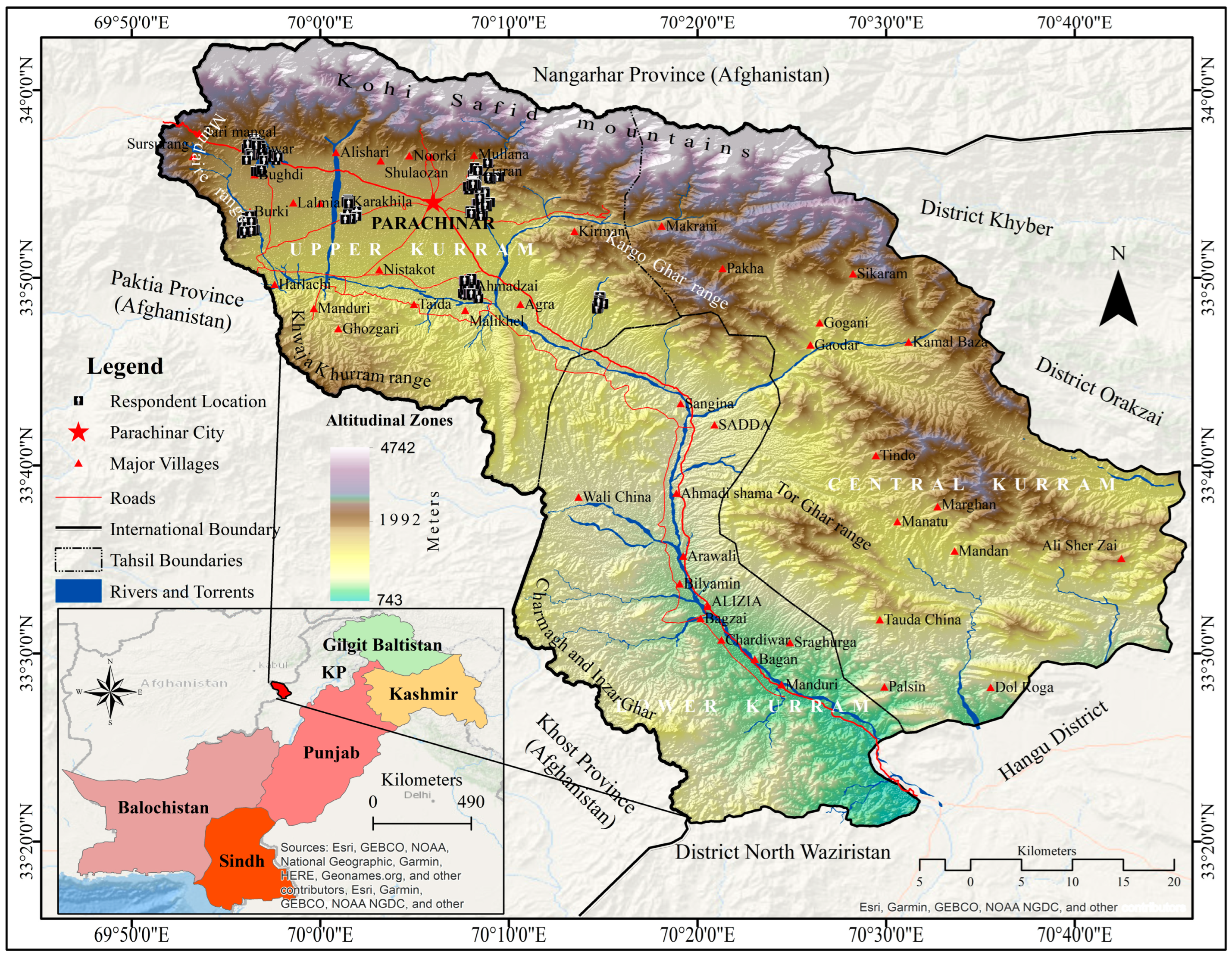
The current investigation has been carried out in District Kurram, situated in the northwestern mountain belt of Khyber Pakhtunkhwa Province. It encompasses an area of 3380 km2, and is located between 33°20′ to 34°10′ N latitude and 69°50′ to 70°50′ E longitude. This district shares its northeastern border with the tribal districts of Khyber and Orakzai, an eastern boundary with Hangu District, and a southeastern border with the tribal district of North Waziristan, while being enveloped by Afghanistan to the north, west, and southwest (Figure 1). Administratively, the district comprises three Tehsils: Upper, Lower, and Central Kurram. The upper Kurram tehsil is predominantly inhabited by the Turi tribe, and the lower Kurram by the Bangash and Turi tribes, whereas the central Kurram is primarily home to the Para Chamkani, Massuzai, Ali Sherzai, and other tribal communities [17,41].
Bordered by towering mountain ranges on three sides, District Kurram is nestled amidst a formidable mountain range, notably the Koh-e-Safed or Spin Ghar range, boasting an average height of 3600 m above mean sea level (m a.s.l.) [42]. This majestic range is often enveloped in snow throughout the year. Serving as the natural demarcation between Pakistan and Afghanistan, these mountains are adorned with lush coniferous forests at higher altitudes, while oak forests cover their lower elevations and foothills [43]. In contrast, the southern mountain ranges, including Charmagh and Tor Ghar, exhibit lesser elevations, characterized by scattered patches of oak forest, sparse vegetation, scrubland, and shrubbery. The majority of human settlements are inhabited along the valleys’ alluvial fans, where the availability of flat terrain coincides with a continuous water supply. The hills and mountains serve as vital resources for grazing livestock and gathering firewood, reflecting the close interdependence between human populations and the surrounding natural landscape [44].
The temperature and rainfall patterns within the study area exhibit considerable variation based on aspect and elevation. The northern and western mountains, along with the Parachinar plateau, receive snowfall and endure cold weather during winter, while maintaining pleasant conditions during summer. Conversely, the southeastern regions, characterized by lower elevations, do not experience snowfall and exhibit comparatively milder winter conditions. During the winter months of December, January, and February, the mean minimum temperature remains below the freezing point, and the maximum below 13 °C. Contrarily, June emerges as the warmest month, with a mean maximum temperature of 30.9 °C [45].
Historically, District Kurram was part of the Mughal Empire. However, following the empire’s decline, it became part of the Kingdom of Afghanistan. The Turi, the leading tribe inhabiting Kurram, lived as an independent tribe. The rulers of Afghanistan made several attempts to bring the Turi tribe under their control but were initially unsuccessful. From 1818 onwards, several military expeditions were sent approximately every five to six years for revenue collection by Payanda Khan, a Barakzai ruler of Afghanistan. These efforts eventually led to the Turi tribe being brought under the direct control of Kabul in 1848, marked by the appointment of a governor in Kurram Valley [46]. The Turi were unhappy with the tyrannical behavior of the Afghan governors, leading them to support the British Army during the Second Anglo–Afghan War. They demanded that the British government free Kurram from Afghan influence. On 7 October 1880, Major General Watson announced the independent status of Kurram Valley. However, this independence was short-lived due to lingering hostilities among local people, exacerbated by Afghan governors’ policies. Finally, in 1892, the British government integrated Kurram as an agency into British India [47,48]. Upon the partition of India in 1947, Kurram became part of Pakistan and was administered as a Federally Administered Tribal Area (FATA) until 2017. Subsequently, it was integrated into Khyber Pakhtunkhwa as Tribal District Kurram, along with other tribal agencies [45,49].
In District Kurram, forests are regarded as communal assets and have traditionally been apportioned among the villages and tribes inhabiting the area. The upper and lower Kurram are settled tehsils, with the first settlement operations carried out during the British era in 1904-05 and subsequently in 1944-45 [47,50]. A close examination of these assessment reports reveals that all areas covered by natural forests were categorized as wastelands under communal ownership. These forests are owned by different villages and communities living in the vicinity. Both Upper and Lower Kurram have communal de jure rights, maintain comprehensive official and revenue records, with communal ownership of village forests documented in File 49D for Upper Kurram and File 49L for Lower Kurram [51]. These files meticulously demarcate the forest areas of each village and provide detailed descriptions alongside sketches. Boundaries for each village forest are supported by testimonies and affidavits from respective village Malaks. Figure 2 presents an example of such demarcation and testimonies (Figure 2). In Central Kurram, however, no such revenue records exist. Despite this, a communal de facto ownership system prevails, where forests in proximity to villages and tribal areas are claimed by the respective communities. While many villages have demarcated their forest boundaries, disputes regarding boundary demarcation persist in several areas [49].
The state institutions, including the forest department, have no role in managing these communal forests. Instead, communal autochthonous institutions regulate and manage all forest related practices such as access, harvesting, and protection measures. However, a small portion of forest located in the Spina Shaga area at the foot of Sekaram Sar (highest peak in the Koh-e-Safid range) was handed over to the British government in 1929 by the elders of village Pewar for conservation purposes [52]. This area remained a full-grown forest with large and tall trees until the 1970s. The bona fide residents of Village Pewar were entitled to extract timber subject to proper permission from the government. However, this forest was widely harvested after the 1980s during the Russian–Afghan war when a large number of refugees immigrated to District Kurram. This forest still falls under the jurisdiction of state property and is managed by the forest department [49].
In our previous study [39], we explored the temporal variation in forest cover change and its driving forces in Kurram Valley. The temporal span of this study was 1972 to 2019 and further divided into three sub-periods, i.e., period 1 from 1972 to 1987, period 2 from 1987 to 2000, and period 3 from 2000 to 2019. More than 33% of the area was covered by forest in 1972; however, this rapidly declined to 21% in 1987 and 19.9% in 2000; onward, the deforestation rate reduced and the forest cover remained at 19.2% in 2019. The annual deforestation rate was 2.4% in period 1, 1.2% in period 2, and 0.2% in period 3. The main driving force behind this high deforestation rate in the early two periods was the influx of Afghan refugees due to the Russian invasion of Afghanistan in 1979. The number of refugees settled for more than two decades in Kurram Valley exceeded 3.5 million, which was more than the local population at the time. These refugees had many adverse impacts on local socio-economic and ecological conditions, natural resources, and their management systems. They widely utilized the natural forest illegally for domestic and commercial purposes. Thus, hostilities evolved between the local population and refugees, which led to a severe sectarian crisis in Kurram Valley. They deteriorated the local management practices of forest resources, which resulted in an increase in the deforestation rate. These refugees were relocated from District Kurram to other districts in the early 2000s and thus, pressure on the forest was reduced. Onward, the deforestation rate reduced and management systems were reactivated in most of the affected villages, although local inhabitants are also heavily dependent on fuelwood for domestic energy consumption. Due to the limited availability of other energy sources, fuelwood is used in kitchens of more than 90% of households [45]. The prolonged winter season exacerbates this dependence, as large quantities of fuelwood are required for space heating. Most of this wood is extracted and collected from local forests. However, the local inhabitants sustainably utilize their forest resources, maintaining balance between social need and ecological requirement, which is clear from the fact that the local population has increased to many times greater than it was during 1980s and 1990s, but deforestation rate has reduced considerably. The present rate of deforestation can better be attributed to mismanagement of forest in certain localities. Detailed descriptions of further in-depth understanding are available in the references [41,44,45,49,53,54].

2.2. Selection of Sample Villages/Mouza

For this study, six sample Mouza1 [55], i.e., Jalandhar, Pewar, Ziran Yousaf Khel, Ahmadzai, Karakhila, and Burki, were selected based on purposive sampling procedures from Kurram Valley (Figure 1; Table 1).

2.3. Data Collection

This research is qualitative and exploratory in nature and does not include longitudinal ecological measurements or systematic spatial analysis. Therefore, data was collected through personal observation, respondents’ interviews, and focus Ggroup discussions (FGDs). Both structured and unstructured questions were utilized during the interviews and FGDs, covering a range of topics, including the formation of the ownership system, autochthonous institutions, their responsibilities, conservation practices, utilization mechanisms, traditional law, appointment of the stewards/watchmen and patrolling guards, resource dependency, forest degradation, local conflicts over forest resources, etc.

2.3.1. Personal Observation

The principal author is a bona fide resident of the study area. He has closely observed forest management, conservation, and utilization practices in Kurram Valley for more than three decades. He has remained a part of the system and participated in management and conservation practices. He has utilized the forest wood for domestic energy requirements and is well aware of forest-related practices, past and present conditions, and changes over time. However, he belongs to one of the sample villages, his knowledge is primarily limited to the forest resources of that particular village, and he has limited awareness of forest conditions in other villages. Using his observation and local knowledge, he collected data from other knowledgeable elders in all the sample villages through interviews and group discussions, which reduced the chance of positioning or confirmatory bias in personal observations.

2.3.2. Individual Interviews

Interviews are the most significant data collection tool in qualitative research because they enable researchers to explore participants’ experiences, perceptions, knowledge systems, and social realities in depth [56]. Data were collected through individual interviews during the field survey conducted in 2019. For this purpose, knowledgeable household heads aged 60 years and above were selected through a snowball sampling procedure. This technique is helpful in identifying specific persons. These elderly individuals were selected based on their knowledge regarding the past and present state of forest resources. Mostly these individuals remained members of traditional governing institutions and had an active role in forest management and conservation practices. A total of 42 household heads were interviewed from all the sample villages. This number of interviews is sufficient for understanding the system. The number of interviews was different in sample villages due to their household and population sizes. Five knowledgeable persons, who remained the village elders, were interviewed from each of Burki, Karakhela, and Jalandhar, respectively, seven persons from Ahmadzai, and ten each from Pewar and Ziran Yousaf Khel. These individuals were formally informed that the data collected through these interviews would be used purely for academic research. With their permission, the interview of each elder was recorded on an audio recorder, which was cross-checked with focus group discussions for more accurate results.

2.3.3. Interviews with Revenue and Forest Officials

Interviews were also conducted with the revenue officials (Patwari) appointed in sample villages and government forest officials for confirmation and validation of previously collected data. The topics of forest ownership, historical and present situations, and the role of the forest department in management and conservation systems were discussed.

2.3.4. Focus Group Discussions

Data was collected in the sample villages through 16 FGDs with knowledgeable elders of each sample village. Two FGDs were arranged in Jalandhar, Karakhela, and Burki, respectively, three each in Ahmadzai and Pewar, and four in Ziran Yousaf Khel based on the sample villages’ populations and numbers of households (Table 1). During the discussion, both structured and unstructured questions were asked regarding the same topics described in Section 2.3. The discussions were audio-recorded for further analysis.

2.3.5. Unmanned Aerial Vehicle (UAV) Data

Unmanned Aerial Vehicle (UAV) data were also acquired using a DJI Mavic 3 drone for identifying specific forest conditions in certain areas. The UAV images were used as supplementary data, supporting field observations of forest conditions and management practices. These high-resolution images helped in identifying different canopy cover and signs of disturbances and conservation in selected locations. These were used to make qualitative comparisons between areas with differential levels of community governance, where areas of relatively better forest condition were observed to be under stronger institutional regulation or sacred groves. UAV imagery-based detailed spatial or temporal analysis was beyond the scope of this study. Moreover, the UAV data contributed to triangulation by linking governance practices with observable ecological patterns.

2.4. Data Analysis

As already mentioned, interviews and FGDs were recorded on an audio recorder for subsequent processes. The analysis of the data was carried out through a systematic manual review of recordings of interviews and FGDs using a thematic analysis approach. These recorded interviews and FGDs were listened to several times to ensure familiarity with the content and to capture context-specific meanings. During this process, key statements, recurring issues, and locally significant explanations related to forest governance practices, institutional roles, and resource use were noted and organized in field notebooks. Similar viewpoints and commonly shared understandings across participants were then grouped together to identify broader patterns in community perceptions and management systems. These emerging patterns were further interpreted in light of the researcher’s direct field observations and long-term engagement with the study area. A comparative cross-village analysis was also undertaken to examine variations in governance effectiveness and forest use practices across different social and ecological contexts. In order to ensure the credibility of the results, the technique of triangulation was used by comparing the information obtained through interviews, group discussions, direct observations, and secondary sources of information, including UAV images, where applicable. Contradictory ideas and differences in context were also taken into consideration in the analysis to prevent overgeneralization of the results and to present a more nuanced view of the outcomes of community-based forest governance.

3. Results

3.1. Conservation System

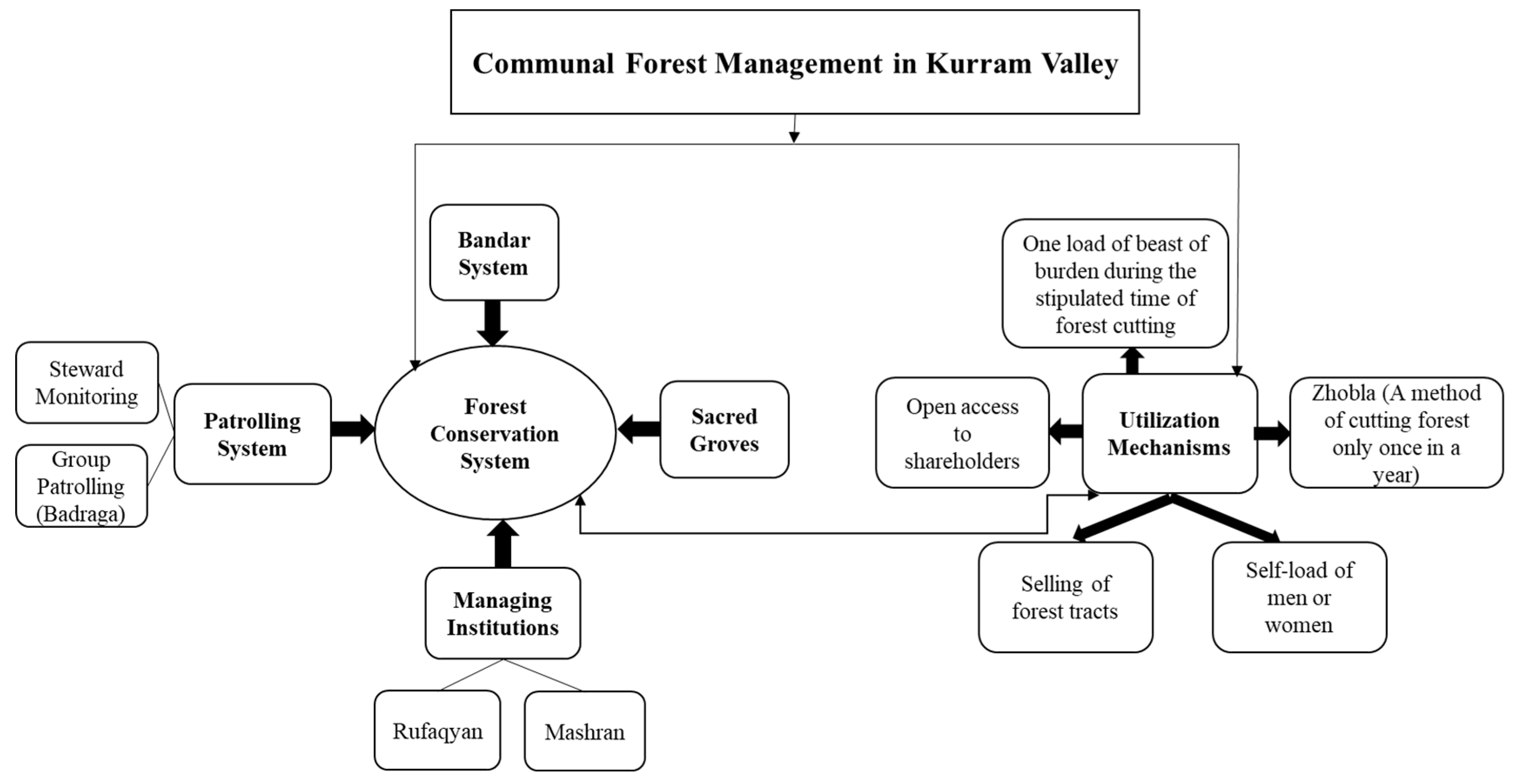
The forest conservation system is deeply rooted in local governing institutions, area-specific conservation strategies, and sustainable utilization mechanisms (Figure 3). The owner communities have established village-based resource governing institutions. They actively monitor the forest to protect it from illegal harvesters and implement conservation measures by designating certain forest parcels where cutting is prohibited. Meanwhile, they allow sustainable utilization of other parcels. This balanced approach helps ensure the long-term health and availability of forest resources.

3.2. Local Managing Institutions

For the effective management and conservation of forest resources in District Kurram, local inhabitants have established various institutions. The primary governing body in each village is known as the Mashran, comprising a group of elderly individuals, each representing a distinct section (Plarina2 [57]) of the village. The Mashran oversees village or community management, including the day-to-day activities and resource management. Additionally, specialized sub-institutions have been established to manage water, land, and forest resources, operating under the oversight of the Mashran. The institution responsible for forest management is locally referred to as the Rufaqyan. The Rufaqyan plays a central role in conservation by ensuring the careful management and sustainable utilization of forest resources across numerous villages. This institution is dedicated to implementing policies and strategies aimed at preserving and responsibly exploiting the forest ecosystem for the benefit of the community. Its establishment is formalized within the village Mashran assembly (Maraka3 [58,59,60]), wherein representation is afforded to each Plarina Mashar (single member of the Mashran assembly). The selection of Rufaqyan members is commonly based on a rotational framework (with some variations from village to village), wherein households take sequential turns, with exceptions granted to widows and orphans. Nomination of Rufaqyan members is generally organized by village Mashran from their respective Plarina, often following a rotational protocol. Alternatively, selection criteria may include voluntary interest or considerations of experience and aptitude. The rotational and representative nature of membership appears to strengthen institutional legitimacy, collective ownership, and compliance with forest-related rules across different villages.
Each Plarina is duly represented within the Rufaqyan, with membership tenure spanning from 1 to 3 years; however, variations exist among villages. Notably, members of the Rufaqyan serve without remuneration. Instead, they are authorized to levy fines on violators, the proceeds of which are subsequently distributed among committee members. Moreover, in selected villages, fines may also be allocated towards administrative expenses. The use of fines both as a deterrence and as institutional incentives implies the existence of locally evolved enforcement and accountability mechanisms that could play a positive role in forest resource regulation.

3.3. Bandar System

The Bandar system represents a prevailing method of forest conservation widely practiced across villages in District Kurram. Under the guidance of the Mashran, the Rufaqyan is empowered to assign a specific tract/parcel of forest for conservation, typically ranging from 10 to 30 years. Upon designation, the identified parcel is demarcated and a prohibition on cutting is enforced within the village. In certain villages, the holy Quran is ceremoniously circulated around the designated area, reinforcing to villagers the sanctity of the conservation efforts and warning of divine retribution for violators.
The Bandar system holds significant respect and adherence from villagers, who rely on alternative forest parcels to meet their domestic needs during the conservation period. This system is notably practiced in sample villages such as Pewar, Burki, Ziran Yousaf Khel, and Jalandhar, with Ahmadzai having formerly adopted this practice, although presently lacking any management systems. The Ziran Yousafkhel stands out for its tight enforcement of a complete ban on forest cutting for over 30 years. In Pewar, a selective approach is taken, with some forest parcels reserved for conservation while others are opened for cutting. Upon the maturation of a conserved forest parcel (Bandar), it is opened for use while another parcel is assigned for conservation. This system supports forest regrowth by providing sufficient recovery time to a selective forest parcel before its reopening to harvesting. This system reflects the struggle to maintain a balance between livelihood needs and resource sustainability.

3.4. Patrolling System

For the protection of Bandar and other forest parcels, the Rufaqyan initiates patrolling through a patrolling group based on timely needs, locally referred to as a Badraga4. A Badraga constitutes a prevalent conservation system across the majority of villages in the study area cf. [61,62]. Generally comprising four to five members selected on a rotational basis, patrol groups undertake the task of monitoring and safeguarding forest areas against illegal logging. Each household is required to contribute a laborer to the patrol group on a rotating schedule, with exceptions made for widows and orphans. Households unable to provide laborers due to exceptional circumstances are obligated to cover a labor cost according to the prevailing time. In many villages, patrols are primarily conducted during the winter season, coinciding with the peak period of illegal logging. However, in selected villages, patrols are not restricted to a specific season and are conducted intermittently throughout the year. In some villages, stewards are appointed by the community to oversee and protect the forest, receiving monetary compensation ranging from PKR 15,000 to 20,000 per month, collected on a per-household basis. The responsibilities of stewards include conducting daily patrols to monitor and safeguard the forest. Violators apprehended by patrol groups or stewards face penalties, the severity of which is determined by the nature of the offense and at the discretion of the patrol group or steward. Any fines collected are distributed among the members of the patrol group on duty.

3.5. Utilization Mechanisms

The forest in Kurram Valley is traditionally and historically utilized by local communities in a sustainable manner, following several indigenous rules and regulations. Commonly, the utilization of forest resources in Kurram Valley employs five distinct mechanisms:
  • One load of beast of burden per household during the stipulated time of forest cutting.
  • Zhobla (A method of cutting the forest only once a year).
  • Self-loads of men or women.
  • Selling of forest tracts.
  • Open access to shareholders.

3.5.1. One Load of a Beast of Burden

In this method, beasts of burden (i.e., donkeys, mules, and horses) are employed for wood collection; each co-owner household is permitted only one load per day. The use of tractors or alternative transport facilities for collecting forest wood is prohibited. This traditional method has persisted for an extended period due to limited road access in many forested areas, necessitating reliance on beasts of burden for transportation. This practice remains prevalent in numerous villages within Upper and Lower Kurram, as well as in the majority of villages in Central Kurram. In this mechanism of forest resource utilization, the Rufaqyan convenes a meeting, consulting with village elders, to decide on opening a tract or portion of the forest for wood collection. They also determine the starting date and duration, typically specifying the number of days for tree felling. The Rufaqyan then announces the decision in the village one day prior to the scheduled cutting date.
In District Kurram, not every household keeps beasts of burden, posing challenges for collecting wood during designated forest harvesting periods. To address this issue and ensure equitable utilization of forest resources, the Rufaqyan has implemented a system to subdivide the allocated harvesting time. Historically, village authorities divided the allocated time for wood collection into two equal periods. The first period was reserved for households with draught animals, while the second was designated for those without. Under this system, households without draught animals would seek assistance from animal owners. Through the prevailing cooperative system (locally known as Pagara5), many neighboring households share labors and beasts of burden on a single predetermined date within the designated harvesting period. The stipulated number of wood loads was delivered on behalf of the requested household. However, extra loads were not permitted. The host family would typically serve a lavish lunch to the Pagara members, but this system has largely diminished in recent times.
Presently, the Rufaqyan divides the stipulated time into four to eight short periods, each spanning two to five days, across many villages. The initial period is assigned to owners of beasts of burden, while subsequent periods are allocated to households without such animals. This rotation between animal owners and non-owners continues repeatedly during the stipulated time of forest harvesting. Within this framework, after meeting their own wood-collection quotas, animal owners bring additional loads to households without animals during their designated period. However, these additional loads are not brought voluntarily. Instead, animal owners levy a fee per load or provide one load to households without animals and retain another load for themselves as compensation. This system ensures equity in wood collection among all households by the end of the forest cutting period.
The following are some common rules that are followed while collecting fuelwood from the forest:
(i)
There is a specific season for forest cutting, usually during autumn and winter, while abstaining from cutting during the flowering season.
(ii)
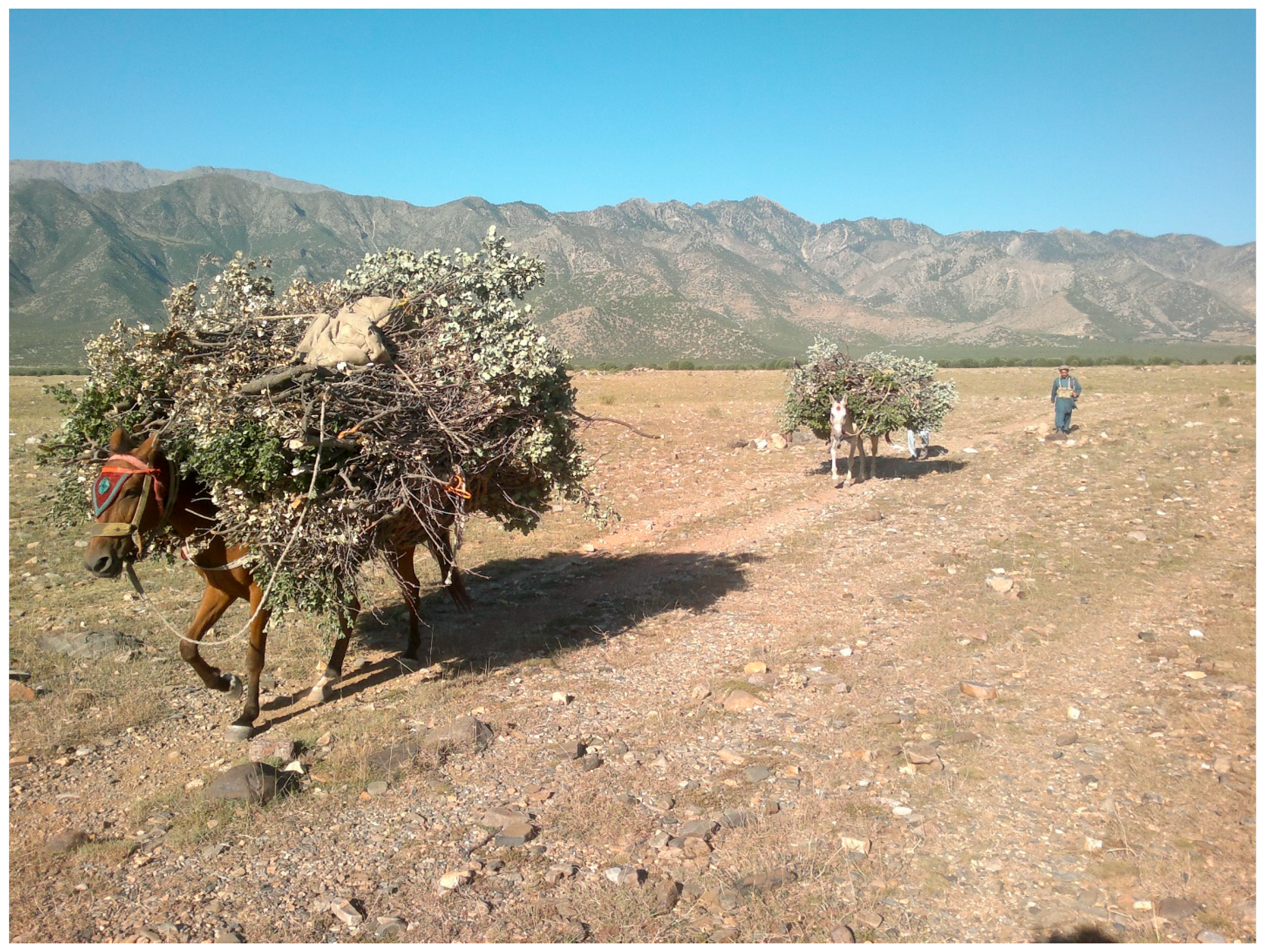
Each household is permitted to bring only one load per day, using a mule, horse, or donkey (Figure 4).
(iii)
Due to conflicts between different sects and tribes resulting in enmities, individuals are encouraged to carry weapons for self-defense, although this rule may not be universally implemented across all villages (Figure 4).
(iv)
A collective security guard system, known as a Badraga, is activated to patrol around villagers, with some members stationed on mountain peaks to guard against external threats during forest cutting. This system is common in villages located near the western border with Afghanistan, such as Pewar, Bughdi, Shalozan, and many others in Central and Lower Kurram.
(v)
The duration for wood collection from the forest is generally fixed between 10 to 20 days for each household, or as determined at the Rufaqyan’s discretion.
(vi)
The Rufaqyan also specifies rules and regulations for tree cutting. For instance, they determine a specific height of tree below which cutting is forbidden, meaning that trees cannot be cut near their roots. The rules are flexible; sometimes only one axe is allowed for cutting, and at other times, cutting is completely banned and only dry wood collection is permitted. These regulations are adjusted according to the needs of the community and the condition of forest.
(vii)
Adherence to the established rules is mandatory for all individuals. In cases of non-compliance, the Rufaqyan imposes fines commensurate with the severity of the infraction. These fines are collected by committee members from the designated household elder and are allocated toward meeting expenses and facilitating travel related to forest affairs. Occasionally, fines collected are distributed among Rufaqyan members, as they do not receive salaries for their services. However, individual villages may adopt unique mechanisms for fine collection and allocation.
Figure 4. Fuelwood is transported by beasts of burden from the forest located in the vicinity, with local harvesters walking alongside and armed with guns for security purposes, in the village Pewar Sharmukhel. Source: Photo © Kamal Hussain, December 2019 at Village Pewar Sharmukhel.
Land 15 00603 g004

3.5.2. Zhobla

Zhobla is a unique system of fuelwood collection practiced solely in the village Burki, located north of Kharlachi village on the entrance of the river Kurram from Afghanistan. Under this system, a single designated individual from each household is granted the freedom to cut trees for a fixed duration without interruption. This privilege cannot be transferred to another individual. Initially, the time allotted for harvesting was 5 to 6 h. However, with the rise in population and numbers of households, placing greater pressure on the forest, the duration has been reduced to 3 to 4 h. This system is practiced every year or every third year based on the villagers’ needs and forest conservation concerns, decided by the Rufaqyan. Prior to commencement of harvesting, the Rufaqyan determines the allocation of a specific forest parcel for cutting. The parcel is subdivided into sections, with each section assigned to a Plarina. Subsequently, each Plarina parcel is further divided into subsections allocated to group or individual households for tree cutting. All households are obligated to conduct tree cutting within their designated subsections during the specified timeframe. Households typically endeavor to hire skilled laborers capable of maximizing tree felling within the allotted time. Compensation for laborers is negotiated between the household elder and the hired laborer, usually in cash. Following cutting, family laborers gather the fallen trees, load them onto tractors, and transport them to their respective homes. The collected wood often proves insufficient to meet the household’s annual fuelwood needs. Historically, villagers sourced additional wood from Afghanistan before 2007. However, with the subsequent ban on Afghan wood imports, villagers have resorted to harvesting trees from their farmland or purchasing wood from the market.

3.5.3. Self-Load of Men or Women

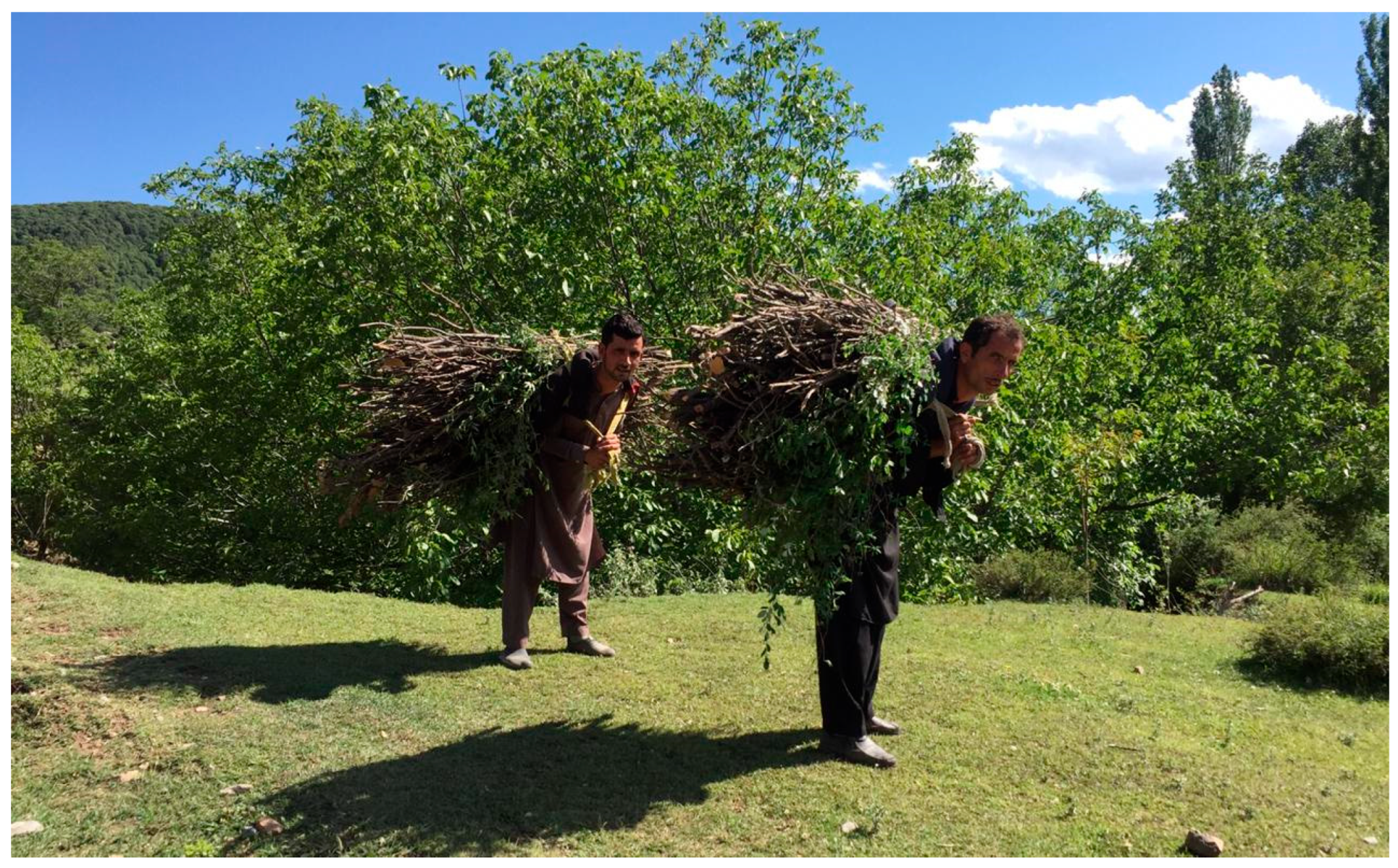
The self-load mechanism involves villagers, both men and women, transporting wood on their backs from nearby forests (Figure 5). This method typically imposes minimal to no restrictions on the co-owners regarding wood collection, as mostly dry wood is gathered for domestic use. In selected villages, limitations on the number of loads per day have been implemented, allowing individuals to carry only one load each day, but these regulations have flexibility and change over time. However, in many other villages, there are no regulations governing the schedule or quantity of wood loads, allowing unrestricted collection as needed. This mechanism is widely practiced in numerous villages across Central Kurram and in a selected few villages of Upper and Lower Kurram. However, it is commonly not permitted in those villages where Zhobla and loads via beasts of burden are practiced.

3.5.4. Sale of a Forest Tract to Contractors

In this system, villagers opt to sell a parcel of forest to contractors after conserving it for a certain duration. This practice is commonly employed to generate funds for specific communal projects, such as constructing a mosque, Imam Bargah, water channels, or other major communal tasks. In some cases, the cash generated is distributed among the co-owners. In villages with strong conservation systems, a formal agreement is established between the contractor and the Rufaqyan, under the auspices of the Mashran, detailing the terms and conditions for tree cutting. Conversely, in villages where institutional structures are weak, no restrictions are imposed.
If the forest is located on high mountain slopes and inaccessible for vehicles, a road is constructed before felling trees. Afterward, all trees are felled within the designated parcels of land. The harvested wood is then either sold on-site, per tractor load or mound, or transported to the wood market for further sale. After the complete removal of trees, the villagers designate the area as Bandar once again. However, contractors frequently cause extensive damage to the forest through clear-cutting, resulting in a prolonged regeneration period. Forest tracts that have been sold often face significant challenges in recovery if not protected by the Bandar system, as continuous cutting and overgrazing severely hinder regrowth.

3.5.5. Open Access

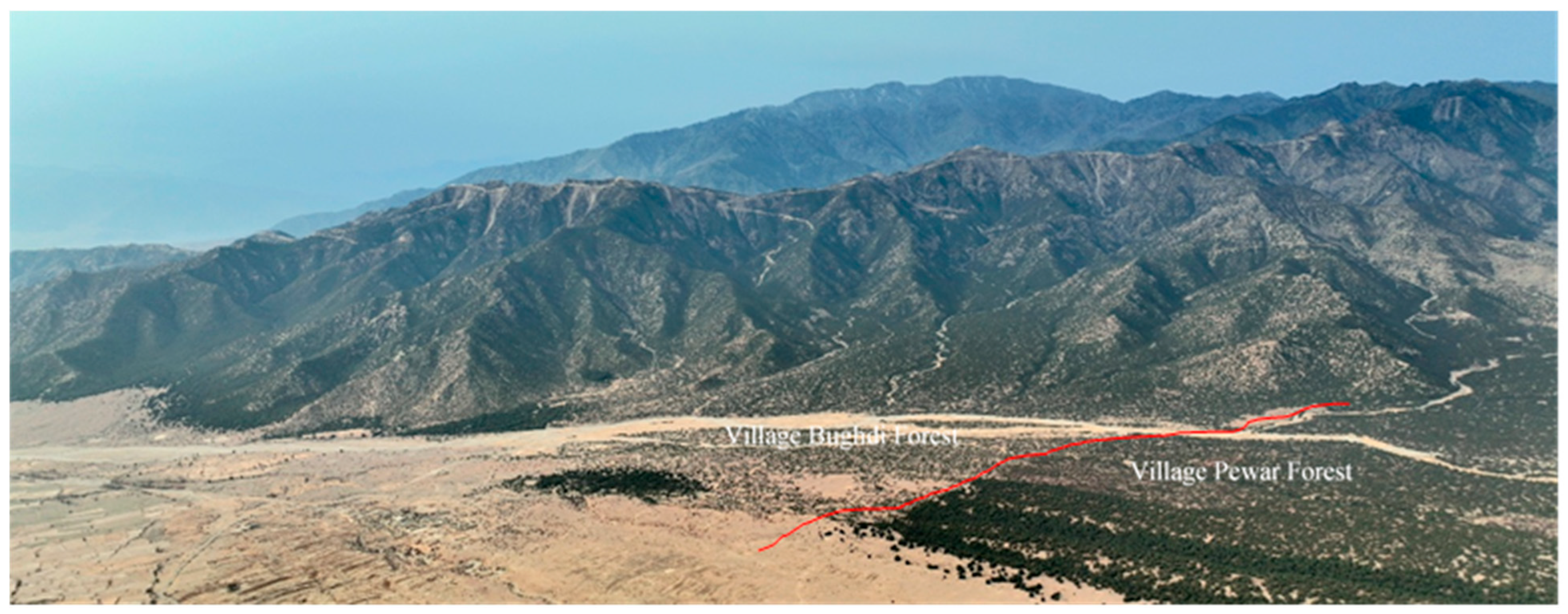
In several villages within the study area, forest management has weakened or vanished, and villagers utilize their forests under an open-access mechanism where no restrictions are imposed. For instance, in Ahmadzai, the forest is utilized without oversight from a Rufaqyan or established security structures, and traditional rules are no longer observed. This lack of management has resulted in unrestricted cutting and removal of trees, leading to heightened illegal activity within these forests. Another example is Bughdi village, situated south of Pewar, where residents freely collect wood from the forest without any restrictions. Consequently, trees in accessible low-altitude areas have been cleared (Figure 6). However, some forest parcels located on high-altitude slopes, which have been conserved under the Bandar system, still remain intact. Similarly, in the rangeland area of Lower Kurram, forest patches exist that are harvested without any restrictions. Villagers in Lower Kurram rely on these rangeland trees to meet their domestic needs.

3.5.6. Sacred Groves

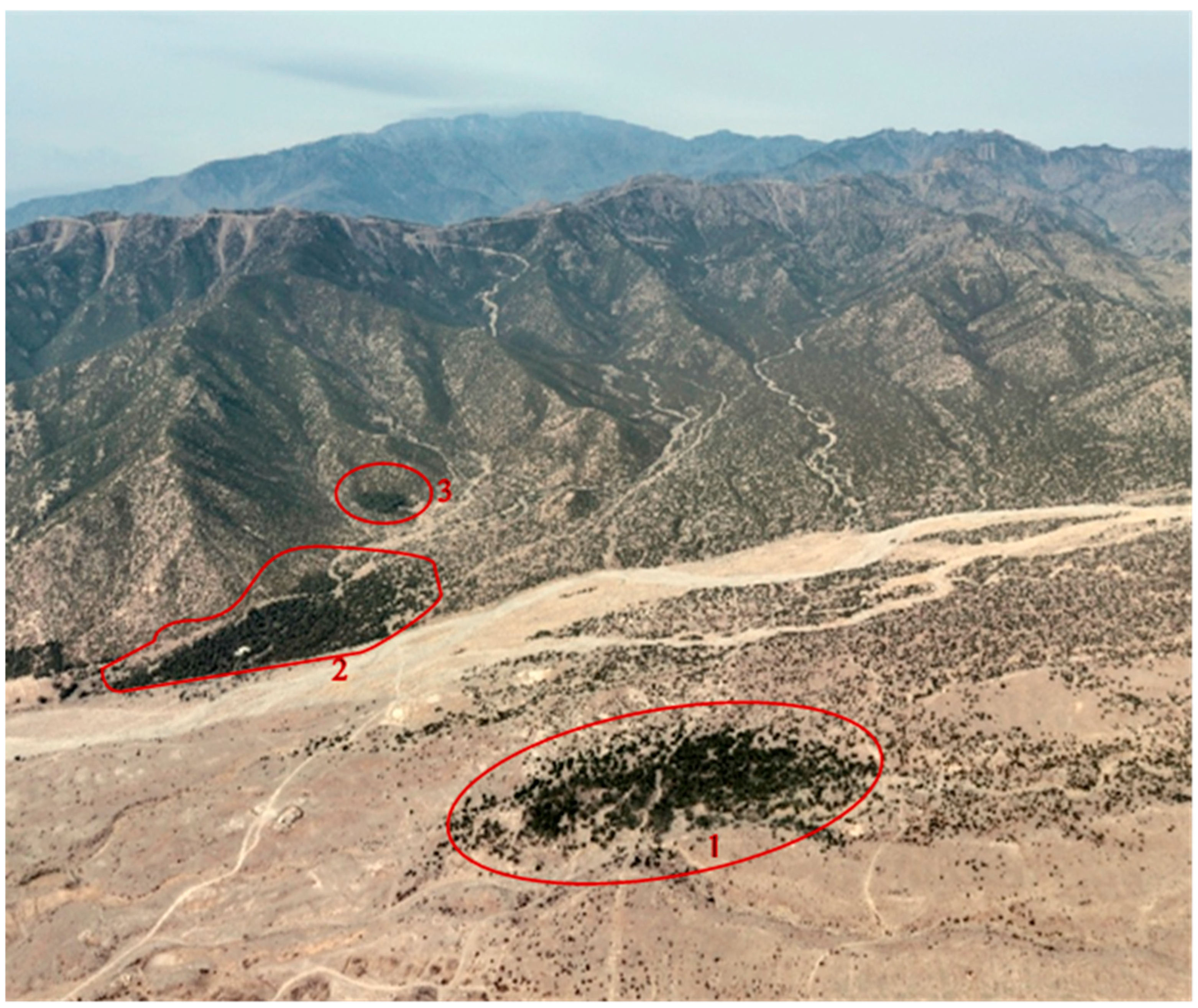
It is common practice in District Kurram that the cutting of trees on graveyards or near the tombs of saints or other holy places is culturally and morally restricted. These sacred groves are found in most of the villages. An example of the sacred groves is shown in Figure 7, where three forest spots are highlighted with red circles. Spot 1 is a graveyard, spot 2 is sacred place associated with twelve Imam of Shai sect of Islam, and spot 3 is also a sacred place associated with Hazrat Ali (Aliahi salam; the 1st Imam). These tracts are thickly covered with forest mostly consisting of old trees without any cutting for long time. The surrounding area was also covered by forest but due to unrestricted cutting it has been cleared and only the sacred groves still remain (Figure 7).

4. Discussion

The TEK-based forest management system in Kurram Valley has been investigated in this study. The results reveal that forest conservation practices operate in a systematic way, where communal ownership, traditional governing institutions, and complex safeguarding mechanisms contribute to the sustainable utilization of forest resources. These components of management system (ownership, governance, monitoring, protection, and sustainable utilization) are interconnected and function in a systematic, dynamic, and flexible manner protecting both the ecology of the area and the livelihood strategies of the community. The results are in line with many micro-level studies conducted in marginalized and resource-dependent communities around the world [19,63,64,65,66].
Communal ownership has played a central role in forest conservation practices in Kurram Valley because it has empowered community members and shareholders to play active roles in decision-making processes cf. [67,68]. These decisions, often more democratic in nature, flexible, and context-oriented, have enabled the community to respond efficiently to ecological, social, and economic challenges. The findings are similar to the studies of Agarwal, [69], Akamani, [66], Awazi, [70], and Hodgdon, [71], who have highlighted that communal ownership enhances the accountability and resilience of forest management systems, specifically in resource-dependent communities. Similarly, the autochthonous governing institutions, i.e., the Mashran and the Rufaqyan, play a vital role in implementing conservation measures and monitoring sustainable utilization of forest resources cf. [72]. Their duties and struggle to enforce traditional law, mediate intra- and inter-village disputes, and ensure that all shareholders have equitable access to resources cf. [73,74], demonstrate the strength of the system. The responsibilities of the Rufaqyan, in particular, to oversee the forest governance, including the operation and monitoring of patrol groups in terms of need and task assigned, to harvest monitoring, to ensure security through the Badraga, and to impose fines in cases of non-compliance further highlight the seriousness of the community regarding forest conservation and the strength of the system, which closely align with the design principles of Ostrom’s [38] common pool resource institutions. The efficiency of these governing institutions highlights the capabilities of communities to self-organize and manage their resources sustainably without the presence of the formal state mechanism cf. [75]. The findings of this study regarding the presence of voluntary communal resource management mechanisms support the broader scientific findings of scholarly work, which acknowledge that traditional governing systems are capable and resilient for natural resource management [76,77,78,79,80].
The Bandar system, similar to the communal reserved forest in the studies of Agrawal & Ostrom, [81], Chhatre & Agrawal [82], and Wilkie & Painter [83], is an example of the proper conservation practices of forests in Kurram Valley. The combination of religious and spiritual norms and rituals further strengthens the Bandar conservation system cf. [84]. Moreover, sacred groves contribute to forest conservation in Kurram Valley, as their religious and cultural importance discourages all types of tree cutting within these sites. Gadgil et al. [85] highlight the critical role of sacred groves or taboos in biodiversity conservation, reflecting that cultural and religious-based enforcement practices are similar among indigenous communities around the world. Furthermore, the Badraga or patrolling system provides protection to forest areas from illegal harvesters. The rotational patrolling of community members and the appointment of a steward for monitoring and protection not only reduces illegal practices but also enhances a sense of stewardship and collective responsibilities among shareholders cf. [86,87,88].
The different utilization mechanisms of forest resources in Kurram Valley, including one load per household, Zhobla, and self-load, also play a significant role in preventing unsustainable cutting. These mechanisms exhibit a deep sense of environmental sensibility, reflect in-depth consideration of sustainable harvesting, and ensure forest cutting within sustainable limits providing the chance of continuous regeneration. Scientific studies such as Gilmour & Fisher [89], Tole [64], Dhungana et al. [90], and Dhungana et al. [91] have also investigated the vital role of community-managed utilization for maintaining sustainability of forest resources in their respective study areas. Moreover, the mechanism of equitable distribution, particularly the system adjusting households without beasts of burden, reflects fairness and social equity of community in resource utilization cf. [92].
Despite the significance of the traditional management system, this study brings attention to emerging vulnerabilities confronted to this system. With the passage of time, the weakening and inefficacy of these institutions have been reported from few villages in Kurram Valley, which has resulted in rising incidents of illegal forest cutting, unregulated utilizations, and consequent forest degradation. The main driving forces of weakening in this governing system include change in livelihood strategies, reduction in dependence on forest resources due to growing market-based income alternatives, labor shortage and outmigration, etc. cf. [93,94,95]. This transition is similar to the worldwide trend of rural modernization, which leads to the erosion of traditional management practices, resulting in an open-access governance system that is more vulnerable to illegal harvesting and exploitation [96,97,98]. For example, the results of this study highlight that though study villages, i.e., Jalandhar and Ahmadzai, actively participated in all types of management practices of forest resource until the 1990s, their efficiency has since reduced, leading to increasing deforestation and forest degradation. On the other hand, the villages Pewar and Ziran, with a strong management system, still have existing forest which has been conserved for generations. Studies have reported similar enforcement mechanisms in other parts of the world, including Nepal and Mexico, where community management has contributed to forest regeneration and to a drop in illegal timber extraction [89,99,100].

Study Limitations

The study has certain limitations in data availability and interpretation of the results, including 1. It is based on qualitative data (interviews, focus group discussions, and field observations), and does not include detailed quantitative ecological measurements such as temporal changes in forest cover etc.; 2. The spatial coverage of the study is limited to selected villages, which may not fully represent variability across the wider landscape; 3. Establishing a clear causal relationship between traditional governance practices and forest conservation outcomes is challenging, as other factors such as remoteness, population pressure, and market accessibility may also influence forest conditions; 4. Given its exploratory and descriptive design, the study offers limited analytical generalization regarding the broader implications of traditional forest governance systems.

5. Conclusions

The present study, preliminary and descriptive in nature, is an attempt to document TEK and investigate its effectiveness in regulating forest management and conservation practices in Kurram Valley. The study results reveal that TEK-based forest management has been practiced through generations, which has played a significant role in forest conservation. Results highlight the efficient role of local governing institutions (Mashran and Rufaqyan) in managing conservation practices, regulating utilization mechanisms, resolving disputes, ensuring equitable distribution of forest resources, enforcing traditional law, providing security to shareholders during forest harvesting, and being responsible for collective accountability. The results indicate that the local community has unique, area-specific conservation (Bandar) and protection (Badraga) systems that have prevailed across generations and are still functional in most of the villages. This system helps to maintain regrowth in harvested areas and prevents unwanted exploitation. The prevailing utilization practices of forest (one load of beast of burden per household, Zhobla, and self-load) help to prevent unsustainable wood extraction, function in a flexible way, and adopt changes with time subject to socioecological demands. Overall, the TEK-based forest management systems have been in practice for a long time and is still functional in Kurram Valley, promoting sustainability and maintaining balance between community requirements and ecological demands. However, the systems are confronted with modernization and other social challenges, including erosion of institutional authority and concomitant lawlessness, illegal harvesting, and weakening of conservation and protection systems. These issues are threats to the continuity of the prevailing system and emphasize the urgent need to adapt revitalization measures for sustainable conservation of these systems.
Further in-depth understanding is needed on the interaction of the TEK-based forest management system with emerging socio-economic modernization and environmental pressures. For conserving the TEK-based management system, some necessary measures can be taken, including 1. State formal recognition of the system and its integration to forest policy; 2. Empowering and supporting the autochthonous institution in conservation practices; 3. Encouraging collaboration between local institutions and forestry departments for technical guidance on sustainable harvesting and regeneration practices; 4. Encouraging documentation and transmission of TEK to younger generations through community learning forums.

Author Contributions

Conceptualization, K.H. and F.R.; methodology, K.H.; software, K.H. and I.U.; validation, R.H. (Rafiq Hussain), R.H. (Rahib Hussain), and I.U.; formal analysis, K.H.; investigation, K.H. and R.H. (Rafiq Hussain); data curation, F.R., I.U., and R.H. (Rahib Hussain); writing—original draft preparation, K.H.; writing—review and editing, F.R. and U.S.; visualization, K.H.; supervision, F.R., U.S., and I.U. All authors have read and agreed to the published version of the manuscript.

Funding

This research received no external funding.

Data Availability Statement

The new data created and presented in this study are available on request from the first author.

Acknowledgments

The authors sincerely acknowledge the active participation of respondents in providing valuable data, as well as their hospitality and cooperation.

Conflicts of Interest

The authors declare no conflicts of interest.

Notes

1
A Mouza is the smallest revenue estate with a cadastral map and land revenue records. It is a unit of land having its own name, distinct boundaries, and a specific area that is measured precisely and divided into plots. Several names like village, Deh, Killi, etc., are used for Mouza interchangeably. In a Mouza area, there may be one or more villages and some Mouza might be without inhabitants [54]. In this study the terms Mouza and village are used interchangeably.
2
Each clan of the Pashtun tribes consists of several closely related groups known as Plarina. A Plarina is made up of a number of extended families that are connected to one another by a common ancestor, and the members of one Plarina have close relations with one another and are commonly called cousins. A Plarina is a small unit of tribe formation. Usually, members of several Plarina live in single village and share village common facilities, including mosques, water canals, mills, etc. [55].
3
A Maraka is an assembly of village elders for resolving the local disputes. It is somewhat similar to a Jirga and the terms are often used interchangeably, but a Maraka is a local village institution and handles less serious disputes within the village or Khel. Elder members of a Maraka belong to various Plarina of one Khel or village. See [56,57,58] for details on Jirga and Maraca institutions.
4
The term Badraga is not limited to forest patrolling; it refers more broadly to any communal security or guarding group mobilized during emergencies. In addition to monitoring forest areas, Badraga members assume protective responsibilities whenever the community faces potential threats or danger.
5
Before the advent of mechanized agriculture, farming required a substantial labor force. To address this need, residents of a neighborhood would work collectively, sharing family labor. This practice, known as Pagara, was prevalent in various economic activities, including crop harvesting, fuelwood collection from forests, manure distribution to agricultural fields, and house construction when extra labor was needed for a brief period. In the Pagara system, a family needing assistance would request help from neighboring households, usually a day before the planned work. Each household would contribute a laborer, and the work would begin early in the morning, continuing until 2 to 4 p.m. The host family provided breakfast and lunch for the workers. This system was based on reciprocal labor sharing; if a requested laborer did not participate without a valid reason, the host family would decline to share their labor for that household’s future needs. Pagara facilitated mutual support and cooperation within communities, ensuring that labor-intensive tasks were completed efficiently while fostering social bonds and reciprocity among neighbors.

References

  1. Price, M.F.; Gratzer, G.; Duguma, L.A.; Kohler, T.; Maselli, D.; Romeo, R. Mountain Forest in a Changing World—Realizing Values, Addressing Challenges; FAO: Rome, Italy, 2011. [Google Scholar]
  2. Yadav, V.K.; Yadav, S.; Adhikari, B.S.; Rawat, L. Forest Provisioning Services Use Pattern: A Case Study from Renuka Forest Division, Western Himalaya. Small-Scale For. 2022, 21, 55–70. [Google Scholar] [CrossRef]
  3. Hussain, J.; Zhou, K.; Akbar, M.; Raza, G.; Ali, S.; Hussain, A.; Abbas, Q.; Khan, G.; Khan, M.; Abbas, H. Dependence of rural livelihoods on forest resources in Naltar Valley, a dry temperate mountainous region, Pakistan. Glob. Ecol. Conserv. 2019, 20, e00765. [Google Scholar] [CrossRef]
  4. FAO. The State of the World’s Forest 2018—Forest Pathways to Sustainable Development; Food and Agricultural Organization of United Nation: Rome, Italy, 2018. [Google Scholar]
  5. FAO. The State of the World’s Forests 2022. Forest Pathways for Green Recovery and Building Inclusive, Resilient and Sustainable Economies; FAO: Rome, Italy, 2022. [Google Scholar]
  6. UN. The Global Forest Goals Report 2021; United Nations Department of Economic and Social Affairs, United Nations Forum on Forests Secretariat: New York, NY, USA, 2021. [Google Scholar]
  7. Nagar, B.; Kumar, M.; Pandey, R.; Rawat, S. Fuelwood and fodder consumption from agroforestry at different altitudinal zones of Garhwal Himalaya. J. Plant Dev. Sci. 2018, 10, 659–668. [Google Scholar]
  8. FAO. Forest Resources of Nepal: Country Report—FRA 2000; Food and Agriculture Organization of the United Nations: Rome, Italy, 2000. [Google Scholar]
  9. Parrotta, J.A.; Agnoletti, M. (Eds.) Traditional Forest-Related Knowledge and Climate Change: Sustaining Communities, Ecosystems and Biocultural Diversity; World Forests 12; Springer: Dordrecht, The Netherlands, 2012. [Google Scholar] [CrossRef]
  10. Chao, S. Forest Peoples: Numbers Across the World; Forest Peoples Programme: Moreton-in-Marsh, UK, 2012; Volume 10. [Google Scholar]
  11. Martin, J.F.; Roy, E.D.; Diemont, S.A.; Ferguson, B.G. Traditional Ecological Knowledge (TEK): Ideas, inspiration, and designs for ecological engineering. Ecol. Eng. 2010, 36, 839–849. [Google Scholar] [CrossRef]
  12. Kim, E.-J.A.; Asghar, A.; Jordan, S. A critical review of traditional ecological knowledge (TEK) in science education. Can. J. Sci. Math. Technol. Educ. 2017, 17, 258–270. [Google Scholar] [CrossRef]
  13. Tassell-Matamua, N. Indigenous knowledges. What they are and why they matter. EXPLORE 2025, 21, 103144. [Google Scholar] [CrossRef]
  14. Tiwari, B.; Tynsong, H.; Lynser, M. Forest management practices of the tribal people of Meghalaya, North-East India. J. Trop. For. Sci. 2010, 22, 329–342. [Google Scholar]
  15. Phuthego, T.; Chanda, R. Traditional ecological knowledge and community-based natural resource management: Lessons from a Botswana wildlife management area. Appl. Geogr. 2004, 24, 57–76. [Google Scholar] [CrossRef]
  16. Parrotta, J.; Yeo-Chang, Y.; Camacho, L.D. Traditional knowledge for sustainable forest management and provision of ecosystem services. Int. J. Biodivers. Sci. Ecosyst. Serv. Manag. 2016, 12, 1–4. [Google Scholar] [CrossRef]
  17. Abbas, W.; Hussain, W.; Hussain, W.; Badshah, L.; Hussain, K.; Pieroni, A. Traditional wild vegetables gathered by four religious groups in Kurram District, Khyber Pakhtunkhwa, North-West Pakistan. Genet. Resour. Crop Evol. 2020, 67, 1521–1536. [Google Scholar] [CrossRef]
  18. Daniel, R.A.; Wilhelm, T.; Case-Scott, H.; Goldman, G.; Hinzman, H. What Is “Indigenous Knowledge” and Why Does It Matter? Integrating Ancestral Wisdom and Approaches into Federal Decision-Making; The White House: Washington, DC, USA, 2022.
  19. Akalibey, S.; Hlaváčková, P.; Schneider, J.; Fialová, J.; Darkwah, S.; Ahenkan, A. Integrating indigenous knowledge and culture in sustainable forest management via global environmental policies. J. For. Sci. 2024, 70, 265. [Google Scholar] [CrossRef]
  20. Schwab, N.; Schickhoff, U.; Fischer, E. Transition to agroforestry significantly improves soil quality: A case study in the central mid-hills of Nepal. Agric. Ecosyst. Environ. 2015, 205, 57–69. [Google Scholar] [CrossRef]
  21. Rotich, B.; Makindi, S.; Esilaba, M. Communities attitudes and perceptions towards the status, use and management of Kapolet Forest Reserve in Kenya. Int. J. Biodivers. Conserv. 2020, 12, 363–374. [Google Scholar] [CrossRef]
  22. Geist, H.J.; Lambin, E.F. Proximate causes and underlying driving forces of tropical deforestation: Tropical forests are disappearing as the result of many pressures, both local and regional, acting in various combinations in different geographical locations. BioScience 2002, 52, 143–150. [Google Scholar] [CrossRef]
  23. Makondo, C.C.; Thomas, D.S.G. Climate change adaptation: Linking indigenous knowledge with western science for effective adaptation. Environ. Sci. Policy 2018, 88, 83–91. [Google Scholar] [CrossRef]
  24. Alule, J.R.; Nuwategeka, E.; Oriangi, G.; Lajul, W. Relevance of indigenous knowledge in sustainable management of forest resources in the 21st century Uganda. East Afr. J. Environ. Nat. Resour. 2023, 6, 277–296. [Google Scholar] [CrossRef]
  25. Sinthumule, N.I.; Mashau, M.L. Traditional ecological knowledge and practices for forest conservation in Thathe Vondo in Limpopo Province, South Africa. Glob. Ecol. Conserv. 2020, 22, e00910. [Google Scholar] [CrossRef]
  26. Moloise, S.D.; Matamanda, A.R.; Bhanye, J.I. Traditional ecological knowledge and practices for ecosystem conservation and management: The case of savanna ecosystem services in Limpopo, South Africa. Int. J. Sustain. Dev. World Ecol. 2024, 31, 29–42. [Google Scholar] [CrossRef]
  27. Sinthumule, N.I. Traditional taboos: Informal and invisible protection of remaining patches of forest in Vhembe District in Limpopo, South Africa. Front. Conserv. Sci. 2024, 5, 1423712. [Google Scholar] [CrossRef]
  28. Sinthumule, N.I. Traditional ecological knowledge and its role in biodiversity conservation: A systematic review. Front. Environ. Sci. 2023, 11, 1164900. [Google Scholar] [CrossRef]
  29. Czarny, T. Traditional ecological knowledge in forestry: Trends and prospects. Glas. Šumarskog Fak. Univ. Banjoj Luci 2023, 33, 47–70. [Google Scholar] [CrossRef]
  30. Irakiza, R.; Serge, N.J.; Vedaste, M.; Elias, B.; Nyirambangutse, B.; Marc, N. Assessment of traditional ecological knowledge and beliefs in the utilisation of important plant species: The case of Buhanga sacred forest, Rwanda. Koedoe Afr. Prot. Area Conserv. Sci. 2016, 58, 1–11. [Google Scholar] [CrossRef]
  31. Xu, J.; Ma, E.T.; Tashi, D.; Fu, Y.; Lu, Z.; Melick, D. Integrating Sacred Knowledge for Conservation Cultures and Landscapes in Southwest China. Ecol. Soc. 2005, 10, 7. [Google Scholar] [CrossRef]
  32. Iskandar, J.; Iskandar, B.S. Local knowledge of the Baduy Community of South Banten (Indonesia) on the traditional landscapes. Biodiversitas J. Biol. Divers. 2017, 18, 928–938. [Google Scholar] [CrossRef]
  33. Kala, C.P. Traditional ecological knowledge of tribal communities and sustainability of nature and natural resources in Pachmarhi biosphere reserve in India. Int. J. Ecol. 2022, 2022, 5979024. [Google Scholar] [CrossRef]
  34. Plieninger, T.; Quintas-Soriano, C.; Torralba, M.; Mohammadi Samani, K.; Shakeri, Z. Social dynamics of values, taboos and perceived threats around sacred groves in Kurdistan, Iran. People Nat. 2020, 2, 1237–1250. [Google Scholar] [CrossRef]
  35. Sténs, A.; Roberge, J.-M.; Löfmarck, E.; Beland Lindahl, K.; Felton, A.; Widmark, C.; Rist, L.; Johansson, J.; Nordin, A.; Nilsson, U. From ecological knowledge to conservation policy: A case study on green tree retention and continuous-cover forestry in Sweden. Biodivers. Conserv. 2019, 28, 3547–3574. [Google Scholar] [CrossRef]
  36. Hernández-Morcillo, M.; Hoberg, J.; Oteros-Rozas, E.; Plieninger, T.; Gómez-Baggethun, E.; Reyes-García, V. Traditional Ecological Knowledge in Europe: Status Quo and Insights for the Environmental Policy Agenda. Environ. Sci. Policy Sustain. Dev. 2014, 56, 3–17. [Google Scholar] [CrossRef]
  37. Paneque-Gálvez, J.; Pérez-Llorente, I.; Luz, A.C.; Guèze, M.; Mas, J.-F.; Macía, M.J.; Orta-Martínez, M.; Reyes-García, V. High overlap between traditional ecological knowledge and forest conservation found in the Bolivian Amazon. Ambio 2018, 47, 908–923. [Google Scholar] [CrossRef]
  38. Ostrom, E. Governing the Commons: The Evolution of Institutions for Collective Action; Cambridge University Press: Cambridge, UK, 1990. [Google Scholar]
  39. Folke, C.; Hahn, T.; Olsson, P.; Norberg, J. Adaptive governance of social-ecological systems. Annu. Rev. Environ. Resour. 2005, 30, 441–473. [Google Scholar] [CrossRef]
  40. Berkes, F. Sacred Ecology: Learning from Indigenous Knowledge and Stewardship; Taylor & Francis: Oxfordshire, UK, 2026. [Google Scholar]
  41. Hussain, K.; Haq, F.; Rahman, F. Shrinking greenery: Land use and land cover changes in Kurram Agency, Kohi Safid Mountains of north-western Pakistan. J. Mt. Sci. 2018, 15, 296–306. [Google Scholar] [CrossRef]
  42. Khan, F.K. Pakistan Geography, Economy & People, New Edition ed.; Oxford University Press: Karachi, Pakistan, 2015; p. 210. [Google Scholar]
  43. GoP. Census Report of Kurram Agency; Population Census Organization Statistics Division Govrnment of Pakistan Islamabad: Islamabad, Pakistan, 1998.
  44. Hussain, K.; Rahman, F.; Ullah, I.; Ahmad, Z.; Schickhoff, U. Animals Feed in Transition: Intricate Interplay of Land Use Land Cover Change and Fodder Sources in Kurram Valley, Pakistan. Resources 2024, 13, 30. [Google Scholar] [CrossRef]
  45. Hussain, K. Assessment of Global Environmental Change Impacts on Natural Resources in Koh-e-Safid Mountains: A Study of Kurram Valley, Pakistan; University of Peshawar: Peshawar, Pakistan, 2023; p. 180. [Google Scholar]
  46. GONWFP. Gazetteer of Kurram Agency; Govermnebt of NWFP: Peshawar, Pakistan, 1908.
  47. Sahai, L.G. Assessment Report of Kurram Valley; Government Printing and Stationary, North West Frontire Provice: Peshawar, Pakistan, 1905. [Google Scholar]
  48. GoP. Kurram Agency Village Statestics; Government Press NWFP Peshawar: Peshawar, Pakistan, 1961.
  49. Hussain, K. Demorgaphic Growth, Accessibility and Changes in Mountains Forest Cover: A Study of Kurram Agency (1970–2014); Department of Geography, University of Peshawar: Peshawar, Pakistan, 2016. [Google Scholar]
  50. Kapur, B.K. Assessment and Final Report of the Second Regular Settlement of Kurram Valley; North West Frontier Provice Government Press: Peshawar, Pakistan, 1944.
  51. GoI. An Unpublished Government Document “The Sufid Koh Area from Khurmana River to Sikaram”; File No. 49D, 49D, Ed.; GoI: New Delhi, India, 1929.
  52. GoI. Pewar Reserved Forest: Note on the Working of New Forest Rules; Unpublished government record; Forest Office Parachinar: Peshawar, Pakistan, 1928.
  53. Carter, L. Socio Economic profile of Kurram Agency. In Prepared for the Planning and Development Department NWFP; USAID: Peshawar, Pakistan, 1991. [Google Scholar]
  54. Hussain, K.; Rahman, F.; Ullah, I.; Ahmad, Z.; Schickhoff, U. Assessing the Impacts of Population Growth and Roads on Forest Cover: A Temporal Approach to Reconstruct the Deforestation Process in District Kurram, Pakistan, since 1972. Land 2022, 11, 810. [Google Scholar] [CrossRef]
  55. GoP. Pakistan’s Mouza Statistics; Government of Pakistan Statistic Division Agriculture Census Organization: Lahore, Pakistan, 2008.
  56. Kvale, S.; Brinkmann, S. Interviews: Learning the Craft of Qualitative Research Interviewing; Sage: Thousand Oaks, CA, USA, 2009. [Google Scholar]
  57. Wardak, A. Jirga—A Traditional Mechanism of Conflict Resolution in Afghanistan; Centre for Criminology, University of Glamorgan: Pontypridd, UK, 2003. [Google Scholar]
  58. Richard, P.J. The Complexity of Justice System and Women in the Contemporary Afghanistan. Int. J. Adv. Res. Technol. 2014, 3, 134–158. [Google Scholar]
  59. Mehmood, W.; Haider, S.I.; Ali, R. Jirga and Sharitization: An Analysis of Maraka in District Karak. Glob. Econ. Rev. 2017, 2, 54–60. [Google Scholar]
  60. Wardak, A. Jirga: Power and traditional conflict resolution in Afghanistan. In Law After Ground Zero; Routledge-Cavendish: London, UK, 2017; pp. 187–204. [Google Scholar]
  61. Agarwal, B. Gender and forest conservation: The impact of women’s participation in community forest governance. Ecol. Econ. 2009, 68, 2785–2799. [Google Scholar] [CrossRef]
  62. Chandra, A.; Fauzi, D.; Khatimah, F.H.; Wicaksono, S.A. Assessing Drivers of Forest Conservation in Simancuang Village Forest, West Sumatra. Small-Scale For. 2022, 21, 93–118. [Google Scholar] [CrossRef]
  63. Kimengsi, J.N.; Owusu, R.; Charmakar, S.; Manu, G.; Giessen, L. A global systematic review of forest management institutions: Towards a new research agenda. Landsc. Ecol. 2023, 38, 307–326. [Google Scholar] [CrossRef]
  64. Tole, L. Reforms from the ground up: A review of community-based forest management in tropical developing countries. Environ. Manag. 2010, 45, 1312–1331. [Google Scholar] [CrossRef] [PubMed]
  65. Maraseni, T.N.; Bhattarai, N.; Karky, B.S.; Cadman, T.; Timalsina, N.; Bhandari, T.S.; Apan, A.; Ma, H.O.; Rawat, R.S.; Verma, N.; et al. An assessment of governance quality for community-based forest management systems in Asia: Prioritisation of governance indicators at various scales. Land Use Policy 2019, 81, 750–761. [Google Scholar] [CrossRef]
  66. Akamani, K. Path Dependence, Community Resilience, and Social Responses to the Implementation of Collaborative Forest Management in Ghana. Int. J. Commons 2023, 17, 22–36. [Google Scholar] [CrossRef]
  67. Segura Warnholtz, G. Forest Management by Local Communities: Evolution and Current Trends Since the 1970s. In Forests as Complex Social and Ecological Systems: A Festschrift for Chadwick D. Oliver; Baker, P.J., Larsen, D.R., Saxena, A., Eds.; Springer International Publishing: Cham, Switzerland, 2022; pp. 275–294. [Google Scholar]
  68. Guadilla-Sáez, S.; Pardo-de-Santayana, M.; Reyes-García, V. Forest commons, traditional community ownership and ecological consequences: Insights from Spain. For. Policy Econ. 2020, 112, 102107. [Google Scholar] [CrossRef]
  69. Agarwal, B. Participatory Exclusions, Community Forestry, and Gender: An Analysis for South Asia and a Conceptual Framework. World Dev. 2001, 29, 1623–1648. [Google Scholar] [CrossRef]
  70. Awazi, N.P. Climate Resilience in Forest-Dependent Communities in the Developing World: What Implications for Livelihoods and Sustainability? In Building Resilience: Climate Change and Livelihoods in the Global South; Awazi, N.P., Ed.; Springer Nature: Cham, Switzerland, 2025; pp. 27–54. [Google Scholar]
  71. Hodgdon, B. Community Forest Management: Climate and Forest 2030. Resouces for Funder Thought Piece. 2021. Available online: https://www.climateandforests2030.org/wp-content/uploads/2021/10/COMMUNITIES_Community-Forest-Management_Hodgdon.pdf (accessed on 14 February 2026).
  72. Mkwananzi, Z.N.; Mafa, O. The roles of traditional leaders in forest management in the context of dual governance. Int. J. Manag. Stud. Soc. Sci. Res. 2023, 5, 427–439. [Google Scholar] [CrossRef]
  73. Ota, L.; Mukul, S.; Gregorio, N.; Herbohn, J. Community-Based Management of Tropical Forests: Lessons Learned and Implications for Sustainable Forest Management; University of the Sunshine Coast: Sunshine Coast, Australia, 2020. [Google Scholar]
  74. FAO. Community-Based Forestry: Extent, Effectiveness, and Potential (Policy Brief); Food and Agriculture Organization of the United Nations: Rome, Italy, 2017. [Google Scholar]
  75. Ostrom, E. Understanding Institutional Diversity; Princeton University Press: Princeton, NJ, USA, 2005; pp. 393–432. [Google Scholar]
  76. Blackman, A.; Corral, L.; Lima, E.S.; Asner, G.P. Titling indigenous communities protects forests in the Peruvian Amazon. Proc. Natl. Acad. Sci. USA 2017, 114, 4123–4128. [Google Scholar] [CrossRef] [PubMed]
  77. Boedhihartono, A.K. Can Community Forests Be Compatible With Biodiversity Conservation in Indonesia? Land 2017, 6, 21. [Google Scholar] [CrossRef]
  78. Molnar, A.; France, M.; Purdy, L.; Karver, J. Community-Based Forest Management The Extent and Potential Scope of Community and Smallholder Forest Management and Enterprises; Food and Agricultural Organization (FAO): Quito, Equador, 2011. [Google Scholar]
  79. Charmakar, S.; Kimengsi, J.N.; Giessen, L. Linking institutional change mechanisms with forest management outcomes: Evidence from community forestry in Nepal. Ecol. Soc. 2024, 29, 1. [Google Scholar] [CrossRef]
  80. Ahmad, Z.; Dittmann, A.; Hussain, K.; Ihsanullah, I. Water crisis in the Eastren Hindu Kush: A micro-level study of community-based irrigation water managemnt in the mountain village Kushaum, Pakistan. Erdkunde 2020, 74, 59–79. [Google Scholar] [CrossRef]
  81. Agrawal, A.; Ostrom, E. Collective action, property rights, and decentralization in resource use in India and Nepal. Politics Soc. 2001, 29, 485–514. [Google Scholar] [CrossRef]
  82. Chhatre, A.; Agrawal, A. Trade-offs and synergies between carbon storage and livelihood benefits from forest commons. Proc. Natl. Acad. Sci. USA 2009, 106, 17667–17670. [Google Scholar] [CrossRef]
  83. Wilkie, D.; Painter, M. Factors of success in community forest conservation. Conserv. Sci. Pract. 2021, 3, e388. [Google Scholar] [CrossRef]
  84. Berkes, F. Sacred Ecology, 4th ed.; Routledge: New York, NY, USA, 2017; p. 394. [Google Scholar]
  85. Gadgil, M.; Berkes, F.; Folke, C. Indigenous knowledge for biodiversity conservation. Ambio-Stockholm 1993, 22, 151. [Google Scholar]
  86. Nagahama, K.; Tachibana, S.; Rakwal, R. Critical Aspects of People’s Participation in Community-Based Forest Management from the Case of Van Panchayat in Indian Himalaya. Forests 2022, 13, 1667. [Google Scholar] [CrossRef]
  87. Bray, D.B.; Merino-Pérez, L.; Barry, D. The Community Forests of Mexico: Managing for Sustainable Landscapes; University of Texas Press: Austin, TX, USA, 2005. [Google Scholar]
  88. Franco, C.L.; Morcatty, T.Q.; Queiroz, H.L.; Sorice, M.G.; Fa, J.E.; Souza, P.R.e.; Sousa, I.S.; Valsecchi, J.; El Bizri, H.R. Strengthening Amazon conservation through community-based voluntary patrolling. Conserv. Biol. 2025, 39, e70045. [Google Scholar] [CrossRef]
  89. Gilmour, D.A.; Fisher, R.J. Villagers, Forests and Foresters: The Philosophy, Process and Practice of Community Forestry in Nepal; Sahayogi Press: Kathmandu, Nepal; The University of Michigan: Ann Arbor, MI, USA, 1991. [Google Scholar]
  90. Dhungana, N.; Lee, C.-H.; Khadka, C.; Adhikari, S.; Pudasaini, N.; Ghimire, P. Evaluating Community Forest User Groups (CFUGs)’ Performance in Managing Community Forests: A Case Study in Central Nepal. Sustainability 2024, 16, 4471. [Google Scholar] [CrossRef]
  91. Chepkonga, M.K.; Francis, R.; Kapyas, W.K. Influence of Community Forest Association (CFA) on Local Community Sustainable Forest Utilization in North Nandi Forest, Kenya. J. Res. Innov. Implic. Educ. 2022, 6, 168–176. [Google Scholar]
  92. Bhatta, M.; Zander, K.K.; Garnett, S.T. Governance of forest resource use in western Nepal: Current state and community preferences. Ambio 2022, 51, 1711–1725. [Google Scholar] [CrossRef]
  93. Schickhoff, U. Human Impact on High Altitude Forests in Northern Pakistan: Degradation Processes and Root Causes; Biogeography and Biodiversity; Rawat Publications: New Delhi, India, 2009; pp. 76–90. [Google Scholar]
  94. Schickhoff, U. Socio-Economic Background and Ecological Effects of Forest Destruction in Northern Pakistan; Karakorum-Hindukush-Himalaya: Dynamics of Change (Culture Area Karakorum, Scientific Studies); Rüdiger Köppe: Köln, Germany, 1998; pp. 287–302. [Google Scholar]
  95. Ahmad, Z.; Malik, S.M.; Hussain, K.; ul Haq, N.; Altaf, F. Community Resilience and Innovation in Livelihood Strategies: Exploring the Drivers of Change in Mountain Agriculture in Lotkuh Valley, Pakistan. J. Asian Dev. Stud. 2023, 12, 158–177. [Google Scholar] [CrossRef]
  96. Robbins, P.; McSweeney, K.; Chhangani, A.K.; Rice, J.L. Conservation as it is: Illicit resource use in a wildlife reserve in India. Hum. Ecol. 2009, 37, 559–575. [Google Scholar] [CrossRef]
  97. Pretty, J.; Adams, B.; Berkes, F.; De Athayde, S.F.; Dudley, N.; Hunn, E.; Maffi, L.; Milton, K.; Rapport, D.; Robbins, P. The intersections of biological diversity and cultural diversity: Towards integration. Conserv. Soc. 2009, 7, 100–112. [Google Scholar] [CrossRef]
  98. Ahmad, Z.; Postigo, J.C.; Fazlur-Rahman Hussain, K.; Altaf, F. Changing mountain pastoralism and its impacts in the Hindu Kush Himalayan region: The case of Kushum, Pakistan. Nomadic Peoples 2025, 29, 70–100. [Google Scholar] [CrossRef]
  99. Bray, D.B.; Merino-Pérez, L.; Negreros-Castillo, P.; Segura-Warnholtz, G.; Torres-Rojo, J.M.; Vester, H.F. Mexico’s community-managed forests as a global model for sustainable landscapes. Conserv. Biol. 2003, 17, 672–677. [Google Scholar] [CrossRef]
  100. Baland, J.-M.; Platteau, J.-P. Halting Degradation of Natural Resources: Is There a Role for Rural Communities? Food & Agriculture Organization: Rome, Italy, 1996. [Google Scholar]
Figure 1. Physiographical map of Kurram Valley, with sample villages and respondents’ locations.
Land 15 00603 g001
Figure 2. Sketch, description, and testimony of village Dungila communal forest. Source: File 49D, Revenue office Parachinar.
Land 15 00603 g002
Figure 3. Major components that collectively form the traditional forest conservation system in Kurram Valley. Source: Prepared by the principal author.
Land 15 00603 g003
Figure 5. Two young men are carrying self-loads of collected fuelwood from the nearby forest in Lalmai area of Ziran Yousafkhel. Source: Photo © Kamal Hussain, June 2019 at Lalmai of village Ziran Yousaf Khel.
Land 15 00603 g005
Figure 6. Forest areas of Pewar and Bughdi villages. The red line marks the boundary between the two villages’ forests. Pewar maintains a strong community-based management system, resulting in well-conserved forest cover, while weaker institutional control in Bughdi has contributed to significant forest degradation. Source: Photo © Kamal Hussain by DJI Mavic 3 drone, December 2023 at Pewar and Bughdi villages’ forest.
Land 15 00603 g006
Figure 7. Graveyard and sacred sites in the Bughdi village forest area along the western border with Afghanistan, surrounded by dense forest preserved due to cultural and spiritual protection practices. Source: Photo © Kamal Hussain captured with a DJI Mavic 3 drone, December 2023 at Bughdi village.
Land 15 00603 g007
Table 1. Number of interviews, FGDs, households, and population in the sample villages, 2017.
Name of MouzaInterviewsFGDsNo. of HouseholdsTotal Population
Ziran Yousaf Khel10410089023
Pewar1037107466
Ahmadzai735545870
Jallandhar523203120
Karakhela523893934
Burki523593368
Total4216334032,781
Source: Field survey 2019.
Disclaimer/Publisher’s Note: The statements, opinions and data contained in all publications are solely those of the individual author(s) and contributor(s) and not of MDPI and/or the editor(s). MDPI and/or the editor(s) disclaim responsibility for any injury to people or property resulting from any ideas, methods, instructions or products referred to in the content.