1. Introduction
Ecosystem services provide various benefits of nature to humans, including tangible material goods and intangible regulating services [
1,
2]. Human exploitation of natural resources, particularly human intervention in ecological processes, has become more intensive, placing serious pressure on ecosystems and the services they provide [
3]. According to the Millennium Ecosystem Assessment, approximately 60% of global ecosystem services are in some degree of degradation [
4]. Owing to the heterogeneity of the spatial distribution of ecosystems and the complexity of ecological processes, the enhancement of one ecosystem service may lead to the impairment of another ecosystem service [
5,
6]. Therefore, an in-depth understanding of the interactions among ecosystem services, assessment of the trade-offs and synergies between ecosystem service pairs, and identification of the major ecological problems and dominant ecosystem services in a region are important for the rational planning and management of these services and enhancement of human well-being.
In recent years, local and international research has been conducted on the relationship identification and spatial mapping of ecosystem services trade-offs/synergies. Dai et al. [
7] classified the research methods of ecosystem services trade-offs/synergies into scenario simulation, statistical, and spatial analysis methods. Scenario simulation methods mainly analyze trade-offs from the perspective of future ecosystem service management through land use scenarios and climate change simulations [
8,
9]. However, because they assess future ecosystem services, whether scenarios such as land use and climate are set scientifically and whether the predictions are accurate is difficult to determine. Statistical methods such as correlation coefficient and cluster analysis are mostly based on the assumption that ecosystem services are linearly related. However, some researchers believe that ecosystem services naturally interact in space and time rather than just linearly [
10,
11], and several domestic and international researchers have reported that there is a non-linear relationship between ecosystem services [
12,
13]. Meanwhile, linear analysis methods, such as correlation coefficients, have low information content, which can only determine the overall positive and negative linear relationship between two services and cannot identify the quantitative spatial expression, which is not conducive for studying intra-regional differences [
14,
15]. Some studies have introduced spatial mapping methods, such as the root mean square error method [
16], to study regional ecosystem services trade-offs/synergistic relationships to spatially quantify the strength of these interactions. However, this method considers the relationship to be synergistic only when the benefit values of the two services are equal; if the benefit values are unequal, then it is a trade-off relationship, which is one-sided to a certain extent. Current studies either focus on quantitative analysis involving statistical relationships to explore ecosystem service trade-offs and synergistic relationships as a whole, or they lack the scientific expression of spatial and temporal differences within regions.
Despite the growing body of literature on ES interactions, several critical knowledge gaps persist. Most studies have focused on the global or regional scale, with less attention paid to the unique trade-off patterns driven by the “highland-lowland” gradient characteristic of mountain regions [
17,
18]. While linear correlation analysis remains the dominant method, emerging research highlights the prevalence of non-linear relationships among ES, which linear models fail to capture. Advanced non-linear methods, such as generalized additive models (GAMs), copula-based models, and machine learning techniques, have shown great potential in revealing complex ES interactions [
19]. However, these methods have not been widely applied in the context of mountain ES trade-off analysis, and their comparative advantages over traditional approaches remain underexplored. For instance, machine learning models like XGBoost have been successfully used to predict ES values and identify key drivers [
20], while vine copula modeling has proven effective in assessing dependence among ES under varying environmental conditions [
21]. Furthermore, recent studies have emphasized the need to incorporate a supply-flow-demand network perspective to capture the spatial dynamics of ES flows, especially under the compounded impacts of climate change and functional space transformation [
22]. This is particularly relevant for mountain regions that serve as critical “water towers” and ecological corridors for downstream areas [
23]. Jopke et al. [
12] used bagplot to analyze the trade-offs/synergies between ecosystem services and their distribution and mapped the interactions between ecosystem services in Europe. Bagplots have also been used to some extent in analyzing the ecosystem services trade-offs/synergistic relationships in the Nan Si Lake Basin of eastern China [
24] and in northwestern France [
25]. While the bagplot method itself is not novel, combining the pocket diagram with the correlation coefficient can determine the positive and negative correlations of the two services as a whole and obtain the spatial expression of ecosystem service interactions in a more intuitive way. By overlaying multiple services, the zonation of ecosystem service trade-offs/synergies and the identification of regionally dominant services can also be achieved.
Mountain ecosystems are globally significant for their rich biodiversity and their role as essential sources of water and other ecosystem services for both upland and lowland communities [
26,
27]. However, they are also highly vulnerable to climate change and human pressures [
28]. The Taihang Mountains are an important and typical mountain range in China, with steep topography and infertile soil, and has a population of 10.975 million people. Compared with the Hengduan Mountains and Qiangui Karst Mountains, which are also typical mountains in China, the Taihang Mountains have the most prominent human-land conflicts [
29], where the current food supply is insufficient to meet the needs of the growing population and the ecosystems are more fragile. The Taihang Mountains are an important functional area for water conservation and soil preservation in China, and as an ecological barrier and “water tower” for the Beijing–Tianjin–Hebei metropolitan cluster and North China Plain, this mountain range is responsible for major ecological functions such as climate regulation, water conservation, soil preservation, and biodiversity conservation. However, the specific patterns of ES trade-offs along the topographic gradient from the western highlands to the eastern plains, and how population pressure quantitatively influences the intensity of these trade-offs, remain poorly understood. Determining the trade-offs and synergistic relationships between ecosystem services, zoning based on trade-offs and synergies, and identifying dominant services are crucial for understanding human-earth conflicts and ensuring ecological protection and high-quality development in the Taihang Mountains, as well as the North China Plain.
Therefore, based on the actual ecological conditions, regional ecological functions, and human well-being needs in the Taihang Mountains, and following the principles of comprehensively reflecting the mountain’s ecological service functions, maintaining the ecological security of the mountains and surrounding areas, and enabling quantitative assessment with accessible data, this study selected six ecosystem services classified into four categories: provisioning (food supply), regulating (water yield and carbon density), supporting (soil retention and habitat quality), and cultural (leisure and recreation). These services correspond both to the MA (Millennium Ecosystem Assessment) and align with typical classifications of ecosystem services in China [
30]. Food supply is included in the provisioning services of the MA; leisure and recreation are included in the cultural services of the MA; water yield and carbon density are included in the regulating services of the MA, corresponding to water regulation and climate regulation, respectively. Soil conservation and habitat quality are categorized as supporting services with reference to the frameworks of the MA and Xie [
30].
To address the identified knowledge gaps and advance the understanding of ES interactions in mountainous regions, this study aims to answer the following research questions:
What are the main trade-offs and interactions among the selected ecosystem services in the Taihang Mountains region?
How can non-linear relationships among ecosystem services be effectively described and quantified, and what are their spatial patterns?
Can the spatial patterns of ecosystem service relationships emerge as a byproduct of local non-linear interactions among variables, and how robust are these findings when compared with conventional linear approaches?
By answering these questions, this study will contribute to a more nuanced understanding of ES dynamics in complex mountain landscapes and provide a scientific basis for spatially explicit ecosystem management and zoning. The findings will offer valuable insights for balancing ecological conservation with socio-economic development in the Taihang Mountains and other similar regions worldwide.
2. Materials and Methods
2.1. Study Sites
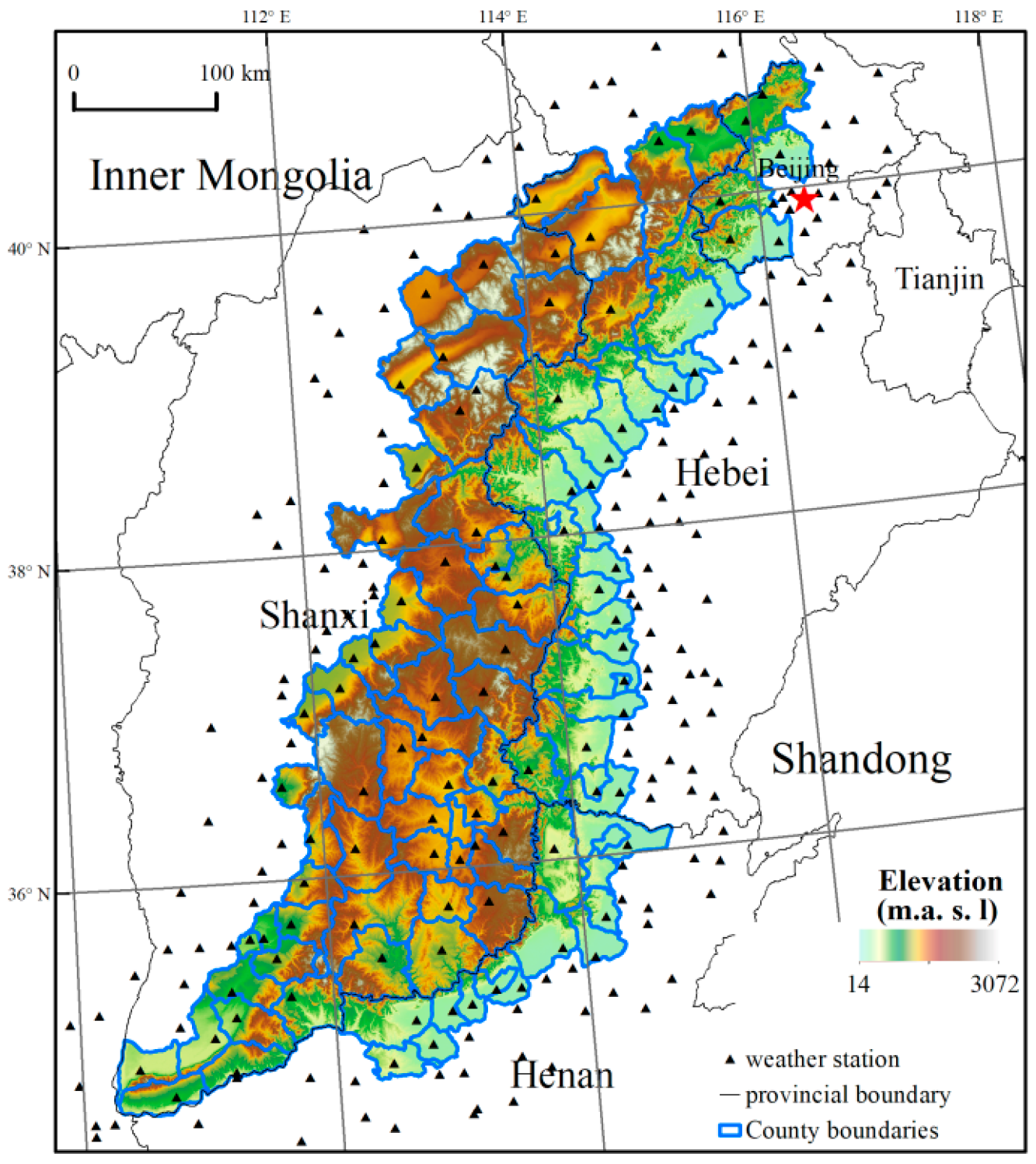
The Taihang Mountains, situated between the Loess Plateau and North China Plain, constitute an important geographical boundary in China. This mountain range spans from the Western Mountains in the north to the Wangwu Mountains in the south; borders the Loess Plateau in the west and the North China Plain in the east; and traverses Beijing and the Shanxi, Henan, and Hebei Provinces in a northeast-southwest direction. It stretches over 800 km and is approximately 200 km wide. The Taihang Mountains (110°14′ E–116°35′ E, 34°34′ N–40°47′ N) encompasses 101 county-level administrative units (
Figure 1), with a total area of approximately 1.37 × 10
5 km
2. The geological base of the Taihang Mountains is a complex monoclinic fold with fault structures on the eastern side and typical flood fans and alluvial plains in front of the mountains. The area has many east–west cross valleys, with steep mountains in the east and gentle slopes in the west. The terrain is high in the northwest and southeast, with most elevations above 1200 m. The elevational difference and topographic relief are significant, with the lowest elevation being approximately 14 m and the highest exceeding 3000 m, while the steepest slope is approximately 78°. The western flank of the Taihang Mountains connects to the Loess Plateau, while the eastern flank transitions from mesas, low mountains, and hills to plains, with more intermontane basins, and three major basins—Jinzhong, Changzhi, and Zezhou—spread across the southern part of the Shanxi Province.
2.2. Data Sources and Processing
The data necessary for this study comprised information on land-use types, topography, soil, vegetation, meteorology, roads, distribution of natural attractions, and statistical yearbooks.
Land-use type data: The 2018 land-use type data, divided into 6 primary categories and 22 secondary categories, were obtained from the Resource and Environment Science Data Centre of the Chinese Academy of Sciences (
http://www.resdc.cn).
Topographic data: ASTER GDEM (resolution, 30 m) was acquired from the geospatial data cloud, which was then mosaicked, cropped, and projected to generate a digital elevation model (DEM) of the study area.
Soil data: Data on soil organic matter and soil organic carbon were obtained from the China Soil Organic Matter Dataset of the National Qinghai–Tibet Plateau Data Centre [
31], while soil depth data were obtained using the point distribution of soil profile depth through cropping, projection, and interpolation. Data on soil texture spatial distribution (spatial resolution, 1 km) were obtained from the Data Centre for Resource and Environmental Sciences, Chinese Academy of Sciences.
Vegetation data: The 2018 Normalized Difference Vegetation Index (NDVI) spatial distribution dataset was obtained from the Data Centre for Resource and Environmental Sciences, Chinese Academy of Sciences [
32], while vegetation cover fractional (VCF) was calculated using a like-element dichotomous model [
33] to determine the
C values in soil retention assessment.
Meteorological data: This included information on daily precipitation, average temperature, maximum temperature, minimum temperature, and sunshine hours from 246 meteorological stations in and around the study area from 2011 to 2018, obtained from the daily value dataset of Chinese terrestrial climate information from the China Meteorological Science Network (
http://data.cma.cn/). Spatial interpolation was performed using the ANUSPLIN software (v.4.4) to generate the monthly, annual, and multi-year average precipitation of the study area from 2011 to 2018. Solar radiation data were obtained from the global high-resolution surface solar radiation dataset (1983–2018) of the National Tibetan Plateau Data Center [
34], and the monthly solar radiation values of the study area in 2018 were generated by conversion, projection, and cropping.
Road data: This dataset was obtained from the National Road dataset of the Resource and Environment Science Data Centre of the Chinese Academy of Sciences (
http://www.resdc.cn) and includes highways, railways, national roads, provincial roads, and county roads.
Natural attraction distribution data: These data were obtained from the Baidu Map POI Collection Crawler. The extracted data were filtered to remove duplicate records, and the distribution of natural attractions in the study area in 2020 was obtained by manually removing attractions with biased humanistic features according to the location of construction sites and extracting keywords such as memorials, museums, and Christian churches.
Statistical yearbooks: These data were sourced from the statistical yearbook-sharing platform (
https://www.yearbookchina.com), and data on 2018 grain, oilseed, meat, egg, and milk production in the prefecture-level cities and counties in the study area were obtained from the statistical yearbooks of local statistical bureaus.
2.3. Ecosystem Services Assessment Methodology
This study employed statistical data spatialization, the InVEST model (v.3.9.0), and the ArcGIS kernel density method to evaluate and map six ecosystem services—food supply (FS), water yield (WY), soil retention (SR), carbon density (CD), habitat quality (HQ), and leisure and recreation (LR). The required parameters and calculation processes are listed in
Table 1. For detailed parameters of the InVEST model (v.3.9.0), please refer to the
Appendix A at the end of this paper.
2.3.1. Food Supply Assessment
This study spatialized food production statistical data for cropland and grassland using positive NDVI values within each county-level administrative region. Specifically, grain and oil production were allocated to cropland grids based on NDVI values, while meat, egg, and milk production were allocated to grassland grids based on NDVI values, thereby achieving spatial mapping of food supply per unit area in the study area. The calculation formula is as follows:
where
Gi represents the allocated grain and oil production or meat, egg, and milk production for the
i-th grid within the county;
Gsum represents the total grain and oil production or total meat, egg, and milk production within the county;
NDVIi represents the
NDVI value of the
i-th grid; and
NDVIsum represents the sum of
NDVI values for cropland or grassland within the county. The allocation considered only total production and
NDVI values, without distinguishing between different crops or different types of livestock.
2.3.2. Water Yield Service Assessment and Validation
The water yield module of the InVEST model was employed to assess water yield services in the study area. Its core algorithm is based on the principle of water balance, assuming that the water yield from each grid cell ultimately reaches the outlet via surface flow, subsurface flow, or baseflow. Water yield is calculated as precipitation minus actual evapotranspiration for each grid cell, using the following formula:
where
Yxj represents the water yield of grid
x in land use type
j;
AETxj represents the actual evapotranspiration of grid
x in land use type
j; and
Px represents the annual precipitation on grid
x.
The InVEST model Water Yield module uses the Zhang coefficient to adjust model outputs and simulate water yield conditions in different regions. Given the difficulty of obtaining hydrological observation data over large spatial scales, this study adjusted the Zhang coefficient by comparing simulation results for corresponding reservoir basins within the study area based on publicly available hydrological data, aiming to obtain simulation results suitable for the study area. Through multiple adjustments and model runs, and by validating against observation data from hydrological stations, it was determined that a
Z value of 10 yielded results consistent with the actual conditions of the study area. Based on the sum of the multi-year average observed runoff and water consumption from 2005 to 2015 for seven reservoir hydrological stations within the study area, the corresponding watersheds were delineated, and the average water yield depth for each watershed was calculated (
Table 2). A linear fit between these values and the simulated water yield depth for 2018 revealed a significant linear relationship (y = 0.4593x + 31.962, R
2 = 0.8539). The water yield results assessed in this study showed a high degree of agreement with actual observation data, enabling their use in ecosystem service trade-off analysis.
2.3.3. Soil Retention Assessment and Validation
The soil retention module of the InVEST model evaluates the soil retention capacity of different land use types based on the Universal Soil Loss Equation (
USLE). By incorporating factors such as topography, precipitation, soil properties, and land use/cover, the module estimates potential soil loss (
RKLS) and actual soil loss (
USLE). The soil retention of a plot is then calculated as
RKLS minus
USLE. Based on this, the InVEST model further accounts for the sediment retention capacity of a plot in intercepting sediment from upslope erosion, thereby improving the accuracy of soil retention estimates. The calculation principles are as follows:
where
R is the rainfall erosivity factor,
K is the soil erodibility factor,
LS is the slope length and steepness factor,
C is the vegetation cover and management factor (ranging from 0 to 1),
P is the soil and water conservation measure factor (ranging from 0 to 1),
SR is the soil retention amount,
RKLS is the potential soil erosion amount, and
USLE is the actual soil erosion amount, all in t/(ha·a).
This study validated the results using actual average annual sediment transport data from 2005 to 2015 and simulated sediment transport data for seven hydrological stations within the Taihang Mountain region (
Table 3). The sum of actual observed average annual sediment transport for the seven hydrological stations was 24.08 × 10
4 t, while the sum of simulated sediment transport was 24.61 × 10
4 t, indicating close agreement. Linear fitting revealed a significant linear relationship between the two (y = 0.8505x + 0.3469, R
2 = 0.9212). The model-based assessments of soil erosion and soil retention are therefore considered reliable.
2.3.4. Carbon Density Assessment
The InVEST model estimates carbon storage based on land use type maps and carbon density data, utilizing four carbon pools: aboveground biomass, belowground biomass, soil carbon, and dead organic carbon. Land use data and carbon density data were input into the Carbon module of the InVEST model to obtain carbon storage for the study area across different periods, and the spatial distribution and changes in carbon storage and carbon density were analyzed. The calculation methods are as follows:
where
i represents a specific land use type;
Ci_above represents the aboveground carbon density of land use type I (t/ha);
Ci_below represents the belowground carbon density of land use type
i (t/ha);
Ci_soil represents the soil carbon density of land use type
i (t/ha);
Ci_dead represents the dead organic carbon density of land use type
i (t/ha);
Ctot represents the total carbon storage (t);
Si represents the area of land use type
i (ha); and
n is the number of land use types, which in this study is 6.
2.3.5. Habitat Quality Assessment
The InVEST habitat quality model generates habitat quality maps by integrating land use/cover information with biodiversity threat factors. In this study, cropland, urban land, rural residential land, and roads were considered threat factors to habitat quality in the study area, and the habitat quality and degradation levels of different land use types were assessed. The calculation method is as follows:
where
Qxj represents the habitat quality of grid
x in land use/cover type
j;
Hj represents the habitat suitability of land use/cover type
j;
Dxj represents the habitat degradation degree of grid
x in land use/cover type
j; and
k is the semi-saturation constant, with a system default value of 0.5, typically set to the maximum degradation raster value.
2.3.6. Recreation Service Assessment
The natural scenic spot distribution density was obtained by analyzing natural scenic spot data using the Kernel Density tool in ArcGIS software (v.10.8).
2.4. Ecosystem Services Trade-Off/Synergistic Relationship Analysis Methods
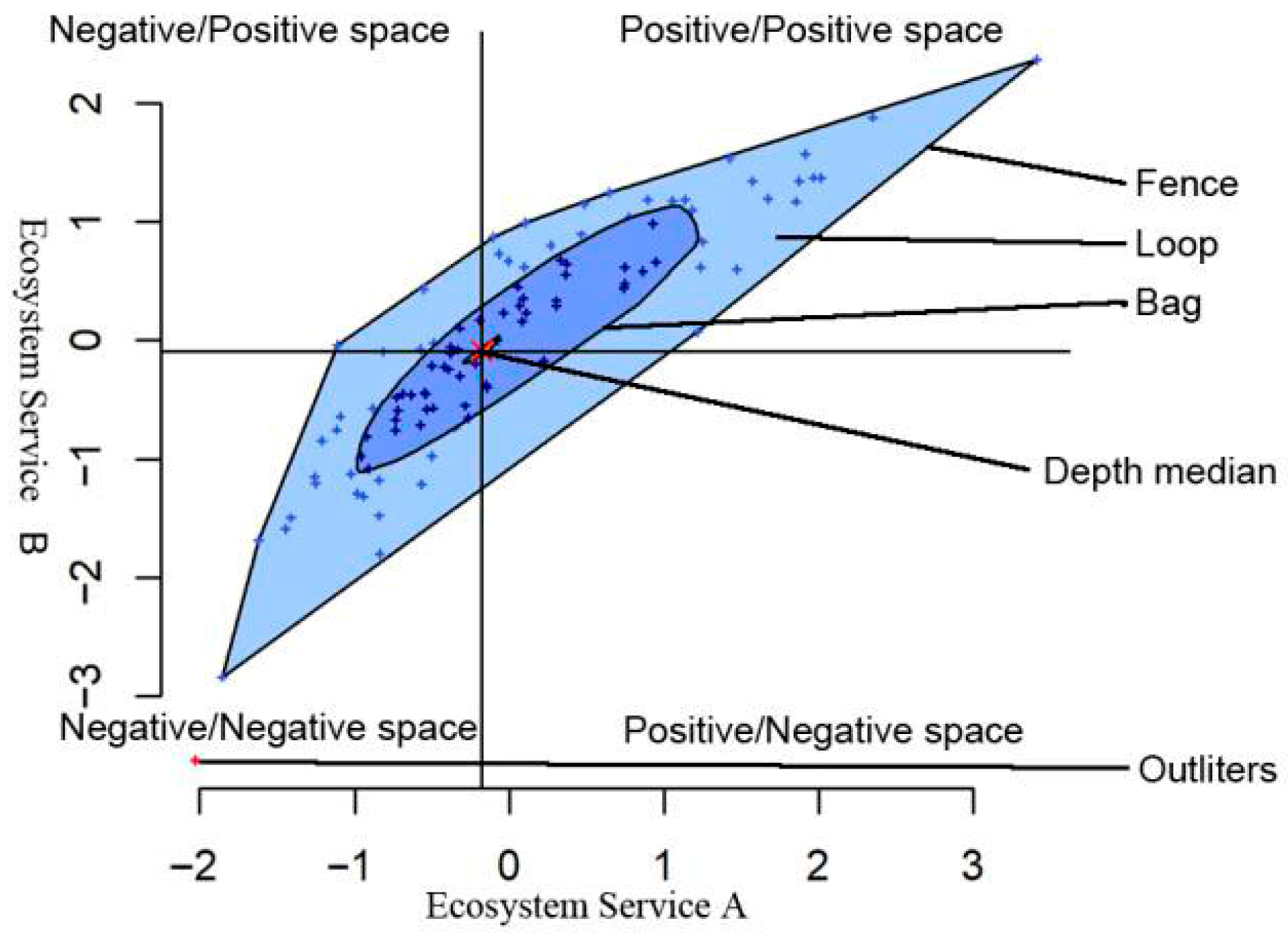
We conducted zonal statistics on the six ecosystem service assessment results using county boundaries to obtain the ecosystem services per unit area supply for 101 county-level administrative divisions in the study area. As the ecosystem service data did not exactly conform to a normal distribution, and the value ranges of the various ecosystem services differed significantly, for ease of comparison, the data were normalized using the quantile function in Python (v.3.8), and the processed data had a mean of 0 and a standard deviation of 1. In this study, a non-linear bagplot was used to describe the relationships between ecosystem service pairs. A bagplot consists of points labeled with the highest half-space depth. The deepest location point is called the depth median, represented by a red cross. The surrounding area containing 50% of the data point locations is called the bag (dark-colored area). By magnifying the bag by a factor of three, a boundary is created called the fence. The area between the bag and fence is called the loop (light-colored area), and any data points outside of the fence are considered outliers, represented by red points. The direction of the bag indicates correlation, while the shape of the bag indicates distributional asymmetries and outliers. Bagplots were generated using the R language bagplot package, which utilizes improved normal distributions and normalized ecosystem service values for mapping. The bagplot uses the location of the depth median as a reference point, which can be divided into four quadrants (
Figure 2). Each quadrant represents the likelihood space of the relationship between ecosystem services A and B. The positive/positive space (two ecosystem services performing well relative to the depth median) is located in the upper-right corner of the depth median, and the negative/negative space is located in the lower-left corner. Bagplots were computationally mapped using the R language bagplot package by applying an improved normal distribution and standardized ecosystem service values.
Synergies between two services occur when the elevation of one service causes an increase in the other service. In bagplot, a synergistic relationship is considered to exist if the bag is oriented from bottom left to top right, covering mainly the negative/negative and positive/positive spaces. Trade-offs between two ecosystem services occur when one service is elevated at the expense of another service. In bagplot, a trade-off relationship is considered to exist when the bag is oriented from top left to bottom right, covering mainly the positive/negative and negative/positive spaces. Interaction between two ecosystem services is interpreted as compatible when an increase in one service does not cause an increase or decrease in the other service. In bagplot, a compatibility relationship is considered to exist if the coverage areas of the negative/negative and positive/positive spaces are roughly equal to those of the positive/negative and negative/positive spaces [
12].
Since the compatibility relationship is difficult to determine through bagplots, the Pearson correlation coefficient r is additionally used to quantify the correlation between the two ecosystem services for comparison purposes, and the trade-off/synergy relationships between ecosystem services are interpreted by combining the characteristics of the bagplots. When the absolute value of r is less than 0.1, the relationship between the two services is considered compatible. Before calculating the Pearson correlation coefficient, a global spatial autocorrelation test was conducted for each set of ecosystem service data. The Global Moran’s I index ranged from 0.36 to 0.58, with p-values of 0 and z-values exceeding 4, indicating the presence of spatial autocorrelation in the ecosystem service data. Given that spatial autocorrelation is common in geoscience data, this study places greater emphasis on the magnitude and direction of the correlation coefficient (r) rather than relying solely on its I-value and p-value.
Moreover, the cumulative correlation coefficient () was used as an indicator to rank ecosystem services according to their synergistic or trade-off effects with all other services in the correlation matrix. The cumulative value () of each ecosystem service () was calculated as the sum of all paired correlation coefficients () contributed by . The rationale behind this is that a higher positive cumulative Ri value indicates greater synergy and fewer trade-offs with other ecosystem services. The number of trade-offs or synergies between and other ecosystem services was determined by the sign (positive or negative) of the value. Ri, as an indicator for measuring the overall level of conflict/synergy between a given service and all other services, draws inspiration from the concept of degree or centrality in network analysis. It is not a strict statistical measure but rather a heuristic ranking indicator used to quickly identify services that play a key role (whether synergistic or conflicting). At the same time, it must be interpreted in conjunction with ns, nt, and nn to provide a comprehensive understanding. ns, nt, and nn indicate the overall number of ecosystem services with which synergistic, trade-off, and compatible relationships exist, respectively.
The results of the ecosystem service trade-off/synergy analysis and the bagplot in the study area were used to map the data points in the bag to the selected pairs of ecosystem services and identify and map areas of synergy (positive/positive, negative/negative), trade-offs (positive/negative, negative/positive), and outliers between the analyzed pairs of ecosystem services to understand their interactions. Multiple partitions of the ecosystem services were obtained by dividing the six services into positive (above average) and negative (below average) values. The service with the highest value among the six positive ecosystem services was considered the dominant service for the kilometer grid cell, whereas cells with negative values for all six services were categorized as having no dominant service (), resulting in the spatial distribution of dominant ecosystem services in the study area.
3. Results
3.1. Trade-Offs/Synergies Between Ecosystem Service Pairs
The synergistic, trade-off, and compatible relationships between each ecosystem service pair were identified.
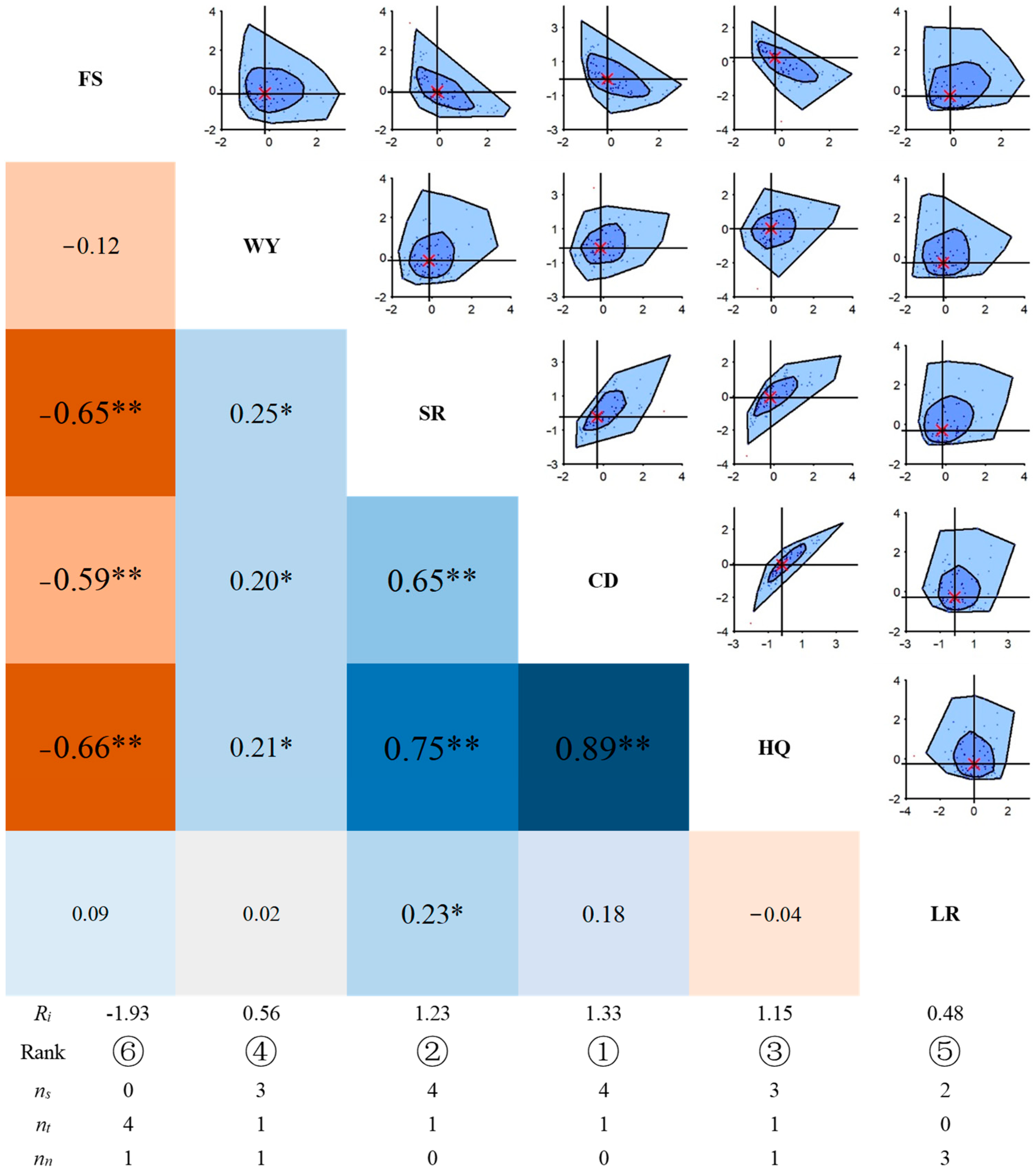
Figure 3 shows the relationships among the 15 ecosystem service pairs throughout the study area, and the results of the linear correlation coefficients corroborated the results of the bag diagram analyses. Analysis revealed multiple synergistic relationships, identifying eight ecosystem service pairs with discernible synergies and six with a prevailing synergistic association among four services: WY, SR, CD, and HQ. The synergistic effect was particularly significant (
p < 0.01) between CD and HQ (r = 0.89), SR and HQ (r = 0.75), and SR and CD (r = 0.65). In the case of CD vs. HQ, for example, the bagplot showing their interdependence was characterized by an elongated shape, where the graph extended along the diagonal from the negative/negative to the positive/positive space direction, and only a small part of the bag-and-loop region covered the negative/positive and positive/negative spaces. The entire graph was in the form of an elongated ellipse, exhibiting strong synergistic effects, both in terms of the correlation coefficients and bagplot shape. Additionally, LR vs. SR (r = 0.23) and LR vs. CD (r = 0.18) showed weak synergistic relationships.
An overall trade-off relationship was observed between FS and the other services. The trade-offs were significant between FS and SR, CD, HQ, with r of −0.65, −0.59, and −0.66, respectively. FS vs. WY (r = −0.12) showed a weaker trade-off relationship overall. In the case of FS vs. HQ, the bag extended from the positive/negative space to the negative/positive space, and the bag and loop were in the shape of a slanted funnel, pointing from the upper left corner to the lower right corner and gradually widening in the direction of smaller x-values. In general, trade-offs between provisioning services or between provisioning, regulating, and supporting services were easy to generate.
Three ecosystem service pairs showed compatible relationships, with r values close to 0, namely FS vs. LR (r = 0.09), WY vs. LR (r = 0.02), and HQ vs. LR (r = −0.04). The shape distribution of the pocket diagram was asymmetrical, mainly covering positive/positive and negative/positive spaces. Positive/negative and negative/negative spaces covered less area, and although the area distribution was not balanced, the pocket diagram direction extension was not obvious, and it still showed a compatible relationship in general.
According to the cumulative Ri ranking, CD (R = 1.33) was the ecosystem service with the highest cumulative correlation coefficient, followed by SR (R = 1.23), and these two services were positively correlated with all other services, except FS. HQ (R = 1.15) was the third in synergistic potential but had the strongest synergistic (r = 0.89) and trade-off effects (r = −0.66). FS was the ecosystem service with the highest negative cumulative coefficient (r = −1.93).
3.2. Zoning of the Study Area Based on Ecosystem Services Trade-Offs/Synergies
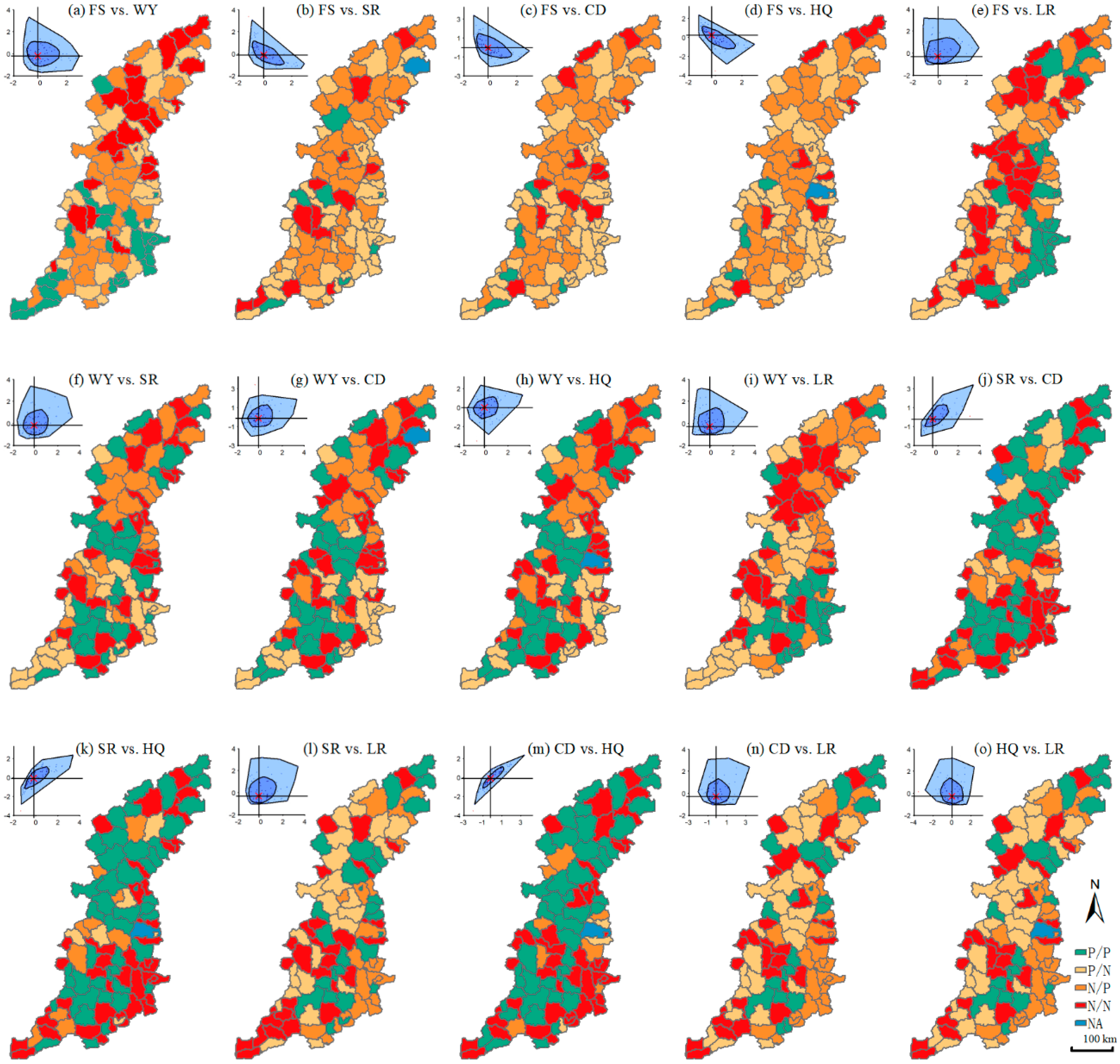
The spatial heterogeneity of ecosystem service interactions across county-level units was visualized using localized mapping analysis (
Figure 4). The classification of each county in
Figure 4 (P/P, P/N, N/P, N/N) is determined based on the positions of the county’s values for the two services relative to the bagplot depth median point constructed for all sample points in the service pair. Specifically, P indicates a value above the median depth value for that service, while N indicates a value below it. Therefore, P/P is located in the first quadrant of the bagplot (filled in green), P/N is in the second quadrant (filled in light orange), N/N is in the third quadrant (filled in red), N/P is in the fourth quadrant (filled in dark orange), and NA corresponds to outliers outside the fence. Our findings revealed distinct patterns of synergistic and trade-off relationships among the ecosystem service pairs. Specifically, FS and WY exhibited synergistic relationships in 48 counties with equal proportions of positive–positive and negative–negative synergies (24 counties each). These spatial clusters demonstrated clear geographical segregation. The positive–positive synergies predominantly concentrated in the southern counties, such as Yongji, Ruicheng etal, which are characterized by higher precipitation and more intensive agricultural practices, suggesting that under certain conditions, agricultural development and water yield can coexist. The negative–negative synergies clustered in the northern counties. This spatial dichotomy suggests better synergistic effects between food provisioning and water production services in the southern Taihang Mountains than in the northern regions. Conversely, trade-off relationships between FS and WY were observed in 53 counties, showing differential spatial aggregation patterns: negative-positive trade-offs (27 counties) formed concentrated clusters in the central-southern regions, while positive-negative trade-offs (26 counties) displayed dispersed distributions (
Figure 4a).
Notably, stronger trade-off effects emerged between FS and other ecosystem services. FS showed pronounced trade-offs with SR (79 counties), CD (84 counties), and HQ (87 counties), with relatively scarce and spatially fragmented synergistic relationships. The FS vs. HQ interaction was particularly striking, as only four counties (Taigu, Gu, Jiang, and Pinglu) demonstrated positive-positive synergies (
Figure 4b–d). The FS-LR relationship was an exception, showing synergistic effects in 49 counties. They comprised 23 positive-positive synergies along the eastern periphery and 26 negative-negative synergies forming a distinct central belt (
Figure 4e).
Comparative analysis of WY interactions revealed consistent spatial patterns across multiple service pairs (WY vs. SR, CD, and HQ). Positive–positive and positive–negative interactions predominantly occupied the southern regions, whereas negative-positive trade-offs were concentrated in the northern areas. Negative–negative interactions showed a widespread sporadic distribution. Synergistic effects generally outweighed the trade-offs in these relationships. The WY-LR interaction demonstrated near-parity between synergies (52 counties) and trade-offs (49 counties), with positive–positive clusters in southeastern counties and bipolar negative-negative distributions showing northern predominance.
Strong synergistic networks were identified among the regulating services, with SR vs. CD (76 counties), SR vs. HQ (84 counties), and CD vs. HQ (89 counties) interactions displaying concentrated positive–positive clusters and southeastern negative-negative aggregations. Further analysis revealed similar spatial configurations in SR-LR, CD-LR, and HQ-LR relationships, reinforcing the significant interdependencies between soil retention, carbon sequestration, and habitat quality services.
3.3. Multiple Ecosystem Service Trade-Offs/Synergistic Zoning
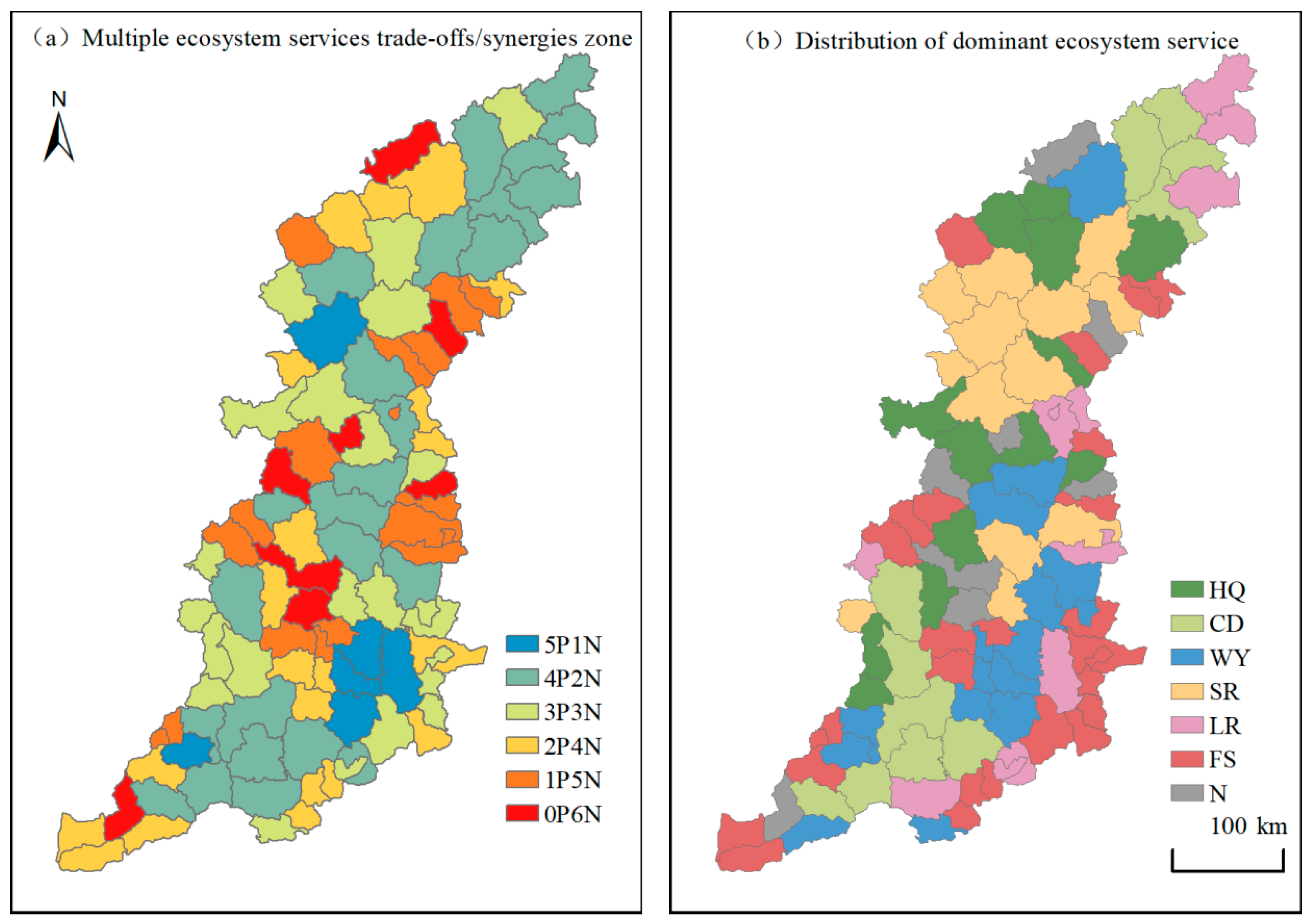
Through the systematic categorization of the six ecosystem services in county-level administrative units based on Z-score standardized values (positive values indicating above-average performance and negative values representing below-average status), we established distinct ecosystem service zones across the study area (
Figure 5a). The spatial distribution of dominant ecosystem services was determined by identifying the service with the maximum positive value in each unit, whereas units with exclusively negative values were classified as non-dominant (N) (
Figure 5b).
Key analytical findings are as follows:
Optimal synergy status: No county units exhibited fully synergistic relationships across all six ecosystem services (6 positive/0 negative).
High-performance units: Six counties demonstrated five positive/one negative configurations. Notably, four counties (Pingshun, Huguan, Lingchuan, and Wutai) displayed synergistic WY/SR/CD/HQ/LR clusters requiring enhanced food supply capacity, whereas Linzhou and Jiangjiang counties showed deficiencies in carbon sequestration and habitat quality, respectively.
Moderate synergy patterns: 25 counties exhibited 4 positive/1 negative configurations, predominantly distributed across the northeastern, central, and southwestern regions. The dominant service clusters included WY/SR/CD/HQ (nine units) and SR/CD/HQ/LR (eight units). Further, 23 counties demonstrated 3 positive/3 negative configurations, primarily featuring SR/CD/HQ (10 units) and FS/WY/LR (8 units) synergies.
Suboptimal performance: 21 counties displayed 2 positive/4 negative service profiles, while 18 counties showed 1 positive/5 negative configurations, with 10 units maintaining high food provisioning capacity.
Critical trade-off areas: Eight county units exhibited below-average performance across all ecosystem services, representing complete service trade-offs without dominant functions.
This spatial differentiation highlights significant regional disparities in ecosystem service provision capacities, with distinct geographical clustering patterns of service synergies and trade-offs. These findings underscore the need for different management strategies to address specific service deficiencies across county units.
The spatial distribution patterns of the dominant ecosystem services exhibited significant regional heterogeneity across the study area (
Figure 5b). Food supply emerged as the predominant service category, characterizing 27 county-level units that were primarily clustered in relatively flat peripheral zones and intermontane basins. Water production dominated 16 administrative units with a notable spatial concentration in the southern regions, except for Weixian County in the Hebei Province, which was a northern outlier.
The spatial configuration of service dominance demonstrated distinct aggregation patterns. Soil conservation services prevailed in 13 county units, 9 of which (69.2%) were concentrated in the northern territories, exhibiting marked spatial clustering. Similarly, carbon sequestration services showed pronounced spatial autocorrelation, with 11 contiguous units forming 2 distinct clusters in the northeastern and southwestern sectors. In contrast, habitat quality and recreational services demonstrated comparatively dispersed distributions across the 13 county units, suggesting weaker spatial dependence. This pattern of spatial heterogeneity aligns with the topographic gradients and anthropogenic disturbance levels observed in the study area.
4. Discussion
4.1. Interactions Between Ecosystem Service Pairs
This study investigated the interactions among 15 ecosystem service pairs, revealing prevalent trade-offs between food provision and regulating/supporting services—a finding consistent with previous research. Raudsepp-Hearne et al. [
43] analyzed 12 ecosystem services in Quebec, Canada, and identified trade-offs between crop production and other services. Jopke et al. [
42] examined 45 ecosystem service pairs across Europe and found significant negative correlations between crop production and regulating services. Similarly, Yu et al. [
34] demonstrated trade-offs between grain yield and net primary productivity, soil retention, and habitat quality at a regional scale in the Qinling-Daba Mountains. In line with these studies, our results further show that food provision exhibits the highest absolute negative cumulative correlation coefficient among all service pairs, underscoring its consistently strong trade-off relationships with other services.
Beyond this general consistency, a cross-regional comparison reveals notable differences in the intensity of these trade-offs. Specifically, the negative correlations between provisioning services and regulating or supporting services in the Taihang Mountain area are stronger than those observed in Europe, Quebec (Canada), and the Qinba Mountains (China). This pattern likely reflects the greater impact of higher population density and more intensive agricultural reclamation pressure on soil conservation capacity and habitats in this region. Collectively, these findings suggest that human-induced modifications for food production are often in conflict with regulating and supporting services, highlighting the need for balanced land-use strategies to prevent ecosystem service imbalances and mitigate their subsequent effects on regional human well-being.
Relationships between regulating and supporting services were mostly synergistic, aligning with domestic case studies. Wu et al. [
44] identified positive correlations between water yield, carbon sequestration, and soil retention in Ordos City. Yin et al. [
45] found predominantly synergistic or compatible relationships among these services in China’s ecological barrier zones. Yu et al. [
46] reported significant synergies among water yield, soil retention, habitat quality, and net primary productivity (NPP) in the Qinling-Daba Mountains. In contrast, recreational services showed minimal interaction with other services in our study area, which may be attributable to the unique spatial development patterns of the natural landscapes in the Taihang Mountains. The steep topography and concentrated development of recreational resources in low-altitude transitional zones likely limit large-scale interactions with other ecosystem services.
4.2. Bagplot, Correlation Coefficient, and Cumulative Correlation Coefficient
Although correlation coefficients remain the predominant analytical method, emerging bagplot analysis shows comparable effectiveness despite its underutilization in ecosystem service research [
12,
24,
25]. Bagplots can not only visualize service relationships but also provide critical spatial management insights through quadrant identification. The positive-positive quadrant offers reference templates for synergistic management, while the negative-negative zones highlight areas that require prioritized intervention. For instance, agriculturally dominated edge areas in
Figure 5 exhibit negative-negative relationships between regulating and supporting services, reflecting inherent limitations in enhancing water-related services within intensive farming systems. This spatial interpretation surpasses the conventional linear correlation analysis by revealing context-dependent service interactions.
While Bagplot offers intuitive advantages for visualizing bivariate distributions and classifying quadrant categories, its application comes with several limitations. One notable limitation is its high computational cost, particularly with large sample sizes, as constructing the depth median, computing convex hulls, and determining the bag boundary can require substantial computational resources, potentially compromising analytical efficiency. Additionally, Bagplot is sensitive to outliers, where extreme values can significantly alter the shape and orientation of the bag, thereby affecting the position of the depth median and the resulting quadrant classification, leading to reduced stability in the categorization. Furthermore, interpretation of the results can be somewhat ambiguous. For instance, identifying relationships such as compatible or synergistic relies on a binary classification of quadrant membership (i.e., above or below the depth median), yet this classification lacks support from statistical testing. In borderline cases, the determination may involve subjectivity, which can affect the reproducibility of the findings. Given these limitations, in practical applications it is advisable to combine Bagplot with other statistical methods—such as correlation analysis, robust regression, or spatial autocorrelation analysis—for cross-validation, thereby enhancing the reliability of the conclusions.
The cumulative correlation coefficient (
R) quantifies the overall conflict intensity between individual services and others. However,
R values demonstrated sensitivity to service selection and insensitivity to directional changes when the correlation magnitudes were comparable. As shown in
Figure 3, the cumulative
R values of soil conservation and habitat quality are very close, but soil conservation exhibits four synergistic relationships and one trade-off relationship, while habitat quality exhibits three synergistic relationships, one trade-off relationship, and one compatibility relationship. Although the
R values of the two is similar, HQ and LR exhibit a compatible relationship, which may indicate that high-quality habitats do not necessarily possess high recreational value, or that recreational activities have little impact on the habitats. In contrast, SR and LR show a weak synergistic relationship, possibly because areas with good vegetation cover are conducive to both soil conservation and the provision of recreational landscapes. This difference in the nature of the relationships informs distinct management strategies: for SR, it can be naturally integrated into recreational development; for HQ, the potential impact of recreational development needs to be separately assessed. The cumulative
R-values of water production services and leisure recreation are also very close, but water production services exhibit three types of synergy, one type of trade-off, and one type of compatibility relationship, while leisure recreation exhibits two types of synergy and three types of compatibility relationship. This highlights the necessity of complementing R values with parameters that quantify the number of synergistic (
ns), trade-off (
nt), and neutral (
nn) relationships.
4.3. Formation Mechanisms of Ecosystem Service Trade-Offs/Synergies and Dominant Ecosystem Services Spatial Patterns
Identifying regional ecological issues and delineating dominant functional zones are crucial for optimizing spatial management. The Taihang Mountains, a transitional zone between the eastern plains and western highlands, exhibit complex interactions between natural factors, anthropogenic activities, and socioeconomic elements. Recent ecological restoration projects and socioeconomic development have significantly altered ecosystem service supply patterns and spatial relationships.
Alluvial plains along the Haihe and Yellow Rivers support intensive agriculture, creating food provision hotspots at the periphery of the study area. High-altitude regions with minimal human disturbance maintained superior regulating/supporting services through dense vegetation cover (correlation coefficients: 0.65–0.89). Water yield hotspots occurred in areas with high precipitation, low evapotranspiration, and low-water-retention soils. Recreational services were concentrated in transitional hill-plain zones with moderate slopes, high accessibility, and intact habitats. Ecological protection policies and socioeconomic demands further shape service patterns [
47,
48]. Multi-service zoning enables rapid identification of low-value service areas for targeted ecological rehabilitation. Spatial regulation based on dominant ecosystem services provides effective guidance for ecological conservation and land consolidation [
49,
50]. Sustainable ecosystem management requires integrated policies that balance service synergies and optimize the spatial configurations of dominant services.
4.4. Limitations and Future Directions
This study focuses on six ecosystem services—food provision, hydrological regulation, soil conservation, carbon sequestration, biodiversity, and recreation and culture—selected from the MA. While covering four major categories within the MA framework, this selection does not represent all products and services provided by mountain ecosystems to humanity. Future work should establish a classification system tailored to China’s mountainous and transitional zones by integrating frameworks like TEEB [
51] and CICES [
52] with the unique ecological conditions of mountain ecosystems. This approach will enable more comprehensive and accurate assessments and research. Due to data availability constraints, this study evaluates and analyzes ecosystem services and their interrelationships only for the year 2018, without examining temporal trade-off dynamics among the six services. Focusing solely on the interrelationships among ecosystem services within a specific timeframe may lead to misjudgments. Analyses of long-term continuous time series could enhance the credibility of trade-off/synergy relationship studies [
53]. Future research could collect multi-temporal, long-period meteorological, hydrological, remote sensing, and cartographic data to conduct long-term ecosystem service assessments and correlation studies, thereby enriching the spatiotemporal dynamics of ecosystem service trade-offs and synergies.