1. Introduction
Climate change is one of the most pressing challenges of the 21st century, with increasing drought risk representing a critical concern worldwide. Drought, defined as a prolonged absence of, or significant reduction in, precipitation, poses severe threats to agricultural systems, rural livelihoods, and food security [
1]. Smallholder farmers are disproportionately affected due to their reliance on agriculture for sustenance and economic stability, coupled with limited alternative livelihoods [
2,
3]. The increasing frequency and intensity of droughts exacerbate socio-economic vulnerabilities, making resilience-building strategies a crucial area of research and policy intervention [
4].
Socio-ecological resilience is a dynamic property that acknowledges the inherent complexity and uncertainty of social–ecological interactions [
5,
6]. Within this framework, social–ecological memory, which encompasses knowledge, practices, and traditions accumulated by Indigenous and local communities, plays a pivotal role in sustaining resilience [
7]. Traditional land-use practices, developed over centuries, reflect deep relationships between farmers and their environment, enabling adaptation to environmental changes [
8]. However, governmental policies often perceive traditional agricultural systems as being more vulnerable and less adaptable to climate change than modern systems [
9]. In contrast, studies highlight that traditional farming systems employ cultural practices and adaptive strategies that enhance resilience to environmental changes [
10]. The erosion of socio-ecological memory has been exacerbated by agricultural industrialization, land-use change, and urbanization [
11,
12]. The expansion of neoliberal policies and transnational agribusinesses has accelerated the displacement of rural populations and the conversion of traditional agricultural lands to industrial monocultures [
13]. This process intensifies social inequalities and exacerbates vulnerabilities, contributing to the intergenerational erosion of accumulated ecological knowledge and adaptive practices [
14,
15]. Consequently, identifying, systematizing, and evaluating the complex interactions between climate change-induced risks and the adaptive capacity of agricultural systems is imperative to sustain resilient farming communities [
16].
This study adopts a socio-ecological resilience perspective in which resilience is conceptualized as the capacity of a farming system to maintain its core functions, identity, and adaptive practices under disturbance, rather than as the mere inverse of vulnerability. Within this framing, resilience must be specified in relation to both a disturbance and a social unit of concern [
17]. In this case, the disturbance is the combined pressure of the 2009–2019 megadrought and exotic forest-driven land-use changes in the Araucanía Region, while the social–ecological unit of concern is the smallholder peasant farming system, understood as a culturally embedded livelihood system. Accordingly, resilience is used here in a primarily descriptive and comparative sense to examine variation in the persistence and adaptive capacity of farming systems under shared climatic stress, rather than as an inherently normative or universally desirable condition. We examined the socio-ecological resilience of traditional peasant agricultural systems in the Araucanía Region of south–central Chile, a territory historically inhabited by the Indigenous Mapuche people. This region has undergone profound socio-political transformations, particularly following the late 19th-century colonization by the Chilean state, which led to the displacement and confinement of Mapuche communities. Since the late 20th century, neoliberal policies have promoted land dispossession and exotic forest plantations, exacerbating socio-environmental vulnerabilities [
18,
19,
20]. Biophysical assessments also indicate increasing aridity due to declining precipitation trends [
21,
22]. Together, these socio-political and environmental transformations threaten traditional agricultural practices that have sustained rural communities for generations.
Against this background, we hypothesize that Mapuche farming systems, because they retain stronger forms of social–ecological memory, expressed in their agroecological diversity, drought knowledge, and locally adapted crop management, will exhibit greater resilience than non-Mapuche peasant systems under prolonged drought and forest-driven land-use changes. Accordingly, we expect lower vulnerability, higher response capacity, and lower rates of system collapse among Mapuche farms over the 2009–2019 period. This research assesses how different farming communities (both Mapuche and non-Mapuche peasants) respond to increasing water scarcity through varying levels of socio-ecological resilience. Specifically, the study aims to address the following questions: (1) How do peasant farmers in the Araucanía Region adapt to drought conditions? (2) What factors contribute to or constrain long-term socio-ecological resilience? (3) Do ethno-cultural differences influence resilience outcomes? These questions are examined over a period of a decade (2009–2019), allowing for an assessment of changes in the resilience levels of agricultural systems subjected to prolonged water scarcity. By exploring these questions, this study contributes to a broader understanding of resilience in agricultural systems facing climate change. Recognizing the role of socio-ecological memory and traditional knowledge in sustaining resilience can inform policy frameworks that integrate Indigenous and local adaptive strategies into climate adaptation efforts.
2. Methods
2.1. Study Site
This study was conducted in the counties of Lumaco and Traiguén (37°35′ S–39°35′ S; 70°50′ W; 31,858 km
2) in the Araucanía Region, Chile. The area corresponds to the “Secano Interior”, an inland dryland zone characterized by pronounced seasonal water limitation and a prolonged dry period of approximately five to six months per year. The regional climate is Mediterranean, with marked interannual variability and annual precipitation typically ranging between 500 and 700 mm, conditions that impose structural constraints on agricultural production systems [
23]. The soils are of volcanic origin, which influences their water-retention capacity and overall fertility [
24]. Since 2010, a substantial reduction in annual precipitation—between 30% and 70%—has been recorded in south–central Chile [
21,
22]. This phenomenon, referred to as the “megadrought”, has significantly impacted agricultural productivity and local water availability. These climatic trends underscore the growing vulnerability of agricultural systems and the urgent need for adaptive strategies that enhance socio-ecological resilience.
Historically, the Araucanía Region was one of the last territories to be incorporated into the Chilean state, a process that was consolidated in 1883. The land was subsequently settled by both national migrants from central Chile and European colonists, primarily Swiss, Italian, German, and French [
25]. During this period, Mapuche communities were forcibly relocated to reservations, losing much of their ancestral land. Over time, large tracts of land were converted into forest plantations dominated by exotic species such as
Pinus radiata and
Eucalyptus globulus [
26]. These land-use changes have exacerbated water scarcity by altering local hydrological cycles, further challenging the resilience of traditional agricultural systems [
27].
2.2. Farm Selection and Sampling
Farmers were initially selected in 2009 using a snowball sampling strategy, whereby early participants referred the research team to other potential interviewees within nearby rural communities. This approach was chosen because no complete sampling frame of smallholder farms differentiated by ethno-cultural identity was available for the study area, and because access to dispersed rural farmers depended strongly on local social networks. Farms were included if they met two basic criteria: (1) farm size of 30 ha or less, and (2) farmer identification with one of the three ethno-cultural groups considered in the study: Mapuche farmers, Chilean farmers, and European-descent farmers.
A total of 177 farms were evaluated during the first sampling season (2009) for the initial cross-sectional characterization of the systems. From this original sample, 78 farms were retained for the longitudinal follow-up conducted in 2019. This selection was purposive rather than random and was based on three operational criteria: (1) the feasibility of relocating and physically accessing the farm after ten years; (2) the completeness of the baseline information required to calculate the socio-ecological risk indicators; and (3) the need to maintain sufficient comparability across the ethno-cultural groups included in the analysis. Accordingly, the longitudinal subsample consisted of 30 Mapuche farms, 30 Chilean farms, and 18 European-descent farms. This procedure was designed to maximize data quality and comparability over time rather than to ensure statistical representativeness of all farms in the study area.
2.3. Assessment of Resilience in Agricultural Systems
Farm resilience was estimated based on two primary dimensions: vulnerability and drought response capacity [
28]. Resilience was defined as the ability of a farm system to persist under water scarcity without undergoing irreversible changes [
16]. Vulnerability indicators included (1) water access difficulty, (2) exotic forest plantations, and (3) cultivated homogeneity. Drought response capacity was evaluated through (1) the presence of drought-resistant crop varieties, (2) knowledge of drought-adaptive farming practices, and (3) participation in water-related social networks.
Data collection combined multiple methods, including semi-structured interviews, farm surveys, GIS-based landscape analysis, and direct field measurements. Resilience indicators were finalized prior to the study through participatory meetings with local farmers and other stakeholders, ensuring that the research design was grounded in the lived experience and adaptive strategies of local farming communities (
Table 1). All indicators were standardized on an ordinal scale from 0 to 1, with higher values representing either greater vulnerability or greater drought response capacity, depending on the dimension considered. No differential weighting scheme was applied. Instead, indicators within each dimension were aggregated using equal weights. Accordingly, vulnerability was calculated as the mean of water access difficulty, exotic forest plantation context, and cultivated homogeneity, whereas response capacity was calculated as the mean of drought-resistant crops, knowledge level, and water-related social networks. The categorical scores assigned to each variable (e.g., high = 1; medium = 0.5; low = 0) were defined on the basis of field surveys, semi-structured interviews with farmers, and the participatory validation of indicators conducted with local farmers and stakeholders prior to data collection (
Table 1).
The resulting composite index is used here as an operational proxy for comparative socio-ecological resilience, based on the joint consideration of vulnerability-related conditions and response-capacity attributes. This does not imply that vulnerability and resilience are treated as conceptual opposites. Rather, vulnerability and response capacity are approached as distinct analytical dimensions whose combined configuration enables a comparative assessment of system persistence under drought conditions. The index is therefore intended as a heuristic, context-specific tool for longitudinal comparison among farming systems in the study area, rather than as a universal or exhaustive measure of resilience.
2.4. Statistical Analysis
Differences in resilience indicators between ethno-cultural groups were analyzed using linear mixed-effects models (LME) implemented with lme4 package in R software [
30]. The models incorporated ethno-cultural groups as a fixed effect, while farm was treated as a random effect. The significance of these factors was assessed using
p ≤ 0.05 as the threshold.
3. Results
Of the 177 farms initially measured, 89 were Mapuche, 70 Chilean, and 18 were of European descent. This latter group was notably smaller because they were less common in the territory, and because, in several cases, their farming systems did not meet the criteria for small-scale farming, with farm areas exceeding 30 hectares and therefore being excluded from the sample.
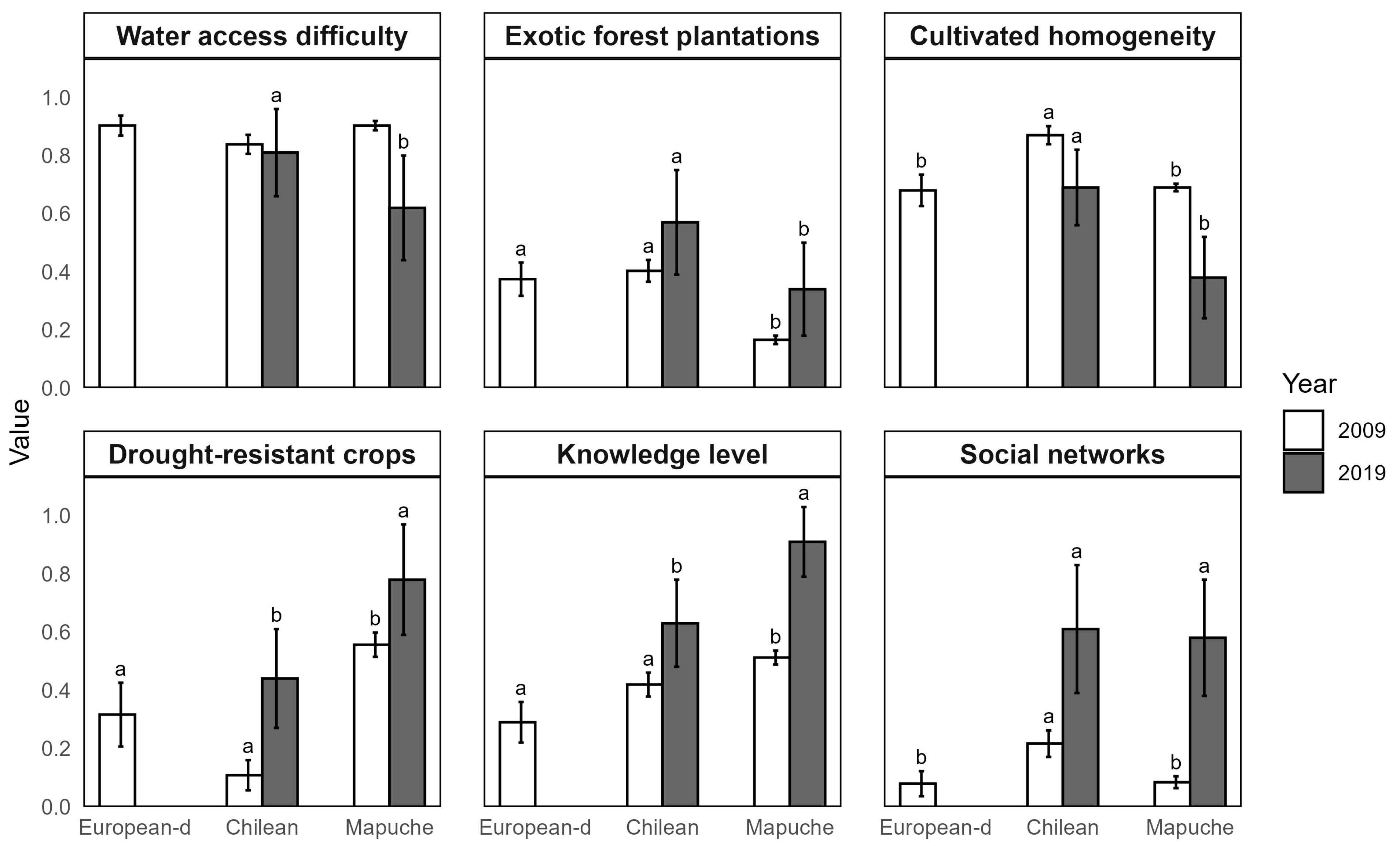
In the first season (2009), the estimated resilience was higher in Mapuche sampled farms, with a mean (±SD) value of 0.88 (±0.27), while Chilean and European-descent farms had values of 0.52 (±0.138) and 0.55 (±0.197) respectively. Mapuche farmers exhibited lower levels of vulnerability, apparently related to their non-proximity to forest plantation. Both Mapuche and European-descent farms had greater cultivated diversity (i.e., lower cultivated homogeneity) compared to Chilean farms (
Figure 1). Mapuche farms showed higher capacity to cope with drought, due to their higher knowledge of drought-adaptive farming practices and the maintenance of drought-resistant crop varieties. However, Chilean farms had higher access to irrigation, which is probably related to the higher presence of water-related social networks. The results obtained suggest a greater resilience of Mapuche farm systems to drought, which is closely linked to agroecological diversity, traditional knowledge and the conservation of local varieties via seed exchanges.
During the study period, 25 of the 78 selected farms were converted to other land uses. Thus, 53 farms remained active in 2019 and were considered in the final stage of the analysis. Considering the initial definitions of this research, where resilience is defined as the maintenance of the function and identity of a system despite the occurrence of stressors, we can consider that in the 10 years between the first and second evaluations, 32% of the farm systems collapsed. It is also noteworthy that among the 25 collapsed systems, 15 farms (60%) corresponded to European-descent farm owners. Six of the collapsed systems belonged to Chilean farmers and four to the Mapuche group, corresponding to 24% and 16% of each category, respectively.
The collapse of 78% of the properties in the European-descent group prevented the continuity of the resilience analysis applied to this category, and therefore it was applied only to the Mapuche and Chilean groups. Regarding the groups that remained in the territory, the analysis showed that resilience for the 2019 period continued to be significantly higher in Mapuche systems than in Chilean systems (
Table 2). However, in both cases resilience values were higher in 2019 than in 2009, indicating a generalized increment under prolonged drought conditions. In 2009 and 2019 the Chilean systems presented greater vulnerability than the Mapuche systems, while Mapuche systems presented greater response capacity than Chilean systems. Exotic forest plantations surrounding farms remained higher in Chilean farms, and increased relative to 2009 as several agricultural farms were converted into forest plantations. Cultivated homogeneity remained significantly higher in Chilean systems, although it was lower in 2019 than in 2009, suggesting a growing diversification of cropping patterns.
In relation to the variables associated with response capacity, the level of knowledge of agricultural practices that help mitigate drought impacts increased slightly in 2019 compared to 2009 in both groups (Chilean and Mapuche), maintaining a statistically significant difference in favor of Mapuche systems (p < 0.01). The maintenance of drought-tolerant crop species and varieties showed a moderate increase compared to 2009, although the difference remained significant in favor of Mapuche systems. Finally, farmers’ access to social networks for drought-related issues was higher in Chilean farms in 2009, increased for Chilean and Mapuche farms, and did not show statistically significant differences between the two groups in 2019 (p > 0.05).
4. Discussion
This study shows that the capacity of peasant farming systems to persist under prolonged drought and landscape transformation differs across farming systems with distinct ethno-cultural histories and agricultural practices. By combining a longitudinal study design (2009–2019) with a socio-ecological resilience index, we provide empirical evidence that resilience is not only a function of climatic exposure but is deeply embedded in agricultural practices, agroecological diversity, and socio-cultural memory.
4.1. Ethno-Cultural Identity as a Driver of Land-Use Resilience
Our findings show that Mapuche farming systems consistently maintained higher levels of resilience than non-Mapuche systems. This resilience was associated with lower cultivated homogeneity, greater retention of knowledge on how to deal with drought and the continued use of local drought-tolerant crop varieties. These characteristics align with research highlighting the role of agricultural biodiversity in enhancing adaptive capacity to climate variability [
31] and the contribution of Indigenous and local knowledge to livelihood resilience [
7,
32].
Rather than functioning as static traditional systems, Mapuche agroecosystems operate as dynamic socio-ecological systems that integrate cultural identity, knowledge transmission, and agricultural management practices. The maintenance of crop diversity and preventive drought practices reflects what [
14] conceptualize as socio-ecological memory, i.e., knowledge embedded in practices that enhances system persistence. Our results support the argument that resilience is co-produced by agroecological diversity and socio-ecological memory.
4.2. Landscape Homogenization and Differential System Collapse
One of the most significant findings of this study is the differential collapse of peasant systems over the 10-year period. Thirty-two percent of farms ceased to function as peasant systems and were largely converted into exotic forest plantations. This transformation reflects broader processes of land-use change and extractivist expansion documented in southern Chile [
26]. These transitions may also reflect broader structural constraints affecting smallholder agriculture, including economic and productive difficulties, together with pressure associated with the expansion of the industrial forest sector in the region. Landscape homogenization, driven by exotic forest plantations, reduces functional diversity and increases hydrological vulnerability [
20,
33]. Previous studies have shown that exotic forest plantations alter local water balances and exacerbate drought impacts [
27]. Our findings add a socio-territorial dimension to this literature: systems embedded in more homogenized landscapes and with lower agroecological diversity were more likely to collapse. This suggests that resilience must be understood not only at the farm scale but within broader territorial dynamics. The interaction between climatic stress (megadrought) and structural land-use transformation amplifies vulnerability, particularly in systems lacking strong socio-ecological memory.
The especially high collapse rate observed in European-descent farms deserves particular attention. Although such systems may conventionally be assumed to have greater initial capital endowment, our findings suggest that capital alone did not guarantee the persistence of the identity and function of the agricultural system. A plausible interpretation is that these farms were more strongly integrated into market-oriented and simplified production dynamics, making them more vulnerable to economic pressures, land-use conversion, and the expansion of exotic forest plantations. In this sense, resilience appears to depend less on initial material assets alone than on the capacity to maintain agroecological diversity and adaptive knowledge. This may help explain why the European-descent group experienced the highest collapse rate despite its presumed initial advantages.
4.3. Normative Scope of Resilience
In this study, describing Mapuche farming systems as more resilient is not intended as an abstract value judgment, nor as a policy claim that any persistent system should automatically be preserved. Rather, it is a context-specific empirical observation that these systems showed greater capacity to maintain livelihood functions, agroecological diversity, and drought-related knowledge under prolonged water stress. We recognize, however, that resilience is not inherently beneficial in all cases, since socially unequal, environmentally degrading, or otherwise maladaptive systems may also persist over time [
34,
35]. Our normative position is therefore limited and explicit: in this case, the resilience documented is considered socially relevant because it is associated with the persistence of smallholder livelihoods, biocultural diversity, and locally embedded adaptive practices in a territory shaped by historical dispossession and ongoing land-use pressure linked to the expansion of industrial forest plantations.
4.4. Limitations of the Study
This study has limitations related to both the sampling strategy and the longitudinal retention of farms. First, the initial sample was constructed using snowball sampling, a non-probabilistic method that was appropriate for accessing dispersed rural farmers and culturally differentiated communities, but which may overrepresent households that are more socially connected or more visible within local networks. Second, the longitudinal analysis was based on a purposive subsample of 78 out of the 177 farms initially surveyed in 2009. Because retention depended on accessibility, the feasibility of recontact, and the completeness of baseline information, some degree of selection bias cannot be ruled out. Therefore, the longitudinal findings should be interpreted as applying to the followed farms rather than as statistically representative of all smallholder farming systems in the study area. The substantive value of the study lies in the comparative and longitudinal analysis of resilience trajectories under prolonged drought and land-use change, rather than in probabilistic inference.
A further limitation concerns the relatively small initial sample size of the European-descent group and its high collapse rate over the study period, which reduced the possibility of maintaining this category in the 2019 resilience comparison and limits the strength of group-specific inferences for this subgroup.
5. Conclusions
This study provides empirical and longitudinal evidence that socio-ecological resilience differed systematically across farming systems with distinct ethno-cultural trajectories exposed to prolonged drought and landscape transformation. During the decade marked by Chile’s megadrought (2009–2019), we documented not only differences in resilience levels among Mapuche and non-Mapuche farmers, but also a differential rate of system collapse associated with land-use change and the expansion of forest plantations.
Mapuche farming systems consistently exhibited higher resilience, characterized by greater agroecological diversity, lower cultivated homogeneity, stronger retention of drought-related knowledge, and continued maintenance of local drought-tolerant varieties. These elements reflect the persistence of socio-ecological memory and culturally embedded agricultural management practices that enhance adaptive capacity. In contrast, non-Mapuche systems showed higher vulnerability indicators and a greater tendency toward landscape homogenization, factors associated with reduced adaptive flexibility.
Most critically, 32% of the originally surveyed farms ceased functioning as peasant systems within ten years, having been primarily converted into forestry plantations. This collapse disproportionately affected farms belonging to descendants of European settlers, followed by Chilean farmers, while Mapuche systems showed the lowest rate of transformation. These findings suggest that resilience is not merely a function of biophysical exposure, but also of cultural identity, land-use practices, and the capacity to maintain system function and identity under stress.
The expansion of industrial forest plantations and increasing climatic aridity are not only environmental pressures but drivers of socio-territorial restructuring. Our results indicate that agroecological diversity and the preservation of traditional knowledge are not nostalgic remnants of the past, but active mechanisms of resilience that enhance the persistence of peasant systems under climate stress.
The results from this study indicate that resilience cannot be reduced to biophysical indicators such as water access. Despite operating under the same climatic regime, farming systems exhibited markedly different outcomes depending on land-use practices and cultural strategies. However, the results suggest that landscape homogenization associated with forestry incentives was an important contextual condition constraining peasant adaptive capacity. More broadly, our findings should be interpreted as evidence of patterned association rather than as proof of causal effects attributable solely to ethno-cultural identity. The differences observed among farming systems likely emerge from the interaction of culturally embedded management practices, agroecological diversity, territorial context, and broader political–economic pressures that were not exhaustively controlled in this study. Accordingly, the contribution of this paper lies less in establishing causal hierarchy than in showing that resilience outcomes under prolonged drought are unevenly distributed across historically differentiated farming systems and are closely associated with the maintenance of social–ecological memory and diversified land-use practices.
From a policy perspective, resilience-building strategies in drought-prone regions should move beyond technocratic adaptation measures and recognize the territorial, cultural, and knowledge-based dimensions of agroecosystems. Supporting Indigenous and peasant agroecological practices is not only a matter of cultural recognition but a concrete pathway for strengthening climate resilience and sustaining multifunctional rural landscapes.
Author Contributions
Conceptualization, R.M., C.N., L.V. and M.A.; Methodology, R.M., C.N., L.V. and M.A.; Software, F.S.; Validation, R.M., C.N. and M.A.; Formal analysis, R.M., F.S., L.V. and M.A.; Investigation, R.M., C.N., F.S., L.V. and M.A.; Resources, R.M.; Data curation, R.M.; Writing—original draft, R.M., F.S. and M.A.; Writing—review & editing, R.M., C.N., F.S., L.V. and M.A.; Supervision, M.A.; Project administration, R.M.; Funding acquisition, R.M. All authors have read and agreed to the published version of the manuscript.
Funding
This work was supported by FONDECYT Chile under Grant number 1171144 and by IDRC Canada under Grant number 106963-001.
Data Availability Statement
The datasets presented in this article are not readily available because they contain sensitive information derived from interviews with smallholder farmers, including Indigenous (Mapuche) participants, and may compromise the privacy and confidentiality of individuals and communities involved in the study. Requests to access the datasets should be directed to the principal author, subject to ethical approval and compliance with data protection and confidentiality agreements.
Acknowledgments
We are grateful to all the farmers that collaborated by giving us information and access to their farms. This study was approved by a Scientific Ethics Committee of the corresponding university (Universidad de La Frontera) and therefore complies with ethical standards, including the use of informed consent for each instrument applied.
Conflicts of Interest
The authors declare no conflict of interest.
References
- Dai, A.; Zhao, T.; Chen, J. Climate change and drought: A precipitation and evaporation perspective. Curr. Clim. Change Rep. 2018, 4, 301–312.2. [Google Scholar] [CrossRef]
- Cohn, A.S.; Newton, P.; Gil, J.D.B.; Kuhl, L.; Samberg, L.; Ricciardi, V.; Manly, J.R.; Northrop, S. Smallholder agriculture and climate change. Annu. Rev. Environ. Resour. 2017, 42, 347–375. [Google Scholar] [CrossRef]
- Pingali, P.; Aiyar, A.; Abraham, M.; Rahman, A. (Eds.) Rural livelihood challenges: Moving out of agriculture. In Transforming Food Systems for a Rising India; Palgrave Macmillan: London, UK, 2019; pp. 47–71. [Google Scholar]
- IPCC. Climate Change 2021: The Physical Science Basis. Contribution of Working Group I to the Sixth Assessment Report of the Intergovernmental Panel on Climate Change; Cambridge University Press: Cambridge, UK, 2021. [Google Scholar]
- Folke, C.; Biggs, R.; Norström, A.V.; Reyers, B.; Rockström, J. Social-ecological resilience and biosphere-based sustainability science. Ecol. Soc. 2016, 21, 41. [Google Scholar] [CrossRef]
- Rammig, A.; Bahn, M.; Vera, C.; Knoke, T.; Paul, C.; Vollan, B.; Erb, K.-H.; Bardgett, R.D.; Lavorel, S.; Thonicke, K. Adaptive capacity of coupled social-ecological systems to absorb climate extremes. In Climate Extremes and Their Implications for Impact and Risk Assessment; Elsevier: Amsterdam, The Netherlands, 2020; pp. 257–278. [Google Scholar]
- Caviedes, J.; Ibarra, J.T.; Calvet-Mir, L.; Álvarez-Fernández, S.; Junqueira, A.B. Indigenous and local knowledge on social-ecological changes is positively associated with livelihood resilience in a Globally Important Agricultural Heritage System. Agric. Syst. 2024, 216, 103885. [Google Scholar] [CrossRef]
- Muhar, A.; Raymond, C.M.; van den Born, R.J.; Bauer, N.; Böck, K.; Braito, M.; Buijs, A.; Flint, C.; de Groot, W.T.; Lves, C.D.; et al. A model integrating social-cultural concepts of nature into frameworks of interaction between social and natural systems. J. Environ. Plan. Manag. 2018, 61, 756–777. [Google Scholar] [CrossRef]
- Ficiciyan, A.; Loos, J.; Sievers-Glotzbach, S.; Tscharntke, T. More than yield: Ecosystem services of traditional versus modern crop varieties revisited. Sustainability 2018, 10, 2834. [Google Scholar] [CrossRef]
- Altieri, M.A.; Nicholls, C.I.; Montalba, R. Technological Approaches to Sustainable Agriculture at a Crossroads: An Agroecological Perspective. Sustainability 2017, 9, 349. [Google Scholar] [CrossRef]
- Altieri, M.A.; Koohafkan, P. Enduring Farms: Climate Change, Smallholders and Traditional Farming Communities; Third World Network (TWN): Penang, Malaysia, 2008; Volume 6. [Google Scholar]
- Bonilla-Moheno, M.; Aide, T.M.; Bonilla-Moheno, M.; Aide, T.M. Beyond deforestation: Land cover transitions in Mexico. Agric. Syst. 2020, 178, 102734. [Google Scholar] [CrossRef]
- d’Amour, C.B.; Reitsma, F.; Baiocchi, G.; Barthel, S.; Güneralp, B.; Erb, K.H.; Haberl, H.; Creutzig, F.; Seto, K.C. Future urban land expansion and implications for global croplands. Proc. Natl. Acad. Sci. USA 2017, 114, 8939–8944. [Google Scholar] [CrossRef] [PubMed]
- Barthel, S.; Folke, C.; Colding, J. Social–ecological memory in urban gardens—Retaining the capacity for management of ecosystem services. Glob. Environ. Change 2010, 20, 255–265. [Google Scholar] [CrossRef]
- Whyte, K. Indigenous peoples, climate change loss and damage, and the responsibility of settler states. SSRN 2016. [Google Scholar] [CrossRef]
- Maleksaeidi, H.; Karami, E. Social-ecological resilience and sustainable agriculture under water scarcity. Agroecol. Sustain. Food Syst. 2013, 37, 262–290. [Google Scholar] [CrossRef]
- Cutter, S.L. Resilience to what? Resilience for whom? Geogr. J. 2016, 182, 110–113. [Google Scholar] [CrossRef]
- Manuschevich, D. Neoliberalization of forestry discourses in Chile. For. Policy Econ. 2016, 69, 21–30. [Google Scholar] [CrossRef]
- Ulloa, M.E.; Barton, J.R. A “landscapes of power” framework for historical political ecology: The production of cultural hegemony in Araucanía-Wallmapu. Geogr. J. 2019, 52, 445–454. [Google Scholar] [CrossRef]
- Carte, L.; Hofflinger, Á.; Polk, M. Expanding Exotic Forest Plantations and Declining Rural Populations in La Araucanía, Chile. Land 2021, 10, 283. [Google Scholar] [CrossRef]
- Garreaud, R.D.; Alvarez-Garreton, C.; Barichivich, J.; Pablo Boisier, J.; Christie, D.; Galleguillos, M.; LeQuesne, C.; McPhee, J.; Zambrano-Bigiarini, M. The 2010–2015 megadrought in central Chile: Impacts on regional hydroclimate and vegetation. Hydrol. Earth Syst. Sci. 2017, 21, 6307–6327. [Google Scholar] [CrossRef]
- Garreaud, R.D.; Alvarez-Garreton, C.; Barichivich, J.; Boisier, J.P.; Christie, D.A.; Galleguillos, M.; LeQuesne, C.; McPhee, J.; Zambrano-Bigiarini, M. The Central Chile mega drought (2010–2018): A climate dynamics perspective. Int. J. Climatol. 2020, 40, 421–439. [Google Scholar] [CrossRef]
- Vial, M.; Inostroza, J. Persistencia del efecto del subsolado en un suelo bajo rotación de cultivos-pastoreo en el secano de la Región de La Araucanía, Chile. Chil. J. Agric. Anim. Sci. 2022, 38, 224–233. [Google Scholar] [CrossRef]
- Soil Survey Staff. Soil Survey Manual, USDA Handbook No. 18; Government Printing Office: Washington, DC, USA, 2017.
- Di Gimiani, P. The becoming of ancestral land: Place and property in Mapuche land claims. Am. Ethnol. 2015, 42, 490–503. [Google Scholar] [CrossRef]
- Miranda, A.; Altamirano, A.; Cayuela, L.; Pincheira, F.; Lara, A. Different times, same story: Native forest loss and landscape homogenization in three physiographical areas of south-central Chile. Appl. Geogr. 2015, 60, 20–28. [Google Scholar] [CrossRef]
- Fuentealba, M.; Bahamóndez Provoste, C.; Sarricolea Espinoza, P.; Meseguer-Ruiz, O.; Latorre, C. The 2010–2020 “megadrought” drives reduction in lake surface area in the Andes of central Chile (32–36° S). J. Hydrol. Reg. Stud. 2021, 38, 100952. [Google Scholar] [CrossRef]
- Nicholls, C.I.; Salazar-Rojas, Á.; Vázquez, L.L.; Montalba, R.; Machado, M.; Gazzano, I.; Henao, A.; Altieri, M.A. Methodological approaches to assess the resilience of farming systems to climate change: Examples from Latin America. Land 2026, 15, 172. [Google Scholar] [CrossRef]
- Montalba, R.; Fonseca, F.; García, M.; Vieli, L.; Altieri, M. Determining levels of drought-related socio-ecological risk of Araucanía farming systems of Chile: Influence of cultural diversity and agro-biodiversity. Pap. Rev. Sociol. 2015, 100, 607–624. [Google Scholar]
- R Core Team. R: A Language and Environment for Statistical Computing; R Foundation for Statistical Computing: Vienna, Austria, 2026; Available online: https://www.R-project.org/ (accessed on 15 November 2025).
- Mijatović, D.; Van Oudenhoven, F.; Eyzaguirre, P.; Hodgkin, T. The role of agricultural biodiversity in strengthening resilience to climate change: Toward an analytical framework. Int. J. Agric. Sustain. 2018, 16, 203–217. [Google Scholar] [CrossRef]
- Altieri, M.A.; Nicholls, C.I.; Montalba, R.; Vieli, L.; Vazquez, L.L. Agroecology and the limits to resilience: Extending the adaptation capacity of agroecosystems to drought. Front. Agron. 2025, 7, 1534370. [Google Scholar] [CrossRef]
- Little, C.; Lara, A.; McPhee, J.; Urrutia, R. Revealing the Impact of Forest Exotic Plantations on Water Yield in Large Scale Watersheds in South-Central Chile. J. Hydrol. 2009, 374, 162–170. [Google Scholar] [CrossRef]
- Walker, B.; Holling, C.S.; Carpenter, S.R.; Kinzig, A. Resilience, adaptability and transformability in social-ecological systems. Ecol. Soc. 2004, 9, 5. [Google Scholar] [CrossRef]
- Dornelles, A.Z.; Boyd, E.; Nunes, R.J.; Asquith, M.; Boonstra, W.J.; Delabre, I.; Denney, J.M.; Grimm, V.; Jentsch, A.; Nicholas, K.A.; et al. Towards a bridging concept for undesirable resilience in social-ecological systems. Glob. Sustain. 2020, 3, e20. [Google Scholar] [CrossRef]
| Disclaimer/Publisher’s Note: The statements, opinions and data contained in all publications are solely those of the individual author(s) and contributor(s) and not of MDPI and/or the editor(s). MDPI and/or the editor(s) disclaim responsibility for any injury to people or property resulting from any ideas, methods, instructions or products referred to in the content. |




 ,
,