Enhancing Urban and Peri-Urban Zoning Using Spatially Constrained Clustering: Evidence from the Jakarta–Bandung Mega-Urban Region



Abstract
1. Introduction
2. Materials and Methods
2.1. Study Area
2.2. Variables and Indicators
2.3. Methods
2.3.1. Data Pre-Processing
2.3.2. Rustiadi Quantitative Zoning Method (RQZM)
2.3.3. K-Means Clustering
2.3.4. Cluster Validation
3. Results
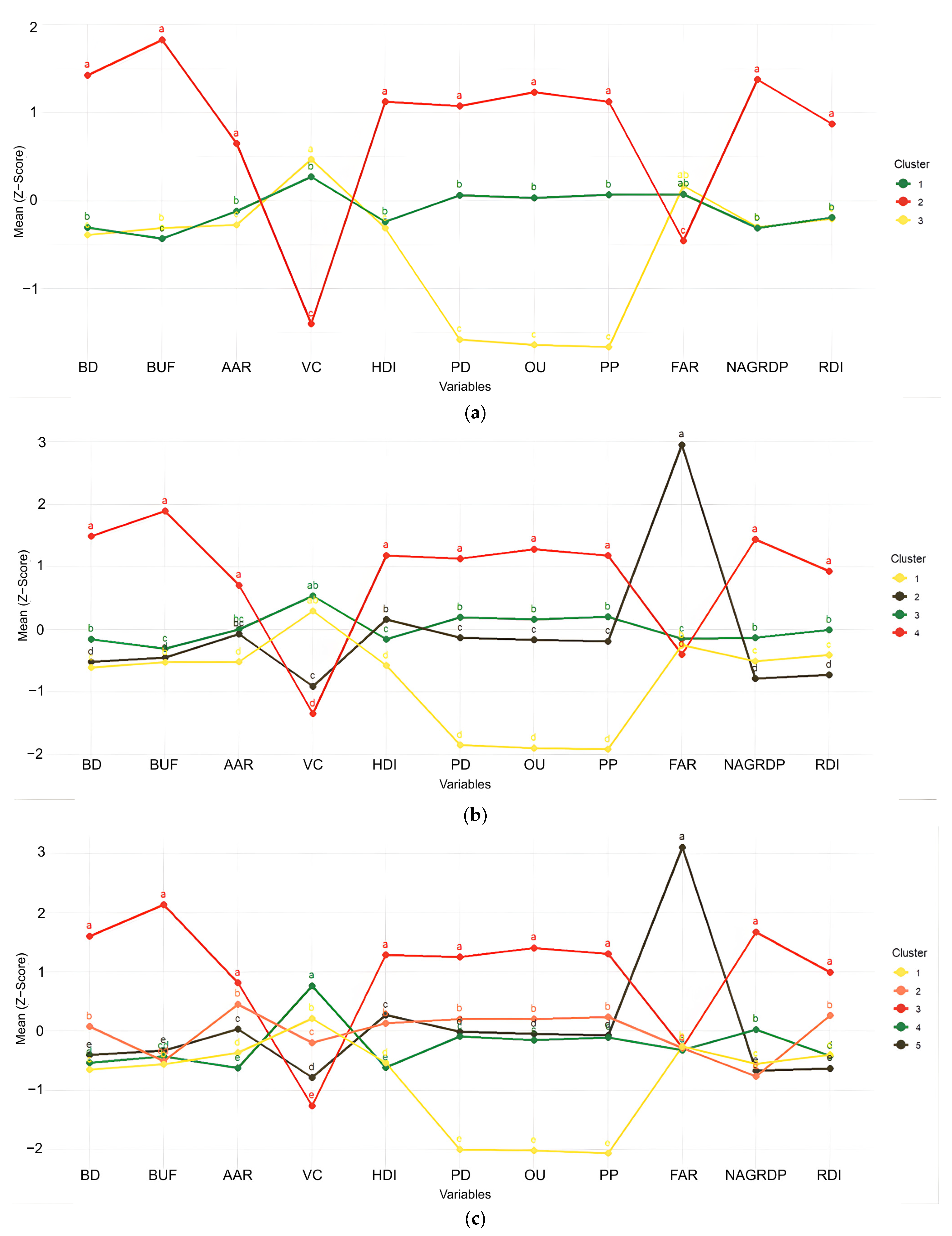
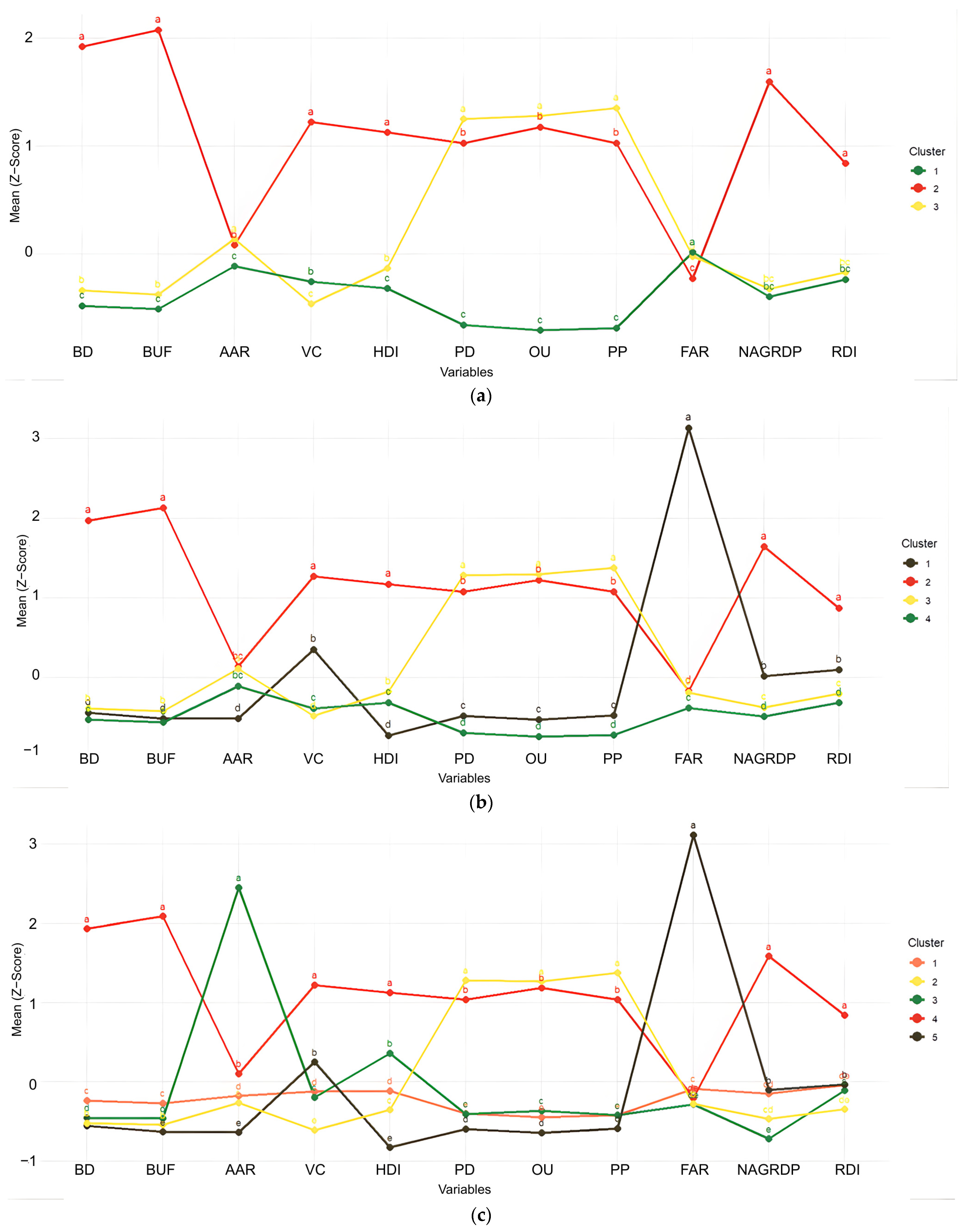
3.1. Comparison Between Non-RQZM K-Means and RQZM-2 K-Means
3.2. Validation of Clustering Results
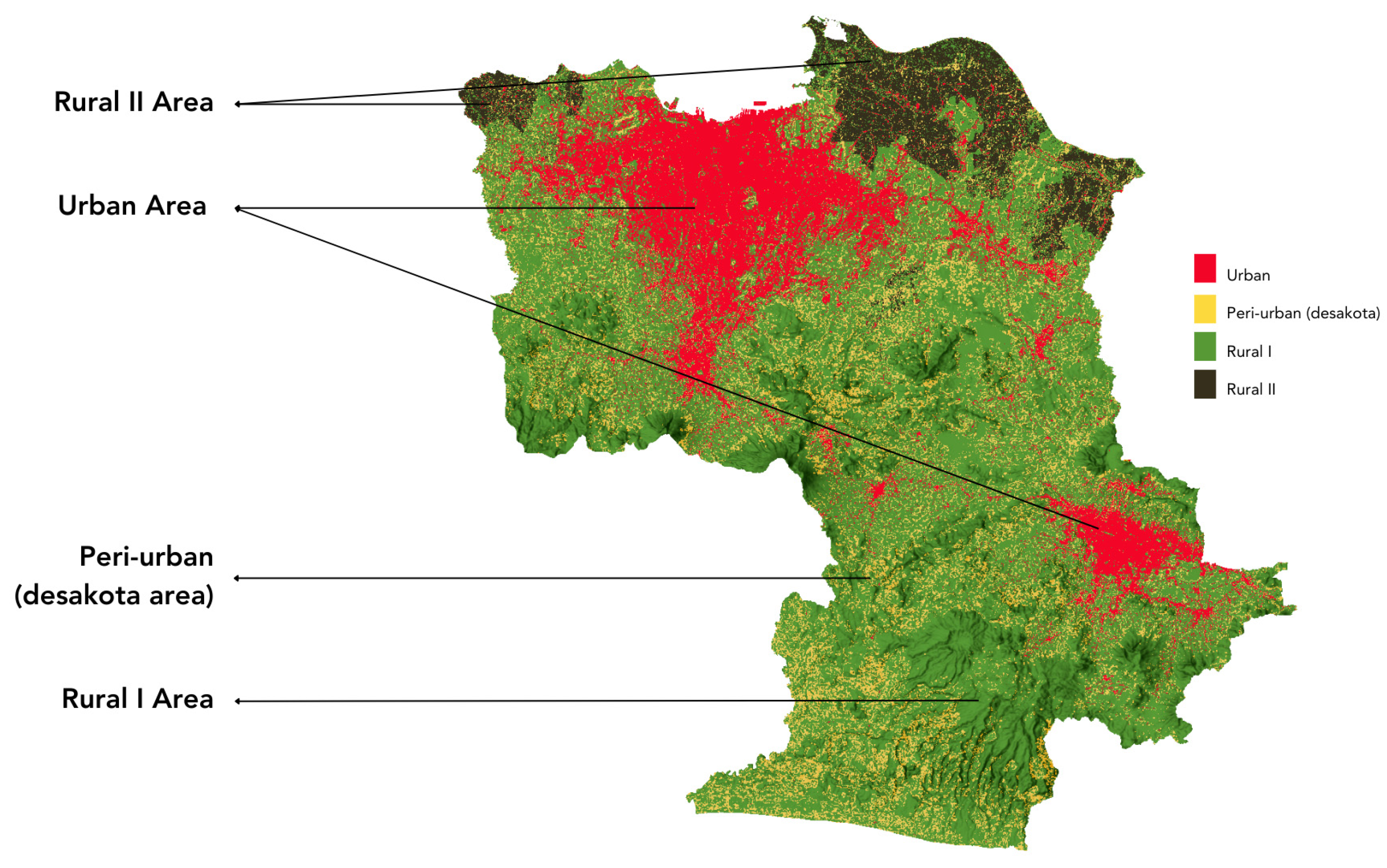
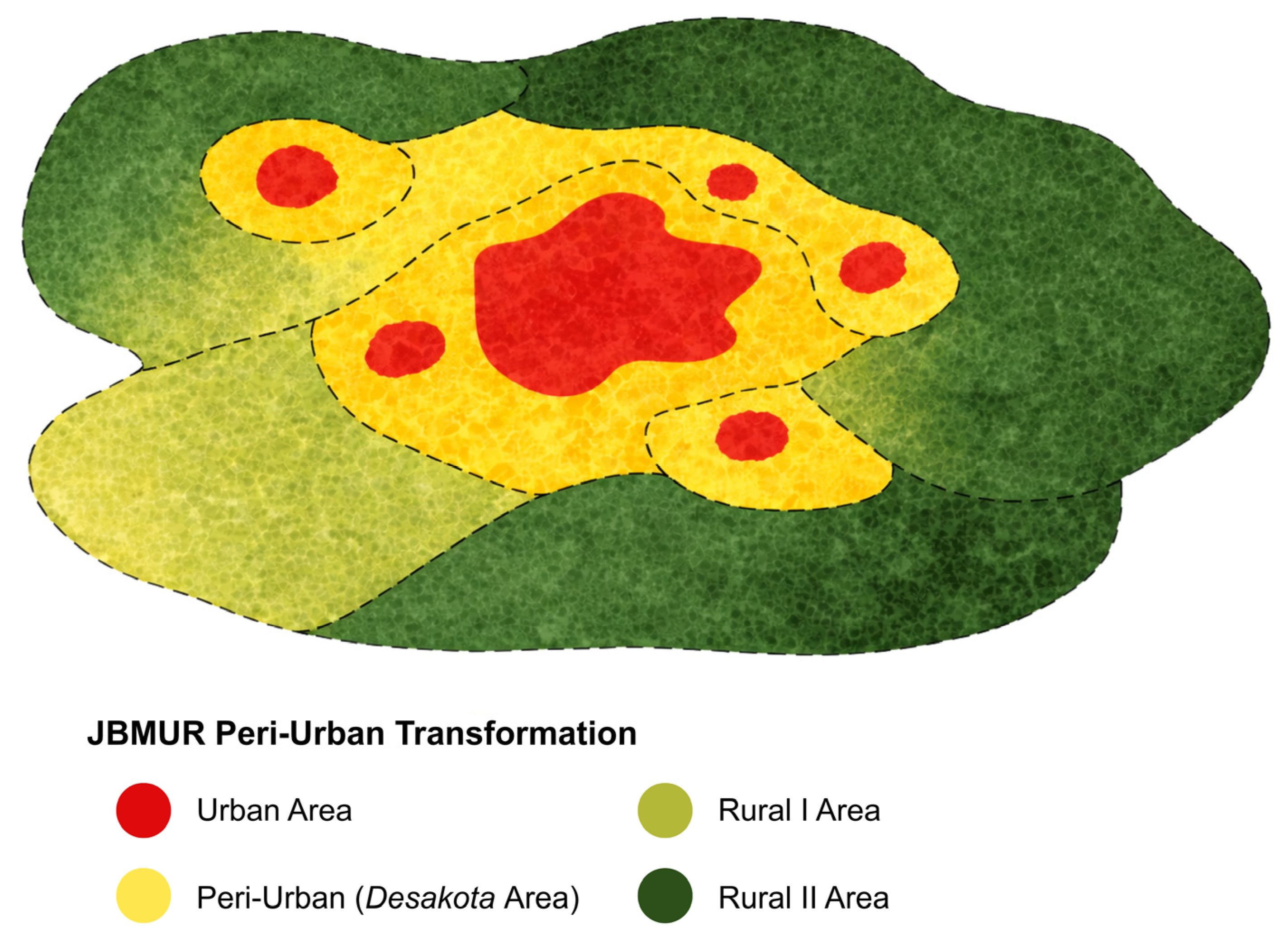
3.3. R–P–U Zones in the Jakarta–Bandung Mega-Urban Region (JBMUR)
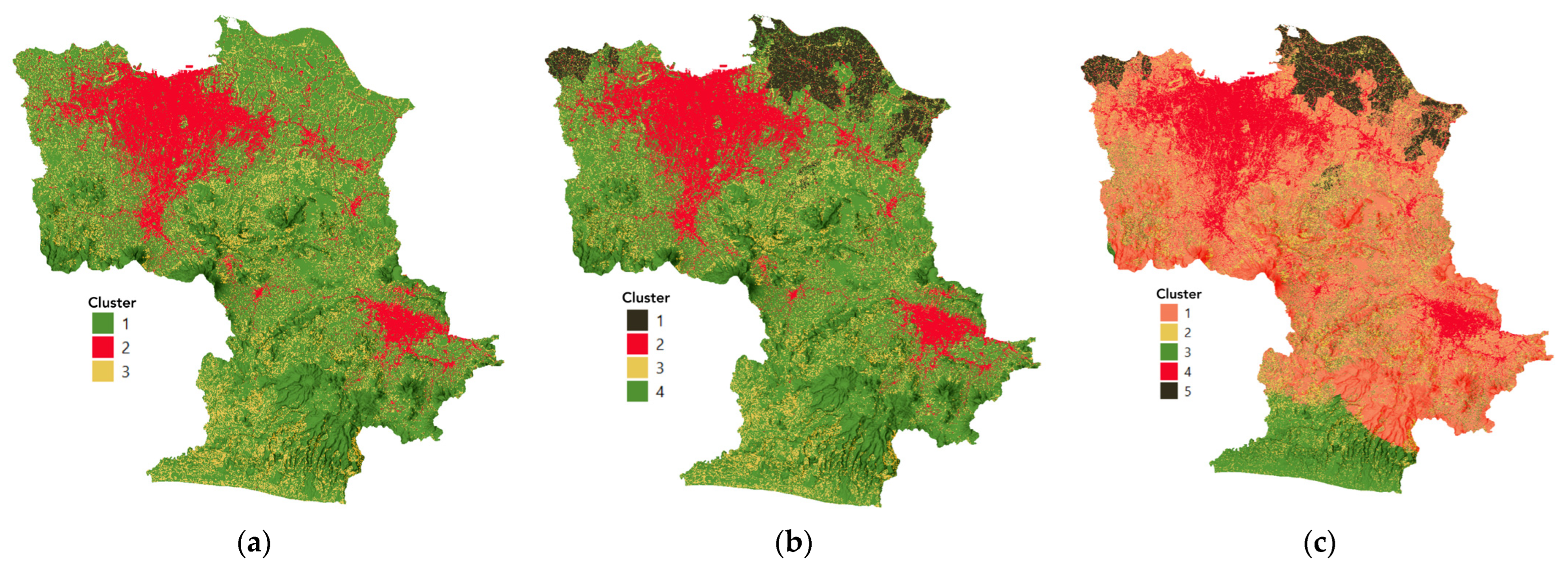
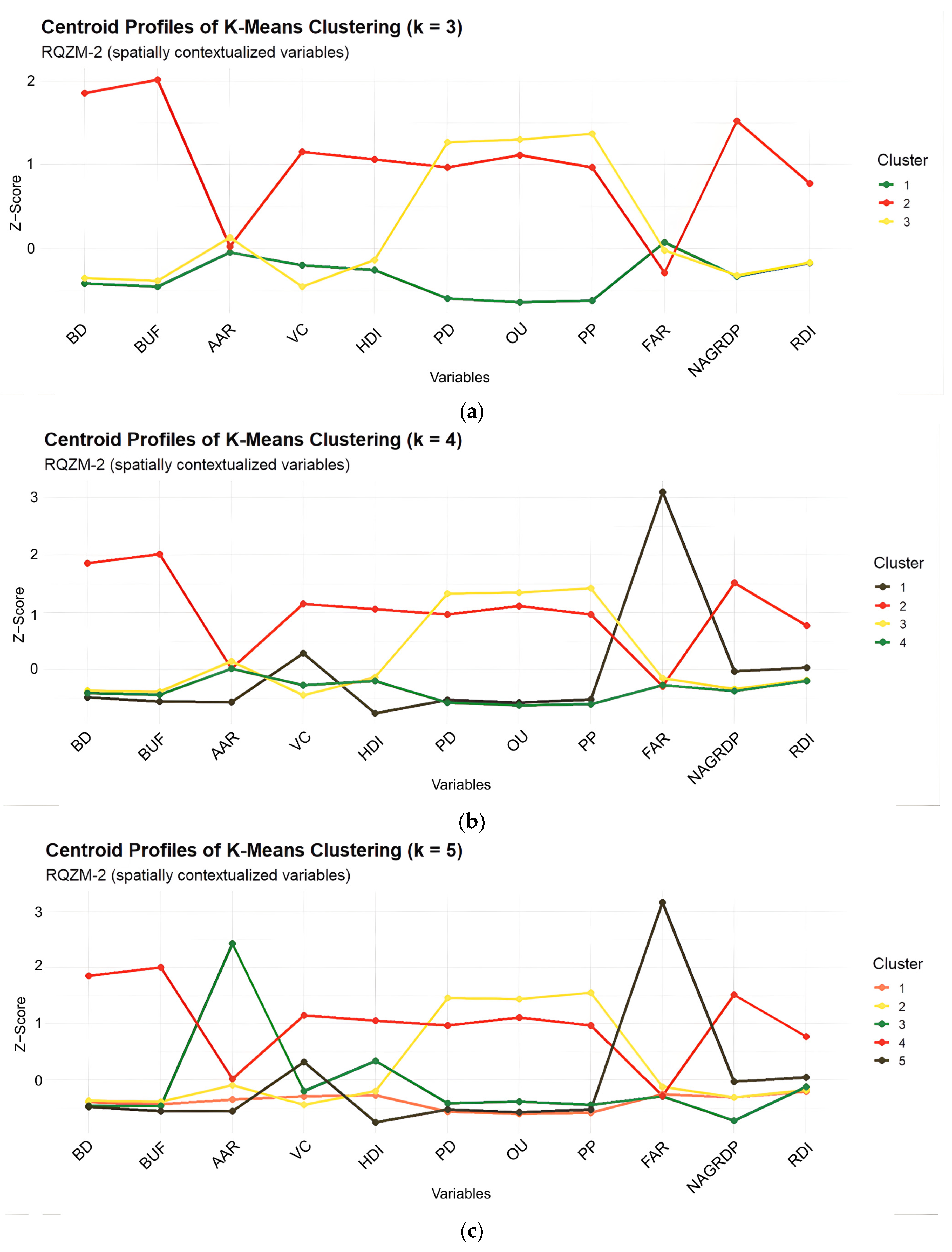
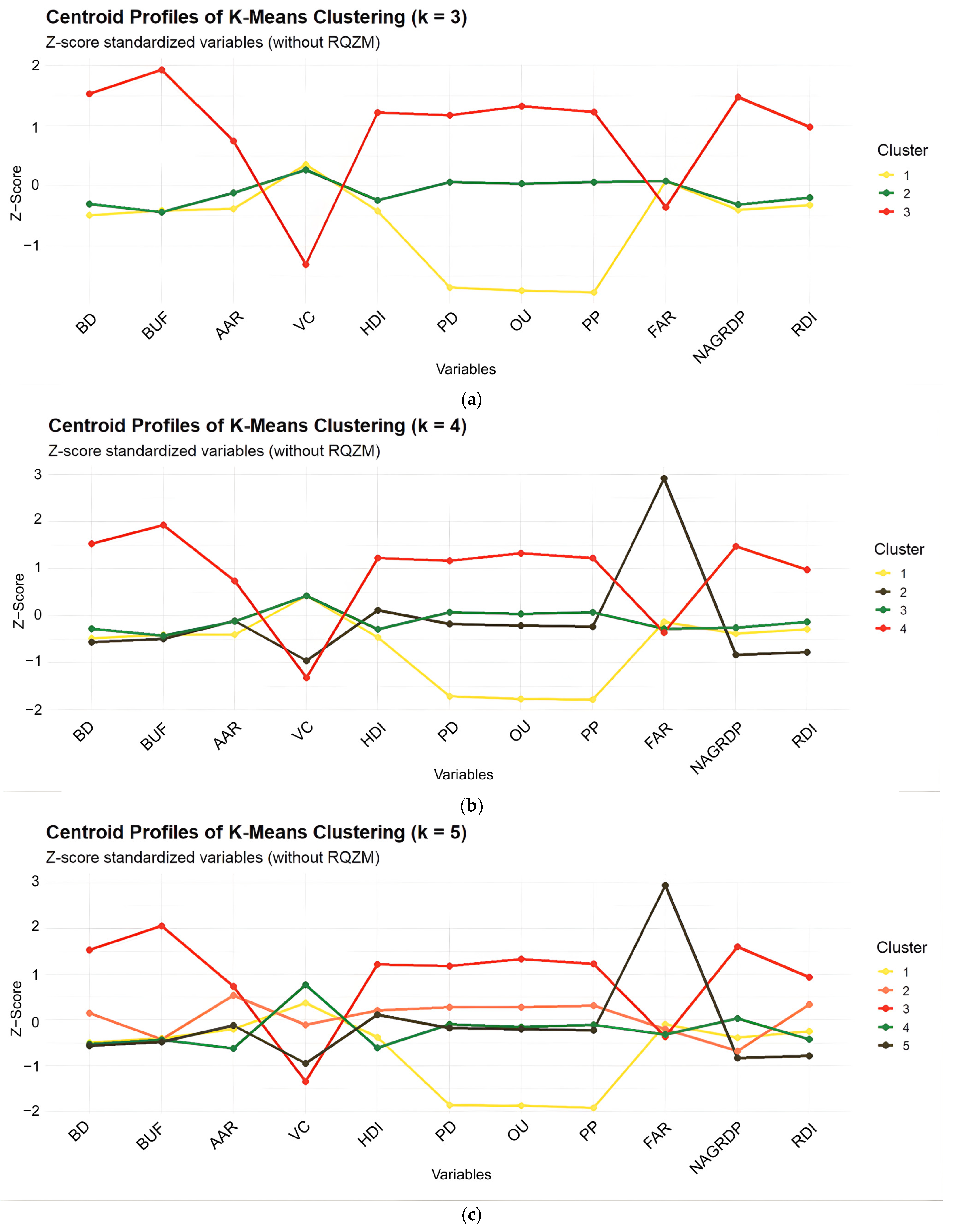
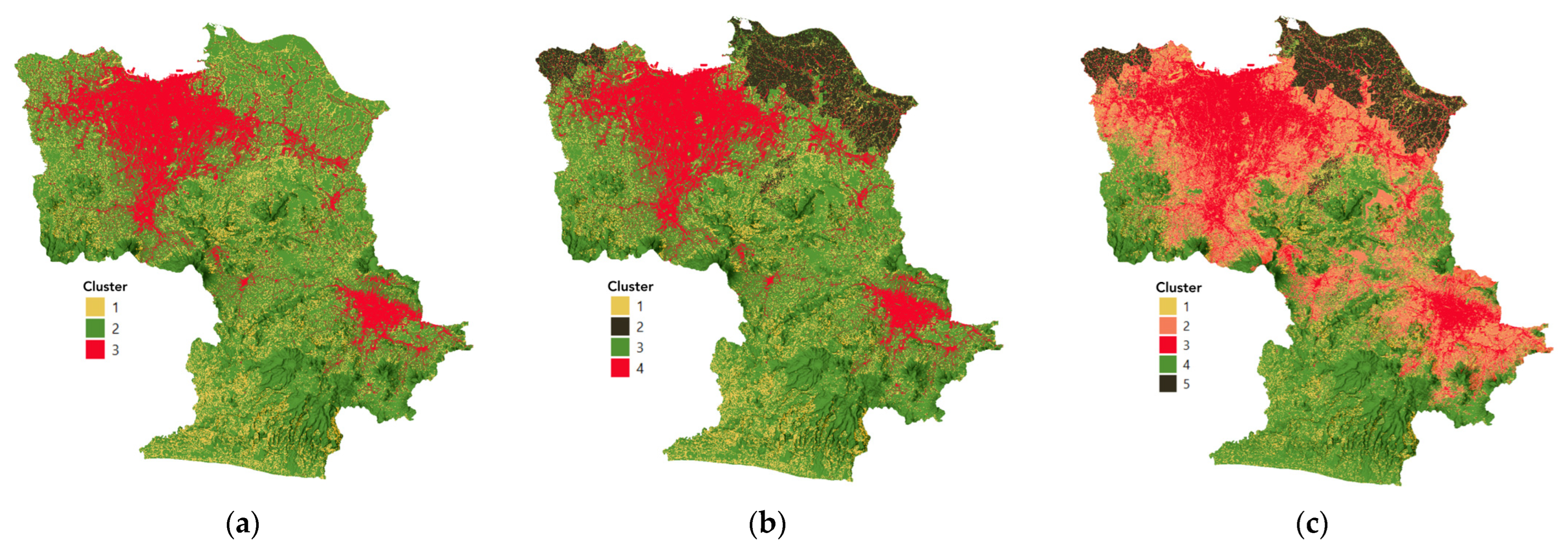
- The urban zone (Cluster 2) is characterized by very high values of BD and BUF, indicating intensive built-up development, combined with relatively high VC and slightly elevated PD, OU, and PP, reflecting concentrated population and moderate social pressure. NAGRDP and RDI consistently exhibit high values, indicating a diversified non-agricultural economic structure and advanced regional development. In contrast, FAR shows relatively low values, confirming the limited role of agricultural activities within urban areas. Accessibility (AAR) is generally higher than in rural typologies, supporting dense urban functions, although it partially overlaps with peri-urban areas.
- The peri-urban zone (Cluster 3) represents a transitional system with moderate values of BD and BUF and relatively good accessibility (AAR). This typology exhibits the highest values of PD, OU, and PP among all clusters, indicating intense population pressure and heightened social vulnerability associated with ongoing rural–urban transition. Environmental indicators show relatively low values, reflecting increasing land conversion and reduced vegetation cover. NAGRDP and RDI remain at moderate levels and are unexpectedly lower than those observed in Rural I, highlighting areas undergoing structural transformation rather than fully established urban economic systems.
- The rural zones (Cluster 4 and 1) display consistently low built-up intensity (BD and BUF) and weaker socio-economic performance. Rural I shows relatively balanced but low values across PD, OU, PP, NAGRDP, and RDI, combined with low VC and moderate FAR, indicating stable agricultural-based systems with limited diversification and gradual land-use change. Accessibility (AAR) remains low to moderate, reinforcing the predominantly rural character of these areas. Rural II exhibits a highly distinctive profile characterized by extremely high FAR, indicating strong agricultural dominance, alongside very low HDI, reflecting limited human development outcomes. Built-up indicators (BD and BUF) are slightly higher than in Rural I, but accessibility (AAR) remains consistently low, while VC is relatively higher than in both rural and peri-urban zones. This zone represents agrarian-dominated yet structurally isolated rural areas, predominantly located in peripheral and weakly integrated into the regional urban system.
4. Discussion
4.1. Functional R–P–U Structure of the JBMUR
4.2. Peri-Urban Transformation and Empirical Representation of Classical Concepts
5. Conclusions
Author Contributions
Funding
Data Availability Statement
Conflicts of Interest
Appendix A. Data Pre-Processing Workflow for Indicator Construction
- The spatial indicators used in this study were produced through the following preprocessing workflow.
- Step 1: Spatial Harmonization
- All datasets were projected to a common coordinate reference system and aligned to a uniform grid-based spatial framework. Raster datasets were resampled to the target resolution using bilinear interpolation for continuous variables and nearest-neighbor resampling for categorical variables to preserve class integrity.
- Step 2: Built-Environment Indicator Processing
- Aggregate building footprint polygons from the Global Building Atlas [99] to compute building density (BD; buildings/km2) by normalizing building counts by area.
- Convert built-up land cover classes into a binary raster (built-up = 1; non-built-up = 0) and calculate built-up fraction (BUF; %) using a moving window approach.
- Step 3: Accessibility Indicator Processing
- Extract arterial road networks from OSM data.
- Compute Euclidean distance to the nearest arterial road for each grid cell.
- Transform distance values into an accessibility to arterial roads index using an inverse distance formulation, whereby shorter distances correspond to higher accessibility.
- Step 4: Environmental Indicator Processing
- Calculate the NDVI from Landsat multispectral imagery.
- Linearly rescale NDVI values within a predefined vegetation range to produce vegetation cover (VC; 0–1), representing the proportional dominance of vegetated surfaces.
- Step 5: Socio-Economic Indicator Downscaling
- Anchor administrative-level values to official statistics to preserve statistical consistency.
- Allocate intra-regional spatial variation using spatial proxy variables, including population distribution, land-use composition, and infrastructure availability.
- Apply mean-preserving constraints to ensure that aggregated grid-level values remained consistent with original administrative totals.
- This procedure was applied to Human Development Index (HDI), population density (PD; per 1000 population), open unemployment (OU; per 1000 population), poor population (PP; per 1000 population), and farmers ratio (FAR).
- Step 6: Farmers Ratio (FAR) Construction
- Calculate the farmers ratio (FAR) as the number of farmers per 1000 population using district-level agricultural household data.
- Spatially distribute FAR to the pixel level and weight it by the proportion of agricultural land (paddy fields and mixed cropland) relative to total land area within each pixel.
- Step 7: Economic Structure Indicator Processing
- Assign regency-level non-agricultural GRDP ratio (NAGRDP) values to spatial units.
- Weight NAGRDP by the proportion of non-agricultural land area to generate a spatially explicit representation while preserving the original administrative economic structure.
- Step 8: Regional Development Index (RDI) Construction
- Apply facility-specific weights based on relative availability across regions.
- Standardize weighted facility indices and aggregate them to produce Regional Development Index (RDI) values.
- Rasterize administrative-level RDI values to the common spatial grid.
- Step 9: Standardization and Masking
- Standardize all continuous indicator layers using z-score normalization (mean = 0; standard deviation = 1).
- Mask raster cells outside the study boundary to ensure consistent spatial coverage across the study area.
- The external datasets used in this study are publicly available from the following sources:
- Global Building Atlas (building footprint polygons): https://github.com/zhu-xlab/GlobalBuildingAtlas (accessed on 17 October 2025)
- Landsat 9 Surface Reflectance Data (multispectral imagery): USGS Earth Explorer, https://earthexplorer.usgs.gov (accessed on 20 October 2025)
- OpenStreetMap (OSM) (road network data): https://www.openstreetmap.org/#map=5/-2.55/118.02 (accessed on 12 December 2025)
- Gridded Population Data (population distribution at 30 m resolution) https://www.worldpop.org (accessed on 18 October 2025)
- Official Socio-Economic and Facility Statistics: Indonesia’s Central Bureau of Statistics (BPS) https://www.bps.go.id/id and related official publications https://sensus.bps.go.id/main/index/st2023 (accessed on 18–20 October 2025)
References
- United Nations. World Urbanization Prospects: The 2018 Revision; United Nations: New York, NY, USA, 2019. [Google Scholar]
- Datta, A.; Shaban, A. Mega-Urbanization in the Global South: Fast Cities and New Urban Utopias of the Postcolonial State; Routledge Studies in Urbanism and the City; First Issued in Paperback; Routledge: London, UK; Taylor & Francis Group: New York, NY, USA, 2020. [Google Scholar]
- McGee, T.G.; Greenberg, C. The Emergence of Extended Metropolitan Regions in ASEAN: Towards the Year 2000. ASEAN Econ. Bull. 1992, 9, 22–44. [Google Scholar] [CrossRef] [Scilit]
- Dorodjatoen, A.M.H. The Emergence of Jakarta-Bandung Mega-Urban Region and Its Future Challenges. J. Reg. City Plan. 2009, 20, 15–33. [Google Scholar]
- Rustiadi, E.; Mizuno, K.; Kobayashi, S. Measuring Spatial Patterns of the Suburbanization Process. J. Rural Plan. Assoc. 1999, 18, 31–42. [Google Scholar] [CrossRef] [Scilit]
- Curran-Cournane, F.; Cain, T.; Greenhalgh, S.; Samarsinghe, O. Attitudes of a Farming Community towards Urban Growth and Rural Fragmentation—An Auckland Case Study. Land Use Policy 2016, 58, 241–250. [Google Scholar] [CrossRef] [Scilit]
- Sinha, S. Causes of Urban Sprawl: A Comparative Study of Developed and Developing World Cities. Res. Rev. Int. J. Multidiscip. 2018, 3, 5–9. [Google Scholar]
- Shaw, B.J.; Van Vliet, J.; Verburg, P.H. The Peri-Urbanization of Europe: A Systematic Review of a Multifaceted Process. Landsc. Urban Plan. 2020, 196, 103733. [Google Scholar] [CrossRef] [Scilit]
- Allen, A. Environmental Planning and Management of the Peri-Urban Interface: Perspectives on an Emerging Field. Environ. Urban 2003, 15, 135–148. [Google Scholar] [CrossRef] [Scilit]
- Kurtz, R.A.; Eicher, J.B. Fringe and Suburb: A Confusion of Concepts. Soc. Forces 1958, 37, 32–37. [Google Scholar] [CrossRef] [Scilit]
- Sahana, M.; Ravetz, J.; Patel, P.P.; Dadashpoor, H.; Follmann, A. Where Is the Peri-Urban? A Systematic Review of Peri-Urban Research and Approaches for Its Identification and Demarcation Worldwide. Remote Sens. 2023, 15, 1316. [Google Scholar] [CrossRef] [Scilit]
- Cattivelli, V. Methods for the Identification of Urban, Rural and Peri-Urban Areas in Europe: An Overview. J. Urban Regen. Renew. 2021, 14, 240. [Google Scholar] [CrossRef] [Scilit]
- Pearson, D. Lifestyle Properties, Ecosystem Services, and Biodiversity Protection in Peri-Urban Aotearoa–New Zealand: A Case Study from Peri-Urban Palmerston North. Land 2021, 10, 1345. [Google Scholar] [CrossRef] [Scilit]
- Wang, Y.; Huang, S.; Liu, J. Research on the Rural Environmental Governance and Interaction Effects of Farmers under the Perspective of Circular Economy—Evidence from Three Provinces of China. Sustainability 2023, 15, 13233. [Google Scholar] [CrossRef] [Scilit]
- Tian, L. Land Use Dynamics Driven by Rural Industrialization and Land Finance in the Peri-Urban Areas of China: “The Examples of Jiangyin and Shunde”. Land Use Policy 2015, 45, 117–127. [Google Scholar] [CrossRef] [Scilit]
- Guldin, G.E. Desakotas and beyond: Urbanization in Southern China. Ethnology 1996, 35, 265. [Google Scholar] [CrossRef] [Scilit]
- Wu, F.; Phelps, N.A. From Suburbia to Post-Suburbia in China? Aspects of the Transformation of the Beijing and Shanghai Global City Regions. Built Environ. 2008, 34, 464–481. [Google Scholar] [CrossRef] [Scilit]
- Miao, J.T.; Phelps, N.A.; Lu, T.; Wang, C.C. The Trials of China’s Technoburbia: The Case of the Future Sci-Tech City Corridor in Hangzhou. Urban Geogr. 2019, 40, 1443–1466. [Google Scholar] [CrossRef] [Scilit]
- McGee, T.G. Chapter 1 the Emergence of Desakota Regions in Asia: Expanding a Hypothesis. In The Extended Metropolis; Ginsburg, N., Koppel, B., McGee, T.G., Eds.; University of Hawaii Press: Honolulu, HI, USA, 1991; pp. 1–26. [Google Scholar]
- Ginsburg, N. Chapter 2 Extended Metropolitan Regions in Asia: A New Spatial Paradigm. In The Extended Metropolis; Ginsburg, N., Koppel, B., McGee, T.G., Eds.; University of Hawaii Press: Honolulu, HI, USA, 1991; pp. 27–46. [Google Scholar]
- McGee, T.G. Desakota. In International Encyclopedia of Geography; Richardson, D., Castree, N., Goodchild, M.F., Kobayashi, A., Liu, W., Marston, R.A., Eds.; Wiley: Hoboken, NJ, USA, 2017; pp. 1–2. [Google Scholar]
- Barrington, M.J.; Ilbery, B.W. Farm Fragmentation: A Case Study from Coventry’s Urban Fringe. Geoforum 1987, 18, 237–245. [Google Scholar] [CrossRef] [Scilit]
- Ilbery, B.W. Agricultural Change on the West Midlands’ Urban Fringe. Tijdschr. Voor Econ. Soc. Geogr. 1988, 79, 108–121. [Google Scholar] [CrossRef] [Scilit]
- Bryant, C.R.; Russwurm, L.H.; MacLellan, A.G. The City’s Countryside: Land and Its Management in the Rural-Urban Fringe; 2. impr.; Longman: London, UK, 1985. [Google Scholar]
- Chen, Y.; Wen, Y.; Li, Z. From Blueprint to Action: The Transformation of the Planning Paradigm for Desakota in China. Cities 2017, 60, 454–465. [Google Scholar] [CrossRef] [Scilit]
- Georg, I.; Blaschke, T.; Taubenböck, H. Are We in Boswash Yet? A Multi-Source Geodata Approach to Spatially Delimit Urban Corridors. ISPRS Int. J. Geo-Inf. 2018, 7, 15. [Google Scholar] [CrossRef] [Scilit]
- Bai, M.; Zhang, X.; Ai, W.; Jing, X.; Liu, L. A High-Resolution Global Annual City and Town Boundaries Dataset (2000–2022) Derived from GLC_FCS30D Product. Sci. Data 2025, 13, 50. [Google Scholar] [CrossRef] [Scilit] [PubMed]
- Chettry, V. Peri-Urban Area Delineation and Urban Sprawl Quantification in Thiruvananthapuram Urban Agglomeration, India, from 2001 to 2021 Using Geoinformatics. Appl. Geomat. 2022, 14, 639–652. [Google Scholar] [CrossRef] [Scilit]
- Zhang, A. Analysis of the Sustainable Development Pathway of Urban–Rural Integration from the Perspective of Spatial Planning: A Case Study of the Urban–Rural Fringe of Beijing. Sustainability 2025, 17, 1857. [Google Scholar] [CrossRef] [Scilit]
- Fang, L.; Wang, Y. Multi-Disciplinary Determination of the Rural/Urban Boundary: A Case Study in Xi’an, China. Sustainability 2018, 10, 2632. [Google Scholar] [CrossRef] [Scilit]
- Dong, Q.; Qu, S.; Qin, J.; Yi, D.; Liu, Y.; Zhang, J. A Method to Identify Urban Fringe Area Based on the Industry Density of POI. ISPRS Int. J. Geo-Inf. 2022, 11, 128. [Google Scholar] [CrossRef] [Scilit]
- Long, Y.; Luo, S.; Liu, X.; Luo, T.; Liu, X. Research on the Dynamic Evolution of the Landscape Pattern in the Urban Fringe Area of Wuhan from 2000 to 2020. ISPRS Int. J. Geo-Inf. 2022, 11, 483. [Google Scholar] [CrossRef] [Scilit]
- Peng, J.; Zhao, S.; Liu, Y.; Tian, L. Identifying the Urban-Rural Fringe Using Wavelet Transform and Kernel Density Estimation: A Case Study in Beijing City, China. Environ. Model. Softw. 2016, 83, 286–302. [Google Scholar] [CrossRef] [Scilit]
- Lu, W.; Li, Y.; Zhao, R.; Wang, Y. Using Remote Sensing to Identify Urban Fringe Areas and Their Spatial Pattern of Educational Resources: A Case Study of the Chengdu-Chongqing Economic Circle. Remote Sens. 2022, 14, 3148. [Google Scholar] [CrossRef] [Scilit]
- Peng, J.; Hu, Y.; Liu, Y.; Ma, J.; Zhao, S. A New Approach for Urban-Rural Fringe Identification: Integrating Impervious Surface Area and Spatial Continuous Wavelet Transform. Landsc. Urban Plan. 2018, 175, 72–79. [Google Scholar] [CrossRef] [Scilit]
- Mortoja, M.G.; Yigitcanlar, T. How Does Peri-Urbanization Trigger Climate Change Vulnerabilities? An Investigation of the Dhaka Megacity in Bangladesh. Remote Sens. 2020, 12, 3938. [Google Scholar] [CrossRef] [Scilit]
- Diti, I.; Tassinari, P.; Torreggiani, D. The Agri-Environmental Footprint: A Method for the Identification and Classification of Peri-Urban Areas. J. Environ. Manag. 2015, 162, 250–262. [Google Scholar] [CrossRef] [Scilit]
- Zeng, T.; Jin, H.; Geng, Z.; Kang, Z.; Zhang, Z. Urban–Rural Fringe Long-Term Sequence Monitoring Based on a Comparative Study on DMSP-OLS and NPP-VIIRS Nighttime Light Data: A Case Study of Shenyang, China. Int. J. Environ. Res. Public Health 2022, 19, 11835. [Google Scholar] [CrossRef] [Scilit] [PubMed]
- Gonçalves, J.; Gomes, M.C.; Ezequiel, S.; Moreira, F.; Loupa-Ramos, I. Differentiating Peri-Urban Areas: A Transdisciplinary Approach towards a Typology. Land Use Policy 2017, 63, 331–341. [Google Scholar] [CrossRef] [Scilit]
- Moreira, F.; Fontes, I.; Dias, S.; Silva, J.B.e; Loupa-Ramos, I. Contrasting Static versus Dynamic-Based Typologies of Land Cover Patterns in the Lisbon Metropolitan Area: Towards a Better Understanding of Peri-Urban Areas. Appl. Geogr. 2016, 75, 49–59. [Google Scholar] [CrossRef] [Scilit]
- Jatayu, A.; Rustiadi, E.; Pribadi, D.O. A Quantitative Approach to Characterizing the Changes and Managing Urban Form for Sustaining the Suburb of a Mega-Urban Region: The Case of North Cianjur. Sustainability 2020, 12, 8085. [Google Scholar] [CrossRef] [Scilit]
- Tobler, W.R. A Computer Movie Simulating Urban Growth in the Detroit Region. Econ. Geogr. 1970, 46, 234. [Google Scholar] [CrossRef] [Scilit]
- Ji, D.; Tian, J.; Zhang, J.; Zeng, J.; Namaiti, A. Identification and Spatiotemporal Evolution Analysis of the Urban–Rural Fringe in Polycentric Cities Based on K-Means Clustering and Multi-Source Data: A Case Study of Chengdu City. Land 2024, 13, 1727. [Google Scholar] [CrossRef] [Scilit]
- AssunÇão, R.M.; Neves, M.C.; Câmara, G.; Da Costa Freitas, C. Efficient Regionalization Techniques for Socio-economic Geographical Units Using Minimum Spanning Trees. Int. J. Geogr. Inf. Sci. 2006, 20, 797–811. [Google Scholar] [CrossRef] [Scilit]
- Martin, D. Extending the Automated Zoning Procedure to Reconcile Incompatible Zoning Systems. Int. J. Geogr. Inf. Sci. 2003, 17, 181–196. [Google Scholar] [CrossRef] [Scilit]
- Guo, D. Regionalization with Dynamically Constrained Agglomerative Clustering and Partitioning (REDCAP). Int. J. Geogr. Inf. Sci. 2008, 22, 801–823. [Google Scholar] [CrossRef] [Scilit]
- Rustiadi, E.; Kobayashi, S. Contiguous Spatial Classification: A New Approach on Quantitative Zoning Method. J. Geogr. High. Educ. 2000, 43, 122–136. [Google Scholar]
- Kurnia, A.A.; Rustiadi, E.; Pravitasari, A.E. Characterizing Industrial-Dominated Suburban Formation Using Quantitative Zoning Method: The Case of Bekasi Regency, Indonesia. Sustainability 2020, 12, 8094. [Google Scholar] [CrossRef] [Scilit]
- Jatayu, A.; Saizen, I.; Rustiadi, E.; Pribadi, D.O.; Juanda, B. Urban Form Dynamics and Modelling towards Sustainable Hinterland Development in North Cianjur, Jakarta–Bandung Mega-Urban Region. Sustainability 2022, 14, 907. [Google Scholar] [CrossRef] [Scilit]
- Kurnianti, D.N.; Rustiadi, E.; Baskoro, D.P.T. Land Use Projection for Spatial Plan Consistency in Jabodetabek. Indones. J. Geogr. 2016, 47, 124–131. [Google Scholar] [CrossRef] [Scilit]
- Rustiadi, E.; Pribadi, D.O.; Pravitasari, A.E.; Indraprahasta, G.S.; Iman, L.S. Jabodetabek Megacity: From City Development Toward Urban Complex Management System. In Urban Development Challenges, Risks and Resilience in Asian Mega Cities; Singh, R.B., Ed.; Advances in Geographical and Environmental Sciences; Springer: Tokyo, Japan, 2015; pp. 421–445. [Google Scholar]
- Supriyatin, R.; Pravitasari, A.E.; Pribadi, D.O. Pemetaan Karakteristik Wilayah Urban Dan Rural Di Wilayah Bandung Raya Dengan Metode Spatial Clustering. J. Geogr. 2020, 12, 125–136. [Google Scholar] [CrossRef] [Scilit]
- Fuadina, L.N.; Rustiadi, E.; Pravitasari, A.E. The Dynamic of Land Use Changes and Regional Development in Bandung Metropolitan Area. IOP Conf. Ser. Earth Environ. Sci. 2020, 556, 012002. [Google Scholar] [CrossRef] [Scilit]
- Firman, T.; Dharmapatni, I.A.I. THE EMERGENCE OF EXTENDED METROPOLITAN REGIONS IN INDONESIA: JABOTABEK AND BANDUNG METROPOLITAN AREA. Rev. Urban Reg. Dev. 1995, 7, 167–188. [Google Scholar] [CrossRef] [Scilit]
- Dharmapatni, I.A.I.; Firman, T. Problems and Challenges of Mega-Urban Regions in Indonesia: The Case of Jabotabek and the Bandung Metropolitan Area. In The Mega-Urban Regions of Southeast Asia; McGee, T.G., Robinson, I.M., Eds.; University of British Columbia Press: Vancouver, BC, Canada, 2007; pp. 296–314. [Google Scholar]
- Firman, T. The Continuity and Change in Mega-Urbanization in Indonesia: A Survey of Jakarta–Bandung Region (JBR) Development. Habitat Int. 2009, 33, 327–339. [Google Scholar] [CrossRef] [Scilit]
- Aguilar, A.G.; Ward, P.M.; Smith, C.B., Sr. Globalization, Regional Development, and Mega-City Expansion in Latin America: Analyzing Mexico City’s Peri-Urban Hinterland. Cities 2003, 20, 3–21. [Google Scholar] [CrossRef] [Scilit]
- Hudalah, D.; Octifanny, Y.; Talitha, T.; Firman, T.; Phelps, N.A. From Metropolitanization to Megaregionalization: Intentionality in the Urban Restructuring of Java’s North Coast, Indonesia. J. Plan. Educ. Res. 2024, 44, 292–306. [Google Scholar] [CrossRef] [Scilit]
- Rustiadi, E.; Pravitasari, A.E.; Setiawan, Y.; Mulya, S.P.; Pribadi, D.O.; Tsutsumida, N. Impact of Continuous Jakarta Megacity Urban Expansion on the Formation of the Jakarta-Bandung Conurbation over the Rice Farm Regions. Cities 2021, 111, 103000. [Google Scholar] [CrossRef] [Scilit]
- Sherman, L.; Proctor, J.; Druckenmiller, H.; Tapia, H.; Hsiang, S. Global High-Resolution Estimates of the United Nations Human Development Index Using Satellite Imagery and Machine-Learning; National Bureau of Economic Research: Cambridge, MA, USA, 2023; p. w31044. [Google Scholar]
- Openshaw, S. A Million or so Correlation Coefficients: Three Experiments on the Modifiable Areal Unit Problem. In Statistical Applications in the Spatial Sciences; Pion: London, UK, 1979. [Google Scholar]
- Rustiadi, E.; Saefulhakim, S.; Panuju, D.R. Perencanaan dan Pengembangan Wilayah, 1st ed.; Crestpent Press dan Yayasan Obor Indonesia: Jakarta, Indonesia, 2009. [Google Scholar]
- Rustiadi, E.; Kitamura, T. Analysis of Land Use Changes in City Suburbs. A Case Study on Some Subdistricts of the Bekasi Area of West Java, Indonesia. J. Rural Plan. Assoc. 1998, 17, 20–31. [Google Scholar] [CrossRef] [Scilit]
- Lloyd, S. Least Squares Quantization in PCM. IEEE Trans. Inform. Theory 1982, 28, 129–137. [Google Scholar] [CrossRef] [Scilit]
- MacQueen, J. Some Methods for Classification and Analysis of Multivariate Observations. In Proceedings of the Fifth Berkeley Symposium on Mathematical Statistics and Probability, Volume 1: Statistics; University of California Press: Berkeley, CA, USA, 1967; Volume 5.1, pp. 281–298. [Google Scholar]
- Hartigan, J.A.; Wong, M.A. Algorithm AS 136: A K-Means Clustering Algorithm. Appl. Stat. 1979, 28, 100. [Google Scholar] [CrossRef] [Scilit]
- Jain, A.K. Data Clustering: 50 Years beyond K-Means. Pattern Recognit. Lett. 2010, 31, 651–666. [Google Scholar] [CrossRef] [Scilit]
- Kurnia, A.A.; Rustiadi, E.; Pravitasari, A.E. Cluster Analysis and Spatial Pattern Approaches in Identifying Development Pattern of Bodebek Region, West Java. In Proceedings of the Sixth International Symposium on LAPAN-IPB Satellite; Pham, T.D., Kanniah, K.D., Arai, K., Perez, G.J.P., Setiawan, Y., Prasetyo, L.B., Murayama, Y., Eds.; SPIE: Bogor, Indonesia, 2019; p. 101. [Google Scholar]
- Firmansyah, F.; Jatayu, A.; Imaduddin, B.R. Spatial Transformation Analysis in Menganti Subdistrict: A Study of Peri-Urban Area Typologies in the Face of Urban Expansion. IOP Conf. Ser. Earth Environ. Sci. 2024, 1353, 012039. [Google Scholar] [CrossRef] [Scilit]
- Pathak, V.; Deshkar, S. Optimising Resources and Localising Sustainability through Hierarchical Village Clustering in Nagpur Metropolitan Region, India. Sci. Rep. 2026, 16, 5749. [Google Scholar] [CrossRef] [Scilit]
- Bisiani, S.; Gulyas, A.; Heravi, B. Mapping News Geography: A Computational Framework for Classifying Local Media Through Geographic Coverage Patterns. Anth. Comp. Hum. 2025, 3, 861–882. [Google Scholar] [CrossRef] [Scilit]
- Álvarez-Ruiz, D.; Sánchez-Alzola, A.; Pastor-Fernández, A. Geospatial Clustering of GNSS Stations Using Unsupervised Learning: A Statistical Framework to Enhance Deformation Analysis for Environmental Risk Management. Mathematics 2026, 14, 855. [Google Scholar] [CrossRef] [Scilit]
- Rousseeuw, P.J. Silhouettes: A Graphical Aid to the Interpretation and Validation of Cluster Analysis. J. Comput. Appl. Math. 1987, 20, 53–65. [Google Scholar] [CrossRef] [Scilit]
- Davies, D.L.; Bouldin, D.W. A Cluster Separation Measure. IEEE Trans. Pattern Anal. Mach. Intell. 1979, PAMI-1, 224–227. [Google Scholar] [CrossRef] [Scilit]
- von Luxburg, U. Clustering Stability: An Overview. arXiv 2010. [Google Scholar] [CrossRef] [Scilit]
- Steinley, D. Properties of the Hubert-Arable Adjusted Rand Index. Psychol. Methods 2004, 9, 386–396. [Google Scholar] [CrossRef] [Scilit]
- Ben-Hur, A.; Elisseeff, A.; Guyon, I. A Stability Based Method for Discovering Structure in Clustered Data. In Proceedings of the Biocomputing 2002; WORLD SCIENTIFIC: Kauai, HI, USA, 2001; pp. 6–17. [Google Scholar] [CrossRef] [Scilit]
- Kang, Y.; Wu, K.; Gao, S.; Ng, I.; Rao, J.; Ye, S.; Zhang, F.; Fei, T. STICC: A Multivariate Spatial Clustering Method for Repeated Geographic Pattern Discovery with Consideration of Spatial Contiguity. arXiv 2022. [Google Scholar] [CrossRef] [Scilit]
- Wolf, L.J.; Knaap, E.; Rey, S. Geosilhouettes: Geographical Measures of Cluster Fit. Environ. Plan. B Urban Anal. City Sci. 2021, 48, 521–539. [Google Scholar] [CrossRef] [Scilit]
- Sun, D.; Fang, X.; Zhang, Y.; Zhu, Z.; Ma, C.; Yang, J. Complementary Classification of Hypertrophic Cardiomyopathy Using Unsupervised Cluster Analysis on Left Ventricular Function. Sci. Rep. 2025, 15, 8362. [Google Scholar] [CrossRef] [Scilit]
- Wang, Y.; Zhang, M.; Wang, P. Data-Driven Cluster Analysis on the Association of Aging, Obesity and Insulin Resistance with New-Onset Diabetes in Chinese Adults: A Multicenter Retrospective Cohort Study. Front. Med. 2025, 12, 1640017. [Google Scholar] [CrossRef] [Scilit]
- Montgomery, D.C. Design and Analysis of Experiments, EMEA Edition, 9th ed.; Wiley: Hoboken, NJ, USA, 2020. [Google Scholar]
- Follmann, A. Geographies of Peri-urbanization in the Global South. Geogr. Compass 2022, 16, e12650. [Google Scholar] [CrossRef] [Scilit]
- Kontgis, C.; Schneider, A.; Fox, J.; Saksena, S.; Spencer, J.H.; Castrence, M. Monitoring Peri-Urbanization in the Greater Ho Chi Minh City Metropolitan Area. Appl. Geogr. 2014, 53, 377–388. [Google Scholar] [CrossRef] [Scilit]
- Sareen, S.; Haque, M. The Dynamics of Peri-Urban Spatial Planning: An Overview. J. Urban Plan. Dev. 2023, 149, 03123002. [Google Scholar] [CrossRef] [Scilit]
- Christiawan, P.I.; Nguyen, T.P.L. Peri-Urbanization in Populous Developing Asian Countries: A Systematic Review. Int. J. Sustain. Dev. Plan. 2024, 19, 949–962. [Google Scholar] [CrossRef] [Scilit]
- Tesfay, S.M.; Gebregiorgis, G.A.; Ayele, D.G. Peri-Urban Land Transformation in the Global South: Revisiting Conceptual Vectors and Theoretical Perspectives. Land 2025, 14, 1483. [Google Scholar] [CrossRef] [Scilit]
- Jatayu, A.; Rustiadi, E.; Juanda, B.; Pribadi, D.O. Metric-Based Approach for Quantifying Urban Expansion Impact on Urban Form Changes in the JBMUR South Conurbation Corridor. Land 2023, 12, 864. [Google Scholar] [CrossRef] [Scilit]
- Hudalah, D.; Winarso, H.; Woltjer, J. Planning by Opportunity: An Analysis of Periurban Environmental Conflicts in Indonesia. Environ. Plan A 2010, 42, 2254–2269. [Google Scholar] [CrossRef] [Scilit]
- Pribadi, D.O.; Saifullah, K.; Nurdin, M.; Putra, A.S. Finding a New Approach to Spatial Planning of Complex Desakota Regions: The Use of Spatial-Based Indicators in Regional Sustainability. In Remote Sensing and GIS in Peri-Urban Research—Perspectives on Global Change, Sustainability and Resilience; Modern Cartography Series; Elsevier: Amsterdam, The Netherlands, 2024; Volume 11, pp. 483–507. [Google Scholar]
- Mc Gee, T.G.; Shaharudin, I. Reimagining the “Peri-Urban” in the Mega-Urban Regions of Southeast Asia. In Balanced Urban Development: Options and Strategies for Liveable Cities; Maheshwari, B., Thoradeniya, B., Singh, V.P., Eds.; Water Science and Technology Library; Springer International Publishing: Cham, Switzerland, 2016; Volume 72, pp. 499–516. [Google Scholar]
- Pribadi, D.O.; Pauleit, S. The Dynamics of Peri-Urban Agriculture during Rapid Urbanization of Jabodetabek Metropolitan Area. Land Use Policy 2015, 48, 13–24. [Google Scholar] [CrossRef] [Scilit]
- Gubry, P. Chapter 7 Urbanization in Southeast Asia. Research Ideas from the Experience of Vietnam. In Trends of Urbanization and Suburbanization in Southeast Asia; General Publishing House: Mumbai, India, 2012. [Google Scholar]
- Abdullah, A. Kampung Sayong in Transition: Analyzing Urbanization’s Impact on Malay Settlements Patterns and Social Fabric. Int. J. BES 2025, 13, 119–133. [Google Scholar] [CrossRef] [Scilit]
- Sui, D.Z.; Zeng, H. Modeling the Dynamics of Landscape Structure in Asia’s Emerging Desakota Regions: A Case Study in Shenzhen. Landsc. Urban Plan. 2001, 53, 37–52. [Google Scholar] [CrossRef] [Scilit]
- Tian, L.; Ge, B.; Li, Y. Impacts of State-Led and Bottom-up Urbanization on Land Use Change in the Peri-Urban Areas of Shanghai: Planned Growth or Uncontrolled Sprawl? Cities 2017, 60, 476–486. [Google Scholar] [CrossRef] [Scilit]
- Ortega, A.A.C. Desakota 2.0: Worlding Hybrid Spaces in the Global Urban. Urban Geogr. 2020, 41, 668–681. [Google Scholar] [CrossRef] [Scilit]
- Purwantiningrum, P.; Rustiadi, E.; Pribadi, D.O. Mapping the Spatial Pattern of Ecosystem Services in the Jabodetabek Metropolitan Area, Indonesia: Could Peri-Urban Areas Support the Urban Core? Reg. Sustain. 2025, 6, 100276. [Google Scholar] [CrossRef] [Scilit]
- Zhu, X.X.; Chen, S.; Zhang, F.; Shi, Y.; Wang, Y. GlobalBuildingAtlas: An Open Global and Complete Dataset of Building Polygons, Heights and LoD1 3D Models. Earth Syst. Sci. Data 2025, 17, 6647–6668. [Google Scholar] [CrossRef] [Scilit]
- Stevens, F.R.; Gaughan, A.E.; Linard, C.; Tatem, A.J. Disaggregating Census Data for Population Mapping Using Random Forests with Remotely-Sensed and Ancillary Data. PLoS ONE 2015, 10, e0107042. [Google Scholar] [CrossRef] [Scilit]
- Pravitasari, A.E.; Rustiadi, E.; Priatama, R.A.; Murtadho, A.; Kurnia, A.A.; Mulya, S.P.; Saizen, I.; Widodo, C.E.; Wulandari, S. Spatiotemporal Distribution Patterns and Local Driving Factors of Regional Development in Java. ISPRS Int. J. Geo-Inf. 2021, 10, 812. [Google Scholar] [CrossRef] [Scilit]
- Murtadho, A.; Pravitasari, A.E.; Munibah, K.; Rustiadi, E. Spatial Distribution Pattern of Village Development Index in Karawang Regency Using Spatial Autocorrelation Approach. J. Pembang. Wil. Kota 2020, 16, 102–111. [Google Scholar] [CrossRef] [Scilit]

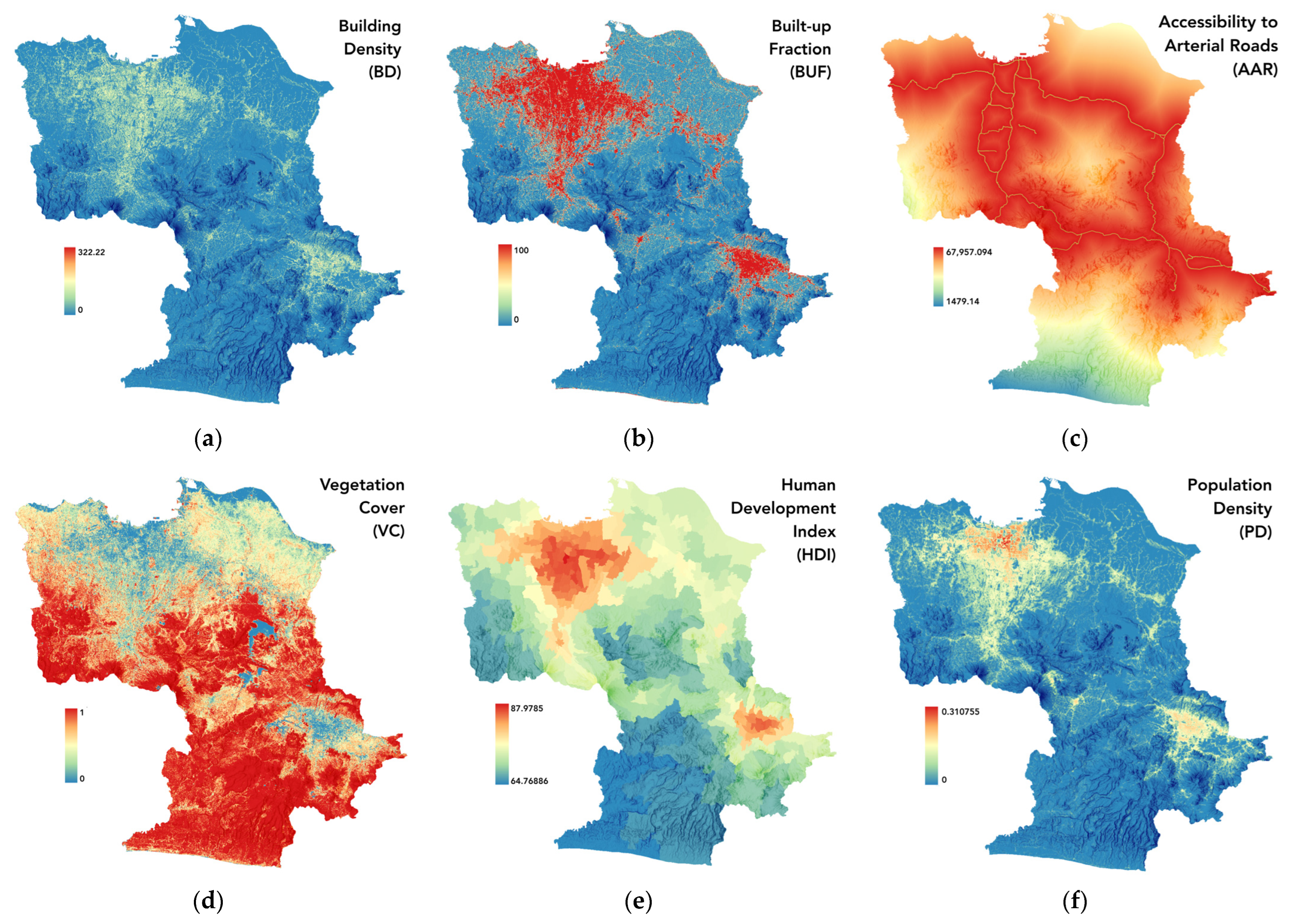
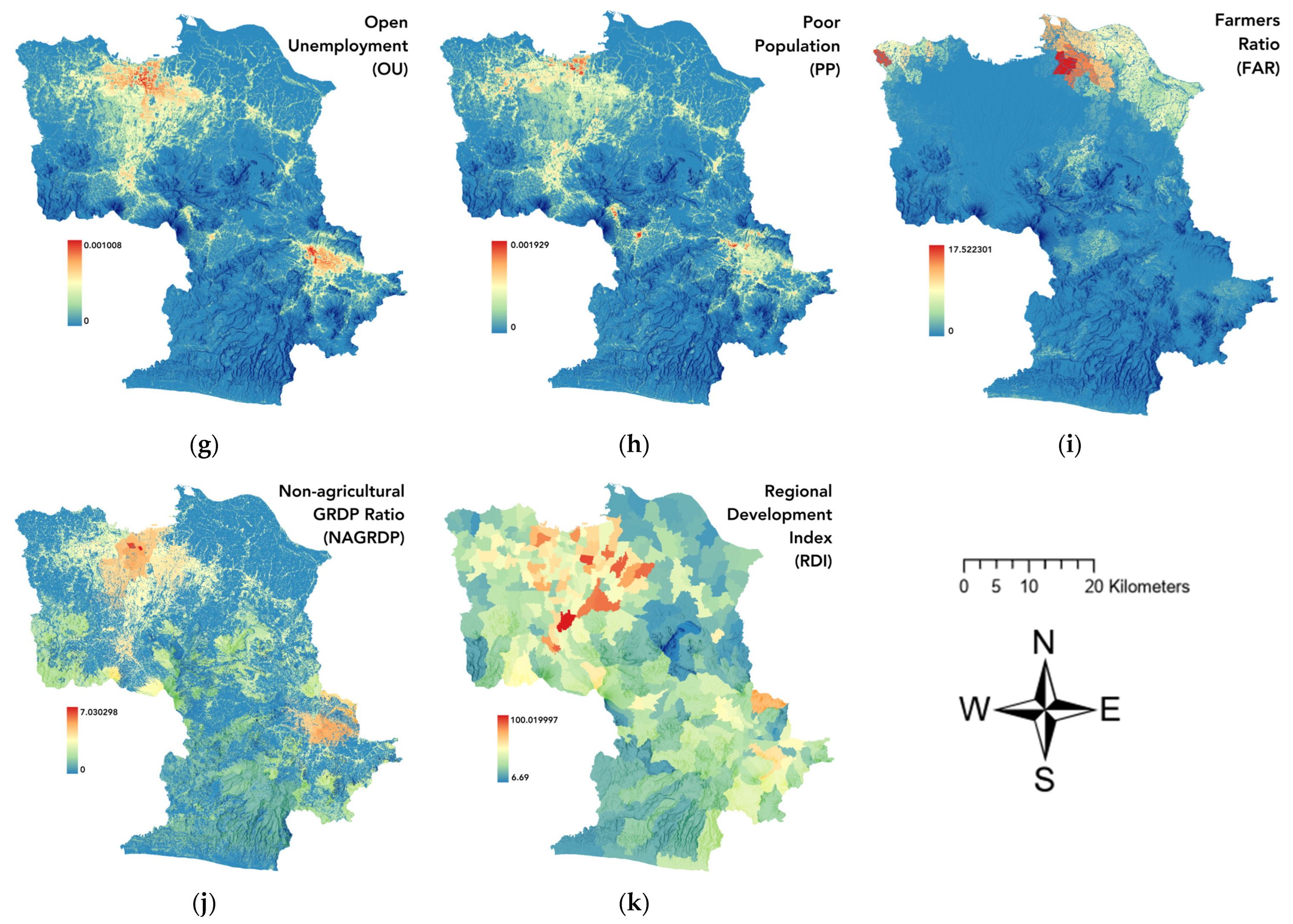






| Variable | Unit | Year | Definition | Data Source | |
|---|---|---|---|---|---|
| BD | Building Density | buildings/km2 | 2025 | Density of building footprints aggregated at grid level. | Global Building Atlas |
| BUF | Built-up Fraction | % | 2025 | Percentage of built-up area within each raster cell. | LULC classification (30 m) |
| AAR | Accessibility to Arterial Roads | index | 2025 | Accessibility index based on inverse distance to arterial roads. | OpenStreetMap (OSM) |
| VC | Vegetation Cover | 0–1 | 2025 | Fraction of vegetation derived from NDVI satellite imagery. | Landsat 9 |
| HDI | Human Development Index | index | 2024 | Composite indicator of education, health, and income dimensions | Indonesia Central Bureau of Statistics |
| PD | Population Density | persons/1000 population | 2024 | Spatial distribution of population based on gridded population data. | WorldPop and Indonesia Central Bureau of Statistics |
| OU | Open Unemployment | persons/1000 population | 2024 | Open unemployment rate per 1000 population. | Indonesia Central Bureau of Statistics |
| PP | Poor Population | persons/1000 population | 2024 | Poverty rate per 1000 population based on national criteria. | Indonesia Central Bureau of Statistics |
| FAR | Farmers Ratio | persons/1000 population | 2023 | Number of individuals primarily engaged in agriculture per 1000 population. | Agricultural Census—Indonesia Central Bureau of Statistics |
| NAGRDP | Non-agricultural GRDP Ratio | ratio | 2024 | Contribution of non-agricultural sectors to the regional economy. | Indonesia Central Bureau of Statistics |
| RDI | Regional Development Index | index | 2024 | Composite index representing availability and capacity of regional services. | Villages Potential—Indonesia Central Bureau of Statistics |
| Validation Criterion | Non-RQZM | RQZM-2 | Interpretation | ||||
|---|---|---|---|---|---|---|---|
| k = 3 | k = 4 | k = 5 | k = 3 | k = 4 | k = 5 | ||
| Mean Silhouette ↑ * | 0.299 | 0.320 | 0.256 | 0.335 | 0.337 | 0.309 | RQZM-2 (k = 4) provides the strongest overall cluster separation. |
| Davies–Bouldin Index ↓ | 1.422 | 1.262 | 1.336 | 1.454 | 1.321 | 1.226 | RQZM-2 (k = 5) yields the most compact and well-separated clusters. |
| Mean ARI (Stability) ↑ | 0.985 | 0.982 | 0.808 | 0.989 | 0.987 | 0.981 | RQZM-2 (k = 3) shows the highest clustering stability. |
| Spatial Patches ↓ | 69 | 69 | 69 | 69 | 69 | 69 | Both methods (all k) exhibit identical spatial coherence. |
| Zone | Area (km2) | Percentage of Total Area (%) | Spatial Characteristics |
|---|---|---|---|
| Urban (Cluster 2) | 2697.68 | 16.28 | Compact urban cores with intensive built-up development and strong non-agricultural economic activities |
| Peri-urban/Desakota (Cluster 3) | 2497.43 | 15.07 | Transitional belts with mixed land-use and the highest population and social pressure |
| Rural I (Cluster 4) | 10,301.02 | 62.17 | Dominant rural landscapes with stable agricultural activities and moderate connectivity |
| Rural II (Cluster 1) | 1074.08 | 6.48 | Spatially isolated rural areas with strong agricultural dominance and limited accessibility |
| Total | 16,570.21 | 100.00 | — |
Disclaimer/Publisher’s Note: The statements, opinions and data contained in all publications are solely those of the individual author(s) and contributor(s) and not of MDPI and/or the editor(s). MDPI and/or the editor(s) disclaim responsibility for any injury to people or property resulting from any ideas, methods, instructions or products referred to in the content. |
© 2026 by the authors. Licensee MDPI, Basel, Switzerland. This article is an open access article distributed under the terms and conditions of the Creative Commons Attribution (CC BY) license.
Share and Cite
Rahma, N.Z.C.; Rustiadi, E.; Pravitasari, A.E. Enhancing Urban and Peri-Urban Zoning Using Spatially Constrained Clustering: Evidence from the Jakarta–Bandung Mega-Urban Region. Land 2026, 15, 534. https://doi.org/10.3390/land15040534
Rahma NZC, Rustiadi E, Pravitasari AE. Enhancing Urban and Peri-Urban Zoning Using Spatially Constrained Clustering: Evidence from the Jakarta–Bandung Mega-Urban Region. Land. 2026; 15(4):534. https://doi.org/10.3390/land15040534
Chicago/Turabian StyleRahma, Nur Zahro Charissa, Ernan Rustiadi, and Andrea Emma Pravitasari. 2026. "Enhancing Urban and Peri-Urban Zoning Using Spatially Constrained Clustering: Evidence from the Jakarta–Bandung Mega-Urban Region" Land 15, no. 4: 534. https://doi.org/10.3390/land15040534
APA StyleRahma, N. Z. C., Rustiadi, E., & Pravitasari, A. E. (2026). Enhancing Urban and Peri-Urban Zoning Using Spatially Constrained Clustering: Evidence from the Jakarta–Bandung Mega-Urban Region. Land, 15(4), 534. https://doi.org/10.3390/land15040534