Biocrust Functional Traits Exhibit Divergent Responses to Future Climate–Land Use Scenarios in an Arid Region of Northern China

 , and
, and
Abstract
1. Introduction
2. Materials and Methods
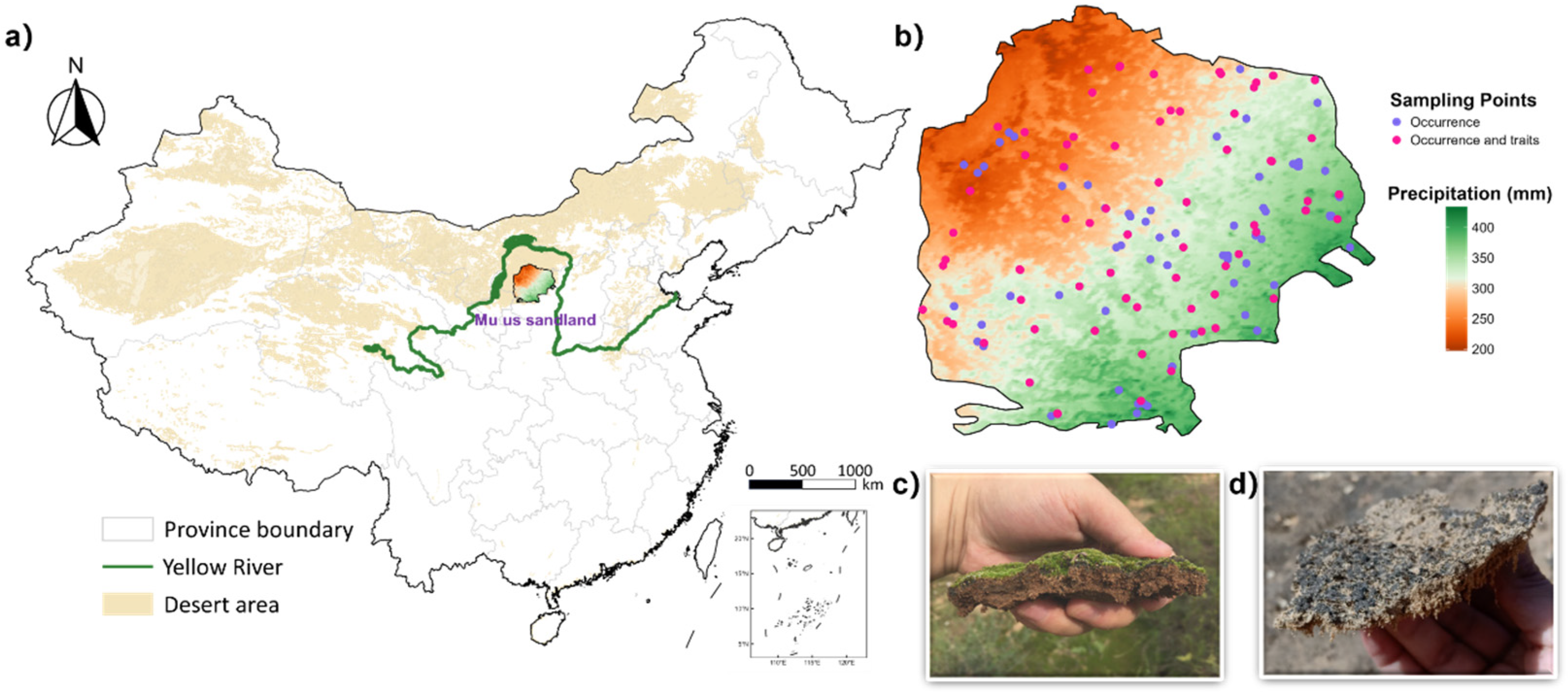
2.1. Study Region
2.2. Data Collection and Preprocessing
2.3. Modeling Biocrust Habitat Distribution and Identifying Environmental Drivers
2.4. Biocrust Functional Trait Distribution Modeling Under Current and Future Scenarios
3. Results
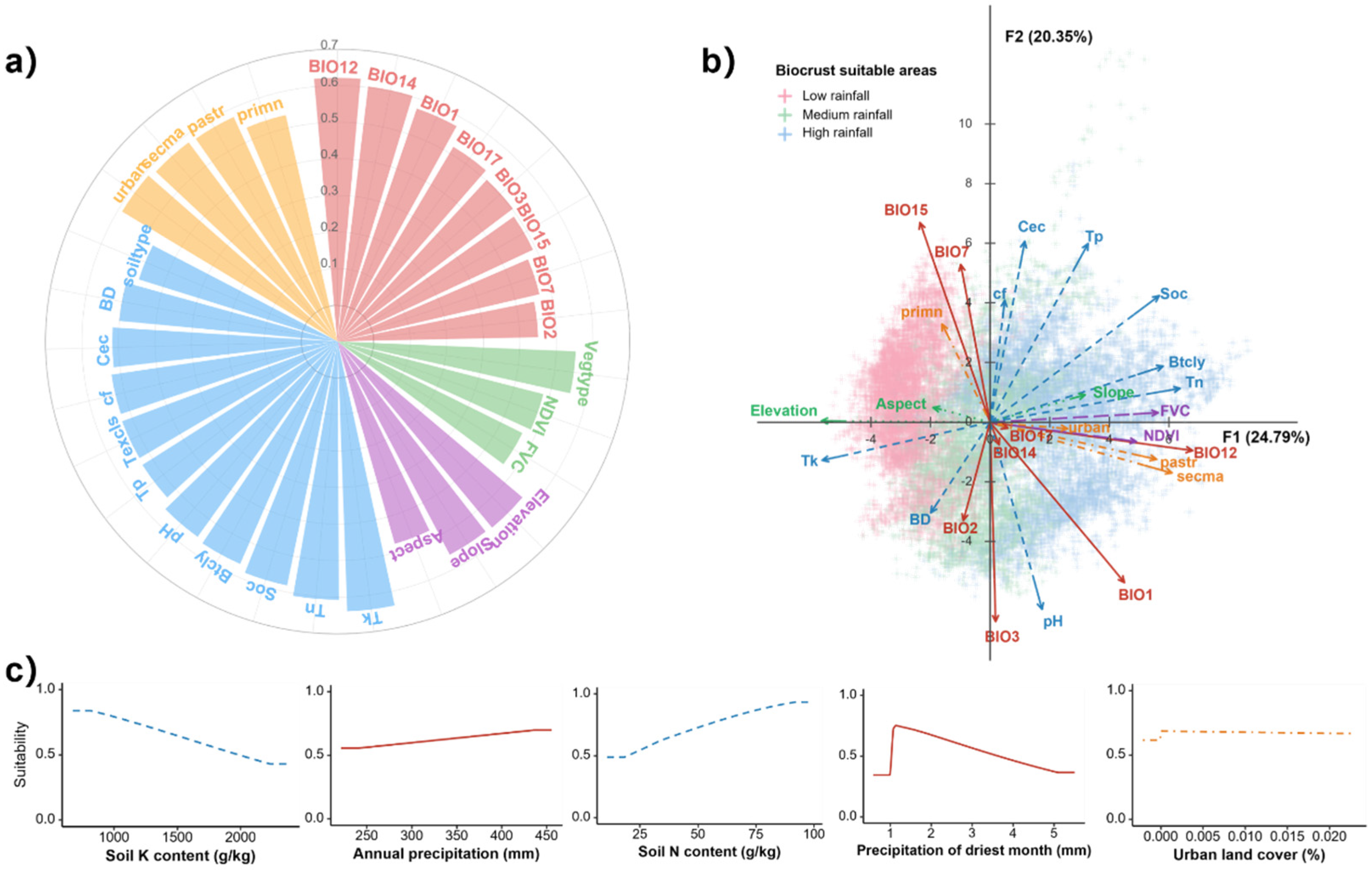
3.1. Biocrust Habitat Distribution and Its Environmental Drivers
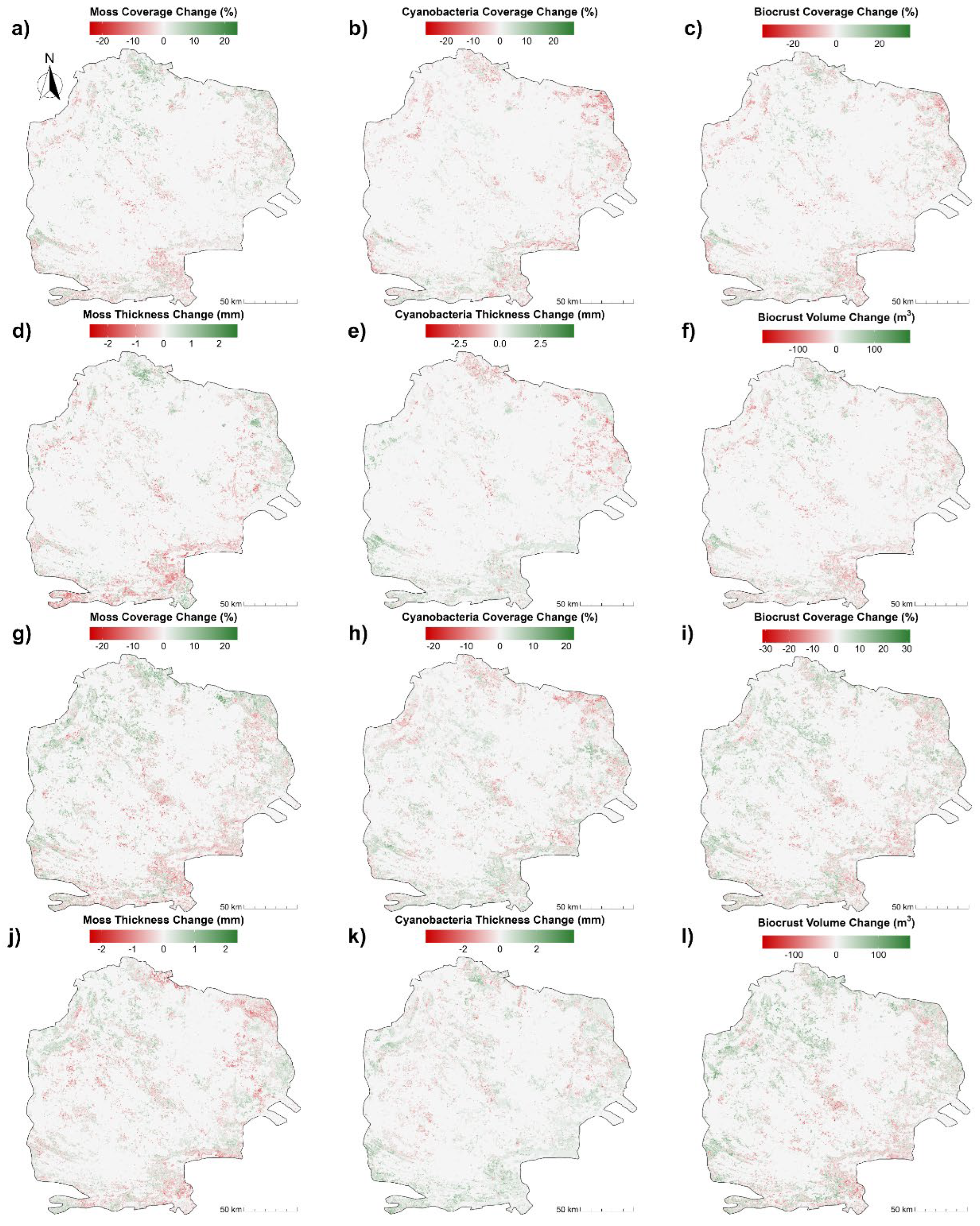
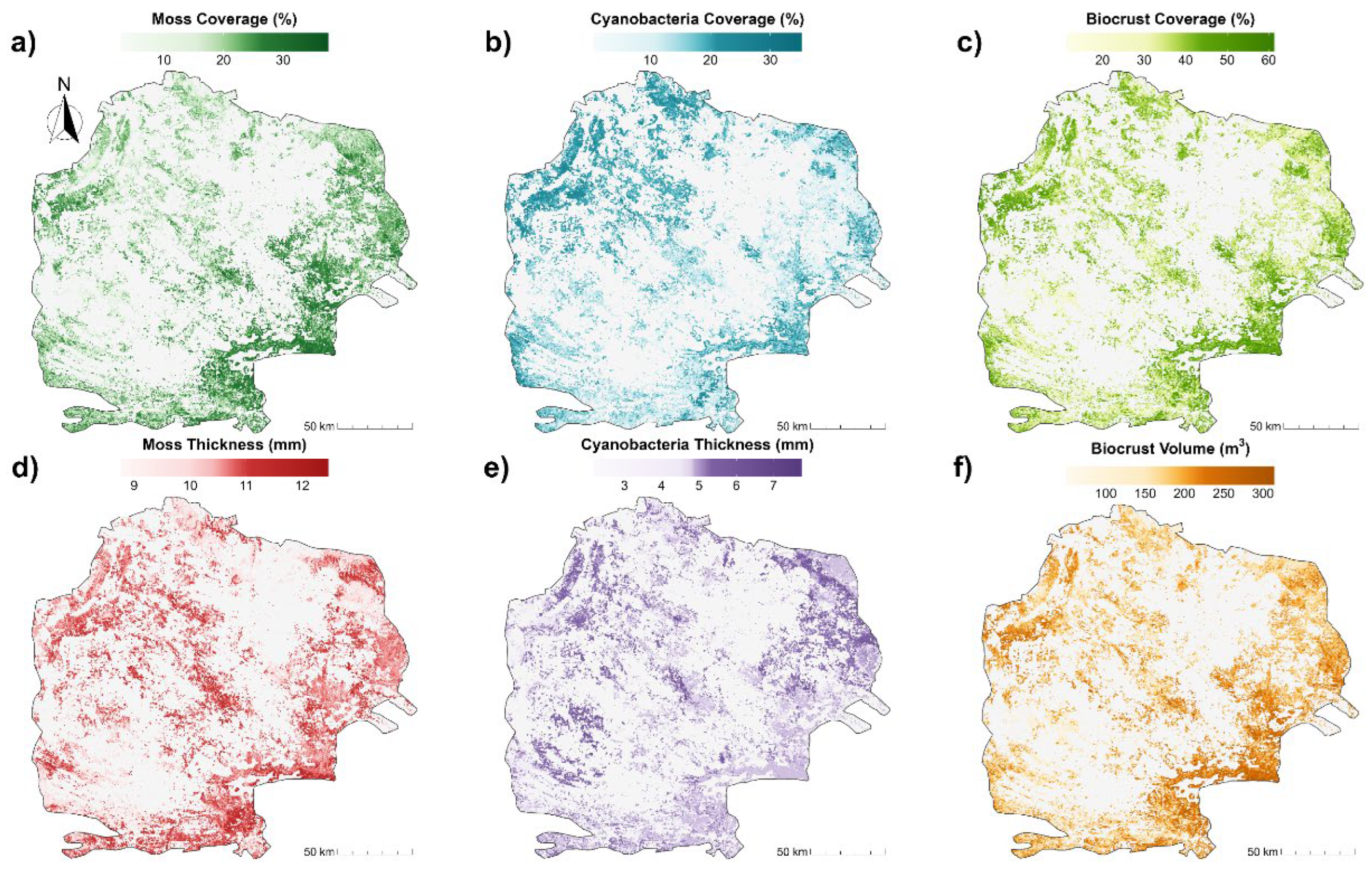
3.2. Projected Changes in Biocrust Functional Traits Under Future Scenarios
4. Discussion
4.1. Environmental Drivers Controlling Biocrust Habitat Distribution
4.2. Non-Linear and Divergent Responses of Biocrust Traits to Future Scenarios
4.3. Limitations, Implications for Conservation, and Future Directions
5. Conclusions
Supplementary Materials
Author Contributions
Funding
Data Availability Statement
Acknowledgments
Conflicts of Interest
References
- Weber, B.; Belnap, J.; Büdel, B.; Antoninka, A.J.; Barger, N.N.; Chaudhary, V.B.; Darrouzet-Nardi, A.; Eldridge, D.J.; Faist, A.M.; Ferrenberg, S.; et al. What is a biocrust? A refined, contemporary definition for a broadening research community. Biol. Rev. 2022, 97, 1768–1785. [Google Scholar] [CrossRef]
- Rodriguez-Caballero, E.; Belnap, J.; Büdel, B.; Crutzen, P.J.; Andreae, M.O.; Pöschl, U.; Weber, B. Dryland photoautotrophic soil surface communities endangered by global change. Nat. Geosci. 2018, 11, 185–189. [Google Scholar] [CrossRef]
- Belnap, J.; Weber, B.; Büdel, B. Biological Soil Crusts: An Organizing Principle in Drylands; Springer International Publishing: Cham, Switzerland, 2016. [Google Scholar]
- Elbert, W.; Weber, B.; Burrows, S.; Steinkamp, J.; Büdel, B.; Andreae, M.O.; Pöschl, U. Contribution of cryptogamic covers to the global cycles of carbon and nitrogen. Nat. Geosci. 2012, 5, 459–462. [Google Scholar] [CrossRef]
- Phillips, M.L.; McNellis, B.E.; Howell, A.; Lauria, C.M.; Belnap, J.; Reed, S.C. Biocrusts mediate a new mechanism for land degradation under a changing climate. Nat. Clim. Change 2022, 12, 71–76. [Google Scholar] [CrossRef]
- Eldridge, D.J.; Reed, S.; Travers, S.K.; Bowker, M.A.; Maestre, F.T.; Ding, J.; Havrilla, C.; Rodriguez-Caballero, E.; Barger, N.; Weber, B.; et al. The pervasive and multifaceted influence of biocrusts on water in the world’s drylands. Glob. Change Biol. 2020, 26, 6003–6014. [Google Scholar] [CrossRef]
- Ferrenberg, S.; Reed, S.C.; Belnap, J. Climate change and physical disturbance cause similar community shifts in biological soil crusts. Proc. Natl. Acad. Sci. USA 2015, 112, 12116–12121. [Google Scholar] [CrossRef]
- Mallen-Cooper, M.; Bowker, M.A.; Antoninka, A.J.; Eldridge, D.J. A practical guide to measuring functional indicators and traits in biocrusts. Restor. Ecol. 2020, 28, S56–S66. [Google Scholar] [CrossRef]
- Chamizo, S.; Cantón, Y.; Miralles, I.; Domingo, F. Biological soil crust development affects physicochemical characteristics of soil surface in semiarid ecosystems. Soil Biol. Biochem. 2012, 49, 96–105. [Google Scholar] [CrossRef]
- Ju, M.-C.; Zhang, T.-L.; Li, X.-K.; Li, B.-Y.; Li, Y.-P.; Liu, Q.-Y.; Wang, Q.-X.; Bu, C.-F. Large scale environmental drivers of biocrust distribution and development across a sandy desert in China. Catena 2021, 200, 105137. [Google Scholar] [CrossRef]
- Wei, Y.; Ju, M.; Zou, Y.; Wu, S.; Eldridge, D.; Bu, C. Regional-scale environmental drivers and thresholds of under-canopy biocrusts in the Sandland. Plant Soil 2024, 512, 1047–1065. [Google Scholar] [CrossRef]
- Li, X.R.; Song, G.; Hui, R.; Wang, Z.R. Precipitation and topsoil attributes determine the species diversity and distribution patterns of crustal communities in desert ecosystems. Plant Soil 2017, 420, 163–175. [Google Scholar] [CrossRef]
- Qiu, D.; Zhang, C.; Chuai, Z.; Antoninka, A.J.; Xiao, B. Climate change could shift the geographical distribution of biocrusts in the Qaidam Basin. J. Appl. Ecol. 2025, 62, 1752–1763. [Google Scholar] [CrossRef]
- Liu, N.; Gao, L.; Tian, H.; Zhao, Y. Future Climate Change Will Reduce the Potential Distributions of Biocrusts: A Case Study on the Loess Plateau of China. Ecosyst. Health Sustain. 2024, 10, 0261. [Google Scholar] [CrossRef]
- Qiu, D.; Bowker, M.A.; Xiao, B.; Zhao, Y.; Zhou, X.; Li, X. Mapping biocrust distribution in China’s drylands under changing climate. Sci. Total Environ. 2023, 905, 167211. [Google Scholar] [CrossRef]
- Wang, S.; Ma, L.; Yang, L.; Ma, Y.; Zhang, Y.; Zhao, C.; Chen, N. Advancing studies on global biocrust distribution. Soil 2024, 10, 763–778. [Google Scholar] [CrossRef]
- Reed, S.C.; Delgado-Baquerizo, M.; Ferrenberg, S. Biocrust science and global change. New Phytol. 2019, 223, 1047–1051. [Google Scholar] [CrossRef]
- Ferrenberg, S.; Reed, S.C. Biocrust ecology: Unifying micro- and macro-scales to confront global change. New Phytol. 2017, 216, 643–646. [Google Scholar] [CrossRef] [PubMed]
- Feng, X.; Fu, B.; Piao, S.; Wang, S.; Ciais, P.; Zeng, Z.; Lü, Y.; Zeng, Y.; Li, Y.; Jiang, X.; et al. Revegetation in China’s Loess Plateau is approaching sustainable water resource limits. Nat. Clim. Change 2016, 6, 1019–1022. [Google Scholar] [CrossRef]
- Wang, S.; Fu, B.; Piao, S.; Lü, Y.; Ciais, P.; Feng, X.; Wang, Y. Reduced sediment transport in the Yellow River due to anthropogenic changes. Nat. Geosci. 2016, 9, 38–41. [Google Scholar] [CrossRef]
- Belnap, J. The potential roles of biological soil crusts in dryland hydrologic cycles. Hydrol. Process. 2006, 20, 3159–3178. [Google Scholar] [CrossRef]
- Wisz, M.S.; Hijmans, R.J.; Li, J.; Peterson, A.T.; Graham, C.H.; Guisan, A. NCEAS Predicting Species Distributions Working Group. Effects of sample size on the performance of species distribution models. Divers. Distrib. 2008, 14, 763–773. [Google Scholar] [CrossRef]
- Mallen-Cooper, M.; Rodríguez-Caballero, E.; Eldridge, D.J.; Weber, B.; Büdel, B.; Dumack, K.; Classification Working, G. Towards a unified method for measuring biocrust cover. Methods Ecol. Evol. 2020, 11, 1579–1590. [Google Scholar] [CrossRef]
- Fick, S.E.; Hijmans, R.J. WorldClim 2: New 1-km spatial resolution climate surfaces for global land areas. Int. J. Climatol. 2017, 37, 4302–4315. [Google Scholar] [CrossRef]
- Poggio, L.; De Sousa, L.M.; Batjes, N.H.; Heuvelink, G.B.M.; Kempen, B.; Ribeiro, E.; Rossiter, D. SoilGrids 2.0: Producing soil information for the globe with quantified spatial uncertainty. Soil 2021, 7, 217–240. [Google Scholar] [CrossRef]
- Farr, T.G.; Rosen, P.A.; Caro, E.; Crippen, R.; Duren, R.; Hensley, S.; Kobrick, M.; Paller, M.; Rodriguez, E.; Roth, L.; et al. The shuttle radar topography mission. Rev. Geophys. 2007, 45, RG2004. [Google Scholar] [CrossRef]
- Hurtt, G.C.; Chini, L.; Sahajpal, R.; Frolking, S.; Bodirsky, B.L.; Calvin, K.; Doelman, J.C.; Fisk, J.; Fujimori, S.; Goldewijk, K.K.; et al. Harmonization of global land use change and management for the period 850–2100 (LUH2) for CMIP6. Geosci. Model Dev. 2020, 13, 5425–5464. [Google Scholar] [CrossRef]
- Yang, J.; Huang, X. The 30 m annual land cover dataset and its dynamics in China from 1990 to 2019. Earth Syst. Sci. Data 2021, 13, 3907–3925. [Google Scholar] [CrossRef]
- Phillips, S.J.; Anderson, R.P.; Dudík, M.; Schapire, R.E.; Blair, M.E. Opening the black box: An open-source release of Maxent. Ecography 2017, 40, 887–893. [Google Scholar] [CrossRef]
- Barbet-Massin, M.; Jiguet, F.; Albert, C.H.; Thuiller, W. Selecting pseudo-absences for species distribution models: How, where and how many? Methods Ecol. Evol. 2012, 3, 327–338. [Google Scholar] [CrossRef]
- Lissovsky, A.A.; Dudov, S.V. Species-distribution modeling: Advantages and limitations of its application. 2. MaxEnt. Biol. Bull. Rev. 2021, 11, 265–275. [Google Scholar] [CrossRef]
- Ripley, B.; Venables, B.; Bates, D.M.; Hornik, K.; Gebhardt, A.; Firth, D. Package ‘MASS’ (Version 7.3-60). Available online: https://CRAN.R-project.org/package=MASS (accessed on 15 January 2026).
- Phillips, S.J.; Dudík, M.; Elith, J.; Graham, C.H.; Lehmann, A.; Leathwick, J.; Ferrier, S. Sample selection bias and presence-only distribution models: Implications for background and pseudo-absence data. Ecol. Appl. 2009, 19, 181–197. [Google Scholar] [CrossRef]
- Kass, J.M.; Muscarella, R.; Galante, P.J.; Bohl, C.L.; Buitrago-Pinilla, G.E.; Boria, R.A.; Soley-Guardia, M.; Anderson, R.P. ENMeval 2.0: Redesigned for customizable and reproducible modeling of species’ niches and distributions. Methods Ecol. Evol. 2021, 12, 1602–1608. [Google Scholar] [CrossRef]
- Allouche, O.; Tsoar, A.; Kadmon, R. Assessing the accuracy of species distribution models: Prevalence, kappa and the true skill statistic (TSS). J. Appl. Ecol. 2006, 43, 1223–1232. [Google Scholar] [CrossRef]
- Liu, C.; Newell, G.; White, M. On the selection of thresholds for predicting species occurrence with presence-only data. Ecol. Evol. 2016, 6, 337–348. [Google Scholar] [CrossRef]
- Hirzel, A.H.; Le Lay, G.; Helfer, V.; Randin, C.; Guisan, A. Evaluating the ability of habitat suitability models to predict species presences. Ecol. Model. 2006, 199, 142–152. [Google Scholar] [CrossRef]
- Lobo, J.M.; Jiménez-Valverde, A.; Real, R. AUC: A misleading measure of the performance of predictive distribution models. Glob. Ecol. Biogeogr. 2008, 17, 145–151. [Google Scholar] [CrossRef]
- Jiménez-Valverde, A. Insights into the area under the receiver operating characteristic curve (AUC) as a discrimination measure in species distribution modelling. Glob. Ecol. Biogeogr. 2012, 21, 498–507. [Google Scholar] [CrossRef]
- Elith, J.; Kearney, M.; Phillips, S. The art of modelling range-shifting species. Methods Ecol. Evol. 2010, 1, 330–342. [Google Scholar] [CrossRef]
- Araújo, M.B.; Anderson, R.P.; Barbosa, A.M.; Beale, C.M.; Dormann, C.F.; Early, R.; Garcia, R.A.; Guisan, A.; Maiorano, L.; Naimi, B.; et al. Standards for distribution models in biodiversity assessments. Sci. Adv. 2019, 5, eaat4858. [Google Scholar] [CrossRef]
- Phillips, S.J.; Anderson, R.P.; Schapire, R.E. Maximum entropy modeling of species geographic distributions. Ecol. Model. 2006, 190, 231–259. [Google Scholar] [CrossRef]
- Phillips, S.J. A Brief Tutorial on Maxent. Available online: https://biodiversityinformatics.amnh.org/open_source/maxent/ (accessed on 15 January 2026).
- Wickham, H. ggplot2: Elegant Graphics for Data Analysis; Springer: New York, NY, USA, 2016; ISBN 978-0-387-98140-6. Available online: https://ggplot2.tidyverse.org (accessed on 15 January 2026).
- Tang, Y.; Horikoshi, M.; Li, W. ggfortify: Unified interface to visualize statistical result of popular R packages. R J. 2016, 8, 478–489. [Google Scholar] [CrossRef]
- Breiman, L.; Cutler, A.; Liaw, A.; Wiener, M. Package ‘randomForest’ (Version 4.7-1.2). Available online: https://CRAN.R-project.org/package=randomForest (accessed on 15 January 2026).
- Snoek, J.; Larochelle, H.; Adams, R.P. Practical bayesian optimization of machine learning algorithms. In Proceedings of the Advances in Neural Information Processing Systems 25, Lake Tahoe, NV, USA, 3–6 December 2012; pp. 2951–2959. [Google Scholar]
- R Core Team. R: A Language and Environment for Statistical Computing; R Foundation for Statistical Computing: Vienna, Austria, 2023; Available online: https://www.R-project.org/ (accessed on 15 January 2026).
- Hijmans, R.J. Terra: Spatial Data Analysis (Version 1.7-55). Available online: https://CRAN.R-project.org/package=terra (accessed on 15 January 2026).
- Genuer, R.; Poggi, J.-M.; Tuleau-Malot, C. VSURF: An R Package for Variable Selection Using Random Forests. R J. 2015, 7, 19–33. [Google Scholar] [CrossRef]
- Delgado-Baquerizo, M.; Maestre, F.T.; Gallardo, A.; Bowker, M.A.; Wallenstein, M.D.; Quero, J.L.; Ochoa, V.; Gozalo, B.; García-Gómez, M.; Soliveres, S.; et al. Decoupling of soil nutrient cycles as a function of aridity in global drylands. Nature 2013, 502, 672–676. [Google Scholar] [CrossRef]
- Bertness, M.D.; Callaway, R. Positive interactions in communities. Trends Ecol. Evol. 1994, 9, 191–193. [Google Scholar] [CrossRef]
- Bowker, M.A.; Belnap, J.; Davidson, D.W.; Goldstein, H. Correlates of biological soil crust abundance across a continuum of spatial scales: Support for a hierarchical conceptual model. J. Appl. Ecol. 2006, 43, 152–163. [Google Scholar] [CrossRef]
- Hu, C.; Liu, Y.; Song, L.; Zhang, D. Effect of desert soil algae on the stabilization of fine sands. J. Appl. Phycol. 2002, 14, 281–292. [Google Scholar] [CrossRef]
- Bowker, M.A.; Eldridge, D.J.; Val, J.; Soliveres, S. Hydrology in a patterned landscape is co-engineered by soil-disturbing animals and biological crusts. Soil Biol. Biochem. 2013, 61, 14–22. [Google Scholar] [CrossRef]
- Coe, K.K.; Belnap, J.; Sparks, J.P. Precipitation-driven carbon balance controls survivorship of desert biocrust mosses. Ecology 2012, 93, 1626–1636. [Google Scholar] [CrossRef]
- Li, X.; Zhang, Z.; Tan, H.; Gao, Y.; Liu, L.; Wang, X. Ecological restoration and recovery in the wind-blown sand hazard areas of northern China: Relationship between soil water and carrying capacity for vegetation in the Tengger Desert. Sci. China Life Sci. 2014, 57, 539–548. [Google Scholar] [CrossRef] [PubMed]
- Zhang, Y.; Aradóttir, Á.L.; Serpe, M.; Boeken, B. Interactions of Biological Soil Crusts with Vascular Plants. In Biological Soil Crusts: An Organizing Principle in Drylands; Springer International Publishing: Cham, Switzerland, 2016; pp. 385–406. [Google Scholar]
- Concostrina-Zubiri, L.; Huber-Sannwald, E.; Martínez, I.; Flores Flores, J.L.; Reyes-Agüero, J.A.; Escudero, A.; Belnap, J. Biological soil crusts across disturbance–recovery scenarios: Effect of grazing regime on community dynamics. Ecol. Appl. 2014, 24, 1863–1877. [Google Scholar] [CrossRef] [PubMed]
- Maestre, F.T.; Benito, B.M.; Berdugo, M.; Concostrina-Zubiri, L.; Delgado-Baquerizo, M.; Eldridge, D.J.; Guirado, E.; Gross, N.; Kéfi, S.; Le Bagousse-Pinguet, Y.; et al. Biogeography of global drylands. New Phytol. 2021, 231, 540–558. [Google Scholar] [CrossRef] [PubMed]
- Berdugo, M.; Delgado-Baquerizo, M.; Soliveres, S.; Hernández-Clemente, R.; Zhao, Y.; Gaitán, J.J.; Gross, N.; Saiz, H.; Maire, V.; Lehmann, A.; et al. Global ecosystem thresholds driven by aridity. Science 2020, 367, 787–790. [Google Scholar] [CrossRef]
- Reed, S.C.; Coe, K.K.; Sparks, J.P.; Housman, D.C.; Zelikova, T.J.; Belnap, J. Changes to dryland rainfall result in rapid moss mortality and altered soil fertility. Nat. Clim. Change 2012, 2, 752–755. [Google Scholar] [CrossRef]
- Maestre, F.T.; Delgado-Baquerizo, M.; Jeffries, T.C.; Eldridge, D.J.; Ochoa, V.; Gozalo, B.; Quero, J.L.; García-Gómez, M.; Gallardo, A.; Ulrich, W.; et al. Increasing aridity reduces soil microbial diversity and abundance in global drylands. Proc. Natl. Acad. Sci. USA 2015, 112, 15684–15689. [Google Scholar] [CrossRef] [PubMed]
- Ferrenberg, S.; Tucker, C.L.; Reed, S.C. Biological soil crusts: Diminutive communities of potential global importance. Front. Ecol. Environ. 2017, 15, 160–167. [Google Scholar] [CrossRef]
- Rossi, F.; Mugnai, G.; De Philippis, R. Cyanobacterial biocrust induction: A comprehensive review on a soil rehabilitation-effective biotechnology. Geoderma 2022, 415, 115766. [Google Scholar] [CrossRef]
- Costa, O.Y.A.; Raaijmakers, J.M.; Kuramae, E.E. Microbial extracellular polymeric substances: Ecological function and impact on soil aggregation. Front. Microbiol. 2018, 9, 1636. [Google Scholar] [CrossRef]
- Young, K.E.; Reed, S.C.; Morton, M.; Bowker, M.A. Biocrust mosses and cyanobacteria exhibit distinct carbon uptake responses to variations in precipitation amount and frequency. Ecol. Lett. 2025, 28, e70125. [Google Scholar] [CrossRef]
- Havrilla, C.A.; Chaudhary, V.B.; Ferrenberg, S.; Antoninka, A.J.; Belnap, J.; Bowker, M.A.; Eldridge, D.J.; Faist, A.M.; Huber-Sannwald, E.; Leslie, A.D.; et al. Towards a predictive framework for biocrust mediation of plant performance: A meta-analysis. J. Ecol. 2019, 107, 2789–2807. [Google Scholar] [CrossRef]
- Mallen-Cooper, M.; Cornwell, W.K.; Slavich, E.; Sabot, M.E.B.; Xirocostas, Z.A.; Eldridge, D.J. Limited range shifting in biocrusts despite climate warming: A 25-year resurvey. J. Ecol. 2023, 111, 2194–2207. [Google Scholar] [CrossRef]
- Ladrón de Guevara, M.; Maestre, F.T. Ecology and responses to climate change of biocrust-forming mosses in drylands. J. Exp. Bot. 2022, 73, 4380–4395. [Google Scholar] [CrossRef]
- Delgado-Baquerizo, M.; Maestre, F.T.; Eldridge, D.J.; Bowker, M.A.; Ochoa, V.; Gozalo, B.; Berdugo, M.; Val, J.; Singh, B.K. Biocrust-forming mosses mitigate the negative impacts of increasing aridity on ecosystem multifunctionality in drylands. New Phytol. 2016, 209, 1540–1552. [Google Scholar] [CrossRef]
- Berdugo, M.; Vidiella, B.; Solé, R.V.; Maestre, F.T. Ecological mechanisms underlying aridity thresholds in global drylands. Funct. Ecol. 2022, 36, 4–23. [Google Scholar] [CrossRef]
- Elith, J.; Leathwick, J.R. Species Distribution Models: Ecological Explanation and Prediction Across Space and Time. Annu. Rev. Ecol. Evol. Syst. 2009, 40, 677–697. [Google Scholar] [CrossRef]
- Zhou, X.; Zhao, Y.; Belnap, J.; Zhang, B.; Bu, C.; Zhang, Y. Practices of biological soil crust rehabilitation in China: Experiences and challenges. Restor. Ecol. 2020, 28, S45–S55. [Google Scholar] [CrossRef]
- Antoninka, A.; Faist, A.M.; Rodriguez-Caballero, E.; Young, K.; Chaudhary, V.B.; Condon, L.A.; Pyke, D.A. Biological soil crusts in ecological restoration: Emerging research and perspectives. Restor. Ecol. 2020, 28, S3–S8. [Google Scholar] [CrossRef]
- Bowker, M.A.; Antoninka, A.J.; Chuckran, P.F. Improving field success of biocrust rehabilitation materials: Hardening the organisms or softening the environment? Restor. Ecol. 2020, 28, S177–S186. [Google Scholar] [CrossRef]
- Bowker, M.A. Biological Soil Crust Rehabilitation in Theory and Practice: An Underexploited Opportunity. Restor. Ecol. 2007, 15, 13–23. [Google Scholar] [CrossRef]
- Deng, S.; Zhang, D.; Wang, G.; Zhou, X.; Ye, C.; Fu, T.; Ke, T.; Zhang, Y.; Liu, Y.; Chen, L. Biological soil crust succession in deserts through a 59-year-long case study in China: How induced biological soil crust strategy accelerates desertification reversal from decades to years. Soil Biol. Biochem. 2020, 140, 107665. [Google Scholar] [CrossRef]
- Chen, R.L.; Yin, B.; Yang, W.; Li, J.; Li, Z.; Zhang, Y.; Chen, J. Mapping the successional stages of biological soil crusts at 3-m resolution in the Gurbantunggut Desert, China through hydration-induced spectral response. Remote Sens. Environ. 2024, 310, 114230. [Google Scholar] [CrossRef]



Disclaimer/Publisher’s Note: The statements, opinions and data contained in all publications are solely those of the individual author(s) and contributor(s) and not of MDPI and/or the editor(s). MDPI and/or the editor(s) disclaim responsibility for any injury to people or property resulting from any ideas, methods, instructions or products referred to in the content. |
© 2026 by the authors. Licensee MDPI, Basel, Switzerland. This article is an open access article distributed under the terms and conditions of the Creative Commons Attribution (CC BY) license.
Share and Cite
Wei, Y.; Ju, M.; Zou, Y.; Fan, J.; Li, X.; Pang, J.; Zhang, W.; Bu, C. Biocrust Functional Traits Exhibit Divergent Responses to Future Climate–Land Use Scenarios in an Arid Region of Northern China. Land 2026, 15, 436. https://doi.org/10.3390/land15030436
Wei Y, Ju M, Zou Y, Fan J, Li X, Pang J, Zhang W, Bu C. Biocrust Functional Traits Exhibit Divergent Responses to Future Climate–Land Use Scenarios in an Arid Region of Northern China. Land. 2026; 15(3):436. https://doi.org/10.3390/land15030436
Chicago/Turabian StyleWei, Yingxin, Mengchen Ju, Yanuo Zou, Jin Fan, Xinhao Li, Jingwen Pang, Wenxin Zhang, and Chongfeng Bu. 2026. "Biocrust Functional Traits Exhibit Divergent Responses to Future Climate–Land Use Scenarios in an Arid Region of Northern China" Land 15, no. 3: 436. https://doi.org/10.3390/land15030436
APA StyleWei, Y., Ju, M., Zou, Y., Fan, J., Li, X., Pang, J., Zhang, W., & Bu, C. (2026). Biocrust Functional Traits Exhibit Divergent Responses to Future Climate–Land Use Scenarios in an Arid Region of Northern China. Land, 15(3), 436. https://doi.org/10.3390/land15030436