Article

The Impact of the Farmland Protection Policy on the Adjustment of Grain Planting Structure: Evidence in China


1
Institute of Agricultural Economics and Scientific and Technical Information, Fujian Academy of Agricultural Sciences, Fuzhou 350003, China
2
College of Economics and Management, China Agricultural University, Beijing 100083, China
*
Author to whom correspondence should be addressed.
Land 2026, 15(3), 425; https://doi.org/10.3390/land15030425
Submission received: 1 February 2026 / Revised: 3 March 2026 / Accepted: 4 March 2026 / Published: 5 March 2026
(This article belongs to the Special Issue Land Use Policy and Food Security: 3rd Edition)

Abstract

The quantity and quality of arable land are the basic prerequisites for food security; the arable land balance policy is a key measure to strictly protect farmland, and plays an important role in ensuring arable land use control, sustainable land use and reducing the contradiction between people and land. Drawing on panel data from 26 Chinese provinces spanning 2004 to 2017, this study employs the Nerlove supply response model to empirically examine the impact mechanism and regional heterogeneity of the arable land balance policy on the structure of grain crop cultivation, considering variations in land use following farmland supplementation. The findings reveal that the policy has induced fluctuations in grain crop structure, oscillating between “grain-oriented” and “non-grain-oriented” patterns. These shifts are primarily driven by the heterogeneous technological effects associated with farmland supplementation, which influence farmers’ planting decisions. Nonetheless, the policy has helped mitigate the adverse effects of farmland development on grain production, with the mitigation effect being more pronounced in non-major grain-producing regions. Furthermore, supporting measures such as land consolidation, outsourcing of agricultural services, and cross-regional mechanized operations have contributed to maintaining grain crop cultivation after land supplementation. Based on these findings, optimizing the arable land balance policy requires greater alignment with crop-specific production characteristics and regional farming practices. This includes refining the farmland supplementation coefficient and enhancing the policy’s differentiation mechanisms. Policy adjustments should also reflect the economic development levels and natural resource endowments of both major and non-major grain-producing regions, to promote a functional equilibrium in farmland utilization. Additionally, efforts to improve soil fertility and mechanization capabilities following land supplementation are essential to sustaining stable grain production. This study provides decision-making information support for optimizing the arable land balance policy and improving crop planting structure.

1. Introduction

Food security is not only essential for economic livelihoods but is also a critical pillar of national security (Bindraban et al., 2012; Tyczewska et al., 2018) [1,2]. As the most fundamental factor of agricultural production, arable land requires robust protection to ensure its efficient utilization and the sustainable growth of grain output. Recognizing the importance of optimizing crop structure to stabilize grain supply (d’Amour et al., 2017) [3], China has implemented a series of policy initiatives under the strategic framework of “storing grain in the land”. Following the revision of the Land Administration Law in 1997, the principle of “strict arable land protection” was established and later institutionalized through the 2003 introduction of the “strictest farmland protection system”. Since the 18th National Congress of the Communist Party of China, this policy framework has emphasized the balance between land occupation and supplementation, the preservation of permanent basic farmland, and the integration of quantity control, quality improvement, and ecological sustainability. These demands aim to curb both the conversion of farmland to non-agricultural uses (non-agriculturalization) and the shift away from grain production (non-grainization), both of which threaten long-term food security (Xue et al., 2024) [4]. A key institutional element of this framework is the occupation–compensation balance policy, which is based on the principle of “compensating for as much land as is occupied”. This policy represents a major reform in land management by seeking to reconcile the dual goals of safeguarding food production and supporting economic development (Fan et al., 2019) [5]. In support of this policy, China has institutionalized complementary mechanisms for arable land protection. These mechanisms include the permanent basic farmland system, land-use control regulations, and the construction of high-standard farmland (Zhong et al., 2017) [6]. Together, they provide a comprehensive approach to protecting cultivated land in terms of quantity, quality, and designated use. Over time, the occupation–compensation balance policy has gradually shifted from a focus on restoring the quantity of arable land to an approach that simultaneously emphasizes both quantity and quality (Liu et al., 2014; Wang et al., 2012) [7,8].
Despite these efforts, the implementation of the policy has been shaped by factors such as urbanization, fiscal incentives for local governments, and the dynamics of central–local interactions. While the policy has slowed the overall loss of arable land, its implementation still faces considerable challenges. Deviations from the intended process, including “occupying first and compensating later”, “compensating with lower-quality land”, and “fragmented compensation for consolidated occupation”, remain common (Liu et al., 2023; Chen et al., 2019) [9,10]. Data from the third national land survey indicate that, since the “second survey” conducted in 2007, the country’s cultivated land has diminished by 7.53 million hectares. Notably, a significant portion of this loss involves high-quality cultivated land, while the quality of the remaining supplementary cultivated land is subpar (Yu et al., 2022) [11]. The persistent decline in the area of cultivated land continues to be pronounced. Between the mid-1980s and 2003, provinces in coastal and central China experienced a substantial loss of cropland, totaling millions of hectares (Heilig, 1997; Ash and Edmonds, 1998; Ministry of Land and Resources, 2004) [12,13,14]. Furthermore, recent national land survey data show that arable land is increasingly concentrated in the less fertile northwest regions, which exacerbates the ongoing imbalance in land quantity, quality, and ecological sustainability (Liu et al., 2014; Wang et al.,2012) [7,8]. Land consolidation and supplementation under the policy not only alter the structure and quality of arable land but also disrupt land tenure security (Li et al., 2018) [15]. According to previous research Su et al. (2018) [16] and Turinawe et al. (2015) [17], the weakening of land-use rights undermines farmers’ incentives to invest in agriculture, which affects their crop selection and production intensity. For instance, by 2017, large-scale grain producers accounted for less than 10% of total agricultural fixed-asset investment. Additionally, from 2015 to 2019, the total sown area of grain crops declined by 1.6 million hectares due to policy-driven land adjustments, with this downward trend only stabilizing in 2020 (Chen et al., 2021) [18]. Given this context, analyzing how the occupation–compensation balance policy influences crop structure is essential for understanding the tensions between farmland protection and grain production. This study investigates how farmland supplementation and occupation affect grain production capacity, particularly focusing on their influence on crop planting structure. Previous studies have examined two main aspects: the dynamic impact of the policy on planting structure and the mechanisms through which it affects grain output. Some researchers argue that the policy has reduced arable land capacity in areas with high levels of land supplementation, thereby lowering grain output (Huang et al., 2019) [19]. In contrast, others suggest that improvements in farmland quality and infrastructure have significantly boosted grain productivity (Hao et al., 2023; Zhang et al., 2024) [20,21]. At the micro level, planting decisions are shaped by land quality and scale. For instance, large landholdings may encourage non-grain crops due to economies of scale, while low-quality land discourages investment in high-value crops. However, farmers may adopt socialized services such as land trusteeship to sustain grain output (Zhou et al., 2023) [22]. Fragmentation of land parcels also plays a role in shaping planting decisions, often making stable and efficient grain cultivation more difficult (Xu et al., 2021; Zhou et al., 2024) [23,24]. At the macro level, the issue of “high-quality land occupation and low-quality land supplementation” remains unresolved. Supplemented land is often two to three grades lower in quality than the land it replaces, failing to meet the needs of grain production and thereby threatening national output (Lan et al.,2023) [25]. Furthermore, many provinces face shortages of reserve land resources. For example, to meet annual land quotas, some coastal counties in Fujian Province have converted tidal flats into farmland, while most available reserves are located in mountainous areas, where development costs are high and cultivation is difficult (Zhang, 2016) [26].
Although existing empirical studies have made important contributions to understanding the relationship between the occupation–compensation balance policy and grain planting, some aspects of this issue warrant further exploration. First, empirical studies often rely on regional data and may suffer from selection bias, which contributes to mixed findings. Second, few studies employ cross-sectional micro data to directly examine planting decisions. Third, the potential lag effects of policy implementation are generally overlooked. This study addresses these gaps by posing three core research questions: (1) Do changes in land-use patterns following farmland supplementation influence grain planting structure? (2) Can such effects be explained by agricultural technological change? (3) What are the specific mechanisms through which these effects occur?
To answer these questions, the present study draws on the theory of induced technological change and integrates it with a supply response model. Using provincial-level panel data, it applies an extended variable-coefficient Nerlove supply response model and conducts empirical tests using system GMM and FGLS with fixed effects. This study is intended to make two key contributions. First, it provides quantitative evidence of the policy’s impact on crop planting structure, which complements previous research that has largely relied on macro-level case analyses. Second, it introduces a novel analytical framework by combining induced technological change theory with supply response modeling. This framework enables an evaluation of land-use change scenarios even in the absence of micro-level land data and provides a useful tool for identifying policy effects under real-world constraints.

2. Materials and Methods

In microeconomic production analysis, the assumption of the “rational economic agent” is commonly employed, where economic behavior is guided by the objective of self-interest maximization. However, farmers, as bounded rational economic agents (Simon, 1971; Chen et al., 2012) [27,28], make production decisions based not only on profit motives but also on their specific needs, motivations, and the objective constraints they face. According to the principle of behavioral economic rationality, farmers adjust their factor allocation decisions within existing constraints in order to maximize income (Luo, 2005) [29]. In this context, the adoption of agricultural technologies becomes a means to optimize resource allocation and improve decision-making efficiency. In the production process, increasing scarcity of production factors compels farmers to seek technological alternatives that can substitute for the limited inputs, thereby enabling them to maintain or enhance income levels. This process reflects the core idea of induced technological change, wherein resource scarcity becomes the key driver of technological innovation and adoption in agriculture (Hayami and Ruttan, 1985) [30].
Assuming that the agricultural production function at time t follows a Cobb–Douglas (C-D) production function with diminishing returns to scale (Solow, 1957) [31], the baseline production function model can be expressed as:
f ( x ) = A t L a t K β t
In Equation (1), At represents the total factor productivity at time t; L represents labor input, and K represents capital input. α is the labor output elasticity, β is the capital output elasticity, with α > 0, β > 0, and α + β < 1, indicating diminishing returns to scale. Following the implementation of the Occupation–Compensation Balance Policy, changes in land use patterns resulting from farmland supplementation may influence the structure of the agricultural production function. Specifically, two possible scenarios emerge: (1) the newly supplemented land is contiguous with the existing arable land and (2) the new land is non-contiguous, resulting in increased land fragmentation. These different spatial configurations can affect farmers’ production behavior and technological responses. In this study, land fragmentation refers to the spatial dispersion of cultivated plots within a farmer’s operational holdings. This concept is discussed strictly from the perspective of agricultural production efficiency and input allocation, and does not imply that spatial continuity is universally preferable. At the broader land-use level, maintaining contiguous or interconnected areas can also be associated with sustainability and conservation goals (Zaplata and Hecker, 2018) [32].
Scenario 1: If, after land supplementation, the newly acquired plots are not contiguous with the original arable land—leading to land fragmentation—farmers may adjust their input allocation during crop cultivation. However, no induced technological change occurs in this scenario. The production function under these conditions can be expressed as:
f ( x ) = A t L a ( δ t ) K β ( δ t )
In Equation (2), δt represents the proportion of replenished land to the total arable land area. It is introduced as a measure of the potential impact of land replenishment on farmers’ crop planting decisions. Since the objective of farmers is to maximize expected profits, this can be expressed using the following maximization equation:
m a x π t e = P t e × Y t ( P t e , w 1 , w 2 ) w 1 L w 2 K
s . t   Y t f t ( L , K ) , L > 0 , K > 0
In Equation (3), P t e denotes the expected selling price of agricultural products and Y t represents the agricultural output (kg) in period t. w 1 , w 2 denote the unit price of labor and capital, respectively. By constructing the Lagrangian function and deriving the first-order conditions for profit maximization, the factor demand functions can be obtained. Substituting these into the original production function yields the agricultural product supply function. Taking the logarithm P t e on both sides and differentiating with respect to the relevant variables, the supply elasticity of agricultural products can then be derived.
ε t = α ( δ t ) + β ( δ t ) 1 α ( δ t ) β ( δ t )
The derivative of the change in the proportion of cultivated land with respect to supply elasticity is:
ε t δ t = α δ t + β δ t ( 1 α β ) 2
Assuming that the newly supplemented farmland is not contiguous with the original remaining plots, the demand for and likelihood of localized technological improvements remain relatively low (Zeng et al., 2022) [33]. Meanwhile, as a key production factor in crop cultivation, farmland supplementation demonstrates strong complementarity with labor and other capital inputs. Changes in the quality of the supplemented farmland negatively impact the output elasticity of labor and capital, i.e., both partial derivatives are less than zero (∂α/∂δt < 0, and ∂β/∂δt < 0). This implies that an increase in the proportion of supplemented farmland leads to a decline in the supply elasticity of grain crops. Moreover, the cost–benefit ratio per unit area decreases, prompting farmers to reduce the proportion of grain crops in diversified planting decisions.
Based on the above analysis, this study proposes the following hypotheses:
H1. 
Farmland supplementation under the land balance policy leads to a shift toward non-grain crop cultivation.
H1a. 
Farmland supplementation under the land balance policy reduces the supply elasticity of grain crops.
H1b. 
Farmland supplementation under the land balance policy decreases the proportion of grain crops in diversified cropping systems.
Scenario 2: If the newly supplemented farmland is contiguous with the original arable land, farmers are more likely to adopt labor- or capital-substituting technological improvements in agricultural production. These may include land consolidation, cross-regional mechanized operations, and the outsourcing of agricultural services, thereby facilitating localized technological advancement. The production function under this scenario can be represented as:
f ( x ) = A t L α ( δ t , T 1 ( δ t ) ) K β ( δ t , T 2 ( δ t ) )
In this context, T 1 ( δ t ) and T 2 ( δ t ) represent labor-substituting and capital-substituting technological advancements, respectively, induced by changes in farmland use patterns resulting from farmland supplementation at time t. These variables are introduced as measures of the potential technological impact of farmland supplementation on farmers’ crop cultivation decisions. Following the same derivation steps as in Scenario 1, the expression for agricultural product supply elasticity under Scenario 2 is obtained as follows:
ε t = α ( δ t , T 1 ( δ t ) ) + β ( δ t , T 2 ( δ t ) ) 1 α ( δ t , T 1 ( δ t ) ) β ( δ t , T 2 ( δ t ) )
The derivative of the change in the proportion of cultivated land replenishment with respect to supply elasticity is:
ε t δ t = α δ t + β δ t + T 1 δ α T 1 + T 2 δ α T 2 ( 1 α β ) 2
Under Scenario 2, the expansion of farmland resulting from supplementation leads to a clear substitution relationship between farmland and labor or other capital inputs, while the complementarity among these factors weakens. The shift toward large-scale farming relaxes the rigid constraints on labor and capital inputs for grain production. If farmers continue with their original farming practices, operational costs are likely to rise (Lu and Hu, 2015) [34].
From the perspective of decision-making flexibility, sudden changes in farmland conditions tend to prompt farmers to follow collective rather than individual decisions when facing operational choices (Yang et al., 2021) [35]. Technological progress mitigates production constraints associated with large-scale farmland management and positively influences other production input factors, meaning that T 1 / δ , α / T 1 , T 2 / δ , β / T 2 are both greater than zero. This enhances the efficiency of utilizing variable inputs, improves the supply elasticity of grain crops, and increases the cost-effectiveness of land use. As a result, farmers tend to increase the proportion of grain crops within their diversified cropping strategies (Song et al., 2021) [36].
Based on the above analysis, this study proposes the following hypotheses:
H2. 
Farmland supplementation under the arable land occupation–compensation balance policy promotes a shift toward grain-oriented planting.
H2a. 
Farmland supplementation, by inducing technological change, increases the supply elasticity of grain crops.
H2b. 
Farmland supplementation, by inducing technological change, increases the proportion of grain crops within diversified cropping systems.
Under the two scenarios, farmland supplementation leads to significant differences in grain supply elasticity and planting proportions. Given the varying characteristics of staple grain crops, the attributes of the supplemented farmland, whether or not they induce technological change, affect the supply elasticity and planting proportions of different grain crops in distinct ways. These effects exhibit notable differences in direction.
Therefore, we propose
H3. 
The arable land occupation–compensation balance policy exerts heterogeneous effects on the planting adjustments of different grain crops, thereby reshaping the overall grain cropping structure.
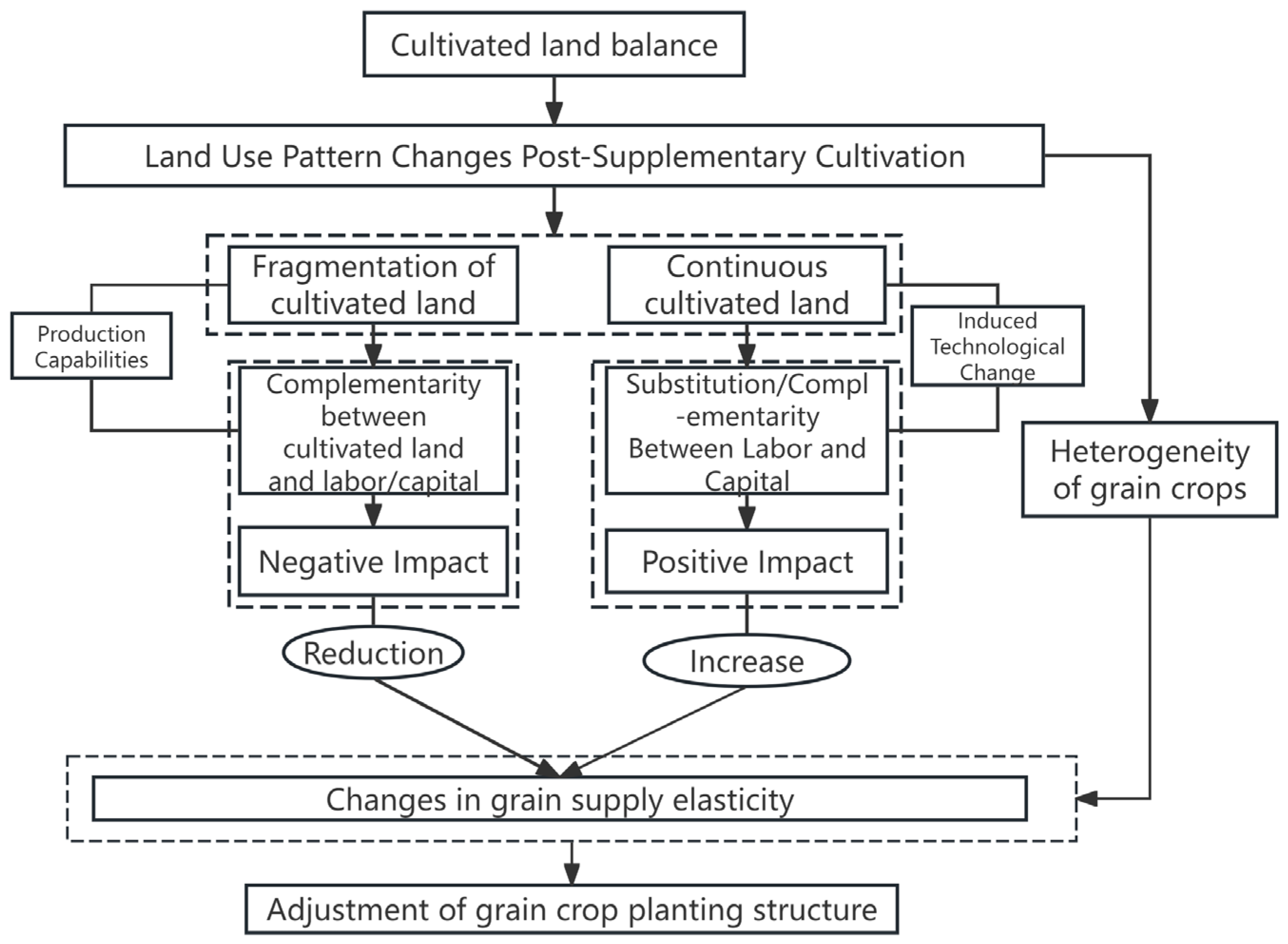
In summary, the impact mechanism of the policy on grain crop planting structures and changes in supply elasticity is illustrated in Figure 1. It should be noted that the diagram is drawn from the perspective of the agricultural industry.
Although policy tools are uniform in form, the heterogeneous effects of policy shocks at the crop level arise from differences among various grain crops regarding factor strength, management divisibility, and operational organization requirements. The direction and magnitude of these effects depend on the relative strength of channels, including changes in land constraints, input substitution, and transaction costs; therefore, they must be identified through empirical evidence.

3. Data, Model, and Variables

3.1. Data Sources

The data used in this study are primarily drawn from official statistical yearbooks and annual reports covering the period from 2005 to 2018. Specifically, information on the transformation of low- and medium-yield farmland and the development of high-standard farmland are obtained from the China Fiscal Statistical Yearbook. Agricultural production-related fees are sourced from the China Rural Management Statistical Yearbook (2006–2017). Indicators such as the proportion of supplemented farmland, the area of expropriated farmland, and the area of farmland converted to other uses are collected from the China Land and Resources Statistical Yearbook. Data on crop prices, sown area, agricultural employment, agricultural labor costs, and total mechanical power are retrieved from the China Rural Statistical Yearbook, while urbanization rates are derived from the China Statistical Yearbook.
Although China completed its third national land survey in 2018, the China Land and Resources Statistical Yearbook has not been updated since due to objective constraints. Nevertheless, the arable land occupation–compensation balance policy, which was revised in 2010, has remained largely stable in terms of implementation and enforcement. As such, conducting theoretical and empirical research using data from 2004 to 2017 remains both valid and meaningful.
To ensure that the price data conform to the requirements of the Nerlove supply response model, this study adopts the data processing approach proposed by Yang et al. (2020) [37], with the following adjustments made to all price indices:
(1)
Based on 2013 production volumes and output values, producer prices for seven major crops are obtained, and historical prices are back-calculated using the corresponding producer price indices. For provinces where wheat and rice producer price indices are unavailable, the general grain producer price index is used as a proxy.
(2)
To adjust for inflation, nominal prices of the seven crops are deflated using the rural consumer price index, yielding real price series.
(3)
For the Hainan Province, where wheat and corn data are missing, a small constant value of 0.1 is assigned to avoid computational errors when taking natural logarithms.

3.2. Variables

Based on research objectives and data availability, this study focuses on three major grain crops: rice, wheat, and corn, across 26 provinces (including municipalities and autonomous regions) in China. The specific variable definitions are as follows.

3.2.1. Dependent Variable

To analyze the structure of crop cultivation while accounting for competition among different crop types, the dependent variable is defined as the proportion of grain crop sown area relative to the total sown area of all crops (Qian et al., 2018) [38]. Specifically, it refers to the combined sown area of rice, wheat, and corn as a percentage of the total cultivated area.
The classification of major grain-producing regions follows the Policy Measures for Reforming and Improving Agricultural Comprehensive Development issued by the Ministry of Finance in 2003. According to this classification, 13 provinces and autonomous regions—Hebei, Inner Mongolia, Jilin, Heilongjiang, Liaoning, Jiangsu, Anhui, Jiangxi, Shandong, Henan, Hubei, Hunan, and Sichuan—are identified as major grain-producing regions. The remaining provinces are categorized as non-major grain-producing regions.

3.2.2. Independent Variables

The key independent variables include the lagged sown area of grain crops (in hectares), the proportion of supplemented farmland (%), and the lagged self-price of staple crops. The farmland supplementation ratio, which measures the elasticity of farmland replenishment, is defined as the total supplemented farmland area accumulated through land consolidation, reclamation, and development in a given province divided by the increase in total farmland area in that year.

3.2.3. Control Variables

The control variables in this study include price factors, socio-economic changes induced by farmland supplementation, and the degree of implementation of land-related fiscal policies. First, the cultivated area of staple grain crops is influenced by the relative profitability of competing crops within a region. Therefore, the model incorporates the prices of alternative crops, such as legumes, tubers, oilseeds, and vegetables, to account for substitution effects.
Second, government expectations regarding land adjustment are shaped by market land prices, the status of previously transferred land, and existing land reserves. Accordingly, the approved area for farmland conversion and the area of expropriated farmland are included as proxies for government land reserves. Since land development and consolidation projects represent a key component of farmland supplementation (Duan et al., 2021) [39], including them may introduce endogeneity. As such, these projects are excluded from the set of land fiscal policy variables.
In addition, farmland supplementation may contribute to the displacement of agricultural labor. Prior research has shown that rural labor costs and labor migration significantly affect regional cropping structures. To capture this effect, agricultural labor prices and the proportion of the workforce engaged in agricultural employment are included as control variables to reflect labor displacement dynamics.
Finally, with regard to policy variables, this study considers three major grain price support policies: the temporary corn purchase and storage policy, the minimum purchase price policy for wheat, and the minimum purchase price policy for rice. The minimum purchase price policies for wheat and rice were implemented from 2006 to 2017 and from 2004 to 2017, respectively, while the temporary corn storage policy was active from 2008 to 2015. A binary policy variable is constructed to indicate whether a given province was covered by one or more of these price support programs during the study period.

3.2.4. Mechanism Variables

The definition and selection of mechanism variables are intended to capture the technological shocks induced by farmland supplementation and their influence on adjustments in grain crop cultivation structures.
(1)
The combined area of low- and medium-yield farmland transformation and high-standard farmland development, expressed as a percentage of total farmland, is used to reflect improvements in soil fertility resulting from land consolidation efforts under the arable land occupation–compensation balance policy.
(2)
Total agricultural production-related fees, excluding irrigation water and electricity charges, are used to capture the extent of farmers’ adoption of outsourced agricultural services.
(3)
Although the China Agricultural Machinery Industry Yearbook reports data on the cross-regional operation area of agricultural machinery, this information has only been available since 2008, which substantially reduces the usable sample size. Moreover, the concept overlaps with that of outsourced services. Therefore, total agricultural mechanical power is adopted as an alternative indicator to approximate the scale of cross-regional mechanized operations.
Based on the above definitions, the descriptive statistics of the key variables employed in this study are presented in Table 1.

3.3. Econometric Model

3.3.1. Dynamic Analysis Model of Grain Crop Sown Area

According to neoclassical economic theory, producers make production decisions based on relative prices. Therefore, when analyzing how grain farmers adjust their input allocations within the production possibility frontier under the arable land occupation–compensation balance policy, it is essential to consider changes in grain prices.
A substantial body of research on the dynamic supply response of agricultural products has drawn upon Nerlove’s (1956) [40] theory of adaptive expectations and his supply response model. This study similarly adopts the Nerlove framework as the basis for empirical analysis.
In the Nerlove model, it is assumed that farmers adjust their sown area in response to expected prices and other relevant factors, gradually converging toward a long-run equilibrium. The model can be specified as follows:
Y m , t d = α 0 + α 1 P m , t e + D m , t α 2 + ε 1 m , t
In Equation (9), m represents different types of grain crops, P m , t e denotes the expected price of a specific grain crop, and D m , t represents other exogenous variables beyond grain prices. The term ε 1 m , t represents a disturbance term that follows a normal distribution N ( 0 , σ 1 2 ) .
During the planting process, farmers are subject to production constraints and budgetary limitations, which prevent them from immediately adjusting the actual sown area to its optimal level. Instead, the equilibrium sown area is achieved gradually as farmers adjust their planting decisions over time in response to a fixed expectation error (Shao et al., 2011) [41].
In the Nerlove model, the actual sown area in the current period is determined by a combination of the previous period’s actual sown area and the expected error, scaled by an adjustment coefficient. This dynamic adjustment process can be represented by the following equation:
Y m , t = Y m , t 1 + ϕ ( Y m , t 1 e Y m , t 1 ) + ε t
In Equation (10), Y m , t represents the actual sown area of a specific grain crop in period t, while Y m , t 1 denotes the actual sown area of the same crop in period t−1. The parameter ϕ is referred to as the acreage adjustment coefficient, which reflects the ability of farmers to adjust the grain sown area in response to policy changes and market demand. The term ε t represents a disturbance term following a normal distribution N ( 0 , σ 1 2 ) .
When a region implements the arable land occupation–compensation balance policy, the primary driver of land supplementation is the local government’s reliance on “land finance” as a tool to promote urbanization and industrialization. Both the processes of “land transfer” (i.e., land sales) and “land compensation” (i.e., land replenishment) follow an expected adjustment mechanism. Guided by expectations formed under prevailing market conditions, decisions on land sales are influenced by factors such as current land market dynamics, the volume of land sold in the previous period, and the size of existing land reserves. These considerations ultimately determine the scale and timing of farmland compensation.
In this context, this study introduces the land supplementation ratio as a proxy to capture the elasticity of land replenishment. The elasticity of land supplementation is calculated using the following formula:
δ t e = δ t 1 + φ ( δ t 1 δ t 1 e ) + ε t
In Equation (11), δ t e represents the expected land supplementation elasticity in period t, δ t 1 denotes the expected land supplementation ratio in the previous period, and ε t is the disturbance term, assumed to follow a normal distribution N ( 0 , σ 1 2 ) .
Finally, the expected price of grain prices by farmers is taken into consideration. The specific calculation formula is as follows:
P t e = P t 1 + λ ( P t 1 P t 1 e ) + ε t
In Equation (12), P t e represents the expected price of agricultural products in period t, and P t 1 refers to the price of agricultural products in the previous period. In the above equations, φ , and λ represent the expected land supplementation coefficient, expected supply adjustment coefficient, and expected price adjustment coefficient, respectively.
The theoretical analysis considers that changes in land area and quality following the implementation of the land occupation compensation policy may induce technological shocks to the production function. Therefore, the interaction term between land supplementation elasticity δ t e and expected price P t e is introduced to capture this effect. After adjusting the original Nerlove supply response model, it can be expressed as follows:
Y t e = a 0 + a 1 P t e + a 2 P t e × δ t e + a 3 D t + ϵ t
Finally, by rearranging Equations (10)–(13), the modified variable-coefficient Nerlove supply response model is obtained as follows:
Y t = b 0 + b 1 Y t 1 + b 2 P t 1 + b 3 P t 1 × δ t 1 + b 4 D t + v t
In Equation (14), b 0 b 3 represents the theoretical parameter to be estimated, where b 0 = a 0 , b 1 = 1 1 , b 2 = a 1 , b 3 = a 2 , b 4 = a 3 , v t = μ t . D t denotes other control variables excluding the expected price and expected land supplementation adjustment coefficient. Given that farmers have relatively limited sources of information, their production decisions are highly dependent on policies and the surrounding environment. Therefore, the study assumes the expected value of the agricultural price parameter λ = 1. The extent of land regulation changes and its expectations are coordinated with the land transactions and land reserves from the previous period. Additionally, farmers’ expectations regarding land supplementation after the policy may be the same as those from the previous period, hence it is assumed that φ = 1.

3.3.2. Specific Form of Empirical Model

In order to eliminate the possible impact of heteroscedasticity, the variable coefficient Nerlove model is logarithmized based on Equation (14), and its form is:
ln Y i k , t = b 0 + b 1 ln Y i k , t 1 + b 2 ln P i k , t 1 × ln δ i , t 1 + b 3 ln P i k , t 1 + k 6 b 4 ln P i j , t 1 + b 10 ln l e v y i , t + b 11 l n t r a n s i , t + b 12 l n u r b i , t +   b 13 l n f i r i , t + b 14 l n l a b i , t + b 15 P o l i c y i , t + μ i + v i , t
In Equation (15), i represents the number of provinces in a specific grain-producing region; t denotes the year, with t ranging from 2004 to 2017. Here, b 0 b 3 is the parameter to be estimated in the empirical model, μᵢ denotes the individual effect, and vᵢ,t is the error term. Y i k , t and Y i k , t 1 represent the proportion of grain crop sowing area to the total crop sowing area in province i for years t and t − 1 (%), respectively, where k = 1 to 3, corresponding to rice, wheat, and corn, respectively. δ i , t 1 represents the land supplementation elasticity in province i for year t − 1 (%). P i k , t 1 refers to the self-price of the k grain crop in province i for year t − 1 (in RMB/kg). The price of competing crops j, which are not of the k grain category, is denoted as pⱼ (in RMB/kg), where j = 1 to 6, representing the six competing crops other than the analyzed k crop.
When the interaction term between land supplementation elasticity and the self-price is absent, meaning that the land balance policy does not induce technological progress in farmers’ production, the variable coefficient Nerlove model reduces to the standard Nerlove model, i.e., a constant-coefficient Nerlove model. In the model, the primary focus is to first estimate b2, the three main parameters to be estimated, and test whether Hypothesis 1 and Hypothesis 2 hold. Subsequently, heterogeneity analysis is conducted, followed by estimation of parameters such as b4.
Finally, the study explores the mechanisms by which the land balance policy affects the planting structure. The empirical test examines whether, when land supplementation induces technological innovation, it affects the structure of grain crop planting through land reclamation, outsourcing services, and cross-regional operations. To minimize the adverse effects of cross-sectional heteroscedasticity and time series autocorrelation on the regression results, feasible generalized least squares (FGLS) estimation is employed.
I n X i t = χ 0 + χ 1 I n δ i t + Z i t η + π t + μ i + ε i t
In this context, X i t represents the mechanism variable to be tested, which is used to estimate how land supplementation elasticity impacts the micro-level decision-making of farmers in grain cultivation. δ i t represents the land supplementation elasticity in province i during year t. Z i t denotes various control variables, while μ indicates individual fixed effects, and π represents time fixed effects. ε is the residual error term, i represents the province, t denotes the year, and ε i t is the random disturbance term.

4. Results

Endogeneity is a critical concern in econometric modeling, as it can lead to biased and inconsistent estimates. In the Nerlove model, the inclusion of first-order lagged terms for both sown area and price introduces potential endogeneity, which must be properly addressed. Among the available estimation techniques for dynamic panel data, the System Generalized Method of Moments (System GMM) is widely used, as it improves estimation efficiency and allows for the inclusion of variables that are time-invariant (Chen, 2014) [42].
System GMM can be implemented using either a one-step or two-step estimation procedure, depending on how the weighting matrix is constructed. However, the standard errors obtained from the two-step method are known to exhibit substantial downward bias in finite samples. Therefore, this study adopts the one-step method to conduct statistical inference on the significance of the estimated coefficients (b0-b3), while the two-step method is employed to confirm the robustness of the results (Arellano et al., 1991) [43]. Before conducting the System GMM estimation, all variables were subjected to unit root tests, including the Augmented Dickey–Fuller (ADF) test, the Levin-Lin-Chu (LLC) test, and the Im–Pesaran–Shin (IPS) test. The results indicate that, after first-differencing all continuous variables, the null hypothesis of a unit root is rejected at the 1% significance level. This confirms that all variables are stationary and suitable for subsequent estimation.

4.1. The Impact of the Land Occupation–Compensation Balance Policy on the Crop Planting Structure

Table 2 presents the estimated effects of the land occupation–compensation balance policy on crop planting structures, distinguishing between scenarios with and without technological shocks. When the interaction terms between land compensation elasticity and own-price are excluded, and after controlling for crop prices, socio-economic characteristics, and land finance factors, columns 1, 3, and 5 of Table 2 show that a 1% increase in land compensation elasticity leads to a 0.017% decrease in the planting proportion of rice, while the proportions of wheat and corn increase by 0.016% and 0.068%, respectively. However, no statistically significant effects are observed on crop supply elasticity with respect to price.
These results can be attributed to differences in crop-specific production conditions. Rice, relative to wheat and corn, is characterized by lower mechanization levels. This cross-crop gap is also reflected in official statistics: in 2020, the comprehensive mechanization rate for wheat reached 97.19%, compared with 84.35% for rice and 89.76% for maize (Ministry of Agriculture and Rural Affairs of China (MOA); the 2020 National Agricultural Mechanization Development Statistical Bulletin; Agricultural Mechanization Management Department, 2021). Moreover, rice cultivation typically requires more intensive field management, irrigation coordination, and plot-level supervision, which makes it more sensitive to increases in operational fragmentation and scale diseconomies. In the absence of technological improvement, increased land fragmentation raises production costs, discouraging rice cultivation and thus reducing its planting share. Consistent with this mechanism, micro-evidence from China shows that farmland fragmentation constrains machinery use and generates crop-differentiated productivity effects across rice, wheat, and maize, highlighting that fragmentation can translate into higher operational frictions and altered input–output performance. In contrast, wheat and corn benefit from higher unit-area cost–benefit ratios (Hao et al., 2023) [20]. In addition, both crops are more compatible with standardized mechanized operations and large-scale service provision, allowing farmers to reduce marginal production costs when land consolidation improves operational efficiency. When land is more contiguous, planting costs fall, encouraging their expansion. Additionally, the prices of complementary crops, driven by varying rotation and intercropping pattern, systematically influence planting structures. The planting proportion in the previous period also exerts a significant influence on the current period, suggesting strong intertemporal correlation. This reflects the fact that farmers continue to face considerable production risks, resulting in persistent year-to-year fluctuations in planting decisions.
When the interaction terms between land compensation elasticity and own-price are included, as shown in columns 2, 4, and 6 of Table 2, the results suggest that the land occupation–compensation balance policy may induce technological change in crop production. Specifically, a one-unit increase in the logarithmic value of land compensation elasticity leads to a significant decrease in the supply elasticity of rice and corn by 0.037 and 0.054, respectively, while that of wheat increases by 0.028. In terms of planting structure, the proportion of wheat declines, whereas those of rice and corn increase. These findings imply that land compensation has induced significant technological progress in rice and corn cultivation. Economically, this suggests that improvements in land quality and operational conditions have lowered the fixed cost threshold for technology adoption in these crops, thereby enhancing their supply responsiveness under fragmented land structures. In particular, improvements in land consolidation, the adoption of agricultural services, and the expansion of mechanized planting and harvesting have enhanced farmers’ willingness to grow food crops under fragmented land conditions, thereby promoting the expansion of rice and corn. In contrast, wheat cultivation appears more sensitive to rising production costs (Ma et al., 2009) [44], and technological improvements have not sufficiently offset these cost increases. As a result, the share of wheat in diversified planting systems has declined.
Overall, the results support H1 and H2. The effects of land compensation on supply elasticity and planting proportions are crop-specific and exhibit opposite directions. The heterogeneous impact of the policy across crops has led to adjustments in the grain planting structure, thereby confirming H3. This adjustment reflects farmers’ rational reallocation of land resources toward crops with relatively stronger adaptability to changes in land endowments and production conditions.

4.2. Mechanism Test of the Impact of the Land Occupation–Compensation Balance Policy on the Crop Planting Structure Under Changes in Land Use Patterns

The regression results presented in Table 3 indicate that, after controlling for year and provincial fixed effects, the “grainization” pathway induced by land compensation through technological shocks is statistically significant. As shown in column (1), in response to the productivity constraints associated with large-scale land management and the common practice of “dominant compensation with lower-quality land”, regions implementing the land occupation–compensation balance policy are more likely to promote the transformation of low- and medium-yield farmland and the construction of high-standard farmland. These efforts have led to notable improvements in irrigation infrastructure and mechanization (Chen et al., 2022) [45], thereby significantly increasing the proportion of grain crop cultivation. Columns (2) and (3) of Table 3 further reveal that large-scale arable land management encourages farmers to engage in cross-regional farming services by investing in or renting agricultural machinery. This facilitates diversified cropping systems that include a substantial share of grain crops. In some cases, farmers may rent equipment from neighboring plots to support their own production activities (Qian et al., 2022) [46].
Moreover, the expansion of large-scale land management has accelerated the adoption of inter-regional agricultural machinery services, substantially reducing the cost of agricultural production services. Consequently, farmers are increasingly inclined to maintain intensive land use for grain cultivation by purchasing outsourced services, thereby reinforcing the shift toward grain-oriented planting structures (Luo et al., 2019; Song et al., 2022) [47,48].

4.3. Response of Crop Planting Structure to the Occupation–Compensation Balance Policy in Grain-Producing and Non-Grain-Producing Areas

The heterogeneity analysis continues to employ the system GMM estimator to assess the effects of the occupation–compensation balance policy on crop planting structures in major grain-producing and non-grain-producing areas. Without incorporating the interaction terms between land compensation elasticity and own-price, the results reported in columns (2), (4), and (6) of Table 4 indicate that a one-unit increase in the natural logarithm of land compensation elasticity leads to a 0.012 decrease in the proportion of rice cultivation in non-grain-producing regions. At the same time, the proportions of wheat and corn cultivation increase within the sample area. These results suggest that the constant-coefficient model performs well in identifying heterogeneity across regions. Compared to non-grain-producing areas, grain-producing regions are subject to more stringent land use regulations, which effectively constrain both land occupation and “degrainization” tendencies. Moreover, the occupation–compensation balance is often accompanied by quality mismatches—such as “superior occupation and inferior compensation” and even “paddy field occupation and dry land compensation”—which can weaken the extent to which compensated land changes crop returns and thus dampen observable structural adjustments in some regions (Liu et al., 2023) [9]. Therefore, in the absence of significant changes in land use patterns, it is reasonable that land compensation does not significantly influence the share of grain crops in grain-producing areas. The marginal effect of land compensation depends on the baseline land endowment and regulatory intensity. In grain-producing areas, where land use is already tightly regulated and grain production is policy-prioritized, the additional policy shock generates limited incremental adjustment in crop structure. A further reason is diminishing marginal gains from compensation: evidence indicates that compensated farmland can be much farther from settlements—on average 2–7 times the farming distance of occupied land—and that productivity balance may deteriorate due to “occupying superior land while compensating inferior land”, meaning that when high-quality reserve land is largely exhausted, new compensation may be insufficient to shift crop structure in grain-producing areas (Chen et al., 2019) [10]. In addition, the relatively weak response in grain-producing areas may also reflect the exhaustion of high-quality land reserves accumulated during earlier stages of policy implementation. When the marginal quality of newly supplemented land declines, its capacity to alter relative returns across crops becomes limited, thereby constraining structural adjustments.
The series of regression results in Table 4 further suggest that, even when technical conditions remain unchanged, frequent land use adjustments may lead farmers in non-grain-producing areas to reduce the share of grain crops in their planting decisions. This effect is particularly pronounced for rice, which involves more complex production processes than wheat and corn. Economically, in non-grain-producing areas where grain cultivation is not institutionally anchored, farmers face weaker policy constraints and greater flexibility in land reallocation. Consequently, land use adjustments triggered by the policy translate more directly into changes in crop composition. Moreover, the relatively sluggish response of competing crop prices, coupled with the cross-regional transmission of price support policies, may also prompt farmers in non-grain-producing areas to shift away from grain cultivation in favor of other crops.
As shown in Table 5, after introducing the interaction terms between land compensation elasticity and own-price, a 1% increase in land compensation elasticity leads to significant increases in the planting proportions of rice, wheat, and corn in non-grain-producing areas by 0.118%, 0.156%, and 0.057%, respectively. These results suggest that when the occupation–compensation balance policy induces technological change through land compensation, the proportion of grain crops in non-grain-producing areas rises significantly, reflecting a clear trend toward “grainization” under the positive influence of land compensation elasticity. In contrast, in grain-producing areas, only the planting proportion of corn responds significantly to land compensation, showing a notable decrease. This indicates that land compensation under technological change does not universally promote grain cultivation in grain-producing regions and may even suppress corn cultivation due to other structural or economic factors. This heterogeneous response reflects differences in adjustment costs and opportunity costs across regions, as farmers in grain-producing areas may already operate near policy-imposed production targets, limiting the scope for further structural expansion.
Regarding supply elasticity, the patterns observed in non-grain-producing areas move in the opposite direction compared to the changes in planting proportions. Specifically, the supply elasticities of rice, wheat, and corn decline despite increases in their planting shares. This suggests that the technological progress induced by land compensation in these areas remains relatively limited, weakening the responsiveness of planting decisions to price signals. In grain-producing areas, however, the supply elasticity of corn increases significantly with rising land compensation elasticity. This indicates that land compensation has effectively stimulated technological advancement in corn production during the sample period, thereby enhancing the responsiveness of farmers to price changes and reinforcing the role of land policy in shaping crop supply dynamics.
Overall, the changes in planting proportions and supply elasticities observed in non-grain-producing areas are broadly consistent in both sign and relative magnitude with the results from the two Nerlove model specifications used in the baseline regressions, and the estimated effects remain statistically significant. This consistency suggests that the land use pattern change scenario proposed in the earlier hypothesis provides more robust empirical support for the adjustment of grain crop planting structures in non-grain-producing regions.
In other words, the occupation–compensation balance policy plays a more effective role in curbing the trend of “non-grainization” within non-grain-producing areas. Compared to major grain-producing provinces, non-grain-producing regions face greater pressure in the “man–land” relationship due to more limited arable land resources. In this context, land compensation and the associated technological progress induced by the policy significantly contribute to safeguarding grain production, thereby enhancing food security in these regions. Under tighter land scarcity constraints, improvements in land quality and production efficiency have a stronger effect on grain output decisions, thereby amplifying the policy’s structural effect in non-grain-producing areas.

4.4. A Mechanism Test of the Impact of the Grain Production Area Classification on the Grain Crop Planting Structure

There are differences in natural endowments and agricultural development levels between grain-producing and non-grain-producing provinces, particularly in terms of initial conditions such as land slope, quality grade, and operational scale. These disparities affect the feasibility and effectiveness of land remediation and mechanized operations, thereby leading to heterogeneous outcomes in the policy’s impact mechanisms across regions.
The regression results presented in columns (1) and (2) of Table 6 indicate that, after controlling for year and provincial fixed effects, land replenishment in non-grain-producing areas has a significantly positive effect on land remediation efforts, with results significant at the 1% level. This suggests that, under the occupation–compensation balance policy, non-grain-producing regions are more actively engaged in the transformation of low- and medium-yield farmland and the construction of high-standard farmland. Through land remediation, these regions improve agricultural infrastructure, thereby enhancing land productivity and utilization efficiency despite constraints in land quality and quantity. This, in turn, supports stable food production on limited land resources and helps ease the pressure on overall food supply. Moreover, improved land conditions can raise the income of grain farmers in non-grain-producing areas, partially offsetting the negative impacts of land occupation on rural livelihoods.
In addition, the regression results in columns (3) to (6) of Table 6 reveal that land replenishment in non-grain-producing areas has a more substantial positive impact on the adoption of cross-regional mechanized services for crop production, with coefficients again significant at the 1% level. The associated reduction in production-related service costs is also more pronounced than in grain-producing areas. This cost reduction enables farmers in fragmented land settings to adopt diversified cropping strategies more effectively by purchasing agricultural services, thereby enhancing both production efficiency and crop adaptability.

5. Conclusions, Policy Implications and Discussion

5.1. Conclusions

The occupation–compensation balance policy represents a key land management measure implemented in China to strictly protect arable land, designed not only to offset farmland occupation but also to stabilize grain production under tightening land constraints. By integrating land protection policy with crop supply behavior within an extended Nerlove framework and provincial panel data from 26 provinces, this study demonstrates that land compensation operates not merely as a quantity-balancing tool, but as a structural force reshaping crop allocation patterns through technological and organizational channels. The main findings are summarized as follows:
(1)
Benchmark estimation based on the extended Nerlove model. The results reveal that when land-use adjustments following replenishment do not induce technological change, the policy primarily alters crop allocation through cost reconfiguration, increasing the planting shares of wheat and maize. Once land-use changes trigger technological progress, however, the policy exerts a deeper structural impact: wheat supply elasticity rises, while the planting proportions of rice and maize expand. These differentiated responses indicate that land replenishment operates through both production-cost and technological-shock effects, generating dynamic adjustments between “grain-oriented” and “non-grain-oriented” cultivation systems rather than producing uniform expansion.
(2)
Land remediation, cross-regional mechanization, and outsourcing services. The empirical analysis identifies three concrete transmission channels through which the policy reshapes crop structure. First, land replenishment stimulates land remediation efforts, improving plot quality and production conditions, thereby reinforcing the economic viability of grain cultivation. Second, it facilitates the expansion of cross-regional mechanized farming services, enabling farmers to overcome fragmentation constraints and maintain grain production within diversified systems. Third, the growth of outsourced agricultural services significantly reduces transaction and operational costs associated with fragmented land, lowering the threshold for continued grain cultivation. Importantly, however, the effectiveness of these mechanisms is not automatic. Their success critically depends on the density and connectivity of existing rural settlement networks and the maturity of local logistics and service infrastructures. Where rural transport systems, machinery circulation networks, and service platforms are well developed, land remediation and mechanization services can translate more effectively into structural adjustments in crop production.
(3)
Heterogeneity test based on grain-producing versus non-grain-producing areas. The regional heterogeneity analysis further highlights that non-grain-producing areas exhibit stronger structural responsiveness to the policy than major grain-producing provinces. In non-grain-producing regions, land compensation not only offsets the negative effects of land occupation but also, when coupled with technological change, significantly increases both planting shares and supply elasticity for most food crops. In contrast, in major grain-producing areas, institutional rigidity, baseline production specialization, and limited marginal land-quality gains constrain the magnitude of adjustment. This contrast underscores that the policy’s structural effectiveness is conditioned by regional land endowments and institutional environments. In regions facing tighter “man–land” constraints and possessing adaptable service networks, land compensation—together with remediation and mechanization—plays a more decisive role in safeguarding grain production and enhancing food security.

5.2. Policy Implications

Based on the above conclusions, the following insights can be drawn.
(1)
Differences in growth cycles, characteristics, and planting habits of different crops. Given that food crops differ in growth duration, agronomic characteristics, and planting preferences, and considering the time lag in farmers’ adjustment of planting areas, shifts in crop varieties and input use are inevitable. Future adjustments to the occupation–compensation balance policy should refine land replenishment coefficients in alignment with the biological and ecological characteristics of different crops, thereby addressing the trade-off between land protection and food production. The policy design should also incorporate regional natural endowments to enhance the “quantity elasticity, quality elasticity, and ecological elasticity” of land replenishment (Zhong, 2022; Estoque et al., 2023) [49,50].
(2)
Significant differences between grain-producing and non-grain-producing areas. Grain-producing and non-grain-producing regions vary considerably in terms of natural endowments, socio-economic development needs, and land supply capacity. A uniform policy approach may not be appropriate. While the current framework allows for cross-regional compensation within provincial boundaries, further policy differentiation is needed to meet the diverse needs of agricultural development. In grain-producing provinces, policy emphasis should be placed on promoting large-scale cultivation and supporting “grain-oriented” agriculture through land replenishment and technological advancement. In contrast, non-grain-producing provinces should strengthen land requisition controls and implement macro-level price regulations to prevent excessive land demand from driving up food prices and incentivizing a shift toward “non-grain” crops. At the same time, integrating price support policies, industrial upgrading, and the development of agricultural socialized services can help stabilize planting behavior and prevent unintended shifts away from food crop cultivation, thereby promoting balanced functional compensation in land use across regions.
(3)
Need for timely follow-up after land replenishment. Effective policy implementation requires timely follow-up actions in land remediation, mechanization, and the provision of agricultural services. Expanding outsourcing services and promoting cross-regional mechanization can enhance land fertility and operational efficiency, thereby supporting the continuation of food crop cultivation under diversified cropping systems. Simultaneously, strict enforcement of the occupation–compensation balance policy is essential to maintain land market stability and avoid policy effects that disproportionately benefit or disadvantage specific crops, which could result in structural imbalances in the overall food crop production system.

5.3. Discussion

The occupation–compensation balance policy aims to ensure the quantitative equilibrium of arable land. However, one of its long-standing concerns lies in the qualitative equivalence between occupied and replenished land. In practice, the newly compensated land may differ in soil fertility, irrigation conditions, terrain characteristics, and accessibility, thereby weakening its effective production capacity. In this regard, advanced technologies such as geographic information systems (GIS), high-resolution remote sensing, drone-based soil diagnostics, and digital land monitoring platforms under the Agriculture 4.0 framework offer important solutions. By enabling real-time and plot-level assessment of soil properties and land productivity, these technologies can substantially reduce information asymmetries in land quality evaluation and enhance the credibility of compensation mechanisms. Strengthening technological monitoring capacity is therefore critical for addressing the quality challenges inherent in the occupation–compensation balance system.
At the same time, the present empirical framework, which relies on provincial panel data and an extended Nerlove supply response model, inevitably overlooks micro-level differences in land-use practices across individual producers. Future research would benefit from incorporating finer-scale geospatial data, plot-level remote sensing information, and farm-level transaction records to better capture dynamic adjustment processes and non-linear responses. In particular, physical constraints—such as terrain, slope, and natural barriers—are likely to interact with land connectivity and accessibility, influencing the actual effectiveness of land remediation and mechanization services. Incorporating micro-spatial geographic variables into causal identification can also help mitigate endogeneity driven by geographic confounders, thereby improving the credibility of policy effect estimates.
The results also suggest that crop planting decisions are highly sensitive to changes in production costs. Yet cost sensitivity is not determined solely by on-farm conditions; it is embedded within broader rural infrastructure systems. The spatial distribution of storage facilities, grain collection stations, transport corridors, and logistics networks shapes post-harvest costs, market access, and risk exposure. Where rural logistics and service networks are dense and well connected, the benefits of land remediation and cross-regional mechanization can be more fully realized. In contrast, inadequate infrastructure may dampen the structural effects of land compensation, even when formal land quotas are balanced.
Finally, regional differences in supply responsiveness point to the potential role of local land market institutions. Variations in land rental market development, tenure security, and transfer flexibility can influence farmers’ capacity to reallocate land in response to policy-induced changes in relative returns. In regions with more active and transparent land markets, farmers may adjust crop composition more efficiently, amplifying the observable policy effect. Future research that integrate land market dynamics into macro-level models would therefore provide a more complete understanding of how institutional environments mediate structural adjustments in grain production.
Overall, the long-term effectiveness of the occupation–compensation balance policy depends not only on administrative quota management but also on technological monitoring capacity, spatial geography, infrastructure systems, and land market institutions. Recognizing these interdependencies is essential for designing more resilient land protection and food security strategies.

Author Contributions

Data curation, J.Z.; Investigation, Y.L.; Methodology, J.Z.; Supervision, N.H., J.W. and Y.H.; Writing—original draft, Y.L., J.W. and Y.H.; Writing—review & editing, N.H. All authors have read and agreed to the published version of the manuscript.

Funding

This research was funded by the Tsinghua Rural Research Doctoral Dissertation Scholarship Project (No. 202408).

Data Availability Statement

The data presented in this study are available on request from the corresponding author due to privacy.

Acknowledgments

We would like to thank the reviewers for their thoughtful comments that helped improve the quality of the work.

Conflicts of Interest

The authors declare no conflicts of interest.

References

  1. Bindraban, P.S.; van der Velde, M.; Ye, L.M.; van den Berg, M.; Materechera, S.; Kiba, D.I.; Tamene, L.; Ragnarsdottir, K.V.; Jongschaap, R.; Hoogmoed, M.; et al. Assessing the impact of soil degradation on food production. Curr. Opin. Environ. Sustain. 2012, 4, 478–488. [Google Scholar] [CrossRef]
  2. Tyczewska, A.; Wozniak, E.; Gracz, J.; Kuczynski, J.; Twardowski, T. Towards food security: Current state and future prospects of agrobiotechnology. Trends Biotechnol. 2018, 36, 1219–1229. [Google Scholar] [CrossRef]
  3. Bren d’Amour, C.; Reitsma, F.; Baiocchi, G.; Barthel, S.; Güneralp, B.; Erb, K.H.; Haberl, H.; Creutzig, F.; Seto, K.C. Future urban land expansion and implications for global croplands. Proc. Natl. Acad. Sci. USA 2017, 114, 8939–8944. [Google Scholar] [CrossRef] [PubMed]
  4. Xue, S.; Fang, Z.; van Riper, C.; He, W.; Li, X.; Zhang, F.; Wang, T.; Cheng, C.; Zhou, Q.; Huang, Z.; et al. Ensuring China’s food security in a geographical shift of its grain production: Driving factors, threats, and solutions. Resour. Conserv. Recycl. 2024, 210, 107845. [Google Scholar] [CrossRef]
  5. Fan, Y.P.; Fang, C.L.; Zhang, Q. Coupling coordinated development between social economy and ecological environment in Chinese provincial capital cities: Assessment and policy implications. J. Clean. Prod. 2019, 229, 289–298. [Google Scholar] [CrossRef]
  6. Zhong, T.; Mitchell, B.; Scott, S.; Huang, X.; Li, Y.; Lu, X. Growing centralization in China’s farmland protection policy in response to policy failure and related upward-extending unwillingness to protect farmland since 1978. Environ. Plan. C Polit. Space 2017, 35, 1075–1097. [Google Scholar]
  7. Liu, Y.; Fang, F.; Li, Y. Key issues of land use in China and implications for policy making. Land Use Policy 2014, 40, 6–12. [Google Scholar] [CrossRef]
  8. Wang, J.; Chen, Y.; Shao, X.; Zhang, Y.; Cao, Y. Land-use changes and policy dimension driving forces in China: Present, trend and future. Land Use Policy 2012, 29, 737–749. [Google Scholar] [CrossRef]
  9. Liu, C.; Song, C.; Ye, S.; Cheng, F.; Zhang, L.; Li, C. Estimate provincial-level effectiveness of the arable land requisition-compensation balance policy in mainland China in the last 20 years. Land Use Policy 2023, 131, 106733. [Google Scholar]
  10. Chen, W.; Ye, X.; Li, J.; Fan, X.; Liu, Q.; Dong, W. Analyzing requisition–compensation balance of farmland policy in China through telecoupling: A case study in the middle reaches of Yangtze River Urban Agglomerations. Land Use Policy 2019, 83, 134–146. [Google Scholar] [CrossRef]
  11. Yu, F.; Dai, M.; Lin, S. Farmland protection based on bottom-line thinking of food security: Current situation, dilemmas and countermeasures. Econ. Horiz. 2022, 12, 9–16. [Google Scholar] [CrossRef]
  12. Heilig, G.K. Anthropogenic factors in land-use change in China. Popul. Dev. Rev. 1997, 23, 139–168. [Google Scholar] [CrossRef]
  13. Ash, R.F.; Edmonds, R.L. China’s land resources, environment, and agricultural production. Chin. Q. 1998, 156, 836–879. [Google Scholar] [CrossRef]
  14. Ministry of Land and Resources. Communique on Land and Resources of China, 2002; Ministry of Land and Resources of the People’s Republic of China: Beijing, China, 2004. [Google Scholar]
  15. Li, Y.; Wu, W.; Liu, Y. Land consolidation for rural sustainability in China: Practical reflections and policy implications. Land Use Policy 2018, 74, 137–141. [Google Scholar] [CrossRef]
  16. Su, B.; Li, Y.; Li, L.; Wang, Y. How does nonfarm employment stability influence farmers’ farmland transfer decisions? Implications for China’s land use policy. Land Use Policy 2018, 74, 66–72. [Google Scholar] [CrossRef]
  17. Turinawe, A.; Mugisha, J.; Drake, L. Soil and water conservation agriculture in subsistence systems: Determinants of adoption in southwestern Uganda. J. Soil Water Conserv. 2015, 70, 133–142. [Google Scholar] [CrossRef]
  18. Chen, F.; Liu, J.; Chang, Y.; Zhang, Q.; Yu, H.; Zhang, S. Spatial differentiation and driving mechanisms of arable land non-grainization in China. China Land Sci. 2021, 35, 33–43. [Google Scholar]
  19. Huang, S.; Hu, X. The impact of arable land quality on grain production under the occupation-compensation balance system. J. Financ. Econ. 2019, 12, 121–129. [Google Scholar]
  20. Hao, W.; Hu, X.; Wang, J.; Zhang, Z.; Shi, Z.; Zhou, H. The impact of farmland fragmentation in China on agricultural productivity. J. Clean. Prod. 2023, 425, 138962. [Google Scholar] [CrossRef]
  21. Zhang, Y.; Lei, M.; Lan, X.; Zhang, X.; Fan, S.; Gao, J. The multiple effects of farmland infrastructure investment on agrifood systems in China—An interdisciplinary model analysis. China Agric. Econ. Rev. 2024, 16, 320–339. [Google Scholar] [CrossRef]
  22. Zhou, Z.; Zhang, K.; Wu, H.; Liu, C.; Yu, Z. Land transfer or trusteeship: Can agricultural production socialization services promote grain scale management? Land 2023, 12, 797. [Google Scholar] [CrossRef]
  23. Xu, W.; Jin, X.; Liu, J.; Zhou, Y. Analysis of influencing factors of cultivated land fragmentation based on hierarchical linear model: A case study of Jiangsu Province, China. Land Use Policy 2021, 101, 105119. [Google Scholar] [CrossRef]
  24. Zhou, C.; Zhao, Y.; Long, M.; Li, X. How does land fragmentation affect agricultural technical efficiency? Based on mediation effects analysis. Land 2024, 13, 284. [Google Scholar] [CrossRef]
  25. Lan, Y.; Xu, B.; Huan, Y.; Guo, J.; Liu, X.; Han, J.; Li, K. Food security and land use under sustainable development goals: Insights from food supply to demand side and limited arable land in China. Foods 2023, 12, 4168. [Google Scholar] [CrossRef]
  26. Zhang, B. Dilemmas and suggestions of the occupation-compensation balance system: A case study of Fujian Province. China Land 2016, 4, 33–34. [Google Scholar]
  27. Simon, H.A. Administrative Behavior: A Study of Decision-Making Processes in Administrative Organizations; Macmillan: New York, NY, USA, 1971. [Google Scholar]
  28. Chen, S.; Chen, H.; Liang, X.; Liu, J. Effect of the Household Bounded Rationality Decision-making about Land Use Behavior: A Case Study for Gaoxigou Village of Mizhi County in Shaanxi Province. J. Nat. Resour. 2012, 27, 1286–1295. [Google Scholar] [CrossRef]
  29. Luo, B. New Institutional Economics; Shanxi Economic Publishing House: Taiyuan, China, 2005. [Google Scholar]
  30. Hayami, Y.; Ruttan, V. Agricultural Development: An International Perspective; Johns Hopkins University Press: Baltimore, MD, USA; London, UK, 1985. [Google Scholar]
  31. Solow, R.M. Technical change and the aggregate production function. Rev. Econ. Stat. 1957, 39, 312–320. [Google Scholar] [CrossRef]
  32. Zaplata, K.; Hecker, P. Convergence in tourism and divergence in agriculture as a perspective to foster sustainability all round. Adv. Appl. Sociol. 2018, 8, 464–469. [Google Scholar] [CrossRef]
  33. Zeng, L.; Li, X.; Sun, Q. The impact of cropping specialization on agricultural eco-efficiency. China Agric. Resour. Reg. Plan. 2022, 43, 10–21. [Google Scholar]
  34. Lu, H.; Hu, H. Effects of land fragmentation and crop diversification on agricultural profit and efficiency: Evidence from Jiangsu farmers. J. Agrotech. Econ. 2015, 7, 4–15. [Google Scholar]
  35. Yang, Z.; Ji, Y. The impact of land parcel scale operation on farmers’ agricultural structure adjustment: From the perspective of decision-making freedom and scale economy. Arid. Reg. Resour. Environ. 2021, 35, 97–102. [Google Scholar]
  36. Song, H.; Luan, J.; Zhang, S.; Jiang, J. Land fragmentation, crop diversification, and agricultural technical efficiency: Evidence based on a stochastic frontier model and mediation analysis. J. Agrotech. Econ. 2021, 2, 18–29. [Google Scholar] [CrossRef]
  37. Yang, X.; Mu, Y. Irrigation water pressure, supply elasticity and grain production structure based on heterogeneous coefficient Nerlove model. J. Nat. Resour. 2020, 35, 728–742. [Google Scholar] [CrossRef]
  38. Qian, L.; Yuan, H.; Liu, J.; Hong, M. The impact of farmland transfer on grain cropping structure. J. Agrotech. Econ. 2018, 8, 63–74. [Google Scholar] [CrossRef]
  39. Duan, J.; Ren, C.; Wang, S.; Zhang, X.; Reis, S.; Xu, J.; Gu, B. Consolidation of agricultural land can contribute to agricultural sustainability in China. Nat. Food 2021, 2, 1014–1022. [Google Scholar] [CrossRef] [PubMed]
  40. Nerlove, M. Estimates of the elasticities of supply of selected agricultural commodities. J. Farm Econ. 1956, 38, 496–509. [Google Scholar] [CrossRef]
  41. Shao, F.; Lu, Q. Regional corn supply response in China based on the Nerlove model. Econ. Issues 2011, 7, 73–76. [Google Scholar]
  42. Chen, Q. Advanced Econometrics and Stata Applications, 2nd ed.; Higher Education Press: Beijing, China, 2014. [Google Scholar]
  43. Arellano, M.; Bond, S. Some tests of specification for panel data: Monte Carlo evidence and an application to employment equations. Rev. Econ. Stud. 1991, 58, 277–297. [Google Scholar] [CrossRef]
  44. Ma, W.; Feng, Z. Wheat supply response in China based on the Nerlove model. Technol. Econ. 2009, 28, 50–52+128. [Google Scholar]
  45. Chen, H.; Tan, Y.; Xiao, W.; Li, G.; Meng, F.; He, T.; Li, X. Urbanization in China drives farmland uphill under the constraint of the requisition–compensation balance. Sci. Total Environ. 2022, 831, 154895. [Google Scholar] [CrossRef] [PubMed]
  46. Qian, L.; Lu, H.; Gao, Q.; Lu, H. Household-owned farm machinery vs. outsourced machinery services: The impact of agricultural mechanization on the land leasing behavior of relatively large-scale farmers in China. Land Use Policy 2022, 115, 106008. [Google Scholar] [CrossRef]
  47. Luo, B.; Wan, Y.; Hong, W.; Zhong, W. Land fragmentation, service outsourcing, and farmland abandonment: Evidence from a survey of 2,704 farmers in nine provinces. Econ. Horiz. 2019, 7, 63–73. [Google Scholar] [CrossRef]
  48. Song, G.; Ren, G. Spatial response of cultivated land use efficiency to the maize structural adjustment policy in the “Sickle Bend” region of China: An empirical study from the cold area of northeast. Land Use Policy 2022, 123, 106421. [Google Scholar] [CrossRef]
  49. Zhong, Y. Food security and the inherent logic of “storing grain in the land”. People’s Forum Acad. Front. 2022, 22, 78–85. [Google Scholar] [CrossRef]
  50. Estoque, R.C.; Wu, J. The resilience–sustainability–quality of life nexus. Sci. Total Environ. 2024, 912, 169526. [Google Scholar] [CrossRef] [PubMed]
Figure 1. Theoretical framework.
Land 15 00425 g001
Table 1. Descriptive Statistics of Variables.
VariableVariable SymbolsObsMeanStandard DeviationMinMax
Proportion of cultivated land replenishment (%) δ 36486.62418.73713.933100.000
Rice planting ratio (%) Y 1 36419.99116.7870.00262.157
Wheat planting ratio (%) Y 2 36411.91911.9490.00238.789
Corn planting ratio (%) Y 3 36419.18416.3110.01268.417
Rice price (RMB/kg) P 1 3641.8550.4040.7793.088
Wheat price (RMB/kg) P 2 3641.7490.6670.0644.647
Corn price (RMB/kg) P 3 3641.6260.5500.8024.311
Bean price (RMB/kg) P 4 3643.6961.1341.27612.354
Potato price (RMB/kg) P 6 3643.0191.7580.0977.836
Oil price (RMB/kg) P 7 3644.2810.9812.1808.873
Vegetable price (RMB/kg) P 8 3641.5040.4390.7242.856
Number of people employed in agriculture (10,000 people) f i r 3641122.827669.250130.8004377.900
Agricultural labor price/RMB l a b 3642767.1702143.133138.23015,457.100
Area of expropriated cultivated land (hectares) l e v y 3646716.8594422.477159.31026,719.690
Area of converted cultivated land (hectares) t r a n s 3647015.9894343.941248.61027,827.590
Urbanization rate (%) u r b 36449.1399.79226.25069.850
Land consolidation level (%) r e m e d i a t 3640.3570.2290.0681.671
Total mechanical power (10 million watts) m a c h i n e 3643408.4582784.205244.00013,353.000
Agricultural production charges (10,000 yuan/RMB) c h a r g e s 3122213.3103360.7530.00023,881.600
Table 2. The impact of cultivated land supplement on the planting structure of grain crops.
Parameter Estimated
(Natural Logarithm)
RiceWheatCorn
Constant coefficient NerloveVariable coefficient NerloveConstant coefficient NerloveVariable coefficient NerloveConstant coefficient NerloveVariable coefficient Nerlove
Corresponding crop planting ratio t − 10.970 ***1.002 ***0.996 ***0.999 ***1.015 ***1.030 ***
(0.023)(0.004)(0.024)(0.005)(0.139)(0.020)
k-type food crop price t – 1 × cultivated land replenishment elasticity i, t − 1/−0.037 ***/0.028 */−0.054 **
(0.013)(0.016)(0.024)
Cultivated land replenishment
elasticity i, t − 1
−0.017 ***0.067 ***0.016 *−0.050 *0.068 **0.135 **
(0.006)(0.026)(0.009)(0.028)(0.031)(0.053)
Rice price i, t − 10.0040.032 ***0.0020.002 *−0.0050.013 *
(0.006)(0.012)(0.006)(0.001)(0.032)(0.007)
Wheat price i, t − 1−0.001−0.0010.001−0.027 *−0.0160.000
(0.004)(0.001)(0.003)(0.015)(0.061)(0.003)
Corn price i, t − 1−0.004−0.004 ***0.0040.000−0.0430.040 *
(0.004)(0.001)(0.006)(0.002)(0.029)(0.023)
Bean price i, t − 10.0050.002 *−0.0000.002 ***0.004−0.001
(0.003)(0.001)(0.002)(0.001)(0.005)(0.002)
Potato price i, t − 1−0.0000.0000.0020.001 *0.0120.002
(0.002)(0.000)(0.001)(0.000)(0.008)(0.002)
Oil price i, t − 1−0.004 **−0.002 *−0.004 *−0.003 **0.001−0.008 **
(0.002)(0.001)(0.002)(0.001)(0.008)(0.003)
Vegetable price i, t − 10.012 *0.003−0.007−0.003 *−0.0210.009
(0.007)(0.002)(0.013)(0.002)(0.026)(0.007)
Constant term0.001−0.056 **−0.065 *0.0340.107−0.106 **
(0.015)(0.024)(0.038)(0.025)(0.140)(0.049)
Control variablesYesYesYesYesYesYes
AR (1)0.0120.0200.0040.0060.0130.014
AR (2)0.4450.7150.8040.7840.5870.678
Hansen Value0.9990.9990.9720.9990.1650.678
Observations338338338338338338
Notes: The data in brackets indicate the standard error of the GMM one-step method; ***, **, and * indicate that the coefficients are significant at the 1%, 5%, and 10% levels, respectively.
Table 3. Mechanism test: land consolidation, agricultural mechanization and agricultural production fees.
(1)(2)(3)
Land Consolidation LevelAgricultural Mechanization LevelProductive Charges
Cultivated land replenishment elasticity0.097 ***0.268 ***−0.758 ***
(0.033)(0.053)(0.230)
Control variablesYesYesYes
Year fixed effectsYesYesYes
Province fixed effectsYesYesYes
Constant term0.273 ***
(0.029)
7.897 ***
(0.010)
6.590 ***
(0.035)
Observations364364311
Notes: The data in brackets indicate the standard error of the GMM one-step method; ***, **, and * indicate that the coefficients are significant at the 1%, 5%, and 10% levels, respectively.
Table 4. Heterogeneity test of the constant coefficient Nerlove model based on the division of main production areas.
Parameters to
Be Estimated
RiceWheatCorn
Main Production AreasNon-Main Production AreaMain Production AreasNon-Main Production AreaMain Production AreasNon-Main Production Area
Corresponding crop planting area t − 11.021 ***0.999 ***1.016 ***0.970 ***0.985 ***0.992 ***
(0.010)(0.009)(0.038)(0.031)(0.018)(0.009)
Cultivated land replenishment elasticity i, t − 1−0.000−0.012 *0.0090.014 *0.0090.015 **
(0.003)(0.007)(0.010)(0.008)(0.014)(0.007)
Rice price i, t − 10.010 ***−0.0000.0030.0030.023 *0.001
(0.002)(0.003)(0.006)(0.004)(0.012)(0.005)
Wheat price i, t − 10.005 **0.0010.004−0.0100.016 *−0.010 ***
(0.002)(0.003)(0.004)(0.007)(0.009)(0.004)
Corn price i, t − 1−0.0080.0010.005−0.001−0.030−0.012 **
(0.008)(0.003)(0.011)(0.007)(0.020)(0.005)
Bean price i, t − 1−0.0010.004−0.001−0.000−0.0020.003
(0.001)(0.003)(0.002)(0.001)(0.001)(0.003)
Potato price i, t − 10.001 *0.0010.0000.005 *0.0000.003 ***
(0.001)(0.001)(0.002)(0.003)(0.001)(0.001)
Oil price i, t − 1−0.002 **−0.002−0.006 *0.0050.002−0.006 **
(0.001)(0.002)(0.003)(0.004)(0.002)(0.002)
Vegetable price i, t − 10.005 *−0.0040.007−0.0120.007−0.002
(0.003)(0.003)(0.009)(0.012)(0.008)(0.008)
Constant term−0.066 ***0.012 *−0.035−0.010−0.134 **0.018 ***
(0.018)(0.006)(0.031)(0.020)(0.054)(0.006)
Control variablesYesYesYesYesYesYes
AR (1)0.1350.0250.0470.0340.1180.003
AR (2)0.4940.2320.0970.5440.8670.836
Hansen Value0.9990.9990.9990.9990.9990.999
Observations169169169169169169
Note: The data in brackets represent the standard error of GMM one-step method; ***, **, * represent coefficients that are significant at the 1%, 5%, and 10% levels, respectively.
Table 5. Heterogeneity test of variable coefficient Nerlove model based on the division of main production areas.
Parameters to Be EstimatedRiceWheatCorn
Main Production AreasNon-Main Production AreaMain Production AreasNon-Main Production AreaMain Production AreasNon-Main Production Area
Corresponding crop planting ratio t − 11.014 ***0.993 ***0.985 ***0.939 ***0.993 ***0.985 ***
(0.010)(0.012)(0.051)(0.096)(0.022)(0.017)
k-type food crop price t−1×cultivated land replenishment elasticity i, t − 1−0.017−0.063 **0.016−0.069 *0.270 **−0.020 *
(0.016)(0.027)(0.028)(0.041)(0.135)(0.011)
Cultivated land replenishment elasticity i, t − 10.0290.118 **−0.0070.156 *−0.388 **0.057 *
(0.031)(0.054)(0.048)(0.085)(0.196)(0.030)
Rice price i, t − 1−0.0070.002−0.013−0.000−0.275 **0.002
(0.009)(0.004)(0.014)(0.012)(0.112)(0.013)
Wheat price i, t − 10.0040.001−0.0090.0450.009−0.008 **
(0.003)(0.004)(0.031)(0.036)(0.007)(0.004)
Corn price i, t − 10.0210.061 **−0.0100.0120.029 ***−0.000
(0.013)(0.025)(0.015)(0.014)(0.009)(0.004)
Bean price i, t − 1−0.0010.003−0.003−0.0010.003−0.000
(0.001)(0.003)(0.002)(0.002)(0.002)(0.001)
Potato price i, t − 10.0010.001 **0.0050.012 **−0.002 *0.003 ***
(0.001)(0.001)(0.003)(0.006)(0.001)(0.001)
Oil price i, t − 1−0.002−0.001−0.0040.0090.004−0.007 **
(0.002)(0.002)(0.004)(0.008)(0.004)(0.003)
Vegetable price i, t − 10.007 *−0.0050.0080.0020.0040.003
(0.003)(0.005)(0.012)(0.022)(0.006)(0.007)
Constant term−0.068 **−0.101 *0.051−0.1160.212−0.024
(0.028)(0.052)(0.073)(0.096)(0.142)(0.027)
Control variablesYesYesYesYesYesYes
AR (1)0.1430.0270.0250.1560.0500.007
AR (2)0.8730.1180.0590.4280.7140.975
Hansen Value0.9990.9990.9990.9990.9990.999
Observations169169169169169169
Note: The data in brackets represent the standard error of GMM one-step method; ***, **, * represent coefficients that are significant at the 1%, 5%, and 10% levels, respectively.
Table 6. Heterogeneity verification of mechanism test.
Land Consolidation LevelAgricultural Mechanization LevelProductive Charges
Non-Main Production AreaMain Production AreasNon-Main Production AreaMain Production AreasNon-Main Production AreaMain Production Areas
Cultivated land replenishment elasticity0.160 ***0.0330.274 ***0.262 ***−0.770 *−0.744 ***
(0.050)(0.033)(0.086)(0.071)(0.408)(0.203)
Control variablesYesYesYesYesYesYes
Year fixed effectsYesYesYesYesYesYes
Province fixed effectsYesYesYesYesYesYes
Constant term0.214 ***
(0.043)
0.332 ***
(0.029)
8.032 ***
(0.015)
7.762 ***
(0.013)
6.378 ***
(0.064)
6.802 ***
(0.031)
Observations182182182182155156
Note: *, ** and *** represent significance levels of 10%, 5% and 1% respectively. The data in brackets are robust standard errors.
Disclaimer/Publisher’s Note: The statements, opinions and data contained in all publications are solely those of the individual author(s) and contributor(s) and not of MDPI and/or the editor(s). MDPI and/or the editor(s) disclaim responsibility for any injury to people or property resulting from any ideas, methods, instructions or products referred to in the content.