Systematic Review

Artificial Intelligence in Cadastre: A Systematic Review of Methods, Applications, and Trends

1
Department of Land Surveying and Geo-Informatics, The Hong Kong Polytechnic University, Kowloon, Hong Kong, China
2
State Key Laboratory of Climate Resilience for Coastal Cities, The Hong Kong Polytechnic University, Hong Kong, China
3
Research Institute for Sustainable Urban Development, The Hong Kong Polytechnic University, Kowloon, Hong Kong, China
4
Research Institute of Land and Space, The Hong Kong Polytechnic University, Kowloon, Hong Kong, China
5
Otto Poon Research Institute for Climate-Resilient Infrastructure, The Hong Kong Polytechnic University, Hong Kong, China
*
Author to whom correspondence should be addressed.
Land 2026, 15(3), 411; https://doi.org/10.3390/land15030411
Submission received: 3 February 2026 / Revised: 24 February 2026 / Accepted: 26 February 2026 / Published: 2 March 2026

Abstract

Surveying and register administration are core to land administration, and accordingly, land surveying and registration are essential to socio-economic development due to their potential accuracy and efficiency. Until now, customary land surveying and registration have relied on human input, which is a situation that undermines efficiency and is prone to errors in data handling. During the last decade, the exponential growth in artificial intelligence (AI), in particular, geospatial artificial intelligence (GeoAI), has provided new methodologies that can overcome these deficiencies. This review examines AI in cadastral management by analyzing technical solutions and trends across three areas including data collection, modeling, and common applications. This review aims to provide a comprehensive survey of the current use of AI in cadastral management to the extent of defining a future research avenue. Based on the comprehensive review of literature, this study has reached the following three conclusions. (1) Automated extraction of parcel boundaries has been achieved through deep learning in data collection and processing, removing the bottlenecks of manual interpretation. Models such as convolutional neural networks (CNNs) and Transformers have been used for pixel-level semantic segmentation of high-resolution remote sensing images, leading to significant improvements in efficiency and accuracy. (2) Non-spatial data have been processed with natural language processing techniques to automatically extract information and construct relationships, thus overcoming the limitations of paper-based archives and traditional relational databases. (3) Deep learning models have been applied to automatically detect parcel changes and to enable integrated analysis of spatial and non-spatial data, which has supported the transition of cadastral management from two-dimensional to three-dimensional. However, several challenges remain, including differences in multi-temporal data processing, spatial semantic ambiguity, and the lack of large-scale, high-quality annotated data. Future research can focus on improving model generalization, advancing cross-modal data fusion, and providing recommendations for the development of a reliable and practical intelligent cadastral system.

1. Introduction

Cadastral systems constitute the foundation of national land management. Through the surveying, registration, and management of land, ownership, location, area, use, and other attributes are established, providing a legal basis for land transactions, tax administration, urban planning, and related activities. With increasing urbanization and the growing complexity of land management, the cadastral system serves as a critical basis for land ownership, taxation, and planning decisions. Efficiency in public administration depends directly on the accuracy and current status of cadastral information. Thus, automation of the collection and updating of cadastral information has become one of the major objectives of theoretical and practical research in cadastral mapping [1].
Traditional cadastral surveying—a process that involves field surveying and later preparing paper maps, after which parcel lines are then manually vectorized—has been known to be a labor-intensive and generally inefficient process [2]. Planimeters, total stations, and similar triangulation tools were standard, and the vectorization step in map creation was accomplished manually. The resulting workflow proved problematic and prone to human error, such as topological anomalies and or hanging lines, thus severely jeopardizing both the quality and consistency of cadastral information. The partial automation of cadastral data maintenance and acquisition, which geographic information systems (GIS), remote sensing (RS), and global navigation satellite systems (GNSS) still rely on the traditional GIS analytical techniques used to model and analyze the data, techniques that are also imperfect and inaccurate when used to analyze modern, large-scale, complex, and dynamic cadasters. As a result, other cadastral activities, including change monitoring and matching parcels, continue to rely heavily on humans, and hence present the greatest obstacle to highly automated cadastral workflows.
Artificial intelligence has been brought on board to correct the inadequacies of traditional methods to solve the basic problems in cadastral work in a smart and automated way, hence forcing efficiency, increasing cost reduction, and maintaining data quality. Luo et al. [3] previously applied traditional computer vision algorithms and machine learning classifiers to simulate manual interpretation processes, achieving semi-automated cadastral boundary identification. However, the techniques need highly engineered characteristics and have a weak generalization capacity as well as robustness to deal with complex and heterogeneous geographical settings.
Over the past few years, the new maturity of deep learning, especially convolutional neural networks, has enabled automatic extraction of multidimensional features from high-resolution remote sensing imagery, in turn, enabling pixel-level semantic segmentation of cadastral boundaries and significantly reducing the requirements of manual feature engineering [4]. Advances in natural language processing (NLP) roughly in parallel now allow such intelligent processing of unstructured data, such as cadastral texts and legal documents. Using entity recognition (NER) and knowledge graphs, it is possible to automatically access the important information, as well as construct elaborate graphs of property rights relationships, and thus avoid the inability of traditional relational databases to support unstructured data [5]. In the field of three-dimensional cadastral surveying, multi-source data can be analyzed by AI algorithms to generate three-dimensional building models, providing technical support for urban planning and underground property rights management [6].
This review aims to thoroughly assess the present state, principal technical methodologies, and prospective developmental trends of AI applications in the domain of cadastre. Specifically, it establishes a structured taxonomy to provide added value beyond a general overview. Initially, particular AI technologies for collecting and processing both spatial and non-spatial data are delineated. This includes deep learning-guided boundary delineation and natural language processing-informed unstructured text analysis. The study introduces a comparative framework to contrast these methodologies. It further analyzes the role of AI in cadastral analysis and modelling, such as parcel change detection and 3D cadastral modelling, and discusses intelligent data management, quality control, and calibration workflows. Finally, modern problems are analyzed, and future research directions are outlined to provide a theoretical basis for the intelligent upgrading of cadastral administration.

2. Literature Review

2.1. Related Projects

In recent years, considerable effort has been directed toward AI applications for the restoration, registration of cadastral maps, and automated extraction. The given study addresses the issue of the reconciliation of historical data inconsistency and variance between the archival records and the contemporary sources. Pilot investigations employed image-to-map registration, deep learning-driven revision assistance, and clustering to elucidate error patterns [7]. Machine learning-based solutions and Unmanned Aerial Vehicle (UAV) oblique photogrammetry were combined to facilitate cadastral reconnaissance to reduce the time and cost pressure [8]. The use of automated algorithms that could be applied to the drone-captured imagery demonstrated efficiency and reduced manual workload, while meeting operational requirements.

2.2. Literature Collection Methods

To systematically gather relevant academic literature for a research review on the application of artificial intelligence (AI) in the field of cadastre, a comprehensive topic search was conducted within the Web of Science (WOS) Core Collection database. Based on the connotations of the two terms “AI” and “cadastre”, their synonyms were identified, and the search formula was constructed in Table 1.
The Web of Science (WoS) database was chosen as the principal database for the systematic review process based on the high standards adopted by the database for its indexing policies and the quality of the literature available in the domains of land administration, remote sensing, and computer science. This was because the use of the WoS database is a necessity to ensure the high academic impact of the literature used in the systematic review process, which is a significant consideration because of the vast impact of AI literature available in the domain of computer science. In addition, to avoid the possibility of coverage bias, the references used from the 79 papers were cross-checked through backward snowballing to ensure the inclusion of a significant number of the major technological paradigms. However, it is a limitation that the exclusion of some conference-specific databases, like the IEEE Xplore database, may cause a slight underrepresentation of the proceedings.
Notably, the list of search terms related to AI is based on basic cadastral literature and at current GeoAI applications. We used broad terms such as “artificial general intelligence” to ensure a wide scope of current technological trends, in order to avoid omitting emerging trends in this field. However, in order to keep the scope narrow, a careful manual screening process was used. The relevance to cadastral work, such as boundary extraction or data modeling, was used to evaluate each result. Papers that were merely theoretical in their application to AI or used AI in geospatial applications outside of cadastral work were excluded in the initial screening based on the title and abstract.
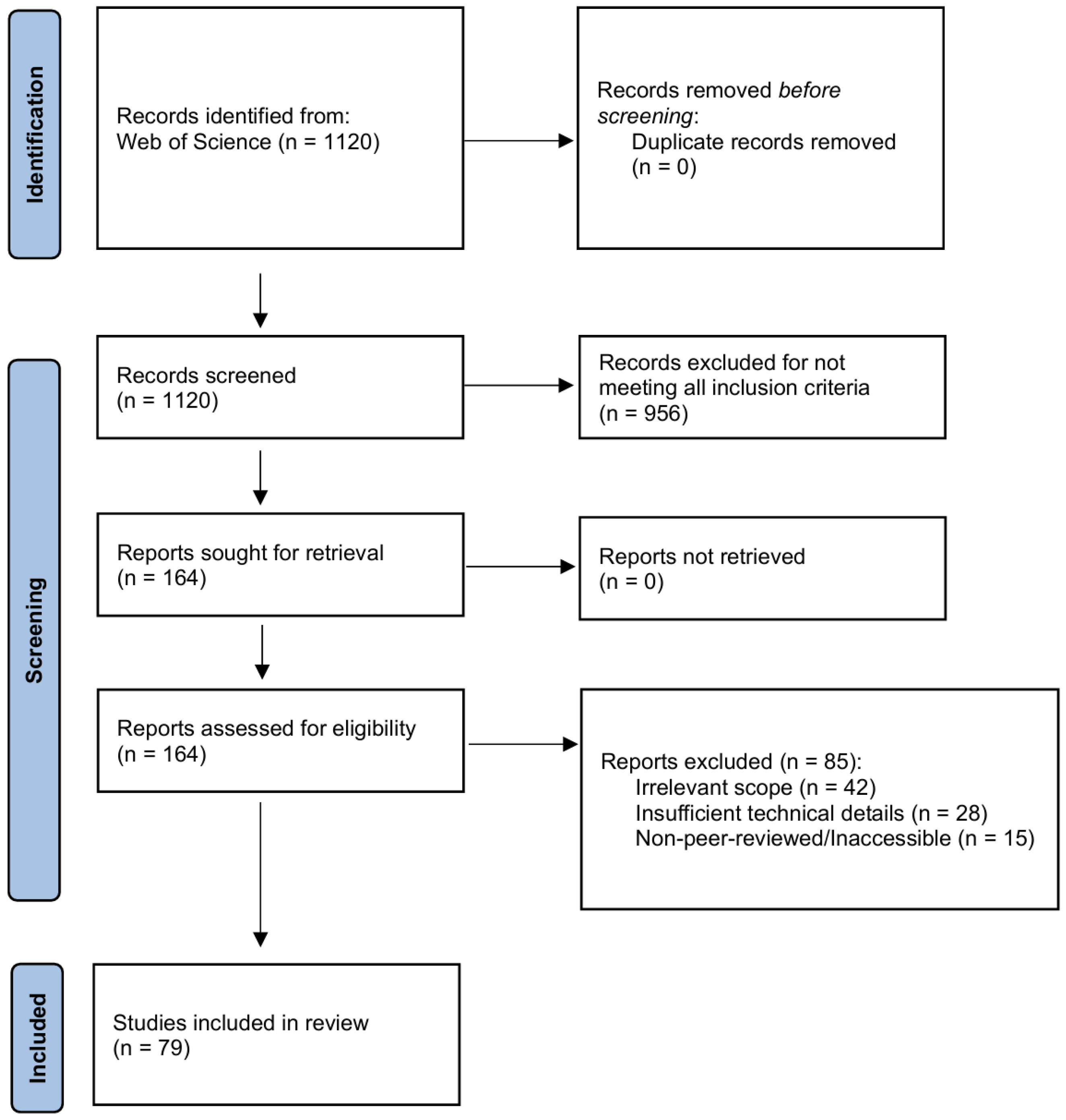
Relevant literature was collected, covering the period from 1985 to 2025, using these keywords, which spanned from early explorations based on traditional machine learning methods to recent advances in deep learning, natural language processing, and knowledge graphs. To maintain the engineering perspective, the available literature was also evaluated based on its relevance to the applications of AI in cadastral data capture, processing, modelling, analysis, and application situations in the domain. Evaluation was conducted by extracting, for each included paper, bibliographic data, task type, datasets, methods, evaluation metrics, and key findings, to support consistent comparative assessment. The systematic screening and selection process, following the PRISMA 2020 guidelines, is illustrated in Figure 1, detailing the transition from initial identification to the final inclusion of 79 core studies.

2.3. Literature Statistical Characteristics

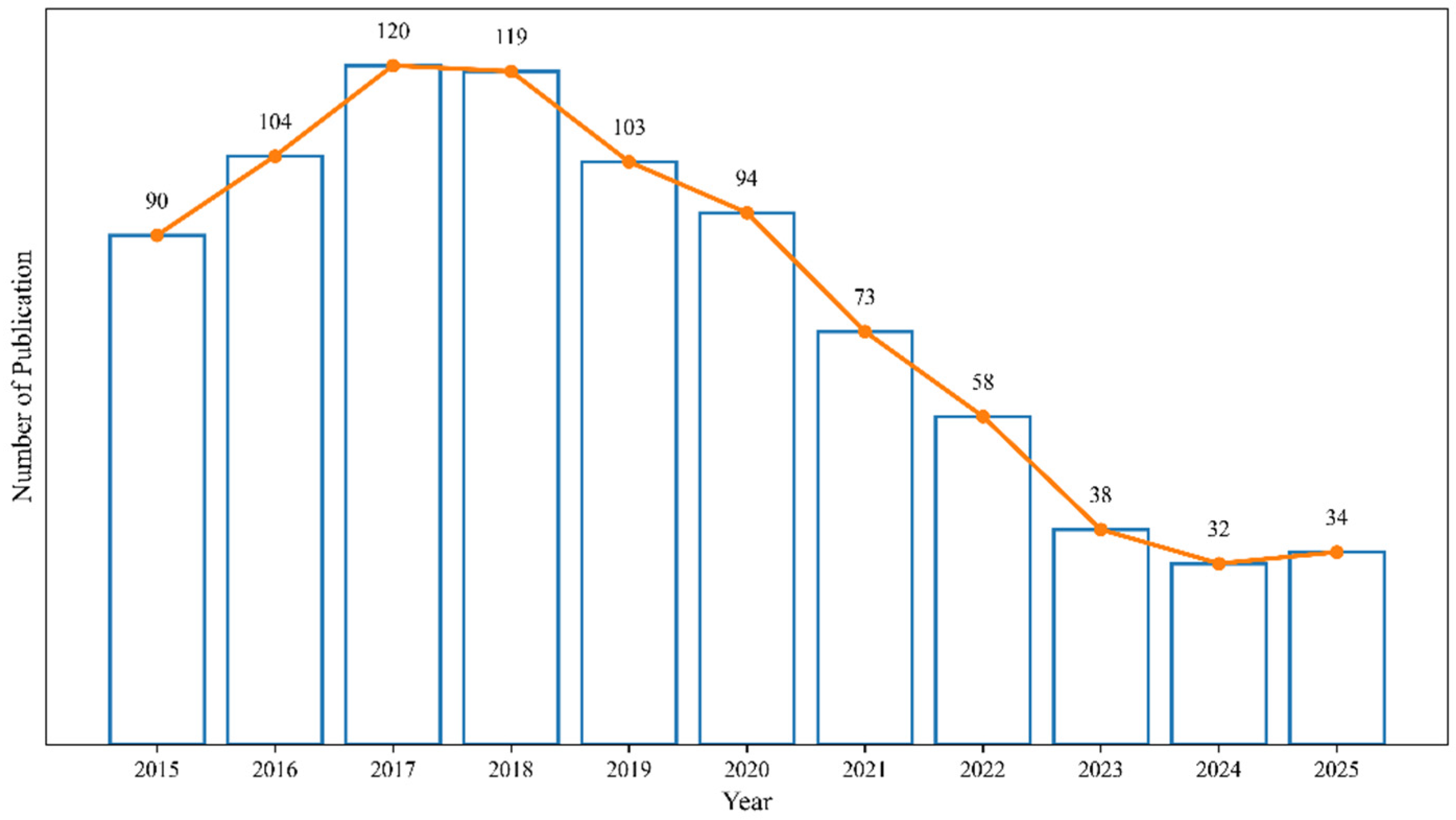
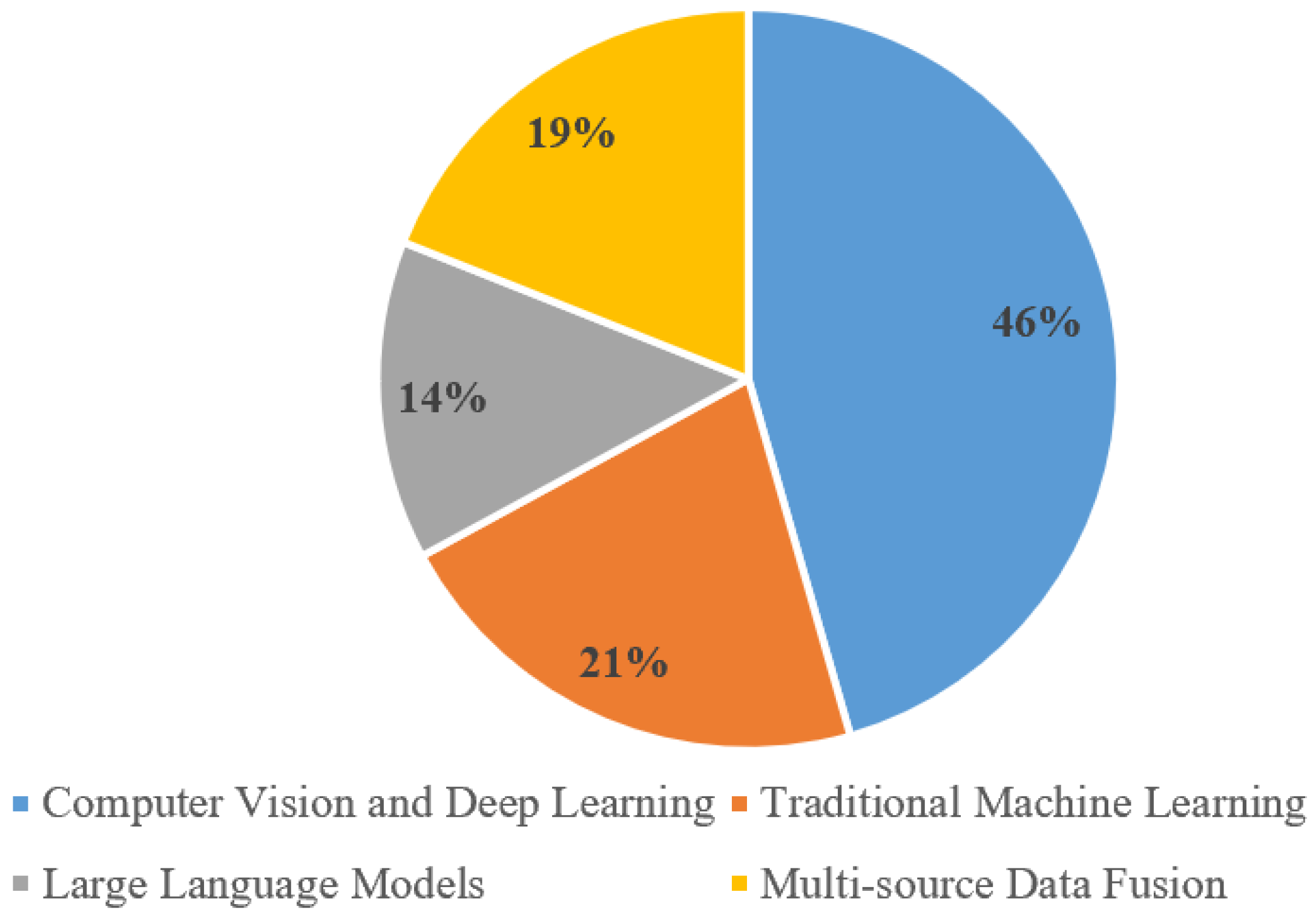
By analyzing the collected literature, several statistical characteristics of AI research in cadastral surveying have been identified. Early research was primarily focused on semi-automated identification and classification of cadastral boundaries using traditional machine learning methods. During this period, pixel-level or object-oriented image analysis (OBIA) was mainly relied upon as the technical approach, depending on manually designed features. Since around 2017, with the rise of deep learning technologies, particularly convolutional neural networks (CNNs) and fully convolutional networks (FCNs) applied in the semantic segmentation of cadastral images, the number of studies has increased significantly. Additionally, research focus has gradually expanded from two-dimensional cadastral systems to three-dimensional systems and dynamic cadastral management. A surge in literature has been observed on the use of drone oblique photography and LiDAR point cloud data for three-dimensional reconstruction and indoor cadastral modeling. In terms of data processing, the application of natural language processing and knowledge graph technologies has also increased. This trend indicates growing academic attention to the processing and management of unstructured cadastral data. The annual number of publications regarding AI research in cadastral surveying over the past decade is shown in Figure 2. The annual publication values in Figure 2 were calculated by aggregating peer-reviewed journal articles and conference proceedings indexed in the Web of Science (WoS) Core Collection. To ensure a timely reflection of research trends, “Early Access” records were categorized based on their earliest online availability date. The variation in publication quantity after 2018 is attributed to a substantial paradigm shift within the cadastral AI research field. The initial phase (2015–2018) recorded a rapid increase in publication counts, driven by the swift transfer of general AI algorithms to cadastral applications. However, from 2018 onward, the field entered a declining zone where highly complex issues were being investigated, such as multi-source data fusion, legal semantic analysis, and 3D topological modeling. These represent long-term studies that require higher standards of methodological rigor and empirical depth to meet the requirements of top-tier publications. Additionally, due to the inherent indexing lag of the database, the data for 2025 is not yet complete, particularly for publications in the “Early Access” stage. To provide a clear quantitative overview of the technical landscape, the 79 selected studies are categorized by their dominant AI algorithms, as shown in Figure 3.

3. Methods of AI in Cadastre

3.1. Data Collection and Processing

3.1.1. Spatial Data Collection and Processing

Cadastral spatial data precisely describes spatial location, boundary shape, topological relationships, and three-dimensional property characteristics of land parcels. Traditional spatial data collection and processing have primarily relied on conventional surveying methods and manual digitization techniques. Typically, paper maps are converted into raster images using high-resolution scanners. When dealing with large-scale, high-density cadastral surveys, work progress is severely hampered. Manual boundary tracing is prone to introducing topological errors such as suspended lines, pseudo-nodes, and face gaps. This not only increases the cost of post-processing data corrections but also significantly impacts the accuracy and reliability of cadastral data [9].
To overcome the limitations of traditional methods, multi-source remote sensing fusion technology was proposed by Ali et al. (2012) [10] for improvement. Early satellite imagery from Landsat, SPOT, and other satellites had coarse resolution. Therefore, these images were difficult to use directly for precise parcel boundary extraction. However, by fusing high-resolution aerial photography imagery with satellite imagery, orthophotography maps with high spatial accuracy and rich spectral information were generated. These maps provided high-quality base maps for cadastral surveying. Nevertheless, image interpretation at this stage remained highly dependent on manual interpretation. Efficiency and accuracy were constrained by the experience and subjective judgment of professionals [7]. The introduction of deep learning technology has brought a significant shift toward AI-assisted workflows. As the core technology of deep learning in computer vision, CNNs possess powerful feature extraction and pattern recognition capabilities. This offers a new solution for the automated extraction of parcel boundaries. By training on large amounts of labeled data, CNN models can learn to automatically identify land feature characteristics in imagery. Semantic segmentation of parcel boundaries can thus be enabled. Advanced deep learning models such as U-Net or Mask R-CNN have been found to achieve pixel-level identification of parcel boundaries from high-resolution remote sensing imagery [11].
Drone oblique photogrammetry should be viewed as a complementary rather than a universal solution for collecting cadastral data. It excels at topographic capture and 3D reconstruction; however, for parcel boundary delineation, it is generally limited to visible, physically demarcated features and often still relies on manual digitization. Drones equipped with high-resolution cameras are used to capture multi-angle images. These images generate high-density 3D point cloud data and 3D reality models. This technology captures not only planar information of land parcels but also detailed vertical information. Such data lay the foundation for the establishment of 3D cadastral data [12]. For example, drone surveying technology has demonstrated significant potential in large-scale engineering and cadastral projects. By leveraging high-endurance UAVs equipped with advanced sensors, it is now possible to conduct high-precision topographical mapping of extensive areas in a short period of time. In contrast, traditional surveying methods would take two weeks, greatly improving efficiency and safety. At the same time, this technology can access rugged areas that were previously inaccessible to personnel and can establish 3D models through data processing, providing detailed data for engineering design and analysis [13]. For parcel boundary delineation, however, additional manual digitization or AI-assisted methods are typically required, especially for invisible boundaries.

3.1.2. Non-Spatial Data Collection and Processing

In the cadastral system, non-spatial data are a core component. Together with spatial data, a complete land information model is formed. Non-spatial data primarily refers to various attribute information related to cadastral parcels. These attributes are extremely diverse and include but are not limited to, property registration information, land use types, rights holder information, easements, mortgages, and other legal and administrative documents. These data form the foundation for cadastral management, land valuation, tax administration, and public services. The quality of non-spatial data directly determines the effectiveness and reliability of the entire cadastral system [14].
Early cadastre non-spatial data management primarily relied on the digitization of paper-based records. This process typically involves manual data entry or scanning and recognition. Numerous challenges were presented. First, data entry errors were common. Human errors, difficulties in recognizing handwritten text, and the absence of standardized entry guidelines contributed to poor data quality [15]. Second, the absence of data standardization and consistency posed another major challenge. Different historical periods, administrative regions, and staff members used different terminology, formats, and coding methods to describe the same type of information. Inconsistencies in the spelling of rights holders’ names, address formats, and land use classification standards significantly hindered data integration and sharing.
With respect to data storage, traditional cadastral systems predominantly use relational databases. Data gets stored in the structure of key-value pairs, thus decreasing data redundancy. A cadastral parcel’s unique name, for example, becomes the main key. It links multiple data tables, for example, the rights holder table, property rights table, and land use table. However, the storage approach of the partitioned storage has some inherent weaknesses [16]. In many cases, text fields like contracts or approvals contain semi-structured or unstructured data. This makes it extremely difficult to meaningfully integrate them into the relational database’s structured data. In making sophisticated cross-table queries or analyzing, for example, to obtain all the land property rights that were modified because of inheritance in a specified area, traditional relational databases encounter performance bottlenecks. This results in low query efficiency. To overcome the limitations of traditional storage models, Zhang et al. [17] proposed utilizing graph-attribute integrated databases as a breakthrough. The core idea of this model is to achieve co-storage of spatial and non-spatial data. By storing the coordinates and topological relationships of cadastral parcels, along with attribute information such as property owners, area, and land type, in the same data object or table, data access and query efficiency can be significantly improved.
Currently, the rapid development of AI has brought revolutionary changes to the collection, processing, and management of non-spatial cadastral data. In particular, the application of NLP technology has greatly improved the ability to process unstructured text data. Cadastral management deals with a huge amount of unstructured text, for instance, registration of land applications, sales and purchase deeds, and inheritance records. In the past, extracting essential information from said records had to be carried out manually after scanning. Automatable and intelligent extraction of the same can be facilitated in deep learning-based NLP models. Named Entity Recognition (NER) technology can be used to automate the finding of key entities in records [18]. The best example of the NER model in the past has been the Bi-directional Long Short-Term Memory with Conditional Random Field (BiLSTM-CRF) model. It can be used to effectively find entities such as parcel numbers, the name of the rights holder, document numbers, and registration date [19]. The respective methodology also incorporates the use of BiLSTM to capture the context against which dependency-based text relies, then a CRF layer that globally optimizes the series of labels and hence ensures high precision in the natural extraction of terms within the entity. Yan et al. [20] have subsequently taken Transformer-based models a step further to classify the cadastre-text and automate finding the entity type. These models can also be used to automate the process of identifying key values, such as legal area, intention, and period of use, within large libraries of legal documents, and once this has been captured, the result can be recorded in a structured database. The resulting framework not only enhances operational efficiency but also augments data quality and completeness [21].
In summary, the collection and processing of non-spatial cadastral data is transforming traditional manual modes to AI-driven automated and intelligent modes. From the early digitization of paper archives to the key-value association of relational databases, and then to the homogeneous storage of graph-attribute integrated databases, technological advancements have continuously improved the management efficiency of cadastral data. Currently, AI technologies represented by NLP and knowledge graphs have fundamentally changed the processing of unstructured text. Deep data association and value extraction have been enabled. A solid technological foundation has thus been provided for constructing a new generation of intelligent cadastral systems.

3.2. Modeling and Analysis Methods

Following the collection and processing of cadastral data, modeling and analysis are critical steps in achieving automated cadastral management. Prior to the application of AI technology, cadastral modeling and analysis primarily relied on traditional GIS software (e.g., ArcGIS Pro 3.0, Esri, Redlands, CA, USA) and manual surveying techniques. Early cadastral map analysis often required surveyors to assess parcel boundaries, areas, and interactions with surrounding features based on paper maps and field survey data. Manual interpretation and simulation techniques were used. This method was not only time-consuming and labor-intensive but also highly dependent on the operator’s experience. Strong subjectivity resulted, and data consistency and accuracy were difficult to ensure [22]. With the gradual popularization of GIS, RS, and GNSS technologies, although cadastral data collection has been automated and intelligentized, subsequent modeling and analysis still primarily rely on traditional GIS spatial analysis tools, such as buffer analysis and overlay analysis. These tools are inefficient and inaccurate when handling large-scale, complex, and variable cadastral data. The demands of modern cadastral management are thus unmet. Particularly in the high-level tasks of detecting change in cadastral maps and matching parcels, conventional methods tend to be labor-intensive. It has become a major hurdle in the process of automating the cadastre [23].
To overcome the limitations of traditional methods, machine learning technology has begun to be introduced into the field of cadastral surveying, particularly achieving significant progress in addressing issues such as land parcel change detection and data updates. Machine learning models, especially those like Random Forest and Support Vector Machines (SVM), are used to learn patterns from large amounts of cadastral data to enable automated analysis. Hajjheidari et al. [24] proposed an intelligent framework based on Random Forest, which analyzes remote sensing imagery and cadastral data from different periods to automatically identify boundary changes in land parcels and achieve intelligent matching between new and old parcels. In Hong Kong, where a range of primary and secondary land records (e.g., Demarcation District Sheet, old aerial photos, etc.) are largely available, and parcel boundaries are determined or re-established with clear guidelines (e.g., the Code of Practice under Chapter 473 Land Survey Ordinance), this approach is well-suited to support the interpretation of the original grant or demarcation intent and to reconcile discrepancies between registered boundaries and on-ground occupation over time. Compared to the traditional methods based on visual inspection or examination of land boundary evidence, records, and secondary evidence such as aerial photos, the framework successfully increases the accuracy and efficiency of any urban cadastral map update. However, the conventional machine learning models may display limited feature extraction ability in various undertakings involving super-high-resolution remote sensing imagery. These methods are unable to cope with complex and changing ground conditions, especially for small parcel boundary changes, where accurate detection still needs improvement. To further enhance the automation level of cadastral surveying and reduce costs, Crommelinck et al. [25] combined machine learning with drone oblique photography technology. By processing images obtained from single-lens drones using oblique photography and machine learning algorithms, cadastral maps meeting the accuracy requirements for first-level boundary points can be automatically generated. The image processing workflow is optimized by this method, significantly reducing fieldwork efforts and lowering the overall cost of cadastral surveying by 38%. Nevertheless, the accuracy of this method is still affected when areas with shadows, obstructions, or unclear textures are processed, and the two-dimensional cadastral maps generated cannot meet the requirements of three-dimensional cadastral management. These issues have prompted researchers to seek more powerful models to extract deeper features from more complex data sources, thereby driving cadastral modeling and analysis into the realm of deep learning.
Deep learning, particularly CNNs, has revolutionized cadastral modeling and analysis due to powerful feature learning capabilities. Spatial features of objects can be directly learned and identified from remote sensing imagery by CNN models. Pixel-level semantic segmentation is enabled, and cadastral boundaries can be extracted automatically. Crommelinck et al. [11] developed a CNN-based deep learning model specifically designed for segmenting visible cadastral boundaries from high-resolution remote sensing imagery. A new model of parcel boundary delineation based on deep learning was assessed on a dataset of 722 parcels in the rural regions of Africa. The model achieved a 38% better delineation efficiency compared to the state of the art and eliminated 80% of the manual intervention clicks. Those findings indicate that deep learning systems clearly have a benefit when dealing with complex rural parcels that have poorly delineated features. Even though the model was useful in deriving boundaries, some weaknesses were identified. On the one hand, the segmentation of boundary lines was successfully completed; however, gaps or overlaps were created between them. Second, the resulting segments of boundaries did not have the contextual sensitivity to adjacent parcels, which resulted in ambiguities in topological relationships. These issues need to be addressed later. Wang et al. [26] resolved such disadvantages, suggesting a framework of integrating the multi-task segmentation and graph convolutional neural networks. In this scheme, boundary extraction of land parcels and their land-use classification are performed jointly using a multi-task learning scheme, and the extraction of the boundaries allows non-spatial attributes to be attributed to them directly. Zhang et al. [27] improved this method further to introduce a multi-task inspired deep clustering model with a boundary adaptation mechanism (MTDC-BA). This enhances the model’s discriminative power in regions with blurred boundaries while extracting deep spatial features. The model demonstrates good adaptability for classification and clustering of high-dimensional data. These advanced studies provide new insights for achieving three-dimensional cadastral and intelligent property management. They also indicate a shift in the cadastral field from purely spatial data processing toward comprehensive spatial-non-spatial integrated intelligent analysis.

4. Typical AI Applications in Cadastre

Based on the literature search method mentioned in Section 2.2, typical application scenarios of AI in cadastral surveying are divided into three categories: AI-Driven automatic extraction of cadastral features, AI-Enabled 3D cadastral modeling and applications, and intelligent cadastral data management and calibration. Detailed explanations of each category are provided in the following sections.

4.1. AI-Driven Automatic Extraction of Cadastral Features

Using AI technology to directly extract cadastral features from remote sensing data is currently a core and hot research area [28]. The core idea of early exploratory and semi-automated methods was to use traditional computer vision algorithms and classical machine learning classifiers to simulate the manual interpretation process, thereby achieving semi-automated boundary identification. During this phase, research focused on the manual design and extraction of spectral, texture, and shape features from images. These features were then input into classifiers such as support vector machines and random forests for parcel segmentation [29]. Cheng et al. [30] utilized Landsat data for agricultural parcel segmentation, while Hertz and Schafer [31] proposed a multi-threshold edge matching algorithm, laying the foundation for the algorithmic extraction of cadastral features. However, inherent limitations exist in traditional pixel-level methods. Noise or abnormal pixel values in original images often cause salt-and-pepper effects. The result of such effects is the occurrence of mapping errors. To correct this situation, the OBIA approach was proposed. This technique cascades together succinctly neighboring pixels whose characteristics are similar into the objects. These objects are then classified based on attributes such as average reflectance, texture, shape, and spatial location [32]. OBIA has been proven to have some degree of effectiveness when it comes to extracting what is visible, including fences, stone walls, and ditches. Although OBIA tries to overcome or bypass certain weaknesses of the traditional approaches using pixel scale methods, the basic bottleneck of doing so still lies in the fact that OBIA requires manual input and subjective design of features. Traditional and OBIA highly rely on previously constructed attributes and subjective scaling of the segmentation parameters, such as the scale parameters. Critical loss of robustness and ability for generalization has been shown when using these models with complex and varied cadastral conditions. This not only makes using the same algorithm with different geographic settings complex [33] but also introduces an inadequacy in geometric as well as topological entity issues in processing challenging urban regions. Even the performance comes out worse when compared to performance in rural regions [28]. Inherent tension between completeness in extraction and inexactness results in an insoluble problem for the traditional approaches that hold for cadastral applications. All this insulates these systems from applying to conditions where high-precision, large-scale automation is required. Specifically, the performance of OBIA is highly dependent on the selection of optimal scales and the expertise of the interpreter in defining rules. This heavy reliance on manually defined rules often limits its generalizability across diverse cadastral landscapes, necessitating more autonomous feature extraction capabilities, such as Convolutional Neural Networks (CNNs). In turn, the introduction of deep learning technologies has directly led to becoming an area for development.
The emergence of deep learning has marked a paradigm shift in the field of cadastral feature extraction [34]. To provide a brief overview of how these technologies have developed over time, Table 2 summarizes the key features and applications of traditional methods.
The rise of CNNs has ushered cadastral feature extraction into an era of high precision and end-to-end automation. The power of CNNs lies in their ability to automatically learn and extract deep, high-dimensional features from images, greatly reducing the reliance on manual feature engineering [35]. During this phase, three key technological pathways have emerged:
  • End-to-End Semantic Segmentation
Semantic segmentation refers to the process in which category labels are mapped to each pixel across an image. In the use for cadastral surveying, it is utilized in the classification of remote sensing imagery pixels as classes such as cadastral boundaries, parcels, or background so that the extraction of cadastral boundaries with pixel-level precision could be attained [36]. The Fully Convolutional Network (FCN) was the first CNN structure to deploy end-to-end semantic segmentation with the use of learnable deconvolution transformations so that pixel-level predictions could be enabled [37]. Xia et al. [38] were successful in the extraction of cadastral boundaries using drone images with reference to an improved FCN structure. Following this, the U-Net simplified the operation further with its symmetrical encoder-decoder architecture, with the use of the skip connection. The U-Net encoder path carries out the work of extracting deep semantic features, and the decoder path recovers the spatial resolution and detailed information through the concatenation of feature maps of corresponding layers with the encoder. Compared to other designs, this design allows high-precision results with small datasets [26]. Fetai et al. (2022) [7] used the concept of deep learning to update the available cadastral boundary data with intelligence.
Although U-Net performs well in pixel-level classification, it primarily relies on convolutional operations to capture local features, making it difficult to effectively model the global continuity and geometric regularity of cadastral boundaries [38]. To tackle such a problem, Zhang et al. [39] investigated how the self-attention mechanism in Transformer models helps to recognize long-range dependencies between pixels. Using such properties of the CNNs to extract the local features and the Transformers’ ability to assess global dependency, they designed more effective hybrid models to get a deeper insight into the cadastral remote sensing images and achieve precise boundary segmentation [40,41]. A comprehensive overview of AI model implementations in cadastral tasks is presented in Table 3.
2.
Accurate Building Extraction
Buildings are one of the most important fixed features in cadastral surveys, and their accurate extraction is crucial for urban cadastral management and planning. Deep convolutional neural networks (DCNNs) have demonstrated outstanding performance in this task. DCNNs can effectively process complex orthophotos and dense image matching point clouds, overcoming the limitations of traditional methods in handling complex roof structures and shadow occlusions [42]. However, high-performance deep learning models heavily rely on large-scale annotated datasets, which are often difficult to obtain in the cadastral field [43]. To address this challenge, transfer learning techniques have been widely adopted. By pre-training models on large general purpose datasets and then fine-tuning them on smaller, localized datasets, good performance can be achieved even with limited data. Sanca et al. [44] achieved good building detection results with limited data through transfer learning. Moreover, urban voluminous settings pose a lot of difficulties in extracting buildings. Hiding behind the vegetation, shadow, rooftop parking lots, and the surfaces that are the same color as the rest may prevent the model from distinguishing non-building parts and vice versa or tracing the whole shape of buildings accurately [42]. To eliminate these problems, Zorzi et al. [45] suggested using geometric regularization constraints to be included in the model so that the boundaries generated could be more predictable concerning the alignment of the corners and the structural strength.
In complex scenarios, such as vegetation obstruction, high-rise building shadows, or unclear terrain features, relying solely on a single data source makes it challenging to achieve high-precision cadastral feature extraction [46]. Therefore, multi-source data fusion has turned out to be a key development trend to deal with the challenge. By fusing data obtained by different sensors, for instance, optical, radar, and LiDAR data, the area of interest might be expressed in a richer and stronger sense. Pohl and Van Genderen [47] proposed the thought that data fusion has been typically summarized into three levels: pixel-level, feature-level, and decision-level.
The fusion of high-resolution optical imagery with LiDAR data is one of the most common and effective multi-source data fusion methods for cadastral feature extraction. Airborne LiDAR data can generate normalized digital surface models (nDSM), providing precise building height information [48]. Fusing nDSM as a fourth band with high-resolution RGB images at the pixel level can significantly improve the completeness and accuracy of building extraction, overcoming the limitations of optical imagery in handling shadows and complex roof structures.
Synthetic Aperture Radar (SAR) data has the capability of all-weather, all-time imaging and can penetrate clouds and vegetation [49]. Combining SAR data with optical imagery can significantly improve the accuracy of land cover classification, especially in areas with dense vegetation [50]. Additionally, ground-level street view images provide facade information about buildings, complementing aerial imagery captured from a bird’s-eye view. By integrating both, building type classification can be performed, and three-dimensional urban models can be updated by detecting geometric changes in street views, which is crucial for dynamic monitoring of urban environments [51]. The advantages of different multi-source data fusion methods in cadastral applications are summarized in Table 4.

4.2. AI-Enabled 3D Cadastral Modeling and Applications

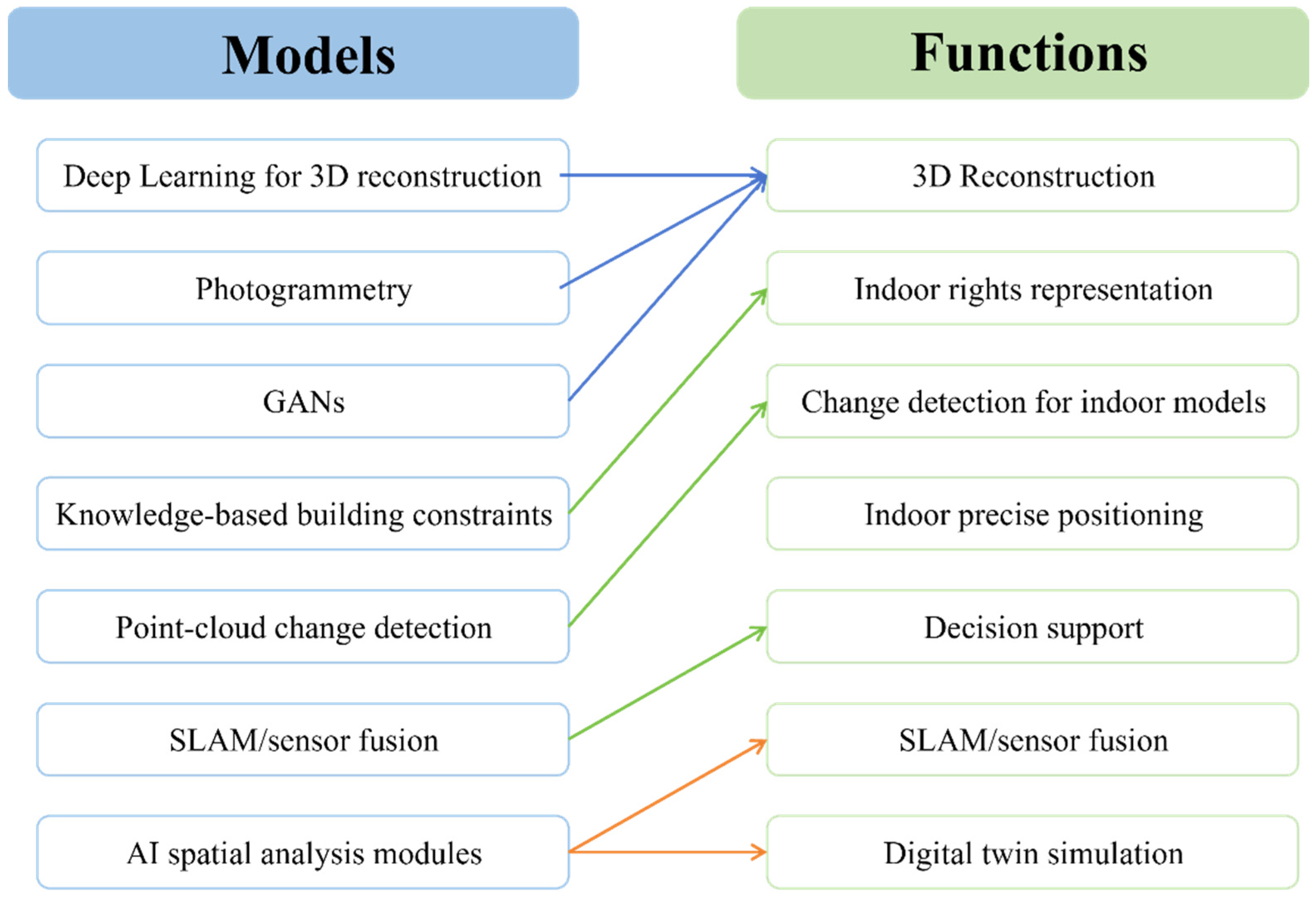
The application of AI is driving the evolution of cadastral management from static two-dimensional to dynamic three-dimensional models. AI not only utilizes AI algorithms to generate three-dimensional models compliant with cadastral standards from multi-source data, thereby accelerating the automated construction of 3D models but also enables dynamic management and decision support for 3D models. This primarily encompasses two components: automatic 3D reconstruction and three-dimensional cadastral applications with dynamic management. To better illustrate the operational viability of these developments, the relationships depicted in Figure 4 have been characterized by specific maturity levels. For instance, data acquisition and processing capabilities, such as 3D reconstruction facilitated by photogrammetry, are increasingly viewed as mature and are being incorporated into operational cadastres. Conversely, the aforementioned higher-level capabilities, including the representation of rights in indoor spaces, decision support, and digital twin simulation, are largely at the research or experimental stage and require further validation in terms of legal reliability and topological consistency before full-scale implementation. Figure 4 presents the structure of the GeoAI models and the cadastral functions. The arrows indicate the flow of ideas, and their colors, which are blue, green, and orange, are matched to the target categories.
The core of automatic 3D reconstruction involves using AI to analyze 2D images, point clouds, and other data to generate legally valid 3D building and spatial models. Based on technical pathways, this can be divided into three research directions:
First is 3D reconstruction based on 2D images. This method combines building a knowledge base with deep learning to extract 3D structures from aerial satellite imagery. Bertan et al. [55] combined 2D boundaries from digital cadastral maps with a building knowledge base to automatically reconstruct 3D roof models. However, the traditional 2D cadastral framework, while efficient for flat land parcels, fails to accurately represent the complex overlapping ownerships in modern vertical urban environments. This functional gap has driven the transition toward 3D cadastral modeling, which utilizes AI to process volumetric data for complex property rights management. In this context, Masouleh and Sadeghian [56] proposed a data-driven deep learning reconstruction method. This method uses deep learning to directly learn and reconstruct 3D building cadastral models from aerial images. Although this can significantly reduce the cost of manual intervention, it requires high-precision training data, and the current level of automation is still limited by the generalization ability in complex scenes. The combination of new data sources, such as drone oblique photography with AI algorithms [57], as well as the application of advanced models such as generative adversarial networks (GANs) [58], is further improving the efficiency and realism of 3D modeling.
After the creation of 3D models, the value of AI is further demonstrated in three-dimensional cadastral applications and dynamic management, particularly in the representation of complex indoor property rights and decision support. Indoor cadastral surveys include updating indoor cadastral models using change detection in point cloud data [59] and applying machine learning to solve the challenge of precise positioning in indoor mobile mapping systems [60]. Cities like Hong Kong with dense urban environments and high-rise buildings require 3D property rights registrations to facilitate vertical development, and the application of AI in indoor cadastral surveys presents potential for advancing these efforts. Meanwhile, the Government of the HKSAR has recently introduced 3D indoor maps for 1250 buildings covering the whole territory, which represent a significant step towards 3D indoor mapping in Hong Kong. The Open3Dhk launched by the Lands Department of the HKSAR in 2023 is a government-led smart platform initiative that uses WebGL technology to enable real-time rendering and interaction with 3D city models and the dissemination of 3D visualization maps and indoor maps with various formats, supporting planning approvals, public participation, and interdepartmental collaboration. Its application programming interface (API) allows developers to integrate AI-driven spatial analysis modules, reflecting the evolution of 3D cadastral data from static models to dynamic decision support, and providing infrastructure support for smart city governance [61].
AI-driven 3D models are becoming the foundation of digital twins. They can be used to simulate urban planning scenarios or manage the rights to facilities such as underground utility networks, thereby dynamically adjusting the property rights of underground facilities [62].

4.3. Intelligent Cadastral Data Management and Calibration

Intelligent cadastral data management and calibration focus on the back-end processing and management of cadastral data. In other words, after data collection and modeling, AI technology is used to ensure the accuracy, consistency, and usability of the data. The core tasks include identifying and specifying errors in legacy records, updating records, attributes, and occupation status while preserving the original legal boundaries, maintaining topological consistency with consideration of long-standing peaceful occupation during boundary definition or determination, and extracting semantic value by linking spatial data with legal texts and local enquiries about boundary knowledge. Existing research mainly focuses on two directions:
  • Existing Cadastral Map Intelligent Labeling
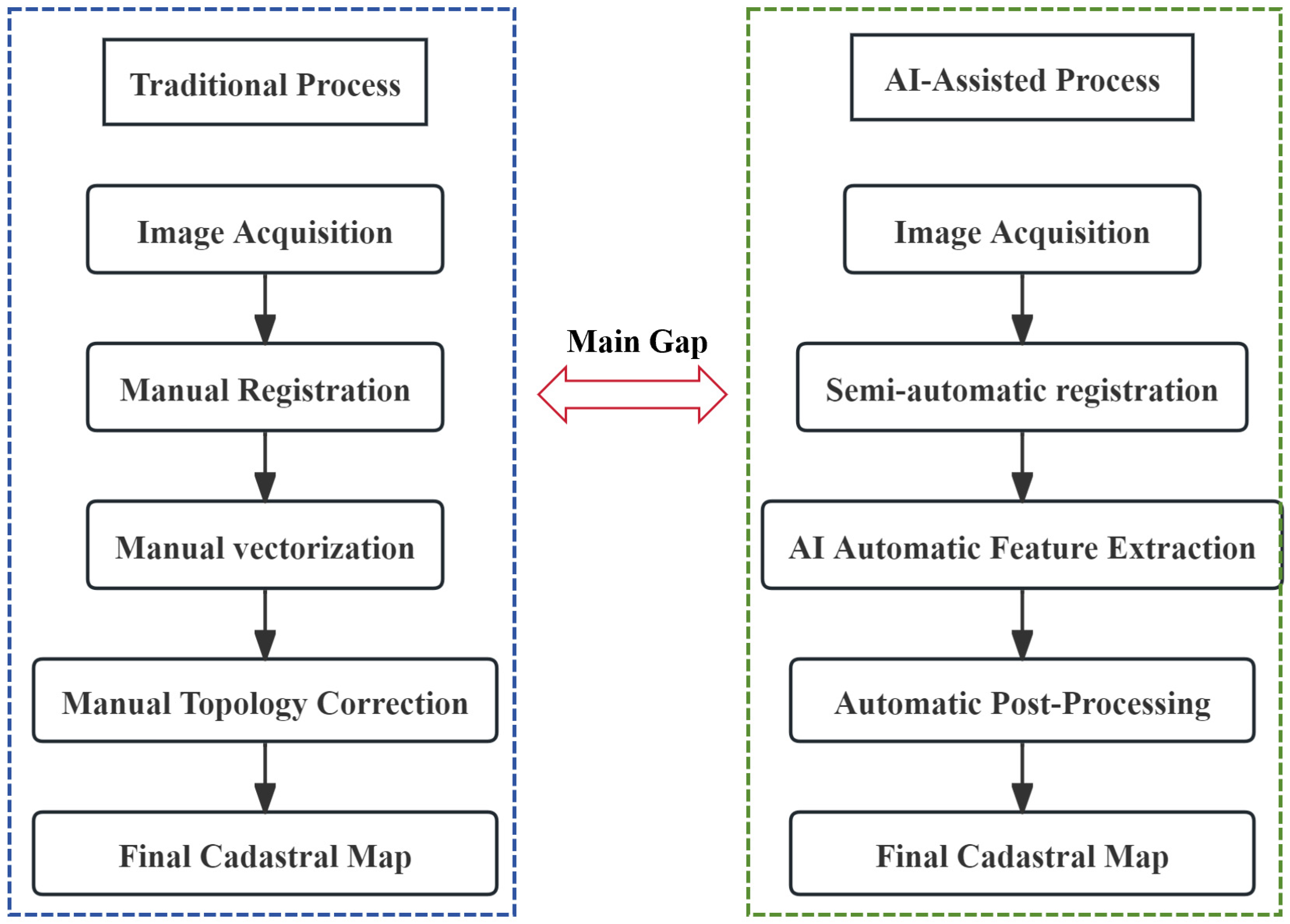
The core objective of this research direction is to address quality issues in existing cadastral data, especially scanned historical maps and early digital compilations, through AI-assisted geometric rectification and content repair. This includes detecting and quantifying geometric distortion in historical maps, anchoring the adjustment with reliable and temporally stable reference points such as survey control and long-lived features, and applying controlled rubber sheeting or thin plate spline transformations with independent checkpoints, residual analysis, and RMSE thresholds to verify the results. Because automatic matching of modern maps or photo features can misregister, all adjustments require careful verification and audit trails. At its core, the issue is a lack of domain knowledge for recognizing and validating dependable boundary evidence and records. Research efforts are focused on the development of automated tools, the application of deep learning models, and the identification of error patterns. Figure 5 illustrates the comparison between traditional scanning methods and AI-based approaches in processing historical cadastral maps. It is important to note, however, that the workflow depicted in Figure 5 is conceptual in nature, and the level of automation in the various steps of the process is not the same. In the modern system of cadastral surveys, data-intensive activities such as image capture and the initial stages of feature extraction are highly automated. However, activities such as image alignment and the use of topological post-processing, which require complex spatial reasoning, are still in the realm of human-in-the-loop checks. Further, the actual production of the final cadastral map is a process in which a great deal of expertise is required to meet the stringent legal and evidentiary standards of a system of land administration.
Recent studies emphasize assisted, quality-controlled registration, where deep learning yields incremental, context-dependent accuracy improvements. First studies examined region-based map-to-image registration [63] and currently followed advancement methods [64]. More recent research has also increased the accuracy level of registration. Fetai et al. [7] suggested that explicit land margins could be identified by CNN and that multiple georeferencing procedures could be united to minimize manual intervention and reach semi-automated touch-ups. They have also implemented incremental update mechanisms to support dynamic data, like designs based on topological linkage rules, which automatically fix geometric distortions in the change of land parcel segments, to maintain spatial consistency [65]. Furthermore, time series management is critical, with event-driven models capable of recording the causes of changes, aiding in resolving temporal inconsistencies [66].
Deep learning also has immense promise in the automated digitization and vectorization of old cadastral maps [67]. Similarly, Fetai et al. [7] indicate that pre-marking invisible boundaries before the acquisition of drone or satellite images has the potential to increase the scope of digitization. This approach not only overcomes the bottleneck in the conversion of historical data but also improves data usability by monitoring changes in parcel attributes over time through models such as temporal GIS. Through the application of machine learning techniques such as clustering, systematic errors in cadastral maps are automatically discovered, offering decision support for data cleaning with automated improvements [68]. Error identification needs an integration of data quality rules with AI algorithms. Through the application of an inspection system that is knowledge- and rule-based, spatial topological errors in the map are discovered automatically with the reporting of error patterns through clustering analysis [69]. Pullar and Donaldson [70] also indicate that machine learning has an application in the calibration of models, for example, checking for category consistency in land use through remote sensing data, as well as discovering systematic biases in cadastral maps.
2.
Data Management based on AI and Standard Frameworks
The proposed direction of research bases its idea on the use of AI to implement semantic and intelligent management of cadastral data to unlock value from the data. Data silos, less-than-perfect update mechanisms, and the lack of effective decision support because of semantic heterogeneity are factors underpinning the problem context. In dealing with these concerns, the research dwells upon standardized patterns, AI-based analysis, and ontology integration to provide increased data consistency, scalability, and smart application functions.
The ISO 19152 Land Administration Domain Model (LADM) is an international standard for data and conceptual modeling that provides a unified global vocabulary for land administration. It aligns societal governance needs with technological developments, facilitates software development, and can accelerate the implementation of land administration systems that support sustainability [71]. LADM must be combined with multidimensional data models to handle 3D cadastral or dynamic data. Shahidinejad et al. [19] noted that LADM ensures data integrity and consistency in conceptual design but requires optimization of the physical model to support large spatial datasets.
Automated data analysis and classification involve using techniques such as clustering [72] or more advanced variational autoencoders [73] to analyze cadastral databases and automatically identify building types. AI analysis must be combined with an intelligent sensing framework, which collects data from multiple sources, cleans and transforms it, and then inputs it into the model repository.
Ontology and semantic integration involve introducing ontology and knowledge graph technologies to validate the consistency of conceptual models in cadastral systems [74] but does not address semantic conflicts in dynamic data. Stock et al. [75] attempted to address this issue by deriving spatiotemporal sequences from data. Yilmaz et al. [76] even developed a comprehensive, ontology-based spatial data quality assessment framework. However, the assessment still requires manual setting of indicator weights and has not achieved AI-driven adaptive optimization.

5. Discussion and Prospects

The application of AI technology in the field of cadastral surveying is transitioning from theoretical exploration to practical implementation, and its significant potential in data collection, processing, modeling, and analysis has been preliminarily validated. However, as systematically analyzed across the thematic categories of data processing in Section 3.1 and modeling in Section 4.2, while AI has made notable progress in the cadastral surveying field, it also faces systemic challenges, with several key challenges and unresolved issues remaining.
One is that the problem of incompatibility of multi-source data still exists. While multi-source data integration can enhance the accuracy of cadastral feature extraction, differences in data format, resolution, and imaging conditions among various sensors pose significant challenges [77]. During the process of tracking the change in the parcels of data over time using data fusion techniques, the changes in the sunlight, seasons, and settings can affect the results. Hence, the results of the change detection process have to be manually adjusted, which defeats the purpose of the efficiency promised by the use of AI. In future studies, more powerful fusion models that could be adapted to the differences in multi-source data should be designed and analyzed to obtain end-to-end cross-modal learning approaches to minimize human interaction.
The generalization ability and robustness of models need to be improved. The existing models of AI using cadastral issues are mainly trained and tested on a local area or collection, and their capabilities of inference commonly prove to be inadequate when subjected to geographical varieties and the characteristics of the land features. Traditional pixel-level methods and object-oriented methods are limited by manually designed features, while deep learning models may also exhibit boundary discontinuities or topological errors when processing complex scenes [78]. Future research should focus on developing models with stronger generalization capabilities, such as through transfer learning and domain adaptation techniques, to reduce model dependence on specific datasets, combined with geometric regularization constraints and topological correction modules to ensure that the generated cadastral boundaries are more reliable in terms of structure and topology.
Third, unstructured data are not easily understood at a deep semantic level. It may be pointed out that even though NLP and knowledge graph technologies are capable of automatically identifying and extracting key information out of cadastral documents, deep semantic reasoning based on large volumes of complex legal texts, and solving problems of semantic ambiguity and heterogeneity, is still a research area. For example, legal documents from different historical periods may use different expressions for the same easement, which requires AI models to have strong contextual understanding and cross-temporal reasoning capabilities [79]. Future research could explore combining large language models (LLMs) with knowledge graphs to achieve more precise cadastral semantic understanding and reasoning, thereby supporting more complex property dispute analysis and legal decision-making.
Fourth, the legal and ethical foundation of AI-driven cadastres is still in development. The technical efficiency of AI is undeniable, but the rules under which the output of the AI system can be used as evidence are still in the making. The output of the AI system, in practice, is used as technical guidance, and the ultimate decision rests with human professionals who are in charge of the process. The certified surveyor or the registrar who checks and validates the output of the AI system, ensures that the output conforms to the legal standards set by the cadastral system, holds the ultimate legal liability in case of disputes over ownership, as in the case of the algorithm misreading a feature or shadows as a boundary. Furthermore, the use of high-resolution UAV and satellite images in the development of the AI system poses serious data-privacy concerns, as the data on private properties may be revealed without the consent of the property owners. The new system would have to ensure data privacy and transparency in the use of the system, holding the system legally liable and ensuring the accuracy and reliability of the system. Besides the liability and privacy issues, the integration of AI into the cadastral system must also resolve the issue of the disparity between the boundaries as depicted on the imagery and the boundaries as defined on the title. For example, the boundaries as depicted on the imagery, such as fences or walls, may not match the boundaries as defined on the title. The output of the AI system must, therefore, be subject to some sort of adjudication process before it can update the registration. For the system to be legally sound, the output of the system must be incorporated into the existing system through the use of the human-in-the-loop approach.
Overall, future research should focus on developing more robust cross-modal fusion models to address data heterogeneity. Enhancing the model’s generalization capabilities and topological constraints to adapt to complex and dynamic application scenarios. Combining large language models with knowledge graphs to achieve a deeper semantic understanding of cadastral legal documents. Equally important is the establishment of legal and ethical standards to clarify algorithmic accountability and protect data privacy. By systematically addressing these technical and regulatory challenges, the application of AI technology in the cadastral field will transition from theoretical exploration to deeper practical implementation, laying a solid foundation for the development of efficient, legally compliant, and reliable intelligent cadastral systems.

6. Conclusions

The rapid advancement of artificial intelligence is transforming various sectors and driving innovation. The main benefits brought by AI in land administration include an adequate volume of spatial data processing, rationalization of the scientificity of decision-making, and modernization of management. Hence, an extensive review of the application of AI in the administration of land is essential. This is because it will involve an examination of the major factors that connect the advancement of technology with the persistent goals of administration. This will encourage the shift towards smarter systems of administration instead of traditional methods. Based on this, this review has systematically summarized how AI has been used to manage land administration by touching on various issues like data collection and processing, modeling and analysis, among other factors, and the usual applications of AI in land administration management. The following three conclusions can be summarized:
In terms of data collection and processing, AI technology has significantly improved the efficiency and accuracy of land administration work. Deep learning, particularly convolutional neural networks (CNNs) and Transformer models, can automatically and accurately extract parcel boundaries from remote sensing imagery, addressing the issues of low efficiency and high error rates in traditional manual digitization. In terms of non-spatial data, the application of NLP and knowledge graph technology has enabled intelligent processing of unstructured data, such as legal documents, opening up possibilities for deep association and value extraction of cadastral data. By providing a comparative framework, this review explains the shift from manual, rule-based OBIA to autonomous deep learning paradigms, highlighting when and why specific models excel.
In terms of modeling and analysis, AI technology has driven the evolution of cadastral management from static two-dimensional to dynamic three-dimensional systems. Machine learning models can automatically detect parcel changes, while deep learning models can simultaneously perform parcel boundary extraction and land use classification, enabling integrated analysis of spatial and non-spatial data. Additionally, AI applications in 3D cadastral modeling, such as automatic 3D reconstruction based on multi-source data fusion, offer new solutions for urban planning and complex indoor property management.
In typical application scenarios, AI-driven automatic extraction of cadastral features, AI-enabled three-dimensional cadastral modeling, and intelligent data management and calibration have become major research directions. These applications not only improve data production efficiency but also ensure the accuracy and consistency of cadastral data through technologies such as intelligent calibration and repair, and error pattern recognition.
However, it is important to point out that not all AI solutions have attained full maturity. For instance, there is excellent automation in terms of data collection, though when it comes to more complex issues such as topology analysis and legal semantics, we still have to rely on human expertise. The inability to generalize the shape and size of cities, and the deep semantic complexity of cadastral law, add to the challenge of AI based cadastre. Therefore, it is not possible to envision the full automation of the cadastre with AI, given the practical and legal limitations that will require the involvement of humans in the process.
Despite significant progress in AI applications within the cadastral field, numerous challenges remain. Future research should focus on developing more robust multi-source data fusion and cross-modal learning models, as well as enhancing the generalization and robustness of AI models. By addressing these challenges, AI will be able to be applied more comprehensively and deeply in cadastral management, ultimately achieving the full intelligence of cadastral systems and providing a solid foundation for the sustainable development of the socio-economy.

Author Contributions

Conceptualization, J.C. and M.S.W.; methodology, J.C.; software, J.C.; validation, J.C. and M.N.; formal analysis, J.C.; investigation, J.C.; resources, M.N. and M.S.W.; data curation, J.C.; writing—original draft preparation, J.C.; writing—review and editing, J.C., M.N., B.S.L., and M.S.W.; visualization, J.C.; supervision, M.S.W.; project administration, M.S.W.; funding acquisition, M.N. and M.S.W. All authors have read and agreed to the published version of the manuscript.

Funding

This study was substantially funded by the General Research Fund (Grant No. 15603923 and 15609421), the Collaborative Research Fund (Grant No. C5062–21GF), and Young Collaborative Research Fund (Grant No. C6003–22Y) from the Research Grants Council, Hong Kong, China. The authors acknowledge funding support (Grant No. N-ZH8S, BBG2, and 1-CDL5) from the Otto Poon Research Institute for Climate-Resilient Infrastructure, the Research Institute for Sustainable Urban Development, the Research Institute of Land and Space, The Hong Kong Polytechnic University, Kowloon, Hong Kong, China. This work was also supported by the State Key Laboratory of Climate Resilience for Coastal Cities at the Hong Kong Polytechnic University. M.S. Wong also acknowledges support from the Environment and Conservation Fund under Grant 2021-107. M. Nazeer was substantially supported through the General Research Fund (Grant No. PolyU15306224) from the Research Grants Council of Hong Kong.

Data Availability Statement

The raw data supporting the conclusions of this article will be made available by the authors on request.

Acknowledgments

The authors would like to thank Ben Chan from the Research Institute for Land and Space, The Hong Kong Polytechnic University, Hong Kong, for his advice.

Conflicts of Interest

The authors declare no conflicts of interest. The funders had no role in the design of the study; in the collection, analyses, or interpretation of data; in the writing of the manuscript; or in the decision to publish the results.

Abbreviations

The following abbreviations are used in this manuscript:
3DThree-Dimensional
AIArtificial Intelligence
AGIArtificial General Intelligence
APIApplication Programming Interface
BiLSTMBidirectional Long Short-Term Memory
BiLSTM-CRFBidirectional Long Short-Term Memory with Conditional Random Field
CEDDCivil Engineering and Development Department (CEDD)
CNNConvolutional Neural Network
CRFConditional Random Field
DCNNDeep Convolutional Neural Network
FCNFully Convolutional Network
GANGenerative Adversarial Network
GeoAIGeospatial Artificial Intelligence
GNSSGlobal Navigation Satellite System
GISGeographic Information System
HKSARThe Hong Kong Special Administrative Region
ISOInternational Organization for Standardization
LADMLand Administration Domain Model
LiDARLight Detection and Ranging
LLMLarge Language Model
MTDC-BAMulti-task Inspired Deep Clustering with Boundary Adaptation
nDSMNormalized Digital Surface Model
NERNamed Entity Recognition
NLPNatural Language Processing
OBIAObject-Based Image Analysis
RSRemote Sensing
SARSynthetic Aperture Radar
SVMSupport Vector Machine
UAVUnmanned Aerial Vehicle
WOSWeb of Science

References

  1. Rakhmonov, K.; Abdurakhimova, M. Improvement of cadastral information provisioning system in an administrative region. E3S Web Conf. 2021, 227, 5002. [Google Scholar] [CrossRef]
  2. Soewardi, B.; Rieger, T.; Djalal, F.; Pamuncak, E.; Ramon, R. Decentralizing Indonesia’s Land Administration System: Are Local Governments and Land Offices Ready—Evidence from 27 Districts: Final Report; World Bank Group: Washington, DC, USA, 2001. [Google Scholar]
  3. Luo, X.; Bennett, R.M.; Koeva, M.; Lemmen, C. Investigating semi-automated cadastral boundaries extraction from airborne laser scanned data. Land 2017, 6, 60. [Google Scholar] [CrossRef]
  4. Wang, H.; Cao, P.; Wang, J.; Zaiane, O.R. UCTransNet: Rethinking the skip connections in U-Net from a channel-wise perspective with transformer. AAAI Conf. Artif. Intell. 2022, 36, 2441–2449. [Google Scholar] [CrossRef]
  5. Hu, Z.; Hou, W.; Liu, X. Deep learning for named entity recognition: A survey. Neural Comput. Appl. 2024, 36, 8995–9022. [Google Scholar] [CrossRef]
  6. Ren, G.D. Research on cadastral management based on 3D GIS technology. China High-Tech. 2022, 6, 112–113. [Google Scholar] [CrossRef]
  7. Fetai, B.; Grigillo, D.; Lisec, A. Revising cadastral data on land boundaries using deep learning in image-based mapping. ISPRS Int. J. Geo-Inf. 2022, 11, 298. [Google Scholar] [CrossRef]
  8. Crommelinck, S.; Bennett, R.; Gerke, M.; Nex, F.; Yang, M.; Vosselman, G. Review of automatic feature extraction from high-resolution optical sensor data for UAV-based cadastral mapping. Remote Sens. 2016, 8, 689. [Google Scholar] [CrossRef]
  9. Zhao, Z.W. Thoughts on issues related to cadastral surveying and mapping. Heilongjiang Sci. Technol. Inf. 2015, 21, 22. [Google Scholar]
  10. Ali, Z.; Tuladhar, A.; Zevenbergen, J. An integrated approach for updating cadastral maps in Pakistan using satellite remote sensing data. J. Appl. Geogr. 2012, 18, 386–398. [Google Scholar] [CrossRef]
  11. Crommelinck, S.; Koeva, M.; Yang, M.Y.; Vosselman, G. Application of deep learning for delineation of visible cadastral boundaries from remote sensing imagery. Remote Sens. 2019, 11, 2505. [Google Scholar] [CrossRef]
  12. Bakici, S.; Erkek, B.; Ayyildiz, E.; Özmüş, L. The use of 3D city models from oblique images on land administration. ISPRS Ann. Photogramm. Remote Sens. Spat. Inf. Sci. 2017, IV-4/W4, 117–121. [Google Scholar] [CrossRef]
  13. ZCGIS. Drones Help Hong Kong Engineering Surveying: Two Weeks of Work Finished in One Day. 2022. Available online: http://www.zcgis.com/article_show.aspx?id=134 (accessed on 27 January 2026).
  14. Effenberg, W.W.; Enemark, S.; Williamson, I.P. Framework for discussion of digital spatial data flow within cadastral systems. Aust. Surv. 1999, 44, 35–43. [Google Scholar] [CrossRef]
  15. Bennett, R.M.; Unger, E.-M.; Lemmen, C.; Dijkstra, P. Land administration maintenance: A review of the persistent problem and emerging fit-for-purpose solutions. Land 2021, 10, 509. [Google Scholar] [CrossRef]
  16. Haggag, A.; Shaker, I.; El-Maghraby, M. Towards an automated information system for cadastral survey in Egypt. In Proceedings of the FIG Working Week 2005 and 8th International Conference on the Global Spatial Data Infrastructure (GSDI-8): From Pharaohs to Geoinformatics, Cairo, Egypt, 16–21 April 2005. [Google Scholar]
  17. Zhang, B.; Tian, D.S.; Jiang, S.K.; Dai, G.Z. Research and implementation of urban cadastral management information technology. Land Resour. Inform. 2009, 1, 20–23. [Google Scholar]
  18. Patwardhan, N.; Marrone, S.; Sansone, C. Transformers in the real world: A survey on NLP applications. Information 2023, 14, 242. [Google Scholar] [CrossRef]
  19. Shahidinejad, J.; Kalantari, M.; Rajabifard, A. 3D cadastral database systems—A systematic literature review. ISPRS Int. J. Geo-Inf. 2024, 13, 30. [Google Scholar] [CrossRef]
  20. Yan, Q.; Jiao, F.; Peng, W. Building materials classification model based on text data enhancement and semantic feature extraction. Buildings 2024, 14, 1859. [Google Scholar] [CrossRef]
  21. Sanh, V.; Debut, L.; Chaumond, J.; Wolf, T. DistilBERT, a distilled version of BERT: Smaller, faster, cheaper and lighter. arXiv 2019, arXiv:1910.01108. [Google Scholar] [CrossRef]
  22. Amankulova, N.; Molmakova, M.; Karimova, G. Artificial intelligence and geoinformation systems. Bull. Sci. Pract. 2023, 9, 278–287. [Google Scholar] [CrossRef]
  23. Pepe, M.; Tana, F.F.; Palumbo, D.; Spacone, E. Building Information Modelling from Cadastral Plans and Application to an Italian Case Study Building Using Innovative Strategies. J. Sustain. Archit. Civ. Eng. 2024, 36, 82–93. [Google Scholar] [CrossRef]
  24. Hajiheidari, A.; Delavar, M.R.; Rajabifard, A. Smart Urban Cadastral Map Enrichment—A Machine Learning Method. ISPRS Int. J. Geo-Inf. 2024, 13, 80. [Google Scholar] [CrossRef]
  25. Crommelinck, S.; Bennett, R.; Gerke, M.; Yang, M.Y.; Vosselman, G. Contour Detection for UAV-Based Cadastral Mapping. Remote Sens. 2017, 9, 171. [Google Scholar] [CrossRef]
  26. Wang, A.; Zhang, P. Cooperation of Multi-Task Segmentation and a Graph Convolutional Network for Object Vector Boundary Extraction in Remote-Sensing Imagery. Int. J. Remote Sens. 2023, 44, 4911–4936. [Google Scholar] [CrossRef]
  27. Zhang, X.; Wang, T.; Zhao, X.; Wen, D.; Zhai, D. Multitask-Guided Deep Clustering with Boundary Adaptation. IEEE Trans. Neural Netw. Learn. Syst. 2024, 35, 6089–6102. [Google Scholar] [CrossRef] [PubMed]
  28. Nyandwi, E.; Koeva, M.; Kohli, D.; Bennett, R. Comparing Human Versus Machine-Driven Cadastral Boundary Feature Extraction. Remote Sens. 2019, 11, 1662. [Google Scholar] [CrossRef]
  29. Wang, H. Research on the Application of Random Forest-Based Feature Selection Algorithm in Data Mining Experiments. Int. J. Adv. Comput. Sci. Appl. 2023, 14, 505–518. [Google Scholar] [CrossRef]
  30. Cheng, T.D.; Angelici, G.L.; Slye, R.E.; Ma, M. Computer-Aided Boundary Delineation of Agricultural Lands; NASA-TM-102243; NASA: Moffett Field, CA, USA, 1989.
  31. Hertz, L.; Schafer, R.W. Multilevel Thresholding Using Edge Matching. Comput. Vis. Graph. Image Process. 1988, 44, 279–295. [Google Scholar] [CrossRef]
  32. Su, W.; Li, J.; Chen, Y.H.; Zhang, J.S.; Hu, D.Y.; Liu, C.M. Object-Oriented Urban Land Cover Classification Based on Multi-Scale Image Segmentation: A Case Study of the Urban Central Area of Kuala Lumpur, Malaysia. J. Remote Sens. 2007, 11, 521–530. [Google Scholar]
  33. Kohli, D.; Crommelinck, S.; Bennett, R.; Koeva, M.; Lemmen, C.; Bovolo, F.; Benediktsson, J.A.; Bruzzone, L. Object-Based Image Analysis for Cadastral Mapping Using Satellite Images. Proc. SPIE 2017, 10427, 10427V. [Google Scholar] [CrossRef]
  34. Anaraki, N.R.; Tahmasbi, M.; Kheradpisheh, S.R. Detecting Cadastral Boundary from Satellite Images Using U-Net Model. arXiv 2025, arXiv:2502.11044. [Google Scholar] [CrossRef]
  35. O’Mahony, N.; Campbell, S.; Carvalho, A.; Harapanahalli, S.; Hernandez, G.V.; Krpalkova, L.; Riordan, D.; Walsh, J.; Arai, K.; Kapoor, S. Deep Learning vs. Traditional Computer Vision. In Advances in Computer Vision; Springer: Cham, Switzerland, 2019; Volume 943, pp. 128–144. [Google Scholar] [CrossRef]
  36. Shelhamer, E.; Long, J.; Darrell, T. Fully Convolutional Networks for Semantic Segmentation. IEEE Trans. Pattern Anal. Mach. Intell. 2017, 39, 640–651. [Google Scholar] [CrossRef] [PubMed]
  37. Xia, X.; Persello, C.; Koeva, M. Deep Fully Convolutional Networks for Cadastral Boundary Detection from UAV Images. Remote Sens. 2019, 11, 1725. [Google Scholar] [CrossRef]
  38. Voelsen, M.; Lauble, S.; Rottensteiner, F.; Heipke, C. Transformer Models for Multi-Temporal Land Cover Classification Using Remote Sensing Images. ISPRS Ann. Photogramm. Remote Sens. Spat. Inf. Sci. 2023, X-1/W1-2023, 981–990. [Google Scholar] [CrossRef]
  39. Zhang, Z.; Huang, L.; Tang, B.-H.; Le, W.; Wang, M.; Cheng, J.; Wu, Q. MATNet: Multiattention Transformer Network for Cropland Semantic Segmentation in Remote Sensing Images. Int. J. Digit. Earth 2024, 17, 2392845. [Google Scholar] [CrossRef]
  40. Zhang, C.; Deng, X.; Ling, S.H. Next-Gen Medical Imaging: U-Net Evolution and the Rise of Transformers. Sensors 2024, 24, 4668. [Google Scholar] [CrossRef]
  41. Liu, P.; Gao, Y.; Zheng, X.; Wang, H.; Zhao, Y.; Wu, X.; Lu, Z.; Yue, Z.; Xie, Y.; Hao, S. Integrating Attention Mechanism and Boundary Detection for Building Segmentation from Remote Sensing Images. Front. Neurorobot. 2025, 18, 1482051. [Google Scholar] [CrossRef]
  42. Maltezos, E.; Doulamis, N.; Doulamis, A.; Ioannidis, C. Deep Convolutional Neural Networks for Building Extraction from Orthoimages and Dense Image Matching Point Clouds. J. Appl. Remote Sens. 2017, 11, 042620. [Google Scholar] [CrossRef]
  43. Zhang, Z.; Guo, W.; Li, M.; Yu, W. GIS-Supervised Building Extraction with Label Noise-Adaptive Fully Convolutional Neural Network. IEEE Geosci. Remote Sens. Lett. 2020, 17, 2135–2139. [Google Scholar] [CrossRef]
  44. Sanca, S.; Ostir, K.; Mangafic, A. Building Detection with Convolutional Networks Trained with Transfer Learning. Geod. Vestn. 2021, 65, 559–593. [Google Scholar] [CrossRef]
  45. Zorzi, S.; Cavalli, D.; Bruzzone, L. Regularization by Denoising Unrolling Network for Building Footprint Extraction from High-Resolution Remote Sensing Images. IEEE Trans. Geosci. Remote Sens. 2022, 60, 1–14. [Google Scholar]
  46. Khoshelham, K. Building Extraction from Multiple Data Sources: A Data Fusion Framework for Reconstruction of Generic Models. In International Archives of Photogrammetry and Remote Sensing; International Society of Photogrammetry and Remote Sensing: Bethesda, MD, USA, 2004; Volume 35, p. 7. Available online: https://research.utwente.nl/en/publications/building-extraction-from-multiple-data-sources-a-data-fusion-fram (accessed on 1 September 2025).
  47. Pohl, C.; Van Genderen, J.L. Multisensor Image Fusion in Remote Sensing: Concepts, Methods and Applications. Int. J. Remote Sens. 1998, 19, 823–854. [Google Scholar] [CrossRef]
  48. Hartfield, K.A.; Landau, K.I.; van Leeuwen, W.J.D. Fusion of High Resolution Aerial Multispectral and LiDAR Data: Land Cover in the Context of Urban Mosquito Habitat. Remote Sens. 2011, 3, 2364–2383. [Google Scholar] [CrossRef]
  49. Idrees, M.; Shafri, H.Z.M.; Saeidi, V. Imaging Spectroscopy and Light Detection and Ranging Data Fusion for Urban Features Extraction. Am. J. Appl. Sci. 2013, 10, 1575–1585. [Google Scholar] [CrossRef]
  50. Alipour Fard, T.; Hasanlou, M.; Arefi, H. Classifier Fusion of High-Resolution Optical and Synthetic Aperture Radar (SAR) Satellite Imagery for Classification in Urban Area. Int. Arch. Photogramm. Remote Sens. Spat. Inf. Sci. 2014, XL-2/W3, 25–29. [Google Scholar] [CrossRef][Green Version]
  51. Wahbeh, W.; Müller, G.; Ammann, M.; Nebiker, S. Automatic Image-Based 3D Reconstruction Strategies for High-Fidelity Urban Models—Comparison and Fusion of UAV and Mobile Mapping Imagery for Urban Design Studies. Int. Arch. Photogramm. Remote Sens. Spat. Inf. Sci. 2022, XLIII-B2, 461–468. [Google Scholar] [CrossRef]
  52. Sun, J.Y.; Wang, C.L.; Qian, H.M. Building Information Extraction Using LIDAR Data and High-Resolution Images. J. Anhui Water Conserv. Tech. Coll. 2017, 17, 1–4. [Google Scholar] [CrossRef]
  53. Metrikaityte, G.; Suziedelyte Visockiene, J.; Papsys, K. Digital Mapping of Land Cover Changes Using the Fusion of SAR and MSI Satellite Data. Land 2022, 11, 1023. [Google Scholar] [CrossRef]
  54. Gaw, L.Y.; Chen, S.; Chow, Y.S.; Lee, K.; Biljecki, F. Comparing Street View Imagery and Aerial Perspectives in the Built Environment. ISPRS Ann. Photogramm. Remote Sens. Spat. Inf. Sci. 2022, X-4/W3-2022, 49–56. [Google Scholar] [CrossRef]
  55. Bertan, E.; Goekmen, M.; Moreau, G. Automatic 3D Roof Reconstruction Using Digital Cadastral Map, Architectural Knowledge and an Aerial Image. In Proceedings of the 2006 IEEE International Symposium on Geoscience and Remote Sensing, Denver, CO, USA, 31 July–4 August 2006; p. 1415. [Google Scholar] [CrossRef]
  56. Masouleh, M.K.; Sadeghian, S. Deep Learning-Based Method for Reconstructing Three-Dimensional Building Cadastre Models from Aerial Images. J. Appl. Remote Sens. 2019, 13, 024508. [Google Scholar] [CrossRef]
  57. Shao, H.; Liu, X.Y.; Liu, R.; Huang, R. Application of Oblique Photogrammetry in Large-Scale Cadastral Map Surveying and Mapping in Complex Areas. Green Sci. Technol. 2020, 14, 202–205. [Google Scholar]
  58. Ran, X.; Xue, L.; Sang, X.; Pei, Y.; Zhang, Y. Intelligent Generation of Cross Sections Using a Conditional Generative Adversarial Network and Application to Regional 3D Geological Modeling. Mathematics 2022, 10, 4677. [Google Scholar] [CrossRef]
  59. Koeva, M.; Nikoohemat, S.; Elberink, S.O.; Morales, J.; Lemmen, C.; Zevenbergen, J. Towards 3D Indoor Cadastre Based on Change Detection from Point Clouds. Remote Sens. 2019, 11, 1972. [Google Scholar] [CrossRef]
  60. Potsiou, C.; Doulamis, N.; Bakalos, N.; Gkeli, M.; Ioannidis, C. Indoor Localization for 3D Mobile Cadastral Mapping Using Machine Learning Techniques. ISPRS Ann. Photogramm. Remote Sens. Spat. Inf. Sci. 2020, VI-4/W1-2020, 159–166. [Google Scholar] [CrossRef]
  61. Lands Department. Hong Kong: Lands Department Launches 3D Visualisation Map of Kowloon Central and “Open3Dhk” Application Platform. Hong Kong Government News, 20 September 2023. Available online: https://www.info.gov.hk/gia/general/202309/20/P2023092000238.htm (accessed on 27 January 2026).
  62. Andritsou, D.; Alexiou, C.; Potsiou, C. BIM, 3D Cadastral Data and AI for Weather Conditions Simulation and Energy Consumption Monitoring. Land 2024, 13, 880. [Google Scholar] [CrossRef]
  63. Trias-Sanz, R.; Pierrot-Deseilligny, M. A Region-Based Method for Graph to Image Registration with an Application to Cadastre Data. In Proceedings of the 17th International Conference on Pattern Recognition (ICPR 2004), Cambridge, UK, 26 August 2004; pp. 1703–1706. [Google Scholar]
  64. Trias-Sanz, R.; Pierrot-Deseilligny, M.; Louchet, J.; Stamon, G. Methods for Fine Registration of Cadastre Graphs to Images. IEEE Trans. Pattern Anal. Mach. Intell. 2007, 29, 1990–2000. [Google Scholar] [CrossRef]
  65. Chen, J.; Zhou, X.-G. Incremental Updating of Spatial Database Based on Topological Linkage, Taking Cadastral Database’s Updating as an Example. Ce Hui Xue Bao 2008, 37, 322. [Google Scholar]
  66. Lin, G.F.; Feng, X.Z.; Wang, L.; Du, J.K. An Event-Centered Object-Oriented Spatiotemporal Data Model. Acta Geod. Cartogr. Sin. 2002, 31, 71–76. [Google Scholar] [CrossRef]
  67. Goederle, W.T.; Rampetsreiter, F.; Macher, C.; Mauthner, K.; Pimas, O. Deep Learning for Historical Cadastral Maps and Satellite Imagery Analysis: Insights from Styria’s Franciscean Cadastre. Digit. Humanit. Q. 2024, 18, 744. [Google Scholar]
  68. Vantas, K.; Mirkopoulou, V. Towards Automated Cadastral Map Improvement: A Clustering Approach for Error Pattern Recognition. Geomatics 2025, 5, 16. [Google Scholar] [CrossRef]
  69. Li, F.; Yue, J.; Yu, Z. A Spatial Data Checking System Based on Quality Rules. In Proceedings of the 2010 18th International Conference on Geoinformatics, Beijing, China, 18–20 June 2010; pp. 1–4. [Google Scholar] [CrossRef]
  70. Pullar, D.; Donaldson, S. Accuracy Issues for Spatial Update of Digital Cadastral Maps. ISPRS Int. J. Geo-Inf. 2022, 11, 221. [Google Scholar] [CrossRef]
  71. Lemmen, C.; van Oosterom, P.; Bennett, R. The Land Administration Domain Model. Land Use Policy 2015, 49, 535–545. [Google Scholar] [CrossRef]
  72. Martinez-Rocamora, A.; Díaz-Cuevas, P.; Camarillo-Naranjo, J.; Gálvez-Ruiz, D.; González-Vallejo, P. Identification of Residential Building Typologies by Applying Clustering Techniques to Cadastral Data. J. Build. Eng. 2024, 86, 108912. [Google Scholar] [CrossRef]
  73. De-Miguel-Rodriguez, J.; Requena-Garcia-Cruz, M.; Romero-Sánchez, E.; Morales-Esteban, A. Automated Building Typology Clustering and Identification Using a Variational Autoencoder on Digital Land Cadastres. Results Eng. 2025, 26, 105232. [Google Scholar] [CrossRef]
  74. Hess, C.; Schlieder, C. Ontology-Based Verification of Core Model Conformity in Conceptual Modeling. Comput. Environ. Urban Syst. 2006, 30, 543–561. [Google Scholar] [CrossRef]
  75. Stock, K.; Leibovici, D.; Delazari, L.; Santos, R. Discovering Order in Chaos: Using a Heuristic Ontology to Derive Spatio-Temporal Sequences for Cadastral Data. Spat. Cogn. Comput. 2015, 15, 115–141. [Google Scholar] [CrossRef]
  76. Yılmaz, C.; Cömert, Ç.; Yıldırım, D. Ontology-Based Spatial Data Quality Assessment Framework. Appl. Sci. 2024, 14, 10045. [Google Scholar] [CrossRef]
  77. Ding, Y.; Du, X.; Wang, J.; Rong, C.; Lu, W. Multi-Source Relational Data Fusion. Sci. Sin. Inf. 2020, 50, 649–661. [Google Scholar] [CrossRef]
  78. Hadid, A.; Chakraborty, T.; Busby, D. When Geoscience Meets Generative AI and Large Language Models: Foundations, Trends, and Future Challenges. Expert Syst. 2024, 41, e13654. [Google Scholar] [CrossRef]
  79. Wang, S.; Hu, T.; Xiao, H.; Li, Y.; Zhang, C.; Ning, H.; Zhu, R.; Li, Z.; Ye, X. GPT, Large Language Models (LLMs) and Generative Artificial Intelligence (GAI) Models in Geospatial Science: A Systematic Review. Int. J. Digit. Earth 2024, 17, 2353122. [Google Scholar] [CrossRef]
Figure 1. PRISMA flow diagram.
Land 15 00411 g001
Figure 2. Annual number of publications regarding AI research in cadastral surveying from 2015 to 2025.
Land 15 00411 g002
Figure 3. Distribution of AI algorithm categories across the 79 reviewed studies.
Land 15 00411 g003
Figure 4. Hierarchy between GeoAI models and cadastral functions.
Land 15 00411 g004
Figure 5. Comparison of traditional and AI-assisted workflows.
Land 15 00411 g005
Table 1. Search strings used in the WOS Core Collection database.
TopicWOS Core Collection Database Search String
AI in CadastreTS = (“cadastre” OR “cadastral register” OR “land registry” OR “land survey record*” OR “property register” OR “tax roll” OR “cadastral record*”) AND (“Artificial Intelligence” OR “AI” OR “intelligent system*” OR “machine intelligence” OR “autonomous intelligence” OR “artificial general intelligence” OR AGI OR “narrow AI” OR “deep learning” OR “machine learning” OR “natural language processing” OR “NLP” OR “computer vision” OR “CV” OR “intelligent agent*” OR “data intelligence” OR “augmented intelligence”)
Note: * is used as a wildcard symbol in the search string to represent any group of characters.
Table 2. Comparative analysis of traditional feature extraction methods.
MethodologyCharacteristicsApplication Scenarios
Traditional Computer Vision
(CV)
Pixel-level processingHigh-contrast boundary extraction, simple feature enhancement, etc.
Object-Based Image Analysis
(OBIA)
Segment-level analysisRural and agricultural parcel mapping, delineation of large-scale land plots with distinct geometric regularities, etc.
Deep Learning
(DL)
Data-driven feature learningComplex urban cadastral surveys, multi-source data fusion, etc.
Table 3. Summary of AI models in cadastral applications.
TaskData TypeModel FamilyEvaluation MetricsKey ResultsLimitations
Visible Boundary ExtractionUAV imagery; Satellite dataCNNs (U-Net, FCN, ResNet)Precision, Recall, F1-score, IoUAchieved automated delineation of physical boundaries, significantly reducing manual workload in the rural cadastre.Performance is sensitive to vegetation occlusion and boundary shadows.
Parcel and Plot SegmentationMultispectral imagery; Optical sensorsAttention-based; Transformers; OBIAOverall Accuracy, Kappa, MIoUImproved edge localization and semantic consistency for complex agricultural and urban parcels.High computational cost for Transformer models; requires large-scale, high-quality labels.
Building Footprint ExtractionLiDAR; SAR; Aerial orthoimagesDeep Learning; Data FusionRMSE, MAE, Detection RateSuccessful extraction of 3D-like features and building footprints through multi-source data fusion.Difficulties in aligning heterogeneous data.
3D Cadastral ModelingOblique photos; Point clouds; BIM3D GISGeometric accuracy; Reconstruction rateEnabled 3D representation of complex strata titles and indoor property rights.Lack of universal standards for 3D topological data maintenance and updating.
Legal Document AnalysisUnstructured text; Historical deedsNLP; LLMs; ClusteringF1-score, Silhouette score, Rand IndexAutomated extraction of land rights entities and identification of historical map error patterns.Dependent on the quality of legacy cadastral archives.
Database Checking and UpdatingVector databases; Cadastral mapsMachine Learning; Topology-based rulesTopological consistency; Update latencyDeveloped systematic rules for quality checking and incremental updating of spatial databases.Primarily handles geometric errors; struggles with complex legal-semantic inconsistencies.
Table 4. Advantages of data fusion methods in cadastral applications.
Data SourcesIssues AddressedApplication ScenariosAdvantagesReferences
RGB + LiDARShadows, vegetation obstruction, and missing height informationBuilding extraction, 3D city modelingSignificantly improved accuracySun et al., 2017 [52]
Optical imagery + SARCloud cover and weather effects, vegetation penetrationLand cover classification and change detectionImprove classification accuracy and robustness to achieve round-the-clock monitoringMetrikaityte et al., 2022 [53]
Aerial + Street view imagesBuilding facade details, geometric variationsBuilding type classification, 3D model updateComprehensive understanding of urban structureGaw et al., 2022 [54]
Disclaimer/Publisher’s Note: The statements, opinions and data contained in all publications are solely those of the individual author(s) and contributor(s) and not of MDPI and/or the editor(s). MDPI and/or the editor(s) disclaim responsibility for any injury to people or property resulting from any ideas, methods, instructions or products referred to in the content.