1. Introduction
As global urbanization accelerates, the sustainability [
1,
2], inclusiveness [
3,
4], and healthiness [
5,
6] of urban spaces have become central concerns for policymakers and scholars. Urban parks are essential public open spaces and key components of urban green infrastructure, providing ecological, climatic, social, and health-related benefits [
7,
8,
9,
10]. As everyday activity settings, their spatial vitality has become an important indicator for assessing whether park investments translate into effective public use and equitable benefits [
11,
12,
13]. Understanding the mechanisms driving park vitality is therefore critical for evidence-based planning and targeted resource allocation.
Existing research on park vitality has expanded substantially in recent years, shifting from early supply-side indicators—such as green area and service radius—to more demand-oriented approaches that incorporate human behavior, mobility patterns, and spatial preferences [
14,
15]. Current studies generally identify three major categories of influencing factors: (1) internal structural attributes of parks, including area, facility density, and functional diversity [
16,
17]; (2) surrounding built-environment characteristics, such as residential density, commercial POI distributions, and accessibility [
18,
19]; (3) socio-demographic and behavioral profiles of users, including population density, age composition, and commuting modes [
20,
21]. Conceptually, park vitality can be understood as a behavioral outcome shaped by park-side affordances, surrounding opportunities, and latent demand, and its drivers often operate through nonlinear and interaction-dependent mechanisms. However, two gaps remain. First, many studies rely on linear or average-effect models, which are limited in capturing diminishing returns, trigger effects, and multi-factor interactions that are common in urban systems [
22,
23,
24]. Second, even when rich variable systems are used, many analyses remain correlation-oriented and do not explicitly identify effective value ranges, thresholds, or configuration-dependent combinations that shape vitality outcomes [
25,
26,
27].
From the perspectives of spatial behavior and behavioral geography, individuals’ cognitive responses to environmental stimuli are typically nonlinear and context-dependent. These characteristics are especially salient in open spaces such as urban parks [
28,
29,
30]. Prior studies reveal that spatial variables often exhibit diminishing marginal effects, response thresholds, and structural tipping points—indicating that their impacts are not continuously increasing but instead become effective only within specific intervals and may decline or reverse beyond certain critical values [
31,
32,
33]. From a planning and policy perspective, explicitly accounting for such nonlinearity is crucial because it helps identify actionable thresholds, saturation points, and interaction-dependent effective ranges, thereby supporting targeted and cost-efficient interventions under limited fiscal resources. Park vitality, therefore, is not the sum of independent linear factors but the outcome of complex, dynamic responses shaped by variable configurations and contextual conditions. Understanding this complexity requires moving beyond linear causal frameworks toward modeling approaches capable of analyzing nonlinear relationships, interactions, and threshold mechanisms [
34].
In addressing these analytical challenges, traditional linear models have shown limited capacity to capture the multidimensional, nonlinear relationships inherent in vitality formation [
35,
36,
37]. In recent years, interpretable machine learning methods have gained prominence in urban studies for their superior ability to model complex interactions. Among them, the XGBoost algorithm has been recognized for its strong predictive performance, robustness, and ability to identify high-dimensional relationship structures without prespecifying functional forms [
38,
39,
40]. Furthermore, explainable tools such as partial dependence plots allow the visualization of marginal effects across different value intervals, offering insights into which variables matter most and under what conditions [
41,
42]. Compared with deep learning models, XGBoost provides both interpretability and stability, making it particularly suitable for policy-oriented research on urban vitality mechanisms [
43,
44]. Accordingly, this study adopts XGBoost as the primary modeling approach to balance methodological rigor and policy relevance.
Building on this conceptual foundation, the present study develops a nonlinear analytical framework for urban park vitality, examining its multidimensional drivers and underlying mechanisms. Using representative parks within the urban built-up area as samples, the study constructs a variable system encompassing park characteristics (e.g., area, facility type, functional diversity), surrounding built-environment indicators (e.g., residential and commercial POI density, transportation nodes), and measures overall park vitality through an integrated dataset. The research focuses on four questions: (1) Does park vitality exhibit spatial heterogeneity and distribution patterns? (2) Which variables contribute most significantly to overall vitality? (3) Do individual variables demonstrate nonlinear or threshold-based marginal effects? (4) Are synergistic or substitutive relationships present among variables? Through this analysis, the study intends to offer actionable, data-driven insights for optimizing park configurations and designing targeted planning interventions.
Theoretically, this research advances urban vitality studies by integrating interpretable machine learning methods and establishing a systematic analytical pathway of “variable identification–threshold detection–interaction mechanism analysis.” This contributes to the diversification of multi-factor spatial vitality modeling paradigms and expands the application of nonlinear methodologies in spatial behavior research. Practically, the key variables, functional intervals, and critical thresholds identified in this study can support governments in designing high-efficiency, high-marginal-return intervention strategies under limited fiscal resources, facilitating a transition from “average allocation” to “structure-oriented optimization,” but these intervals and thresholds should be interpreted as context-dependent and case-specific (Changsha) empirical results, instead of transferable universal standards. Moreover, the methodological framework proposed herein is transferable to other contexts, such as commercial district vitality, nighttime economy spatial layouts, and greenway system planning, offering valuable guidance for building inclusive, efficient, and sustainable urban public space systems.
2. Methodology
2.1. Aalytical Workflow
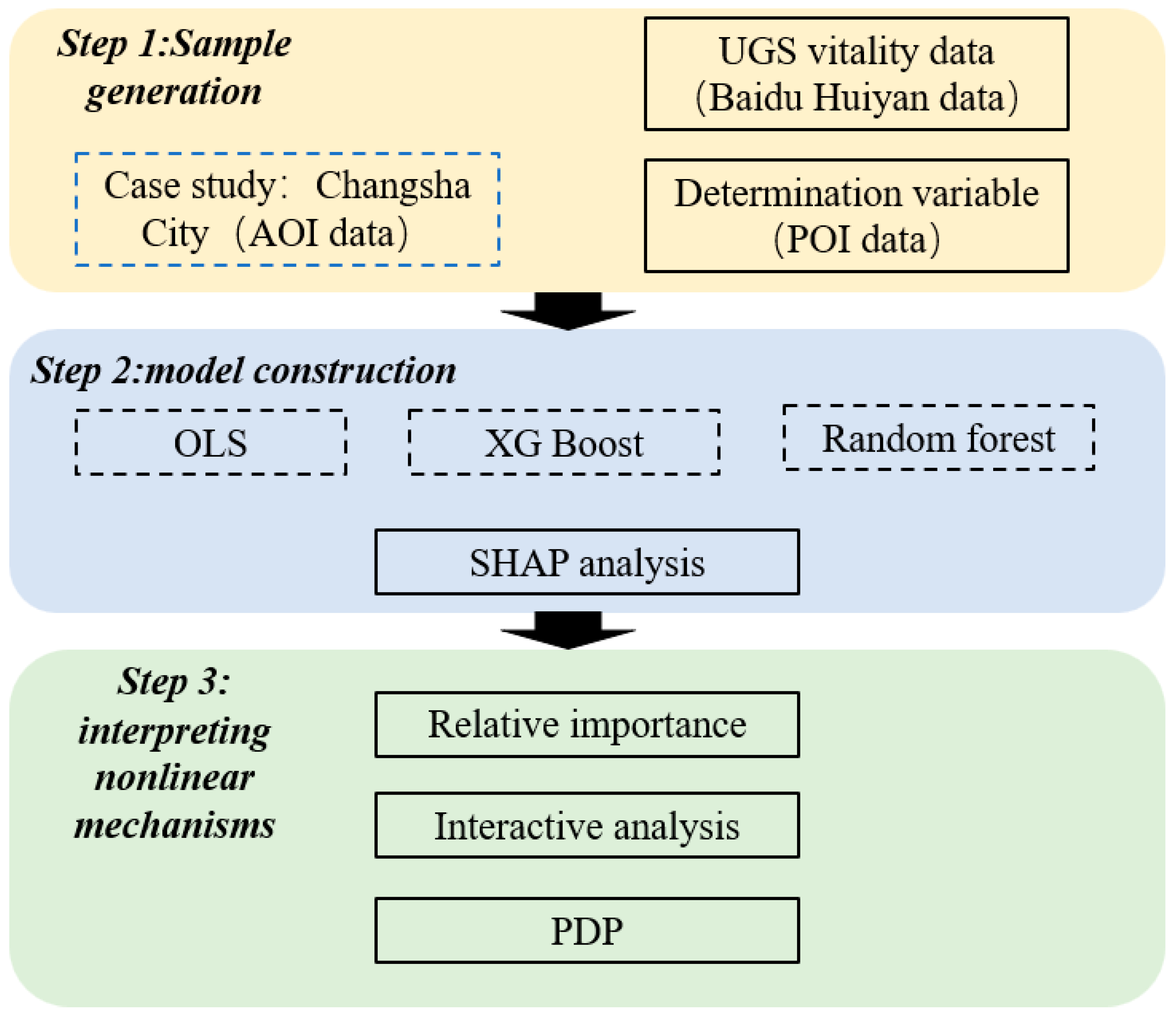
As shown in
Figure 1. This study aims to identify the key determinants of urban park vitality and uncover their nonlinear response mechanisms. To achieve this objective, a comprehensive analytical framework combining multi-source spatial data and interpretable machine learning models was developed. The research design consists of three sequential stages: (1) sample generation, (2) model construction and analysis, (3) mechanism interpretation.
In the sample generation stage, typical urban parks in the central districts of Changsha were selected as analysis units. Here, “typical” refers to publicly accessible urban parks that (i) fall within the defined study area, (ii) have valid and complete AOI polygons after GIS cleaning, (iii) can be reliably linked to the Baidu Huiyan population heatmap data and POI-based indicators, (iv) contain no substantial missing values in key attributes after multi-source data integration; duplicated/overlapping AOIs, closed institutional green areas, and records with incomplete spatial or attribute information were excluded. Multi-dimensional data were collected, including internal park attributes, surrounding built-environment features, and high-resolution population activity data. Urban park vitality was quantified using the population heatmap dataset provided by Baidu Huiyan (UGS vitality data), supplemented with POI and AOI information to construct a full set of explanatory variables. These inclusion/exclusion rules and data-integration procedures were designed to ensure the accuracy, completeness, and spatial consistency of the final park samples.
In the model construction stage, multiple regression models—including OLS regression, XGBoost, and Random Forest—were applied to examine both linear and nonlinear relationships between built-environment factors and park vitality. To explicitly evaluate nonlinear effects relative to linear alternatives, we used a consistent 80/20 train–test split for all models. Model performance was assessed on the held-out test set using pre-specified metrics (RMSE and R2). The added value of nonlinearity was determined by whether tree-based models (Random Forest and XGBoost) achieved lower RMSE and higher R2 than OLS under the same split, thereby assessing competing linear explanations in a transparent and comparable manner. XGBoost served as the core analytical model due to its strong capability in capturing nonlinear interactions and its superior predictive performance in the model comparison. SHAP values were computed to evaluate the contribution of each variable, enabling the identification of both dominant predictors and their nonlinear influence pathways.
The final stage focuses on interpreting nonlinear mechanisms. Using SHAP, Partial Dependence Plots (PDP), and interaction analyses, this study investigates how variables influence park vitality across different value ranges, how threshold effects emerge, and how variable combinations jointly shape vitality outcomes. These tools reveal synergistic, substitutive, and asymmetric effects that cannot be captured by traditional linear models.
2.2. Case Study: Changsha City
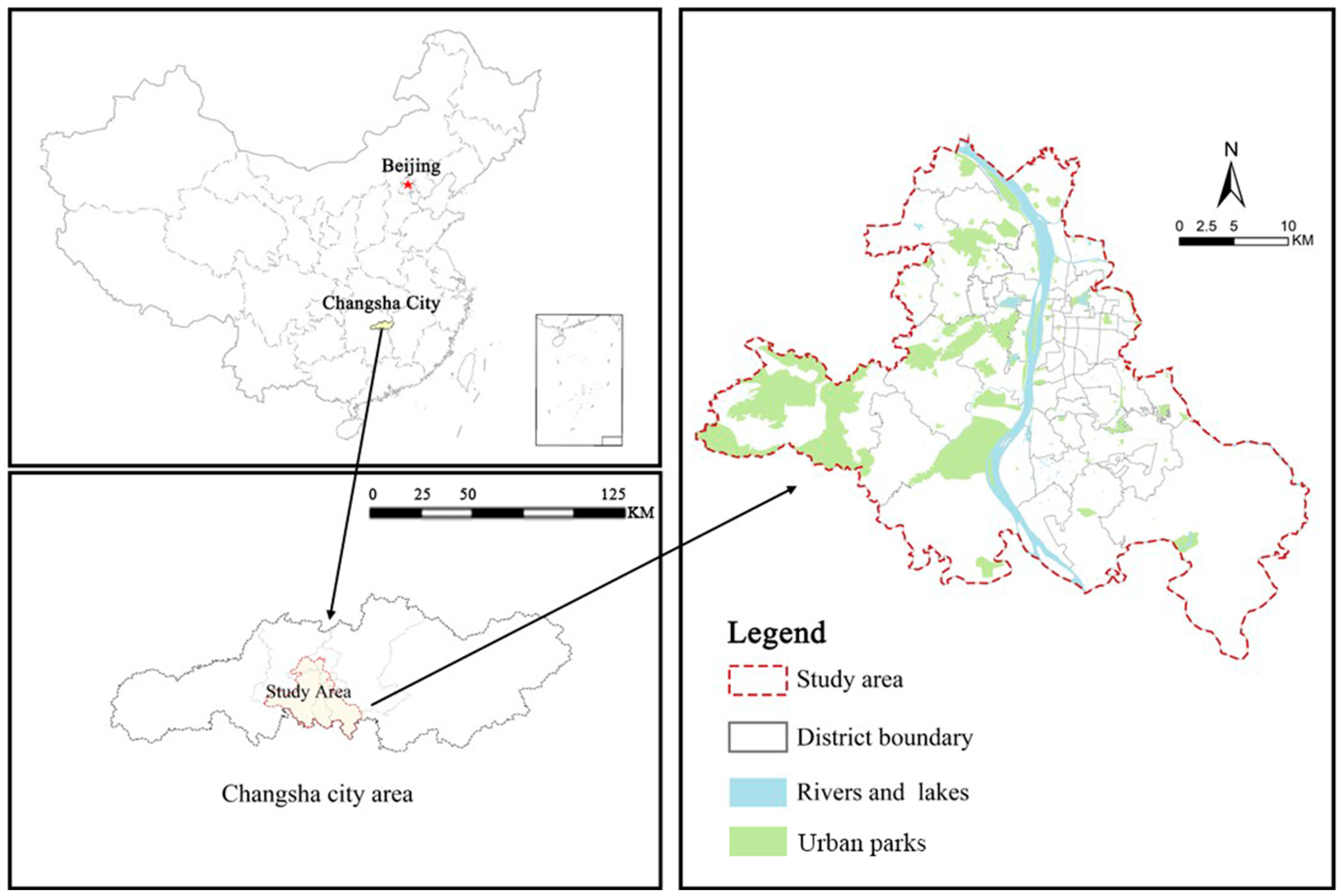
As shown in
Figure 2, Changsha, the capital city of Hunan Province, is selected as the empirical study area. The city is located in the northeastern part of Hunan, between 27°51′–28°41′ N and 111°53′–114°15′ E. It is a major city in central China and one of the core areas of the national “resource-conserving and environmentally friendly” (two-oriented) society pilot zone. According to the Changsha Statistical Yearbook 2021, the municipality covers a total administrative area of 11,819 km
2, with a permanent population of approximately 10.40 million.
Changsha is chosen as the empirical case due to its distinctively heterogeneous urban form, fragmented green space distribution, and markedly uneven population density, which together provide an appropriate setting for examining potentially nonlinear mechanisms underlying urban park vitality. From the perspective of public space dynamics, the city exhibits spatial contrasts conducive to identifying nonlinear vitality responses. First, the spatial distribution of parks shows substantial variation in size, function, and surrounding built-environment conditions. East of the Xiang River, where high-density residential blocks dominate, parks tend to be small, scattered, and embedded within compact neighborhoods; in contrast, the western urban area contains several large comprehensive parks that are more likely to be located near relatively lower-density development or institutional clusters. Such structural contrasts provide observable “gradient zones” for probing nonlinear responses such as diminishing marginal effects, activation thresholds, and context-dependent interactions. Second, Changsha’s population and socio-economic activities are strongly polycentric, with major nodes distributed along the Xiang River corridor and secondary centers emerging in multiple districts. This polycentric pattern, combined with marked temporal fluctuations in population mobility, suggests that the relationship between population presence and park vitality is unlikely to be strictly linear or monotonic. Areas with extremely high activity density may exhibit saturation effects, while zones with moderate activity levels may show sharp increases in vitality once key accessibility or facility thresholds are met.
Given these characteristics, this study focuses on the main built-up area delineated in the Changsha Master Plan (2020–2035), covering six central districts—Yuelu, Kaifu, Furong, Yuhua, Tianxin, and Wangcheng [
45]—with a total area of approximately 1352 km
2. This area represents the functional heart of the metropolitan region, containing complex mixtures of residential, commercial, transportation, and public service infrastructures. The diversity and spatial variability across these districts enrich the observable range of built-environment factors, enabling the XGBoost model to detect nonlinear patterns such as threshold shifts, interaction-driven effects, and varying marginal responses under different contextual conditions. The study area also accommodates a large resident population as of 2021 [
46], providing a robust geographic foundation for constructing and validating the proposed nonlinear modeling framework.
Due to the combined effects of natural topography, historical urban development, and functional positioning, the scale, quality, and spatial distribution of urban parks in Changsha exhibit pronounced heterogeneity. The river–lake system plays a key role in structuring the urban landscape, with the Xiangjiang River running north–south through the main urban area and functioning as a primary ecological corridor. Urban green spaces include large comprehensive parks, peri-urban green areas, and riparian ecological corridors. Overall, they display a “ribbon along the river and multi-core clustering” pattern: continuous green corridors along both banks of the Xiangjiang constitute the regional ecological backbone, while several large green clusters are distributed in the southwestern and northern parts of the city and are closely connected to surrounding mountainous and natural areas. In contrast, the southeastern sector is dominated by small- and medium-sized parks with a more dispersed layout. This configuration reflects the joint influence of topographic constraints, the river–lake system, and urban expansion processes on the formation of Changsha’s green space structure.
Given that population density and socio-economic activities are highly concentrated in the central urban area, this study focuses on the main built-up districts to more precisely identify the driving mechanisms and spatial structure of urban park vitality. Following the Changsha Master Plan (2020–2035), six central districts—Yuelu, Kaifu, Furong, Yuhua, Tianxin, and Wangcheng—are delineated as the study area, covering approximately 1352 km
2. After applying the park screening criteria and multi-source data integration procedures (
Section 2.1), a total of 147 parks within the six-district study area were retained as the final analytical samples for model estimation and interpretation.
2.3. Data Resources and Collection
2.3.1. POI Data
In recent years, point-of-interest (POI) data have become one of the core foundational datasets in urban spatial analysis, as advances in spatial big data have made them widely accessible, consistently structured, and finely classified [
47,
48]. Each POI entry typically records a place name, functional category, address, and geographic coordinates, and is stored as a point feature in a Geographic Information System (GIS). This representation enables straightforward spatial statistics and regional comparison, while the underlying reliance on Digital Line Graph (DLG) and other mapping products ensures high locational accuracy and comprehensive coverage across the urban fabric.
In this study, POI data are used to characterize both the internal conditions of urban parks and the configuration of their surrounding built-environments within the central districts of Changsha. For each park, POIs located inside the park AOI and within a 500 m buffer are extracted to describe its spatial context. We adopt 500 m to represent a proximate, pedestrian-oriented catchment (approximately a 5–8 min walk) that is most likely to shape everyday access and the immediate functional opportunities adjacent to parks in the dense built-up area. A smaller buffer (e.g., 300 m) tends to be overly sensitive to boundary effects and local POI placement, whereas a larger buffer (e.g., 800 m) increasingly mixes multiple urban subareas and weakens the park-adjacent signal by incorporating heterogeneous functions that are less directly tied to near-park conditions.
Using a single 500 m buffer therefore provides a practical balance between proximity relevance and measurement stability, while ensuring comparability across parks. Rather than treating POIs as proxies for activity or vitality, we use them as built-environment exposure indicators that reflect the functional mix and service-support capacity of park-adjacent areas. In particular, the analysis focuses on the counts and spatial distribution of several functionally meaningful categories—such as leisure and recreation, commercial services, medical facilities, and transportation nodes—which are aggregated to construct the environmental explanatory variables used in the nonlinear modeling of park vitality. We acknowledge that service ranges vary by park type; the 500 m buffer is used here as a standardized neighborhood-scale exposure measure for cross-park comparison in the central districts.
All POI records were obtained from the Amap (Gaode) Open Platform (
https://lbs.amap.com/ [accessed on 1 October 2025]), a major digital mapping and navigation provider in China that offers a detailed classification system and stable API access. Using customized queries based on predefined keywords and functional codes, we systematically retrieved POIs associated with urban parks and their neighboring built-up areas in Changsha. The raw data were subsequently processed in a GIS environment, including spatial reference harmonization, selection within AOI and buffer extents, and functional reclassification, yielding a set of spatial environmental variables suitable for model estimation and interpretation.
2.3.2. AOI Data
Spatial analysis, representing two-dimensional spatial entities with clearly defined boundaries and functional attributes [
49]. Unlike POI data, which record only point locations, AOI datasets incorporate polygon geometries that delineate the precise extent of spatial features. Each AOI entry includes not only basic descriptive attributes—such as name, category, and geographic coordinates—but also a complete boundary outline, enabling detailed assessments of spatial coverage, configuration, and internal structure within a GIS environment.
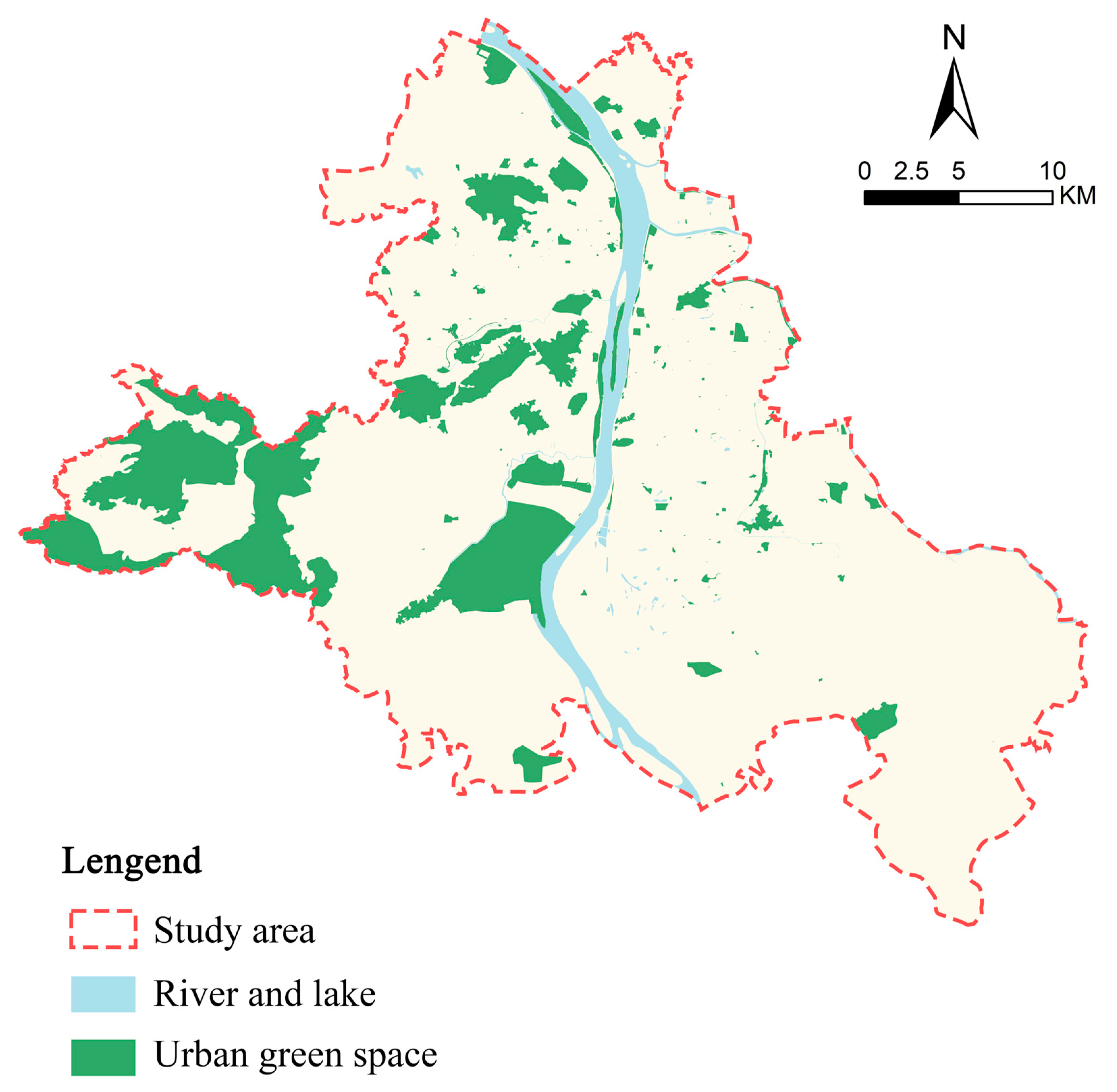
In this study, AOI data are used to accurately capture the physical boundaries and spatial layouts of urban parks in the central districts of Changsha (
Figure 3). The polygon-based representation provides a level of spatial fidelity that point-based POI records cannot achieve, particularly in differentiating variations in park size, shape, and land-use extent. These advantages make AOI data essential for subsequent analytical procedures, including area normalization, buffer construction, and spatial overlay, and thus form the foundational component of the “park intrinsic characteristics” variable group within the modeling framework.
The AOI dataset used in this research was obtained from the Amap (Gaode) Open Platform (
https://lbs.amap.com/ [accessed on 1 October 2025]) through automated API queries and Python3.10-based retrieval workflows. The dataset includes each park’s name, functional classification, and a complete set of boundary coordinates, which were imported into GIS for projection harmonization, topology checking, and spatial preprocessing. Compared with point-based proxies, AOI polygons provide a more comprehensive and fine-grained representation of park morphology, ensuring higher spatial precision for the identification of nonlinear mechanisms in park vitality.
2.3.3. Vitality Data
Understanding population distribution is essential for analyzing the external drivers of urban park vitality, particularly in cities where population density exhibits strong spatial heterogeneity. Population concentration shapes both the potential user base and the intensity of actual park use, often generating nonlinear patterns such as saturation effects or threshold responses. To capture this dimension with sufficient spatial granularity, this study incorporates high-resolution population grid data for Changsha in 2025, obtained from the Baidu Huiyan Urban Population Data Platform (
https://huiyan.baidu.com [accessed on 1 October 2025]). The Huiyan dataset is derived from anonymized location requests submitted by mobile devices through Baidu Maps’ positioning SDK. Nationwide space is partitioned into standardized 70 m × 70 m grid cells, and the platform aggregates the hourly number of active positioning signals to produce a temporally responsive and spatially detailed representation of population distribution [
50,
51]. For the purposes of this study, we extracted the platform’s annual normalized dataset and calculated the mean activity level within each park’s AOI boundary and its surrounding buffer area. This variable, representing “latent population demand,” complements the built-environment indicators by quantifying the magnitude of potential user flows accessible to each park.
To ensure spatial accuracy and consistency, all raw data were projected into a unified coordinate system within ArcGIS (version 10.1) before being overlaid with the AOI polygons and POI-based environmental layers. This workflow guarantees compatibility among datasets with differing origins and geometries, thereby improving the reliability of subsequent nonlinear modelling.
It is important to note that all data provided by the Huiyan platform are fully anonymized at the source, contain no personal identifiers, and comply strictly with privacy protection requirements.
2.3.4. Descriptive Statistics of Key Variable
To investigate the mechanisms underlying urban park vitality, this study conceptualizes vitality as a behavioral outcome jointly shaped by (1) internal park affordances, (2) surrounding built-environment opportunities, (3) latent demand and activity intensity. This framework synthesizes the factor categories discussed in the Introduction into operational dimensions that can be measured consistently across parks using observable spatial indicators. Specifically, internal affordances are represented by facility and functional provisions within the park AOI, surrounding opportunities are characterized by functionally differentiated POIs and accessibility-related indicators in the park-adjacent neighborhood, and latent demand is proxied by high-resolution population activity intensity derived from the Baidu Huiyan heatmap.
To investigate the mechanisms underlying urban park vitality, this study develops an explanatory variable system along two primary dimensions: internal facility characteristics and external built-environment conditions. The construction of this system emphasizes observable, interpretable, and reproducible spatial indicators, while deliberately excluding subjective landscape preference factors that cannot be consistently quantified across all parks (
Table 1). Descriptive statistics (minimum, maximum, mean, and standard deviation) are reported to summarize variable distributions, diagnose scale differences and potential outliers, and provide context for interpreting nonlinear response ranges and threshold-like behaviors in subsequent analyses.
In terms of the external built-environment, a buffer zone is defined outside each park’s AOI boundary to capture the influence of surrounding urban functions on park use. Within this zone, the numbers of functionally differentiated POIs are calculated to construct multiple built-environment variables. These indicators are consistent with widely used built-environment concepts (e.g., the “5D” logic), where residential intensity approximates Density, functional POI composition reflects Diversity, service destinations represent Destination accessibility, and transit-related POIs capture Distance to transit/transport accessibility. Residential POIs are used to approximate the baseline distribution of the local resident population, whereas commercial service POIs represent potential sources of everyday activity demand [
52]. Public service facilities, including schools and hospitals, are incorporated to reflect the intensity of service provision in the vicinity [
53]. Transportation-related POIs—such as bus stops and metro stations—serve as indicators of accessibility levels [
54]. In line with prior research, transport accessibility is treated as a critical “threshold variable” with strong nonlinear potential: when accessibility is insufficient, park use is severely constrained, whereas once a basic level of accessibility is achieved, a substantial escalation in vitality may occur [
55,
56,
57]. In addition, high-resolution population distribution data from the Baidu Huiyan platform are overlaid to derive the average level of population activity around each park, thereby strengthening the model’s ability to capture external demand-side conditions.
With respect to internal structural characteristics, POIs located within each park’s AOI boundary are used to construct indicators of functional mix and facility intensity. The internal POI categories selected include public restrooms, fitness facilities, open plazas, commercial or managed activity spaces, and leisure nodes [
58,
59,
60,
61]. The spatial configuration of these facilities directly affects the comfort and usability of park spaces and, in practice, generates differentiated attraction for various user groups, such as children, older adults, and middle-aged or young visitors engaged in exercise and recreation [
57,
58,
59]. Accordingly, both the density and diversity of internal facilities are regarded as core indicators for explaining variations in spatial vitality.
Considering the complex interactions among urban spatial elements and the nonlinear ways in which they influence vitality, this study does not introduce landscape themes as explanatory variables. Although features such as water bodies or forested landscapes may attract specific user segments, they cannot be objectively quantified and scale-harmonized within the current data framework, and are therefore excluded from the present analysis. Future research may extend this direction by incorporating street-view image recognition, UAV-based imagery, or other advanced techniques capable of capturing detailed landscape attributes. Taken together, the variable system constructed in this study adheres to the principle of “observable–interpretable–modellable,” and jointly incorporates population base, accessibility, service provision, and internal functional diversity, thereby providing strong spatial-logical support for subsequent modeling of urban park vitality.
Descriptive statistics are reported to summarize variable distributions, check for extreme values and scale differences, and provide basic context for interpreting nonlinear response ranges and threshold-like behaviors in subsequent analyses.
2.4. XGBoost
In modeling the nonlinear mechanisms that drive urban park vitality, conventional linear approaches such as OLS regression and logistic regression are inherently limited in their ability to capture interaction effects and complex response patterns between variables. To more accurately reveal potential threshold effects, marginal changes, and synergistic mechanisms between intrinsic park characteristics and surrounding built-environment factors, this study employs Extreme Gradient Boosting (XGBoost), a tree-based gradient boosting model, as the primary analytical tool. Following the pre-specified 80/20 train–test evaluation protocol (RMSE and R
2) described above, the primary model was selected based on predictive accuracy; the comparison outcomes are presented in
Table 2.
XGBoost is an enhanced ensemble learning algorithm built upon the gradient boosting decision tree (GBDT) framework, and is well suited for handling complex nonlinear structures and high-order interactions among explanatory variables [
38]. Unlike traditional parametric models, XGBoost does not require any prior specification of functional forms. Instead, it iteratively constructs and optimizes a series of decision trees, with each subsequent tree trained to minimize the residuals of the previous iteration, thereby progressively approximating the optimal prediction of the target variable. The method integrates regularization terms into the objective function to control model complexity and reduce the risk of overfitting, which is particularly advantageous when dealing with heterogeneous feature sets such as those used in this study (e.g., park area, POI densities, functional diversity, and accessibility indicators) and their multi-variable nonlinear interactions.
During model training, XGBoost makes use of both first- and second-order gradient information to guide the selection of splitting variables and split points in each tree, improving the efficiency and stability of the optimization process. Compared with fully parallel ensemble algorithms such as Random Forest, XGBoost adopts a sequential boosting strategy that focuses on iteratively correcting residual errors, typically achieving faster convergence and higher predictive performance. These properties make XGBoost especially suitable for the present research context, which involves a moderate number of park samples but relatively high-dimensional built-environment and facility-related features.
Given the inherently “black-box” nature of ensemble tree models, this study further incorporates interpretable machine learning techniques to enhance model transparency and substantively interpret the estimated relationships. SHAP (SHapley Additive exPlanations) values are first used to derive a theoretically grounded ranking of global variable importance, quantifying the average marginal contribution of each predictor to the model’s forecast of urban park vitality [
60]. PDPs are then employed to visualize how predicted vitality responds to changes in individual variables across their value ranges, enabling the identification of nonlinear turning points and critical threshold intervals [
62]. In addition, model hyperparameters are tuned through cross-validation to balance bias and variance, and feature selection procedures are applied to mitigate redundancy among predictors, thereby improving the stability and generalization capacity of the XGBoost model.
3. Results
3.1. Model Performance Comparison
To evaluate the predictive validity of the proposed modeling framework, three regression models—Linear Regression, Random Forest, and Extreme Gradient Boosting (XGBoost)—were trained and tested under identical data-splitting conditions. Model performance was assessed using two standard indicators: the root-mean-square error (RMSE) and the coefficient of determination (R
2). The comparative results are presented in
Table 2.
The findings reveal a clear performance hierarchy among the three models. XGBoost achieves the highest predictive accuracy, with an RMSE of 14.96 and an R2 of 0.74, indicating its strong capacity to capture the nonlinear and context-dependent relationships between park characteristics, surrounding built-environment factors, and vitality outcomes. In contrast, the Linear Regression model, despite its interpretability advantages, performs significantly worse (RMSE = 21.81; R2 = 0.44). This underperformance underscores the model’s limitations in contexts where predictor–response relationships deviate markedly from linearity or when variable interactions play essential roles. The Random Forest model exhibits moderate prediction capability (RMSE = 20.89; R2 = 0.49), benefiting from its tree-based structure yet still unable to match the precision and stability of XGBoost.
Overall, the results confirm that XGBoost provides superior generalization and fitting performance compared with both linear and other ensemble-based nonlinear models. This advantage validates its suitability as a core analytical tool for examining nonlinear driving mechanisms in complex urban systems. Accordingly, subsequent analyses—including variable importance assessment and nonlinear response interpretation—are conducted using the XGBoost model.
3.2. Spatial Distribution of Predicted Park Vitality and Variable Importance
3.2.1. Spatial Distribution of Park Vitality
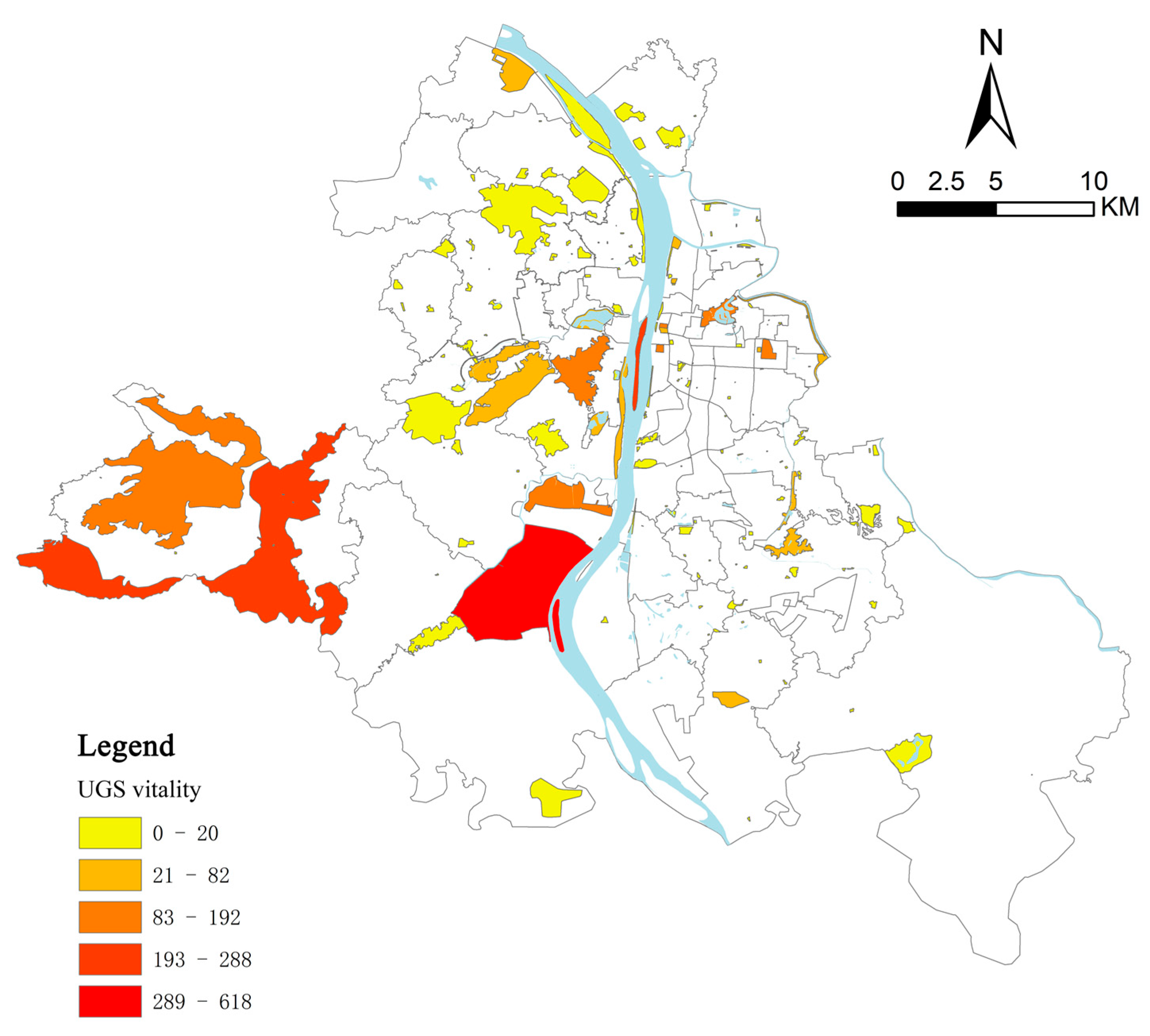
As shown in
Figure 4, the spatial distribution of park vitality in Changsha exhibits pronounced spatial heterogeneity, characterized by a clear “core aggregation–peripheral attenuation” pattern.
To begin with, high-vitality parks are predominantly concentrated in the southwestern part of the city, extending into several pockets of the central urban area. The southwestern cluster represents the largest and most continuous hotspot zone, with vitality values ranging from 193 to 618, corresponding to the highest category on the heatmap. This concentrated high-value distribution is likely associated with the co-location of large comprehensive parks, industrial clusters, and high-density residential communities, which jointly attract stable and sizable flows of residents, commuters, and visitors. Meanwhile, several parks in the central districts also demonstrate moderate to high vitality, forming localized hotspots that typically arise from the synergistic influence of commercial services, public transit accessibility, and high surrounding population density.
In contrast, the eastern and northeastern parts of the city show substantially lower levels of park vitality. Most parks in these areas fall within the 0–82 range, forming fragmented and weakly clustered low-value patterns. Possible reasons include relatively low residential population density, limited coverage of commercial and public service facilities, and the transitional nature of some newly developing urban areas. The scattered spatial configuration of parks in these regions further constrains their ability to attract sustained user activity, creating a sharp contrast with the high-value clusters in the southwest.
Overall, Changsha’s park vitality follows a distinct spatial gradient of “strongest in the southwest, moderate in the central area, and weakest in the northeast.” High-vitality zones generally correspond to areas with greater concentrations of population, commerce, and employment opportunities, while low-vitality zones are more commonly found in peripheral or newly developed districts where supporting services are insufficiently established. This pattern highlights that park vitality is not only driven by internal park attributes but is also strongly shaped by the surrounding built-environment and urban functional structure.
3.2.2. Feature Importance Ranking
The XGBoost model’s variable importance analysis reveals a highly uneven contribution structure among both internal and external factors, suggesting that urban park vitality is shaped by a small number of dominant drivers rather than by a uniformly distributed set of influences. The relative importance scores and rankings are presented in
Table 3.
Overall, sports and leisure facilities emerge as the most influential factor by a substantial margin, contributing 63.66% to the model—far exceeding all other variables. This dominant weight indicates that parks with well-developed sports and recreational infrastructure are significantly more capable of attracting and sustaining user activity, reflecting the increasing demand for physical exercise and outdoor recreation in high-density urban environments. The nonlinearity captured by the model suggests that even incremental improvements in sports facilities can lead to disproportionately large gains in park vitality.
Following at a distance, shopping services represent the second strongest predictor, with a relative importance of 14.66%. This demonstrates that the commercial environment surrounding parks plays a substantial role in shaping activity intensity, likely due to the co-location of retail clusters, pedestrian flows, and leisure-oriented consumption behaviors. The synergy between consumption activities and public space use appears to be an important spatial mechanism in Changsha’s urban context.
Among external factors, government service facilities and residential density rank third and fourth, contributing 8.40% and 7.13%, respectively. Their importance suggests that administrative service nodes and dense residential communities provide a stable demand base for everyday park use. Particularly, residential density enhances proximity-based visitation, whereas government-related facilities often function as secondary attractors that increase local foot traffic.
Internal park facilities such as general public amenities (4.17%) hold moderate influence, reinforcing their role as essential but not decisive elements in shaping vitality. In contrast, variables such as scenic spots (0.70%), company and enterprise clusters (0.61%), science–education–cultural facilities (0.44%), and transportation services (0.23%) contribute minimally to the model. Their limited predictive power indicates that these factors either exert indirect or context-dependent effects, or that their spatial distribution in Changsha does not strongly overlap with the city’s primary park usage patterns.
Taken together, the variable importance results highlight a distinct hierarchy: a single dominant factor (sports facilities), followed by two moderately strong contributors (shopping services and government services), and a set of low-impact or marginal variables. This uneven structure underscores the nonlinear nature of park vitality formation and validates the advantages of using XGBoost to capture such complex relationships. These findings also provide a robust empirical basis for the subsequent analysis of partial dependence and nonlinear response curves.
3.3. Nonlinear Response Mechanisms
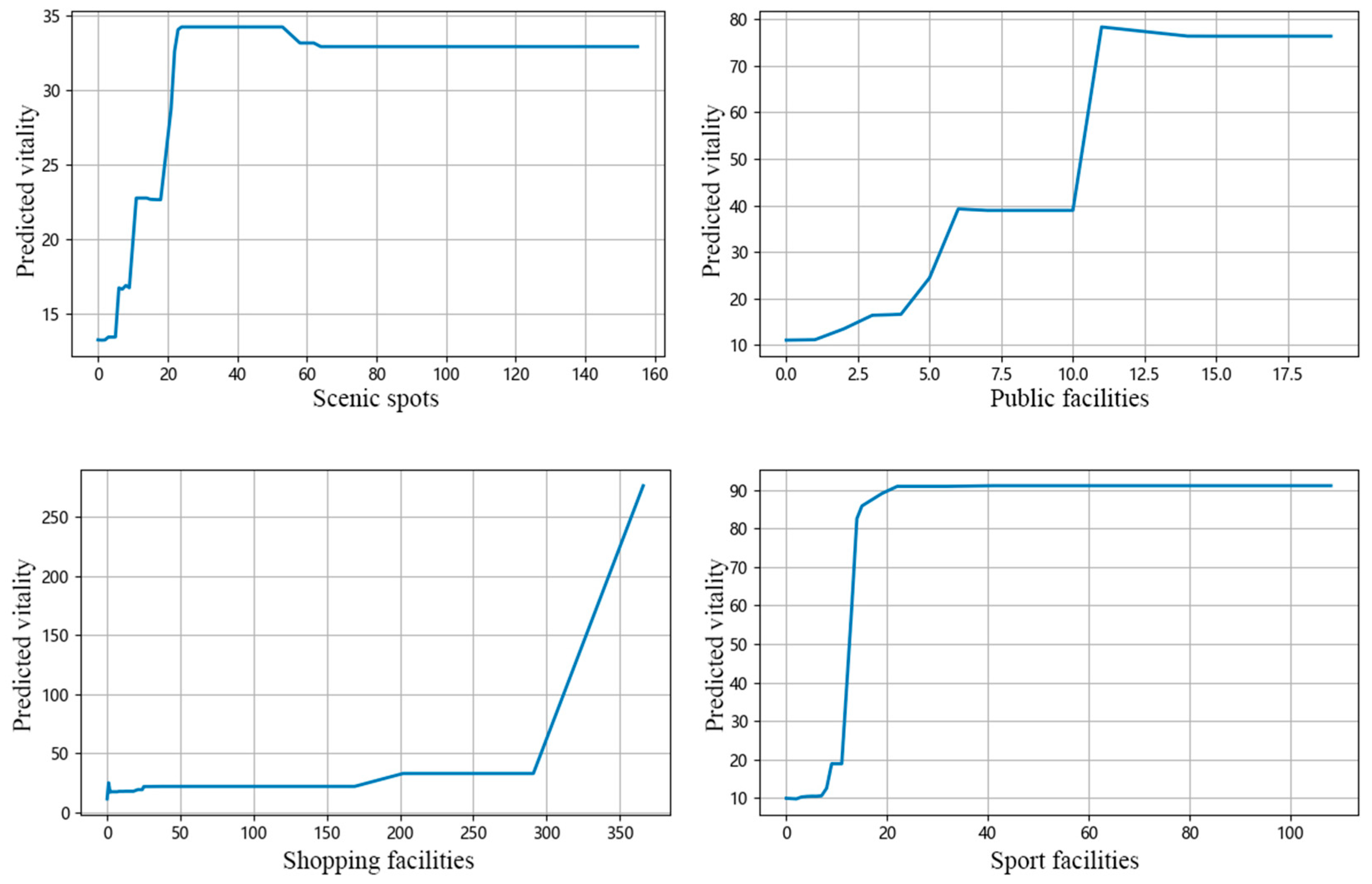
To further elucidate the nonlinear determinants of urban park vitality, the XGBoost model outputs were combined with PDPs and SHAP-based marginal response curves. Based on the feature importance ranking, four variables exhibiting the strongest nonlinear characteristics were selected for detailed interpretation: sports and leisure facilities, shopping services, public amenities, and scenic spots. These variables represent distinct dimensions of functional attraction and environmental support, and their response curves reveal different modes of marginal influence across value ranges (
Figure 5).
The response curve for sports and leisure facilities demonstrates a pronounced “rapid ascent–plateau” pattern. At low facility counts, the marginal effect on park vitality rises steeply, indicating that small increases in recreational infrastructure can substantially elevate user activity. However, once the number of facilities exceeds approximately 20, the curve begins to flatten, suggesting a saturation threshold beyond which additional sports-related elements no longer contribute meaningfully to vitality. This pattern reflects a clear scale-dependent threshold effect, indicating that moderate provision is sufficient to activate recreational demand.
Similarly, public amenities display a segmented growth structure. The marginal effect increases notably within the range of 5–10 amenities, after which the curve gradually stabilizes. This implies the existence of a functional adequacy point, where a minimum set of amenities—such as rest areas, restrooms, and shade structures—significantly improves user experience, but expanding these facilities beyond this threshold yields diminishing returns. The presence of this inflection zone indicates that improving basic service levels is more effective than pursuing excessive amenity density.
In contrast, shopping services show a distinct “low sensitivity–inflection point–explosive growth” pattern. When the number of shopping-related POIs is small, their marginal contribution to park vitality is minimal. However, once the variable surpasses a critical threshold of roughly 250 POIs, the response curve rises sharply, exhibiting quasi-exponential growth. This reveals a strong commercial agglomeration effect, in which high-density retail environments generate intense pedestrian flows that spill over into adjacent park spaces. The nonlinearity suggests that only sufficiently vibrant commercial clusters can produce meaningful positive externalities for park vitality.
Finally, the scenic spots variable exhibits a more moderate and smooth positive effect. Although its elasticity is comparatively weaker, the response curve indicates consistent marginal gains at low values, implying that the presence of distinctive natural or cultural features still contributes to higher visitation frequencies. However, unlike the other variables, scenic spots do not display sharply defined thresholds or nonlinear transitions, reflecting their role as supportive but not dominant contributors to spatial vitality.
Collectively, these nonlinear response patterns show distinct response shapes across different groups of predictors. Activity−oriented variables (e.g., sports and shopping facilities) display pronounced threshold-like behaviors, with marginal effects increasing rapidly within specific value ranges, whereas supportive environmental variables (e.g., public amenities and scenic resources) exhibit comparatively smoother curves with more gradual changes across their ranges. Overall, the estimated response curves indicate that predictor effects vary across levels and are not constant over the observed value intervals.
3.4. Interaction Effects
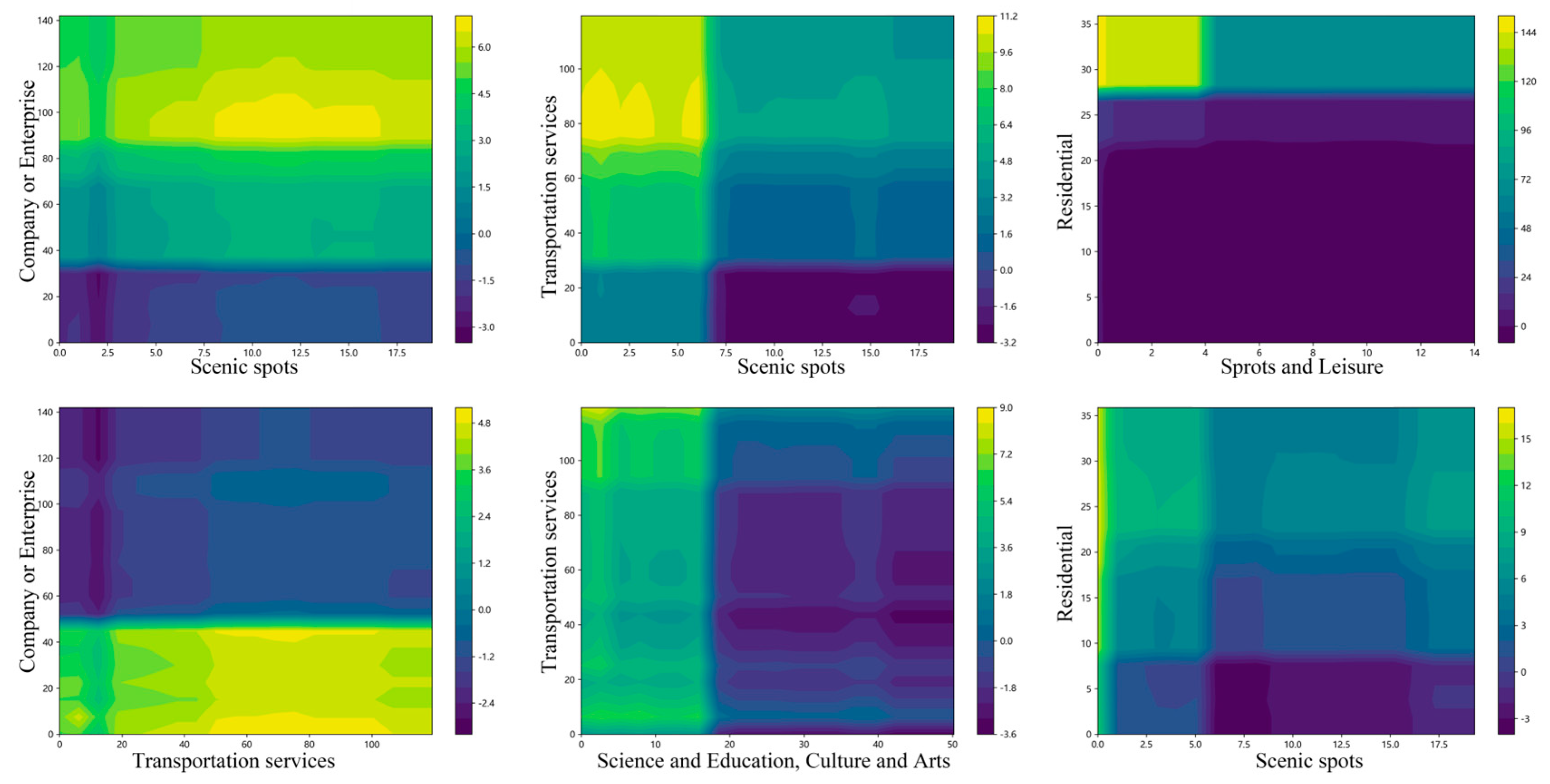
Building on the nonlinear response analysis, this study further investigates the joint effects among key explanatory variables by employing bivariate PDPs generated from the XGBoost model. These interaction surfaces allow the identification of synergistic, complementary, or interfering relationships among built-environment factors within a nonlinear predictive framework. The visualization results reveal clear and heterogeneous interaction structures across different variable pairs, underscoring the multi-dimensional complexity of urban park vitality (
Figure 6).
The interaction between sports and leisure facilities and residential density exhibits the strongest synergistic enhancement. When residential density reaches a moderate level and the quantity of sports and leisure facilities continues to increase, the predicted park vitality rises sharply. This pattern suggests that these two spatial functions produce a positive cumulative effect when co-located, forming a well-coupled environment that simultaneously supports everyday community activity and recreational demand. In such spatial contexts, recreational infrastructure is more readily activated by nearby resident populations, while local residents benefit from greater accessibility to physical activity spaces, jointly amplifying vitality outcomes.
In contrast, the interaction surface for scenic spots and public amenities displays a more segmented pattern. As the level of scenic resources increases from low to moderate, the marginal influence of public amenities intensifies, indicating a phase of complementary enhancement. However, once natural attractiveness exceeds a certain threshold, the vitality response plateaus or even subtly declines. This platform effect implies diminishing marginal returns under conditions of resource redundancy: when natural attractiveness alone is sufficiently strong, additional public amenities no longer generate meaningful incremental vitality. Such a structure highlights the importance of identifying critical thresholds in built-environment optimization and avoiding over-investment in redundant supportive infrastructure.
Other variable pairs—including scenic spots × transportation services and cultural/educational facilities × transportation services—do not exhibit consistent synergistic patterns. Particularly for transportation-related combinations, the interaction surfaces show weak or unstable responses, with localized fluctuations rather than systematic upward trends. This suggests that transport accessibility, while foundational, does not automatically translate into increased spatial vitality unless effectively integrated with compatible land-use functions. In some contexts, transportation may even introduce a competitive or divergent influence on park use, implying that accessibility alone is insufficient to generate activity flows without functional alignment.
By contrast, the combination of scenic spots and government services demonstrates a steadily increasing interaction effect, with vitality rising from the lower-left to the upper-right of the response surface. This indicates a multiplicative effect between natural resources and institutional service functions: the co-presence of high-quality scenic attractions and robust governmental or administrative service infrastructure can jointly elevate both perceived spatial value and actual user engagement.
These bivariate interaction surfaces indicate that the marginal effect of one variable changes with the level of another variable. For several variable pairs, predicted vitality increases more sharply when both factors are simultaneously high within certain ranges, whereas for other pairs the marginal gain attenuates when one factor is already at a high level. These results suggest that the combined effects of built-environment factors can deviate from simple additivity across different contextual combinations.
4. Discussion
4.1. Nonlinear Mechanisms Underlying Urban Park Vitality
Urban parks are widely recognized as critical nodes for enabling public life, and a large body of empirical work has examined how park attributes and surrounding built-environment factors relate to use intensity and vitality outcomes [
63,
64,
65,
66]. However, many studies have implicitly relied on linear effect reasoning—assuming that larger supply or higher density straightforwardly translates into stronger vitality—thereby encouraging a “functional accumulation” planning logic [
67,
68,
69]. Building on behavioral geography, where cognitive and behavioral responses to environmental stimuli are often nonlinear and context-dependent, especially in open public spaces [
70,
71], our results provide additional evidence that park vitality does not increase monotonically with individual variables.
Specifically, the threshold-like and plateauing patterns observed in the PDP curves resonate with prior discussions of diminishing marginal effects and response thresholds in spatial behavior and urban environmental responses. This helps explain why continuous increases in single functions may not sustain vitality gains and can even lead to crowding, displacement, or benefit saturation once critical levels are exceeded—a mechanism that cannot be adequately captured by purely linear specifications [
72,
73]. At the same time, the interaction surfaces show that the marginal effect of one factor varies with the level of another factor, suggesting that vitality formation is configuration-dependent rather than purely additive. Such a configuration view is consistent with the broader argument that urban public space outcomes emerge from multi-factor co-presence and contextual combinations, rather than isolated inputs [
74,
75].
Importantly, these nonlinear patterns should be interpreted as case- and indicator-dependent empirical regularities, conditional on the Changsha context and the adopted vitality proxy; therefore, the specific turning points and effective ranges are not intended as universally transferable benchmarks. Nevertheless, articulating thresholds and interaction structures provides a more operational basis for identifying “effective windows” for intervention than relying on static totals.
4.2. Advancing Mechanism Identification Through Explainable Machine Learning
Although numerous empirical studies have examined determinants of park vitality, most rely on traditional regression models that emphasize average effects and statistical significance [
76,
77]. While informative for preliminary behavioral interpretation, such models struggle to capture complex interactions, nonlinear transitions, and threshold dynamics [
78,
79]. By integrating XGBoost with SHAP-based interpretability, this study demonstrates a methodological advancement that not only enhances predictive accuracy but also enables a transparent decomposition of variable contributions and nonlinear response patterns, offering a significant extension to existing analytical approaches in urban spatial research [
80,
81].
The principal strength of this interpretive modeling framework lies in its ability to detect marginal effects and interactional structures without imposing predefined functional forms [
82,
83]. SHAP rankings identify the most influential variables at a global scale, whereas PDPs and bivariate interaction plots reveal how these variables operate under different numerical intervals and combinations—whether synergistically, conditionally, or competitively. This shift from “significance testing” to “structure discovery” represents more than a methodological upgrade; it reflects a fundamental reorientation in the conceptualization of park vitality, highlighting that system behavior emerges from multi-factor configurations rather than isolated effects [
84].
Within the context of urban parks—spaces characterized by “weak planning but strong behavioral response”—this analytical shift is especially warranted. The complex interplay among spatial supply, behavioral preference, and environmental context challenges the assumptions of linear causality. Thus, explainable machine learning offers both technical appropriateness and theoretical alignment for uncovering the dynamic mechanisms underpinning vitality formation.
4.3. Reconstructing the Logic of Urban Park Provision
Conventional park provision has often been guided by linear principles such as uniform coverage and incremental supply expansion, which implicitly assume stable marginal returns. Such a logic is consistent with linear-effect interpretations frequently adopted in empirical studies of park use and vitality determinants [
85,
86]. However, the threshold and interaction patterns identified here align with the broader behavioral argument that responses to environmental stimuli are context-dependent and may exhibit saturation and activation dynamics [
87,
88].
From a planning perspective, these results suggest that vitality enhancement may benefit more from structural coordination than from simple accumulation [
89]. When marginal returns are non-constant, interventions targeted at effective windows (e.g., ranges where marginal gains are steep) and coordinated configurations (where complementary factors jointly amplify vitality) may be more cost-efficient than uniform additions of single facilities [
90,
91]. At the same time, the evidence of attenuation/plateauing implies that oversupply can yield diminishing benefits, reinforcing the need to diagnose local context and avoid one-size-fits-all prescriptions [
92].
Finally, because the observed response shapes and interaction structures are derived from a single-city case and a specific vitality proxy, policy translation should remain cautious; multi-city replication and alternative vitality measures are needed to assess transferability before formulating broadly applicable design standards.
4.4. Implications for Landscape–Ecological Modelling and Dynamical Perspectives
From a landscape–ecological standpoint, park vitality can be interpreted as an emergent outcome of coupled interactions between green-space structure, surrounding urban morphology, and human activity processes. The nonlinear patterns identified in this study—such as effective windows with steep marginal gains and attenuation/plateauing at higher intensity levels—provide empirical evidence for specifying response functions commonly used in dynamical modelling, where saturation and threshold-like transitions are expected rather than assumed to be linear.
Moreover, the interaction structures revealed by SHAP-based bivariate dependence and interaction visualizations suggest that vitality outcomes are jointly shaped by configurations of factors, which can be translated into coupling terms in mathematical models (e.g., conditional effects or synergistic/competitive interactions) instead of additive independent effects. In this sense, our framework offers a data-driven step of “structure identification” that can inform the formulation and calibration of landscape-ecological dynamical models for public space systems.
Finally, the explainable machine learning outputs can serve as transferable priors or surrogate relationships for scenario simulation: identified thresholds and interaction regimes can guide the design of intervention experiments, thereby strengthening the linkage between pattern–process reasoning and planning-oriented dynamical exploration in landscape ecology.
4.5. Limitations and Future Research
This study has several limitations. First, the empirical evidence is based on a single-city case (Changsha); therefore, the identified thresholds and interaction structures should be regarded as context-dependent regularities rather than universal benchmarks. Second, park vitality is proxied using population heatmap intensity, which captures activity presence but may not fully distinguish activity types, duration, or user composition; alternative vitality measurements and multi-source validation could further strengthen inference. Third, the built-environment indicators are constructed using AOI/POI-based proxies and a fixed neighborhood buffer, which may not fully reflect heterogeneous service ranges across park types or individual mobility constraints.
Future research can address these issues by conducting cross-city replication, testing alternative vitality proxies, and evaluating the sensitivity of key nonlinear findings to spatial operationalization choices. In addition, incorporating richer ecological and design-related attributes using scalable data sources may help extend the framework to a broader set of park performance mechanisms.
5. Conclusions
This study develops an explainable machine learning framework to identify the nonlinear mechanisms driving urban park vitality, revealing how park attributes and surrounding built-environment factors jointly shape public space use through threshold effects, marginal variations, and cross-factor interactions. The findings demonstrate that park vitality is not a linear outcome of any single element nor a simple accumulation of facilities. Instead, it emerges from structurally coupled conditions among multiple variables, thereby challenging conventional analytical paradigms centered on additive effects and average responses.
Methodologically, the integration of XGBoost, SHAP values, and partial dependence plots provides a powerful balance between predictive accuracy and interpretability, enabling fine-grained decomposition of variable contributions and nonlinear response patterns. This framework proves effective for analyzing high-dimensional and complex spatial behavioral data and is transferable to studies of other types of public spaces. It also supports the broader methodological shift from linear statistical modeling toward structural learning in urban spatial research.
Empirically, this study identifies several factors—such as sports and leisure facilities, shopping services, and governmental service amenities—that are associated with higher park vitality in the Changsha case under specific configuration conditions. The results suggest strong marginal increases and interaction patterns among certain variable combinations, indicating that vitality responses may be sensitive to how functions are configured rather than to uniform expansion of any single resource. Within this case and given the adopted vitality proxy, these insights may inform planning practice by emphasizing the potential value of optimizing functional coordination and targeting “effective windows” (i.e., context-dependent ranges where marginal gains are steep), while the transferability of specific thresholds and interaction structures should be validated across cities and measurement settings.
Several limitations remain. The relatively limited sample size may increase sensitivity to local extreme values. Moreover, the present analysis is based on static spatial data and therefore does not explicitly represent temporal dynamics or micro-level behavioral heterogeneity. Future research could incorporate trajectory-based mobility records and time-resolved urban dynamics to develop explicitly dynamical (spatiotemporal) representations of park vitality, and combine these with micro-level user surveys to enrich mechanism interpretation. Additionally, variable construction was constrained by data availability. Incorporating semantically richer indicators—such as environmental perception metrics and multi-scale accessibility measures—may further improve explanatory depth and transferability.
Overall, this study advances the understanding of the structural logic underlying urban park vitality by demonstrating the theoretical and practical value of identifying nonlinear response regimes and interaction structures in public space systems. From a landscape-ecological modelling perspective, the revealed effective windows, attenuation/plateauing patterns, and configuration-dependent effects can inform the specification of response functions and coupling terms in mathematical and dynamical models, thereby supporting scenario-based simulation and context-sensitive intervention design. Moving forward, urban spatial interventions should move beyond homogeneous provision models and adopt configuration strategies that are sensitive to structural conditions, thresholds, and system responses. In this regard, data-driven structural modelling provides a tractable pathway for interpreting—and ultimately shaping—the coupled human–landscape mechanisms that govern public space vitality.