Article

A Framework for Profitability-Focused Land Use Transitions Between Agriculture and Forestry: A Case Study of Latvia


1
Circular Bioeconomy Research Group, Latvia University of Life Sciences and Technologies, Svetes Street 18, LV-3001 Jelgava, Latvia
2
Scientific Laboratory of Forest and Water Resources, Latvia University of Life Sciences and Technologies, J. Cakstes Boulevard 5, LV-3001 Jelgava, Latvia
3
Institute of Forestry, Latvia University of Life Sciences and Technologies, Akademijas Street 11, LV-3001 Jelgava, Latvia
*
Author to whom correspondence should be addressed.
Land 2026, 15(2), 204; https://doi.org/10.3390/land15020204
Submission received: 19 December 2025 / Revised: 14 January 2026 / Accepted: 21 January 2026 / Published: 23 January 2026

Abstract

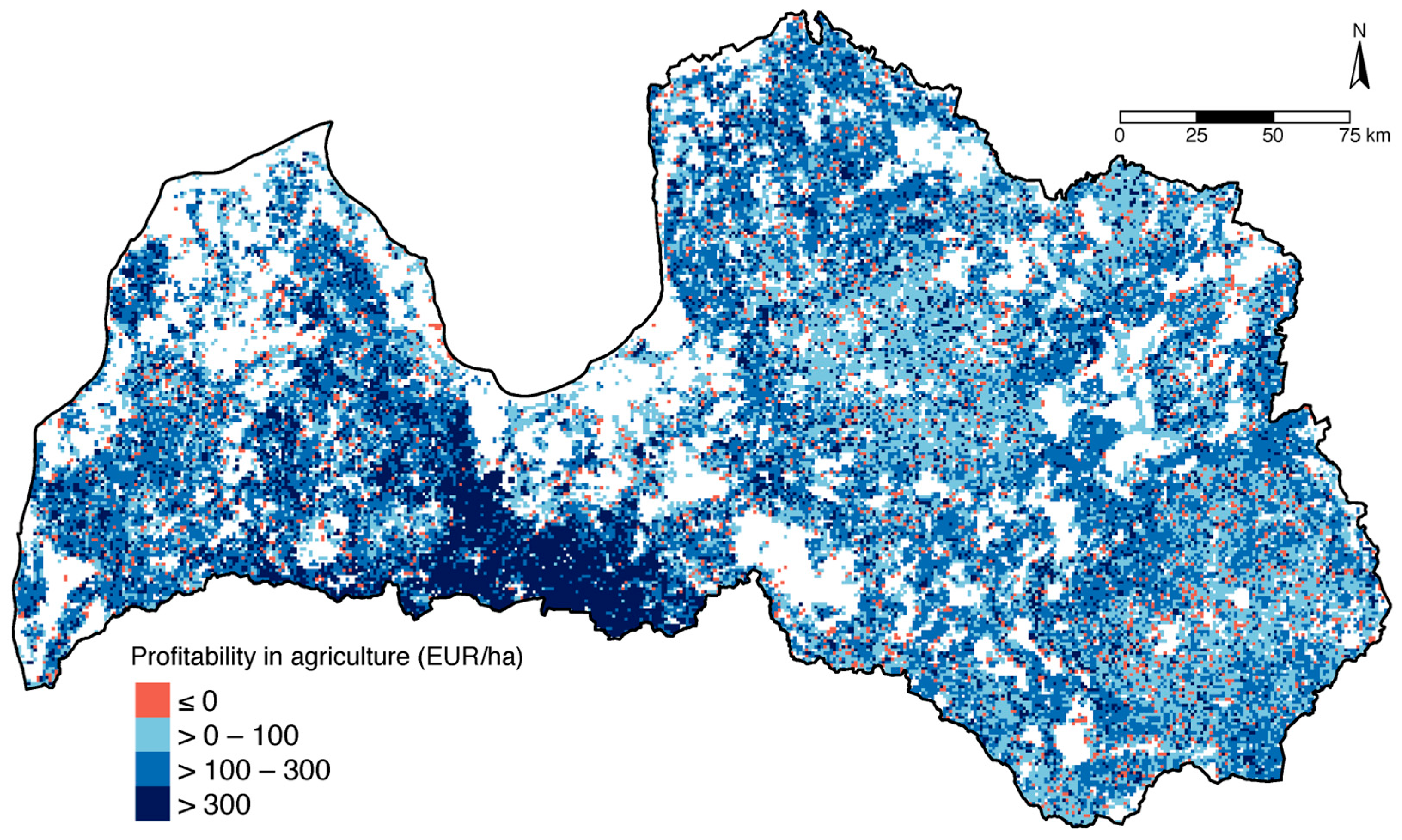
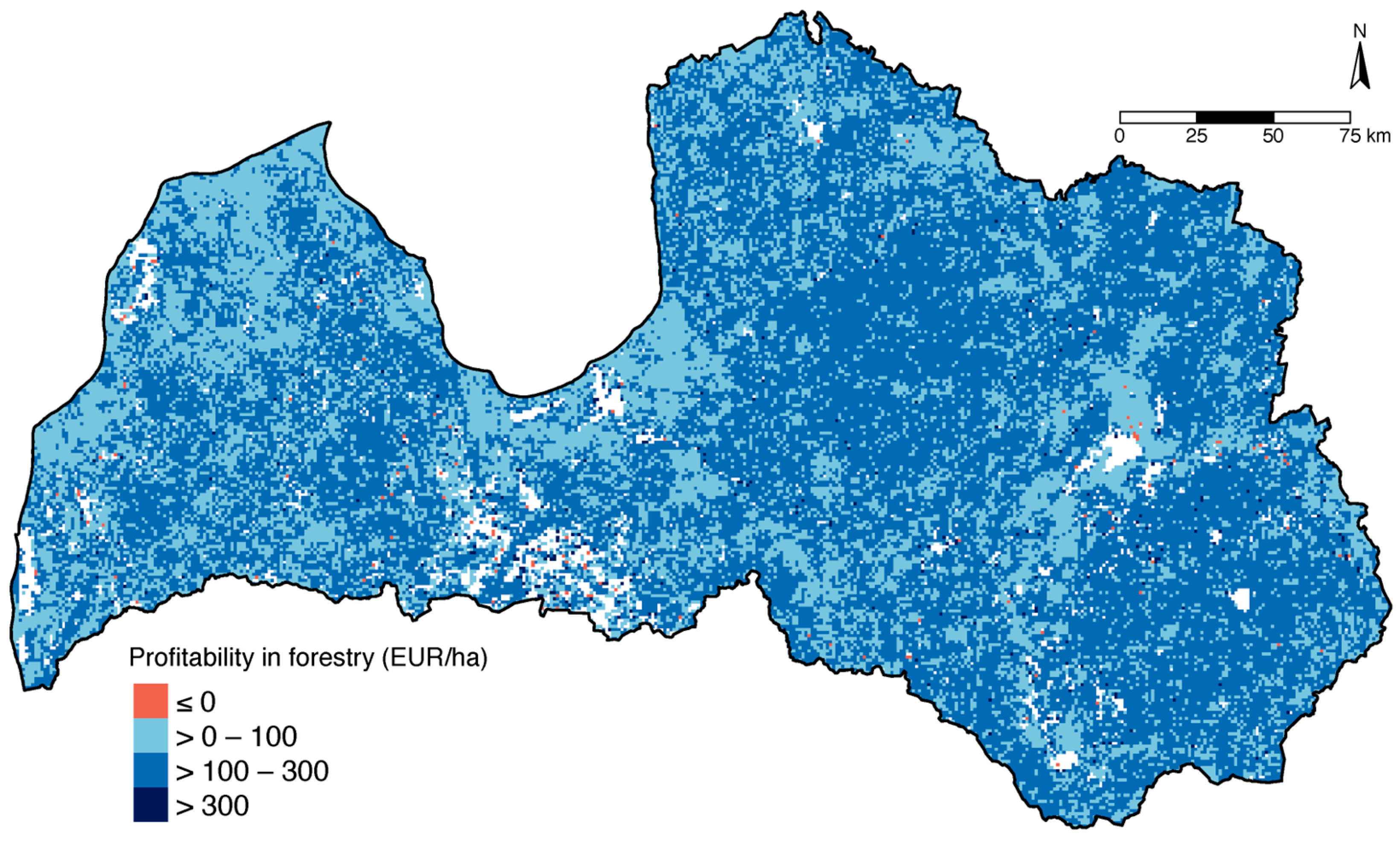
Understanding when and where to shift land from agriculture to forestry is essential for designing sustainable land use strategies that align with climate, biodiversity, and rural development goals. However, traditional profitability comparisons rely on long-term discounting, which is highly sensitive to assumptions and often misaligned with the shorter-term decision-making horizons that are relevant for policymakers. This study presents a deposit-based framework that interprets annual timber biomass growth as accumulating economic value, enabling direct, per-hectare comparisons with yearly agricultural profits. The framework integrates parcel-level spatial data, land quality indicators, national statistics, and expert inputs to produce high-resolution maps of annual profitability for both agriculture and forestry. Applied to the case of Latvia, the results show strong spatial variation in agricultural returns, particularly in low-quality areas where profits are marginal or negative. By contrast, forestry provides more stable, though modest, economic gains across a wide range of biophysical conditions. These insights help identify where afforestation becomes a financially viable land use alternative. The framework is designed to be transferable to other regions by substituting local data on land quality, prices and growth. It complements policy instruments such as performance-based CAP payments and afforestation support, offering a future-oriented tool for spatially explicit and economically grounded land use planning.
Keywords: afforestation; land use profitability; parcel-level assessment; sustainable land management; land quality; crop groups; regional differentiation afforestation; land use profitability; parcel-level assessment; sustainable land management; land quality; crop groups; regional differentiation