Article

Historic Gardens as Neglected Heritage in a Rural Mediterranean Region (Basilicata, Italy): Multi-Source Assessments for Emerging Categories Across Landscape Units


1
Department of Science, University Roma Tre, Viale G. Marconi 446, 00146 Rome, Italy
2
Department of Architecture, University Roma Tre, Largo Giovanni Battista Marzi, 10, 00153 Rome, Italy
3
Direzione Generale dell’Ambiente, Energia e Tutela del Territorio, Via Verrastro 5, 85100 Potenza, Italy
4
Institute of Heritage Science, National Research Council ISPC-CNR, SP35d, 9, Montelibretti, 00010 Rome, Italy
*
Author to whom correspondence should be addressed.
Land 2026, 15(10), 1802; https://doi.org/10.3390/land15101802
Submission received: 11 August 2026 / Revised: 20 September 2026 / Accepted: 22 September 2026 / Published: 25 September 2026
(This article belongs to the Special Issue Evaluating and Managing Historic Landscapes)

Abstract

Historic gardens represent an important part of the cultural heritage of a region. Gardens in rural areas, lacking some formal features and having characteristics strictly combined with the landscape, are often neglected. This contribution aims to give a methodological assessment for their recognition and an evaluation of the resulting categories. We analysed the Basilicata region (Italy), which shows a rural economy and low urbanisation. Previous knowledge recorded only few historic gardens, but considering various sources of information, based on the convergence of botanical, historical-artistic, and social significance, we obtained a preliminary inventory of 335 sites, later reduced to 150. Eight socio-cultural categories emerged, with a predominance of Masserie gardens, which align landscape design with productive function, followed by noble urban palaces’ gardens, where design is predominantly ornamental, and by gardens of religious complexes and cloisters. Memorial and cemetery’s gardens, and those of castles, rural villas, public and archaeological sites, and agronomic horti channel panoramic and topographic settings into ornamental or community values. Their territorial distribution varies across the nine landscape units of the region, with the most interesting ones in the Murgia Materan Plateau and in the Coastal Ionic Plain, with an inverse trend between quantity and quality. The study defines their typological and structural characteristics and brings to light a significant number of neglected realities. Most of them date back to the Middle Age and the modern era, even if heavily changed, having a horticultural function together with aesthetic and spiritual values.

1. Introduction

From ancient times, the cultivation of plants for practical needs, combined with aims belonging to the spiritual and aesthetic sphere, gave rise to the creation of idealised places, i.e., the gardens [1,2,3]. The idea of the garden was born to set up a precious place to be protected and isolated from its surrounding environment yet closely connected to it. In fact, the material shape of the “paradeiza” in Persian culture [4], such as those of the first Egyptian gardens [5], was conceived as an enclosed space, separated from its surroundings by a fence, where useful and ornamental plants were carefully combined following precise orders and organisations [6]. Gardens also became a place of spiritual isolation, a place of serenity and inner peace, a place of contact with the divine. In fact, they represented idyllic spaces where humans could feel living in perfect harmony with the rest of God’s creation [4,7,8,9,10]. Throughout history, they represented symbols of prosperity, prestige and power, as well as elements of connection to the divine, and they have been strictly associated with villas, palaces and religious structures [11,12,13,14,15].
The evolution of gardens followed the changing culture of populations over time and over space and thus constitutes a part of the history of places [13,16,17]. Their concept and identity are not totally equivalent in the view of national and international regulations [3]. The first one, i.e., the Burra Charter [18], simply defined them as a part of a “cultural heritage place”, having both natural and cultural features; a few years later, the Florence Charter [19], which still remains the most important document, more explicitly defined them as “an architectural and horticultural composition of public interest from historical or artistic points of view”, emphasising that their most crucial elements are the historical, artistic, and aesthetic values, combined with a specific plant selection.
Previous data [3] showed that among the countries of the Council of Europe, 33% have filed garden policies, but when considering the cultural heritage national law, only 7%, i.e., only 14 countries, have a clear definition of a historic garden. Furthermore, the main typologies of protected gardens were mainly related to historical and artistic values and, less frequently, to architectural, aesthetic, botanical, social and scientific characteristics. Even though botanical elements are fundamental components of a garden, a few countries include botanical value as explicit criteria in the legal designation of historic gardens [3]. Indeed, a distinction between agricultural spaces and gardens does seem relevant in the context of the main documents, where gardens are seen as expressions of the direct affinity between civilisation and nature. However, gardens as designed landscapes are distinguished by their aesthetic and artistic values or “testimony of idealised image of the world” (UNESCO [20]; Florence Charter [19]). In general, a scarcity of knowledge about the rural realities emerges from the literature, as does the difficulty of interpreting the values of rural historic gardens, sometimes overlapping with cultural landscapes, neglecting their relevance in such contexts [21]. A wider frame is provided by the ICOMOS-IFLA Principles Concerning Rural Landscapes as Heritage [22], which extend heritage recognition to ordinary as well as outstanding rural areas, and treat their productive dimension as part of their heritage value.
When considering Mediterranean regions, such as Italy, Greece, Spain or Portugal, knowledge of historic gardens remains fragmented and insufficiently systematised, even though these sites constitute a significant component of the cultural and landscape heritage. The literature overall considers the historic landscape for their evident cultural values, but very little attention is given to the historic gardens as separate entities [23,24,25,26,27,28]. The limited attention devoted to historic gardens is an evident research gap, and it has often hindered a comprehensive understanding of their role in the historical construction of landscapes and in shaping local territorial identities.
In Mediterranean rural areas, such as in the Basilicata region of Southern Italy, very little information is available on the gardens of this area, where 46 historic gardens are listed under conservation directives [29,30,31]. The Central Institute for Conservation and Documentation of the Ministry of Culture (ICCD) later collected 13 sites as Parks and Avenues of Remembrance in the Regional Landscape Plan, whereas another 14 have been recognised as Municipal Villas. The APGIs database (Italian Parks and Gardens Association, established in 2011) [32] still collects only 2 historic gardens, and very few scientific contributions can be detected on such a topic [33,34,35]. Thanks to the funding of the National Biodiversity Future centre (PNRR), a partially related study, which considers not only historic gardens, but any kind of ornamental flora of the Basilicata region, was recently carried out [36].
Furthermore, the recent opportunities offered by funding from the National Recovery and Resilience Plan (PNRR) for the protection and enhancement of Italy’s historic parks and gardens (M1C3–Measure 2–Investment 2.3) [37] made it possible to focus attention on this neglected topic. In 2023, ICCD (Central Institute for Cataloguing and Documentation of the Ministry of Culture, Italy) launched an initiative aimed at identifying, quantifying, and describing historic parks and gardens, as well as cataloguing them to facilitate a better understanding, preservation, and promotion of this heritage, with the goal of highlighting its complexity, variety, and scope, and identifying the most significant sites within each local context.
Focusing on the Basilicata region, where the target of the Plan was to identify and describe 150 historic gardens, this study was first aimed to provide a methodological contribution to the assessment of the underrecognised reality of historic gardens in rural contexts, applying a wide multi-source method. A further objective was to evaluate the different categories of gardens by analysing components, cultural influences and processes that contribute to their distinctive identity.
Through a careful selection and evaluation process, this paper shows how the historic gardens, especially in rural areas, can be interpreted as a fragile cultural palimpsest, in which social practices, symbolic values and territorial relationships accumulated over time can remain legible despite the inevitable processes of transformation that have accompanied their evolution.

2. Materials and Methods

A comprehensive methodological approach was developed here, first for the identification and collection of data, and then for their validation. Subsequently, elaboration and clustering of socio-cultural and historical categories were carried out before the data analysis.

2.1. Study Area

The Basilicata region, located in Southern Italy between the regions of Puglia, Campania, and Calabria, retains a strong rural character, marked by low population density and a close interaction between natural, historical, and cultural components of the territory. It shows distinctive features for natural and cultural heritage sites, and it includes outstanding natural parks, archaeological and monumental places, such as World Heritage Sites (the Sassi and the Park of the Rupestrian Churches of Matera [38]).
Considering the natural features, the territory has a high geological fragility, with a high risk of landsliding and flooding. It is mostly characterised by mountains and hills belonging to the complex of the southern Apennine chain, with plains occupying only a small portion. This complex orography, with altitudinal ranges (from sea level up to 2267 m of the Pollino Mountain), also gives rise to complex climatic variability, with inland and hilly zones, characterised by temperate sub-continental bioclimates, and the Ionian and Tyrrhenian coasts having hot-arid Mediterranean bioclimates [39]. Furthermore, the recent climate changes and the nature of cropping terrains, coupled with the climate dynamics, have brought some inner areas to desertification and land degradation [40].
Throughout history, the geographical position of the region has favoured the overlap of different cultural and settlement patterns, establishing the area as a transitional area between the Lombard and Byzantine worlds and, subsequently, as an integral part of the historical and political dynamics of Southern Italy.
This territorial complexity is recognised by the Regional Landscape Plan [41], which divides the region into nine landscape units: A. Vulcanic complex of Vulture; B. Inner mountains of Apennine; C. Hills and terraces of Bradanic area; D. Murgia Materan Plateau; E. The Upper Agri valley; F. The Clay gorges; G. Coastal Ionic Plain; H. Pollino Mountains; and I. The Reliefs of the Tyrrhenian Coast. Each landscape unit is characterised by specific geomorphological, environmental, historical-settlement, and perceptual features that contribute to the definition of distinctive and recognisable landscapes, reflecting the long-term interaction between natural factors and human activities.

2.2. The Assessment Methods for Identification and Collection of Historical Gardens

Identification and collection of historical gardens were based both on the literature and on field surveys. Different phases of data analysis were needed for the assessment of the various characterising elements.

2.2.1. Data Collection

Data collection proceeded through different categories of sources: bibliographic data (national and international literature, Congress Proceedings); inventories of local public entities (Regions, municipality, etc.); conservation agencies (Superintendency of Archaeology, Fine Arts and Landscape and archival national data); expert opinions from environmental and historic associations (e.g., APGI–Associazione Parchi e Giardini d’Italia, FAI–Fondo Ambiente Italiano, and ADSI–Associazione Dimore Storiche Italiane); web-based site inventories, such as amateur groups; direct knowledge on the part of the person compiling the records, and eventually informal local recommendations. Each source contributed new sites to the inventory.
At this stage, data collection followed an intentionally broad and non-selective logic. All sites potentially identifiable as gardens, parks, cultivated green spaces, or designed landscapes associated with historical, cultural, social, or productive functions were included, regardless of their conservation status or level of documentation. The resulting dataset constituted a preliminary inventory, subsequently subjected to validation and filtering procedures.

2.2.2. Data Validation

Field reports and local recommendations were then used to verify the previously collected data and to add further information. In this phase, we carried out an analytical assessment of garden values, using three different evaluation criteria that should occur together (A = botanical-scientific values, B = historical-social values, C = artistic- aesthetic- architectural values), as derived from the international literature [3].
To establish the botanical and scientific value, the taxonomical identification of the occurring species was carried out. The natural value of the species was assessed considering their presence in specific laws (local, national and international) and the scientific literature, with an estimation based on conservation interest, rarity, vulnerability, endemism, and strict linkage with specific habitat [42]. The conservation value was assessed using International Directives (Habitats Directive 92/43/EEC [43] and CITES [44]) and National and Regional Red Lists [45,46]. At the same time, the age, habitat and horticultural values were also considered, particularly in the case of heritage trees, which are underlined in the region, especially fruit trees [47] and gymnosperms introduced from the Americas [48].
Historical and social values were assessed through a preliminary historical-critical interpretation of each site, based primarily on its present-day configuration [49] and supported by the available documentary and bibliographic sources, without aiming at an exhaustive historical reconstruction. The analysis therefore focused on those historical processes that remain legible in the current spatial organisation and cultural context, privileging the elements that are still recognisable and significant for the inventorying and cataloguing activities described above [21,50]. Attention was devoted to the relationships between gardens and local communities, patterns of land ownership, religious practices and forms of collective memory that have contributed to shaping these places over time [51,52]. The historical significance of each site was therefore considered in relation to the associated architectural complex—whether a castle, villa, palace, monastery or Masserie—and to the role it has played in structuring the surrounding landscape. Whenever possible, continuity or transformation of the original functions was also investigated, distinguishing situations in which changing cultural, social or productive needs merely resulted in a change of use from those in which they substantially affected the spatial organisation and architectural layout of the garden.
Artistic, aesthetic and architectural values were assessed not only through the presence of architecturally significant structures or ornamental features of particular interest, but also by recognising the garden as the outcome of a conscious process of spatial design, in which vegetation and built elements contribute jointly to the definition of a unified cultural organism [21]. The assessment therefore considered the organisation of pathways, terraces, enclosure systems, hydraulic works, stairways, perspective axes, viewpoints and visual relationships with the surrounding architecture and landscape, together with the persistence of historical layouts and original compositional intentions [53,54,55]. Terraces, hydraulic systems, tree alignments, pergolas, living enclosures, arboreal cultivations and open spaces were therefore interpreted both as devices serving the productive organisation of the site and as architectural and landscape elements whose semantic value contributes to the construction of the historical identity of the place, in line with lexicographical and thesaural approaches to architectural and environmental heritage [56,57]. Finally, consideration was given to the extent to which later adaptations, functional alterations, changes of use, or shifts in aesthetic taste and cultural paradigms have modified the original layout, distinguishing interventions that primarily affected patterns of use from those that consciously redefined the spatial and perceptual configuration of the garden [21,58].
Finally, to give an assessment of quality for each parameter, we used a numerical scale from 0 to 4 (4 = Very High; 3 = High; 2 = Medium; 1 = Low; 0 = Absent), as shown in Table 1.
In a previous paper on the identity of historic gardens [3], we underlined that a historic garden arises only when the convergence of the 3 selective criteria occurs. As shown in Figure 1, only the overlapping of all the 3 values can properly define such cultural elements (the lack of any artistic elements in valuable areas with historic/social and botanical elements shifts the area into a cultural landscape; the lack of botanical elements and the occurrence of historic/social and artistic elements produces a cultural site and not a garden; the absence of historical and social values and the occurrence of a place with botanical and artistic values produces modern gardens, that can have cultural values only if they are representative of the cultural values of the contemporary age). Then, when a “green space” lacks one of these criteria (1. botanical, 2. historical and social, 3. Artistic aesthetic and architectural values) and shows a value of 0 in any one of them, we excluded it from the list of historic gardens.
This process allowed us to validate the collected list of historic gardens in a new reduced list. Modern gardens were also considered if they could be regarded as representative of a new stylistic approach of the contemporary era. The ICCD typologies of Parks and Gardens were derived from the new “PG” form (version 4.01), based on the previous version (3.00) released by the ICCD and used nationwide in Italy [59].

2.2.3. Elaboration and Clustering on Socio-Cultural, Formal Characters, and Use Patterns

Then, we combined information on each garden’s cultural significance (its primary value and, consequently, the reason for its listing) and the key features: the character of the green space (green areas and plant architecture), buildings and structures, street furniture, water systems, water features, and the fountain system.
The primary clustering of the gardens was also made by combining socio-cultural characteristics:
  • The definition of the site (garden, park, vegetable garden);
  • Architectural elements associated with them (castles, palaces, villas, rural realities);
  • Social values, when linked to secular power, the religious sphere, or the popular context.
  • Furthermore, gardens were categorised into four design types based on spatial organisation and formal characteristics:
  • Formal gardens: geometric layouts with axial symmetry and regular parterres, characterised by human dominion over nature through geometric organisation;
  • Irregular gardens: designed areas with asymmetric layouts and organic arrangements, still shaped with deliberate human design;
  • Landscape gardens: designed following naturalistic principles with emphasis on pictorial composition, topographic integration, and informal planting arrangements;
  • Mixed gardens: exhibiting hybrid characteristics that combine elements from multiple design traditions. This includes gardens with areas of formal or irregular design, alongside natural parts.
Finally, gardens were classified by dominant use pattern (i.e., function), recognising that many gardens serve multiple functions but exhibit a primary organisational logic. Classification was based on dominant characteristics, recognising that individual gardens may exhibit secondary attributes from other categories:
  • Ornamental gardens: designed primarily for aesthetic contemplation and display;
  • Productive gardens: here utilitarian cultivation represents the primary organisational principle. This category includes kitchen gardens (horti), orchards (fruits), vineyards, and working agricultural landscapes where food production, rather than ornamental display, governs spatial layout and plant selection;
  • Social (community) gardens: they serve civic functions with open access and communal use. Design accommodates collective social memories and activities;
  • Spiritual gardens: green areas projected for religious contemplation and ritual purposes.

2.2.4. Final Selection Based on Conservation Status and Representativeness

From the body of sources—which were not entirely consistent in their approach to data collection and presentation—we made a representative selection of the categories that we believed could be identified.
Conservation status was scored on a four-level scale through field observation and documentary cross-check:
  • A = Good: design, structures and plant assemblage substantially preserved and actively maintained;
  • B = Fair: design legible, with localised deterioration of structures or plant assemblage;
  • C = Mediocre: design partially compromised, with diffuse deterioration affecting more than one component;
  • D = Poor: design barely recognisable, with structural failure or near-complete loss of the original plant assemblage.
Sites whose state could not be classified were recorded as unknown and excluded from the conservation-emergency analysis. The conservation-priority classification crossed the total value score (range 4–12; Section 2.2.2) with the four-level conservation status (Section 2.2.4) to define three classes: critical (total value ≥ 7 with mediocre or poor condition); watch (total value 4–6 with mediocre or poor condition, or total value ≥ 7 with fair condition); stable (all remaining classified sites). In the present analysis, we selected the sites having at least the value 4.
The score was assessed by at least two experts (usually an architect and a botanist) and two other assessors (one from the University and one from the Basilicata region). In case of different opinions about the score values, a discussion among experts and assessors was carried out.

2.3. Statistical Data Analysis

All analyses were carried out in R (version 4.5.1) and QGIS (version 3.36.1). Inter-source overlap within the preliminary inventory was examined through a chord diagram (circlise package [60]). The distribution of typology, design and function across the validated database was rendered as an alluvial diagram (ggalluvial [61]). Variability in garden surface area across typologies was summarised through boxplots of log-transformed values (ggplot2 [62]). The logarithmic scale was required by the order-of-magnitude range observed between categories. The association between the eight categories and the nine landscape units was tested with a chi-square test and visualised through Correspondence Analysis (CA) of the 8 × 9 contingency table (FactoMineR [63]). The formal-functional coherence of the eight typological categories was tested through Multiple Correspondence Analysis (MCA), with design and function entered as active variables and typology as a supplementary qualitative variable (FactoMineR [63]); confidence ellipses around category centroids were drawn with factoextra [64]. The geographic distribution was rendered as a kernel density surface in QGIS, with a Gaussian kernel and bandwidth selected based on average inter-site distance within the Basilicata region.

3. Results

3.1. Collection and Selection

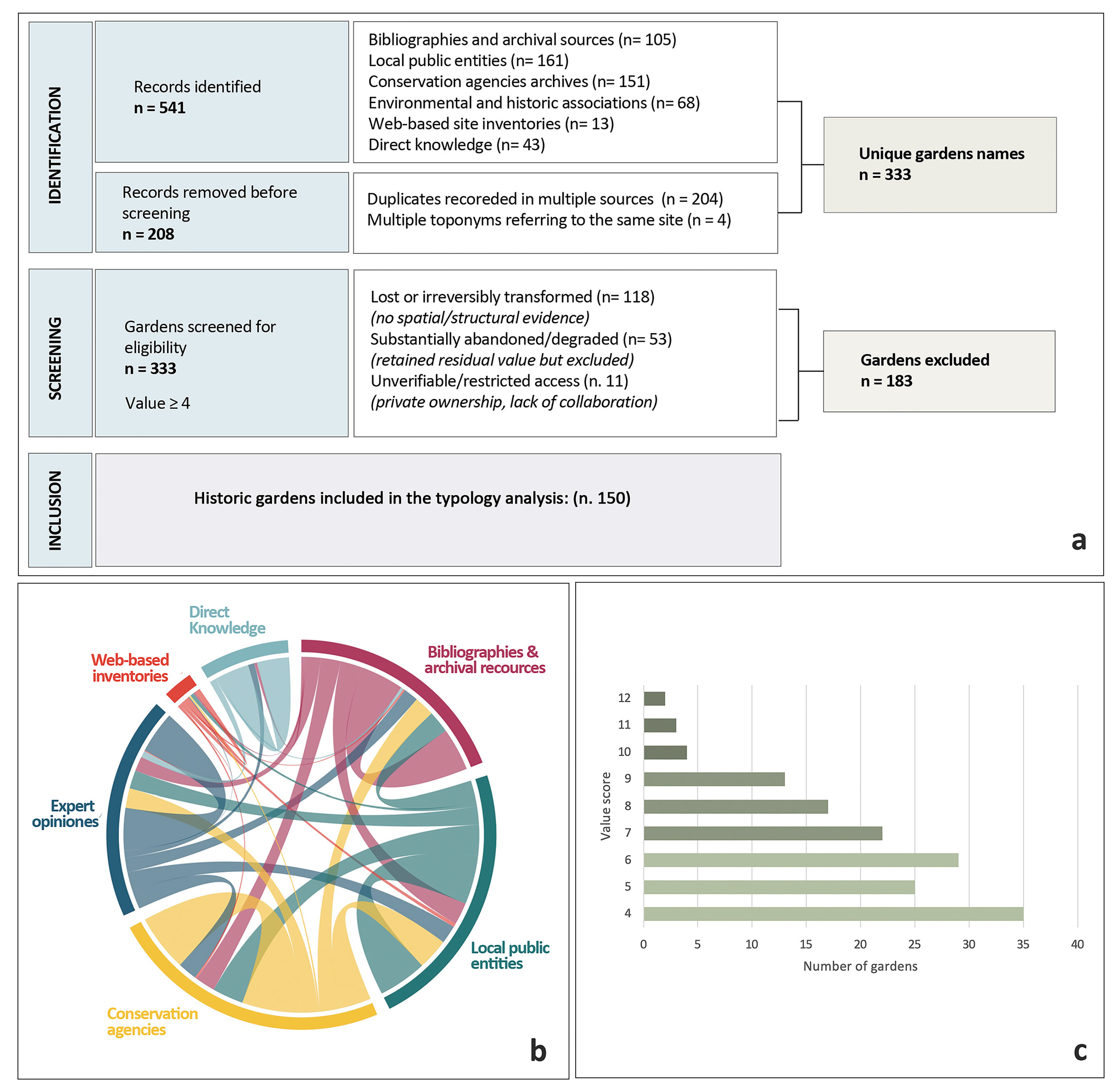
Sequential consultation of the various source categories yielded a preliminary inventory of 335 candidate sites (Figure 2a). Some of them (204 sites) were listed in more than one source, and this condition improves their value, at least for the social appraisal. The two institutional sources (regional public administration and superintendence archives) supplied the largest contingents, followed by bibliographic and archival sources. However, inter-source overlap (Figure 2b) revealed substantial heterogeneity in data availability across collection categories. The widest bilateral flow links the two institutional sources (81 co-documented sites), with bibliographic and archival sources sharing substantial portions of both. Direct knowledge stands apart, with 77% of its entries appearing in no other source. Across the inventory, 61% of sites were documented through a single channel only, a fragmentation that justifies the multi-source strategy adopted here.
Application of the value-based screening protocol (total score ≥ 4 across the three values, with no value scored 0—without any disagreement among experts and assessors) retained 150 sites and distributed the excluded entries across four categories: irreversible loss, substantial abandonment and advanced degradation, inaccessibility, and duplicate names for single physical sites (Figure 2a). The degraded or inaccessible sites can retain residual heritage value and are reserved as candidates for future revalidation, contingent on conservation interventions or renewed stakeholder collaboration.
All subsequent analyses are restricted to the 150 selected sites (See Supplementary Materials). The distribution of total garden value within this set shows an inverse trend between quantity and quality of the gardens (Figure 2c). In fact, the medium-low band (4–6) accounts for most sites (n = 89; 59%), followed by the medium-high band (7–9; n = 52; 35%), while only nine gardens (6%) reach the high band (10–12). These high-value sites identify the principal candidates for the regional emergency assessment developed in subsequent sections.
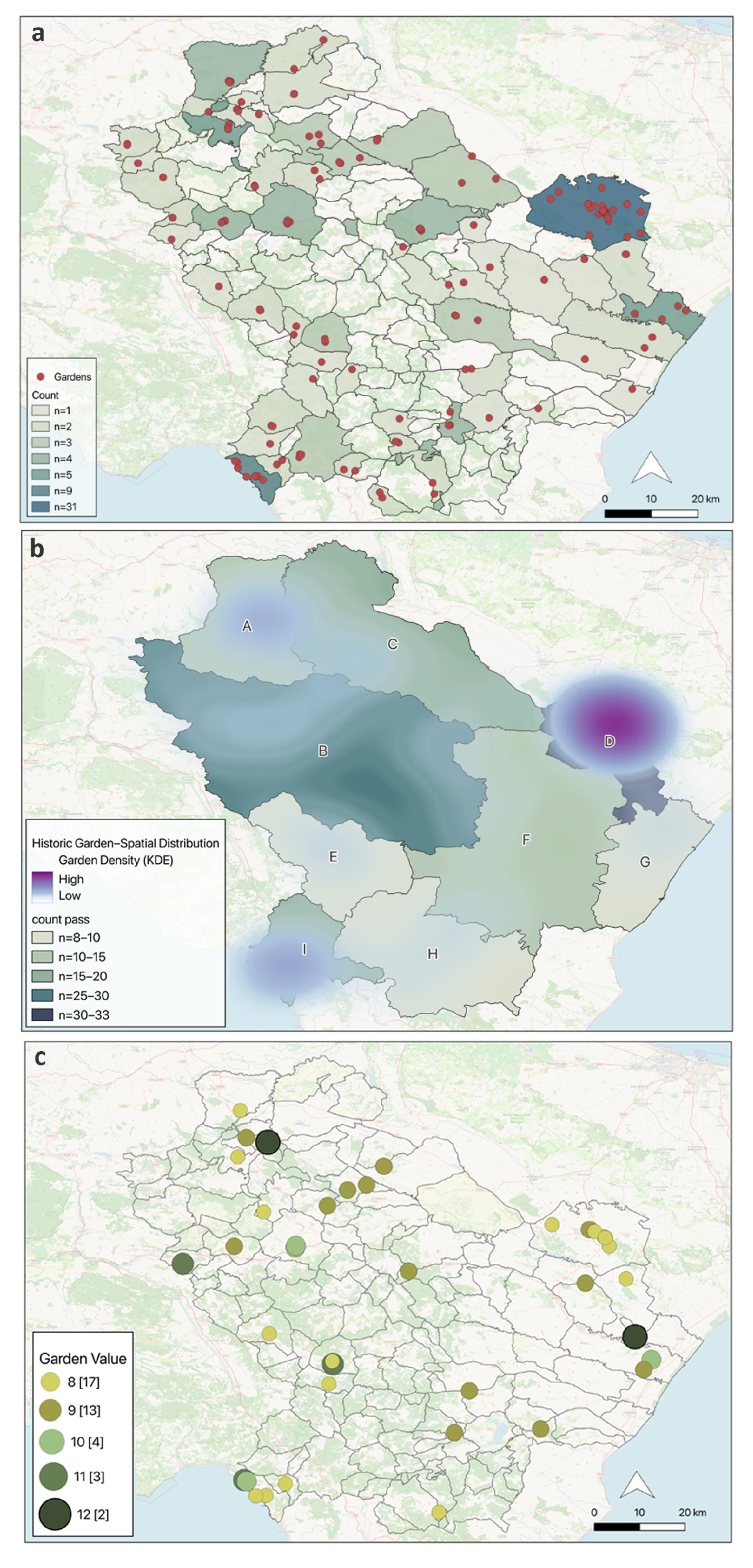
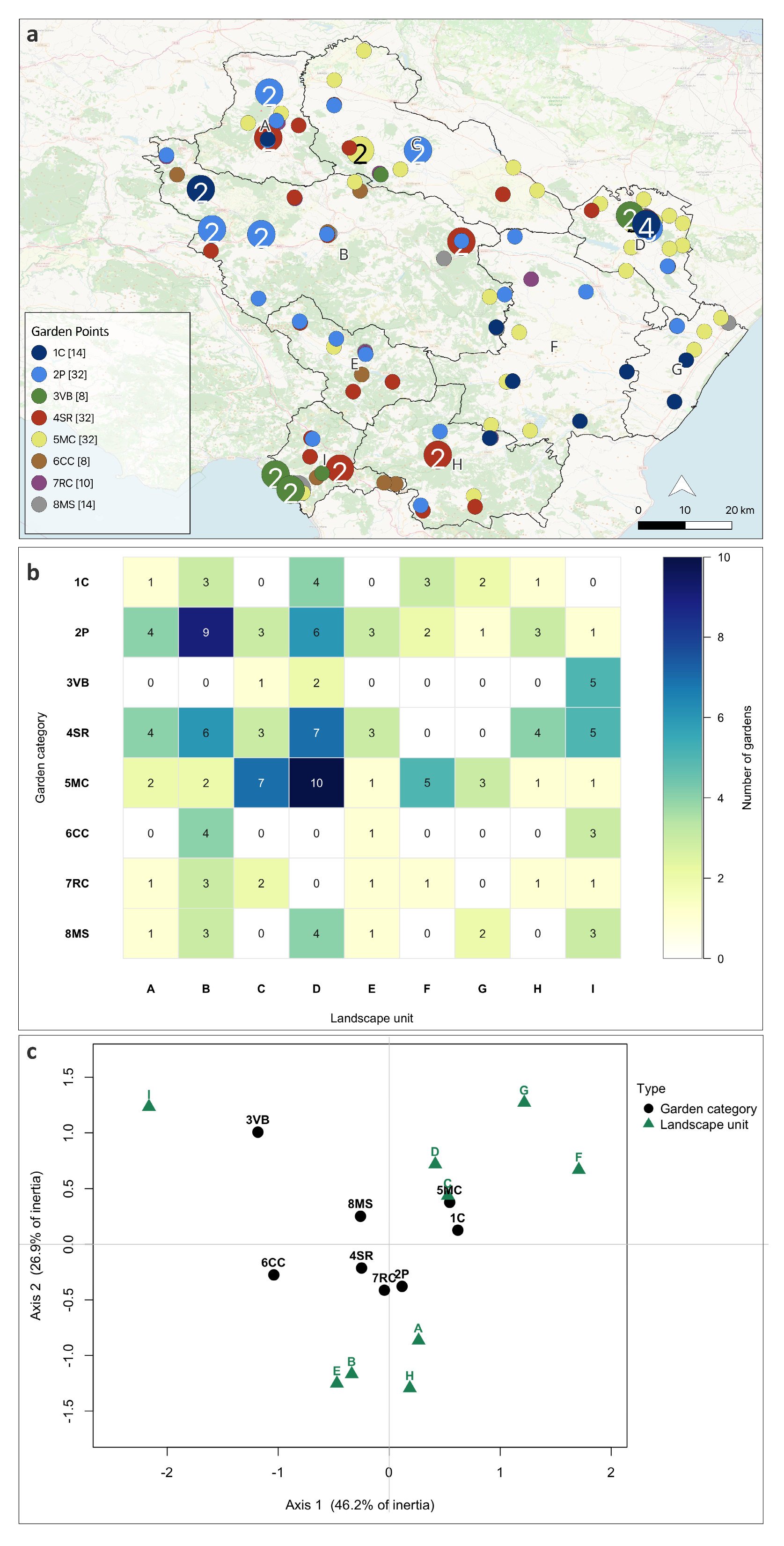
The 150 selected gardens are spread across 57 of the 131 Basilicata’s municipalities, occupying urban (n = 75; 50%), rural (n = 45; 30%) and peri-urban (n = 30; 20%) settings. Potenza province holds the larger absolute number of sites (n = 91 in 41 municipalities); Matera province (territorially smaller and less populous) shows a higher density per municipality (59 sites in 16 municipalities) (Figure 3a).
The relation with the landscape systems of the Basilicata region, shown in Figure 3b, shows that historic gardens are unevenly distributed across the nine landscape units. The highest absolute frequency was recorded in the Murgia Materan Plateau (D; n = 33), followed by the Inner Mountain of Apennine (B). The lowest counts were observed in the Upper Agri valley (E), the Pollino mountains (H), and the Coastal Ionic Plain (G), all below 11 gardens. The kernel density surface resolves this distribution into two principal poles, the city of Matera (n = 31) and Maratea on the Tyrrhenian coast (n = 9). Outside these poles, the heritage is dispersed across small and medium urban centres along the Bradanic foothills and the Agri valley, mirroring the historic pattern of feudal and ecclesiastical settlement in inner Basilicata. The KDE surface highlighted a pronounced concentration peak in the eastern sector of the region, centred on the Matera plateau (D), and secondary hotspots within Units A (Vulture) and I (Tyrrhenian coast). The central and southern lowland units (E, F, G) displayed homogeneously low density. When considering the different values of the gardens and reducing the number to the most relevant cases (those having values 8–12), the distribution across the territory produces different results, with non-negligible examples in areas with low concentration of gardens (Figure 3c).
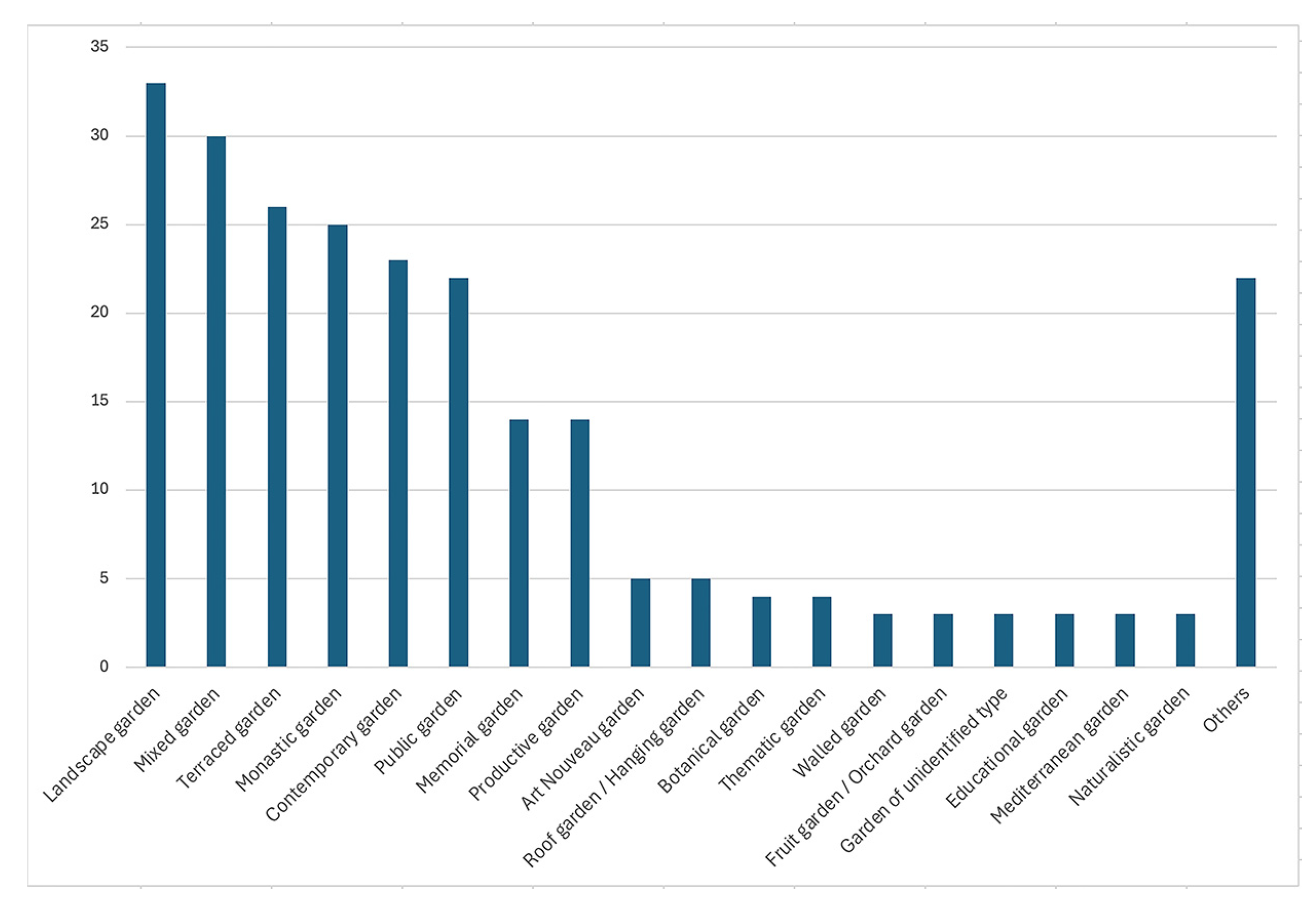
When considering the ICCD official typologies, we can observe the predominance of landscape gardens and mixed gardens, often organised in terraces, and having also a productive role (Figure 4). Obviously, a garden can have different attributes and fall into more than one typology.

3.2. Clustering of the Various Socio-Cultural Categories of Historic Gardens

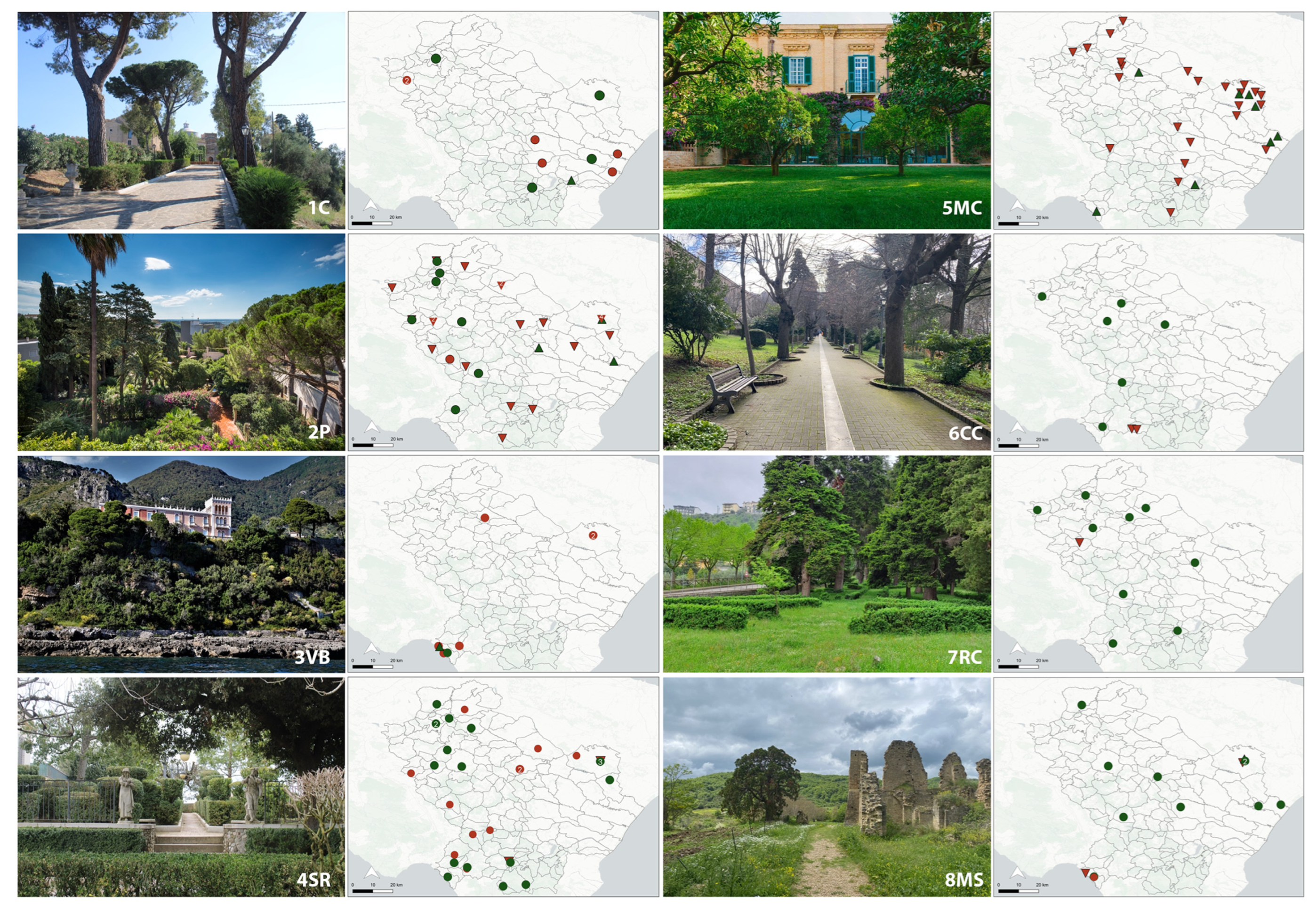
A socio-cultural categorisation of the gardens having an historical value, organised around the socio-historical institutions through which they were generated, gave rise to eight different groups (see Table 2). Some examples of their morphologies and their occurrence in the different municipalities are shown in Figure 5. In some cases, it was necessary to evaluate the assigned category carefully, since the garden could be connected to more than one (e.g. Fortified structures or gardens of religious structures and Masserie). We considered in such cases the prevailing categories, even if this gave rise to a reduction in the representativeness of some of them.
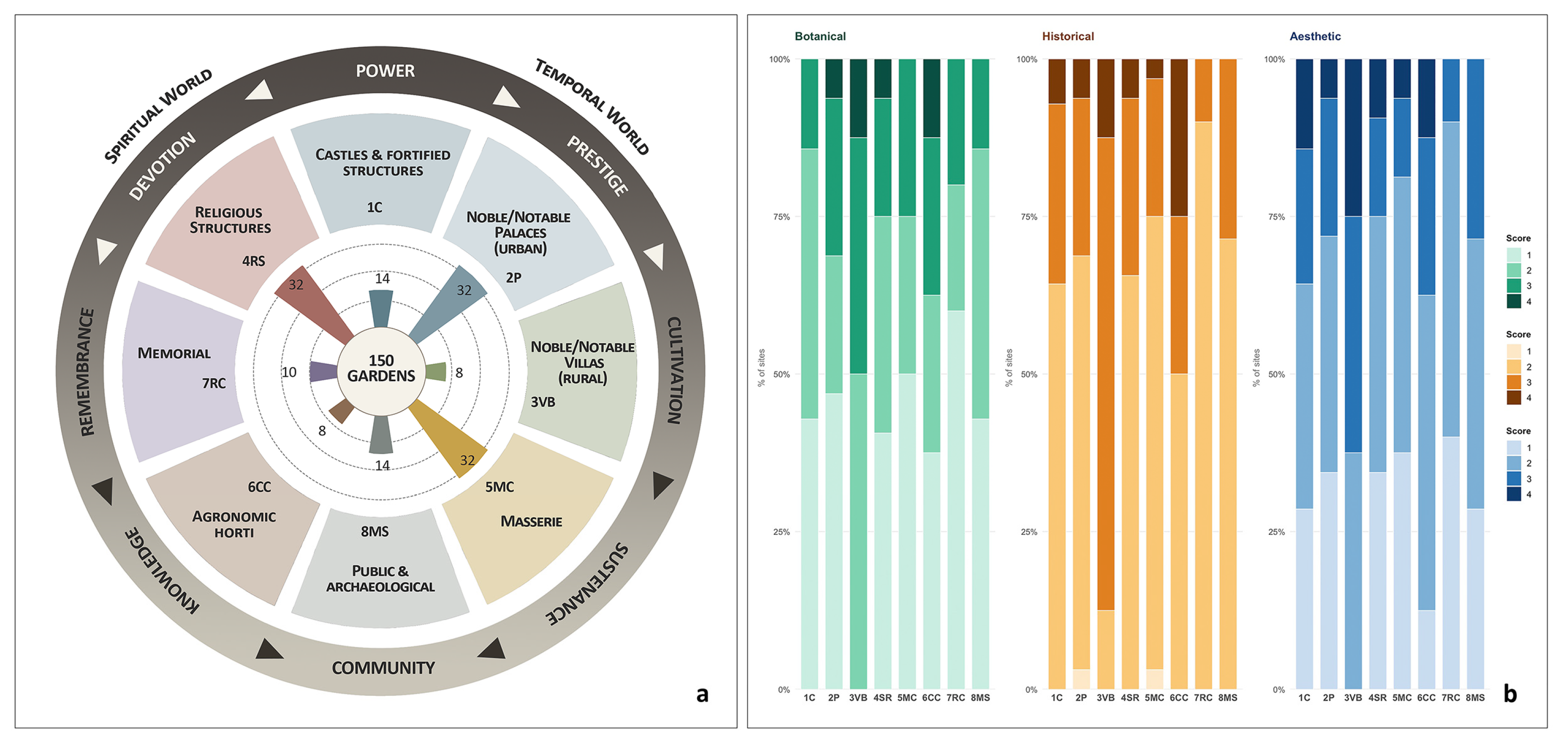
The suggested categories can be associated with different values that could explain their origins (e.g., power, prestige, spirituality, devotion, remembrance, cultivation, knowledge), as shown in Figure 6a.
The value scores show differential patterns across the eight categories (Figure 6b). Noble rural villas (3VB) and, to a lesser extent, agronomic gardens (6CC) emerge as the highest-valued categories across all three evaluation axes, with their sites concentrated at scores 3 and 4 in the botanical, historical and aesthetic dimensions. Memorial and cemetery gardens (7RC) record the lowest profiles, dominated by scores 1 and 2 across the three axes. The historical-social axis is the most uniformly high across the dataset (almost no site falls below score 2), while the botanical and aesthetic axes discriminate more sharply between categories. The remaining types (1C, 2P, 4SR, 5MC, 8MS) display intermediate, heterogeneous profiles, with no single axis dominating their score distribution.
When considering the botanical interest, high scores arose from the occurrence of monumental trees or shrubs (e.g., some centenary pines (Pinus pinea L., and P. halepensis Mill.), oaks (Quercus robur L., cypresses (Cupressus sempervirens L.), olive trees Olea europaea L., boxes (Buxus sempervirens L. and B. balearica Lam.) and for the early presence of species coming from other continents (overall Conifers, such as sequoias- Sequoiadendron giganteum (Lindl.) J. Buchholz and Sequoia sempervirens, and cedars- Cedrus atlantica (Endl.) Manetti ex Carriere and C. deodara (Roxb. ex (D.Don) G.Don).
When considering the potential for touristic and cultural fruition, the information on the value score (Figure 6b) and that on the condition of regular opening or restricted access (about half of the total selected) are relevant, as shown in Table 3.
The eight categories are dispersed across the whole region but unevenly composed from one area to another (Figure 7a,b), and the association between category and landscape unit was statistically significant (χ2 = 82.36, df = 56, p = 0.0125, Cramér’s V = 0.28), indicating a moderate association (Figure 7c).
The Murgia Materan Plateau (D) is the richest and most diversified unit, concentrating the largest counts of Masserie (5MC), religious complexes (4SR) and noble palaces (2P); Masserie also dominate the Bradanic Hills and Terraces (C) and the Clay gorges (F), tracing the agrarian backbone of the region. Noble urban palaces (2P) peak in the Inner mountains of Apennine (B) and are the most widely distributed category, occurring in all nine units. By contrast, noble rural villas (3VB) are almost confined to the Tyrrhenian coast (I), whereas the Upper Agri valley (E) and the Coastal Ionic Plain (G) hold the fewest gardens and host no dominant category. Correspondence analysis (Figure 7c) confirms this pattern: the first two dimensions accounted for 73.09% of the total inertia (Dimension 1 = 46.22%; Dimension 2 = 26.87%). Dimension 1 was driven mainly by noble rural villas (3VB; 29.41%), Masserie (5MC; 24.98%) and agronomic gardens (6CC; 22.71%), with landscape units I (59.34%) and F (21.40%) contributing most; Dimension 2 was driven mainly by noble rural villas (3VB; 36.63%), noble urban palaces (2P; 20.79%) and Masserie (5MC; 20.42%), with units B (27.24%) and I (19.35%) contributing most. Most of the categories (5MC, 1C, 4SR, 7RC, 2P, 8MS) and landscape units (A, B, D) gather near the centre, indicating that these gardens are not preferentially bound to a single landscape, while the few peripheral pairings, 3VB and 6CC near units I and F, and 8MS near G, depart from this general distribution.
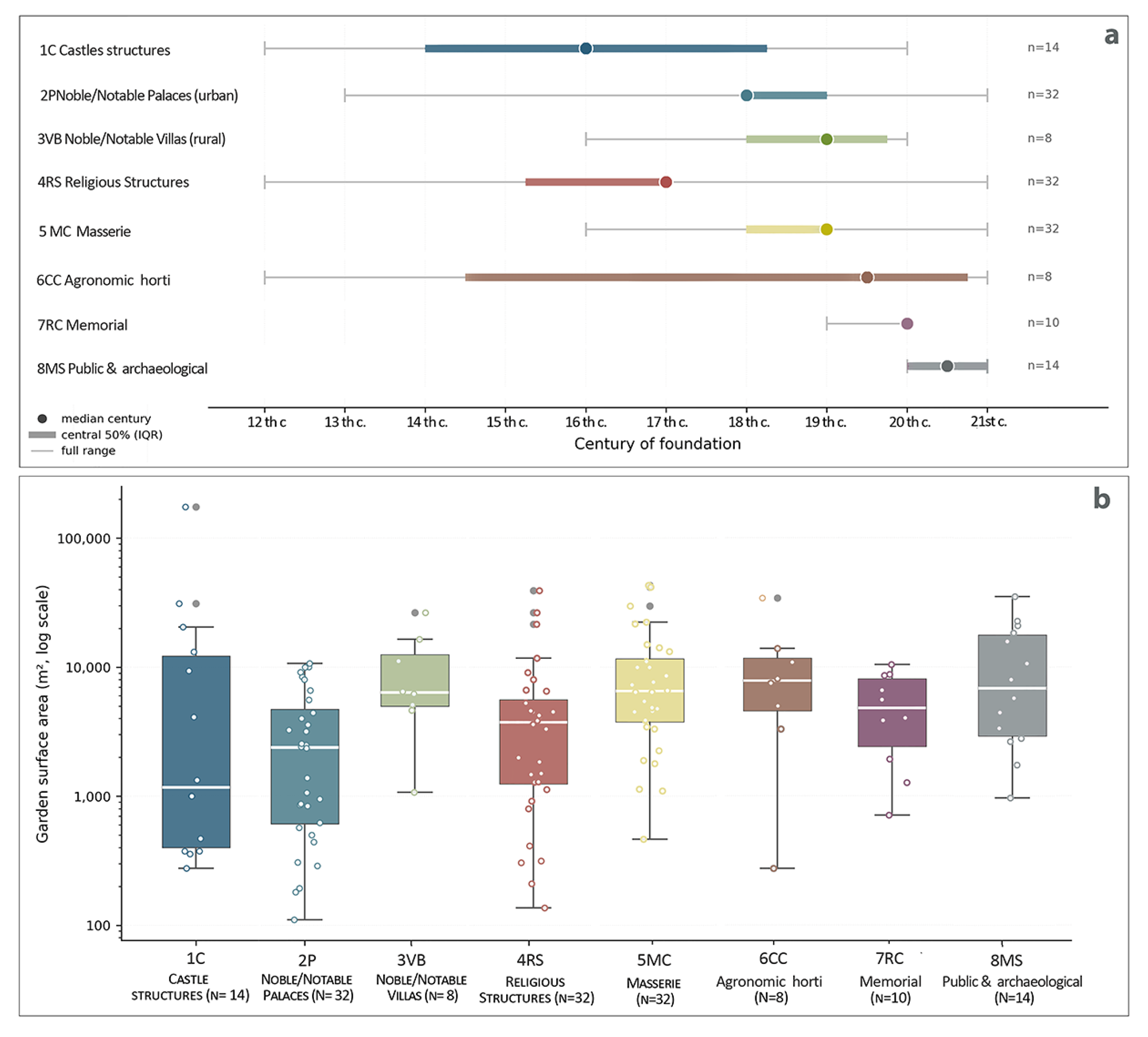
The foundation of the surviving gardens spans nine centuries, from medieval to contemporary creations. The dataset is dominated by gardens founded between the 18th and 19th centuries (n = 27 and 35, respectively), the single most productive period; a secondary cluster in the 16th–17th centuries (n = 32 combined) and a limited medieval component (12th–13th c., n = 11) extend the chronological depth of the dataset backward. The 20–21st century cohort (n = 40) constitutes the second-largest group overall. When considering the time of settlement of the gardens according to the socio-cultural categories (Figure 8a), we can observe that religious and cloister gardens (4SR) display the broadest range and the deepest historical roots, with foundations distributed from the 12th century to the present and a clear peak in the 17th century. Castles (1C) constitute the oldest typology, with garden foundations spanning from the 12th to the 20th century. Gardens of Masserie (5MC) and noble urban palaces (2P) concentrate in the 18th–19th centuries; rural villas (3VB) emerge later, peaking in the 19th century. Two typologies are exclusively contemporary: memorial gardens (7RC), founded almost entirely in the 20th century, and public/archaeological gardens (8MS), founded entirely in the 20–21st centuries. Agronomic and horticultural gardens (6CC) exhibit a markedly bimodal pattern, with foundations clustered in the medieval period (12–13th) and again in the 19–21st centuries but no representation across the intervening five centuries.
Garden surface area varied highly across the typologies (Figure 8b). Agronomic gardens (6CC), public and archaeological gardens (8MS), Masserie (5MC) and noble rural villas (3VB) form the larger-format group, with medians in the order of half a hectare. Memorial gardens (7RC) and religious structures (4SR) occupy an intermediate band. Noble urban palaces (2P) and castles (1C) form the smaller-format group, both compressed within the historic urban or fortified fabric in which they are inscribed. Internal variability is itself differentiated: religious structures (4SR) and castles (1C) span two orders of magnitude in size, while noble rural villas (3VB), memorial gardens (7RC) and agronomic gardens (6CC) are comparatively homogeneous.

3.3. Relations Among the Categories, Design Language, and Functions

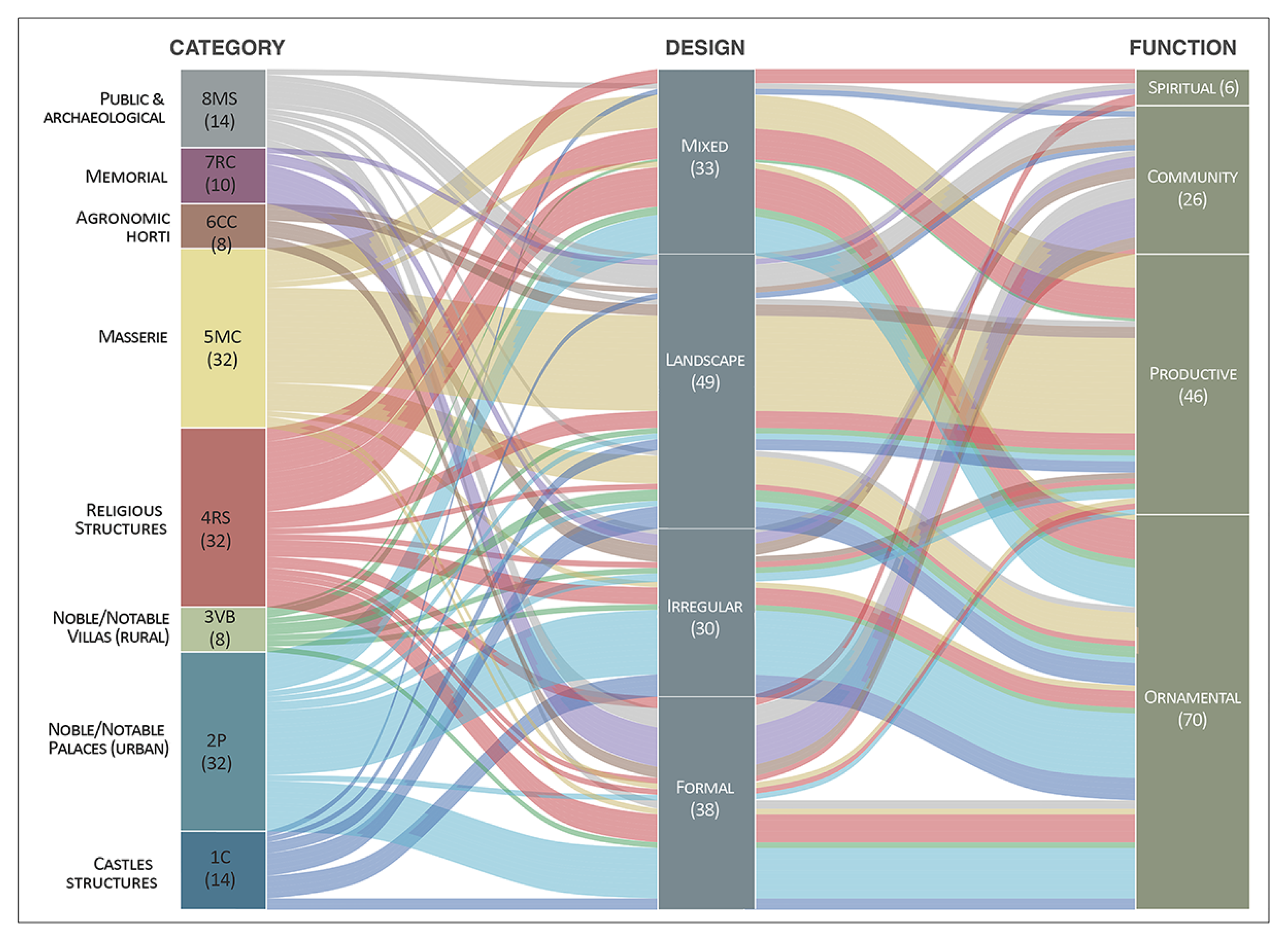
The joint distribution of categories, design language, and primary function (Figure 9) confirms that several categories carry strongly concentrated relations. Gardens of Masserie (5MC) align with landscape design (69%) and productive function (75%), consistent with their embedding in working agricultural complexes. Memorial and cemetery gardens (7RC) combine formal design (70%) with community function (90%). Noble urban palace gardens (2P) are almost exclusively ornamental (97%), with design alternating between formal and irregular layouts to accommodate the constraints of the urban fabric. Castles (1C), noble rural villas (3VB) and public and archaeological gardens (8MS) converge on a landscape design axis, channelling panoramic and topographic settings into ornamental or community value. Religious complexes and cloisters (4SR) form the most internally heterogeneous category: mixed design solutions account for nearly half of its sites, and the functional profile distributes across ornamental, productive and spiritual modalities; a heterogeneity that reflects the historical evolution of these spaces from primarily devotional to multifunctional cloister gardens.
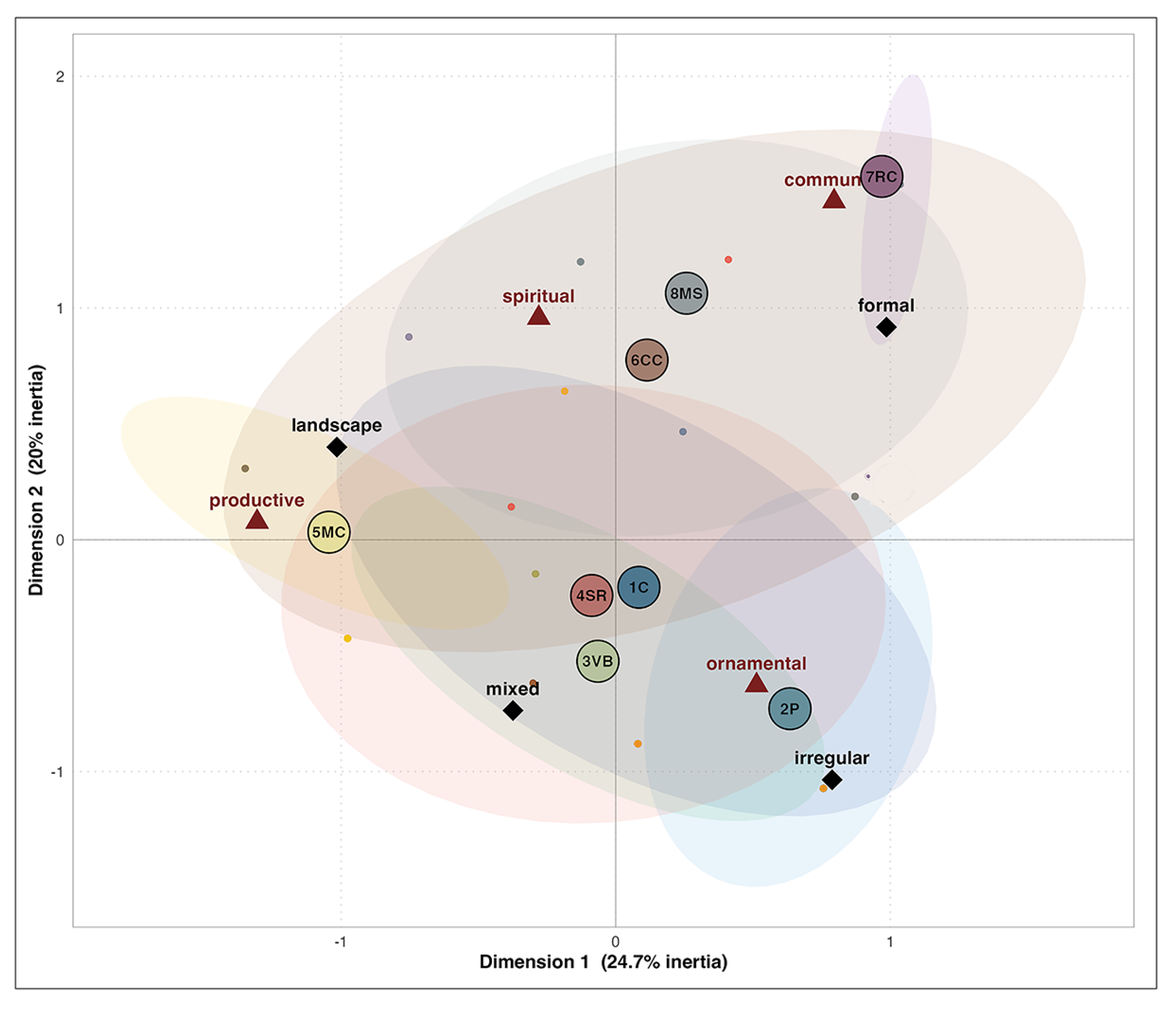
Multiple Correspondence Analysis applied to the design and function modalities, with the eight categories projected as variables (Figure 10), resolves the design-function space into two interpretable dimensions explaining 44.80% of the total inertia (Dimension 1 = 24.63%; Dimension 2 = 20.17%). Dimension 1, driven primarily by productive function (33.44%), landscape design (22.43%) and formal design (17.06%), polarises the formal-ornamental modalities of elite designed gardens against the landscape-productive modalities of working agricultural landscapes. Dimension 2, driven mainly by social function (29.94%), formal design (18.39%), irregular design (18.06%) and ornamental function (16.71%), isolates the community modality, separating gardens of collective-civic vocation from those of private-domestic function. The category centroids project onto three distinct poles. Masserie (5MC) sits at the productive-rural pole, at the positive end of Dimension 1. The civic-collective pole, at the upper end of Dimension 2, is occupied by memorial gardens (7RC), public and archaeological gardens (8MS), and agronomic gardens (6CC). Noble urban palaces (2P) define the private-ornamental pole on the negative side of Dimension 1. The remaining three categories—castles (1C), religious structures (4SR) and noble rural villas (3VB)—cluster near the origin with overlapping confidence ellipses. Their design-function profiles are statistically indistinguishable; what differentiates them is architectural-historical context, not form.

4. Discussion

Gardens have generally been conceived as closed spaces, inspiring beauty and peace, as well as productive places, and throughout history they have played a particularly significant role, as they embody and synthesise the historical relationships established between communities, landscapes, and cultural heritage [65,66,67].

4.1. Documentation and Assessment

Results showed that the historic gardens of a rural Mediterranean region are neither marginal nor homogeneous but constitute a stratified and complex system. In the Basilicata region, they are spread across most municipalities, occupying urban, peri-urban and rural settings, with the highest concentrations in two main areas, respectively in the west and east of the region (Matera and Maratea).
The evident gap between the previously documented set [29,30,31] and the database validated here shows that there is no real absence of historic gardens in the territory, but it can be explained by the lack of criteria capable of recognising vernacular, rural and devotional forms as historic gardens. Similar findings have been reported in other peripheral and rural European contexts [28,68,69], where conventional inventories overlooked the green-space arrangements lying outside the dominant aesthetic tradition. The inventory step suffered from the documentary fragmentation typical of rural areas, where no single archival source covers the full range of sites and where field-based recovery is a structural requirement rather than a complement [21,68]. The categorisation step addresses the narrow scope of conventional historic-garden classifications, which favour formal aesthetic types and rarely accommodate the institutional variety observed across this region.
Furthermore, the evaluation step tackles the lack of standardised criteria for inclusion in heritage registers, a problem that has remained unresolved across European jurisdictions and is widely regarded as the main obstacle to comparative heritage assessment [70,71,72]. We believe that a relevant contribution of this paper is the positive results raised from the applied methodology, based on the co-occurrence among three groups of different parameters [3]. In fact, we believe that the normative emphasis on artistic and architectural composition (Florence Charter [19]) captures only one facet of the composite identity of these gardens. Carefully considering the naturalistic values of the botanical component and treating the productive function of a garden as a constitutive rather than a secondary attribute is, therefore, not a regional concession but a return to the long historical definition of the garden [70,73]. Within the present framework, giving explicit weight to the botanical axis addresses a recognised gap in legal definitions, in which botanical content rarely features among the criteria for designation [3]. The historical-social axis adds a further dimension by recovering values (collective memory, devotional practice, agrarian identity) that the aesthetic axis alone cannot express [50,51,74]. Together, the three axes redraw the boundaries of what counts as a historic garden in a rural Mediterranean region, broadening them well beyond the limited scope of earlier regional studies [29,30,31].
The low value-based score according to the three main parameters of most gardens (Figure 2), even if with some significant differences (Figure 3), seems to arise from different reasons such as the low conservation status, the not always evident high artistic and architectonic features, and the absence of a clear identity. Indeed, the low conservation status of most gardens (more than half of the collected data) shows the fragility of such heritage. Furthermore, maintaining gardens in rural Mediterranean areas, which are the focus of this research, shows some specific challenges compared to other regions, since the Mediterranean climate shows summer drought stress that limits perennial species. The low state of conservation of many sites can also depend on the not negligible irrigation needs of such realities.

4.2. Socio-Cultural Significance

The stylistic typologies of gardens recognised here widely varied, showing a hybrid character among productive, ornamental and devotional aims arising across noble, religious and agrarian settings. In our approach, the developed categories were based on the relationship between socio-historical values, design language and functions (Figure 5 and Figure 6), and they support categories (gardens of Masserie, agronomic horti, memorial and cemetery gardens, archaeological-evocative gardens) that do not have a settled position in the established literature. This more open framework is consistent with recent calls for a broader concept of the historic garden, one able to include productive landscapes, contemporary commemorative forms and vernacular green spaces within a single analytical structure [21,58,75,76]. The protocol can be transferred to other under-studied Mediterranean and rural contexts, where comparable documentary and typological conditions are likely to be found.
The distribution and the relationship with the landscape units (Figure 7a–c) indicate that historic-garden heritage in the Basilicata region is not a closed inheritance from a single historical phase but a layered and still-evolving regional category. The chronological windows of each typology add a further layer of interpretation: religious gardens display the deepest historical roots and the broadest range, Masserie and noble palaces concentrate in the 18th–19th centuries in step with the agricultural and noble reforms of the Kingdom of the Two Sicilies, and the exclusively contemporary character of memorial and public-archaeological gardens shows that civic memory has become an active site of garden creation in recent decades.

4.3. Design and Functional Integration

The distribution of categories, design language and primary function confirmed that several categories have concentrated relations (Figure 9), and the Multiple Correspondence Analysis (Figure 10) also confirmed that the eight categories proposed here are not an arbitrary grouping but correspond to genuinely distinct design-function profiles.
Gardens of Masserie at the productive-rural pole, those of noble urban palaces at the private-ornamental pole, and the cluster of civic-collective gardens (memorial, public-archaeological, agronomic) at the community pole, occupy clearly separated regions of the factorial plane and define the three main orientations of the regional heritage. Gardens of castles, religious complexes and noble rural villas converge near the centroid with overlapping confidence ellipses, which means that they cannot be distinguished by their design-function combination alone. What distinguishes them is mostly the institutional and historical context, not formal language.
This finding has both methodological and conceptual consequences. Methodologically, it confirms that the typologies and categories must be anchored in socio-historical institutions as well as in formal attributes, since two of these three classes would otherwise collapse into a single mixed category; this is consistent with classification proposals that treat institutional context as a primary criterion for historic-garden categorisation rather than as a secondary descriptor [21,72].
By applying the multi-source method for assessment and typological classification, we could observe how their distribution across the different landscape units reflects diverse patterns of territorial organisation, resource management practices, cultural influences, and land transformation processes, thereby contributing to the distinctive identity of each regional landscape context. Historic gardens should therefore be regarded not only as sites of historical, artistic, and botanical value, but also as territorial indicators through which the processes of landscape formation and evolution in the Basilicata region can be interpreted.

4.4. Study’s Limitations and Further Studies

An intrinsic limitation of the study lies in the fact that a historic garden is an architectural organism which, by its nature, is subject to continuous evolution, and whose significance may reside not only in the preservation of the original design but also in the historical, architectural and cultural quality of the transformations that have accompanied its development.
Some biases, which in any case we consider not highly relevant in the whole, can stem from its own procedures, such as the hard zero-score exclusion rule, a certain subjective scoring, primary-category assignment, restricted field access to private sites, and archival bias for chronological analysis. Furthermore, a limit can arise from the decision to consider only the prevailing categories of gardens, even if they could be connected to more than one (e.g., gardens in Fortified structures or gardens of religious structures and Masserie).
Further directions of the work will be a deeper analysis of the most endangered realities and the priority of conservation, which was only introduced in this paper. The results of the floristics assessment of the gardens that emerged from our inventory need to be illustrated and discussed in a further specific contribution.

5. Conclusions

The methodological approach of this analysis, based on a multifactorial assessment of the botanical-scientific, historical-social and artistic- aesthetic- architectural values, proved suitable for defining historic gardens. The developed framework (multi-source collection, tri-axial scoring, and category validation by correspondence analysis) is transferable to other under-studied rural contexts and offers a concrete response to the scarcity of formal definitions of rural historic gardens in current heritage doctrine.
The present work contributed to their identification, screening and value characterisation in the little-known reality of the Basilicata region. It brought to light a significant number of neglected cultural assets that were sometimes not fully recognised as such, which show different stylistic typologies and can be clustered into various socio-cultural categories. It made it possible to assess the spatial distribution in the municipalities, which varied across the different landscape units. Information on the age of settlement, spatial extent, and reasons for their settlements has been provided here for the first time.
The low conservation status of most gardens showed their fragility and the urgent need to better consider such realities. In the still preserved gardens, a distinctive integration between formal composition and productive functions was observed, recognising that, in general—and especially within rural Mediterranean contexts—the constituent elements of a garden frequently perform multiple functions in which utilitarian, compositional, ornamental, symbolic and representative aspects are closely intertwined.

Supplementary Materials

The following supporting information can be downloaded at: https://www.mdpi.com/article/10.3390/land15101802/s1, Table S1: List of 150 historic gardens used in the study and their related socio—cultural categories.

Author Contributions

Conceptualisation, G.C., F.B. and Z.H.; methodology, G.C., Z.H., V.L. and F.B.; Validation, G.C., Z.H., V.L. and F.B.; Field surveys: F.B., Z.H., M.P., N.S., V.L., G.C. Formal analysis, Z.H.; Writing—original draft preparation, Z.H. and G.C.; Writing—review and editing, Z.H., G.C., N.S. and V.L.; visualisation, Z.H. and F.B.; project administration, G.C. and A.M.; funding acquisition, G.C. and A.M. All authors have read and agreed to the published version of the manuscript.

Funding

This research was funded through the Collaboration Agreement Regione Basilicata-Univ Roma Tre Progetto di catalogazione di parchi e giardini storici, PNRR, Missione 1—Digitalizzazione, innovazione, competitività e cultura, Componente 3—Cultura 4.0 (M1C3), Misura 2”Rigenerazione di piccoli siti culturali, patrimonio culturale, religioso e rurale”, Investimento 2.3: “Programmi per valorizzare l’identità dei luoghi: parchi e giardini storici”, that is gratefully acknowledged.

Data Availability Statement

All data supporting the findings of this study are available within the main text or in the Supplementary Information.

Acknowledgments

We would like to thank all the people of Basilicata who were willing to share their knowledge of gardens with the authors. Heartfelt acknowledgements are extended to Giovanni Carraro, Alessandro Mazza and Cosimo Gaudiano, who have been additionally involved in the field surveys, and to Alice Bartoli for some graphical and GIS elaborations. Further thanks to Vincenzo Cazzato (Università Salento) and Giuseppe La Mastra (APGI-Ales) for their involvement in the botanical categorisation of the historical gardens, which stimulated such activity, and to Eugenia Imperatori and all the ICCD staff for their technical support, and finally to Anna Abate and Laura Stabile of the Basilicata region for their cooperation in such activity.

Conflicts of Interest

The authors declare no conflicts of interest.

Abbreviations

The following abbreviations are used in this manuscript:
ADSIAssociazione Dimore Storiche Italiane (Italian Historic Houses Association)
APGIAssociazione Parchi e Giardini d’Italia (Italian Parks and Gardens Association)
CACorrespondence Analysis
CITESConvention on International Trade in Endangered Species of Wild Fauna and Flora
FAIFondo Ambiente Italiano (Italian Environment Fund)
ICCDIstituto Centrale per il Catalogo e la Documentazione (Central Institute for Cataloguing and Documentation)
KDEKernel Density Estimation
MCAMultiple Correspondence Analysis
PNRRPiano Nazionale di Ripresa e Resilienza (National Recovery and Resilience Plan)
PPRPiano Paesaggistico Regionale (Regional Landscape Plan)

References

  1. Holmes, K. ‘I Have Built Up a Little Garden’: The Vernacular Garden, National Identity and a Sense of Place. Stud. Hist. Gard. Des. Landsc. 2001, 21, 115–121. [Google Scholar] [CrossRef] [Scilit]
  2. Gleason, K.L. A Cultural History of Gardens in Antiquity, 1st ed.; Bloomsbury Publishing: London, UK, 2013. [Google Scholar] [CrossRef] [Scilit]
  3. Hosseini, Z.; Bartoli, F.; Pontrandolfi, M.A.; Caneva, G. Identity of a historic garden: The view of the international literature and committees on the role of the botanical elements. Urban For. Urban Green. 2024, 101, 128501. [Google Scholar] [CrossRef] [Scilit]
  4. Gharipour, M. Persian Gardens and Pavilions: Reflections in History, Poetry and the Arts; I.B. Tauris: London, UK, 2013. [Google Scholar]
  5. Wilkinson, A. Gardens in ancient Egypt: Their locations and symbolism. J. Gard. Hist. 1990, 10, 199–208. [Google Scholar] [CrossRef] [Scilit]
  6. Majdecki, L. History of Gardens, Volume 1: From Antiquity to the Baroque; PWN Scientific Publishing House: Warsaw, Poland, 2007. [Google Scholar]
  7. Delumeau, J. History of Paradise: The Garden of Eden in Myth and Tradition; University of Illinois Press: Urbana, IL, USA, 2000. [Google Scholar]
  8. Cardini, F.; Miglio, M. Nostalgia del Paradiso: Il Giardino Medievale; Laterza: Bari, Italy, 2002. [Google Scholar]
  9. Vercelloni, M.; Vercelloni, V. The Invention of the Western Garden: The History of an Idea; Abbeville Press: New York, NY, USA, 2009. [Google Scholar]
  10. Hosseini, Z.; Caneva, G. Lost gardens: From knowledge to revitalization and cultural valorization of natural elements. Sustainability 2022, 14, 2956. [Google Scholar] [CrossRef] [Scilit]
  11. Battisti, E. Natura artificiosa to natura artificialis. In The Italian Garden; Coffin, D.R., Ed.; Dumbarton Oaks: Washington, DC, USA, 1972; pp. 3–36. [Google Scholar]
  12. Carroll, M. Earthly Paradises: Ancient Gardens in History and Archaeology; J. Paul Getty Museum: Los Angeles, CA, USA, 2003. [Google Scholar]
  13. Gothein, M.L.; Bencivenni, M.; De Vico Fallani, M. Storia dell’Arte dei Giardini; L.S. Olschki: Florence, Italy, 2006. [Google Scholar]
  14. Farrar, L. Gardens and Gardeners of the Ancient World: History, Myth and Archaeology; Windgather Press: Oxford, UK, 2016. [Google Scholar] [CrossRef] [Scilit]
  15. Albani Rocchetti, G.; Bartoli, F.; Cicinelli, E.; Lucchese, F.; Caneva, G. Linking man and nature: Relictual forest coenosis with Laurus nobilis L. and Celtis australis L. in Antica Lavinium, Italy. Sustainability 2022, 14, 56. [Google Scholar] [CrossRef] [Scilit]
  16. Jashemski, W.F. The gardens of Pompeii, Herculaneum and the villas destroyed by Vesuvius. J. Gard. Hist. 1992, 12, 102–125. [Google Scholar] [CrossRef] [Scilit]
  17. Tosco, C. Storia dei Giardini: Dalla Bibbia al Giardino all’Italiana; Il Mulino: Bologna, Italy, 2018. [Google Scholar]
  18. Burra Charter. The Australia ICOMOS Charter for Places of Cultural Significance; Australia ICOMOS: Burwood, Australia, 1979; Available online: https://australia.icomos.org/ (accessed on 20 May 2026).
  19. Florence Charter. Charter on the Preservation of Historic Gardens; ICOMOS-IFLA: Paris, France, 1982. [Google Scholar]
  20. UNESCO World Heritage Centre. Cultural Landscapes; UNESCO: Paris, France, 1992; Available online: https://whc.unesco.org/en/culturallandscape/ (accessed on 20 May 2026).
  21. Lian, J.; Nijhuis, S.; Bracken, G.; Wu, X.; Wu, X.; Chen, D. Conservation and development of the historic garden in a landscape context: A systematic literature review. Landsc. Urban Plan. 2024, 246, 105027. [Google Scholar] [CrossRef] [Scilit]
  22. ICOMOS-IFLA. Principles Concerning Rural Landscapes as Heritage; ICOMOS-IFLA: Paris, France, 2017; Available online: https://www.icomos.org/images/DOCUMENTS/Charters/GA2017_6-3-1_RuralLandscapesPrinciples_EN_adopted-15122017.pdf (accessed on 15 September 2026).
  23. Apostolides, E.; Papafotiou, M.; Vissilia, A.M.; Paraskevopoulou, A. Gardens and orchards of Kampos’ historical country mansions in Chios: An early trace of landscape architecture in Greece. Stud. Hist. Gard. Des. Landsc. 2015, 35, 290–311. [Google Scholar] [CrossRef] [Scilit]
  24. Kizos, T.; Koulouri, M. Agricultural landscape dynamics in the Mediterranean: Lesvos (Greece) case study using evidence from the last three centuries. Environ. Sci. Policy 2006, 9, 330–342. [Google Scholar] [CrossRef] [Scilit]
  25. Gkoltsiou, A.; Athanasiadou, E.; Paraskevopoulou, A.T. Agricultural heritage landscapes of Greece: Three case studies and strategic steps towards their acknowledgement, conservation and management. Sustainability 2021, 13, 5955. [Google Scholar] [CrossRef] [Scilit]
  26. Rivera, D.; Navarro, J.; Camarero, I.; Valera, J.; Rivera-Obón, D.J.; Obón, C. Persistence and heritage from medieval bustān gardens: Roses in ancient western Islamic contexts and abandoned rural gardens of Spain. Heritage 2025, 8, 315. [Google Scholar] [CrossRef] [Scilit]
  27. López-Estébanez, N.; Molina-Holgado, P.; Allende Álvarez, F. Preserving the values of Mediterranean enclosed fields with dry stone walls, an example of vulnerable natural and rural heritage. Heritage 2024, 7, 844–872. [Google Scholar] [CrossRef] [Scilit]
  28. Silva, S.; Carvalho, P. Historic gardens heritage in Portugal: From the originality of an art to the inventory process. Sustainability 2022, 14, 5978. [Google Scholar] [CrossRef] [Scilit]
  29. Cazzato, V. Ville, Parchi e Giardini: Per un Atlante del Patrimonio Vincolato; Quaderni del Ministero per i Beni Culturali e Ambientali; Istituto Poligrafico e Zecca Dello Stato, Libreria Dello Stato: Rome, Italy, 1992. [Google Scholar]
  30. Cazzato, V. Atlante del Giardino Italiano, 1750–1940: Dizionario Biografico di Architetti, Giardinieri, Botanici, Committenti, Letterati e Altri Protagonisti; Istituto Poligrafico e Zecca dello Stato, Libreria dello Stato: Rome, Italy, 2009. [Google Scholar]
  31. Cazzato, V. L’Italia dei Giardini; Touring Club Italiano, Associazione Parchi e Giardini d’Italia: Milan, Italy, 2016. [Google Scholar]
  32. APGI—Associazione Parchi e Giardini d’Italia (Italian Parks and Gardens Association). Database of Italian Parks and Gardens; APGI: Roma, Italy, 2011. [Google Scholar]
  33. Volonnino, F.; Pontrandolfi, M.A. Un orto botanico ottocentesco nel Regno delle Due Sicilie: L’Orto agrario sperimentale della provincia di Basilicata. Analisi storica. In Proceedings of the Atti del Convegno Internazionale Celebrativo del 450° Anniversario di Fondazione dell’Orto Botanico di Padova, Orti Botanici: Passato, Presente, Futuro, Padua, Italy, 29–30 June 1995; Associazione Nazionale Musei Scientifici, Orti Botanici, Giardini Zoologici, Acquari: Padua, Italy, 1998. [Google Scholar]
  34. Colacino, C. Villa Santa Maria a Potenza: Un antico orto botanico. Delpinoa 2023, 63–64, 39–53. [Google Scholar]
  35. Bartoli, F.; Pontrandolfi, M.A.; Hosseini, Z.; Caneva, G. A floristic analysis and reconstruction for the renewal of botanical memory: The ‘Experimental Agricultural Garden of Villa Santa Maria in Potenza’ (Southern Italy) as a model. J. Zool. Bot. Gard. 2026, 7, 12. [Google Scholar] [CrossRef] [Scilit]
  36. Di Gristina, E.; Pardi, R.; Cirlincione, F.; Venturella, G.; Gargano, M.L. Ornamental vascular plant diversity in Basilicata (Southern Italy). Plants 2025, 14, 3306. [Google Scholar] [CrossRef] [Scilit] [PubMed]
  37. Ministero della Cultura. Piano Nazionale di Ripresa e Resilienza (PNRR), Missione 1—Digitalizzazione, Innovazione, Competitività e Cultura, Componente 3—Cultura 4.0 (M1C3), Misura 2 ‘Rigenerazione di Piccoli Siti Culturali, Patrimonio Culturale, Religioso e Rurale’, Investimento 2.3 ‘Programmi per Valorizzare L’identità dei Luoghi: Parchi e Giardini Storici’; Ministero della Cultura: Rome, Italy, 2023. [Google Scholar]
  38. UNESCO World Heritage Centre. The Sassi and the Park of the Rupestrian Churches of Matera; UNESCO: Paris, France, 1993; Available online: https://whc.unesco.org/en/list/670 (accessed on 15 June 2026).
  39. Pesaresi, S.; Biondi, E.; Casavecchia, S. Bioclimates of Italy. J. Maps 2017, 13, 955–960. [Google Scholar] [CrossRef] [Scilit]
  40. Piccarreta, M.; Capolongo, D.; Boenzi, F.; Bentivenga, M. Implications of decadal changes in precipitation and land use policy to soil erosion in Basilicata, Italy. Catena 2006, 65, 138–151. [Google Scholar] [CrossRef] [Scilit]
  41. Regione Basilicata. Ambiti di Paesaggio–Piano Paesaggistico Regionale (PPR). Available online: https://ppr.regione.basilicata.it/ambiti-di-paesaggio/ (accessed on 11 June 2026).
  42. Cicinelli, E.; Salerno, G.; Caneva, G. An assessment methodology to combine the preservation of biodiversity and cultural heritage: The San Vincenzo al Volturno historical site (Molise, Italy). Biodivers. Conserv. 2018, 27, 1073–1093. [Google Scholar] [CrossRef] [Scilit]
  43. European Commission. Council Directive 92/43/EEC of 21 May 1992 on the Conservation of Natural Habitats and of Wild Fauna and Flora (Habitats Directive). Available online: https://eur-lex.europa.eu/eli/dir/1992/43/oj/eng (accessed on 20 June 2026).
  44. Convention on International Trade in Endangered Species of Wild Fauna and Flora (CITES), 1973. Available online: https://cites.org/eng/disc/text.php (accessed on 20 June 2026).
  45. Rossi, G.; Montagnani, C.; Gargano, D.; Peruzzi, L.; Abeli, T.; Ravera, S.; Cogoni, A.; Fenu, G.; Magrini, S.; Gennai, M.; et al. (Eds.) Lista Rossa Della Flora Italiana. 1. Policy Species e Altre Specie Minacciate; Comitato Italiano IUCN, Ministero dell’Ambiente e della Tutela del Territorio e del Mare: Rome, Italy, 2013. [Google Scholar]
  46. Rossi, G.; Orsenigo, S.; Gargano, D.; Montagnani, C.; Peruzzi, L.; Fenu, G.; Abeli, T.; Alessandrini, A.; Astuti, G.; Bacchetta, G.; et al. Lista Rossa Della Flora Italiana. 2. Endemiti e Altre Specie Minacciate; Ministero dell’Ambiente e Della Tutela del Territorio e del Mare: Rome, Italy, 2020. [Google Scholar]
  47. Palli, J.; Baliva, M.; Biondi, F.; Calcagnile, L.; Cerbino, D.; D’Elia, M.; Muleo, R.; Schettino, A.; Quarta, G.; Sassone, N.; et al. The longevity of fruit trees in Basilicata (Southern Italy): Implications for agricultural biodiversity conservation. Land 2023, 12, 550. [Google Scholar] [CrossRef] [Scilit]
  48. Spicciarelli, R. You Plant with Trees Fathers: The Monumental Trees of Lucani; Regione Basilicata: Potenza, Italy, 1996. [Google Scholar]
  49. Fredheim, L.H.; Khalaf, M. The significance of values: Heritage value typologies re-examined. Int. J. Herit. Stud. 2016, 22, 466–481, Erratum in Int. J. Herit. Stud. 2016, 22, I. https://doi.org/10.1080/13527258.2016.1189720. [Google Scholar] [CrossRef] [Scilit]
  50. Antrop, M. Why landscapes of the past are important for the future. Landsc. Urban Plan. 2005, 70, 21–34. [Google Scholar] [CrossRef] [Scilit]
  51. Stobbelaar, D.J.; Pedroli, B. Perspectives on landscape identity: A conceptual challenge. Landsc. Res. 2011, 36, 321–339. [Google Scholar] [CrossRef] [Scilit]
  52. Scazzosi, L. Rural landscape as heritage: Reasons for and implications of Principles Concerning Rural Landscapes as Heritage ICOMOS-IFLA 2017. Built Herit. 2018, 2, 39–52. [Google Scholar] [CrossRef] [Scilit]
  53. Tveit, M.; Ode, Å.; Fry, G. Key concepts in a framework for analysing visual landscape character. Landsc. Res. 2006, 31, 229–255. [Google Scholar] [CrossRef] [Scilit]
  54. Fekete, A.; Kollányi, L. Research-based design approaches in historic garden renovation. Land 2019, 8, 192. [Google Scholar] [CrossRef] [Scilit]
  55. Fekete, A.; Sárospataki, M.; Vajda, S. Technical aspects of the reconstruction of historic gardens. Prog. Agric. Eng. Sci. 2021, 17, 69–88. [Google Scholar] [CrossRef] [Scilit]
  56. Roccasecca, P. Ricerca sul Lessico di Parchi e Giardini; ICCD: Rome, Italy, 1990. [Google Scholar]
  57. Pugliano, A. Elementi di un Costituendo Thesaurus Utile alla Conoscenza, Alla Tutela, alla Conservazione dell’Architettura: Il Riconoscimento, la Documentazione, il Catalogo dei Beni; Prospettive Edizioni: Rome, Italy, 2009. [Google Scholar]
  58. Funsten, C.; Borsellino, V.; Schimmenti, E. A systematic literature review of historic garden management and its economic aspects. Sustainability 2020, 12, 10679. [Google Scholar] [CrossRef] [Scilit]
  59. ICCD—Istituto Centrale per il Catalogo e la Documentazione. Scheda PG (Parchi e Giardini), Version 4.01; Ministero della Cultura: Rome, Italy, 2024. [Google Scholar]
  60. Gu, Z.; Gu, L.; Eils, R.; Schlesner, M.; Brors, B. Circlize implements and enhances circular visualization in R. Bioinformatics 2014, 30, 2811–2812. [Google Scholar] [CrossRef] [Scilit] [PubMed]
  61. Brunson, J.C. Ggalluvial: Layered grammar for alluvial plots. J. Open Source Softw. 2020, 5, 2017. [Google Scholar] [CrossRef] [Scilit] [PubMed]
  62. Wickham, H. ggplot2: Elegant Graphics for Data Analysis, 2nd ed.; Springer: Cham, Switzerland, 2016. [Google Scholar] [CrossRef] [Scilit]
  63. Lê, S.; Josse, J.; Husson, F. FactoMineR: An R package for multivariate analysis. J. Stat. Softw. 2008, 25, 1–18. [Google Scholar] [CrossRef] [Scilit]
  64. Kassambara, A.; Mundt, F. Factoextra: Extract and Visualize the Results of Multivariate Data Analyses; Comprehensive R Archive Network (CRAN). 2016. Available online: https://cran.r-project.org/web/packages/factoextra/index.html (accessed on 20 June 2026).
  65. Bartoli, F.; D’Amato, L.; Nucera, A.; Albani Rocchetti, G.; Caneva, G. Understanding the lost: Reconstruction of the garden design of Villa Peretti Montalto (Rome, Italy) for urban valorization. Plants 2024, 13, 77. [Google Scholar] [CrossRef] [Scilit] [PubMed]
  66. Caneva, G.; Zangari, G.; Lazzara, A.; D’Amato, L.; Maras, D.F. Trees and the significance of sacred grove imagery in Etruscan funerary paintings at Tarquinia (Italy). Rend. Lincei Sci. Fis. Nat. 2024, 35, 637–654. [Google Scholar] [CrossRef] [Scilit]
  67. Caneva, G.; Hosseini, Z.; Bartoli, F.; Capotorti, G.; Attorre, F.; Blasi, C. Revaluating CUNA places (CUltural place of high relevance for NAture): Rome as a multifaced example of outstanding values and potentials. Land 2025, 14, 226. [Google Scholar] [CrossRef] [Scilit]
  68. Walerzak, M.T.; Świerk, D.; Krzyżaniak, M.; Urbański, P. A method of analysis and valorisation of historic green space arrangements in rural areas in Poland. Bulg. J. Agric. Sci. 2015, 21, 507–516. [Google Scholar]
  69. Gao, L.; Dietze-Schirdewahn, A.; Zhen, L. Garden culture as heritage: A pilot study of garden culture conservation based on Norwegian examples. Urban For. Urban Green. 2018, 30, 239–246. [Google Scholar] [CrossRef] [Scilit]
  70. Jagiełło, M. Do we need a new Florence Charter? The importance of authenticity for the maintenance of historic gardens and other historic greenery layouts in the context of source research (past) and taking into account the implementation of the sustainable development idea (future). Sustainability 2021, 13, 4900. [Google Scholar] [CrossRef] [Scilit]
  71. Stachańczyk, R. Issue of standards in conservation proceedings and documentation for the revalorisation of historic parks and gardens. Kur. Konserw. 2010, 7, 43–50. [Google Scholar]
  72. Athanasiadou, E. Historic gardens and parks worldwide and in Greece: Principles of acknowledgement, conservation, restoration and management. Heritage 2019, 2, 2678–2690. [Google Scholar] [CrossRef] [Scilit]
  73. Khalilnezhad, S.M.R. Distinctive features of productive landscapes in Persian gardens. Acta Hortic. 2017, 1189, 35–38. [Google Scholar] [CrossRef] [Scilit]
  74. Stewart, W.P.; Liebert, D.; Larkin, K.W. Community identities as visions for landscape change. Landsc. Urban Plan. 2004, 69, 315–334. [Google Scholar] [CrossRef] [Scilit]
  75. Gullino, P.; Pomatto, E.; Gaino, W.; Devecchi, M.; Larcher, F. New challenges for historic gardens’ restoration: A holistic approach for the Royal Park of Moncalieri Castle (Turin Metropolitan Area, Italy). Sustainability 2020, 12, 10067. [Google Scholar] [CrossRef] [Scilit]
  76. Manganelli Del Fà, R.; Casciani, A.; Vettori, S.; Cuzman, O.A.; Tiano, P.; Rosa, P.; Riminesi, C. Sustainable conservation and restoration of historical gardens. In Handbook of Cultural Heritage Analysis; D’Amico, S., Venuti, V., Eds.; Springer: Cham, Switzerland, 2022; pp. 1745–1762. [Google Scholar] [CrossRef] [Scilit]
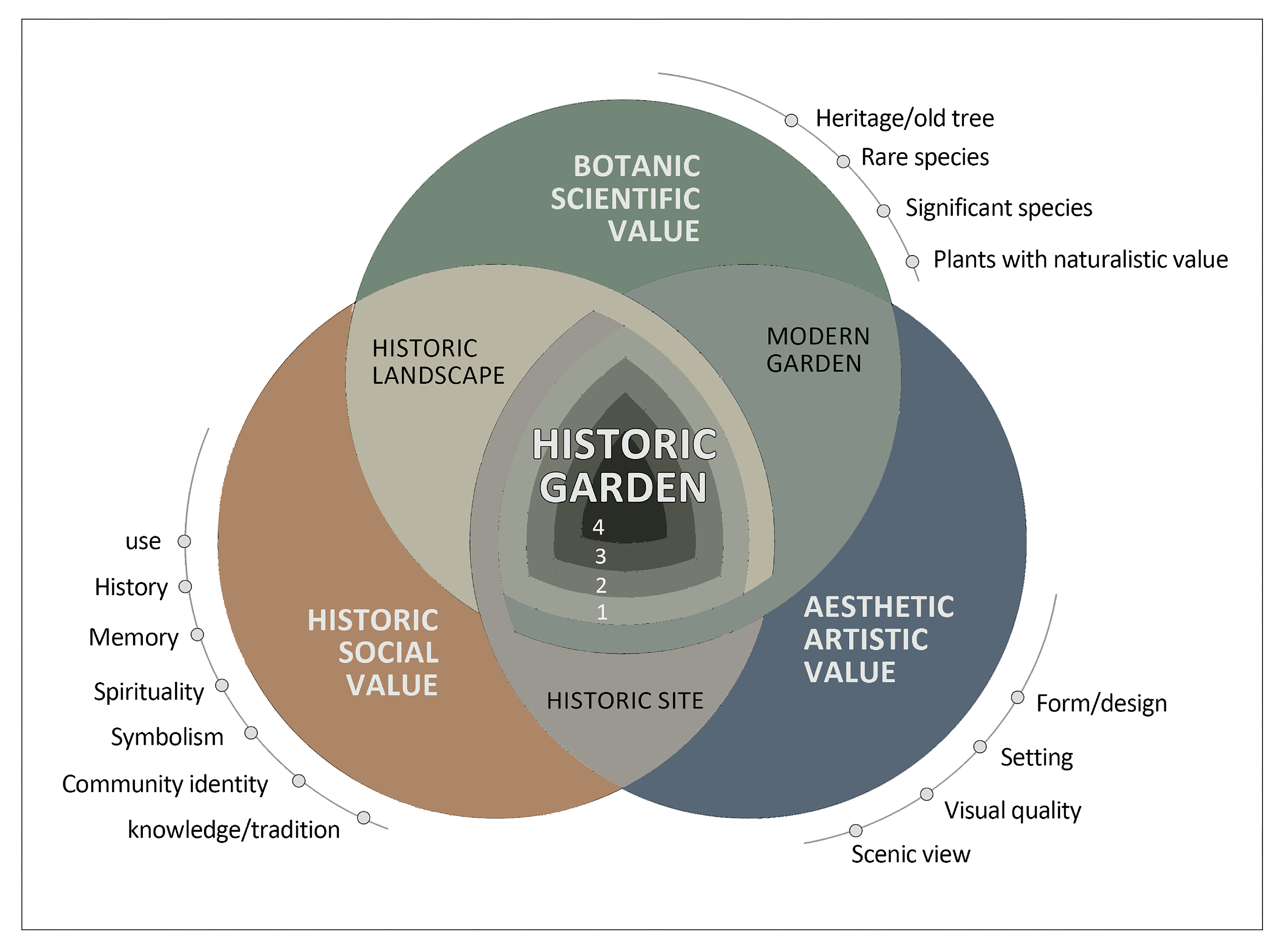
Figure 1. Graph that synthesises the three criteria of evaluation (white characters) of the historic gardens, highlighting the relations among the different parameters that are used for their identification, and that should occur together (modified from [3]). The quality for each parameter is also expressed by a numerical scale from 1 to 4 (4 = Very High; 3 = High; 2 = Medium; 1 = Low). When one of the criteria scored 0, the garden in question was not validated and was excluded.
Land 15 01802 g001
Figure 2. Identification, screening, and value characterisation of historic gardens in the Basilicata region. (a) Flowchart of the collection and validation process; (b) chord diagram of inter-source relationships: arc width proportional to the number of sites contributed by each source and self-loops representing sites documented exclusively by a single channel; (c) histogram of the scores of the detected gardens, computed as the sum of the 3 parameters (botanical-scientific, historical-social and artistic-aesthetic-architectural scores) (range 4–12), grouped into three bands: medium-low (4–6), medium-high (7–9) and high (10–12).
Land 15 01802 g002
Figure 3. Regional distribution of historical gardens (independently from their values): (a) at the municipal scale, darker green indicates higher site concentration; (b) according to the landscape systems of the region: A. Vulcanic complex of Vulture; B. Inner mountains of Apennine; C. Bradanic Hills and Terraces; D. Murgia Materan Plateau; E. Upper Agri valley; F. Clay gorges; G. Coastal Ionic Plain; H. Pollino Mountains; I. The Reliefs of the Tyrrhenian Coast (PPR Basilicata, art. 135 [41]), with Kernel density surface of gardens. (c) Regional distribution of the most relevant gardens (39 gardens selected based on value score 8–12).
Land 15 01802 g003
Figure 4. Histogram of the main typologies of gardens recognised in the Basilicata region (according to the ICCD list). The “Other” group includes typologies represented by only 1 or 2 records each (Baroque and Rococo Garden; Edible and medicinal plant garden; Botanical collection garden; Sculpture Garden; Eclectic Garden; Literary Garden; Renaissance and Mannerist Garden; Amateur Garden; Archaeological Garden; Contemporary art garden; Citrus Garden; Esoteric Garden; Funerary Garden; Medieval Garden; Romantic Garden).
Land 15 01802 g004
Figure 5. Examples of historical gardens representative of the eight main socio-cultural categories occurring in the Basilicata region (on the right) with local names and locations (municipalities): (1C) Castle-Masserie San Basilio (Pisticci); (2P) Margherita Palace (Bernalda); (3VB) Villa Nitti (Maratea); (4SR) Municipal Villa San Francesco d’Assisi (Ripacandida); (5MC) Tenuta Visconti (Marconia); (6CC) Municipal Villa di Santa Maria (Potenza); (7RC) Funeral Chapel Caivano (Picerno); (8MS) Parco della Città dell’Utopia (Campomaggiore). Their territorial distribution (on the left): the circles indicate the public properties, and the triangles the private ones; the green colour indicates the areas with public open access, and the red colour indicates the spaces with restricted access.
Land 15 01802 g005
Figure 6. (a) Quantitative occurrence of the eight socio-cultural categories of historic gardens identified in Basilicata, organised around the institutions/functions through which they were generated (note that the sequence in listing gardens is not exactly numerical, but it is associated with them). The core ring shows the total number of gardens in each category (corresponding to the second ring). The external ring shows the reasons that gave rise to their settlements. (b) Value scores of the eight categories, separately for the botanical-scientific, historical-social and artistic-aesthetic-architectural dimensions. Category codes: 1C. castles and fortifications; 2P. noble urban palaces; 3VB. noble rural villas; 4SR. religious complexes and cloisters; 5MC. Masserie and rural estates; 6CC. agronomic horti; 7RC. memorial and cemetery gardens; 8MS. Public and archaeological gardens.
Land 15 01802 g006
Figure 7. (a) Territorial distribution (see different colours and their size) of the eight categories of selected gardens (150) and (b) concentration in relation to the nine landscape units identified in the Regional Landscape Plan; (c) CA showing the relations among garden categories and landscape units. Category codes: 1C. castles and fortifications; 2P. noble urban palaces; 3VB. noble rural villas; 4SR. religious complexes and cloisters; 5MC. Masserie and rural estates; 6CC. agronomic horti; 7RC. memorial and cemetery gardens; 8MS. Public and archaeological gardens. Landscape unites code: A. Vulcanic complex of Vulture; B. Inner mountains of Apennine; C. Bradanic Hills and Terraces; D. Murgia Materan Plateau; E. Upper Agri valley; F. Clay gorges; G. Coastal Ionic Plain; H. Pollino Mountains; I. The Reliefs of the Tyrrhenian Coast.
Land 15 01802 g007
Figure 8. (a) strip plot of foundation centuries across the eight typological categories; (b) boxplots of garden surface area (m2, log scale) by typological category. Boxes show median and interquartile range; whiskers and individual points show the full distribution.
Land 15 01802 g008
Figure 9. Alluvial diagram of the joint distribution of category (left axis), primary design (centre) and primary function (right axis). Category codes: 1C, castles and fortifications; 2P, noble urban palaces; 3VB, noble rural villas; 4SR, religious complexes and cloisters; 5MC, Masserie and rural estates; 6CC, agronomic horti; 7RC, memorial and cemetery gardens; 8MS, Public and archaeological gardens.
Land 15 01802 g009
Figure 10. Multiple Correspondence Analysis (MCA) of design and function modalities; the eight typological categories are entered as supplementary qualitative variables. Coloured circles mark category centroids, surrounded by their confidence ellipses; small grey points are individual gardens. Black diamonds indicate design modalities (formal, irregular, landscape, mixed), red triangles indicate function modalities (community, spiritual, productive, ornamental).
Land 15 01802 g010
Table 1. Value-based score of historic gardens according to the three main groups of characterising parameters.
ValueA. Botanical and Scientific Values * B. Historical and Social Values C. Artistic Aesthetic and Architectural Values
4Very HighSignificant presence of rare plants or elements with naturalistic value, such as heritage trees (at least 3 species and several individuals having high naturalistic value)High significant representativeness of historical events, memories, traditions (very high values at least in one of these categories)High significant presence of artistic elements (of any age), scenic views, architectural significant elements (very high values at least in one of these categories)
3HighPresence of plants with naturalistic value (age, size, conservation interest) (at least 1–2 species and several individuals having high value)Presence of some significant element with connection with historical events, memories, traditions (high values at least in one of these categories)Significant presence of artistic elements (of any age), scenic views, architectural significant elements (high values at least in one of these categories)
2MediumPresence of plants with medium naturalistic value (age, size, conservation interest) (absence of species/individuals with high relevant values, but some of them with medium naturalistic value)Presence of some element with some connection with historical events, memories, traditions (significant but limited values at least in one of these categories)Presence of artistic elements (of any age), scenic views, architectural significant elements (significant but limited values at least in one of these categories)
1LowResidual natural value, but still present botanical elements (presence of species/individuals with low naturalistic value)Presence of few elements with some connection with historical events, memories, traditions (limited values at least in one of these categories)Residual value of artistic elements (of any age), scenic views, architectural significant elements (limited values at least in one of these categories)
0AbsentNo botanical values: the supposed garden was not includedNo historical/social values: the garden was not included No artistic/aesthetic/architectural values: the garden was not included.
* Values defined by conservation interest, rarity, vulnerability, endemism, strict linkage with specific habitat, and included in protection laws.
Table 2. The eight socio-cultural categories of historic gardens identified in the Basilicata region, organised around the socio-historical institutions and functions through which they were generated, with their code, denomination and defining characteristics.
CodeCategoryDescription
1CGardens connected to castles and/or fortified structures.Gardens, even recently created, but connected to castles and fortified structures, which present a design influenced by the orography and history of the places.
2PGardens of noble/notable palaces/in urban and peri-urban contexts.Gardens, including recently created ones, but belonging to historic buildings in urban contexts, which present a design connected to the history of the places.
3VBGardens of noble/notable villas/palaces in natural and rural contexts.Gardens, including recently created ones, but belonging to historic buildings or villas in natural and rural contexts, which present a design connected to the history of the places.
4SRGardens and cloisters of religious structuresGardens, including recently created ones, but also relevant cloisters and religious structures, which present a design connected to the history of the places.
5MCGardens of Masserie (Farmhouses/Estates & Rural Cottages).Gardens, including recently created ones, but belonging to productive farms/estates or rural cottages, which feature a design connected to the history of the places.
6CCGardens linked to agronomic horti/arboretums and to peasant civilisation.Gardens—even recently created and transformed (including into municipal villas)—which have a clear relevance or evocative value to the world of agriculture and peasant civilisation.
7RCGardens of memory of the fallen (remembrance and tragedies) & cemetery gardens or funeral chapels.Gardens that trace their origins to tragic historical events and cemetery settings, some of which have recently been transformed into municipal villas.
8MSPublic gardens and archaeological areas evocative of historical memory, modern and contemporary gardens, but linked to artistic projects, inspired by history and nature.Gardens that design the archaeological landscape and present a design approach connected to the historical value of the places. Recently created and artistic gardens inspired by the historical and natural value of the places.
Table 3. Ownership and public accessibility of the gardens by socio-cultural category.
TypologyPublic and ReligiousPrivate
Regular OpeningRestricted AccessRegular OpeningRestricted Access
1C4118
2P71321
3VB1115
4SR (relig.)191102
5MC00824
6CC6002
7RC9001
8MS10112
Total56151465
Disclaimer/Publisher’s Note: The statements, opinions and data contained in all publications are solely those of the individual author(s) and contributor(s) and not of MDPI and/or the editor(s). MDPI and/or the editor(s) disclaim responsibility for any injury to people or property resulting from any ideas, methods, instructions or products referred to in the content.