Article

Multi-Decadal Vegetation Phenology Dynamics in China’s Arid Northwest: Unraveling Climate–Terrain Interactions via PLS-SEM


1
Hebei Province Collaborative Innovation Center for Sustainable Utilization of Water Resources and Optimization of Industrial Structure, Hebei GEO University, Shijiazhuang 050031, China
2
Hebei Province Key Laboratory of Sustained Utilization & Development of Water Resources, Shijiazhuang 050031, China
3
Hebei Center for Ecological and Environmental Geology Research, Hebei GEO University, Shijiazhuang 050031, China
4
Hebei International Joint Research Center for Remote Sensing of Agricultural Drought Monitoring, School of Land Science and Space Planning, Hebei GEO University, Shijiazhuang 050031, China
*
Authors to whom correspondence should be addressed.
Land 2026, 15(1), 61; https://doi.org/10.3390/land15010061 (registering DOI)
Submission received: 2 November 2025 / Revised: 21 December 2025 / Accepted: 22 December 2025 / Published: 29 December 2025

Abstract

The dry area in northwest China (ARNC), with its tough climate, serious soil erosion, and poor soil quality, is one of China’s most fragile ecosystems. Studying changes in plant growth cycles here is very important for improving environmental monitoring and making plans to adapt to climate change. While vegetation growing season parameters (Start/End of Season: SOS/EOS) serve as vital indicators of ecosystem dynamics, comprehensive understanding has been constrained by limited long-term phenological datasets and insufficient exploration of multi-factor interactions. This study used PLS-SEM to analyze 27-year (1990–2016) vegetation index data, systematically quantifying spatiotemporal variations in growing season phenology and disentangling climate–terrain driving mechanisms. The results revealed the following key findings. (1) Spatial heterogeneity in phenological patterns, with the annual average Start of Season (SOS) and End of Season (EOS) being 114.7 Day and 301.7 Day, respectively, exhibiting a northwest–high to southeast–low gradient. The findings indicate a prolongation of the vegetation growing season, with significant spatial variability. (2) Interannual fluctuations showed the SOS and EOS coefficient of variation (CV) values of 0.230 and 0.234, respectively, with southeastern regions displaying higher instability than northwestern counterparts. (3) The spatial variation in SOS/EOS is primarily influenced by meteorological and geographical factors, with an explanatory power exceeding 30%. This research advances mechanistic understandings of arid ecosystem responses to environmental stressors, providing a scientific foundation for targeted ecological restoration, desertification mitigation, and sustainable land management in climate-sensitive drylands.

1. Introduction

Phenological variation refers to the periodic life events during plant growth and development, such as flowering and leaf senescence [1]. It has been demonstrated that phenological changes can directly reflect climate change and the adaptation of plants to alterations in the natural environment [2,3,4]. In the northwest region, where the climate system is fragile and the ecosystem is undergoing degradation [5], the sensitivity of plant phenology is of particular importance [6,7]. Understanding phenological responses can help analyze dynamic changes in the climate system and natural environment of the northwest, promoting the overall improvement and sustainable development of the ecosystem. Also, it is very important for the region’s economic and social development.
Phenological data can be obtained through traditional field measurements or by estimating from remote sensing data. Field-based measurements primarily rely on visual observation. However, aside from its high cost and the discrepancies between different observers and observed subjects, this method also suffers from significant temporal and spatial constraints, making it difficult to achieve consistent observational criteria across larger spatial and temporal scales [7,8,9]. On the other hand, using remote sensing data has some benefits like fast data collection, wide coverage over space and time, and high accuracy [10,11,12,13]. The plant growth data come from the NDVI time series, and they are smoothed using the Savitzky–Golay (S-G) filter. The Start of Season (SOS) is when NDVI reaches a certain part of the yearly range, and the End of Season (EOS) is when NDVI drops to a certain part of the yearly range [14,15]. SOS indicates the point at which vegetation begins its phase of rapid growth., while EOS decides how long the growing season lasts, which then affects net primary productivity [16]. This shows that SOS and EOS are important for understanding plant growth and they control ecosystem productivity by changing how long the growing season is [17].
Central Asia is located in the vast area of Eurasia, with a vast territory and harsh natural environment. The vegetation in ARNC is mainly grassland, which is sparse and has a low recovery ability. Once damaged, it is difficult to recover [18]. This area is very sensitive to changes in climate and desertification [19].
Over the past few decades, numerous studies have been conducted on plant phenology in northwest China. Using various datasets, ref. [20] examined changes in vegetation phenology in the Northwest Territories from 1982 to 2015. They found that the growing season for plants has become longer in places like Xinjiang, with spring starting earlier and autumn ending a little later, but the delay in autumn is smaller than the advancement of spring. The study also noted a downward trend in the vegetation phenological response to temperature rise, meaning that as temperatures increase, the advance in spring phenology decreases. Various methods have been discussed to study the types and scales of vegetation phenology, though no long-term community-scale research method has been established. Using GIMMS/NDVI data, ref. [21] studied how vegetation coverage related to climate from 1982 to 2006. They found that NDVI in northwest China generally increased, and vegetation coverage had a weak positive link with yearly temperature and rainfall. However, there was a clear connection with annual temperature and precipitation, and vegetation responded with some delay to these changes.
By looking at how plant growth cycles change over time and across northwest China, and considering factors like temperature, rainfall, and altitude, previous studies have shown the patterns of these phenological changes in the region. However, most of these studies have not analyzed phenological data over an extended time series or explored it in a direct manner. Additionally, due to the interaction of various influencing factors, phenological information has not been analyzed in the context of these interactions. This study integrates a long-term time series of phenological data to elucidate the changing patterns of the plant growing season and their driving factors. It investigates the seasonal dynamics of plant growth across different periods in the arid steppe and desert regions of Central Asia. This work aims to deepen the theoretical understanding of plant phenology, thereby overcoming the limitations of previous studies, and to provide scientific support for ecological restoration and economic development in this region. The main goals of this study are as follows: (1) to look at how the plant growing season changes over time and across different areas, and (2) to find out the main factors that cause these changes in plant growth cycles. Reaching these goals can help provide a more accurate understanding of how the plant growing seasons change in the study area. At the same time, it can also give some scientific support for protecting the environment and helping the area develop in a more sustainable way.

2. Data and Methods

2.1. Study Area

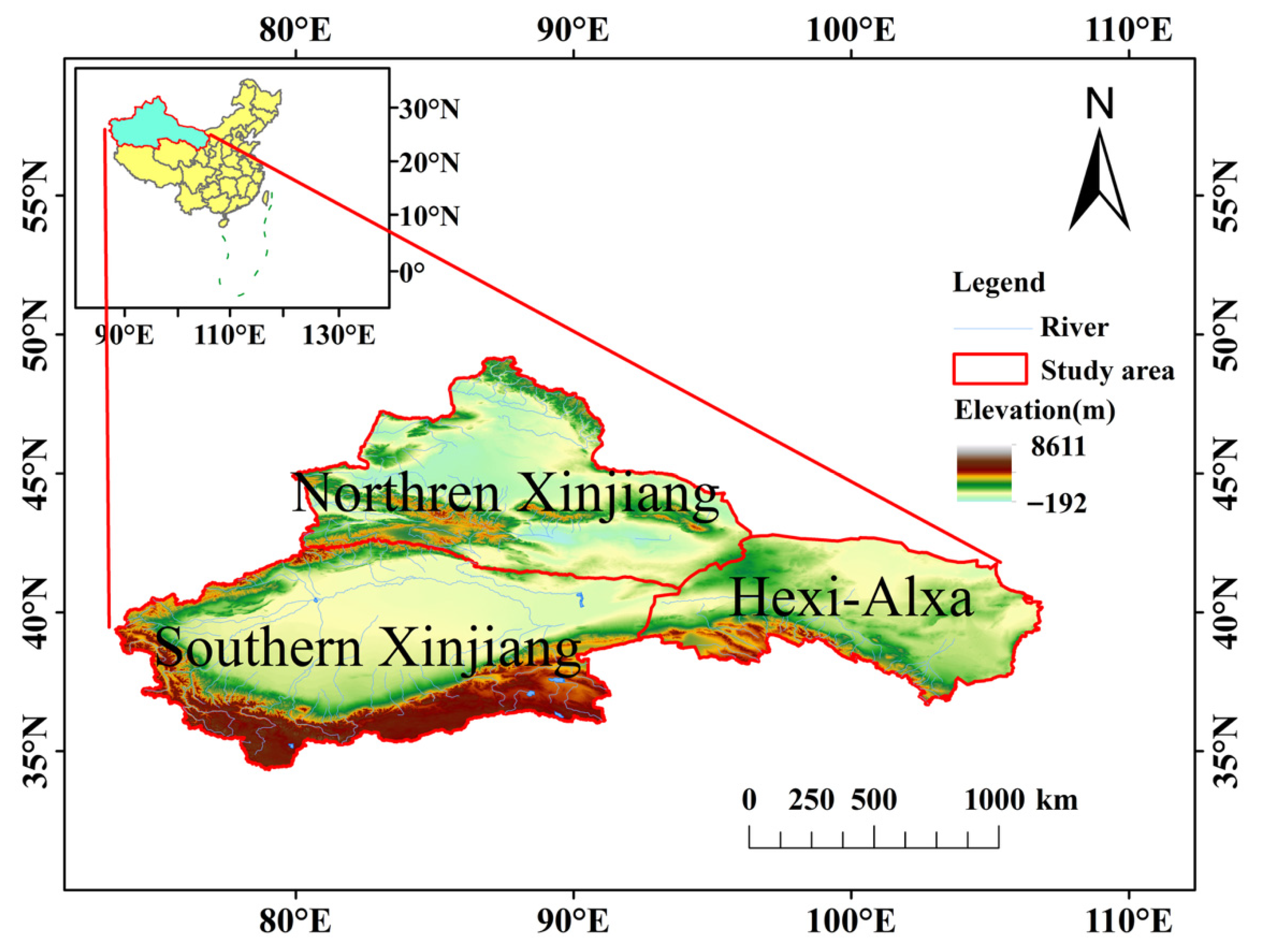
The arid region in northwest China (ARNC) is located in the middle of the Eurasian continent, between about 35° N–50° N latitude and 73° E–107° E longitude. It covers about 2.13 × 10⁶ km2. The region is not very developed socially or economically and has complicated landforms, with many deserts. Because of the mix of monsoon systems, air flows, and temperature changes from the Qinghai–Tibet Plateau, the ARNC usually has a kind of temperate continental climate [22]. The climate here has little rainfall, big differences in temperature between day and night, and high evaporation rates [23]. Because of the landforms and climate, the vegetation is thin, comprising mostly deserts and sandy areas [24]. The ecosystem is weak, very sensitive, and not good at supporting the environment, so it recovers very slowly. It is seen as one of the most climate-sensitive areas in the world [25,26]. According to the landforms and earlier studies [27], the ARNC is divided into three subregions for research: Northern Xinjiang, Southern Xinjiang, and Hexi-Alxa (Figure 1).

2.2. Data

The original data utilized in this research were sourced from publicly accessible platforms. Phenological data are from NASA EARTH DATA (URL: https://www.earthdata.nasa.gov/data/catalog/lpcloud-vipphen-ndvi-004 (accessed on 10 September 2024)). The terrain data is from the geospatial data cloud (https://www.gscloud.cn). Climate data is from Copernicus Climate Data Stroe (URL: https://cds.climate.copernicus.eu/datasets/reanalysis-era5-single-levels?tab=overview (accessed on 24 November 2024)). The drought data is from Figshare (URL: https://figshare.com/articles/dataset/CHM_Drought/25656951/2 (accessed on 9 December 2024))s. The time coverage of all data is from 1990 to 2016. Most of the data has an accuracy of 0.1° To ensure uniform accuracy, we unify the DEM data to 0.1° through bilinear interpolation (Table 1).

2.3. Methods

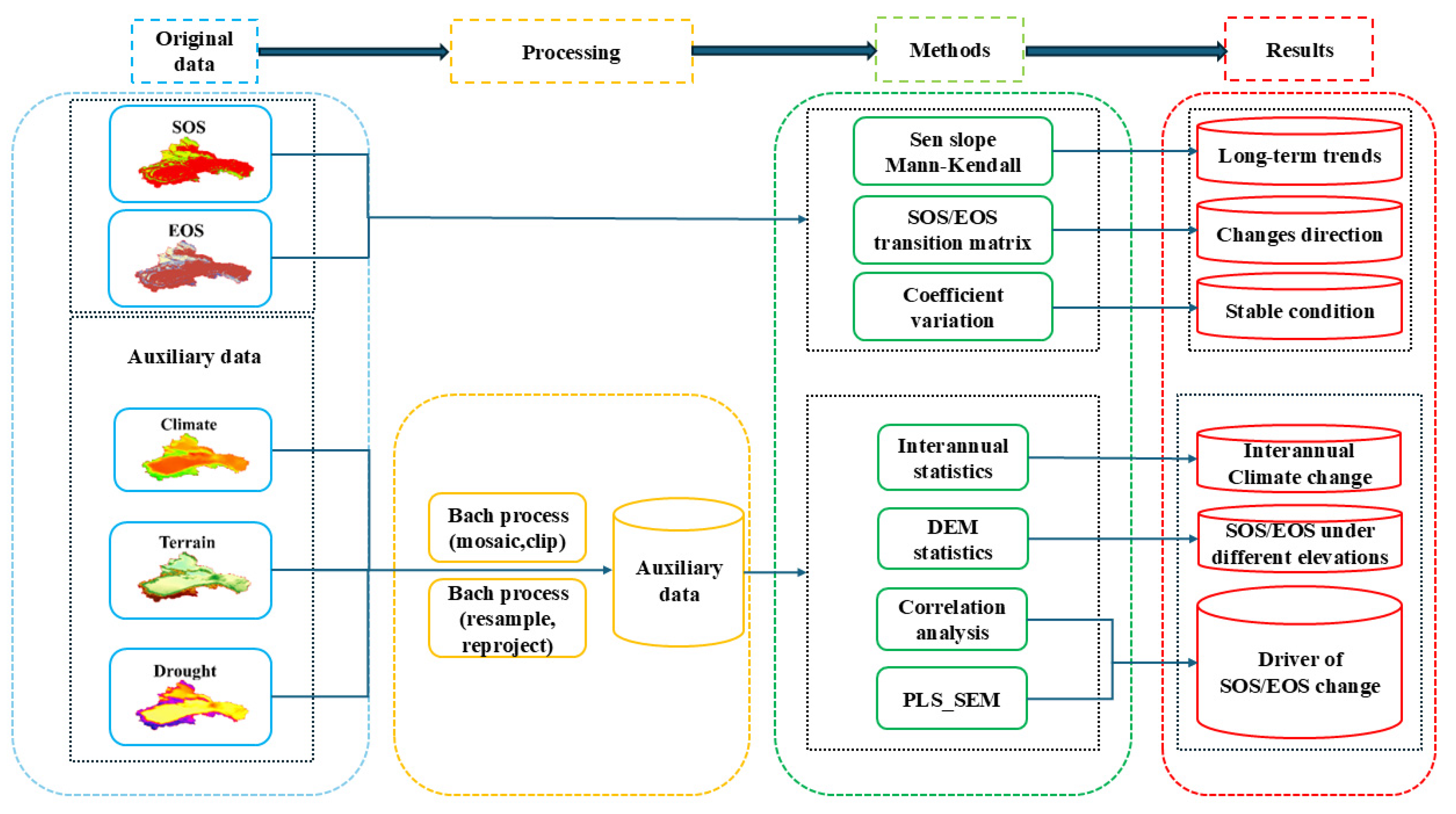
Figure 2 presents the methodology and technical procedures used in this study, which include the following: (1) obtaining SOS/EOS data from 1990 to 2016 and preparing other related data; (2) analyzing how SOS/EOS changed over time and across different areas; (3) identifying and summarizing the factors that influence SOS/EOS in the ARNC; and (4) calculating yearly statistics for SOS/EOS changes and climate variations using OriginPro 2024 (OriginLab, 2024) and R programming (version 4.3.2).

2.3.1. Trend Analysis

Sen’s slope is a common method that is often used to study trends in long-term time series data. The formula is shown below [28,29]:
β = media A j A i j i
In this context, where 1 < i < j < n, β denotes the Sen’s slope of SOS/EOS. When β > 0, it indicates an increasing trend in the change in SOS/EOS, while β < 0 signifies a decreasing trend. Here, i represents the year, and n refers to the total duration of the study.
S = i = 1 n 1 j = i + 1 n sgn ( A j A i )
sgn ( FVC j FVC i ) = 1 , A j A i > 0 0 , A j A i = 0 1 , A j A i < 0
where 1 < i < j < n, and S is the test statistic. When n is more than ten, the test statistic S is changed into a standard normal test statistic Z, which shows the significance level. The calculation formula is as follows:
Var ( S ) = n ( n 1 ) ( 2 n + 5 ) 18
Z = S 1 Var ( S ) , S > 0 0 , S = 0 S + 1 Var ( S ) , S < 0
Here, n represents the duration of the study period.

2.3.2. Coefficient of Variation

The coefficient of variation (CV) is often used to show how much change there is in long-term time series data. It can help us see how stable or different the natural environment is in the study area. In this study, CV was used to check how stable SOS and EOS are in the ARNC, as shown below:
CV = i = 1 n ( A i avg ( A ) ) 2 n 1 avg ( A )
Here, CV represents the coefficient of variation for SOS/EOS. n denotes the duration of the study, while avg(SOS/EOS) refers to the average value of SOS/EOS. iii represents the year.

2.3.3. Correlation Analysis

We have employed Pearson correlation coefficient test to perform the correlation analysis. It indicates the linear association between two variables and shows how strong and in which direction the association is. The formula is as follows:
r x y = ( x x ¯ ) × ( y y ¯ ) ( x x ¯ ) 2 × ( y y ¯ ) 2
Here, rxy indicates the correlation between, xxx indicates the SOS/EOS factor, x ¯ indicates the mean of xxx, y ¯ indicates the mean SOS/EOS throughout the growing period, and y indicates the mean of y.

2.3.4. Partial Least Squares Structural Equation Model (PLS-SEM)

The structural equation model (SEM) is a multivariate analytical method employed to identify causal relationships from correlations. It comprises multiple structural equations and has gained widespread recognition in ecological applications since 2000 [30]. This approach is capable of constructing and testing complex multi-factor path models. It is well-suited for handling non-linear relationships and multicollinearity, while also exhibiting high compatibility with remote sensing data [31,32,33]. The statistical and numerical characteristics of partial least squares structural equation modelling (PLS-SEM) demonstrate its global optimization criteria and convergence properties, which enhance the stability and reliability of the model estimation. Moreover, it is particularly well-suited for handling ecological remote sensing data that are non-normally distributed and contain substantial noise [34]. Additionally, PLS-SEM facilitates the generation of prediction results while accounting for the influence of variables [35].

3. Results

3.1. Temporal and Spatial Variation Characteristics of SOS/EOS

3.1.1. Temporal Variation Characteristics of SOS/EOS

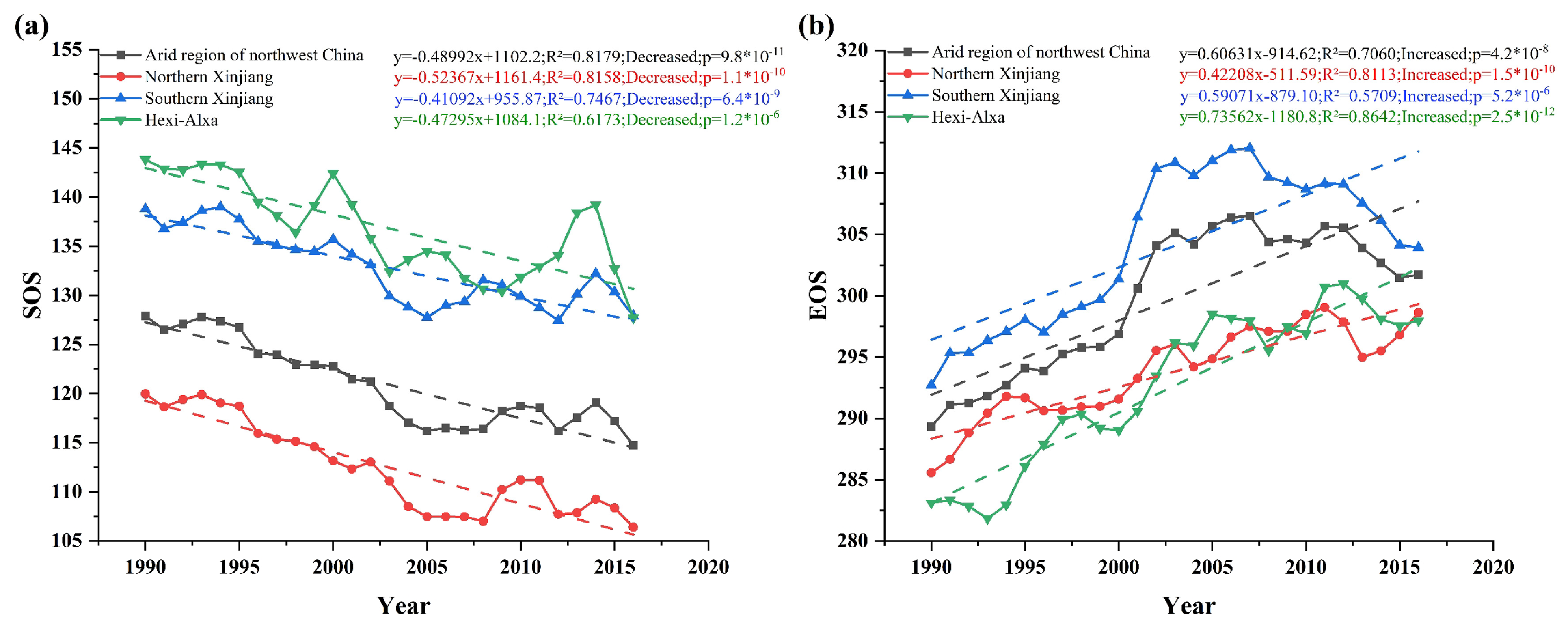
To see how plant growth changed in the ARNC from 1990 to 2016, we used the average SOS and EOS to show when the growing season started and ended. We made plots of the changes in average SOS and EOS from 1990 to 2000, and similar graphs were made for the three subregions (Figure 3).
The average SOS in the ARNC was 114.7, and the Mann–Kendall (MK) trend analysis showed a very obvious increasing trend during the study period (P = 9.8 × 10⁻¹¹). The biggest decrease in SOS happened from 2015 to 2016, and the yearly increase rate was 0.021 Day/year. SOS values were also quite different between Northern Xinjiang and the other two subregions. The average SOS values for Northern Xinjiang, Southern Xinjiang, and Hexi-Alxa were 106.407 Day, 127.916 Day, and 127.727 Day, respectively. The Mann–Kendall test confirmed that all three subregions showed a significant downward trend in SOS.
For EOS, the average value for the ARNC was 301.7. The MK trend analysis indicated a significant increasing trend throughout the study period (P = 2.0 × 10⁻¹²). The biggest rise in EOS happened from 2015 to 2016, and the yearly growth rate was 0.013. There were significant differences in EOS values between Southern Xinjiang and the other two subregions. The average EOS values were 172.908 for Northern Xinjiang, 59.722 for Southern Xinjiang, and 54.740 for Hexi-Alxa. The Mann–Kendall test showed that EOS went up clearly in all three subregions.

3.1.2. Spatial Variation Characteristics of SOS/EOS

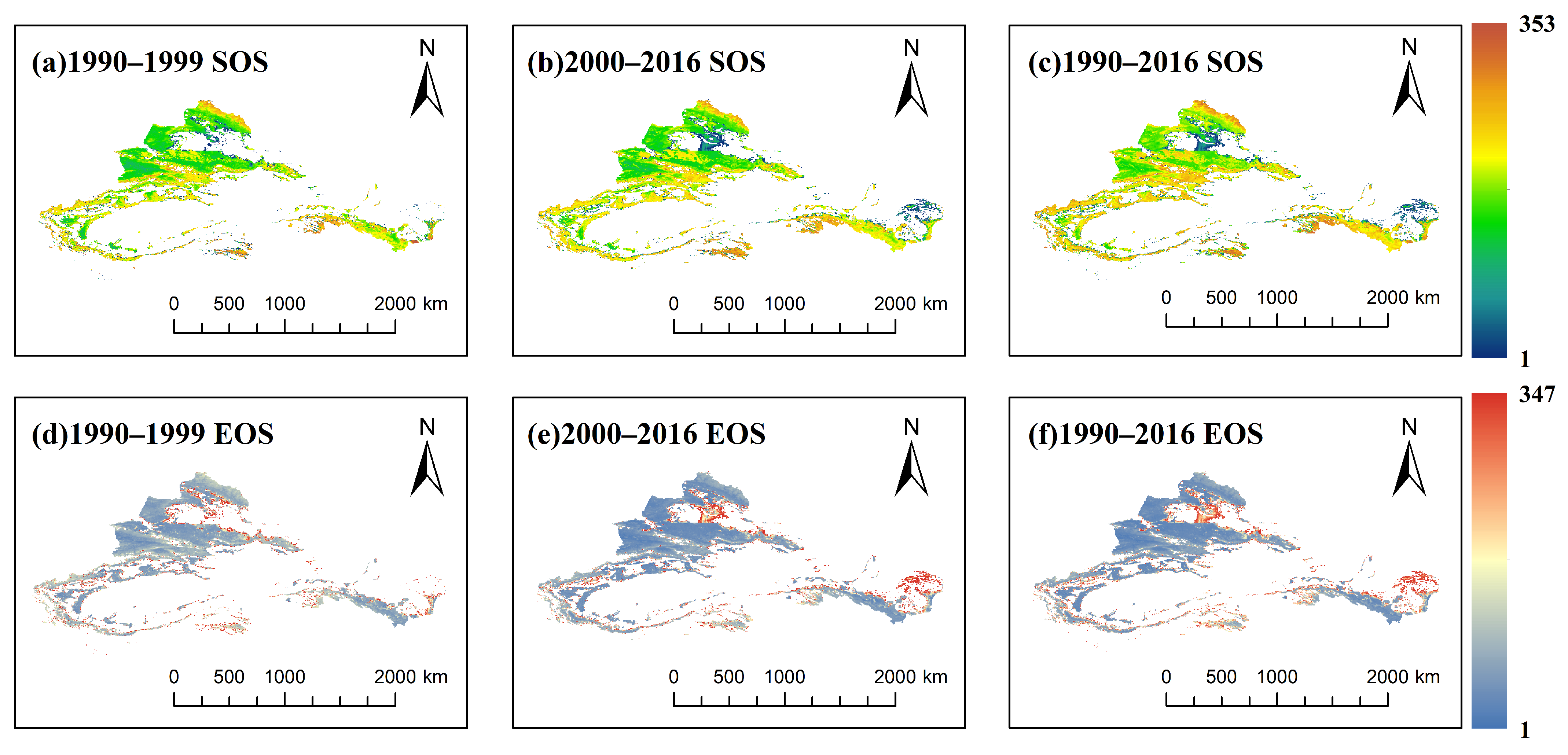
Based on the phenological data in the ARNC, spatial distribution maps of the average plant growing season for the periods 1990–1999 and 2000–2016 were generated (Figure 4). The results revealed that the plant growing season exhibited a distinct spatial pattern, with a longer growing season in the northwest region, a shorter growing season in the central region, and the lowest values in the eastern region. Significant spatial differences were observed, with the areas with negative and low values being larger than those with higher values. This growth period was notably prolonged in the Tianshan, the south slopes of Altai, and in the Qilian Mountains.

3.2. Trend of SOS/EOS Change

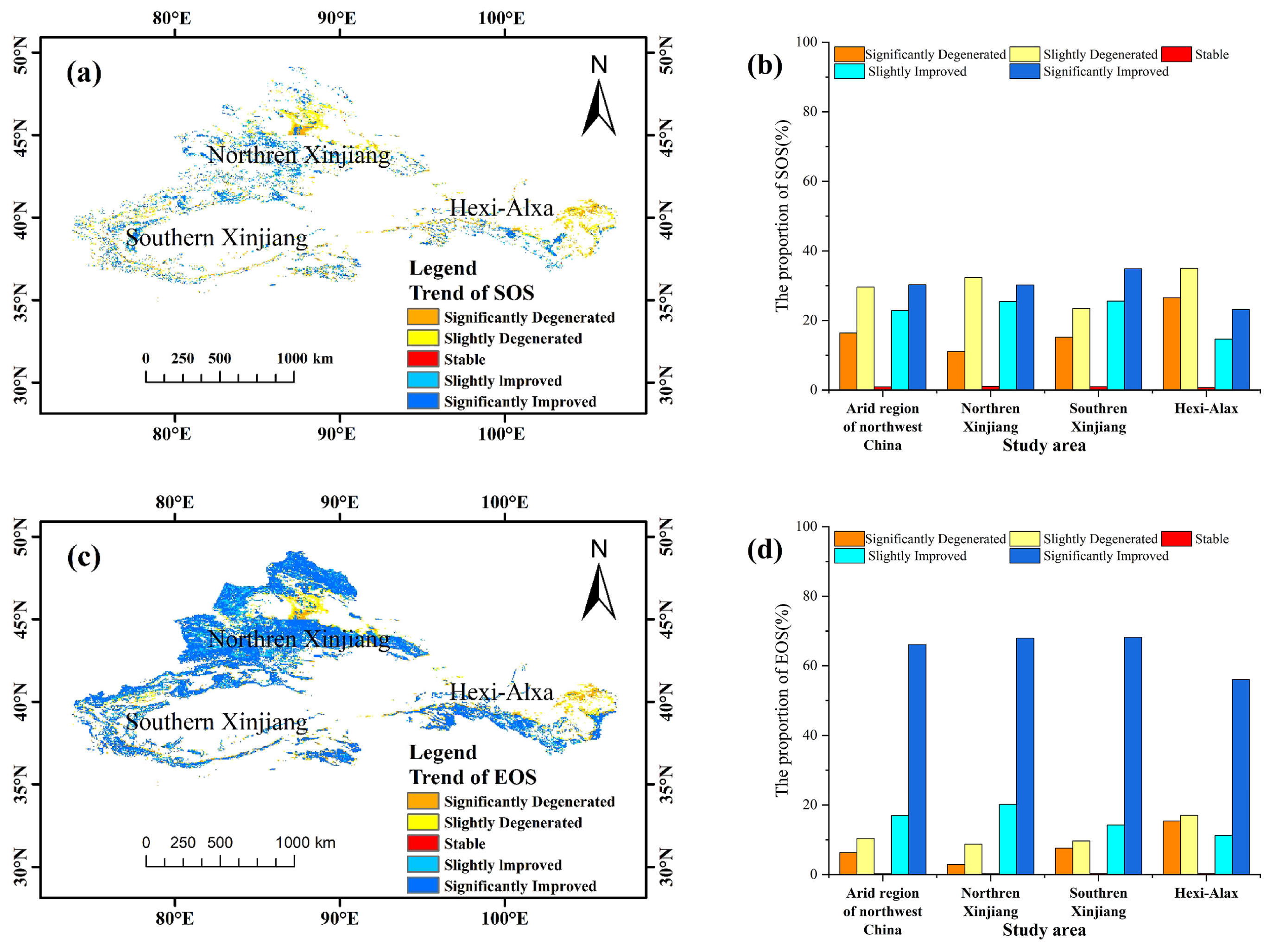
To examine the SOS and EOS transitions further, we also employed Sen’s slope estimator and the Mann–Kendall test each for every pixel to examine the trends. Following earlier studies [28,29], we divided the SOS/EOS change trends (Table 2) to see how they were distributed in space. We also calculated and made maps to show areas with different SOS/EOS change trends in each subregion (Figure 5).
The results showed that SOS trends were quite different in space. About 1,132,358.35 km2, or 53.09% of the total area, had earlier SOS. This tendency was very pronounced for the south slopes of the Altai Mountains, for the majority of the Tianshan Mountains, and the Qilian Mountains, and especially for their basins in the region near the Ili and Manas rivers. These areas have plenty of water and high evapotranspiration, which helps plants to grow better. On the other hand, the area showing a decrease in SOS progression covers 980,776.80 km2, or 46.98% of the ARNC. This decline is most noticeable in the Junggar Basin and in northwestern Gansu, where desert and sandy terrain predominate, creating an environment that hinders vegetation growth. Moreover, a relatively stable SOS area spans 19,738.18 km2, accounting for 0.93% of the ARNC.
On the other hand, the EOS change trend also shows obvious differences across space, similar to the pattern of SOS. The area where EOS improved is 17,700,659.69 km2, making up 83.02% of the total area. This rise mainly takes place along the south slopes of the Altai Range, along most of the Tianshan Range, and along the area of the Qilian Range. In contrast, the area where EOS decreased is 355,918.12 km2, or 16.69% of the ARNC. This decline is mostly seen in the Junggar Basin and in northwestern Gansu, where the land is mainly comprises desert and sand. Additionally, the relatively stable area of EOS extends over 6295.55 km2, accounting for 0.30% of the ARNC.

3.3. Stability Analysis of SOS/EOS

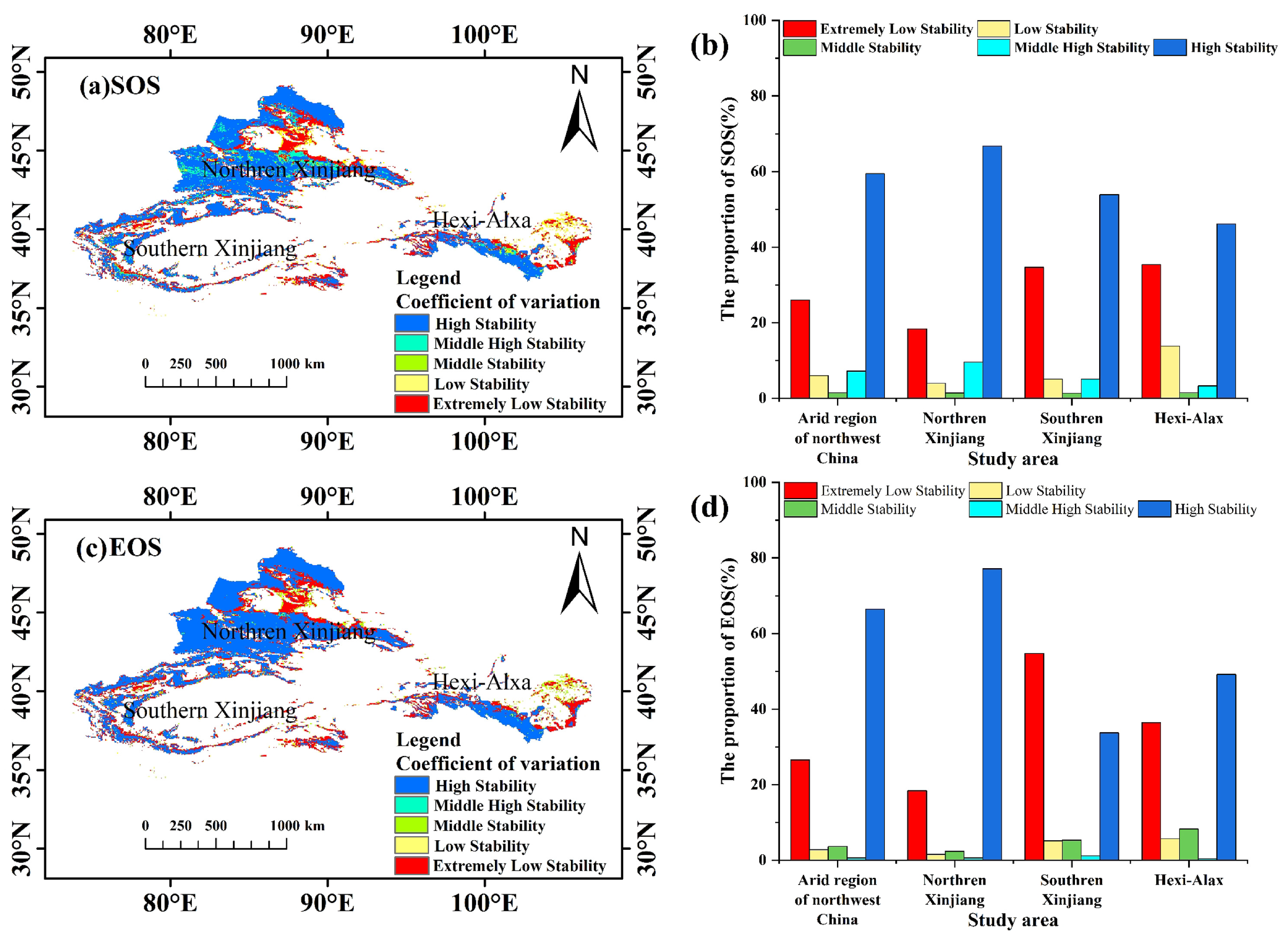
The coefficient of variation (CV) shows how much SOS/EOS changes over time. Higher CV means more change and a weaker ecosystem, while lower CV means less change and a stronger ecosystem. The rules for CV classes are shown in Table 3. Using yearly SOS/EOS data for the ARNC from 2000 to 2020, we calculated the CV and looked at how stable areas were spread out and at their proportions (Figure 6).
The results show that the average coefficient of variation for EOS in the ARNC is −0.467, which means there is only a small amount of fluctuation. Overall, stronger variations appear in the northwest and southeast. The pattern of the vegetation growing season looks similar to the CV pattern, which suggests that areas with bigger changes in the growing season usually have lower stability. Areas with high, medium, and low stability are mostly in the Qaidam Basin and the Qilian Mountains, covering 624,714.98 km2. They are predominantly desert and sandy regions, with weak plant growth, limited vegetation coverage, and stable natural environments. On the other hand, highly unstable and unstable areas are predominantly located in the Tianshan Mountains, Altai Mountains, southwestern Xinjiang, and most of northwestern Gansu, spanning an area of 1,430,187.16 km2, where the natural environment is more favorable. The stable area measures 77,971.27 km2.
The average coefficient of variation for SOS is −0.414, which suggests minimal volatility. Overall, the map shows that changes are smaller in the northwest and bigger in the southeast. The distribution of the vegetation growing season closely aligns with the CV distribution, with the general pattern reflecting that of EOS. However, the area of medium-to-high stability has nearly entirely shifted to a high stability zone.

3.4. Analysis of Influencing Factors of SOS/EOS

3.4.1. Interannual Climate Change

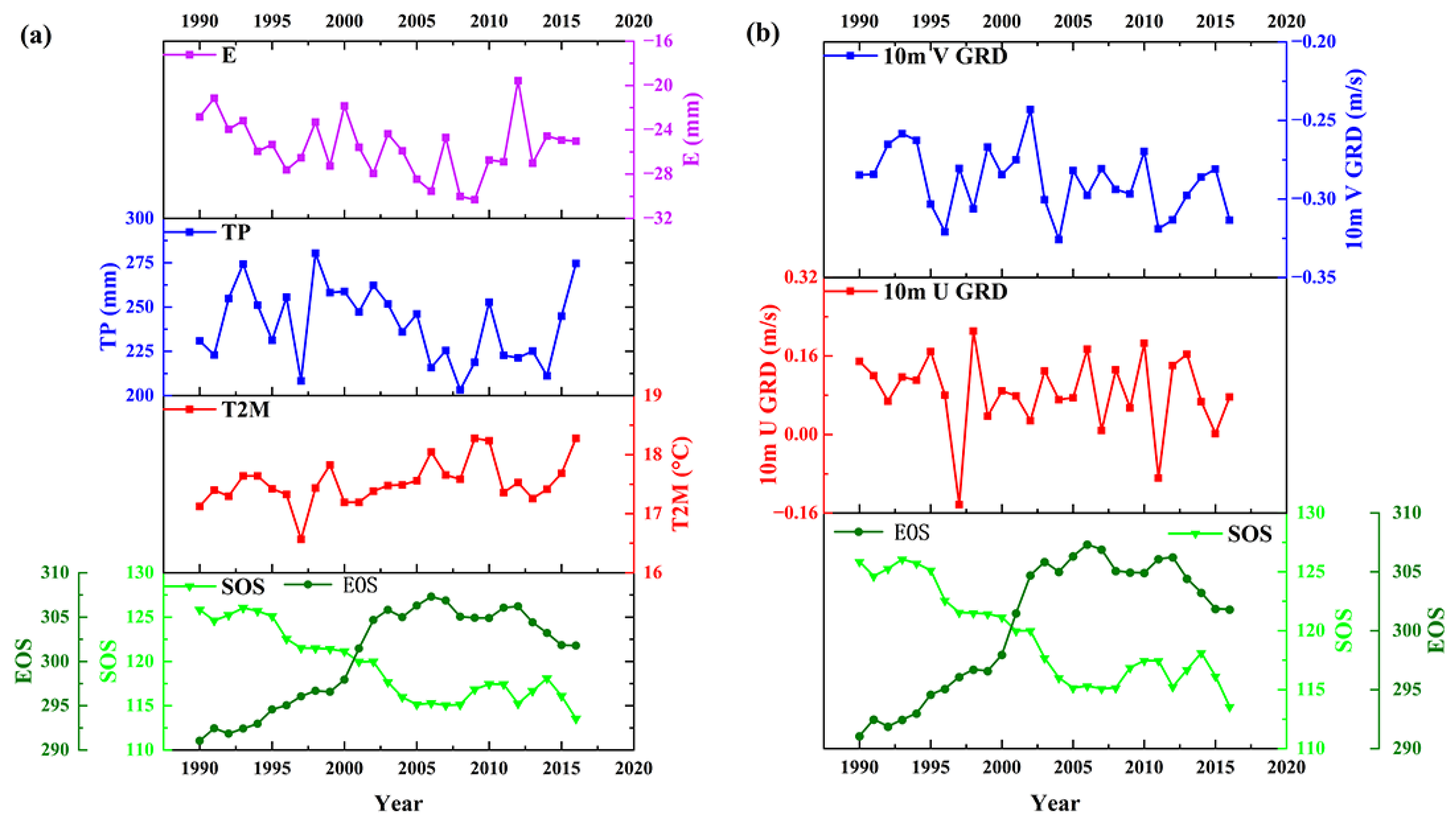
Figure 7 illustrates the mean variations in plant evapotranspiration, rainfall, temperature, and wind speed across the ARNC between 1990 and 2016. Generally, precipitation and plant evapotranspiration showed opposing trends, with average changes of 240.22 mm and −25.57 mm, respectively. Between 2015 and 2016, the EOS increased noticeably at a rate of 0.013 per year. During this time, the average precipitation increased a little from 290.84 mm to 291.43 mm, and plant evapotranspiration changed slightly from −24.93 mm to −25.02 mm. The most significant difference between precipitation and plant evapotranspiration occurred during this time, ensuring an adequate water supply for vegetation. This caused both the start and end of the growing season to be later, which made the plant growth period longer.
The annual variation trend of the difference between plant evapotranspiration and precipitation generally aligned with the variation trend of vegetation phenology. A positive difference between precipitation and plant evapotranspiration is typically associated with an extended vegetation growing season, while a smaller difference is linked to a shortened growing season. The changing trend of wind speed was also related to vegetation phenology, with its primary feature being that high wind speeds negatively impacted vegetation phenology. When wind speeds are elevated, they inhibit plant transpiration, thereby affecting vegetation development.

3.4.2. The Variation in SOS/EOS Under Different Elevations

Terrain features have a big impact on plant growth, and altitude is especially important. As elevation goes up, the air becomes colder, which makes water vapor turn into clouds and increases rainfall. At the same time, as air pressure goes down, the air becomes thinner, and sunlight becomes stronger. These changes related to altitude strongly affect plant health and metabolism. Since the ARNC has very different elevations, ranging from −162 m to 8611 m, these factors need to be considered when studying the spatial patterns and trends of plant phenology.
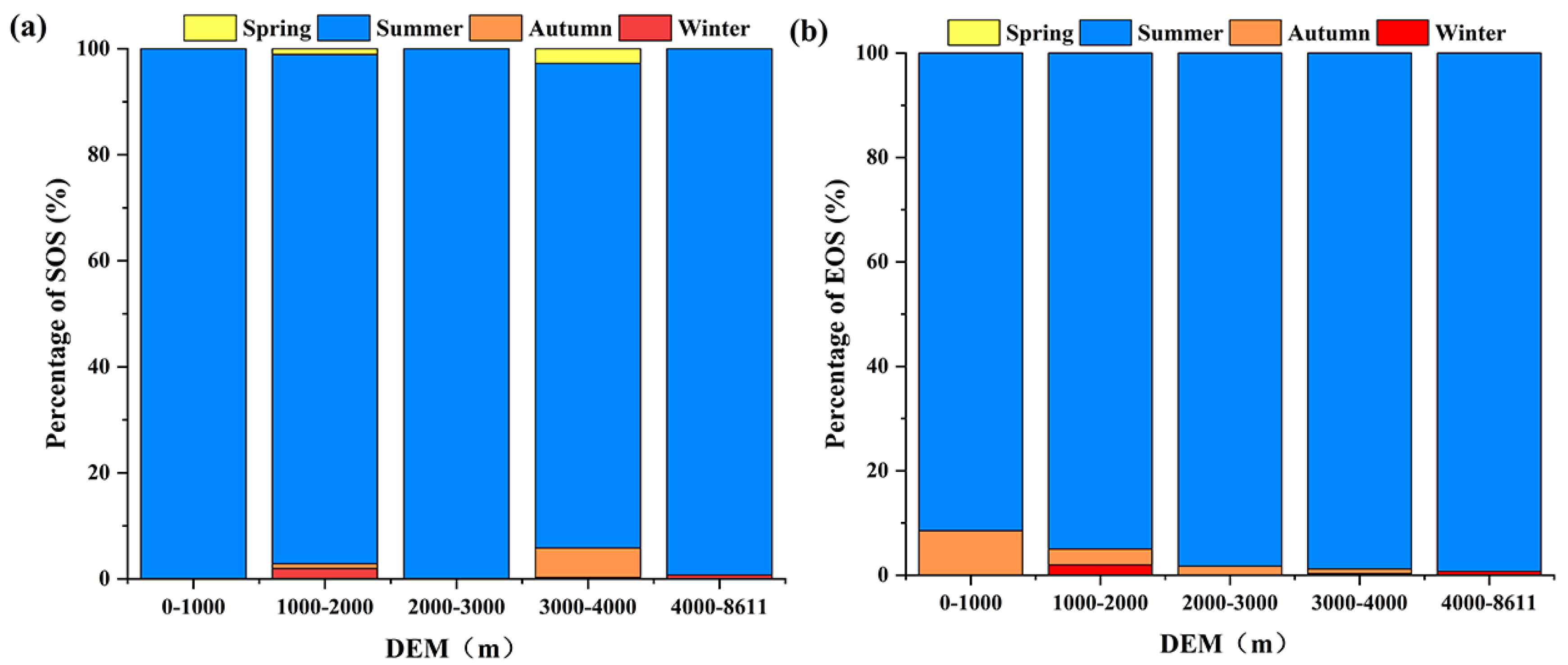
To facilitate the analysis of plant growth season changes at different elevations, this study categorized SOS and EOS into four seasonal ranges. The distribution ratio of SOS/EOS under varying elevation conditions was plotted (Figure 8). The findings showed notable variations in terms of the proportion of phenological data across different elevations. In regions like the Turpan Basin, Junggar Basin, and Badain Jaran Desert, situated below 2000 m above sea level, EOS predominantly occurs during the summer, with some occurrences in autumn and winter. At higher elevations, EOS is almost exclusively observed in the summer. Similarly, SOS is mainly observed in the summer across the entire region. Notably, SOS values are lower near the Qilian Mountains and Altun Mountains at altitudes of 1000–2000 m, as well as at altitudes of 3000–4000 m.

3.4.3. Correlation Analysis of Drought Index

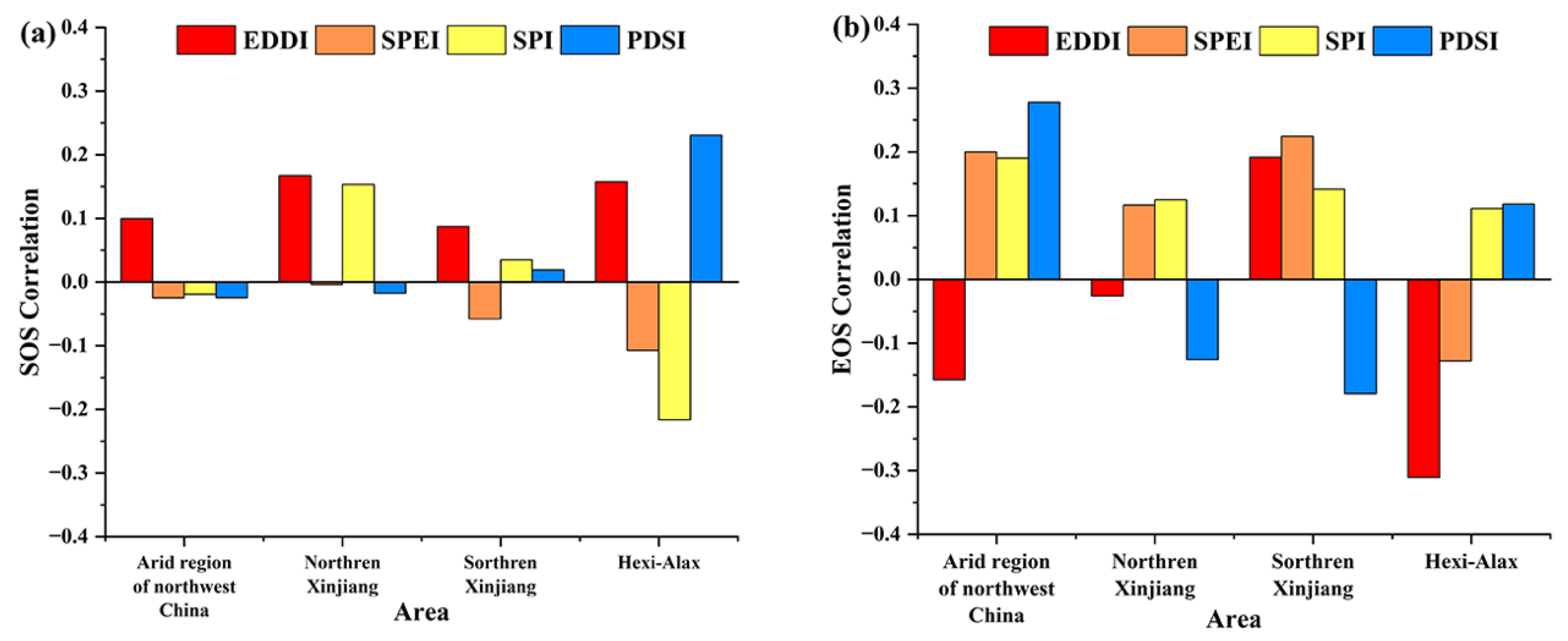
Drought is a very serious and complicated natural disaster, mostly caused by not enough rainfall and too much evaporation occurring, especially in semi-arid and dry areas [36]. Drought alters the water use characteristics of vegetation, accelerates plant aging, promotes early leaf shedding, and leads to an earlier onset of the deciduous period, ultimately shortening the growing season [17]. In the North Atlantic tropical rainforest, the climate is characterized by persistent drought, low rainfall, and high evaporation throughout the year. The drought index serves as a comprehensive analytical tool that integrates various meteorological factors such as precipitation and evaporation and phenological trends in the study area. The correlation between four average drought indices and phenology from 1990 to 2016 was analyzed and visualized (Figure 9).
Regarding the SOS in the ARNC, the EDDI exhibited the highest correlation (r = 0.10), with a mean value of −0.34 indicating moderate drought conditions. The correlations with the remaining three indices were weaker and relatively balanced. For the EOS, the drought indices showed more balanced correlations overall, with the PDSI demonstrating the strongest association (r = 0.28). Among the three subregions, both the EOS and SOS in the Hexi-Alxa region responded more markedly to the drought indices. In contrast, southern and northern Xinjiang showed a relatively lower sensitivity to the different drought indices.

3.4.4. Analysis of the Changing Driving Force of SOS/EOS

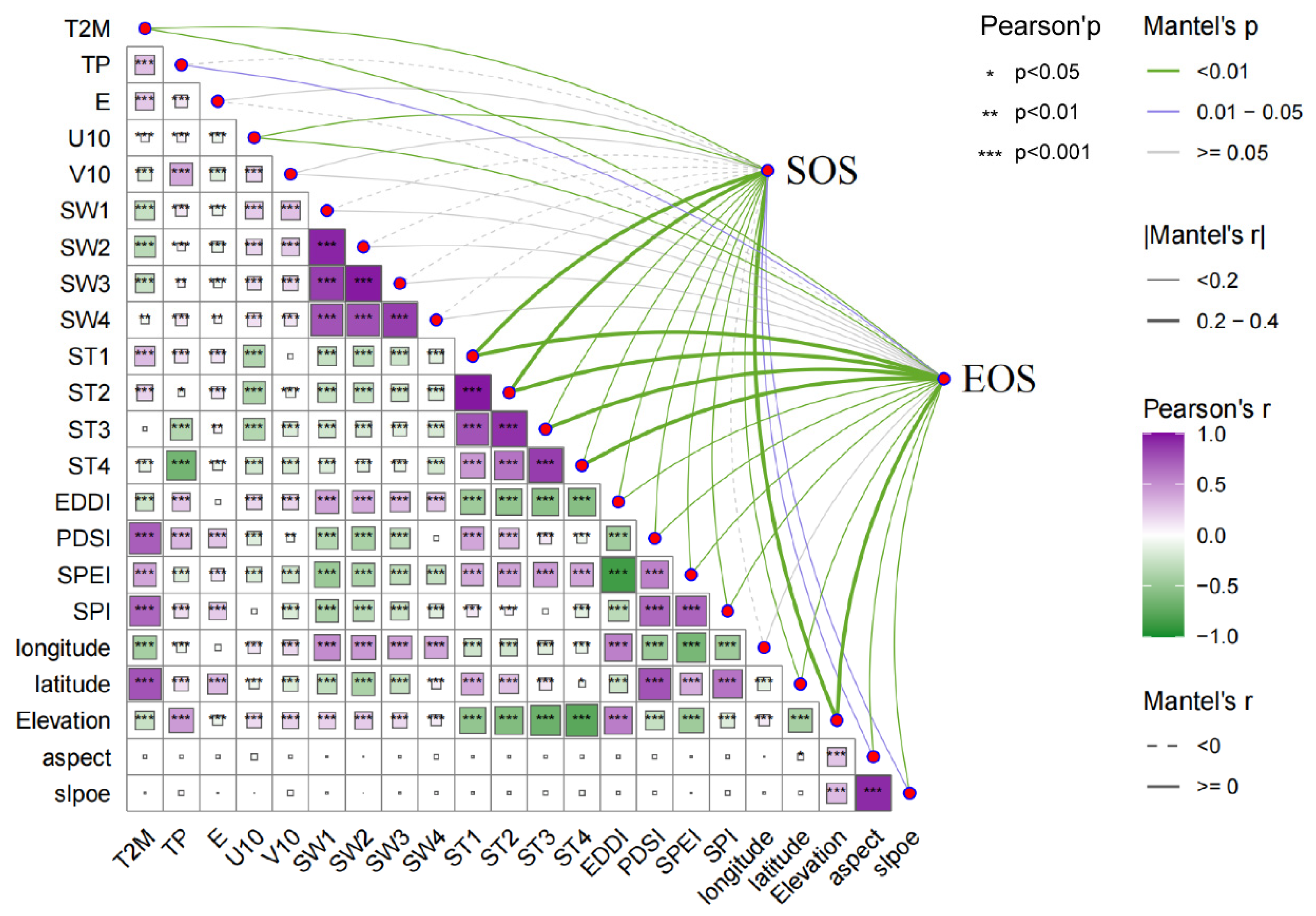
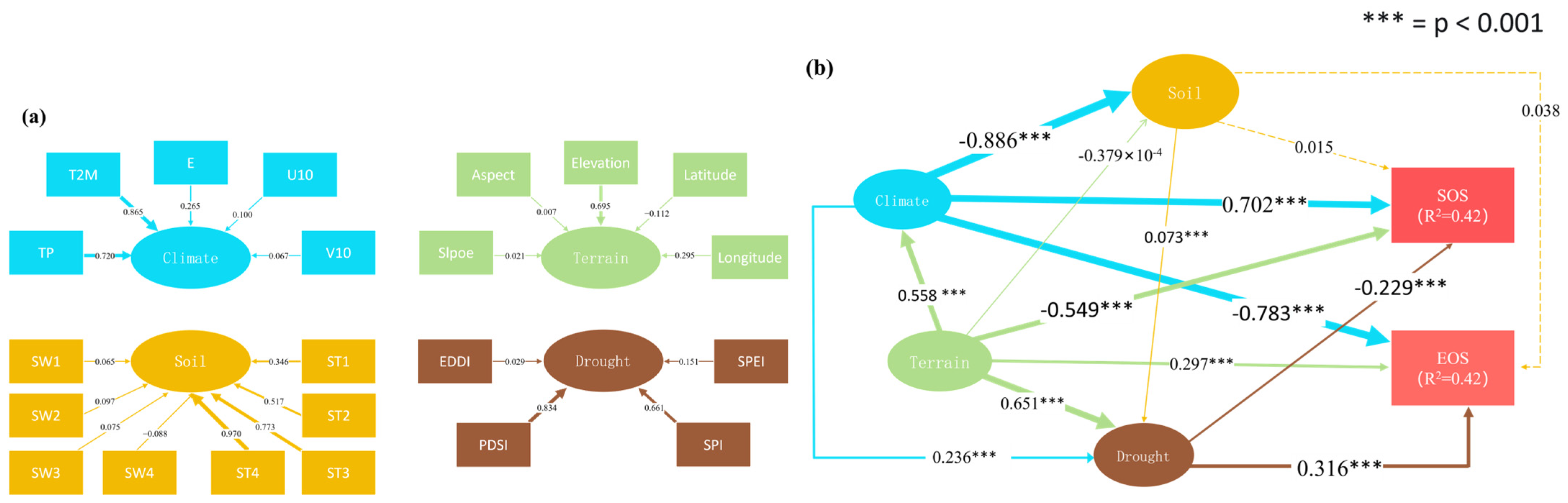
To study how different factors affect the spatial patterns of SOS/EOS, this study looked at ten driving factors. To measure how things like climate, geography, soil, and drought influence the plant growing season, we used correlation analysis (Figure 10) and Partial Least Squares Path Modeling (PLS-PM). The goodness of fit for the constructed PLS-PM model was found to be greater than 0.3 (COF = 0.34), suggesting that the model provides a reasonable explanatory framework. The direct and indirect influence pathways, along with the contribution coefficients of each factor on SOS/EOS, are depicted in Figure 11.
The results indicated that, with the exception of soil, all other latent variables had a significant direct impact on the plant growing season; however, they could also indirectly influence the plant growing season by affecting drought conditions. Among these factors, meteorological variables had the largest path coefficients for plant growth. Specifically, the path coefficients of weather factors for SOS and EOS were 0.702 and −0.783, showing that they have a main role in the changes in the plant growing season over time. Within the meteorological factors, temperature and precipitation were identified as the most influential. Furthermore, Mantel’s analysis revealed that deep soil conditions and drought conditions explained the variability in the plant growing season quite well.

4. Discussion

4.1. Spatiotemporal Distribution Features of SOS/EOS

From 1990 to 2016, the average annual SOS displayed a fluctuating decline, while EOS showed a fluctuating increase, both demonstrating considerable spatial variability. Regions with dense vegetation were mainly located along the southern slopes of the Altai Mountains and across the Tianshan Mountains. The difference between high and low coverage areas is mainly due to drought, serious desertification, low rainfall, and the fact that deserts and sandy land dominate the landscape. This observation is consistent with previous studies [23,26]. Marked differences were found in the average plant growing seasons across various regions. Among the three subregions, Northern Xinjiang had the longest growing season, with the lowest and highest average SOS and EOS values of 303.94 and 106.41, respectively. This is primarily due to increases in temperature and precipitation in Northern Xinjiang. The rise in precipitation directly supports vegetation growth, while the increased temperature extends the growing season, accelerates glacier melting, and boosts water availability, particularly during the summer, thereby enhancing vegetation growth [37].
The SOS trends in different areas showed different amounts of delay or early arrival. Those areas that joined SOS earlier specialized mainly in the northern slopes of the Tianshan Mountains and the northern foot slopes of the Qilian Mountains.

4.2. Effects of Driving Factors on SOS/EOS Changes

The changes in the vegetation growing season in the ARNC are caused by many things simultaneously, like climate change, soil conditions, and drought, not just one single reason. Different drought indices provide a comprehensive evaluation of these various influencing factors. In this study, the Evaporative Demand Drought Index (EDDI) and the Palmer Drought Severity Index [38] were employed to assess drought conditions based on evapotranspiration and soil moisture, respectively. Additionally, the Standardized Precipitation Index (SPI) and the Standardized Precipitation Evapotranspiration Index (SPEI) were utilized for cross-validation to ensure the robustness and general applicability of the assessment. In the last 30 years, the ARNC has shown a trend of becoming warmer and wetter, with more rain and higher temperatures, but there are still obvious differences between regions. The rise in precipitation in western regions has probably alleviated drought conditions. The arid northwest of China saw a significant shift during the 1980s and 1990s, especially after 1996, when the areas benefiting from increased precipitation began to grow. This suggests that precipitation has risen over the past three decades, and the drought index indicates that overall drought conditions may have eased [39].
In general, various drought indices provide a more direct understanding of the plant growing season’s response to drought events and extreme climate conditions. The Evaporative Drought Demand Index [40] reflects sudden drought by evaluating potential evapotranspiration (PET) anomalies. It is sensitive to short-term meteorological changes, such as high temperature and wind speed, making it suitable for monitoring the water stress caused by rapid increases in plant transpiration [41]. In the ARNC, this reflects a scenario where vegetation undergoes water stress that limits transpiration, resulting in both delayed growth onset and premature growth termination. The Standardized Precipitation Index (SPI) shows how much water plants need at different growth stages by using rainfall data [42]. In all subregions of the ARNC, the End of the Growing Season (EOS) exhibited a significant positive correlation with precipitation. The Palmer Drought Severity Index (PDSI) incorporates a physical water balance approach as well as precipitation, warmth, the water capacity of the soil, and other components to indicate soil moisture over medium-to-long timescales. The Standardized Precipitation Evapotranspiration Index (SPEI) incorporates warmth into the SPI and water shortages by comparing rain and potential evapotranspiration (PET). With the climate becoming warmer, SPEI is better than SPI for checking how high temperatures and drought affect plants [35,43]. The various drought indices collectively indicate that the water required by vegetation is being depleted through multiple pathways, thereby restricting its growth. Soil moisture and temperature directly influence vegetation growth and development, with the dominant factors varying under different conditions. For instance, temperature may be more critical when water is abundant, while water becomes the limiting factor during drought conditions [44], as is evident in the ARNC’s plant growth patterns. Human activities also significantly impact vegetation growth. Since 2000, a cumulative volume of 10.2 billion cubic meters of water has been supplied to the lower course of the Tahe River, thus terminating a drought period of 30 years and bringing to life essentially 400 km of “green corridors”. Since 1984, Alxa League has carried out aerial seeding and sand control experiments, covering a total of 6.893 million mu with afforestation efforts that have effectively fixed mobile dunes. Since the 1990s, the implementation of ecological migration policies has moved herders out of ecologically fragile areas, reducing human-induced damage. Additionally, the Heihe River Basin has been subjected to water division, throttling, and river regulation since the early 1990s, contributing significantly to ecological protection. These efforts have improved vegetation coverage and positively impacted the natural environment of the region [45,46,47].
Climate plays a crucial role in determining the variation in plant growing seasons, with precipitation, evapotranspiration, and other climatic factors being the primary components. Both evapotranspiration and prcipitation are positively associated with the duration of plant growth periods. Together, they help maintain a relatively stable water balance for plants. As evapotranspiration increases alongside plant transpiration, it can foster plant growth, particularly in semi-arid regions where improved water use efficiency aids in drought resilience [48]. In arid zones, water sources like precipitation are vital for supporting plant growth and fueling photosynthesis, the key process driving vegetation development [49]. Wind speed also affects plant growth through several factors. Wind speeds of 3 to 5 m/s may hinder plant development, likely by interfering with photosynthesis and water uptake. Additionally, wind speed can influence greenhouse gas emissions at the water–air interface, which in turn affects the environmental conditions essential for plant growth [50]. These findings emphasize that changes in human activities and other factors influence the environment in complex ways. Thus, ecological restoration and sustainable development require a multi-faceted approach that considers the diverse impacts of various driving forces [51].

4.3. Limitations and Future Perspectives

This study employed a relatively coarse resolution, which is incapable of ensuring complete accuracy when integrating multi-source remote sensing data. Although a reasonable bilinear interpolation method was applied, some inevitable errors persist. Our research generalized the land use types across ARNC uniformly as grassland. However, this generalization introduces classification errors at finer scales, which consequently prevents the analysis from revealing small-scale specificities in the driving factors. Furthermore, this study did not account for any extreme events or anomalous changes that occurred during certain periods. To address these limitations, future research will be conducted to attempt to resolve these issues.

5. Conclusions

This study looked at how the plant growing season in the ARNC changed over time and across different areas from 1990 to 2016, and the factors that caused these changes. The main findings are summarized below:
  • From 1990 to 2016, the average yearly SOS and EOS were 114.7 Day and 301.7 Day, with higher numbers in the northwest and lower numbers in the southeast. The results indicate a prolongation of the vegetation growing season.
  • Interannual fluctuations showed the SOS and EOS coefficient of variation (CV) values of 0.230 and 0.234, respectively, with southeastern regions displaying higher instability than northwestern counterparts.
  • The spatial variation in SOS/EOS is primarily influenced by meteorological and geographical conditions, with an explanatory power exceeding 30%.
The ARNC region is characterized by exceptionally harsh natural conditions, including persistent drought, intense evaporation, scarce precipitation, and extreme weather events. These factors collectively create a harsh and continually deteriorating environment for growth. Furthermore, a series of issues triggered by global climate change are further accelerating the degradation of vegetation health. In summary, the delayed vegetation phenology in ARNC results from multiple interconnected factors, with climate playing a dominant role. To address this issue, more detailed work is required to fill in data gaps at finer scales. Additionally, corresponding measures can be implemented, such as intervening in regional water resource utilization and planting more adaptable vegetation within suitable areas. Only by integrating the aforementioned measures and strengthening ecological and environmental protection can ARNC achieve sustainable development, restore its ecosystems, and promote vegetation growth.

Author Contributions

J.Z.: Writing—original draft, data curation, and conceptualization. Y.F.: Writing—review and editing, methodology, and conceptualization. D.Y.: Supervision and Conceptualization. K.Y.: Visualization and investigation. All authors have read and agreed to the published version of the manuscript.

Funding

This research is Supported by Hebei Natural Science Foundation (D2025403024), Science Research Project of Hebei Education Department (BJK2024076), the PhD Research Startup Foundation of Hebei GEO University (BQ2024011), Hebei Center for Ecological and Environmental Geology Research (JSYF-202301), Institute of Hydrogeology and Environmental Geology, the Hydrogeological Water Resources Survey and Monitoring in the Upper Reaches of the Yellow River Basin (IHEGDD20210041), the investigation project of the China Geological Survey (DD20242633), and the Open Fund for Hebei Province Collaborative Innovation Center for Sustainable Utilization of Water Resources and Optimization of Industrial Structure (ZXTZX08, SXTXN202503).

Data Availability Statement

Data will be made available on request.

Acknowledgments

We thank the anonymous reviewers for their insightful comments and suggestions, which have helped improve the quality of this study.

Conflicts of Interest

They have stated that they have no professional relationships or financial affiliations that may have intervened in the determination achieved in this study.

References

  1. Fu, Y.H.; Zhao, H.; Piao, S.; Peaucelle, M.; Peng, S.; Zhou, G.; Ciais, P.; Huang, M.; Menzel, A.; Penuelas, J.; et al. Declining global warming effects on the phenology of spring leaf unfolding. Nature 2015, 526, 104–107. [Google Scholar] [CrossRef]
  2. Kudoh, H. Molecular phenology in plants: In natura systems biology for the comprehensive understanding of seasonal responses under natural environments. New Phytol. 2016, 210, 399–412. [Google Scholar] [CrossRef] [PubMed]
  3. Liu, Y.; Wang, P.; Elberling, B.; Westergaard-Nielsen, A. Drivers of contemporary and future changes in Arctic seasonal transition dates for a tundra site in coastal Greenland. Glob. Change Biol. 2024, 30, e17118. [Google Scholar] [CrossRef]
  4. Menzel, A.; Sparks, T.H.; Estrella, N.; Koch, E.; Aasa, A.; Ahas, R.; Alm-Kübler, K.; Bissolli, P.; Braslavská, O.; Briede, A.; et al. European phenological response to climate change matches the warming pattern. Glob. Change Biol. 2006, 12, 1969–1976. [Google Scholar] [CrossRef]
  5. Ge, X.; Ding, J.; Amantai, N.; Xiong, J.; Wang, J. Responses of vegetation cover to hydro-climatic variations in Bosten Lake Watershed, NW China. Front. Plant Sci. 2024, 15, 1323445. [Google Scholar] [CrossRef]
  6. Liu, E.; Zhou, G.; He, Q.; Wu, B.; Lv, X. Predrought and Its Persistence Determined the Phenological Changes of Stipa krylovii in Inner Mongolia. Agronomy 2023, 13, 1345. [Google Scholar] [CrossRef]
  7. Piao, S.; Liu, Q.; Chen, A.; Janssens, I.A.; Fu, Y.; Dai, J.; Liu, L.; Lian, X.; Shen, M.; Zhu, X. Plant phenology and global climate change: Current progresses and challenges. Glob. Change Biol. 2019, 25, 1922–1940. [Google Scholar] [CrossRef]
  8. Wang, M.; Luo, Y.; Zhang, Z.; Xie, Q.; Wu, X.; Ma, X. Recent advances in remote sensing of vegetation phenology: Retrieval algorithm and validation strategy. Natl. Remote Sens. Bull. 2022, 26, 431–455. [Google Scholar]
  9. Zhao, Z. The Research of the Phenology Change and It’s Response to Geographical Elements in Qilian Mountains from 1982 to 2014. Doctoral Dissertation, Northwest Normal University, Lanzhou, China, 2016. [Google Scholar]
  10. Zhang, X.; Han, L.; Han, L.; Zhu, L. How Well Do Deep Learning-Based Methods for Land Cover Classification and Object Detection Perform on High Resolution Remote Sensing Imagery? Remote Sens. 2020, 12, 417. [Google Scholar] [CrossRef]
  11. Simović, I.; Šikoparija, B.; Panić, M.; Radulović, M.; Lugonja, P. Remote sensing of poplar phenophase and leaf miner attack in urban forests. Remote Sens. 2022, 14, 6331. [Google Scholar] [CrossRef]
  12. Borgogno-Mondino, E.; Fissore, V. Reading Greenness in Urban Areas: Possible Roles of Phenological Metrics from the Copernicus HR-VPP Dataset. Remote Sens. 2022, 14, 4517. [Google Scholar] [CrossRef]
  13. Soudani, K.; Hmimina, G.; Delpierre, N.; Pontailler, J.-Y.; Aubinet, M.; Bonal, D.; Caquet, B.; de Grandcourt, A.; Burban, B.; Flechard, C.; et al. Ground-based Network of NDVI measurements for tracking temporal dynamics of canopy structure and vegetation phenology in different biomes. Remote Sens. Environ. 2012, 123, 234–245. [Google Scholar] [CrossRef]
  14. Wang, J.; Meng, S.; Zhu, W.; Xu, Z. Phenological Changes and Their Influencing Factors under the Joint Action of Water and Temperature in Northeast Asia. Remote Sens. 2023, 15, 5298. [Google Scholar] [CrossRef]
  15. Zheng, W.; Liu, Y.; Yang, X.; Fan, W. Spatiotemporal Variations of Forest Vegetation Phenology and Its Response to Climate Change in Northeast China. Remote Sens. 2022, 14, 2909. [Google Scholar] [CrossRef]
  16. Li, X.; Xu, J.; Jia, Y.; Liu, S.; Jiang, Y.; Yuan, Z.; Du, H.; Han, R.; Ye, Y. Spatio-temporal dynamics of vegetation over cloudy areas in Southwest China retrieved from four NDVI products. Ecol. Inform. 2024, 81, 102630. [Google Scholar] [CrossRef]
  17. Wu, C.; Peng, J.; Ciais, P.; Peñuelas, J.; Wang, H.; Beguería, S.; Andrew Black, T.; Jassal, R.S.; Zhang, X.; Yuan, W.; et al. Increased drought effects on the phenology of autumn leaf senescence. Nat. Clim. Change 2022, 12, 943–949. [Google Scholar] [CrossRef]
  18. Cao, S.; He, Y.; Zhang, L.; Sun, Q.; Zhang, Y.; Li, H.; Wei, X.; Liu, Y. Spatiotemporal dynamics of vegetation net ecosystem productivity and its response to drought in Northwest China. GISci. Remote Sens. 2023, 60, 2194597. [Google Scholar] [CrossRef]
  19. Li, Z.; Pan, J. Spatiotemporal changes in vegetation net primary productivity in the arid region of Northwest China, 2001 to 2012. Front. Earth Sci. 2017, 12, 108–124. [Google Scholar] [CrossRef]
  20. Fu, Y.; Zhang, J.; Wu, Z.; Chen, S. Vegetation phenology response to climate change in China. J. Beijing Norm. Univ. (Nat. Sci.) 2022, 58, 424–433. [Google Scholar]
  21. Liu, X.; Ren, Z. Vegetation Coverage Change and lts Relationship with ClimateFactors in Northwest China. Sci. Agric. Sin. 2012, 45, 1954–1963. [Google Scholar]
  22. Wang, H.; Chen, Y.; Xun, S.; Lai, D.; Fan, Y.; Li, Z. Changes in daily climate extremes in the arid area of northwestern China. Theor. Appl. Climatol. 2012, 112, 15–28. [Google Scholar] [CrossRef]
  23. Li, X.; Zulkar, H.; Wang, D.; Zhao, T.; Xu, W. Changes in Vegetation Coverage and Migration Characteristics of Center of Gravity in the Arid Desert Region of Northwest China in 30 Recent Years. Land 2022, 11, 1688. [Google Scholar] [CrossRef]
  24. Ding, H.; Hao, X. Spatiotemporal change and drivers analysis of desertification in the arid region of northwest China based on geographic detector. Environ. Chall. 2021, 4, 100082. [Google Scholar] [CrossRef]
  25. Chi, H.; Wu, Y.; Zheng, H.; Zhang, B.; Sun, Z.; Yan, J.; Ren, Y.; Guo, L. Spatial patterns of climate change and associated climate hazards in Northwest China. Sci. Rep. 2023, 13, 10418. [Google Scholar] [CrossRef]
  26. Wang, S.; Liu, Q.; Huang, C. Vegetation Change and Its Response to Climate Extremes in the Arid Region of Northwest China. Remote Sens. 2021, 13, 1230. [Google Scholar] [CrossRef]
  27. Deng, H.; Chen, Y.; Shi, X.; Li, W.; Wang, H.; Zhang, S.; Fang, G. Dynamics of temperature and precipitation extremes and their spatial variation in the arid region of northwest China. Atmos. Res. 2014, 138, 346–355. [Google Scholar] [CrossRef]
  28. Kong, Z.; Ling, H.; Deng, M.; Han, F.; Yan, J.; Deng, X.; Wang, Z.; Ma, Y.; Wang, W. Past and projected future patterns of fractional vegetation coverage in China. Sci. Total Environ. 2023, 902, 166133. [Google Scholar] [CrossRef] [PubMed]
  29. Tao, S.; Peng, W.; Xiang, J. Spatiotemporal variations and driving mechanisms of vegetation coverage in the Wumeng Mountainous Area, China. Ecol. Inform. 2022, 70, 101737. [Google Scholar] [CrossRef]
  30. Shi, Y.F.; Shi, S.H.; Huang, X.M. The application of structural equation modeling in ecology based on R. Chin. J. Ecol. 2022, 41, 1015–1023. [Google Scholar]
  31. Xu, J.; Tang, Y.; Dong, L.; Wang, S.; Yu, B.; Wu, J.; Zheng, Z.; Huang, Y. Temperature-dominated spatiotemporal variability in snow phenology on the Tibetan Plateau from 2002 to 2022. Cryosphere 2024, 18, 1817–1834. [Google Scholar] [CrossRef]
  32. Henseler, J.; Hubona, G.; Ray, P.A. Using PLS path modeling in new technology research: Updated guidelines. Ind. Manag. Data Syst. 2016, 116, 2–20. [Google Scholar] [CrossRef]
  33. Chin, W.W.; Loiacono, E.T. A joint use of PLS regression and PLS path modelling for a data analysis approach to latent variable modelling. In Proceedings of the 2010 Conference of the International Federation of Classification Societies (IFCS), Dresden, Germany, 13–18 March 2009; Springer: Berlin/Heidelberg, Germany; pp. 93–96. [Google Scholar]
  34. Fan, Y.; Chen, J.; Shirkey, G.; John, R.; Wu, S.R.; Park, H.; Shao, C. Applications of Structural Equation Modeling (SEM) in Ecological Studies: An Updated Review. Ecol. Process. 2016, 5, 19. [Google Scholar] [CrossRef]
  35. Davino, C.; Dolce, P.; Taralli, S.; Vistocco, D. Composite-Based Path Modeling for Conditional Quantiles Prediction. An Application to Assess Health Differences at Local Level in a Well-Being Perspective. Soc. Indic. Res. 2020, 161, 907–936. [Google Scholar] [CrossRef]
  36. Li, M.; Ge, C.; Zong, S.; Wang, G. Drought Assessment on Vegetation in the Loess Plateau Using a Phenology-Based Vegetation Condition Index. Remote Sens. 2022, 14, 3043. [Google Scholar] [CrossRef]
  37. Yu, H.; Bian, Z.; Mu, S.; Yuan, J.; Chen, F. Effects of Climate Change on Land Cover Change and Vegetation Dynamics in Xinjiang, China. Int. J. Environ. Res. Public Health 2020, 17, 4865. [Google Scholar] [CrossRef]
  38. Li, Z.; Chen, Y.; Fang, G.; Li, Y. Multivariate assessment and attribution of droughts in Central Asia. Sci. Rep. 2017, 7, 1316. [Google Scholar] [CrossRef]
  39. Chen, Z.; Zan, M.; Kong, J.; Yang, S.; Xue, C. Phenology of Vegetation in Arid Northwest China Based on Sun-Induced Chlorophyll Fluorescence. Forests 2023, 14, 2310. [Google Scholar] [CrossRef]
  40. Getahun, Y.S.; Li, M.-H. Flash drought evaluation using evaporative stress and evaporative demand drought indices: A case study from Awash River Basin (ARB), Ethiopia. Theor. Appl. Climatol. 2024, 155, 85–104. [Google Scholar] [CrossRef]
  41. Ng, C.Y.; Wan Jaafar, W.Z.; Othman, F.; Lai, S.H.; Mei, Y.; Juneng, L. Assessment of Evaporative Demand Drought Index for drought analysis in Peninsular Malaysia. Sci. Total Environ. 2024, 917, 170249. [Google Scholar] [CrossRef]
  42. Paulo, A.A.; Rosa, R.D.; Pereira, L.S. Climate trends and behaviour of drought indices based on precipitation and evapotranspiration in Portugal. Nat. Hazards Earth Syst. Sci. 2012, 12, 1481–1491. [Google Scholar] [CrossRef]
  43. Zhang, W.; Guo, H.; Wu, Y.; Zhang, Z.; Yin, H.; Feng, K.; Liu, J.; Fu, B. Temporal and Spatial Evolution of Meteorological Drought in Inner Mongolia Inland River Basin and Its Driving Factors. Sustainability 2024, 16, 2212. [Google Scholar] [CrossRef]
  44. Dusza, Y.; Sanchez-Canete, E.P.; Galliard, J.L.; Ferriere, R.; Chollet, S.; Massol, F.; Hansart, A.; Juarez, S.; Dontsova, K.; Haren, J.V.; et al. Biotic soil-plant interaction processes explain most of hysteric soil CO(2) efflux response to temperature in cross-factorial mesocosm experiment. Sci. Rep. 2020, 10, 905. [Google Scholar]
  45. Aishan, T.; Halik, Ü.; Cyffka, B.; Kuba, M.; Abliz, A.; Baidourela, A. Monitoring the hydrological and ecological response to water diversion in the lower reaches of the Tarim River, Northwest China. Quat. Int. 2013, 311, 155–162. [Google Scholar] [CrossRef]
  46. Bao, A.; Huang, Y.; Ma, Y.; Guo, H.; Wang, Y. Assessing the effect of EWDP on vegetation restoration by remote sensing in the lower reaches of Tarim River. Ecol. Indic. 2017, 74, 261–275. [Google Scholar] [CrossRef]
  47. Dou, X.; Ma, X.; Huo, T.; Zhu, J.; Zhao, C. Assessment of the environmental effects of ecological water conveyance over 31 years for a terminal lake in Central Asia. Catena 2022, 208, 105725. [Google Scholar] [CrossRef]
  48. Ju, P.; Yan, W.; Liu, J.; Liu, X.; Liu, L.; He, Y.; Chen, H. Plant Phenology and Its Anthropogenic and Natural Influencing Factors in Densely Populated Areas During the Economic Transition Period of China. Front. Environ. Sci. 2022, 9, 792918. [Google Scholar] [CrossRef]
  49. Xu, X.; Luo, Y.; Yang, S.; Lu, X.; Zhou, Q.; Liu, M.; Shi, C.; Liao, M. Change trend and sustainability of vegetation net primary productivity ofterrestrial ecosystems in different global climatic zones. Acta Ecol. Sin. 2023, 43, 3729–3743. [Google Scholar]
  50. He, B.; Li, Z.; You, X.; Guo, J.; Chen, Y.; Li, C. The model estimation and sensitivity analysis of greenhouse gas on water-air interface in Pengxi River, Three Gorges Reservoir. J. Lake Sci. 2017, 29, 705–712. [Google Scholar] [CrossRef]
  51. Xiang, M.; Deng, Q.; Duan, L.; Yang, J.; Wang, C.; Liu, J.; Liu, M. Dynamic monitoring and analysis of the earthquake Worst-hit area based on remote sensing. Alex. Eng. J. 2022, 61, 8691–8702. [Google Scholar] [CrossRef]
Figure 1. Schematic diagram of the study area (the ANRC includes Northern Xinjiang, Southern Xinjiang, and Hexi-Alxa).
Land 15 00061 g001
Figure 2. Framework of this study.
Land 15 00061 g002
Figure 3. Variation trend of the annual average SOS/EOS in ARNC and its four subregions. (a) SOS; (b) EOS.
Land 15 00061 g003
Figure 4. Average SOS/EOS in the ARNC. (a): 1990–2016 SOS; (b): 2000–2016 SOS; (c): 1990–2016 SOS; (d): 1990–2016 EOS; (e): 2000–2016 EOS; and (f): 1990–2016 E0S.
Land 15 00061 g004
Figure 5. The change trend of the SOS/EOS in the study area from 1990 to 2016. (a): Spatial distribution of SOS; (b): proportion of each grade of SOS; (c): spatial distribution of EOS; and (d): proportion of each grade of EOS.
Land 15 00061 g005
Figure 6. The CV of SOS/EOS in the study area from 1990 to 2016. (a): Spatial distribution of SOS; (b): proportion of each grade of SOS; (c): spatial distribution of EOS; and (d): proportion of each grade of EOS.
Land 15 00061 g006
Figure 7. Interannual changes in climate elements in the ARNC. (a): Total precipitation, 2 m temperature, and evaporation from vegetation transpiration; (b): 10 m component of wind.
Land 15 00061 g007
Figure 8. The variation in SOS/EOS at different elevations in the ARNC. (a): Proportion of SOS grades; (b): proportion of EOS grades.
Land 15 00061 g008
Figure 9. Drought condition of the ARNC. (a): SOS; (b): EOS.
Land 15 00061 g009
Figure 10. The influence of driving force factors under different interactions.
Land 15 00061 g010
Figure 11. PLS-PM. (a): Path coefficient (b): latent variables and observed variables.
Land 15 00061 g011
Table 1. List of auxiliary data.
CategoryDataUnitSpatial
Resolution
Temporal
Resolution
PhenologySOS/EOSDay0.1°Year
TerrainGDEMV3m30 mN/A
Climate2 m temperature
(T2M)
K0.1°Month
Evaporation from vegetation transpiration
(E)
M of water equivalent0.1°Month
10 m component of wind
(10 M GRD)
m s−10.1°Month
Total precipitation
(TP)
m0.1°Month
Soil temperature
(ST)
K0.1°Month
Volumetric soil water layer
(SW)
m3 m−30.1°Month
DroughtSPIN/A0.1°Year
SPEIN/A0.1°Year
PDSIN/A0.1°Year
EDDIN/A0.1°Year
Table 2. Classification criteria for SOS/EOS trends.
SlopeSignificance LevelChange Trend
S > 0Z > 1.96Significantly Improved
0 < Z < 1.96Slightly Improved
0.05 < ZStable
S < 00 < Z < 1.96Slightly Degenerated
Z > 1.96Significantly Degenerated
Table 3. Classification criteria for CV.
CVLevel of Stability
CV ≤ 0.10High Stability
0.10 < CV ≤ 0.15Middle High Stability
0.15 < CV ≤ 0.20Middle Stability
0.20 < CV ≤ 0.30Low Stability
0.30 < CVExtremely Low Stability
Disclaimer/Publisher’s Note: The statements, opinions and data contained in all publications are solely those of the individual author(s) and contributor(s) and not of MDPI and/or the editor(s). MDPI and/or the editor(s) disclaim responsibility for any injury to people or property resulting from any ideas, methods, instructions or products referred to in the content.