Article

Integrating Scenario Forecasting with SPNN-AtGNNWR for China’s Carbon Peak Pathway Projection

1
Key Laboratory of Land Satellite Remote Sensing Application, Ministry of Natural Resources of the People’s Republic of China, Nanjing 210019, China
2
School of Internet of Things, Nanjing University of Posts and Telecommunications, Nanjing 210023, China
3
Smart Health Big Data Analysis and Location Services Engineering Research Center of Jiangsu Province, Nanjing University of Posts and Telecommunications, Nanjing 210023, China
4
College of Environment and Energy, South China University of Technology, Guangzhou Higher Education Mega Center, Guangzhou 510006, China
5
School of Earth Sciences and Engineering, Hohai University, Nanjing 210098, China
6
Geological Exploration Technology Institute of Jiangsu Province, Nanjing 210049, China
7
Department of Geography and Resource Management, The Chinese University of Hong Kong, Shatin, Hong Kong SAR 999077, China
8
Institute of Space and Earth Information Science, The Chinese University of Hong Kong, Shatin, Hong Kong SAR 999077, China
*
Author to whom correspondence should be addressed.
Land 2026, 15(1), 54; https://doi.org/10.3390/land15010054 (registering DOI)
Submission received: 31 October 2025 / Revised: 17 December 2025 / Accepted: 25 December 2025 / Published: 27 December 2025
(This article belongs to the Section Land Innovations – Data and Machine Learning)

Abstract

As the world’s leading carbon emitter, China’s ability to reach its pledged carbon peak by 2030 is pivotal for its own green transition and global climate governance. This research proposes a novel integration of spatial proximity neural networks with attention-enhanced geographically weighted neural network regression. This new model integrates spatial dependencies and an attention mechanism into the traditional geographically weighted neural network regression framework. The model demonstrates good performance in forecasting carbon emissions (coefficient determination = 0.904, root mean square error = 48.927). Using this model, alongside population, GDP, total energy consumption, and other influencing factors, the research integrated scenario forecasting to project China’s total carbon emissions from 2023 to 2040. Three policy-relevant scenarios—baseline, low-carbon, and extensive development—were set to forecast and analyze various potential outcomes under uncertain conditions. Under the baseline scenario, China’s emissions peak in 2029 at 9926.26 Mt; the low-carbon scenario advances the peak to 2027 at 9688.88 Mt; whereas an extensive growth path delays the peak to 2032 at 10,347.70 Mt. These findings underscore the urgency of optimizing energy structure, curbing fossil fuel dependence, and balancing economic growth with the deep decoupling of emissions. This research offers policymakers a robust, spatially explicit tool for evaluating future trajectories under diverse development pathways.

1. Introduction

As global climate problems become more pronounced, China has introduced the “Dual Carbon” strategy, outlining targets to peak carbon emissions by 2030 and attain carbon neutrality by 2060 [1]. This strategy not only reflects China’s commitment as a responsible major power in addressing climate change but also provides significant guidance for Chinese provinces and municipalities in formulating and implementing carbon reduction policies. As the largest carbon-emitting country, China has a robust industrial base and high energy consumption, holding a significant position in global carbon emissions. Its timeline and pathway for achieving carbon peak play a demonstrative and leading role in the realization of global carbon neutrality. To fulfill the national “Dual Carbon” goals, Chinese authorities issued an “Action Plan for Carbon Dioxide Peaking Before 2030” and accompanying policy initiatives, outlining specific measures and timelines for optimizing the energy mix, enhancing energy efficiency, and promoting green low-carbon technologies across the country. Particularly in the 14th Five-Year Plan, China has further detailed its carbon peak targets by proposing several specific tasks and action plans, including vigorously developing renewable energy, promoting the green transition of industries, and strengthening ecological protection and restoration.
Carbon peaking is defined as the stage at which a country or region’s carbon emissions attain their maximum level before entering a downward trend [2]. Currently, countries around the world are actively formulating and implementing carbon peaking strategies to combat climate change and curb greenhouse gas emissions. Existing studies indicate that the realization of peak carbon emissions involves the comprehensive interaction of economic, energy, technological, and policy factors, characterized by high complexity and uncertainty [3,4,5]. Research on carbon estimation and carbon peaking prediction has primarily focused on three aspects: identifying carbon emission drivers, simulating emission processes, and predicting emission volumes.
To develop targeted emission reduction measures and achieve the desired outcomes, a deep understanding of the main contributors to increasing carbon emissions is crucial. This understanding facilitates the implementation of measures to control them, lowering carbon dioxide output. Common methods for analyzing carbon influencing factors include the IPAT equation, the STIRPAT model (a stochastic regression-based extension of IPAT), and gray relational analysis (GRA). The IPAT and STIRPAT equations can reveal the complex effects of population, economic activity, and technological progress on carbon emission. They contribute to understanding how different variables influence carbon emissions and support the development of evidence-based emission reduction policies. For instance, Li et al. employed the STIRPAT model to examine the effects of urbanization and industrialization on energy use and carbon emissions across various economic development phases [6]. Wang et al. [7] applied GRA to examine the effects of urbanization and industrialization on China’s carbon emissions [2]. In addition, Fan et al. applied GRA to identify and quantify the influence of various drivers on China’s carbon intensity from 1980 to 2003, finding that economic expansion and energy consumption significantly affect carbon emissions [8].
Currently, the fundamental methods for forecasting carbon emissions include gray prediction models, machine learning (ML) techniques, and scenario analysis. Gray prediction models provide several advantages for carbon emission forecasting, including straightforward implementation, minimal parameter requirements, and ease of model training [9,10]. However, gray prediction models are less effective than ML algorithms in fitting nonlinear sequences. In recent years, numerous researchers have applied ML algorithms to carbon emission prediction studies, yielding promising results with methods such as back propagation neural networks [11], extreme learning machines [12], and support vector machines [13]. ML algorithms eliminate reliance on traditional logical operations and can handle prediction problems more effectively, demonstrating superior performance in carbon emission forecasting.
Scenario analysis is a qualitative forecasting method that involves various assumptions about the future development trends of the predicted object, and it has been frequently applied in carbon emission forecasting in recent years. When utilizing scenario analysis for carbon prediction, it is often integrated with the STIRPAT model. Li et al. combined scenario forecasting with the STIRPAT model to predict China’s carbon peak from 2015 to 2035 [14]. Similarly, based on the STIRPAT model along with a system dynamic forecasting model, Rokhmawati et al. [15] predicted the future carbon emissions of Indonesia under 10 scenarios, with and without the carbon tax.
Various methods for carbon emission forecasting exist, covering multiple disciplines such as systems science, computer science, and management science, each with its strengths and weaknesses. For example, deep learning methods excel in accuracy but are often limited in long-term forecasting, making them more suitable for short-term forecasts. In addition, statistical and economic models, such as the IPAT and STIRPAT equations, provide crucial insights into the driving factors of carbon emissions but may struggle with nonlinear relationships and complex interactions. Therefore, combining deep learning methods with scenario forecasting allows for the exploration of possible development paths under different scenarios. This approach not only compensates for the shortcomings of each individual method but also enables more reasonable and comprehensive carbon emission forecasts. In recent years, scholars have conducted relevant research on this approach. Shi et al. [16] investigated China’s pathways toward low-carbon development using an innovative LSTM model integrated with scenario forecasting. Their results suggest that under three scenarios, China’s carbon emissions are expected to peak around 2030 at approximately 11.82 to 11.94 billion tons. Niu et al. [17] applied a general regression neural network approach under three scenarios to forecast China’s carbon emissions and intensity from 2016 through 2040.
Above all, combining scenario forecasting with deep learning can integrate the advantages of both approaches, leading to more reliable forecast results. This research incorporates spatial heterogeneity and an attention mechanism into deep learning methods by employing a geographically weighted neural network regression (GNNWR) model for calculating carbon emissions. By quantitatively analyzing the dependence between carbon emissions and influencing factors, this research examines the weight of each factor. By integrating the enhanced GNNWR and scenario forecasting, a carbon emission forecast model is constructed for China, forecasting the peak year and peak value of carbon emissions. This approach provides scientific policy recommendations and decision assistance for achieving “Dual Carbon” goals, promoting energy conservation, and advancing emission reduction efforts.
The remaining sections of the paper are structured as follows. Section 2 provides an overview of the study area and data sources used, and introduces the main methodology of this research. Section 3 presents the construction process and evaluation methods of the carbon emissions forecasting model. Section 4 sets multiple scenarios to forecast future carbon emissions and explores the effect of each influencing factor on the peak in carbon emissions and carbon peaking time. Finally, Section 5 contains the summary of the whole paper.

2. Materials and Methods

2.1. Materials

2.1.1. Study Area

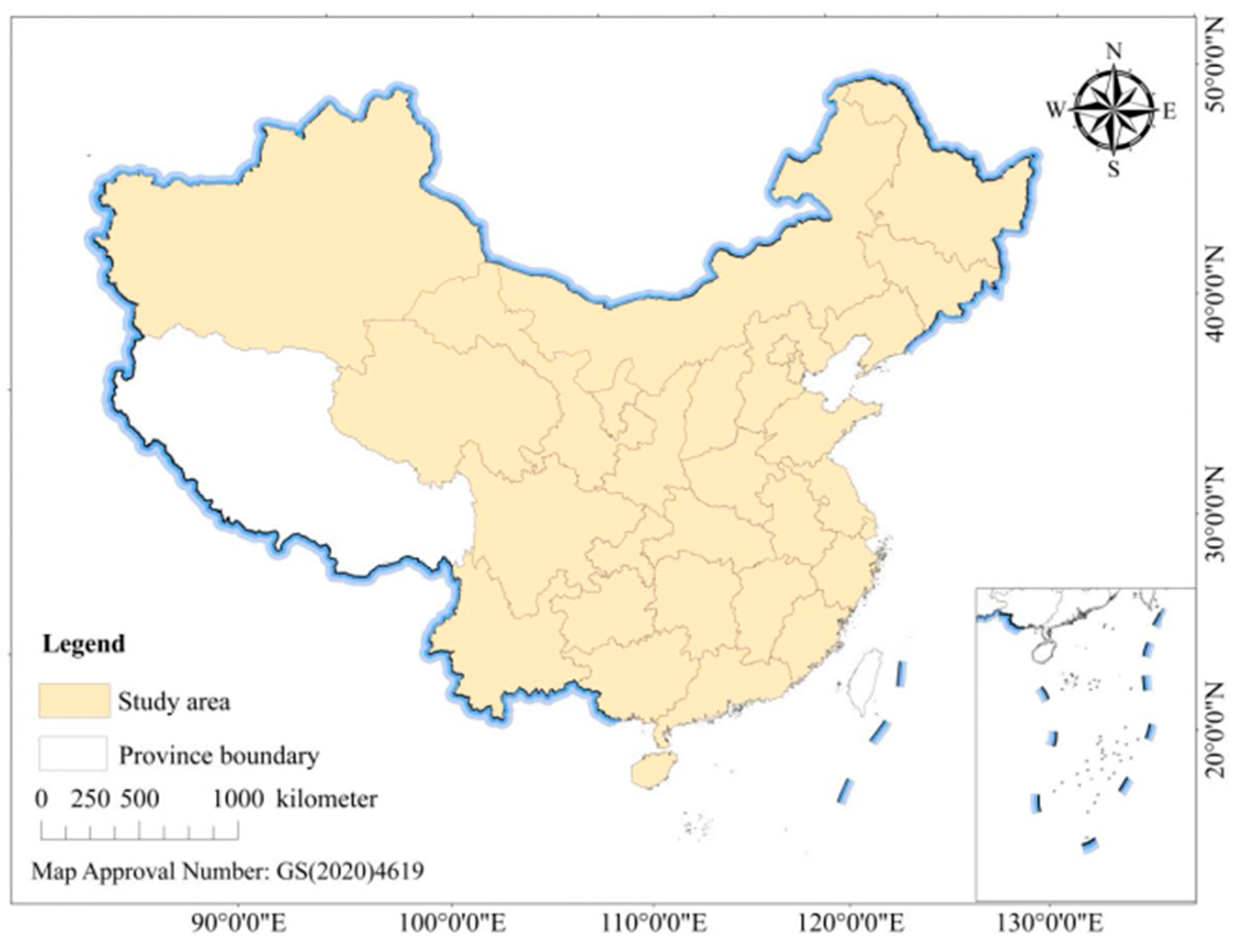
This research focuses on the Chinese mainland. However, due to data limitations and incompleteness, Xizang is not included in this study. Carbon emissions records covering the period 2011–2022 for Chinese cities were employed in this research. The primary data source is the China City Statistical Yearbook. The study area encompasses more than 90% of China’s population and economic activities, serving as a primary source of energy and carbon emissions. The area plays a crucial role in achieving the national “Dual Carbon” goals. The study area is depicted in Figure 1.

2.1.2. Data Sources

This research employs data related to carbon emission drivers and energy consumption, collected from provincial and municipal statistics published in the China Statistical Yearbook between 2011 and 2022. The influencing factors include GDP, total population, total energy consumption, cement production, urbanization rate, and coal consumption share. Particularly, the population data represent the permanent resident population at the end of each year, as recorded in the statistical yearbooks. Due to annual price fluctuations in China, using GDP calculated at current-year prices may result in inaccurate comparative analysis results. To eliminate the effect of price changes, this research adjusts GDP data to 2015 constant prices. The “Consumption of Major Energy by Industrial Sector” section in each city’s statistical yearbook provides data on 10 energy types, including raw coal, gasoline, kerosene, and natural gas. Standard coal conversion for each energy type is conducted using coefficients recommended in carbon emissions guidelines by the Intergovernmental Panel on Climate Change (IPCC). The data sources are shown in Table 1.
The selection of carbon emission driving factors in this study is based on the classic IPAT and STIRPAT model frameworks, combined with the physical formation mechanism of carbon emissions. Specifically, GDP serves as the primary driver of energy demand; according to the environmental Kuznets curve theory, the industrialization process in developing regions often exhibits a strong positive correlation with carbon emissions [18]. Population size directly expands the consumption base for housing, transportation, and public services [19]. The urbanization rate transforms energy consumption patterns, as urban infrastructure construction significantly increases the demand for carbon-intensive products, such as steel and cement. Total energy consumption is the direct source of carbon emissions, and given China’s resource endowment, a high share of coal consumption directly leads to higher carbon intensity [19]. Furthermore, cement production is selected as a key industrial indicator because it involves not only fuel combustion but also the chemical decomposition of limestone during clinker production, which is a major source of industrial process emissions [20].

2.2. Methods

2.2.1. GRA

Carbon dioxide is primarily emitted through the utilization of fossil fuels. This process is influenced by factors like population, GDP and urbanization. The construction of a gray relational model between carbon emissions and the influencing factors enables a clear depiction of their interrelationships.
The correlation between carbon emissions and 6 selected factors in 26 provinces and 4 municipalities of China is assessed using the GRA method. The corresponding gray relational coefficients are shown in Table 2.
Prior to regression model training, this study employed the variance inflation factor (VIF) and tolerance indicators to conduct a multicollinearity test on the selected variables. The results are shown in Table 3. The test results indicate that the VIF values for the six influencing factors—GDP, population size, urbanization rate, total energy consumption, coal consumption share, and cement production—are all below 3.1, and the tolerance values all exceed 0.3. Statistically, a VIF value of less than 10 is generally considered to imply the absence of severe multicollinearity. This result confirms no significant collinearity issues present among the selected variables, thereby ensuring the reliability of the subsequent regression analysis and model prediction.

2.2.2. Spatial Proximity Neural Network with Attention-Enhanced GNNWR (SPNN-AtGNNWR)

Spatial data are widely utilized across many fields, such as environmental science, meteorology, geography, ecology, and economics. Tobler’s first law of geography highlights that spatial interconnections exist among all entities, with proximity enhancing the intensity of such connections [21]. To investigate the spatial nonstationary of geographically correlated data, Brunsdon et al. [22] initially defined the geographically weighted regression (GWR) model, which considers spatial relationship variations caused by differences in geographical locations when calculating regression coefficients. Building on the GWR framework, Wu et al. [23] reinterpreted the concept of spatially nonsmooth relationships, leading to the construction of the GNNWR. The GNNWR integrates neural network models with ordinary linear regression. It leverages the strong regression capabilities of neural network models to effectively capture spatial heterogeneity and nonlinear complexities in regression structures. The spatial relationship modeled by GNNWR is represented by Equation (1):
y i = w 0 ( u i , v i ) × β 0 + i = 1 n w k ( u i , v i ) β k x i k + ε i
where y i represents the estimated carbon emissions of the i th point (i = 1, …, 30); in this research, n = 30, indicating the 30 provincial-level administrative regions within the study area; ( u i , v i ) represents the geodesic coordinates of point i ; β0 is the intercept term; w ( u i , v i ) reflects the distinction between GNNWR and GWR by indicating coefficients’ weights β; x i k represents the kth independent variables of carbon emission influencing factors at ith point (k = 1, …, 6); and ε i represents the error term for ith sample, with a mean value of zero.
Traditional GNNWR models primarily rely on spatial distance to determine weights, but they exhibit limitations in handling the complex spatial heterogeneity of carbon emissions. For instance, service-oriented cities and neighboring industrial cities, despite their close geographical proximity, may possess distinct carbon emission patterns. To address this limitation, this study constructs a hybrid architecture. First, the SPNN is introduced. This module not only calculates geometric distance but also explicitly models complex spatial dependencies (including topological and metric relationships) to capture regional spillover effects. Second, an attention mechanism is integrated, allowing the model to dynamically adjust the weights of influencing factors based on feature importance rather than solely on geographic distance. This enables the model to “focus” on the dominant driving factors of each region (e.g., focusing on energy consumption in industrial zones and GDP in developed cities).
The carbon emissions of each city are usually influenced by its interactions with neighboring cities, and such interactions are typically manifested as spatial proximity relationships, which play a key role in forecasting carbon emissions. Therefore, analyzing the latent spatial proximity relationship among cities is essential. Based on the GNNWR model, these spatial proximity relationships are incorporated to develop the SPNN-GNNWR model [24]. The results demonstrate that this model significantly reduces uncertainty in carbon emission estimates and achieves superior predictive accuracy. The results indicate that the model effectively minimizes uncertainty in carbon emission predictions and achieves high accuracy, with a coefficient determination (R2) of 0.925 and a 10-fold cross-validation R2 of 0.822.
The attention mechanism originally stems from the field of cognitive science, where it was used to emulate how humans selectively attend to key information during processing. This mechanism was first applied in computer vision tasks to address the challenge of extracting local features in image recognition. Its core idea is to assign different weights to different inputs, allowing the model to concentrate on the most critical information rather than treating all inputs equally. GNNWR essentially combines GWR with neural networks, enabling it to account for spatial heterogeneity while leveraging the powerful nonlinear fitting capabilities of neural networks, thereby enabling more effectively capturing spatial heterogeneity and nonlinear relationships. The GNNWR model uses the spatial distances of input data to formulate its GWR strategy. Its core mechanism lies in incorporating neural networks into GWR to automatically analyze spatial distances among samples, generating dynamic weight matrices associated with the target location. This allows for adaptive learning of spatial weights, which strengthens the model’s performance in representing complex spatial heterogeneity. However, carbon emissions in different regions are influenced by diverse and spatially heterogeneous factors. For example, in industrial-dominated regions, energy consumption may be the primary determinant of emissions, whereas in areas with a developed service sector, GDP and population size might play more critical roles. When the carbon emission patterns of adjacent cities differ, relying solely on spatial distance for target value estimation may impair model performance. The weights assigned to regional features in GNNWR are typically derived from a spatial weight matrix, which lacks the ability to dynamically adjust the different factor weights at the target location. To address this limitation, the self-attention mechanism enables the model to adaptively assign weights to influencing factors, grounded in the distinct features of carbon emissions in different regions. This allows the model to learn the varying sensitivities of regions to different factors, thereby enhancing forecasting accuracy. The attention mechanism can enhance feature representation by emphasizing key information and suppressing irrelevant or secondary signals during model fitting. The computational formulation is given by Equation (2):
A t t e n t i o n Q , K . V = s o f t m a x ( Q K T d ) V
where Q denotes the query matrix, which contains the information to be attended on; K is the key matrix, representing the information to be matched; and V represents the value matrix, which holds the actual content information. The parameter d refers to the dimensionality of the key vectors, and d serves as a scaling factor to prevent the vanishing gradient problem.
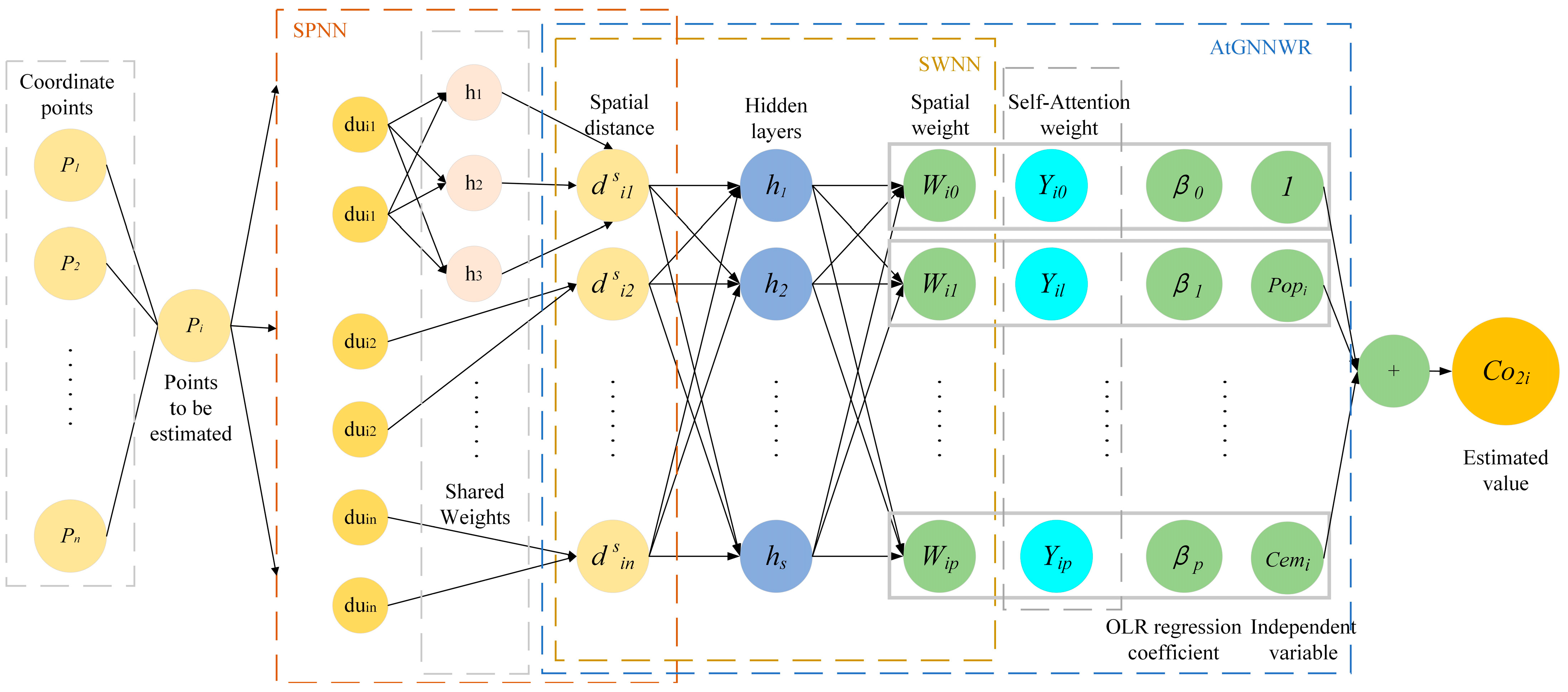
The combination of the self-attention mechanism with the GNNWR model primarily aims to dynamically adjust the weights of influencing factors, thereby enhancing the model’s adaptability for carbon emission forecasting across different regions. In this study, the attention mechanism is incorporated into the SPNN-GNNWR model, generating an enhanced version named SPNN-AtGNNWR. Specifically, a self-attention layer is introduced after the spatial distance layer to dynamically adjust the weights of each influencing factors. The structure of the SPNN-AtGNNWR is illustrated in Figure 2.

2.2.3. Scenario Forecasting

Scenario forecasting is a systematic approach that involves creating multiple hypothetical scenarios to explore potential pathways toward carbon peak achievement. This approach is particularly useful for addressing complex and uncertain future environments [25]. Scenario forecasting establishes scenarios as forecast of potential future economic and social development trends. This method focuses on future changes and uses the forecast results to assist decision-makers in making judgments about an uncertain future [26].
In this research, considering the actual situation and plans for China’s carbon peak, the scenario-based forecasting method is leveraged to construct three scenarios: the baseline, low-carbon, and extensive development scenarios. Future carbon emissions are forecasted by considering key influencing factors, including GDP, total energy consumption, population, cement production, urbanization rate, and coal consumption share.

2.3. Model Construction and Evaluation

2.3.1. Data Preprocessing

Due to differences in the sources or units of the dataset, the features may have different dimensions and value ranges. Standardization is used to normalize the dimensions of these features, which helps smooth the gradient differences between the data. This process prevents issues such as gradient explosion or vanishing, ensuring more stable and efficient model training. This operation not only accelerates the convergence process of the model but also enhances training efficiency and minimizes the influence of outliers. Standardization can also enhance robustness against noisy data on model training and help prevent overfitting. In this research, given that the carbon emission data and its influencing factors are bound and positive, the min-max normalization method is chosen for data standardization. The calculation method is as follows in Equation (3):
y i = x i m i n ( x i ) m a x ( x i ) m i n ( x i )
where yi denotes the standardized value corresponding to the ith indicator, and xi denotes the unprocessed value of the ith indicator. m i n ( x i ) and m a x ( x i ) are the minimum and maximum boundary values for the ith indicator, respectively.

2.3.2. Model Construction

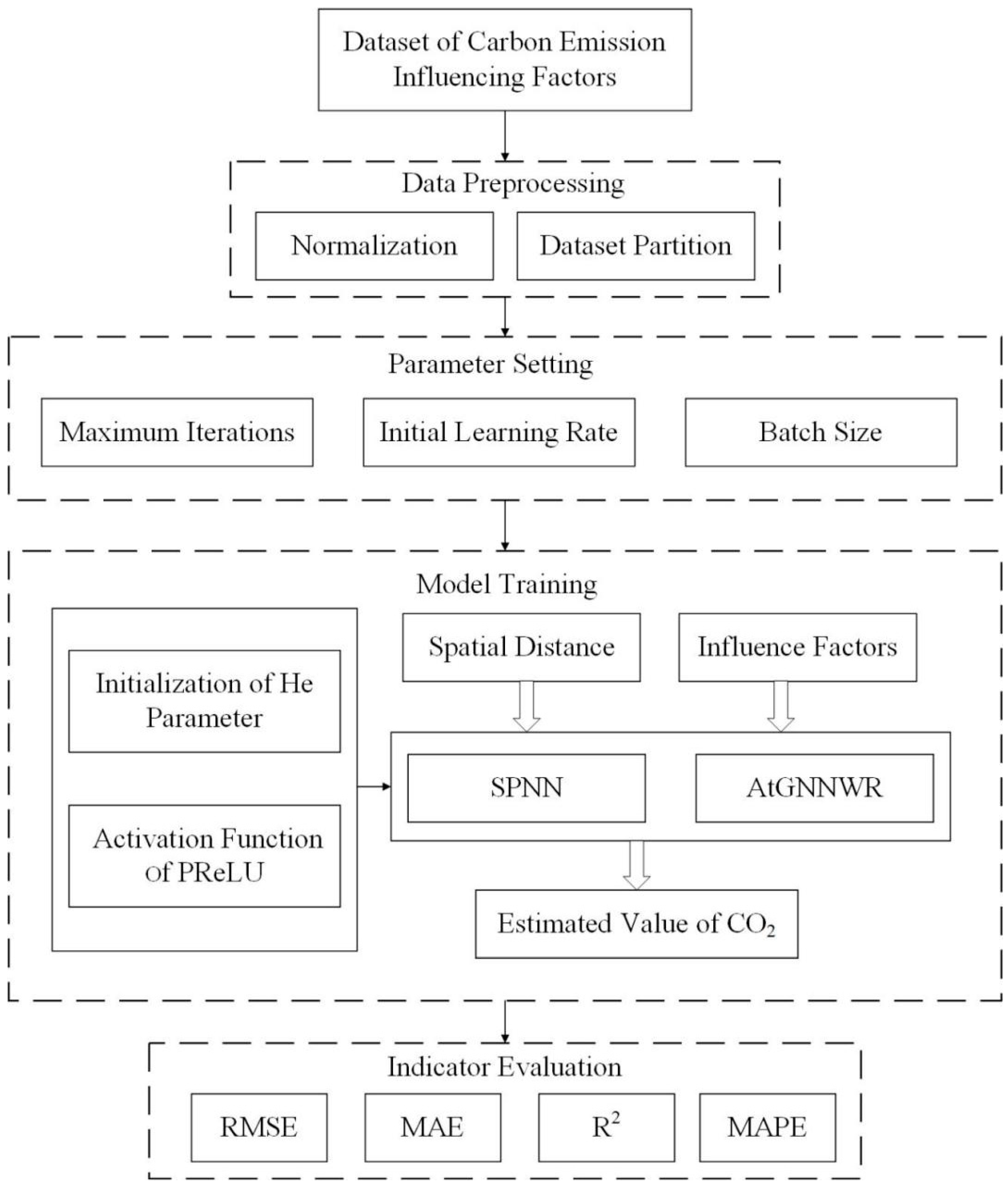
Spatial datasets exhibit pronounced anisotropy. To accurately capture intricate nonlinear relationships in spatial data, the SPNN is employed to precisely quantify intercity spatial relationships. In this research, the SPNN-AtGNNWR model is developed using Python (v3.7) and the TensorFlow framework (v1.14.0). Data preprocessing and analysis were conducted using pandas (v1.3.5) and NumPy (v1.21.5), with the comprehensive process detailed in Figure 3.
(1)
Data preparation: The dataset undergoes normalization and is subsequently divided into training, validation, and test subsets in a 70:15:15 ratio.
(2)
Data preprocessing stage: To accelerate model convergence and prevent gradient explosion, this study adopts the man-mix normalization method to map all input features to the [0, 1] range. The dataset is strictly partitioned into training, validation, and testing sets according to a ratio of 70%:15%:15%. The model is constructed based on the TensorFlow framework, and specific optimization strategies are employed during the training process to ensure stability. He initialization is adopted to initialize network weights to prevent gradient vanishing or exploding. The parametric ReLU activation function is selected to avoid the “dying neuron” problem and enhance nonlinear expression capability by adaptively learning negative slope parameters. Lastly, the dropout technique (with the dropout rate determined by experimental settings) is applied in the hidden layers to prevent overfitting. The model training iterations are set to 2000, the initial learning rate is 0.1, and mean squared error (MSE) is adopted as the loss function.
(3)
Performance evaluation: The fitted values are compared with the actual values, and the model’s fitting efficiency is validated through the calculation of related evaluation indicators.

2.3.3. Model Evaluation

To assess the predictive accuracy of the carbon emission forecasting model in this study, the following evaluation metrics are employed: R2, root mean square error (RMSE), mean absolute error (MAE), and mean absolute percentage error, as shown respectively as follows:
R 2 = 1 i = 1 n y i y i 2 i = 1 n y i y i 2
R M S E = 1 n i = 1 n y i y i 2
M A E = 1 n i = 1 n y i y i
M A P E = 100 % n i = 1 n y i y i y i
where y i denotes the unprocessed values, y i denotes the forecasted values, and n denotes the total number of samples. In this research, n = 360 and represents the annual carbon emissions for 26 provinces and 4 municipalities in China from 2011 to 2022.

2.4. Multiscenario Carbon Peak Forecasting

2.4.1. Scenario Setting

The essence of scenario forecasting lies in constructing multiple hypothetical scenarios to forecast and analyze potential future carbon emission pathways. These scenarios are typically grounded in factors such as different policy measures, technological advancements, economic growth trajectories, and social behavior. Scenario forecasting is employed to forecast and analyze various potential outcomes under uncertain conditions. Its primary objective is to consider multiple possible future scenarios, facilitating more effective responses to potential changes and risks. This approach is widely applied in domains such as climate forecasting, supply chain management, and energy prediction.
Different from global-scale studies that typically utilize the IPCC Shared Socioeconomic Pathways, this study adopts a “bottom-up” policy analysis approach to construct three scenarios: baseline, low-carbon, and extensive. The setting of scenario parameters is derived directly from the “14th Five-Year Plan” (2021–2025) and the “Outline of Vision 2035” issued by 30 provinces in China. For instance, specific targets for GDP growth, population planning, and energy consumption control indicators for each province are established in accordance with local administrative documents. The rates established in the “14th Five-Year Plan” better reflect local economic and energy development conditions. This approach ensures that the forecasting results align closely with China’s actual administrative targets and regional development roadmaps, thereby providing a reference basis with higher local relevance for provincial policymakers compared to generic global scenarios.
This research established three development scenarios: the baseline, low-carbon, and extensive scenarios. This research established three development scenarios: the baseline, low-carbon, and extensive scenarios.
Baseline scenario: This scenario refers to the steady development aligned with the planning documents issued by 26 provinces and 4 municipalities of China. This scenario reflects the future carbon emission trends based on the development goals outlined in successive “Five-Year Plan,” along with policies on population, energy, urbanization, and other influencing factors for each province. The growth rates of six influencing factors are derived from the development plans proposed within the “Outline of the 14th Five-Year Plan for National Economic and Social Development,” “Outline of Vision 2035,” and the “14th Five-Year Plan for Energy Development” of each province and municipality. Table 4 provides the growth rates of these factors. This scenario assumes the continuity of current policies and that established development plans remain unchanged. The parameter settings are strictly based on the “14th Five-Year Plan” and the “Outline of Vision 2035” of various provinces and municipalities, reflecting the natural evolutionary pathway under the existing policy framework.
Low-carbon scenario: This scenario represents a development pathway characterized by “accelerated innovation and active transition.” Under this scenario, the design posits that the government will adopt more aggressive decarbonization strategies, significantly reducing energy consumption per unit of GDP through accelerated technological innovation (e.g., Jiangsu Province is set to achieve an annual reduction of 4.0%), and implementing stricter industrial transition pathways (e.g., the cement industry accelerates the promotion of low-carbon technologies, and the share of coal consumption decreases by 1.4% annually). This scenario simulates China’s potential to achieve deep decarbonization under strong policy interventions and the application of breakthrough low-carbon technologies.
Extensive scenario: This scenario represents a development pathway characterized by “policy delay and high resource dependence.” It simulates conditions where emission reduction policies lag in implementation or weaken in enforcement, under the assumption that economic growth is prioritized and environmental constraints are relaxed. Under this pathway, the inertial growth of energy-intensive industries leads to energy consumption and carbon emissions maintaining high levels, serving to evaluate the risks associated with achieving carbon peak targets under unfavorable conditions.
Although technological progress and renewable energy deployment are not listed as standalone input variables, they have been implicitly integrated into the setting of scenario parameters. Specifically, technological progress is primarily reflected in the reduction rate of energy consumption per unit of GDP. A faster rate of decline in energy consumption is set in the low-carbon scenario compared to the baseline scenario (e.g., Jiangsu Province is set to an annual decrease of 4.0%, versus 3.4% for the baseline), simulating the energy efficiency gains resulting from advancements in energy-saving technologies and industrial upgrading. The deployment of renewable energy is represented by the decline in the share of coal consumption. The sharper decline in the coal share under the low-carbon scenario (an annual decrease of 1.4%, compared to 1.0% for the baseline) represents the process of actively substituting fossil fuels with renewable energy sources, such as wind and solar power.
Taking Jiangsu Province as a case study, the parameter settings under the baseline, low-carbon, and extensive scenarios are presented in Table 5.
(1) GDP: Based on the planning goals proposed in the “Outline of the National Economic and Social Development Plan of Jiangsu Province,” the annual GDP growth rate of Jiangsu Province is set at 5.50%. Accordingly, the baseline scenario is set to have an annual average of 5.50% for 2023–2025, with 0.5 percentage point decrease in each subsequent phase. The GDP growth rates for the low-carbon and extensive scenarios are adjusted by ±0.5% relative to the baseline scenario.
(2) Total people: Comparing data from “China’s Seventh National Population Censuses” (2020) with the “Sixth Census” (2010), Jiangsu Province’s permanent resident population increased by 6.087 million over the past decade, representing a 7.74% growth and an average annual growth of 0.75%. The population growth rate in the baseline scenario is set at 0.75%, whereas the rates for the low-carbon and extensive scenarios are set at 0.65% and 0.85%, respectively. In subsequent phases, the growth rate decreases by 0.05% per phase.
(3) Urbanization rate: According to the “Outline of the 12th, 13th, and 14th Five-Year Plans for the National Economic and Social Development Plan of Jiangsu Province,” the target urbanization rates for the end of the “12th Five-Year Plan,” “13th Five-Year Plan,” and “14th Five-Year Plan” (2015, 2020, and 2025) are set at 63%, 67%, and 75%, with annual growth rates of 1.20%, 0.90%, and 0.30%, respectively. With rapid economic development and continuous improvement of urban infrastructure, Jiangsu Province has experienced a rapid increase in its urbanization rate over the past few decades. Its urbanization level has now reached a relatively high point. As the capacity of cities to absorb new population approaches saturation, the annual growth rate of urbanization in Jiangsu Province has begun to slow down. Consequently, the annual urbanization growth rates are set at 0.2%, 0.3%, and 0.4% for the three scenarios. In subsequent phases, the growth rate will gradually decrease. Once the urbanization rate reaches 100%, no further growth will be assumed.
(4) Energy consumption: According to the “Chinese Action Plan for Carbon Peaking Before 2030” and the “Comprehensive Work Plan for Energy Conservation and Emission Reduction for the 14th Five-Year Plan,” the energy consumption per unit of GDP should mandate a 13.5% reduction by 2025 compared to 2020. The “Implementation Plan for Carbon Peak in Industrial Field and Key Industries of Jiangsu Province” mandates that by 2025, a 17% reduction in energy consumption per unit of industrial added value is targeted for enterprises above the specified size, compared to the base year 2020. Throughout the “14th Five-Year Plan” period, the annual decline percentages of total energy consumption in Jiangsu Province are set at 3.4%, 4.0%, and 2.8% for the low-carbon, baseline, and extensive scenarios, respectively.
(5) Coal consumption share: By 2020, Jiangsu Province successfully controlled and reduced coal consumption, with the directly utilized coal after conversion decreasing from 272.09 million tons to around 240 million tons, thereby maintaining a trend of negative growth. According to the “Comprehensive Work Plan for Energy Conservation and Emission Reduction for the 14th Five-Year Plan Period” issued under the authority of the State Council, coal consumption in the Beijing–Tianjin–Hebei and the surrounding areas, along with the Yangtze River Delta region, is expected to decrease by approximately 10% and 5%, respectively, by 2025. Therefore, under the baseline scenario, the coal consumption share is projected to decline annually by 1%, with rates of −1.4% and −0.6% for the low-carbon and extensive scenarios, respectively.
(6) Cement production: The “Implementation Plan for Ultra-low Emission Transformation in the Cement and Coking Industries of Jiangsu Province” highlights the comprehensive promotion of ultra-low emission transformation and evaluation in Jiangsu Province’s cement and coking industries. By the end of 2025, all cement and coking enterprises in Jiangsu Province are expected to complete ultra-low emission retrofitting and clean production renovation. In addition, all new, expanded, or relocated cement and coking enterprises must comply with ultra-low emission standards. In 2011, cement production in Jiangsu Province totaled 14.8997 million tons, rising to 15.76736 million tons in 2019, 15.27513 million tons in 2020, and 15.40211 million tons in 2021, reflecting a gradual stability. On the basis the historical growth of cement production, the annual growth rates for the baseline, low-carbon, and extensive scenarios are set as 0.21%, 0.27%, and 0.33%, respectively.


2.4.2. Validation of Scenario Forecasting

To assess the applicability of the scenario forecasting method in forecasting carbon emissions, this research applies the aforementioned method to the influencing factors for the period 2011–2022 and evaluates their accuracy and reliability.
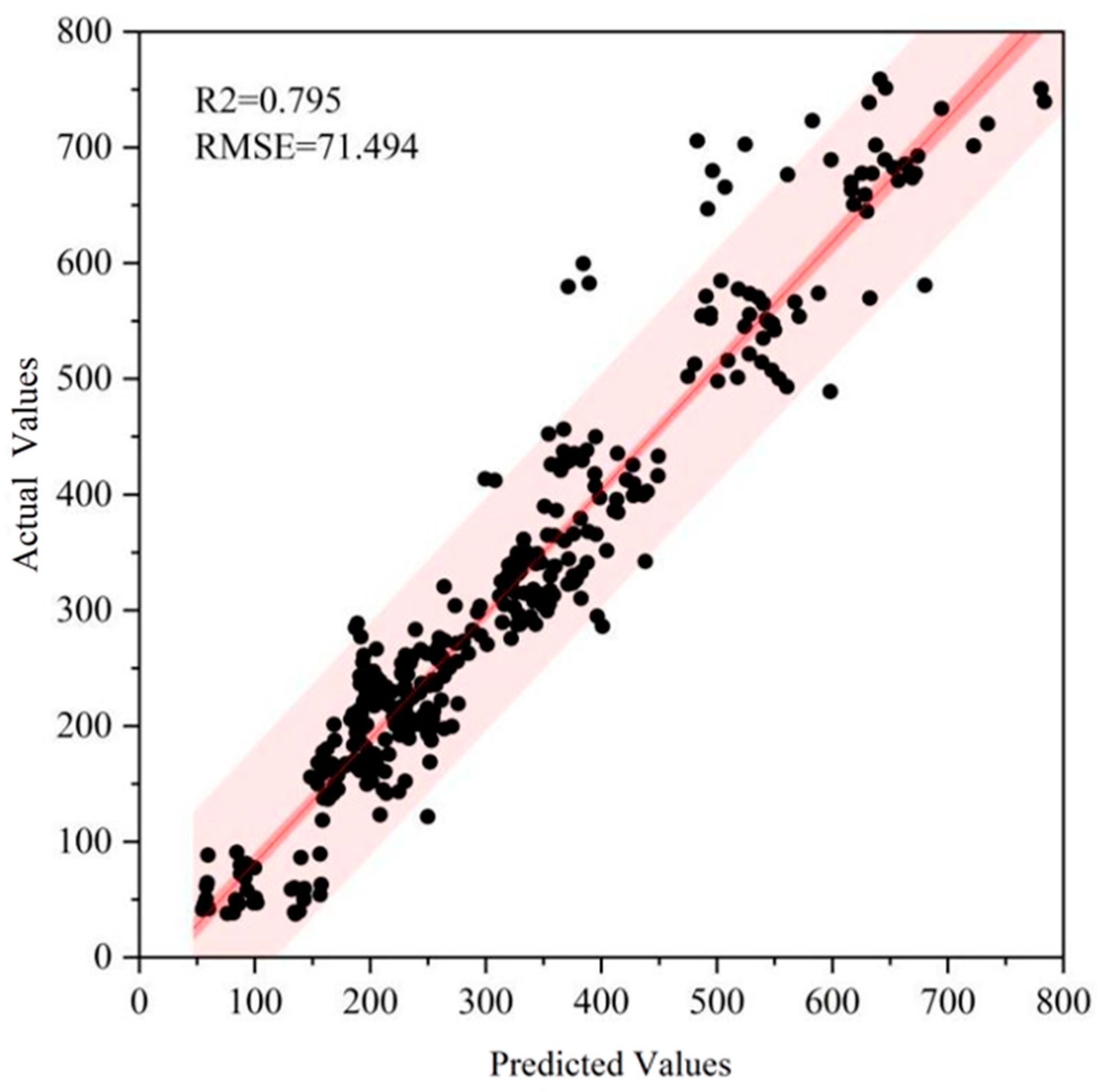
The carbon emission influencing factor dataset configured based on the scenarios from 2011 to 2022, is inputted into the established SPNN-AtGNNWR model. The forecasted carbon emission values generated by the model are compared with the actual values to measure the forecasting accuracy. With an R2 score of 0.795 and an RMSE of 71.494, the model demonstrates a close fit between actual and predicted values with minimal error. By integrating scenario forecasting with deep learning techniques, the model achieved high accuracy in forecasting carbon emissions. Table 6 summarizes the performance evaluation metrics in detail, and Figure 4 presents the scatter plot comparing the forecasted values with the actual values. These results confirm the strong forecasting capabilities of the proposed approach.

3. Results

3.1. Experimental Results of SPNN-AtGNNWR Model

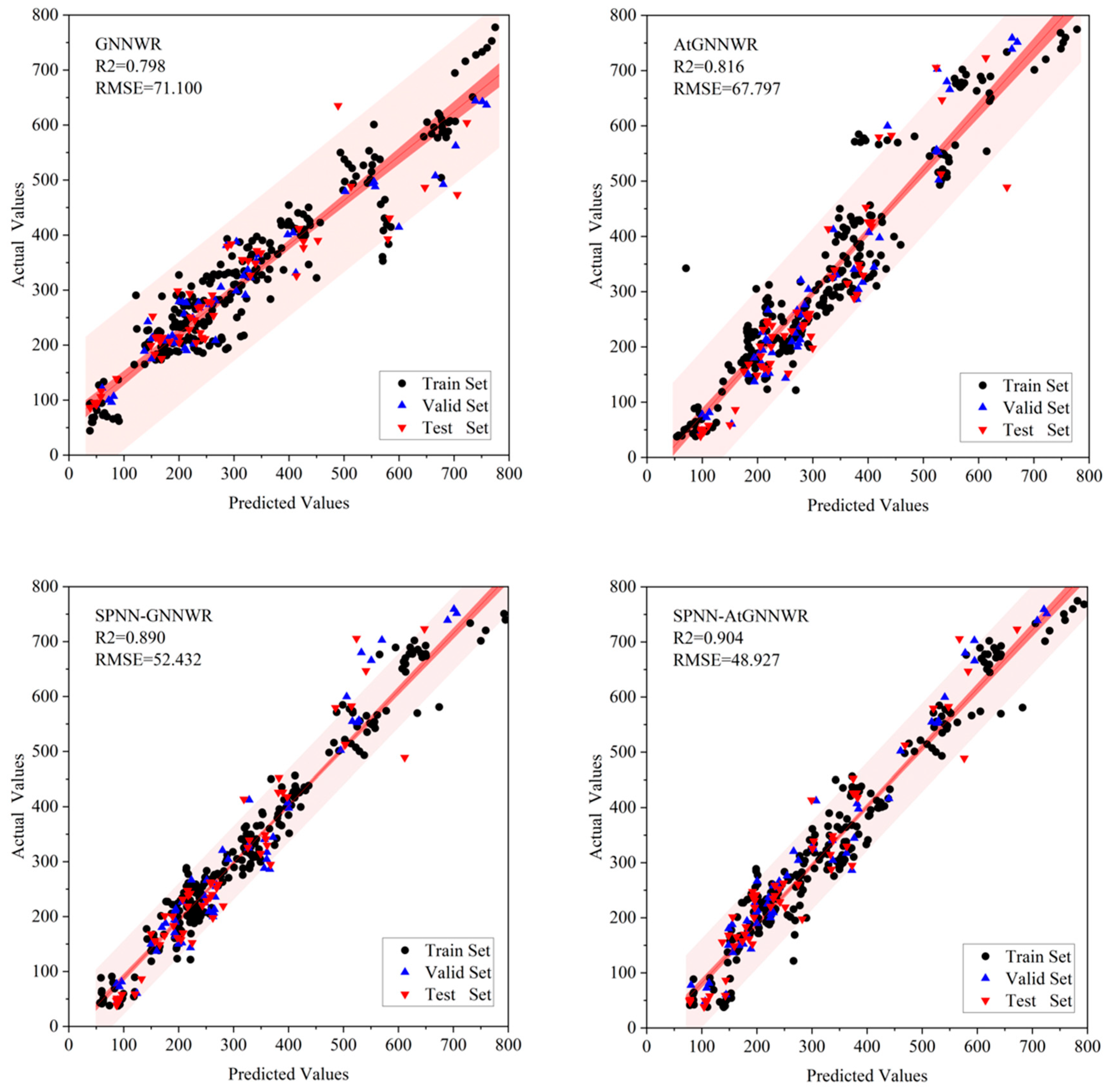
Following data transformation and normalization, annual datasets for all provinces and directly administered municipalities in China from 2011 to 2022 are generated. After preprocessing, the data are divided into 70% as the training set, 15% as the validation set, and the remaining 15% as the testing set. Given that six carbon emission-related factors are identified as input variables, with the carbon emission amount as the output variable, the model structure includes six input neurons and one output neuron. The model is trained on all samples for 2000 epochs. To validate the effectiveness of incorporating the self-attention mechanism, this research compares the performance of GNNWR, AtGNNWR, SPNN-GNNWR, and SPNN-AtGNNWR on the carbon emission dataset. The performance evaluation results and corresponding scatter plots after training these four models are presented in Table 7 and Figure 5, respectively.
The experimental results indicate marked differences in performance among the four models for carbon emission forecasting. As the baseline model, GNNWR combines GWR with neural networks; when modeling spatial heterogeneity, GNNWR primarily calculates spatial weights based on geographic distance or spatial topological relationships. However, carbon emissions are influenced not only by geographical factors but may also be associated with nonspatial factors such as economic conditions, industrial structure, and policy measures. By incorporating an attention mechanism, AtGNNWR performs weighted optimization of the carbon emission factors, enabling the model to better capture the economic, social, and environmental characteristics of different regions. This allows AtGNNWR to self-adaptively adjust weight allocations accordingly, thereby improving its forecasting performance moderately. Nonetheless, given its absence of explicit modeling of spatial proximity, the improvements remain relatively limited. By contrast, SPNN-GNNWR, by incorporating spatial proximity features, significantly enhances the model’s capacity to capture spatial heterogeneity in carbon emissions and reduces forecasting error. The SPNN-AtGNNWR, which integrates the attention mechanism, achieves the best performance across all evaluation metrics, indicating that jointly considering spatial proximity and dynamic weight-adjustment yields the most effective improvements in model accuracy.
From the error analysis, GNNWR exhibits relatively high values in MSE, RMSE, and MAE. Although AtGNNWR shows a certain degree of improvement, it still presents considerable deviations. By incorporating spatial proximity, the R2 of SPNN-GNNWR experienced a rise from 0.798 to 0.890, and its RMSE decreased from 71.101 in GNNWR to 52.432, demonstrating that the inclusion of spatial proximity markedly enhances the model’s predictive accuracy. Notably, SPNN-AtGNNWR achieved the lowest error values and a more uniform error distribution with an R2 of 0.904, reflecting a 13.28% improvement in predictive performance over the original GNNWR model. For regions with high carbon emissions, the predicted values from SPNN-AtGNNWR are closer to the true values, reflecting superior generalization capability and greater robustness. Further analysis of the contributions of different components to model performance reveals that using GNNWR alone yields relatively poor predictive results. By contrast, incorporating either the attention mechanism or the spatial proximity relationship can enhance the SPNN-AtGNNWR’s performance. The attention mechanism enables the model to learn the weights of influencing factors more flexibly, whereas the inclusion of spatial proximity relationship substantially enhances the ability to capture spatial characteristics. When both are combined, SPNN-AtGNNWR outperforms all other models across each metric, indicating that the two modules complement each other effectively and jointly enhance the model’s predictive ability.

3.2. Multiscenario Carbon Peaking Forecast Results

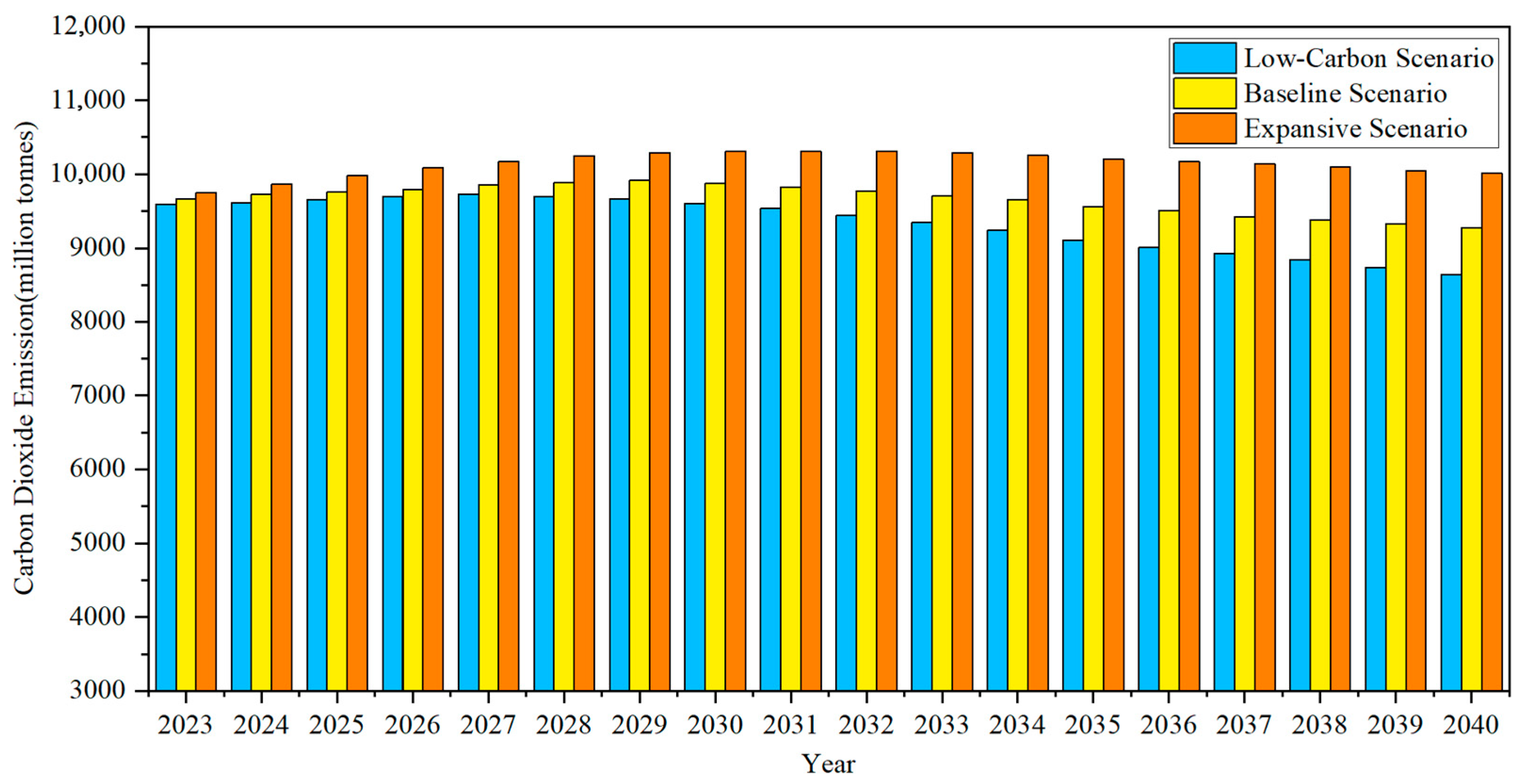
Based on different scenario growth rates of various drivers, the corresponding factor values are computed and fed into the SPNN-AtGNNWR model as input variables. The carbon emission forecasting results for the years 2023–2040 under the three scenarios are shown in Figure 6. These results determine the peak in carbon emission and carbon peaking time for each scenario.
Under the baseline scenario, China will achieve its carbon peak target in 2029, with a maximum value of 9926.26 million tons. From 2023 to 2029, carbon emissions are expected to show a slow upward trend, exhibiting an average annual growth rate of 0.47%, marking a 0.29% decrease compared to the 2011–2022 period. This trend suggests that although emissions continue to increase, the pace of growth has notably decelerated, indicating that policy interventions and technological advancements are beginning to effectively curb the rise in carbon emissions.
Under the low-carbon scenario, China’s carbon emissions are forecasted reach their peak in 2027 at 9688.88 million tons. During the forecast period, the total carbon emissions exhibit minimal fluctuation and begin to decline after the peak in 2027. Compared to the baseline scenario, this scenario indicates a reduction of 237.38 million tons in the peak emissions, and the peak occurs two years earlier.
Under the scenario of extensive conditions, the carbon peak will occur in 2032, three years later than under the baseline scenario. The peak value is estimated at 10,347.70 million tons, reflecting increases of 4.25% and 6.80% compared to the baseline and low-carbon scenarios, respectively.

4. Discussion

4.1. Effect of Individual Factors on Carbon Peak

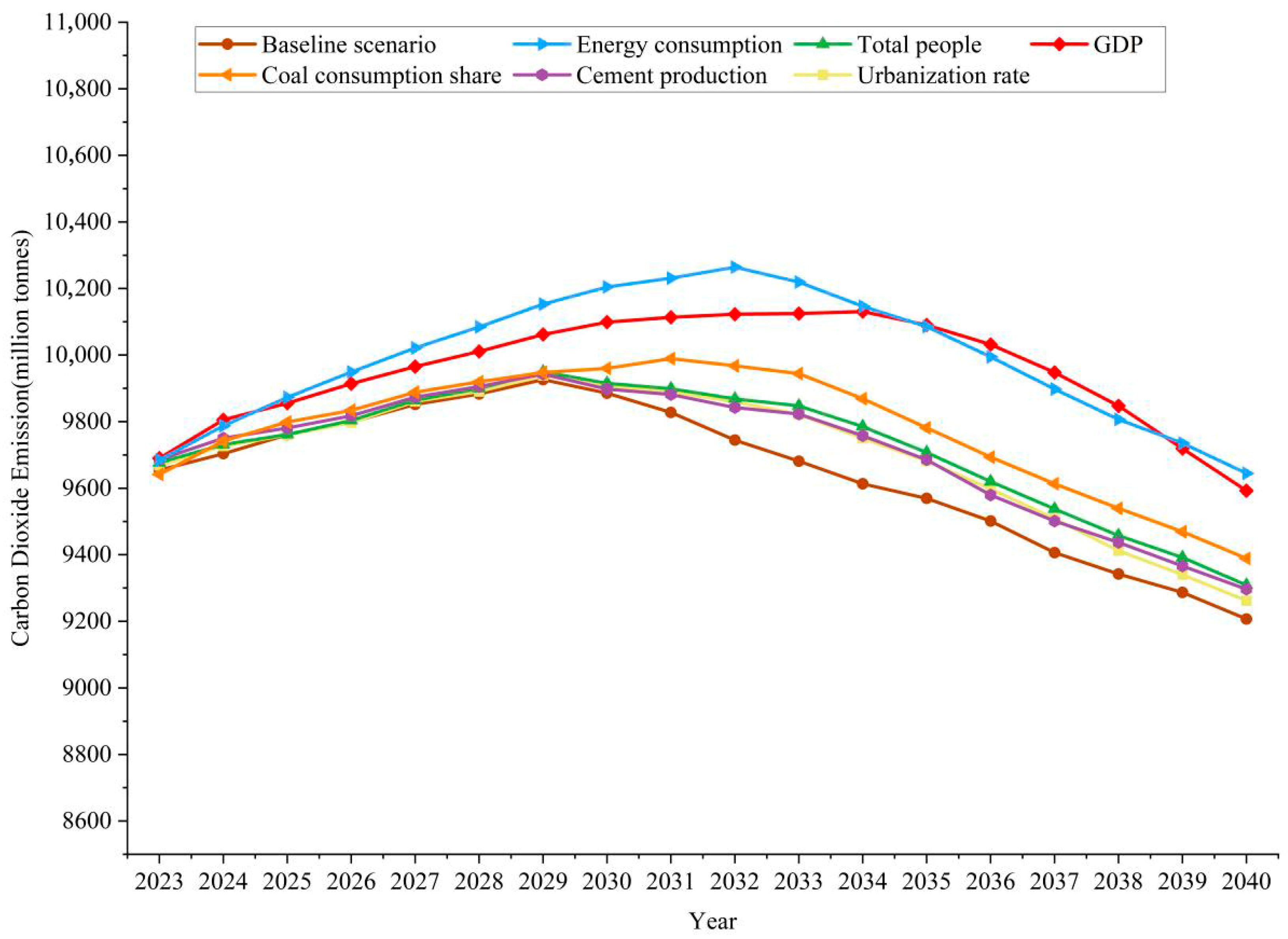
To evaluate the robustness of the forecasting results, this study conducts a sensitivity analysis by adjusting the growth rate of an individual factor to the extensive scenario level while maintaining other factors at the baseline level. The analysis results indicate that total energy consumption and GDP are the most sensitive factors affecting the carbon emission trend. Increasing the growth rate of energy consumption results in an increase of 337.7 million tons in the peak value and delays the peak year to 2032. Similarly, a higher GDP growth rate delays the peak to 2034. The coal consumption share also exhibits significant sensitivity; a slowdown in its rate of decline delays the peak by two years. Conversely, variations in population and urbanization rate have a relatively minor effect on the peak timeline. This indicates that achieving China’s carbon peak target depends more on the control of energy intensity and structural decoupling rather than merely on restricting population scale.
To further explore the effect of individual carbon emission influencing factors on the carbon peak, this research adjusts the growth rate of a single influencing factor to align with the corresponding growth rate under the extensive scenario while maintaining the growth rates of other factors consistent with the baseline scenario. This approach allows for an evaluation of how these factors affect the carbon peak value and the timing of the carbon peak in China.
In the extensive scenario, economic growth predominantly relies on a high-carbon and resource-intensive development model, which leads to a higher carbon emission peak and a later peak year. Adjusting the growth rates of individual influencing factors tends to increase total carbon emissions, and changes in certain factors can also delay the carbon peak year. The effects of changes in determinants on the total amount of carbon emissions and the timing of peak are revealed by the results. The results indicate that GDP, total energy consumption, and coal consumption share exert especially significant effects on the magnitude of the carbon peak and its occurrence year. These factors contribute not only to increasing the peak emission level but also to shifting the timing of when the peak is reached to different extents.
Under the baseline scenario, China’s carbon emissions are expected to reach the maximum at 9926.26 million tons in the year 2029. However, as shown in Figure 7, changes in individual carbon emission influencing factors can substantially affect the carbon emission trajectory, particularly total energy consumption and GDP. The variations in these three factors have noticeable influence on the carbon peak value and the carbon peak year. First, total energy consumption has the most significant effect on the carbon peak value, with the corresponding peak reaching 10,254.80 million tons and pushing the peak year to 2032. Second, the increase in GDP raises the peak value to 10,126.21 million tons, an increase of 199.95 million tons higher than the baseline scenario, resulting in a further delay in the carbon peak year to 2034.
The coal consumption share also exerts a significant influence on the carbon emission trajectory, increasing the peak value to 9980.25 million tons and delaying the peak year to 2031. Conversely, although the growth of population, urbanization rate, and cement production also contribute to higher carbon peak values, their effects on the overall trend are comparatively smaller. Achieving carbon peaking depends on the synergistic effects of multiple factors, with economic growth, energy consumption, and the coal consumption share playing pivotal roles. Notably, changes in the energy and economic growth sectors will significantly delay the carbon peak timeline. Therefore, efforts should prioritize optimizing the energy structure, reducing reliance on fossil fuels while sustaining economic expansion, and balancing economic growth with carbon reduction goals. The collaborative action of all key factors is essential to ensure that China achieves its carbon peak goal before 2030.

4.2. Limitation and Future Outlook

Although this study has achieved certain results in model construction and scenario forecasting, considering the complexity of the carbon emission system and the dynamic changes in socioeconomic systems, the following limitations remain, which require further improvement in future work:
(1)
Quality and dependence of historical data: Model training in this study relies heavily on historical data from statistical yearbooks. Although interpolation is performed for missing data, the inherent lag of statistical data and potential discrepancies in provincial statistical standards (e.g., the absence of data for Xizang) may have a certain effect on the model’s prediction accuracy. Furthermore, relying solely on macro statistical data makes it difficult to capture emission characteristics at the micro level.
(2)
Risks of the hybrid deep learning model: Although the SPNN-AtGNNWR model significantly improves goodness of fit by incorporating the attention mechanism and spatial proximity, as a deep learning model, it still faces a potential risk of overfitting given the relatively limited sample size (provincial annual data). Although this study adopts dropout and regularization strategies to mitigate this issue, the model’s generalization ability still needs to be verified on more diverse datasets. At the same time, the “black box” nature of deep learning models limits their interpretability to a certain extent, making it challenging to directly derive specific physical mechanisms from model weights.
(3)
Uncertainty of long-term forecasting: Long-term socioeconomic forecasting for the period 2023–2040 is inherently extremely challenging. Future abrupt policy changes, the emergence of disruptive technologies (e.g., controlled nuclear fusion or high-efficiency carbon capture), or shifts in global geopolitics could all lead to actual trajectories deviating from the projected scenarios.
As global climate action advances, improving the scientific rigor and practical applicability of carbon emission prediction models remains a pressing priority. Although this study has offered initial progress in model construction and scenario setting, the inherent complexity of emission processes still imposes limitations in factor selection, model efficiency, and scenario refinement. Future investigations might focus on the following directions:
(1)
Expanding influencing factors: Beyond the six factors mentioned in this study (e.g., GDP, population, and energy consumption), additional variables should be incorporated, such as industrial structure, climate conditions, and land use, to capture emission driving mechanisms underlying carbon emissions more comprehensively.
(2)
Optimizing model architecture: The attention mechanism within the GNNWR framework must be enhanced to identify key emission patterns more effectively, thereby improving prediction accuracy and robustness. The integration of explainable artificial intelligence techniques should be explored to visualize and deeply interpret the internal attention weights of the SPNN-AtGNNWR model, thereby intuitively revealing the spatiotemporal mechanisms of various driving factors.
(3)
Refining scenario analysis: Rather than being confined to the three basic scenarios (i.e., baseline, low-carbon, extensive growth), a refined scenario system should be developed that incorporates multiple dimensions—including technological progress, economic development, social transformation, environmental constraints, and global cooperation—thereby providing more precise scientific support for policy-making. A more dynamic scenario simulation system that incorporates climate change feedback, global carbon market fluctuations, and differentiated transition pathways of specific industries must be established to provide more resilient decision support.
(4)
Integration of multisource big data: Multisource heterogeneous data (e.g., nighttime light remote sensing data, traffic flow big data, and high-frequency industrial electricity data) should be introduced to compensate for the deficiencies of traditional statistical data and enhance the spatiotemporal resolution of carbon emission estimation.

5. Conclusions

The integrated SPNN-AtGNNWR model (R2 = 0.904, RMSE = 48.927) developed in this study, which incorporates spatial proximity and an attention mechanism, significantly enhances the accuracy of carbon emission forecasting. Empirical results identify that population (0.907), total energy consumption (0.882), and GDP (0.881) are the primary driving factors of emission. Multiscenario simulations further reveal that China’s carbon peak pathway is highly dependent on policy interventions:
(1)
Under the low-carbon scenario, peak emissions are projected to occur in 2027, with total emissions of 9688.88 Mt.
(2)
Under the baseline scenario, peak emissions are projected to occur in 2029, with total emissions of 9926.26 Mt.
(3)
Under the extensive scenario, peak emissions are expected to take place 2032, with total emissions of 10,347.70 Mt.
Rising energy consumption, GDP growth, and heavy reliance on coal remain the key barriers delaying carbon peak. To realize China’s 2030 carbon peak goal, coordinated actions beyond the baseline trajectory are required. A dual-track strategy must be adopted:
(1)
Control total energy consumption while accelerating the transition to clean energy, particularly by reducing dependence on coal;
(2)
Promote a deep decoupling between economic growth and carbon emissions.
Based on the model forecasting results, this study proposes specific and differentiated policy recommendations. Linking tax incentives to carbon efficiency is recommended regarding industrial restructuring; for instance, drawing on Zhejiang Province’s “hero per mu” mechanism, resources should be allocated differentially based on carbon intensity to phase out inefficient and high-energy-consuming enterprises. In terms of energy technology, for energy-intensive provinces, the adoption of “Virtual Power Plant” technology (as piloted in Jiangsu Province) is suggested to enhance grid efficiency. In the steel and cement sectors, promoting hydrogen metallurgy (e.g., HBIS Group) and biomass fuel substitution (e.g., Conch Cement) represents a critical pathway. Regarding urban governance, for high-density urban agglomerations, green building standards and personal carbon account systems (e.g., Beijing MaaS platform) should be promoted to effectively mitigate carbon emission pressure on the consumption side.
Spatially explicit scenario analysis further confirms that only through multidimensional governance—including optimizing industrial structure, enhancing system-wide energy efficiency, and managing population-driven demand—can China capture the low-carbon peak window in 2027 and lay a solid foundation for carbon neutrality.

Author Contributions

L.M.: Conceptualization, Writing—original draft, Methodology, Investigation, Supervision, Funding acquisition, Writing—review. H.X.: Software, Resources, Data curation. X.F.: Writing—original draft, Data curation, Formal Analysis, Visualization. J.W.: Resources, Data curation. S.T.: Data curation, Formal Analysis; X.Z.: Methodology, Supervision, Writing—Review; X.S.: Resources, Writing—Review; G.L.: Supervision, Writing—Review; M.-P.K.: Writing—Review. All authors have read and agreed to the published version of the manuscript.

Funding

This study was funded by the Key Laboratory of Land Satellite Remote Sensing Application, Ministry of Natural Resources of the People’s Republic of China (Grant No. KLSMNR-K202304), and Postgraduate Research & Practice Innovation Program of Jiangsu Province (Grant No. KYCX25_1234).

Data Availability Statement

Data will be made available on request.

Acknowledgments

The research utilized statistical data from the 26 provinces and 4 municipalities in China, sourced from their respective statistical yearbooks. We acknowledge the statistical bureaus of the respective provinces and municipalities for providing accurate and comprehensive data, which significantly contributed to this study. The authors would also like to thank the anonymous reviewers for providing valuable comments and suggestions.

Conflicts of Interest

The authors declare that they have no known competing financial interests or personal relationships that could have appeared to influence the work reported in this paper.

References

  1. Sun, L.-L.; Cui, H.-J.; Ge, Q.-S. Will China achieve its 2060 carbon neutral commitment from the provincial perspective? Adv. Clim. Change Res. 2022, 13, 169–178. [Google Scholar] [CrossRef]
  2. Wang, Q.; Su, M. The effects of urbanization and industrialization on decoupling economic growth from carbon emission—A case study of China. Sustain. Cities Soc. 2019, 51, 101758. [Google Scholar] [CrossRef]
  3. Cruz, M.R.; Fitiwi, D.Z.; Santos, S.F.; Catalão, J.P. A comprehensive survey of flexibility options for supporting the low-carbon energy future. Renew. Sustain. Energy Rev. 2018, 97, 338–353. [Google Scholar] [CrossRef]
  4. Duan, H.; Mo, J.; Fan, Y.; Wang, S. Achieving China’s energy and climate policy targets in 2030 under multiple uncertainties. Energy Econ. 2018, 70, 45–60. [Google Scholar] [CrossRef]
  5. Wei, Y.-M.; Chen, K.; Kang, J.-N.; Chen, W.; Wang, X.-Y.; Zhang, X. Policy and management of carbon peaking and carbon neutrality: A literature review. Engineering 2022, 14, 52–63. [Google Scholar] [CrossRef]
  6. Li, K.; Lin, B. Impacts of urbanization and industrialization on energy consumption/CO2 emissions: Does the level of development matter? Renew. Sustain. Energy Rev. 2015, 52, 1107–1122. [Google Scholar] [CrossRef]
  7. Wang, H.; Lu, X.; Deng, Y.; Sun, Y.; Nielsen, C.P.; Liu, Y.; Zhu, G.; Bu, M.; Bi, J.; McElroy, M.B. China’s CO2 peak before 2030 implied from characteristics and growth of cities. Nat. Sustain. 2019, 2, 748–754. [Google Scholar] [CrossRef]
  8. Fan, Y.; Liu, L.-C.; Wu, G.; Tsai, H.-T.; Wei, Y.-M. Changes in carbon intensity in China: Empirical findings from 1980–2003. Ecol. Econ. 2007, 62, 683–691. [Google Scholar] [CrossRef]
  9. Hamzacebi, C.; Karakurt, I. Forecasting the energy-related CO2 emissions of Turkey using a grey prediction model. Energy Sources Part A Recovery Util. Environ. Eff. 2015, 37, 1023–1031. [Google Scholar]
  10. Liu, L.; Zong, H.; Zhao, E.; Chen, C.; Wang, J. Can China realize its carbon emission reduction goal in 2020: From the perspective of thermal power development. Appl. Energy 2014, 124, 199–212. [Google Scholar] [CrossRef]
  11. Chen, H.; Wang, Y.; Zuo, M.; Zhang, C.; Jia, N.; Liu, X.; Yang, S. A new prediction model of CO2 diffusion coefficient in crude oil under reservoir conditions based on BP neural network. Energy 2022, 239, 122286. [Google Scholar] [CrossRef]
  12. Rahman, M.; Rashid, F.; Roy, S.K.; Habib, M.A. Application of extreme learning machine (ELM) forecasting model on CO2 emission dataset of a natural gas-fired power plant in Dhaka, Bangladesh. Data Brief 2024, 54, 110491. [Google Scholar] [CrossRef] [PubMed]
  13. Ehteram, M.; Sammen, S.S.; Panahi, F.; Sidek, L.M. A hybrid novel SVM model for predicting CO2 emissions using Multiobjective Seagull Optimization. Environ. Sci. Pollut. Res. 2021, 28, 66171–66192. [Google Scholar] [CrossRef]
  14. Li, L.; Lei, Y.; He, C.; Wu, S.; Chen, J. Prediction on the Peak of the CO2 Emissions in China Using the STIRPAT Model. Adv. Meteorol. 2016, 2016, 5213623. [Google Scholar] [CrossRef]
  15. Rokhmawati, A.; Sarasi, V.; Berampu, L.T. Scenario analysis of the Indonesia carbon tax impact on carbon emissions using system dynamics modeling and STIRPAT model. Geogr. Sustain. 2024, 5, 577–587. [Google Scholar] [CrossRef]
  16. Shi, C.; Zhi, J.; Yao, X.; Zhang, H.; Yu, Y.; Zeng, Q.; Li, L.; Zhang, Y. How can China achieve the 2030 carbon peak goal—A crossover analysis based on low-carbon economics and deep learning. Energy 2023, 269, 126776. [Google Scholar] [CrossRef]
  17. Niu, D.; Wang, K.; Wu, J.; Sun, L.; Liang, Y.; Xu, X.; Yang, X. Can China achieve its 2030 carbon emissions commitment? Scenario analysis based on an improved general regression neural network. J. Clean. Prod. 2020, 243, 118558. [Google Scholar] [CrossRef]
  18. Wang, T.; Riti, J.S.; Shu, Y. Decoupling emissions of greenhouse gas, urbanization, energy and income: Analysis from the economy of China. Environ. Sci. Pollut. Res. 2018, 25, 19845–19858. [Google Scholar] [CrossRef]
  19. Zou, Y.; Huang, M. Carbon emission of urban agglomeration: Feature mining, formation mechanism and peak intervention. J. Beijing Inst. Technol. (Soc. Sci. Ed.) 2023, 25, 56–67. [Google Scholar]
  20. Ma, M.; Huang, Z.; Wang, J.; Niu, L.; Zhang, W.; Xu, X.; Xi, F.; Liu, Z. Accounting of cement carbon sink and its contribution to China’s carbon neutrality. Sci. China Earth Sci. 2024, 67, 1836–1847. [Google Scholar] [CrossRef]
  21. Tobler, W.R. A computer movie simulating urban growth in the Detroit region. Econ. Geogr. 1970, 46, 234–240. [Google Scholar] [CrossRef]
  22. Brunsdon, C.; Fotheringham, A.S.; Charlton, M.E. Geographically weighted regression: A method for exploring spatial nonstationarity. Geogr. Anal. 1996, 28, 281–298. [Google Scholar] [CrossRef]
  23. Wu, S.; Wang, Z.; Du, Z.; Huang, B.; Zhang, F.; Liu, R. Geographically and temporally neural network weighted regression for modeling spatiotemporal non-stationary relationships. Int. J. Geogr. Inf. Sci. 2021, 35, 582–608. [Google Scholar] [CrossRef]
  24. Miao, L.; Tang, S.; Li, X.; Yu, D.; Deng, Y.; Hang, T.; Yang, H.; Liang, Y.; Kwan, M.-P.; Huang, L. Estimating the CO2 emissions of Chinese cities from 2011 to 2020 based on SPNN-GNNWR. Environ. Res. 2023, 218, 115060. [Google Scholar] [CrossRef]
  25. Duinker, P.N.; Greig, L.A. Scenario analysis in environmental impact assessment: Improving explorations of the future. Environ. Impact Assess. Rev. 2007, 27, 206–219. [Google Scholar] [CrossRef]
  26. Paltsev, S. Energy scenarios: The value and limits of scenario analysis. Wiley Interdiscip. Rev. Energy Environ. 2017, 6, e242. [Google Scholar] [CrossRef]
Figure 1. Map of the study area.
Land 15 00054 g001
Figure 2. Structure of the SPNN-AtGNNWR model.
Land 15 00054 g002
Figure 3. Flowchart of model construction.
Land 15 00054 g003
Figure 4. Scatter plot of scenario forecasting results. (The black dots represent the data points, the red line indicates the linear regression fit, and the shaded area represents the 95% confidence interval.)
Land 15 00054 g004
Figure 5. Scatter plot of each model.
Land 15 00054 g005
Figure 6. Carbon emission forecast trends in China for different scenarios.
Land 15 00054 g006
Figure 7. Effect of individual factors on total carbon emissions and the peak year.
Land 15 00054 g007
Table 1. List of data sources.
DataSource
total populationhttps://www.stats.gov.cn/sj/ndsj (accessed on 25 August 2025)
GDPhttps://www.stats.gov.cn/sj/ndsj (accessed on 25 August 2025)
total energy consumptionhttps://www.stats.gov.cn/sj/ndsj (accessed on 25 August 2025)
cement productionhttps://www.stats.gov.cn/sj/ndsj (accessed on 25 August 2025)
urbanization rate https://www.stats.gov.cn/sj/ndsj (accessed on 25 August 2025)
coal consumption sharehttps://www.stats.gov.cn/sj/ndsj (accessed on 25 August 2025)
ten energy types including raw coal, gasoline, kerosene, and natural gashttps://www.stats.gov.cn/sj/ndsj (accessed on 25 August 2025)
Standard coal conversion for each energy typehttps://www.ipcc.ch/ (accessed on 25 August 2025)
Table 2. Carbon emission factors with correlation coefficient.
Influencing FactorCorrelation Coefficient
Total population0.907
Urbanization rate0.806
GDP0.881
Coal consumption share0.808
Cement production0.879
Total Energy consumption0.882
Table 3. Test for multicollinearity of variables.
Influencing FactorGDPPopulationUrbanizationTotal Energy ConsumptionCoal Consumption ShareCement Production
VIF2.4323.0641.0021.4731.0101.456
Tolerance0.4110.3260.9980.6790.9900.687
Table 4. Change rate of influencing factors in the baseline scenario (%).
ProvinceGDPTotal PeopleUrbanization RateEnergy ConsumptionCoal Consumption ShareCement Production
Beijing510.043.8−1.2−8.7
Tianjin60.30.48−3−6.1−4.1
Hebei60.21−3−2−1.8
Shanxi80.11.6−2.9−21.5
Inner Mongolia5−0.30.4−3−7.9−4.4
Liaoning60.360.81.60.46−3.2
Jilin6.5−0.2812.8−0.96−4.1
Heilongjiang5.5−1.190.8−2−0.8−4.5
Shanghai50.560.011.2−1.2−5.1
Jiangsu5.50.750.3−3.4−10.27
Zhejiang5.51.60.82.25−50.87
Anhui6.50.1610.80.54.8
Fujian6.31.190.36−2.7−0.14.2
Jiangxi70.141−2.7−74.5
Shandong5.50.580.641.7−10.80.59
Henan60.5610.44−8.8−1.4
Hubei6.50.0911−2.50.86
Hunan60.110.9−2.8−2.70.43
Guangdong51.910.68−2.8−1.5−2.5
Guangxi6.50.860.6−2.70.243.8
Hainan101.61−2.6−2.72.08
Chongqing61.061−2.7−4.33
Sichuan60.881−2.7−2−0.03
Guizhou71.051.6−2.7−90.2
Yunnan80.62−0.13−2.74.2
Shaanxi60.570.8−2.7−4.30.33
Gansu6.5−0.221.6−2.7−6.643.8
Qinghai5.50.521−2.7−1.74−0.66
Ningxia61.350.8−2.7−31.2
Xinjiang61.711.52.8−72
Table 5. Change rate settings under different scenarios.
ScenarioYearIndicators Change Rate
GDPTotal PeopleUrbanization RateTotal Energy ConsumptionCoal Consumption ShareCement Production
Low-carbon scenario2023–20255.00%0.65%0.20%−4.00%−1.40%0.21%
2026–20304.50%0.60%0.15%−3.60%−1.20%0.17%
2031–20404.00%0.55%0.10%−3.20%−1.00%0.13%
Baseline scenario2023–20255.50%0.75%0.30%−3.40%−1.00%0.27%
2026–20305.00%0.70%0.20%−3.00%−0.80%0.23%
2031–20404.50%0.65%0.10%−2.60%−0.60%0.19%
Extensive scenario2023–20256.00%0.85%0.40%−2.80%−0.60%0.33%
2026–20305.50%0.80%0.30%−2.40%−0.40%0.29%
2031–20405.00%0.75%0.20%−2.00%−0.20%0.25%
Table 6. Evaluation results of scenario forecasting.
MetricR2RMSEMAEMAPE
Value0.79571.49449.64826.96%
Table 7. Model training indicators.
ModelResultR2RMSEMAEMAPE
GNNWRtrain0.83074.81746.36320.15%
val0.85767.84551.55821.05%
test0.79871.10152.98629.75%
AtGNNWRtrain0.88661.29446.40419.59%
val0.87264.12851.01622.92%
test0.81667.79753.99933.25%
SPNN-GNNWRtrain0.96434.65427.69413.83%
val0.92449.28336.80615.86%
test0.89052.43239.91924.28%
SPNN-AtGNNWRtrain0.91652.66438.86419.25%
val0.93047.49334.15314.26%
test0.90448.92736.08719.97%
Disclaimer/Publisher’s Note: The statements, opinions and data contained in all publications are solely those of the individual author(s) and contributor(s) and not of MDPI and/or the editor(s). MDPI and/or the editor(s) disclaim responsibility for any injury to people or property resulting from any ideas, methods, instructions or products referred to in the content.