Article

Tracing Vegetation Responses to Human Pressure and Climatic Stress: A Case Study from the Agri Valley (Southern Italy)

1
Istituto Superiore per la Protezione e la Ricerca Ambientale (ISPRA), Via Vitaliano Brancati 48, 00144 Rome, Italy
2
Agenzia Regionale per la Protezione dell’Ambiente Della Basilicata (ARPAB), Via Della Fisica 18 C/D, 75100 Potenza, Italy
*
Author to whom correspondence should be addressed.
These authors contributed equally to this work.
Land 2026, 15(1), 48; https://doi.org/10.3390/land15010048 (registering DOI)
Submission received: 5 November 2025 / Revised: 19 December 2025 / Accepted: 24 December 2025 / Published: 26 December 2025

Abstract

Projected climate changes in the Mediterranean exceed those in most European regions, yet their effects on vegetation remain uncertain. We investigated vegetation changes in the Agri Valley (Basilicata, Italy) using 318 plots, including 40 resurveys. Community-weighted Ellenberg indicator values (EIVs) and plant ecological groups were combined with long-term hydroclimatic anomalies reconstructed via the BIGBANG model (1951–2024), providing a long-term climatic baseline for interpretation. Significant shifts emerged in several EIVs, with clear habitat-specific patterns. Forests showed decreasing light and increasing moisture values, reflecting a higher presence of forest-associated species, though some diagnostic taxa declined. Grasslands exhibited increasing aridity, with a growing contribution of dry-grassland species and a decline in winter therophytes. Climatic analyses revealed pronounced long-term warming, accelerating after the 1980s, while annual precipitation remained highly variable without a monotonic trend. Recent years were marked by intensified drought, evidenced by declining SPEI values (2013–2022) and a higher frequency of dry months (SPEI ≤ −1). The convergence of vegetation responses, species turnover, and climatic anomalies supports climate-driven community trajectories. Despite limited land-use data, this multi-indicator framework effectively detects early ecological responses and identifies vulnerable habitats, providing valuable insights for the conservation and management of Mediterranean mountain ecosystems under ongoing climate change.

1. Introduction

Multitemporal analyses of vegetation represent a fundamental tool for assessing the impacts of human activities and climate variability on terrestrial ecosystems. By comparing floristic and vegetation data collected at different times, it is possible to detect evolutionary trends, quantify the magnitude of ecological changes, and distinguish anthropogenic influences from natural dynamics [1,2,3,4]. In regions where industrial development, land-use change, and climate anomalies interact, such analyses are particularly valuable for identifying early warning signals of ecosystem degradation and shifts in plant community composition [5].
The Agri Valley, located in the Southern Apennines (Basilicata region, Italy) and partially included in the Appennino Lucano—Val d’Agri—Lagonegrese National Park, constitutes one of the most ecologically and socio-economically complex landscapes of the Italian peninsula. This region is characterized by a mosaic of forest ecosystems, shrublands, and grasslands that have long been shaped by traditional agricultural and pastoral practices. However, during the past decades, the area has undergone significant transformations associated with various development dynamics, including industrial activities, infrastructure expansion, and changes in forest and pasture management practices [6]. These pressures, coupled with increasing climatic variability, raise concerns regarding habitat integrity, soil consumption, and the resilience of native vegetation.
Vegetation responds not only to direct human disturbances but also to indirect environmental changes, such as altered microclimate, nutrient enrichment, and soil compaction. Therefore, the multitemporal evaluation of floristic and structural changes provides essential insights into the trajectories of plant communities under stress [1,5]. In the broader Mediterranean context, climate warming, increased drought frequency and marked shifts in precipitation regimes have emerged as key drivers of ecological change. The region is projected to continue warming and drying at rates exceeding those expected in most European regions [7,8]. Recent research highlights that plant communities often exhibit climatic disequilibrium—i.e., temporal lags between climate trends and vegetation responses—related to both environmental change and species functional traits [9]. Open habitats such as shrublands and grasslands tend to respond more rapidly to warming and aridification, whereas forest communities may show more gradual or subtle changes over comparable timescales due to slower turnover and the influence of microclimatic heterogeneity [10,11].
In addition to human drivers, recent climatic anomalies (including prolonged droughts, heatwaves, and irregular precipitation patterns) can contribute to modifying the spatial distribution of vegetation types and their ecological characteristics [12,13,14]. Understanding how these combined pressures affect local plant assemblages is crucial for sustainable landscape management and biodiversity conservation in the Agri Valley. To complement floristic and structural information, community-level Ellenberg-type indicator values (EIVs) offer a harmonized and widely used framework for assessing ecological conditions across gradients of light, temperature, moisture, nutrients, salinity and soil reaction [15,16]. Recent work has shown that moisture-related EIVs can reflect atmospheric water demand (vapor pressure deficit, VPD) rather than soil moisture solely, providing sensitive proxies for climatic stress [17].
Although resurvey studies have been increasingly used across Europe to assess long-term vegetation change, Mediterranean mountain systems remain underrepresented [5,18]. Moreover, at the best of our knowledge, no previous research has jointly analyzed (i) multitemporal vegetation dynamics at site level, (ii) community-level ecological indicators, and (iii) long-term hydroclimatic anomalies.
To address this gap, the present study examined changes in community-weighted Ellenberg indicator values in different ecosystems between 2013 and 2022. Its objective was to evaluate habitat-specific sensitivity to climate anomalies within a robust climatic context, including long-term warming and the recent increase in drought anomalies captured by SPEI (Standardized Precipitation-Evapotranspiration Index), and to relate observed vegetation shifts to hydroclimatic trends derived from BIGBANG [19,20]. By integrating vegetation resurveys across different habitat types, ecological indicators, and long-term climate data, this study provides a comprehensive assessment of vegetation–climate interactions in the Agri Valley and offers insights for conservation and adaptive management in Mediterranean mountain ecosystems.
In line with these objectives, the article first describes the study area and methodological framework, then presents the results of multitemporal vegetation and climate analyses, and finally discusses their implications for understanding ecosystem responses to environmental change.
The specific aims of the paper were to test whether:
(1)
Community-level ecological indicators have changed significantly in the last decade;
(2)
Observed ecological shifts correspond to recent hydroclimatic anomalies reconstructed using long-term modeling (BIGBANG) and to the drying signal observed in the years separating the surveys.
The nomenclature follows the FloraVeg.EU database (https://floraveg.eu/, accessed on 1 September 2025).

2. Materials and Methods

2.1. Study Area

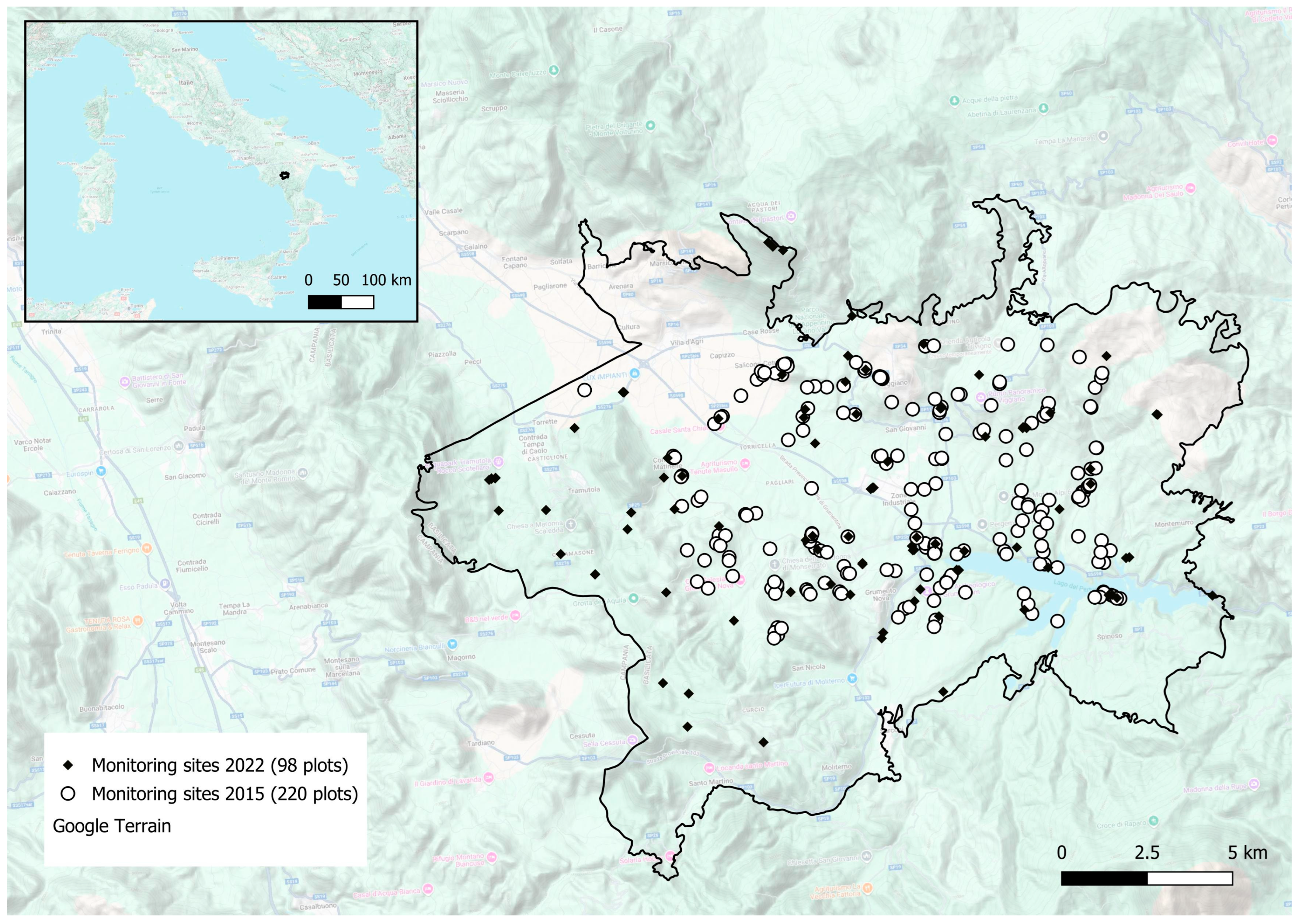
The study area is located in the medium and high sector of the Agri River basin, around the town of Viggiano (Potenza province, Basilicata, Southern Italy) (Figure 1). The territory is characterized by a typical Apennine morphology, with altitudes ranging from approximately 600 to 1500 m a.s.l. (with the maximum at 1700 m in the Mountain of Viggiano), and a predominantly calcareous–marly substrate [21,22]. The area is partially included in the Appennino Lucano—Val d’Agri—Lagonegrese National Park and overlaps five Sites of the Natura 2000 Network: four SCIs (IT9210110, IT9210143, IT9210180, IT8050034), and one SPA (IT9210271).

2.2. Vegetation Characteristics

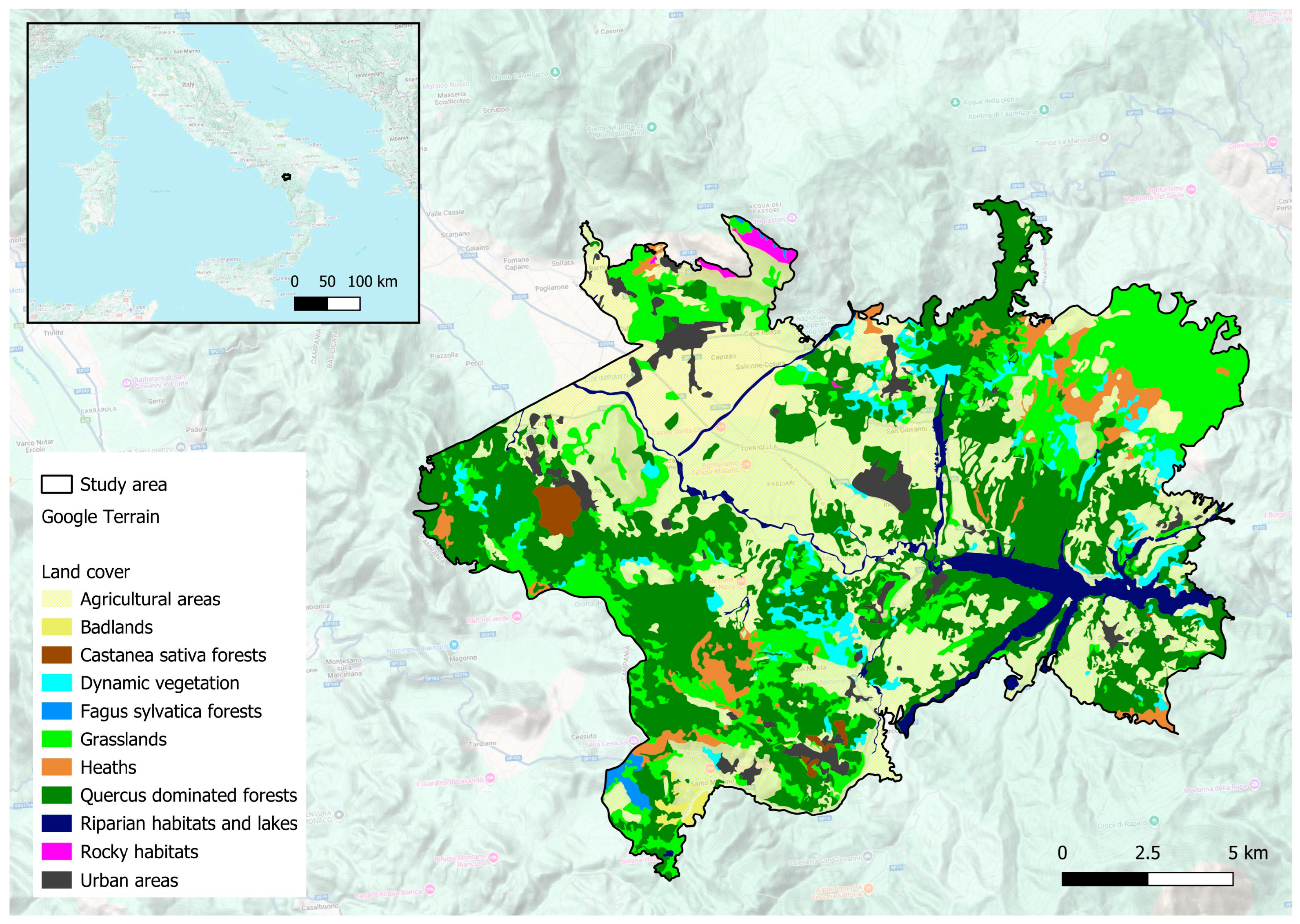
Vegetation in the Agri Valley forms a complex ecological mosaic shaped by geomorphology, land use, and local management practices. The area includes both zonal forest formations and azonal riparian and aquatic habitats, as well as a rich variety of semi-natural grasslands and transitional shrublands (Figure 2).
Oak forests dominated by Quercus cerris, with occasional Q. frainetto and Q. pubescens, prevail in the hilly and lower montane belts; some of these stands belong to habitat type 91M0 of Directive 92/43/EEC (the Habitats Directive) [24,25]. These stands show varying degrees of human influence, from well-structured high forests to recently coppiced woods where the canopy has been significantly opened. In the latter, light-demanding herbaceous species temporarily replace the nemoral flora before the arboreal layer re-establishes. Small and isolated stands of holm oak (Q. ilex) also occur in the southern portion of the basin, representing rare Mediterranean enclaves within a mainly continental region [26]. At higher elevations, beech forests (habitat 9210*) occur, particularly on the slopes of the Mountain of Viggiano and in the Moliterno area. These communities, which frequently host Lobaria pulmonaria lichen, range from mixed, species-rich stands with Ilex aquifolium, Acer pseudoplatanus, and Carpinus betulus, particularly in the Moliterno mountains, to more monospecific beech woods showing a simplified structure and reduced understory diversity in the Mountain of Viggiano [27,28].
The riparian systems are mainly represented by willow and poplar galleries (Salix alba, Populus alba) corresponding to habitat 92A0, and alder stands (Alnus glutinosa) linked to habitat 91E0*. These communities are distributed along the Agri River and its tributaries. At Lake Pertusillo, the expansion of invasive species such as Amorpha fruticosa and Paspalum distichum have locally displaced native taxa, a pattern also reported across southern Italy [29,30,31]. Aquatic vegetation is relatively scarcely represented due to strong water level fluctuations in the Pertusillo reservoir, but remnant populations of Potamogeton crispus and Ranunculus trichophyllus have been recorded, together with characteristic helophytes such as Typha latifolia and Sparganium erectum. These communities are ecologically significant for amphibians and aquatic invertebrates, although they are not formally assigned to any habitat type.
Shrublands occur as scattered patches across mid-altitude slopes and transitional areas between forests and grasslands. They are composed mainly of Acer campestre, Cornus mas, Crataegus monogyna, Corylus avellana, and Prunus spinosa, forming ecotonal habitats that play an important role for wildlife, providing both food and shelter. In early successional stages, dynamic vegetation is dominated by Rubus or Pteridium, forming dense stands.
Grasslands show high structural and floristic heterogeneity. The dry calcareous grasslands (often dominated by Stipa austroitalica, Brachypodium rupestre, or Festuca spp.) impart a steppe-like aspect to the landscape [32,33], particularly between Viggiano and Tramutola, where habitat 62A0 can be recognized. At the margins of the Stipa grasslands, more or less localized patches of therophytic grasslands dominated by Trachynia distachya are present and can be attributed to habitat type 6220* [26].
In the montane belt, species-rich grasslands belonging to habitat 6210(*) (Semi-natural dry grasslands and scrublands with orchids) host numerous Orchidaceae, including Himantoglossum adriaticum, Orchis purpurea, and Ophrys lacaitae [34,35]. At lower and more humid sites, semi-mesophilous and humid meadows, dominated by Dactylis glomerata, Onobrychis caput-galli and Agrostis stolonifera, occur near streams and valley bottoms, sometimes interspersed with hygrophilous species such as Carex otrubae. On rocky outcrops and eroded slopes, garrigue and chasmophytic vegetation develops, often dominated by the Italian endemic Lomelosia pseudositensis and the southern species Plocama calabrica (syn. Putoria calabrica), both indicators of high biogeographical value and relict Mediterranean–oriental affinities [26]. These types of communities belong to habitat type 8210.
We included all of the vegetation types described for the study area in the surveys conducted for this present study [33,34,36,37,38].

2.3. Human Influence

The Agri Valley hosts a mosaic landscape where traditional agro-pastoral systems coexist with industrial and infrastructural development. In riparian zones, hydrological regulation and invasive species contribute to the further modification of plant assemblages. Despite these pressures, the area retains a remarkable floristic richness and includes habitats of European conservation interest, making it a valuable case study for assessing vegetation responses to both anthropogenic and climatic drivers [21,34].
In recent decades, forest management practices (particularly coppicing), variations in grazing intensity, and widespread land abandonment, together with the development of hydrocarbon-related infrastructures, have profoundly influenced vegetation dynamics across the basin. These drivers have modified vegetation structure and landscape connectivity, accelerated secondary successions, and altered the spatial distribution of open habitats [39,40,41]. In addition to land-use change, climate anomalies have increasingly influenced the ecological balance of the basin. Spatially explicit datasets of temperature and precipitation anomalies reveal a progressive trend toward increased aridity and warming, especially in the lower sectors of the valley [19,20,42,43]. These conditions make certain areas more prone to ecological change, potentially amplifying the vegetation shifts observed through floristic indicators such as the Ellenberg indices for temperature and humidity [16,44,45,46]. Although multitemporal vegetation studies have frequently addressed the effects of land-use change (often relying on remotely sensed data or land-cover proxies), climate-driven signals in floristic composition and their interaction with ongoing anthropogenic pressures remain comparatively less explored due to the limited availability of long-term vegetation resurvey data [5].

2.4. Floristic and Vegetation Surveys

To evaluate these dynamics, a multitemporal floristic–vegetation survey was conducted by comparing two datasets: (i) a literature-derived dataset, compiled from published vegetation studies, collected in 2013–2014 (hereafter named 2015 dataset) [6] and (ii) an original dataset based on field surveys conducted by the authors in 2022 [22,47]. From the 2015 dataset, which comprised 220 relevés, 40 plots—hereafter referred to as the spatially matched plots—were resampled in 2022 using a stratified random design to ensure coverage of all major vegetation types and ecological conditions. The accuracy of plot re-localization ranged from approximately 5 m to less than 200 m, reflecting the variable spatial precision of the literature-derived data. Consequently, plot comparisons were performed at the ecosystem level rather than through strict one-to-one matching. This methodological choice is consistent with the spatial resolution of the hydroclimatic data, which were analyzed on a 1 km × 1 km grid. Moreover, because the 2022 field campaign lasted one year instead of two, the overall sampling effort was lower; however, the spatial distribution of plots was optimized to preserve statistical and ecological representativeness across the study area. In addition, 58 new reference plots were established in areas located farther from the main anthropogenic sites to evaluate spatial gradients and compare vegetation dynamics between more impacted and peripheral, less disturbed zones. Thus, a total of 98 relevés was conducted in 2022.
All of the GIS analyses were conducted with QGIS (version 3.22) [48].
All 2022 dataset plots were georeferenced using GPS coordinates marking the plot center. Plot geometry followed national and European standards for habitat monitoring, as reported in Table 1. Plot size was designed according to these standards, which require dimensions to reflect the structural scale and spatial heterogeneity of each vegetation physiognomy [49,50]. Smaller plots effectively capture compositional variability in herbaceous species-rich communities, whereas larger plots are necessary in forests to encompass canopy structure and understory–overstory interactions. Thus, differences in plot size reflect ecological and methodological requirements and do not hinder temporal comparisons, as community-level Ellenberg indicators are intrinsically scale-independent.
Within each plot, in 2022, we recorded the total percentage cover of live plants and deadwood components, including detailed cover estimates for each vegetation layer (tree, shrub, herbaceous, juvenile, and seedling strata). The latter, often neglected in conventional surveys, provide key information on forest regeneration and resilience. Environmental, structural and floristic data for each sample site (plot) are released on online databases [47,51]. For data recording, we employed standardized national survey forms and the Vegapp application (version 1.5.13) [52], which allows for the direct input of vegetation and structural data into a georeferenced database.
Before performing the analysis, to minimize discrepancies due to observer-related differences or taxonomic uncertainty, nomenclature was standardized according to FloraVeg.EU (https://floraveg.eu/, accessed on 1 September 2025), an online database of European plant species and vegetation [53]. Species that were difficult to determine consistently (e.g., Taraxacum, Hieracium, Rubus spp.) were merged into aggregated taxa or functional species groups, according to the same database. This approach ensured robust comparisons between the 2015 and 2022 datasets while avoiding artificial differences caused by minor taxonomic or identification inconsistencies [1]. To ensure analytical consistency, all species were assigned to ecological groups (e.g., forest, dry grasslands, dynamic, and ruderal species; see Supplementary Materials for details) based on the Italian National Flora [54,55,56,57] and Ellenberg Indicator Values (EIVs) obtained from FloraVeg.EU, using the same reference dataset for both survey years. This standardization enabled quantitative comparisons between surveys, and subsequent statistical analyses were conducted to evaluate the significance and ecological relevance of temporal variations [15]. Changes in Ellenberg temperature and humidity values were interpreted as proxies of microclimatic and ecological shifts potentially driven by climate variability. In addition to Ellenberg values, ecological groups were used to cross-check patterns and support the ecological interpretation of the results. Climatic anomaly maps were also examined to assess whether areas experiencing higher thermal and aridity stress spatially corresponded to relevés with extreme Ellenberg temperature and humidity values.

2.5. Data Analysis

For each plot, community means of EIVs were calculated as averages of the individual species values, as suggested by Ostrowsky et al. [58] and then aggregated by habitat type macro-categories for both sampling years (2015 and 2022). For the definition of the macro-categories, we used the first level of habitat type, according to the national interpretation manual [24], as shown in Table 2. To visualize the ecological profiles of the different vegetation types and their temporal shifts, radar plots (spider diagrams) were produced showing the mean Ellenberg indices for the two years.
Differences in Ellenberg ecological indicator values between 2015 and 2022 were assessed for each macro-categorical group using the non-parametric Mann–Whitney U test (two-tailed, α = 0.05) [59]. This test was chosen because it does not assume normality and is suitable for ordinal ecological data [60,61].
The Mann–Whitney U tests were initially performed on the complete 2015 and 2022 datasets to capture the overall temporal variability across all sampled plots and to assess general patterns of ecological change at the landscape scale. The analyses were then repeated on the subset of plots resampled in both years (spatially matched plots)—belonging to the same macro-categories and located in areas with comparable vegetation—to support a more direct comparison between survey years.
Moreover, since our analyses were conducted at the species pool macro-category level rather than through direct one-to-one plot comparison, the approach remains methodologically robust and ecologically consistent. This improvement aimed to reduce potential bias related to site relocation, local heterogeneity, or differences in land-use context, thereby providing a more spatially consistent evaluation of ecological trajectories. Finally, species turnover was quantified within each ecological group (see Supplementary Materials for details) by classifying species as shared, lost, or gained, and by summarizing changes in occurrence frequency and mean cover, including absences.
All statistical analyses were performed in Python 3.12.3.

2.6. Climatic Anomaly Analysis

To contextualize vegetation changes and interpret the ecological responses observed in the study area, we characterized the local climatic regime and its temporal evolution.
Climatic data were obtained from the BIGBANG—Nationwide GIS-based hydrological budget on a regular grid, a hydrological model developed by ISPRA [19,20,42,43]. BIGBANG is a GIS-based, distributed modeling system that estimates the main components of the hydrological balance (precipitation, evapotranspiration, infiltration, runoff) over a regular 1 km grid for the entire Italian territory. The database covers the period 1951–2024, offering monthly and annual fields for the main hydroclimatic variables. A similar approach has been used in the PNRR DigitAP project at national scale (https://www.nnb.isprambiente.it/it/digitap, accessed on 1 December 2025).
For this study, the climatic layers of the BIGBANG database were used, specifically:
  • Mean air temperature (°C)—monthly and annual averages.
  • Total precipitation (mm)—monthly and annual totals.
We also used the Long-Term Annual Average (LTAA, 1951–2024) products for both variables, which represent the official climatological means of the entire observation period and useful as a reference for interpreting long-term conditions.
To assess temporal variability, climatic anomalies were calculated as departures from the 1980–2010 climatological baseline, in line with the WMO [62] and IPCC [63] recommendations (Equation (1)):
A n o m a l y t = X t X 1980 2010 ¯
where:
  • X t is the value of the climatic variable (temperature or precipitation) at time t (month or year);
  • X 1980 2010 is the long- term climatological mean of the variable over the 1980–2010 reference period.
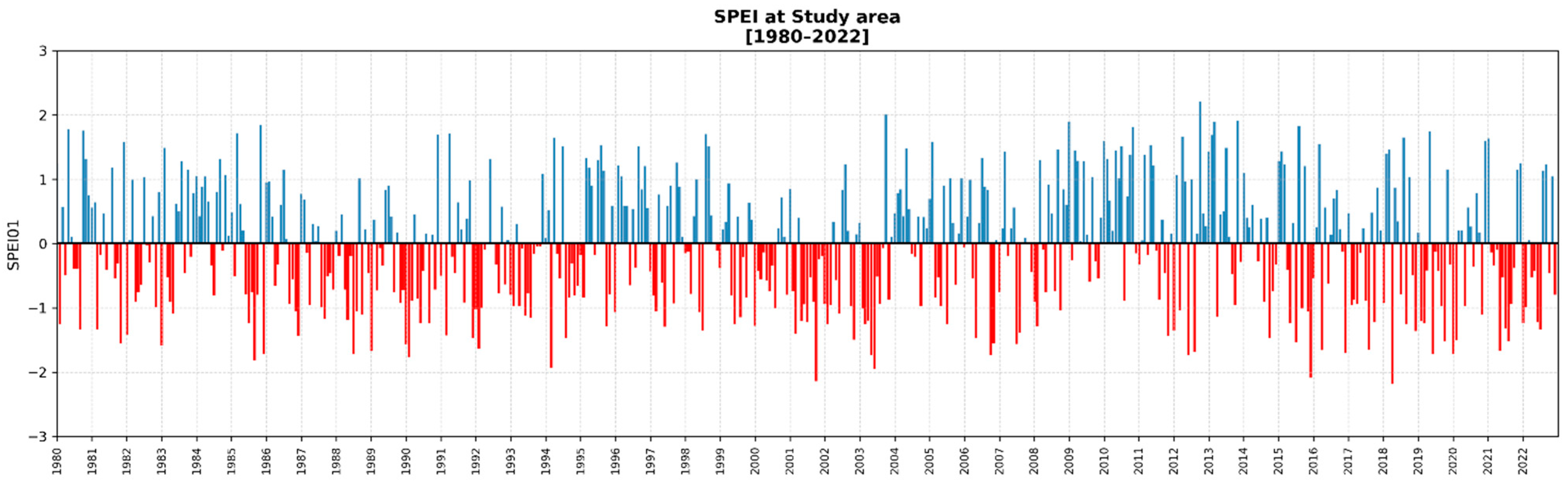
To integrate precipitation- and temperature-based metrics with an index that explicitly accounts for atmospheric evaporative demand, we also extracted the Standardized Precipitation–Evapotranspiration Index (SPEI) [64] from the BIGBANG database (monthly fields); in particular, we used SPEI at 1-month accumulation (SPEI01). SPEI is a widely used drought indicator based on the climatic water balance designed to consider both precipitation and potential evapotranspiration (PET) in determining drought, then standardized to allow comparisons across time. Negative SPEI values indicate drier-than-normal conditions (SPEI01 ≤ −1: drought months), while positive values indicate wetter-than-normal conditions (SPEI > 1). We quantified (i) changes in mean SPEI01, (ii) the frequency of drought months (PEI01 ≥ +1: wet anomalies), and (iii) temporal trends in SPEI01 over the analysis period.
Finally, temporal trends in temperature, precipitation, and SPEI were assessed using the non-parametric Mann–Kendall test [65], and their magnitude was estimated through Sen’s slope [66]. For plot-based climate summaries, 2015 plots were explicitly tagged by their survey year (2013 vs. 2014), and between-survey comparisons were computed starting from the corresponding first survey year (i.e., early period summaries start in 2013 for 2013 plots and in 2014 for 2014 plots).

3. Results

3.1. Plant Community Ecological Shift

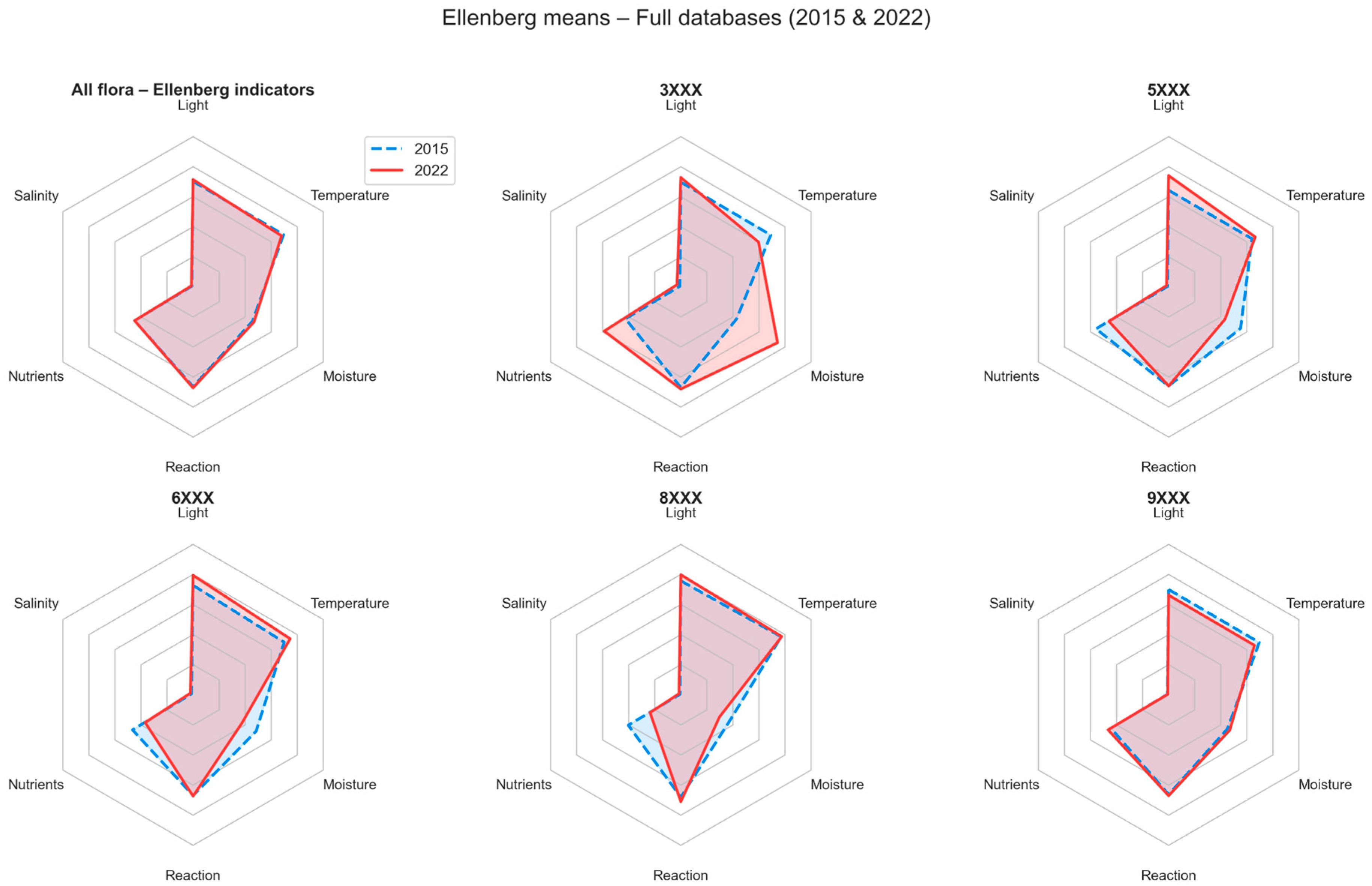
For each plot, community mean EIVs were calculated as the average of individual species values, following Ostrowsky et al. [58]. The resulting values were then aggregated by habitat-type macro-categories for both sampling years (2015 and 2022) and visualized as spider diagrams (Figure 3).
The Mann–Whitney U test identified several significant differences in Ellenberg indicator values between 2015 and 2022 (Table 3), based on the comparison of the full 2015 and 2022 datasets.
Among the six indicators analyzed, the most consistent and significant variations were observed for Light, Moisture, and Nutrients, while Salinity, Temperature, and Reaction showed fewer but still meaningful changes in specific macro-categories.
Light values increased significantly in macro-categories 3XXX (p = 1.40 × 10⁻³), 5XXX, and 6XXX (p ≤ 10−14), whereas a decrease was detected in 9XXX (p = 1.59 × 10−60).
Moisture increased strongly in 3XXX (p = 2.97 × 10−73) and 9XXX (p = 4.34 × 10⁻¹³) but declined sharply in 5XXX and 6XXX (p ≤ 10−11).
Nutrient values showed significant increases in 3XXX and 9XXX and decreases in 5XXX, 6XXX, and 8XXX (all p ≤ 10−6).
A moderate but consistent rise in Salinity was recorded in 3XXX, 5XXX, and 6XXX, while a decrease was observed in 9XXX (p = 5.03 × 10⁻⁶). Reaction increased in 8XXX (p = 1.62 × 10⁻²).
Temperature displayed a decrease in 3XXX (p = 2.17 × 10⁻¹³) and 9XXX (p = 9.86 × 10⁻⁷).
Overall, the results indicate statistically significant yet spatially differentiated shifts in the Ellenberg indicator values between 2015 and 2022, as detailed in Table 3, which reports all mean values and p-statistics for each macro-categorical group.
The Mann–Whitney U test, applied to the subset of plots that were spatially paired between 2015 and 2022, revealed a pattern of significant shifts in Ellenberg indicator values across multiple macro-categories (Table 4).
Among the six Ellenberg indicators, the most consistent and statistically significant variations again involved Moisture and Nutrients, although the magnitude and direction of change differed slightly compared to the full-dataset analysis.
Specifically, Light values increased markedly in macro-categories 5XXX and 6XXX (p ≤ 7.63 × 10⁻⁹), while a significant decrease persisted in 9XXX (p = 6.84 × 10⁻¹⁵); moisture exhibited a clear increase in 3XXX (p = 6.32 × 10⁻²⁵) but declined sharply in 5XXX and 6XXX (p ≤ 10−14). Nutrient values increased significantly in 3XXX (p = 1.25 × 10⁻¹²) and decreased in 5XXX, 6XXX, and 8XXX (p ≤ 1.23 × 10⁻²); Salinity showed a significant increase in 3XXX (p = 1.01 × 10⁻⁶) but a decrease in 9XXX (p = 1.44 × 10⁻⁴), whereas temperature showed a mixed behavior, decreasing in 3XXX (p = 1.00 × 10⁻⁶) but increasing in 6XXX (p = 9.32 × 10⁻⁶).

3.2. Species Turnover by Ecological Groups

Although this analysis is coarse because it does not rely on paired plots, it still provides a broad overview of species turnover. Considering all sampling plots, species turnover analysis (species classified as gained in 2022 only, lost in 2015 only, or shared across both years) showed the largest guild pools in xeric grasslands species (n = 194 species) and forest species (n = 150). Dry grasslands species exhibited a net gain (gained = 75, lost = 41, net = +34), as did forest species (gained = 46, lost = 22, net = +24), while ruderal species displayed a smaller net gain (gained = 33, lost = 28, net = +5). While this coarse approach cannot capture fine-scale dynamics, examining the overall species pool can still reveal meaningful differences, which are later explored in detail using matched paired plots (Table 5).
In the matched paired plots dataset, community composition changed substantially, but the direction and intensity of change differed among ecological groups (Table 6).
Dry grasslands species represented the richest group (n_species_total = 143) and showed the largest absolute turnover, with 55 gained vs. 33 lost. Importantly, among the shared xeric species, the balance shifted toward declines in occupancy (27 decreasing vs. 17 increasing) and a slight predominance of cover decreases (25 decreasing vs. 22 increasing; Table S3).
Forest species showed a more conservative pattern in richness with a net_gain = +13; turnover_rate = 0.438, but the shared component clearly points to a negative direction of change: among the 68 shared forest species, cover decreases strongly dominated (41 decreases vs. 25 increases; only 2 stable; Table S3) and occupancy decreases were also prevalent (38 decreases vs. 17 increases).
Ruderal species exhibited intermediate turnover (turnover_rate = 0.563) with a modest positive net balance (net_gain = +5). In this group, shared species showed a mixed response: cover changes were balanced (16 increase vs. 16 decrease; Table S3), while occupancy showed a slight tendency toward expansion (14 increasing vs. 12 decreasing).
Species linked to vegetation dynamics showed moderate turnover (turnover_rate = 0.457; net_gain = +6), but shared species tended to show declines in cover (12 cover decreases vs. 6 increases; Table S3) and occupancy (10 occupancy decreases vs. 5 increases). Several smaller groups showed high proportional turnover, which should be interpreted cautiously due to low species counts. For example, orchids had a high turnover rate (0.727) and a positive net gain (+4), but shared orchids mainly showed cover decreases (Table S3) and occupancy decreases, indicating instability within a small, shared core. Mesophilous grassland species were the only group with a negative net balance (net_gain = −3), and shared species mostly showed cover decreases (4 decreases, 0 increases; Table S3) with more occupancy losses than gains, suggesting a contraction of mesic grassland elements. Segetal species showed complete replacement (n_shared = 0; turnover_rate = 1), i.e., the species recorded in the two surveys did not overlap, again with the caveat of very low richness. Invasive plant species increased slightly (net_gain = +1) with high turnover (0.75), indicating that this component is small but changing.
The ranked lists of the most increasing/decreasing shared species are provided in the Supplementary Materials (Table S4).

3.3. Climate Analysis

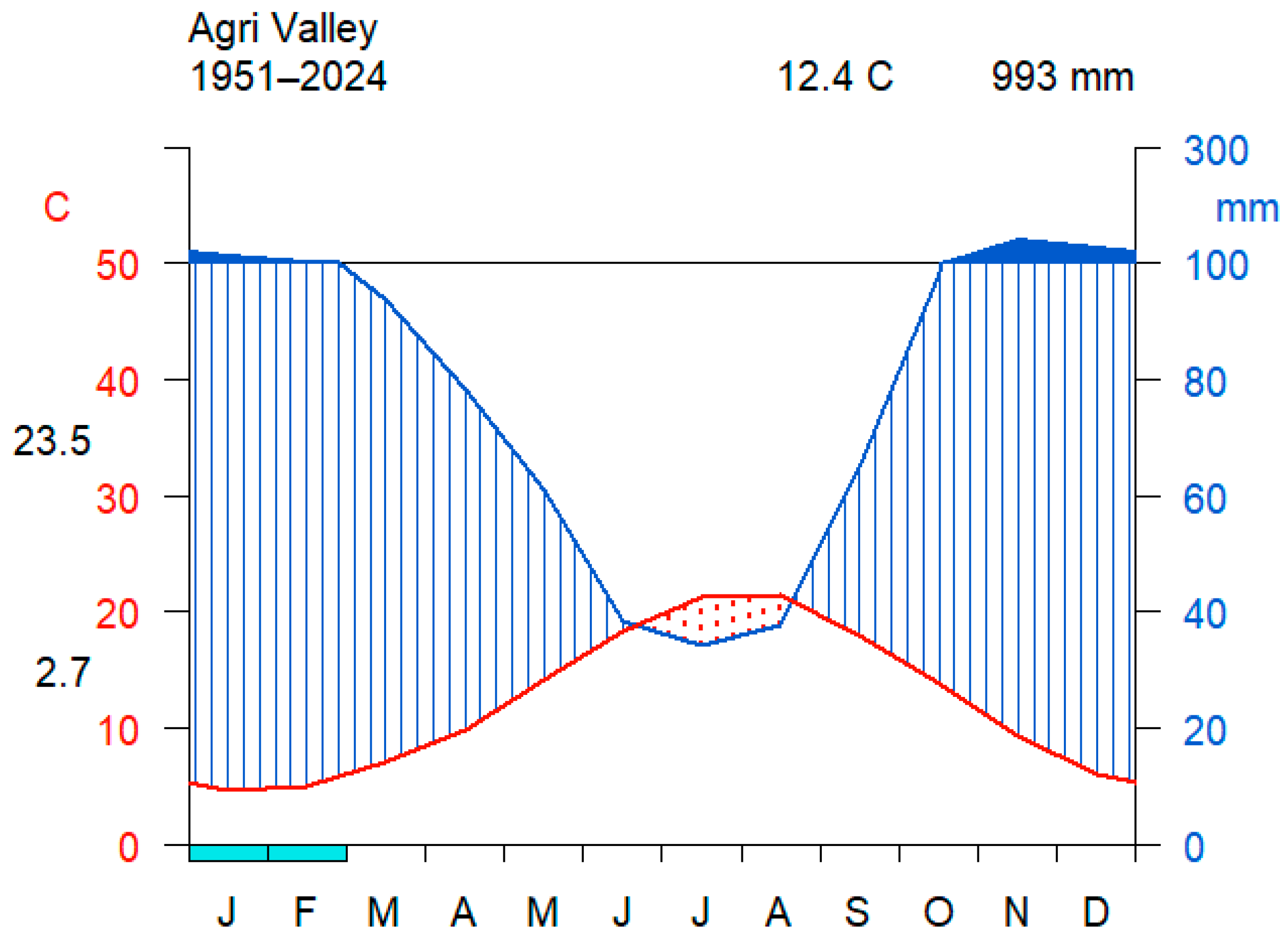
The climatic characterization of the study area, based on the BIGBANG dataset, highlights a typical Mediterranean regime with marked seasonality in both temperature and precipitation. To provide a synthetic and ecologically meaningful overview of these patterns, we adopted a Walter–Lieth climate diagram (Figure 4) [67], which displays the mean monthly temperature (red line) and precipitation (blue bars) following the classical P/2 scaling criterion.
This representation allows for a rapid identification of humid and dry periods: months where precipitation falls below twice the air temperature (P < 2T) are highlighted as biologically dry, while months exceeding this threshold indicate humid conditions.
The long-term annual average (1951–2024) corresponds to a mean temperature of ≈12.4 °C and a total annual precipitation of ≈993 mm, as shown in the upper part of the diagram (Figure 4). The climatic year is characterized by cool and relatively wet winters, a sharp reduction in rainfall from June to September, and a dry summer peak in July–August, where precipitation reached its minimum (≈20–35 mm month−1) and fell below the P < 2T threshold, defining a relevant summer drought. Conversely, precipitation maxima occurred in November–December (≈95–120 mm month−1), corresponding to the main humid season.
The diagram clearly illustrates the pronounced thermo-pluviometric contrast typical of inland Mediterranean mountain areas:
  • Winter–spring humid phase (December–May),
  • Summer drought (June–September, strongest in July–August),
  • Autumn recharge phase (October–December).
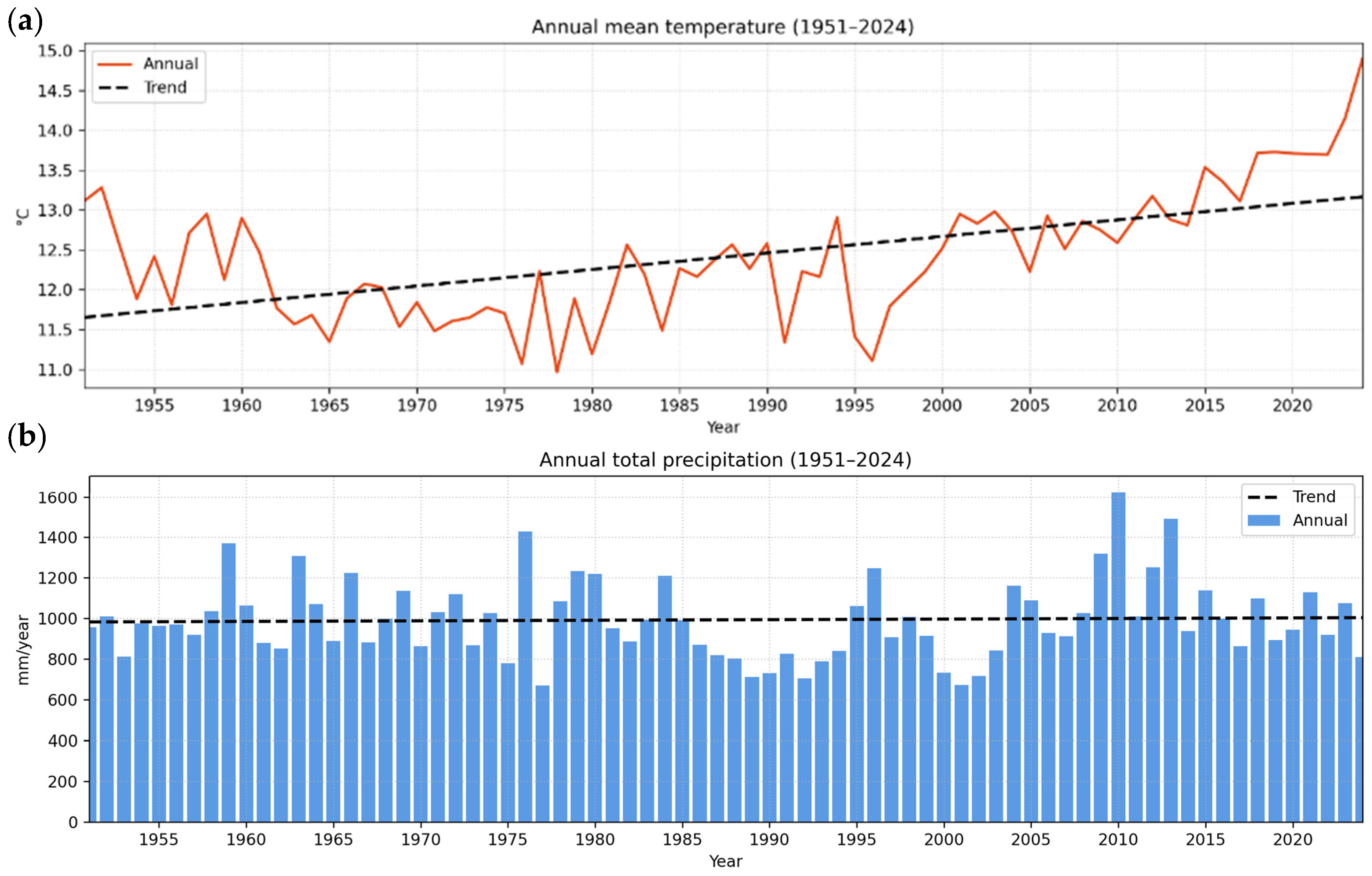
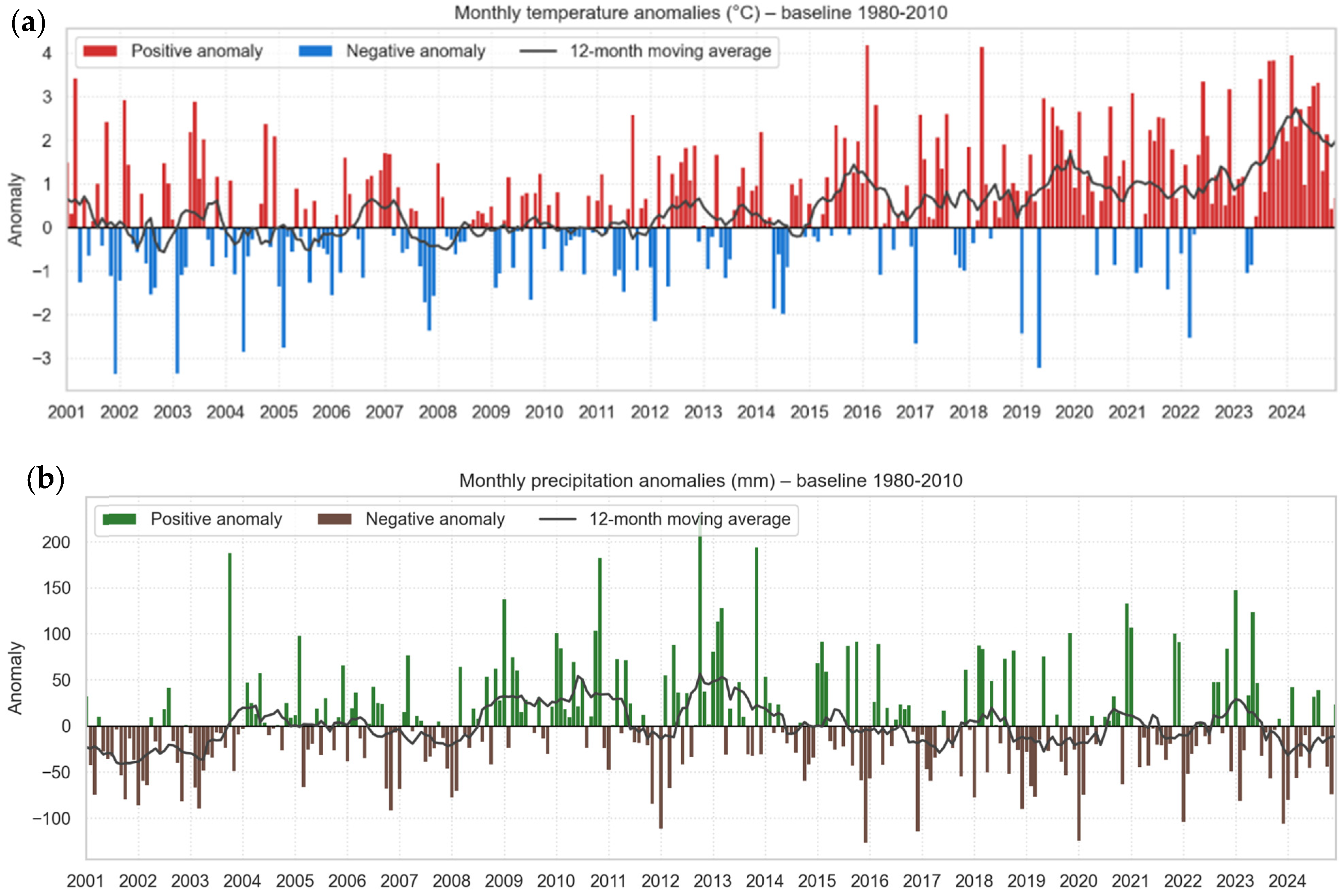
We quantified long-term trends in annual temperature and precipitation (Figure 5) and analyzed monthly anomalies relative to the 1980–2010 climatological baseline (Figure 6), restricting trend statistics to 1951–2022 and 1980–2022 to ensure consistency with the second vegetation survey year (2022).
Over 1951–2022, mean annual temperature showed a significant monotonic increase (Mann–Kendall p = 5.49 × 10⁻⁶) with a Sen’s slope of +0.21 °C decade−1 corresponding to an overall warming of ~+1.54 °C across the study period (Table 7). The shorter period 1980–2022 confirms an accelerated warming (p = 1.10 × 10⁻⁹), with a Sen’s slope of +0.48 °C decade−1 corresponding to an overall warming of ~+1.79 °C.
Annual precipitation exhibited high interannual variability and no significant trend over 1951–2022 (p = 0.918; Sen’s slope +1.92 mm decade−1, Table 7). Over 1980–2022, precipitation showed a weak, non-significant tendency to increase (p = 0.0787; Sen’s slope +35 mm decade−1).
Monthly anomalies relative to the 1980–2010 baseline (Figure 6) revealed mostly positive temperature deviations since the late 1990s, with peaks in 2003, 2017, and 2022 (Figure 6a). The annual mean temperature anomaly increased significantly (p = 5.83 × 10−65, with a Sen’s slope of +0.611 per decade °C decade−1). In parallel, the frequency of months with positive temperature anomalies increased by +2 months decade−1 (p = 4.08 × 10⁻⁴), and “hot” months with anomalies ≥ +2 °C increased by +1 months decade−1 (p = 0.0039). In contrast, precipitation anomalies showed no significant trend in either annual mean anomaly (p = 0.498) indicating that the hydroclimatic signal over this period was dominated by high interannual variability with drought years such as 2001–2002, 2017, and 2022 (Figure 6b).
At the study-area scale, annual SPEI shifted from positive values in 2013 (SPEI = 0.550) to moderately negative values in 2022 (SPEI = −0.295), while 2014 was close to neutral (SPEI = −0.047), (Figure 7), indicating a marked transition from wetter to drier conditions between the two survey periods. Because the 2015 database includes surveys conducted in both 2013 and 2014, we explicitly accounted for this by tagging 2015 plots by survey year; 30 out of 220 plots (13.6%) were surveyed in 2014.
Over 1951–2022 period, annual mean SPEI showed high interannual variability and no significant monotonic trend (p = 0.348) (Figure 7, Table 8). The same absence of a monotonic signal was confirmed when restricting the record to the more recent 1980–2022 period (p > 0.8; Table 8). However, focusing on the interval separating the two vegetation surveys (2013–2022), annual SPEI exhibited a significant decreasing tendency (p = 0.049; Sen’s slope = −0.044 SPEI units yr−1; Table 8), indicating progressive drying conditions during the years between sampling campaigns. Consistently, drought-month frequency increased between the two sub-periods that bracketed the surveys: at the study area scale, the proportion of months with SPEI ≤ −1 rose from 16.7% in 2013–2017 to 26.7% in 2018–2022, together with a decrease in mean SPEI (0.095 to −0.207), suggesting that the later survey period was characterized not only by lower mean SPEI but also by more frequent dry anomalies.
The same direction of change was observed for the period 2013–2022 at sampling locations when summarized as a monthly mean time series (all plots: 16.7% to 26.7%; paired subset: 16.7% to 28.3%). However, inference over this short interval should be interpreted cautiously and is primarily used to support the direction of change observed in frequency-based indicators.
When stratifying sampling locations by ecological macro-categories (all sampling points, Table 9), all habitat types showed a drying shift between the early (2013–2017) and late (2018–2022) sub-periods, expressed both as (i) a decrease in mean SPEI and (ii) an increase in the proportion of drought months (SPEI ≤ −1).
Ranking macro-categories by “drying severity” based primarily on Sen’s slope (more negative = stronger drying) and secondarily on drought-month increase, wetlands showed the strongest and most coherent signal 1(3XXX: Sen = −0.55 SPEI/dec, p = 0.015; drought months 20.1% → 28.8%, +8.7 pp), followed by forests (9XXX: Sen = −0.51/dec, p = 0.025) and grasslands (6XXX: Sen = −0.49/dec, p = 0.015). Shrublands exhibited a comparable slope but weaker statistical support (5XXX: Sen = −0.52/dec, p = 0.108), while rocky habitats showed a smaller slope but a marked increase in drought-month frequency (8XXX: Sen = −0.36/dec, p = 0.015). Overall, the full dataset indicates that drying is transversal across habitat types, with wetlands and forests emerging as the most consistently affected categories, whereas in shrublands and rocky habitats, the signal is more evident in drought-month frequencies than in trend strength.
In the matched paired plots (Table 10), we did not estimate temporal trends because the limited sample size within each macro-category would not provide robust inference. Instead, we compared the two survey-bracketing sub-periods (2013–2017 vs. 2018–2022) using (i) differences in mean SPEI and (ii) differences in the proportion of drought months (SPEI01 ≤ −1). Under this descriptive comparison, wetlands and forests again showed the clearest drying signal, with the largest increases in drought-month frequency (3XXX: 14.2% → 31.7%; 9XXX: 9.5% → 26.1%,), followed by grasslands (6XXX: 18.3% → 29.9%) and shrublands (5XXX: 19.0% → 27.9%). Rocky habitats showed the weakest shift in drought-month frequency (8XXX: 14.2% → 17.5%), consistent with reduced sample support for this macro-category in the paired dataset.

4. Discussion

The Mann–Whitney U test identified several significant differences in Ellenberg indicator values between 2015 and 2022 (Table 2) with varying responses of EIVs among different habitat macro-categories. The decreasing Light values observed in 9XXX (p = 1.59 × 10−60), both in the whole and in the spatially matched analysis, suggested natural successional evolution of forest habitats, as shade-tolerant species could increase in the floristic composition, as result of the development of a denser canopy cover, which can be considered as a good indicator for vegetation dynamics in forest ecosystems [68,69]. Also, the increasing trend in Moisture values observed in 9XXX (p = 4.34 × 10⁻¹³ in whole dataset) led to similar conclusions, as canopy development enhances shading and consequently increases soil humidity. Previous studies have shown that variations in canopy cover significantly influence understory light and moisture regimes [70]. Furthermore, both empirical and synthesis works indicate that canopy dynamics and increasing canopy cover are associated with reduced understory light availability and altered microclimatic conditions, favoring shade-tolerant and moisture-demanding understory species [70,71]. In Mediterranean and Apennine contexts, remote-sensing and field studies also link canopy structural development to enhanced below-canopy humidity and compositional shifts in the herb layer [72]. This pattern suggests that local canopy closure processes may contribute to microclimatic buffering, mitigating the effects of increasing aridity at the stand scale. This buffering interpretation is also consistent with the climatic characterization of the study area, which indicates that the main directional signal is warming rather than a clear long-term precipitation decline.
Moisture value also showed an increase in 3XXX (p = 2.97 × 10−73, whole dataset; p = 6.32 × 10⁻²⁵, matched plots), where it can reflect the resistance of moisture conditions in freshwater habitats. Furthermore, these habitats were more extensively surveyed in 2022, when all riparian communities within the monitoring area were included to ensure a comprehensive assessment of vegetation conditions [73]. The lower number of corresponding plots in 2015 may therefore have contributed to the observed difference.
Moisture values showed a decline in shrublands (5XXX) (p = 4.38 × 10⁻¹², whole dateset; p = 6.72 × 10⁻⁷, matched plot) and grasslands (6XXX) (p = 7.61 × 10⁻³⁵,whole dataset; p = 1.91 × 10⁻¹⁴, matched plots), suggesting that these habitat types may be more affected than others by increasing aridity. For grasslands, this shift may indicate a further increase in soil aridity, consistent with evidence that even steppe-like and semi-dry grassland communities can be vulnerable to reduced soil moisture and prolonged droughts under Mediterranean climatic conditions [73]. The climate results support the interpretation that open habitats are responding to the combination of increasing thermal forcing and more frequent dry anomalies in the most recent decade, rather than to a monotonic decrease in annual precipitation.
Temperature indicator value displayed mixed behavior, decreasing in 3XXX (p = 2.17 × 10⁻¹³, whole dataset; p = 1.00 × 10⁻⁶ in matched) and in 9XXX (p = 9.86 × 10⁻⁷ in whole), which—according to the Light and Moisture results—suggests a good state of conservation for freshwater and forest habitats.
The increase in the Temperature indicator observed for grasslands in matched paired plots (6XXX, p = 9.32 × 10⁻⁶) seems to indicate that they are among the habitat types most affected by climate change, as also reported by Bonanomi et al. [13], particularly when considered alongside the decline in Moisture values. Indeed, the need for analyses specifically aimed at disentangling the effects of climatic anomalies from those of local management regimes has already been highlighted for the Apennine region [74].
Even when the analysis was restricted to spatially matched plots, Light and Moisture remained the most responsive indicators, showing consistent and significant shifts over time (Table 4). This convergence across independent datasets strengthens the evidence for genuine ecological change, providing a robust signal that transcends potential relocation or sampling biases.
The results on species turnover in the matched datasets (40 plot pairs) seem to reinforce the trends highlighted by the EIV analyses. Two concurrent, yet ecologically coherent, processes appear to drive the observed changes in plant communities: (i) the expansion of forest canopy cover and (ii) the aridification of open grasslands.
Concerning the first process, forests species showing the largest increases in cover between 2015 and 2022, in riparian and mesophilous forests, were the understory species Ulmus minor, Sambucus nigra, and Solanum dulcamara. This pattern is consistent with the observed decrease in the Light indicator values in forest habitats, suggesting a shift towards more shaded conditions. A similar trend was observed for Quercus cerris, Rubus caesius, Crataegus monogyna, Lathyrus niger, Stachys sylvatica, Luzula forsteri, Pyrus communis, Viola odorata, and Aegonychon purpurocaeruleum, which are commonly recorded in forests belonging to habitat type 91M0* (deciduous Quercus-dominated forests). These species appear to have benefited from increasing canopy closure. Notably, among the species showing the strongest decreases in cover, we recorded Quercus frainetto, a key diagnostic and structural species of habitat type 91M0* in the Basilicata region and, more broadly, across the Mediterranean context [24]. The decline of this species may therefore represent an early warning signal for the conservation status of thermophilous deciduous oak forests in the region. These results support the hypothesis of advancing forest cover and the structural maturation of woody vegetation. This pattern is consistent with the afforestation processes documented in the Basilicata region during the Quaternary [75,76]. Nevertheless, some meso-hygrophilous species—such as Alnus glutinosa, Salix alba, Populus nigra, Brachypodium sylvaticum, Calystegia sepium/sylvatica, Equisetum sp.pl., Rubus fruticosus aggr.—showed declines in abundance, in line with the dieback reported for certain Mediterranean forest habitats [75].
Concerning grasslands habitats, the species showing the largest increases in cover were Koeleria lobata/splendens, Trifolium stellatum, Helianthemum nummularium, Gelasia villosa, and Convolvulus cantabrica. These species are typical of mountain dry grasslands, commonly associated with habitat types 6210(*) and 62A0. Their increase suggests that continental dry grasslands may retain some species more resistant to the effects of increasing aridity. These types of grasslands seems to be richer in typical dry grasslands species, consistent with the literature [77,78,79]. Notably, a marked decrease in cover was observed for Trachynia distachya, Aegilops geniculata, Salvia verbenaca, Plantago lanceolata and Micromeria graeca, highlighting the vulnerability of Mediterranean dry grasslands (habitat type 6220*). Coldea and collaborators [79] found a similar trend for dry grasslands in the Carpathian Mountains. Mediterranean dry grasslands belonging to habitat type 6220* include several semi-desert species, some of which may already be close to their lower tolerance limits for aridity, making them particularly sensitive to further increases in drought stress. Moreover, among the more ruderal grassland species, Dasypyrum villosum, Scabiosa columbaria aggr./Sixalix atropurpurea, Picris hieracioides, Melilotus sulcatus, and Ononis spinosa exhibited modest increases in cover, suggesting that they may be relatively favored under drier conditions and could contribute to compositional shifts within dry grasslands, potentially affecting the typical annual component of habitat type 6220* [78].
In fact, the climatic context supports this mechanism: although annual precipitation did not show a significant monotonic decline, temperatures increased significantly, and the SPEI indicates a recent drying tendency over the survey-bracketing interval (2013–2022), together with a higher frequency of drought months (SPEI01 ≤ −1) in 2018–2022 than in 2013–2017 (Table 8; Figure 6). Our results suggest that when feasible, a multiscale approach can be useful for interpreting vegetation processes [80].
In terms of floristic patterns, shrublands showed trends broadly comparable to those of grasslands, yet no clear directional changes emerged. This may be partly due to the relatively small number of shrubland plots available for comparison.
Overall, these results highlight how climate-driven pressures may interact with habitat-specific ecological constraints, leading to contrasting trajectories in open versus wooded ecosystems and underscoring the need for differentiated conservation and management strategies, as also suggested in other studies [81]. The coexistence of forest expansion and grassland aridification indicates that these processes may operate at different spatial scales—forest edges continue to advance, while drying conditions intensify in the remaining open patches, which may represent the most ecologically “old-growth” grasslands in the system [77].
In this study, we analyzed changes in Ellenberg indicator values (EIVs) and species turnover, finding similar trends between functional traits and climatic data. Our results are consistent with the literature, which recognizes EIVs as useful proxies for detecting changes in vegetation dynamics [82]. Regarding the EIVs associated with soil chemical properties (Nutrients, Reaction, and Salinity), the observed increase in Nutrients may reflect the ongoing successional processes in forest habitats (9XXX), while it could also indicate potential eutrophication in freshwater systems.

5. Conclusions

By integrating multitemporal vegetation plot resurveys, community-level ecological indicators, and hydroclimatic anomalies, this study provides new insights into the responses of Mediterranean vegetation to increasing aridity. Our results reveal contrasting trajectories between different ecosystems, highlighting the importance of habitat-specific ecological constraints in shaping vegetation dynamics under climate stress.
In grassland habitats, species turnover patterns indicate divergent responses between continental and Mediterranean plant communities. While continental dry grasslands appear to retain a species pool capable of partially buffering increasing aridity, Mediterranean dry grasslands show signs of vulnerability, particularly through declines in annual diagnostic species and the relative persistence or spread of more ruderal and stress-tolerant taxa. These trends suggest an ongoing reorganization of species composition that may compromise the conservation status of priority habitat types.
In forest ecosystems, changes in species composition and Ellenberg indicator values point to increasing shade and mesic conditions at the understorey level, consistent with canopy closure processes. While such dynamics may locally mitigate the effects of climatic aridity, the decline of key eastern thermophilous species, such as Quercus frainetto, indicates that structural buffering alone may not fully offset long-term climate-driven stress on forest composition and resilience.
EIVs proved to be sensitive indicators of vegetation change under climate and human pressures. However, these patterns should be interpreted considering several limitations. Climate metrics were derived from a 1 km gridded dataset, which can smooth fine-scale topographic and microclimatic variability, especially in heterogeneous or mountainous settings. In addition, our ability to disentangle the mechanisms behind habitat-specific responses was constrained by the lack of direct soil information (e.g., texture, depth, and water-holding capacity), which is known to strongly modulate drought impacts and vegetation sensitivity. Finally, only a subset of plots could be consistently matched between survey campaigns; consequently, some ecological macro-categories are represented by relatively few resurveyed plots.
Overall, our findings demonstrate the value of combining vegetation resurveys analyzed at the functional-trait level with hydroclimatic indices to detect early signals of climate-driven vegetation change. This integrative framework allows for a more mechanistic interpretation of observed community shifts and provides a robust basis for anticipating future trajectories of Mediterranean ecosystems under increasing aridity, with important implications for conservation and adaptive management strategies.
From a management perspective, promoting adaptive land-use strategies (such as sustainable grazing regimes, targeted restoration or reforestation, and conservation of soil and water resources) may help mitigate aridification processes and enhance habitat resilience. Future work could therefore increase the number of resurveyed plots, integrate targeted soil sampling and eco-physiological data, combining detailed habitat-specific measurements with remote sensing, UAS, and LiDAR technologies to enhance spatial comparability at the national scale and support climate-resilient monitoring.


Supplementary Materials

The following supporting information can be downloaded at: https://www.mdpi.com/article/10.3390/land15010048/s1, Table S1: Differences in mean Ellenberg indicator values (2015–2022) across all plots, with statistically significant changes highlighted in bold; Table S2: Differences in mean Ellenberg indicator values (2015–2022) based on paired plots only, with statistically significant changes highlighted in bold; Table S3: Species turnover and direction of change between 2015 and 2022 in the spatially paired plots dataset, summarised by ecological group. For each group, the table reports total species richness across both surveys (n_species_total), numbers of species gained (n_gained) and lost (n_lost), and the size of the shared component (n_shared). For shared species only, directional changes are summarised separately for cover (number of species with increased, decreased, or stable cover: shared_cover_increase, shared_cover_decrease, shared_cover_stable) and occupancy (number of species with increased, decreased, or stable occupancy: shared_occ_increase, shared_occ_decrease, shared_occ_stable). Net change in richness is expressed as net_gain (= n_gainedn_lost), and overall compositional change is summarised by the turnover_rate (see Methods for definition); Table S4: Ranked lists of the most increasing (“top winners”) and most decreasing (“top losers”) shared species between 2015 and 2022 in the spatially paired plots dataset. The table reports its prevailing ecological group (mode of group assignment across occurrences), mean cover including zeros in each survey (mean_cover_incl0_2015, mean_cover_incl0_2022) and the corresponding difference (delta_mean_cover_incl0), as well as occurrence (proportion of paired plots where the species was recorded) in 2015 and 2022 (occurrence_2015, occurrence_2022) and the related change (delta_occurrence). Positive deltas indicate increases, negative deltas decreases.

Author Contributions

Conceptualization, E.C., M.P., F.P., L.C. and P.A.; methodology, E.C., M.P. and F.P.; formal analysis, M.P.; investigation, E.C., F.P. and G.M.; data curation, E.C., M.P. and F.P.; writing—original draft preparation, E.C. and M.P.; writing—review and editing, all authors; supervision, L.C. and P.A.; project administration, L.C. and P.A.; funding acquisition, G.C., A.P. and P.A. All authors have read and agreed to the published version of the manuscript.

Funding

This work was supported by the ARPA Basilicata [Agreement between ARPA Basilicata and ISPRA on Ecosystems Monitoring by innovative indicators development (30 November 2021)].

Data Availability Statement

The data presented in this study are openly available in Zenodo at https://doi.org/10.5281/zenodo.7405294 [47], https://doi.org/10.5281/zenodo.17533875 [51].

Acknowledgments

The authors would like to thank Irene Prisco for their assistance during fieldwork, and Giovanni Salerno for support in the identification of critical taxa. We are also grateful to Giovanna Potenza, Leonardo Rosati, and Maria Rita La Penna for the useful discussions on the Val d’Agri habitats.

Conflicts of Interest

The authors declare no conflicts of interest.

References

  1. Chytry, M.; Tichy, L.; Hennekens, S.M.; Schaminee, J.H.J. Assessing Vegetation Change Using Vegetation-Plot Databases: A Risky Business. Appl. Veg. Sci. 2014, 17, 32–41. [Google Scholar] [CrossRef]
  2. Kopecký, M.; Macek, M. Vegetation Resurvey Is Robust to Plot Location Uncertainty. Divers. Distrib. 2015, 21, 322–330. [Google Scholar] [CrossRef] [PubMed]
  3. Giarrizzo, E.; Burrascano, S.; Zavattero, L.; Blasi, C. New Methodological Insights for the Assessment of Temporal Changes in Semi-Natural Dry Grasslands Plant Species Composition Based on Field Data from the Northern Apennines. Hacquetia 2015, 14, 19–32. [Google Scholar] [CrossRef]
  4. Pärtel, M.; Tamme, R.; Carmona, C.P.; Riibak, K.; Moora, M.; Bennett, J.A.; Chiarucci, A.; Chytrý, M.; de Bello, F.; Eriksson, O.; et al. Global Impoverishment of Natural Vegetation Revealed by Dark Diversity. Nature 2025, 641, 917–924. [Google Scholar] [CrossRef]
  5. Knollová, I.; Chytrý, M.; Bruelheide, H.; Dullinger, S.; Jandt, U.; Bernhardt-Römermann, M.; Biurrun, I.; de Bello, F.; Glaser, M.; Hennekens, S.; et al. ReSurveyEurope: A Database of Resurveyed Vegetation Plots in Europe. J. Veg. Sci. 2024, 35, e13235. [Google Scholar] [CrossRef]
  6. AECOM. Monitoraggio Dello Stato Degli Ecosistemi Centro Oli Val d’Agri. In Monitoraggio Della Vegetazione Con Studio Fitosociologico; DOC_SIME_AMB_07_18; ENI Spa.: Rome, Italy, 2014. [Google Scholar]
  7. Spinoni, J.; Vogt, J.V.; Naumann, G.; Barbosa, P.; Dosio, A. Will Drought Events Become More Frequent and Severe in Europe? Int. J. Climatol. 2018, 38, 1718–1736. [Google Scholar] [CrossRef]
  8. Giorgi, F.; Lionello, P. Climate Change Projections for the Mediterranean Region. Glob. Planet. Change 2008, 63, 90–104. [Google Scholar] [CrossRef]
  9. Perez-Navarro, M.A.; Lloret, F.; Molina-Venegas, R.; Alcántara, J.M.; Verdú, M. Plant Canopies Promote Climatic Disequilibrium in Mediterranean Recruit Communities. Ecol. Lett. 2024, 27, e14391. [Google Scholar] [CrossRef] [PubMed]
  10. De Frenne, P.; Rodríguez-Sánchez, F.; Coomes, D.A.; Baeten, L.; Verstraeten, G.; Vellend, M.; Bernhardt-Römermann, M.; Brown, C.D.; Brunet, J.; Cornelis, J.; et al. Microclimate Moderates Plant Responses to Macroclimate Warming. Proc. Natl. Acad. Sci. USA 2013, 110, 18561–18565. [Google Scholar] [CrossRef]
  11. Zhu, K.; Song, Y.; Lesage, J.C.; Luong, J.C.; Bartolome, J.W.; Chiariello, N.R.; Dudney, J.; Field, C.B.; Hallett, L.M.; Hammond, M.; et al. Rapid Shifts in Grassland Communities Driven by Climate Change. Nat. Ecol. Evol. 2024, 8, 2252–2264. [Google Scholar] [CrossRef]
  12. Palombo, C.; Battipaglia, G.; Cherubini, P.; Chirici, G.; Garfì, V.; Lasserre, B.; Lombardi, F.; Marchetti, M.; Tognetti, R. Warming-Related Growth Responses at the Southern Limit Distribution of Mountain Pine (Pinus Mugo Turra Subsp. Mugo). J. Veg. Sci. 2014, 25, 571–583. [Google Scholar] [CrossRef]
  13. Bonanomi, G.; Idbella, M.; Allegrezza, M.; Tesei, G. Dieback of the Cushion Plant Silene Acaulis at Its Southern Limit of Distribution in the Apennines. Alp. Bot. 2023, 133, 57–62. [Google Scholar] [CrossRef]
  14. Liu, S.; Yang, D.; Zhang, X.; Liu, F. Quantitative Analysis and Nonlinear Response of Vegetation Dynamic to Driving Factors in Arid and Semi-Arid Regions of China. Land 2025, 14, 1575. [Google Scholar] [CrossRef]
  15. Tichý, L.; Axmanová, I.; Dengler, J.; Guarino, R.; Jansen, F.; Midolo, G.; Nobis, M.P.; Van Meerbeek, K.; Aćić, S.; Attorre, F.; et al. Ellenberg-type Indicator Values for European Vascular Plant Species. J. Veg. Sci. 2023, 34, e13168. [Google Scholar] [CrossRef]
  16. Ellenberg, H. Zeigerwerte Der Gefässpflanzen Mitteleuropas. Scr. Geobot. 1974, 9, 1–197. [Google Scholar]
  17. Kopecký, M.; Hederová, L.; Macek, M.; Klinerová, T.; Wild, J. Forest Plant Indicator Values for Moisture Reflect Atmospheric Vapour Pressure Deficit Rather than Soil Water Content. New Phytol. 2024, 244, 1801–1811. [Google Scholar] [CrossRef] [PubMed]
  18. Chytrý, M.; Hennekens, S.M.; Jiménez-Alfaro, B.; Knollová, I.; Dengler, J.; Jansen, F.; Landucci, F.; Schaminée, J.H.J.; Aćić, S.; Agrillo, E.; et al. European Vegetation Archive (EVA): An Integrated Database of European Vegetation Plots. Appl. Veg. Sci. 2016, 19, 173–180. [Google Scholar] [CrossRef]
  19. Braca, G.; Bussettini, M.; Lastoria, B.; Mariani, S.; Piva, F. Il Modello Di Bilancio Idrologico Nazionale BIGBANG: Sviluppo e Applicazioni Operative. La Disponibilità Della Risorsa Idrica Naturale in Italia Dal 1951 Al 2020/The BIGBANG National Water Balance Model: Development and Operational Applications. Ava. L’Acqua 2022, 2, 13. [Google Scholar]
  20. Braca, G.; Mariani, S.; Lastoria, B.; Tropeano, R.; Casaioli, M.; Piva, F.; Marchetti, G.; Bussettini, M. Bilancio Idrologico Nazionale: Stime BIGBANG e Indicatori Sulla Risorsa Idrica. Aggiornamento Al 2023; Serie Rapporti. Rapporto n. 401/2024; ISPRA: Roma, Italy, 2024.
  21. Di Pietro, R.; Conte, A.L.; Iamonico, D. La Vegetazione Di San Martino d’Agri. Monografia e Carta Della Vegetazione; Grafica Mente: Sant’Arcangelo, Italy, 2014. [Google Scholar]
  22. Carli, E.; Casella, L.; Miraglia, G.; Pretto, F.; Prisco, I.; Caricato, G.; Palma, A.; Angelini, P. Open Data for Assessing Habitats Degree of Conservation at Plot Level. An Example Dataset of Forest Structural Attributes in Val d’Agri (Basilicata, Southern Italy). Data Brief 2023, 47, 108986. [Google Scholar] [CrossRef]
  23. Papallo, O.; Bianco, P.M. Carta Della Natura Della Regione Basilicata: Carta Degli Habitat Alla Scala 1:50.000; ISPRA: Roma, Italy, 2012.
  24. Biondi, E.; Blasi, C.; Burrascano, S.; Casavecchia, S.; Copiz, R.; Del Vico, E.; Galdenzi, D.; Gigante, D.; Lasen, C.; Spampinato, G.; et al. Manuale Italiano di Interpretazione Degli Habitat Della Direttiva 92/43/CEE (Italian Interpretation Manual of the 92/43/EEC Habitats Directive). Available online: http://vnr.unipg.it/habitat/ (accessed on 1 December 2016).
  25. Zanotti, A.L.; Ubaldi, D.; Corbetta, F.; Pirone, G. Boschi Submontani Dell’Appennino Lucano Centro-Meridionale. Ann. Bot. Studi Sul Territ. 1993, 51, 47–67. [Google Scholar]
  26. Di Pietro, R.; Fascetti, S.; Filibeck, G.; Blasi, C. Le Serie Di Vegetazione Della Regione Basilicata. In La Vegetazione d’Italia; Blasi, C., Ed.; Palombi & Partner S.r.l.: Roma, Italy, 2010; pp. 375–390. [Google Scholar]
  27. Aita, L.; Corbetta, F.; Orsino, F. Osservazioni Fitosociologiche Sulla Vegetazione Forestale Dell’Appennino Lucano Centro-Settentrionale. I Le Cerrete. Arch. Bot. Biogeogr. Ital. 1977, 53, 97–130. [Google Scholar]
  28. Potenza, G.; Fascetti, S. Lobarion as Indicator of Ancient Forest in the Appennino Lucano (Basilicata-Southern Italy). L’Italia For. Mont. 2010, 65, 765–774. [Google Scholar] [CrossRef]
  29. Viciani, D.; Vidali, M.; Gigante, D.; Bolpagni, R.; Villani, M.; Acosta, A.T.R.; Adorni, M.; Aleffi, M.; Allegrezza, M.; Angiolini, C.; et al. A First Checklist of the Alien-Dominated Vegetation in Italy. Plant Sociol. 2020, 57, 29–54. [Google Scholar] [CrossRef]
  30. Spampinato, G.; Laface, V.L.A.; Posillipo, G.; Cano Ortiz, A.; Quinto Canas, R.; Musarella, C.M. Alien Flora in Calabria (Southern Italy): An Updated Checklist. Biol. Invasions 2022, 24, 2323–2334. [Google Scholar] [CrossRef]
  31. Cambria, S.; Azzaro, D.; Caldarella, O.; Aleo, M.; Bazan, G.; Guarino, R.; Torre, G.; Cristaudo, A.E.; Ilardi, V.; La Rosa, A.; et al. New Data on Native and Alien Vascular Flora of Sicily (Italy): New Findings and Updates. Plants 2023, 12, 1743. [Google Scholar] [CrossRef] [PubMed]
  32. Terzi, M.; Di Pietro, R.; D’Amico, F.S. Analisi Delle Specie Indicatrici Applicata Alle Comunità a Stipa Austroitalica Martinovsky e Relative Problematiche Sintassonomiche. Fitosociologia 2010, 47, 3–29. [Google Scholar]
  33. Forte, L.; Perrino, E.V.; Terzi, M. Le Praterie a Stipa Austroitalica Martinovsky Ssp. Austroitalica Dell’Alta Murgia (Puglia) e Della Murgia Materana (Basilicata). Fitosociologia 2005, 42, 83–103. [Google Scholar]
  34. Corbetta, F. Lineamenti Della Vegetazione Lucana. G. Bot. Ital. 1974, 108, 211–234. [Google Scholar] [CrossRef]
  35. Corbetta, F.; Ubaldi, D. Tipologia Fitosociologica Delle Praterie Altomontane Del Monte Della Madonna Di Viaggiano (Appennino Lucano). Biogeogr.–J. Integr. Biogeogr. 1986, 10, 207–236. [Google Scholar] [CrossRef]
  36. Stinca, A.; Chianese, G.; D’Auria, G.; Fascetti, S.; Ravo, M.; Romano, V.A.; Salerno, G.; Astuti, G.; Bartolucci, F.; Bernardo, L.; et al. Contribution to the Floristic Knowledge of Eastern Irpinia and Vulture-Melfese Area (Campania and Basilicata, Southern Italy). Ital. Bot. 2019, 8, 1–16. [Google Scholar] [CrossRef]
  37. Landucci, F.; Acosta, A.T.R.; Agrillo, E.; Attorre, F.; Biondi, E.; Cambria, V.E.; Chiarucci, A.; Del Vico, E.; De Sanctis, M.; Facioni, L.; et al. VegItaly: The Italian Collaborative Project for a National Vegetation Database. Plant Biosyst. 2012, 146, 756–763. [Google Scholar] [CrossRef]
  38. Cassola, F.M.; Iaria, J.; Martini, M.; Santi, F.; De Silvestri, M.; Lattarulo, D.; Rossin, J.; Carli, E.; Angelini, P.; Casella, L.; et al. Assessing the Effects of Anthropogenic Pressures on Biodiversity: A Multi-Taxonomic Approach in Basilicata, Italy. Environ. Sci. Pollut. Res. 2025, 32, 4879–4893. [Google Scholar] [CrossRef]
  39. Falcucci, A.; Maiorano, L.; Boitani, L. Changes in Land-Use/Land-Cover Patterns in Italy and Their Implications for Biodiversity Conservation. Landsc. Ecol. 2007, 22, 617–631. [Google Scholar] [CrossRef]
  40. Michelangeli, F.; Di Rita, F.; Celant, A.; Tisnérat-Laborde, N.; Lirer, F.; Magri, D. Three Millennia of Vegetation, Land-Use, and Climate Change in SE Sicily. Forests 2022, 13, 102. [Google Scholar] [CrossRef]
  41. Mancino, G.; Nolè, A.; Ripullone, F.; Ferrara, A. Landsat TM Imagery and NDVI Differencing to Detect Vegetation Change: Assessing Natural Forest Expansion in Basilicata, Southern Italy. iForest-Biogeosci. For. 2014, 7, 75–84. [Google Scholar] [CrossRef]
  42. Braca, G.; Mariani, S.; Lastoria, B.; Piva, F.; Archi, F.; Botto, A.; Casaioli, M.; Forte, T.; Marchetti, G.; Peruzzi, C.; et al. Bilancio Idrologico Nazionale: Focus Su Siccità e Disponibilità Naturale Della Risorsa Idrica Rinnovabile. Aggiornamento Al 2022; Serie Rapporti. Rapporto n. 401/2024; ISPRA: Roma, Italy, 2023.
  43. Braca, G.; Bussettini, M.; Gafà, R.M.; Monti, G.M.; Martarelli, L.; Silvi, A.; La Vigna, F. The Nationwide Water Budget Estimation in the Light of the New Permeability Map of Italy. Acque Sotter.Ital. J. Groundw. 2022, 11, 31–39. [Google Scholar] [CrossRef]
  44. Immoor, A.; Zacharias, D.; Müller, J.; Diekmann, M. A Re-Visitation Study (1948–2015) of Wet Grassland Vegetation in the Stedinger Land near Bremen, North-Western Germany. Tuexenia 2017, 37, 271–288. [Google Scholar] [CrossRef]
  45. Diekmann, M.; Andres, C.; Becker, T.; Bennie, J.; Blüml, V.; Bullock, J.M.; Culmsee, H.; Fanigliulo, M.; Hahn, A.; Heinken, T.; et al. Patterns of Long-Term Vegetation Change Vary between Different Types of Semi-Natural Grasslands in Western and Central Europe. J. Veg. Sci. 2019, 30, 187–202. [Google Scholar] [CrossRef]
  46. Löfgren, O.; Hall, K.; Schmid, B.C.; Prentice, H.C. Grasslands Ancient and Modern: Soil Nutrients, Habitat Age and Their Relation to Ellenberg N. J. Veg. Sci. 2020, 31, 367–379. [Google Scholar] [CrossRef]
  47. Carli, E.; Casella, L.; Miraglia, G.; Pretto, F.; Prisco, I.; Caricato, G.; Palma, A.; Angelini, P. Open Data for Assessing Habitats Degree of Conservation at Plot Level. An Example Dataset of Forest Structural Attributes in Val d’Agri (Basilicata, Southern Italy)|Zenodo. Available online: https://zenodo.org/record/7405294#.Y7MNstWZOUn (accessed on 2 January 2023).
  48. QGIS Development Team. QGIS Geographic Information System. Open Source Geospatial Foundation Project. 2021. [Google Scholar]
  49. Chytry, M.; Optykova, Z. Plot Sizes Used for Phytosociological Sampling of European Vegetation. J. Veg. Sci. 2003, 14, 563–570. [Google Scholar] [CrossRef]
  50. Angelini, P.; Casella, L.; Grignetti, A.; Genovesi, P. (Eds.) Manuali per Il Monitoraggio Di Specie e Habitat Di Interesse Comunitario (Direttiva 92/43/CEE) in Italia: Habitat; Serie Manuali e Linee Guida, 142/2016; ISPRA: Roma, Italy, 2016.
  51. Carli, E.; Pretto, F.; Casella, L.; Miraglia, G.; Palma, A.; Caricato, G.; Angelini, P. Agri Valley Floristic-Vegetation Survey 2022. Zenodo. 2025. Available online: https://zenodo.org/records/17533875 (accessed on 5 November 2025).
  52. Schmidtlein, S. Vegapp. v.3; Version 4.5 (Beta), 2025; Chitin Software: Augsburg, Germany, 2024. [Google Scholar]
  53. Chytrý, M.; Řezníčková, M.; Novotný, P.; Holubová, D.; Preislerová, Z.; Attorre, F.; Biurrun, I.; Blažek, P.; Bonari, G.; Borovyk, D.; et al. FloraVeg. EU—An Online Database of European Vegetation, Habitats and Flora. Appl. Veg. Sci. 2024, 27, e12798. [Google Scholar] [CrossRef]
  54. Pignatti, S. Flora d’Italia. Vol. 1; Edagricole-New Business Media: Bologna, Italy, 2017. [Google Scholar]
  55. Pignatti, S. Flora d’Italia. Vol. 2.; Edagricole-New Business Media: Bologna, Italy, 2017. [Google Scholar]
  56. Pignatti, S. Flora d’Italia. Vol. 3; Edagricole-New Business Media: Bologna, Italy, 2018. [Google Scholar]
  57. Pignatti, S. Flora d’Italia. Vol. 4; Edagricole-New Business Media: Bologna, Italy, 2019. [Google Scholar]
  58. Ostrowski, G.; Aicher, S.; Mankiewicz, A.; Chusova, O.; Dembicz, I.; Widmer, S.; Dengler, J. Mean Ecological Indicator Values: Use EIVE but No Cover-Weighting. Veg. Classif. Surv. 2025, 6, 57–67. [Google Scholar] [CrossRef]
  59. Mann, H.B.; Whitney, D.R. On a Test of Whether One of Two Random Variables Is Stochastically Larger than the Other. Ann. Math. Stat. 1947, 18, 50–60. [Google Scholar] [CrossRef]
  60. Scolastri, A.; Cancellieri, L.; Iocchi, M.; Cutini, M. Old Coppice versus High Forest: The Impact of Beech Forest Management on Plant Species Diversity in Central Apennines (Italy). J. Plant Ecol. 2016, 10, rtw034. [Google Scholar] [CrossRef]
  61. Vitasović Kosić, I.; Juračak, J.; Łuczaj, Ł. Using Ellenberg-Pignatti Values to Estimate Habitat Preferences of Wild Food and Medicinal Plants: An Example from Northeastern Istria (Croatia). J. Ethnobiol. Ethnomedicine 2017, 13, 31. [Google Scholar] [CrossRef]
  62. WMO (World Meteorological Organization). Guidelines on the Calculation of Climate Normals; WMO (World Meteorological Organization): Geneva, Switzerland, 2017. [Google Scholar]
  63. Intergovernmental Panel on Climate Change (IPCC). Climate Change 2021—The Physical Science Basis; Cambridge University Press: Cambridge, UK, 2023. [CrossRef]
  64. Vicente-Serrano, S.M.; Beguería, S.; López-Moreno, J.I. A Multiscalar Drought Index Sensitive to Global Warming: The Standardized Precipitation Evapotranspiration Index. J. Clim. 2010, 23, 1696–1718. [Google Scholar] [CrossRef]
  65. Mann, H.B. Nonparametric Tests Against Trend. Econometrica 1945, 13, 245. [Google Scholar] [CrossRef]
  66. Sen, P.K. Estimates of the Regression Coefficient Based on Kendall’s Tau. J. Am. Stat. Assoc. 1968, 63, 1379. [Google Scholar] [CrossRef]
  67. Walther, H.; Lieth, H. Klimadiagramm-Weltatlas; Veb Gustav Fischer Verlag: Jena, Germany, 1967. [Google Scholar]
  68. Burrascano, S.; Ripullone, F.; Bernardo, L.; Borghetti, M.; Carli, E.; Colangelo, M.; Gangale, C.; Gargano, D.; Gentilesca, T.; Luzzi, G.; et al. It’s a Long Way to the Top: Plant Species Diversity in the Transition from Managed to Old-growth Forests. J. Veg. Sci. 2018, 29, 98–109. [Google Scholar] [CrossRef]
  69. Oettel, J.; Lapin, K. Linking Forest Management and Biodiversity Indicators to Strengthen Sustainable Forest Management in Europe. Ecol. Indic. 2021, 122, 107275. [Google Scholar] [CrossRef]
  70. Valerio, M.; Ibáñez, R.; Gazol, A. The Role of Canopy Cover Dynamics over a Decade of Changes in the Understory of an Atlantic Beech-Oak Forest. Forests 2021, 12, 938. [Google Scholar] [CrossRef]
  71. Burrascano, S.; Chianucci, F.; Trentanovi, G.; Kepfer-Rojas, S.; Sitzia, T.; Tinya, F.; Doerfler, I.; Paillet, Y.; Nagel, T.A.; Mitic, B.; et al. Where Are We Now with European Forest Multi-Taxon Biodiversity and Where Can We Head To? Biol. Conserv. 2023, 284, 110176. [Google Scholar] [CrossRef]
  72. Solano, F.; Modica, G.; Praticò, S.; Box, O.F.; Piovesan, G. Unveiling the Complex Canopy Spatial Structure of a Mediterranean Old-Growth Beech (Fagus Sylvatica L.) Forest from UAV Observations. Ecol. Indic. 2022, 138, 108807. [Google Scholar] [CrossRef]
  73. Almeida-Ñauñay, A.F.; Villeta, M.; Quemada, M.; Tarquis, A.M. Assessment of Drought Indexes on Different Time Scales: A Case in Semiarid Mediterranean Grasslands. Remote Sens. 2022, 14, 565. [Google Scholar] [CrossRef]
  74. Napoleone, F.; Giarrizzo, E.; Burrascano, S. Habitat Conservation State and Plant Diversity Respond to Different Drivers in Semi-Natural Grasslands. J. Veg. Sci. 2021, 32, e13055. [Google Scholar] [CrossRef]
  75. Seddaiu, S.; Ruiu, P.; Piras, G.; Scanu, B.; Satta, G.; Lentini, A.; La Mela Veca, D.; Sidoti, A.; Castellaneta, M.; Colangelo, M.; et al. The Vulnerability of Mediterranean Forests to Extreme Heat and Drought Events: The Case of Holm Oak (Quercus Ilex L.) Dieback in Italy. For. Riv. Di Selvic. Ed Ecol. For. 2025, 22, 56–65. [Google Scholar] [CrossRef]
  76. Alderotti, F.; Bussotti, F.; Brunetti, C.; Ferrini, F.; Gori, A.; Pollastrini, M. Linking Patterns of Forest Dieback to Triggering Climatic and Weather Events: An Overview on Mediterranean Forests. iForest-Biogeosci. For. 2024, 17, 309–316. [Google Scholar] [CrossRef]
  77. Nerlekar, A.N.; Veldman, J.W. High Plant Diversity and Slow Assembly of Old-Growth Grasslands. Proc. Natl. Acad. Sci. USA 2020, 117, 18550–18556. [Google Scholar] [CrossRef]
  78. Diekmann, M.; Jandt, U.; Alard, D.; Bleeker, A.; Corcket, E.; Gowing, D.J.G.; Stevens, C.J.; Duprè, C. Long-Term Changes in Calcareous Grassland Vegetation in North-Western Germany–No Decline in Species Richness, but a Shift in Species Composition. Biol. Conserv. 2014, 172, 170–179. [Google Scholar] [CrossRef]
  79. Coldea, G.; Gafta, D.; Filipaş, L.; Stoica, A.I. No Decline in Plant Species Diversity Despite Noticeable Land Use Changes Over 58 Years (Carpathian Foothills, Romania). Earth Syst. Environ. 2025, 1–17. [Google Scholar] [CrossRef]
  80. Ma, X.; Zhang, P.; Yang, L.; Qi, Y.; Liu, J.; Liu, L.; Fan, X.; Hou, K. Assessing the Relative Contributions, Combined Effects and Multiscale Uncertainty of Future Land Use and Climate Change on Water-Related Ecosystem Services in Southwest China Using a Novel Integrated Modelling Framework. Sustain. Cities Soc. 2024, 106, 105400. [Google Scholar] [CrossRef]
  81. Bai, Y.; Ochuodho, T.O.; Yang, J. Impact of Land Use and Climate Change on Water-Related Ecosystem Services in Kentucky, USA. Ecol. Indic. 2019, 102, 51–64. [Google Scholar] [CrossRef]
  82. Ivanova, N.; Zolotova, E. Vegetation Dynamics Studies Based on Ellenberg and Landolt Indicator Values: A Review. Land 2024, 13, 1643. [Google Scholar] [CrossRef]
Figure 1. Study area and location of the monitoring sites for the two surveys.
Land 15 00048 g001
Figure 2. Main habitats included in the study area are shown in the map: oak forests (dark green), riparian habitats and lakes (blue), Fagus sylvatica forests (cobalt), Castanea sativa forests (brown), grasslands (light green), shrublands (orange), dynamic vegetation dominated by Rubus or Pteridium (electric light blue), urban areas (grey), and agricultural areas (light yellow). Map derived by the Map of the Nature of Basilicata Region [23].
Land 15 00048 g002
Figure 3. Comparison of the spider plots for each Ellenberg indicator value between the two surveys, blue dashed line for 2015, and red solid line for 2022. Each spider diagram shows the ecological requirements of the different macro-categories (see Table 2 for details on the vegetation typologies included in each macro-category).
Land 15 00048 g003
Figure 4. Walter–Lieth climate diagram for the Agri Valley (1951–2024). The red line shows the mean monthly temperature (°C). Blue bars represent the mean monthly precipitation (mm), plotted as P/2 according to Walter–Lieth conventions. The hatched area marks months where precipitation falls below the aridity threshold (P < 2T). The upper-right panels report the mean annual temperature and total mean annual precipitation for the reference period. Letters indicate the months of the year: J = January, F = February, M = March, A = April, M = May, J = June, J = July, A = August, S = September, O = October, N = November, D = December.
Land 15 00048 g004
Figure 5. (a,b) Annual mean temperature (a) (orange line) and total annual precipitation (b) (blue bars) for the study area during 1951–2024. Dashed black lines indicate the corresponding linear trends.
Land 15 00048 g005
Figure 6. (a,b) Monthly temperature (a) and precipitation (b) anomalies for the study area (2001–2024) relative to the 1980–2010 climatological baseline. Red and green bars represent positive anomalies, blue and brown bars indicate negative anomalies, and black lines indicate the smoothed anomaly trend.
Land 15 00048 g006
Figure 7. Monthly SPEI01 time series for the study area over 1980–2022. Bars above the zero line (blue) indicate wetter-than-normal conditions, whereas bars below zero (red) indicate drier-than-normal conditions.
Land 15 00048 g007
Table 1. Plot shape and size according to vegetation physiognomy.
Vegetation PhysiognomyPlot ShapePlot Size m2
herbaceous vegetation square 4
shrub vegetation square 25
zonal forests square 225
azonal riparian forests rectangular 100 (20 × 5)
Table 2. Description of habitat types included in the macro-categories.
Macro-CategoryDescription
3XXXFreshwater habitats
5XXXMediterranean shrublands
6XXXGrasslands
7XXXMarshes
8XXXRocky habitats
9XXX Forest habitats
Table 3. Differences in mean Ellenberg indicator values (2015–2022) across all plots. Only statistically significant results (p < 0.05) are shown. The up (↑) and down (↓) arrows indicate the direction of the observed change: ↑ increasing, ↓ decreasing. The full dataset, including non-significant variables, is reported in the Supplementary Materials (Table S1).
Macro-CategoryVariableN_2015N_2022Mean_2015Mean_2022Delta_2022_Minus_2015Directionp_Value
3XXXLight3804316.977.250.281.40 × 10−3
3XXXTemperature2561876.915.97−0.942.17 × 10−13
3XXXMoisture3783604.287.423.142.97 × 10−73
3XXXNutrients3913564.255.871.625.09 × 10−40
3XXXSalinity4694510.080.280.25.02 × 10−40
5XXXLight1662056.437.330.95.46 × 10−15
5XXXMoisture1641855.524.4−1.124.38 × 10−12
5XXXNutrients1901905.594.72−0.862.29 × 10−7
5XXXSalinity2382290.070.170.091.61 × 10−6
6XXXLight6236567.287.930.656.02 × 10−43
6XXXMoisture5696064.843.97−0.877.61 × 10−35
6XXXNutrients5795454.653.76−0.898.72 × 10−19
6XXXSalinity7216730.120.210.092.88 × 10−11
8XXXLight70817.587.980.42.34 × 10−2
8XXXMoisture71813.672.98−0.74.74 × 10−5
8XXXReaction77736.817.090.291.62 × 10−2
8XXXNutrients72794.042.38−1.667.84 × 10−11
9XXXLight2957200376.54−0.461.59 × 10−60
9XXXTemperature183913716.966.69−0.279.86 × 10−7
9XXXMoisture296622444.514.720.24.34 × 10−13
9XXXNutrients299422464.434.660.234.49 × 10−6
9XXXSalinity364727570.090.06−0.035.03 × 10−6
Table 4. Differences in mean Ellenberg indicator values (2015–2022) based on paired plots only. Only statistically significant results (p < 0.05) are shown. The up (↑) and down (↓) arrows indicate the direction of the observed change: ↑ increasing, ↓ decreasing. The complete table including non-significant values is provided in the Supplementary Materials (Table S2).
Macro-CategoryVariableN_2015N_2022Mean_2015Mean_2022Delta_2022_Minus_2015Directionp_Value
3XXXTemperature83667.095.92−1.171.00 × 10−6
3XXXMoisture1261214.037.223.196.32 × 10−25
3XXXNutrients1291134.225.821.61.25 × 10−12
3XXXSalinity1581440.090.230.141.01 × 10−6
5XXXLight22295.67.521.927.39 × 10−7
5XXXMoisture24265.363.96−1.46.72 × 10−7
5XXXNutrients25245.833.26−2.576.15 × 10−8
6XXXLight1192517.527.980.467.63 × 10−9
6XXXTemperature631546.747.821.089.32 × 10−6
6XXXMoisture1012295.313.74−1.571.91 × 10−14
6XXXNutrients1062014.813.68−1.141.40 × 10−8
8XXXNutrients42223.72.58−1.121.23 × 10−2
9XXXLight56912926.976.62−0.356.84 × 10−15
9XXXSalinity71416630.10.06−0.041.44 × 10−4
Table 5. Species turnover between the two survey campaigns for all plots. For each ecological group, the table reports the total species pool across both years (n_species_total) and its partitioning into “gained”, “lost”, and “shared” species.
Ecological Groupsn_Species_Totaln_Gainedn_Lostn_Shared
Dry grasslands species194754178
Forest species150462282
Ruderal species118332857
Other5230814
Species indicating vegetation dynamics4112722
Igrophylous species289514
Orchids16619
Generalists13634
Mesophilous grassland species13265
Segetal species11344
Invasive plant species9423
Table 6. Species turnover between the two survey campaigns for the matched paired-plots dataset. For each ecological group, the table reports the total species pool across both years (n_species_total) and its partitioning into “gained”, “lost”, and “shared” species.
Ecological Groupsn_Species_Totaln_Gainedn_Lostn_Shared
Dry grasslands species143553355
Forest species121332068
Ruderal species87272238
Species indicating vegetation dynamics3511519
Other3215710
Igrophylous species20659
Orchids11623
Generalists9423
Mesophilous grasslands species9144
Segetal species6330
Invasive plant species4211
Table 7. Mann–Kendall trend tests and Sen’s slope estimates for annual mean temperature and annual total precipitation over two-time windows (1951–2022 and 1980–2022). For each variable and period, the Mann–Kendall p-value and Sen’s slope are expressed both per year and per decade.
VariablePeriodp-ValueSen’s Slope °C/yr (°C/Decade)
Temperature_mean (°C)1951–20225.49 × 10−6+0.02163 °C/yr (≈+0.216 °C/decade)
Temperature_mean (°C)1980–20222.03 × 10−8+0.04262 °C/yr (≈+0.426 °C/decade)
Precipitation_total (mm)1951–20220.918+ 0.1922 mm/yr (≈+1.92 mm/decade)
Precipitation_total (mm)1980–20220.0787+3.5684 mm/yr (≈+35.68 mm/decade)
Table 8. Mann–Kendall trend tests and Sen’s slope estimate for annual mean SPEI across three time windows (1951–2022, 1980–2022, and 2013–2022). For each period, the Mann–Kendall p-value and Sen’s slope are reported both per year and per decade. The table also reports the average percentage of drought months (SPEI ≤ −1) over the whole period (Dry months %), and separately for the first half (Dry % half 1) and second half (Dry % half 2) of the same period.
Periodp-ValueSen’s SlopeDry Months % (SPEI01 < −1)Dry % (Half 1)Dry % (Half 2)
1951–20220.348−0.0014209/yr (≈−0.01421/dec)16.915.7 (1951–1986)19.7 (1987–2022)
1980–20220.8830.0003411/yr (≈−0.00341/dec)18.417.8 (1980–2001)19.8 (2002–2022)
2013–20220.049−0.0440556/yr (≈−0.4406/dec)22.516.7 (2013–2017)26.7 (2018–2022)
Table 9. Macro-category summaries of SPEI changes at sampling locations. For each ecological macro-category, the table reports the Mann–Kendall p-value and Sen’s slope (SPEI units per decade) over 2013–2022; the shift in mean SPEI between the early (2013–2017) and late (2018–2022) sub-periods (Δmean); the frequency of drought months (SPEI ≤ −1) changed between the same sub-periods.
Macrop-ValueSen Slope (SPEI/dec)Mean SPEI 2013–2017Mean SPEI 2018–2022ΔMeanDrought Months ≤ −1 (%) 2013–2017Drought Months ≤ −1 (%) 2018–2022
3XXX0.015−0.550.150−0.256−0.40620.128.8
9XXX0.025−0.510.156−0.162−0.31816.423.1
5XXX0.108−0.520.106−0.234−0.34018.929.4
6XXX0.015−0.490.079−0.225−0.30416.726.5
8XXX0.015−0.360.097−0.177−0.27416.126.9
Table 10. Macro-category summaries of SPEI changes at paired plots. For each ecological macro-category, the table reports the Mann–Kendall p-value and Sen’s slope (SPEI units per decade) over 2013–2022; the shift in mean SPEI between the early (2013–2017) and late (2018–2022) sub-periods (Δmean); the frequency of drought months (SPEI ≤ −1) changed between the same sub-periods.
MacroMean SPEI 2013–2017Mean SPEI 2018–2022ΔMeanDrought Months ≤ −1 (%) 2013–2017Drought Months ≤ −1 (%) 2018–2022
3XXX0.344−0.251−0.59614.231.7
9XXX0.389−0.172−0.5619.526.1
5XXX0.079−0.261−0.34019.027.9
6XXX0.196−0.035−0.23118.329.9
8XXX0.1250.019−0.10614.217.5
Disclaimer/Publisher’s Note: The statements, opinions and data contained in all publications are solely those of the individual author(s) and contributor(s) and not of MDPI and/or the editor(s). MDPI and/or the editor(s) disclaim responsibility for any injury to people or property resulting from any ideas, methods, instructions or products referred to in the content.