Article

A Study on the Prioritization of Reuse Models for Abandoned Quarries Based on Residents’ Demands: A Case Study of Jiawang District, Xuzhou City

School of Architecture and Design, China University of Mining and Technology, Xuzhou 221116, China
*
Author to whom correspondence should be addressed.
Land 2026, 15(1), 157; https://doi.org/10.3390/land15010157
Submission received: 30 October 2025 / Revised: 4 January 2026 / Accepted: 8 January 2026 / Published: 13 January 2026

Abstract

Globally, more than 60,000 abandoned open-pit mines have been identified. Most of these sites lack effective management or ecological restoration measures. As a result, they pose substantial environmental and socioeconomic challenges. Against this backdrop, the reuse of quarry wastelands has emerged as a critical strategy for improving resource efficiency and promoting sustainable development in mining regions. Current domestic research mainly concentrates on ecological restoration techniques for abandoned quarry sites. However, systematic methods for prioritizing and ranking alternative reuse models remain limited. This study investigated four quarry reuse models: agricultural production, ecological protection, recreation-based education, and new energy development. The analysis integrated site suitability ( U 1 ) with residents’ demands ( U 2 ). Four representative quarry sites in Jiawang District, Xuzhou City, were selected as case studies. Based on coupled matching analysis, a priority identification method for quarry site reuse models was developed. Results indicated divergent prioritization between site suitability and resident demand. Site suitability composite values ranged from 3.9548 to 6.3094. Qishan and Kanshan sites demonstrated high suitability for recreation-based education and agricultural production, while the Dongshan site showed the highest ecological protection suitability. Suitability for emerging energy applications was generally low across all sites. Resident demand composite values showed significant variation across the four models. Recreation-based education demand ( U 2 ranging from 0.3273 to 0.3778) substantially exceeded the other three land use types, with residents generally harbouring a degree of reluctance towards new energy development models. After coupling these factors, the original site suitability rankings were restructured: Qishan and Dongshan were selected for the recreation-based education model; Kanshan for agricultural production; and Changshan for ecological protection. This study offers insights for the diversified utilization of abandoned quarries in rural areas and provides a reference for ecological restoration and transformative development in mining regions.

1. Introduction

As a major resource-rich country, China has mining areas spanning millions of hectares. An estimated 300 million people reside in mining towns, accounting for more than one-quarter of the national population. Decades of large-scale, extensive, and inefficient mineral extraction practices have severely degraded the ecological environment of mining regions. This degradation has triggered a range of environmental issues, including ground subsidence, vegetation degradation, and soil erosion. These impacts have altered the topography and landscape of mining sites. They have also disrupted surrounding ecosystems, adversely affecting residents’ livelihoods and well-being. Research indicates that post-mining-abandoned lands, due to severe ecological degradation, are generally unsuitable for reuse without ecological restoration. Over time, both the quantity and spatial extent of these degraded areas have continued to increase. By 2022, mining activities had caused land degradation across approximately 507,400 hectares nationwide. This poses a severe challenge for ecological restoration in mining areas [1]. In recent years, urban development models have shifted toward refinement, high efficiency, and sustainability. The comprehensive management and reuse of abandoned open-pit mining sites have emerged as a societal concern. This article focuses on abandoned quarry sites. These sites fall within the scope of research and practice in this field.
Meanwhile, the global mining industry is experiencing a period of decline. In response, governments worldwide are actively promoting the repurposing of open-pit mine wastelands. This practice has rapidly evolved into a globally significant industrial trend [2]. The reuse of mining wastelands goes beyond the simple greening of abandoned mines. Through sustainable planning and design, these areas can be transformed into spaces with ecological, cultural, and recreational value [3]. This process reshapes the ecological environment of the mining area. It also provides residents with accessible natural landscapes and recreational spaces. Furthermore, reuse enhances the land use value of adjacent areas. It promotes the development of related industries, including commerce, services, and tourism. Collectively, these effects create opportunities for regional transformation and economic diversification [4].
Currently, a wide range of reuse models has been implemented both internationally and domestically. These models cover diverse applications, including agricultural production, ecological protection, recreational development, urban expansion, and renewable energy generation [5]. Selecting an appropriate reuse model remains a complex task. It requires the identification and systematic evaluation of multiple influencing factors across environmental, technical, social, economic, and ecological dimensions. International research indicates that multi-criteria decision-making (MCDM) methods are commonly employed to support the selection of reuse models. MCDM is a well-established decision-support tool widely applied across disciplines. It enables rational and transparent decision-making in complex, multi-dimensional contexts [6]. Within the MCDM framework, decision-makers evaluate, compare, and rank potential reuse alternatives based on predefined criteria. This process facilitates the identification of optimal solutions. Various MCDM approaches have been frequently applied in such analyses, including the Preference Ranking Organization Method for Enrichment Evaluation (PROMETHEE) [7], Analytic Hierarchy Process (AHP) [8], Technique for Order Preference by Similarity to Ideal Solution (TOPSIS) [9], weighted sum models [10], and grey relational analysis [11], among others. In contrast, studies on the reuse of mining wastelands in China often focus on site-specific ecological restoration planning. Comprehensive research that systematically evaluates and prioritizes multiple reuse models based on their potential value, however, remains limited. Scientifically and effectively selecting appropriate reuse models has become an increasingly recognized social priority. The purpose of these selections is to restore degraded mining wastelands. They also aim to promote the transformation and upgrading of the mining industry. Additionally, they seek to inject new vitality into local economic growth.
The complexity of the mining system makes the evaluation and ranking of reuse models for mining wastelands a challenging task. This process involves multiple sectors and disciplines and requires coordination among diverse stakeholder interests [12]. International research highlights that public participation is a critical component in decision-making for reuse strategies. Key stakeholders—including government agencies, landowners, and adjacent communities—play pivotal roles in shaping the selection of reuse models. Their input provides managers with a sound basis for informed decision-making [13]. In contrast to international practices, domestic studies have largely relied on expert-driven site suitability assessments. Such assessments often neglect residents’ actual demands and preferences. They also demonstrate limited public engagement. However, effective decision-making for mining wasteland reuse requires integrating expert evaluations with social considerations. A key social consideration is public demand. This integration enhances both the scientific rigor and practical feasibility of outcomes. To address this gap, this study proposes a comprehensive evaluation framework for mining wasteland reuse. The framework simultaneously incorporates two core dimensions: site suitability and residents’ demands. A coupling coordination degree model and a matching quadrant analysis are applied to assess the synergistic relationship between these two dimensions. It is hypothesized that higher degrees of coupling and matching between site suitability and residents’ demands correspond to higher priorities for reuse models. The optimal redevelopment strategy for the study area is then determined. Its core goal is to maximize the restoration and functional enhancement of degraded mining sites. The core innovation of this method is a dual-system analysis framework. It integrates two key elements: expert-determined site suitability and resident-expressed social demands. Integration is achieved via quantitative coupling and matching models. This integration establishes a priority standard for reuse models of abandoned quarry sites. Notably, this method differs from the multi-criteria decision-making (MCDM) approach. MCDM incorporates public participation into a single indicator evaluation system. In contrast, this method treats expert evaluations and resident preferences as independent dimensions. Its core criterion is system coordination. The method abandons traditional linear ranking assessment results. Instead, it adopts a two-dimensional quadrant matching model. This model classifies four matching types, intuitively reflecting the degree of alignment between the reuse models and the “harmony between people and land” objective. This approach addresses a key limitation of traditional methods: overemphasizing ranking while neglecting adaptation. It also compensates for the shortcomings of purely technical evaluations in China. Ultimately, it makes the selection of reuse models for abandoned quarry sites more focused on coordinating the site’s human-land relationship. This study selected Jiawang District, Xuzhou City as a case study and posed the following research questions: (1) How can an evaluation indicator system for abandoned quarry site reuse models be constructed that integrates site suitability and resident needs? (2) How can the coupling relationship between site suitability and resident needs be quantified, and how should the priority of reuse models for different abandoned quarry sites be ranked? (3) For the optimal reuse model of each site, how can it be implemented through specific pathways?

2. Materials and Methods

2.1. Research Framework and Technical Approach

2.1.1. Theoretical Framework

This research centers on the theory of harmonious human-land relationships. It establishes a comprehensive evaluation method for reutilization models of abandoned quarry sites. The method integrates two key considerations: site suitability and public preferences. The theoretical foundations are as follows:
(1)
Human-Land Relationship Coordination Theory: The compatibility between the land’s natural attributes and human utilization methods is the core theory for selecting reuse models of abandoned quarry sites. The restoration of abandoned quarry sites was once dominated by engineering governance. This governance approach has gradually shifted toward improving the living environment of mining areas, guided by sustainable development principles. This study employed a coupling degree model, and from a supply-demand perspective, it analyzed the relationship between residents’ demands and land potential. This ensures restoration models satisfy ecological functions while aligning with village development demands.
(2)
Land Suitability Theory: This theory serves as the core framework for selecting reuse models in quarry wastelands. Spatial heterogeneity resulting from water accumulation, slope gradients, and landscape aesthetics caused by quarry damage, along with surrounding environmental conditions such as adjacent land use types and public service facility configurations, all influence functional choices for quarry wasteland reuse—including recreational use, agricultural production, new energy development, and ecological conservation.
(3)
Participatory Planning Theory: This theory emphasizes public participation as a crucial component of land use decision-making. Particularly in the transformation of resource-depleted cities, embedding residents’ bottom-up needs reveals diverse preferences for quarry site reuse models. This approach transcends expert-dominated, singular natural baseline evaluation methods, establishing a comprehensive assessment framework encompassing ecological, economic, and social dimensions.

2.1.2. Technical Route

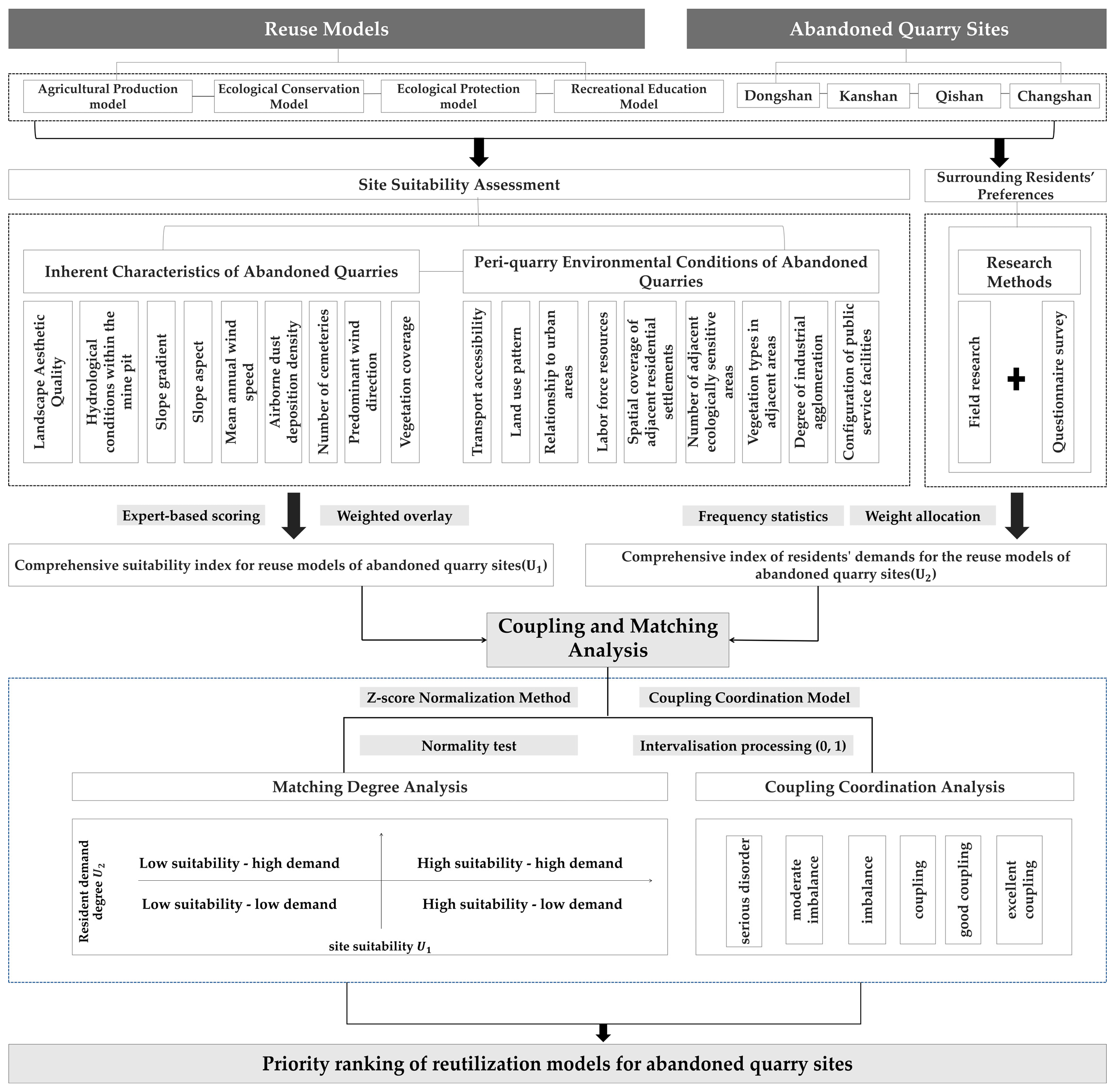
This study aimed to address two key issues: quantitatively measuring the reuse suitability of abandoned quarry sites and residents’ demands, and prioritizing abandoned quarry reuse models based on the coupling and matching degree of these two dimensions. To achieve this objective, a four-step methodology was adopted (Figure 1). First, through a comprehensive review of existing literature and field investigations, potential reuse model types were identified. A hierarchical evaluation index system was developed for each model. The relative importance and interdependencies among indicators were analyzed to determine appropriate weights and evaluation criteria. Second, expert scoring was conducted according to the established criteria to assess the suitability of each quarry site under various reuse scenarios. Third, questionnaire surveys were conducted to collect residents’ preference rankings for reuse models of abandoned quarry sites. The frequency of each priority ranking for the four models was statistically analyzed, and then corresponding weights were assigned to each ranking to reflect its relative importance. These frequency values were multiplied by their respective weights and aggregated to calculate a comprehensive score. This score quantified residents’ overall preferences for different abandoned quarry reuse models. Finally, the coupling coordination degree model was applied. This model quantified the synergistic relationship between site suitability and residents’ demands. A quadrant-based matching analysis was then conducted. This analysis evaluated the compatibility of the two dimensions. Based on these results, reuse models were prioritized across different study sites. The optimal restoration strategy was then selected, with three key criteria: high suitability, strong residents’ demands, and a high level of coupling coordination.

2.2. Overview of the Research Area and Sample Selection

2.2.1. Overview of the Research Area

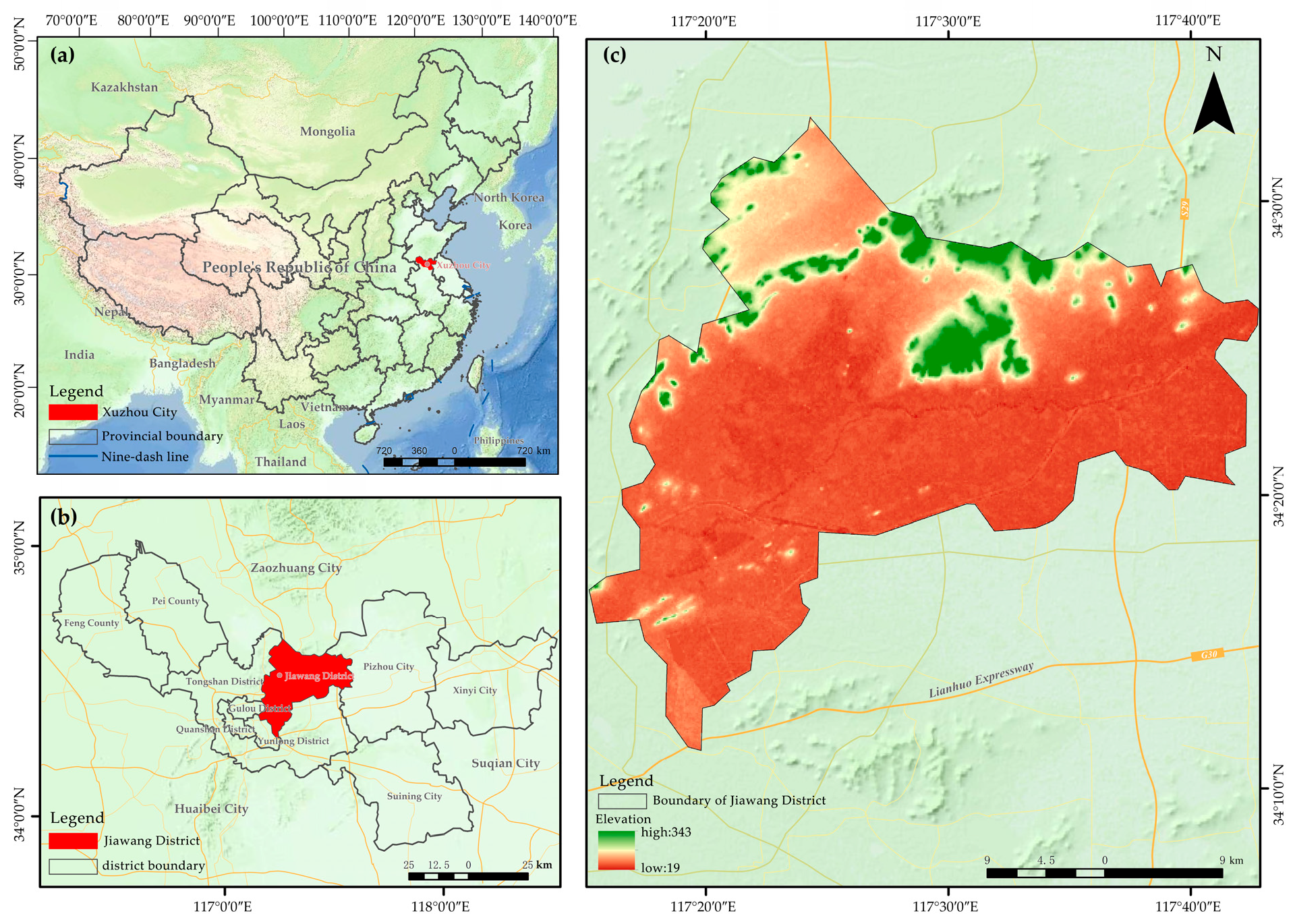
The study area is located in Jiawang District, Xuzhou City, at the junction of Jiangsu and Shandong provinces, within a warm temperate semi-humid monsoon climate zone. The terrain is predominantly flat, characterized by a combination of hilly areas and the Huanghuai plain. The district borders Zaozhuang City in Shandong Province to the north, Pizhou City to the east, Tongshan District to the south and northwest, and connects with Gulou, Yunlong, and Quanshan districts of Xuzhou City to the west (Figure 2). With a total area of 612.13 square kilometers, Jiawang District administers eight sub-districts and five towns. As of April 2023, the resident population was 566,300, with an urbanization rate exceeding 66.2%.
Jiawang District is endowed with abundant mineral resources. Since the 1950s, over one hundred mining enterprises have been established, focusing on extracting cement-grade limestone, construction aggregates, and related materials. These enterprises have significantly contributed to regional economic growth. In 2011, the district was officially designated as one of China’s 69 resource-depleted cities (including counties and districts). As mineral reserves have been progressively exhausted, mine closures have transitioned from policy planning to practical implementation. This transition marks the start of Jiawang’s regional transformation toward sustainable development. In recent years, as a representative resource-depleted area in China, Jiawang District has prioritized ecological construction. It has also vigorously promoted ecological restoration of mining wastelands, achieving remarkable results. One of these achievements, the governance of Panan Lake coal mining subsidence land, has become a model for domestic coal mining subsidence land governance. Through systematic restoration and comprehensive site management, historical ecological problems have been effectively addressed. These efforts have also established a solid foundation for the city’s green development. At the same time, the process has generated additional employment opportunities for residents. It has promoted diversification of the regional economic structure and supported the coordinated advancement of brownfield regeneration and social equity. Overall, the mature governance practices implemented in Jiawang District form a robust regional foundation for this study. They ensure the feasibility of the research and enhance the transferability of its findings to comparable contexts internationally.

2.2.2. Data Sources and Processing

This study draws on data from the 2018 Jiawang Mining Area Geological Environment Investigation Project Results Report and the Guidelines for Land and Sea Use Classification in Territorial Space Investigation, Planning, and Use Control (2023 Edition). These sources provide information on the spatial distribution of abandoned quarry sites, geological environmental conditions, and land use classification standards in Jiawang District. Together, they form the basis of the assessment framework. Stakeholder preferences and demands regarding potential reuse models were collected through semi-structured interviews and questionnaire surveys. In addition, key site attributes—including plot boundaries, topographic characteristics, and vegetation cover—were obtained through field investigations. Mapping tools and drone-based imagery were used to support data acquisition and spatial analysis.

2.2.3. Sample Selection Basis

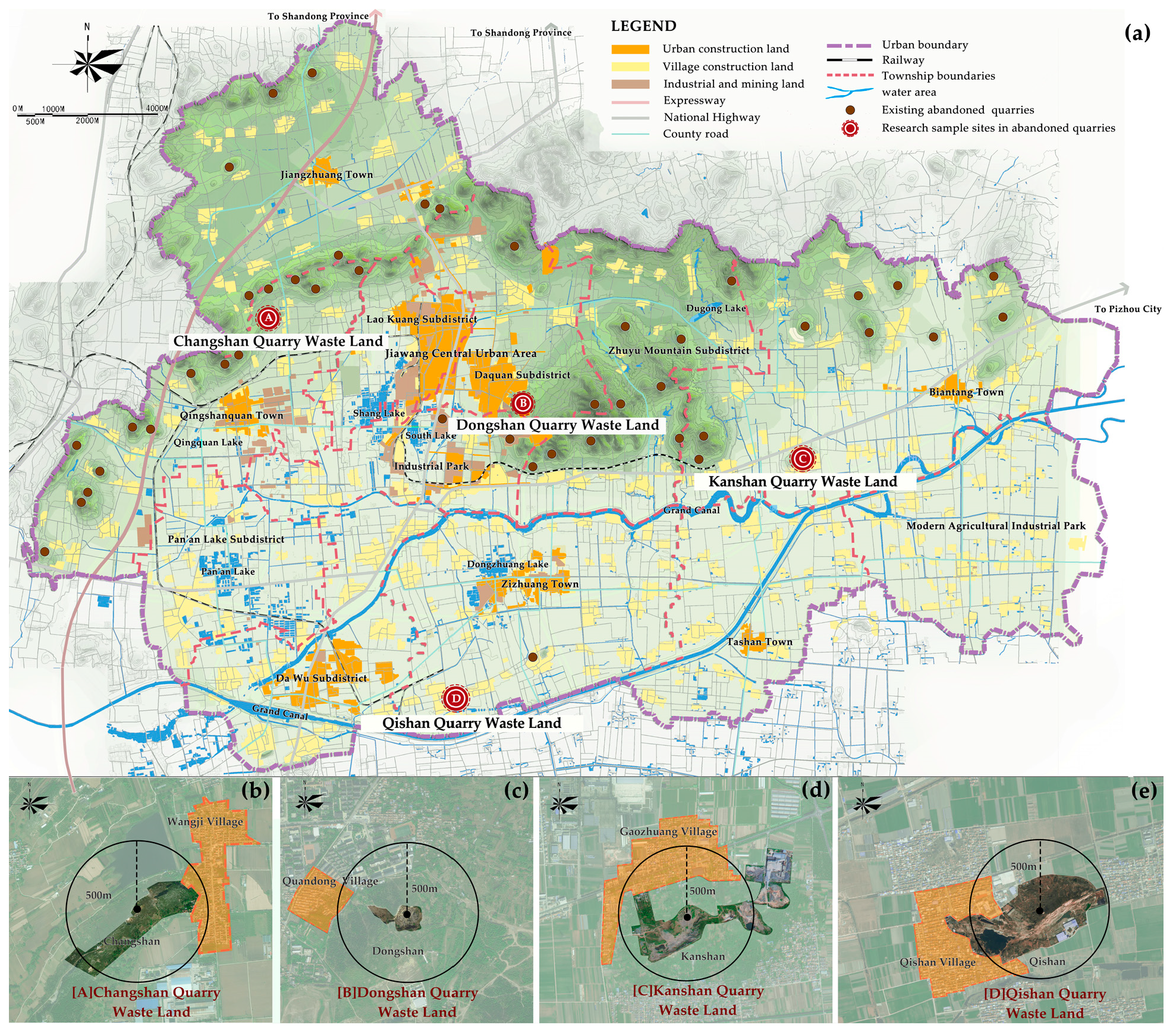
The type of mineral resource extracted determines the nature and characteristics of post-closure abandoned sites. Based on the category of exploitable minerals, mining sites can be classified into three main types: coal mines, stone quarries, and metal mines. This study focuses specifically on abandoned quarry sites—defined as areas degraded by stone extraction activities that remain functionally unusable without intervention. According to the “2018 Jiawang Mine Geological Environment Investigation Project Results Report,” there are currently 50 open-pit abandoned quarry sites within the district, predominantly located in the northern part of Jiawang District. To refine the selection of study sites, a screening process was conducted based on three criteria: proximity to residential settlements, current land use status, and physical accessibility and safety. First, using the distance between quarry wastelands and residential areas as the starting point, and based on the theory of living spheres, Baidu Maps’ surveying tools were employed to categorize 50 quarry wastelands into four distance tiers relative to residential areas: within 200 m, 200–500 m, 500–1000 m, and over 1000 m. Field surveys and resident interviews revealed that residents rarely use quarry sites more than 500 m from their homes. Their awareness of these sites’ actual conditions is extremely low, making it difficult for them to effectively participate in feedback regarding reuse models. Therefore, this study excluded 38 abandoned quarry sites located more than 500 m from residential areas during the initial site selection phase. Subsequently, three sites undergoing government-implemented ecological restoration projects and five sites inaccessible to residents due to site closures were also excluded. Ultimately, four abandoned quarry sites—Dongshan, Kanshan, Qishan, and Changshan—were designated as the specific study areas (Figure 3).

2.3. Suitability Evaluation of Reuse for Abandoned Quarry Sites

2.3.1. Reuse Models for Abandoned Quarry Sites

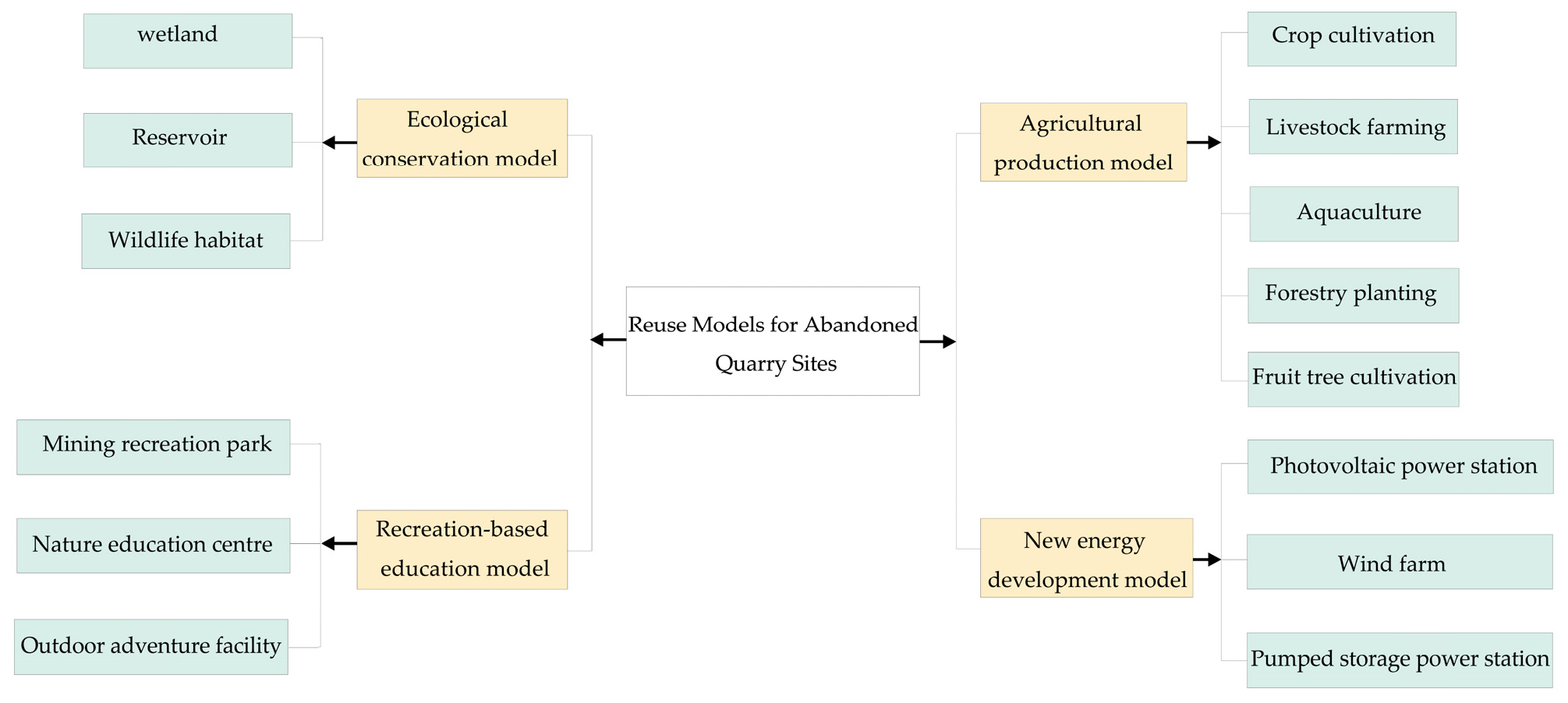
The diversity of residual resources and site conditions in abandoned quarry sites enables a wide range of potential reuse models. Due to the distinct geomorphological characteristics and varying degrees of ecological degradation resulting from open-pit quarrying, numerous redevelopment approaches have been established through both international and domestic research and practices (Figure 4). This study systematically reviewed existing reuse model typologies. It then integrated these typologies with the biophysical and socio-environmental site conditions of the study area to align quarry reuse with regional sustainable development objectives. Based on this framework, four reuse models were proposed: agricultural production, new energy development, ecological protection, and recreation-based education [14,15,16].
The agricultural production model is a comprehensive land use strategy for post-operational quarries. Through ecological restoration and land reclamation, abandoned quarries are converted into productive agricultural land. This model supports activities such as crop cultivation, livestock husbandry, aquaculture, forestry, and fruit production. The ecological protection model focuses on transforming degraded quarry sites into self-sustaining ecosystems. It relies on targeted environmental remediation to restore ecological functions. This model prioritizes long-term ecosystem services and environmental quality over short-term economic returns [17]. This model can be further classified into wetlands, reservoirs, and wildlife habitats. The recreation-based education model involves the adaptive reuse of abandoned quarries as multifunctional public spaces that integrate leisure, scientific outreach, cultural engagement, and social interaction [18]. By preserving and highlighting regional natural landscapes and mining heritage, this model provides the public with unique environments for recreation and learning, thereby integrating ecological restoration with recreational use and environmental education. Subtypes include mine heritage parks, nature education centers, and outdoor experiential learning bases. The new energy development model capitalizes on the topographical and spatial advantages of abandoned quarries by installing solar photovoltaic arrays, wind turbines, and pumped-storage hydropower facilities to harness renewable resources, such as sunlight, wind, and water. The generated clean energy is supplied to former mining areas and surrounding communities. This approach addresses the issue of underutilized land. It also promotes the energy-oriented revitalization of degraded sites and delivers combined economic and ecological benefits [19].

2.3.2. Development of the Evaluation Index System for Abandoned Quarry Sites

Building on the site-specific characteristics of abandoned quarry land in Jiawang District, this study integrated field investigations, questionnaire surveys, and expert consultations with a comprehensive review of existing literature and relevant ecological restoration policies and regulatory frameworks to identify key factors influencing quarry site reuse. From two overarching dimensions—site-intrinsic conditions and surrounding environmental context—a total of 18 indicators were selected. Considering the distinct influencing factors associated with each of the four reuse models, these 18 indicators were further organized into four criterion sets: C1, C2, C3, and C4 (Table 1). This structured classification serves as the foundation for developing a differentiated evaluation index system to assess the reuse potential of abandoned quarry sites under various development scenarios.

2.3.3. Determination of Suitability Evaluation Criteria for Abandoned Quarry Sites and Computation of the Comprehensive Suitability Score

The suitability evaluation of abandoned quarry sites for reuse constitutes a critical prerequisite for selecting appropriate reuse models, requiring a systematic and rigorous assessment methodology. The choice of evaluation approach directly affects the accuracy and scientific robustness of the results. Quarry site reuse is influenced by multiple interrelated factors. Thus, this study adopts the Analytic Hierarchy Process (AHP) as its evaluation framework. AHP facilitates pairwise comparisons of decision-relevant criteria based on their relative importance [13]. This enables the integration of qualitative judgments with quantitative analysis. Additionally, AHP is operationally straightforward and design-flexible. These characteristics make it particularly suitable for addressing complex, multi-level, and multi-objective decision-making problems.
This paper selected the influencing factors of each reuse mode as evaluation indicators based on the differences among various reuse modes. The original data of various site evaluation indicators were obtained through on-site surveys, drone images, statistical yearbooks, etc. Meanwhile, referring to relevant literature and normative documents, and considering the characteristics of each indicator, the evaluation standards were determined. The suitability grades of the evaluation indicators were divided into five levels, with values of 1, 3, 5, 7, and 9. The score values were divided according to the degree of superiority of the evaluation criteria. The higher the score, the better the evaluation standard in the indicators. Four suitability evaluation systems for abandoned quarry sites were constructed through the selection of evaluation indicators and the determination of evaluation standards (Appendix A). Subsequently, relative importance comparisons of each evaluation indicator were conducted based on the four systems above. For these comparisons, the 1–9 scale method and its reciprocal were generally adopted (Table 2) [8].
Subsequently, ten experts from relevant fields such as urban and rural planning, mine ecological restoration, and land resource management were invited. All experts possessed practical or research experience in the mine area restoration or planning. Combining the aforementioned scaling method and the constructed indicator system, a questionnaire survey (Appendix B) was conducted using the expert consultation method. The ten experts independently scored the importance of each indicator. Following the collection of expert scores, a group decision-making process was conducted. The pairwise comparison judgment matrices from multiple experts were consolidated using the geometric mean method to construct a comprehensive judgment matrix. Consistency testing was performed on this matrix. Based on the validated judgment matrix, the weight values for each level and indicator were calculated. Finally, the assessment results of each indicator were multiplied by the corresponding weight and summed up to obtain the U 1 values. The key calculation steps and formulas are as follows:
(1)
Construction of judgment matrix
Construct the judgment matrix A of all solution layers relative to different criterion layers based on the expert scoring results.
A = a 11 a 12 . . . . . . a 1 n a 21 a 22 . . . . . . a 2 n . . . . . . a i j . . . . . . . . . . . . . . . . . . . . . a n 1 a n 2 . . . . . . a n n ,
where a i j is the importance of a i relative to a j . If the former is more important, a i j > 1; if the latter is more important, a i j < 1; and if they are equally important, a i j = 1.
(2)
Solution to the indicator weight vector
On the basis of the judgment matrix, the weight values between each level and each index were obtained.
First, the matrix was normalized. The calculation formula is as follows:
b i j =   a i j i = 1 n a i j   ( i , j   =   1 ,   2 ,   3 , ,   n ) ,
where a i j is the data in the i-th row and j-th column of the judgment matrix; b i j is the data in the i-th row and j-th column of the judgment matrix after normalization.
Secondly, we added the elements in the matrix to obtain the eigenvector. The calculation formula is as follows:
w i =   j = 1 n b i j   ( i , j   =   1 ,   2 ,   3 , ,   n ) ,
Again, we normalized the feature vector W to obtain the weight value of each factor. The calculation formula is as follows:
w i =   w i i = 1 n w i   ( i , j   =   1 ,   2 ,   3 , ,   n ) ,
where w i is the weight of the i-th indicator.
Finally, we calculated the maximum eigenvalue of the judgment matrix A. The calculation formula is as follows:
λ m a x =   1 n i = 1 n ( A w ) i w i ,
where n is the order of the matrix, w i is the weight of the i-th indicator, and λ m a x is the maximum eigenvalue of the judgment matrix A.
(3)
Consistency test
We calculated the consistency index CI and consistency ratio CR, and performed consistency testing (Table 3). When CR < 0.1, it means the judgment matrix is reasonable; when CR ≥ 0.1, the matrix must be readjusted.
CI stands for consistency index, and the calculation formula is as follows:
C I =   λ m a x n n 1
CR stands for consistency ratio, and the calculation formula is as follows:
C R =   C I R I
(4)
Solution to site suitability
Using weighted calculation, the evaluation results of each indicator were superimposed according to the above weights to obtain the U 1 value. The calculation formula is as follows:
U 1 =   i = 1 n w i x i ,
where U 1 represents the comprehensive suitability score of the abandoned quarry site for reuse, w i denotes the weight assigned to each evaluation index, and x i denotes the score of each index under the respective reuse models.

2.4. Assessment of Local Residents’ Preferences for Reuse Models of Abandoned Quarry Sites

The Analytic Hierarchy Process (AHP) for weight determination relies on expert judgments. However, these judgments often overlook the influence of residents’ preferences on the decision. The selection of reuse models for abandoned quarry sites is a multi-objective, system-based decision-making process. In this process, the relative importance of each model is determined not only by expert evaluations but also by residents’ demands. Therefore, integrating perspectives from both experts and residents is essential. This integration enhances the comprehensiveness and legitimacy of the decision-making process.
First, this study aimed to quantify the surrounding residents’ demand for quarry site reuse models. To ensure the representativeness of the survey sample, stratified random sampling was employed to distribute questionnaires. The respondents included residents within a 500 m radius of four villages in the study area: Qishan Village, Gaozhuang Village, Wangji Village, and Quandong Village. Respondents were asked to rank four reuse models in order of preference. Before the survey, supplementary explanations for each reuse model were provided. This ensured respondents fully understood the advantages and disadvantages of each model before ranking them. A total of 105 questionnaires were distributed in this study. After a logical consistency check, 82 valid questionnaires were retained, resulting in an effective recovery rate of 78.1%. The demographic characteristics of the respondents are as follows: In terms of age structure, the majority were aged 41–60 (48.78%), followed by those over 61 years old (39.02%), while the proportion of those aged 21–40 was the lowest at 12.20%. Regarding gender, males accounted for 53.66%, slightly higher than females at 46.34%. In terms of occupation, farmers were the largest group (48.78%), followed by self-employed individuals (24.39%), manual workers (migrant workers and factory workers each accounting for 9.76%), and other occupations (7.32%). As for educational attainment, the majority had a high school or technical secondary school education (47.56%) or had completed primary school or less (42.68%), while those with a college degree and those with a bachelor’s degree or above accounted for the same proportion, both at 4.88%.
Then, the frequency of each model’s occurrence at different ranking positions was calculated. Simultaneously, corresponding weights were assigned to each ranking position in order of priority ( w i = n, where i represents the ranking position and n denotes the corresponding weight value; as i increases from 1 to 4 sequentially, n takes the values 0.4, 0.3, 0.2, 0.1, respectively). Finally, a weighted aggregation method was applied using these rank-based weights to compute the comprehensive score of residents’ demand for each reuse model. The calculation formula is as follows:
U 2 =   i = 1 n w i x i
where U 2 denotes the comprehensive residents’ demand value for the reuse models of abandoned quarry sites, w i represents the weight assigned to each ranking position, and x i refers to the frequency with which each model appears at a given rank across the surveyed responses.
The weights of the above ranking positions were subjectively assigned linearly based on their importance. Thus, the final calculation results required secondary verification. This study adopted an alternative weighting method—the Borda count—to reprocess valid questionnaire data collected from the four residential areas. The core of the Borda count is to sum the assigned values of residents’ ranking preferences. Its assignment rule is determined by the total number of reuse models (denoted as m): the k-th ranked model receives (m−k) points (where k = 1, 2, …, m). For the four models in this study, the specific assignment rules are as follows: 3 points for the first place, 2 points for the second place, 1 point for the third place, and 0 points for the fourth place. Unranked models are recorded as 0 points; when only one model is selected, that model receives 3 points, and the remainder are scored 0 points. Subsequently, the Borda count values for each model were accumulated across all valid questionnaires from a given village. This yielded the total Borda count score for each model in that village, which served as the new comprehensive value of residents’ demand for quarry wasteland reuse models. The calculation formula is as follows:
S j =   i = 1 n s i j
where S j represents the total Borda score for reuse pattern j, n denotes the number of valid questionnaires, and s i j indicates the score obtained by pattern j in questionnaire i.
By comparing the results of the two calculation methods above, we can test the robustness of U 2 , the comprehensive value of residents’ demand for quarry wasteland reuse models. The specific judgment logic is as follows: Calculate the Pearson correlation coefficient between U 2 and S . If r ≥ 0.8 and p < 0.01, the two values show a strong correlation with no significant difference. Compare the priority rankings of the four reuse patterns under both methods. If the consistency rate ≥ 80%, residents’ core preferences have not shifted due to changes in weighting methods. Use a paired t-test to analyze the mean difference between U 2 and S . If p > 0.05, there is no statistically significant difference, further validating U 2 ’s reliability. If S meets the three conditions—strong correlation, consistent ranking, and insignificant difference— U 2 can be deemed robust. The resident preferences it reflects are authentic and reliable, providing solid data support for subsequent coupling and matching analysis.
Finally, due to the limited number of valid questionnaires in this study, the confidence interval for the U 2 must be reported to minimize sampling error.

2.5. Priority Evaluation of Reuse Models for Abandoned Quarry Sites

2.5.1. Coupling Coordination Degree Analysis

The reuse of quarry wastelands fundamentally involves aligning the natural carrying capacity of land with human social demands. It is a process of synergistic optimization between natural and social systems. The coupling coordination degree model reflects the degree of interaction between systems and the level of coordinated development [26]. Its core principle is that tighter interactions and more synchronized development between systems result in higher coordination levels. This model has two key advantages: operational simplicity and intuitive outcomes. These features make it a crucial prerequisite and foundation for analyzing operational mechanisms across different systems. It also constitutes an ideal method for assessing the feasibility of quarry wasteland reuse models.
This paper employed the coupling coordination degree model to measure the degree of coordinated development between two systems: site suitability and resident demand. Simultaneously, to meet the requirements of subsequent calculation formulas or analyses, the raw data U 1 and U 2 required processing before calculating the coupling coordination degree. First, the raw data were divided into four groups based on the four quarry wastelands. Then, each group underwent intervalization to compress the data within the range (0, 1), satisfying basic requirements. The calculation formula is as follows:
Q   =   a   +   ( b a ) ( x x m a x ) x m a x x m i n
where a and b represent the compressed data interval values, where x m a x denotes the maximum value and x m i n denotes the minimum value.
Next, we calculated the coupling coordination degree D value. The calculation process is as follows:
C   =   2 U 1 × U 1 ( U 1 + U 2 )
T = α   × U 1 + β   ×   U 2
D = C × T
where C denotes the coupling degree; T represents the comprehensive harmony index of site suitability and residents’ demands; and D refers to the coupling coordination degree. U 1 and U 2 denote the comprehensive values of site suitability and residents’ demands, respectively. The weights assigned to site suitability and residents’ demands in the comprehensive harmony index are denoted by α and β, respectively. Given their equal importance in this study, the weight coefficients are set to 0.5 (i.e., α = β = 0.5). The coupling coordination index ranges from 0 to 1. The closer the index approaches 1, the higher the degree of coupling coordination between the two entities. Conversely, a lower index indicates a weaker developmental correlation between them, suggesting a trend toward disordered development [27]. Drawing on the study area’s characteristics and prior research, the coupling coordination degree between site suitability and residents’ demands is categorized into six levels (Table 4).

2.5.2. Matching Degree Analysis

Due to the significant disparity between the comprehensive suitability value ( U 1 ) and the comprehensive demand value ( U 2 ), Z-score normalization was applied to both variables to minimize their impact on the analysis results. To ensure the scientific validity and rationality of the normalization process, a normality test was first conducted on U 1 and U 2 . Given the small sample size of this study, the Shapiro–Wilk test combined with visual verification was employed. Four independent test units were formed based on the four quarry wastelands to assess data distribution characteristics. The specific steps are as follows:
Test hypotheses and the significance level were established: null hypothesis H 0 (the sample data followed a normal distribution.); alternative hypothesis H 1 (the sample data did not follow a normal distribution.); the significance level α = 0.05 was set (with an allowed error probability of 5%); and the test statistic W was calculated using IBM SPSS Statistics 27.0.1. The formula is as follows:
W   =   ( i = 1 n a i x ( i ) ) 2 i = 1 n ( x i x ¯ ) 2
where x i represents the sample data sorted in ascending order, a i denotes the coefficient specific to the Shapiro–Wilk test (determined by the sample size n , obtainable via statistical software or reference tables), x ¯ is the sample mean, and n is the sample size.
Finally, we determined the p-value and made a decision: We extracted the p-value corresponding to W from the software output. If the p-value > 0.05, we accept H 0 and conclude that the data follow a normal distribution. If the p-value ≤ 0.05, we reject H 0 and conclude that the data do not follow a normal distribution.
Next, if the verification results showed that the comprehensive value of site suitability ( U 1 ) and the comprehensive value of residents’ demands ( U 2 ) were normally distributed, the Z-score standardization method was used for their standardization. The corresponding calculation formula is as follows:
Z = x μ σ
where Z denotes the standardized value, x represents the original data value (i.e., U 1 or U 2 ), μ is the mean of the original data, and σ is its standard deviation. Following standardization, both U 1 and U 2 are transformed into dimensionless standardized values with a mean of 0 and a standard deviation of 1.
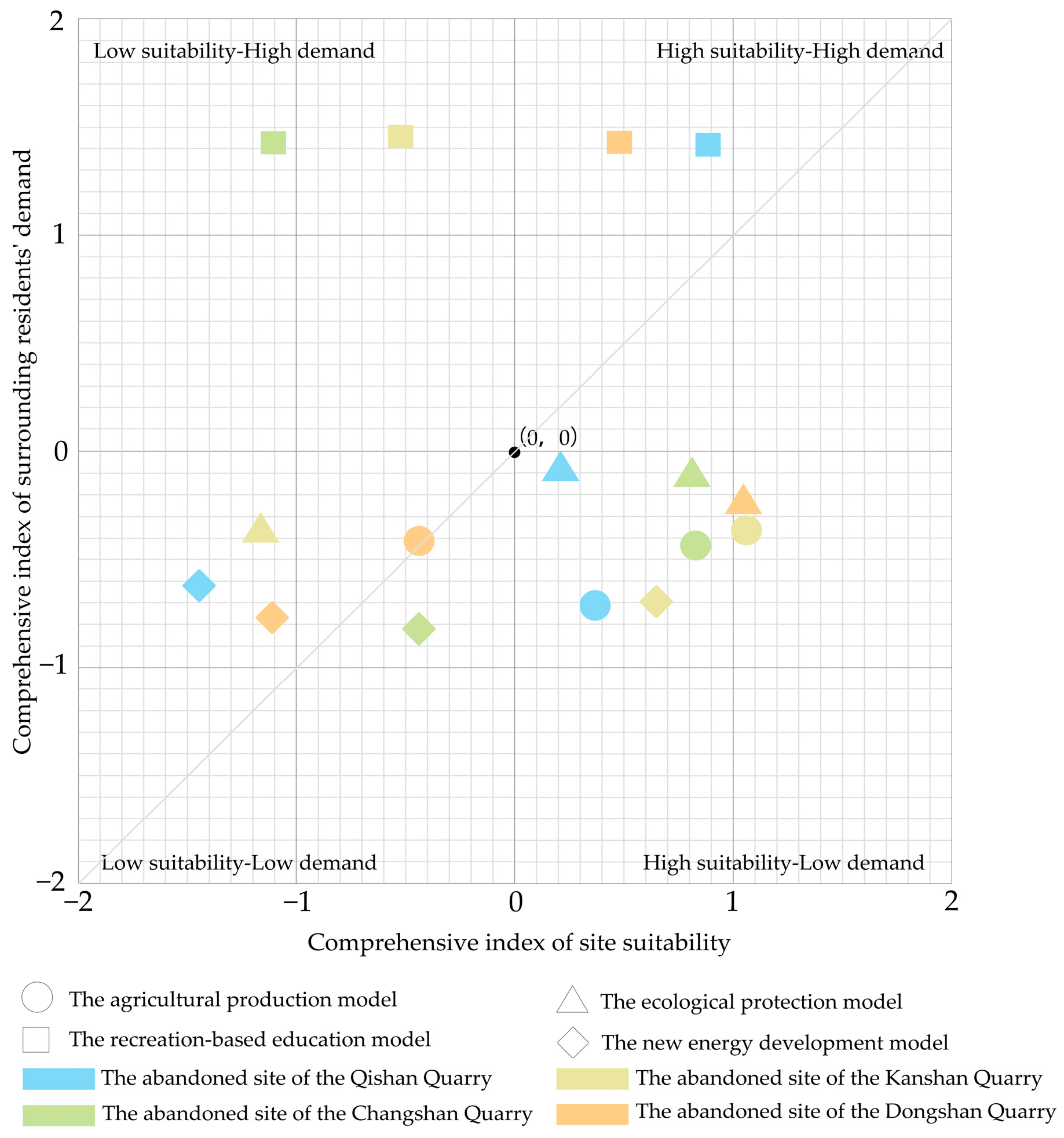
Subsequently, a quadrant-based matching analysis was conducted based on the Z-score standardization results. Drawing on established methodologies from prior research, we constructed a two-dimensional coordinate system. Its origin was set at (0, 0), corresponding to the mean of the standardized variables. The x-axis represented standardized U 1 , and the y-axis represented standardized U 2 . Based on the distribution characteristics of the data, the coordinate plane was divided into four quadrants [28].
Finally, each sample point for a quarry wasteland site was plotted in the coordinate system based on its standardized U 1 and U 2 values. The spatial distribution of these points across the four quadrants facilitated the assessment of the matching relationship between site suitability and residents’ demands. The interpretation of each quadrant is as follows: the first quadrant indicates high demand and high suitability; the second quadrant reflects high demand but low suitability; the third quadrant signifies low demand and low suitability; and the fourth quadrant denotes low demand but high suitability.

2.5.3. Priority Ranking of Reuse Models for Abandoned Quarry Sites

Based on the preceding analysis of coupling coordination degree and matching degree, this study established a criterion for determining the priority ranking for selecting reuse models of abandoned quarry sites. The prioritization framework integrates two key dimensions: coupling coordination degree and matching degree. The classification scheme is defined as follows:
When the coupling coordination degree falls within the high-quality coupling range (CCD value between 0.8 and 1.0), sites exhibiting a high demand and high suitability matching pattern are assigned to Priority Level I; those with low demand but high suitability are classified as Priority Level III. When the coupling coordination degree lies in the good coupling range (CCD value between 0.6 and 0.8), sites characterized by high demand and high suitability are designated as Priority Level II, while those with low demand but high suitability are categorized as Priority Level IV (Table 5).

3. Results

3.1. Suitability of Different Reuse Models for Abandoned Quarry Sites

The results reveal significant variations in site suitability among the four abandoned quarries under different reuse models, with comprehensive scores ranging from 3.9548 to 6.3094 (Table 6). For the agricultural production model, the suitability values vary considerably among the sites. Kanshan exhibits the highest suitability score of 5.9389, indicating that its intrinsic conditions and surrounding environment are highly suitable for agricultural reuse. Dongshan follows with a score of 5.8276, while Changshan and Qishan show relatively lower values at 4.8938 and 4.4898, respectively. The ecological protection model shows polarized site suitability scores. For this model, Qishan, Kanshan, and Dongshan quarries demonstrate higher suitability, with scores of 5.7050, 5.7580, and 5.7982, respectively. In contrast, Changshan quarry has relatively lower suitability, scoring 4.8828. Under the recreation-based education model, Qishan quarry exhibits the highest suitability, achieving a comprehensive score of 6.3094. Kanshan and Dongshan quarries show similar suitability scores: 5.8084 and 5.3656, respectively. However, Changshan quarry has significantly lower suitability (4.1008), indicating limited feasibility for this reuse model. For the new energy development model, the Kanshan quarry demonstrates the highest suitability with a comprehensive score of 5.9054, exhibiting a clear advantage. The comprehensive scores for Qishan, Changshan, and Dongshan quarries are generally at a moderately low level, at 4.0846, 4.3792, and 3.9548, respectively, indicating lower suitability.

3.2. Residents’ Preferences for Reuse Models of Abandoned Quarry Sites

The composite value of residents’ demands directly reflects their overall preference for different reuse models, with higher values indicating stronger support. Significant differences in demand are observed among the four abandoned quarry sites (Table 7). Across all sites, the recreation-based education model consistently shows the highest demand. Its composite values range from 0.3273 to 0.3778, substantially exceeding those of the other models. This pattern indicates widespread community interest in leisure, recreational, and educational spaces. Demand for the agricultural production model is generally low. Qishan, Kanshan, and Dongshan have composite values of 0.1000, 0.1222, and 0.0818, respectively. Changshan exhibits relatively higher demand at 0.1700, suggesting that notable interest in agricultural reuse is concentrated in its surrounding communities. The ecological protection model ranks second overall in terms of residents’ demand, although its values remain well below those of the recreation-based education model. Qishan and Changshan show relatively stronger support, with values of 0.1727 and 0.2000, respectively. In contrast, Kanshan and Dongshan display weaker demand at 0.1222 and 0.1091, respectively. The new energy development model receives the lowest demand across all sites. Qishan, Kanshan, Changshan, and Dongshan have composite values of 0.1091, 0.0778, 0.1300, and 0.0455, respectively. This result suggests limited public awareness and acceptance of this reuse option.
To validate the robustness and reliability of the composite demand value U 2 derived from the linear weighting method, this study recalculates the composite demand score using the Borda Count method. Multidimensional verification is conducted through Pearson correlation analysis (Table 8), priority ranking comparisons, and paired samples t-tests (Table 9), yielding the following results:
Pearson correlation analysis reveals extremely strong positive correlations (r = 0.954~0.999) between U 2 and the Borda Count scores S j for all four quarry sites, with all p-values < 0.05 (mostly p < 0.01). This indicates an exceptionally strong correlation and no significant differences between the two measures, establishing a foundation for U 2 ’s robustness. Concurrently, the agreement rate for the ranking of the four reuse patterns under both methods reaches 100%. Paired sample t-tests reveal p-values > 0.05 for all four quarry sites, indicating no statistically significant differences. In effect size analysis, Cohen’s d values for the four paired categories range from 0.974 to 1.494 (all exceeding the large effect size threshold of 0.8). However, as p-values fail to reach significance, these differences lack statistical significance, further corroborating the consistency in the results.
In summary, the results from both the Borda Count method and the original linear weighting method satisfy the core criteria of “strong correlation, consistent ranking, and non-significant differences”. This demonstrates the robust reliability of U 2 , reflecting authentic and reliable resident preference data. It provides a solid data foundation for subsequent coupling and matching analyses of quarry wasteland reuse models.
In addition, for the sample size of 82 valid questionnaires, the 95% confidence interval of the comprehensive value of the surrounding residents’ demands ( U 2 ) is calculated. The results show that the confidence interval is [0.11896, 0.23615], with a relatively small range, indicating that the survey results of residents’ demands are highly reliable.

3.3. Prioritization of Quarry Abandoned Land Reuse Models Based on Site Suitability and Resident Demand

To ensure the scientific validity and appropriateness of Z-score standardization, the site suitability composite value U 1 and the resident demand composite value U 2 must first undergo normality testing. Given the small sample size of four for each group in this study, the Shapiro–Wilk test is employed, yielding the following results:
The site suitability composite values for all four quarries’ wastelands demonstrate consistent outcomes upon testing (Table 10). In the Shapiro–Wilk test, the p-values for the four datasets from Qishan, Kanshan, Changshan, and Dongshan are all greater than 0.05. Furthermore, the absolute skewness values for the composite suitability values across all four study areas are less than 3, while their absolute kurtosis values are less than 10. These results meet the supplementary criterion for “basically acceptable as a normal distribution.” Therefore, it is determined that the composite suitability values for the four quarries’ wastelands exhibit characteristics of a normal distribution.
The results of normality tests for the composite residents’ demand values show partial discrepancies (Table 11). In the Shapiro–Wilk test, the p-values for Qishan, Changshan, and Dongshan are 0.161, 0.345, and 0.127, respectively, all exceeding 0.05 and thus meeting the normality requirement. However, the p-value for Kanshan is 0.045, which is below the 0.05 threshold. This indicates that the composite value of residents’ demands at Kanshan does not follow a normal distribution. Supplementary assessments reveal that the absolute skewness values for the composite demand indices across all four areas are below 3, while their absolute kurtosis values remain under 10. These results satisfy the relaxed criteria for basic normality. Consequently, the overall dataset meets the prerequisites for Z-score normalization.
This study employs a coupling coordination degree model to calculate the coupling coordination between the suitability of quarry wasteland reuse sites and the demands of surrounding residents. Results indicate that the coupling coordination between U 1 and U 2 values for the four reuse models fluctuate between 0.100 and 0.995. Based on specific numerical values, outcomes can be categorized into four types: excellent coupling (0.8 < CCD < 1), good coupling (0.6 < CCD ≤ 0.8), moderate imbalance (0.3 < CCD ≤ 0.4), and severe imbalance (0 < CCD ≤ 0.3). Notably, the agricultural production model exhibits significantly greater coupling coordination differences across the four quarry wastelands. At the Qishan quarry site, the coupling coordination degree is a mere 0.297, indicating severe imbalance. Conversely, the model exhibits good coupling at Kanshan and Changshan quarry sites, with coupling coordination degrees of 0.626 and 0.657, respectively. In contrast, Dongshan shows moderate imbalance, recording a coupling coordination value of 0.448. The ecological protection model also displays varying coupling coordination values across the four quarry sites. At Qishan, Changshan, and Dongshan, the values are 0.683, 0.749, and 0.692, respectively—all indicating good coupling states. At the Kanshan quarry site, however, the coupling coordination value drops to 0.198, representing a severely imbalanced state. The recreation-based education model performs well at Qishan and Dongshan quarry sites. Its coupling coordination values at these two sites are 0.995 and 0.931, respectively, indicating an optimal coupling state. In this state, site suitability aligns closely with public demand. At Kanshan, the model also achieves a good coupling state, with a coordination value of 0.728. Conversely, Changshan records a coordination value of 0.315, reflecting a moderately imbalanced state. This result indicates limited feasibility for implementing the reuse scheme in Changshan. The new energy development model generally performs poorly across all quarry wastelands. At the Qishan quarry site, the coupling coordination value stands at 0.147. At Kanshan, Changshan, and Dongshan quarry sites, the values progressively decrease to 0.300, 0.244, and 0.100, respectively, all indicating a severely imbalanced state. This suggests both the site suitability and residents’ demands for this model remain at low levels.
Quantifying the coupling relationship between site suitability and resident demand alone could not accurately determine reuse pattern priorities [29]. This paper introduces the Z-score standardization method to process U 1 and U 2 data. The processed values represent the X and Y axes to construct a two-dimensional quadrant. This quadrant framework enables further analysis of the matching degree between site suitability and the surrounding residents’ demands. Based on quadrant positioning characteristics, the matching status can be categorized into four types: high suitability-high demand (Quadrant I), low suitability-high demand (Quadrant II), low suitability-low demand (Quadrant III), and high suitability-low demand (Quadrant IV). The agricultural production model shows regional variations in its distribution across quarries. At Dongshan quarry wasteland, this model falls into Quadrant III, corresponding to the low suitability-low demand range. In contrast, at Qishan, Kanshan, and Changshan quarry wastelands, it resides in Quadrant IV, aligning with the high suitability-low demand range. The ecological protection model also spans two quadrants. At Kanshan quarry wasteland, it occupies Quadrant III (low suitability-low demand). At Qishan, Changshan, and Dongshan quarry wastelands, it lies in Quadrant IV (high suitability-low demand). The recreation-based education model achieves high suitability and high demand at Qishan and Dongshan quarry sites, placing it in Quadrant I. Conversely, at Kanshan and Changshan quarry sites, it falls into Quadrant II (low suitability but high demand). This indicates a mismatch between site suitability and community needs. The new energy development model exhibits the poorest overall suitability. At the Kanshan quarry site, it occupies Quadrant IV (high suitability-low demand). At Qishan, Changshan, and Dongshan quarry sites, it consistently lies in Quadrant III, showing low suitability and low demand characteristics (Figure 5).
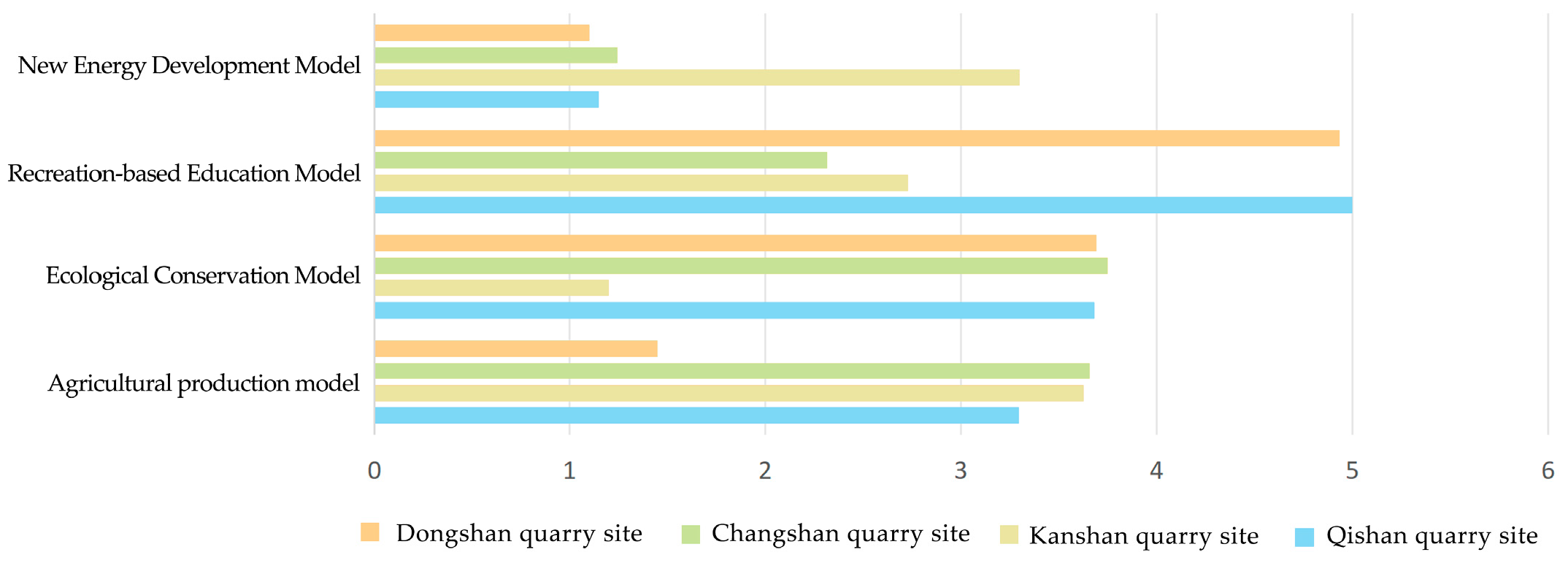
Based on an integrated analysis of coupling coordination degree and matching degree, this study determines the relative priority rankings of reuse models for the four abandoned quarry sites. The rankings are as follows (Table 12): For Qishan, the recreation-based education model is prioritized. It is followed by ecological protection, agricultural production, and new energy development. For Kanshan, agricultural production ranks first. Next are new energy development, recreation-based education, and ecological protection. For Changshan, the preferred sequence starts with ecological protection. It is followed by agricultural production, recreation-based education, and new energy development. For Dongshan, the ranking is recreation-based education first. Then come ecological protection, agricultural production, and new energy development. To make the sorting results more intuitive, this paper adopts a bar chart (Figure 6) to show priority differences among different modes. In this chart, the vertical axis represents the four reuse modes. The horizontal axis represents the priority scores of different reuse modes. The scoring rules are as follows: In the matching degree quadrant, reuse modes in Quadrant I are assigned 4 points. Those in Quadrant II get 2 points, and those in Quadrant III get 1 point. Modes in Quadrant IV are assigned 3 points. Meanwhile, the coupling coordination degree values of different reuse modes are added to the above-assigned values. This calculation yields the corresponding priority scores.

4. Discussion

4.1. Analysis of Reuse Model Selection for Quarry-Abandoned Sites

The spatial characteristics of different abandoned quarry sites and residents’ preferences determine variations in site model selection.
Previous studies indicate that the recreation-based education model is regarded as the most flexible and practical reuse approach. Basu and Mishra contend that land reclamation based on recreation-based education functions constitutes the most frequently adopted option for mining-abandoned site reuse [30]. Regarding site suitability, the high scores for the recreation-based education model primarily stem from contributions by specific indicators. These indicators include landscape aesthetics, cemetery density, pit lake conditions, and coverage of surrounding settlements [31]. The distinctive landscapes formed by quarry pits confer advantages for developing recreational functions. Such landscapes include cliff formations, visual diversity, and water bodies. For instance, the Qishan site features extensive lakes and significant elevation variations. Dongshan, though less accessible, achieves a high suitability score. This is due to its location along recreational trails to the summit and its colorful quarry ruins. However, the number of graves is a negative indicator affecting suitability for this model. For example, the Kanshan site, despite its varied topography, faces obstacles in tourism development. Numerous graves within the site are the main cause, including challenges related to grave relocation, landscape design, and cultural taboos. Concurrently, the recreation-based education model achieves the highest composite resident demand score among the four quarry sites. This indicates strong acceptance and expectations for this approach. Some residents express behavioral demand for recreational activities within the pits. Others recognize the model’s significant potential to stimulate village economic development and generate employment opportunities [13].
Compared to the recreation-based education model, the agricultural production model does not hold an advantage in the utilization of quarry wasteland. Such sites predominantly feature exposed rock formations with significant topographical variations, rendering the conditions for developing agricultural production models rather stringent [32]. Nevertheless, the agricultural production model at the Kanshan quarry wasteland achieves the highest suitability score ( U 1 = 5.9389). Several core indicators contribute to this advantage. These include a slope gradient of ≤2° and relatively flat terrain; a prevailing wind direction situated downwind, which mitigates environmental impacts from livestock farming; high residential coverage that provides ample labor for agricultural cultivation; and sufficient quarry pond water that meets irrigation demands for large-scale planting. Collectively, these factors establish the key advantages of developing agricultural production models at the Kanshan quarry site. Conversely, poor accessibility reduces the viability of agricultural production models. In addition, the Dongshan quarry site is located on a mountaintop with limited water accumulation, resulting in a lower suitability score for this model. Agricultural production models must also consider restoring topsoil through backfilling. Quarry sites with high suitability may explore soil-less cultivation methods like greenhouse fruit and vegetable production [33].
Ecological protection models refer to the reconstruction of degraded ecosystems within abandoned mine pits into stable, diverse, and sustainable ecosystems through engineering and biological measures [34]. All quarry wastelands examined in this study are historical abandoned pits yet to undergo ecological restoration. Among these, the Dongshan site exhibits the highest ecological suitability value ( U 1 = 5.7982). This indicates the model is applicable to areas with favorable ecological foundations and potential to enhance green infrastructure networks. Within a 200 m radius, the site is predominantly forested, while six ecologically sensitive zones (including nature reserves and scenic tourist areas) lie within 10 km. The site’s high vegetation coverage provides a sound foundation for ecosystem restoration, while low industrial concentration reduces human disturbance to ecological protection. The sites of KanShan and QiShan have scattered and continuous water accumulation in the mine pits. The formation of the mine pit lakes provides a hydrological basis for the construction of wetland ecosystems. Consequently, KanShan and QiShan achieved suitability scores of 5.7580 and 5.7050, respectively. Furthermore, regarding resident demand outcomes, this model was categorized as low-demand across all four quarry wastelands. This stems primarily from its high ecological value but limited socio-economic benefits, where ecological protection measures partially constrain recreational activities [35], resulting in subdued resident demand willingness.
New energy development models impose site requirements centred on slope gradient and waterlogged areas. Excessive mine pit water accumulation increases the installation costs of solar photovoltaic panels. Annual average wind speeds below 3 m/s limit wind power generation efficiency. Steep terrain slopes at some sites impair power output efficiency and raise construction costs, thereby reducing economic viability [29]. Among the studied quarry wastelands, Kanshan exhibits relatively gentle slopes and a substantial scale. This yields a suitability value of 5.9054 for this model. Conversely, the Qishan quarry wasteland exhibits the lowest comprehensive suitability score for new energy development models, at merely 4.0846. This stems from shortcomings such as excessive water accumulation areas and insufficient annual average wind speeds, which impede the installation and operation of emerging energy equipment. Nevertheless, questionnaire surveys indicate low public awareness and acceptance of this model. Long-term quarrying activities at abandoned sites have typically caused ecological damage to the local environment. Residents, having endured prolonged exposure to such environmental issues, have developed an instinctive wariness towards industrial facilities. They fear that the new energy development model may inflict secondary environmental harm.

4.2. Implementation Strategies for the Reuse Model of Abandoned Quarry Sites

Based on the research findings and the priority ranking of reuse models presented in Figure 6, the recreational and educational model is selected for the Qishan and Dongshan abandoned quarry sites. This selection reflects residents’ widespread preference for enhancing recreational facilities and improving the living environment. Meanwhile, site suitability reflects the objective judgment of natural background and engineering feasibility. Residents’ demand, however, often varies due to limited awareness or benefit cycle considerations. Thus, the ecological protection model is adopted for the Changshan abandoned quarry site, and the agricultural production model for the Kanshan abandoned quarry site. The possible challenges and specific implementation strategies that may be encountered during the implementation of different reuse models are as follows (Table 13).

5. Conclusions

5.1. Research Findings

This study presents a novel and practical technical framework for prioritizing reuse models of open-pit quarry wastelands. This framework integrates coupling and matching analysis of site suitability and surrounding residents’ demands. First, relevant influencing factors are identified based on the physical characteristics of each site and its surrounding environment. This identification leads to the construction of 18 evaluation indicators. These indicators include landscape aesthetics, slope, and mine pit water accumulation, and they are used to quantitatively assess site suitability. Second, a questionnaire survey is conducted to capture residents’ preferences for different reuse models. This survey enables the calculation of a comprehensive demand index. Finally, the coupling coordination degree model and matching degree analysis are applied to quantify the synergistic relationship between site suitability and residents’ demands. This quantification results in a priority ranking of reuse models across four abandoned quarry sites.
The main conclusions are as follows: (1) In terms of site suitability, the comprehensive suitability assessment values of the abandoned quarry sites range from 3.9548 to 6.3094. This indicates significant differences in the suitability of various reuse models across different study areas. (2) From the perspective of residents’ demands, the comprehensive demand values for the recreation-based education model in different study areas range from 0.3273 to 0.3778. The overall score is relatively high, which indicates that residents have the highest expectations for this model. The reason is that this model can transform abandoned quarries into recreational spaces. It significantly enhances regional vitality and promotes local economic development, thereby bringing long-term benefits to the surrounding residents. The comprehensive demand values for the agricultural production model and the ecological protection model range from 0.0818 to 0.2. Their overall preferences are lower than those of the recreation-based education model. The former is limited by the site’s natural conditions, including geology and hydrology. The latter stems from the weak correlation between ecological protection and the economic interests of surrounding residents. The comprehensive demand values for the new energy development model are generally low and fluctuate greatly, ranging from 0.0455 to 0.13, which is related to the residents’ insufficient understanding of this model. (3) Through the coupling and matching analysis of site suitability and residents’ demands, the results show that the recreation-based education model demonstrates significant advantages in both Qishan and Dongshan abandoned quarries. This model can maximize the utilization benefits of the site through landscape reshaping, the implementation of educational functions, and regional coordinated development. The agricultural production model performs well in Kanshan. It is advisable to encourage agricultural planting or livestock breeding in this area to promote the efficient use of land resources. The ecological protection model ranks first in the Longshan abandoned quarry. Ecological restoration projects should be implemented here, ecological monitoring strengthened, and relevant ecological development paths explored. These measures provide important guarantees for the sustainable development of abandoned quarries. The new energy development model ranks relatively low in all four abandoned quarries. This is due to multiple restrictions, such as residents’ cognition and site conditions. In the future, efforts should be made to gradually improve its application efficiency.
The method proposed in this study is concise and flexible. Its core value lies in the establishment of a dual-system decision-making framework that couples expert evaluation with the demands of residents. This method has the potential for promotion across different types of mining areas and cultural backgrounds. Although the research focuses on abandoned quarry sites, the core framework is equally applicable to other types of mining areas. These include coal mining subsidence areas and metal mine abandoned sites. The core difference among abandoned sites in various mining areas lies only in the suitability index system of the site. By making targeted adjustments to the indicators based on the existing framework, the method can be applied in different scenarios. The public participation mechanism and the coupling matching method emphasized in the study are universal. Although residents’ demand preferences may vary in different cultural backgrounds, the constructed quantitative assessment method of residents’ demands can flexibly adapt to different regional public opinion survey scenarios. Moreover, the framework includes natural attribute indicators and socio-economic indicators. Natural attribute indicators include slope and aspect, while socio-economic indicators include traffic accessibility and industrial agglomeration degree. These indicators are common elements in the assessment of mining area reuse, further enhancing the feasibility of cross-regional application.

5.2. Research Limitations and Future Directions

5.2.1. Research Limitations

This study systematically reviews literature on mine reuse. It selects widely considered and recurring evaluation indicators to maintain robustness and consistency within the research scope. While this approach ensures a degree of scientific rigour, reliance solely on literature may overlook other factors influencing the final reuse model [13]. For instance, this study considers only natural and social factors when selecting evaluation indicators. It omits relevant economic metrics such as governmental financial investment and land transfer income. This omission may impact the practical feasibility of reuse models. Furthermore, the reuse of abandoned quarry sites involves numerous stakeholders, including governmental bodies, residents, and landowners. When collecting stakeholders’ opinions through questionnaires, this study focuses only on the needs of the specific group of residents. It does not consider the demands of other stakeholders. Moreover, the age structure of the survey sample is concentrated among middle-aged and elderly people. This characteristic mainly stems from the current demographic structure of the rural study area. In this area, many young and middle-aged laborers are away for education or work. This might have led to insufficient representation of younger groups’ preferences in the results, thereby limiting the comprehensiveness of the demand assessment.

5.2.2. Future Directions

Based on the aforementioned research limitations, future studies should expand the scope of interdisciplinary literature references. They should integrate research findings from fields such as economics, environmental engineering, and safety science. This integration refines the assessment system and enhances the feasibility of reuse models. Additionally, a tripartite benefit-sharing mechanism involving the government, residents, and landowners should be established. This mechanism incorporates the demands of other stakeholders into the decision-making process for reuse models of abandoned quarry sites. It addresses the limitations of single-stakeholder decision-making, balances the interests of all parties, and enables stakeholders to collectively contribute to the transformative development of abandoned quarries through the selection of reuse models [36]. At the same time, the scale of the survey sample should be expanded and the age distribution optimized. In-depth interviews should be conducted with different age and occupational groups. Through focus group discussions, the formation mechanism of stakeholders’ preferences for different reuse models should be analyzed. This analysis uncovers the reasons behind the demands, providing a more comprehensive basis for the optimization of reuse models for abandoned quarry sites. In terms of research scale, future studies can expand from individual quarry wastelands to regional-scale integrated planning. In terms of research methods, GIS spatial analysis and system dynamics simulation techniques can be combined. This combination dynamically predicts the implementation effects of different reuse models under various policy, economic, and social conditions. It enhances the practical guidance value of the research conclusions. Through the above expansions, more comprehensive decision-making bases can be provided for the reuse of abandoned quarry sites. This promotes the sustainable transformation and development of abandoned mine pits.
In summary, this study organically integrates expert technical assessments with expressions of resident needs, thereby addressing the limitations of single-stakeholder perspectives in traditional decision-making. It provides direct guidance for the reuse of quarry wastelands in Jiawang District. Meanwhile, it offers a methodological framework for the transformative development of similar regions and wastelands of different mineral types. Future refinements could include incorporating economic indicators and broadening stakeholder engagement to enhance the framework’s applicability across wider regions.

Author Contributions

Conceptualization, S.F. and L.H.; methodology, S.F. and L.H.; software, L.H.; validation, L.H. and T.T.; formal analysis, Y.Z.; investigation, S.F. and T.T.; resources, Y.Y.; data curation, L.H.; writing—original draft preparation, S.F. and L.H.; writing—review and editing, S.F.; visualization, T.T.; supervision, S.F.; project administration, S.F.; funding acquisition, S.F. All authors have read and agreed to the published version of the manuscript.

Funding

This research was funded by the Higher Education Institutions Philosophy and Social Science Research Project of Jiangsu Provincial Education Department (grant number 2025SJYB0775).

Institutional Review Board Statement

The investigation in this study fully complies with the ethical principles of the Declaration of Helsinki and poses no ethical risks. All respondents were informed of the purpose, content, and voluntary nature of the survey before participating. They could refuse to answer or withdraw from the survey at any time without suffering any adverse consequences. The survey would not cause any physical or psychological harm to the respondents, nor would it touch upon privacy, dignity, or other sensitive issues. The entire process takes less than three minutes and does not impose any burden on the participants.

Data Availability Statement

The raw data from the household demand survey and the weighted expert assessment data in this study constitute newly created datasets. These may be made available through appropriate channels following publication, in accordance with the requirements of the journal Land.

Conflicts of Interest

The authors declare no conflicts of interest.

Appendix A. Evaluation System for the Suitability of Different Reuse Models of Abandoned Quarry Sites

Table A1. Evaluation system for the suitability of agricultural production models.
FactorsSub-FactorsEvaluation CriteriaReferences
13579
Inherent characteristics of abandoned quarry sitesHydrological conditions within the mine pitThe water body is either completely dried up or too small in area, with water depths insufficient to support agricultural irrigation.The water area is limited, characterized by shallow depths, seasonal rainfall variability, and restricted storage capacity, making it suitable only for small-scale agricultural irrigation.The water body is sufficiently extensive and has moderate water depth, enabling it to support medium-scale agricultural irrigation.The water body is extensive and sufficiently deep, enabling it to support large-scale agricultural irrigation.The water body is extensive and sufficiently deep, capable of supporting agricultural irrigation as well as potential aquaculture development.[36]
Slope gradient>25°>15–25°>6–15°>2–6°≤2°[37]
Slope aspectDue northNortheast and northwestDue east and due westSoutheast and southwestFlatland and due south[22]
Number of cemeteries>105–103–51–3No cemetery-
Peri-quarry environmental conditions of abandoned quarry sitesPredominant wind directionLocated upwind of the prevailing wind direction and within 500 m of urban areas or rural settlements.Located upwind of the prevailing wind direction and 500–1000 m from urban areas or rural settlements.Located downwind of the prevailing wind direction and 500 m from urban areas or rural settlements.Located downwind of the prevailing wind direction and 500–1000 m from urban areas or rural settlements.Located downwind of the prevailing wind direction and over 1000 m from urban areas or rural settlements.[37]
Land use patternThe surrounding land is predominantly non-agricultural, which limits the potential for agricultural agglomeration.Land use is highly fragmented, and agricultural cultivation exhibits low spatial coherence, limiting the feasibility of large-scale operations.The land is predominantly unused yet has some potential for agricultural use; however, integration remains challenging.Land use is predominantly agricultural, and the surrounding farmlands are contiguous and concentrated, facilitating large-scale cultivation.The land exhibits high suitability for agricultural cultivation and is therefore suitable for designation as a large-scale farming zone.-
Transport accessibilityRoad network density ≤ 1.5 km/km2; The mine pit has poor accessibility and cannot accommodate mechanical passage.Road network density 1.5–2.5 km/km2; Access to the mine pit is limited due to narrow and uneven road conditions.Road network density 2.5–3 km/km2; The accessibility of the mine pit is generally adequate.Road network density 3–4 km/km2; The mine pit is reasonably accessible and generally meets the requirements for passage.Road network density ≥ 4 km/km2; The mine pit exhibits good accessibility and largely satisfies the requirements of passage.-
Spatial coverage of adjacent residential settlements (%)<1010–1515–2020–25>25-
Table A2. Evaluation system for the suitability of ecological protection models.
FactorsSub-FactorsEvaluation CriteriaReferences
13579
Inherent characteristics of abandoned quarry sitesHydrological conditions within the mine pitThe water body is either desiccated or characterized by an insufficient surface area to sustain a functional aquatic ecological environment, resulting in low ecological value.The water body is constrained in surface area and exhibits shallow water depth, thereby having limited capacity to support ecosystem restoration.A water body with sufficient surface area and moderate water depth can provide suitable habitats for certain aquatic species.The water body is extensive in surface area and features substantial water depth, enabling active interaction with the surrounding ecological environment and supporting relatively high biodiversity.The water area is very spacious, with a considerable depth of water accumulation. It integrates well with the surrounding ecology, forming a complete ecosystem with rich biodiversity.-
Slope gradient<88–1515–2525–45>45[37]
Slope aspectDue northNortheast and northwestDue east and due westSoutheast and southwestFlatland and due south[22]
Vegetation coverage(%)0–1010–3030–4040–7070–100[21]
Peri-quarry environmental conditions of abandoned quarry sitesVegetation types in adjacent areasNon-forest landUntucked forest landScrublands and newly established plantationsForested land (bamboo forests)Forested land (broadleaved and coniferous forests)[38,39]
Number of adjacent ecologically sensitive areasNone1–22–33–4≥5-
Land use patternThe surrounding land has been occupied by intensive development and construction, making it difficult to establish an ecological pattern.The surrounding area contains a certain amount of ecological land; however, ecological connectivity remains poor and requires integration and optimization.A certain proportion of ecological land exists in the surrounding area and is integrated with other land uses, necessitating enhanced coordination of ecological protection efforts.The surrounding land use is predominantly composed of ecological land, complemented by other land uses, forming a favorable ecological pattern.The surrounding area has evolved into a large, contiguous ecological zone with a comprehensive ecological protection system.-
Degree of industrial agglomerationHighRelatively highOrdinaryRelatively lowLow[25]
Table A3. Evaluation system for the suitability of recreation-based education models.
FactorsSub-FactorsEvaluation CriteriaReferences
13579
Inherent characteristics of abandoned quarry sitesLandscape aesthetic qualityVery PoorPoorFairGoodExcellent[20]
Hydrological conditions within the mine pitExcessive water accumulation poses safety risks, while a small water area has low recreational appeal and cannot effectively fulfill educational functions.The limited water area imposes many restrictions on the development of recreational activities and limits its educational and demonstration functions.The water body is of moderate extent with suitable depth, enabling a range of recreational activities and offering measurable educational value.The water area is appropriately scaled, the water depth is safe, and a variety of recreational activities can be supported. The educational function is effectively realized.The water area is appropriately scaled, and the water depth is safe and stable. The design can integrate recreational facility layouts with educational content, resulting in a prominent educational function.-
Vegetation coverage(%)0–1010–3030–4040–7070–100[21]
Number of cemeteries>105–103–51–3No cemetery-
Peri-quarry environmental conditions of abandoned quarry sitesLand use patternThe surrounding land is largely underutilized or unsuitable for development, which hinders the formation of a cohesive recreational cluster.The surrounding land use is relatively monotonous, offering limited support for recreational functions.There is some land around that can be integrated and utilized, but the coordination is rather difficult.The surrounding land use is relatively well-planned and incorporates adequate supporting functions.The surrounding land use is highly aligned with recreational functions, fostering a strong agglomeration effect.-
Transport accessibilityRoad network density ≤ 1.5 km/km2; The mine pit has poor accessibility and cannot accommodate mechanical passage.Road network density 1.5–2.5 km/km2; Access to the mine pit is limited due to narrow and uneven road conditions.Road network density 2.5–3 km/km2; The accessibility of the mine pit is generally adequate.Road network density 3–4 km/km2; The mine pit is reasonably accessible and generally meets the requirements for passage.Road network density ≥ 4 km/km2; The mine pit exhibits good accessibility and largely satisfies the requirements of passage.-
Configuration of public service facilitiesNo public service facilities.Public service facilities are seriously inadequate.Public service facilities are sufficient to meet basic minimum requirements.Public service facilities are relatively comprehensive and capable of synergistic development.Public service facilities are complete and can interact well with the recreational area.-
Spatial coverage of adjacent residential settlements(%)<1010–1515–2020–25>25-
Relationship to urban areas>10 km7.5–10 km5–7.5 km2.5–5 km<2.5 km[40]
Table A4. Evaluation system for the suitability of new energy development models.
FactorsSub-FactorsEvaluation CriteriaReferences
13579
Inherent characteristics of abandoned quarry sitesHydrological conditions within the mine pitThe water area is extensive, with substantial water accumulation depth, posing significant safety hazards and entailing extremely high drainage costs.The water area is relatively extensive, with considerable accumulation depth, adversely affecting equipment installation and operation, and necessitating extensive drainage treatment.The water area is appropriate, and the accumulated water depth is moderate, yet drainage treatment remains necessary.The water area is limited, and the water depth is relatively shallow, thus largely satisfying the construction requirements.The water body is either dry or the water area is minimal, with negligible water depth, having no impact on equipment installation and operation.-
Slope gradient>1510–157–103–70–3[37]
Slope aspectDue northNortheast and northwestDue east and due westSoutheast and southwestFlatland and due south[22]
Number of cemeteries>105–103–51–3No cemetery-
Mean annual wind speedLowRelatively lowOrdinaryRelatively highHigh[36]
Airborne dust deposition densityHighRelatively highOrdinaryRelatively lowLow[36]
Peri-quarry environmental conditions of abandoned quarry sitesLand use patternThe surrounding land is largely idle or inherently difficult to utilize, limiting the potential for industrial cluster formation.The surrounding land use is relatively homogeneous, providing limited potential for the integration and support of new energy sources.The surrounding land possesses an established industrial base; however, it has limited integration with new energy sectors and requires significant structural transformation.The surrounding land use is reasonably organised with adequate supporting facilities, facilitating the coordinated development of new energy sources.The surrounding land use is closely aligned with new energy sectors, fostering strong agglomeration effects; supported by comprehensive infrastructure, an industrial cluster has been established.-
Transport accessibilityRoad network density ≤ 1.5 km/km2; The mine pit has poor accessibility and cannot accommodate mechanical passage.Road network density 1.5–2.5 km/km2; Access to the mine pit is limited due to narrow and uneven road conditions.Road network density 2.5–3 km/km2; The accessibility of the mine pit is generally adequate.Road network density 3–4 km/km2; The mine pit is reasonably accessible and generally meets the requirements for passage.Road network density ≥ 4 km/km2; The mine pit exhibits good accessibility and largely satisfies the requirements of passage.-
Relationship to urban areas>10 km or <0.7 km7.5–10 km5–7.5 km2.5–5 km0.7–2.5 km[40]
Degree of industrial agglomerationLowRelatively lowOrdinaryRelatively highHigh[25]
Labor force resourcesseverely deficientdeficientmoderateabundantexcessively abundant-

Appendix B. Expert Consultation Questionnaire on Weight Assignment in the Site Suitability Assessment for Different Reuse Models of Abandoned Quarry Sites

Dear Expert:
Thank you very much for taking the time to fill out this questionnaire!
This questionnaire aims to determine the weights of various indicators in the site suitability assessment system for different reuse models of four abandoned quarry sites, to support the decision-making of the optimal reuse model. We sincerely ask you to evaluate the importance of each indicator based on your professional knowledge. Your feedback is crucial to this research. It will take approximately 10 to 15 min to complete this questionnaire. All data will be used solely for academic purposes and will be strictly confidential.
Note on Scale Definitions: The 1–9 Scale Method will be used for pairwise comparisons: 1 = equally important; 3 = slightly more important; 5 = moderately more important; 7 = strongly more important; 9 = extremely more important.
Table A5. Scoring of site suitability for different reuse models of abandoned quarry sites.
Reuse ModelIndicator SystemFour Abandoned Quarry SitesIndicator Weight
The Abandoned Site of the Qishan QuarryThe Abandoned Site of the Kanshan QuarryThe Abandoned Site of the Changshan QuarryThe Abandoned Site of the Dongshan Quarry
13579135791357913579
The agricultural production modelHydrological conditions within the mine pit
Slope gradient
Slope aspect
Number of cemeteries
Predominant wind direction
Land use pattern
Transport accessibility
Spatial coverage of adjacent residential settlements
The ecological protection modelHydrological conditions within the mine pit
Slope gradient
Slope aspect
Vegetation coverage
Number of adjacent ecologically sensitive areas
Vegetation types in adjacent areas
Land use pattern
Degree of industrial agglomeration
The recreation-based education modelLandscape aesthetic quality
Hydrological conditions within the mine pit
Vegetation coverage
Number of cemeteries
Land use pattern
Transport accessibility
Configuration of public service facilities
Spatial coverage of adjacent residential settlements
Relationship to urban areas
The new energy development modelHydrological conditions within the mine pit
Slope gradient
Slope aspect
Mean annual wind speed
Airborne dust deposition density
Number of cemeteries
Land use pattern
Transport accessibility
Relationship to urban areas
Degree of industrial agglomeration
Labor force resources

References

  1. Xing, Y.; Wang, J.; Yang, J.; Chen, D.; Du, X.; Guo, J.; Song, L. Distribution Status and Existing Issues of Abandoned Open-Pit Mining Sites Nationwide. Remote Sens. Nat. Resour. 2024, 36, 21–26. [Google Scholar] [CrossRef]
  2. Spanidis, P.-M.; Roumpos, C.; Pavloudakis, F. A Methodology Combining IDEF0 and Weighted Risk Factor Analysis for the Strategic Planning of Mine Reclamation. Minerals 2022, 12, 713. [Google Scholar] [CrossRef]
  3. Zhu, D.-D.; Song, Y.-S.; Li, L. Study on Sustainable Landscape Design of Abandoned Quarries. Procedia Earth Planet. Sci. 2009, 1, 1107–1113. [Google Scholar] [CrossRef]
  4. Laurence, D. Optimisation of the Mine Closure Process. J. Clean. Prod. 2006, 14, 285–298. [Google Scholar] [CrossRef]
  5. Keenan, J.; Holcombe, S. Mining as a Temporary Land Use: A Global Stocktake of Post-Mining Transitions and Repurposing. Extr. Ind. Soc. 2021, 8, 100924. [Google Scholar] [CrossRef]
  6. Tzeng, G.H. Multiple Attribute Decision Making: Methods and Applications; CRC Press: Boca Raton, FL, USA, 2011; ISBN 978-0-429-11070-2. [Google Scholar]
  7. Figueira, J.; Greco, S.; Ehrogott, M. Multiple Criteria Decision Analysis: State of the Art Surveys; International Series in Operations Research & Management Science; Springer: New York, NY, USA, 2005; Volume 78, ISBN 978-0-387-23067-2. [Google Scholar]
  8. Saaty, T.L.; Sodenkamp, M. Making Decisions in Hierarchic and Network Systems. Int. J. Appl. Decis. Sci. 2008, 1, 24. [Google Scholar] [CrossRef]
  9. Behzadian, M.; Khanmohammadi Otaghsara, S.; Yazdani, M.; Ignatius, J. A State-of the-Art Survey of TOPSIS Applications. Expert Syst. Appl. 2012, 39, 13051–13069. [Google Scholar] [CrossRef]
  10. Odu, G.O. Weighting Methods for Multi-Criteria Decision Making Technique. J. Appl. Sci. Environ. Manag. 2019, 23, 1449. [Google Scholar] [CrossRef]
  11. Sun, H.; Wang, S.; Hao, X. An Improved Analytic Hierarchy Process Method for the Evaluation of Agricultural Water Management in Irrigation Districts of North China. Agric. Water Manag. 2017, 179, 324–337. [Google Scholar] [CrossRef]
  12. Mert, Y. Contribution to Sustainable Development: Re-Development of Post-Mining Brownfields. J. Clean. Prod. 2019, 240, 118212. [Google Scholar] [CrossRef]
  13. Singh, A.; Agarwal, S.; Prabhat, A. A Multi-Criteria Decision Framework to Evaluate Sustainable Alternatives for Repurposing of Abandoned or Closed Surface Coal Mines. Front. Earth Sci. 2024, 12, 1330217. [Google Scholar] [CrossRef]
  14. Giri, S.; Holt, O.S.; Tully, G.; Miller, A.; Yellishetty, M.; Whittle, D.; Bach, P.M. Assessing Repurposing Options for Abandoned Mines and Quarries in Victoria, Australia Using Spatial MCDA. Resour. Conserv. Recycl. 2025, 218, 108254. [Google Scholar] [CrossRef]
  15. Tsolaki-Fiaka, S.; Bathrellos, G.; Skilodimou, H. Multi-Criteria Decision Analysis for an Abandoned Quarry in the Evros Region (NE Greece). Land 2018, 7, 43. [Google Scholar] [CrossRef]
  16. Cui, C.; Wang, B.; Zhao, Y.; Zhang, Y.-J.; Xue, L. Risk Management for Mine Closure: A Cloud Model and Hybrid Semi-Quantitative Decision Method. Int. J. Miner. Metall. Mater. 2020, 27, 1021–1035. [Google Scholar] [CrossRef]
  17. Zhang, L.; Yu, H.; Hao, C.; Wang, H. Practice Model and Path of Ecosystem Product Value Realization. Res. Environ. Sci. 2021, 34, 1407–1416. [Google Scholar] [CrossRef]
  18. Ochwada-Doyle, F.A.; McLeod, J.; Barrett, G.; Clarke, G.; Gray, C.A. Spatial Patterns of Recreational Exploitation in Eastern Australian ROFAs: Implications for Zonal Management. Fish. Manag. Ecol. 2014, 21, 383–397. [Google Scholar] [CrossRef]
  19. Li, H.; Sun, J. New Model of Waste Mine Treatment under the Background of"double Carbon"—Photovoltaic Power Station Model. Nonferrous Met. Sect. 2022, 74, 70–73. [Google Scholar] [CrossRef]
  20. Rediske, G.; Siluk, J.C.M.; Gastaldo, N.G.; Rigo, P.D.; Rosa, C.B. Determinant Factors in Site Selection for Photovoltaic Projects: A Systematic Review. Int. J. Energy Res. 2019, 43, 1689–1701. [Google Scholar] [CrossRef]
  21. Jiang, X.; Sun, Z.; Xin, Y.; Zhou, S.; Shen, H. Conservation Development Construction and Regulation Measures of Landscape Tourism Resort Based on Ecological Sensitivity Evaluation. Environ. Prot. Sci. 2024, 50, 50–58. [Google Scholar] [CrossRef]
  22. Kamati, K.; Smit, J.; Hull, S. Multicriteria Decision Method for Siting Wind and Solar Power Plants in Central North Namibia. Geomatics 2022, 3, 47–67. [Google Scholar] [CrossRef]
  23. Hao, X.; Song, S.; Tang, K.; Guo, Y.; Ding, Z. Current Situation and Prospect of New Energy Redevelopment of Closed/Abandoned Mine Land Resources in China. Met. Mine 2024, 68–75. [Google Scholar] [CrossRef]
  24. Fawad, M.; Ullah, F.; Irshad, M.; Shah, W.; Mahmood, Q.; Ahmad, I. Marble Waste Site Suitability Assessment Using the GIS-Based AHP Model. Environ. Sci. Pollut. Res. 2022, 29, 28386–28401. [Google Scholar] [CrossRef] [PubMed]
  25. Zhao, Y.; Xu, D. Comprehensive Utilization Potential Assessment of Abandoned Open Pit Based on AHP-FCE. Value Eng. 2023, 42, 22–24. [Google Scholar] [CrossRef]
  26. Xin, R.; Skov-Petersen, H.; Zeng, J.; Zhou, J.; Li, K.; Hu, J.; Liu, X.; Kong, J.; Wang, Q. Identifying Key Areas of Imbalanced Supply and Demand of Ecosystem Services at the Urban Agglomeration Scale: A Case Study of the Fujian Delta in China. Sci. Total Environ. 2021, 791, 148173. [Google Scholar] [CrossRef]
  27. Ding, T.; Chen, J.; Fang, Z.; Chen, J. Assessment of Coordinative Relationship between Comprehensive Ecosystem Service and Urbanization: A Case Study of Yangtze River Delta Urban Agglomerations, China. Ecol. Indic. 2021, 133, 108454. [Google Scholar] [CrossRef]
  28. Wang, J.; Zhai, T.; Lin, Y.; Kong, X.; He, T. Spatial Imbalance and Changes in Supply and Demand of Ecosystem Services in China. Sci. Total Environ. 2019, 657, 781–791. [Google Scholar] [CrossRef]
  29. Cheng, G.; Li, G.; Pu, X.; Chen, C.; He, Y. Advancing Coupling Coordination Simulation in the Social-Human-Ecological System of the Three Gorges Reservoir Area: A Multi-Scenario System Dynamics Approach. Ecol. Indic. 2024, 158, 111504. [Google Scholar] [CrossRef]
  30. Tao, H.; Li, X.; Liu, Z.; Liu, Z.; Li, J.; Wang, Y. A Method for the Transformation of Abandoned Coal Mine Clusters and the Coordination Planning of Cultural Tourism Resources. Land 2024, 13, 2228. [Google Scholar] [CrossRef]
  31. Zhang, Q.; Zhang, T.; Liu, X.; Zhang, Q.; Zhang, T.; Liu, X. Index System to Evaluate the Quarries Ecological Restoration. Sustainability 2018, 10, 619. [Google Scholar] [CrossRef]
  32. Darwish, T.; Stehouwer, R.; Miller, D.; Sloan, J.; Jomaa, I.; Shaban, A.; Khater, C.; Hamzé, M.; Jomaa, S. Assessment of Abandoned Quarries for Revegetation and Water Harvesting in Lebanon, East Mediterranean. Reclam. Sci. 2008, 2008, 1. [Google Scholar] [CrossRef]
  33. Hu, Z. Theory and Methods for Soil Reconstruction in Mine Reclamation. J. Coal Sci. Eng. 2022, 47, 2499–2515. [Google Scholar]
  34. Bradshaw, A. Restoration of Mined Lands—Using Natural Processes. Ecol. Eng. 1997, 8, 255–269. [Google Scholar] [CrossRef]
  35. Svobodova, K.; Sklenicka, P.; Molnarova, K.; Salek, M. Visual Preferences for Physical Attributes of Mining and Post-Mining Landscapes with Respect to the Sociodemographic Characteristics of Respondents. Ecol. Eng. 2012, 43, 34–44. [Google Scholar] [CrossRef]
  36. Yu, C.; Tang, M.; Wang, D.; Li, S. Evaluation on the Suitability of Land Reclamation in Open Pit Based on FAHP-Entropy Weighting Method. Met. Mine 2018, 138–143. [Google Scholar] [CrossRef]
  37. Dong, Z.; Bian, Z.; Jin, W.; Guo, X.; Zhang, Y.; Liu, X.; Wang, C.; Guan, D. An Integrated Approach to Prioritizing Ecological Restoration of Abandoned Mine Lands Based on Cost-Benefit Analysis. Sci. Total Environ. 2024, 924, 171579. [Google Scholar] [CrossRef] [PubMed]
  38. Gudissa, L.; Raghuvanshi, T.K.; Meten, M.; Chemeda, Y.C. A GIS-AHP based approach for optimization of quarry site location around Harer and Dire-Dawa towns, Eastern Ethiopia. J. Environ. Eng. Landsc. Manag. 2022, 30, 151–164. [Google Scholar] [CrossRef]
  39. Khorsandi, H.; Faramarzi, A.; Aghapour, A.A.; Jafari, S.J. Landfill Site Selection via Integrating Multi-Criteria Decision Techniques with Geographic Information Systems: A Case Study in Naqadeh, Iran. Environ. Monit. Assess. 2019, 191, 730. [Google Scholar] [CrossRef]
  40. Dey, P.K.; Ramcharan, E.K. Analytic Hierarchy Process Helps Select Site for Limestone Quarry Expansion in Barbados. J. Environ. Manage. 2008, 88, 1384–1395. [Google Scholar] [CrossRef] [PubMed]
Figure 1. Technical roadmap.
Land 15 00157 g001
Figure 2. Geographical location of the study area: (a) Location of the study area within China; (b) Location of the study area within Xuzhou City; (c) Topographic map of the study area.
Land 15 00157 g002
Figure 3. Distribution and current status of research samples: (a) Spatial distribution of research areas; (b) The current state of the abandoned quarry in Changshan and the surrounding villages within a 500 m radius; (c) The current state of the abandoned quarry in Dongshan and the surrounding villages within a 500 m radius; (d) The current state of the abandoned quarry in kanshan and the surrounding villages within a 500 m radius; (e) The current state of the abandoned quarry in Qishan and the surrounding villages within a 500 m radius.
Land 15 00157 g003
Figure 4. Potential reuse models for abandoned quarry sites.
Land 15 00157 g004
Figure 5. Matching degree between site suitability and residents’ demands.
Land 15 00157 g005
Figure 6. Priority ranking of reuse models.
Land 15 00157 g006
Table 1. Evaluation index system for the reuse potential of abandoned quarry sites under different reuse models.
FactorsSub-FactorsFour Modes of ReuseExplanation
Agricultural Production Model (C1)Ecological Protection Model (C2)Recreation-Based Education Model (C3)New Energy Development Model (C4)
Inherent characteristics of abandoned quarry sitesLandscape Aesthetic Quality [20] The unique landscape characteristics of abandoned quarry sites result from mining activities.
Hydrological conditions within the mine pit [21]Water accumulation in post-mining depressions resulting from mining activities.
Slope gradient [22] The slope gradients of the mine pit platform and the pit floor.
Slope aspect [22] The direction of the projection of the slope normal onto the horizontal plane.
Mean annual wind speed [22] The mean instantaneous wind speed over a specified time interval.
Airborne dust deposition density [23] Dust deposition per unit volume of air.
Number of cemeteries [24] The number of extant cemeteries within the study area.
Predominant wind direction [25] The angular range of the predominant wind direction in the study area.
Vegetation coverage [21] The proportion of land area covered by vegetation relative to the total land area, typically expressed as a percentage.
Peri-quarry environmental conditions of abandoned quarry sitesTransport accessibility [20] The ease with which individuals can travel between locations using available transportation options.
Land use pattern [20]Land use patterns of areas surrounding abandoned quarry sites.
Relationship to urban areas [22] The proximity of the study area to the nearest urban settlement.
Labor force resources [20] The total labor force available for productive activities within the study area.
Spatial coverage of adjacent residential settlements [20] The proportion of land occupied by residential settlements within a 500 m buffer surrounding the study area.
Number of adjacent ecologically sensitive areas [20] The number of areas exhibiting high sensitivity to human productive activities within a 10 km buffer surrounding the study area.
Vegetation types in adjacent areas [21] Vegetation types in the vicinity of the study area.
Degree of industrial agglomeration [25] The extent of geographical clustering of firms within the same industry.
Configuration of public service facilities [25] The types and quantities of various public service facilities planned and established within the study area and its surrounding areas.
Note: In the aforementioned indicator system, Indicator 2 (hydrological conditions within the mine pit) is used to assess the site suitability of photovoltaic power stations within the new energy development model. Only land-based photovoltaic panel installations are considered, in accordance with the actual conditions of the study area. This indicator thus evaluates the extent to which water accumulation in abandoned mine pits affects the spatial configuration of ground-mounted photovoltaic systems. In rural areas of Jiawang District, traditional burial practices persist. The distribution of burial grounds directly impacts core aspects of site development, involving not only the engineering costs and implementation challenges of grave relocation but also necessitating consideration of cultural taboos in landscape design and respect for local customs. Consequently, the indicator ‘Number of cemeteries’ must be quantified through an assessment framework.
Table 2. Saaty’s scale of relative importance for pairwise criteria comparison.
Intensity of ImportanceDefinition
1The two factors are considered to be equally important.
3When comparing the two factors, the first is judged to be slightly more important than the second.
5When comparing the two factors, the first is judged to be moderately more important than the second.
7When comparing the two factors, the first is judged to be strongly more important than the second.
9When comparing the two factors, the first is judged to be extremely more important than the second.
2,4,6,8The intermediate value in the pairwise judgment between two adjacent factors
The reciprocal of the aforementioned valueThe inverse comparison of two elements is the reciprocal of the original comparison value.
Table 3. Table of random consistency indicators.
N (Number of Indicators)RI (Random Consistency Index)
10
20
30.58
40.90
51.12
61.24
71.32
81.41
91.45
101.49
111.51
Table 4. Coupling coordination level division.
Coupling Coordination DegreeCoupling Coordination Level
(0, 0.3]Severe imbalance
(0.3, 0.4]moderate imbalance
(0.4, 0.5]imbalance
(0.5, 0.6]coupling
(0.6, 0.8]good coupling
(0.8, 1)excellent coupling
Table 5. Criteria for prioritizing reuse models of abandoned quarry sites.
Coupling Coordination DegreeMatch Degree
High Suitability-High DemandHigh Suitability-Low Demand
Excellent Coupling (0.8~1]Priority IPriority III
Good Coupling (0.6~0.8]Priority IIPriority IV
Table 6. Comprehensive site suitability values ( U 1 ) for different abandoned quarry sites.
Abandoned Quarry SiteReuse ModelsThe Comprehensive Site Suitability Value ( U 1 )Intervalization
Processing of
Comprehensive Values
The abandoned site of the Qishan quarryThe agricultural production model5.82760.78
The ecological protection model5.7050 0.72
The recreation-based education model6.30940.99
The new energy development model4.08460.01
The abandoned site of the Kanshan quarryThe agricultural production model5.9389 0.99
The ecological protection model5.7580 0.01
The recreation-based education model5.80840.28
The new energy development model5.90540.81
The abandoned site of the Changshan quarryThe agricultural production model4.89380.99
The ecological protection model4.88280.98
The recreation-based education model4.10080.01
The new energy development model4.37920.35
The abandoned site of the Dongshan quarryThe agricultural production model4.48980.29
The ecological protection model5.79820.99
The recreation-based education model5.36560.76
The new energy development model3.95480.01
Table 7. Comprehensive values of residents’ demands ( U 2 ) for reuse models of different abandoned quarry sites.
Abandoned Quarry Sites and Their Surrounding VillagesReuse Models Weight Assignment for Different Preference Frequencies ( w i , Where i = 1, 2, 3, 4)The Comprehensive Demand Value of Surrounding Residents ( U 2 )Intervalization Processing of Comprehensive Values
First-Preference Frequency ( w 1 = 0.40)Second-Preference Frequency ( w 2 = 0.30)Third-Preference Frequency ( w 3 = 0.20)Fourth-Preference Frequency ( w 4 = 0.10)
The abandoned site of the Qishan quarry; Qishan VillageThe agricultural production model0.09090.00000.18180.27270.10000.01
The ecological protection model0.18180.27270.00000.18180.17270.30
The recreation-based education model0.72730.18180.00000.00000.34550.99
The new energy development model0.00000.18180.27270.00000.10910.05
The abandoned site of the Kanshan quarry; Gaozhuang VillageThe agricultural production model0.11110.22220.00000.11110.12220.16
The ecological protection model0.00000.33330.00000.22220.12220.16
The recreation-based education model0.88890.00000.11110.00000.37780.99
The new energy development model0.00000.11110.22220.00000.07780.01
The abandoned site of the Changshan quarry; Wangji VillageThe agricultural production model0.00000.40000.10000.30000.17000.19
The ecological protection model0.20000.30000.00000.30000.20000.32
The recreation-based education model0.80000.10000.00000.00000.35000.99
The new energy development model0.00000.00000.60000.10000.13000.01
The abandoned site of the Dongshan quarry; Quandong VillageThe agricultural production model0.09090.09090.00000.18180.08180.14
The ecological protection model0.09090.18180.09090.00000.10910.23
The recreation-based education model0.81820.00000.00000.00000.32730.99
The new energy development model0.00000.09090.09090.00000.04550.01
Table 8. Pearson correlation analysis results.
Abandoned Quarry Sites—Surrounding Residential AreasReuse ModelThe Comprehensive Demand Value of Surrounding Residents ( U 2 )Boda Total Score ( S j )Correlation Coefficientp Value
The abandoned site of the Qishan quarry—Qishan VillageAgricultural production0.1000100.999 **0.001
Ecological protection0.1727240.958 *0.042
Recreation and education0.3455560.969 *0.031
Emerging energy0.1091140.976 *0.024
The abandoned site of the Kanshan quarry—Gaozhuang VillageAgricultural production0.1222140.954 *0.046
Ecological protection0.1222120.999 **0.001
Recreation and education0.3778500.974 *0.026
Emerging energy0.077880.989 *0.011
The abandoned site of the Changshan quarry—Wangji VillageAgricultural production0.1700180.984 *0.016
Ecological protection0.2000240.986 *0.014
Recreation and education0.3500520.999 **0.001
Emerging energy0.1300120.997 **0.003
The abandoned site of the Dongshan quarry—Quandong VillageAgricultural production0.0818100.988 *0.012
Ecological protection0.1091160.994 **0.006
Recreation and education0.3273540.992 **0.008
Emerging energy0.045560.999 **0.001
* p < 0.05 ** p < 0.01.
Table 9. Paired t-test analysis results.
Abandoned Quarry Sites—Surrounding Residential AreasPaired (Mean ± Standard Deviation)Mean
Difference Value
tpDifference 95% CIStandard
Deviation of the Difference
Cohen’s d Value
Pair 1Pair 2
Qishan—Qishan Village0.18 ± 0.1126.00 ± 20.85−25.82−2.490.088−58.812~7.17620.7351.245
Kanshan—Gaozhuang Village0.18 ± 0.1421.00 ± 19.49−20.82−2.1520.121−51.626~9.97619.3571.076
Changshan—Wangji Village0.21 ± 0.1026.50 ± 17.69−26.29−2.9880.058−54.286~1.71117.5961.494
Dongshan—Quandong Village0.14 ± 0.1321.50 ± 22.05−21.36−1.9480.147−56.248~13.53021.9260.974
Table 10. Results of Normality Test for Site Suitability Comprehensive Score ( U 1 ).
NameSample SizeAverage ValueStandard DeviationSkewnessKurtosisShapiro–Wilk Test
Statistics W Valuep
Comprehensive Suitability Value for the Qishan Site45.4820.967−1.5522.8610.8550.244
Comprehensive Suitability Value for the Kanshan Site45.8530.084−0.167−3.6180.9330.614
Comprehensive Suitability Value for the Changshan Site44.5640.391−0.419−3.6250.8610.264
Comprehensive Suitability Value for the Dongshan Site44.9020.834−0.116−2.9770.9570.76
Table 11. Analysis Results of Normality Test for residents’ demands Comprehensive Score ( U 2 ).
NameSample SizeAverage ValueStandard DeviationSkewnessKurtosisShapiro–Wilk Test
Statistics W Valuep
Comprehensive value of Qishan village residents’ demands45.4820.967−1.5522.8610.8550.244
Comprehensive value of Kanshan village residents’ demands45.8530.084−0.167−3.6180.9330.614
Comprehensive value of Changshan village residents’ demands44.5640.391−0.419−3.6250.8610.264
Comprehensive value of Dongshan village residents’ demands44.9020.834−0.116−2.9770.9570.76
Table 12. Degree of coupling and coordination between site suitability and residents’ demands.
Research SitesReuse ModelsIntervalisation of the Comprehensive Suitability Value for SitesIntervalisation of the Composite Value for Residents’ DemandsCoupling Coordination Degree DCoupling Coordination DegreeThe Standardized U 1 The Standardized U 2 Quadrant Interval MatchingCoupling Matching Degree SortingRelative Ranking
The abandoned site of the Qishan quarryThe agricultural production model0.780.010.297Severe imbalance0.357678281−0.719041916High suitability-low demand-3
The ecological protection model0.720.300.683good coupling0.230921937−0.079893546High suitability-low demandIV2
The recreation-based education model0.990.990.995excellent coupling0.8558121031.438083832High suitability-high demandI1
The new energy development model0.010.0460.147Severe imbalance−1.44441232−0.639148369Low suitability-low demand-4
The abandoned site of the Kanshan quarryThe agricultural production model0.990.160.626good coupling1.027315622−0.385805028High suitability-low demandIV1
The ecological protection model0.010.160.198Severe imbalance−1.127838111−0.385805028Low suitability-low demand-4
The recreation-based education model0.280.990.728good coupling−0.5274720091.482303528Low suitability-high demand-3
The new energy development model0.810.010.300Severe imbalance0.627994498−0.710693472High suitability-low demand-2
The abandoned site of the Changshan quarryThe agricultural production model0.990.360.657good coupling0.842668784−0.442492325High suitability-low demandIV2
The ecological protection model0.980.470.749good coupling0.814550002−0.130144802High suitability-low demandIV1
The recreation-based education model0.010.990.315moderate imbalance−1.1844398031.431592817Low suitability-high demand-3
The new energy development model0.350.010.244Severe imbalance−0.472778983−0.85895569Low suitability-low demand-4
The abandoned site of the Dongshan quarryThe agricultural production model0.290.140.448moderate imbalance−0.494538966−0.465474668Low suitability-low demand-3
The ecological protection model0.990.230.692good coupling1.074839601−0.250640206High suitability-low demandIV2
The recreation-based education model0.760.990.931excellent coupling0.5559515181.468035492High suitability-high demandI1
The new energy development model0.010.010.100Severe imbalance−1.136252152−0.751920617Low suitability-low demand-4
Table 13. Implementation Strategy Table for Quarry Waste Land Reuse Models.
PatternEvaluation SitePotential ChallengesImplementation Strategy
Agricultural productionThe abandoned site of the Kanshan quarryThe site has a small amount of fill soil, and the terrain is irregular; the accessibility of transportation is poor; there are cemeteries within the site, which affect planting; the sales channels for agricultural products are not smooth.Carry out deepening and filling projects, level the site, and demarcate functional zones such as core planting areas and breeding areas; improve traffic accessibility to ensure the passage of agricultural machinery; use trees to shield the graves within the site and reduce visual interference; expand sales channels through e-commerce live streaming, direct supply to supermarkets, and other means.
Ecological protectionThe abandoned site of the Changshan quarryThe restoration period is long, and the short-term economic benefits are not obvious; the vegetation is monotonous, and the level of biodiversity is low; the ecological functions of the waterlogged areas in the site have not been fully utilized; there is a lack of publicity and education related to ecological protection.Combine ecological compensation policies to strive for subsidies for ecological public welfare forests; replant native dominant tree species and shrubs to enhance vegetation and biodiversity; utilize waterlogged areas to plant aquatic plants and build artificial wetlands to improve ecological functions; conduct publicity and education through on-site visits or organized activities to enhance residents’ awareness of ecological protection.
Recreation-based educationThe abandoned sites of Qishan and Dongshan quarriesThere is a significant funding gap, and the costs of facility construction, operation, and maintenance are high; transportation and supporting facilities are not well developed; protection and display of mining heritage are insufficient; damaged mountains affect the harmony of the landscape.Establish a diversified financing model—government-led, with social capital and village collectives as shareholders—to ensure funding; provide skills training to develop local talent and involve villagers in catering, accommodation, and other services; build parking lots and upgrade roads; use mine pit water to create ecological ponds with boardwalks and viewing platforms; preserve and mark mining relics for protection and display; construct a mining heritage exhibition hall and partner with research or tourism institutions to develop educational tours; implement soil restoration and greening on degraded slopes and damaged mountains.
New Energy development-The coordination between facility layout and ecological protection is insufficient; residents’ awareness and acceptance are low; some areas of the site have large slopes and severe water accumulation, which affect the installation and operation efficiency of the facilities.Coordinate engineering design with ecological restoration; conduct popular science promotion and education activities, and organize residents to visit mature projects to visually demonstrate the environmental and economic benefits, as well as employment promotion effects of new energy; strengthen the stability treatment of slopes and the improvement of waterlogged areas to create conditions for the installation and operation of facilities.
Disclaimer/Publisher’s Note: The statements, opinions and data contained in all publications are solely those of the individual author(s) and contributor(s) and not of MDPI and/or the editor(s). MDPI and/or the editor(s) disclaim responsibility for any injury to people or property resulting from any ideas, methods, instructions or products referred to in the content.