
Article

Distribution and Sources of Heavy Metals in Stormwater: Influence of Land Use in Camden, New Jersey


1
Department of Environmental Science, School of Earth and Environment, College of Science and Mathematics, Rowan University, Glassboro, NJ 08028, USA
2
Department of Geography, Planning, and Sustainability, School of Earth and Environment, College of Science and Mathematics, Rowan University, Glassboro, NJ 08028, USA
3
Department of Chemistry, Rutgers University, Camden, NJ 08102, USA
4
Department of Chemistry and Biochemistry, College of Science and Mathematics, Rowan University, Glassboro, NJ 08028, USA
*
Authors to whom correspondence should be addressed.
Land 2026, 15(1), 154; https://doi.org/10.3390/land15010154
Submission received: 6 December 2025 / Revised: 5 January 2026 / Accepted: 8 January 2026 / Published: 13 January 2026

Abstract

Heavy metals are widespread environmental contaminants from natural and anthropogenic sources, posing risks to human health and ecosystems. In urban areas, levels are elevated due to industrial activity, traffic emissions, and building materials. Camden, New Jersey, a city with a history of industry and illegal dumping, faces increased risk due to aging sewer and stormwater systems. These systems frequently flood neighborhoods and parks, heightening residents’ exposure to heavy metals. Despite this, few studies have examined metal distribution in Camden, particularly during storm events. This study analyzes stormwater metal concentrations across residential and commercial areas to assess contamination levels, potential sources, and land use associations. Stormwater samples were collected from 33 flooded street locations after four storm events in summer 2023, along with samples from a flooded residential basement during three storms. All were analyzed for total lead, cadmium, and arsenic using inductively coupled plasma–mass spectrometry (ICP-MS, (Department of Chemistry and Biochemistry, Rowan University, Glassboro, NJ, USA)). Concentration data were visualized using geographic information system (GIS)-based mapping in relation to land use, socioeconomic, and public health factors. In Camden’s stormwater, lead levels (1–1164 µg L−1) were notably higher than those of cadmium (0.1–3.3 µg L−1) and arsenic (0.2–8.6 µg L−1), which were relatively low. Concentrations varied citywide, with localized hot spots shaped by environmental and socio-economic factors. Principal component analysis indicates lead and cadmium likely originate from shared sources, mainly industries and illegal dumping. Notably, indoor stormwater samples showed higher heavy metal concentrations than outdoor street samples, indicating greater exposure risks in flooded homes. These findings highlight the spatial variability and complex sources of heavy metal contamination in stormwater, underscoring the need for targeted interventions in vulnerable communities.

1. Introduction

Urban heavy metal contamination is an environmental problem in many countries, negatively affecting urban ecology and human health [1]. Although heavy metals can originate naturally, their presence in urban settings is primarily driven by anthropogenic activities such as industrial releases, housing materials, infrastructure development, domestic sources, and traffic emissions [2,3,4]. In addition to ongoing sources, previously contaminated sites also continue to release heavy metals into the surrounding environment [5]. Lead is one of the commonly identified heavy metals in urban waters and soils, particularly due to its wide range of uses including roofing, paints, pipes, and automobiles [6]. Other toxic heavy metals, including cadmium and arsenic, can also enter urban environments through industrial emissions, traffic-related sources, improper landfill management, and waste incineration [7]. The occurrence and distribution of heavy metals within a city vary depending on land use, including previously contaminated sites, industrialized and commercial areas, residential neighborhoods, agricultural properties, parks, and recreational spaces [8]. Stormwater runoff plays a significant role in redistributing heavy metals in urban environments, further contributing to contamination patterns [3]. Urban residents have a high potential for heavy metal exposure, and the severity of exposure depends on the level of contamination in their surroundings [9].
Exposure to multiple heavy metals can pose serious health risks to humans and other living organisms [10,11,12,13]. Tadpoles exposed to lead contaminated sediment either died or suffered from deformities in their appendages and digits [13] while ducks and geese showed slow brain development after exposure to soils contaminated with mining and smelting waste [14]. Heavy metals are directly linked to severe health effects in humans, including renal dysfunction, brain damage, neurotoxicity, reproductive failure, high blood pressure, cardiovascular disease, and cancer [8,15,16,17,18]. Alarmingly, lead exposure is particularly harmful to children, as it impairs the development of the central nervous system, reducing cognitive ability and lowering IQ [9]. In addition to health impacts, the presence of lead in soil is linked to having negative effects on soil’s nutrients and fertility [10].
The study area of this research, City of Camden, New Jersey, has a rich industrial history, with 225 confirmed sites of active contamination [19]. Urban heavy metal concentrations are substantially elevated due to industrial releases, housing materials, and traffic emissions [2]. The City of Camden is surrounded by water on three sides: the Delaware River bounds Camden to the north and west; Newton Creek runs to the south; and the Cooper River runs through the city into the Delaware River. At high tide, these surrounding waterways flood into the low-lying parts of the city and transport land deposited contaminants into the water, increasing their bioavailability for human exposure. The situation in Camden is further complicated by its combined sewer and stormwater (CSOs) infrastructure. CSOs collect rainwater runoff and untreated domestic sewage into a single system, which often exceeds capacity during moderate to heavy rain events, leading to overflows into neighborhoods, parks, rivers, and creeks after moderate to heavy rain events. These overflows are becoming more frequent due to climate change [20,21] and redistribute contaminants throughout the city, placing Camden residents at risk of exposure to heavy metals and other toxic substances [22,23,24,25]. Research conducted in Philadelphia, Pennsylvania, a neighboring city of Camden, has shown that the concentration of lead in children’s blood is correlated with the amount of lead in the soil where they live [26]. Furthermore, Bassetti et al. [27] found that 36% of community gardens in Philadelphia exceeded the Canadian Council guidelines for a maximum of 140 mg/kg of lead in soil, and Sage et al. [28] reported that 86% of produce samples, including root and leafy vegetables from these gardens, had lead concentrations above their respective safe levels. Given Camden’s proximity to Philadelphia and its history of industrial activity, combined with its aging sewer infrastructure, it is possible that Camden residents are exposed to above-average amounts of lead and other heavy metals.
Although at least one previous study has examined heavy metal contamination in Camden [29], a comprehensive evaluation linking contamination levels to land-use patterns and potential sources is still lacking. In this study, we investigated the distribution of three toxic heavy metals, lead (Pb), cadmium (Cd), and arsenic (As), in stormwater runoff in Camden, New Jersey, comprehensively in 33 locations for the first time. A geographic information system (GIS)-based mapping of heavy metal concentrations and locations will be performed to analyze contaminant trends in relation to land use, socioeconomic, and public health factors. Additionally, a principal component analysis will be performed to evaluate covariate controls on heavy metal distributions in City of Camden.

2. Methods and Materials

2.1. Chemicals

Trace metal-grade concentrated hydrochloric acid (37%) and nitric acid (67–70%) were purchased from Fisher Scientific, Hanover Park, IL, USA. Trace metal grade acids were diluted with ultra-high purity water (18 MΩ-cm) to prepare 35% nitric acid and 18% hydrochloric acid which were used for heavy metal extraction. Standard mixture of As, Cd and Pb (Heavy metal mix IX-96.0–95.9 mgL−1 in 12% nitric acid) was purchased from Sigma-Aldrich Inc., St. Louis, MO, USA.

2.2. Sample Collection

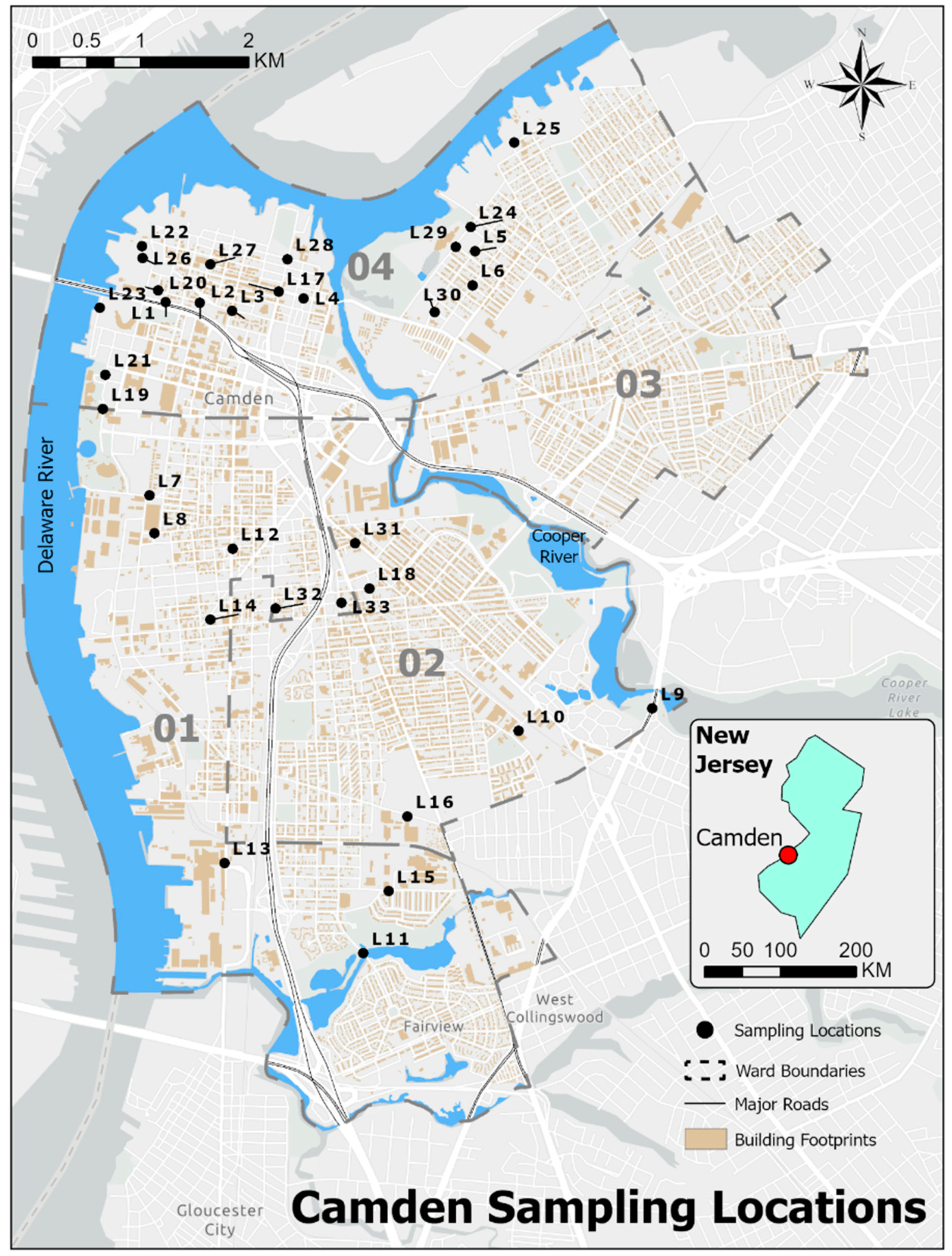
We collected stormwater samples from 33 randomized locations of flooded streets in the City of Camden, with sampling distributed across four heavy storm events (Figure 1). The events occurred in August and September 2023 (18 August 2023; 30 August 2023; 10 September 2023; 17 September 2023) and average precipitation ranged from 1.3 mm to 49.8 mm. We used pre-cleaned 125 mL polypropylene bottles for sampling and cleaning procedures included rinsing with laboratory detergent and 10% hydrochloric acid followed by deionized water to avoid contamination prior to sample. Stormwater from the puddles that were created on the roads after storm events was collected into the bottles using polypropylene transfer pipettes and triplicate samples were collected for each location. Water samples from a flooded basement of a Camden residence were also collected after three storm events in triplicates. Non-filtered water samples were acidified with 35% nitric acid to maintain pH below 2 and stored in the refrigerator until heavy metal extraction which was conducted within a month of collection.

2.3. Heavy Metal Extraction and Analysis

Acid extraction was carried out following US-EPA 200.8 guidelines [30] to extract total (dissolved + suspended) concentrations of Pb, Cd, and As in stormwater samples. 100 mL sample aliquots were mixed with 2 mL of 35% nitric acid and 1 mL of 50% hydrochloric acid in 150 mL glass beakers. Then, the beakers were heated up on a hot plate until the internal temperature of the solution was between 80 °C and 85 °C. Once the volume of the sample aliquot was reduced from 100 mL to 30 mL, the beakers were taken off the hot plate and left to cool. After cooling, each sample is transferred from the beaker to a 50 mL polypropylene centrifuge tube. The beakers were rinsed with ultra-pure water, and the washing was added to the centrifuge tube so that the final volume of the sample became 40 mL. Each sample was mixed in a vortex mixer and then centrifuged if there was considerable amount of suspended particulate matter in the sample. Finally, each sample was filtered through 0.45 µm polyethersulfone (PES) filters and extract was stored in the refrigerator until analysis was performed. An ultra-pure water method blank was extracted for each batch of samples extracted. Samples extracts were analyzed for heavy metals (Pb, Cd, As) using Agilent 7900 (Agilent Technologies, Inc., Santa Clara, CA, USA) inductively coupled plasma mass spectrometer (ICP-MS) with an Argon torch, a quadrupole mass analyzer, and a Collision/Reaction Cell (CRC) following the ASTM International standard test method D5673 for elements in water [31]. Heavy metals (Pb, Cd, As) were quantified using separate external calibration curves for each metal which ranges from 0.01–100 µg L−1. However, samples needed to be diluted 10 times to match the calibration range of the instrument for Pb quantification. Sample recovery percentages are 106.1 ± 0.9%, 101.8 ± 1.5% and 107.3 ± 0.6% for Pb, Cd, and As, respectively.

2.4. GIS Data Analysis and Mapping

We utilized GIS techniques to analyze the spatial distribution of heavy metals in our study area. A total of 33 sample locations were digitized based on their x and y coordinates. The GIS shapefile containing these locations was joined with a spreadsheet that included laboratory-tested concentrations of heavy metals. In addition to sample data, various base data layers were collected to provide spatial context. These layers included satellite imagery to serve as a backdrop, Camden’s four political ward boundaries, land use categories (2020), Camden city schools, and major roads. The data sources included the Delaware Valley Regional Planning Commission (DVRPC), the New Jersey Geographic Information Network (NJGIN), and Camden County. Once all relevant data were collected and integrated, we created three separate maps, each representing the concentration of a specific heavy metal in Camden. The spatial analysis process involved the following steps: Data Integration—The heavy metal concentration data were linked with their respective sample locations in GIS to allow spatial visualization and analysis. Symbolization—Each map displayed sample locations as points, with the size of the points varying proportionally to the level of contamination. This allowed for an intuitive representation of pollutant intensity across Camden. Proximity Analysis—Camden city schools were overlaid onto the maps to assess their proximity to high-concentration areas, highlighting potential risks to children. Land Use Assessment—A land use layer was incorporated to visually interpret the types of land use in and around contaminated sites. This helped identify whether industrial, residential, or recreational areas were more affected by heavy metal contamination.
Land use categories were also recorded for each sample point. If a sample site fell at a street intersection, land use data from all four corners were documented, allowing for a more comprehensive assessment of how different land use types contribute to contamination.

2.5. Statistical Analysis

2.5.1. Evaluating Differences in Distribution Patterns of Heavy Metals

Since the measured heavy metal concentrations (Pb, Cd, As) showed non-normal distributions (skewness of 3.8, 1.7, and 1.4 for Pb, Cd and As, respectively), we performed Kruskal–Wallis test with Post hoc test (Dunn’s test) to evaluate statistically significant differences in measured concentrations between these three metals at each of the sampling location of this study. Given the alarmingly high lead detected in stormwater, we also performed Kruskal–Wallis test with Post hoc test (Dunn’s test) to identify potential patterns of stormwater lead concentrations based on the geographical regions of Camden City: northwestern, northeastern, middle and southern.

2.5.2. Evaluating Covariate Controls on Heavy Metal Distributions

In addition to GIS-based mapping, we conducted a principal component analysis (PCA) to disentangle covariate controls on stormwater heavy metal distribution in the City of Camden, NJ, USA. Heavy metal (Pb, Cd, As) concentrations and environmental variables were used as metrics in PCA using the program Excel Stat (Microsoft 365 version) and the metrics used in PCA were mean normalized. Various GIS datasets using the ArcGIS Online (Professional version) platform were collected to assess potential influencing factors at each sample location. Rainfall data (in inches; later converted to mm) were obtained from the Mount Holly Weather Station to determine precipitation levels at each sampling point [32]. Given the role of stormwater in redistributing contaminants, we gathered rainfall data corresponding to each sample location to analyze its potential influence on heavy metal dispersion.
Elevation data (in meters) were utilized [33] to examine how topography might influence contaminant accumulation and runoff patterns. Flood frequency data were obtained from the floodplain maps o, where each location was classified based on its recurrence interval, distinguishing between 100-year flood zones (1% annual chance) and 500-year flood zones (0.2% annual chance) [34]. Given Camden’s stormwater infrastructure challenges, areas within high-frequency flood zones were analyzed for their correlation with heavy metal contamination. Furthermore, we analyzed the percentage of built surfaces within a 100 m2 area around each sampling location to determine the extent of impervious surfaces, which impact stormwater infiltration and pollutant transport. The number of contaminated sites within a 0.25-mile radius of each sampling location was determined using data from the New Jersey Department of Environmental Protection (NJDEP). This dataset allowed us to investigate whether proximity to historically contaminated sites influenced current heavy metal levels.
Traffic density was determined by using satellite imagery from Environmental Systems Research Institute, Inc. [35], where roads were categorized into three levels: low-density roads (1), medium-density boulevards (2), and high-density highways (3). Additionally, the distance of each sample site from major roads and highways (in meters) was measured using satellite imagery from ESRI, as proximity to high-traffic areas could contribute to elevated heavy metal concentrations due to vehicular emissions and road wear. We also assessed the number of houses and buildings within a 0.25-mile (402 m) radius of each sample point using satellite imagery from ESRI. This helped evaluate the potential for residential exposure and urban density effects on contamination levels. We also collected data on built years of the buildings located in the City of Camden from the tool developed by NJDEP in 2023 [36]. We assessed the number of buildings that were built before and after 1978 that were located within a 0.25-mile (402 m) radius of each sample point using satellite imagery from ESRI. Leaded paint was commonly used in buildings built before 1950 and it was banned in 1978 by the United States Environmental Protection Agency. So, this data will support evaluating how lead paints contributed to the stormwater distributions in the City of Camden. All collected GIS variables were compiled into a spreadsheet and used for PCA (Supplementary Materials, Table S1).

3. Results and Discussion

3.1. Heavy Metal Distribution in Stormwater

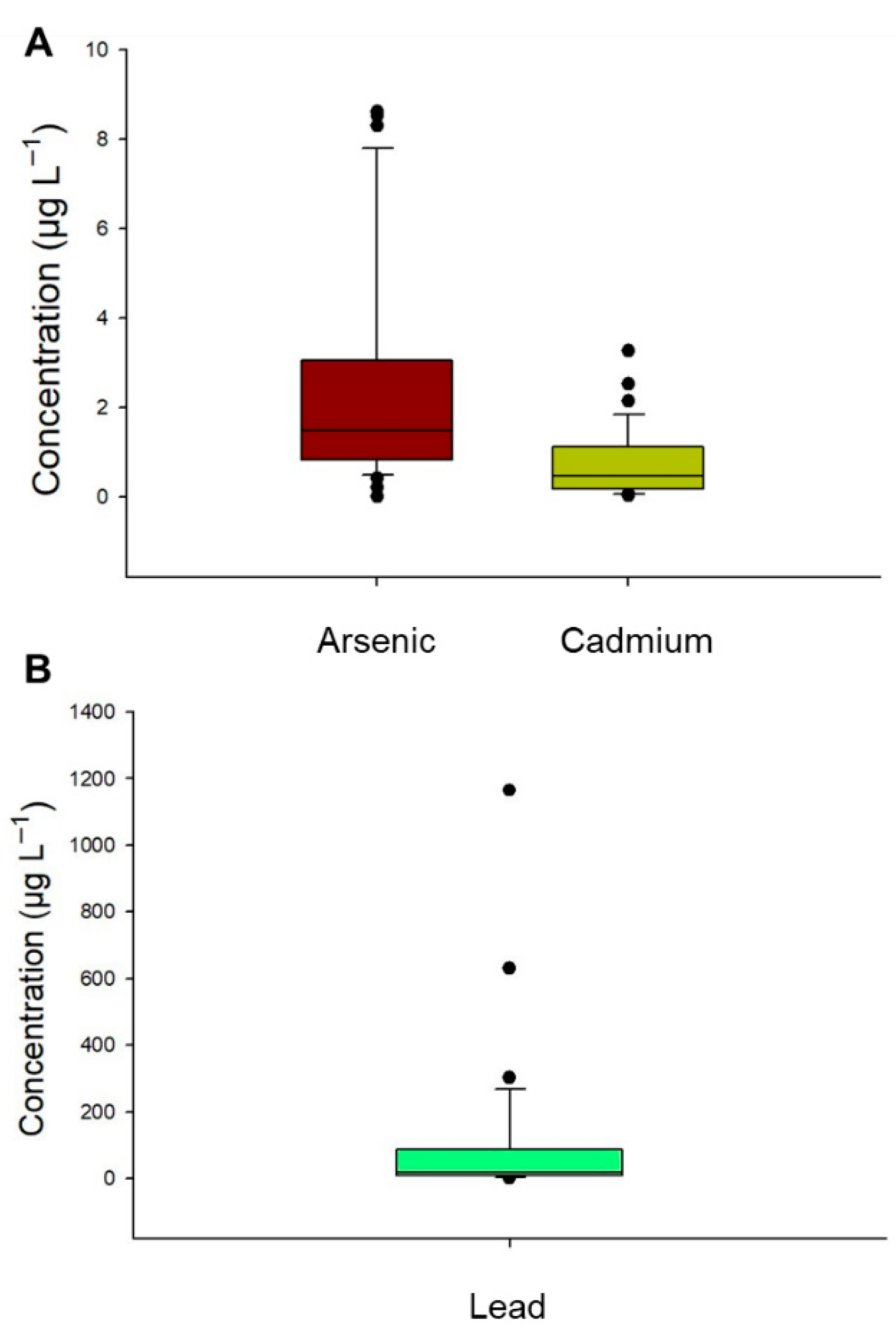
During the Atlantic hurricane season (June–November), north Atlantic coastline receives increased rainfall and cities like Camden with a lot of built surfaces have less infiltration of the rainwater into the ground, resulting in frequent floods in the streets, parks and neighborhoods [37,38]. Stormwater picks up pollutants as it flows over land surfaces, leading to elevated concentrations of contaminants, including heavy metals [39]. In the City of Camden, stormwater lead concentrations ranged from 1 to 1164 µg L−1, whereas cadmium (0.1–3.3 µg L−1) and arsenic (0.2–8.6 µg L−1) levels were comparatively low (Figure 2). Concentrations of Pb, Cd and As at each sampling location were shown in Supplementary Table S2. The concentrations of three metals are significantly different according to the Kruskal–Wallis test with Dunn’s post hoc test (p-value < 0.05). Lead concentrations at most sites exceeded or neared the current EPA action level of 15 µg L−1 [40], while cadmium (0.7 ± 0.8 µg L−1) and arsenic (2.6 ± 2.6 µg L−1) remained below EPA maximum contaminant levels (MCLs) for drinking water which are 5 µg L−1 and 10 µg L−1 [40], respectively. Although stormwater concentrations cannot be directly compared to drinking water standards, elevated lead levels in Camden’s stormwater indicate substantial lead loading and suggest an increased risk of other human exposure pathways, including dermal contact of contaminated runoff [29]. Moreover, polluted stormwater can contaminate receiving surface waters (rivers, lakes, and ponds) and potentially groundwater in Camden, which serve as important sources of drinking water and recreational activities.
The lead that is present in industrial and automobile emissions tends to be adsorbed onto the particulate matter in the air, and later these particles carrying lead settle on the land surfaces based on their size, shape and density, which we call “dry deposition” [25]. According to the NJDEP air quality report [40], average particle-bound lead concentrations measured in fine aerosol (PM 2.5) in New Jersey are lower than US EPA’s National Ambient Air Quality Standard (NAAQS) for lead (150 ng m3). However, given the numerous air polluting stationary and mobile sources located in Camden such as Diesel trucks, Diesel ships in port, dust from scrap yards, a cement factory, and the world’s largest licorice processing plant, air quality concerns have been raised by the Camden residents [41]. For instance, lead is released from diesel trucks and ships primarily through the combustion of diesel fuel and the wear of engine and fuel system components, which generates airborne particulate matter containing lead. Later, these lead containing particulates deposit on land surfaces in and around the city, washed off in stormwater runoff, contributing to elevated lead levels in Camden.
Besides dry deposition, during storm events, airborne particles can reach the land with rain, called “wet deposition”. The magnitude of wet deposition of particles bearing heavy metals is significantly elevated than dry deposition, removing pollutants from the atmosphere, but contaminant levels will be dramatically increased in the surface soil horizons and impervious surfaces [42,43]. Apart from atmospheric deposition, automobile wear and tear, weathering of old buildings containing lead paints, historically unregulated industrial and domestic waste dumpsites such as Cramer Hill landfill could also contribute to the lead levels in Camden soils [16,17,44].
Soil lead concentrations are highly variable in sites even one or two feet apart from each other [45]. Cook [46] reported that average lead concentration in urban soils in southern New Jersey (376 µg g−1) almost exceeds the US-EPA guideline for residential soils which is 400 µg g−1. Surface soil horizons have higher concentrations of lead than in subsurface soil horizons, not only because lead enters the soil primarily through surface deposition, but surface soil horizons are generally rich in organic matter that has greater potential of lead binding onto the soil particles [47]. During storm events, surface soil horizons get easily disturbed and washed off from the land surfaces, accumulating both water-soluble and particle-bound lead in the stormwater [48]. Finer soil particles exhibit higher lead adsorption due to their increased surface area-to-volume ratio [46]. These fine surface soils are easily mobilized by flowing water, even at low velocities. Suspended particles containing heavy metals, including lead, degrade stormwater quality and increase exposure risks for humans and organisms via contaminated water, food, and dermal contact [49,50]. Besides leaching from soil, lead containing particles that are settled in impervious surfaces like roads, sidewalks and parking lots can also contribute to the elevated lead levels in stormwater [51].
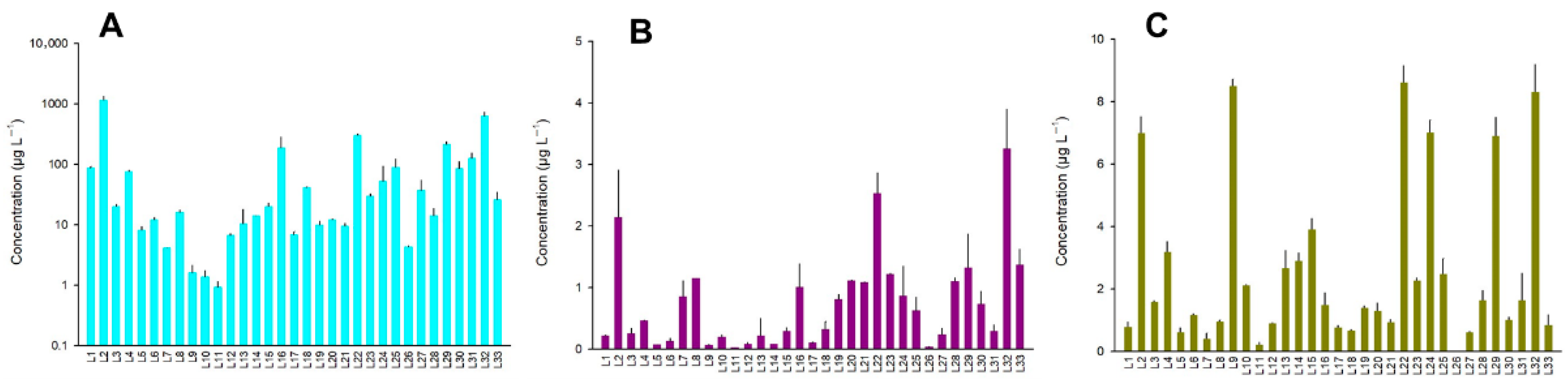
Unlike lead, stormwater cadmium (0.1–3.3 µg L−1) and arsenic (0.2–8.6 µg L−1) concentrations detected at all sampling locations (Figure 3) were notably low in City of Camden. Given the lower adsorption of arsenic and cadmium onto surface soils relative to lead [52,53], particle-bound metal fractions do not contribute much to the total stormwater concentrations detected for cadmium and arsenic. Besides that, the nature of source materials plays a critical role in determining the levels of cadmium and arsenic in stormwater runoff. Urban sources such as fossil fuel combustion and industrial processes like metal refining and smelting release cadmium and arsenic into the environment [54] while agricultural runoff containing fertilizers and pesticides also contributes a lot to the total environmental concentrations. Previous studies have reported higher levels of cadmium and arsenic in farmlands [55]. However, the City of Camden lacks agricultural lands, except for small-scale community gardens, which could be a reason for lower concentrations detected in stormwater. Apart from anthropogenic sources, natural weathering of rocks and minerals is also a considerable source of arsenic into the environment, but for urban settings with a lot of built surfaces, this could not be a significant source.
Before landing in the surrounding surface water bodies, stormwater in Camden enters residential neighborhoods, inundating residents’ backyards, front yards, and even basements of the houses located in low-elevation areas. Average concentrations of lead, cadmium, and arsenic in a flooded basement of Camden residence after three storm events are 893 ± 263 µg L−1, 1.8 ± 0.1 µg L−1, and 10.3 ± 2.4 µg L−1, respectively (Table 1). These basement concentrations are 9, 2.5, and 4 times higher than average stormwater concentrations collected from streets for lead, cadmium and arsenic, respectively. The house is situated within a residential neighborhood; however, it lies near a major highway with heavy daily traffic, including frequent truck activity. The surrounding area also contains an auto repair facility, several light-industrial buildings, and a nearby river known to experience water quality impairments.
During superstorms Katrina and Sandy, flooded basements posed a risk of heavy metal exposure, with lead being a particular concern due to its presence in older homes and potential for contamination from floodwater [56]. Frequent basement floods considerably increase human exposure to heavy metals through ingestion of contaminated food and water, as well as through dermal contact during clean-up [57]. When floodwater recedes, dried sediments containing these contaminants remain and can become airborne dust. This dust can then be inhaled, potentially affecting the respiratory health of household residents [57].
Stormwater heavy metal distribution patterns are significantly different based on the history of contamination, current sources of pollution, environmental conditions and socioeconomic factors of the study location. Table 2 shows previously published total (dissolved + suspended) concentrations of lead, cadmium and arsenic measured in different urban and suburban settings all around the world. Those samples were primarily collected from stormwater runoff in the streets and highways, stormwater drainage channels and outlets from storm sewers. Stormwater lead (15–808 µg L−1), cadmium (0.3–90 µg L−1) and arsenic (2.6–158 µg L−1) concentrations shown in Table 2, widely vary within a one to two magnitude range and solely depend on the site-specific characteristics including sources and climatic conditions. For instance, extensive urban and infrastructural development, high traffic density, small-scale industries, auto-repair shops, metal workshops, battery recycling activities, and roadside markets have contributed to significantly elevated lead (650 ± 160 µg L−1) and cadmium (90 ± 130 µg L−1) concentrations in stormwater runoff along the Abeokuta–Ibadan Road in Abeokuta, Nigeria [1]. Similarly, significant heavy metal pollution in District 17 of Tehran has been attributed to its long industrial history, intense vehicular traffic, high population density, informal waste dumping, small-scale industrial activities and poor stormwater management [8]. In both locations, prolonged dry periods promote the accumulation of contaminants on urban surfaces, leading to elevated pollutant concentrations in stormwater during rainfall events. Detected cadmium (2–5 µg L−1) and arsenic (6–11 µg L−1) levels in Singapore [58] and Denton, Texas [59], have been attributed to scattered microelectronic industries and agricultural activities, respectively. In our study, the average lead concentration detected in stormwater runoff from Camden streets (101 µg L−1) falls within the range reported in Table 2, except for one site in northwestern Camden that exhibited a markedly elevated Pb concentration (1164 µg L−1), likely linked to a localized source. However, stormwater cadmium (0.7 µg L−1) and arsenic (2.6 µg L−1) levels in Camden lie at the lower end of the range, showing a low risk of Cd and As exposure in Camden, compared to most of the other urban environments shown in Table 2. Basement stormwater contaminant levels in this study (591–1074 µg L−1 for Pb; 1.8–1.9 µg L−1 for Cd; 8.5–13 µg L−1 for As) were higher than those observed in outdoor environments (average 101 µg L−1 for Pb; 0.7 µg L−1 for Cd; and 2.6 µg L−1 for As). Among the three elements, Pb exhibited a more pronounced increase in basement stormwater compared to street runoff. Therefore, street concentrations probably underestimating the real exposure risk and future studies are highly recommended in flooded household environments to evaluate direct heavy metal exposure to Camden residents.
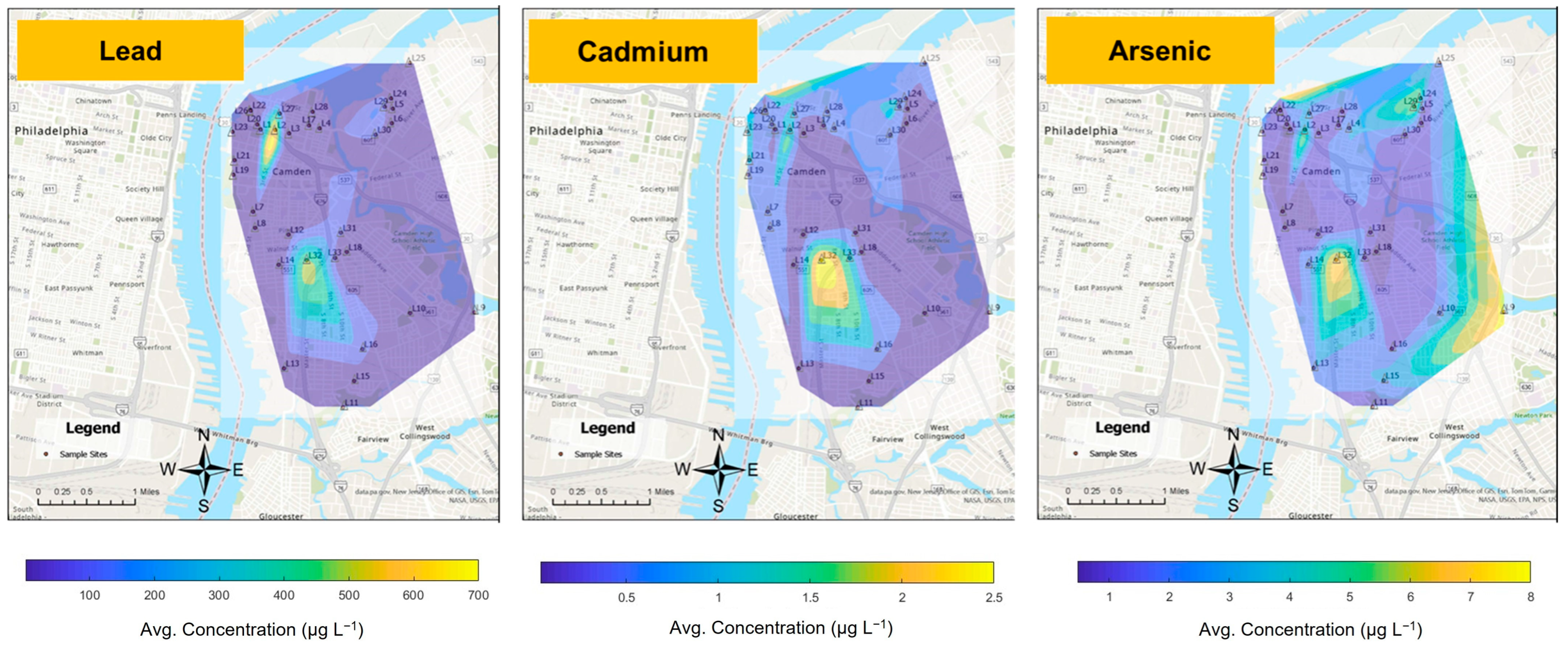
In our study, all the three heavy metals measured (Pb, Cd, As) showed considerable variation across sampling locations (Figure 2 and Figure 3), suggesting environmental and socio-economic factors directly impact the heavy metal distribution in Camden City. The Kruskal–Wallis test with Dunn’s post hoc test indicates that none of the metal concentrations (Pb, Cd, As) detected in stormwater have a significant difference (p-value < 0.05) between northwestern, northeastern, middle and southern regions of the City of Camden. It is mainly because each region has certain locations within the city that have elevated metal concentrations, which does not support significant differences between entire regions. The contour maps created based on the detected heavy metal concentrations show those localized hot spots of lead, cadmium, and arsenic distributions in the map of the Camden City (Figure 4). All three metals have a widespread hotspot of increased levels in the middle to southwestern part of the city while lead distribution shows a prominent narrow region of elevated concentrations in the northwestern part of the city. The southeastern part of the city shows an elevated patch of arsenic concentrations in the stormwater. The variable spatial distributions of lead, cadmium, and arsenic concentrations within the city suggest that they may be directly related to land use patterns and localized sources. We used GIS based maps and principal component analysis for investigating those relationships and it is described in the next section.

3.2. Relation of Land Use to Heavy Metal Distribution and Source Identification

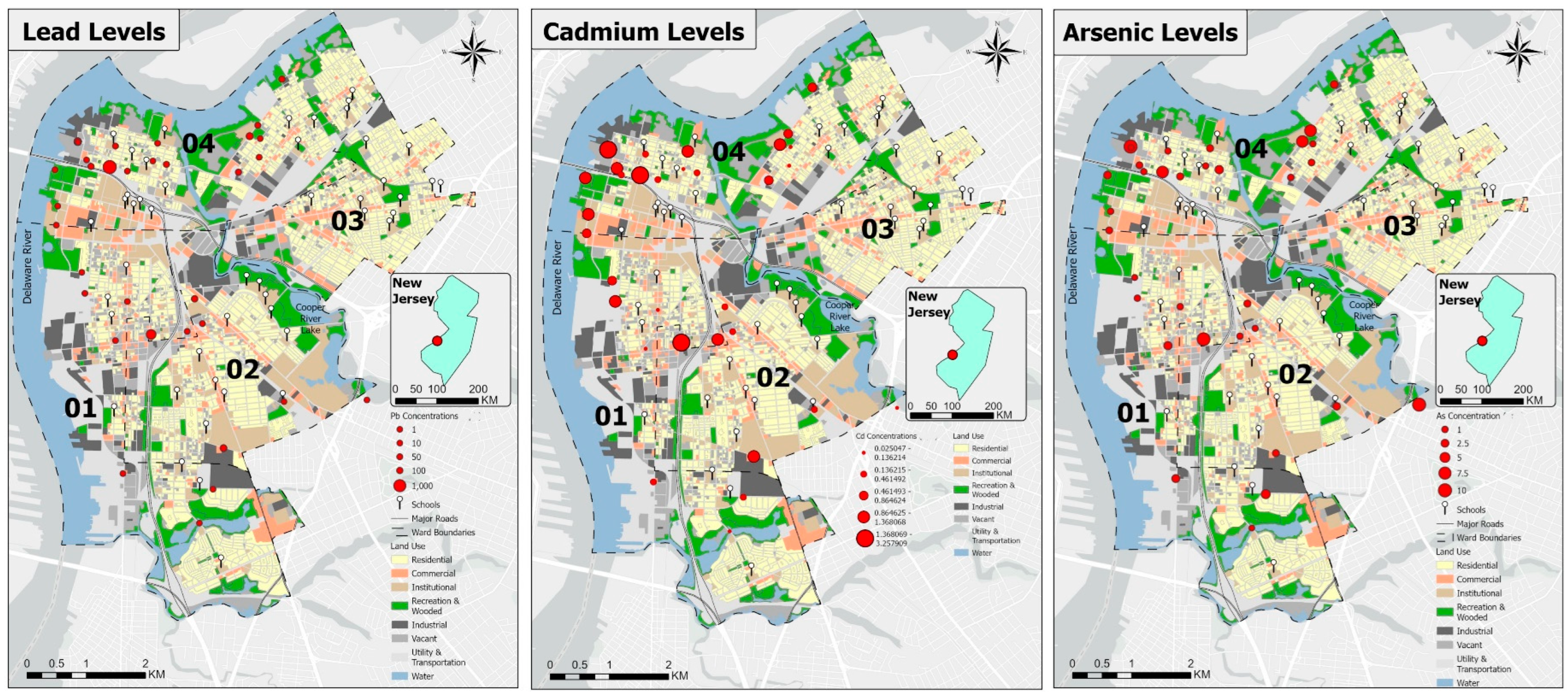
A visual representation of heavy metal contamination trends in Camden, enabling further interpretation of the relationship between land use patterns, pollution sources, and public health risk is clearly seen in Figure 5. For the lead, the location with the highest concentration (over 1000 µg L−1) is situated in a transportation land use area and adjacent to a residential land use area. This site is very close to a major highway running through Camden, suggesting that the high presence of lead in stormwater may be influenced by the heavy traffic volume, including frequent truck traffic. Many parcels in Camden are vacant or undeveloped, often classified as potential brownfields. These vacant lots are frequently used for illegal activities such as trash dumping, car abandonment, and the disposal of hazardous materials. The high concentration in this location may be attributed to these factors.
However, despite these specific examples, the map does not provide enough evidence to conclude that any land use type is directly responsible for higher lead contamination in Camden’s stormwater. While some areas with elevated lead levels are located near industrial sites, residential neighborhoods, or highways, no definitive pattern has emerged. Due to the limited number of samples, we cannot yet establish a strong connection between land use and lead contamination. Additional data collection is necessary to support any conclusions regarding the relationship between land use categories and lead concentrations in stormwater. Similar patterns were observed for the cadmium and arsenic concentrations (Figure 5).
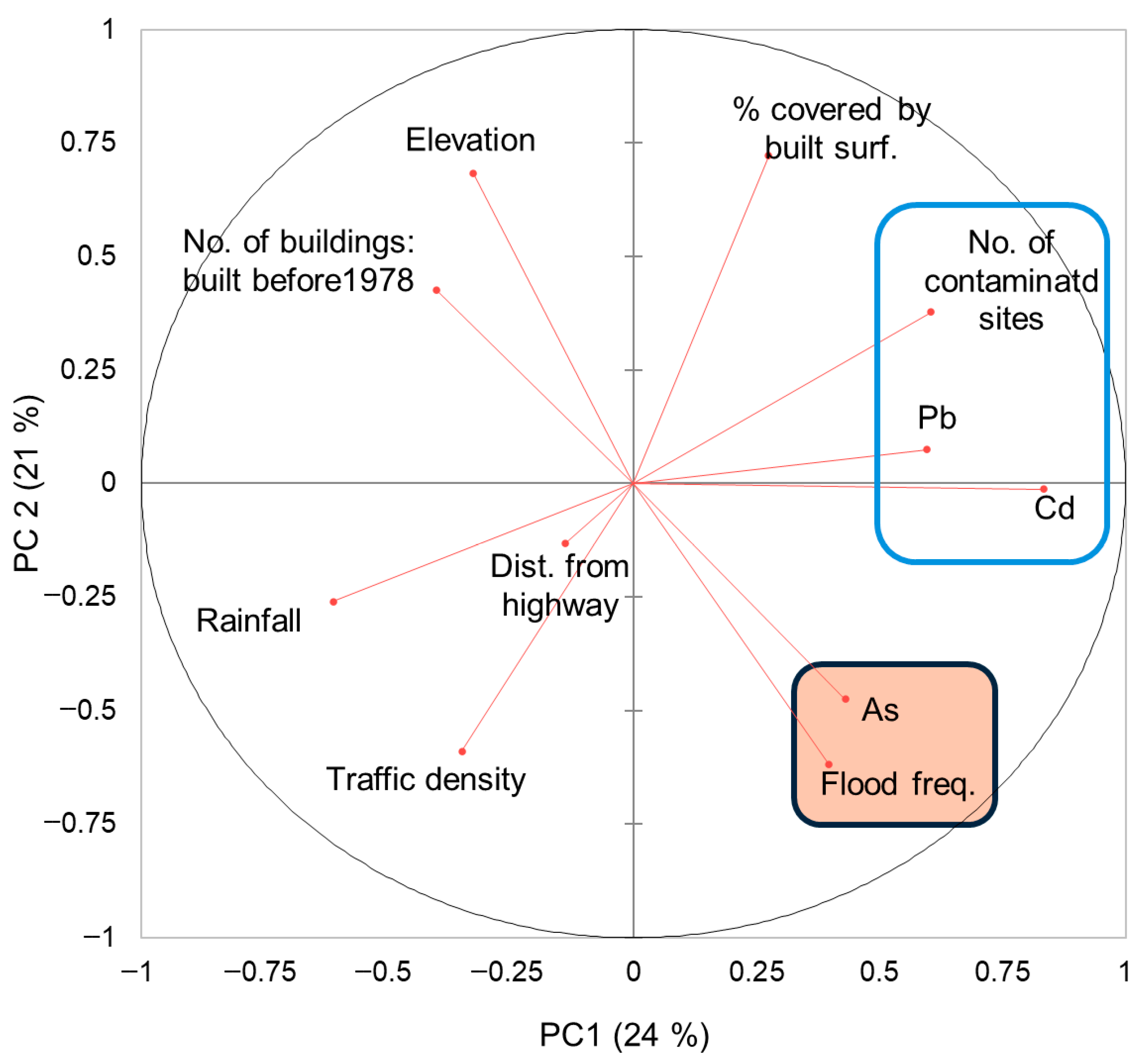
As an alternative to the visual interpretation of heavy metal distribution and land use patterns, we investigated results of the principal component analysis (PCA) of heavy metals and other environmental variables to understand how different sources contributed to the heavy metal distribution in the city (Figure 6). In the PCA biplot, lead and cadmium concentrations and number of previously contaminated sites located within 402 m radius were clustered as a group (see the box outline in blue in PCA plot; Figure 6). It indicates that previous industrial and domestic waste disposal sites could be common sources of both lead and cadmium contamination in stormwater in Camden. Wide range of items, such as electronics, batteries, plastics, paints and pigments, construction debris, can release metals into the surrounding soil and environment, then contaminate stormwater runoff and redistribute these pollutants. The NJDEP report published in 2017 documented higher average lead concentration in urban soils in New Jersey that it was in 1993 [47]. Although active sources of heavy metals have decreased over the years due to regulatory decisions, stormwater could still transport pollutants from previously contaminated sites to new locations. Furthermore, clustering of arsenic concentration and flood frequency in the PCA biplot (Orange shaded box) revealed that frequent flooding can significantly influence arsenic concentrations in stormwater due to its strong redox sensitivity. Flood-induced reducing conditions promote transformation of As (V) to the more mobile As (III), enhancing arsenic mobilization [63,64].
Caballero-Gómez et al. [9] identified that lead paint in houses and number of demolitions in old buildings had a strong correlation with the blood lead levels in children in Philadelphia. But in our study, we have not seen clear relationships with lead levels collected from flooded streets and the number of old housings built before 1978 within the radius of 402 m of the sampling location. It could be due to the stormwater movement through the environment that redistributes lead where it is originally deposited. Such relationships may be more evident if indoor basement lead concentrations are examined in flooded houses constructed prior to 1978, when lead-based paint was still in use. However, historical remediation efforts, building renovations, and soil replacement may weaken the direct association between building age and present-day stormwater metal concentrations. Similarly, we have not seen a good relationship of traffic density and/or distance to the highways with the heavy metal distributions, except one location showed the highest stormwater lead concentration. Traffic density alone may not adequately capture metal emission processes, which are strongly influenced by vehicle fleet composition, braking frequency, and roadway surface conditions. Nevertheless, road traffic is a well-established source of heavy metals, particularly lead [65], and atmospheric transport and stormwater runoff can disperse these pollutants beyond their points of origin.
Land use and hydrologic factors examined in the principal component analysis in our study only explained 46% of variance in the data, suggesting that stormwater heavy metal distributions are influenced by other interacting physical, chemical, and anthropogenic processes as well. Soil and sediment properties (e.g., particle size, organic matter, and pH), urban surface materials, and stormwater infrastructure design and maintenance strongly regulate metal adsorption, transport, and retention [46,66,67]. Atmospheric deposition and localized human activities can contribute to background metal loading independent of nearby land-use indicators. Together, these factors likely mask simple relationships between heavy metal concentrations and individual spatial predictors, highlighting the need for integrated, process-based urban stormwater assessments.

4. Conclusions

In this study, stormwater heavy metal (lead, cadmium, and arsenic) distributions were reported for flooded streets in the City of Camden, New Jersey. We found that detected lead concentrations in stormwater at most sampling locations were significantly elevated, indicating increased Pb exposure risks to Camden residents, particularly through dermal contact during and after flooding events. In contrast, cadmium and arsenic levels in Camden’s stormwater runoff were notably lower than those reported for general urban environments and were substantially lower than the lead concentrations detected at the same sites, identifying lead as the primary contaminant of concern.
The three elements measured in this study showed considerable spatial variability among sampling locations, reflecting the influence of land-use patterns, historical development, and socio-economic conditions on heavy metal distributions in Camden. Isolated hotspots of elevated concentrations were observed, which correspond to areas with a legacy of industrial activity and waste disposal. Principal component analysis indicated that lead and cadmium likely originate from similar sources, primarily associated with historically contaminated industrial lands and former waste dump sites. These findings highlight how past land-use decisions continue to shape present-day environmental quality and exposure risks in urban flood-prone areas.
All three heavy metals measured in the basement of a residential property were considerably elevated compared to concentrations in flooded streets, underscoring indoor environments as critical but often overlooked exposure settings. This result suggests that floodwaters mobilized across contaminated urban land surfaces can transport pollutants directly into residential spaces, where metals may persist in sediment and dust after floodwaters recede. These findings emphasize the need to integrate indoor exposure considerations into land-use planning and flood-risk management frameworks.
While this study provides important insights into stormwater contamination and land–water interactions in Camden, it is limited to data collected during the summer of 2023. Seasonal differences in precipitation, land-surface conditions, and contaminant mobilization may influence stormwater quality; therefore, long-term and multi-season monitoring is necessary to fully characterize heavy metal dynamics across urban land uses. In addition, this study reports total heavy metal concentrations (dissolved plus particle-associated), which limits assessment of metal mobility and bioavailability that are key factors for understanding contaminant transport across land surfaces and evaluating potential public health risks.
From a land management and policy perspective, stormwater remains less regulated than drinking water and wastewater systems, despite its strong connection to land use and flood exposure pathways. Given the elevated lead concentrations and pronounced indoor exposure risks identified in this study, stormwater control strategies should be explicitly incorporated into urban land-use planning in cities like Camden that are affected by legacy industrial contamination and recurrent flooding. Priority should be given to implementing green infrastructure in areas with historically contaminated land uses and in high-risk residential neighborhoods. Green City strategies and Low-Impact Development (LID) practices, such as detention and retention basins, bioretention systems, bioswales, green roofs, and porous pavements, can reduce runoff volumes, limit contaminant mobilization from urban soils, and mitigate pollutant transport into residential and water environments.
In parallel, land-use policy and post-flood management practices should include clear guidance for indoor cleaning and remediation following flooding events, particularly in neighborhoods adjacent to historically contaminated sites. Future research should focus on flooded household environments and post-flood land–building interactions to better quantify exposure pathways and to inform land-based planning, remediation, and public health protection strategies for Camden residents.

Supplementary Materials

The following supporting information can be downloaded at: https://www.mdpi.com/article/10.3390/land15010154/s1, Table S1: Environmental variables used in principle component analysis (PCA); Table S2: Concentrations of lead, cadmium, arsenic in stormwater measured at each location in City of Camden (n = 3).

Author Contributions

Conceptualization, T.A., M.M. and D.S.-d.l.C.; methodology, T.A., M.M. and D.S.-d.l.C.; software, T.A. and M.M.; validation, T.A. and M.M.; formal analysis, T.A. and M.M.; investigation, T.A., M.M., D.S.-d.l.C. and A.L.; resources, T.A., M.M., L.Y. and J.F.; data curation, T.A., A.L. and M.M.; writing—original draft preparation, T.A. and M.M.; writing—review and editing, T.A., M.M., D.S.-d.l.C., L.Y., J.F. and A.L.; visualization, T.A. and M.M.; supervision, T.A. and M.M.; project administration, M.M.; funding acquisition, M.M., T.A. and D.S.-d.l.C. All authors have read and agreed to the published version of the manuscript.

Funding

This research was funded by South Jersey Institute of Population Health [grant number: Cycle 2, Project #50].

Data Availability Statement

Data will be made available on request.

Acknowledgments

The authors gratefully acknowledge the funding support provided by the South Jersey Institute of Population Health (Principal Investigator: Mahbubur Meenar, Cycle 2, Project #50). We extend our sincere thanks to Benjamin Woodward (Rowan University) and Arturo Ramos Ochoa (Rutgers University–Camden) for their assistance with stormwater sampling. We are also thankful to Ladarion Hardison, Graham Luther and Hannah Genereux (Rowan University), as well as Sampath Rathnayaka (Pennsylvania State University), for their valuable contributions to figure generation, analysis, and writing. Additionally, we recognize Eli Moore for his early involvement in the project and appreciate the support of our community partner, Shaneka Boucher, from Social Responsibility Through Me.

Conflicts of Interest

The authors declare no conflict of interest.

References

  1. Adedeji, O.H.; Olayinka, O.O. Heavy Metal Concentrations in Urban Stormwater Runoff and Receiving Streams. J. Environ. Earth Sci. 2013, 3, 141–150. [Google Scholar]
  2. Sakson, G.; Brezinska, A.; Zawilski, M. Emission of heavy metals from an urban catchment into receiving water and possibility of its limitation on the example of Lodz city. Environ. Monit. Assess. 2018, 190, 281. [Google Scholar] [CrossRef]
  3. Göbel, P.; Dierkes, C.; Coldewey, W.G. Storm water runoff concentration matrix for urban areas. J. Contam. Hydrol. 2006, 91, 26–42. [Google Scholar] [CrossRef]
  4. Alrabie, N.A.; Mohamat-Yusuff, F.; Rohasliney, H.; Zulkeflee, Z.; Amal, M.N.A.; Arshad, A.; Sani, M.S.A. Preliminary evaluation of heavy metal contamination and source identification in Kuala Lumpur SMART Stormwater Pond Sediments using Pb isotopic signature. Sustainability 2021, 13, 9020. [Google Scholar] [CrossRef]
  5. Qian, Y.; Gallagher, F.; Deng, Y.; Wu, M.; Feng, H. Risk assessment and interpretation of heavy metal contaminated soils on an urban brownfield site in New York metropolitan area. Environ. Sci. Pollut. Res. 2017, 24, 23549–23558. [Google Scholar] [CrossRef]
  6. Baranowska-Bosiacka, I.; Korbecki, J.; Marchlewicz, M. Lead, Pb. In Mammals and Birds as Bioindicators of Trace Element Contaminations in Terrestrial Environments: An Ecotoxicological Assessment of the Northern Hemisphere; Kalisińska, E., Ed.; Springer: Cham, Switzerland, 2019; pp. 563–592. [Google Scholar]
  7. Wei, B.; Yang, L. A review of heavy metal contamination in urban soils. Sci. Total Environ. 2010, 408, 447–456. [Google Scholar]
  8. Soltaninia, S.; Taghavi, L.; Hosseini, S.A.; Motamedvaziri, B.; Eslamian, S. The effect of land-use type and climatic conditions on heavy metal pollutants in urban runoff in a semi-arid region. J. Water Reuse Desalin. 2022, 12, 384–402. [Google Scholar] [CrossRef]
  9. Caballero-Gómez, H.; White, H.K.; O’Shea, M.J.; Pepino, R.; Howarth, M.; Gieré, R. Spatial analysis and lead-risk assessment of Philadelphia, USA. GeoHealth 2022, 6, e2021GH000519. [Google Scholar] [CrossRef]
  10. Alengebawy, A.; Abdelkhalek, S.T.; Qureshi, S.R.; Wang, M.Q. Heavy metals and pesticides toxicity in agricultural soil and plants: Ecological risks and human health implications. Toxics 2021, 9, 42. [Google Scholar] [CrossRef]
  11. Ancion, P.Y.; Lear, G.; Lewis, G.D. Three common metal contaminants of urban runoff (Zn, Cu & Pb) accumulate in freshwater biofilm and modify embedded bacterial communities. Environ. Pollut. 2010, 158, 2738–2745. [Google Scholar] [CrossRef]
  12. Besser, J.M.; Brumbaugh, W.G.; Allert, A.L.; Poulton, B.C.; Schmitt, C.J.; Ingersoll, C.G. Ecological impacts of lead mining on Ozark streams: Toxicity of sediment and pore water. Ecotoxicol. Environ. Saf. 2009, 72, 516–526. [Google Scholar] [CrossRef]
  13. Sparling, D.W.; Krest, S.; Ortiz-Santaliestra, M. Effects of lead-contaminated sediment on Rana sphenocephala tadpoles. Arch. Environ. Contam. Toxicol. 2006, 51, 458–466. [Google Scholar] [CrossRef]
  14. Douglas-Stroebel, E.; Hoffman, D.J.; Brewer, G.L.; Sileo, L. Effects of lead-contaminated sediment and nutrition on mallard duckling brain growth and biochemistry. Environ. Pollut. 2004, 131, 215–222. [Google Scholar] [CrossRef]
  15. Mitra, S.; Chakraborty, A.J.; Tareq, A.M.; Emran, T.B.; Nainu, F.; Khusro, A.; Idris, A.M.; Khandaker, M.U.; Osman, H.; Alhumaydhi, F.A.; et al. Impact of heavy metals on the environment and human health: Novel therapeutic insights to counter the toxicity. J. King Saud Univ. Sci. 2022, 34, 101865. [Google Scholar] [CrossRef]
  16. Hanfi, M.Y.; Mostafa, M.Y.; Zhukovsky, M.V. Heavy metal contamination in urban surface sediments: Sources, distribution, contamination control, and remediation. Environ. Monit. Assess. 2020, 192, 32. [Google Scholar] [CrossRef]
  17. Ma, Y.; Egodawatta, P.; McGree, J.; Liu, A.; Goonetilleke, A. Human health risk assessment of heavy metals in urban stormwater. Sci. Total Environ. 2016, 557–558, 764–772. [Google Scholar] [CrossRef]
  18. Vardhan, K.H.; Kumar, P.S.; Panda, R.C. A review on heavy metal pollution, toxicity and remedial measures: Current trends and future perspectives. J. Mol. Liq. 2019, 290, 111197. [Google Scholar] [CrossRef]
  19. New Jersey Environmental Protection Agency. Contaminated Site Remediation & Redevelopment (CSRR). 2024. Available online: https://dep.nj.gov/srp/kcsnj/ (accessed on 10 March 2025).
  20. Meenar, M.; Howell, J.P.; Moulton, D.; Walsh, S. Green stormwater infrastructure planning in urban landscapes: Understanding context, appearance, meaning, and perception. Land 2020, 9, 534. [Google Scholar] [CrossRef]
  21. National Oceanic and Atmospheric Administration (NOAA). Annual 2021 National Climate Report; National Centers for Environmental Information (NCEI): Asheville, NC, USA, 2022.
  22. United States Environmental Protection Agency (US-EPA). Combined Sewer Overflows (CSOs). 2023. Available online: https://www.epa.gov/npdes/combined-sewer-overflows-csos (accessed on 3 December 2024).
  23. United States Environmental Protection Agency (US-EPA). Camden, New Jersey Uses Green Infrastructure to Manage Stormwater. 2023. Available online: https://www.epa.gov/arc-x/camden-new-jersey-uses-green-infrastructure-manage-stormwater (accessed on 2 December 2024).
  24. Novaes, C.; Marques, R. Public policy: Urban stormwater in a paradigm shift, is it the end or just the beginning? Water Sci. Technol. 2022, 85, 2652–2662. [Google Scholar] [CrossRef]
  25. Tashakor, M.; Behrooz, R.D.; Asvad, S.R.; Kaskaoutis, D.G. Tracing of Heavy Metals Embedded in Indoor Dust Particles from the Industrial City of Asaluyeh, South of Iran. Int. J. Environ. Res. Public Health. 2022, 19, 7905. [Google Scholar] [CrossRef]
  26. Bradham, K.D.; Nelson, C.M.; Kelly, J.; Pomales, A.; Scruton, K.; Dignam, T.; Misenheimer, J.C.; Li, K.; Obenour, D.R.; Thomas, D.J. The relationship between total and bioaccessible lead on children’s blood lead levels in urban residential Philadelphia soils. Environ. Sci. Technol. 2017, 51, 10005–10011. [Google Scholar] [CrossRef]
  27. Bassetti, O.G.; McDonough, R.A.; Shakya, K.M. Soil contamination in community gardens of Philadelphia and Pittsburgh, Pennsylvania. Environ. Monit. Assess. 2023, 195, 782. [Google Scholar] [CrossRef]
  28. Sage, L.; Bassetti, O.; Johnson, E.; Shakya Weston, N. Assessment of heavy metal contamination in soil and produce of Philadelphia community gardens. Environ. Pollut. Bioavailab. 2023, 35, 2209283. [Google Scholar] [CrossRef]
  29. Hatter, A.; Heintzelman, D.P.; Heminghaus, M.; Foglein, J.; Meenar, M.; Moore, E.K. Heavy metal mobilization in urban stormwater runoff from residential, commercial, and industrial zones. Pollutants 2025, 5, 32. [Google Scholar] [CrossRef]
  30. United States Environmental Protection Agency (US-EPA). 200.8: Determination of Trace Elements in Waters and Wastes by Inductively Coupled Plasma—Mass Spectrometry; United States Environmental Protection Agency: Washington, DC, USA, 1994.
  31. ASTM International. Standard Test Method for Elements in Water by Inductively Coupled Plasma-Mass Spectrometry; ASTM International: West Consecutive Hawke, PA, USA, 2016. [Google Scholar]
  32. National Weather Service. Climate Data and Information; National Oceanic and Atmospheric Administration (NOAA): Washington, DC, USA. Available online: https://www.weather.gov/wrh/climate (accessed on 1 March 2025).
  33. United States Geological Survey. USGS National Map: Elevation Data; U.S. Department of the Interior: Washington, DC, USA. Available online: https://www.usgs.gov/core-science-systems/national-geospatial-program/national-map (accessed on 1 March 2025).
  34. Rutgers University Center for Remote Sensing and Spatial Analysis. NJFloodMapper: Interactive Coastal Flood Mapping Tool. Available online: https://njfloodmapper.org/ (accessed on 1 March 2025).
  35. Environmental Systems Research Institute, Inc. (ESRI). Traffic Counts Advanced Demographics Dataset. Available online: https://doc.arcgis.com/en/esri-demographics/latest/esri-demographics/traffic-counts.htm (accessed on 20 March 2025).
  36. New Jersey Department of Environmental Protection. The Potential Lead Exposure Mapping (PLEM)-Lead-Based Paint. 2023. Available online: https://experience.arcgis.com/experience/bc82aa1d39d54e5d944d701cf7e8450d/page/Lead-based-Paint (accessed on 20 March 2025).
  37. Landsea, C.W.; Pielke, R.A., Jr.; Mestas-Nuñez, A.M.; Knaff, J.A. Atlantic basin hurricanes: Indices of climatic changes. Clim. Change 1999, 42, 89–129. [Google Scholar]
  38. Hamilton, B.; Coops, N.C.; Lokman, K. Time series monitoring of impervious surfaces and runoff impacts in Metro Vancouver. Sci. Total Environ. 2021, 760, 143873. [Google Scholar]
  39. Barałkiewicz, D.; Chudzińska, M.; Szpakowska, B.; Świerk, D.; Gołdyn, R.; Dondajewska, R. Storm water contamination and its effect on the quality of urban surface waters. Environ. Monit. Assess. 2014, 186, 6789–6803. [Google Scholar] [CrossRef]
  40. United States Environmental Protection Agency (US-EPA). National Primary Drinking Water Regulation Table; United States Environmental Protection Agency: Washington, DC, USA, 2009.
  41. New Jersey Environmental Protection Agency. Camden Waterfront South Air Toxics Pilot Project; Division of Air Quality: Trenton, NJ, USA, 2005.
  42. Reinfelder, J.R.; Totten, L.A.; Eisenreich, S.J. The New Jersey Atmospheric Deposition Network (NJADN); Final Report; New Jersey Department of Environmental Protection: Trenton, NJ, USA, 2004.
  43. Yu, C.H.; Fan, Z.; McCandlish, E.; Stern, A.H.; Lioy, P.J. Characterization of Spatial Impact of Particles Emitted from a Cement Material Production Facility on Outdoor Particle Deposition in the Surrounding Community. J. Air Waste Manag. Assoc. 2011, 61, 1015–1025. [Google Scholar] [CrossRef]
  44. Levin, R.; Vieira, C.L.Z.; Rosenbaum, M.H.; Bischoff, K.; Mordarski, D.C.; Brown, M.J. The urban lead (Pb) burden in humans, animals and the natural environment. Environ. Res. 2021, 193, 110377. [Google Scholar] [CrossRef]
  45. United States Environmental Protection Agency (US-EPA). III Region (2020) Lead in Soil; United States Environmental Protection Agency: Washington, DC, USA, 2020.
  46. Cook, Z. Assessment and Potential for Phyto-and-Mycorremediation of Soil Heavy Metal Polltuion in Southern New Jersey (USA). Master’s Thesis, Graduate School-Camden Rutgers, Camden, NJ, USA, 2019. [Google Scholar]
  47. Lester, L.A. Statistical Analysis: Metal Concentrations in Soil; Division of Science and Research, New Jersey Department of Environmental Protection: Trenton, NJ, USA, 2020.
  48. Liu, C.; Lu, J.; Liu, J.; Mehmood, T.; Chen, W. Effects of lead (Pb) in stormwater runoff on the microbial characteristics and organics removal in bioretention systems. Chemosphere 2020, 253, 126721. [Google Scholar] [CrossRef]
  49. Huang, H.; Guan, H.; Tian, Z.; Chen, M.; Tian, K.; Zhao, F.; Wang, P. Exposure sources, intake pathways and accumulation of lead in human blood. Soil Secur. 2024, 15, 100150. [Google Scholar] [CrossRef]
  50. Tom, M.; Fletcher, T.D.; McCarthy, D.T. Heavy metal contamination of vegetables irrigated by urban stormwater: A matter of time? PLoS ONE 2014, 9, e112441. [Google Scholar] [CrossRef]
  51. Hwang, H.M.; Fiala, M.J.; Park, D.; Wade, T.L. Review of pollutants in urban road dust and stormwater runoff: Part 1. Heavy metals released from vehicles. Int. J. Urban Sci. 2016, 20, 334–360. [Google Scholar] [CrossRef]
  52. McLean, J.E.; Bledsoe, B.E. Ground Water Issue: Behavior of Metals in Soils; EPA/540/S-92/018; United States Environmental Protection Agency: Washington, DC, USA, 1992.
  53. Bradl, H.B. Adsorption of heavy metal ions on soils and soils constituents. J. Colloid Interface Sci. 2004, 277, 1–18. [Google Scholar] [CrossRef]
  54. Wu, W.; Wu, P.; Yang, F.; Sun, D.L.; Zhang, D.X.; Zhou, Y.K. Assessment of heavy metal pollution and human health risks in urban soils around an electronics manufacturing facility. Sci. Total Environ. 2018, 630, 53–61. [Google Scholar] [CrossRef]
  55. Fields, T.W.; McNevin, T.F.; Harkov, R.A. A Summary of Selected Soil Constituents and Contaminants at Background Locations in New Jersey; Soil Remediation Program; New Jersey Department of Environmental Protection: Trenton, NJ, USA, 1993.
  56. Rabito, F.A.; Iqbal, S.; Perry, S.; Arroyave, W.; Rice, J.C. Environmental lead after Hurricane Katrina: Implications for future populations. Environ. Health Perspect. 2012, 120, 180–184. [Google Scholar] [CrossRef][Green Version]
  57. Weber, A.; Wolf, S.; Becker, N.; Marker-Neuhaus, L.; Bellanova, P.; Brull, C.; Hollert Klopries, E.; Schuttrumpf, H.; Lehmkuhl, F. The risk may not be limited to flooding: Polluted flood sediments pose a human health threat to the unaware public. Environ. Sci. Eur. 2023, 35, 58. [Google Scholar] [CrossRef]
  58. Joshi, U.M.; Balasubramanian, R. Characteristics and environmental mobility of trace elements in urban runoff. Chemosphere (Oxford) 2010, 80, 310–318. [Google Scholar] [CrossRef]
  59. Appel, P.L.; Hudak, P.F. Automated sampling of stormwater runoff in an urban watershed, North-Central Texas. J. Environ. Sci. Health Part A 2001, 36, 897–907. [Google Scholar] [CrossRef]
  60. Pochodyła-Ducka, E.; Glińska-Lewczuk, K.; Jaszczak, A. Changes in Stormwater Quality and Heavy Metals Content along the Rainfall–Runoff Process in an Urban Catchment. Water 2023, 15, 3505. [Google Scholar] [CrossRef]
  61. Prestes, E.C.; dos Anjos, V.E.; Sodré, F.F.; Grassi, M.T. Copper, Lead and Cadmium Loads and Behavior in Urban Stormwater Runoff in Curitiba, Brazil. J. Braz. Chem. Soc. 2006, 17, 53–60. [Google Scholar] [CrossRef]
  62. Brown, J.N.; Peake, B.M. Sources of heavy metals and polycyclic aromatic hydrocarbons in urban stormwater runoff. Sci. Total Environ. 2006, 359, 145–155. [Google Scholar] [CrossRef]
  63. Izadi, L.N.; Tamadoni, A.; Siebecker, M.G.; Sricharoenvech, P.; Barreto, M.S.C.; Fischel, M.H.H.; Tappero, R.; Sparks, D.L. Hurricanes and turbulent floods threaten arsenic-contaminated coastal soils and vulnerable communities. Environ. Int. 2025, 200, 109479. [Google Scholar] [CrossRef]
  64. Yamaguchi, N.; Nakamura, T.; Dong, D.; Takahashi, Y.; Amachi, S.; Makino, T. Arsenic release from flooded paddy soils is influenced by speciation, Eh, pH, and iron dissolution. Chemosphere 2011, 83, 925–932. [Google Scholar] [CrossRef]
  65. Huber, M.; Helmreich, B. Stormwater management: Calculation of traffic area runoff loads and traffic related emissions. Water 2016, 8, 294. [Google Scholar] [CrossRef]
  66. Bąk, Ł.; Szeląg, B.; Sałata, A.; Studziński, J. Modeling of heavy metal (Ni, Mn, Co, Zn, Cu, Pb, and Fe) and PAH content in stormwater sediments based on weather and physico-geographical characteristics of the catchment-data-mining approach. Water 2019, 11, 626. [Google Scholar] [CrossRef]
  67. Chang, N.B.; Lu, J.W.; Chui, T.F.M.; Hartshorn, N. Global policy analysis of low impact development for stormwater management in urban regions. Land Use Policy 2018, 70, 368–383. [Google Scholar] [CrossRef]
Figure 1. Location map of sampling sites in Camden City. Stormwater samples were collected (n = 33) from flooded streets in Summer 2023.
Land 15 00154 g001
Figure 2. Concentration of (A) Arsenic and Cadmium and (B) Lead in stormwater in Camden City (n = 33).
Land 15 00154 g002
Figure 3. Concentration of (A) Lead, (B) Cadmium, and (C) Arsenic in stormwater at the different locations in Camden City (n = 33). Error bars represent standard deviations (n = 3). Lead concentrations are shown on a logarithmic scale to accommodate the broad range of measured values at different sampling locations.
Land 15 00154 g003
Figure 4. Heavy metal (lead, cadmium, Arsenic) distribution of stormwater in City of Camden in Summer 2023. The heavy metal concentrations at unmeasured locations were interpolated using measured concentrations at 33 sampling locations in the City of Camden.
Land 15 00154 g004
Figure 5. Heavy metal concentrations in stormwater collected from 33 flooded street locations in Camden during Summer 2023. Concentrations are reported in µg L−1. Concentration ranges are visualized using graduated symbol sizes in GIS; symbol sizes are scaled independently for each map and therefore are not directly comparable across panels.
Land 15 00154 g005
Figure 6. Principal component (PC) analysis of stormwater heavy metal distribution and environmental variables in City of Camden. The environmental variables included in the study are rainfall, elevation, traffic density, distance from highway, flood frequency, number of buildings built before 1978 within 402 m radius, number of contaminated sites within 402 m radius and percentage of land covered by built surfaces within 100 m radius of sampling location. Traffic density at each sampling location was ranked as low (1), medium (2) and high (3) and included in the PC analysis. PC1 and PC2 account for 24% and 21% variance, respectively. PC1/PC2 = principal components 1 and 2; Pb = Lead; As = Arsenic; Cd = Cadmium; Box outlined in blue shows potential co-occurrence of lead and cadmium while orange shaded box reveals the relation of frequent floods and As concentration in stormwater in Camden.
Land 15 00154 g006
Table 1. Concentration of heavy metals in a flooded basement of Camden residence after three storm events in Summer 2023. Error is the standard deviation of triplicate samples.
Storm EventArsenic (µg L−1)Cadmium (µg L−1)Lead (µg L−1)
18.5 ± 0.11.8 ± 0.12591 ± 255
29.4 ± 7.81.9 ± 1.01074 ± 730
313.0 ± 1.81.8 ± 0.61015 ± 90
Table 2. Average total (dissolved + suspended) heavy metal concentrations in stormwater in urban regions, as published by various sources.
LocationTypeConcentrationReference
Lead (µg L−1)Arsenic (µg L−1)Cadmium (µg L−1)
Camden, New Jersey, United StatesStreets in the city101 +/− 2272.6 +/− 2.60.7 +/− 0.8Current study
Olsztyn, PolandStormwater drain25.0 +/− 34.3N/AN/A[60]
District 17, Tehran, IranDischarge catchment area (mixed land-use)808 158 17 [8]
SingaporeUrban runoffResidential: 51.32
Industrial: 90.25
Residential: 6.2
Industrial: 10.76
Residential: 1.82
Industrial: 4.57
[58]
Abeokuta-Ibadan Road, Abeokuta, NigeriaStormwater for Highway runoff650 +/− 160 N/A90 +/− 130 [1]
Lodz, PolandOutlets from storm sewers15N/A0.5[2]
Curitiba BrazilStreet gutters60.6 N/A0.32 [61]
Dunedin, New ZealandStormwater Drain208 +/− 74
670 +/− 332
N/AN/A[62]
Denton, Texas, United StatesStormwater drainage channel30 8 4 [59]
Disclaimer/Publisher’s Note: The statements, opinions and data contained in all publications are solely those of the individual author(s) and contributor(s) and not of MDPI and/or the editor(s). MDPI and/or the editor(s) disclaim responsibility for any injury to people or property resulting from any ideas, methods, instructions or products referred to in the content.