Assessing the Feasibility of PPPs for Cultural Heritage Enhancement in UNESCO Sites: The Case of Matera (Italy)



Abstract
1. Introduction
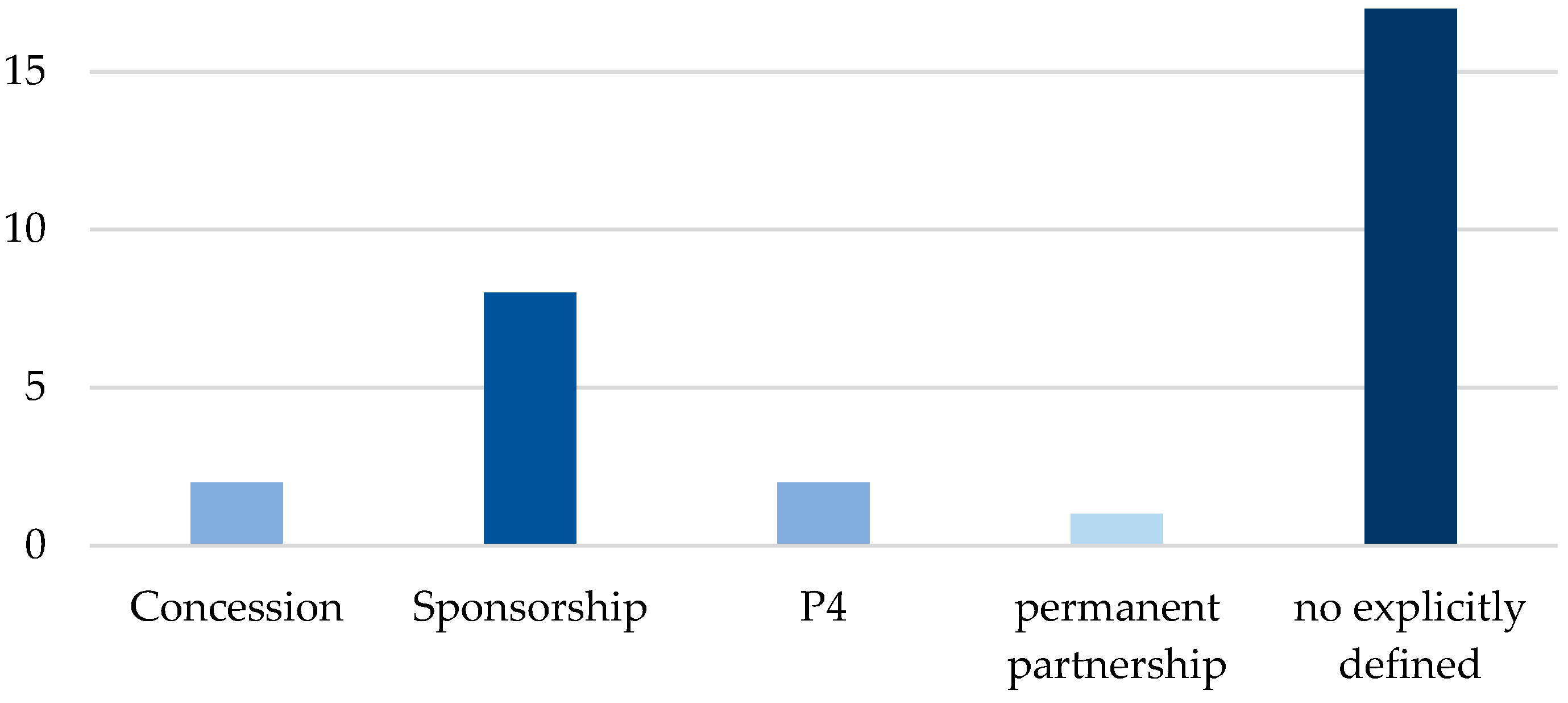
- Concession. It is a pecuniary interest contract between the public and private sectors in which the public entrusts the private sector with the execution of works and the management of services [12]. The essential issue in this type of agreement is the transfer of the operational risks associated with the demand or supply of a good or activity to the private entity.
- Sponsorship. This is a type of contract in which the private entity economically contributes to public initiatives. In general, the private partner benefits from a return of visibility related to linking its own brand to the cultural asset.
- Private-public-people partnerships (P4). This is a no-profit contract between public and private entities to define and organize models related to enhancing and managing cultural heritage.
2. PPPs and UNESCO: Approaches and Implementation
PPPs and UNESCO Sites: The Italian Case
- Site typology. The typology of heritage sites they deal with (cultural, natural, cultural landscape).
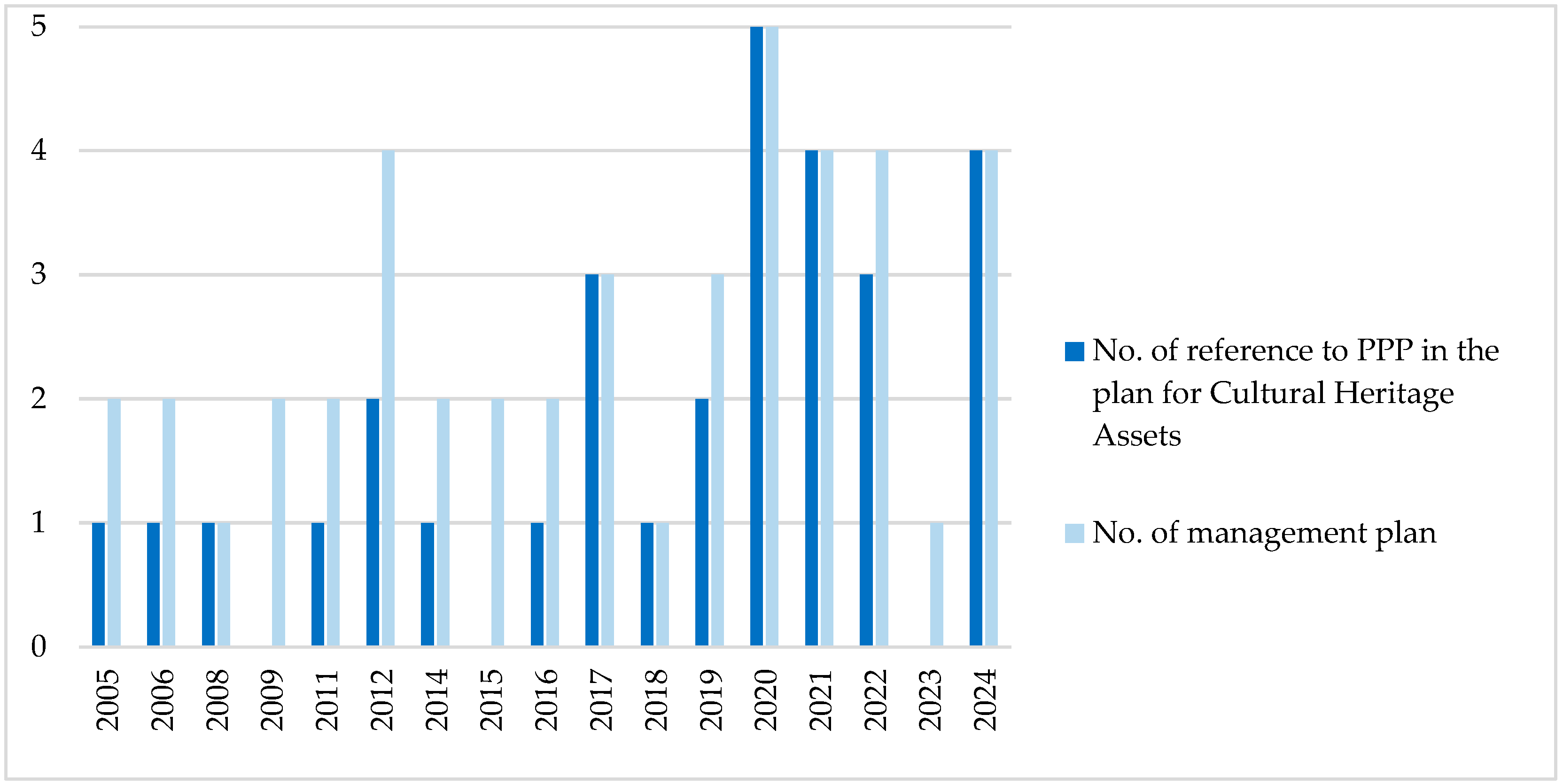
- Adoption year. The year of the plan’s adoption. It refers to the last version of the plan available online as of November 2024.
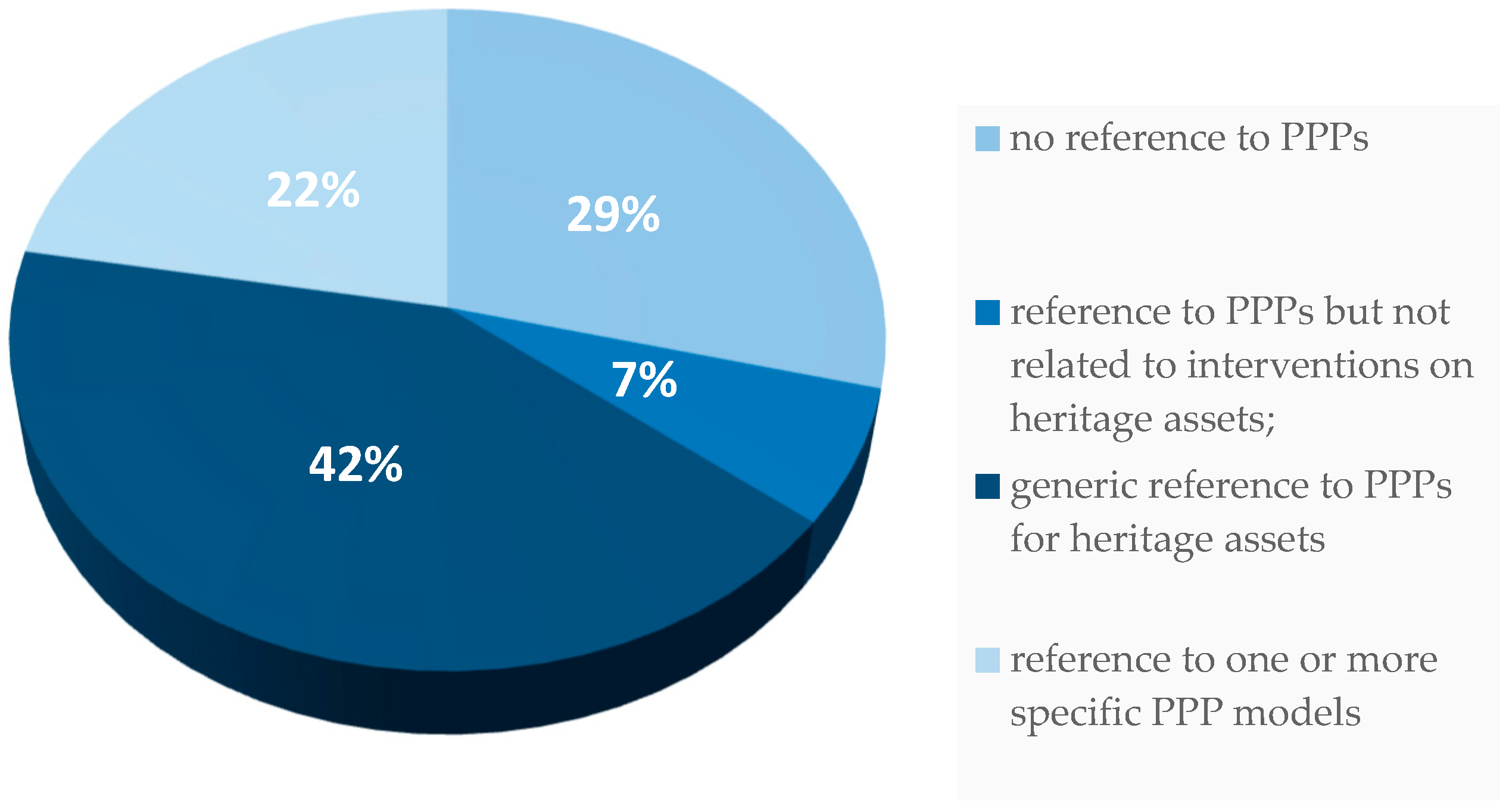
- Reference to PPP. This dimension considers the presence of any reference to PPPs in the analyzed plan. According to it, the management plans are distinguished into four categories: no reference to PPPs; reference to PPPs but not related to interventions on heritage assets; generic reference to PPPs for heritage assets; and reference to one or more specific PPP models.
- Proposed PPP model. Only for the management plans, including references to one or more specific PPP models for heritage assets, does this dimension explicitly outline the proposed model/models.
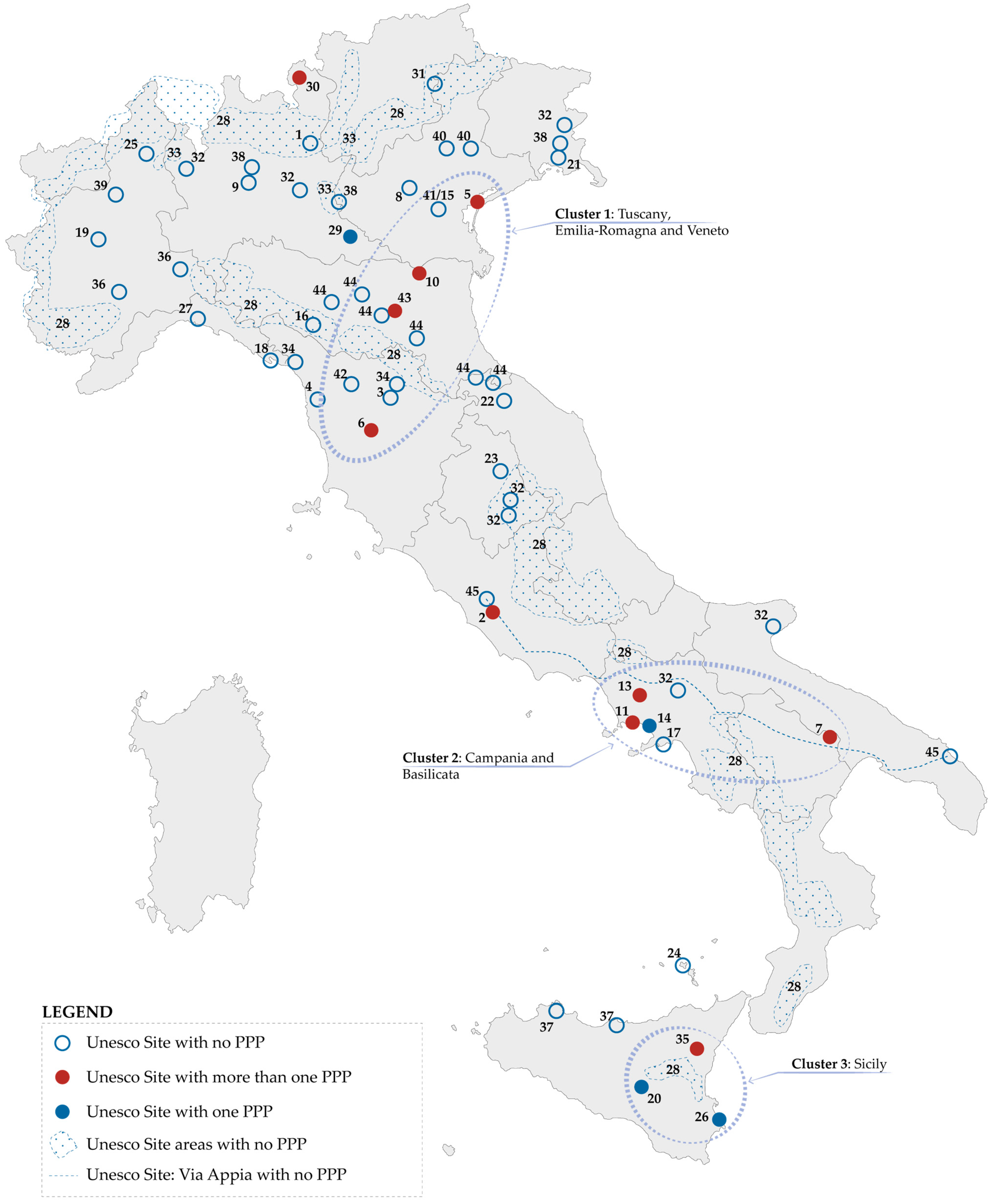
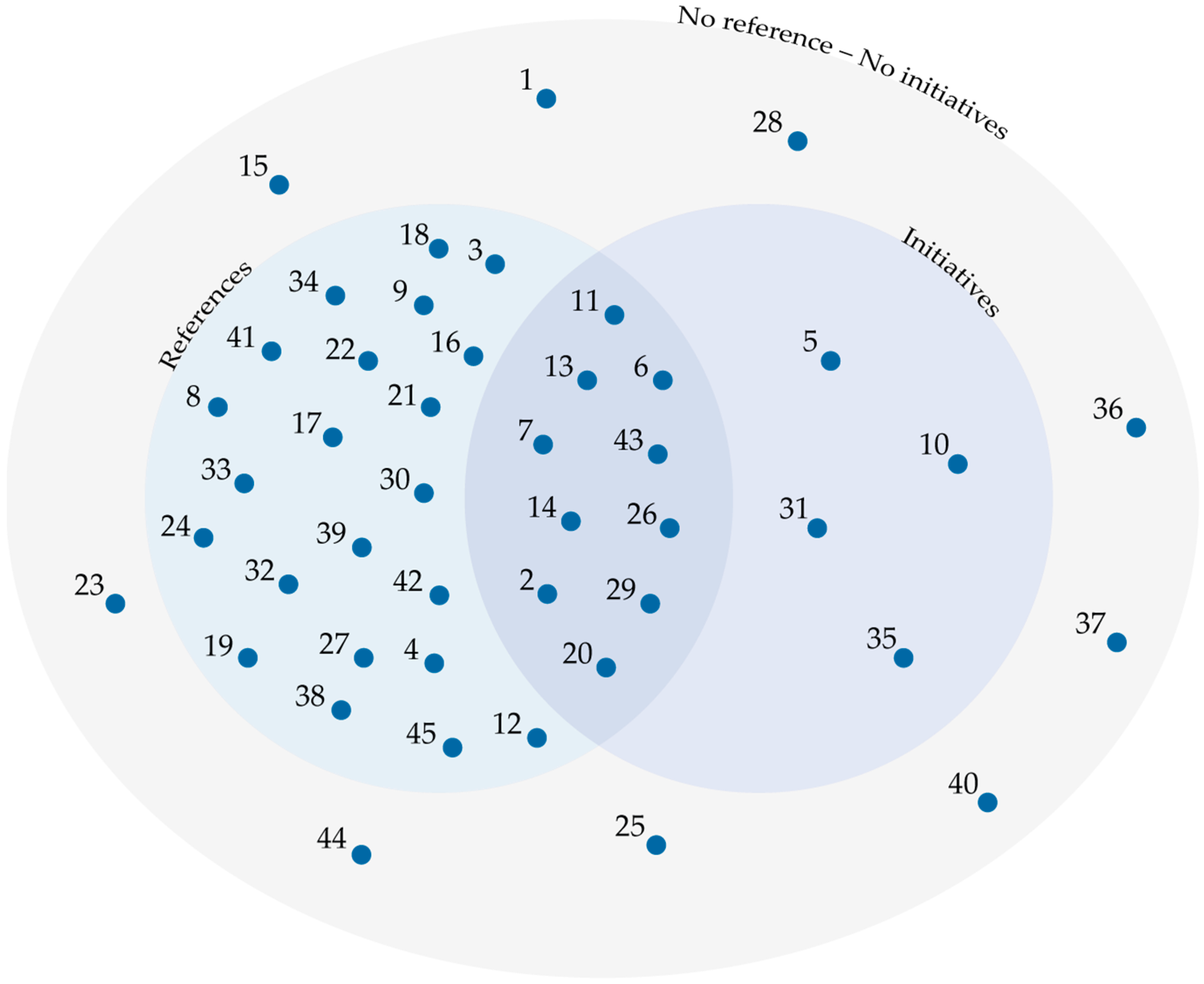
- No reference–No initiatives. UNESCO sites for which management plans do not refer to public–private partnerships, and there are no PPP initiatives implemented.
- Reference–Initiatives. UNESCO sites for which management plans refer to public–private partnerships and where there are PPP examples implemented.
- No reference–Initiatives. UNESCO sites for which management plans do not refer to public–private partnerships, and there are PPP initiatives implemented.
- Reference–No initiatives. UNESCO sites for which management plans refer to public–private partnerships, and there are no examples of PPPs implemented at the site itself.
3. Assessing the Feasibility of PPPs for Heritage Enhancement: A Methodological Approach
- Their financial sustainability both from the public and the private sides. This task, from the private side, requires verifying the achievement of an average ordinary profit through the PPP initiative. On the public side, instead, it requires verifying that the initiative does not produce any loss for the administration or that these losses are within its budget constraints.
- Their ability to ensure a fair distribution of benefits between the public and the private entities involved in the partnership agreement.
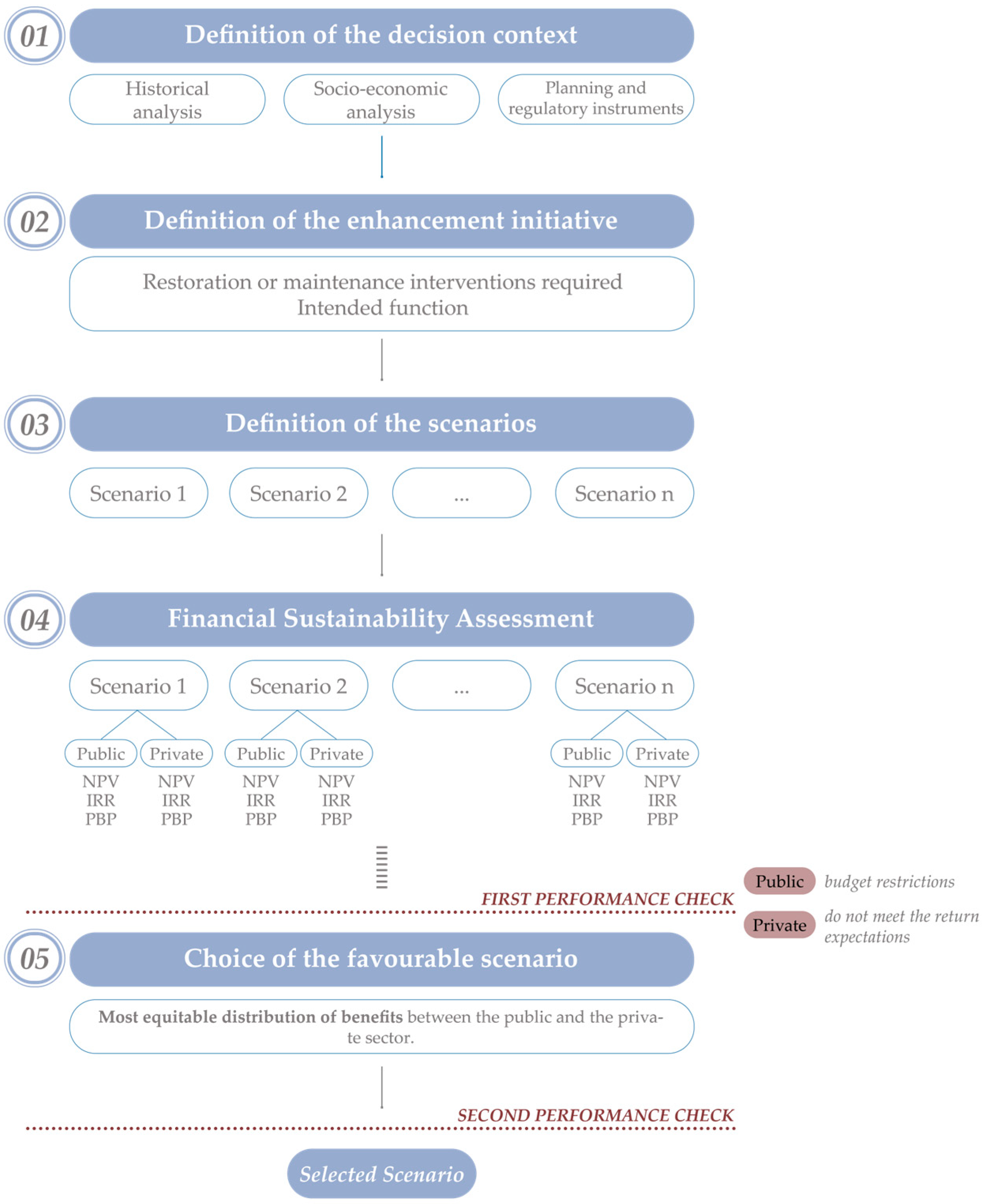
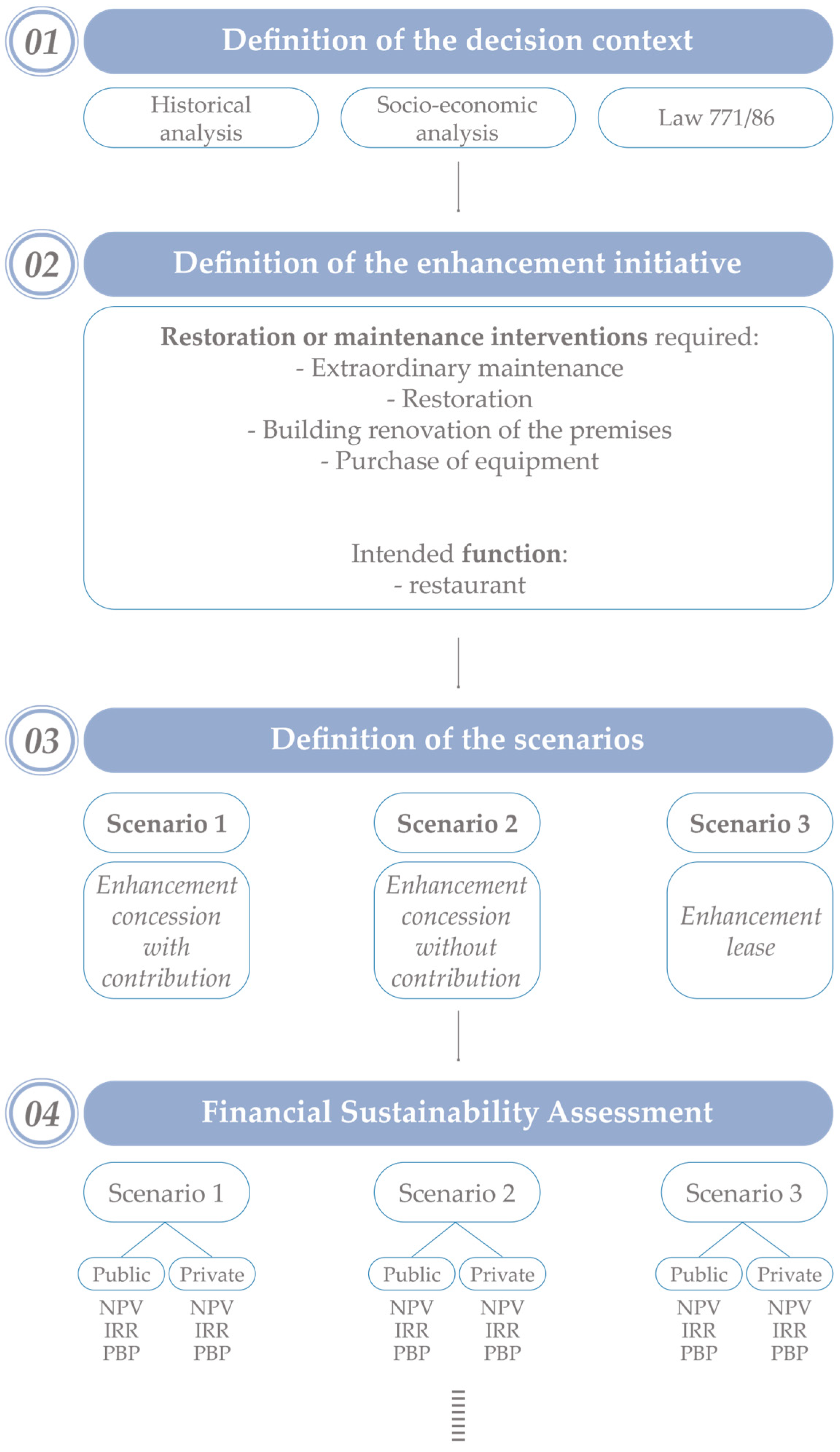
- Definition of the decision context. This step requires building a comprehensive knowledge frame of the site under analysis and of the planning and regulatory instruments relevant to the implementation of PPP initiatives in the site.
- Definition of the enhancement initiative. Based on the features of the heritage assets considered in the UNESCO site and their system of values, this step delves into defining a suitable and compatible enhancement initiative, meeting both public and private interest in concerning restoration or maintenance interventions needed and intended functions or activities [91].
- Definition of the scenarios. Based on the evidence from the previous phase, this step requires defining the PPP scenarios for heritage enhancement compatible and coherent with the existing planning guidelines and regulatory constraints for the considered UNESCO site.
- Financial Sustainability Assessment. This phase represents the core evaluation task in the designed methodological approach, aimed at verifying the different scenarios’ financial sustainability and implications from the public and private sides. From a methodological perspective, it rests on a cost–benefit analysis limited to the financial cash flows [92], which are discounted according to the following Equation (1):
- where stands for the revenues related to the enhancement initiatives; is given by the sum of the construction and the management costs; and is the discount factor, based on the definition of the discount rate .The financial sustainability of the enhancement initiative can be comprehensively assessed, for each defined scenario, both from the public and private perspective, by referring to three profitability indicators [93]. The former is the Net Present Value (), which is obtained as (2)
- where is the time horizon for the analysis; is the cash flow for the year is the discount factor for the year According to this profitability indicator, the financial sustainability is verified when the is higher than zero. The other profitability indicators are the Internal Rate of Return () and the Payback Period (PBP). The is the discount rate setting the of all cash flows equal to zero [94,95]. On its own, it does not indicate the project’s financial sustainability but must be compared with the discount rate used in the analysis: it must be higher than the discount rate [96]. Finally, the PBP is the time required to recover the investment costs.
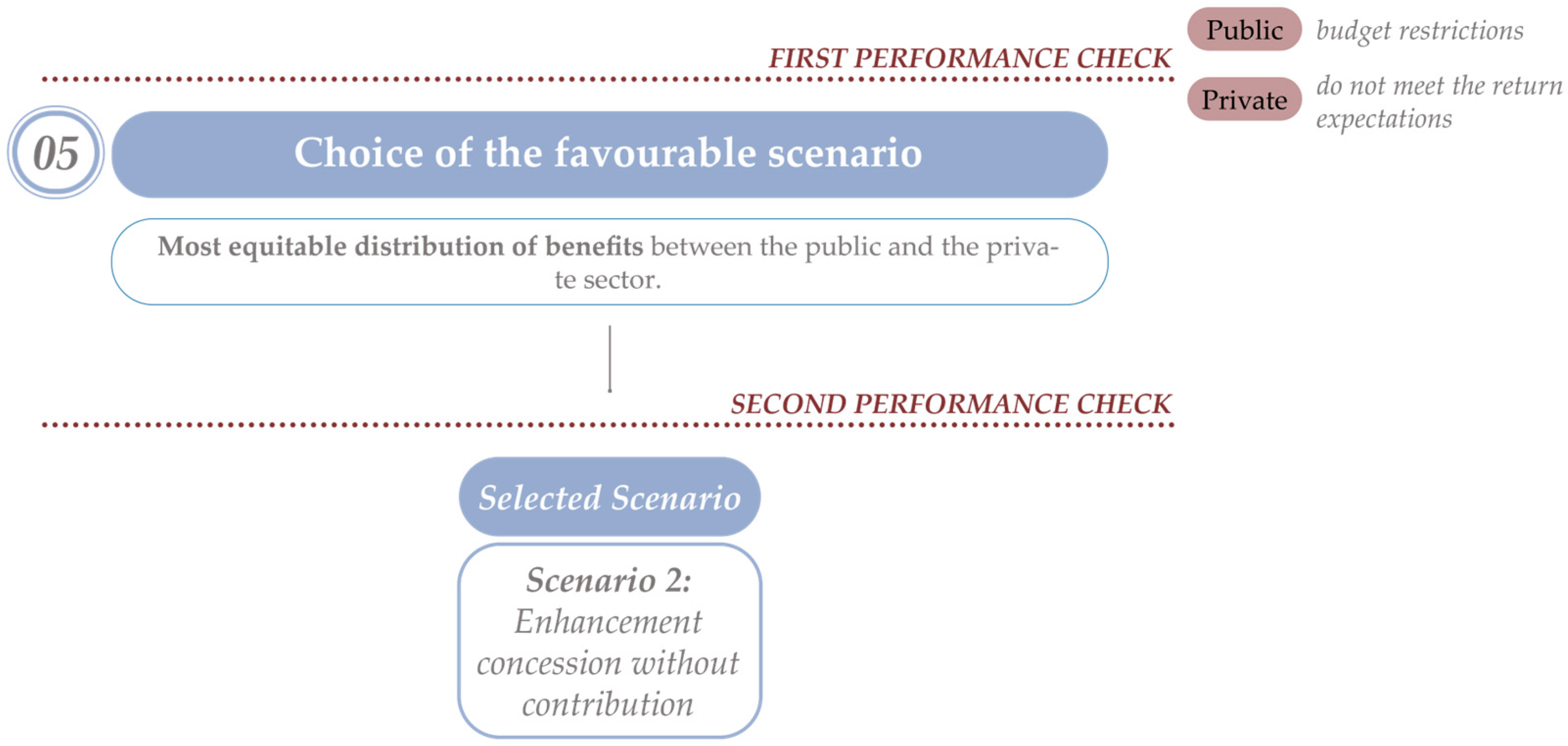
- To this aim, for each defined scenario, after selecting an appropriate time horizon and estimating the related revenues and costs to be properly distributed over time, the three profitability indicators were calculated for the public and the private entities involved in the initiative. These indicators thus allow for a first performance check about the enhancement scenarios [97], aimed at excluding the ones that do not meet the private entity’s return expectations and the public administration’s budget restrictions.
- 5.
- Choice of the favorable scenario. This last step, limited to the enhancement scenarios that have passed the first performance check, involves comparing these scenarios to identify the one ensuring the most equitable distribution of benefits between the public and the private sectors. Thanks to this second performance check, it is possible to understand which PPP scenario ensures the best distribution of benefits.
4. Assessing the Feasibility of the Sub-Concession for Cultural Heritage Enhancement: The Case of the UNESCO Site “I Sassi di Matera”
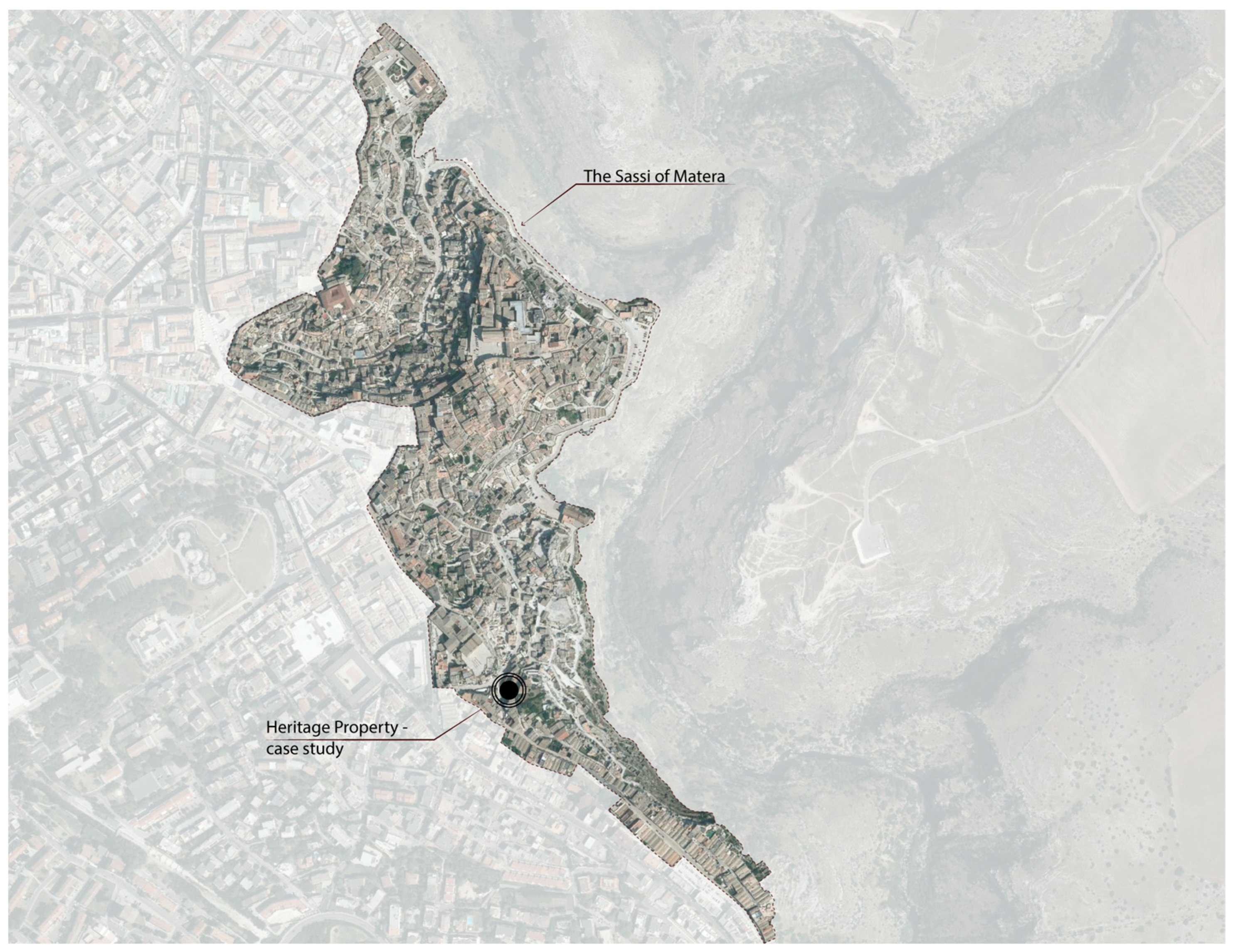
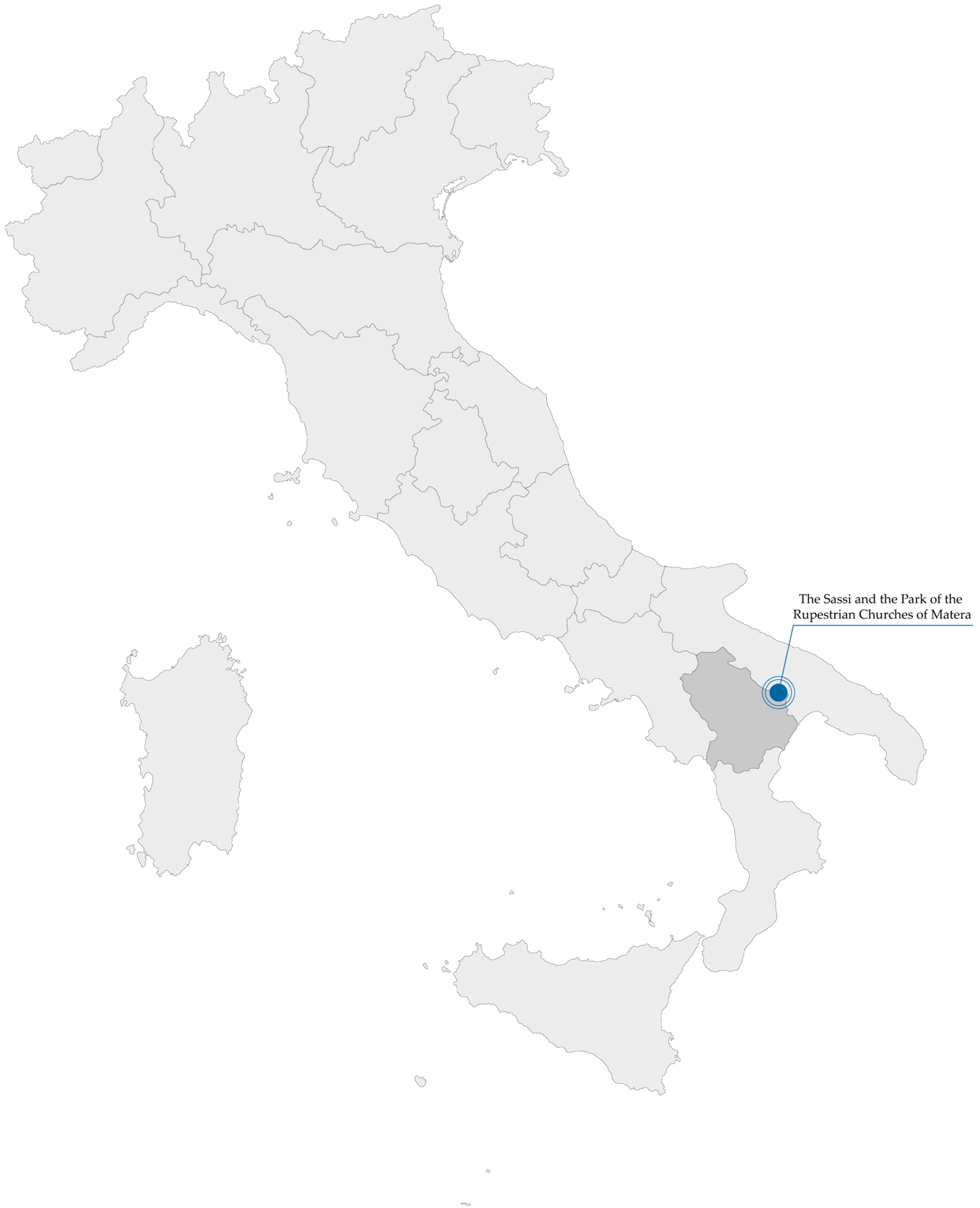
4.1. Introduction to the “I Sassi di Matera” Site
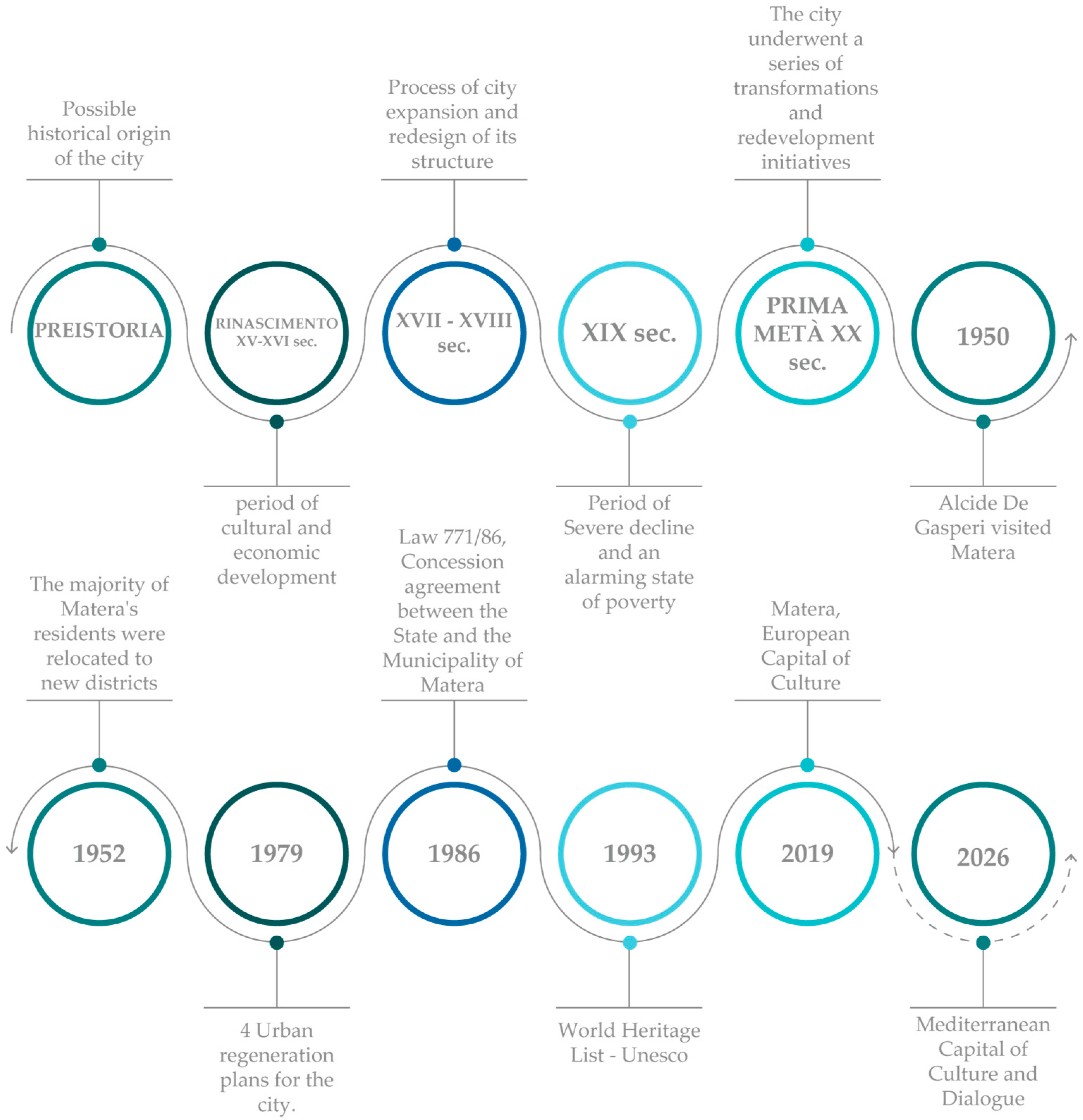
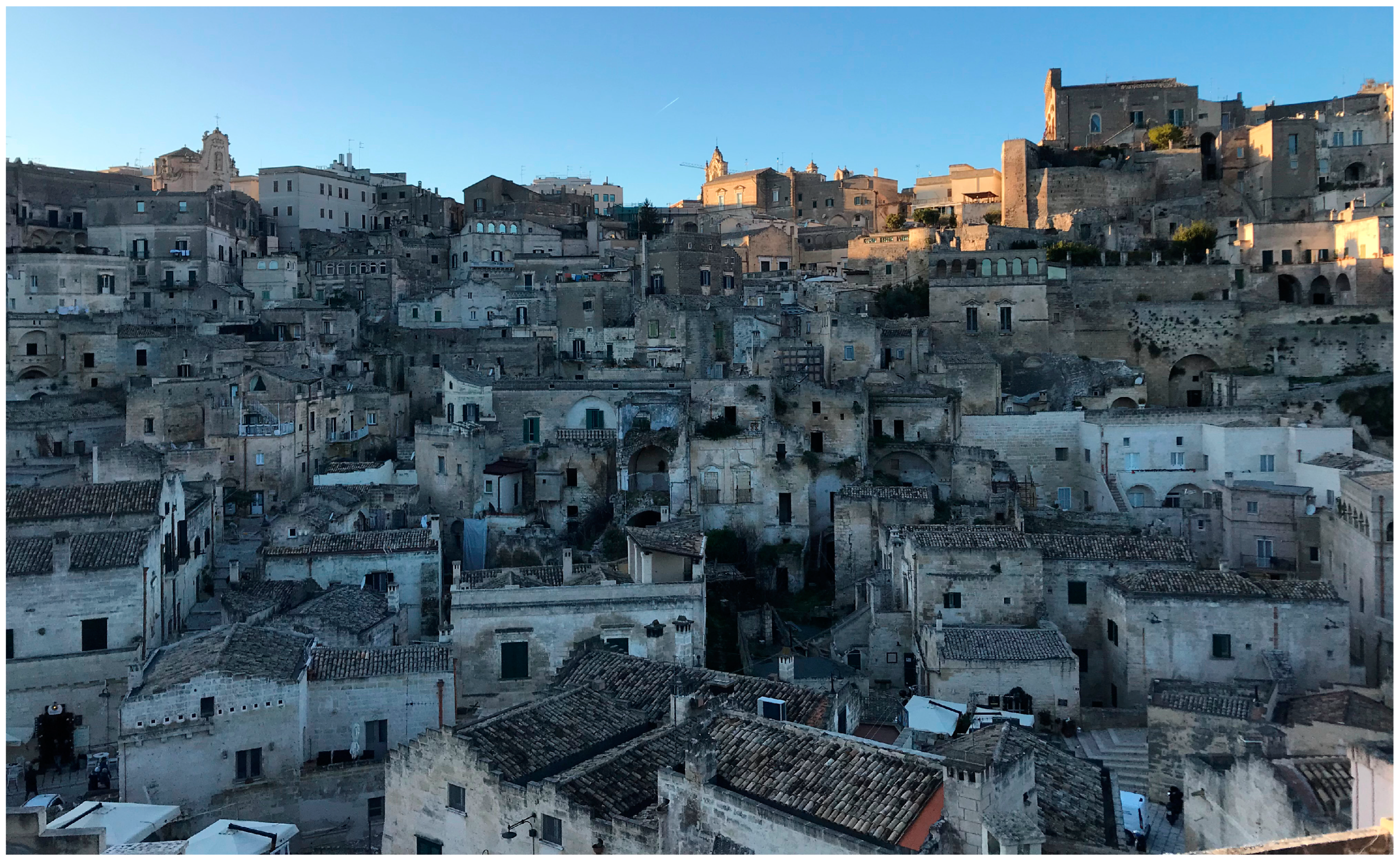
- The origin of this site is not definable: several studies date this origin back to the Neolithic period [99]. The ancient city is located on an overhanging spur of the Gravina, a long and deep fault that is a typical consequence of erosion phenomena on limestone soils. Its uniqueness stems from the local inhabitants’ ability to carve stone and transform private caves into real dwellings (Figure 8) [100].
- 1986, with Law n. 771/86, which establishes the concession of the public properties in the Sassi from the state to the Matera municipality and the possibility for the municipality to enhance them through a PPP mechanism: the sub-concession to private citizens [106].
- 1993, the year of inclusion of the “The Sassi and the Park of the Rupestrian Churches in Matera” (in Italian: I Sassi e il Parco delle Chiese Rupestri di Matera) site in the World Heritage List [107].
- 2019, when Matera is the “European Capital of Culture” [108].
4.2. The Sub-Concession Mechanism for the “Sassi di Matera” Enhancement
- Residential properties can be assigned to people who are already assignees of residential housing in the “Sassi”, thus recomposing the housing units, improving their overall habitability, and supporting the citizens of Matera.
- For commercial, craft, and non-residential properties, priority in the allocation is given to entities registered with the local Chamber of Commerce that already own a property adjoining the one subject to the sub-concession.
- For properties devoted to cultural activities, the municipal administration can directly choose the private partner for the sub-concession.
4.3. The Methodological Approach Implementation to the “I Sassi di Matera” UNESCO Site
- First scenario—Enhancement concession with contribution. In it, the public asset is assigned to the private for 30 years, and the public administration partially funds the renovation intervention.
- Second scenario—Enhancement concession without contribution. According to this scenario, the public asset is granted to the private party for 30 years, but the renovation intervention is all in charge of the private.
- Third scenario—Enhancement lease. In it, the private party pays a rent fee to be granted with the use of the asset and totally bears the renovation costs.
4.3.1. First Scenario—Enhancement Concession with Contribution
- The costs for the extraordinary maintenance/renovation interventions on the property under concession. They are estimated through a detailed cost estimation, based on the project attached to the sub-concession request, and amount to EUR 250,000.00.
- The costs for purchasing equipment and furniture related to the activity. They are estimated through a market analysis based on the information provided by the private entrepreneur and amount to EUR 100,000.00.
- The marketing expenses and the professional fees, which are, respectively, estimated as 8% of the renovation cost, thus amounting to EUR 20,000.
4.3.2. Second Scenario—Enhancement Concession Without Contribution
4.3.3. Third Scenario—Enhancement Lease
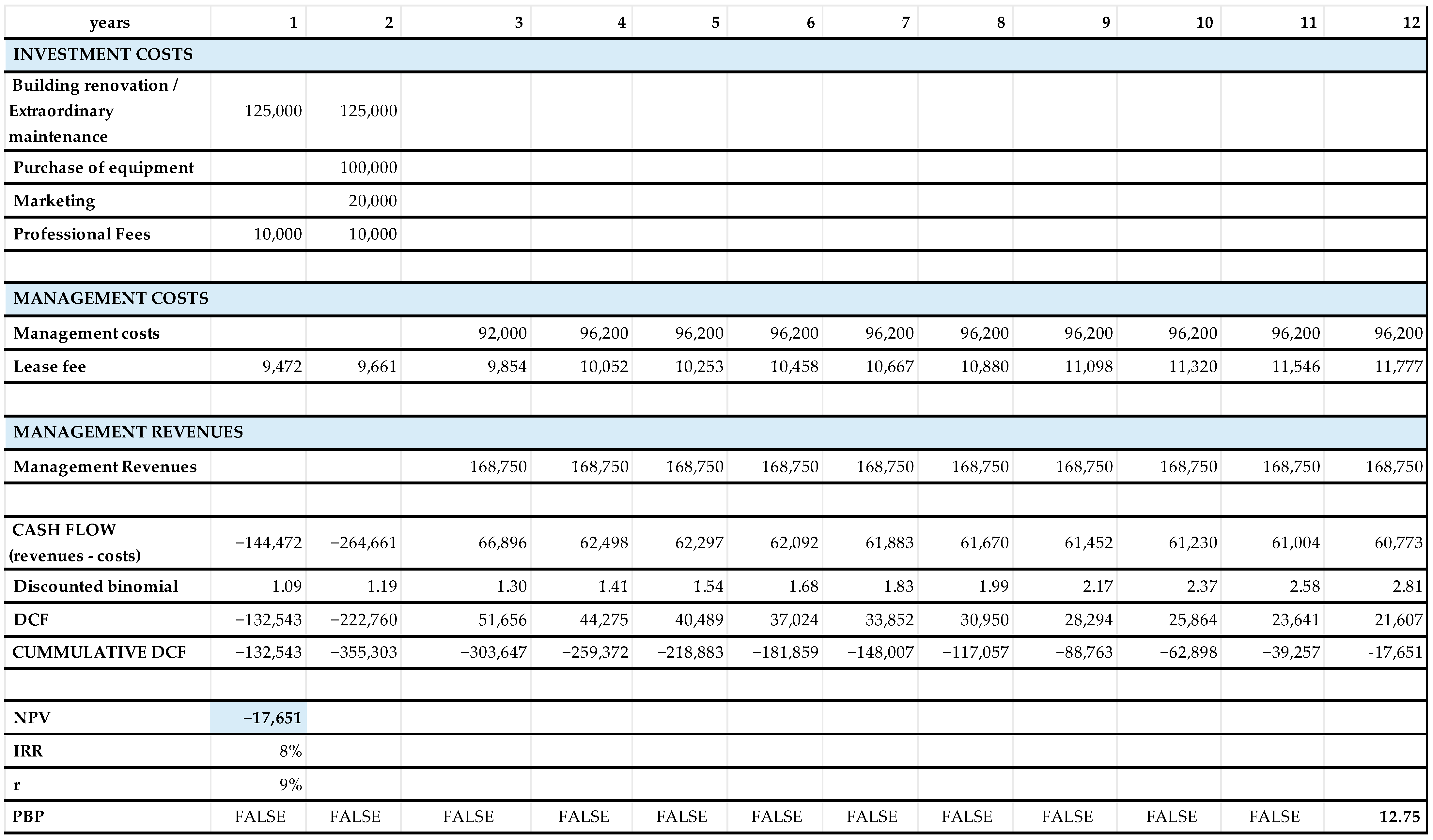
- the time horizon for the analysis, which is set at 12 (6 + 6) years as the typical duration of a rent contract for commercial properties in Italy;
- there being an additional yearly cost represented by the rent fee to the municipality. It is estimated based on the average OMI rent value for commercial properties for the semester 2024 [109] and depreciated with the amortization rate of the renovation work. Based on these assumptions, the depreciated yearly rent fee is equal to EUR 9471 for the first year and is yearly updated to consider price variations;
- the discount rate for the analysis, given the higher risk of the partnership, is increased by 1%, coming to 9%.
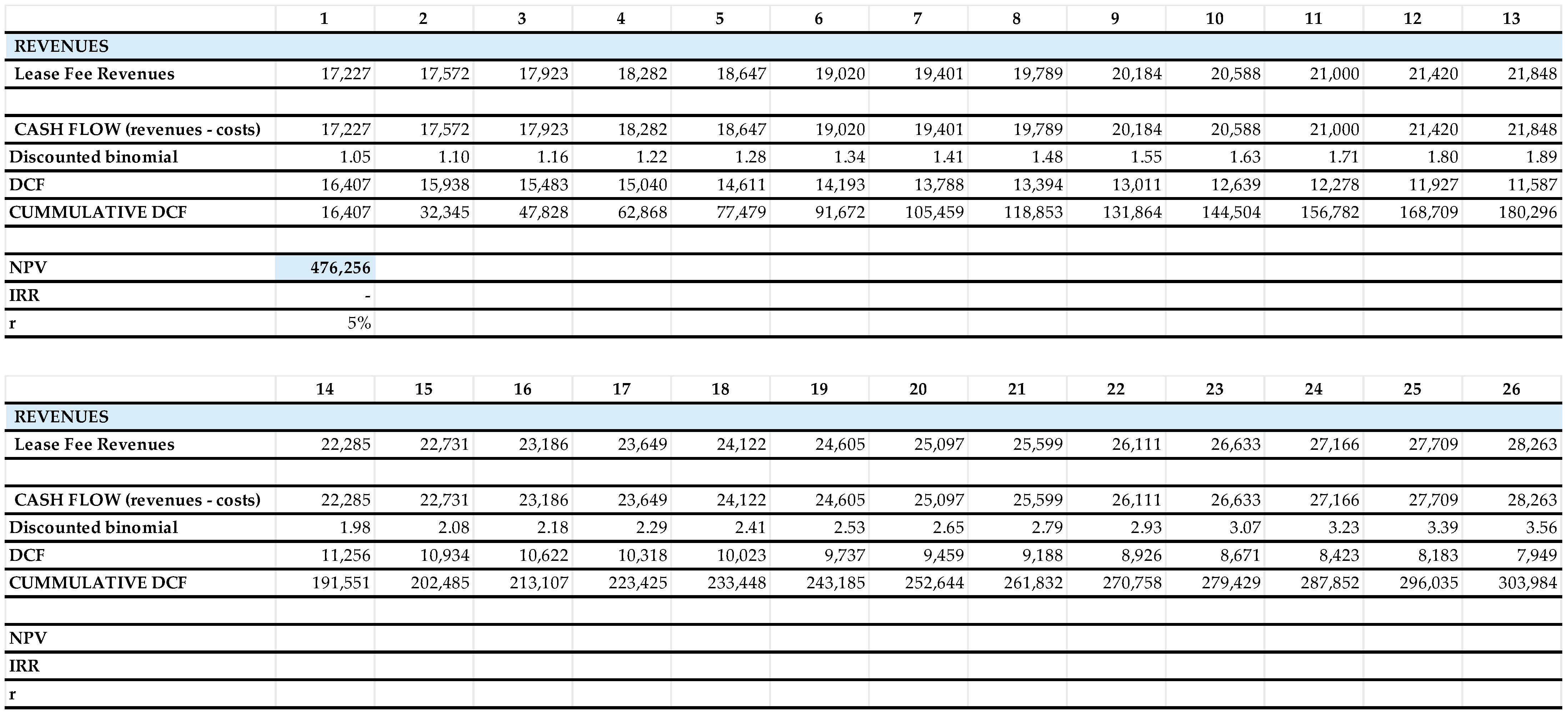
- Based on these assumptions, the private financial feasibility assessment must refer to an NPV of EUR −17,650.54, an IRR of 7.9%, and a PBP of 12.75 years. From the public side, instead, the time horizon is set at 61 years, which is the residual duration of the concession of the property from the state to the municipality. There are no costs, while the revenues are placed equal to the rent fee paid by the private entrepreneur, which is considered every 12 years with two years of vacancy between one contract and the following one. Finally, as for the private, the discount rate comes to 5% due to the risk premium increase. For the public, thus, the NPV is EUR 476,255.66, while the PBP is 0 (Figure A1 and Figure A2 in Appendix B).
5. Results
6. Conclusions
Author Contributions
Funding
Data Availability Statement
Acknowledgments
Conflicts of Interest
Abbreviations
| 4P | Private–public–people partnerships |
| IRR | Internal rate of return |
| MAB | Man and the Biosphere |
| NPV | Net present value |
| PPP | Public–private partnership |
| PBP | Payback period |
| QPE | Quality physical education |
Appendix A

| UNESCO Site Identification | Management Plan Analysis | |||||||
|---|---|---|---|---|---|---|---|---|
| UNESCO Site | Region | Date of Inscription | Category of Property (Cultural, Natural) | Adoption Year * | Reference to PPP in the Plan | Proposed PPP Model | No. Reference | |
| 1 | Rock Drawings in Valcamonica | Lombardy | 1979 | Cultural | 2005 | no reference to PPPs | -- | [45] |
| 2 | Historic Centre of Rome, the Properties of the Holy See in that City Enjoying Extraterritorial Rights and San Paolo Fuori le Mura | Lazio | 1980 | Cultural | 2015 | reference to PPPs but not related to interventions on heritage assets | -- | [46] |
| 3 | Historic Centre of Florence | Tuscany | 1982 | Cultural | 2022 | reference to PPPs but not related to interventions on heritage assets | -- | [47] |
| 4 | Piazza del Duomo, Pisa | Tuscany | 1987 | Cultural | 2021 | generic reference to PPPs for heritage assets | not explicitly defined | [48] |
| 5 | Venice and its Lagoon | Veneto | 1987 | Cultural | 2012–2018 | no reference to PPPs | -- | [49] |
| 6 | Historic Centre of San Gimignano | Tuscany | 1990 | Cultural | 2022 | generic reference to PPPs for heritage assets | not explicitly defined | [50] |
| 7 | The Sassi and the Park of the Rupestrian Churches of Matera | Basilicata | 1993 | Cultural | 2014–2019 | reference to one or more specific PPP models | concession | [51] |
| 8 | City of Vicenza and the Palladian Villas of the Veneto | Veneto | 1994 | Cultural | 2024–2030 | reference to PPPs but not related to interventions on heritage assets | -- | [52] |
| 9 | Crespi d’Adda | Lombardy | 1995 | Cultural | 2022–2027 | generic reference to PPPs for heritage assets | not explicitly defined | [53] |
| 10 | Ferrara, City of the Renaissance, and its Po Delta | Tuscany | 1995 | Cultural | 2009 | no reference to PPPs | -- | [54] |
| 11 | Historic Centre of Naples | Campania | 1995 | Cultural | 2011 | generic reference to PPPs for heritage assets | not explicitly defined | [55] |
| 12 | Historic Centre of the City of Pienza | Tuscany | 1996 | Cultural | 2005 | reference to one or more specific PPP models | concession | [56] |
| 13 | 18th-Century Royal Palace at Caserta with the Park, the Aqueduct of Vanvitelli, and the San Leucio Complex | Campania | 1997 | Cultural | 2024 | generic reference to PPPs for heritage assets | not explicitly defined | [57] |
| 14 | Archaeological Areas of Pompei, Herculaneum, and Torre Annunziata | Campania | 1997 | Cultural | 2016 | reference to one or more specific PPP models | sponsorship and private–public–people partnerships | [58] |
| 15 | Botanical Garden (Orto Botanico), Padua | Veneto | 1997 | Cultural | 2006–2009 | no reference to PPPs | -- | [59] |
| 16 | Cathedral, Torre Civica and Piazza Grande, Modena | Emila-Romagna | 1997 | Cultural | 2018–2020 | generic reference to PPPs for heritage assets | not explicitly defined | [60] |
| 17 | Costiera Amalfitana | Campania | 1997 | Cultural (landscape) | 2019 | generic reference to PPPs for heritage assets | not explicitly defined | [61] |
| 18 | Portovenere, Cinque Terre, and the Islands (Palmaria, Tino and Tinetto) | Liguria | 1997 | Cultural | 2020 | generic reference to PPPs for heritage assets | not explicitly defined | [62] |
| 19 | Residences of the Royal House of Savoy | Piedmont | 1997 | Cultural | 2012 | generic reference to PPPs for heritage assets | not explicitly defined | [63] |
| 20 | Villa Romana del Casale | Sicily | 1997 | Cultural | 2020 | generic reference to PPPs for heritage assets | sponsorship | [64] |
| 21 | Archaeological Area and the Patriarchal Basilica of Aquileia | Friuli-Venezia-Giulia | 1998 | Cultural | 2017 | generic reference to PPPs for heritage assets | not explicitly defined | [65] |
| 22 | Historic Centre of Urbino | Marche | 1998 | Cultural | 2012–2013 | generic reference to PPPs for heritage assets | not explicitly defined | [66] |
| 23 | Assisi, the Basilica of San Francesco and Other Franciscan Sites | Umbria | 2000 | Cultural | 2009 | no reference to PPPs | -- | [67] |
| 24 | Isole Eolie (Aeolian Islands) | Sicily | 2000 | Natural | 2008 | generic reference to PPPs for heritage assets | not explicitly defined | [68] |
| 25 | Sacri Monti of Piedmont and Lombardy | Piedmont/Lombardy | 2003 | Cultural | 2012 | no reference to PPPs | -- | [69] |
| 26 | Syracuse and the Rocky Necropolis of Pantalica | Sicily | 2005 | Cultural | 2020 | generic reference to PPPs for heritage assets | private–public–people partnerships | [70] |
| 27 | Genoa: Le Strade Nuove and the system of the Palazzi dei Rolli | Liguria | 2006 | Cultural | 2020–2024 | reference to one or more specific PPP models | sponsorship | [71] |
| 28 | Ancient and Primeval Beech Forests of the Carpathians and Other Regions of Europe | Transnational ownership | 2007 | Natural | 2011 | no reference to PPPs | -- | [72] |
| 29 | Mantua and Sabbioneta | Lombardy | 2008 | Cultural | 2020 | generic reference to PPPs for heritage assets | not explicitly defined | [73] |
| 30 | Rhaetian Railway in the Albula/Bernina Landscapes | Italy/Swiss | 2008 | Cultural | 2006 | reference to one or more specific PPP models | sponsorship | [74] |
| 31 | The Dolomites | Trentino-South Tyrol/Veneto/Friuli-Venezia-Giulia | 2009 | Natural | 2015 | no reference to PPPs | -- | [75] |
| 32 | Longobards in Italy. Places of the Power (568–774 A.D.) | Italy | 2011 | Cultural | 2022–2027 | generic reference to PPPs for heritage assets | not explicitly defined | [76] |
| 33 | Prehistoric Pile Dwellings around the Alps | North Italy | 2011 | Cultural | 2019–2023 | reference to one or more specific PPP models | sponsorship | [77] |
| 34 | Medici Villas and Gardens in Tuscany | Tuscany | 2013 | Cultural | 2024 | reference to one or more specific PPP models | sponsorship | [78] |
| 35 | Mount Etna | Sicily | 2013 | Natural | 2016 | no reference to PPPs | -- | [79] |
| 36 | Vineyard Landscape of Piedmont: Langhe-Roero and Monferrato | Piedmont | 2014 | Cultural | 2014–2017 | no reference to PPPs | -- | [80] |
| 37 | Arab-Norman Palermo and the Cathedral Churches of Cefalú and Monreale | Sicily | 2015 | Cultural | -- | no reference to PPPs | -- | [81] |
| 38 | Venetian Works of Defence between the 16th and 17th Centuries: Stato da Terra–Western Stato da Mar | North Italy | 2017 | Cultural | 2017 | generic reference to PPPs for heritage assets | not explicitly defined | [82] |
| 39 | Ivrea, industrial city of the 20th century | Piedmont | 2018 | Cultural | 2017 | generic reference to PPPs for heritage assets | not explicitly defined | [83] |
| 40 | Le Colline del Prosecco di Conegliano e Valdobbiadene | Veneto | 2019 | Cultural | 2019 | no reference to PPPs | -- | [84] |
| 41 | Padua’s fourteenth-century fresco cycles | Veneto | 2021 | Cultural | 2021 | reference to one or more specific PPP models | sponsorship | [85] |
| 42 | The Great Spa Towns of Europe | Tuscany | 2021 | Cultural | 2021 | reference to one or more specific PPP models | sponsorship | [86] |
| 43 | The Porticoes of Bologna | Emila-Romagna | 2021 | Cultural | 2021 | reference to one or more specific PPP models | permanent partnership | [87] |
| 44 | Evaporitic Karst and Caves of Northern Apennines | Center-North Italy | 2023 | Natural | 2023 | no reference to PPPs | -- | [88] |
| 45 | Via Appia. Regina Viarum | Lazio | 2024 | Cultural | 2024 | generic reference to PPPs for heritage assets | not explicitly defined | [89] |
Appendix B
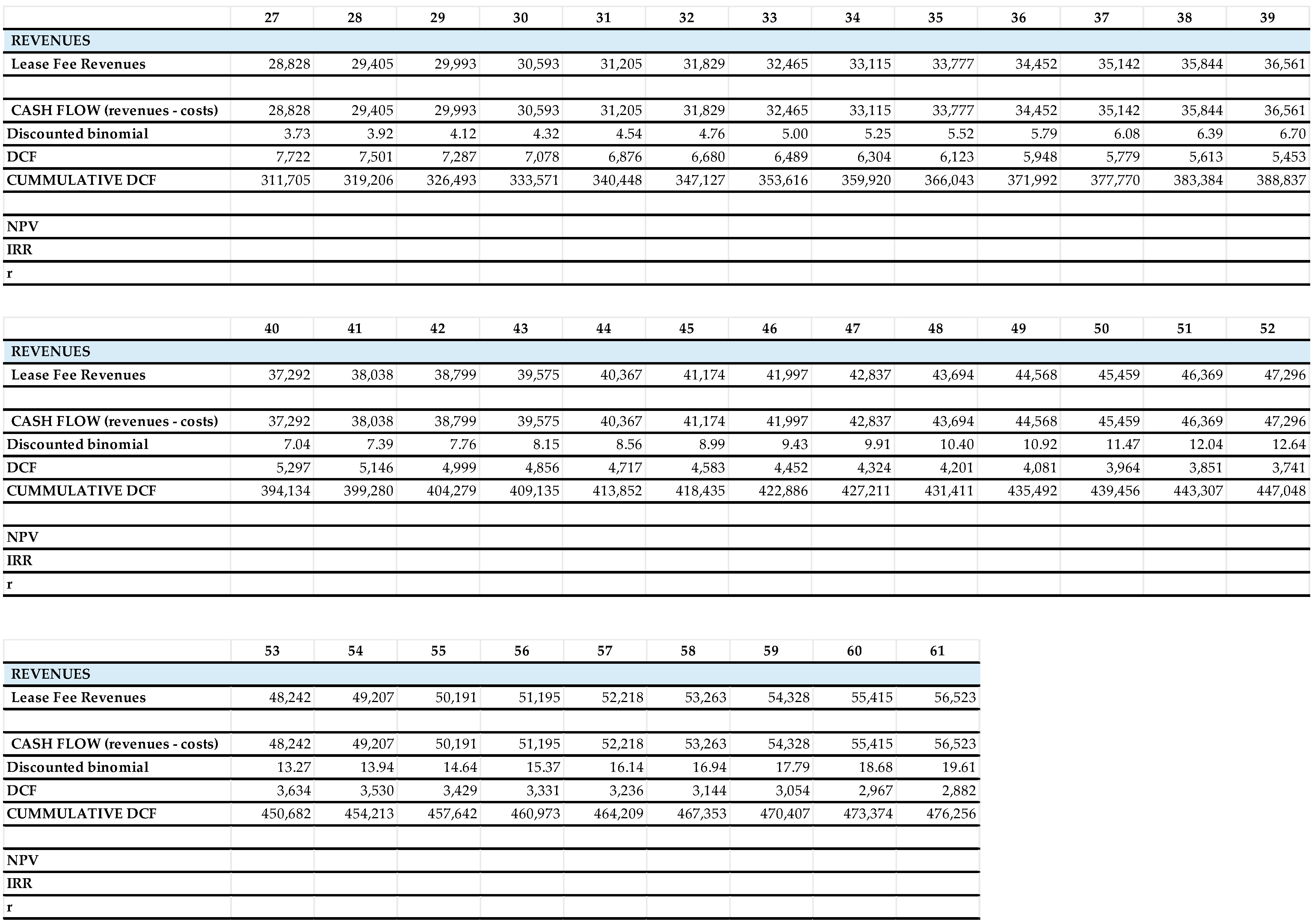
Note
- Management Plans are produced by the local site management team according to the Operational Guidelines for the Implementation of the World Heritage Convention.
References
- United Nations. Transforming Our World: The 2030 Agenda for Sustainable Development. Available online: https://sdgs.un.org/publications/transforming-our-world-2030-agenda-sustainable-development-17981 (accessed on 28 December 2024).
- Angrisano, M.; Nocca, F.; Scotto di Santolo, A. Multidimensional Evaluation Framework for Assessing Cultural Heritage Adaptive Reuse Projects: The Case of the Seminary in Sant’Agata de’ Goti (Italy). Urban Sci. 2024, 8, 50. [Google Scholar] [CrossRef] [Scilit]
- Assumma, V.; Datola, G.; Mondini, G. New Cohesion Policy 2021–2027: The Role of Indicators in the Assessment of the SDGs Targets Performance. In Computational Sciences and Its Applications—ICCSA 2021. Lecture Notes in Computer Science, 12955, Proceedings of the 21st International Conference on Computational Sciences and Its Applications (ICCSA 2021), Cagliari, Italy, 13–16 September 2021; Gervasi, O., Murgante, B., Misra, S., Garau, C., Blečić, I., Taniar, D., Apduhan, B.O., Rocha, A.M.A.C., Tarantino, E., Torre, C.M., Eds.; Springer: Cham, Switzerland, 2021; Volume VII, pp. 614–625. [Google Scholar] [CrossRef] [Scilit]
- Snowball, J.D.; Courtney, S. Cultural heritage routes in South Africa: Effective tools for heritage conservation and local economic development? Dev. S. Afr. 2010, 27, 563–576. [Google Scholar] [CrossRef] [Scilit]
- Torrieri, F.; Fumo, M.; Sarnataro, M.; Ausiello, G. An integrated decision support system for the sustainable reuse of the former monastery of “ritiro del carmine” in Campania region. Sustainability 2019, 11, 5244. [Google Scholar] [CrossRef] [Scilit]
- Pultrone, G. Past and/is future in the implementation of the 2030 agenda. Strategies for the enhancement of cultural heritage for fragile territories. ArcHistoR 2019, 12, 488–501. [Google Scholar] [CrossRef] [Scilit]
- Gravagnuolo, A.; Angrisano, M.; Bosone, M.; Buglione, F.; De Toro, P.; Fusco Girard, L. Participatory evaluation of cultural heritage adaptive reuse interventions in the circular economy perspective: A case study of historic buildings in Salerno (Italy). J. Urban Manag. 2024, 13, 107–139. [Google Scholar] [CrossRef] [Scilit]
- Pintossi, N.; Ikiz Kaya, D.; van Wesemael, P.; Pereira Roders, A. Challenges of cultural heritage adaptive reuse: A stakeholders-based comparative study in three European cities. Habitat Int. 2023, 136, 102807. [Google Scholar] [CrossRef] [Scilit]
- Touch, L.D.; Van Nguyen, M.; Ha Duy, K.; Nguyen Van, D. Prioritizing barriers to the conservation of cultural heritage buildings in adaptation to urbanization and climate change. J. Clean. Prod. 2024, 473, 143529. [Google Scholar] [CrossRef] [Scilit]
- Rossi, P. Partenariato pubblico-privato e valorizzazione economica dei beni culturali nella riforma del codice degli appalti. Federilismi 2018, 2, 1–23. [Google Scholar]
- Commission of the European Communities. Green Paper on Public-Private Partnerships and Community Law on Public Contracts and Concessions. p. 3. Available online: https://eur-lex.europa.eu/legal-content/IT/ALL/?uri=celex%3A52004DC0327 (accessed on 14 November 2024).
- Directive 2014/23/EU of the European Parliament and of the Council of 26 February 2014 on the Award of Concession Contracts. Available online: https://eur-lex.europa.eu/eli/dir/2014/23/oj (accessed on 14 November 2024).
- Jones, J.; Embry, E. Exploring impact investing’s emergence in the philanthropic sector. In A Research Agenda for Social Finance; Lehner, O.M., Ed.; Edward Elgar Publishing: Cheltenham, UK, 2021; pp. 11–36. [Google Scholar] [CrossRef] [Scilit]
- Lipparini, F.; Medda, F. Impact investment for urban cultural heritage. City Cult. Soc. 2021, 26, 100413. [Google Scholar] [CrossRef] [Scilit]
- Jelinčić, D.A.; Tišma, S.; Senkić, M.; Dodig, D. Public-private partnership in cultural heritage sector. Transylv. Rev. Adm. Sci. 2017, 74–89. [Google Scholar] [CrossRef] [Scilit]
- Settembre Blundo, D.; García Muiña, F.E.; Fernández del Hoyo, A.P.; Riccardi, M.P.; Maramotti Politi, A.L. Sponsorship and patronage and beyond: PPP as an innovative practice in the management of cultural heritage. J. Cult. Manag. Sustain. Dev. 2017, 7, 147–163. [Google Scholar] [CrossRef] [Scilit]
- Chizhevskaya, E.; Magomaeva, L. Economic prospects for public-private partnership in Russia and European Union. Asian Soc. Sci. 2015, 11, 135–143. [Google Scholar] [CrossRef] [Scilit]
- Dubini, P.; Leone, L.; Forti, L. Role distribution in public-private partnerships. Int. Stud. Manag. Organ. 2012, 42, 57–75. [Google Scholar] [CrossRef] [Scilit]
- Antoniazzi, S. Cultural Heritage and Atypical Public-Private Partnerships in the Public Contracts Code. Federalisimi.it 2024, 8, 1–33. [Google Scholar]
- Boniotti, C. Wide-area heritage projects in Lombardy: From a mono-sector to a multi-sector approach. Heritage 2021, 4, 4304–4317. [Google Scholar] [CrossRef] [Scilit]
- Rossitti, M.; Torrieri, F. Action research for the conservation of architectural heritage in marginal areas: The role of evaluation. Valori Valutazioni 2022, 30, 3–42. [Google Scholar] [CrossRef] [Scilit]
- Abdou, M. Heritage conservation and the limitation of public-private partnerships. Cult. Trends 2024, 33, 324–340. [Google Scholar] [CrossRef] [Scilit]
- Boniotti, C. The beneficial role of surveys in the investment analysis for public built cultural heritage concessions. Int. Arch. Photogramm. Remote Sens. Spat. Inf. Sci. 2019, XLII-2/W11, 263–267. [Google Scholar] [CrossRef] [Scilit]
- Batijargal, T.; Zhang, M. Review of key challenges in public-private partnership implementation. J. Infrastruct. Policy Dev. 2021, 5, 1378. [Google Scholar] [CrossRef] [Scilit]
- Zakharina, O.; Khodakivskii, E.; Iakobchuk, V. Explication of the concept of «public-private partnership» in public administration theory. Sci. Horiz. 2020, 3, 26–33. [Google Scholar] [CrossRef] [Scilit]
- Asaduzzaman, M.; Kaivo-oja, J.; Stenvall, J.; Jusi, S. Strengthening Local Governance in Developing Countries: Partnership as an Alternative Approach. Public Organ. Rev. 2016, 16, 335–356. [Google Scholar] [CrossRef] [Scilit]
- Boyer, E.J.; Van Slyke, D.M.; Rogers, J.D. An Empirical Examination of Public Involvement in Public-Private Partnerships: Qualifying the Benefits of Public Involvement in PPPs. J. Public Adm. Res. Theory 2016, 26, 45–61. [Google Scholar] [CrossRef] [Scilit]
- Balsas, C.J.L. US Urban and regional planning history, theory and partnerships for a new century. J. Urban Regen. Renew. 2022, 15, 439–452. Available online: https://www.ingentaconnect.com/contentone/hsp/jurr/2022/00000015/00000004/art00009 (accessed on 7 April 2025). [CrossRef] [Scilit]
- Rogerson, C.M. Public-private partnerships for tourism infrastructure development: Evidence from the Cradle of Humankind, South Africa. Tourism 2016, 64, 419–430. Available online: https://hrcak.srce.hr/file/251636 (accessed on 21 December 2024).
- UNESCO. Themes 2.2.1 Outstanding Universal Value: Definition and Attributes. Available online: https://whc.unesco.org/en/compendium/?&Documents=1&action=list&id_faq_themes=962 (accessed on 28 December 2024).
- UNESCO. World Heritage in Danger. Available online: https://whc.unesco.org/en/danger/ (accessed on 21 December 2024).
- UNESCO. Available online: https://www.unesco.org/en (accessed on 18 November 2024).
- Verger, A.; Moschetti, M. Public-Private Partnerships as an Education Policy Approach: Multiple Meanings, Risks and Challenges. Educ. Res. Foresight Ser. 2016, 19, 1–13. Available online: https://en.unesco.org/node/268820 (accessed on 6 January 2025).
- UNESCO. Quality Physical Education (QPE): Guidelines for Policymakers. Available online: https://unesdoc.unesco.org/ark:/48223/pf0000231101 (accessed on 6 January 2025).
- UNESCO. Man and the Biosphere Programme (MAB). Available online: https://www.unesco.org/en/mab (accessed on 6 January 2025).
- Klaver, M.; Currie, B.; Sekonya, J.G.; Coetzer, K. Learning Through Place-Based Implementation of the UNESCO MAB Program in South Africa’s Oldest Biosphere Reserve: A Case Study of the Kogelberg Biosphere Reserve. Land 2024, 13, 455. [Google Scholar] [CrossRef] [Scilit]
- UNESCO. Creative Cities Network. Available online: https://www.unesco.org/en/creative-cities (accessed on 6 January 2025).
- UNESCO. Convention on the Protection and Promotion of the Diversity of Cultural Expressions, p. 10. Available online: https://www.unesco.org/en/legal-affairs/convention-protection-and-promotion-diversity-cultural-expressions (accessed on 6 January 2025).
- UNESCO. World Heritage Convention. Available online: https://whc.unesco.org/ (accessed on 18 November 2024).
- UNESCO. Revised PACT Initiative Strategy. Available online: https://whc.unesco.org/en/documents/123019 (accessed on 6 January 2025).
- Mannino, F.; Mignosa, A. Public Private Partnership for the Enhancement of Cultural Heritage: The case of the Benedictine Monastery of Catania. In Enhancing Participation in the Arts in the EU; Ateca-Amestoy, V., Ginsburgh, V., Mazza, I., O’Hagan, J., Prieto-Rodriguez, J., Eds.; Springer: Cham, Switzerland, 2017; pp. 207–219. [Google Scholar] [CrossRef] [Scilit]
- Boyd, S.W.; Timothy, D.J. Developing partnerships: Tools for interpretation and management of world heritage sites. Tour. Recreat. Res. 2001, 26, 47–53. [Google Scholar] [CrossRef] [Scilit]
- ISTAT, Paesaggio e Patrimonio Culturale. Available online: https://www.istat.it/it/files/2023/04/9.pdf (accessed on 29 November 2024).
- Acampa, G.; Parisi, C.M. Cultural Heritage Management: Optimising Procedures and Maintenance Costs. Valori Valutazioni 2021, 29, 79–101. Available online: https://siev.org/wp-content/uploads/2022/01/07_ACAMPA_PARISI_1.pdf (accessed on 28 November 2024). [CrossRef] [Scilit]
- Piano di Gestione Del Sito UNESCO n.94 “Arte Rupestre della Valle Camonica”. 2005. Available online: https://www.vallecamonicaunesco.it/project/piano-di-gestione-del-sito-unesco-n-94-arte-rupestre-della-valle-camonica/ (accessed on 19 November 2024).
- Sovrintendenza Capitolina ai Beni Culturali, Piano di Gestione del Sito Patrimonio Mondiale UNESCO. Centro Storico di Roma, le Proprietà Extraterritoriali Della Santa Sede Nella Città e San Paolo Fuori le Mura, Rome. 2015. Available online: https://www.carteinregola.it/wp-content/uploads/2019/07/0001delib.piano-gestione-sito-UNESCO-PDG-1_2.3.pdf (accessed on 19 November 2024).
- Florence World Heritage and Relations with UNESCO, Department of Culture and Sports of the Municipality of Florence, in Collaboration with the HeRe_Lab, Heritage and Research Laboratory (University of Florence and Municipality of Florence) and the MUS.E Association, Il Piano di Gestione del Centro Storico di Firenze. Patrimonio Mondiale UNESCO. 2022. Available online: https://www.firenzepatrimoniomondiale.it/il-piano-di-gestione-2021-2022-e-piani-di-gestione-precedenti/ (accessed on 19 November 2024).
- Municipality of Pisa, Pisa World Heritage, Management Plan for the Site of Piazza del Duomo. 2021. Available online: https://www.turismo.pisa.it/patrimonio-mondiale/piano-di-gestione/materiali-e-documentazione (accessed on 19 November 2024).
- Municipality of Venezia, Venezia e la sua Laguna Patrimonio Mondiale UNESCO, Management Plan 2012–2018. Available online: https://www.comune.venezia.it/it/content/clone-il-piano-gestione (accessed on 19 November 2024).
- Municipality of San Gimignano, University of Florence, DIDA Department of Architecture, HeRe_Lab, Heritage and Research Laboratory, Management Plan of the Historic Center of San Gimignano. 2022. Available online: https://www.comunesg.net/it/public_documents/unesco-piano-di-gestione (accessed on 19 November 2024).
- Angela Colonna, Domenico Fiore, I Sassi e il Parco Delle Chiese Rupestri di Matera. Patrimonio Dell’umanità. Management Plan 2014–2019. Available online: https://www.materaunescochair.it/piano-di-gestione-del-sito-unesco-sassi-di-matera/ (accessed on 19 November 2024).
- City of Vicenza, Management Plan 2024–2030. City of Vicenza and the Palladian Villas of the Veneto UNESCO World Heritage Site. 2024. Available online: https://www.vicenzavillepalladio.it/gestione/piano-di-gestione-2024-2030/ (accessed on 19 November 2024).
- Regione Lombardia, Ministero Della Cultura—Ufficio UNESCO, Associazione Crespi d’Adda, LINKS Foundation—Passion for Innovation, Villaggio Operaio di Crespi d’Adda, Piano di Gestione Del Sito WHL UNESCO, 2022–2027. Available online: https://visitcrespi.it/blog/post/piano-di-gestione-2022-2027 (accessed on 19 November 2024).
- Direzione Regionale per i Beni Culturali e Paesaggistici Dell’emilia Romagna per Conto del Ministero per i Beni e le Attività Culturali, Regione Emilia Romagna, Provincia di Ferrara, Municipality of Ferrara, Consorzio del Parco Regionale del Delta del Po, Ferrara, Città del Rinascimento e il suo Delta del Po, Management Plan Program 2011–2012. Available online: https://www.ferraradeltapo-patrimoniomondiale.it/piano-di-gestione/ (accessed on 19 November 2024).
- Municipality of Napoli, Centro Storico di Napoli. Patrimonio Mondiale UNESCO, Sistema di Gestione, January 2011. Available online: https://www.comune.napoli.it/flex/cm/pages/ServeBLOB.php/L/IT/IDPagina/14142 (accessed on 19 November 2024).
- Comune di Pienza, Provincia di Siena, Piano di Gestione del Sito UNESCO del Centro Storico di Pienza redatto secondo il modello del Ministero dei Beni e le Attività Culturali, December 2005. Available online: https://static-www.comune.pienza.si.it/wp-content/uploads/2025/02/Piano-di-gestione-sito-Unesco.pdf (accessed on 19 November 2024).
- City of Caserta, Reggia di Caserta, Ministero della Cultura, Real Belvedere di San Leucio Caserta, Eccezionale Valore Universale. Sito UNESCO, Reggia di Caserta, Acquedotto Carolino, Belvedere di San Leucio, Management Plan. 2024. Available online: https://reggiadicaserta.cultura.gov.it/piano-di-gestione-sito-unesco-reggia-di-caserta-acquedotto-carolino-belvedere-san-leucio/ (accessed on 19 November 2024).
- MIBACT, UNESCO Site n. 829. Archaeological Areas of Pompeii, Herculaneum and Torre Annunziata. Management Plan. 2016. Available online: https://pompeiisites.org/parco-archeologico-di-pompei/ufficio-unesco/piano-di-gestione/ (accessed on 20 November 2024).
- University of Padua, The Botanical Garden of Padua. Patrimonio Mondiale—UNESCO. Management Plan 2006–2009. Available online: https://m.ortobotanicopd.it/sites/ortobotanicopd/files/Piano_di_Gestione.pdf (accessed on 20 November 2024).
- Ufficio Coordinamento Sito UNESCO—Musei Civici di Modena. Piano di Gestione del Sito UNESCO di Modena. Aggiornamento 2018/2020. Available online: http://www.unesco.modena.it/it/area-istituzionale-scientifica/area-istituzionale/gestione-sito-unesco-1/piano-di-gestione (accessed on 20 November 2024).
- Centro Universitario Europeo per i Beni Culturali Ravello, Verso la costiera antica. Piano di Gestione del sito UNESCO “Costiera Amalfitana”, Ravello 2019. Available online: https://www.univeur.org/cuebc/index.php/it/pdg-costiera-amalfitana (accessed on 20 November 2024).
- LINKS Foundation—Leading Innovation & Knowledge for Society, Torino, Piano di Gestione per Il Sito UNESCO Porto Venere, Cinque Terre e Isole (Palmaria, Tino e Tinetto). 2020. Available online: https://whc.unesco.org/en/list/826/documents/ (accessed on 20 November 2024).
- Direzione Regionale per i Beni Culturali e Paesaggistici del Piemonte, Piano di Gestione. Sito Seriale UNESCO “Residenze Sabaude”, Turin 2012. Available online: https://piemonte.cultura.gov.it/images/unesco/PdG_VolumeII.pdf (accessed on 20 November 2024).
- Civita Sicilia, Piano di Gestione Del Sito UNESCO. Villa Romana del Casale, Management Plan 2020. Available online: https://www.villaromanadelcasale.it/piano-di-gestione/ (accessed on 20 November 2024).
- Fondazione Aquileia, Area Archeologica di Aquileia e Basilica Patriarcale. Management Plan, November 2017. Available online: https://www.fondazioneaquileia.it/files/documenti/pdg_aquileia.pdf (accessed on 20 November 2024).
- Comune di Urbino, Piano di Gestione del Centro Storico di Urbino Sito UNESCO, 2013–2013. Available online: https://whc.unesco.org/uploads/activities/documents/activity-1144-6.pdf (accessed on 20 November 2024).
- Municipality of Assisi, Assisi, Basilica di S. Francesco e Altri Siti Francescani, Management Plan. 2009. Available online: https://www.comune.assisi.pg.it/piani-di-gestione-del-sito-unesco/ (accessed on 20 November 2024).
- Regione Siciliana, Piano di Gestione UNESCO Isole Eolie. 2008. Available online: https://www2.regione.sicilia.it/beniculturali/dirbenicult/pianogestioneeolie.html (accessed on 20 November 2024).
- Regione Piemonte, Piano di Valorizzazione Culturale e SIT Del Sito UNESCO “Sacri Monti del Piemonte e Della Lombardia”, November 2012. Available online: https://www.sacrimonti.org/documents/20630/64144/PUG_2.pdf/3f61d786-fa13-489d-aad6-96a436f7d994 (accessed on 20 November 2024).
- Regione Siciliana, Management Plan of the UNESCO Site. Syracuse and the Rocky Necropolis of Pantalica, 2020 Update. Available online: https://www.researchgate.net/publication/369538103_Management_Plan_of_the_UNESCO_Site_Siracusa_and_the_Rocky_Necropolis_of_Pantalica_ITALY (accessed on 20 November 2024).
- Municipality of Genova, Regione Liguria, Piano di Gestione Del Sito UNESCO “Genova, Le Strade Nuove e il Sistema dei Palazzi dei Rolli”, 2020–2024. Available online: https://www.rolliestradenuove.it/piano-di-gestione/ (accessed on 21 November 2024).
- Integrated Management Plan for the Serial Nomination “Beech Primeval Forests of the Carpathians”. 2011. Available online: https://whc.unesco.org/en/list/1133/documents/ (accessed on 21 November 2024).
- Municipality of Mantova, Municipality of Sabbioneta, Mantua and Sabbioneta the Management Plan. 2020. Available online: https://whc.unesco.org/en/list/1287/documents/ (accessed on 21 November 2024).
- Switzerland/Italy, Management Plan, Candidature UNESCO World Heritage, Rhaetian Railway in the Albula/Bernina Cultural Landscape, December 2006. Available online: https://www.rhb.ch/fileadmin/user_upload/redaktion/Ueber_die_RhB/UNESCO%20Welterbe/Dokumente/Verein%20Welterbe%20RhB/Managementplan_en.pdf (accessed on 21 November 2024).
- Fondazione Dolomiti Dolomiten Dolomites Dolomitis UNESCO, The Dolomites. Overall Management Strategy [+ Tourism Strategy]. 2015. Available online: https://whc.unesco.org/en/list/1237/documents/ (accessed on 21 November 2024).
- Italia Langobardorum, Longobardi in Italia 2011–2021, Piano di Gestione 2.0. I Longobardi in Italia. I Luoghi del Potere (568–774 d.C.), 2022–2027. Available online: https://longobardinitalia.it/upload/PDG_Ita.pdf (accessed on 21 November 2024).
- Prehistoric Pile Dwellings Around the Alps. International Management Plan, Vienna 2019–2023. Available online: https://whc.unesco.org/en/list/1363/documents/ (accessed on 21 November 2024).
- Regione Toscana, Ville e Giardini Medicei in Toscana, University of Florence, DIDA Department of Architecture, HeRe_Lab, Heritage and Research laboratory, The management plan for the Medici Villas and gardens in Tuscany, World Heritage Site. 2024. Available online: https://whc.unesco.org/en/list/175/documents/ (accessed on 21 November 2024).
- Ente Parco Dell’etna, UNESCO Site “Mount Etna” Volume 1. Management Plan. 2016. Available online: https://iris.unipa.it/handle/10447/621296 (accessed on 21 November 2024).
- Regione Piemonte, I Paesaggi Vitivinicoli del Piemonte: Langhe-Roero e Monferrato, Management Plan 2014–2017. Available online: https://www.paesaggivitivinicoliunesco.it/centro-ricerche-e-documentazione/pubblicazioni-dellassociazione/ (accessed on 21 November 2024).
- Regione Siciliana, Palermo Arabo-Normanna e le Cattedrali di Cefalù e Monreale, Management Plan. Available online: https://iris.unipa.it/retrieve/e3ad891e-2436-da0e-e053-3705fe0a2b96/piano%20di%20gestione%20Palermo%20arabo-normanna%20F.B.R..pdf (accessed on 21 November 2024).
- The Venetian Works of Defence Between 15th and 17th Centuries. Management Plan. 2017. Available online: https://whc.unesco.org/en/list/1533/documents/ (accessed on 21 November 2024).
- Ivrea. Industrial City of the 20th Century. Nomination by Italian State for Inscription on the UNESCO World Heritage List. Management Plan. 2017. Available online: https://whc.unesco.org/en/list/1538/documents/ (accessed on 21 November 2024).
- Le Colline del Prosecco di Conegliano e Valdobbiadene. Management Plan. 2019. Management Plan. 2017. Available online: https://whc.unesco.org/en/list/1571/documents/ (accessed on 21 November 2024).
- Padua Urbs Picta, Giotto’s Scrovegni Chapel and Padua’s Fourteenth-Century Fresco Cycles. Management Plan. 2021. Available online: https://www.padovaurbspicta.org/home-page-2/piano-di-gestione/ (accessed on 21 November 2024).
- United Nations Educational, Scientific and Cultural Organization, Nomination of the GREAT SPAS of Europe for Inclusion on the World Heritage List. Volume III: Property Management Plan. 2021. Available online: https://whc.unesco.org/en/list/1613/documents/ (accessed on 21 November 2024).
- I Portici di Bologna. Candidatura UNESCO. The Porticoes of Bologna. Management Plan. 2021. Available online: https://whc.unesco.org/en/list/1650/documents/ (accessed on 21 November 2024).
- Regione Emilia-Romagna, Ministero Della Transizione Ecologica, Proposal of the Evaporitic Karst and Caves of Northern Apennines for Inscription on the UNESCO Natural World Heritage List, Project of the Overall Management Strategy. 2022. Available online: https://whc.unesco.org/en/list/1692/documents/ (accessed on 21 November 2024).
- Via Appia Regina Viarum. Nomination Format, Annex 3, Management Plan. 2024. Available online: https://whc.unesco.org/en/list/1708/documents/ (accessed on 21 November 2024).
- Ferri, P.; Zan, L. Partnerships for heritage conservation: Evidence from the archeological site of Herculaneum. J. Manag. Gov. 2017, 21, 1–25. [Google Scholar] [CrossRef] [Scilit]
- Dell’Ovo, M.; Bassani, S.; Stefanina, G.; Oppio, A. Memories at risk. How to Support Decisions About Abandoned Industrial Heritage Regeneration. Valori Valutazioni 2020, 24, 107–115. Available online: https://siev.org/9-24-2020/ (accessed on 8 January 2025).
- Del Giudice, V.; Passeri, A.; Torrieri, F.; De Paola, P. Risk analysis within feasibility studies: An application to cost-benefit analysis for the construction of a new road. In Material Science, Civil Engineering and Architecture Science, Mechanical Engineering and Manufacturing Technology II, Proceedings of the 3rd International Conference on Advanced Engineering Materials and Architecture Science, Hohhot, China, 26–27 July 2014; Liu, H.W., Wang, G., Zhang, G.W., Eds.; Scientific.Net: Bäch, Switzerland, 2014; Volume 651–653, pp. 1249–1254. [Google Scholar] [CrossRef] [Scilit]
- Fabbri, R.; Gabrielli, L.; Ruggeri, A.G. Interactions between restoration and financial analysis: The case of Cuneo War Wounded House. J. Cult. Herit. Manag. Sustain. Dev. 2018, 8, 145–161. [Google Scholar] [CrossRef] [Scilit]
- Gomez-Zapata, J.D.; del Barrio-Tellado, M.J. Social impact and return on investment from cultural heritage institutions: An application to public libraries in Colombia. J. Cult. Herit. 2023, 64, 102–112. [Google Scholar] [CrossRef] [Scilit]
- Del Giudice, V.; Passeri, A.; Torrieri, F.; De Paola, P. Estimation of risk-return for real estate investments by applying Ellwood’s model and real options analysis: An application to the residential real estate market of Naples. In Material Science, Civil Engineering and Architecture Science, Mechanical Engineering and Manufacturing Technology II, Proceedings of the 3rd International Conference on Advanced Engineering Materials and Architecture Science, Hohhot, China, 26–27 July 2014; Liu, H.W., Wang, G., Zhang, G.W., Eds.; Scientific.Net: Bäch, Switzerland, 2014; Volume 651–653, pp. 1570–1575. [Google Scholar] [CrossRef] [Scilit]
- Limonov, L.E.; Nesena, M.V.; Semenov, A.A. Application of Cost-Benefit Analysis to Evaluate the Efficiency of Cultural Heritage Preservation Projects in Historic Towns of Russia. Reg. Res. Russ. 2020, 10, 530–537. [Google Scholar] [CrossRef] [Scilit]
- Stanganelli, M.; Torrieri, F.; Gerundo, C.; Rossitti, M. A Strategic Performance-Based Planning Methodology to Promote the Regeneration of Fragile Territories. In Innovation in Urban and Regional Planning. Lecture Notes in Civil Engineering, 146, Proceedings of the 11th International Conference on Innovation in Urban and Regional Planning, Catania, Italy, 8–10 September 2021; La Rosa, D., Privitera, R., Eds.; Springer: Cham, Switzerland, 2021; Volume 1, pp. 149–157. [Google Scholar] [CrossRef] [Scilit]
- Bonomo, A.E.; Acito, A.M.; Prosser, G.; Rizzo, G.; Munnecke, A.; Koch, R.; Bentivenga, M. Matera’s Old Quarries: Geological and Historical Archives That Need Protection and Valorization. Geoheritage 2019, 11, 1603–1619. [Google Scholar] [CrossRef] [Scilit]
- Morelli, M. Storia di Matera; F.lli Montemurro Editore: Matera, Italy, 1963. [Google Scholar]
- Tropeano, M.; Sabato, L.; Festa, V.; Capolongo, D.; Casciano, C.I.; Chiarella, D.; Gallicchio, S.; Longhitano, S.G.; Moretti, M.; Petruzzelli, M.; et al. “Sassi”, the old town of Matera (Southern Italy): First aid for geotourists in the “European capital of culture 2019”. Alp. Mediterr. Quat. 2018, 31, 133–145. [Google Scholar]
- Rota, L. Matera Storia di una Città; Edizione Giannatelli: Matera, Italy, 2011. [Google Scholar]
- De Togni, N. The Two Faces of Matera: Diachronic Narratives of Changing Perspectives on Heritage. In Spatial Tensions in Urban Design; Vassallo, I., Cerruti But, M., Setti, G., Kercuku, A., Eds.; Springer: Cham, Switzerland, 2021; pp. 109–120. [Google Scholar] [CrossRef] [Scilit]
- Piccinato, L. Matera, i Sassi, i nuovi Borghi ed il Piano Regolatore. Urbanistica 1955, 15–16, 143–150. [Google Scholar]
- Rocchi, P. I Sassi di Matera tra Restauro Conservativo e Consolidamento; Marsilio Editori: Padova, Italy, 1988. [Google Scholar]
- Scardigno, R.; Mininni, G.; Cicirelli, P.G.; D’Errico, F. The ‘Glocal’ Community of Matera 2019: Participative Processes and Re-Signification of Cultural Heritage. Sustainability 2022, 14, 12673. [Google Scholar] [CrossRef] [Scilit]
- Law 771/86, Conservazione e Recupero dei Rioni Sassi di Matera. Available online: https://www.edizionieuropee.it/law/html/34/zn5_07_009.html (accessed on 2 December 2024).
- Varriale, R. Re-inventing Underground Space in Matera. Heritage 2019, 2, 1070–1084. [Google Scholar] [CrossRef] [Scilit]
- Rotolo, M. Internationalizing small-sized cities through mega-events: The case of Matera-Basilicata 2019 European Capital of Culture. Eur. Plan. Stud. 2022, 30, 554–565. [Google Scholar] [CrossRef] [Scilit]
- Agenzia Delle Entrate. Osservatorio del Mercato Immobiliare. Available online: https://www.agenziaentrate.gov.it/portale/schede/fabbricatiterreni/omi/banche-dati/quotazioni-immobiliari (accessed on 20 December 2024).
- Tišma, S.; Mileusnić Škrtić, M.; Maleković, S.; Jelinčić, D.A. Cost–Benefit Analysis in the Evaluation of Cultural Heritage Project Funding. J. Risk Financ. Manag. 2021, 14, 466. [Google Scholar] [CrossRef] [Scilit]
- Mendel, S.C.; Brudney, J.L. Putting the NP in PPP: The role of nonprofit organizations in public-private partnerships. Public Perform. Manag. Rev. 2012, 35, 617–642. [Google Scholar] [CrossRef] [Scilit]
- Žuvela, A.; Šveb Dragija, M.; Jelinčić, D.A. Partnerships in Heritage Governance and Management: Review Study of Public–Civil, Public–Private and Public–Private–Community Partnerships. Heritage 2023, 6, 6862–6880. [Google Scholar] [CrossRef] [Scilit]





| Paper | Year | PPP Initiative | Reference UNESCO Site |
|---|---|---|---|
| Partnerships for heritage conservation: evidence from the archeological site of Herculaneum | 2017 | Herculaneum Conservation Project (HCP) | Archaeological Areas of Pompei, Herculaneum, and Torre Annunziata |
| NPV [EUR] | IRR | PBP [Years] | Convenience Judgement | ||
|---|---|---|---|---|---|
| Scenario 1 | Private | 380,746 | 19.5% | 8.53 | Yes |
| Public | −34,952 | n.d.* | n.d.* | Yes | |
| Scenario 2 | Private | 347,089 | 17.5% | 9.49 | Yes |
| Public | n.d.* | n.d.* | n.d.* | Yes | |
| Scenario 3 | Private | −17,651 | 7.9% | 12.75 | No |
| Public | 476,256 | n.d.* | 1.00 | yes |
Disclaimer/Publisher’s Note: The statements, opinions and data contained in all publications are solely those of the individual author(s) and contributor(s) and not of MDPI and/or the editor(s). MDPI and/or the editor(s) disclaim responsibility for any injury to people or property resulting from any ideas, methods, instructions or products referred to in the content. |
© 2025 by the authors. Licensee MDPI, Basel, Switzerland. This article is an open access article distributed under the terms and conditions of the Creative Commons Attribution (CC BY) license (https://creativecommons.org/licenses/by/4.0/).
Share and Cite
Torrieri, F.; Crisopulli, A.; Rossitti, M. Assessing the Feasibility of PPPs for Cultural Heritage Enhancement in UNESCO Sites: The Case of Matera (Italy). Land 2025, 14, 898. https://doi.org/10.3390/land14040898
Torrieri F, Crisopulli A, Rossitti M. Assessing the Feasibility of PPPs for Cultural Heritage Enhancement in UNESCO Sites: The Case of Matera (Italy). Land. 2025; 14(4):898. https://doi.org/10.3390/land14040898
Chicago/Turabian StyleTorrieri, Francesca, Alessia Crisopulli, and Marco Rossitti. 2025. "Assessing the Feasibility of PPPs for Cultural Heritage Enhancement in UNESCO Sites: The Case of Matera (Italy)" Land 14, no. 4: 898. https://doi.org/10.3390/land14040898
APA StyleTorrieri, F., Crisopulli, A., & Rossitti, M. (2025). Assessing the Feasibility of PPPs for Cultural Heritage Enhancement in UNESCO Sites: The Case of Matera (Italy). Land, 14(4), 898. https://doi.org/10.3390/land14040898