Article

Exploring the Driving Forces of Ecosystem Services in the Yangtze River Basin, China

1
School of Public Administration, Hubei University, Wuhan 430062, China
2
Department of Geography, School of Geography and Information Engineering, China University of Geosciences, Wuhan 430078, China
3
School of Public Administration, China University of Geosciences, Wuhan 430074, China
*
Author to whom correspondence should be addressed.
Land 2025, 14(2), 411; https://doi.org/10.3390/land14020411
Submission received: 19 December 2024 / Revised: 6 February 2025 / Accepted: 11 February 2025 / Published: 16 February 2025

Abstract

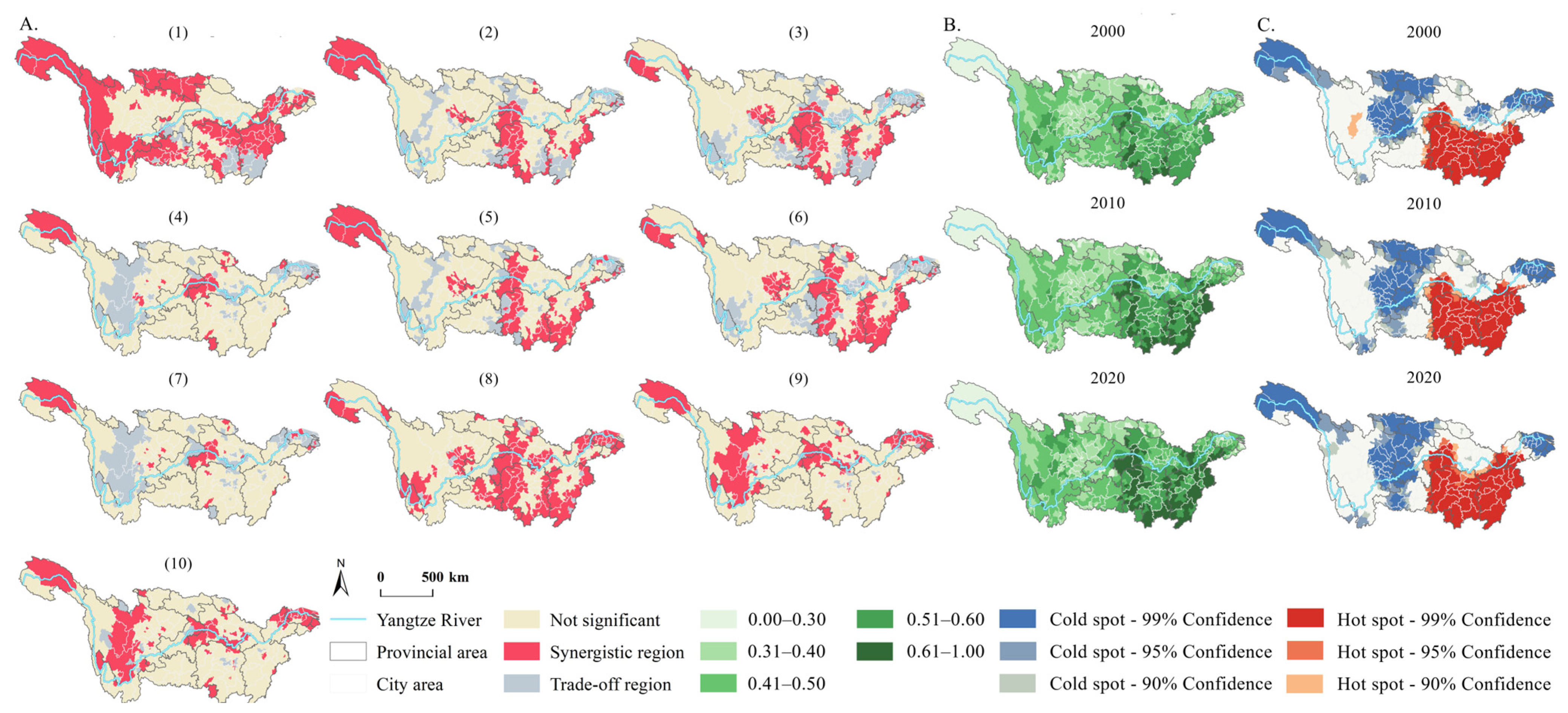
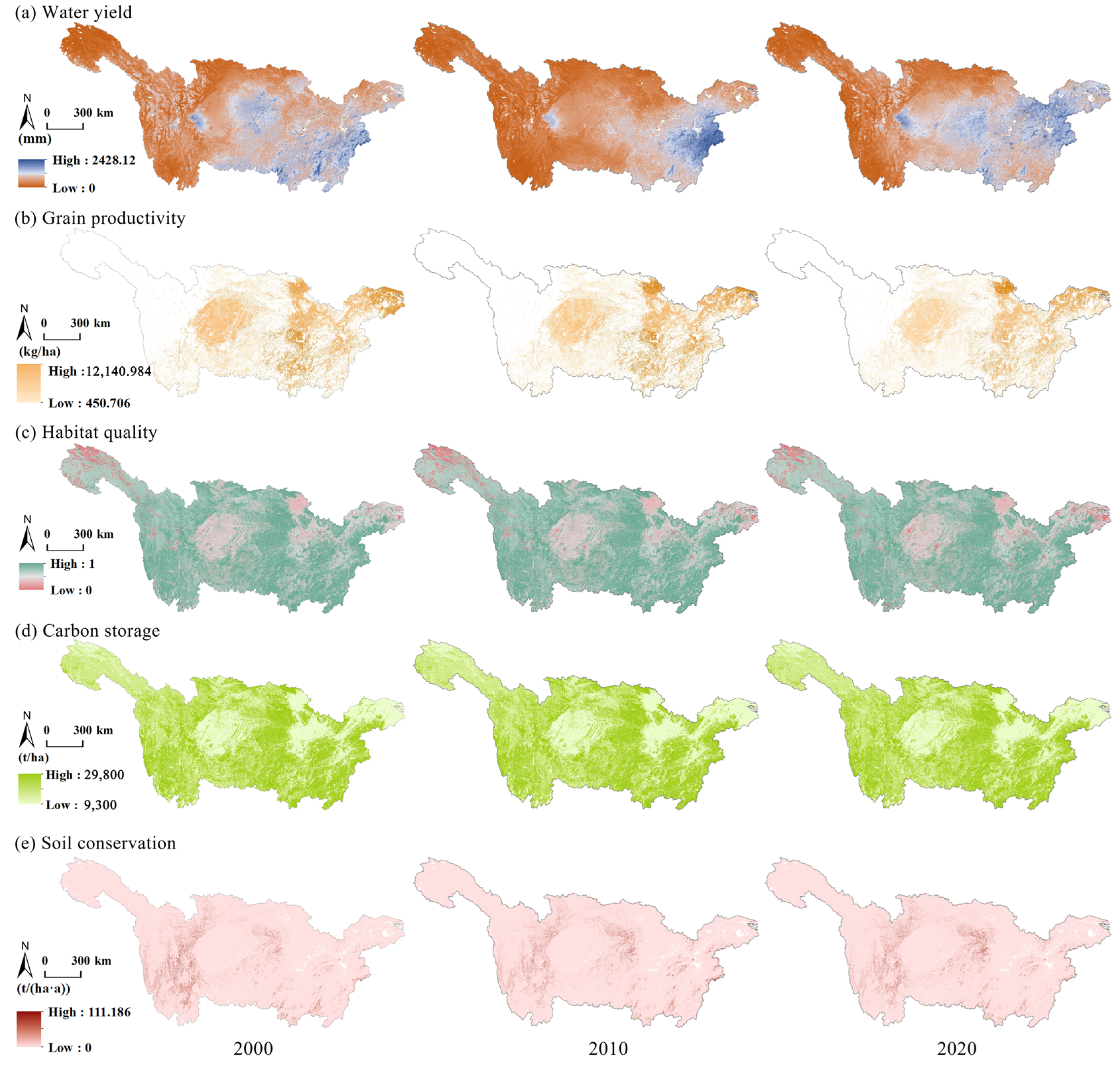
Ecosystem services (ESs) are increasingly recognized as critical to sustainable development and human well-being and are frequently used as indicators in environmental governance policies. However, existing studies mostly assess the performance of isolated single ESs, ignoring the management data needs of local governments for comprehensive gate-keeping and the easy monitoring of regional ecosystems, and lacking holistic gate-keeping indicators for local ESs. To address these shortcomings, this study assessed the spatial changes in five main ESs in the Yangtze River basin (YTRB) in China by creating a comprehensive ESs indicator (CESI) using multi-source data, and introduced the hotspot analyses and spatial econometric models to explore the driving forces of CESI. Results showed that during the study period, the CESI in the YTRB increased from 0.44 in 2000 to 0.47 in 2020. High-value areas were mainly concentrated in the hilly and mountainous regions, whereas the low-value areas were predominantly situated in the plain areas. From 2000 to 2020, the hot spots of CESI were primarily located in the middle and the lower reaches of the YTRB. Conversely, the cold spots were situated in the upper reaches of the YTRB. The regression analysis revealed a significant negative association between socioeconomic factors and CESI, while a significant positive association between natural background factors and CESI. Of the natural background factors, average precipitation has the largest positive effect on CESI, with each 1% increase resulting in up to 0.369% increase in CESI. In contrast, GDP density had the greatest negative impact on CESI, with each 1% increase triggering a reduction in CESI of up to 6.210%. The findings suggest that CESI, which integrates multiple ESs, can effectively simplify the difficulty of regional ecological regulation. The driving mechanism indicates that environmental protection policies, when combined with the natural conditions and intensity of human activities in the region, would be more coherent with varying regulatory intensities.
Keywords: ecosystem services; driving forces; hotspots analysis; spatial econometric model; the Yangtze River basin ecosystem services; driving forces; hotspots analysis; spatial econometric model; the Yangtze River basin