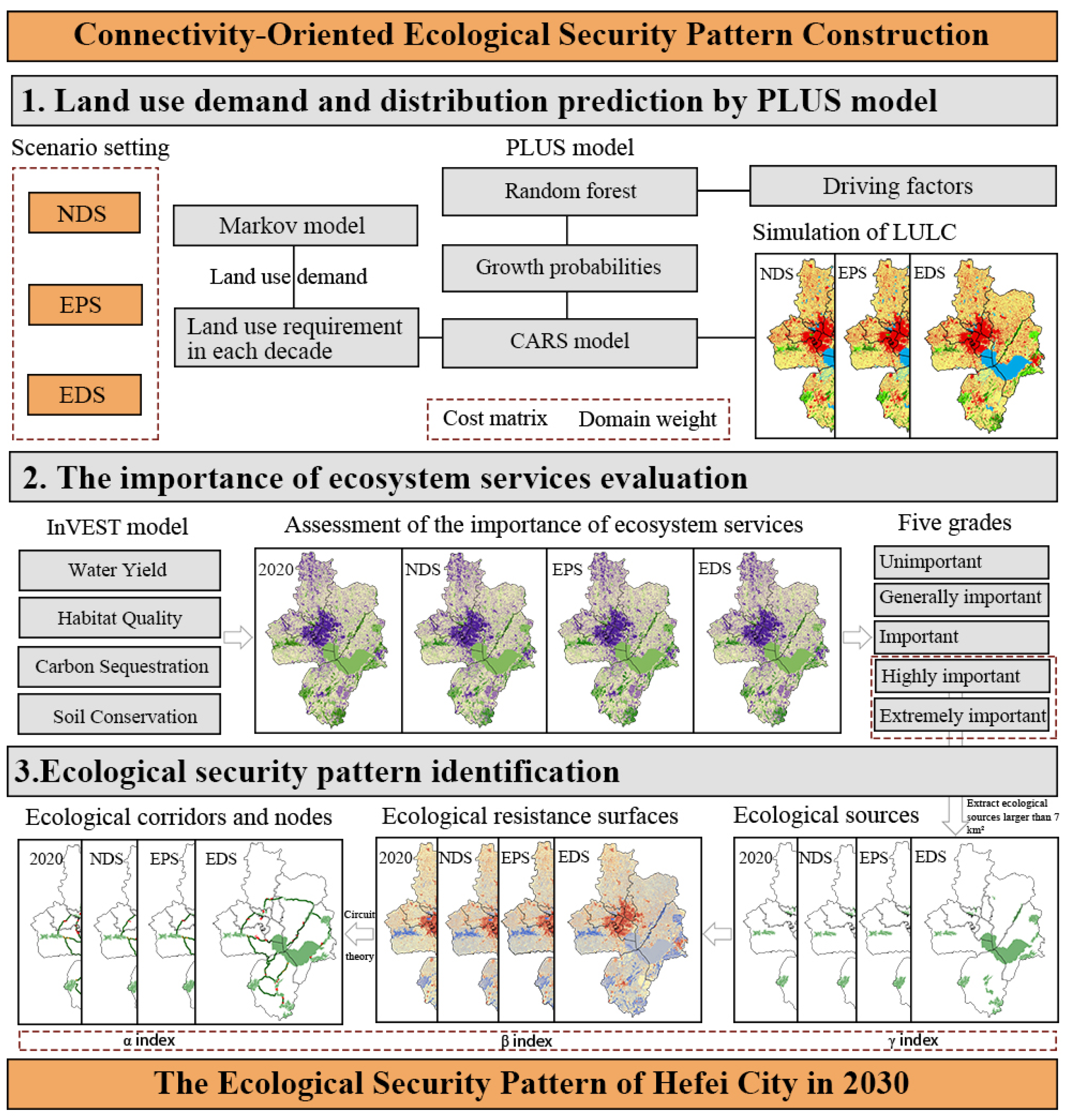

Connectivity-Oriented Ecological Security Pattern Construction Through Multi-Scenario Simulation Approach: A Case Study of Hefei City, China


Abstract
1. Introduction
2. Study Area and Data Sources
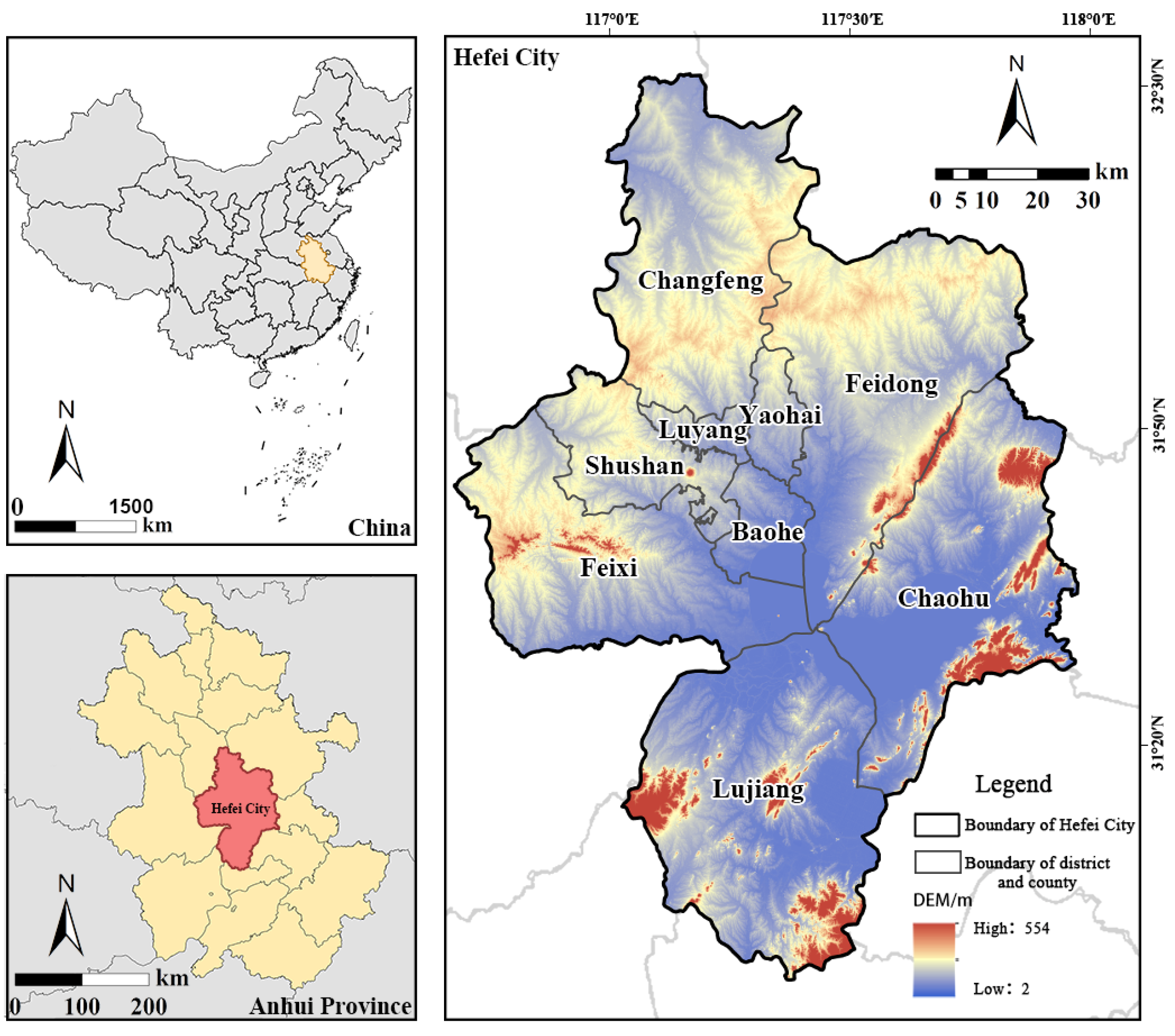
2.1. Overview of the Study Area
2.2. Data Sources
3. Research Methods
3.1. LULC Simulation
3.1.1. The Selection of Driving Factors
- (1)
- Six natural factors [12]: elevation, slope, NDVI, annual average temperature, annual average precipitation, and soil type.
- (2)
- Three socio-economic factors [44]: GDP, night light data, and population.
- (3)
- Five accessibility factors [45]: including distance from highways, distance from roads, distance from railways, distance from settlements, and distance from water.
3.1.2. Prediction of Land Use Demand
3.1.3. Accuracy Verification
3.1.4. Multi-Scenario Setting
3.2. ESV Evaluation
3.3. ESP Construction
3.3.1. Ecological Sources
3.3.2. Ecological Resistance Surfaces
3.3.3. Ecological Corridors and Ecological Nodes
3.4. Assessment of Ecological Network Connectivity
4. Research Results
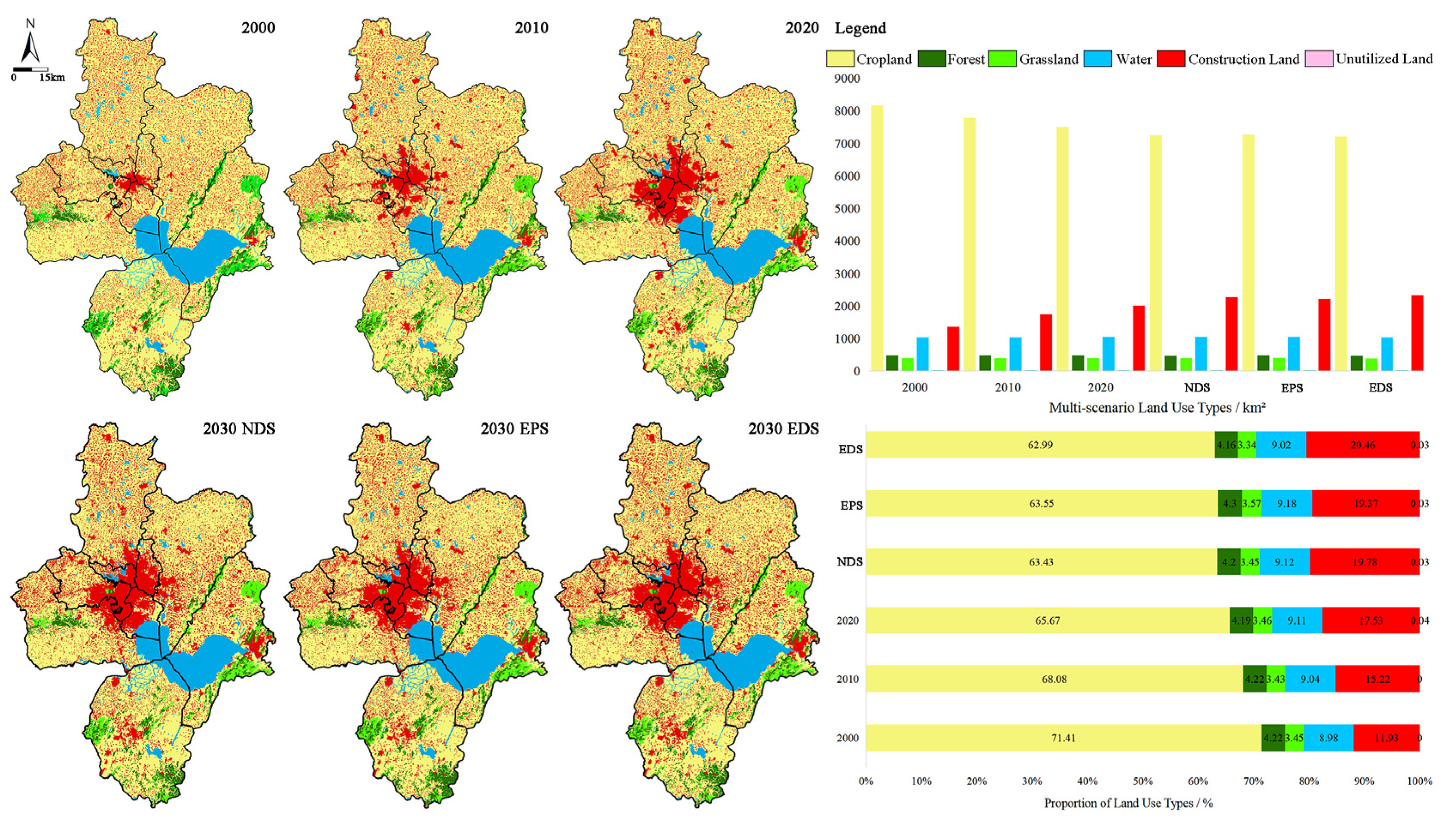
4.1. LULC and Multi-Scenario Simulation Results
4.2. Multi-Scenario Simulation Results of Ecological Source
4.2.1. Assessment of the ESV
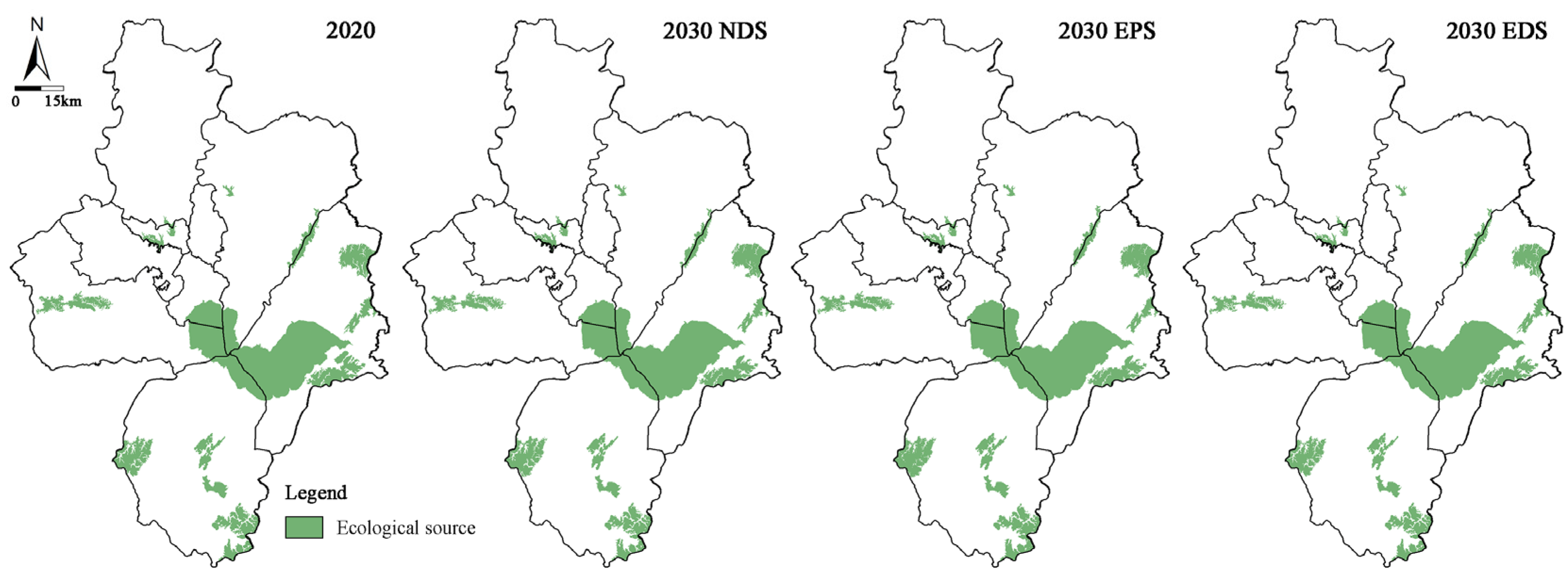
4.2.2. Extraction of Ecological Sources
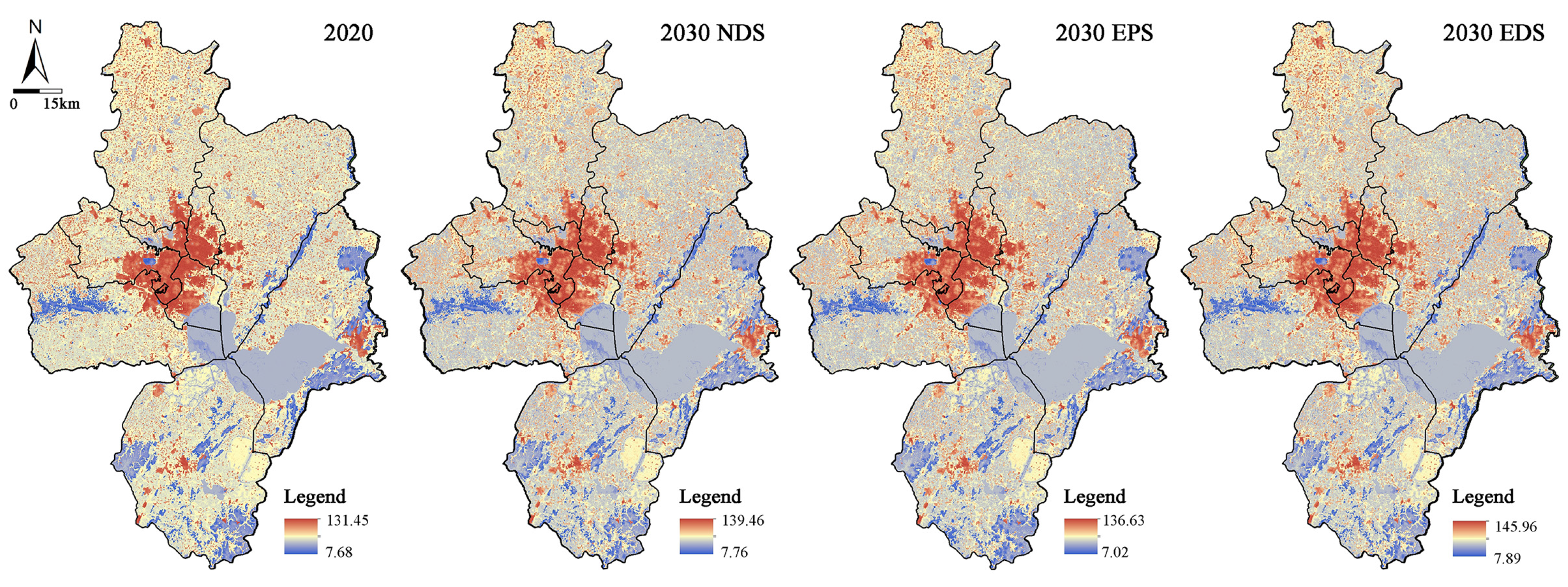
4.3. Multi-Scenario Simulation Results of Ecological Resistance Surfaces
4.4. Multi-Scenario Simulation Results of Ecological Corridors and Ecological Nodes
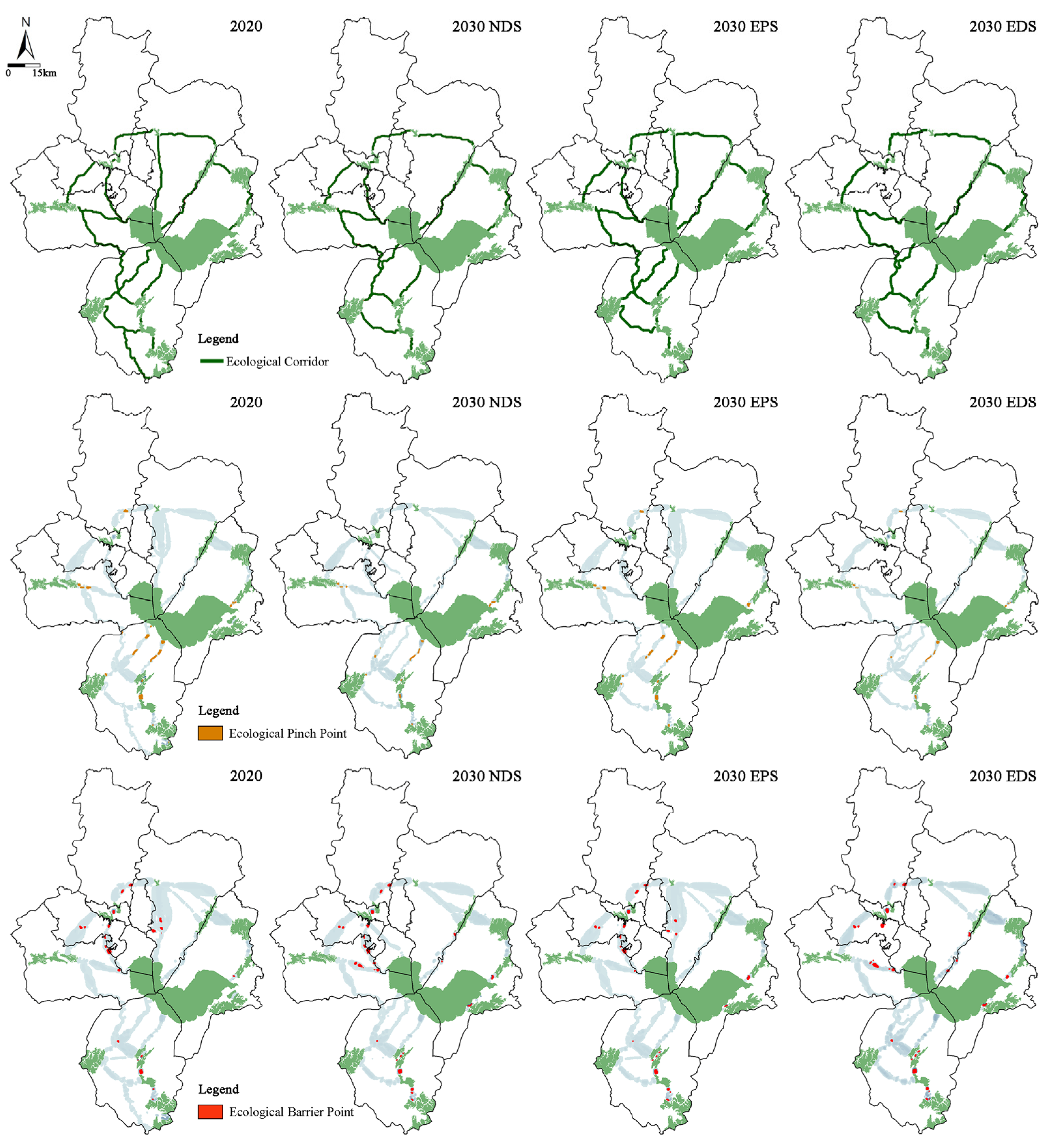
4.4.1. Identification of Ecological Corridors and Ecological Nodes
4.4.2. Evaluation of Ecological Network Connectivity
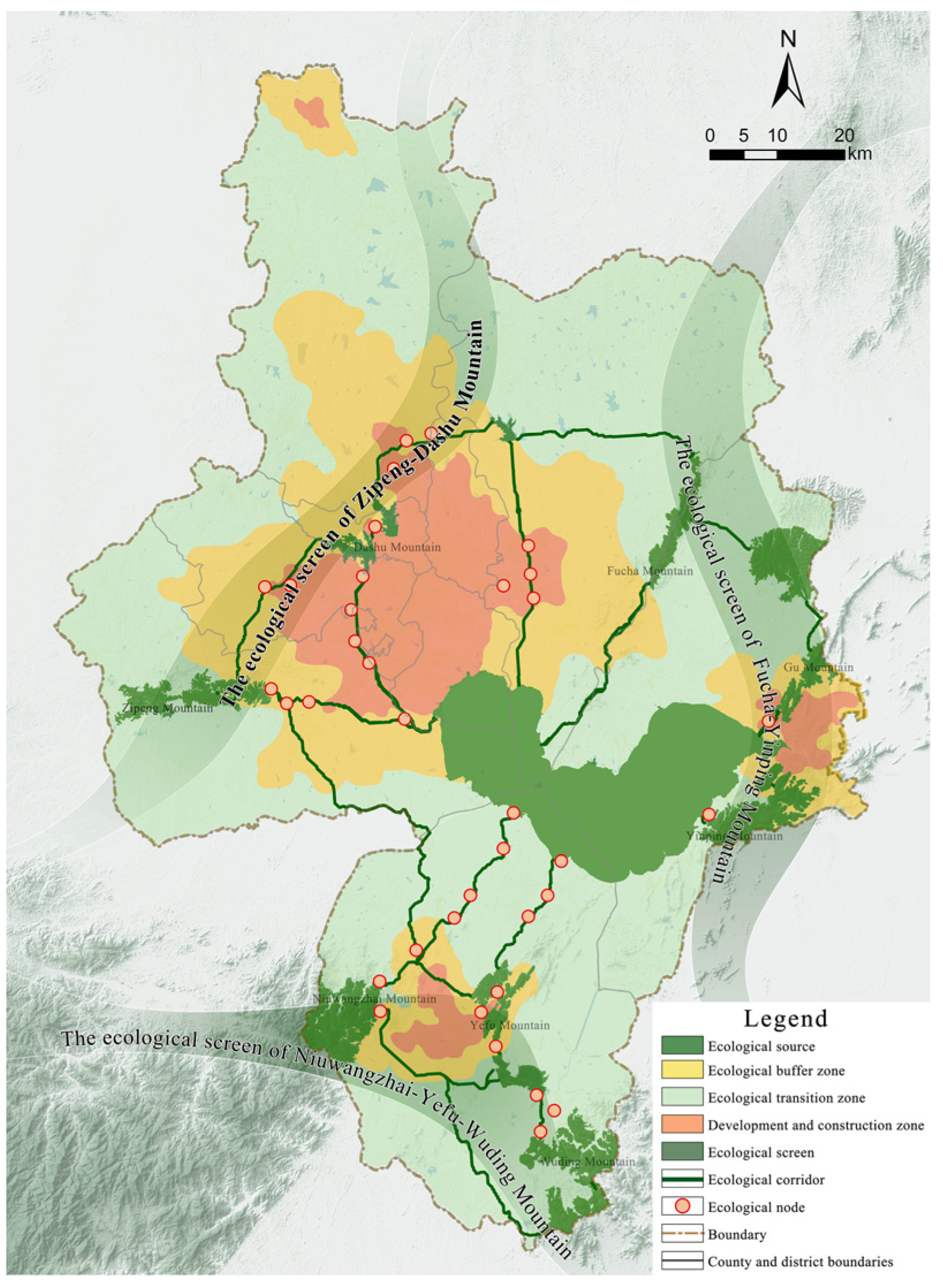
4.5. Construction of Connectivity-Oriented ESP
5. Discussion
5.1. Comparison with Existing Research
5.2. Implications for Ecological Protection and Management
5.3. Restrictions and Development
6. Conclusions
Author Contributions
Funding
Data Availability Statement
Conflicts of Interest
Abbreviations
| LULC | Land use and land cover |
| PLUS | Patch-generating land-use simulation |
| ESV | Ecosystem service value |
| NDS | Natural development scenario |
| EPS | Ecological protection scenario |
| EDS | Economic development scenario |
| MCR | Minimum cumulative resistance |
| WC | Water conservation |
| HQ | Habitat quality |
| CS | Carbon sequestration |
| SC | Soil conservation |
| NDV | Normalized vegetation index |
| α | Network closure index |
| β | Line point ratio index |
| γ | Network connectivity index |
References
- Zhao, Y.; He, L.; Bai, W.; He, Z.; Luo, F.; Wang, Z. Prediction of ecological security patterns based on urban expansion: A case study of Chengdu. Ecol. Indic. 2024, 158, 111467. [Google Scholar] [CrossRef]
- Zhou, L.; Qin, Y.; Cheng, J.; Zhu, H.; Li, M.; Zhang, J.; LeBleu, C.; Shen, G.; Chen, T.; Liu, Y. Urban ecosystem services, ecological security patterns and ecological resilience in coastal cities: The impact of land reclamation in Macao SAR. J. Environ. Manag. 2025, 373, 123750. [Google Scholar] [CrossRef] [PubMed]
- Han, W.; Tao, Z.; Li, Z.; Cheng, M.; Fan, H.; Cribb, M.; Wang, Q. Effect of Urban Built-Up Area Expansion on the Urban Heat Islands in Different Seasons in 34 Metropolitan Regions across China. Remote Sensing 2023, 15, 248. [Google Scholar] [CrossRef]
- Zhang, L.; Wan, Y.; Sun, Y.; He, G.; Lei, X.; Wei, X.; Jin, G. Optimizing ecological security patterns in a megacity by enhancing urban-rural connectivity: Insights from Wuhan, China. Appl. Geogr. 2025, 176, 103535. [Google Scholar] [CrossRef]
- Chen, Y.; Yang, P. New advances in international research on land use/land cover change. Econ. Geogr. 2001, 21, 95–100. [Google Scholar]
- Li, Q.; Wang, H. Prediction of Land Use Change in the Zhangdu Lake Basin Based on Markov Model. Resour. Sci. 2008, 30, 1541–1546. [Google Scholar]
- Wickramasuriya, R.C.; Bregt, A.K.; van Delden, H.; Hagen-Zanker, A. The dynamics of shifting cultivation captured in an extended Constrained Cellular Automata land use model. Ecol. Model. 2009, 220, 2302–2309. [Google Scholar] [CrossRef]
- Liu, X.; Liang, X.; Li, X.; Xu, X.; Ou, J.; Chen, Y.; Li, S.; Wang, S.; Pei, F. A future land use simulation model (FLUS) for simulating multiple land use scenarios by coupling human and natural effects. Landsc. Urban Plan. 2017, 168, 94–116. [Google Scholar] [CrossRef]
- Xiu, N.; Hu, Y.; Fan, W. Fine Simulation Analysis of the Evolution of Land Use Types in Heilongjiang Province. Environ. Sci. 2025, 1–22. [Google Scholar] [CrossRef]
- Xu, L.; Liu, X.; Tong, D.; Liu, Z.; Yin, L.; Zheng, W. Forecasting Urban Land Use Change Based on Cellular Automata and the PLUS Model. Land 2022, 11, 652. [Google Scholar] [CrossRef]
- Liang, X.; Guan, Q.; Clarke, K.C.; Liu, S.; Wang, B.; Yao, Y. Understanding the drivers of sustainable land expansion using a patch-generating land use simulation (PLUS) model: A case study in Wuhan, China. Comput. Environ. Urban Syst. 2021, 85, 101569. [Google Scholar] [CrossRef]
- Li, X.; Fu, J.; Jiang, D.; Lin, G.; Cao, C. Land use optimization in Ningbo City with a coupled GA and PLUS model. J. Clean. Prod. 2022, 375, 134004. [Google Scholar] [CrossRef]
- Zheng, Y.; Su, L.; Zeng, Q.; Zhou, S.; Li, S.; Hong, H.; Deng, H.; Li, W. Spatiotemporal assessment of land use carbon emission in the Guangdong-Hong Kong-Macao Greater Bay Area:A hybrid static-dynamic model integrated with PLUS. Urban Clim. 2025, 63, 102574. [Google Scholar] [CrossRef]
- Feng, X.; Li, Y.; Yu, E.; Yang, J.; Wang, S.; Yuan, W. Spatiotemporal evolution pattern and simulation of the coupling of carbon productivity and land development in the Yangtze River Delta, China. Ecol. Inform. 2023, 77, 102186. [Google Scholar] [CrossRef]
- Zhang, Z.; Li, X.; Du, S.; Liu, C.; Shi, Z.; Yan, C. Spatial-temporal evolution analysis of multi-scenario land use and ecosystem services base on PLUS-Invest model: A case study in Beijing-Tianjin-Hebei region, China. Sustain. Futures 2025, 10, 101154. [Google Scholar] [CrossRef]
- Gao, Y.; Wang, Z. Future urban heat island effect and heat risk in mountainous megacity: Multi-scenario simulations using machine learning model and the SD-PLUS model. Sustain. Cities Soc. 2025, 134, 106915. [Google Scholar] [CrossRef]
- Wu, Q.; Cao, Y.; Zhang, Y.; Su, D.; Fang, X. Linking ecosystem services trade-offs, human preferences and future scenario simulations to ecological security patterns: A novel methodology for reconciling conflicting ecological functions. Appl. Geogr. 2025, 176, 103534. [Google Scholar] [CrossRef]
- Cen, X.; Zhang, H. Impacts of multi-scenario land use change on ecosystem services and ecological security pattern: A case study of the Yellow River Delta. Res. Cold Arid Reg. 2024, 16, 30–44. [Google Scholar] [CrossRef]
- Xin, S.; Li, Z.; Chen, N.; Zhang, Z.; Zhang, X.; Chen, H.; Ma, X.; Kang, L. The contribution of multi-objective land use optimization to reducing ecological risk: A case study of the Lanzhou-Xining urban agglomeration. Ecol. Indic. 2024, 168, 112604. [Google Scholar] [CrossRef]
- Liu, J.; Kong, X.; Zhu, Y.; Zhang, B. A study on land use change simulation based on PLUS model and the U-net structure: A case study of Jilin Province. Ecol. Indic. 2025, 176, 113619. [Google Scholar] [CrossRef]
- Xu, X.; Wang, S.; Rong, W. Construction of ecological network in Suzhou based on the PLUS and MSPA models. Ecol. Indic. 2023, 154, 110740. [Google Scholar] [CrossRef]
- Guo, H.; Cai, Y.; Li, B.; Tang, Y.; Qi, Z.; Huang, Y.; Yang, Z. An integrated modeling approach for ecological risks assessment under multiple scenarios in Guangzhou, China. Ecol. Indic. 2022, 142, 109270. [Google Scholar] [CrossRef]
- Luo, X.; Le, F.; Zhang, Y.; Zhang, H.; Zhai, J.; Luo, Y. Multi-scenario analysis and optimization strategy of ecological security pattern in the Weihe river basin. J. Environ. Manag. 2024, 366, 121813. [Google Scholar] [CrossRef]
- Ma, K.; Fu, B.; Li, X.; Guan, W. Regional Ecological Security Patterns: Concepts and Theoretical Basis. Acta Ecol. Sin. 2004, 24, 761–768. [Google Scholar]
- Shi, X.; Zhao, J.; Zhiyun, O. Assessment of eco-security in the Knowledge Grid e-science environment. J. Syst. Softw. 2006, 79, 246–252. [Google Scholar] [CrossRef]
- Ying, B.; Liu, T.; Ke, L.; Xiong, K.; Li, S.; Sun, R.; Zhu, F. Identifying the Landscape Security Pattern in Karst Rocky Desertification Area Based on Ecosystem Services and Ecological Sensitivity: A Case Study of Guanling County, Guizhou Province. Forests 2023, 14, 613. [Google Scholar] [CrossRef]
- Wang, B.; Zhang, Y.; Gu, H.; Bian, Z. Ecological Security Patterns Based on Ecosystem Service Assessment and Circuit Theory: A Case Study of Liaoning Province, China. Land 2025, 14, 1257. [Google Scholar] [CrossRef]
- Wang, Y.; Thornton, D.H.; Ge, D.; Wang, S.; Ding, P. Ecological correlates of vulnerability to fragmentation in forest birds on inundated subtropical land-bridge islands. Biol. Conserv. 2015, 191, 251–257. [Google Scholar] [CrossRef]
- Abulaiti, H.; Mamat, A.; Mijiti, M. Construction and Optimization of Ecological Network in Kuqa, China. Land 2025, 14, 323. [Google Scholar] [CrossRef]
- Li, X.; Tao, H.; Wang, J.; Zhang, B.; Liu, Z.; Liu, Z.; Li, J. Integrated Evaluation of the Ecological Security Pattern in Central Beijing Using InVEST, MSPA, and Multifactor Indices. Land 2025, 14, 205. [Google Scholar] [CrossRef]
- Su, Y.; Chen, X.; Liao, J.; Zhang, H.; Wang, C.; Ye, Y.; Wang, Y. Modeling the optimal ecological security pattern for guiding the urban constructed land expansions. Urban For. Urban Green. 2016, 19, 35–46. [Google Scholar] [CrossRef]
- Wu, T.; Lu, S.; Ding, Y. Ecological Security Evaluation System Integrated with Circuit Theory for Regional Ecological Security Pattern Construction: A Coordinated Study of Chang-Zhu-Tan Metropolitan Area in China. Land 2025, 14, 257. [Google Scholar] [CrossRef]
- Knaapen, J.P.; Scheffer, M.; Harms, B. Estimating habitat isolation in landscape planning. Landsc. Urban Plan. 1992, 23, 1–16. [Google Scholar] [CrossRef]
- Li, T.; Yiyin, L.; Gaigai, L.; Jun, L.; Qinchu, L.; Jinzhao, L. Landscape Pattern Optimization of Dongfang City, Hainan Province Based on Granularity Reverse Deduction Method and MCR Model. J. Ecol. 2016, 35, 3393–3403. [Google Scholar]
- Doyle, P.G.; Snell, J.L. Random Walks and Electric Networks, 1st ed.; Mathematical Association of America: Washington, DC, USA, 1984; Volume 22. [Google Scholar]
- Dang, Z.; Hu, B.; Gao, C.; Wen, S.; Ren, J.; Liang, Y. Construction and Optimization of the Ecological Security Pattern of Pinglu Canal Economic Zone Based on the InVEST-Circuit Theory Model. Land 2025, 14, 1103. [Google Scholar] [CrossRef]
- Guan, D.; Chang, Q.; Zhou, L.; Zhu, K.; Peng, G. Construction and Optimization of Ecological Security Pattern Network Based on the Supply–Demand Ratio of Ecosystem Services: A Study from Chengdu–Chongqing Economic Circle, China. Land 2024, 13, 844. [Google Scholar] [CrossRef]
- Liu, X.; Zhang, F.; Gao, Q.; Li, T.; Zhang, R.; Jia, Y. Optimizing the Ecological Network to Construct an Ecological Security Pattern in a Metropolitan Area: A Case Study of the Jinan Metropolitan Area, China. Sustainability 2025, 17, 7342. [Google Scholar] [CrossRef]
- Dai, X.; Li, D.; Zheng, Y.; Liu, C.; Li, N.; Lu, H. Analysis of spatiotemporal changes and driving factors of green and blue carbon stocks in Zhangzhou City based on PLUS and InVEST models. J. Clean. Prod. 2025, 528, 146743. [Google Scholar] [CrossRef]
- Koko, A.F.; Han, Z.; Wu, Y.; Zhang, S.; Ding, N.; Luo, J. Spatiotemporal Analysis and Prediction of Urban Land Use/Land Cover Changes Using a Cellular Automata and Novel Patch-Generating Land Use Simulation Model: A Study of Zhejiang Province, China. Land 2023, 12, 1525. [Google Scholar] [CrossRef]
- Wu, A.; Wang, Z. Multi-scenario simulation and carbon storage assessment of land use in a multi-mountainous city. Land Use Policy 2025, 153, 107529. [Google Scholar] [CrossRef]
- Xu, X.; Kong, W.; Wang, L.; Wang, T.; Luo, P.; Cui, J. A novel and dynamic land use/cover change research framework based on an improved PLUS model and a fuzzy multiobjective programming model. Ecol. Inform. 2024, 80, 102460. [Google Scholar] [CrossRef]
- Huang, C.; Zhou, Y.; Wu, T.; Zhang, M.; Qiu, Y. A cellular automata model coupled with partitioning CNN-LSTM and PLUS models for urban land change simulation. J. Environ. Manag. 2024, 351, 119828. [Google Scholar] [CrossRef] [PubMed]
- Zeng, J.; Wu, J.; Chen, W. Coupling analysis of land use change with landscape ecological risk in China: A multi-scenario simulation perspective. J. Clean. Prod. 2024, 435, 140518. [Google Scholar] [CrossRef]
- Li, L.; Huang, X.; Yang, H. Scenario-based urban growth simulation by incorporating ecological-agricultural-urban suitability into a Future Land Use Simulation model. Cities 2023, 137, 104334. [Google Scholar] [CrossRef]
- Li, H.; Zhang, K.; Liu, Y.; Qin, Y.; Wang, W.; Wang, M.; Liu, Y.; Li, Y. Spatiotemporal evolution of land use and carbon storage in China: Multi-Scenario simulation and driving factor analysis based on the PLUS-InVEST model and SHAP. Environ. Res. 2025, 279, 121860. [Google Scholar] [CrossRef] [PubMed]
- Ma, J.; Mei, Z.; Wang, X.; Li, S.; Liang, J. Ecological Security Pattern Construction and Multi-Scenario Risk Early Warning (2020–2035) in the Guangdong–Hong Kong–Macao Greater Bay Area, China. Land 2024, 13, 1267. [Google Scholar] [CrossRef]
- Zitao, Y.; Li, T. Sustainable Development Assessment Based on PLUS Simulation of Future Land Use Changes: A Case Study of Jiangxi Province. Geogr. Sci. 2024, 44, 1826–1836. [Google Scholar]
- Ma, G.; Li, Q.; Zhang, J.; Zhang, L.; Cheng, H.; Ju, Z.; Sun, G. Simulation and Analysis of Land-Use Change Based on the PLUS Model in the Fuxian Lake Basin (Yunnan–Guizhou Plateau, China). Land 2023, 12, 120. [Google Scholar] [CrossRef]
- Fan, F.; Wen, X.; Feng, Z.; Gao, Y.; Li, W. Optimizing urban ecological space based on the scenario of ecological security patterns: The case of central Wuhan, China. Appl. Geogr. 2022, 138, 102619. [Google Scholar] [CrossRef]
- Wang, Y.; Liang, D.; Wang, J.; Zhang, Y.; Chen, F.; Ma, X. An analysis of regional carbon stock response under land use structure change and multi-scenario prediction, a case study of Hefei, China. Ecol. Indic. 2023, 151, 110293. [Google Scholar] [CrossRef]
- Zhang, J.; Cao, P.; Roosli, R. Assessing land use and carbon storage changes using PLUS and InVEST models: A multi-scenario simulation in Hohhot. Environ. Sustain. Indic. 2025, 26, 100655. [Google Scholar] [CrossRef]
- Luan, C.; Liu, R.; Li, Y.; Zhang, Q. Comparison of various models for multi-scenario simulation of land use/land cover to predict ecosystem service value: A case study of Harbin-Changchun Urban Agglomeration, China. J. Clean. Prod. 2024, 478, 144012. [Google Scholar] [CrossRef]
- Yan, Z.; Mengyao, L.; Lina, W.; Jianing, Y.; Qiaoling, L. Research on Ecological Restoration Strategies for Territorial Space Based on Ecological Network Optimization Comparison. Chin. Gard. 2024, 40, 43–49. [Google Scholar]
- Liu, P.-X.; Liu, Y.; Li, T.-N.; Guo, W.-W.; Yang, A.-L.; Yang, X.; Li, E.-Z.; Wang, Z.-J. Identification and Trend Analysis of Ecological Security Pattern in Mudanjiang City Based on MSPA-MCR-PLUS Model. Sustainability 2024, 16, 9690. [Google Scholar] [CrossRef]
- Li, T.; Li, L.; Tang, M.; Deng, H. Heterogeneous Impacts of Human Activity Intensity on Regional Ecological Security Patterns: The Case of Southwest China. Land 2024, 13, 2172. [Google Scholar] [CrossRef]
- Jia, D.; Qiu, W.; Guo, R.; Wu, M.; Wang, Z.; Hu, X. Prioritizing Protection and Restoration Areas Based on Ecological Security Pattern with Different Resistance Assignments. Land 2025, 14, 349. [Google Scholar] [CrossRef]
- Tong, A.; Zhou, Y.; Chen, T.; Qu, Z. Constructing an Ecological Spatial Network Optimization Framework from the Pattern–Process–Function Perspective: A Case Study in Wuhan. Remote Sens. 2025, 17, 2548. [Google Scholar]
- Lai, X.; Yu, H.; Liu, G.; Zhang, X.; Feng, Y.; Ji, Y.; Zhao, Q.; Jiang, J.; Gu, X. Construction and Analysis of Ecological Security Patterns in the Southern Anhui Region of China from a Circuit Theory Perspective. Remote Sens. 2023, 15, 1385. [Google Scholar] [CrossRef]
- Lai, J.; Qi, S. Construction of ecological security pattern based on ecological protection red line, machine learning algorithms, and circuit theory: A case study of Kunming city, China. J. Clean. Prod. 2025, 520, 146117. [Google Scholar] [CrossRef]
- Yuan, M.; Xian, Q.; Huang, Q.; Yang, C.; Shu, J.; Yao, C.; Pan, H. Research on ecological security pattern based on the paradigm of “portray-assessment-construction-validation”—Minjiang River Basin as an example. J. Environ. Manag. 2025, 394, 127553. [Google Scholar] [CrossRef]
- Liu, Y.; Jing, Y.; Zhao, S.; Lu, P.; Han, S. Ecological security pattern and simulation prediction based on circuit theory: A case study of the Nansi Lake Basin in China. J. Nat. Conserv. 2026, 89, 127137. [Google Scholar] [CrossRef]
- Xie, P.; Yang, J.; Wang, H.; Liu, Y.; Liu, Y. A New method of simulating urban ventilation corridors using circuit theory. Sustain. Cities Soc. 2020, 59, 102162. [Google Scholar] [CrossRef]
- Zhang, F.; Liu, X.; Jia, Y. Construction and evolution of river basin ecological network based on circuit theory and MSPA: A case study of Dawen River Basin. Ecol. Model. 2025, 510, 111364. [Google Scholar] [CrossRef]
- Li, Z.; Chenxu, W.; Jianying, X.; Xin, L.; Xiaojin, W. The Scenario of Optimizing the Ecological Network of Arid Cities for Enhanced Connectivity: A Case Study of Bayannur City and Its Surrounding Areas. Acta Ecol. Sin. 2022, 42, 8675–8689. [Google Scholar]
- Xiuping, L.; Xinyu, L.; Yanming, L.; Songting, Z.; Ziyun, D.; Minjie, D. Construction and Optimization of Ecological Network in Rapidly Urbanizing Areas: A Case Study of Daxing District, Beijing. Acta Ecol. Sin. 2023, 43, 8321–8331. [Google Scholar]
- Xiaolu, X.; Xiaolong, Z.; Junqiang, M.; Xinwen, W. Research on Ecological Network Identification and Optimization in the Hilly Area of Central Sichuan: A Case Study of Suining City. Environ. Ecol. 2025, 7, 81–88. [Google Scholar]
- Zhang, Y.; Yin, X.; Li, Y.; Wei, J.; Wang, H.; Yu, P.; Chen, Y. Evaluating ecological redline policies: Integrating multi-scenario land use simulation with ecological network analysis. Ecol. Model. 2025, 510, 111357. [Google Scholar] [CrossRef]
- Xu, B.; Xu, T.; Nie, W.; Fan, C.; Wu, Y.; Wang, Z. Simulation and planning regulation of rural landscape patterns in suburbs of large cities: Based on the ESP-GMOP-PLUS coupled model. Ecol. Front. 2025, 45, 1689–1703. [Google Scholar] [CrossRef]
- Wu, C.; Wang, Z. Multi-scenario simulation and evaluation of the impacts of land use change on ecosystem service values in the Chishui River Basin of Guizhou Province, China. Ecol. Indic. 2024, 163, 112078. [Google Scholar] [CrossRef]
- Niu, X.; Zhang, J.; Wang, S.; Zong, L.; Zhou, M.; Zhang, M. Identification of priority areas for ecological restoration based on ecological security patterns and ecological risks: A case study of the Hefei Metropolitan Area. Ecol. Indic. 2025, 175, 113590. [Google Scholar] [CrossRef]
- Zhang, Z.; Wang, C.; Qian, Y.; Zhang, Q.; Song, C.; Li, Q.; Wu, Y.; Dong, B. Habitat networks simulation and sustainable optimization policies for sectional functional impairments based on “land—Species” coupling. J. Clean. Prod. 2025, 486, 144513. [Google Scholar] [CrossRef]
- Wang, Y.; Qu, Z.; Zhong, Q.; Zhang, Q.; Zhang, L.; Zhang, R.; Yi, Y.; Zhang, G.; Li, X.; Liu, J. Delimitation of ecological corridors in a highly urbanizing region based on circuit theory and MSPA. Ecol. Indic. 2022, 142, 109258. [Google Scholar] [CrossRef]
- Fang, Y.; Zhao, L. Assessing the environmental benefits of urban ventilation corridors: A case study in Hefei, China. Build. Environ. 2022, 212, 108810. [Google Scholar] [CrossRef]
- Rotem-Mindali, O.; Katzir, N.; Perez, O. Identifying Regulatory Barriers in the Management of Ecological Corridors in an Increasingly Congested Space. Land 2024, 13, 1552. [Google Scholar] [CrossRef]
- Li, Y.; Zhao, J.; Yuan, J.; Ji, P.; Deng, X.; Yang, Y. Constructing the Ecological Security Pattern of Nujiang Prefecture Based on the Framework of “Importance–Sensitivity–Connectivity”. Int. J. Environ. Res. Public Health 2022, 19, 10869. [Google Scholar] [CrossRef] [PubMed]
- An, H.; Yan, W.; Li, T.; Jing, X.; Yinlong, L.; Minxuan, S.; Yuan, Z. Research Progress and Prospect of Carbon Effects in Land Use Systems: Mechanism, Simulation and Optimization. J. Nat. Resour. 2024, 39, 2450–2470. [Google Scholar]
- Du, Z.; Niu, J.; Fan, D.; Zhang, Z.; Yang, Z. Simulation of Land Use Change and Driving Force Analysis in the Sandy and Coarse Sand Area of the Middle reaches of the Yellow River Based on the PLUS model. Res. Soil Water Conserv. 2024, 31, 309–318. [Google Scholar]
- Laliberté, J.; St-Laurent, M.-H. Validation of functional connectivity modeling: The Achilles’ heel of landscape connectivity mapping. Landsc. Urban Plan. 2020, 202, 103878. [Google Scholar] [CrossRef]
- Wei, W.; Wang, S.; Li, X.; Zhou, J.; Zhong, Y.; Li, P.; Zhang, Z. Identification and Analysis of Ecological Corridors in the Central Urban Area of Xuchang Based on Multi-Source Geospatial Data. ISPRS Int. J. Geo-Inf. 2024, 13, 322. [Google Scholar] [CrossRef]
- Dang, H.; Lü, Y.; Guo, J.; Wu, X. Multi-scenario simulation can contribute to identify priorities for regional ecological corridors conservation. Ecol. Indic. 2024, 165, 112166. [Google Scholar] [CrossRef]
- Chen, R.; Carruthers-Jones, J.; Carver, S.; Wu, J. Constructing urban ecological corridors to reflect local species diversity and conservation objectives. Sci. Total Environ. 2024, 907, 167987. [Google Scholar] [CrossRef] [PubMed]
- Mimet, A.; Houet, T.; Julliard, R.; Simon, L. Assessing functional connectivity: A landscape approach for handling multiple ecological requirements. Methods Ecol. Evol. 2013, 4, 453–463. [Google Scholar] [CrossRef]
- Valerio, F.; Godinho, S.; Salgueiro, P.; Medinas, D.; Manghi, G.; Mira, A.; Pedroso, N.M.; Ferreira, E.M.; Craveiro, J.; Costa, P.; et al. Integrating remote sensing data on habitat suitability and functional connectivity to inform multitaxa roadkill mitigation plans. Landsc. Ecol. 2023, 38, 3335–3352. [Google Scholar] [CrossRef]






| Data Types | Data Sources | Resolution |
|---|---|---|
| Land use type data of 2000, 2010 and 2020 | Resources and Environmental Science Data Center (http://www.resdc.cn/DOI, before 1 September 2023) | 30 m |
| GDP and population density | 1 km | |
| Elevation | 30 m | |
| Normalized Vegetation Index (NDVI) | 30 m | |
| Precipitation and temperature | National Meteorological Science Data Center (http://data.cma.cn/, before 12 September 2023) | 1 km |
| Soil particle size data for sandy, silty and clay soils | ISRIC (International Soil Reference and Information Center) soil grid (Soil grid-global gridded soil information) | 250 m |
| Nighttime lighting data | National Meteorological Science Data Center (https://data.tpdc.ac.cn/, before 5 September 2023) | 1 km |
| Road network | Open Street Map (https://www.openstreetmap.org/) | |
| Hefei Statistical Yearbook 2000–2020, Hefei Urban Master Plan (2011–2020) | Hefei Municipal Bureau of Statistics, Hefei Municipal Bureau of Natural Resources and Planning |
| Type | Formula | Formula Explanation |
|---|---|---|
| Water Conservation | represents the water conservation; represents the annual precipitation data; represents the actual annual evapotranspiration; represents the annual potential evapotranspiration data; represents non-physical parameters; represents the available soil moisture content; is an empirical constant, and its value range is from 1 to 30 | |
| Habitat Quality | represents the habitat quality; represents habitat suitability; represents the stress level of the habitat; is half-saturated and a constant, and its value is usually half of the maximum value of ; represents the normalized constant. Set 2.5 as the default value in the model | |
| Carbon Sequestration | represents the carbon sequestration; represents surface carbon storage; represents the storage of soil organic carbon; represents the carbon storage of dead organic matter; represents underground carbon storage; represents the total carbon storage; is the total area of each type of LULC; represents the LULC types | |
| Soil Conservation | represents soil retention capacity; is the coefficient of rainfall erosion; is the soil erosibility coefficient; is the slope length coefficient; is the slope coefficient, dimensionless; is the vegetation coverage and management coefficient; stands for soil conservation factor |
| Resistance Factor | Resistance Factor Classification | Resistance Value | Weight |
|---|---|---|---|
| Land use type | Construction land | 80 | 0.30 |
| Unutilized land | 60 | ||
| Cropland | 40 | ||
| Water | 20 | ||
| Forest and Grassland | 10 | ||
| Elevation/m | >280 | 50 | 0.11 |
| 210–280 | 40 | ||
| 140–210 | 30 | ||
| 70–140 | 20 | ||
| <70 | 10 | ||
| Slope/° | >24 | 50 | 0.13 |
| 18–24 | 40 | ||
| 12–18 | 30 | ||
| 6–12 | 20 | ||
| 0–6 | 10 | ||
| NDVI | 0–0.15 | 80 | 0.12 |
| 0.15–0.3 | 50 | ||
| 0.3–0.45 | 30 | ||
| 0.45–0.6 | 20 | ||
| >0.6 | 10 | ||
| Distance from water/km | >3000 | 50 | 0.10 |
| 1500–3000 | 40 | ||
| 1000–1500 | 30 | ||
| 500–1000 | 20 | ||
| <500 | 10 | ||
| Distance from the construction land/km | <500 | 50 | 0.12 |
| 500–1000 | 40 | ||
| 1000–1500 | 30 | ||
| 1500–3000 | 20 | ||
| >3000 | 10 | ||
| Distance from main roads/km | <500 | 50 | 0.12 |
| 500–1000 | 40 | ||
| 1000–1500 | 30 | ||
| 1500–3000 | 20 | ||
| >3000 | 10 |
| Classification | 2020 | 2030 NDS | 2030 EPS | 2030 EDS | ||||
|---|---|---|---|---|---|---|---|---|
| Area (km2) | Proportion (%) | Area (km2) | Proportion (%) | Area (km2) | Proportion (%) | Area (km2) | Proportion (%) | |
| Unimportant | 1562.59 | 13.65 | 1254.46 | 10.96 | 1231.93 | 10.76 | 1279.86 | 11.18 |
| Generally important | 3660.01 | 31.98 | 3389.49 | 29.62 | 3348.86 | 29.26 | 3460.46 | 30.24 |
| Important | 3894.59 | 34.03 | 4296.55 | 37.54 | 4320.87 | 37.75 | 4277.37 | 37.37 |
| Highly important | 1790.49 | 15.64 | 1991.79 | 17.40 | 2012.95 | 17.59 | 1936.89 | 16.92 |
| Extremely important | 548.03 | 4.79 | 552.13 | 4.82 | 571.18 | 4.99 | 528.91 | 4.62 |
| Category | 2020 | 2030 NDS | 2030 EPS | 2030 EDS |
|---|---|---|---|---|
| 0.21 | 0.25 | 0.23 | 0.28 | |
| 0.58 | 0.50 | 0.54 | 0.45 | |
| 0.20 | 0.18 | 0.19 | 0.16 |
Disclaimer/Publisher’s Note: The statements, opinions and data contained in all publications are solely those of the individual author(s) and contributor(s) and not of MDPI and/or the editor(s). MDPI and/or the editor(s) disclaim responsibility for any injury to people or property resulting from any ideas, methods, instructions or products referred to in the content. |
© 2025 by the authors. Licensee MDPI, Basel, Switzerland. This article is an open access article distributed under the terms and conditions of the Creative Commons Attribution (CC BY) license (https://creativecommons.org/licenses/by/4.0/).
Share and Cite
Wang, F.; Zheng, J.; Huang, Y.; Lu, S.; Liu, R. Connectivity-Oriented Ecological Security Pattern Construction Through Multi-Scenario Simulation Approach: A Case Study of Hefei City, China. Land 2025, 14, 2419. https://doi.org/10.3390/land14122419
Wang F, Zheng J, Huang Y, Lu S, Liu R. Connectivity-Oriented Ecological Security Pattern Construction Through Multi-Scenario Simulation Approach: A Case Study of Hefei City, China. Land. 2025; 14(12):2419. https://doi.org/10.3390/land14122419
Chicago/Turabian StyleWang, Fengyu, Jiawei Zheng, Yaping Huang, Shiwei Lu, and Ruiqi Liu. 2025. "Connectivity-Oriented Ecological Security Pattern Construction Through Multi-Scenario Simulation Approach: A Case Study of Hefei City, China" Land 14, no. 12: 2419. https://doi.org/10.3390/land14122419
APA StyleWang, F., Zheng, J., Huang, Y., Lu, S., & Liu, R. (2025). Connectivity-Oriented Ecological Security Pattern Construction Through Multi-Scenario Simulation Approach: A Case Study of Hefei City, China. Land, 14(12), 2419. https://doi.org/10.3390/land14122419