Exploring the Impact Mechanism on Collaborative Governance of Urban–Rural Integrated Development in the Yangtze River Delta Region



Abstract
1. Introduction
1.1. Research Background
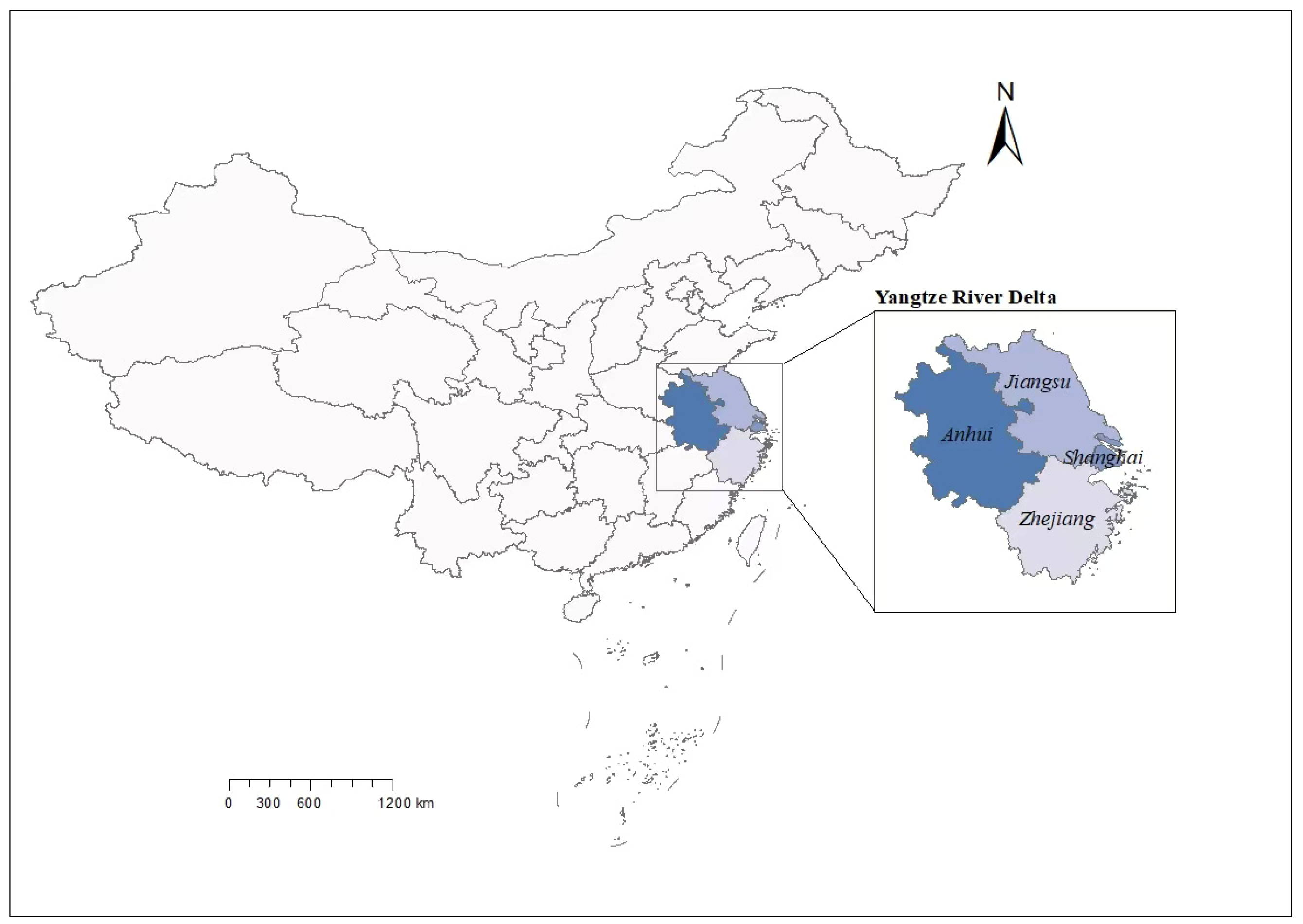
1.2. Study Area
2. Research Method and Data Collection
2.1. Research Method
2.2. Data Collection
- Policy Texts. This study analyzed over one hundred textual materials, including policy documents, official texts, and development plans concerning urban–rural integrated development, rural revitalization, and collaborative governance of urban–rural communities issued by the central government and the Yangtze River Delta region from 2023 to 2025. Here, the terms policy documents and official texts primarily refer to official, macro-level plans, whereas development plans denote micro-level implementation plans. The year, type, source and quantity of the texts are presented in Table 1. These materials, totaling more than forty thousand words, were sourced from newspapers, websites of party and government departments, serving as the primary source of data for the grounded theory approach employed in this study.
- Semi-structured Interviews. Between July 2024 and July 2025, this study conducted over a dozen depth interviews based on a theoretical sampling strategy, targeting professors, associate professors, doctoral candidates in the field of public administration from universities, as well as government officials in the field of urban–rural development. This group possesses profound professional experience and insights into collaborative governance, urban–rural development, and grassroots governance. Their interview data are of significant importance for theoretical construction and development. Interviewing was terminated when additional data no longer contributed to the development of new theoretical categories or dimensions. The primary focus of these interviews encompassed integrated development in the Yangtze River Delta region, urban–rural integrated development, and collaborative governance practices within urban–rural communities. Each interview lasted approximately 90 to 120 min. To ensure the authenticity of the interview contents and the psychological comfort of the interviewees, this study refrained from audio recording during the interviews. However, the information provided by the interviewees and the contents of the interviews were meticulously sorted and reviewed to guarantee the completeness of the interview materials. These materials served as valuable supplements to the data required for the grounded theory approach.
- Field Observation. This study conducted visits to multiple cities in the Yangtze River Delta region, engaging in on-site observations and documentation of collaborative governance practices. These observations served as a valuable supplement to the materials required for the grounded theory approach.
3. Coding Process
3.1. Opening Coding
3.2. Axial Coding
3.3. Selective Coding
3.4. Theoretical Saturation Test
4. Research Results
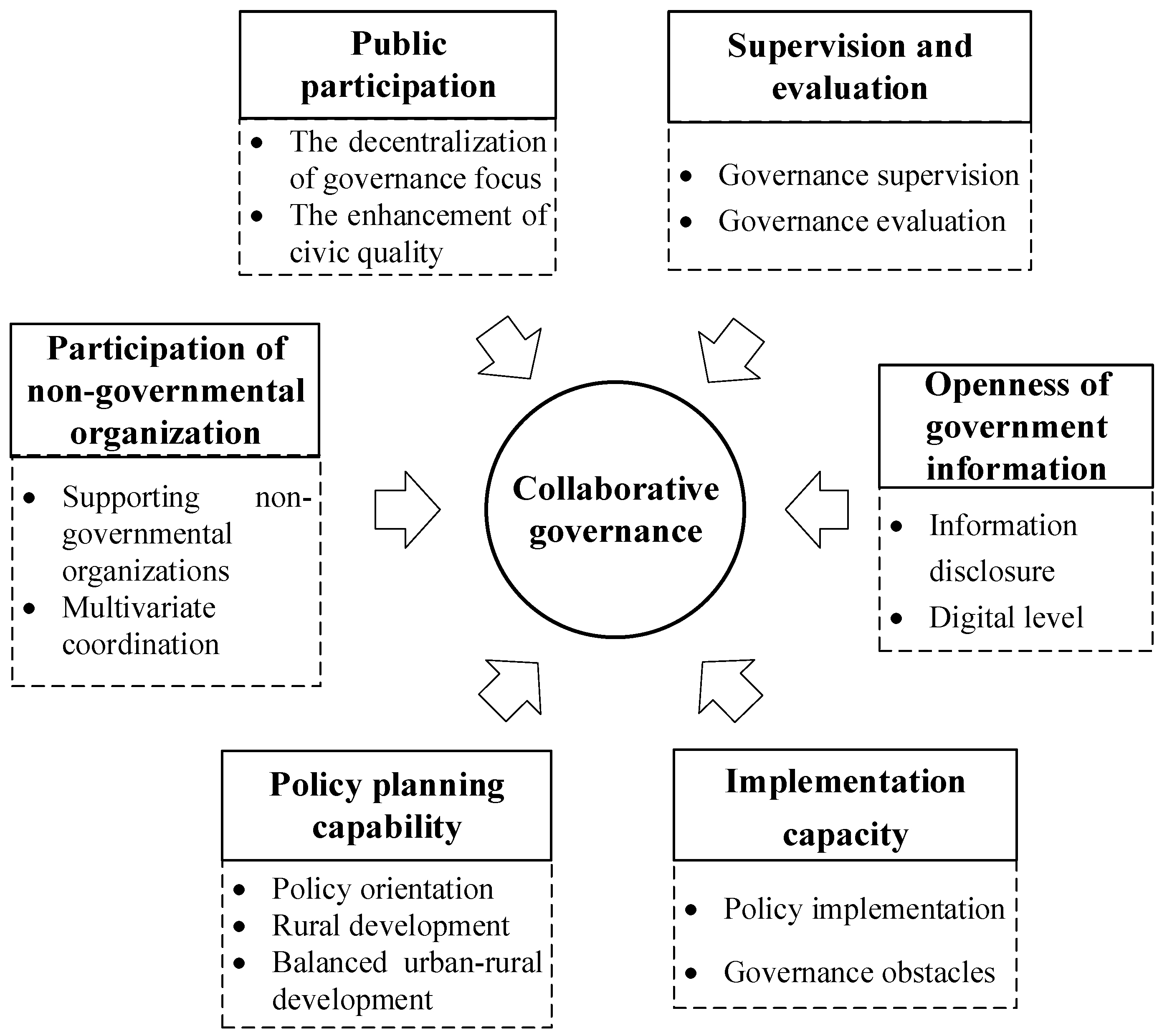
4.1. Policy Planning Capability
4.2. Public Participation
4.3. Participation of Non-Governmental Organization
4.4. Openness of Government Information
4.5. Implementation Capacity
4.6. Supervision and Evaluation
5. Conclusions
Author Contributions
Funding
Data Availability Statement
Conflicts of Interest
Abbreviations
| NGOs | Non-governmental organizations |
References
- Wang, Y.; Lu, Y.; Zhu, Y. Can the integration between urban and rural areas be realized? A new theoretical analytical framework. J. Geogr. Sci. 2024, 34, 3–24. [Google Scholar] [CrossRef]
- Lei, J.; Xie, Y.; Chen, Y.; Zhong, T.; Lin, Y.; Wang, M. The Transformation of Peri-Urban Agriculture and Its Implications for Urban–Rural Integration Under the Influence of Digital Technology. Land 2025, 14, 375. [Google Scholar] [CrossRef]
- Fang, C. On integrated urban and rural development. J. Geogr. Sci. 2022, 32, 1411–1426. [Google Scholar] [CrossRef]
- Li, L.; Yang, L.; Wang, H.; Yang, S.; Yan, Z. Spatiotemporal Evolution Characteristics and Impact Factors of Urban-rural Integrated Development in China. Chin. Geogr. Sci. 2025, 35, 802–818. [Google Scholar] [CrossRef]
- Chen, K.; Long, H.; Liao, L.; Tu, S.; Li, T. Land use transitions and urban-rural integrated development: Theoretical framework and China’s evidence. Land Use Policy 2020, 92, 104465. [Google Scholar] [CrossRef]
- Jiang, P.; Yang, Y.; Ye, W.; Liu, L.; Gu, X.; Chen, H.; Zhang, Y. Study on the Efficiency, Evolutionary Trend, and Influencing Factors of Rural-Urban Inte-gration Development in Sichuan and Chongqing Regions under the Background of Dual Carbon. Land 2024, 13, 696. [Google Scholar]
- Xiong, J. The Logic of Grassroots Administrative Regions Governance in Integrated Urban-Rural Development—A Case Study of Suburban Land Use. Adm. Trib. 2024, 2, 21–30. (In Chinese) [Google Scholar]
- Shi, J.-G.; Xu, K.; Duan, K. Investigating the intention to participate in environmental governance during urban-rural integrated development process in the Yangtze River Delta Region. Environ. Sci. Policy 2022, 128, 132–141. [Google Scholar] [CrossRef]
- Jia, J.; Yin, L.; Yan, C. Urban-Rural Logistics Coupling Coordinated Development and Urban-Rural Integrated Development: Measurement, Influencing Factors, and Countermeasures. Math. Probl. Eng. 2022, 2022, 2969206. [Google Scholar] [CrossRef]
- Zhan, L.; Wang, S.; Xie, S.; Zhang, Q.; Qu, Y. Spatial path to achieve urban-rural integration development—Analytical framework for coupling the linkage and coordination of urban-rural system functions. Habitat Int. 2023, 142, 102953. [Google Scholar] [CrossRef]
- Zhang, C.; Fan, Y.; Fang, C. When will China realize urban-rural integration? A case study of 30 provinces in China. Cities 2024, 153, 105290. [Google Scholar] [CrossRef]
- Chen, X.; Yu, L.; Li, Y.; Liu, T.; Liu, J.; Peng, D.; Zhang, X.; Fang, C.; Gong, P. China’s ongoing rural to urban transformation benefits the population but is not evenly spread. Commun. Earth Environ. 2024, 5, 416. [Google Scholar] [CrossRef]
- Chen, K.Z.; Mao, R.; Zhou, Y. Rurbanomics for common prosperity: New approach to integrated urban-rural development. China Agric. Econ. Rev. 2023, 15, 1–16. [Google Scholar] [CrossRef]
- Li, Z.-C.; Ma, Z.; Nguyen-Phuoc, D.Q.; Fu, X. Influential factors and passenger satisfaction towards integrated urban-rural bus services: A case study of Chibi, China. Transp. Policy 2025, 172, 103769. [Google Scholar] [CrossRef]
- He, Y.; Wen, C.; Fang, X.; Sun, X. Impacts of urban-rural integration on landscape patterns and their implications for landscape sustainability: The case of Changsha, China. Landsc. Ecol. 2024, 39, 129. [Google Scholar] [CrossRef]
- He, R. Urban-rural integration and rural revitalization: Theory, mechanism and implementation. Geogr. Res. 2018, 37, 2127–2140. (In Chinese) [Google Scholar]
- Gao, L.; Yan, J.; Du, Y. Identifying the Turning Point of the Urban–Rural Relationship: Evidence from Macro Data. China World Econ. 2018, 26, 106–126. [Google Scholar] [CrossRef]
- Liu, S.H.; Ren, Y.Y.; Ma, D.M.; Yu, M.M. Retrospect and analysis to the progress, predicament and frame in the urban–rural relations of China since 1949. J. Arid. Land Resour. Environ. 2015, 29, 6–12. (In Chinese) [Google Scholar]
- Zhu, X.; Guo, S.; Yuan, H. The impact of total factor mobility on rural-urban symbiosis: Evidence from 27 Chinese provinces. PLoS ONE 2023, 18, e0294788. [Google Scholar] [CrossRef]
- Chen, M.; Zhou, Y.; Huang, X.; Ye, C. The Integration of New-Type Urbanization and Rural Revitalization Strategies in China: Origin, Reality and Future Trends. Land 2021, 10, 207. [Google Scholar] [CrossRef]
- Sun, J.; Zhou, M.; Wang, S. Localized practices of rural tourism makers from a resilience perspective: A comparative study in China. J. Rural Stud. 2025, 119, 103722. [Google Scholar] [CrossRef]
- Zhu, J.; Zhu, M.; Xiao, Y. Urbanization for rural development: Spatial paradigm shifts toward inclusive urban-rural integrated development in China. J. Rural Stud. 2019, 71, 94–103. [Google Scholar] [CrossRef]
- Ma, L.; Liu, S.; Fang, F.; Che, X.; Chen, M. Evaluation of urban-rural difference and integration based on quality of life. Sustain. Cities Soc. 2020, 54, 101877. [Google Scholar] [CrossRef]
- Fang, Y.; Perc, M.; Zhang, H. A game theoretical model for the stimulation of public cooperation in environmental collaborative governance. R. Soc. Open Sci. 2022, 9, 221148. [Google Scholar] [CrossRef]
- Kiss, B.; Sekulova, F.; Hörschelmann, K.; Salk, C.F.; Takahashi, W.; Wamsler, C. Citizen participation in the governance of nature--based solutions. Environ. Policy Gov. 2022, 32, 247–272. [Google Scholar] [CrossRef]
- Ansell, C.; Gash, A. Collaborative Platforms as a Governance Strategy. J. Public Adm. Res. Theory 2018, 28, 16–32. [Google Scholar] [CrossRef]
- Ansell, C.; Gash, A. Collaborative Governance in Theory and Practice. J. Public Adm. Res. Theory 2008, 18, 543–571. [Google Scholar] [CrossRef]
- Qi, H.; Ran, B. Paradoxes in collaborative governance. Public Manag. Rev. 2023, 26, 2728–2753. [Google Scholar] [CrossRef]
- Ye, C.; Liu, Z. Rural-urban co-governance: Multi-scale practice. Sci. Bull. 2020, 65, 778–780. [Google Scholar] [CrossRef]
- Jin, Y.; Xu, Y. Carbon reduction of urban form strategies: Regional heterogeneity in Yangtze River Delta, China. Land Use Policy 2024, 141, 107154. [Google Scholar] [CrossRef]
- Wang, Q.; Mao, C. Evolutionary Game Analysis of Ecological Governance Strategies in the Yangtze River Delta Region, China. Land 2024, 13, 212. [Google Scholar] [CrossRef]
- Niu, B.; Ge, D.; Sun, J.; Sun, D.; Ma, Y.; Ni, Y.; Lu, Y. Multi-scales urban-rural integrated development and land-use transition: The story of China. Habitat Int. 2023, 132, 102744. [Google Scholar] [CrossRef]
- Li, W.; Chen, Z.; Li, M.; Zhang, H.; Li, M.; Qiu, X.; Zhou, C. Carbon emission and economic development trade-offs for optimizing land-use allocation in the Yangtze River Delta, China. Ecol. Indic. 2023, 147, 109950. [Google Scholar] [CrossRef]
- Glaser, B.G. The Discovery of Grounded Theory: Strategies for Qualitative Research; Aldine Publishing Company: New York, NY, USA, 1967. [Google Scholar]
- Strauss, A.L. Qualitative Analysis for Social Scientists; Cambridge University Press: Cambridge, UK, 1987. [Google Scholar]
- Goldkuhl, G.; Cronholm, S. Adding Theoretical Grounding to Grounded Theory: Toward Multi-Grounded Theory. Int. J. Qual. Methods 2010, 9, 187–205. [Google Scholar] [CrossRef]
- Redman-MacLaren, M.; Mills, J. Transformational Grounded Theory: Theory, Voice, and Action. Int. J. Qual. Methods 2015, 14, 1–12. [Google Scholar] [CrossRef]
- Hafer, J. Developing the Theory of Pragmatic Public Management through Classic Grounded Theory Methodology. J. Public Adm. Res. Theory 2022, 32, 627–640. [Google Scholar] [CrossRef]
- Yu, X.; Wang, J.; Liu, Y. Civic Participation in Chinese Cyber Politics: A Grounded Theory Approach of Para-Xylene Projects. Int. J. Environ. Res. Public Health 2022, 18, 12458. [Google Scholar] [CrossRef]
- Shapiro, M. Language and Political Understanding. Philosophy 1983, 58, 552–554. [Google Scholar] [CrossRef]
- Walter, L. Public Opinion; Shanghai People’s Press: Shanghai, China, 2006. [Google Scholar]
- Freeman, R.; Maybin, J. Documents, Practices and Policy. Evid. Policy 2011, 7, 155–170. [Google Scholar] [CrossRef]
- Yu, H.; Murat, B.; Li, J.; Li, L. How can Policy Document Mentions to Scholarly Papers be Interpreted? An Analysis of the Underlying Mentioning Process. Scientometrics 2023, 128, 6247–6266. [Google Scholar] [CrossRef]
- Bernardo, C.; Sergio, S. Mapping Science in Artificial Intelligence Policy Development: Formulation, Trends, and Influences. Sci. Public Policy 2024, 51, 1104–1116. [Google Scholar] [CrossRef]
- Ren, C.; Lin, X. Research on digital spillover effect of internet enterprises—An exploratory study based on grounded theory. Appl. Econ. 2023, 56, 4776–4790. [Google Scholar] [CrossRef]
- Zeng, Z.; Yu, X. The connotation, cause, and reform path of institutional transaction costs: A grounded theory analysis. Local Gov. Stud. 2024, 50, 893–914. [Google Scholar] [CrossRef]
- Nah, F.; Tan, X. An Emergent Model of End-users’ Acceptance of Enterprise Resource Planning Systems: A Grounded Theory Approach. J. Database Manag. 2015, 26, 44–66. [Google Scholar] [CrossRef]
- Long, D.R.; Strauss, A.; Corbin, J. Basics of Qualitative Research: Grounded Theory Procedures and Techniques; Sage Publications: Newbury Park, CA, USA, 1990. [Google Scholar]
- Charmaz, K.; Thornberg, R. The pursuit of quality in grounded theory. Qual. Res. Psychol. 2020, 18, 305–327. [Google Scholar] [CrossRef]
- Allen, N.; Davey, M. The value of constructivist grounded theory for built environment researchers. J. Plan. Educ. Res. 2018, 38, 222–232. [Google Scholar] [CrossRef]
- Liu, S.; Wang, Y. From Native Rural China to Urban-rural China: The Rural Transition Perspective of China Transfor-mation. Manag. World 2018, 34, 128–146. (In Chinese) [Google Scholar]
- Chen, C.; LeGates, R.; Zhao, M.; Fang, C. The changing rural-urban divide in China’s megacities. Cities 2018, 81, 81–90. [Google Scholar] [CrossRef]
- Wang, Y.; Chen, X.; Sun, P.; Liu, H.; He, J. Spatial-temporal Evolution of the Urban-rural Coordination Relationship in Northeast China in 1990–2018. Chin. Geogr. Sci. 2021, 31, 429–443. [Google Scholar] [CrossRef]
- Chen, K.; Liu, S. Does urbanization promote the urban-rural equalization of basic public services? Evidence from prefectural cities in China. Appl. Econ. 2024, 56, 3445–3459. [Google Scholar] [CrossRef]
- Wang, W.; Zhu, Y. Impact of Labour Productivity Differences on Urban--Rural Integration Development and Its Spatial Effect: Evidence from a Spatial Durbin Model. Complexity 2022, 2022, 4675682. [Google Scholar] [CrossRef]
- Hertel, T.; Zhai, F. Labor market distortions, rural–urban inequality and the opening of China’s economy. Econ. Model. 2006, 23, 76–109. [Google Scholar] [CrossRef]
- Zhang, J.; Chen, Z.; Hu, B.; Zhu, D. Do Regional Integration Policies Promote Integrated Urban–Rural Development? Evidence from the Yangtze River Delta Region, China. Land 2024, 13, 1501. [Google Scholar] [CrossRef]
- Wu, Y.; Chen, Y.; Deng, X.; Hui, E.C. Development of characteristic towns in China. Habitat Int. 2018, 77, 21–31. [Google Scholar] [CrossRef]
- Ye, C.; Pan, J.; Liu, Z. The historical logics and geographical patterns of rural-urban governance in China. J. Geogr. Sci. 2022, 32, 1225–1240. [Google Scholar] [CrossRef]
- Clark, J.K. Public Values and Public Participation: A Case of Collaborative Governance of a Planning Process. Am. Rev. Public Adm. 2021, 51, 199–212. [Google Scholar] [CrossRef]
- Scott, T.A.; Thomas, C.W. Unpacking the Collaborative Toolbox: Why and When Do Public Managers Choose Collaborative Governance Strategies? Policy Stud. J. 2017, 45, 191–214. [Google Scholar] [CrossRef]
- Zakharov, A.; Bondarenko, O. Social status and social learning. J. Behav. Exp. Econ. 2021, 90, 101647. [Google Scholar] [CrossRef]
- Chang, C.L.-H. The dilemma of renqing in ISD processes: Interpretations from the perspectives of face, renqing and guanxi of Chinese cultural society. Behav. Inf. Technol. 2012, 31, 481–493. [Google Scholar] [CrossRef]
- Jiang, S.; Zhang, D.; Irwin, D.D. The Prevalence and Importance of Semiformal Organizations and Semiformal Control in Rural China: Insights from a National Survey. Asian J. Criminol. 2022, 17, 331–352. [Google Scholar] [CrossRef] [PubMed]
- Gong, H.; Jiang, H.; Leung, J.C.B. The changing relationship between the Chinese Government and Non-governmental Organisations in social service delivery: Approaching partnership? Asia Pac. J. Soc. Work Dev. 2019, 29, 120–132. [Google Scholar] [CrossRef]
- Fan, F.; Tan, L. Quality Differences and Influencing Dimensions of County Social Governance under the Background of High Quality Development. J. Henan Norm. Univ. (Philos. Soc. Sci.) 2021, 48, 67–77. (In Chinese) [Google Scholar]
- Doucet, T.C.; Duinker, P.N.; Charles, J.D.; Steenberg, J.W.; Zurba, M. Characterizing Non-governmental Organizations and Local Government Col-laborations in Urban Forest Management Across Canada. Environ. Manag. 2024, 73, 231–242. [Google Scholar] [CrossRef] [PubMed]
- Tapia, F.; Oxhoa-Peralta, D.; Reith, A. From design to action: Service design tools for enhancing collaboration in nature-based solutions implementation. J. Environ. Manag. 2025, 379, 124739. [Google Scholar] [CrossRef] [PubMed]
- Li, J.; Zhan, G.; Dai, X.; Qi, M.; Liu, B. Innovation and Optimization Logic of Grassroots Digital Governance in China under Digital Empowerment and Digital Sustainability. Sustainability 2022, 14, 16470. [Google Scholar] [CrossRef]
- Hanisch, M.; Goldsby, C.M.; Fabian, N.E.; Oehmichen, J. Digital governance: A conceptual framework and research agenda. J. Bus. Res. 2024, 162, 113777. [Google Scholar] [CrossRef]
- McNaught, R. The application of collaborative governance in local level climate and disaster resilient development—A global review. Environ. Sci. Policy 2023, 151, 103627. [Google Scholar] [CrossRef]
- Mu, R. Role of Law, Position of Actor and Linkage of Policy in China’s National Environmental Governance System, 1972–2016. Sustainability 2018, 10, 1065. [Google Scholar] [CrossRef]
- Li, C.; Gu, X.; Li, Z.; Lai, Y. Government-enterprise collusion and public oversight in the green transformation of resource-based enterprises: A principal-agent perspective. Syst. Eng. 2024, 27, 417–429. [Google Scholar]



| Year | Type | Source | ||||
|---|---|---|---|---|---|---|
| Central Government | Shanghai | Jiangsu | Zhejiang | Anhui | ||
| 2023 | Policy Documents | 6 | 6 | 4 | 4 | 3 |
| Development Plans | 0 | 5 | 5 | 3 | 3 | |
| 2024 | Policy Documents | 4 | 5 | 6 | 6 | 4 |
| Development Plans | 0 | 3 | 3 | 6 | 5 | |
| 2025 | Policy Documents | 4 | 2 | 4 | 5 | 6 |
| Development Plans | 0 | 2 | 3 | 3 | 4 | |
| Initial Category | Initial Concept |
|---|---|
| Enhancing the level of rural public services | Balanced allocation of public resources between urban and rural Areas; Rural healthcare service system; Rural public infrastructure construction; Extension of critical municipal utilities to urban suburbs and rural areas; Urban–rural integration of infrastructure; Urban–rural integrated public welfare projects; Equalization of basic public services (7 items in total) |
| Factor mobility | Reduction in rural surplus labor force; Elimination of barriers for rural population to enter cities; Establishment of an interconnected urban–rural land market; Incentives for urban talents to move to rural areas; Improvement of urban inclusiveness; Inflow of industrial and commercial capital into rural areas (6 items in total) |
| Community development | Establishment of community elderly associations; Organizing residents to participate in community governance; Public welfare and charity; Smart community development; Mediation of community disputes; Long-term mechanism for punishing vice and promoting virtue (6 items in total) |
| Market development | Enhancing enterprises’ awareness of CSR; Enterprises providing social services through multiple channels; Enhancing the spirit of social contract in market development; Enhancing the legal awareness in market development (4 items in total) |
| Data disclosure | Disclosure of government information timely; Residents’ awareness of government work (2 items in total) |
| Publication of results | Disclosure of evaluation results; Assessment and comparison of grassroots urban–rural community work (2 items in total) |
| Urban–rural culture | Conducting various rural cultural activities; Customs and conventions in rural areas; Cultural facilities for intangible cultural heritage; Display of village history (4 items in total) |
| Personnel training | Strengthening the training of volunteer personnel; Enhancing the training of personnel in urban–rural communities; Cultivating talent in rural healthcare (3 items in total) |
| Citizenship consciousness | Unifying thoughts under the leadership of party organizations; Social learning; Encouraging active citizen participation; Shared vision; Enhancing the sense of identity among urban–rural community residents; Strengthening the sense of responsibility among urban–rural community residents (5 items in total) |
| Integrated platform | Public consultation platform; Digital infrastructure; Interconnection of basic data (3 items in total) |
| Big data | Information technology support; Information sharing on public resource trading platforms; “Internet + Government Services” (3 items in total) |
| Supporting non-governmental organizations | Free association and new social communities; Enhancing the enthusiasm of social organizations; Increasing support for grassroots social organizations; Understanding the needs and development potential of social organizations (4 items in total) |
| Leveraging the role of non- governmental organizations | Enhancing the autonomy of social organizations; Social organizations discover and understand the needs of urban–rural residents; Party building work in social organizations; Promoting the focus of social governance towards the grassroots level of non-governmental organizations (4 items in total) |
| Rural beneficial measures | Providing subsidies to farmers; Encouraging local elites to return villages; Supporting farmers’ employments and entrepreneurships; Expanding channels for increasing farmers’ income; Developing rural education; Targeted poverty alleviation (6 items in total) |
| Technical support | Providing expert guidance for villagers; Rural e-commerce support; Supporting the development of rural eco-tourism circles; Support for rural financial services (4 items in total) |
| Characteristic development | Combination of local characteristics and policy initiatives; The radiating effect of characteristic towns on surrounding rural areas; Creating distinctive branded products; Characteristic town construction; Foster industries with competitive advantages (5 items in total) |
| Rural planning | Rural road network planning; Planning and constructing self-service facilities for rural culture, sports, commerce and logistics; Village planning tailored to local conditions; Planning for rural video surveillance; Permanent basic farmland planning (5 items in total) |
| Policy promotion | Establish and improve institutional mechanisms for urban–rural integrated development; Reshaping new-type urban–rural relations; Major policy decisions and deployments; Reforming old institutional mechanisms and establishing new ones; Urban–rural complementarity (5 items in total) |
| Rural potential | Transforming rural development shortcomings into potential; Emphasizing the influence of rural elites; Village renovation and revitalization of existing land resources; Facilitating the connection between urban and rural land markets (4 items in total) |
| Urban–rural disparities | Impeded flow of factors between urban and rural areas; Uneven allocation of public resources; Large disparity in living standards between urban and rural residents (3 items in total) |
| Evaluation system | Constructing an evaluation system for urban–rural integrated development; Establishing a governance standard system; Third-party evaluation system; Performance evaluation and comparison of grassroots urban–rural community work (3 items in total) |
| Feedback system | Establishing a feedback mechanism for urban–rural residents; Facilitating the alignment of services with residents’ needs (2 items in total) |
| Collective spirit | promoting the spirit of governance systems; Reconstruct collective consciousness in urban–rural grassroots communities (2 items in total) |
| Dissemination of results | Publicize innovative governance practices widely; Form demonstration areas to enhance their exemplary role (2 items in total) |
| Legalization of governance | The transition from moral constraint to legalized governance in rural areas; Improve the rural governance system that integrates autonomy, rule of law, and moral governance; Local regulations on urban–rural community governance; Enhance the level of socialization, Legalization, intellectualization, and specialization in social governance (4 items in total) |
| Environmental governance | Garbage classification; Noise pollution treatment; The issue of scattered and irregular burial practices; Sewage discharge (4 items in total) |
| Forms of governance | Networked governance structure; Power balance and decision-making rules (2 items in total) |
| Interdisciplinary collaboration | An area pioneering the coordinated development of urban–rural industries; Establishment of a leading group to resolve horizontal and vertical contradictions; Interregional cooperation relationships; Interdepartmental rural working group (4 items in total) |
| Obstacles of integrated development | Household registration system; Fragmentation of social organizations; Conflicts between rural cadres and the masses; Drawbacks of the urban–rural dual structure; Weakening of interpersonal connections (5 items in total) |
| Migrant population | Abolishing the household registration system; Non-registered permanent residents enjoy basic public services; Equal rights and responsibilities (3 items in total) |
| Problem prevention | Renovation of dilapidated houses; Preventing the disturbance of grassroots governance by gangster forces; Strictly preventing the transfer of urban pollution to rural areas (3 items in total) |
| Understanding the needs at the grassroots level | Actively collecting public opinions through face-to-face interactions; Listening to the experiences of grassroots community staff; Organizing residents to negotiate and resolve major issues in urban–rural communities; Legal expression of interests and demands by the masses (4 items in total) |
| Channels for the expression of public opinion | Expanding avenues for citizen participation; Governmental hotlines; Mayor’s mailboxes; Leveraging information technology to facilitate smooth channels for the expression of demands (4 items in total) |
| Humanistic care | Impoverished population; Vulnerable children; Individuals with mental disorders; Persons released after serving their criminal sentences and their children (4 items in total) |
| Social security | Multi-level rural old-age security system; Urban–rural social assistance; Unifying compensation standards for urban and rural residents (3 items in total) |
| Major Category | Initial Category |
|---|---|
| Balanced urban–rural development | Enhancing the level of rural public services; Factor mobility |
| Multifaceted coordination | community development; market development |
| Information disclosure | Data disclosure; Publication of results |
| Enhancement of civic qualities | Urban–rural culture; Personnel training; Citizenship consciousness |
| Digital level | Integrated platform; Big data |
| Non-governmental organization | Supporting non-governmental organizations; Leveraging the role of non-governmental organizations |
| Rural development | Rural beneficial measures; Technical support; Characteristic development; Rural planning |
| Policy orientation | Policy promotion; Rural potential; Urban–rural disparities |
| Governance supervision | Evaluation system; Feedback system |
| Governance evaluation | Collective spirit; Dissemination of results |
| Policy implementation | Legalization of governance; Environmental governance; Forms of governance; Interdisciplinary collaboration |
| Governance obstacles | Obstacles of integrated development; Migrant population; Problem prevention |
| Decentralization of governance focus | Understanding the needs at the grassroots level; Channels for the expression of public opinion; Humanistic care; Social security |
Disclaimer/Publisher’s Note: The statements, opinions and data contained in all publications are solely those of the individual author(s) and contributor(s) and not of MDPI and/or the editor(s). MDPI and/or the editor(s) disclaim responsibility for any injury to people or property resulting from any ideas, methods, instructions or products referred to in the content. |
© 2025 by the authors. Licensee MDPI, Basel, Switzerland. This article is an open access article distributed under the terms and conditions of the Creative Commons Attribution (CC BY) license (https://creativecommons.org/licenses/by/4.0/).
Share and Cite
Xu, K.; Wen, S.; Duan, K.; Hua, W. Exploring the Impact Mechanism on Collaborative Governance of Urban–Rural Integrated Development in the Yangtze River Delta Region. Land 2025, 14, 2393. https://doi.org/10.3390/land14122393
Xu K, Wen S, Duan K, Hua W. Exploring the Impact Mechanism on Collaborative Governance of Urban–Rural Integrated Development in the Yangtze River Delta Region. Land. 2025; 14(12):2393. https://doi.org/10.3390/land14122393
Chicago/Turabian StyleXu, Ke, Shiping Wen, Kaifeng Duan, and Wenwen Hua. 2025. "Exploring the Impact Mechanism on Collaborative Governance of Urban–Rural Integrated Development in the Yangtze River Delta Region" Land 14, no. 12: 2393. https://doi.org/10.3390/land14122393
APA StyleXu, K., Wen, S., Duan, K., & Hua, W. (2025). Exploring the Impact Mechanism on Collaborative Governance of Urban–Rural Integrated Development in the Yangtze River Delta Region. Land, 14(12), 2393. https://doi.org/10.3390/land14122393