Article

Spatial Distribution and Tourism Potential of Intangible Cultural Heritage and Historic and Cultural Cities—A Case Study of Anhui Province, China
School of Architecture and Art, Hefei University of Technology, Hefei 230009, China
*
Author to whom correspondence should be addressed.
Land 2025, 14(12), 2360; https://doi.org/10.3390/land14122360
Submission received: 14 October 2025 / Revised: 24 November 2025 / Accepted: 27 November 2025 / Published: 3 December 2025

Abstract

Anhui Province in China possesses abundant and varied resources of intangible cultural heritage (ICH) and historic cultural cities (HCCs). Investigating their spatial distribution characteristics and synergistic development mechanisms holds significant importance for heritage conservation and sustainable development. This study employs GIS technology to analyze the spatial distribution patterns of two categories of heritage in Anhui Province during 2024, constructing an interactive matrix model between them. This provides both theoretical foundations and practical pathways for highlighting the contemporary value of intangible cultural heritage and fostering its innovative conservation and development. The findings indicate the following: (1) Regarding the structural attributes of the quantity and categories of ICH in Anhui Province, traditional craftsmanship and traditional drama account for the highest proportion of national-level ICH. Provincial-level ICH is dominated by traditional craftsmanship, and Quyi accounts for the lowest proportion at all levels. The distribution of tourism resources shows obvious regional differences, with Huangshan City and Hefei City being rich in resources, and areas such as Huaibei City being relatively poorer. (2) The spatial distribution shows a regular pattern, with national-level ICH randomly distributed and provincial-level ICH showing aggregation characteristics; HCC resources are randomly distributed, and there is a significant positive spatial correlation with ICH resources. (3) The construction of the “intangible cultural heritage tourism–historical and cultural city” matrix reveals four distinct categories of historical and cultural cities within Anhui Province: “high-potential ICH tourism—high-potential HCC”, “high-potential ICH tourism—low-potential HCC”, “low-potential ICH tourism—high-potential HCC”, and “low-potential ICH tourism—low-potential HCC”. These findings will assist cities in Anhui Province in formulating culture and tourist policies to enhance the regional tourism economy, informed by local resource circumstances and development methods.

1. Introduction

1.1. Intangible Cultural Heritage (ICH)

Intangible cultural heritage (ICH) is a dynamic cultural essence, embodying a knowledge system that integrates historical, cultural, artistic, and scientific qualities, including many manifestations such as performing arts, handicrafts, festivals, and folklore. The distribution of ICH in different countries and regions vividly reflects the diversity of human civilization and fully demonstrates the richness of human wisdom [1]. An HCC city serves as a significant medium of human civilization, including both physical and intangible cultural legacy, while also functioning as a spatial–semiotic vehicle for national spirit, communal memory, and regional identity.
Academic research on intangible cultural heritage has evolved from the initial definition of concepts and the emergence of a sense of safeguarding to an in-depth exploration of multidisciplinary integration and systematic safeguarding. At the beginning, researchers were mainly concerned with the definition, connotation, and characteristics of the concept of ‘ICH’, and explored the necessity and preliminary methods of safeguarding [2,3,4]; later on, research perspectives and methods tended to become more diversified, and deepened discussions on topics such as spatial distribution, productive safeguarding, inheritors, and community roles began to emerge, while more recently, researchers have placed more emphasis on holistic, cross-disciplinary and cross-local systematic safeguarding, and have paid attention to the strategic issues of intangible heritage and rural revitalization, cultural tourism, and modern economic transformation [5,6,7].
In 2003, the United Nations Educational, Scientific and Cultural Organization (UNESCO) adopted the Convention for the Safeguarding of the ICH, marking the formal establishment of a global safeguarding system for the ICH. After China’s accession to the Convention in August 2004, a localized safeguarding framework has been gradually built up and has continued to promote the institutionalized and regularized development of the safeguarding of ICH in China. The core areas of focus within the current academic community regarding intangible cultural heritage encompass three aspects.

1.1.1. Spatial Distribution and Place-Making

Existing research primarily focuses on intangible cultural heritage at various levels, employing methods such as GIS for analyzing the spatial and temporal distribution law of ICH at the national, inter-provincial regional, economic zone, provincial, and municipal levels [8,9], revealing the formation mechanism of geographical environment, economic development, cultural tradition, and other factors on the types, structural characteristics, and spatial pattern of ICH, and providing the basis for formulating the targeted protection and utilization strategies [10,11,12,13,14].
Additionally, research has focused on the field of cultural heritage tourism, assessing the impact of residents’ support on tourism by examining factors such as heritage accessibility. The study focuses on the shaping of sense of place, authenticity experience, and recognizability formation in ICH tourism [15,16].
Research into the interaction between intangible cultural heritage (ICH) and the tourism industry encompasses not only community participation elements such as resident support levels but also examines behavioral aspects, including visitors’ cultural identification through discussion of the construction and integration of ICH authenticity and the impact of ICH on the city’s image recognition [17,18,19,20,21].

1.1.2. Cultural and Creative Transformation and Design Development

Considering ICH as an important design resource, we refine its morphological characteristics and cultural connotations through case studies and apply them to the development of ICH derivatives and innovative design of tourism souvenirs, so as to promote the living inheritance of ICH and the transformation of value [22,23,24,25,26].
Researchers are committed to the innovative use of digital technologies such as 3D modeling, motion capture, visual presentation, and VR/AR with meta-universe in the protection of ICH, which encourages the methods of recording, preserving, and experiencing ICH to be undertaken in the direction of informatization and intelligence [27,28,29].
In particular, ICH is highly acknowledged around the world as a bearer of the history and cultural legacy of all people. As a vital tourism asset, it is essential for fostering regional economic growth. In Macau, the drunken dragon dance, as one of the best local intangible cultural heritage tourism resources, has been widely recognized by local officials, local residents, performers, and tourists [30]. In Vienna, cafés are not only an important resource for cultural tourism but have also become a key channel and vehicle for building social networks between residents and tourists, helping to promote the depth of its tourism industry [31].

1.2. Material Spatial Elements

1.2.1. Definition and Implications of the Historical and Cultural City (HHC) Concept

The concept of HHC was initially constructed in opposition to modern cities [32]. The focus of attention for HHC in Europe and the Americas includes historic buildings, historic districts, and cultural and historic landscapes. HHC in China is defined as ‘cities that are particularly rich in preserved cultural relics and have great historical and cultural value and revolutionary significance’, but in terms of administrative division, Chinese HCCs can also be ‘counties’, ‘districts’, ‘towns’, or ‘villages’. In 1982, China formally established the protection system of the famous HCC; the Urban Planning Law promulgated in 1989 emphasized that urban planning should protect the HCC [33]. Nowadays, the protection of ICH has become an important part of the protection of China’s HCC.

1.2.2. The Formation of China’s HHC Protection System

The research on HCC has evolved from the static mode, focusing on the preservation of material entities, to a living heritage system integrating multidisciplinary perspectives, digital methods, and sustainable concepts. The current research mainly focuses on the following dimensions: at the level of preservation theory and methodology, scholars are committed to exploring the systematic preservation system and the sustainable development strategy and its implementation path in the context of rapid urbanization [34,35,36,37]. At the level of spatial resource analysis, the focus extends to the spatial distribution pattern of material elements (such as historic districts and architectural clusters) within the HCC and the integration mechanism of cultural resources [38,39,40,41]; at the level of tourism development and cultural transformation, the research covers the paths of cultural and tourism integration and the response to the challenges of the process of tourism, as well as the modern translation and public perception of the historical elements in the urban regeneration and architectural design [13,42,43,44,45,46]; in terms of technological empowerment, it focuses on the renewal practice of the smart city concept in historic urban areas, intelligent participation in cultural tourism, and other innovations in the interaction between technology and heritage [47,48]. This evolutionary vein reflects the research paradigm shift in the field from single entity conservation to holistic, living, and intelligent development.

1.3. The Relationship Between Intangible Cultural Heritage and Elements of Physical Space

Previous studies have extensively explored topics such as the characteristics of ICH distribution at different levels, coping strategies for ICH-producing tourism, and the tourism applications of HCCs and historical and cultural elements. Studies on the relevance of the two have often focused on the conservation, management, and tourism development of art forms, knowledge, skills, and geographic spaces. The existing research has emphasized the embodiment and transmission of ICH through material spaces, while overlooking the correlation between ICH and the development of HCCs [48,49,50,51].
Although some studies have explored the relationship between intangible cultural heritage and material spatial elements, they have predominantly focused on evaluating policy models. These studies either lack an examination of the interactive mechanisms between ICH and physical spaces or introduce technical methodologies without conducting specific quantitative analyses based on these techniques.
In general, insufficient attention has been paid to the correlation between material spatial elements and ICH and HCC, which is in line with the concept of post-modern tourism and experiential tourism, and this direction can not only provide new research perspectives but also lay a theoretical foundation for the subsequent related research. In view of this, this study takes Anhui Province as an example, aiming to systematically explore the logic of interaction between ICH tourism and HCC, and then reveal their inherent characteristics and coupling modes.
By analyzing the richness and spatial distribution of ICH and the system of HCCs in the sixteen cities and municipalities of Anhui Province, and by revealing the role played by HCC in ICH tourism, we will be able to guide the rational development and utilization of ICH resources in Anhui Province in a scientific way. This research mainly focuses on national and Anhui provincial ICH projects (including extension projects) and HCCs (including cities, towns, and villages). Using ArcGIS to analyze the spatial distribution of ICH and HCC and evaluating the quantitative indicators of ICH tourism and HCC through mathematical and statistical methods, the ‘ICH tourism–HCC’ matrix was finally constructed.

2. Data and Methods

2.1. Field of Research

This study analyses Anhui Province in China as a case study. Anhui Province is located in East China (longitude 114°54′–119°37′ E, latitude 29°41′–34°38′ N), which is the transitional zone between North and South China in terms of geography and culture. The province’s geomorphology shows obvious regional differentiation from north to south: from the Huaibei Plain to the Jianghuai Hills and the southern Anhui Mountains. The Yangtze River and the Huaihe River run through the whole territory, naturally dividing the province into the three major geographical units of Huaibei, Jianghuai, and Jiangnan.
The historical and cultural pattern of Anhui Province has accumulated over thousands of years, forming two major protection systems for ICH and HCC. The former covers many national projects such as the Anhui Opera, Huangmei Opera, Anhui ink, Xuan paper, etc.; the latter includes famous cities such as Anqing, Shexian County, and famous towns and villages, such as Hongcun, Xidi, etc., which show a multi-level heritage composition from tangible to intangible, and from city to countryside.
Throughout millennia, the convergence of history, geographical transformations, and cultural exchanges has influenced the varied historical and cultural patterns of Anhui Province. In 2006, China announced the first batch of national representative ICH projects; Anhui has a large number of selected ICH, including the world-renowned Hui Opera, Nuo Opera, Huangmei Opera, and other traditional theaters, and is full of regional cultural characteristics of the Hui ink, She ink stone, Xuan paper, Wuhu Iron Painting, and other traditional craftsmanship, and also includes the traditional projects of exquisite and delicate paper-cutting and Huizhou carving. Since 1982, when China announced the first batch of national HHC, Anhui has selected cities such as Anqing, Bozhou, Shouxian, and Shexian, as well as Sanhe Town, Wan’an Town, and Datong Town, and villages and towns such as Jiangcun, Hongcun, Xidi Village, etc. The complete sequence of HCCs and plentiful ICH provides a solid resource base for the development of ICH tourism and the construction of HCCs in Anhui.
Today, Anhui Province’s tourism market is on a high growth path, backed by both ambitious strategic goals and a tangible holiday economy. According to Anhui’s plan, by 2025, the goal is to receive up to 1 billion visitors annually, with a total tourism revenue of CNY 1.2 trillion, making tourism a veritable pillar industry. Data shows that 75.1 per cent of tourists in Anhui province are ‘post-90s’ and ‘post-00s’; the proportion of young tourists in the Huangshan Mountain scenic area has also reached 67 per cent, with the average age of tourists being only 30.1 years old.
The complete sequence of HCCs and abundant ICH provides a solid resource base for the development of new ICH tourism and the construction of HCCs in Anhui. Therefore, this paper selects Anhui Province as a typical sample to study the spatial pattern of Chinese cultural heritage and the geographical characteristics of HCCs.

2.2. Data Acquisition and Processing

By the conclusion of 2024, China’s State Council had declared five cohorts of national-level representative projects for intangible cultural heritage (ICH), encompassing a total of 99 projects (including extensions) in Anhui Province (https://www.ihchina.cn/); Anhui Province had announced six cohorts of provincial-level intangible-heritage-representative projects (including extension projects) in 2006, 2008, 2010, 2014, 2017, and 2022, amounting to 606 projects (https://www.ah.gov.cn/). This research acquired the national-level ICH catalog in Anhui Province from the China Intangible Cultural Heritage Network, the provincial-level ICH catalog from the Anhui Provincial Department of Culture and Tourism, and the HCC catalog from the Anhui Provincial Department of Housing and Urban–Rural Development. The geographical coordinates of the A-level ICH and HCC were acquired from the Gaode Map open platform.
The raw data are processed in the following manner. For projects chosen at both national and provincial levels with identical reporting units, only national-level projects are considered. For projects jointly declared by several organizations, the count is based on the number of declaring organizations; however, if all declared organizations are from the same city, the count is considered as one. The geographical coordinates of ICH are determined by the number of geographical coordinates of the defined units. If all declared units are from the same city, the count will be one, and the geographical coordinates of the highest-ranked declared units will take precedence. The geographical coordinates of the HCC will be determined by the geographic coordinates of the declared units, or a single unit if all declared units are located inside the same city, with the geographic coordinates of the highest-ranked declared unit taking precedence. The unprocessed data yielded 99 national-level ICH projects, 631 provincial-level ICH projects in Anhui, 42 national-level HCC projects, and 40 provincial-level HCC projects in Anhui.

2.3. Analysis of Spatial Distribution Patterns

The nearest neighbor index (NNI) can be used to determine the type of distribution of ICH and HCC in geospatial spaces, and the class point elements are generally divided into cluster type, uniform type, and random type [52]. The nearest neighbor index indicates the ratio of the average observed distance to the expected average distance. The NNI formula is [53].
N N I = i = 1 N   m i n ( d i j ) N 0.5 A N
In the formula, m i n ( d i j ) is the distance between any ICH and HCC projects and their nearest neighbor; N is the total number of ICH and HCC projects; and A is the area of the case study.

2.4. Kernel Density Estimation

The kernel density estimation can reflect the influence intensity around a kernel [54]. It is a tool for identifying and analyzing ICH and HCC hotspots and cold spots. The formula is [55]
f x = 1 n h i i = 1 n k x x i h
In the formula, f x represents the density estimate of the observation points; the larger the value of f x , the denser the points are; k x x i h is the kernel function; h is broadband; n represents the number of observation points within the broadband; and x x i represents the distance from the valuation point x to x i .

2.5. The Correlation Measure Between ICH Tourism and HCC

China’s system of A-grade scenic spots (5A, 4A, 3A, 2A, A) is a core indicator of the degree of development of tourism resources. Among them, 5A scenic spots represent the highest quality of China’s tourist attractions, with the richest tourism resources and high-quality service facilities. Therefore, this research takes Anhui Province A-level scenic spots as a sample and utilizes the concept of the first concentration of resources to construct the abundance ratio of tourism resources [56], ICH tourism resources, and HCCs as a database for analyzing the tourism potential of ICH. The formula is (3)–(8).
Values of tourism resource abundance [57,58] are as follows:
R D i = 5.0 X 5 A + 2.5 X 4 A + 1.75 X 3 A + 0.5 X 2 A + 0.25 X A
In the formula, R D i represents the abundance value of tourism resources in i cities, X i A is the number of scenic spots of the iA level, and the coefficients are the weights of scenic spots of different levels.
The tourism resource abundance ratio [57,58] is as follows:
T i = R D i i = 1 n   R D i
In the formula, T i is the tourism resource abundance ratio and R D i is the tourism resource abundance value of the i city, i =1, 2, 3, ……, n.
The current research on ICH tourism and HCC is nascent, lacking a robust technique for determining the conversion rate of ICH tourism, and the existing methodologies for assessing the availability of ICH tourism resources and HCC are not yet refined. This study seeks to develop a scientific assessment system for ICH tourism resources and HCC resources, while also investigating effective methodologies for quantifying the quantity of ICH tourism resources and the tourism conversion rate. This research employed the Delphi approach. To ensure the authority and comprehensiveness of the assessment, this study invited 20 experts in related fields from universities, research institutes, provincial culture and tourism departments, and planning and design institutes, including ICH conservation and research (8), tourism planning and management (6), and HCC conservation and architectural planning (6). Through several rounds of expert consultation, the aim was to reach a consensus on the weighting assignment of intangible cultural heritage tourism resources and historic and cultural cities. The specifics are as follows (Figure 1).
Specific implementation details: (1) Pre-research and training—before the official scoring, provide all experts with a unified ‘Assessment Manual’, clearly defining the criteria of ‘ICH scenic spot’ (need to have living heritage, tourism display, and regular performance), and explaining the scoring dimensions and anchor points in detail. Ensure that all rounds of consultation are completed independently to avoid mutual influence among experts. (2) Identification and screening—experts independently complete the screening of ICH attractions that meet the criteria from the full list of A-level scenic spots in Anhui Province and form a preliminary consensus ‘ICH attractions list’ to enter the next round. (3) Weight assignment—based on the principle of Formula (3), the experts assign weights to different grades of ICH attractions (5A to A) within the range of 1–10 points. The researcher calculates the mean, standard deviation, and coefficient of variation in the weights of each grade. Initial weights and consensus degree indicators were obtained. (4) Consensus confirmation—facilitate consensus among experts on the final weights. Provide anonymous feedback to the experts on the statistical results of the second round (especially for indicators with large disagreements where the coefficient of variation CV > 0.25) and organize a meeting for discussion. Subsequently, experts refer to the results of the discussion and conduct the final round of assignment to obtain the final, high consensus weights. (5) Data processing and analysis process—Tukey’s Fences method was used to identify and exclude extreme rating values. Then, calculate the coefficient of variation in each weighting index; if CV ≤ 0.25, it is considered that a good consensus is reached. The consistency coefficients of multiple rounds of ratings were calculated and tested for significance to prove the credibility of the expert assessment results. The weighted average method was used to calculate the final weights.
After the above rigorous process, the finalized weighting system is as follows and is embedded in Formula (5), for measuring the tourism potential of ICH, and Formula (7), for HCC, respectively.
Values of ICH tourism resource abundance:
B i = 9 D 5 A + 7.5 D 4 A + 5 D 3 A + 2.5 D 2 A + 1.25 D A
In the formula, Bi is the abundance value of ICH tourism resources in i city. DiA is the number of ICH tourism resources at the iA level, and the coefficients are the weights of ICH tourism resources at different levels.
The ICH tourism resource abundance ratio is as follows:
I i = B i i = 1 n B i
In the formula, I i is the abundance ratio of ICH tourism resources in the i city, B i is the abundance value of ICH tourism resources in the i city, i = 1, 2, 3, …, n.
The values of HCC resource abundance are as follows:
F i = 5.0 C N 1 + 2.5 C N 2 + 1.2 5 C N 3 + 3 C P 1 + 1.75 C P 2 + 0.5 C P 3
In the formula, F i is the abundance value of HCC in i city. C N 1 is the number of historic and cultural cities in i city, C N 2 is the number of Chinese historic and cultural towns in i city, C N 3 is the number of Chinese historic and cultural villages in i city, C P 1 is the number of Anhui provincial historic and cultural cities in i city, C P 2 is the number of provincial historic and cultural towns in i city, and C P 3 is the number of provincial historic and cultural villages in i city. The coefficients are the weights of different levels of HCC.
The HCC resource abundance ratio is as follows:
R i = F i i = 1 n   F i
In the formula, R i is the abundance of HCC and F i represents the abundance value of HCC of the i city, i = 1, 2, 3, …, n.

2.6. Construction of the ICH Tourism and HCC Matrix

The ICH-HCC matrix proposed in this research is based on the Boston Consulting Group Matrix (BCG Matrix) [59], which has been improved to draw on the principles and theories at the core of the BCG Matrix. On the basis of the BCG Matrix, we improve the original formula, derive the new Formulas (3)–(8), and obtain the ratio of the abundance of ICH tourism resources, as well as the ratio of the abundance of HCC resources. Then, the ICH tourism–HCC matrix is established, with reference to the rank and scale of the ICH tourism coefficients and HHC coefficients. Finally, we analyze the reasons why each city in Anhui occupies different quadrants and put forward targeted development suggestions in conjunction with the spatial distribution of ICH tourism resources and HCCs in Anhui Province.

3. Results

3.1. The Quantity and the Type Structure Characteristics of ICH in Anhui Province

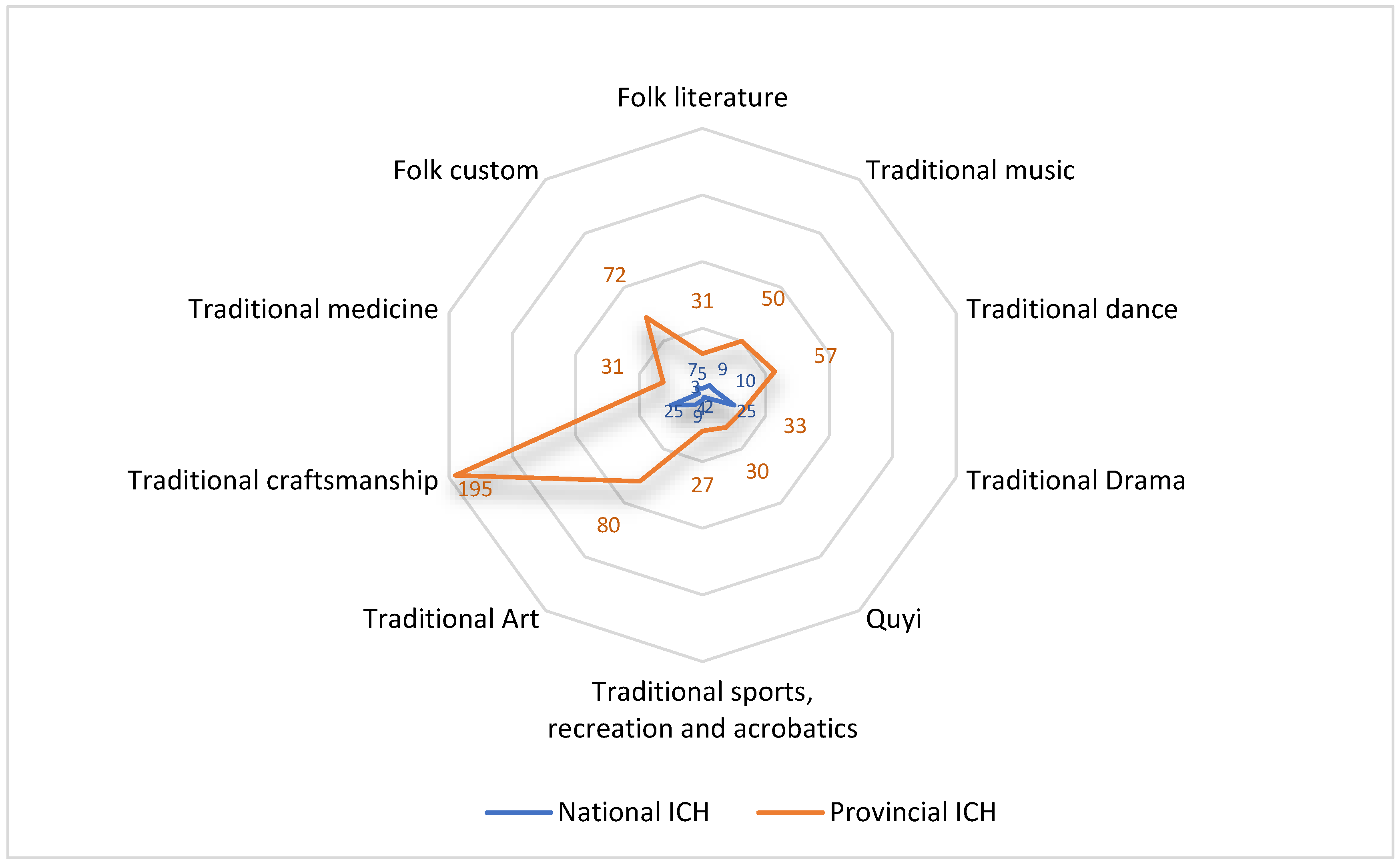
Clarifying the current situation of tourism development and distribution of ICH resources is a prerequisite for analyzing the transformation and utilization of HHC and ICH tourism. According to UNESCO’s classification of ICH, the ICH of Anhui Province in 2024 can be divided into ten categories: folklore, traditional music, traditional dance, traditional drama, Quyi (China’s various ‘rapping art’ collectively, using oral folklore and the art of singing for the long-term development of a form of art), traditional sports recreation and acrobatics, traditional art, traditional craftsmanship, traditional medicine, and folk custom. In this paper, radar charts are used, which can more intuitively show the relationship between different types of national and provincial ICH in Anhui Province (Figure 2). This not only aids in summarizing the various categories of national and provincial ICH but also offers data support for future study. This paper also obtains the number of different types of national and provincial ICH in Anhui Province and then calculates the proportion of national and provincial ICH in Anhui Province (Table 1).
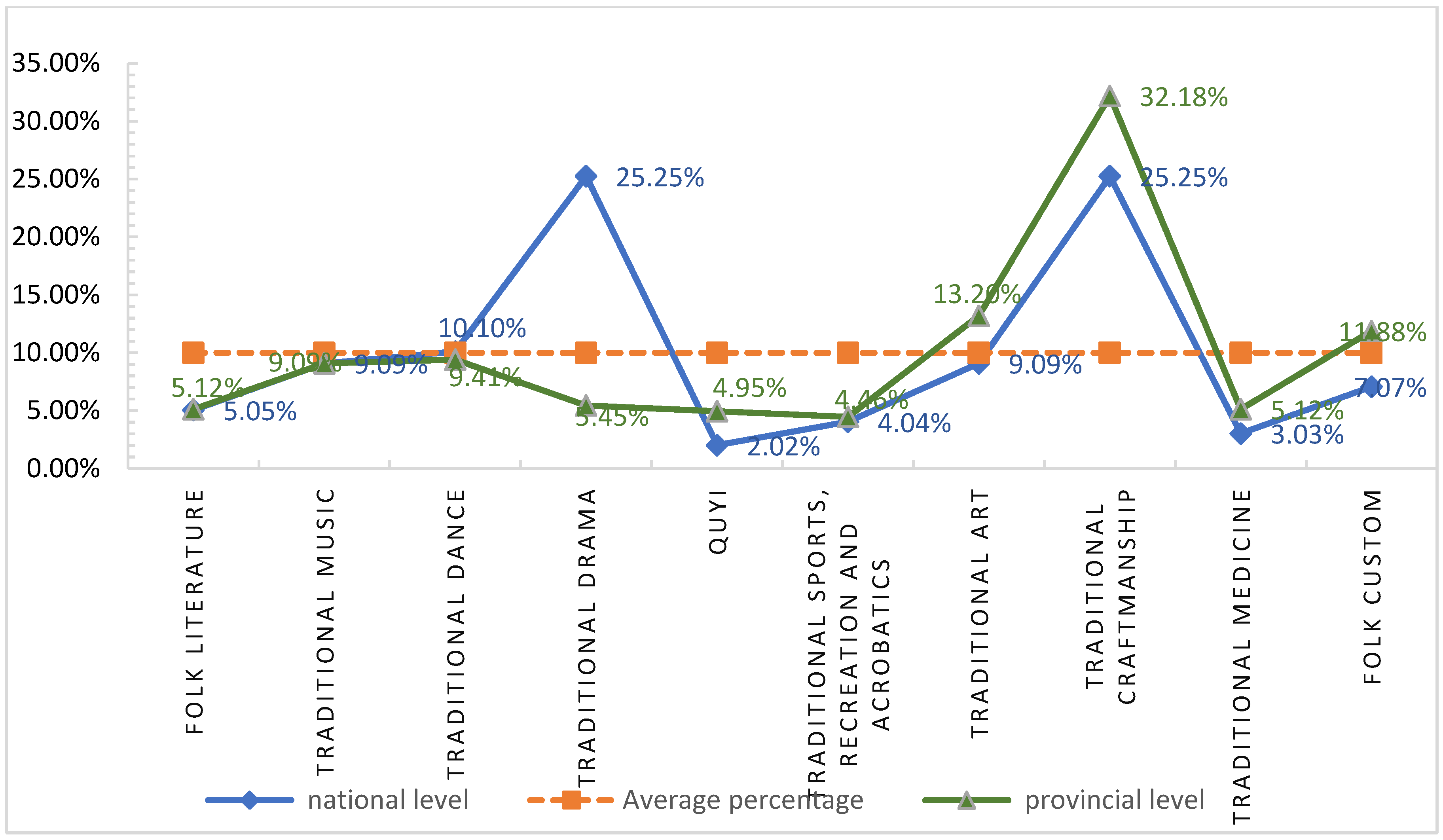
In this paper, we also obtain the number of national and provincial ICH projects and then calculate the proportion of national and provincial ICH projects in Anhui Province (Figure 3). The data of national ICH were obtained from the official China Intangible Cultural Heritage website (https://www.ihchina.cn/) and the data on provincial ICH were obtained from the official website of Anhui Provincial Department of Culture and Tourism (https://ct.ah.gov.cn/).
As can be seen from Table 1 and Figure 3, among the national ICH in Anhui Province, traditional drama and traditional craftsmanship account for the highest proportion, both at 25.25%; followed by traditional dance and traditional art at 10.10% and 9.09%, respectively; and Quyi at the lowest proportion, at 2.02%. Among the provincial ICH in Anhui Province, traditional craftsmanship accounts for the highest proportion at 32.18%, followed by traditional art and folk custom at 13.20% and 11.88%, respectively, and traditional sports recreation and acrobatics have the lowest proportion at 4.46%.
The above phenomenon is closely related to the characteristics of the geographical unit of Anhui and the historical migration of its population. In the past, due to natural geographical barriers and backward transportation conditions, the ICH resources in Anhui were relatively independent and well-preserved, and it was easy to form a production and lifestyle with regional characteristics. Summarizing the ICH resources of Anhui Province, it is found that the ICH projects are mainly related to the life and production of the ancient ancestors in the Anhui region, rituals, recreation, and other aspects, such as the customs of lifting the pavilion, book fairs, temple fairs, ancestor sacrifices, and other customs, as well as songs and dances such as dragon dances, lantern dances, Hui Opera, Huangmei Opera, etc., and there are also the traditional crafts of daily necessities, such as Jieshou colored ceramics, Wan’an compass, Hui ink, Xuan paper, Sheyan inkstone, and green tea. The reason why the number of projects in the category of Quyi is low at the national and provincial levels is that some projects related to Quyi are recognized as traditional drama and traditional music, such as suona art, Yuexi Gaoqiang, Qingyang qiang, Siping tong, etc., which are not categorized into Quyi, resulting in the percentage of ICH projects in the category of Quyi being in a situation of a double low at the national and provincial levels. As can be seen from Figure 2, traditional drama and traditional craftsmanship account for the highest proportion of national ICH, which coincides with the social phenomenon that Anhui’s dramas, such as Inkstone and Xuan Paper, are household names. Among the provincial ICH in Anhui, traditional craftsmanship accounts for the highest proportion, followed by traditional art and folk custom, which rank second and third, respectively. It can be seen that Anhui Province still has a large number of high-quality ICH resources that have not yet been fully developed, which lays a solid foundation for the rapid and high-quality development of ICH tourism in Anhui.

3.2. Spatial Distribution of Tourism Resources, ICH Tourism Resources, and HCC

To better clarify the current situation of tourism utilization of ICH and the characteristics of different cities in using intangible cultural resources to develop tourism, we analyzed the specific problems faced by each region and proposed targeted development paths. Based on the analysis of the quantitative structure and spatial distribution characteristics of ICH, this research presents a visualization of the geographic information about tourism resources and ICH resources.

3.3. Spatial Distribution of A-Level Scenic Spots, ICH A-Level Scenic Spots, and HCC Spots

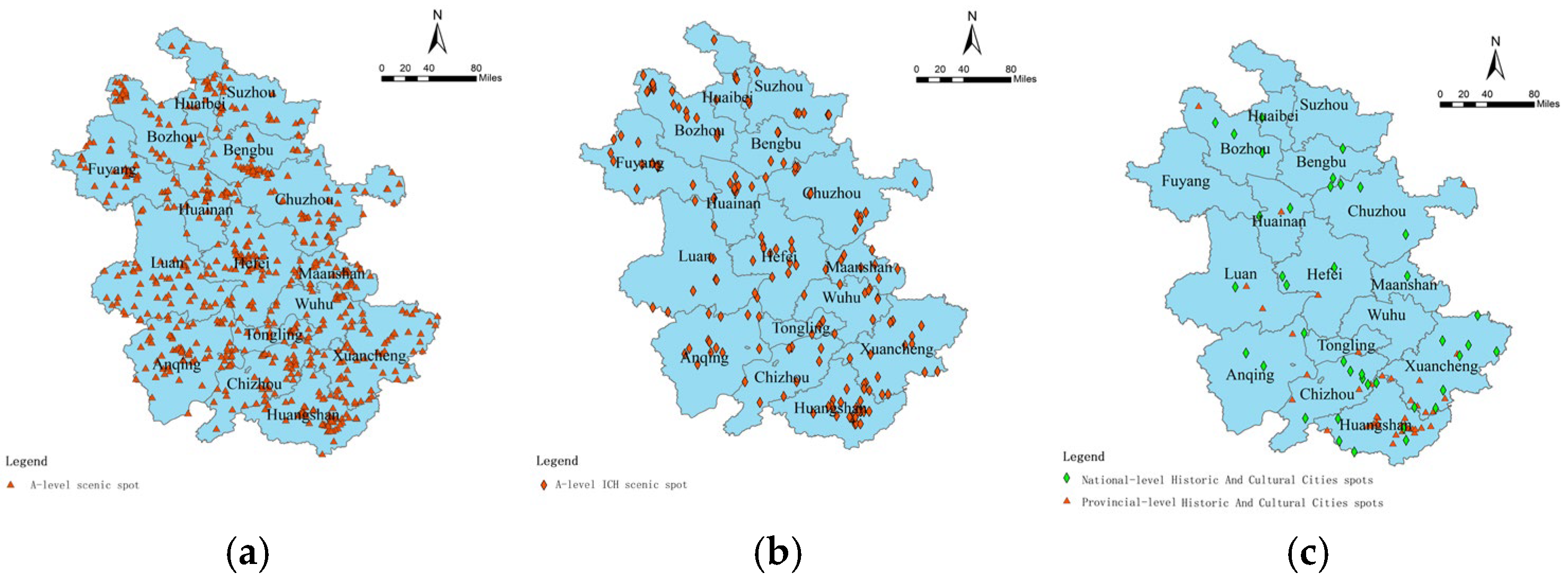
The specific steps are as follows. Firstly, we summarized the list of A-level scenic spots in Anhui Province as of 2024. Then, 10 experts in the field of ICH and tourism were invited to screen out scenic spots with ICH characteristics as ICH scenic spots from the A-level scenic spots (Table 2). Finally, ArcGIS was used to analyze the spatial visualization of A-level scenic spots (Figure 4a), A-level ICH scenic spots (Figure 4b), and HCC spots (Figure 4c), and then to analyze the spatial distribution characteristics of tourism resources, ICH tourism resources and HCC in different cities.
According to Figure 4a, A-level scenic spots in Anhui Province are mainly distributed in Anqing and Hefei, followed by Lu’an and Xuancheng, and the number of A-level scenic spots in Huaibei is the lowest; according to Figure 4b, the A-level ICH scenic spots are mainly distributed in Huangshan City, Bozhou City, and Xuancheng City, and the numbers of A-level ICH scenic spots in Huaibei City and Tongling City are the lowest; according to Figure 4c, the number of HCCs in Huangshan City is the largest and the most concentrated, and the numbers of HCCs in Suzhou City, Fuyang City, and Wuhu City are the least.

3.4. Spatial Distribution of the Richness of Tourism Resources, ICH Tourism Resources, and HCC

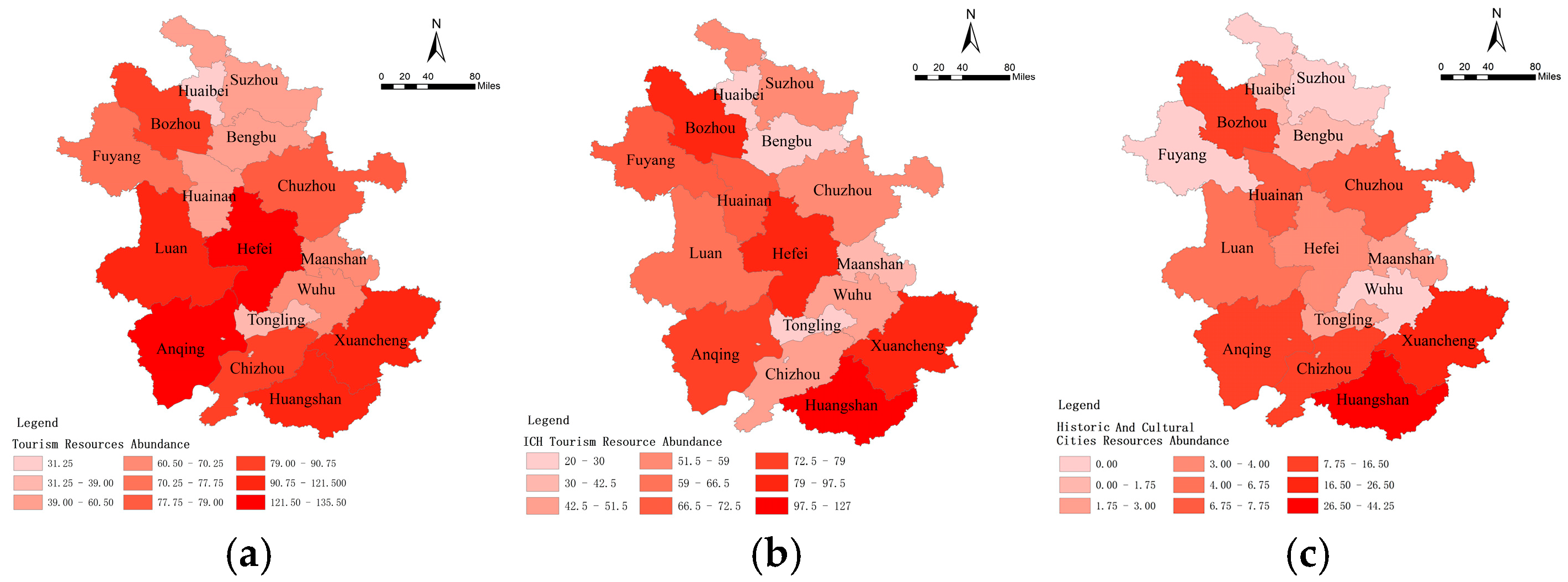
The abundance of tourism resources and ICH resources, as well as HCCs, in sixteen cities in Anhui Province were calculated by Formulas (3), (5), and (7). The spatial distribution maps of tourism resources, ICH resources, and HCC were generated by ArcGIS 10.8 (Figure 5a–c).
As illustrated in Figure 4, the spatial distribution of tourism, ICH, and HCC resources across Anhui Province exhibits significant regional heterogeneity. As shown in Figure 5a, tourism resource abundance is highest in Anqing and Hefei (ranked equally), followed sequentially by Lu’an, Xuancheng, Huangshan, Bozhou, Chizhou, Chuzhou, Fuyang, Wuhu, Ma’anshan, Huainan, Suzhou, Bengbu, Tongling, and Huaibei. Figure 5b reveals that ICH resources demonstrate a distinct distribution pattern, with Huangshan possessing the greatest abundance, followed by Bozhou, Xuancheng, Hefei, Anqing, Huainan, Fuyang, Lu’an, Chuzhou, Suzhou, Chizhou, Wuhu, Ma’anshan, and Bengbu, while Huaibei and Tongling share the lowest levels. Regarding HCC resources (Figure 5c), Huangshan leads significantly again, followed by Anqing, Xuancheng, Chizhou, Bozhou, Chuzhou, Huainan, Lu’an, Hefei, Ma’anshan, Tongling, Huaibei, and Bengbu, with Fuyang, Suzhou, and Wuhu exhibiting equivalent minimal levels.

3.5. Kernel Density Distribution of ICH and HCC

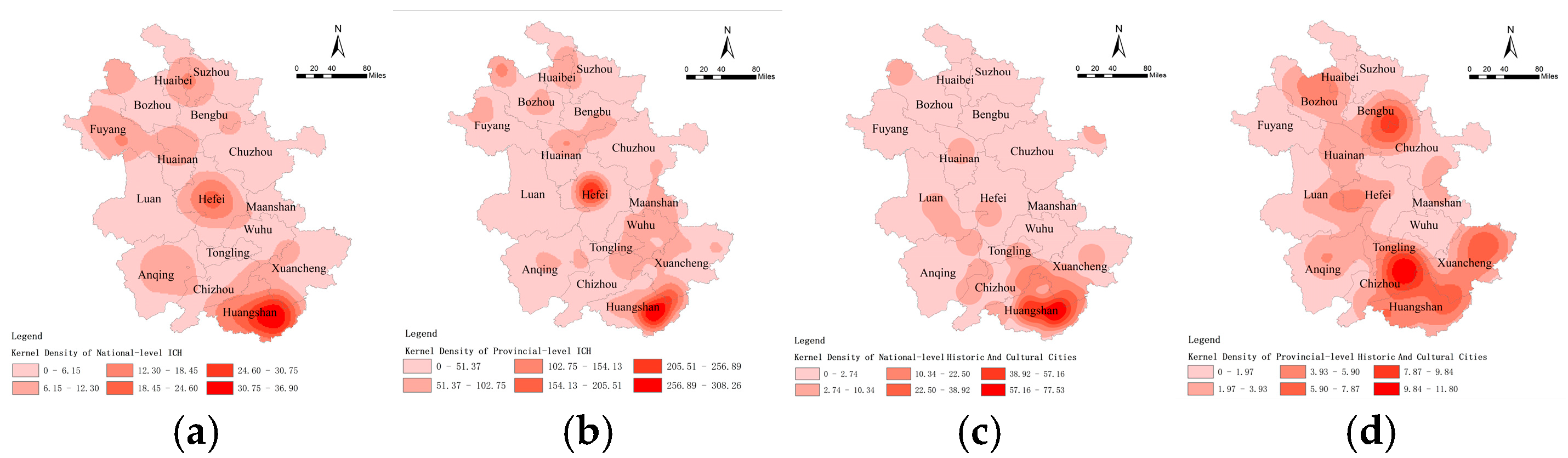
In this research, the kernel density analysis tool in ArcGIS 10.8 was used to calculate the data of national and provincial ICH and HCCs in Anhui Province by applying Formula (2) and finally generated the kernel density distribution maps of ICH and HCCs at the national and provincial levels (Figure 6).
As can be seen in Figure 6a, national ICH in Anhui Province is distributed into a main core area and several sub-core areas: the main core area is located in Huangshan City, and the sub-core areas are distributed in Hefei City, Anqing City, Fuyang City, Huainan City, and the borders of Suzhou and Huaibei Cities. From Figure 6b, it can be seen that Anhui’s provincial intangible culture is distributed into two main core areas and several sub-core areas: the main core area is located in Huangshan City and Hefei City, while the sub-core areas are distributed in Maanshan City, Wuhu City, Tongling City, and Xuancheng City in the southern Anhui region, and Huainan City, Bengbu City, Huaibei City, and Suzhou City in the northern Anhui region. As can be seen from Figure 6c, the national-level HCCs in Anhui Province are mainly concentrated in Huangshan City, Xuancheng City, Tongling City, and Chizhou City, with a small number of them being distributed in Hefei City, Lu’an City, and Huainan City. As can be seen from Figure 6d, the provincial-level HHCs in Anhui Province show a belt-shaped distribution from south to north and are mainly located in Tongling City, Chizhou City, Huangshan City, and Xuancheng City, as well as the intersection of Chuzhou City and Bengbu City.
Generally speaking, the national and provincial ICH in Anhui Province is mainly concentrated in the mountainous cities in southern Anhui Province and cities along the Yangtze River, such as Huangshan City and Xuancheng City in southern Anhui Province and Anqing City, Tongling City, and Wuhu City along the Yangtze River; a small number of them are distributed in the plain cities in northern Anhui Province, such as Huaibei City and Suzhou City. Anhui’s national HCCs are mainly concentrated in Huangshan City, in the south of Anhui Province, and Tongling City, Wuhu City, and Maanshan City along the Yangtze River; provincial HCCs are also mainly located in Chizhou City, Tongling City, Huangshan City, and Xuancheng City in the south of Anhui Province, and a small number of them are located in Huaibei City and Bozhou City. It can be seen that there is a certain positive correlation between the density and spatial distribution of HCCs and ICH in Anhui Province.

3.6. Spatial Nearest Neighbor Characteristics of ICH Resources and HCC

The nearest-neighbor index (NNI) of national-level ICH was calculated by Formula (1), using the spatial data tool in ArcGIS 10.8, and the calculated NNI is 0.559873, the Z value is −8.377727, the p value is 0.000, and the NNI value is ≥0.5. Therefore, the distribution of national-level ICH in Anhui Province is random. The NNI obtained by calculating the nearest neighbor index of Anhui’s provincial ICH is 0.404137, the Z value is −29.084904, the p value is 0.000, and the NNI value is ≤0.5. Therefore, the provincial ICH of Anhui province is clustered. The NNI of the national HCCs in Anhui Province is 0.952715, the Z value is −0.586246, the p value is 0.557710, and the NNI value is ≥0.5. Therefore, the distribution of the resources of HCCs in Anhui Province is random. The NNI of Anhui’s provincial HCCs is 0.937455, the Z value is −0.756749, the p value is 0.449200, and the NNI is ≥0.5. Therefore, the provincial HCCs of Anhui province are also random.

3.7. Characteristics of ICH Tourism and HCCs in Anhui Province

Establishing the Matrix of ICH Tourism and HCCs

To observe the current situation and characteristics of ICH tourism utilization in different cities more clearly, we analyze the role of HCCs in ICH tourism and propose targeted development strategies; this research constructs a matrix of ICH tourism and HCCs.
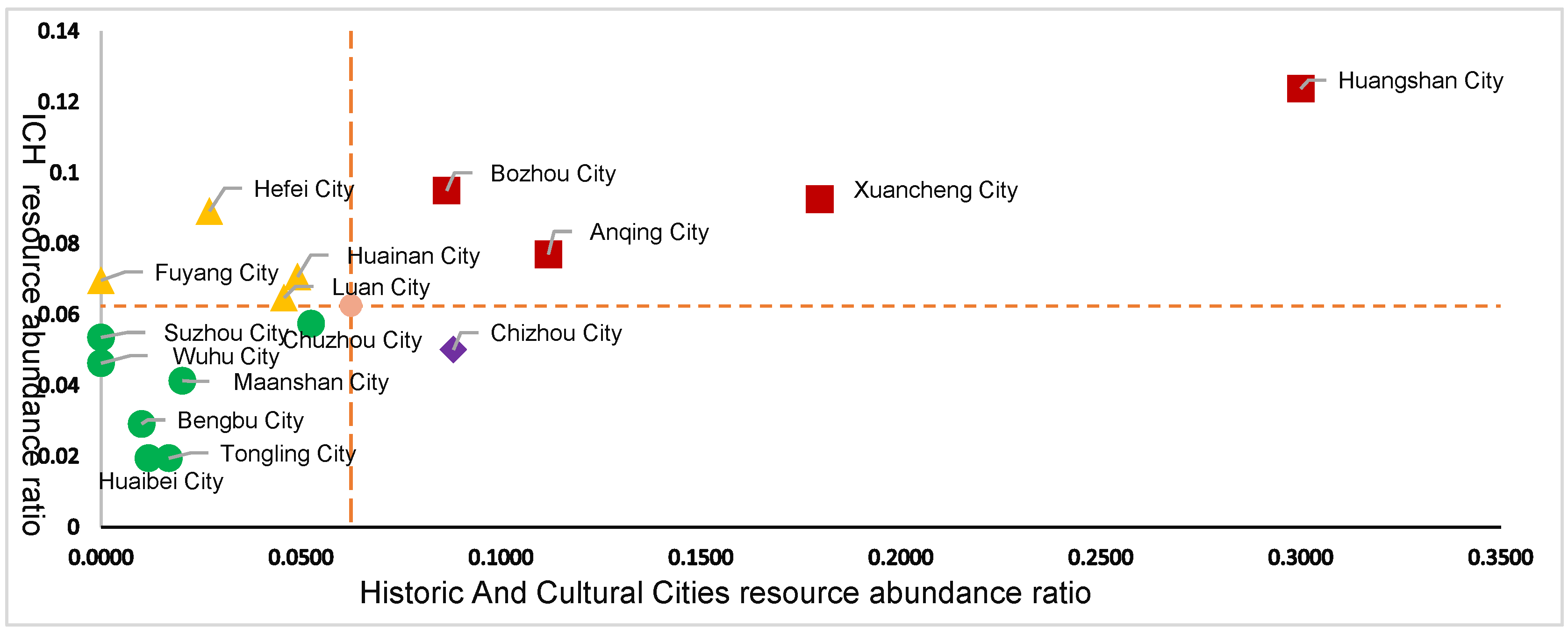
The specific steps are as follows. The data related to ICH and HCC of sixteen cities in Anhui Province in 2024 are summarized in a table (Table 3) and the results related to ICH tourism and the HCCs of sixteen cities in Anhui Province, calculated by Equations (3)–(8), are brought together in a table (Table 4). Based on the ratio of ICH tourism and HCCs in Table 4, a matrix of ICH tourism potential was established. The dotted line in the matrix represents the dividing line, and the value of both the horizontal and vertical dotted lines is 0.0625 (Figure 7).

4. Discussion

4.1. Interpretation of Key Findings

4.1.1. The Correlation Between Intangible Cultural Heritage and Material Spatial Elements

Through mathematical modeling and spatial analysis, this study reveals the correlation between ICH and HCCs in Anhui Province in two key dimensions. First, there is a positive correlation of spatial distribution: the distribution of ICH and HCC in Anhui Province is not balanced and shows the clustering effect of ‘the more abundant, the more abundant, the more barren, the more barren’, which indicates that there is a significant positive correlation between the two. Second, there is a difference in tourism potential: some resource-rich cities have successfully transformed their cultural assets into tourism attractions, while other cities, especially those with relatively scarce resources or in transition, have yet to explore the tourism potential of their cultural resources.

4.1.2. Urban Classification and Development Pathways Based on the “Resources-Potential” Model

Uneven development exists within many provinces in China. The study categorizes cities into four types of development and matches each type with a corresponding development strategy. This study provides a roadmap for Guangdong, Zhejiang, Sichuan, and other major tourism provinces to solve the problem of intra-provincial development disparities. In addition, the two-dimensional analysis model of ‘resource agglomeration effect—tourism potential difference’ and the classification of cities with different resource endowments provide a standardized, replicable, and comparable analytical tool for other regions to study similar issues. Scholars at home and abroad can use this framework to analyze the distribution pattern of cultural heritage in their own countries or regions, so as to conduct comparative studies across regions and cultures.
Based on the research findings, we try to build a government-guided, market-operated, social participation long-term mechanism to promote the synergistic development of the regional ICH tourism economy: government departments should collaborate to establish a regular coordination mechanism between the cultural and tourism, planning, and construction departments; formulate a cross-regional ICH tourism development plan; and set up special support funds to guide the rational allocation of resources. Universities and research institutes should provide intellectual support and technical guidance, enterprises should invest in market-oriented operation and product development to form economic benefits, and ICH inheritors and communities should participate in living heritage to create a good atmosphere for inheritance and development.
In a global context, analyzing the commonalities and characteristics of the development paths of cities in Anhui, it is clear that the key to future development lies in stepping out of the ‘resource determinism’ and shifting to a more refined positioning, deeper integration, and a more innovative expression. For resource-rich cities (e.g., Huangshan, Anqing), the goal is to move from ‘attraction’ to ‘destination’. The focus is to learn from Gifu Shirakawa-go Happo House, break through the ticket economy, and create greater comprehensive income by creating high value-added experiences and extending the length of time tourists stay in the city. For cities with distinctive characteristics (e.g., Fuyang, Tongling), the strategy is to move from ‘resources’ to ‘brands’. The key is to learn from the experience of Venice and Scotland, to carry out thematic and industrialized development, and to transform individual advantages into core competitiveness. For cities with potential to be explored (such as Huaibei and Bengbu), the key is from ‘integration’ to ‘highlights’. Although they may lack top-notch resources, they can combine their industrial, transport, and other modern urban characteristics to explore innovative integration modes such as ‘industrial heritage + ICH’ and ‘urban hub + culture and leisure’.

4.2. Characteristics and Suggestions for ICH Tourism in 16 Cities in Anhui Province

Figure 7 can be used not only to reflect the current characteristics of ICH tourism resources and HCC resources in each city but also to explain the reasons and development potential of ICH and HCC characteristics. According to the four quadrants of the matrix, the sixteen cities in Anhui Province are categorized as “high-potential ICH tourism–high-potential HCC”, “high-potential ICH tourism–low-potential HCC”, “low-potential ICH tourism–low-potential HCC”, and “low-potential ICH tourism–high-potential HCC”.

4.2.1. Characteristics and Suggestions for “High-Potential ICH Tourism–High-Potential HCC” Cities

As can be seen from Figure 7, Huangshan City, Xuancheng City, Anqing City, and Bozhou City are located in the first quadrant of the matrix, and all four cities are of the ‘high-potential ICH tourism–high-potential HCC’ type. They are ‘double-high’-type cities. Huangshan City ranks first in both the HCC and ICH indexes in Anhui Province, and the other three cities also have indexes that are above average. The reasons for this result are closely related to the construction of HCCs, geographical resource endowment, infrastructure construction, and the economic development level of each city.
Huangshan’s rich HCC resources, ICH resources, and large number of natural landscape resources have laid a good resource foundation for the initial development of ICH tourism and historical and cultural city tourism in the city, relying on the tourism industry. In 2024, Huangshan City received 92.229 million tourists, with a total tourism revenue of CNY 84.177 billion [60]. The average age of tourists has dropped from 37.6 years old last year to 36 years old, which shows that the attractiveness and market potential of Huangshan tourism is continuously increasing. Huangshan City should give full play to its numerous resource advantages as an HHC and continue to play the role of tourism as a driving force for the development of ICH tourism and the role of ICH tourism as a facilitator for the construction of HHC. Not only should we focus on building well-known brands, but we should also endeavor to enhance the tourism conversion rate of ICH in HHC and strengthen the further integration of tourism and ICH projects.
The fact that Xuancheng City is the only pilot city in the province for the preparation of programs and technical guidelines for the protection and transmission of urban and rural history and culture, and that it has set up permanent institutions, such as historic and cultural city protection centers, at the city and county levels, are indicative of its greater investment in systematic protection and management. Although Bozhou itself is a national historic and cultural city with three historic and cultural cities, the number of Chinese historic and cultural towns under its jurisdiction was relatively small in earlier statistics. Xuancheng City has a forest landscape area of more than 1.1 million mu, and Jing County, under its jurisdiction, has achieved an output value of CNY 2.5 billion of forest recreation industry in 2023, and received 4.13 million forest tourism and recreation trips, which confirms the competitiveness of its development of convalescent tourism in the aging era. Xuancheng City should give full play to its natural ecological advantages and focus on the development of the forest recreation industry. Bozhou City’s tourism development is more focused on its profound history and cultural relics. In terms of adaptive use, Bozhou should carry out a conservation development model based on historic districts and buildings, with new functions such as community services and cultural creativity being implanted in historic buildings after they have been repaired. The closed natural geographical unit of Anqing City has preserved ICH resources that are relatively intact. Anqing has 415 ICH projects at the national, provincial, municipal, and county levels, including 8 at the national level and 39 at the provincial level. There are 357 ICH representative inheritors above the municipal level; 22 municipal ICH inheritance bases have been established. However, due to geographical closure and relatively backward infrastructure development, the resulting attractions are isolated and lack overall attractiveness. Therefore, Anqing should let the ICH move from the state of ‘being protected’ to the market and turn it into a tourist attraction, optimize the route network, strengthen the transformation of ‘road and landscape integration’, and build scenic routes, so as to improve the accessibility and experience of sightseeing.

4.2.2. Characteristics and Suggestions for “High-Potential ICH–Tourism-Low-Potential HCC” Cities

Figure 7 shows that Hefei, Huainan, Lu’an, and Fuyang are located in the second quadrant of the matrix. Their ICH tourism indexes are all above the average value, while the index of HCCs is below the average value. They are ‘high–low’ type cities. Among them, Lu’an City has the lowest ICH tourism index and Fuyang City has the lowest HCC index. This is related to the urban development orientation and the historical evolution of the two cities.
Located in the western part of Anhui Province, Lu’an City is a historical and revolutionary old area integrating mountainous areas, reservoirs, and flood storage areas. Lu’an City has a long history and culture, but long-term disorderly development has destroyed a large number of historical monuments. Although a certain amount of ICH resources has been preserved in the mountainous areas and villages, it lags behind other cities in the province in terms of the construction and evaluation of HCCs.
Fuyang City is an agricultural town in the northern Anhui province, with national ICHs such as Fuyang paper-cutting, Yingshang flower drum lanterns, and Jieshou colored pottery. However, its positioning as a major agricultural city and floodplain makes its image as a tourist destination poor, and the construction of Fuyang City as an HCC lags far behind other cities in the same province.
Therefore, Lu’an City should learn from the experience of establishing eight national and provincial ICH workshops (the highest number in the province), continue to grow the inheritance team through the mode of ‘base + inheritor + craftsman’, and build high-quality historical and cultural scenic spots. Fuyang City, on the other hand, should enhance its tourism image through policy guidance and precise marketing, and take the initiative to join forces with the Fuyang City Circle Cultural and Tourism Alliance to carry out promotional activities. Hefei is a national science and technology innovation pilot city and a comprehensive national science center. Hefei is systematically building a ‘world-class science tourism destination’, which provides a top platform for the deep integration of science and technology with culture and tourism. The culture and tourism development model of tourism around Chaohu Lake has achieved remarkable results; in 2024, Chaohu received 12.321 million tourists and had a tourism revenue of up to CNY 4.29 billion, up by 20.7% and 50.1% year-on-year, respectively.
Therefore, Hefei can create diversified consumption scenarios: Hefei should learn from the successful experience of Chaohu Ear Street and Zhegao Old Street, integrate the ICH experience, morning tea culture, and night market consumption into the ‘business, culture, and tourism’ scenarios, and take the initiative to dock with the province’s high-quality resources. Hefei can be the initiator to link ICH resources in Huangshan, Xuancheng, and other places to design cross-regional ICH tourism lines.
In the early economic construction, Huainan was positioned as a resource-based city that was devoted to the development of coal and power industries, and paid relatively little attention to the tourism industry. Huainan City has one item on the reserve list of world cultural heritage, one national great site, and 739 cultural relics of various kinds. However, the construction of Huainan’s historical and cultural cities is relatively backward, with only one entry in the national and provincial HCC ratings.
Therefore, Huainan City should endeavor to adjust its economic structure, actively develop the tourism industry, and make use of its rich and high-quality HHC resources, as well as ICH resources, to improve the construction and development of the HCC in order to accelerate the development of ICH tourism.

4.2.3. Characteristics and Suggestions for “Low-Potential ICH Tourism–Low-Potential HCC” Cities

As can be seen in Figure 7, Chuzhou, Maanshan, Bengbu, Tongling, Huaibei, Suzhou, and Wuhu are in the third quadrant, and their HCC indexes and ICH indexes are lower than the average level, belonging to the ‘double-low’-type of cities. Among them, Suzhou City and Wuhu City have the lowest HCC indexes, while Huaibei City and Tongling City have the lowest ICH tourism indexes.
Chuzhou City is closest to the origin of the coordinates in the third quadrant, which coincides with its current state of urban development. Chuzhou has a complete list of famous historic and cultural cities, towns, and villages and a certain number of ICH projects. In Chuzhou’s Zunyang Street Historical and Cultural Block, more than 50 ICH skills have been successfully introduced, making the block’s cultural characteristics account for more than 50% of the business, proving the great potential of the integration of ICH and tourism. However, Chuzhou City has the problem of an insufficiently concentrated distribution of advantageous resources and a shortage of professionals.
In response to the above problems, Chuzhou City should be designed through the ‘landscape and ICH’ theme line, the Langya Mountain, Qingliuguan, Xijian Lake, and Zunyang Street ICH workshop organic series; for professionals in the settlement, children’s education, scenic services, and other aspects of the provision of facilities need to attract talent to improve services. Maanshan City’s early urban orientation was that of an industrial city, known nationwide for the Maanshan Iron and Steel Group. The city has long relied on the iron and steel industry for its development, and through industrial transformation, it has committed itself to developing new industry clusters, such as information technology, artificial intelligence, and new energy. As a result, the city’s economic development focuses on modern manufacturing and the digital economy, while tourism development started late and the construction of HCCs lagged.
Maanshan, on the one hand, can use the perfect industrial system to develop characteristics of industrial tourism. On the other hand, it can also take advantage of the fact that the ICH can be fully integrated into scenic spots, neighborhoods, and festivals, so that the ICH from the static display to the dynamic experience and fashionable consumption contributes to the diversified development of the tourism industry. Bengbu City is a transport hub city developed in modern times and does not have an advantage for ICH and HCC, which require historical deposits and inheritance. At present, Bengbu City does not have a national 5A-level tourist attraction, which largely affects Bengbu’s attractiveness and competitiveness in the national tourism landscape. In addition, in Bengbu City, there are scattered attractions, which find it difficult to attract domestic and foreign tourists. To address the core issues of ‘scattered attractions’ and ‘insufficient brand power’, Bengbu can integrate the spatial and thematic dimensions and focus on creating core IPs; secondly, Bengbu should develop its own advantages as a transport hub and strengthen cooperation with neighboring cities for synergistic development.
Tongling and Huaibei are closest to each other in the third quadrant, which indicates that the current development of the two cities is the most similar and that the two cities do not have obvious advantages in terms of HCC resources. Tongling has formed a complete resource-based industrial chain of metal smelting, sulfur and phosphorus chemicals, building materials, and electronic materials, with copper as its core industry. Huaibei City is a typical coal resource-based city that has achieved certain economic development through its energy advantage and raw material industry. However, due to the small geographical area of the two cities, they have a single industrial structure and insufficient investment in the construction of ICH and HCC.
Such cities should develop a tourism specialty. For example, Huaibei City can explore wetland resources and build leisure and holiday tourism that is led by cultural and ecological experiences. Tongling City can give full credit to the characteristics of its tourism resources, highlighting the theme of copper culture, and develop a combination of copper culture tourism resources, such as the ancient Tongling mining site and the Tongguanshan Cultural and Creative Park. Combined with the production of traditional craftsmanship to enrich the sense of participation of tourists, this would create a unique Tongling characteristic of the tourism experience.
Suzhou and Wuhu are also relatively close to each other in the third quadrant, suggesting some similarity in their current development characteristics. Both cities rank last in Anhui Province in the HCC index, as does Fuyang; the level of ICH is slightly below average.
Wuhu City is supported by industries such as automobiles and parts and electronics and electrical appliances; the value added of the industry grew by 10.4 per cent in 2024. Tourism is not a key direction for the city’s development. Wuhu City’s previous tourism was dominated by convention and exhibition tourism and holiday tourism, and the development and design of tourism routes have not yet matured, so the economic benefits of tourism are not high. Therefore, Wuhu City should increase policy guidance and support the initiative to promote Hefei, Maanshan, and other neighboring cities, and jointly design cross-regional tourism routes, to promote the interactive development of ICH tourism and Wuhu City’s advantageous industries. Suzhou City, on the other hand, needs to transform its rich ICH resources and excellent ecological environment into perceptible and experiential tourism products. Combining the 15 new municipal ICHs added in 2025 with traditional festivals and folklore activities to create regular and interactive ICH exhibitions and experiences will attract tourists’ participation.

4.2.4. Characteristics and Suggestions for “Low-Potential ICH Tourism–High-Potential HCC” City

As can be seen in Figure 7, Chizhou is located in the fourth quadrant, with an above-average HCC index and a below-average ICH tourism index. This indicates that it is relatively abundant in HCC resources, but relatively scarce in ICH tourism resources, and is a ‘low–high’ type of city.
Chizhou City has four national-level ICHs and 27 provincial-level ICHs, covering categories such as traditional theater, traditional music, and traditional skills. However, its level is lower than the provincial average, and the development of ICH attractions is uneven, with high-level historical and cultural resources scattered and distributed, and the overall synergy is insufficient. Therefore, Chizhou should combine sports, festivals, night tourism, and other forms of business to create boutique tourism routes and projects, linking different counties, districts, and types of ICH projects with local natural scenery and historical monuments, and solving the problem of spatial dispersion.

4.3. Limitations and Future Research

The contribution of this study is to explore the distribution pattern and relevance of ICH resources in Anhui Province from the perspective of the material space of HCCs. Firstly, this study establishes a series of mathematical formulas to quantify the abundance of tourism resources, ICH tourism resources, and HCC resources, which lays the foundation for the establishment of the “ICH Tourism—HCC” matrix. Secondly, this study conducted spatial and matrix analyses of ICH tourism resources and HCC resources through ArcGIS, which provides a reference for urban planners in Anhui Province to formulate reasonable ICH tourism strategies by taking into account the current ICH tourism potentials of each city.
This paper empirically explores the competitive relationship between ICH and the tourism market in Anhui Province, through mathematical computational analysis and spatial visualization analysis. However, there are still some limitations. The determination of ICH scenic spots and the use of experts to determine the weights of A-level ICH tourism resources and HHC resources are still highly subjective. Although peer review is a commonly employed method for assessing heritage value, the knowledge backgrounds, value orientations, and even regional sentiments of different experts may exert potential influences on evaluation outcomes, making it difficult to achieve fully unified standards. Future research could explore constructing hybrid models that integrate objective statistical data with subjective assessments to enhance the scientific rigor and transparency of the evaluation process. Secondly, the study lacks a systematic comparative international perspective, with the conclusions primarily being based on historical and cultural cities within a single nation or region. Consequently, its findings and patterns may be influenced by specific local policy environments and cultural contexts. Finally, the proposed policy recommendations remain rather superficial. While the research highlights the importance of balancing conservation with coordinated development, it would be more valuable to outline design methodologies at the spatial planning level for translating intangible cultural heritage “activity pathways” into concrete “spatial guidelines”. Future research should focus on deepening theoretical models, expanding transnational comparisons, and developing more targeted and evaluable policy tools to effectively advance the sustainable conservation and development of historic and cultural cities.

5. Conclusions

5.1. The Typological Structure of Intangible Cultural Heritage

The study found that the ICH of Anhui Province presents the distinctive feature of ‘strong in traditional craftsmanship and traditional drama, but weak in Quyi in terms of its typological structure’. Traditional craftsmanship is the absolute core, with the highest number and percentage of national and provincial ICH, reflecting Anhui’s foundations of handicraft and exquisite craftsmanship. Traditional construction techniques, such as carving, which are closely associated with spatial elements within historic and cultural cities, directly foster connections between intangible cultural heritage and tangible spatial features. This is corroborated by the fact that nearly 70% of cities in Anhui Province fall into the categories of ‘high-potential ICH tourism—high-potential HCC’ and ‘low-potential ICH tourism—low-potential HCC’.

5.2. Spatial Distribution of Material Cultural Elements

The spatial distribution of tourism resources in Anhui is uneven, with different centers of concentration, and Grade A scenic spots are concentrated in Anqing, Hefei, Lu’an, and Xuancheng, suggesting that these areas are more mature in terms of their natural scenery and comprehensive tourist attractions. The core intangible cultural heritage scenic spots are in Huangshan City, Xuancheng City, Bozhou City, and Hefei City, which are the key areas for the living inheritance of intangible heritage and tourism transformation. HCCs are highly concentrated in Huangshan City, Anqing City and Bozhou City, which are areas with extremely deep historical heritage.
Constructing the matrix of ‘ICH Tourism–HCC’, we found that there are four types of ICH tourism in HHCs in Anhui Province. Huangshan City, Xuancheng City, Anqing City, and Bozhou City show the development characteristics of a ‘high-potential ICH tourism–high-potential HCC’. Huainan City, Lu’an City, Hefei City, and Fuyang City present the development characteristics of a ‘high-potential ICH tourism–low-potential HCC’. Chuzhou City, Maanshan City, Tongling, City Huaibei, City Bengbu City, Wuhu City, and Suzhou City showed the characteristics of a ‘low-potential ICH tourism–low-potential HCC’. Chizhou City shows the development characteristics of a ‘low-potential ICH tourism–high-potential HCC’.

5.3. From Cultural Resources to Industrial Strengths

Anhui’s ICH is embedded in China’s civilizational gene pool, and its many manifestations not only preserve the collective memory of regional cultural identity but also enhance the area’s tourism industry through distinct cultural capital. The data indicate that in 2023, the consumer market scale of ICH derivatives in Anhui surpassed CNY 18 billion, with 12 ICH projects, including traditional residential construction techniques in Huizhou, generating employment for over 100,000 individuals, thereby validating the dual empowering effect of ICH’s living inheritance and innovative transformation.
By analyzing the characteristic relationship between HCCs and ICH tourism in Anhui Province, this study not only provides an important theoretical foundation and analytical framework for subsequent research but also provides an operable solution for promoting the high-quality development of ICH tourism in Anhui Province by constructing a cooperative mechanism and implementation path for multi-party participation. Each stakeholder should play to its own advantages, form a concerted effort, and jointly promote the transformation of ICH tourism in Anhui Province from resource advantages to industrial advantages.
Future studies on ICH should be more comprehensive and varied. Attention must be directed to the geographic disparity of ICH. Historical, geographical, and economic factors contribute to substantial disparities in the ICH across various regions. Future research should concentrate on the causes and effects of this spatial imbalance and investigate strategies that facilitate the equitable distribution of resources and coordinated regional development. Subsequently, future research should also focus on the digital preservation and transmission of ICH, using modern scientific and technological methods to digitally record, preserve, and disseminate ICH, and to expand its influence and audience.

Author Contributions

Conceptualization, Z.X. and L.C.; methodology, Z.X. and L.C.; software, L.C. and Y.W.; validation, Z.X. and L.C.; formal analysis, L.C. and Y.W.; investigation, D.G., Z.X. and L.C.; resources, D.G., L.C. and Y.W.; data curation, L.C. and Y.W.; writing—original draft preparation, Z.X. and L.C.; writing—review and editing, D.G., Z.X., L.C., W.C. and Y.W.; visualization, L.C. and Y.W.; supervision, D.G.; project administration, D.G.; funding acquisition, D.G. All authors have read and agreed to the published version of the manuscript.

Funding

This work was supported by the Humanities and Social Sciences Planning Program of the Ministry of Education (Grant No. 20YJACH030).

Data Availability Statement

The datasets used and analyzed in this study are available from the authors upon reasonable request.

Conflicts of Interest

The authors declare no conflicts of interest.

Abbreviations

ICHIntangible cultural heritage
HCCHistoric and cultural city
GISGeographic information system
VRVirtual reality
ARAugmented reality

References

  1. Dong, B.; Bai, K.; Sun, X.; Wang, M.; Liu, Y. Spatial distribution and tourism competition of intangible cultural heritage: Take Guizhou, China as an example. Herit. Sci. 2023, 11, 64. [Google Scholar] [CrossRef]
  2. Schmitt, T.M. The UNESCO concept of safeguarding intangible cultural heritage: Its background and Marrakchi roots. In Cultural Heritage Rights; Routledge: Abingdon, UK, 2017; pp. 257–274. [Google Scholar]
  3. Cominelli, F.; Greffe, X. Intangible cultural heritage: Safeguarding for creativity. City Cult. Soc. 2012, 3, 245–250. [Google Scholar] [CrossRef]
  4. Jacobs, M. The spirit of the convention–Interlocking principles and ethics for safeguarding intangible cultural heritage. Int. J. Intang. Herit. 2016, 11, 72–87. [Google Scholar]
  5. Mitsche, N.; Vogt, F.; Knox, D.; Cooper, I.; Lombardi, P.; Ciaffi, D. Intangibles: Enhancing access to cities’ cultural heritage through interpretation. Int. J. Cult. Tour. Hosp. Res. 2013, 7, 68–77. [Google Scholar] [CrossRef]
  6. Arcos-Pumarola, J.; Paquin, A.G.; Sitges, M.H. The use of intangible heritage and creative industries as a tourism asset in the UNESCO creative cities network. Heliyon 2023, 9, e13106. [Google Scholar] [CrossRef]
  7. Gwerevende, S.; Mthombeni, Z.M. Safeguarding intangible cultural heritage: Exploring the synergies in the transmission of Indigenous languages, dance and music practices in Southern Africa. Int. J. Herit. Stud. 2023, 29, 398–412. [Google Scholar] [CrossRef]
  8. Xu, B.; Pan, J. Analysis of structural characteristics and spatial distribution of the national intangible cultural heritage in China and its policy implications. Sci. Cold Arid. Reg. 2019, 11, 389–406. [Google Scholar]
  9. Nie, X.; Xie, Y.; Xie, X.; Zheng, L. The characteristics and influencing factors of the spatial distribution of intangible cultural heritage in the Yellow River Basin of China. Herit. Sci. 2022, 10, 121. [Google Scholar] [CrossRef]
  10. Shao, D.; Zoh, K.J.; Xie, Y. The spatial differentiation mechanism of intangible cultural heritage and its integration with tourism development based on explainable machine learning and coupled coordination models: A case study of the Jiang-Zhe-Hu in China. Herit. Sci. 2024, 12, 414. [Google Scholar] [CrossRef]
  11. Li, X.; Zhu, R.; Shi, C.; Yang, X.; Chen, J.; Wei, K. Research on the construction of intangible cultural heritage corridors in the Yellow River Basin based on geographic information system (GIS) technology and the minimum cumulative resistance (MCR) model. Herit. Sci. 2024, 12, 271. [Google Scholar] [CrossRef]
  12. Lv, J.; Chai, Y.; Hu, X. Synergistic development of intangible cultural heritage and tourism industry: Empirical experiences from Jilin, China. PLoS ONE 2025, 20, e0313421. [Google Scholar] [CrossRef] [PubMed]
  13. Lei, H.; Zhou, Y. Conducting heritage tourism-Led urban renewal in Chinese historical and cultural urban spaces: A case study of Datong. Land 2022, 11, 2122. [Google Scholar] [CrossRef]
  14. Jiang, J.; Zang, T.; Xing, J.; Ikebe, K. Spatial distribution of urban heritage and landscape approach to urban contextual continuity: The case of Suzhou. Land 2023, 12, 150. [Google Scholar] [CrossRef]
  15. Tan, S.K.; Tan, S.H.; Kok, Y.S.; Choon, S.W. Sense of place and sustainability of intangible cultural heritage—The case of George Town and Melaka. Tour. Manag. 2018, 67, 376–387. [Google Scholar] [CrossRef]
  16. Ahmed, N. Residents support towards cultural heritage tourism: The relevance of heritage proximity and tourism perceived impacts. Rev. Tur. Stud. Cercet. Tur. 2023, 35. [Google Scholar] [CrossRef]
  17. Guo, Y.; Cao, Z.; Zhu, Z. The influence of ICH-narrator/self-congruity on tourist’s purchase intention of intangible cultural heritage products in a narrative context. J. Hosp. Tour. Manag. 2022, 52, 151–160. [Google Scholar] [CrossRef]
  18. Guo, Y.; Zhu, Z. Intangible cultural heritage souvenirs: Image congruity and brand influence on tourists’ purchase intention. Tour. Rev. 2023, 78, 1203–1216. [Google Scholar] [CrossRef]
  19. Su, J. A difficult integration of authenticity and intangible cultural heritage? The case of Yunnan, China. China Perspect. 2021, 2021/3, 29–39. [Google Scholar] [CrossRef]
  20. Zhang, Y.; Zheng, Q.; Huang, L.; Lee, T.J.; Hyun, S.S. Alienation and authenticity in intangible cultural heritage tourism. J. Sustain. Tour. 2024, 32, 2459–2478. [Google Scholar] [CrossRef]
  21. Qiu, Q. Identifying the role of intangible cultural heritage in distinguishing cities: A social media study of heritage, place, and sense in Guangzhou, China. J. Destin. Mark. Manag. 2023, 27, 100764. [Google Scholar] [CrossRef]
  22. Xie, J. Innovative design of artificial intelligence in intangible cultural heritage. Sci. Program. 2022, 2022, 6913046. [Google Scholar] [CrossRef]
  23. Liu, Y.; Chen, M.; Wang, Q. The impact of symmetry design of intangible cultural heritage souvenir on tourists’ aesthetic pleasure. Front. Psychol. 2022, 13, 987716. [Google Scholar] [CrossRef]
  24. Nie, X.; Ma, M.; Ji, J.; Zheng, L. The spatial distribution of traditional intangible cultural heritage medicine of China and its influencing factors. Herit. Sci. 2023, 11, 90. [Google Scholar] [CrossRef]
  25. Li, L. Cultural communication and diversity along the Grand Canal of China: A case study of folk songs in intangible cultural heritage. Herit. Sci. 2023, 11, 66. [Google Scholar] [CrossRef]
  26. Io, M.U. Understanding the core attractiveness of performing arts heritage to international tourists. Tour. Geogr. 2019, 21, 687–705. [Google Scholar] [CrossRef]
  27. Skublewska-Paszkowska, M.; Milosz, M.; Powroznik, P.; Lukasik, E. 3D technologies for intangible cultural heritage preservation—literature review for selected databases. Herit. Sci. 2022, 10, 3. [Google Scholar] [CrossRef] [PubMed]
  28. Chen, Z. Visualizing experiencescape–from the art of intangible cultural heritage. Curr. Issues Tour. 2022, 25, 559–578. [Google Scholar] [CrossRef]
  29. Buragohain, D.; Meng, Y.; Deng, C.; Li, Q.; Chaudhary, S. Digitalizing cultural heritage through metaverse applications: Challenges, opportunities, and strategies. Herit. Sci. 2024, 12, 295. [Google Scholar] [CrossRef]
  30. Chen, Z.; Suntikul, W.; King, B. Constructing an intangible cultural heritage experiencescape: The case of the Feast of the Drunken Dragon (Macau). Tour. Manag. Perspect. 2020, 34, 100659. [Google Scholar] [CrossRef]
  31. Chen, Y.S.; Wu, S.T. Social networking practices of Viennese coffeehouse culture and intangible heritage tourism. J. Tour. Cult. Change 2019, 17, 186–207. [Google Scholar] [CrossRef]
  32. Lamprakos, M. The idea of the historic city. Change Over Time 2014, 4, 8–38. [Google Scholar] [CrossRef]
  33. Zhao, Y.; Tang, W.; Long, L.; Wang, Z. Review and Prospect of Protection of Famous Historical and Cultural Towns and Villages in China. J. Archit. 2012, 6, 12–17. (In Chinese) [Google Scholar]
  34. Lee, S.L. Urban conservation policy and the preservation of historical and cultural heritage: The case of Singapore. Cities 1996, 13, 399–409. [Google Scholar] [CrossRef]
  35. Wang, J. Problems and solutions in the protection of historical urban areas. Front. Archit. Res. 2012, 1, 40–43. [Google Scholar] [CrossRef]
  36. Kakiuchi, E. Cultural heritage protection system in Japan: Current issues and prospects for the future. Gdańskie Stud. Azji Wschod. 2016, 10, 7–27. [Google Scholar] [CrossRef]
  37. Ragheb, A.; Aly, R.; Ahmed, G. Toward sustainable urban development of historical cities: Case study of Fouh City, Egypt. Ain Shams Eng. J. 2022, 13, 101520. [Google Scholar] [CrossRef]
  38. Fan, J.; Maliki, N.Z.; Zainal Abidin, N.A. Spatial patterns of historical and cultural blocks based on multisource data and protection and development strategies within the context of urban renewal: A case study of Xi’an, China. Landsc. Res. 2025, 50, 4–22. [Google Scholar] [CrossRef]
  39. Xu, Z.; Tian, G.; Wei, K.; Ma, Y.; Zhang, S.; Huang, Y.; Yao, X. The influence of environment on the distribution characteristics of historical buildings in the Songshan Region. Land 2022, 11, 2094. [Google Scholar] [CrossRef]
  40. Shao, J.; Liu, G.; Yuan, H.; Song, Q.; Yang, M.; Luo, D.; Zhang, X.; Tan, Y.; Zhang, Y. Evaluation and scale forecast of underground space resources of historical and cultural cities in China. ISPRS Int. J. Geo-Inf. 2022, 11, 31. [Google Scholar] [CrossRef]
  41. Zhou, L.; Ouyang, F.; Sun, Y.; Chen, W.; Li, Y.; Zhao, R. Integrated sustainable development of culture into tourist map design: A case from Foshan, China. Int. J. Environ. Res. Public Health 2022, 19, 14191. [Google Scholar] [CrossRef]
  42. Alvarez, M.D. Creative cities and cultural spaces: New perspectives for city tourism. Int. J. Cult. Tour. Hosp. Res. 2010, 4, 171–175. [Google Scholar] [CrossRef]
  43. García-Hernández, M.; De la Calle-Vaquero, M.; Yubero, C. Cultural heritage and urban tourism: Historic city centres under pressure. Sustainability 2017, 9, 1346. [Google Scholar] [CrossRef]
  44. Liang, F.; Pan, Y.; Gu, M.; Liu, Y.; Lei, L. Research on the paths and strategies of the integrated development of culture and tourism industry in urban historical blocks. Front. Public Health 2022, 10, 1016801. [Google Scholar] [CrossRef] [PubMed]
  45. Wang, J.; Fan, W.; You, J. Evaluation of tourism elements in historical and cultural blocks using machine learning: A case study of Taiping Street in Hunan Province. npj Herit. Sci. 2025, 13, 30. [Google Scholar] [CrossRef]
  46. Cheng, Y.; Chen, W. Cultural Perception of Tourism Heritage Landscapes via Multi-Label Deep Learning: A Study of Jingdezhen, the Porcelain Capital. Land 2025, 14, 559. [Google Scholar] [CrossRef]
  47. Panagiotopoulou, M.; Somarakis, G.; Stratigea, A. Smartening up participatory cultural tourism planning in historical city centers. J. Urban Technol. 2020, 27, 3–26. [Google Scholar] [CrossRef]
  48. Deng, K. Exploration of Renewal and Renovation Design of Historical and Cultural Protection Areas Based on Smart Cities. J. Civ. Eng. Urban Plan 2024, 6, 93–97. [Google Scholar]
  49. Huangshan Municipal Development and Reform Commission, Anhui Province. A Brief Analysis of the City’s Economic Performance in 2024. Available online: https://www.huangshan.gov.cn/zwgk/public/6615714/11718285.html (accessed on 8 February 2025).
  50. Rodzi, N.I.M.; Zaki, S.A.; Subli, S.M.H.S. Between tourism and intangible cultural heritage. Procedia-Soc. Behav. Sci. 2013, 85, 411–420. [Google Scholar] [CrossRef]
  51. Bucurescu, I. Managing tourism and cultural heritage in historic towns: Examples from Romania. J. Herit. Tour. 2015, 10, 248–262. [Google Scholar] [CrossRef]
  52. Lak, A.; Gheitasi, M.; Timothy, D.J. Urban regeneration through heritage tourism: Cultural policies and strategic management. J. Tour. Cult. Change 2020, 18, 386–403. [Google Scholar] [CrossRef]
  53. Wang, X.; Zhan, S. Exploring the spatial distribution of ICH by geographic information system (GIS). Mob. Inf. Syst. 2022, 2022, 8689113. [Google Scholar] [CrossRef]
  54. Han, Q.; Tao, F.; Hong, Z.; Qin, G.; Wei, Y.; Chen, Y.; Zhou, T. Research on the spatiotemporal distribution and factors influencing intangible cultural heritage in Fujian Province from a multiscale perspective. Herit. Sci. 2024, 12, 239. [Google Scholar] [CrossRef]
  55. Zhang, J.; Cenci, J.; Becue, V.; Koutra, S. Analysis of spatial structure and influencing factors of the distribution of national industrial heritage sites in China based on mathematical calculations. Environ. Sci. Pollut. Res. 2022, 29, 27124–27139. [Google Scholar] [CrossRef]
  56. Pang, L.; Wu, L. Distribution characteristics and influencing factors of intangible cultural heritage in Beijing-Tianjin-Hebei. Herit. Sci. 2023, 11, 19. [Google Scholar] [CrossRef]
  57. Collins, A. Tourism development and natural capital. Ann. Tour. Res. 1999, 26, 98–109. [Google Scholar] [CrossRef]
  58. Zhang, T.; Wang, Y.; Zhang, S.; Wang, Y.; Yu, H. Evaluation of ontological value of regional tourism resources: A case study of Hainan Island, China. J. Geogr. Sci. 2021, 31, 1015–1038. [Google Scholar] [CrossRef]
  59. Sun, G.N.; Yang, J. Effect of urbanization on the tourism development of Xi’an city over the recent 30 years. J. Shaanxi Norm. Univ. (Nat. Sci. Ed). 2014, 42, 78–84. (In Chinese) [Google Scholar]
  60. Lakićević, M.; Žarevac, M. Tourism thought as a factor of tourism development in Serbia. Hotel. Tour. Manag. 2014, 2, 29–37. [Google Scholar]
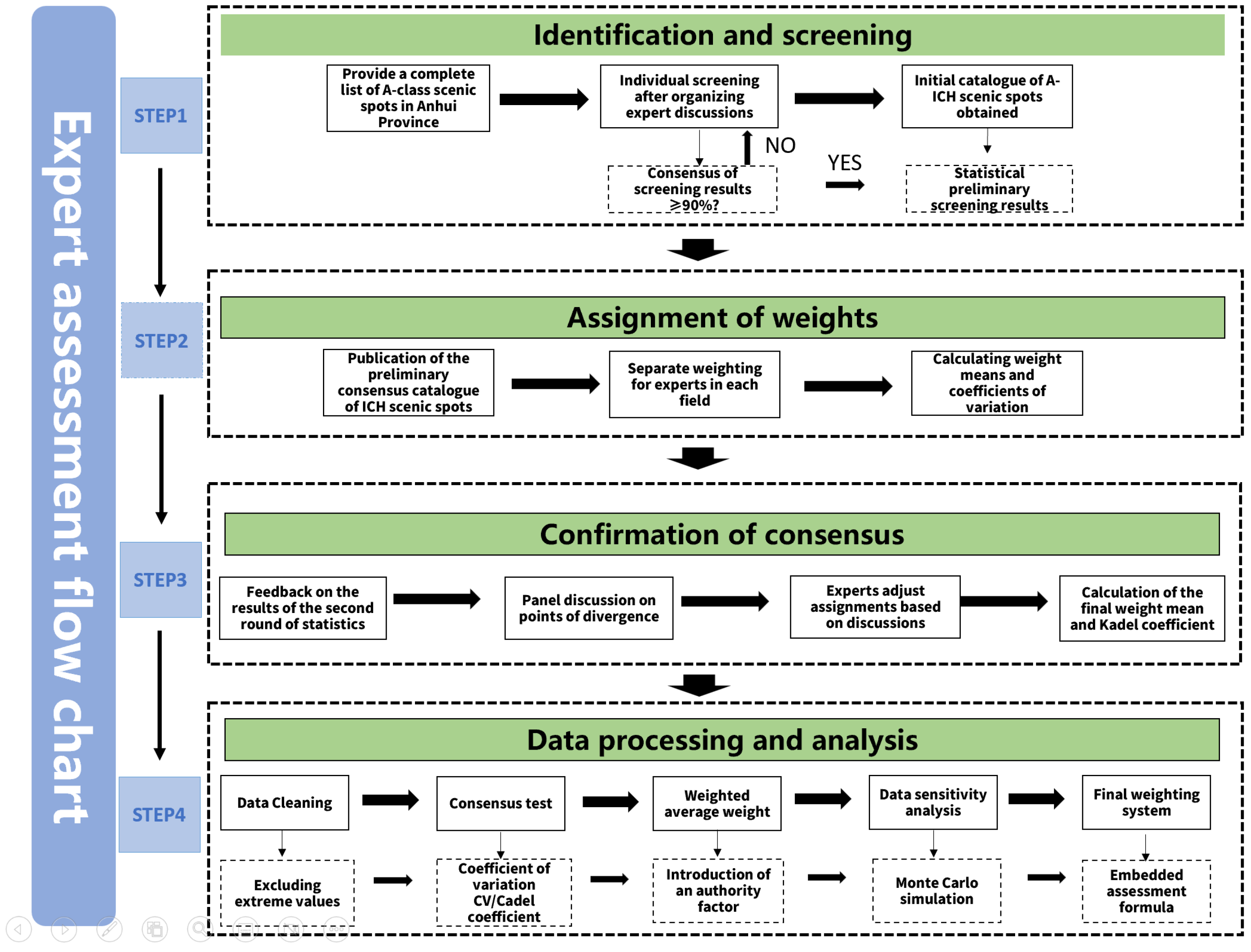
Figure 1. Expert assessment flow chart.
Land 14 02360 g001
Figure 2. Structure of national and provincial ICH types in Anhui Province in 2024. National ICH: China national intangible cultural heritage projects, Provincial ICH: Anhui provincial intangible cultural heritage projects.
Land 14 02360 g002
Figure 3. Proportion of national and provincial ICH in Anhui Province, 2024. National-level: China national intangible cultural heritage projects, provincial-level: Anhui provincial intangible cultural heritage projects.
Land 14 02360 g003
Figure 4. Spatial distribution of A-level scenic spots, ICH A-level scenic spots, and HCC spots in Anhui. (a) A-level scenic spots: A-level scenic area in Anhui, (b) ICH A-level scenic spots: A-level intangible cultural heritage scenic area in Anhui, (c) HCC spots: National and provincial historic and cultural cities in Anhui.
Land 14 02360 g004
Figure 5. Spatial distribution of tourism, tourism resources, and HCC resource abundance in Anhui. (a) Tourism resource abundance: tourism resource abundance in Anhui Province, (b) ICH tourism resource abundance: intangible cultural heritage tourism resource abundance in Anhui Province, (c) HCC resource abundance: historic and cultural city resource abundance in Anhui Province.
Land 14 02360 g005
Figure 6. Spatial distribution of kernel density at national-level and provincial-level ICH and HCC in Anhui. (a) National-level ICH: kernel density of national-level intangible cultural heritage in Anhui, (b) Provincial-level ICH: kernel density of provincial-level intangible cultural heritage in Anhui, (c) National-level HCC: kernel density of national-level historic and cultural cities in Anhui, (d) Provincial-level HCC: kernel density of provincial-level historic and cultural cities in Anhui.
Land 14 02360 g006
Figure 7. Tourism potential matrix of ICH tourism and HCCs. Orange vertical dotted line: the average value of the abundance ratio of intangible cultural heritage tourism resources in 16 cities in Anhui Province is 0.0625, orange horizontal dotted line: the average value of the abundance ratio of historic and cultural cities resources in 16 cities in Anhui Province is 0.0625.
Land 14 02360 g007
Table 1. Quantity and percentage of national and provincial ICH types in Anhui Province in 2024.
Project CategoryFolkloreTraditional MusicTraditional DanceTraditional DramaQuyiTraditional Sports,
Recreation and Acrobatics
Traditional ArtTraditional
Craftsmanship
Traditional
Medicine
Folk Custom
National level5910252492537
Percentage at national level5.05%9.09%10.10%25.25%2.02%4.04%9.09%25.25%3.03%7.07%
Provincial level315057333027801953172
Percentage at provincial level5.12%9.09%9.41%5.45%4.95%4.46%13.20%32.18%5.12%11.88%
Table 2. Quantity of A-level scenic spots and A-level ICH scenic spots in Anhui Province in 2024.
RegionHefei CityHuaibei CityBozhou CitySuzhou CityBengbu CityFuyang CityHuainan CityChuzhou CityLu’an CityMaanshan
City
Wuhu CityTongling
City
Chizhou CityXuancheng
City
Anqing CityHuangshan City
5A-level scenic spot1000010121101113
4A-level
scenic spot
27397688726811917232321
3A-level
scenic spot
3613392119292030242421822294018
2A-level scenic spot0200114118902527611
A-level scenic spot0000000000000000
5A-level ICH scenic spot1000010110001013
4A-level ICH scenic spot7154225161323646
3A-level ICH scenic spot62125396727513989
2A-level ICH scenic spot0100012310002204
A-level ICH scenic spot0000000000000000
ICH: intangible cultural heritage.
Table 3. Quantity of ICH and HCC in Anhui Province in 2024.
RegionHefei CityHuaibei CityBozhou CitySuzhou CityBengbu CityFuyang CityHuainan CityChuzhou CityLu’an CityMaanshan
City
Wuhu CityTongling
City
Chizhou CityXuancheng
City
Anqing CityHuangshan City
National-level ICH8169310525230371124
Provincial-level ICH59175438214024302726321729784693
N1-level HCC0010001000000122
N2-level HCC1000000020012203
N3-level HCC00000001000016016
P3-level HCC0020000201001111
P3-level HCC0110001010001221
P3-level HCC3000301100004504
ICH: intangible cultural heritage; HCC: historic cultural cities; C N 1 : Chinese historic and cultural cities; C N 2 : Chinese historic and cultural towns; C N 3 : Chinese historic and cultural villages; C P 1 : Anhui provincial historic and cultural cities; C P 2 : Anhui provincial historic and cultural towns; C P 3 : Anhui provincial historic and cultural villages.
Table 4. Related data of tourism, ICH tourism, and HCC in Anhui Province in 2024.
RegionHefei CityHuaibei CityBozhou CitySuzhou CityBengbu CityFuyang CityHuainan CityChuzhou CityLu’an CityMaanshan
City
Wuhu CityTongling
City
Chizhou CityXuancheng
City
Anqing CityHuangshan City
Tourism resource abundance135.531.2590.7554.2553.7577.7560.579121.56770.253987116.75135.5104.5
Tourism resource abundance ratio0.10230.02360.06850.0410.04060.05870.04570.05970.09140.05060.0530.02950.06570.08820.10230.0789
Ranking of tourism resource abundance1155121381172109146314
ICH resource abundance91.52097.5553071.572.55966.542.547.52051.59579127
ICH resource abundance ratio0.08920.01950.0950.05360.02920.06970.07070.05750.06480.04140.04630.01950.05010.09260.0770.1238
Ranking of ICH resource abundance41521014769813121511351
HCC resource abundance41.7512.7501.507.257.756.75302.51326.516.544.25
HCC resource abundance ratio0.0271 0.0119 0.0864 0.0000 0.0102 0.0000 0.0492 0.0525 0.0458 0.0203 0.0000 0.0169 0.0881 0.1797 0.1119 0.3000
Ranking of HCC resource abundance91251413147681014114231
ICH: intangible cultural heritage; HCC: historic and cultural city.
Disclaimer/Publisher’s Note: The statements, opinions and data contained in all publications are solely those of the individual author(s) and contributor(s) and not of MDPI and/or the editor(s). MDPI and/or the editor(s) disclaim responsibility for any injury to people or property resulting from any ideas, methods, instructions or products referred to in the content.