Article

Mapping Urban Environmental Quality in Isfahan: A Scenario-Driven Framework for Decision Support


1
College of Management, University of Tehran, Tehran 1411713114, Iran
2
Department of Remote Sensing and GIS, University of Tehran, Tehran 1417853933, Iran
3
Institute of Geography, Humboldt Universität zu Berlin, Rudower Chaussee 16, 12489 Berlin, Germany
4
Department of Computational Landscape Ecology, Helmholtz-Centre for Environmental Research—UFZ, 04318 Leipzig, Germany
*
Author to whom correspondence should be addressed.
Land 2025, 14(11), 2213; https://doi.org/10.3390/land14112213
Submission received: 20 September 2025 / Revised: 4 November 2025 / Accepted: 7 November 2025 / Published: 8 November 2025

Abstract

Urban managers and decision-makers may approach Urban Environmental Quality (UEQ) assessment with perspectives that range from highly pessimistic to highly optimistic scenarios. The objective of this study was to introduce a scenario-driven spatial decision support system framework for optimizing UEQ zoning. The proposed framework includes six steps: (1) building a geodatabase of criteria, (2) standardizing criteria using minimum and maximum methods, (3) determining criteria weights using the Analytic Hierarchy Process (AHP) method, (4) combining criteria and creating scenarios using the OWA method, (5) analyzing UEQ maps with statistical analyses, and (6) examining variability through histogram analysis of UEQ values across scenarios. The results indicate that, among environmental and infrastructural criteria, air pollution and population density had the most significant impact on UEQ zoning in Isfahan city. In the five decision-making scenarios (highly pessimistic, pessimistic, neutral, optimistic, and highly optimistic), 8% (19), 12% (15), 16% (12), 21% (8), and 25% (5) of Isfahan’s area were classified as poor, respectively. Additionally, the percentage of the population in poor classes across the scenarios was 5% (14), 10% (11), 13% (7), 17% (5), and 20% (3), respectively. The findings demonstrate that the proposed framework offers high flexibility and capability for assessing UEQ across different decision-making scenarios.

1. Introduction

In recent decades, rapid population growth and unplanned urbanization in many developing countries have led to the creation of low-quality urban environments and increased pressure on natural resources [1,2,3,4,5]. Cities consume up to 80% of natural resources, produce 75% of greenhouse gases, and generate 50% of global waste, with two-thirds of the world’s population residing in urban areas [6,7]. These demographic shifts have intensified pressure on urban environmental quality (UEQ), resulting in improper and unsustainable urban development [8]. Spatial assessment of UEQ has become a key prerequisite in urban planning [9,10,11]. Addressing the challenges of declining UEQ and achieving sustainable development goals requires collaborative efforts among governments, planners, architects, and citizens to create sustainable urban environments that prioritize human well-being and environmental health. Indeed, developing sustainable and environmentally just cities represents one of the most pressing challenges of the twenty-first century. In this context, improving urban quality zoning optimization tools, especially when applied to cities in the Global South that often face severe environmental and social pressures, is of critical importance for achieving equitable and resilient urban futures [12,13,14].
Urban quality of life is now recognized as one of the fundamental concepts in urban planning and sustainable development [15,16]. Many countries strive to assess quality of life across various geographic scales to offer strategies that improve urban conditions in areas with deficiencies [17,18]. Due to its multidimensional nature, UEQ encompasses environmental and infrastructural aspects, necessitating precise modeling and the consideration of multiple spatial criteria, which make its analysis complex and challenging [10,11,15,19]. Modeling spatial variations in UEQ and understanding the influential criteria are essential for improving current conditions. Utilizing appropriate models to analyze UEQ spatially and to examine how these criteria affect it is critically important [19].
Various methods, such as surveys and data analysis in statistical and spatial software, have previously been employed to assess UEQ [20,21]. Survey-based and statistical data analysis methods have several limitations, including a lack of attention to spatial dimensions, low data quality, uneven information distribution, limitations in data collection, parameter complexity, misunderstandings of survey items, and small sample sizes [22]. Consequently, Geographic Information System (GIS)-based methods have garnered more attention due to their ability to store, analyze, process, and display spatial data, particularly when integrated with urban management and planning sciences. GIS enables the assessment and resolution of spatial issues in urban life, revealing complex relationships and overlaps between criteria through mapping and multivariate analysis, while also providing a suitable platform for collaborative decision-making [23,24]. Additionally, multi-criteria decision-analysis methods are highly effective due to their capacity to evaluate issues with multiple, often conflicting criteria, enhancing spatial analyses by structuring, prioritizing, and evaluating criteria [25].
Several studies have integrated multi-criteria decision analysis (MCDA) with GIS to evaluate UEQ. Joseph, et al. [19] applied an expert-based GIS framework to Port-au-Prince, Haiti, using criteria such as proximity to water bodies (including coastal pollution), markets, cemeteries, and slum areas, and found that most residents living in zones of low environmental quality. Sadler, et al. [26] employed an Analytic Hierarchy Process (AHP) model and GIS in Flint, Michigan, incorporating six main groups of criteria—amenities, environment, green space, housing, infrastructure, and social factors—to map spatial variations in UEQ across urban neighborhoods. Similarly, Akyol, et al. [24] assessed UEQ in Denizli, Turkey, by combining GIS and MCDA, producing classifications consistent with residents’ perceptions. Abd El Karim and Awawdeh [27] developed a hierarchical GIS-based approach in Al-Buraidah, Saudi Arabia, to evaluate access to key urban services and identify zones with high living standards. They assessed access to 12 services, including universities, schools, hospitals, health centers, government offices, religious centers, and sports facilities. In India, Roy, et al. [11] utilized a spatial autocorrelation model based on GIS to reveal significant spatial heterogeneity in UEQ distribution across the study area. However, most of these studies provide a single, definitive assessment that does not account for decision-maker priorities and risk preferences. Although different perspectives and methodological approaches can yield varying UEQ outcomes, the techniques employed in these studies limit the generalizability of their findings across different decision-making contexts.
Given that decision-making and planning in urban environments can vary based on time and budget, often it is not feasible to generalize the results of decision-making models from one scenario to another regarding the perspectives of managers and planners. The Ordered Weighted Averaging (OWA) model is a decision-making method based on prioritization that can incorporate the decision-maker’s subjective priorities and their impact on the decision-making process [28,29,30]. This method has a high ability to combine criteria and produce diverse outputs for various scenarios, offering the flexibility to create a range of optimistic to pessimistic scenarios. The results derived from the OWA model can serve as guidance for managers and planners with different viewpoints. In this model, as the level of optimism increases, the decision-making risk rises, and the desired quality standard decreases. Decision-makers with a stringent approach typically emphasize maximizing expectations and maintaining a high-quality standard. Some risk-averse managers prefer to invest in UEQ improvement projects in neighborhoods that meet a minimum level of desirability. The lower the quality of criteria in a location, the greater the need for improvement and higher priority for action in that area. This model is highly effective for prioritizing projects in different neighborhoods, especially when a government agency’s financial resources are limited.
Scenarios are analytical tools that represent a set of possible conditions or futures based on different assumptions, priorities, and decision-maker perspectives. They enable urban planners to explore the potential consequences of alternative policies, resource allocations, or environmental changes, providing a more comprehensive understanding of outcomes than a single deterministic model. In practice, scenarios can reflect varying levels of optimism or risk tolerance: for example, a highly optimistic scenario may prioritize areas with the greatest potential for improving urban environmental quality, while a pessimistic or risk-averse scenario may focus on maintaining minimum standards across all areas. Consequently, the results of a decision-making model can differ substantially depending on the chosen scenario, limiting the feasibility of generalizing results from one scenario to another. Integrating scenarios into UEQ analyses allows for informed decision-making, logical prioritization of projects, and risk-aware management under uncertainty.
The proposed scenario-driven spatial MCDA framework is built on the conceptual foundation that urban environmental quality is multidimensional and influenced by interacting environmental and infrastructural factors. Unlike traditional approaches that provide a single deterministic assessment, this framework integrates scenario-based analysis with multi-criteria decision-making to capture variability in decision-maker priorities and risk preferences. The key innovations of this framework include: (1) identification and ranking of spatial criteria affecting UEQ using an objective weighting method; (2) flexible assessment of UEQ under multiple scenarios ranging from highly optimistic to highly pessimistic, accommodating diverse decision-making perspectives; and (3) integration of variability analysis to quantify the degree of agreement and variability in UEQ outcomes across scenarios. By linking scenario-based evaluation with variability assessment, the framework provides actionable insights for sustainable urban planning, informed prioritization of interventions, and enhanced urban livability.

2. Study Area

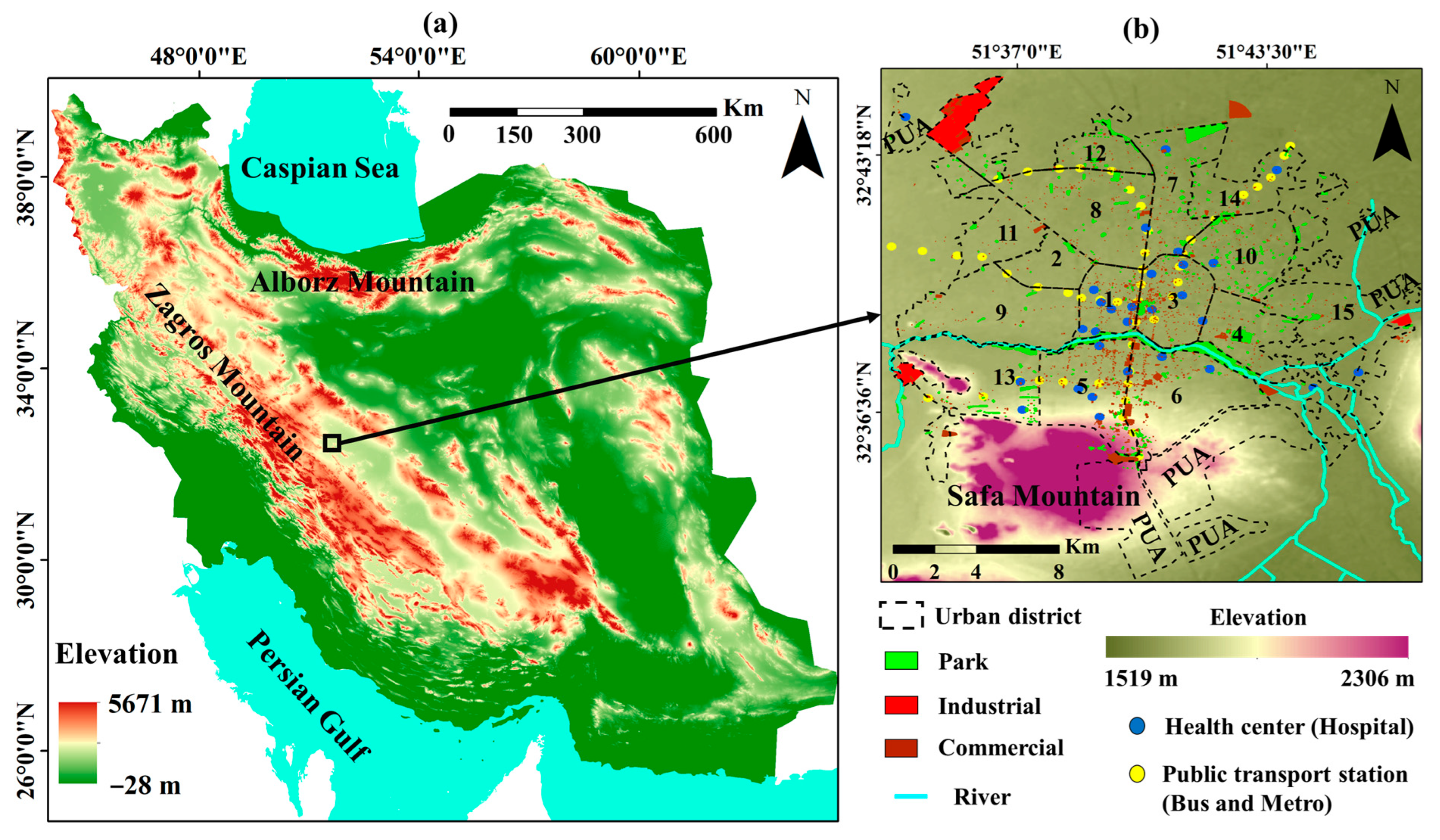
Isfahan, the capital of Isfahan Province, Iran, lies at 51°40′32″ East and 32°39′30″ North (Figure 1), covering an area of approximately 550 km2. Isfahan was expected to have a population of around 2.1 million in 2024, ranking third after Tehran and Mashad in Iran’s largest cities. Urbanization in Isfahan, like other regions of Iran. Isfahan, one of Iran’s major cities, has experienced urban expansion and population growth in recent years. The city is situated at an average elevation of 1580 m above sea level, near the Zagros Mountain range, and has a temperate and dry climate characterized by hot, dry summers. Zayandeh Rud, the most important natural feature of the city, plays a crucial role in the formation and supply of both surface and groundwater. The city’s average annual temperature ranges from 16 to 20 degrees Celsius, with an average annual rainfall of about 130 mm. Isfahan is divided into 15 urban districts and is geographically bordered to the south by the Safa Mountain and to the east by a desert region. In Isfahan, extensive peri-urban (or urban fringe) areas are located mainly in the southern and eastern parts of the city. These transitional zones, which have not yet been officially incorporated into municipal boundaries, are experiencing rapid and often unplanned development. As shown in Figure 1b, abbreviated PUA, these peri-urban areas were included in the analyses to ensure a comprehensive assessment of the city’s environmental quality.
Isfahan is not only one of the historical and cultural centers of Iran but also a major industrial and educational hub. The city is located in a semi-arid steppe biome, surrounded by mountainous terrain of the Zagros range and arid plains to the east. Its natural ecosystem is characterized by sparse vegetation and limited water resources, strongly dependent on the Zayandeh Rud River. In Isfahan, earthquakes are a major natural hazard. Historical earthquakes have occurred in the area and small earthquakes have been recorded. There have been many small earthquakes in the city due to the Gavart fault, which is located near the northeastern border of the city. Other hazards, such as floods, are negligible locally. Economically, Isfahan has a diversified structure based on heavy industries (such as steel production, petrochemicals, and power plants), trade, and tourism. The city hosts several universities and research centers, contributing to its high level of educational attainment. However, socioeconomic disparities persist between central and peripheral districts. While central areas generally have better infrastructure and higher income levels, some peripheral districts face challenges related to housing shortages and lower access to services. These socioeconomic variations indirectly affect environmental quality and urban livability. Nevertheless, the present study focuses primarily on environmental and infrastructural indicators due to data limitations and the methodological emphasis on spatial decision support. Future studies should integrate detailed social and economic variables to achieve a more holistic understanding of UEQ.

3. Data and Methods

3.1. Data

The data required for this study to evaluate and model the UEQ consisted of two main categories of information needed to prepare maps: (1) environmental criteria and (2) infrastructural criteria. The details of the data used in this study are presented in Table 1 and Table 2.
Land surface temperature, albedo, and vegetation cover maps were obtained from Landsat 9 satellite imagery with a spatial resolution of 30 m. The elevation map was derived from the Advanced Spaceborne Thermal Emission and Reflection Radiometer (ASTER) digital elevation model, also with a 30-m spatial resolution. Pollution maps were created from greenhouse gas data products obtained from the Sentinel 3 satellite and aerosol optical depth data from the Moderate Resolution Imaging Spectroradiometer (MODIS) sensor on the NASA Aqua satellite, with a 1000-m spatial resolution. Remote sensing data for the year 2024 were used. These datasets are freely available in raster file format. To verify the accuracy of the air pollution criterion maps, data from Isfahan’s air quality monitoring network were used, including NO2 and PM2.5 concentrations collected from monitoring stations across the city. The modeled air pollution values derived from Sentinel-3 and MODIS products were compared with the ground-based measurements. The comparison showed a good agreement, with an R2 value of 0.88 for NO2 and 0.91 for PM2.5, indicating that the satellite-based estimates reliably represent the spatial distribution of air pollution in Isfahan. These results confirm the suitability of the air pollution maps for use as a criterion in the UEQ assessment.
River network and road network data were obtained in linear shapefile format, while the geographical locations of healthcare centers, public transport networks (including metro and bus stations), and commercial and service centers were updated in 2024 in point shapefile format from OpenStreetMap v0.6. Additionally, the locations of parks and industrial areas in Isfahan were obtained in polygon shapefile format from OpenStreetMap. Fault data, in polygon shapefile format at a 1:50,000 scale, were provided by the Geological Survey of Iran and used for generating the fault distance map. Population data, based on statistical blocks, were sourced from the Iranian Statistics Center and used to generate the population density map.
All input datasets were standardized to a uniform spatial resolution of 30 m to ensure consistency across analyses. For datasets originally at coarser resolutions (e.g., Sentinel-3 or MODIS-derived air pollution data), the nearest-neighbor resampling method was applied. This procedure ensured that all criterion maps, including environmental and infrastructural layers, as well as all UEQ output maps, have a spatial resolution of 30 m, enabling accurate overlay and spatial analysis.
For data storage, preparation, analysis, standardization, and the generation of criterion maps, as well as for executing the required models and ultimately producing the final maps and output results, the software tools used in this study include ArcGIS 10.8, Expert Choice version 11, Google Earth Engine platform, and MATLAB 2022.

3.2. Method

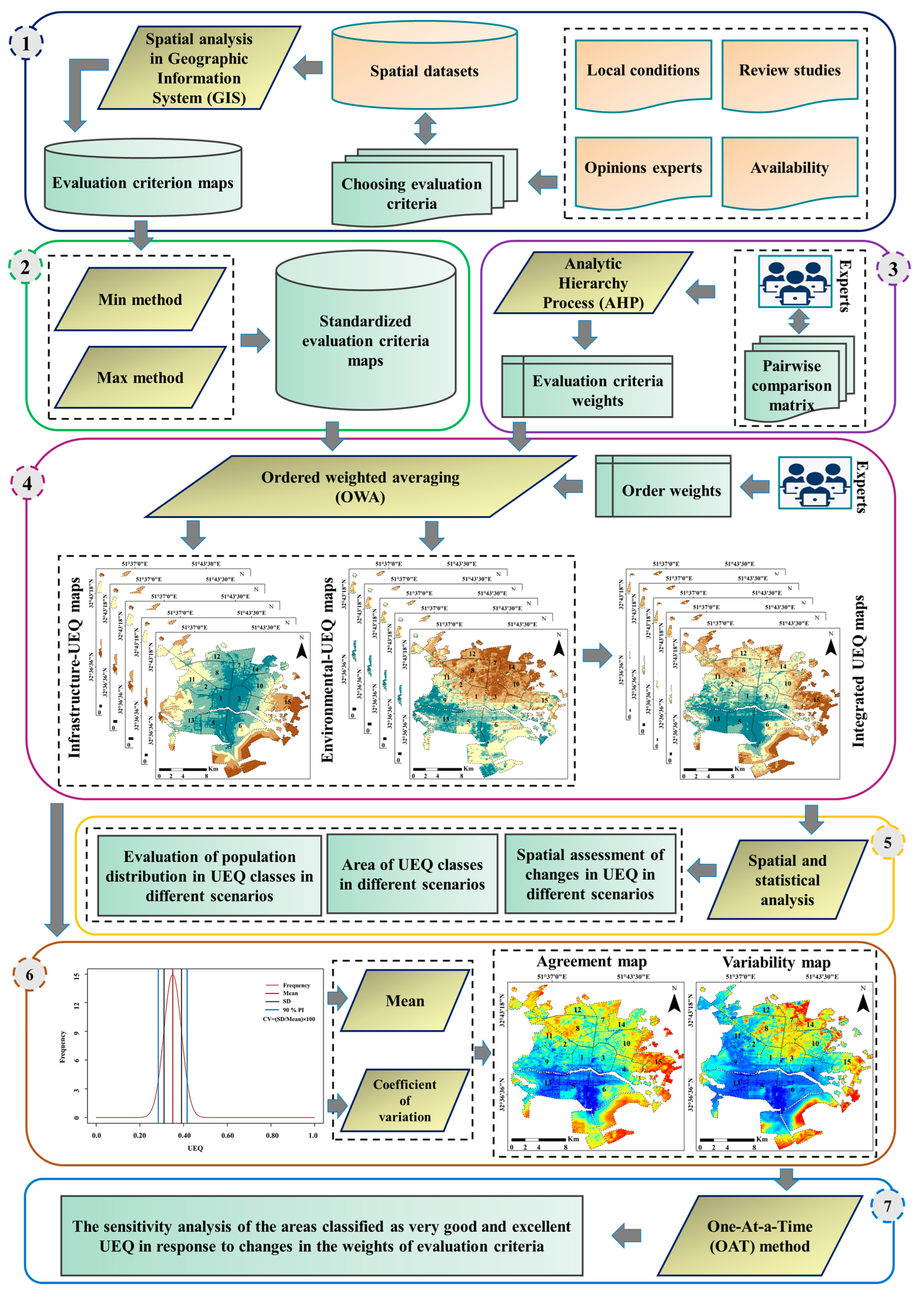
The flowchart of the methodology used is shown in Figure 2. In this study, a scenario-driven spatial multi-criteria decision-making framework was proposed for optimized UEQ zoning. The process was defined in seven main steps: (1) preparation of the geodatabase for the evaluation criteria, (2) standardization of the evaluation criteria, (3) determination of the weight of the evaluation criteria, (4) combination of the evaluation criteria and scenario creation, (5) evaluation and analysis of the UEQ maps obtained from various scenarios, (6) evaluation of the degree of agreement and variability in the UEQ assessment, and (7) sensitivity analysis. In the first step, the criteria affecting UEQ were identified and categorized based on the literature and expert opinions. Then, the maps related to the identified criteria were prepared using spatial analysis tools in GIS and stored in a geodatabase. In the second step, these maps were standardized using the maximum and minimum standardization methods, converting them into usable maps for further analysis. In the third step, the AHP was used to determine the relative importance of each criterion. This method enables researchers to assign weights to various criteria based on their relative importance in the urban environment. In the fourth step, the standardized maps of the criteria, the determined weights, and the factors related to different decision-making scenarios were combined using the OWA method. The result of this combination was multiple UEQ maps created under different decision-making scenarios, including optimistic and pessimistic scenarios. In this stage, the area and spatial distribution of different UEQ classes in the city of Isfahan were analyzed for each scenario. Additionally, the population distribution of Isfahan in various UEQ classes was assessed for the different scenarios. Finally, based on a statistical method, the degree of agreement and variability between decision-making scenarios and various evaluation criteria in the UEQ evaluation was calculated and its spatial distribution was analyzed. In the seventh step, the sensitivity analysis of the areas classified as very good and excellent UEQ in response to changes in the weights of evaluation criteria was examined using the One-At-a-Time (OAT) method.

3.2.1. Evaluation Criteria

In this study, based on expert opinions, two main groups of criteria were identified: environmental and infrastructural. These criteria were used for evaluating the UEQ based on the spatial multi-criteria decision support system. The environmental quality criteria include air pollution, thermal comfort, vegetation density, albedo, distance from fault lines, elevation, and proximity to rivers. The infrastructural criteria include population density, access to healthcare facilities, access to parks, access to commercial centers, distance from industrial centers, access to road networks, and access to metro and bus stations.
To prepare the spatial datasets used in this study, multiple remote sensing and spatial analysis techniques were applied. Air pollution data were derived from Sentinel-3 and MODIS products and processed in ArcGIS, while thermal comfort was calculated using Landsat 9 data analyzed in MATLAB. Vegetation cover and albedo indices were generated on the Google Earth Engine (GEE) platform using NDVI and surface reflectance calculations from Landsat imagery. Topographical and geological parameters, including elevation and distance from fault lines, were obtained from ASTER DEM and fault line datasets using Euclidean distance analysis. Hydrological proximity was calculated based on Euclidean distance from river networks. For infrastructural factors, including population density, data were collected from the Iranian Statistical Center and mapped in ArcGIS, while accessibility-related criteria such as proximity to roads, healthcare facilities, parks, commercial centers, industrial zones, and public transport stations were derived through Euclidean distance analysis of corresponding spatial layers. All datasets were resampled to a uniform spatial resolution and normalized before integration within the spatial multi-criteria decision support framework. The details of the criteria and sub-criteria used in this study for evaluating UEQ are shown in Table 2.

3.2.2. Standardization of Evaluation Criteria

In this study, the criteria used for evaluating and zoning the UEQ were standardized. For this purpose, the criteria were normalized based on their minimum and maximum values to make them dimensionless [9,52,53,54]. The standardization method for each criterion depended on its type of impact. For criteria where higher values indicate better quality and desirability in UEQ evaluation, Equation (1) was used. These criteria include Albedo, Vegetation cover, Distance from fault lines, and Distance from industrial centers. For criteria where lower values indicate better quality and desirability, Equation (2) was applied. These criteria include Thermal comfort, Elevation, Proximity to river Network, Air pollution, Proximity to parks, Access to public transport stations, Proximity to road networks, Proximity to healthcare centers, Proximity to commercial and service centers, and Population density.
A i j = V i j V j m i n V j m a x V j m i n
A i j = V j m a x V i j V j m a x V j m i n
In Equations (1) and (2), A i j is the standardized value for location i-th in criterion j-th, V i j is the value for location i-th in criterion j-th, and V j m a x and V j m i n are the maximum and minimum values for criterion j-th, respectively. After standardization, the minimum and maximum values of the standardized criteria varied between 0 and 1, where values close to 1 represent the excellent UEQ, and values close to 0 represent the poor UEQ. The standardization of the evaluation criteria was carried out using the Raster Calculator tool in ArcMap 10.8 software.

3.2.3. Determination of the Weight of Evaluation Criteria

In this study, a questionnaire was used to identify the evaluation criteria and determine their relative importance (weight) based on the opinions of experts and specialists. The sample included urban planning experts, urban management specialists, social sciences professionals, environmental experts, and GIS specialists. A total of 42 questionnaires were correctly completed by these specialists. Purposeful sampling was applied to select participants with specific expertise relevant to the study, ensuring the sample accurately represented the target population. Ethical approval was obtained from the Institutional Review Board (IRB) prior to inviting participation. Participants received detailed information regarding the study’s purpose, potential risks and benefits, and their rights, including the ability to withdraw at any time without consequences. Informed written consent was obtained from all participants before data collection. To minimize potential biases, experts were trained on the importance of reducing biases and avoiding social desirability bias, and the Delphi method was applied with three rounds of structured questionnaires to refine expert judgments.
To combine expert opinions and determine the weight of each effective criterion, the AHP was employed. The AHP is a widely used multi-criteria decision-making technique that captures the interrelationships among criteria through pairwise comparisons [55,56,57,58]. Experts compared the importance of each criterion relative to others using a pairwise comparison matrix. Experts first compared the relative importance of each criterion in a pairwise comparison matrix, where each element represents the importance ratio between two criteria based on Saaty’s 1–9 scale. The main diagonal of the matrix was assigned a value of one, while the reciprocal values were used for the symmetric elements. Next, the matrix was normalized by dividing each element by the sum of its corresponding column, ensuring all values were on a comparable scale. The average of each row in the normalized matrix was then calculated to obtain the weight vector, representing the relative priority of each criterion. Finally, the consistency index (CI) and consistency ratio (CR) were computed to verify the logical coherence of the comparisons. A CR value below 0.1 indicated that the judgments were consistent and the derived weights were reliable for subsequent analysis.
In this study, the AHP framework was applied separately to 7 environmental criteria and 7 infrastructural sub-criteria, resulting in a set of recalculated weights that reflect both expert consensus and the interdependent relationships among criteria. These weights were subsequently used in the spatial multi-criteria analysis to generate UEQ maps and perform scenario-based assessments.

3.2.4. Combining Evaluation Criteria and Scenario Development

In this study, the OWA method was used to model and evaluate UEQ across different scenarios. The OWA method, a multi-criteria aggregation operator, was first introduced by Yager [59] and was later applied to various spatial applications [60,61,62,63]. One of the key advantages of this model is its ability to rank scenarios continuously between the intersection operator (no risk) and the union operator (with risk). To calculate UEQ using the set of evaluation criteria, the OWA method and Equation (3) were utilized.
V A i o = j = 1 n λ k U k Z i k k = 1 n λ k U k
In Equation (3), V A i o represents the final output of the OWA method, indicating the relative degree of the UEQ. Z i k refers to the standardized values of the k-th criterion at the i-th location. U k represents the weight of the k-th criterion, and λ k denotes the ordinal weight of the k-th criterion. The ordinal weights vary across different scenarios. The variable n represents the number of criteria.
The OWA operator uses two types of weight sets for an n-criterion set and combines the criterion maps. These two types are: (a) the weight set for the criteria w 1 , w 2 ,…, w n , and (b) the set of order weights λ 1 , λ 2 ,…, λ n (where 0 < λ k < 1 and j = 1 n λ j = 1 ). The criterion weights represent the relative importance of each criterion (layer or map), which were determined using the AHP in Section 3.2.3. The order weights are assigned based on the spatial location of the cells in the layers or maps. In other words, in a criterion map (layer), all cells share the same criterion weight w, but their ordinal weight λ differs. The sorting process controls the OWA operator, which relates the weight λ k to the sorted values of the criteria at the i-th location. Specifically, the first λ 1 corresponds to the highest value of the criteria at the i-th location, λ 2 to the second-highest, and λ n to the lowest value of the criteria at the same location.
The parameter ORness in the OWA method is used in scenario development [28,63,64]. This parameter reflects the level of optimism (risk tolerance) in decision-making. In fact, the value and degree of ORness indicate the decision-maker’s emphasis on better or worse values within a set of criteria, representing the decision-maker’s optimism or pessimism (risk-taking or risk-averse behavior). The value of ORness is calculated using Equation (4).
O R n e s s = k = 1 n n j n 1 λ k 0 O R n e s s 1
In Equation (4), n represents the number of criteria, and λ k denotes the ordinal weight of the k-th criterion. The ORness value indicates the position of the OWA operator on a continuous scale between the OR and AND operators. A higher ORness value reflects greater optimism and risk-taking behavior in decision-making. Conversely, a lower ORness value indicates greater pessimism and risk aversion in decision-making. The OWA model was implemented using MATLAB 2022 to perform the spatial aggregation and scenario-based analysis.

3.2.5. Evaluation and Spatial Analysis of UEQ Variations Across Scenarios

In this study, decision-making scenarios were defined based on the ORness parameter of the Ordered Weighted Averaging (OWA) method, which represents the degree of optimism or risk tolerance of the decision-maker. The ORness value ranges from 0 to 1, delineating the full spectrum of decision-making attitudes—from completely risk-averse to fully risk-taking. This range effectively bridges two extreme aggregation operators: the AND operator (ORness = 0), representing a highly pessimistic and risk-averse perspective, and the OR operator (ORness = 1), corresponding to a highly optimistic and risk-taking perspective. In the highly optimistic scenario (ORness = 1), decision-making involves the highest level of risk, meaning that if only one or a few influential criteria show favorable conditions, the overall urban environmental quality (UEQ) is still evaluated as good. This scenario aligns with development-oriented planning approaches that emphasize opportunities and urban growth potential [64]. Conversely, in the highly pessimistic scenario (ORness = 0), the lowest level of risk tolerance is applied—requiring that most or all criteria meet favorable conditions for an area to be considered of high environmental quality. Such an approach is typically associated with Green Urbanism or Low-Carbon Urbanism, where stricter environmental standards are prioritized, such as increasing green spaces or reducing pollution. At the neutral level (ORness = 0.5), the model behaves similarly to the WLC method, producing a balanced aggregation of all criteria according to their respective weights. This reflects a moderate level of risk tolerance consistent with Sustainable Urbanism principles. The proposed framework is flexible and can simulate decision-making behavior across the entire ORness range, effectively generating around 100 different scenarios. For clarity and interpretability, five representative levels were applied in this study: highly pessimistic (0), pessimistic (0.25), neutral (0.5), optimistic (0.75), and highly optimistic (1). These scenarios quantitatively influence UEQ predictions by adjusting the ordinal weights assigned to the ranked criterion values at each location. As the ORness value increases, the level of optimism and risk tolerance also increases, allowing the model to reproduce diverse planning perspectives—from conservative to opportunity-driven—thereby providing a robust tool for scenario-based urban environmental quality assessment and management.
The UEQ status within the study area was classified into five levels: Poor (0–0.2), Fair (0.2–0.4), Good (0.4–0.6), Very good (0.6–0.8), and Excellent (0.8–1). The spatial distribution of these classes was assessed across the area in each scenario. Subsequently, the area covered by each UEQ class was calculated and compared across scenarios. Additionally, the spatial distribution of Isfahan’s population within each UEQ class was analyzed across different scenarios.

3.2.6. Dynamic ORness Computation and Stakeholder Preference Integration

To enhance the adaptability of the OWA operator in UEQ assessment, a dynamic ORness allocation framework was developed. Previous studies have mostly used conventional OWA approaches that rely on fixed levels of ORness (e.g., 0, 0.25, 0.5, 0.75, 1) across different scenarios [29,30]. In addition, this study proposes a method that incorporates stakeholder-specific preferences derived from a structured questionnaire. This framework provides flexible weighting schemes that better reflect heterogeneous preferences. This inherent flexibility allows urban environmental quality assessment to be tailored to any perspective or stakeholder approach. In fact, ORness values can adapt dynamically based on the priorities and perspectives of different urban planners and environmental agencies.
A structured questionnaire was designed to elicit the preferences of key stakeholder groups, including urban planners, environmental agencies, and municipal service providers. The survey consisted of two sections: (1) Evaluation of perceived trade-offs between environmental and socio-economic indicators, and (2) Self-assessment of decision-making style (from highly risk-averse to highly optimistic). Responses were rated on a 5-point Likert scale, from 1 (very low importance) to 5 (very high importance). The results of this survey provided input data for quantifying stakeholder preferences and dynamic ORness levels [65]. After that, to represent the aggregate preference structure of each stakeholder group, a Stakeholder Preference Index (SPI) was calculated using Equation (5) as the normalized weighted mean of all criteria importance scores:
S P I i = j = 1 n w j × s i j j = 1 n w j
where s i j is the score given by stakeholder i to criterion j , and w j denotes the relative significance of each criterion derived from the survey’s stakeholder preference. The SPI reflects the general tendency of each group toward either optimistic (risk-taking) or pessimistic (risk-averse) decision behavior [65]. The dynamic ORness value ( α i ) for each stakeholder group was assigned as a continuous function of its SPI, according to Equation (6).
α i = S P I i S P I m i n S P I m a x S P I m i n
where α i [ 0 , 1 ]   represents the degree of optimism. Higher values (closer to 1) indicate more optimistic aggregation—emphasizing maximum performance of criteria (ideally for planners focused on development potential), whereas lower values indicate more pessimistic views—emphasizing the worst-performing criteria (typical for environmental regulators prioritizing risk prevention) [66,67]. In contrast to arbitrarily fixed thresholds, this approach ensures ORness dynamically reflects stakeholder perceptions. After dynamically calculating ORness values, we used the parameterized OWA formulation (Equation (7)) to generate weights for the OWA [66].
w j = ( 1 α i ) n j α i j 1 k = 1 n ( 1 α i ) n k α i k 1
In the dynamic OWA weighting formula, each component plays a distinct role in defining the level of optimism or pessimism in the evaluation process. The term α i represents the dynamic degree of optimism (ORness) for stakeholder group i. The variable n denotes the total number of criteria, while j indicates the rank position of each criterion after sorting the input values from lowest to highest. The factor ( 1 α i ) ( n j ) emphasizes the contribution of lower-ranked criteria under pessimistic conditions, whereas ( α i ) ( j 1 ) enhances the influence of higher-ranked criteria under optimistic conditions. The denominator, k = 1 n ( 1 α i ) ( n k ) ( α i ) ( k 1 ) , serves as a normalization factor, ensuring that the total weights sum to one. Consequently, the interaction between n , j , k , and α i determines the overall shape of the weighting distribution and reflects the stakeholder’s attitudinal tendency in assessing urban environmental quality. This guarantees that scenario evaluations adapt to stakeholder priorities, enhancing inclusiveness and realism in urban decision-making.

3.2.7. Variability Evaluation and Degree of Agreement in UEQ Assessment

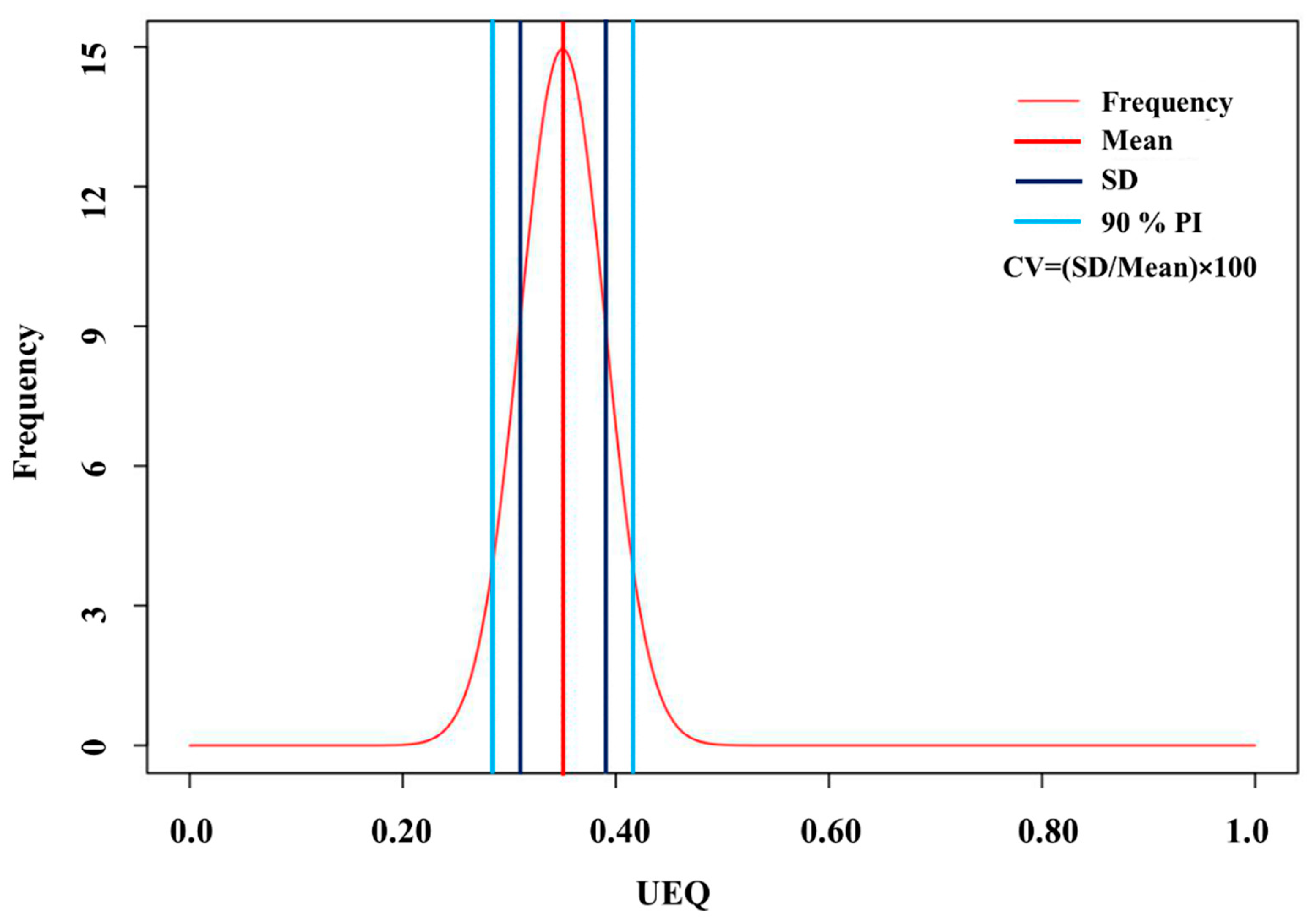
In this study, the variability of UEQ values at each location was evaluated by analyzing the histogram of modeled UEQ values across different decision-making scenarios and evaluation criteria. The mean and coefficient of variation (CV) were calculated across all repetitions at a 90% confidence interval (Figure 3). The resulting mean UEQ map illustrates the overall distribution of urban environmental quality and helps reduce the influence of scenario and criteria selection on the results. The CV map represents the variability of UEQ values at each location: lower CV values indicate low variability and strong agreement among scenarios and criteria, reflecting more stable and reliable UEQ results. Higher CV values indicate greater variability, showing lower agreement among scenarios and criteria. This approach allows identifying locations that are more sensitive to scenario variations versus those that produce consistent and robust results across scenarios. All computations and analyses were performed using MATLAB 2022.

3.2.8. Sensitivity Analysis

Sensitivity analysis is a crucial step in evaluating the robustness of the UEQ assessment and understanding the influence of individual criteria on the final results. In this study, the OAT method [68,69] was employed, in which the weight of a single criterion is varied while keeping all other criteria constant, allowing the direct effect of that criterion on UEQ zoning to be observed [70]. Among the common OAT approaches—(1) varying criteria weights, (2) altering criteria values, and (3) changing the relative importance of criteria [71]—this study focused on systematically varying the criteria weights to identify sensitive factors and quantify changes in priority. For each sensitivity test, three parameters were defined: the main criterion whose weight is adjusted, the range of percent change applied to its original weight, and the increment of percent change specifying the step size, which does not exceed the defined range [72]. As the weight of the main criterion changes, the weights of all other criteria are proportionally adjusted to maintain a total sum of one. This method enabled the identification of criteria most sensitive to weight variations, providing key insights into which environmental and infrastructural factors strongly influence UEQ zoning.

4. Results

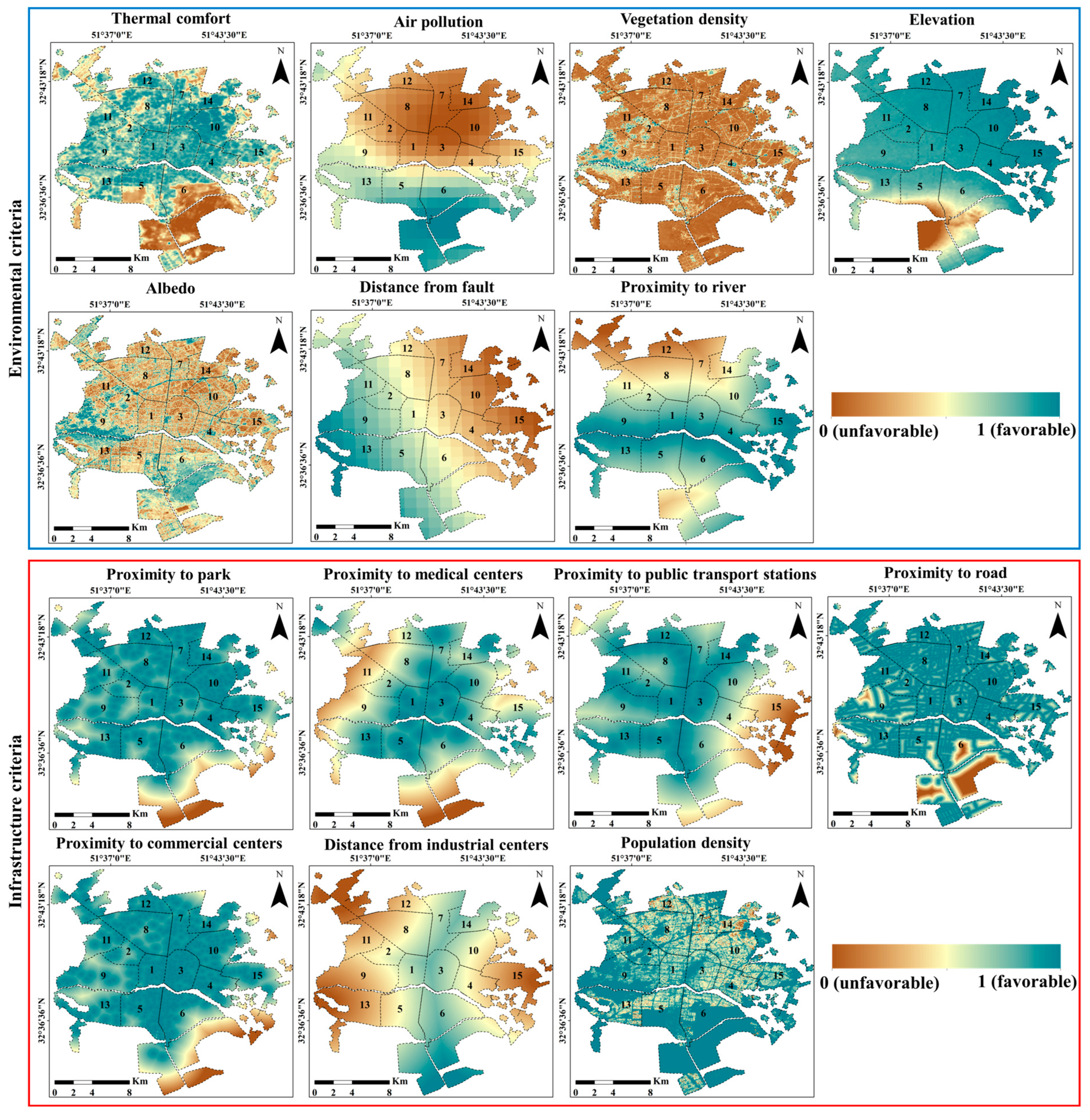
The standardized map of environmental criteria impacting the UEQ in various neighborhoods of Isfahan is shown in Figure 4. The spatial distribution of environmental criteria in Isfahan indicates considerable diversity and heterogeneity. For air pollution, due to the presence of polluting industries and heavy traffic, a north–south pattern has formed; northern areas of the city experience lower environmental quality, whereas southern areas have higher quality. Regarding vegetation cover, environmental quality is relatively similar across most areas. However, districts 9 and 13 (including Najvan Forest Park) and districts 3, 4, 5, and 6 (adjacent to the Zayandehrud River, Isfahan University green spaces, Ghadir Garden, and Rajaee Garden) have significantly better environmental quality. In terms of thermal comfort, most areas of the city are favorable; however, the southern parts of districts 5 and 6 show sharp temperature variations due to arid and barren conditions, leading to reduced thermal comfort. Concerning albedo, the western parts (districts 9 and 13) and southeastern areas (district 6) offer the highest UEQ. Additionally, in terms of proximity to the river, central districts (including districts 1, 3, 4, 5, and 6) have higher quality than more distant areas. For fault line proximity, the northeastern parts of the city, which are closer to faults, have lower environmental quality than southwestern areas. Lastly, regarding elevation variation, most city areas have favorable quality, with only a few neighborhoods in districts 5, 6 and PUA areas showing relatively lower quality.
The map of infrastructure criteria affecting the spatial distribution of UEQ indicates an uneven distribution across the city. For proximity to commercial and service centers, most areas of Isfahan are well-positioned, with only certain parts of districts 15, 2, and PUA areas having lower quality in this regard. For proximity to industrial centers, due to the presence of the Jay Industrial Park in the east and refinery and power plant facilities in the west, central city areas show better environmental quality than eastern and western regions, especially in the northwest. For park proximity, a relatively uniform quality level is observed, thanks to the distribution of urban, local, and neighborhood parks. In terms of access to roads and public transportation, most areas have good quality, attributed to the well-spread bus stations; however, military zones such as Havanirouz and Ghadir have lower quality due to security restrictions. Regarding proximity to public transport stations, central and northern areas have higher quality, while districts 4, 15 and PUA areas have the lowest quality. The river proximity criterion also shows that central Isfahan districts (1, 3, 4, 5, and 6) enjoy better quality than other areas. For population density, northeastern, northern, and central areas, due to higher density, have lower environmental quality compared to other areas. Lastly, for proximity to healthcare centers, most central areas have acceptable quality, but certain neighborhoods in districts 15, 12, 11, 9 and PUA areas are weaker in this regard.

Weights of Evaluation Criteria

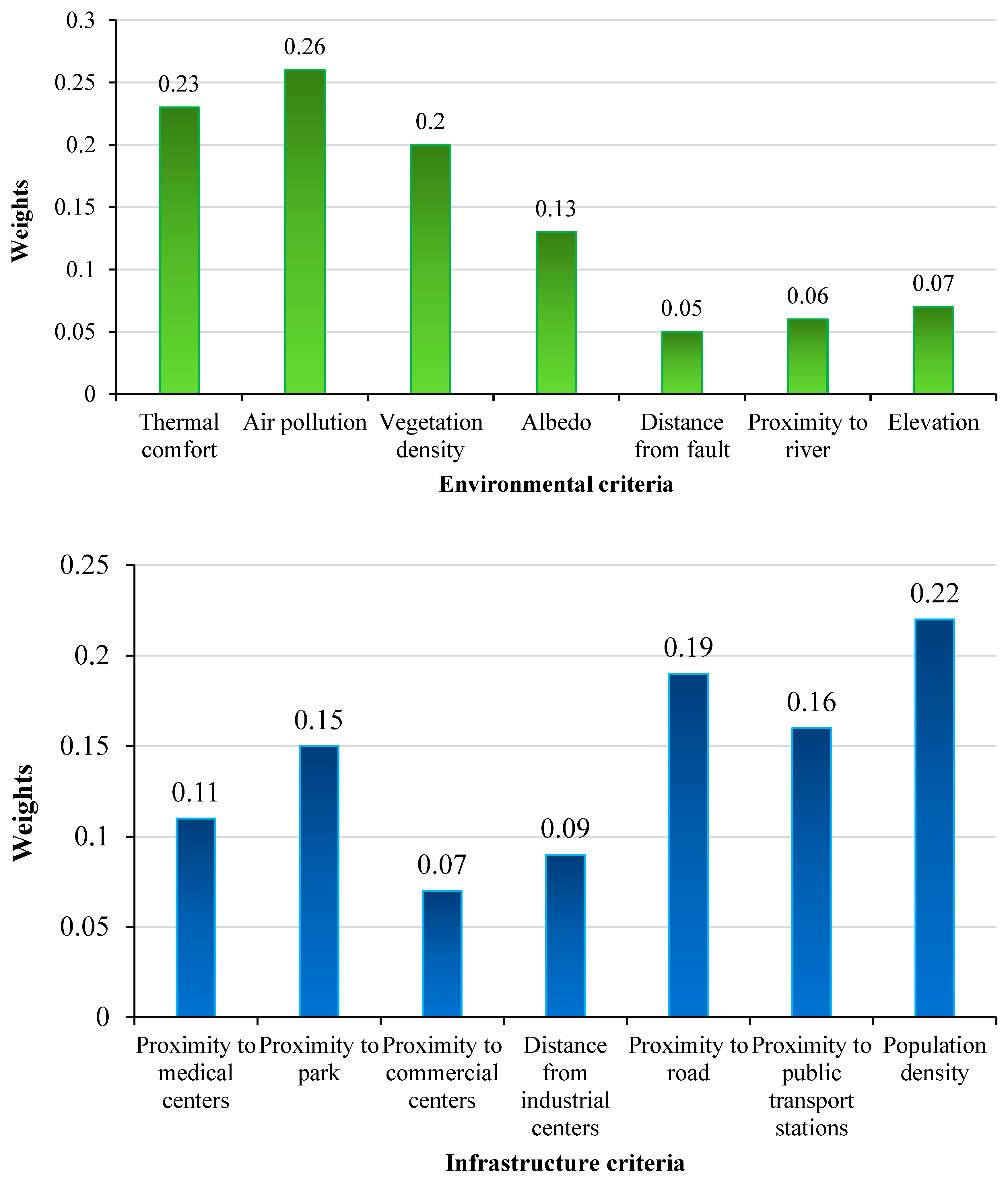
The weights of environmental and infrastructure criteria in the UEQ assessment for Isfahan are shown in Figure 5. Higher weights indicate a greater impact on the assessment of UEQ. Among the environmental criteria, air pollution (0.26) and thermal comfort (0.23) hold the highest relative importance, while distance from faults (0.05) and distance from rivers (0.06) have the lowest. In terms of infrastructure criteria, population density (0.22) and proximity to road networks (0.19) are the most influential, whereas proximity to commercial and service centers (0.07) and proximity to industrial areas (0.09) carry lower weights. The inconsistency rates for environmental, infrastructure, and combined criteria are 0.04, 0.05, and 0.07, respectively, indicating acceptable consistency in pairwise comparisons and decision-making in the AHP.
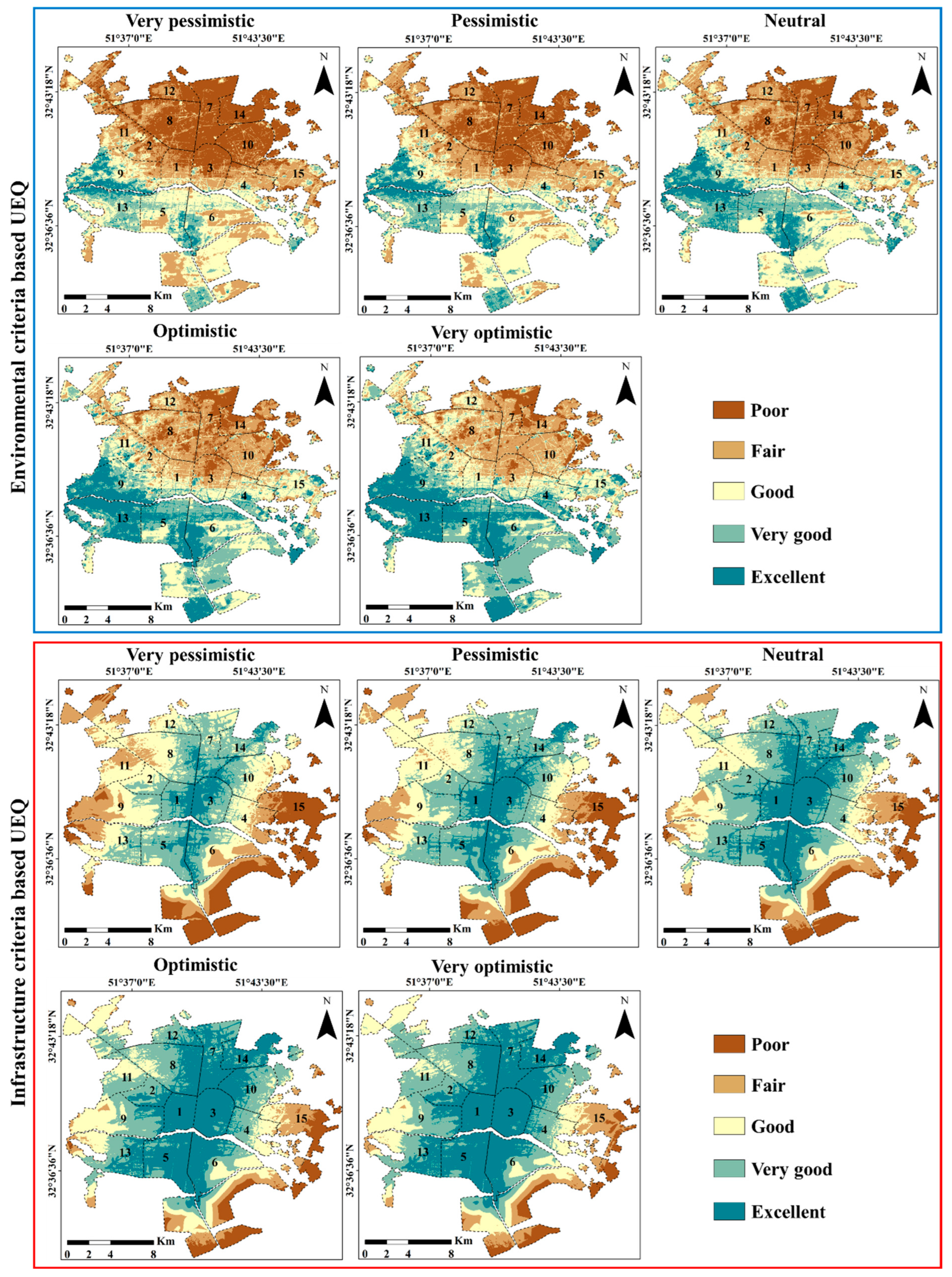
The maps evaluating the UEQ of Isfahan based on environmental and infrastructural criteria in different decision-making scenarios are shown in Figure 6. Visual assessment of the UEQ maps based on the combination of environmental criteria revealed a high spatial heterogeneity in quality across different districts of Isfahan. In the highly pessimistic scenario, many districts of Isfahan lack excellent UEQ, with the highest-quality neighborhoods identified primarily in districts 6 and 5. As optimism increased in the scenarios, more neighborhoods with high UEQ were identified and prioritized in other districts. Overall, the assessment indicates that the northern, eastern, and northern-central regions of Isfahan have the highest number of neighborhoods with fair and poor quality, with large portions of districts 10, 14, 7, and 8 even in the optimistic scenario still exhibiting fair and poor quality. The UEQ map in the neutral scenario shows that, under neutral decision-making conditions, the northeastern districts of Isfahan have Fair quality, especially district 14, which has the poorest quality, while the southern and southwestern districts, including district 6, exhibit the highest UEQ.
There was a significant difference in the UEQ based on infrastructural criteria compared to the evaluation based on environmental criteria. In the highly pessimistic scenario, many central districts of the city have neighborhoods with excellent UEQ, and only districts 15, 12, and 11 lack neighborhoods with this level of quality. With increased optimism in the various scenarios, the extent and number of neighborhoods with very good and excellent UEQ increased in different sections of the city. Overall, the assessment of UEQ in Isfahan based on infrastructural criteria shows that neighborhoods farther from the city center generally have lower quality. Outlying neighborhoods in districts 15 (Gort), 2 (Bakhtiardasht), 4 (Zayanderood Township), and 5 (Sepahan-Shahr) have low UEQ, even in the highly optimistic scenario. In the neutral scenario, which reflects a balanced decision-making condition, the outlying neighborhoods of Isfahan, particularly in districts 11 and 9, have the lowest quality levels, while central districts like 3 and 6 exhibit the highest UEQ.
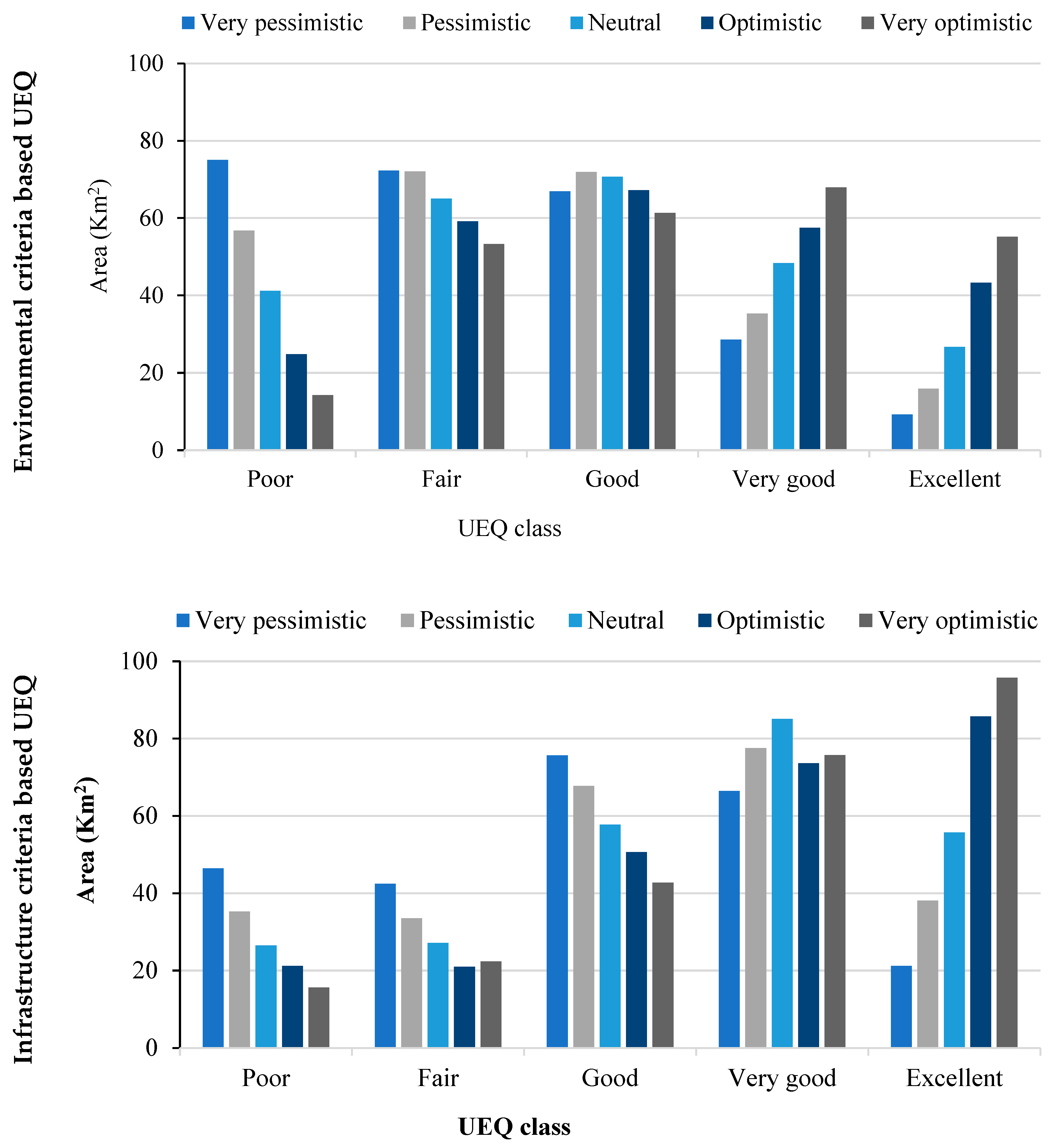
The area of different UEQ classes in Isfahan, based on environmental and infrastructural criteria in various decision-making scenarios, is shown in Figure 7. Based on environmental criteria, the area of districts with excellent UEQ in Isfahan is 9.21, 15.85, 26.69, 43.29, and 55.17 km2 for the very pessimistic, pessimistic, neutral, optimistic, and very optimistic scenarios, respectively, covering 3.6%, 6.2%, 10.6%, 17.2%, and 21.9% of the city. The corresponding values for areas with poor class are 75.00, 56.79, 41.14, 24.81, and 14.24 km2, covering 29.7%, 22.5%, 16.3%, 9.8%, and 5.6% of the city. In the neutral scenario, 16.3%, 25.8%, 28.1%, 19.2%, and 10.6% of Isfahan’s area falls under the poor, fair, good, very good, and excellent classes, respectively. In both optimistic and pessimistic scenarios, the good (67.23 km2) and fair (72.09 km2) classes occupy the largest areas compared to the other classes. The area of the poor, fair, good, very good, and excellent classes changed by approximately −81%, −26%, −8%, +137%, and +498%, respectively, as the scenario shifted from very pessimistic to very optimistic. The results show that as optimism increases in decision-making, the area of excellent and very good quality classes increases, while the area of fair and poor classes decreases. In other words, applying stricter standards for life quality in urban environmental assessments results in a reduction in the area of the excellent quality class.
The results of UEQ assessment in Isfahan based on infrastructural criteria also indicate that as optimism in decision-making increases, the area of excellent quality classes increases, while the area of poor classes decreases. The area of neighborhoods with excellent UEQ in the very pessimistic, pessimistic, neutral, optimistic, and very optimistic scenarios is 21.17, 38.06, 55.72, 73.85, and 72.95 km2, respectively, which is higher than the area of excellent quality based on environmental criteria. These values cover 8.4%, 15.1%, 22.1%, 34.0%, and 37.9% of Isfahan’s area. The area of neighborhoods with very poor environmental quality in these scenarios is 45.45, 35.22, 26.47, 21.20, and 15.62 km2, respectively, covering 18.4%, 13.9%, 10.5%, 8.4%, and 6.2% of the city’s area. As the scenario changes from very pessimistic to very optimistic, the area of poor, fair, good, very good, and excellent classes changed by approximately −66%, −47%, −43%, +13%, and +352%, respectively. The results indicate an improvement in the UEQ of Isfahan in the optimistic scenarios, showing that the city has better conditions in terms of infrastructural criteria than environmental criteria.
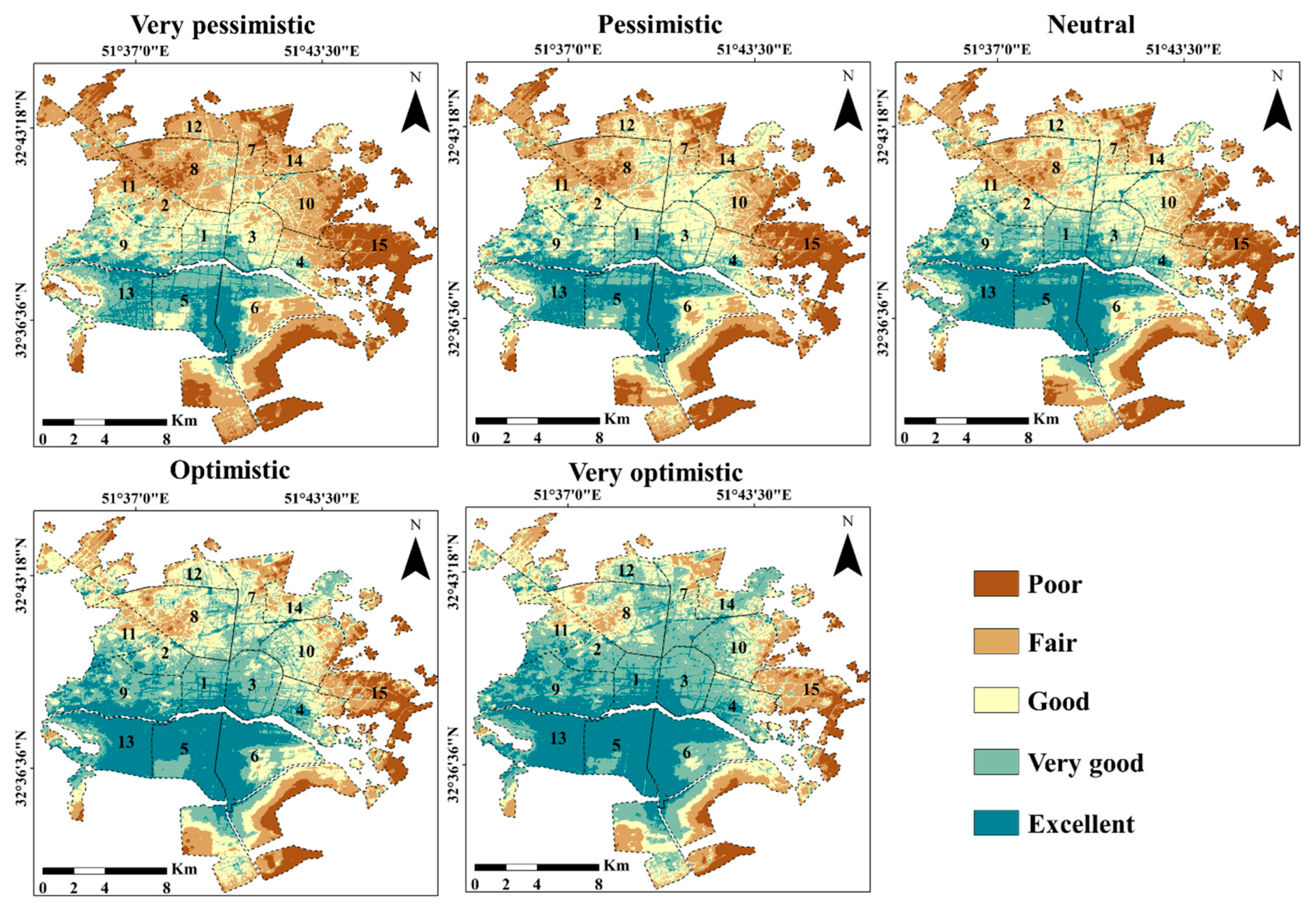
The UEQ assessment maps of Isfahan are shown in five decision-making scenarios in Figure 8. The results indicate that neighborhoods with very good and excellent quality are mainly located in the central, southern, and southwestern areas of Isfahan, providing favorable living conditions for residents. Overall, as optimism increases, the area covered by high-quality classes expands, while the area covered by low-quality classes decreases. In the highly pessimistic scenario, neighborhoods with suitable quality are mostly located in the southern, western, and southwestern parts of the city, including districts 6, 5, 9, 4, 13, and 3. In this scenario, the extent and distribution of areas with excellent quality are limited, and such conditions are not observed in some urban areas. In the neutral decision-making scenario, neighborhoods with excellent and very good quality are identified in most parts of Isfahan; however, these neighborhoods have average quality in terms of evaluation criteria in UEQ assessment and require further investment to improve infrastructure or environmental conditions. In the highly optimistic scenario, the number of neighborhoods with excellent and very good increases significantly, and these neighborhoods are primarily located in the eastern and southeastern parts of the city. Newly identified neighborhoods in the excellent and very good quality classes, which only appear in the optimistic scenario, have minimal quality and should have appropriate programs implemented to meet the basic needs of residents in these areas. The assessment results show that neighborhoods in districts 6, 5, 7, 15, 8, 9, 4, 13, 12, and 11 are identified as districts with suitable quality. Some of these neighborhoods, despite having minimal quality in certain criteria, are considered suitable due to their favorable quality in other evaluation criteria.
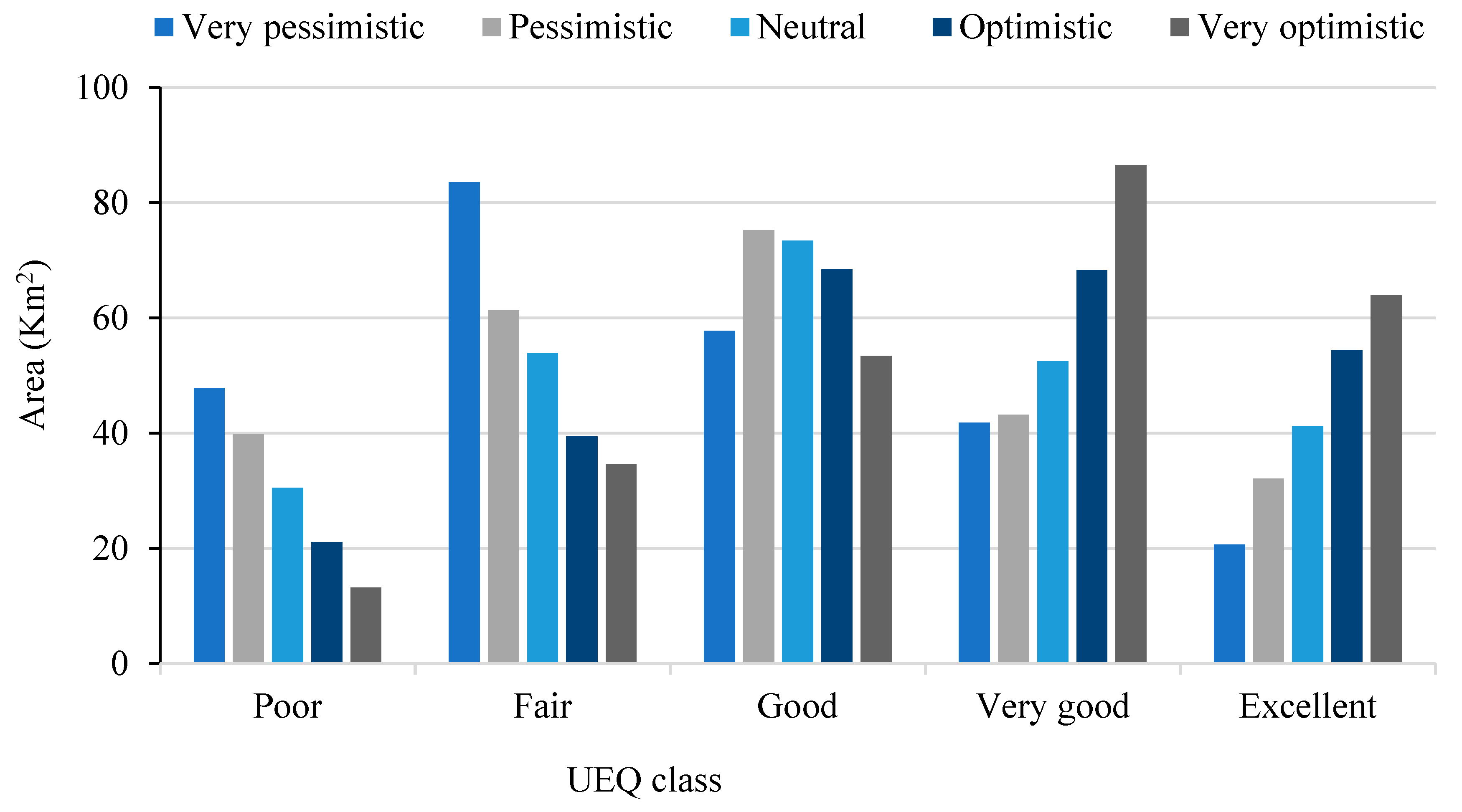
The area of different UEQ classes in Isfahan city based on all evaluation criteria across various scenarios is shown in Figure 9. The area of regions with excellent quality in the very pessimistic, pessimistic, neutral, optimistic, and very optimistic scenarios is 20.66, 32.09, 41.26, 54.35, and 63.90 km2, respectively. The percentage coverage of the excellent quality class in Isfahan in these scenarios is 8%, 12%, 16%, 21%, and 25%. Additionally, the area of regions with poor quality is 77.47, 39.84, 30.48, 21.12, and 13.17 km2, respectively, covering 19%, 15%, 12%, 8%, and 5% of Isfahan. In the very pessimistic scenario, the fair and poor-quality classes cover a total area of 131.35 km2, accounting for approximately 52% of Isfahan’s total area. Therefore, according to the results of this scenario, most neighborhoods require improvement in their UEQ. In the pessimistic scenario, the good quality class covers the largest area in Isfahan, with 29.1%. In the neutral scenario, the good quality class covers the largest area at 28.9% of the city’s total area. In the optimistic scenario, compared to the neutral scenario, the area of high and excellent quality classes increases by 31.7% and 29.9%, while the area of fair and poor-quality classes decreases by 26.8% and 30.7%, respectively. When changing from the very pessimistic to the very optimistic scenario, the area of the poor, fair, good, very good, and excellent classes changed by approximately −72%, −58%, −7%, 106%, and 209%, respectively.
The percentage of the area of the excellent class in the 15 districts of Isfahan city based on all relevant criteria in different scenarios is shown in Table 3. The percentage of the excellent class area in the 15 districts of Isfahan is highly variable. In the very pessimistic scenario, 25.7% and 22.5% of districts 13 and 5, respectively, were classified in the excellent class, while this value was zero or close to zero in districts 8, 10, 14, and 15. Districts 12, 14, and 15 also lacked the excellent class in the pessimistic scenario. In the neutral scenario, districts 13, 15, and 9 had the highest percentages of excellent class area, with 52.7%, 40.0%, and 28.6%, respectively. In all scenarios, districts 1, 5, 9, and 13 had the highest percentages, while districts 8, 10, 12, 14, and 15 had the lowest percentages of excellent class. Only 5.3% of district 1 in the very pessimistic scenario was classified in the excellent class, but this value increased to 51% in the very optimistic scenario, which was the highest increase among all districts. District 15 lacked the excellent class in all scenarios.
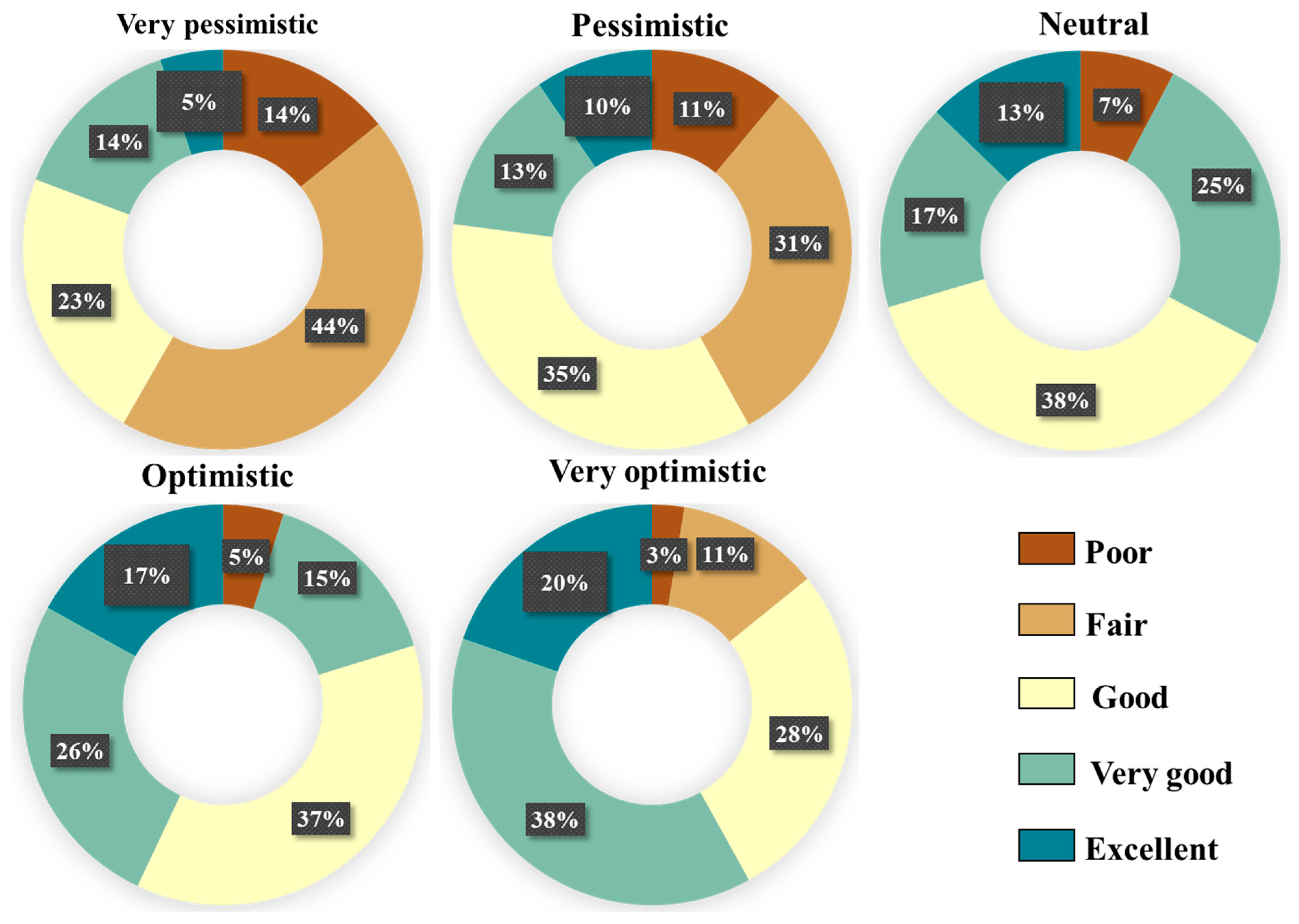
The percentage distribution of the population in Isfahan city across different UEQ classes in various decision-making scenarios is shown in Figure 10. The percentage of the population in the Excellent class in the very pessimistic, pessimistic, neutral, optimistic, and very optimistic scenarios was 5%, 10%, 13%, 17%, and 20%, respectively. The corresponding percentages for the poor class were 14%, 11%, 7%, 5%, and 3%. In the very optimistic scenario, the highest percentage, 44%, of the population was in the fair class, which was higher than in the other classes. In the optimistic, neutral, and pessimistic scenarios, the highest percentage of the population was in the good class, accounting for 35%, 38%, and 37%, respectively. In the very pessimistic scenario, 3%, 11%, 28%, 38%, and 20% of the population were distributed across the poor, fair, good, very good, and excellent classes, with the highest percentage in the very good class. As the level of optimism increased, the percentage of the population in the more desirable UEQ classes also increased.
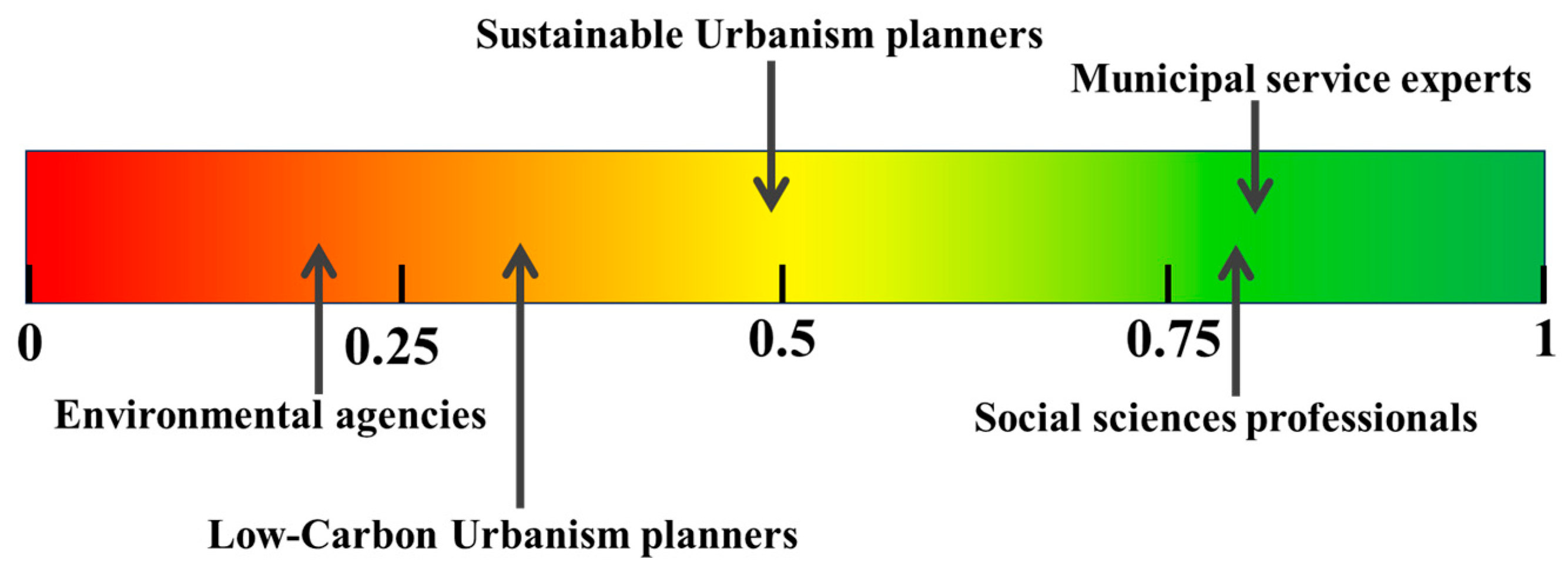
Based on participants’ perspectives and preferences, the stakeholder preference index (SPI) was calculated to represent the aggregate preference structure of each stakeholder group. The SPI reflects the general tendency of each group toward either optimistic (risk-taking) or pessimistic (risk-averse) decision behavior, while dynamic ORness indicates the extent to which their decisions emphasize higher outcomes (values closer to 1 suggest more optimistic, integrative decision-making). The results indicate that municipal service experts (SPI = 3.77, ORness = 0.81) and social sciences professionals (SPI = 3.73, ORness = 0.78) exhibit the highest SPI and ORness values, suggesting an emphasis on minimum standards for all evaluation criteria and an optimistic decision approach. In contrast, environmental agencies with a Green Urbanism approach (SPI = 2.21, ORness = 0.20) and Low-Carbon Urbanism planners (SPI = 2.51, ORness = 0.32) have lower values, indicating more conservative, risk-averse tendencies. It can be noted that Sustainable Urbanism planners (SPI = 2.96, ORness = 0.49) will fall in the mid-range, exhibiting moderate optimism. Figure 11 illustrates the proximity of some stakeholders’ preferences to the scenarios implemented in this study based on ORness values.
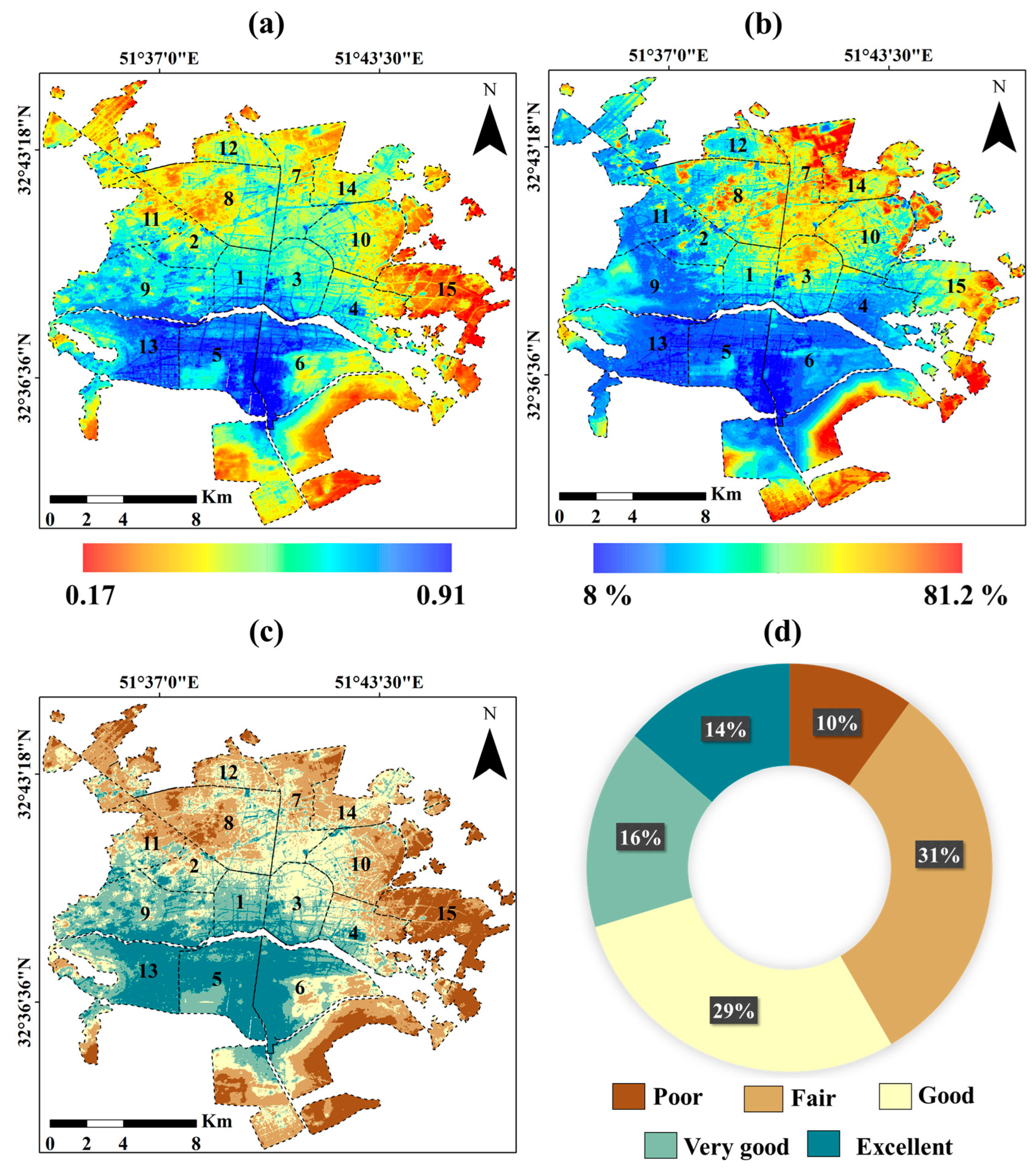
The maps showing the average UEQ suitability, variability of UEQ values, classification of average UEQ, and population distribution across UEQ classes under different decision-making scenarios and evaluation criteria are presented in Figure 12. The highest average UEQ suitability was observed in districts 13, 9, 1, and 5, with values of 0.68, 0.65, 0.65, and 0.63, respectively. Conversely, the lowest average UEQ suitability occurred in districts 15, 12, and 10. Overall, districts in the south and southwest of Isfahan exhibited higher average UEQ suitability compared to other regions. The variability of UEQ evaluation across scenarios and criteria ranged from 8% to 81.2%, with an average of approximately 21%. Districts 5, 6, 4, 13, and 9 displayed the lowest variability, indicating strong agreement among scenarios and criteria in these areas. Based on the suitability map, the largest areas classified as “Excellent” were found in districts 5, 13, and 6, whereas region 15 contained the largest proportion of the “Poor” class. Population distribution across UEQ classes showed that 10%, 31%, 29%, 16%, and 14% of the population resided in the poor, fair, good, very good, and excellent categories, respectively.
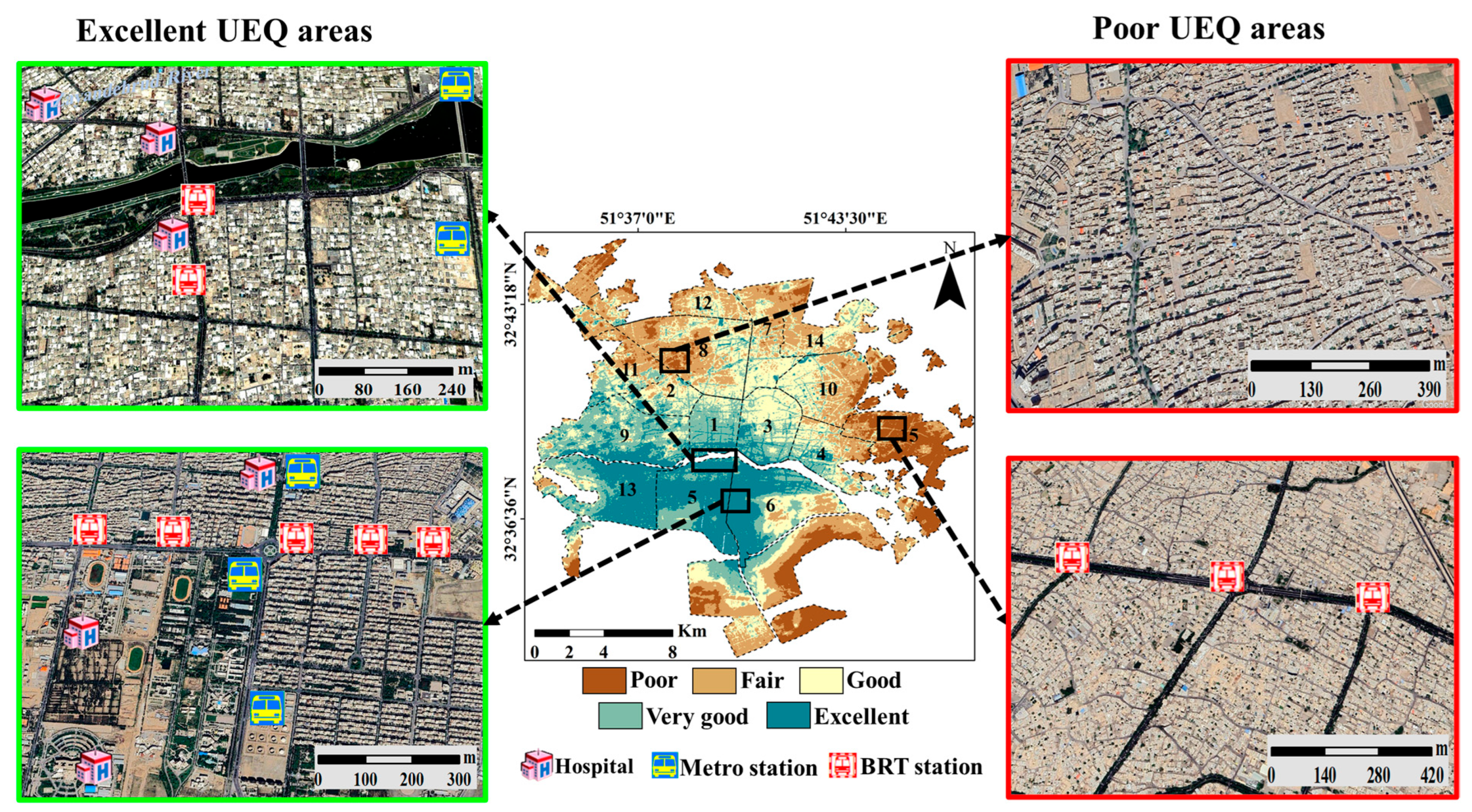
Figure 13 visually demonstrates sample areas with excellent and poor UEQ, providing a clearer spatial understanding of the spatial distribution and classification results across Isfahan. This visual representation helps illustrate how areas with favorable environmental and infrastructural conditions contrast with those facing greater environmental or infrastructural challenges.
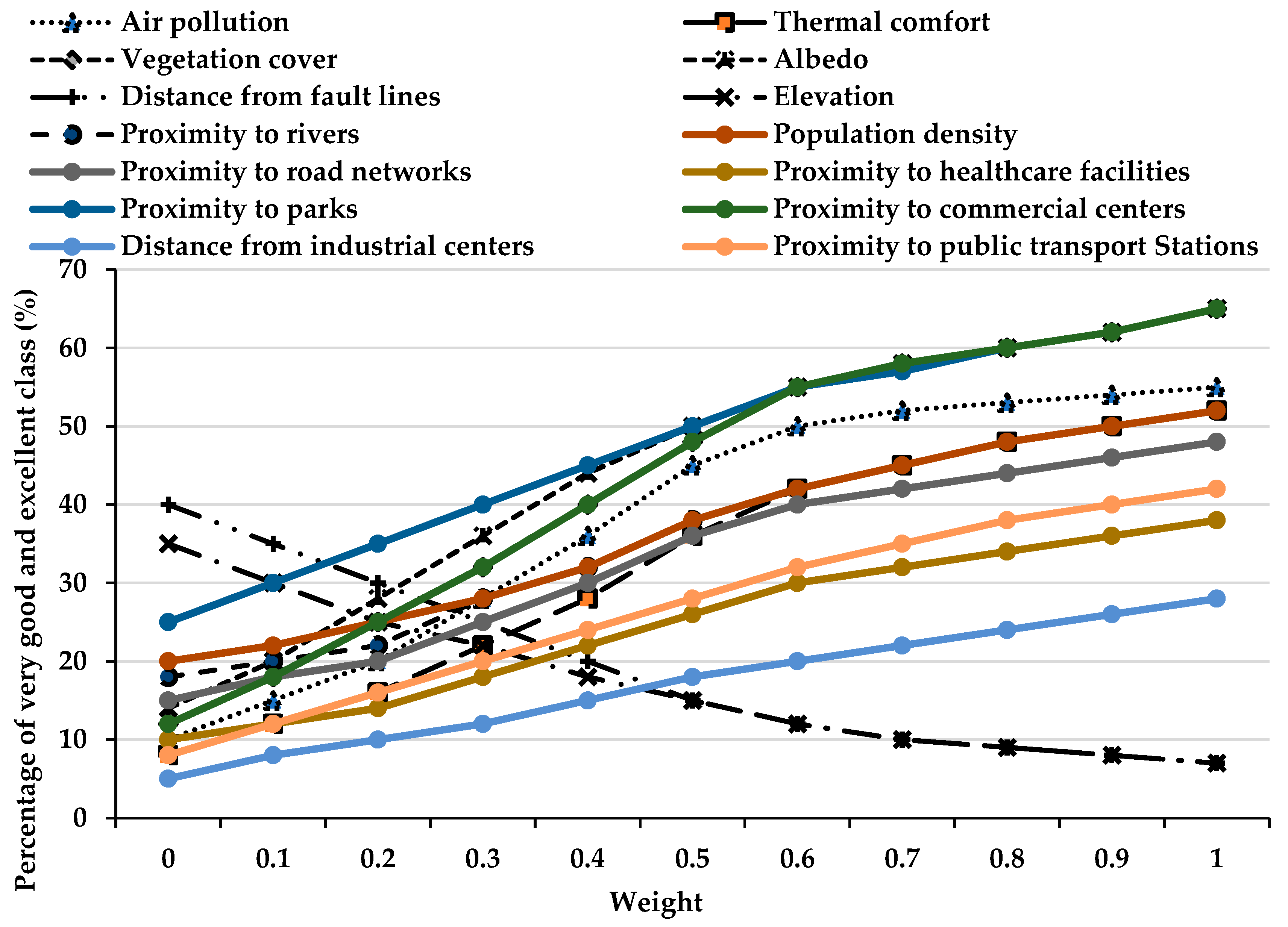
The sensitivity analysis of the percentage of areas with high and very high UEQ is presented in Figure 14. The results reveal that certain criteria—particularly air pollution, vegetation cover, and proximity to parks—exert a strong influence on UEQ zoning outcomes. As the weights of these criteria increase, the proportion of areas classified as very good or excellent UEQ rises markedly. For instance, increasing the weight of vegetation cover from 0 to 1 results in an increase in high-UEQ areas from 12% to 65%, highlighting its dominant role in shaping urban environmental quality patterns. Similarly, air pollution and proximity to parks show substantial sensitivity, with higher weights leading to greater coverage of very good or excellent-UEQ areas. Conversely, criteria such as distance from fault lines, elevation, and proximity to industrial centers display a negative impact on very good or excellent-UEQ areas; increasing their weights reduces the proportion of areas classified as very good or excellent UEQ. Other criteria, including thermal comfort, albedo, proximity to rivers, population density, road networks, healthcare facilities, commercial centers, and public transport stations, exhibit moderate sensitivity, with their impact stabilizing once weights exceed 0.6.

5. Discussion

Quality and reliability of input data play a crucial role in UEQ assessments, as they directly influence the accuracy and credibility of results. Therefore, it is essential to consider the potential uncertainties associated with different datasets used in spatial analyses. In this study, data uncertainties were carefully considered during the evaluation of UEQ. The main sources of uncertainty were related to factors such as cloud cover and retrieval errors in LST data, atmospheric correction in NDVI data, and the coarse spatial resolution of air pollution datasets derived from Sentinel-3 and MODIS sensors. Minor positional errors are also possible in vector datasets such as fault lines and road networks. In addition, there were completeness issues with OpenStreetMap layers representing rivers, roads, and service facilities. Although these uncertainties are relatively low and do not significantly affect the overall assessment, they may lead to small spatial discrepancies. Overall, the integration of multi-source and multi-resolution data, along with appropriate pre-processing and validation procedures, minimizes the influence of such uncertainties on the final UEQ evaluation.
The analysis of UEQ in Isfahan based on environmental and infrastructural criteria revealed that the quality of urban neighborhoods varies depending on the group of criteria applied. For example, a neighborhood may have a high quality according to infrastructural criteria in a specific scenario, but a very low quality based on environmental criteria (Figure 6). Although these assessments are useful in identifying the weaknesses of different neighborhoods, it is essential that UEQ be evaluated comprehensively and integrally at an appropriate scale [9,48]. Furthermore, the findings of the study showed that zoning the UEQ of Isfahan based on urban districts is not particularly practical, and assessments should be conducted at smaller zoning scales. This is because the results indicated that even in a district with low overall quality, one or more neighborhoods within it might have high quality. In other words, the quality levels of neighborhoods within a district are very diverse (Figure 6). Therefore, in the final assessment of the UEQ zoning based on all criteria, neighborhoods from different districts are analyzed. Even within a neighborhood, the spatial distribution of UEQ is heterogeneous and variable (Figure 8). Therefore, this study utilized spatial analysis and moderate-resolution remote sensing databases in the modeling and evaluation of spatial changes in UEQ (Table 1). One of the weaknesses of qualitative and quantitative questionnaire-based methods is their inability to model spatial changes in UEQ [22], whereas the use of multi-criteria decision-analysis-GIS integrated models allows for the modeling of these spatial changes at high resolution [10,19,43].
One key factor affecting the accuracy of UEQ zoning is the weighting of criteria. In the revised study, the AHP was employed to determine the weights of environmental and infrastructural criteria. AHP allows for the modeling of interrelationships among criteria through pairwise comparisons, which enhances the robustness and reliability of the weighting process [73]. Although AHP requires more comparisons than Best-Worst Method (BWM)—for instance, 21 pairwise comparisons for seven criteria—this method provides a consistency check to ensure that expert judgments are logically coherent, thereby reducing potential biases in the weighting process. Unlike BWM, AHP captures the relative importance of criteria while considering interdependencies, offering a more comprehensive assessment framework [74]. Other methods, such as DEMATEL and ANP, also allow modeling of interdependencies and complex networks among criteria; however, these approaches are often computationally intensive and demand greater data input and expert involvement [75,76,77,78]. By using AHP, the study balances the need for capturing interdependent relationships among criteria with practical considerations of data availability and expert participation [79], ultimately providing a more reliable basis for generating UEQ maps and conducting scenario-based assessments.
Also, the reliance on expert opinions for criterion weighting in this study introduces a degree of subjectivity and potential bias, which may influence the final UEQ assessment. While expert judgment is valuable for capturing local knowledge and context-specific insights, the limited number of participants and lack of detailed demographic information constrain the assessment’s reproducibility and reliability. Future research should aim to combine objective data-driven approaches with subjective expert evaluations, such as statistical weighting, AHP, entropy-based methods, or hybrid techniques. This integration can reduce uncertainty, enhance the robustness of criterion weighting, and provide more reliable guidance for urban planning and policy-making.
In zoning problems, challenges such as lack of accurate data, lack of control over some evaluation variables, and uncertainty in evaluating qualitative criteria make decision-making occur in a risky environment [33,63,80]. In general, risk-averse individuals focus on the negative aspects of a criterion, while risk-seeking individuals focus on the positive aspects. The final decision is influenced by the optimism or pessimism of the decision-maker. The OWA model, a sequential decision-making model, allows for considering the priorities and preferences of decision-makers at different levels of optimism [9,28,60]. The OWA model can estimate the degree of optimism and apply it in combining criteria for determining optimal options. It utilizes GIS-based integrated methods like WLC and overlay Boolean, and the researcher can generate and evaluate a wide range of maps, solutions, and scenarios by adjusting the weights of the criteria [9,63,81]. In this study, OWA was used to generate UEQ maps by combining standardized values of criteria and ORness values. The resulting UEQ maps, based on different criteria and decision scenarios with varying levels of optimism, can be valuable for urban planners. This flexibility allows decision-makers to adapt to different project needs based on varying degrees of optimism. For example, in a balanced decision scenario, urban planners can select locations with average quality as appropriate, while in a pessimistic decision-making scenario, areas with high-quality indicators will be considered for development, as they offer a more stable and robust solution.
The inherent flexibility of the OWA-based framework allows UEQ assessments to be tailored to different stakeholder perspectives and decision-making priorities. This adaptability is particularly valuable in urban planning, where stakeholders such as city planners, environmental agencies, and local communities may have divergent objectives and risk tolerances. By dynamically adjusting the ORness parameter, the framework can reflect these varying priorities, producing UEQ maps that emphasize areas of concern or opportunity according to specific perspectives. For future applications in other cities, this capability enables planners to generate multiple scenario-based outputs, facilitating participatory decision-making and ensuring that interventions are aligned with local priori to identify which areas and criteria are most affected by shifts in decision-making optimism or pessimism, thereby improving the robustness and relevance of urban environmental management strategies.
It is important to distinguish between UEQ and the broader concept of urban quality of life. The present study focused specifically on evaluating the environmental and infrastructural dimensions of urban quality, rather than the socioeconomic well-being of residents. While evidence from other Global South cities suggests that environmental quality often correlates with income and education levels, the lack of high-resolution socioeconomic data for Isfahan limited our ability to directly quantify such relationships [56,82,83,84,85]. Nevertheless, descriptive observations indicate that neighborhoods with higher environmental quality are typically located in the central and southern districts, which tend to have better infrastructure and higher housing values.
This study has demonstrated that analyzing UEQ based on environmental and infrastructural criteria can play a crucial role in improving urban planning and management. The proposed framework serves as a flexible and adaptable tool for assessing UEQ, capable of being applied to diverse urban contexts, including cities with different climates or varying infrastructure densities. While validation was conducted in Isfahan—a city with unique characteristics such as an arid climate and the Zayandeh Rud River—the framework is designed to be generalizable to other urban contexts. However, the relevant criteria and their relative importance may differ between cities, and therefore, in each urban context, the selection of criteria and their weighting should be determined based on expert judgment and local conditions. Comparing UEQ zoning results across multiple cities could help identify context-invariant criteria (e.g., air pollution, population density) that consistently affect urban environmental quality, as well as context-specific criteria (e.g., the Zayandeh Rud River in Isfahan) that vary depending on local characteristics. Future research should explore several avenues to make the results more accurate and comprehensive. First, integrating social and economic indicators would provide a more complete understanding of how socioeconomic inequalities influence spatial patterns of UEQ. Second, analyzing the interactions between environmental and social criteria at the neighborhood scale—considering factors such as income, education, and social participation—would enhance the understanding of underlying mechanisms affecting urban quality. Additionally, developing advanced multi-criteria decision-making models capable of incorporating dynamic socio-economic processes and the impacts of climate change would allow urban planners to explore different scenarios for improving environmental quality and mitigating adverse climate-related effects. Under conditions of rapid urbanization and climate change, such models could provide critical insights into the potential consequences for urban quality of life and sustainable development. Finally, testing and validating the proposed framework in other cities and regions—both within and beyond Iran—would help refine the methodology, develop more locally adapted and transferable models, and support sustainable urban planning worldwide.
A key limitation in this study relates to the spatial resolution of input datasets, particularly for air pollution [86,87]. Sentinel-3-derived greenhouse gas concentration data, with a 1 km resolution, may not capture fine-scale variations such as local pollution hotspots near individual factories or small parks in densely populated neighborhoods. Ground-based monitoring is currently limited in Isfahan, with only three stations available, making high-resolution interpolation infeasible. Consequently, the UEQ maps derived from these datasets are somewhat “smoothed,” which may obscure micro-scale environmental issues. Despite this, the selected satellite data provide the most comprehensive coverage available for Isfahan and are sufficient for assessing neighborhood-scale UEQ patterns. Future studies in other regions, or where denser monitoring networks exist, should utilize higher-resolution datasets to capture local variations more accurately, which could improve the precision of scenario-based UEQ assessments.
The results of this study can be highly beneficial for urban policymakers and planners in promoting sustainable development and improving environmental quality. The results of the UEQ assessment models can help decision-makers make better resource allocation decisions and improve urban infrastructure development based on more accurate, data-driven analyses. In policy-making, this study can serve as a tool for prioritizing urban investments to improve environmental quality in specific neighborhoods and enhance the effectiveness of urban projects. Specifically, the findings of this research can guide the implementation of green and sustainable policies in urban development, contributing to a higher quality of life for citizens and reducing the negative impacts of climate change. Additionally, the findings can be utilized in formulating policies aimed at raising public awareness and fostering social participation in urban decision-making processes. Promoting active citizen involvement in the management and improvement of environmental quality can contribute to sustainable development and create better, more livable urban environments.
The proposed scenario-driven decision support framework is highly adaptable, cost-effective, and suitable for application in cities across diverse geographical and socioeconomic contexts, including those in Africa and Latin America. Most datasets and indicators used in this study—such as satellite-based environmental and infrastructural data—are obtained from open-access global platforms (e.g., Landsat, Sentinel, MODIS, ASTER DEM, and OpenStreetMap), making the framework widely implementable at minimal cost. The model can be executed using free or low-cost software environments such as QGIS 3.40 LTR and Google Earth Engine platform, allowing its application even in low-income or data-scarce urban settings without requiring expensive proprietary software or field surveys. In some Global South cities, however, detailed socioeconomic and demographic data may be limited, which can constrain comprehensive UEQ evaluations. In such cases, the integration of local expert knowledge and participatory weighting of criteria is recommended to ensure contextual accuracy. This flexibility enables the model to be calibrated to local conditions and institutionalized within municipal planning departments as a long-term, low-cost decision-support tool for monitoring and improving urban environmental quality. It should be noted that while the analytical process itself is inexpensive, the implementation of subsequent urban improvement actions—such as infrastructure upgrades or the expansion of green spaces—may involve separate investments and planning efforts.
In this study, several sources of uncertainty may have influenced the UEQ assessment results. These include uncertainties in input data, such as spatial resolution, measurement errors in environmental variables, and the subjectivity inherent in expert-based criterion weighting. Standardization and resampling were applied to harmonize datasets, and sensitivity analyses across different OWA scenarios helped to quantify the variability in UEQ outcomes. Despite these measures, the potential impact of data and modeling uncertainties on spatial patterns and area calculations should be acknowledged. When comparing our findings with previous studies, similar spatial heterogeneity patterns were observed, with central urban areas often exhibiting lower environmental quality and peripheral areas higher quality. However, the influence of local geohazards, river networks, and urban morphology in Isfahan highlights the context-specific nature of UEQ determinants, emphasizing that uncertainties in data and model assumptions must be carefully considered when interpreting results and developing urban planning strategies.
The proposed approach in present study enabled a comprehensive evaluation of the existing spatial patterns of UEQ across Isfahan, offering valuable insights for current urban management and planning. However, the use of static datasets inherently limits the ability to capture the temporal dynamics of urban environmental and infrastructural changes, such as seasonal air pollution peaks, vegetation fluctuations, or the impacts of newly developed transport infrastructure. While some environmental indicators in this study—such as air quality and land surface temperature—were derived from multi-year averages to reduce short-term anomalies, we fully acknowledge that incorporating temporal datasets would provide a more comprehensive understanding of long-term and short-term UEQ variations. Therefore, future extensions of this framework will focus on integrating multi-temporal satellite imagery (e.g., Landsat 8–9 and MODIS) and longitudinal socio-economic data to capture interannual and seasonal changes. Moreover, trend detection techniques such as the Mann–Kendall test will be applied to distinguish stable from rapidly changing UEQ hotspots, enhancing the framework’s capacity to monitor urban evolution and support adaptive, forward-looking planning. Also, to overcome the limitation of the coarse spatial resolution of greenhouse gas concentration data (Sentinel-3, 1 km), future studies could apply machine learning-based downscaling methods. By integrating environmental and biophysical surface parameters, such as vegetation cover, land surface temperature, and impervious fraction, these approaches can generate finer-resolution greenhouse gas maps and better capture intra-urban spatial variability.
As a future perspective, citizen science approaches can be integrated within the proposed framework to provide richer datasets with higher spatial and temporal coverage as well as encourage community participation in UEQ assessment [88,89,90,91]. In addition to increasing UEQ assessment robustness, this integration would also facilitate a more inclusive and collaborative decision-making process in urban areas.

6. Conclusions

In this study, a spatial multi-criteria decision support system was applied to evaluate and map the urban environmental quality (UEQ) of neighborhoods in Isfahan under different decision-making scenarios. The results demonstrated that the combination of GIS and multi-criteria decision-analysis methods, particularly the Ordered Weighted Averaging (OWA) model, effectively captures spatial variations in UEQ and allows for scenario-based assessments reflecting varying levels of optimism and risk tolerance. Key findings include the significant influence of environmental and infrastructural criteria on UEQ patterns, and the observation that increasing the ORness parameter in the OWA model leads to larger areas classified as high-quality regions and smaller areas as low-quality regions. These findings highlight the capability of the OWA model to control and assess the spatial distribution of urban quality under diverse scenarios. Overall, the study provides quantitative insights into the spatial determinants of UEQ in Isfahan, demonstrating the value of scenario-driven spatial multi-criteria analyses for identifying areas of varying environmental quality. Based on the findings, it is suggested that future studies include additional relevant criteria, such as noise pollution and resident satisfaction, to provide a more comprehensive evaluation of UEQ. Moreover, the proposed approach is not geographically limited and can be applied to evaluate UEQ in cities worldwide. Considering the potential of integrated multi-criteria decision-analysis methods and GIS in assessing UEQ, it is suggested that future studies pay more attention to analyzing the interactions between environmental, social, and economic factors at the neighborhood and regional levels. This could enhance predictions and decision-making processes and provide more accurate evaluations of UEQ. In terms of sustainable development, policymakers can use the results of this study to determine urban priorities for investment in environmental improvement projects. Especially in developing cities, applying similar models can help optimize resource management and create sustainable and livable urban environments. Practically, this study can be a valuable tool for urban policy-making in decision-making processes, particularly when complex analyses and various scenarios are needed in urban planning. Additionally, the results can be used to launch UEQ improvement projects aimed at achieving sustainable development and improving the living conditions of residents in cities.

Author Contributions

Conceptualization, Z.T., M.J., S.E. and M.K.F.; methodology, M.K.F. and A.S.; software, M.K.F. and A.S.; data curation, Z.T. and M.J.; writing—original draft preparation, Z.T., M.J. and S.E.; writing—review and editing, M.K.F., A.S. and D.H. All authors have read and agreed to the published version of the manuscript.

Funding

This research received no external funding.

Institutional Review Board Statement

Not applicable.

Informed Consent Statement

Not applicable.

Data Availability Statement

The data used to support the findings of this study are available from the corresponding author upon reasonable request.

Conflicts of Interest

The authors declare no conflicts of interest.

References

  1. Stone, B. Urban sprawl and air quality in large US cities. J. Environ. Manag. 2008, 86, 688–698. [Google Scholar] [CrossRef] [PubMed]
  2. Firozjaei, M.K.; Weng, Q.; Zhao, C.; Kiavarz, M.; Lu, L.; Alavipanah, S.K. Surface anthropogenic heat islands in six megacities: An assessment based on a triple-source surface energy balance model. Remote Sens. Environ. 2020, 242, 111751. [Google Scholar] [CrossRef]
  3. Weng, Q.; Firozjaei, M.K.; Sedighi, A.; Kiavarz, M.; Alavipanah, S.K. Statistical analysis of surface urban heat island intensity variations: A case study of Babol city, Iran. GIScience Remote Sens. 2019, 56, 576–604. [Google Scholar] [CrossRef]
  4. Firozjaei, M.K.; Mijani, N.; Fathololoumi, S.; Arsanjani, J.J. Forecasting spatiotemporal dynamics of daytime surface urban cool islands in response to urbanization in drylands: Case study of Kerman and Zahedan Cities, Iran. Remote Sens. 2024, 16, 4416. [Google Scholar] [CrossRef]
  5. Karimi Firozjaei, M.; Mijani, N.; Nadizadeh Shorabeh, S.; Kazemi, Y.; Ebrahimian Ghajari, Y.; Jokar Arsanjani, J.; Kiavarz, M.; Alavipanah, S.K. Assessing the Effect of Urban Growth on Surface Ecological Status Using Multi-Temporal Satellite Imagery: A Multi-City Analysis. ISPRS Int. J. Geo-Inf. 2023, 12, 406. [Google Scholar] [CrossRef]
  6. Martek, I.; Hosseini, M.R.; Shrestha, A.; Zavadskas, E.K.; Seaton, S. The sustainability narrative in contemporary architecture: Falling short of building a sustainable future. Sustainability 2018, 10, 981. [Google Scholar] [CrossRef]
  7. Firozjaei, M.K.; Sedighi, A.; Argany, M.; Jelokhani-Niaraki, M.; Arsanjani, J.J. A geographical direction-based approach for capturing the local variation of urban expansion in the application of CA-Markov model. Cities 2019, 93, 120–135. [Google Scholar] [CrossRef]
  8. Marans, R.W. Quality of urban life & environmental sustainability studies: Future linkage opportunities. Habitat Int. 2015, 45, 47–52. [Google Scholar] [CrossRef]
  9. Moradi, B.; Akbari, R.; Taghavi, S.R.; Fardad, F.; Esmailzadeh, A.; Ahmadi, M.Z.; Attarroshan, S.; Nickravesh, F.; Jokar Arsanjani, J.; Amirkhani, M. A scenario-based spatial multi-criteria decision-making system for urban environment quality assessment: Case study of tehran. Land 2023, 12, 1659. [Google Scholar] [CrossRef]
  10. Musse, M.A.; Barona, D.A.; Rodriguez, L.M.S. Urban environmental quality assessment using remote sensing and census data. Int. J. Appl. Earth Obs. Geoinf. 2018, 71, 95–108. [Google Scholar] [CrossRef]
  11. Roy, S.; Bose, A.; Majumder, S.; Roy Chowdhury, I.; Abdo, H.G.; Almohamad, H.; Abdullah Al Dughairi, A. Evaluating urban environment quality (UEQ) for Class-I Indian city: An integrated RS-GIS based exploratory spatial analysis. Geocarto Int. 2022, 38, 2153932. [Google Scholar] [CrossRef]
  12. Martek, I.; Hosseini, M.R.; Shrestha, A.; Edwards, D.J.; Seaton, S.; Costin, G. End-user engagement: The missing link of sustainability transition for Australian residential buildings. J. Clean. Prod. 2019, 224, 697–708. [Google Scholar] [CrossRef]
  13. Krishnan, V.S.; Firoz, C.M. Regional urban environmental quality assessment and spatial analysis. J. Urban Manag. 2020, 9, 191–204. [Google Scholar] [CrossRef]
  14. Yang, C.; Zhang, C.; Li, Q.; Liu, H.; Gao, W.; Shi, T.; Liu, X.; Wu, G. Rapid urbanization and policy variation greatly drive ecological quality evolution in Guangdong-Hong Kong-Macau Greater Bay Area of China: A remote sensing perspective. Ecol. Indic. 2020, 115, 106373. [Google Scholar] [CrossRef]
  15. Guida, C.; Carpentieri, G. Quality of life in the urban environment and primary health services for the elderly during the Covid-19 pandemic: An application to the city of Milan (Italy). Cities 2021, 110, 103038. [Google Scholar] [CrossRef] [PubMed]
  16. Khalil, H.A.E.E. Enhancing quality of life through strategic urban planning. Sustain. Cities Soc. 2012, 5, 77–86. [Google Scholar] [CrossRef]
  17. Portney, K.E. Taking Sustainable Cities Seriously: Economic Development, the Environment, and Quality of Life in American Cities; MIT Press: Cambridge, MA, USA, 2013. [Google Scholar]
  18. Chang, S.; Smith, M.K. Residents’ quality of life in smart cities: A systematic literature review. Land 2023, 12, 876. [Google Scholar] [CrossRef]
  19. Joseph, M.; Wang, F.; Wang, L. GIS-based assessment of urban environmental quality in Port-au-Prince, Haiti. Habitat Int. 2014, 41, 33–40. [Google Scholar] [CrossRef]
  20. Hassanzadeh, J.; Asadi-Lari, M.; Baghbanian, A.; Ghaem, H.; Kassani, A.; Rezaianzadeh, A. Association between social capital, health-related quality of life, and mental health: A structural-equation modeling approach. Croat. Med. J. 2016, 57, 58–65. [Google Scholar] [CrossRef]
  21. Miremadi, M.; Bandari, R.; Heravi-Karimooi, M.; Rejeh, N.; Sharif Nia, H.; Montazeri, A. The Persian short form aging perceptions questionnaire (APQ-P): A validation study. Health Qual. Life Outcomes 2020, 18, 7. [Google Scholar] [CrossRef]
  22. Aithal, A.; Aithal, P. Development and validation of survey questionnaire & experimental data–a systematical review-based statistical approach. Int. J. Manag. Technol. Soc. Sci. 2020, 5, 233–251. [Google Scholar]
  23. Fradelos, E.C.; Papathanasiou, I.V.; Mitsi, D.; Tsaras, K.; Kleisiaris, C.F.; Kourkouta, L. Health based geographic information systems (GIS) and their applications. Acta Inform. Medica 2014, 22, 402. [Google Scholar] [CrossRef] [PubMed]
  24. Akyol, E.; Alkan, M.; Kaya, A.; Tasdelen, S.; Aydin, A. Environmental urbanization assessment using gis and multicriteria decision analysis: A case study for Denizli (Turkey) municipal area. Adv. Civ. Eng. 2018, 2018, 6915938. [Google Scholar] [CrossRef]
  25. Malczewski, J.; Rinner, C. Multicriteria Decision Analysis in Geographic Information Science; Springer: Berlin/Heidelberg, Germany, 2015. [Google Scholar]
  26. Sadler, R.C.; Hippensteel, C.; Nelson, V.; Greene-Moton, E.; Furr-Holden, C.D. Community-engaged development of a GIS-based healthfulness index to shape health equity solutions. Soc. Sci. Med. 2019, 227, 63–75. [Google Scholar] [CrossRef]
  27. Abd El Karim, A.; Awawdeh, M.M. Integrating GIS accessibility and location-allocation models with multicriteria decision analysis for evaluating quality of life in Buraidah city, KSA. Sustainability 2020, 12, 1412. [Google Scholar] [CrossRef]
  28. Firozjaei, M.K.; Nematollahi, O.; Mijani, N.; Shorabeh, S.N.; Firozjaei, H.K.; Toomanian, A. An integrated GIS-based Ordered Weighted Averaging analysis for solar energy evaluation in Iran: Current conditions and future planning. Renew. Energy 2019, 136, 1130–1146. [Google Scholar] [CrossRef]
  29. Zabihi, H.; Alizadeh, M.; Kibet Langat, P.; Karami, M.; Shahabi, H.; Ahmad, A.; Nor Said, M.; Lee, S. GIS multi-criteria analysis by ordered weighted averaging (OWA): Toward an integrated citrus management strategy. Sustainability 2019, 11, 1009. [Google Scholar] [CrossRef]
  30. Saragih, D.P.; Purba, M.; Pariawan, S.P.D. The advantages of the ordered weighted averaging (OWA) method in decision making and reliability testing of spatial multi-criteria site selection (SMCSS) model. Indones. J. Geogr. 2024, 56, 116–126. [Google Scholar] [CrossRef]
  31. Shafer, C.S.; Lee, B.K.; Turner, S. A tale of three greenway trails: User perceptions related to quality of life. Landsc. Urban Plan. 2000, 49, 163–178. [Google Scholar] [CrossRef]
  32. Mijani, N.; Alavipanah, S.K.; Firozjaei, M.K.; Arsanjani, J.J.; Hamzeh, S.; Weng, Q. Modeling outdoor thermal comfort using satellite imagery: A principle component analysis-based approach. Ecol. Indic. 2020, 117, 106555. [Google Scholar] [CrossRef]
  33. Mijani, N.; Alavipanah, S.K.; Hamzeh, S.; Firozjaei, M.K.; Arsanjani, J.J. Modeling thermal comfort in different condition of mind using satellite images: An Ordered Weighted Averaging approach and a case study. Ecol. Indic. 2019, 104, 1–12. [Google Scholar] [CrossRef]
  34. Karimi Firozjaei, M.; Mahmoodi, H.; Jokar Arsanjani, J. Daytime Surface Urban Heat Island Variation in Response to Future Urban Expansion: An Assessment of Different Climate Regimes. Remote Sens. 2025, 17, 1730. [Google Scholar] [CrossRef]
  35. Aghazadeh, F.; Rahimi, A.; Tarashkar, M.; Firozjaei, M.K.; Ioja, C.; Ondrejicka, V.; Finka, M. Assessing the Green Infrastructure and Built Up effects in Enhancing Thermal Comfort for Vulnerable Populations in Urban Heat Waves: A Case Study of Tabriz Metropolitan. Remote Sens. Appl. Soc. Environ. 2025, 39, 101671. [Google Scholar] [CrossRef]
  36. Aboelata, A.; Sodoudi, S. Evaluating urban vegetation scenarios to mitigate urban heat island and reduce buildings’ energy in dense built-up areas in Cairo. Build. Environ. 2019, 166, 106407. [Google Scholar] [CrossRef]
  37. Zhong, Q.; Ma, J.; Zhao, B.; Wang, X.; Zong, J.; Xiao, X. Assessing spatial-temporal dynamics of urban expansion, vegetation greenness and photosynthesis in megacity Shanghai, China during 2000–2016. Remote Sens. Environ. 2019, 233, 111374. [Google Scholar] [CrossRef]
  38. Sharma, S.; Kumar, A.K. Effect of urban surface albedo enhancement in India on regional climate cooling. Remote Sens. Appl. Soc. Environ. 2017, 8, 193–198. [Google Scholar] [CrossRef]
  39. Taleghani, M. The impact of increasing urban surface albedo on outdoor summer thermal comfort within a university campus. Urban Clim. 2018, 24, 175–184. [Google Scholar] [CrossRef]
  40. Yang, X.; Li, Y. The impact of building density and building height heterogeneity on average urban albedo and street surface temperature. Build. Environ. 2015, 90, 146–156. [Google Scholar] [CrossRef]
  41. Afsari, R.; Nadizadeh Shorabeh, S.; Bakhshi Lomer, A.R.; Homaee, M.; Arsanjani, J.J. Using artificial neural networks to assess earthquake vulnerability in urban blocks of Tehran. Remote Sens. 2023, 15, 1248. [Google Scholar] [CrossRef]
  42. Aksha, S.K.; Juran, L.; Resler, L.M.; Zhang, Y. An analysis of social vulnerability to natural hazards in Nepal using a modified social vulnerability index. Int. J. Disaster Risk Sci. 2019, 10, 103–116. [Google Scholar] [CrossRef]
  43. Liu, Y.; Yue, W.; Fan, P.; Zhang, Z.; Huang, J. Assessing the urban environmental quality of mountainous cities: A case study in Chongqing, China. Ecol. Indic. 2017, 81, 132–145. [Google Scholar] [CrossRef]
  44. Rahman, A.; Kumar, Y.; Fazal, S.; Bhaskaran, S. Urbanization and quality of urban environment using remote sensing and GIS techniques in East Delhi-India. J. Geogr. Inf. Syst. 2011, 3, 62. [Google Scholar] [CrossRef]
  45. Padilla, C.M.; Kihal-Talantikit, W.; Perez, S.; Deguen, S. Use of geographic indicators of healthcare, environment and socioeconomic factors to characterize environmental health disparities. Environ. Health 2016, 15, 79. [Google Scholar] [CrossRef] [PubMed]
  46. Rigolon, A. Parks and young people: An environmental justice study of park proximity, acreage, and quality in Denver, Colorado. Landsc. Urban Plan. 2017, 165, 73–83. [Google Scholar] [CrossRef]
  47. Moran, M.R.; Rodríguez, D.A.; Cotinez-O’Ryan, A.; Miranda, J.J. Park use, perceived park proximity, and neighborhood characteristics: Evidence from 11 cities in Latin America. Cities 2020, 105, 102817. [Google Scholar] [CrossRef]
  48. Mahmoudzadeh, H.; Abedini, A.; Aram, F.; Mosavi, A. Evaluating urban environmental quality using multi criteria decision making. Heliyon 2024, 10, e24921. [Google Scholar] [CrossRef]
  49. Zhang, J.; Deng, W. Industrial structure change and its eco-environmental influence since the establishment of municipality in Chongqing, China. Procedia Environ. Sci. 2010, 2, 517–526. [Google Scholar] [CrossRef]
  50. Chiarazzo, V.; Coppola, P.; Dell’Olio, L.; Ibeas, A.; Ottomanelli, M. The effects of environmental quality on residential choice location. Procedia-Soc. Behav. Sci. 2014, 162, 178–187. [Google Scholar] [CrossRef]
  51. Zacharias, J.; Zhao, Q. Local environmental factors in walking distance at metro stations. Public Transport 2018, 10, 91–106. [Google Scholar] [CrossRef]
  52. Shorabeh, S.N.; Firozjaei, M.K.; Nematollahi, O.; Firozjaei, H.K.; Jelokhani-Niaraki, M. A risk-based multi-criteria spatial decision analysis for solar power plant site selection in different climates: A case study in Iran. Renew. Energy 2019, 143, 958–973. [Google Scholar] [CrossRef]
  53. Karimi Firozjaei, M.; Sedighi, A.; Jelokhani-Niaraki, M. An urban growth simulation model based on integration of local weights and decision risk values. Trans. GIS 2020, 24, 1695–1721. [Google Scholar] [CrossRef]
  54. Heydari, R.; Fathololoumi, S.; Soltanbeygi, M.; Firozjaei, M.K. A Sustainability-Oriented Spatial Multi-Criteria Decision Analysis Framework for Optimizing Recreational Ecological Park Development. Sustainability 2025, 17, 731. [Google Scholar] [CrossRef]
  55. Gompf, K.; Traverso, M.; Hetterich, J. Using analytical hierarchy process (AHP) to introduce weights to social life cycle assessment of mobility services. Sustainability 2021, 13, 1258. [Google Scholar] [CrossRef]
  56. Chi, Y.L.; Mak, H.W.L. From comparative and statistical assessments of liveability and health conditions of districts in Hong Kong towards future city development. Sustainability 2021, 13, 8781. [Google Scholar] [CrossRef]
  57. Shorabeh, S.N.; Varnaseri, A.; Firozjaei, M.K.; Nickravesh, F.; Samany, N.N. Spatial modeling of areas suitable for public libraries construction by integration of GIS and multi-attribute decision making: Case study Tehran, Iran. Libr. Inf. Sci. Res. 2020, 42, 101017. [Google Scholar] [CrossRef]
  58. Gholamalizadeh, A.; Shorabeh, S.N.; Choubineh, K.; Karimi, A.; Ghahremani, L.; Firozjaei, M.K. Exploring the climatic conditions effect on spatial urban photovoltaic systems development using a spatial multi-criteria decision analysis: A multi-city analysis. Sustain. Cities Soc. 2024, 116, 105941. [Google Scholar] [CrossRef]
  59. Yager, R.R. On ordered weighted averaging aggregation operators in multicriteria decisionmaking. IEEE Trans. Syst. Man Cybern. 1988, 18, 183–190. [Google Scholar] [CrossRef]
  60. Malczewski, J. Ordered weighted averaging with fuzzy quantifiers: GIS-based multicriteria evaluation for land-use suitability analysis. Int. J. Appl. Earth Obs. Geoinf. 2006, 8, 270–277. [Google Scholar] [CrossRef]
  61. Malczewski, J.; Liu, X. Local ordered weighted averaging in GIS-based multicriteria analysis. Ann. GIS 2014, 20, 117–129. [Google Scholar] [CrossRef]
  62. Xiao, Y.; Yi, S.; Tang, Z. Integrated flood hazard assessment based on spatial ordered weighted averaging method considering spatial heterogeneity of risk preference. Sci. Total Environ. 2017, 599, 1034–1046. [Google Scholar] [CrossRef]
  63. Kiavarz, M.; Jelokhani-Niaraki, M. Geothermal prospectivity mapping using GIS-based Ordered Weighted Averaging approach: A case study in Japan’s Akita and Iwate provinces. Geothermics 2017, 70, 295–304. [Google Scholar] [CrossRef]
  64. Kazemi, N.; Taheri, Z.; Jokar Arsanjani, J.; Firozjaei, M.K. A Scenario-Based Framework to Optimising Eco-Wellness Tourism Development and Creating Niche Markets: A Case Study of Ardabil, Iran. ISPRS Int. J. Geo-Inf. 2025, 14, 385. [Google Scholar] [CrossRef]
  65. Thokala, P.; Madhavan, G. Stakeholder involvement in multi-criteria decision analysis. Cost Eff. Resour. Alloc. 2018, 16. [Google Scholar] [CrossRef]
  66. Ahn, B.S. Parameterized OWA operator weights: An extreme point approach. Int. J. Approx. Reason. 2010, 51, 820–831. [Google Scholar] [CrossRef]
  67. Emrouznejad, A.; Marra, M. Ordered weighted averaging operators 1988–2014: A citation-based literature survey. Int. J. Intell. Syst. 2014, 29, 994–1014. [Google Scholar] [CrossRef]
  68. Firozjaei, M.K.; Abdeyazdan, H.; Esmailzadeh, A.; Sedighi, A. Optimizing urban solar photovoltaic potential: A large group spatial decision-making approach for Tehran. Energy Sustain. Dev. 2025, 85, 101689. [Google Scholar] [CrossRef]
  69. Fildes, S.G.; Bruce, D.; Clark, I.F.; Raimondo, T.; Keane, R.; Batelaan, O. Integrating spatially explicit sensitivity and uncertainty analysis in a multi-criteria decision analysis-based groundwater potential zone model. J. Hydrol. 2022, 610, 127837. [Google Scholar] [CrossRef]
  70. Chen, Y.; Yu, J.; Khan, S. Spatial sensitivity analysis of multi-criteria weights in GIS-based land suitability evaluation. Environ. Model. Softw. 2010, 25, 1582–1591. [Google Scholar] [CrossRef]
  71. Khalid, K.; Ali, M.; Abd Rahman, N.; Mispan, M. Application on one-at-a-time sensitivity analysis of semi-distributed hydrological model in tropical watershed. Int. J. Eng. Technol. 2016, 8, 132–136. [Google Scholar] [CrossRef]
  72. Yu, S.; Yun, S.-T.; Hwang, S.-I.; Chae, G. One-at-a-time sensitivity analysis of pollutant loadings to subsurface properties for the assessment of soil and groundwater pollution potential. Environ. Sci. Pollut. Res. 2019, 26, 21216–21238. [Google Scholar] [CrossRef]
  73. Rezaei, M.; Nezamabadi-Pour, H. Using gravitational search algorithm in prototype generation for nearest neighbor classification. Neurocomputing 2015, 157, 256–263. [Google Scholar] [CrossRef]
  74. Vanolya, N.M.; Jelokhani-Niaraki, M.; Toomanian, A. Validation of spatial multicriteria decision analysis results using public participation GIS. Appl. Geogr. 2019, 112, 102061. [Google Scholar] [CrossRef]
  75. Çetinkaya, C.; Kabak, M.; Erbaş, M.; Özceylan, E. Evaluation of ecotourism sites: A GIS-based multi-criteria decision analysis. Kybernetes 2018, 47, 1664–1686. [Google Scholar] [CrossRef]
  76. Gigović, L.; Pamučar, D.; Lukić, D.; Marković, S. GIS-Fuzzy DEMATEL MCDA model for the evaluation of the sites for ecotourism development: A case study of “Dunavski ključ” region, Serbia. Land Use Policy 2016, 58, 348–365. [Google Scholar] [CrossRef]
  77. Tajer, E.; Demir, S. Ecotourism strategy of UNESCO city in Iran: Applying a new quantitative method integrated with BWM. J. Clean. Prod. 2022, 376, 134284. [Google Scholar] [CrossRef]
  78. Kaymaz, Ç.K.; Çakır, Ç.; Birinci, S.; Kızılkan, Y. GIS-Fuzzy DEMATEL MCDA model in the evaluation of the areas for ecotourism development: A case study of “Uzundere”, Erzurum-Turkey. Appl. Geogr. 2021, 136, 102577. [Google Scholar] [CrossRef]
  79. García-Melón, M.; Gómez-Navarro, T.; Acuña-Dutra, S. A combined ANP-delphi approach to evaluate sustainable tourism. Environ. Impact Assess. Rev. 2012, 34, 41–50. [Google Scholar] [CrossRef]
  80. Malczewski, J.; Chapman, T.; Flegel, C.; Walters, D.; Shrubsole, D.; Healy, M.A. GIS–multicriteria evaluation with ordered weighted averaging (OWA): Case study of developing watershed management strategies. Environ. Plan. A 2003, 35, 1769–1784. [Google Scholar] [CrossRef]
  81. Shorabeh, S.N.; Firozjaei, H.K.; Firozjaei, M.K.; Jelokhani-Niaraki, M.; Homaee, M.; Nematollahi, O. The site selection of wind energy power plant using GIS-multi-criteria evaluation from economic perspectives. Renew. Sustain. Energy Rev. 2022, 168, 112778. [Google Scholar] [CrossRef]
  82. Tian, S.; Wu, W.; Chen, S.; Li, Z.; Li, L. Socioeconomic factors behind the relationship between urban expansion and ecosystem services: A multiscale study in China. Landsc. Ecol. 2025, 40, 80. [Google Scholar] [CrossRef]
  83. Giannico, V.; Spano, G.; Elia, M.; D’Este, M.; Sanesi, G.; Lafortezza, R. Green spaces, quality of life, and citizen perception in European cities. Environ. Res. 2021, 196, 110922. [Google Scholar] [CrossRef]
  84. Wang, J.; Su, M.; Chen, B.; Chen, S.; Liang, C. A comparative study of Beijing and three global cities: A perspective on urban livability. Front. Earth Sci. 2011, 5, 323–329. [Google Scholar] [CrossRef]
  85. Chiu, R.L. Urban sustainability and the urban forms of China’s leading mega cities: Beijing, Shanghai and Guangzhou. Urban Policy Res. 2012, 30, 359–383. [Google Scholar] [CrossRef]
  86. Mak, H.W.L.; Laughner, J.L.; Fung, J.C.H.; Zhu, Q.; Cohen, R.C. Improved satellite retrieval of tropospheric NO2 column density via updating of air mass factor (AMF): Case study of Southern China. Remote Sens. 2018, 10, 1789. [Google Scholar] [CrossRef]
  87. Gaffin, S.R.; Rosenzweig, C.; Xing, X.; Yetman, G. Downscaling and geo-spatial gridding of socio-economic projections from the IPCC Special Report on Emissions Scenarios (SRES). Glob. Environ. Change 2004, 14, 105–123. [Google Scholar] [CrossRef]
  88. Van Brussel, S.; Huyse, H. Citizen science on speed? Realising the triple objective of scientific rigour, policy influence and deep citizen engagement in a large-scale citizen science project on ambient air quality in Antwerp. J. Environ. Plan. Manag. 2019, 62, 534–551. [Google Scholar] [CrossRef]
  89. Lin, S.; Liang, W. Assessing urban environmental quality and citizen science data quality: Identifying indicator bird species in cities of China. Glob. Ecol. Conserv. 2025, 59, e03575. [Google Scholar] [CrossRef]
  90. O’Regan, A.C.; Grythe, H.; Hellebust, S.; Lopez-Aparicio, S.; O’Dowd, C.; Hamer, P.D.; Santos, G.S.; Nyhan, M.M. Data fusion for enhancing urban air quality modeling using large-scale citizen science data. Sustain. Cities Soc. 2024, 116, 105896. [Google Scholar] [CrossRef]
  91. Fraisl, D.; Hager, G.; Bedessem, B.; Gold, M.; Hsing, P.-Y.; Danielsen, F.; Hitchcock, C.B.; Hulbert, J.M.; Piera, J.; Spiers, H. Citizen science in environmental and ecological sciences. Nat. Rev. Methods Primers 2022, 2, 64. [Google Scholar] [CrossRef]
Figure 1. (a) Geographical location of Isfahan city in Iran, (b) boundaries of urban districts, and spatial distribution of specific land uses within the city.
Land 14 02213 g001
Figure 2. Research Methodology Flowchart.
Land 14 02213 g002
Figure 3. Component analysis of variability in UEQ values based on different decision-making scenarios and evaluation criteria.
Land 14 02213 g003
Figure 4. Standardized map of environmental and infrastructure criteria in assessing UEQ in Isfahan. All maps are normalized to a 0–1 scale for comparability.
Land 14 02213 g004
Figure 5. Weights of environmental and infrastructure criteria in the UEQ assessment.
Land 14 02213 g005
Figure 6. Maps of UEQ assessment in Isfahan based on effective environmental and infrastructural criteria in different scenarios.
Land 14 02213 g006
Figure 7. Area of different UEQ classes in Isfahan based on environmental and infrastructural criteria across various decision-making scenarios (km2).
Land 14 02213 g007
Figure 8. UEQ class assessment maps of Isfahan city in five different scenarios.
Land 14 02213 g008
Figure 9. Area of different UEQ classes in Isfahan based on all evaluation criteria (km2).
Land 14 02213 g009
Figure 10. Percentage distribution of the population in Isfahan city across different UEQ classes in various decision-making scenarios.
Land 14 02213 g010
Figure 11. The proximity of some stakeholders’ preferences to the scenarios implemented in this study based on ORness values.
Land 14 02213 g011
Figure 12. Maps of (a) average UEQ values, (b) variability of UEQ values, (c) classification of average UEQ values, and (d) population distribution in classes of average UEQ values across different decision-making scenarios and evaluation criteria.
Land 14 02213 g012
Figure 13. Sample areas in Isfahan showing excellent (green) and poor (red) UEQ.
Land 14 02213 g013
Figure 14. Sensitivity analysis of the percentage of areas with very good or excellent UEQ to changes in criteria weights.
Land 14 02213 g014
Table 1. Details of the data used in the study.
Main CriteriaDataFormatSource/ProviderOriginal Resolution/ScaleWebsite
Environmental criteriaLand Surface Temperature (LST)TiffLandsat Collection 2 Level-2 Images30 mhttps://earthexplorer.usgs.gov/ (accessed on 20 April 2025)
Albedo Surface
Vegetation (NDVI)
ElevationASTER Digital Elevation Model30 mhttps://earthexplorer.usgs.gov/ (accessed on 20 April 2025)
Air PollutionSentinel 5 Greenhouse Gas Products/MOD04 AOD from MODIS Terra1000 mhttps://sentinels.copernicus.eu/data-products
and https://modis.gsfc.nasa.gov/data/ (accessed on 22 April 2025)
Fault MapSHP (Polyline)Geological Survey of Iran1:50,000-
River NetworkOpenStreetMap1:2000https://www.openstreetmap.org/ (accessed on 25 April 2025)
Infrastructure criteriaRoad Network
Industrial AreasSHP (Polygon)
Green Spaces and Parks
Commercial and Service Centers
public transport Stations (Bus and Metro)SHP (Point)
Healthcare Centers (Hospitals)
Demographic DataSHP (Polygon)Iranian Statistical CenterCenses block-
Table 2. Details of criteria and sub-criteria used in this study for evaluating UEQ.
Main CriterionSub-CriterionDescription
Environmental criteriaAir pollutionAir pollution is one of the major environmental challenges in large cities, with significant negative impacts on human health and the physical environment [31]. Pollutants such as nitrogen dioxide, sulfur dioxide, carbon monoxide, methane, and aerosols have been analyzed.
Thermal comfortThermal comfort plays an important role in the well-being and health of residents. Reduced thermal comfort leads to fatigue, sleep problems, decreased concentration, and even health threats [32,33,34]. This criterion is influenced by climatic conditions, biophysical surface characteristics, and urban structure [35].
Vegetation coverVegetation cover improves environmental quality by absorbing carbon dioxide, filtering pollution, and reducing air temperature. It also helps reduce the urban heat island effect and provides green, calming spaces for citizens [34,36,37].
AlbedoAlbedo, or the amount of radiation reflected from the earth’s surface, is influenced by human activities and can affect the radiative balance and urban climate. Higher albedo typically improves environmental quality and helps cool urban heat islands [38,39,40].
Distance from fault linesProximity to fault lines increases seismic risks, threatening residential safety. Areas farther from fault lines have higher environmental quality and safety [41,42].
ElevationElevation and slope affect access to infrastructure and services. Areas with lower elevation typically have better access to facilities and services, leading to higher environmental quality [43].
Proximity to riversRivers play an important role in improving UEQ. Proximity to rivers reduces temperature, increases humidity, enhances urban scenery, and creates green and recreational spaces [9]. Isfahan has only one significant river; lakes or seas are absent.
Infrastructure criteriaPopulation densityPopulation density indicates the number of individuals per unit area. High population density may increase pressure on infrastructure and reduce quality of life, while lower density can enhance access to resources and open spaces, improving environmental quality [10,44].
Proximity to road networksProximity to roads and networks can improve access to various services and infrastructure. This criterion enhances life quality and convenience for daily commuting, and is particularly important for transport and emergency access [9,41].
Proximity to healthcare facilitiesHealthcare centers are essential for residents’ health and well-being. Proximity to these centers means faster access to emergency services and better overall health. This criterion contributes to residents’ welfare and safety, enhancing environmental quality [15,45].
Proximity to parksParks and green spaces help improve air quality, reduce stress, and provide recreational and social opportunities. Proximity to these spaces can increase residents’ comfort and well-being, improving UEQ [46,47].
Proximity to commercial centersProximity to commercial centers and stores allows residents to meet daily needs easily. This criterion improves well-being, reduces the need for long trips for shopping, and enhances urban life quality [19,48].
Distance from industrial centersProximity to industrial centers can have negative environmental and health impacts, as these areas are often sources of air and noise pollution. Greater distance from these centers reduces pollution and enhances environmental quality [9,49].
Proximity to public transport StationsAccess to public transportation stations, such as metro and bus stations, helps reduce private car usage, thus decreasing traffic and air pollution. Proximity to these stations also increases convenience for residents’ daily commuting [50,51].
Table 3. Percentage of excellent class area in the 15 districts of Isfahan city in different scenarios (%).
DistrictsVery PessimisticPessimisticNeutralOptimisticVery Optimistic
15.311.619.036.751.0
20.71.73.68.112.1
36.510.715.525.432.6
40.82.54.48.212.0
522.532.840.047.952.4
613.919.123.127.830.6
70.20.40.82.03.5
80.10.40.92.43.8
912.420.928.641.451.6
100.00.41.12.33.6
110.41.94.07.911.5
120.00.00.30.81.6
1325.742.552.762.167.5
140.00.00.21.12.3
150.00.00.00.00.0
Disclaimer/Publisher’s Note: The statements, opinions and data contained in all publications are solely those of the individual author(s) and contributor(s) and not of MDPI and/or the editor(s). MDPI and/or the editor(s) disclaim responsibility for any injury to people or property resulting from any ideas, methods, instructions or products referred to in the content.