Artificial Intelligence in Urban Planning: A Bibliometric Analysis and Hotspot Prediction

Abstract
1. Introduction
2. Materials and Methods
2.1. Data Collection
2.2. Research Methods
2.2.1. Bibliometric Analysis Using CiteSpace
2.2.2. Literature Review and Data Analysis Assisted by Generative AI
2.2.3. Keyword Prediction and Trend Analysis Based on Support Vector
3. Results
3.1. Evolution of Development Stages
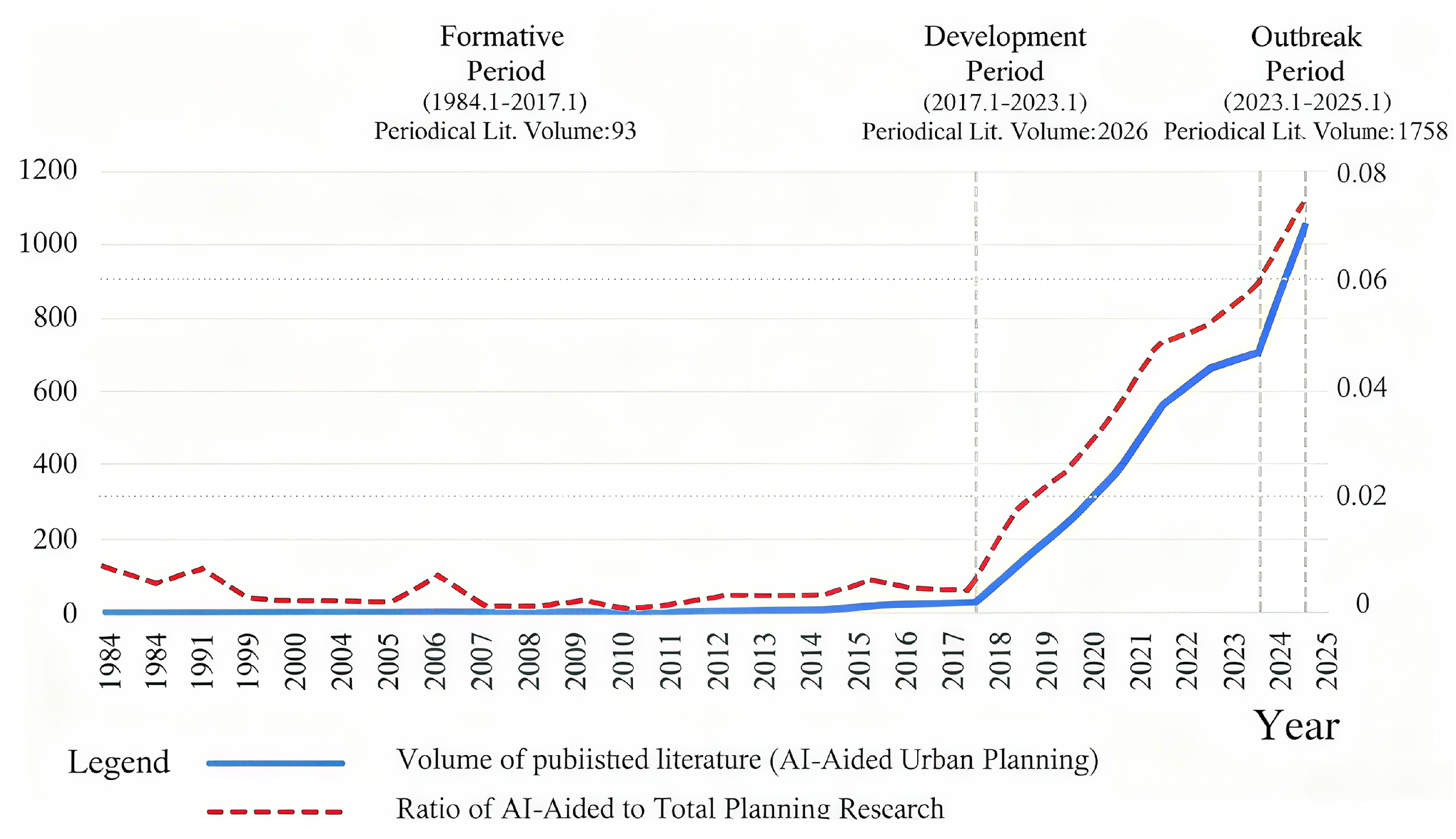
- Stage I The embryonic stage. (January 1984–January 2017)
- Stage II Rapid Development Phase (January 2017–January 2023)
- Stage III Explosive Growth Phase (January 2023–January 2025)
3.2. Research Network Analysis
3.2.1. National Research Network Analysis
- 1.
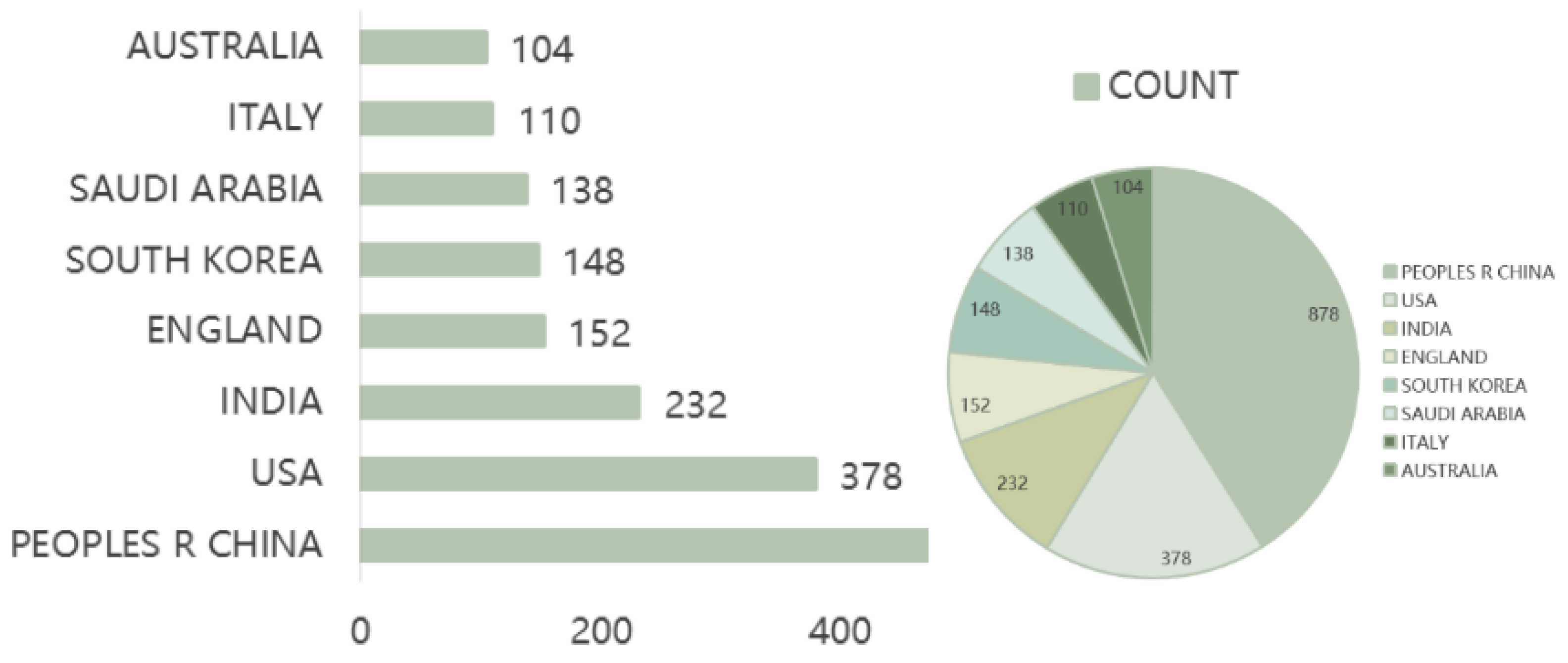
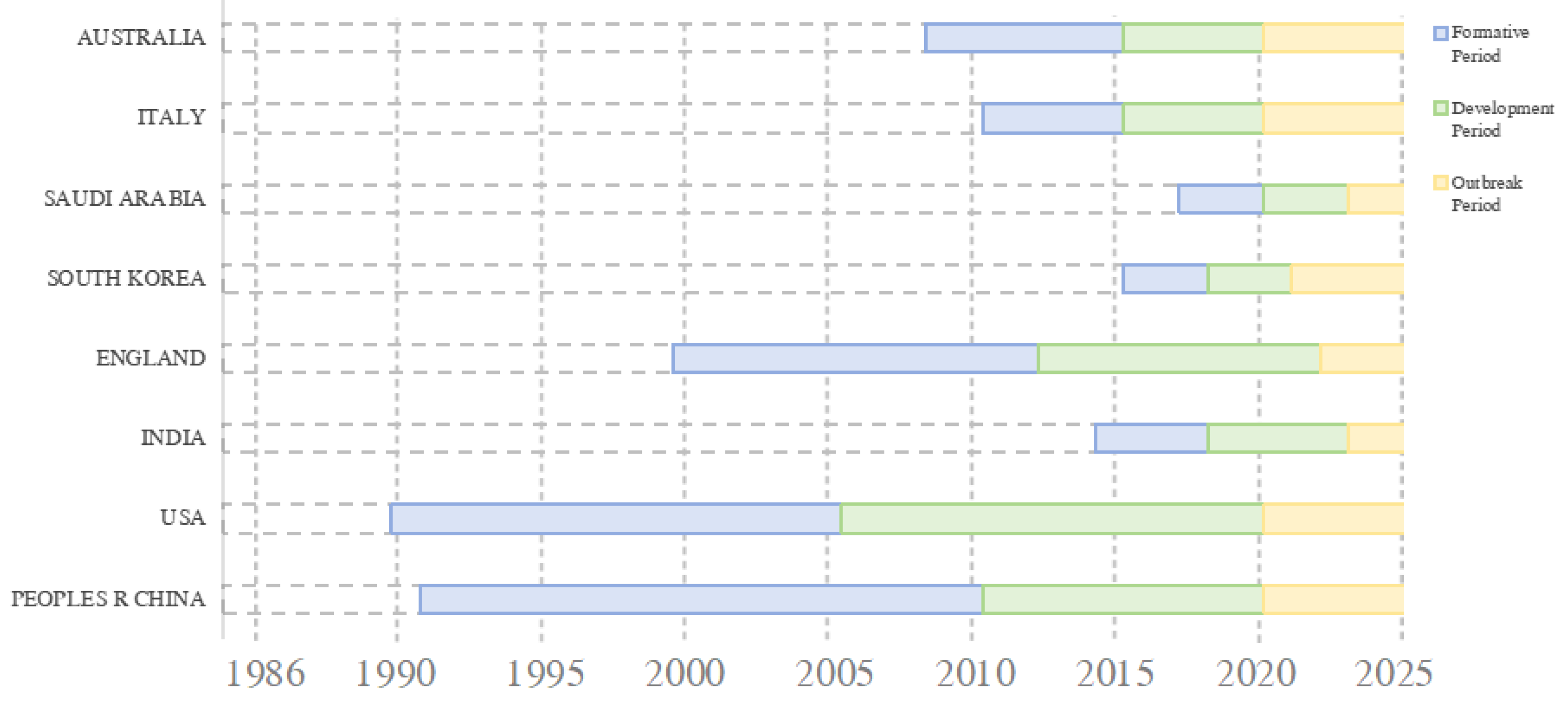
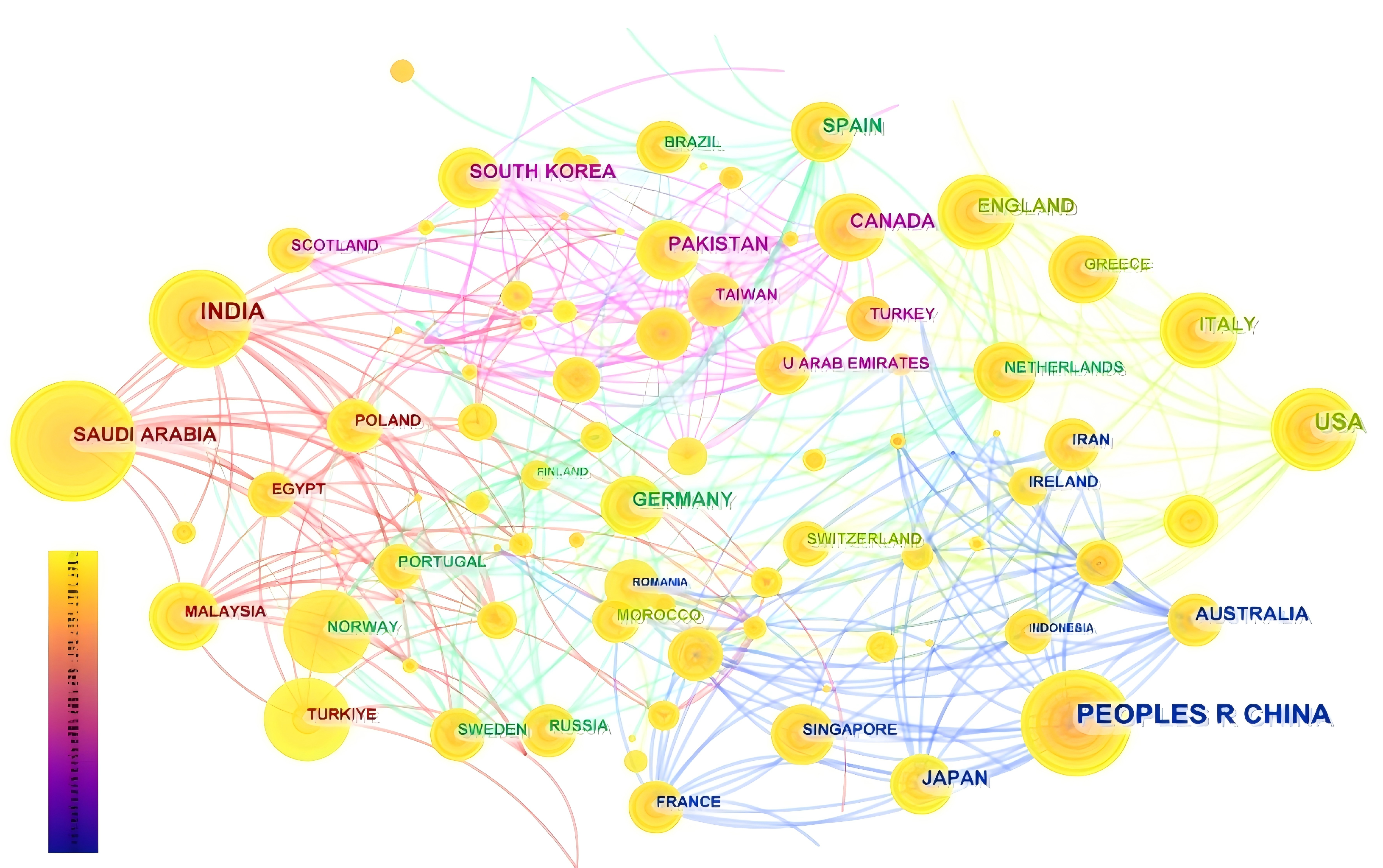
- Ranking of National Research OutputThe number of publications from each country was compiled by analyzing the countries of origin for data within the literature database (Figure 6). The analysis revealed that China (PEOPLES R CHINA) has produced the most significant volume of research in the field of “the application of AI technologies in urban planning,” with a total of 878 publications, accounting for approximately 35% of all publications (joint publications by multiple countries were counted only once). The United States (USA) ranked second with 378 publications, comprising about 15%. Other countries with a relatively abundant research output include India (INDIA) with 232 publications, England (ENGLAND) with 152, South Korea (SOUTH KOREA) with 148, Saudi Arabia (SAUDI ARABIA) with 138, Italy (ITALY) with 110, Canada (CANADA) with 109, and Australia (AUSTRALIA) with 104. All remaining countries each contributed fewer than 100 publications.To more scientifically evaluate the research situation in different countries/regions, we normalized it by combining economic and scientific research scale indicators. Specifically, based on the population (2023), GDP (2023) and the proportion of R&D expenditure in GDP (the latest available data) published by the World Bank, the number of articles per million people, the number of GDP articles per trillion dollars and the corresponding number of articles per unit of R&D expenditure (estimated value) are calculated. The standardized results of some major countries/regions are shown in Table 4.Continuing to analyze Table 4, it can be seen that although China leads in the original publication volume, after normalizing population and GDP, its research density is lower than that of countries such as the United Kingdom, Saudi Arabia, and South Korea. Saudi Arabia and South Korea have outstanding performance in the unit R&D expenditure output index, followed by the United States, the United Kingdom, and Australia. China has a moderate performance, while India has the lowest.
- 2.
- National Collaboration NetworkCollaborative relationships among researchers from different countries were evident. A country co-occurrence analysis was conducted to construct a national collaboration network (Figure 7), thereby uncovering patterns of international collaboration.Globally, China has the closest collaboration with Japan, co-authoring 71 publications, accounting for approximately 3% of the global population. These publications represent 8% and 92% of China’s and Japan’s total outputs. Other bilateral collaborations with more than 10 co-authored publications include England and Switzerland (24 publications), Spain and Germany (21 publications), the United Arab Emirates and Canada (16 publications), Saudi Arabia and Malaysia (15 publications), Saudi Arabia and India (13 publications), the United States and Switzerland (13 publications), and Australia and England (12 publications). The analysis shows that China collaborates frequently with East and Southeast Asian countries, but has relatively fewer collaborations with Western countries, with powerful ties to Japan. The United States has a more dispersed collaboration pattern across Europe and Asia, with modest collaboration volumes with Switzerland (13 publications), the United Kingdom (8 publications), Israel (8 publications), and several other European nations. The UK collaborates mainly with European countries, with Australia as a notable exception. Saudi Arabia and the UAE maintain extensive collaborations spanning Europe and Asia, with significant geographic breadth. Switzerland primarily collaborates with Western countries and maintains many co-authored publications. Overall, international collaboration exhibits a cluster-based tendency; however, leading publishing countries tend to cooperate less with one another. This suggests that national conditions and geographic proximity significantly influence such collaboration.
- 3.
- National Research CharacteristicsA data analysis and content review were conducted on countries with more than 100 publications to understand each country’s research profile. These countries’ developmental trajectories can be broadly categorized as shown in Figure 8. Most countries progress from foundational AI technologies to complex system integration, eventually focusing on sustainability, ethics, and brilliant processes. This evolution is typically demonstrated as follows: in the emergence phase, there is basic technical exploration and initial policy planning, with a low volume of publications; in the rapid development phase, research becomes more specialized and scenario-oriented, accompanied by systematic policy frameworks and a significant increase in publication volume; in the explosive growth phase, cutting-edge technologies such as generative AI and digital twins emerge rapidly, full-process applications are deepened, and the integration with national policy and strategic frameworks becomes more prominent.
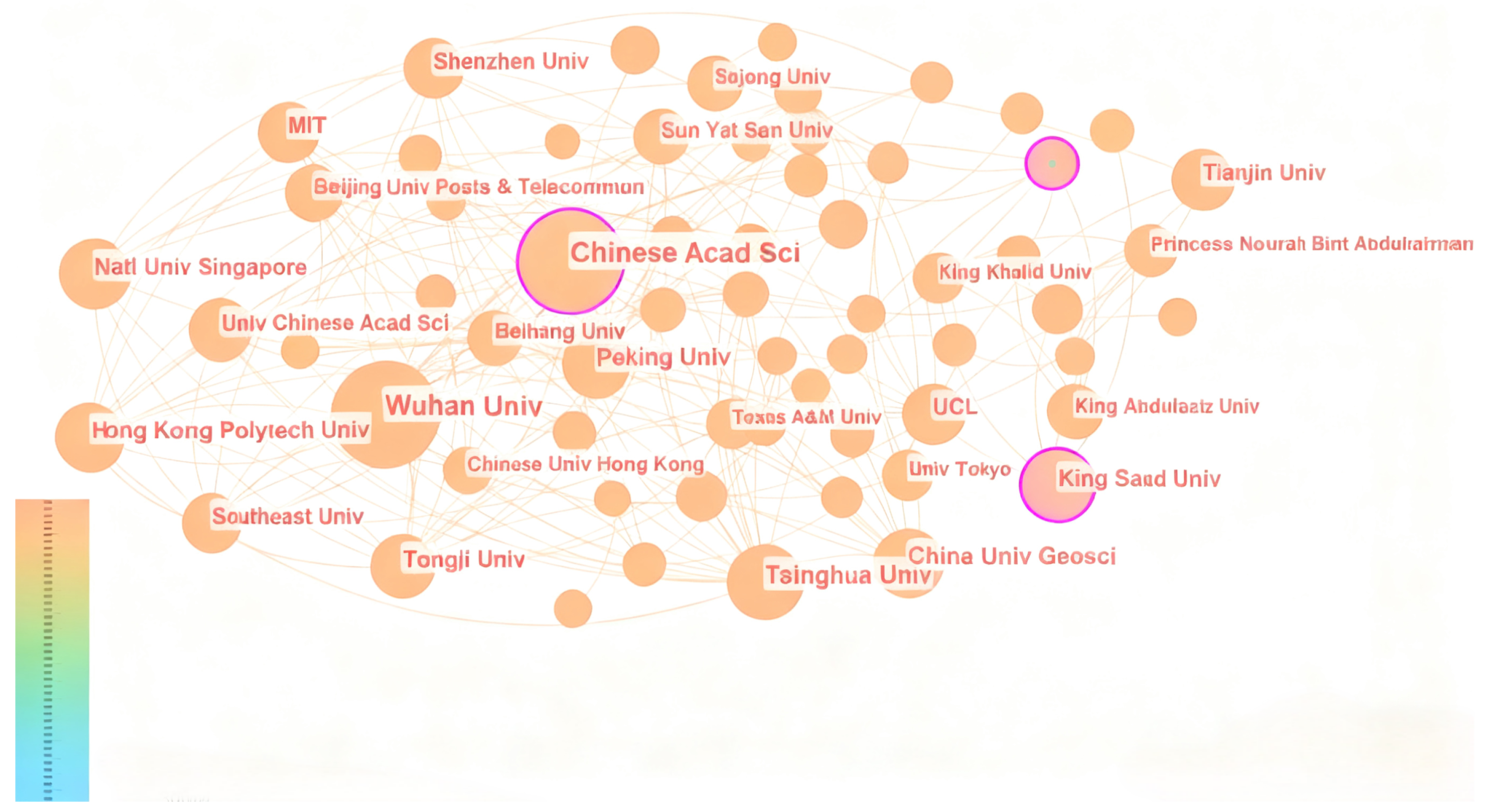
3.2.2. Institutional Research Network Analysis
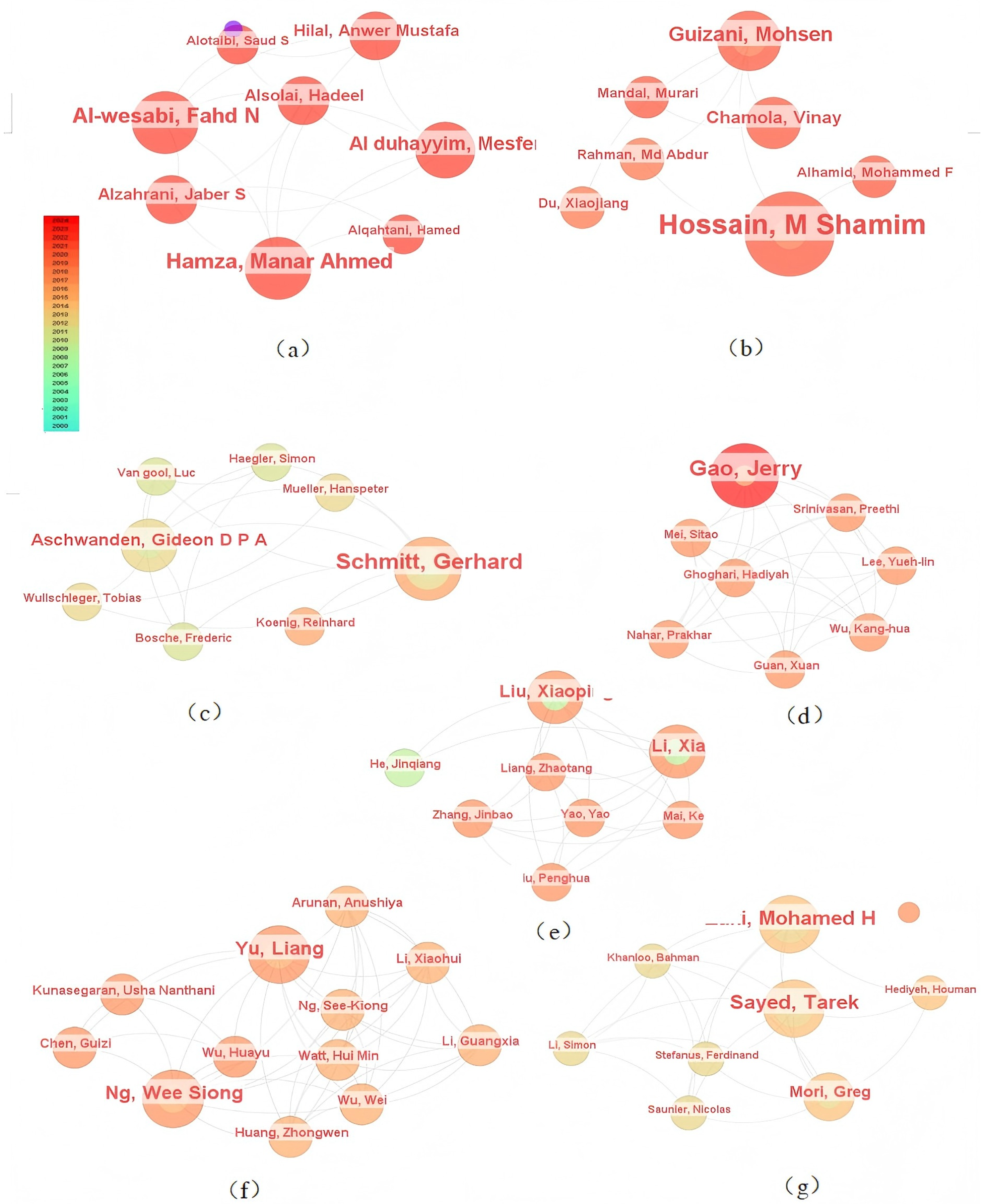
3.2.3. Author Collaboration Network Analysis
3.2.4. Interdisciplinary Research Network Analysis
3.3. Keywords and Technological Development Status
3.3.1. Keyword Evolution Timeline
3.3.2. Timeline of Key Technologies Across Planning Scales
3.3.3. Timeline of Technological Development Across Application Scenarios
3.3.4. Technological Development Speed
3.3.5. Specific Applications of AI Technologies
3.4. Prediction of Future Development Trends Based on SVM
4. Discussion
4.1. Influence of National Policies and Conditions
- 1.
- Guiding and Promoting Role of National Policies in Field DevelopmentFrom the global distribution of the literature output, countries such as China, the United States, and India have become dominant forces in this field due to policy support and technological accumulation (Figure 6). This illustrates that the formulation of national policies plays a crucial guiding role in shaping the development direction and application scenarios of AI technologies in urban planning. It is recommended that government agencies scientifically formulate relevant policies by considering the current status and future needs of both the country and the discipline, so as to promote development that aligns with national requirements.
- 2.
- Impact of National Conditions on the Development of the FieldThe technological development level of a country is primarily determined by its comprehensive national strength and overall national conditions. Most countries with strong comprehensive strength and relatively stable national conditions, such as China, the United States, and the United Kingdom, initiated research in this field earlier. These countries exhibit relatively stable and continuous development while maintaining considerable growth potential. Some countries, such as Japan, Germany, and Italy, started later but have developed rapidly. These countries generally emphasize technological development, possess strong economic power and solid industrial bases, and have favorable conditions for growth.Meanwhile, differences in national conditions have also led to a differentiation in the focus of technological applications:(1) Research on high-density and large-scale cities focuses more on traffic optimization, energy management, and microclimate regulation; low-density cities are more concerned with infrastructure connectivity and the accessibility of public services. High-density urban countries such as Japan focus on disaster response [151] and cultural heritage [152];(2) Global/regional core cities include Beijing, Shanghai, Singapore, London, New York, etc. These cities are both research subjects and major testing grounds for new technologies. Characteristic challenging cities include cities in arid regions (Riyadh), high-density historic cities (Hong Kong, Seoul), and rapidly developing big cities (Delhi, Mumbai). Research often focuses on specific issues in these cities, such as heat islands, transportation, and heritage conservation. Emerging smart cities include Dubai (Saudi Arabia) and Songdo (South Korea). These cities are often studied as demonstration cases of new technologies. Saudi Arabia, a resource-based country, prioritizes the development of energy optimization and cultural heritage restoration technologies [153], reflecting the deep binding of policy objectives, urban location, and technological paths.(3) Economic strength and industrialization level directly affect the speed of technological iteration, and research frontiers in high-income countries often involve sustainability, carbon neutrality, livability, advanced data simulation (digital twins), and citizen participation; research on middle and low-income countries focuses more on improving basic services, expanding infrastructure, land management, disaster response, and applicable technologies (such as demand forecasting based on mobile data). Developed countries (such as Germany and the UK) have rapidly entered a period of explosive growth through policy guidance, while developing countries (such as India) are more concerned with inclusive technologies (such as federated learning) to bridge the social equity gap [154].
4.2. Transformative Impact of AI Technologies on Urban Planning
- 1.
- Restructuring of Planning ProcessesTraditional planning relies on experience and static data analysis [156]. In contrast, AI technologies realize intelligent planning processes through real-time data perception [34,140], multi-source data fusion [21], and dynamic modeling [157], significantly improving planning efficiency and scientific rigor [158,159,160].
- 2.
- Innovation Paradigm Triggered by Generative AIGenerative AI technologies disrupt traditional design methods, such as Generative Adversarial Networks (GANs) and ChatGPT [150]. Studies have shown that a GAN has been applied to traffic scenario simulation [161] and architectural form generation [162] (Table 8), while large language models can rapidly generate planning proposals through natural language interaction [102]. These technologies shorten design cycles and optimize decision-making through multi-solution comparisons, driving planning from “experience-driven” toward “data-algorithm collaborative-driven.”
- 3.
- Explainable AI Empowering Transparent GovernanceExplainable AI (XAI) techniques reveal model decision logic, addressing the trust crisis caused by AI’s “black box” nature [163,164], while helping the public understand the basis for resource allocation and promoting multi-stakeholder co-governance models [146].At present, the actual management of urban data is usually held by local governments and technology providers or enterprises commissioned by them. Governments often control data collection and access through public platforms, while private enterprises often play a substantive management role in data processing, modeling, and commercial applications.Some cities have started to introduce AI models in policy pilots, but their validation still relies heavily on development teams or internal government evaluations, lacking independent and publicly available third-party validation processes. The rationality, fairness, and reproducibility of model decision-making have not yet formed a unified standard at the industry or policy level. XAI is currently mostly used by planning agencies and communities as a post hoc explanatory tool, rather than embedding public participation into the model development and iteration process.In the future, integrating XAI and blockchain may further enable data traceability and compliance verification, reshaping the ethical framework of urban planning [60,165]. Meanwhile, the fusion of generative AI and XAI is expected to facilitate the emergence of “autonomous planning systems,” achieving full-chain automation from data collection to plan implementation [149].
4.3. Full-Scale Deepening of Tech Iteration and Applications
- 1.
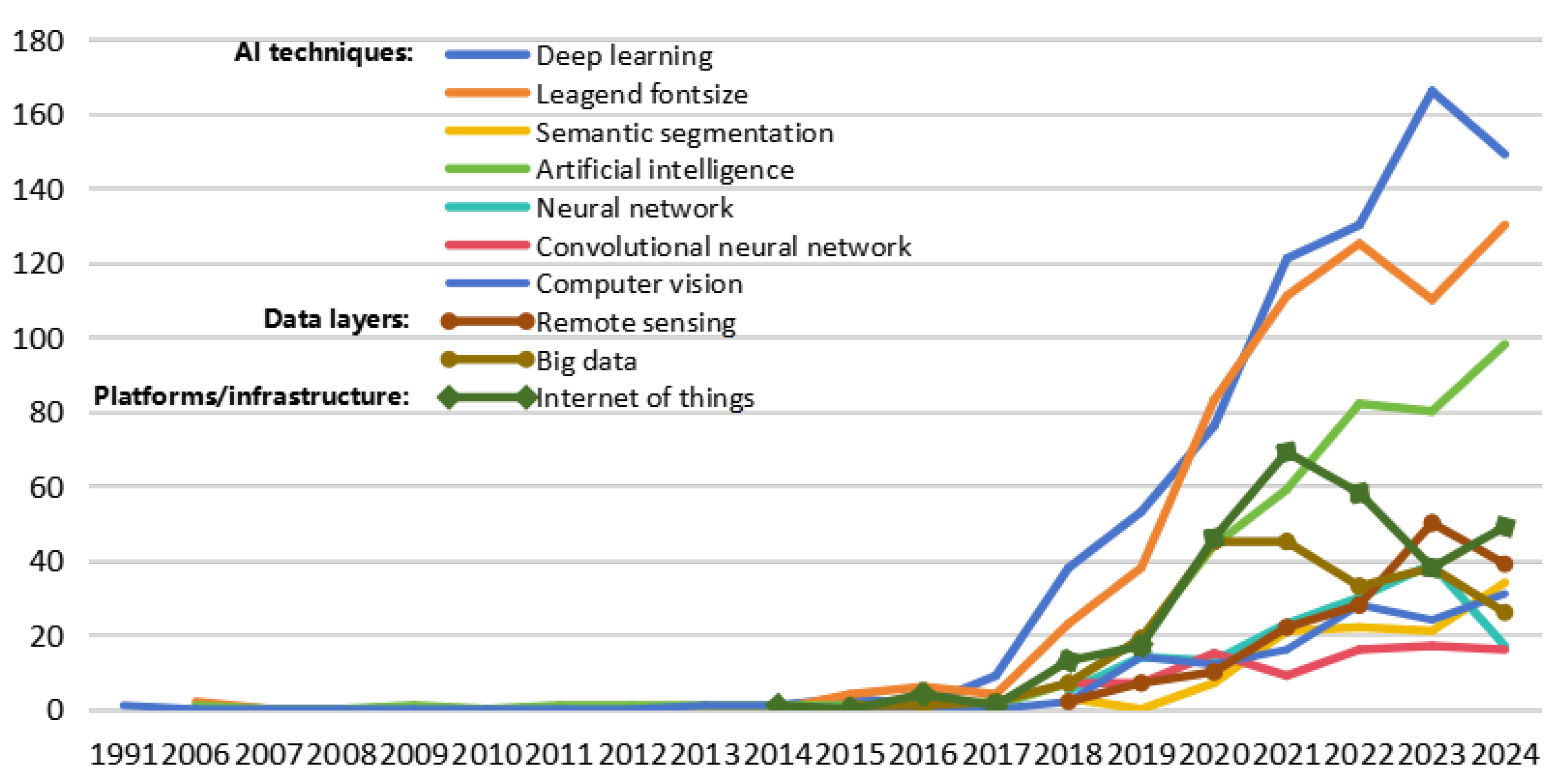
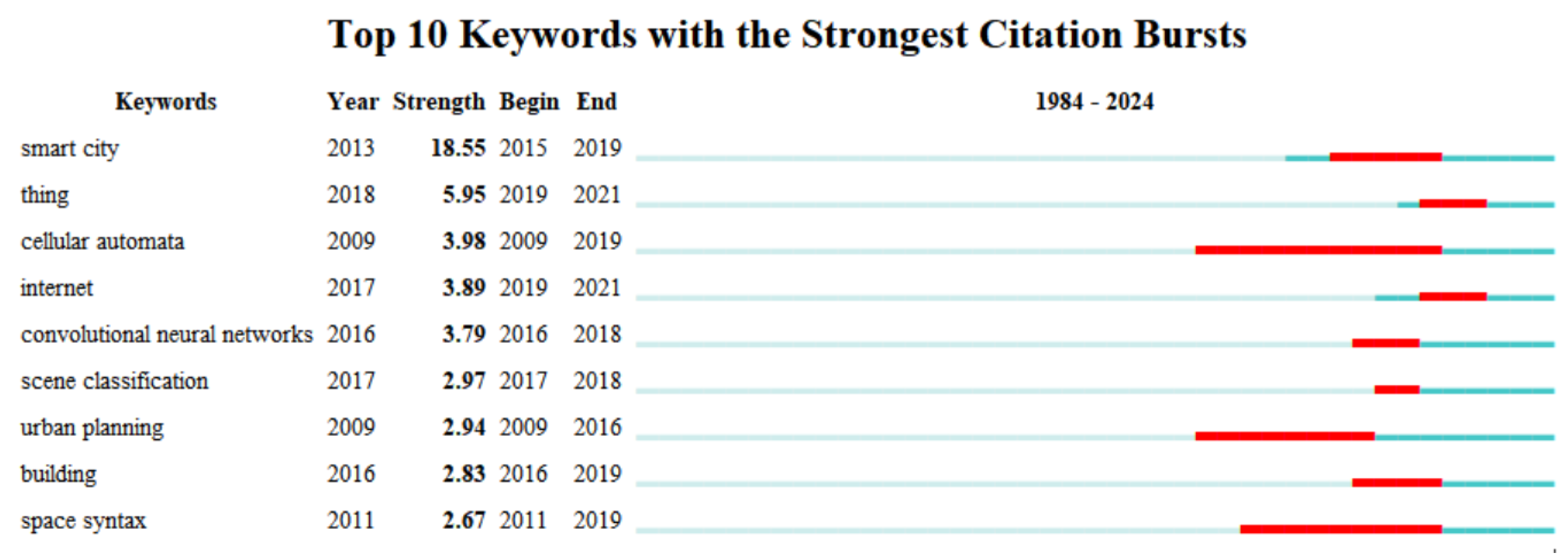
- Deep Penetration of Foundational TechnologiesMachine learning and deep learning have become general-purpose technologies in the planning field, supporting multi-level demands ranging from macro-scale traffic forecasting [19,156] to micro-scale building boundary extraction [166] (Table 11). Research shows that the literature on these two technology types continues to lead in proportion (Figure 14), with algorithmic optimizations further enhancing the accuracy of data fusion and pattern recognition [167].
- 2.
- Emerging Technologies Expanding Micro-Scale ScenariosEmerging technologies such as federated learning and edge computing fill gaps left by traditional methods. For example, edge computing enables real-time parking space recognition [168], while semantic segmentation technology achieves pixel-level analysis of building details [111]. These technologies drive planning from “district-level” optimization to “building-facility-level” precise regulation, which is especially prominent in smart communities and heritage conservation [169].
- 3.
- Full-Scale Collaboration and Cross-Domain IntegrationAI technology applications span the urban planning lifecycle [170,171,172] (Table 8). Additionally, integrating AI with the Internet of Things (IoT) and 6G has spawned interdisciplinary technologies such as cellular automata, enabling dynamic simulation of complex urban systems [120]. In the future, micro-scale technologies (e.g., explainable AI, autonomous vehicles) will deeply couple with macro models (e.g., fog computing, graph neural networks), forming an intelligent planning system characterized by “comprehensive perception–real-time response–closed-loop optimization.” With breakthroughs in quantum computing and neuro-symbolic AI, planning technologies will evolve toward “ultra-precision” and “self-adaptiveness”.
5. Conclusions
- 1.
- Development Stages:The evolution of AI applications in urban planning can be categorized into three distinct phases: the nascent stage (January 1984–January 2017), the rapid development stage (January 2017–January 2023), and the outbreak stage (January 2023–January 2025). Over time, the field has transitioned from generalized technological exploration to scenario-specific adaptation, and further toward value-driven innovation. This evolution has gradually established a tripartite research framework comprising technology, context, and objectives. AI is expected to remain a central research focus in the field of urban planning for the foreseeable future.
- 2.
- Publication Landscape:China (878 publications), the United States (378), and India (232) are the top three countries in terms of publication volume. National policies and contextual conditions significantly influence AI deployment in urban planning. Wuhan University and the Chinese Academy of Sciences demonstrated high productivity among research institutions. In the global author collaboration network, the Hamza research group made notable contributions, while the most prolific individual author was Filip Biljecki.
- 3.
- Keyword Analysis:High-frequency keywords include deep learning, machine learning, smart cities, and big data. These can be broadly divided into two categories: technological keywords and those related to research themes and application scenarios. Technological advancements are developed mainly in tandem with specific application contexts, reflecting an overall trend toward maturity, focus, and expansion across diverse spatial scales.
- 4.
- Future Directions:Established technologies such as deep learning and machine learning will continue to serve as research focal points. Meanwhile, emerging technologies—particularly generative AI and explainable AI—are expected to offer novel perspectives. The future trajectory is characterized by a shift from macro-level coordination to micro-level precision, supported by full-scale integration and interdisciplinary convergence.
- 5.
- Challenges and Gaps:Current limitations include issues related to data privacy, the digital divide, and ethical concerns. Addressing these challenges will require strengthened international collaboration, promoting inclusive technology, and exploring hybrid applications that integrate various AI paradigms.
- 1.
- The current research is only based on the WOS core collection, expanding multilingual databases such as CNKI and Scopus to enhance data comprehensiveness;
- 2.
- Validate the applicability, operability, and social acceptance of AI technology in complex scenarios such as urban renewal and disaster response through field cases.
- 3.
- Generative AI and explainable AI have become emerging hotspots, especially in the areas of scheme generation and decision-making transparency. In the future, their application research in collaborative design, public participation, and ethical governance should be strengthened.
- 4.
- The number of works in the literature on emerging technologies is still relatively small, and most of them are in the conceptual or experimental stage. Their actual integration path, technological maturity, and policy adaptability have not been systematically evaluated.
- 5.
- Current research is mostly focused on a single technology or data source, and a complete technology chain and standard framework have not yet been formed. In the future, efforts should be made to strengthen multimodal data fusion and real-time analysis capabilities, supporting dynamic programming and adaptive decision-making.
- 6.
- The existing literature on AI ethics, data privacy, and social impact is still relatively scattered, lacking systematic evaluation tools and policy recommendations, especially in the context of cross-cultural and cross-institutional comparative research. AI applications need to balance efficiency and fairness, and in the future, an interdisciplinary ethical governance framework should be established.
Author Contributions
Funding
Data Availability Statement
Conflicts of Interest
Abbreviations
| AI | Artificial Intelligence |
| ML | Machine Learning |
| SVM | Support Vector Machine |
| RF | Random Forest |
| RL | Reinforcement Learning |
| DQN | Deep Q-Network |
| PPO | Proximal Policy Optimization |
| DL | Deep Learning |
| CNN | Convolutional Neural Network |
| ResNet | Residual Network |
| RNN | Recurrent Neural Network |
| LSTM | Long Short-Term Memory |
| BERT | Bidirectional Encoder Representations from Transformers |
| CV | Computer Vision |
| 3D Recon | 3D Reconstruction |
| KR | Knowledge Representation |
| FL | Federated Learning |
| GenAI | Generative AI |
| GAN | Generative Adversarial Network |
| XAI | eXplainable AI |
| SHAP | SHapley Additive exPlanations |
| LIME | Local Interpretable Model-agnostic Explanations |
| K-means | K-means Clustering |
| MARL | Multi-Agent Reinforcement Learning |
References
- Haenlein, M.; Kaplan, A. A Brief History of Artificial Intelligence: On the Past, Present, and Future of Artificial Intelligence. Calif. Manag. Rev. 2019, 61, 5–14. [Google Scholar] [CrossRef]
- Jeon, J.; Lee, S.Y. Large language models in education: A focus on the complementary relationship between human teachers and ChatGPT. Educ. Inf. Technol. 2023, 28, 15873–15892. [Google Scholar] [CrossRef]
- Zahlan, A.; Ranjan, R.P.; Hayes, D. Artificial intelligence innovation in healthcare: Literature review, exploratory analysis, and future research. Technol. Soc. 2023, 74, 102321. [Google Scholar] [CrossRef]
- Vlacic, B.; Corbo, L.; Silva, S.C.E.; Dabic, M. The evolving role of artificial intelligence in marketing: A review and research agenda. J. Bus. Res. 2021, 128, 187–203. [Google Scholar] [CrossRef]
- Li, M.L.; Yin, D.X.; Qiu, H.L.; Bai, B. A systematic review of AI technology-based service encounters: Implications for hospitality and tourism operations. Int. J. Hosp. Manag. 2021, 95, 102930. [Google Scholar] [CrossRef]
- Ebekozien, A.; Aigbavboa, C.; Emuchay, F.E.; Aigbedion, M.; Ogbaini, I.F.; Awo-Osagie, A.I. Urban solid waste challenges and opportunities to promote sustainable developing cities through the fourth industrial revolution technologies. Int. J. Build. Pathol. Adapt. 2024, 42, 729–750. [Google Scholar] [CrossRef]
- Deng, M.; Huan, Z.; Kai, J.; Zheng, H.T.; Yue, C.; Peng, C. Deep Reinforcement Learning for Energy-Efficient Edge Caching in Mobile Edge Networks. China Commun. 2024, 21, 243–256. [Google Scholar] [CrossRef]
- Liu, S.R.; Wu, G.Y.; Barth, M. A Complete State Transition-Based Traffic Signal Control Using Deep Reinforcement Learning. In Proceedings of the 9th Annual IEEE Conference on Technologies for Sustainability (IEEE SusTech), Corona, CA, USA, 21–23 April 2022; pp. 100–107. [Google Scholar] [CrossRef]
- Huang, J.F.; Bibri, S.E.; Keel, P. Generative spatial artificial intelligence for sustainable smart cities: A pioneering large flow model for urban digital twin. Environ. Sci. Ecotechnol. 2025, 24, 100526. [Google Scholar] [CrossRef]
- Pavirani, F.; Gokhale, G.; Claessens, B.; Develder, C. Demand response for residential building heating: Effective Monte Carlo Tree Search control based on physics-informed neural networks. Energy Build. 2024, 311, 114161. [Google Scholar] [CrossRef]
- Feng, D.C.; Yi, X.; Deger, Z.T.; Liu, H.K.; Chen, S.Z.; Wu, G. Rapid post-earthquake damage assessment of building portfolios through deep learning-based component-level image recognition. J. Build. Eng. 2024, 98, 111380. [Google Scholar] [CrossRef]
- Abdollahi, A.; Pradhan, B.; Gite, S.; Alamri, A. Building Footprint Extraction from High Resolution Aerial Images Using Generative Adversarial Network (GAN) Architecture. IEEE Access 2020, 8, 209517–209527. [Google Scholar] [CrossRef]
- Chin, M.H.; Afsar-Manesh, N.; Bierman, A.S.; Chang, C.S.E.; Colón-Rodríguez, C.J.; Dullabh, P.; Duran, D.G.; Fair, M.; Hernandez-Boussard, T.; Hightower, M.; et al. Guiding Principles to Address the Impact of Algorithm Bias on Racial and Ethnic Disparities in Health and Health Care. JAMA Netw. Open 2023, 6, e2345050. [Google Scholar] [CrossRef] [PubMed]
- von Brackel-Schmidt, C.; Kucevic, E.; Leible, S.; Simic, D.; Gücük, G.L.; Schmidt, F.N. Equipping Participation Formats with Generative AI: A Case Study Predicting the Future of a Metropolitan City in the Year 2040. In HCI in Business, Government and Organizations; Lecture Notes in Computer Science; Springer: Cham, Switzerland, 2024; Volume 14720, pp. 270–285. [Google Scholar] [CrossRef]
- Johnson, T.L.; Johnson, N.N.; McCurdy, D.; Olajide, M.S. Facial recognition systems in policing and racial disparities in arrests. Gov. Inf. Q. 2022, 39, 101753. [Google Scholar] [CrossRef]
- Khan, A.; Aslam, S.; Aurangzeb, K.; Alhussein, M.; Javaid, N. Multiscale modeling in smart cities: A survey on applications, current trends, and challenges. Sustain. Cities Soc. 2022, 78, 103517. [Google Scholar] [CrossRef]
- Arsanjani, J.J.; Helbich, M.; Vaz, E.D. Spatiotemporal simulation of urban growth patterns using agent-based modeling: The case of Tehran. Cities 2013, 32, 33–42. [Google Scholar] [CrossRef]
- Chen, D.Y.; Shi, X.D.; Zhang, H.R.; Song, X.; Zhang, D.X.; Chen, Y.T.; Yan, J.Y. A Phone-Based Distributed Ambient Temperature Measurement System With an Efficient Label-Free Automated Training Strategy. IEEE Trans. Mob. Comput. 2024, 23, 11781–11793. [Google Scholar] [CrossRef]
- Zhang, J.K.; Wang, J.; Zang, H.Y.; Ma, N.; Skitmore, M.; Qu, Z.Y.; Skulmoski, G.; Chen, J.L. The Application of Machine Learning and Deep Learning in Intelligent Transportation: A Scientometric Analysis and Qualitative Review of Research Trends. Sustainability 2024, 16, 5879. [Google Scholar] [CrossRef]
- Wu, J.D.; Song, Z.Y.; Lv, C. Deep Reinforcement Learning-Based Energy-Efficient Decision-Making for Autonomous Electric Vehicle in Dynamic Traffic Environments. IEEE Trans. Transp. Electrif. 2024, 10, 875–887. [Google Scholar] [CrossRef]
- Zou, X.C.; Yan, Y.B.; Hao, X.X.; Hu, Y.H.; Wen, H.M.; Liu, E.R.; Zhang, J.B.; Li, Y.; Li, T.R.; Zheng, Y.; et al. Deep learning for cross-domain data fusion in urban computing: Taxonomy, advances, and outlook. Inf. Fusion 2025, 113, 102606. [Google Scholar] [CrossRef]
- Collier, E.; Mukhopadhyay, S.; Duffy, K.; Ganguly, S.; Madanguit, G.; Kalia, S.; Shreekant, G.; Nemani, R.; Michaelis, A.; Li, S.; et al. Semantic Segmentation of High Resolution Satellite Imagery using Generative Adversarial Networks with Progressive Growing. Remote Sens. Lett. 2021, 12, 439–448. [Google Scholar] [CrossRef]
- Ye, Z.J.; Zhu, L.; Li, Y.; Wang, H.W.; Yu, F.R.; Tang, T. Digital Twin-Driven VCTS Control: An Iterative Approach Using Model-Based Reinforcement Learning. IEEE Trans. Veh. Technol. 2025, 74, 3913–3924. [Google Scholar] [CrossRef]
- Harvey, C.A.; Chacón, M.; Donatti, C.I.; Garen, E.; Hannah, L.; Andrade, A.; Bede, L.; Brown, D.; Calle, A.; Chará, J.; et al. Climate-Smart Landscapes: Opportunities and Challenges for Integrating Adaptation and Mitigation in Tropical Agriculture. Conserv. Lett. 2014, 7, 77–90. [Google Scholar] [CrossRef]
- Blanusa, J.; Baraja, M.C.; Anghel, A.; von Niederhäusern, L.; Altman, E.; Pozidis, H.; Atasu, K. Graph Feature Preprocessor: Real-time Subgraph-based Feature Extraction for Financial Crime Detection. In Proceedings of the 5th International Conference on AI in Finance, Brooklyn, NY, USA, 14–17 November 2024; pp. 222–230. [Google Scholar] [CrossRef]
- Wang, S.; Zhang, Y.; Piao, X.L.; Lin, X.Q.; Hu, Y.L.; Yin, B.C. MRAGNN: Refining urban spatio-temporal prediction of crime occurrence with multi-type crime correlation learning. Expert Syst. Appl. 2025, 265, 125940. [Google Scholar] [CrossRef]
- Liu, X.C.; Wu, T.; Jiang, Q.R.; Ao, X.; Zhu, L.H.; Qiao, R.L. The nonlinear climatological impacts of urban morphology on extreme heats in urban functional zones: An interpretable ensemble learning-based approach. Build. Environ. 2025, 273, 112728. [Google Scholar] [CrossRef]
- Asiri, M.M.; Aldehim, G.; Alruwais, N.; Allafi, R.; Alzahrani, I.; Nouri, A.M.; Assiri, M.; Ahmed, N.A. Coastal Flood risk assessment using ensemble multi-criteria decision-making with machine learning approaches. Environ. Res. 2024, 245, 118042. [Google Scholar] [CrossRef]
- Joyce, A.; Javidroozi, V. Smart city development: Data sharing vs. data protection legislations. Cities 2024, 148, 104859. [Google Scholar] [CrossRef]
- Przeybilovicz, E.; Cunha, M.A. Governing in the digital age: The emergence of dynamic smart urban governance modes. Gov. Inf. Q. 2024, 41, 101907. [Google Scholar] [CrossRef]
- Hacker, K.P.; Seto, K.C.; Costa, F.; Corburn, J.; Reis, M.G.; Ko, A.I.; Diuk-Wasser, M.A. Urban slum structure: Integrating socioeconomic and land cover data to model slum evolution in Salvador, Brazil. Int. J. Health Geogr. 2013, 12, 45. [Google Scholar] [CrossRef]
- Bosco, G.; Riccardi, V.; Sciarrone, A.; D’Amore, R.; Visvizi, A. AI-driven innovation in smart city governance: Achieving human-centric and sustainable outcomes. Transform. Gov.-People Process Policy 2024. [Google Scholar] [CrossRef]
- Zhang, W.T.; Hu, B.; Liu, Y.Z.; Zhang, X.N.; Li, Z.X. Urban Flood Risk Assessment through the Integration of Natural and Human Resilience Based on Machine Learning Models. Remote Sens. 2023, 15, 3678. [Google Scholar] [CrossRef]
- Sepasgozar, S.M.E. Differentiating Digital Twin from Digital Shadow: Elucidating a Paradigm Shift to Expedite a Smart, Sustainable Built Environment. Buildings 2021, 11, 151. [Google Scholar] [CrossRef]
- Cui, D.J.; Hu, G.; Ai, Z.T.; Du, Y.X.; Mak, C.M.; Kwok, K. Particle image velocimetry measurement and CFD simulation of pedestrian level wind environment around U-type street canyon. Build. Environ. 2019, 154, 239–251. [Google Scholar] [CrossRef]
- Yang, J.; Dung, N.T.; Thach, P.N.; Phong, N.T.; Phu, V.D.; Phu, K.D.; Yen, L.M.; Thy, D.B.X.; Soltan, A.A.S.; Thwaites, L.; et al. Generalizability assessment of AI models across hospitals in a low-middle and high income country. Nat. Commun. 2024, 15, 52618. [Google Scholar] [CrossRef]
- El Majdoubi, D.; El Bakkali, H.; Sadki, S. Towards Smart Blockchain-Based System for Privacy and Security in a Smart City environment. In Proceedings of the 5th International Conference on Cloud Computing and Artificial Intelligence: Technologies and Applications (CloudTech), Marrakesh, Morocco, 24–26 November 2020; pp. 117–123. [Google Scholar] [CrossRef]
- Peng, Z.R.; Lu, K.F.; Liu, Y.H.; Zhai, W. The Pathway of Urban Planning AI: From Planning Support to Plan-Making. J. Plan. Educ. Res. 2024, 44, 2263–2279. [Google Scholar] [CrossRef]
- An, T.; Kim, H.; Joo, C. Prediction of COVID-19 Infection Spread Through Agent-based Simulation. In Proceedings of the 23rd International Symposium on Theory, Algorithmic Foundations, and Protocol Design for Mobile Networks and Mobile Computing (MobiHoc), Seoul, Republic of Korea, 17–20 October 2022; pp. 247–252. [Google Scholar] [CrossRef]
- Das, D.K. Digital Technology and AI for Smart Sustainable Cities in the Global South: A Critical Review of Literature and Case Studies. Urban Sci. 2025, 9, 72. [Google Scholar] [CrossRef]
- Nevanperä, M.; Helin, J.; Rajamäki, J. Comparison of European Commission’s Ethical Guidelines for AI to Other Organizational Ethical Guidelines. In Proceedings of the 3rd European Conference on the Impact of Artificial Intelligence and Robotics (ECIAIR), Online, 18–19 November 2021; pp. 132–137. [Google Scholar] [CrossRef]
- Pei, H.X.; Zhang, J.W.; Zhang, Y.; Xu, H.L.; Li, L. Self-Organized Routing for Autonomous Vehicles via Deep Reinforcement Learning. IEEE Trans. Veh. Technol. 2024, 73, 426–437. [Google Scholar] [CrossRef]
- Al-Raeei, M. The smart future for sustainable development: Artificial intelligence solutions for sustainable urbanization. Sustain. Dev. 2025, 33, 508–517. [Google Scholar] [CrossRef]
- Ji, P.H.; Su, R.; Wu, G.D.; Xue, L.; Zhang, Z.J.; Fang, H.T.; Gao, R.H.; Zhang, W.C.; Zhang, D.H. Projecting Future Wetland Dynamics Under Climate Change and Land Use Pressure: A Machine Learning Approach Using Remote Sensing and Markov Chain Modeling. Remote Sens. 2025, 17, 1089. [Google Scholar] [CrossRef]
- Ochoa, W.A.A.; Neto, A.I.; Vitorio, P.C., Jr.; Calabokis, O.P.; Ballesteros-Ballesteros, V. The Theory of Complexity and Sustainable Urban Development: A Systematic Literature Review. Sustainability 2025, 17, 3. [Google Scholar] [CrossRef]
- Chen, S.Y.; Huang, Q.X.; Muttarak, R.; Fang, J.Y.; Liu, T.; He, C.Y.; Liu, Z.W.; Zhu, L. Updating global urbanization projections under the Shared Socioeconomic Pathways. Sci. Data 2022, 9, 137. [Google Scholar] [CrossRef]
- Rathore, M.M.; Ahmad, A.; Paul, A.; Rho, S. Urban planning and building smart cities based on the Internet of Things using Big Data analytics. Comput. Netw. 2016, 101, 63–80. [Google Scholar] [CrossRef]
- Zhuang, Y.N.; Cenci, J.; Zhang, J.Z. Review of Big Data Implementation and Expectations in Smart Cities. Buildings 2024, 14, 3717. [Google Scholar] [CrossRef]
- Mukhamediev, R.I.; Popova, Y.; Kuchin, Y.; Zaitseva, E.; Kalimoldayev, A.; Symagulov, A.; Levashenko, V.; Abdoldina, F.; Gopejenko, V.; Yakunin, K.; et al. Review of Artificial Intelligence and Machine Learning Technologies: Classification, Restrictions, Opportunities and Challenges. Mathematics 2022, 10, 2552. [Google Scholar] [CrossRef]
- Fistola, R.; La Rocca, R.A. From smart city to artificial intelligence city. Envisaging the future of urban planning. Tema-J. Land Use Mobil. Environ. 2024, 18, 411–422. [Google Scholar] [CrossRef]
- Sharifi, A.; Khavarian-Garmsir, A.R.; Allam, Z.; Asadzadeh, A. Progress and prospects in planning: A bibliometric review of literature in Urban Studies and Regional and Urban Planning, 1956–2022. Prog. Plan. 2023, 173, 100740. [Google Scholar] [CrossRef]
- He, W.; Chen, M.Z. Advancing Urban Life: A Systematic Review of Emerging Technologies and Artificial Intelligence in Urban Design and Planning. Buildings 2024, 14, 835. [Google Scholar] [CrossRef]
- Dwivedi, Y.K.; Kshetri, N.; Hughes, L.; Slade, E.L.; Jeyaraj, A.; Kar, A.K.; Baabdullah, A.M.; Koohang, A.; Raghavan, V.; Ahuja, M.; et al. “So what if ChatGPT wrote it?” Multidisciplinary perspectives on opportunities, challenges and implications of generative conversational AI for research, practice and policy. Int. J. Inf. Manag. 2023, 71, 102642. [Google Scholar] [CrossRef]
- Pan, X.L.; Yan, E.J.; Cui, M.; Hua, W.N. Examining the usage, citation, and diffusion patterns of bibliometric mapping software: A comparative study of three tools. J. Inf. 2018, 12, 481–493. [Google Scholar] [CrossRef]
- Liu, Z.G.; Yin, Y.M.; Liu, W.D.; Dunford, M. Visualizing the intellectual structure and evolution of innovation systems research: A bibliometric analysis. Scientometrics 2015, 103, 135–158. [Google Scholar] [CrossRef]
- Mannuru, N.R.; Shahriar, S.; Teel, Z.A.; Wang, T.; Lund, B.D.; Tijani, S.; Pohboon, C.O.; Agbaji, D.; Alhassan, J.; Galley, J.; et al. Artificial intelligence in developing countries: The impact of generative artificial intelligence (AI) technologies for development. Inf. Dev. 2023, 41, 1036–1054. [Google Scholar] [CrossRef]
- Zhang, Y.L.; Xe, Y.C. Travel Mode Choice Modeling with Support Vector Machines. Transp. Res. Rec. 2008, 2076, 141–150. [Google Scholar] [CrossRef]
- Yao, L.; Fang, Z.P.; Xiao, Y.Q.; Hou, J.J.; Fu, Z.J. An Intelligent Fault Diagnosis Method for Lithium Battery Systems Based on Grid Search Support Vector Machine. Energy 2021, 214, 118866. [Google Scholar] [CrossRef]
- Bai, X.M.; Zhang, F.L.; Lee, I. Predicting the citations of scholarly paper. J. Inf. 2019, 13, 407–418. [Google Scholar] [CrossRef]
- Tahamtan, I.; Afshar, A.S.; Ahamdzadeh, K. Factors affecting number of citations: A comprehensive review of the literature. Scientometrics 2016, 107, 1195–1225. [Google Scholar] [CrossRef]
- Hasanah, A.; Wu, J. Bibliometric analysis and global research trends of climate change and cities studies for 30 years (1990-2021). Environ. Dev. Sustain. 2025, 27, 5573–5617. [Google Scholar] [CrossRef]
- Truong, T.M.T.; Ly, H.B.; Lee, D.; Pham, B.T.; Derrible, S. Analyzing travel behavior in Hanoi using Support Vector Machine. Transp. Plan. Technol. 2021, 44, 843–859. [Google Scholar] [CrossRef]
- Tehrany, M.S.; Pradhan, B.; Jebur, M.N. Flood susceptibility mapping using a novel ensemble weights-of-evidence and support vector machine models in GIS. J. Hydrol. 2014, 512, 332–343. [Google Scholar] [CrossRef]
- Uddin, M.G.; Nash, S.; Rahman, A.; Olbert, A.I. Performance analysis of the water quality index model for predicting water state using machine learning techniques. Process Saf. Environ. Prot. 2023, 169, 808–828. [Google Scholar] [CrossRef]
- Barath, E.; Futo, I. A Regional-Planning System Based on Artificial-Intelligence Concepts. Pap. Reg. Sci. Assoc. 1984, 55, 135–154. [Google Scholar] [CrossRef]
- Oh, J.; Hwang, J.E.; Smith, S.F.; Koile, K. Learning from main streets—A machine learning approach identifying neighborhood commercial districts. In Proceedings of the 8th International Conference on Design and Decision Support Systems in Architecture and Urban Planning, Dordrecht, The Netherlands, 4–7 July 2006; pp. 325–336. [Google Scholar] [CrossRef]
- Wu, J.K.; Chen, T.; Yang, L. A Knowledge-Based Image Database System (ISDBS). Sci. China Ser. A 1991, 34, 87–93. [Google Scholar]
- Huang, X.; Xie, C.; Fang, X.; Zhang, L.P. Combining Pixel- and Object-Based Machine Learning for Identification of Water-Body Types From Urban High-Resolution Remote-Sensing Imagery. IEEE J. Sel. Top. Appl. Earth Obs. Remote Sens. 2015, 8, 2097–2110. [Google Scholar] [CrossRef]
- Lv, Q.; Dou, Y.; Niu, X.; Xu, J.Q.; Xu, J.B.; Xia, F. Urban Land Use and Land Cover Classification Using Remotely Sensed SAR Data through Deep Belief Networks. J. Sens. 2015, 2015, 538063. [Google Scholar] [CrossRef]
- Tian, Y.X.; Pan, L. Predicting Short-term Traffic Flow by Long Short-Term Memory Recurrent Neural Network. In Proceedings of the 2015 IEEE International Conference on Smart City/SocialCom/SustainCom (SmartCity), Chengdu, China, 19–21 December 2015; pp. 153–158. [Google Scholar] [CrossRef]
- Vakalopoulou, M.; Karantzalos, K.; Komodakis, N.; Paragios, N. Building Detection in Very High Resolution Multispectral Data with Deep Learning Features. In Proceedings of the IEEE International Geoscience and Remote Sensing Symposium (IGARSS), Milan, Italy, 26–31 July 2025; pp. 1873–1876. [Google Scholar]
- Yin, L.; Wang, Z.X. Measuring visual enclosure for street walkability: Using machine learning algorithms and Google Street View imagery. Appl. Geogr. 2016, 76, 147–153. [Google Scholar] [CrossRef]
- Li, S.; Sayed, T.; Zaki, M.H.; Mori, G.; Stefanus, F.; Khanloo, B.; Saunier, N. Automated Collection of Pedestrian Data Through Computer Vision Techniques. Transp. Res. Rec. 2012, 2299, 121–127. [Google Scholar] [CrossRef]
- Ma, R.J. DEM generation and building detection from Lidar data. Photogramm. Eng. Remote Sens. 2005, 71, 847–854. [Google Scholar] [CrossRef]
- Noulas, A.; Mascolo, C.; Frias-Martinez, E. Exploiting Foursquare and Cellular Data to Infer User Activity in Urban Environments. In Proceedings of the IEEE 14th International Conference on Mobile Data Management (MDM), Milan, Italy, 3–6 June 2013; pp. 167–176. [Google Scholar] [CrossRef]
- Zhao, K.; Tarkoma, S.; Liu, S.Y.; Vo, H. Urban Human Mobility Data Mining: An Overview. In Proceedings of the 4th IEEE International Conference on Big Data (Big Data), Washington, DC, USA, 5–8 December 2016; pp. 1911–1920. [Google Scholar]
- Hu, M.; Li, C. Design Smart City Based on 3S, Internet of Things, Grid Computing and Cloud Computing Technology. In International Workshop on Internet of Things (IOT Workshop 2012); Communications in Computer and Information Science; Springer: Berlin, Germany, 2012; Volume 312, pp. 466–473. [Google Scholar]
- Skouby, K.E.; Lynggaard, P. Smart Home and Smart City Solutions enabled by 5G, IoT, AAI and CoT Services. In Proceedings of the 2014 International Conference on Contemporary Computing and Informatics (ic3i), Mysuru, India, 27–29 November 2014; pp. 874–878. [Google Scholar]
- Rossini, R.; Ferrera, E.; Conzon, D.; Pastrone, C. WSNs Self-Calibration approach for Smart City applications leveraging Incremental Machine Learning Techniques. In Proceedings of the 8th IFIP International Conference on New Technologies, Mobility and Security (NTMS), Paris, France, 18–20 June 2016. [Google Scholar]
- Singh, S.; Sharma, P.K.; Yoon, B.; Shojafar, M.; Cho, G.H.; Ra, I.H. Convergence of blockchain and artificial intelligence in IoT network for the sustainable smart city. Sustain. Cities Soc. 2020, 63, 102364. [Google Scholar] [CrossRef]
- Gotovtsev, P. How IoT Can Integrate Biotechnological Approaches for City Applications-Review of Recent Advancements, Issues, and Perspectives. Appl. Sci. 2020, 10, 3990. [Google Scholar] [CrossRef]
- Kumari, A.; Tanwar, S. Secure data analytics for smart grid systems in a sustainable smart city: Challenges, solutions, and future directions. Sustain. Comput.-Inform. Syst. 2020, 28, 100427. [Google Scholar] [CrossRef]
- Nguyen, D.C.; Pathirana, P.N.; Ding, M.; Seneviratne, A. Blockchain for 5G and beyond networks: A state of the art survey. J. Netw. Comput. Appl. 2020, 166, 102693. [Google Scholar] [CrossRef]
- Ye, Y.; Richards, D.; Lu, Y.; Song, X.P.; Zhuang, Y.; Zeng, W.; Zhong, T. Measuring daily accessed street greenery: A human-scale approach for informing better urban planning practices. Landsc. Urban Plan. 2019, 191, 103434. [Google Scholar] [CrossRef]
- Guo, R.; Song, X.Y.; Li, P.R.; Wu, G.M.; Guo, Z.L. Large-Scale and Refined Green Space Identification-Based Sustainable Urban Renewal Mode Assessment. Math. Probl. Eng. 2020, 2020, 2043019. [Google Scholar] [CrossRef]
- Kovacs-Györi, A.; Ristea, A.; Havas, C.; Mehaffy, M.; Hochmair, H.H.; Resch, B.; Juhasz, L.; Lehner, A.; Ramasubramanian, L.; Blaschke, T. Opportunities and Challenges of Geospatial Analysis for Promoting Urban Livability in the Era of Big Data and Machine Learning. ISPRS Int. J. Geo-Inf. 2020, 9, 752. [Google Scholar] [CrossRef]
- Kong, L.Q.; Liu, Z.F.; Wu, J.G. A systematic review of big data-based urban sustainability research: State-of-the-science and future directions. J. Clean. Prod. 2020, 273, 123142. [Google Scholar] [CrossRef]
- Serey, J.; Quezada, L.; Alfaro, M.; Fuertes, G.; Ternero, R.; Gatica, G.; Gutierrez, S.; Vargas, M. Methodological Proposals for the Development of Services in a Smart City: A Literature Review. Sustainability 2020, 12, 10249. [Google Scholar] [CrossRef]
- Qi, X.Q.; Li, K.Q.; Liu, P.K.; Zhou, X.G.; Sun, M.Y. Deep Attention and Multi-Scale Networks for Accurate Remote Sensing Image Segmentation. IEEE Access 2020, 8, 146627–146639. [Google Scholar] [CrossRef]
- Keshtkar, H.; Voigt, W.; Alizadeh, E. Land-cover classification and analysis of change using machine-learning classifiers and multi-temporal remote sensing imagery. Arab. J. Geosci. 2017, 10, 154. [Google Scholar] [CrossRef]
- Hernandez, I.E.R.; Shi, W.Z. A Random Forests classification method for urban land-use mapping integrating spatial metrics and texture analysis. Int. J. Remote Sens. 2018, 39, 1175–1198. [Google Scholar] [CrossRef]
- Wang, R.S.; Peethambaran, J.; Chen, D. LiDAR Point Clouds to 3-D Urban Models: A Review. IEEE J. Sel. Top. Appl. Earth Obs. Remote Sens. 2018, 11, 606–627. [Google Scholar] [CrossRef]
- The current development status of artificial intelligence under the epidemic. Househ. Appl. 2020, 10, 45–48.
- Vijai, P.; Sivakumar, P.B. Design of IoT Systems and Analytics in the context of Smart City initiatives in India. Procedia Comput. Sci. 2016, 92, 583–588. [Google Scholar] [CrossRef]
- Meng, S.Y.; Su, X.; Sun, G.B.; Li, M.S.; Xue, F. From 3D pedestrian networks to wheelable networks: An automatic wheelability assessment method for high-density urban areas using contrastive deep learning of smartphone point clouds. Comput. Environ. Urban Syst. 2025, 117, 102255. [Google Scholar] [CrossRef]
- Wedyan, M.; Saeidi-Rizi, F. Assessing the impact of walkability indicators on health outcomes using machine learning algorithms: A case study of Michigan. Travel Behav. Soc. 2025, 39, 100983. [Google Scholar] [CrossRef]
- Hu, H.; Zhou, H.X.; Cheng, J.Q.; Shu, T.Y. The effects of green apartment living, neighborhood greenspace exposures and greenspace exposures in activity space on residents’ walking behaviors and mental health in China. Appl. Geogr. 2025, 177, 103545. [Google Scholar] [CrossRef]
- Hassan, A.H.; Ahmed, E.M.; Hussien, J.M.; bin Sulaiman, R.; Abdulhak, M.; Kahtan, H. A cyber physical sustainable smart city framework toward society 5.0: Explainable AI for enhanced SDGs monitoring. Res. Glob. 2025, 10, 100275. [Google Scholar] [CrossRef]
- Mim, N.J.; Nandi, D.; Khan, S.S.; Dey, A.; Ahmed, S.I. In-Between Visuals and Visible: The Impacts of Text-to-Image Generative AI Tools on Digital Image-making Practices in the Global South. In Proceedings of the CHI Conference on Human Factors in Computing Systems (CHI), Honolulu, HI, USA, 11–16 May 2024. [Google Scholar] [CrossRef]
- Huang, Y.J.; Zhang, J.H.; Chen, X.; Lam, A.H.F.; Chen, B. From Simulation to Prediction: Enhancing Digital Twins with Advanced Generative AI Technologies. In Proceedings of the IEEE 18th International Conference on Control and Automation (ICCA), Reykjavik, Iceland, 18–21 June 2024; pp. 490–495. [Google Scholar] [CrossRef]
- Liang, H.; Zhang, J.X.; Li, Y.Q.; Wang, B.W.; Huang, J.Y. Automatic Estimation for Visual Quality Changes of Street Space via Street-View Images and Multimodal Large Language Models. IEEE Access 2024, 12, 87713–87727. [Google Scholar] [CrossRef]
- Taktak, F. AI-Enhanced Geomatics Engineering: Innovative Solutions and Applications Using ChatGPT, an Advanced AI Language Model. Int. J. Eng. Geosci. 2025, 10, 36–45. [Google Scholar] [CrossRef]
- Zhang, D. The Impact of Smart Cities on the Export of China’s Artificial Intelligence Products. Master’s Thesis, Wuhan University, Wuhan, China, 2021. [Google Scholar] [CrossRef]
- Yuan, H. Interpretation of the Development Plan for the New Generation of Artificial Intelligence. Technol. Style 2018, 37, 45–48. [Google Scholar] [CrossRef]
- Parker, L.E. Creation of the National Artificial Intelligence Research and Development Strategic Plan. AI Mag. 2018, 39, 25–31. [Google Scholar] [CrossRef]
- Lartey, D.; Law, K.M.Y. Artificial intelligence adoption in urban planning governance: A systematic review of advancements in decision-making, and policy making. Landsc. Urban Plan. 2025, 258, 105337. [Google Scholar] [CrossRef]
- Koo, B.W.; Guhathakurt, S.; Botchwey, N. How are Neighborhood and Street-Level Walkability Factors Associated with Walking Behaviors? A Big Data Approach Using Street View Images. Environ. Behav. 2022, 54, 211–241. [Google Scholar] [CrossRef]
- Hong, J.Y.; Zhu, Z.D.; Lyu, L.J.; Zhou, Y.; Boddeti, V.N.; Zhou, J.Y. International Workshop on Federated Learning for Distributed Data Mining. In Proceedings of the 29th ACM SIGKDD Conference on Knowledge Discovery and Data Mining (KDD), Long Beach, CA, USA, 6–10 August 2023; pp. 5861–5862. [Google Scholar] [CrossRef]
- Amani, M.; Ghorbanian, A.; Ahmadi, S.A.; Kakooei, M.; Moghimi, A.; Mirmazloumi, S.M. Google Earth Engine Cloud Computing Platform for Remote Sensing Big Data Applications: A Comprehensive Review. IEEE J. Sel. Top. Appl. Earth Obs. Remote Sens. 2020, 13, 5326–5350. [Google Scholar] [CrossRef]
- Cao, R.; Tu, W.; Yang, C.X.; Li, Q.; Liu, J.; Zhu, J.S.; Zhang, Q.; Li, Q.; Qiu, G. Deep learning-based remote and social sensing data fusion for urban region function recognition. ISPRS J. Photogramm. Remote Sens. 2020, 163, 82–97. [Google Scholar] [CrossRef]
- Cao, R.; Zhu, J.S.; Tu, W.; Li, Q.Q.; Cao, J.Z.; Liu, B.Z.; Zhang, Q.; Qiu, G. Integrating Aerial and Street View Images for Urban Land Use Classification. Remote Sens. 2018, 10, 1553. [Google Scholar] [CrossRef]
- Li, W.J.; Dong, R.M.; Fu, H.H.; Wang, J.; Yu, L.; Gong, P. Integrating Google Earth imagery with Landsat data to improve 30-m resolution land cover mapping. Remote Sens. Environ. 2020, 237, 111563. [Google Scholar] [CrossRef]
- Wang, S.S.; Hou, X.W.; Zhao, X. Automatic Building Extraction From High-Resolution Aerial Imagery via Fully Convolutional Encoder-Decoder Network With Non-Local Block. IEEE Access 2020, 8, 7313–7322. [Google Scholar] [CrossRef]
- Yao, Y.; Li, X.; Liu, X.P.; Liu, P.H.; Liang, Z.T.; Zhang, J.B.; Mai, K. Sensing spatial distribution of urban land use by integrating points-of-interest and Google Word2Vec model. Int. J. Geogr. Inf. Sci. 2017, 31, 825–848. [Google Scholar] [CrossRef]
- Yao, Y.; Liang, Z.T.; Yuan, Z.H.; Liu, P.H.; Bie, Y.P.; Zhang, J.B.; Wang, R.; Wang, R.; Guan, Q. A human-machine adversarial scoring framework for urban perception assessment using street-view images. Int. J. Geogr. Inf. Sci. 2019, 33, 2363–2384. [Google Scholar] [CrossRef]
- Zhai, Y.Q.; Yao, Y.; Guan, Q.F.; Liang, X.; Li, X.; Pan, Y.T.; Yue, H.; Yuan, Z.; Zhou, J. Simulating urban land use change by integrating a convolutional neural network with vector-based cellular automata. Int. J. Geogr. Inf. Sci. 2020, 34, 1475–1499. [Google Scholar] [CrossRef]
- Zhang, P.B.; Ke, Y.H.; Zhang, Z.X.; Wang, M.L.; Li, P.; Zhang, S.Y. Urban Land Use and Land Cover Classification Using Novel Deep Learning Models Based on High Spatial Resolution Satellite Imagery. Sensors 2018, 18, 3717. [Google Scholar] [CrossRef]
- Gaur, S.; Singh, R. A Comprehensive Review on Land Use/Land Cover (LULC) Change Modeling for Urban Development: Current Status and Future Prospects. Sustainability 2023, 15, 903. [Google Scholar] [CrossRef]
- Gharaibeh, A.; Shaamala, A.; Obeidat, R.; Al-Kofahi, S. Improving land-use change modeling by integrating ANN with Cellular Automata-Markov Chain model. Heliyon 2020, 6, e05092. [Google Scholar] [CrossRef]
- He, J.L.; Xia, L.; Yao, Y.; Ye, H.; Zhang, J.B. Mining transition rules of cellular automata for simulating urban expansion by using the deep learning techniques. Int. J. Geogr. Inf. Sci. 2018, 32, 2076–2097. [Google Scholar] [CrossRef]
- Zhou, Y.; Huang, C.; Wu, T.; Zhang, M.Y. A novel spatio-temporal cellular automata model coupling partitioning with CNN-LSTM to urban land change simulation. Ecol. Model. 2023, 482, 110394. [Google Scholar] [CrossRef]
- Ma, Z.P. Deep exploration of street view features for identifying urban vitality: A case study of Qingdao city. Int. J. Appl. Earth Obs. Geoinf. 2023, 123, 103476. [Google Scholar] [CrossRef]
- Miranda, A.S.; Fan, Z.Y.; Duarte, F.; Ratti, C. Desirable streets: Using deviations in pedestrian trajectories to measure the value of the built environment. Comput. Environ. Urban Syst. 2021, 86, 101563. [Google Scholar] [CrossRef]
- Yigitcanlar, T.; Desouza, K.C.; Butler, L.; Roozkhosh, F. Contributions and Risks of Artificial Intelligence (AI) in Building Smarter Cities: Insights from a Systematic Review of the Literature. Energies 2020, 13, 1473. [Google Scholar] [CrossRef]
- Zhou, H.; He, S.J.; Cai, Y.Y.; Wang, M.; Su, S.L. Social inequalities in neighborhood visual walkability: Using street view imagery and deep learning technologies to facilitate healthy city planning. Sustain. Cities Soc. 2019, 50, 101605. [Google Scholar] [CrossRef]
- Chen, Y.Y.; Zhang, X.; Grekousis, G.; Huang, Y.L.; Hua, F.L.; Pan, Z.H.; Liu, Y.S. Examining the importance of built and natural environment factors in predicting self-rated health in older adults: An extreme gradient boosting (XGBoost) approach. J. Clean. Prod. 2023, 413, 137432. [Google Scholar] [CrossRef]
- Qiu, W.S.; Zhang, Z.Y.; Liu, X.; Li, W.J.; Li, X.J.; Xu, X.; Huang, X. Subjective or objective measures of street environment, which are more effective in explaining housing prices? Landsc. Urban Plan. 2022, 221, 104358. [Google Scholar] [CrossRef]
- Wu, C.; Du, Y.H.; Li, S.; Liu, P.Y.; Ye, X.Y. Does visual contact with green space impact housing prices? An integrated approach of machine learning and hedonic modeling based on the perception of green space. Land Use Policy 2022, 115, 106048. [Google Scholar] [CrossRef]
- Zhang, L.; Li, D.; Guo, Q.S. Deep Learning From Spatio-Temporal Data Using Orthogonal Regularization Residual CNN for Air Prediction. IEEE Access 2020, 8, 66037–66047. [Google Scholar] [CrossRef]
- Pan, K.; Lu, J.; Li, J.R.; Xu, Z.Y. A Hybrid Autoformer Network for Air Pollution Forecasting Based on External Factor Optimization. Atmosphere 2023, 14, 869. [Google Scholar] [CrossRef]
- Sonet, M.S.; Hasan, M.Y.; Al Kafy, A.; Shobnom, N. Spatiotemporal analysis of urban expansion, land use dynamics, and thermal characteristics in a rapidly growing megacity using remote sensing and machine learning techniques. Theor. Appl. Climatol. 2025, 156, 79. [Google Scholar] [CrossRef]
- Wang, Y.Y.; Zhang, P.; Xie, Y.L.; Chen, L.; Li, Y. Toward explainable flood risk prediction: Integrating a novel hybrid machine learning model. Sustain. Cities Soc. 2025, 120, 106140. [Google Scholar] [CrossRef]
- Zhu, S.J.; Yan, Y.; Zhao, B.; Wang, H. Assessing the impact of adjacent urban morphology on street temperature: A multisource analysis using random forest and SHAP. Build. Environ. 2025, 267, 112326. [Google Scholar] [CrossRef]
- Bindajam, A.A.; Mallick, J.; Hang, H.T. Assessing landscape fragmentation due to urbanization in English Bazar Municipality, Malda, India, using landscape metrics. Environ. Sci. Pollut. Res. 2023, 30, 68716–68731. [Google Scholar] [CrossRef] [PubMed]
- Gasparovic, M.; Dobrinic, D. Comparative Assessment of Machine Learning Methods for Urban Vegetation Mapping Using Multitemporal Sentinel-1 Imagery. Remote Sens. 2020, 12, 1952. [Google Scholar] [CrossRef]
- Luo, Z.Y.; Tian, J.; Zeng, J.; Pilla, F. Resilient landscape pattern for reducing coastal flood susceptibility. Sci. Total Environ. 2023, 856, 159087. [Google Scholar] [CrossRef]
- Rees, G.; Hebryn-Baidy, L.; Belenok, V. Temporal Variations in Land Surface Temperature within an Urban Ecosystem: A Comprehensive Assessment of Land Use and Land Cover Change in Kharkiv, Ukraine. Remote Sens. 2024, 16, 1637. [Google Scholar] [CrossRef]
- Vulova, S.; Rocha, A.D.; Meier, F.; Nouri, H.; Schulz, C.; Soulsby, C.; Tetzlaff, D.; Kleinschmit, B. City-wide, high-resolution mapping of evapotranspiration to guide climate-resilient planning. Remote Sens. Environ. 2023, 287, 113487. [Google Scholar] [CrossRef]
- Asad, S.M.; Ansari, S.; Ozturk, M.; Rais, R.N.B.; Dashtipour, K.; Hussain, S.; Abbasi, Q.H.; Imran, M.A. Mobility Management-Based Autonomous Energy-Aware Framework Using Machine Learning Approach in Dense Mobile Networks. Signals 2020, 1, 170–187. [Google Scholar] [CrossRef]
- D’Amico, G.; L’Abbate, P.; Liao, W.J.; Yigitcanlar, T.; Ioppolo, G. Understanding Sensor Cities: Insights from Technology Giant Company Driven Smart Urbanism Practices. Sensors 2020, 20, 4391. [Google Scholar] [CrossRef]
- Lydia, E.L.; Jovith, A.A.; Devaraj, A.F.S.; Seo, C.; Joshi, G.P. Green Energy Efficient Routing with Deep Learning Based Anomaly Detection for Internet of Things (IoT) Communications. Mathematics 2021, 9, 500. [Google Scholar] [CrossRef]
- Mahmood, D.; Latif, S.; Anwar, A.; Hussain, S.J.; Jhanjhi, N.Z.; Sama, N.U.; Humayun, M. Utilization of ICT and AI techniques in harnessing residential energy consumption for an energy-aware smart city: A review. Int. J. Adv. Appl. Sci. 2021, 8, 50–66. [Google Scholar] [CrossRef]
- Zhang, X.P.; Yan, F.Y.; Liu, H.J.; Qiao, Z. Towards low carbon cities: A machine learning method for predicting urban blocks carbon emissions (UBCE) based on built environment factors (BEF) in Changxing City, China. Sustain. Cities Soc. 2021, 69, 102875. [Google Scholar] [CrossRef]
- Bai, Y.H.; Cao, M.Q.; Wang, R.Y.; Liu, Y.Q.; Wang, S. How street greenery facilitates active travel for university students. J. Transp. Health 2022, 26, 101393. [Google Scholar] [CrossRef]
- Jeon, J.; Woo, A. Deep learning analysis of street panorama images to evaluate the streetscape walkability of neighborhoods for subsidized families in Seoul, Korea. Landsc. Urban Plan. 2023, 230, 104631. [Google Scholar] [CrossRef]
- Lyu, Y.; Lu, H.X.; Lee, M.K.; Schmitt, G.; Lim, B.Y. IF-City: Intelligible Fair City Planning to Measure, Explain and Mitigate Inequality. IEEE Trans. Vis. Comput. Graph. 2024, 30, 3749–3766. [Google Scholar] [CrossRef]
- Yigitcanlar, T.; Mehmood, R.; Corchado, J.M. Green Artificial Intelligence: Towards an Efficient, Sustainable and Equitable Technology for Smart Cities and Futures. Sustainability 2021, 13, 8952. [Google Scholar] [CrossRef]
- Dritsas, E.; Trigka, M. Remote Sensing and Geospatial Analysis in the Big Data Era: A Survey. Remote Sens. 2025, 17, 550. [Google Scholar] [CrossRef]
- Lifelo, Z.; Ding, J.G.; Ning, H.S.; Dhelim, S. Artificial Intelligence-Enabled Metaverse for Sustainable Smart Cities: Technologies, Applications, Challenges, and Future Directions. Electronics 2024, 13, 4874. [Google Scholar] [CrossRef]
- Jiang, F.F.; Ma, J.; Webster, C.J.; Chiaradia, A.J.F.; Zhou, Y.L.; Zhao, Z.; Zhang, X.H. Generative urban design: A systematic review on problem formulation, design generation, and decision-making. Prog. Plan. 2024, 180, 100795. [Google Scholar] [CrossRef]
- Li, Q.; Liu, Y.J.; Chen, L.; Yang, X.C.; Peng, Y.; Yuan, X.R.; Wijerathne, M.L.L. SEEVis: A Smart Emergency Evacuation Plan Visualization System with Data-Driven Shot Designs. Comput. Graph. Forum 2020, 39, 523–535. [Google Scholar] [CrossRef]
- Zhang, J.X.; Xiang, R.K.; Kuang, Z.Y.; Wang, B.W.; Li, Y.Q. ArchGPT: Harnessing large language models for supporting renovation and conservation of traditional architectural heritage. Herit. Sci. 2024, 12, 220. [Google Scholar] [CrossRef]
- Sepehri, B.; Almulhim, A.I.; Adibhesami, M.A.; Makaremi, S.; Ejazi, F. Artificial Intelligence Role in Promoting Saudi Arabia’s Smart Cities: Addressing SDGs for Socio-Cultural Challenges. Sociol. Obozr. 2024, 23, 20–47. [Google Scholar] [CrossRef]
- Ramu, S.P.; Boopalan, P.; Pham, Q.V.; Maddikunta, R.; Huynh-The, T.; Alazab, M.; Nguyen, T.T.; Gadekallu, T.P. Federated learning enabled digital twins for smart cities: Concepts, recent advances, and future directions. Sustain. Cities Soc. 2022, 79, 103663. [Google Scholar] [CrossRef]
- Yan, Z.J.; Jiang, L.; Huang, X.L.; Zhang, L.F.; Zhou, X.X. Intelligent urbanism with artificial intelligence in shaping tomorrow’s smart cities: Current developments, trends, and future directions. J. Cloud Comput. 2023, 12, 179. [Google Scholar] [CrossRef]
- Khan, S.; Ghazal, T.M.; Alyas, T.; Waqas, M.; Raza, M.A.; Ali, O.; Khan, M.A.; Abbas, S. Towards Transparent Traffic Solutions: Reinforcement Learning and Explainable AI for Traffic Congestion. Int. J. Adv. Comput. Sci. Appl. 2025, 16, 503–511. [Google Scholar] [CrossRef]
- Liu, J.X.; Liu, W.X.; Allechy, F.B.; Zheng, Z.W.; Liu, R.; Kouadio, K.L. Machine learning-based techniques for land subsidence simulation in an urban area. J. Environ. Manag. 2024, 352, 120078. [Google Scholar] [CrossRef]
- Oladimeji, D.; Gupta, K.; Kose, N.A.; Gundogan, K.; Ge, L.Q.; Liang, F. Smart Transportation: An Overview of Technologies and Applications. Sensors 2023, 23, 3880. [Google Scholar] [CrossRef]
- Heidari, A.; Navimipour, N.J.; Unal, M. Applications of ML/DL in the management of smart cities and societies based on new trends in information technologies: A systematic literature review. Sustain. Cities Soc. 2022, 85, 104089. [Google Scholar] [CrossRef]
- Minerva, R.; Lee, G.M.; Crespi, N. Digital Twin in the IoT Context: A Survey on Technical Features, Scenarios, and Architectural Models. Proc. IEEE 2020, 108, 1785–1824. [Google Scholar] [CrossRef]
- Zheng, Q.; Hou, Y.; Yang, H.L.; Tan, P.C.; Shi, H.Y.; Xu, Z.J.; Ye, Z.J.; Chen, N.; Qu, X.C.; Han, X.; et al. Towards a sustainable monitoring: A self-powered smart transportation infrastructure skin. Nano Energy 2022, 98, 107245. [Google Scholar] [CrossRef]
- Chen, G.; Zhang, J.W. Applying Artificial Intelligence and Deep Belief Network to predict traffic congestion evacuation performance in smart cities. Appl. Soft Comput. 2022, 121, 108692. [Google Scholar] [CrossRef]
- Loh, H.W.; Ooi, C.P.; Seoni, S.; Barua, P.D.; Molinari, F.; Acharya, U.R. Application of explainable artificial intelligence for healthcare: A systematic review of the last decade (2011-2022). Comput. Methods Programs Biomed. 2022, 226, 107161. [Google Scholar] [CrossRef]
- Tong, S.; Li, S.K. Explainable Artificial Intelligence for Urban Planning: Challenges, Solutions, and Future Trends from a New Perspective. Int. J. Adv. Comput. Sci. Appl. 2024, 15, 779–787. [Google Scholar] [CrossRef]
- Kumar, R.; Javeed, D.; Aljuhani, A.; Jolfaei, A.; Kumar, P.; Islam, A. Blockchain-Based Authentication and Explainable AI for Securing Consumer IoT Applications. IEEE Trans. Consum. Electron. 2024, 70, 1145–1154. [Google Scholar] [CrossRef]
- Yu, Y.; Wang, C.P.; Kou, R.K.; Wang, H.Y.; Yang, B.X.; Xu, J.H.; Fu, Q. Enhancing Building Segmentation With Shadow-Aware Edge Perception. IEEE J. Sel. Top. Appl. Earth Obs. Remote Sens. 2025, 18, 1–12. [Google Scholar] [CrossRef]
- Wang, L.B.; Li, R.; Wang, D.Z.; Duan, C.X.; Wang, T.; Meng, X.L. Transformer Meets Convolution: A Bilateral Awareness Network for Semantic Segmentation of Very Fine Resolution Urban Scene Images. Remote Sens. 2021, 13, 3065. [Google Scholar] [CrossRef]
- Rajyalakshmi, V.; Lakshmanna, K. Detection of car parking space by using Hybrid Deep DenseNet Optimization algorithm. Int. J. Netw. Manag. 2024, 34, e2228. [Google Scholar] [CrossRef]
- Wu, J.Y.; Lu, Y.T.; Gao, H.; Wang, M.S. Cultivating historical heritage area vitality using urban morphology approach based on big data and machine learning. Comput. Environ. Urban Syst. 2022, 91, 101716. [Google Scholar] [CrossRef]
- Quan, S.J. Comparing hyperparameter tuning methods in machine learning based urban building energy modeling: A study in Chicago. Energy Build. 2024, 317, 114353. [Google Scholar] [CrossRef]
- Tang, J.X.; Long, Y. Measuring visual quality of street space and its temporal variation: Methodology and its application in the Hutong area in Beijing. Landsc. Urban Plan. 2019, 191, 103436. [Google Scholar] [CrossRef]
- Zhou, Y.M.; Lei, H.; Zhang, X.Y.; Wang, S.; Xu, Y.Y.; Li, C.; Zhang, J. Using the Dual Concept of Evolutionary Game and Reinforcement Learning in Support of Decision-Making Process of Community Regeneration-Case Study in Shanghai. Buildings 2023, 13, 175. [Google Scholar] [CrossRef]







| Core Dimension | Key Planning Issues & Praxis | Exemplary AI Applications |
|---|---|---|
| Spatial Structure & Form | Urban spatial layout patterns (monocentric, polycentric), regulation of building massing, density, and intensity, shaping of skylines and visual corridors, planning of public space networks. | Urban form simulation, development intensity prediction, viewshed analysis, space syntax analysis. |
| Land Use & Functional Zoning | Designation of land uses (residential, commercial, industrial), formulation of zoning regulations, promotion of mixed-use development, conservation of agricultural and ecological land. | Land use/land cover monitoring, land suitability assessment, identification of non-compliant development. |
| Multi-Scale Transport & Infrastructure Networks | Planning of road, transit, rail, and non-motorized transport systems; evaluation of spatial and service accessibility; optimization of utility infrastructure layout and capacity; enhancing urban resilience. | Traffic flow prediction, network optimization, accessibility computation, disaster simulation. |
| Public Service Facility Allocation | Siting of public facilities (schools, hospitals, parks) and defining service area standards based on demographic distribution and demand; ensuring equity and efficiency in service provision. | Location-allocation optimization, service coverage simulation, supply–demand matching, equity evaluation. |
| Housing & Land Markets | Analysis of housing supply/demand and affordability, regulation of land supply and pricing, formulation of affordable housing policies, addressing gentrification or urban decline. | House price prediction, land value appraisal, housing gap forecasting, market dynamic monitoring. |
| Socioeconomic Drivers & Spatial Impacts | Analyzing demographic, industrial, investment, and policy drivers of urban growth/decline; assessing their impacts on spatial structure and community change. | Economic growth forecasting, population migration simulation, industrial layout optimization, decline area identification. |
| Environmental Quality & Climate Resilience | Monitoring and mitigating air/noise/water pollution; planning green and blue infrastructure; adapting to climate risks (flooding, urban heat island effect, sea-level rise). | Environmental quality monitoring, UHI simulation, flood risk modeling, carbon neutrality pathway planning. |
| Keyword Frequency | “Urban Planning” Related Keywords | “AI Technology”Related Keywords |
|---|---|---|
| High frequency (≥5 times) | Land use planning (8), Urban design (7), Spatial planning (7), Smart city (6), City planning (5), Regional planning (5) | Artificial intelligence (7), Machine learning (8), Deep learning (8), Computer vision (7), Data mining (7), Neural networks (6) |
| Inclusion Criteria | Exclusion Criteria |
|---|---|
| Urban, town (urban-rural), or regional planning | Not related to urban/town/regional planning (e.g., marine spatial planning) |
| Involving AI technology | Not related to AI technology (e.g., “smart city” without AI) |
| Explaining AI’s role in planning work | Unrelated to research objectives (e.g., AI applications beyond urban planning) |
| Country/Region | Total Publications | Publications per Million People | Publications per Trillion USD GDP | Research Efficiency Index | Dominant Urban Types (Examples) |
|---|---|---|---|---|---|
| China | 878 | 0.62 | 49.8 | Medium | Megacities (Beijing, Shanghai), high-density cities |
| United States | 378 | 1.12 | 15.2 | High | Metropolitan areas (New York, Bay Area), sprawling cities |
| India | 232 | 0.16 | 78.6 | Low | Rapidly expanding large cities (Delhi, Mumbai) |
| United Kingdom | 152 | 2.23 | 50.9 | High | High-density historic cities (London), regenerating cities |
| Saudi Arabia | 138 | 3.83 | 165.2 | Very High | Emerging smart cities (NEOMs), resource-based cities |
| South Korea | 148 | 2.88 | 80.4 | Very High | Highly digitalized cities (Seoul, Songdo) |
| Australia | 104 | 3.90 | 63.4 | High | Low-density coastal cities (Sydney, Melbourne) |
| Inclusion Criteria | Exclusion Criteria |
|---|---|
| Urban, town (urban–rural), or regional planning | Not within the scope of urban, town (urban–rural), or regional planning (such as the frequent occurrence of marine spatial planning) |
| Involving AI technology | Not related to AI technology (such as smart, thoughtful city planning that does not involve AI technology) |
| Explain the role of AI technology in urban planning, or the role of AI technology in specific planning work under urban planning (such as transportation planning, building planning, etc.) | Urban planning or AI technology application content unrelated to research objectives and research questions (such as an AI technology application unrelated to urban planning) |
| Predictor | Min | Max | Source and Explanation |
|---|---|---|---|
| Author | 0 | 1 | AU, single (1) and multiple (0) authorship |
| Citation | 0 | 280 | TC, total citations |
| Keywords | 2 | 25 | DE, number of keywords used |
| Paper length | 3 | 66 | PG, number of pages |
| References | 0 | 327 | NR, number of references |
| Year | 1991 | 2021 | PY, publication year |
| Top 10 Keywords With highest Frequency | 0 | 1 | CiteSpace analysis, keywords with the highest frequency will be obtained. The availability of each keyword in the paper will be classified. Available (1), unavailable (0) |
| Citedmore (Target Variable) | N | CM | TC, with baseline 15 citations, more than 15 (CM) and less than 15 (N) |
| Institution | Country | Primary Research Urban Context | Typical Research Focus |
|---|---|---|---|
| Wuhan University | China | Megacities, river basin management | Remote sensing, GIS, urban flood simulation |
| Chinese Academy of Sciences | China | Diverse (national case studies) | Macro-scale urbanization simulation, environmental remote sensing |
| University of Hong Kong | China | High-density international financial metropolis | High-density urban morphology, transportation, public health |
| King Saud University | Saudi Arabia | Arid region capital city | Smart grid systems, cultural heritage digitization, urban heat island effects |
| National University of Singapore | Singapore | City-state, smart city development | Intelligent transportation systems, digital twins, sustainable building technologies |
| Rank | Institute | Country | Frequency |
|---|---|---|---|
| 1 | Wuhan University | China | 63 |
| 2 | Chinese Academy of Sciences | China | 59 |
| 3 | University of Hong Kong | China | 34 |
| 4 | Tsinghua University | China | 34 |
| 5 | China University of Geosciences | China | 31 |
| 6 | Hong Kong Polytechnic University | China | 30 |
| 7 | Peking University | China | 29 |
| 8 | National University of Singapore | Singapore | 28 |
| 9 | King Saud University | Saudi Arabia | 28 |
| 10 | Tongji University | China | 26 |
| Rank | Author | Frequency |
|---|---|---|
| 1 | Biljecki_Filip | 11 |
| 2 | Khan_Muhammad Adnan | 9 |
| 3 | Park_Jong Hyuk | 9 |
| 4 | Abbas_Sagheer | 8 |
| 5 | Lv_Zhihan | 8 |
| 6 | Hossain_M Shamim | 8 |
| 7 | Yang_Yang | 7 |
| 8 | Yigitcanlar_Tan | 7 |
| 9 | Zhang_Fan | 6 |
| 10 | Guan_Qingfeng | 6 |
| Rank | Group | Subdiscipline | Number | Proportion |
|---|---|---|---|---|
| 1 | Data Science and Artificial Intelligence | Computer Science Artificial Intelligence, Computer Science Information, Computer Science Theory Methods, Computer Science Interdisciplinary Applications, Computer Science Software Engineering, Computer Science Hardware Architecture, Computer Science Cybernetics, Automation Control Systems, Robotics, Information Science Library Science, Imaging Science Photographic Technology | 3020 | 0.7787 |
| 2 | Environment, Geography and Geosciences | Environmental Sciences, Environmental Studies, Green Sustainable Science Technology, Remote Sensing, Geosciences Multidisciplinary, Geography, Physical Geography, Water Resources, Meteorology Atmospheric Sciences, Ecology, Geochemistry Geophysics | 2329 | 0.6007 |
| 3 | Engineering and Technology | Engineering Electrical Electronic, Engineering Multidisciplinary, Engineering Civil, Engineering Environmental, Instruments Instrumentation, Telecommunications, Engineering Industrial, Engineering Mechanical, Engineering Geological, Engineering Ocean, Engineering Marine, Engineering Aerospace, Engineering Manufacturing, Engineering Chemical, Engineering Biomedical | 2186 | 0.5636 |
| 4 | Core Planning and Urban Sciences | Urban Studies, Regional Urban Planning, Architecture, Transportation Science Technology, Transportation Economics, Operations Research Management Science | 520 | 0.1341 |
| 5 | Social Sciences and Public Administration | Business, Management, Public Administration, Development Studies, Sociology | 176 | 0.0454 |
| Country | Period | Time Range | Period Characteristics | Technical Focus | Policy Standard |
|---|---|---|---|---|---|
| China | Formative | 1991–2010 | Fundamental Technology Exploration (Remote Sensing Classification, Traffic Statistics) | Traditional Machine Learning, Data Fusion | National Medium- and Long-Term Science and Technology Plan |
| Development | 2011–2020 | Scenario Expansion to Real-Time Decision-Making in Smart Cities | Deep Learning (CNN, RNN), Multimodal Fusion | New Generation AI Development Plan, New Infrastructure Initiative | |
| Outbreak | 2021–2025 | Full-Process Application Deepening (Microclimate Simulation, Carbon Neutrality Goals) | Generative Models, Digital Twin | 14th Five-Year Plan for Digital Economy | |
| USA | Formative | 1990–2005 | Early-Stage Technological Attempts (Land Use Analysis) | Expert Systems, Hybrid AI | National Information Infrastructure Program |
| Development | 2006–2020 | Technological Specialization (Street View Analysis, Crime Monitoring) | Deep Learning, Data-Driven Decision- Making | Open Government Data Initiative, Algorithmic Accountability Act | |
| Outbreak | 2021–2025 | Technological Convergence (Urban Design Simulation), Carbon Neutrality and Complex Systems | Digital Twin, Multimodal Fusion | CHIPS and Science Act | |
| India | Formative | 2015–2018 | Technology Initiation (Intelligent Transportation, Satellite Image Analysis) | IoT, Basic ML | Digital India Programme |
| Development | 2019–2023 | Technology Extension (Blockchain, GAN), Data Privacy Governance | Deep Learning, Federated Learning | National AI Strategy | |
| Outbreak | 2024–2025 | Frontier Technology Deployment (Omni-Dimensional Urban Perception) | Quantum Computing, 6G | Bharat 6G Vision Document | |
| England | Formative | 2000–2012 | Fundamental Geospatial Technologies (Social Dynamics Simulation) | Agent-Based Modeling, GIS | UK Geospatial Strategy |
| Development | 2013–2022 | Technical Specialization (Traffic Estimation, Energy Consumption Optimization) | Multi-Source Data Fusion, Digital Twin | AI Ethics and Safety Framework | |
| Outbreak | 2023–2025 | Technological Breakthrough (Carbon Neutrality Planning, Low-Latency Decision Systems) | Generative AI, Edge Intelligence | Net Zero Strategy | |
| Korea | Formative | 2016–2018 | Foundational Applications (Traffic Monitoring, Satellite Analytics) | CNN, UAV Platforms | Smart Cities Act |
| Development | 2019–2021 | Technology Extension (Energy Optimization, Urban Security) | Blockchain, Federated Learning | Blockchain Technology Development Plan | |
| Outbreak | 2022–2025 | Technological Advancement (Carbon Neutral Planning, Cultural Heritage Preservation) | Multimodal Fusion, XAI | Guidelines for Explainable AI | |
| Saudi Arabic | Formative | 2018–2020 | Preliminary Applications (Smart Parking, Incident Detection) | IoT, Basic ML | Saudi Vision 2023 |
| Development | 2021–2023 | Technology Expansion (Energy Optimization, Satellite Image Classification) | Federated Learning, GAN | National Artificial Intelligence Strategy | |
| Outbreak | 2024–2025 | Technology Deepening (Urban Heat Island Modeling, Heritage Restoration) | Geo-AI, Digital Twin | Smart Cities and Digital Twin Framework | |
| Italy | Formative | 2011–2015 | Technological Exploration (Smart City Framework Design) | IoT, asic ML | National Industry 4.0 Initiative |
| Development | 2016–2020 | Technology Extension (Traffic Prediction, Environmental Monitoring) | Deep Learning, Edge Computing | Sustainable Urban Development Program | |
| Outbreak | 2021–2025 | Technological Convergence (Disaster Risk Assessment, Energy Management) | Quantum-AI Synergy, Digital Twin | National Quantum Technology Programme | |
| Australia | Formative | 2009–2015 | Foundational Data Fusion (Pedestrian Behavior Analysis) | GIS, Infrastructure Visualization | National Smart Cities Mission |
| Development | 2016–2020 | Technical Specialization(Building Extraction, Traffic Prediction) | Deep Learning, Multi-Source Data Fusion | National Digital Twin Strategy | |
| Outbreak | 2021–2025 | Technology Deepening (Carbon Emission Simulation, Community Regeneration) | Generative AI, Digital Twin | Net Zero Emissions Roadmap |
| Key Technology | Start Year | Scale | Main Applications |
|---|---|---|---|
| Neural networks | 1999 | Macro | Urban data pattern recognition and regional development trend prediction |
| Macro | Natural environmental change analysis | ||
| Remote sensing | 2005 | Macro | Urban land use monitoring |
| Machine learning | 2006 | Macro | Urban transportation forecasting |
| Meso | Community service optimization | ||
| Artificial intelligence | 2006 | Macro | Urban transportation forecasting |
| Meso | Community service optimization | ||
| Smart city | 2013 | Macro | Urban infrastructure interoperability and data-driven governance |
| Internet of Things (IoT) | 2014 | Meso | Community-level device networking |
| Deep learning | 2014 | Meso | Image recognition (e.g., community security surveillance) |
| Big data | 2015 | Meso | District resource allocation via multi-source data integration |
| Convolutional neural network | 2016 | Micro | Building boundary extraction (high-precision mapping) |
| Semantic segmentation | 2017 | Micro | Architectural detail analysis |
| Smart grid | 2017 | Meso | Community energy distribution optimization |
| Blockchain | 2018 | Meso | Secure community data sharing |
| Federated learning | 2018 | Macro | Cross-regional data collaboration |
| Edge computing | 2019 | Micro | Real-time data processing (streetlight control, parking) |
| Digital twin | 2020 | Full | Multi-scale urban virtual modeling |
| Generative Adversarial Networks | 2020 | Full | Scenario generation (traffic/architectural simulation) |
| Urban computing | 2021 | Macro | Integrated data fusion and transport optimization |
| Smart mobility | 2021 | Meso | Community transportation efficiency enhancement |
| Explainable AI | 2022 | Micro | Decision-making transparency enhancement |
| Autonomous vehicles | 2022 | Meso | Traffic flow optimization |
| Graph neural networks | 2023 | Macro | Complex urban network relationship optimization |
| Metaverse integration | 2023 | Full | Cyber-physical spatial integration |
| Urban Planning Problem | Data | AI Method | Evaluation Metrics | Typical Outputs | Limitations | Ref. |
|---|---|---|---|---|---|---|
| Land-use mapping | Satellite imagery, LiDAR, POI, mobile data | CNN, U-Net, GAN, Random Forest | IoU, Accuracy, F1-Score, Precision, Recall | Land cover maps, building footprints, urban functional zones | Requires high-quality labels; computational cost; limited generalization | [109,110,111,112,113,114,115,116,117] |
| Cellular Automata, LSTM, Agent-Based Models | Kappa, RMSE, AUC, spatial metrics | Future land use maps, urban sprawl patterns | Model calibration challenging; relies on historical trends | [116,118,119,120,121] | ||
| Graph Neural Networks, Spatial Clustering, Deep Learning | Coverage ratio, travel time, MAE, RMSE | Service areas, accessibility heatmaps, inequity maps | Data privacy; real-time dynamics not captured | [84,122,123,124,125] | ||
| Urban analysis | Real estate transactions, street view images, census data | Regression, CNN, XGBoost, Explainable AI | RMSE, MAE, R2, SHAP values | Housing price maps, demand forecasts | Black-box models; market volatility; data bias | [84,126,127,128,129] |
| CNN, Random Forest, LSTM, Bayesian Networks | Precision, Recall, AUC, F1-Score, RMSE | Risk maps, evacuation routes, exposure analysis | Data scarcity for rare events; scale-dependent accuracy | [124,130,131,132,133] | ||
| U-Net, Random Forest, CNN, Semantic Segmentation | IoU, RMSE, accuracy, temperature reduction % | Green space maps, UHI intensity maps, cooling strategies | Limited sensor coverage; seasonal variability | [134,135,136,137,138] | ||
| Low-carbon energy planning | Energy consumption, solar radiation, smart meter data | LSTM, Reinforcement Learning, Transfer Learning | RMSE, MAPE, energy savings %, carbon reduction | Energy demand forecasts, solar potential maps | Data privacy; model interpretability; long-term uncertainty | [139,140,141,142,143] |
| Equity and inclusion | Street view images, mobile data, census, social media | CNN, Clustering, Explainable AI, NLP | Gini coefficient, disparity index, accuracy, F1-Score | Accessibility maps, pollution exposure, safety perception | Biased data; subjectivity in perception metrics | [87,144,145,146,147] |
| Module | Category | Branch | Technical Overview | Application Scenarios | Frontier Directions | Implementation Platforms |
|---|---|---|---|---|---|---|
| Basic Algorithms | ML | Supervised (SVM, RF) | Training predictive models | Recommendation systems, Risk control | Meta-Learning | Scikit-learn, XGBoost |
| Unsupervised (K-means) | Pattern discovery | Customer segmentation | Self-supervised | H2O AutoML | ||
| RL (DQN/PPO) | Trial–error learning | Robotics, Energy opt | Offline RL | Stable Baselines | ||
| DL | CNN (ResNet) | Pattern recognition | Autonomous driving | Neuro-symbolic | PyTorch | |
| RNN (LSTM) | Sequence processing | Traffic prediction | Transformer | Keras | ||
| Transformer (BERT) | Attention modeling | Text generation | Multilingual models | Hugging Face | ||
| Perception | CV | Object Detection | Object localization | Surveillance systems | Multimodal vision | YOLO v8 |
| Segmentation | Pixel classification | Medical imaging | SAM model | OpenCV | ||
| 3D Reconstruction | 3D modeling | Heritage digitization | Neural fields | NVIDIA Omniverse | ||
| Data/Decision | KR | Knowledge Graph | Relational inference | Medical diagnosis | Neuro-Symbolic | Neo4j |
| RL | Autonomous Decision | Dynamic decision | Drone coordination | MARL | AnyLogic | |
| FL | Privacy Learning | Distributed training | Medical data sharing | Data fusion | TF Federated | |
| Ethics/AI | GenAI | GAN | Content generation | Industrial design | 3D generation | Stable Diffusion |
| XAI | SHAP | Model transparency | Medical diagnosis | Causal reasoning | LIME | |
| Security | Adversarial | Attack defense | Facial recognition | Homomorphic | IBM Toolbox |
| True “CM” | True “N” | Class Precision (%) | |
|---|---|---|---|
| Pred. “CM” | 1110 | 2 | 99.8201 |
| Pred. “N” | 3 | 2982 | 99.8995 |
| Class recall | 99.7305% | 99.9330% |
| Keywords | w Value | Keywords | w Value |
|---|---|---|---|
| deep learning | 0.17095588235294118 | City | 0.09191176470588236 |
| machine learning | 0.14154411764705885 | smart city | 0.08823529411764705 |
| smart cities | 0.08823529411764705 | big data | 0.08088235294117647 |
| artificial intelligence | 0.1213235294117647 | Internet of Things | 0.04044117647058824 |
| model | 0.1047794117647059 | internet | 0.022058823529411763 |
Disclaimer/Publisher’s Note: The statements, opinions and data contained in all publications are solely those of the individual author(s) and contributor(s) and not of MDPI and/or the editor(s). MDPI and/or the editor(s) disclaim responsibility for any injury to people or property resulting from any ideas, methods, instructions or products referred to in the content. |
© 2025 by the authors. Licensee MDPI, Basel, Switzerland. This article is an open access article distributed under the terms and conditions of the Creative Commons Attribution (CC BY) license (https://creativecommons.org/licenses/by/4.0/).
Share and Cite
Si, S.; Yao, Y.; Wu, J. Artificial Intelligence in Urban Planning: A Bibliometric Analysis and Hotspot Prediction. Land 2025, 14, 2100. https://doi.org/10.3390/land14112100
Si S, Yao Y, Wu J. Artificial Intelligence in Urban Planning: A Bibliometric Analysis and Hotspot Prediction. Land. 2025; 14(11):2100. https://doi.org/10.3390/land14112100
Chicago/Turabian StyleSi, Shuyu, Yeduozi Yao, and Jing Wu. 2025. "Artificial Intelligence in Urban Planning: A Bibliometric Analysis and Hotspot Prediction" Land 14, no. 11: 2100. https://doi.org/10.3390/land14112100
APA StyleSi, S., Yao, Y., & Wu, J. (2025). Artificial Intelligence in Urban Planning: A Bibliometric Analysis and Hotspot Prediction. Land, 14(11), 2100. https://doi.org/10.3390/land14112100