


Evaluating Spatial Representativity in a Stakeholder-Driven Honeybee Monitoring Network Across Italy


Abstract
1. Introduction
2. Materials and Methods
2.1. Selection of BeeNet Workstations
- Fixed location in an agroecosystem: the apiary (at least, the five colonies devoted to the project) had to be stationary and not used for migratory beekeeping.
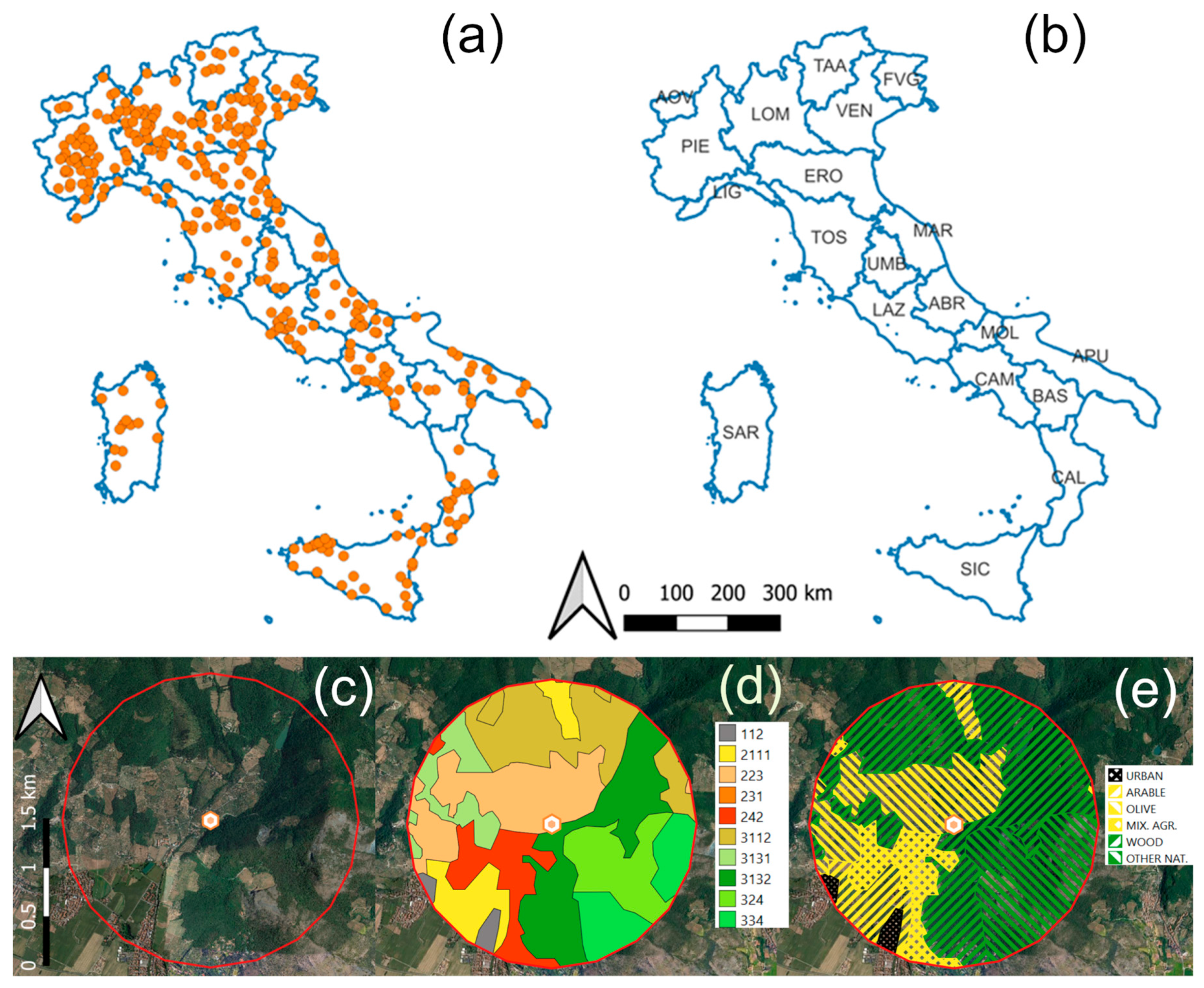
- Beekeepers were asked to confirm that more than 50% of the land within a 1.5 km radius around the apiary consisted of agricultural or semi-natural habitats. This ensured that the data collected would reliably reflect the characteristics of the surrounding agri-environment.
- Professional production: only apiaries used for professional honey production were eligible. This criterion helped maintain consistency in management practices across sites and reliability of samples. Production goals (e.g., honey, queens, royal jelly) and beekeeping experience can greatly influence hive management.
- Long-term commitment: beekeepers had to agree to participate for the full duration of the monitoring period (three years), allow regular technical visits, share management data, and permit the installation of experimental high-tech monitoring devices on their hives.
2.2. Landscape Analyses: Apiary Surroundings

| Macro-Categories 1 | CLC Categories Identifier 2 | CLC Italy 3 | CLC BeeNet 4 |
|---|---|---|---|
| Anthropic | 111; 112; 121; 1211; 122; 123; 124; 131; 132; 133; 141; 142 | 12 | 11 |
| Arable Crops | 211; 2111; 2112; 212 | 4 | 3 |
| Paddies | 213 | 1 | 1 |
| Vineyards | 221 | 1 | 1 |
| Orchards | 222 | 1 | 1 |
| Olive Groves | 223 | 1 | 1 |
| Meadows | 231 | 1 | 1 |
| Complex Agricultural Surfaces | 224; 2241; 241; 242; 243; 244 | 6 | 6 |
| Woods | 311; 3111; 3112; 3113; 3114; 3115; 3116; 3117; 312; 3121; 3122; 3123; 3124; 3125; 313; 3131; 3132 | 17 | 13 |
| Other Natural Areas | 321; 3211; 3212; 322; 323; 3231; 3232; 324; 3241; 331; 332; 333; 334; 335; 411; 412; 421; 422 | 18 | 12 |
| Waters | 511; 512; 521; 522 | 4 | 2 |
| Seas And Oceans | 523 | 1 | 1 |
2.3. Data Analyses
3. Results
3.1. Selection of BeeNet Workstations
3.2. Landscape Analyses: Apiary Surroundings
4. Discussion
5. Conclusions
Author Contributions
Funding
Data Availability Statement
Acknowledgments
Conflicts of Interest
Appendix A
| Criterion | Period of Control | Population Under Control | Means of Verification |
|---|---|---|---|
| distance from other workstations | beginning of the study | all workstations | upon receiving the coordinates, an immediate verification was carried out, and locations were rejected if situated less than 3 km from already approved workstations. |
| fixed location | end of first year | all workstations | while flexibility in the location of workstations was allowed during the first year, no further repositioning was permitted thereafter: the selection process was somewhat flexible in the first year, allowing minor location adjustments if the previous beekeeper’s selection interfered with beekeeping activities; however, from March 2022 onwards, no further changes were permitted to ensure data consistency and integrity. |
| between second and third year | on a random sample of workstations with hi-tech hives | the GPS installed in the hi-tech hive enabled continuous monitoring of its position over the following months. | |
| long-term commitment | end of first year | all workstations | the project provided funding to beekeepers’ associations to ensure the maintenance of a constant number of active workstations |
| precision of coordinates | between first and second year | all workstations | the presence of workstations was verified using local orthophotos. If a workstation was not detected, beekeepers were asked to re-check the coordinates or provide an explanation for apiary movements. During this process, positional errors of approximately 30–50 km were identified. |
| professional production | first year | workstations of the regions Emilia-Romagna and Umbria | The team carried out interviews with beekeepers, but the majority of verification and validation was delegated to the associations. |
| agroecosystem | third year | all workstations | this work |
| Italian Region Extended Name | Acronym | Anthropic | Arable Crops | Paddies | Vineyards | Orchards | Olive Groves | Meadows | Complex Agricultural Surfaces | Woods | Other Natural Areas | Waters |
|---|---|---|---|---|---|---|---|---|---|---|---|---|
| Abruzzo | ABR | 327.00 | 1970.36 | 211.17 | 15.26 | 435.96 | 157.60 | 2051.99 | 3063.02 | 2542.37 | 21.05 | |
| Basilicata | BAS | 157.46 | 3818.40 | 15.28 | 123.89 | 273.78 | 76.97 | 1383.78 | 2794.22 | 1312.74 | 34.67 | |
| Calabria | CAL | 561.12 | 2080.10 | 7.34 | 44.59 | 530.41 | 1943.43 | 107.31 | 2544.17 | 5488.39 | 1733.14 | 32.96 |
| Campania | CAM | 1018.38 | 3086.23 | 12.73 | 563.43 | 612.87 | 123.06 | 3084.26 | 3808.54 | 1257.75 | 29.34 | |
| Emilia-Romagna | ERO | 1249.79 | 9662.66 | 150.75 | 39.23 | 104.68 | 6.91 | 42.55 | 5059.45 | 4810.61 | 1097.93 | 217.69 |
| Friuli Venezia Giulia | FVG | 623.66 | 1837.00 | 143.00 | 1.40 | 56.95 | 983.64 | 2977.01 | 1135.07 | 152.90 | ||
| Lazio | LAZ | 1099.59 | 4857.95 | 142.55 | 342.14 | 962.27 | 78.54 | 3312.76 | 4448.64 | 1701.42 | 253.23 | |
| Liguria | LIG | 275.45 | 65.21 | 4.29 | 162.99 | 14.69 | 672.20 | 3326.19 | 888.14 | 4.36 | ||
| Lombardia | LOM | 2776.42 | 7945.54 | 1237.07 | 164.57 | 12.53 | 5.11 | 375.65 | 1777.81 | 5540.05 | 3354.94 | 686.43 |
| Marche | MAR | 448.21 | 3958.30 | 59.95 | 3.42 | 1.95 | 35.39 | 1924.37 | 1993.37 | 947.45 | 9.85 | |
| Molise | MOL | 81.65 | 1707.31 | 49.62 | 2.04 | 138.46 | 35.40 | 797.54 | 1202.83 | 412.23 | 12.34 | |
| Piedmont | PIE | 1361.48 | 4102.22 | 1413.32 | 629.52 | 153.23 | 418.54 | 4316.08 | 7469.55 | 5317.26 | 220.14 | |
| Apulia | APU | 1058.95 | 6721.53 | 1407.59 | 218.92 | 3942.48 | 248.09 | 3069.76 | 1259.56 | 1263.24 | 137.37 | |
| Sardinia | SAR | 722.03 | 5249.27 | 54.21 | 90.84 | 100.01 | 414.87 | 405.83 | 4930.67 | 4030.14 | 7888.35 | 211.00 |
| Sicily | SIC | 1302.44 | 8874.92 | 1569.42 | 1149.99 | 1775.59 | 4212.83 | 2560.99 | 4160.06 | 98.93 | ||
| Tuscany | TUS | 1121.40 | 5214.16 | 3.91 | 672.60 | 19.46 | 819.50 | 630.61 | 3097.54 | 9942.72 | 1365.67 | 94.57 |
| Trentino-Alto Adige | TAA | 293.91 | 74.68 | 148.39 | 330.28 | 749.40 | 563.68 | 6526.60 | 4854.40 | 63.59 | ||
| Umbria | UMB | 299.75 | 2433.39 | 60.46 | 1.04 | 300.31 | 98.44 | 1405.17 | 3078.06 | 629.22 | 148.16 | |
| Aosta Valley | AOV | 47.18 | 0.27 | 3.57 | 2.17 | 94.10 | 167.10 | 738.84 | 2205.51 | 3.42 | ||
| Veneto | VEN | 1700.34 | 6559.94 | 76.35 | 738.19 | 83.96 | 22.79 | 386.06 | 2502.38 | 3876.97 | 1595.76 | 790.11 |
| ITALY | IT | 16,526.20 | 80,219.44 | 2942.95 | 6207.55 | 3758.26 | 11,819.26 | 4135.21 | 47,857.17 | 78,936.29 | 45,662.64 | 3222.10 |
| Italian Region Extended Name | Acronym | Anthropic | Arable Crops | Paddies | Vineyards | Orchards | Olive Groves | Meadows | Complex Agricultural Surfaces | Woods | Other Natural Areas | Waters |
|---|---|---|---|---|---|---|---|---|---|---|---|---|
| Abruzzo | ABR | 5.11 | 14.54 | 3.96 | 0.00 | 8.33 | 0.54 | 30.96 | 15.72 | 5.17 | 0.00 | |
| Basilicata | BAS | 3.53 | 31.14 | 0.06 | 0.94 | 0.37 | 0.12 | 10.61 | 3.99 | 4.40 | 0.00 | |
| Calabria | CAL | 4.80 | 12.63 | 0.00 | 0.13 | 7.67 | 33.67 | 1.78 | 32.83 | 17.52 | 6.11 | 0.00 |
| Campania | CAM | 17.61 | 33.46 | 0.05 | 8.30 | 5.73 | 0.52 | 37.27 | 14.22 | 6.38 | 1.03 | |
| Emilia-Romagna | ERO | 8.76 | 124.43 | 0.00 | 1.84 | 0.80 | 1.17 | 0.00 | 60.91 | 18.20 | 8.03 | 0.25 |
| Friuli Venezia Giulia | FVG | 12.05 | 29.50 | 0.01 | 0.00 | 0.07 | 14.92 | 1.22 | 1.38 | 0.60 | ||
| Lazio | LAZ | 28.33 | 45.06 | 0.72 | 2.25 | 5.57 | 1.34 | 23.49 | 7.60 | 1.69 | 1.92 | |
| Liguria | LIG | 3.79 | 1.47 | 0.55 | 2.11 | 0.00 | 13.91 | 19.68 | 9.42 | 0.00 | ||
| Lombardia | LOM | 63.60 | 146.44 | 6.36 | 1.69 | 0.00 | 0.00 | 3.21 | 41.65 | 33.08 | 2.92 | 3.42 |
| Marche | MAR | 1.30 | 21.49 | 0.25 | 0.00 | 0.00 | 0.00 | 17.81 | 5.57 | 2.13 | 0.00 | |
| Molise | MOL | 1.44 | 20.61 | 0.05 | 0.00 | 3.24 | 0.00 | 10.91 | 14.22 | 3.11 | 0.00 | |
| Piedmont | PIE | 34.09 | 71.51 | 5.08 | 16.41 | 7.19 | 3.81 | 100.11 | 85.05 | 11.91 | 5.23 | |
| Apulia | APU | 5.38 | 15.66 | 7.73 | 0.00 | 27.15 | 0.00 | 13.26 | 3.42 | 3.06 | 0.00 | |
| Sardinia | SAR | 4.29 | 39.68 | 0.00 | 0.78 | 1.85 | 5.20 | 0.55 | 30.53 | 3.11 | 11.41 | 0.00 |
| Sicily | SIC | 18.00 | 49.20 | 10.97 | 17.76 | 16.97 | 48.28 | 12.53 | 26.48 | 0.36 | ||
| Tuscany | TUS | 13.43 | 45.65 | 0.00 | 5.82 | 0.17 | 15.42 | 2.20 | 29.13 | 48.02 | 5.93 | 0.49 |
| Trentino-Alto Adige | TAA | 6.05 | 0.00 | 2.71 | 12.47 | 2.87 | 3.88 | 20.28 | 5.53 | 1.85 | ||
| Umbria | UMB | 7.14 | 30.96 | 1.39 | 0.00 | 3.90 | 0.00 | 16.43 | 6.89 | 0.60 | 0.98 | |
| Aosta Valley | AOV | 3.96 | 0.00 | 1.57 | 1.18 | 2.44 | 6.03 | 1.49 | 4.20 | 0.00 | ||
| Veneto | VEN | 34.48 | 87.55 | 0.00 | 6.07 | 3.04 | 0.26 | 12.48 | 57.53 | 34.88 | 1.30 | 1.46 |
| ITALY | IT | 277.13 | 820.99 | 11.45 | 62.77 | 63.61 | 129.09 | 31.92 | 600.43 | 366.70 | 121.15 | 17.59 |
References
- Hung, K.L.J.; Kingston, J.M.; Albrecht, M.; Holway, D.A.; Kohn, J.R. The worldwide importance of honey bees as pollinators in natural habitats. Proc. R. Soc. B Biol. Sci. 2018, 285, 20172140. [Google Scholar] [CrossRef] [Scilit]
- Porrini, C.; Sabatini, A.G.; Girotti, S.; Fini, F.; Monaco, L.; Celli, G.; Bortolotti, L.; Ghini, S. The death of honey bees and environmental pollution by pesticides: The honey bees as biological indicators. Bull. Insectol. 2003, 56, 147–152. [Google Scholar]
- Cilia, G.; Bortolotti, L.; Albertazzi, S.; Ghini, S.; Nanetti, A. Honey bee (Apis mellifera L.) colonies as bioindicators of environmental SARS-CoV-2 occurrence. Sci. Total Environ. 2022, 805, 150327. [Google Scholar] [CrossRef] [Scilit] [PubMed]
- Nicewicz, Ł.; Nicewicz, A.W.; Kafel, A.; Nakonieczny, M. Set of stress biomarkers as a practical tool in the assessment of multistress effect using honeybees from urban and rural areas as a model organism: A pilot study. Environ. Sci. Pollut. Res. 2021, 28, 9084–9096. [Google Scholar] [CrossRef] [Scilit]
- Murcia-Morales, M.; Van der Steen, J.J.M.; Vejsnæs, F.; Díaz-Galiano, F.J.; Flores, J.M.; Fernández-Alba, A.R. APIStrip, a new tool for environmental contaminant sampling through honeybee colonies. Sci. Total Environ. 2020, 729, 138948. [Google Scholar] [CrossRef] [Scilit] [PubMed]
- Cilia, G.; Resci, I.; Scarpellini, R.; Zavatta, L.; Albertazzi, S.; Bortolotti, L.; Nanetti, A.; Piva, S. Antimicrobial-Resistant Environmental Bacteria Isolated Using a Network of Honey Bee Colonies (Apis mellifera L. 1758). Transbound. Emerg. Dis. 2023, 2023, 5540574. [Google Scholar] [CrossRef] [Scilit]
- Durant, J.L.; Ponisio, L.C. A Regional, Honey Bee-Centered Approach Is Needed to Incentivize Grower Adoption of Bee-Friendly Practices in the Almond Industry. Front. Sustain. Food Syst. 2021, 5, 628802. [Google Scholar] [CrossRef] [Scilit]
- Gutiérrez, M.; Molero, R.; Gaju, M.; van der Steen, J.; Porrini, C.; Ruiz, J.A. Assessment of heavy metal pollution in Córdoba (Spain) by biomonitoring foraging honeybee. Environ. Monit. Assess. 2015, 187, 651. [Google Scholar] [CrossRef] [Scilit]
- Ngat, T.T.; Xuan Lam, T.; Gia Minh, H.; Thi Phuong Lien, N. Honeybee products as potential bioindicators of heavy metals contamination from Northern Vietnam. Vietnam J. Biotechnol. 2020, 18, 373–384. [Google Scholar] [CrossRef] [Scilit]
- van der Steen, J.J.M.; Cornelissen, B.; Blacquière, T.; Pijnenburg, J.E.M.L.; Severijnen, M. Think regionally, act locally: Metals in honeybee workers in the Netherlands (surveillance study 2008). Environ. Monit. Assess. 2016, 188, 463. [Google Scholar] [CrossRef] [Scilit]
- Perichon, S.; Adamchuk, L.; Biber, L.; Bozic, J.; Chlebo, R.; Filipi, J.; Leidenberger, S.; Mavrofridis, G.; Ozgor, E.; Pocol, C.; et al. Perception of threats to bee colonies and the future of local beekeeping by beekeepers in various european countries perception des menaces pour les colonies d ’ abeilles et futur. Bull. La Société Géographique Liège 2024, 82, 19–46. [Google Scholar] [CrossRef] [Scilit]
- Lindenmayer, D.; Woinarski, J.; Legge, S.; Southwell, D.; Lavery, T.; Robinson, N.; Scheele, B.; Wintle, B. A checklist of attributes for effective monitoring of threatened species and threatened ecosystems. J. Environ. Manag. 2020, 262, 110312. [Google Scholar] [CrossRef] [Scilit]
- Giovanetti, M.; Dettori, A.; Cargnus, E.; Tafi, E.; Caringi, V.; Bortolotti, L. Bees: How and what to monitor to convey critical information. IOBC-WPRS Bull. (Landsc. Manag. Funct. Biodivers.) 2022, 156, 55–60. [Google Scholar]
- Neef, A.; Neubert, D. Stakeholder participation in agricultural research projects: A conceptual framework for reflection and decision-making. Agric. Hum. Values 2011, 28, 179–194. [Google Scholar] [CrossRef] [Scilit]
- Kok, K.P.W.; Gjefsen, M.D.; Regeer, B.J.; Broerse, J.E.W. Unraveling the politics of ‘doing inclusion’ in transdisciplinarity for sustainable transformation. Sustain. Sci. 2021, 16, 1811–1826. [Google Scholar] [CrossRef] [Scilit]
- Barot, S.; Abbadie, L.; Auclerc, A.; Barthélémy, C.; Bérille, E.; Billet, P.; Clergeau, P.; Consales, J.N.; Deschamp-Cottin, M.; David, A.; et al. Urban ecology, stakeholders and the future of ecology. Sci. Total Environ. 2019, 667, 475–484. [Google Scholar] [CrossRef] [Scilit]
- Carvalho, J.; Leite, P.; Valente, A.M.; Fonseca, C.; Torres, R.T. Stakeholders engagement as an important step for the long-term monitoring of wild ungulate populations. Ecol. Solut. Evid. 2021, 2, e12088. [Google Scholar] [CrossRef] [Scilit]
- Sikor, T. Legislation in Central and Eastern Europe. Sociologia Ruralis 2005, 45, 187–201. [Google Scholar] [CrossRef] [Scilit]
- Luján Soto, R.; de Vente, J.; Cuéllar Padilla, M. Learning from farmers’ experiences with participatory monitoring and evaluation of regenerative agriculture based on visual soil assessment. J. Rural Stud. 2021, 88, 192–204. [Google Scholar] [CrossRef] [Scilit]
- Tyllianakis, E.; Martin-Ortega, J. Agri-environmental schemes for biodiversity and environmental protection: How were are not yet “hitting the right keys”. Land Use Policy 2021, 109, 105620. [Google Scholar] [CrossRef] [Scilit]
- Latacz-Lohmann, U.; Hodge, I. European agri-environmental policy for the 21st century. Aust. J. Agric. Resour. Econ. 2003, 47, 123–139. [Google Scholar] [CrossRef] [Scilit]
- Poláková, J.; Soukup, J. Results of implementing less-favoured area subsidies in the 2014–2020 time frame: Are the measures of environmental concern complementary? Sustainability 2020, 12, 10534. [Google Scholar] [CrossRef] [Scilit]
- Feo, E.; Spanoghe, P.; Berckmoes, E.; Pascal, E.; Mosquera-Losada, R.; Opdebeeck, A.; Burssens, S. The multi-actor approach in thematic networks for agriculture and forestry innovation. Agric. Food Econ. 2022, 10, 3. [Google Scholar] [CrossRef] [Scilit] [PubMed]
- Pascucci, S.; De-Magistris, T.; Dries, L.; Adinolfi, F.; Capitanio, F. Participation of Italian farmers in rural development policy. Eur. Rev. Agric. Econ. 2013, 40, 605–631. [Google Scholar] [CrossRef] [Scilit]
- Caramiello, R.; Siniscalco, C. Quaternary vegetation landscapes in Piedmont and in the Aosta valley with particular reference to the Holocene. Biogeogr. J. Integr. Biogeogr. 1998, 19, 69–84. [Google Scholar] [CrossRef] [Scilit]
- Bertoni, D.; Pardo, A.; Paracchini, M.L. Assessing the environmental, social and economic sustainability of beekeeping activities. J. Apic. Res. 2025, 64, 1275–1293. [Google Scholar] [CrossRef] [Scilit]
- Otto, C.R.V.; Roth, C.L.; Carlson, B.L.; Smart, M.D. Land-use change reduces habitat suitability for supporting managed honey bee colonies in the Northern Great Plains. Proc. Natl. Acad. Sci. USA 2016, 113, 10430–10435. [Google Scholar] [CrossRef] [Scilit] [PubMed]
- Melin, A.; Rouget, M.; Colville, J.F.; Midgley, J.J.; Donaldson, J.S. Assessing the role of dispersed floral resources for managed bees in providing supporting ecosystem services for crop pollination. PeerJ 2018, 9, e5654. [Google Scholar] [CrossRef] [Scilit]
- Elmastaş, N.; Ölmez, İ.; Vural, E. Suitability Analysis of Apiculture (Beekeeping) Activity Areas with Multi-Criteria Method: A Case Study of Adıyaman. Coğrafya Derg. J. Geogr. 2022, 44, 19–30. [Google Scholar] [CrossRef] [Scilit]
- Walther, G.R.; Roques, A.; Hulme, P.E.; Sykes, M.T.; Pyšek, P.; Kühn, I.; Zobel, M.; Bacher, S.; Botta-Dukát, Z.; Bugmann, H.; et al. Alien species in a warmer world: Risks and opportunities. Trends Ecol. Evol. 2009, 24, 686–693. [Google Scholar] [CrossRef] [Scilit]
- Roque, N.; Fernandez, P.; Silveira, C.; Vilas-Boas, M.; Anjos, O. Using Analytic Hierarchy Process to Assess Beekeeping Suitability in Portuguese Controlled Areas: A First Approach. Insects 2024, 15, 91. [Google Scholar] [CrossRef] [Scilit]
- Malagnini, V.; Cappellari, A.; Marini, L.; Zanotelli, L.; Zorer, R.; Angeli, G.; Ioriatti, C.; Fontana, P. Seasonality and Landscape Composition Drive the Diversity of Pollen Collected by Managed Honey Bees. Front. Sustain. Food Syst. 2022, 6, 865368. [Google Scholar] [CrossRef] [Scilit]
- Parreno, M.A.; Werle, S.; Buydens, L.; Leroy, C.; Roberts, S.; Koirala, S.; Filipiak, M.; Kuhlmann, M.; Brunet, J.L.; Henry, M.; et al. Landscape heterogeneity correlates with bee and pollen diversity while size and specialization degree explain species-specific responses of wild bees to the environment. Sci. Total Environ. 2024, 954, 176595. [Google Scholar] [CrossRef] [Scilit]
- Pardo, A.; Borges, P.A.V. Worldwide importance of insect pollination in apple orchards: A review. Agric. Ecosyst. Environ. 2020, 293, 106839. [Google Scholar] [CrossRef] [Scilit]
- Brunori, E.; Maesano, M.; Moresi, F.V.; Matteucci, G.; Biasi, R.; Scarascia Mugnozza, G. The hidden land conservation benefits of olive-based (Olea europaea L.) landscapes: An agroforestry investigation in the southern Mediterranean (Calabria region, Italy). L. Degrad. Dev. 2020, 31, 801–815. [Google Scholar] [CrossRef] [Scilit]
- Dobrei, A.I.; Nan, A.; Eleonora, N.; Daniela, D.; Georgeta, D.A. Research on honeybee pollination influence in increasing the fruit set rate and improving yield components in several grapevine varieties. J. Hortic. For. Biotechnol. 2021, 25, 88–95. [Google Scholar]
- Mueller, T.G.; Baert, N.; Muñiz, P.A.; Sossa, D.E.; Danforth, B.N.; McArt, S.H. Pesticide risk during commercial apple pollination is greater for honeybees than other managed and wild bees. J. Appl. Ecol. 2024, 61, 1289–1300. [Google Scholar] [CrossRef] [Scilit]
- Waser, N.M.; Price, M.V. Drought, pollen and nectar availability, and pollination success. Ecology 2016, 97, 1400–1409. [Google Scholar] [CrossRef] [Scilit]
- Kuppler, J.; Wieland, J.; Junker, R.R.; Ayasse, M. Drought-induced reduction in flower size and abundance correlates with reduced flower visits by bumble bees. AoB Plants 2021, 13, plab001. [Google Scholar] [CrossRef] [Scilit] [PubMed]
- Kovac, H.; Käfer, H.; Stabentheiner, A. The energetics and thermoregulation of water collecting honeybees. J. Comp. Physiol. A Neuroethol. Sens. Neural Behav. Physiol. 2018, 204, 783–790. [Google Scholar] [CrossRef] [Scilit]
- Ostwald, M.M.; Smith, M.L.; Seeley, T.D. The behavioral regulation of thirst, water collection and water storage in honey bee colonies. J. Exp. Biol. 2016, 219, 2156–2165. [Google Scholar] [CrossRef] [Scilit]
- Pagliarino, E.; Orlando, F.; Vaglia, V.; Rolfo, S.; Bocchi, S. Participatory research for sustainable agriculture: The case of the Italian agroecological rice network. Eur. J. Futures Res. 2020, 8, 7. [Google Scholar] [CrossRef] [Scilit]
- Luyet, V.; Schlaepfer, R.; Parlange, M.B.; Buttler, A. A framework to implement Stakeholder participation in environmental projects. J. Environ. Manag. 2012, 111, 213–219. [Google Scholar] [CrossRef] [Scilit] [PubMed]
- Kuchling, S.; Kopacka, I.; Kalcher-Sommersguter, E.; Schwarz, M.; Crailsheim, K.; Brodschneider, R. Investigating the role of landscape composition on honey bee colony winter mortality: A long-term analysis. Sci. Rep. 2018, 8, 12263. [Google Scholar] [CrossRef] [Scilit] [PubMed]
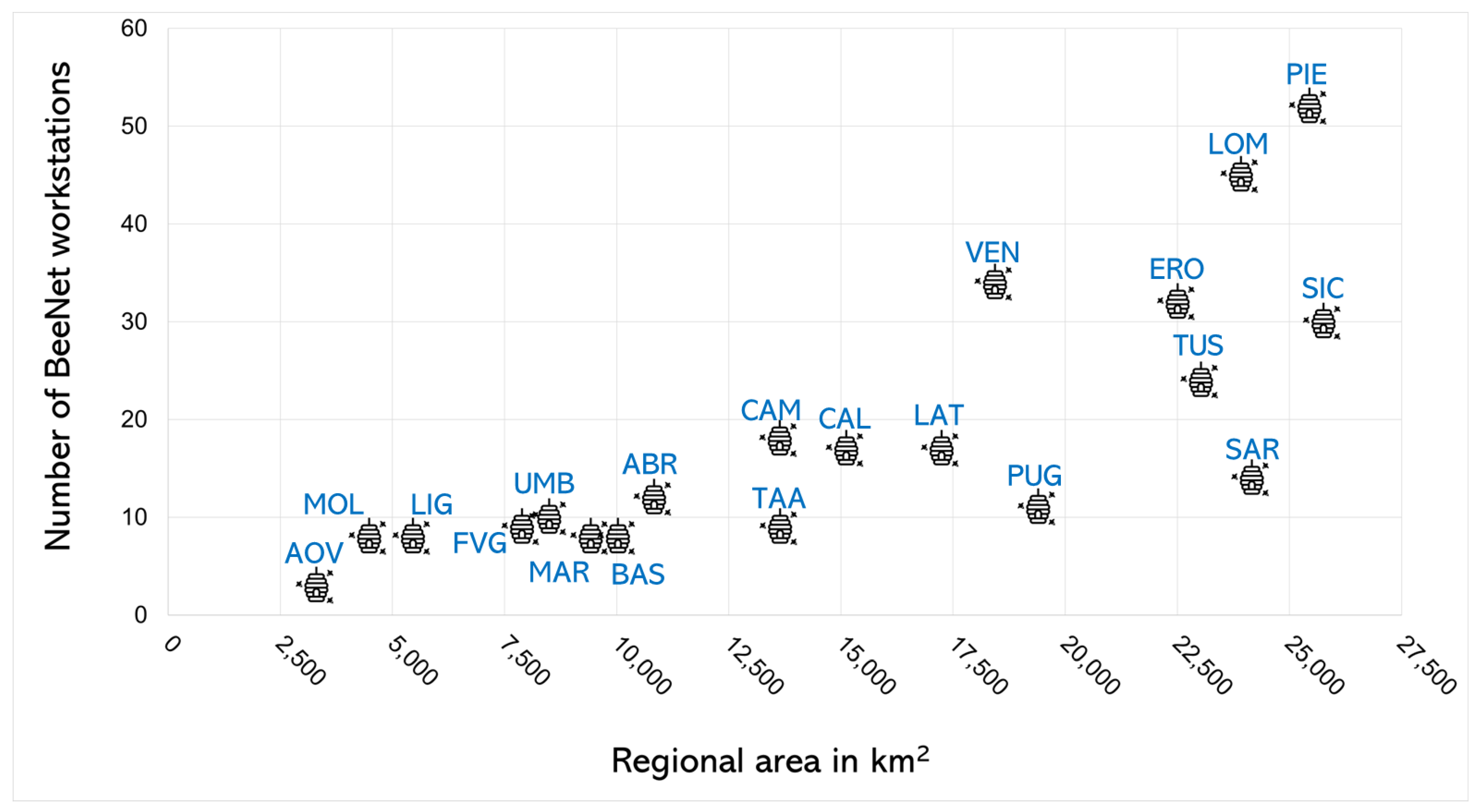
| Region | Acronym | Land Included in the Regional Boundaries (km2) | Land Included in Regional BeeNet Buffers (km2) | Number of BeeNeet Workstations | Regional Area (%) in BeeNet Buffers | Estimation of Land Around Each Workstation km2 |
|---|---|---|---|---|---|---|
| Abruzzo | ABR | 10,795.8 | 84.3 | 12 | 0.78 | 899.6 |
| Basilicata | BAS | 9991.2 | 55.2 | 8 | 0.55 | 1248.9 |
| Calabria | CAL | 15,073.0 | 117.1 | 17 | 0.78 | 886.6 |
| Campania | CAM | 13,596.6 | 124.6 | 18 | 0.92 | 755.4 |
| Emilia-Romagna | ERO | 22,442.3 | 224.4 | 32 | 1.00 | 701.3 |
| Friuli-Venezia Giulia | FVG | 7910.6 | 59.7 | 9 | 0.76 | 879.0 |
| Lazio | LAT | 17,199.1 | 118.0 | 17 | 0.69 | 1011.7 |
| Liguria | LIG | 5413.5 | 50.9 | 8 | 0.94 | 676.7 |
| Lombardy | LOM | 23,876.1 | 302.4 | 44 | 1.27 | 542.6 |
| Marche | MAR | 9382.2 | 48.6 | 7 | 0.52 | 1340.3 |
| Molise | MOL | 4439.4 | 53.6 | 8 | 1.21 | 554.9 |
| Piedmont | PIE | 25,401.3 | 340.4 | 49 | 1.34 | 518.4 |
| Apulia | APU | 19,327.5 | 75.7 | 11 | 0.39 | 1757.0 |
| Sardinia | SAR | 24,097.2 | 97.4 | 14 | 0.40 | 1721.2 |
| Sicily | SIC | 25,705.2 | 200.6 | 30 | 0.78 | 856.8 |
| Tuscany | TUS | 22,982.1 | 166.3 | 24 | 0.72 | 957.6 |
| Trentino- Alto-Adige | TAA | 13,604.9 | 55.6 | 8 | 0.41 | 1700.6 |
| Umbria | UMB | 8454.0 | 68.3 | 10 | 0.81 | 845.4 |
| Aosta Valley | AOV | 3262.2 | 20.9 | 3 | 0.64 | 1087.4 |
| Veneto | VEN | 18,332.8 | 239.0 | 34 | 1.30 | 539.2 |
| Country level | ITALY | 301,287.1 | 2502.8 | 363 | 0.83 | 830.0 |
Disclaimer/Publisher’s Note: The statements, opinions and data contained in all publications are solely those of the individual author(s) and contributor(s) and not of MDPI and/or the editor(s). MDPI and/or the editor(s) disclaim responsibility for any injury to people or property resulting from any ideas, methods, instructions or products referred to in the content. |
© 2025 by the authors. Licensee MDPI, Basel, Switzerland. This article is an open access article distributed under the terms and conditions of the Creative Commons Attribution (CC BY) license (https://creativecommons.org/licenses/by/4.0/).
Share and Cite
Albertazzi, S.; Guerra, I.; Bortolotti, L.; Medrzycki, P.; Giovanetti, M. Evaluating Spatial Representativity in a Stakeholder-Driven Honeybee Monitoring Network Across Italy. Land 2025, 14, 1957. https://doi.org/10.3390/land14101957
Albertazzi S, Guerra I, Bortolotti L, Medrzycki P, Giovanetti M. Evaluating Spatial Representativity in a Stakeholder-Driven Honeybee Monitoring Network Across Italy. Land. 2025; 14(10):1957. https://doi.org/10.3390/land14101957
Chicago/Turabian StyleAlbertazzi, Sergio, Irene Guerra, Laura Bortolotti, Piotr Medrzycki, and Manuela Giovanetti. 2025. "Evaluating Spatial Representativity in a Stakeholder-Driven Honeybee Monitoring Network Across Italy" Land 14, no. 10: 1957. https://doi.org/10.3390/land14101957
APA StyleAlbertazzi, S., Guerra, I., Bortolotti, L., Medrzycki, P., & Giovanetti, M. (2025). Evaluating Spatial Representativity in a Stakeholder-Driven Honeybee Monitoring Network Across Italy. Land, 14(10), 1957. https://doi.org/10.3390/land14101957

