Beyond Distribution: Critique of Spatial Justice Theories—Case Study of Shanghai’s 15-Minute City

Abstract
1. Introduction
2. Spatial Justice and Planning
2.1. Planning and Distributive Justice
First Principle: each person has an equal claim to a fully adequate scheme of equal basic rights and liberties, in which the scheme is compatible with the same scheme for all; in this scheme, the equal political liberties, and only those liberties, are to be guaranteed their fair value.
Second Principle: Social and economic inequalities are to satisfy two conditions. First, they are to be attached to positions and offices open to all under conditions of fair equality of opportunity; second, they are to be of the greatest benefit to the least-advantaged members of society([33]: pp. 5–6).
2.2. Reviewing Critiques of Distributive Justice in the Spatial and Environmental Justice Literature
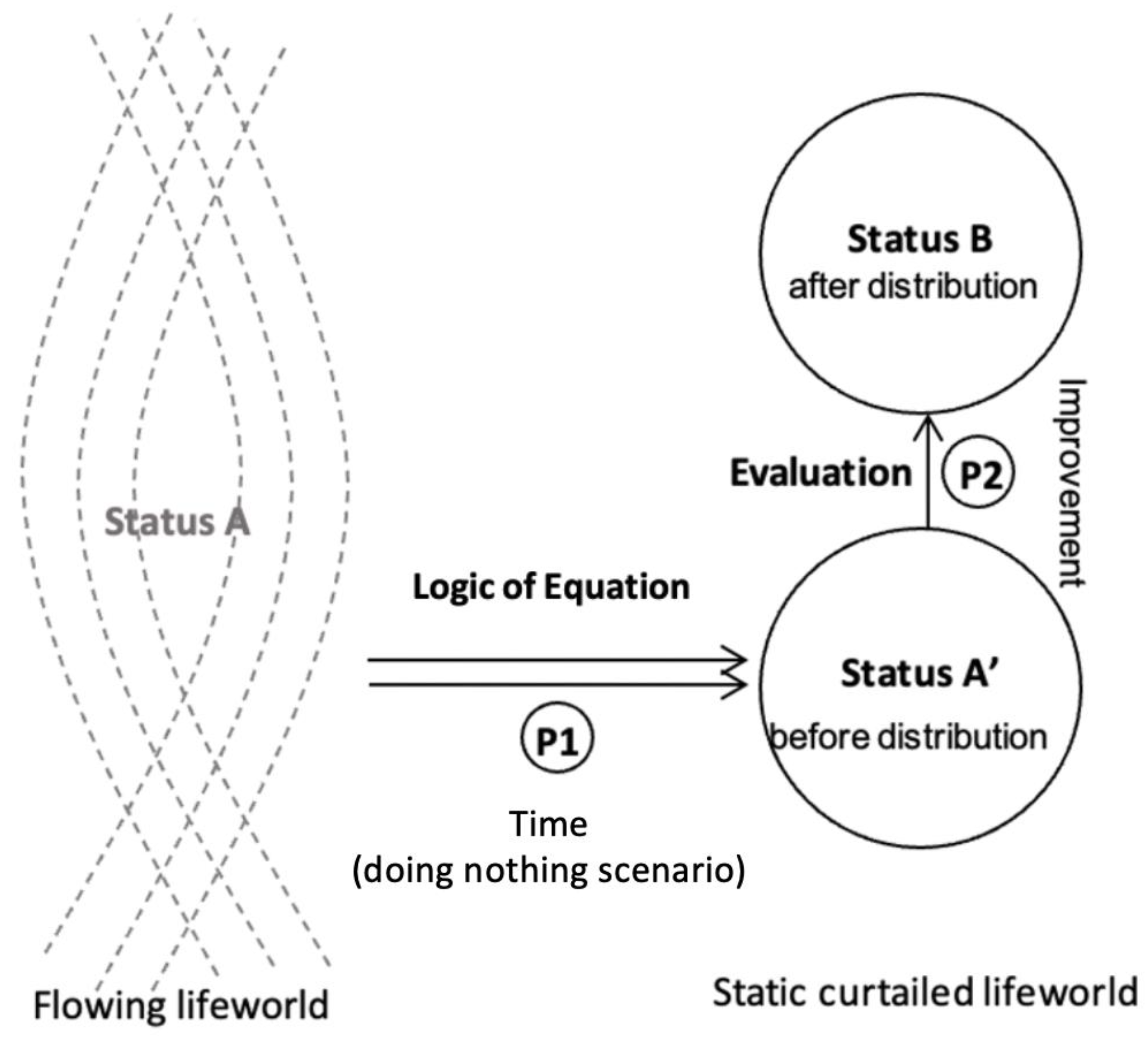
2.3. Problematization: The “Logic of Equation” and Its Impact on the Lifeworld
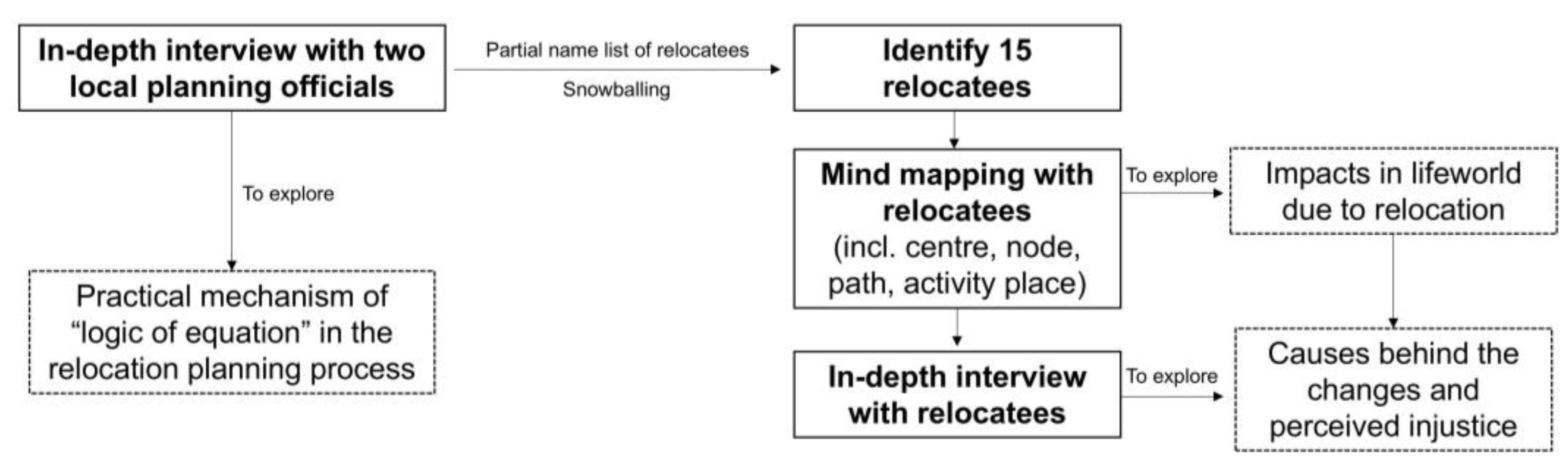
3. Methodology
4. The Logic of the Equation and Injustice: A Case of Relocation Under Community Life-Circle Planning
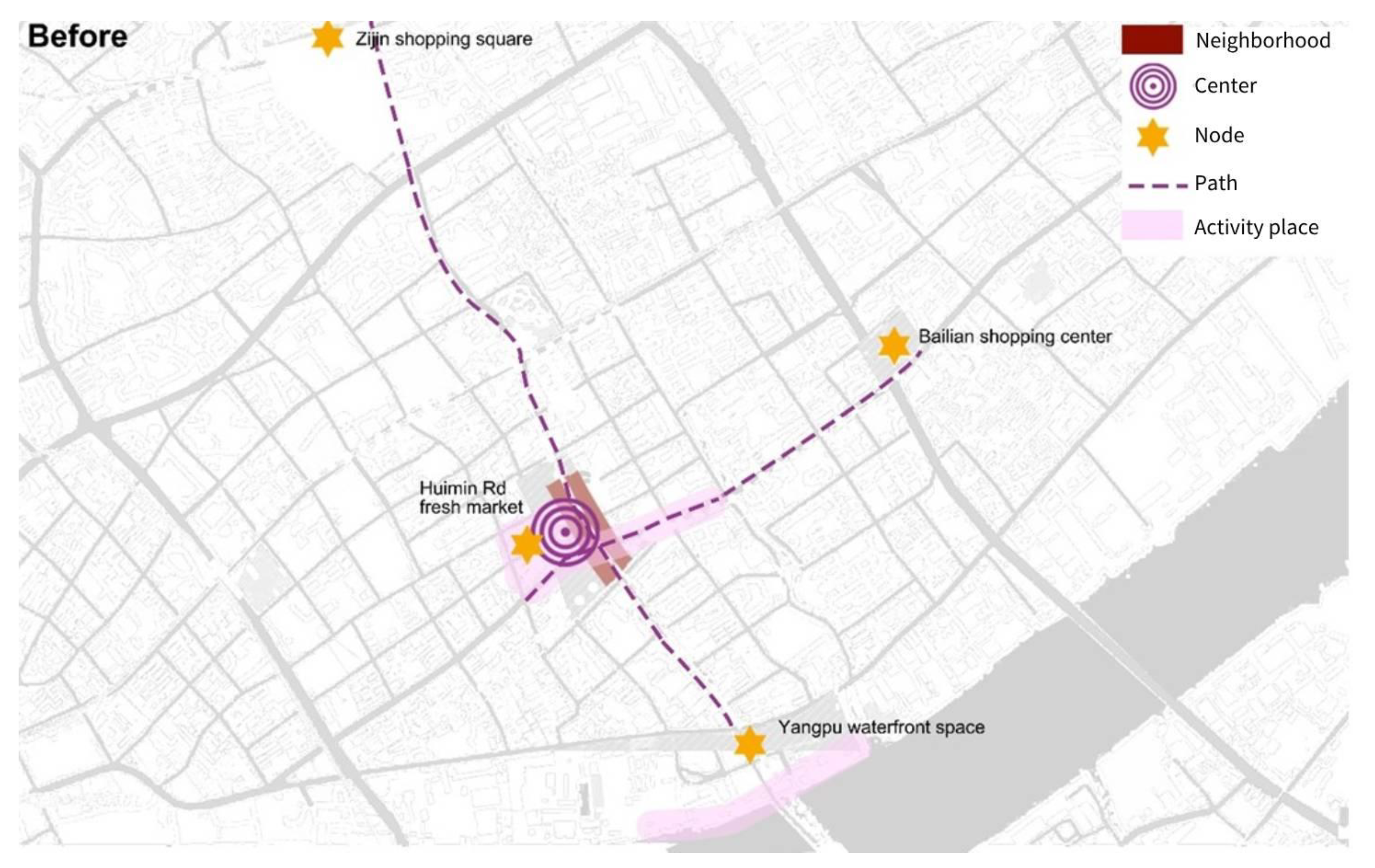
“Because it is hard for me to walk, my daughter is worried about my safety and does not allow me to go out. Since I know few people here, she is afraid that if I fall, no one will help me. I am not allowed to walk inside the neighborhood until they buy a special wheelchair for me. […] Staying at home feels like being in prison”.
“I have no place to go. I should have gone to the neighborhood centre to find some people to talk to or take some exercise there, but nobody is there. I even seldom walk in the neighborhood. Since I had a stroke, I have to ensure someone is around (to help me) in case of an emergency”.
5. Discussion
6. Conclusions
Author Contributions
Funding
Data Availability Statement
Conflicts of Interest
References
- Harvey, D. Social Justice and the City; University of Georgia Press: Athens, GA, USA, 1973; Volume 1. [Google Scholar]
- Fainstein, S. The Just City; Cornell University Press: Ithaca, NY, USA, 2010. [Google Scholar]
- Soja, E.W. Seeking Spatial Justice; University of Minnesota Press: London, UK, 2010. [Google Scholar]
- Campbell, H. Just planning: The art of situated ethical judgment. J. Plan. Educ. Res. 2006, 26, 92–106. [Google Scholar] [CrossRef] [Scilit]
- Smith, D.M. Geography and Social Justice; Wiley Blackwell: Hoboken, NJ, USA, 1994. [Google Scholar]
- Dadashpoor, H.; Alvandipour, N. A genealogy of the five schools of justice in planning thought. Habitat Int. 2020, 101, 102–189. [Google Scholar] [CrossRef] [Scilit]
- Fainstein, S. The just city. Int. J. Urban Sci. 2014, 18, 1–18. [Google Scholar] [CrossRef] [Scilit]
- Moroni, S. The just city. Three background issues: Institutional justice and spatial justice, social justice and distributive justice, concept of justice and conceptions of justice. Plan. Theory 2020, 19, 251–267. [Google Scholar] [CrossRef] [Scilit]
- Korsgaard, C.M. The Sources of Normativity; Cambridge University Press: Cambridge, UK, 1996. [Google Scholar]
- Schlosberg, D. Defining Environmental Justice: Theories, Movement, and Nature; Oxford University Press Inc.: New York, NY, USA, 2007. [Google Scholar]
- Stanley, A. Just space or spatial justice? Difference, discourse, and environmental justice. Local Environ. 2009, 14, 999–1014. [Google Scholar] [CrossRef] [Scilit]
- Schlosberg, D. Reconceiving environmental justice: Global movements and political theories. Environ. Politics 2004, 13, 517–540. [Google Scholar] [CrossRef] [Scilit]
- Moroni, S.; De Franco, A. Spatial justice: A fundamental or derivative notion? City Cult. Soc. 2024, 38, 100593. [Google Scholar] [CrossRef] [Scilit]
- Wu, H.; Wang, L.; Zhang, Z.; Gao, J. Analysis and optimization of 15-minute community life circle based on supply and demand matching: A case study of Shanghai. PLoS ONE 2021, 16, e0256904. [Google Scholar] [CrossRef] [Scilit]
- Hou, L.; Liu, Y. Life circle construction in China under the idea of collaborative governance: A comparative study of Beijing, Shanghai and Guangzhou. Geogr. Rev. Jpn. Ser. B 2017, 90, 2–16. [Google Scholar]
- Liu, T.; Chai, Y. Daily life circle reconstruction: A scheme for sustainable development in urban China. Habitat Int. 2015, 50, 250–260. [Google Scholar] [CrossRef] [Scilit]
- Lefebvre, H. The Production of Space; Willey Blackwell: Hoboken, NJ, USA, 1991. [Google Scholar]
- Bourdieu, P. The Logic of Practice; Stanford University Press: Stanford, CA, USA, 1990. [Google Scholar]
- Seamon, D. Lived bodies, place, and phenomenology: Implications for human rights and environmental justice. J. Hum. Rights Environ. 2013, 4, 143–166. [Google Scholar] [CrossRef] [Scilit]
- Burton, E. Housing for an urban renaissance: Implications for social equity. Hous. Stud. 2003, 18, 537–562. [Google Scholar] [CrossRef] [Scilit]
- McConnell, S. Theories for Planning; Heinemann: London, UK, 1981. [Google Scholar]
- Beauchamp, T.L. Distributive justice and the difference principle. In John Rawls’ Theory of Social Justice; Blocker, H.G., Smith, E.H., Eds.; Ohio University Press: Athens, OH, USA, 1980; pp. 132–161. [Google Scholar]
- Cohen, G.A. Incentives, Inequality, and Community. In The Tanner Lectures on Human Values; Peterson, G.B., Ed.; University of Utah Press: Salt Lake City, UT, USA, 1992. [Google Scholar]
- Arneson, R. Liberalism, Distributive Subjectivism, and Equal Opportunity for Welfare. Philos. Public Aff. 1990, 19, 158–194. [Google Scholar]
- Carens, J. Equality, Moral Incentives and the Market; Chicago University Press: Chicago, IL, USA, 1981. [Google Scholar]
- Lucas, J.R. On Justice; Oxford University Press: Oxford, UK, 1980. [Google Scholar]
- Dick, J. How to Justify a Distribution of Earnings. Philos. Public Aff. 1975, 4, 248–272. [Google Scholar]
- Rescher, N. Distributive Justice: A Constructive Critique of the Utilitarian Theory of Distribution; Bobbs-Merrill: Indianapolis, IN, USA, 1966. [Google Scholar]
- Low, N.; Sturup, S. Being and planning, world formation and authenticity in Heideggerian analysis. Planning Theory 2018, 17, 313–331. [Google Scholar] [CrossRef] [Scilit]
- Basta, C. From justice in planning toward planning for justice: A capability approach. Plan. Theory 2016, 15, 190–212. [Google Scholar] [CrossRef] [Scilit]
- Schmitt, P.; Weck, S. Towards just planning: On the relationship between procedural and distributive justice in local development actions. Plan. Pract. Res. 2024, 39, 753–771. [Google Scholar] [CrossRef] [Scilit]
- Weghorst, M.; Buitelaar, E.; Pelzer, P. A dynamic justice framework for analyzing conceptions of justice: The case of urban development projects. Planning Theory 2024, 17, 147309521770423. [Google Scholar] [CrossRef] [Scilit]
- Rawls, J. Political Liberalism; Columbia University Press: New York, NY, USA, 2005. [Google Scholar]
- Rawls, J. A Theory of Justice; Harvard University Press: Harvard, MA, USA, 1971. [Google Scholar]
- Miller, D. A Response. In Forms of Justice: Critical Perspectives on David Miller’s Political Philosophy; Bell, D.A., de-Shalit, A., Eds.; Rowman and Littlefield: Lanham, MD, USA, 2003. [Google Scholar]
- Young, I.M. Justice and the Politics of Difference; Princeton University Press: Princeton, NJ, USA, 1990. [Google Scholar]
- Fraser, N. Justice Interruptus: Critical Reflections on the ‘Postsocialist’ Condition; Routledgel: New York, NY, USA, 1997. [Google Scholar]
- Nozick, R. Anarchy, State and Utopia; Wiley Blackwell: Hoboken, NY, USA, 1974. [Google Scholar]
- Healey, P. Collaborative Planning; Macmillan: London, UK, 1997. [Google Scholar]
- Forester, J. Critical Theory, Public Policy, and Planning Practice: Toward a Critical Pragmatism; University of New York Press: Albany, NY, USA, 1993. [Google Scholar]
- Sen, A. Inequality Re-Examined; Harvard University Press: Cambridge, UK, 1992. [Google Scholar]
- Nussbaum, M.C. Creating Capabilities: The Human Development Approach; Belknap Press of Harvard: Cambridge, MA, USA, 2011. [Google Scholar]
- Aristotle The Nichomachean Ethics; Oxford University Press: Oxford, UK, 1980.
- Pressman, S.; Summerfield, G. Sen and capabilities. Rev. Political Econ. 2002, 14, 429–434. [Google Scholar] [CrossRef] [Scilit]
- Marcuse, P. From justice planning to commons planning. In Searching for the Just City; Peter, M., James, C., Johannes, N., Ingrid, O., Cuz, P., Justin, S., Eds.; Routledge: New York, NY, USA, 2009; pp. 111–122. [Google Scholar]
- Husserl, E. The Crisis of European Sciences and Transcendental Phenomenology: An Introduction to Phenomenological Philosophy; Northwestern University Press: Evanston, IL, USA, 1970. [Google Scholar]
- Habermas, J. The Theory of Communicative Action, Volume 2: Lifeworld and System: A Critique of Functionalist Reason; Beacon Press: Boston, MA, USA, 1987. [Google Scholar]
- Žižek, S. Looking awry. October 1989, 50, 31–55. [Google Scholar] [CrossRef] [Scilit]
- Hilgers, M.; Mangez, E. Introduction to Pierre Bourdieu’s theory of social fields. In Bourdieu’s Theory of Social Fields; Routledge: New York, NY, USA, 2014; pp. 1–36. [Google Scholar]
- Jiang, Y.; Waley, P.; Gonzalez, S. Nice apartments, no jobs: How former villagers experienced displacement and resettlement in the western suburbs of Shanghai. Urban Stud. 2018, 55, 3202–3217. [Google Scholar] [CrossRef] [Scilit]
- Day, J.; Cervero, R. Effects of Residential Relocation on Household and Commuting Expenditures in Shanghai, China. Int. J. Urban Reg. Res. 2010, 34, 762–788. [Google Scholar] [CrossRef] [Scilit]
- He, S.J.; Wu, F.L. Property-led redevelopment in post-reform China: A case study of Xintiandi redevelopment project in Shanghai. J. Urban Aff. 2005, 27, 1–23. [Google Scholar] [CrossRef] [Scilit]
- Liu, C.Y.; Hu, F.Z.; Jeong, J. Towards inclusive urban development? New knowledge/creative economy and wage inequality in major Chinese cities. Cities 2020, 105, 102385. [Google Scholar] [CrossRef] [Scilit]
- Wu, W.; Tan, W.; Wang, R.; Chen, W.Y. From quantity to quality: Effects of urban greenness on life satisfaction and social inequality. Landsc. Urban Plan. 2023, 238, 104843. [Google Scholar] [CrossRef] [Scilit]
- Foucault, M. The Subject and Power. Crit. Inq. 1982, 8, 777–795. [Google Scholar] [CrossRef] [Scilit]
- Lacan, J. Ecrits: The First Complete Edition in English, 1st ed.; Fink, B., Translator; W. W. Norton & Company: New York, NY, USA, 2007. [Google Scholar]
- Deleuze, G.; Guattari, F. A Thousand Plateaus: Capitalism and Schizophrenia; University of Minnesota Press: Minneapolis, MN, USA, 1988. [Google Scholar]
- Shanghai Urban Planning and Land Resources Administration Bureau. Planning Guidance of 15-Minute Community Life Circle; SUPB: Shanghai, China, 2016.
- Pittman, J.F.; Bowen, G.L. Adolescents on the move: Adjustment to family relocation. Youth Soc. 1994, 26, 69–91. [Google Scholar] [CrossRef] [Scilit]
- Brand, F.N.; Smith, R.T. Life adjustment and relocation of the elderly. J. Gerontol. 1974, 29, 336–340. [Google Scholar] [CrossRef] [Scilit]
- Hendrick, C.; Well, K.S.; Faletti, M.V. Social and emotional effects of geographical relocation on elderly retirees. J. Personal. Soc. Psychol. 1982, 42, 951–962. [Google Scholar] [CrossRef]
- Woodcock, I.; Wollan, S.; Dovey, K. Mapping neighbourhood fields of care. In Proceedings of the 5th State of Australian Cities National Conference, Melbourne, Australia, 29 November–2 December 2011. [Google Scholar]
- Soja, E. Thirdspace: Journeys to Los Angeles and Other Real-and-Imagined Places; Wiley Blackwell: Cambridge, MA, USA, 1996. [Google Scholar]
- Allen, R. What space makes of us: Thirdspace, identity politics, and multiculturalism. Annual Meeting of the American Educational Research Association. 1997. Available online: https://files.eric.ed.gov/fulltext/ED409409.pdf (accessed on 10 January 2025).
- Gregory, D. Geographic Imagination; Wiley Blackwell: Oxford, UK; Cambridge, MA, USA, 1994. [Google Scholar]
- Wang, Z. Life After Resettlement in Urban China: State-led community building as a reterritorialization strategy. Int. J. Urban Reg. Res. 2022, 46, 424–440. [Google Scholar] [CrossRef] [Scilit]
- Verdini, G.; Xin, S. Culture-led Rural Revitalisation in Chinese Intermediary Cities. Challenges and Opportunities under the Pandemic. In Australian and Chinese Perspectives on Urban Regeneration and Rural Revitalisation; Pernice, R., Chen, B., Eds.; Routledge: London, UK, 2024; pp. 160–179. [Google Scholar]
- Verdini, G.; Xin, S. Heritage-led regeneration in Chinese intermediary cities. Understanding incremental changes under a ‘business-as-usual’ urban governance regime. Town Plan. Rev. 2024, 95, 307–331. [Google Scholar] [CrossRef] [Scilit]
- Zhong, S.; Xin, S. Urban-rural Relations in The Context of New Urbanization. In Suzhou in Transition; Tang, B., Cheung, P., Eds.; Routledge: London, UK, 2020; pp. 138–165. [Google Scholar]
- Xin, S.; Gallent, N. Conceptualising ‘neo-exogenous development’: The active party-state and activated communities in Chinese rural governance and development. J. Rural. Stud. 2024, 109, 103306. [Google Scholar] [CrossRef] [Scilit]
- Xin, S.; Deng, H. Beyond entrepreneurism: China’s emerging party-statecraft of Rural Revitalization. Habitat Int. 2025, 156, 103277. [Google Scholar] [CrossRef] [Scilit]

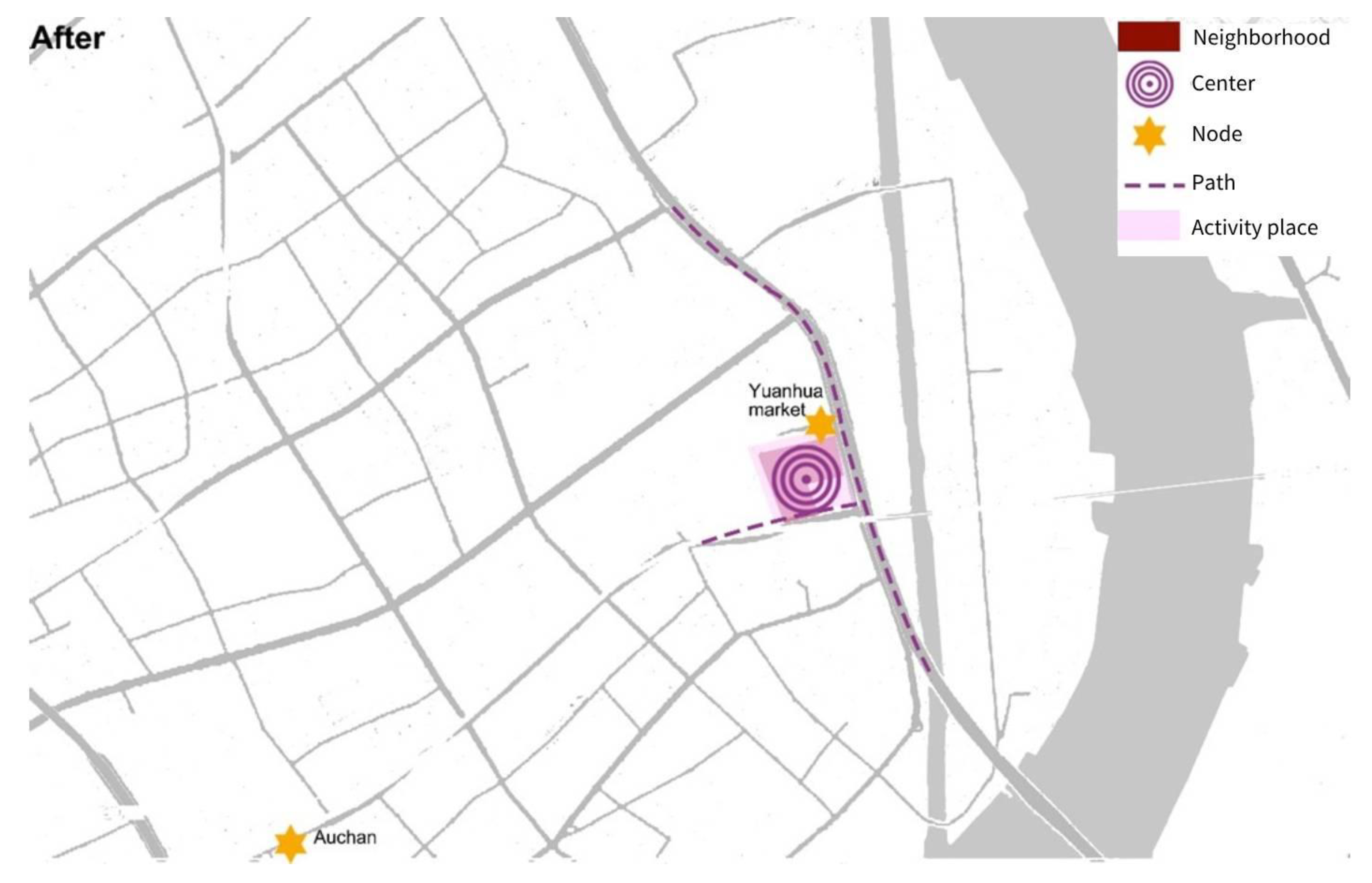

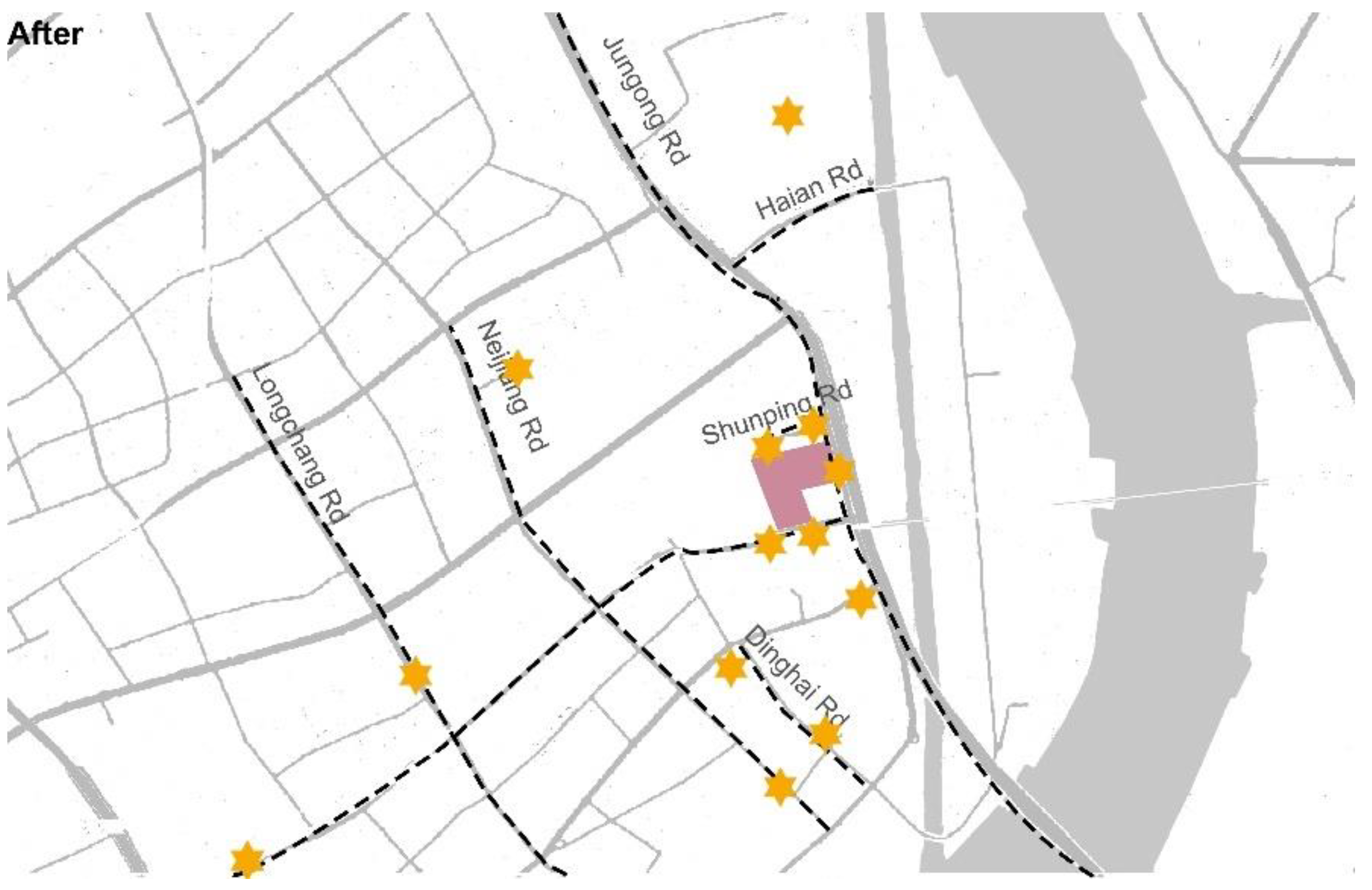

| Interviewee | Age Group | Before/After Ratio of Area of Activity Place | Change | Interviewee | Age Group | Before/After Ratio of Area of Activity Place | Change |
|---|---|---|---|---|---|---|---|
| A | Middle-aged | 1.00 | ≈ | I | Elderly | 2.28 | ↓ |
| B | Elderly | 9.14 | ↓ | J | Elderly | 1.61 | ↓ |
| C | Elderly | 1.20 | ↓ | K | Young | 2.90 | ↓ |
| D | Elderly | 1.45 | ↓ | L | Elderly | 1.96 | ↓ |
| E | Young | 2.89 | ↓ | M | Young | 3.49 | ↓ |
| F | Middle-aged | 0.86 | ↑ | N | Middle-aged | 4.71 | ↓ |
| G | Elderly | 3.95 | ↓ | O | Middle-aged | 4.65 | ↓ |
| H | Elderly | 0.99 | ≈ |
Disclaimer/Publisher’s Note: The statements, opinions and data contained in all publications are solely those of the individual author(s) and contributor(s) and not of MDPI and/or the editor(s). MDPI and/or the editor(s) disclaim responsibility for any injury to people or property resulting from any ideas, methods, instructions or products referred to in the content. |
© 2025 by the authors. Licensee MDPI, Basel, Switzerland. This article is an open access article distributed under the terms and conditions of the Creative Commons Attribution (CC BY) license (https://creativecommons.org/licenses/by/4.0/).
Share and Cite
Xin, S.; Guo, Q. Beyond Distribution: Critique of Spatial Justice Theories—Case Study of Shanghai’s 15-Minute City. Land 2025, 14, 189. https://doi.org/10.3390/land14010189
Xin S, Guo Q. Beyond Distribution: Critique of Spatial Justice Theories—Case Study of Shanghai’s 15-Minute City. Land. 2025; 14(1):189. https://doi.org/10.3390/land14010189
Chicago/Turabian StyleXin, Shengxi, and Qingyuan Guo. 2025. "Beyond Distribution: Critique of Spatial Justice Theories—Case Study of Shanghai’s 15-Minute City" Land 14, no. 1: 189. https://doi.org/10.3390/land14010189
APA StyleXin, S., & Guo, Q. (2025). Beyond Distribution: Critique of Spatial Justice Theories—Case Study of Shanghai’s 15-Minute City. Land, 14(1), 189. https://doi.org/10.3390/land14010189