Article

Bridging Matera’s Fragmented Identity: Unifying Disconnected Urban Spaces

by
Julia Nerantzia Tzortzi
* and
Ishita Saxena
Department Architecture, Built Environment and Construction Engineering, Politecnico di Milano, Via Giuseppe Ponzio, 31, 20133 Milan, Italy
*
Author to whom correspondence should be addressed.
Land 2024, 13(11), 1935; https://doi.org/10.3390/land13111935
Submission received: 5 September 2024 / Revised: 1 November 2024 / Accepted: 14 November 2024 / Published: 17 November 2024
(This article belongs to the Special Issue Integrating Urban Design and Landscape Architecture (Second Edition))

Abstract

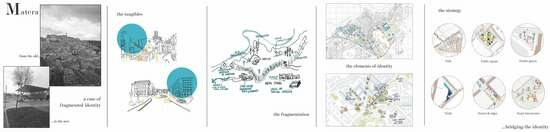
The city, like a piece of architecture, is a structure in space, but one of gigantic scale, something perceived only over a long period. A space is termed a place when it acquires an identity. The entirety of urban personality, urban communication, urban conduct, and urban design constitute the urban identity. This research delves into divided urban identities and examines how urban and architectural design influence the fragmentation of the cityscape. It explores the connection between urban environments’ physical attributes and the divide of social, cultural, and political identities within cities. This study uses a multidisciplinary method to acquire thorough knowledge by combining architectural studies, urban planning theories, and social-cultural perspectives. The case study of reference is the city of Matera, in southern Italy, which has a unique history of a slow shaping of its urban and productive landscape throughout centuries due to heavy environmental constraints and resource availability and which has suffered forced evacuation and major discontinuities in the past century. Here, the opposing traits of the historical Sassi district and the new town are examined, focusing on their resulting separated urban identities. The study also looks at how divided cities may be reconciled and integrated, emphasizing the relevance of a holistic urban approach for the framing of complex issues. The research proposes methods and best practices for developing inclusive urban settings that promote cohesion and shared identities through the analysis of successful cases of urban regeneration, adaptive reuse of spaces, and participatory design processes. The findings of this research contribute to both academic and practical knowledge by deepening the understanding of the relationship between urban design, architecture, and divided urban identities. It emphasizes the value of comprehensive approaches to urban planning that take into account the social, cultural, and historical settings of cities to foster inclusivity, rapprochement, and the development of common urban identities.
Keywords: fragmented cities; social cohesion; divided urban identities; perceived landscape fragmented cities; social cohesion; divided urban identities; perceived landscape
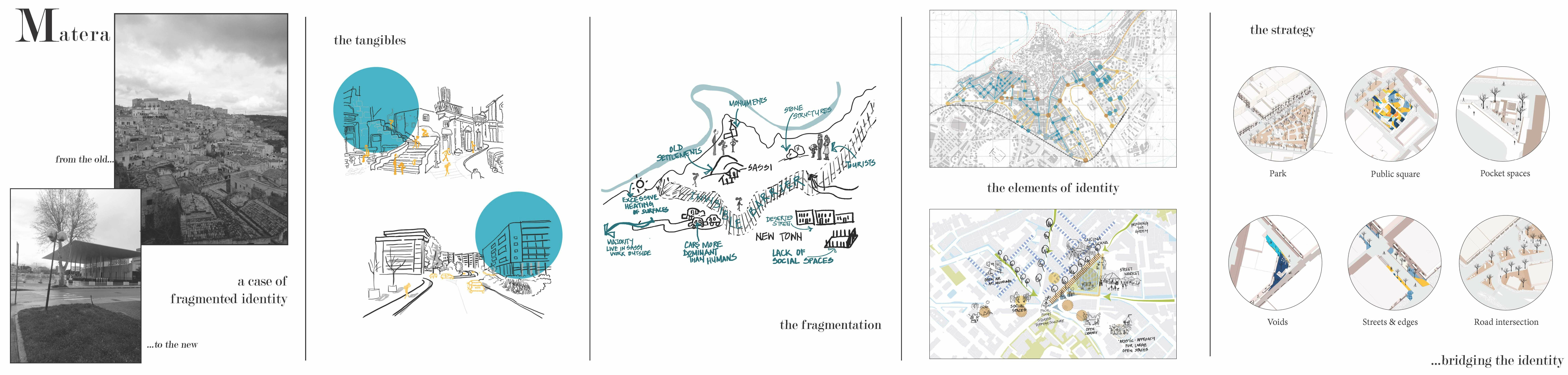
Graphical Abstract