



Creative Tourism in Islands and Regional Sustainable Development: What Can We Learn from the Pilot Projects Implemented in the Azores Territory?




Abstract
1. Introduction
2. Cultural and Creative Tourism in Island Regions
3. Methodological Framework
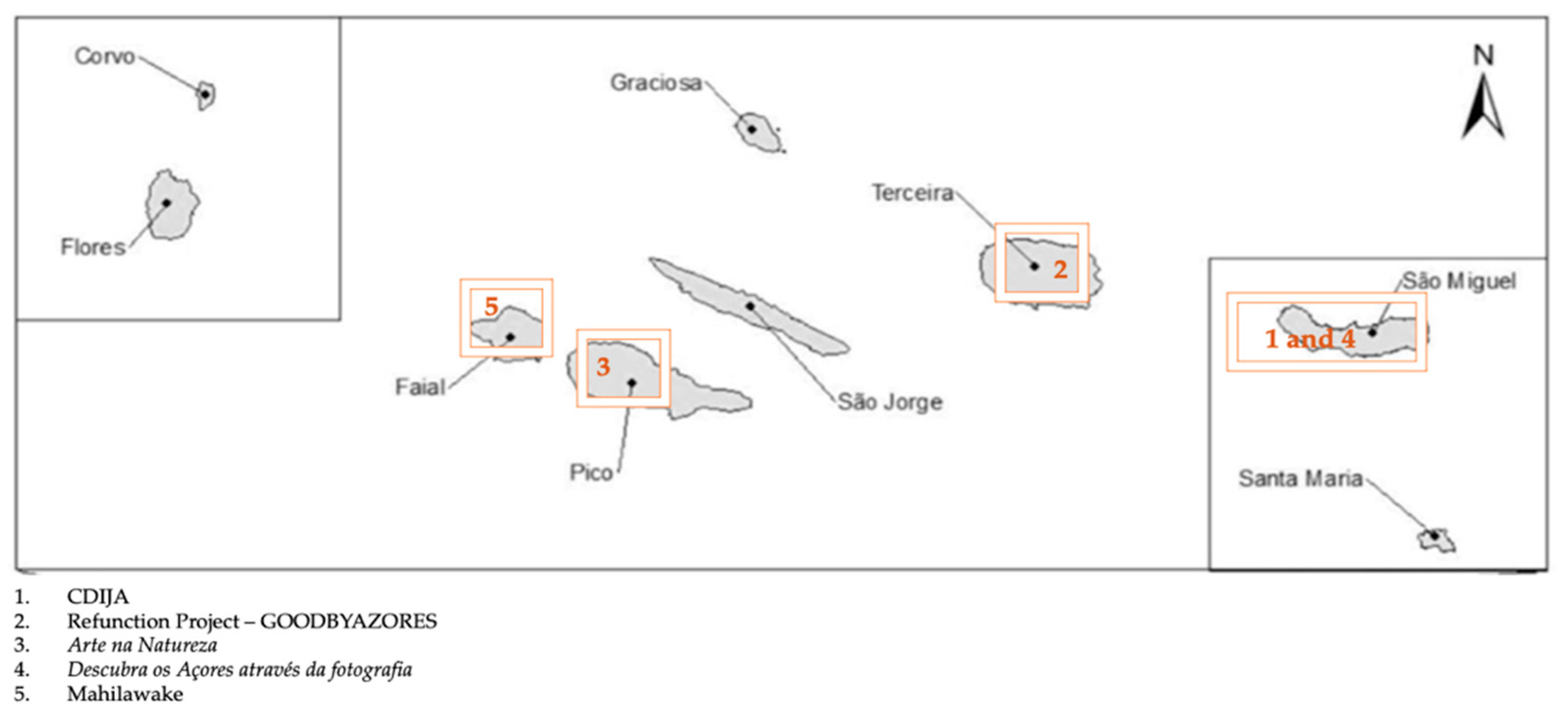
3.1. The Azorean Creative Pilot Projects
Surveys and Interviews
3.2. Tourism Situation in the Azores—In Brief
Azorean Landscapes Richness—In a Nutshell
4. Outcomes
4.1. Overall Statistics
Total Factor Productivity
4.2. The Azorean Creative Tourism Pilot Projects by Field
- CDIJA
- Refunction Project–GOODBYAZORES
- Art in Nature
- Discover the Azores through Photography
- Mahilawake
4.3. The Azorean Creative Pilot Projects Business Model Pattern
5. Discussion
6. Conclusions
- (i)
- encourage entrepreneurship, associated with small and medium-sized firms, promoting the diversity of its touristic offering;
- (ii)
- design guidelines that follow sustainable development models and the SDGs;
- (iii)
- create meaningful investments in the conservation and protection of cultural heritage as well as the Azorean endogenous resources;
- (iv)
- promote the relations between societies and the regional assets and innovative businesses;
- (v)
- prioritize rural tourism over mass tourism;
- (vi)
- facilitate collaboration among the public sector, the private sector, and society in general, and foster their active participation.
7. Research Limitations and Prospective Studies
Author Contributions
Funding
Data Availability Statement
Conflicts of Interest
References
- Koçak, E.; Ulucak, R.; Ulucak, Z.Ş. The impact of tourism developments on CO2 emissions: An advanced panel data estimation. Tour. Manag. Perspect. 2020, 33, 100611. [Google Scholar] [CrossRef]
- Santos, C.; Couto, G.; de Albergaria, I.S.; da Silva, L.S.; Medeiros, P.D.; Simas, R.M.N.; Castanho, R.A. Analyzing Pilot Projects of Creative Tourism in an Ultra-Peripheral Region: Which Guidelines Can Be Extracted for Sustainable Regional Development? Sustainability 2022, 14, 12787. [Google Scholar] [CrossRef]
- Baixinho, A.; Santos, C.; Couto, G.; da Albergaria, I.S.; da Silva, L.S.; Medeiros, P.D.; Simas, R.M.N. Creative Tourism on Islands: A Review of the Literature. Sustainability 2020, 12, 10313. [Google Scholar] [CrossRef]
- Balaguer, J.; Jordá, M. Tourism as a long-run economic growth factor: The Spanish case. Appl. Econ. 2010, 34, 877–884. [Google Scholar] [CrossRef]
- Couto, G.; Pimentel, P.; Oliveira, A.; Ponte Crispim, J.; Santos, C.; Estimaand, D.; Castanho, R.A. SmartDest: Converting the Azores Into a Smart Tourist Destination. Chapter #25 in the IGI GLOBAL Handbook of Research. In Handbook of Research on Sustainable Development Goals, Climate Change, and Digitalization; IGIGLOBAL: Hershey, PA, USA, 2021; pp. 409–432. ISBN 13: 9781799884828. [Google Scholar] [CrossRef]
- Mora Aliseda, J.; Garrido Velarde, J.; Bedón Garzó, R. Indicators for Sustainable Management in the Yasuni National Park; Wseas Transactions on Business and Economics: Athens, Greece, 2017; Volume 14. [Google Scholar]
- Santos, R. O Regresso dos Emigrantes Portugueses e o Desenvolvimento do Turismo em Portugal. Ph.D. Thesis, University of Aveiro, Aveiro, Portugal, 2013. [Google Scholar]
- Castanho, R.A.; Couto, G.; Santos, C. Tourism Promoting Sustainable Regional Development: Focusing on Rural and Creative Tourism in Low-Density and Remote Regions. Rev. De Estud. Andal. 2023, 45, 189–205. [Google Scholar]
- Van der Schyff, T. The Development and Testing of a Measurement Instrument for Regional Tourism Competitiveness Facilitating Economic Development. Ph.D. Thesis, North-West University (NWU), Brisbane, South Africa, 2021. [Google Scholar]
- Croes, R.; Rivera, M. Tourism’s potential to benefit the poor: A social accounting matrix model applied to Ecuador. Tour. Econ. 2017, 23, 29–48. [Google Scholar] [CrossRef]
- Garrido-Velarde, J.; Montero-Parejo, M.J.; Hernández-Blanco, J.; García-Moruno, L. Visual Analysis of the Height Ratio between Building and Background Vegetation. Two Rural Cases of Study: Spain and Sweden. Sustainability 2018, 10, 2593. [Google Scholar] [CrossRef]
- Wu, J.; Sun, W. Regional Integration and Sustainable Development in the Yangtze River Delta, China: Towards a Conceptual Framework and Research Agenda. Land 2023, 12, 470. [Google Scholar] [CrossRef]
- Pimenta, C.A.M.; Ribeiro, J.C.; Remoaldo, P. Regional Development and Creative Tourism: A Bibliometric Survey of the Literature Available in Two Scientific Literature Databases. Rev. Bras. De Gest. E Desenvolv. Reg. 2021, 17, 290–301. [Google Scholar]
- Lima, F.; Silva, Y. ‘Project Querença’ and creative tourism: Visibility and local development of a village in the rural Algarve. E-Rev. Tour. Res. (eRTR) 2017, 14, 21–35. [Google Scholar]
- Kato, H. Remote Island Tourism: A Case Study in Fiji. WIT Trans. Ecol. Environ. 2020, 248, 165–176. [Google Scholar] [CrossRef]
- Castanho, R.A.; Couto, G.; Santos, R. Introductory Chapter: Rural Tourism as a Catalyst for Sustainable Regional Development of Peripheral Territories. In Peripheral Territories, Tourism, and Regional Development; IntechOpen: London, UK, 2021. [Google Scholar] [CrossRef]
- Vargues, P.; Loures, L. Using Geographic Information Systems in Visual and Aesthetic Analysis: The case study of a golf course in Algarve. WSEAS Trans. Environ. Dev. 2008, 4, 774–783. [Google Scholar]
- Mazumder, H.; Ahmed, M.; Al-Amin, Q. Estimating Total Contribution of Tourism to Malaysia Economy. Int. J. Bus. Manag. Soc. Sci. 2009, 2, 146–159. [Google Scholar]
- Behradfar, A.; Castanho, R.; Couto, G.; Sousa, A.; Pimentel, P. Analyzing COVID-19 Post-Pandemic Recovery Process in Azores Archipelago. Konuralp Med. J. 2022, 14, 206–218. [Google Scholar] [CrossRef]
- Tourtellot, J. Destinations rated: 111 islands. Natl. Geogr. Travel. 2007, 24, 108–127. [Google Scholar]
- Ferrari, G.; Jiménez, J.M.; Secondi, L. Tourists’ Expenditure in Tuscany and its impact on the regional economic system. J. Clean. Prod. 2018, 171, 1437–1446. [Google Scholar] [CrossRef]
- Castanho, R.A.; Behradfar, A.; Vulević, A.; Naranjo Gómez, J.M. Analyzing Transportation Sustainability in the Canary Islands Archipelago. Infrastructures 2020, 5, 58. [Google Scholar] [CrossRef]
- Castanho, R.A.; Naranjo Gómez, J.M.; Vulevic, A.; Behradfar, A.; Couto, G. Assessing Transportation Patterns in the Azores Archipelago. Infrastructures 2021, 6, 10. [Google Scholar] [CrossRef]
- McKercher, B. The impact of distance on tourism: A tourism geography law. Tour. Geogr. 2018, 20, 905–909. [Google Scholar] [CrossRef]
- Pascariu, G.; Ibanescu, B. Determinants and implications of the tourism multiplier EECT in EU economies. Towards a core-periphery pattern? Amfiteatru Econ. 2018, 20, 982–997. [Google Scholar]
- Tiago, F.; Oliveira, C.; Brochado, A.; Moro, S. Mapping Island Tourism Research. In Strategic Innovative Marketing and Tourism; Springer International Publishing: Berlin/Heidelberg, Germany, 2020; pp. 71–79. [Google Scholar] [CrossRef]
- CCastanho, R.A.; Couto, G.; Pimentel, P.; Carvalho, C.; Sousa, Á.; Garrido Velarde, J. Assessing the Impacts of Public Policies Over Tourism in Azores Islands. A Research Based on Tourists and Residents Perceptions. WSEAS Trans. Environ. Dev. 2020, 16, 744–753. [Google Scholar] [CrossRef]
- Williams, A. Introduction. In Southern Europe Transformed-Political and Economic Change in Greece, Italy, Portugal and Spain; Williams, A., Ed.; Harper & Row: London, UK, 1984; pp. 1–32. [Google Scholar]
- Yesavdar, U.; Belgibayav, A.; Mersakylova, G. The role of developing direction of international tourism in Kazakhstan. Bull. Natl. Acad. Sci. Repub. Kazakhstan 2016, 2, 180–185. [Google Scholar]
- Meller, P.; Marfán, M. Small Large Industry: Employment generation, linkages, and key sectors. Econ. Dev. Cult. Chang. 1981, 29, 263–274. [Google Scholar]
- King, R. Return Migration and Regional Economic Development. In Return Migration and Regional Economic Problems; Croom Helm: Sydney, Australia, 1986; pp. 1–37. [Google Scholar]
- Gürdallı, H.; Bulanık, S. Socio-Cultural Recovery of the Border in Nicosia: Buffer Fringe Festival over Its Boundaries. Land 2023, 12, 370. [Google Scholar] [CrossRef]
- Zitoun, R.; Sander, S.; Masque, P.; Pijuan, S.P.; Swarzenski, P. Review of the Scientific and Institutional Capacity of Small Island Developing States in Support of a Bottom-up Approach to Achieve Sustainable Development Goal 14 Targets. Oceans 2020, 1, 109–132. [Google Scholar] [CrossRef]
- Walker, T.; Lee, T.; Li, X. Sustainable development for small island tourism: Developing slow tourism in the Caribbean. J. Travel Tour. Mark. 2021, 38, 1–15. [Google Scholar] [CrossRef]
- Naranjo Gómez, J.M.; Lousada, S.; Garrido Velarde, J.; Castanho, R.A.; Loures, L. Land-Use Changes in the Canary Archipelago Using the CORINE Data: A Retrospective Analysis. Land 2020, 9, 232. [Google Scholar] [CrossRef]
- Cohen, E. Small Islands Tourism: A Review. Acta Turistica 2020, 32, 169–183. [Google Scholar] [CrossRef]
- Zhu, H.; Deng, F. How to Influence Rural Tourism Intention by Risk Knowledge during COVID-19 Containment in China: Mediating Role of Risk Perception and Attitude. Int. J. Environ. Res. Public Health 2020, 17, 3514. [Google Scholar] [CrossRef]
- McLeod, M.; Dodds, R.; Butler, R. Island Tourism Sustainability and Resiliency; Routledge: Abingdon, UK, 2022. [Google Scholar] [CrossRef]
- Silva, F.M.; Sousa, C.; Albuquerque, H. Analytical Model for the Development Strategy of a Low-Density Territory: The Montesinho Natural Park. Sustainability 2022, 14, 4373. [Google Scholar] [CrossRef]
- Wen, J.; Kozak, M.; Yang, S.; Liu, F. COVID-19: Potential effects on Chinese citizens’ lifestyle and travel. Tour. Rev. 2020, 76, 74–87. [Google Scholar] [CrossRef]
- UNWTO (United Nations World Tourism Organization). International Recommendations for Tourism Statistics; United Nations World Tourism Organization: Madrid, Spain, 2008. [Google Scholar]
- Mediano-Serrano, L. La Gestión de Marketing en el Turismo Rural; Pearson Prentice Hall: Madrid, Spain, 2004. [Google Scholar]
- OMT. Concepto de Turismo Rural. Available online: https://www.unwto.org/es/turismo-rural (accessed on 10 December 2021).
- Couto, G.; Castanho, R.A.; Pimentel, P.; Carvalho, C.B.; Sousa, Á. The Potential of Adventure Tourism in the Azores: Focusing on the Regional Strategic Planning. In Advances in Tourism, Technology and Systems, ICOTTS 2020. Smart Innovation, Systems and Technologies; Abreu, A., Liberato, D., González, E.A., Garcia Ojeda, J.C., Eds.; Springer: Singapore, 2021; Volume 209, pp. 15–25. [Google Scholar] [CrossRef]
- Morais, J.; Castanho, R.; Pinto-Gomes, C.; Santos, P. Merging Traditional Livelihood Activities with New Employment Opportunities Brought by Ecotourism to Iona National Park, Angola: Rethinking Social Sustainability. In Planeamiento Sectorial: Recursos Hídricos, Espacio Rural y Fronteras; Aranzadi, T.R., Ed.; Thomson Reuters: Toronto, ON, Canada, 2018; pp. 293–303. ISBN 978-84-1309-065-8. [Google Scholar]
- Solima, L.; Minguzzi, A. Territorial development through cultural tourism and creative activities. Mondes Du Tour. 2014, 10, 6–16. [Google Scholar] [CrossRef]
- Richards, G. Panorama of Creative Tourism around the World. In Seminário Internacional de Turismo Criativo; Cais do Sertão: Recife, PE, Brazil, 2018. [Google Scholar]
- Mahony, K.; Zyl, J. The Impacts of Tourism Investment on Rural Communities: Three Case Studies in South Africa. Dev. S. Afr. 2002, 19, 83–103. [Google Scholar] [CrossRef]
- SoSousa, À.; Castanho, R.A.; Couto, G.; Pimentel, P. Post-Covid tourism planning: Based on the Azores residents’ perceptions about the development of regional tourism. Eur. Plan. Stud. 2022, 1–23. [Google Scholar] [CrossRef]
- Ruzic, P.; Demonja, D. Transformations in business & economics. Econ. Impacts Rural Tour. Rural Areas Istria 2017, 16, 31–40. [Google Scholar]
- Henriques, C.; Moreira, M. Creative Tourism and Urban Sustainability: The Cases of Lisbon and Oporto. Rev. Port. De Estud. Reg. 2019, 51, 93–108. [Google Scholar]
- Labrianidis, L.; Ferrão, J.; Hertzina, K.; Kalantaridis, C.; Piasecki, B.; Sma-llbone, D. The Future of Europe’s rural periphery. Final Report. In 5th Framework Programme of the European Community; EC: Brussels, Belgium, 2003. [Google Scholar]
- Goodwin, H. Tourism, Local Economic Development, and poverty reduction. Appl. Res. Econ. Dev. 2008, 5, 55–64. [Google Scholar]
- Castanho, R.A.; Couto, G.; Pimentel, P.; Carvalho, C.B.; Sousa, Á.; Graça Batista, M.; Lousada, S. The Opinions of Decision-Makers Regarding the Rural Tourism Development Potential in the Azores Region. Smart Innovation, Systems and Technologies. In Advances in Tourism, Technology and Systems; Castanho, R.A., Couto, G., Pimentel, P., Carvalho, C., Sousa, Á., da Graça Batista, M., Lousada, S., Eds.; Springer: Singapore, 2022; Volume 293, Chapter 41; ISBN 978-981-19-1039-5. [Google Scholar] [CrossRef]
- Grinberger, A.Y.; Shoval, N.; McKercher, B. Typologies of tourists’ time–space consumption: A new approach using GPS data and GIS tools. Tour. Geogr. 2014, 16, 105–123. [Google Scholar] [CrossRef]
- Fleischer, A.; Felsenstein, D. Support for Rural Tourism—Does it Make a Difference? Ann. Tour. Res. 2000, 27, 1007–1024. [Google Scholar] [CrossRef]
- Vulevic, A.; Castanho, R.A.; Naranjo Gómez, J.M.; Cabezas, J.; Fernández-Pozo, L.; Garrido Velarde, J.; Martín Gallardo, J.; Lousada, S.; Loures, L. Common Regional Development Strategies on Iberian Territories. a Framework for Comprehensive Border Corridors Governance: Establishing Integrated Territorial Development [Online First]; IntechOpen: London, UK, 2021. [Google Scholar] [CrossRef]
- Fernández-Jeri, A. El Comportamiento del Consumidor Convencional de Alimentos Durante el COVID-19, en el Perú. Spec. Issue: Reflex. Sobre Coronavirus Impactos Rev. Científica Monfragüe Resiliente—Sci. J. 2020; 86–92. [Google Scholar]
- Castanho, R.A. A pandemic crisis shocking us all: The COVID-19. Spec. Issue Reflex. Sobre Coronavirus Impactos Rev. Científica Monfragüe Resiliente—Sci. J. 2020; 233–238. [Google Scholar]
- Agius, K. Doorway to Europe: Migration and its impact on island tourism. J. Mar. Isl. Cult. 2021, 10, 21–38. [Google Scholar] [CrossRef]
- Marques, C.P.; Guedes, A.; Bento, R. Rural tourism recovery between two COVID-19 waves: The case of Portugal. Curr. Issues Tour. 2021, 25, 857–863. [Google Scholar] [CrossRef]
- Brokou, D.; Darra, A.; Kavouras, M. Are New Cartographies Strengthening a Sustainable and Responsible Island Tourism? In Smart Cities, Citizen Welfare, and the Implementation of Sustainable Development Goals; IGIGLOBAL: Hershey, PA, USA, 2022; pp. 105–131. [Google Scholar] [CrossRef]
- Rytkönen, P.; Tunón, H. Summer Farmers, Diversification and Rural Tourism—Challenges and Opportunities in the Wake of the Entrepreneurial Turn in Swedish Policies (1991–2019). Sustainability 2020, 12, 5217. [Google Scholar] [CrossRef]
- Silva, F.; Lopes, T. Application of smart tourism to nature-based destinations. In Strategic Business Models to Support Demand, Supply, and Destination Management in the Tourism and Hospitality; Carvalho, L., Calisto, L., Gustavo, N., Eds.; IGI Global: Hershey, PA, USA, 2020; pp. 1–20. [Google Scholar]
- Rebola, F.; Loures, L.; Ferreira, P.; Loures, A. Inland or Coastal: That’s the Question! Different Impacts of COVID-19 on the Tourism Sector in Portugal. Sustainability 2022, 14, 16248. [Google Scholar] [CrossRef]
- Couto, G.; Castanho, R.A.; Pimentel, P.; Barreto Carvalho, C.; Sousa, Á. How SARS-CoV-2 crisis could influence the tourism intentions of Azores Archipelago residents A study based on the assessment of the public perceptions. World Rev. Sci. Technol. Sustain. Dev. 2023, 19, 133–148. [Google Scholar] [CrossRef]
- Waniek, M.; Castanho, R.A. Impact of the COVID-19 Pandemic on Croatia’s tourism sector. In Proceedings of the International Conference on Regional Science: Challenges, Policies and Governance of the Territories in the Post-Covid Era, Granada, Spain, 22 October 2022; pp. 109–112, ISBN 978-84-09-44259-1. [Google Scholar]
- Castanho, R.A. Social and Economic Impacts. In Cultural Sustainable Tourism Strategic Planning for a Sustainable Development; Series: Advances in Science, Technology & Innovation; Mandić, A., Stankov, U., Castanho, R.A., Eds.; Springer: Berlin/Heidelberg, Germany, 2022; pp. 67–68. ISBN 978-3-031-10800-6. [Google Scholar]
- Abellera, K.; Castanho, R.A. Analysis of the Sustainable Tourism Development in Indonesia. In Nuevas Estrategias para un Turismo Sostenible; Thomson Reuters Aranzadi: Madrid, Spain; Athens, Greece, 2022; pp. 371–380. ISBN 978-84-1124-804-4. [Google Scholar]
- Batista, M.D.G.; Couto, G.; Castanho, R.A.; Sousa, Á.; Pimentel, P.; Carvalho, C. The Rural and Nature Tourism Development Potential in Islands. Sustainability 2022, 14, 5289. [Google Scholar] [CrossRef]
- Bryden, J.; Bollman, R. Rural Employment in industrialized countries. Agric. Econ. 2000, 22, 185–197. [Google Scholar] [CrossRef]
- Santos, C.; Castanho, R.A.; Couto, G. Understanding Creative Tourism as a Potential Catalyst for Regional Economic Development in Ultra-Peripheral Territories: Highlighting Pilot-Projects in the Azores Islands. WSEAS Trans. Bus. Econ. 2022, 20, 295–306. [Google Scholar] [CrossRef]
- Sharpley, R.; Vass, A. Tourism, farming and diversification: An attitudinal study. Tour. Manag. 2006, 27, 1040–1052. [Google Scholar] [CrossRef]
- Scott, N.; Laws, E. Stimulants and inhibitors in the development of niche markets-The whale’ stale. In Proceedings of the CAUTHE 2004, Brisbane, Australia, 9–12 February 2004. [Google Scholar]
- Cannonier, C.; Burke, M.G. The economic growth impact of tourism in Small Island Developing States—Evidence from the Caribbean. Tour. Econ. 2018, 25, 85–108. [Google Scholar] [CrossRef]

| Queries | Azorean Creative Tourism Pilot projects | ||||
|---|---|---|---|---|---|
| 1 | 2 | 3 | 4 | 5 | |
| 1. Are most of your clients national or international? | International | International | International and National | International and National | National |
| 2. Do you know who your potential clients nationality and/or background? | United States of America | From International Nationalities | Mostly interested in culture | Mostly interested in photography | National Women |
| 3. Degree of demand for your creative tourism offer from January to April (2022)? | 3 | 2 | 5 | 3 | 3 |
| 4. Do you have partnerships with tourism or other touristic firms? | Yes | Yes | Yes | Yes | Yes |
| 5. Do you have partnerships with city councils or other public institutions? | No | Yes | Yes | No | No |
| 6. Do you have protocols or synergies with national or international advertisement firms to promote your project? | Yes | No | No | No | No |
| 7. Do you have partnerships with material suppliers? | No | No | Yes | No | No |
| 8. How you classify the investments in the project to date? | Moderate | Low | Low | Low | Low |
| 9. Are the main costs of your project fixed? | Variable | Variable | N/A | N/A | Variable |
| 10. For the success of your project, is there a need to invest more? | Yes | Yes | Yes | N/A | Yes |
| 11. The greatest cost in the project? Human resources, physical resources, or others? | Physical resources | Human resources | Promotion | N/A | Physical resources |
| 12. The project is creating profit? | No | No | No | Yes | Yes |
| Total number of firms | 5045 |
| Fully domestic firms | 4685 |
| Firms with foreign share | 360 |
| Mean (domestic firms) | |
| TFP | 5152 |
| Capital | 2,657,802 |
| Labor/Workers | 34 |
| Mean (foreign firms) | |
| TFP | 7691 |
| Capital | 1,162,430 |
| Labor/Workers | 24 |
| Fields | Azorean Creative Tourism Pilot Projects | ||||
|---|---|---|---|---|---|
| 1 | 2 | 3 | 4 | 5 | |
| Integrative | + | ||||
| Human Regional Talent Development | + | + | + | + | + |
| Artistic | + | + | + | ||
| Sociocultural and Gastronomy | + | ||||
| Nature-based tourism focus on Endogenous Resources | + | + | + | ||
Disclaimer/Publisher’s Note: The statements, opinions and data contained in all publications are solely those of the individual author(s) and contributor(s) and not of MDPI and/or the editor(s). MDPI and/or the editor(s) disclaim responsibility for any injury to people or property resulting from any ideas, methods, instructions or products referred to in the content. |
© 2023 by the authors. Licensee MDPI, Basel, Switzerland. This article is an open access article distributed under the terms and conditions of the Creative Commons Attribution (CC BY) license (https://creativecommons.org/licenses/by/4.0/).
Share and Cite
Castanho, R.A.; Santos, C.; Couto, G. Creative Tourism in Islands and Regional Sustainable Development: What Can We Learn from the Pilot Projects Implemented in the Azores Territory? Land 2023, 12, 498. https://doi.org/10.3390/land12020498
Castanho RA, Santos C, Couto G. Creative Tourism in Islands and Regional Sustainable Development: What Can We Learn from the Pilot Projects Implemented in the Azores Territory? Land. 2023; 12(2):498. https://doi.org/10.3390/land12020498
Chicago/Turabian StyleCastanho, Rui Alexandre, Carlos Santos, and Gualter Couto. 2023. "Creative Tourism in Islands and Regional Sustainable Development: What Can We Learn from the Pilot Projects Implemented in the Azores Territory?" Land 12, no. 2: 498. https://doi.org/10.3390/land12020498
APA StyleCastanho, R. A., Santos, C., & Couto, G. (2023). Creative Tourism in Islands and Regional Sustainable Development: What Can We Learn from the Pilot Projects Implemented in the Azores Territory? Land, 12(2), 498. https://doi.org/10.3390/land12020498

