Article

Assessing Preferences for Cultural Ecosystem Services in the English Countryside Using Q Methodology


1
Faculty of Humanities, Charles University in Prague, U Kříže 8, 158 00 Prague, Czech Republic
2
School of Water, Energy and Environment, Cranfield University, College Road, Cranfield MK43 0AL, UK
*
Author to whom correspondence should be addressed.
Land 2023, 12(2), 331; https://doi.org/10.3390/land12020331
Submission received: 25 November 2022 / Revised: 10 January 2023 / Accepted: 16 January 2023 / Published: 26 January 2023
(This article belongs to the Special Issue Rural–Urban Gradients: Landscape and Nature Conservation)

Abstract

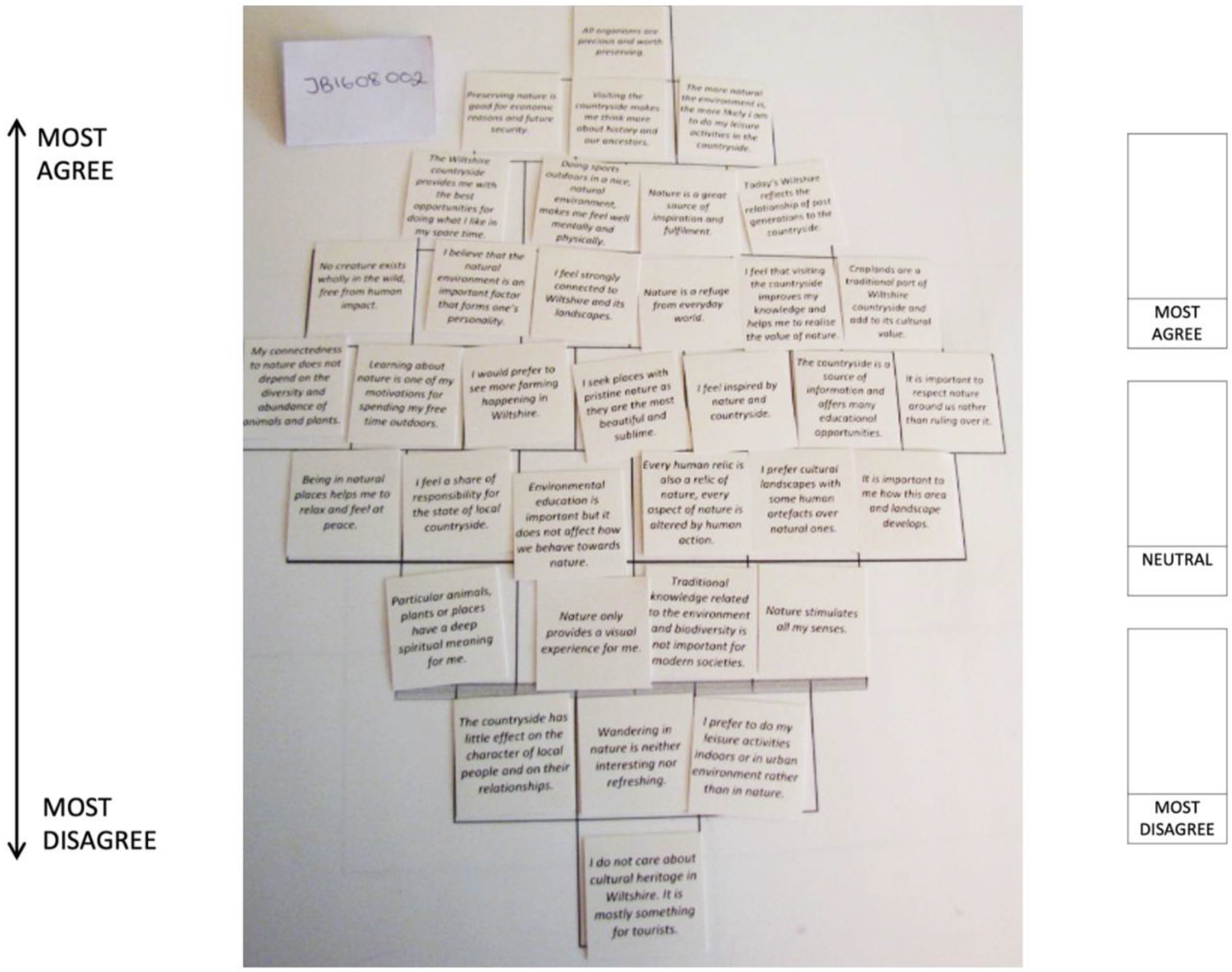
Cultural Ecosystem Services (CES) are difficult to assess due to the subjective and diverse way in which they are experienced. This can make it difficult to apply CES research to enhance human experience of nature. This study applies Q methodology to group people according to their preferences for CES. The Q methodology survey was carried out with 47 local residents and tourists in Wiltshire, in South West England. Four groups of respondents were identified drawing value from nature through: (1) spiritual benefits and mental well-being (Group 1—Inspired by nature); (2) nature and biodiversity conservation (Group 1—Conserving nature); (3) cultural heritage in multifunctional landscapes (Group 3—Countryside mix); and (4) opportunities for outdoor activities (Group 4—Outdoor pursuits). All four groups stated that benefits from nature were enhanced by actually visiting the countryside, through a better understanding of nature itself, and through a range of sensory experiences. They particularly identified relaxation opportunities as a very important CES benefit. These findings, and the demonstrated use of the Q methodology, could support local planning and landscape management in order to provide accessible and functional landscapes that can provide a range of different CES benefits to people.
Keywords: Q methodology; cultural ecosystem services; Wiltshire; multifunctional landscapes; nature’s contributions to people Q methodology; cultural ecosystem services; Wiltshire; multifunctional landscapes; nature’s contributions to people