Correction: Brandolini et al. The Evolution of Historic Agroforestry Landscape in the Northern Apennines (Italy) and Its Consequences for Slope Geomorphic Processes. Land 2023, 12, 1054

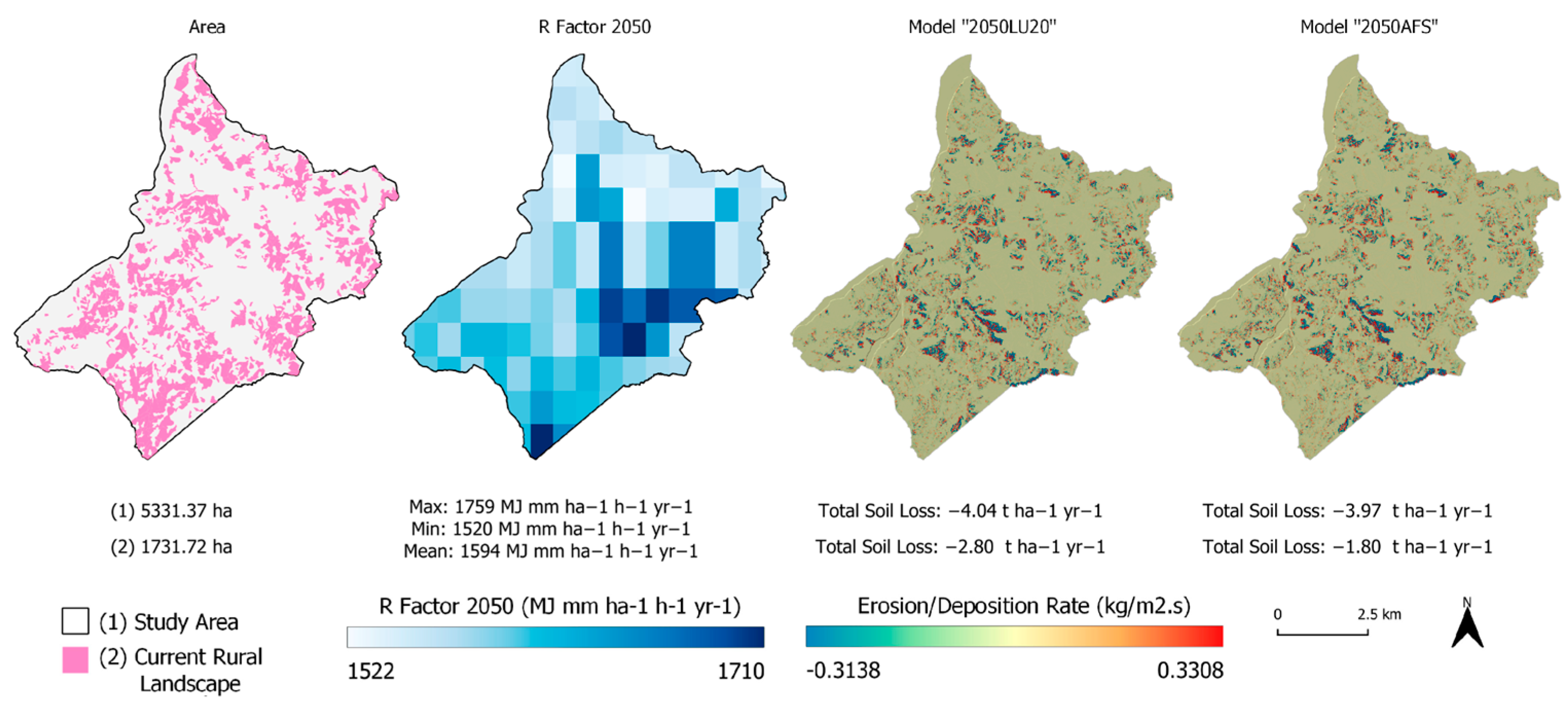
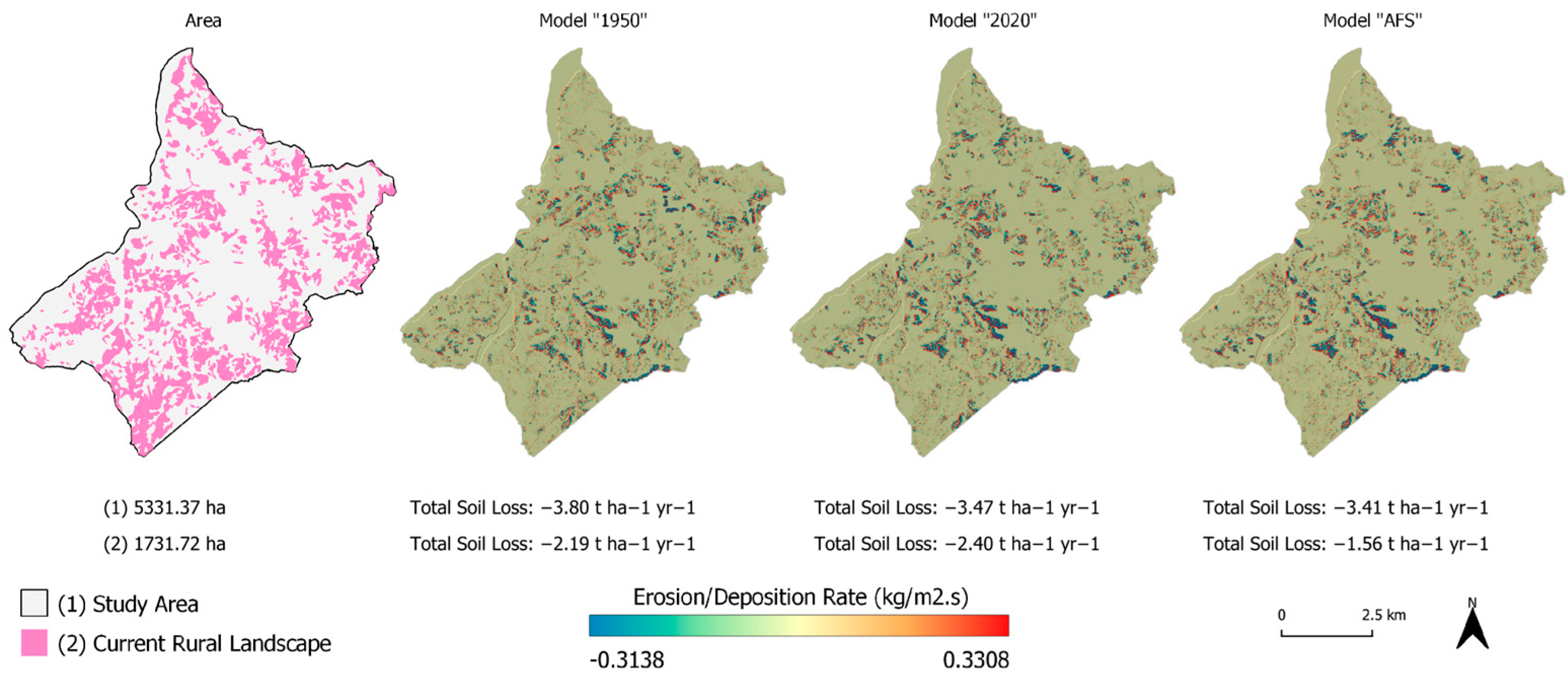
Error in Figures
Error in Table
Reference
- Brandolini, F.; Compostella, C.; Pelfini, M.; Turner, S. The Evolution of Historic Agroforestry Landscape in the Northern Apennines (Italy) and Its Consequences for Slope Geomorphic Processes. Land 2023, 12, 1054. [Google Scholar] [CrossRef]


| Land Use Type | Model “1950” | Model “2020” | Model “AFS” | |||
|---|---|---|---|---|---|---|
| Area (ha) | Soil Loss (t ha−1 year−1) | Area (ha) | Soil Loss (t ha−1 year−1) | Area (ha) | Soil Loss (t ha−1 year−1) | |
| Agroforestry | 1024.83 | 0.93 | 5.66 | 0.02 | 1730.15 | −1.54 |
| Arable land | 1220.20 | −4.65 | 657.00 | −1.55 | nd | nd |
| Grassland | 253.66 | 0.63 | 1067.49 | −0.89 | nd | nd |
| Rough ground | 190.02 | −3.29 | 190.74 | −6.50 | 190.74 | −6.55 |
| Urban area | 65.24 | −0.28 | 184.26 | −0.45 | 184.26 | −0.30 |
| Woodland | 2577.43 | 2.86 | 3226.22 | 5.90 | 3226.22 | 4.98 |
| Total | 5331.37 | −3.80 | 5331.37 | −3.47 | 5331.37 | −3.41 |
Disclaimer/Publisher’s Note: The statements, opinions and data contained in all publications are solely those of the individual author(s) and contributor(s) and not of MDPI and/or the editor(s). MDPI and/or the editor(s) disclaim responsibility for any injury to people or property resulting from any ideas, methods, instructions or products referred to in the content. |
© 2023 by the authors. Licensee MDPI, Basel, Switzerland. This article is an open access article distributed under the terms and conditions of the Creative Commons Attribution (CC BY) license (https://creativecommons.org/licenses/by/4.0/).
Share and Cite
Brandolini, F.; Compostella, C.; Pelfini, M.; Turner, S. Correction: Brandolini et al. The Evolution of Historic Agroforestry Landscape in the Northern Apennines (Italy) and Its Consequences for Slope Geomorphic Processes. Land 2023, 12, 1054. Land 2023, 12, 2015. https://doi.org/10.3390/land12112015
Brandolini F, Compostella C, Pelfini M, Turner S. Correction: Brandolini et al. The Evolution of Historic Agroforestry Landscape in the Northern Apennines (Italy) and Its Consequences for Slope Geomorphic Processes. Land 2023, 12, 1054. Land. 2023; 12(11):2015. https://doi.org/10.3390/land12112015
Chicago/Turabian StyleBrandolini, Filippo, Chiara Compostella, Manuela Pelfini, and Sam Turner. 2023. "Correction: Brandolini et al. The Evolution of Historic Agroforestry Landscape in the Northern Apennines (Italy) and Its Consequences for Slope Geomorphic Processes. Land 2023, 12, 1054" Land 12, no. 11: 2015. https://doi.org/10.3390/land12112015
APA StyleBrandolini, F., Compostella, C., Pelfini, M., & Turner, S. (2023). Correction: Brandolini et al. The Evolution of Historic Agroforestry Landscape in the Northern Apennines (Italy) and Its Consequences for Slope Geomorphic Processes. Land 2023, 12, 1054. Land, 12(11), 2015. https://doi.org/10.3390/land12112015