Article

Incentives for Palm Oil Smallholders in Mandatory Certification in Indonesia
by
Eusebius Pantja Pramudya
1,6,*,
Lukas Rumboko Wibowo
2,
Fitri Nurfatriani
3,
Iman Kasiman Nawireja
5,
Dewi Ratna Kurniasari
2,
Sakti Hutabarat
4,
Yohanes Berenika Kadarusman
6,
Ananda Oemi Iswardhani
1 and
Rukaiyah Rafik
7
1
Institute of Social and Economic Research, Raffles Hills Blok A3 No. 14-15, Depok 16954, Indonesia
2
Research Center for Population, National Research and Innovation Agency (BRIN), Gedung B.J. Habibie, Jl. M.H. Thamrin No. 8, Jakarta Pusat 10340, Indonesia
3
Environment, Maritime, Natural Resources, and Nuclear Policy, Deputy of Development Policy, National Research and Innovation Agency (BRIN), Gedung B.J. Habibie, Jl. M.H. Thamrin No. 8, Jakarta Pusat 10340, Indonesia
4
Department of Agribusiness, Faculty of Agriculture, University of Riau, Jl. HR Soebrantas Km 12.5, Pekanbaru 28293, Indonesia
5
Department of Communication and Community Development Sciences, Faculty of Human Ecology, IPB University, Gedung FEMA Level 5 Wing 1, Kampus IPB Dramaga, Kota Bogor 16680, Indonesia
6
School of Business and Economics, Universitas Prasetiya Mulya, BSD Campus, BSD City Kavling Edutown I.1, Jalan BSD Raya Utama, BSD City, Tangerang 15339, Indonesia
7
Forum Petani Kelapa Sawit Berkelanjutan Indonesia (FORTASBI), Jl. Danau Kerinci, RT.05/RW.07, Kecamatan Bogor Tengah, Kota Bogor 16129, Indonesia
*
Author to whom correspondence should be addressed.
Land 2022, 11(4), 576; https://doi.org/10.3390/land11040576
Submission received: 27 February 2022 / Revised: 2 April 2022 / Accepted: 12 April 2022 / Published: 14 April 2022

Abstract

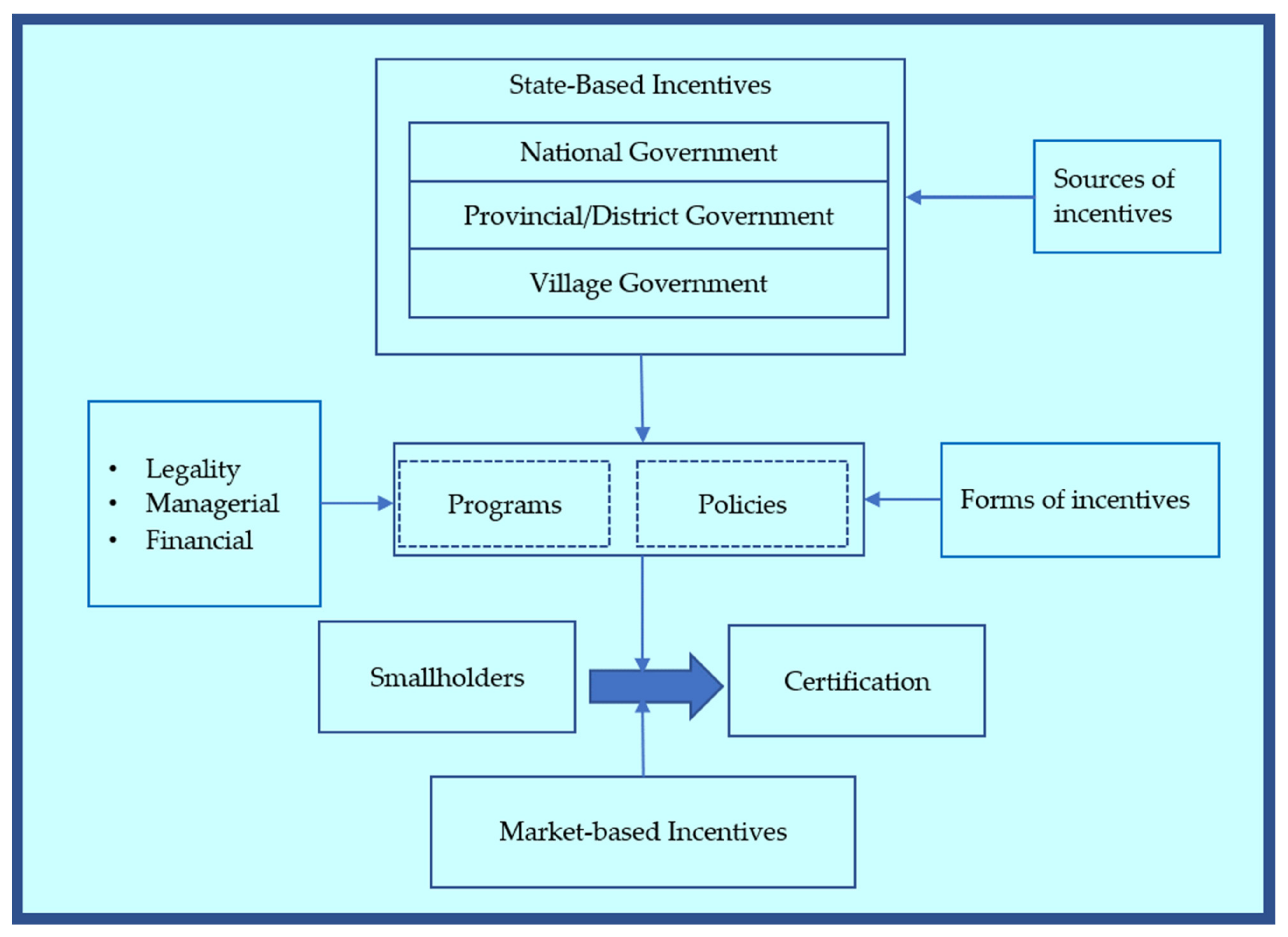
The Indonesian Sustainable Palm Oil (ISPO) is a mandatory certification for palm oil plantations based on compliance with Indonesia’s regulations. Its implementation has been slow, particularly for independent smallholders that face problems of complicated requirements, limited capacity, and limited funding. Meanwhile, limited incentives are in place, either in the form of premium prices, ease of regulation, or funding. This article aims to elaborate on the role of incentives and their options in supporting the acceleration of ISPO implementation to ensure and improve the market access of smallholders. It identifies ways to develop incentives to facilitate the acceleration of ISPO certification and alternative financing sources available to support this. The method of this research is based on qualitative methodology using a literature review, policy document analysis, and in-depth interviews with informants from the government and smallholders. The analysis of this article shows that incentives are needed in the form of funding, regulatory measures, technical assistance, promotion, and rewards for good practices to provide better facilitation and financial support for the regulatory compliance in the legal, managerial and financial aspects of the ISPO. These incentives target government and smallholders. Implications for enabling these incentives include the improvement of government coordination, improved understanding of challenges faced by smallholders, and adoption of innovative approaches to manage financial resources, which are crucial to facilitate smallholders’ capacity and organizational improvement.
Keywords: palm oil; smallholder; incentive; certification; legality compliance; Indonesia palm oil; smallholder; incentive; certification; legality compliance; Indonesia