


Predicting Private and Public Pro-Environmental Behaviors in Rural Tourism Contexts Using SEM and fsQCA: The Role of Destination Image and Relationship Quality


Abstract
1. Introduction
2. Literature Review and Hypothesis Development
2.1. Theoretical Background
2.1.1. Relationship Marketing Paradigm
2.1.2. Appraisal Theory of Emotion
2.2. Hypothesis Development
2.2.1. Link between Destination Image and Relationship Quality
2.2.2. Link between Tourist Satisfaction and Destination Trust
2.2.3. Link between Relationship Quality and Tourist Pro-Environmental Behavior
2.2.4. Link between Destination Image and Tourist Pro-Environmental Behavior
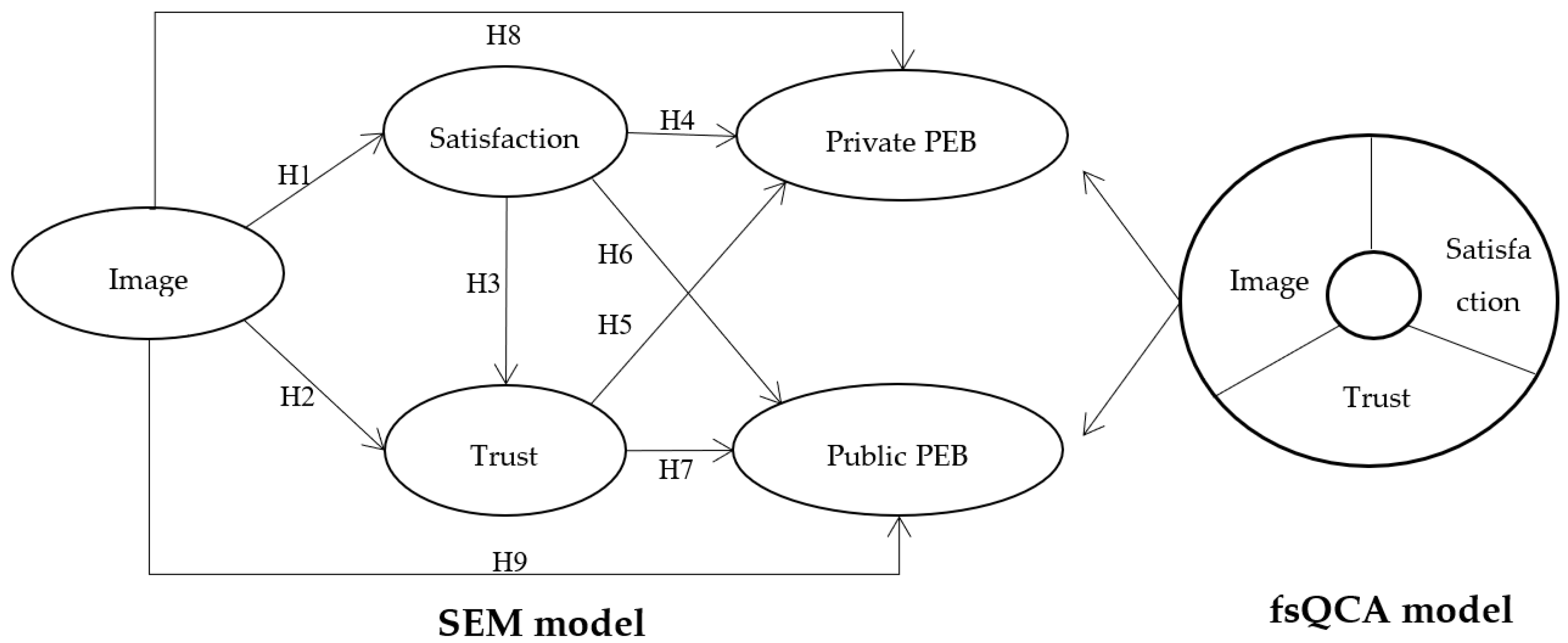
2.3. Conceptual Model
3. Method
3.1. Measurement
3.2. Statistical Analysis Method
3.3. Pretest of the Measurements
3.4. Data Collection and Sample
4. Data Analysis
4.1. Testing Common Method Variance
4.2. Measurement Model Test
4.3. Testing Structural Model
4.4. Results of fsQCA
4.4.1. Applying fsQCA to Predict Private Pro-Environmental Behavior
- (1)
- Contrarian Case Analysis
- (2)
- Data Calibration
- (3)
- Analysis of the necessary conditions of fsQCA
- (4)
- Sufficiency analysis of configuration conditions
- (5)
- Robustness test
4.4.2. Applying fsQCA to Predict Public Pro-Environmental Behavior
- (1)
- Contrarian Case Analysis
- (2)
- Data calibration
- (3)
- Analysis of the necessary conditions of fsQCA
- (4)
- Sufficiency analysis of configuration conditions
- (5)
- Robustness test
5. Conclusions, Contributions, and Implications
5.1. Conclusions
5.2. Theoretical Contributions
5.3. Managerial Implications
6. Limitations and Future Research Directions
Author Contributions
Funding
Institutional Review Board Statement
Informed Consent Statement
Data Availability Statement
Conflicts of Interest
References
- Zhou, Y.; Guo, L.; Liu, Y. Land consolidation boosting poverty alleviation in China: Theory and practice. Land Use Policy 2019, 82, 339–348. [Google Scholar] [CrossRef] [Scilit]
- Diriye, A.W.; Jama, O.M.; Diriye, J.W.; Abdi, A.M. Public preference for sustainable land use policies–Empirical results from multinomial logit model analysis. Land Use Policy 2022, 114, 105975. [Google Scholar] [CrossRef] [Scilit]
- Ayhan, Ç.K.; Taşlı, T.C.; Özkök, F.; Tatlı, H. Land use suitability analysis of rural tourism activities: Yenice, Turkey. Tour. Manag. 2020, 76, 103949. [Google Scholar] [CrossRef] [Scilit]
- Liu, Y.; Dai, L.; Long, H.; Feng, X. Land consolidation mode and ecological oriented transformation under the background of rural revitalization: A case study of Zhejiang Province. Chin. Land Sci. 2021, 35, 71–79. (In Chinese) [Google Scholar]
- Hoang, H.T.T.; Vanacker, V.; Van Rompaey, A.; Vu, K.C.; Nguyen, A.T. Changing human–landscape interactions after development of tourism in the northern Vietnamese Highlands. Anthropocene 2014, 5, 42–51. [Google Scholar] [CrossRef] [Scilit]
- Zhang, H.; Duan, Y.; Han, Z. Research on spatial patterns and sustainable development of rural tourism destinations in the Yellow River Basin of China. Land 2021, 10, 849. [Google Scholar] [CrossRef] [Scilit]
- Gannon, A. Rural tourism as a factor in rural community economic development for economies in transition. J. Sustain. Tour. 1994, 2, 51–60. [Google Scholar] [CrossRef] [Scilit]
- Zhou, B.; Ye, S. Revitalization of rural tourism industry and talents in the post-poverty era through knowledge transfer. Tour. Trib. 2021, 36, 12–13. (In Chinese) [Google Scholar]
- Su, M.; Wall, G.; Wang, Y.; Jin, M. Livelihood sustainability in a rural tourism destination−Hetu Town, Anhui Province, China. Tour. Manag. 2019, 71, 272–281. [Google Scholar] [CrossRef] [Scilit]
- People’s Daily. Tourism Injects New Vitality into Rural Development. Available online: http://ent.people.com.cn/n1/2021/0512/c1012-32100684.html (accessed on 9 December 2021). (In Chinese)
- Fotiadis, A.; Polyzos, S.; Huan, T.-C.T.C. The good, the bad and the ugly on COVID-19 tourism recovery. Ann. Tour. Res. 2021, 87, 103117. [Google Scholar] [CrossRef] [Scilit] [PubMed]
- Li, Z.; Zhang, X.; Yang, K.; Singer, R.; Cui, R. Urban and rural tourism under COVID-19 in China: Research on the recovery measures and tourism development. Tour. Rev. 2021, 76, 718–736. [Google Scholar] [CrossRef] [Scilit]
- Annual Report on China’s Outbound Tourism Development 2021. Available online: http://www.ctaweb.org.cn/cta/gzdt/202111/074b098d53e24375bfebf5352f67512a.shtml (accessed on 15 February 2022). (In Chinese)
- People’s Daily. Rural Tourism Getting Increasingly Popular. Available online: http://finance.people.com.cn/n1/2020/1028/c1004-31908454.html (accessed on 9 December 2021). (In Chinese)
- Luo, W.; Meng, B.; Tang, P.; Tang, Y.; Lu, Y. Influential relationships among rural land consolidation, tourism development and agrarian household livelihoods: An empirical test of rural tourism development. Tour. Trib. 2019, 34, 96–106. (In Chinese) [Google Scholar]
- Gao, C.; Cheng, L. Tourism-driven rural spatial restructuring in the metropolitan fringe: An empirical observation. Land Use Policy 2020, 95, 104609. [Google Scholar] [CrossRef] [Scilit]
- Xi, J.; Zhao, M.; Ge, Q.; Kong, Q. Changes in land use of a village driven by over 25 years of tourism: The case of Gougezhuang village, China. Land Use Policy 2014, 40, 119–130. [Google Scholar] [CrossRef] [Scilit]
- Li, W.; Zhou, Y.; Zhang, Z. Strategies of landscape planning in peri-urban rural tourism: A comparison between two villages in China. Land 2021, 10, 277. [Google Scholar] [CrossRef] [Scilit]
- Zhang, Y.; He, L.; Li, X.; Zhang, C.; Qian, C.; Li, J.; Zhang, A. Why are the Longji Terraces in Southwest China maintained well? A conservation mechanism for agricultural landscapes based on agricultural multi-functions developed by multi-stakeholders. Land Use Policy 2019, 85, 42–51. [Google Scholar] [CrossRef] [Scilit]
- Qiu, H.; Zhou, G. Tourists’ environmentally responsible behavior: Conceptualizing, measuring and validating. Zhej. Soc. Sci. 2017, 12, 88–98. (In Chinese) [Google Scholar]
- Li, S.; Wei, M.; Qu, H.; Qiu, S. How does self-image congruity affect tourists’ environmentally responsible behavior? J. Sustain. Tour. 2020, 28, 2156–2174. [Google Scholar] [CrossRef] [Scilit]
- Jiang, X.; Song, X.; Zhao, H.; Zhang, H. Rural tourism network evaluation based on resource control ability analysis: A case study of Ning’an, China. Land 2021, 10, 427. [Google Scholar] [CrossRef] [Scilit]
- Loureiro, S.M.C.; Guerreiro, J.; Han, H. Past, present, and future of pro-environmental behavior in tourism and hospitality: A text-mining approach. J. Sustain. Tour. 2022, 30, 258–278. [Google Scholar] [CrossRef] [Scilit]
- Knezevic Cvelbar, L.; Grün, B.; Dolnicar, S. “To clean or not to clean?” Reducing daily routine hotel room cleaning by letting tourists answer this question for themselves. J. Travel Res. 2021, 60, 220–229. [Google Scholar] [CrossRef] [Scilit]
- Wang, X.; Zhang, C. Contingent effects of social norms on tourists’ pro-environmental behaviours: The role of Chinese traditionality. J. Sustain. Tour. 2020, 28, 1646–1664. [Google Scholar] [CrossRef] [Scilit]
- Ramkissoon, H.; Graham Smith, L.D.G.; Weiler, B. Testing the dimensionality of place attachment and its relationships with place satisfaction and pro-environmental behaviours: A structural equation modelling approach. Tour. Manag. 2013, 36, 552–566. [Google Scholar] [CrossRef] [Scilit]
- Tonge, J.; Ryan, M.M.; Moore, S.A.; Beckley, L.E. The effect of place attachment on pro-environment behavioral intentions of visitors to coastal natural area tourist destinations. J. Travel Res. 2015, 54, 730–743. [Google Scholar] [CrossRef] [Scilit]
- Han, H.; Kim, W.; Lee, S. Stimulating visitors’ goal-directed behavior for environmentally responsible museums: Testing the role of moderator variables. J. Destin. Mark. Manag. 2018, 8, 290–300. [Google Scholar] [CrossRef] [Scilit]
- Leković, K.; Tomić, S.; Marić, D.; Ćurčić, N.V. Cognitive component of the image of a rural tourism destination as a sustainable development potential. Sustainability 2020, 12, 9413. [Google Scholar] [CrossRef] [Scilit]
- Hernández-Mogollón, J.M.; Alves, H.; Campón-Cerro, A.M.; Di-Clemente, E. Integrating transactional and relationship marketing: A new approach to understanding destination loyalty. Int. Rev. Public Nonprofit Mark. 2021, 18, 3–26. [Google Scholar] [CrossRef] [Scilit]
- Rasoolimanesh, S.M.; Seyfi, S.; Hall, C.M.; Hatamifar, P. Understanding memorable tourism experiences and behavioural intentions of heritage tourists. J. Destin. Mark. Manag. 2021, 21, 100621. [Google Scholar] [CrossRef] [Scilit]
- Chiu, Y.-T.H.; Lee, W.-I.; Chen, T.-H. Environmentally responsible behavior in ecotourism: Exploring the role of destination image and value perception. Asia Pac. J. Tour. Res. 2013, 19, 876–889. [Google Scholar] [CrossRef] [Scilit]
- Liobikienė, G.; Poškus, M.S. The importance of environmental knowledge for private and public sphere pro-environmental behavior: Modifying the value-belief-norm theory. Sustainability 2019, 11, 3324. [Google Scholar] [CrossRef] [Scilit]
- Morgan, R.M.; Hunt, S.D. The commitment-trust theory of relationship marketing. J. Mark. 1994, 58, 20–38. [Google Scholar] [CrossRef] [Scilit]
- Lewin, J.E.; Johnston, W.J. Relationship marketing theory in practice: A case study. J. Bus. Res. 1997, 39, 23–31. [Google Scholar] [CrossRef] [Scilit]
- Li, Y.; Fang, S.; Huan, T.-C.T. Consumer response to discontinuation of corporate social responsibility activities of hotels. Int. J. Hosp. Manag. 2017, 64, 41–50. [Google Scholar] [CrossRef] [Scilit]
- Su, L.; Swanson, S.R.; Chen, X. The effects of perceived service quality on repurchase intentions and subjective well-being of Chinese tourists: The mediating role of relationship quality. Tour. Manag. 2016, 52, 82–95. [Google Scholar] [CrossRef] [Scilit]
- Berry, L.L. Relationship marketing of services perspectives from 1983 and 2000. J. Relatsh. Mark. 2002, 1, 59–77. [Google Scholar] [CrossRef] [Scilit]
- Putra, I.W.J.A.; Putri, D.P. The Mediating Role of Relationship Marketing between Service Quality and Customer Loyalty. J. Relatsh. Mark. 2019, 18, 233–245. [Google Scholar] [CrossRef] [Scilit]
- Chiu, Y.-T.H.; Lee, W.-I.; Chen, T.-H. Environmentally responsible behavior in ecotourism: Antecedents and implications. Tour. Manag. 2014, 40, 321–329. [Google Scholar] [CrossRef] [Scilit]
- He, X.; Hu, D.; Swanson, S.R.; Su, L.; Chen, X. Destination perceptions, relationship quality, and tourist environmentally responsible behavior. Tour. Manag. Perspect. 2018, 28, 93–104. [Google Scholar] [CrossRef] [Scilit]
- Liu, C.-T.; Guo, Y.M.; Lee, C.-H. The effects of relationship quality and switching barriers on customer loyalty. Int. J. Inf. Manag. 2011, 31, 71–79. [Google Scholar] [CrossRef] [Scilit]
- Arnold, M.B. Emotion and Personality: Psychological Aspects; Columbia University Press: New York, NY, USA, 1960. [Google Scholar]
- Lazarus, R.S. Emotion and Adaptation; Oxford University Press: New York, NY, USA, 1991. [Google Scholar]
- Hosany, S. Appraisal Determinants of Tourist Emotional Responses. J. Travel Res. 2012, 51, 303–314. [Google Scholar] [CrossRef] [Scilit]
- Choi, S.-H.; Cai, L.A. The role of relationship quality in integrated destination marketing. J. Travel Tour. Mark. 2018, 35, 541–552. [Google Scholar] [CrossRef] [Scilit]
- Zhang, D.; Chen, Y.; Wang, M. Expectation and confirmation: A preliminary study on the influencing factors of the continuous use of short video platforms. Mod. Commun. 2020, 8, 133–140. (In Chinese) [Google Scholar]
- Furnari, S.; Crilly, D.; Misangyi, V.F.; Greckhamer, T.; Fiss, P.C.; Aguilera, R.V. Capturing causal complexity: Heuristics for configurational theorizing. Acad. Manag. Rev. 2021, 46, 778–799. [Google Scholar] [CrossRef] [Scilit]
- Du, Y.; Jia, L. Configuration perspective and qualitative comparative analysis: A new path for management research. Manag. World 2017, 6, 155–167. (In Chinese) [Google Scholar]
- Zhang, M.; Du, Y. Qualitative comparative analysis (qca) in management and organization research: Position, tactics, and directions. Chin. J. Manag. 2019, 16, 1312–1323. (In Chinese) [Google Scholar]
- Du, Y.; Li, J.; Liu, Q.; Zhao, S.; Chen, K. Configurational theory and QCA method from a complex dynamic perspective: Research progress and future directions. Manag. World. 2021, 3, 180–197. (In Chinese) [Google Scholar]
- Carvajal-Trujillo, E.; Molinillo, S.; Liébana-Cabanillas, F. Determinants and risks of intentions to use mobile applications in museums: An application of fsQCA. Curr. Issues Tour. 2021, 24, 1284–1303. [Google Scholar] [CrossRef] [Scilit]
- Rasoolimanesh, S.M.; Khoo-Lattimore, C.; Md Noor, S.; Jaafar, M.; Konar, R. Tourist engagement and loyalty: Gender matters? Curr. Issues Tour. 2021, 24, 871–885. [Google Scholar] [CrossRef] [Scilit]
- Berry, L.L.; Shostack, G.L.; Upah, G.D. (Eds.) Relationship marketing. In Emerging Perceptions on Service Marketing; American Marketing Association: Chicago, IL, USA, 1983; pp. 25–28. [Google Scholar]
- Sheth, J.N.; Parvatiyar, A. The evolution of relationship marketing. Int. Bus. Rev. 1995, 4, 397–418. [Google Scholar] [CrossRef] [Scilit]
- Palmer, A.J. Relationship marketing: A universal paradigm or management fad? Learn. Organ. 1996, 3, 18–25. [Google Scholar] [CrossRef] [Scilit]
- Fornell, C.; Mithas, S.; Morgeson, F.V., III; Krishnan, M.S. Customer Satisfaction and Stock Prices: High Returns, Low Risk. J. Mark. 2006, 70, 3–14. [Google Scholar] [CrossRef] [Scilit]
- Su, L.; Swanson, S.R. The effect of destination social responsibility on tourist environmentally responsible behavior: Compared analysis of first-time and repeat tourists. Tour. Manag. 2017, 60, 308–321. [Google Scholar] [CrossRef] [Scilit]
- Chan, S.H.J.; Lai, H.Y.I. Understanding the link between communication satisfaction, perceived justice and organizational citizenship behavior. J. Bus. Res. 2017, 70, 214–223. [Google Scholar] [CrossRef] [Scilit]
- Nadiri, H.; Tanova, C. An investigation of the role of justice in turnover intentions, job satisfaction, and organizational citizenship behavior in hospitality industry. Int. J. Hosp. Manag. 2010, 29, 33–41. [Google Scholar] [CrossRef] [Scilit]
- Zheng, W.; Qiu, H.; Morrison, A.M.; Wei, W.; Zhang, X. Rural and Urban Land Tourism and Destination Image: A Dual-Case Study Approach Examining Energy-Saving Behavior and Loyalty. Land 2022, 11, 146. [Google Scholar] [CrossRef] [Scilit]
- Huggins, K.A.; White, D.W.; Holloway, B.B.; Hansen, J.D. Customer gratitude in relationship marketing strategies: A cross-cultural e-tailing perspective. J. Consum. Mark. 2020, 37, 445–455. [Google Scholar] [CrossRef] [Scilit]
- Itani, O.S.; Kassar, A.-N.; Loureiro, S.M.C. Value get, value give: The relationships among perceived value, relationship quality, customer engagement, and value consciousness. Int. J. Hosp. Manag. 2019, 80, 78–90. [Google Scholar] [CrossRef] [Scilit]
- Kim, M.; Thapa, B. Perceived value and flow experience: Application in a nature-based tourism context. J. Destin. Mark. Manag. 2018, 8, 373–384. [Google Scholar] [CrossRef] [Scilit]
- Yakut, E. A VBN theory view on pro-environmental behavior and life satisfaction: Turkey’s recent legislation on plastic carry bags. Curr. Psychol. 2021, 40, 1567–1579. [Google Scholar] [CrossRef] [Scilit]
- Moorman, C.; Deshpandé, R.; Zaltman, G. Factors Affecting trust in Market Research Relationships. J. Mark. 1993, 57, 81–101. [Google Scholar] [CrossRef] [Scilit]
- Ganesan, S. Determinants of Long-Term Orientation in Buyer-Seller Relationships. J. Mark. 1994, 58, 1–19. [Google Scholar] [CrossRef] [Scilit]
- Singh, J.; Sirdeshmukh, D. Agency and trust mechanisms in consumer satisfaction and loyalty judgments. J. Acad. Mark. Sci. 2000, 28, 150–167. [Google Scholar] [CrossRef] [Scilit]
- Endah, P.E.; Umar, N.; Suharyono, S.; Andriani, K. Study on destination image, satisfaction, trust and behavioral intention. Russ. J. Agric. Soc. Econ. Sci. 2017, 61, 148–159. [Google Scholar]
- Kim, T.T.; Kim, W.G.; Kim, H.-B. The effects of perceived justice on recovery satisfaction, trust, word-of-mouth, and revisit intention in upscale hotels. Tour. Manag. 2009, 30, 51–62. [Google Scholar] [CrossRef] [Scilit]
- Moors, A.; Ellsworth, P.C.; Scherer, K.R.; Frijda, N.H. Appraisal Theories of Emotion State of the Art and Future Development. Emot. Rev. 2013, 5, 119–124. [Google Scholar] [CrossRef] [Scilit]
- Bagozzi, R.P.; Gopinath, M.; Nyer, P.U. The Role of Emotions in Marketing. J. Acad. Mark. Sci. 1999, 27, 184–206. [Google Scholar] [CrossRef] [Scilit]
- Watson, L.; Spence, M.T. Causes and consequences of emotions on consumer behaviour: A review and integrative cognitive appraisal theory. Eur. J. Mark. 2007, 41, 487–511. [Google Scholar] [CrossRef] [Scilit]
- Cai, R.R.; Lu, L.; Gursoy, D. Effect of disruptive customer behaviors on others’ overall service experience: An appraisal theory perspective. Tour. Manag. 2018, 69, 330–344. [Google Scholar] [CrossRef] [Scilit]
- Chen, C.-F.; Phou, S. A closer look at destination: Image, personality, relationship and loyalty. Tour. Manag. 2013, 36, 269–278. [Google Scholar] [CrossRef] [Scilit]
- Su, L.; Hsu, M.K.; Swanson, S.R. The Effect of Tourist Relationship Perception on Destination Loyalty at a World Heritage Site in China: The Mediating Role of Overall Destination Satisfaction and Trust. J. Hosp. Tour. Res. 2017, 41, 180–210. [Google Scholar] [CrossRef] [Scilit]
- Hahm, J.; Tasci, A.D.; Terry, D.B. Investigating the interplay among the Olympic Games image, destination image, and country image for four previous hosts. J. Travel Tour. Mark. 2018, 35, 755–771. [Google Scholar] [CrossRef] [Scilit]
- Pike, S. Destination image analysis—A review of 142 papers from 1973 to 2000. Tour. Manag. 2002, 23, 541–549. [Google Scholar] [CrossRef] [Scilit]
- Chew, E.Y.T.; Jahari, S.A. Destination image as a mediator between perceived risks and revisit intention: A case of post-disaster Japan. Tour. Manag. 2014, 40, 382–393. [Google Scholar] [CrossRef] [Scilit]
- Jalilvand, M.R.; Samiei, N.; Dini, B.; Manzari, P.Y. Examining the structural relationships of electronic word of mouth, destination image, tourist attitude toward destination and travel intentions: An integrated approach. J. Destin. Mark. Manag. 2012, 1, 134–143. [Google Scholar] [CrossRef] [Scilit]
- Prayag, G.; Ryan, C. Antecedents of Tourists’ Loyalty to Mauritius: The Role and Influence of Destination Image, Place Attachment, Personal Involvement, and Satisfaction. J. Travel Res. 2012, 51, 342–356. [Google Scholar] [CrossRef] [Scilit]
- Echtner, C.M.; Ritchie, J.R.B. The Measurement of Destination Image: An Empirical Assessment. J. Travel Res. 1993, 31, 3–13. [Google Scholar] [CrossRef] [Scilit]
- Afshardoost, M.; Eshaghi, M.S. Destination image and tourist behavioural intentions: A meta-analysis. Tour. Manag. 2020, 81, 104154. [Google Scholar] [CrossRef] [Scilit]
- Crompton, J.L. Motivations for pleasure vacations. Ann. Tour. Res. 1979, 6, 408–424. [Google Scholar] [CrossRef] [Scilit]
- Chung, J.Y.; Chen, C.-C. The impact of country and destination images on destination loyalty: A construal-level-theory perspective. Asia Pac. J. Tour. Res. 2018, 23, 56–67. [Google Scholar] [CrossRef] [Scilit]
- Gartner, W.C. Image Formation Process. J. Travel Tour. Mark. 1994, 2, 191–216. [Google Scholar] [CrossRef] [Scilit]
- Baloglu, S.; McCleary, K.W. A model of destination image formation. Ann. Tour. Res. 1999, 26, 868–897. [Google Scholar] [CrossRef] [Scilit]
- Gallarza, M.G.; Saura, I.G.; García, H.C. Destination image: Towards a Conceptual Framework. Ann. Tour. Res. 2002, 29, 56–78. [Google Scholar] [CrossRef] [Scilit]
- Zhang, Y.; Zhang, H.; Zhang, J.; Cheng, S. Predicting residents’ pro-environmental behaviors at tourist sites: The role of awareness of disaster’s consequences, values, and place attachment. J. Environ. Psychol. 2014, 40, 131–146. [Google Scholar] [CrossRef] [Scilit]
- Prayag, G.; Hosany, S.; Muskat, B.; Del Chiappa, G. Understanding the Relationships between Tourists’ Emotional Experiences, Perceived Overall Image, Satisfaction, and Intention to Recommend. J. Travel Res. 2017, 56, 41–54. [Google Scholar] [CrossRef] [Scilit]
- Zhang, H.; Fu, X.; Cai, L.A.; Lu, L. Destination image and tourist loyalty: A meta-analysis. Tour. Manag. 2014, 40, 213–223. [Google Scholar] [CrossRef] [Scilit]
- Josiassen, A.; Assaf, A.G.; Woo, L.; Kock, F. The imagery–image duality model: An integrative review and advocating for improved delimitation of concepts. J. Travel Res. 2016, 55, 789–803. [Google Scholar] [CrossRef] [Scilit]
- Wang, B.; Yang, Z.; Han, F.; Shi, H. Car Tourism in Xinjiang: The Mediation Effect of Perceived Value and Tourist Satisfaction on the Relationship between Destination Image and Loyalty. Sustainability 2017, 9, 22. [Google Scholar] [CrossRef] [Scilit]
- Pan, X.; Rasouli, S.; Timmermans, H. Investigating tourist destination choice: Effect of destination image from social network members. Tour. Manag. 2021, 83, 104217. [Google Scholar] [CrossRef] [Scilit]
- Al-Ansi, A.; Han, H. Role of halal-friendly destination performances, value, satisfaction, and trust in generating destination image and loyalty. J. Destin. Mark. Manag. 2019, 13, 51–60. [Google Scholar] [CrossRef] [Scilit]
- Oliver, R.L. Whence consumer loyalty? J. Mark. 1999, 63, 33–44. [Google Scholar] [CrossRef] [Scilit]
- Wang, C.; Hsu, M.K. The relationships of destination image, satisfaction, and behavioral intentions: An integrated model. J. Travel Tour. Mark. 2010, 27, 829–843. [Google Scholar] [CrossRef] [Scilit]
- Jafari, J. Anatomy of the travel industry. Cornell Hotel Restaur. Adm. Q. 1983, 24, 71–81. [Google Scholar] [CrossRef] [Scilit]
- Lam, J.M.S.; Ismail, H.; Lee, S. From desktop to destination: User-generated content platforms, co-created online experiences, destination image and satisfaction. J. Destin. Mark. Manag. 2020, 18, 100490. [Google Scholar] [CrossRef] [Scilit]
- Sirdeshmukh, D.; Singh, J.; Sabol, B. Consumer Trust, Value, and Loyalty in Relational Exchanges. J. Mark. 2002, 66, 15–37. [Google Scholar] [CrossRef] [Scilit]
- Song, H.; Wang, J.; Han, H. Effect of image, satisfaction, trust, love, and respect on loyalty formation for name-brand coffee shops. Int. J. Hosp. Manag. 2019, 79, 50–59. [Google Scholar] [CrossRef] [Scilit]
- Loureiro, S.M.C.; González, F.J.M. The importance of quality, satisfaction, trust, and image in relation to rural tourist loyalty. J. Travel Tour. Mark. 2008, 25, 117–136. [Google Scholar] [CrossRef] [Scilit]
- Lee, J.-S.; Back, K.-J. Attendee-based brand equity. Tour. Manag. 2008, 29, 331–344. [Google Scholar] [CrossRef] [Scilit]
- Delgado-Ballester, E.; Munuera-Alemán, J.L. Brand trust in the context of consumer loyalty. Eur. J. Mark. 2001, 35, 1238–1258. [Google Scholar] [CrossRef] [Scilit]
- Walsh, G.; Hennig-Thurau, T.; Sassenberg, K.; Bornemann, D. Does relationship quality matter in e-services? A comparison of online and offline retailing. J. Retail. Consum. Serv. 2010, 17, 130–142. [Google Scholar] [CrossRef] [Scilit]
- Osman, Z.; Sentosa, I. A study of mediating effect of trust on customer satisfaction and customer loyalty relationship in Malaysian rural tourism. Eur. J. Tour. Res. 2013, 6, 192–206. [Google Scholar]
- Suryaningsih, I.B.; Nugraha, K.S.W.; Sukmalangga, A.Y. Reflection of Customer Experience and Destination Image of Tourist Trust through Satisfaction Mediation. Hasanuddin Econ. Bus. Rev. 2020, 4, 1–6. [Google Scholar] [CrossRef] [Scilit]
- Han, W.; McCabe, S.; Wang, Y.; Chong, A.Y.L. Evaluating user-generated content in social media: An effective approach to encourage greater pro-environmental behavior in tourism? J. Sustain. Tour. 2018, 26, 600–614. [Google Scholar] [CrossRef] [Scilit]
- Wang, X.; Qin, X.; Zhou, Y. A comparative study of relative roles and sequences of cognitive and affective attitudes on tourists’ pro-environmental behavioral intention. J. Sustain. Tour. 2020, 28, 727–746. [Google Scholar] [CrossRef] [Scilit]
- Zhang, H.; Zhang, X.; Bai, B. Tourism employee pro-environmental behavior: An integrated multi-level model. J. Hosp. Tour. Manag. 2021, 47, 443–452. [Google Scholar] [CrossRef] [Scilit]
- Zhou, X.; Tang, C.; Lv, X.; Xing, B. Visitor Engagement, Relationship Quality, and Environmentally Responsible Behavior. Int. J. Environ. Res. Public Health 2020, 17, 1151. [Google Scholar] [CrossRef] [Scilit] [PubMed]
- Su, L.; Hsu, M.K.; Boostrom, R.E., Jr. From recreation to responsibility: Increasing environmentally responsible behavior in tourism. J. Bus. Res. 2020, 109, 557–573. [Google Scholar] [CrossRef] [Scilit]
- Su, L.; Swanson, S.R. Perceived corporate social responsibility’s impact on the well-being and supportive green behaviors of hotel employees: The mediating role of the employee-corporate relationship. Tour. Manag. 2019, 72, 437–450. [Google Scholar] [CrossRef] [Scilit]
- Stern, P.C. Toward a coherent theory of environmentally significant behavior. J. Soc. Issues 2000, 56, 407–424. [Google Scholar] [CrossRef] [Scilit]
- Moon, S.G.; Jeong, S.Y.; Choi, Y. Moderating effects of trust on environmentally significant behavior in Korea. Sustainability 2017, 9, 415. [Google Scholar] [CrossRef] [Scilit]
- Stern, P.C.; Dietz, T.; Ruttan, V.R.; Socolow, R.H.; Sweeny, J.L. (Eds.) Toward a working definition of consumption for environmental research and policy. In Environmentally Significant Consumption: Research Directions; National Academy Press: Washington, DC, USA, 1997; pp. 12–35. [Google Scholar]
- Steg, L.; Vlek, C. Encouraging pro-environmental behaviour: An integrative review and research agenda. J. Environ. Psychol. 2009, 29, 309–317. [Google Scholar] [CrossRef] [Scilit]
- Park, J.; Ha, S. Understanding pro-environmental behavior: A comparison of sustainable consumers and apathetic consumers. Int. J. Retail. Distrib. 2012, 40, 388–403. [Google Scholar] [CrossRef] [Scilit]
- Fujii, S. Environmental concern, attitude toward frugality, and ease of behavior as determinants of pro-environmental behavior intentions. J. Environ. Psychol. 2006, 26, 262–268. [Google Scholar] [CrossRef] [Scilit]
- Han, H.; Moon, H.; Hyun, S.S. Uncovering the determinants of pro-environmental consumption for green hotels and green restaurants. Int. J. Contemp. Hosp. Manag. 2020, 32, 1581–1603. [Google Scholar] [CrossRef] [Scilit]
- Nguyen, N.; Leblanc, G. Corporate image and corporate reputation in customers’ retention decisions in services. J. Retail. Consum. Serv. 2001, 8, 227–236. [Google Scholar] [CrossRef] [Scilit]
- He, Q. The inherent mechanism and temporal-spatial feature of China’s domestic tourist satisfaction. Tour. Trib. 2011, 26, 45–52. (In Chinese) [Google Scholar]
- Wu, H.-C.; Cheng, C.-C.; Ai, C.-H. A study of experiential quality, experiential value, trust, corporate reputation, experiential satisfaction and behavioral intentions for cruise tourists: The case of Hong Kong. Tour. Manag. 2018, 66, 200–220. [Google Scholar] [CrossRef] [Scilit]
- Han, H.; Lee, M.J.; Kim, W. Role of shopping quality, hedonic/utilitarian shopping experiences, trust, satisfaction and perceived barriers in triggering customer post-purchase intentions at airports. Int. J. Contemp. Hosp. Manag. 2018, 30, 3059–3082. [Google Scholar] [CrossRef] [Scilit]
- Lee, T.H.; Jan, F.-H.; Yang, C.-C. Conceptualizing and measuring environmentally responsible behaviors from the perspective of community-based tourists. Tour. Manag. 2013, 36, 454–468. [Google Scholar] [CrossRef] [Scilit]
- Woodside, A.G. Moving beyond multiple regression analysis to algorithms: Calling for adoption of a paradigm shift from symmetric to asymmetric thinking in data analysis and crafting theory. J. Bus. Res. 2013, 66, 463–472. [Google Scholar] [CrossRef] [Scilit]
- Manyara, G.; Jones, E. Community-based tourism enterprises development in Kenya: An exploration of their potential as avenues of poverty reduction. J. Sustain. Tour. 2007, 15, 628–644. [Google Scholar] [CrossRef] [Scilit]
- Saufi, A.; O’Brien, D.; Wilkins, H. Inhibitors to host community participation in sustainable tourism development in developing countries. J. Sustain. Tour. 2014, 22, 801–820. [Google Scholar] [CrossRef] [Scilit]
- Chen, L.-J.; Chen, W.-P. Push-pull factors in international birders’ travel. Tour. Manag. 2015, 48, 416–425. [Google Scholar] [CrossRef] [Scilit]
- Chen, L.-H.; Loverio, J.P.; Wang, M.J.; Bu, N.; Shen, C.-C. The role of face (mien-tzu) in Chinese tourists’ destination choice and behaviors. J. Hosp. Tour. Manag. 2021, 48, 500–508. [Google Scholar] [CrossRef] [Scilit]
- Rahman, M.M.; Khan, S.J.; Sakib, M.S.; Chakma, S.; Procheta, N.F.; Mamun, Z.A.; Rahman, M.M. Assessing the psychological condition among general people of Bangladesh during COVID-19 pandemic. J. Hum. Behav. Soc. Environ. 2020, 31, 449–463. [Google Scholar] [CrossRef] [Scilit]
- Noy, C. Sampling knowledge: The hermeneutics of snowball sampling in qualitative research. Int. J. Soc. Res. Methodol. 2008, 11, 327–344. [Google Scholar] [CrossRef] [Scilit]
- Qiu, H. Developing an extended theory of planned behavior model to predict outbound tourists’ civilization tourism behavioral intention. Tour. Trib. 2017, 32, 75–85. (In Chinese) [Google Scholar]
- Nunnally, J.C. Psychometric Theory; Mc Graw-Hill: New York, NY, USA, 1967. [Google Scholar]
- Karatepe, O.M.; Yorganci, I.; Haktanir, M. Outcomes of customer verbal aggression among hotel employees. Int. J. Contemp. Hosp. Manag. 2009, 21, 713–733. [Google Scholar] [CrossRef] [Scilit]
- Podsakoff, P.M.; Organ, D.W. Self-reports in organizational research: Problems and prospects. J. Manag. 1986, 12, 531–544. [Google Scholar] [CrossRef] [Scilit]
- Gerbing, D.W.; Anderson, J.C. An updated paradigm for scale development incorporating unidimensionality and its assessment. J. Mark. Res. 1988, 25, 186–192. [Google Scholar] [CrossRef] [Scilit]
- Nunnally, J.C. Psychometric Theory, 2nd ed.; McGraw-Hill: New York, NY, USA, 1978. [Google Scholar]
- Hair, J.F.; Black, W.C.; Babin, B.J.; Anderson, R.E. Multivariate Data Analysis, 7th ed.; Prentice Hall: New York, NY, USA, 2009. [Google Scholar]
- Fornell, C.; Larcker, D.F. Evaluating structural equation models with unobservable variables and measurement error. J. Mark. Res. 1981, 18, 39–50. [Google Scholar] [CrossRef] [Scilit]
- Li, Y.; Zhang, C.; Shelby, L.; Huan, T.-C. Customers’ self-image congruity and brand preference: A moderated mediation model of self-brand connection and self-motivation. J. Prod. Brand Manag. 2021. [Google Scholar] [CrossRef] [Scilit]
- Woodside, A.G. Embrace•perform•model: Complexity theory, contrarian case analysis, and multiple realities. J. Bus. Res. 2014, 67, 2495–2503. [Google Scholar] [CrossRef] [Scilit]
- Woodside, A.G. The good practices manifesto: Overcoming bad practices pervasive in current research in business. J. Bus. Res. 2016, 69, 365–381. [Google Scholar] [CrossRef] [Scilit]
- Pappas, N.; Papatheodorou, A. Tourism and the refugee crisis in Greece: Perceptions and decision-making of accommodation providers. Tour. Manag. 2017, 63, 31–41. [Google Scholar] [CrossRef] [Scilit]
- Pappas, I.O.; Woodside, A.G. Fuzzy-set Qualitative Comparative Analysis (fsQCA): Guidelines for research practice in Information Systems and marketing. Int. J. Inf. Manag. 2021, 58, 102310. [Google Scholar] [CrossRef] [Scilit]
- Calabuig Moreno, F.; Prado-Gascó, V.; Hervás, J.C.; Núñez-Pomar, J.; Sanz, V.A. Predicting future intentions of basketball spectators using SEM and fsQCA. J. Bus. Res. 2016, 69, 1396–1400. [Google Scholar] [CrossRef] [Scilit]
- Ragin, C.C.; Drass, K.A.; Davey, S. Fuzzy-Set/Qualitative Comparative Analysis 2.0; University of Arizona: Tucson, AZ, USA, 2006. [Google Scholar]
- Tao, K.; Zhang, S.; Zhao, Y. What does determine performance of government public health governance? A study on co-movement effect based on QCA. Manag. World 2021, 37, 128–138. (In Chinese) [Google Scholar]
- Ragin, C.C.; Fiss, P.C. Net effects analysis versus configurational analysis: An empirical demonstration. In Redesigning Social Inquiry: Fuzzy Sets and Beyond; University of Chicago Press: Chicago, IL, USA, 2008. [Google Scholar]
- Fiss, P.C. Building Better Causal Theories: A Fuzzy Set Approach to Typologies in Organization Research. Acad. Manag. J. 2011, 54, 393–420. [Google Scholar] [CrossRef] [Scilit]
- Schneider, C.Q.; Wagemann, C. Set-Theoretic Methods for the Social Sciences: A Guide to Qualitative Comparative Analysis; Cambridge University Press: Cambridge, UK, 2012. [Google Scholar]
- Huang, R.; Xie, C. Pressure, state and response: Configurational analysis of antecedents of hotel employees’ career prospect perceptions following the COVID-19 pandemic crisis. Tour. Trib. 2021, 36, 103–119. (In Chinese) [Google Scholar]
- Chuah, S.H.W.; Tseng, M.L.; Wu, K.J.; Cheng, C.F. Factors influencing the adoption of sharing economy in B2B context in China: Findings from PLS-SEM and fsQCA. Resour. Conserv. Recycl. 2021, 175, 105892. [Google Scholar] [CrossRef] [Scilit]
- Li, Q.; Wu, M. Rationality or morality? A comparative study of pro-environmental intentions of local and nonlocal visitors in nature-based destinations. J. Destin. Mark. Manag. 2019, 11, 130–139. [Google Scholar] [CrossRef] [Scilit]
- Su, L.; Huang, S.S.; Pearce, J. How does destination social responsibility contribute to environmentally responsible behaviour? A destination resident perspective. J. Bus. Res. 2018, 86, 179–189. [Google Scholar] [CrossRef] [Scilit]
- Randelli, F.; Martellozzo, F. Is rural tourism-induced built-up growth a threat for the sustainability of rural areas? The case study of Tuscany. Land Use Policy 2019, 86, 387–398. [Google Scholar] [CrossRef] [Scilit]
- Wu, M.; Wu, X.; Li, Q.; Tong, Y. Community citizenship behavior in rural tourism destinations: Scale development and validation. Tour. Manag. 2022, 89, 104457. [Google Scholar] [CrossRef] [Scilit]
- He, X.; Su, L.; Swanson, S.R. The service quality to subjective well-being of Chinese tourists connection: A model with replications. Curr. Issues Tour. 2020, 23, 2076–2092. [Google Scholar] [CrossRef] [Scilit]
- Organisation for Economic Co-operation and Development. A Roadmap for Assessing the Impact of Open Government Reform. Available online: https://www.oecd.org/officialdocuments/publicdisplaydocumentpdf/?cote=GOV/PGC/OG(2020)5/REV1&docLanguage=En (accessed on 25 December 2021).
- Okumah, M.; Martin-Ortega, J.; Novo, P.; Chapman, P.J. Revisiting the determinants of pro-environmental behaviour to inform land management policy: A meta-analytic structural equation model application. Land 2020, 9, 135. [Google Scholar] [CrossRef] [Scilit]
- Tarlochan, F.; Ibrahim, M.I.M.; Gaben, B. Understanding traffic accidents among young drivers in Qatar. Int. J. Environ. Res. Public Health 2022, 19, 514. [Google Scholar] [CrossRef] [Scilit] [PubMed]
- Wong, F.M. Factors associated with knowledge, attitudes, and practices related to oral care among the elderly in Hong Kong community. Int. J. Environ. Res. Public Health 2020, 17, 8088. [Google Scholar] [CrossRef] [Scilit] [PubMed]
- Li, Y.; Zhang, C.; Fang, S. Can beauty save service failures? The role of recovery employees’ physical attractiveness in the tourism industry. J. Bus. Res. 2022, 141, 100–110. [Google Scholar] [CrossRef] [Scilit]
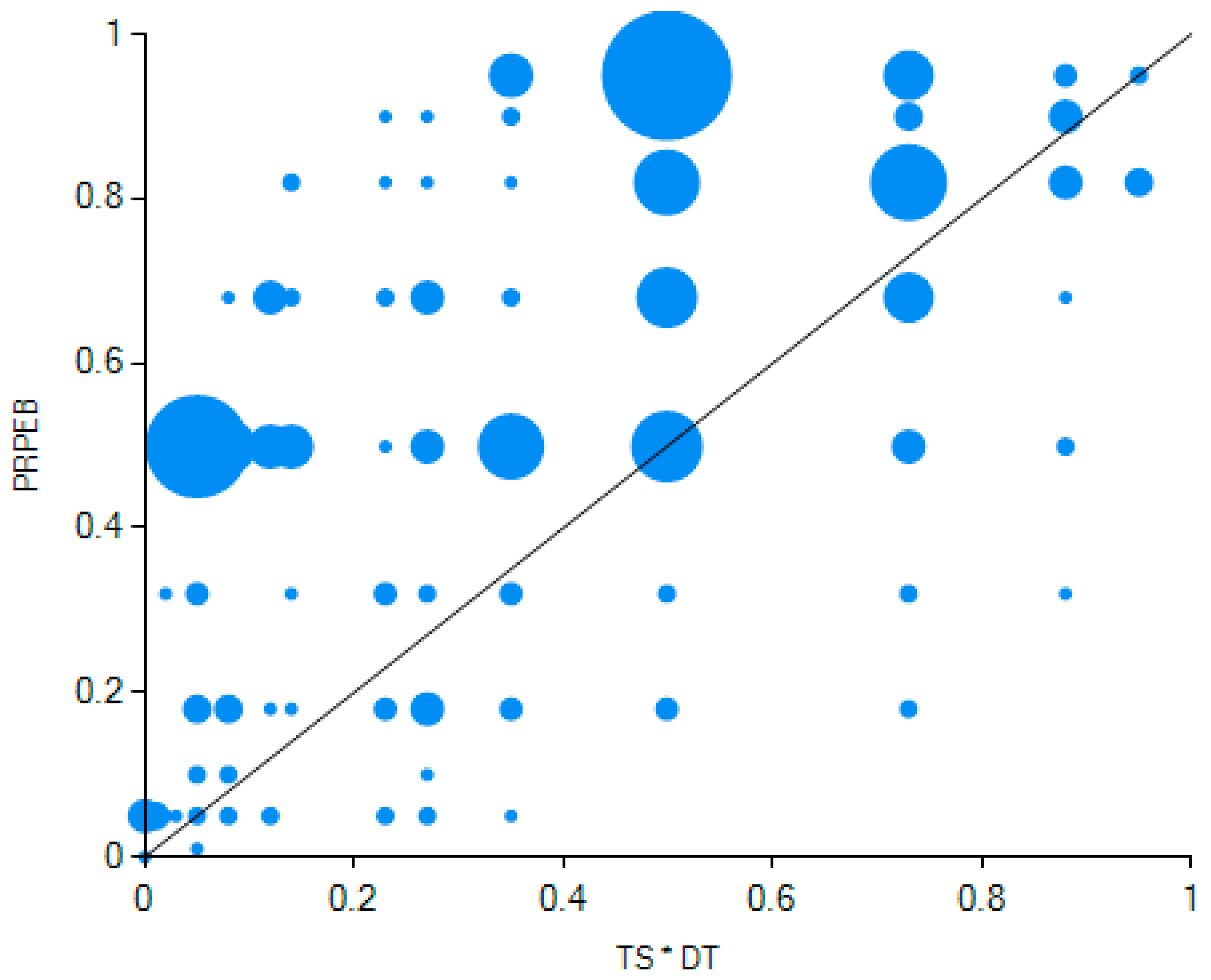
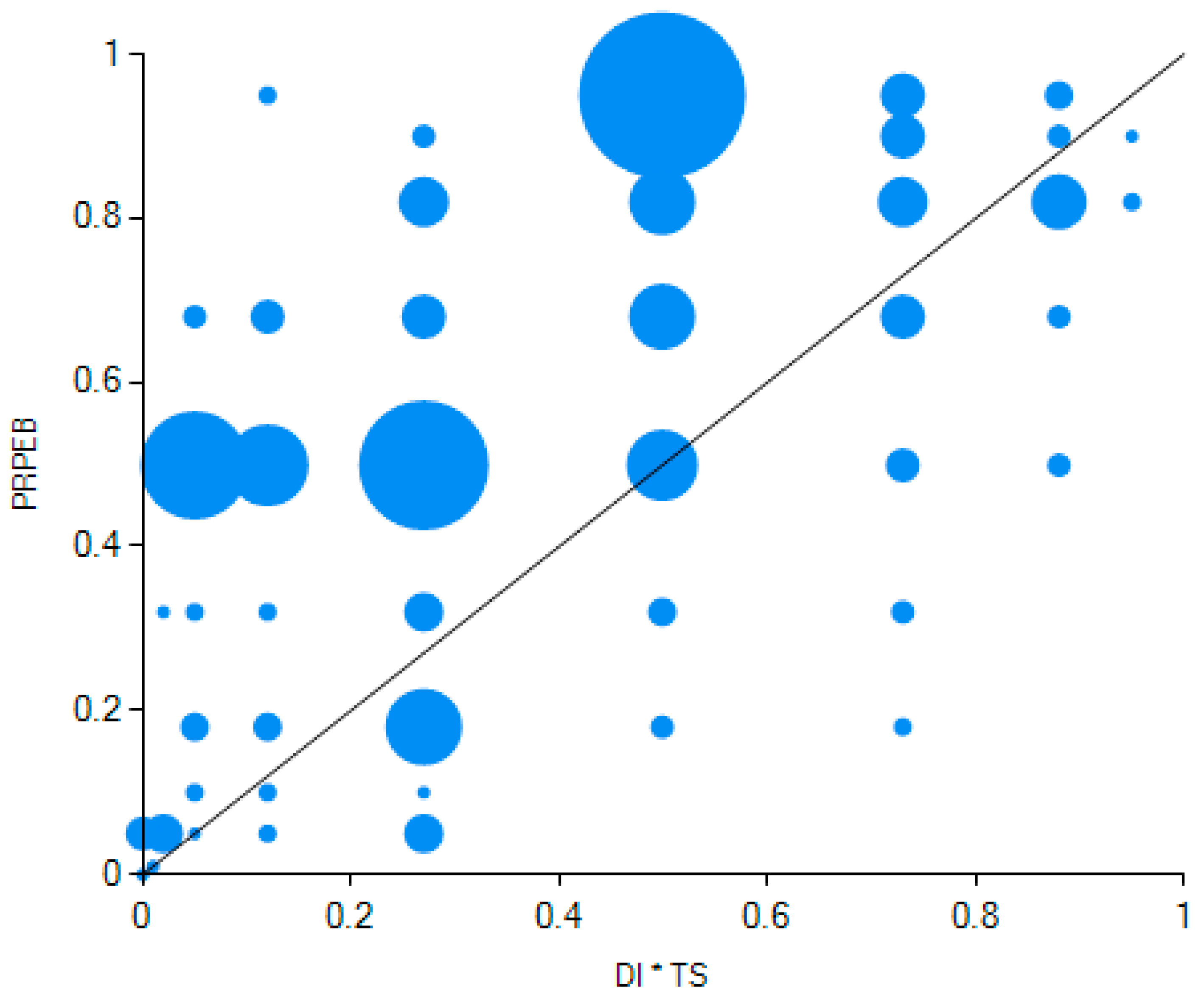
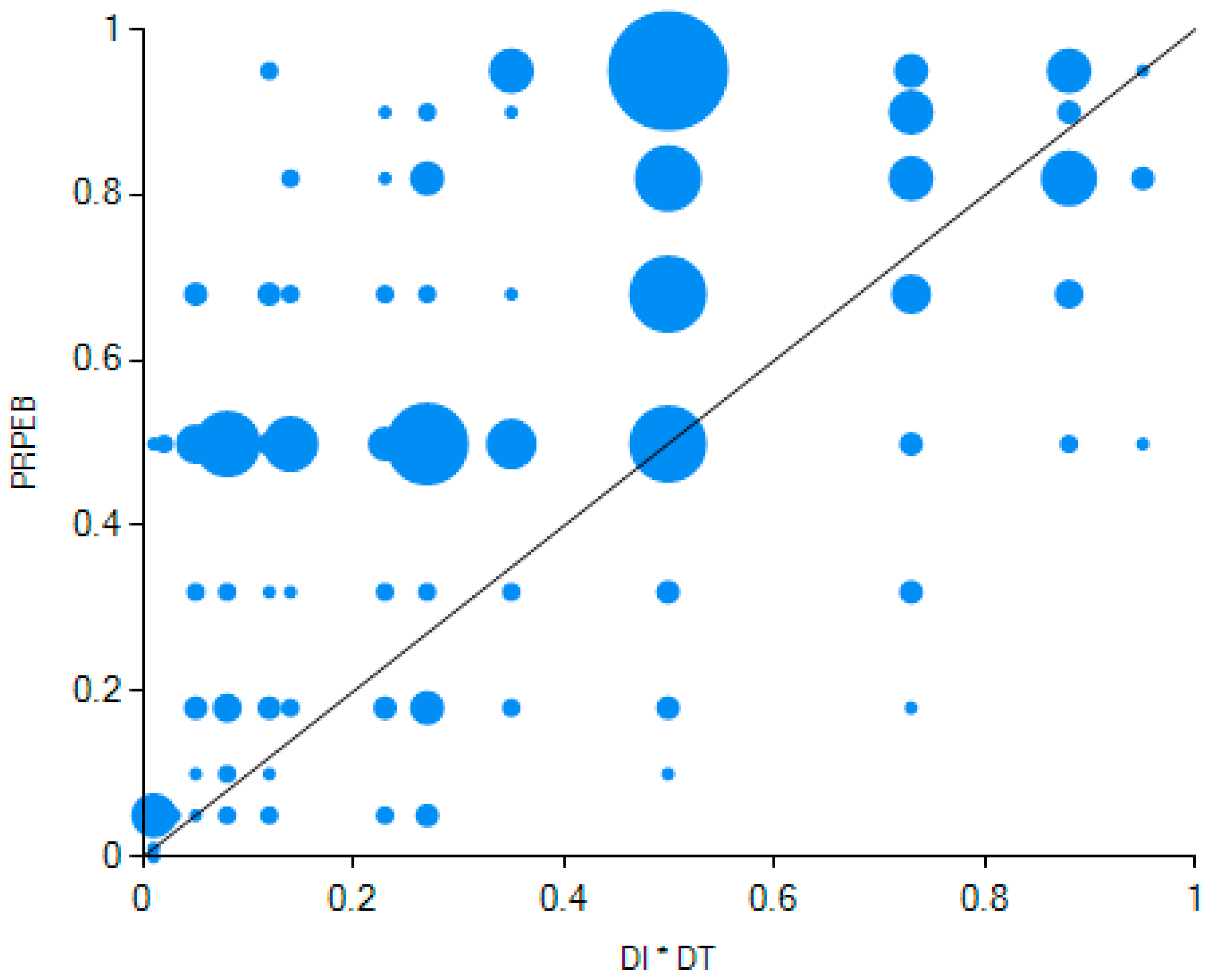

| Construct | Item | Item Label | Source |
|---|---|---|---|
| Destination image | I have a good impression of this rural destination. | DI1 | Nguyen and Leblanc (2001) [121] |
| In my opinion, this rural destination has a good image in the minds of tourists. | DI2 | ||
| I believe that this rural destination has a better image than its competitors. | DI3 | ||
| Satisfaction | Overall, I am satisfied with my visit to this rural destination. | TS1 | He (2011) [122] |
| Compared to my needs, I am satisfied with my visit to this rural destination. | TS2 | ||
| Compared to my expectations, I am satisfied with my visit to this rural destination. | TS3 | ||
| Destination trust | This rural destination takes care of my needs as a tourist. | DT1 | Wu et al. (2018); Han et al. (2018) [123,124] |
| I trust this rural destination. | DT2 | ||
| I have confidence in this rural destination. | DT3 | ||
| This rural destination is reliable. | DT4 | ||
| Private pro-environmental behavior | I conserved electricity at this rural destination (e.g., I switched off lights and electronic equipment if I was not using them.) | PRPEB1 | Tonge et al. (2015) [27] |
| I conserved water at this rural destination (e.g., I turned off the tap if I am not using it). | PRPEB2 | ||
| I did not litter at this rural destination. | PRPEB3 | ||
| I took care of animals and plants at this rural destination. | PRPEB4 | ||
| Public pro-environmental behavior | I work as a volunteer to help the environment of this rural destination. | PUPEB1 | Lee et al. (2013) [125] |
| I donated money to support the environment protection of this rural tourist destination. | PUPEB2 | ||
| I joined in this rural destination’s cleanup efforts to protect the environment. | PUPEB3 | ||
| I wrote letters, online messages or emails in support of the conservation of this rural destination. | PUPEB4 |
| Key Construct | Loading | t-Values | Composite Reliability | Average Variance Extracted |
|---|---|---|---|---|
| Destination image | 0.822 | 0.607 | ||
| DI1 | 0.821 | 11.938 | ||
| DI2 | 0.803 | 11.791 | ||
| DI3 | 0.708 | — | ||
| Satisfaction | 0.861 | 0.674 | ||
| TS1 | 0.762 | 14.095 | ||
| TS2 | 0.861 | 16.2 | ||
| TS3 | 0.837 | — | ||
| Destination trust | 0.883 | 0.655 | ||
| DT1 | 0.761 | 13.853 | ||
| DT2 | 0.832 | 15.509 | ||
| DT3 | 0.836 | 15.604 | ||
| DT4 | 0.805 | — | ||
| Private pro-environmental behavior | 0.906 | 0.709 | ||
| PRPEB1 | 0.91 | 14.621 | ||
| PRPEB2 | 0.915 | 14.689 | ||
| PRPEB3 | 0.818 | 13.228 | ||
| PRPEB4 | 0.708 | — | ||
| Public pro-environmental behavior | 0.925 | 0.754 | ||
| PUPEB1 | 0.831 | 18.34 | ||
| PUPEB2 | 0.882 | 20.461 | ||
| PUPEB3 | 0.883 | 20.521 | ||
| PUPEB4 | 0.876 | — |
| Construct | DI | TS | DT | PRPEB | PUPEB |
|---|---|---|---|---|---|
| Destination image (DI) | [0.779] | ||||
| Tourist satisfaction (TS) | 0.622 | [0.821] | |||
| Destination trust (DT) | 0.627 | 0.684 | [0.809] | ||
| Private pro-environmental behavior (PRPEB) | 0.619 | 0.615 | 0.621 | [0.842] | |
| Public pro-environmental behavior (PUPEB) | 0.414 | 0.541 | 0.636 | 0.520 | [0.868] |
| Hypotheses | Path | Rural Destination Context | ||
|---|---|---|---|---|
| Standardized Coefficient | t-Value | Results | ||
| H1 | Destination image → Satisfaction | 0.622 *** | 8.376 | Supported |
| H2 | Destination image → Destination trust | 0.33 *** | 4.263 | Supported |
| H3 | Satisfaction → Destination trust | 0.479 *** | 6.216 | Supported |
| H4 | Satisfaction → Private pro-environmental behavior | 0.248 ** | 3.012 | Supported |
| H5 | Destination trust → Private pro-environmental behavior | 0.279 *** | 3.389 | Supported |
| H6 | Satisfaction → Public pro-environmental behavior | 0.215 * | 2.488 | Supported |
| H7 | Destination trust → Public pro-environmental behavior | 0.517 *** | 5.756 | Supported |
| H8 | Destination image → Private pro-environmental behavior | 0.289 *** | 3.622 | Supported |
| H9 | Destination image → Public pro-environmental behavior | −0.034 | −0.424 | Not supported |
| Mediating Hypothesized Path | Indirect Effects | Lower | Upper | p-Value | Results |
|---|---|---|---|---|---|
| Destination image → Satisfaction → Private pro-environmental behavior | 0.139 | 0.056 | 0.238 | 0.002 | Supported |
| Destination image → Satisfaction →Destination trust → Private pro-environmental behavior | 0.075 | 0.032 | 0.152 | 0.000 | Supported |
| Destination image → Destination trust → Private pro-environmental behavior | 0.083 | 0.035 | 0.159 | 0.000 | Supported |
| Destination image → Satisfaction → Public pro-environmental behavior | 0.184 | 0.029 | 0.369 | 0.019 | Supported |
| Destination image → Satisfaction → Destination trust → Public pro-environmental behavior | 0.212 | 0.122 | 0.364 | 0.000 | Supported |
| Destination image → Destination trust → Public pro-environmental behavior | 0.234 | 0.122 | 0.393 | 0.000 | Supported |
| Destination Image | Private Pro-Environmental Behavior | Total | |||||
|---|---|---|---|---|---|---|---|
| Cramer’s V = 0.315, p < 0.001 | 1 | 2 | 3 | 4 | 5 | ||
| 1 | Case number | 25 | 13 | 6 | 0 | 2 | 46 |
| Percentage | 54.3% | 28.3% | 13.0% | 0.0% | 4.3% | 100.0% | |
| 2 | Case number | 18 | 35 | 3 | 6 | 2 | 64 |
| Percentage | 28.1% | 54.7% | 4.7% | 9.4% | 3.1% | 100.0% | |
| 3 | Case number | 7 | 24 | 12 | 9 | 19 | 71 |
| Percentage | 9.9% | 33.8% | 16.9% | 12.7% | 26.8% | 100.0% | |
| 4 | Case number | 4 | 9 | 8 | 4 | 11 | 36 |
| Percentage | 11.1% | 25.0% | 22.2% | 11.1% | 30.6% | 100.0% | |
| 5 | Case number | 1 | 15 | 7 | 19 | 26 | 68 |
| Percentage | 1.5% | 22.1% | 10.3% | 27.9% | 38.2% | 100.0% | |
| Total | Case number | 55 | 96 | 36 | 38 | 60 | 285 |
| Percentage | 19.3% | 33.7% | 12.6% | 13.3% | 21.1% | 100.0% | |
| Satisfaction | Private Pro-Environmental Behavior | Total | |||||
|---|---|---|---|---|---|---|---|
| Cramer’s V = 0.305, p < 0.001 | 1 | 2 | 3 | 4 | 5 | ||
| 1 | Case number | 25 | 33 | 5 | 0 | 0 | 63 |
| Percentage | 39.7% | 52.4% | 7.9% | 0.0% | 0.0% | 100.0% | |
| 2 | Case number | 11 | 12 | 6 | 2 | 1 | 32 |
| Percentage | 34.4% | 37.5% | 18.8% | 6.3% | 3.1% | 100.0% | |
| 3 | Case number | 14 | 31 | 7 | 9 | 25 | 86 |
| Percentage | 16.3% | 36.0% | 8.1% | 10.5% | 29.1% | 100.0% | |
| 4 | Case number | 5 | 13 | 11 | 10 | 15 | 54 |
| Percentage | 9.3% | 24.1% | 20.4% | 18.5% | 27.8% | 100.0% | |
| 5 | Case number | 0 | 7 | 7 | 17 | 19 | 50 |
| Percentage | 0.0% | 14.0% | 14.0% | 34.0% | 38.0% | 100.0% | |
| Total | Case number | 55 | 96 | 36 | 38 | 60 | 285 |
| Percentage | 19.3% | 33.7% | 12.6% | 13.3% | 21.1% | 100.0% | |
| Trust | Private Pro-Environmental Behavior | Total | |||||
|---|---|---|---|---|---|---|---|
| Cramer’s V = 0.304, p < 0.001 | 1 | 2 | 3 | 4 | 5 | ||
| 1 | Case number | 27 | 32 | 4 | 2 | 0 | 65 |
| Percentage | 41.5% | 49.2% | 6.2% | 3.1% | 0.0% | 100.0% | |
| 2 | Case number | 18 | 31 | 7 | 2 | 10 | 68 |
| Percentage | 26.5% | 45.6% | 10.3% | 2.9% | 14.7% | 100.0% | |
| 3 | Case number | 6 | 12 | 11 | 7 | 13 | 49 |
| Percentage | 12.2% | 24.5% | 22.4% | 14.3% | 26.5% | 100.0% | |
| 4 | Case number | 4 | 5 | 4 | 8 | 12 | 33 |
| Percentage | 12.1% | 15.2% | 12.1% | 24.2% | 36.4% | 100.0% | |
| 5 | Case number | 0 | 16 | 10 | 19 | 25 | 70 |
| Percentage | 0.0% | 22.9% | 14.3% | 27.1% | 35.7% | 100.0% | |
| Total | Case number | 55 | 96 | 36 | 38 | 60 | 285 |
| Percentage | 19.3% | 33.7% | 12.6% | 13.3% | 21.1% | 100.0% | |
| Category | Conditions and Outcomes | Calibration | ||
|---|---|---|---|---|
| Full Member | Intersection | Full Non-Member | ||
| Outcome variable | Private pro-environmental behavior | 5 | 4 | 3 |
| Condition variable | Destination image | 5 | 4 | 3 |
| Satisfaction | 5 | 4 | 3 | |
| Trust | 4.75 | 4 | 2.75 | |
| Condition Variable | Private Pro-Environmental Behavior | ~Private Pro-Environmental Behavior | ||
|---|---|---|---|---|
| Consistency | Coverage | Consistency | Coverage | |
| Destination image | 0.748 | 0.847 | 0.569 | 0.483 |
| ~Destination image | 0.544 | 0.627 | 0.820 | 0.710 |
| Satisfaction | 0.737 | 0.850 | 0.558 | 0.483 |
| ~Satisfaction | 0.552 | 0.624 | 0.826 | 0.702 |
| Trust | 0.725 | 0.848 | 0.525 | 0.462 |
| ~Trust | 0.540 | 0.602 | 0.827 | 0.693 |
| Mode | Image-Relationship Quality Mode | Relationship Quality Mode | |
|---|---|---|---|
| Condition configuration | Configuration2 | Configuration3 | Configuration1 |
| Destination image | ● | ● | |
| Satisfaction | ● | ● | |
| Trust | ● | ● | |
| Consistency | 0.902 | 0.911 | 0.910 |
| Raw coverage | 0.616 | 0.620 | 0.615 |
| Unique coverage | 0.062 | 0.066 | 0.060 |
| Overall consistency | 0.871 | ||
| Overall coverage | 0.742 | ||
| Destination Image | Public Pro-Environmental Behavior | Total | |||||
|---|---|---|---|---|---|---|---|
| Cramer’s V = 0.241, p < 0.001 | 1 | 2 | 3 | 4 | 5 | ||
| 1 | Case number | 23 | 8 | 8 | 1 | 6 | 46 |
| Percentage | 50.0% | 17.4% | 17.4% | 2.2% | 13.0% | 100.0% | |
| 2 | Case number | 24 | 7 | 20 | 8 | 5 | 64 |
| Percentage | 37.5% | 10.9% | 31.3% | 12.5% | 7.8% | 100.0% | |
| 3 | Case number | 9 | 11 | 23 | 11 | 17 | 71 |
| Percentage | 12.7% | 15.5% | 32.4% | 15.5% | 23.9% | 100.0% | |
| 4 | Case number | 1 | 5 | 9 | 4 | 17 | 36 |
| Percentage | 2.8% | 13.9% | 25.0% | 11.1% | 47.2% | 100.0% | |
| 5 | Case number | 9 | 9 | 19 | 4 | 27 | 68 |
| Percentage | 13.2% | 13.2% | 27.9% | 5.9% | 39.7% | 100.0% | |
| Total | Case number | 66 | 40 | 79 | 28 | 72 | 285 |
| Percentage | 23.2% | 14.0% | 27.7% | 9.8% | 25.3% | 100.0% | |
| Satisfaction | Public Pro-Environmental Behavior | Total | |||||
|---|---|---|---|---|---|---|---|
| Cramer’s V = 0.272, p < 0.001 | 1 | 2 | 3 | 4 | 5 | ||
| 1 | Case number | 27 | 13 | 17 | 1 | 5 | 63 |
| Percentage | 42.9% | 20.6% | 27.0% | 1.6% | 7.9% | 100.0% | |
| 2 | Case number | 11 | 3 | 11 | 6 | 1 | 32 |
| Percentage | 34.4% | 9.4% | 34.4% | 18.8% | 3.1% | 100.0% | |
| 3 | Case number | 23 | 14 | 25 | 10 | 14 | 86 |
| Percentage | 26.7% | 16.3% | 29.1% | 11.6% | 16.3% | 100.0% | |
| 4 | Case number | 1 | 6 | 15 | 7 | 25 | 54 |
| Percentage | 1.9% | 11.1% | 27.8% | 13.0% | 46.3% | 100.0% | |
| 5 | Case number | 4 | 4 | 11 | 4 | 27 | 50 |
| Percentage | 8.0% | 8.0% | 22.0% | 8.0% | 54.0% | 100.0% | |
| Total | Case number | 66 | 40 | 79 | 28 | 72 | 285 |
| Percentage | 23.2% | 14.0% | 27.7% | 9.8% | 25.3% | 100.0% | |
| Trust | Public Pro-Environmental Behavior | Total | |||||
|---|---|---|---|---|---|---|---|
| Cramer’s V = 0.319, p < 0.001 | 1 | 2 | 3 | 4 | 5 | ||
| 1 | Case number | 35 | 11 | 16 | 2 | 1 | 65 |
| Percentage | 53.8% | 16.9% | 24.6% | 3.1% | 1.5% | 100.0% | |
| 2 | Case number | 22 | 11 | 22 | 8 | 5 | 68 |
| Percentage | 32.4% | 16.2% | 32.4% | 11.8% | 7.4% | 100.0% | |
| 3 | Case number | 5 | 9 | 17 | 6 | 12 | 49 |
| Percentage | 10.2% | 18.4% | 34.7% | 12.2% | 24.5% | 100.0% | |
| 4 | Case number | 2 | 2 | 11 | 2 | 16 | 33 |
| Percentage | 6.1% | 6.1% | 33.3% | 6.1% | 48.5% | 100.0% | |
| 5 | Case number | 2 | 7 | 13 | 10 | 38 | 70 |
| Percentage | 2.9% | 10.0% | 18.6% | 14.3% | 54.3% | 100.0% | |
| Total | Case number | 66 | 40 | 79 | 28 | 72 | 285 |
| Percentage | 23.2% | 14.0% | 27.7% | 9.8% | 25.3% | 100.0% | |
| Category | Conditions and Outcomes | Calibration | ||
|---|---|---|---|---|
| Full Member | Intersection | Full Non-Member | ||
| Outcome variable | Public pro-environmental behavior | 5 | 4 | 2.325 |
| Condition variable | Destination image | 5 | 4 | 3 |
| Satisfaction | 5 | 4 | 3 | |
| Trust | 4.75 | 4 | 2.75 | |
| Condition Variable | Public Pro-Environmental Behavior | ~Public Pro-Environmental Behavior | ||
|---|---|---|---|---|
| Consistency | Coverage | Consistency | Coverage | |
| Destination image | 0.763 | 0.718 | 0.596 | 0.621 |
| ~destination image | 0.597 | 0.572 | 0.729 | 0.773 |
| Satisfaction | 0.777 | 0.745 | 0.567 | 0.602 |
| ~satisfaction | 0.584 | 0.550 | 0.760 | 0.791 |
| Trust | 0.792 | 0.770 | 0.523 | 0.563 |
| ~trust | 0.551 | 0.510 | 0.787 | 0.807 |
| Mode | Relationship Quality Mode |
|---|---|
| Condition configuration | Configuration 1 |
| Destination image | |
| Satisfaction | ● |
| Trust | ● |
| Consistency | 0.831 |
| Raw coverage | 0.675 |
| Unique coverage | 0.675 |
| Overall consistency | 0.831 |
| Overall coverage | 0.675 |
Publisher’s Note: MDPI stays neutral with regard to jurisdictional claims in published maps and institutional affiliations. |
© 2022 by the authors. Licensee MDPI, Basel, Switzerland. This article is an open access article distributed under the terms and conditions of the Creative Commons Attribution (CC BY) license (https://creativecommons.org/licenses/by/4.0/).
Share and Cite
Rao, X.; Qiu, H.; Morrison, A.M.; Wei, W.; Zhang, X. Predicting Private and Public Pro-Environmental Behaviors in Rural Tourism Contexts Using SEM and fsQCA: The Role of Destination Image and Relationship Quality. Land 2022, 11, 448. https://doi.org/10.3390/land11030448
Rao X, Qiu H, Morrison AM, Wei W, Zhang X. Predicting Private and Public Pro-Environmental Behaviors in Rural Tourism Contexts Using SEM and fsQCA: The Role of Destination Image and Relationship Quality. Land. 2022; 11(3):448. https://doi.org/10.3390/land11030448
Chicago/Turabian StyleRao, Xiaojuan, Hongliang Qiu, Alastair M. Morrison, Wei Wei, and Xihua Zhang. 2022. "Predicting Private and Public Pro-Environmental Behaviors in Rural Tourism Contexts Using SEM and fsQCA: The Role of Destination Image and Relationship Quality" Land 11, no. 3: 448. https://doi.org/10.3390/land11030448
APA StyleRao, X., Qiu, H., Morrison, A. M., Wei, W., & Zhang, X. (2022). Predicting Private and Public Pro-Environmental Behaviors in Rural Tourism Contexts Using SEM and fsQCA: The Role of Destination Image and Relationship Quality. Land, 11(3), 448. https://doi.org/10.3390/land11030448

