Article

Spatial Spillover Effects of Agricultural Transport Costs in Peru

by
Pedro Herrera-Catalán
1,
Coro Chasco
2,3,* and
Máximo Torero
4
1
Faculty of Economics and Business Administration, Universidad Autónoma de Madrid, C/Francisco Tomás y Valiente, 5, 28049 Madrid, Spain
2
Department of Applied Economics, Universidad Autónoma de Madrid, C/Francisco Tomás y Valiente, 5, 28049 Madrid, Spain
3
ECEMIN Research Group, Nebrija University, C/Sta. Cruz de Marcenado, 27, 28015 Madrid, Spain
4
Food and Agriculture Organization (F.A.O.), Room B532, Viale delle Terme di Caracalla, 00153 Rome, Italy
*
Author to whom correspondence should be addressed.
Land 2022, 11(1), 58; https://doi.org/10.3390/land11010058
Submission received: 10 December 2021 / Revised: 29 December 2021 / Accepted: 29 December 2021 / Published: 31 December 2021

Abstract

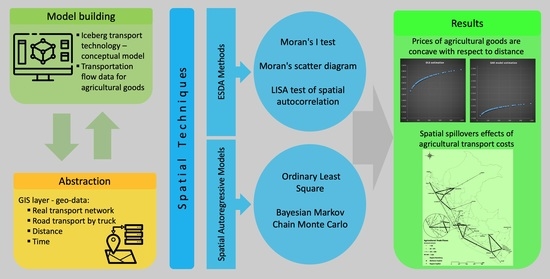
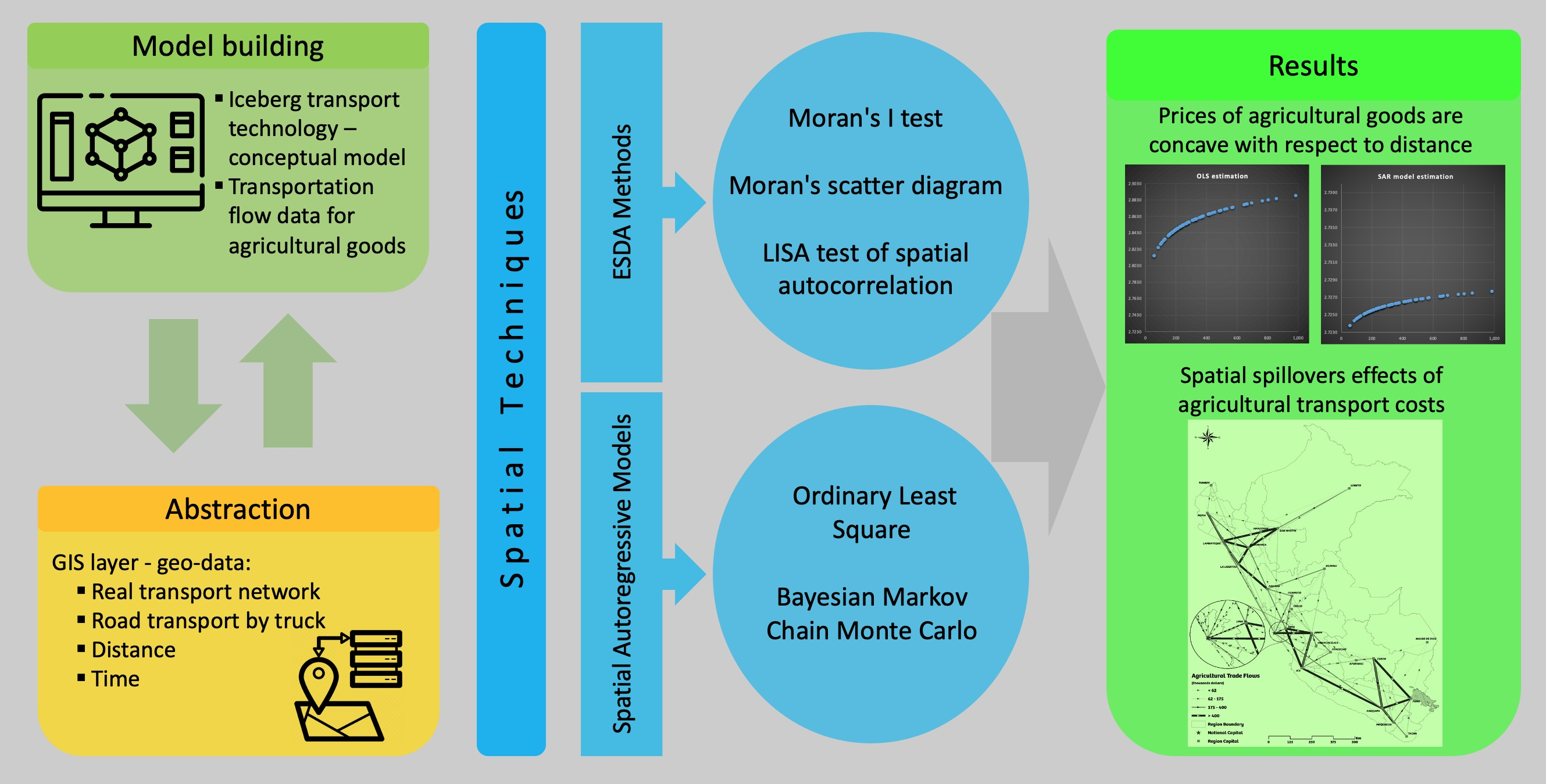
The role of agricultural transport costs in core-periphery structures has habitually been ignored in New Economic Geography (NEG) models. This is due to the convention of treating the agricultural good as the numéraire, thus implying that agricultural transportation costs are assumed to be zero in these models. For more than three decades, this has been the standard setting in spatial equilibrium analysis. This paper examines the effects of agricultural transport costs on the spatial organisation of regional structures in Peru. In doing so, Krugman’s formulation of iceberg transport costs is modified to introduce agricultural transport costs into the dynamic of the NEG models. We use exploratory spatial flow data analysis methods and non-spatial and spatial origin-destination flow models to explore how the regional spatial structure changes when real transportation data for agricultural goods are included into the iceberg transport costs formulation. We show that agricultural transport costs generate flows that are systematically associated with flows to or from nearby regions generating thus the emergence of spatial spillovers across Peruvian regions. The results of the paper support the contention that NEG models have overshadowed the role of agricultural transport costs in determining the spatial configuration of economic activities.
Keywords: agricultural transport costs; new economic geography; spatial spillovers; agglomeration effects; origin-destination flow models agricultural transport costs; new economic geography; spatial spillovers; agglomeration effects; origin-destination flow models
Graphical Abstract