The Emergence of Lotus Farming as an Innovation for Adapting to Climate Change in the Upper Vietnamese Mekong Delta

 ,
, 
Abstract
1. Introduction
2. Materials and Methods
2.1. Historical Research Method
2.2. Research Design, Case Study, and Data Collection
3. Results
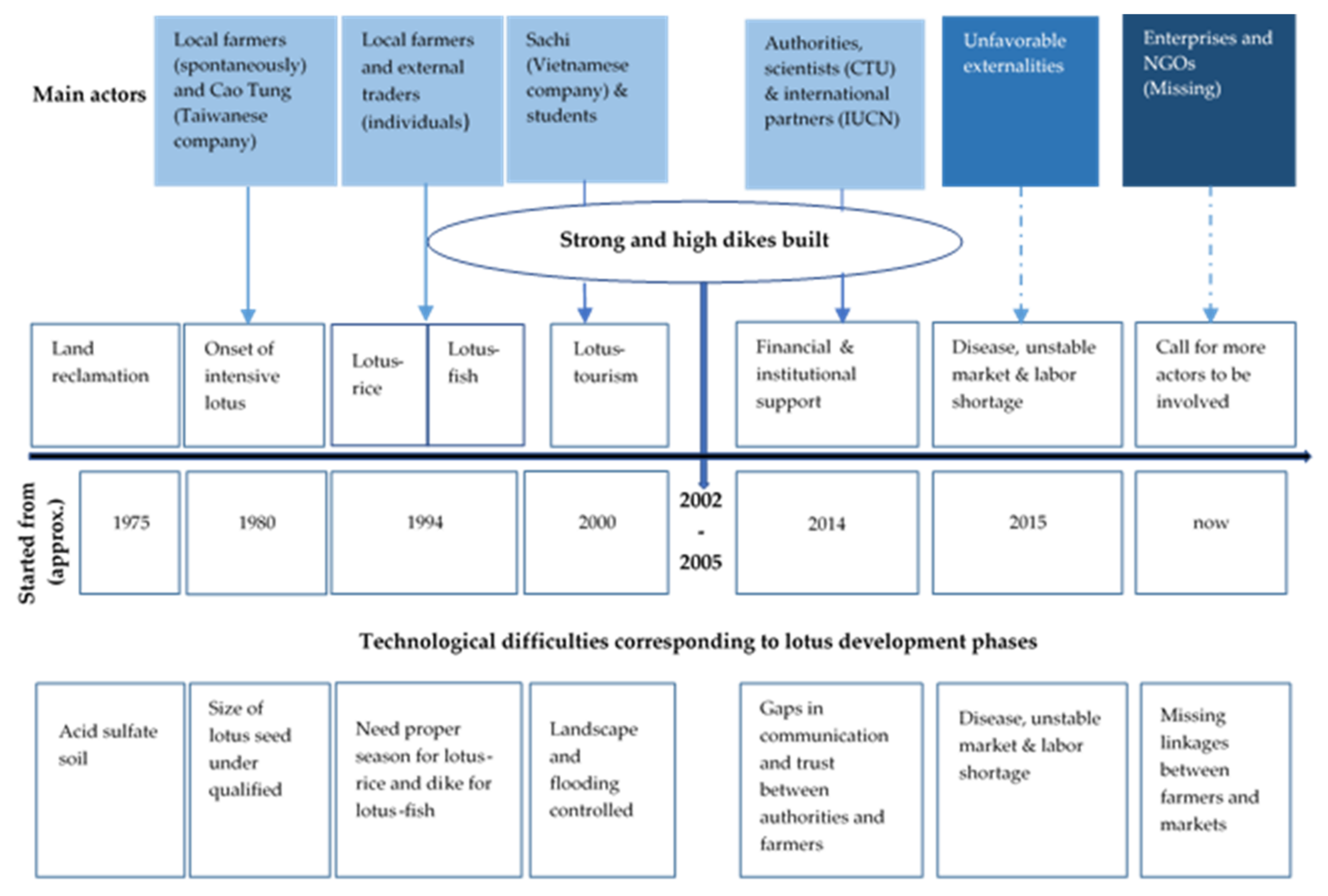
3.1. The Story of Lotus Farming and Its Development Stages with Related Technical Issues
3.1.1. Land Reclamation (1975)
3.1.2. Taiwanese Export Attempt and Intensive Lotus (1980)
3.1.3. Diversification of Lotus Farming Types (1994)
“We don’t know what happened to our lotus trees. They were all sick … the lotus rhizome was suddenly rotten.Scientists and professors from CTU [Can Tho University] already came and took samples, they are investigating. We may know the results soon.We tried many traditional ways to solve it, but the disease is still there.”
3.1.4. Lotus-Ecotourism
3.1.5. Official Support (2014)
3.2. Types of Lotus Farming and the Technological Development Involved
3.2.1. Intensive Lotus
3.2.2. Lotus-Fish
3.2.3. Lotus-Rice
3.2.4. Lotus-Ecotourism
3.3. Stakeholder Perceptions of Lotus Farming during Technology Emergence
3.3.1. Local Farmers in the Land Reclamation Period
3.3.2. The Taiwanese Company
3.3.3. Actors in the Emerging Value Chain
3.3.4. The Vietnamese Company
3.3.5. Regional Authorities
3.3.6. Scientists and Development Partners
3.3.7. Traders
3.4. Stakeholders’ Influence on Technology Development
3.5. Influence of Available Resources on Technology Development
3.6. Closure or Stabilization of the Technology
4. Discussion
4.1. An Emerging Technology with Development Potential
4.2. Implications for Policy, Practice, and Methodology
5. Conclusions
Author Contributions
Funding
Acknowledgments
Conflicts of Interest
Appendix A. Interview Guide
- ▪
- Are you a lotus farmer? What type of lotus farming you are doing and why not others?
- ▪
- For how long have you done this? How did you start with lotus, who introduced it to you?
- ▪
- What are the advantages/disadvantages of farming lotus?
- ▪
- What is the current status of practicing this model at your locality?
- ▪
- What changes in the lotus farming model will occur in the future when compared to the current farming models?
- ▪
- Who is knowledgeable about lotus farming? What kinds of people are changing their understanding of dealing with floods and climate change?
- ▪
- Who is supporting the practice of this model? Who does not? And who is changing?
- ▪
- Which (formal) decisions and activities include adaptive agricultural models in general and flood-based farming systems in particular? (e.g., plans, policies, regulations, research programs)
- ▪
- Where is the lotus cultivation model implemented in the Mekong Delta? What are the criteria for applying lotus cultivation models in these areas?
- ▪
- What technologies were used when implementing the lotus farming model?
- ▪
- What creative ideas are relevant when implementing the lotus farming model?
- ▪
- What are the recommendations for applying and replicating the lotus cultivation model to other areas?
- ▪
- When did you know about lotus farming?
- ▪
- As you know who started the lotus here, what was the reason they planted lotus at that time? What did they do before planting lotus?
- ▪
- In practicing these models, who are you collaborating with?
- ▪
- Do you find yourself collaborating with / or working with someone else to improve the lotus farming development?
- ▪
- Specifically, among the social groups outlined below, which are the relevant groups that may affect the development of lotus farming?
- ◦
- Group of farmers
- ◦
- Local government groups
- ◦
- Researchers/scientists group
- ◦
- Business group (could be a company or a buyer)
- ◦
- Group of foreign organizations
- ◦
- Non-governmental organization
- ▪
- (Is there any other relevant group, according to you?)
- ▪
- Which of the five groups according to you think the most important role to develop lotus cultivation, which group contributes the least?
- ▪
- Do you continue to farm lotus in the future, why?
- ▪
- If you do not continue with lotus, what are your alternatives?
- ▪
- Other things to mention
- ▪
- Do you have any specific aspirations or suggestions for improved lotus cultivation and increased productivity?
- ▪
- Do you have any specific aspirations or suggestions to promote the construction of a lotus product purchasing and processing company on the spot?
- ▪
- Assuming you do not have the expected returns from practicing the model, will you continue it? Why so?
References
- Smith, W. Agriculture in the Central Mekong Delta: Opportunities for Donor Business Engagement; Overseas Development Institute: London, UK, 2013; Available online: https://www.odi.org/publications/8552-agriculture-central-mekong-delta-opportunities-donor-business-engagement (accessed on 2 February 2021).
- Benedikter, S. The Vietnamese Hydrocracy and the Mekong Delta: Water Resources Development from State Socialism to Bureaucratic Capitalism (ZEF Development Studies); LIT Verlag: Münster, Germany, 2014. [Google Scholar]
- Benedikter, S. Bureaucratisation and the state revisited: Critical reflections on administrative reforms in post-renovation Vietnam. Int. J. Asia-Pac. Stud. 2016, 12, 1–40. [Google Scholar]
- Benedikter, S.; Nguyen, L.T. Obsessive planning in transitional Vietnam: Understanding rampant state planning and prospects of reform. J. Vietnam. Stud. 2018, 13, 1–47. [Google Scholar] [CrossRef] [Scilit]
- Tran, D.D.; Van Halsema, G.; Hellegers, P.J.; Ludwig, F.; Seijger, C. Stakeholders’ assessment of dike-protected and flood-based alternatives from a sustainable livelihood perspective in An Giang Province, Mekong Delta, Vietnam. Agric. Water Manag. 2018, 206, 187–199. [Google Scholar] [CrossRef] [Scilit]
- Tran, D.D.; Van Halsema, G.; Hellegers, P.J.; Ludwig, F.; Wyatt, A. Questioning triple rice intensification on the Vietnamese mekong delta floodplains: An environmental and economic analysis of current land-use trends and alternatives. J. Environ. Manag. 2018, 217, 429–441. [Google Scholar] [CrossRef] [Scilit] [PubMed]
- Tran, T.A.; Nguyen, T.H.; Vo, T.T. Adaptation to flood and salinity environments in the Vietnamese Mekong Delta: Empirical analysis of farmer-led innovations. Agric. Water Manag. 2019, 216, 89–97. [Google Scholar] [CrossRef] [Scilit]
- Seijger, C.; Hoang, V.T.M.; Van Halsema, G.; Douven, W.; Wyatt, A. Do strategic delta plans get implemented? The case of the Mekong Delta Plan. Reg. Environ. Chang. 2019, 19, 1131–1145. [Google Scholar] [CrossRef] [Scilit]
- Seijger, C.; Van Halsema, G.E.; Korbee, D. A synthesis on strategic delta planning in action: Wishful thinking, vested practices and unexpected changes. J. Environ. Plan. Manag. 2019, 62, 1654–1674. [Google Scholar] [CrossRef] [Scilit]
- Vo, H.T.M.; Van Halsema, G.; Seijger, C.; Dang, N.K.; Dewulf, A.; Hellegers, P. Political agenda-setting for strategic delta planning in the Mekong Delta: Converging or diverging agendas of policy actors and the Mekong Delta Plan? J. Environ. Plan. Manag. 2019, 62, 1454–1474. [Google Scholar] [CrossRef] [Scilit]
- Vo, H.T.M.; Van Halsema, G.; Hellegers, P.; Bakker, E.J. Assessing stakeholders’ appreciation of no-regret measures for climate change adaptation in the Mekong Delta. J. Environ. Manag. 2021. manuscript submitted. [Google Scholar]
- Bijker, W.E.; Hughes, T.P.; Pinch, T. (Eds.) The Social Construction of Technological Systems: New Directions in the Sociology and History of Technology; MIT Press: Cambridge, MA, USA, 1989. [Google Scholar]
- Al Lily, A.E. The social shaping of educational technologies in Saudi Arabia: An examination of how the social fabric shapes the construction and use of technologies. Technol. Soc. 2013, 35, 203–222. [Google Scholar] [CrossRef] [Scilit]
- Damman, S.; Helness, H.; Amisigo, B.; Banu, R.A.R.A.; Asante, K.A.; Bjørkvoll, T.; Akuffobea, K.A.M.; Logah, F.; Williams, P.A.; Mensah, F.A.; et al. Sustainability and the social construction of technology: The case of RWH as source of water supply in greater Accra. Eur. J. Sustain. Dev. 2017, 6, 41–52. [Google Scholar] [CrossRef] [Scilit]
- Meyer, E.T. Socio-Technical Perspectives on Digital Photography in Professional Practice. Ph.D. Thesis, Indiana University, Bloomington, IN, USA, 2005. Available online: http://blogs.oii.ox.ac.uk/wp-content/uploads/sites/27/2007/11/etmeyer_quals_final.pdf (accessed on 1 February 2021).
- Mollinga, P.; Veldwisch, G.V. Ruling by canal: Governance and system-level design characteristics of large scale irrigation infrastructure in India and Uzbekistan. Water Altern. 2016, 9, 222–249. Available online: https://core.ac.uk/reader/42550990 (accessed on 1 February 2021).
- Prell, C. Rethinking the social construction of technology through ‘Following the Actors’: A reappraisal of technological frames. Sociol. Res. Online 2009, 14, 36–47. [Google Scholar] [CrossRef] [Scilit]
- Shah, E. Seeing like a subaltern: Historical ethnography of pre-modern and modern tank irrigation technology in Karnataka, India. Water Altern. 2012, 5, 507–538. Available online: http://www.water-alternatives.org/index.php/alldoc/articles/vol5/v5issue2/182-a5-2-18/file (accessed on 1 February 2021).
- Shah, E. Social Designs: Tank Irrigation Technology and Agrarian Transformation in Karnataka, South India (Water Resources Series 4). Ph.D. Thesis, Wageningen University, Wageningen, The Netherlands, 2003. [Google Scholar]
- Shah, E. Telling otherwise: A historical anthropology of tank irrigation technology in south India. Technol. Cult. 2008, 49, 652–674. [Google Scholar] [CrossRef] [Scilit]
- Berg, B.L. Qualitative Research Methods for the Social Sciences, 4th ed.; Pearson: Needham, MA, USA, 2001. [Google Scholar]
- Allen, M. The SAGE Encyclopedia of Communication Research Methods; Sage Publications: Thousand Oaks, CA, USA, 2017. [Google Scholar]
- Bruno, L. Reassembling the Social An Introduction to Actor-Network-Theory; Oxford University Press: New York, NY, USA, 2005. [Google Scholar]
- Pfaffenberger, B. Fetishised Objects and Humanised Nature: Towards an Anthropology of Technology. Man 1988, 23, 236. [Google Scholar] [CrossRef] [Scilit]
- Smajgl, A.; Toan, T.Q.; Nhan, D.K.; Ward, J.F.; Trung, N.H.; Tri, L.Q.; Tri, V.P.D.; Vu, P.T. Responding to rising sea levels in the Mekong Delta. Nat. Clim. Chang. 2015, 5, 167–174. [Google Scholar] [CrossRef] [Scilit]
- Anthony, E.J.; Brunier, G.; Besset, M.; Goichot, M.; Dussouillez, P.; Nguyen, V.L. Linking rapid erosion of the Mekong River delta to human activities. Sci. Rep. 2015, 5, 14745. [Google Scholar] [CrossRef] [Scilit]
- Goodman, L.A. Snowball sampling. Ann. Math. Stat. 1961, 32, 148–170. [Google Scholar] [CrossRef] [Scilit]
- Suri, H. Purposeful sampling in qualitative research synthesis. Qual. Res. J. 2011, 11, 63–75. [Google Scholar] [CrossRef] [Scilit]
- Boström, M.; Uggla, Y.; Hansson, V. Environmental representatives: Whom, what, and how are they representing? J. Environ. Policy Plan. 2017, 20, 114–127. [Google Scholar] [CrossRef] [Scilit]
- Ontita, E. Creativity in Everyday Practice: Resources and Livelihoods in Nyamira, Kenya. Ph.D. Thesis, Wageningen University, Wageningen, The Netherlands, 2007. [Google Scholar]
- Dong Thap Province’s People’s Committee. Decision 1168/QDD-UBND on Approving “Restructuring the Agricultural Sector” Program in Dong Thap up to 2020: Vision to 2030; Government of Vietnam. 2016. Available online: https://thuvienphapluat.vn/van-ban/Thuong-mai/Quyet-dinh-1168-QD-UBND-HC-De-an-tai-co-cau-nganh-cong-nghiep-Dong-Thap-2016-2020-2030-329951.aspx (accessed on 1 February 2021).
- Pinch, T.J.; Bijker, W.E. The social construction of facts and artefacts: Or how the sociology of science and the sociology of technology might benefit each other. Soc. Stud. Sci. 1984, 14, 399–441. [Google Scholar] [CrossRef] [Scilit]
- Bjerregaard, P.P. The Social Shaping of Technology: A Case Study of Biochar in Denmark. Master’s Thesis, Copenhagen Business School, Copenhagen, Denmark, 2011. Available online: https://research.cbs.dk/da/studentProjects/3d892ad3-b2fe-4e55-9edc-566c303a9d6f (accessed on 1 February 2021).
- Contested Waterscapes in the Mekong Region. In Contested Waterscapes in the Mekong Region; Earthscan: London, UK, 2009; pp. 203–225. [CrossRef] [Scilit]
- Biggs, D. Promiscuous Transmission and Encapsulated Knowledge: A Material-Semiotic Approach to Modern Rice in the Mekong Delta. In Rice: Global Networks and New Histories; Cambridge University Press (CUP): Cambridge, UK, 2015; pp. 118–137. [Google Scholar] [CrossRef] [Scilit]
- Carr, P.L. From innovation to transformation. Libr. Resour. Tech. Serv. 2009, 53, 3–14. [Google Scholar] [CrossRef] [Scilit]
- Tran, T.A.; Pittock, J.; Tran, D.D. Adaptive flood governance in the Vietnamese Mekong Delta: A policy innovation of the North Vam Nao scheme, An Giang Province. Environ. Sci. Policy 2020, 108, 45–55. [Google Scholar] [CrossRef] [Scilit]
- Dang, H.D. Sustainability of the rice-shrimp farming system in Mekong Delta, Vietnam: A climate adaptive model. J. Econ. Dev. 2020, 22, 21–45. [Google Scholar] [CrossRef] [Scilit]
- Pham, T.A.N.; Loc, H.H.; Tran, D.D.; Quan, N.H. The inefficiency of Vietnamese prawn-rice rotational crops: A slacks-based data envelopment analysis. J. Agribus. Dev. Emerg. Econ. 2020, 11, 60–71. [Google Scholar] [CrossRef] [Scilit]
- Nguyen, H.; Tran, D.; Luan, P.; Ho, L.; Loan, V.; Anh Ngoc, P.; Quang, N.D.; Wyatt, A.; Sea, W. Socio-ecological resilience of mangrove-shrimp models under various threats exacerbated from salinity intrusion in coastal area of the Vietnamese Mekong Delta. Int. J. Sustain. Develop. World Ecol. 2020, 27, 638–651. [Google Scholar] [CrossRef] [Scilit]


| Stakeholders (Relevant Social Groups) | Perceived Function of Lotus Farming as an Innovation | Claims |
|---|---|---|
| Farmers: lotus growers and laborers | Lotus farming is a valuable opportunity to improve incomes and deal with disadvantageous soil conditions |
|
| Scientists: academics, researchers, and students | Lotus farming is a means to adapt to climate change and cope with floods and unfavorable natural conditions |
|
| Development partners: international organizations and NGOs | Lotus farming is a way to cope with the concurrent challenges of climate change, erratic flood seasons, and unfavorable natural conditions |
|
| Local officials: local authorities and farmer representatives | Lotus farming evolved from being a profitable activity for the community to being a symbol of the region’s cultural identity and heritage; it is also a means of implementing the national policy of agricultural restructuring |
|
| Traders: individual traders and companies | For individual traders, lotus farming was foremost a source of monetary profit. Companies, however, viewed it as a way to achieve greater sustainability, as well as profit. |
|
| Crop/Product | An Giang | Dong Thap | Average |
|---|---|---|---|
| Profit from first rice crop (winter-spring) | 794.24 | 553.59 | 709.30 |
| Lotus farming profit | 911.16 | 62.08 | 495.83 |
| Fish farming profit | 168.71 | 354.16 | 175.01 |
| Profit from second rice crop (summer-autumn) | 356.34 | 260.80 | 357.05 |
| Profits from other livelihoods (duck/frog/wild fish) in flood season | 282.54 | 224.25 | 264.60 |
Publisher’s Note: MDPI stays neutral with regard to jurisdictional claims in published maps and institutional affiliations. |
© 2021 by the authors. Licensee MDPI, Basel, Switzerland. This article is an open access article distributed under the terms and conditions of the Creative Commons Attribution (CC BY) license (http://creativecommons.org/licenses/by/4.0/).
Share and Cite
Vo, H.T.M.; van Halsema, G.; Hellegers, P.; Wyatt, A.; Nguyen, Q.H. The Emergence of Lotus Farming as an Innovation for Adapting to Climate Change in the Upper Vietnamese Mekong Delta. Land 2021, 10, 350. https://doi.org/10.3390/land10040350
Vo HTM, van Halsema G, Hellegers P, Wyatt A, Nguyen QH. The Emergence of Lotus Farming as an Innovation for Adapting to Climate Change in the Upper Vietnamese Mekong Delta. Land. 2021; 10(4):350. https://doi.org/10.3390/land10040350
Chicago/Turabian StyleVo, Hoang Thi Minh, Gerardo van Halsema, Petra Hellegers, Andrew Wyatt, and Quan Hong Nguyen. 2021. "The Emergence of Lotus Farming as an Innovation for Adapting to Climate Change in the Upper Vietnamese Mekong Delta" Land 10, no. 4: 350. https://doi.org/10.3390/land10040350
APA StyleVo, H. T. M., van Halsema, G., Hellegers, P., Wyatt, A., & Nguyen, Q. H. (2021). The Emergence of Lotus Farming as an Innovation for Adapting to Climate Change in the Upper Vietnamese Mekong Delta. Land, 10(4), 350. https://doi.org/10.3390/land10040350