Article

Correcting a Transboundary Aquifer Delineation for the U.S.–Mexico Border Region Based on Hydrogeologic Criteria


by
Barry Hibbs
1,* and
Alfredo Granados-Olivas
2
1
Hydrogeology Laboratory, California State University-Los Angeles, Los Angeles, CA 90032, USA
2
Instituto de Ingeniería y Tecnología, Universidad Autónoma de Ciudad Juárez, Ciudad Juárez C.P. 32310, Mexico
*
Author to whom correspondence should be addressed.
Water 2026, 18(9), 1103; https://doi.org/10.3390/w18091103
Submission received: 22 February 2026 / Revised: 3 April 2026 / Accepted: 18 April 2026 / Published: 4 May 2026
(This article belongs to the Section Hydrogeology)

Abstract

A widely reproduced error in hydrogeologic maps originated from a provisional delineation drawn in the mid-1990s to depict the southern extent of the Mesilla Bolson aquifer along the western margin of the El Paso–Juárez metropolitan area. The delineation was created solely to satisfy a U.S. Environmental Protection Agency contractual milestone during early binational groundwater inventory efforts and was never intended to represent a final hydrogeologic basin limit. Nevertheless, the outline persisted, became institutionalized in reports, models, management documents, and public imagery, and was ultimately labeled the “Mesilla/Conejos–Médanos Basin Transboundary Aquifer,” where it continues to be treated as a valid transboundary aquifer delineation. This paper documents the origin of the provisional delineation and proposes a revised delineation for the Mesilla/Conejos–Médanos Basin Transboundary Aquifer, based on internationally recognized definitions of transboundary aquifers and groundwater basins, including United Nations frameworks, and established scientific criteria. These criteria include basin-scale geologic and structural controls, hydrostratigraphic continuity, groundwater divides, and permeability contrasts at basin interfaces. Results indicate that the newly defined aquifer delineation falls within Mexico’s much larger administrative Acuífero Conejos–Médanos (0823), a unit that represents groundwater management jurisdiction in Mexico rather than solely a hydrogeologic basin. The proposed transboundary aquifer is defined on hydrogeological principles and does not coincide with either the administrative unit of Mexico or the historic provisional outline that has become widely used by multiple binational entities and by different experts in groundwater science.

1. Introduction

1.1. Background

For more than three decades, reports, models, maps, and public imagery have reproduced an incorrect southern boundary of the Mesilla Bolson Aquifer (Figure 1). The delineation of the Mesilla Bolson Aquifer, now widely known as the Mesilla/Conejos–Médanos Basin, is located a few kilometers west of the El Paso–Ciudad Juárez metropolitan area and has remained unchanged since its drafting in 1996 [1]. The line was not derived from basin-scale hydrogeologic analysis or accepted criteria for transboundary aquifers. Instead, it originated as a provisional sketch prepared during early binational groundwater inventory work to satisfy a 1996 reporting requirement. Although intended only as a placeholder, it was never revised and became treated as an accepted delineation in scientific and administrative literature.
This study redefines the Mesilla/Conejos–Médanos Transboundary Aquifer using internationally recognized definitions of groundwater basins and transboundary aquifers. Delineation criteria include basin-scale structure, hydrostratigraphic continuity, groundwater divides, and permeability contrasts. The revised delineation incorporates Mexico’s hydrogeologic information [2,3,4,5,6,7,8] and resolves the long-standing mischaracterization of the aquifer’s southern extent. Inconsistent delineation methods are common challenges in transboundary aquifer analysis along the United States–Mexico border, making this effort broadly relevant to transboundary aquifer delineation [9].

1.2. Global Importance of Transboundary Aquifers

Transboundary aquifers represent a critical yet comparatively undercharacterized component of global freshwater systems. Shared water resources, including rivers, lakes, and aquifers, span political boundaries in more than 150 countries and account for a substantial proportion of the world’s accessible freshwater, with transboundary systems representing roughly 60% of global freshwater flows [10]. While transboundary river basins have received considerable attention due to their visibility and more readily observable flow dynamics, groundwater systems present greater challenges for delineation and management [11]. Aquifers are inherently difficult to characterize because their boundaries, flow paths, and hydraulic connectivity are concealed below the surface and often constrained by limited data. Consequently, transboundary aquifers are more prone to inconsistent delineation and fragmented governance frameworks [10,12].
Globally, hundreds of transboundary aquifer systems have been identified, yet only a limited number are governed by formal cooperative agreements [10]. This gap reflects both technical uncertainty and institutional limitations, particularly in arid and semi-arid regions where groundwater is a primary water supply. Mischaracterization of aquifer extent and connectivity can lead to overexploitation, water quality degradation, and cross-border impacts that may not become evident until significant depletion or contamination has occurred. These challenges underscore the need for basin-scale hydrogeologic characterization, improved monitoring, and coordinated data sharing to support sustainable and cooperative management of shared groundwater resources [10,13]. A logical and necessary first step in this process is the rigorous delineation of transboundary aquifer boundaries, which provides a framework for characterization and helps ensure that financial and human resources are neither under nor overallocated.

1.3. Nomenclature

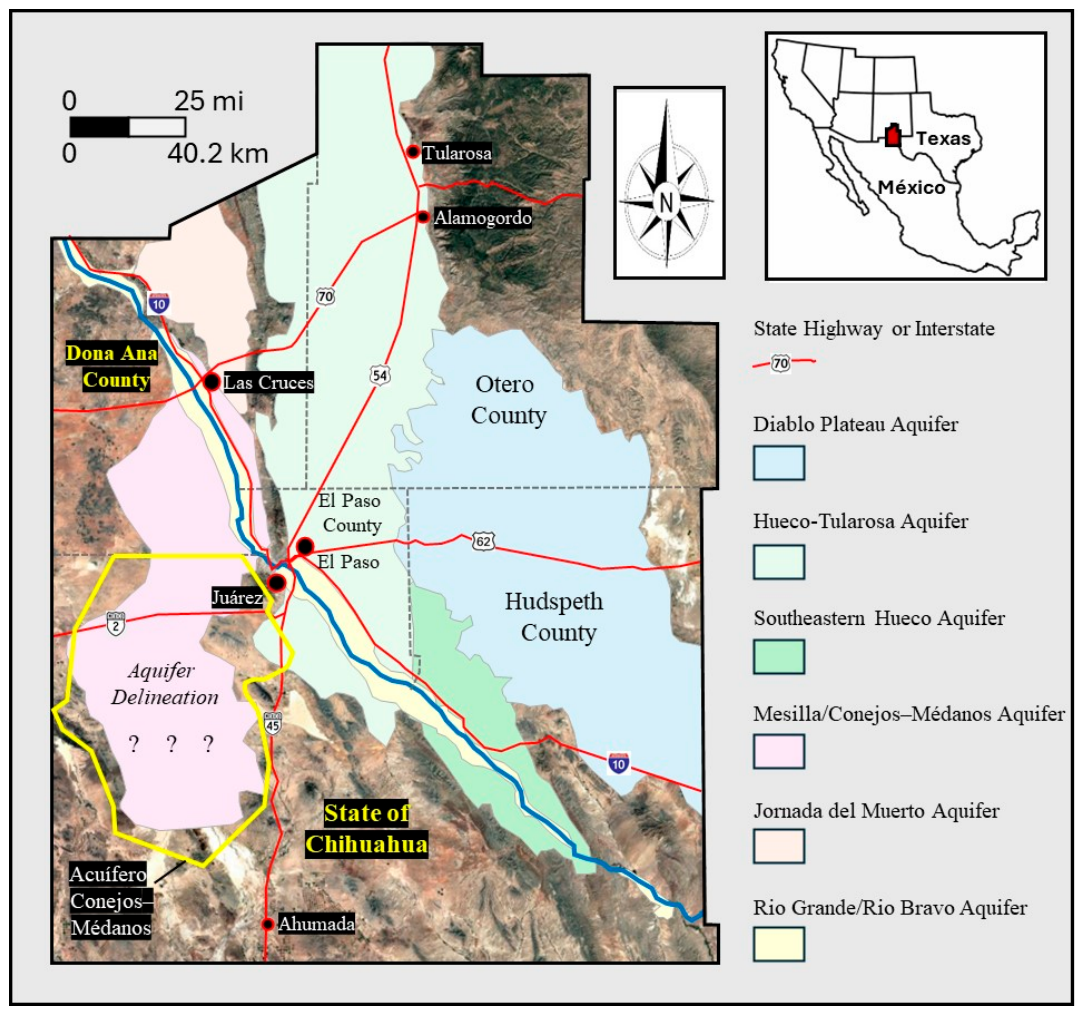
The Mesilla Bolson Aquifer is the structurally defined basin aquifer in the United States extending a short distance into northern Mexico [14,15,16] (Figure 2). The Conejos–Médanos Aquifer (Acuífero Conejos–Médanos in Mexico) is an administratively defined groundwater unit in Chihuahua that terminates at the international boundary (Figure 2 and Figure 3) [8]. The areas overlap only slightly. The expansive TWDB/NMWRRI delineation [1] is evaluated here.
The term Mesilla/Conejos–Médanos Transboundary Aquifer has been used inconsistently and has obscured aquifer extent and hydraulic continuity. Here, the Mesilla/Conejos–Médanos Transboundary Aquifer is defined according to the United Nations definition: a hydraulically connected groundwater-flow system crossing an international boundary. Only hydraulically continuous portions of the system are considered transboundary. This study strives to provide a defensible delineation using the United Nations framework and presents a methodology applicable to other transboundary aquifers.

2. Expedited Delineation and Its Legacy

2.1. First U.S. Delineation and Subsequent Mexican Delineation

A U.S.–Mexico project funded by USEPA Region VI in the 1990s compiled groundwater data and maps and performed, in some cases, the first binational interpretations. U.S. participants included TWDB, NMWRRI, IBWC, and USEPA; Mexican participants included CILA, CONAGUA, and JMAS. Eleven meetings (1994–1997) produced a joint groundwater database and report [17]. Mexico declined to jointly evaluate the Mesilla Bolson Aquifer and recognized only the Hueco Basin Aquifer and the Rio Grande/Río Bravo as transboundary systems (Figure 1).
Because the USEPA contract required inclusion of the Mesilla Bolson Aquifer, the U.S. team mapped the Mexican portion independently (Figure 1 and Figure 2). No Mexican hydrogeologic maps were used, even though it was later learned that there were earlier official publications from Mexican agencies providing regional, preliminary delineations [18]. Under time constraints, a provisional outline was traced from 1:250,000 Instituto Nacional de Estadística y Geografía (INEGI) Mexican geological maps using generalized bedrock contacts. Two hand-drawn versions were produced; the larger was retained as an interim delineation (Figure 1 and Figure 3; Supplementary Materials Correspondence) [1].
Prior work had already completed defensible delineations of adjacent aquifers, such as the Hueco-Tularosa aquifer, using Mexican reports and mapping [19,20,21,22]. Those studies included stratigraphic correlation, hydraulic head mapping, hydrochemical facies analysis, and development of a cross-border numerical profile model [1]. In contrast, the Mesilla Bolson area was prepared rapidly to meet a reporting deadline and lacked basin-scale analysis (Figure 1). It was nonetheless incorporated into the final transboundary atlas report ([1]; Figure 1).
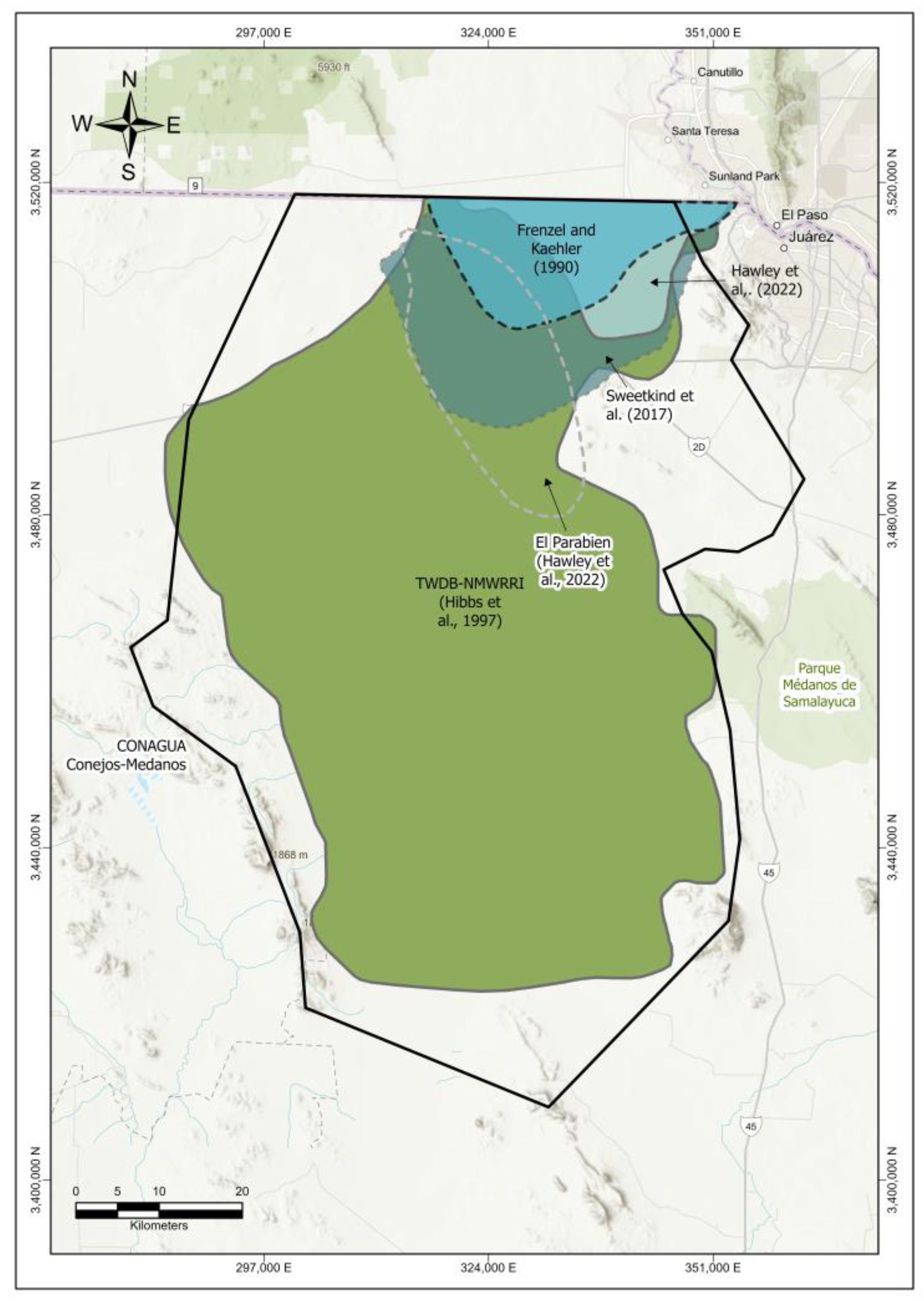
Figure 2. Comparison of groundwater basin extents and conceptual/model boundaries proposed for the Acuífero Conejos–Médanos region. The larger green area shows the Mesilla Bolson Aquifer as defined by TWDB–NMWRRI [1], while the grey dashed shading indicates the El Parabien basin of Hawley et al. (2022) [15]. Northern basin interpretations from Frenzel and Kaehler [14] and Hawley et al. [15] are shown in blue. The Sweetkind [23] numerical model delineation is indicated by the area extending into El Parabien Basin. The figure highlights substantial disagreement over boundaries among studies.
Water 18 01103 g002
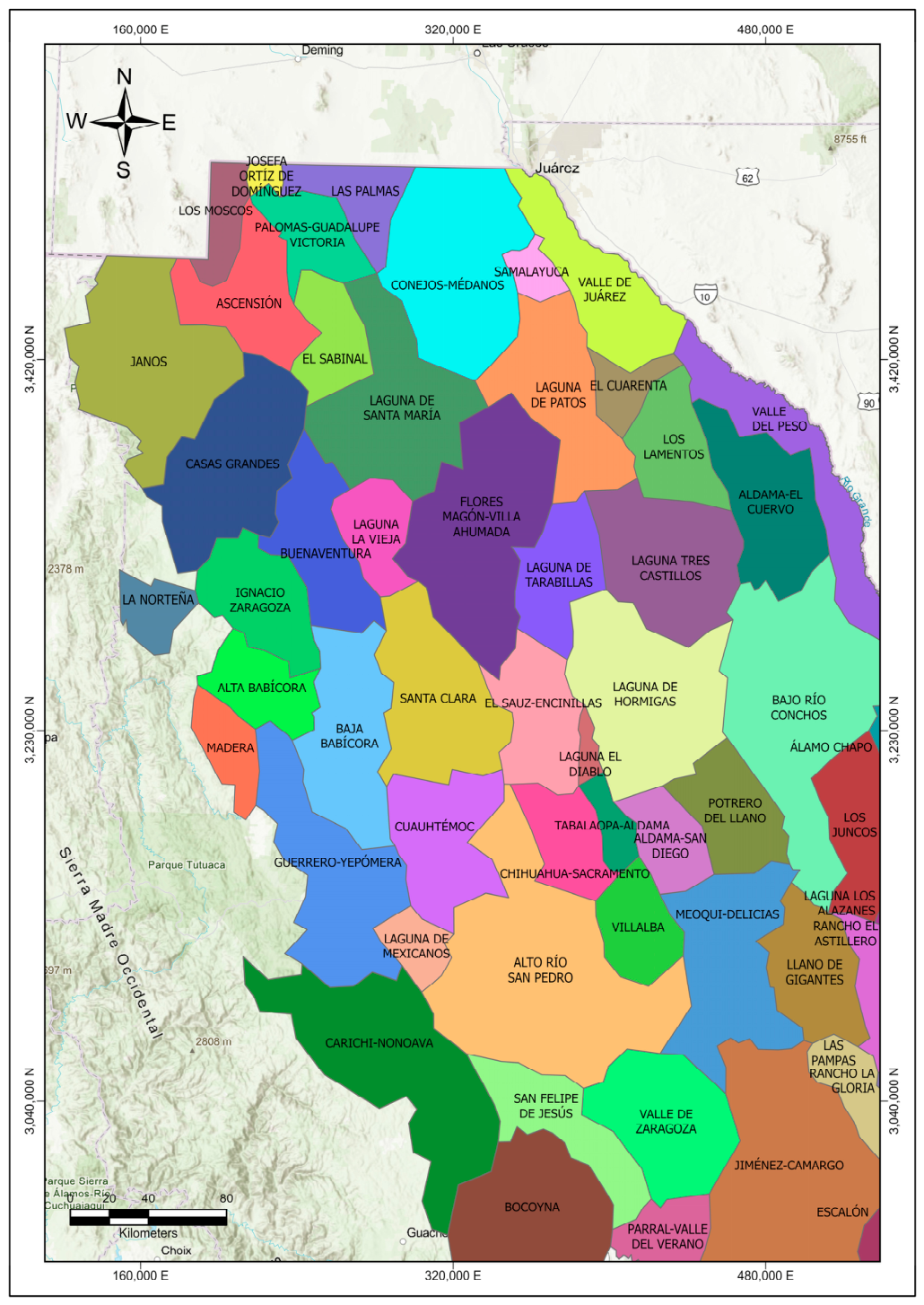
No subsequent revisions were made, and no water-level, structural, or stratigraphic analyses were conducted for the Mexican side (Figure 1). The southern delineation, therefore, consisted of a single provisional areal boundary (Figure S1). Mexico later produced an independent CONAGUA delineation (Figure 2, Figure 3 and Figure 4) [8]. The CONAGUA delineation follows mountain divides and administrative management polygons rather than basin geometry based solely on hydrogeologic criteria (Figure 3) and leaves no undesignated areas between polygons (Figure 2 and Figure 3).
Figure 3. Groundwater units of northern Chihuahua as delineated by Mexico’s Comisión Nacional del Agua (CONAGUA). Colored polygons represent administratively defined groundwater units that are grouped for management and reporting purposes. These units do not necessarily represent single, hydraulically continuous aquifers; rather, they constitute a set of administrative regions that aggregate multiple hydrogeologic settings across the binational border region. Acuífero Conejos–Médanos is highlighted in light blue, upper middle.
Water 18 01103 g003

2.2. Use and Consequences of the Provisional Delineation

Despite its provisional nature, the TWDB/NMWRRI delineation [1] was widely reproduced in management documents, models, databases, publications, and public graphics [24,25,26,27,28,29,30,31,32,33,34] (Figure 1, Figure 2 and Figure 4). The Mexican binational report excluded the Mesilla/Conejos–Médanos Transboundary Aquifer [17] (U.S.–Mexico Binational Report, 1998) (Figure S2), yet the delineation became widely adopted (Figures S1 and S2).
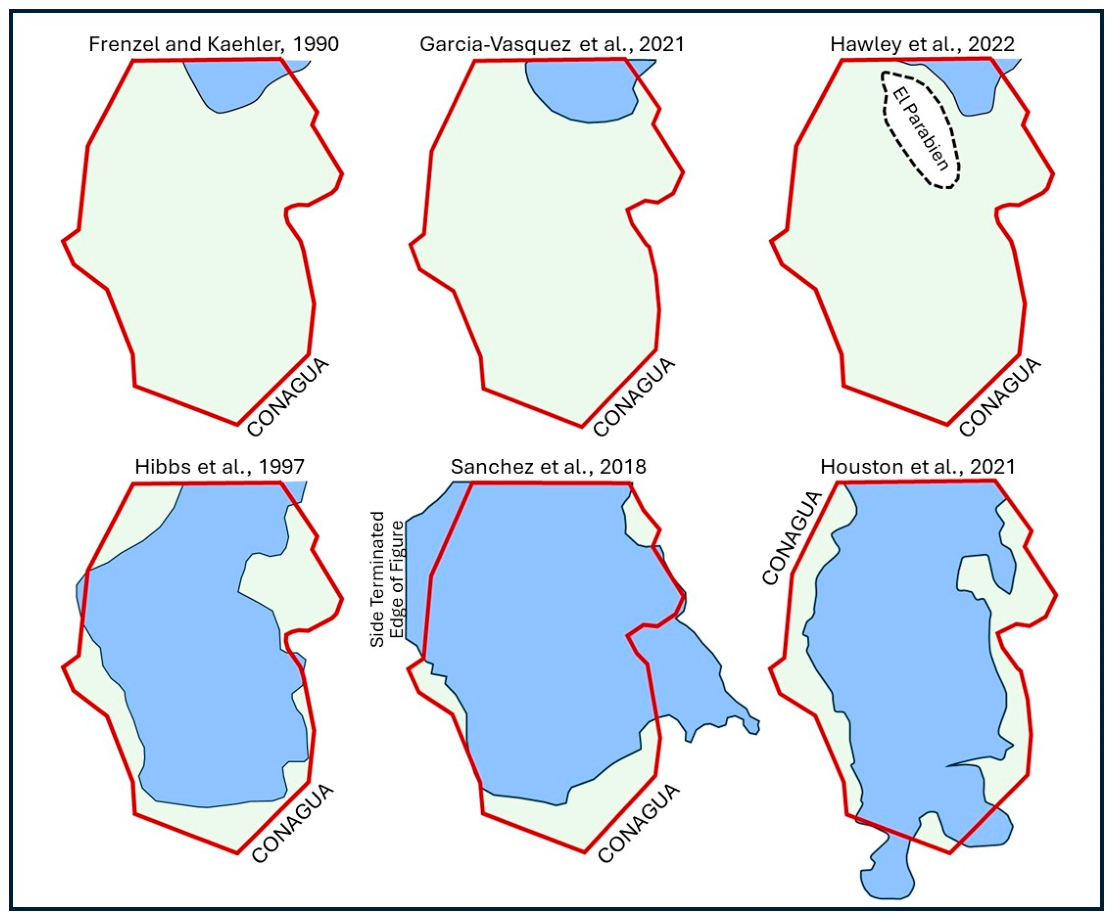
Figure 4. Comparison of published groundwater basin extents for the Mesilla/Conejos–Médanos Transboundary Aquifer region as proposed by different studies. Dark blue polygons show basin extents from Hibbs et al. [1], Frenzel and Kaehler [14], Hawley et al. [15], Sánchez et al. [35], Houston et al. [36], and García-Vásquez et al. [37], plotted within a common reference outline of CONAGUA’s Acuífero Conejos–Médanos (red). The figure illustrates substantial variability in basin size, geometry, and north–south extent across studies, reflecting differences in conceptual models, objectives, and data availability over time. The delineation by Hibbs et al. [1] has been used widely.
Water 18 01103 g004
Overlap between the TWDB/NMWRRI delineation and the later CONAGUA administrative unit reinforced confusion (Figure 2 and Figure 4). However, the TWDB/NMWRRI outline implies a single structurally bounded bolson hydraulically continuous with the U.S. Mesilla Bolson, whereas the CONAGUA unit aggregates mountain blocks, grabens, pediments, and dune fields into management polygons (Figure 5) [8]. CONAGUA boundaries therefore do not necessarily represent continuous groundwater-flow systems. As noted by Hawley et al. [15,16], neither the CONAGUA nor the TWDB/NMWRRI 1997 delineation of the Mesilla/Conejos–Médanos Aquifer (Figure 1) represents a single hydrogeologically continuous transboundary aquifer.
The provisional delineation by TWDB/NMWRRI [1] also led to interpretations of south-to-north through-flow across the Conejos–Médanos area. Geologic and hydrogeologic evidence contradicts this; phreatic saline playas in the Bolsón de los Muertos indicate internal discharge incompatible with a through-flowing aquifer (Figure 5) [16].
Multiple alternative delineations have been proposed (Figure 2 and Figure 4). Frenzel and Kaehler [14] defined a structurally bounded basin extending only slightly into Mexico and noted a lack of hydrologic data south of the border. Later interpretations expanded or contracted the delineation, including Hibbs et al. [1], Sánchez et al. [35], and Houston et al. [36]. More constrained interpretations emphasizing structural compartmentalization were presented by Hawley et al. [15,16], Sweetkind [23], and García-Vásquez et al. [37]. However, the erroneous TWDB/NMWRRI delineation [1] (Hibbs et al., 1997) has been most widely used in transboundary aquifer studies [24,25,26,27,28,29,30,31,32,33,34].
The variability shown in Figure 2 and Figure 4 demonstrates the absence of a consistent framework for defining the southern boundary of the Mesilla/Conejos–Médanos Transboundary Aquifer. Defensible delineation requires integration of structure, basin-fill architecture, groundwater hydraulics, and permeability contrasts consistent with the United Nations definition of a transboundary aquifer.

3. United Nations Definition and Border Delineation Issues

This study applies the United Nations definition of a transboundary aquifer to reevaluate and to redefine the delineation of the Mesilla/Conejos–Médanos Transboundary Aquifer [39,40]: “A permeable geologic formation whose saturated zone extends across the territories of two or more States and functions as a connected groundwater-flow system”. Units lacking hydraulic continuity across a boundary do not meet this definition [40].
Because groundwater flow is controlled by subsurface conditions, activities in one state may affect hydraulic heads, flow directions, water quality, and discharge in another [39]. Aquifers must therefore be delineated hydrogeologically. Poor delineation obscures hydraulic connectivity and possible cross-border impacts or predictions [40]. The Transboundary Waters Assessment Programme (TWAP) guidance requires standardized delineation maps that show aquifer boundaries relative to political and geographic features.
First-order delineations commonly use host-rock or basin-sediment extent because precise groundwater boundaries are difficult to determine from first approximations or where hydrogeologic data are lacking [40]. Along state borders, differences in legal definitions and administrative practice complicate interpretation. In the United States, aquifers are often defined by yield and structural basin boundaries. In Mexico, aquifers are administrative groundwater units that may not correspond perfectly to flow-delineated systems [9]. Artificial aquifer boundaries frequently terminate at state borders due to defining jurisdictional or data limitations rather than groundwater-defined features [9]. Hydrogeologic delineation must therefore rely on structural features, permeability contrasts, groundwater divides, rock and sediment formation boundaries, and other hydrogeological features.
Using this framework, the TWDB/NMWRRI delineation [1], other expansive delineations, and the administrative Acuífero Conejos–Médanos do not satisfy the criteria for a single transboundary aquifer (Figure 2 and Figure 4). Previous interpretations are evaluated using additional data to define a consistent area based on basin compartmentalization and hydraulic connectivity. This study integrates geologic, structural, hydrologic, and hydrochemical data to provide a revised Mesilla/Conejos–Médanos Transboundary Aquifer delineation.
The southern aquifer delineation proposed in this study is a first-order delineation consistent with the UNESCO-IHP and ISARM framework, reflecting the limited availability of hydrogeologic data in the southern portion of the aquifer, where low population density and minimal groundwater development have limited data collection. This study integrates all available geologic and hydrogeologic datasets in a synergistic and complementary manner, combining qualitative interpretation with semi-quantitative analyses to define the new aquifer transboundary region. The resulting delineation provides a conceptual framework and serves as a model approach for aquifer delineation definition under data-limited conditions, while remaining subject to refinement as additional data become available.

4. Methods and Materials

4.1. Overview

Section 4 is organized into two parts. The first part describes the hydrogeologic components within the Acuífero Conejos–Médanos administrative delineation, as defined by CONAGUA (Figure 3), providing the regional context and identifying distinct basins and subbasins relevant to groundwater-flow analysis. The second part describes the analytical, hydrogeologic approach used to delineate the transboundary extent of the Mesilla/Conejos–Médanos Transboundary Aquifer. These criteria include the presentation of data used to evaluate basin boundaries, hydraulic continuity, and groundwater-flow systems that cross the international border. These analytical methods are applied to evaluate criteria defined in the United Nations framework, including identification of a permeable geologic formation and determination of whether a hydraulically connected groundwater-flow system exists across the international boundary.

4.2. Basin Components Within the Acuífero Conejos–Médanos Administrative Boundary Defined by CONAGUA

The CONAGUA delineation represents Mexico’s official aquifer framework and therefore defines groundwater management in northern Chihuahua (Figure 3). Because several expansive transboundary delineations encompass much of this administrative unit, it is necessary to examine the hydrogeologic compartments within the CONAGUA delineation. These include the Mesilla Bolson Aquifer, the El Parabien Basin, the Bolsón de los Muertos (including El Barreal playa), and the Los Médanos sand-dune region; each is a distinct hydrogeologic element relevant to assessing groundwater connectivity within the broader Acuífero Conejos–Médanos (Figure 5).
Mesilla Bolson Aquifer. Defined here as the southern extension into Mexico of the larger U.S. Mesilla Bolson (e.g., [14]; Figure 2 and Figure 4), this classic Rio Grande rift basin is filled with Santa Fe Group sediments and ancestral Rio Grande alluvium. In the United States, the basin is structurally bounded by mountain-front fault systems, including the Robledo–East Potrillo faults to the west and the Franklin–Sierra de Juárez uplifts to the east, which extend across the international border. Its southern extent has long been uncertain. Frenzel and Kaehler [14] used gravity anomalies and limited bedrock control to infer a restricted southward extent, explicitly noting the absence of hydrologic data and identifying the delineation as provisional. Subsequent delineations [15,16,23,37] make minor modifications to this interpretation.
El Parabien Basin. Immediately south lies the deeply buried El Parabien rift subbasin, lacking surface expression. This basin was first inferred structurally [38] and later definitively mapped by [41] using gravity, drilling, and remote sensing data. Gravity lows indicate sediment thicknesses of approximately 2 to 3 km, confirming that it is a discrete structural basin rather than a continuation of the Mesilla Basin [15]. Fault mapping by Reeves [38] clearly outlines the basin. It is separated from the Mesilla Bolson Aquifer by the Potrillo–Sapello High, a buried structural connection between the East Potrillo Mountains and Sierra de Sapello [15,16].
Bolsón de los Muertos and El Barreal Playa. Farther south, the Bolsón de los Muertos contains the El Barreal phreatic playa, a major internal discharge feature within a closed structural basin. Gravity surveys show steep gradients associated with near-vertical faulting and basin-fill thicknesses exceeding several thousand meters [7,38,42,43]. These data demonstrate that the basin is structurally deep, internally drained, and hydrogeologically distinct from both El Parabien and the Mesilla Bolson. Assertions of northward through-flow toward the international border are inconsistent with available geophysical and structural evidence, which instead indicate flow toward internal discharge at El Barreal playa.
Los Médanos Sand Hills. The Los Médanos dune field forms the southeasternmost component of the system. Extensive dunes obscure bedrock and faults, complicating surface mapping; however, gravity data and regional structural trends indicate that subsurface fault systems continue beneath the dunes and control basin geometry and compartmentalization [38]. The dunes are surficial features and do not imply aquifer continuity. Groundwater discharging from the Los Médanos region to the El Barreal playa originates from recharge areas distinct from those that supply El Parabien and does not mix with Mesilla Bolson groundwater. These internally drained systems preclude regional northward through-flow across the entire CONAGUA Acuífero Conejos–Médanos (Figure 5).
The remainder of this paper refines the southern delineation of the Mesilla/Conejos–Médanos Transboundary Aquifer consistent with the United Nations Internationally Shared Aquifer Resources Management (ISARM) framework [40] and evaluates the remaining portions of CONAGUA’s Acuífero Conejos–Médanos using standard flow-system analysis. The resulting delineation strives to provide a scientifically defensible framework that reduces confusion arising from multiple basin definitions and supports improved groundwater assessment and management along the U.S.–Mexico border. The earliest expansive delineation extending far into Mexico is that of TWDB/NMWRRI [1]; revisiting this interpretation permits correcting the delineation to be consistent with United Nations criteria and defensible hydrogeologic principles. The characterization of basin components and structural relationships provides the geologic framework necessary to evaluate whether the system constitutes a permeable geologic formation consistent with the United Nations definition of a transboundary aquifer.

4.3. Groundwater Basin Delineation: Transboundary Extent of the Mesilla/Conejos–Médanos Transboundary Aquifer

This analysis delineates the Mesilla/Conejos–Médanos Transboundary Aquifer by integrating structural geology, basin-fill geometry, hydrostratigraphic continuity, recharge processes, lithology, regional hydraulic gradients, and groundwater divides to distinguish adjacent but hydraulically compartmentalized basins. Two general approaches to groundwater basin delineation are recognized. One defines basin limits using groundwater divides, which may not coincide with topographic divides [14,44]. The second defines basins as structurally bounded areas controlled by uplifted bedrock blocks or low-permeability volcanic units and filled with alluvial sediments derived from adjacent uplands [14]. In practice, both approaches may be combined to delineate transboundary aquifers; here, “basin” refers to a structurally bounded area unless noted otherwise.
These approaches have been applied inconsistently in regional studies. Numerical groundwater-flow models commonly extend to structural limits such as basin-bounding faults [45], whereas some regional assessments emphasize groundwater divides [46,47,48], producing differing aquifer delineations.
To establish the Mesilla/Conejos–Médanos Transboundary Aquifer delineation, hydraulic head data were evaluated using published potentiometric and depth-to-groundwater maps. Depth-to-groundwater data were used to identify potential discharge areas. Basin boundaries were further assessed using published geologic maps, gravity interpretations, and fault compilations to identify structural barriers, buried structural heights, and basin-bounding features. Basin-fill thickness inferred from gravity data was used to distinguish discrete structural basins.
Hydrochemical and groundwater temperature data were analyzed to interpret flow paths, infer groundwater age, and identify evaporative concentration. Temperature anomalies were used to infer deep circulation or regional flow where lithologic or well depth data were limited. The interpretation assumes that groundwater salinity does not systematically decrease along a hydraulic gradient without dilution by recharge. The approach is broadly applicable to Basin and Range basin-fill aquifers and other hydrogeologic systems that cross international or administrative boundaries. Hydraulic head, hydrochemical, and temperature analyses are used to evaluate groundwater flow continuity and direction, providing the basis for determining whether the system functions as a connected groundwater-flow system across the international boundary.

4.4. Summary of Data Sources and Limitations

This study relies primarily on previously published and agency-generated datasets due to limited field access in the transboundary region. The datasets used represent the most comprehensive and internally consistent information currently available for evaluating basin structure, groundwater conditions, and hydrogeologic connectivity of the Mesilla/Conejos–Médanos Transboundary Aquifer.
The core dataset for this analysis is the 2010 groundwater dataset developed by CONAGUA [8,49], which includes groundwater elevations, depth-to-water measurements, and regional hydrogeologic interpretations derived from a network of wells distributed across the Acuífero Conejos–Médanos administrative unit. These data were compiled as part of binational efforts under the Transboundary Aquifer Assessment Program (TAAP) and related collaborative initiatives and are considered high-quality, internally consistent, and appropriate for regional-scale hydrogeologic analysis.
Although the CONAGUA dataset represents conditions from 2010, it remains suitable for delineating the hydrogeologic framework because regional hydraulic gradients remain in a quasi-steady state over time over the mostly undeveloped basin. Comparison of groundwater conditions between approximately 1980 and 2010 indicates nominal changes in hydraulic head across most of the study area, with the exception of localized drawdown associated with pumping in the El Parabien Basin and southern Mesilla Bolson [8,49].
Earlier foundational work [14,50] provides critical context for the northern and transboundary portions of the system. Their study used gravity data, structural interpretation, and limited hydrologic information to define a structurally bounded Mesilla Bolson Aquifer extending only slightly into Mexico, while explicitly noting the absence of hydrologic data south of the international boundary and identifying the southern extent as provisional. This limitation directly supports the reliance in the present study on more recent datasets, particularly CONAGUA [8,49], to constrain regional groundwater conditions.
Reeves [38] and CONAGUA [8,49] provided interpretations and mapping of faults that help delineate basin structure and compartmentalization. Subsequent refinements to basin structure and hydrogeologic interpretation have been provided by Hawley and co-workers [15,16], incorporating updated stratigraphic, structural, and basin-fill analyses. Additional interpretations include Sánchez et al. [10,35] and U.S. Geological Survey analyses which apply interpolation methods to the CONAGUA dataset to generate regional potentiometric surfaces [27]. Structural mapping by Reeves [38] remains fundamental for identifying basin-bounding faults and subsurface compartmentalization.
Despite fair to good density of many of these datasets, several limitations must be acknowledged. The CONAGUA groundwater dataset represents a temporal snapshot [8,49], and groundwater levels will change in response to increased pumping and water demand. As groundwater extraction increases, hydraulic gradients and local flow directions may shift, and the position of interpreted groundwater divides may move accordingly.
Additional uncertainty arises from spatial gaps in monitoring data, interpolation of groundwater surfaces, and the integration of datasets developed using different methods and conceptual models. CONAGUA aquifer boundaries represent administrative units rather than strictly hydrogeologic systems and therefore require reinterpretation using hydrogeologic criteria. The CONAGUA [8,49] dataset provides the most comprehensive and internally consistent representation of groundwater conditions currently available. No comparable regional interpretation has been developed more recently, largely because much of the aquifer remains undeveloped and characterized by very low population density, limiting the need for additional data collection and analysis. The evaluation of data sources and limitations provides context for the reliability of interpretations used to assess hydraulic connectivity and the geologic framework under the United Nations criteria.
A summary of data sources, their applications in this study, and their relative importance for revising the aquifer delineation is provided in Table 1. Data sources are ranked according to their contribution to defining aquifer boundaries, where rank 1 indicates the highest level of importance (tier 1), rank 2 indicates secondary tier importance, and rank 3 indicates third tier importance.

5. Interpretive Results

5.1. Depth-to-Groundwater and Hydraulic Head Maps

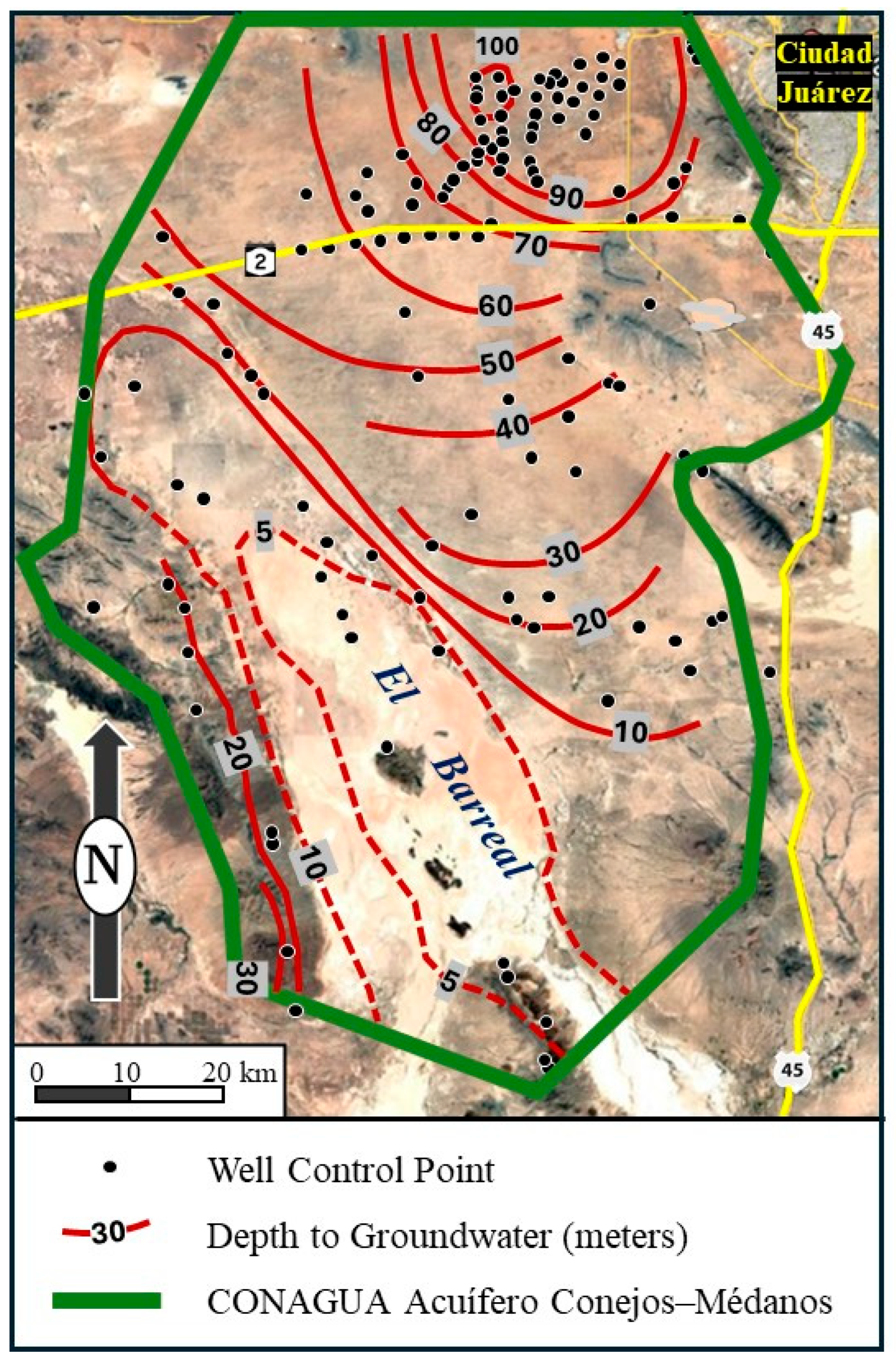
The 2010 CONAGUA [8,49] depth-to-static-groundwater-level map, the most recently available, indicates very shallow groundwater in the Bolsón de los Muertos, particularly in the vicinity of El Barreal, where depths to groundwater are minimal, and groundwater discharge occurs through evaporation and transpiration (Figure 6) [7,8]. Shallow water-table conditions are spatially coincident with salt marshes and phreatic playas, indicating persistent groundwater discharge. Depth to groundwater increases progressively northward from the Bolsón de los Muertos toward the El Parabien Basin, reflecting reduced evaporative discharge and increasing separation between the land surface and the regional water table.
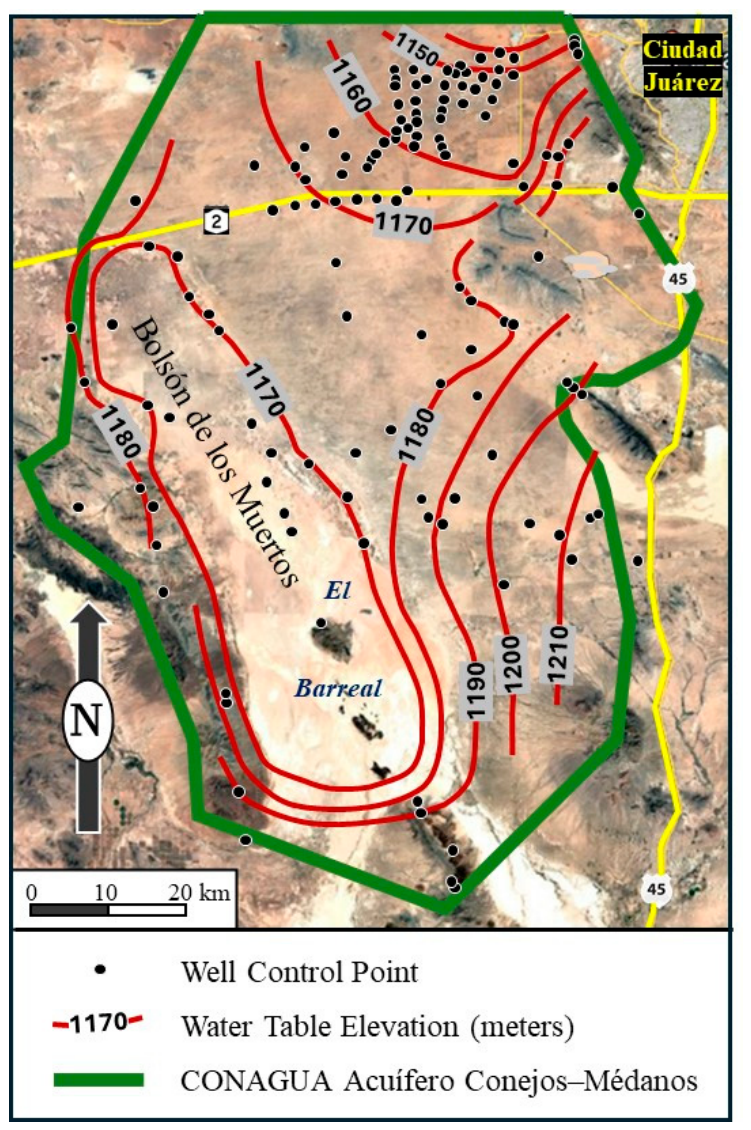
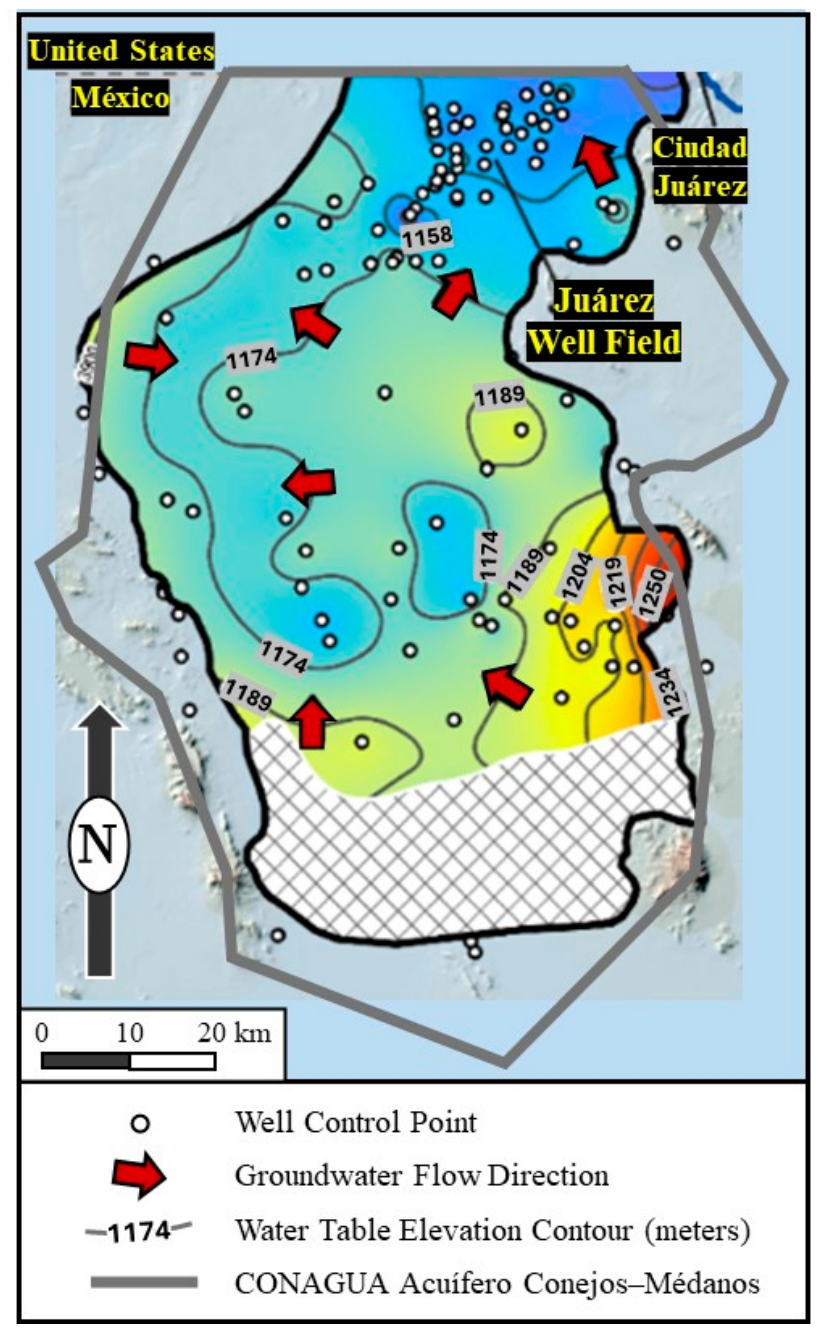
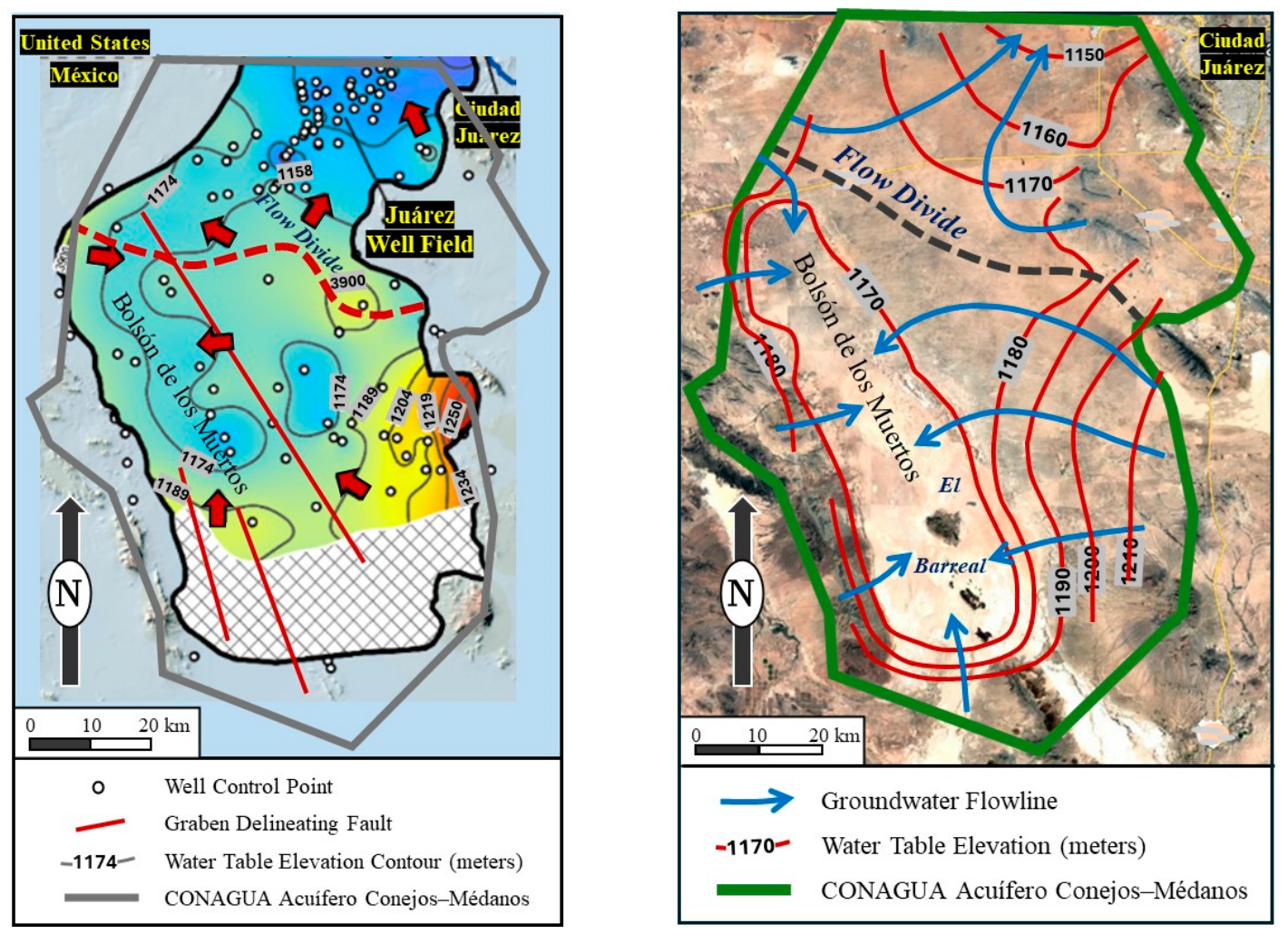
Figure 7 shows a CONAGUA water-table map from 2010, the most recent publicly available regional groundwater dataset for Acuífero Conejos–Médanos [8]. The potentiometric surface map indicates an extremely flat hydraulic gradient across the central Conejos–Médanos region in Los Médanos. Groundwater discharge on the southwest side of Acuífero Conejos–Médanos is indicated primarily by evaporative playas within the Bolsón de los Muertos and by localized pumping centers in the Mesilla Bolson Aquifer–El Parabien Basin area (Figure 7).
A second potentiometric surface map was prepared by a team led by the U.S. Geological Survey using the 2010 CONAGUA data [27] (Figure 8). The map was generated using kriging of the groundwater elevations measured in 2010, mostly in wells completed in basin-fill sediments, including 108 wells in Mexico [27]. The kriged surface provides interpolated groundwater elevations and associated standard errors in areas lacking measurements.
A groundwater trough is mapped using objective kriging results between the Bolsón de los Muertos and the El Parabien Basin and is expressed as a broad, low-gradient feature in the water-table surface, with a contoured elevation of 1174 m that envelops the groundwater trough (Figure 8). This trough is characterized by minimal changes in groundwater elevation and depth to groundwater over large distances north and south across the Acuífero Conejos–Médanos boundary (CONAGUA administrative unit). If groundwater flow is limited to lateral flow within the trough, this feature represents the only apparent groundwater pathway from the southern part of the Acuífero Conejos–Médanos boundary to the north. However, based on the available information, a southward flow toward El Barreal is likely to occur. Hydraulic head and depth-to-groundwater data do not define a consistent gradient within the 1174 m trough that would indicate preferential groundwater flow either northward toward the El Parabien Basin or southward within the Bolsón de los Muertos toward El Barreal. Other data must be evaluated for groundwater flow direction within the trough.

5.2. A Postulated Basin-Wide Groundwater Divide

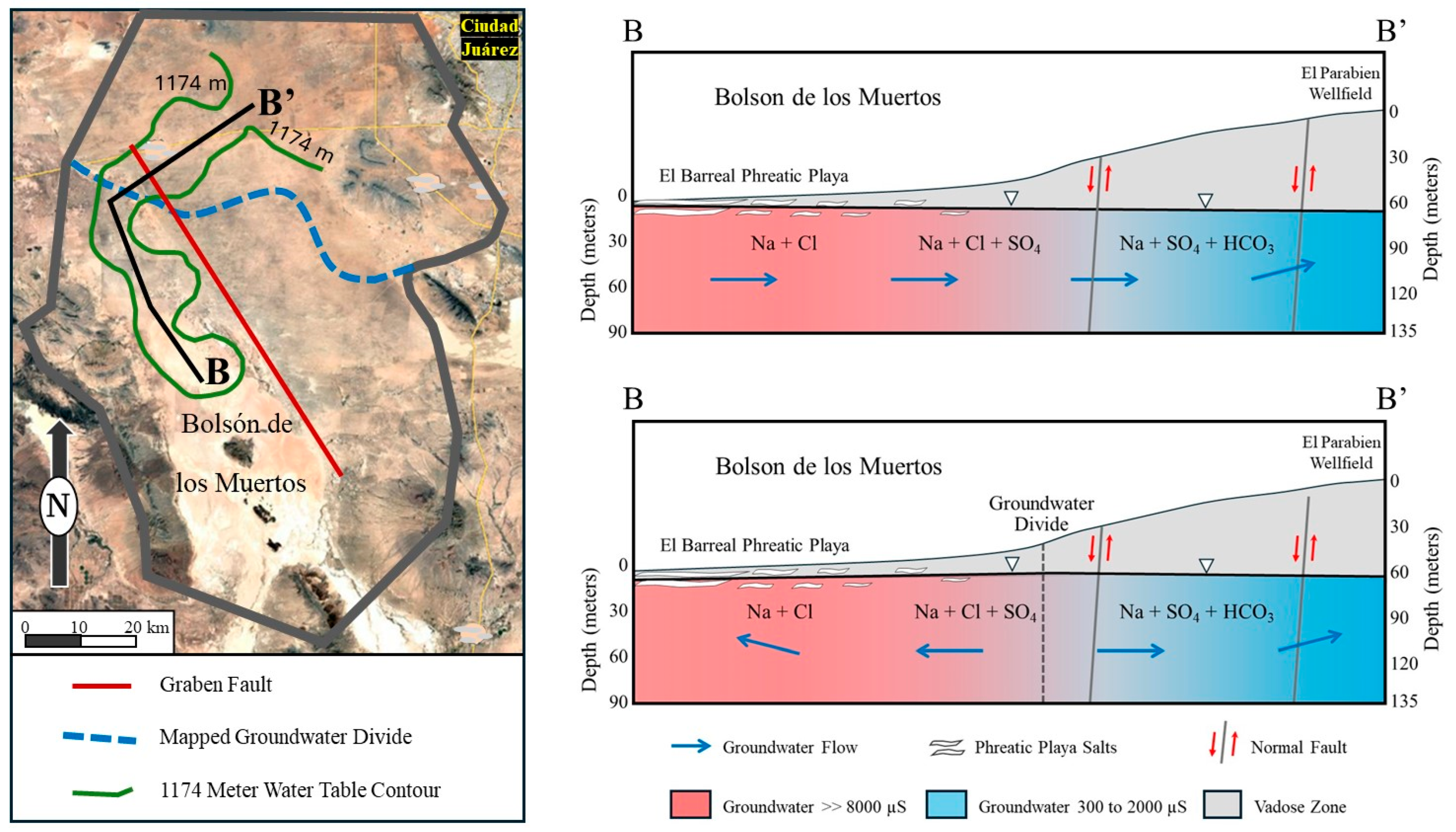
Based on available groundwater-level data from both maps (Figure 7 and Figure 8), a regional groundwater divide is interpreted and shown in Figure 9, with generalized flow lines indicating possible flow directions. The proposed groundwater divide is consistent with both evaluated water-table representations, including the U.S. Geological Survey kriged groundwater elevation surface, in which the divide separates the mapped water-table trough into northeastern- and southward-flowing groundwater.
The location of the postulated divide provides a working basis for evaluating the southern extent of the Mesilla/Conejos–Médanos Transboundary Aquifer. Although both maps are derived from the same underlying dataset, differences arise from interpolation methods and data treatment. Overall, the two maps show good agreement in regional groundwater patterns. Both indicate a broad area of low hydraulic head centered on the Bolsón de los Muertos, with the lowest elevations occurring near Laguna El Barreal. This feature is consistently represented in both maps and provides a key control supporting internally drained conditions in the southern basin. Both maps also depict weak hydraulic gradients across the central portion of the study area, where flow toward areas of low hydraulic head both north and south of the divide is plausible.
The flow line markers in Figure 8 were included in Robertson et al. [27], but the flow lines shown in the right panel of Figure 9 were derived from the hydraulic head distribution interpreted in Figure 7 using standard hydrogeologic principles. Specifically, flow directions were mapped perpendicular to the groundwater contour lines (equipotential lines), which represent the hydraulic gradient. In areas where the hydraulic gradient is very low and contour spacing is broad (i.e., relatively flat potentiometric surfaces), flow directions were inferred based on regional trends and continuity of the gradient.
The interpreted flow lines in Figure 9 also reflect boundary conditions within the system. Groundwater flow is directed toward natural discharge areas, including Laguna El Barreal to the south, and toward pumping centers located north of the groundwater divide, which act as hydraulic sinks. Additionally, known structural features were incorporated into the interpretation of the groundwater divide and flow pattern. These features can influence subsurface permeability and flow paths, and their inclusion follows conventional hydrogeologic mapping methodology.
Differences between the maps are most evident in the representation of the 1174 m groundwater trough. In the kriged surface of Robertson et al. [27], this trough appears as a more continuous and laterally extensive feature, reflecting smoothing and interpolation inherent to the kriging method. The kriged map emphasizes a broad, low-gradient zone in which groundwater flow directions are poorly defined and within which the inferred groundwater divide is located.
A notable difference in the kriged map is the presence of a groundwater depression in the southeastern-central portion of the study area, characterized by locally suppressed hydraulic heads relative to surrounding areas (closed 1174 m contour line). This feature is not clearly expressed in the CILA map [7] and may indicate local drawdown due to groundwater pumping.
Despite these differences, both maps support the presence of a groundwater divide within the low-gradient central trough. The agreement between independently generated representations, one based on direct contouring and the other on geostatistical interpolation, provides confidence that the inferred groundwater divide reflects a real hydrogeologic feature rather than an artifact of mapping methodology.
The position of the dashed groundwater divide shown in Figure 9 is based on interpretation of groundwater-flow directions derived from potentiometric surfaces in Figure 7 and Figure 8, including flow vectors mapped from the CONAGUA [8,49] contours and those generated from the U.S. Geological Survey kriged surface [27]. The divide is placed along the most logical delineation separating inferred northward and southward flow, guided by convergence of flow directions from the basin margins, the presence of internal groundwater mounds, and the geometry of the low-gradient trough common to both maps. Because hydraulic gradients are very low across this central area, the exact position of the divide is approximate and represents a first-order hydrogeologic interpretation based on available data and professional judgment. Support for the existence of the interpreted groundwater divide is developed using multiple lines of evidence, including structural relations, lithology, hydrochemical patterns, and geothermometry indicators.

5.3. Structural Evidence of Groundwater Divide

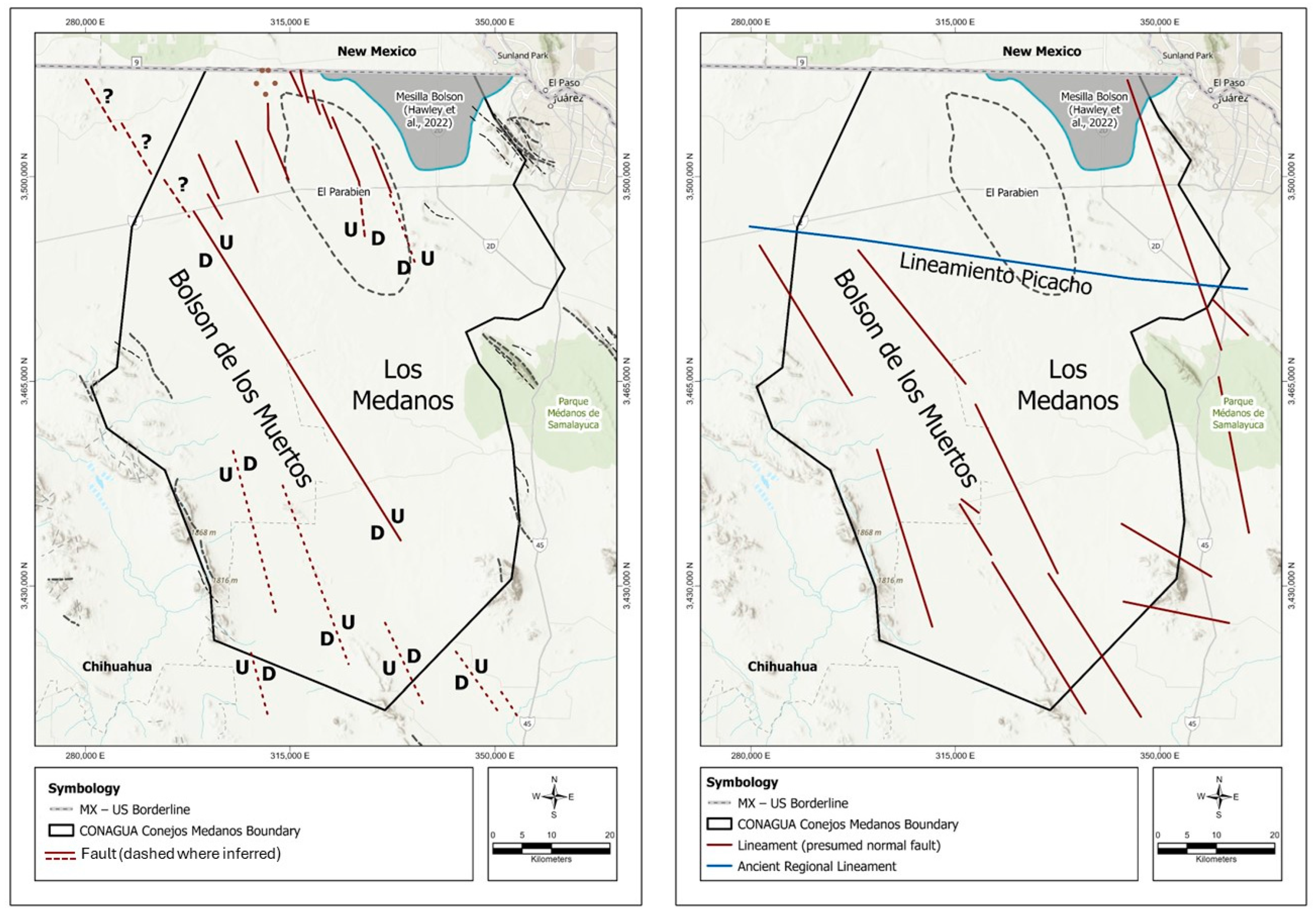
Structural geological data compiled from Reeves [38], CONAGUA [8,49], and CILA [7] indicate the presence of lithologic and structural features that may locally influence groundwater flow along the 1174 m water-table trough delineated from U.S. Geological Survey groundwater elevation surfaces (Figure 5 and Figure 9). Several northwest-trending normal faults are mapped in the region and define the structural margins of the El Parabien Basin and the Bolsón de los Muertos. These faults juxtapose basin-fill sediments against bedrock and older lithologic units and may act as partial hydraulic barriers or zones of reduced permeability, depending on fault architecture and stratigraphic relationships (Figure 5).
In addition to these basin-bounding faults, the Lineamiento Picacho is mapped as a prominent regional structural feature (Figure 5). Unlike the other mapped faults, which are interpreted primarily as normal faults associated with Basin and Range extension, the Lineamiento Picacho, mapped by PEMEX [52], is a laterally extensive lineament that transects the Acuífero Conejos–Médanos area (CONAGUA administrative unit). Its continuity and scale suggest that it may represent a major structural or lithologic boundary rather than a single discrete fault. Although its hydrogeologic role has not been directly evaluated, the feature spatially coincides with portions of the low-gradient water-table trough and may contribute to localized groundwater-flow compartmentalization. The Lineamiento Picacho is situated along the northern margin of the study area, trending broadly west–east for approximately 130 km. It is interpreted to be associated with a deep-seated structural zone that has generated hypabyssal rhyolitic intrusions, indicating significant tectonic control on basin development and subsurface conditions [7].
Although its hydrogeologic significance has not been directly demonstrated, the position of the Lineamiento Picacho relative to mapped groundwater features could influence groundwater-flow patterns. The alignment of this structure (Figure 5) with the groundwater divide shown in Figure 9 indicates a spatial relationship that supports the groundwater divide interpretation. In combination with the structural boundaries of the Bolsón de los Muertos, the lineament may act to restrict northward groundwater movement from the 1174 m groundwater trough toward the El Parabien Basin. Structural features may favor southward groundwater flow toward internal discharge at El Barreal playa, consistent with the groundwater divide depicted in Figure 9. The correspondence between the structural trend (Figure 5) and the inferred divide (Figure 9) therefore provides additional, though interpretive, support for the proposed groundwater divide.

5.4. Lithological Contrasts Influencing Groundwater-Flow Patterns

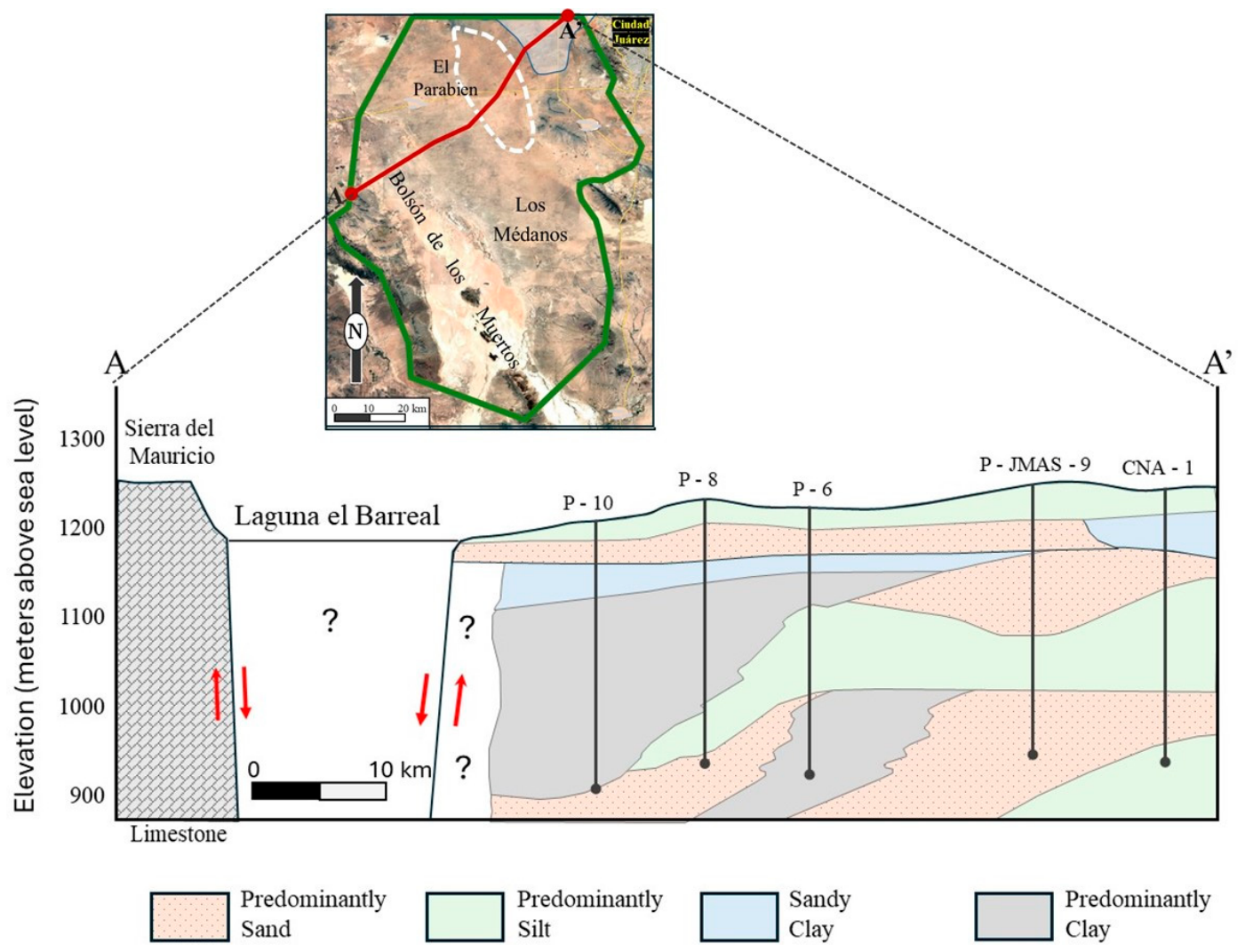
A cross-sectional figure depicts the geologic depositional facies of the Acuífero Conejos–Médanos area (CONAGUA administrative unit) in a northeast-trending section along the basin (Figure 10). The basin is filled with interbedded sand, silt, and clay deposited in a variable closed-basin setting, with coarse-grained alluvial sediments entering from the ancestral Rio Grande forming extensive Santa Fe Group deposits [15]. Along basin margins, fanglomerates were deposited at mountain fronts, which act as potential recharge zones. Sediments become progressively finer-grained toward the western basin interior, consistent with lower-energy depositional environments associated with lacustrine and playa conditions. The A–A′ cross-section shows that clay and sandy clay units thicken substantially toward Laguna El Barreal, reflecting prolonged low-energy lacustrine and playa deposition (Figure 10). These fine-grained deposits become laterally extensive and form a regional low-permeability zone at depth, effectively limiting deep groundwater circulation. In contrast, sand-rich units are most continuous near the surface and toward the subbasin components at El Parabien and Mesilla Bolson, where higher-energy depositional processes dominated and where laterally connected, higher-permeability pathway materials are more likely to persist. Additional geological cross-sections prepared by Hawley et al. [16] show a regionally extensive, fine-textured ancestral lake deposit beneath the Santa Fe Formation that extends across the northern half of the Acuífero Conejos–Médanos (Figure S3, Supporting Information).
In cross-section A–A’ (Figure 10), the sand-dominant basin fill within the El Parabien Basin is approximately 350 m thick in the eastern part of the section line but thins to roughly 70 m toward the Bolsón de los Muertos, where the El Barreal playa forms a major internal discharge feature. Beneath these predominantly sandy deposits, finer-grained clay and silt units of largely lacustrine and playa origin are present. These low-permeability sediments inhibit downward vertical groundwater flow along the western half of the line of section A–A’. As a result, groundwater flow is preferentially redirected laterally within the overlying sand units. This lateral flow behavior is consistent with flow toward internal discharge at El Barreal playa and supports the conceptualization of a lateral-flow-dominated system within the basin. The presence of these fine-grained units provides a hydrogeologic mechanism that reinforces the stability of the postulated groundwater divide by limiting vertical leakage and promoting lateral divergence of flow, thereby strengthening the credibility of the groundwater divide hypothesis.
This stratigraphic architecture has important hydrogeologic implications. As groundwater moves toward and then into the groundwater trough mapped at the 1174 m elevation contour, it encounters increasingly thick clay near El Barreal, which restricts flow through the deeper basin fill. Consequently, groundwater moving through the groundwater trough must be focused within the upper sand units, which provide the primary laterally connected and hydraulically transmissive pathway both north and south. Overall, the lithologic data provide evidence of lateral groundwater flow, which at a secondary level is consistent with movement north and south from a groundwater divide across the Bolsón de los Muertos and through the 1174 m groundwater trough. Northerly groundwater continues northeast of the groundwater divide toward El Parabien through relatively thin sand lenses that thicken to the east, while groundwater moving south of the groundwater divide discharges at phreatic playas at El Barreal.

5.5. Hydrochemical Evidence of Groundwater Divide

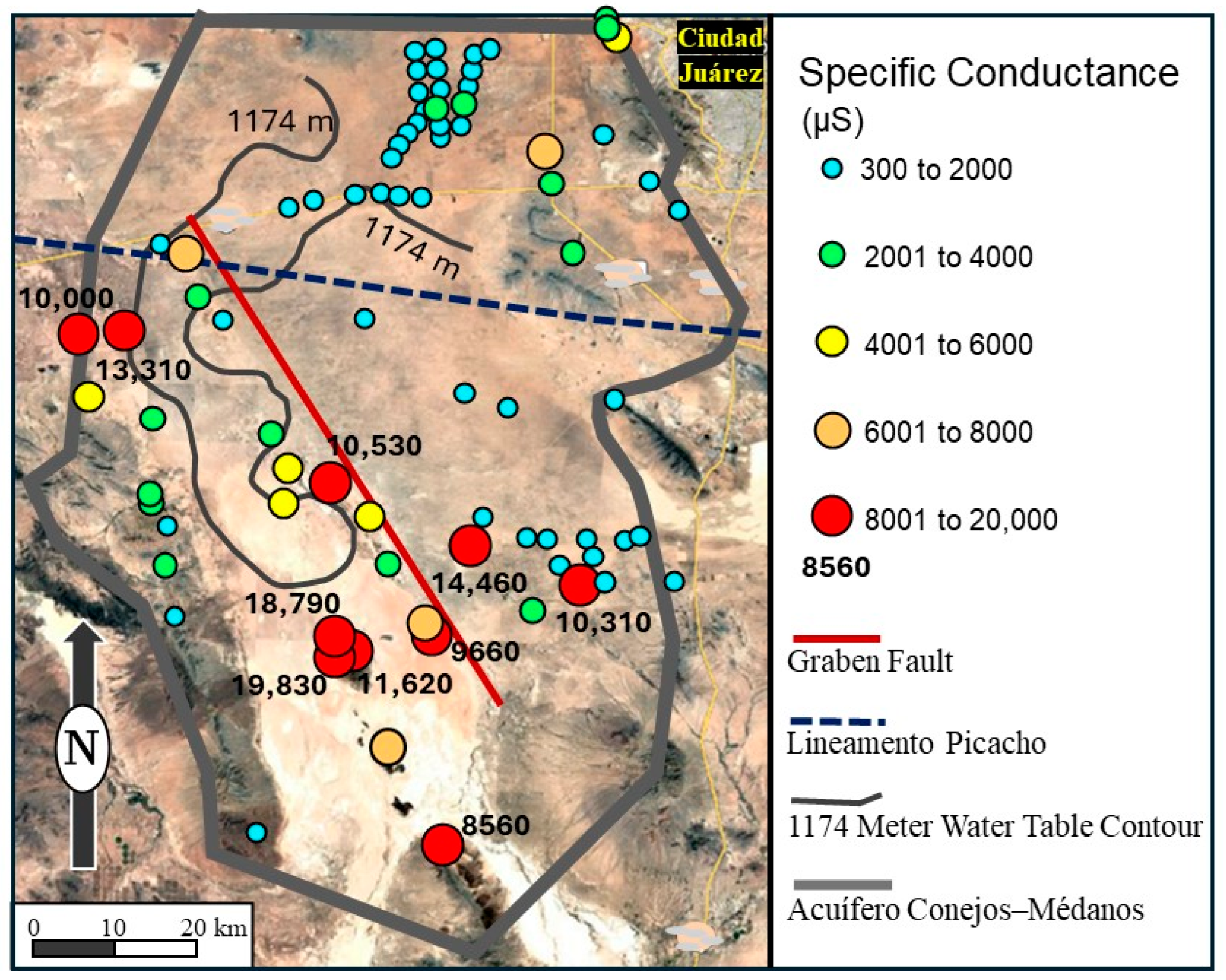
Specific conductance is the only hydrochemical parameter mapped regionally in the Acuífero Conejos–Médanos dataset [7,8] that includes numerical values; however, these data provide important constraints on groundwater-flow patterns and basin connectivity (Figure 11). These data were collected in June, July, August, and part of October 2010 by field crews of the Mexican Geological Service. The highest specific conductance values occur primarily around the margins of the El Barreal phreatic playas within the Bolsón de los Muertos, where shallow groundwater discharge and evaporative concentration are well developed. Estimated total dissolved solids can be approximated by multiplying specific conductance values by a factor of 0.65, indicating highly saline groundwater in these discharge areas.
In contrast, groundwater within the El Parabien Basin and the Mesilla Bolson, as delineated by Hawley et al. [16] (Figure 2), is generally fresh to mildly brackish within developed pumping areas, with few localized exceptions. Wells are notably absent within the El Barreal playa area, where groundwater is expected to be highly saline and unsuitable for use. A strong spatial correspondence is observed between elevated specific conductance values and areas of shallow groundwater depth in the Bolsón de los Muertos (compare Figure 6 and Figure 11), consistent with evaporative concentration associated with groundwater discharge at phreatic playas.
Groundwater salinity does not decrease systematically along a flow path unless it is diluted by recharge or mixed with lower-salinity water. Under a conceptual model involving northward groundwater flow from the El Barreal area toward the El Parabien Basin, saline groundwater would be expected to migrate into the El Parabien Basin through the 1174 m groundwater trough (Figure 9). Available hydrochemical data do not support this pattern. Instead, the observed distribution of specific conductance values is consistent with a groundwater divide separating saline groundwater discharging toward the El Barreal playas from dilute groundwater moving northward toward the El Parabien Basin (Figure 12).
Hydrochemical facies inferred from Stiff diagrams presented in Hibbs et al. (1997) [1] indicate that groundwater chemistry near the 1174 m groundwater trough area changes systematically from north to south. These data were derived from widely spaced regional sampling shown in INEGI Map Sheets [53] and are of relatively low density compared to the 2010 CONAGUA dataset used to develop the specific conductance map (Figure 11). At the north end of the groundwater divide, groundwater exhibits moderate total dissolved solids (TDS) of less than 2000 mg/L and is characterized by a Na–HCO3–SO4 facies. Moving southward along the trough, groundwater becomes progressively more saline, transitioning to a Na–Cl facies with TDS exceeding 10,000 mg/L. All wells toward the south plot outside the margins of the 1174 m groundwater trough. Within the central portion of the trough near El Barreal, groundwater salinity reaches brine concentrations; consequently, no wells are present in this area due to excessive salinity.
When compared with groundwater-level data and interpreted flow paths, the hydrochemical evidence supports a conceptual model in which groundwater south of the inferred divide discharges internally within the Bolsón de los Muertos, whereas groundwater north of the divide follows low-gradient flow paths toward the El Parabien Basin along the 1174 m water-table trough delineated in U.S. Geological Survey groundwater-elevation maps (Figure 8 and Figure 9). Overall, the conceptual models shown in Figure 12 (sections B—B′) suggest that a groundwater divide likely exists across the Acuífero Conejos–Médanos area.

5.6. Flow Systems Analysis with Geothermometry Data

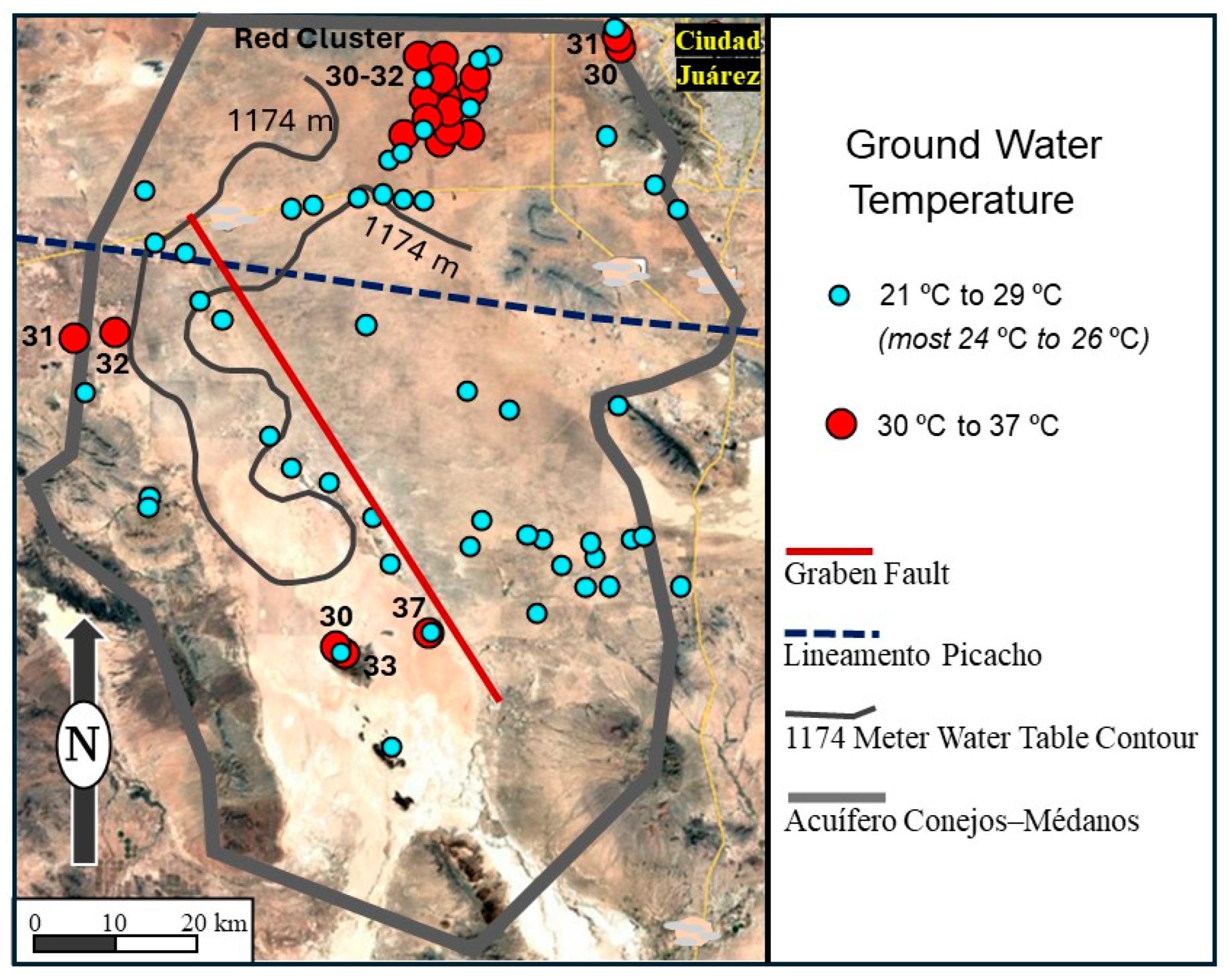
As shown in Figure 13, groundwater temperatures south of the Lineamiento Picacho are generally low in the area wells, with the highest well density. Most measured temperatures are below 29 °C, with most values between approximately 23 and 26 °C. These temperatures are consistent with shallow groundwater systems and short groundwater flow paths characteristic of local flow systems (Figure 13). It is likely that these low-temperature, low-salinity groundwater bodies derive from groundwater in the Santa Fe Formation sands that thin laterally to the south and rest upon older lake deposits.
The likely source of this modern recharge is the flanking areas of the Los Médanos region, where infiltration from surficial deposits and basin-margin processes can supply cooler groundwater to the basin interior. These temperature patterns are consistent with the postulated groundwater divide mapped within the Acuífero Conejos–Médanos area (CONAGUA administrative unit), which would tend to limit the northward movement of cooler recharge waters and help maintain distinct thermal regimes across the basin. Such conditions are consistent with local groundwater flow systems that are strongly influenced by lithology, structure, and topography.
A few groundwater temperatures exceeding 30 °C south of the Lineamiento Picacho are spatially associated with wells located near faults and along the margins of adjacent mountain ranges. Similarly, groundwater samples near the U.S.–Mexico border in the upper portions of Figure 11 and Figure 13, largely within the El Parabien Basin, exhibit moderately elevated temperatures (30–32 °C) and relatively low specific conductance values (<2000 µS/cm, approximately 1250 mg/L TDS). This pattern reflects relatively low mineral solubility in the bedrock and basin-fill sediments. The occurrence of elevated groundwater temperatures in combination with low dissolved-solids concentrations along the El Parabien–Mesilla Bolson area is consistent with interaction between shallow, dilute groundwater and small volumes of warmer groundwater ascending along structural pathways or within localized flow cells [54]. In these settings, groundwater likely circulates vertically along faults, moving downward and then returning upward without long residence times, in contrast to regional groundwater flow systems that are typically associated with more chemically evolved, higher-TDS groundwater.
Additional hydrochemical analyses, including geothermometry using silica, major cations, and trace elements, along with environmental isotopes, would help further evaluate the origin of this groundwater and geothermal signature [54,55]. Overall, the groundwater temperature and chemistry data indicate that local flow systems dominate across much of the study area, with only minor contributions from deeper thermal sources where structural conditions permit.
Groundwater temperature data are interpreted in this study as supporting evidence only and are not considered an independent line of evidence for defining the southern aquifer boundary. These data provide supplementary information on relative flow conditions, as temperatures in the range of 23 to 26 °C are generally indicative of shallow, local flow systems that are not far removed from recharge sources.

5.7. Delineation of the Groundwater Divide: Criteria and Weight-of-Evidence Approach

Mapping the groundwater divide is based on a structured, multi-line-of-evidence evaluation rather than a purely qualitative interpretation. Its position reflects the integration of independent datasets that collectively define groundwater flow behavior. The delineation is based on hydraulic, hydrochemical, structural, lithologic, and geothermometry indicators evaluated for consistency with a regional groundwater divide (Table 1).
Primary Evidence: Hydraulic Head, Depth to Groundwater, and Hydrochemistry: Hydraulic head and depth-to-groundwater data from the CONAGUA dataset [8,49], supplemented by U.S. Geological Survey interpolated surfaces, provide the primary basis for delineation. These data identify a broad, low-gradient groundwater trough where flow directions are weakly defined and diverge. Depth-to-groundwater patterns indicate shallow conditions and active discharge in the Bolsón de los Muertos and increasing depths northward, consistent with internally drained conditions rather than through-flow. Hydrochemical data support this interpretation by indicating evaporative concentration in the southern basin and the absence of systematic dilution along a northward flow path, consistent with separation of flow systems.
Secondary Evidence: Structural Controls: Faults and lineaments mapped by Reeves [38] and later compilations coincide with the hydraulic trough and may influence groundwater movement by contributing to compartmentalization. These features provide supporting, but not definitive, control on the position of the divide.
Tertiary Evidence: Lithology and Groundwater Temperature: Lithologic data indicate thickening fine-grained deposits toward the Bolsón de los Muertos, restricting deep flow and supporting internally drained conditions. Groundwater temperature data are limited but consistent with the overall interpretation of primarily local scale flow and are considered supplementary.
The groundwater divide is located where these independent lines of evidence converge. Hydraulic head, depth-to-groundwater, and hydrochemical data provide the primary constraints, while structural, lithologic, and thermal data support the interpretation. This weight-of-evidence approach demonstrates that the divide represents a consistent hydrogeologic delineation rather than a qualitative inference.

6. Discussion

6.1. New Delineation of Transboundary Aquifer Based on Synthesis of Data

Integration of hydraulic, structural, hydrochemical, and groundwater temperature datasets indicates that a regional groundwater divide within the Acuífero Conejos–Médanos region provides the most consistent conceptual model for groundwater flow and basin connectivity. Hydraulic head and depth-to-groundwater data from CONAGUA [8] mapping, supplemented by a U.S. Geological Survey kriged groundwater elevation surface, show extremely low hydraulic gradients across a 1174 m groundwater trough in the western portion of the Acuífero Conejos–Médanos area and do not define a continuous northward or southward through-flow pathway (Figure 9). Instead, these datasets support the separation of the broad water table trough into gentle hydraulic gradients on either side of an inferred groundwater divide (Figure 9 and Figure 12).
Hydraulic head configuration and depth-to-groundwater patterns provide a primary basis for delineating the groundwater divide shown in Figure 14, as they are solid evidence to constrain flow directions and identify zones of minimal hydraulic gradient. Hydrochemical patterns are equally important, as the pronounced north–south decrease in salinity cannot be explained by simple dilution along a continuous flow path without requiring large volumes of recharge that are not supported by available evidence, including tritium-based studies that show no tritium in wells north of the interpreted groundwater divide [37]. Structural features and hydrostratigraphic interpretations serve as supporting lines of evidence that corroborate, but do not independently control, the position of the boundary.
Depth-to-groundwater patterns show shallow, evaporative conditions in the Bolsón de los Muertos near El Barreal and increasing depth northward, inconsistent with sustained northward flow to the El Parabien Basin (Figure 6 and Figure 12). Structural features may contribute to compartmentalization [56] but are secondary to groundwater-level and hydrochemical evidence [7,8,27,49]. Hydrostratigraphy further limits flow, with clay-rich deposits near El Barreal restricting deep groundwater movement (Figure 10). Hydrochemical data support this interpretation: saline groundwater in the Bolsón contrasts with dilute water in the El Parabien Basin and Mesilla Bolson Aquifer (Figure 11 and Figure 12). The lack of evidence for dilution along a northward path indicates separate flow systems divided by a groundwater divide.
The cluster of samples in the northern part of the basin within the El Parabien Basin and Mesilla Bolson Aquifer, where groundwater development is locally extensive, and characterized by elevated temperatures and relatively low salinity, introduces some uncertainty regarding groundwater origin and flow processes (Figure 11 and Figure 13). These data may reflect localized upward movement of deeper groundwater or mixing with geothermal fluids potentially influenced by pumping; however, all plausible interpretations remain consistent with a lack of sustained south-to-north through-flow across the basin and therefore do not alter the overall weight-of-evidence supporting the revised delineation. The combined information provided by groundwater-level configuration, depth-to-groundwater patterns, structural relations, and groundwater chemistry and temperature distribution is most consistently explained by a conceptual model in which groundwater south of the mapped divide discharges internally within the Bolsón de los Muertos, whereas groundwater north of the divide follows low-gradient flow paths toward the El Parabien Basin (Figure 9 and Figure 12).
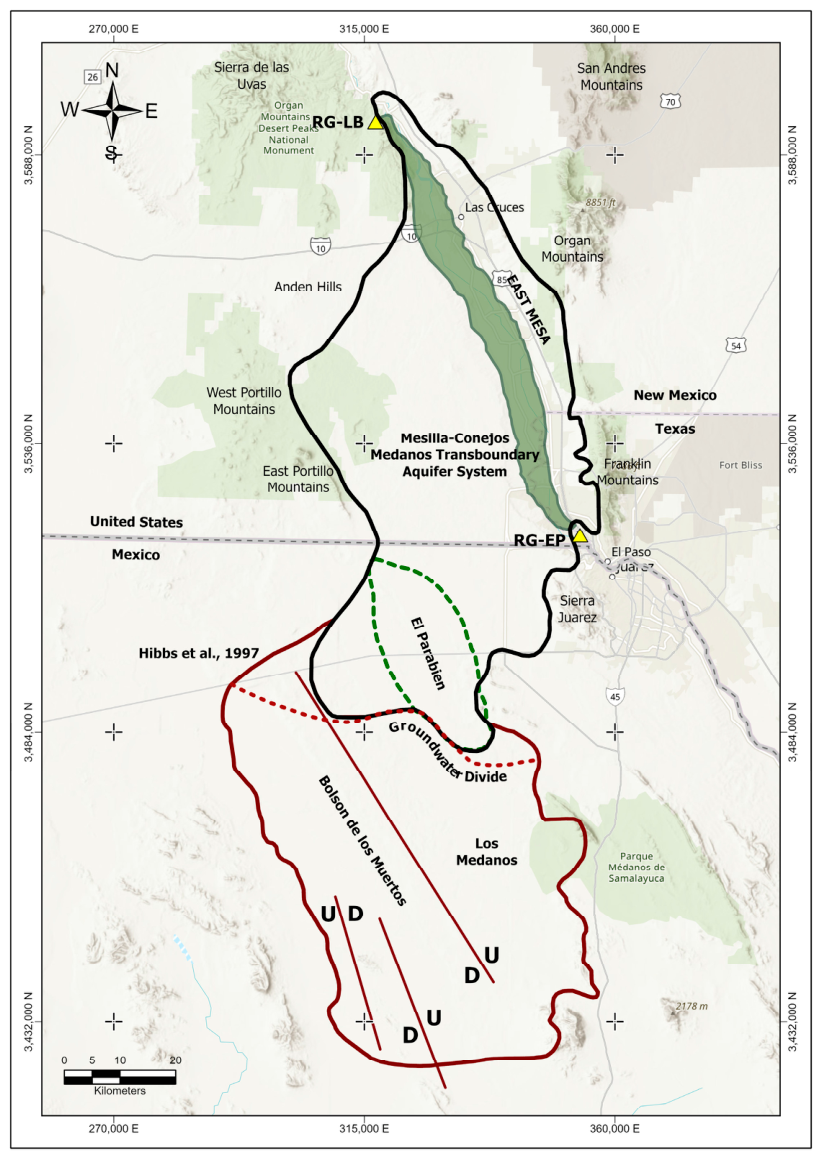
The inferred groundwater divide is adopted as the southern limit of the transboundary extension that defines the Mesilla/Conejos–Médanos Transboundary Aquifer (Figure 14). The western and eastern boundaries follow structural features mapped on the U.S. side of the transboundary aquifer, while the northern delineation connects with the long-established U.S. delineation of the Mesilla Bolson Aquifer. The major basin-bounding fault of the Bolsón de los Muertos, mapped by Reeves [38], provides an additional western closure to the new delineation. This delineation is somewhat larger than that proposed by Sweetkind [23] and encompasses both the El Parabien and Mesilla Bolson extensions described by Hawley et al. [15,16]. Groundwater within the Mexican portion, therefore, constitutes a single, contiguous hydrogeologic system that meets the United Nations definition of a transboundary aquifer. We recommend formal adoption of this new delineation of the Mesilla/Conejos–Médanos Transboundary Aquifer, covering both sides of the U.S.–Mexico border.

6.2. Nuances to the Interpretation: Assumptions Regarding Groundwater Flow

The mapped groundwater divide could migrate south if pumping in the El Parabien Basin or Mesilla Bolson Aquifer expands into the Los Médanos region. Available groundwater-level data show that pumping effects are largely confined to the El Parabien Basin and the Mesilla Bolson Aquifer [15,16] and do not extend southward into the Bolsón de los Muertos or across the mapped divide (Figure S4, Supplementary Materials).
Interpretation is limited by limited hydrogeologic data with depth in Mexico; most hydraulic head measurements are shallow except in deeper municipal wells. The analysis, therefore, emphasizes lateral flow. Basin-fill sands are commonly underlain or laterally bounded by low-permeability lacustrine and playa deposits [15,16] (Figure S3, Supplementary Materials), which restrict vertical hydraulic connectivity. Vertical gradients and fully three-dimensional flow cannot be evaluated rigorously; boundaries and flow directions are interpreted using structure, hydrostratigraphy, hydrochemistry, and geothermal indicators, with local vertical flow possible along faults or where groundwater temperatures are elevated. Accordingly, the delineation shown in Figure 14 should be interpreted as an approximate boundary zone rather than a precisely defined line. Spatial uncertainty is greatest in areas with limited well control, particularly near El Barreal and adjacent portions of the Bolsón de los Muertos, where data gaps require greater reliance on indirect indicators and conceptual interpretation. The groundwater divide is also susceptible to migration in response to extensive groundwater development.
Two-dimensional potentiometric surfaces in arid basins may obscure deeper regional flow paths (>1 km depth) [5,48,57]. Integrating hydrochemistry, groundwater temperature, and structure provides additional constraints. Hydraulic continuity across the international boundary is supported only within the Mesilla/Conejos–Médanos Transboundary Aquifer delineated here, north of the mapped groundwater divide (Figure 14). Interbasin flow can occur where transmissive deep zones exist [47,57,58,59], but no evidence supports interbasin flow south of the delineated aquifer (Figure 14). Pumping may induce movement through bedrock (Supplementary Materials, Figure S4) and is causing drawdown in the Mexican Mesilla Bolson and El Parabien Basin. No evidence indicates pumping-induced interbasin flow south of the newly defined transboundary aquifer. The Supplementary Materials contain correspondence documenting historical binational characterization efforts (1994–1998) and associated milestones (Figures S5–S9).
Uncertainty about the southern delineation has heightened concerns about cross-border impacts from mining, groundwater development, and contaminant transport in northern Chihuahua [60]. Assuming connectivity without hydrogeologic support can misdirect attention away from basin-specific conditions. Delineation errors can also complicate permitting and binational discussions by implying impacts where no demonstrable connection exists, while underestimating transboundary extent can reduce monitoring and data exchange. Distinguishing hydrogeologic aquifers from administrative management units is therefore necessary; recommendations are provided in the Supplementary Materials.

6.3. Implications for Transboundary Groundwater Management and Recommendations for Transboundary Aquifer Delineation in the Americas

Uncertainty in the southern delineation of the Mesilla/Conejos–Médanos Transboundary Aquifer has contributed to public and political concern regarding potential cross-border groundwater impacts, particularly with respect to mining activities, groundwater development, and contaminant transport in northern Chihuahua [60]. Where hydraulic connectivity between adjacent basins is assumed without supporting hydrogeologic evidence, concerns regarding transboundary impacts may be overstated or misdirected. In such cases, attention may be focused on groundwater interactions that are not physically supported, while basin-specific conditions and locally relevant management issues receive less consideration. Clear delineation of aquifer boundaries based on defensible hydrogeologic criteria is therefore important for accurate interpretation of groundwater conditions and for effective communication in a binational setting.
In a broader sense, mischaracterization of aquifer boundaries can affect groundwater management and regulatory processes. Treating hydraulically distinct basins as a single transboundary system may lead to the assumption that groundwater withdrawals, land-use changes, or industrial activities in one basin influence groundwater conditions across the international boundary, even when no demonstrable hydraulic connection exists. Such assumptions can complicate environmental review, permitting, and planning efforts and may introduce uncertainty into binational discussions. Conversely, incomplete identification of the transboundary extent of an aquifer may result in limited monitoring coverage, reduced data exchange, or missed opportunities for cooperative management in areas where cross-border groundwater interactions are present. Distinguishing between hydrogeologically defined aquifers and administratively defined groundwater management units is therefore necessary. Conflation of administrative units with transboundary aquifers can obscure groundwater flow paths, discharge areas, and the spatial extent of potential cross-border effects. Recognition of hydrogeologic boundaries allows binational coordination efforts to focus on those portions of the groundwater system where shared resources or impacts are most likely to occur.
The recommendations summarized in Table 2 are based on lessons learned from this delineation and are intended to inform future transboundary aquifer studies. These recommendations are particularly relevant to basin-fill aquifers along the U.S.–Mexico border and elsewhere but are broadly applicable to transboundary aquifers in general. While these steps represent an ideal framework, data limitations in some settings may necessitate omitting certain steps outlined in the table.

7. Conclusions

A widely used southern delineation of the Mesilla Bolson Aquifer originated as a provisional mid-1990s sketch prepared to meet a U.S. Environmental Protection Agency contract milestone and was not based on robust, basin-scale hydrogeologic analysis. Reuse in reports, maps, models, and public graphics institutionalized the line as a transboundary aquifer delineation west of El Paso–Ciudad Juárez, shaping interpretations of connectivity and management.
Using internationally recognized definitions, including the United Nations framework, this study distinguishes administrative units from hydrogeologically coherent aquifers. The CONAGUA [8] Acuífero Conejos–Médanos is a management unit and was not intended to represent a single hydraulically continuous aquifer; therefore, neither it nor the historic TWDB/NMWRRI outline [1] nor others that resemble it satisfy the definition of a hydraulically connected transboundary system.
A revised delineation integrates basin structure, hydrostratigraphic continuity, permeability contrasts, groundwater divides, and hydrochemical and geothermometry indicators. Evidence indicates the Mesilla Bolson Aquifer extends only a limited distance into northern Chihuahua and is distinct from the El Parabien Basin. Internal discharge and evaporative concentration in the Bolsón de los Muertos, including El Barreal playa, contradict basin-wide south-to-north through-flow, and fine-grained deposits near El Barreal limit deep regional flow. The transboundary aquifer is therefore limited to the southward extension of the Mesilla/Conejos–Médanos Transboundary Aquifer (Figure 14), providing an improved and defensible basis for monitoring, data exchange, and modeling and illustrating the risks of relying on provisional mapping products.

Supplementary Materials

The following supporting information can be downloaded at: https://www.mdpi.com/article/10.3390/w18091103/s1, including an acronym list and reproductions of original aquifer-boundary figures from the 1997 atlas [1] (Hibbs et al., 1997) and the 1998 U.S.–Mexico Binational Report, including the Mexican version that excluded the Mesilla Aquifer. Supporting Information also contains historical correspondence documenting agency participation in the preparation, review, and release of the 1997 atlas and the 1998 binational reports. Supporting information is not peer-reviewed material. Figure S1. Original aquifer boundary interpretations of the TWDB/NMWRRI study, including the informal delineation of what was considered the southern area Mesilla Aquifer that persisted in the literature for nearly three decades (from Hibbs et al., 1997) [1]. Figure S2. Original Mexican version of the binational report showing aquifer delineations but excluding the Mesilla Aquifer (from US-Mexico Binational Report, 1998) [17]. Figure S3. Spatial representation of static groundwater-level change across the study area. Two separate time frames are illustrated: Below the highway southward, trend contours were generated using data collected in 2007 and 2010, showing minimal change of hydraulic head during this period. Closed contours within wellfield in the upper part of the map reflect water-level variations measured during the June to November 2010 period only, showing drawdowns up to 5 meters (from Comisión Internacional de Límites y Aguas, 2011) [7]. Figure S4. Hydrogeologic cross sections across the lower Mesilla Bolson and El Parabién Basin. The tan pattern above the olive-green pattern represents lacustrine deposits, with overlying Santa Fe Formation sediments. These cross sections show that lacustrine deposits occur at depth across large areas of the Conejos–Médanos study area in México (from Hawley et al., 2025) [16]. Figure S5. Letter from the Texas Water Development Board to the U.S. Environmental Protection Agency (5 March 1996) transmitting a quarterly progress report on Transboundary Aquifers in the El Paso–Juárez–Las Cruces Region. The boxed excerpt describes decisions to extend aquifer interpretations across the U.S.–México border and includes the provisional delineation of the Mesilla Bolson aquifer, later formalized by Hibbs et al. (1997) [1]. The document highlights the early recognition of regional, transboundary groundwater continuity and the associated uncertainty arising from limited Mexican data. Figure S6. Letter dated 24 April 1996, from John Ashworth, Texas Water Development Board, to the U.S. Environmental Protection Agency (Region 6), summarizing proposed supplemental data collection for the El Paso–Ciudad Juárez–Las Cruces Transboundary Aquifer Study. The correspondence outlines plans for expanded groundwater sampling, including toxic trace metals and environmental tracers (tritium, carbon-14, and stable isotopes), to improve evaluation of groundwater flow paths, residence times, contamination plume configuration, and aquifer interaction with the Rio Grande. Figure S7. Letter dated 7 January 1997, from John Ashworth, Texas Water Development Board, to the U.S. Environmental Protection Agency (Region 6), outlining plans for a binational release of the report “Transboundary Aquifers of the El Paso/Ciudad Juárez/Las Cruces Region” and proposing expanded cooperation with Mexican agencies. The correspondence references coordination with EPA, TWDB, CILA, and IBWC, and notes funding provisions to support participation by Mexican water agencies in continued transboundary aquifer analysis. Figure S8. Letter dated 28 April 1997, from the U.S. Environmental Protection Agency (Region 6) to Barry Hibbs, Texas Water Development Board, confirming review and acceptance of the report “Transboundary Aquifers and Binational Ground-Water Data Base City of El Paso/Ciudad Juárez Area and Surrounding Region” under Cooperative Agreement X-996343-01. The correspondence states that the document satisfies the terms of the U.S.–Mexico binational agreement and is approved in its submitted format. This is the draft of the US-Mexico Binational Report (1998) [1]. Figure S9. Letter dated 23 October 1997, from the U.S. Environmental Protection Agency (Region 6) to Barry Hibbs, Texas Water Development Board, regarding review of the “Transboundary Aquifers of the El Paso/Ciudad Juárez/Las Cruces Region” report under Cooperative Agreement X-996343-01. The correspondence indicates that the document is acceptable with the addition of the EPA Region 6 technical reviewer in the acknowledgments and disclaimer section. This is the TWDB/NMWRRI Report (Hibbs et al., 1997) [1]. In addition, the delineated GIS shapefiles are provided as Supplemental Material, along with the following metadata description. File Name: Figure 14 Mesilla-Conejos Médanos Transboundary Aquifer. Title: Hydrogeological and Structural Framework of the Mesilla–Conejos Médanos Transboundary Aquifer System. Description: This map provides a high-resolution digital reconstruction of the hydrogeological boundaries and structural features of the Mesilla-Conejos Médanos system. It specifically details the groundwater divide, structural lineaments (faults with U/D displacement indicators), and the spatial extent of the sub-basins. Technical Specifications, Cartography, and GIS Analysis: Luis Alfonso Gándara Ruiz. Software: ArcGIS Pro 3.6.3. Coordinate Reference System (CRS): WGS 84/UTM zone 13N (EPSG: 32613). Date of Creation: April 2026. Data Sources: Hydrogeological & Structural Data: Digitally extracted from Hibbs et al. (1997) [1] and Hawley et al., (2022) [15,16]. This investigation, Figure 14. Administrative Boundaries: INEGI (Mexico) and U.S. Census Bureau (USA). Base Map: World Topographic Map (Esri, USGS). Methodology: The thematic layers were created by georeferencing legacy cartography and subsequently manual vectorization. This process ensures that the study’s structural features align with modern, high-precision topographic and administrative datasets.

Author Contributions

Conceptualization, B.H. and A.G.-O.; methodology, B.H. and A.G.-O.; formal analysis, B.H. and A.G.-O.; investigation, A.G.-O.; resources, B.H.; data curation, B.H.; writing—original draft preparation, B.H. and A.G.-O.; writing—review and editing, B.H. and A.G.-O.; visualization, B.H. and A.G.-O.; project administration, B.H. and A.G.-O.; funding acquisition, B.H. All authors have read and agreed to the published version of the manuscript.

Funding

This material is based upon work supported by the United States Department of Agriculture (USDA), National Institute of Food and Agriculture (NIFA) through the Award No. 2023-68018-40322. Any opinions, findings, conclusions, or recommendations expressed in this material are those of the authors and do not necessarily reflect the view of USDA-NIFA.

Data Availability Statement

All data is contained within the References section reports and data bases. Further inquiries can be directed to the corresponding author.

Acknowledgments

The authors gratefully acknowledge Alfonso Gandara-Ruiz (Department of Geoinformatics, Autonomous University of Ciudad Juárez) for preparing several GIS-based maps and figures used in this study. The authors also gratefully acknowledge John Hawley of the New Mexico Water Resources Institute, New Mexico State University, for initiating discussions on delineation issues in the Mesilla/Conejos–Médanos Transboundary Aquifer. The authors further thank three anonymous reviewers and the academic and handling editors for their constructive comments and reviews.

Conflicts of Interest

The authors declare no conflicts of interest.

References

  1. Hibbs, B.J.; Boghici, R.N.; Hayes, M.E.; Ashworth, J.B.; Hanson, A.T.; Samani, Z.A.; Kennedy, J.F.; Creel, B.J. Transboundary Aquifers of the El Paso–Ciudad Juárez–Las Cruces Region; Texas Water Development Board and New Mexico Water Resources Research Institute, prepared for the U.S. Environmental Protection Agency; Texas Water Development Board: Austin, TX, USA, 1997; 148p.
  2. Secretariat of Agriculture and Hydraulic Resources (SARH). Geohydrologic Study and Exploratory Drilling in the Conejos–Médanos Zone, State of Chihuahua; Secretariat of Agriculture and Hydraulic Resources (SARH): Mexico City, Mexico, 1982.
  3. Técnicas Geológicas y Mineras, S.A. de C.V. Geophysical Study of the Conejos–Médanos Basin to Supply Bulk Water to Ciudad Juárez, Chihuahua; Técnicas Geológicas y Mineras, S.A. de C.V.: Mexico City, Mexico, 1988. [Google Scholar]
  4. General Department of Administration and Control of Hydrological Systems. Geohydrologic Study and Exploratory Drilling in the Conejos–Médanos Zone as an Alternative Source of Drinking Water for Ciudad Juárez, Chihuahua; General Department of Administration and Control of Hydrological Systems: Mexico City, Mexico, 1989.
  5. Mexican Geological Service. Hydrogeological Activities in the Conejos–Médanos Aquifer, State of Chihuahua, Phase I, Vol. II (Appendixes); Mexican Geological Service: Mexico City, Mexico, 2011.
  6. Mexican Geological Service. Hydrogeological Activities in the Conejos–Médanos Aquifer, State of Chihuahua, Phase I, Vol. I; Mexican Geological Service: Mexico City, Mexico, 2011.
  7. Comisión Internacional de Límites y Aguas (CILA); International Boundary and Water Commission (IBWC). Hydrogeological Activities in the Conejos–Médanos/Mesilla Basin Aquifer, Chihuahua: Phase I; CILA/IBWC Publication: El Paso, TX, USA, 2011. [Google Scholar]
  8. Servicio Geológico Mexicano; Coordinación General de Minería; Secretaría de Economía; Gobierno de los Estados Unidos Mexicanos; Comisión Internacional de Límites y Aguas. Actividades hidrogeológicas del acuífero Conejos-Médanos, estado de Chihuahua. I etapa; Secretaría de Economía: Ciudad de México, Mexico, 2010. [Google Scholar]
  9. Comisión Nacional del Agua (CONAGUA). Actualización de la Disponibilidad Media Anual de Agua en el Acuífero Conejos–Médanos (0823), Estado de Chihuahua. Subdirección General Técnica, Gerencia de Aguas Subterráneas, Ciudad de México. 2024. Available online: https://sigagis.conagua.gob.mx/gas1/Edos_Acuiferos_18/chihuahua/DR_0823.pd (accessed on 21 February 2026).
  10. Sánchez, R.; López, V.; Eckstein, G. Identifying and characterizing transboundary aquifers along the Mexico–U.S. border: An initial assessment. J. Hydrol. 2016, 535, 101–119. [Google Scholar] [CrossRef]
  11. UN-Water. Transboundary Waters; UN-Water: Geneva, Switzerland, 2024. [Google Scholar]
  12. Puri, S. Transboundary aquifer resources: International water law and hydrogeological uncertainty. Water Int. 2003, 28, 276–279. [Google Scholar] [CrossRef]
  13. Burchi, S. Legal frameworks for the governance of international transboundary aquifers: Pre- and post-ISARM experience. J. Hydrol. Reg. Stud. 2018, 20, 15–20. [Google Scholar] [CrossRef]
  14. Frenzel, P.F.; Kaehler, C.A. Geohydrology and Simulation of Ground-Water Flow in the Mesilla Basin, Doña Ana County, New Mexico and El Paso County, Texas; with a section on water quality and geochemistry by S.K. Anderholm; U.S. Geological Survey Professional Paper 1407; United States Government Printing Office: Washington, DC, USA, 1992; pp. C1–C105. [CrossRef]
  15. Hawley, J.W.; Swanson, B.H.; Klett, C.T.O. Conservation of shared groundwater resources in the binational Mesilla Basin–El Paso del Norte region: A hydrogeological perspective. In Los Recursos Hidrologicos en Cuencas Transfronterizas Entre México; UACJ-UACH: Ciudad Juárez, Mexico, 2022; Chapter V. [Google Scholar]
  16. Hawley, J.W.; Swanson, B.H.; Walker, J.S.; Glaze, S.H.; Klett, C.T.O. Hydrogeologic Framework of the Mesilla Basin Region of New Mexico, Texas, and Chihuahua (Mexico): Advances in Conceptual and Digital-Model Development; Technical Report 363; Water Resources Research Institute: Las Cruces, NM, USA, 2025. Available online: https://nmwrri.nmsu.edu/publications/technical-reports/tr-reports/tr-363.html (accessed on 5 April 2026).
  17. US–Mexico Binational Report. Transboundary Aquifers and Binational Ground-Water Data Base, City of El Paso/Ciudad Juárez area; Base de Datos Binacional del Acuifero Transfronterizo de Cd. Juárez, Chih./El Paso, Tex. First Binational Aquifer Report and Database Officially Sanctioned by the Governments of the United States and Mexico; Participating agencies: International Boundary and Water Commission, U.S. Environmental Protection Agency, Texas Water Development Board, New Mexico Water Resources Research Institute, Comisión Internacional de Límites y Aguas, Comisión Nacional del Agua, Junta Municipal de Agua y Saneamiento de Ciudad Juárez; International Boundary and Water Commission: El Paso, TX, USA, 1998; 22p. [Google Scholar]
  18. CONAGUA. ACUERDO por el que se da a Conocer el Resultado de los Estudios Técnicos de Aguas Nacionales Sub-Terráneas del Acuífero Conejos-Médanos, Clave 0823, en el Estado de Chihuahua, Región Hidrológico-Administrativa Río Bravo; CONAGUA: Mexico City, Mexico, 1952.
  19. De la O Carreño, A. Water Supply Wells of Juárez, Chihuahua, a Hydrology Study; Ministry of Hydraulic Resources: Mexico City, Mexico, 1957; 23p.
  20. De la O Carreño, A. Preliminary Geohydrological Study of the Juárez Valley and Surrounding Areas; Ministry of Hydraulic Resources: Mexico City, Mexico, 1957; 101p.
  21. De la O Carreño, A. Investigation of Subsurface Geohydrologic Conditions at Juárez, Chihuahua; Applying Electrical Geophysics: Mexico City, Mexico, 1958; 55p. [Google Scholar]
  22. CIEPS. Study of the Technical, Economic, Social, and Financial Feasibility of the Rehabilitation of the Irrigation District, Juárez Valley, Chihuahua (Mexico); CIEPS: Mexico City, Mexico, 1970. [Google Scholar]
  23. Sweetkind, D.S. Three-Dimensional Hydrogeologic Framework Model of the Rio Grande Transboundary Region of New Mexico and Texas, USA, and Northern Chihuahua, Mexico; Scientific Investigations Report 2017-5060; U.S. Geological Survey: Reston, VA, USA, 2017. [CrossRef]
  24. Teeple, A.P. Geophysics- and Geochemistry-Based Assessment of the Geochemical Characteristics and Groundwater-Flow System of the U.S. Part of the Mesilla Basin/Conejos–Médanos Aquifer System; U.S. Geological Survey Scientific Investigations Report 2017–5028; U.S. Geological Survey: Reston, VA, USA, 2017.
  25. Sheng, Z.; Darr, M.; King, J.P.; Bumgarner, J.; Michelsen, A. Mesilla Basin/Conejos–Médanos Section of the Transboundary Aquifer Assessment Program: In Five-Year Interim Report of the United States–Mexico Transboundary Aquifer Assessment Program, 2007–2012; U.S. Geological Survey: Reston, VA, USA, 2012.
  26. Sheng, Z. Impacts of groundwater pumping and climate variability on groundwater availability in the Rio Grande Basin. Ecosphere 2013, 4, 1–25. [Google Scholar] [CrossRef]
  27. Robertson, A.J.; Matherne, A.M.; Pepin, J.D.; Ritchie, A.B.; Sweetkind, D.S.; Teeple, A.P.; Granados-Olivas, A.; García-Vásquez, A.C.; Carroll, K.C.; Fuchs, E.H.; et al. Mesilla/Conejos-Médanos Basin: U.S.-Mexico Transboundary Water Resources. Water 2022, 14, 134. [Google Scholar] [CrossRef]
  28. Pepin, J.D.; Robertson, A.J.; Kelley, S.A. Salinity contributions from geothermal waters to the rio grande and shallow aquifer system in the transboundary mesilla (United States)/Conejos-Médanos (Mexico) Basin. Water 2022, 14, 33. [Google Scholar] [CrossRef]
  29. Pepin, J.D.; Robertson, A.J. Estimated Groundwater Elevations and Standard Errors from the Application of Kriging to Median Groundwater Elevation Data from 2010 in the Mesilla/Conejos-Médanos Basin, United States and Mexico; U.S. Geological Survey: Reston, VA, USA, 2021.
  30. McHugh, R. Cross-Border Management Tool Could Set Trend: Paso del Norte Water Task Force Fills Void; International Relations Center: Washington, DC, USA, 2005. [Google Scholar]
  31. El Paso Water. Our Aquifers; El Paso Water Utilities Public Service Board: El Paso, TX, USA. Available online: https://epwater.org/our-water/water-resources/our-aquifers (accessed on 18 January 2026).
  32. Campana, M.E.; Neir, A.M.; Klise, G.T. Dynamics of Transboundary Groundwater Management: Lessons from North America. Water Resources Program; Publication No. WRP-16; University of New Mexico, and Universities Partnership for Transboundary Waters: Albuquerque, NM, USA, 2006.
  33. Callegary, J.B.; Megdal, S.B.; Villaseñor, E.T.; Petersen-Perlman, J.D.; Sosa, I.M.; Monreal, R.; Gray, F.; Noriega, F.G. Findings and lessons learned from the assessment of the Mexico-United States transboundary San Pedro and Santa Cruz aquifers: The utility of social science in applied hydrologic research. J. Hydrol. Reg. Stud. 2018, 20, 60–73. [Google Scholar] [CrossRef]
  34. Alley, W.M. (Ed.) Five-Year Interim Report of the United States–Mexico Transboundary Aquifer Assessment Program: 2007–2012; U.S. Geological Survey Open-File Report 2013–1059; U.S. Geological Survey: Reston, VA, USA, 2013.
  35. Sanchez, R.; Rodriguez, L.; Tortajada, C. Transboundary aquifers between Chihuahua, Coahuila, Nuevo Leon and Tamaulipas, Mexico, and Texas, USA: Identification and categorization. J. Hydrol. Reg. Stud. 2018, 20, 74–102. [Google Scholar] [CrossRef]
  36. Houston, N.A.; Thomas, J.V.; Foster, L.K.; Pedraza, D.E.; Welborn, T.L. Hydrogeologic Framework and Groundwater Characterization in Selected Alluvial Basins in the Upper Rio Grande Basin, Colorado, New Mexico, and Texas, United States, and Chihuahua, Mexico, 1980–2015; U.S. Geological Survey Scientific Investigations Report 2021–5035; U.S. Geological Survey: Reston, VA, USA, 2021; 71p. [CrossRef]
  37. Garcia-Vasquez, A.C.; Granados-Olivas, A.; Samani, Z.; Fernald, A. Investigation of the Origin of Hueco Bolson and Mesilla Basin Aquifers (US and Mexico) with Isotopic Data Analysis. Water 2022, 14, 526. [Google Scholar] [CrossRef]
  38. Reeves, C.C., Jr. Pluvial Lake Palomas, Northwestern Chihuahua, Mexico, and Pleistocene Geologic History of South-Central New Mexico. In New Mexico Geological Society 16th Annual Fall Field Conference Guidebook; Fitzsimmons, J.P., Balk, C.L., Eds.; New Mexico Geological Society: Socorro, NM, USA, 1965; pp. 199–203. [Google Scholar] [CrossRef]
  39. United Nations General Assembly. The Law of Transboundary Aquifers: Resolution/Adopted by the General Assembly; A/RES/63/124; United Nations General Assembly: New York, NY, USA, 2009. [Google Scholar]
  40. UNESCO-IHP; UNEP. Transboundary Aquifers and Groundwater Systems of Small Island Developing States: Status and Trends-Transboundary Waters Assessment Programme Volume 1; UNESCO-IHP: Paris, France; UNEP: Nairobi, Kenya, 2016. [Google Scholar]
  41. Jiménez, A.J.; Keller, G.R. Rift basin structure in the border region of northwestern Chihuahua. New Mex. Geol. Soc. Guideb. 2000, 51, 79–83. [Google Scholar]
  42. Cabaniss, G.H. Geophysical studies of playa basins. In Geology, Mineralogy, and Hydrology of U.S. Playas, Chapter 5; Neal, J.T., Ed.; Air Force Cambridge Research Laboratory Environmental Research Paper No. 96; Cambridge Research Lab: Bedford, MA, USA, 1965; pp. 123–147. [Google Scholar]
  43. Badgley, P.C. Structural and Tectonic Principles; Harper & Row: New York, NY, USA, 1965; 521p. [Google Scholar]
  44. King, W.E.; Hawley, J.W.; Taylor, A.M.; Wilson, R.P. Geology and Ground-Water Resources of Central and Western Doña Ana County, New Mexico; New Mexico Bureau of Mines and Mineral Resources Hydrologic Report 1; New Mexico Bureau of Mines and Mineral Resources: Socorro, NM, USA, 1971; 64p.
  45. Kernodle, J.M. Summary of U.S. Geological Survey Ground-Water Flow Models of Basin-Fill Aquifers in the Southwestern Alluvial Basins Region, Colorado, New Mexico, and Texas; Open-File Report 90-361; U.S. Geological Survey: Reston, VA, USA, 1992; 89p.
  46. Mullican, W.F., III; Senger, R.K. Hydrogeologic Investigations of Deep Groundwater Flow in the Chihuahuan Desert, Texas; Bureau of Economic Geology, The University of Texas at Austin, Report of Investigations No. 205; Bureau of Economic Geology, The University of Texas at Austin: Austin, TX, USA, 1992; 68p. [Google Scholar]
  47. Hibbs, B.J.; Darling, B.K. Revisiting a classification scheme for U.S.–Mexico alluvial basin-fill aquifers. Ground Water 2005, 43, 750–763. [Google Scholar] [CrossRef] [PubMed]
  48. Darling, B.K.; Hibbs, B.J.; Dutton, A.R. Ground-Water Hydrology and Hydrochemistry of Eagle Flat and Surrounding Area; Prepared for the Texas Low-Level Radioactive Waste Disposal Authority under Interagency Contract No. 92-93-0910; Bureau of Economic Geology, The University of Texas at Austin: Austin, TX, USA, 1994. [Google Scholar]
  49. CONAGUA. Actualización de la Disponibilidad Media Anual de Agua en el Acuífero Conejos–Médanos (0823), Estado de Chihuahua; CONAGUA: Mexico City, Mexico, 2015.
  50. Frenzel, P.F.; Kaehler, C.A. Geohydrology and Simulation of Ground-Water Flow in the Mesilla Basin, Doña Ana County, New Mexico and El Paso County, Texas; with a section on water quality and geochemistry by S.K. Anderholm; U.S. Geological Survey Open-File Report 88–305; US Government Printing Office: Washington, DC, USA, 1990; 179p.
  51. Junta Municipal de Agua y Saneamiento; Dirección de Saneamiento; Departamento de Geohidrología. Sección litológica A–A′ (Figura III.3); JMAS: Ciudad Juárez, Chihuahua, Mexico, 1999.
  52. PEMEX (Petróleos Mexicanos). Unpublished File for the Moyotes-1 Exploratory Well, Municipality of Ciudad Juárez, Chihuahua, Mexico; PEMEX (Petróleos Mexicanos): Mexico City, Mexico, 1972. [Google Scholar]
  53. INEGI (Instituto Nacional de Estadística y Geografía). Carta Geológica, Escala 1:250,000: Ciudad Juárez, Hoja H13-1; INEGI: Mexico City, Mexico, 1983.
  54. Pepin, J.; Person, M.; Phillips, F.; Kelley, S.; Timmons, S.; Owens, L.; Witcher, J.; Gable, C. Deep Fluid Circulation within Crystalline Basement Rocks and the Role of Hydrologic Windows in the Formation of the Truth or Consequences, New Mexico Low-Temperature Geothermal System. Geofluids 2015, 15, 139–160. [Google Scholar] [CrossRef]
  55. Henry, C.D.; Gluck, J.K. A Preliminary Assessment of the Geologic Setting, Hydrology, and Geochemistry of the Hueco Tanks Geothermal Area, Texas and New Mexico; Bureau of Economic Geology, Geological Circular 81-1, 48’; University of Texas at Austin, Bureau of Economic Geology: Austin, TX, USA, 1981. [Google Scholar] [CrossRef][Green Version]
  56. Servicio Geológico Mexicano. Digital Geological Map of Mexico at 1:250,000 Scale: Structural Features (Faults) Vector Dataset (Shapefile); Servicio Geológico Mexicano: Pachuca, Mexico, 2020.
  57. Winograd, I.J.; Thordarson, W. Hydrogeologic and Hydrochemical Framework, South-Central Great Basin, Nevada–California, with Special Reference to the Nevada Test Site; U.S. Geologicl Survey Professional Paper 712–C; U.S. Geological Survey: Reston, VA, USA, 1975; 126p.
  58. Maxey, G.B. Hydrogeology of Desert Basins. Ground Eater 1968, 6, 10–22. [Google Scholar] [CrossRef]
  59. Mifflin, M.D. Region 5, Great Basin. In Hydrogeology; Back, W., Rosenshein, J.S., Seaber, P.R., Eds.; Geological Society of America: Boulder, CO, USA, 1988; 524p. [Google Scholar]
  60. Gamboa, D. Mina la Gloria Verdad o Mentira?—Parte 2. Opinión (Plumas). 2019. Available online: https://www.adiario.mx/plumas/mina-la-gloria-verdad-o-mentira-parte-2/ (accessed on 20 March 2026).
Figure 1. Aquifer area interpretations show the informal delineation of the Mesilla/Conejos–Médanos Aquifer that persisted in the literature for nearly three decades. Hibbs et al. [1] referred to the area shown in pink as the Mesilla Bolson Aquifer, consistent with earlier terminology used in the United States for variable areal mapping of the aquifer. Sometime after 2000, the Mesilla Bolson Aquifer area defined by Hibbs et al. [1] began to be referred to as the Mesilla/Conejos–Médanos Aquifer, with continued widespread use of the original delineation by Hibbs et al. [1]. Other aquifer limits in the United States and Mexico were later defined, including the polygon delineation by CONAGUA, which designates the entire area in Mexico as the Acuífero Conejos–Médanos (modified from Hibbs et al. [1]; the original plate is shown in Figure S1 of the Supporting Information).
Water 18 01103 g001
Figure 5. Hydrogeologic features encompassed within the Mexican administrative aquifer delineation of Acuífero Conejos–Médanos [8]. The delineation includes multiple distinct structural basins rather than a single hydraulically continuous aquifer. From north to south, these include: the Mesilla Bolson Aquifer, a Rio Grande rift basin whose southern extent remains uncertain; the El Parabien Basin [15], a deeply buried subbasin separated from the Mesilla Bolson by the Potrillo–Sapello High; the Bolsón de los Muertos, a closed structural basin containing the internally drained El Barreal playa; and the Los Médanos sand dune field, where surficial dune cover obscures underlying fault-controlled basin geometry. The figure highlights that the administrative delineation of CONAGUA aggregates hydrogeologically compartmentalized basins with differing structures and different groundwater subareas. Faults in the left figure extracted from Reeves [38] and faults on the right figure extracted from Comisión Internacional de Límites y Aguas [7]. Fault displacements are noted by up (U) and down (D) segments of fault blocks.
Water 18 01103 g005
Figure 6. Depth to groundwater (meters) in the Acuífero Conejos–Médanos administrative aquifer based on CONAGUA 2010 data [7]. Extremely shallow groundwater occurs in the Bolsón de los Muertos, particularly around El Barreal, where depths of less than 5 m indicate phreatic conditions and active groundwater discharge by evaporation. Depth to groundwater increases systematically northward toward El Parabien Basin and Mesilla Bolson, exceeding 60 to 100 m in places, reflecting reduced discharge and greater separation between the land surface and the regional water table. This pronounced south-to-north gradient in depth to groundwater is consistent with internally drained basin conditions in the Bolsón de los Muertos and does not support a single, south-to-north through-flowing transboundary aquifer. The 5 m depth-to-groundwater contour and partial 10 m depth-to-groundwater contour (dashed) were integrated from a 2007 CONAGUA map (source of contours: [7], and coordinating Federal Agencies of Mexico).
Water 18 01103 g006
Figure 7. Water-table elevation (meters above mean sea level) in the administrative Acuífero Conejos–Médanos based on CONAGUA 2010 data [7]. Contours show a broad, low-gradient trough across the Bolsón de los Muertos and El Barreal, where groundwater elevations are lowest and internal discharge dominates. Hydraulic gradients steepen toward the basin margins and toward the El Parabien Basin and Mesilla Bolson to the north, but the overall configuration does not define a consistent south-to-north through-flow pathway. Instead, the pattern is consistent with internally drained basin conditions and supports the interpretation of hydrogeologic compartmentalization rather than a single, hydraulically continuous transboundary aquifer (source of contours: CILA [7] and coordinating Federal Agencies of Mexico).
Water 18 01103 g007
Figure 8. Interpolated water-table elevation surface (meters above mean sea level) and inferred groundwater-flow directions in the TWDB/NMWRRI map region, based on kriging of CONAGUA 2010 groundwater-level data compiled by the U.S. Geological Survey [27]. This is the color shaded water table contour map of [27], modified with metric contour labels and text labels. The surface reveals a broad, low-gradient groundwater trough extending across the western portion of the basin, within which hydraulic gradients are minimal and flow directions are poorly defined. Groundwater flow arrows indicate potential local flow components but do not demonstrate a continuous south-to-north through-flow system. Instead, the configuration is consistent with hydraulic compartmentalization and supports the interpretation of a groundwater divide separating internally drained flow systems from the northerly extension of the transboundary field mapped in the diagram.
Water 18 01103 g008
Figure 9. Comparison of groundwater flow interpretations and inferred groundwater divides in the Acuífero Conejos–Médanos region based on 2010 water-table elevation data from CONAGUA [7] and the U.S. Geological Survey kriging surface [27]. Both interpretations indicate a broad, low-gradient groundwater trough across the Bolsón de los Muertos, within which flow directions are weakly defined and sensitive to local hydraulic stresses. The dashed line represents an interpreted regional groundwater divide that separates internally drained flow toward El Barreal from groundwater moving northward toward the El Parabien Basin and Mesilla Bolson Aquifer. Consistency between the two independently developed datasets supports the presence of basin-scale hydraulic compartmentalization rather than a single, south-to-north through-flowing transboundary aquifer (source of contours in right figure: CILA [7], and coordinating Federal Agencies of Mexico).
Water 18 01103 g009
Figure 10. Geologic cross-section A–A′ across the Acuífero Conejos–Médanos region illustrating basin-fill stratigraphy and depositional facies from the Mesilla–El Parabien area southward toward the Bolsón de los Muertos and Laguna El Barreal. Red arrows show relative movement in graben faults. The section shows progressive thickening of fine-grained lacustrine and playa deposits toward El Barreal, where clay and sandy clay units become laterally extensive, forming a regional low-permeability zone. Coarser, sand-dominated units are more continuous toward the El Parabien Basin and Mesilla Bolson Aquifer, where higher-energy depositional environments associated with the ancestral Rio Grande prevailed. This stratigraphic architecture restricts deep regional groundwater flow across the Bolsón de los Muertos and supports hydrogeologic separation between internally drained discharge areas and the transboundary extension of the Mesilla Bolson Aquifer (modified from JMAS [51]).
Water 18 01103 g010
Figure 11. Spatial distribution of groundwater specific conductance (µS) in the Acuífero Conejos–Médanos region based on CONAGUA 2010 data [7]. Elevated specific conductance values, commonly exceeding 8000 µS and locally approaching 20,000 µS, are concentrated around the Bolsón de los Muertos and the El Barreal playa, where shallow groundwater discharge and evaporative concentration dominate. In contrast, lower specific conductance values prevail in the El Parabien Basin and Mesilla Bolson Aquifer, particularly near pumping centers north of the inferred groundwater divide. The sharp spatial contrast in salinity is inconsistent with sustained northward transport of saline groundwater and instead supports hydrogeologic compartmentalization and internal discharge within the southern basin. (Source of specific conductance data: [7], and coordinating Federal Agencies of Mexico). Graben fault is published in Reeves [38].
Water 18 01103 g011
Figure 12. Conceptual groundwater flow interpretations for the Acuífero Conejos–Médanos region based on mapped groundwater divides, water-table configuration, and groundwater salinity patterns. The upper conceptual model illustrates a hypothetical south-to-north through-flow system along the low-gradient 1174 m water-table trough; however, this configuration is inconsistent with the observed groundwater salinity between El Barreal and the El Parabien wellfield. The lower model incorporates an inferred groundwater divide, separating internally drained flow toward the El Barreal phreatic playa from lower-salinity groundwater moving northward toward the El Parabien and Mesilla Bolson pumping centers. The latter interpretation is more consistent with hydraulic, structural, and hydrochemical evidence and supports hydrogeologic compartmentalization rather than basin-wide south-to-north through-flow. Graben fault is published in Reeves [38].
Water 18 01103 g012
Figure 13. Distribution of groundwater temperatures in the Acuífero Conejos–Médanos based on CONAGUA 2010 well data [7]. Most groundwater temperatures range from 23 to 26 °C, indicating shallow circulation and relatively short flow paths typical of local groundwater systems. Elevated temperatures (30 to 37 °C) occur locally near faults and structural features, suggesting limited upward movement of deeper, warmer groundwater rather than basin-wide regional flow. The spatial pattern of temperatures supports the dominance of local flow systems throughout much of the basin and is consistent with hydraulic compartmentalization across the inferred groundwater divide. (Source of temperature data: [7], and coordinating Federal Agencies of Mexico). Graben fault is published in Reeves [38].
Water 18 01103 g013
Figure 14. Revised delineation of the Mesilla/Conejos–Médanos Transboundary Aquifer shown by the thick black line, based on synthesis of basin-scale structure, hydrostratigraphic continuity, permeability contrasts, groundwater divides, and corroborating hydraulic and hydrochemical indicators [1]. The updated delineation restricts the transboundary system to the portion of the transboundary aquifer that extends a moderate distance into northern Chihuahua and remains hydraulically coherent across the international border. Within this revised delineation, groundwater flow is interpreted to occur internally within the defined basin limits, with recharge, flow paths, and discharge constrained by mapped structural and hydraulic boundaries. The delineation distinguishes the hydrogeologic transboundary aquifer from broader administrative polygons and adjacent, hydraulically distinct basins within the CONAGUAS Acuífero Conejos–Médano (modified from [28]). The floodplain of the Rio Grande is represented by the green pattern in the United States and the yellow triangles are stream gauging stations. Graben faults and their relative movements are shown by U (up) and D (down) symbols [28].
Water 18 01103 g014
Table 1. Summary of Data Sources, Applications in this Study, and Relative Importance for Revising the Aquifer Boundary (rank 1 = highest importance; rank 2 = secondary; rank 3 = tertiary importance).
Data SourceReferencesData TypeRole in StudyData RankKey Limitations
CONAGUA, groundwater dataset[7,8,49]Water level maps, depth-to-groundwater mapsPrimary dataset for hydraulic gradients, depth to groundwater, and mapping groundwater dividesTier 1—Highest level Temporal snapshot with 2007 and 2010 data only
CONAGUA, groundwater dataset[7,8,49]Groundwater specific conductancePrimary dataset for groundwater specific conductance, used as proxy for total dissolved solids, helping to evaluate groundwater flow pathsTier 1—
Highest level
Temporal snapshot with 2007 and 2010 data only
CONAGUA, groundwater dataset[7,8,49]Faults and lineamentsRefines structural and hydrogeologic framework and basin compartmentalizationTier 2—
Secondary level
No limitations to note
CONAGUA, groundwater dataset[7,8,49]Groundwater temperatureHelps delineate local versus intermediate and deeper flow systems and groundwater ageTier 3—
Tertiary level
Temporal snapshot with 2007 and 2010 data only
Reeves, journal paper[38]Fault mapping and basin structureDefines structural basin attributes controls and basin compartmentalizationTier 2—
Secondary level
Reconnaissance fault mapping, limited subsurface correlation
Frenzel and Kaehler, USGS report [14,50]Structural, gravity, hydrologic interpretationFoundational Mesilla Bolson delineation; information on basin delineation and basin-fill architectureTier 1—
Highest level
Limited data in Mexico; southern boundary is described as provisional
Hawley and others, NMWRRI reports[15,16]Basin delineation, basin geometry, stratigraphy, lithologyRefines structural and hydrogeologic framework, provides geologic cross-sections and lithologic informationTier 1—
Highest level
No limitations to note
Robertson and others, journal paper [27]Kriged potentiometric surfaceWater-table mapping through kriging helps define new aquifer boundaryTier 1—
Highest level
Interpolation uncertainty in sparse areas
CONAGUA published aquifer administrative boundaries[8,49]Management polygonsBasin delineation setting groundwater management areas as adjacent polygonsTier 2—
Secondary level
Not strictly hydrogeologic; aggregates basins
Junta Municipal de Agua y Saneamiento, hydrogeologic map[51]Hydrogeologic cross-section Hydrogeologic cross-section provides basin-fill lithology and fault location that is used for flow systems analysisTier 3—Tertiary levelControl data at Laguna El Barreal is lacking
Comisión Internacional de Límites y Aguas,
binational
report
[7]Water level maps, groundwater depth, conductivity, faults and lineaments, temperatureCompiles all of the CONAGUA 2010 data in a document in English languageCONAGUA 2010 data and related informationCompiled data has all of the limitations listed for CONAGUA datasets
Table 2. Recommended Approach for Transboundary Aquifer Delineation.
1. Adopt a flow-systems-based approach that integrates multiple datasets for delineation and interpretation; avoid relying on single or limited delineation criterion (e.g., surface divides or administrative polygons).
2. Characterize basin-fill architecture and structural controls, including basin bounding faults, buried structural highs, mapped faults and lineaments, and permeability contrasts, to identify likely compartment boundaries and hydraulic barriers.
3. Develop potentiometric surface maps to identify groundwater divides, flow barriers, and hydraulically connected units, with explicit consideration of uncertainties arising from sparse or shallow control points. Kriging and other statistical methods may assist interpolation but may have severe limitations where data are sparse or strong permeability contrasts exist.
4. Map major ions, hydrochemical facies, and salinity indicators to evaluate mixing processes, test the plausibility of postulated flow mechanisms, and assess consistency with recharge–discharge conceptualizations. Halides and selected minor ions can be especially useful for identifying salinization processes.
5. Analyze groundwater temperature distributions to distinguish shallow from intermediate or deeper flow systems, identify fault-related upwelling or mixing, and better constrain vertical flow components.
6. Incorporate isotopic tracers (stable isotopes and radioisotopes) and other age dating tools as the most reliable tools for groundwater age dating and mixing analysis, explicitly used to complement and cross-check interpretations derived from hydraulic, hydrochemical, thermal, and structural data.
7. Develop integrated conceptual groundwater flow models using all available lines of evidence. Acceptance of any “final” aquifer delineation should require a single coherent conceptual model or a clearly defined set of competing models.
8. Develop numerical groundwater models after conceptual model development to jointly evaluate sensitivity to boundary conditions, permeability structure, recharge and discharge assumptions, and the effects of current and projected pumping stresses.
9. Explicitly acknowledge data limitations, particularly the reliance on shallow hydraulic head data typical of basin-fill aquifers with deep water tables. Interpretations should be treated as potentially two-dimensional artifacts unless supported by deeper head data or independent three-dimensional constraints (e.g., hydrochemistry, isotopes, temperature, stratigraphy, and structure).
10. Recognize unresolved vertical gradients and compartmentalization, which are commonly not captured by shallow or first-encountered groundwater data but may critically influence basin-scale flow interpretations.
11. Apply these methodologies holistically, as they not only improve transboundary aquifer delineation but also enable more robust assessments of aquifer structure, behavior, and cross-border interactions, supporting sound scientific interpretation and cooperative groundwater management.
Disclaimer/Publisher’s Note: The statements, opinions and data contained in all publications are solely those of the individual author(s) and contributor(s) and not of MDPI and/or the editor(s). MDPI and/or the editor(s) disclaim responsibility for any injury to people or property resulting from any ideas, methods, instructions or products referred to in the content.