Article

Seasonal Comparison of Groundwater Irrigation Suitability in the Coastal Zone of Northeastern Laizhou Bay Under the Influence of Seawater Intrusion

1
Key Laboratory of Marine Sedimentology and Environmental Geology, First Institute of Oceanography, Ministry of Natural Resources of the People’s Republic of China, Qingdao 266061, China
2
Observation and Research Station of Seawater Intrusion and Soil Salinization, Laizhou Bay, Ministry of Natural Resources, Qingdao 266061, China
3
School of Eco-Environmental Engineering, Guizhou Minzu University, Guiyang 550025, China
4
Center for Geophysical Survey, China Geological Survey, Langfang 065000, China
5
Marine Science Research Institute of Shandong Province, Qingdao 266104, China
6
Technical Centre for Soil, Agriculture and Rural Ecology and Environment, Ministry of Ecology and Environment, Beijing 100012, China
*
Authors to whom correspondence should be addressed.
Water 2026, 18(9), 1058; https://doi.org/10.3390/w18091058
Submission received: 20 March 2026 / Revised: 26 April 2026 / Accepted: 27 April 2026 / Published: 29 April 2026
(This article belongs to the Special Issue Advanced Research on Marine Geology and Sedimentology, 2nd Edition)

Abstract

Coastal zones are sensitive areas where marine and terrestrial systems interact. Seawater intrusion, a typical coastal geological hazard, poses a serious threat to groundwater resources. This study takes the northeastern coastal zone of Laizhou Bay, a representative area affected by seawater intrusion in China and relying on groundwater for agricultural irrigation, as the research area and integrates hydrochemical analysis, irrigation hazards assessment, and a hybrid-weighted Irrigation Water Quality Index (IRWQI) to reveal seasonal changes in groundwater irrigation suitability. Results show that (1) groundwater hydrochemical facies exhibits a shift from HCO3-Ca type in the rainy season to Cl-Ca·Mg type in the dry season, with TDS and Cl increasing coastward. The Huangshui River estuary displays a striking seasonal reversal: minimally affected during the rainy season, it becomes moderately severely intruded in the dry season, owing to the contrast between the perennial Huangshui River and adjacent ephemeral streams. (2) Salinity hazard (EC, PS) is the most immediate seawater intrusion consequence, with dry-season PS expanding inland and rendering estuarine groundwater unsuitable for irrigation. Although sodium and magnesium hazards remain below critical thresholds, strong Cl–Na+ and Cl–Mg2+ correlations in the dry season signal emerging risks. Bicarbonate hazard declines via conservative mixing with Ca·Mg-rich seawater, masking other hazards. Permeability hazard exhibits moderate seasonal deterioration. (3) Spatially, the IRWQI values are systematically lower during the dry season, with contiguous severe-restriction zones emerging along the Huangshui, Yongwen, and Jiehe River estuaries. These findings indicate that under reduced recharge, seawater intrusion dominates groundwater irrigation quality, triggering a seasonal tipping point. The study provides a scientific basis for adaptive coastal groundwater management.

1. Introduction

Coastal zones are geographical units where oceanic and terrestrial systems connect, interact, and overlap [1], representing one of the most dynamic and vulnerable natural regions on the Earth’s surface [2]. Geological hazards such as seawater intrusion, coastal wetland degradation, and coastal erosion commonly occur in coastal zones [3]. Among these, seawater intrusion is the most prevalent coastal geological hazard, posing a threat to groundwater resources and frequently triggering a series of secondary disasters [4,5].
Seawater intrusion refers to the process and phenomenon where changes in the hydrodynamic conditions of coastal aquifers, driven by natural or anthropogenic factors such as climate change, tsunamis, tides, sea-level rise, drought, and groundwater over-exploitation, disrupt the freshwater-seawater balance, allowing seawater to invade the aquifer [6]. The intrusion of seawater into groundwater aquifers leads to groundwater salinization, which in turn induces secondary hazards. These include soil salinization resulting from the upward migration and accumulation of salts in the capillary fringe under evaporation [7] or the use of salinized groundwater for irrigation. Such irrigation alters the osmotic pressure around crop roots, reducing water uptake and causing wilting, while the accumulation of salts in the soil from irrigation water also contributes to soil salinization [8,9,10]. In some arid and semi-arid coastal regions where agriculture is a primary industry, groundwater serves as a major source for irrigation. Conducting a comprehensive assessment of coastal groundwater irrigation quality facilitates the timely identification of seawater intrusion impacts and provides a basis for the sustainable management of coastal groundwater resources.
Laizhou Bay is the largest coastal bay in Shandong Province, characterized by a dense population and abundant land resources along its coast [11]. Due to human activities, extensive groundwater extraction has occurred in the coastal areas east of Laizhou Bay, leading to severe seawater intrusion. Since its initial discovery in 1976, the extent of seawater intrusion has expanded from isolated points to widespread areas. By the late 1980s and early 1990s, a seawater intrusion zone tens of kilometers wide had formed along the eastern coast of Laizhou Bay [12]. This region has become one of the most typical areas for seawater intrusion in China. Furthermore, the northeastern coastal area of Laizhou Bay also faces the problem of groundwater salinization caused by seawater intrusion. The land use in this area is predominantly agricultural [13], and groundwater is one of the primary sources for agricultural irrigation [14,15]. However, research on groundwater in this region has largely focused on the mechanisms of seawater intrusion and hydrochemical characteristics. Only Zhao [16] conducted a macroscopic correlation analysis between some individual irrigation hazard indices and the degree of seawater intrusion along a transect composed of 34 observation wells west of the Huangshui River, north of Longkou City. A comprehensive assessment of groundwater irrigation suitability under the influence of seawater intrusion in the Longkou City coastal plain area of Shandong Province, along with a comparative study of comprehensive irrigation quality variations between the rainy and dry seasons, has yet to be undertaken.
The suitability of groundwater for agricultural irrigation is fundamentally governed by the concentration and relative proportions of its dissolved ionic constituents, as these directly influence soil permeability, nutrient availability, and crop osmotic potential [17]. Over recent decades, a suite of individual hazard indicators has been developed to quantify specific facets of irrigation risk. These include Electrical Conductivity (EC) and Potential Salinity (PS) for assessing the total salt burden [18,19]; Sodium Percentage (Na%) and Sodium Adsorption Ratio (SAR) for evaluating the risk of soil structural degradation via sodium accumulation [18,20]; and Magnesium Adsorption Ratio (MAR) for identifying imbalances between calcium and magnesium that may exacerbate soil dispersion [21]. While these individual metrics provide targeted diagnostic value, they offer a fragmented perspective on overall water usability [22].
Recognizing the multivariate nature of water quality, Meireles et al. [23] proposed the Irrigation Water Quality Index (IWQI), a composite framework that integrates multiple hazard categories, including salinity, sodicity, and specific ion toxicity, into a single, interpretable score. This index has been widely adopted and adapted in subsequent regional assessments of groundwater suitability, spanning arid agricultural basins in Dzira [24], coastal alluvial plains in India [25], and semi-arid regions of Saudi Arabia [26]. The utility of such composite indices lies in their capacity to condense complex hydrochemical datasets into actionable management classifications, thereby bridging the gap between rigorous geochemical analysis and agricultural policy formulation.
A critical step in constructing any composite water quality index is the assignment of appropriate weights to constituent indicators. The methodological spectrum ranges from subjective approaches, such as the Analytic Hierarchy Process (AHP), which relies on expert judgment to establish pairwise comparisons [27], to purely data-driven objective techniques. Among the latter, the Entropy Weight Method (EWM) has garnered considerable traction in hydrogeological research [28,29]. Grounded in Shannon’s information theory [30], the EWM derives weights directly from the degree of variability exhibited by each parameter across the observed dataset: parameters with greater spatial or temporal heterogeneity are assigned higher weights, under the premise that they carry more discriminative information [31]. This objectivity eliminates the potential bias inherent in expert scoring systems and minimizes computational artifacts [32].
Despite its methodological elegance, the exclusive reliance on EWM is not without limitations. Because EWM is entirely contingent upon the dispersion characteristics of the existing sample set, it may inadvertently overemphasize an indicator that exhibits high statistical variance but relatively low mechanistic significance in driving overall quality degradation [25]. In coastal zones subjected to seawater intrusion, the hydrochemical evolutionary trajectory is strongly dictated by the mixing dynamics between fresh groundwater and intruding seawater. In such contexts, Total Dissolved Solids (TDS) serves as a robust master variable that encapsulates the cumulative effect of salinization processes [33]. Therefore, to transcend the purely statistical nature of EWM, this study introduces a hybrid weighting optimization strategy. We first analyze the Pearson correlation coefficients between TDS and each of the seven individual irrigation hazard indices to quantify the extent to which each hazard is coupled with the overarching hydrochemical evolution driven by seawater intrusion. These correlation-derived coefficients are subsequently integrated with the entropy weights to yield a refined, process-informed weighting scheme. This approach ensures that the final Irrigation Water Quality Index not only reflects local data variability but also honors the underlying geogenic drivers of groundwater degradation along the Laizhou Bay coastal plain.
The spatial assessment of seawater intrusion and its associated irrigation hazards relies fundamentally on the accuracy of geospatial interpolation techniques. In coastal hydrogeology, the selection of an appropriate interpolation method directly influences the reliability of delineating intrusion fronts and identifying high-risk zones [34,35]. Over the past two decades, a variety of spatial prediction methods have been applied to characterize groundwater salinization in coastal aquifers, ranging from deterministic algorithms to advanced geostatistical and machine learning frameworks.
Deterministic methods, most notably Inverse Distance Weighting (IDW), have been widely employed in early seawater intrusion studies due to their computational simplicity and intuitive distance-based weighting scheme [36]. For instance, Arslan [37] utilized IDW to map chloride concentrations in the Bafra coastal plain, demonstrating its utility for rapid preliminary assessments. However, IDW operates under the inherent assumption that the influence of a sampled point diminishes uniformly with distance, irrespective of directional trends or the underlying geological structure. This “bull’s-eye” effect often leads to artificial discontinuities in the mapped salinity distribution and fails to account for the anisotropic dispersion pathways typical of coastal aquifer systems [38].
Recognizing these limitations, researchers have increasingly turned to geostatistical approaches grounded in the Theory of Regionalized Variables. Kriging and its variants have emerged as the standard of best practice in coastal groundwater studies. Specifically, Ordinary Kriging (OK) has been successfully applied to assess the spatial variability of EC and chloride in numerous seawater intrusion-affected regions, including the Mediterranean coast of Egypt [39] and the coastal aquifers of the Nile Delta [40]. The superiority of Kriging over deterministic methods stems from its capacity to quantify and model the spatial autocorrelation structure of the data through the semivariogram γ(h) [33]. By fitting a theoretical variogram model (e.g., spherical, exponential, or Gaussian), OK not only provides the Best Linear Unbiased Estimator (BLUE) at unsampled locations but also generates a quantifiable measure of estimation uncertainty (kriging variance), a critical component for risk-based management of coastal resources [41].
More recently, sophisticated machine learning (ML) algorithms, such as Random Forest (RF) and Support Vector Machines (SVM), have been integrated with environmental covariates to improve prediction accuracy in complex coastal settings [42]. While these data-driven models can capture non-linear relationships between groundwater salinity and auxiliary variables (e.g., land use, topography), their application is often constrained by the requirement for extensive training datasets and the inherent “black-box” nature that may obscure hydrogeological interpretability [43].
In the specific context of the northeastern Laizhou Bay coastal plain, where the aquifer system exhibits distinct seasonal reversals in seawater intrusion magnitude and moderate spatial heterogeneity, the adoption of OK is methodologically justified for three primary reasons: (i) the sampling density satisfies the minimum requirements for robust semivariogram estimation in a spatially continuous phreatic aquifer; (ii) unlike IDW, OK respects the natural flow-path anisotropy from the southeastern recharge zone toward the northwestern coastline, preventing artificial overestimation of salinity in inland areas; and (iii) the transparency of the variogram-based weighting scheme aligns with the study’s objective to provide a mechanistic understanding of how seawater intrusion governs irrigation suitability, rather than solely maximizing prediction accuracy through a non-spatial algorithm. Consequently, this study employs OK to generate the spatially explicit hazard maps essential for informing targeted mitigation strategies.
In summary, groundwater in the northeastern coastal plain of Laizhou Bay lacks a spatially explicit assessment for irrigation suitability under the dynamic influence of seasonal seawater intrusion. Therefore, the objectives of this study are to: (1) characterize the seasonal hydrochemical evolution, with particular emphasis on the contrasting behaviors of the rainy and dry seasons; (2) construct a comprehensive evaluation index for groundwater irrigation quality to identify high-risk irrigation zones; and (3) explain the spatial and seasonal patterns of irrigation hazard emergence to provide a basis for implementing differentiated mitigation measures.

2. Study Area

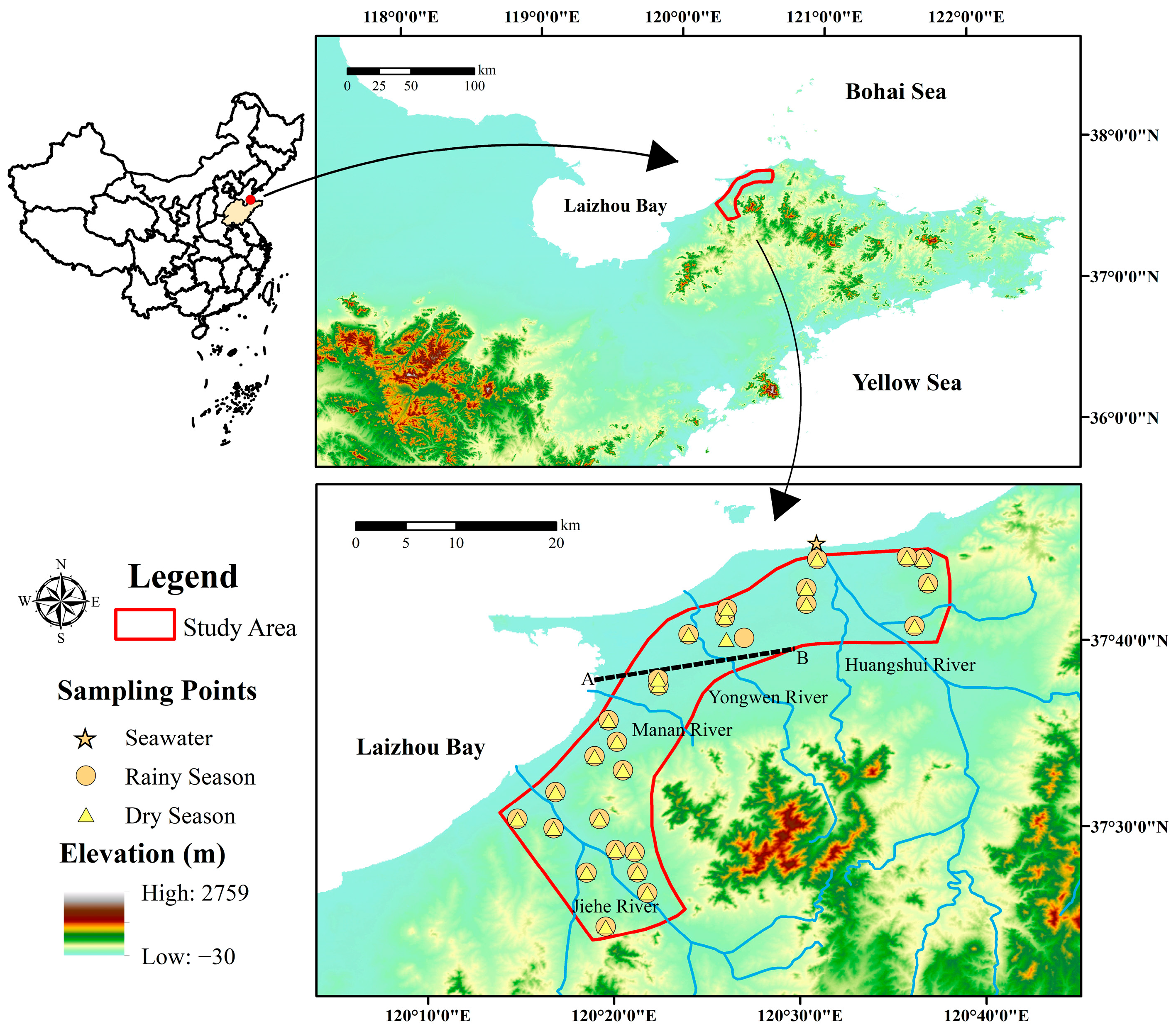
The study area is located on the northeastern coast of Laizhou Bay in Shandong Province, China, encompassing the coastal plain regions of Longkou City and a small portion of Zhaoyuan City (120°15′–120°39′ E, 37°24′–37°45′ N). This region is characterized by a typical sandy coast, with terrain gently sloping from southeast to northwest, forming a low-lying coastal plain with elevations generally below 20 m [44] (Figure 1). The area experiences a warm-temperate continental monsoon climate with four distinct seasons. The mean annual temperature ranges from 11.3 to 12.3 °C, and the average annual precipitation is approximately 658 mm, with over 60% concentrated in summer [45]. Within the study area, the majority of the annual heavy precipitation is concentrated between June and September, whereas the total rainfall from October to December is the lowest of the year [15,46]. The mean annual evaporation is approximately 1900 mm [47]. The main rivers within the study area include the Huangshui, Yongwen, Manan, and Jiehe Rivers, and the Huangshui River represents the largest fluvial system in terms of both drainage area and annual discharge [46]. With the exception of the Huangshui River, all of these watercourses are ephemeral seasonal streams characterized by short source-to-mouth distances and shallow channel depths. They remain completely dry or exhibit negligible baseflow throughout the year, generating surface runoff only in response to intense storm events [48]. Consequently, flow in these rivers is largely confined to summer precipitation periods, while they remain desiccated or reduced to minimal baseflow during the winter and spring dry seasons [46,48]. Most of these rivers originate in the low mountainous and hilly areas of southern and eastern Longkou City, flowing northward or westward into the sea [49].
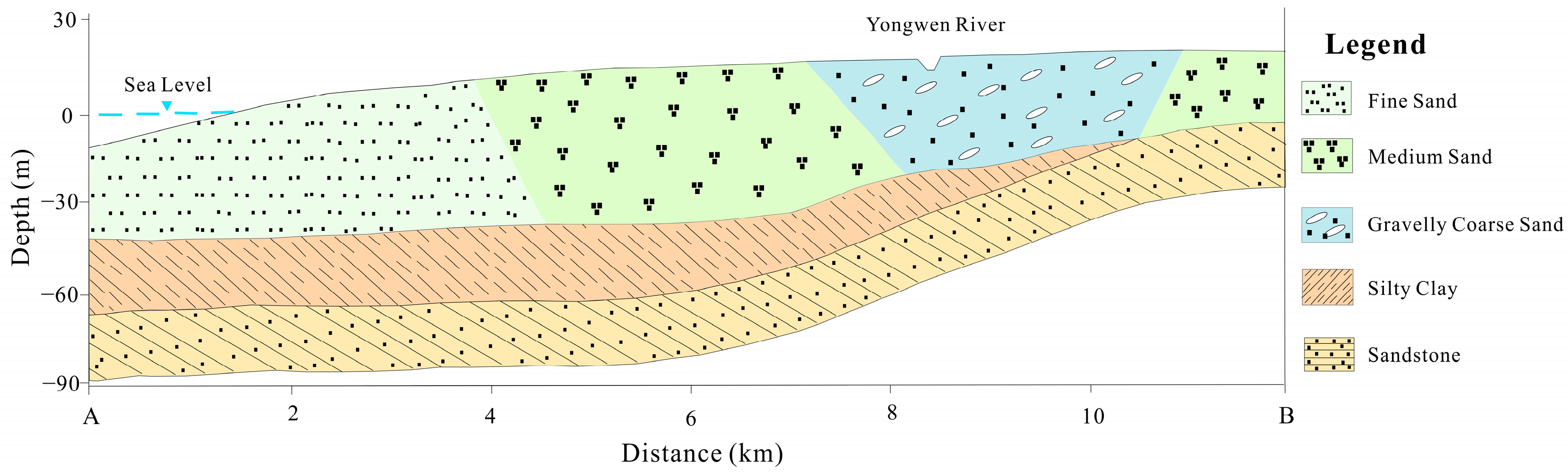
The basement lithology of the study area consists predominantly of Archean–Paleoproterozoic metamorphic rocks of the Jiaobei Terrane, chiefly biotite plagioclase gneiss and amphibole plagioclase gneiss, with subordinate granulite and local amphibolite lenses [50,51,52,53]. The primary mineral assemblage includes plagioclase feldspar, K-feldspar, quartz, biotite, and amphibole—all silicate phases devoid of carbonate minerals [50,51]. This crystalline basement is unconformably overlain by Quaternary unconsolidated sediments ranging from 26 to 116 m in thickness, comprising sandy loam, silty clay, and gravel layers [50,51,52,53]. Existing geological surveys indicate that the study area is not located within a major fault zone [44]. The aquifer system in this region is lithologically dominated by coarse and medium sand, followed by gravel and pebbles, mostly containing small amounts of cohesive soil. The aquifer is typically divided into two to three layers, with a total thickness ranging from 1 to 15 m and an average thickness of approximately 6.2 m [54]. Groundwater burial depths vary from several meters to tens of meters (Figure 2). The aquifer is classified as a phreatic aquifer, though locally it exhibits slightly confined conditions. While permeability and water abundance are heterogeneous, they are generally favorable, classifying the aquifer as having moderate to high water yield capacity [48,54]. Groundwater in this region is primarily recharged by atmospheric precipitation, supplemented by river seepage and lateral inflow from hilly areas [46]. The general direction of groundwater flow aligns with that of surface water, predominantly from southeast to northwest [46,48]. Existing research indicates that, temporally, groundwater dynamics in the study area are strictly controlled by seasonal variations, with water levels declining during the dry season and rising during the wet season [48]. Spatially, influenced by aquifer thickness, permeability, and recharge conditions, the water-bearing capacity of the aquifer is stronger in the eastern plain area and weaker in the western plain area [55].
Groundwater salinization along the coast of Laizhou Bay was first observed in 1976. Over approximately two decades, a seawater intrusion zone tens of kilometers wide formed along the eastern coast of Laizhou Bay. The primary cause was the over-exploitation of coastal freshwater resources, which led to a decline in groundwater levels, the formation of groundwater depression cones, and a subsequent disruption of the relative balance between the freshwater–saltwater interface, ultimately triggering seawater intrusion [56]. Since the 1990s, seawater intrusion in Longkou City has been concentrated in three main areas: both banks of the Huangshui River estuary, both banks of the Yongwen River estuary, and the western coastal area of Longkou [53]. Currently, these three seawater intrusion zones have become connected, and the intrusion rate shows an accelerating trend [12,52].

3. Materials and Methods

3.1. Sampling and Testing

A total of 55 water samples were collected in this study, including one surface seawater sample. Groundwater samples were taken from depths within 100 m during both the rainy season (September 2021) and the dry season (November 2022), with 27 samples collected in each season. The sampling locations for groundwater remained largely consistent between the two seasons. The spatial distribution of the sampling sites is illustrated in Figure 1. Conventional physical and chemical parameters (pH, EC, and TDS) of each sample were determined in situ using a portable YSI ProPlus multiparameter water quality analyzer (YSI Inc., Yellow Springs, OH, USA).
Groundwater samples designated for hydrochemical analysis were immediately filtered through a 0.45 μm membrane filter after collection. Each sample intended for major anion analysis was collected in a polyethylene bottle, sealed, and stored at 4 °C until analysis. Samples for cation analysis (Ca2+, K+, Mg2+, and Na+) were placed in acid-washed polyethylene bottles, with the pH adjusted to approximately 2 by adding 6 N HNO3. HCO3 was determined by adding phenolphthalein to the sample and titrating with a standard HCl solution. The major anion (Cl, and SO42−) concentrations were determined using a Dionex ICS-3000 ion chromatograph (Thermo Fisher Scientific, Waltham, MA, USA), and the cation (Ca2+, K+, Mg2+, and Na+) concentrations were determined by inductively coupled plasma atomic emission spectrometry (Thermo Fisher Scientific, Waltham, MA, USA) [57].

3.2. Analytical Methods

3.2.1. Groundwater Hydrochemistry

The statistical analysis and correlation analysis of groundwater chemical parameters were accomplished using IBM SPSS Statistics Version 26.0 (IBM Corp., Armonk, NY, USA, 2019). The Piper diagram was employed to present the chemical types of groundwater [58]. Additionally, the spatial distribution patterns of hydrochemical parameters and irrigation indices were demonstrated using geostatistical interpolation techniques. Considering the spatially autocorrelated nature of hydrogeological variables in coastal aquifers, the Ordinary Kriging method was employed within ArcGIS 10.8 (ESRI, Redlands, CA, USA, 2020).
In the ArcGIS Geostatistical Analyst, the experimental semivariogram was fitted using the weighted least squares (WLS) method, which is recognized as a practical approximation of the more general Maximum Likelihood (ML) principle [59,60]. Several commonly used theoretical models, namely the spherical, exponential, and Gaussian models, were tested, and their performance was evaluated through a leave-one-out cross-validation procedure. Ultimately, the spherical model was selected as the optimal model because it consistently yielded the lowest root mean square error (RMSE) and the highest coefficient of determination (R2) for key hydrochemical variables such as TDS and Cl in both the rainy and dry seasons. The resulting optimal range approximately reflects the average spatial autocorrelation scale of groundwater chemistry from the coastline inland, consistent with the spatial continuity patterns reported for heterogeneous salinization in coastal aquifers [59,60].
The theoretical basis of Ordinary Kriging estimates the unknown value at an unmeasured location x0, denoted as the predictor Z*(x0), as a linear combination of neighboring observed values Z(xi) weighted by λi. The weights λi are derived by solving the kriging system, which minimizes the estimation variance σ2E = Var[Z*(x0) − Z(x0)] subject to the unbiasedness constraint Σλi = 1. Z*(x0) can be calculated by Equation (1).
Z * ( x 0 ) = i = 1 n λ i Z ( x i )
The spatial continuity was quantified by fitting an experimental semivariogram γ(h), defined as Equation (2).
γ ( h ) = 1 2 N ( h ) i = 1 N ( h ) [ Z ( x i ) Z ( x i + h ) ] 2
where h is the lag distance and N(h) is the number of data pairs. In this study, the Spherical model was selected for semivariogram fitting based on the lowest Root Mean Square Error (RMSE) among the tested models (Spherical, Exponential, and Gaussian). The specific model parameters (Nugget, Sill, and Range) were optimized automatically within the Geostatistical Analyst extension. This approach ensures a robust representation of the heterogeneous salinization patterns typical of seawater intrusion zones [33,41].

3.2.2. Irrigation Hazards

Studies on specific irrigation hazards are important to assess the quality of groundwater that is used for agricultural activities [61]. In view of the special hydrogeological condition of seawater intrusion, this study intends to analyze the irrigation quality of groundwater samples from five hazards: salinity, sodium, magnesium, bicarbonate and permeability. The calculation methods of irrigation hazards assessment indicators are listed in Table 1.

3.2.3. Irrigation Water Quality

The calculation of the Irrigation Water Quality Index (IRWQI) for groundwater uses seven parameters including EC, PS, Na%, SAR, MAR, RSBC, and PI. It can be obtained through Equation (9).
IRWQI = j = 1 n ( W j × Q j )
The calculation formulas of Wj and Qj can be found in the Supplementary Materials.

4. Results

4.1. Chemical Characteristics of Groundwater

4.1.1. Hydrochemical Characteristics

Statistical analysis of groundwater hydrochemical parameters provides insights into the enrichment patterns and variability of chemical components [64]. Table 2 presents the statistical results of hydrochemical parameters in the study area for rainy season and dry season. The skewness values indicate that most hydrochemical parameters exhibit distributions close to normality, which supports the use of parametric statistical tests and ensures that the experimental semivariogram is not unduly influenced by extreme outliers. Non-Gaussian distributions can distort variogram structures and affect kriging estimates [59,60].
In both seasons, the maximum and mean values of cations followed the order Ca2+ > Na+ > Mg2+ > K+, while the mean values of anions were consistently ordered as HCO3 > Cl > SO42−. Except for K+ and HCO3, all other ions exhibited wider concentration ranges during the dry season. However, the order of maximum anion values differed between the two seasons: in the rainy season, it was HCO3 > Cl > SO42−, whereas in the dry season, it shifted to Cl > HCO3 > SO42−.
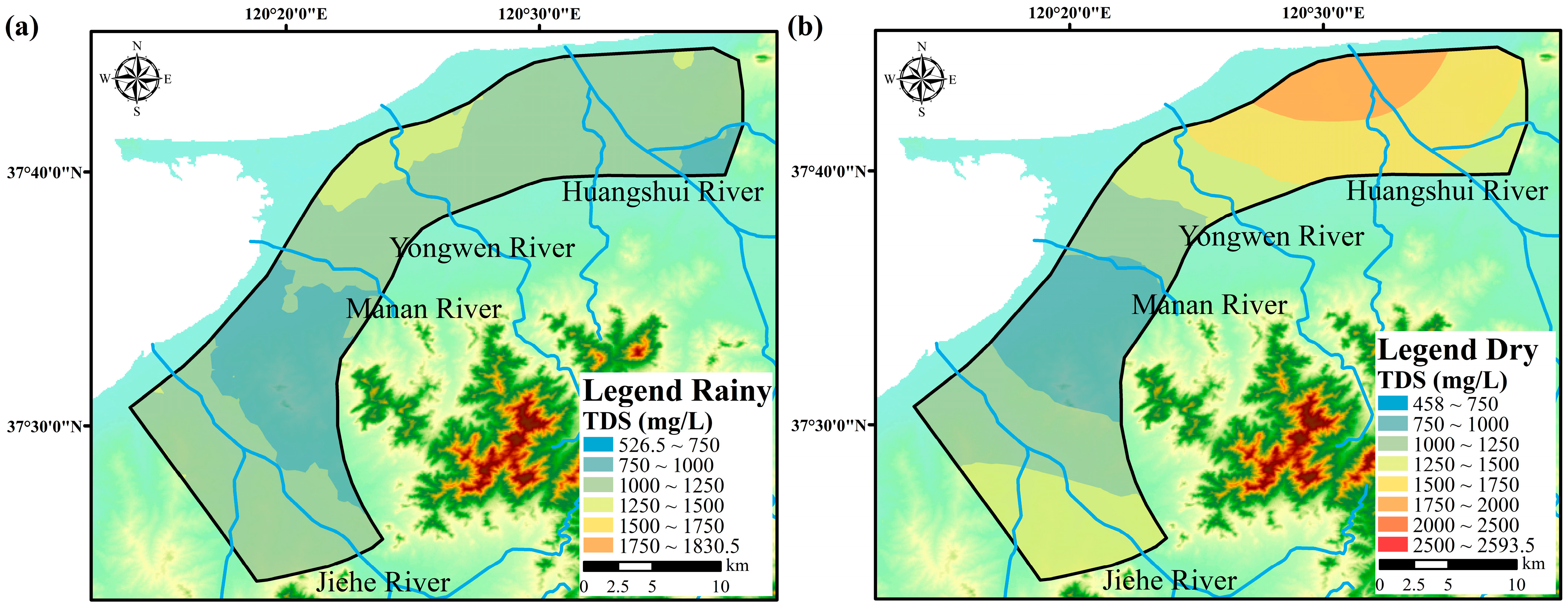
The standard deviation measures the average dispersion of data points relative to their mean [65,66]. With the exception of K+, the standard deviations of all other hydrochemical parameters were larger in the dry season than in the rainy season, indicating greater spatial variability in their concentrations during the dry period. TDS represents the concentration of dissolved solids in groundwater and serves as an indicator of groundwater evolution [67]. In this study, TDS exhibited the highest standard deviation in both seasons. Furthermore, both the range and mean value of TDS were higher in the dry season (range: 458.00–2593.50 mg/L; mean: 1323.54 mg/L) compared to the rainy season (range: 526.50–1830.50 mg/L; mean: 1089.72 mg/L). Spatial interpolation of TDS values for both seasons (Figure 3a,b) revealed a consistent increasing trend from inland toward the coast. Notably, TDS values near the coastline were considerably higher in the dry season than in the rainy season, suggesting more active and complex hydrochemical evolution in near-shore groundwater during the dry period. Additionally, the highest TDS values were observed in the area surrounding both banks of the Huangshui River estuary during the dry season, indicating the most complex hydrochemical evolution processes in that region.
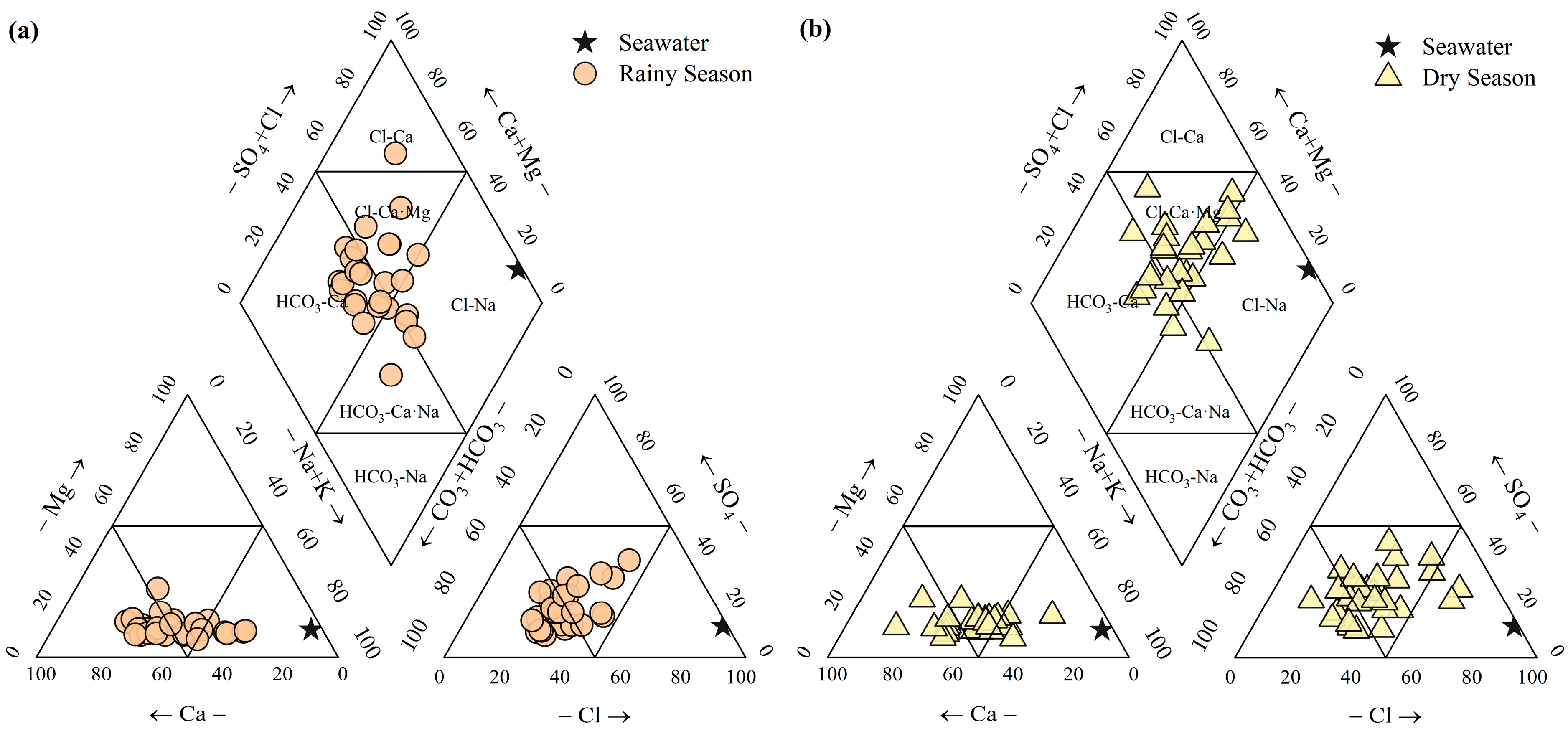
The Piper trilinear diagram, constructed using the percentages of major cation and anion concentrations, illustrates the relative composition of water and enables the classification of hydrochemical facies [58]. As shown in Figure 4a,b, the dominant hydrochemical facies in the study area during the rainy season was the HCO3-Ca type, with a small proportion of groundwater classified as the Cl-Ca·Mg type. In contrast, during the dry season, the predominant facies shifted to the Cl-Ca·Mg type, with a minor proportion remaining as the HCO3-Ca type. Overall, the hydrochemical facies of groundwater in the study area exhibited contrasting patterns between the rainy and dry seasons.

4.1.2. Correlation Analysis of Hydrochemical Parameters

Correlation analysis of hydrochemical parameters provides a detailed interpretation of multiple variable sets in groundwater chemistry studies and reflects the degree of association among various elements [68]. When the absolute value of the correlation coefficient approaches 1, it indicates strong significance and a high degree of association between variables [69]. In this study, normality tests were conducted on eight parameters (Ca2+, Mg2+, Na+, K+, Cl, SO42−, HCO3, and TDS), and the hydrochemical parameters for both the rainy and dry seasons conformed to a normal distribution. Therefore, the Pearson correlation method was selected for analysis, and the results are presented in Table 3 and Table 4.
In the rainy season, the correlation coefficients between TDS and Ca2+, Mg2+, Cl, and SO42− were all greater than 0.65, indicating a significant positive correlation and suggesting that these ions contribute substantially to TDS. The correlation coefficients between Cl and Ca2+, and between Cl and SO42−, were 0.77 and 0.61, respectively, indicating that the concentrations of Ca2+ and SO42− increase with increasing Cl concentration, with Ca2+ exhibiting a more pronounced increase.
In the dry season, the correlation coefficients between TDS and Ca2+, Mg2+, Cl, and SO42− also exceeded 0.65, a pattern similar to that observed in the rainy season. Notably, these coefficients were higher than those in the rainy season, indicating a stronger correlation between these ions and TDS, as well as a greater contribution to TDS during the dry period. Additionally, the correlation coefficient between TDS and Na+ was 0.583 (higher than that in the rainy season), suggesting that Na+ is also correlated with TDS in the dry season and contributes to the increase in TDS. Similar to the rainy season, Cl exhibited correlations with Ca2+ and SO42− in the dry season, with coefficients of 0.689 and 0.522, respectively. However, these values were lower than those in the rainy season, indicating that the correlations between Cl and Ca2+, and between Cl and SO42−, were relatively more pronounced during the rainy season.
It is noteworthy that during the rainy season, Cl showed no significant correlation with Na+ or Mg2+ (correlation coefficients of 0.433 and 0.404, respectively), whereas a different pattern emerged in the dry season. In the dry season, the correlation coefficient between Cl and Mg2+ was 0.529, indicating a moderate correlation, while the coefficient between Cl and Na+ reached 0.762, indicating a strong correlation.

4.1.3. Degree of Seawater Intrusion

The Cl in groundwater is characterized by high solubility and resistance to precipitation, making it one of the most stable ions in aqueous environments and serving as a direct indicator of seawater intrusion [70]. When the Cl concentration in coastal groundwater exceeds 250 mg/L, the aquifer is generally considered to be affected by seawater intrusion. Based on Cl concentrations, groundwater can be classified into four categories of seawater intrusion zones [71].
Statistical analysis of seawater intrusion levels in groundwater samples from the study area during the rainy and dry seasons is presented in Table 5. The results show that 17 groundwater samples fell into Class I (Unaffected or Slightly Affected) in the rainy season, compared to 12 in the dry season. Ten samples were classified as Class II (Lightly Affected) in the rainy season, compared to 14 in the dry season. One sample was classified as Class III (Moderately Severe Affected), observed only in the dry season. A comparative analysis indicates that the number of sampling sites unaffected or only slightly affected by seawater intrusion was lower in the dry season than in the rainy season, while the number of sites lightly or moderately severely affected was higher in the dry season.
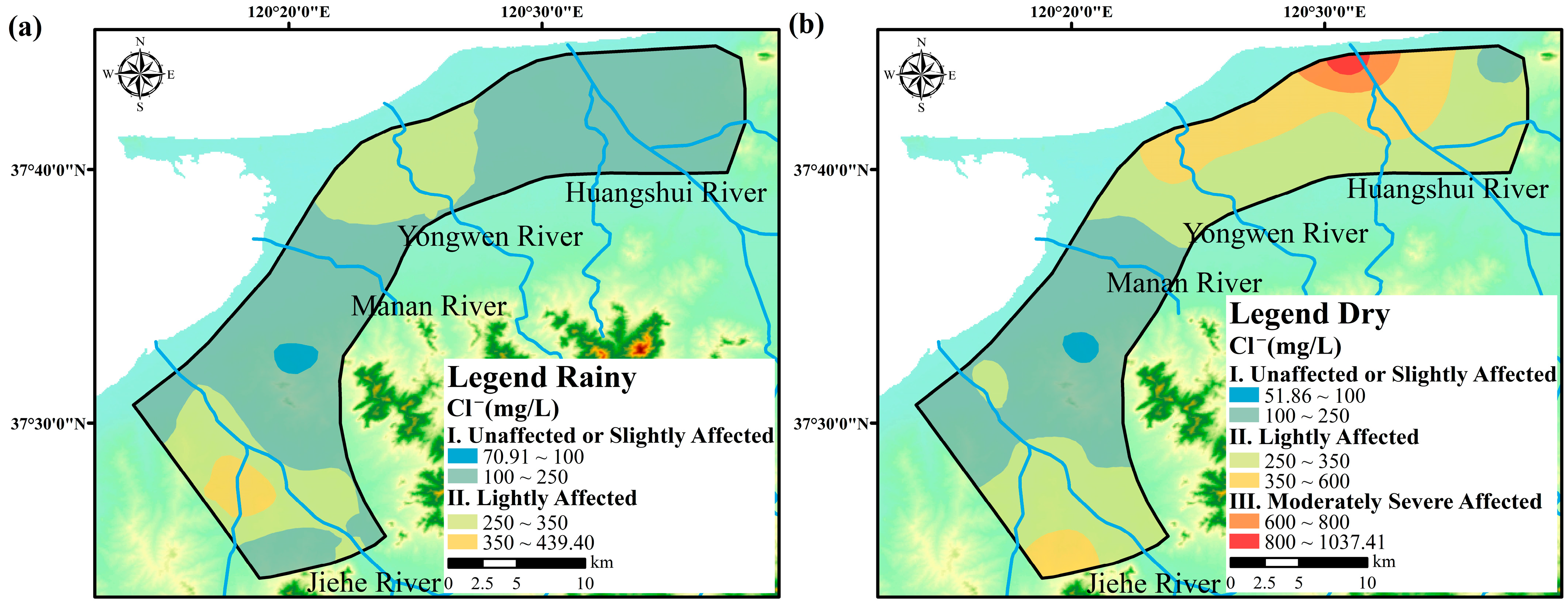
Spatial interpolation of Cl concentrations for both seasons (Figure 5a,b) reveals a consistent increasing trend from inland toward the coast. Notably, Cl concentrations in the northern part of the study area were considerably higher in the dry season than in the rainy season. Overall, groundwater in the study area is more severely affected by seawater intrusion during the dry season, with a broader spatial extent. This finding is consistent with the spatial interpolation results for TDS (Figure 3a,b). As reported in Section 4.1.2, the correlation coefficients between TDS and Cl were 0.783 and 0.864 for the rainy and dry seasons, respectively, indicating a stronger correlation in the dry season. This further suggests that a higher degree of seawater intrusion is associated with more complex hydrochemical evolution of groundwater. Furthermore, ions correlated with Cl are indicative of seawater influence. During the rainy season, Cl exhibited positive correlations with Ca2+ and SO42−, whereas in the dry season, positive correlations were observed between Cl and Na+, Mg2+, Ca2+, and SO42−. This indicates that a greater variety of ions in groundwater are influenced by seawater intrusion during the dry season.
Additionally, areas affected by seawater intrusion in both the rainy and dry seasons include the banks of the Jiehe River estuary and the Yongwen River estuary. In contrast, a distinct seasonal difference was observed in the area surrounding both banks of the Huangshui River estuary. During the rainy season, Cl concentrations in this area were below 250 mg/L, indicating no or only slight seawater intrusion. However, during the dry season, Cl concentrations exceeded 250 mg/L, exhibiting a progressive increase from inland toward the coast, with maximum values surpassing 1000 mg/L.

4.2. Irrigation Hazards Assessment

The suitability of groundwater for irrigation depends on the impact of its mineral composition on plants and soil [72]. Given the seasonal differences in hydrochemical characteristics observed in the study area and the multifaceted influence of seawater intrusion on groundwater, this section evaluates irrigation hazards from five perspectives: salinity, sodium, magnesium, bicarbonate, and permeability.

4.2.1. Salinity Hazard

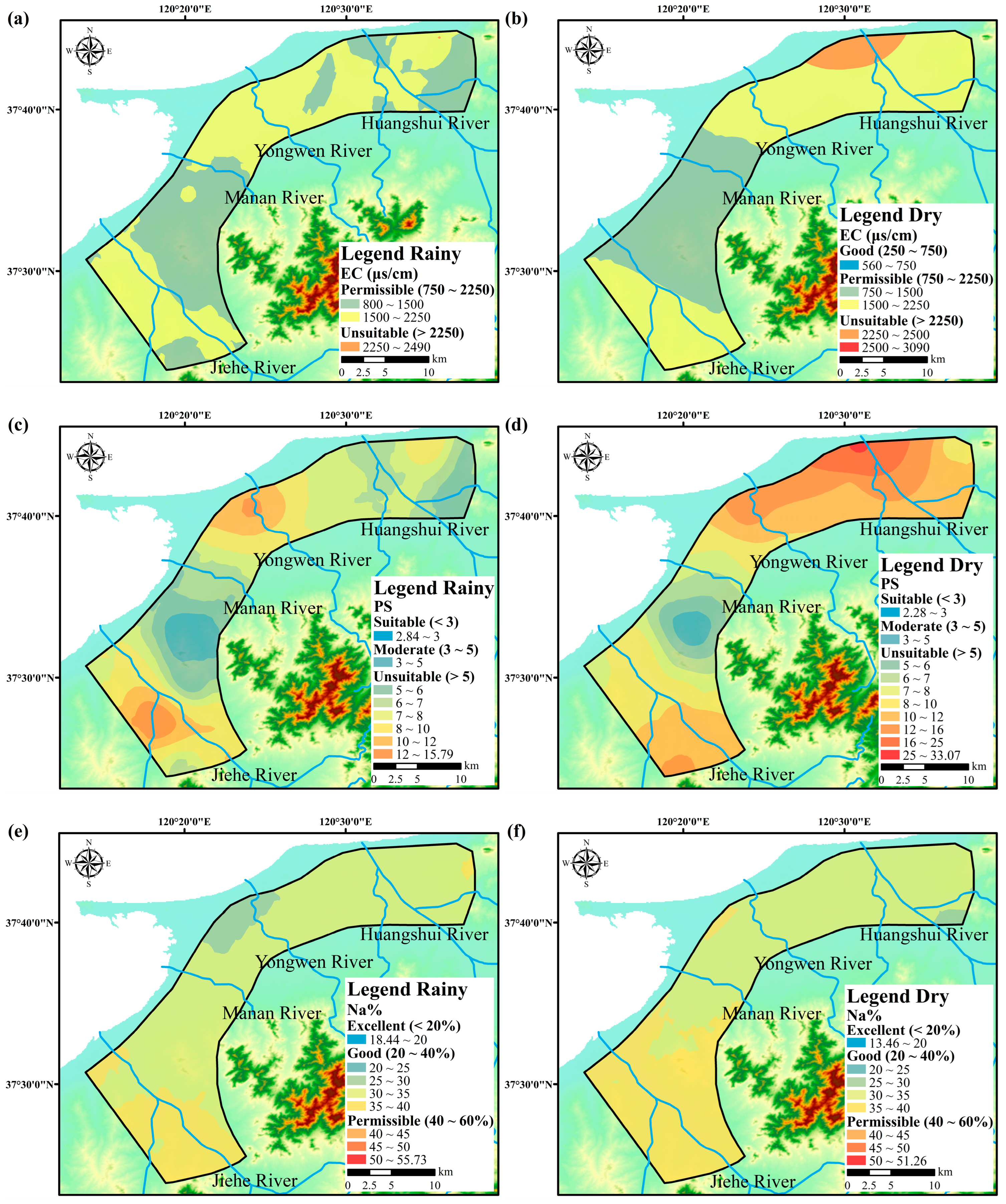
Electrical Conductivity (EC) and Potential Salinity (PS) are commonly used indicators for evaluating irrigation hazards related to salinity. EC reflects the risk of salinity to crops; irrigation with high-salinity water elevates the salt concentration in the soil solution, hindering crop water and nutrient uptake, potentially leading to reduced yields or even crop failure [10]. As shown in Table 6, regarding salinity hazard assessed by EC, 25 groundwater samples were classified as permissible for irrigation during the rainy season, while 2 samples were deemed unsuitable. In the dry season, 24 samples were permissible, and 3 samples were unsuitable. Spatial interpolation of EC values for groundwater sampling points in both seasons (Figure 6a,b) reveals that groundwater during the rainy season was generally permissible for irrigation. Although groundwater during the dry season was also predominantly permissible, samples near the coastline on both banks of the Huangshui River estuary became unsuitable for irrigation.
PS evaluates the impact of irrigation water salinity on soil salinity and fertility [19]. This indicator reflects the risk of elevated salinity concentrations posed by Cl and SO42−, which can increase the osmotic potential of the soil solution. As shown in Table 6, regarding potential salinity hazard, one groundwater sampling point each in the rainy and dry seasons was classified as suitable for irrigation and moderate, respectively. The remaining 25 groundwater sampling points were all deemed unsuitable for irrigation. Although the number of unsuitable samples was consistent between seasons, spatial interpolation of PS values for groundwater sampling points in both seasons (Figure 6c,d) was performed to understand the spatial distribution of potential salinity hazard. The results reveal a spatial pattern highly similar to that of seawater intrusion extent. Groundwater in the areas surrounding the banks of the Jiehe and Yongwen River estuaries exhibited relatively high PS values in both seasons. During the dry season, PS values in these areas were even higher, and the affected area expanded inland. Furthermore, the highest PS values were observed in the area surrounding both banks of the Huangshui River estuary during the dry season. Overall, PS values were higher in the dry season than in the rainy season, indicating that during periods of reduced atmospheric precipitation recharge, a higher degree of seawater intrusion is associated with a greater potential salinity hazard.

4.2.2. Sodium Hazard

If the sodium content in irrigation water is excessively high, it not only directly adversely affects crops, such as causing sodium toxicity, leaf margin scorching, or even defoliation in sensitive crops due to excessive Na+ uptake [73,74]. It also contributes to soil crusting, impairing water movement and aeration within the soil, thereby indirectly affecting crop growth [75]. Among the individual indicators for evaluating sodium hazard, Na% represents the proportion of Na+ among the major cations in irrigation water, reflecting the direct impact of Na+ on crops. In contrast, SAR represents the capacity of soil to adsorb Na+ from irrigation water, reflecting the indirect impact of Na+ on crops.
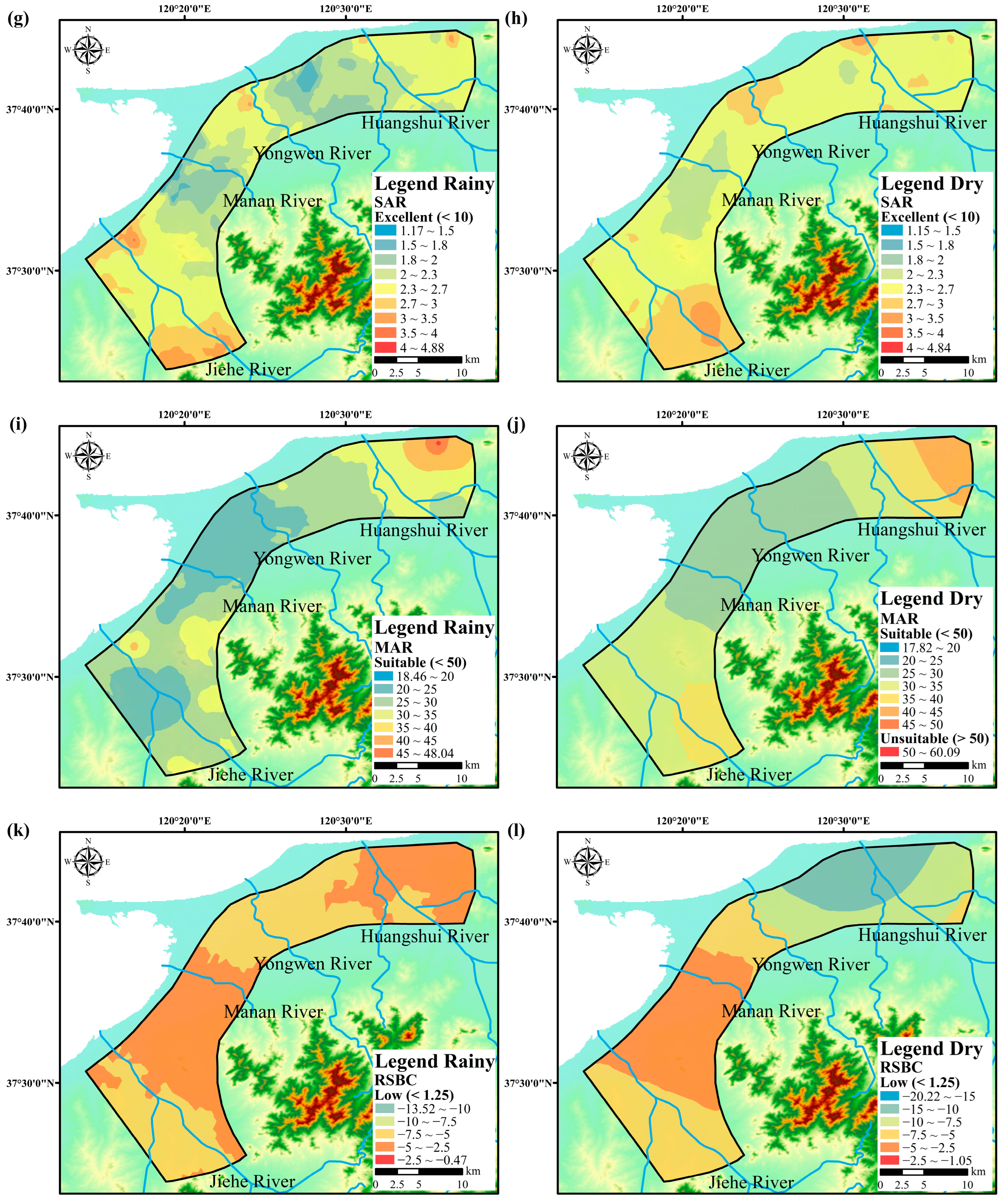
As shown in Table 6, regarding direct sodium hazard assessed by Na%, the classification of groundwater sampling points in the study area was identical for both the rainy and dry seasons: 2 samples were classified as excellent for irrigation suitability, 18 as good, and 7 as permissible. Regarding indirect sodium hazard assessed by SAR, the classification was also consistent between the two seasons, with all samples exhibiting SAR values below 10, falling into the excellent irrigation suitability category. Spatial interpolation of Na% and SAR values for groundwater in both seasons (Figure 6e–h) reveals that, although no sodium hazard was observed in the study area during either season, Na% and SAR values were generally higher in the dry season than in the rainy season. Furthermore, the correlation analysis in Section 4.1.2 indicates that groundwater in the study area was affected by seawater intrusion during the dry season, with a significant positive correlation between Cl and Na+ (0.762). This suggests that groundwater in the study area has the potential to develop a sodium hazard under the influence of seawater intrusion during the dry season.

4.2.3. Magnesium Hazard

Ca2+ contributes to soil particle aggregation, promoting the formation of stable soil structure. However, Mg2+ has a larger hydration radius and is less effective than Ca2+ in promoting aggregation. An excessively high proportion of Mg2+, even with a low SAR value, may predispose soil to dispersion, similarly leading to soil crusting and consequently affecting crop growth. MAR, as an indicator for evaluating magnesium hazard, is used to assess the potential impact of the relative proportion of Mg2+ to Ca2+ in irrigation water on soil [21].
As shown in Table 6, MAR values for all 27 groundwater sampling points were below 50 during the rainy season, indicating that irrigation using groundwater in the study area during the rainy season would not pose a magnesium hazard. During the dry season, MAR values for 26 groundwater sampling points were below 50; however, one sampling point exhibited an MAR value of 60, indicating that irrigation using groundwater at this location would pose a magnesium hazard. To compare and analyze the temporal and spatial distribution of MAR values, spatial interpolation was performed for MAR values in both seasons (Figure 6i,j). The results show that MAR values were generally higher in the dry season than in the rainy season. Concurrently, the correlation analysis in Section 4.1.3 indicates that groundwater in the study area was affected by seawater intrusion during the dry season, with a positive correlation between Cl and Mg2+ (0.529). This pattern is similar to the sodium hazard observed during the dry season, further suggesting that groundwater in the study area is prone to magnesium hazard under the influence of seawater intrusion during the dry season.

4.2.4. Bicarbonate Hazard

Due to the tendency of CO32− to readily react with CO2 and H2O in water to form HCO3, only HCO3 was considered in the calculation of Residual Sodium Bicarbonate (RSBC) in this study. RSBC represents the amount of sodium bicarbonate (NaHCO3) present in the irrigation water if the concentration of HCO3 ions exceeds the concentrations of Ca2+ and Mg2+ ions [62]. An excess of HCO3 causes precipitation of soil Ca2+ and Mg2+, impairing the soil structure as well as potentially activating soil sodium [75]. If the RSBC value is positive, the irrigation water could impair the soil’s ability to absorb moisture and nutrients necessary for crop growth. Conversely, if the RSBC value is negative, the irrigation water is unlikely to affect crop yield [76].
As shown in Table 6, RSBC values for all groundwater sampling points in the study area were below 1.25 in both the rainy and dry seasons, indicating a low risk of bicarbonate hazard. Spatial interpolation of RSBC values for groundwater in both seasons (Figure 6k,l) further confirms the low risk of bicarbonate hazard across the study area. A comparative analysis with the spatial interpolation maps of salinity indicators (Figure 6a–d) reveals that areas with higher salinity indicator values exhibited lower RSBC values. This suggests that under the influence of seawater intrusion, the risk of bicarbonate hazard is actually reduced.

4.2.5. Permeability Hazard

The long-term use of irrigation water may affect the soil permeability that is influenced by Na+, Ca2+, Mg2+, and HCO3 contents of the soil [72]. The Permeability Index (PI) is an indicator used to evaluate soil permeability under the influence of long-term irrigation water. Higher PI values indicate better soil permeability, suggesting that the water is more suitable for irrigation [63].
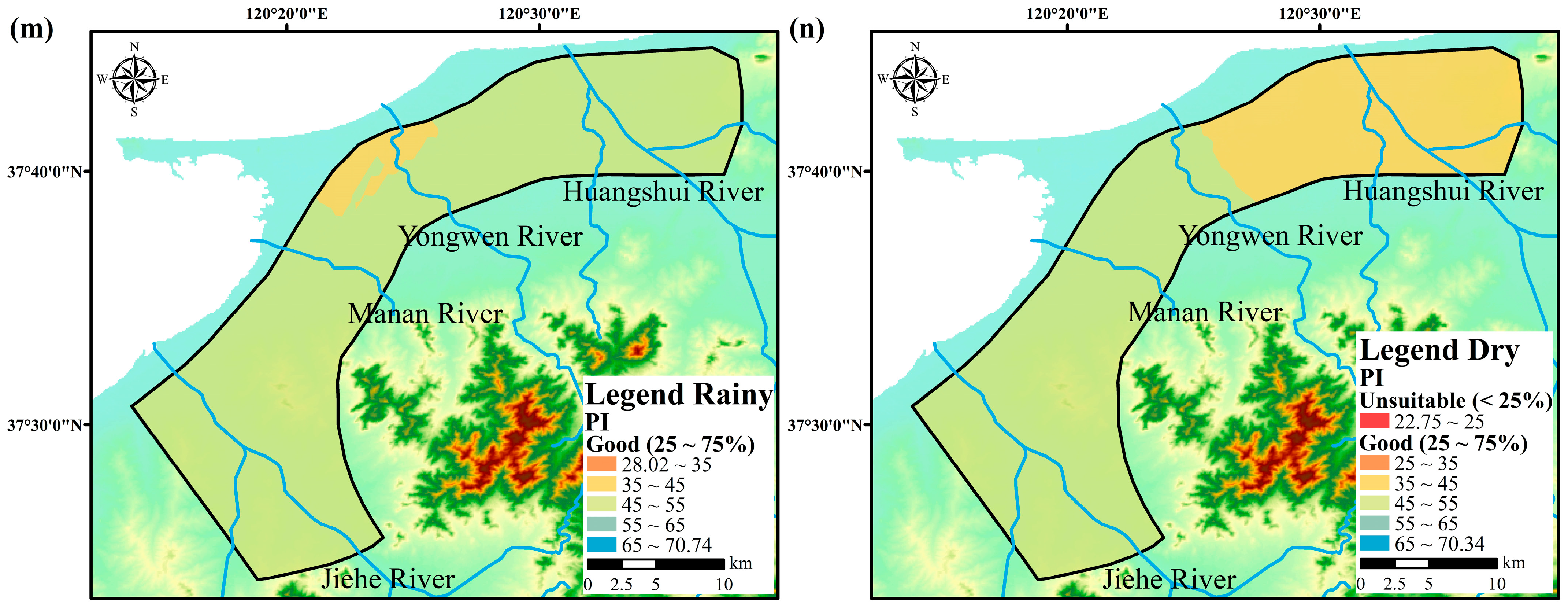
As shown in Table 6, PI values for all 27 groundwater sampling points during the rainy season fell within the range of 25–75%, indicating good irrigation suitability. During the dry season, PI values for 26 groundwater sampling points were within the 25–75% range; however, one sampling point exhibited a PI value of 22.75%, indicating that irrigation using groundwater at this location would pose a soil permeability hazard, rendering it unsuitable for irrigation. Spatial interpolation of PI values for groundwater in both seasons (Figure 6m,n) reveals that irrigation suitability was generally good across the study area in both seasons. However, PI values for groundwater in the area surrounding both banks of the Huangshui River estuary were lower in the dry season than in the rainy season. Furthermore, this area also exhibited high values for salinity hazard indicators, as well as elevated TDS and Cl concentrations, indicating that seawater intrusion increases the risk of soil permeability hazard associated with groundwater irrigation.

4.3. Comprehensive Irrigation Suitability Evaluation

The groundwater of this study area has been affected by seawater intrusion. This process began with isolated points of intrusion, which gradually expanded into multiple distinct areas. Over time, these isolated points merged to form a widespread area of seawater intrusion [12,52]. Consequently, under the influence of seawater intrusion, especially during the dry season when atmospheric precipitation recharge to groundwater is limited, the development trend of groundwater irrigation hazards in this study area may also progress from point-like to extensive areas. Currently, calculations for some individual irrigation hazard indicators have identified specific groundwater sampling points unsuitable for irrigation. However, spatial interpolation of these individual indicator values reveals that groundwater across the entire study area generally remains suitable for irrigation. This indicates that groundwater irrigation hazards are still in an early stage of development. Therefore, it is imperative to begin monitoring the impact of seawater intrusion on groundwater irrigation quality and conducting a more comprehensive analysis of groundwater irrigation suitability.
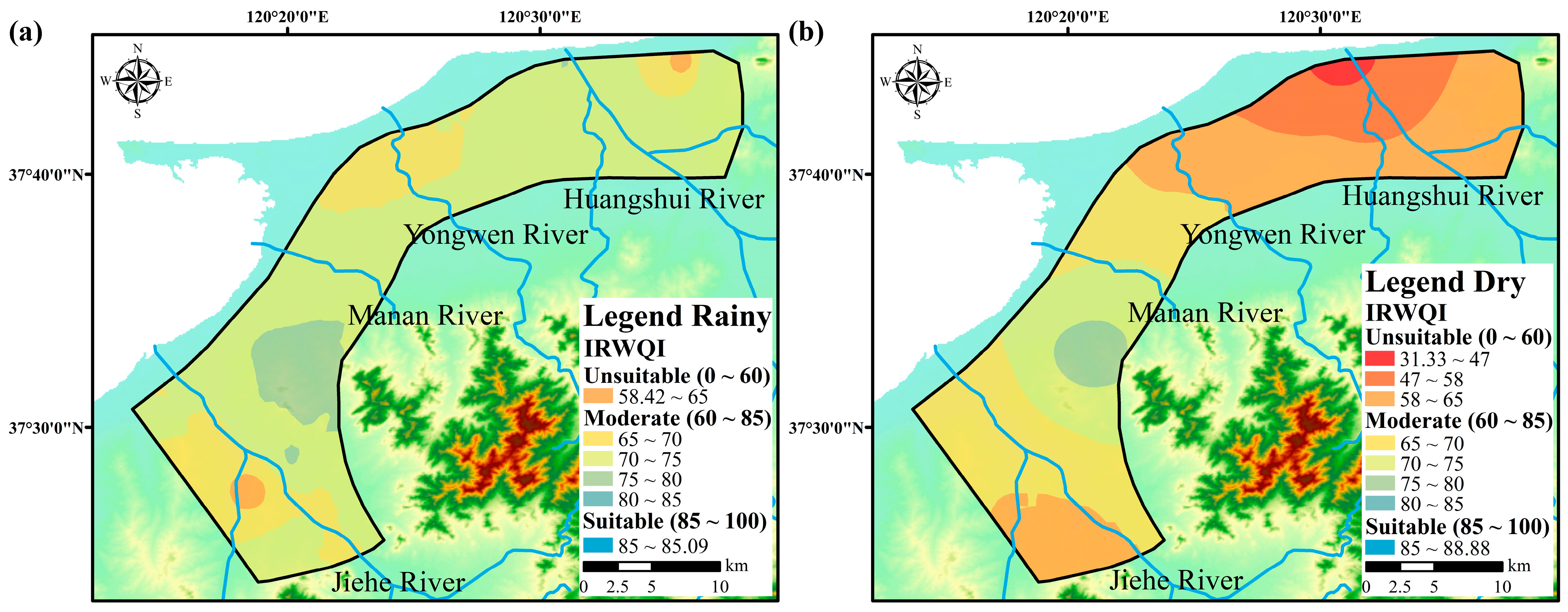
This section combines these seven individual indicators to construct an Irrigation Water Quality Index (IRWQI). The IRWQI values calculated in this study were categorized into three classes: 85–100 indicates no restrictions, suitable for irrigation; 60–85 indicates moderate restrictions, moderately suitable for irrigation; and 0–60 indicates severe restrictions, unsuitable for irrigation.
The classification results of groundwater’s IRWQI values for both the rainy and dry seasons are presented in Table 7. Notably, only one groundwater sampling point fell into the “no restrictions, suitable for irrigation” category in both seasons, representing the same location. During the rainy and dry seasons, 24 and 23 groundwater sampling points, respectively, were classified as moderately suitable for irrigation. Conversely, 2 and 3 sampling points were classified as unsuitable for irrigation in the rainy and dry seasons, respectively. Furthermore, within both the moderately suitable and unsuitable categories, the mean IRWQI values were considerably lower in the dry season compared to the rainy season, indicating poorer comprehensive groundwater irrigation quality during the dry period.
Spatial interpolation of IRWQI values for groundwater in both seasons (Figure 7a,b) reveals that during the rainy season, groundwater across the study area was predominantly classified as moderately suitable for irrigation. In contrast, during the dry season, groundwater in the areas surrounding the banks of the Huangshui, Yongwen, and Jiehe River estuaries fell into severe restrictions, unsuitable for the irrigation category. Notably, extremely low IRWQI values were observed in the area surrounding both banks of the Huangshui River estuary, indicating severe limitations for groundwater irrigation purposes in this region.
In summary, the comprehensive irrigation quality of groundwater in the study area was significantly poorer during the dry season compared to the rainy season. Although groundwater in the areas surrounding the banks of the Jiehe and Yongwen River estuaries was affected by seawater intrusion during the rainy season, their comprehensive irrigation suitability remained predominantly moderate, with only a very limited area classified as unsuitable for irrigation. However, during the dry season, the comprehensive irrigation suitability of groundwater in the areas surrounding the banks of the Huangshui, Yongwen, and Jiehe River estuaries fell into the unsuitable for irrigation category. This spatial pattern coincides precisely with the extent of seawater intrusion during the dry season, indicating that under conditions of limited atmospheric precipitation recharge, seawater intrusion exerts a severe impact on the comprehensive quality of groundwater for irrigation. Consequently, utilizing groundwater from these three areas for agricultural irrigation during the dry season poses a high irrigation risk.

5. Discussion

5.1. Hydrochemical Evolution of Groundwater

The hydrochemical characteristics presented in Section 4.1 reveal a pronounced seasonal change in groundwater composition across the study area. This variability is not merely a statistical artifact but reflects a fundamental shift in the dominant geochemical processes governing solute acquisition between the rainy and dry seasons.
  • Seasonal Facies Shift
During the rainy season, groundwater is predominantly of the HCO3-Ca type (Figure 4a), a signature characteristic of shallow, recently recharged waters in silicate-dominated terrains. In the absence of carbonate lithologies within the study area (see Section 2), the elevated HCO3 and Ca2+ concentrations are primarily derived from the incongruent hydrolysis of primary silicate minerals (e.g., plagioclase feldspars and amphiboles) within the metamorphic basement and overlying clastic sediments, mediated by dissolved soil CO2. This process can be generalized as:
(Na, Ca)-silicate + H2CO3 → Na+ + Ca2+ + HCO3 + clay minerals
The dominance of this meteoric water–rock interaction regime is further corroborated by the relatively low TDS and Cl concentrations observed during this period (Table 2). The spatial distribution of Cl (Figure 5a) indicates that seawater intrusion is largely confined to the immediate estuarine vicinities of the Jiehe and Yongwen Rivers, where topographic lows and reduced hydraulic gradients facilitate localized saline encroachment.
In stark contrast, the dry season witnesses a transition toward Cl-Ca·Mg type waters (Figure 4b) and a substantial elevation in TDS, Cl, Na+, and Mg2+ (Table 2). This facies shift is diagnostic of marine mixing rather than water–rock interaction. The sharp increase in Cl concentrations, which is the most conservative tracer of seawater, and the emergence of strong positive correlations between Cl and Na+ (r = 0.762) and Cl and Mg2+ (r = 0.529) (Table 4) confirm that direct seawater advection becomes the predominant solute source during the dry period. The expansion of the area affected by seawater intrusion (Table 5) and the inland migration of the Cl front (Figure 5b) can be mechanistically attributed to the seasonal reversal of the hydraulic gradient. Diminished meteoric recharge during the dry season reduces the seaward-directed freshwater head, while sustained groundwater abstraction for agricultural use further depresses the water table. This hydrodynamic disequilibrium allows the denser saline wedge to migrate landward through the highly permeable coarse-to-medium sand aquifer system [33,77].
  • Seasonal Reversal of the Huangshui River Estuary
A particularly noteworthy finding is the pronounced seasonal reversal observed in the Huangshui River estuarine zone. During the rainy season, groundwater in this area remains largely unaffected by seawater intrusion (Cl < 250 mg/L), yet during the dry season, it becomes the epicenter of the moderately severe intrusion, with Cl concentrations exceeding 1000 mg/L and TDS reaching 2593.50 mg/L. This phenomenon underscores the critical role of episodic river–aquifer interaction in modulating seawater intrusion vulnerability, an effect that is magnified by the distinct hydrological contrast between the Huangshui River and the other watercourses in the study area. Unlike the Yongwen, Manan, and Jiehe Rivers, which are ephemeral seasonal streams that remain dry or exhibit minimal baseflow for most of the year and convey flow only during summer storm events, the Huangshui River is the sole perennial fluvial system in the region, sustaining a continuous baseflow even during dry periods.
During the rainy season, the substantial and sustained freshwater discharge from the Huangshui River, augmented by its larger catchment and perennial nature, vigorously recharges the adjacent alluvial aquifer, establishing a robust localized hydraulic barrier that effectively repels the landward migration of the saline wedge. In marked contrast, the ephemeral tributaries contribute only sporadic, event-driven runoff that is insufficient to generate a comparable protective effect. As the dry season progresses and regional precipitation ceases, the Huangshui River eventually transitions to a reduced-flow state, and its hydraulic barrier dissipates. Consequently, the aquifer that was previously shielded by the only perennial river in the region becomes acutely vulnerable to unimpeded seawater encroachment. This finding highlights that estuarine zones associated with perennial rivers in otherwise ephemeral drainage networks are not characterized by static vulnerability; rather, they exhibit a pronounced “tipping point” behavior wherein the seasonal contraction of the sole sustained freshwater source triggers a disproportionately severe seawater intrusion response.
  • Cation Responses to Seawater Intrusion
The correlation analysis (Table 3 and Table 4) further indicates the differential geochemical behavior of cations under seawater intrusion stress. The rainy season shows a decoupling between Cl and Na+/Mg2+, suggesting that Na+ and Mg2+ are still predominantly sourced from silicate weathering and ion exchange on clay minerals. In contrast, the dry season exhibits a strong coupling between Cl and both Na+ and Mg2+, indicative of a shift from terrigenous weathering to marine mixing as the primary control on cation composition. The persistent strong correlation between Cl and Ca2+ in both seasons (r = 0.770 and 0.689) may reflect cation exchange processes triggered by seawater intrusion: as Na-rich seawater invades the aquifer, Na+ displaces Ca2+ from exchange sites on clay minerals and weathered feldspar surfaces, releasing Ca2+ into solution [78]. This exchange reaction not only elevates Ca2+ concentrations but also contributes to the observed shift toward Ca·Mg-enriched water types, even in the absence of carbonate mineral dissolution.
  • Relationship between Sediment Genesis and Groundwater Chemistry
The Quaternary sedimentary cover in the study area consists predominantly of alluvial–proluvial and coastal plain deposits, comprising sandy loam and gravel layers [50,51,52,53]. These unconsolidated siliciclastic sediments, derived from the weathering of the metamorphic basement (gneiss and amphibolite), provide a continuous source of Ca2+ and HCO3 ions through silicate hydrolysis [79,80]. The absence of carbonate deposits explains the dominance of HCO3-Ca type groundwater during the rainy season and the lack of significant calcite saturation. In contrast, the marine-origin salts (Cl, Na+, Mg2+) are introduced into the aquifer system primarily through seawater intrusion during the dry season, rather than from sediment-water interaction.

5.2. Mechanistic Linkages Between Hydrochemical Evolution and Irrigation Hazards

In coastal zones subjected to seawater intrusion, the seasonal oscillation between meteoric recharge and saline encroachment imposes a dynamic control on groundwater quality. To interpret this seasonal variability, the following analysis integrates the groundwater hydrochemical evolution trends with the spatial and statistical outcomes of the irrigation hazards assessment to discuss how seawater intrusion-driven hydrochemical changes translate into distinct patterns of irrigation risk.
  • Salinity Hazard as a Direct Imprint of Seawater Mixing
The spatial uniformity between elevated EC/PS values (Figure 6a–d) and the mapped extent of seawater intrusion (Figure 5) confirms that salinity hazard is the most immediate and spatially coherent consequence of seawater incursion. During the rainy season, enhanced meteoric recharge maintains a seaward hydraulic gradient, confining Cl and SO42− enrichment to the nearby estuarine vicinities of the Jiehe and Yongwen Rivers. Under these conditions, the majority of groundwater samples remain permissible for irrigation with respect to EC. In contrast, the dry season contraction of freshwater discharge allows the saline wedge to advance inland, resulting in the emergence of “unsuitable” EC classifications near the Huangshui River estuary and a ubiquitous elevation of PS values across the study area. The disproportionate increase in PS, which incorporates both Cl and SO42−, relative to EC underscores that seawater intrusion not only elevates total ionic strength but also specifically amplifies the risk of sulfate-induced soil degradation.
  • Emerging Sodium and Magnesium Hazards: Cation Exchange and Conservative Mixing
Although Na% and SAR values remained below critical agronomic thresholds in both seasons (Table 6), their systematic increase during the dry season, coupled with the strong Cl–Na+ correlation (r = 0.762, Table 4), signals the progressive encroachment of Na+-rich seawater. More critically, the concurrent rise in MAR values with one dry-season sample exceeding the 50 suitability threshold reveals the operation of cation exchange processes triggered by seawater intrusion. As Na+-laden seawater invades the freshwater aquifer, Na+ displaces Ca2+ from exchange sites on clay minerals and weathered feldspar surfaces [78]. This exchange releases Ca2+ into solution while leaving Mg2+, which is less competitively adsorbed, relatively enriched in the aqueous phase. The net effect is an elevation of the Mg2+/Ca2+ ratio (MAR) even under moderate salinity conditions. Consequently, the magnesium hazard observed during the dry season is not merely a function of direct seawater Mg2+ input but is amplified by the geochemical response of the aquifer matrix to saline stress. This finding indicates that sodium and magnesium hazards, though currently incipient, are poised to intensify if seawater intrusion progresses unchecked.
  • Attenuation of Bicarbonate Hazard: Dilution by Ca·Mg-Rich Seawater
In contrast to salinity and sodicity hazards, RSBC values exhibited a marked decline in areas with elevated TDS and Cl concentrations (Figure 6k,l). As discussed in Section 5.1, the study area is underlain by silicate-rich metamorphic and clastic sediments devoid of carbonate lithologies. The reduction in RSBC during the dry season is therefore not attributable to carbonate precipitation, but rather to the conservative mixing of low-HCO3, high-Ca2+–Mg2+ seawater with fresh groundwater. Because RSBC is calculated as the excess of HCO3 over (Ca2+ + Mg2+) (in meq/L), the disproportionate enrichment of divalent cations from the marine endmember drives the index toward negative values. While this yields a formal classification of “low risk” for bicarbonate hazard, it is crucial to recognize that this apparent mitigation is a geochemical artifact of seawater intrusion that masks the simultaneous escalation of salinity, sodium, and magnesium risks.
  • Permeability Hazard: The Interplay of Salinity and Sodicity
The PI integrates the antagonistic effects of total salinity (which promotes clay flocculation and maintains hydraulic conductivity) and sodium adsorption (which induces clay dispersion and pore clogging) [81]. The moderate decline in PI values near the Huangshui River estuary during the dry season (Figure 6m,n), including one sample falling below the 25% suitability threshold, reflects the delicate balance between these competing processes. In this estuarine zone, the dry-season influx of saline water elevates EC sufficiently to compress the diffuse double layer around clay particles, temporarily preserving soil structure. However, the concomitant rise in Na+ relative to Ca2+ and Mg2+, as indicated by elevated SAR and MAR values, primes the soil system for future structural collapse if low-salinity irrigation water (e.g., rainwater or blended water) is subsequently applied. This phenomenon, known as saline–sodic hazard hysteresis, implies that the permeability risk in the Huangshui estuarine zone may be underestimated by evaluating PI in isolation, and that the true vulnerability of soil structure may only manifest under alternating wet–dry or fresh–saline irrigation regimes.

5.3. Synthesis of Comprehensive Irrigation Suitability

The construction of the IRWQI, informed by a hybrid weighting scheme that integrates entropy-derived variability with TDS-correlated significance, provides a holistic metric for evaluating groundwater irrigation usability. The seasonal degradation in IRWQI values, which is most notable in the emergence of contiguous “severe restriction” zones encompassing the Huangshui, Yongwen, and Jiehe River estuaries during the dry season (Figure 7b), represents the integrated outcome of the hydrochemical processes elucidated above.
During the rainy season, abundant meteoric recharge sustains a seaward-directed hydraulic gradient and promotes the dominance of HCO3-Ca type waters. Under this regime, seawater intrusion is confined to narrow estuarine corridors, and comprehensive irrigation suitability remains predominantly moderate across the study area. The limited spatial extent of unsuitable IRWQI classifications during this period is attributable to the buffering capacity of the perennial Huangshui River and the episodic flushing provided by ephemeral streams.
In contrast, the dry season is characterized by diminished recharge, reduced river discharge (or complete desiccation of ephemeral tributaries), and sustained groundwater abstraction. These conditions collectively reverse the hydraulic gradient, allowing the saline wedge to migrate inland and fundamentally alter the geochemical regime of the coastal aquifer. The shift toward Cl-Ca·Mg type waters, coupled with elevated EC, PS, and MAR, and declining PI, drives the systematic deterioration of IRWQI values. The three estuarine zones identified as “unsuitable” during the dry season coincide precisely with the mapped extent of seawater intrusion, confirming that under conditions of hydrological drought, seawater intrusion becomes the dominant control on comprehensive groundwater irrigation quality.
The case of the Huangshui River estuary is particularly instructive. As the only perennial river in the study area, it provides a sustained freshwater barrier during the rainy season and early dry period. However, as regional precipitation ceases and river flow diminishes, this barrier dissipates, exposing the adjacent aquifer to unimpeded marine encroachment. The resulting collapse in IRWQI values, which shifts from moderate suitability to severe restriction, exemplifies a hydrologically triggered tipping point in coastal groundwater quality. This finding underscores that irrigation risk in the coastal zones affected by seawater intrusion is not static but exhibits pronounced seasonal hysteresis, with the most acute degradation occurring precisely where the largest freshwater sources are seasonally deactivated.


6. Conclusions and Recommendations

6.1. Conclusions

This study investigated the seasonal dynamics of groundwater hydrochemistry and irrigation suitability in the coastal zone of northeastern Laizhou Bay under the influence of seawater intrusion. Through integrated hydrochemical analysis, multi-indicator hazard assessment, and comprehensive irrigation quality evaluation, the principal conclusions are as follows.
(1)
Seasonal hydrochemical reversal driven by seawater intrusion. Groundwater hydrochemical facies undergo a pronounced seasonal transition from HCO3-Ca type in the rainy season to Cl-Ca·Mg type in the dry season. This shift is accompanied by elevated TDS and Cl concentrations and increased spatial heterogeneity during the dry period. The Huangshui River estuary exhibits a distinctive seasonal reversal, remaining unaffected during the rainy season but becoming a moderately severe intrusion zone during the dry season. This phenomenon is mechanistically attributed to the hydrological contrast between the perennial Huangshui River and the ephemeral nature of adjacent streams, which collectively modulate the reversibility of the freshwater–saltwater interface.
(2)
Differentiated irrigation hazard responses. Salinity hazard (EC and PS) is the most immediate and spatially extensive consequence of seawater intrusion, with dry-season PS values expanding inland and rendering estuarine groundwater unsuitable for irrigation. Although sodium and magnesium hazards currently remain below critical agronomic thresholds, significant positive correlations between Cl and Na+ (r = 0.762) and Mg2+ (r = 0.529) during the dry season, together with the emergence of elevated MAR values, indicate an emerging risk of sodic and magnesic degradation driven by cation exchange processes. Bicarbonate hazard (RSBC) declines under seawater intrusion due to conservative mixing with Ca·Mg-rich seawater—a geochemical artifact that should not be misinterpreted as improved overall quality. Permeability hazard (PI) exhibits moderate seasonal deterioration, with one dry-season sample falling below the 25% suitability threshold, reflecting the interplay between salinity flocculation and sodicity dispersion.
(3)
Seasonal degradation of comprehensive irrigation suitability. The IRWQI values are systematically lower during the dry season, with contiguous zones of severe irrigation restriction emerging precisely along the Huangshui, Yongwen, and Jiehe River estuaries. This spatial congruence with seawater intrusion extent demonstrates that under conditions of reduced atmospheric recharge, seawater intrusion becomes the dominant control on groundwater irrigation quality, driving a hydrologically triggered tipping point in coastal aquifer usability. The Huangshui estuarine zone, shielded by the only perennial river in the region during the rainy season, experiences the most acute collapse in irrigation suitability once this freshwater barrier seasonally dissipates.

6.2. Recommendations for Sustainable Groundwater Management

Based on the findings above, the following management recommendations are proposed to mitigate seawater intrusion impacts and ensure sustainable groundwater utilization for irrigation.
(1)
Establish seasonally adaptive pumping protocols. Groundwater abstraction for irrigation should be prioritized in inland zones during the dry season, while extraction in the identified high-risk estuarine areas (Huangshui, Yongwen, and Jiehe River estuaries) should be strictly curtailed or prohibited during the dry period to prevent further exacerbation of seawater intrusion and the associated irrigation hazards.
(2)
Enhance rainy-season groundwater storage. Artificial recharge schemes, such as infiltration basins or injection wells, should be implemented during the rainy season to augment aquifer storage and maintain elevated hydraulic heads that impede saline encroachment during the subsequent dry season. The perennial Huangshui River corridor represents a strategically advantageous location for such managed aquifer recharge initiatives.
(3)
Implement adaptive irrigation and agronomic practices. In areas classified as moderately suitable for irrigation, the blending of higher and lower salinity waters should be practiced to reduce localized salinity loading. Concurrently, the cultivation of salt-tolerant crop varieties should be promoted, and planting schedules should be aligned with seasonal water quality variations to minimize crop exposure to elevated salinity and sodicity during the dry season.
(4)
Establish a long-term groundwater quality monitoring network. Continuous monitoring of key seawater intrusion indicators (Cl, TDS, EC, and PS) in the three estuarine zones is essential for detecting early-stage deterioration and for evaluating the efficacy of management interventions. Such a network would provide the empirical basis for adaptive governance of coastal groundwater resources under evolving climatic and anthropogenic pressures.

Supplementary Materials

The following supporting information can be downloaded at https://www.mdpi.com/article/10.3390/w18091058/s1. Table S1: Correlation analysis of TDS and irrigation hazard indicators in the rainy season. Table S2: Correlation analysis of TDS and irrigation hazard indicators in the dry season. Table S3: Weight Values. Table S4: The classification of qj. Table S5: Statistical characteristics of Qj.

Author Contributions

Conceptualization, T.F. and M.W.; methodology, M.W.; software, Y.F.; validation, M.D., C.Q. and B.L.; formal analysis, F.S.; investigation, C.Q.; resources, B.L. and Y.W.; data curation, Z.C.; writing—original draft preparation, M.W.; writing—review and editing, Z.C.; visualization, M.D.; supervision, F.S.; project administration, Y.F.; funding acquisition, T.F. and Y.W. All authors have read and agreed to the published version of the manuscript.

Funding

This research was financially supported by the National Natural Science Foundation of China (42276226), Shandong Provincial Natural Science Foundation (ZR2022MD048), and Open Fund of the 801 Institute of Hydrogeology and Engineering Geology (801KF2021-14).

Data Availability Statement

The data within the manuscript is available from the corresponding author upon reasonable request.

Acknowledgments

We are thankful for the support of the “Observation and Research Station of Seawater Intrusion and Soil Salinization, Laizhou Bay, Ministry of Natural Resources.” Meanwhile, we would like to thank the reviewers and the editor, who helped improve the manuscript.

Conflicts of Interest

The authors declare no conflicts of interest.

References

  1. Benoit, J.; Hardaway, C.; Hernandez, D. Mitigating Shore Erosion Along Sheltered Coasts; The National Academies Press: Washington, DC, USA, 2007. [Google Scholar] [CrossRef]
  2. Kazakis, N.; Spiliotis, M.; Voudouris, K.; Pliakas, F.K.; Papadopoulos, B. A Fuzzy Multicriteria Categorization of the GALDIT Method to Assess Seawater Intrusion Vulnerability of Coastal Aquifers. Sci. Total Environ. 2018, 621, 524–534. [Google Scholar] [CrossRef] [PubMed]
  3. Yin, P.; Lin, L.; Chen, B.; Xiao, G.; Cao, K.; Yang, J.; Li, M.; Duan, X.; Qiu, J.; Hu, Y.; et al. Coastal zone geo-resources and geo-environment in China. Geol. China 2017, 44, 842–856. (In Chinese) [Google Scholar] [CrossRef]
  4. Abidi, J.H.; Elzain, H.E.; Sabarathinam, C.; El Fehri, R.M.; Farhat, B.; Mammou, A.B.; Yassin, M.A.; Senapathi, V. Integrated approach to understand the multiple natural and anthropogenic stresses on intensively irrigated coastal aquifer in the Mediterranean region. Environ. Res. 2024, 252, 118757. [Google Scholar] [CrossRef]
  5. Gao, M.S.; Luo, Y.M. Problems of groundwater resources and prevention and control of seawater intrusion in key coastal zones of China. Bull. Chin. Acad. Sci. 2016, 31, 1197–1203. (In Chinese) [Google Scholar] [CrossRef]
  6. Vengosh, A.; Kloppmann, W.; Marei, A.; Livshitz, Y.; Gutierrez, A.; Banna, M.; Guerrot, C.; Pankratov, I.; Raanan, H. Sources of Salinity and Boron in the Gaza Strip: Natural Contaminant Flow in the Southern Mediterranean Coastal Aquifer. Water Resour. Res. 2005, 41, 341–356. [Google Scholar] [CrossRef]
  7. Xu, X.Y.; Fu, T.F.; Xiong, G.Y.; Su, Q.; Liu, W.Q.; Chen, G.Q. Progress and prospect of the research on seawater intrusion to soil salinization disaster chain. Adv. Mar. Sci. 2020, 38, 1–10. Available online: https://kns.cnki.net/kcms2/article/abstract?v=OGEEvuKkrhagaGhZUSljUv3L6mshMNhMrYtGiD3-1tDdJUxGnJtpJPcxzxVhtOUZFCk-9NRfzCo10-ZLkZcYhXp8zYlgXCuBd3qXspvV6ZbR3dhXxGk3zWTRZWpHZHewANxmJhQ4MUbsnv35bpHapl25ekGFkIUi1Z9JTcfklp5Adm20TZAVLw==&uniplatform=NZKPT&language=CHS (accessed on 26 April 2026). (In Chinese)
  8. Mostafazadeh-Fard, B.; Mansouri, H.; Mousavi, S.; Feizi, M. Effects of Different Levels of Irrigation Water Salinity and Leaching on Yield and Yield Components of Wheat in an Arid Region. J. Irrig. Drain. Eng. 2009, 135, 32–38. [Google Scholar] [CrossRef]
  9. Mastrocicco, M.; Gervasio, M.P.; Busico, G.; Colombani, N. Natural and Anthropogenic Factors Driving Groundwater Resources Salinization for Agriculture Use in the Campania Plains (Southern Italy). Sci. Total Environ. 2021, 758, 144033. [Google Scholar] [CrossRef]
  10. Rahman, M.M.; Shahrivar, A.A.; Hagare, D.; Maheshwari, B. Impact of Recycled Water Irrigation on Soil Salinity and Its Remediation. Soil Syst. 2022, 6, 13. [Google Scholar] [CrossRef]
  11. Yi, H.P.; Zhang, P.Y.; Bi, J.S.; Zhong, S.Y.; Xia, Y.L.; Yu, J.B. The Influence of Seawater Intrusion on Ecological Environment in the Eastern Coast of Laizhou Bay. Mar. Sci. 2010, 34, 29–34. Available online: https://kns.cnki.net/kcms2/article/abstract?v=OGEEvuKkrhZODc_HquwOZ2RPs5KIZVecVUJgCrx3mVJTLoM3Smx_MC96-VrXHfDg9477TxGzjNB7B4hbKsW85HQVaWgRaduSdVmPLZs4LSwG8FxfNEsRxFjkOkAZ_iDdF63HZMReSmKbTRe5tCh00U431VjZE_X8WYs8Tf68ADK2aUuPjvB--g==&uniplatform=NZKPT&language=CHS (accessed on 26 April 2026). (In Chinese)
  12. Du, G.Y.; Sun, Z.Y. Research of Artificial Geologic Disasters in the East Coast of Laizhou Bay, Bohai Bay. J. Geol. Hazards Environ. Preserv. 2005, 16, 225–230. Available online: https://kns.cnki.net/kcms2/article/abstract?v=OGEEvuKkrhaHdEEMMwAW24sFPhxtu5ZktJmrd9q2CdL3MbNWSDDfNOj-IMhOixtMZC_4BNzVLprr3AqMuN8UCUviUlXTmBNc5o2X9PEHZWX0GoO8JBjIqncyp8pqJl1uFgRnYV4bY0CyyjjHO0rZ2YEDI6ZcxfcQxH8_Cy6oB7ug5dHteqvBhg==&uniplatform=NZKPT&language=CHS (accessed on 26 April 2026). (In Chinese)
  13. Zhang, X.; Liu, L.Y.; Chen, X.D.; Gao, Y.; Xie, S.; Mi, J. GLC_FCS30: Global Land-Cover Product with Fine Classification System at 30 m Using Time-Series Landsat Imagery. Earth Syst. Sci. Data 2021, 13, 2753–2776. [Google Scholar] [CrossRef]
  14. Aboubacar, T.; Zou, L.Z. Groundwater Resources Assessment in the Longkou Plain Area, Shandong Province. J. Chang. Univ. Sci. Technol. 2001, 31, 359–362. Available online: https://kns.cnki.net/kcms2/article/abstract?v=OGEEvuKkrhZmW8JkfkL4RhrMVW_nOW-qK67bsLdkVymdkNNJ9Q5rYetTMfNPepGCAsO7XhK6JdvCsO3h8ts2zZBLpgdPjf-WVvDw7fnmUMMPevdPAex1upe7CzTfuBwOE75MTq7NKw7k10YGpJf1ObgxwthpSIwp8emnqGhlBd3moeV6OvArdg==&uniplatform=NZKPT&language=CHS (accessed on 26 April 2026). (In Chinese)
  15. Yantai Water Conservancy Bureau. Yantai Water Resources Bulletin (2017–2021); Yantai, China, 2018–2022. Available online: https://slj.yantai.gov.cn/art/2023/10/12/art_1293_2904461.html (accessed on 26 April 2026). (In Chinese)
  16. Zhao, J. Study on Seawater Intrusion and Hydrochemical Characteristics and Changes of Shallow Groundwater. Geogr. Sci. 1999, 19, 525–531. Available online: https://kns.cnki.net/kcms2/article/abstract?v=OGEEvuKkrhY2DD0MWMNrFoUiJoSWDPzy814oXej4o-V1tsVNAjaFosw7zc3Yn82rbVH1mFT_OBLXh4xf6FYxHGyZIuFZlkBHNpm1kSWjVLoEnap7ETLHTyXgrFD2DegJxHdWaqJkFaA1LW3qx6NaJDQwVGPS6ASOFbjQeJpCl5njFQVePCRn4w==&uniplatform=NZKPT&language=CHS (accessed on 26 April 2026). (In Chinese)
  17. Taşan, M.; Taşan, S.; Demir, Y. Estimation and Uncertainty Analysis of Groundwater Quality Parameters in a Coastal Aquifer under Seawater Intrusion: A Comparative Study of Deep Learning and Classic Machine Learning Methods. Environ. Sci. Pollut. Res. 2023, 30, 2866–2890. [Google Scholar] [CrossRef]
  18. Richard, L. Diagnosis and Improvement of Saline and Alkali Soils; USDA Hand Book No. 60; US Government Press: Washington, DC, USA, 1954; p. 160. Available online: https://www.ars.usda.gov/ARSUserFiles/20360500/hb60_pdf/hb60complete.pdf (accessed on 26 April 2026).
  19. Doneen, L.D. Notes on Water Quality in Agriculture; Water Science and Engineering Paper 4001; Department of Water Science and Engineering, University of California: Davis, CA, USA, 1964; Available online: https://search.library.ucr.edu/discovery/fulldisplay/alma991002319989704706/01CDL_RIV_INST:UCR (accessed on 26 April 2026).
  20. Wilcox, L. Classification and Use of Irrigation Waters; US Department of Agriculture: Washington, DC, USA, 1955. Available online: https://www.ars.usda.gov/ARSUserFiles/20360500/pdf_pubs/P0192.pdf (accessed on 26 April 2026).
  21. Ayers, R.S.; Westcot, D.W. Water Quality for Agriculture; Food and Agriculture Organization of the United Nations: Rome, Italy, 1985; Available online: https://www.fao.org/3/t0234e/t0234e00.htm (accessed on 26 April 2026).
  22. Bortolini, L.; Maucieri, C.; Borin, M. A Tool for the Evaluation of Irrigation Water Quality in the Arid and Semi-Arid Regions. Agronomy 2018, 8, 23. [Google Scholar] [CrossRef]
  23. Meireles, A.C.M.; Andrade, E.M.D.; Chaves, L.C.G.; Frischkorn, H.; Crisostomo, L.A. A New Proposal of the Classification of Irrigation Water. Rev. Ciênc. Agron. 2010, 41, 349–357. [Google Scholar] [CrossRef]
  24. Hosni, A.; Derdour, A.; Nouri, T.; Moussaoui, T.; Zahi, F.; Reghais, A.; Jodar-Abellan, A.; Pardo, M.Á. Cultivating Sustainability: A Multi-Assessment of Groundwater Quality and Irrigation Suitability in the Arid Agricultural District of Dzira (Ksour Mountains, Algeria). Environ. Monit. Assess. 2024, 196, 886. [Google Scholar] [CrossRef]
  25. Jesuraja, K.; Selvam, S.; Murugan, R. GIS-Based Assessment of Groundwater Quality Index (DWQI and AWQI) in Tiruchendur Coastal City, Southern Tamil Nadu, India. Environ. Earth Sci. 2021, 80, 243. [Google Scholar] [CrossRef]
  26. El Osta, M.; Masoud, M.; Alqarawy, A.; Elsayed, S.; Gad, M. Groundwater Suitability for Drinking and Irrigation Using Water Quality Indices and Multivariate Modeling in Makkah Al-Mukarramah Province, Saudi Arabia. Water 2022, 14, 483. [Google Scholar] [CrossRef]
  27. Saaty, T.L. The Analytic Hierarchy Process: Planning, Priority Setting, Resource Allocation; McGraw-Hill: New York, NY, USA, 1980; Available online: https://api.semanticscholar.org/CorpusID:120643630 (accessed on 26 April 2026).
  28. Zhang, Z.Q.; Zhang, Q.; Liu, C.F.; Wang, C.Y.; Fu, X.G.; Yan, B.Z. Hydrochemistry Characteristics of Groundwater and Its Suitability for Irrigation in Jianyang City of Sichuan Province. Bull. Soil Water Conserv. 2018, 38, 8. Available online: https://kns.cnki.net/kcms2/article/abstract?v=OGEEvuKkrhZxVWhu4hxHPcedilHBbxfm66Cb2EOIgPPj58rVqGlfo82TI2K6sv1iAxOiWn80Nk0LkwP_GsOxpztfLAnHg2-sB1M2OVZoSl0Vs2Gcmt7S2QOOk7juFBLMje6G4e3yM2coW1INoPdQFYrV7SYhma_XT1aUTizJxH7lsshKqd535g==&uniplatform=NZKPT&language=CHS (accessed on 26 April 2026). (In Chinese)
  29. Gopinath, G.; Achu, A.L.; Sabitha, A.R.; Aju, C.D.; Pragath, M.; Prasad, G.S. Hydrochemical Investigation and Prediction of Groundwater Quality in a Tropical Semi-Arid Region of Southern India Using Machine Learning. Groundw. Sustain. Dev. 2024, 27, 101343. [Google Scholar] [CrossRef]
  30. Shannon, C.E. A Mathematical Theory of Communication. Bell Syst. Tech. J. 1948, 27, 379–423. [Google Scholar] [CrossRef]
  31. Gao, Y.Y.; Qian, H.; Ren, W.H.; Wang, H.K.; Liu, F.X.; Yang, F.X. Hydrogeochemical Characterization and Quality Assessment of Groundwater Based on Integrated-Weight Water Quality Index in a Concentrated Urban Area. J. Clean. Prod. 2020, 260, 121006. [Google Scholar] [CrossRef]
  32. Zhang, Q.Y.; Qian, H.; Xu, P.P.; Hou, K.; Yang, F.X. Groundwater Quality Assessment Using a New Integrated-Weight Water Quality Index (IWQI) and Driver Analysis in the Jiaokou Irrigation District, China. Ecotoxicol. Environ. Saf. 2021, 212, 111992. [Google Scholar] [CrossRef] [PubMed]
  33. Attia, M.; Yang, S.; Song, Y.; Tsai, F.T.C. Integration of airborne geophysical data and saltwater intrusion modeling to assess alluvial aquifer dynamics: Salinization, upconing, and management implications. J. Hydrol. 2026, 673, 135377. [Google Scholar] [CrossRef]
  34. Goovaerts, P. Geostatistics for Natural Resources Evaluation; Oxford University Press: New York, NY, USA, 1997; Available online: https://academic.oup.com/book/53785 (accessed on 26 April 2026).
  35. Deutsch, C.V.; Journel, A.G. GSLIB: Geostatistical Software Library and User’s Guide; Oxford University Press: New York, NY, USA, 1992; pp. 119–578. Available online: http://www.claytonvdeutsch.com/wp-content/uploads/2019/03/GSLIB-Book-Second-Edition.pdf (accessed on 26 April 2026).
  36. Babak, O.; Deutsch, C.V. Statistical approach to inverse distance interpolation. Stoch. Environ. Res. Risk Assess. 2009, 23, 543–553. [Google Scholar] [CrossRef]
  37. Arslan, H. Spatial and temporal mapping of groundwater salinity using ordinary kriging and indicator kriging: The case of Bafra Plain, Turkey. Agric. Water Manag. 2012, 113, 57–63. [Google Scholar] [CrossRef]
  38. Rivest, M.; Marcotte, D.; Pasquier, P. Hydraulic head field estimation using kriging with an external drift: A way to consider conceptual model information. J. Hydrol. 2008, 361, 349–361. [Google Scholar] [CrossRef]
  39. El-Sayed, H.M.; Ibrahim, M.I.; Abou Shagar, A.-S.; Elgendy, A.R. Geophysical and hydrochemical analysis of saltwater intrusion in El-Omayed, Egypt: Implications for sustainable groundwater management. Egypt. J. Aquat. Res. 2023, 49, 478–489. [Google Scholar] [CrossRef]
  40. Bradaï, A.; Douaoui, A.; Bettahar, N.; Yahiaoui, I. Improving the prediction accuracy of groundwater salinity mapping using indicator kriging method. J. Irrig. Drain. Eng. 2016, 142, 04016023. [Google Scholar] [CrossRef]
  41. Schiavo, M.; Colombani, N.; Mastrocicco, M. Modeling stochastic saline groundwater occurrence in coastal aquifers. Water Res. 2023, 235, 119885. [Google Scholar] [CrossRef]
  42. Sham, F.A.F.; El-Shafie, A.; Jaafar, W.Z.B.W.; Adarsh, S.; Ahmed, A.N. Machine Learning-based Model for Groundwater Quality Prediction: A Comprehensive Review and Future Time–Cost Effective Modelling Vision. Arch. Comput. Methods Eng. 2025, 32, 3593–3608. [Google Scholar] [CrossRef]
  43. Sahoo, S.; Russo, T.; Elliott, J.; Foster, I. Machine learning algorithms for modeling groundwater level changes in agricultural regions of the US. Water Resour. Res. 2017, 53, 3878–3895. [Google Scholar] [CrossRef]
  44. Yu, W.J. Study on the Dynamic Changing Laws of Seawater Intrusion in the North-East Coastal Area of Laizhou Bay. Master’s Thesis, Shandong University, Jinan, China, 2019. Available online: https://kns.cnki.net/kcms2/article/abstract?v=OGEEvuKkrhYsB-WIJVS0HsYUbTIeGLb0sf8swID0yzt_yrT6gNhToV4Brqv5DoqkSQ15kTivn9Q-uOtJrd3ZDyrTNcTVzlAOFOeBBc2ShLlkbILMmmMjnrbJxSt23OPvK0C8h23rjMeREo-fKX5GV-D4OJTRd1AeR30y0YifcJpF1EcXNFW00wmJeKw_ug0x&uniplatform=NZKPT&language=CHS (accessed on 26 April 2026). (In Chinese)
  45. Yi, H.P.; Zhang, P.Y.; Li, S.T.; Bi, J.S.; Zhong, S.Y. Remedying Local Landscape Ecology in Mud Flat in Eastern Coast of Laizhou Bay. Mar. Sci. 2005, 29, 32–35. Available online: https://kns.cnki.net/kcms2/article/abstract?v=OGEEvuKkrhZw9y3r4yZA5omV0mCLan6BjOpi23dwUpuUaKsTfEaBAVUvAJzFeFYlwz-SigDYt2bBfEwzUSowEPAeDF9rZh5G1qw590pCFZSHDFkmO1LwILudpGMFGMX5k53FeZMWjp3ZsqXO9G9_p73MBu1S9V6MOUFSWsqT17TNzt2h8HKSoQ==&uniplatform=NZKPT&language=CHS (accessed on 26 April 2026). (In Chinese)
  46. Han, Z. Optimization Design of Groundwater Management Schemes in Coastal Areas under Uncertainty Conditions. Master’s Thesis, Jilin University, Changchun, China, 2021. Available online: https://kns.cnki.net/kcms2/article/abstract?v=OGEEvuKkrhZiVf8bA9Dl9q9nmpGSQrGfHYZx58XCvudAFlg62Tlix7iS5DaXiPcfdeqgmZ0vkqW-mkQ0rRhnHC4eqvCdsbTM39xtxbgc4sRETJPMk7eCnQO5-y8XjI-MP1G_pnv-YHdY8pFZaVqIZhI4BkxT4olAc13j1NjRBzFqmFrbUF5s9uTWeIRHAYtT&uniplatform=NZKPT&language=CHS (accessed on 26 April 2026). (In Chinese)
  47. Hou, Z.H. Dynamic Monitoring and Analysis of Coastal Zone Remote Sensing Supported by GIS Technology. Master’s Thesis, Shandong Normal University, Jinan, China, 2006. Available online: https://kns.cnki.net/kcms2/article/abstract?v=OGEEvuKkrhZ9rAAoo_KJtegaSMS9cBeAELw9VzkHLwg8TIE5En2m0pldiXW4bEX4crH2jgaIUyh7RBxz6hAbdeMatdvnZ2IqqUZHmEP286YWmSRw2Vr5590dxGuLz-4zwMq8E91QXyKloGNAFqbfw3nI2IwNkualbNksOCWlYzFO81ky-U3VIA==&uniplatform=NZKPT&language=CHS (accessed on 26 April 2026). (In Chinese)
  48. Li, L.L. Risk Assessment of Groundwater Pollution in the Plain Area of Longkou City. Master’s Thesis, University of Jinan, Jinan, China, 2010. Available online: https://kns.cnki.net/kcms2/article/abstract?v=OGEEvuKkrhYw87DVpUTPUDdkaiCtcx39bZPeAqYmYQ18yh1Sv0FdcV473IFdvmw-5ZRgOpMhtP-XpA_q2wMez3bxAE4zPcAL9sz_1arnnvwtCbwo3PPJ62U9IOUCWrhJDZ4D8tqJKt3U1wA9S0vUVvk6FOhhxgHYCtxIBvMFK-jwW3aug9lasA==&uniplatform=NZKPT&language=CHS (accessed on 26 April 2026). (In Chinese)
  49. Kong, M. Research on the Spatio-Temporal Analysis Information System of Water Resources in Longkou City. Master’s Thesis, Shandong Normal University, Jinan, China, 2001. Available online: https://kns.cnki.net/kcms2/article/abstract?v=OGEEvuKkrhbYcvPG_zvHqTJT3W3Yidz8oMimsRbynSPYuDJ3FqycnKzG-DPhoOxdhbex0Y-h-pDcvjPNrTPDWXyVt5FLjYo1C64WJeyX4EciiHx_tBIfqRidZC1HZd3JawQqA-R653QoPLnOGxKAbsYizNvKx59QO_CSydS4Bg5merQSm0wnPA==&uniplatform=NZKPT&language=CHS (accessed on 26 April 2026). (In Chinese)
  50. Tang, J.; Zheng, Y.F.; Wu, Y.B.; Gong, B.; Liu, X. Geochronology and geochemistry of metamorphic rocks in the Jiaobei terrane: Constraints on its tectonic affinity in the Sulu orogen. Precambrian Res. 2007, 152, 48–82. [Google Scholar] [CrossRef]
  51. Wang, Y.X. Study on Hydrogeochemical Processes during Seawater Intrusion in Longkou Area, Shandong Province. Master’s Thesis, China University of Geosciences, Beijing, China, 2020. Available online: https://kns.cnki.net/kcms2/article/abstract?v=AlbbYkNP6XunHGVmjRLp8MmFbo6CiKMXNdilb_iuB3FluIN6pYWRw7a9EJ3H9Hwmd4Dar7MUGZ6uozZICNdtwYcaKfhnLRaV6Z6VgoY0j5DxsroL34V3OG4u6rLs_b_xv8zYf1Itb6H78m2Z2pHLSBO6UXFxLmgQsnOHbfaEDZZvVMRmt9mjqyvQl745vPiE&uniplatform=NZKPT&language=CHS (accessed on 26 April 2026). (In Chinese)
  52. Wu, J.C.; Xu, Y.Q.; Liu, P.M.; Wang, J.J.; Jiang, Q.B.; Shi, H.W.; Ning, P.H. Development and Hydrochemical Characteristics of Seawater Intrusion in Longkou-Laizhou District. J. Nanjing Univ. Nat. Sci. 1994, 30, 13. Available online: https://kns.cnki.net/kcms2/article/abstract?v=OGEEvuKkrhbKoN88buNbdheZRtcddqmWuykXeqXOkX5rNi-06QhjneLW-IgFkd9u5rNePRIt5wqKWpwTjpkBXNp7EGu-nyBP8dQRU3r1NuOQrYRIbrmigvgdqvFAU4iHY0wPWCvKHWPigogyigKdcqvp2yLNb60fNIPAeFpgzXw=&uniplatform=NZKPT&language=CHS (accessed on 26 April 2026). (In Chinese)
  53. Xu, Y.Q.; Xie, C.H.; Wu, J.C.; Liu, P.M.; Wang, J.J.; Jiang, Q.B.; Shi, H.W.; Ning, P.H. The Pattern of Seawater Intrusion in Longkou-Laizhou Area, Shandong Province. Acta Geol. Sin. 1992, 66, 12. Available online: https://kns.cnki.net/kcms2/article/abstract?v=OGEEvuKkrhZe4gR4DZdecWoI4yc6X5C6c6ri_rb6VMkRB09DjgM1Ubp4a8J1j83KedtHVyMN4ed8i4Zdxnbe1JQ3KynDEbH-o_ztpbChFevlEaz0AlWy3HvyuVTQMxvs87Z1tlTnUkcRWAKTBlveRNo61NcdQI6uvVqX15E4wAV1rjZFI_2Ijw==&uniplatform=NZKPT&language=CHS (accessed on 26 April 2026). (In Chinese)
  54. Wang, Y.X.; Tong, J.X.; Hu, B.X.; Dai, H. Combining Isotope and Hydrogeochemistry Methods to Study the Seawater Intrusion: A Case Study in Longkou City, Shandong Province, China. Water 2022, 14, 789. [Google Scholar] [CrossRef]
  55. Zhang, B.X. Study on Groundwater Vulnerability Assessment and Water Source Protection Zone Delineation in the Huangshui River Basin. Ph.D. Thesis, China University of Geosciences, Beijing, China, 2006. Available online: https://kns.cnki.net/kcms2/article/abstract?v=OGEEvuKkrhZHHmEDLS5tmbGSGgYmPdfTurE62HpHAEpDv-sp6qmMrSfThHDLjIiFLTv1-ub3FtuRCE1e52pb4QSWucwupBB8PIT9xwmlOV49IqGOgtNYkWJ_p9W0JtQt9WxvkPXadpV6xwYzuLqtMt3mHrCCaDECR7xXKoKeViweFkfUMuqfoA==&uniplatform=NZKPT&language=CHS (accessed on 26 April 2026). (In Chinese)
  56. Du, G.Y.; Wang, Q.; Wang, Q.X.; Jin, B.F.; Zhong, S.Y.; Cao, Y.Y.; Gao, G.C.; Mao, A.H. Research Progress on Land-Ocean Interactions in the Coastal Zone of the Eastern Shore of Laizhou Bay. Mar. Sci. 2007, 31, 66–71. Available online: https://kns.cnki.net/kcms2/article/abstract?v=OGEEvuKkrhatlpo6vY9wHSoTaJ1d72mK-vro5QYJ88C7-50waxISs-wi0-Gu_KgE2GprycHZqUohzAN0_Mitpz03kwt13qctueQQ9UDGiUiDoBQVQu8LXS1F1HQ1gH1bDIyMoe5rMSK7uTCwlLBVzV1bmpN0S02lk_isB2sUHvVoYre0Yx8xCA==&uniplatform=NZKPT&language=CHS (accessed on 26 April 2026). (In Chinese)
  57. Fu, T.F.; Fu, Y.S.; Li, C.Z.; Dong, M.X.; Qi, C.; Wang, Z.Y.; Chen, G.Q.; Su, Q.; Xu, X.Y.; Yu, H.J. Seawater intrusion-triggered high fluoride groundwater development on the eastern coast of China. Environ. Sci. Pollut. Res. 2024, 31, 11307–11320. [Google Scholar] [CrossRef]
  58. Piper, A.M. A Graphic Procedure in the Geochemical Interpretation of Water-Analyses. Trans. Am. Geophys. Union 1944, 25, 914–928. [Google Scholar] [CrossRef]
  59. Mälicke, M.; Guadagnini, A.; Zehe, E. SciKit-GStat Uncertainty: A software extension to cope with uncertain geostatistical estimates. Spat. Stat. 2023, 54, 100737. [Google Scholar] [CrossRef]
  60. Schiavo, M. Entropy, fractality, and thermodynamics of groundwater pathways. J. Hydrol. 2023, 623, 129824. [Google Scholar] [CrossRef]
  61. Tharik, M.; Vijayaraghavalu, S.S. Impact of Seawater Intrusion in the Coastal Aquifers and Its Effects on Agriculture in the Delta Region of Tamil Nadu. Environ. Res. Commun. 2024, 6, 101012. [Google Scholar] [CrossRef]
  62. Eaton, F.M. Significance of Carbonates in Irrigation Waters. Soil Sci. 1950, 69, 123–134. [Google Scholar] [CrossRef]
  63. Domenico, P.A.; Schwartz, F.W. Physical and Chemical Hydrogeology; John Wiley and Sons: New York, NY, USA, 1997; Available online: https://www.wiley.com/en-us/Physical+and+Chemical+Hydrogeology%2C+2nd+Edition-p-9780471597629 (accessed on 26 April 2026).
  64. Güler, C.; Thyne, G.D.; McCray, J.E.; Turner, K.A. Evaluation of graphical and multivariate statistical methods for classification of water chemistry data. Hydrogeol. J. 2002, 10, 455–474. [Google Scholar] [CrossRef]
  65. Jia, J.P. Statistics; Tsinghua University Press Co., Ltd.: Beijing, China, 2006; Available online: https://www.tup.tsinghua.edu.cn/bookscenter/book_02066209.html (accessed on 26 April 2026).
  66. Zhang, C.Q.; Wen, X.H.; Gao, M.; Wang, X.X. Hydrochemical and Salinization Characteristics of Groundwater on the Eastern Coast of Laizhou Bay. Mar. Sci. Bull. 2014, 33, 584–591. Available online: https://kns.cnki.net/kcms2/article/abstract?v=AlbbYkNP6XuX4w04rJmZLoTzvQg-N_wF48GZHXSa1sS_NHDc9mAD5yed3PF_mxVOMeS-rLhEgPQ4xL80RB1k-TdQ436NyMCtQDa4S-oxWox1J_wAuconR-qp-6_jbDM2L5CJZbL2kbiaN33UXaQ9rMC20J5GHcIvdloEiU16w1HCALdYvpJP_w==&uniplatform=NZKPT&language=CHS (accessed on 26 April 2026). (In Chinese)
  67. Dong, H.Z.; Gao, Z.J. Theoretical progress of groundwater chemical evolution based on Tóthian theory: A review. Front. Mar. Sci. 2022, 9, 972426. [Google Scholar] [CrossRef]
  68. Zhang, Z.P.; Ma, J.; Xue, E.P.; Wang, F.; Yao, W.H.; Li, H.R. Study on Hydrochemical Evolution Characteristics and Formation Mechanism of Shallow Groundwater—A Case Study of the Surrounding Area of Mengcheng County. Open J. Nat. Sci. 2025, 13, 420. (In Chinese) [Google Scholar] [CrossRef]
  69. Shivanna, A.; Nagendrappa, G. Correlation Matrix of Physico-chemical Characteristics of Select Tank Waters of Tiptur Taluk in Tumkur District, Karnataka. Nat. Environ. Pollut. Technol. 2015, 14, 897. Available online: https://api.semanticscholar.org/CorpusID:55872131 (accessed on 26 April 2026).
  70. Zheng, Y.M.; Gao, M.S.; Liu, S.; Wang, S.T.; Zhao, J.M.; Wang, C.M. Distribution Characteristics of Subsurface Brine Resources on the Southern Coast of Laizhou Bay Since Late Pleistocene. Hydrogeol. Eng. Geol. 2014, 41, 11–18. Available online: https://kns.cnki.net/kcms2/article/abstract?v=OGEEvuKkrhYJqbaiRZxXZMQuhFNQu4bH0M6ndtWlcWwKWrvkmQeaHSP1EXrFzZI-ENW8ult_Uec2EOFeceba2QOnaGmO_wsb-YX4nSWvv5A7YoS_YGbZ-nEmBzZJKbsYTFKQl9hbznqT29rGEHgdZ1kxJb3m6e5BWjXtBXdx3x1xC4qpx3OseQ==&uniplatform=NZKPT&language=CHS (accessed on 26 April 2026). (In Chinese)
  71. Zhao, J. Study on Hydrochemical Indicators and Evaluation of Seawater Intrusion Degree. Sci. Geogr. Sin. 1998, 18, 17–19. Available online: https://kns.cnki.net/kcms2/article/abstract?v=OGEEvuKkrhZmBb1wd_jJ9lYgxl7_Xe8qQXqpxUfqZgOFVN8jBNgm_c5iU6gM7iIySCMt2JOwmx8ujdaMakX60SSFSLJCG9G06G_yfRTb-GohfJHMG85fJgIBpSMA6GdMhPKEom05wpIbWyLk5PVI4A0BtXhhkvgamG8h-FKAE7w=&uniplatform=NZKPT&language=CHS (accessed on 26 April 2026). (In Chinese)
  72. Davraz, A.; Özdemir, A. Groundwater Quality Assessment and Its Suitability in Çeltikçi Plain (Burdur/Turkey). Environ. Earth Sci. 2014, 72, 1167–1190. [Google Scholar] [CrossRef]
  73. Nagaraju, A.; Sunil Kumar, K.; Thejaswi, A. Assessment of Groundwater Quality for Irrigation: A Case Study from Bandalamottu Lead Mining Area, Guntur District, Andhra Pradesh, South India. Appl. Water Sci. 2014, 4, 385–396. [Google Scholar] [CrossRef]
  74. Xia, C.C.; Liu, G.D.; Xia, H.Y.; Jiang, F.T.; Meng, Y.C. Influence of Saline Intrusion on the Wetland Ecosystem Revealed by Isotopic and Hydrochemical Indicators in the Yellow River Delta, China. Ecol. Indic. 2021, 133, 108422. [Google Scholar] [CrossRef]
  75. Rawat, K.S.; Singh, S.K.; Gautam, S.K. Assessment of Groundwater Quality for Irrigation Use: A Peninsular Case Study. Appl. Water Sci. 2018, 8, 233. [Google Scholar] [CrossRef]
  76. Vasanthavigar, M.; Srinivasamoorthy, K.; Prasanna, M.V. Evaluation of Groundwater Suitability for Domestic, Irrigational, and Industrial Purposes: A Case Study from Thirumanimuttar River Basin, Tamilnadu, India. Environ. Monit. Assess. 2012, 184, 405–420. [Google Scholar] [CrossRef]
  77. Werner, A.D.; Bakker, M.; Post, V.E.A.; Vandenbohede, A.; Lu, C.; Ataie-Ashtiani, B.; Simmons, C.T.; Barry, D.A. Seawater intrusion processes, investigation and management: Recent advances and future challenges. Adv. Water Resour. 2013, 51, 3–26. [Google Scholar] [CrossRef]
  78. Andersen, M.S.; Nyvang, V.; Jakobsen, R.; Postma, D. Geochemical processes and solute transport at the seawater/freshwater interface of a sandy aquifer. Geochim. Cosmochim. Acta 2005, 69, 3979–3994. [Google Scholar] [CrossRef]
  79. Tian, Z.; Bian, S.; Guo, X.; Hu, L.; Zhu, J.; Song, L.; Yue, J.; Jia, Y. The Longest Continuous Record of Internal Wave Deposits in the Modern Ocean: Implications for Deep-Sea Sediment Transport. J. Geophys. Res. Oceans 2026, 131, e2025JC023504. [Google Scholar] [CrossRef]
  80. Fan, C.; Tian, Z.; Cui, K.; Huang, J.; Bian, S.; Yang, L.; Zhang, T. A new discovery of source contribution and transport mechanism of clay minerals in Taiwan Canyon-Manila Trench. Deep-Sea Res. Part I 2025, 224, 104571. [Google Scholar] [CrossRef]
  81. Rengasamy, P.; Olsson, K. Sodicity and soil structure. Aust. J. Soil Res. 1991, 29, 935–952. [Google Scholar] [CrossRef]
Figure 1. Geographical location map of the study area.
Water 18 01058 g001
Figure 2. Schematic diagram of A-B stratigraphic section modified from Han (2021) [46]. Note: The section is based on shallow borehole data; the underlying basement consists of metamorphic rocks as reported in [50,51,52,53].
Water 18 01058 g002
Figure 3. (a,b) The spatial distribution characteristics of TDS in the rainy and dry seasons, respectively. Note: The color scales differ between (a) and (b) to better illustrate the seasonal contrast in TDS concentration.
Water 18 01058 g003
Figure 4. (a,b) The Piper diagrams for the rainy and dry seasons, respectively.
Water 18 01058 g004
Figure 5. (a,b) The spatial distribution characteristics of Cl in the rainy and dry seasons, respectively. Note: The color scales differ between (a) and (b) to better illustrate the seasonal contrast in Cl enrichment.
Water 18 01058 g005
Figure 6. (an) The spatial distribution characteristics of the seven individual indicators of irrigation hazards in the rainy and dry seasons, respectively. Note: The color scales differ between EC, PS, MAR, RSBC, and PI to better illustrate the seasonal contrast.
Water 18 01058 g006aWater 18 01058 g006bWater 18 01058 g006c
Figure 7. (a,b) The spatial distribution characteristics of IRWQI values in the rainy and dry seasons, respectively. Note: The color scales differ between (a) and (b) to better illustrate the seasonal contrast.
Water 18 01058 g007
Table 1. Algorithms for irrigation hazard evaluation indicators.
Hazard TypeIndicatorEquation
SalinityElectrical Conductivity (EC) [18]Measured value-
Potential Salinity (PS) [19] P S = C l + 1 2 S O 4 2 (3)
SodiumSodium Percentage (Na%) [20] N a % = N a + C a 2 + + M g 2 + + N a + + K + × 100 % (4)
Sodium Absorption Ratio (SAR) [18] S A R = N a + C a 2 + + M g 2 + 2 (5)
MagnesiumMagnesium Adsorption Ratio (MAR) [21] M A R = M g 2 + C a 2 + + M g 2 + × 100 (6)
BicarbonateResidual Sodium Bicarbonate (RSBC) [62] R S B C = H C O 3 ( C a 2 + + M g 2 + ) (7)
PermeabilityPermeability Index (PI) [63] P I = N a + + H C O 3 C a 2 + + M g 2 + + N a + × 100 % (8)
Notes: All indicators calculated in meq/L except EC in µS/cm.
Table 2. Statistical characteristics of the major chemical composition.
SeasonCa2+Mg2+Na+K+ClSO42−HCO3TDS
Seawater408.001134.008800.00516.0016,285.922222.56296.5028,522.00
RainyMaximum293.84103.68237.0943.74439.40326.45507.101830.50
Minimum50.3719.3566.190.6770.9160.17147.70526.50
Mean158.2736.61123.784.97224.31136.43356.891089.72
Standard Deviation54.4315.7544.618.6079.9778.4293.73307.36
Skewness0.23.030.983.890.611.46−0.470.43
DryMaximum431.00117.00386.0030.301037.41370.58793.802593.50
Minimum45.0015.6042.601.2551.8667.4378.71458.00
Mean165.9248.67144.995.41295.67201.03336.541323.54
Standard Deviation82.9726.5472.526.99180.10101.02165.17456.69
Skewness1.611.341.852.592.790.351.100.89
Table 3. Correlation analysis of hydrochemical parameters in the rainy season.
Ca2+Mg2+Na+K+ClSO42−HCO3TDS
Ca2+1
Mg2+0.3791
Na+0.02−0.0071
K+−0.30.0230.382 *1
Cl0.770 **0.404 *0.433 *−0.1441
SO42−0.430 *0.537 **0.431 *−0.0230.610 **1
HCO30.3190.2110.0710.313−0.038−0.2671
TDS0.738 **0.718 **0.219−0.0350.783 **0.672 **0.1751
Notes: ** At 0.01 level (two-tailed), the correlation was significant. * At 0.05 level (two-tailed), the correlation was significant.
Table 4. Correlation analysis of hydrochemical parameters in the dry season.
Ca2+Mg2+Na+K+ClSO42−HCO3TDS
Ca2+1
Mg2+0.673 **1
Na+0.3160.517 **1
K+−0.1380.1510.2741
Cl0.689 **0.529 **0.762 **0.0941
SO42−0.500 **0.675 **0.617 **0.1660.522 **1
HCO30.536 **0.663 **0.13−0.0420.0540.1431
TDS0.864 **0.746 **0.583 **0.0810.864 **0.684 **0.3031
Notes: ** At 0.01 level (two-tailed), the correlation was significant.
Table 5. Classification of seawater intrusion degree.
Affected DegreeI. Unaffected or SlightlyII. LightlyIII. Moderately SeverelyIV. Severely
Cl (mg/L)Range<250250–600600–1500>1500
RainyNumber171000
Minimum70.91252.52--
Maximum247.58439.4
Mean175.91306.58
DryNumber121410
Minimum51.86251.571037.41-
Maximum247.66510.85
Mean183.98338.42
Table 6. Classification of irrigation hazard indicators.
IndicatorClassificationRangeRainy SeasonDry Season
Num.Min.Max.MeanNum.Min.Max.Mean
ECExcellent<2500-0-
Good250–7500-1560
Permissible750–22502580020801445.202392021201557.83
Unsuitable>225022460249024753245030902786.67
PSSuitable<312.8412.28
Moderate3–514.8514.71
Unsuitable>5255.2215.798.06255.5433.0710.10
Na%Excellent<20%218.4419.6219.03213.4615.1114.28
Good20–40%1820.0439.9329.591824.5939.8832.56
Permissible40–60%740.3055.7347.09740.1751.2644.15
Doubtful60–80%0-0-
Unsuitable>80%0-0-
SARExcellent<10271.174.882.40271.154.842.60
Good10–180-0-
Doubtful18–260-0-
Unsuitable>260-0-
MARSuitable<502718.4648.0428.182617.8245.1631.76
Unsuitable>500-160.09
RSBCLow<1.2527−13.520.47−5.0627−20.22−1.05−6.77
Medium1.25–2.50-0-
High>2.50-0-
PISuitable>75%0-0-
Good25–75%2728.0270.7449.052626.7970.3449.16
Unsuitable<25%0-122.75
Table 7. Classification of IRWQI values.
IrrigationClassificationSuitableModerately SuitableUnsuitable
SeasonRange85–10060–850–60
RainyNumber1242
Minimum85.0966.0858.42
Maximum76.5659.61
Mean71.9359.01
DryNumber1233
Minimum88.8861.1831.33
Maximum73.6155.81
Mean66.3443.65
Disclaimer/Publisher’s Note: The statements, opinions and data contained in all publications are solely those of the individual author(s) and contributor(s) and not of MDPI and/or the editor(s). MDPI and/or the editor(s) disclaim responsibility for any injury to people or property resulting from any ideas, methods, instructions or products referred to in the content.