Article

Characterizing the Long-Term (1981–2023) Temperature and Precipitation Dynamics in the Trans-Mountain Regions of Kazakhstan, Central Asia


1
School of Information Technology and Engineering, Kazakh-British Technical University, Almaty 050000, Kazakhstan
2
Department of Water Resources and Melioration, Kazakh National Agrarian Research University, Almaty 050010, Kazakhstan
3
U.S. Geological Survey (USGS) Earth Resources Observation and Science Center, Fort Collins Science Center, Fort Collins, CO 80526, USA
4
USGS North Central Climate Adaptation Science Center, Fort Collins, CO 80528, USA
5
Faculty of Geography and Environmental Sciences, Al-Farabi Kazakh National University, 71 al-Farabi, Almaty 050040, Kazakhstan
6
Faculty of Natural Sciences, Department of Physical and Economic Geography, L.N. Gumilyov Eurasian National University, Astana 010000, Kazakhstan
7
Key Laboratory of Western China’s Environmental Systems (Ministry of Education), College of Earth and Environmental Sciences, Lanzhou University, Lanzhou 730000, China
8
State Key Laboratory of Desert and Oasis Ecology, Xinjiang Institute of Ecology and Geography, Chinese Academy of Sciences, Urumqi 830011, China
9
State Key Laboratory of Ecological Safety and Sustainable Development in Arid Lands, Xinjiang Institute of Ecology and Geography, Chinese Academy of Sciences, Urumqi 830011, China
*
Author to whom correspondence should be addressed.
Water 2026, 18(9), 1046; https://doi.org/10.3390/w18091046
Submission received: 9 February 2026 / Revised: 31 March 2026 / Accepted: 20 April 2026 / Published: 28 April 2026
(This article belongs to the Section Water Resources Management, Policy and Governance)

Abstract

Mountain regions are highly climate-sensitive, yet long-term observational evidence of elevation and seasonal climate dynamics in Central Asia remains limited. This study examines spatiotemporal trends in temperature (Tmean, Tmax, Tmin, and diurnal temperature range [DTR]) and precipitation across Kazakhstan’s transmountain regions using 74 meteorological stations (1981–2023). Data were analyzed using the Mann–Kendall test and Sen’s slope estimator, stratified across six elevation zones from lowlands (<400 m) to high mountains (>1500 m). Results reveal a robust, spatially coherent warming signal across all zones. Annual Tmean increased at a median rate of ~0.30 °C decade−1, peaking at 0.36 °C decade−1 above 1500 m, corresponding to an absolute increase exceeding 1.5 °C. Warming exhibited strong seasonal and diurnal asymmetries. Spring warmed most rapidly, with Tmean increasing >0.60 °C decade−1 (approaching 3 °C total). Winter warming was driven by Tmin increases (up to 0.44 °C decade−1), causing widespread DTR contraction, whereas summer warming was driven by Tmax increases, expanding DTR at higher elevations. Tmin showed the strongest elevation amplification overall. In stark contrast, precipitation trends were weak, spatially heterogeneous, and largely non-significant. Annual changes ranged from −6.63 to +14.35 mm decade−1, with seasonal tendencies indicating modest, non-significant winter/spring wetting and summer drying. Ultimately, the results demonstrate a profound decoupling between strong, elevation-dependent warming and weak precipitation changes. The acute amplification of temperature, particularly during spring and summer at high elevations, has severe implications for snowmelt timing, glacier mass balance, evapotranspiration demand, and long-term water security in Kazakhstan.

1. Introduction

Mountain regions are critical components of the Earth’s climate system, acting as centers of biodiversity and the primary “water towers” for downstream communities by storing and releasing water from seasonal snowpack and glaciers [1,2]. Their complex terrain creates highly variable microclimates, where temperature and precipitation regimes are strongly modulated by elevation, slope, aspect, and orographic processes [3]. Globally, these high-altitude zones are proving to be exceptionally sensitive to anthropogenic climate change, often experiencing more rapid warming than adjacent lowlands, a phenomenon known as elevation-dependent warming (EDW), which accelerates cryospheric loss and alters hydrological cycles [4,5]. Understanding these spatially heterogeneous climate responses is crucial for assessing ecosystem vulnerability, glacier retreat, water resources, and climate-related hazards in mountain environments. Globally, land surface temperatures have increased at a rate of approximately 0.2–0.3 °C per decade since the early 1980s, with stronger warming over continental interiors and mid-latitude regions [6,7]. Warming is especially pronounced in dry and semi-dry regions due to a combination of lower soil moisture, changing snow cover, and interacting land-atmosphere processes that further drive up surface temperatures [8].
Central Asia epitomizes a climate-sensitive dryland region where mountain systems are of paramount socio-ecological importance. However, Central Asia has emerged as a warming hotspot, with reported temperature increases of 0.3–0.5 °C per decade since the late 20th century, exceeding the global average [9,10]. Mountain–plain transition zones and transmountain regions are especially sensitive due to elevation-dependent warming, cryospheric feedback, and regional circulation changes [5]. Ranges such as the Tien Shan, Zhetysu Alatau, Dzungarian Alatau, and Altai constitute the principal hydrological source for major river basins, sustaining agriculture, hydropower, and populations across Kazakhstan and neighboring states [11,12]. As formidable orographic barriers, these mountains dictate regional atmospheric circulation, precipitating strong spatial gradients in climate [13]. Consequently, the transmountain zones of Kazakhstan are not merely physical features but vital regulatory infrastructures for water security. However, they are undergoing profound changes. This warming exhibit significant spatial heterogeneity, with northern regions, including much of Kazakhstan, experiencing some of the most rapid increases [14,15,16]. Critically, evidence points to an EDW signal, where high-mountain areas are warming disproportionately, exacerbating glacier retreat, permafrost degradation, and snowpack diminution [5,17,18]. These changes directly threaten the natural reservoir function of these ranges, with cascading implications for downstream water availability threatening water security [19,20].
In stark contrast to the relatively coherent warming signal, precipitation trends across Central Asia are markedly complex, spatially heterogeneous, and seasonally contingent [21,22]. The region’s inherent aridity amplifies the impact of even minor absolute changes. Broadly, a “dry gets drier, wet gets wetter” pattern has been suggested, but with significant exceptions [23,24]. Northern Kazakhstan and parts of the Tian Shan have shown tendencies toward increased annual precipitation, at rates ranging from 0.7 to 3.9 mm decade−1, driven mainly by winter and spring increases [21,25,26], while southern and western areas exhibit stagnation or weak decline [21,27]. More critically for hydrology, there is growing evidence of a shift in precipitation phase and seasonality in mountainous zones, a greater proportion of winter precipitation falling as rain, earlier snowmelt onset, and increased interannual variability, which fundamentally disrupts streamflow regimes [18,28]. This intensification of the hydrological cycle is leading to a higher frequency of both extreme precipitation events and severe droughts [29].
Although several regional studies have examined climate trends in Central Asia, most have relied heavily on reanalysis datasets, satellite products, or spatially coarse data due to the limited accessibility of high-resolution observational records [30,31,32]. Long-term, station-based analyses that explore how temperature and precipitation vary with elevation and terrain characteristics are relatively rare, particularly in Central Asia, where observational networks are unevenly distributed and mountain meteorological data have historically been underutilized in peer-reviewed literature [30,33]. Despite the critical role of Kazakhstan’s transmountain zones, significant knowledge gaps persist regarding their long-term climatic dynamics. National-scale assessments often rely on spatially coarse data or reanalysis products that poorly resolve complex topography, potentially obscuring localized, elevation-specific trends [30,34]. While studies have focused on singular impacts like glacier retreat [35,36], flood susceptibility [37], or used model projections [38,39], there is a scarcity of integrated, long-term observational analyses that concurrently examine the fundamental drivers, temperature and precipitation, across these high-altitude catchments. The sparse and uneven distribution of meteorological stations in mountainous areas has historically limited such research, leaving uncertainties about: (i) the precise magnitude and direction of climate trends across different elevations and aspects, (ii) the explicit role of topographic complexity in shaping climatic gradients, and (iii) the detailed spatial structure of changes over multi-decadal periods.
Addressing these uncertainties through a refined, observation-based understanding can be used for advancing climate modeling, conducting robust water resource assessments, and developing effective adaptation strategies in Kazakhstan, where water availability is strongly governed by the dynamics of transboundary river systems. The period from 1981 to the present is particularly crucial, as it covers an era of accelerated change and coincides with the availability of modern, high-resolution satellite and reanalysis datasets, allowing for enhanced validation.
Therefore, this study aims to systematically characterize the long-term dynamics of temperature and precipitation from 1981 to 2023 within the transmountain zones of Kazakhstan in Central Asia. By employing a suite of observation data and robust statistical trend analyses, this research seeks to: (1) quantify the magnitude, spatial pattern, and statistical significance of trends in mean annual and seasonal temperature and precipitation; (2) identify and interpret disparities in trends between different mountain systems and elevation zones to evaluate signals of elevation-dependent warming (EDW) and topographic controls; and (3) synthesize these findings to elucidate the evolving climatic forcing on the region’s cryospheric and hydrological systems. By delivering a multi-decadal analysis grounded in observational data, this study strengthens the evidence base for understanding mountain climate dynamics in Kazakhstan and Central Asia. The findings support improved water resource planning, climate-impact assessment, and regional adaptation strategies in one of Eurasia’s most sensitive and strategically important mountain environments.

2. Study Area

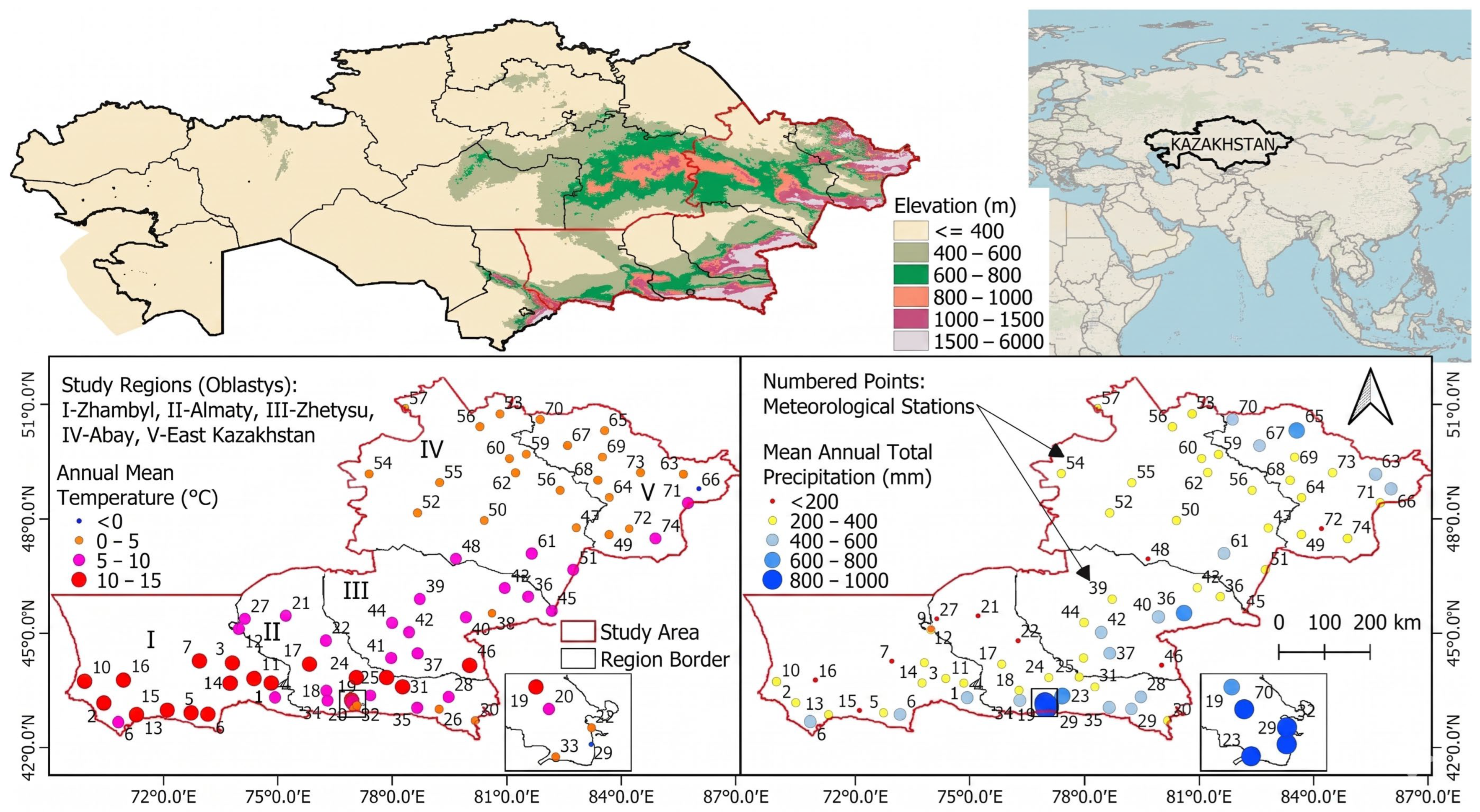
Central Asia is characterized by vast continental interiors, bound by the Caspian Sea in the west and the high mountains of the Tien Shan, Pamir, and Altai in the east and southeast. The region experiences a highly continental climate with pronounced seasonal temperature variations, low humidity, and strong orographic influences on precipitation distribution [11,12]. Within this broader context, Kazakhstan occupies a large portion of northern Central Asia, spanning approximately 2.7 million km2, and is primarily a lowland country, with much of its territory lying below 400 m above sea level (Figure 1). The northern and central areas are dominated by plains and plateaus, while the southern and southeastern parts contain several high-elevation mountain ranges that form important transmountain and transboundary watersheds (Figure 1).
The present study focuses on five southeastern regions (oblasts) of Kazakhstan, which encompass the main mountainous and transmountain regions. These areas include the Zhetysu Alatau, Ili Alatau, Dzungarian Alatau, and portions of the Tien Shan foothills, which are critical for regional hydrology and climate studies (Figure 1). These mountains form natural barriers affecting regional atmospheric circulation and precipitation, and they are the source regions of several rivers that cross national boundaries, including the Shu-talas river basin shared with Kyrgyzstan, the Ili river basin and Irtysh river basin shared with China.
The study region exhibits complex topography with pronounced orographic gradients. Elevations in the mountainous zones range from approximately 150 m in the foothills to over 4000 m in the high peaks (Figure 1 and Table 1). The terrain comprises steep slopes, narrow valleys, ridges, and intermontane basins, producing strong spatial heterogeneity in both temperature and precipitation. The orographic effects in this region result in distinct microclimates, where higher elevations receive significantly more precipitation than lowland plains, and temperature decreases with altitude following lapse rates that are variable depending on slope and aspect (Table 1 and Figure 1).
Precipitation exhibits a strong altitudinal gradient, ranging from ~100 mm per year in lowland areas to ~1000 mm per year in high-mountain regions (Table 1 and Figure 1). Similarly, temperature decreases with elevation, with mean annual temperatures from 12 °C in lowlands down to ~−2 °C in high-altitude areas, highlighting the strong influence of topography on local climate regimes. These gradients make the region ideal for studying elevation-dependent climate responses and the spatial variability of hydroclimatic conditions.
According to the Köppen–Geiger climate classification, the southeastern mountainous region of Kazakhstan is dominated by semi-arid (BSk) and humid continental (Dfa/Dfb) climates in valleys and foothills, while alpine and subalpine climate zones prevail at higher elevations [40,41]. Seasonal precipitation in this region is strongly controlled by orographic effects and prevailing westerly and southwesterly atmospheric circulation, resulting in higher precipitation during winter and spring in mountainous areas, whereas surrounding lowlands experience comparatively drier conditions, particularly in summer [21,25]. Temperature regimes exhibit pronounced continentality, characterized by hot summers in valleys and cold winters at higher elevations, reflecting strong elevation-dependent climatic gradients [33,42,43].
The topography of Kazakhstan’s transmountain regions is highly heterogeneous and can be broadly classified into four elevation zones (Figure 1 and Table 1). Lowlands (0–400 m above sea level) are characterized by plains and semi-steppe landscapes, low annual precipitation (~100–300 mm yr−1), and relatively high mean temperatures (~4–12 °C). Foothills (400–1000 m) exhibit gently sloping terrain, moderate precipitation (~200–600 mm yr−1), and mean temperatures ranging from ~2 to 11 °C. Mid-mountain zones (1000–1500 m) are defined by moderately steep slopes, increased precipitation (~400–700 mm yr−1), and cooler climatic conditions (~2–8 °C). High-mountain areas (1500–4000+ m) comprise steep slopes and ridgelines, receive the highest precipitation amounts (~500–1000 mm yr−1), and experience low mean annual temperatures ranging from approximately −2 to 6 °C.
These regions host transboundary watersheds, which are crucial for downstream water supply, agriculture, and ecosystem services. The combination of steep elevation gradients, complex physiography, and heterogeneous climatic conditions makes the study area an excellent natural laboratory for evaluating orographic controls, elevation-dependent warming, and spatial variability of temperature and precipitation.

3. Data and Methods

3.1. Meteorological Data

This study uses daily meteorological observations obtained from 74 meteorological stations distributed across the five transmountain regions (Zhambyl, Almaty, Zhetysu, Abay and East Kazakhstan) of Kazakhstan, covering the period 1981–2023. The dataset includes four key variables: daily minimum temperature (Tmin), maximum temperature (Tmax), average temperature (Tmean), and precipitation. These stations span a wide range of elevations and physiographic settings, making them suitable for analyzing orographic influences on regional climate.
All available daily meteorological observations were compiled into a unified database and processed to ensure temporal consistency across stations. Although no formal homogenization or advanced quality-control (QC) procedures were applied, the long-term observational records were systematically screened for basic structural integrity, including checks for formatting errors, duplicated entries, and discontinuities or inconsistencies in date sequences. Several stations exhibited data gaps spanning multiple months or, in some cases, entire years (Supplementary Table S1). To minimize the influence of incomplete records on trend and variability analyses, years containing more than one month of missing data were excluded from further analysis. Consequently, only station–year records with at least 90% temporal coverage were retained for annual and seasonal evaluations. Despite these exclusions, the remaining dataset maintains a high spatial density (Table 1) of meteorological stations distributed across complex mountainous terrain. This dense observational network provides a robust foundation for examining spatial and temporal variability in temperature and precipitation, assessing elevation-dependent climate responses, and evaluating the role of topographic controls on regional hydroclimatic patterns throughout the study area.

3.2. Statistical and Trend Analysis

This study employed a multi-stage statistical framework to characterize the spatial and temporal climatology of the mountain region and to detect significant long-term trends. The analysis was stratified by elevation to elucidate the complex relationship between altitude and climate change signals. Long-term climatological characteristics were analyzed at the station level to characterize the spatial and temporal variability of temperature and precipitation across different elevation ranges. For each meteorological station, daily observations were aggregated to derive seasonal and annual mean values of average temperature (Tmean), minimum temperature (Tmin), maximum temperature (Tmax), diurnal temperature range (DTR = Tmax − Tmin), and total precipitation. These aggregated series were used to evaluate long-term variability and trends in the study area. All spatial mapping and geographical distribution analyses were performed using QGIS 3.1 [44] software, while the statistical trend analyses (Mann–Kendall test and Sen’s slope estimator) and data visualizations were executed within the R 4.5.2 [45] statistical computing environment.
  • Standard deviation (SD) and absolute change (AC)
Descriptive statistics, including the mean and standard deviation (SD), were computed for each climatic variable to quantify interannual variability. The standard deviation was calculated as Equation (1):
S D = 1 n 1 i = 1 n ( x i x ¯ ) 2
where x i represents the climatic variable in year i, x ¯ is the long-term mean, and (n) is the number of years of observation.
The absolute change (AC) over a study period is calculated directly from the trend slope and the length of the record as Equation (2):
A C =   β × N
where A C ( )  is the absolute change over the entire period, β is Sen’s slope (change per year), and N is the total number of years in the analysis.
  • Trend Detection and Magnitude Estimation
Long-term trends in temperature and precipitation were assessed using the non-parametric Mann–Kendall (MK) test, which is widely applied in hydroclimatic studies due to its robustness against non-normal distributions, missing values, and outliers [46,47]. The MK test evaluates the null hypothesis of no monotonic trend against the alternative hypothesis of an increasing or decreasing trend.
The MK test statistic (S) is defined as Equation (3):
S = k = 1 n 1 j = k + 1 n sgn ( x j x k )
where the sign function is given by Equation (4):
s g n x j x k = + 1   x j   >     x k 0   x j =   x k 1   x j <   x k
where x j and x k are the data values at time j and k, respectively. The standardized test statistic (S) was used to assess statistical significance at conventional confidence levels (e.g., (p < 0.05)).
The magnitude of trends was quantified using Sen’s slope estimator, a non-parametric method that computes the median of all pairwise slopes and is insensitive to extreme values [48]. Sen’s slope ( β ) is calculated as in Equation (5):
β   = m e d i a n x j x k j k
Trend magnitudes were expressed as °C per decade for temperature indices and mm per decade for precipitation.
  • Elevation-Dependent Trend Analysis
Recognizing that climate change impacts are often non-linear with altitude, a stratified analysis was conducted. To investigate elevation-dependent climate responses, meteorological stations were grouped into six elevation zones based on their altitude above sea level: 0–400 m, 400–600 m, 600–800 m, 800–1000 m, 1000–1500 m, and >1500 m. Within each elevation band, station records were aggregated to compute representative annual and seasonal climatic indices. Annual and seasonal trend analyses (MK test and Sen’s slope) were then performed for each elevation group to assess how the magnitude and direction of temperature and precipitation trends vary with altitude. This stratified approach enables a robust evaluation of elevation-dependent warming and precipitation changes, which are particularly relevant in complex mountainous environments where topography strongly modulates climatic processes.

4. Results and Discussion

4.1. Long-Term Monthly Mean Precipitation and Temperature Patterns Across Elevation Zones

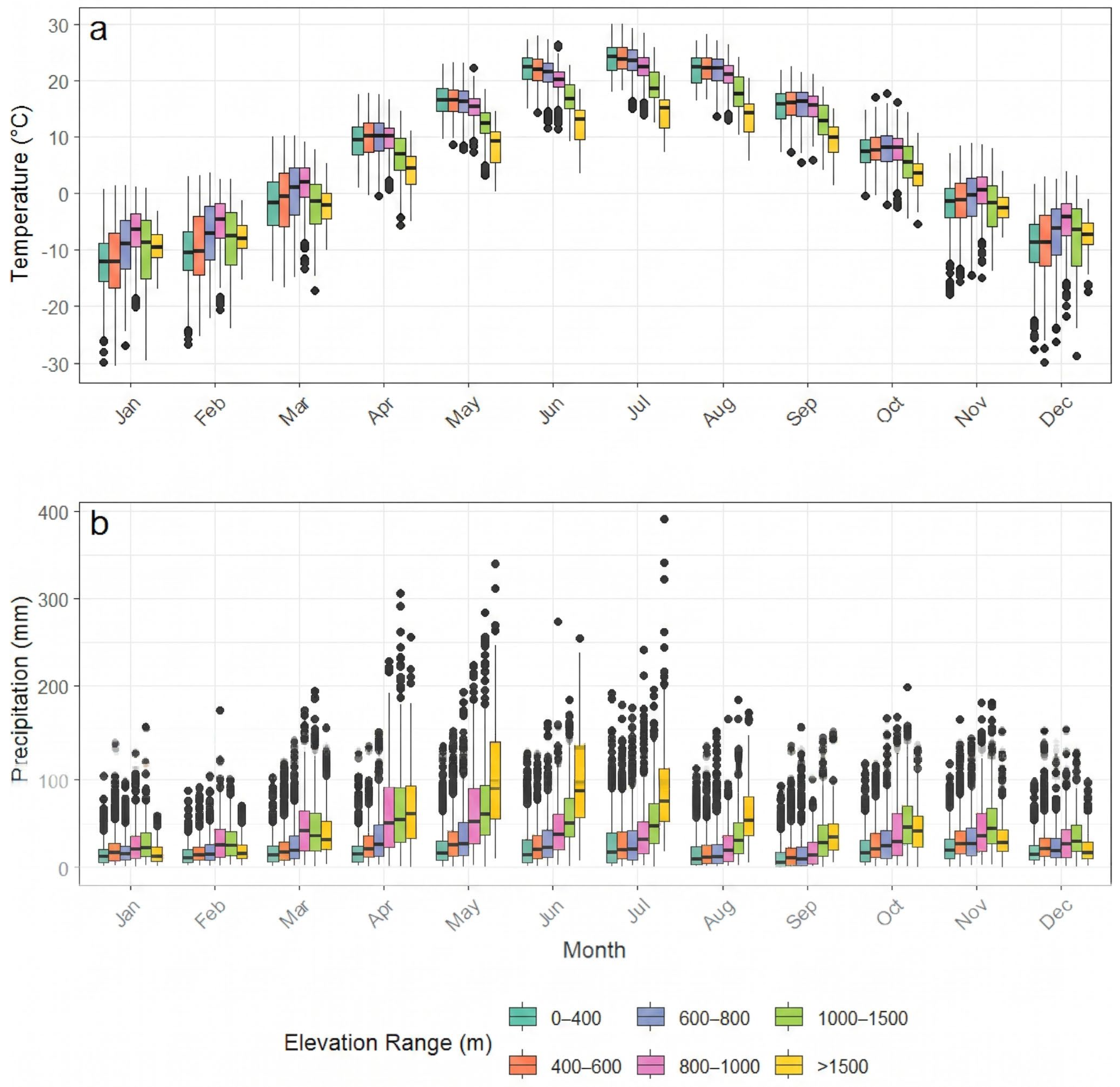
Figure 2 presents the long-term (1981–2023) mean monthly temperature and precipitation for all meteorological stations, stratified by elevation range. The results highlight substantial month-to-month and elevation-dependent variability, reflecting the heterogeneous climatic conditions across the transmountain region. In the lowland zone (<400 m), the lowest monthly temperatures occur during winter (DJF), while this zone experiences the highest temperatures during summer (JJA). In contrast, the highest winter (DJF) temperatures are observed in the 800–1000 m elevation range, which also shows relatively elevated temperatures during spring (MAM) and autumn (SON). This elevation band exhibits greater inter-station variability, likely due to the transitional climatic conditions between the eastern and western parts of the study area. Notably, mountain regions above 1500 m display the lowest temperature variability, indicating more uniform thermal conditions across stations (Figure 2).
Monthly precipitation exhibits pronounced spatial and temporal variability across all elevation zones (Figure 2). In the high-mountain zone (>1500 m), monthly totals can reach 200–400 mm between April and July, with most precipitation occurring from April to October and peak values consistently observed in May–July, indicating a predominance of rainfall over snowfall despite substantial variability. The lowland zone (<400 m) experiences the lowest precipitation year-round. Notably, the mid-mountain zone (800–1000 m) records the highest winter (DJF) precipitation, likely driven by enhanced orographic lifting and snowfall processes.

4.2. Trends and Absolute Changes in Temperature Indices

4.2.1. Station-Based Annual Temperature Indices: Trends and Slopes

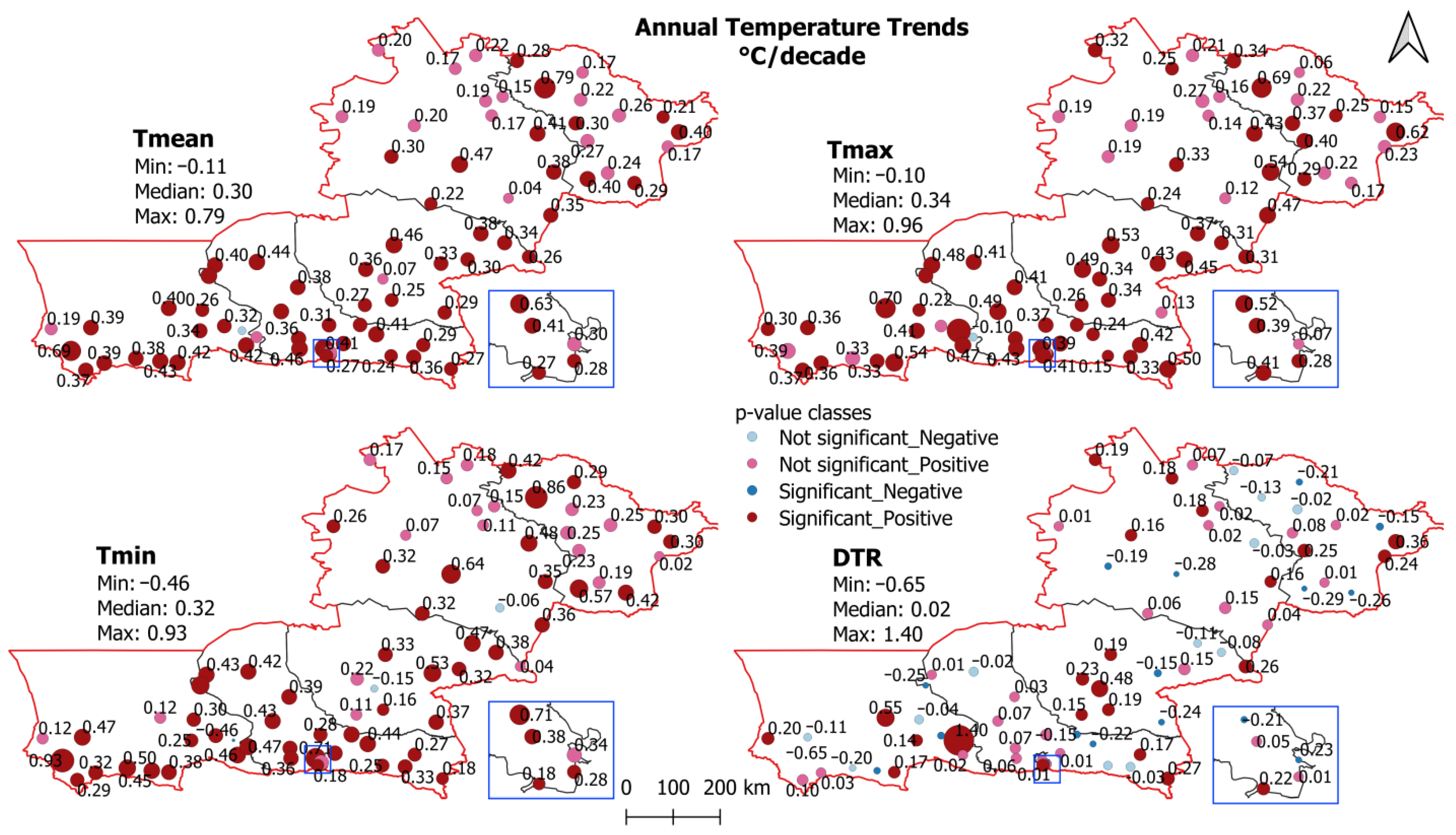
Figure 3 illustrates the spatial distribution of station-based long-term trends in annual mean temperature (Tmean), maximum temperature (Tmax), minimum temperature (Tmin), and diurnal temperature range (DTR) across the transmountain study area for the period 1981–2023. Overall, the results reveal a coherent and pervasive warming signal, with nearly all stations exhibiting positive trends in all temperature indices. The strongest warming is concentrated in the southwestern portion of the study area, whereas stations in the northwestern sector display weaker, though still predominantly positive, trends, indicating pronounced spatial heterogeneity in warming intensity.
For Tmean, Sen’s slope estimates exhibit a median warming rate of 0.30 °C decade−1, with values ranging from −0.11 to 0.79 °C decade−1, reflecting substantial spatial variability. Importantly, the majority of Tmean trends are statistically significant, confirming that the observed warming is unlikely to result from random variability. Only the Anarkhay station shows a weak and non-significant negative trend (−0.11 °C decade−1), which is more plausibly attributable to localized influences, such as complex topography, land surface heterogeneity, or observational uncertainties, rather than to a regionally coherent cooling signal. These findings are consistent with national-scale assessments that report robust warming across Kazakhstan at rates of approximately 0.3–0.4 °C per decade since the 1980s, albeit with strong regional contrasts driven by elevation, land use characteristics, and atmospheric circulation patterns [15,16,49].
Trends in Tmax further reinforce the dominance of warming across the region. All stations except Otar exhibit positive Tmax trends, with Sen’s slope estimates spanning −0.10 to 0.96 °C decade−1 and a median value of 0.34 °C decade−1. The slight negative trend detected at Otar (−0.10 °C decade−1) is statistically insignificant and unlikely to be regionally representative. Instead, it may reflect site-specific factors such as station relocation, irrigation expansion, or local circulation modifications that preferentially damp daytime temperature increases. The most pronounced Tmax increase is observed at Anarkhay, underscoring the spatial heterogeneity of daytime warming and highlighting the role of local surface–atmosphere interactions in shaping extreme temperature responses.
In contrast to Tmax, Tmin trends display greater spatial complexity. While most stations record significant Tmin warming, with a median Sen’s slope of 0.32 °C decade−1 and a range from −0.46 to 0.93 °C decade−1, Anarkhay exhibits a statistically significant cooling trend (−0.46 °C decade−1), and both Taldykorgan and Urzhar show weak, non-significant negative trends. Such localized Tmin cooling or suppressed warming has been documented in other mountainous and continental regions of Central Asia and western China, where cold-air pooling, persistent snow cover, enhanced nocturnal radiative cooling, and changes in boundary-layer processes can counteract large-scale warming tendencies [5,50]. These results emphasize that minimum temperature trends are particularly sensitive to topographic setting and surface conditions and may diverge from regional-scale warming signals at individual stations.
As a consequence of the differing behaviors of Tmax and Tmin, DTR trends exhibit the greatest spatial heterogeneity among the analyzed indices. Sen’s slope estimates show a near-zero median value of 0.02 °C decade−1, with a wide range from −0.65 to +1.40 °C decade−1. This spread reflects the combined and sometimes opposing changes in daytime and nighttime temperatures. Stations in the warmer southwestern part of the study area tend to show more pronounced and statistically significant DTR trends, whereas stations in the northeastern and eastern sectors exhibit weaker and less consistent changes. Similar mixed DTR responses have been widely reported across Central Asia and adjacent regions, where DTR is strongly modulated by cloud cover variability, soil moisture availability, aerosol loading, and land use change [51,52].
The observed patterns are broadly consistent with findings from North China, a climatically analogous region characterized by strong continentality and limited oceanic influence. There, significant warming of approximately 0.25–0.4 °C per decade has been reported since the late twentieth century, with Tmin often increasing more rapidly than Tmax, resulting in a declining DTR at many stations [52,53,54]. However, recent studies indicate a partial recovery, stabilization, or even a reversal of this declining DTR trend in many regions. This shift is widely attributed to ‘global brightening,’ driven by reductions in aerosol concentrations and subsequent changes in cloud cover, which have increased surface solar irradiance and accelerated daytime warming [55,56]. This evolving and spatially heterogeneous DTR behavior closely mirrors the mixed DTR trends identified in the present study area.
At the continental scale, Eurasia has experienced some of the strongest warming trends globally, particularly in inland regions far removed from oceanic moderation ([6]). Numerous observational and reanalysis-based studies demonstrate that Tmin increases frequently outpace Tmax increases in mid-latitude land regions, though this asymmetry is neither spatially uniform nor temporally stationary [51,57]. Across Central Asia, widespread increases in Tmean, Tmax, and Tmin have been documented, accompanied by spatially heterogeneous and sometimes non-monotonic DTR trends, reflecting the combined influence of large-scale circulation changes and local surface processes [34,58].
Overall, the results confirm that the transmountain region of Kazakhstan is undergoing significant and spatially differentiated warming that is consistent with regional and global climate change signals. The coexistence of strong mean warming, localized Tmin cooling, and heterogeneous DTR trends highlights the importance of station-scale analyses in complex terrain and underscores the critical role of local surface–atmosphere interactions in modulating the regional expression of global warming.

4.2.2. Station-Based Seasonal Temperature Indices: Trends and Slopes

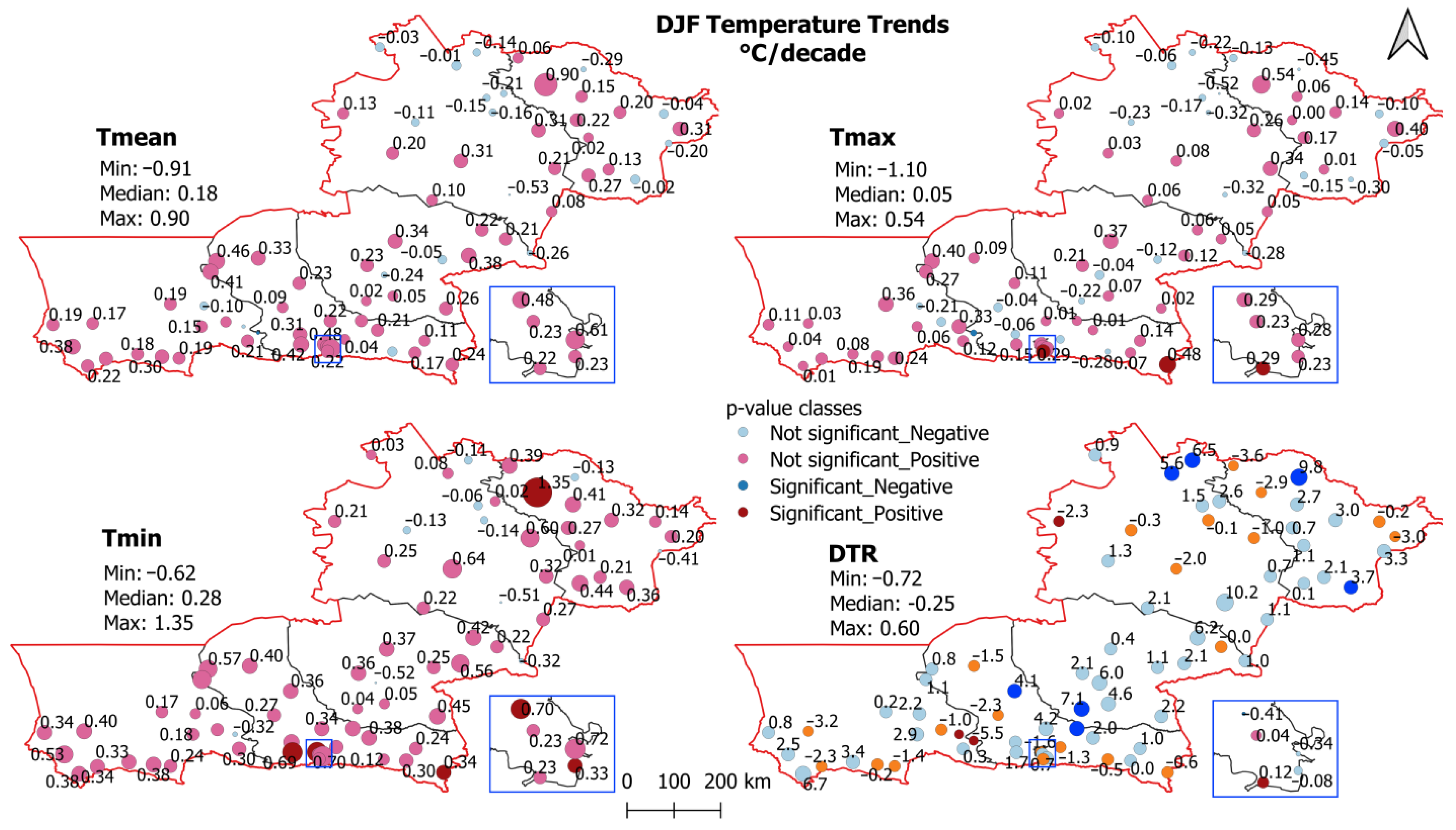
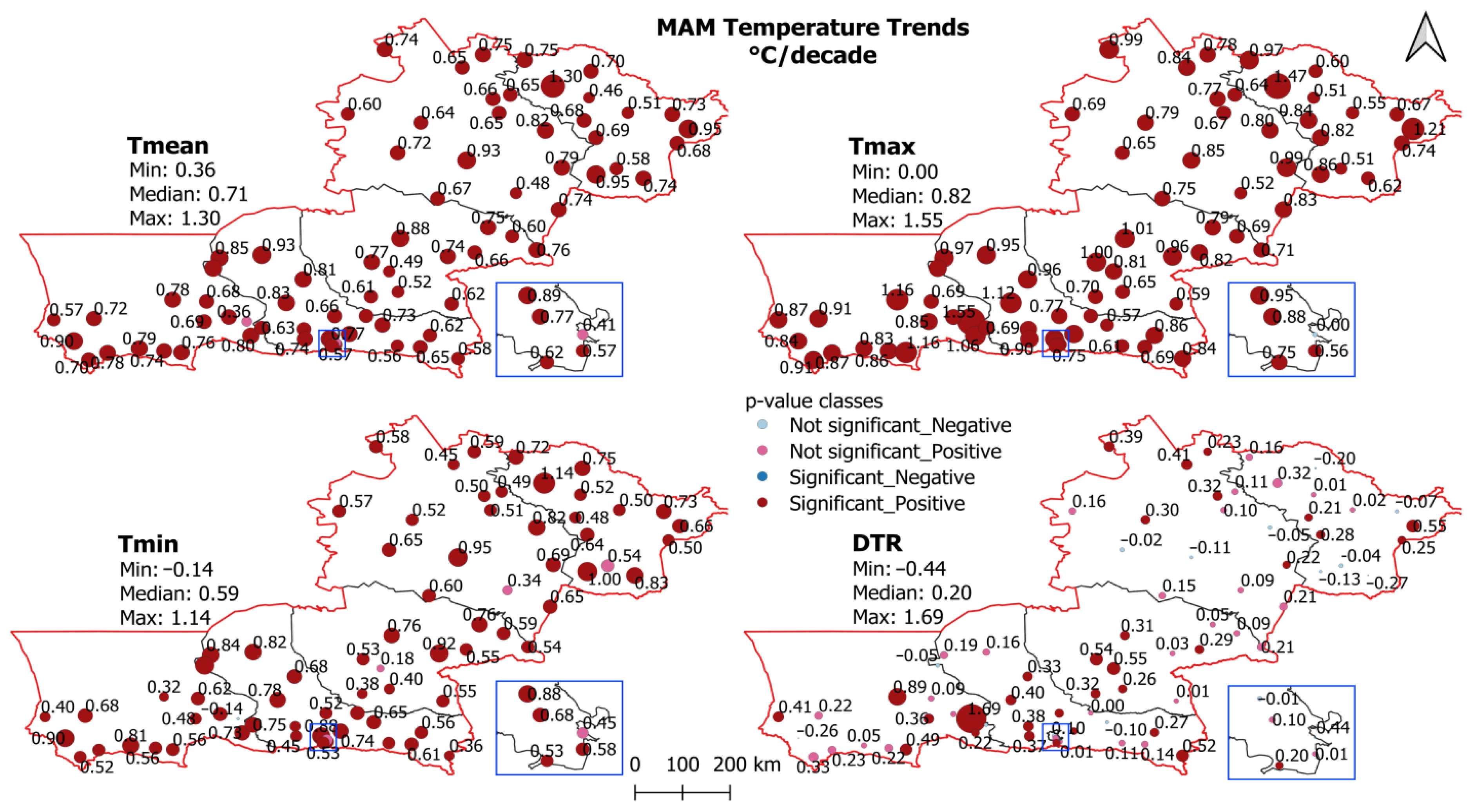
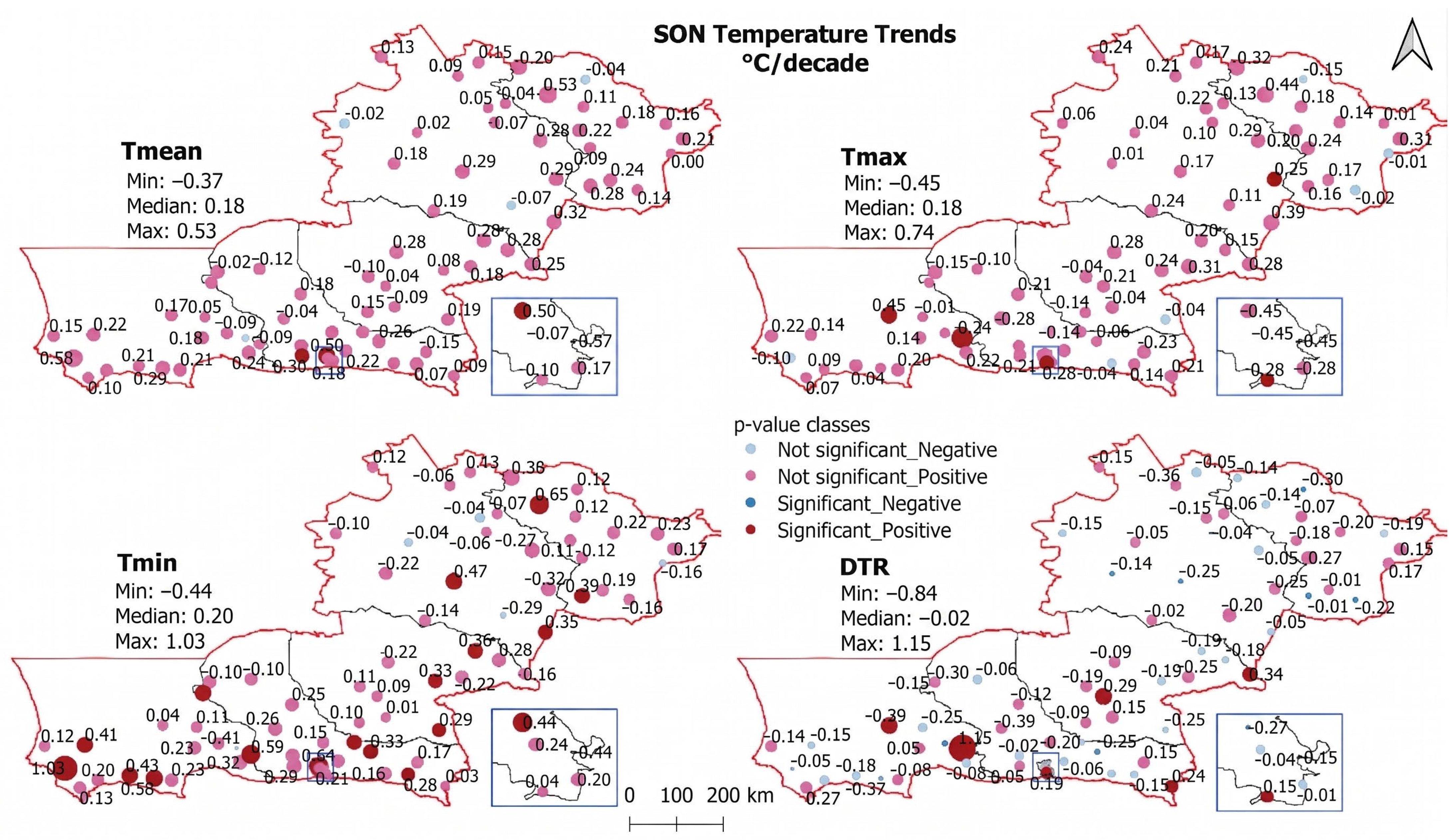
Station-based analyses of seasonal temperature indices for the period 1981–2023 reveal a pronounced and seasonally asymmetric warming signal across Kazakhstan’s transmountain zones (Figure 4, Figure 5, Figure 6 and Figure 7). While positive trends dominate in all seasons, their magnitude, statistical significance, and diurnal structure differ substantially between winter (DJF), spring (MAM), summer (JJA), and autumn (SON). In particular, spring and summer exhibit strong and statistically significant warming, whereas winter and autumn show weaker and largely non-significant trends. These seasonal contrasts highlight the importance of considering intra-annual variability when assessing climate change impacts in complex mountainous terrain.
Spatial analysis of winter (DJF) trends (Figure 4) indicates a widespread but statistically non-significant warming, with a median Tmean trend of 0.18 (−0.91–0.90) °C decade−1. A notable north–south gradient emerges: stations in the southern and southwestern sectors show consistent positive trends, while scattered stations in the north and northwest exhibit weak cooling. The most distinctive feature of winter is the pronounced asymmetry between Tmin and Tmax. The median Tmin trend (0.28 °C decade−1) is over five times stronger than the median Tmax trend (0.05 °C decade−1). This differential results in a significant contraction of the Diurnal Temperature Range (DTR), with a median trend of −0.25 °C decade−1. This pattern of amplified nighttime warming is consistent with global observations linked to increased cloud cover, atmospheric humidity, or changes in surface albedo [59,60]. In mountainous, snow-covered terrain, this reduced DTR can suppress sublimation, alter snowpack metamorphism, and negatively influence permafrost thermal stability [61,62]. The spatial heterogeneity may reflect varying sensitivities to changes in wintertime synoptic patterns, such as the frequency of cold, clear nights versus cloudy, warm air incursions [63].
Spring (MAM) is unequivocally the season of most intense and statistically significant change (Figure 5). The median Tmean warming of 0.71 °C decade−1 (range: 0.36–1.36 °C decade−1) represents the highest seasonal rate, a phenomenon repeatedly identified as a hallmark of Central Asian climate change [15,58]. Crucially, warming is dominant in daytime temperatures, with a median Tmax trend of 0.82 °C decade−1, exceeding the Tmin trend of 0.59 °C decade−1. This drives a notable increase in the DTR (median: +0.20 °C decade−1), marking a complete reversal from the winter pattern. The strong spring Tmax warming is a primary driver of accelerated snowmelt onset. Earlier snow clearance reduces surface albedo, exposing darker ground and triggering a powerful positive feedback that further amplifies regional heating—a process central to the concept of elevation-dependent warming [5,64]. This shift directly advances the timing of peak river runoff, posing a significant challenge for downstream water management by concentrating water availability earlier in the year and potentially exacerbating late-summer shortages [18,28].
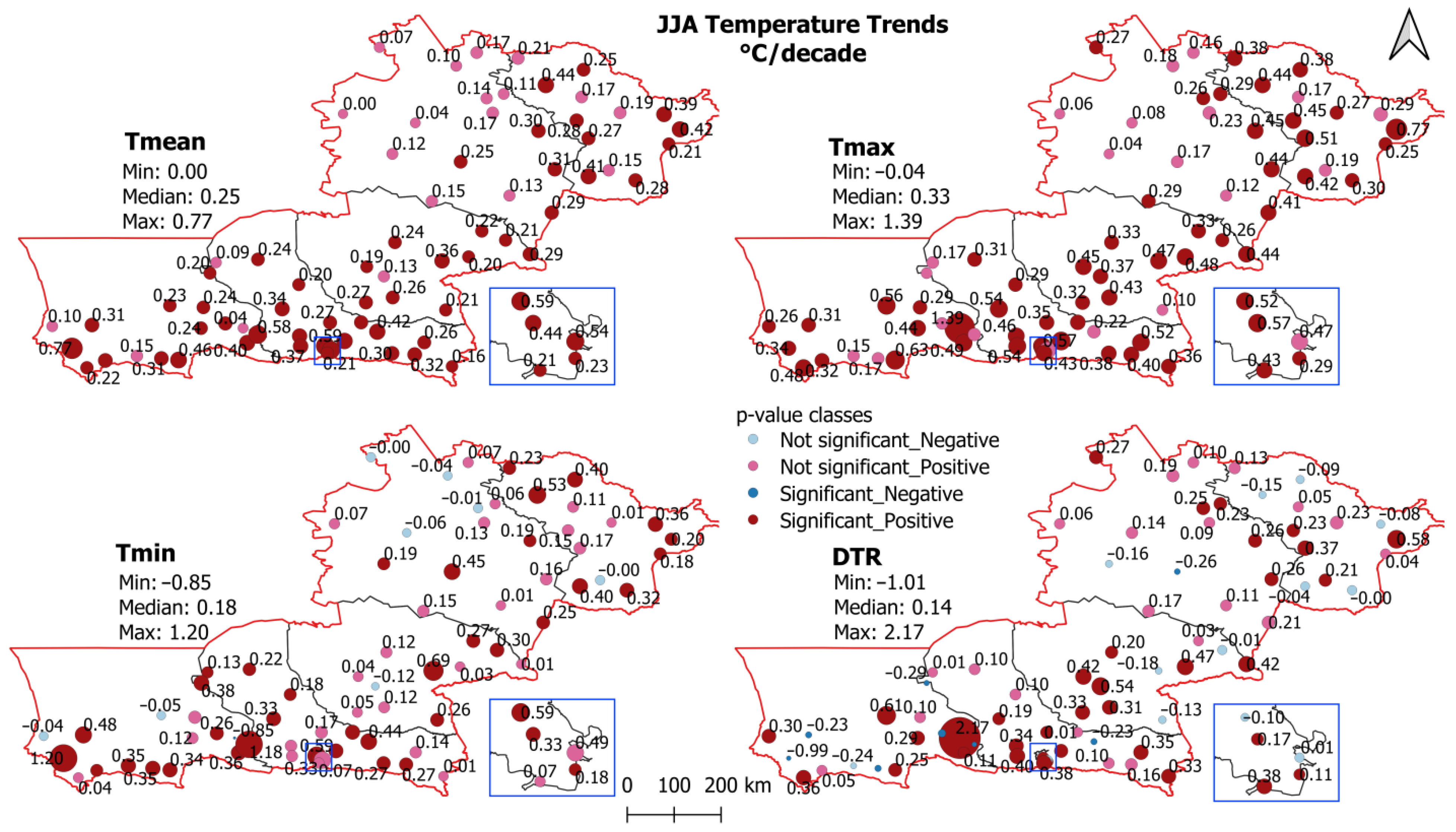
Summer (JJA) trends (Figure 6) show consistent and frequently significant warming, though at a lower magnitude than in spring. The median Tmean increase of 0.25 °C decade−1 is accompanied by a persistent dominance of Tmax warming (0.33 °C decade−1) over Tmin (0.18 °C decade−1), resulting in a positive DTR trend of +0.14 °C decade−1. Spatially, the strongest summer warming occurs in the warmer low-elevation and southwestern parts of the study area, where Tmax trends locally exceed 1.0 °C decade−1. These hotspots likely reflect the combined effects of aridity, reduced soil moisture, and enhanced land–atmosphere coupling in valley and piedmont environments. Rising summer Tmax has critical implications for both natural and human systems. Increased evaporative demand intensifies drought stress, accelerates glacier mass loss above the equilibrium line altitude, and heightens heat-related risks to ecosystems, agriculture, and human health [19,29,65]. In transmountain regions that depend on glacier- and snowmelt-fed runoff, sustained summer warming further amplifies the vulnerability of water resources [66].
Autumn (SON) trends (Figure 7) resemble those observed in winter, with weak and largely non-significant warming. Median Tmean warming is 0.18 °C decade−1, and Tmax and Tmin trends are nearly identical (0.18 and 0.20 °C decade−1, respectively), resulting in a near-zero median DTR trend (−0.02 °C decade−1). Despite this apparent stability, individual stations exhibit substantial variability, with DTR trends ranging from strongly negative to positive values. As a transitional season, autumn is influenced by competing processes, including declining solar radiation, variable cloud cover, and the delayed onset of persistent snow cover, which together limit the development of strong and spatially coherent thermal trends.
Overall, the transmountain zones of Kazakhstan are not experiencing uniform warming across seasons; rather, they are undergoing a pronounced seasonal reconfiguration of their thermal regime. The amplification of spring and summer Tmax emerges as a key driver of cryospheric degradation and hydrological change, with cascading consequences for water security, ecosystem stability, and climate risk. These station-based observations provide critical ground truth for climate model evaluation and underscore how moving beyond annual averages to explicitly consider seasonal and diurnal asymmetries provides more granular detail of climate change impacts in complex mountainous regions.

4.2.3. Elevation-Based Annual and Seasonal Temperature Indices: Trends and Absolute Changes

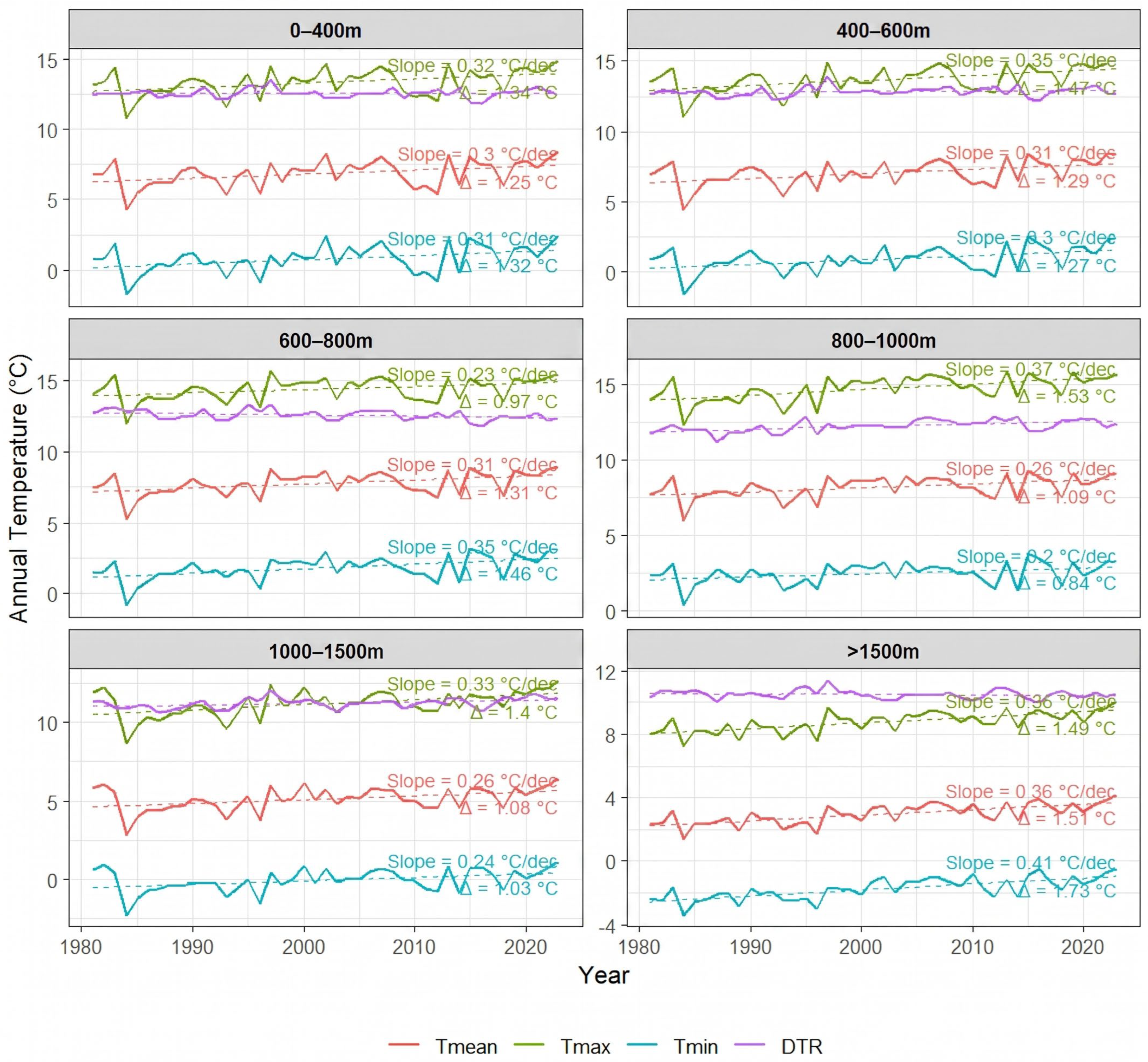
To quantify the elevation dependence of recent warming, Sen’s slope (SS), absolute change (AC), and standard deviation (SD) of annual and seasonal temperature indices (Tmean, Tmax, Tmin, and DTR) were evaluated across six elevation zones (0–400 m, 400–600 m, 600–800 m, 800–1000 m, 1000–1500 m, and >1500 m) using observations from 74 meteorological stations (Table 2; Figure 8; Supplementary Figures S1–S4). The results demonstrate pronounced elevation- and season-specific variability in both the magnitude and structure of temperature change. Overall, warming intensifies in high elevation, with the strongest and most spatially coherent trends observed at elevations above 1500 m, particularly for annual mean and minimum temperatures. This pattern provides robust observational evidence of elevation-dependent warming (EDW) in the transmountain regions of Kazakhstan.
  • Annual Temperature Trends across Elevation Zones
At the annual scale, all elevation zones exhibit statistically significant warming in Tmean, Tmax, and Tmin, although the magnitude and relative contribution of daytime versus nighttime temperatures vary systematically with elevation (Figure 8; Table 2). In the lowland zone (0–400 m), mean warming rates are relatively uniform across indices, with Tmean, Tmax, and Tmin increasing at approximately 0.30–0.32 °C decade−1. Similar magnitudes persist in the 400–600 m and 600–800 m zones, although the latter exhibits a distinct Tmin-dominated warming signal (Tmin = 0.35 °C decade−1), accompanied by a significant reduction in DTR. This suggests enhanced nighttime warming at mid-elevations, likely linked to cold-air pooling and boundary-layer processes.
Between 800 and 1500 m, warming remains statistically significant but becomes increasingly asymmetric. In these zones, Tmax trends intensify (up to 0.37 °C decade−1), while Tmin trends weaken, leading to a systematic expansion of DTR. This pattern indicates a growing dominance of daytime heating with elevation, potentially driven by reduced soil moisture, stronger solar forcing, and enhanced land–atmosphere coupling.
The strongest and most coherent warming occurs above 1500 m, where Tmean increases at 0.36 °C decade−1, and Tmin exhibits the highest rate among all elevation zones (0.41 °C decade−1). Absolute temperature changes over the study period exceed 1.5 °C for all indices, underscoring the exceptional sensitivity of high-elevation environments to climate change. These results align with extensive evidence that mountain regions warm faster than adjacent lowlands due to snow–albedo feedbacks, reduced atmospheric moisture, and enhanced radiative forcing [5,6,67].
  • Seasonal Trends and Elevation Dependence
Winter (DJF) trends are generally weak and statistically non-significant across most elevation zones, reflecting high interannual variability and strong synoptic control. Below 1500 m, Tmean and Tmax exhibit slight cooling or near-zero trends, whereas Tmin shows consistent positive trends, resulting in a statistically significant contraction of DTR. This pattern indicates dominant nighttime warming, a feature commonly associated with increased cloud cover, enhanced longwave radiation, and reduced nocturnal cooling [59,60]. However, above 1500 m, winter warming becomes more pronounced, with Tmean increasing at 0.32 °C decade−1 and Tmin at 0.44 °C decade−1, accompanied by a significant decline in DTR (Table 2 and Supplementary Figure S1). This specific high-elevation winter Tmin amplification serves as the primary catalyst for the snowpack modification and permafrost destabilization processes outlined earlier [61,62].
Spring (MAM) exhibits the strongest and most spatially coherent warming across all elevation zones, confirming it as the season most responsive to climate forcing in the region. Tmean warming exceeds 0.60 °C decade−1 decade−1 at all elevations, with peak values in the lowlands (0.70 °C decade−1) and sustained strong warming above 1500 m (0.63 °C decade−1) (Table 2 and Supplementary Figure S2). Warming is dominated by Tmax across all elevations, leading to widespread DTR expansion. This pronounced springtime Tmax amplification is a hallmark of Central Asian climate change and reflects strong snow–albedo feedbacks associated with earlier snowmelt [15,68]. As snow cover retreats earlier with elevation, darker surfaces absorb more solar radiation, reinforcing surface heating and accelerating cryospheric loss. Because this intense daytime heating is sustained at higher altitudes, the elevation-dependent signal actively exacerbates the early peak runoff and subsequent late-summer downstream water shortages previously identified [18,28].
Summer (JJA) warming is significant across all elevation zones but displays a clear elevation dependence. Lowland zones show relatively modest Tmean increases (~0.18 °C decade−1), whereas elevations above 1000 m experience stronger warming (~0.26–0.27 °C decade−1) (Table 2 and Supplementary Figure S3). Tmax dominates summer warming at all elevations, particularly between 800 and 1500 m, where DTR increases significantly. At high elevations, sustained summer warming accelerates glacier mass loss above the equilibrium line altitude and enhances evapotranspiration demand in alpine ecosystems [19,29]. In arid and semi-arid mountain regions, this combination of higher Tmax and increased evaporative demand exacerbates water stress, amplifying climate risks to agriculture and downstream populations [65,66].
Autumn (SON) trends are weak and largely non-significant across most elevation zones, reflecting its transitional nature between the radiatively active summer and snow-dominated winter. Nevertheless, Tmin warming above 1500 m remains statistically significant (0.27 °C decade−1) (Table 2 and Supplementary Figure S4), indicating continued sensitivity of nighttime temperatures at high elevations. DTR responses are mixed, with negative trends at low and high elevations and positive trends at mid-elevations, underscoring the complex interplay of cloud cover, soil moisture, and delayed snow onset during this season.
Overall, the elevation-stratified analysis reveals that warming in Kazakhstan’s transmountain regions is not uniform but strongly modulated by elevation and season. The amplification of warming above 1500 m, particularly in Tmin annually and in Tmax during spring and summer, provides compelling observational evidence for elevation-dependent warming. These findings strongly align with broader Eurasian climate assessments (e.g., [15,22], which identify Central Asia as a warming hotspot. However, our elevation-stratified approach reveals that the transmountain zones of Kazakhstan are experiencing a much more pronounced daytime spring warming and nighttime winter warming than adjacent lowland studies have previously captured, underscoring the unique vulnerability of these high-altitude water towers. Also, these patterns are consistent with regional and global mountain climate studies and have far-reaching implications for cryospheric stability, hydrological regimes, and water security [5,6]. By explicitly linking temperature trends to elevation and season, these station-based results provide essential ground truth for climate model evaluation and emphasize the need for impact assessments that move beyond annual averages. The observed seasonal and elevational asymmetries highlight that future climate risks in Central Asia will be driven not only by mean warming but by its timing, vertical structure, and diurnal characteristics.

4.3. Precipitation Trends and Absolute Changes

4.3.1. Station-Based Annual and Seasonal Precipitation Trends

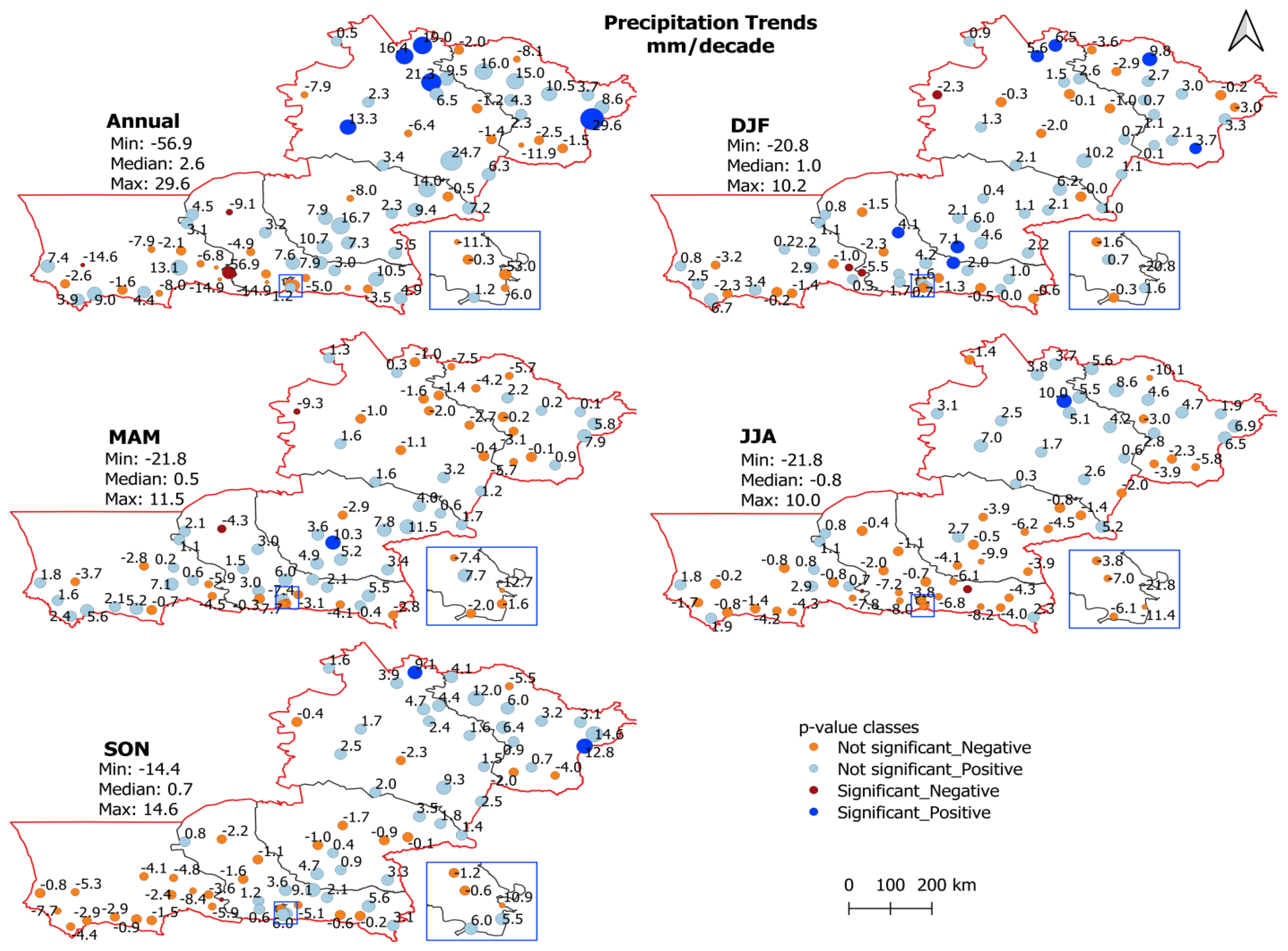
Figure 9 presents the spatial distribution of long-term station-based trends in annual and seasonal (DJF, MAM, JJA, SON) precipitation across the transmountain study area for the period 1981–2023, expressed as Sen’s slope estimates (mm decade−1) and relative change (% decade−1). In contrast to the coherent and statistically robust warming observed in temperature indices, precipitation trends exhibit pronounced spatial heterogeneity, weak magnitudes, and limited statistical significance. This behavior reflects the inherently higher variability and localized controls governing precipitation in continental mountainous regions.
At the annual scale, the median precipitation trend is modestly positive (2.6 mm decade−1), but individual station trends range widely from −56.9 to +29.6 mm decade−1, highlighting substantial spatial divergence. Stations located in the eastern part of the study area predominantly exhibit positive trends, including four stations with statistically significant increases, whereas the western sector is characterized mainly by negative trends, with one station showing a significant decline. This east–west contrast likely reflects differences in moisture transport pathways, orographic enhancement, and regional circulation influences associated with westerly flow systems and localized convective processes. Similar spatially inconsistent precipitation trends have been widely documented across Kazakhstan and Central Asia, where long-term changes are often weak relative to interannual variability [21,34].
Seasonal analyses further underscore the lack of a uniform precipitation response. During winter (DJF), the median trend is slightly positive (1.0 mm decade−1), but trends span a broad range (−20.8 to +10.2 mm decade−1) and display no coherent spatial structure. Most stations exhibit non-significant changes, suggesting that winter precipitation remains strongly controlled by large-scale synoptic circulation and episodic cyclone activity rather than by monotonic climate trends. The prevalence of weak winter trends is consistent with findings from other continental interior regions, where snowfall variability often masks long-term signals [6,26].
In spring (MAM), a small positive median trend (0.5 mm decade−1) is observed, but spatial patterns remain mixed. The northwestern part of the study area is dominated by non-significant negative trends, while the southeastern sector shows predominantly non-significant positive changes. Spring precipitation in Central Asia is closely linked to transitional circulation regimes and frontal activity, which are highly sensitive to interannual atmospheric variability. As a result, long-term trends often remain statistically weak despite substantial year-to-year fluctuations [21,34].
The summer (JJA) season is the only period exhibiting a negative median trend (−0.8 mm decade−1), although this signal is also weak and largely non-significant. Northeastern stations tend to show slight positive changes, whereas southeastern stations are characterized by negative trends. This pattern may reflect enhanced evapotranspiration under rising temperatures, reduced soil moisture availability, and weakening of convective precipitation efficiency during summer, processes that have been increasingly reported across arid and semi-arid regions of Central Asia [22]. The absence of widespread statistical significance indicates that summer drying signals remain subtle and spatially inconsistent at the station scale.
During autumn (SON), the median trend returns to a weakly positive value (0.7 mm decade−1), with northeastern stations largely exhibiting positive changes and southwestern stations showing negative trends. Autumn precipitation is influenced by retreating monsoon-related systems and mid-latitude westerlies, resulting in complex spatial patterns that vary strongly across relatively short distances in mountainous terrain. Comparable northeast–southwest contrasts have been reported in regional precipitation assessments across eastern Kazakhstan and western China [52,54].
Overall, the station-based results indicate that precipitation trends across the transmountain region are weak, spatially fragmented, and largely non-significant, in stark contrast to the strong and consistent warming observed in temperature indices. This decoupling between temperature and precipitation trends is a well-established feature of continental interior climates, where thermodynamic warming does not necessarily translate into systematic precipitation increases [6]. Instead, precipitation changes remain strongly modulated by circulation dynamics, topography, and localized convective processes. The dominance of non-significant trends suggests that natural variability continues to overshadow long-term precipitation change at the station scale, emphasizing the need for caution when interpreting localized wetting or drying signals. These findings are consistent with broader Central Asian assessments, which report modest long-term increases or decreases in precipitation but with low spatial coherence and high uncertainty [21,34]. Nevertheless, the emerging tendency toward summer drying in parts of the region, combined with robust warming, may have important implications for water availability, drought risk, and ecosystem stress, particularly in snow-fed and irrigated systems.

4.3.2. Elevation-Based Annual and Seasonal Precipitation Trends

At the annual scale, nearly all elevation zones exhibit weak positive but statistically non-significant precipitation trends, ranging from 1.58 to 14.35 mm decade−1 (Table 3; Supplementary Figure S5). The only exception occurs in the 800–1000 m elevation band, which shows a slight negative trend (−6.63 mm decade−1). The largest annual increase is observed above 1500 m (14.35 mm decade−1), accompanied by the highest variability (SD = 111.64 mm), indicating that high-elevation precipitation is strongly influenced by episodic events rather than persistent long-term change. Similar patterns―characterized by weak mean trends and large variability―have been widely reported across Central Asia, where precipitation responses to climate change are often masked by strong year-to-year fluctuations and limited observational coverage at high elevations [21,34].
During winter (DJF), most elevation zones show small positive but non-significant trends (0.88–2.39 mm decade−1), while the 800–1000 m zone again exhibits a weak negative change (−2.59 mm decade−1) (Table 3; Supplementary Figure S5). The largest winter increase occurs in the 400–600 m elevation range (2.39 mm decade−1). Winter precipitation in Kazakhstan is primarily controlled by mid-latitude westerlies and synoptic-scale cyclones, whose frequency and intensity exhibit strong interannual variability. Consequently, even under pronounced winter warming, long-term precipitation trends remain statistically weak and spatially inconsistent [6,26].
In spring (MAM), most elevation zones show weak positive precipitation tendencies (1.43–9.21 mm decade−1), whereas the lowest (0–400 m) and mid-elevation (800–1000 m) zones exhibit slight negative trends (−1.56 and −0.71 mm decade−1, respectively). The strongest spring increase occurs above 1500 m (9.21 mm decade−1), with a near-significant p-value (0.094), suggesting a possible but still uncertain intensification of high-elevation spring precipitation. This tendency may reflect enhanced moisture availability and orographic lifting under warming conditions; however, the lack of statistical significance indicates that these processes do not yet translate into a robust long-term signal [5].
In contrast, summer (JJA) precipitation shows a predominantly negative tendency across nearly all elevation zones (−2.36 to −0.76 mm decade−1) (Table 3; Supplementary Figure S5), with the strongest drying observed in the 1000–1500 m elevation band (−3.50 mm decade−1). Only the lowest elevation zone (0–400 m) exhibits a marginal positive change (0.20 mm decade−1). Although none of these trends are statistically significant, the consistent summer drying tendency aligns with broader regional evidence of declining summer precipitation or reduced precipitation efficiency across arid and semi-arid Central Asia, driven by increased atmospheric stability, enhanced evapotranspiration, and soil moisture limitations under rising temperatures [22].
During autumn (SON), all elevation zones exhibit weak positive precipitation trends (0.07–4.36 mm decade−1), with the largest increase again occurring above 1500 m (4.36 mm decade−1) (Table 3; Supplementary Figure S5). However, these trends remain non-significant and are accompanied by substantial variability, reflecting the transitional nature of autumn circulation, when competing influences from residual summer convection and strengthening westerlies produce spatially fragmented precipitation responses [52,54].
Overall, the elevation-based analysis demonstrates that precipitation does not exhibit a statistically robust elevation-dependent response, despite modest increases at higher elevations in some seasons. This decoupling between strong elevation-dependent warming and weak precipitation change is a characteristic feature of continental mountain regions, where thermodynamic increases in atmospheric moisture do not necessarily translate into increased precipitation due to circulation constraints and local atmospheric dynamics [6,21,34]. It must be noted, however, that the sparse and highly heterogeneous spatial distribution of stations in the high-mountain zones (above 1500 m) poses significant challenges for characterizing localized precipitation shifts. While our results indicate that observed changes across all zones remain statistically non-significant, the inherent uncertainty at high altitudes highlights a data gap that could be addressed with a denser observational network. Despite these monitoring limitations, the combination of pronounced warming across all elevation zones and weak, uncertain precipitation trends implies increasing evaporative demand, reduced snow persistence, and heightened sensitivity of water resources to interannual variability rather than long-term precipitation change. These findings emphasize that future hydrological risks in Kazakhstan’s transmountain regions are likely to be driven more by temperature-controlled processes—such as snowmelt timing, glacier mass loss, and evapotranspiration—than by systematic changes in precipitation amount.

5. Conclusions

This study provides a comprehensive elevation- and season-grouped assessment of long-term climate change across Kazakhstan’s transmountain regions based on 74 meteorological stations spanning 1981–2023. The results demonstrate that recent climate change in the region is overwhelmingly dominated by a strong elevation-dependent warming, while precipitation trends remain weak, spatially fragmented, and statistically non-significant.
Annual air temperature has increased significantly across all elevation zones, with Sen’s slope estimates of Tmean ranging from ~0.26 to 0.36 °C decade−1 and corresponding absolute increases of approximately 1.1–1.5 °C over the study period. The strongest warming occurs above 1500 m, where Tmin increases at up to 0.41 °C decade−1 (AC ≈ 1.7 °C), providing compelling observational evidence for elevation-dependent warming.
Seasonal analyses reveal pronounced asymmetry in both the magnitude and structure of warming. Spring (MAM) emerges as the most rapidly warming season, with Tmean increasing by ~0.60–0.70 °C decade−1 across elevations and absolute changes approaching 3 °C since 1981. This warming is dominated by Tmax (up to ~0.88 °C decade−1 at mid-elevations), leading to systematic DTR expansion and accelerating snowmelt onset. Summer (JJA) warming is also significant, particularly at elevations above 1000 m, where Tmax increases by ~0.36–0.45 °C decade−1, enhancing evaporative demand and glacier mass loss. In contrast, winter (DJF) warming is weaker in terms of Tmean but is characterized by strong Tmin increases (up to 0.44 °C decade−1 at high elevations), resulting in widespread DTR contraction (as much as −0.25 °C decade−1). Autumn (SON) exhibits the weakest and least coherent temperature trends, reflecting its transitional climatic nature.
Precipitation trends show no statistically significant dependence on elevation. Annual changes are small (generally within ±15 mm decade−1) relative to large interannual variability, particularly at high elevations where standard deviations exceed 100 mm. Seasonally, modest winter and spring wetting tendencies (up to ~9 mm decade−1) contrast with weak summer drying (down to −3.5 mm decade−1 at mid-elevations), but none of these trends are spatially coherent nor statistically significant. This confirms a persistent decoupling between temperature and precipitation change in continental mountain regions.
Overall, these findings highlight the critical influence of elevation on temperature changes in Kazakhstan’s transmountain regions, while also emphasizing the relatively stable and spatially fragmented nature of precipitation trends. Given the strong seasonal and elevation-dependent warming, future research and regional climate adaptation strategies could focus on high-elevation areas, including topics such as water resource management, glacier and snowpack monitoring, and ecosystem vulnerability assessments. Elevation-specific climate insights could be integrated into sustainable land use planning, agricultural practices, and disaster risk reduction measures, which could help to mitigate the impacts of accelerated snowmelt under continued warming. Long-term, high-resolution monitoring combined with modeling efforts can be used to improve predictions and support climate-resilient development in these sensitive mountainous regions.

Supplementary Materials

The following supporting information can be downloaded at: https://www.mdpi.com/article/10.3390/w18091046/s1.

Author Contributions

Conceptualization, B.D.; Methodology, B.D.; Formal analysis, B.D.; Resources, T.U.; Data curation, T.U. and K.S.; Writing—original draft, B.D.; Writing—review & editing, B.D., G.B.S., K.K., J.S., Y.M., K.S., X.W., S.D. and X.P.; Visualization, B.D.; Supervision, G.B.S.; Funding acquisition, J.S. All authors have read and agreed to the published version of the manuscript.

Funding

This research was funded by the Committee of Science of the Ministry of Science and Higher Education of the Republic of Kazakhstan (Grant No. BR27197639) “Flood-drought mitigation innovations with managed aquifer recharge hydrogeological strategies for the Zhambyl, Almaty, Zhetysu, Abay, and East Kazakhstan regions”.

Data Availability Statement

The original contributions presented in this study are included in the article/Supplementary Material. Further inquiries can be directed to the corresponding author.

Acknowledgments

The authors gratefully acknowledge Kazhydromet for providing the meteorological station observations used in this study.The authors also acknowledge the use of ChatGPT (OpenAI, [version 5.3]) for language editing and improvement purposes. All AI-generated suggestions were reviewed, revised as needed, and approved by the authors to ensure accuracy and maintain the integrity of the scientific content. S.D. was supported by the Xinjiang Tianshan Talent High Level Leading Talent (2022TSYCLJ0012). Any use of trade, firm, or product names is for descriptive purposes only and does not imply endorsement by the U.S. Government.

Conflicts of Interest

The authors declare no conflicts of interest.

References

  1. Messerli, B.; Ives, J.D. (Eds.) Mountains of the World: A Global Priority; Parthenon Publishing: Carnforth, UK, 1997. [Google Scholar]
  2. Viviroli, D.; Dürr, H.H.; Messerli, B.; Meybeck, M.; Weingartner, R. Mountains of the world, water towers for humanity: Typology, mapping, and global significance. Water Resour. Res. 2007, 43, W07447. [Google Scholar] [CrossRef]
  3. Barry, R.G. Mountain Weather and Climate, 3rd ed.; Cambridge University Press: Cambridge, UK, 2008. [Google Scholar]
  4. Beniston, M. Climatic change in mountain regions: A review of possible impacts. Clim. Change 2003, 59, 5–31. [Google Scholar] [CrossRef]
  5. Pepin, N.; Bradley, R.S.; Diaz, H.F.; Baraer, M.; Caceres, E.B.; Forsythe, N.; Fowler, H.; Greenwood, G.; Hashmi, M.Z.; Liu, X.D.; et al. Elevation-dependent warming in mountain regions of the world. Nat. Clim. Change 2015, 5, 424–430. [Google Scholar]
  6. IPCC. Climate Change 2021: The Physical Science Basis; Contribution of Working Group I to the Sixth Assessment Report of the Intergovernmental Panel on Climate Change; Cambridge University Press: Cambridge, UK, 2021. [Google Scholar]
  7. Jones, P.D.; Lister, D.H.; Osborn, T.J.; Harpham, C.; Salmon, M.; Morice, C.P. Hemispheric and large-scale land-surface air temperature variations: An extensive revision and an update to 2010. J. Geophys. Res. Atmos. 2012, 117, D05127. [Google Scholar] [CrossRef]
  8. Dai, A.; Zhao, T.; Chen, J. Climate change and drought: A precipitation and evaporation perspective. Curr. Clim. Change Rep. 2018, 4, 301–312. [Google Scholar] [CrossRef]
  9. Chen, F.; Wang, J.; Jin, L.; Zhang, Q.; Li, J.; Chen, J. Rapid warming in mid-latitude central Asia for the past 100 years. Front. Earth Sci. China 2009, 3, 42–50. [Google Scholar] [CrossRef]
  10. Li, Z.; Chen, Y.; Fang, G.; Li, Y. Multivariate assessment and attribution of droughts in Central Asia. Sci. Rep. 2017, 7, 1316. [Google Scholar] [CrossRef]
  11. Chen, Y.; Li, Z.; Fang, G.; Deng, H. Impact of climate change on water resources in the Tianshan Mountains, Central Asia. Acta Geogr. Sin. 2017, 72, 18–26. [Google Scholar]
  12. Unger-Shayesteh, K.; Vorogushyn, S.; Farinotti, D.; Gafurov, A.; Duethmann, D.; Mandychev, A.; Merz, B. What do we know about past changes in the water cycle of Central Asian headwaters? A review. Glob. Planet. Change 2013, 110, 4–25. [Google Scholar] [CrossRef]
  13. Böhner, J. General climatic controls and topoclimatic variations in Central and High Asia. Boreas 2006, 35, 279–295. [Google Scholar] [CrossRef]
  14. Farooq, I.; Shah, A.R.; Salik, K.M.; Ismail, M. Annual, seasonal and monthly trend analysis of temperature in Kazakhstan during 1970–2017 using non-parametric statistical methods and GIS technologies. Earth Syst. Environ. 2021, 5, 575–595. [Google Scholar] [CrossRef]
  15. Salnikov, V.; Turulina, G.; Polyakova, S.; Petrova, Y.; Skakova, A. Climate change in Kazakhstan during the past 70 years. Quat. Int. 2015, 358, 77–82. [Google Scholar] [CrossRef]
  16. Bayer-Altın, T.; Sadykova, D.; Türkeş, M. Evolution of long-term trends and variability in air temperatures of Kazakhstan for the period 1963–2020. Theor. Appl. Climatol. 2024, 155, 541–566. [Google Scholar] [CrossRef]
  17. Guo, D.; Yu, E.; Wang, H. Will the Tibetan Plateau warming depend on elevation in the future? J. Geophys. Res. Atmos. 2016, 121, 3969–3978. [Google Scholar] [CrossRef]
  18. Sorg, A.; Bolch, T.; Stoffel, M.; Solomina, O.; Beniston, M. Climate change impacts on glaciers and runoff in Tien Shan (Central Asia). Nat. Clim. Change 2012, 2, 725–731. [Google Scholar] [CrossRef]
  19. Hagg, W.; Braun, L.N.; Kuhn, M.; Nesgaard, T.I. Modelling of hydrological response to climate change in glacierized Central Asian catchments. J. Hydrol. 2007, 332, 40–53. [Google Scholar] [CrossRef]
  20. Bolch, T. Climate change and glacier retreat in northern Tien Shan (Kazakhstan/Kyrgyzstan) using remote sensing data. Glob. Planet. Change 2007, 56, 1–12. [Google Scholar] [CrossRef]
  21. Chen, F.; Huang, W.; Jin, L.; Chen, J.; Wang, J. Spatiotemporal precipitation variations in the arid Central Asia in the context of global warming. Sci. China Earth Sci. 2011, 54, 1812–1821. [Google Scholar] [CrossRef]
  22. Peng, D.; Zhou, T.; Zhang, L.; Zhang, W.; Chen, X. Observationally constrained projection of the reduced intensification of extreme climate events in Central Asia from 0.5 C less global warming. Clim. Dyn. 2020, 54, 543–560. [Google Scholar] [CrossRef]
  23. Shi, Y.; Shen, Y.; Kang, E.; Li, D.; Ding, Y.; Zhang, G.; Hu, R. Recent and future climate change in northwest China. Clim. Change 2007, 80, 379–393. [Google Scholar] [CrossRef]
  24. Deng, H.; Chen, Y. Influences of recent climate change and human activities on water storage variations in Central Asia. J. Hydrol. 2017, 544, 46–57. [Google Scholar] [CrossRef]
  25. Aizen, E.M.; Aizen, V.B.; Melack, J.M.; Nakamura, T.; Ohta, T. Precipitation and atmospheric circulation patterns at mid-latitudes of Asia. Int. J. Climatol. 2001, 21, 535–556. [Google Scholar] [CrossRef]
  26. Bothe, O.; Fraedrich, K.; Zhu, X. Precipitation climate of Central Asia and the large-scale atmospheric circulation. Theor. Appl. Climatol. 2012, 108, 345–354. [Google Scholar] [CrossRef]
  27. Micklin, P. The Aral Sea disaster. Annu. Rev. Earth Planet. Sci. 2007, 35, 47–72. [Google Scholar] [CrossRef]
  28. Barnett, T.P.; Adam, J.C.; Lettenmaier, D.P. Potential impacts of a warming climate on water availability in snow-dominated regions. Nature 2005, 438, 303–309. [Google Scholar] [CrossRef] [PubMed]
  29. Jiang, J.; Zhou, T.; Chen, X.; Zhang, L. Future changes in precipitation over Central Asia based on CMIP6 projections. Environ. Res. Lett. 2020, 15, 054009. [Google Scholar] [CrossRef]
  30. Duisebek, B.; Senay, G.B.; Ojima, D.S.; Zhang, T.; Sagin, J.; Wang, X. Evaluating the Performance of Multiple Precipitation Datasets over the Transboundary Ili River Basin Between China and Kazakhstan. Sustainability 2025, 17, 7418. [Google Scholar] [CrossRef]
  31. Wang, X.; Wang, K.; Wang, J.; Yuan, Y.; Pang, G.; Gou, X.; Li, Y.; Wang, Q.; Liu, L.; Duisebek, B.; et al. Characterizing the spatial-temporal patterns of precipitation in the Qilian Mountains, northwestern China over the past four decades. J. Hydrol. Reg. Stud. 2025, 62, 102821. [Google Scholar] [CrossRef]
  32. Yao, J.; Chen, Y.; Guan, X.; Zhao, Y.; Chen, J.; Mao, W. Recent climate and hydrological changes in a mountain–basin system in Xinjiang, China. Earth-Sci. Rev. 2019, 226, 103957. [Google Scholar] [CrossRef]
  33. Kyrgyzbay, K.; Kakimzhanov, Y.; Sagin, J. Climate data verification for assessing climate change in Almaty region of the Republic of Kazakhstan. Clim. Serv. 2023, 32, 100423. [Google Scholar] [CrossRef]
  34. Hu, Z.; Zhang, C.; Hu, Q.; Tian, H. Temperature changes in Central Asia from 1979 to 2011 based on multiple datasets. J. Clim. 2014, 27, 1143–1167. [Google Scholar] [CrossRef]
  35. Farinotti, D.; Longuevergne, L.; Moholdt, G.; Duethmann, D.; Mölg, T.; Bolch, T.; Vorogushyn, S.; Günther, A. Substantial glacier mass loss in the Tien Shan over the past 50 years. Nat. Geosci. 2015, 8, 716–722. [Google Scholar] [CrossRef]
  36. Barandun, M.; Huss, M.; Usubaliev, R.; Azisov, E.; Berthier, E.; Kääb, A.; Bolch, T.; Hoelzle, M. Multi-decadal mass balance series of three Kyrgyz glaciers inferred from modelling constrained with repeated snow line observations. Cryosphere 2018, 12, 1899–1919. [Google Scholar] [CrossRef]
  37. Kyrgyzbay, K.; Usmanov, T.; Sagin, J.; Duisebek, B.; Arystanova, R.; Kulbekova, S.; Utepov, A.; Amanzholova, R. Spatial Assessment of Flood Susceptibility in the Abai Region, Kazakhstan. Water 2026, 18, 817. [Google Scholar] [CrossRef]
  38. Mannig, B.; Müller, M.; Starke, E.; Merkenschlager, C.; Mao, W.; Zhi, X.; Podzun, R.; Jacob, D.; Paeth, H. Dynamical downscaling of climate change in Central Asia. Glob. Planet. Change 2013, 110, 26–39. [Google Scholar] [CrossRef]
  39. Ozturk, T.; Turp, M.T.; Türkeş, M.; Kurnaz, M.L. Projected changes in temperature and precipitation climatology of Central Asia CORDEX Region 8 by using RegCM4.3.5. Atmos. Res. 2017, 183, 296–307. [Google Scholar] [CrossRef]
  40. Peel, M.C.; Finlayson, B.L.; McMahon, T.A. Updated world map of the Köppen-Geiger climate classification. Hydrol. Earth Syst. Sci. 2007, 11, 1633–1644. [Google Scholar] [CrossRef]
  41. Beck, H.E.; Zimmermann, N.E.; McVicar, T.R.; Vergopolan, N.; Berg, A.; Wood, E.F. Present and future Köppen-Geiger climate classification maps at 1-km resolution. Sci. Data 2018, 5, 180214. [Google Scholar] [CrossRef] [PubMed]
  42. Aizen, V.B.; Aizen, E.M.; Kuzmichonok, V.A. Glaciers and hydrological changes in the Tien Shan: Simulation and prediction. Environ. Res. Lett. 2007, 2, 045019. [Google Scholar] [CrossRef]
  43. Shahgedanova, M. (Ed.) The Physical Geography of Northern Eurasia; Oxford University Press: Oxford, UK, 2003. [Google Scholar]
  44. QGIS. QGIS Geographic Information System. QGIS Association. 2025. Available online: https://www.qgis.org/ (accessed on 1 December 2025).
  45. R Core Team. R: A Language and Environment for Statistical Computing; R Foundation for Statistical Computing: Vienna, Austria, 2025; Available online: https://www.r-project.org/ (accessed on 12 December 2025).
  46. Mann, H.B. Nonparametric tests against trend. Econometrica 1945, 13, 245–259. [Google Scholar] [CrossRef]
  47. Kendall, M.G. Rank Correlation Methods, 4th ed.; Charles Griffin: London, UK, 1975; p. 272. [Google Scholar]
  48. Sen, P.K. Estimates of the regression coefficient based on Kendall’s tau. J. Am. Stat. Assoc. 1968, 63, 1379–1389. [Google Scholar] [CrossRef]
  49. Salnikov, V.; Talanov, Y.; Polyakova, S.; Assylbekova, A.; Kauazov, A.; Bultekov, N.; Musralinova, G.; Kissebayev, D.; Beldeubayev, Y. An assessment of the present trends in temperature and precipitation extremes in Kazakhstan. Climate 2023, 11, 33. [Google Scholar] [CrossRef]
  50. You, Q.; Kang, S.; Pepin, N.; Flügel, W.A.; Yan, Y.; Behrawan, H.; Huang, J. Relationship between temperature trend magnitude, elevation and mean temperature in the Tibetan Plateau from homogenized surface stations and reanalysis data. Glob. Planet. Change 2010, 71, 124–133. [Google Scholar] [CrossRef]
  51. Vose, R.S.; Easterling, D.R.; Gleason, B. Maximum and minimum temperature trends for the globe: An update through 2004. Geophys. Res. Lett. 2005, 32, L23822. [Google Scholar] [CrossRef]
  52. Ren, Y.Y.; Ren, G.Y.; Sun, X.B.; Shrestha, A.B.; You, Q.L.; Zhan, Y.J.; Zhang, P.F.; Zhang, Y.F.; Zhu, X.Y. Observed changes in surface air temperature and precipitation in the Hindu Kush Himalayan region over the last 100-plus years. Adv. Clim. Change Res. 2017, 8, 148–156. [Google Scholar] [CrossRef]
  53. Wang, F.; Zhang, C.; Peng, Y.; Zhou, H. Diurnal temperature range variation and its causes in a semiarid region from 1957 to 2006. Int. J. Climatol. 2014, 34, 343–354. [Google Scholar] [CrossRef]
  54. Wang, X.; Li, Y.; Wang, M.; Li, Y.; Gong, X.; Chen, Y.; Chen, Y.; Cao, W. Changes in daily extreme temperature and precipitation events in mainland China from 1960 to 2016 under global warming. Int. J. Climatol. 2021, 41, 1465–1483. [Google Scholar] [CrossRef]
  55. Zhong, Z.; He, B.; Chen, H.W.; Chen, D.; Zhou, T.; Dong, W.; Xiao, C.; Xie, S.P.; Song, X.; Guo, L.; et al. Reversed asymmetric warming of sub-diurnal temperature over land during recent decades. Nat. Commun. 2023, 14, 7189. [Google Scholar] [CrossRef] [PubMed]
  56. Liu, G.; Guo, Y.; Xia, H.; Liu, X.; Song, H.; Yang, J.; Zhang, Y. Increase asymmetric warming rates between daytime and nighttime temperatures over global land during recent decades. Geophys. Res. Lett. 2024, 51, e2024GL112832. [Google Scholar] [CrossRef]
  57. Donat, M.G.; Alexander, L.V.; Yang, H.; Durre, I.; Vose, R.; Caesar, J. Global land-based datasets for monitoring climatic extremes. Bull. Am. Meteorol. Soc. 2013, 94, 997–1006. [Google Scholar] [CrossRef]
  58. Ogunrinde, A.T.; Adeyeri, O.E.; Xian, X.; Yu, H.; Jing, Q.; Faloye, O.T. Long-term spatiotemporal trends in precipitation, temperature, and evapotranspiration across arid Asia and Africa. Water 2024, 16, 3161. [Google Scholar] [CrossRef]
  59. Davy, R.; Esau, I.; Chernokulsky, A.; Outten, S.; Zilitinkevich, S. Diurnal asymmetry to the observed global warming. Int. J. Climatol. 2017, 37, 79–93. [Google Scholar] [CrossRef]
  60. Wang, K.; Dickinson, R.E. Contribution of solar radiation to decadal temperature variability over land. Proc. Natl. Acad. Sci. USA 2013, 110, 14877–14882. [Google Scholar] [CrossRef]
  61. Gobiet, A.; Kotlarski, S.; Beniston, M.; Heinrich, G.; Rajczak, J.; Stoffel, M. 21st century climate change in the European Alps—A review. Sci. Total Environ. 2014, 493, 1138–1151. [Google Scholar] [CrossRef] [PubMed]
  62. Zhang, T. Influence of the seasonal snow cover on the ground thermal regime: An overview. Rev. Geophys. 2005, 43, RG4002. [Google Scholar] [CrossRef]
  63. Screen, J.A.; Simmonds, I. The central role of diminishing sea ice in recent Arctic temperature amplification. Nature 2010, 464, 1334–1337. [Google Scholar] [CrossRef]
  64. Groisman, P.Y.; Karl, T.R.; Knight, R.W. Observed impact of snow cover on the heat balance and the rise of continental spring temperatures. Science 1994, 263, 198–200. [Google Scholar] [CrossRef] [PubMed]
  65. Reyer, C.P.; Otto, I.M.; Adams, S.; Albrecht, T.; Baarsch, F.; Cartsburg, M.; Coumou, D.; Eden, A.; Ludi, E.; Marcus, R.; et al. Climate change impacts in Central Asia and their implications for development. Reg. Environ. Change 2017, 17, 1639–1650. [Google Scholar] [CrossRef]
  66. Duisebek, B.; Shahgedanova, M.; Wade, A.J.; Ragab, R.; Saidaliyeva, Z.; Kasatkin, N. Climate warming accelerates maize phenology and reduces water requirements and yields in south-eastern Kazakhstan. Agric. Water Manag. 2026, 329, 110343. [Google Scholar] [CrossRef]
  67. Rangwala, I.; Miller, J.R. Climate change in mountains: A review of elevation-dependent warming and its possible causes. Clim. Change 2012, 114, 527–547. [Google Scholar] [CrossRef]
  68. Li, X.; Liu, X.; Zhao, K.; Zhang, X.; Li, L. Change in the potential snowfall phenology: Past, present, and future in the Chinese Tianshan mountainous region, Central Asia. Cryosphere 2023, 17, 2437–2453. [Google Scholar] [CrossRef]
Figure 1. Study area of the transmountain regions of Kazakhstan, showing elevation and the distribution of meteorological stations with associated long-term (1981–2023) mean annual precipitation (mm) and annual mean temperature (°C).
Water 18 01046 g001
Figure 2. Long-term (1981–2023) mean monthly (a) temperature and (b) precipitation derived from meteorological stations across different elevation zones.
Water 18 01046 g002
Figure 3. Long-term (1981–2023) spatial distribution of station-based trends in annual mean (Tmean), maximum (Tmax), and minimum (Tmin) air temperature, along with the diurnal temperature range (DTR). Trends are quantified using Sen’s slope estimates (°C decade−1). The minimum (min), median, and maximum (max) trend values across all stations are summarized, and statistical significance is classified using p-values < 0.05.
Water 18 01046 g003
Figure 4. Long-term (1981–2023) spatial distribution of station-based trends in DJF (December–February) mean (Tmean), maximum (Tmax), and minimum (Tmin) air temperature, as well as the diurnal temperature range (DTR). Trends are expressed as Sen’s slope estimates (°C decade−1). The minimum (min), median, and maximum (max) trend values across all stations are summarized, and statistical significance is classified using p-values at <0.05.
Water 18 01046 g004
Figure 5. Long-term (1981–2023) spatial distribution of station-based trends in MAM (March–May) mean (Tmean), maximum (Tmax), and minimum (Tmin) air temperature, as well as the diurnal temperature range (DTR). Trends are expressed as Sen’s slope estimates (°C decade−1). The minimum (min), median, and maximum (max) trend values across all stations are summarized, and statistical significance is classified using p-values < 0.05.
Water 18 01046 g005
Figure 6. Long-term (1981–2023) spatial distribution of station-based trends in JJA (June–August) mean (Tmean), maximum (Tmax), and minimum (Tmin) air temperature, as well as the diurnal temperature range (DTR). Trends are expressed as Sen’s slope estimates (°C decade−1). The minimum (min), median, and maximum (max) trend values across all stations are summarized, and statistical significance is classified using p-values < 0.05.
Water 18 01046 g006
Figure 7. Long-term (1981–2023) spatial distribution of station-based trends in SON (September–November) mean (Tmean), maximum (Tmax), and minimum (Tmin) air temperature, as well as the diurnal temperature range (DTR). Trends are expressed as Sen’s slope estimates (°C decade−1). The minimum (min), median, and maximum (max) trend values across all stations are summarized, and statistical significance is classified using p-values < 0.05.
Water 18 01046 g007
Figure 8. Elevation-dependent long-term (1981–2023) trends in annual mean (Tmean), maximum (Tmax), and minimum (Tmin) air temperature, as well as the diurnal temperature range (DTR), across six elevation bands. Trends are quantified using Sen’s slope estimates (°C decade−1), with corresponding absolute temperature changes (Δ, °C) over the study period shown for each elevation range.
Water 18 01046 g008
Figure 9. Long-term (1981–2023) spatial distribution of station-based trends in annual and seasonal precipitation, including DJF (December–February), MAM (March–May), JJA (June–August), and SON (September–November). Trends are quantified using Sen’s slope estimates (mm decade−1). The minimum (min), median, and maximum (max) trend values across all stations are summarized, and statistical significance is classified based on p-values < 0.05.
Water 18 01046 g009
Table 1. Summary of meteorological stations by elevation range.
Elevation Range (m)Number of StationsDensity (km2 per Station)Average Annual
Precipitation (mm)
Average Annual Temperature (°C)
0–400199914239.68.2
400–600208448302.68.2
600–800156718324.87.8
800–100078031437.58.3
1000–150077538578.55.1
>1500610,635641.43.2
Table 2. Annual and seasonal trends in air temperature indices (Tmean, Tmax, Tmin, and DTR) for 1981–2023 across different elevation ranges, estimated using the Mann–Kendall test and Sen’s slope (SS, °C decade−1), including standard deviation (SD), statistical significance (p-value), absolute change (AC), and the number of stations within each elevation zone. DTR = diurnal temperature range.
Elevation Range (m)Number of Stations Temporal RangeTmeanTmaxTminDTR
SDSSp-ValueACSDSSp-ValueACSDSSp-ValueACSDSSp-ValueAC
0–40019Annual0.930.30**1.250.940.32**1.340.980.31*1.320.320.02NS0.07
DJF2.45−0.01NS−0.042.28−0.18NS−0.722.590.08NS0.320.57−0.17**−0.71
MAM1.640.70**2.921.800.81***3.411.550.60**2.530.650.20*0.83
JJA0.620.18**0.740.760.28**1.180.570.21**0.870.500.06NS0.24
SON1.330.16NS0.691.510.18NS0.761.330.20NS0.850.84−0.05NS−0.19
400–60020Annual0.890.31**1.290.930.35**1.470.900.30**1.270.340.06NS0.23
DJF2.20−0.13NS−0.522.05−0.10NS−0.412.36−0.03NS−0.130.55−0.16*−0.64
MAM1.630.69**2.891.800.78**3.291.520.64**2.680.660.18*0.77
JJA0.690.24***0.990.880.33***1.390.590.19**0.820.560.15*0.62
SON1.260.21NS0.881.440.20NS0.851.250.20NS0.850.820.04NS0.17
600–80015Annual0.800.31**1.310.800.23*0.970.840.35***1.460.34−0.09*−0.36
DJF2.010.05NS0.21.99−0.12NS−0.512.110.15NS0.630.57−0.28***−1.15
MAM1.530.67**2.801.700.72**3.041.410.64**2.680.680.10NS0.42
JJA0.660.23**0.970.770.21*0.890.60.28***1.180.49−0.07NS−0.28
SON1.230.16NS0.661.440.07NS0.291.170.21NS0.860.76−0.15NS−0.63
800–10007Annual0.720.26**1.090.830.37***1.530.700.20*0.840.400.18***0.78
DJF1.92−0.02NS−0.091.90−0.18NS−0.721.940.13NS0.540.45−0.19**−0.79
MAM1.620.60**2.531.950.88***3.701.410.46**1.940.840.42***1.74
JJA0.900.26**1.091.220.45***1.880.610.05NS0.200.790.49***2.05
SON1.220.15NS0.621.480.18NS0.741.110.15NS0.630.760.20NS0.85
1000–15007Annual0.740.26*1.080.840.33***1.400.720.24*1.030.320.10**0.42
DJF1.610.00NS0.001.63−0.03NS−0.111.610.03NS0.140.34−0.07NS−0.30
MAM1.520.68**2.841.710.79***3.311.440.55**2.300.550.22**0.93
JJA0.700.27**1.130.960.41***1.740.540.16*0.670.610.24***1.01
SON1.130.09NS0.361.310.15NS0.621.100.11NS0.470.540.03NS0.14
>15006Annual0.640.36***1.510.660.36***1.490.690.41***1.730.28−0.04NS−0.16
DJF1.270.32NS1.331.250.21NS0.851.340.44**1.800.38−0.19***−0.75
MAM1.290.63***2.641.370.66***2.761.260.59***2.460.440.08NS0.35
JJA0.650.26**1.090.820.36***1.520.540.25***1.060.470.09NS0.39
SON1.010.21NS0.881.190.14NS0.580.990.27*1.120.55−0.11NS−0.45
Notes: ***: p-value < 0.001, **: p-value < 0.01, *: p-value < 0.05, Not Significant (NS): p-value > 0.05.
Table 3. Annual and seasonal trends in precipitation for 1981–2023 across different elevation ranges, estimated using the Mann–Kendall test and Sen’s slope (SS, mm decade−1), including standard deviation (SD), statistical significance (p-value), Relative Change (%) over the study period, and the number of stations within each elevation zone.
Elevation Range (m)Number of StationsTemporal RangeLong-Term Mean Precipitation (mm)SDSSRelative Change (%)p-Value
0–40019Annual239.937.641.583.00.755
DJF50.612.640.887.30.590
MAM68.015.28−1.56−9.90.474
JJA61.117.830.201.30.880
SON60.118.441.007.30.553
400–60020Annual300.050.784.366.50.385
DJF65.719.312.3915.50.280
MAM76.221.701.679.50.480
JJA80.223.13−0.76−3.90.917
SON77.522.441.367.70.588
600–80015Annual326.354.852.303.00.719
DJF64.916.051.228.20.467
MAM81.526.161.437.70.513
JJA98.523.31−1.76−7.70.537
SON80.722.590.070.40.925
800–10007Annual438.885.06−6.63−6.50.533
DJF82.923.77−2.59−13.30.958
MAM96.247.34−0.71−3.00.325
JJA163.029.12−2.36−6.00.610
SON95.830.830.351.70.940
1000–15007Annual578.995.575.534.30.601
DJF96.127.100.140.40.559
MAM153.648.114.5512.90.432
JJA187.540.33−3.50−8.20.559
SON140.638.451.685.20.720
>15006Annual641.4111.6414.359.50.172
DJF61.218.213.6225.40.261
MAM250.753.209.2115.90.094
JJA210.256.97−1.75−3.40.859
SON118.537.004.3615.90.239
Disclaimer/Publisher’s Note: The statements, opinions and data contained in all publications are solely those of the individual author(s) and contributor(s) and not of MDPI and/or the editor(s). MDPI and/or the editor(s) disclaim responsibility for any injury to people or property resulting from any ideas, methods, instructions or products referred to in the content.