Article

Graphene Oxide-Mediated Sulfur Cycling: A Novel Strategy for Multi-Pathway Autotrophic Nitrogen Removal in the SRAO Bioreactor

State Key Laboratory of Pollution Control and Resources Reuse, College of Environmental Science and Engineering, Tongji University, Siping Road, Shanghai 200092, China
*
Author to whom correspondence should be addressed.
Water 2026, 18(8), 980; https://doi.org/10.3390/w18080980
Submission received: 23 March 2026 / Revised: 16 April 2026 / Accepted: 17 April 2026 / Published: 20 April 2026
(This article belongs to the Section Wastewater Treatment and Reuse)

Abstract

Sulfate-reducing ammonium oxidation (SRAO) is an emerging anaerobic autotrophic nitrogen removal process that combines ammonium oxidation with sulfate reduction. However, it faces some challenges, such as the slow growth of autotrophic microorganisms, weak synergistic interaction between different microorganisms, and poor substrate transfer capability. Herein, graphene oxide (GO) was added to a lab-scale bioreactor to promote SRAO reaction, and its effect on nitrogen removal was systematically investigated. The results demonstrated that GO served not only microbial carriers but also electron shuttles, which were conducive to microbial spatial distribution and better electron transfer, improving the sulfur cycle-driven multi-pathway nitrogen removal performance. The addition of 50 mg/L GO not only enhanced the SRAO activity and increased the ammonium removal efficiency by 24.7%, but also reduced the effluent nitrite concentration and promoted nitrogen production. After reaction, the main functional groups on the surface of GO had been changed, and the composite aggregates of microorganisms were formed. Mass balance analysis revealed that SRAO was the dominant pathway, while Anammox and sulfur-autotrophic denitrification (SADN) played complementary roles. Moreover, after adding GO, the relative abundances of Desulfosarcinaceae and Bacillus, which were functional microorganisms in the SRAO reaction, were increased by 35.7% and 58.5%, respectively. This study will provide an in-depth understanding of the mechanisms for nitrogen removal in the SRAO bioreactor.

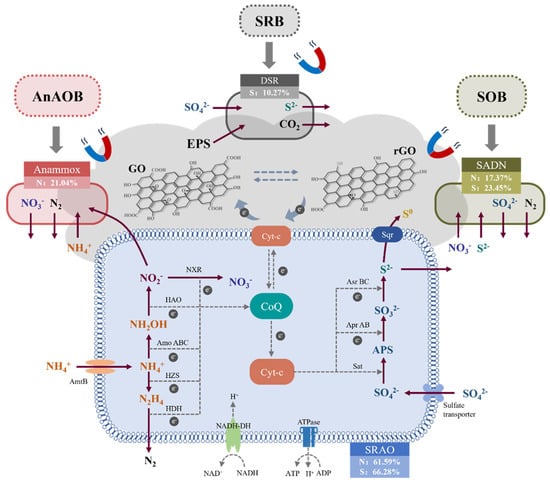
Graphical Abstract

1. Introduction

The industrial wastewater discharged from sectors such as seafood processing, petrochemical manufacturing, and mineral production typically contains high concentrations of ammonium and sulfate, coupled with low levels of organic carbon. Their low ratio of C and N severely limits the treatment efficiency of conventional heterotrophic nitrogen removal technologies used organic carbon as the primary electron donor. Consequently, there is an urgent need to develop autotrophic, sustainable, and environmentally friendly wastewater treatment processes that utilize inorganic compounds as electron donors.
Sulfate-reducing ammonium oxidation (SRAO), which is a novel autotrophic process that couples NH4+ oxidation and SO42− reduction, has attracted considerable attention. The early studies suggested that SRAO could independently oxidize ammonium to nitrogen gas while reducing sulfate to elemental sulfur (Equation (1)) [1]. However, in recent years, it has been gradually confirmed that there were complex processes involving multiple pathways in an SRAO bioreactor. For instance, it is reported that approximately 12.6~22% of ammonium and sulfate were converted to nitrite and sulfide via Equation (2) [2,3,4]. Subsequently, the generated nitrite serves as a substrate for anaerobic ammonium oxidation (Anammox) to produce nitrogen gas (Equation (3)), and sulfide is oxidized to sulfate through sulfur-autotrophic denitrification (SADN) (Equations (4) and (5)), thereby establishing a sulfur cycle that enhances nitrogen removal. In addition, Zhang et al. [5] found that about 7.2% of ammonium could be oxidized to nitrate via the SRAO reaction of Equation (6), and the low-valent sulfur was oxidized to sulfate through SADN. Moreover, Wimalaweera et al. [6] used an SRAO bioreactor to treat rubber wastewater and found that up to half of the sulfate reduction could be attributed to dissimilatory sulfate reduction (DSR) (Equation (7)). Herein, it is clearly seen from the above multiple reaction pathways that there is a sulfur cycle in an SRAO bioreactor. Specifically, the reduced sulfur species generated by sulfate reduction in the SRAO reaction can further participate in the other reactions, such as Anammox and SADN, and are oxidized to sulfate. From this perspective, sulfur substances can be regarded as a cycling medium to drive the deep removal of nitrogen.
2 NH 4 + + SO 4 2     N 2 +   S 0 + 4 H 2 O
4 NH 4 + + 3 SO 4 2     4 NO 2 + 3 S 2 + 4 H 2 O +   8 H +
NH 4 + + 1.32 NO 2 + 0.066 HCO 3 + 0.13 H +     N 2 + 0.26 NO 3 + 0.066 C H 2 O 0.5 N 0.15 + 2 H 2 O
3 S 2 - + 8 NO 2 + 4 H 2 O     3 SO 4   2 + 4 N 2 + 8 OH
5 S 2 + 8 NO 3 + 4 H 2 O     5 SO 4 2 + 4 N 2 + 8 OH
3 NH 4 + + 4 SO 4 2 + 2 HCO 3     3 NO 3   + 4 S 0 + 7 H 2 O + 2 CO 3 2
C 6 H 10 O 5 + 3 SO 4 2 + H 2 O     3 S 2 + 6 HCO 3 + 6 H +
The microbial communities involved in the SRAO bioreactor are highly diverse. In the past few years, Desulfuromonas, Anammoxoglobus sulfate, and several Bacillus strains (e.g., B. benzoevorans and strain SUD-1) have been confirmed to be functional microorganisms for the SRAO reaction, and they could oxidize ammonium and reduce sulfate simultaneously [7]. Subsequently, the low-valent sulfur compounds generated by sulfate reduction would serve as electron donors for sulfur-oxidizing bacteria (e.g., Thiobacillus and Sulfurimonas) to form sulfate in the biological reaction system, thereby realizing the sulfur cycle [8,9]. In addition, Candidatus Brocadia and Candidatus Kuenenia have been reported to contribute to ammonium oxidation, converting ammonium and nitrite to nitrogen gas [8]. Furthermore, several sulfate-reducing bacteria (SRB), such as Desulfovibrio and Desulfobulbus, can utilize electrons released from ammonium oxidation to reduce sulfate [7,9]. Therefore, the SRAO bioreactor contains collaborative processes mediated by different microorganisms. The intermediates generated from a biochemical reaction can provide substrates for other reactions, collectively forming an integrated and sulfur cycle-driven multi-pathway nitrogen removal bioreactor involved with Anammox, SADN, and DSR. Nevertheless, the SRAO bioreactor still faces several challenges. On one hand, the slow growth and dispersed distribution of autotrophic microorganisms result in long diffusion pathways and significant transferring resistance for the substrate, constraining the overall reaction rate [10,11]. On the other hand, electron transport between different microorganisms was also considered as one of the limiting factors for nitrogen removal in the SRAO bioreactor, owing to the cooperation of various microorganisms [12].
In recent years, carbonaceous nanomaterials have been widely applied to enhance anaerobic bioprocesses. Graphene oxide (GO), in particular, has been paid significant attention due to its excellent colloidal stability, biocompatibility, and superior electron transfer capability, which are not simultaneously present in other carbonaceous materials with comparable specific surface areas [13,14]. It is reported that low-concentration GO can promote the formation of microbial granules, stimulate the biosynthesis of pili and c-type cytochromes, shorten electron transfer distances, and broaden electron transfer pathways, thereby enhancing cellular metabolic activity [15,16]. Xie et al. [17] found that low-dose GO successfully increased the relative abundance of crucial genes associated with c-type cytochromes and type IV pilus assembly, and improved nitrogen removal efficiency by 19.1%. However, to date, the effect of GO on the nitrogen removal in an SRAO bioreactor and its underlying mechanism still remains unexplored.
In this study, GO was introduced into a lab-scale SRAO bioreactor to enhance nitrogen removal. Meanwhile, the potential mechanism by which GO influences sulfur cycle-driven multi-pathway nitrogen removal was systematically investigated. First, the nitrogen removal performance of the bioreactor was evaluated. Subsequently, to elucidate the role of GO, the GO, sludge, and the aggregates of sludge and GO were characterized using scanning electron microscopy (SEM), Fourier transform infrared spectroscopy (FTIR), X-ray diffraction (XRD), and X-ray photoelectron spectroscopy (XPS). Moreover, mass balances of nitrogen and sulfur were conducted to quantify the contributions of different reactions, including SRAO, Anammox, SADN, and DSR, to nitrogen removal. Finally, to reveal the underlying biochemical mechanisms, the synergistic interactions among functional microorganisms and potential electron transfer pathways were explored. This study will provide an in-depth understanding of the mechanisms for nitrogen removal in the SRAO bioreactor.

2. Materials and Methods

2.1. Inoculated Sludge, Synthetic Wastewater, and GO

The inoculated sludge was taken from the digested sludge of a wastewater treatment plant with an initial biomass concentration of approximately 3.55 g MLVSS/L. The composition of the synthetic wastewater used was: 1.25 g KHCO3, 0.025 g KH2PO4, 0.3 g CaCl2⋅2H2O, 0.2 g MgCl2·6H2O, 1 mL trace element I, and 1 mL trace element II, in each liter of deionized water. The composition of the trace element I solution was: 0.2 g ZnCl2; 0.17 g CuCl2⋅2H2O; 0.19 g NiCl2⋅6H2O; 0.014 g H3BO3; 0.24 g CoCl2⋅6H2O; 0.63 g MnCl2; 0.22 g NaMoO4⋅2H2O; and 0.21 g NaSeO4⋅10H2O, in each liter of deionized water. The composition of trace element II solution was: 1.0 g EDTA; 0.5 g FeSO4⋅7H2O, in each liter of deionized water [18]. The GO was purchased from Beijing MREDA Technology Co., Ltd. (Mreda, Beijing, China), which had a thickness ranging from 0.55 to 1.2 nm and an average radial size of 0.3 to 0.5 μm. A concentration of 50 mg/L was selected for this study based on the similar anaerobic systems reported by previous studies [17,19,20], considering that lower doses might be less effective while higher doses could lead to biological inhibition or increased cost [20,21].

2.2. Bioreactors Setup and Operation

The lab-scale SRAO bioreactor used in the experiment had a working volume of 500 mL and operated for 152 d. It was operated in a two-day cycle with five consecutive stages: feed (15 min), reaction (2760 min), settling (40 min), draining (15 min), and idling (50 min). A synthetic wastewater (300 mL) was added at the beginning of the feed period, and the same volume of supernatant was removed in the draining period. The detailed experimental setting is listed in Table 1. In Phase I, NH4+ and SO42− were utilized as the principal substrates in the form of (NH4)2SO4 under low loading conditions with the concentrations of NH4+-N and SO42− to be 40 mg/L and 135 mg/L, respectively, and the molar ratio of NH4+-N to SO42−-S to be 2:1. In this phase, 30 mg/L NO2-N was also added to promote the building up of autotrophic biological nitrogen removal, and the molar ratio of NH4+ and NO2 was about 1:1.32. In Phase II, the NH4+-N, SO42− and NO2-N concentrations increased to 80 mg/L, 270 mg/L, and 60 mg/L, respectively. In Phase III, the NH4+-N and SO42− concentrations increased further to 160 mg/L and 540 mg/L, respectively, and NO2 was not added. During this phase, the SRAO bioreactor gradually became a stable state. At 100 d, 50 mg/L GO (dispersed with deionized water) was added in each cycle with the feed, and the operation entered Phase IV [17,19]. In Phase V, the N and S load and the GO dosage were consistent with Phase IV, but the hydraulic retention time (HRT) was changed from 2 d to 1 d. The pH was controlled at 7.8 ± 0.3 through HCl or NaOH. The reactor was flushed with N2 for 20 min to expel the dissolved oxygen. Then, they were sealed with rubber stoppers. Finally, it was put in a shaker with constant temperature and light avoidance at 33 ± 0.2 °C and 180 rpm [7].

2.3. Batch Experiments

To elucidate the individual contributions of the main biochemical reaction involved in the SRAO bioreactor, two parallel sets of batch experiments were conducted in several serum bottles with a working volume of 100 mL. The sole difference between them was the addition of 50 mg/L GO in one set and its absence in the other. Each set of experiments was divided into five groups, and the detailed experimental setting is listed in Table 2. In Group I, based on the optimal theoretical substrate consumption ratio, sufficient substrates were added to verify the coexistence of SRAO, Anammox, and SADN reactions, and evaluate their synergistic potential. In Group II, according to the optimal substrate conditions for the Anammox reaction, the Anammox reaction rate was independently determined. In Group III, according to the concentrations of sulfide and nitrate in the effluent of the long-term SRAO bioreactor, substrate levels were set to ensure accurate measurement of the SADN reaction rate. In Group IV, under the optimal substrate conditions for SRAO reaction, the reaction rate of independent SRAO was quantitatively analyzed. In Group V, which served as an abiotic control, no sludge was added, and only 50 mg/L GO and corresponding substrates were added, aiming to evaluate the contribution of GO adsorption to substrate removal. Approximately 50 mL of sludge was extracted from the SRAO bioreactor at 152 d, washed three times through centrifugation, re-suspended with phosphate buffer (pH = 7.0), and transferred to the above serum bottles, except for Group V. Each group was conducted in triplicate to ensure reproducibility and reliability of the results.
All bottles were flushed with high-purity N2 for 20 min to expel the dissolved oxygen. Then, they were sealed with rubber stoppers and placed in a shaker with constant temperature and light avoidance at 33 ± 0.2 °C and 180 rpm for 48 h. A certain amount of the liquid samples was collected periodically by syringe for chemical analysis. After each sampling, the same volume of N2 was injected into the serum bottle to balance the inside pressure of the bottle.

2.4. Chemical Analysis

A certain amount of the samples of the reaction solution (in the idling period) was taken in each reaction cycle for chemical analysis using a syringe and filtered through 0.22 μm needle filters. The NH4+-N concentration was determined by nano reagent spectrophotometry. The NO2-N, NO3-N, and SO42− concentrations were determined by ion chromatography (ICS5000 Ion Chromatography, Thermo Fisher Scientific, Waltham, MA, USA). The sulfide concentration was determined using methylene blue spectrophotometry. The pH was monitored using a PHS-2F multi-parameter meter (Leici, Shanghai, China). The mixed liquor suspended solids (MLSSs) and mixed liquor volatile suspended solids (MLVSSs) were determined according to the national standard methods. Extracellular polymer substance (EPS) was extracted using the thermal extraction method [22]. The polysaccharide (PS) and protein (PN) content in the EPS samples was determined by the anthrone method and the modified Folin–Lowry method, respectively [15].

2.5. Characteristic Analysis

The morphological changes in the sludge samples before and after the experiment were observed by SEM (SEM 300, ZEISS Gemini, Oberkochen, Germany). The changes in functional groups of the surface on the sludge and GO during the long-term reaction in the SRAO bioreactor were qualitatively analyzed by FTIR (Thermo Fisher Scientific Nicolet iS20, Thermo Fisher Scientific, Waltham, MA, USA) [16]. The crystal structure of the inoculated sludge and the sludge samples after the experiment was identified through XRD (D8 Advance Diffractometer, Bruker Axs Gmbh, Karlsruhe, Germany) [23]. The chemical state and elemental composition of GO before and after the experiment were determined by analyzing the electron binding energies using XPS (Thermo Scientific K-Alpha, Thermo Fisher Scientific, Waltham, MA, USA) [24].

2.6. Microbial Community Analysis

The inoculated sludge sample (designated as Inc_XH) and sludge samples collected from the SRAO bioreactor at 40 d, 80 d, and 152 d were analyzed for the microbial community. The sludge samples were processed through a series of steps, including centrifugation, freeze-drying, and extraction of total genomic DNA using the E.Z.N.A.® soil DNA kit (Omega Bio-Tek, Norcross, GA, USA). The quality and concentration of DNA were determined by 1.0% agarose gel electrophoresis and a NanoDrop2000 spectrophotometer (Thermo Fisher Scientific, Waltham, MA, USA) and kept at −80 °C prior to further use. To analyze the microbial community structure, the hypervariable region V3–V4 of the bacterial 16S rRNA gene was amplified with primer pairs 338F (5′-ACTCCTACGGGAGGCAGCAG-3′) and 806R (5′-GGACTACHVGGGTWTCTAAT-3′) [25] using a T100 Thermal Cycler PCR thermocycler (BIO-RAD, Hercules, CA, USA). PCR amplification cycling conditions were as follows: initial denaturation at 95 °C for 3 min, followed by 27 cycles of denaturing at 95 °C for 30 s, annealing at 55 °C for 30 s, extension at 72 °C for 45 s, and a single extension at 72 °C for 10 min, and ending at 4 °C. The resulting amplicons were purified and then pooled in equimolar amounts, and paired-end sequenced on an Illumina Nextseq2000 platform (Illumina, San Diego, CA, USA) for sequencing according to the standard protocols of Majorbio Bio-Pharm Technology Co., Ltd. (Shanghai, China).

3. Results and Discussion

3.1. Performance of the SRAO Bioreactor

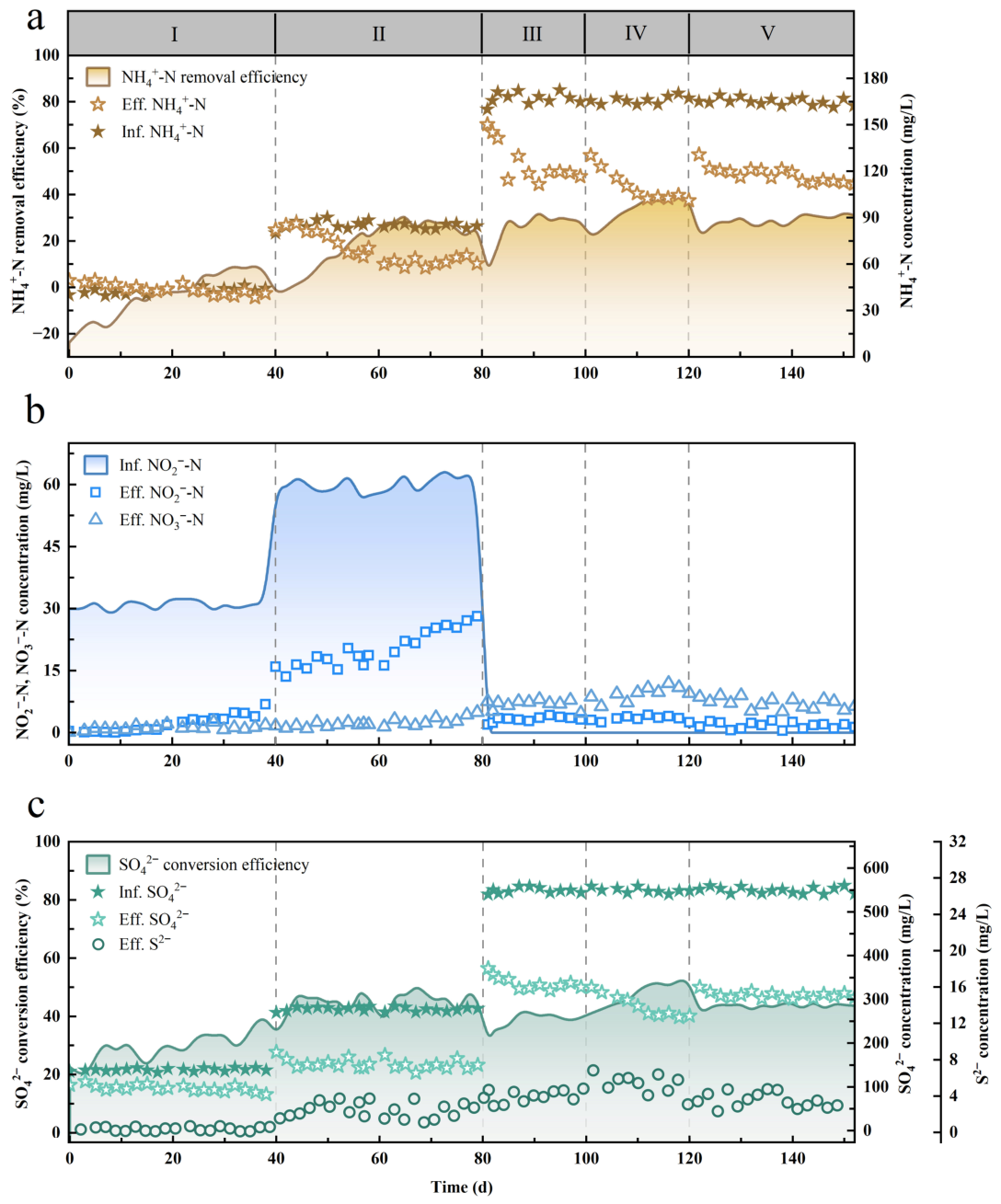
To evaluate the start-up, stabilization, and enhancement of the SRAO bioreactor, the variations in NH4+, NO2, NO3, SO42−, and S2− concentrations over time were monitored, and the results were presented in Figure 1.
As shown in Figure 1a, in the initial stage of Phase I, the effluent concentration of NH4+ exceeded the influent concentration, and then gradually decreased. This may be explained by the fact that the heterotrophic microorganisms in the sludge decay and disintegrate when the organic carbon is deficient, which causes the release of intracellular nitrogen compounds, thereby resulting in abnormal accumulation of NH4+. By comparison, some studies using Anammox sludge as inoculum did not show significant NH4+ accumulation due to its inherent high ammonium oxidation activity [8,26]. At the end of Phase I, NH4+ removal efficiency was only 8.22%, and SO42− conversion efficiency was 29.76%. However, the molar ratio of NH4+ and SO42− was only 0.51, which was far below the theoretical value of 2 (Equation (1)). It indicated that the SRAO bioreactor was gradually establishing, but other sulfate reduction pathways, such as DSR, may coexist. In Phase II, the influent concentrations of NH4+, SO42−, and NO2 increased, and the bioreactor gradually stabilized after experiencing a brief fluctuation. As shown in Figure 1b, the effluent NO2 concentration continued to increase. This might be explained by the fact that the organic matter released from microbial decay had been basically completely consumed, which caused the heterotrophic denitrification to be significantly suppressed, thereby leading to NO2 accumulation. Additionally, S2− was detected in the effluent of this reactor, and the subsequent microbial analysis revealed the enrichment of sulfur-autotrophic denitrifying bacteria. This indicated that the bioreactor had been capable of autotrophic denitrification. At the end of this phase, NH4+ removal and SO42− conversion efficiencies were stabilized at 27.25% and 45.6%, respectively. Concurrently, the molar ratio of NH4+ and SO42− increased to 1.29, suggesting a significant enhancement in the metabolic activity of the SRAO pathway. In Phase III, the reactor influent contained only NH4+ and SO42−, with no NO2 addition. As seen in Figure 1b,c, the effluent contained low concentrations of NO2, NO3, and S2−, confirming that the SRAO bioreactor contained a complex and multi-pathway process (Equations (2) and (6)). Meanwhile, these intermediates provided substrates for Anammox, SADN, and DSR. At the end of this phase, NH4+ removal efficiency remained at 29.21%, while SO42− conversion efficiency was 38.21%, and the molar ratio of NH4+ and SO42− further increased to 1.75, indicating that SRAO progressively became the dominant pathway.
To enhance the nitrogen removal performance of the reactor, 50 mg/L of GO was added in the initial moment of Phase IV, and the other influent substrate concentrations were the same as those in Phase III. The results demonstrated that NH4+ removal efficiency reached 36.42% at the end of Phase IV, which increased by 24.7% compared with the end of Phase III. This might be attributed to the large specific surface area of GO, which provided an effective carrier for microbial attachment and aggregation. Moreover, GO contained abundant oxygen-containing functional groups on its surface, and it can serve as electron shuttles, facilitating extracellular electron transfer among functional microorganisms and thereby enhancing the efficiency of sulfur cycle-driven nitrogen removal [27,28]. Simultaneously, the SO42− conversion efficiency was 48.01% at this moment, and the molar ratio of NH4+ and SO42− decreased to 1.58, indicating that GO promoted the multi-pathway transformation of sulfur species and reinforced the redox cycling of sulfur compounds. In Phase V, the hydraulic retention time (HRT) was decreased from 2 d to 1 d, while the influent substrate concentrations remained the same as in Phase IV. The results showed that the reactor exhibited strong resilience against hydraulic shock loading in the presence of GO, with the maximum NH4+ removal loading reaching 56.51 mg/(L·d). Due to the shortened reaction time, the NH4+ removal efficiency decreased. However, compared to Phase IV, the extent of this decrease was not pronounced, suggesting that GO mitigated the negative impact of reduced HRT. Furthermore, the molar ratio of NH4+ to SO42− stabilized at approximately 1.51, with substantially lower fluctuations than those observed in Phases I~III. This indicates that GO improved the operational stability of the sulfur cycle-driven multi-pathway nitrogen removal process, successfully establishing a stable nitrogen removal regime primarily driven by the SRAO reaction, with complementary contributions from Anammox, SADN, and DSR.

3.2. The Role of GO for the SRAO Bioreactor

To investigate the role of GO for the SRAO bioreactor, the sludge samples and GO were characterized systematically by SEM, FTIR, XRD, and XPS.
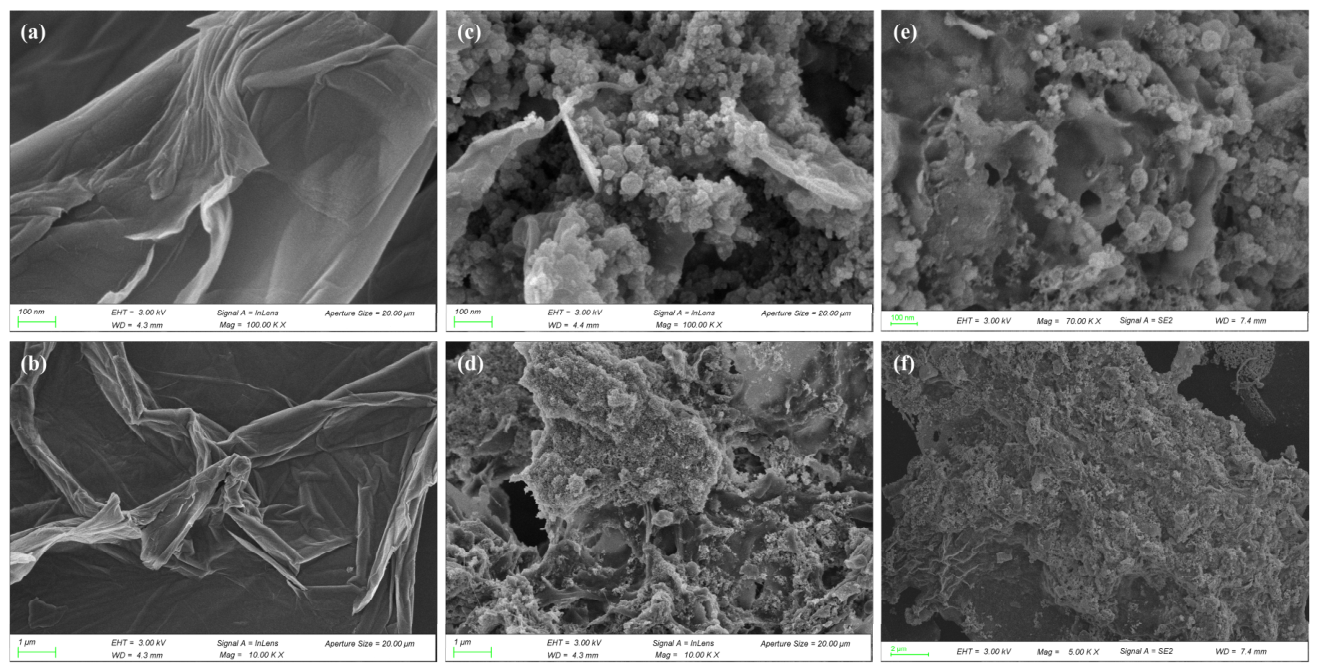
The micro morphologies of sludge and GO were characterized by SEM, and the results are shown in Figure 2. It was seen from Figure 2a,b that the original GO exhibited a characteristic layered topology with distinct wrinkled textures. This was attributed to the sp2-hybridized carbon framework and surface functionalization of GO [29]. As shown in Figure 2c,d, the sludge sample at 80 d had abundant biomass-like spherical aggregates interspersed with filamentous structures. By comparison, it is displayed from Figure 2e,f that the sludge sample at 152 d formed porous aggregates after adding GO. These aggregates likely consisted of uniformly dispersed GO sheets, granular microbial cells, and extracellular polymeric substances (EPSs), forming a structure conducive to microbial cell densification and granulation. Numerous irregular aggregates adhered between the GO layers, which were presumed to be elemental sulfur or sulfur-containing crystalline precipitates, likely generated through SRAO reactions and subsequent sulfur conversion pathways [29]. The close interaction between functional microorganisms, GO, and biogenic sulfur species facilitated the formation of highly synergistic bio-hybrid aggregates. This structure has been shown to enhance substrate diffusion and strengthen metabolic cooperation and system stability within the SRAO process [30]. These findings suggest that GO can effectively function as a microbial carrier, supporting the densification and granulation of microbial communities and significantly improving the overall performance of the biological system.
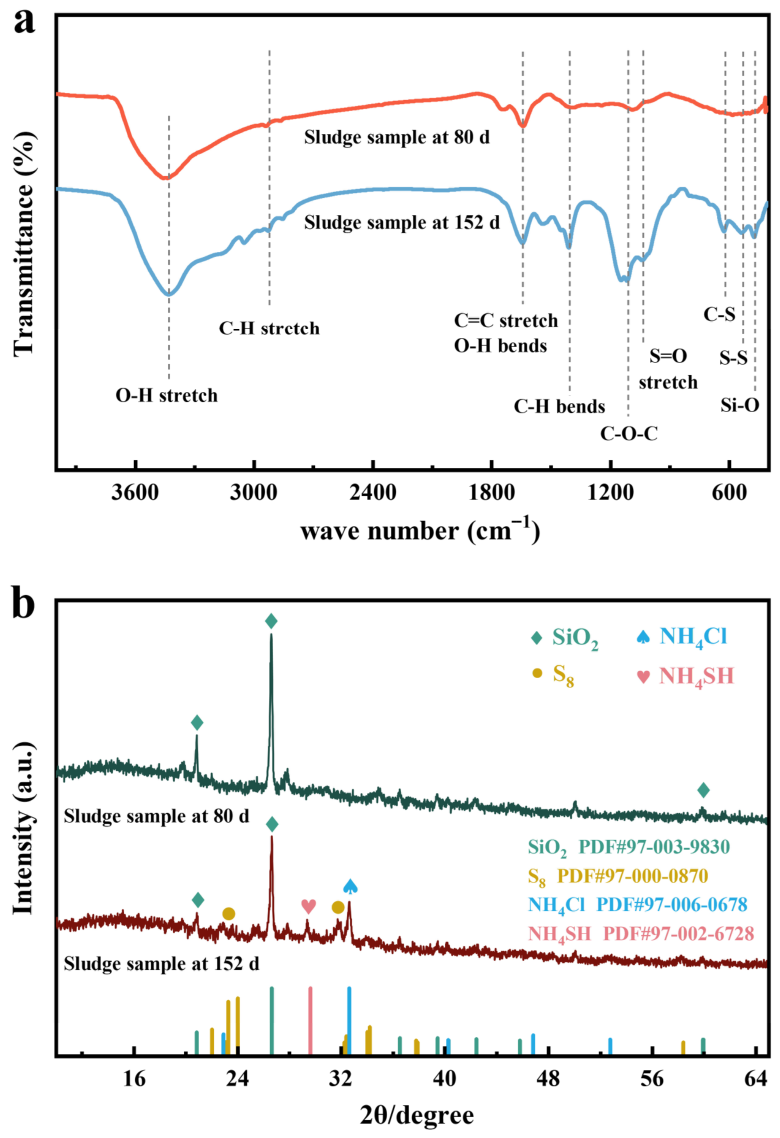
FTIR analysis was conducted to characterize the surface functional groups of the sludge samples at 80 d and 152 d (Figure 3a). A broad and pronounced peak observed near 3430 cm−1 corresponds to O-H stretching vibrations from hydroxyl and carboxyl groups [29]. Peaks at 2925 cm−1 and 1400 cm−1 are attributed to C-H stretching and bending vibrations, respectively. The characteristic peak around 1645 cm−1 arises from aromatic C=C stretching vibrations combined with O-H bending modes [31]. Notably, compared to the sludge sample at 80 d, the intensity of these oxygen-containing functional group-related peaks was enhanced after adding GO to the sludge sample at 152 d. Higher peak intensities within the range from 1130 to 1000 cm−1 were also detected, encompassing epoxy C-O-C and S=O functional groups [31,32,33]. The former is a characteristic functional group of GO, and the latter is associated with S=O stretching. However, the intensity of oxygen-containing functional groups in the sludge sample at 152 d remained lower than that in the original GO. It might be attributed to the partial reduction of oxygen-containing functional groups on GO during the reaction, which enabled its role as an electron shuttle. Meanwhile, the characteristic peaks at 620 cm−1 and 530 cm−1, respectively, indicated the existence of C-S and S-S bonds. The appearance of these two characteristic peaks provided direct evidence for the reduction in sulfate to the low-valent sulfur compound (S0 or HS) [32,34]. Therefore, GO not only possesses the capability to act as a carrier in biological reactions but also exhibits potential as an electron shuttle during substance transformation.
XRD analysis was performed to examine the crystal structures of the sludge sample at 80 d and 152 d, covering a 2θ range of 10° to 65° (Figure 3b). It was reported that GO had a characteristic diffraction peak at approximately 10° [33,34]. However, this peak was absent in the sludge sample at 152 d, indicating that GO might be modified structurally because of the biochemical redox reactions of its superficial functional groups. It was speculated that GO was likely to serve as an electron shuttle to facilitate electron transfer during substrate conversion in the reaction system. Diffraction peaks corresponding to trace amounts of elemental sulfur were clearly observed in the sludge sample at 152 d, which exhibited strong alignment with the S8 crystal phase (PDF#97-000-0870) [32]. However, no such peaks were detected in the sludge sample at 80 d. It was presumed that SO42− was partially reduced to elemental sulfur, which subsequently attached to the surface of GO. This incorporation likely induced structural defects within GO, leading to peak broadening in the XRD patterns [35], which was a result consistent with the FTIR analysis. Peaks corresponding to SiO2 likely originated from the adsorption of incidental impurities onto the sample surfaces. Furthermore, the detection of NH4SH crystals indicated the chemical combination of H2S and NH3 [36], suggesting that sulfate was reduced to generate not only elemental sulfur but also sulfide.
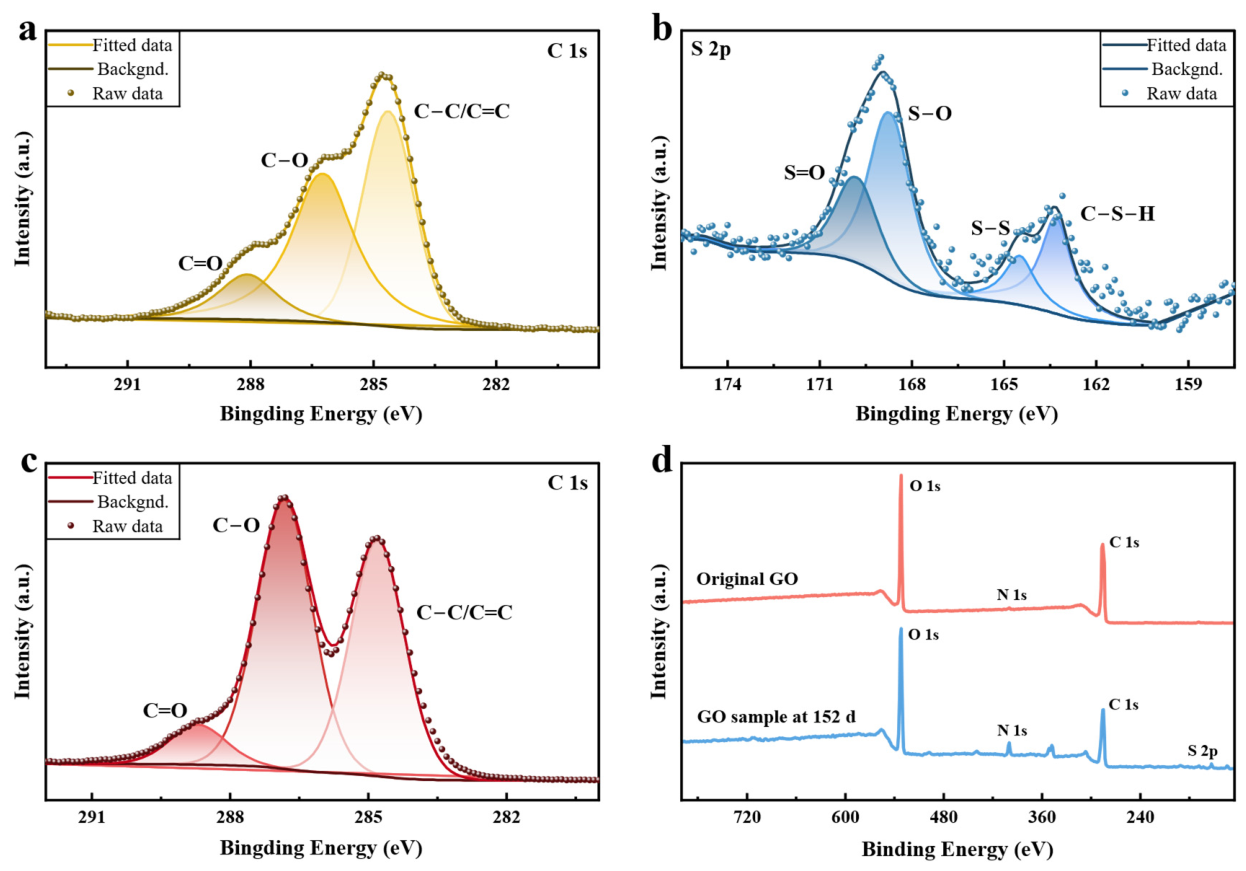
To further study the changes in chemical bonds composed of different elements, including C, O, and S, the original GO and the GO samples at 152 d were characterized by XPS. It was found from the high-resolution C 1s spectra in Figure 4a,c that there were C-O (285.8 eV) and C=O (287.8 eV) on the surface of the GO sample. Meanwhile, the characteristic peak at 284.5 eV was attributed to the C-C and C=C [32]. Compared to the original GO, the intensity of the characteristic peaks of C-O in the GO sample at 152 d was significantly decreased, and the intensity of other characteristic peaks had no obvious changes. The high-resolution S 2p spectra displayed in Figure 4b indicated that C-S, S-S, and S-O bonds were formed on the surface of the GO sample at 152 d. The peaks at 168 eV and 169 eV were attributed to S-O and S=O bonds, respectively. The corresponding peaks with binding energies in the vicinity of 163 eV and 164 eV represented the C-S-H and S-S bonds [32]. On the contrary, there was no S element on the surface of the original GO. This provided possible evidence that SO42− was reduced to produce elemental sulfur, which would aggregate on the GO layer [37]. In addition, it demonstrated that the produced sulfur in the reactor mostly had a covalent attachment to the carbon atoms of GO, subsequently undergoing a hydrolytic process to form thiol groups. The functional groups presented on the surface of GO, including hydroxyl and epoxy groups, were observed to exhibit strong interactions with sulfur-based substances. These interactions may occur through mechanisms such as hydrogen bonding, van der Waals forces, or chemical reactions, resulting in a tight binding of the sulfur element to the GO surface [38,39]. Simultaneously, the decrease in oxygen binding peaks linked with carbon following sulfur attachment indicated that GO was partially reduced during the reaction process. This suggested that GO contributed to substrate conversion and electron transfer. The peak area ratios were calculated based on the XPS fitting results to quantify the aforementioned fractions further. It can be seen from the Table S1 that the ratio of carbon and oxygen in the GO sample at 152 d increased by 7.24% compared with the original GO. Also, the sulfur content increased from 0.63% to 4.72%. These collectively indicated that the oxygen-containing functional groups of GO were partially reduced. Furthermore, the XPS full spectrum shown in Figure 4d confirmed the presence of N 1s peaks, and this may be attributed to the slight adsorption affected by GO.
In conclusion, GO not only served as a microbial carrier supporting microbial growth, forming aggregates that involve microorganisms, EPSs, and GO, but also functioned as an electron shuttle due to changes in its surface functional groups and partial reduction. This enabled GO to mediate electron transfer, thereby promoting sulfur cycling coupled with nitrogen removal. Additionally, covalent interactions between GO and reduced sulfur products further facilitated electron transfer and substrate conversion. These functionalities of GO enhanced the metabolic cooperation of microorganisms and contributed to the operational stability of the SRAO bioreactor.

3.3. Mass Balance and Contribution Analysis

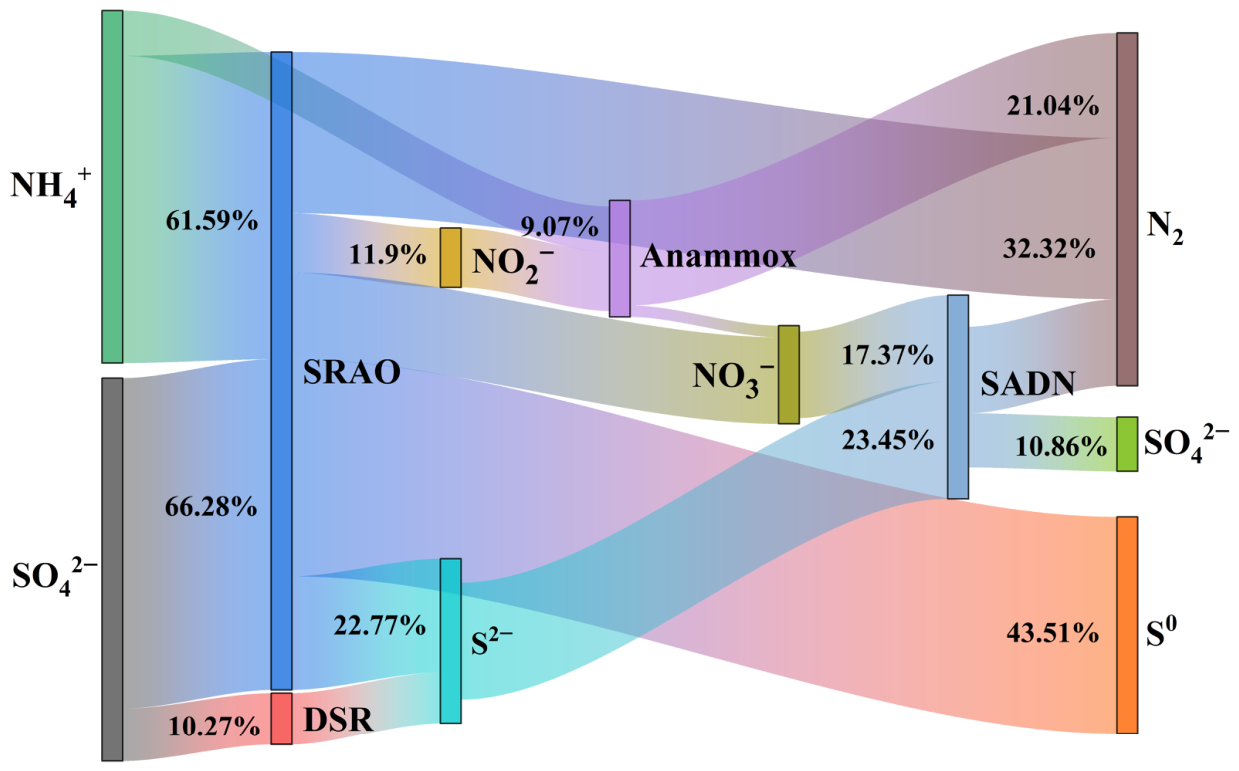
To elucidate the individual contributions of the main biochemical reaction involved in the SRAO bioreactor, batch experiments with 50 mg/L GO and batch experiments without GO were conducted, and the variations of nitrogen-containing and sulfur-containing compound concentrations versus time were detected. Each batch experiment included five parallel groups. Meanwhile, according to the chemical stoichiometric relationship (Equations (1), (3) and (5)), the substrate ratios of each group were optimized, creating conditions that strongly favor one target reaction while minimizing the influence of other reactions. The results are illustrated in Figure 5 and Figure S1. Then, based on the above variations in concentration of substances, the transformation proportions of the main biochemical reaction to total nitrogen or total sulfur were analyzed, and the results were presented in Figure 6. The detailed calculation procedures were provided in the Supplementary Materials.
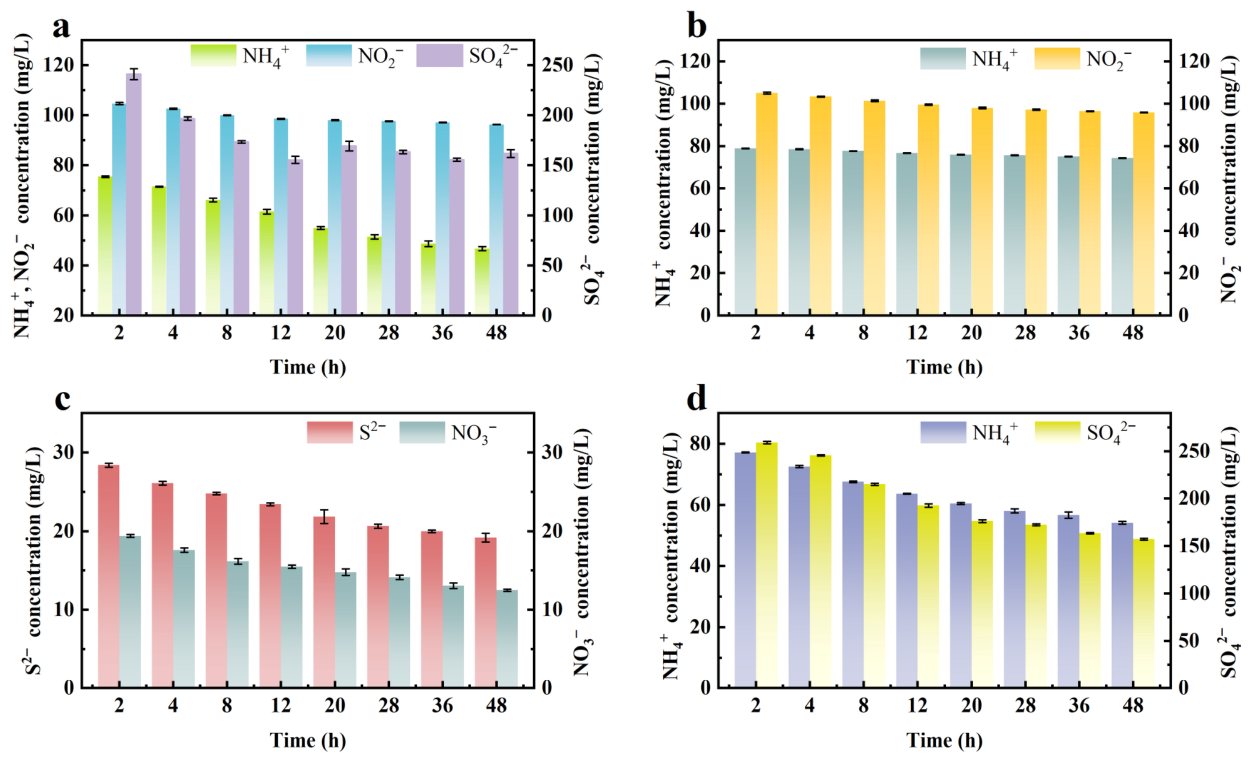
As shown in Figure 5a, it was seen that ammonium removal occurred predominantly within the first 20 h in Group I for the batch experiment with GO, reaching a removal rate of 39.89 mg/(L·d). Meanwhile, sulfate concentration decreased rapidly in the first 8 h, and then had a rebound and continuous fluctuation, indicating that there might be a transformation of sulfur-containing substances. It was explained that the reduced sulfur substances generated from sulfate reduction could be re-oxidized to sulfate by SADN, establishing an internal sulfur cycle. Compared with Group I without GO (Figure S1), ammonium removal increased by 38.26%, and sulfate concentration had more obvious fluctuations in Group I with GO, demonstrating that GO effectively improved the nitrogen removal coupled with sulfur cycling.
As shown in Figure 5b, it was found that ammonium concentration had no obvious changes in Group II, indicating that GO had a limited influence on the ammonium removal through the Anammox reaction. This might be attributed to the low abundance of Anammox microorganisms, which restricted the potential impact of GO. The mass balance (Figure 6) quantitatively confirmed this ancillary role, attributing 5.64 mg/L of nitrogen removal (21.04% of the total) specifically to the Anammox reaction.
As shown in Figure 5c, sulfide oxidation performance increased by 33.41% in Group III, indicating that the participation of GO could be beneficial to the SADN reaction to enhance the transformation of sulfur-containing substances, thereby promoting the nitrogen removal in the bioreactor. Through calculation, 10.64 mg/L of sulfide was consumed in the SADN reaction, and it contributed to 17.37% of nitrogen transformation and 23.45% of sulfur transformation.
As shown in Figure 5d, it was found that GO significantly enhanced the SRAO reaction. Specifically, GO increased not only the ammonium removal rate by about 24.23% but also the sulfate reduction rate by about 34.62%. Through calculation, the SRAO reaction contributed 23.15 mg/L to nitrogen removal, constituting 61.59% of the total. Simultaneously, the SRAO reaction contributed 66.28% of the total sulfur conversion. Additionally, the sulfate transformation beyond the theoretical levels of SRAO and SADN might be attributed to DSR at 10.27%. Its possible reason was that EPSs secreted by microorganisms could serve as available organics under the organics-deficient conditions, supporting the metabolism of sulfate-reducing bacteria. The variation in EPSs versus time was shown in the Supplementary Materials [40,41,42,43]. For Group V, which served as the abiotic control, it was found that the adsorption of substrates caused by GO was less than 5%, which was considered negligible.
Based on the above discussion, it was concluded reasonably that the SRAO reaction is the crucial biochemical process contributing to nitrogen removal and sulfur conversion, and the other reactions, including Anammox, SADN, and DSR, played complementary roles. These reactions collectively construct a synergistic nitrogen removal process.

3.4. Microbial Diversity Analysis

The variation in microbial biomass, expressed as MLVSS, during the long-term reaction is presented in Figure S3. During Phase I and Phase II, the MLVSS initially declined and subsequently increased. This suggested that heterotrophic microorganisms might utilize dead microorganisms for metabolic activities, leading to a substantial reduction in biomass. As the reaction progressed, autotrophic microorganisms gradually dominated and became enriched as the primary functional community. During Phase III, the MLVSS stabilized at approximately 2.16 g/L. In Phase IV, after adding 50 mg/L GO into the reactor, the MLVSS increased by 31.4%, reaching 2.84 g/L, indicating that microorganisms continue to grow at this moment. It can be attributed to the dual role of GO as both a microbial carrier and an electron shuttle, which effectively promoted the enrichment, co-aggregation, and metabolic activity of functional microorganisms, thereby improving the treatment performance in the bioreactor.
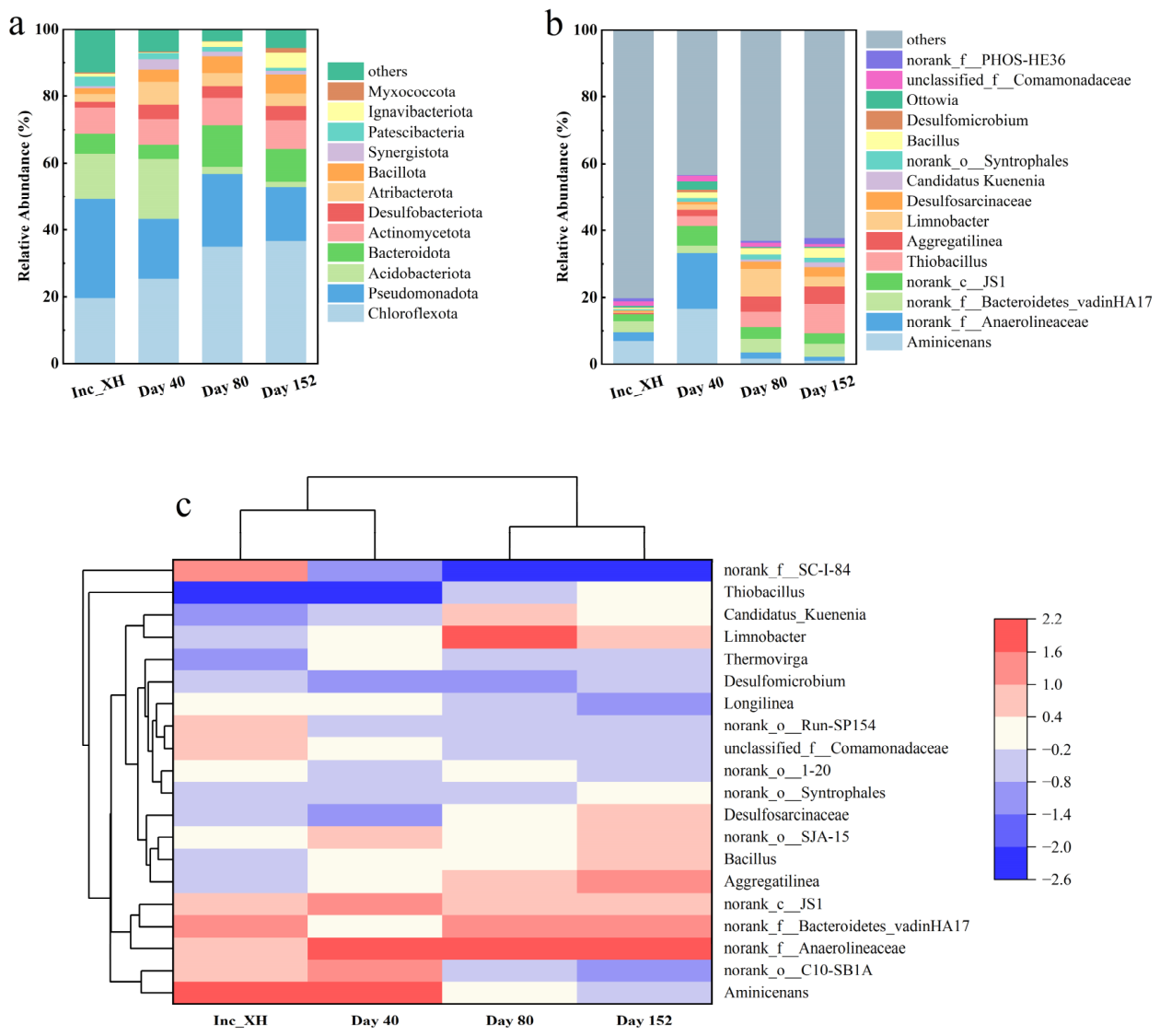
The relative abundances of microorganisms at the phylum level are shown in Figure 7a. It was found that the taxonomic composition remained basically unchanged before and after adding GO. Nevertheless, the relative abundances of some microbial phyla, including Chloroflexota, Pseudomonadota, Acidobacteriota, Bacteroidota, and Desulfobacteriota, had significant fluctuations. It has been reported that Desulfobacterota comprises diverse electroactive sulfate-reducing bacteria capable of performing extracellular electron transfer via c-type cytochromes, thereby driving sulfate reduction [44,45]. Recent metagenomic and physiological studies have revealed that Desulfobacterota species, such as Desulfuromonas acetexigens, encode and express multi-heme c-type cytochromes that serve as central electron transfer hubs for extracellular electron transfer [44]. At the end of Phase II (80 d), the relative abundance of Desulfobacteriota was 3.28%. However, at the end of Phase IV (152 d), it increased to 4.06% in the presence of GO. It might be explained that GO served as a conductive substance to promote the activities of electroactive bacteria through both direct contact and long-distance electron transfer, thereby enhancing the material transformation in the bioreactor. Chloroflexota, a typical filamentous phylum, gradually increased in relative abundance and remained stable after adding GO. It could form a filamentous structure, which not only served as a physical scaffold for other microbes but also intertwined with the layered structure of GO. So, the relatively abundant Chloroflexota was beneficial to optimize the spatial distribution of microorganisms and improve electron transfer efficiency [46]. Acidobacteriota has been confirmed to participate in organic matter degradation and EPS synthesis [47]. In the present study, there was an autotrophic environment with limited organic matter in the bioreactor, leading to a marked decline in the relative abundance of Acidobacteriota from 13.5% at the end of Phase I (40 d) to 1.57% at the end of Phase V (152 d). In addition, the metabolism and death of Acidobacteriota could provide organic electron donors for the DSR reaction.
The relative abundances of microorganisms at the genus level are presented in Figure 7b,c. It was reported that Desulfosarcinaceae, identified as a functional microorganism in the SRAO reaction, can utilize ammonium as an electron donor to support sulfate reduction [18]. In the present study, its relative abundance increased by 35.7% from Phase II (2.1%) to Phase V (2.85%). This phenomenon suggested that GO enhanced sulfur cycle-driven nitrogen removal. Bacillus, which is phylogenetically related to an SRAO strain discovered by Cai et al. [7], increased by 58.5% from Phase II (1.76%) to Phase V (2.79%). Its proliferation confirmed the stimulatory effect of GO on the microbial community associated with the SRAO reaction. Thiobacillus, a crucial genus responsible for SADN, was not detected in the inoculated sludge, but its relative abundance clearly increased to 8.69% at the end of Phase V (152 d). This might be related to the formation of a sulfur-cycling pathway after adding GO. In addition, the relative abundance of Candidatus Kuenenia, an Anammox microorganism, increased from 0.32% at the end of Phase II (80 d) to 1.34% at the end of Phase V (152 d), a 3.19-fold increase. In the bioreactor, nitrite generated from the SRAO reaction provided an essential substrate for Candidatus Kuenenia, thereby improving the nitrogen removal efficiency. Therefore, the addition of GO improved the cooperative capacity of the microbial community, increased the efficiency of electron transfer, and strengthened the performance of the sulfur cycle-driven nitrogen removal.

3.5. Possible Mechanisms

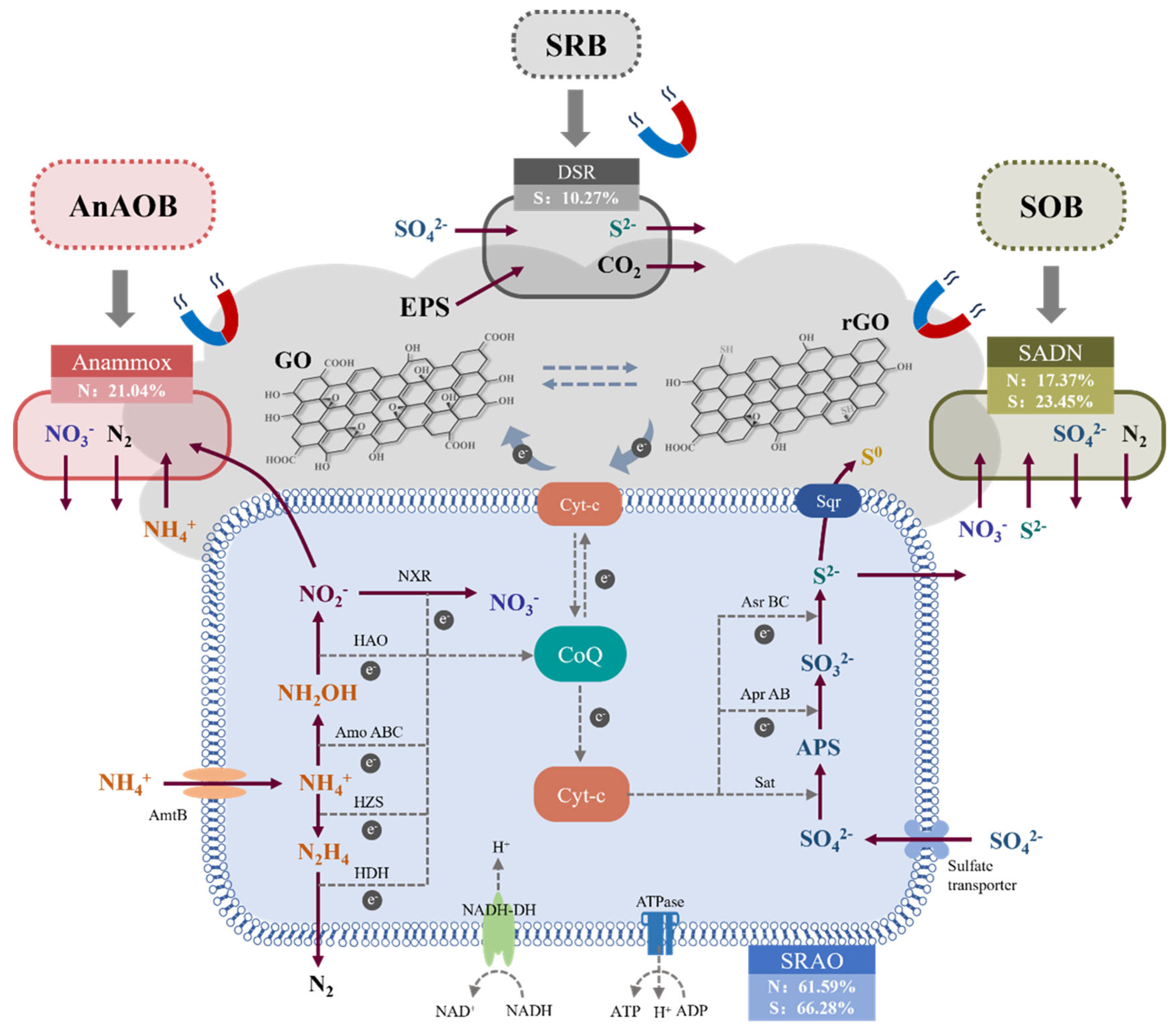
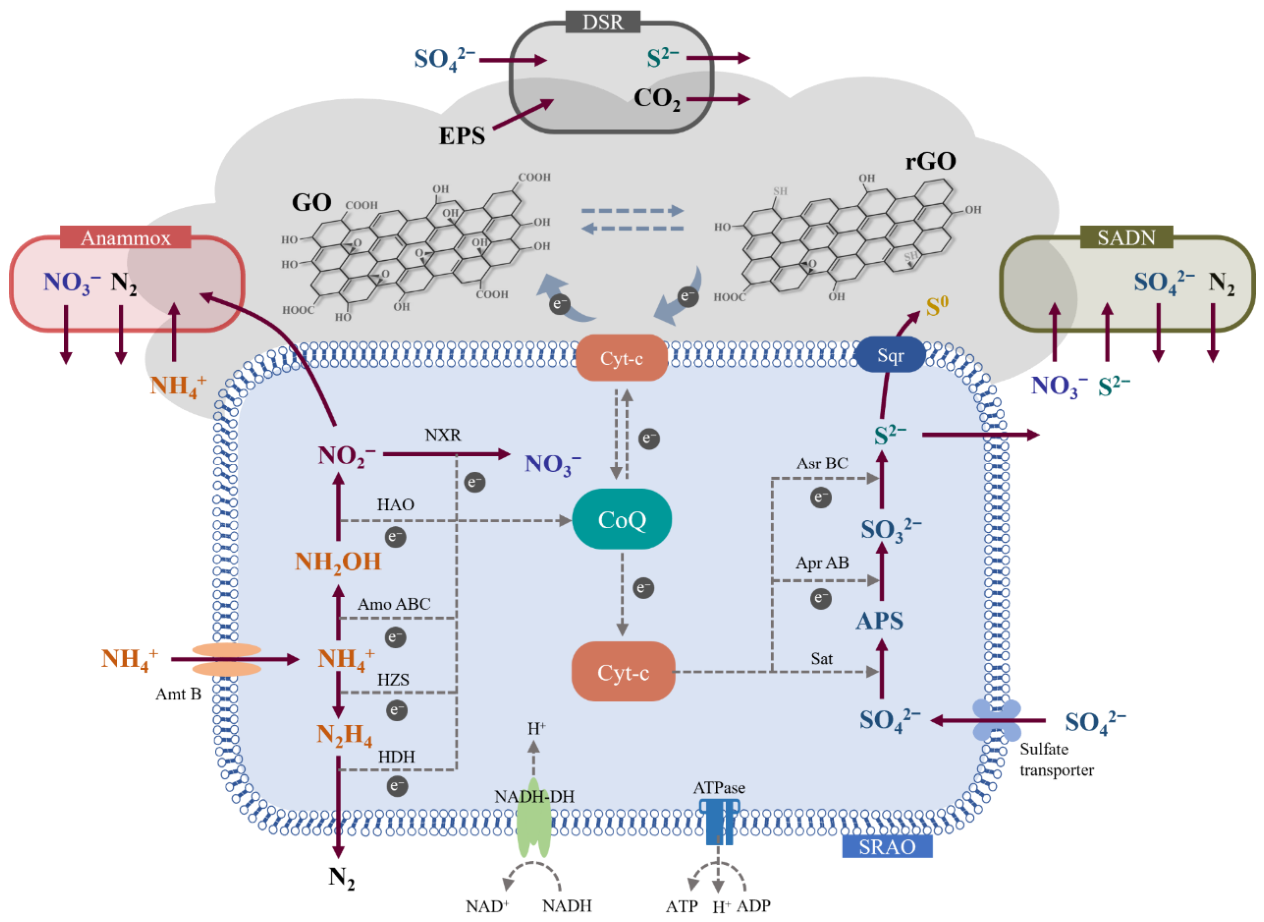
The possible mechanism by which GO enhances the nitrogen removal in the SRAO bioreactor is proposed and described in Figure 8. For the nitrogen removal, NH4+ enters the cells through the ammonium transporter (Amt) and is generally catalyzed by hydrazine synthase (HZS) to form N2H4, which will be transformed into N2 via hydrazine dehydrogenase (HDH) [48]. Meanwhile, a small portion of NH4+ is oxidized by nitrification genes (e.g., AmoABC, HAO, and NXR) to produce small amounts of nitrite and nitrate [49]. It is worth mentioning that the electrons released from NH4+ oxidation might be transferred via the intracellular electron transfer chain to support the transformation of sulfur-containing substances. For the sulfate conversion, SO42− is converted into adenosine sulfate (APS) by sulfate adenylyltransferase (Sat), and then reduced by adenylylsulfate reductase AB (AprAB) to SO32−, which will be further reduced to S2− by anaerobic sulfite reductase BC (AsrBC). Because of the sulfide quinone oxidoreductase (Sqr), the generated S2− can be oxidized to S0 and even sulfate [48]. Among the above biochemical reactions, the SRAO reaction is the primary process contributing to nitrogen removal, and the other reactions, including Anammox, SADN, and DSR, played complementary roles. Compared with the reaction period without GO, microbial aggregates will be formed, which supports the growth of functional microorganisms, after adding GO. In addition, the electron transfer could be improved because of the changes in oxygen-containing functional groups on the surface of GO [12]. Thus, GO can serve as a biological carrier and an electron shuttle to enhance the sulfur cycle-driven multi-pathway nitrogen removal.

4. Conclusions

A novel strategy for multi-pathway autotrophic nitrogen removal through GO-mediated sulfur cycling was successfully achieved in an SRAO bioreactor. The addition of 50 mg/L GO significantly improved the performance of nitrogen removal, and ammonium removal efficiency increased by 24.7%. After the reaction, the main functional groups on the surface of GO had been changed. Meanwhile, microbial aggregates were formed, providing favorable conditions for the growth and metabolism of microorganisms. In particular, the relative abundances of Desulfosarcinaceae and Bacillus, functional bacteria in the SRAO reaction, increased from 2.1% and 1.76% to 2.85% and 2.79%, respectively. In addition, SRAO was established as the dominant pathway and contributed 61.59% to nitrogen removal, while Anammox and SADN served as complementary processes. These results indicated that GO not only served as biological carriers of microorganisms but also shortened the distance for electron transmission, thereby optimizing microbial spatial distribution and improving the nitrogen removal efficiency.

Supplementary Materials

The following supporting information can be downloaded at: https://www.mdpi.com/article/10.3390/w18080980/s1, Figure S1: The variations of ammonium, nitrite, and sulfate concentrations in the Group I (a), ammonium and nitrite concentrations in the Group II (b), sulfide and nitrate concentrations in the Group III (c), and ammonium and sulfate concentrations in the Group IV (d) versus time in the batch experiment without GO; Figure S2: The variations of EPS content and PN/PS versus time in the Group I [40,41,42,43]; Figure S3: The variations of MLSS, MLVSS, and MLVSS/MLSS versus time in the SRAO bioreactor; Table S1: The proportions of elemental contents for the original GO and GO sample at 152 d.

Author Contributions

Writing—original draft preparation, D.Y.; supervision, H.X.; methodology, Z.W., S.T., and X.Y.; conceptualization, Y.W.; writing—review and editing, M.W. All authors have read and agreed to the published version of the manuscript.

Funding

This research was supported by the National Science Fund for Distinguished Young Scholars (52225001).

Data Availability Statement

The original contributions presented in this study are included in the article. Further inquiries can be directed to the corresponding author.

Conflicts of Interest

The authors declare that the research was conducted in the absence of any commercial or financial relationships that could be construed as potential conflicts of interest.

Abbreviations

The following abbreviations are used in this manuscript:
GOGraphene oxide
SRAOSulfate-reducing ammonium oxidation
AnammoxAnaerobic ammonium oxidation
SADNSulfur-autotrophic denitrification
DSRDissimilatory sulfate reduction
EPSExtracellular polymer substance
MLSSsMixed liquor suspended solids
MLVSSsMixed liquor volatile suspended solids
SEMScanning electron microscope
FTIRFourier transform infrared spectroscopy
XRDX-ray diffraction
XPSX-ray photoelectron spectroscopy

References

  1. Fdz-Polanco, F.; Fdz-Polanco, M.; Fernandez, N.; Urueña, M.A.; Garcia, P.A.; Villaverde, S. New Process for Simultaneous Removal of Nitrogen and Sulphur under Anaerobic Conditions. Water Res. 2001, 35, 1111–1114. [Google Scholar] [CrossRef] [PubMed]
  2. Liu, S.; Yang, F.; Gong, Z.; Meng, F.; Chen, H.; Xue, Y.; Furukawa, K. Application of Anaerobic Ammonium-Oxidizing Consortium to Achieve Completely Autotrophic Ammonium and Sulfate Removal. Bioresour. Technol. 2008, 99, 6817–6825. [Google Scholar] [CrossRef] [PubMed]
  3. Zhao, Q.-L.; Li, W.; You, S.-J. Simultaneous Removal of Ammonium-Nitrogen and Sulphate from Wastewaters with an Anaerobic Attached-Growth Bioreactor. Water Sci. Technol. 2006, 54, 27–35. [Google Scholar] [CrossRef] [PubMed]
  4. Zhang, L.; Zheng, P.; He, Y.; Jin, R. Performance of Sulfate-Dependent Anaerobic Ammonium Oxidation. Sci. China Ser. B-Chem. 2009, 52, 86–92. [Google Scholar] [CrossRef]
  5. Zhang, D.; Cui, L.; Wang, H.; Liang, J. Study of Sulfate-Reducing Ammonium Oxidation Process and Its Microbial Community Composition. Water Sci. Technol. 2019, 79, 137–144. [Google Scholar] [CrossRef]
  6. Wimalaweera, I.; Zuo, F.; Tang, Q.; Sui, Q.; Jinadasa, S.; Weragoda, S.; Ritigala, T.; Weerasooriya, R.; Wang, Y.; Zhong, H.; et al. Synchronised Removal of Nitrogen and Sulphate from Rubber Industrial Wastewater by Coupling of Sulfammox and Sulphide-Driven Autotrophic Denitrification in Anaerobic Membrane Bioreactor. Bioresour. Technol. 2025, 416, 131785. [Google Scholar] [CrossRef]
  7. Cai, J.; Jiang, J.; Zheng, P. Isolation and Identification of Bacteria Responsible for Simultaneous Anaerobic Ammonium and Sulfate Removal. Sci. China Chem. 2010, 53, 645–650. [Google Scholar] [CrossRef]
  8. Rikmann, E.; Zekker, I.; Tomingas, M.; Vabamäe, P.; Kroon, K.; Saluste, A.; Tenno, T.; Menert, A.; Loorits, L.; dC Rubin, S.S.C.; et al. Comparison of Sulfate-Reducing and Conventional Anammox Upflow Anaerobic Sludge Blanket Reactors. J. Biosci. Bioeng. 2014, 118, 426–433. [Google Scholar] [CrossRef]
  9. Liu, L.-Y.; Xie, G.-J.; Xing, D.-F.; Liu, B.-F.; Ding, J.; Cao, G.-L.; Ren, N.-Q. Sulfate Dependent Ammonium Oxidation: A Microbial Process Linked Nitrogen with Sulfur Cycle and Potential Application. Environ. Res. 2021, 192, 110282. [Google Scholar] [CrossRef]
  10. Zhang, B.; Zhang, N.; He, A.; Wang, C.; Li, Z.; Zhang, G.; Xue, R. Carrier Type Affects Anammox Community Assembly, Species Interactions and Nitrogen Conversion. Bioresour. Technol. 2023, 369, 128422. [Google Scholar] [CrossRef]
  11. Xue, Y.; Ma, H.; Li, Y.-Y. Anammox-Based Granulation Cycle for Sustainable Granular Sludge Biotechnology from Mechanisms to Strategies: A Critical Review. Water Res. 2023, 228, 119353. [Google Scholar] [CrossRef] [PubMed]
  12. An, T.; Chang, Y.; Xie, J.; Tang, K.; Liu, Y.; Liu, Y.; Chen, C. Rapid Start-Up and Long-Term Stability of Anammox with Magnetic Biochar Addition: Performance Improvement, Microbial Community, and Potential Mechanisms. ACS ES&T Eng. 2023, 3, 2097–2108. [Google Scholar] [CrossRef]
  13. Toral-Sánchez, E.; Rangel-Mendez, J.R.; Valdés, J.A.A.; Aguilar, C.N.; Cervantes, F.J. Tailoring Partially Reduced Graphene Oxide as Redox Mediator for Enhanced Biotransformation of Iopromide under Methanogenic and Sulfate-Reducing Conditions. Bioresour. Technol. 2017, 223, 269–276. [Google Scholar] [CrossRef] [PubMed]
  14. Hu, J.; Zeng, C.; Liu, G.; Lu, Y.; Zhang, R.; Luo, H. Enhanced Sulfate Reduction Accompanied with Electrically-Conductive Pili Production in Graphene Oxide Modified Biocathodes. Bioresour. Technol. 2019, 282, 425–432. [Google Scholar] [CrossRef]
  15. Li, X.Y.; Yang, S.F. Influence of Loosely Bound Extracellular Polymeric Substances (EPS) on the Flocculation, Sedimentation and Dewaterability of Activated Sludge. Water Res. 2007, 41, 1022–1030. [Google Scholar] [CrossRef]
  16. Paredes, J.I.; Villar-Rodil, S.; Martínez-Alonso, A.; Tascón, J.M.D. Graphene Oxide Dispersions in Organic Solvents. Langmuir 2008, 24, 10560–10564. [Google Scholar] [CrossRef]
  17. Xie, Y.; Zou, C.; Ismail, S.; Xie, L.; Ni, S.-Q. Dosage-Dependent Impacts of Graphene Oxide on the Anammox Process: Performance and Mechanism. ACS ES&T Eng. 2024, 4, 1048–1062. [Google Scholar] [CrossRef]
  18. Yang, Z.; Zhou, S.; Sun, Y. Start-up of Simultaneous Removal of Ammonium and Sulfate from an Anaerobic Ammonium Oxidation (Anammox) Process in an Anaerobic up-Flow Bioreactor. J. Hazard. Mater. 2009, 169, 113–118. [Google Scholar] [CrossRef]
  19. Wang, D.; Wang, G.; Zhang, G.; Xu, X.; Yang, F. Using Graphene Oxide to Enhance the Activity of Anammox Bacteria for Nitrogen Removal. Bioresour. Technol. 2013, 131, 527–530. [Google Scholar] [CrossRef]
  20. Tian, Y.; Yu, D.; Wang, Y.; Chen, G. Performance and Responses of Aerobic Granular Sludge at Different Concentrations of Graphene Oxide after a Single Administered Dose. Water Environ. Res. 2021, 93, 2210–2222. [Google Scholar] [CrossRef]
  21. Kedves, A.; Sánta, L.; Balázs, M.; Kesserű, P.; Kiss, I.; Rónavári, A.; Kónya, Z. Chronic Responses of Aerobic Granules to the Presence of Graphene Oxide in Sequencing Batch Reactors. J. Hazard. Mater. 2020, 389, 121905. [Google Scholar] [CrossRef] [PubMed]
  22. Morgan, J.W.; Forster, C.F.; Evison, L. A Comparative Study of the Nature of Biopolymers Extracted from Anaerobic and Activated Sludges. Water Res. 1990, 24, 743–750. [Google Scholar] [CrossRef]
  23. Kumar, N.A.; Choi, H.-J.; Shin, Y.R.; Chang, D.W.; Dai, L.; Baek, J.-B. Polyaniline-Grafted Reduced Graphene Oxide for Efficient Electrochemical Supercapacitors. ACS Nano 2012, 6, 1715–1723. [Google Scholar] [CrossRef] [PubMed]
  24. Zhang, Z.; Schniepp, H.C.; Adamson, D.H. Characterization of Graphene Oxide: Variations in Reported Approaches. Carbon 2019, 154, 510–521. [Google Scholar] [CrossRef]
  25. Liu, C.; Zhao, D.; Ma, W.; Guo, Y.; Wang, A.; Wang, Q.; Lee, D.-J. Denitrifying Sulfide Removal Process on High-Salinity Wastewaters in the Presence of Halomonas Sp. Appl. Microbiol. Biotechnol. 2016, 100, 1421–1426. [Google Scholar] [CrossRef]
  26. Rikmann, E.; Zekker, I.; Tomingas, M.; Tenno, T.; Loorits, L.; Vabamäe, P.; Mandel, A.; Raudkivi, M.; Daija, L.; Kroon, K.; et al. Sulfate-Reducing Anammox for Sulfate and Nitrogen Containing Wastewaters. Desalination Water Treat. 2016, 57, 3132–3141. [Google Scholar] [CrossRef]
  27. Dreyer, D.R.; Park, S.; Bielawski, C.W.; Ruoff, R.S. The Chemistry of Graphene Oxide. Chem. Soc. Rev. 2009, 39, 228–240. [Google Scholar] [CrossRef]
  28. Sun, D.-Z.; Yu, Y.-Y.; Xie, R.-R.; Zhang, C.-L.; Yang, Y.; Zhai, D.-D.; Yang, G.; Liu, L.; Yong, Y.-C. In-Situ Growth of Graphene/Polyaniline for Synergistic Improvement of Extracellular Electron Transfer in Bioelectrochemical Systems. Biosens. Bioelectron. 2017, 87, 195–202. [Google Scholar] [CrossRef]
  29. Liou, Y.-X.; Li, S.-L.; Hsieh, K.-Y.; Li, S.-J.; Hu, L.-J. Investigating the Extracellular-Electron-Transfer Mechanisms and Kinetics of Shewanella Decolorationis NTOU1 Reducing Graphene Oxide via Lactate Metabolism. Bioengineering 2023, 10, 311. [Google Scholar] [CrossRef]
  30. Igarashi, K.; Miyako, E.; Kato, S. Direct Interspecies Electron Transfer Mediated by Graphene Oxide-Based Materials. Front. Microbiol. 2020, 10, 3068. [Google Scholar] [CrossRef]
  31. Wei, X.-X.; Chen, C.-M.; Guo, S.-Q.; Guo, F.; Li, X.-M.; Wang, X.-X.; Cui, H.-T.; Zhao, L.-F.; Li, W. Advanced Visible-Light-Driven Photocatalyst BiOBr–TiO2–Graphene Composite with Graphene as a Nano-Filler. J. Mater. Chem. A 2014, 2, 4667–4675. [Google Scholar] [CrossRef]
  32. Vinayan, B.P.; Zhao-Karger, Z.; Diemant, T.; Chakravadhanula, V.S.K.; Schwarzburger, N.I.; Cambaz, M.A.; Behm, R.J.; Kübel, C.; Fichtner, M. Performance Study of Magnesium–Sulfur Battery Using a Graphene Based Sulfur Composite Cathode Electrode and a Non-Nucleophilic Mg Electrolyte. Nanoscale 2016, 8, 3296–3306. [Google Scholar] [CrossRef] [PubMed]
  33. Pirveysian, M.; Ghiaci, M. Synthesis and Characterization of Sulfur Functionalized Graphene Oxide Nanosheets as Efficient Sorbent for Removal of Pb2+, Cd2+, Ni2+ and Zn2+ Ions from Aqueous Solution: A Combined Thermodynamic and Kinetic Studies. Appl. Surf. Sci. 2018, 428, 98–109. [Google Scholar] [CrossRef]
  34. Fan, W.; Li, S.; Yuan, Q.; Wu, P.; Zhang, X. Light-Driven in-Situ Synthesis of Nano-Sulfur and Graphene Oxide Composites for Efficient Removal of Heavy Metal Ions. J. Hazard. Mater. 2025, 487, 137079. [Google Scholar] [CrossRef] [PubMed]
  35. Babaei Moghadam, B.; Sadeghi, E.; Soleimani Lashkenari, M. Preparation and Evaluation of S-rGO/ZnFe2O4/NiCoLDH Nanocomposite Electrocatalyst in Oxygen Reduction Reaction. Int. J. Hydrogen Energy 2024, 72, 789–799. [Google Scholar] [CrossRef]
  36. Ferraro, J.R.; Sill, G.; Fink, U. Infrared Intensity Measurements of Cryodeposited Thin Films of NH3, NH4 HS, H2 S, and Assignments of Absorption Bands. Appl. Spectrosc. 1980, 34, 525–533. [Google Scholar] [CrossRef]
  37. Thomas, H.R.; Marsden, A.J.; Walker, M.; Wilson, N.R.; Rourke, J.P. Sulfur-Functionalized Graphene Oxide by Epoxide Ring-Opening. Angew. Chem. Int. Ed. 2014, 53, 7613–7618. [Google Scholar] [CrossRef]
  38. Xiao, P.; Bu, F.; Yang, G.; Zhang, Y.; Xu, Y. Integration of Graphene, Nano Sulfur, and Conducting Polymer into Compact, Flexible Lithium–Sulfur Battery Cathodes with Ultrahigh Volumetric Capacity and Superior Cycling Stability for Foldable Devices. Adv. Mater. 2017, 29, 1703324. [Google Scholar] [CrossRef]
  39. Li, Z.; Li, C.; Ge, X.; Ma, J.; Zhang, Z.; Li, Q.; Wang, C.; Yin, L. Reduced Graphene Oxide Wrapped MOFs-Derived Cobalt-Doped Porous Carbon Polyhedrons as Sulfur Immobilizers as Cathodes for High Performance Lithium Sulfur Batteries. Nano Energy 2016, 23, 15–26. [Google Scholar] [CrossRef]
  40. Xu, J.; Li, C.; Shen, Y.; Zhu, N. Anaerobic Ammonium Oxidation (Anammox) Promoted by Pyrogenic Biochar: Deciphering the Interaction with Extracellular Polymeric Substances (EPS). Sci. Total Environ. 2022, 802, 149884. [Google Scholar] [CrossRef]
  41. Wang, X.; Chen, T.; Gao, C.; Xie, Y.; Zhang, A. Use of Extracellular Polymeric Substances as Natural Redox Mediators to En-hance Denitrification Performance by Accelerating Electron Transfer and Carbon Source Metabolism. Bioresour. Technol. 2022, 345, 126522. [Google Scholar] [CrossRef] [PubMed]
  42. Wang, J.; Lu, H.; Chen, G.-H.; Lau, G.N.; Tsang, W.L.; Van Loosdrecht, M.C.M. A Novel Sulfate Reduction, Autotrophic Deni-trification, Nitrification Integrated (SANI) Process for Saline Wastewater Treatment. Water Res. 2009, 43, 2363–2372. [Google Scholar] [CrossRef]
  43. Jimenez, J. Organic Matter Characterization with 3D Fluorescence Spectroscopy for Anaerobic Digestion Modeling of Wastewater Treatment Sludge. Ph.D. Thesis, Université Montpellier 2 (Sciences et Techniques), Montpellier, France, 2012. [Google Scholar]
  44. Shaw, D.R.; Katuri, K.P.; Sapireddy, V.; Douvropoulou, O.; Gralnick, J.A.; Saikaly, P.E. Independently Evolved Extracellular Electron Transfer Pathways in Ecologically Diverse Desulfobacterota. ISME J. 2025, 19, wraf097. [Google Scholar] [CrossRef]
  45. Lovley, D.R.; Holmes, D.E. Electromicrobiology: The Ecophysiology of Phylogenetically Diverse Electroactive Microorganisms. Nat. Rev. Microbiol. 2022, 20, 5–19. [Google Scholar] [CrossRef]
  46. Speirs, L.B.M.; Rice, D.T.F.; Petrovski, S.; Seviour, R.J. The Phylogeny, Biodiversity, and Ecology of the Chloroflexi in Activated Sludge. Front. Microbiol. 2019, 10, 2015. [Google Scholar] [CrossRef] [PubMed]
  47. Kielak, A.M.; Barreto, C.C.; Kowalchuk, G.A.; van Veen, J.A.; Kuramae, E.E. The Ecology of Acidobacteria: Moving beyond Genes and Genomes. Front. Microbiol. 2016, 7, 744. [Google Scholar] [CrossRef] [PubMed]
  48. Liu, L.-Y.; Wang, X.; Dang, C.-C.; Zhao, Z.-C.; Xing, D.-F.; Liu, B.-F.; Ren, N.-Q.; Xie, G.-J. Anaerobic Ammonium Oxidation Coupled with Sulfate Reduction Links Nitrogen with Sulfur Cycle. Bioresour. Technol. 2024, 403, 130903. [Google Scholar] [CrossRef]
  49. Wang, T.; Wang, H.; Ran, X.; Wang, Y. Salt Stimulates Sulfide−driven Autotrophic Denitrification: Microbial Network and Metagenomics Analyses. Water Res. 2024, 257, 121742. [Google Scholar] [CrossRef]
Figure 1. The long-term performance of the SRAO bioreactor. (a) NH4+-N concentrations in influent and effluent, and removal efficiency of NH4+-N; (b) NO2-N concentration in influent, and NO2-N and NO3-N concentrations in effluent; (c) SO42− concentration in influent, SO42− and S2− concentrations in effluent, and conversion efficiency of SO42−. Abbreviation: Inf: influent; Eff: effluent. I–V refers to Phase I to Phase V, respectively.
Water 18 00980 g001
Figure 2. The SEM images of the original GO (100 nm (a), 1 μm (b)), the sludge sample at 80 d (100 nm (c), 1 μm (d)), and the sludge sample at 152 d (100 nm (e), 2 μm (f)).
Water 18 00980 g002
Figure 3. FTIR (a) and XRD (b) spectra of the sludge sample at 80 d and 152 d.
Water 18 00980 g003
Figure 4. XPS C 1s spectrum of GO sample at 152 d (a) and original GO (c), XPS S 2p spectrum of GO sample at 152 d (b), full-scan XPS surveys of original GO and GO sample at 152 d (d).
Water 18 00980 g004
Figure 5. The variations in ammonium, nitrite, and sulfate concentrations in Group I (a), ammonium and nitrite concentrations in Group II (b), sulfide and nitrate concentrations in Group III (c), and ammonium and sulfate concentrations in Group IV (d) versus time in the batch experiment with 50 mg/L GO.
Water 18 00980 g005
Figure 6. Sankey diagram of mass balance and contribution analysis. The percentage refers to the transformation proportions of the total nitrogen or total sulfur.
Water 18 00980 g006
Figure 7. The relative abundance of microorganisms at the phylum level (a) and genus level (b); the heatmap of the relative abundance of microorganisms at the genus level (c).
Water 18 00980 g007
Figure 8. The possible mechanisms by which GO enhances the nitrogen removal in the SRAO bioreactor.
Water 18 00980 g008
Table 1. Influent conditions of the SRAO bioreactor in different phases.
Phase (d)Concentration (mg/L)GO (mg/L)HRT (d)
NH4+-NSO42−NO2-N
I (0–40)4013530-2
II (41–80)8027060-2
III (81–100)160540--2
IV (101–120)160540-502
V (121–152)160540-501
Table 2. The conditions for the different groups of the batch experiments.
GroupReactionInitial Concentration (mg/L)Time
NH4+-NNO2-NNO3-NSO42−S2−
IMix80105-270-48 h
IIAnammox80105-0-48 h
IIISADN--20-3048 h
IVSRAO80--270-48 h
VNo sludge80--270-48 h
Disclaimer/Publisher’s Note: The statements, opinions and data contained in all publications are solely those of the individual author(s) and contributor(s) and not of MDPI and/or the editor(s). MDPI and/or the editor(s) disclaim responsibility for any injury to people or property resulting from any ideas, methods, instructions or products referred to in the content.