


Abstract
Crop planting structure adjustments in irrigated agricultural regions alter irrigation and drainage regimes, with potential consequences for regional surface water dynamics. However, the nature and scale dependence of these linkages remain insufficiently understood. This study investigates the spatiotemporal dynamics of crop planting structure and surface water bodies in the Ningxia Plain from 2004 to 2023, and systematically quantifies their scale-dependent coupling mechanisms. Annual crop maps were generated using a Random Forest classifier (Sentinel-2, 2019–2023) and a Transformer-based model applied to multi-source satellite imagery (2004–2018). Surface water bodies were derived from long-term remote sensing datasets covering the full study period. Results show that the agricultural system underwent a pronounced transition toward maize dominance. Maize area expanded by 50.8%, whereas wheat and rice declined by 74.3% and 44.6%, respectively. Crop diversity also decreased, with the Shannon Diversity Index declining from 1.41 to 1.06 in 2023, indicating progressive system simplification. Meanwhile, surface water bodies exhibited a sustained downward trend, decreasing at an average rate of −5.32 km2 per year after 2013 and reaching a minimum in 2022. The Yellow River water surface area also contracted by 14.41% (p = 0.001), indicating a basin-scale reduction in surface water extent. Lake classification results reveal strong scale-dependent hydrological responses. Small lakes (≤18 ha), accounting for 73.2% of lake numbers, are primarily controlled by local irrigation–drainage processes. Medium lakes (18–80 ha) are influenced by both anthropogenic regulation and natural variability. Large lakes (>80 ha), although representing only 4.9% of lake numbers but 62.9% of total water area, are mainly sustained by climatic variability and ecological water supplementation. Principal component analysis explains 84.44% of total variance, highlighting agricultural structural change and irrigation–drainage dynamics as key system drivers. Correlation analysis further reveals strong climate sensitivity of large lakes and the Yellow River (ρ = 0.50, p = 0.031), while small lakes are predominantly influenced by agricultural drainage processes. Overall, crop planting structure affects regional water dynamics through scale-dependent processes, with maize expansion altering irrigation and diversion patterns and local irrigation–drainage processes controlling small water bodies.
1. Introduction
Terrestrial water cycling is a fundamental component of the global hydrological system, encompassing precipitation, surface runoff, soil infiltration, evapotranspiration, and groundwater recharge [1]. In irrigated agricultural regions, these natural processes are substantially modified by human activities, particularly large-scale irrigation and drainage operations that dominate regional water redistribution [2,3]. Crop planting structure, the composition and spatial arrangement of cultivated crops, is a primary determinant of agricultural water demand, as different crops vary markedly in their growth duration, water requirements, and irrigation regimes [2]. When planting structure shifts, the resulting changes in irrigation volume and drainage generation propagate through canal and drainage networks to influence surface water bodies at the regional scale [4]. Understanding this coupling is essential for sustainable water management in irrigated dryland regions, yet the spatiotemporal mechanisms linking crop structure to surface water body dynamics remain poorly quantified.
The Ningxia Plain, located in the upper reaches of the Yellow River in northwestern China, provides an ideal setting for investigating this question.
The Ningxia Plain exemplifies the broader challenges facing arid irrigated regions under intensifying water stress. In 2023, Yellow River diversions accounted for over 98% of the total agricultural surface water supply in the region, making the local hydrological system exceptionally sensitive to any shift in irrigation demand. Small lakes (≤10 km2) constitute more than 90% of all lakes in the plain and are characterized by shallow depths and high sensitivity to both climatic variability and human activity. Despite growing recognition that crop structural adjustment propagates through irrigation and drainage networks to reshape regional surface water patterns, existing studies have largely attributed lake area changes to aggregate water use indicators or climatic drivers (e.g., total diversion, precipitation variability), without resolving the differential contributions of individual crop types [5,6,7]. This gap limits the process-level understanding of agricultural–hydrological interactions and constrains the scientific basis for coordinated water resource management and ecological conservation in irrigated dryland regions.
The region relies almost exclusively on Yellow River diversion for agricultural production, with irrigation water delivered through a hierarchical canal system and return flows conveyed via an extensive drainage network [8,9]. Since 2000, regional crop planting structure has undergone substantial transformation driven by national water-saving policies and market incentives: high water-consuming paddy rice has been progressively reduced in favor of dryland maize [10], while specialty cash crops, including wolfberry, grape, and market vegetables, have expanded rapidly [11].
Given that surface water bodies in the plain—including inland lakes, wetlands, and the Yellow River channel—are fed primarily by Yellow River diversion and agricultural return flow, these structural changes potentially reshape the regional surface water landscape. However, systematic multi-decadal analysis linking crop structure dynamics to surface water body change in this system remains scarce. Existing work either covers short time windows or single crop types [12,13], or attributes lake area change to aggregate indicators such as total diversion volume without resolving crop-type-specific contributions [9].
Remote sensing provides the primary operational means for monitoring crop planting structure and surface water bodies at regional scales over extended periods. Since the pioneering work of MacDonald and Hall [14], satellite-based crop monitoring has evolved substantially, with advances in cloud computing platforms and high-revisit missions enabling annual crop mapping at high spatial resolution [15,16,17]. Spectral–temporal features derived from multi-date imagery, including vegetation indices and phenological metrics, exploit the distinct growth-stage signatures of different crops to enable classification [18,19]. Among classifiers, Random Forest remains widely favored for its robustness under high-dimensional, limited-sample conditions [20,21], while Transformer-based architectures have more recently demonstrated superior performance for time-series image classification by capturing long-range temporal dependencies through self-attention mechanisms [22,23]. Combining these tools with multivariate statistical attribution frameworks allows the relative contributions of agricultural structural change and climatic variability to surface water body dynamics to be systematically disentangled.
Crop planting structure influences surface water bodies primarily through two pathways. First, different crops impose different irrigation demands: paddy rice requires continuous field ponding from transplanting through heading, generating sustained lateral seepage and substantial drainage return flow, whereas dryland crops such as maize produce episodic drainage pulses under intermittent irrigation [24,25]. Second, changes in drainage volume, timing, and spatial concentration alter the replenishment of surface water bodies, particularly small inland lakes that accumulate agricultural return flow in low-lying inter-field depressions [26,27]. Water-saving interventions in irrigated plains, including canal lining and crop substitution, have been shown to reduce drainage surplus and alter the seasonal dynamics of downstream water bodies [28,29]. However, whether this influence varies systematically with water body size—and whether large managed lakes respond differently from small field-adjacent water bodies—remains an open question that this study addresses directly.
This study pursues three objectives: (i) to characterize the annual crop planting structure of seven major crops in the Ningxia Plain from 2004 to 2023 using multi-source remote sensing; (ii) to extract the spatiotemporal dynamics of regional surface water bodies over the same period; and (iii) to quantify the macro-scale drivers of surface water body change using principal component analysis (PCA) and Spearman correlation, distinguishing the relative roles of agricultural structural change and climatic variability and assessing how these relationships vary with water body size. The findings provide a scientific basis for understanding how agricultural activities modulate regional water cycling in irrigated dryland systems and offer practical guidance for water resource allocation in the Ningxia Plain.
2. Materials and Methods
2.1. Study Area
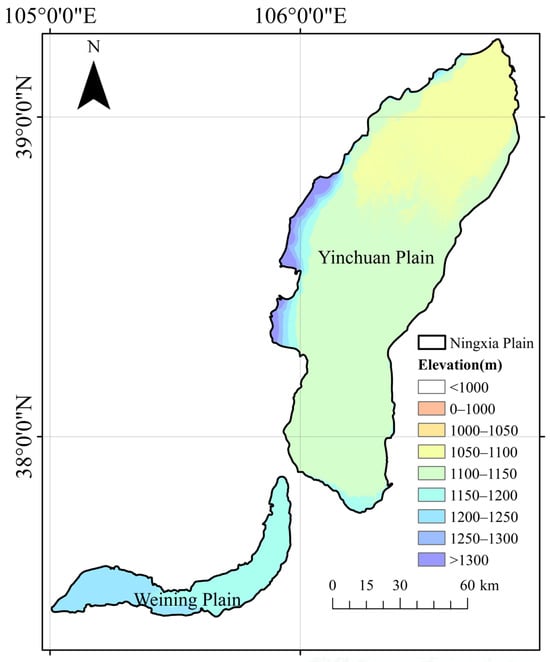
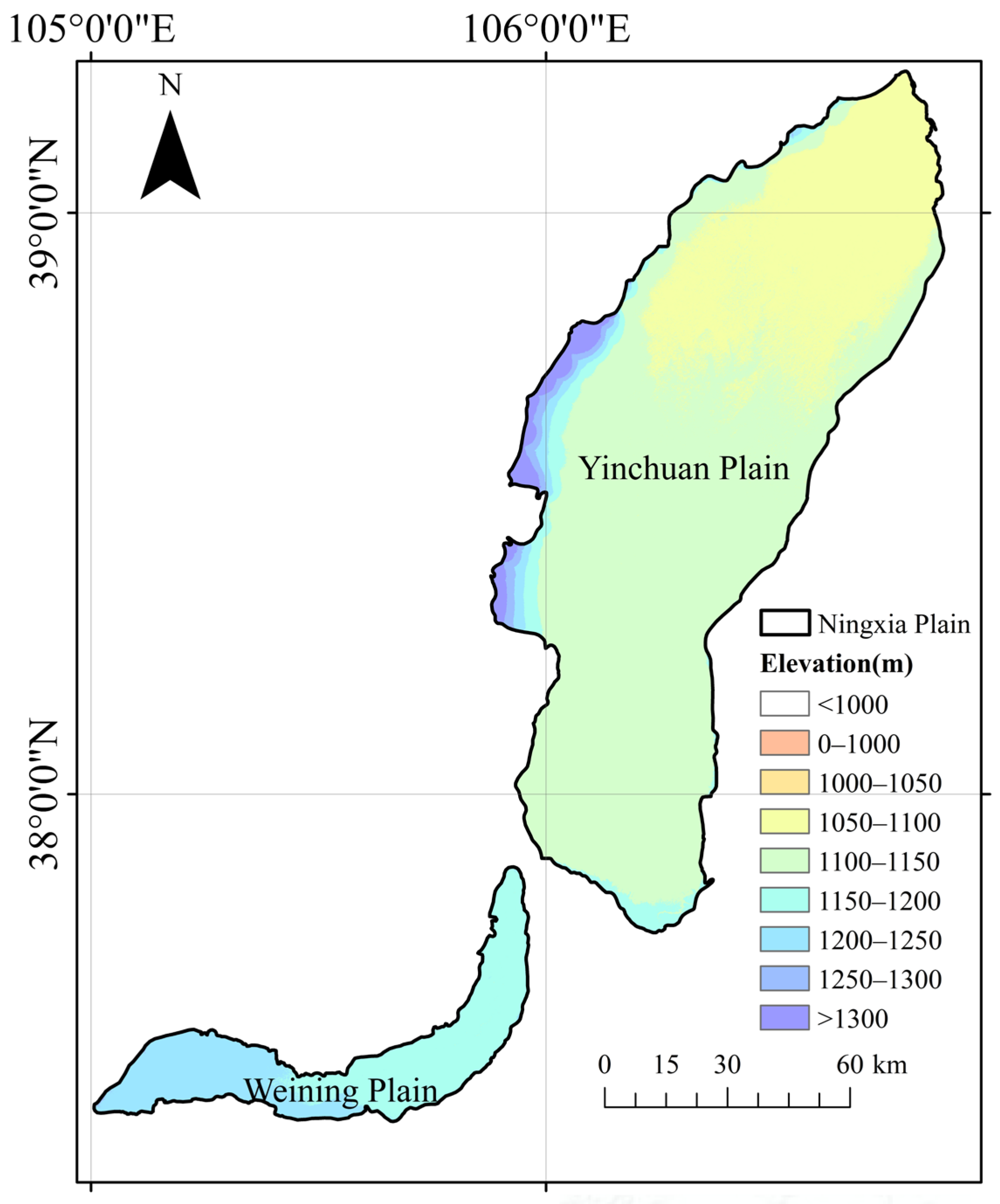
The Ningxia Plain is located in the upper reaches of the Yellow River in northwestern China (37.43–39.24° N, 105.01–106.87° E), covering approximately 8000 km2 (Figure 1). It comprises two geomorphologically distinct sub-units: the Yinchuan Plain to the north and the Weining Plain to the south. The Yinchuan Plain, the larger of the two, spans 11 county-level administrative units across Yinchuan, Shizuishan, and Wuzhong cities and is the core zone of regional agricultural, industrial, and service sector development. Its terrain slopes gently from southwest to northeast within a fault-bounded basin, enabling gravity-fed irrigation from the Yellow River following the river’s passage through the Qingtongxia gorge under the unified regulation of the Qingtongxia Hydraulic Hub. The Weining Plain, situated in northern Zhongwei City, is underlain by Yellow River alluvial and aeolian deposits and similarly relies on Yellow River diversion for stable agricultural production.
Figure 1.
Study area (Ningxia Plain).
The region has a semi-arid continental climate, characterized by limited and unevenly distributed precipitation, high evaporation, and abundant sunshine. Mean annual precipitation ranges from 175 to 201 mm (based on data from Huinong and Lingwu meteorological stations), concentrated in June–September (70–80% of annual total), while mean annual potential evapotranspiration ranges from 1507 to 3553 mm (based on Yinchuan and Taole stations). The resulting large moisture deficit means that agricultural production is almost entirely dependent on irrigation. In 2023, Yellow River diversions accounted for over 98% of the total agricultural surface water supply. Irrigation water is diverted from the Yellow River through major canals—including the Tanglai, Huinong, Hanyuan, Han, and Qin canals—and distributed to farmland via a multi-tier canal network; surplus irrigation water is discharged through a corresponding drainage network comprising the First through Fifth Main Drains. Over 2004–2023, both total diversion and total drainage volumes showed declining trends, with drainage volume declining more sharply after 2015, particularly in the Qingtongxia Irrigation District, reflecting the combined effects of water-saving irrigation infrastructure improvements and crop structure adjustment.
The plain’s hydrology is shaped by three principal surface water components: the Yellow River, which provides the primary water source; a network of inland lakes and wetlands, many of which receive water through agricultural drainage and ecological supplement channels; and the engineered canal-drain system, which mediates water transfer between the river and farmland. Major lakes include Xinhai Lake (~23.4 km2), Sha Lake (~31.5 km2), Mingyue Lake (~17.35 km2), Yuehai Lake (~9.02 km2), and Zhenshuo Lake (~7.67 km2). The plain’s agricultural system supports seven major crop types: spring wheat, maize, rice, wolfberry, grape, alfalfa, and vegetables supplied to Hong Kong markets. Since 2000, the regional agricultural structure has progressively shifted from traditional grain crops toward dryland and specialty crops, making the Ningxia Plain an instructive case for studying the hydrological consequences of crop planting structure adjustment under water scarcity constraints.
2.2. Data Sources
2.2.1. Cropland Mask
Cropland spatial boundaries were derived by taking the spatial intersection of three 30 m annual land cover datasets, all accessible via GEE. The China Cropland Dataset (CACD, 2004–2021) from long-term Landsat time series used machine learning classification optimized for Chinese agricultural landscapes [30]. The China Land Cover Dataset (CLCD, 2004–2021) was produced by using Random Forest classification combined with temporal change detection on Landsat imagery, providing annual land cover maps at 30 m including cultivated land, forest, grassland, and water [31]. The Global Land Cover with Fine Classification System (GLC_FCS30D, 2004–2022) was produced from global Landsat imagery using deep learning and a fine classification scheme that distinguishes multiple cropland sub-types [32]. Following the multi-source fusion approach [33], we integrated CACD, CLCD, and GLC-FCS30D products on GEE, ranking pixel confidence by spatial consistency and quality weights (Table S7). Due to the unavailability of 2023 extent data, 2021 data were used as a proxy, as the 2019 and 2021 extents showed 94% spatial overlap. This substitution was justified by the relative stability of China’s cropland area compared to its dynamic cropping structures and productivity [34]. The resulting dataset provides spatially continuous cropland extent for 2019 and 2023 with quantified uncertainty.
2.2.2. Remote Sensing Imagery for Crop Classification
Two data sources provided continuous coverage across the full 2004–2023 study period. For 2019–2023, Sentinel-2 Level-2A surface reflectance imagery was used (ESA; approximately 5-day revisit; GEE path: COPERNICUS/S2_SR_HARMONIZED). Monthly median composites were generated from cloud-masked imagery acquired during the primary growing season (April–October), retaining seven spectral bands: Blue (490 nm), Green (560 nm), Red (665 nm), Red Edge 1 (705 nm), Red Edge 2 (740 nm), NIR (842 nm), and SWIR1 (1610 nm), at 10 m spatial resolution. Five vegetation indices were additionally computed: Normalized Difference Vegetation Index (NDVI), Normalized Difference Red Edge Index (NDRE), Green Normalized Difference Vegetation Index (GNDVI), Ratio Vegetation Index (RVI), and Land Surface Water Index (LSWI). A three-level temporal window compositing strategy was applied to handle cloud-persistent gaps: a primary window of ±15 days around the target date, a secondary window of ±30 days, and a tertiary monthly composite as fallback, ensuring complete and temporally consistent feature time series for all pixels within the cropland mask.
For 2004–2018, the Alpha Earth dataset was used—a 30 m, 16-day composite product derived from MODIS–Landsat spatiotemporal fusion, providing Green, NIR, SWIR1, and LSWI spectral bands (downloaded from https://data-starcloud.pcl.ac.cn/aiforearth (accessed on 18 February 2026)). This dataset bridges the resolution gap between coarse MODIS (250–500 m) and the lower temporal frequency of Landsat (16-day), providing a temporally dense, moderately high-resolution time series suitable for annual crop classification.
2.2.3. Surface Water Body Data
Surface water body dynamics were characterized using a global lake area dynamics dataset, which provides monthly lake area time series at 30 m spatial resolution through deep learning-based spatiotemporal fusion of MODIS and Landsat imagery, covering 2004–2023 (downloaded from Zenodo: https://doi.org/10.5281/zenodo.14568609). Canal and channelized river water surfaces were masked using a regional canal distribution map combined with visual interpretation of high-resolution Google Earth imagery; subsequent analysis focused exclusively on the Yellow River channel and lakes, including natural lakes, wetlands, ponds, and seasonal water bodies.
2.2.4. Meteorological Data
Meteorological data for 2004–2023 at 0.1° spatial resolution comprised three variables. Daily precipitation was obtained from the CHM_PRE V2 gridded dataset (National Meteorological Information Center, China) [35], produced by combining long-term station observations with LightGBM machine learning interpolation. Monthly actual evapotranspiration was extracted from the China Land Surface Actual Evapotranspiration Dataset v2.0, derived by integrating multi-source meteorological observations and remote sensing data inversion. Monthly air temperature was obtained from the ERA5-Land reanalysis product (ECMWF, Copernicus Climate Data Store). Net precipitation (PE = precipitation minus actual evapotranspiration) was computed as a proxy for the regional hydroclimatic water balance. Statistical data included annual crop planting areas by county (2004–2022) from the Ningxia Statistical Yearbook (https://www.nx.gov.cn/zwgk/zfxxgk/fdzdgknr/tjxx_40901/tjnj/ (accessed on 20 February 2026)), and annual diversion and drainage volumes for the Qingtongxia and Weining irrigation districts (2004–2023) from the Ningxia Water Resources Bulletin (https://slt.nx.gov.cn/xxgk_281/fdzdgknr/gbxx/szygb/ (accessed on 20 February 2026)).
2.2.5. Sampling Data
Field sampling was conducted across the Ningxia Plain from 25 to 29 May 2025, covering the plain from north to south. Sample points were identified by visual inspection of crop types in the field, with plot boundaries subsequently delineated using Google Earth high-resolution imagery and vectorized in ArcMap 10.8.2 software. A total of 458 sample points were collected, covering seven crop classes: rice, maize, spring wheat, vegetables (Hong Kong market supply), grape, wolfberry, and alfalfa. Total sample area was 739 ha (Table 1). Sample polygons were used for Random Forest classifier training and accuracy assessment for the Sentinel-2 period; their temporal transferability to the Alpha Earth period was evaluated through comparison with statistical yearbook data.
Table 1.
Field sample statistics by crop type (May 2025).
The 2025 field samples were directly used to train the Random Forest classifier for the Sentinel-2 period (2019–2023). For the long-term Transformer model, these samples, which were supplemented by the validated 2024 classification map, served as the basis for capturing stable phenological signatures. This approach is justified by (1) the consistent phenological traits of annual crops (for example, rice or maize) regardless of spatial shifts, and (2) the high spatial stability of vegetables and perennial crops, which are constrained by fixed infrastructure like deep groundwater wells and greenhouses, ensuring their representativeness for historical years.
2.3. Methods
2.3.1. Sentinel-2 Period (2019–2023): Random Forest Classification
On GEE, the full spectral–temporal feature stack comprised the seven Sentinel-2 bands plus five vegetation indices for each month from April to October, yielding up to 84 features per pixel per year. Feature importance was computed using the built-in Random Forest impurity-based ranking, and the top 20 features were retained for final classification to reduce dimensionality and mitigate overfitting. Random Forest classification was performed with 200 decision trees using the field sample polygons split 70:30 into training and validation sets. The classifier was applied annually within the cropland mask to produce a seven-class crop map for each year from 2019 to 2023. Class imbalance among sample types was addressed by stratified sampling during training set construction, ensuring adequate representation of minority classes such as alfalfa and vegetables.
2.3.2. Alpha Earth Period (2004–2018): Transformer-Based Classification
For the earlier period, a Transformer-based image classification model was trained to leverage the temporal structure of the 16-day composite time series. Training data were generated by spatially matching 2019 Sentinel-2 classifications and 2025 field samples to contemporaneous Alpha Earth imagery at coincident locations, producing a labeled dataset representative of the spectral–temporal signatures in the fusion imagery. The resulting dataset was randomly divided into independent training and validation subsets using a stratified 80:20 split. The validation subset was strictly excluded from model training and used solely for performance evaluation. The model used a multi-head self-attention architecture to capture inter-date dependencies within each growing season and was trained for 100 epochs with an Adam optimizer (learning rate = 0.001, batch size = 32). Training loss and accuracy curves for both training and validation sets were monitored throughout to confirm convergence and generalizability. The trained model was then applied to the 2004–2018 Alpha Earth time series to produce annual crop maps consistent with the Sentinel-2 period classification scheme.
2.3.3. Accuracy Assessment and Temporal Validation
Classification accuracy for the Sentinel-2 period was evaluated using the 30% withheld validation sample set. Overall accuracy (OA), Kappa coefficient, per-class precision, recall, and F1 score were computed from the confusion matrix. For temporal consistency validation across both periods, the total classified area of each major crop per year was compared against county-level statistical yearbook data using the Pearson correlation coefficient (r) and mean absolute percentage error (MAPE), providing an independent assessment of how well the remote sensing classifications track documented area changes over the 2004–2023 study period.
2.3.4. Surface Water Body Analysis
Monthly surface water area time series were computed separately for total water bodies, the Yellow River channel, and lakes at the plain scale. Annual maximum and annual mean area were computed as complementary indicators of peak seasonal extent and baseline water availability, respectively. Long-term trends were assessed using the nonparametric Sen slope estimator and Mann–Kendall trend test, with p < 0.05 as the significance threshold. Intra-annual seasonal patterns were characterized using multi-year monthly mean area and its standard deviation. Spatial hotspot analysis was performed on a 500 m × 500 m grid using the Getis-Ord Gi* statistic at 90%, 95%, and 99% confidence levels to identify persistent spatial concentrations of surface water.
To characterize lake size diversity and provide a basis for driver attribution, lakes were classified into four types using K-means clustering of GLAKE long-term maximum area data (1984–2019): Type I (≤18 ha), Type II (18–80 ha), Type III (80–400 ha), and Type IV (>400 ha), with cluster labels assigned in descending order of cluster centroid area; Type I lakes represent small lakes, while Types II–IV correspond to medium and large lakes (Table S7).
2.3.5. Driver Analysis: PCA and Spearman Correlation
To disentangle the relative contributions of agricultural structural change and climatic variability to interannual surface water body dynamics, PCA was applied to a set of seven annual variables: total diversion volume, total drainage volume, annual precipitation, annual actual evapotranspiration, and the planted areas of maize, wheat, and rice. These three crops were selected as representative of the agricultural structure change signal because they collectively account for over 85% of total cropland area throughout the study period and have irrigation regimes directly connected to the main canal-drain network. Cash crops with partially independent irrigation regimes (grape irrigated by winery-managed drip systems, vegetables by groundwater sprinklers, wolfberry and alfalfa by diversified water sources) were excluded to minimize confounding. Cash crops (e.g., grapes, vegetables, wolfberries, and alfalfa) were excluded because their fragmented, market-driven dynamics introduce stochastic noise rather than reflecting regional hydrological trends. Furthermore, their limited spatial extent contributes minimal variance, meaning their inclusion would not substantially alter the primary principal component structure. All variables were standardized to a zero mean and unit variance prior to PCA. Spearman rank correlation coefficients between each PC score and the annual area of each water body type (Type I lakes, Types II–IV combined lakes, and the Yellow River) were then computed, with statistical significance assessed at p < 0.05.
2.3.6. Shannon Diversity Index (SHDI)
The Shannon Diversity Index (SHDI) was used to quantify the diversity of crop planting structure in the Ningxia Plain from 2004 to 2023. SHDI is defined as:
where is the proportion of the i-th crop type in the total cultivated area, and n is the number of crop types.
Higher SHDI values indicate a more diverse and balanced planting structure, whereas values approaching zero reflect dominance by a single crop type. In this study, SHDI was applied to characterize the temporal evolution of crop structure diversity at the regional scale.
3. Results
3.1. Crop Planting Structure Dynamics
3.1.1. Classification Accuracy
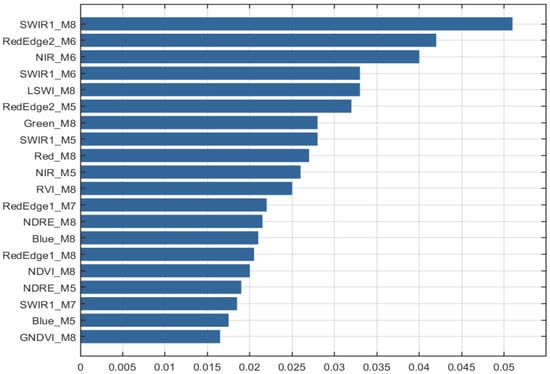
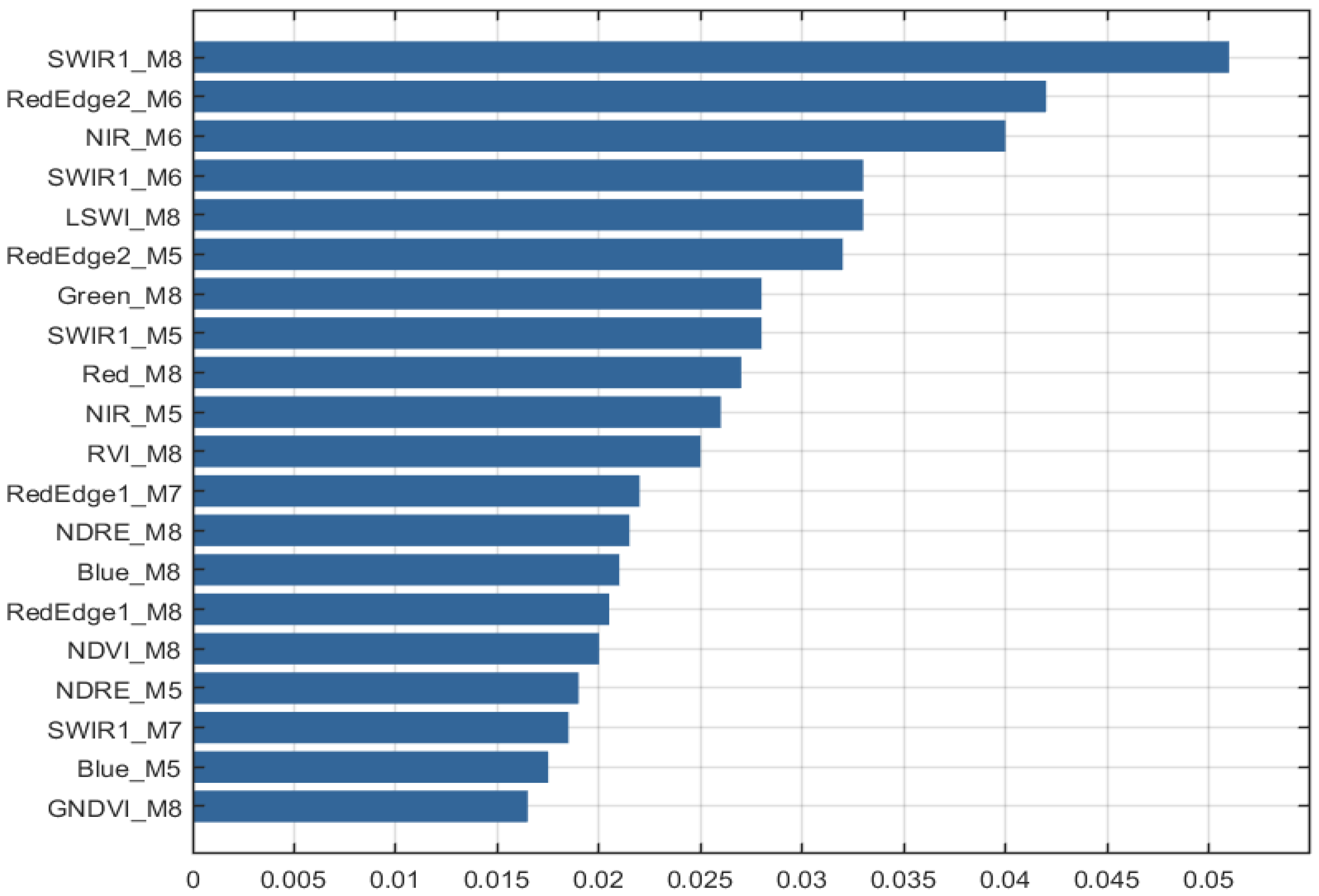
The Random Forest classifier achieved an overall accuracy of 93.0% (Kappa = 0.91). Grape and vegetables were classified most accurately, while minor confusion was observed between rice and maize, and wolfberry showed the lowest precision (Table S5). Feature importance analysis highlighted SWIR1 in August, as well as RedEdge2 and NIR in June, as the most discriminative, reflecting mid-season crop differences (Figure 2). Grape achieved the highest precision (99.4%, F1 = 0.957, recall = 95.4%), followed by vegetables (98.6%, F1 = 0.980, recall = 97.4%). Rice (F1 = 0.949, recall = 96.3%) and maize were well-classified (F1 = 0.845, recall = 98.2%), with minor confusion mainly occurring at field boundaries. Wolfberry exhibited the lowest precision (87.3%, F1 = 0.834, recall = 80.1%), primarily due to spectral similarity with maize during the growing season. Overall, these results indicated that the Random Forest classifier provided reliable discrimination across all seven crop classes, with limitations mainly restricted to spectrally similar crop pairs.
Figure 2.
Top 20 feature importances selected by the Random Forest model. The x-axis represents feature importance scores.
Alpha Earth 30 m imagery was super-resolved to 10 m using a Real-ESRGAN model, achieving a peak PSNR of 25.09 dB (CC = 0.87–0.88, SAM = 3.38, ERGAS = 13.57) at epoch 258, confirming stable spatial and spectral optimization with fine-tuned high-frequency detail (Figure S1).
The Transformer model performed better (98.7% accuracy, Kappa 0.982), with rice scoring highest (F1 = 0.999, recall = 100%), followed by grape (F1 = 1.000), maize (F1 = 0.995, recall = 99.7%), vegetables (F1 = 0.992), alfalfa (F1 = 0.977), wheat (F1 = 0.897), and wolfberry lowest (F1 = 0.894, recall = 81.5%) (Table S6). The superior performance of the Transformer model over the Random Forest classifier demonstrates the advantage of capturing long-range temporal dependencies in multi-year time-series classification, supporting the reliability of the 2004–2018 crop maps.
3.1.2. Temporal Evolution of Crop Areas
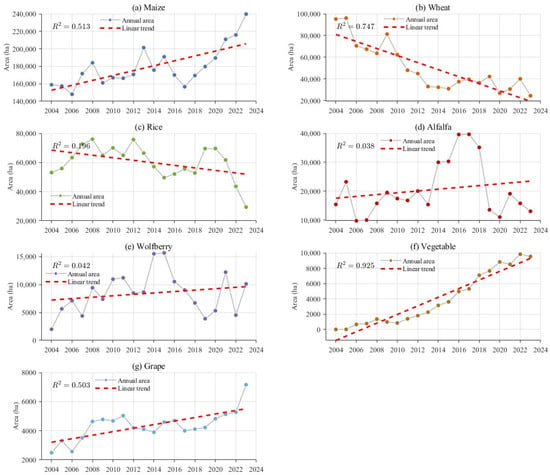
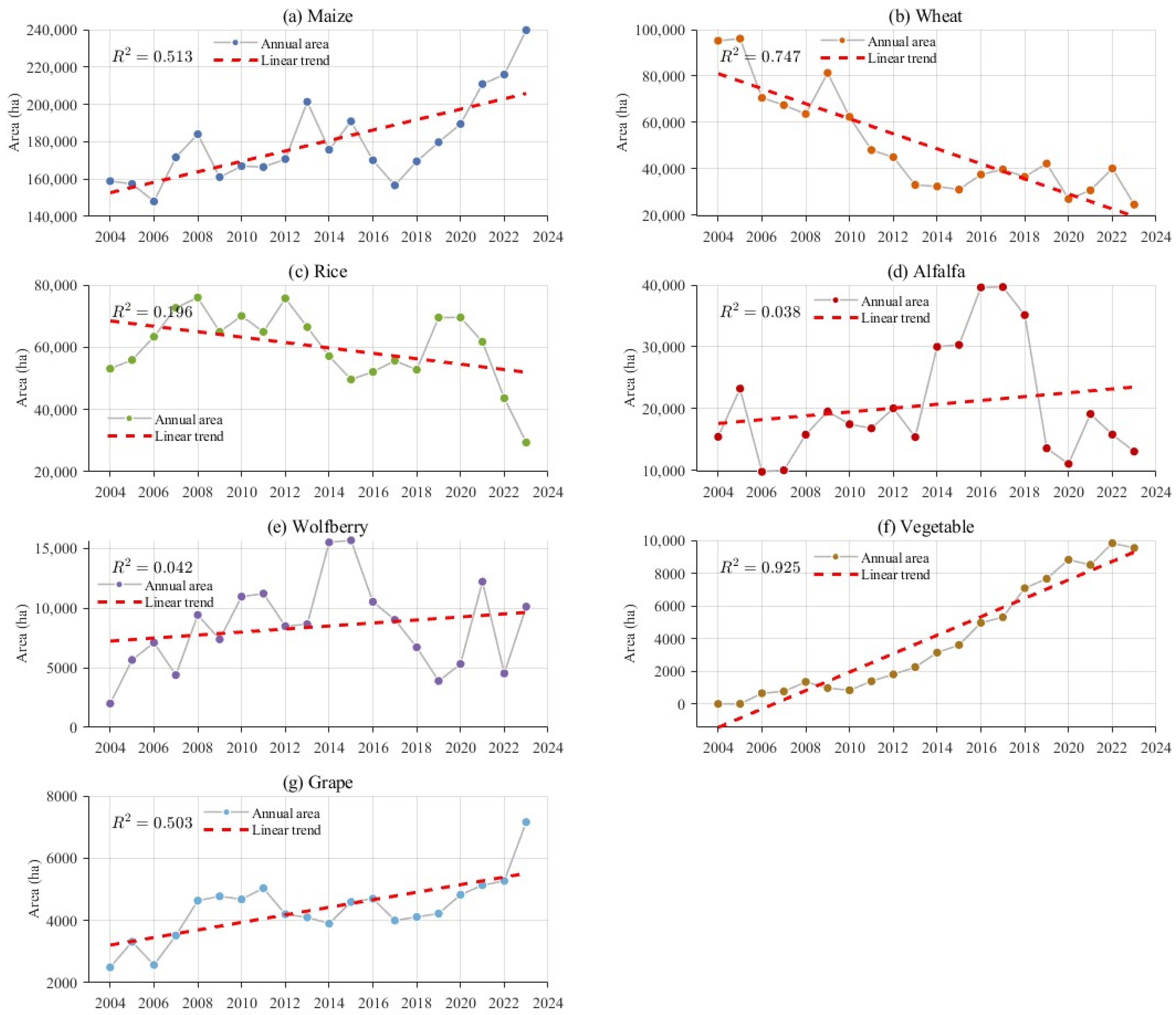
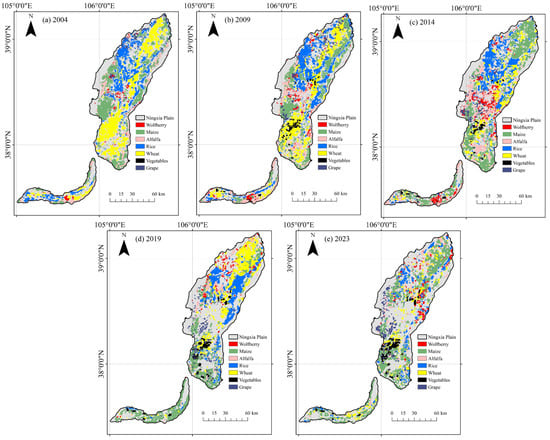
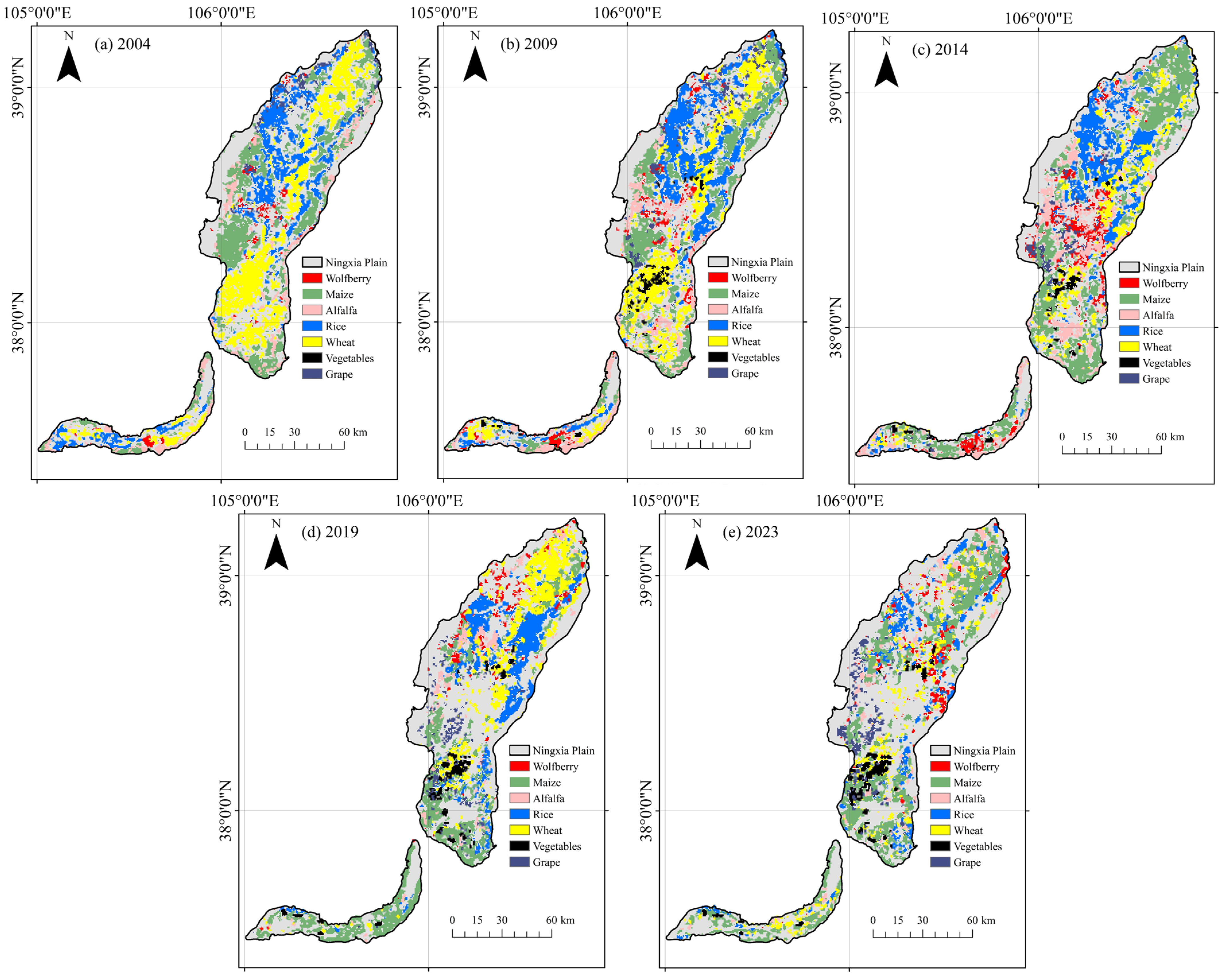
Over 2004–2023, the seven major crops in the Ningxia Plain underwent substantial and largely directional structural reorganization (Figure 3). Among staple grain crops, maize expanded from approximately 160,000 ha in 2004 to approximately 240,000 ha in 2023 (+50.8%), exhibiting a wave-like increasing trend with particularly rapid growth after 2019. Wheat declined continuously and steeply from approximately 95,000 ha to approximately 25,000 ha (−74.3%), representing the largest absolute area loss of any crop over the study period. Rice followed a more complex trajectory: relatively stable at around 50,000–55,000 ha during 2007–2012, it began declining after 2013 and accelerated sharply after 2019, falling to approximately 29,000 ha by 2023 (−44.6% from the 2004 level of 53,000 ha). Among cash and specialty crops, vegetables (Hong Kong market supply) exhibited the most pronounced relative growth, increasing approximately 14-fold from approximately 650 ha in 2006 to approximately 9500 ha in 2023. Grape area nearly tripled from approximately 2500 to approximately 7200 ha over the study period, showing a stable increasing trend. Wolfberry showed moderate fluctuating growth without a clear directional trend. Alfalfa expanded substantially until around 2015 and then contracted, suggesting sensitivity to market price fluctuations and policy changes for livestock feed crops.
Figure 3.
Temporal variations and linear trends of major crop planting areas (2004–2023).
3.1.3. Structural Diversity: SHDI Analysis
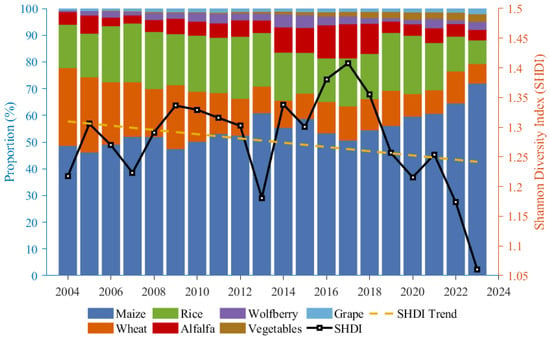
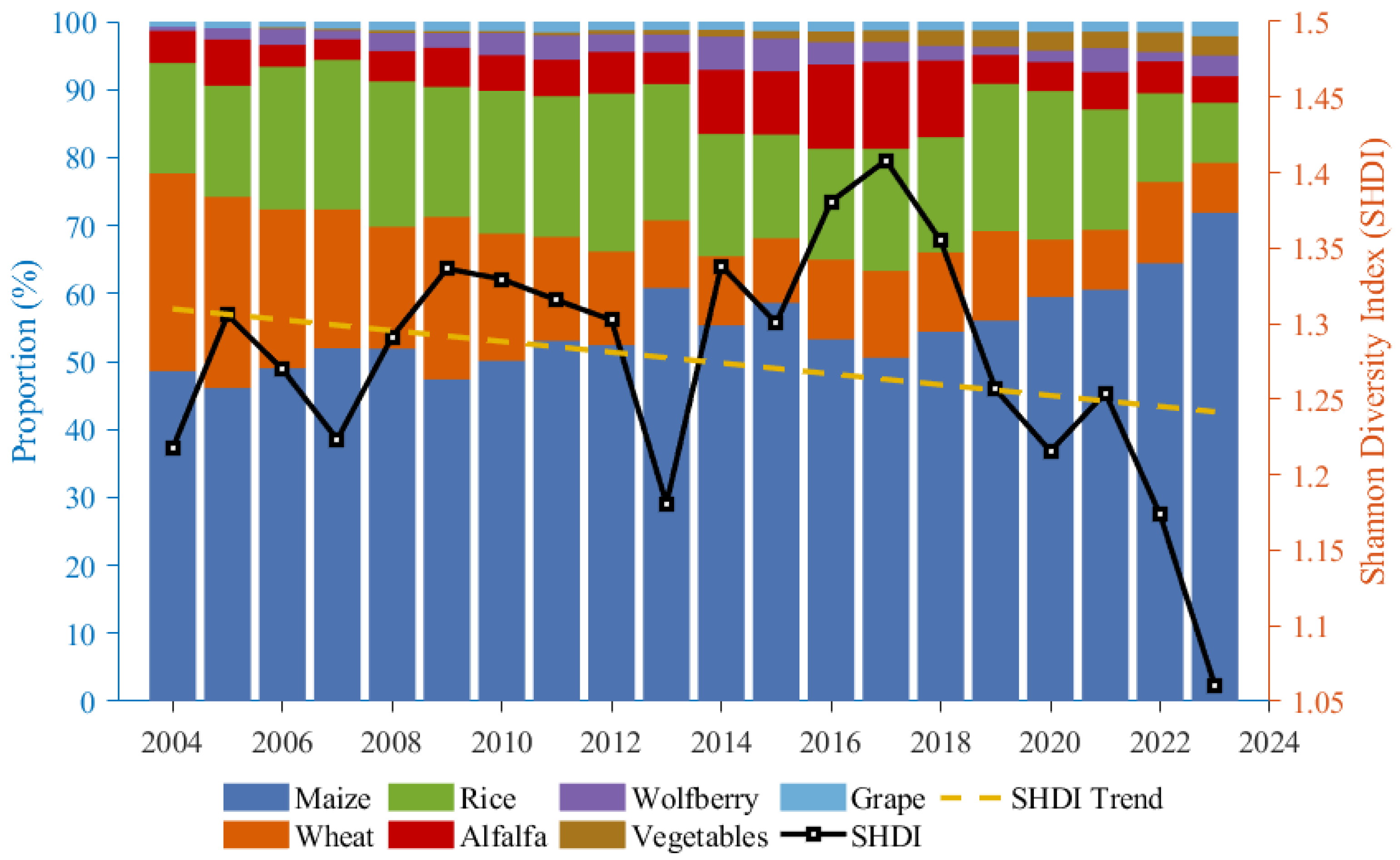
The Shannon Diversity Index (SHDI) computed from the annual proportional composition of the seven crops provides a synthetic measure of structural diversity that goes beyond individual crop area changes (Figure 4). SHDI rose from 1.22 in 2004 to a peak of 1.41 in 2017, before declining sharply to 1.06 by 2023, which was the lowest value in the 20-year record. Mann–Kendall trend testing over the full 2004–2023 period did not find a statistically significant monotonic trend (τ = −0.11, p = 0.54), reflecting the non-monotonic rise-then-fall trajectory. However, piecewise analysis identifies four distinct structural phases: a fluctuating increase phase (2004–2009, SHDI from 1.22 to 1.34) driven by initial wheat contraction and cash crop expansion; a volatile adjustment phase (2009–2014) characterized by large interannual swings (SHDI ranging from 1.18 to 1.34) as multiple crops underwent simultaneous restructuring; a transitional rise phase (2014–2017) during which rice expansion and cash crop growth temporarily increased diversity; and a sustained consolidation phase (2019–2023) when the accelerated rice-to-maize conversion drove SHDI to its study-period minimum. The dominant compositional trend across all phases was the rise in maize’s share from 48.6% to 71.9% and the decline in wheat from 29.1% to 7.3% and rice from 16.2% to 8.8%, while cash crops increased in absolute area but remained proportionally insufficient to offset structural consolidation.
Figure 4.
Evolution of cropping structure and trend of the SHDI.
3.1.4. Crop Transition Analysis
Four consecutive five-year transition matrices (Tables S1–S4, Supplementary Materials) quantified the dominant structural pathways across the study period, summarized in Table 2. During 2004–2009, wheat contraction dominated (retention 48.5%), with over 70% of converted land shifting to maize. During 2009–2014, restructuring intensified: wheat retention collapsed to 16.8%, and maize became the primary net beneficiary (+19,486 ha), while alfalfa expanded rapidly, and wolfberry and vegetable cultivation began sustained growth. During 2014–2019, the pattern reversed, with rice reaching its historical peak through large-scale maize-to-rice conversion (21,692 ha), while alfalfa collapsed (retention 11.5%) as livestock market incentives shifted. During 2019–2023, the most concentrated restructuring occurred: rice retention fell to just 23.8%, with 34,480 ha converting directly to maize in a single five-year period, and the net gain of maize reached approximately 41,892 ha, indicating a decisive consolidation toward dryland crop dominance. Across all periods, grapes and vegetables maintained consistent positive net balances, while wheat declined monotonically.
Table 2.
Summary of five-year crop transition statistics (net area change and dominant conversion pathways).
3.1.5. Spatial Patterns and Directional Characteristics
Local Moran’s I analysis on a 500 m × 500 m grid revealed spatially structured and temporally evolving crop clustering dynamics (Figure 5). In 2004, wheat formed prominent high–high clusters across the northern Yinchuan Plain and the Weining Plain; rice was concentrated in a northwest corridor running along and west of the Yellow River; grape was tightly localized to the Helan Mountain piedmont zone. By 2014, wheat clusters had fragmented substantially, and maize hotspots had expanded into former wheat areas across the central plain. By 2023, maize high–high clusters dominated nearly the entire cultivated landscape of both sub-plains, wheat was confined to isolated clusters around Qingtongxia and Yinchuan cities, and rice hotspots had almost entirely disappeared from the Yellow River corridor areas they previously occupied. Grape clusters intensified along the Helan piedmont, and vegetable clusters emerged and strengthened in the Qingtongxia area.
Figure 5.
Local Moran’s I of major crops in the Ningxia Plain from 2004 to 2023.
Standard deviation ellipse (SDE) analysis provided complementary quantification of spatial directional characteristics. Maize ellipses were the most consistent over the study period: their area expanded continuously, the major-to-minor axis ratio remained stable at 3.1–4.25, and the principal orientation stayed at 60–65°, closely aligned with the northeast axis of the plain. Wheat ellipses contracted markedly in both area and axis length, and directional irregularity increased after 2014, indicating spatial fragmentation into isolated clusters. Rice ellipses stayed compact and stable in orientation until 2019, then shrank rapidly in area while maintaining orientation, reflecting contraction concentrated in the northwest corridor. Cash crop ellipses (grape, vegetables, wolfberry) had lower axis ratios (2.68–3.89) and greater interannual directional variability, reflecting their more dispersed distribution across smallholder and estate plots on the plain margins.
3.2. Surface Water Body Dynamics
3.2.1. Temporal Variation at Monthly and Annual Scales
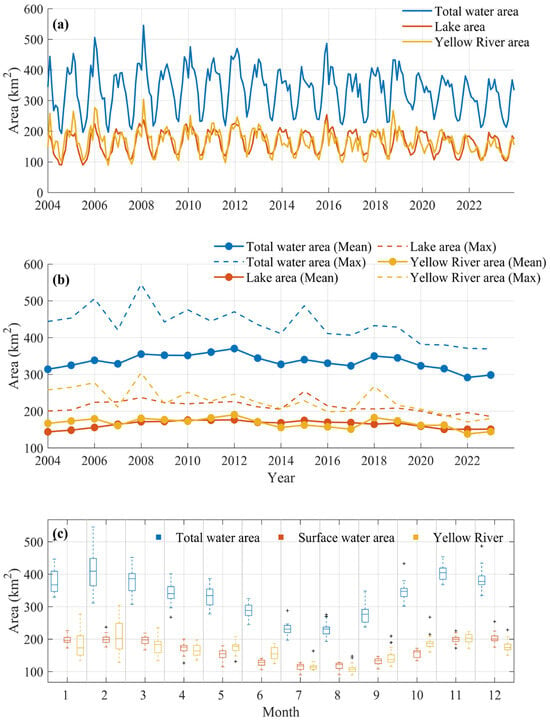
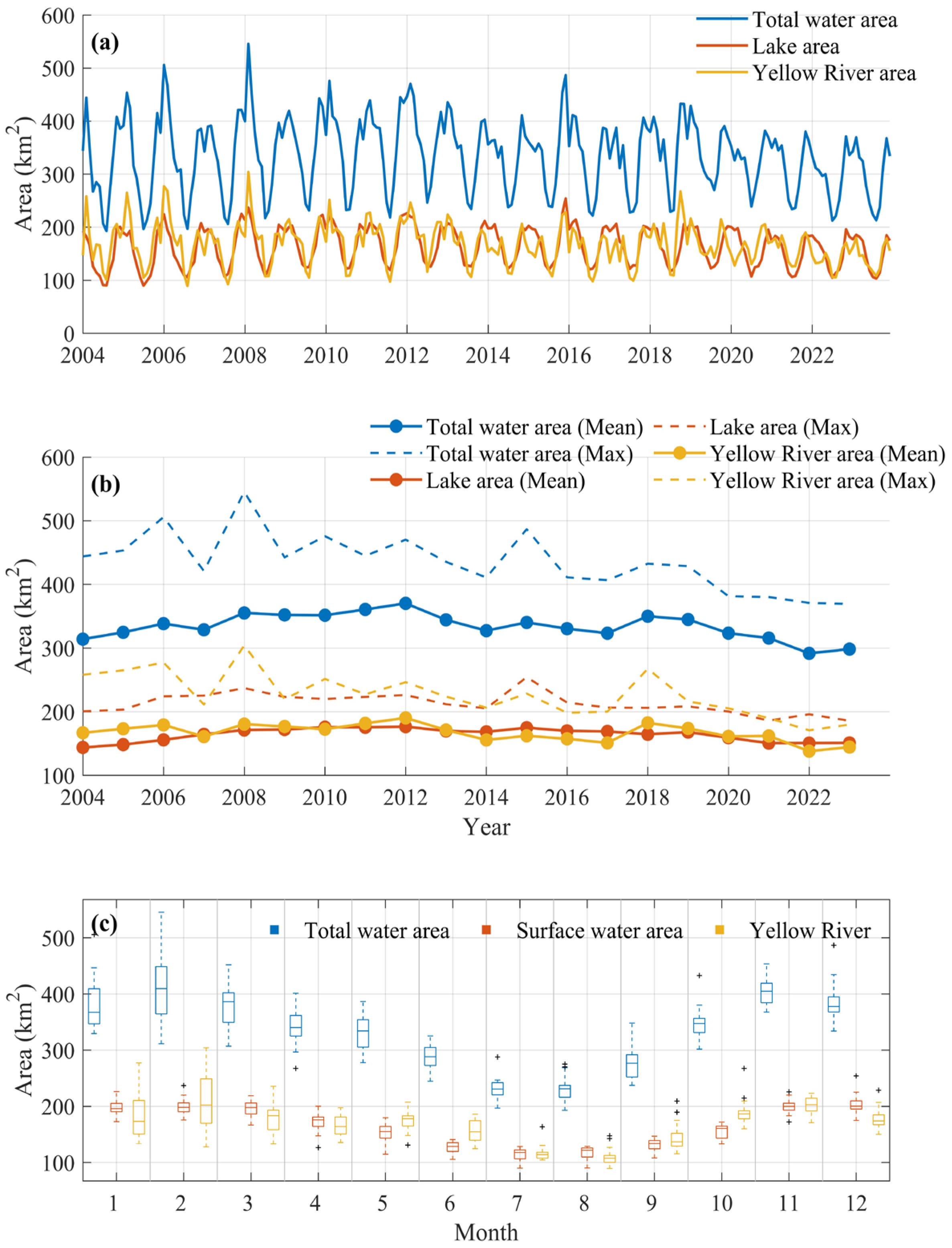
Monthly total surface water area fluctuated between 191.63 km2 (August 2004) and 545.94 km2 (February 2008) over the study period, with a multi-year mean of 332.54 km2 and a coefficient of variation of 21.0% (Figure 6a), indicating substantial intra-annual and interannual variability. A pronounced and consistent seasonal pattern prevailed throughout the 20 years: the multi-year monthly mean area peaked in February (409.12 km2; SD = 58.77 km2) and reached its annual minimum in August (228.76 km2; SD = 22.42 km2), representing an intra-annual range of approximately 180 km2. The larger standard deviation of February values (58.77 km2) compared to August values (22.42 km2) indicated that peak winter extents were more variable across years than summer minima. Seasonal mean areas were 390.46 km2 in winter (December–February), 349.70 km2 in spring (March–May), 248.24 km2 in summer (June–August), and 341.74 km2 in autumn (September–November), confirming the dominant “more in winter, less in summer” seasonal rhythm.
Figure 6.
Spatiotemporal variations in total surface water area, areal water bodies, and the Yellow River area in the Ningxia Plain (2004–2023). (a) Monthly variations in surface water area; (b) annual maximum and mean surface water area; (c) monthly distribution of surface water area.
At the annual scale (Figure 6b), total water body area was relatively stable during 2004–2012, with a mean annual maximum of approximately 466 km2 and a mean annual average of approximately 340 km2. After 2013, the annual maximum area began declining at a rate of −5.32 km2/yr (Sen slope), reaching the study-period minimum in 2022. Annual mean area declined more gradually, suggesting that peak seasonal extents contracted more than baseline water body area. The divergence between the decline rates of annual maximum and mean area suggests that the overall reduction in total water body area is primarily driven by a compression of seasonal peak conditions, likely associated with diminished agricultural drainage surplus during peak irrigation periods, rather than a uniform contraction of permanent water bodies.
The Yellow River and lakes exhibited contrasting temporal behaviors. The Yellow River (mean area: 167.21 km2; CV = 22.92%) showed a significant and continuous declining trend over the study period (Mann–Kendall Z = −3.28, p = 0.001), with a cumulative reduction of 14.41% from 2004 to 2023. This trend reflects two reinforcing mechanisms: a long-term reduction in upstream inflow due to flow regulation by upstream reservoirs, and intensified irrigation abstraction from the Yellow River main channel during the July–August low-flow period when agricultural demand peaks but natural flow is lowest. Lake area (mean: 164.12 km2) was considerably more stable across the study period, with an autocorrelation coefficient of 0.817 compared to 0.587 for the Yellow River, indicating lower sensitivity to year-to-year variability in driving factors.
Based on the lake maximum area dataset (GLAKE), the K-means clustering (K = 4, silhouette score = 0.58) classified lakes in the region into four major types: Type I (≤18 ha), Type II (18–80 ha), Type III (80–400 ha), and Type IV (>400 ha) (Table 3).
Table 3.
Lake size classification results based on K-means clustering of GLAKE maximum area data (1984–2019).
Type I small water bodies (≤18 ha) showed no significant directional trend over the study period, with annual total area fluctuating between 3979 ha (2015) and 4827 ha (2014), and a multi-year mean of approximately 4490 ha.
3.2.2. Spatial Distribution
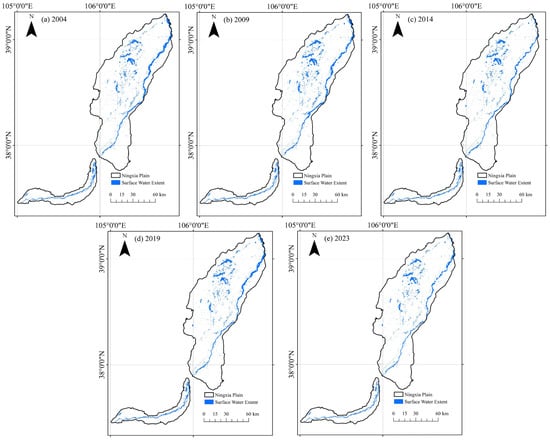
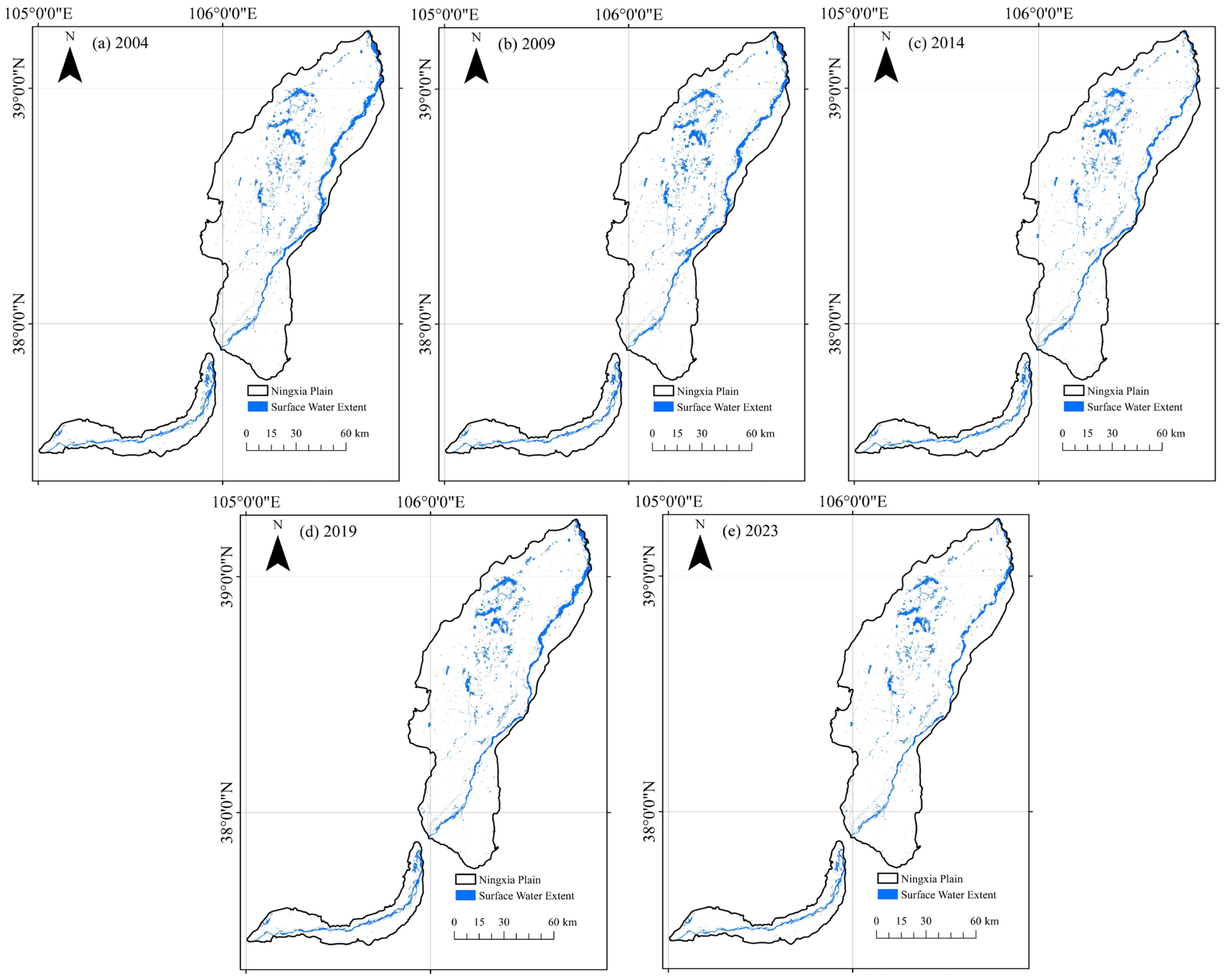
The multi-year maximum surface water extent across 2004–2023 (Figure 7) indicates that surface water in the Ningxia Plain is primarily concentrated along the Yellow River corridor and in the western Yinchuan Plain, with a noticeable trend of higher water levels in the northern and western regions. Large permanent lakes, including Xinhai Lake, Shahu Lake, Mingyue Lake, Yuehai Lake and others, play a crucial role in shaping the spatial structure of the water landscape. Meanwhile, numerous small and medium lakes scattered throughout the central plain represent the most dynamic component, as they respond sensitively to fluctuations in agricultural irrigation and drainage from year to year.
Figure 7.
Spatial distribution of maximum surface water extent in the Ningxia Plain from 2004 to 2023.
3.3. Lake Classification
To establish a basis for scale-dependent driver attribution, lakes within the Ningxia Plain were classified by size using K-means clustering applied to the GLAKE global lake dataset. This dataset records the long-term maximum lake area for each mapped water body from 1984 to 2019. A total of 718 lake polygons within the Ningxia Plain boundary were extracted, and K-means clustering was applied to the log-transformed maximum area values. The optimal number of clusters, K = 4, was determined by maximizing the silhouette coefficient for K values ranging from 2 to 5. Cluster labels were assigned in descending order of the cluster centroid area, resulting in four size classes (Table 3).
Small lakes (Type I, ≤18 ha) make up 73.2% of all lake units but only represent 15.3% of the total area. These lakes are physically integrated within the farmland mosaic, with their water balances primarily influenced by local field irrigation and drainage surplus. Medium lakes (Type II, 18–80 ha) are sustained through human management but are generally disconnected from the direct cycles of irrigation and drainage. Meanwhile, large and very large lakes (Types III–IV, >80 ha) account for just 4.9% of the total number of lake units but cover 62.9% of the total area. These larger lakes are maintained through dedicated ecological supplement systems and are largely insulated from variations at the field-scale agricultural level.
3.4. Macro-Scale Drivers of Surface Water Body Change
3.4.1. Principal Component Analysis
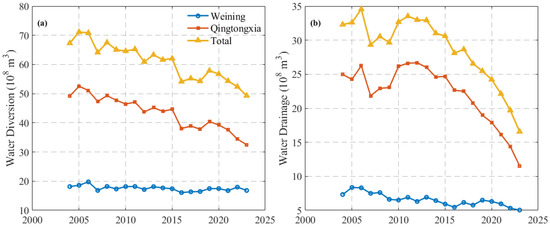
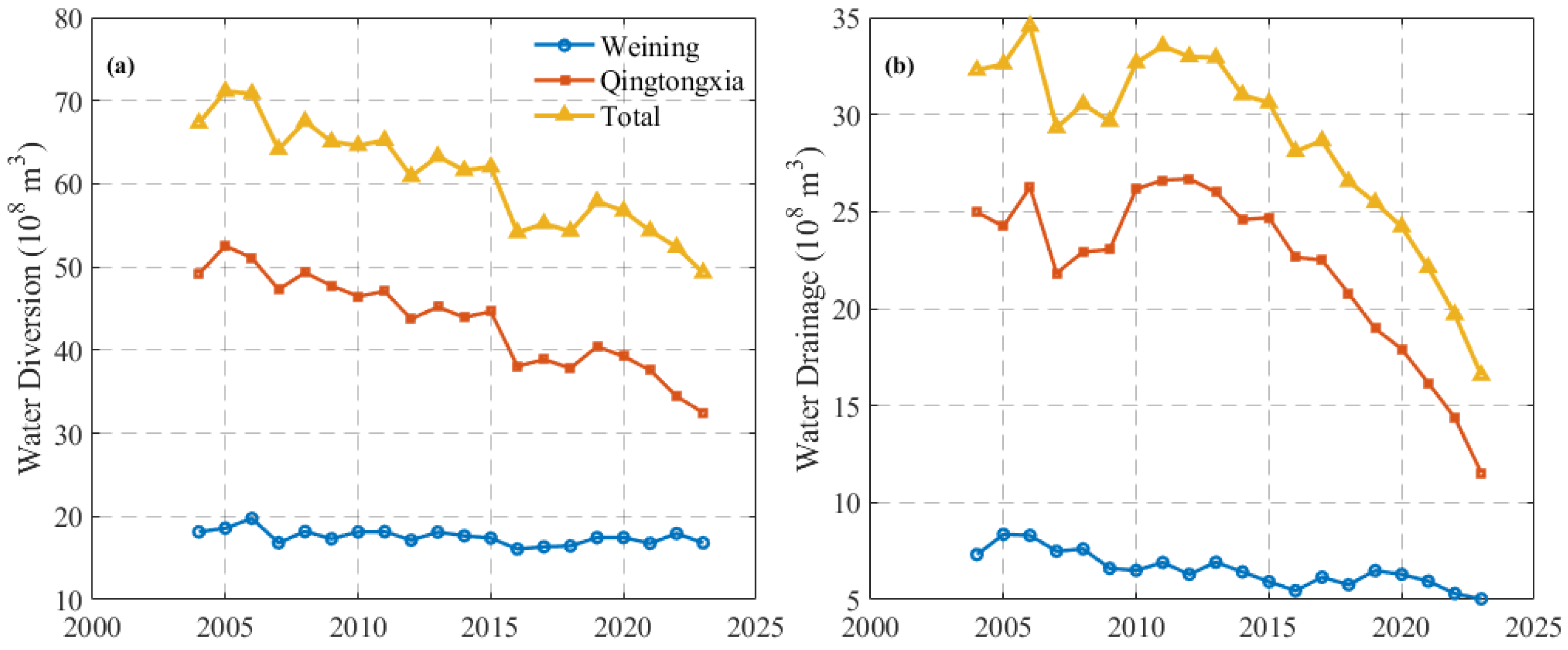
Over 2004–2023, total diversion and drainage volumes in the two major irrigation districts of the Ningxia Plain, the Qingtongxia Irrigation District (covering the Yinchuan Plain) and the Weining Irrigation District (covering the Weining Plain), showed a general declining trend (Figure 8). Total diversion declined gradually, with changes concentrated in the Qingtongxia Irrigation District, while the Weining District remained relatively stable. Drainage volume declined more sharply than diversion, also dominated by the Qingtongxia District; after 2015, drainage continued to decrease and reached its study-period minimum in 2023. The progressively declining ratio of drainage to diversion volume indicates improving irrigation water use efficiency and a shift toward more water-conservativing agricultural management. These coordinated changes in diversion, drainage, and crop structure motivate the following PCA-based attribution analysis.
Figure 8.
(a) Water diversion volumes in the Weining irrigation district, Qingtongxia irrigation district, and their total; (b) Water drainage volumes in the Weining irrigation district, Qingtongxia irrigation district, and their total.
PCA of the seven standardized annual variables converged on three principal components with eigenvalues exceeding 1.0, together explaining 84.44% of total variance. PC1 accounted for 48.19% of variance and showed strong positive loadings for total diversion volume (0.54), wheat area (0.47), and total drainage volume (0.46), alongside a strong negative loading for maize area (−0.40) (Table 4). This component captures the dominant long-term structural trajectory of the Ningxia Plain: the coordinated transition from a water-intensive, heavily irrigated agricultural system centered on wheat and large diversion volumes toward a dryland-dominated system with reduced diversion and drainage, driven by the progressive substitution of wheat (and later rice) by maize. PC1 therefore represents the agricultural structural change dimension and constitutes the single largest source of variance in the system. PC2 accounted for 22.21% of variance and was dominated by actual evapotranspiration (0.62) and precipitation (0.60) with similar positive loadings, representing the natural hydroclimatic variability dimension, the interannual fluctuations in regional water availability driven by weather patterns. PC3 accounted for 14.04% of the variance and was almost entirely controlled by rice area (0.84), with minor contributions from other variables. This component captures the dynamics of paddy rice cultivation as a largely independent signal, distinct from the aggregate diversion and drainage trends captured by PC1, reflecting the fact that paddy rice has its own field-level water cycling dynamics (ponding, seepage, return flow) that are not fully represented in irrigation district water balance statistics.
Table 4.
PCA loadings for the seven input variables.
3.4.2. Scale-Dependent Water Body Responses
Spearman rank correlation between the three PC scores and the annual area of each water body type revealed clear and consistent scale-dependent patterns (Table 4).
Large lakes (Types II–IV combined, >18 ha) showed a statistically significant positive correlation with PC2 (ρ = 0.50, p = 0.031), confirming that interannual hydroclimatic variability, represented by fluctuations in evapotranspiration and precipitation, is the dominant driver of large lake area at the annual scale. In wetter years with reduced evapotranspiration (positive PC2 scores), large lake areas expand; in drier, high-evaporation years (negative PC2 scores), they contract. Large lakes showed no significant correlation with PC1 (agricultural structural change, ρ = 0.04) or PC3 (rice dynamics, ρ = 0.19), confirming that they are effectively insulated from agricultural structural change at the macro-scale, consistent with their reliance on engineered ecological supplement systems rather than spontaneous field drainage.
The Yellow River area showed a moderate positive correlation with PC1 (ρ = 0.42, p = 0.07), approaching but not reaching conventional significance at the 0.05 level. This borderline result is consistent with the interpretation that reduced diversion intensity and the wheat-to-maize transition have partially eased the magnitude of seasonal irrigation abstraction from the Yellow River main channel, contributing to a modest counteracting effect on the long-term channel narrowing trend. However, the primary driver of Yellow River area decline, reduced upstream inflow from long-term flow regulation, operates at scales beyond those captured by the local PCA variables, which likely accounts for the incomplete correlation.
Type I small lakes (≤18 ha) showed no statistically significant correlation with any of the three principal components: ρ = −0.13 with PC1, ρ = 0.16 with PC2, and ρ = 0.21 with PC3, all non-significant (Table 5). This null result is substantively important: it demonstrates that the dynamics of small lakes in the Ningxia Plain are not governed by macro-level agricultural water management or regional climatic variability at the interannual scale. The absence of correlation with PC2 rules out climate as a dominant driver; the absence of correlation with PC1 rules out aggregate irrigation and drainage statistics as the primary control. Given the spatial embedding of Type I lakes within the farmland mosaic, which are surrounded by fields whose local drainage directly supplies water to inter-field depressions, this result strongly implicates local field-scale irrigation and drainage activity as the primary driver of Type I lakes dynamics, operating through processes that are averaged out in regional water balance statistics.
Table 5.
Spearman correlation coefficients (ρ) between different water bodies’ area indicators and principal component scores.
4. Discussion
4.1. Scale-Dependent Agricultural–Hydrological Coupling
The contrasting responses of large and small water bodies reveal a fundamental scale-dependent coupling between agricultural activity and regional hydrology. Large lakes, sustained by centrally managed water supply systems connected to the Yellow River, are primarily controlled by hydroclimatic variability and remain effectively decoupled from field-scale agricultural processes. In contrast, small water bodies embedded within farmland mosaics are governed by localized irrigation and drainage dynamics, making them insensitive to aggregated water diversion statistics but highly responsive to crop-level water management.
This scale-dependent behavior is consistent with findings from other irrigated dryland systems, where small lakes respond rapidly to local land-use change, while larger water bodies are dominated by basin-scale hydrological forcing [36,37]. Together, these results indicate that aggregate diversion volume is an insufficient proxy for understanding water body dynamics in highly engineered irrigated plains, and highlight the need to differentiate hydrological drivers across scales and variables, rather than relying on single aggregated indicators.
4.2. Hydrological Fingerprints of Crop Structural Change
The results reveal a clear and systematic scale-dependent differentiation in the hydrological drivers of water body dynamics, with the influence of agricultural structural change showing pronounced differences across spatial scales.
Large lakes (Types II–IV) are controlled by interannual hydroclimatic variability (PC2) and show no linkage to agricultural structural change (PC1), indicating limited influence of irrigation processes under ecological water supplementation, in line with climate-dominated lake dynamics in arid regions reported for northwestern China [38], and implying potential vulnerability under reduced ecological water allocation.
The Yellow River is primarily controlled by agricultural structural change, particularly reduced irrigation diversion, with secondary modulation by hydroclimatic forcing, indicating a co-dominated system driven by both human regulation and climate variability [39,40].
Type I small lakes show no significant correlation with any principal component, indicating that their variability is primarily governed by local-scale hydrological processes rather than regionally aggregated drivers. This reflects strong scale dependence in hydrological systems, where small water bodies are more sensitive to localized groundwater–surface water interactions and human water use, including irrigation practices and water management, rather than basin-scale climatic or water-balance signals [41,42,43].
4.3. Policy-Driven Structural Dynamics: Diversification and Re-Consolidation
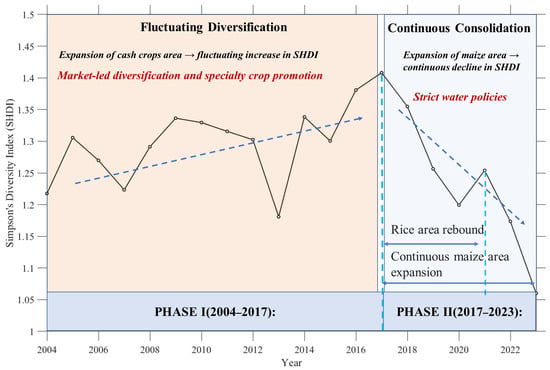
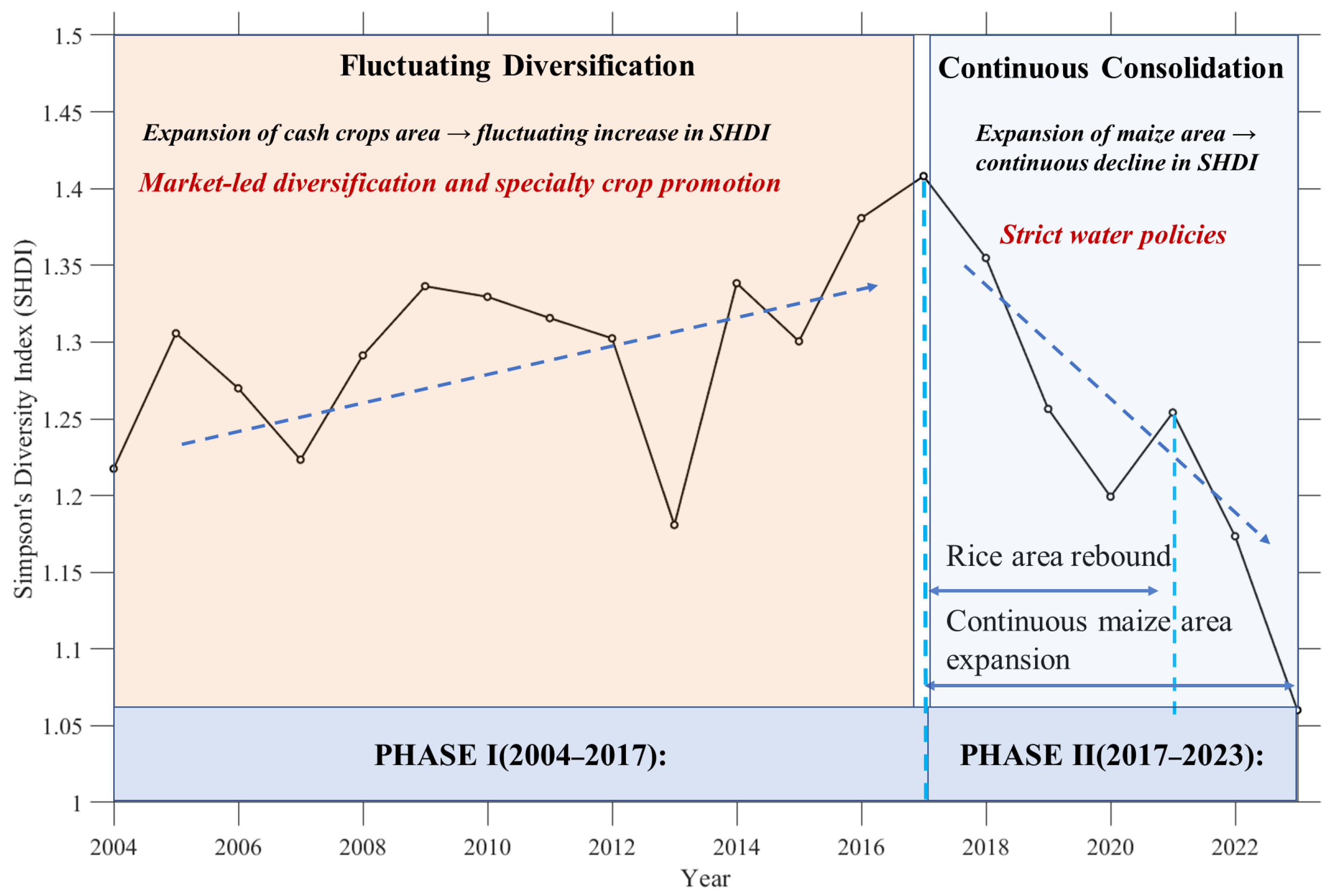
The non-monotonic trajectory of SHDI, rising from 1.22 in 2004 to a peak of 1.41 in 2017 before falling to 1.06 by 2023, reflects the interplay between competing policy objectives rather than a simple linear transition to water savings. As shown in Figure 9, the initial diversification phase (2004–2017) was characterized by a fluctuating increase in structural diversity, driven by the simultaneous promotion of specialty cash crops (wolfberry, grape, vegetables) and the gradual contraction of wheat under market pressure, increasing structural diversity to its historical maximum, even as total water use declined. Subsequently, the 2017–2023 period marked a phase of continuous structural consolidation driven by steady maize area expansion. This overall decline was briefly moderated by the 2018–2021 rice area rebound, which illustrates how short-term policy interventions can temporarily reverse long-term structural trajectories: regional food security directives following the mid-2010s encouraged farmers to maintain paddy rice production, counteracting the water-saving momentum of earlier years and creating the most hydrologically anomalous period of the study, when agricultural drainage volumes partially recovered. The post-2019 consolidation phase, which eventually intensified to override this rebound, leading to a sharp fall in SHDI and a loss of 34,480 ha of rice in a single five-year period, reflects the decisive implementation of national water quota constraints under the strictest phase of the Yellow River water allocation reform. Taken together, these dynamics suggest that planting structure trajectories in heavily policy-regulated irrigated systems are inherently non-linear, with structural diversity serving as a sensitive indicator of the tension between short-term production objectives and long-term water conservation goals.
Figure 9.
Spatiotemporal variations in crop diversity under different policy-driven phases, where the solid black line represents SHDI values and the dashed blue arrow indicates the direction of change.
4.4. Limitations and Future Work
While we gained valuable insights, there are some limitations to consider. First, the 30-m resolution of the remote sensing datasets may not adequately capture small-scale fragmented water bodies or complex intercropping patterns. Second, our study concentrates on macro-scale hydrological variables; therefore, we did not explicitly model the role of the shallow groundwater table and subsurface return flows, which are important pathways in the irrigation–drainage system. Third, the statistical attribution used in this study may overlook certain field-level human factors, such as localized water management policies. Fourth, using the 2021 cropland mask as a proxy for 2023 may not fully account for subtle, recent land-use transitions due to the lack of updated multi-source datasets. Future research will focus on incorporating more detailed data and physically based models to better understand these intricate surface–subsurface interactions.
5. Conclusions
This study quantified the multidecadal coupling between crop planting structures and surface water dynamics in the Ningxia Plain from 2004 to 2023, revealing how agricultural structural adjustments reshape regional hydrology.
Over the past two decades, the region’s agricultural landscape transitioned from a diverse, water-intensive system toward a heavily consolidated, dryland-dominated structure (primarily maize). Concurrently, total surface water extents and the Yellow River channel exhibited sustained long-term contractions. Rather than a uniform loss of permanent water bodies, this decline was largely characterized by the compression of seasonal peak water extents, reflecting diminished agricultural drainage surpluses.
Crucially, our analysis demonstrates that the hydrological impacts of agricultural shifts are highly scale-dependent. Large lakes are predominantly controlled by interannual hydroclimatic variability and buffered by engineered ecological supplementation, rendering them relatively insensitive to macro-scale crop changes. Conversely, small lakes embedded within the farmland mosaic are directly coupled to local field-level irrigation and drainage dynamics, making them the most sensitive hydrological indicators of agricultural water-saving interventions.
Future management should adopt scale-differentiated strategies, balancing agricultural efficiency with the protection of both large and small lakes. Additionally, integrating high-resolution remote sensing and physical models is essential to explicitly quantify local surface–groundwater interactions.
Supplementary Materials
The following supporting information can be downloaded at https://www.mdpi.com/article/10.3390/w18080978/s1, Table S1: Crop planting structure transition matrix, Ningxia Plain, 2004–2009; Table S2: Crop planting structure transition matrix, Ningxia Plain, 2009–2014; Table S3: Crop planting structure transition matrix, Ningxia Plain, 2014–2019; Table S4: Crop planting structure transition matrix, Ningxia Plain, 2019–2023; Figure S1: Real-ESRGAN training and validation performance metrics (PSNR, SAM, CC, and ERGAS) across training epochs; Table S5: Confusion matrix for crop classification based on Sentinel imagery; Table S6: Confusion matrix for crop classification based on composite imagery; Table S7: Credibility ranking matrix used for the cropland datasets.
Author Contributions
Conceptualization, C.J. and X.S.; methodology, C.J.; validation, C.J.; formal analysis, C.J.; investigation, C.J.; data curation, C.J.; writing—original draft preparation, C.J.; writing—review and editing, X.S.; visualization, C.J.; supervision, X.S. All authors have read and agreed to the published version of the manuscript.
Funding
This research was funded by the National Natural Science Foundation of China, grant number U24A20571.
Data Availability Statement
The original contributions presented in this study are included in the article. Further inquiries can be directed to the corresponding authors.
Conflicts of Interest
The authors declare no conflicts of interest.
References
- Gnann, S.; Baldwin, J.W.; Cuthbert, M.O.; Gleeson, T.; Schwanghart, W.; Wagener, T. The Influence of Topography on the Global Terrestrial Water Cycle. Rev. Geophys. 2025, 63, e2023RG000810. [Google Scholar] [CrossRef] [Scilit]
- Perry, C.; Steduto, P.; Allen, R.G.; Burt, C.M. Increasing Productivity in Irrigated Agriculture: Agronomic Constraints and Hydrological Realities. Agric. Water Manag. 2009, 96, 1517–1524. [Google Scholar] [CrossRef] [Scilit]
- Jaramillo, F.; Destouni, G. Developing Water Change Spectra and Distinguishing Change Drivers Worldwide. Geophys. Res. Lett. 2014, 41, 8377–8386. [Google Scholar] [CrossRef] [Scilit]
- Lu, Z.; Peng, S.; Wu, T.; Lei, J.; Wei, J.; Yang, X. Effects of Irrigation and Canal Networks on Groundwater–Land Surface Interactions in the Middle Heihe River Basin, China. J. Hydrol. Reg. Stud. 2025, 60, 102532. [Google Scholar] [CrossRef] [Scilit]
- Han, X.; Wei, Z.; Zhang, B.; Han, C.; Song, J. Effects of Crop Planting Structure Adjustment on Water Use Efficiency in the Irrigation Area of Hei River Basin. Water 2018, 10, 1305. [Google Scholar] [CrossRef] [Scilit]
- Miao, Q.; Liu, X.; Shi, H.; Wei, Z.; Luo, Y.; Wang, Y.; Gonçalves, J.M.; Feng, W. Lake-Area Shrinkage Driven by the Combined Effects of Climate Change and Human Activities. Ecol. Indic. 2025, 175, 113606. [Google Scholar] [CrossRef] [Scilit]
- Cao, Y.; Fu, C.; Yang, M.; Wu, H.; Wu, H.; Zhang, H.; Xia, Y.; Zhu, Z. Exploring the Drivers for Changes in Lake Area in a Typical Arid Region during Past Decades. Water 2023, 15, 3354. [Google Scholar] [CrossRef] [Scilit]
- Liu, M.; Lv, S.; Qiao, Q.; Song, L. Design and Numerical Simulation of the Headworks in the Shizuishan Section of the Yellow River. Sustainability 2023, 15, 4564. [Google Scholar] [CrossRef] [Scilit]
- Ding, X.; Zhang, H.; Wang, Z.; Shang, G.; Huang, Y.; Li, H. Analysis of the Evolution Pattern and Driving Mechanism of Lakes in the Northern Ningxia Yellow Diversion Irrigation Area. Water 2022, 14, 3658. [Google Scholar] [CrossRef] [Scilit]
- Yu, H.; Liu, K.; Bai, Y.; Luo, Y.; Wang, T.; Zhong, J.; Liu, S.; Bai, Z. The Agricultural Planting Structure Adjustment Based on Water Footprint and Multi-Objective Optimisation Models in China. J. Clean. Prod. 2021, 297, 126646. [Google Scholar] [CrossRef] [Scilit]
- Yang, L.; Ou, Y.; Yao, Y. Research on Estimating the Nitrogen Pollutant Load of Agricultural Drainage Water in the Ningxia Irrigation Area Based on the Improved ECM Model. Front. Environ. Sci. 2025, 13, 1626677. [Google Scholar] [CrossRef] [Scilit]
- Luan, W.; Shen, X.; Fu, Y.; Li, W.; Liu, Q.; Wang, T.; Ma, D. Research on Maize Acreage Extraction and Growth Monitoring Based on a Machine Learning Algorithm and Multi-Source Remote Sensing Data. Sustainability 2023, 15, 16343. [Google Scholar] [CrossRef] [Scilit]
- Chen, X.; Huang, Q.; Xiong, Y.; Yang, Q.; Li, H.; Hou, Z.; Huang, G. Tracking the Spatio-Temporal Change of the Main Food Crop Planting Structure in the Yellow River Basin over 2001–2020. Comput. Electron. Agric. 2023, 212, 108102. [Google Scholar] [CrossRef] [Scilit]
- MacDonald, R.B.; Hall, F.G. Global Crop Forecasting. Science 1980, 208, 670–679. [Google Scholar] [CrossRef] [Scilit]
- Weiss, M.; Jacob, F.; Duveiller, G. Remote Sensing for Agricultural Applications: A Meta-Review. Remote Sens. Environ. 2020, 236, 111402. [Google Scholar] [CrossRef] [Scilit]
- Luo, Y.; Zhang, Z.; Li, Z.; Chen, Y.; Zhang, L.; Cao, J.; Tao, F. Identifying the Spatiotemporal Changes of Annual Harvesting Areas for Three Staple Crops in China by Integrating Multi-Data Sources. Environ. Res. Lett. 2020, 15, 074003. [Google Scholar] [CrossRef] [Scilit]
- Sishodia, R.P.; Ray, R.L.; Singh, S.K. Applications of Remote Sensing in Precision Agriculture: A Review. Remote Sens. 2020, 12, 3136. [Google Scholar] [CrossRef] [Scilit]
- Van Niel, T.G.; McVicar, T.R. Determining Temporal Windows for Crop Discrimination with Remote Sensing: A Case Study in South-Eastern Australia. Comput. Electron. Agric. 2004, 45, 91–108. [Google Scholar] [CrossRef] [Scilit]
- Mercier, A.; Betbeder, J.; Baudry, J.; Le Roux, V.; Spicher, F.; Lacoux, J.; Roger, D.; Hubert-Moy, L. Evaluation of Sentinel-1 & 2 Time Series for Predicting Wheat and Rapeseed Phenological Stages. ISPRS J. Photogramm. Remote Sens. 2020, 163, 231–256. [Google Scholar] [CrossRef] [Scilit]
- Breiman, L. Random Forests. Mach. Learn. 2001, 45, 5–32. [Google Scholar] [CrossRef] [Scilit]
- Hao, P.; Zhan, Y.; Wang, L.; Niu, Z.; Shakir, M. Feature Selection of Time Series MODIS Data for Early Crop Classification Using Random Forest: A Case Study in Kansas, USA. Remote Sens. 2015, 7, 5347–5369. [Google Scholar] [CrossRef] [Scilit]
- Vaswani, A.; Shazeer, N.; Parmar, N.; Uszkoreit, J.; Jones, L.; Gomez, A.N.; Kaiser, Ł.; Polosukhin, I. Attention Is All You Need. In Proceedings of the 31st International Conference on Neural Information Processing Systems; Curran Associates Inc.: Red Hook, NY, USA, 2017; pp. 6000–6010. [Google Scholar]
- Li, Z.; Chen, G.; Zhang, T. A CNN-Transformer Hybrid Approach for Crop Classification Using Multitemporal Multisensor Images. IEEE J. Sel. Top. Appl. Earth Obs. Remote Sens. 2020, 13, 847–858. [Google Scholar] [CrossRef] [Scilit]
- Lopez, J.R.; Winter, J.M.; Elliott, J.; Ruane, A.C.; Porter, C.; Hoogenboom, G. Integrating Growth Stage Deficit Irrigation into a Process Based Crop Model. Agric. For. Meteorol. 2017, 243, 84–92. [Google Scholar] [CrossRef] [Scilit]
- Zou, Y.; Saddique, Q.; Ali, A.; Xu, J.; Khan, M.I.; Qing, M.; Azmat, M.; Cai, H.; Siddique, K.H.M. Deficit Irrigation Improves Maize Yield and Water Use Efficiency in a Semi-Arid Environment. Agric. Water Manag. 2021, 243, 106483. [Google Scholar] [CrossRef] [Scilit]
- Herzon, I.; Helenius, J. Agricultural Drainage Ditches, Their Biological Importance and Functioning. Biol. Conserv. 2008, 141, 1171–1183. [Google Scholar] [CrossRef] [Scilit]
- Li, X.; Zhang, C.; Huo, Z. Optimizing Irrigation and Drainage by Considering Agricultural Hydrological Process in Arid Farmland with Shallow Groundwater. J. Hydrol. 2020, 585, 124785. [Google Scholar] [CrossRef] [Scilit]
- Wu, Z.; Zhang, S.; Shan, B.; Zhang, F.; Chen, X. Optimizing Crop Spatial Structure to Improve Water Use Efficiency and Ecological Sustainability in Inland River Basin. Agronomy 2024, 14, 1645. [Google Scholar] [CrossRef] [Scilit]
- Hu, H.; Wu, Z.; Li, L. Ecological Well-Being Model for Water-Saving Planning in Irrigation Areas of Arid Northwest China. Water 2025, 17, 1193. [Google Scholar] [CrossRef] [Scilit]
- Tu, Y.; Wu, S.; Chen, B.; Weng, Q.; Bai, Y.; Yang, J.; Yu, L.; Xu, B. A 30 m Annual Cropland Dataset of China from 1986 to 2021. Earth Syst. Sci. Data 2024, 16, 2297–2316. [Google Scholar] [CrossRef] [Scilit]
- Yang, J.; Huang, X. The 30 m Annual Land Cover Dataset and Its Dynamics in China from 1990 to 2019. Earth Syst. Sci. Data 2021, 13, 3907–3925. [Google Scholar] [CrossRef] [Scilit]
- Zhang, X.; Zhao, T.; Xu, H.; Liu, W.; Wang, J.; Chen, X.; Liu, L. GLC_FCS30D: The First Global 30 m Land-Cover Dynamics Monitoring Product with a Fine Classification System for the Period from 1985 to 2022 Generated Using Dense-Time-Series Landsat Imagery and the Continuous Change-Detection Method. Earth Syst. Sci. Data 2024, 16, 1353–1381. [Google Scholar] [CrossRef] [Scilit]
- Lu, M.; Wu, W.; You, L.; See, L.; Fritz, S.; Yu, Q.; Wei, Y.; Chen, D.; Yang, P.; Xue, B. A Cultivated Planet in 2010—Part 1: The Global Synergy Cropland Map. Earth Syst. Sci. Data 2020, 12, 1913–1928. [Google Scholar] [CrossRef] [Scilit]
- Jia, R.; Fang, X.; Yang, Y.; Yokozawa, M.; Ye, Y. A 28-Time-Point Cropland Area Change Dataset in Northeast China from 1000 to 2020. Earth Syst. Sci. Data 2024, 16, 4971–4994. [Google Scholar] [CrossRef] [Scilit]
- Hu, J.; Miao, C.; Su, J.; Zhang, Q.; Gou, J.; Sun, Q. An Upgraded High-Precision Gridded Precipitation Dataset for the Chinese Mainland Considering Spatial Autocorrelation and Covariates. Earth Syst. Sci. Data 2025, 17, 3987–4004. [Google Scholar] [CrossRef] [Scilit]
- Pi, X.; Luo, Q.; Feng, L.; Xu, Y.; Tang, J.; Liang, X.; Ma, E.; Cheng, R.; Fensholt, R.; Brandt, M.; et al. Mapping Global Lake Dynamics Reveals the Emerging Roles of Small Lakes. Nat. Commun. 2022, 13, 5777. [Google Scholar] [CrossRef] [Scilit]
- Valerio, F.; Godinho, S.; Ferraz, G.; Pita, R.; Gameiro, J.; Silva, B.; Marques, A.T.; Silva, J.P. Multi-Temporal Remote Sensing of Inland Surface Waters: A Fusion of Sentinel-1&2 Data Applied to Small Seasonal Ponds in Semiarid Environments. Int. J. Appl. Earth Obs. Geoinf. 2024, 135, 104283. [Google Scholar] [CrossRef] [Scilit]
- Qian, J.; Chen, Y.; Wang, Y.; Li, Y.; Li, Z.; Fang, G.; Liu, C.; Wang, Y.; Wei, Z. The Synergistic Effects of Climate Change and Human Activities on Wetland Expansion in Xinjiang. Land 2025, 14, 1889. [Google Scholar] [CrossRef] [Scilit]
- Wang, Z.; Tian, J.; Feng, K. Response of runoff towards land use changes in the Yellow River Basin in Ningxia, China. PLoS ONE 2022, 17, e0265931. [Google Scholar] [CrossRef] [Scilit] [PubMed]
- Huang, Z.; Tang, Z.; Tian, J.; Zhang, X.; Ma, N.; Bai, X.; Zhang, Y. Climate Change Dominates Recent Increase in Streamflow in the Yellow River Basin. J. Hydrol. 2025, 661, 133737. [Google Scholar] [CrossRef] [Scilit]
- Wang, L.; Sun, Y.; Yang, C.; Dong, Y. Groundwater–Surface Water Interactions across an Arid River Basin: Spatial Patterns Revealed by Stable Isotopes and Hydrochemistry. Hydrol. Earth Syst. Sci. 2025, 29, 4417–4436. [Google Scholar] [CrossRef] [Scilit]
- Tu, C.; Wang, W.; Wang, W.; Huang, F.; Gao, M.; Liu, Y.; Gong, P.; Yao, Y. Irrigation Suitability and Interaction Between Surface Water and Groundwater Influenced by Agriculture Activities in an Arid Plain of Central Asia. Agriculture 2025, 15, 1704. [Google Scholar] [CrossRef] [Scilit]
- Wang, W.; Chen, Y.; Wang, W.; Zhu, C.; Chen, Y.; Liu, X.; Zhang, T. Water Quality and Interaction between Groundwater and Surface Water Impacted by Agricultural Activities in an Oasis-Desert Region. J. Hydrol. 2023, 617, 128937. [Google Scholar] [CrossRef] [Scilit]

Disclaimer/Publisher’s Note: The statements, opinions and data contained in all publications are solely those of the individual author(s) and contributor(s) and not of MDPI and/or the editor(s). MDPI and/or the editor(s) disclaim responsibility for any injury to people or property resulting from any ideas, methods, instructions or products referred to in the content. |
© 2026 by the authors. Licensee MDPI, Basel, Switzerland. This article is an open access article distributed under the terms and conditions of the Creative Commons Attribution (CC BY) license.