Article

Spatio-Temporal Evolution and Associated Factors of Water Retention in Huaihe River Economic Belt


School of Geography, Geomatics and Planning, Jiangsu Normal University, Xuzhou 221116, China
*
Author to whom correspondence should be addressed.
These authors contributed equally to this work.
Water 2026, 18(8), 968; https://doi.org/10.3390/w18080968
Submission received: 27 January 2026 / Revised: 9 April 2026 / Accepted: 16 April 2026 / Published: 18 April 2026
(This article belongs to the Section Water Resources Management, Policy and Governance)

Abstract

As a critical link between regional economic development and ecological security, understanding the dynamics of water retention is essential for sustainable water resource management in the Huaihe River Economic Belt. This study explores the spatio-temporal evolution and spatial explanatory factors of water retention across five temporal snapshots (2003, 2008, 2013, 2018, and 2023). Based on the InVEST model, we assessed water retention capacity at both grid and spatial development levels, thereby obtaining the retention characteristics of different land-use types and their responses to land-use transitions. Furthermore, a parameter-optimized geographical detector was employed to quantify the relative contributions of climatic-environmental and social-economic factors to the spatial variance of the modeled water retention index. Results indicate that the total water retention capacity exhibited significant interannual fluctuations, with the net capacity in 2023 being lower than the initial level in 2003. Retention values displayed obvious spatial heterogeneity, with high levels concentrated in the southwest and north and low levels distributed in the central area, closely mirroring precipitation distribution. While forest land exhibited the strongest unit water retention capacity, cropland contributed the most to the total volume (50.49%) due to its predominant areal proportion (73.92%). Notably, the conversion of forest to cropland was spatially associated with the most substantial loss in the modeled retention capacity. Soil saturated hydraulic conductivity and land-use type were identified as the dominant factors explaining the spatial variance of water retention. These findings underscore the methodological utility of coupling the InVEST model with a parameter-optimized geographical detector. For practical ecosystem management, the results suggest that spatial planning policies should strictly limit the conversion of ecological lands to agricultural use and prioritize targeted soil hydrological improvements in the central plains to secure long-term water resources.

1. Introduction

Ecosystem services refer to the various benefits that humans obtain directly or indirectly from natural ecosystems, and they provide the essential basis for life-support systems on Earth and the sustainable advancement of human society [1]. Among these services, water retention is a critical regulating service of ecosystems, and it is the combined result of climate, vegetation, and soil interactions, characterized by complexity and dynamism [2]. Water retention enables the redistribution of precipitation through canopy interception, litter water-holding, soil water storage, infiltration, and groundwater recharge [3]. It fulfills essential functions including regulating runoff, improving water quality, mitigating floods, supplementing low flows, and maintaining base flow of rivers [4]. Consequently, it plays an irreplaceable role in ensuring regional water security, controlling droughts and floods, and preserving ecological balance [5]. Therefore, the visualization and quantitative assessment of water retention functions have attracted significant attention from scholars and have become a hot topic in related fields.
In terms of assessment methods for water retention functions, early studies mainly adopted traditional approaches such as the water balance, precipitation storage, and comprehensive water storage capacity method [6]. Although these methods are widely used in hydrological research, they typically require extensive on-site observation data, making it difficult to achieve dynamic assessments across large areas and long time series [7]. Driven by the progress of remote sensing technology, geographic information system (GIS) and computer simulation techniques, process-based mechanistic models have gradually become mainstream tools for ecosystem service assessment. Models such as SWAT (Soil and Water Assessment Tool), MIKESHE (MIKE System Hydrological European), TOPMODEL (Topography-based Hydrological Model), and InVEST (Integrated Valuation of Ecosystem Services and Tradeoffs) have been widely applied in water retention assessment studies [8,9]. Among these models, the InVEST model has demonstrated strong applicability in ecosystem service assessments across different regions worldwide, attributed to its advantages such as relatively low parameter requirements, simple operational procedures, and visualizable assessment results [10,11]. It is important to acknowledge the limitations of the InVEST model. It primarily operates on an annual average basis, which limits its ability to capture daily scale or event-based hydrological dynamics, and it simplifies complex physical processes such as deep groundwater routing [12]. Despite these limitations, InVEST was identified as the best-fitting framework for the present research. Compared to highly complex physical models like SWAT or MIKESHE that require immense daily meteorological data and intricate hydrological calibration parameters, InVEST strikes an optimal balance. It efficiently handles large-scale, heterogeneous regions over long time series with accessible data, providing spatially explicit results that are highly suitable for macro-level ecosystem service evaluation and spatial planning. Existing studies have shown this model yields reliable application outcomes in water retention assessments in typical ecological regions, such as Qinling Mountains, Yellow River Basin, the arid-hot valley of Jinsha River, and Loess Plateau [13].
In the context of spatial association analysis, traditional statistical approaches, including correlation analysis, cluster analysis, and principal component analysis, can identify the main factors influencing water retention functions, but these methods struggle to effectively reveal spatial differentiation characteristics and interactive effects among multiple factors [14]. As an emerging spatial analysis tool, the Geodetector (Geographical Detector) quantifies how much individual influencing factors and their mutual interactions explain the changes in water retention functions, in recent years, it has been increasingly applied in research on the spatial association of ecosystem services [15]. Traditional Geodetector relies on manual determination of the number of discrete categories and discretization methods, while the parameter-optimized Geodetector chooses optimal parameter settings through an automated algorithm, reducing subjective bias, improving the objectivity and accuracy of model analysis, and enabling a more scientific revelation of the complexity of these spatial associations.
It is important to note that at a broad regional scale, directly measuring actual hydrological storage is highly challenging. Therefore, in this study, ‘water retention’ is defined not as a direct field-based measurement of absolute water storage, but rather as a spatially explicit modeled proxy. This proxy index is derived from the water yield and then modified by topographic characteristics, soil saturated hydraulic conductivity, and land-use specific flow velocity parameters. It serves to comparatively evaluate the relative capacity of different land use types and spatial regions to retain precipitation and regulate runoff.
As a significant economic and geographical area located in eastern China, Huaihe River Economic Belt serves as a crucial ecological security barrier for the country’s ecological civilization construction and high-quality economic development, and it is also an ecosystem zone highly sensitive to global changes [16], with rapid urbanization and economic development, this region has faced severe challenges, including uneven spatiotemporal distribution of water resources, water environmental pollution, and degradation of ecological functions [17]. Currently, research regarding the Huaihe River Economic Belt predominantly focuses on socioeconomic and macro-environmental domains, such as food security, carbon emissions, and new urbanization. Studies specifically targeting water retention mostly concentrate on individual cities or provinces within the basin, leaving a critical gap in holistic, region-wide assessments. Although a limited number of studies have touched upon water retention across the region, they often rely on traditional water balance equations as a minor component of broader research, lacking in-depth exploration [18]. Furthermore, the existing literature in related fields presents several specific limitations. First, regarding spatiotemporal scales, some studies employ coarse spatial resolutions (e.g., 1000 m) and relatively short time spans (e.g., 10 years) [19,20], which fail to accurately capture fine-grained spatial heterogeneity and long-term ecological evolutionary trends. Second, concerning spatial explanatory associations, many studies either completely lack attribution analysis or rely heavily on traditional linear statistical methods, such as principal component analysis (PCA) and stepwise regression [21,22]. These linear models are inherently inadequate for capturing the spatial stratified heterogeneity and the complex, non-linear interactive effects between natural and human factors. Third, while some researchers have utilized the Geographical Detector to address spatial heterogeneity, the vast majority employ the traditional version. This approach relies on subjective manual data discretization, which can easily lead to biased or sub-optimal evaluations of explanatory power [13]. Lastly, most of these mechanism analyses are conducted statically for a single year or aggregated over the entire study period [23,24]. This static perspective neglects the dynamic temporal shifts in the explanatory capacity of influencing factors under the context of continuous climate change and rapid land-use transitions. To bridge these gaps, this study selects five research years (2003, 2008, 2013, 2018, and 2023) and uses the InVEST model to simulate water retention capacity in the Huaihe River Economic Belt. It systematically analyzes the spatio-temporal variation characteristics of water retention and differences in retention capacity across different land use types. Additionally, the parameter-optimized Geodetector is employed to quantitatively reveal the spatial explanatory power mechanisms of natural factors and human activities on changes in water retention functions, so it is necessary to provide a scientific basis for ecological protection and water resource management in the Huaihe River Basin, and also provides a methodological reference for ecosystem service research in similar economic-ecological composite regions.

2. Materials and Methods

2.1. Study Area

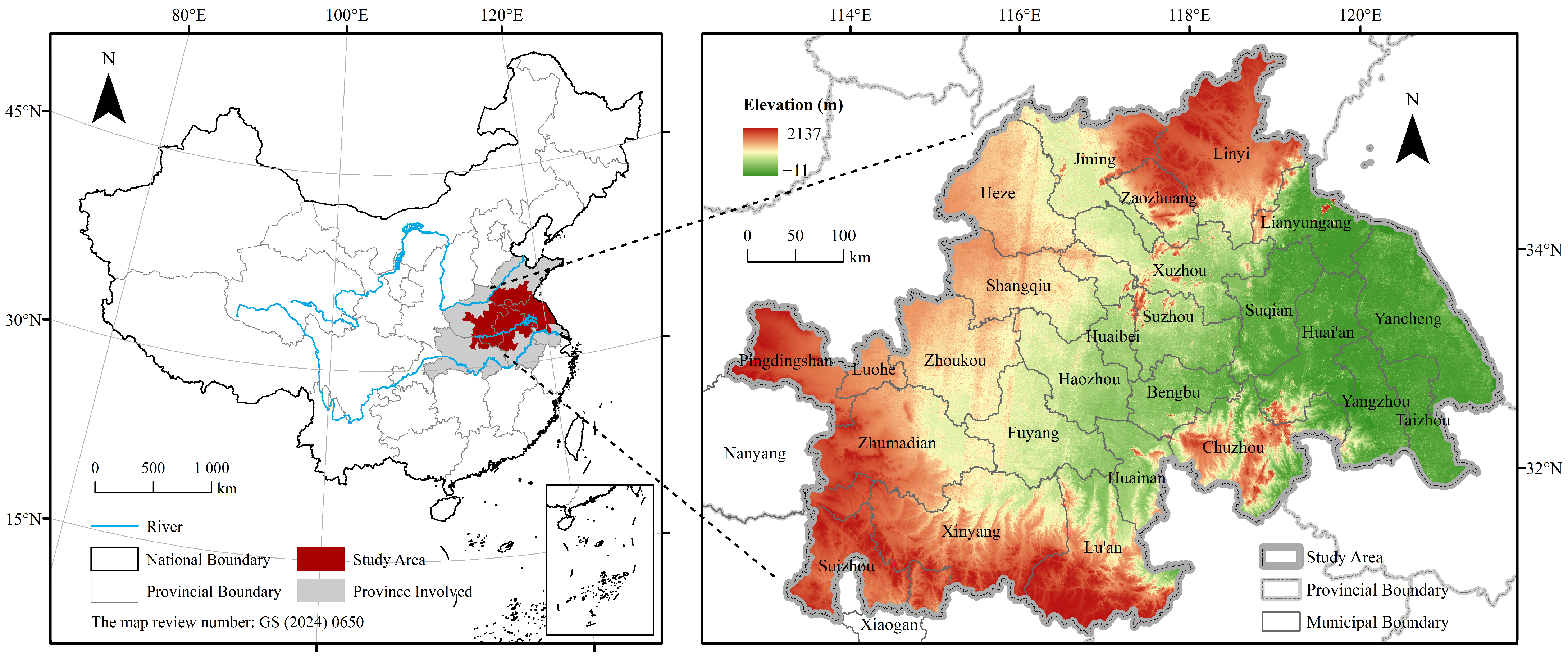
Situated in the central-eastern part of China, the Huaihe River Economic Belt falls within the transitional zone of northern and southern climates. Its geographical coordinates range from 31°01′ N to 36°13′ N and 112°14′ E to 120°54′ E, covering the main part of the Huaihe River Basin, it stretches approximately 850 km in the east–west direction and 600 km in the north–south direction, with a planned area of 243,000 km2. A warm-temperate semi-humid monsoon climate prevails in the region north of the Huaihe River, while the southern region is dominated by a subtropical humid monsoon climate. Vegetation types exhibit north–south differences and vertical stratification corresponding to climate and terrain: deciduous broad-leaved forests dominate north of the Huaihe River, while evergreen and deciduous broad-leaved mixed forests are predominant south of it [18]. The main land use types are cropland and forest in the study region, and it contains important lake wetlands, including Hongze Lake, Nansi Lake, and Gaoyou Lake. With diverse ecosystem types, the region serves as a key water retention area and ecological barrier. Topographically, the region is dominated by plains, with an average elevation of approximately 74 m, supplemented by hills and mountains (the highest peak exceeds 2000 m). Overall, the terrain is characterized by higher elevations in the north and southwest, while the central and eastern parts are relatively lower. The multi-year average temperature ranges from 8 °C to 17 °C, with distinct four seasons. With a long sunshine duration and high evapotranspiration, the annual evapotranspiration in this region is about 700–1250 mm. The amount of precipitation decreases from south to north, and it is unevenly distributed across seasons; it is mainly concentrated between June and September, and the multi-year average rainfall ranges from 670 mm to 1720 mm.
According to the Huaihe River Economic Belt Development Plan released upon the approval of the State Council, Huaihe River Economic Belt includes 25 prefecture-level cities, 1 county-level city and 3 counties across five provinces (Jiangsu, Shandong, Henan, Anhui, and Hubei) through which the main stream of the Huaihe River, its first-level tributaries, and the lower Yishu-Si River system flow. Specifically, these areas are: (1) Jiangsu Province, including 7 cities: Huai’an, Yancheng, Suqian, Xuzhou, Lianyungang, Yangzhou, Taizhou; (2) Shandong Province, including 4 cities: Zaozhuang, Jining, Linyi, Heze; (3) Anhui Province, including 8 cities: Bengbu, Huainan, Fuyang, Lu’an, Bozhou, Suzhou, Huaibei, Chuzhou; (4) Henan Province, including 6 cities and 1 county: Xinyang, Zhumadian, Zhoukou, Luohe, Shangqiu, Pingdingshan, and Tongbai County; (5) Hubei Province, including 1 county-level city and 2 counties: Guangshui City, Sui County, and Dawu County (Figure 1). By the end of 2020, the population is 141 million in the study area.

2.2. Data Resources and Processing

The various types of data used in the Water Yield Module, Water Retention Calculation, and Spatial Association Analysis Module of the InVEST model always include basic data and various parameters. The basic data sources and corresponding processing methods are shown in Table 1. Other variables were obtained or calculated as follows: Biophysical parameters (Table 2) and flow velocity coefficients were determined through a systematic literature synthesis. To ensure the reliability and localized applicability of these parameters, we referred to the InVEST model user’s manual [25] and prioritized peer-reviewed studies conducted in the Huaihe River Basin or regions with highly similar climatic and ecological characteristics, such as the eastern monsoon region of China [26,27,28]. For parameters that varied among the reference studies, we calculated the mean values, like the evapotranspiration coefficient. For root depth and flow velocity coefficient, we further applied a macro-regional class-level generalization (e.g., rounding to the nearest tens or hundreds). This generalization approach establishes representative constants that avoid spurious precision at the macro-watershed scale and reduces the model’s sensitivity to minor local parameter fluctuations, thereby enhancing the robustness of the biophysical input table. The vegetation-covered parameter was assigned strictly based on the model’s binary structural requirement (1 for vegetated, 0 for non-vegetated). The structural validity of these parameters was further cross-verified through the calibration of the seasonal constant Z to ensure the integrated model output aligns with observed hydrological reality. ArcGIS 10.8 was employed to clip all raster data to the study area boundary, after which they were projected into the unified coordinate system (CGCS2000_GK_CM_117E), and resampled to 30 m spatial resolution to ensure data consistency. To ensure spatio-temporal consistency, dynamic datasets (e.g., land use, precipitation, potential evapotranspiration, NDVI, population, and nighttime light) were extracted for the specific study years (2003, 2008, 2013, 2018, and 2023), while relatively stable geomorphological and pedological features (DEM, soil type, soil depth, etc.) were treated as time-invariant variables across all study periods.

2.3. Research Methods

2.3.1. Assessment of Water Yield

The Water Yield Module of the InVEST model was applied to assess the changes and spatial distribution pattern of water resource supply in the study area. Based on the principle of water balance, the module calculates water resource supply as the water yield within each raster cell, which is derived as the difference between precipitation and actual evapotranspiration. It includes surface runoff, soil water content, litter water-holding capacity, and canopy interception [43]. The calculation formulas are as follows:
Y x j = 1 AET x j P x × P x
where Yxj, AETxj and Px are the annual water yield of land use type j, the annual actual evapotranspiration of land use type j and the annual precipitation in raster cell x, respectively.
AET x j P x = 1 + ω x R x j 1 + ω x R x j + 1 / R x j
where Rxj is the dimensionless Budyko aridity index; ωx is a non-physical parameter describing natural climate-soil properties.
ω x = Z AWC x P x ,   R x j = K c j × ET 0 x j P x
where AWCx is the plant-available water capacity in raster cell x; Z is the Zhang coefficient (also known as the seasonal constant), which characterizes the multi-year average precipitation distribution and other hydrogeological features of the study area; Kcj is the vegetation evapotranspiration coefficient of land use type j; ET0xj is the reference evapotranspiration.
AWC x = min ( S o i l depth , R o o t depth ) × PAWC
PAWC = 54.509 0.132 × sand % 0.003 × ( sand % ) 2 0.055 × silt % 0.006 × ( silt % ) 2         0.738 × clay % + 0.007 × ( clay % ) 2 2.688 × OM % + 0.501 × ( OM % ) 2
where Soildepth is the soil layer depth; Rootdepth is the root depth; PAWC is the plant-available water capacity; sand%, silt%, clay% and OM% are the soil sand content, silt content, clay content and organic matter content, respectively.

2.3.2. Calculation of Water Retention

Based on the water yield results, the water retention capacity is obtained. Instead of representing the exact volume of groundwater or actual field soil moisture, this calculated water retention operates as a spatial index that reflects the ecosystem’s potential to retain water. It is further constrained by local topography, soil properties and vegetation surface roughness. To quantify this, we adopted the water retention empirical equation, which was widely accepted in academia [19,44]. The calculation formulas are as follows:
WR = min 1 , 249 Vel × min 1 , 0.9 × TI 3 × min 1 , K soil 300 × Y
where WR is the water retention capacity, and Y is the water yield. The equation modifies Y through three normalized limiting factors: (1) Vel is the flow velocity coefficient, the term min(1, 249/Vel) reflects the surface flow resistance, areas with higher vegetation coverage have lower flow velocities, allowing more time for water retention, whereas impervious surfaces generate rapid runoff, the constant 249 is the empirical threshold; TI is the topographic index (dimensionless), the term min(1, 0.9 × TI/3) captures the terrain’s effect on water residence time, higher TI values often found in flat or convergence areas, facilitate water accumulation and infiltration. The constant 3 is the normalization threshold. Ksoil is the soil saturated hydraulic conductivity; the term min(1, Ksoil/300) denotes the soil’s infiltration capacity, soils with higher Ksoil permit more surface runoff to percolate and be stored in the soil matrix, and the constant 300 represents the saturated threshold.
TI = log D area S o i l depth × P slope
where Darea is the number of catchment raster cells; Soildepth is the soil layer depth; Pslope is the percentage slope.

2.3.3. Water Yield Coefficient and Water Retention Coefficient

Precipitation is the most direct source and critical influencing factor of water resources in a watershed [44]. Therefore, referring to previous studies [45,46], the water yield coefficient is applied to quantify the efficiency of precipitation conversion into water yield, and the water retention coefficient can be similarly acquired. The calculation formulas are as follows:
C y = Y P × 100 % ,   C w r = WR P × 100 %
where Cy is the water yield coefficient, P is the precipitation, and Cwr is the water retention coefficient.

2.3.4. Parameter-Optimized Geographical Detector

Geographical Detector represents a statistical technique aimed at revealing spatial differentiation and the underlying spatially associated factors [47]. This study employs parameter optimization, factor detector, and interaction detector in the parameter-optimized Geographical Detector model to analyze the main explanatory factors for the spatio-temporal differentiation of water retention in the Huaihe River Economic Belt.
Parameter optimization includes grid size optimization and discretization optimization. Firstly, determining an appropriate grid size requires balancing the preservation of spatial heterogeneity with computational efficiency. Given the extensive area of the Huaihe River Economic Belt and referring to relevant macro-scale studies [48,49], grid sizes that are too small may introduce spatial noise and massive computational burdens, while excessively large grids might obscure localized environmental variations. Consequently, 8 different grid sizes (6, 6.5, 7, 7.5, 8, 8.5, 9, and 9.5 km) were constructed using the Fishnet tool in ArcGIS 10.8, generating 7259, 6195, 5329, 4642, 4087, 3625, 3228, and 2897 grids, respectively. Secondly, under each grid size, parameter-optimized Geographical Detection was performed using the “GD” package (version 10.8) in RStudio software (version 2025.05.0) to calculate the q-values of each explanatory factor under different parameter combinations. Specifically, five discretization methods (equal interval, natural breaks, quantile, geometric interval, and standard deviation) were evaluated, with the range of discrete classification numbers set to 3–10 categories. This discretization range is highly appropriate for the analyzed continuous variables; fewer than 3 intervals fail to adequately capture spatial differentiation, whereas more than 10 intervals can lead to over-segmentation, resulting in too few sample units per stratum and thereby reducing the statistical reliability of the q-values. Finally, to avoid the impact of extreme values, the 90th percentile of the q-values corresponding to the optimal spatial discretization scheme under each grid size was calculated. The grid size at which this percentile reaches the maximum is determined as the optimal grid size.
The factor detector quantifies the explanatory power of independent variables on the dependent variable. The calculation formula is as follows:
q = 1 1 N σ 2 h = 1 L N h σ h 2 = 1 S S W S S T
where the value of q ranges from 0 to 1; the larger q-value, the stronger explanatory power of the factor on the dependent variable; h = 1, 2, …, L represents the layer number of the variable; Nh, N, σ2, and σ h 2 is the number of units in layer h, total number of all units, total variance, and the variance of layer h, respectively; SSW is the sum of variances in one layer; SST is the total variance of the entire region.
The interaction detector is used to analyze the interaction between two independent variables, i.e., whether the combined effect of the two factors increases or decreases the explanatory power of the dependent variable, or if their impacts on the dependent variable are independent of each other [49]. It includes 5 types, as shown in Table 3:
It is important to note that the water retention capacity in this study is a modeled proxy index derived from the InVEST model, which explicitly integrates parameters such as Ksoil and Vel as multiplicative modifiers (Equation (6)). Therefore, the application of the Geodetector in this study is not intended to establish independent physical causality or process-based hydrological mechanisms. Rather, it serves as a spatial variance attribution tool. Its purpose is to quantify the relative explanatory power of both internal structural parameters and external environmental inputs in shaping the spatial heterogeneity of the final modeled water retention index.

3. Results

3.1. Model Accuracy Validation

Based on the water resource bulletin data publicly released by the water conservancy bureaus, the seasonal constant Z in the Water Yield Module was calibrated. Because water resource bulletin data for certain regions were unavailable 15 years ago, the available data of three periods (2013, 2018, and 2023) were initially selected for verification. Among them, missing data for a few small counties (e.g., Sui County, Guangshui City, and Dawu County) were reasonably estimated based on their historical proportions or substituted with surface water resources. Since these regions account for a minimal proportion of the study area, the impact on the overall simulation is negligible.
It should be noted that the ‘Total Water Resources’ in the statistical bulletins and the ‘Water Yield’ simulated by the InVEST model are conceptually distinct yet hydrologically correlated. The former is a statistical summation of surface and groundwater based on site-specific observations, while the latter represents the theoretical runoff generated per pixel based on the water balance principle. Although the InVEST model simplifies certain processes, such as deep groundwater-surface water interaction and anthropogenic water consumption, the statistical bulletin remains the most authoritative benchmark for regional-scale validation in China.
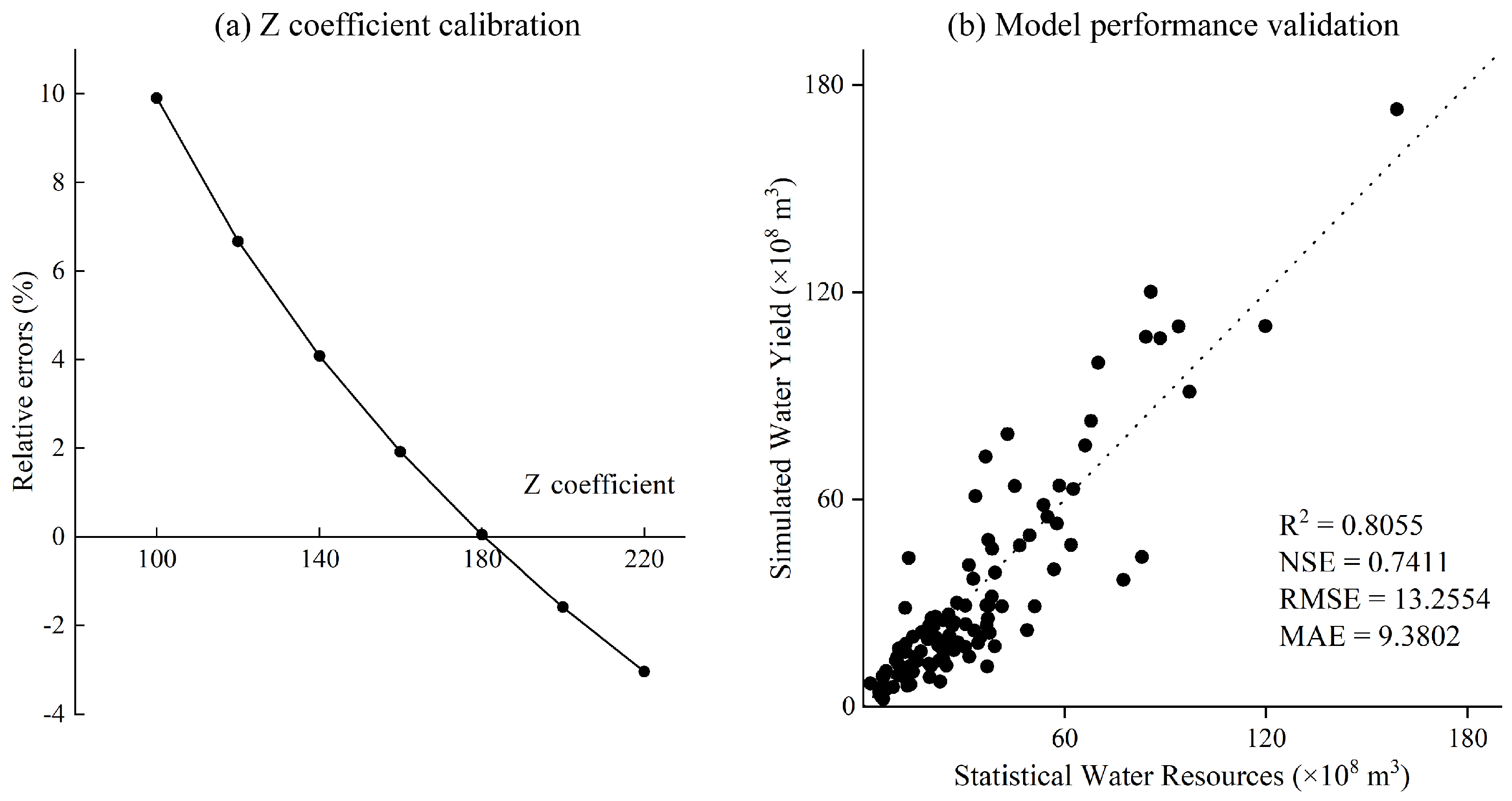
As shown in Figure 2a, the relative error of simulated water yield exhibited a near-linear decreasing trend as the seasonal constant Z increased from 100 to 220. Specifically, when Z was at 100, the model overestimated the water yield with a relative error of approximately 10%; as Z increased to 180.553, the relative error dropped to its minimum absolute value, and the relative error of water yield in each period was less than 5% (Table 4), after which further increases in Z led to underestimations (a relative error of approximately −3% at Z = 220). Furthermore, to robustly validate the model’s stability across varying periods, climate conditions, and underlying surface characteristics, we aggregated all available municipal-level water resource statistics across the five study periods (2003 to 2023), yielding 107 independent validation samples. As depicted in Figure 2b, the linear regression between the municipal-level simulated water yield and the statistical data demonstrated excellent performance, with an R2 (Coefficient of Determination) of 0.8055 and an NSE (Nash-Sutcliffe Efficiency) of 0.7411. Other metrics, including RMSE (13.2554) and MAE (9.3802), further confirmed the low systematic error. This rigorous validation indicates that the InVEST model has strong robustness and reliability, justifying its subsequent use for calculating water retention capacity.

3.2. Spatio-Temporal Evolution Characteristics of Water Retention Service

3.2.1. Spatio-Temporal Evolution Characteristics of Water Retention Service Based on the Grid Level

Based on the grid level, the average water yield depth of the study area from 2003 to 2023 was 359.29 mm, the corresponding total water yield and water yield coefficients were 939.84 × 10⁸ m3 and 38.39%, respectively (Table 5). The interannual variation trends of water yield depth, total water yield, and water yield coefficient were consistent: the peak values occurred in 2003, the lowest values in 2013, and the values in other years were relatively stable. Rather than a continuous monotonic decline, the water retention exhibited a fluctuating pattern (initially decreasing from 2003 to 2013, and subsequently recovering towards 2023) across the five temporal snapshots.
As shown in Table 5, the water retention situation was similar to the water yield situation. During the last 20 years, the average water retention depth, the corresponding total water retention, and the water retention coefficients were 12.29 mm, 25.42 × 10⁸ m3 and 1.04%, respectively. The total annual water retention fluctuated significantly, with fluctuation ranges of −38.62%, −32.18%, 48.16%, and 2.50%, respectively, indicating strong temporal dynamics largely driven by the specific climatic conditions of these snapshot years. Compared with 2003, the total water retention in 2023 decreased by 36.78%.
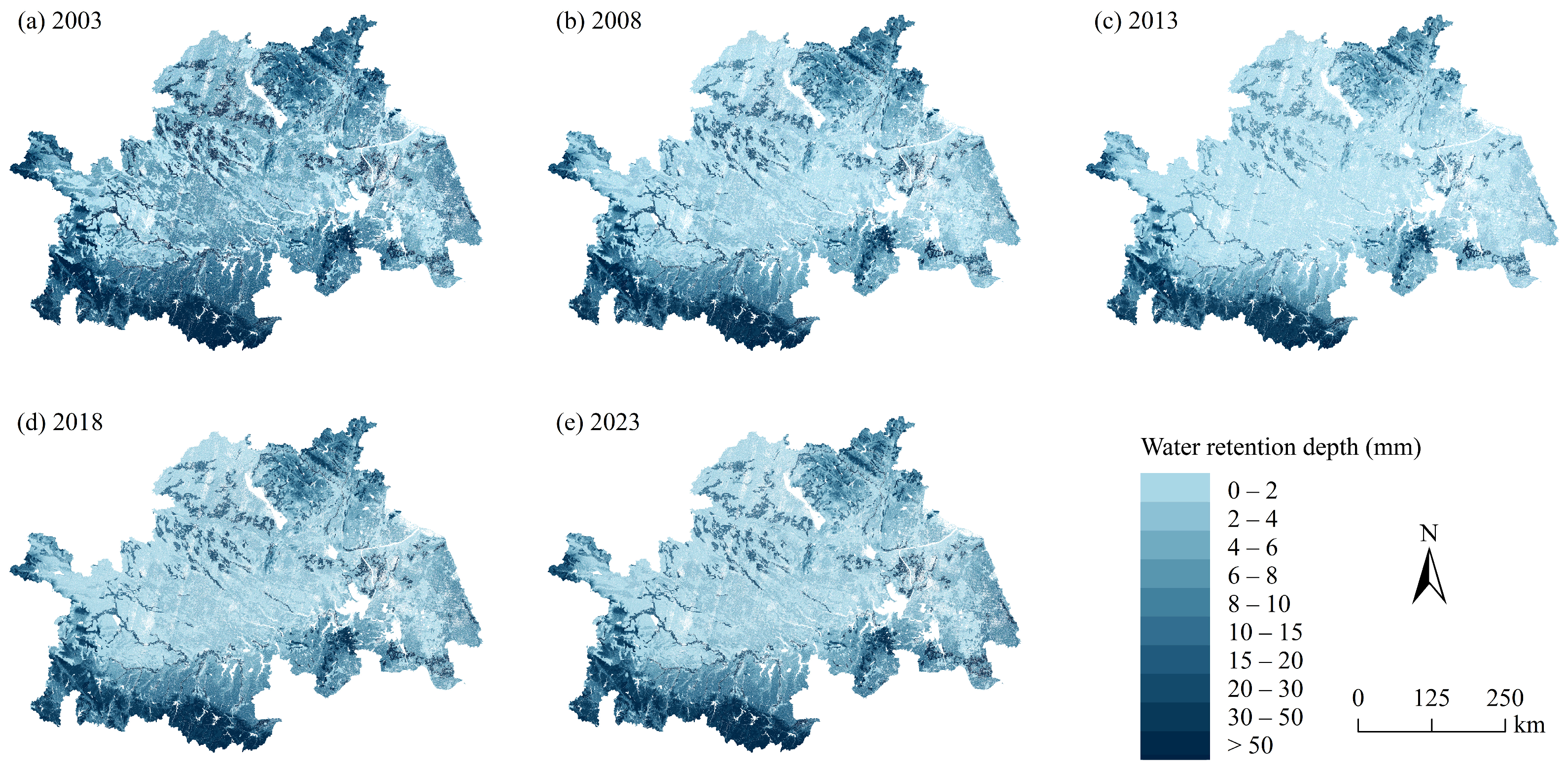
From 2003 to 2023, the spatial differentiation pattern of annual water retention depth in the study area showed little change, and the overall pattern exhibited a certain regularity, characterized by higher values in the southwest and north, and lower values in the central and eastern regions (Figure 3). This is closely related to the spatial distribution characteristics of precipitation in the study area: more in the south and less in the north, and the spatial differences in land use/cover types. Regions with high water retention are distributed near the Dabie Mountains in the southwest and near Mount Tai in the north, while areas with low water retention are mainly concentrated in the Huang-Huai region, which is mainly in the south of the Yellow River and the north of the Huaihe River.
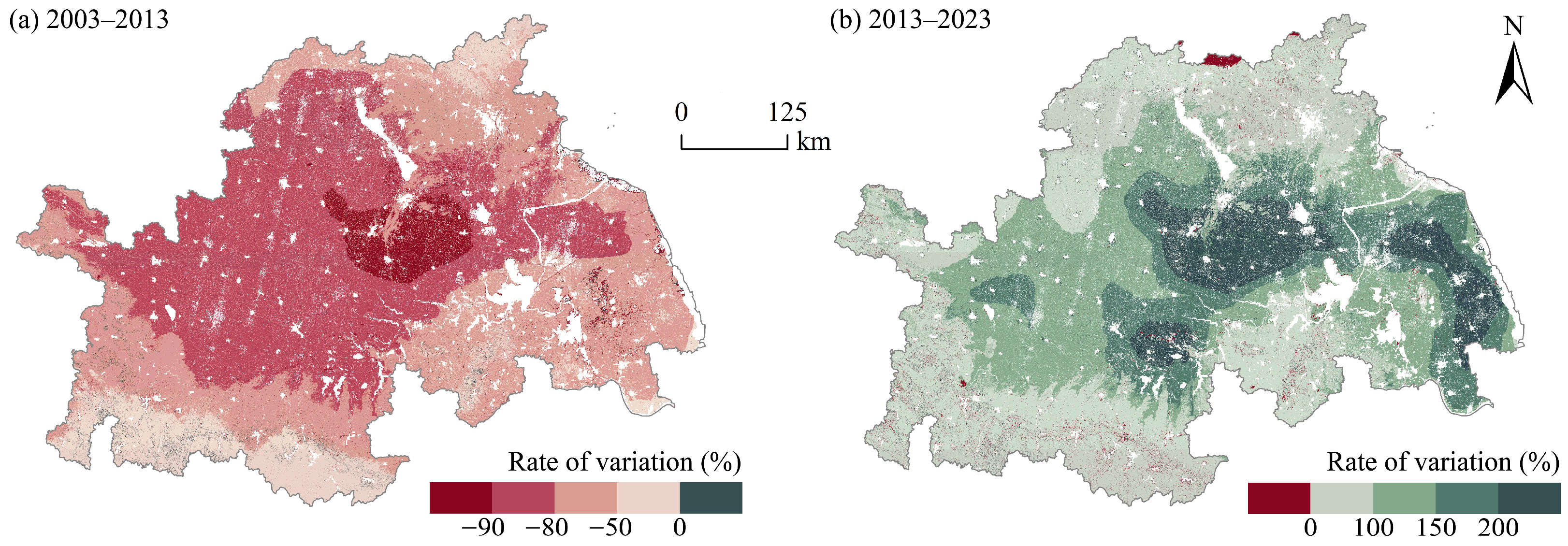
As shown in Figure 4a, the water retention depth of the study area showed an overall downward trend from 2003 to 2013, with the magnitude of decline decreasing sequentially from the central region to the surrounding areas. Among them, the central area had the largest decline, including Huaibei, Suzhou, and parts of Shangqiu and Xuzhou, other areas with a relatively large decline were scattered in the western portion of the Huang-Huai Plain; while areas with a small decline were distributed in the southern, eastern, and northern parts of the study area, forming an inverted “C”-shaped semi-enclosed pattern; the areas with the smallest decline were located in the Dabie Mountains in the southern part of the study area and the region near Mount Tai in the northern part. As shown in Figure 4b, the water retention depth of the Huaihe River Economic Belt showed an overall upward trend from 2013 to 2023, with the increase magnitude decreasing sequentially from the central-eastern region to the other three sides, except for the core cities such as Huaibei, Suzhou, Xuzhou, and Suqian, Fuyang, Yancheng and parts of Huainan, were high-value areas with an increase magnitude of over 150% or even 200%. In addition, areas around the high-value regions (Yangzhou, Huai’an, and Lianyungang) and the western part of the Huang-Huai Plain (Bozhou, Zhoukou, and Zhumadian) have a relatively high increase magnitude, ranging from 100% to 150%, the increase magnitude in the northern and southern parts of the study area was within 100%, and areas with decreased water retention depth were mainly concentrated in the northern part of Jining.

3.2.2. Spatio-Temporal Evolution Characteristics of Water Retention Service Based on Spatial Pattern Level

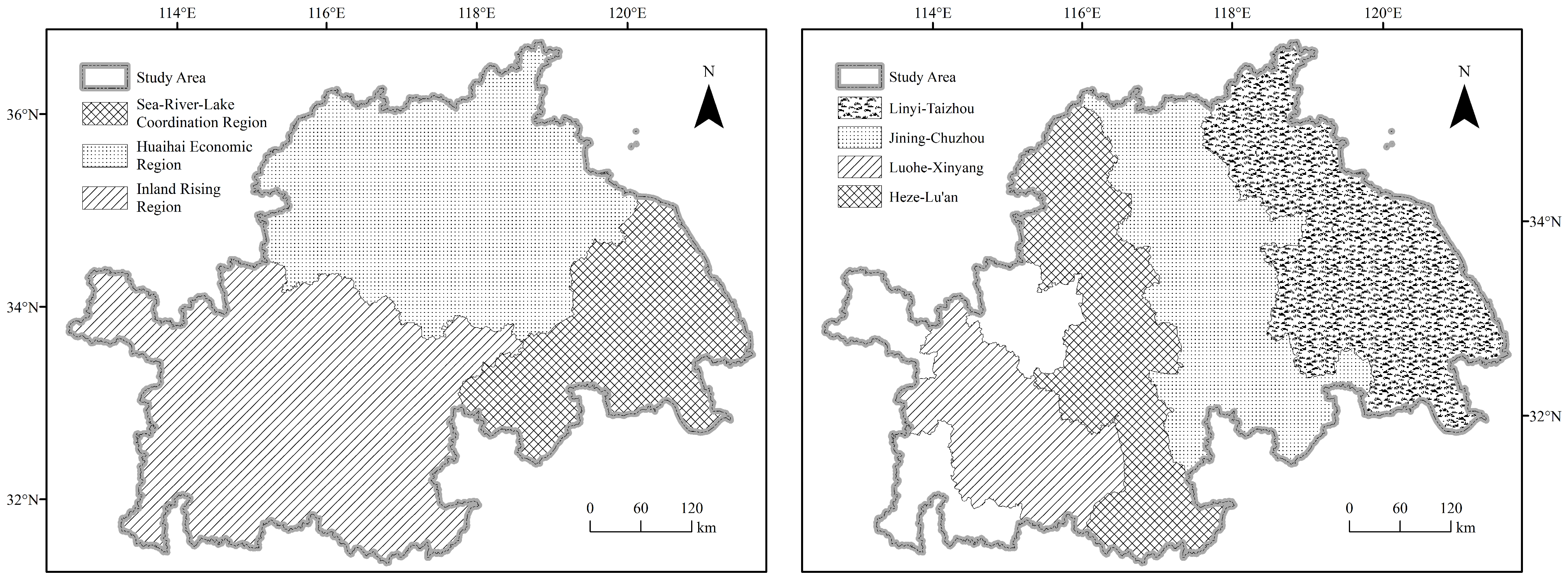
According to the major function zoning [50], the Huaihe River Ecological Economic Belt has established an overall pattern of “One Belt, Three Regions, Four Axes, and Multiple Points” (Figure 5).
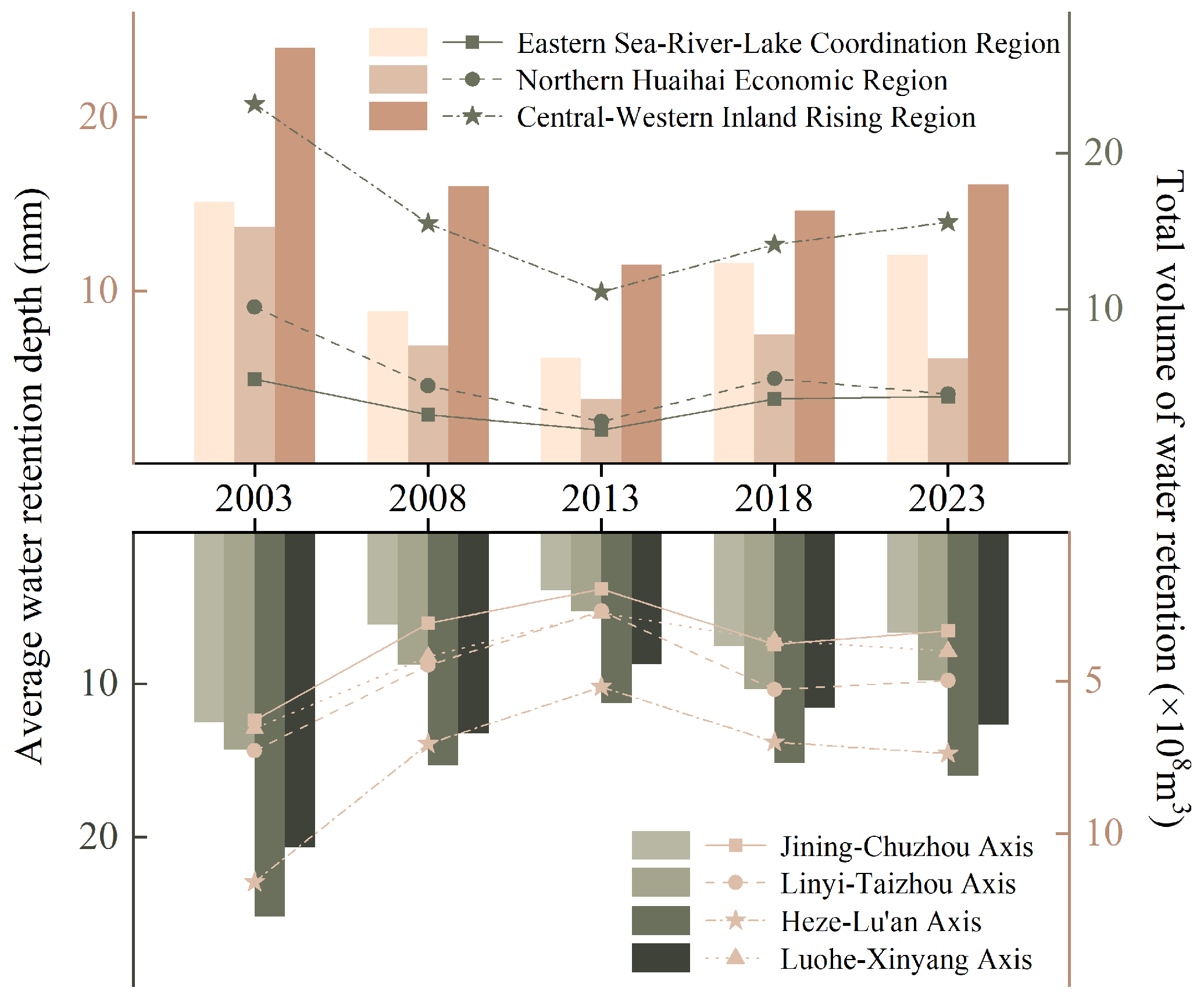
The “Three Regions” refer to the Eastern Sea-River-Lake Coordination Region, the Northern Huaihai Economic Region, and the Central-Western Inland Rising Region. The Eastern Sea-River-Lake Coordination Region includes cities such as Huai’an, Yancheng, Yangzhou, Taizhou, and Chuzhou; the Northern Huaihai Economic Region covers cities including Xuzhou, Lianyungang, Suqian, Suzhou, Huaibei, Shangqiu, Zaozhuang, Jining, Linyi, and Heze; the Central-Western Inland Rising Region comprises cities (counties) such as Bengbu, Xinyang, Huainan, Fuyang, Lu’an, Bozhou, Zhumadian, Zhoukou, Luohe, Pingdingshan, Tongbai, Sui County, Guangshui, and Dawu. As shown in Figure 6, the overall average water retention depth of the “Three Regions” showed a trend of first decreasing and then increasing, with the maximum value in 2003 and the minimum value in 2013. The average water retention depth of the “Three regions” in descending order was: Central-Western Inland Rising Region > Eastern Sea-River-Lake Coordination Region > Northern Huaihai Economic Region. In terms of total water retention, the overall variation trend of each region during the study period was consistent with that of the average water retention depth. In the study period, the total water retention of the Central-Western Inland Rising Region was much higher than that of the other two regions, which was related to its vast area and higher water retention depth per unit area. The Northern Huaihai Economic Region had a slightly higher total water retention than the Eastern Sea-River-Lake Coordination Region, and the gap between these two regions gradually narrowed over time under shifting regional dynamics.
The “Four Axes” are defined as follows: ① The Linyi-Lianyungang-Suqian-Huai’an-Yancheng-Yangzhou-Taizhou Development Axis (referred to as the “Linyi-Taizhou Axis” for short), which relies on the Xinyi-Changxing Railway, Beijing-Shanghai Expressway, Beijing-Hangzhou Grand Canal, the under-construction Lianyungang-Huai’an-Yangzhou-Zhenjiang High-Speed Railway, and the planned Beijing-Shanghai High-Speed Railway Second Corridor. ② The Luohe-Zhumadian-Xinyang Development Axis (referred to as the “Luohe-Xinyang Axis” for short), supported by the Beijing-Guangzhou Railway. ③ The Heze-Shangqiu-Bozhou-Fuyang-Lu’an Development Axis (referred to as the “Heze-Lu’an Axis” for short), based on the Beijing-Kowloon Railway. ④ The Jining-Zaozhuang-Xuzhou-Huaibei-Suzhou-Bengbu-Huainan-Chuzhou Development Axis (referred to as the “Jining-Chuzhou Axis” for short), relying on the Beijing-Shanghai Railway and the Beijing-Shanghai High-Speed Railway. As shown in Figure 6, the temporal variation characteristics of the average water retention depth and total water retention of the “Four Axes” were similar to those of the “Three Regions”, both showing a trend of first decreasing and then increasing. Within the study period, the average water retention depth of the four axes in descending order was: “Heze-Lu’an Axis” > “Luohe-Xinyang Axis” > “Linyi-Taizhou Axis” > “Jining-Chuzhou Axis”. This was related to the area of forest land covered by these axes. Both the “Heze-Lu’an Axis” and the “Luohe-Xinyang Axis” cover parts of the Dabie Mountains in the southwestern part of the study area; there is a high forest coverage rate in mountainous areas, so they have strong water retention capacity, and the “Linyi-Taizhou Axis” covers parts of Mount Tai in the northern region of the study area. In terms of total water retention, the order from the highest to the lowest was: “Heze-Lu’an Axis” > “Linyi-Taizhou Axis” > “Luohe-Xinyang Axis” > “Jining-Chuzhou Axis”.

3.3. Correlation Analysis Between Land Use and Water Retention

3.3.1. Water Retention Characteristics of Different Land Use Types

The underlying surface is a key factor influencing changes in water yield, and the distribution of land use affects the soil water storage capacity, which in turn impacts water retention across different land use types in a region [23]. The water retention capacity of various land use types can be reflected by their water retention depth per unit area; a greater water retention depth indicates a stronger retention capacity. Generally, areas with higher vegetation coverage have relatively stronger water retention capacity.
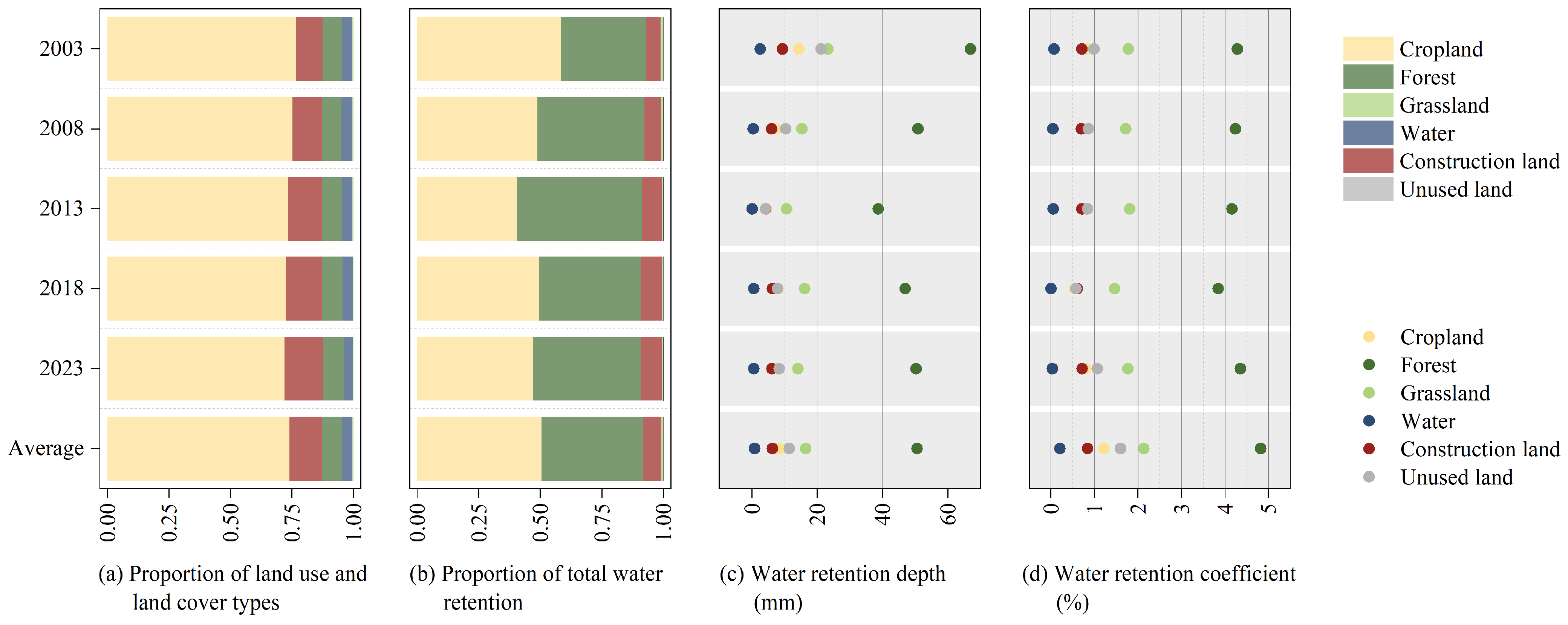
Based on the statistical analysis of the area proportion of each land use type in the study period, we employed the zonal statistics function in ArcGIS 10.8 to compute the proportion of total water retention, water retention depth, and water retention coefficient for each land use type. As shown in Figure 7a, the area proportion of each land use type was basically consistent over the last 20 years, in descending order: cropland > construction land > forest > water > grassland > unused land. According to Figure 7b, the proportion of total water retention for different land use types was also roughly the same each year, in descending order: cropland > forest > construction land > grassland > water > unused land. Notably, in 2013, the estimated total water retention of forests (50.80%) was higher than that of croplands (40.54%). Although forests accounted for a small proportion of the study area (only 8.15% of the multi-year average), they, together with croplands, were the main contributors to the total water retention in the study area (their multi-year average proportions were 41.30% and 50.49%, respectively). Although the area proportion remained stable, the proportion of total water retention provided by forests showed significant temporal fluctuation, peaking at 50.80% in 2013 and dropping to 41.30% in 2023. As illustrated in Figure 7c, the water retention depth for all land use types experienced a synchronous trough in 2013. For instance, the retention depth of forests sharply decreased from 66.97 mm in 2003 to 38.69 mm in 2013, before recovering to 50.59 mm in 2023.
It can be observed from Figure 7c,d that the water retention depth per unit area and water retention coefficient of each land use type changed over the last 20 years but showed an overall similar trend. By calculating the average values of water retention depth and water retention coefficient for the five periods across various land use types, the water retention capacity of the land use types was sorted as follows: forest > grassland > unused land > cropland > construction land > water. Among these, forests had significantly stronger water retention capacity than other land use types, with a depth of 50.59 mm per unit area. This result is consistent with many previous studies [51,52]. Ranking second, the water retention depth of grassland was only 16.45 mm per unit area. Although forests have high evapotranspiration, their canopy intercepts precipitation to protect the soil structure, and the litter layer strengthens water absorption, thereby endowing them with strong water retention capacity. The water retention capacity of unused land and construction land was relatively weak, at 11.38 mm and 6.27 mm per unit area, respectively. The main reason is that construction land has no vegetation to intercept precipitation; instead, precipitation often forms runoff and directly flows into rivers, leading to weak water retention capacity. Additionally, the water retention depth of cropland was 8.42 mm per unit area. Due to its high flow velocity coefficient, rainwater travels a long distance per unit time and easily forms surface runoff, which is not conducive to storing and retaining precipitation. As a result, cropland’s water retention capacity is not strong, however, their contribution to the total regional water retention exceeded 50%, indicating that the total water retention of different land use types is closely related not only to their water retention capacity but also highly dependent on their area, as the multi-year average proportion of croplands in the study area reached 73.92%. Finally, the water retention depth of water areas was only 0.78 mm per unit area. This is not due to weak ecological functions, but rather the model mechanism: water does not participate in terrestrial hydrological processes such as vegetation interception and soil infiltration, so the simulated water retention value is close to 0.

3.3.2. Response of Water Retention to Land Use Change

To quantitatively analyze the impact of land use type changes on water retention, the land use transfer matrix and the Zonal Statistics tool in ArcGIS 10.8 were used to statistically analyze changes in land use types, total water retention, and water retention depth from 2003 to 2023.
As shown in Table 6 and the detailed land use transfer matrix (Table A1), significant changes in land use types occurred from 2003 to 2023. Among these, cropland experienced the largest area change at 13,826.03 km2, followed by forest, water, and grassland, with changed areas of 1651.54 km2, 1304.37 km2, and 945.81 km2, respectively. The changed areas of other land use types were relatively small. A total of 74.01% of the changed cropland was converted to construction land, and 15.67% to forest; 94.37% of the changed forest was converted to cropland; 79.15% of the changed water areas was converted to cropland, and 20.49% to construction land; as for the changed grassland, 64.00% was converted to cropland, and 26.28% to forest. It is evident that most of the changed land use types were converted to construction land and cropland. Among the unchanged land use types, their total water retention all decreased differently; the order of decrease amount was: cropland > forest > construction land > grassland > water > unused land. Notably, the decrease amount in cropland and forest was significantly higher than that in other land use types. The total water retention of the changed land use types also varied; they accounted for only 8.23% of the total changed amount of water retention. Among the changed land use types, the conversion of forest to other types resulted in the highest estimated reduction in water retention capacity, at 77.65 × 10⁶ m3, followed by cropland and grassland, with losses of 20.97 × 10⁶ m3 and 10.10 × 10⁶ m3, respectively. When water areas were converted to other land use types, they participated in terrestrial hydrological processes, leading to a slight increase in water retention; other land use variation caused little change in water retention. It must be strongly emphasized that the simulated near-zero water retention for water bodies is a methodological artifact of the InVEST model framework, which strictly calculates terrestrial runoff reduction rather than actual aquatic storage. Therefore, land-use transitions involving water bodies resulting in an apparent “loss” of water retention should not be interpreted as a genuine degradation of ecological water storage capacity. In reality, aquatic systems possess substantial hydrological regulation functions that are simply not captured by this proxy-based metric.
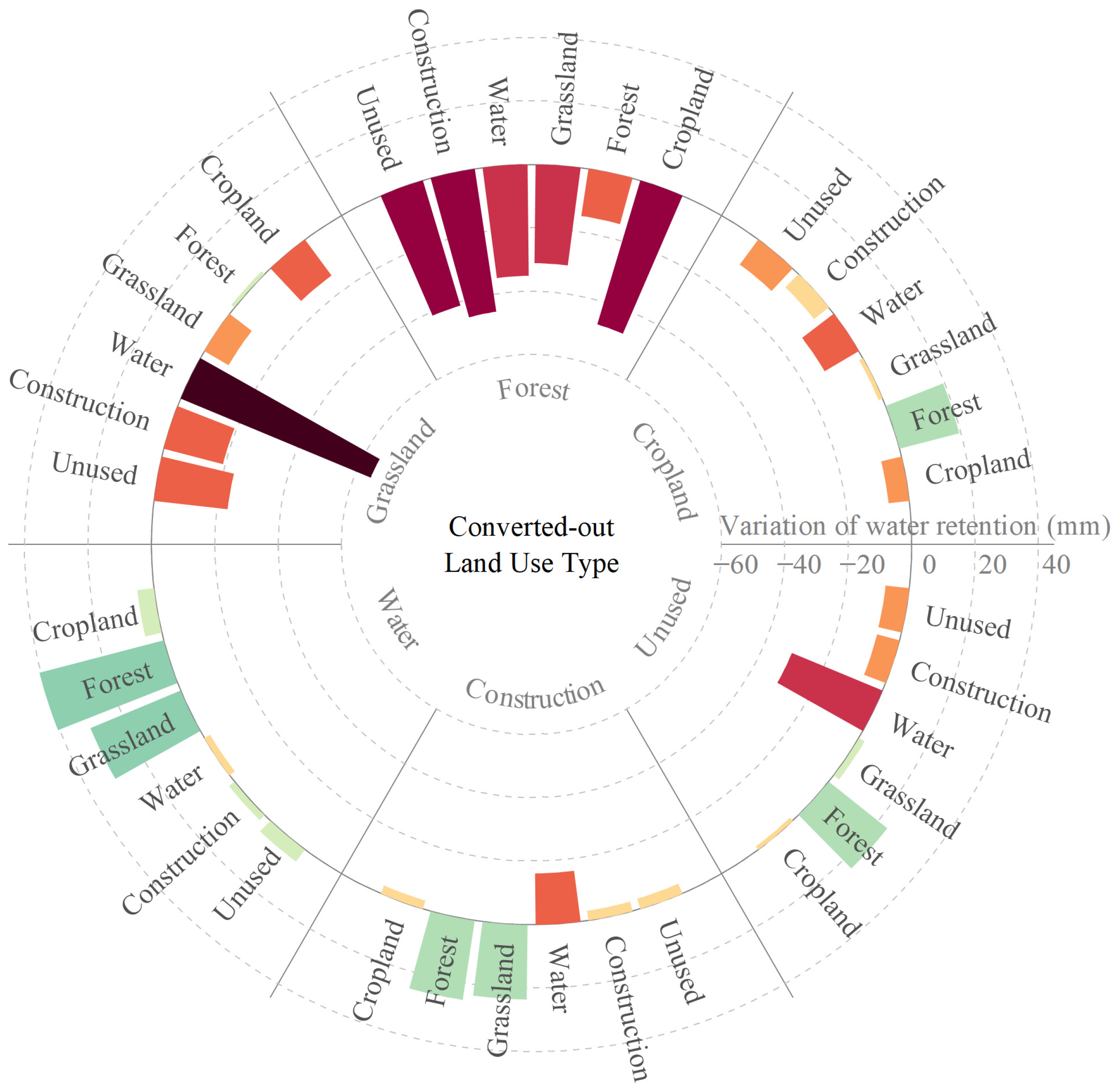
As shown in Figure 8, from 2003 to 2023, the water retention depth per unit area of the unchanged land use types decreased to varying amounts, which indicated a decline in the water retention capacity of all land use types. The order of decline magnitude was: forest > grassland > unused land > cropland > construction land > water areas. From the perspective of converted-out land use types, the conversion of forest to other types led to a significant decrease in water retention capacity, followed by grassland and cropland. Among these, the conversion of grassland to water areas resulted in the largest decrease in water retention depth per unit area, while the conversion of water areas to forest caused the largest increase in this depth. For the conversion of forest to other types, the conversion to cropland led to the largest decline in water retention capacity, with an average reduction of approximately 47.45 mm, followed by conversion to construction land, unused land, water areas, and grassland. For the conversion of grassland to other land types, the conversion to water areas resulted in the largest decline in water retention capacity, followed by conversion to unused land, construction land, and cropland. As the conversion of water areas to other land types, the conversion to forest caused the largest increase in water retention capacity, followed by conversion to grassland, cropland, unused land, and construction land. Although water areas converting to other land use types improved water retention capacity, the overall proportion of water areas was small, so the total water retention did not increase significantly. Although the change in cropland to other land types caused a small overall reduction in water retention capacity, its large proportion in the total area led to a significant decrease in total water retention. In addition, from the perspective of land transfer, the conversion of other land use types to forest significantly improved water retention capacity, while the conversion to cropland, water, construction land, and unused land has the opposite effect. For example, the ecological restoration from cropland to forest effectively improved regional retention capacity, increasing the retention depth by 19.45 mm per unit area.

3.4. Analysis of the Spatial Explanatory Factors of Water Retention

3.4.1. Selection of the Optimal Grid Size

The water retention capacity of the study area from 2003 to 2023 was taken as the dependent variable, referring to the results of previous studies, 12 potential explanatory factors were selected, including DEM (X1), slope (X2), soil depth (X3), soil type (X4), soil saturated hydraulic conductivity (X5), land use type (X6), temperature (X7), precipitation (X8), actual evapotranspiration (X9), NDVI (X10), population (X11), and night-time light index (X12). The optimal parameter geographical detector was used to explore the factors explaining the spatial variance of the water retention. Various explanatory factors and water retention depth in 2023 were used as input data to select the optimal grid size. The explanatory power of each factor varies under different grid sizes (Table 7). When the grid size is 8.5 km, the 90th percentile of q reaches the highest value, so the 8.5 km grid size was used to sample the explanatory factor data of each year, and the optimal parameter geographical detection was conducted in RStudio. Through the parameter optimization process, the optimal discretization method and the optimal number of intervals for each explanatory factor were determined to maximize their respective spatial explanatory power (q-values). The specific optimal parameter combinations used for the final Geographical Detector analysis are presented in Table A2.

3.4.2. Analysis of Spatial Explanatory Power

From 2003 to 2023, the explanatory power of the 12 explanatory factors for water retention capacity all met the requirements of the significance test (p < 0.05). There existed notable differences in the explanatory power of these factors for water retention capacity, and the explanatory power of each factor also changed over different years (Table 8). During this period, soil saturated hydraulic conductivity and land use type exhibited the strongest spatial explanatory power for water retention, ranking first and second among all factors in each year. This high spatial association is partially expected and inherently linked to the mathematical structure of the InVEST module, as both factors act as direct multiplicative modifiers in the calculation. However, it is noteworthy that precipitation consistently ranked third. Although precipitation is not a direct topographic or soil-related modifier in Equation (6), its strong explanatory power highlights that the interannual fluctuation of climatic inputs, coupled with static surface structural parameters, profoundly shapes the spatial distribution characteristics of water retention capacity in the study region.
In addition, the nighttime light index and temperature ranked last place among all factors in each year, while soil type was basically stable in the third last place; the explanatory power of these three factors was relatively low. DEM, actual evapotranspiration, and slope also had a certain explanatory power for water retention, followed by NDVI, soil depth, and population, whose explanatory power was slightly weaker. From a horizontal comparison perspective, the explanatory power of soil saturated hydraulic conductivity experienced a process of first decreasing and then increasing, while the explanatory power exerted by land use type generally first increased and then decreased. In 2003, the explanatory power of soil saturated hydraulic conductivity was the highest, more than twice that of land use type in the same year. In 2013, the explanatory power of soil saturated hydraulic conductivity reached its lowest value, which was almost the same as that of land use type, which reached its highest value in the same year.

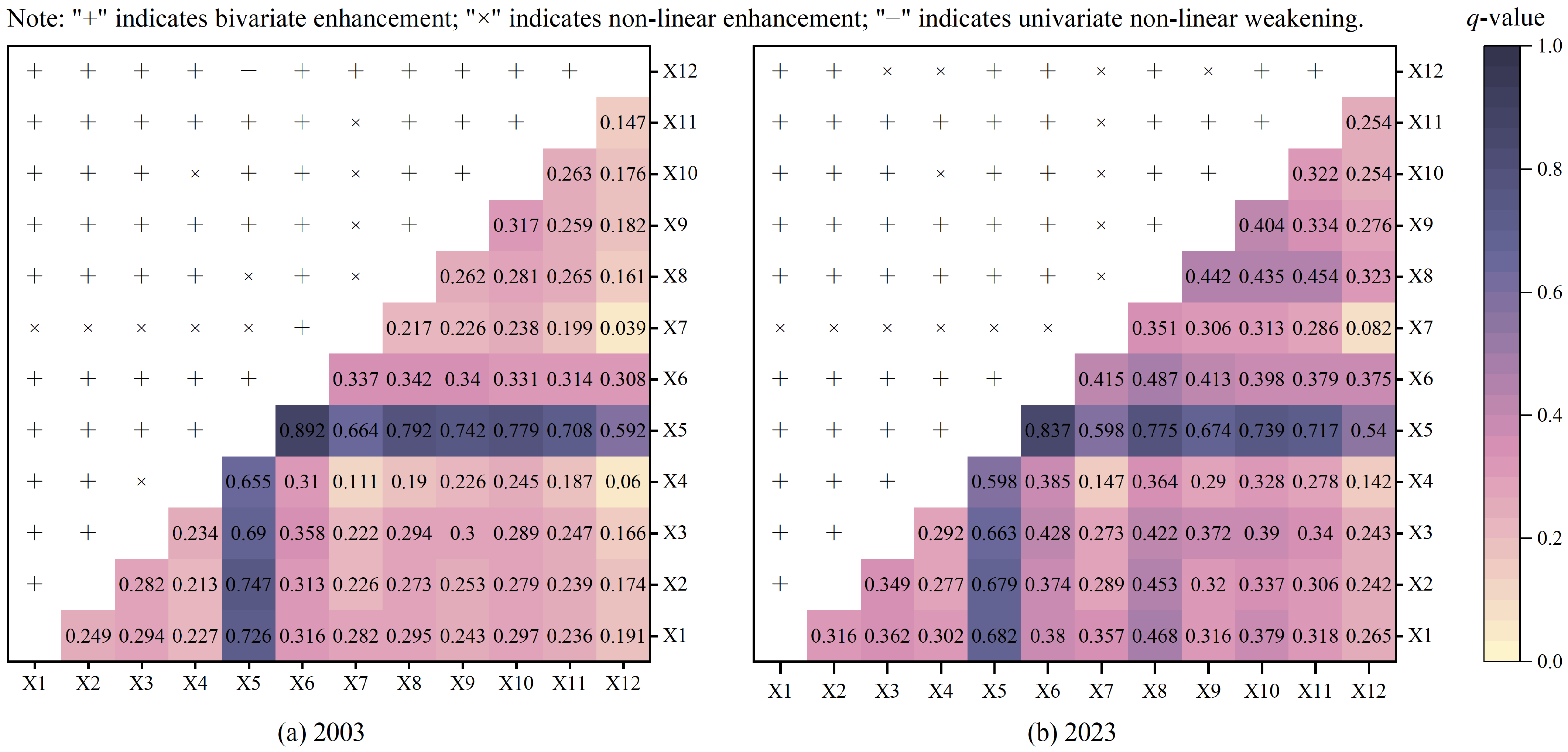
3.4.3. Analysis of the Interaction of Influencing Factors

Since the water retention capacity is the product of the interconnection action of various factors, the years 2003 and 2023 were chosen to conduct interaction detection for it; the results of other years were similar. The results of factor interaction detection for water retention are shown in Figure 9, its impact degree of the interaction between any two factors is greater than that of a single factor. Since the explanatory power of soil saturated hydraulic conductivity (X5) is the highest for water retention capacity in the study area, its interactive explanatory power with any other factor is greater than that between any other two factors. Among them, the coupled explanatory power of soil saturated hydraulic conductivity and land use type (X6) is the highest, reaching a q-value of 0.892 in 2003 and 0.837 in 2023.
The types of factor interaction are roughly divided into two categories: bivariate enhancement and non-linear enhancement. Most of them are bivariate enhancements and a few are non-linear enhancements in the study area. Only one pair of factors exhibited univariate non-linear weakening: soil saturated hydraulic conductivity (X5) and the night-time light index (X12) in 2003. Over the past 20 years, the explanatory power of the interaction between most factors has shown an increasing trend, and some interaction types have changed. For example, the interaction between land use type (X6) and temperature (X7), soil depth (X3) and soil type (X4), had changed from bivariate enhancement to non-linear enhancement, which is 1.23 times (q = 0.415 in 2023) and 1.25 times (q = 0.292 in 2023) the value in 2003, respectively; the interaction between soil saturated hydraulic conductivity and the night-time light index has changed from univariate non-linear weakening to bivariate enhancement, which is 1.1 times the value in 2003 (q = 0.54 in 2023); while the interaction between soil saturated hydraulic conductivity and precipitation (X8) has changed from non-linear enhancement to bivariate enhancement, which is 0.98 times the value in 2003 (q = 0.775 in 2023). Among the factor combinations with non-linear enhancement, most are combined with temperature. However, the explanatory power of temperature is low as a single factor (q-value ranges form 0.026 to 0.037), which indicates that the explanatory power of temperature will be notably enhanced when it is coupled with other influencing factors (q-value ranges form 0.111 to 0.664).

4. Discussion

4.1. Spatio-Temporal Dynamics and Cross-Regional Comparisons

Based on the InVEST model, the simulated total water retention exhibited significant temporal variations and spatial differentiation over the last 20 years. Across the five selected time points over the last 20 years, the total water retention experienced distinct fluctuations rather than a continuous trend. A notable drop was observed between 2003 and 2013, after which it slightly recovered but still did not return to the initial level. Spatially, the water retention capacity presented a pattern of “high in the southwest and north, low in the central region”, which is consistent with the research results of Huang Ying et al. [18]. Dabie Mountain in the southwest and Mount Tai in the north of the study area have strong interception and water storage capacities due to dense vegetation coverage, while the central Huang-Huai Plain is dominated by cropland and construction land, with rapid surface runoff and weak water retention capacity.
Compared to other major river basins and economic regions in China, the Huaihe River Economic Belt exhibits unique ecohydrological characteristics. In the Yellow River Basin, particularly the Loess Plateau, water retention dynamics are profoundly driven by large-scale ecological restoration projects (e.g., the Grain for Green Program) and are highly sensitive to regional vegetation greening [53,54]. In contrast, in the highly urbanized Yangtze River Delta or Pearl River Delta, the rapid expansion of impervious surfaces (construction land) associated with urbanization is recognized as the absolute dominant cause of water retention loss [55,56].
The Huaihe River Economic Belt, however, presents a different paradigm. It serves as a massive agricultural base where cropland accounts for roughly 74% of the total area. According to our findings, the regional water retention capacity here is less responsive to rapid urban expansion or large-scale afforestation compared to the aforementioned regions. Instead, its baseline capacity and spatial heterogeneity are fundamentally constrained by long-term agricultural land-use practices and intrinsic soil hydrological properties across the vast plains. Recognizing these unique cross-regional differences is essential for formulating localized, basin-specific ecological management policies.

4.2. Relative Significance of Climatic and Anthropogenic Factors

Based on the optimal parameter geographical detector, the spatial associations of the water retention service are studied in the Huaihe River Ecological Economic Belt. A critical nuance in understanding the spatial associations lies in distinguishing the roles of climatic fluctuations versus anthropogenic land-use changes. As observed in our temporal analysis, the significant drop in total water retention between 2003 and 2013 is closely related to the interannual fluctuation of regional precipitation. Because our study is based on five discrete temporal snapshots rather than continuous annual observations, these values capture specific dry or wet years (e.g., abundant precipitation in 2003 and significantly low precipitation in 2013). Thus, climatic factors primarily dictate the macro-temporal fluctuations and the baseline volume of water yield in any given year, rather than a persistent structural decline.
However, while precipitation provides the water source, anthropogenic factors (represented by land use type) and underlying surface characteristics (represented by soil saturated hydraulic conductivity) strongly dictate the spatial configuration and the structural water retention capacity of the landscape. Our Geographical Detector results identify soil saturated hydraulic conductivity and land use type as the factors with the strongest spatial explanatory power for water retention, outranking precipitation. Rather than implying simple direct causation, this indicates that these two factors are the primary spatial explanatory factors shaping the basin’s capacity to hold water. Soil saturated hydraulic conductivity characterizes the fundamental potential for water infiltration and soil water storage, while land use type modifies hydrological processes by altering surface cover conditions. As the third most important explanatory factor, precipitation indicates that the coupled effect of climatic factors and underlying surface characteristics is highly associated with water retention capacity. Furthermore, interaction detection reveals that the explanatory capacity derived from the interaction between any two factors is strictly higher than that of each individual factor alone. Among them, the interaction between soil saturated hydraulic conductivity and land use type is the strongest, indicating that they synergistically explain the spatial heterogeneity of water retention. Although temperature shows weak individual explanatory power, it exhibits non-linear enhancement when interacting with other variables, reflecting that it may indirectly shape water retention capacity by influencing evapotranspiration and vegetation growth.
Specifically, anthropogenic land use changes exhibit a profound spatial footprint on water retention. Cropland and forest are the main contributors to the total water retention in the study area. However, since cropland accounts for the vast majority, 73.92% of the total area, its water retention capacity per unit area is notably low (only 8.42 mm).In contrast, the water retention capacity per unit area of forest and grassland is significantly higher, which is consistent with previous studies. Because their total areas are relatively small, the structural conversion of these ecological lands to cropland and construction land is spatially correlated with a substantial loss of water retention. From 2003 to 2023, the transfer out of the forest was associated with the largest decline in the simulated water retention index (reaching 77.65 × 10⁶ m3). Even in years with abundant precipitation, regions dominated by cropland and construction land fail to effectively retain water due to rapid modeled surface runoff and poor soil infiltration.
Therefore, while interannual climatic fluctuations drive temporary temporal peaks and troughs, anthropogenic land-use transitions and underlying soil properties act as the fundamental constraints on regional spatial heterogeneity. This underscores a critical planning implication: the protection and restoration of ecological land are crucial for improving the regional intrinsic water retention capacity and fostering long-term ecological security in the Huaihe River Economic Belt.

4.3. Research Significance and Limitations

This study provides valuable region-specific insights into the dynamics of ecosystem services in the Huaihe River Economic Belt, a critical ecological and economic transitional zone in eastern China. The methodological innovation of this research lies in the coupling of the InVEST model with a parameter-optimized Geographical Detector. Compared to traditional manual discretization, the parameter-optimized approach eliminates subjective bias, offering a more robust quantification of how interacting natural and anthropogenic factors affect spatial heterogeneity. By tracking five-year temporal snapshots, this study explicitly highlights the dominating spatial influence of soil saturated hydraulic conductivity and land-use transitions (particularly forest-to-cropland loss) on regional water retention. The findings provide a targeted, spatially explicit scientific basis for regional land-use planning, emphasizing that future ecological engineering in such heterogeneous basins should prioritize both forest protection and the improvement of soil hydrological properties.
While the methodology provides comprehensive spatial proxy assessments, several limitations regarding model structure and validation must be acknowledged. First, our model calibration and validation were exclusively performed on the water yield component using statistical water resource bulletins. The final water retention metric—derived by modifying water yield with topographical and soil-related parameters—was not independently validated because of the lack of large-scale, field-based observations of actual soil moisture or groundwater storage. Consequently, a satisfactory fit for water yield does not completely guarantee the absolute accuracy of the derived retention estimates, introducing a degree of uncertainty into the proxy-based spatial patterns. Furthermore, the InVEST model contains inherent structural artifacts: it mathematically sets the water retention of aquatic systems (water bodies) to zero, which severely underestimates the massive water storage function of wetlands and lakes. Additionally, the model primarily focuses on surface and shallow soil hydrological processes. In regions with deep-rooted vegetation, the omission of deep soil water dynamics may underestimate actual evapotranspiration, thereby mathematically overestimating water yield and subsequent retention capacity in certain terrestrial areas [57].
Another key limitation stems from parameter generalization and structural endogeneity. Given the vast area and high environmental heterogeneity of the Huaihe River Economic Belt, applying uniform, class-level constants in the biophysical table (e.g., fixed root depth and flow velocity coefficients for broad land-cover classes) simplifies reality. For instance, forests in the southern mountainous areas and northern plains may exhibit significantly different ecohydrological behaviors; using generalized parameters ignores this intra-class spatial variability and introduces uncertainty into the local-scale retention estimates. Finally, there is an inherent structural endogeneity between the modeled retention metric and the spatial association analysis. As highlighted by our results, factors like land use and soil saturated hydraulic conductivity exhibit the strongest explanatory power. However, because these variables are explicitly used as inputs or multipliers in the InVEST equation to calculate water retention, their high explanatory power partly arises from the internal structure of the model itself. Therefore, our Geographical Detector results should be strictly interpreted as identifying the strongest spatial explanatory associations rather than demonstrating independent, process-based hydrological causation. Future studies could mitigate these uncertainties by incorporating dynamic, spatially continuous parameterization and integrating direct field-based hydrological measurements.

5. Conclusions

Based on the proxy-based simulation and spatial association analysis of the water retention service in the Huaihe River Economic Belt from 2003 to 2023, this study draws the following main conclusions:
  • Methodological Contribution: By coupling the InVEST model with a parameter-optimized geographical detector, this study successfully quantified the relative explanatory power of internal structural parameters and external environmental inputs. This approach eliminates the subjective bias of traditional manual discretization, providing a robust, spatially explicit framework for attributing macro-scale ecohydrological heterogeneity.
  • Spatio-temporal Dynamics: Over the five temporal snapshots evaluated, the modeled water retention index exhibited significant interannual fluctuations—largely affected by climatic variability—rather than a monotonic structural decline. The spatial pattern consistently showed high retention in the southwest and north, and low retention in the central region, tightly mirroring the regional precipitation distribution and land-use configuration.
  • Land-use Effects and Spatial Explanatory Factors: Forests demonstrated the strongest water retention capacity per unit area (50.59 mm). However, due to its vast areal extent, cropland contributed the most to the total regional retention volume. Crucially, the conversion of forest to other land-use types was spatially associated with the most substantial simulated reductions in retention capacity. Soil saturated hydraulic conductivity and land-use type were identified as the strongest individual and interacting spatial explanatory factors, outranking direct climatic inputs.
  • Planning and Management Implications: The findings highlight that while precipitation dictates temporal fluctuations, intrinsic soil properties and anthropogenic land-use transitions establish the fundamental spatial constraints on regional water retention. For practical land use planning, policymakers should strictly enforce ecological redlines to prevent the conversion of high-retention forests in the Dabie Mountains and Mount Tai areas. In the central plains, where cropland dominates and soil infiltration is a limiting factor, water resource management should focus on agricultural structural adjustments, such as enhancing soil organic matter to improve hydraulic conductivity and implementing localized runoff-retention infrastructure.

Author Contributions

Conceptualization and methodology, W.Z.; software, T.G.; validation, formal analysis and investigation, W.Z., T.G. and Q.M.; resources and data curation, W.Z. and X.B.; writing—original draft preparation, W.Z. and Y.C.; writing—review and editing, T.P. and Q.M.; visualization, W.Z. and X.B.; supervision and funding acquisition, J.H.; project administration, W.Z. All authors have read and agreed to the published version of the manuscript.

Funding

This work was funded by The National Natural Science Foundation of China [Grant No. 41671395] and Postgraduate Research and Practice Innovation Program of Jiangsu Normal University [Grant No. 2024XKT0097].

Data Availability Statement

All datasets used in this study are publicly available from the published literature [29,30,31,32,33,34,35,36,37,38,39,40,41,42], and the biophysical parameters of InVEST water yield model were included in the article. No new datasets were generated. Further inquiries can be directed to the corresponding author.

Acknowledgments

We are grateful for the data provided by “National Earth System Science Data Center (https://www.geodata.cn (accessed on 26 January 2026))” and “National Tibetan Plateau/Third Pole Environment Data Center (http://data.tpdc.ac.cn (accessed on 26 January 2026))”. During the preparation of this manuscript, the authors used “Gemini 3 pro preview” for the purposes of translation and improving the readability of some sentences. The authors have reviewed and edited the output and take full responsibility for the content of this publication.

Conflicts of Interest

The authors declare no conflicts of interest. The funders had no role in the design of the study; in the collection, analyses, or interpretation of data; in the writing of the manuscript; or in the decision to publish the results.

Appendix A

Table A1. The transfer-out proportion matrix of land use types in the study area from 2003 to 2023.
%2023
CroplandForestGrasslandWaterConstruction Unused
2003Cropland15.67 1.77 8.55 74.01 0.00
Forest94.37 2.02 0.47 3.12 0.02
Grassland64.00 26.28 1.42 8.20 0.10
Water79.15 0.31 0.01 20.49 0.03
Construction34.06 0.11 0.03 65.75 0.04
Unused20.05 0.25 1.67 38.59 39.44
Notes: Construction refers to construction land, Unused refers to unused land.
Table A2. Details of parameter-optimized geographic detector.
YearParameterX1X2X3X5X7X8X9X10X11X12
2003discretization methodssdnaturalsdgeometricnaturalequalnaturalnaturalquantilequantile
number of intervals109108109109109
2008discretization methodssdnaturalsdgeometricequalsdnaturalsdgeometricquantile
number of intervals10910891099810
2013discretization methodssdnaturalsdgeometricequalsdnaturalsdquantilequantile
number of intervals10910810101010109
2018discretization methodssdnaturalsdgeometricsdequalgeometricsdquantilequantile
number of intervals109108610910109
2023discretization methodssdnaturalsdgeometricsdsdsdnaturalgeometricquantile
number of intervals109108101088109
Notes: As X4 and X6 are categorical variables, discretization processing is not required for these factors. Method abbreviations: equal = equal interval, natural = natural breaks, quantile = quantile, geometric = geometric interval, sd = standard deviation.

References

  1. He, S.; Qian, H.; Liu, Y.; Zhao, X.; Su, F.; Ma, H.; Guan, Z.; Zhang, T. Water conservation assessment and its influencing factors identification using the InVEST and random forest model in the northern piedmont of the Qinling Mountains. J. Hydrol. Reg. Stud. 2025, 57, 102194. [Google Scholar] [CrossRef]
  2. Niu, N.; Fan, J.; Yang, Z. The spatial and temporal variations evaluation of water conservation in Guizhou Province based on InVEST model. Sci. Rep. 2025, 15, 22413. [Google Scholar] [CrossRef]
  3. Gou, Z.; Zhang, P.; Jia, X.; Si, S.; Zhao, Y. Spatiotemporal Evolution and Multi-Scenario Prediction of Water Conservation in Qinling Mountains Based on the InVEST-PLUS Model. Chin. J. Environ. Sci. 2025, 1–16. [Google Scholar] [CrossRef]
  4. Luo, F.; Wang, S.; Lü, Y.; Mu, R.; Fo, J.; Zhang, T.; Xu, J.; Wang, C. Domain knowledge-enhanced graph reinforcement learning method for Volt/Var control in distribution networks. Appl. Energy 2025, 398, 126409. [Google Scholar] [CrossRef]
  5. Gao, X.; Feng, Q.; Li, Z.; Deng, X.; Xue, J.; Zhang, B. Spatio-temporal pattern and key influencing factors of water conservation value in the Three-River Source region. Acta Ecol. Sin. 2024, 44, 7074–7086. [Google Scholar] [CrossRef]
  6. Liu, Y.; Hou, P.; Wang, P.; Zhu, J. Research advance on quantitative assessment methods of ecosystem water conservation service functions. Chin. J. Appl. Ecol. 2024, 35, 275–288. [Google Scholar] [CrossRef]
  7. Wang, Y.; Ye, A.; Qiao, F.; Li, Z.; Miao, C.; Di, Z.; Gong, W. Review on connotation and estimation method of water conservation. South-to-North Water Transf. Water Sci. Technol. 2021, 19, 1041–1071. [Google Scholar] [CrossRef]
  8. Zuo, Q.; Wang, J.; Yang, F.; Song, Q. Concept analysis of water conservation and calculation methods of water conservation capacity. Adv. Sci. Technol. Water Resour. 2022, 42, 13–19. [Google Scholar] [CrossRef]
  9. Smith, K.A.; Schneider, K.E.; Kinoshita, A.M.; Kurzweil, J.; Prucha, B.; Hogue, T.S. Water yield response to forest treatment patterns in a sierra nevada watershed. J. Hydrol. Reg. Stud. 2024, 53, 101762. [Google Scholar] [CrossRef]
  10. Shaw, M.R.; Pendleton, L.; Cameron, D.R.; Morris, B.; Bachelet, D.; Klausmeyer, K.; MacKenzie, J.; Conklin, D.R.; Bratman, G.N.; Lenihan, J.; et al. The impact of climate change on California’s ecosystem services. Clim. Change 2011, 109, 465–484. [Google Scholar] [CrossRef]
  11. Sánchez-Canales, M.; Benito, A.L.; Passuello, A.; Terrado, M.; Ziv, G.; Acuña, V.; Schuhmacher, M.; Elorza, F.J. Sensitivity analysis of ecosystem service valuation in a Mediterranean watershed. Sci. Total Environ. 2012, 440, 140–153. [Google Scholar] [CrossRef] [PubMed]
  12. Zhang, X.; Li, Y.; Lü, C.; Bi, R.; Xia, L.; Guo, Y.; Wang, Y.; Xu, C.; Sun, B. Research progress on application of ecosystem service functions based on InVEST model. Ecol. Sci. 2022, 41, 237–242. [Google Scholar] [CrossRef]
  13. Li, Y.; Ma, Y.; Chen, Q.; Fan, J.; Yin, L.; Li, Q.; Shi, Y.; Gao, X.; Yang, K.; Tu, C. Spatio-temporal Evolution Characteristics and Driving Factors of Water Conservation Function in the Dry-Hot Valley Area of Jinsha River Based on InVEST Model. Chin. J. Environ. Sci. 2025, 1–17. [Google Scholar] [CrossRef]
  14. Wang, S.; Jin, T.; Yan, L.; Gong, J. Trade-off and synergy among ecosystem services and the influencing factors in the Ziwuling Region, Northwest China. Chin. J. Appl. Ecol. 2022, 33, 3087–3096. [Google Scholar] [CrossRef]
  15. Wang, J.; Xu, C. Geodetector: Principle and prospective. Acta Geogr. Sin. 2017, 72, 116–134. [Google Scholar] [CrossRef]
  16. Zhao, G.; Tian, S.; Liang, S.; Jing, Y.; Chen, R.; Wang, W.; Han, B. Dynamic evolution trend and driving mechanisms of water conservation in the Yellow River Basin, China. Sci. Rep. 2024, 14, 26304. [Google Scholar] [CrossRef]
  17. Niu, J.; Wang, Z.; Lin, H.; Zhang, Y.; Sun, B.; Liu, Y. Temporal and Spatial Evolution Characteristics and Driving Factors of NPP in the Huaihe River Economic Belt. Geogr. Geo-Inf. Sci. 2024, 40, 37–43. [Google Scholar] [CrossRef]
  18. Huang, Y.; Li, X. Ecosystem Services Evaluation and Spatiotemporal Analysis of Huaihe River Eco-economic Zone from 1995 to 2015. J. Ecol. Rural Environ. 2021, 37, 49–56. [Google Scholar] [CrossRef]
  19. Chen, N.; Cheng, Y.; Wang, D. Spatial-temporal differentiation characteristics of water conservation capacity and its influencing factors in Xihanshui Basin, Northwest China. Chin. J. Appl. Ecol. 2025, 36, 2487–2496. [Google Scholar] [CrossRef]
  20. He, Q.; Ren, M. Spatio-temporal dynamics and driving factors of water conservation in the “Sanjiangyuan” area of Hainan Island. J. Trop. Biol. 2026, 1–14. [Google Scholar] [CrossRef]
  21. Wang, Q.; Yuan, B.; Wu, J.; Liu, W.; Wu, Y. Assessment of Water Resources Carrying Capacity Based on Principal Component Analysis and System Dynamics: A Case Study of Qingyang City. J. Changjiang River Sci. Res. Inst. 2025, 42, 51–59. [Google Scholar] [CrossRef]
  22. Ning, Y.; Zhang, F.; Feng, Q.; Wei, Y.; Ding, J.; Zhang, Y. Temporal and spatial variation of water conservation function in Qinling Mountain and its influencing factors. Chin. J. Ecol. 2020, 39, 3080–3091. [Google Scholar] [CrossRef]
  23. Lü, M.; Zhang, H.; He, G.; Zhang, X.; Liu, Y. Dynamic evolution and driving factors of water conservation service function in the Yellow River Basin. Acta Ecol. Sin. 2024, 44, 2761–2771. [Google Scholar] [CrossRef]
  24. Wang, S.; Luo, F.; Fo, J.; Lü, Y.; Wang, C. Two-stage spatiotemporal decoupling configuration of SOP and multi-level electric-hydrogen hybrid energy storage based on feature extraction for distribution networks with ultra-high DG penetration. Appl. Energy 2025, 398, 126438. [Google Scholar] [CrossRef]
  25. Natural Capital Project. InVEST, version 3.16.2; Stanford University, University of Minnesota, Chinese Academy of Sciences, The Nature Conservancy, World Wildlife Fund, Stockholm Resilience Centre and the Royal Swedish Academy of Sciences: Stanford, CA, USA, 2025. [CrossRef]
  26. Xie, Z.; Li, P.; Liu, W.; Jiang, Y. Spatial and temporal changes in water conservation in the Loess Plateau under the influence of climate change and vegetation restoration. Acta Ecol. Sin. 2024, 44, 10915–10935. [Google Scholar] [CrossRef]
  27. Lu, C.; Cai, X.; Hao, C.; Liu, Y.; Wang, Z.; Ma, Y. Ecosystem service tradeoff and synergistic relationship in the Yellow River Delta High-Efficiency Eco-Economic Zone. Chin. J. Appl. Ecol. 2024, 35, 457–468. [Google Scholar] [CrossRef]
  28. Tian, W.; Du, Q. Assessment and Prediction of Trade-offs and Synergies of Ecosystem Services in Hebei Province. Chin. J. Environ. Sci. 2025, 46, 6378–6392. [Google Scholar] [CrossRef]
  29. Yang, J.; Huang, X. The 30 m annual land cover dataset and its dynamics in China from 1990 to 2019. Earth Syst. Sci. Data 2021, 13, 3907–3925. [Google Scholar] [CrossRef]
  30. Yang, J.; Huang, X. The 30 m Annual Land Cover Datasets and Its Dynamics in China from 1985 to 2023. Zenodo. 2024. Available online: https://zenodo.org/records/12779975 (accessed on 26 January 2026).
  31. Peng, S.; Ding, Y.; Liu, W.; Li, Z. 1 km monthly temperature and precipitation dataset for China from 1901 to 2017. Earth Syst. Sci. Data 2019, 11, 1931–1946. [Google Scholar] [CrossRef]
  32. Peng, S. High-Spatial-Resolution Monthly Precipitation Dataset over China During 1901–2017. Zenodo. 2019. Available online: https://zenodo.org/records/3114194 (accessed on 26 January 2026).
  33. Peng, S.; Ding, Y.; Wen, Z.; Chen, Y.; Cao, Y.; Ren, J. Spatiotemporal change and trend analysis of potential evapotranspiration over the Loess Plateau of China during 2011–2100. Agric. For. Meteorol. 2017, 233, 183–194. [Google Scholar] [CrossRef]
  34. Peng, S. High-Spatial-Resolution Monthly Temperature and Precipitation Dataset for China for 1901–2017. Pangaea. 2019. Available online: https://doi.pangaea.de/10.1594/PANGAEA.902191 (accessed on 26 January 2026).
  35. Yan, F.; Shangguan, W.; Zhang, J.; Hu, B. Depth-to-bedrock map of China at a spatial resolution of 100 meters. Sci. Data 2020, 7, 2. [Google Scholar] [CrossRef]
  36. Yan, F.; Shangguan, W.; Zhang, J.; Hu, B. Depth-to-Bedrock Map of China at a Spatial Resolution of 100 Meters. Figshare. 2019. Available online: https://figshare.com/collections/Depth-to-bedrock_map_of_China_at_a_spatial_resolution_of_100_meters/4714514/1 (accessed on 26 January 2026).
  37. FAO; IIASA. Harmonized World Soil Database, 2nd ed.; FAO: Rome, Italy; IIASA: Laxenburg, Austria, 2023. [Google Scholar] [CrossRef]
  38. Shangguan, W.; Dai, Y.; Liu, B.; Zhu, A.; Duan, Q.; Wu, L.; Ji, D.; Ye, A.; Yuan, H.; Zhang, Q.; et al. A China Dataset of Soil Properties for Land Surface Modeling. J. Adv. Model. Earth Syst. 2013, 5, 212–224. [Google Scholar] [CrossRef]
  39. Shangguan, W.; Dai, Y. A China Dataset of Soil Properties for Land Surface Modeling. National Tibetan Plateau/Third Pole Environment Data Center, 2014. Available online: https://data.tpdc.ac.cn/zh-hans/data/11573187-fd64-47b1-81a6-0c7c224112a0 (accessed on 1 July 2025).
  40. Didan, K. MODIS/Terra Vegetation Indices Monthly L3 Global 1km SIN Grid V061; NASA Land Processes Distributed Active Archive Center: Sioux Falls, SD, USA, 2021. Available online: https://www.earthdata.nasa.gov/data/catalog/lpcloud-mod13a3-061 (accessed on 26 January 2026).
  41. Lebakula, V.; Epting, J.; Moehl, J.; Stipek, C.; Adams, D.; Reith, A.; Kaufman, J.; Gonzales, J.; Reynolds, B.; Basford, S.; et al. LandScan Silver Edition; Oak Ridge National Laboratory: Oak Ridge, TN, USA, 2024. [CrossRef]
  42. Chen, Z.; Yu, B.; Yang, C.; Zhou, Y.; Yao, S.; Qian, X.; Wang, C.; Wu, B.; Wu, J.; Liao, L.; et al. The Global NPP-VIIRS-Like Nighttime Light Data (Version 2) for 1992–2024. Harvard Dataverse. 2020. Available online: https://doi.org/10.7910/DVN/YGIVCD (accessed on 26 January 2026).
  43. Cao, Y.; Ma, Y.; Bao, A.; Chang, C.; Liu, T. Evaluation of the water conservation function in the Ili River Delta of Central Asia based on the InVEST model. J. Arid Land 2023, 15, 1455–1473. [Google Scholar] [CrossRef]
  44. Chen, W.; Xu, J.; Li, S. Water Conservation Function of Mountainous City in Western Yunnan: A Case Study of Baoshan City. Acta Sci. Nat. Univ. Pekin. 2021, 57, 1153–1160. [Google Scholar] [CrossRef]
  45. Cao, M.; Xin, Z. Modified InVEST model for spatiotemporal variations of water conservation and its driving factors in the southwestern alpine Canyon region of China from 1990 to 2020. Environ. Sustain. Indic. 2025, 28, 101034. [Google Scholar] [CrossRef]
  46. Zhao, Y.; Zhou, J.; Lei, L.; Xiang, J.; Huang, M.; Feng, W.; Zhu, G.; Wei, W.; Wang, J. Identification of drivers for water yield in the upstream of Shiyang River based on InVEST model. Chin. J. Ecol. 2019, 38, 3789–3799. [Google Scholar] [CrossRef]
  47. Wang, L.; Li, X.; He, J.; Liu, Y. Spatiotemporal changes and influencing factors of soil conservation capacity in Linyi City of Shandong Province based on InVEST model. Bull. Soil Water Conserv. 2025, 45, 337–345. [Google Scholar] [CrossRef]
  48. Shi, Z.; Xie, H.; Wang, Z.; Hu, X.; Wang, X.; Xie, X.; Lin, H.; Liu, X. Analysis of spatiotemporal heterogeneity of habitat quality and their driving factors based on optimal parameters based geographic detector for Fuzhou City, China. J. Environ. Eng. Technol. 2023, 13, 1921–1930. [Google Scholar] [CrossRef]
  49. Zhang, P.; Zhang, Q.; Liu, Y.; Zou, Y.; Li, G.; Yu, J.; Tian, E.; Wang, G.; Ni, B.; Zhu, W. Dynamics and driving factors of water conservation services: A case study in the Ussuri River Basin, China. Landsc. Ecol. 2025, 40, 215. [Google Scholar] [CrossRef]
  50. National Development and Reform Commision. Development Plan for the Huaihe River Ecological Economic Belt. Available online: https://zfxxgk.ndrc.gov.cn/web/iteminfo.jsp?id=15767 (accessed on 26 January 2026).
  51. Wang, S.; Zhan, Y.; Wang, Z.; Liu, Y.; Liu, J.; Zhou, S. Effects of Land Use and Cover Change on Water Conservation in Henan Province. J. Henan Univ. Nat. Sci. 2025, 55, 183–195. [Google Scholar] [CrossRef]
  52. Li, Q.; Jia, Y.; Wang, H.; Wang, Z. Analysis of trade-off and synergy effects of ecosystem services in Hebei province from the perspective of ecological function area. Acta Geogr. Sin. 2023, 78, 2833–2849. [Google Scholar] [CrossRef]
  53. Zhang, Y.; Du, J.; Guo, L.; Sheng, Z.; Wu, J.; Zhang, J. Water Conservation Estimation Based on Time Series NDVI in the Yellow River Basin. Remote Sens. 2021, 13, 1105. [Google Scholar] [CrossRef]
  54. He, J.; Shi, X.; Fu, Y.; Yuan, Y. Spatiotemporal pattern of the trade-offs and synergies of ecosystem services after Grain for Green Program: A case study of the Loess Plateau, China. Environ. Sci. Pollut. Res. 2020, 27, 30020–30033. [Google Scholar] [CrossRef]
  55. Wang, Y.; Gu, X.; Yu, H. Spatiotemporal Variation in the Yangtze River Delta Urban Agglomeration from 1980 to 2020 and Future Trends in Ecosystem Services. Land 2023, 12, 929. [Google Scholar] [CrossRef]
  56. Wang, S.; Liu, Z.; Chen, Y.; Fang, C. Factors influencing ecosystem services in the Pearl River Delta, China: Spatiotemporal differentiation and varying importance. Resour. Conserv. Recycl. 2021, 168, 105477. [Google Scholar] [CrossRef]
  57. Liu, J.; Tian, Y.; Jiang, T.; Sun, J.; Liu, G.; Yang, X. Temporal and Spatial Variation of Water Conservation Capacity in the Jinan Spring Basin over the Past 20 Years. J. Hydroecol. 2023, 44, 48–57. [Google Scholar] [CrossRef]
Figure 1. Geographical location of the study area.
Water 18 00968 g001
Figure 2. Z Coefficient Calibration and Performance Validation of the InVEST Water Yield Model.
Water 18 00968 g002
Figure 3. Spatial distribution of water retention depth in the study area from 2003 to 2023.
Water 18 00968 g003
Figure 4. Spatial distribution of the rate of variation in water retention depth.
Water 18 00968 g004
Figure 5. Development spatial pattern of the study area.
Water 18 00968 g005
Figure 6. Variation in water retention under different spatial patterns from 2003 to 2023.
Water 18 00968 g006
Figure 7. Variation in LULC and water retention of different land use types from 2003 to 2023.
Water 18 00968 g007
Figure 8. Variation in water retention depth in different land use changes in the study area.
Water 18 00968 g008
Figure 9. Interaction of explanatory factors for water retention in the study area from 2003 to 2023.
Water 18 00968 g009
Table 1. Basic data resources and processing.
DataSpatial ResolutionData Source and Processing
Administrative Divisionhttps://cloudcenter.tianditu.gov.cn/ (accessed on 25 July 2024).
Land Use/Cover30 mThe 30 m annual land cover datasets and its dynamics in China from 1985 to 2023 [29,30].
Annual Precipitation1000 m1-km monthly precipitation dataset for China (1901–2024) [31,32],
National Earth System Science Data Center (https://www.geodata.cn (accessed on 26 January 2026)),
Monthly data were processed into annual data using the ModelBuilder in ArcGIS 10.8.
Annual Potential
Evapotranspiration
1000 m1-km monthly potential evapotranspiration dataset in China (1901–2024) [33,34],
National Earth System Science Data Center (https://www.geodata.cn (accessed on 26 January 2026)),
Monthly data were processed into annual data using the ModelBuilder in ArcGIS 10.8.
Depth to Root
Restriction Layer
100 mDepth to bedrock map of China at 100 m resolution [35,36].
Plant Available
Water Content
1000 mHarmonized World Soil Database v2.0 [37],
After associating soil data maps with attribute tables, the corresponding fields in the soil database were substituted into Equation (6) for calculation.
BasinData set of China river basin and river network based on DEM extraction,
https://www.resdc.cn/ (accessed on 23 July 2025).
Soil Depth1000 mA China Dataset of Soil Properties for Land Surface Modeling, Journal of Advances in Modeling Earth Systems [38,39],
https://data.tpdc.ac.cn/zh-hans/data/11573187-fd64-47b1-81a6-0c7c224112a0 (accessed on 26 January 2026).
Soil Type1000 mSpatial Distribution Data of Soil Types in China,
https://www.resdc.cn/data.aspx?DATAID=145 (accessed on 17 June 2025).
Digital Elevation Model
(DEM)
30 mGDEMV3 30 m Resolution Digital Elevation Data,
https://www.gscloud.cn/ (accessed on 17 June 2025).
Normalized Difference
Vegetation Index
(NDVI)
1000 mMODIS/Terra Vegetation Indices Monthly L3 Global 1 km SIN Grid V061 [40],
Monthly data were synthesized into annual data using the maximum value composite method via the ModelBuilder in ArcGIS 10.8.
Population1000 mLandScan Silver Edition [41].
Nighttime Light500 mThe global NPP-VIIRS-like nighttime light data (Version 2) for 1992–2024 [42].
Table 2. Biophysical parameters of InVEST water yield model.
Land Use TypesRoot Depth
(mm)
Evapotranspiration CoefficientVegetation-CoveredFlow Velocity Coefficient
Cropland15000.661850
Forest40000.891285
Grassland18000.681550
Water1000.8502012
Construction land1500.2602012
Unused land3000.3401550
Table 3. Types of GeoDetector interaction.
Interaction TypeJudgment Criterion
Non-linear Weakeningq(X1X2) < min(q(X1), q(X2))
Univariate Non-linear Weakeningmin(q(X1), q(X2)) < q(X1X2) < max(q(X1), q(X2))
Bivariate Enhancementq(X1X2) > max(q(X1), q(X2))
Non-linear Enhancementq(X1X2) > q(X1) + q(X2)
Mutual Independenceq(X1X2) = q(X1) + q(X2)
Table 4. Comparison and verification of simulated versus statistical values of water yield in the study area under the optimal Z parameter.
YearSimulated Water Yield
(×108 m3)
Statistical Water Resources
(×108 m3)
Relative Error
(%)
2013537.88554.152.94
2018902.38903.300.10
2023911.01893.811.92
Average783.75783.75
Table 5. Temporal variation in water yield and water retention in the study area.
YearWater Yield Depth
(mm)
Total Water Yield
(×108 m3)
Water Yield Coefficient
(%)
Water Retention Depth
(mm)
Total Water Retention
(×108 m3)
Water Retention Coefficient
(%)
2003572.021494.9948.9718.7438.771.27
2008326.19852.9636.1111.5023.791.01
2013205.58537.8827.707.8016.140.83
2018344.81902.3837.0511.5623.910.98
2023347.87911.0137.1911.8524.511.00
Average359.29939.8438.3912.2925.421.04
Table 6. Changes in land use types and total water retention in the study area from 2003 to 2023.
2023Total Area
(km2)
Total Water Retention Change
(×106 m3)
2003No Land Use ChangeLand Use ChangeNo Land Use ChangeLand Use Change
Cropland144,430.8413,826.03−957.31−20.97
Forest18,451.191651.54−279.00−77.65
Grassland606.08945.81−5.37−10.10
Water1137.151304.37−2.416.46
Construction land24,238.58248.40−76.48−2.82
Unused land0.235.420.00−0.06
Table 7. Comparison of grid size effects on q-values and the 90th percentile of explanatory factors.
Explanatory Factor6 km6.5 km7 km7.5 km8 km8.5 km9 km9.5 km
X10.1660.1270.1710.2330.1660.2430.1670.138
X20.1500.1380.1690.2320.1600.2120.1670.189
X30.1350.0920.1450.2030.1490.2050.1330.104
X40.0720.0520.0690.0860.0740.0950.0680.047
X50.6310.4260.6660.4920.3990.5390.6470.748
X60.2840.2200.2900.3690.2950.3670.2760.225
X70.0180.0140.0210.0350.0300.0360.0240.013
X80.2220.2080.2330.2790.2260.3030.2440.193
X90.1790.1420.1830.2380.1820.2410.1830.134
X100.1660.1430.1620.2140.1890.2330.1630.150
X110.1630.1250.1620.2210.1750.2310.1470.107
X120.0250.0190.0250.0300.0250.0340.0280.017
90th percentile of q0.2780.2190.2840.3600.2880.3610.2730.222
Table 8. Explanatory power of various explanatory factors for water retention.
Explanatory FactorX1X2X3X4X5X6X7X8X9X10X11X12
20030.1860.1690.1600.0530.6270.3050.0330.1550.1790.1720.1430.008
20080.2670.2370.2000.0940.5110.4040.0370.3290.2500.0640.1990.007
20130.3020.2650.2180.1160.4730.4420.0260.4170.2610.1750.2190.012
20180.2290.2030.1950.0940.5600.3530.0280.2820.2350.2180.1810.016
20230.2430.2120.2050.0950.5390.3670.0360.3030.2410.2330.2310.034
Disclaimer/Publisher’s Note: The statements, opinions and data contained in all publications are solely those of the individual author(s) and contributor(s) and not of MDPI and/or the editor(s). MDPI and/or the editor(s) disclaim responsibility for any injury to people or property resulting from any ideas, methods, instructions or products referred to in the content.