Uncertainty of Temporal and Spatial δ2H Interpolation on Young Water Fraction Estimates Using the StorAge Selection Function in Subtropical Mountain Catchments

 ,
,  , ,
, ,  ,
,  and
and 
Abstract
1. Introduction
2. Materials and Methods
2.1. Study Site
2.2. Hydrometrics of the Gauged and Ungauged Catchments
2.3. Stable Isotope Sampling and Data Collection
2.4. Precipitation δ2H Interpolation Methods
2.4.1. Spatial Interpolation and the Designation of Precipitation Isotopes to Catchments
- The Closest Elevation Rain Collector Method (Raw)
- 2.
- Reversed Effective Recharge Elevation (rERE)
- 3.
- Simple Elevation-δ2H regression (ER)
- 4.
- Regression Kriging (RK)
2.4.2. Temporal Variation in Rainwater Isotopes
- Stepwise Interpolation
- 2.
- Sinewave Fitting
2.5. StorAge Selection Function and Parameterization
2.6. Experimental Design
3. Results
3.1. Isotopic Patterns of Observed Precipitation and Streamflow
3.2. SWAT Performance and Hydrometrics Output
3.3. Interpolated Rainfall δ2H Time Series
3.4. SAS Model Performance with Different Interpolations
3.5. The Initial Storage and the Storage Selection Behavior
3.5.1. The Result of Initial Storage (S0)
3.5.2. Storage Selection Parameters: α and β
3.5.3. Evaporation Parameters (ket and αfrac)
3.6. Results for Water Age Estimations (Fyw)
4. Discussion
4.1. Characterization of the Observed δ2H Signatures and Topographic Controls
4.2. Variability of Temporal Interpolation Schemes
4.3. Variability of Spatial Interpolation Schemes
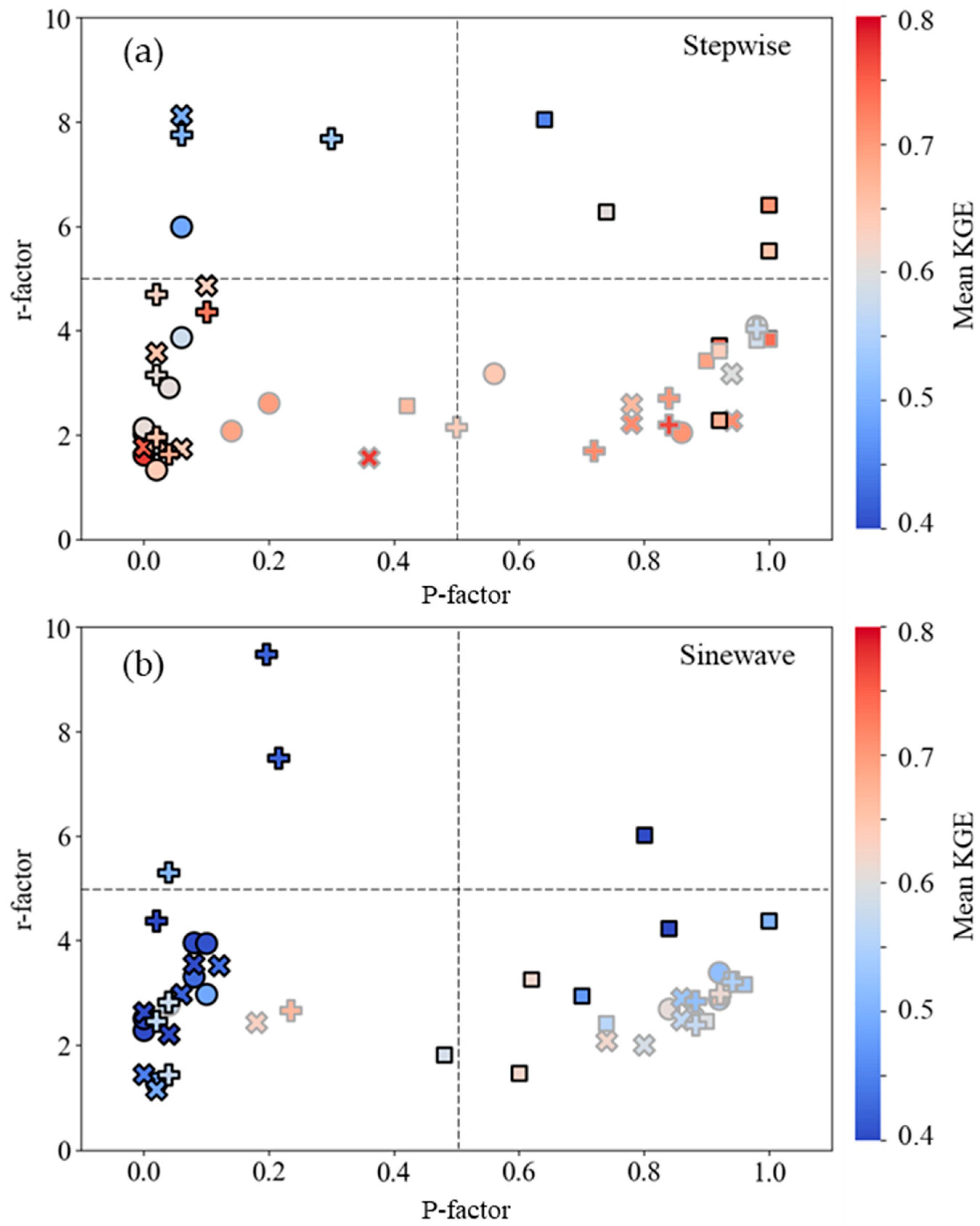
- The lower-Right (high p-factor, low r-factor) quadrant represents the ideal zone where the model is both reliable and precise. Most western front catchments (gray outlines) using rERE and RK fall here, indicating the SAS model effectively captures isotopic variability within a narrow, physically realistic band.
- The lower-Left (low p-factor, low r-factor) quadrant represents an over-confident but biased model. RAW, ER, and RK points for eastern catchments (black outlines) frequently cluster here, particularly under sinewave interpolation. The model produces a tight uncertainty band that simply estimated over the observations, likely failing to account for high-altitude isotopic extremes (Figures S6 and S7). This may be caused by taking the raw data or the averaged δ2H value to represent the catchment, while stream water in the inner catchments is principally sourced from high-altitude upstream reaches rather than concurrent local precipitation as reported by Peng et al. [46].
- The upper-Right (high p-factor, high r-factor) quadrant is a conservative zone where reliability is high but precision is low. Several rERE points for steep catchments move into this quadrant. While the uncertainty band is wide, it successfully encompasses the stream observations, reflecting the high variability of source water in these catchments, which may need further study to constrain it.
- The upper-Left (low p-factor, high r-factor) points in this zone indicate a structural failure where even a wide uncertainty band cannot capture the stream signal. This suggests the SAS model’s mixing assumptions may not match the actual flow-path dynamics of those specific catchments, indicating the efficiency of the model input in the study area.
4.4. Water Age Estimation and the Controls
4.4.1. Dominance of Subsurface Storage (S0)
4.4.2. Eco Hydrological Gradient of ket and αfrac
4.4.3. Selection Dynamics and the Old Water Paradox
4.5. Limitations and Recommendations for Future Work
5. Conclusions
Supplementary Materials
Author Contributions
Funding
Data Availability Statement
Acknowledgments
Conflicts of Interest
References
- Botter, G.; Bertuzzo, E.; Rinaldo, A. Catchment residence and travel time distributions: The master equation. Geophys. Res. Lett. 2011, 38, L11403. [Google Scholar] [CrossRef] [Scilit]
- Harman, C.J. Time-variable transit time distributions and transport: Theory and application to storage-dependent transport of chloride in a watershed. Water Resour. Res. 2015, 51, 1–30. [Google Scholar] [CrossRef] [Scilit]
- Rinaldo, A.; Benettin, P.; Harman, C.J.; Hrachowitz, M.; McGuire, K.J.; van der Velde, Y.; Bertuzzo, E.; Botter, G. Storage selection functions: A coherent framework for quantifying how catchments store and release water and solutes. Water Resour. Res. 2015, 51, 4840–4847. [Google Scholar] [CrossRef] [Scilit]
- Remondi, F.; Botter, M.; Burlando, P.; Fatichi, S. Variability of transit time distributions with climate and topography: A modelling approach. J. Hydrol. 2019, 569, 37–50. [Google Scholar] [CrossRef] [Scilit]
- Yang, J.; Wang, Q.; Heidbüchel, I.; Lu, C.; Xie, Y.; Musolff, A.; Fleckenstein, J.H. Effect of topographic slope on the export of nitrate in humid catchments: A 3D model study. Hydrol. Earth Syst. Sci. 2022, 26, 5051–5068. [Google Scholar] [CrossRef] [Scilit]
- Niemi, A.J. Residence time distributions of variable flow processes. Int. J. Appl. Radiat. Isot. 1977, 28, 855–860. [Google Scholar] [CrossRef] [Scilit]
- McGuire, K.J.; McDonnell, J.J.; Weiler, M.; Kendall, C.; McGlynn, B.L.; Welker, J.M.; Seibert, J. The role of topography on catchment-scale water residence time. Water Resour. Res. 2005, 41, W05002. [Google Scholar] [CrossRef] [Scilit]
- Rinaldo, A.; Botter, G.; Bertuzzo, E.; Uccelli, A.; Settin, T.; Marani, M. Transport at basin scales: 1. Theoretical framework. Hydrol. Earth Syst. Sci. 2006, 10, 19–29. [Google Scholar] [CrossRef] [Scilit]
- Benettin, P.; Rodriguez, N.B.; Sprenger, M.; Kim, M.; Klaus, J.; Harman, C.J.; van der Velde, Y.; Hrachowitz, M.; Botter, G.; McGuire, K.J.; et al. Transit time estimation in catchments: Recent developments and future directions. Water Resour. Res. 2022, 58, e2022WR033096. [Google Scholar] [CrossRef] [Scilit]
- Botter, G.; Bertuzzo, E.; Rinaldo, A. Transport in the hydrologic response: Travel time distributions, soil moisture dynamics, and the old water paradox. Water Resour. Res. 2010, 46, W03514. [Google Scholar] [CrossRef] [Scilit]
- Kirchner, J.W. Aggregation in environmental systems—Part 1: Seasonal tracer cycles quantify young water fractions, but not mean transit times, in spatially heterogeneous catchments. Hydrol. Earth Syst. Sci. 2016, 20, 279–297. [Google Scholar] [CrossRef] [Scilit]
- Hrachowitz, M.; Soulsby, C.; Tetzlaff, D.; Malcolm, I.A.; Schoups, G. Gamma distribution models for transit time estimation in catchments: Physical interpretation of parameters and implications for time-variant transit time assessment. Water Resour. Res. 2010, 46, W10536. [Google Scholar] [CrossRef] [Scilit]
- Danesh-Yazdi, M.; Klaus, J.; Condon, L.E.; Maxwell, R.M. Bridging the gap between numerical solutions of travel time distributions and analytical storage selection functions. Hydrol. Process. 2018, 32, 1063–1076. [Google Scholar] [CrossRef] [Scilit]
- van der Velde, Y.; Torfs, P.J.J.F.; van der Zee, S.E.A.T.M.; Uijlenhoet, R. Quantifying catchment-scale mixing and its effect on time-varying travel time distributions. Water Resour. Res. 2012, 48, W06536. [Google Scholar] [CrossRef] [Scilit]
- Benettin, P.; Kirchner, J.W.; Rinaldo, A.; Botter, G. Modeling chloride transport using travel time distributions at Plynlimon, Wales. Water Resour. Res. 2015, 51, 3259–3276. [Google Scholar] [CrossRef] [Scilit]
- Hrachowitz, M.; Benettin, P.; van Breukelen, B.M.; Fovet, O.; Howden, N.J.K.; Ruiz, L.; van der Velde, Y.; Wade, A.J. Transit times—The link between hydrology and water quality at the catchment scale. WIREs Water 2016, 3, 629–657. [Google Scholar] [CrossRef] [Scilit]
- Kim, M.; Pangle, L.A.; Cardoso, C.; Lora, M.; Volkmann, T.H.M.; Wang, Y.; Harman, C.J.; Troch, P.A. Transit time distributions and StorAge Selection functions in a sloping soil lysimeter with time-varying flow paths. Water Resour. Res. 2016, 52, 7105–7129. [Google Scholar] [CrossRef] [Scilit]
- Wilusz, D.C.; Harman, C.J.; Ball, W.P. Sensitivity of Catchment Transit Times to Rainfall Variability Under Present and Future Climates. Water Resour. Res. 2017, 53, 10231–10256. [Google Scholar] [CrossRef] [Scilit]
- Borriero, A.; Kumar, R.; Nguyen, T.V.; Fleckenstein, J.H.; Lutz, S.R. Uncertainty in water transit time estimation with StorAge Selection functions and tracer data interpolation. Hydrol. Earth Syst. Sci. 2023, 27, 2989–3004. [Google Scholar] [CrossRef] [Scilit]
- Borriero, A.; Nguyen, T.V.; Lutz, S.R.; Fleckenstein, J.H.; Musolff, A.; Kumar, R. Can the young water fraction reduce predictive uncertainty in water transit time estimations? J. Hydrol. 2024, 645, 132238. [Google Scholar] [CrossRef] [Scilit]
- Beven, K.; Freer, J. Equifinality, data assimilation, and uncertainty estimation in mechanistic modelling of complex environmental systems using the GLUE methodology. J. Hydrol. 2001, 249, 11–29. [Google Scholar] [CrossRef] [Scilit]
- Moges, E.; Demissie, Y.; Larsen, L.; Yassin, F. Review: Sources of Hydrological Model Uncertainties and Advances in Their Analysis. Water 2021, 13, 28. [Google Scholar] [CrossRef] [Scilit]
- Nan, Y.; He, Z.; Tian, F.; Wei, Z.; Tian, L. Can we use precipitation isotope outputs of isotopic general circulation models to improve hydrological modeling in large mountainous catchments on the Tibetan Plateau? Hydrol. Earth Syst. Sci. 2021, 25, 6151–6172. Available online: https://hess.copernicus.org/articles/25/6151/2021/ (accessed on 10 April 2026). [CrossRef] [Scilit]
- Avesani, D.; Nan, Y.; Tian, F. Reducing hydrological uncertainty in large mountainous basins: The role of isotope, snow cover, and glacier dynamics in capturing streamflow seasonality. Hydrol. Earth Syst. Sci. 2025, 29, 5755–5775. Available online: https://hess.copernicus.org/articles/29/5755/2025/ (accessed on 10 April 2026). [CrossRef] [Scilit]
- Tetzlaff, D.; Piovano, T.; Ala-Aho, P.; Smith, A.; Carey, S.K.; Marsh, P.; Wookey, P.A.; Street, L.E.; Soulsby, C. Using stable isotopes to estimate travel times in a data-sparse Arctic catchment. Hydrol. Process. 2018, 32, 1936–1952. [Google Scholar] [CrossRef] [Scilit] [PubMed]
- von Freyberg, J.; Rücker, A.; Zappa, M.; Schlumpf, A.; Studer, B.; Kirchner, J.W. Four years of daily stable water isotope data in stream water and precipitation from three Swiss catchments. Sci. Data 2022, 9, 46. [Google Scholar] [CrossRef] [Scilit] [PubMed]
- Burgman, J.O.; Calles, B.; Westman, F. Conclusions from a ten year study of oxygen-18 in precipitation and runoff in Sweden. In Isotope Techniques in Water Resources Development; IAEA: Vienna, Austria, 1987; pp. 579–590. [Google Scholar]
- DeWalle, D.R.; Edwards, P.J.; Swistock, B.R.; Aravena, R.; Drimmie, R.J. Seasonal isotope hydrology of three Appalachian forest catchments. Hydrol. Process. 1997, 11, 1895–1906. [Google Scholar] [CrossRef] [Scilit]
- Buzacott, A.J.V.; van der Velde, Y.; Keitel, C.; Vervoort, R.W. Constraining water age dynamics in a south-eastern Australian catchment using an age-ranked storage and stable isotope approach. Hydrol. Process. 2020, 34, 4384–4403. [Google Scholar] [CrossRef] [Scilit]
- Hrachowitz, M.; Soulsby, C.; Tetzlaff, D.; Dawson, J.J.C.; Malcolm, I.A. Regionalization of transit time estimates in montane catchments by integrating landscape controls. Water Resour. Res. 2009, 45, W05421. [Google Scholar] [CrossRef] [Scilit]
- Ingraham, N.L. Isotopic variation in precipitation. In Isotope Tracers in Catchment Hydrology; Kendall, C., McDonnell, J.J., Eds.; Elsevier: Amsterdam, The Netherlands, 1998; pp. 87–118. [Google Scholar] [CrossRef] [Scilit]
- McGuire, K.J.; McDonnell, J.J. A review and evaluation of catchment transit time modeling. J. Hydrol. 2006, 330, 543–563. [Google Scholar] [CrossRef] [Scilit]
- Jasechko, S.; Kirchner, J.W.; Welker, J.M.; McDonnell, J.J. Substantial proportion of global streamflow less than three months old. Nat. Geosci. 2016, 9, 126–129. [Google Scholar] [CrossRef] [Scilit]
- Hale, V.C.; McDonnell, J.J.; Stewart, M.K.; Solomon, D.K.; Doolitte, J.; Ice, G.G.; Pack, R.T. Effect of bedrock permeability on stream base flow mean transit time scaling relationships: 2. Process study of storage and release. Water Resour. Res. 2016, 52, 1375–1397. [Google Scholar] [CrossRef] [Scilit]
- Jasechko, S. Global isotope hydrogeology—Review. Rev. Geophys. 2019, 57, 835–965. [Google Scholar] [CrossRef] [Scilit]
- Lutz, S.R.; Krieg, R.; Müller, C.; Zink, M.; Knöller, K.; Samaniego, L.; Merz, R. Spatial Patterns of Water Age: Using Young Water Fractions to Improve the Characterization of Transit Times in Contrasting Catchments. Water Resour. Res. 2018, 54, 4767–4784. [Google Scholar] [CrossRef] [Scilit]
- von Freyberg, J.; Allen, S.T.; Seeger, S.; Weiler, M.; Kirchner, J.W. Sensitivity of young water fractions to hydro-climatic forcing and landscape properties across 22 Swiss catchments. Hydrol. Earth Syst. Sci. 2018, 22, 3841–3861. [Google Scholar] [CrossRef] [Scilit]
- Song, C.; Wang, G.; Liu, G.; Mao, T.; Sun, X.; Chen, X. Stable isotope variations of precipitation and streamflow reveal the young water fraction of a permafrost watershed. Hydrol. Process. 2017, 31, 935–947. [Google Scholar] [CrossRef] [Scilit]
- Mayer-Anhalt, L.; Birkel, C.; Sánchez-Murillo, R.; Schulz, S. Tracer-aided modelling reveals quick runoff generation and young streamflow ages in a tropical rainforest catchment. Hydrol. Process. 2022, 36, e14508. [Google Scholar] [CrossRef] [Scilit]
- Gentile, A.; Canone, D.; Ceperley, N.; Gisolo, D.; Previati, M.; Zuecco, G.; Schaefli, B.; Ferraris, S. Towards a conceptualization of the hydrological processes behind changes of young water fraction with elevation: A focus on mountainous alpine catchments. Hydrol. Earth Syst. Sci. 2023, 27, 2301–2323. [Google Scholar] [CrossRef] [Scilit]
- Mosquera, G.M.; Segura, C.; Vaché, K.B.; Windhorst, D.; Breuer, L.; Crespo, P. Insights into the water mean transit time in a high-elevation tropical ecosystem. Hydrol. Earth Syst. Sci. 2016, 20, 2987–3004. [Google Scholar] [CrossRef] [Scilit]
- Muñoz-Villers, L.E.; Geissert, D.R.; Holwerda, F.; McDonnell, J.J. Factors influencing stream baseflow transit times in tropical montane watersheds. Hydrol. Earth Syst. Sci. 2016, 20, 1621–1635. [Google Scholar] [CrossRef] [Scilit]
- Burt, E.I.; Coayla Rimachi, D.H.; Ccahuana Quispe, A.J.; Atwood, A.; West, A.J. Isotope-derived young water fractions in streamflow across the tropical Andes mountains and Amazon floodplain. Hydrol. Earth Syst. Sci. 2023, 27, 2883–2898. [Google Scholar] [CrossRef] [Scilit]
- Immerzeel, W.W.; Lutz, A.F.; Andrade, M.; Bahl, A.; Biemans, H.; Bolch, T.; Hyde, S.; Brumby, S.; Davies, B.J.; Elmore, A.C.; et al. Importance and vulnerability of the world’s water towers. Nature 2020, 577, 364–369. [Google Scholar] [CrossRef] [Scilit] [PubMed]
- Yu, S.B.; Chen, H.Y.; Kuo, L.C. Velocity field of GPS stations in the Taiwan area. Tectonophysics 1997, 274, 41–59. [Google Scholar] [CrossRef] [Scilit]
- Ernst, W.G.; Jahn, B.M. Crustal evolution of Taiwan: A petrological and geochemical perspective. Tectonophysics 1987, 140, 177–205. [Google Scholar]
- Peng, T.R.; Wang, C.H.; Huang, C.C.; Fei, L.Y.; Chen, C.T.A.; Hwong, J.L. Stable isotopic characteristic of Taiwan’s precipitation: A case study of western Pacific monsoon region. Earth Planet. Sci. Lett. 2010, 289, 357–366. [Google Scholar] [CrossRef] [Scilit]
- Peng, T.R.; Chen, K.Y.; Zhan, W.J.; Lu, W.C.; Tong, L.T.J. Use of stable water isotopes to identify hydrological processes of meteoric water in montane catchments. Hydrol. Process. 2015, 29, 4957–4967. [Google Scholar] [CrossRef] [Scilit]
- Hsu, S.M. Quantifying the hydraulic properties of fractured rock masses along a borehole using composite geological indices: A case study in the mid and upper Choshui River Basin in Central Taiwan. Eng. Geol. 2021, 284, 105924. [Google Scholar] [CrossRef] [Scilit]
- Huang, C.C.; Lin, J.J.; Hsu, S.M. A Study on Hydrogeological Characteristics and Groundwater Resources Potential in the Mountainous Regions of Taiwan. Bull. Cent. Geol. Surv. MOEA 2013, 26, 27–54. Available online: https://twgeoref.gsmma.gov.tw/GeoWeb/cp.do?action=cp&kt=2748&xItem=145944&ctNode=217&mp=6 (accessed on 10 April 2026). (In Chinese)
- Arnold, J.G.; Srinivasan, R.; Muttiah, R.S.; Williams, J.R. Large area hydrologic modeling and assessment part I: Model development. J. Am. Water Resour. Assoc. 1998, 34, 73–89. [Google Scholar] [CrossRef] [Scilit]
- Lu, C.M.; Chiang, L.C. Assessment of Sediment Transport Functions with the Modified SWAT-Twn Model for a Taiwanese Small Mountainous Watershed. Water 2019, 11, 1749. [Google Scholar] [CrossRef] [Scilit]
- Chiang, L.C.; Liao, C.J.; Lu, C.M.; Huang, P.H.; Yuan, Y. Applicability of modified SWAT model (SWAT-Twn) on simulation of watershed sediment yields under different land use/cover scenarios in Taiwan. Environ. Monit. Assess. 2021, 193, 520. [Google Scholar] [CrossRef] [Scilit]
- Chiang, L.C.; Shih, P.C.; Lu, C.M.; Jhong, B.C. Strategies analysis for improving SWAT model accuracy and representativeness of calibrated parameters in sediment simulation for various land use and climate conditions. J. Hydrol. 2023, 626, 130124. [Google Scholar] [CrossRef] [Scilit]
- Abbaspour, K.C. SWAT-CUP: SWAT Calibration and Uncertainty Programs—A User Manual; Eawag: Dübendorf, Switzerland, 2015. [Google Scholar]
- Moriasi, D.N.; Arnold, J.G.; Van Liew, M.W.; Bingner, R.L.; Harmel, R.D.; Veith, T.L. Model Evaluation Guidelines for Systematic Quantification of Accuracy in Watershed Simulations. Trans. ASABE 2007, 50, 885–900. [Google Scholar] [CrossRef] [Scilit]
- Lee, J.Y.; Shih, Y.T.; Lan, C.Y.; Lee, T.Y.; Peng, T.R.; Lee, C.T.; Huang, J.C. Rainstorm Magnitude Likely Regulates Event Water Fraction and Its Transit Time in Mesoscale Mountainous Catchments: Implication for Modelling Parameterization. Water 2020, 12, 1169. [Google Scholar] [CrossRef] [Scilit]
- Knighton, J.; Souter-Kline, V.; Volkmann, T.; Troch, P.A.; Kim, M.; Harman, C.J.; Morris, C.; Buchanan, B.; Walter, M.T. Seasonal and Topographic Variations in Ecohydrological Separation Within a Small, Temperate, Snow-Influenced Catchment. Water Resour. Res. 2019, 55, 6417–6435. [Google Scholar] [CrossRef] [Scilit]
- Smith, A.A.; Tetzlaff, D.; Soulsby, C. Using storage selection functions to assess mixing patterns and water ages of soil water, evaporation and transpiration. Adv. Water Resour. 2020, 141, 103586. [Google Scholar] [CrossRef] [Scilit]
- Benettin, P.; Bertuzzo, E. tran-SAS v1.0: A numerical model to compute catchment-scale hydrologic transport using storage selection functions. Geosci. Model Dev. 2018, 11, 1627–1639. [Google Scholar] [CrossRef] [Scilit]
- Bliss, C.I. Statistics in Biology; McGraw-Hill: New York, NY, USA, 1970; Volume 2, pp. 219–284. [Google Scholar] [CrossRef] [Scilit]
- Benettin, P.; Soulsby, C.; Birkel, C.; Tetzlaff, D.; Botter, G.; Rinaldo, A. Using SAS functions and high-resolution isotope data to unravel travel time distributions in headwater catchments. Water Resour. Res. 2017, 53, 1864–1878. [Google Scholar] [CrossRef] [Scilit]
- Nguyen, T.V.; Kumar, R.; Lutz, S.R.; Musolff, A.; Yang, J.; Fleckenstein, J.H. Modeling Nitrate Export From a Mesoscale Catchment Using StorAge Selection Functions. Water Resour. Res. 2021, 57, e2020WR028490. [Google Scholar] [CrossRef] [Scilit]
- Gat, J.R.; Gonfiantini, R. Stable Isotope Hydrology: Deuterium and Oxygen-18 in the Water Cycle; Technical Reports Series No. 210; IAEA: Vienna, Austria, 1981; pp. 1–337. Available online: http://www-pub.iaea.org/books/IAEABooks/1311/Stable-Isotope-Hydrology-Deuterium-and-Oxygen-18-in-the-Water-Cycle (accessed on 11 November 2024).
- Gupta, H.V.; Kling, H.; Yilmaz, K.K.; Martinez, G.F. Decomposition of the mean squared error and NSE performance criteria: Implications for improving hydrological modelling. J. Hydrol. 2009, 377, 80–91. [Google Scholar] [CrossRef] [Scilit]
- Abbaspour, K.C.; Johnson, C.A.; van Genuchten, M.T. Estimating uncertain flow and transport parameters using a sequential uncertainty fitting procedure. Vadose Zone J. 2004, 3, 1340–1352. [Google Scholar] [CrossRef] [Scilit]
- Kirchner, J.W.; Feng, X.; Neal, C. Catchment-scale advection and dispersion as a mechanism for fractal scaling in stream tracer concentrations. J. Hydrol. 2001, 254, 82–101. [Google Scholar] [CrossRef] [Scilit]
- Tetzlaff, D.; Birkel, C.; Dick, J.; Geris, J.; Soulsby, C. Storage dynamics in hydropedological units control hillslope connectivity, runoff generation and the evolution of catchment transit time distributions. Water Resour. Res. 2014, 50, 969–985. [Google Scholar] [CrossRef] [Scilit]
- Andersson, J.C.M.; Arheimer, B.; Traoré, F.; Gustafsson, D.; Ali, A. Process refinements improve a hydrological model concept applied to the Niger River basin. Hydrol. Process. 2017, 31, 4540–4554. [Google Scholar] [CrossRef] [Scilit]
- Thiemig, V.; Rojas, R.; Zambrano-Bigiarini, M.; De Roo, A. Hydrological evaluation of satellite-based rainfall estimates over the Volta and Baro-Akobo Basin. J. Hydrol. 2013, 499, 324–338. [Google Scholar] [CrossRef] [Scilit]
- Pfister, L.; Martínez-Carreras, N.; Hissler, C.; Klaus, J.; Carrer, G.E.; McDonnell, J.J.; Hoffmann, L. Bedrock geology controls on catchment storage, mixing, and release: A comparative analysis of 16 nested catchments. Hydrol. Process. 2017, 31, 1828–1845. [Google Scholar] [CrossRef] [Scilit]
- Allen, S.T.; Kirchner, J.W.; Braun, S.; Siegwolf, R.T.W.; Goldsmith, G.R. Seasonal origins of soil water used by trees. Hydrol. Earth Syst. Sci. 2019, 23, 1199–1210. [Google Scholar] [CrossRef] [Scilit]
- Hrachowitz, M.; Savenije, H.H.G.; Blöschl, G.; McDonnell, J.J.; Sivapalan, M.; Pomeroy, J.W.; Arheimer, B.; Blume, T.; Clark, M.P.; Ehret, U.; et al. A decade of Predictions in Ungauged Basins (PUB)—A review. Hydrol. Sci. J. 2013, 58, 1198–1255. [Google Scholar] [CrossRef] [Scilit]
- Soulsby, C.; Birkel, C.; Geris, J.; Dick, J.; Tunaley, C.; Tetzlaff, D. Stream water age distributions controlled by storage dynamics and nonlinear hydrologic connectivity: Modeling with high-resolution isotope data. Water Resour. Res. 2015, 51, 7759–7776. [Google Scholar] [CrossRef] [Scilit]
- Kirchner, J.W. A double paradox in catchment hydrology and geochemistry. Hydrol. Process. 2003, 17, 871–874. [Google Scholar] [CrossRef] [Scilit]



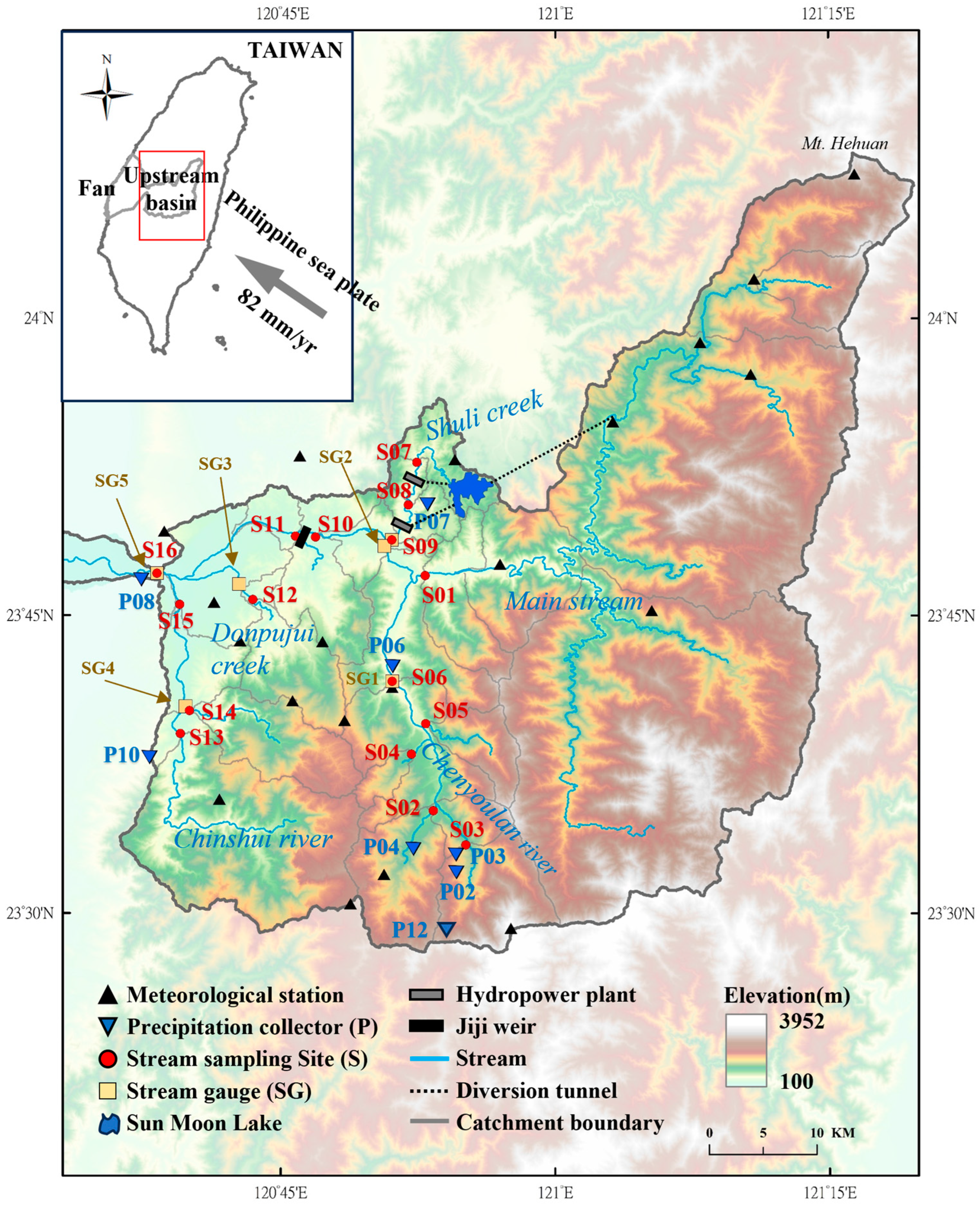
| Site | Latitude | Longitude | Elevation (m asl) | δ2H (Weighted Mean) (‰) | n |
|---|---|---|---|---|---|
| P02 | 23.534 | 120.909 | 1919 | −113 to −9 (−62) | 35 |
| P03 | 23.553 | 120.913 | 1440 | −102 to −3 (−59) | 35 |
| P04 | 23.553 | 120.870 | 1077 | −107 to −1 (−55) | 34 |
| P06 | 23.694 | 120.850 | 478 | −110 to 7 (−43) | 30 |
| P07 | 23.843 | 120.866 | 361 | −93 to −1 (−47) | 27 |
| P08 | 23.780 | 120.636 | 101 | −68 to −1 (−40) | 22 |
| P10 | 23.630 | 120.629 | 433 | −85 to 14 (−42) | 32 |
| P12 | 23.487 | 120.889 | 2619 | −105 to −10 (−63) | 12 |
| Stream | Site | Drainage Area (km2) | Mean Elevation (m asl) | Slope (%) | Mean δ2H (‰) | rERE (m asl) | Designated Raw Station |
|---|---|---|---|---|---|---|---|
| M | S01 | 1626 | 1915 (317 to 3819) | 77 | −78 (−88 to −64) | 3305 | P02 |
| CYL | S02 | 90 | 1734 (774 to 2847) | 73 | −69 (−73 to −59) | 2580 | P02 |
| CYL | S03 | 86 | 2229 (957 to 3855) | 87 | −80 (−84 to −71) | 3492 | P02 |
| CYL | S04 | 15 | 1484 (757 to 2402) | 72 | −66 (−70 to −57) | 2350 | P03 |
| CYL | S05 | 41 | 1926 (618 to 3250) | 85 | −72 (−75 to −64) | 2809 | P02 |
| CYL | S06 | 364 | 1711 (472 to 3855) | 75 | −72 (−75 to −58) | 2807 | P02 |
| SL | S07 | 43 | 744 (463 to 1341) | 49 | −52 (−58 to −44) | 1244 | P06 |
| SL | S08 | 55 | 730 (360 to 1341) | 43 | −59 (−68 to −45) | 1807 | P06 |
| SL | S09 | 82 | 697 (267 to 1341) | 46 | −65 (−71 to −58) | 2276 | P06 |
| M | S10 | 2201 | 1772 (215 to 3855) | 74 | −73 (−84 to −62) | 2873 | P02 |
| M | S11 | 2290 | 1724 (190 to 3855) | 72 | −70 (−83 to −46) | 2678 | P02 |
| DPR | S12 | 73 | 866 (186 to 2024) | 50 | −49 (−55 to −43) | 988 | P04 |
| CS | S13 | 259 | 1175 (214 to 2660) | 65 | −55 (−60 to −45) | 1459 | P03 |
| CS | S14 | 87 | 1295 (198 to 2286) | 67 | −56 (−62 to −45) | 1521 | P04 |
| CS | S15 | 406 | 1076 (117 to 2660) | 61 | −52 (−59 to −44) | 1210 | P04 |
| M | S16 | 2893 | 1547 (89 to 3855) | 68 | −64 (−77 to −45) | 2224 | P03 |
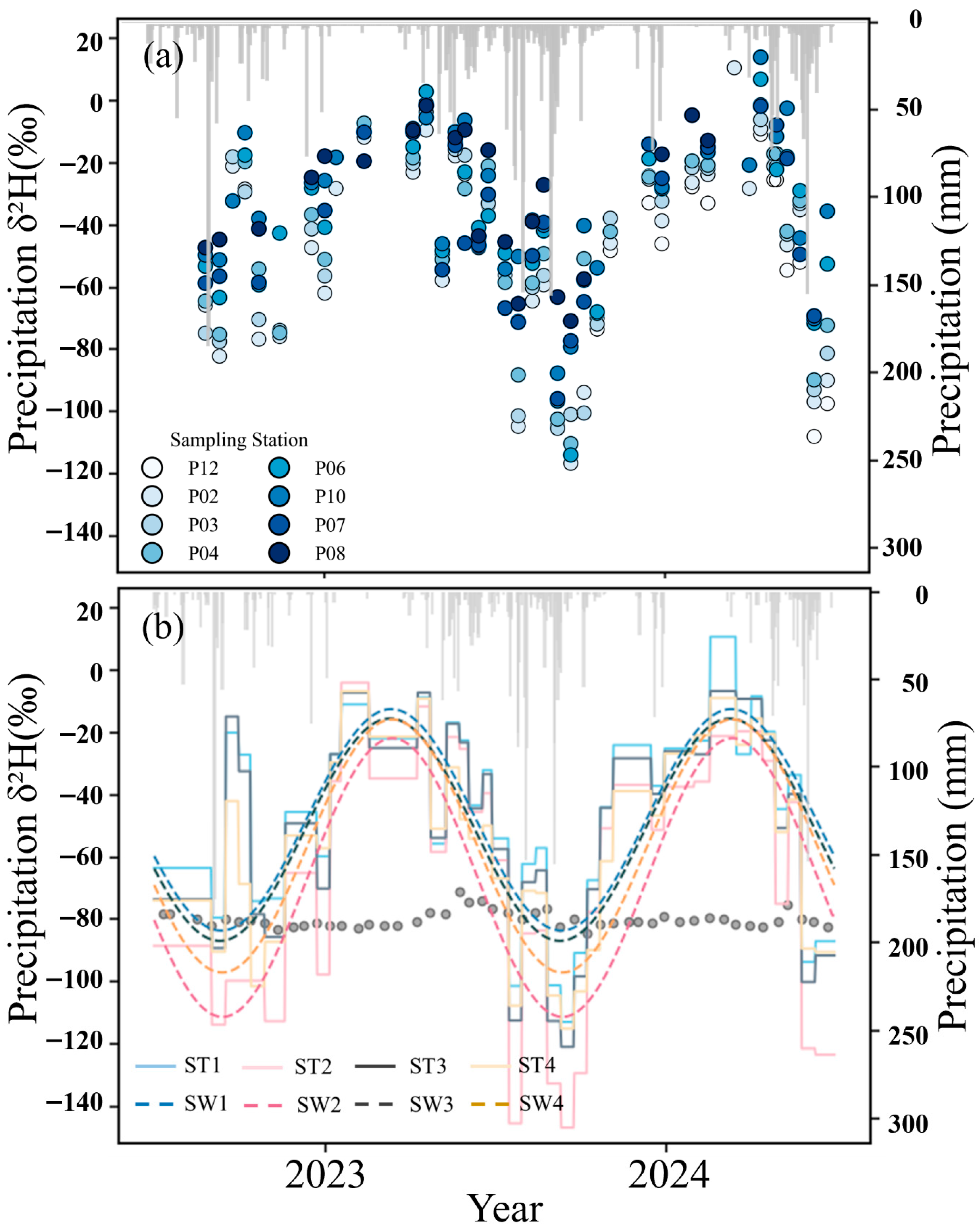
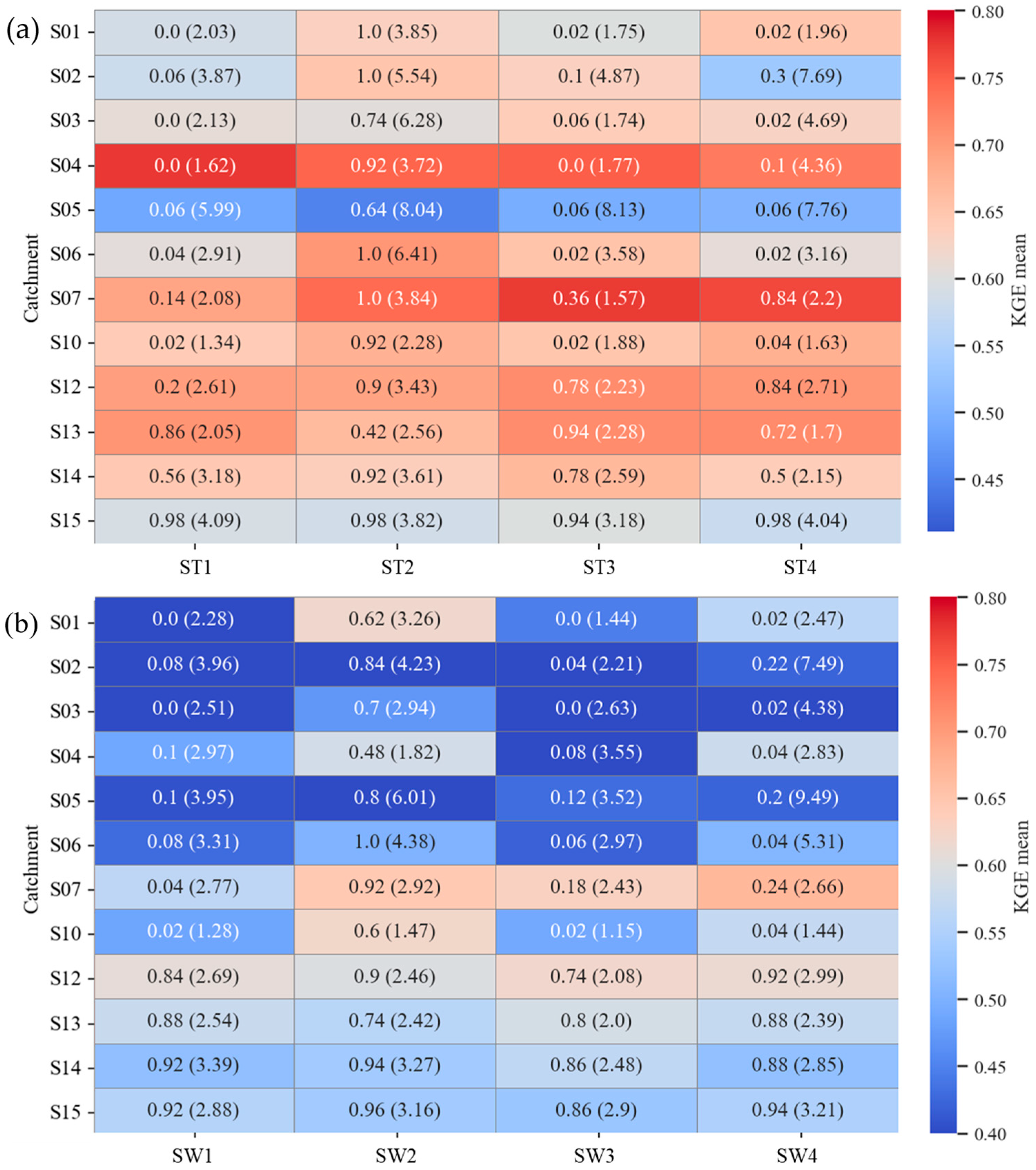
| Scenario | Spatial | Temporal | Storage Selection Function |
|---|---|---|---|
| ST1 | Raw | Stepwise | Time variant fSAS (Beta distribution) |
| ST2 | rERE | ||
| ST3 | ER | ||
| ST4 | RK | ||
| SW1 | Raw | Sinewave | |
| SW2 | rERE | ||
| SW3 | ER | ||
| SW4 | RK |
| Calibrated Parameter | Symbol (Unit) | Lower Bound | Upper Bound |
|---|---|---|---|
| initial storage | S0 (mm) | 500 | 10,000 |
| shape parameter | Kmin (-) | 0.01 | 1 |
| shape parameter | Kmax (-) | 0.01 | 10 |
| shape controlling factor | Θ (-) | 0.01 | 10 |
| ET selection parameter | Ket (-) | 0.01 | 10 |
| fractionation coefficient for evaporation | αfrac (-) | 0.9995 | 1.0000 |
| Station | Period | p-Factor | r-Factor | R2 | NSE | PBIAS (%) | KGE | Mean Simulation (Mean Observation) (m3/s) |
|---|---|---|---|---|---|---|---|---|
| SG1 | calibration | 0.83 | 0.64 | 0.62 | 0.49 | −19.8 | 0.68 | 19.69 (16.42) |
| validation | 0.58 | 0.56 | 0.67 | 0.60 | 26.8 | 0.57 | 16.71 (22.85) | |
| SG2 | calibration | 0.71 | 0.52 | 0.59 | 0.54 | −10.0 | 0.75 | 93.50 (84.97) |
| validation | 0.64 | 0.36 | 0.65 | 0.59 | 16.0 | 0.50 | 90.49 (107.70) | |
| SG3 | calibration | 0.37 | 0.20 | 0.69 | 0.64 | 20.4 | 0.54 | 4.28 (5.37) |
| validation | 0.47 | 0.31 | 0.76 | 0.75 | 2.1 | 0.87 | 4.19 (4.28) | |
| SG4 | calibration | 0.49 | 0.20 | 0.81 | 0.81 | −16.1 | 0.81 | 24.03 (20.70) |
| validation | 0.47 | 0.23 | 0.69 | 0.64 | −40.1 | 0.56 | 23.56 (16.82) | |
| SG5 | calibration | 0.21 | 0.30 | 0.67 | 0.62 | −50.2 | 0.46 | 140.31 (93.38) |
| validation | 0.48 | 0.37 | 0.72 | 0.68 | −31.6 | 0.64 | 137.47 (104.46) |
Disclaimer/Publisher’s Note: The statements, opinions and data contained in all publications are solely those of the individual author(s) and contributor(s) and not of MDPI and/or the editor(s). MDPI and/or the editor(s) disclaim responsibility for any injury to people or property resulting from any ideas, methods, instructions or products referred to in the content. |
© 2026 by the authors. Licensee MDPI, Basel, Switzerland. This article is an open access article distributed under the terms and conditions of the Creative Commons Attribution (CC BY) license.
Share and Cite
Chen, J.-P.; Chen, Y.-C.; Lee, J.-Y.; Chiang, L.-C.; Chang, F.-J.; Huang, J.-C. Uncertainty of Temporal and Spatial δ2H Interpolation on Young Water Fraction Estimates Using the StorAge Selection Function in Subtropical Mountain Catchments. Water 2026, 18, 958. https://doi.org/10.3390/w18080958
Chen J-P, Chen Y-C, Lee J-Y, Chiang L-C, Chang F-J, Huang J-C. Uncertainty of Temporal and Spatial δ2H Interpolation on Young Water Fraction Estimates Using the StorAge Selection Function in Subtropical Mountain Catchments. Water. 2026; 18(8):958. https://doi.org/10.3390/w18080958
Chicago/Turabian StyleChen, Jui-Ping, Yi-Chin Chen, Jun-Yi Lee, Li-Chi Chiang, Fi-John Chang, and Jr-Chuan Huang. 2026. "Uncertainty of Temporal and Spatial δ2H Interpolation on Young Water Fraction Estimates Using the StorAge Selection Function in Subtropical Mountain Catchments" Water 18, no. 8: 958. https://doi.org/10.3390/w18080958
APA StyleChen, J.-P., Chen, Y.-C., Lee, J.-Y., Chiang, L.-C., Chang, F.-J., & Huang, J.-C. (2026). Uncertainty of Temporal and Spatial δ2H Interpolation on Young Water Fraction Estimates Using the StorAge Selection Function in Subtropical Mountain Catchments. Water, 18(8), 958. https://doi.org/10.3390/w18080958