


Abstract
Droplet freezing on cold surfaces plays a critical role in icing phenomena and thermal management systems. In this study, a numerical model is developed to investigate the freezing of a single water droplet, with emphasis on the influence of natural convection on internal flow dynamics. A two-phase (water–ice) solver is implemented in OpenFOAM by incorporating an enthalpy–porosity solidification model and a buoyancy model into an existing framework. The solver is verified against the analytical solution of the one-dimensional Stefan problem and validated using benchmark cases of natural convection and solidification in a cavity. Using the validated model, we examine the effects of natural convection and water density inversion on the internal flow behavior during droplet freezing. Simulations are performed for a rigid axisymmetric droplet configuration. By accounting for density inversion in the buoyancy source term, the model successfully captures the experimentally observed reversal of internal flow during freezing. The results indicate that the flow reversal occurs when the maximum droplet temperature approaches the density inversion temperature of water. While early-stage freezing follows the classical Stefan solution, comparisons with experimental data indicate that incorporating droplet impact and heat transfer to the surroundings would further enhance the model’s predictive capability.
1. Introduction
Studying the solidification of water is essential due to its critical role in many natural and industrial processes. The buildup of ice on the surface of engineering structures such as aircraft [1,2], wind turbines [3], and hydropower facilities can significantly reduce their efficiency and even lead to hazardous situations. Water freezing is also of great importance in meteorology, spray freezing technologies, and thermal energy storage systems [4], where understanding the phase-change dynamics is crucial for both performance optimization and safety. As the solidification of a water droplet is the starting point of the freezing process, investigating it is important for understanding anti-icing and de-icing mechanisms.
Freezing of a droplet goes through five distinct stages [5,6,7]: (1) supercooling, during which the liquid temperature decreases to a temperature below freezing temperature without phase change; (2) nucleation, which is the point at which the supercooling stage ends due to the formation of nucleation sites; (3) recalescence, during which the droplet temperature rises back toward the freezing point due to latent head release from crystal growth at the nuclei; (4) freezing, during which the solid–liquid interface advances until the droplet is fully solid; and (5) solid cooling, where the temperature of the fully frozen droplet decreases due to conduction heat transfer. Finally, a single water droplet on a cold surface freezes into a singular shape. The volume expansion of water upon freezing in the vertical direction, together with surface tension effects, has been reported as the main reason for the formation of a singular sharp conical tip in a freezing water droplet [8,9]. Even asymmetric droplets form a universal freezing tip, with the position shifting according to the asymmetry of the droplet [10]. Furthermore, Starostin et al. [11] demonstrated that although the geometry of the freezing tip is universal, its spatial orientation is controlled by asymmetric heat conduction in the substrate. While the formation of a conical tip at the end of the solidification process of a water droplet has been proven in several studies, Miao et al. [12] showed in a combined experimental and analytical study that external air convection can suppress the formation of the sharp ice tip in a freezing droplet by changing the shape of the freezing front, causing the tip angle to vary from 131° to 180° (i.e., no sharp tip). Zhang et al. [13] reported that the formation of the tipless freezing mode is caused by strong convective heat transfer under forced convection, which brings the solid–liquid interface to thermal equilibrium and significantly slows its upward movement.
Various topics have been the focus of numerical and experimental studies on freezing droplets. In a numerical study, Zhang et al. [14] incorporated the effects of supercooling and volume expansion during droplet freezing, enabling improved predictions of freezing-front evolution and total freezing time. Their results showed better agreement with experimental observations compared to earlier studies that neglected these effects. Regarding their findings, plate temperature and contact angle showed a stronger influence on the freezing process than the volume of the droplet. Castillo et al. [15] measured the surface temperature of the droplet using infrared thermography, which was used as a boundary condition in their numerical simulations. The time-dependent boundary condition provided better agreement with the experimental results compared to models assuming constant thermal conditions. Their simulations further demonstrated that the majority of the latent heat released during solidification is transferred into the substrate, while only a small fraction is released to the surrounding air. In addition, the substrate surface structure affects the freezing process of a droplet. Although hydrophobic surfaces can reduce droplet attachment to the surface, thereby reducing heat transfer and freezing [16], Kong et al. [17] showed that rebound or freezing occurrence on hydrophobic and superhydrophobic surfaces depends on the degree of supercooling that droplets can freeze before rebounding. On hydrophilic surfaces, droplets adhere quickly upon impact and typically freeze in place.
Flow interactions inside and outside the droplet may also influence the temperature distribution and rate of the freezing process. In an experimental and numerical study, Kawanami et al. [18] investigated the effects of Marangoni convection caused by surface tension gradients along with buoyancy forces arising from the density inversion at 4 °C on the internal flow of a freezing droplet. According to their findings, both have significant impacts on the freezing process and internal flow at the density inversion point. Furthermore, increased influence of natural convection close to the density inversion temperature was observed in the numerical study by Karlsson et al. [19], although effects on flow dynamics, such as directional velocity changes, were not studied. In a combined experimental and numerical study, Voulgaropoulos et al. [20] investigated the freezing process and internal flow of a sessile water droplet surrounded by oil cooled by heat transfer to the surrounding oil. However, their simulations neglected the volume expansion of the droplet. The directional change of the internal flow in a freezing droplet was first reported by Karlsson et al. [21], who utilized the particle image velocimetry (PIV) method to measure the velocity fields inside the droplet. Their observations indicate that the initial flow direction is upward along the centerline, that downward flow occurs near the water–air interface, and that the flow direction reverses as time progresses. In a subsequent study, Karlsson et al. [22] reported the directional change in evaporating droplets and performed a comparative analysis between freezing and evaporating cases. Using a modified version of the same experimental setup, Fagerström et al. [23] examined the effect of substrate material on the internal flow during freezing of a droplet, showing that substrate material influences the magnitude of velocity. Furthermore, Fagerström and Ljung [24], indicated that a larger contact angle increases the internal velocity, freezing time, and time until directional change, while the substrate temperature influences the internal velocity and freezing time. In a more recentstudy [25], they compared the internal flow in freezing and non-freezing subcooled droplets, demonstrating that the freezing process itself is not the main driving force of the internal flow, which is instead driven by the temperature difference between the droplet and the substrate.
Several mechanisms can influence the magnitude and direction of internal flow of a freezing droplet, including natural convection, Marangoni convection, conduction, and volume expansion. Although the magnitude of internal flow and the velocity directional change can be investigated through experiments, in order to examine and control the effect of individual mechanisms there is a need to couple experiments with numerical work. Most studies on internal flow within freezing droplets have been experimental, and the mechanisms responsible for the observed directional changes in the flow are still not fully understood. Therefore, the present work focuses on a numerical investigation of the influence of natural convection on these directional changes. In this paper, a new solver is implemented in the open-source software OpenFOAM v2312 to simulate the freezing process and natural convection, incorporating the enthalpy–porosity method for solidification modeling and a temperature-dependent density relation for water to represent the density inversion at 4 °C. Using the applied solver, we investigate the freezing process dynamics for a freezing sessile droplet, including natural convection. The OpenFOAM solver is verified and validated with available models and experiments from the literature [26,27,28], and simulations of a single droplet are compared with the experimental results by Fagerström and Ljung [25].
2. Materials and Modeling Approach
In this section, the governing equations for simulating the freezing process and flow dynamics of a water droplet on a cold surface are presented in detail. The numerical setup used in the simulations is also described. Lastly, methods used for the validation of the implemented OpenFOAM solver are introduced.
2.1. Governing Equations
The incompressible continuity and momentum equations in the simulation of fluid flow are
in which and represent the buoyancy and Darcy source [29] terms, respectively, which are defined in the following subsections.
2.1.1. Solidification Model
The solidification of a freezing water droplet is simulated using the enthalpy–porosity approach introduced by Voller and Prakash [29]. This formulation utilizes both sensible and latent heat through an enthalpy-based energy description, while the porosity concept is employed to capture the gradual transition between liquid and solid phases:
where
Here, h represents the sensible enthalpy, while denotes the latent heat contribution. The sensible enthalpy is expressed as
where is the reference enthalpy at the reference temperature and is the specific heat at constant pressure. During the solidification process, the latent heat is expressed as
where L denotes the latent heat of fusion and represents the liquid volume fraction within a computational cell. The value of is equal to 1.0 in the fully liquid state and 0.0 in the fully solid state, while in the mushy region it lies between between 0.0 and 1.0, commonly approximated by a linear variation. In the case of a non-isothermal phase change, this relationship can be expressed using the following step function:
where is the upper bound (liquidus temperature) and is the lower bound (solidus temperature) of the phase change temperature range ( ), which are defined as
This method can be used for isothermal phase changes by considering a small . Substituting the defined expression for H into Equation (3) yields an energy formulation that accounts for both sensible and latent heat effects associated with solidification:
When used in the enthalpy–porosity method, the piecewise linear relation given in Equation (7) requires an iterative procedure in order to ensure coupling between the liquid volume fraction and the energy equation.
As solidification progresses, the fluid velocity is damped and ultimately approaches zero. To capture this behavior, a Darcy-type source term (see Equation (2)) is introduced into the momentum equation to impose resistance within the phase-change region. The Carman–Kozeny relation is used to define this source term, which is written as
where is the mushy zone constant and q is a small value to prevent division by zero when is equal to zero in the solid region. The value of determines how quickly the flow is damped during the phase change process. Since the mushy zone constant is a large value, the small value of q has a negligible influence on the solidification process. Finally, the thermophysical material properties of the two-phase mixture at the interface of fluid and solid are obtained from the following relation:
where the subscripts l and s represent liquid and solid, respectively, and y can represent any physical property.
2.1.2. Buoyancy and Natural Convection
Natural convection under small variations in density is commonly modeled using the Boussinesq approximation, in which density depends linearly on temperature. Accordingly, the buoyancy source term in the momentum equation (Equation (2)) is defined as
where is the reference temperature, is the density in reference temperature, is the thermal expansion coefficient at the reference temperature, and the subscript B refers to the Boussinesq approximation. However, water has an anomalous behavior in which its density varies nonlinearly with temperature and reaches a maximum near 4 °C. As a result, the thermal expansion coefficient is negative between 0 °C and 4 °C, and becomes positive at higher temperatures. The relation for the temperature-dependent density is defined as [27]
in which T is the temperature in Celsius. In this case, the buoyancy term is
The subscript w denotes water.
2.2. Numerical Setup
The finite volume method based on open-source OpenFOAM software is applied to simulate the solidification process. A new solver is developed by implementing solidification source terms from the enthalpy–porosity method as well as the buoyancy source term related to water density expression (Equation (12)) based on the buoyantBoussinesqPimpleFoam solver in OpenFOAM. The energy equation of the base solver is modified to incorporate the enthalpy–porosity solidification method and enable its iterative solution, coupling the liquid volume fraction with the energy equation; in addition, a Darcy source term is added to the momentum equation to account for the velocity damping in the solid region. Furthermore, the density relation in the bouncy source term is changed to include the water density expression.
A first-order Euler scheme is employed for time discretization to ensure numerical stability during phase change. Spatial gradients are computed using a second-order Gauss linear scheme. Convective terms in the momentum and energy equations are discretized using a limited linear scheme to maintain stability and prevent non-physical oscillations, while an upwind scheme is applied for temperature transport to enhance robustness. The phase fraction equation is discretized using a second-order Van Leer scheme to accurately capture the interface while preserving boundedness. Diffusive terms are treated using a second-order Gauss linear corrected scheme to account for mesh non-orthogonality. Pressure–velocity coupling is handled using the PIMPLE algorithm. Tight convergence criteria were applied, with residual tolerances set to for pressure and for velocity and temperature.
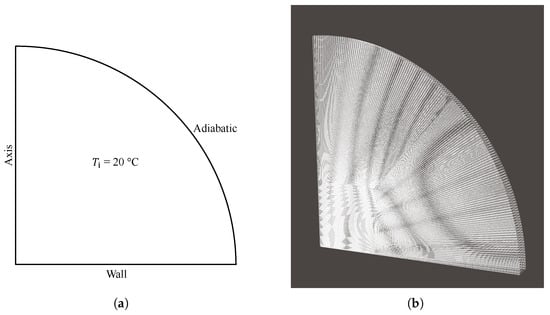
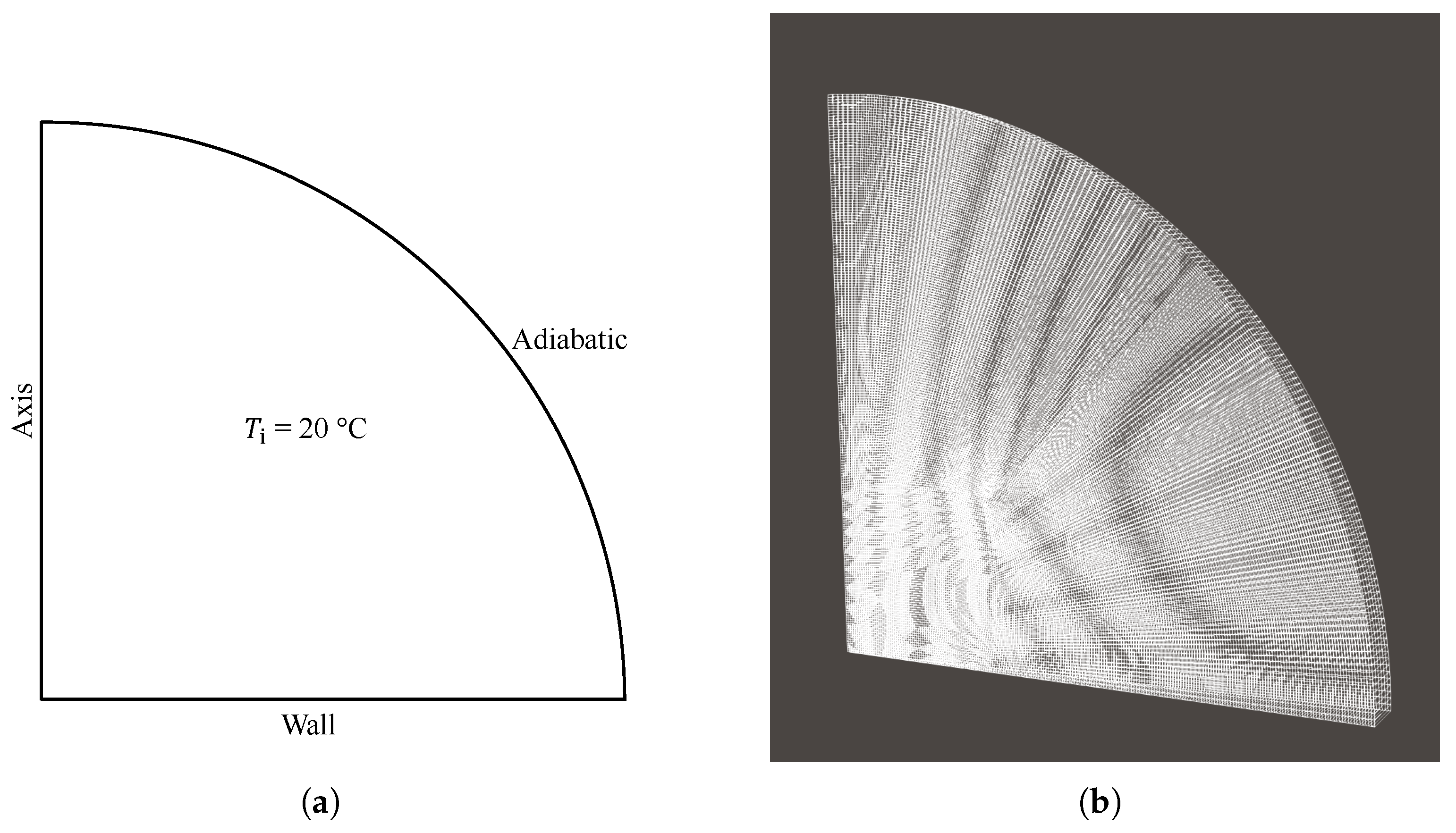
The investigated geometry in the simulations is based on the experiments by Fagerström and Ljung [25]. To focus on the primary objective of the present study, namely, the effect of natural convection on internal flow dynamics, the computational domain is simplified. The surrounding air is neglected to eliminate heat transfer effects with the environment, and a rigid droplet geometry is assumed to exclude shape deformation during phase change. This assumption is reasonable during the early stages of freezing, when the droplet shape does not change significantly. Accordingly, an axisymmetric rigid droplet with a radius of 1.6285 mm is considered, while the surrounding air is neglected (see Figure 1a). As illustrated in Figure 1b, a wedge-shaped slice of the droplet with one cell in the circumference direction is used for two-dimensional axisymmetric simulations in OpenFOAM. A room temperature of 20 °C is considered as the initial temperature of the droplet, and two different wall temperatures of −8 °C and −12 °C are examined. The zero-gradient boundary condition is defined on the droplet surface to prevent any effects from this surface on the flow. An o-grid mesh with hexahedral cells, shown in Figure 1b, is adopted for the computational domain. The mesh shown in the figure is relatively coarse in order to illustrate the mesh structure. A grid independence study is presented in Section 3.2.1.
Figure 1.
Axisymmetric rigid droplet domain: (a) geometry and boundary conditions; (b) mesh (27,816 nodes).
2.3. Methods for Verification and Validation
The evaluation of the implemented new solver is carried out in two steps. First, the solidification process is verified by comparing a one-dimensional setup with the analytical solution of the Stefan problem [30]. Second, the natural convection implementation of the solver is tested via simulation of natural convection and solidification in a cavity, following the experimental studies by Giangi et al. [26] and Kowalewski and Rebow [27]. Furthermore, the numerical results of flow in a cavity are compared with the numerical study by Nyueyong et al. [28].
2.3.1. One-Dimensional Phase Change Problem
The Stefan problem, also known as the moving boundary problem, is a fundamental model of heat transfer problems with solidification or melting phase change. In this framework, the freezing front development and temperature distribution can be obtained by solving diffusion equations in the solid and liquid phases while considering an energy balance at the interface between the phases. The analytical solution for this problem is known as Neumann’s solution, where the position of the solid–liquid interface over time is obtained as [30]
in which is the thermal diffusivity of the solid phase and is a constant parameter determined from the following transcendental equation [31]:
where , , and are the phase change temperature, wall temperature, and initial temperature expressed in Celsius, respectively. The temperature in the solid and liquid regions is expressed as
and
where the substrates l and s represent liquid and solid, respectively.
To simulate an isothermal solidification in the Stefan problem, a one-dimensional domain with a length of 50 mm and 200 cells is used. The fluid is in contact with a cold surface with °C and starts freezing from this surface. The initial temperature of the fluid is °C and the solidification temperature is °C. The phase change temperature range used in the simulations is set to a value of °C. The material properties are presented in Table 1, and are assumed to be constant in each phase. The water density variation with temperature, according to Equation (13), is applied only in the buoyancy term of the momentum equation. The value of the parameter obtained from Equation (16) is 0.16435.
Table 1.
Thermophysical properties of water and ice.
2.3.2. Natural Convection in a Cavity
The experimental benchmark study by Giangi et al. [26] is used to validate the natural convection in a heated cubic cavity. Here, a two-dimensional square geometry with a side length of 38 mm is considered. The left wall is set to 10 °C, while the right wall of the domain is set to 0.0 °C. The initial temperature of the water inside the cavity is 4 °C. The top and bottom boundaries are defined as adiabatic boundary conditions. The thermophysical properties of material are listed in Table 1. All properties are assumed constant in each phase except for the water density in buoyancy term, which changes with temperature according to Equation (13).
2.3.3. Solidification of Water in a Cavity
To verify and validate the implemented solver for the combined case of solidification and natural convection, this setup is also simulated in a cavity similar to Section 2.3.2. The main modifications to the problem discussed in the previous section are that the cold wall temperature is set to −10 °C and the steady-state results from the previous natural convection study are used as the initial condition in the simulation. The simulation results are then compared with the experimental [27] and numerical [28] studies.
3. Results and Discussion
In this section, we first validate the newly-implemented OpenFOAM solver, then present the results from our simulations of water droplet freezing.
3.1. Verification and Validation of the Implemented OpenFOAM Solver
This section presents the verification and validation results for the test cases described in Section 2.3.
3.1.1. Verification of the Solidification Model Using the Analytical Stefan Solution
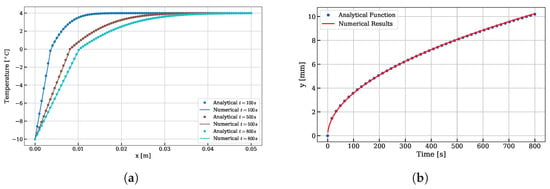
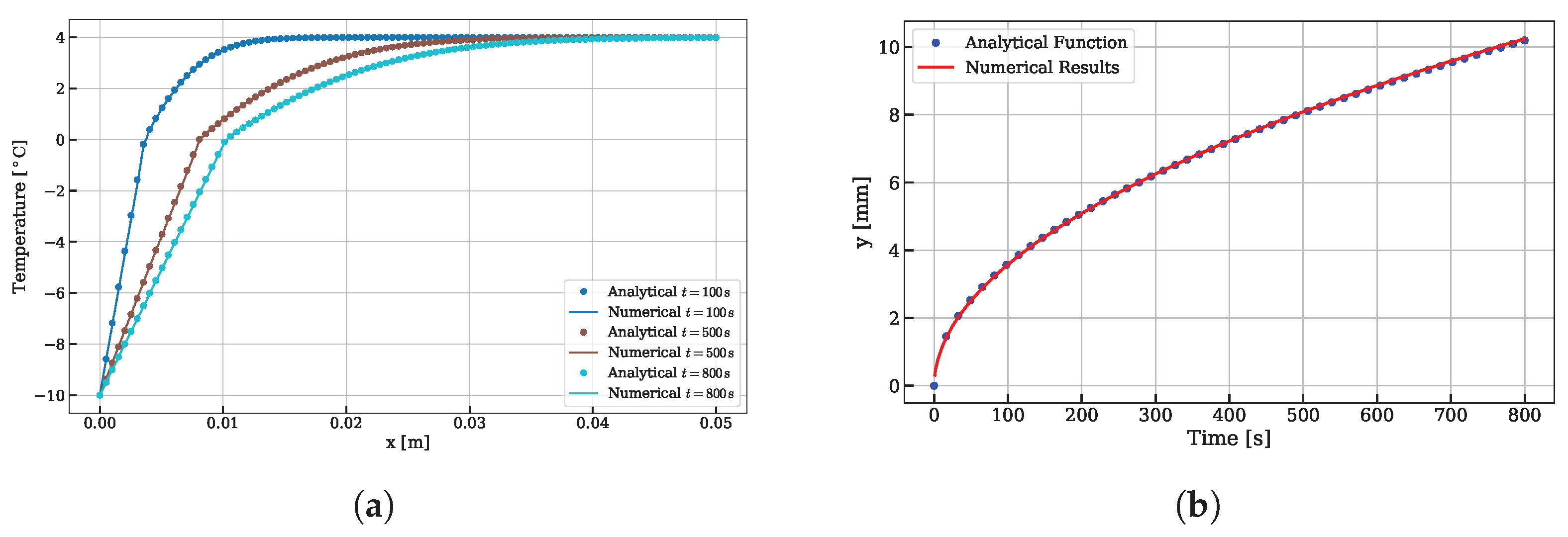
The one-dimensional numerical results from the case setup discussed in Section 2.3.1 are compared to the Neumann analytical solution (Equations (15), (17), and (18)). As illustrated in Figure 2a, the numerical results show good agreement with the analytical solution, which presents the temperature profiles along the domain at different times, as well as with Figure 2b, which shows the freezing front movement during phase change.
Figure 2.
The simulation verification of the Stefan problem: (a) temperature profiles over time and (b) freezing front development.
3.1.2. Validation of Natural Convection in a Cavity
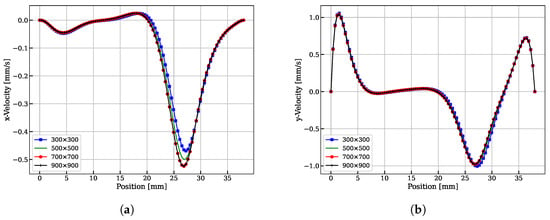
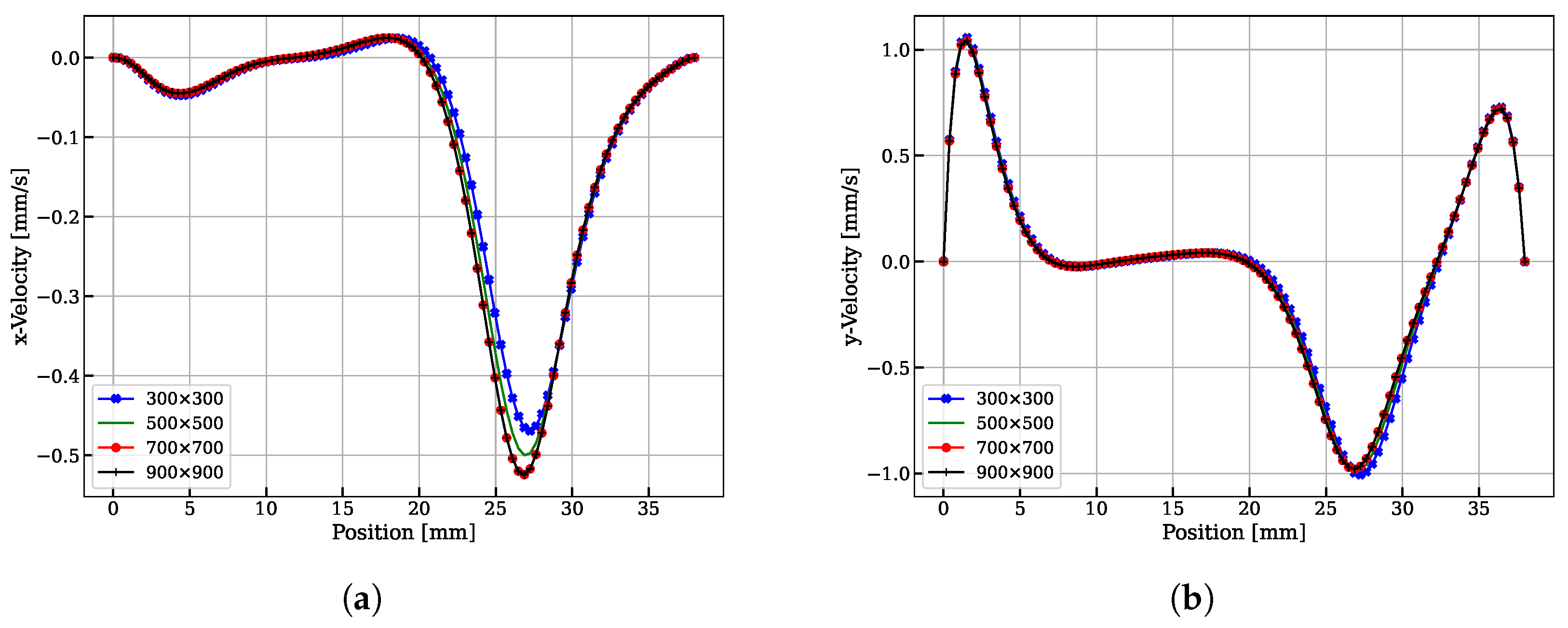
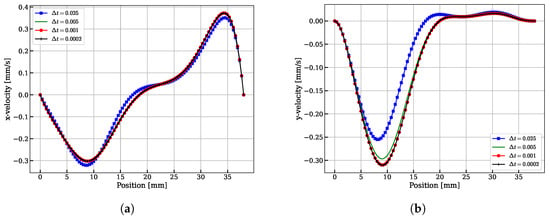
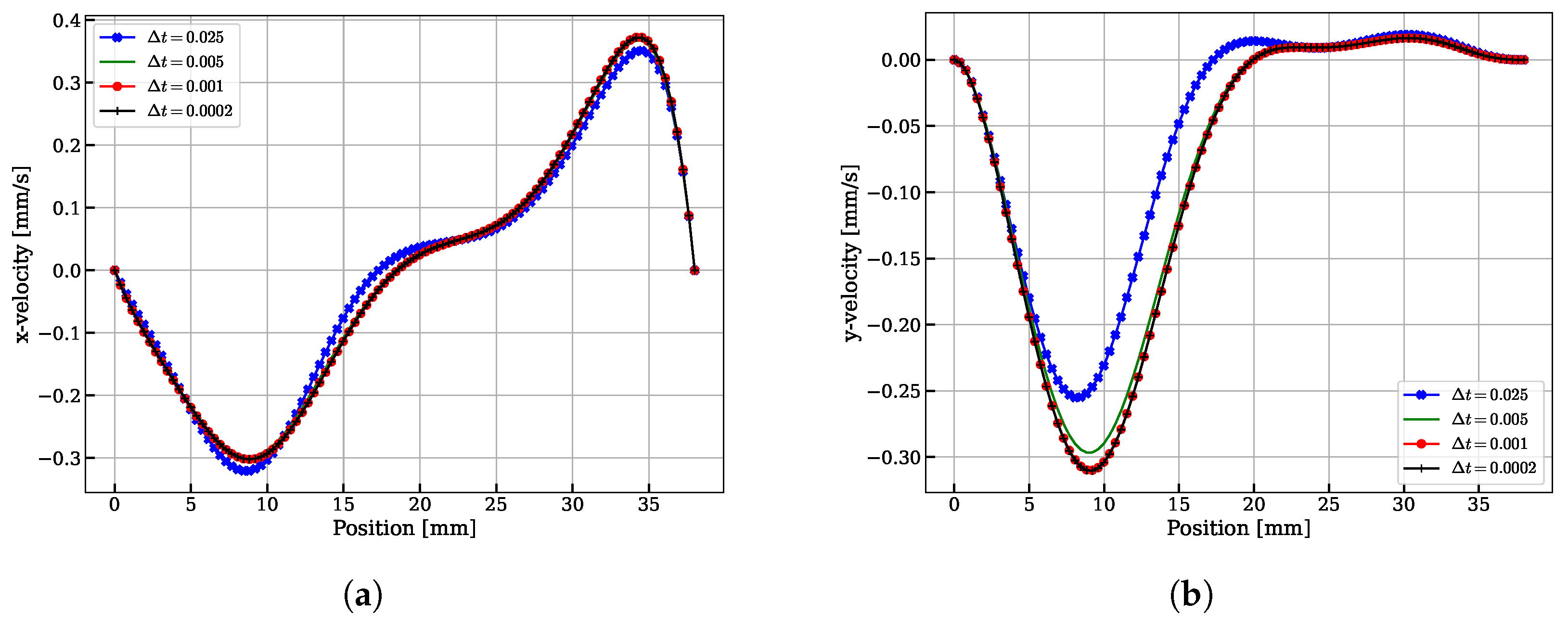
The implementation of natural convection is validated using the cavity configuration introduced in Section 2.3.2. To ensure the independence of the results from the mesh, four mesh sizes are used. The vertical and horizontal velocities along the horizontal symmetry line of the cavity (y = 19 mm) are compared in Figure 3. The two finest meshes (700 × 700 and 900 × 900) show almost the same results. Therefore, the grid with 700 × 700 cells is used for the validation studies. The steady-state solution is obtained using the PIMPLE algorithm in a pseudo-transient mode [32]. This approach allows the solution to converge efficiently without resolving actual transient behavior. Since time accuracy is not required, relatively large time steps can be used to speed up convergence. Therefore, adaptive time stepping is employed by limiting the maximum Courant number to 2, as higher values were found to lead to numerical instability.
Figure 3.
(a) Horizontal and (b) vertical velocities along the horizontal symmetry line of the cavity for four mesh sizes.
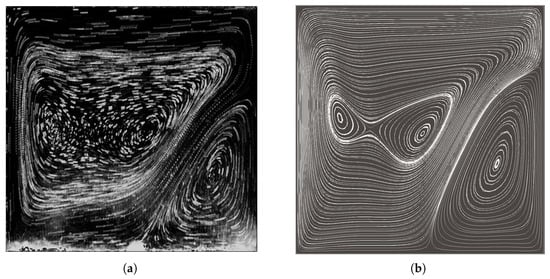
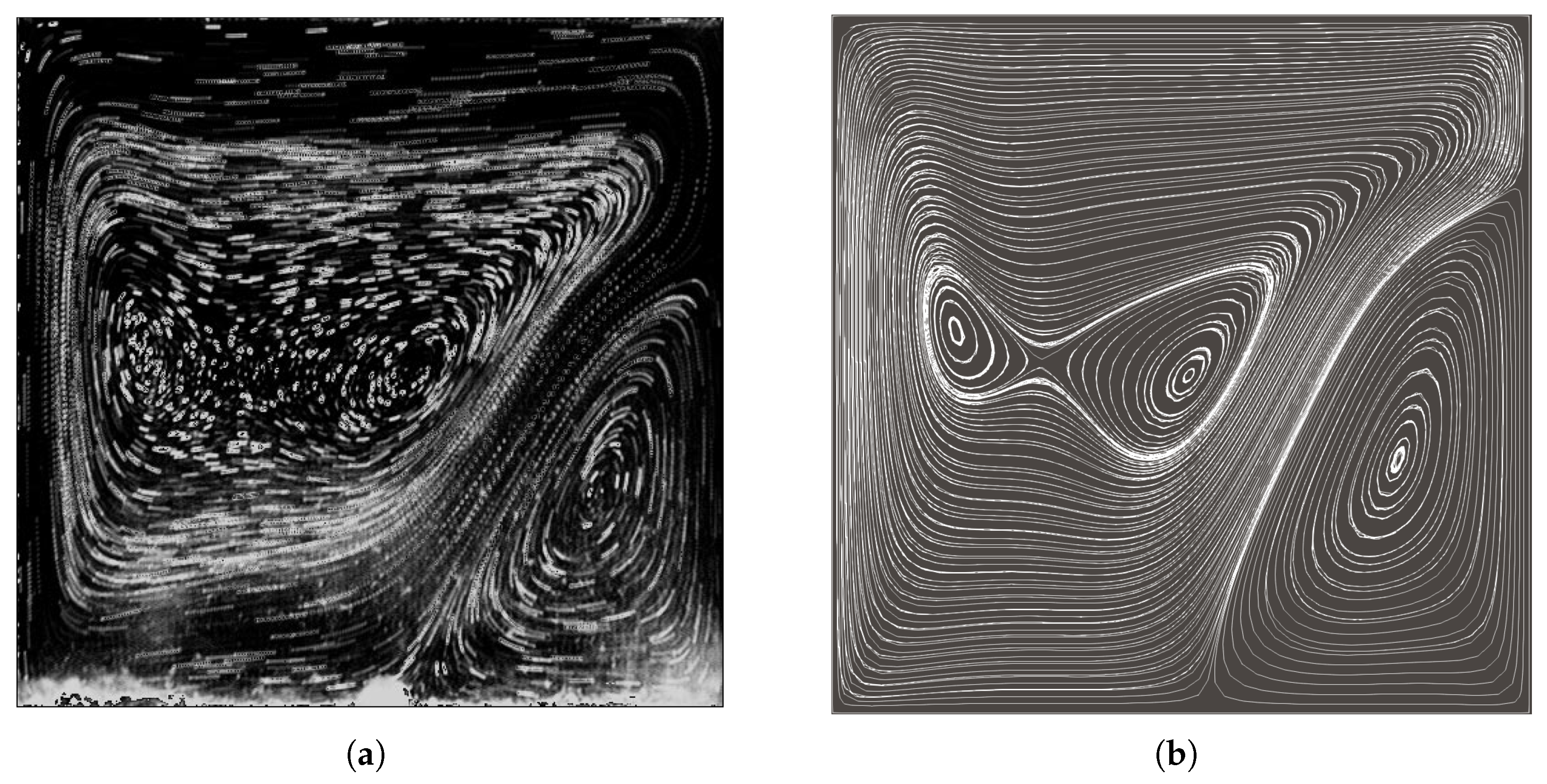
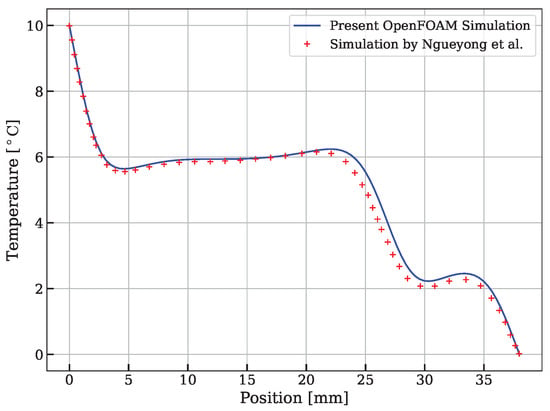
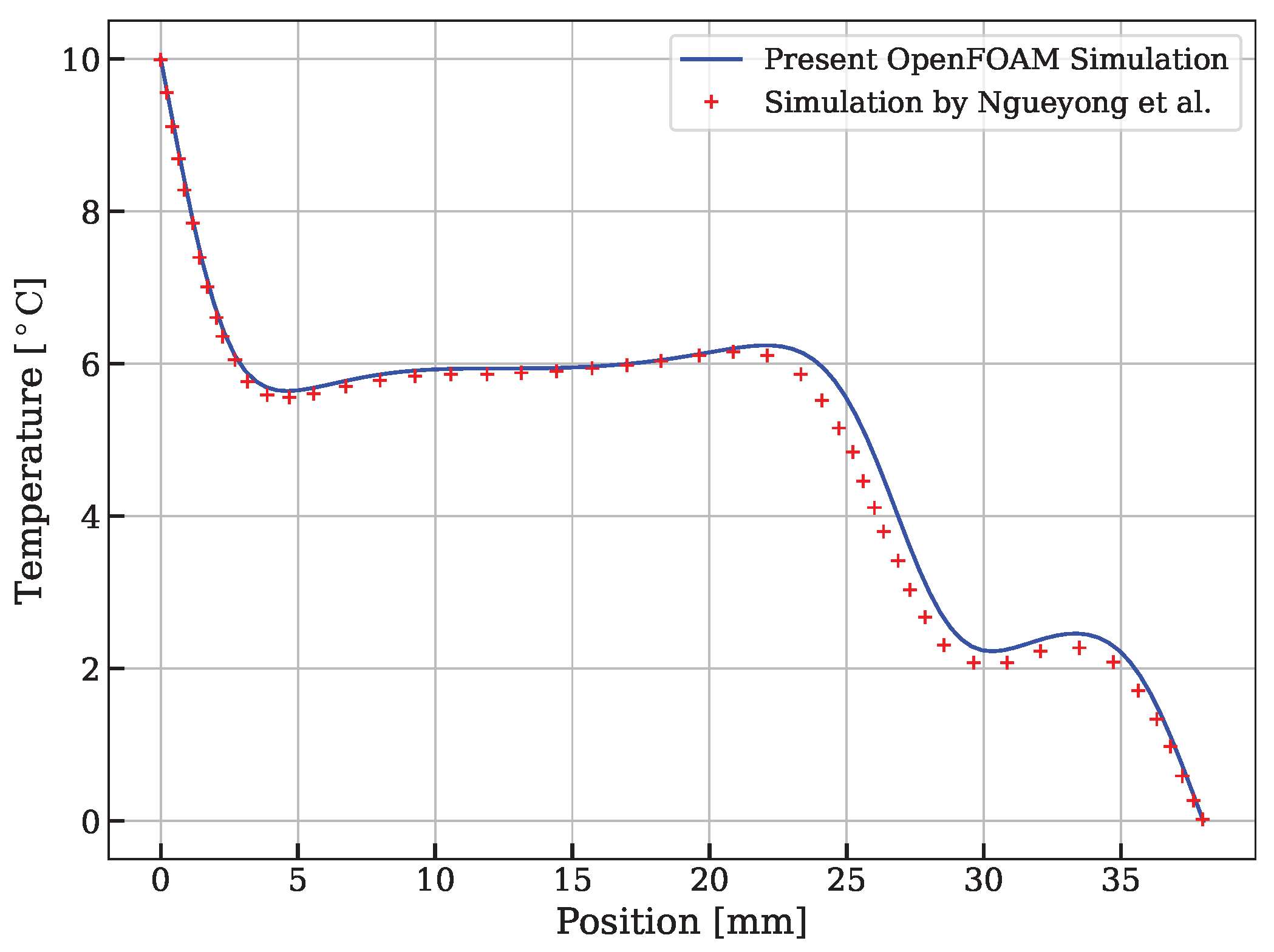
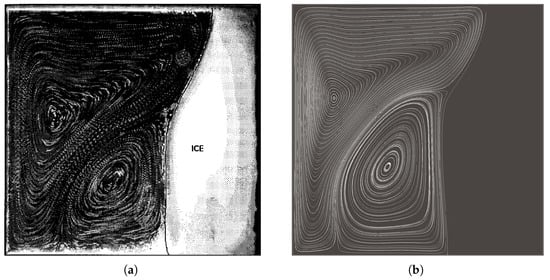
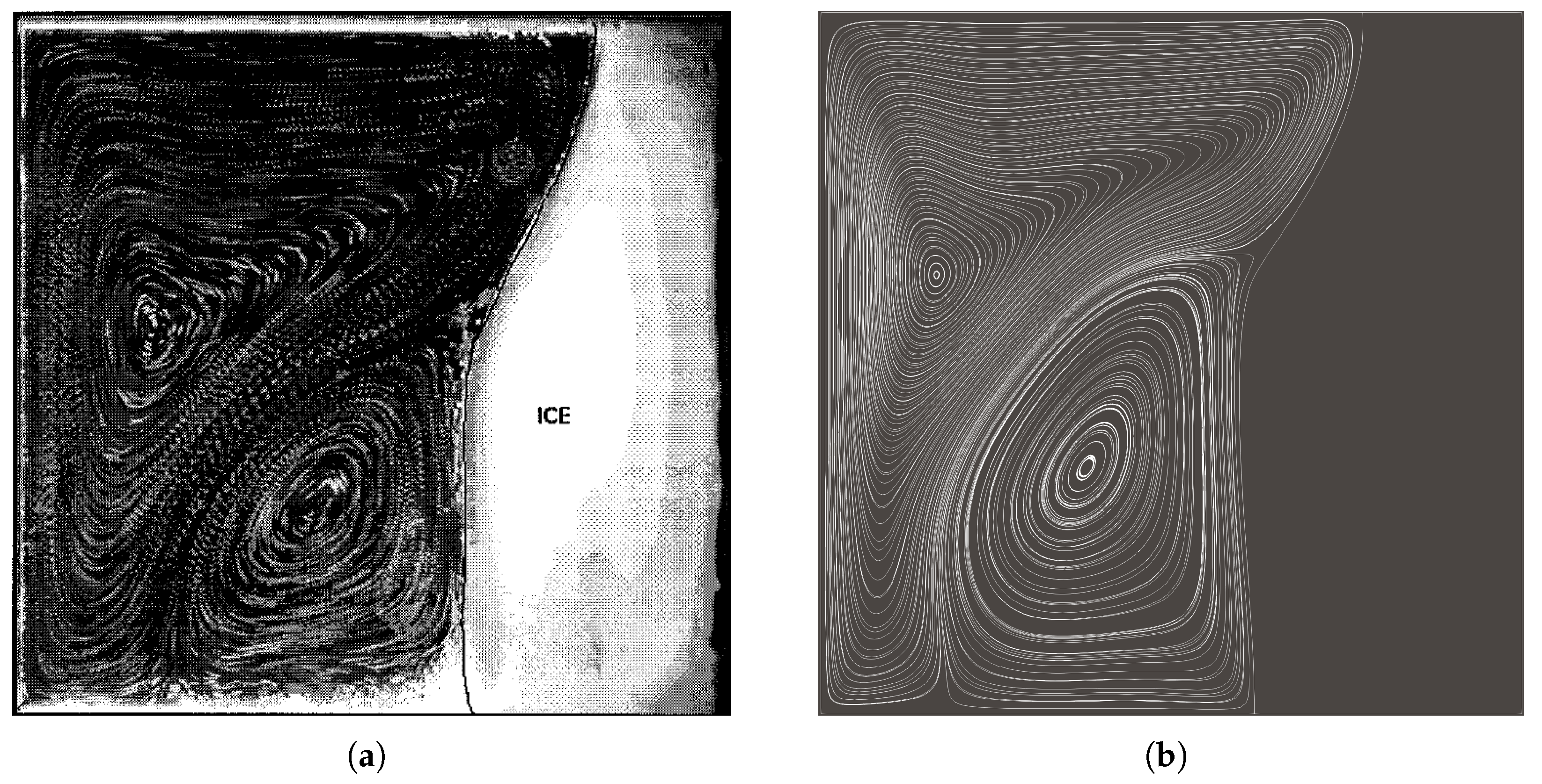
The numerical result shows circulation patterns in the cavity that are similar to those observed in the experiments; see Figure 4, where steady state velocity streamlines are displayed. However, detailed comparison with the experimental data is limited by differences in the applied boundary condition. There is a heat flux in the top and bottom boundaries in the experiments that is not considered in the simulations. To further validate the results, the temperature profile along the horizontal symmetry line of the cavity (y = 19 mm) at steady state is compared with the numerical results of Nyueyong et al. [28], who employed adiabatic boundary conditions at the top and bottom boundaries. As shown in Figure 5, the temperature profile from the present simulation agrees well with the reference. A small deviation is observed around x = 26 mm, where the maximum difference is about 0.8 °C. This occurs in a region with strong flow gradients and vortex interaction. Overall, the error remains low, with a relative mean deviation (RMD) of 3.8 %, showing that the model predicts the temperature field well.
Figure 4.
Steady-state velocity streamlines in a differently heated cavity: (a) experiments by Giangi et al. [26] (Reproduced with permission from Springer Nature, 2014) and (b) current numerical simulation.
Figure 5.
Steady-state temperature profile along the horizontal symmetry line for the current simulation and simulations by Nyueyong et al. [28].
3.1.3. Validation of Coupled Solidification–Convection in a Cavity
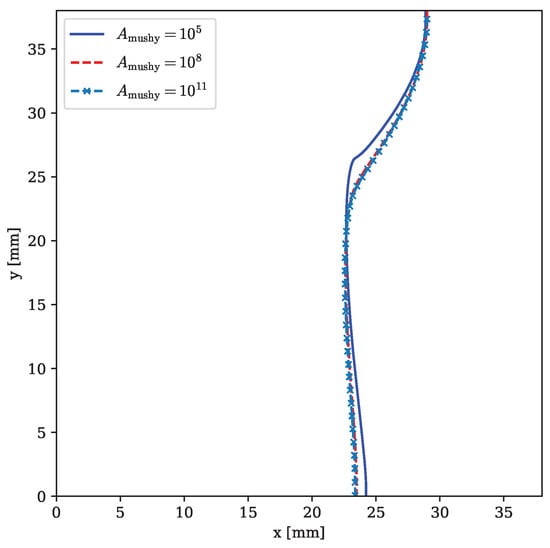
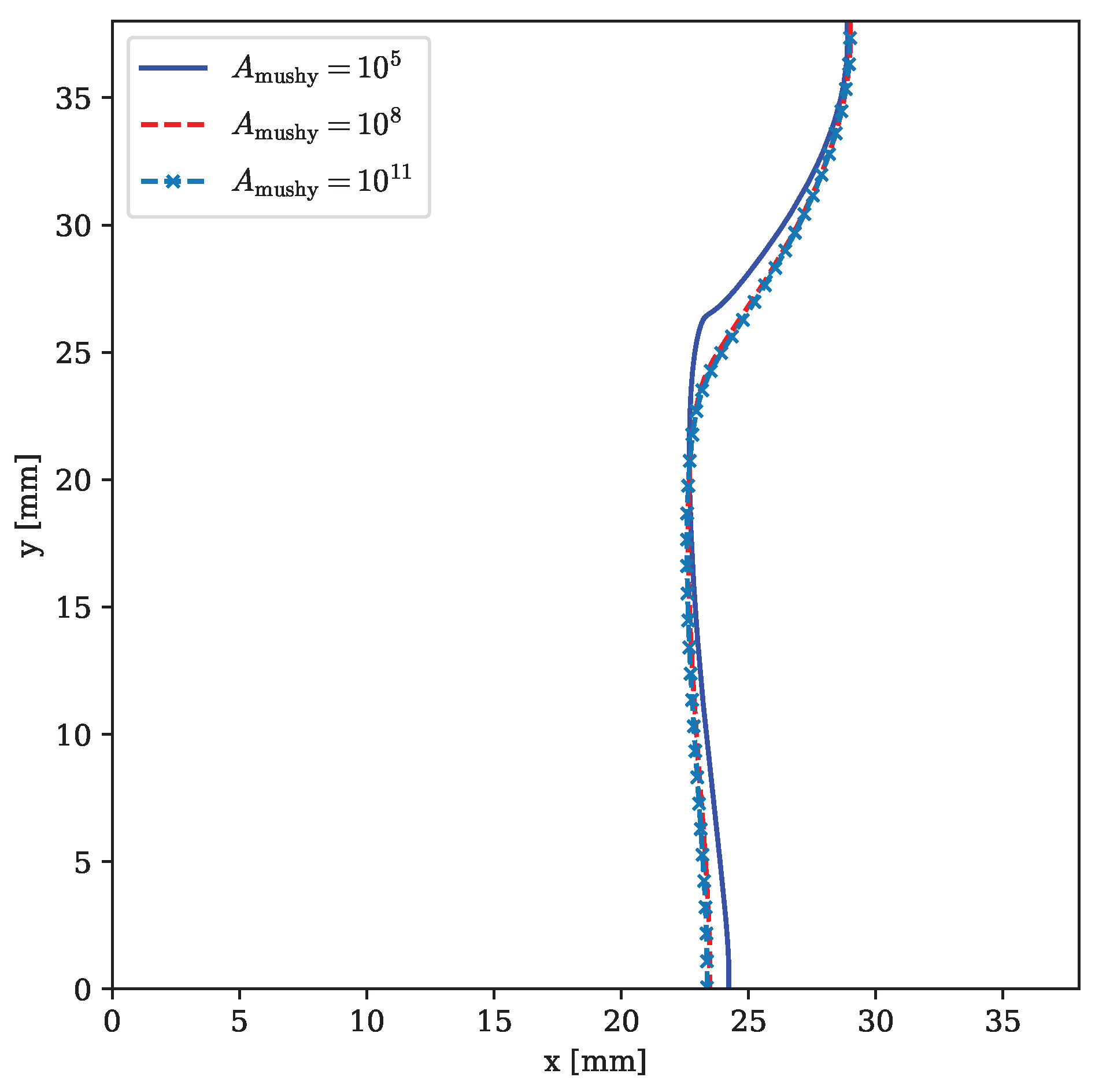
The coupled freezing and natural convection model is validated using the configuration introduced in Section 2.3.3. To examine the independence of our results with respect to the mushy zone constant, the freezing front position for three different values of is plotted in Figure 6. It can be observed that the two larger values produce nearly identical results for the freezing front position. Therefore, is used in our simulations. Furthermore, the value of the parameter q in Equation (10) is set to 0.001 in order to prevent division by zero in the solid region.
Figure 6.
Freezing front position for three different values of .
In this case, a constant time step is used in the simulations to ensure numerical stability of the transient phase change process. To check the independence of the results from the time step value, Figure 7 compares the velocity magnitudes along the vertical centerline for three different time steps. Based on this analysis, the velocity profiles at and show complete overlap, indicating time step independence. Therefore, is selected for the solidification simulations in the cavity.
Figure 7.
(a) Horizontal and (b) vertical velocity profiles along the vertical symmetry line (x = 19 mm) of the cavity for four different time steps.
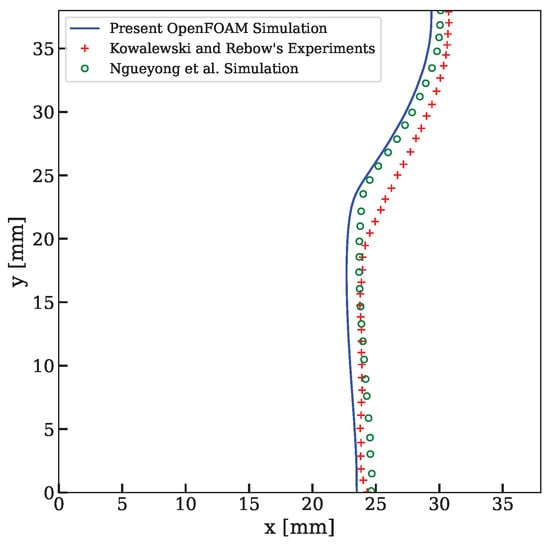
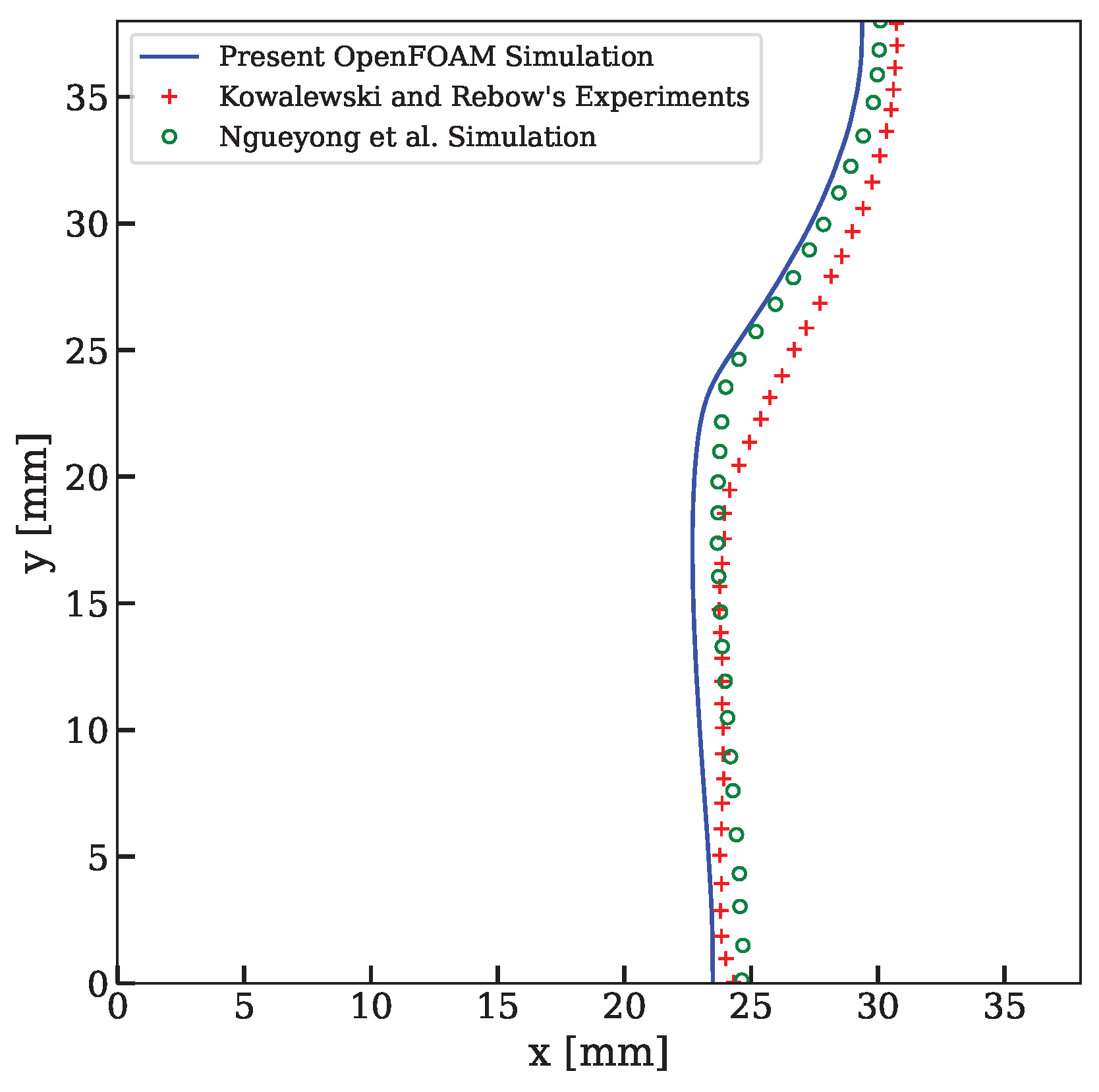
Liquid starts freezing from the right wall. As shown in Figure 8, the velocity streamlines at t = 2340 s present acceptable agreement with the experimental results by Kowalewski and Rebow [27]. Due to heat flux in the top and bottom boundaries mentioned for the experiments in the reference paper [27], the lower circulation region is larger in the simulations compared to the experiments. Additionally, the freezing front position from the numerical simulation at t = 2340 s is compared with the experiments by Kowalewski and Rebow [27] and the numerical simulation by Nyueyong et al. [28]; see Figure 9. The deviation between the present simulation and the experimental data is small. The mean absolute error (MAE) is 1.42 mm, indicating good overall agreement. The maximum deviation reaches 2.56 mm, but is limited to a small region. This difference may also be attributed to variations in boundary conditions. Comparison with the reference simulation by Ngueyong et al. [28] shows good agreement, with an MAE of 0.82 mm and maximum deviation of 1.19 mm. The small differences observed here may be due to the use of different numerical methods, as the reference study applies a sharp-interface Stefan method with level-set interface tracking.
Figure 8.
Velocity streamlines in a cavity during the freezing of water process at t = 2340 s: (a) experiments by Kowalewski and Rebow [27] (Reproduced with permission from Begell House, 1997); (b) current numerical simulation.
Figure 9.
Simulated freezing front position at t = 2340 s compared with experimental results by Kowalewski and Rebow [27] and numerical results by Nyueyong et al. [28].
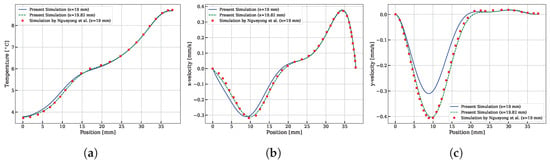
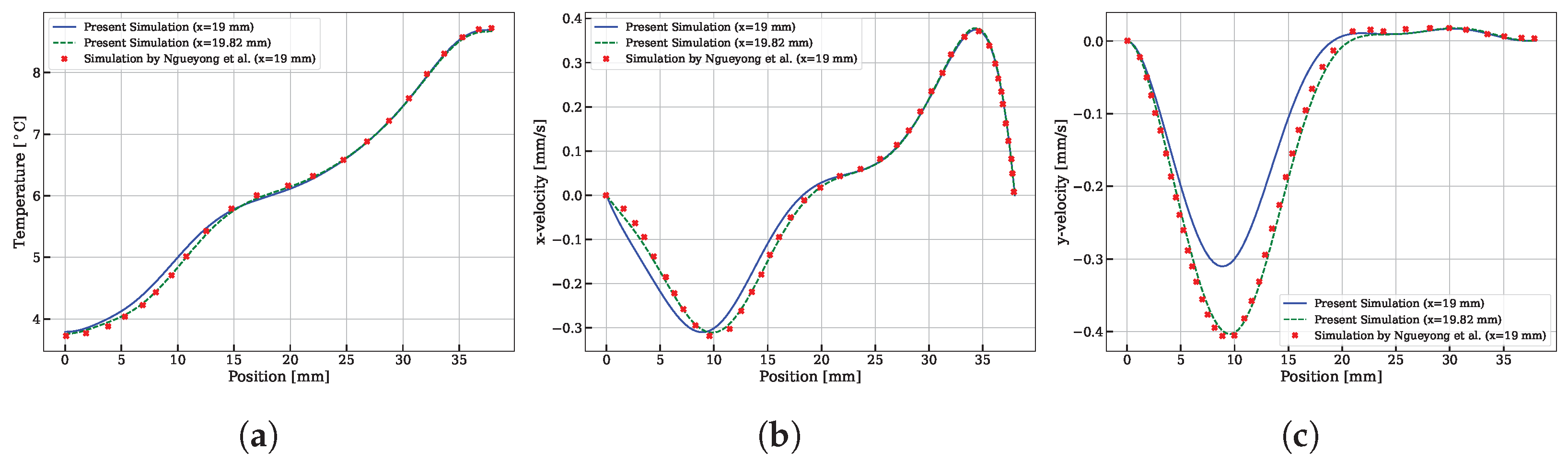
Furthermore, the temperature and velocity profiles along the vertical symmetry line of the cavity (x = 19 mm) are compared with numerical simulations by Nyueyong et al. [28]. The velocity and temperature profiles show good agreement with the reference simulations; see Figure 10. The present OpenFOAM results closely follow the trends reported by the reference results, with the curves nearly overlapping across most of the domain. The main flow features, including velocity peaks and recirculation behavior, are well captured. Figure 10 also includes profiles evaluated at x = 19.82 mm, which corresponds to a location shifted by 0.82 mm toward the freezing front. This shift is based on the mean absolute error (MAE) of the freezing front position obtained from the previous comparison. At this adjusted location, the agreement with the reference data is further improved; in particular, the absolute error of the maximum of y-velocity magnitude decreases significantly, from 0.09 mm/s at x = 19 mm to 0.0034 mm/s at x = 19.82 mm. This indicates that small discrepancies in the position of the freezing front can affect the local velocity and temperature profiles.
Figure 10.
Comparison of (a) temperature, (b) x-velocity, and (c) y-velocity profiles of the cavity between the present simulation and reference numerical study [28].
3.2. Freezing of a Water Droplet Simulation
In this section, results of the freezing droplet simulations are presented and discussed. To prevent any effects from other mechanisms and limit the results to the primary focus of the study, the effects of supercooling, Marangoni convection, thermal exchange with air and the surface, and droplet impact are all neglected. We use the same value of and from the cavity case for the droplet simulations, since the results showed no sensitivity to their variation.
3.2.1. Mesh Study
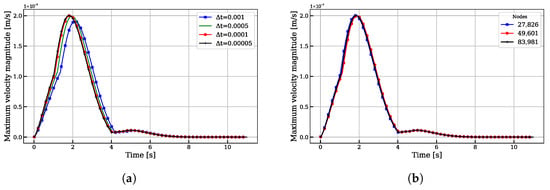
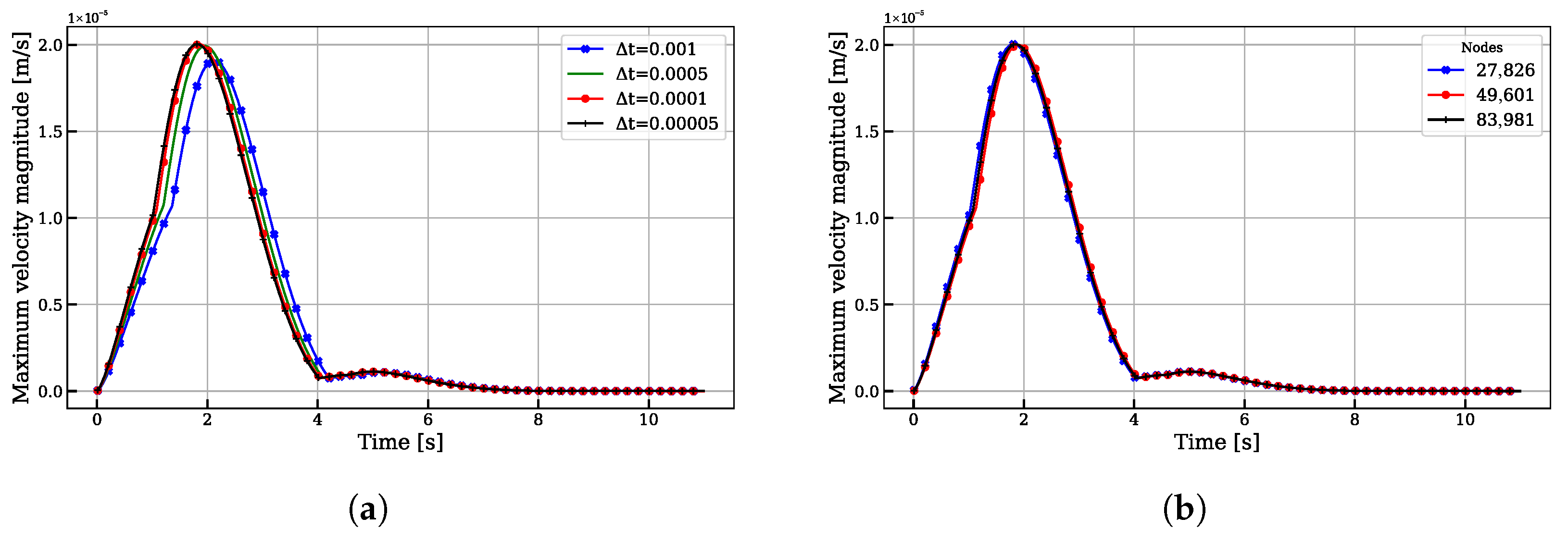
Based on the setup presented in Section 2.2, a grid with 27,816 nodes for °C is used to study the time-step independence. As shown in Figure 11a, the maximum velocity of fluid over time is plotted in four different time steps. The two smallest time steps almost match in the same curve. To check the effect of mesh on the results, the maximum velocity of fluid over time is compared in three different grids with 27,816, 49,601, and 83,981 nodes. Since the smaller time steps have a negligible effect on the results for the finer meshes, a time step of is used in all simulations. The discrepancies between the curves are small, as shown in the Figure 11b. The mesh with 49,601 nodes is used in the subsequent simulations.
Figure 11.
Maximum velocity magnitude of fluid along time in (a) the grid with 27,816 nodes at different time steps and (b) with different node numbers.
3.2.2. Freezing Front Evolution
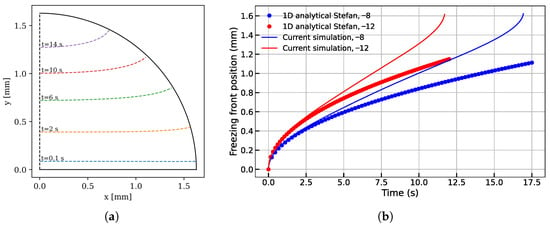
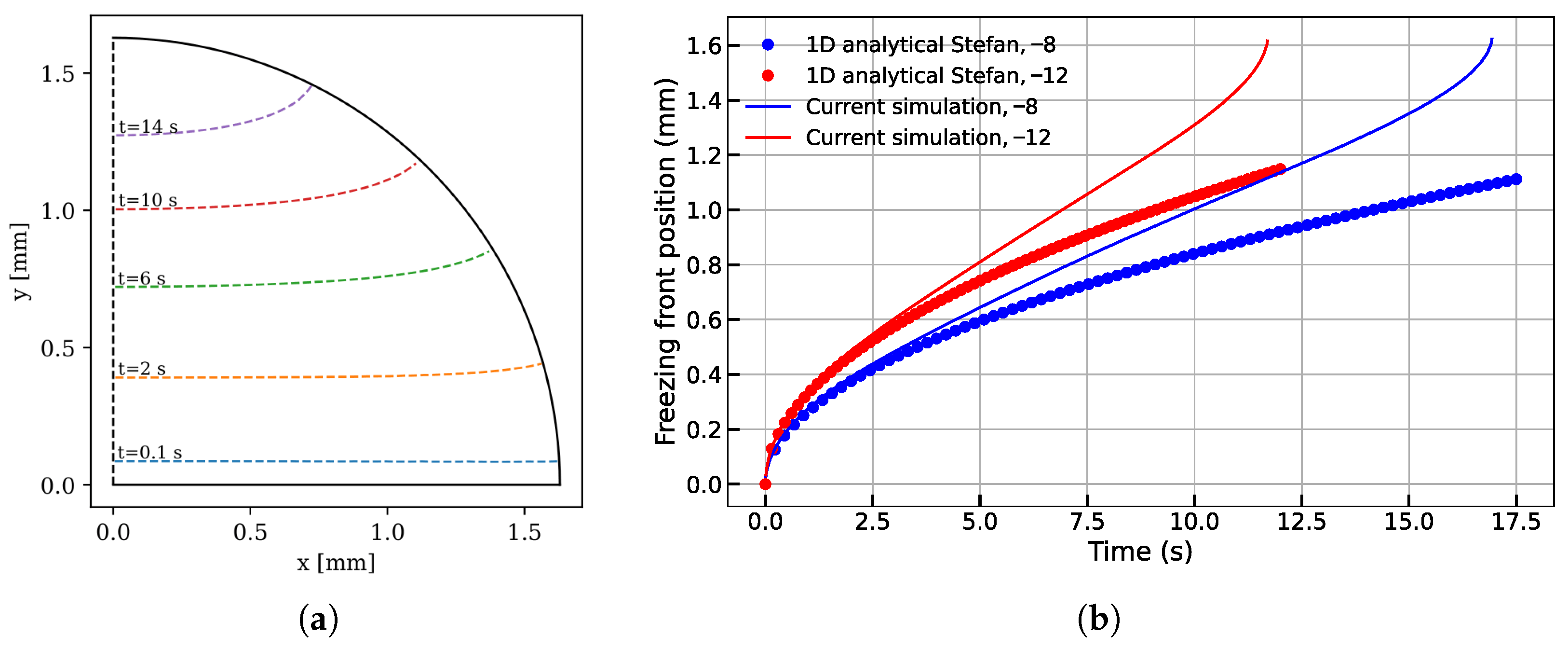
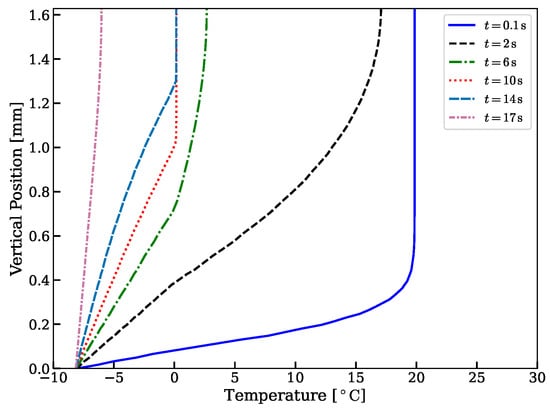
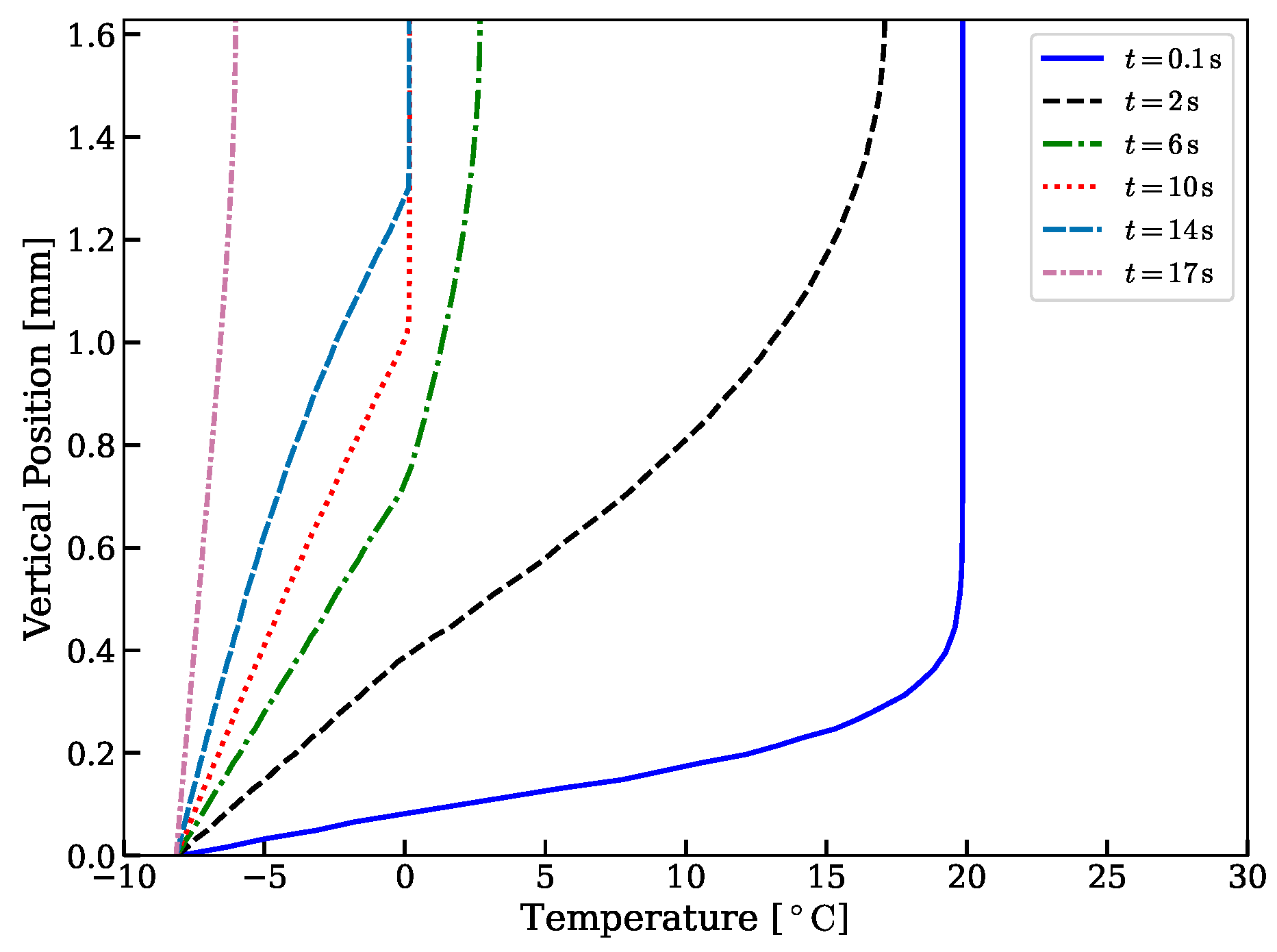
The droplet on the cold surface begins to freeze from the bottom, and the freezing front moves upward until the droplet is completely frozen. The freezing front is almost flat at early times of freezing, but with time becomes concave; see Figure 12a. Therefore, to enable comparison with the one-dimensional Stefan solution, the freezing front evolution along the centerline of the droplet (along the axis of the axisymmetric geometry) is considered. Figure 12b plots the evolution of the freezing front at the centerline of the droplet obtained from the current numerical study and the analytical solution of the one-dimensional Stefan problem for two wall temperatures, °C and °C. At early times, the freezing front evolution agrees well with the one-dimensional Stefan solution, indicating that the solidification process is initially governed by diffusion-controlled heat transfer similar to a semi-infinite Stefan problem. However, as time progresses, geometry and boundary conditions affect the solution and the droplet can no longer be interpreted as a semi-infinite domain. In the one-dimensional Stefan problem, which assumes a semi-infinite domain, the liquid temperature remains constant over time and heat transfer is governed only by conduction through the solid layer. In contrast, the droplet has a finite size; as the freezing front advances, heat transfer is influenced not only by conduction through the ice layer but also by the decreasing temperature of the remaining liquid. In addition, the interface area between the ice and water decreases as the freezing front progresses. As shown in Figure 13, the temperature of the remaining liquid gradually decreases with time. This bulk cooling of the liquid reduces the thermal energy that must be transferred for phase change. Consequently, the freezing front in the droplet advances faster than predicted by the one-dimensional Stefan solution at later times.
Figure 12.
Simulated freezing front evolution: (a) freezing front at different times for °C and (b) comparison of the freezing front evolution with the analytical one-dimensional Stefan problem.
Figure 13.
Temperature profiles along the centerline of the droplet over time for °C.
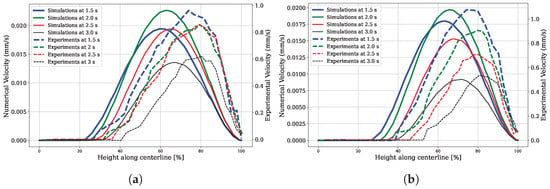
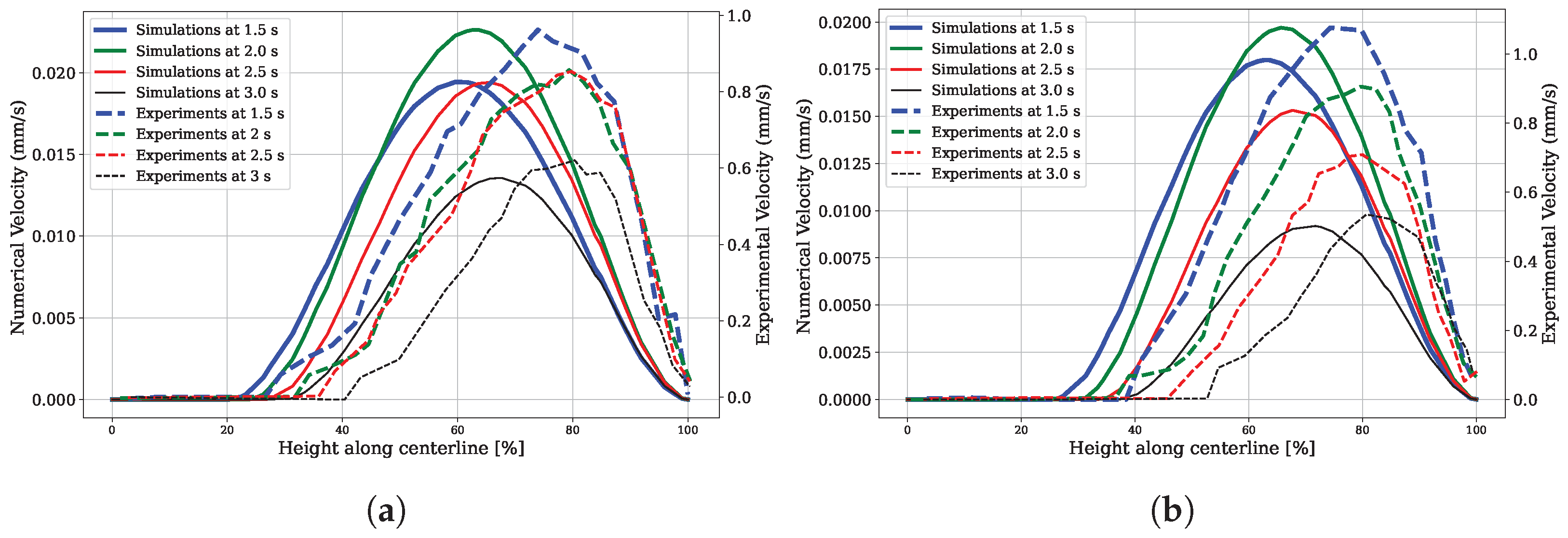
Although the numerical results capture the expected trend of the solidification process and agree with the analytical solution of the one-dimensional Stefan problem at early times, the velocity profiles along the centerline show that the freezing front initially moves at a slower pace in the simulations compared to experiments. In the experiments, the position of the freezing front is higher than in the numerical simulation, with mean differences of 5.8% and 10.28% of the droplet height for °C and °C, respectively (see Figure 14). This discrepancy may arise from two factors. First, the supercooling stage reported in experiments [5,6,7] was not included in the simulations, although it may accelerate the initial freezing. Second, impingement effects associated with droplet release in the experiments could increase the heat transfer in the initial stage of freezing. However, the assumption of a constant wall temperature enhances heat extraction, as the substrate effectively acts as an ideal heat sink. Depending on the thermal properties of the substrate, this may influence the early-time cooling behavior and the predicted freezing front velocity.
Figure 14.
Velocity profiles at different times from the current study and from the experiments by Fagerström and Ljung [25] at (a) °C and (b) °C.
As Figure 14 shows, the simulations also provide a lower velocity along the centerline compared to the experiments, with the experimental values being approximately one order of magnitude higher. Additionally, in the numerical simulations, the maximum velocity in the centerline increases from 1.5 s to 2.0 s and decreases at later times. In contrast, the experiments show the highest velocity at 1.5 s and then decrease over time. One possible reason for the difference in velocity magnitude is the initial velocity induced by droplet impact on the surface in the experiments, which may affect both heat and momentum transfer but is not considered in the simulations. Moreover, Marangoni convection may have a significant effect on internal flow [18]. The initial temperature gradient in the droplet would cause clockwise initial circulation [21], which could be another reason for the discrepancy in velocity magnitude between the experiments and the current study. However, Marangoni convection is not considered in this simulation in order to prevent influence on our investigation of natural convection.
3.2.3. Natural Convection and Directional Change in a Freezing Droplet
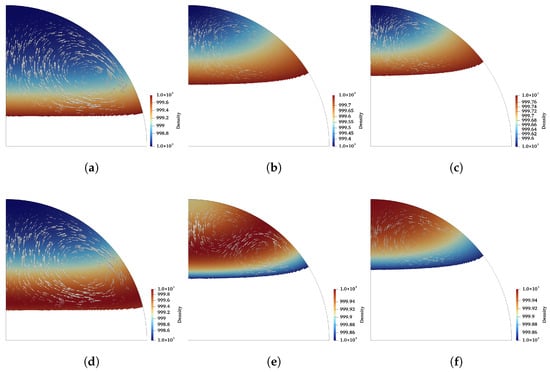
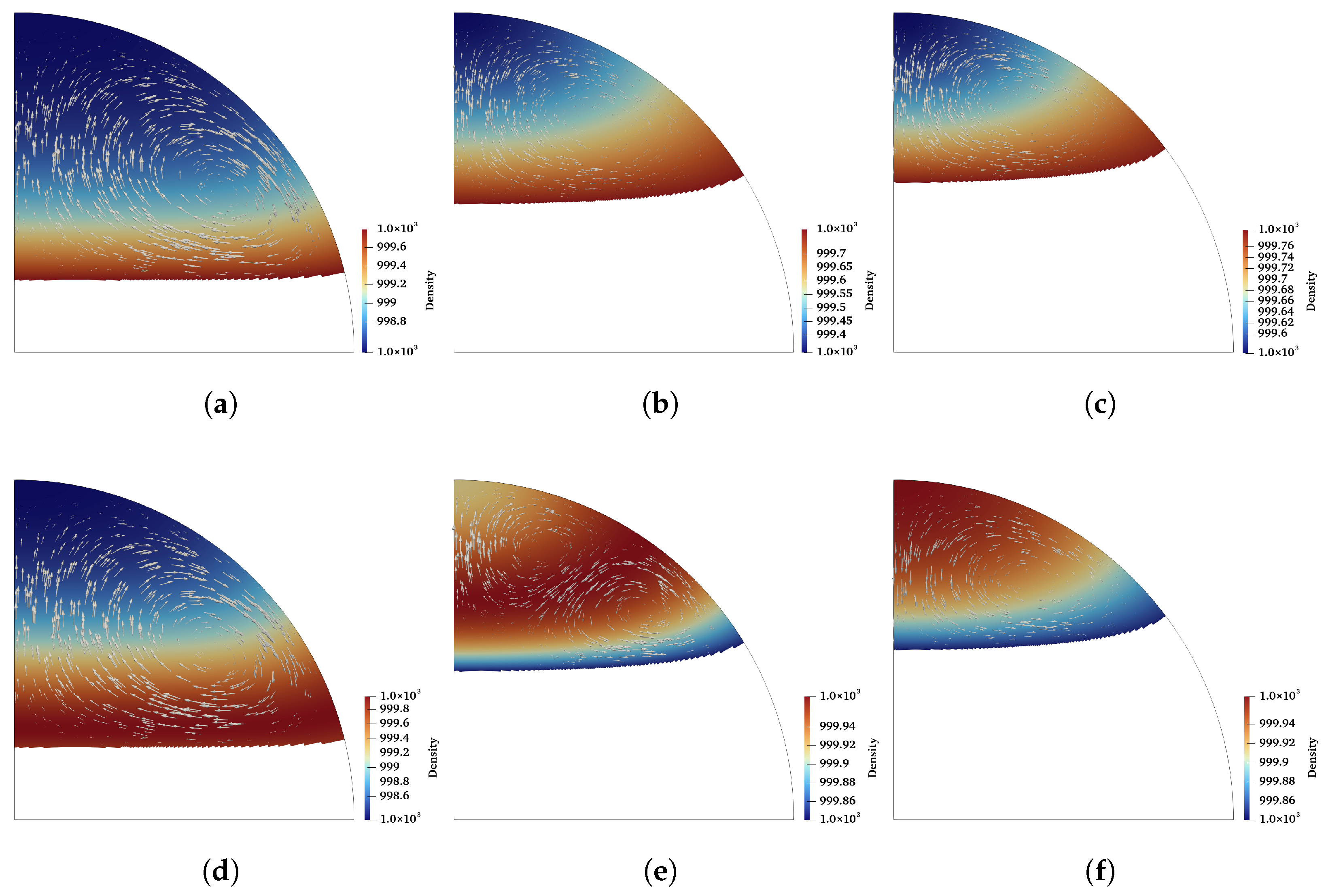
The directional change in the internal flow of a freezing droplet has been mentioned in several studies in the literature [21,22,23,24,25]. In addition, the experimental study by Karlsson et al. [22] reported a directional change in the internal flow of an evaporating droplet. However, the underlying mechanisms may differ between freezing and evaporating droplets. In addition to the effects of the spherical cap and temperature-dependent viscosity, the density inversion of water at 4 °C is a possible reason for the directional change of the internal flow in freezing droplets. To further study this hypothesis, natural convection is investigated using both the standard Boussinesq approximation with a linear density–temperature relation (Section 2.1.2) and temperature-dependent water density formulation, as defined in Equation (13). In the Boussinesq case, the thermal expansion coefficient and reference density are respectively set to and = 6.734 × 10⁻⁵ K−1 at the reference temperature °C. Freezing of the droplet initiates at the bottom cold wall ( °C). Figure 15 illustrates snapshots of the velocity vectors along with the liquid density at different times during the freezing process for both cases. The first row corresponds to the classical Boussinesq approximation, while the second row represents the case using the temperature-dependent water density. The white regions on the domain indicate ice.
Figure 15.
Snapshots of velocity vectors together with liquid density contours for °C at (a) Boussinesq approximation, case t = 1.0 s; (b) Boussinesq approximation, t = 4.0 s; (c) Boussinesq approximation, t = 5.0 s; (d) water density expression case, t = 1.0 s; (e) water density expression case, t = 4.0 s; and (f) water density expression case, t = 5.0 s.
The simulations using the Boussinesq approximation do not show the directional change reported by previous experiments [25], whereas the temperature-dependent water density case proves directional change of fluid flow after a few seconds of freezing. In the Boussinesq approximation, density decreases linearly with increasing temperature. As a result, the fluid near the ice layer is denser and the flow circulates clockwise with a very low velocity. Since this linear relation is maintained during the freezing process, the flow direction remains unchanged. However, in the water density expression case, the liquid close to the cold surface is denser. The internal flow circulates in a clockwise direction, although at very low velocity (see Figure 15d). As time passes and the temperature near the ice surface decreases below 4 °C, the maximum liquid density occurs in the regions where the temperature is around 4 °C. Consequently, the flow direction reverses near the right corner, between the 4 °C isotherm and the ice surface, forming a counterclockwise circulation. As shown in Figure 15e, this directional change is visible at approximately 4.0 s, when the denser liquid descends and two circulation regions appear in the liquid, rotating in opposite directions. As time progresses further and the liquid temperature continues to decrease, the circulation region on the right side grows, while the one on the left side gradually disappears. As a result, after , when the top of the droplet approaches 4 °C with highest density, a single dominant circulation cell remains, rotating in the opposite direction of the initial flow.
Table 2 shows the freezing time and time until directional change obtained from prior experiments [25], the Boussinesq approximation case, and the water density expression case. In both numerical cases, the droplet freezes in a shorter time than in the experiments. For example, at °C the freezing time is reduced from 23 s in the experiments to 16.93 s in the simulations (26% shorter), while at °C it decreases from 18 s to about 11.7 s (35% shorter). This can be attributed to the idealized thermal boundary conditions used in the simulations, including a constant substrate temperature. In contrast, in the experiments there is heat transfer between the droplet, the surrounding air, and the substrate, which reduces the net cooling rate and leads to longer freezing times.
Table 2.
Freezing time and time until directional change from the experiments by Fagerström and Ljung [25], the Boussinesq approximation case, and the water expression case.
Furthermore, the directional change occurs at a slightly later time in the simulations, verifying the hypothesis of increased initial heat transfer in the experiments, as discussed in Section 3.2.2. The delay is about 0.6 s at °C and about 0.2 s at °C compared to the experiments. The maximum droplet temperature corresponding to the time of flow directional change is presented in Table 2. The results indicate that the internal flow changes direction when the maximum droplet temperature approaches approximately 5 °C, which is in the vicinity of the density inversion temperature of water.
4. Conclusions
In this work, the freezing process of a rigid sessile water droplet is investigated using the open-source software OpenFOAM. A new solver is implemented within an existing OpenFOAM framework to account for the freezing process and natural convection in water, including the effect of temperature-dependent density. The solver is verified and validated against analytical, numerical, and experimental benchmark cases, demonstrating good agreement. The freezing droplet simulations are compared with experimental data reported in the reference study. The main findings are summarized as follows:
- The proposed OpenFOAM solver is successfully compared with experimental and numerical results for the case of flow and solidification in a cavity, confirming its accuracy for coupled phase-change and convection problems.
- Comparisons between the semi-infinite one-dimensional Stefan problem, reported experimental results, and the presented numerical model of a single droplet indicate that there are effects in the experiments during impact that are not accounted for in the simulations, possibly due to supercooling or impact velocities.
- The numerical simulation with temperature-dependent density captures the trend of directional change of the internal flow reported by experiments, whereas the classic Boussinesq approximation fails to reproduce this behavior.
- Temperature evaluation of the droplet simulations indicates that directional change of the internal flow appears when the maximum droplet temperature is in proximity to the density inversion temperature.
- Quantitative comparison with experiments shows that freezing times are under-predicted (by approximately 25–35%) and that velocity magnitudes are lower, emphasizing limitations of the current model due to simplified boundary conditions and neglected effects such as Marangoni convection and droplet impact.
- Combined analysis of the analytical, numerical, and experimental results shows that the heat and mass transfer conditions relevant to an impacting droplet must be accurately captured and incorporated into the numerical model in order to achieve full agreement.
Because the main focus of the current study was to investigate the effects of natural convection and water density inversion on the internal flow, we did not consider the effects of Marangoni convection, droplet impact, heat transfer to the substrate and surrounding air, or volume expansion. These factors may explain the discrepancies between numerical results and experiments. Accordingly, as a next step, further studies are required to investigate the effects of such mechanisms in the freezing process of a water droplet in order to more clearly capture the phenomena reported by experiments.
Author Contributions
Conceptualization, P.K. and A.-L.L.; formal analysis, P.K.; funding acquisition, A.-L.L.; investigation, P.K.; methodology, P.K.; software, P.K.; supervision, A.-L.L. and T.S.L.; validation, P.K.; visualization, P.K.; writing—original draft, P.K.; writing—review and editing, P.K., A.-L.L., and T.S.L. All authors have read and agreed to the published version of the manuscript.
Funding
The research is part of a project funded by the Swedish Research Council (2022-04237).
Data Availability Statement
The custom OpenFOAM solver developed in this study is publicly available on Zenodo at https://doi.org/10.5281/zenodo.19485970.
Conflicts of Interest
The authors declare no conflicts of interest.
References
- Cao, Y.; Tan, W.; Wu, Z. Aircraft Icing: An Ongoing Threat to Aviation Safety. Aerosp. Sci. Technol. 2018, 75, 353–385. [Google Scholar] [CrossRef] [Scilit]
- Zeng, D.; Li, Y.; Liu, H.; Yang, Y.; Peng, L.; Zhu, C.; Zhao, N. Superhydrophobic Coating Induced Anti-Icing and Deicing Characteristics of an Airfoil. Colloids Surf. A 2023, 660, 130824. [Google Scholar] [CrossRef] [Scilit]
- Afzal, F.; Virk, M.S. Review of Icing Effects on Wind Turbine in Cold Regions. E3S Web Conf. 2018, 72, 01007. [Google Scholar] [CrossRef] [Scilit]
- Akhtar, S.; Xu, M.; Mohit, M.; Sasmito, A.P. A Comprehensive Review of Modeling Water Solidification for Droplet Freezing Applications. Renew. Sustain. Energy Rev. 2023, 188, 113768. [Google Scholar] [CrossRef] [Scilit]
- Hindmarsh, J.P.; Russell, A.B.; Chen, X.D. Experimental and Numerical Analysis of the Temperature Transition of a Freezing Food Solution Droplet. Chem. Eng. Sci. 2004, 59, 2503–2515. [Google Scholar] [CrossRef] [Scilit]
- Chaudhary, G.; Li, R. Freezing of Water Droplets on Solid Surfaces: An Experimental and Numerical Study. Exp. Therm. Fluid Sci. 2014, 57, 86–93. [Google Scholar] [CrossRef] [Scilit]
- Akhtar, S.; Xu, M.; Sasmito, A.P. Development and validation of a semi-analytical framework for droplet freezing with heterogeneous nucleation and non-linear interface kinetics. Int. J. Heat Mass Transf. 2021, 166, 120734. [Google Scholar] [CrossRef] [Scilit]
- Enríquez, O.R.; Marín, ÁG.; Winkels, K.G.; Snoeijer, J.H. Freezing Singularities in Water Drops. Phys. Fluids 2012, 24, 091102. [Google Scholar] [CrossRef] [Scilit]
- Marin, A.G.; Enríquez, O.R.; Brunet, P.; Colinet, P.; Snoeijer, J.H. Universality of Tip Singularity Formation in Freezing Water Drops. Phys. Rev. Lett. 2014, 113, 054301. [Google Scholar] [CrossRef] [Scilit] [PubMed]
- Ismail, M.F.; Waghmare, P.R. Universality in Freezing of an Asymmetric Drop. Appl. Phys. Lett. 2016, 109, 234105. [Google Scholar] [CrossRef] [Scilit]
- Starostin, A.; Strelnikov, V.; Dombrovsky, L.A.; Shoval, S.; Gendelman, O.; Bormashenko, E. Effect of Asymmetric Cooling of Sessile Droplets on Orientation of the Freezing Tip. J. Colloid Interface Sci. 2022, 620, 179–186. [Google Scholar] [CrossRef] [Scilit] [PubMed]
- Miao, S.; Zhang, C.; Liu, X. Tunable Tip Singularity of a Water Droplet Freezing on Surfaces under Forced Convection. Appl. Therm. Eng. 2024, 241, 122362. [Google Scholar] [CrossRef] [Scilit]
- Zhang, D.; Wang, Y.; Yuan, X.; Yue, X.; Liu, J.; Liu, W. Freezing modes of water droplet on cold plate surface under forced convection. Appl. Therm. Eng. 2023, 223, 120025. [Google Scholar] [CrossRef] [Scilit]
- Zhang, X.; Liu, X.; Wu, X.; Min, J. Simulation and Experiment on Supercooled Sessile Water Droplet Freezing with Special Attention to Supercooling and Volume Expansion Effects. Int. J. Heat Mass Transf. 2018, 127, 975–985. [Google Scholar] [CrossRef] [Scilit]
- Castillo, J.E.; Huang, Y.; Pan, Z.; Weibel, J.A. Quantifying the Pathways of Latent Heat Dissipation during Droplet Freezing on Cooled Substrates. Int. J. Heat Mass Transf. 2021, 164, 120608. [Google Scholar] [CrossRef] [Scilit]
- Mishchenko, L.; Hatton, B.; Bahadur, V.; Taylor, J.A.; Krupenkin, T.; Aizenberg, J. Design of Ice-Free Nanostructured Surfaces Based on Repulsion of Impacting Water Droplets. ACS Nano 2010, 4, 7699–7707. [Google Scholar] [CrossRef] [Scilit]
- Kong, W.; Wang, L.; Bian, P.; Liu, H. Effect of Surface Wettability on Impact-Freezing of Supercooled Large Water Droplet. Exp. Therm. Fluid Sci. 2022, 130, 110508. [Google Scholar] [CrossRef] [Scilit]
- Kawanami, T.; Yamada, M.; Fukusako, S.; Kawai, H. Solidification Characteristics of a Droplet on a Horizontal Cooled Wall. Heat Transfer–Jpn. Res. 1997, 26, 469–483. [Google Scholar] [CrossRef]
- Karlsson, L.; Ljung, A.-L.; Lundström, T.S. Modelling the dynamics of the flow within freezing water droplets. Heat Mass Transf. 2018, 54, 3761–3769. [Google Scholar] [CrossRef] [Scilit]
- Voulgaropoulos, V.; Kadivar, M.; Moghimi, M.A.; Maher, M.; Alawadi, H.; Matar, O.K.; Markides, C.N. A combined experimental and computational study of phase-change dynamics and flow inside a sessile water droplet freezing due to interfacial heat transfer. Int. J. Heat Mass Transf. 2021, 180, 121803. [Google Scholar] [CrossRef] [Scilit]
- Karlsson, L.; Lycksam, H.; Ljung, A.-L.; Gren, P.; Lundström, T.S. Experimental Study of the Internal Flow in Freezing Water Droplets on a Cold Surface. Exp. Fluids 2019, 60, 182. [Google Scholar] [CrossRef] [Scilit]
- Karlsson, L.; Lycksam, H.; Ljung, A.-L.; Gren, P.; Lundström, T.S. Comparing internal flow in freezing and evaporating water droplets using PIV. Water 2020, 12, 1489. [Google Scholar] [CrossRef] [Scilit]
- Fagerström, E.; Ljung, A.-L.; Karlsson, L.; Lycksam, H. Influence of Substrate Material on Flow in Freezing Water Droplets—An Experimental Study. Water 2021, 13, 1628. [Google Scholar] [CrossRef] [Scilit]
- Fagerström, E.; Ljung, A.-L. Shape and Temperature Dependence on the Directional Velocity Change in a Freezing Water Droplet. Int. J. Thermofluids 2023, 20, 100519. [Google Scholar] [CrossRef] [Scilit]
- Fagerström, E.; Ljung, A.-L. Internal Flow in Freezing and Non-Freezing Water Droplets at Freezing Temperatures. Int. J. Heat Mass Transf. 2024, 234, 126100. [Google Scholar] [CrossRef] [Scilit]
- Giangi, M.; Stella, F.; Kowalewski, T.A. Phase Change Problems with Free Convection: Fixed Grid Numerical Simulation. Comput. Vis. Sci. 1999, 2, 123–130. [Google Scholar] [CrossRef] [Scilit]
- Kowalewski, T.A.; Rebow, M. An experimental benchmark for freezing water in the cubic cavity. In CHT’97—Advances in Computational Heat Transfer. Proceedings of the International Symposium; Begell House, Inc.: Danbury, CT, USA, 1997. [Google Scholar]
- Ngueyong, I.T.; Urquiza, J.M.; Martin, D. A CutFEM Method for Phase Change Problems with Natural Convection. Comput. Methods Appl. Mech. Eng. 2024, 420, 116713. [Google Scholar] [CrossRef] [Scilit]
- Voller, V.R.; Prakash, C. A fixed grid numerical modelling methodology for convection–diffusion mushy region phase-change problems. Int. J. Heat Mass Transf. 1987, 30, 1709–1719. [Google Scholar] [CrossRef] [Scilit]
- Hahn, D.W.; Özisik, M.N. Heat Conduction; John Wiley & Sons: Hoboken, NJ, USA, 2012. [Google Scholar]
- Lyu, S.; Wang, K.; Zhang, Z.; Pedrono, A.; Sun, C.; Legendre, D. A hybrid VOF-IBM method for the simulation of freezing liquid films and freezing drops. J. Comput. Phys. 2021, 432, 110160. [Google Scholar] [CrossRef] [Scilit]
- Greenshields, C.J.; Weller, H.G. Notes on Computational Fluid Dynamics: General Principles; CFD Direct: Reading, UK, 2022. [Google Scholar]

Disclaimer/Publisher’s Note: The statements, opinions and data contained in all publications are solely those of the individual author(s) and contributor(s) and not of MDPI and/or the editor(s). MDPI and/or the editor(s) disclaim responsibility for any injury to people or property resulting from any ideas, methods, instructions or products referred to in the content. |
© 2026 by the authors. Licensee MDPI, Basel, Switzerland. This article is an open access article distributed under the terms and conditions of the Creative Commons Attribution (CC BY) license.