Article

TiO2/CdS Heterojunction as an Efficient Photocatalyst for Degradation of Crystal Violet Dye and Antibacterial Activity


1
Department of Chemistry, Abdul Wali Khan University Mardan, Mardan 23200, Pakistan
2
UNESCO-UNISA Africa Chair in Nanosciences and Nanotechnology, College of Graduate Studies, University of South Africa, Muckleneuk Ridge, P.O. Box 392, Pretoria 0002, South Africa
3
Department of Chemistry, COMSATS University Islamabad, Abbottabad Campus, Abbottabad 22060, Pakistan
4
Program in Environmental and Polymer Engineering, Graduate School, INHA University, 100 Inha-ro, Michuhol-gu, Incheon 22212, Republic of Korea
5
Department of Environmental Engineering, Inha University, 100 Inha-ro, Michuhol-gu, Incheon 22212, Republic of Korea
*
Authors to whom correspondence should be addressed.
Water 2026, 18(8), 910; https://doi.org/10.3390/w18080910
Submission received: 14 January 2026 / Revised: 12 March 2026 / Accepted: 1 April 2026 / Published: 10 April 2026
(This article belongs to the Special Issue Recent Advances in Photocatalysis in Water and Wastewater Treatment)

Abstract

In this study, TiO2 nanoparticles (NPs), CdS NPs and TiO2/CdS nanocomposite were synthesized via the sol–gel, hydrothermal and ex situ method, respectively. The synthesized materials were characterized using XRD, UV–vis DRS, FTIR, SEM, and EDX analysis. XRD analysis confirmed the crystalline structure of the as-prepared samples, while the bandgap energy of TiO2 NPs, CdS NPs, and TiO2/CdS nanocomposite were determined to be 2.98, 1.94, and 2.27 eV, respectively. Photocatalytic efficiency of TiO2 NPs, CdS NPs, and TiO2/CdS nanocomposite was systematically evaluated by photocatalytic degradation of crystal violet (CV) dye under visible-light irradiation. Under optimized reaction conditions of [CV concentration] = 20 mg/L, [catalyst dosage] = 0.25 g/L, and pH = 6, TiO2/CdS nanocomposite achieved 86.3% removal of CV within 180 min, outperforming pure TiO2 NPs (16.4%) and CdS NPs (66.9%). The enhanced performance of TiO2/CdS nanocomposite as compared to CdS NPs is attributed to improved charge separation via heterojunction formation, while significantly superior performance over TiO2 demonstrates successful visible-light activation. Further optimization study revealed that maximum removal efficiency of CV (97.1%) was achieved at lower dye concentration (10 mg/L). Photocatalytic degradation of CV followed pseudo-first-order kinetics. Moreover, scavenger experiments confirmed hydroxyl radicals (•OH) as dominant reactive species. Furthermore, the TiO2/CdS nanocomposite demonstrated good reusability with minimal activity loss after five runs. Additionally, the as-prepared nanocomposites showed significant antibacterial activity against Pseudomonas aeruginosa (P. aeruginosa). The present study indicated that TiO2/CdS nanocomposite could be simultaneously used for degradation of organic pollutants as well as for removal of microorganisms while targeting environmental sustainability and water purification.

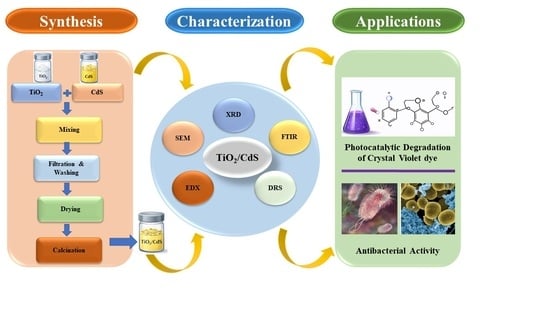
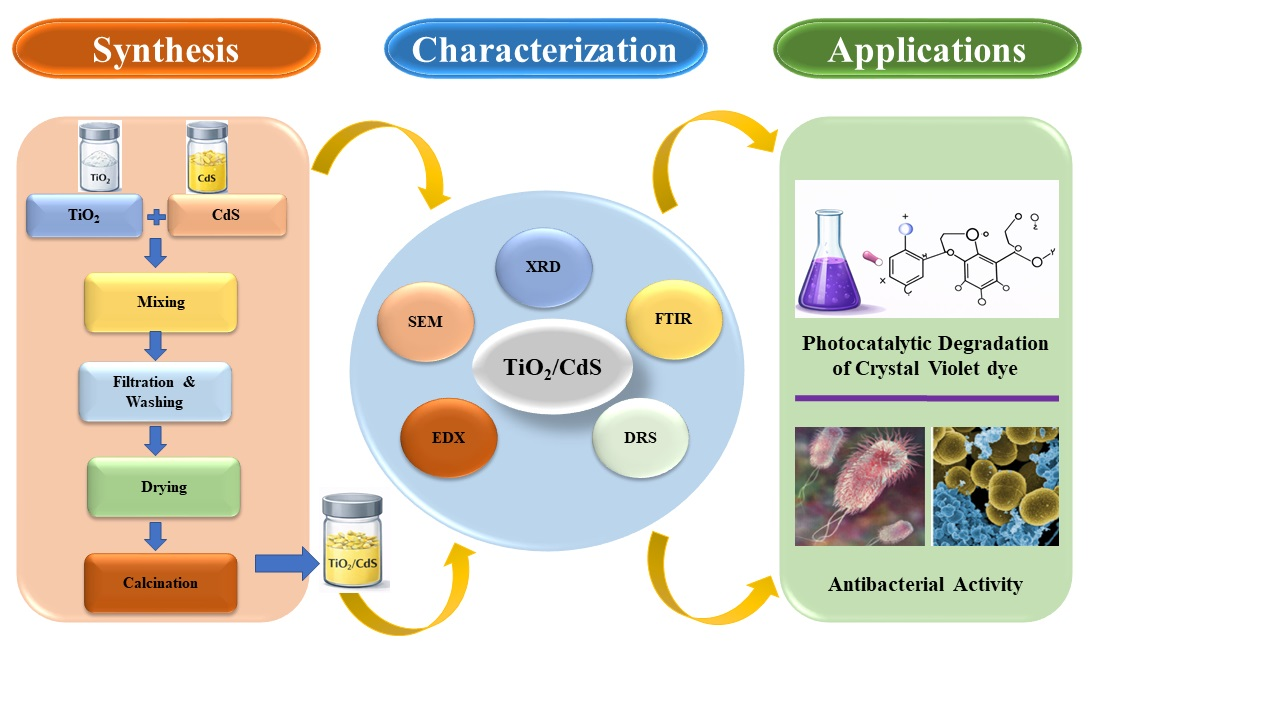
Graphical Abstract

1. Introduction

The rapid industrialization and urbanization of modern society have resulted in the widespread discharge of hazardous organic compounds, particularly synthetic dyes, in the aquatic ecosystems [1,2]. Organic dyes find extensive applications across various industries, including paper, textiles, pigments, cosmetics, food processing, and pharmaceuticals [2,3]. However, different dyes, including methylene blue, methyl orange, allura red, crystal violet and Rhodamine B, discharged from industries pose significant environmental and health threats [4,5]. Many of these dyes are toxic, mutagenic, and carcinogenic, causing lung tissue damage, cardiovascular stress, gastrointestinal complications, and systemic toxicity in humans and wildlife [5,6].
Crystal violet (CV), also called gentian violet or methyl violet, is one of the pollutants of great concern, particularly as a triphenylmethane dye. It is widely applied as a pH indicator, a cotton and silk textile dye, a component in paints and printing inks, a bacteriostatic agent, an active component in Gram stains and an external skin disinfectant used in humans and animals [1,7]. Nevertheless, despite such applications, its release into the aquatic environment causes significant health effects, such as moderate eye irritation, painful light sensitivity, respiratory and kidney failure, irreversible corneal damage and possible blindness [1,7]. It can also be absorbed through the skin in toxic doses, leading to skin and stomach irritation [7,8]. The non-biodegradable nature and toxicity of CV dye in water bodies emphasize the need to develop effective treatment technologies. Additionally, microbial contamination, specifically pathogenic bacteria such as P. aeruginosa, presents a critical and concurrent challenge in water that requires effective inactivation strategies [9]. Conventional wastewater treatment methods, including adsorption, coagulation, and biological degradation, have been employed for contaminant removal [6,10,11]. Although adsorption has received significant consideration because it is low-cost and easy to operate [11], traditional processes do not always lead to complete mineralization of organic contaminants and usually demonstrate limited removal efficiencies [12]. Conversely, advanced oxidation processes (AOPs), most notably the heterogeneous photocatalysis, provide an effective solution of degrading and completely mineralizing organic pollutants into harmless final products (CO2, H2O, and mineral acids) in the presence of light irradiation [4,6,13].
Titanium dioxide (TiO2) has emerged as a prominent photocatalyst due to its abundance, high stability, non-toxicity, and significant photocatalytic performance [14,15]. However, its large bandgap (3.0–3.2 eV for anatase) limits its activity primarily to UV light irradiation, which constitutes only 4 to 5% of the total solar irradiation, thereby restricting its practical photocatalytic applications [16,17]. To overcome this limitation and enhance visible-light absorption, narrow bandgap semiconductors such as cadmium sulfide (CdS) have been coupled with TiO2. CdS, with its narrow bandgap (1.94 eV), exhibits excellent visible-light absorption properties and, due to its unique structural and electronic properties, it presents an attractive co-catalyst for TiO2 modification [18,19,20]. The favorable band alignment between CdS and TiO2, with the CdS conduction band (CB) positioned approximately at 0.5 eV more negative than TiO2, facilitates efficient charge carrier separation [21,22]. Under visible-light irradiation, the photogenerated electrons transfer from the CdS CB to TiO2 CB, while TiO2 does not generate holes in its valence band (VB) under visible light, which inhibits electron-hole recombination, thereby enhancing photocatalytic efficiency [20,23]. Despite these advantages, CdS suffers from photocorrosion and Cd2+ ion leaching under prolonged irradiation, limiting its long-term photocatalytic applications [19,24]. The coupling of CdS with TiO2 addresses these limitations by providing structural protection through the chemical stability of TiO2, while the heterojunction simultaneously enhances surface area, creates additional active sites, and maintains visible-light activity. This synergetic combination creates a robust photocatalytic system with enhanced stability and performance. Although considerable research has been carried out on TiO2/CdS nanocomposites, systematic research on the impact of synthesis parameters and the operational conditions on the degradation of CV dye is still limited. Most of the previous literature has studied other dyes or has not systematically optimized key operational parameters, such as the effect of solution pH, initial dye concentration, and catalyst dosage on photocatalytic activity. Furthermore, the ex-situ approach for the synthesis of TiO2/CdS heterojunctions, which offers better control over composition and interface properties, has been underexplored for CV dye degradation applications.
In this context, the current work aims to develop and systematically evaluate TiO2/CdS nanocomposite photocatalysts for CV dye degradation under visible-light irradiation. Specifically, TiO2 and CdS NPs were synthesized via the sol–gel and hydrothermal methods, respectively, followed by the formation of TiO2/CdS heterojunction using an ex-situ approach. The as-synthesized materials were thoroughly characterized for their structural, morphological, optical, and compositional features using advanced analytical techniques including SEM, EDX, XRD, FTIR, and UV–vis DRS analysis. The photocatalytic activity of TiO2 NPs, CdS NPs, and TiO2/CdS nanocomposite was evaluated by assessing CV dye degradation under visible-light irradiation. Key operational parameters, including initial dye concentration, pH of the solution, and catalyst dosage, were systematically optimized. The kinetic study, reactive species identification, and stability assessment are discussed in detail, providing valuable mechanistic insights. Besides photocatalytic applications, TiO2/CdS nanocomposites showed effective antibacterial efficacy, particularly against P. aeruginosa, making them suitable candidates for both environmental and antibacterial applications.

2. Materials and Methods

2.1. Materials

Titanium tetraisopropoxide [Ti(OCH(CH3)2)]4 (TTIP), sodium sulfide (Na2S.H2O), cadmium acetate (CdCH3COO)2), and isopropanol [(CH3)2CHOH] were purchased from Sigma-Aldrich, St. Louis, MO, USA. Methanol (CH3OH), hydrochloric acid (HCl), sodium hydroxide (NaOH), ethanol (CH3CH2OH), ethylenediaminetetraacetic acid (EDTA), and p-benzoquinone (p-BQ) were also obtained from Sigma-Aldrich (St. Louis, MO, USA). All the chemicals were of analytical grade and used without further purification. Distilled water (DW) was used throughout the experiments.

2.2. Synthesis of TiO2 Nanoparticles

TiO2 was synthesized via the sol–gel method. Initially, 8.42 mL of TTIP was added dropwise to 24 mL of isopropanol under continuous stirring to form an alkoxide solution. The mixture was stirred continuously for an additional 10 min to ensure complete dispersion. Subsequently, a mixture comprising 10 mL of isopropanol and 4 mL of distilled water was added dropwise to the alkoxide solution to initiate hydrolysis. The resulting suspension was stirred for 24 h at room temperature to finalize the hydrolysis and condensation reactions. The obtained precipitate was isolated and dried in an oven at 80 °C overnight. Finally, the dried sample was calcined in a furnace at 430 °C for 2 h to obtain crystalline TiO2 NPs.

2.3. Synthesis of CdS Nanoparticles

CdS NPs were synthesized via the hydrothermal method. Initially, aqueous solutions of 0.2 M cadmium acetate and 0.1 M sodium sulfide were prepared in 50 mL distilled water (each solution in separate beakers). The sodium sulfide solution was gradually added to the cadmium acetate solution while being vigorously stirred until a yellow precipitate formed, indicating CdS formation according to reaction (1). This mixture was subsequently transferred to a Teflon-lined hydrothermal autoclave reactor and subjected to a temperature of 170 °C for 14 h. After cooling to ambient temperature, the product was filtered, rinsed thoroughly with distilled water, and dried at 100 °C. The dried sample was then calcined at 430 °C for 1 h in a muffle furnace (Nabertherm L 3/11, Nabertherm GmbH, Lilienthal, Germany) to obtain pure CdS NPs in powder form.
Cd(CH3COO)2 + Na2S → CdS + 2CH3COONa

2.4. Synthesis of TiO2/CdS Nanocomposite

The TiO2/CdS nanocomposite was prepared by mixing TiO2 NPs with CdS NPs using an ex-situ physical method. The as-synthesized TiO2 NPs (2 g, 90 wt.%) were physically mixed with CdS NPs (0.22 g, 10 wt.%) using a mortar and pestle for 10 min to ensure uniform distribution. The above mixture was then transferred to a beaker containing 20 mL methanol and 10 mL DW. The suspension was stirred for 30 min at ambient temperature, followed by 30 min continuous stirring at 80 °C. Subsequently, the sample was placed in an oven at 100 °C to facilitate the evaporation of the solvent employed in the production of TiO2/CdS nanocomposite. The dried sample was then crushed and calcined at 430 °C for 1 h to enhance crystallinity and eliminate residual organic ingredients, producing TiO2/CdS nanocomposite.

2.5. Characterization

The as-synthesized NPs and nanocomposites were characterized using the advanced analytical methods mentioned previously. The X-ray diffraction (XRD) patterns were recorded with the help of an X-ray diffractometer (Bruker D8 Advance, Bruker AXS GmbH, Karlsruhe, Germany) to investigate the phase structure and crystallite size of as-synthesized NPs and nanocomposites. The FTIR spectra were obtained with an FTIR spectrometer (PerkinElmer Spectrum 100, PerkinElmer, Inc., Waltham, MA, USA) over the spectral range of 400–4000 cm−1 to identify the characteristic functional groups in the as-synthesized samples. A scanning electron microscope (SEM) (JEOL JSM-6490, JEOL Ltd., Tokyo, Japan) was used to examine the morphology of the prepared samples. The elemental composition was confirmed using energy-dispersive X-ray (EDX) spectroscopy. Lastly, optical properties and bandgap of the as-prepared samples were measured through ultraviolet–visible diffuse reflectance spectrophotometer (UV–vis DRS) using a diffuse reflectance spectrophotometer (Shimadzu UV-2600, Shimadzu Corporation, Kyoto, Japan).

2.6. Photocatalytic Evaluation of Catalysts

The photocatalytic activity of as-synthesized photocatalysts (TiO2, CdS, and TiO2/CdS) was evaluated through CV dye degradation under visible-light irradiation. An 18 W LED lamp (Philips, Amsterdam, Netherlands; visible light, λ > 400 nm, 10 cm above the solution surface, and average light intensity approximately 50–60 mW/cm2) was used as the irradiation source. In each degradation study, 100 mL of CV dye with initial concentration of 20 mg/L was mixed with a photocatalyst at a loading of 0.25 g/L in a 250 mL glass beaker at 300 rpm. Prior to light irradiation, the suspension was stirred in darkness to facilitate the stabilization of adsorption and desorption, thereby achieving the adsorption of dye molecules onto the catalyst surface. The reaction mixture was then placed under visible light and constant stirring was done to ensure uniform irradiation and prevent catalyst from settling down at the bottom. Then, 5 mL of the samples of aqueous dye solution were withdrawn from the reaction mixture, after every 30 min of visible-light irradiation, immediately centrifuged to separate the catalyst, and their absorbance was analyzed using UV–vis spectrophotometry (Shimadzu UV-1900, Shimadzu Corporation, Kyoto, Japan) to measure the remaining dye concentration.
The effect of various experimental parameters on the CV removal was also studied while keeping the other reaction conditions constant (pH = 6, initial dye concentration = 20 mg/L, and catalyst dosage = 0.25 g/L). The effect of pH, initial dye concentration, and catalyst dosage on % degradation of CV was also evaluated. The pH of the suspension was adjusted using HCl (0.1 M) and NaOH (0.1 M) solutions. The removal efficiency of as-synthesized catalysts was calculated using the following expression (Equation (2)):
R e m o v a l   e f f i c i e n c y ( % ) = [ ( C 0 − C t ) / C 0 ] × 100
where Ct represents the concentration at time t and C0 represents the initial dye concentration. The photocatalyst was recovered through centrifugation (4000 rpm; HERMLE Z 206 A centrifuge, HERMLE Labortechnik GmbH, Wehingen, Germany), followed by washing with ethanol and deionized water. It was then dried at 80 °C and employed for an additional cycle of the degradation reaction.

2.7. Antibacterial Evaluation

The antibacterial efficiency of TiO2/CdS nanocomposite was evaluated against P. aeruginosa (Gram-negative, ATCC 27853; American Type Culture Collection, Manassas, VA, USA) bacterium via the agar-well diffusion method. P. aeruginosa was cultured in nutrient broth (Oxoid Ltd., Basingstoke, UK) and incubated at 37 °C for 24 h in a shaking incubator (Memmert SV 1422, Memmert GmbH + Co. KG, Schwabach, Germany) at 150 rpm. Mueller-Hinton agar plates (MHA; Oxoid Ltd., Basingstoke, UK) were used as the culture medium for the examination. To achieve homogenous bacterial suspension, 100 µL of pre-cultured bacteria was evenly plated on MHA plates. The bacterial suspension was adjusted to an optical density of 0.1 at 600 nm (about 108 CFU/mL). The preparation of nutrient agar plates was carried out by mixing 28 g/L of nutrient agar (Oxoid Ltd., Basingstoke, UK) in distilled water and then autoclaving. After cooling, the plates were inoculated with P. aeruginosa once they solidified by uniformly distributing bacterial suspension (100 µL) prepared on the surface of the agar with the aid of a sterile cotton-swab. A sterile cork borer (6 mm in diameter) was used to make wells on the surface of the agar. The as-synthesized TiO2/CdS nanocomposites were suspended in isopropanol at varying concentrations of 50, 100, and 200 µg/mL. Wells (6 mm in diameter) were prepared in agar plates and 50 µL of photocatalyst solution was added into each well. Ciprofloxacin (10 µg/mL; Sigma-Aldrich, St. Louis, MO, USA) was used as a positive control, while isopropanol alone served as negative control. The plates were inverted and incubated at 37 °C for 24 h. Following incubation, the zones of inhibition were measured with a ruler in millimeters. All the examinations were repeated triplicate (n = 3), and the mean value and standard deviation were calculated for zone of inhibition.

3. Results and Discussion

3.1. Characterization

3.1.1. FTIR Analysis

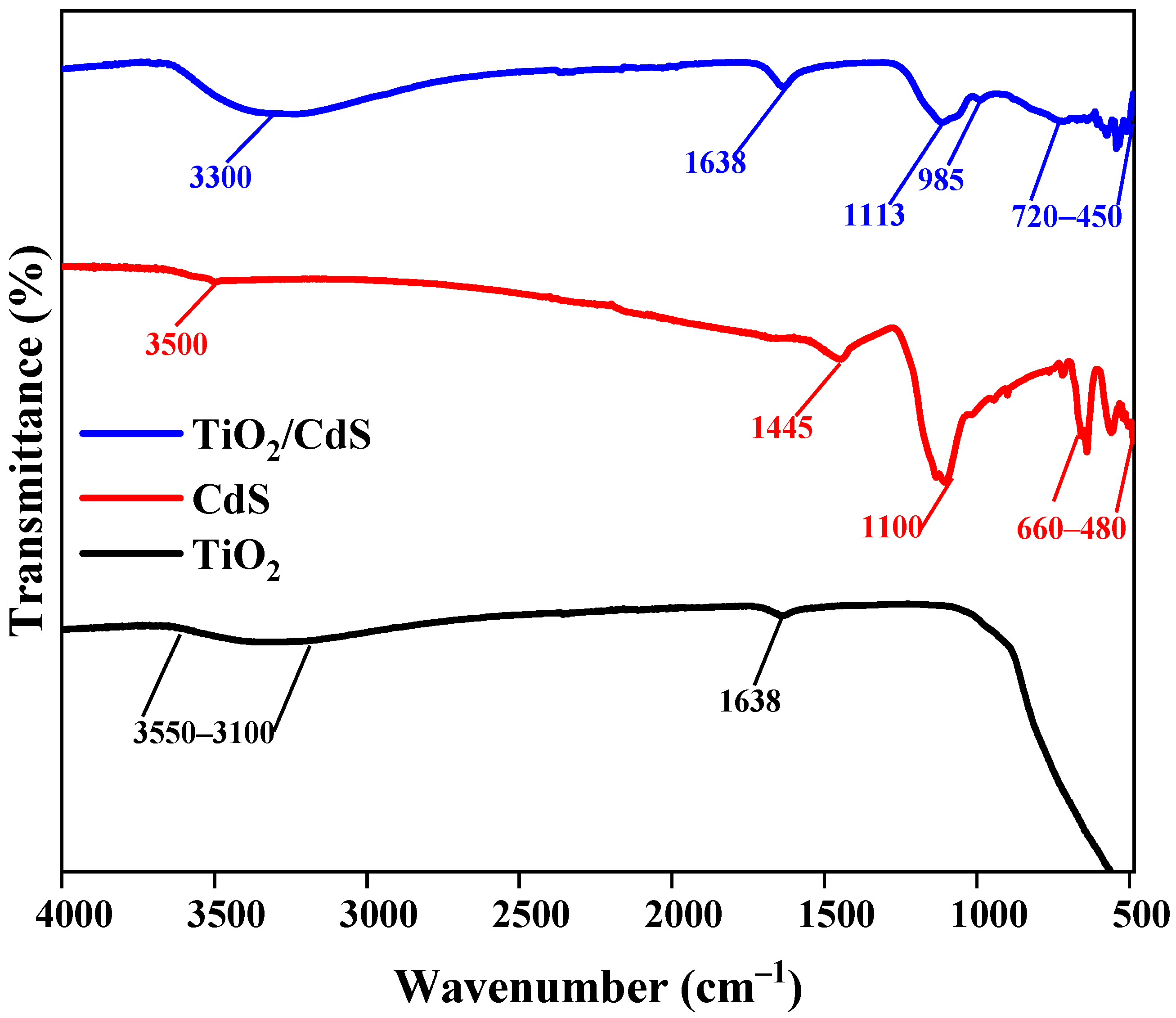
FTIR spectroscopy was employed to identify functional groups in TiO2, CdS NPs and TiO2/CdS nanocomposite. FTIR spectra of all synthesized samples are shown in Figure 1. The broad absorption band observed at 3000–3500 cm−1 across all the samples corresponds to O-H stretching vibration of surface hydroxyl group and absorbed water molecules on the NPs’ surface [24]. The peak observed at 1638 cm−1 is attributed to the H-O-H bending mode of coordinated water molecules, confirming water coordination through hydrogen bonding on the NPs, as shown in Figure 1 [25,26,27]. The intermediate strong band position in the 1445 cm−1 region is assigned to the stretching vibration of C-H deformation mode [25,26,28]. The distinctive band at 985 cm−1 corresponds to stretching vibrations of Ti-O, while an additional peak at 1113 cm−1 shows C-O stretching vibration, indicating a modified vibrational environment upon CdS incorporation [29]. The small absorption bands present between 720 and 450 cm−1 are attributed to both Ti-O and Cd-S vibrational modes, confirming successful incorporation of CdS into TiO2 [24,26,30]. The bands appearing at 660–480 cm−1 correspond to Cd-S stretching modes [24,26]. By comparing pure TiO2 and CdS NPs spectra, peak shifts and broadening were observed in the composite, indicating strong interfacial interactions rather than simple mixing. Thus, it was confirmed that the TiO2/CdS nanocomposite was successfully synthesized.

3.1.2. XRD Analysis

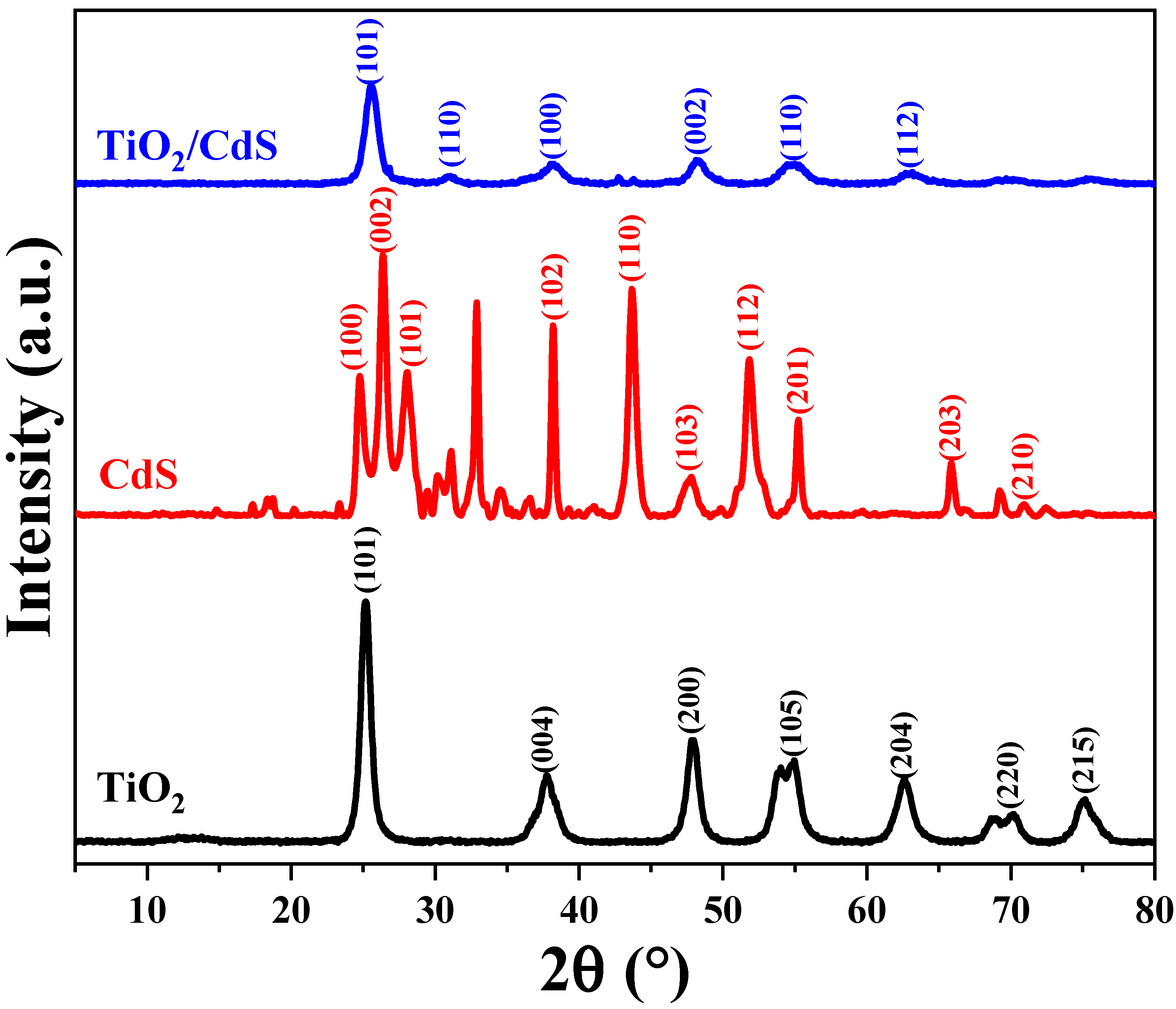
The XRD technique was employed to determine the phase composition, crystal structure and crystallite size of TiO2, CdS NPs and TiO2/CdS nanocomposite. The XRD spectra of as-prepared samples are illustrated in Figure 2. The XRD pattern of TiO2 showed characteristic peaks at 2θ positions of 25.3°, 37.8°, 48.1°, 54.1°, 62.7°, 70.1°, and 75.0°, corresponding to (101), (004), (200), (105), (204), (220), and (215) diffraction planes, respectively. The observed diffraction peaks and their corresponding planes align well with standard anatase-phase TiO2 and match well with the JCPDS card (Reference no. 21-1272) [16,24]. The dominant (101) peak at 25.3° is characteristic of the anatase structure and exhibits high intensity, indicating good crystallinity and phase purity. Similarly, CdS displayed well-defined peaks at 2θ positions of 24.8°, 26.5°, 28.1°, 36.6°, 43.8°, 47.9°, 51.8°, 55.0°, 66.0°, and 69.2°, corresponding to (100), (002), (101), (102), (110), (103), (112), (201), (203), and (210) planes of hexagonal wurtzite phase, respectively. These peaks along with their respective planes demonstrate the phase purity and structural order of hexagonal wurtzite structure of CdS NPs and match well with the standard JCPDS card (Reference no. 41–1049) [19,24]. The sharp and intense peaks indicate good crystallinity of synthesized CdS NPs. A weak peak around 32.2° was not assigned to any diffraction plane of hexagonal CdS according to JCPDS 41-1049 and may be attributed to minor structural imperfections or background noise. Furthermore, the XRD pattern of the TiO2/CdS nanocomposite exhibits peaks at 2θ positions 25.3°, 38.0°, 48.1°, 54.1°, and 62.7°, confirming successful heterojunction formation between the two semiconductors. However, due to the low mass percent (10 wt.%) of CdS, the intensity of CdS peaks was considerably reduced in the composite compared to pure CdS, while TiO2 peaks remained prominent [24,31,32]. In our previous work on TiO2/CdS nanocomposites synthesized with a 1:1 ratio, CdS diffraction peaks were more clearly visible due to the higher CdS content, whereas in the present study the 9:1 TiO2/CdS ratio results in weaker CdS reflections [24]. Importantly, no shift in the diffraction peaks of either CdS and TiO2 was observed in the nanocomposite, indicating that both phases maintain their individual crystal structures without the lattice constant parameter changes upon nanocomposite formation. This suggests physical mixing rather than solid-solution formation, which is beneficial for maintaining the individual photocatalytic properties of both components. The calculated average sizes for TiO2, CdS NPs, and TiO2/CdS nanocomposite were 28.7, 32.1, and 30.5 nm, respectively, calculated using the Scherrer equation (Equation (3)) [24].
  D = k λ   / β c o s   θ

3.1.3. SEM Analysis

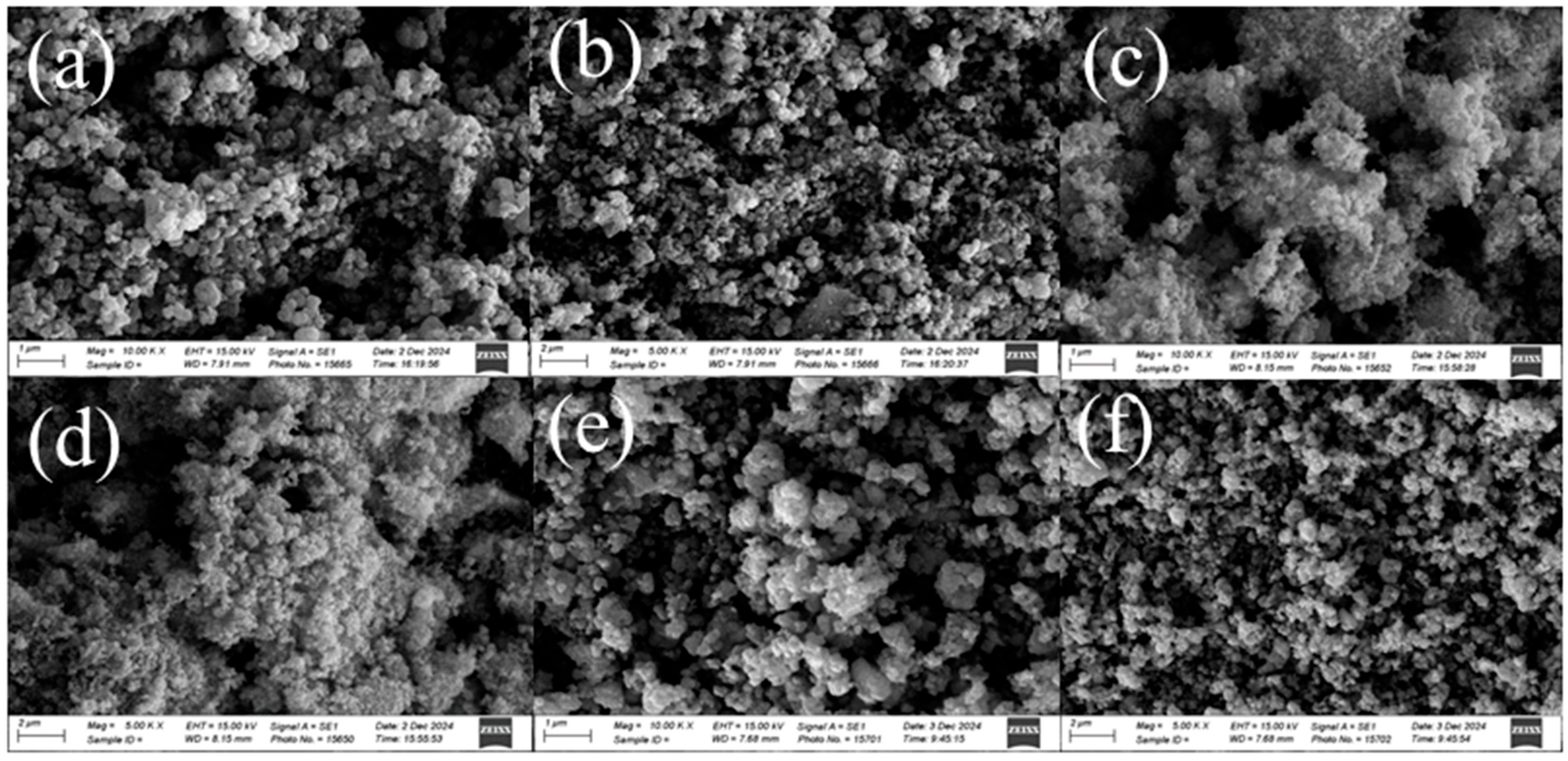
The surface morphology of the synthesized TiO2, CdS NPs, and TiO2/CdS nanocomposite was characterized using SEM analysis. The SEM micrographs of as-prepared TiO2, CdS NPs, and TiO2/CdS nanocomposite are illustrated in Figure 3. Pure TiO2 NPs exhibited predominantly spherical morphology with uniform size distribution (Figure 3a,b). The structure of the particles displayed a mixture of individual spherical-shaped and small agglomerates, with a few oval-shaped particles. Based on SEM analysis, the agglomerated clusters showed good porosity with interconnected spherical NPs forming larger three-dimensional network structures, which is favorable for photocatalytic applications due to enhanced surface accessibility.
CdS NPs (Figure 3c,d) showed slightly aggregated and irregular morphology, which is different from TiO2 NPs. The CdS NPs displayed densely packed agglomerates with a cauliflower-like structure, showing a more compact clustered structure as compared to the porous TiO2 agglomerated structure. SEM images of TiO2/CdS nanocomposite (Figure 3e,f) exhibited a porous and agglomerated morphology and homogeneous distribution with CdS NPs appearing to be dispersed on the surface of TiO2. The homogeneity and porosity are essential for the photocatalytic system to perform effectively [24,32].
The impact of CdS compounding on the surface morphology of TiO2 is clearly illustrated in Figure 3e,f. Following CdS incorporation, all resultant nanocomposite samples comprised cemented agglomerates with a rough surface texture. The enhanced surface energy of NPs is known to induce particle agglomeration [20,24]. In this study, the observed severe levels of agglomeration and cementation can be partially attributed to the precipitation of CdS on the surfaces and interstitial spaces of the TiO2 particles. These findings confirmed the successful formation of heterojunctions such as TiO2/CdS nanocomposites.

3.1.4. EDX Analysis

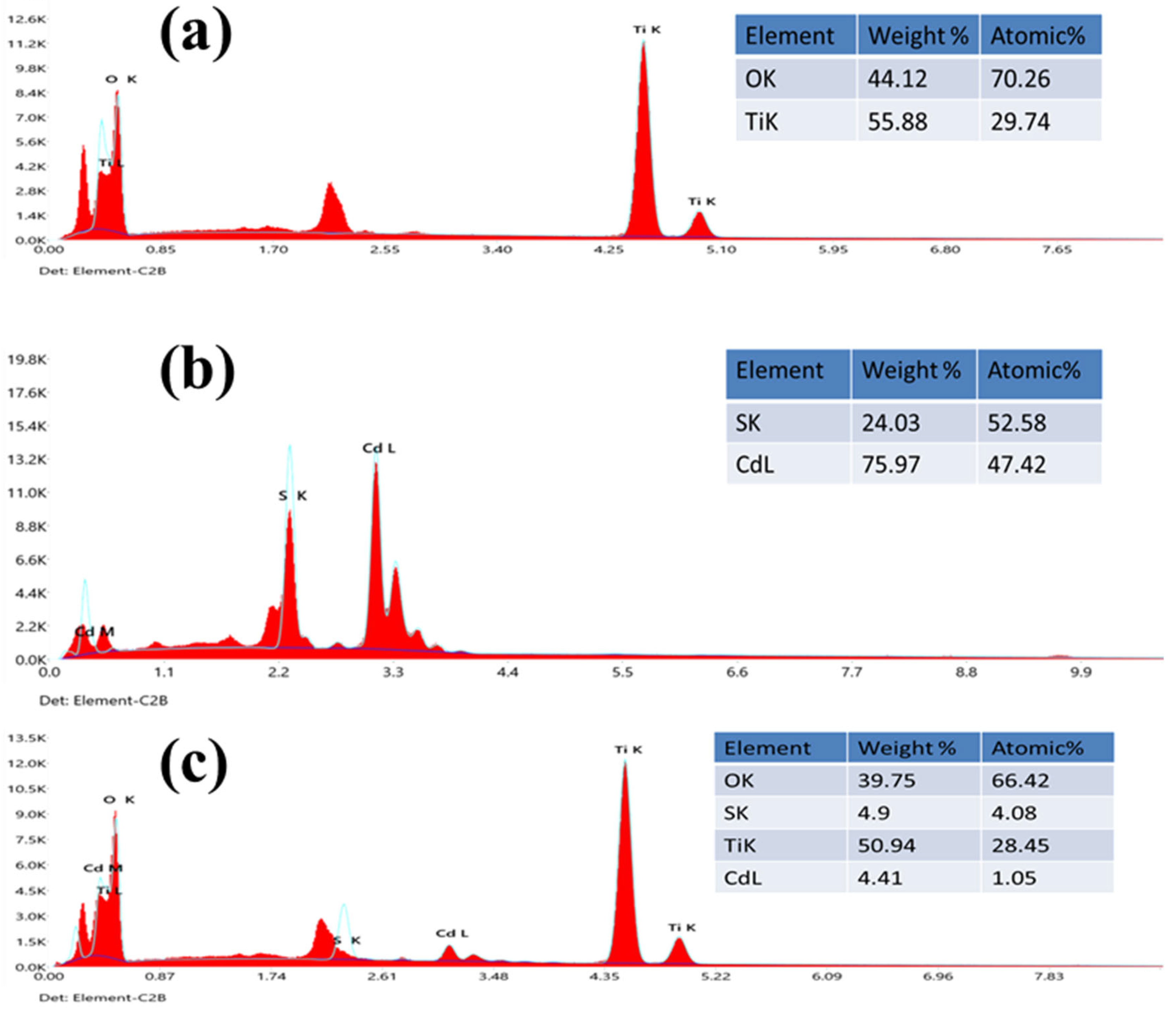
The elemental composition and chemical purity of the synthesized TiO2 NPs, CdS NPs, and the TiO2/CdS nanocomposite were systematically assessed using EDX spectroscopy (Figure 4). EDX analysis was carried out in the energy range of 0 to 14 keV to capture all relevant elemental signatures. The EDX spectrum showed that the atomic percentages of TiO2 NPs were 70.26% oxygen and 29.74% titanium (Figure 4a), which are in close agreement with the theoretical stoichiometric ratio for TiO2 (2:1). The slight deviation toward higher oxygen content can be attributed to the surface OH groups and adsorbed water molecules commonly found in TiO2 NPs [33]. Similarly, CdS NPs exhibited an atomic composition of 52.58% sulfur and 47.42% cadmium (Figure 4b). The slight deviation from the ideal 1:1 stoichiometric ratio indicates high-quality CdS formation with minimal sulfur vacancies. The spectrum of the TiO2/CdS nanocomposite displayed distinct peaks corresponding to the elements O, Ti, S, and Cd, with their respective proportions being 66.42, 28.45, 4.08, and 1.05% (Figure 4c). The Ti and O signals’ predominance indicates TiO2 as the major phase, while the presence of S and Cd confirms successful CdS incorporation. Figure 4 clearly illustrates the presence of both TiO2 and CdS NPs in the TiO2/CdS nanocomposite, confirming successful integration of both TiO2 and CdS phases within the nanocomposite structure. The observed morphological changes, along with the presence of all constituent elements in composite, demonstrate successful nanocomposite formation, consistent with previous studies [34,35].

3.1.5. Optical Properties and Bandgap Determination

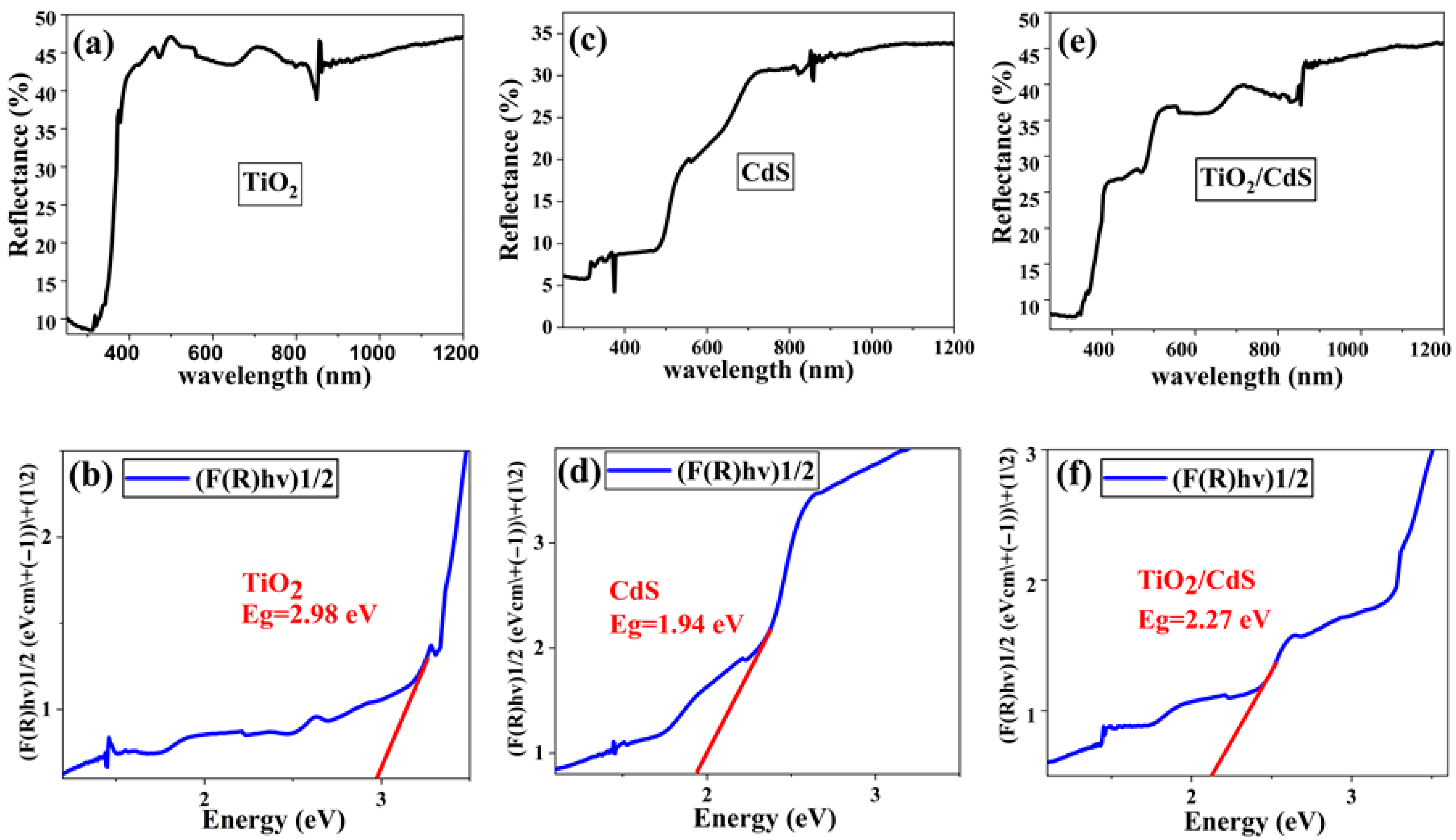
The optical characteristics and bandgaps of TiO2 NPs, CdS NPs, and TiO2/CdS nanocomposite were examined by UV–vis DRS. Figure 5a–f show the DRS spectra and related Tauc plots of the synthesized NPs and nanocomposite. The bandgaps of TiO2, CdS NPs, and TiO2/CdS nanocomposite were determined to be 2.98 eV (Figure 5b), 1.94 eV (Figure 5d), and 2.27 eV (Figure 5f), respectively. The bandgaps were determined from UV–vis DRS data using Tauc plots. The Tauc relation (αhν)1/2 = A(hν − Eg) was applied using the Kubelka–Munk function (Equation (4)) [24].
    F R = α s = ( 1 − R ∞ ) 2 / 2 R ∞
The intermediate bandgap energy of the composite positioned between those of TiO2 and CdS demonstrates synergistic effects, enabling enhanced light absorption across both UV and visible regions [22,24,36]. The improved absorption of light in the UV–vis region facilitates a greater number of photogenerated electrons and holes (e−/h+) participating in the photocatalytic process, thereby increasing the overall photocatalytic efficiency of TiO2/CdS [22]. The type II heterojunction formation between TiO2 and CdS enhances charge carrier separation under visible light and suppresses electron-hole recombination, thereby enhancing the photocatalytic performance of TiO2/CdS composite [22,24,36]. Upon exposure to visible light, electrons are generated in the CdS conduction band and transferred to the TiO2 conduction band, while holes are retained in the valence band of CdS [22]. The process by which these charge carriers are separated in composite suppresses the electron-hole recombination process, thereby improving the photocatalytic efficiency [22,24,36]. The improved charge separation dynamics and enhanced visible-light absorption properties of the TiO2/CdS nanocomposite make it a promising candidate for photocatalytic dye degradation application [22].

3.2. Photocatalytic Evaluation

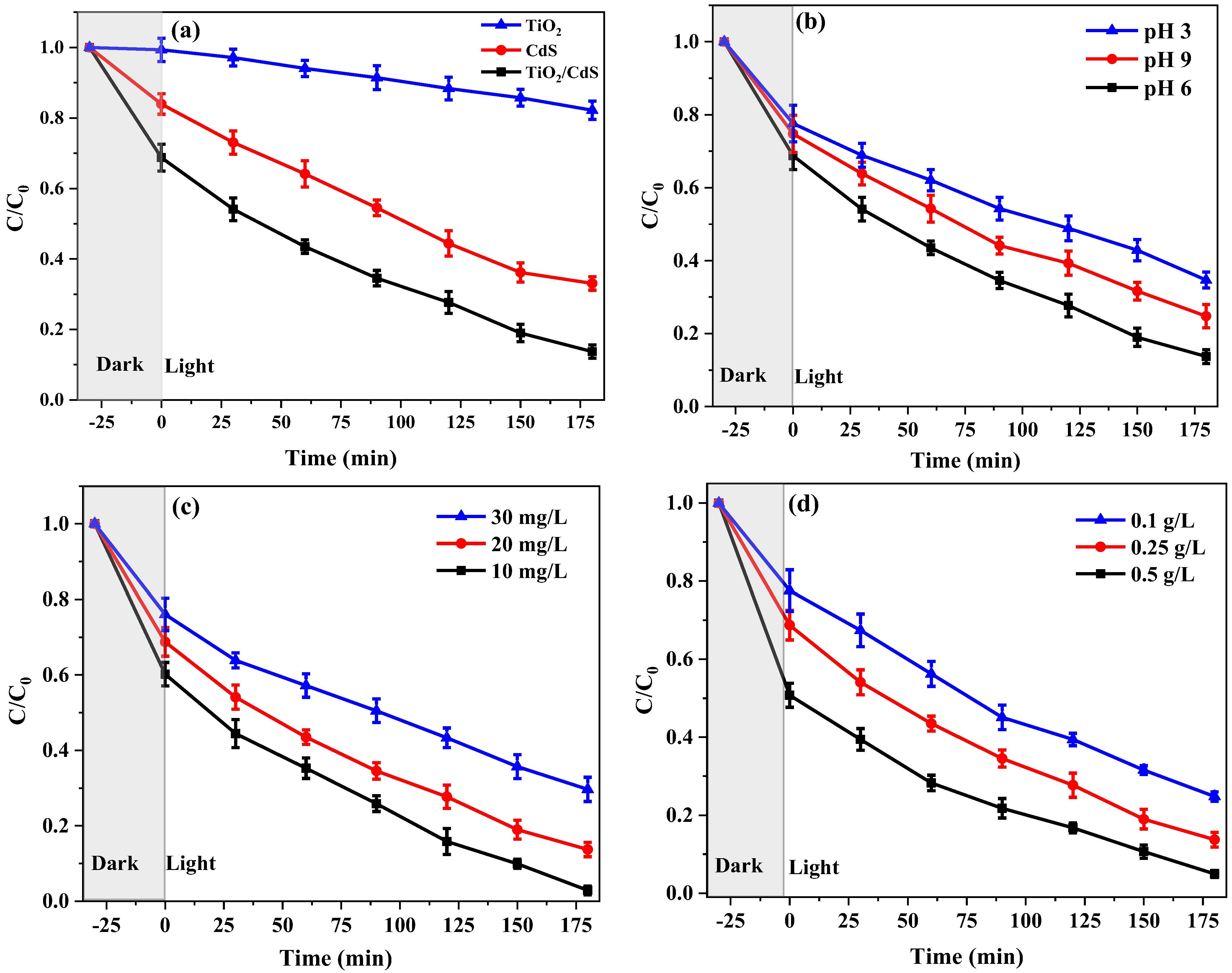
The photocatalytic activity of the as-prepared TiO2 NPs, CdS NPs, and TiO2/CdS nanocomposite was evaluated for the degradation of CV dye under visible-light irradiation. The results demonstrated that TiO2/CdS nanocomposite exhibited higher dye removal efficiency (86.3%) compared to pure TiO2 NPs (16.4%) and CdS NPs (66.9%), as shown in Figure 6a and Table 1. Here, the removal efficiency represents total dye removal, including both dark-phase adsorption and photocatalytic degradation, calculated relative to the initial dye concentration (C0) before catalyst addition.
Practically, TiO2 cannot be activated under visible light due to its wide bandgap, which impede its photocatalytic activity under visible-light irradiation [16,17]. The slight degradation observed for TiO2 under visible light can be explained by dye sensitization, where the CV dye absorbs light and passes electrons to TiO2, thereby producing reactive radicals and showing minimal photocatalytic activity [4,37]. Despite the lower bandgap, the moderate photocatalytic activity of CdS could be ascribed to rapid charge recombination and photocorrosion of CdS [19,38]. The enhancement in the activity of the TiO2/CdS nanocomposite is attributed to the formation of type II heterojunction, which inhibits the charge recombination [21,35]. The degradation data were well fitted to a pseudo-first-order kinetic model (Figure S1, Supporting Material (SM)). The rate constant (kobs) values for the photocatalytic degradation of CV were found to be 0.0010, 0.0052, and 0.0085 min−1 using TiO2, CdS and TiO2/CdS nanocomposite, respectively (Figure S1, Supporting Material, and Table 1). The as-synthesized nanocomposite exhibited better activity, as evidenced by its large kobs value. Photocatalytic activity of TiO2/CdS nanocomposite was systematically tested under varying conditions, including pH of solution, initial concentration of CV dye, and catalyst dosage.

3.2.1. Influence of pH

The photodegradation rate of many organic contaminants, including dyes, is significantly influenced by the solution pH [4,24]. Hence, the photocatalytic removal of CV using TiO2/CdS nanocomposite was investigated under various pH conditions (i.e., 3.0, 6.0, and 9.0), while keeping other experimental conditions constant. The removal efficiencies of the CV dye at pH 3.0, 6.0 and 9.0 were measured as 65.3, 86.3 and 75.2% (Figure 6b and Table 1), with kobs values of 0.0042, 0.0085 and 0.0058 min−1 (Figure S2, Supporting Material), respectively. The removal efficiency of TiO2/CdS can be explained in terms of pHPZC of catalyst and pKa value of pollutant. The point of zero charge (pHPZC), at which the surface is neutral, of TiO2/CdS is 5.8 [24], whereas the pKa value of CV has been reported to be 9.4 [39], indicating that the CV remains cationic in the tested range of pH. The poor removal efficiency (65.3%) at pH 3.0 could be attributed to electrostatic repulsion between the CV+ molecules and the surface of TiO2/CdS, which is positively charged at pH < pHPZC [24,40,41]. In addition, the stability of the catalyst may be compromised under highly acidic medium due to Cd2+ leaching from CdS constituents [19,24,38]. The maximum removal efficiency (86.3%) was due to the electrostatic force of attraction between CV+ and the negatively charged catalyst’s surface (pH > pHPZC) [4,24,41]. Alkaline conditions (pH 9.0) generate more OH− and excess OH− at pH 9 competes with CV dye for the active sites, thereby reducing the photocatalytic degradation of CV [4,37]. Moreover, the oxidation potential of •OH decreases at higher pH, which leads to reduction in photocatalytic degradation of CV [16,24,26,42]. Overall, pH 6 (near-neutral) provides an optimal balance between electrostatic adsorption of CV+ onto the negatively charged TiO2/CdS surface, sufficient ROS generation, and catalyst stability, thereby achieving the highest photocatalytic performance in wastewater treatment.

3.2.2. Effect of CV Concentration

The TiO2/CdS nanocomposite was employed for the photocatalytic degradation of CV dye at different initial dye concentrations (i.e., 10, 20, and 30 mg/L). The results revealed that the highest removal efficiency of 97.1% was obtained at an initial CV concentration of 10 mg/L, followed by 86.3% at 20 mg/L and 70.3% at 30 mg/L after 180 min of visible-light irradiation, as demonstrated in Table 1 and Figure 6c. The values of kobs were 0.0142, 0.0085 and 0.0051 min−1 for 10, 20 and 30 mg/L of CV, respectively (Figure S3, Supporting Material, and Table 1).
These results revealed that the pollutant removal efficiency decreased as the dye concentration increased. The decrease in removal at higher dye concentrations can be explained by a number of reasons: (i) saturation of the catalyst active sites, inhibiting the production of •OH [4]; (ii) limited penetration of light as a result of the inner filter effect caused by high dye concentration, denseness of the solution, and scattering of light, which reduce the amount of light absorbed by the photocatalyst [43]; and (iii) scavenging of ROS by an excessive number of dye molecules.
The calculated rate of degradation progressively increased with increasing CV dye concentration as indicated by 0.0539, 0.0958, and 0.1172 mg L−1 min−1 for initial concentrations of 10, 20, and 30 mg/L, respectively, after 180 min of visible-light irradiation (Figure S4, Supporting Material). This increase in degradation rate is attributed to the higher probability of interactions between an increased number of dye molecules and •OH, leading to the higher degradation rate of CV dye at its high concentrations [16,24,26,44].

3.2.3. Effect of Photocatalyst Dose

The catalyst-dosage effect was examined by varying TiO2/CdS nanocomposite’s concentration (0.1, 0.25, and 0.5 g/L), while other parameters were kept constant. The findings revealed that the removal efficiency increased as the concentration of catalyst increased. At a catalyst dose of 0.1, 0.25, and 0.5 g/L, the removal efficiencies were measured as 75.2, 86.3, and 95.1%, respectively (Table 1 and Figure 6d). In addition, at 0.1, 0.25, and 0.5 g/L initial dose, the kobs values were 0.0059, 0.0085, and 0.0116 min−1, respectively (Figure S5, Supporting Material, and Table 1). The increase in percent removal with increase in initial concentration of the photocatalyst can be attributed to the fact that a greater number of active sites were available for the adsorption of CV molecules on the TiO2/CdS surface [45]. Furthermore, at higher catalyst loading, the greater number of active sites and enhanced surface area of photocatalyst particles facilitate the electron-hole pair (e−/h+) generation, resulting in higher production of ROS. However, at higher catalyst loading (beyond optimal), particle agglomeration and light scattering can take place, which may reduce photocatalytic performance [46]. In this study, the highest photocatalytic activity was achieved at 0.5 g/L catalyst dosage; however, 0.25 g/L was selected as the optimal dosage due to cost-effectiveness and practical applications. This dosage represents the point of diminishing returns, where an increase in catalyst dose does not enhance the degradation but instead increases costs and energy requirements of materials [47]. The relationship between catalyst dosage and performance highlights that the TiO2/CdS heterojunction plays a role in overcoming limitations observed in single-component photocatalysts. The comparison of photocatalytic activities of previously reported TiO2/CdS nanocomposite is shown in Table 2.

3.3. Degradation of CV Dye Using TiO2/CdS Nanocomposite

When a photon with energy equivalent to or greater than the bandgap of the TiO2/CdS photocatalyst falls on its surface, electrons (e−) are excited from the valence band to conduction band, resulting in the formation of holes (h+) in the valence band of both TiO2 and CdS, while CdS act as the primary absorber due to its narrower bandgap (Reaction (5)) [51,52].
TiO2/CdS + hv → TiO2 (e−CB/h+VB) + CdS (e−CB/h+VB)
Due to the favorable alignment of energy levels between CdS and TiO2, photogenerated electrons migrate to the conduction band of TiO2 from the conduction band of CdS, while holes produced in the valence band of TiO2 are transferred to the CdS valence band. Holes flow in the opposite direction to electrons, which enhances charge separation by reducing recombination [53].
The holes (h+) subsequently react with surface-adsorbed H2O or OH− groups to generate highly reactive •OH [4,54] (Reactions (6) and (7)).
h+ + H2O → •OH + H+
h+ + OH− → •OH
At the same time, the electrons (e−) in the conduction band react molecular oxygen and H+ to produce superoxide radical anion (O2•−) and H2O2 (Reactions (8) and (9)) [24].
e−CB + O2 → O2•−
2e−CB + O2 + 2H+ → H2O2
The produced H2O2 further reacts with O2•− to produce more •OH, OH− and O2 (Reaction (10)) [4].
H2O2 + O2•−→ •OH + OH− + O2
The highly oxidizing •OH attacks the CV molecules, disrupting their conjugated systems and aromatic rings, leading to complete degradation [4,55] (Reaction (11)).
•OH + CV → intermediates → CO2 + H2O + mineralized products
The TiO2/CdS nanocomposite exhibits excellent photocatalytic stability during the photocatalytic process, attributed to effective charge separation and the protective influence of TiO2 on CdS, preventing photocorrosion in CdS and facilitating dye degradation. The synergistic effect of the advantageous properties of both CdS and TiO2, while minimizing their disadvantages, leads to enhanced photocatalytic activity for CV dye breakdown under visible-light irradiation [24,54,55].

3.4. Effect of Scavengers on the Photocatalytic Degradation of CV

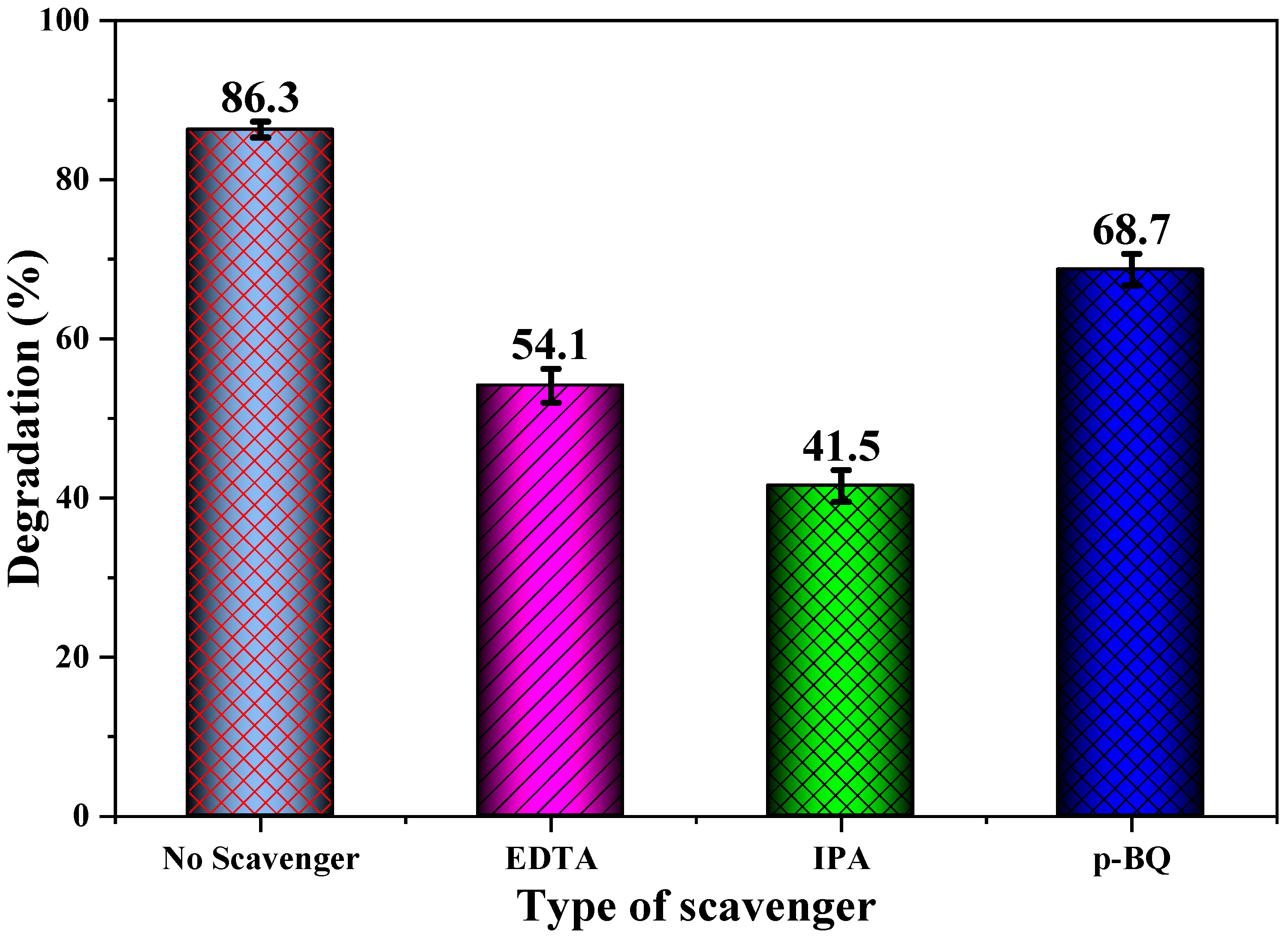
To elucidate the proposed mechanism and identify predominant reactive species involved in degradation of CV dye, scavenging experiments were performed under optimized conditions, as shown in Figure 7 and Table 3. This study involved the scavenging of photogenerated h+ with 5 mM ethylenediamineteteraacetic acid (EDTA), •OH with 5 mM isopropanol (IPA), and O2•− with 5 mM of p-benzoquinone (p-BQ) [56]. The addition of EDTA as a h+ scavenger decreased the degradation efficiency significantly from 86.3 to 54.1% (a 32.2% decline in TiO2/CdS efficiency) [57]. Such behavior may be due to direct oxidation of dye molecules by h+. The direct oxidation of dye molecules by h+ is also an important route for the degradation process [57]. In the same way, the removal efficiency was dramatically decreased to 41.5% from 86.3% upon the addition of IPA, a potent scavenger of •OH, resulting in 44.8% loss of TiO2/CdS’s activity. Isopropanol scavenging confirms •OH as the main oxidizing species attacking the conjugated dye structure [4,37]. The reason for the high reactivity of •OH could be attributed to its very high oxidation potential (E° = 2.80 V vs. NHE), which allows it to mineralize organic pollutants with great efficiency [58,59]. On the other hand, p-benzoquinone exhibited moderate inhibition of 17.6% (i.e., from 86.3 to 68.7%), suggesting that O2•− has minor contribution [56,60]. The scavenging effect of p-BQ on O2•− perfectly aligns with the reported literature, where it is shown to significantly reduce the formation of secondary ROS and thereby disrupting the overall degradation process. These findings revealed the role of O2•− as a secondary contributor to the photocatalytic degradation process. These detailed scavenger experiments establish a clear ROS hierarchy (•OH > h+ > O2•−) and are in good agreement with the suggested multi-pathway degradation mechanism (Figure 7 and Table 3) [57]. The synergistic action of different types of ROS ensures complete mineralization of CV dye into degradation products on the surface of the photocatalyst under visible-light irradiation [4,37].

3.5. Reusability of TiO2/CdS Nanocomposite

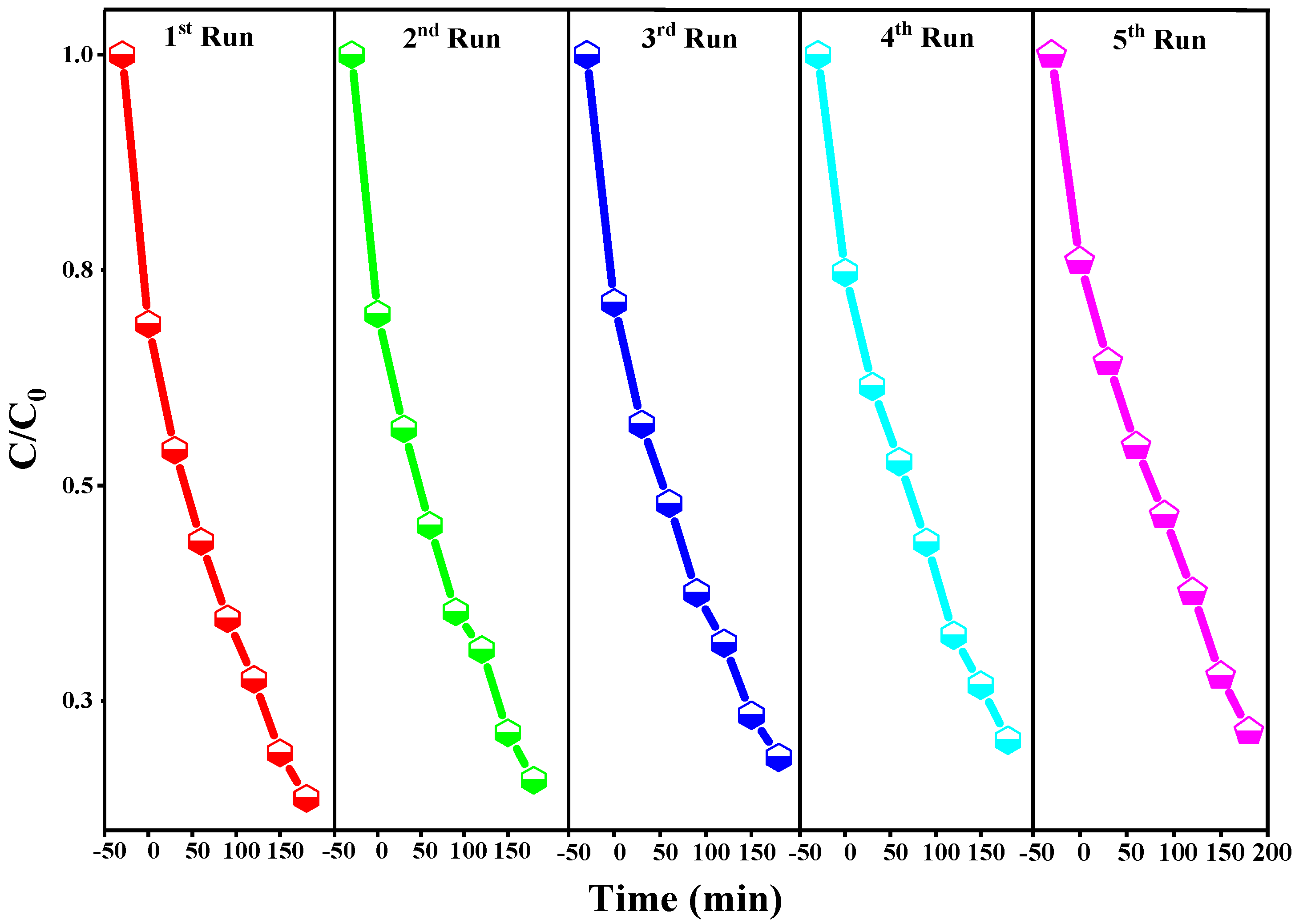
Practically, the reusability and stability of photocatalyst play important role in wastewater treatment. To verify the stability and the reusability of TiO2/CdS nanocomposite, under optimum conditions (i.e., pH 6, 20 mg/L of CV dye, and 0.25 g/L of catalyst dose) recycling experiments were performed (Figure 8). Following each run, the photocatalyst was separated by centrifugation, washed with DW and ethanol three times, and dried at 80 °C. Afterwards, the catalyst was employed for a subsequent degradation run. The results revealed that the photocatalytic activity of the TiO2/CdS nanocomposite was maintained until fourth cycle. After five runs, the removal efficiency dropped from 86.3% (first run) to 78.5% (fifth run), showing loss of only 7.8% in the photocatalytic activity. This relatively small reduction in removal efficiency can be attributed to the following factors: (i) minor photocorrosion of CdS under extended light exposure [19,24]; (ii) loss of catalyst material in the recovery and washing steps [24,45]; (iii) partial blocking of active sites by degradation intermediates [24,45].
Although the activity was slightly decreased, the TiO2/CdS nanocomposite greatly enhanced the stability of CdS nanoparticles, which usually severely photo-corroded and rapidly deactivated. This improved stability is due to the shielding effect of TiO2 that prevents the direct exposure of CdS to the reaction environment, which in turn minimizes leaching and photocorrosion of Cd2+ [19,34]. The efficient electron transfer from CdS to TiO2 also contributes to decreasing the accumulation of photogenerated holes in CdS, which mainly cause photocorrosion [34]. These results indicate that TiO2/CdS nanocomposite has excellent reusability and stability and can be considered as a promising candidate for wastewater treatment and environmental remediation.

3.6. Antibacterial Assessment

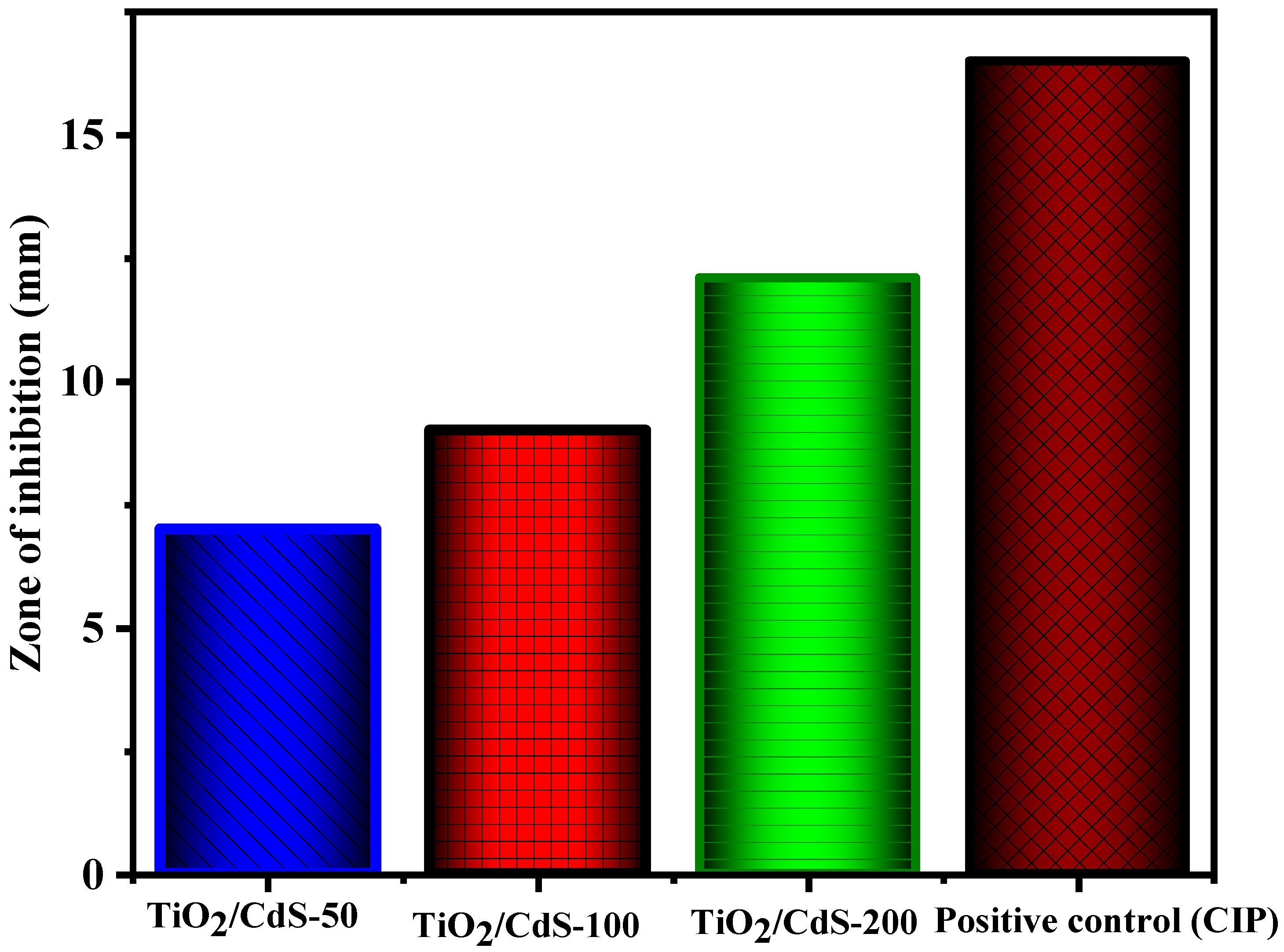
The antibacterial performance of synthesized TiO2/CdS nanocomposite was evaluated against P. aeruginosa at its various concentrations (50, 100, and 200 µg/mL) by means of the agar-well diffusion method. The results demonstrate that the nanocomposite exhibited concentration-dependent antibacterial activity as shown in Figure 9 and Table 4. Inhibition zones were 7.0 ± 0.5 mm at 50 µg/mL, 9.0 ± 0.6 mm at 100 µg/mL, and 12.1 ± 0.7 mm at 200 µg/mL, while the positive control ciprofloxacin (50 µg/mL) showed 16.5 ± 1.2 mm inhibition zone. Isopropanol, which was used as negative control, showed no inhibition zone, confirming that the observed antibacterial activity was solely due to TiO2/CdS nanocomposites. The enhanced antibacterial activity of TiO2/CdS could be attributed to the synergistic effect of heterojunction, which enables effective charge carrier separation and extends visible-light absorption. This property of the nanocomposite allows it to generate ROS under visible light [24,36,61]. These ROS then attack multiple bacterial targets simultaneously, including the external membrane and nucleic acids of P. aeruginosa [24,61]. The multi-level action is particularly relevant for P. aeruginosa, an opportunistic Gram-negative pathogenic bacterium that has intrinsic resistance mechanisms including efflux pumps, reduced membrane permeability, and biofilm formation [9,24,61]. The composite’s nano-scale dimensions provide a high surface-to-volume ratio that facilitates fast bacterial interaction and membrane disruption [8,9,24]. These findings revealed that the TiO2/CdS nanocomposite has significant potential as effective antimicrobial agent against P. aeruginosa, with promising applications in medical device coatings, wound dressing, and water purification systems.

4. Conclusions

The TiO2, CdS NPs and TiO2/CdS nanocomposite were successfully synthesized via the sol–gel, hydrothermal, and ex situ method, respectively. The as-prepared samples were comprehensively analyzed using FTIR, XRD, SEM-EDX, and UV–vis DRS analysis. XRD confirmed the anatase phase of TiO2 and hexagonal wurtzite phase CdS, while FTIR determined the distinctive functional groups. SEM-EDX revealed the morphology and elemental composition. The bandgap energy of TiO2, CdS, and TiO2/CdS nanocomposite was found to be 2.98, 1.94, and 2.27 eV, respectively. The broad bandgap of TiO2 limits its activity in UV light, whereas CdS with its narrow bandgap enables photocatalytic activity under visible light. The CdS/TiO2 nanocomposite exhibits an intermediate bandgap, which allows it to function effectively in both UV and visible light. Under optimized conditions, the TiO2/CdS nanocomposite demonstrated a significant photocatalytic efficiency (86.3%) compared to TiO2 (16.4%) and CdS (66.9%). •OH was identified as a dominant reactive specie involved in the removal of CV dye. The reusability results indicate that the nanocomposite still exhibited good photocatalytic efficiency after five successive runs, which confirmed the stability and reusability of the nanocomposite. In conclusion, the TiO2/CdS heterojunction demonstrated superior photocatalytic performance and significant antibacterial efficiency against P. aeruginosa, confirming its dual-functional potential for both environmental and medical applications.

Supplementary Materials

The following supporting information can be downloaded at https://www.mdpi.com/article/10.3390/w18080910/s1. Figure S1: −ln (C/C0) versus time graphs for comparative study; Figure S2: −ln (C/C0) versus time graph for influence of pH study; Figure S3: −ln (C/C0) versus time graph for CV concentration study; Figure S4: Degradation rate of CV dye at various initial concentration; Figure S5: −ln (C/C0) versus time for effect of catalyst dosage study.

Author Contributions

S.A.: Conceptualization, Data curation, Formal analysis, Investigation, Methodology, Writing—original draft. S.I.: Formal analysis, Investigation, Methodology, Writing—original draft. S.R.: Data curation, Investigation, Writing—original draft. N.A.: Investigation, Methodology, Software, Validation, Writing—original draft. D.K.: Methodology, Software, Writing—review and editing. A.Z.: Resources, Investigation, Writing—review and editing. M.A.: Project administration, Supervision, Validation, Writing—review and editing. N.S.S.: Software, Validation, Writing—review and editing. J.A.K.: Conceptualization, Project administration, Supervision, Funding acquisition, Validation, Visualization, Writing—review and editing. C.H.: Conceptualization, Validation, Funding acquisition, Writing—review and editing. All authors have read and agreed to the published version of the manuscript.

Funding

The authors gratefully acknowledge the Higher Education Commission (HEC), Pakistan, for financial support through the National Research Program for Universities (NRPU) Project, Ref No. 20-15851/NRPU/R&D/HEC/2021-2020. CH acknowledges the support from the National Research Foundation of Korea (NRF) grant funded by the Korean government (MSIT) (No. RS-2025-00461931).

Data Availability Statement

The original contributions presented in this study are included in the article. Further inquiries can be directed to the corresponding author.

Acknowledgments

Higher Education Commission (HEC), Pakistan, is highly acknowledged for financial support through National Research Program for Universities (NRPU) Project, Ref No. 20-15851/NRPU/R&D/HEC/2021-2020.

Conflicts of Interest

The authors declare no conflict of interest.

References

  1. de Oliveira, R.; Sant’Ana, A.C. Crystal violet degradation by visible light-driven AgNP/TiO2 hybrid photocatalyst tracked by SERRS spectroscopy. Vib. Spectrosc. 2024, 133, 103694. [Google Scholar] [CrossRef] [Scilit]
  2. Uddin, M.A.; Akter, S.; Banu, L.A.; Sayem, A.S.M. A comprehensive review on natural colourants: Classification, extraction and application in textile and other industries. J. Clean. Prod. 2022, 349, 131489. [Google Scholar] [CrossRef] [Scilit]
  3. Phan, K.; Raes, K.; Van Speybroeck, V.; Roosen, M.; De Clerck, K.; De Meester, S. Non-food applications of natural dyes extracted from agro-food residues: A critical review. J. Clean. Prod. 2021, 301, 126920. [Google Scholar] [CrossRef] [Scilit]
  4. Tan, S.N.; Yuen, M.L.; Ramli, R.A. Photocatalysis of dyes: Operational parameters, mechanisms, and degradation pathway. Green Anal. Chem. 2025, 12, 100230. [Google Scholar] [CrossRef] [Scilit]
  5. Kumar, M.; Singh, V.P.; Bhat, S.B.; Kumar, R. Environmental risks of textile dyes and photocatalytic materials for sustainable treatment: Current status and future directions. Discov. Environ. 2025, 3, 132. [Google Scholar] [CrossRef] [Scilit]
  6. Al-Tohamy, R.; Ali, S.S.; Li, F.; Okasha, K.M.; Mahmoud, Y.A.-G.; Elsamahy, T.; Jiao, H.; Fu, Y.; Sun, J. A critical review on the treatment of dye-containing wastewater: Ecotoxicological and health concerns of textile dyes and possible remediation approaches for environmental safety. Ecotoxicol. Environ. Saf. 2022, 231, 113160. [Google Scholar] [CrossRef] [Scilit] [PubMed]
  7. Mittal, A.; Mittal, J.; Malviya, A.; Kaur, D.; Gupta, V. Adsorption of hazardous dye crystal violet from wastewater by waste materials. J. Colloid Interface Sci. 2010, 343, 463–473. [Google Scholar] [CrossRef] [Scilit]
  8. Dibrov, P.; Dzioba, J.; Gosink, K.K.; Häse, C.C. Chemiosmotic mechanism of antimicrobial activity of Ag+ in Vibrio cholerae. Antimicrob. Agents Chemother. 2002, 46, 2668–2670. [Google Scholar] [CrossRef] [Scilit]
  9. Baaloudj, O.; Assadi, I.; Nasrallah, N.; El Jery, A.; Khezami, L.; Assadi, A.A. Simultaneous removal of antibiotics and inactivation of antibiotic-resistant bacteria by photocatalysis: A review. J. Water Process Eng. 2021, 42, 102089. [Google Scholar] [CrossRef] [Scilit]
  10. Saleh, T.A.; Tuzen, M.; Sarı, A. Polyamide magnetic palygorskite for the simultaneous removal of Hg (II) and methyl mercury; with factorial design analysis. J. Environ. Manag. 2018, 211, 323–333. [Google Scholar] [CrossRef] [Scilit]
  11. Chen, J.; Feng, J.; Yan, W. Influence of metal oxides on the adsorption characteristics of PPy/metal oxides for Methylene Blue. J. Colloid Interface Sci. 2016, 475, 26–35. [Google Scholar] [CrossRef] [Scilit]
  12. Ahmed, M.; Mavukkandy, M.O.; Giwa, A.; Elektorowicz, M.; Katsou, E.; Khelifi, O.; Naddeo, V.; Hasan, S.W. Recent developments in hazardous pollutants removal from wastewater and water reuse within a circular economy. NPJ Clean Water 2022, 5, 12. [Google Scholar]
  13. Bernabeu, A.; Vercher, R.; Santos-Juanes, L.; Simón, P.; Lardín, C.; Martínez, M.; Vicente, J.; González, R.; Llosá, C.; Arques, A.; et al. Solar photocatalysis as a tertiary treatment to remove emerging pollutants from wastewater treatment plant effluents. Catal. Today 2011, 161, 235–240. [Google Scholar] [CrossRef] [Scilit]
  14. Chen, X.; Liu, L.; Yu, P.Y.; Mao, S.S. Increasing solar absorption for photocatalysis with black hydrogenated titanium dioxide nanocrystals. Science 2011, 331, 746–750. [Google Scholar] [CrossRef] [Scilit] [PubMed]
  15. Pan, X.; Yang, M.-Q.; Fu, X.; Zhang, N.; Xu, Y.-J. Defective TiO2 with oxygen vacancies: Synthesis, properties and photocatalytic applications. Nanoscale 2013, 5, 3601–3614. [Google Scholar] [CrossRef] [Scilit]
  16. Khan, J.A.; Sayed, M.; Shah, N.S.; Khan, S.; Khan, A.A.; Sultan, M.; Tighezza, A.M.; Iqbal, J.; Boczkaj, G. Synthesis of N-doped TiO2 nanoparticles with enhanced photocatalytic activity for 2,4-dichlorophenol degradation and H2 production. J. Environ. Chem. Eng. 2023, 11, 111308. [Google Scholar] [CrossRef] [Scilit]
  17. Khan, J.A.; Han, C.; Shah, N.S.; Khan, H.M.; Nadagouda, M.N.; Likodimos, V.; Falaras, P.; O’Shea, K.; Dionysiou, D.D. Ultraviolet–visible light–sensitive high surface area phosphorous-fluorine–co-doped TiO2 nanoparticles for the degradation of atrazine in water. Environ. Eng. Sci. 2014, 31, 435–446. [Google Scholar] [CrossRef] [Scilit]
  18. Arabzadeh, A.; Salimi, A.; Ashrafi, M.; Soltanian, S.; Servati, P. Enhanced visible light driven photoelectrocatalytic oxidation of ethanol at reduced graphene oxide/CdS nanowires decorated with Pt nanoparticles. Catal. Sci. Technol. 2016, 6, 3485–3496. [Google Scholar] [CrossRef] [Scilit]
  19. Ning, X.; Li, J.; Yang, B.; Zhen, W.; Li, Z.; Tian, B.; Lu, G. Inhibition of photocorrosion of CdS via assembling with thin film TiO2 and removing formed oxygen by artificial gill for visible light overall water splitting. Appl. Catal. B Environ. 2017, 212, 129–139. [Google Scholar] [CrossRef] [Scilit]
  20. Jie, L.; Gao, X.; Cao, X.; Wu, S.; Long, X.; Ma, Q.; Su, J. A review of CdS photocatalytic nanomaterials: Morphology, synthesis methods, and applications. Mater. Sci. Semicond. Process. 2024, 176, 108288. [Google Scholar] [CrossRef] [Scilit]
  21. Arabzadeh, A.; Salimi, A. One dimensional CdS nanowire@TiO2 nanoparticles core-shell as high performance photocatalyst for fast degradation of dye pollutants under visible and sunlight irradiation. J. Colloid Interface Sci. 2016, 479, 43–54. [Google Scholar] [CrossRef] [Scilit]
  22. Wang, L.; Han, J.; Feng, J.; Wang, X.; Su, D.; Hou, X.; Hou, J.; Liang, J.; Dou, S.X. Simultaneously efficient light absorption and charge transport of CdS/TiO2 nanotube array toward improved photoelectrochemical performance. Int. J. Hydrogen Energy 2019, 44, 30899–30909. [Google Scholar]
  23. Ye, A.; Fan, W.; Zhang, Q.; Deng, W.; Wang, Y. CdS–graphene and CdS–CNT nanocomposites as visible-light photocatalysts for hydrogen evolution and organic dye degradation. Catal. Sci. Technol. 2012, 2, 969–978. [Google Scholar] [CrossRef] [Scilit]
  24. Ahmad, W.; Akhtar, N.; Choi, A.; Ateeq, M.; Shah, N.S.; Khan, J.A.; Al-Anazi, A.; Han, C. Hydrothermally engineered TiO2/CdS nanocomposite for efficient photocatalytic degradation of carbamazepine, hydrogen evolution and antibacterial applications. Sep. Purif. Technol. 2025, 383, 136131. [Google Scholar]
  25. Buzgar, N.; Buzatu, A.; Sanislav, I.V. The Raman study on certain sulfates. An. Stiint. U. Al. I-Mat 2009, 55, 5–23. [Google Scholar]
  26. Akhtar, N.; Choi, C.; Ateeq, M.; Fazil, P.; Shah, N.S.; Khan, J.A.; Al-Sehemi, A.G.; Zada, A.; Shah, M.I.A.; Ikram, R.; et al. CdS/CuO heterostructure for enhanced photocatalytic degradation of ciprofloxacin and hydrogen production under visible light irradiation. Chem. Eng. J. 2025, 507, 160336. [Google Scholar]
  27. León, A.; Reuquen, P.; Garín, C.; Segura, R.; Vargas, P.; Zapata, P.; Orihuela, P.A. FTIR and Raman characterization of TiO2 nanoparticles coated with polyethylene glycol as carrier for 2-methoxyestradiol. Appl. Sci. 2017, 7, 49. [Google Scholar] [CrossRef] [Scilit]
  28. Farouk, H.U. Effect of Chloride and Sulfate Ions on Deactivation of TiO2 Anatase in Photocatalytic Treatment of Methylene Blue and Methyl Orange. Ph.D. Thesis, University of Malaya, Kuala Lumpur, Malaysia, 2019. [Google Scholar]
  29. Kumar, P.M.; Badrinarayanan, S.; Sastry, M. Nanocrystalline TiO2 studied by optical, FTIR and X-ray photoelectron spectroscopy: Correlation to presence of surface states. Thin Solid Films 2000, 358, 122–130. [Google Scholar]
  30. Abdelmoneim, H.E.M.; Wassel, M.A.; Elfeky, A.S.; Bendary, S.H.; Awad, M.A.; Salem, S.S.; Mahmoud, S.A. Multiple applications of CdS/TiO2 nanocomposites synthesized via microwave-assisted sol–gel. J. Clust. Sci. 2022, 33, 1119–1128. [Google Scholar]
  31. Wang, J.; Zhu, Q.; Liao, Y.; Fu, H.; Chang, J.; Zhang, Y.; Kan, T.; Gao, H.; Huang, W. Efficient enhancement of photocatalytic hydrogen evolution of CdS nanorods by Nano-CuO. J. Alloys Compd. 2021, 883, 160832. [Google Scholar]
  32. Rafiq, K.; Sabir, M.; Abid, M.Z.; Jalil, M.; Nadeem, M.A.; Iqbal, S.; Rauf, A.; Hussain, E. Tuning of TiO2/CdS Hybrid Semiconductor with au cocatalysts: State-of-the-art design for sunlight-driven H2 Generation from Water Splitting. Energy Fuels 2024, 38, 4625–4636. [Google Scholar]
  33. Wu, C.-Y.; Tu, K.-J.; Deng, J.-P.; Lo, Y.-S.; Wu, C.-H. Markedly enhanced surface hydroxyl groups of TiO2 nanoparticles with superior water-dispersibility for photocatalysis. Materials 2017, 10, 566. [Google Scholar] [CrossRef] [Scilit]
  34. Wei, L.; Guo, Z.; Jia, X. Probing photocorrosion mechanism of CdS films and enhancing photoelectrocatalytic activity via cocatalyst. Catal. Lett. 2021, 151, 56–66. [Google Scholar] [CrossRef] [Scilit]
  35. Gao, X.; Liu, X.; Zhu, Z.; Gao, Y.; Wang, Q.; Zhu, F.; Xie, Z. Enhanced visible light photocatalytic performance of CdS sensitized TiO2 nanorod arrays decorated with Au nanoparticles as electron sinks. Sci. Rep. 2017, 7, 973. [Google Scholar] [PubMed]
  36. Ge, H.; Xu, F.; Cheng, B.; Yu, J.; Ho, W. S-scheme heterojunction TiO2/CdS nanocomposite nanofiber as H2-production photocatalyst. ChemCatChem 2019, 11, 6301–6309. [Google Scholar]
  37. Rauf, M.; Ashraf, S.S. Fundamental principles and application of heterogeneous photocatalytic degradation of dyes in solution. Chem. Eng. J. 2009, 151, 10–18. [Google Scholar] [CrossRef] [Scilit]
  38. Nasir, J.A.; Rehman, Z.U.; Shah, S.N.A.; Khan, A.; Butler, I.S.; Catlow, C.R.A. Recent developments and perspectives in CdS-based photocatalysts for water splitting. J. Mater. Chem. A 2020, 8, 20752–20780. [Google Scholar] [CrossRef] [Scilit]
  39. Huang, Y.-P.; Niu, H.-B.; Jin, L.; Jiao, L.; Johnson, D.; Tian, H.-L.; Sarina, S.; Zhu, H.-Y.; Fang, Y.-F. Selective adsorption of Crystal Violet via hydrogen bonded water bridges by InVO4. Chem. Eng. J. Adv. 2023, 15, 100508. [Google Scholar] [CrossRef] [Scilit]
  40. Loosli, F.; Le Coustumer, P.; Stoll, S. Impact of alginate concentration on the stability of agglomerates made of TiO2 engineered nanoparticles: Water hardness and pH effects. J. Nanoparticle Res. 2015, 17, 44. [Google Scholar] [CrossRef] [Scilit]
  41. Elashery, S.E.; Ibrahim, I.; Gomaa, H.; El-Bouraie, M.M.; Moneam, I.A.; Fekry, S.S.; Mohamed, G.G. Comparative study of the photocatalytic degradation of crystal violet using ferromagnetic magnesium oxide nanoparticles and MgO-bentonite nanocomposite. Magnetochemistry 2023, 9, 56. [Google Scholar] [CrossRef] [Scilit]
  42. Ahmad, W.; Shah, R.; Khan, D.; Khan, J.A.; Shah, N.S.; Al-Anazi, A.; Han, C. Enhanced visible-light driven degradation of carbamazepine and hydrogen evolution using nitrogen-doped TiO2 nanoparticles. Ceram. Int. 2025, 52, 2552–2567. [Google Scholar] [CrossRef] [Scilit]
  43. Moustakas, N.; Katsaros, F.; Kontos, A.; Romanos, G.; Dionysiou, D.; Falaras, P. Visible light active TiO2 photocatalytic filtration membranes with improved permeability and low energy consumption. Catal. Today 2014, 224, 56–69. [Google Scholar] [CrossRef] [Scilit]
  44. Yuan, R.; Ramjaun, S.N.; Wang, Z.; Liu, J. Concentration profiles of chlorine radicals and their significances in •OH-induced dye degradation: Kinetic modeling and reaction pathways. Chem. Eng. J. 2012, 209, 38–45. [Google Scholar] [CrossRef] [Scilit]
  45. Qutub, N.; Singh, P.; Sabir, S.; Sagadevan, S.; Oh, W.-C. Enhanced photocatalytic degradation of Acid Blue dye using CdS/TiO2 nanocomposite. Sci. Rep. 2022, 12, 5759. [Google Scholar] [PubMed]
  46. Panbude, U.; Palwe, V.; Khairkar, R.V.; Ravi, M.; Nagababu, P. Enhanced antibiotic degradation using rGO composites under visible light photocatalysis. J. Environ. Chem. Eng. 2024, 12, 114547. [Google Scholar] [CrossRef] [Scilit]
  47. Champati, A.; Sahu, P.K.; Rath, A.; Naik, B.; Pradhan, A. Enhanced Photodegradation of Antibiotics and Antimicrobial Activity by a g-C3N4/g-C3N5 Nanosheet Heterojunction Photocatalyst. ACS Omega 2025, 10, 43871–43890. [Google Scholar]
  48. Makama, A.B.; Salmiaton, A.; Saion, E.B.; Choong, T.S.Y.; Abdullah, N. Synthesis of CdS sensitized TiO2 photocatalysts: Methylene blue adsorption and enhanced photocatalytic activities. Int. J. Photoenergy 2016, 2016, 2947510. [Google Scholar]
  49. Du, Y.-E.; Niu, X.; He, X.; Hou, K.; Liu, H.; Zhang, C. Synthesis and photocatalytic activity of TiO2/CdS nanocomposites with co-exposed anatase highly reactive facets. Molecules 2021, 26, 6031. [Google Scholar] [CrossRef] [Scilit]
  50. Keerthana, B.G.T.; Murugakoothan, P. Synthesis and characterization of CdS/TiO2 nanocomposite: Methylene blue adsorption and enhanced photocatalytic activities. Vacuum 2019, 159, 476–481. [Google Scholar] [CrossRef] [Scilit]
  51. Zyoud, A.H.; Zaatar, N.; Saadeddin, I.; Ali, C.; Park, D.; Campet, G.; Hilal, H.S. CdS-sensitized TiO2 in phenazopyridine photo-degradation: Catalyst efficiency, stability and feasibility assessment. J. Hazard. Mater. 2010, 173, 318–325. [Google Scholar] [CrossRef] [Scilit]
  52. Shi, J.-W.; Yan, X.; Cui, H.-J.; Zong, X.; Fu, M.-L.; Chen, S.; Wang, L. Low-temperature synthesis of CdS/TiO2 composite photocatalysts: Influence of synthetic procedure on photocatalytic activity under visible light. J. Mol. Catal. A Chem. 2012, 356, 53–60. [Google Scholar]
  53. Li, X.; Yu, J.; Jaroniec, M. Hierarchical photocatalysts. Chem. Soc. Rev. 2016, 45, 2603–2636. [Google Scholar] [CrossRef] [Scilit]
  54. Khan, S.; Ahmad, W.; Akhtar, N.; Shah, R.; Ali, A.; Shah, N.S.; Al-Anazi, A.; Khan, J.A. Cutting-edge research progress in synthesis and applications of MXene-based nanocomposites for water purification: A comprehensive review. J. Environ. Chem. Eng. 2025, 13, 119941. [Google Scholar]
  55. Baaloudj, O.; Nasrallah, N.; Bouallouche, R.; Kenfoud, H.; Khezami, L.; Assadi, A.A. High efficient Cefixime removal from water by the sillenite Bi12TiO20: Photocatalytic mechanism and degradation pathway. J. Clean. Prod. 2022, 330, 129934. [Google Scholar] [CrossRef] [Scilit]
  56. Hossain, S.S.; Tarek, M.; Munusamy, T.D.; Karim, K.M.R.; Roopan, S.M.; Sarkar, S.M.; Cheng, C.K.; Khan, M.M.R. Facile synthesis of CuO/CdS heterostructure photocatalyst for the effective degradation of dye under visible light. Environ. Res. 2020, 188, 109803. [Google Scholar] [CrossRef] [Scilit]
  57. Zheng, X.; Yuan, J.; Shen, J.; Liang, J.; Che, J.; Tang, B.; He, G.; Chen, H. A carnation-like rGO/Bi2O2CO3/BiOCl composite: Efficient photocatalyst for the degradation of ciprofloxacin. J. Mater. Sci. Mater. Electron. 2019, 30, 5986–5994. [Google Scholar] [CrossRef] [Scilit]
  58. Feng, Z.; Tian, Q.; Yang, Q.; Zhou, Y.; Zhao, H.; Zhao, G. Selectively photoelectrocatalytic reduction of oxygen to hydroxyl radical and singlet oxygen: Mechanism and validation in coal wastewater. Appl. Catal. B Environ. 2021, 286, 119908. [Google Scholar]
  59. He, J.; Ma, W.; He, J.; Zhao, J.; Yu, J.C. Photooxidation of azo dye in aqueous dispersions of H2O2/α-FeOOH. Appl. Catal. B Environ. 2002, 39, 211–220. [Google Scholar] [CrossRef] [Scilit]
  60. Hossain, M.S.; Mollah, M.Y.A.; Susan, M.A.B.H.; Islam, M.M. Role of in situ electrogenerated reactive oxygen species towards degradation of organic dye in aqueous solution. Electrochim. Acta 2020, 344, 136146. [Google Scholar] [CrossRef] [Scilit]
  61. Rukh, G.; Ullah, A.; Akhtar, N.; Yasmeen, S.; Zada, A.; Fazil, P.; Khan, J.A.; Ali, O.A.A.; Mahmoud, S.F.; Shah, M.I.A.; et al. Exceptional synergistic photodynamic antimicrobial chemotherapy of graphene oxide decorated with nicotinamide zinc phthalocyanine potentiated by potassium iodide. Diam. Relat. Mater. 2025, 156, 112452. [Google Scholar] [CrossRef] [Scilit]
Figure 1. FTIR spectra of TiO2, CdS NPs, and TiO2/CdS nanocomposite.
Water 18 00910 g001
Figure 2. XRD patterns of TiO2, CdS NPs, and TiO2/CdS nanocomposite.
Water 18 00910 g002
Figure 3. SEM images of the TiO2 NPs (a,b), CdS NPs (c,d), and TiO2/CdS nanocomposite (e,f).
Water 18 00910 g003
Figure 4. EDX spectra of (a) TiO2 NPs, (b) CdS NPs, (c) TiO2/CdS nanocomposite.
Water 18 00910 g004
Figure 5. (a) TiO2 DRS spectrum, (b) TiO2 Tauc plot, (c) CdS DRS spectrum, (d) CdS Tauc plot, (e) TiO2/CdS DRS spectrum, and (f) TiO2/CdS Tauc plot.
Water 18 00910 g005
Figure 6. (a) CV dye removal efficiency by TiO2 NPs, CdS NPs, and TiO2/CdS nanocomposite under optimized experimental conditions: [CV]0 = 20 mg/L, [catalyst]0 = 0.25 g/L, pH = 6, and time = 180 min; (b) pH-dependent photocatalytic removal of CV dye by TiO2/CdS nanocomposite under reaction conditions: [CV]0 = 20 mg/L, [TiO2/CdS]0 = 0.25 g/L, and time = 180 min; (c) Effects of initial CV dye concentration on its photocatalytic removal using TiO2/CdS nanocomposite under reaction conditions: [TiO2/CdS]0 = 0.25 g/L, pH = 6, and time = 180 min; (d) TiO2/CdS dosage effect on CV dye removal under experimental conditions: [CV]0 = 20 mg/L, pH = 6, and time = 180 min.
Water 18 00910 g006
Figure 7. Removal of CV in the presence of different specific scavengers. Reaction conditions: [CV]0 = 20 mg/L, photocatalyst dose = 0.25 g/L, pH = 6.0, [IPA]0 = [EDTA]0 = [p-BQ]0 = 5.0 mM.
Water 18 00910 g007
Figure 8. Reusability study of TiO2/CdS nanocomposite.
Water 18 00910 g008
Figure 9. Inhibition zones of TiO2/CdS at various concentrations (50, 100, and 200 µg/mL) and positive control (CIP) at 50 µg/mL against P. aeruginosa.
Water 18 00910 g009
Table 1. The photocatalytic performance of TiO2 NPs, CdS NPs, and TiO2/CdS nanocomposite: removal efficiency and kinetic study under optimized experimental conditions.
StudySamplesInitial CV Dye Concentration (mg/L)Catalyst (g/L)pHRemoval (%) at 180 minkobs (min−1)
Catalyst ComparisonTiO2200.25616.40.0010
CdS200.25666.90.0052
TiO2/CdS200.25686.30.0085
pHTiO2/CdS200.25365.30.0042
TiO2/CdS200.25686.30.0085
TiO2/CdS200.25975.20.0058
[CV dye]0TiO2/CdS100.25697.10.0142
TiO2/CdS200.25686.30.0085
TiO2/CdS300.25670.30.0051
[TiO2/CdS]0TiO2/CdS200.10675.20.0059
TiO2/CdS200.25686.30.0085
TiO2/CdS200.5695.10.0116
Table 2. Comparison of TiO2/CdS photocatalysts reported for dye removal under visible light.
PhotocatalystTargeted DyeLight SourceRemoval (%)Time (min)Reference
CdS-sensitized TiO2 photocatalystMethylene blueVisible light85.9120[48]
TiO2/CdS nanocompositeMethyl OrangeUV-light88.4120[49]
TiO2/CdS compositeMethylene blueVisible light77180[50]
CdS/TiO2 nanocompositeAcid blue Visible light8490[45]
TiO2/CdS nanocompositeCrystal violetVisible light86.3 **180Current work
Notes: ** Comprehensive characterization analysis (XRD, FTIR, SEM, EDX, and UV–vis DRS); systematic optimization of parameters (dye concentration, pH, catalyst dosage, and comparative studies); reusability study; mechanistic insight via scavenger experiments; and detailed kinetic (kobs values) study. Achieved 86.3% CV removal at optimized conditions. For complete study parameters, see Table 1.
Table 3. Percentage reductions in photocatalytic removal of CV dye in the presence of different scavengers. Experimental conditions: [CV]0 = 20 mg/L, [TiO2/CdS]0 = 0.25 g/L, [EDTA]0 = 5 mM, [IPA]0 = 5 mM, [p-BQ]0 = 5 mM.
Type of Scavenger
(5 mM)
Target SpeciesRemoval Efficiency (%)Inhibition (%)Mechanism
Control
(No scavenger)
----86.30All species involved
EDTAh+54.132.2Direct oxidation blocking [57,59]
IPA•OH41.544.8Primary oxidant scavenging (E° = +2.80 V) [59]
p-BQO2•−68.717.6Secondary oxidant pathway disruption [56,60]
Table 4. Inhibition zones of TiO2/CdS nanocomposite and ciprofloxacin (CIP) against P. aeruginosa.
CompoundConcentration (µg/mL)Zone of Inhibition (mm)
Positive control (CIP)5016.5 ± 1.2
Negative control-No inhibition
TiO2/CdS507.0 ± 0.5
TiO2/CdS1009.0 ± 0.6
TiO2/CdS20012.1 ± 0.7
Disclaimer/Publisher’s Note: The statements, opinions and data contained in all publications are solely those of the individual author(s) and contributor(s) and not of MDPI and/or the editor(s). MDPI and/or the editor(s) disclaim responsibility for any injury to people or property resulting from any ideas, methods, instructions or products referred to in the content.