Article

Multidecadal Intensification of Internal Phosphorus Loading in the Archipelago Sea and Implications for Mitigation Strategies

Finnish Supervisory Agency, 20800 Turku, Finland
Water 2026, 18(8), 908; https://doi.org/10.3390/w18080908
Submission received: 13 March 2026 / Revised: 7 April 2026 / Accepted: 8 April 2026 / Published: 10 April 2026
(This article belongs to the Section Biodiversity and Functionality of Aquatic Ecosystems)

Abstract

Internal phosphorus loading is a key process sustaining eutrophication in stratified Baltic Sea coastal systems, yet its long-term dynamics in the Archipelago Sea remain poorly quantified due to limited deep-water monitoring and the absence of sediment time series. This study provides a multidecadal assessment of internal loading from the early 1980s to 2025 using two complementary indicators: (i) seasonal accumulation of total phosphorus in the surface layer (ΔTP) and (ii) the covariation between near-bottom oxygen depletion and dissolved inorganic phosphorus (DIP) release. Temporal associations with external phosphorus inputs from marine fish farming—highly variable during the study period—were analyzed to evaluate whether cumulative loading trajectories coincided with phases of intensified ΔTP. New measurements of drifting filamentous macroalgae from 2025 were additionally used to assess their seasonal contribution to the internal phosphorus pool and their relevance for mitigation. Results show a pronounced multidecadal strengthening of internal loading signals in the mid and inner Archipelago Sea. At the Seili station, ΔTP increased by approximately 6.8 µg L−1 (≈3.4-fold) since the early 1980s. This trend coincided with long-term deterioration of near-bottom oxygen conditions and increasing DIP concentrations, consistent with enhanced sediment phosphorus release. Although cumulative aquaculture loading exhibited simple correlations with ΔTP, detrended analyses indicate that these relationships largely reflect shared long-term trends rather than direct causal linkages. Drifting filamentous macroalgae formed a substantial seasonal phosphorus reservoir (≈146 t P). Overall, internal phosphorus input to the Archipelago Sea has intensified markedly—by an estimated ~70% since the 1980s—highlighting the growing importance of sediment–water feedbacks and legacy phosphorus. Effective mitigation therefore requires strategies that address both internal recycling processes and external nutrient inputs. Targeted removal of drifting filamentous macroalgae may provide a complementary nutrient-export pathway in coastal management.

1. Introduction

Internal phosphorus loading is increasingly recognized as a major process sustaining eutrophication in the Baltic Sea, even after substantial reductions in external nutrient inputs [1]. Across the Baltic Sea, widespread bottom-water hypoxia and anoxia have intensified during recent decades, reinforcing sediment–water phosphorus feedbacks and slowing ecosystem recovery despite major nutrient reduction efforts. In this strongly stratified brackish system, hypoxic and anoxic bottom layers weaken the sediment’s ability to retain phosphorus, promoting its release back into the water column and delaying ecosystem recovery [2,3]. The Archipelago Sea, located between the Baltic Proper and the Bothnian Bay (Figure 1), is particularly vulnerable to this internal feedback. High organic matter sedimentation, restricted water exchange, and recurrent bottom-water hypoxia facilitate the release of legacy sediment phosphorus, sustaining elevated nutrient concentrations despite notable reductions in external loading from the catchment [2,4]. This process enhances phytoplankton production, promotes nitrogen-fixing cyanobacterial blooms, and fuels oxygen consumption, thereby reinforcing a self-amplifying eutrophication cycle [2,4].
Internal phosphorus cycling can also exert a stronger influence on coastal ecosystem dynamics than contemporary external inputs. Regional syntheses indicate that internal processes may regulate eutrophication more strongly than riverine loading, complicating management and slowing the expected recovery despite major nutrient reduction measures, including those under the Baltic Sea Action Plan (BSAP) [3,5]. Although anthropogenic nutrient discharges have declined markedly since the 1980s, improvements in water quality remain limited due to persistent internal recycling of phosphorus [5,6]. Internal loading is further reinforced by water-column stratification and climate-driven warming. Phosphorus released during late-summer hypoxia becomes redistributed during autumn and winter mixing, elevating nutrient concentrations ahead of the spring bloom and enabling high annual primary productivity [7].
Quantifying the magnitude and temporal evolution of internal phosphorus loading is therefore essential for evaluating the ecological status of the Archipelago Sea and for developing realistic mitigation strategies. Internal phosphorus fluxes directly affect Water Framework Directive (WFD) indicators—including chlorophyll-a concentrations, phytoplankton biomass, and deep-water oxygen conditions—and failure to account for these processes can lead to overly optimistic expectations regarding ecosystem recovery. Recent policy analyses also highlight the need to refine phosphorus metrics to better represent biologically available and internally recycled fractions [5].
Beyond characterizing internal loading, potential in situ mitigation measures also warrant attention. One promising approach is the targeted removal of opportunistic filamentous macroalgae, which proliferates in nutrient-rich, sheltered coastal areas. These algae rapidly assimilate nitrogen and phosphorus, forming biomass that temporarily store nutrients but may release them again upon decomposition. Empirical studies in the northern Baltic Sea show that macroalgal biomass contains substantial quantities of N and P, supporting its potential for nutrient removal [8]. Large-scale assessments further indicate that sea-based macroalgal cultivation and biomass harvesting can reduce eutrophication symptoms by exporting nutrients from coastal waters [9]. Pilot projects have also demonstrated the feasibility and nutrient-removal potential of harvesting drifting filamentous macroalgae in the Baltic Sea [10].
Previous work in the Archipelago Sea quantified the average effective internal phosphorus load using an extensive dataset covering the years 2000–2024. The analysis indicated that approximately 270 t of phosphorus is transported annually from deep waters to the surface layer during the summer period, whereas external inputs contribute only ~80 t per year [2]. Although these estimates provide a robust baseline for the overall magnitude of internal loading, the assessment did not address temporal trends and therefore does not reveal whether internal phosphorus recycling has intensified over the study period.
Long-term investigations from other Baltic Sea coastal systems have reported multi-decadal increases in sediment-driven phosphorus recycling. Such intensification has been documented in the Stockholm inner archipelago [7], several Baltic lagoons [11], and the deep basins of the Baltic Proper [1].
Despite these regional observations, the long-term evolution of internal phosphorus recycling in the Archipelago Sea remains insufficiently constrained. It is not known whether similar multi-decadal strengthening of internal loading has occurred in this system. Addressing this uncertainty provides motivation for the present study.
Internal phosphorus loading is a well-recognized driver of eutrophication in stratified coastal systems, yet its multidecadal development in the Archipelago Sea remains insufficiently quantified, largely because deep-water monitoring has been limited and no long-term sediment phosphorus inventories exist. To address these gaps, the present study investigates how internal loading evolved from the early 1980s to 2025 using multiple complementary indicators. Specifically, we examine (i) seasonal phosphorus accumulation within surface and near-bottom water layers (ΔTP), quantified as the increase from early-summer minimum concentrations to late-summer–autumn maxima during the stratified period, and (ii) the covariation between deep-water oxygen depletion and the release of dissolved inorganic phosphorus (DIP). Because physical mixing and advection can also modify phosphorus concentrations, the interpretation of ΔTP is complemented by analyzing the relationship between oxygen depletion and deep-water DIP concentrations, which serves as an indicator of sedimentary phosphorus release under hypoxic conditions.
Among external nutrient sources, marine fish farming represents the load component that varied most strongly during the study period: it emerged as a new point source in the early 1980s, expanded rapidly, and subsequently declined to lower but sustained levels. Because no spatially or temporally comprehensive sediment studies exist for the Archipelago Sea, potential linkages between external inputs and subsequent internal loading must therefore be evaluated through temporal co-variation rather than direct sediment inventories. Accordingly, we analyze whether the timing and magnitude of aquaculture-derived phosphorus inputs—particularly their cumulative loading trajectory—coincide with periods when ΔTP intensified most rapidly, allowing the identification of possible threshold-type responses in the system.
Additionally, we incorporate new results from a 2025 survey of drifting filamentous macroalgae to compare their phosphorus content with estimated internal fluxes and to evaluate whether biomass removal—currently discussed as a mitigation option—could represent a measurable nutrient export pathway.
Through this integrated multidecadal analysis, the study aims to (i) quantify long-term changes in internal phosphorus loading in the Archipelago Sea, (ii) evaluate the consistency and explanatory value of multiple water-column indicators in capturing its temporal dynamics, and (iii) examine whether historical external loading patterns and potential biomass harvesting could influence the internal nutrient balance. By combining long-term observational records with indicator-based analysis, the study provides a process-oriented assessment of how internal phosphorus loading has evolved over time. The study thus provides the first comprehensive multidecadal assessment of how internal phosphorus loading in the Archipelago Sea has intensified, stabilized, or shifted during 1980–2025 and considers the implications for feasible management interventions without attempting to infer ecological consequences beyond what the available data support.

2. Material and Methods

2.1. Study Areas

The Archipelago Sea, located between the Baltic Proper and the Gulf of Bothnia (Figure 1), is one of the world’s most topographically complex coastal systems, comprising about 30,000 islands. Its shallow waters have a mean depth of 23 m and a maximum of 146 m, covering roughly 9500 km2—65% on the mainland side—with a total volume of 213 km3. The coastal drainage basin spans ~8900 km2, with limited lakes (<2%) and extensive agricultural land (28%). Freshwater input is dominated by eight rivers delivering ~2.2 km3 yr−1 [2].
The sea is non-tidal and strongly seasonal: summer temperatures are high, and winter ice cover forms with >90% probability. Pronounced gradients in salinity, temperature, and wave exposure, together with a highly heterogeneous island mosaic, support diverse biotopes and complex ecological networks [12,13]. The shallow, fragmented morphology also regulates water exchange, buffering interactions between the coastline and the open Baltic, and between the Baltic Proper and the Gulf of Bothnia.
The Archipelago Sea is commonly divided into inner, middle, and outer archipelago zones based on island density, coastline complexity, and exposure to open-sea conditions. The inner archipelago consists of sheltered, island-rich and shallow basins with restricted exchange; the middle archipelago represents semi-open areas with moderate exposure; and the outer archipelago comprises sparsely islanded, highly exposed waters with stronger coupling to the Baltic Proper. These physical gradients, well-documented in earlier ecological descriptions [12,13], structure residence times and biogeochemical functioning and form the basis for the zonation applied in this study.
The Archipelago Sea hosts a diverse assemblage of filamentous algae. Dominant green species, Cladophora glomerata and C. rupestris, form extensive mats on rocky, nutrient-rich shores, with C. glomerata prevailing in summer. These species respond strongly to eutrophication and can develop large seasonal drifting masses. Light and nutrient availability drive blooms, which peak in spring and summer [14].
Brown filamentous algae, including Pilayella littoralis and Ectocarpus siliculosus, often co-occur with Cladophora and compete for similar resources. Red species such as Ceramium tenuicorne and Polysiphonia fucoides are typical of rocky substrates in the outer archipelago and within Fucus stands.
Longer-lived macroalgae—including Fucus vesiculosus, F. radicans, Furcellaria lumbricalis, and Chorda filum—form persistent vegetation belts that provide habitat for invertebrates and juvenile fish.
According to recent Water Framework Directive assessments, the overall ecological status is moderate, though several nearshore and inner-archipelago sites remain in poor or bad condition due to persistent eutrophication and nutrient loading. Previous studies provide detailed syntheses of regional characteristics and long-term water quality trends [2,15,16].

2.2. Phosphorus Loading Data for the Archipelago Sea

According to Helminen [2], total phosphorus load—including diffuse, natural leach, point sources, and atmospheric deposition—to the mainland side of the Archipelago Sea (6191 km2) averaged 575 t yr−1 between 2000 and 2023. River measurements indicate that 27.6% of this load is in dissolved form (DIP) [3]. During 15 May–15 October, the catchment contributed only 25.5 t, about 6% of the annual load [2].
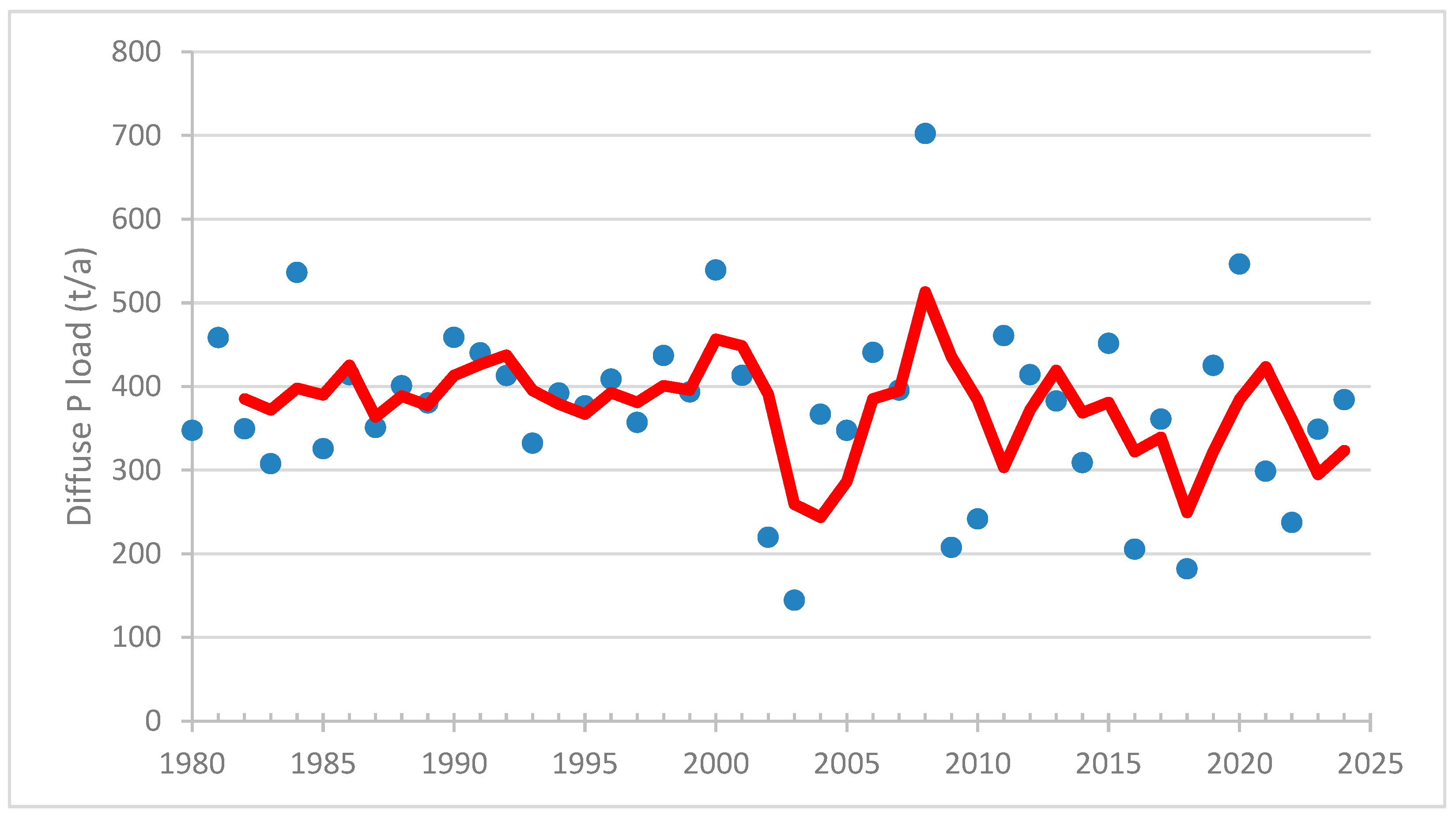
Riverine phosphorus from the main rivers—Aurajoki, Paimionjoki, and Uskelanjoki—was obtained from national environmental statistics for 1970–2018 (compiled by the Finnish Environment Institute). Diffuse load estimates for 1995–2024 were available from SYKE, while values for 1980–1994 were reconstructed using a regression model calibrated on the overlap period 1995–2018. The reconstructed (1980–1994) and observed (1995–2024) data were combined into a continuous time series.
For visualization, annual values are shown as individual points with a centered three-year moving average (MA3) to reduce short-term variability (Figure 2). No statistically significant long-term trend was detected; the overall mean load was 375.1 t yr−1 (95% CI: 344.0–406.2).
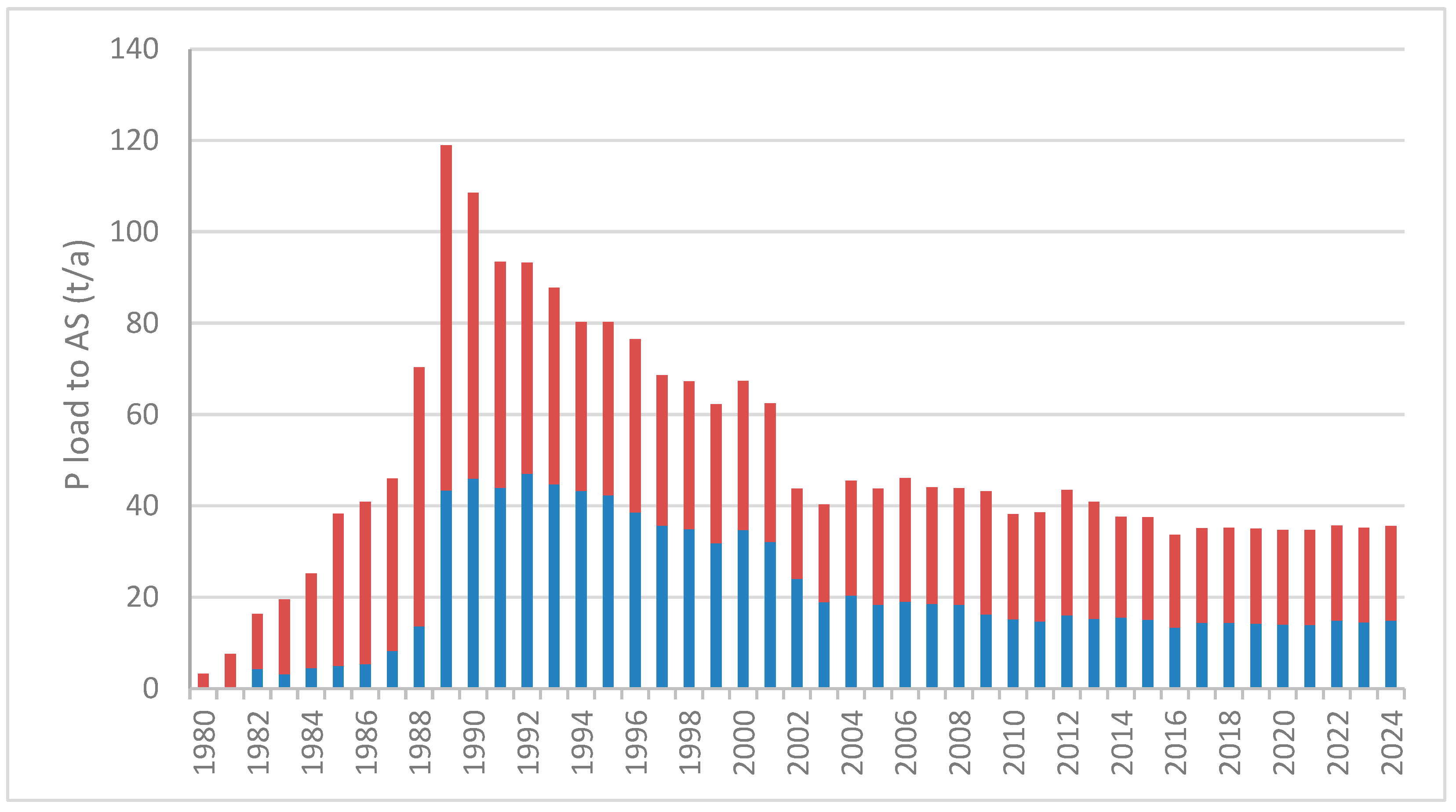
Phosphorus load data from Åland fish farms were obtained from the Åland Regional Government’s Fiskodlingsstatistik, and data from mainland Finland (1982–2024) from the Finnish Environmental Administration’s VAHTI database [17]. Missing early Åland values were linearly interpolated. To approximate the load affecting the Archipelago Sea, Åland’s total load was multiplied by 0.9, based on spatial mapping and expert judgment indicating that ~90% of Åland aquaculture occurs on the Archipelago Sea side. The annual phosphorus loads shown here correspond to the values plotted in Figure 3.
Fish farming in the Archipelago Sea expanded in the early 1980s. Total phosphorus load increased rapidly from 25.2 t in 1984 to 93.3 t in 1992 (+68.1 t, +271%), as shown in Figure 3. The short-term peak occurred in 1989 at 119.0 t (43.4 t mainland, 75.6 t Åland). After this, loads declined and stabilized at lower levels: 47.6 t yr−1 (2000–2009) and 32.4 t yr−1 (2010–2024), reflecting a long-term reduction relative to the late 1980s/early 1990s.
The decline was not due to reduced production but to improved phosphorus efficiency. Advances in feed formulation, feeding efficiency, and selective breeding over the past four decades reduced the weighted mean specific phosphorus load from Finnish rainbow trout farms from ~36 g P kg−1 in 1980 to ~4 g P kg−1 in recent years—an overall decline of nearly 90%—despite stable or rising production [18]. These efficiency improvements explain the long-term decrease in annual loads depicted in Figure 3.
The total phosphorus load from wastewater in the coastal area off Turku averaged 24 t yr−1 in the 1980s and remained around 16 t yr−1 between 1991 and 2008. Following the commissioning of the Kakola central wastewater treatment plant, the load was halved and has continued to decline, currently below 4 t yr−1 [16].

2.3. Water Quality Analytics and Data

Water quality in the Archipelago Sea has been monitored for several decades, with the earliest measurements dating back to the 1960s. At Seili, located in the middle archipelago zone, an intensive monitoring station has been operating since 1983, providing biweekly sampling at multiple fixed depths as part of a long-term systematic observation programme. The dataset is substantially more detailed than those from traditional coastal monitoring stations, comprising several thousand TP, DIP, and O2 observations from 1983 to 2025, with high data completeness (TP > 95%, DIP ≈ 90%, O2 > 95%). Typical surface concentrations range from 10 to 32 µg L−1 for TP, 1 to 5 µg L−1 for DIP, and 8 to 15 mg L−1 for O2. In contrast, deep-water concentrations often exceed 40–100 µg L−1 for TP and 7–15 µg L−1 for DIP, and exhibit recurring late-summer O2 minima below 5 mg L−1.
For comparison, monitoring at the inner archipelago station Turm 275 began in 1962 but reflects a more typical coastal sampling frequency of approximately 10–11 observations per year in recent decades, whereas Seili provides roughly twice the temporal resolution during the growing season. In this study, water quality changes are analyzed for the period 1980–2025. Data from all stations have previously been used in an assessment of internal loading in the Archipelago Sea [2]. The long and uninterrupted time series from Seili is particularly valuable, as its high sampling frequency and consistent multi-depth coverage enable the detection of gradual changes in coastal biogeochemistry that are difficult to resolve at more sparsely sampled stations.
The resulting measurements are publicly accessible through the Finnish Environment Institute’s VESLA platform [19]. VESLA compiles physico-chemical data from nationwide and regional monitoring programs coordinated by environmental authorities, supplemented by statutory assessments performed by private entities and water protection organizations. The monitoring data used in this study originates from SYKE’s VESLA database and is routinely submitted to the HELCOM COMBINE system; thus, these meaurements are also included in HELCOM’s official Baltic Sea datasets, even though this analysis uses the national primary dataset.
Methods for quantifying inorganic nutrients in marine environments are well established [20]. In this study, the dataset derives from analyses conducted in accredited laboratories [21]. Typically, nutrient determinations were performed on unfiltered samples within 5–8 h of collection, with adjustments made for turbidity and color interference. Total phosphorus was determined following acidic digestion with K2S2O8 and subsequent spectrophotometric detection as an ammonium molybdate blue complex [22].

2.4. Calculations for Internal Phosphorus Loading Indexes

Internal loading was calculated following Helminen [2] and restricted to the biological production season (15 May–15 October). In the Archipelago Sea, spring bloom ends by mid-May and autumn turnover begins around mid-October; during this period, riverine nutrient inputs are minimal, so most observed increases in water column phosphorus are attributed to internal processes, primarily loading and redistribution. This approach is commonly applied to estimate internal loading from lake data [23,24].
The main methodological difference from Helminen [2] is that seasonal changes in TP and DIP, together with concurrent O2 concentrations, are calculated separately for each production season on a year-specific basis. In contrast to the earlier approach, which provided a single seasonal internal loading estimate for selected years, the present method produces continuous annual time series (1983–2025) of depth-layer-specific TP and DIP differences. This enables consistent long-term analysis of internal loading and oxygen dynamics, as the approach yields fully paired annual minima and maxima rather than isolated seasonal estimates.
Because physical mixing and horizontal advection may also influence phosphorus concentrations, seasonal phosphorus accumulation (ΔTP) is interpreted here as an integrated indicator of water-column phosphorus enrichment during the stratified production period rather than as a direct quantitative estimate of sediment phosphorus flux. To strengthen process interpretation, ΔTP trends are therefore evaluated together with the covariation between near-bottom oxygen depletion and dissolved inorganic phosphorus (DIP) concentrations, which provides an independent indicator of sediment phosphorus release under hypoxic conditions.

2.4.1. Seasonal Increase in Phosphorus Concentrations Across Water Layers

Seasonal variation of phosphorus in surface-water (0–10 m) and near-bottom water layer (5–7 m from the bottom) was quantified as the difference between the late-summer–autumn maximum and the early-summer minimum (ΔP). In the surface layer (0–10 m), only total phosphorus (TP) was used, because dissolved inorganic phosphorus (DIP) concentrations are extremely low due to rapid nutrient cycling. Given the strong DIP signal and consistent redox-driven internal loading dynamics in the deep bottom layer at Seili (~50 m), bottom-water results for this station are presented based on DIP. In contrast, at the shallower inner-archipelago stations Turm 275 (~10 m) and Turm 297 (~30 m), bottom-water DIP exhibits episodic and highly variable behavior, whereas TP provides a more stable and interpretable measure of seasonal phosphorus dynamics. Therefore, bottom-layer analyses at these stations are reported using TP.
The early-summer minimum was defined as the value closest to 1 June within the window 1 May–30 June, whereas the autumn maximum was selected within 15 September–15 October, or, if no measurement was available, as the closest value to 1 October within 1 September–31 October. Annual ΔP values were computed for the full period 1983–2025.

2.4.2. Seasonal Metrics of Bottom-Water Dissolved Oxygen and Dissolved Inorganic Phosphorus (DIP)

Bottom-near dissolved oxygen concentrations (∼46–52.5 m) at the Seili intensive monitoring station were analyzed using the full dataset from 1983–2025. For each year, observations collected between 15 May, and 15 October were selected to represent the productive season, when thermal stratification limits vertical mixing and increases the risk of oxygen depletion near the sediment–water interface. Four annual metrics were calculated: seasonal minimum (O2_min), median (O2_med), maximum (O2_max), and the fraction of observations below 8 mg L−1 (frac < 8).
The threshold of 8 mg L−1 was used as a precautionary indicator of near-bottom hypoxia risk. Studies from Baltic coastal systems show that oxygen measured 1 m above the sediment may overlook thin hypoxic layers directly at the seabed, meaning that hypoxia or even anoxia can occur at the sediment surface despite overlying water concentrations close to 8 mg L−1 [11]. This threshold therefore provides a conservative proxy for conditions favoring sedimentary phosphorus release.
For dissolved inorganic phosphorus (DIP), annual minimum, median, and maximum concentrations were calculated from bottom-near observations (≈50 m) during the productive season (May–October). In addition, the annual fraction of observations exceeding 20 µg L−1 was computed to quantify the frequency of elevated DIP events associated with internal loading from reducing sediments.

2.5. Temporal Linkages Between Aquaculture Phosphorus Loading and Seili Surface-Layer ΔTP

Temporal associations between aquaculture-derived phosphorus (P) loading and surface-layer phosphorus accumulation at Seili were assessed for 1980–2024. Annual aquaculture P-loads were paired with ΔTP values calculated from two fixed seasonal windows: early-summer minima (≈15 May–15 June) and late-season maxima (≈15 September–20 October). ΔTP was defined as the difference between these endpoints, providing a consistent estimate of growing-season phosphorus buildup.
Associations were examined using (i) simple ordinary least squares (OLS) regressions with annual and cumulative P-loading, (ii) detrended residual-on-residual regressions to separate long-term co-trending from interannual relationships, and (iii) segmented regression to test for potential nonlinear responses. Segmented regression [25] was used to identify potential breakpoints in the ΔTP–load relationship. Breakpoints were estimated iteratively using piecewise linear segments.
Additional analyses included lagged correlations (−10 to +10 years) and cumulative loading trajectories to evaluate delayed system responses. Scatterplots and time-series overlays were used to visualize co-variation and identify potential shifts in the relationship over time.

2.6. Assessment of Filamentous Algal Biomass

A study conducted in 2025 [26] examined variation in filamentous algal production throughout the entire growing season, as well as differences across depths along the eutrophication gradient in the Archipelago Sea (Figure 1).
Quantitative samples, three replicates of attached filamentous algae, were taken monthly (February/March-September) in 2025 from the littoral shallow hardbottom [27]. Sampling places were chosen in areas with an even rock surface, suitable for Kautsky sampling [28]. The samples were taken semi-randomly at 10–60 cm depth so that the vegetation from approximately the same depth (considering variation in water level) was sampled.
The collection of algae was made using a Kautsky frame accompanied by an attached net bag and a scraper, and the sampling was conducted either through snorkeling or wading. The algal material was carefully removed from the net bags, and each sample was put in a separate zip-lock bag and frozen.
Filamentous algae samples were collected in August 2025 at 4–5 depths, spaced at 1 m intervals, from three locations along the Archipelago Sea eutrophication gradient (Figure 1), covering different growth zones within the water column. The sampling was conducted with a Kautsky sampler as described above, by scuba diving.
In the laboratory, all algal samples were sorted under a microscope, and all macrofauna were removed from the algal material by hand. The total biomass (g dry weight) of each species was estimated after drying to constant weight (48 h in 60 °C). The biomass data was calculated from the Kautsky frame (18 × 18 cm or 20 × 20 cm) to g dry weight m−2.
Total phosphorus in filamentous algal biomass was analyzed in spring 2025 at the University of Helsinki’s Tvärminne Zoological Station laboratory, following procedures described in Helminen [26]. Dried composite samples collected at 2 m depth from eight stations were subjected to a modified particulate-P protocol in which hydrolysis was performed with 1 M HCl, after which phosphate was quantified using a Thermo Scientific Aquakem 250 photometric analyzer [29].
To estimate the total biomass of filamentous algae, information on the surface areas of depth zones and shoreline lengths within different sub-regions of the Archipelago Sea was required. These spatial data were obtained using QGIS geographic information software (Version 3.40.7), based on publicly available datasets published by Traficom [30].
Drifting filamentous algal mats were not sampled directly in this study. Instead, their biomass was estimated indirectly from seasonal changes in attached algal biomass during the 2025 growing season. Monthly Kautsky samples (February/March–September) provided depth-standardized measurements of attached filamentous algal biomass (g DW m−2). For each month, total standing stock (t DW) across the Archipelago Sea was calculated by multiplying depth-specific biomass estimates by the corresponding littoral surface areas derived from QGIS-based spatial analyses. Direct sampling of drifting mats was not attempted because such mats are highly patchy, spatially transient, and logistically difficult to quantify reliably at the scale of the entire Archipelago Sea. This limitation is now stated explicitly.
The amount of drifting algal material was inferred from the decline in total attached biomass between April (the seasonal maximum) and the subsequent early-summermonths (May–July). This decrease represents the material that detached from substrates and thus formed drifting algal mats. The estimated drifting-algae biomass (t DW) was calculated as the difference between the April standing stock and the mean standing stock of May–July. The corresponding phosphorus stock (t P) of drifting material was obtained by multiplying the biomass estimate by the measured springtime P concentrations of filamentous algal tissue. This indirect approach provides a basin-wide estimate of drifting algal biomass and its associated nutrient pool, complementing the direct measurements of attached algae.

2.7. Statistical Analysis

All statistical tests were evaluated at α = 0.05 unless otherwise specified. Temporal trends in seasonal phosphorus metrics (ΔTP, ΔDIP, DIP_min, DIP_med, DIP_max, and the fraction of observations exceeding threshold values) were assessed using both parametric and non-parametric methods. Ordinary least squares (OLS) regression was used to estimate linear slopes and associated 95% confidence intervals, and prediction intervals were derived from the residual variance and leverage structure of the fitted model, resulting in interval bands that widen toward the ends of the time series. Long-term monotonic tendencies were evaluated using the Mann–Kendall trend test [31,32] and corresponding Theil–Sen slope estimator [33], which provide distribution-free measures of directional change. Distinct sub-periods (e.g., 1990–2002; 2003–2025) were analyzed separately where visual inspection indicated multi-phase behavior.
Decadal-scale development in ΔTP and DIP was evaluated using bootstrap resampling (20,000 iterations per decade), following recommended water-quality trend-analysis practices [34]. For DIP, a robust LOWESS smoother (span selected via leave-one-out cross-validation) was used to describe multi-decadal evolution independent of interannual noise.
For analyses linking aquaculture phosphorus loading to Seili ΔTP (Section 2.5), OLS regression, detrended residual-on-residual regression, segmented regression for breakpoint detection [25], lag-correlation analysis (−10 to +10 yr), and cumulative-load diagnostics were applied. All calculations were performed using Microsoft® Excel® (Microsoft 365 MSO Version 2502), and Microsoft® Copilot (GPT-5.4 Thinking model, Microsoft 365), which generated and executed Python code (scipy.stats; statsmodels) to support statistical analyses. All AI-generated outputs were reviewed and verified by the author.

3. Results

3.1. Seasonal Phosphorus Enrichment Trends in Surface and Bottom-Near Waters at Middle- and Inner-Zone Stations

A clear long-term intensification of the seasonal surface-layer phosphorus difference (ΔTP) is evident in the studied areas of the Archipelago Sea, spanning both the mid-archipelago and inner-archipelago zones. At Seili, representing the mid-archipelago, ΔTP has increased significantly by +6.8 µg L−1 since the early 1980s—an approximately 3.4-fold rise supported by both parametric and non-parametric trend tests.
In the inner archipelago, Turm275 and Turm297 show a similar strengthening of surface-layer ΔTP, with statistically significant long-term increases at both stations, while bottom-layer trends remain non-significant, indicating that the multi-decadal amplification of seasonal phosphorus dynamics is expressed primarily in surface waters. The station-specific results are presented below.

3.1.1. Middle-Zone, Seili

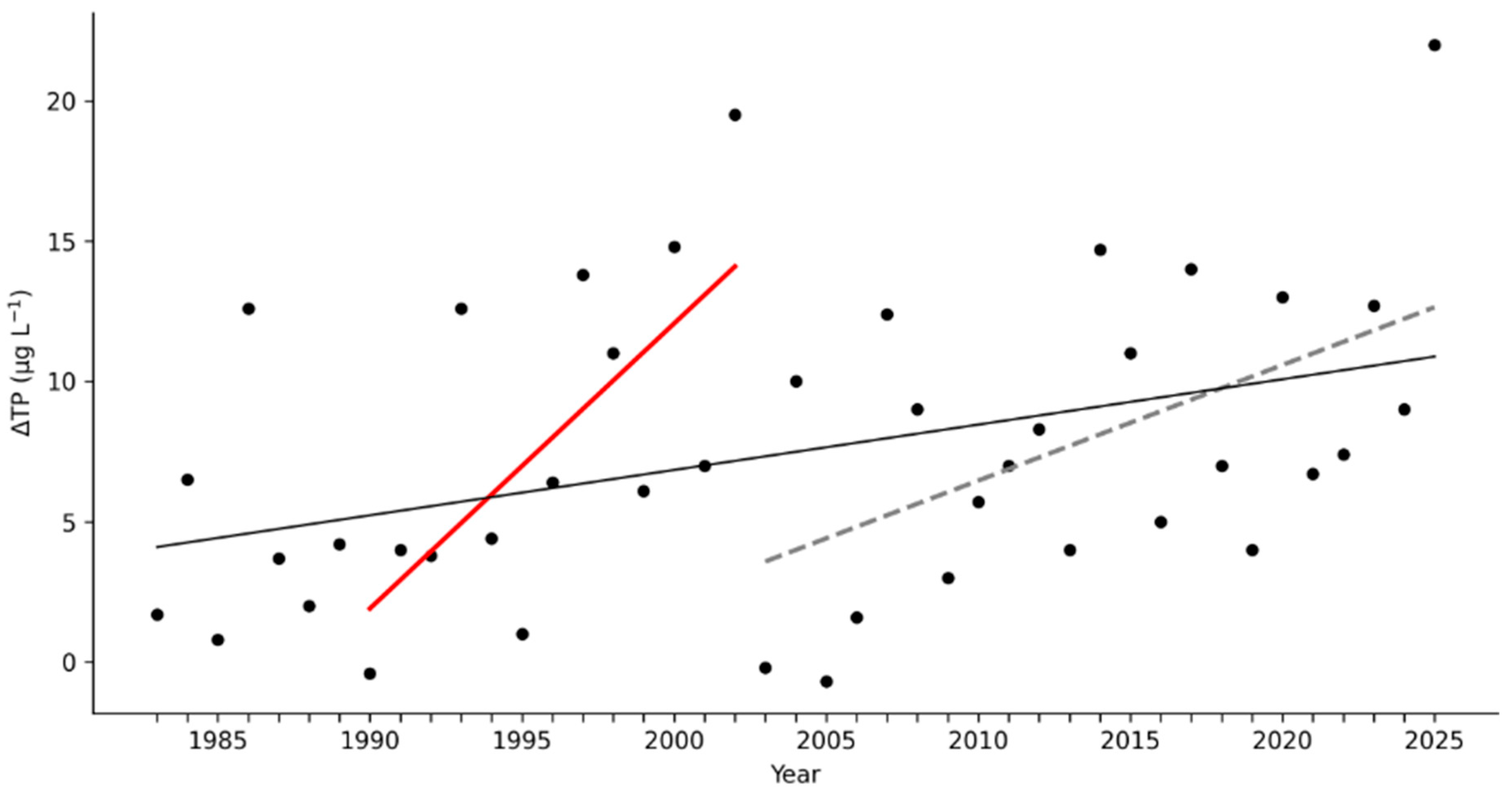
A statistically significant long-term increase in the seasonal surface-layer (0–10 m) total phosphorus difference (ΔTP) at the Seili intensive monitoring station was detected over the full monitoring period from 1983 to 2025 (Figure 4). A linear regression fitted to the entire time series yielded a slope of 0.162 µg L−1 yr−1 (95% CI: 0.037–0.286 µg L−1 yr−1, p = 0.012, n = 43), with a consistent estimate provided by the Theil–Sen slope (0.163 µg L−1 yr−1). Kendall’s tau also indicated a significant monotonic increase (τ = 0.285, p = 0.0073).
Using this long-term trend, the cumulative increase in ΔTP from the early 1980s to 2025 is +6.8 µg L−1, corresponding to a rise from the early-period median (1983–1990; 2.85 µg L−1) to an estimated trend-based level of ~9.65 µg L−1, i.e., an approximately 3.4-fold increase. This multi-decadal amplification reflects a substantial strengthening of internal phosphorus loading.
Harmonized decadal bootstrap estimates (20,000 resamples per decade) support this long-term intensification. Decadal medians increased from 3.70 µg L−1 in the late 1980s (1983–1989; 95% CI: 1.70–6.50, n = 7) to 10.85 µg L−1 in the 2020s (2020–2025; 95% CI: 7.05–17.50, n = 6). When evaluated against the harmonized early-period baseline (1983–1990 median 2.85 µg L−1, 95% CI: 0.80–6.50), the 2020s median corresponds to an approximately 3.8-fold level, with the 2000s–2010s remaining elevated at ~2.5–2.8×.
A distinct and statistically significant increasing trend was identified for the period 1990–2002, during which ΔTP rose at a rate of 1.02 µg L−1 yr−1 (p = 0.0118) (Figure 4). This interval represents the earliest phase in the monitoring record where a consistent and statistically robust intensification of late-season phosphorus enrichment is detectable. A secondary rise is visually apparent beginning in the early 2000s, and therefore the period 2003–2025 was tested separately. Although the trend over this interval was positive (0.27 µg L−1 yr−1), it was not statistically significant (p = 0.19), and similarly non-significant slopes were obtained for the related intervals beginning in 2004, 2005, and 2006.
Non-parametric tests indicate a significant long-term increase in the annual autumn maximum of dissolved inorganic phosphorus (DIP) in near-bottom waters at the Seili station. The Mann–Kendall test yielded Z = 2.60 with p = 0.0094, and the Theil–Sen slope was +0.476 µg L−1 yr−1. By comparison, the OLS slope was +0.346 µg L−1 yr−1 with 95% CI = −0.032… + 0.725 µg L−1 yr−1, p = 0.0718, and R2 = 0.0769 (n = 43), reflecting interannual variability while remaining similar in magnitude to the robust estimate. Kendall’s τ for the monotonic trend was 0.278 (p = 0.0091).
Decadal bootstrap medians (95% CI) for the autumn maximum DIP increased from ~23.0 µg L−1 (18.0–27.0) in the 1980s to ~31.5 µg L−1 (27.0–37.0) in the 1990s and peaked at ~50.0 µg L−1 (39.0–70.0) in the 2000s. Medians remained elevated in the 2010s (~39.5 µg L−1; 29.5–47.5) and 2020s (~39.0 µg L−1; 24.5–45.5), with broader uncertainty toward the end of the record.
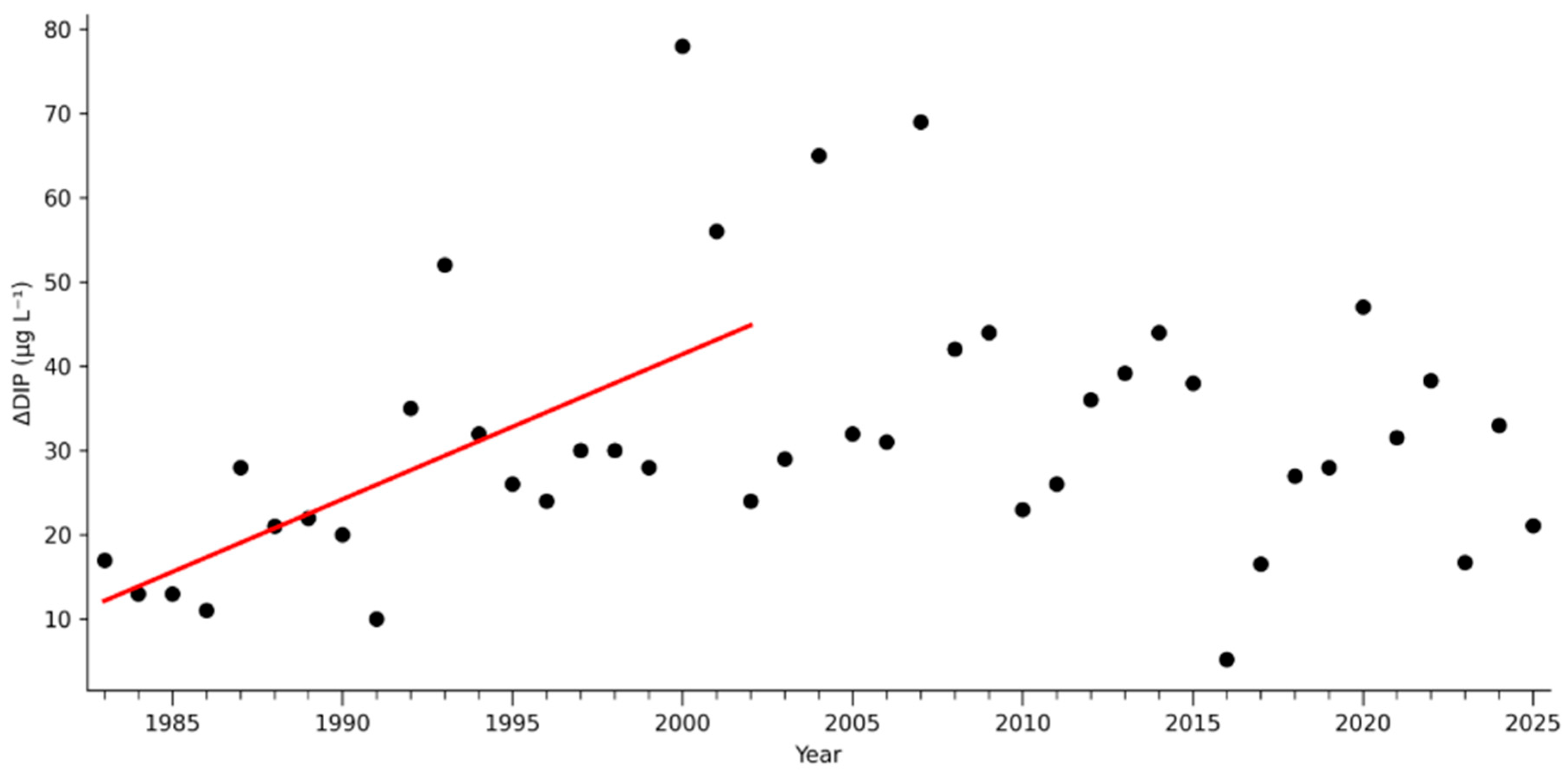
Analysis of the full record (1983–2025) shows not statistically significant long-term trend in seasonal ΔDIP at the Seili bottom-near station (Figure 5). The OLS slope was +0.233 µg L−1 yr−1 (95% CI = −0.152… + 0.618 µg L−1 yr−1; p = 0.229; R2 = 0.035; n = 43), and the non-parametric statistics were similarly non-significant (Kendall’s τ = 0.205, p = 0.054; Theil–Sen = +0.333 µg L−1 yr−1). These results indicate that ΔDIP does not exhibit a consistent multi-decadal trend across the study period.
In contrast, the early part of the record (1983–2002) shows a clear and statistically significant increase in seasonal ΔDIP (Figure 5). During this period, the OLS slope was +1.722 µg L−1 yr−1 (95% CI = +0.614… + 2.829 µg L−1 yr−1; p = 0.0043; R2 = 0.372; n = 20). Non-parametric metrics corroborated this strong monotonic rise (Kendall’s τ = 0.447; p = 0.0063; Theil–Sen = +1.214 µg L−1 yr−1). These findings demonstrate that seasonal accumulation of DIP intensified significantly during 1983–2002, even though the full-period trend is not statistically significant.

3.1.2. Inner-Zone, Turm275 and Turm297

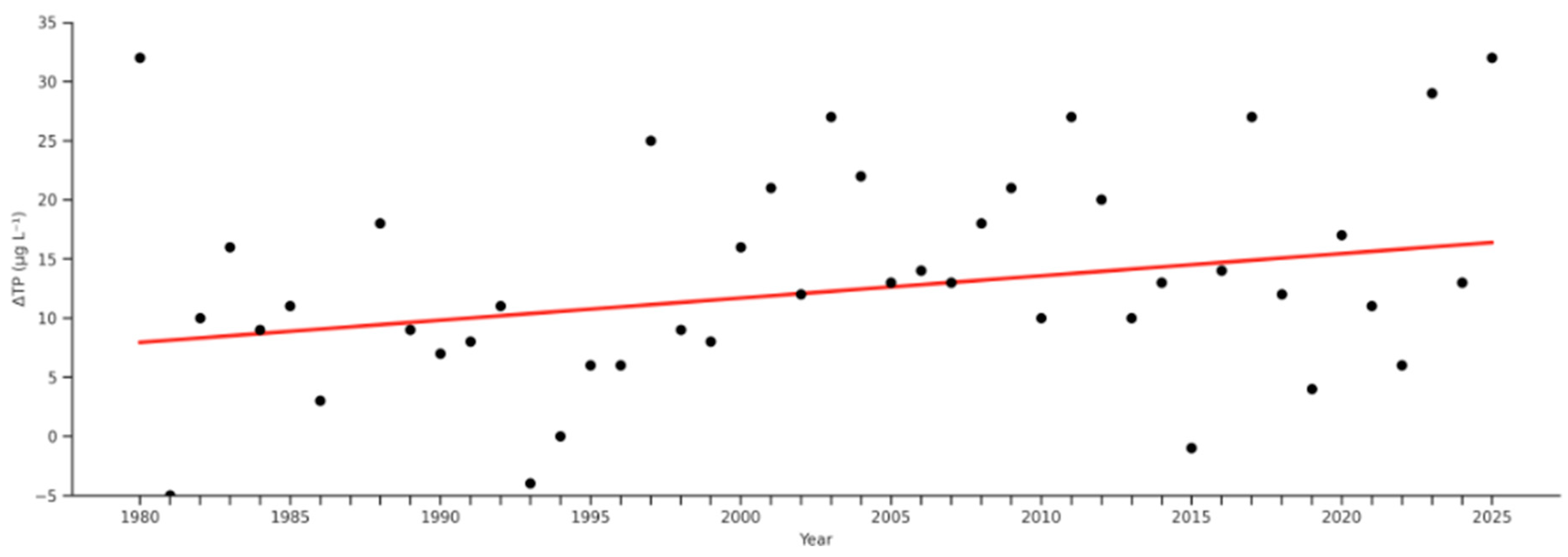
A statistically significant long-term increase in the seasonal phosphorus difference (ΔTP) was detected in the Turm275 surface layer (0–6 m) (Figure 6). Mann–Kendall testing indicated a positive monotonic trend (MK Z = 1.99, p = 0.046), with a corresponding Sen slope of +0.188 µg L−1 yr−1, confirming a persistent multi-decadal intensification of the seasonal TP amplitude.
Using this long-term trend, the cumulative increase in ΔTP from the early 1980s to recent years is approximately +5.6 µg L−1, based on a rise from an early-period mean of 12.4 µg L−1 (1980–1984) to 18.0 µg L−1 in 2020–2025. This change corresponds to an approximately 1.45-fold intensification of the seasonal TP amplitude.
Harmonized decadal bootstrap medians (20,000 resamples per decade) support and contextualize this long-term intensification. Early values in the 1980s yielded a median ΔTP of 10.0 µg L−1 (95% CI: 3.0–18.0; n = 9), followed by a temporary decline in the 1990s to 7.5 µg L−1 (95% CI: 3.5–9.5; n = 10). Thereafter, ΔTP markedly increased, reaching 17.0 µg L−1 in the 2000s (95% CI: 13.0–21.5; n = 10) and remaining elevated at 12.5 µg L−1 in the 2010s (95% CI: 7.0–20.5; n = 10). The 2020s show a sustained high median of 15.0 µg L−1 (95% CI: 8.5–30.5; n = 6).
When these decadal medians are evaluated relative to the harmonized early-period baseline (1980–1984 mean 12.4 µg L−1), the ΔTP levels of the 2000s, 2010s, and 2020s correspond to approximately 1.4×, 1.0×, and 1.2× the early-period magnitude, respectively. Although the fold increases are more modest than those observed at the Seili offshore station, the Turm275 record nonetheless reveals a clear multi-decadal strengthening of seasonal TP accumulation in near-surface waters, consistent with enhanced internal loading influence.
In contrast to the surface layer, no long-term trend was detected in the seasonal phosphorus difference (ΔTP) of the bottom waters (≥8 m). The Mann–Kendall test indicated no monotonic change over the full monitoring period (MK p = 0.992), and the corresponding Sen slope estimate remained 0.00 µg L−1 yr−1, confirming the statistical absence of directional development in bottom-layer seasonal dynamics.
Across all years, early-summer TP minima in bottom waters averaged 27.5 µg L−1 (median 24 µg L−1), which is ~3.9 µg L−1 higher than the corresponding surface minima (median difference +1 µg L−1; n = 45 paired years). Autumn TP maxima were, however, lower in the bottom layer (mean 32.6 µg L−1, median 34 µg L−1) compared with the surface (mean 38.0 µg L−1), resulting in a consistently smaller seasonal amplitude. Consequently, the mean bottom-water ΔTP was only 5.1 µg L−1 (median 7 µg L−1), which is ~8.3 µg L−1 lower than the surface-layer ΔTP (median difference −7 µg L−1).
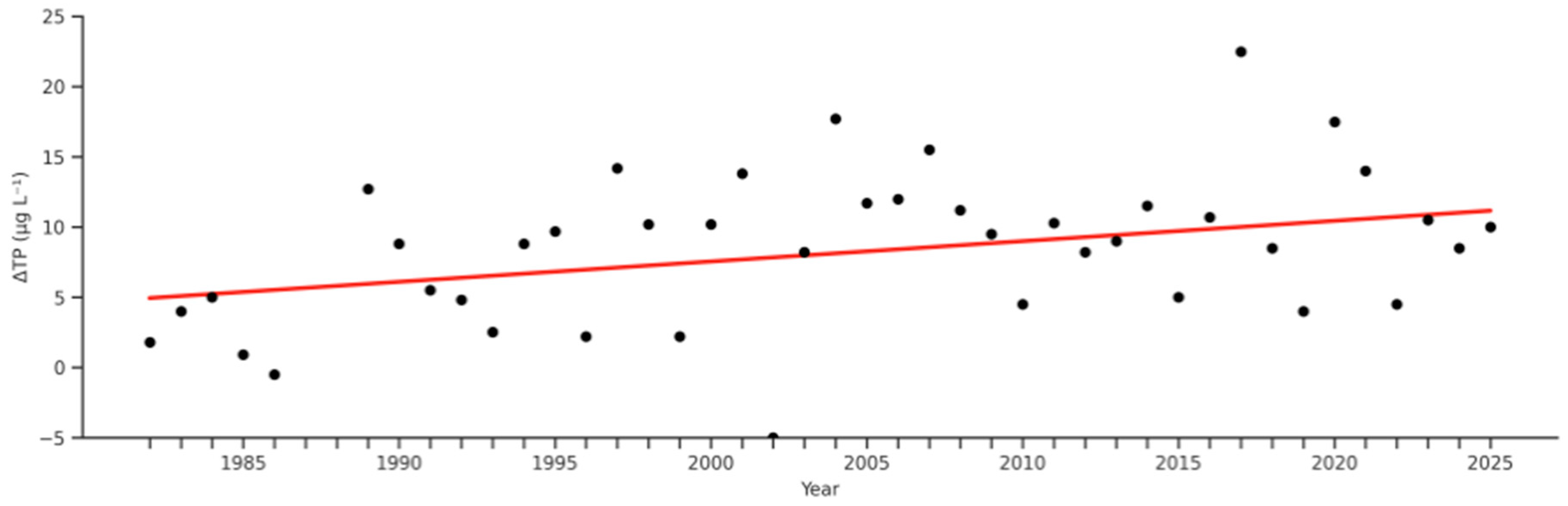
A statistically significant long-term increase in the seasonal phosphorus difference (ΔTP) was detected in the surface layer at Turm297 (Figure 7). Linear regression yielded a positive slope of +0.172 µg L−1 yr−1 (95% CI: +0.048 to +0.296 µg L−1 yr−1; p = 0.0078, R2 = 0.164), indicating a persistent directional rise in ΔTP over the four-decade record. Non-parametric testing supported this finding: the Mann–Kendall trend test showed a significant monotonic increase (MK Z = 2.24, p = 0.0248), and the corresponding Sen slope estimate was +0.145 µg L−1 yr−1.
Using this long-term tendency, the cumulative increase in surface-layer ΔTP from the early 1980s to recent years is +7.23 µg L−1, based on a rise from an early-period mean of 3.6 µg L−1 (1981–1984) to 10.83 µg L−1 in 2020–2025. This corresponds to an approximately threefold increase in the seasonal TP amplitude at Turm297.
Harmonized decadal bootstrap medians (20,000 resamples per decade) further corroborate this multidecadal intensification. Median ΔTP rose from 2.90 µg L−1 in the 1980s (95% CI: 0.20–8.85; n = 6) to 11.45 µg L−1 in the 2000s (95% CI: 9.5–13.8; n = 10), with elevated values also in the 2010s (median = 8.75 µg L−1; n = 10) and the early 2020s (median = 10.25 µg L−1; n = 6).
These results indicate that the strengthening of seasonal phosphorus accumulation in the surface layer at Turm297 is both statistically robust and consistent throughout the decades.
In contrast to the surface, the bottom-layer ΔTP in Turm297 showed not statistically significant long-term trend. The linear regression slope (+0.302 µg L−1 yr−1) was not significant (95% CI: −0.036 to +0.640; p = 0.0788), and the Mann–Kendall test similarly indicated a non-significant monotonic tendency (MK p = 0.0518). The Sen slope estimate was +0.383 µg L−1 yr−1, but without statistical support.
Although the long-term trend was not significant, early-to-recent comparison suggests an increase in the magnitude of bottom-layer ΔTP over time: the mean rose from 9.67 µg L−1 (1981–1984) to 24.33 µg L−1 (2020–2025), corresponding to a ~2.5-fold level. However, high interannual variability and wide bootstrap confidence intervals reduce statistical certainty. Decadal bootstrap medians peak in the 2010s (median = 30.5 µg L−1; 95% CI: 24.5–39.0; n = 10) but decline slightly in the 2020s (median = 25.0 µg L−1; n = 6).

3.1.3. Outer-Zone, Korp 175

The ΔTP time series at station Korp 175 (1980–2026), based on surface-layer (0–10 m) data and defined as the difference between the late-summer–autumn maximum (15 September–20 October) and the early-summer minimum (15 May–15 June), showed substantial interannual variability (approximately −0.5 to 25 µg L−1) but no significant temporal trend. Linear regression indicated a slope of 0.00195 µg L−1 yr−1 (p = 0.93), and the Kendall rank correlation was likewise non-significant (τ = 0.025, p = 0.77).

3.2. Deep-Water Oxygen Depletion and Dissolved Inorganic Phosphorus (DIP) Release

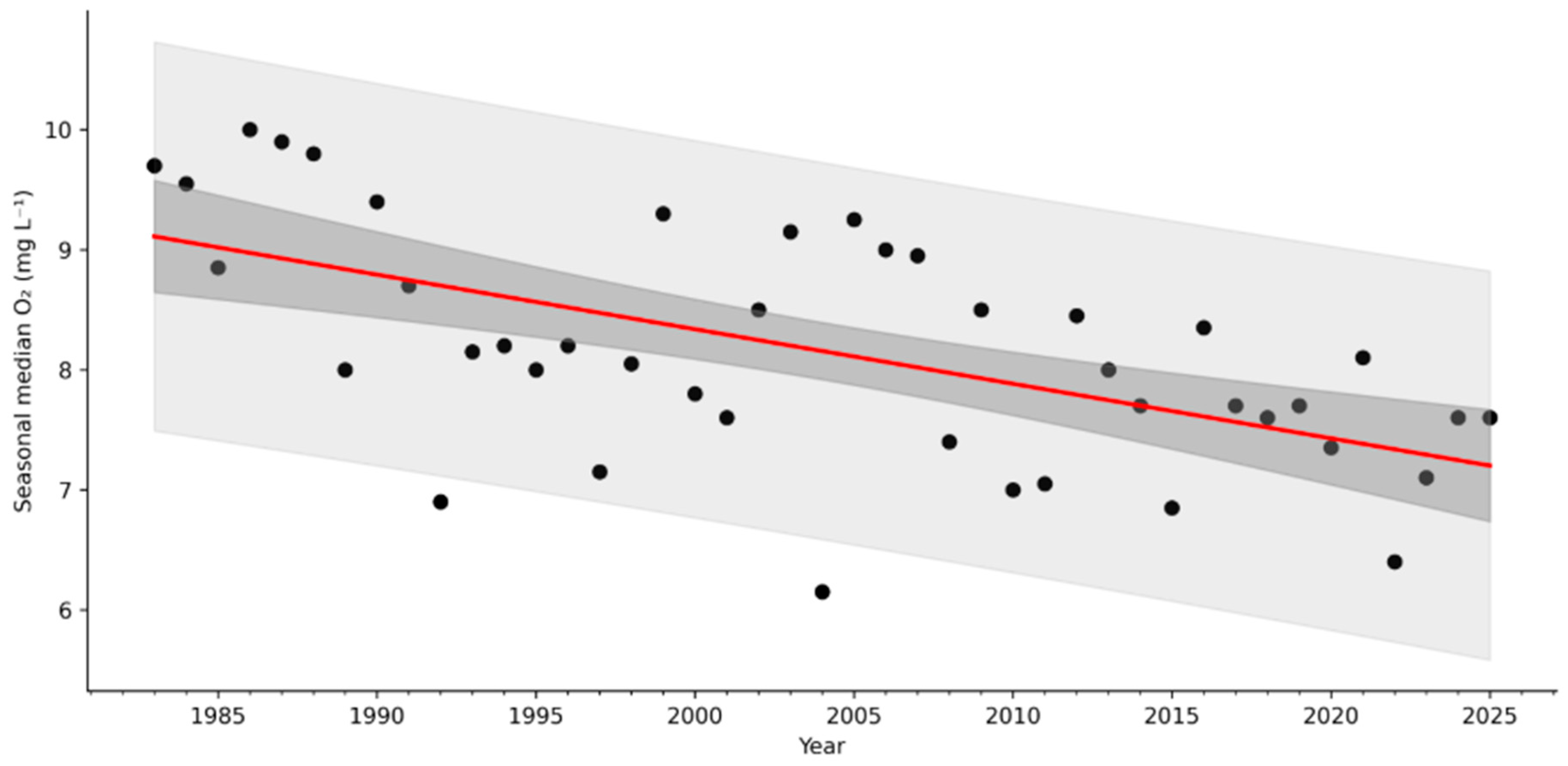
Seasonal near-bottom oxygen conditions at the Seili station show a clear long-term deterioration across all examined metrics. Seasonal minimum oxygen concentrations decline significantly (OLS slope = −0.063 mg L−1 yr−1, 95% CI: −0.0865 to −0.0400; p < 0.001), corresponding to an approximate decrease of 0.63 mg L−1 per decade. The Mann–Kendall test confirms this trend (Z = −4.34, p < 0.001), with a Sen’s slope of −0.069 mg L−1 yr−1.
Seasonal median oxygen concentrations also decrease significantly (OLS slope = −0.0455 mg L−1 yr−1, 95% CI: −0.0651 to −0.0258; p < 0.001; MK Z = −4.36, p < 0.001; Sen’s slope = −0.050 mg L−1 yr−1) (Figure 8).
Seasonal maximum oxygen concentrations show a smaller but still significant decline (OLS slope = −0.0388 mg L−1 yr−1, 95% CI: −0.0626 to −0.0149; p = 0.00209; MK Z = −3.09, p = 0.00198; Sen’s slope = −0.0333 mg L−1 yr−1).
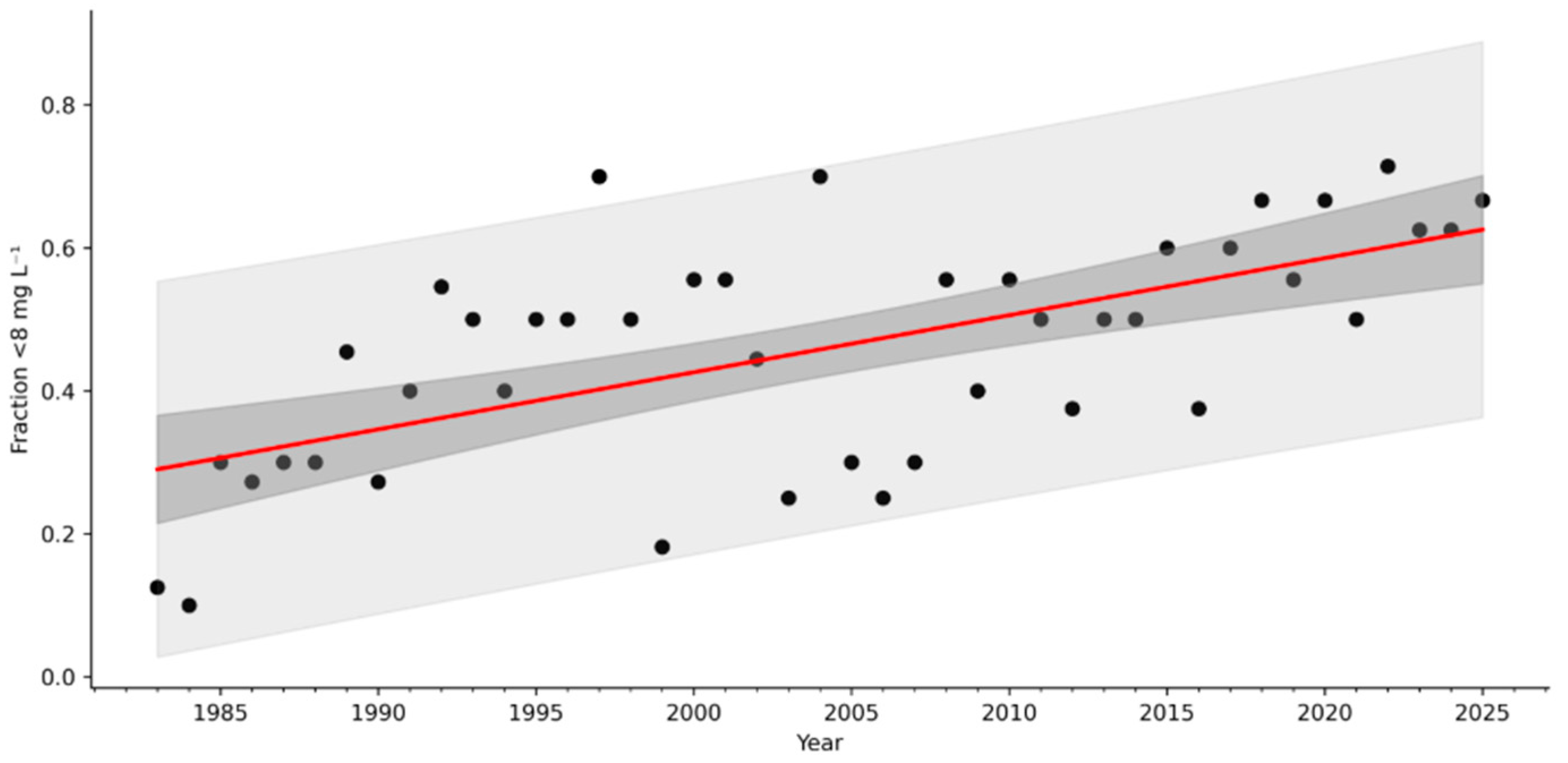
At the same time, the fraction of observations below 8 mg L−1 increases significantly (OLS slope = 0.0080 yr−1, 95% CI: 0.0048–0.0112; p = 9.28 × 10⁻⁶; MK Z = 4.36, p = 1.30 × 10⁻⁵; Sen’s slope = 0.00824 yr−1), indicating a growing prevalence of suboptimal oxygen conditions during the productive season (Figure 9). The consistency between OLS, Mann–Kendall, and Sen’s slope estimates indicates robust long-term trends rather than short-term variability.
For the productive season (15 May–15 October), bottom-near dissolved inorganic phosphorus (DIP) at the Seili station was analyzed for years with valid data (n = 43). Median seasonal values were 6.0 µg L−1 (DIP_min), 21.0 µg L−1 (DIP_med), and 39.0 µg L−1 (DIP_max); the median fraction of observations exceeding 20 µg L−1 was 0.50.
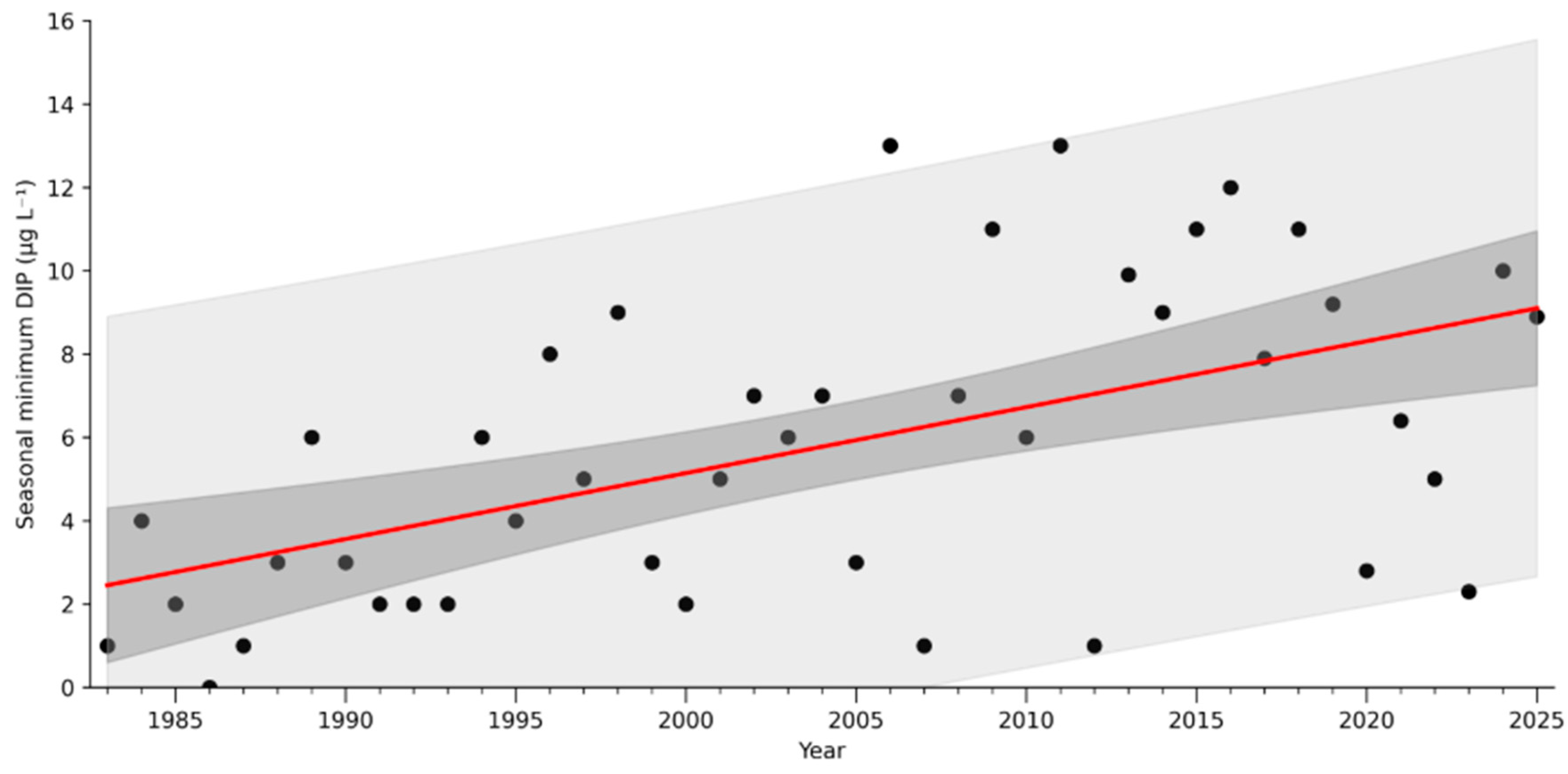
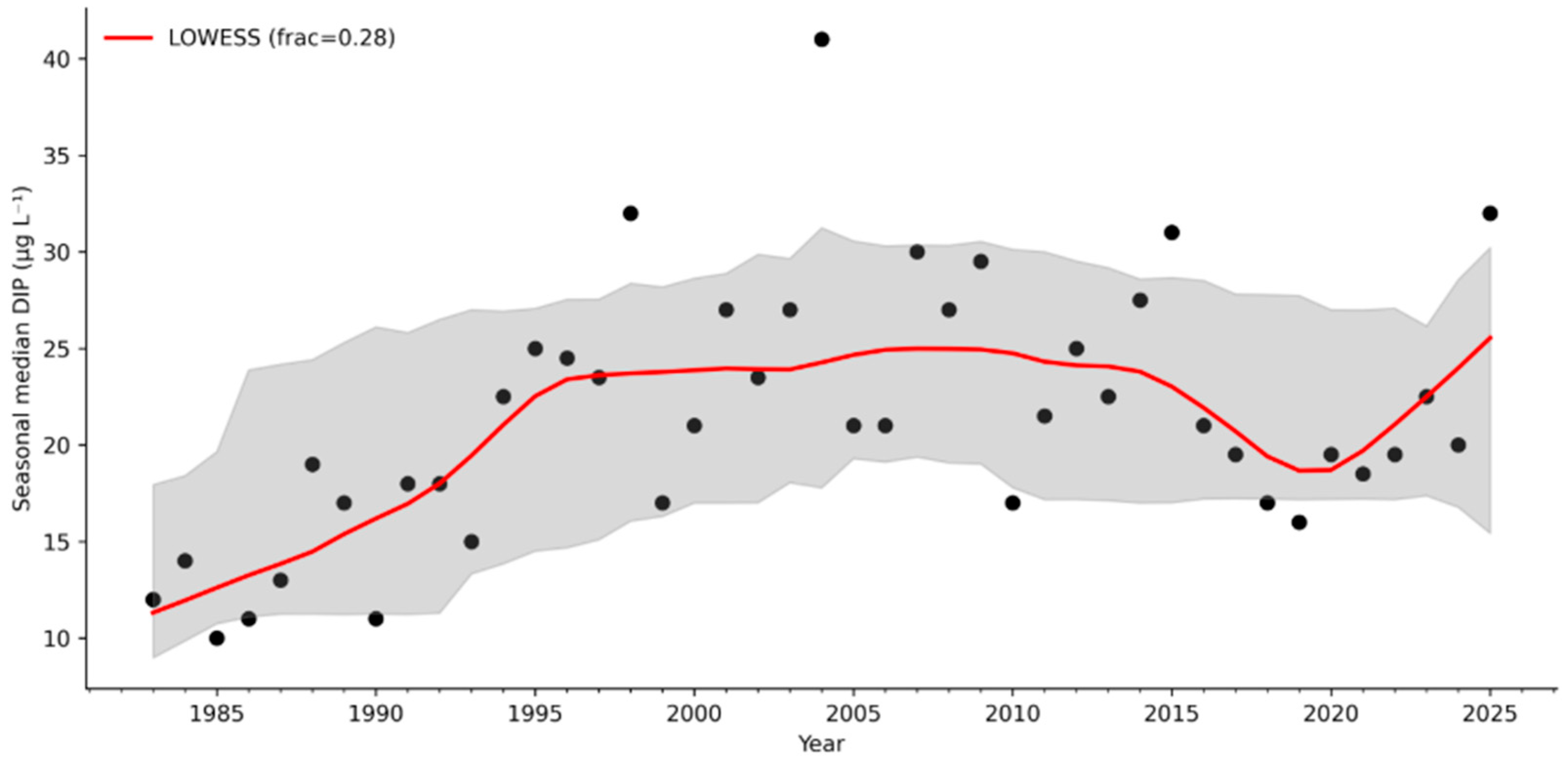
All DIP metrics show positive long-term trends. DIP_min increases by 0.158 µg L−1 yr−1 (95% CI: 0.082–0.234; p < 0.001; R2 = 0.290; MK Z = 3.65, p < 0.001; Sen = 0.172 µg L−1 yr−1) (Figure 10). DIP_med also increases significantly (0.213 µg L−1 yr−1, 95% CI: 0.065–0.361; p = 0.005; R2 = 0.163; MK Z = 2.64, p = 0.008; Sen = 0.217 µg L−1 yr−1). A robust LOWESS smoother (Figure 11) indicates a marked increase in median DIP from the early 1980s to the early–mid 2000s, followed by fluctuating but generally elevated levels. DIP_max shows a weaker but significant increase (0.470 µg L−1 yr−1, 95% CI: 0.005–0.934; p = 0.048; R2 = 0.087; MK Z = 3.12, p = 0.002; Sen = 0.417 µg L−1 yr−1).
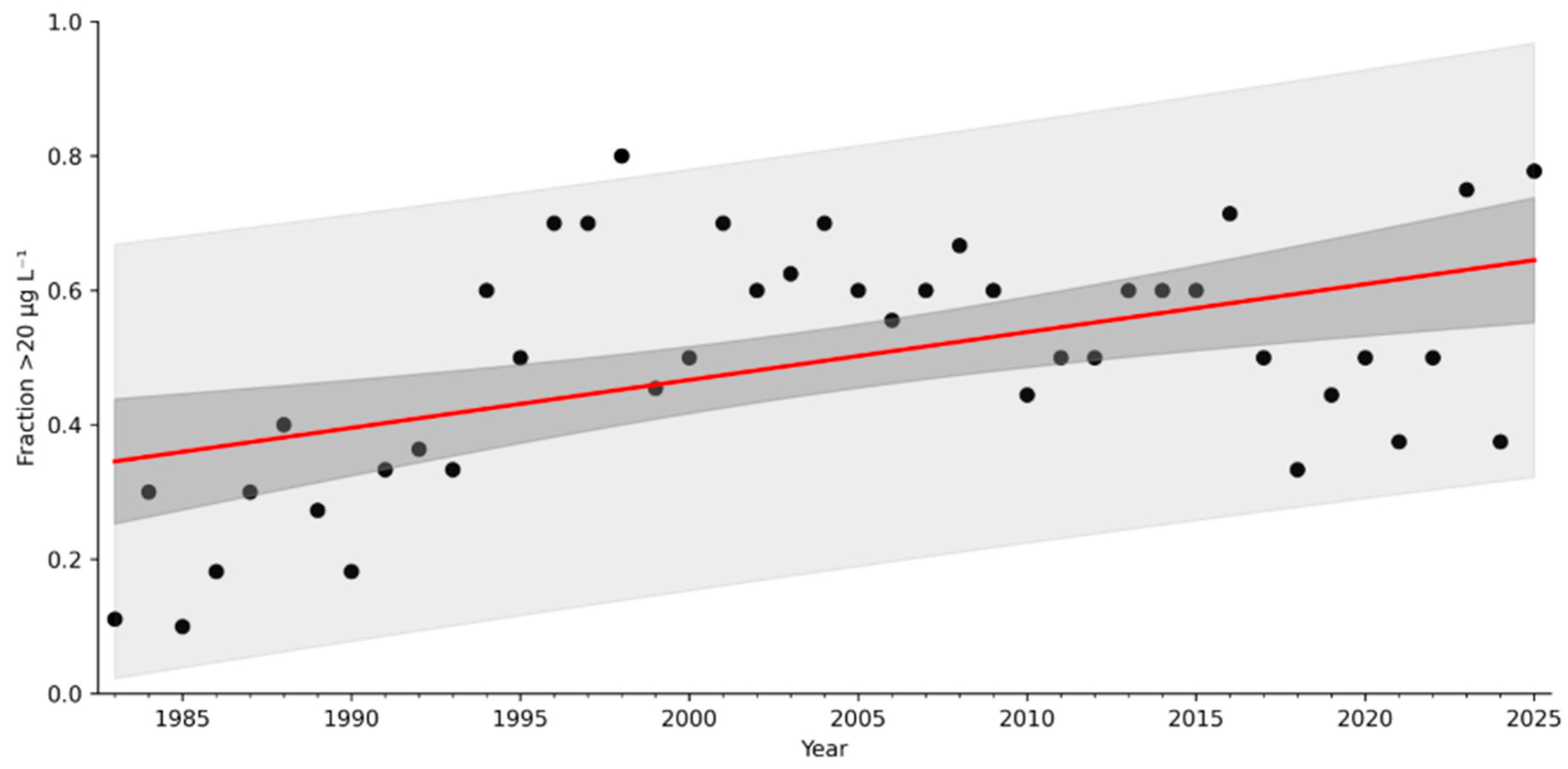
The fraction of observations exceeding 20 µg L−1 increases by 0.0073 yr−1 (95% CI: 0.0035–0.0111; p < 0.001; MK Z = 2.86, p = 0.004; Sen = 0.0071 yr−1), indicating an increasing frequency of elevated bottom-near DIP during the productive season (Figure 12).

3.3. Temporal Linkages Between Aquaculture Phosphorus Loading and Seili Surface-Layer ΔTP

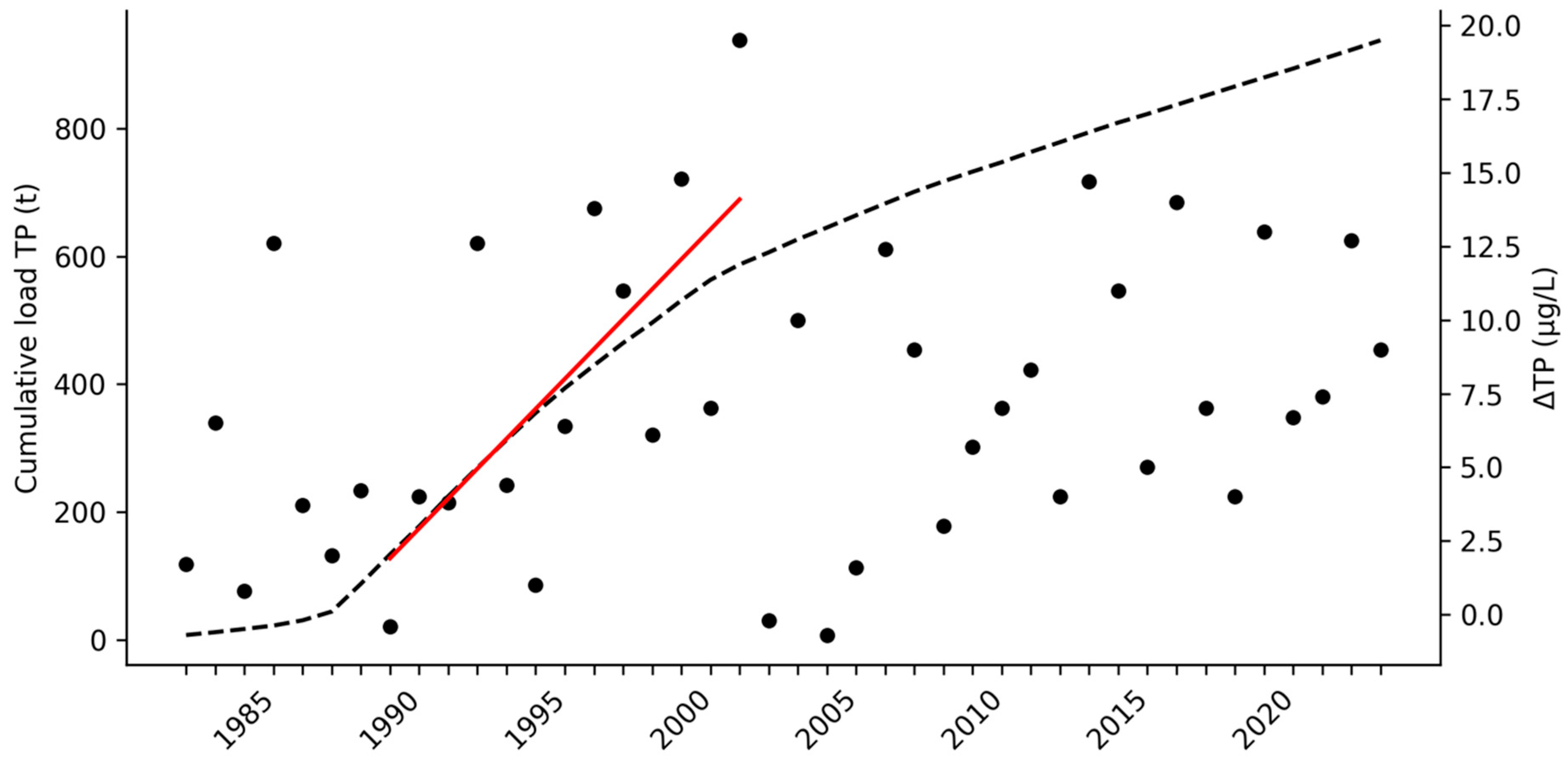
A simple linear regression over the full observation period indicated a significant positive association between annual ΔTP at Seili and cumulative aquaculture phosphorus load (r = 0.329, p = 0.034; explained variance ≈ 11%) (Figure 13). However, when long-term trends were removed from both ΔTP and cumulative load (residual-on-residual regression), the relationship was no longer significant (R2(res) ≈ 0.08, p ≈ 0.08), suggesting that the naïve correlation largely reflects shared multi-decadal co-trending rather than year-to-year dependency.
During 1990–2002, a period of clear ΔTP increase (1.02 µg L−1 yr−1; p = 0.012), simple correlations with cumulative aquaculture load were again significant (R2 ≈ 0.44, p = 0.013), but these associations disappeared after detrending (p = 0.668, R2(res) < 0.05), indicating that the intensification cannot be statistically attributed to cumulative aquaculture loading alone.
Segmented regression of ΔTP against cumulative load did not identify a robust breakpoint; the estimated threshold was highly uncertain (≈457 units, 95% CI ≈ 18–863), and slopes above and below the putative threshold were similar.

3.4. Temporal Patterns of Filamentous Algal Biomass and Phosphorus Storage

At all study sites, substantial amounts of filamentous algae were already present in March, with surface-layer (0–1 m) biomass averaging 71.2 g DW m−2 (range 14–167 g DW m−2) (Table 1). Biomass peaked in April at 118.2 g DW m−2 (59–187 g DW m−2). By May, filamentous algal biomass had nearly halved, averaging 63.7 g DW m−2 (33–86 g DW m−2). During June–July, biomass remained like May levels (mean 62.3 g DW m−2; range 43–108 g DW m−2) but declined markedly by August to 23.9 g DW m−2 (13–48 g DW m−2).
The assemblage consisted mainly of typical Baltic filamentous algae. Brown algae (the Pylaiella/Ectocarpus complex) dominated in early spring, whereas green algae (Cladophora spp.) became predominant in summer.
Laboratory analyses at the Tvärminne Zoological Station indicated that the filamentous algal material contained an average total phosphorus concentration of 0.26 ± 0.03% DW.
For the Archipelago Sea (9500 km2), the surface area of the 0–4.5 m depth zone was estimated at 163,500 ha. Using the total shoreline length of 26,316 km and this surface area, the average width of the likely filamentous algal occurrence zone was calculated at approximately 62 m. The biomass estimates above represent the surface layer (0–1 m). To obtain depth-integrated values for the full study depth (0–4.5 m), surface-layer means were adjusted using depth-dependent biomass variation reported by Salovius and Salo [26].
Table 1 presents the estimated filamentous algal biomass (DW, t) across the entire Archipelago Sea for different months, along with the corresponding phosphorus stock (t). Biomass peaked in April at 119,819 t DW, with an associated phosphorus stock of 312 t. During this period, Pylaiella littoralis was the dominant species, accounting for 70–90% of the total biomass.
From May to July, biomass was roughly half of the April level. Interpreting this decline as detachment of filamentous algae from their substrates indicates that a substantial fraction of the spring biomass transitions into drifting algal mats. Based on the difference between the April standing stock and the May–July average, the estimated drifting biomass is approximately 55,000 t DW, corresponding to about 146 t of phosphorus using the measured P concentration of 0.26% DW. This drifting fraction represents a major mobile nutrient pool that becomes available for release during summer as mats decompose in the water column or accumulate along shorelines.

4. Discussion

This study reveals a clear multi-decadal intensification of internal phosphorus loading in the Archipelago Sea. Seasonal surface-layer phosphorus differences (ΔTP) increased significantly from the early 1980s to 2025 at the mid-archipelago station Seili and the inner-archipelago stations Turm 275 and Turm 297, while no long-term change was detected in the outer archipelago. At Seili, ΔTP increased by ~6.8 µg L−1, representing a 3.4-fold rise over the observation period. Concurrently, near-bottom oxygen declined and dissolved inorganic phosphorus (DIP) concentrations increased, consistent with enhanced sediment phosphorus release under oxygen-depleted conditions. Although cumulative aquaculture phosphorus loading showed naïve correlations with ΔTP, these associations disappeared after detrending, indicating that the apparent relationships largely reflect shared long-term co-trending rather than direct dependency. Drifting filamentous macroalgae represents a potentially substantial seasonal phosphorus pool, with an estimated 146 t of phosphorus in detached algal biomass.

4.1. Temporal Trends of Effective Phosphorus Loading

A clear long-term intensification of seasonal surface-layer ΔTP is evident across the mid and inner archipelago zones. At Seili, ΔTP has increased by ~6.8 µg L−1 since the early 1980s, a 3.4-fold rise confirmed by parametric and non-parametric trend tests. This index reflects effective net internal phosphorus loading, capturing upward transport from bottom to surface waters during the productive season (15 May–15 October) [2].
Inner-archipelago stations Turm 275 and Turm 297 exhibit similar surface-layer ΔTP increases, whereas bottom-layer trends remain non-significant. This indicates that multi-decadal amplification of phosphorus dynamics is primarily expressed in surface waters, while deep-water signals of internal loading remain concentrated in stratified basins such as Seili.
At Seili (≈44–55 m), DIP constituted a median of 62% of total phosphorus during stratified conditions, justifying its use as the primary bottom-water indicator. In shallower inner-archipelago basins, DIP was more episodic, and TP provided a more stable representation of bottom-layer phosphorus dynamics. Across Turm 275 and Turm 297, increasing surface-layer ΔTP alongside largely stable bottom-layer conditions reflects contrasting hydrographic settings: shallow, well-flushed basins experience frequent mixing and short residence times that limit prolonged anoxia and sediment P release, while still receiving lateral phosphorus inputs. These observations align with Helminen and Inkala [15,35], highlighting the role of summer water exchange and advective inflows in the central archipelago and sediment-driven internal loading in the inner archipelago. Catchment-derived inputs mainly affect the innermost coastal waters, shaping surface-layer ΔTP dynamics.
In contrast, the outer-zone station Korp 175 showed no long-term ΔTP change, despite substantial interannual variability (−0.5 to 25 µg L−1). Linear regression (0.00195 µg L−1 yr−1, p = 0.93) and Kendall’s τ (0.025, p = 0.77) confirmed stable conditions, reflecting effective ventilation and open-sea exchange that prevent cumulative intensification of internal loading. Overall, ΔTP intensification is characteristic of the mid and inner archipelago surface layers, whereas bottom-layer amplification occurs only in deep, stratified basins. The outer archipelago remains hydrographically resilient. These spatial distinctions underscore the value of surface-layer ΔTP as a sentinel indicator of basin-wide internal phosphorus cycling and the importance of basin morphology, water exchange regimes, and sediment–water feedback [15,35].

4.2. Implications for Internal Loading Estimates

Consistent ΔTP analysis at Seili and inner-archipelago stations shows marked increases from the early 1980s to 2000–2024. At Seili, median ΔTP rose from 5.1 to 11.0 µg L−1 (~2.2-fold), while inner-archipelago increases ranged from 1.4- to 2.3-fold, reflecting consistent late-season enrichment. No long-term change was observed at the outer-archipelago station Korp 175.
Applying ΔTP-derived fold changes to Helminen’s recent-period spatially explicit loading values (inner archipelago: 40 t yr−1; mid-archipelago: 78 t yr−1; outer archipelago: 46 t yr−1 [2]) yields early-1980s loads of 22, 35, and 46 t yr−1, respectively, totaling 103 t yr−1. Extrapolated to the entire Archipelago Sea, this corresponds to ~158 t yr−1, compared with Helminen’s recent-period estimate of 269 t yr−1, indicating an increase of ~110 t yr−1 (~70%) over four decades. These results highlight the growing role of sediment–water feedback and legacy phosphorus pools in sustaining eutrophication, emphasizing the need to address both internal and external nutrient sources.

4.3. Role of Cumulative Aquaculture Phosphorus in ΔTP Intensification

Simple correlations between cumulative aquaculture phosphorus and ΔTP at Seili reflect long-term co-trending rather than direct year-to-year effects. The pronounced ΔTP increase during 1990–2002 cannot be explained by aquaculture alone. Multiple drivers likely contributed, including riverine and diffuse nutrient inputs, enhanced organic matter delivery, sediment redox changes, and hydro-climatic factors such as stronger stratification and reduced deep-water ventilation. Once sediment phosphorus pools were enriched, internal loading inertia could sustain elevated ΔTP despite later reductions in external inputs. Aquaculture may have contributed to favorable conditions but cannot be uniquely or linearly linked to observed ΔTP escalation. Resolving the relative contributions of these factors requires mechanistic modelling integrating external loads, hydro-biogeochemical processes, and sediment feedback.

4.4. Filamentous Algae as a Temporary Phosphorus Reservoir

Filamentous algae estimates are based solely on 2025 observations; no systematic long-term data exists, so trends cannot be inferred. Algae naturally detach at the end of their life cycle, forming drifting mats that accumulate in shallow areas or sink below the euphotic zone, where decomposition continues [36]. These mats can cover large areas, generating localized hypoxia/anoxia and promoting sulfate-reducing microbial activity and sediment nutrient release [37,38,39,40].
Decomposition proceeds rapidly at first, releasing labile compounds, and slows as refractory matter persists, with rates depending on biotic interactions, temperature, particle size, organic composition, and nutrient availability [37]. In 2025, total phosphorus in filamentous algae was estimated at ≈312 t (~20% of the spring phosphorus pool [2]), Approximately half of this biomass detached during early summer, corresponding to ≈55,000 t DW of drifting material containing ≈146 t of phosphorus. These drifting mats therefore constitute a substantial mobile summer phosphorus source that is not captured by conventional water-column monitoring but may significantly affect local oxygen conditions, benthic nutrient fluxes, and the timing of internal P release.
Ecological impacts may be greater in shallow areas where mats accumulate, enhancing oxygen depletion and sediment phosphorus release. Diver observations suggest mats may drift into deeper basins, though quantitative data are lacking [37]. This lateral redistribution implies that drifting algae not only functions as a seasonal phosphorus reservoir but also as a mechanism that transports bioavailable phosphorus across subbasins, potentially coupling littoral and pelagic nutrient dynamics.
Removing detached filamentous algae directly reduces the bioavailable summer phosphorus pool. This measure targets both water column and sediment phosphorus, whereas reductions in external loading typically manifest in internal pools only after long and uncertain lags.

4.5. Implications for Management

The multi-decadal increase in surface-layer ΔTP and reconstructed internal phosphorus loads highlights the importance of managing both internal and external nutrient sources. While external phosphorus reductions under initiatives like the Baltic Sea Action Plan have lowered riverine inputs, stratified basins continue to experience sediment-derived recycling, maintaining elevated nutrient concentrations [5,41].
Effective management requires process-oriented monitoring integrating surface ΔTP, bottom oxygen, benthic phosphorus fluxes, and stratification dynamics. Elevated surface ΔTP serves as a sentinel indicator, providing early warning for adaptive interventions [5,40]. A promising approach in the inner archipelago is the removal of drifting filamentous algae, functioning as temporary phosphorus reservoirs. Physical harvesting reduces bioavailable summer phosphorus, complementing catchment-scale nutrient management and accelerating recovery. SWOT analysis highlights strategic strengths, limitations, opportunities, and threats, with the main constraint being the lack of long-term biomass data [25]. Unlike external load reductions, targeted biomass removal directly addresses internal loading.
Integrating algae removal with conventional nutrient management and long-term monitoring can mitigate internal phosphorus fluxes and inform prioritization of interventions. Mechanistic modelling of nutrient transport and monitoring of sentinel indicators can support evidence-based, ecosystem-oriented management in the Archipelago Sea and other coastal systems dominated by internal loading [3,5,42].

5. Conclusions

In the mid-archipelago, ΔTP increased by approximately 6.8 µg L−1, representing a ~3.4-fold rise over the observation period. Concurrently, near-bottom oxygen declined and dissolved inorganic phosphorus (DIP) concentrations increased, consistent with enhanced sediment phosphorus release under oxygen-depleted conditions. In the inner archipelago, ΔTP also rose, though more moderately, while conditions in the outer archipelago remained stable due to effective water exchange and limited sediment phosphorus release.
Reconstructed historical loads indicate that internal phosphorus input has increased by roughly 70% over four decades, highlighting the growing influence of sediment–water feedback and legacy phosphorus pools on eutrophication. These findings emphasize the need for management strategies that address both internal recycling and external nutrient inputs. Targeted removal of drifting filamentous algae offers practical means to reduce bioavailable summer phosphorus and complement watershed-scale reductions. Continued monitoring of ΔTP and related indicators is essential to track future changes driven by stratification, hypoxia, and climate variability, supporting adaptive, ecosystem-based management of the Archipelago Sea.

Funding

This research was funded by the Ministry of the Environment. Support for the implementation of the project was granted under the Supporting Water and Environmental Management programme (decision 3 September 2024, VN/19624/2024 757/2021).

Data Availability Statement

All data supporting the findings of this study are available from the Finnish Environment Institute (SYKE) open data portal: https://www.syke.fi/en/environmental-data/maps-and-information-services/open-environmental-information-systems (accessed on 15 March 2026).

Acknowledgments

This study was conducted at the Finnish Supervisory Agency, Turku (LVV). Monitoring data were obtained from the databases of LVV and the Finnish Environment Institute (SYKE). The author acknowledges the filamentous algae study conducted by Sonja Salovius-Laurén and Christoffer Boström (Åbo Akademi University). The author also thanks GIS specialist Annukka Koivukari for her cooperation and support. During the preparation of this manuscript, the authors used Microsoft® Copilot (GPT 5–based model, Microsoft 365) to assist in performing statistical analyses, including the generation of Python code, verification of statistical test selection, and cross-checking numerical results. The authors have reviewed and edited all outputs and take full responsibility for the content of this publication.

Conflicts of Interest

The research was conducted in the absence of any commercial or financial relationships that could be construed as a potential conflict of interest.

References

  1. Stigebrandt, A.; Andersson, A. The Eutrophication of the Baltic Sea Has Been Boosted and Perpetuated by a Major Internal Phosphorus Source. Front. Mar. Sci. 2020, 7, 572994. [Google Scholar] [CrossRef]
  2. Helminen, H. The Role of Internal Phosphorus Loading in the Archipelago Sea Ecological Status. Water 2025, 17, 248. [Google Scholar] [CrossRef]
  3. Internal Loading—The Baltic Sea. Itämeri.fi State of the Baltic Sea Portal. Available online: https://itameri.fi/en/state-of-the-baltic-sea/eutrophication/internal-loading/ (accessed on 1 April 2026).
  4. Puttonen, I. Phosphorus in the Sediments of the Northern Baltic Sea Archipelagos—Internal P Loading and Its Impact on Eutrophication. Ph.D. Thesis, Åbo Akademi University, Turku, Finland, 2017. Available online: https://www.doria.fi/handle/10024/131068 (accessed on 1 April 2026).
  5. Iho, A.; Valve, H.; Ekholm, P.; Uusitalo, R.; Lehtoranta, J.; Soinne, H.; Salminen, J. Efficient protection of the Baltic Sea needs a revision of phosphorus metric. Ambio 2023, 52, 1389–1399. [Google Scholar] [CrossRef] [PubMed]
  6. Beck, K.; Lock, L.; Zinin, A. Why the Baltic Sea Still Chokes After Decades of Nutrient Controls. Phys.org. 2026. Available online: https://phys.org/news/2026-02-baltic-sea-decades-nutrient.html (accessed on 1 April 2026).
  7. Walve, J.; Sandberg, M.; Larsson, U.; Lännergren, C. A Baltic Sea estuary as a phosphorus source and sink after drastic load reduction: Seasonal and long-term mass balances for the Stockholm inner archipelago for 1968–2015. Biogeosciences 2018, 15, 3003–3025. [Google Scholar] [CrossRef]
  8. Suutari, M.; Leskinen, E.; Spilling, K.; Kostamo, K.; Seppälä, J. Nutrient removal by biomass accumulation on artificial substrata in the northern Baltic Sea. J. Appl. Phycol. 2016, 28, 2765–2778. [Google Scholar] [CrossRef]
  9. Kotta, J.; Raudsepp, U.; Szava-Kovats, R.; Aps, R.; Armoskaite, A.; Barda, I.; Bergström, P.; Futter, M.; Gröndahl, F.; Hargrave, M.; et al. Assessing the potential for sea-based macroalgae cultivation and its application for nutrient removal in the Baltic Sea. Sci. Total Environ. 2022, 839, 156230. [Google Scholar] [CrossRef]
  10. Risén, E.; Tatarchenko, O.; Gröndahl, F.; Malmström, M.E. Harvesting of drifting filamentous macroalgae in the Baltic Sea: An energy assessment. J. Renew. Sustain. Energy 2014, 6, 013116. [Google Scholar] [CrossRef]
  11. Schernewski, G.; Neumann, T.; Piehl, S.; von Weber, M. New Approaches to Unveil the Unknown: Oxygen Depletion and Internal Eutrophication in a Baltic Lagoon over Decades. Front. Environ. Sci. 2025, 13, 1620191. [Google Scholar] [CrossRef]
  12. Bonsdorff, E.; Blomqvist, E.M. Biotic couplings on shallow water softbottoms—Examples from the northern Baltic Sea. Oceanogr. Mar. Biol. Annu. Rev. 1993, 31, 153–176. [Google Scholar]
  13. Von Numers, M. Distribution, numbers and ecological gradients of birds breeding on small islands in the Archipelago Sea, SW Finland. Acta Zool. Fenn. 1995, 197, 1–127. [Google Scholar]
  14. Kemp, H.; Zieritz, A.; Dugdale, S.J.; Helmsing, N.R.; Wiezer, S.; de Senerpont Domis, L.N.; Maberly, S.C.; Kelly, M.; McGowan, S. Light and temperature as triggers for surface filamentous green algal blooms in shallow freshwater systems. Limnol. Oceanogr. 2025, 70, S155–S169. [Google Scholar] [CrossRef]
  15. Helminen, H.; Inkala, A. Modelled Water and Phosphorus Transports in the Archipelago Sea and through the Åland Sea and Northern Baltic Sea and Their Links to Water Quality. J. Mar. Sci. Eng. 2024, 12, 1252. [Google Scholar] [CrossRef]
  16. Helminen, H. The Effects of Reduced Wastewater Load in the Marine Area off Turku in the Archipelago Sea During the Period 1965–2025. Water 2025, 17, 1251. [Google Scholar] [CrossRef]
  17. Finnish Environmental Administration. VAHTI—Environmental Protection Database. Available online: https://www.ymparisto.fi (accessed on 10 March 2026).
  18. Kause, A.; Nousiainen, A.; Koskinen, H. Improvement in Feed Efficiency and Reduction in Nutrient Loading from Rainbow Trout Farms: The Role of Selective Breeding. J. Anim. Sci. 2022, 100, skac214. [Google Scholar] [CrossRef]
  19. Finnish Environment Institute’s VESLA Platform. Available online: https://www.syke.fi/en/environmental-data/maps-and-information-services/open-environmental-information-systems (accessed on 10 March 2026).
  20. Becker, S.; Aoyama, M.; Woodward, E.M.S.; Bakker, K.; Coverly, S.; Mahaffey, C.; Tanhua, T. GO-SHIP Repeat Hydrography Nutrient Manual: The Precise and Accurate Determination of Dissolved Inorganic Nutrients in Seawater, Using Continuous Flow Analysis Methods. Front. Mar. Sci. 2020, 7, 581790. [Google Scholar] [CrossRef]
  21. SFS-EN ISO/IEC 17025:2017; General Requirements for the Competence of Testing and Calibration Laboratories. ISO: Geneva, Switzerland, 2017.
  22. SFS 3026; Determination of Phosphorus in Water. Finnish Standards Association SFS: Helsinki, Finland, 1986; 11p.
  23. Sarvala, J.; Helminen, H.; Heikkilä, J. Invasive submerged macrophytes complicate management of a shallow boreal lake: A 42-year history of monitoring and restoration attempts in Littoistenjärvi, SW Finland. Hydrobiologia 2020, 847, 4575–4599. [Google Scholar] [CrossRef]
  24. Nurnberg, G.K.; Tarvainen, M.; Ventelä, A.-M.; Sarvala, J. Internal phosphorus load estimation during biomanipulation in a large polymictic and mesotrophic lake. Inland Waters 2012, 2, 147–162. [Google Scholar] [CrossRef]
  25. Muggeo, V.M.R. Estimating Regression Models with Unknown Break Points. Stat. Med. 2003, 22, 3055–3071. [Google Scholar] [CrossRef]
  26. Helminen, H. RIKI—Removal and Recycling of Filamentous Algal Biomass in the Archipelago Sea; Final Report 8 December 2025; Centre for Economic Development, Transport and the Environment for Southwest Finland (ELY Centre): Turku, Finland, 2025; 49p. (In Finnish) [Google Scholar]
  27. Salovius-Laurén, S.; Salo, T. Filamentous Macroalgal Production in the Archipelago Sea—Variation in Time, Space and Along a Depth Gradient; Unpublished Research Report 2025; Åbo Akademi University: Turku, Finland, 2025; 12p. [Google Scholar]
  28. Kautsky, N.; Kautsky, H.; Kautsky, U.; Waern, M. Decreased Depth Penetration of Fucus vesiculosus (L.) Since the 1940s Indicates Eutrophication of the Baltic Sea. Mar. Ecol. Prog. Ser. 1986, 28, 1–8. [Google Scholar] [CrossRef]
  29. Solorzano, L.; Sharp, J.H. Determination of total dissolved phosphorus and particulate phosphorus in natural water. Limnol. Oceanogr. 1980, 25, 754–758. [Google Scholar] [CrossRef]
  30. Finnish Transport and Communications Agency Traficom. Spatial Datasets; Download and View Service. Available online: https://julkinen.traficom.fi/oskari/ (accessed on 10 March 2026).
  31. Mann, H.B. Nonparametric Tests Against Trend. Econometrica 1945, 13, 245–259. [Google Scholar] [CrossRef]
  32. Kendall, M.G. Rank Correlation Methods; Griffin: London, UK, 1975. [Google Scholar]
  33. Sen, P.K. Estimates of the Regression Coefficient Based on Kendall’s Tau. J. Am. Stat. Assoc. 1968, 63, 1379–1389. [Google Scholar] [CrossRef]
  34. Helsel, D.R.; Hirsch, R.M.; Ryberg, K.; Archfield, S.; Gilroy, E. Statistical Methods in Water Resources; U.S. Geological Survey: Reston, VA, USA, 2020. [Google Scholar]
  35. Helminen, H.; Inkala, A. Impact of Summer Surface Hydrodynamics on the Advection of External Phosphorus Loads to the Archipelago Sea, Northern Baltic Sea. Discov. Water, 2026; preprint. [CrossRef]
  36. Salovius, S.; Bonsdorff, E. Effects of depth, sediment and grazers on the degradation of drifting filamentous algae (Cladophora glomerata and Pilayella littoralis). J. Exp. Mar. Biol. Ecol. 2004, 298, 93–109. [Google Scholar] [CrossRef]
  37. Vahteri, P.; Mäkinen, A.; Salovius, S.; Vuorinen, I. Are drifting algal mats conquering the bottom of the Archipelago Sea, SW Finland? Ambio 2000, 29, 338–343. [Google Scholar] [CrossRef]
  38. Rosenberg, R.; Diaz, R.J. Sulfur bacteria (Beggiatoa spp.) mats indicate hypoxic conditions in the inner Stockholm archipelago. Ambio 1993, 22, 32–36. [Google Scholar]
  39. Holmström, A. Occurrence, Species Composition, Biomass and Decomposition of Drifting Algae in the Northwestern Åland Archipelago, Northern Baltic Sea. Master’s Thesis, Åbo Akademi University, Department of Biology, Turku, Finland, 1998; p. 69, (In Swedish with English Abstract). [Google Scholar]
  40. Fenchel, T.; King, T.M.; Blackburn, T.H. Bacterial Biochemistry: The Ecophysiology of Mineral Cycling; Academic Press: San Diego, CA, USA, 1998; p. 307. [Google Scholar]
  41. HELCOM. Eutrophication. In State of the Baltic Sea—Third HELCOM Holistic Assessment; HELCOM: Helsinki, Finland, 2023; Available online: https://stateofthebalticsea.helcom.fi/findings/pressures/pollution/eutrophication/ (accessed on 10 March 2026).
  42. Vahtera, E.; Conley, D.J.; Gustafsson, B.G.; Kuosa, H.; Pitkänen, H.; Savchuk, O.P.; Tamminen, T.; Viitasalo, M.; Voss, M.; Wasmund, N.; et al. Internal ecosystem feedbacks enhance nitrogen fixing cyanobacteria blooms and complicate management in the Baltic Sea. Ambio 2007, 36, 186–194. [Google Scholar] [CrossRef]
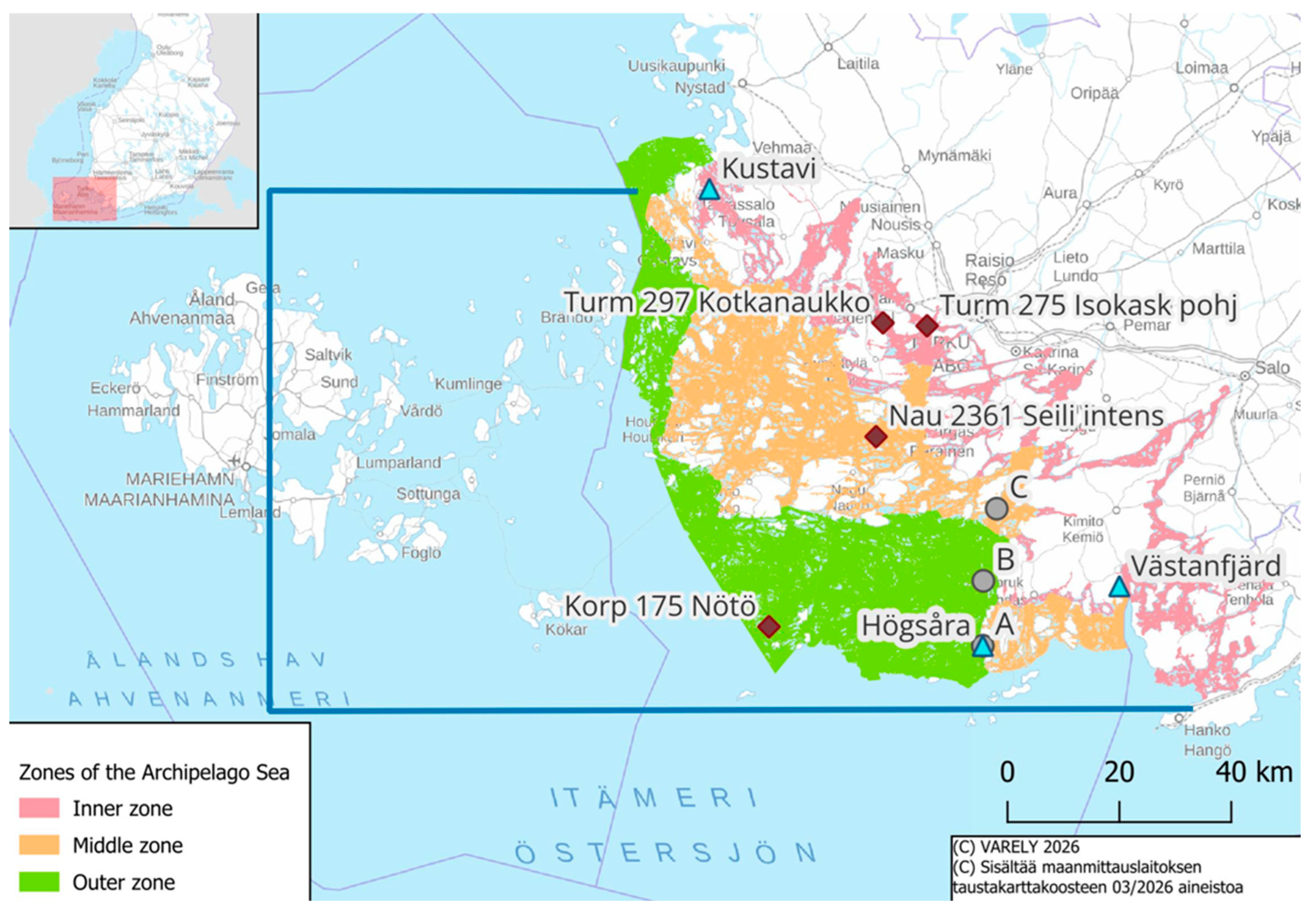
Figure 1. Map of the Archipelago Sea and the locations of water quality monitoring stations. The blue line indicates the boundary of the Archipelago Sea. The types of water formations (inner, middle, outer) are represented on the map with different colors (pink, orange, green). Water quality observation stations are shown on the map as brown diamond symbols and are labeled accordingly. Filamentous algae seasonal sampling locations are indicated by light-blue triangles, and the study sites used for depth-gradient sampling (A–C) are shown as grey circles.
Water 18 00908 g001
Figure 2. Estimated phosphorus loading to the Archipelago Sea from major rivers and diffuse sources. Riverine loads from Aurajoki, Paimionjoki and Uskelanjoki are based on environmental administration statistics compiled by the Finnish Environment Institute. Diffuse load for 1980–1994 was reconstructed using a regression model calibrated for 1995–2018. Annual values are shown as points and the centered 3-year moving average (MA3) as a line.
Water 18 00908 g002
Figure 3. Gross phosphorus loads from fish farming directed to the Archipelago Sea, presented separately for mainland Finland (blue bars) and Åland (red bars). Mainland data (1982–2024) are from the Finnish Environmental Administration’s VAHTI system; Åland data are from the Regional Government’s Fiskodlingsstatistik.
Water 18 00908 g003
Figure 4. Seasonal surface-layer (0–10 m) phosphorus difference (ΔTP) at Seili from 1983 to 2025. Black points show annual ΔTP values. The period 1990–2002 exhibits a significant increasing trend (1.02 µg L−1 yr−1, p = 0.012; red line), whereas 2003–2025 shows a non-significant positive trend (0.27 µg L−1 yr−1, p = 0.19; grey dashed line). The thin black line displays the long-term trend for the full record (0.162 µg L−1 yr−1, p = 0.012).
Water 18 00908 g004
Figure 5. Seasonal ΔDIP (autumn maximum [15 September–20 October] minus early-summer minimum [1 May–15 June]) at Seili bottom-near waters (≈44–55 m). Black points show all years; the red OLS line depict the significant 1983–2002 segment (slope = +1.72 µg L−1 yr−1; p = 0.0043). Non-significant segments are omitted from the trend line depiction.
Water 18 00908 g005
Figure 6. Annual surface-layer (0–6 m) seasonal phosphorus difference (ΔTP) at station Turm275, calculated as the autumn maximum minus the early-summer minimum for each year. Each black point represents one annual ΔTP estimate. A Sen trend line is shown only when the long-term monotonic trend is statistically significant (Mann–Kendall p < 0.05).
Water 18 00908 g006
Figure 7. Annual seasonal phosphorus difference (ΔTP) in the Turm297 surface layer (0–10 m), calculated as the difference between the early-summer TP minimum (May–June) and the autumn TP maximum (September–October). Each black point represents one annual ΔTP estimate. A Sen slope trend line (red) is displayed only when the long-term monotonic trend is statistically significant (Mann–Kendall p < 0.05).
Water 18 00908 g007
Figure 8. Seasonal median bottom-near dissolved oxygen (mg L−1) with OLS trend (red line), 95% confidence (dark grey) and prediction (grey) intervals. Intervals widen toward the series ends due to increasing OLS estimation uncertainty.
Water 18 00908 g008
Figure 9. Fraction of observations below 8 mg L−1 with OLS trend (red line), 95% confidence (dark grey) and prediction (grey) intervals. Intervals widen toward the series ends due to increasing OLS estimation uncertainty.
Water 18 00908 g009
Figure 10. Seasonal minimum DIP (15 May–15 October) with OLS trend (red line), 95% confidence (dark grey) and prediction intervals (grey).
Water 18 00908 g010
Figure 11. Seasonal median DIP with robust LOWESS (span tuned by LOOCV) and ~95% bootstrap band (moving-block, L = 3 years). LOWESS smoothing was fitted using the LOOCV-selected span, and the uncertainty band was obtained from a moving-block bootstrap where each resampled series preserved chronological order before refitting the smoother. The span of the robust LOWESS smoother was selected using LOOCV to ensure an objective, data-driven choice of smoothing level.
Water 18 00908 g011
Figure 12. Fraction of observations > 20 µg L−1 with OLS trend (red line), 95% confidence (dark grey) and prediction intervals (grey).
Water 18 00908 g012
Figure 13. Cumulative aquaculture phosphorus load (black dashed line, left axis) and annual surface-layer ΔTP at Seili (black points, right axis) from 1983 to 2025. The period 1990–2002 shows a significant increasing ΔTP trend (1.02 µg L−1 yr−1, p = 0.012; red line), consistent with Figure 4. From 2003–2025, ΔTP exhibits a non-significant positive trend (0.27 µg L−1 yr−1, p = 0.19), indicating no statistically robust directional change over the more recent period.
Water 18 00908 g013
Table 1. Estimated Filamentous Algal Biomass and Phosphorus Content.
MonthBiomass (0–1 m) (g m−2 DW)Mean Biomass (0–4.5 m) (g m−2 DW)Total Biomass (t DW)Phosphorus Stock (t P)
March71.244.172,175188
April118.273.3119,819312
May63.739.564,573168
June–July62.338.663,154164
August23.914.824,22763
Disclaimer/Publisher’s Note: The statements, opinions and data contained in all publications are solely those of the individual author(s) and contributor(s) and not of MDPI and/or the editor(s). MDPI and/or the editor(s) disclaim responsibility for any injury to people or property resulting from any ideas, methods, instructions or products referred to in the content.