Hydrological Stability and Sensitivity Analysis of the Cahaba River Basin: A Combined Review and Simulation Study



Abstract
1. Introduction
- To evaluate the suitability and feasibility of a continuous integration framework for watershed modeling by combining hydrological sensitivity analysis, high-resolution spatial data, and in situ sensing strategies.
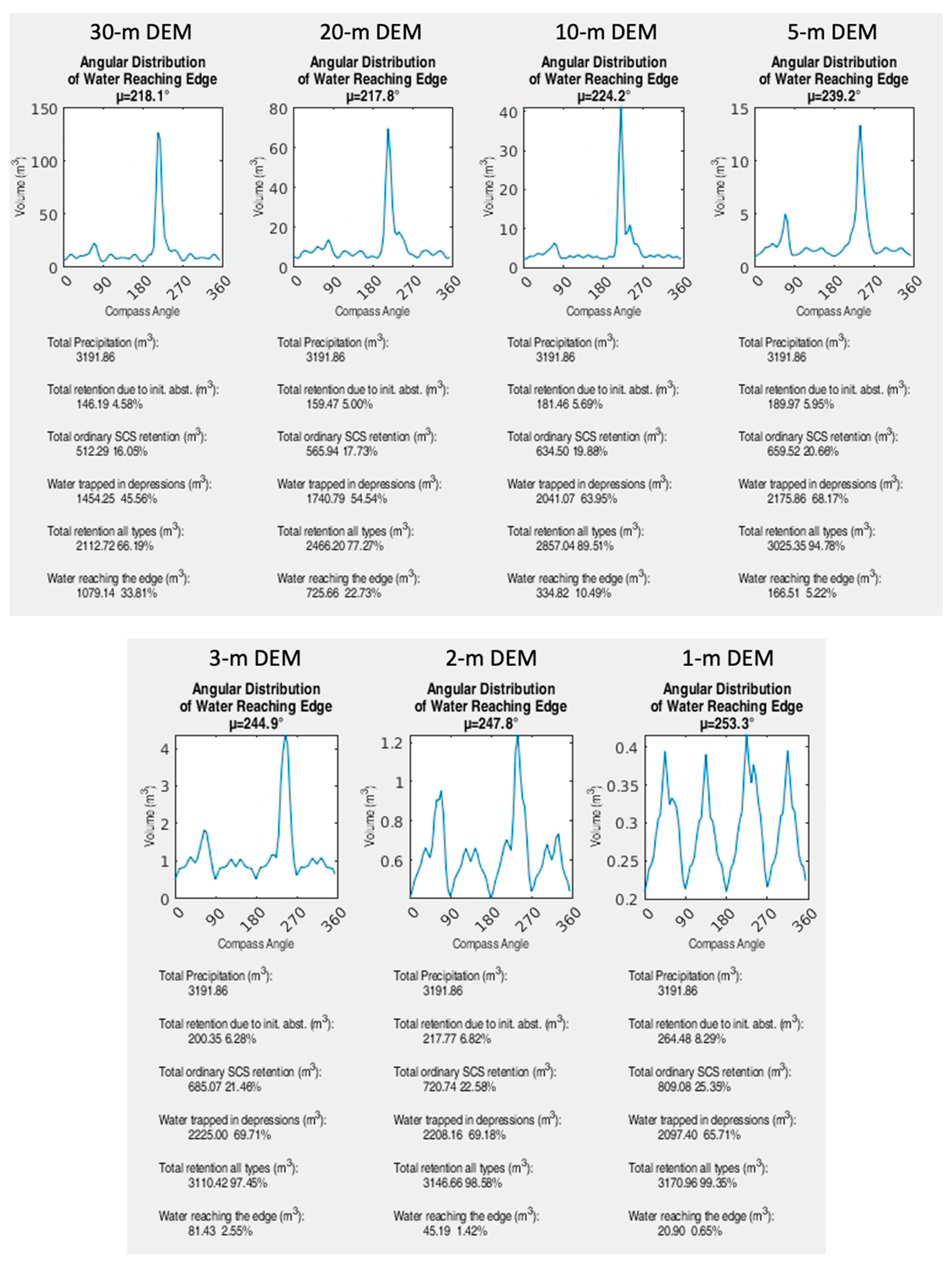
- To investigate how variations in digital elevation model resolution influence watershed delineation, hydrological responses, and the identification of localized hydrological hotspots.
- To analyze the impacts of land use and soil heterogeneity on hydrological processes and model refinement within the watershed.
- To quantify the sensitivity of the hydrological models to curve number, total water retention, and surface flow under high-resolution terrain conditions.
2. Materials and Methods
2.1. Modeling Case Study Area
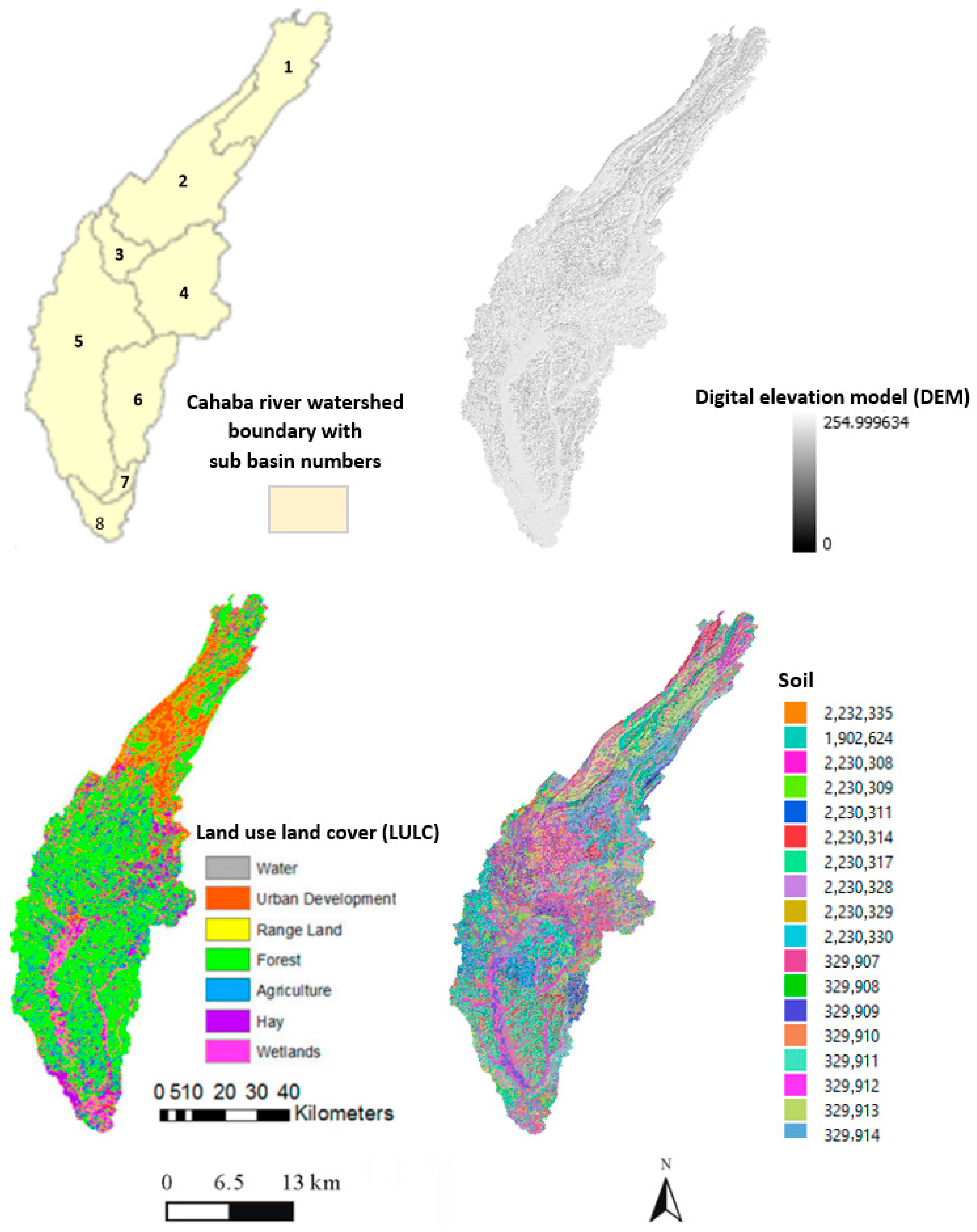
2.2. Insights from Benchmark SWAT Model of Cahaba River Watershed
2.2.1. Calibration and Validation of SWAT Model
2.2.2. Hydrological Behavior Across Land Uses
2.2.3. Model Improvements and Sensitivity Analysis
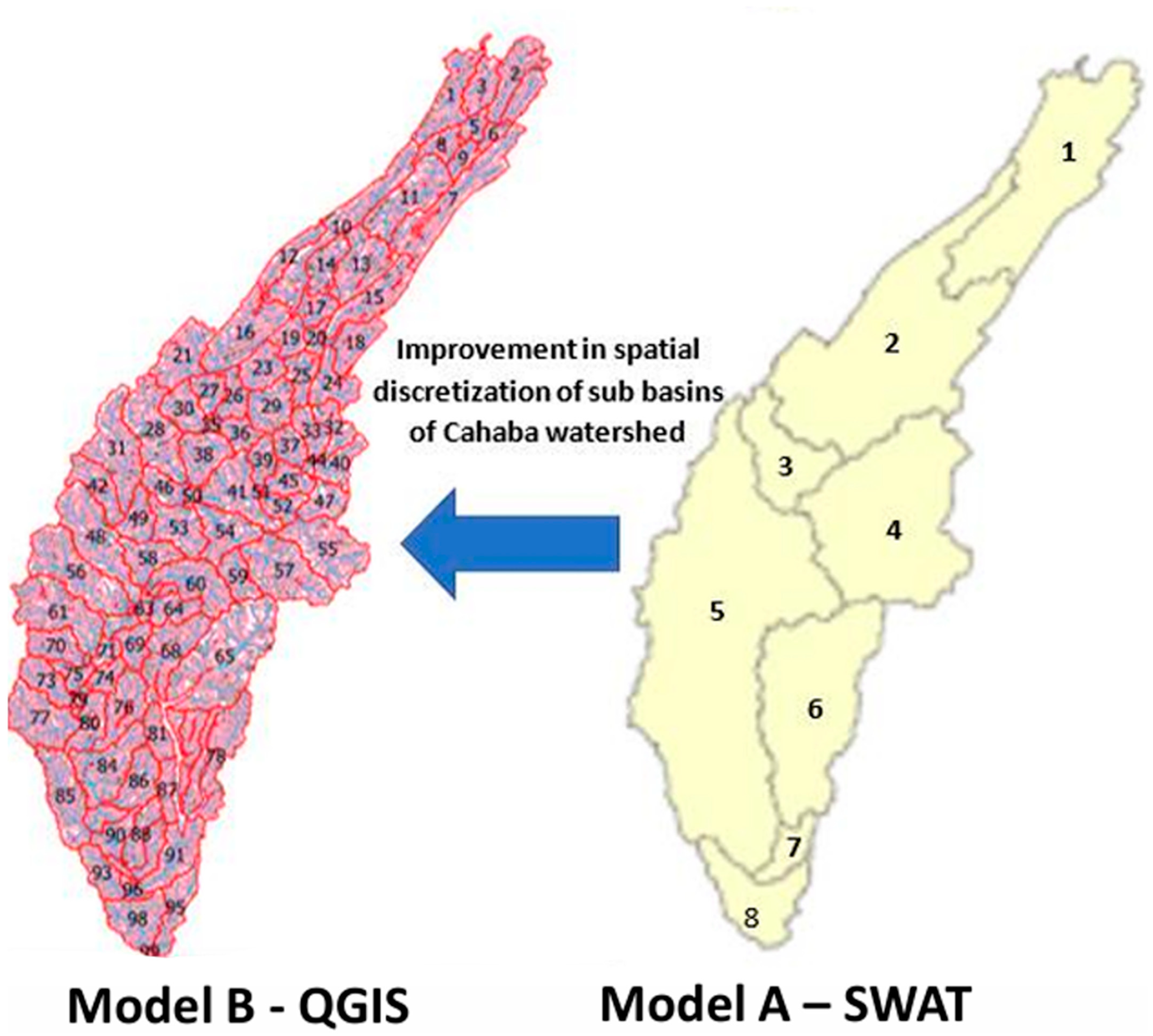
- Spatial resolution enhancements: The number of subbasins could be increased significantly by using a revised hydrological model or redefining the area threshold in the benchmark SWAT model for improving the model’s capacity to capture localized hydrological variations.
- Hotspot identification: Sensitivity analysis identified subbasins with extreme slopes and dominant land cover types as key contributors to transient hydrological responses. These hotspots are prioritized for targeted sensor tasking and refined calibration (Table 1).
- Key observables for real-time sensing: Parameters such as soil emissivity, floodplain elevation, and rainfall-induced changes are being explored for integration with real-time sensors to enhance dynamic response capabilities of the model.
2.3. Refined Modeling Using QGIS
DEM Transitioning
2.4. Local Sensitivity Analysis to Inform Continuous Improvement
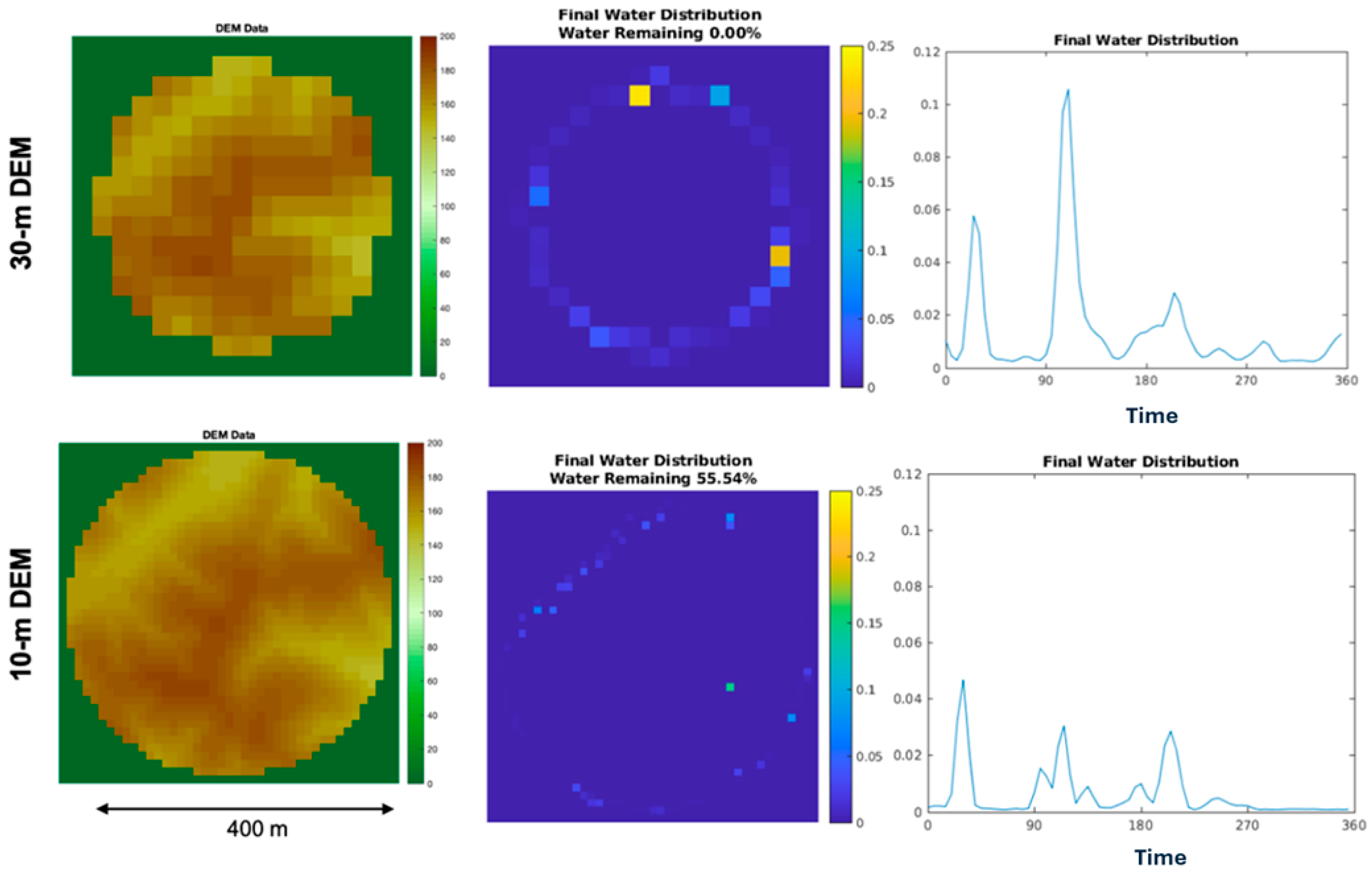
Localized Flow Partitioning Simulations
- Initial abstractions (0.2S) following National Engineering Handbook (USDA NRCS, 2004) recommendations.
- An SCS runoff equation to compute flow and retention iteratively.
- Multiple flow direction (MFD) routing, distributing flow to adjacent pixels based on slope and geometry.
- Iterative updates of actual retention (F) and runoff (Qflow) until convergence.
- Circumferential output vectors of water flux at 5° intervals, smoothed for pixel overlap.
3. Results
3.1. SWAT Model Experiments: Effects of DEM Transitioning
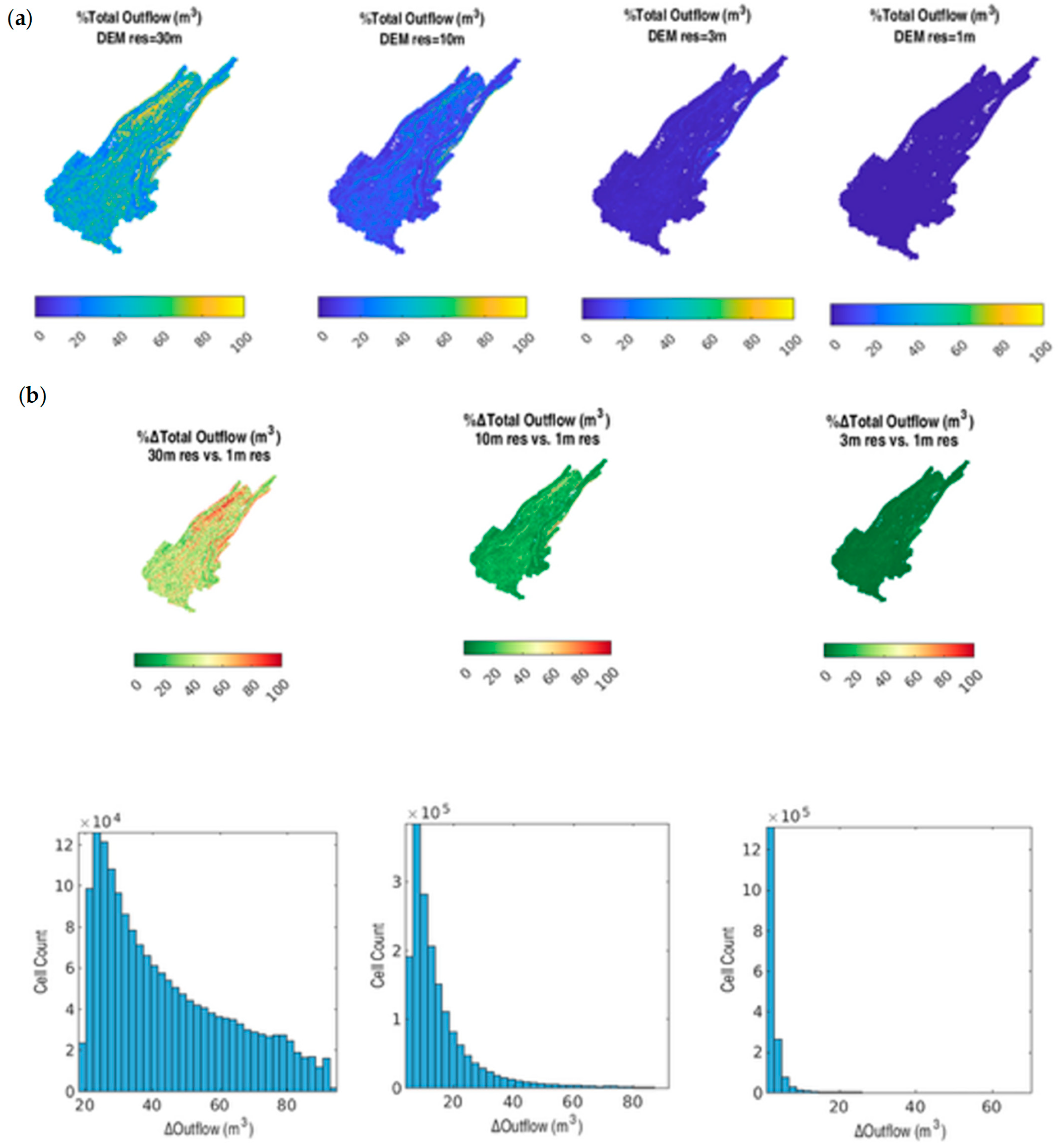
3.1.1. Spatial Hydrological Modeling Improvements
3.1.2. Computation Time Comparison
3.2. Sensitivity Experiments: Quantifying Local Impact of Spatial Heterogeneity
3.2.1. Sensitivity to DEM Resolution
3.2.2. Sensitivity to CN Variation
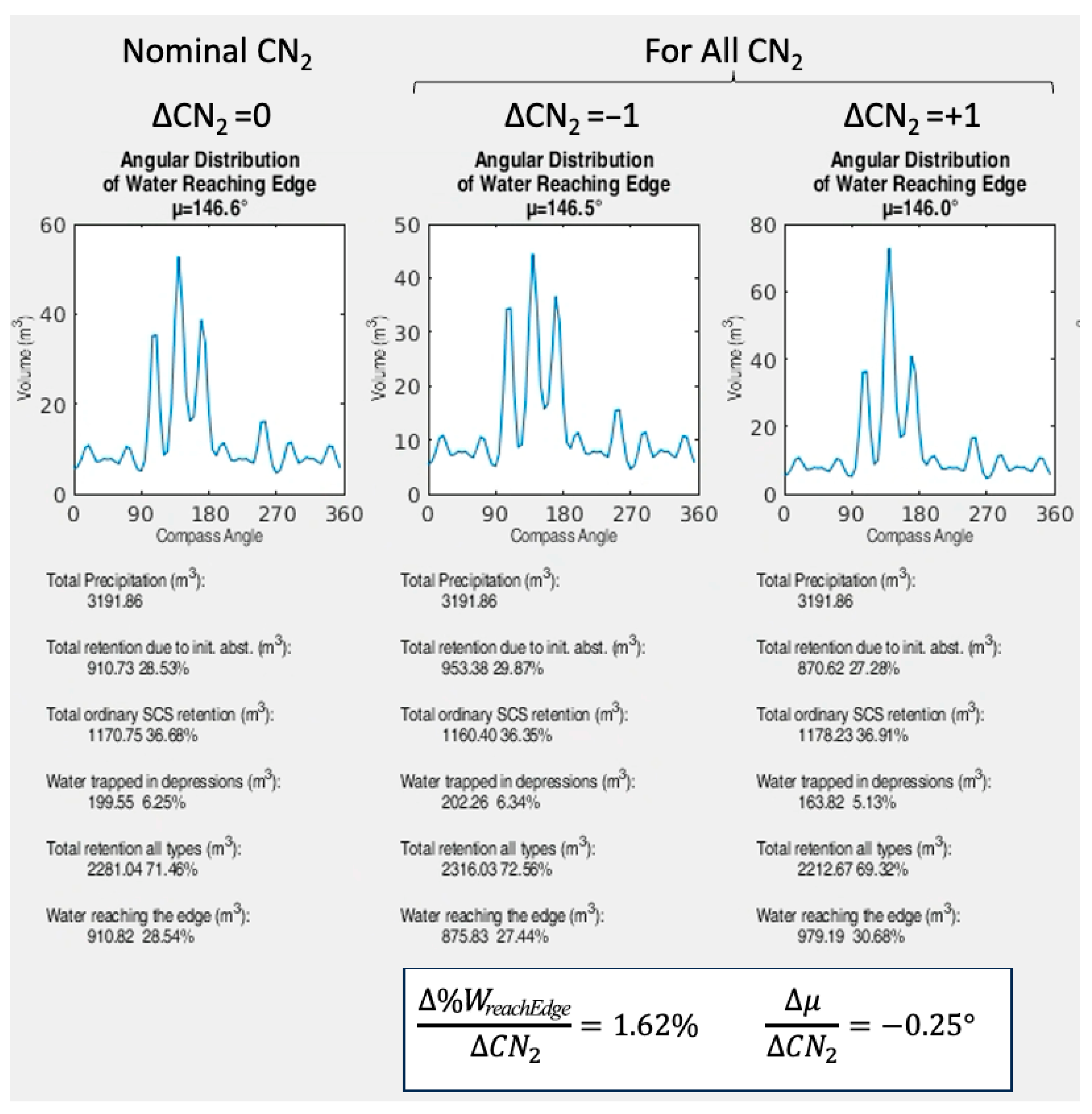
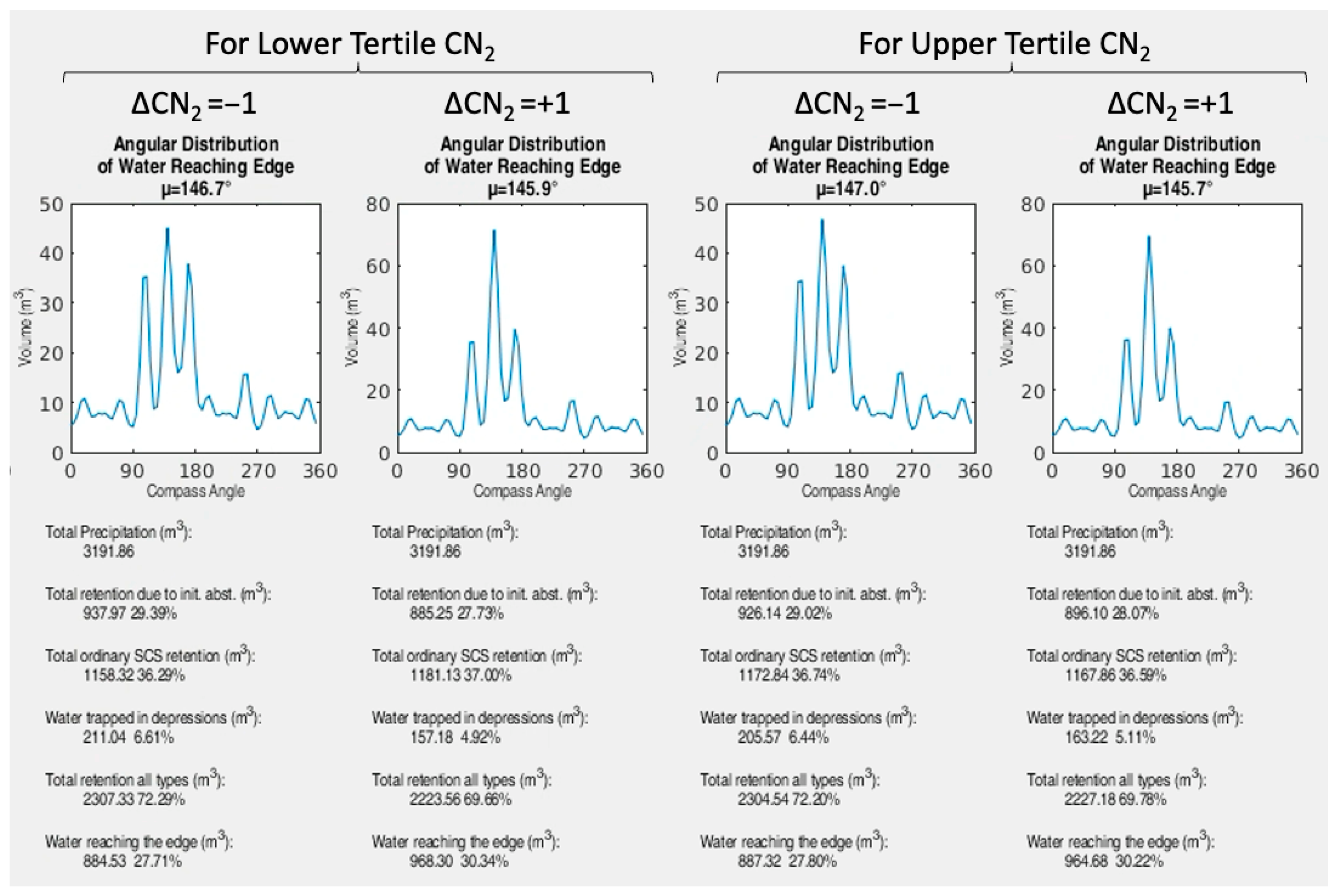
- The nominal moderate saturation (CN2) profile;
- All CN2 values in the circular test region varied by ±1;
- CN2 values less than or equal to the 1/3 quantile value varied by ±1;
- CN2 values greater than or equal to the 2/3 quantile value varied by ±1.
4. Discussion
4.1. Mapping Experiments in Subbasin Scale
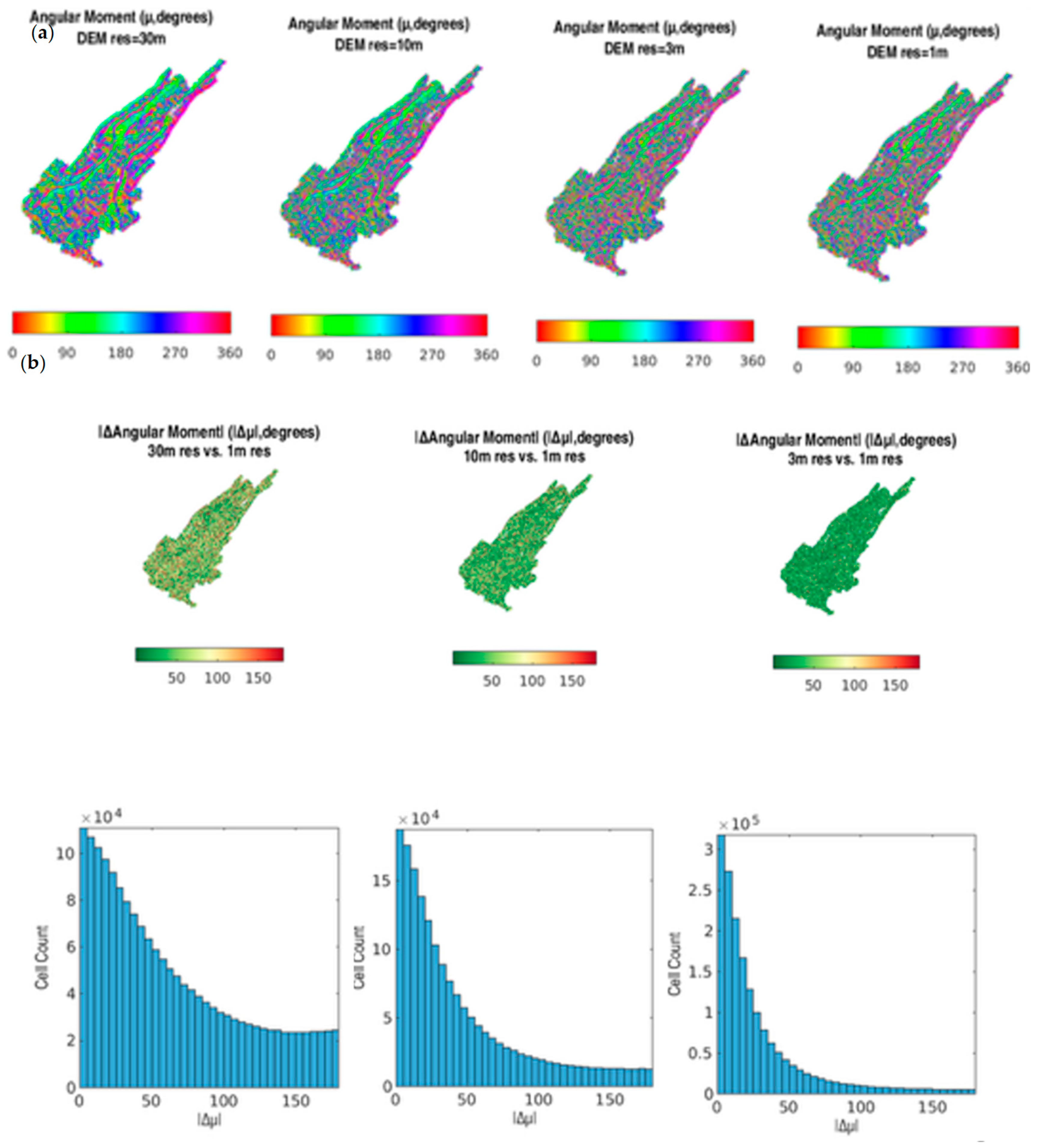
4.1.1. Comparing Angular First Moment of Spatially Resolute DEMs vs. 1 m DEM

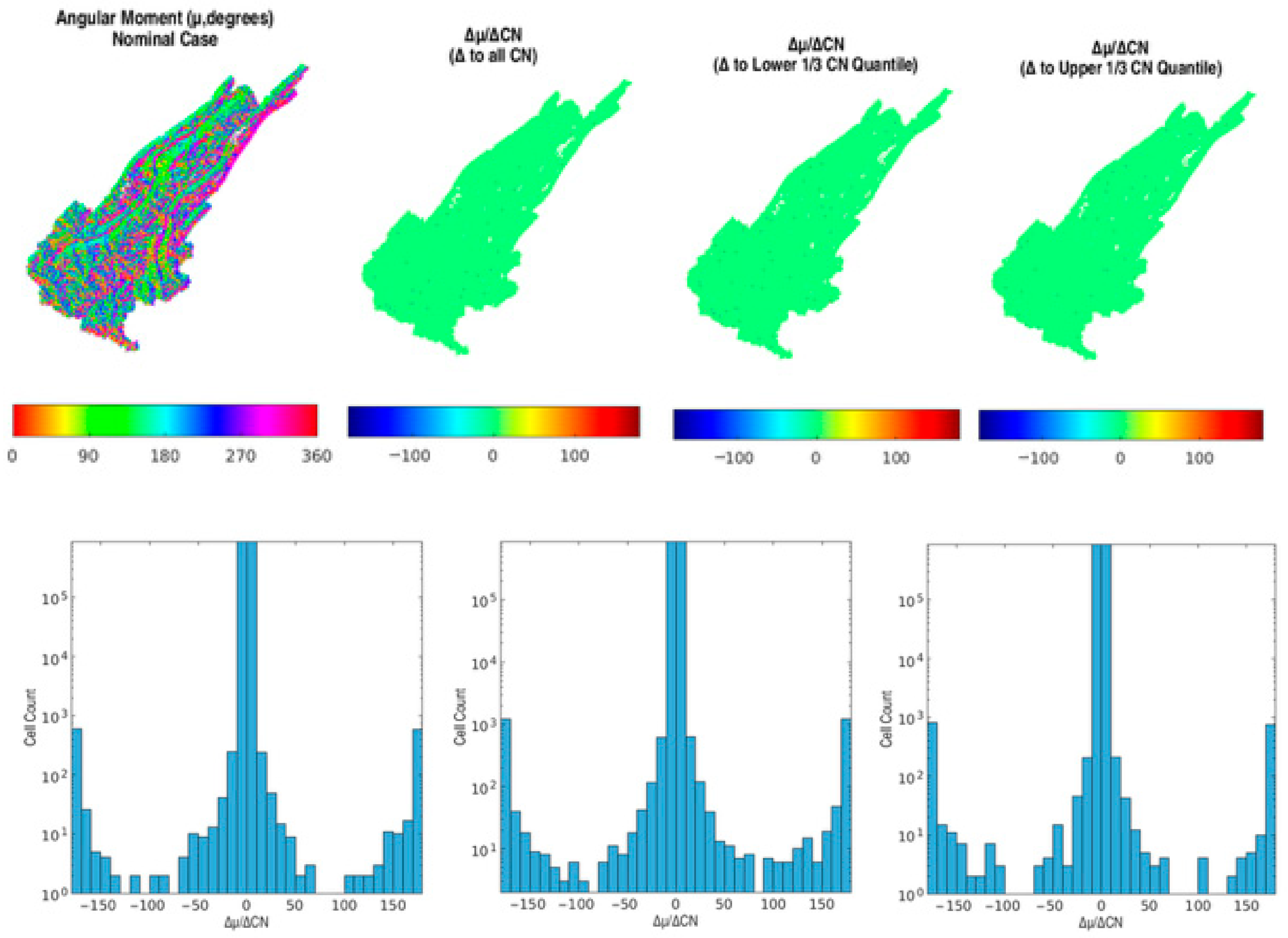
4.1.2. Comparing Angular First-Moment Sensitivity to Perturbed CN
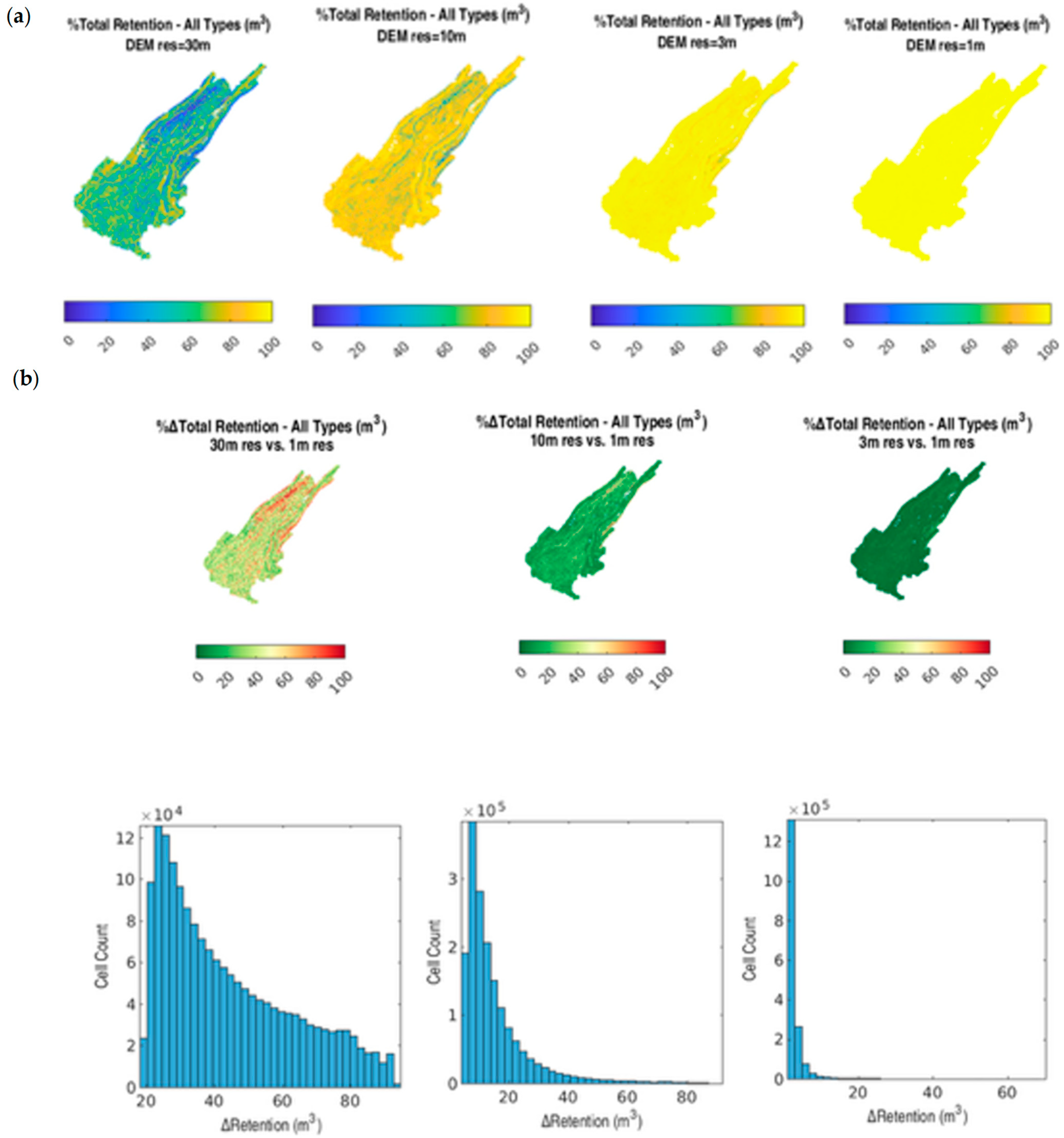
4.1.3. Comparing Total Water Retention Based on Spatially Resolute DEMs vs. 1 m DEM

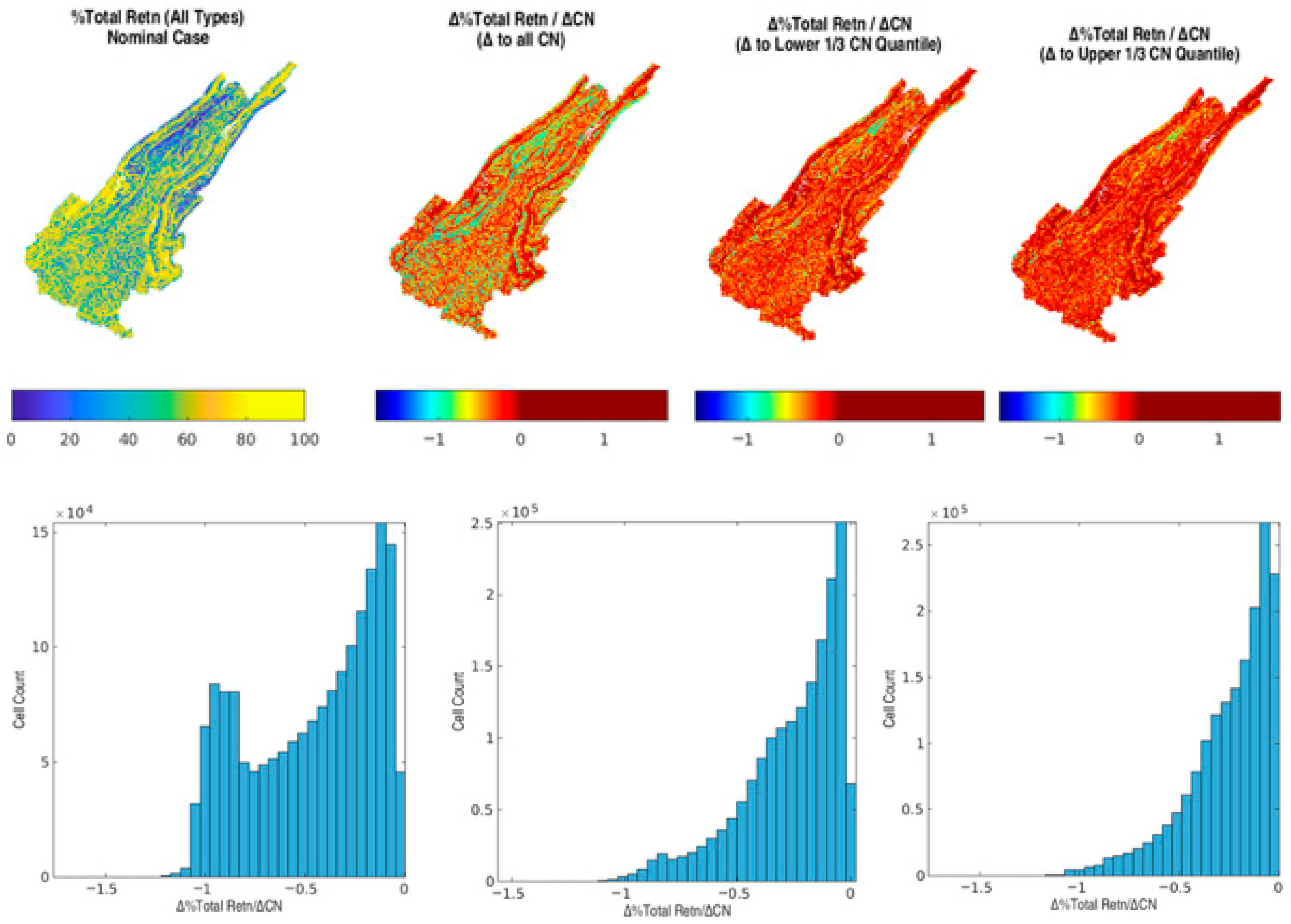
4.1.4. Comparing Total Water Retention Sensitivity to Perturbed CN
- The influence of micro-topography revealed by high-resolution DEMs on initial abstraction and infiltration processes;
- How finer spatial discretization modifies contributing areas and runoff pathways;
- Event-scale comparisons between observed and simulated hydrographs to derive revised CN values;
- Parameter sensitivity-based approaches to identify which CN-related factors most strongly contribute to the observed nonlinear response.
4.1.5. Comparing Surface Flow Simulations with Spatially Resolute DEMs vs. 1 m DEM

5. Limitations and Future Work
6. Conclusions
- Continuous Integration Framework: Enables dynamic feedback between model outputs and sensor deployment, improving model fidelity through targeted, high-utility data collection.
- Effect of DEM Resolution: Transitioning from 30 m to 1 m DEMs increased subbasin delineation granularity (from 8 to 99 units), revealing localized hydrological hotspots and enhanced prediction of runoff and retention patterns.
- Hydrological Sensitivity to Terrain Detail: Fine-resolution DEMs (≤5 m) captured microtopographic depressions and slope-driven flow pathways, improving representation of infiltration and surface water connectivity. Coarser DEMs (≥20 m) consistently underestimated retention and smoothed flow patterns.
- Curve Number (CN) Sensitivity: Small perturbations in CN values significantly affected retention and runoff behavior, underscoring the need to recalibrate CN relationships when integrating high-resolution terrain data.
- Localized Flow Partitioning: High-resolution models revealed up to 58% greater water retention in fine DEMs due to better capture of local depressions and drainage structures, improving accuracy of surface flow direction and magnitude.
- Computation Resolution Tradeoff: While 1 m DEM modeling increased processing time 4–10× relative to 30 m DEMs, it provided substantially improved hydrologic realism, justifying selective use in spatially sensitive zones.
- Implications for Sensor Tasking: Sensitivity maps derived from local model analyses can guide adaptive sensor placement and data collection, optimizing resource allocation for real-time watershed monitoring.
- Limitations of existing empirical models: Existing models, such as the SCS curve number method, have been fit to data based on course-resolution inputs. For use of finer resolutions, the CN tables, initial abstractions assumptions, etc., need to be revisited and updated for use with high-resolution data.
- Assessing the influence of micro-topography revealed by high-resolution DEMs on initial abstraction and infiltration processes, which may significantly alter effective runoff thresholds.
- Examining how finer spatial discretization reshapes contributing areas and flow pathways, thereby modifying the hydrological response represented by the CN framework.
- Conducting event-scale comparisons between measured and simulated hydrographs to systematically derive revised CN values that better reflect the physical behavior of the study area.
- Applying parameter sensitivity approaches to identify which CN-related factors of land cover, soil group, and initial abstraction ratio most strongly drive the nonlinear runoff response observed in the simulations.
- Recalibration of the existing CN tables when integrated with high-resolution DEM data.
Author Contributions
Funding
Data Availability Statement
Acknowledgments
Conflicts of Interest
References
- Preetha, P.; Hasan, M. Scrutinizing the hydrological responses of Chennai, India using coupled SWAT–FEM model under land use land cover and climate change scenarios. Land 2023, 12, 938. [Google Scholar] [CrossRef]
- Laniak, G.F.; Olchin, G.; Goodall, J.; Voinov, A.; Hill, M.; Glynn, P.; Hughes, A. Integrated environmental modeling: A vision and roadmap for the future. Environ. Model. Softw. 2013, 39, 3–23. [Google Scholar] [CrossRef]
- Gosain, A.K.; Rao, S.; Basuray, D. Climate change impact assessment on hydrology of Indian river catchments. Curr. Sci. 2006, 90, 346–353. [Google Scholar]
- Huang, S.; Krysanova, V.; Osterle, H.; Hattermann, F.F. Simulation of spatiotemporal dynamics of water fluxes in Germany under climate change. Hydrol. Process. 2010, 24, 3289–3306. [Google Scholar] [CrossRef]
- Eckhardt, K.; Ulbrich, U. Potential impacts of climate change on groundwater recharge and streamflow in a central European low mountain range. J. Hydrol. 2003, 284, 244–252. [Google Scholar] [CrossRef]
- Kingston, D.G.; Taylor, R.G. Sources of uncertainty in climate change impacts on river discharge and groundwater in a headwater catchment of the Upper Nile Basin, Uganda. Hydrol. Earth Syst. Sci. 2010, 14, 1297–1308. [Google Scholar] [CrossRef]
- Schmugge, T.; Kustas, W.P.; Ritchie, J.C.; Jackson, T.J.; Rango, A. Remote sensing in hydrology. Adv. Water Resour. 2002, 25, 1367–1385. [Google Scholar] [CrossRef]
- Preetha, P.P.; Al-Hamdan, A.Z. Developing nitrate–nitrogen transport models using remotely sensed geospatial data of soil moisture profiles and wet depositions. J. Environ. Sci. Health A 2020, 55, 615–628. [Google Scholar] [CrossRef]
- Flacke, W.; Auerswald, K.; Neufang, L. Combining a modified Universal Soil Loss Equation with a digital terrain model for computing high resolution maps of soil loss resulting from rain wash. Catena 1990, 17, 383–397. [Google Scholar] [CrossRef]
- Xian, G.; Crane, M. Assessments of urban growth in the TBW using remote sensing data. Remote Sens. Environ. 2005, 97, 203–215. [Google Scholar] [CrossRef]
- Moreno-Madrinan, M.J.; Al-Hamdan, M.Z.; Rickman, D.L.; Muller-Karger, F.E. Using the surface reflectance MODIS Terra product to estimate turbidity in Tampa Bay, Florida. Remote Sens. 2010, 2, 2713–2728. [Google Scholar] [CrossRef]
- Gonzalez, M.O.; Preetha, P.; Kumar, M.; Clement, T.P. Comparison of data-driven groundwater recharge estimates with a process-based model for a river basin in the southeastern USA. J. Hydrol. Eng. 2023, 28, 04023019. [Google Scholar] [CrossRef]
- Preetha, P.; Bathi, J.R.; Kumar, M.; Kode, V.R. Predictive tools and advances in sustainable water resources through atmospheric water generation under changing climate: A review. Sustainability 2025, 17, 1462. [Google Scholar] [CrossRef]
- Zhang, R.; Srinivasan, F.H. Predicting hydrologic response to climate change in the Luohe River catchment using the SWAT model. Am. Soc. Agric. Biol. Eng. 2007, 50, 901–910. [Google Scholar]
- Takle, E.S.; Jha, M.; Lu, E.; Arritt, R.W.; Gutowski, W.J. Streamflow in the upper Mississippi River catchment as simulated by SWAT driven by global climate models and NARCCAP regional models. Meteorol. Z. 2010, 19, 341–346. [Google Scholar] [CrossRef]
- Lakshmanan, V.; Geethalakshmi, R.; Sekhar, S.N.U.; Annamalai, H. Climate change adaptation strategies in Bhavani Basin using SWAT model. J. Appl. Eng. Agric. 2011, 27, 887–893. [Google Scholar] [CrossRef]
- Nourani, V.; Rouzegari, N.; Molajou, A.; Baghanam, A.H. An integrated simulation–optimization framework to optimize reservoir operation adapted to climate change scenarios. J. Hydrol. 2020, 587, 125018. [Google Scholar] [CrossRef]
- Balasubramanian, R.; Saravanakumar, V.; Boomiraj, K. Ecological footprints and climate change impact on rice production in India. In The Future Rice Strategy for India; Elsevier: Amsterdam, The Netherlands, 2017; pp. 69–106. [Google Scholar]
- Rao, K.P.C.; Ndegwa, W.G.; Kizito, K.; Oyoo, A. Climate variability and change: Farmer perceptions in semi-arid Kenya. Exp. Agric. 2011, 47, 267–291. [Google Scholar] [CrossRef]
- Thomas, B.F.; Behrangi, A.; Famiglietti, J.S. Precipitation intensity effects on groundwater recharge in the southwestern United States. Water 2016, 8, 90. [Google Scholar] [CrossRef]
- Ibrahim, A.; Wayayok, A.; Shafri, H.Z.M.; Toridi, N.M. Remote sensing technologies for modelling groundwater storage dynamics: Comprehensive review. J. Hydrol. X 2024, 23, 100175. [Google Scholar]
- Kwon, H.; Park, G.; Kim, S. Estimation of soil loss changes and sediment transport path using GIS and multi-temporal RS data. J. GIS Assoc. Korea 2002, 10, 134–147. [Google Scholar]
- Deng, J.S.; Wang, K.; Deng, Y.H.; Qi, G.J. PCA-based land-use change detection and analysis using multitemporal and multisensor satellite data. Int. J. Remote Sens. 2008, 29, 4823–4838. [Google Scholar] [CrossRef]
- Sadeghi, S.H.; Zabihi, M.; Vafakhah, M.; Hazbavi, Z. Spatiotemporal mapping of rainfall erosivity index for different return periods in Iran. Nat. Hazards 2017, 87, 35–56. [Google Scholar] [CrossRef]
- Das, S.; Talukdar, S.; Scaringi, G. How do climate, geomorphology, and land-use control sediment yield generation in an anthropogenically modified landscape? EarthArXiv 2025. [Google Scholar] [CrossRef]
- Abdelkader, M. Data- and Process-Based Methods to Enhance Streamflow Estimation Across Scales. Ph.D. Thesis, Stevens Institute of Technology, Hoboken, NJ, USA, 2024. [Google Scholar]
- Grose, A. Assessing Catchment-Scale Ground Thaw, Runoff, and Stream Chemistry Processes Across the Thaw Season in Arctic Permafrost Catchments. Ph.D. Thesis, Michigan State University, East Lansing, MI, USA, 2025. [Google Scholar]
- Kim, C.; Kim, D.H. Effects of rainfall spatial distribution on the relationship between rainfall spatiotemporal resolution and runoff prediction accuracy. Water 2020, 12, 846. [Google Scholar] [CrossRef]
- Kamangir, H.; Hajiesmaeeli, M.; Earles, J.M. California crop yield benchmark: Combining satellite image, climate, evapotranspiration, and soil data layers for county-level yield forecasting of over 70 crops. In Proceedings of the IEEE/CVF Conference on Computer Vision and Pattern Recognition; IEEE: New York, NY, USA, 2025; pp. 5530–5539. [Google Scholar]
- Wu, M.; Schurgers, G.; Rummukainen, M.; Smith, B.; Samuelsson, P.; Jansson, C.; May, W. Vegetation–climate feedbacks modulate rainfall patterns in Africa under future climate change. Earth Syst. Dyn. 2016, 7, 627–647. [Google Scholar] [CrossRef]
- Wang, Z.; Gong, Y.; Wang, R.; Luo, K.; Xie, M.; Wu, J. Diagnosing ecosystem service imbalance: A machine learning–driven dissection of supply–demand bundle dynamics in the Dongting Lake Basin. Land Degrad. Dev. 2026. Epub ahead of printing. [Google Scholar] [CrossRef]
- Lambin, E.F.; Ehrlich, D. Land-cover changes in sub-Saharan Africa (1982–1991): Application of a change index based on remotely sensed surface temperature and vegetation indices. Remote Sens. Environ. 1997, 61, 181–200. [Google Scholar] [CrossRef]
- Dietrich, W.E.; Bellugi, D.; Real de Asua, R. Validation of the shallow landslide model SHALSTAB for forest management. In Land Use and Watersheds; AGU Publications: Washington, DC, USA, 2001; pp. 195–227. [Google Scholar]
- Chakrabarti, S.; Judge, J.; Rangarajan, A.; Ranka, S. Utilizing self-regularized regressive models to downscale microwave brightness temperatures for agricultural land covers. IEEE J. Sel. Top. Appl. Earth Obs. Remote Sens. 2017, 10, 478–488. [Google Scholar] [CrossRef]
- Lubczynski, M.; Leblanc, M.; Batelaan, O. Remote sensing and hydrogeophysics give a new impetus to integrated hydrological models: A review. J. Hydrol. 2024, 633, 130–142. [Google Scholar] [CrossRef]
- Schultz, G.A. Remote sensing in hydrology. J. Hydrol. 1988, 100, 239–265. [Google Scholar] [CrossRef]
- Engman, E.T.; Gurney, R.J. Recent advances and future implications of remote sensing for hydrologic modeling. In Recent Advances in Modeling of Hydrologic Systems; Springer: Dordrecht, The Netherlands, 1991; pp. 471–495. [Google Scholar]
- Farnsworth, R.K.; Barrett, E.C.; Dhanju, M.S. Application of Remote Sensing to Hydrology Including Groundwater; UNESCO: Paris, France, 1984; p. 122. [Google Scholar]
- Weng, Q. Modeling urban growth effects on surface runoff with integrated remote sensing and GIS. Environ. Manag. 2001, 28, 737–748. [Google Scholar] [CrossRef] [PubMed]
- Silvestro, F.; Gabellani, S.; Delogu, F.; Rudari, R.; Boni, G. Exploiting remote sensing land surface temperature in distributed hydrological modelling: The Continuum model. Hydrol. Earth Syst. Sci. 2013, 17, 39–62. [Google Scholar] [CrossRef]
- Preetha, P.P.; Al-Hamdan, A.Z. Integrating finite-element-model and remote-sensing data into SWAT to estimate transit times of nitrate in groundwater. Hydrogeol. J. 2020, 28, 2187–2205. [Google Scholar] [CrossRef]
- Balsamo, G.; Agusti-Parareda, A.; Albergel, C.; Arduini, G.; Beljaars, A.; Bidlot, J.; Blyth, E.; Bousserez, N.; Boussetta, S.; Brown, A.; et al. Satellite and in situ observations for advancing global Earth surface modelling: A review. Remote Sens. 2018, 10, 2038. [Google Scholar] [CrossRef]
- Raupach, M.R.; Rayner, P.J.; Barrett, D.J.; DeFries, R.S.; Heimann, M.; Ojima, D.S.; Quegan, S.; Schmullius, C.C. Model–data synthesis in terrestrial carbon observation: Methods, data requirements, and data uncertainty. Glob. Change Biol. 2005, 11, 378–397. [Google Scholar] [CrossRef]
- Gettelman, A.; Geer, A.J.; Forbes, R.M.; Carmichael, G.R.; Feingold, G.; Posselt, D.J.; Stephens, G.L.; Heever, S.C.v.D.; Varble, A.C.; Zuidema, P. The future of Earth system prediction: Advances in model–data fusion. Sci. Adv. 2022, 8, eabn3488. [Google Scholar] [CrossRef]
- Chen, S.; Long, G.; Jiang, J.; Liu, D.; Zhang, C. Foundation models for weather and climate data understanding: A comprehensive survey. arXiv 2023, arXiv:2312.03014. [Google Scholar] [CrossRef]
- Dasari, S.K.; Preetha, P.; Ghantasala, H.M. Predictive analysis of hydrological variables in the Cahaba watershed using time-series and machine learning models. Earth 2025, 6, 89. [Google Scholar] [CrossRef]
- Li, F.; Yigitcanlar, T.; Nepal, M.; Nguyen, K.; Dur, F. Machine learning and remote sensing integration for urban sustainability: A review. Sustain. Cities Soc. 2023, 96, 104653. [Google Scholar] [CrossRef]
- Petty, T.R.; Dhingra, P. Streamflow hydrology estimate using machine learning (SHEM). J. Am. Water Resour. Assoc. 2018, 54, 55–68. [Google Scholar] [CrossRef]
- Preetha, P.; Joseph, N. Evaluating modified soil erodibility factors using pedotransfer functions and dynamic remote-sensing data. Land 2025, 14, 657. [Google Scholar] [CrossRef]
- Salerno, F.; Tartari, G. A coupled approach of surface hydrological modelling and wavelet analysis for understanding baseflow components in karst environments. J. Hydrol. 2009, 376, 295–306. [Google Scholar] [CrossRef]
- Singh, V.P.; Woolhiser, D.A. Mathematical modeling of watershed hydrology. J. Hydrol. Eng. 2002, 7, 270–292. [Google Scholar] [CrossRef]
- Shope, C.L.; Maharjan, G.R.; Tenhunen, J.; Seo, B.; Kim, K.; Riley, J.; Arnhold, S.; Koellner, T.; Ok, Y.S.; Peiffer, S.; et al. Using SWAT to improve process descriptions and hydrologic partitioning in South Korea. Hydrol. Earth Syst. Sci. 2014, 18, 539–557. [Google Scholar] [CrossRef]
- Gassman, P.W.; Reyes, M.R.; Green, C.H.; Arnold, J.G. The SWAT tool: Historical development, applications, and research directions. Trans. ASABE 2007, 50, 1211–1250. [Google Scholar] [CrossRef]
- Mwangi, J.K.; Shisanya, C.A.; Gathenya, J.M.; Namirembe, S.; Moriasi, D.N. Evaluating conservation practices on water and sediment yield in Kenya. J. Soil Water Conserv. 2015, 70, 75–90. [Google Scholar] [CrossRef]
- Ramesh, V.; Patil, A.; Ramsankaran, R.A.A.J. Dual correction of rainfall and root zone soil moisture estimates for improving streamflow simulations. ARC Geophys. Res. 2025, 1, 15. [Google Scholar] [CrossRef]
- Mardian, J. Drought Monitoring and Agricultural Risk Assessment in Canadian Prairies Using Earth Observation and ML. Ph.D. Thesis, University of Guelph, Guelph, ON, Canada, 2023. [Google Scholar]
- Praskievicz, S.; Chang, H. Hydrological modelling of basin-scale climate change and urban development impacts. Prog. Phys. Geogr. 2009, 33, 650–671. [Google Scholar] [CrossRef]
- Droegemeier, K.K.; Smith, J.D.; Businger, S.; Doswell, C.; Doyle, J.; Duffy, C.; Foufoula-Georgiou, E.; Graziano, T.; James, L.D.; Krajewski, V.; et al. Hydrological aspects of weather prediction and flood warnings. Bull. Am. Meteorol. Soc. 2000, 81, 2665–2680. [Google Scholar] [CrossRef]
- Nunes, J.P.; Nearing, M.A. Modelling impacts of climatic change using new erosion models. In Handbook of Erosion Modelling; Blackwell Publishing Ltd.: Oxford, UK, 2010; pp. 289–312. [Google Scholar]
- Edwards, B.L.; Webb, N.P.; Brown, D.P.; Elias, E.; Peck, D.; Pierson, F.; Williams, C.; Herrick, J. Climate change impacts on wind and water erosion on US rangelands. J. Soil Water Conserv. 2019, 74, 405–418. [Google Scholar] [CrossRef]
- Leitch, C.; Harbor, J. Impacts of land use change on freshwater runoff in Barbados. J. Soil Water Conserv. 1999, 54, 584–592. [Google Scholar] [CrossRef]
- Tyrrell, B.; McCleery, T.; Preetha, P. Advanced sensing for hydrological metrology. In C3A Workshop; MIT Lincoln Laboratory: Lexington, MA, USA, 2024. [Google Scholar]
- Herman, J.D.; Kollat, J.B.; Reed, P.M.; Wagener, T. High-resolution time-varying sensitivity analysis. Hydrol. Earth Syst. Sci. 2013, 17, 5109–5125. [Google Scholar] [CrossRef]
- Herman, J.D.; Kollat, J.B.; Reed, R.M.; Wagener, T. Method of Morris reduces computational demands in global sensitivity analysis. Hydrol. Earth Syst. Sci. 2013, 17, 2893–2903. [Google Scholar] [CrossRef]
- Ratto, M.; Young, P.C.; Romanowicz, R.; Pappenberger, F.; Saltelli, A.; Pagano, A. Uncertainty and sensitivity analysis in hydrology. Hydrol. Earth Syst. Sci. 2007, 11, 1249–1266. [Google Scholar] [CrossRef]
- Yenni, R.; Arun, P.V. Towards explainable discriminative models for EO data analysis. In Explainable AI for EO; CRC Press: Boca Raton, FL, USA, 2025; pp. 76–85. [Google Scholar]
- Sidle, R.; Ochiai, H. Processes, prediction, and land use. Water Resour. Monogr. 2006, 525, 870. [Google Scholar]
- Babazadeh Maghsoodlo, Y. Deep Learning and Dynamical Systems Approaches to Critical Transitions in Socio–Climate Systems. Ph.D. Thesis, University of Waterloo, Waterloo, ON, Canada, 2025. [Google Scholar]
- Horton, P.; Schaefli, B.; Kauzlaric, M. Why do we have so many different hydrological models? A review based on the case of Switzerland. Wiley Interdiscip. Rev. Water 2022, 9, e1574. [Google Scholar] [CrossRef]
- Li, Y.; Grimaldi, S.; Walker, J.P.; Pauwels, V.R. Remote sensing in flood forecasting: A review. Remote Sens. 2016, 8, 456. [Google Scholar] [CrossRef]
- Yun, Z.; Wang, Y.; Liu, P.; Li, L.; Liu, Y.; Chen, C.; Gao, R.; Peng, Z. Satellite-gauge fusion with near-real-time gap filling for rainfall monitoring. J. Hydrol. 2025, 662, 133913. [Google Scholar] [CrossRef]
- Sharifi, E.; Brocca, L. Monitoring precipitation from space: Progress, challenges, opportunities. In Precipitation Science; Elsevier: Amsterdam, The Netherlands, 2022; pp. 239–255. [Google Scholar]
- Xu, X.; Li, J.; Tolson, B.A. Integrating remote sensing data and hydrologic modeling. Prog. Phys. Geogr. 2014, 38, 464–498. [Google Scholar] [CrossRef]
- Zanella, A.; Zubelzu, S.; Bennis, M. Sensor networks, data processing, and inference: The hydrology challenge. IEEE Access 2023, 11, 107823–107842. [Google Scholar] [CrossRef]
- Jaywant, S.A.; Arif, K.M. Remote sensing techniques for water quality monitoring: A review. Sensors 2024, 24, 8041. [Google Scholar] [CrossRef] [PubMed]
- Mashala, M.J.; Dube, T.; Mudereri, B.T.; Ayisi, K.K.; Ramudzuli, M.R. A systematic review on advancements in remote sensing for assessing and monitoring land use and land cover changes impacts on surface water resources in semi-arid tropical environments. Remote Sens. 2023, 15, 3926. [Google Scholar] [CrossRef]
- Gacu, J.G.; Monjardin, C.E.F.; Mangulabnan, R.G.T.; Mendez, J.C.F. Application of artificial intelligence in hydrological modeling for streamflow prediction in ungauged watersheds: A review. Water 2025, 17, 2722. [Google Scholar] [CrossRef]
- Toney, J.J.N. The Upper Cahaba River Watershed, AL: A Long-Term Assessment and Future Predictions of Water Resource Quality and Quantity. Master’s Thesis, Alabama A&M University, Huntsville, UK, 2021. [Google Scholar]
- Preetha, P.P.; Joseph, N.; Narasimhan, B. Quantifying surface water and groundwater interactions using a coupled SWAT–FEM model: Implications of management practices on hydrological processes in irrigated river basins. Water Resour. Manag. 2021, 35, 2781–2797. [Google Scholar] [CrossRef]
- Preetha, P.P.; Al-Hamdan, A.Z.; Anderson, M.D. Assessment of climate variability and short-term land use land cover change effects on water quality of Cahaba River Basin. Int. J. Hydrol. Sci. Technol. 2021, 11, 54–75. [Google Scholar] [CrossRef]
- Preetha, P.P.; Al-Hamdan, A.Z. Synergy of remotely sensed data in spatiotemporal dynamic modeling of the crop and cover management factor. Pedosphere 2022, 32, 381–392. [Google Scholar] [CrossRef]
- Park, S.; Nielsen, A.; Bailey, R.T.; Trolle, D.; Bieger, K. A QGIS-based graphical user interface for application and evaluation of SWAT-MODFLOW models. Environ. Model. Softw. 2019, 111, 493–497. [Google Scholar] [CrossRef]
- Buchanan, B.P.; Fleming, M.; Schneider, R.L.; Richards, B.K.; Archibald, J.; Qiu, Z.; Walter, M.T. Evaluating topographic wetness indices across central New York agricultural landscapes. Hydrol. Earth Syst. Sci. 2014, 18, 3279–3299. [Google Scholar] [CrossRef]
- Ferreira, V.; Albariño, R.; Larrañaga, A.; LeRoy, C.J.; Masese, F.O.; Moretti, M.S. Ecosystem services provided by small streams: An overview. Hydrobiologia 2023, 850, 2501–2535. [Google Scholar] [CrossRef]
- Santos, P.P.; Reis, E. Assessment of stream flood susceptibility: A cross-analysis between model results and flood losses. J. Flood Risk Manag. 2018, 11, S1038–S1050. [Google Scholar] [CrossRef]
- Muñoz-Villers, L.E.; Geissert, D.R.; Holwerda, F.; McDonnell, J.J. Factors influencing stream water transit times in tropical montane watersheds. Hydrol. Earth Syst. Sci. Discuss. 2015, 12, 10975–11011. [Google Scholar]
- Mourad, K.A.; Oele, J.; Yacoob, W.; Greenwalt, J.; Zain, M.; Al-Okaishi, A.; Aulaiah, A.; Berndtsson, R. Hydrological assessment under climatic and socioeconomic scenarios using remote sensing, QGIS, and climate models: A case study of the Tuban Delta, Yemen. Sustainability 2025, 17, 2258. [Google Scholar] [CrossRef]
- Șlepac, V.; Vlasenco, A. GIS application for spatial data analysis: MapInfo vs. QGIS. In Proceedings of the ConsGeoCad 2024, Chisinau, Moldova, 21–23 November 2024. [Google Scholar]
- Perret, J.; Jessell, M.W.; Bétend, E. GEOL-QMAPS: An open-source QGIS-based solution for digital geological mapping. Appl. Comput. Geosci. 2024, 24, 100197. [Google Scholar] [CrossRef]
- Sadushi, S. Using QGIS-Based Analysis to Estimate Availability and Accessibility of Urban Green Spaces in Tirana. Ph.D. Thesis, Epoka University, Tirana, Albania, 2023. [Google Scholar]
- Falasy, A.; Cooke, R. QGIS-based support tools to simplify complex design challenges of subsurface drainage systems. Irrig. Drain. 2025, 74, 199–215. [Google Scholar] [CrossRef]
- Ngamile, S.; Madonsela, S.; Kganyago, M. Trends in remote sensing of water quality parameters in inland water bodies: A systematic review. Front. Environ. Sci. 2025, 13, 1549301. [Google Scholar] [CrossRef]
- Sahu, I.; Prasad, A.D. Assessment of hydro potential using integrated tools in QGIS. ISPRS Ann. Photogramm. Remote Sens. Spat. Inf. Sci. 2018, 4, 115–119. [Google Scholar] [CrossRef]
- Thompson, S.E.; Sivapalan, M.; Harman, C.J.; Srinivasan, V.; Hipsey, M.R.; Reed, P.; Montanari, A.; Blöschl, G. Developing predictive insight into changing water systems: Hydrologic science for the Anthropocene. Hydrol. Earth Syst. Sci. 2013, 17, 5013–5039. [Google Scholar] [CrossRef]
- Troch, P.A.; Lahmers, T.; Meira, A.; Mukherjee, R.; Pedersen, J.W.; Roy, T.; Valdés-Pineda, R. Catchment coevolution: A useful framework for improving predictions of hydrological change. Water Resour. Res. 2015, 51, 4903–4925. [Google Scholar] [CrossRef]
- Kavetski, D.; Fenicia, F. Elements of a flexible approach for conceptual hydrological modeling: 2. Application and experimental insights. Water Resour. Res. 2011, 47, 1–19. [Google Scholar] [CrossRef]
- Kumar, R.; Samaniego, L.; Attinger, S. Implications of distributed hydrologic model parameterization on water fluxes. Water Resour. Res. 2013, 49, 360–379. [Google Scholar] [CrossRef]
- Chen, F.; Crow, W.T.; Starks, P.J.; Moriasi, D.N. Improving hydrologic predictions via assimilation of surface soil moisture. Adv. Water Resour. 2011, 34, 526–536. [Google Scholar] [CrossRef]
- Davis, N.A. Predicting Future Range Expansion of Whooping Crane Winter Habitat Using Long-Term Census and Remotely Sensed Data. Master’s Thesis, Texas State University, San Marcos, TX, USA, 2019. [Google Scholar]
- Claessens, L.; Heuvelink, G.B.M.; Schoorl, J.M.; Veldkamp, A. DEM resolution effects on shallow landslide hazard and soil redistribution modelling. Earth Surf. Process. Landf. 2005, 30, 461–477. [Google Scholar] [CrossRef]
- Vaze, J.; Teng, J.; Spencer, G. Impact of DEM accuracy and resolution on topographic indices. Environ. Model. Softw. 2010, 25, 1086–1098. [Google Scholar] [CrossRef]
- Samsonov, T. Granularity of DEM and optimal level of detail in small-scale cartographic relief presentation. Remote Sens. 2022, 14, 1270. [Google Scholar] [CrossRef]
- Lin, S.; Jing, C.; Coles, N.A.; Chaplot, V.; Moore, N.J.; Wu, J. Evaluating DEM source and resolution uncertainties in SWAT. Stoch. Environ. Res. Risk Assess. 2013, 27, 209–221. [Google Scholar] [CrossRef]
- Neitsch, S.L.; Arnold, J.G.; Kiniry, J.R.; Williams, J.R.; King, K.W. Soil and Water Assessment Tool (SWAT) Theoretical Documentation—Version 2009; TR-406; Texas A&M University: College Station, TX, USA, 2011. [Google Scholar]
- Moghadam, S.H.; Ashofteh, P.S.; Singh, V.P. Sensitivity analysis of streamflow parameters with SWAT calibrated by NCEP CFSR. Theor. Appl. Climatol. 2024, 155, 8797–8813. [Google Scholar] [CrossRef]
- Soomro, A.G.; Babar, M.M.; Memon, A.H.; Zaidi, A.Z.; Ashraf, A.; Lund, J. Sensitivity of direct runoff to curve number using the SCS-CN method. Civ. Eng. J. 2019, 5, 2738–2746. [Google Scholar] [CrossRef]
- Pang, S.; Wang, X.; Melching, C.S.; Feger, K.H. Modified SWAT model based on slope and precipitation intensity. J. Hydrol. 2020, 588, 125098. [Google Scholar] [CrossRef]
- Abbas, S.A.; Bailey, R.T.; White, J.T.; Arnold, J.G.; White, M.J.; Čerkasova, N.; Gao, J. Framework for parameter estimation, sensitivity, and uncertainty using SWAT+. Hydrol. Earth Syst. Sci. 2024, 28, 21–48. [Google Scholar] [CrossRef]
- Siddiqui, A.R. Curve Number Generator: A QGIS Plugin to Generate Curve Number Layers from Land Use and Soil. Available online: https://github.com/ar-siddiqui/curve_number_generator (accessed on 4 August 2025).
- Malek, S.A. Alpine Sensor Network System for High-Resolution Spatial Snow and Runoff Estimation. Ph.D. Thesis, UC Berkeley, Berkeley, CA, USA, 2019. [Google Scholar]
- Toews, M.W. Modelling Climate Change Impacts on Groundwater Recharge in a Semi-Arid Region. Master’s Thesis, University of British Columbia, Vancouver, BC, Canada, 2007. [Google Scholar]
- Johnson, J.M. The Role of Spatial Data Science in Continental-Scale Hydrology. Ph.D. Thesis, UC Santa Barbara, Santa Barbara, CA, USA, 2022. [Google Scholar]
- De Filippis, G.; Pouliaris, C.; Kahuda, D.; Vasile, T.A.; Manea, V.A.; Zaun, F.; Panteleit, B.; Dadaser-Celik, F.; Positano, P.; Nannucci, M.S.; et al. Demonstrating the application of QGIS-integrated FREEWAT platform for groundwater resource management. Water 2019, 12, 41. [Google Scholar] [CrossRef]
- Rocha, J.; Duarte, A.; Fabres, S.; Quintela, A.; Serpa, D. Influence of DEM resolution on hydrological responses in terraced catchments. Remote Sens. 2022, 15, 169. [Google Scholar] [CrossRef]
- Ortíz-Rodríguez, A.J.; Muñoz-Robles, C.; Rodríguez-Herrera, J.G.; Osorio-Carmona, V.; Barbosa-Briones, E. Effect of DEM resolution on assessing hydrological connectivity in tropical and semi-arid basins. J. Hydrol. 2022, 612, 128104. [Google Scholar] [CrossRef]
- Babaremu, K.; Taiwo, O.; Ajayi, D. Impacts of land use and land cover changes on hydrological response. TWIST 2024, 19, 256–267. [Google Scholar]
- Tebeje, A.K.; Hussein, M.A.; Assefa, T.T.; Mhiret, D.A.; Zimale, F.A.; Abebe, W.B.; Adem, A.A.; Tilahun, S.A.; Desta, G.; Ahmed, M.A. Detection of hydrological alteration and soil erosion in a conserved tropical ecosystem of Ethiopia. Environ. Sustain. Indic. 2024, 24, 100498. [Google Scholar] [CrossRef]
- Workie, M.D.; Teku, D. Assessing soil erosion hotspots and land degradation extent in Beshilo Watershed. Front. Environ. Sci. 2025, 13, 1548881. [Google Scholar] [CrossRef]
- Maximus, J.K. Assessing watershed vulnerability to erosion using DEM and LULC data in Guyana. HydroResearch 2025, 8, 178–193. [Google Scholar] [CrossRef]
- Heredia-R, M.; Torres, B.; Cabrera-Torres, F.; Torres, E.; Díaz-Ambrona, C.G.; Pappalardo, S.E. LULC changes in uncontacted indigenous areas: Deforestation hotspots in Yasuní Biosphere. Forests 2021, 12, 1539. [Google Scholar] [CrossRef]
- Preetha, P.; Al-Hamdan, A.A. Dynamic hydrological modeling and satellite data for sediment yield assessment. Remote Sens. 2022, 14, 400. [Google Scholar] [CrossRef]
- Preetha, P.P.; Maclin, K. Evaluation of hydrogeological models and big data for groundwater quantification. In Environmental Processes and Management; Springer: Cham, Switzerland, 2023; pp. 189–206. [Google Scholar]
- Creutzfeldt, B.N.A. Remote Sensing-Based Characterization of Land Cover and Terrain Properties for Hydrological Modelling in Semi-Arid Brazil. Ph.D. Thesis, University of Potsdam, Potsdam, Germany, 2006. [Google Scholar]
- Marcus, W.A.; Aspinall, R.J.; Marston, R.A. GIS and surface hydrology in mountains. In Mountain Hydrology; Springer-Praxis: Chichester, UK, 2004; pp. 343–379. [Google Scholar]
- Chen, J.M.; Chen, X.; Ju, W. Effects of vegetation heterogeneity and surface topography on NPP scaling. Biogeosciences 2013, 10, 4879–4896. [Google Scholar] [CrossRef]
- Berger, K.P. Surface Water–Groundwater Interaction Across Complex Terrain. Ph.D. Thesis, MIT, Cambridge, MA, USA, 2000. [Google Scholar]
- Rasheed, N.J.; Al-Khafaji, M.S.; Alwan, I.A.; Al-Suwaiyan, M.S.; Doost, Z.H.; Yaseen, Z.M. Survey on the resolution and accuracy of input data validity for SWAT-based hydrological models. Heliyon 2024, 10, 19. [Google Scholar] [CrossRef] [PubMed]
- Dile, Y.T.; Bayabil, H.K.; Ayana, E.K.; Worqlul, A.W.; Srinivasan, R.; Lefore, N.; Berihun, M.L. Effects of DEM and soil data resolution on streamflow and sediment yield simulation. Environ. Monit. Assess. 2024, 196, 71. [Google Scholar] [CrossRef]
- Aqnouy, M.; Ahmed, M.; Ayele, G.T.; Bouizrou, I.; Bouadila, A.; Stitou El Messari, J.E. Comparison of hydrological platforms in assessing rainfall–runoff behavior in a Mediterranean watershed of Northern Morocco. Water 2023, 15, 447. [Google Scholar] [CrossRef]
- Fan, Y.; Clark, M.; Lawrence, D.M.; Swenson, S.; Band, L.E.; Brantley, S.L.; Brooks, P.D.; Dietrich, W.E.; Flores, A.; Grant, G.; et al. Hillslope hydrology in global change research. Water Resour. Res. 2019, 55, 1737–1772. [Google Scholar] [CrossRef]
- Price, K. Effects of watershed topography, soils, land use, and climate on baseflow hydrology. Prog. Phys. Geogr. 2011, 35, 465–492. [Google Scholar] [CrossRef]
- Paniconi, C.; Wood, E.F. A detailed model for simulation of catchment-scale subsurface hydrology. Water Resour. Res. 1993, 29, 1601–1620. [Google Scholar] [CrossRef]
- Montenegro, A.; Ragab, R. Hydrological response of a Brazilian semi-arid catchment to different land use and climate change scenarios: A modelling study. Hydrol. Process. 2010, 24, 2705–2723. [Google Scholar] [CrossRef]





| Land Use Land Cover Classification | % Area of Watershed | Sub Basin Location (Model A) | ET (mm) | Surface Runoff (mm) | Groundwater Storage (mm) | Water Yield (mm) |
|---|---|---|---|---|---|---|
| Forest | 57 | 3 | 22.2 | 0.008 | 19.387 | 23.466 |
| 4 | 23.26 | 0.382 | 30.167 | 32.947 | ||
| 5 | 23.255 | 0.025 | 33.528 | 36.898 | ||
| 6 | 23.116 | 0.24 | 32.261 | 35.734 | ||
| 7 | 21.9 | 0.398 | 39.091 | 42.059 | ||
| Urban Development | 12.25 | 1 | 21.651 | 0.753 | 2.634 | 7.424 |
| 2 | 22.278 | 0.78 | 11.35 | 15.574 |
| Task | SWAT (30 m DEM) | QGIS (1 m DEM) |
|---|---|---|
| DEM preprocessing | 2–10 min | 1–4 h |
| Watershed delineation & HRU creation | 5–30 min | 1–3 h |
| Model setup (QSWAT+/SWAT Editor) | 10–30 min | 1–2 h |
| Model simulation (15 years) | 2–10 min | 15–60 min |
| Total time (1870 sq miles watershed) | 30 min–1 h | 7–14 h |
Disclaimer/Publisher’s Note: The statements, opinions and data contained in all publications are solely those of the individual author(s) and contributor(s) and not of MDPI and/or the editor(s). MDPI and/or the editor(s) disclaim responsibility for any injury to people or property resulting from any ideas, methods, instructions or products referred to in the content. |
© 2026 by the authors. Licensee MDPI, Basel, Switzerland. This article is an open access article distributed under the terms and conditions of the Creative Commons Attribution (CC BY) license.
Share and Cite
Preetha, P.; Tyrrell, B.; Moore, A. Hydrological Stability and Sensitivity Analysis of the Cahaba River Basin: A Combined Review and Simulation Study. Water 2026, 18, 894. https://doi.org/10.3390/w18080894
Preetha P, Tyrrell B, Moore A. Hydrological Stability and Sensitivity Analysis of the Cahaba River Basin: A Combined Review and Simulation Study. Water. 2026; 18(8):894. https://doi.org/10.3390/w18080894
Chicago/Turabian StylePreetha, Pooja, Brian Tyrrell, and Autumn Moore. 2026. "Hydrological Stability and Sensitivity Analysis of the Cahaba River Basin: A Combined Review and Simulation Study" Water 18, no. 8: 894. https://doi.org/10.3390/w18080894
APA StylePreetha, P., Tyrrell, B., & Moore, A. (2026). Hydrological Stability and Sensitivity Analysis of the Cahaba River Basin: A Combined Review and Simulation Study. Water, 18(8), 894. https://doi.org/10.3390/w18080894