Article

Evolutionary Characteristics of Water Resource Governance Policies in China: Based on a Quantitative Textual Analysis


1
School of Public Administration, Public Issues Institute, Sichuan University, Chengdu 610065, China
2
Business School, University of Technology Sydney, Ultimo, NSW 2007, Australia
3
Business School, Sichuan University, Chengdu 610065, China
*
Author to whom correspondence should be addressed.
Water 2026, 18(7), 862; https://doi.org/10.3390/w18070862
Submission received: 31 December 2025 / Revised: 22 March 2026 / Accepted: 26 March 2026 / Published: 3 April 2026
(This article belongs to the Section Water Resources Management, Policy and Governance)

Abstract

Water governance faces growing challenges from climate change, pollution, and increasing demand, rendering policy evolution a critical research focus. This study analyzes the evolutionary characteristics of China’s national water resources governance policies from 1988 to 2025 through an integrated quantitative textual analysis. Based on 154 authoritative policy documents, the study employs Latent Dirichlet Allocation topic modeling, semantic network analysis, and a tripartite policy instrument coding scheme (command-and-control, market-based, and public participation instruments). The results reveal three key findings: a significant shift in policy attention from early administrative control toward system-oriented governance emphasizing watershed/ecological protection, conservation, and technology; a persistently imbalanced instrument mix with command-and-control tools remaining dominant, despite gradual diversification after 2000; and a three-stage evolutionary trajectory from administrative framework building (1988–1999), through comprehensive management and diversification (2000–2015), to collaborative innovation and basin/ecology integration (2016–2025). This study contributes a long-term empirical perspective on water policy evolution in an emerging economy, demonstrates an integrated textual-analytic approach, and provides actionable insights for optimizing policy mixes through strengthened incentive compatibility, substantive participation mechanisms, and coherent governance-aligned instrument portfolios.

1. Introduction

Water resources underpin human health, economic production, and ecosystem integrity. Yet many regions face intensifying risks from climatic extremes, demographic growth, industrial restructuring, and land-use change, which jointly stress both water quantity and water quality. Contemporary assessments emphasize that water insecurity is rarely a purely hydrological problem; rather, it often reflects how institutions allocate, regulate, monitor, and coordinate water-related decisions across sectors and scales [1,2]. Accordingly, water resource governance, understood as the rules, actors, instruments, and processes through which societies make and implement water decisions, has become a central research agenda spanning environmental governance, public administration, and sustainability science [3,4,5].
China provides a salient setting for water governance research because it combines large-scale water demand, pronounced spatial-temporal heterogeneity in water availability, and rapid socio-economic transitions. While China’s total freshwater endowment is substantial, multiple indicators suggest that per-capita availability is well below the world average and that inter-regional mismatches between supply and demand remain persistent [6,7]. Over recent decades, intensified industrialization and urbanization have been accompanied by ecosystem pressures and water quality challenges in many basins, increasing the complexity of coordinating water allocation, pollution control, ecological protection, and disaster risk reduction within a unified governance framework [8,9].
Water resource governance has become a pivotal agenda in China’s ecological civilization construction and a binding constraint on high-quality development. Water resource governance is co-shaped by policy, science/technology, monitoring infrastructure, modeling capacity, and implementation capacity. In a sense, policy texts could be regarded as observable artifacts of governance priorities and instrument design. Since the promulgation of the Water Law of the People’s Republic of China (1988), China has progressively expanded its national water governance policy architecture, including water abstraction permitting, quota management, pricing and fee reforms, basin-level planning, ecological redlines, and performance-based accountability mechanisms [6]. More recently, governance innovations such as the River Chief System (RCS) have aimed to address fragmentation by strengthening cross-departmental coordination and clarifying responsibilities for water pollution control and river management [8,10]. At the same time, market-oriented experiments, such as water rights trading pilots, have been promoted to improve allocation efficiency under scarcity constraints, though empirical findings indicate heterogeneity across regions and institutional conditions [11,12].

1.1. Policy Instruments and Policy Mixes in Water Governance

Policy instrument theory offers a structured lens for examining how governments translate governance goals into implementable mechanisms. Classic typologies distinguish regulatory/command-and-control tools, economic/market-based instruments, and information/communication instruments [13,14]. Subsequent scholarship argues that governance performance depends not only on individual tools but also on the design quality of policy mixes, including coherence, complementarity, and consistency across instruments and across governance levels [15,16,17]. In water policy contexts, the OECD emphasizes that effective governance requires aligning policy instruments with institutional capacities, stakeholder engagement, financing, and accountability arrangements [3].
In China, existing evaluations suggest that national water policies have expanded substantially in coverage and administrative reach, while challenges remain in incentive alignment, market-based coordination, transparency, and systematic performance evaluation, especially when policies must adapt to diverse regional water endowments and administrative capacities [6,8,11]. Moreover, instrument interactions can be non-trivial. For example, command-and-control permitting systems may coexist with pricing reforms and market pilots, potentially generating synergies or tensions. Understanding such interactions requires analytic approaches that connect what policies prioritize with how they intend to act across time [16,18].
It is worth noting that the evolution of water resource governance is not solely driven by policy texts. The deepening of scientific understanding and the innovation of technical means also play a crucial role [19]. The development of hydrological science has enabled us to gain a deeper understanding of the water cycle process, while advancements in environmental monitoring technologies and information technologies have made precise governance possible [20,21]. In recent years, the “four-prevention” (forecasting, warning, simulation, and planning) technical system proposed by China in the construction of smart water conservancy is a typical case of the deep integration of technology and governance policies [22]. Therefore, although this study takes policy texts as the analytical object, in interpreting them it will fully consider that these texts are the institutionalized reflection of scientific consensus and technical feasibility in a specific period.

1.2. Policy Themes and Policy Instruments: Conceptualization and Analytical Framework

Policy themes and policy instruments are two core concepts in the field of policy analysis, corresponding, respectively, to the two fundamental questions of “what does the policy focus on” and “how is the policy implemented” [23].
The policy theme reflects the decision-makers’ allocation of attention and the setting of the agenda on specific issues, and is the result of the construction of policy problems and the arrangement of priorities. From the perspective of agenda-setting theory, the evolution of policy themes reveals the process by which social issues enter the policy realm and receive institutional responses [24]. In the field of water resource governance, policy themes can cover multiple dimensions such as water allocation, water quality protection, ecological restoration, disaster response, and technological innovation. Their changes reflect the evolution of governance concepts and the shift of governance focus.
Policy instruments are the means and mechanisms through which the government transforms its governance goals into specific actions. The classic classification of policy tools divides them into three main types: directive control tools (such as standards, licenses, prohibitions); economic incentive tools (such as taxes, subsidies, tradable permits); and information and participation tools (such as information disclosure, public consultation, voluntary agreements) [25,26]. Different types of instruments correspond to different assumptions about the relationship between the state and society and different behavioral incentive logics: directive control instruments rely on authority and regulation; economic tools rely on the market and price signals; and participation instruments rely on communication and social capital [27].
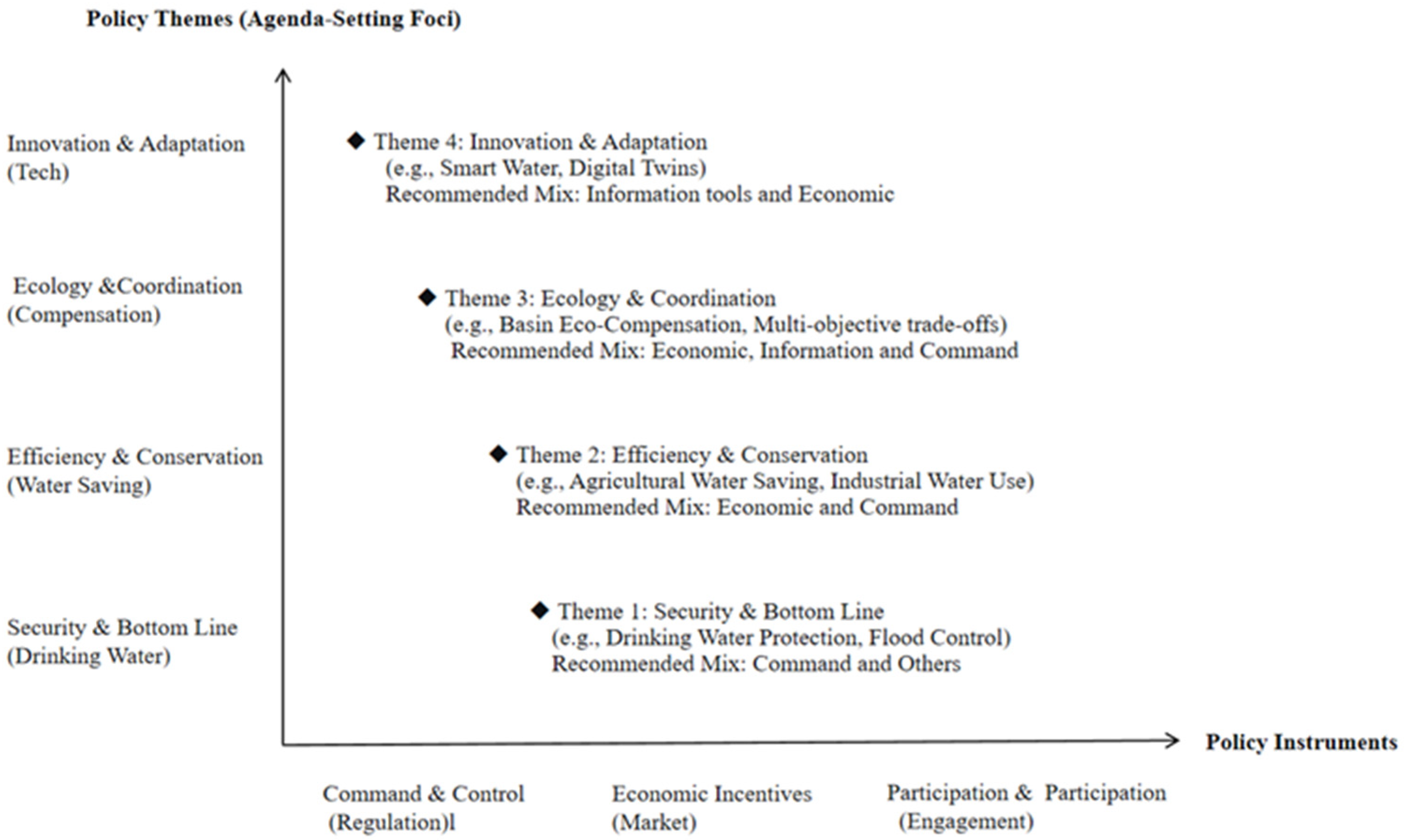
There is an inherent theoretical connection between policy themes and policy instruments. On the one hand, specific policy themes tend to prefer the types of policy instruments that match them: issues related to safety and bottom lines (such as drinking water safety) are more likely to use directive control tools; issues related to efficiency improvement (such as water conservation) may incorporate more economic instruments; and issues involving the coordination of diverse values (such as river basin ecological compensation) require the combined use of various tools [28]. On the other hand, the selection and combination of instruments can also, in turn, affect the implementation effect of policy themes—improper tool configuration may lead to the suspension of policy goals or implementation deviations. Therefore, understanding policy evolution requires simultaneously examining the “themes” and “instruments” dimensions, and analyzing the matching and synergy between them.
Based on the above theoretical understanding, this study constructs a two-dimensional analysis framework of “theme—instrument” (Figure 1), aiming to reveal the evolution characteristics and interaction logic of China’s water resources governance policies at the levels of agenda setting and implementation means.

1.3. Quantitative Text Analysis of Environmental and Water Policy Research

The growing availability of large-scale policy text corpora has accelerated computational approaches in public policy research. Quantitative text analysis helps address limitations of purely qualitative reviews, such as limited sample sizes and challenges in systematically tracking long-term discursive change, by extracting patterns from document collections in a reproducible manner [29,30]. Topic modeling, in particular Latent Dirichlet Allocation (LDA), is widely used to infer latent thematic structures in text corpora [31]. Researchers increasingly combine topic modeling with robustness diagnostics, coherence measures, and interactive visualization to improve interpretability and model selection [32,33].
In parallel, semantic network analysis (SNA) has been used to represent policy discourses as networks of co-occurring concepts, enabling analysis of central themes, discursive coalitions, and structural change through network metrics [34,35]. Integrating topic models with semantic networks can provide complementary insights: topic models capture probabilistic thematic mixtures, whereas networks highlight relational structures among key concepts.
In water governance research, computational text analysis has been applied to explore policy priorities, coordination patterns, and nexus framings. A qualitative model of the water-energy-food-land (WEFL)–biofuels nexus uses supervised LDA topic modeling, co-occurrence, and network analysis on a large corpus of scientific, corporate, and policy-relevant texts to reveal how policy, governance, innovation, and labor are framed and interconnected [36]. Governance studies emphasize that institutional narratives of collaboration and accountability can shape implementation outcomes in complex water systems [3,5]. In China, empirical work on the RCS has highlighted its potential to address fragmentation, while also noting implementation variation and the continuing need for transparency and public engagement [8,10].

1.4. Climate Change, Water Quality, and the Need to Link Governance with Modeling Evidence

Water governance increasingly intersects with climate change adaptation and water quality management. Climate change can affect water quality through multiple pathways: altered hydrological regimes, higher water temperatures, intensified storm runoff, changed pollutant transport, and increased risks of eutrophication and salinization [9,27]. Synthesis work also underscores the need for governance systems to anticipate compound risks, e.g., drought-driven concentration of pollutants combined with extreme rainfall pulses that mobilize nonpoint-source loads [37,38].
Correspondingly, water quality modeling has become a core tool for policy design and evaluation. Process-based watershed models and river water quality models are widely used to simulate pollutant generation, transport, and fate, and to assess management scenarios [39,40]. Reviews also document the expansion of data-driven and machine-learning approaches for water quality prediction and monitoring, particularly where observation networks are sparse or relationships are highly nonlinear [41,42]. However, modeling evidence can only inform decisions if governance systems provide data sharing, transparency, stakeholder legitimacy, and institutional capacity for implementation and enforcement [5].

1.5. Research Gaps and Objectives of This Study

Despite growing attention, three gaps remain in the literature on China’s water resource governance. First, long-term national-level analyses that track multi-decadal policy evolution remain limited, especially those that systematically compare stages of governance development using consistent computational methods. Second, many studies rely on a single method (e.g., qualitative review or one text-mining technique), which can under-represent the multi-dimensional nature of policy systems. Third, the interaction between policy topics (what is emphasized) and policy instruments (how action is operationalized) has not been sufficiently examined, even though policy mix theory suggests such interactions are critical to governance performance [16,17].
To address these gaps, this study conducts a comprehensive quantitative textual analysis of China’s national-level water resource governance policies from 1988 to 2025 by integrating LDA topic modeling to identify latent thematic structures and their phased evolution, policy instrument coding to characterize instrument portfolios and changes in instrument balance, and semantic network analysis to examine concept co-occurrence structures and core-node evolution. By linking topics with instruments across stages, the study aims to reveal how China’s water governance has evolved from administrative regulation-dominant approaches toward more diversified and coordinated governance arrangements, while identifying persistent limitations and potential directions for policy refinement.

2. Materials and Methods

The research is conducted in the following steps. First, water resource governance policy texts in China from 1988 to 2025 are collected and screened. Second, the policy texts are preprocessed. Third, LDA topic modeling is used to extract policy topics and analyze their phased evolution. Fourth, policy instruments are classified and counted to explore their application patterns. Fifth, a semantic network of core concepts is constructed using SNA to analyze network characteristics and core-node evolution. Finally, the research results are discussed and policy implications proposed.

2.1. Policy Text Collection and Screening

2.1.1. Data Sources, Scope, and Search Strategy

China’s water governance follows a top-down institutional logic. National policies provide a consistent long-term corpus and typically set the institutional architecture, baseline constraints, and national priorities. Restricting samples to the central level ensures consistent institutional weight, clear research boundaries, and methodological standardization. National and ministerial policies are fully disclosed, traceable, and authoritative, guaranteeing data reliability and research reproducibility, whereas many local normative documents are internally circulated and unevenly published. This research focuses on the evolutionary path and discursive structure of national water governance; concentrating on top-level design strengthens theoretical parsimony and analytical pertinence. Hence, this study focuses on national-level policy documents relevant to water resource governance in China between January 1988 and December 2025. To ensure authenticity and traceability, documents were collected from authoritative governmental portals and professional legal/policy databases. Primary sources included: the National People’s Congress and the State Council portals; ministerial portals (e.g., Ministry of Water Resources, Ministry of Ecology and Environment, Ministry of Natural Resources); and professional databases (e.g., Chinalawinfo). Searches were conducted using combinations of keywords reflecting water allocation, use, conservation, pollution control, ecological protection, and governance mechanisms. The specific retrieval process and results are shown in Table 1.

2.1.2. Inclusion/Exclusion Criteria and Quality Control

Documents were screened using the following four criteria.
(1)
Relevance: documents directly addressing water resource development, allocation, utilization, conservation, protection, pollution control, ecological restoration, basin governance or accountability mechanisms. Texts that merely mentioned water incidentally were excluded.
(2)
Document type: laws, administrative regulations, departmental rules, normative documents, and major policy documents issued by central authorities. News releases, interpretive commentary, and internal working notes were excluded.
(3)
Time window: issued between January 1988 and December 2025.
(4)
Completeness: full text available; fragmented or incomplete records were excluded.
The retrieved documents were exported with metadata. To enhance objectivity, two trained coders independently conducted screening and de-duplication, followed by reconciliation meetings to resolve disagreements. Multi-step de-duplication was performed: (1) exact-match de-duplication based on document number and full title; (2) near-duplicate screening based on title similarity (e.g., minor formatting differences) and cross-checking issuance date and issuing body; and (3) for cases where the same policy appeared in multiple portals, we retained the most authoritative/complete version (typically the issuing agency or State Council/NPC portal) and removed other entries. Furthermore, inter-coder agreement was quantified using a kappa statistic, consistent with established reliability standards in content analysis [43,44,45]. The final corpus comprised 154 valid policy documents spanning 37 years, forming the basis for subsequent analyses.

2.2. Text Preprocessing

Text preprocessing is crucial for ensuring the accuracy and effectiveness of quantitative analysis. Chinese policy texts were cleaned and standardized prior to modeling. Non-substantive elements (e.g., headers, issuing agency lines, document numbers, pagination artifacts) were removed while retaining policy provisions and operational statements. Cleaned texts were stored in a structured format (e.g., .xlsx/.csv) with metadata fields (title, issuing body, date, document type).
Word segmentation was performed using Python 3.11, supplemented by a domain-specific dictionary to preserve water governance terms. A customized stop-word list was developed by combining generic Chinese stop-words with governance-domain stop terms and high-frequency administrative function words. Tokens with very low corpus frequency were filtered to reduce noise and dimensionality. The resulting corpus was transformed into a bag-of-words representation and a term dictionary for LDA and semantic network construction.

2.3. Analytical Framework and Methods

Quantitative textual analysis has emerged as a powerful tool for policy research, addressing the limitations of traditional qualitative methods such as strong subjectivity and small sample sizes. This study integrates three complementary methods, namely, LDA topic modeling, policy instrument analysis, and semantic network analysis, to capture thematic evolution, instrument portfolios, and discursive structures. LDA topic modeling enables the extraction of latent policy topics and the revelation of evolutionary trends in policy focus; policy instruments analysis clarifies the implementation methods and structural characteristics of policies; and SNA visualizes the correlation between core policy concepts, reflecting changes in the policy system structure. Such multi-method integration is increasingly recommended for policy text analysis because it balances interpretability and robustness while reducing the risk that findings reflect one method’s assumptions [29,34]. All analyses were implemented in Python using standard, reproducible workflows (e.g., scikit-learn for LDA-related modeling, pandas for data handling) [46].

2.3.1. LDA Topic Modeling

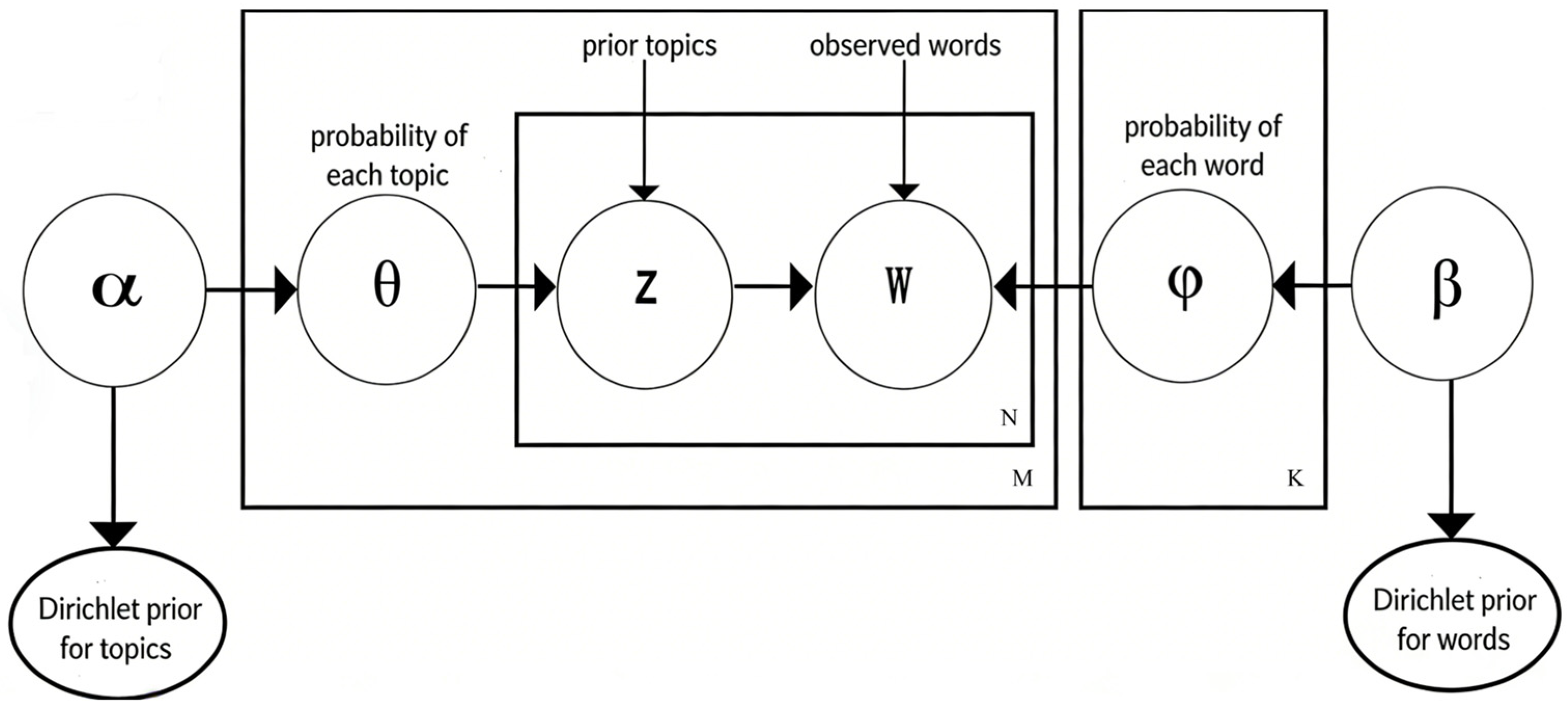
LDA is a probabilistic generative model that represents each document as a mixture of topics and each topic as a distribution over words [31]. This study used LDA to identify latent thematic structures in the policy corpus and to track topic prevalence over time. The LDA model diagram is shown in Figure 2.
Model selection. The number of topics was determined using a combination of quantitative diagnostics and interpretability checks. While perplexity is commonly used, prior research cautions that lower perplexity does not necessarily yield more interpretable topics for readers [47]. Therefore, this study jointly considered perplexity trends, topic coherence measures [32], and visualization-based separation using Python 3.11 [33]. This combined approach aims to balance predictive fit with semantic interpretability.
Perplexity was computed as:
P e r p l e x i t y = e x p d = 1 M n = 1 N d log   p w d n d = 1 M N d
where M is the number of documents, N d the number of tokens in document d , and p ( w d n ) the probability of token n in document d under the trained model.
Topic evolution. After selecting the topic number, we computed yearly or staged topic prevalence by aggregating topic proportions across documents within each time slice. This enabled analysis of policy agenda shifts and stage-wise governance priorities.

2.3.2. Policy Instrument Coding and Portfolio Analysis

Policy instruments are specific means adopted by the government to achieve policy goals, and their rational selection is crucial for policy effectiveness. Policy instruments matter because they operationalize state intentions by shaping compliance behavior, mobilizing resources and configuring actor incentives. A systematic, traceable analysis of the instruments in official texts can thus reveal the evolvement characteristics over time and deeper logic of governance transformation. To examine how governance intentions are operationalized, this study coded policy instruments into three categories widely used in environmental and public policy research: (1) command-and-control (regulatory mandates, standards, permits); (2) market-based/economic instruments (pricing, subsidies, taxes/fees, tradable permits/rights); and (3) information- and participation-oriented instruments (disclosure, public supervision, education, consultation, stakeholder participation) [13,14,18].
A coding manual defined inclusion rules, typical textual signals, and examples for each instrument type. Coders annotated documents at the clause/paragraph level, then aggregated counts to construct instrument portfolios by year or stage. This study reports both absolute frequencies and normalized shares to account for uneven document lengths and changing issuance intensity over time. Portfolio interpretation follows policy mix theory, emphasizing balance and interaction among instruments rather than single-tool dominance [15,16,17].

2.3.3. Semantic Network Analysis (SNA)

SNA was used to map the relational structure among core policy concepts. Following established approaches in semantic network text analytics, nodes represent keywords/concepts and edges represent co-occurrence relationships within documents, generating a weighted co-occurrence network [34]. Network metrics were computed to identify structural features and core nodes over time, including network density and centrality indicators [35].
Network density measures the overall connectedness of the semantic network, reflecting the average intensity of associations among all core policy concepts. It is calculated as:
D = 2 M N ( N 1 )
where D denotes network density (ranging from 0 to 1, with higher values indicating closer semantic associations among concepts), M represents the actual number of edges (co-occurrence relationships) in the network, and N is the total number of nodes (core policy concepts).
Degree Centrality quantifies the importance of a node (policy concept) by measuring the number of direct connections (co-occurrence relationships) it has with other nodes. It is calculated as:
C D ( i ) = k i N 1 , k i = j i a i j .
where C D ( i ) is the degree centrality of node i , x i j is a binary variable (1 if node i and node j are connected by an edge, 0 otherwise).
Stage-wise networks were constructed to examine whether central concepts shifted from administrative control toward ecological protection, efficiency, and participatory governance narratives. To improve robustness, edge thresholds were applied to reduce spurious links driven by rare co-occurrence, and sensitivity checks were conducted using alternative thresholds. Visualization and metric computation were implemented using Python network analysis libraries.

3. Results

3.1. High-Frequency Policy Terms

To characterize the distribution of attention in China’s national-level water resource governance policies from 1988 to 2025, we conducted a quantitative text analysis using Python 3.11. Policy documents were segmented using Jieba, followed by stop-word removal and domain-specific filtering to construct a term database for subsequent modeling. After applying term filtering criteria (token length > 1 and frequency ≥ 10), 2,434 valid terms were retained.
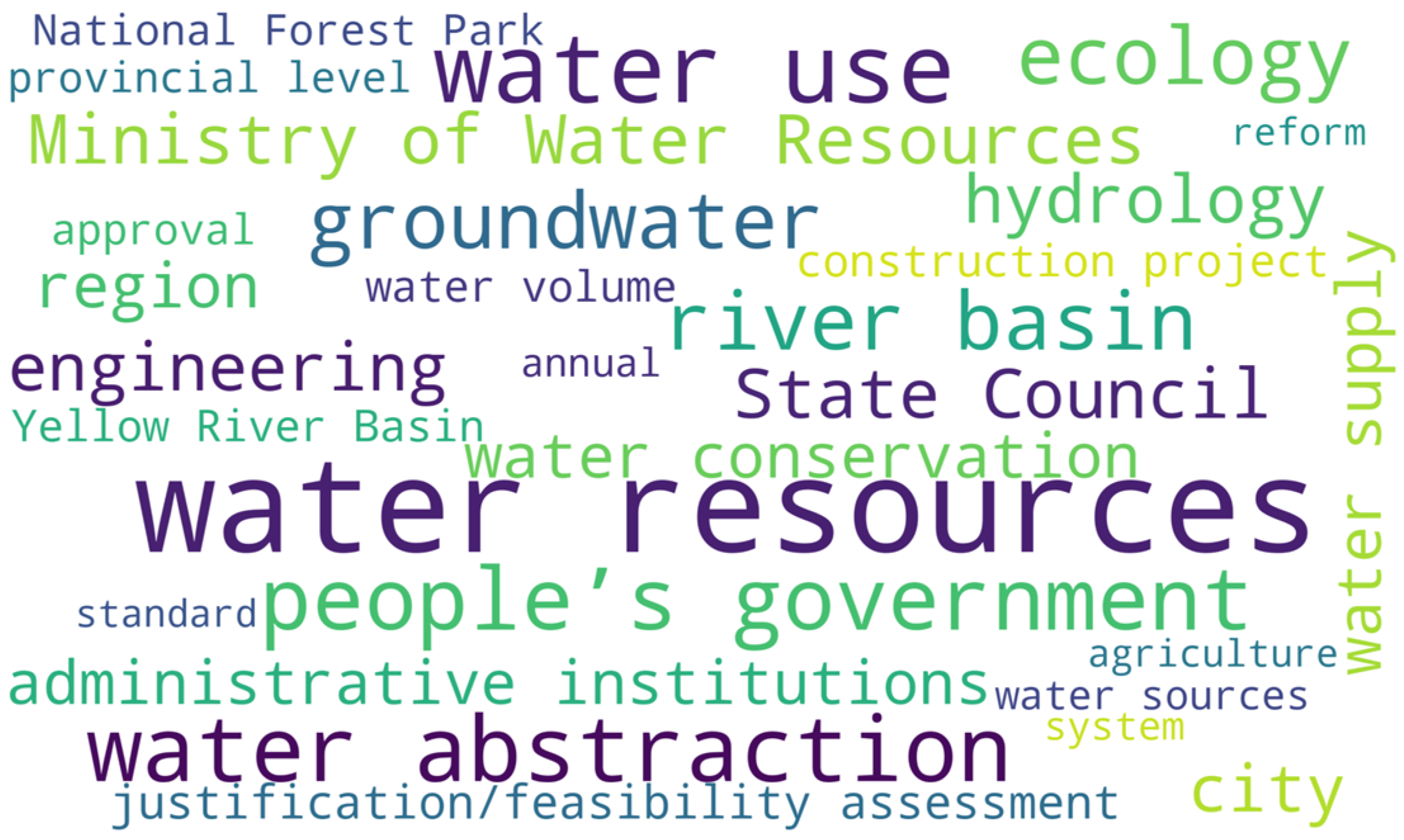
Table 2 reports the top high-frequency terms. As expected, foundational terms such as “water resources”, “water usage”, and “water intake” dominate the policy discourse, forming the semantic backbone of the corpus. Governance-actor and institutional terms (e.g., “people’s government”, “State Council”, “Ministry of Water Resources”, “administrative institutions”, and “management institution”) also occur frequently, reflecting the policy system’s strong administrative steering and hierarchical implementation structure. Meanwhile, terms such as “water conservation”, “system”, “standard”, “reform”, “ecology” and “groundwater” suggest an expanding governance agenda that integrates conservation-oriented efficiency goals with ecological protection and resource-risk considerations.
To visualize this vocabulary structure, a word cloud is provided in Figure 3. The visualization confirms the corpus’ dual emphasis on resource allocation and use regulation (e.g., water resources, water use, abstraction, approval) and system-building and ecological framing (e.g., ecology, conservation, standards, reform), consistent with China’s policy trajectory toward combining rigid constraints with system-level governance objectives.
Overall, China’s water resources policy system embodies distinct characteristics of government leadership, systematic governance, institutional constraints and key breakthroughs.

3.2. LDA Topic Modeling Results

3.2.1. Determination of the Optimal Number of Topics

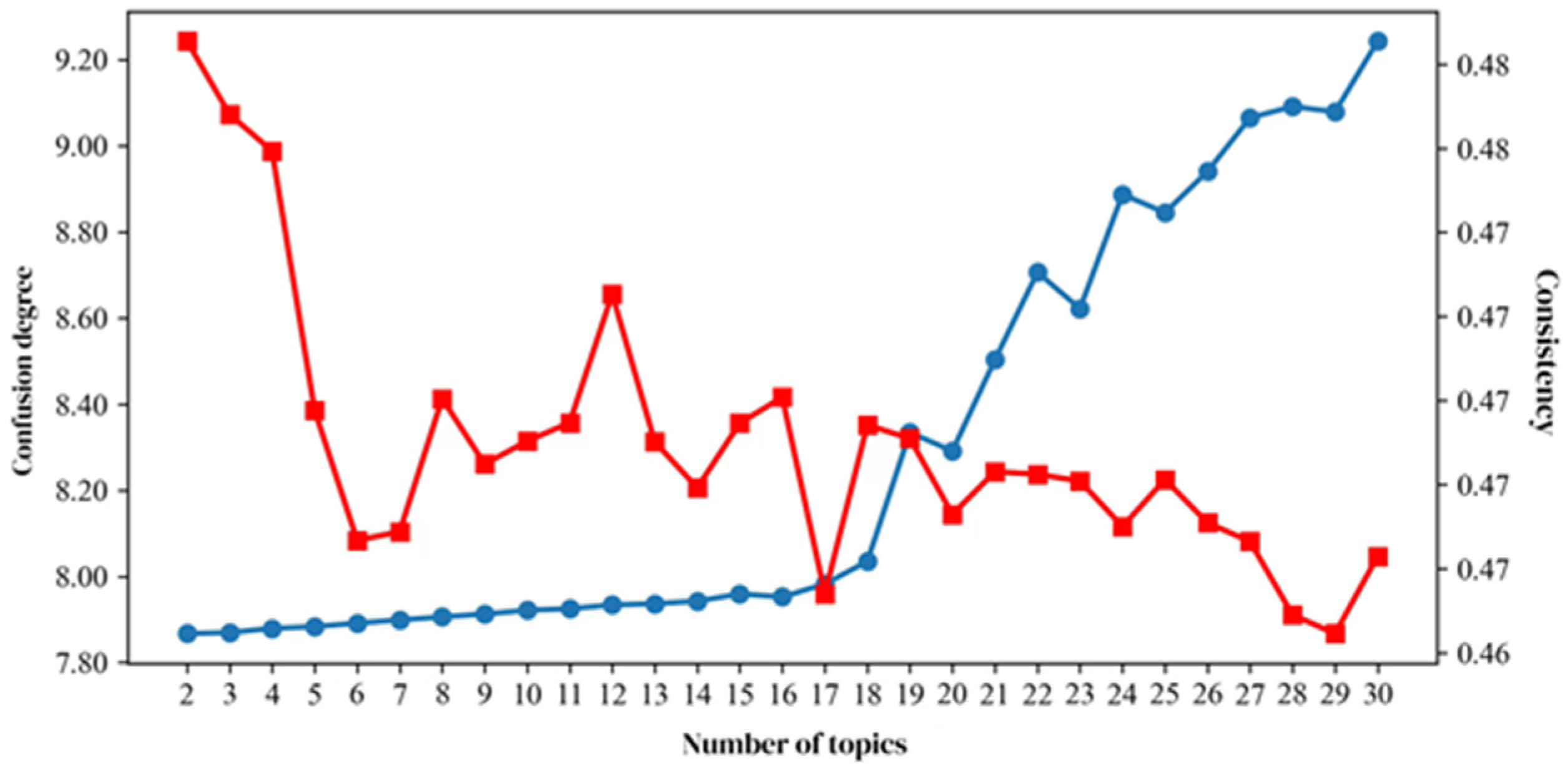
Determining the number of topics ( k value) in the LDA model is a crucial step in topic modeling. “The optimal number of topics” does not refer to an objectively correct numerical value, but rather is the result of a trade-off between statistical fit and semantic interpretability [31]. It refers to the selected number of latent topics k in the LDA model, chosen to balance statistical fit and interpretability. Statistical fit is typically measured by perplexity—the lower the perplexity, the stronger the model’s predictive ability. However, an excessively low perplexity often corresponds to an excessive number of topics, which may lead to topic fragmentation and semantic overlap, thereby reducing interpretability [47]. This study comprehensively employs perplexity trends, topic consistency indicators (topic coherence), and pyLDAvis visualization diagnostics.
Python 3.11 is an interactive tool for visualizing the results of LDA topic models, de-veloped by Carson Sievert and Kenneth Shirley [33]. It maps the topics onto a two-dimensional plane through principal component analysis, generating an interactive bubble chart: each bubble represents a topic, the size of the bubble reflects the relative importance of the topic in the corpus, and the distance between bubbles indicates the similarity between topics. Users can click on the bubbles to view the most representative keywords of that topic and their frequency distribution, thereby assisting in the semantic interpretation and model diagnosis of the topics. In this study, Python 3.11 was used to examine the degree of topic separation under different k values, and it was found that when k = 5, the topic bubbles were relatively evenly distributed in the two-dimensional space with less overlap, supporting the rationality of the topic selection. It was ultimately determined that k = 5 is the optimal solution, and this number ensures both the model’s statistical fit (perplexity in the descending inflection point region) and the clarity and identifiable semantic content of each topic, avoiding the interpretational dilemma of excessive topic subdivision.

3.2.2. Topic Extraction and Interpretation

Based on the LDA outputs and human-assisted semantic validation, the extracted topics were consolidated into two higher-level governance themes (as shown in Table 3), i.e., Administrative Control and Comprehensive Management.
Comprehensive Management shows a higher overall prevalence (0.56), emphasizing system-level coordination and integrated objectives such as basin governance, water-saving, technology application, and total-quantity management. It reflects the transformation trajectory of China’s water resources policy from fragmented management to systematic and holistic governance. In 2012, the Opinions on Implementing the Strictest Water Resources Management System established the “Three Red Lines” management system, marking the formation of a systematic governance framework. The 2015 Action Plan for Water Pollution Prevention and Control promoted the coordinated control of water quality and quantity, and the 2019 National Water Conservation Action Plan elevated water conservation to the national strategic level. Although the River and Lake Chief System belongs to the category of administrative execution, its original intention was to effectively promote cross-departmental and cross-regional collaborative governance and provide institutional support for comprehensive management.
Administrative Control accounts for 0.44, highlighting procedural regulation and enforcement mechanisms such as licensing/approval, institutional management, and basin-specific regulatory focus. It reflects the government’s implementation of key control measures through standardized and procedural means, playing a pivotal role in water resource governance. Its formation and evolution have obvious policy continuity: in 1988, the Water Law of the People’s Republic of China initially established an administrative management framework. In 1993, the Implementation Measures for the Water Abstraction Permit System and subsequent supporting systems were established to establish a closed-loop control system for water intake and discharge. The River Chief System and lake chief system, implemented in 2016, establish a local party and government responsibility system, and in 2019, Ecological Protection and High-quality Development of the Yellow River Basin was elevated to a national strategy, followed by the promulgation of the Yellow River Protection Law of the People’s Republic of China, further strengthening the rule of law and rigid constraints of basin governance.
These two themes can be interpreted as complementary pillars: Comprehensive Management reflects the evolution toward integrated governance and top-level design, while Administrative Control captures the procedural and regulatory backbone of implementation, including permits, approvals, and basin governance institutions. Together, they form a coupled policy logic in which system-wide governance objectives are operationalized through procedural and regulatory instruments.

3.3. Semantic Network Analysis Results

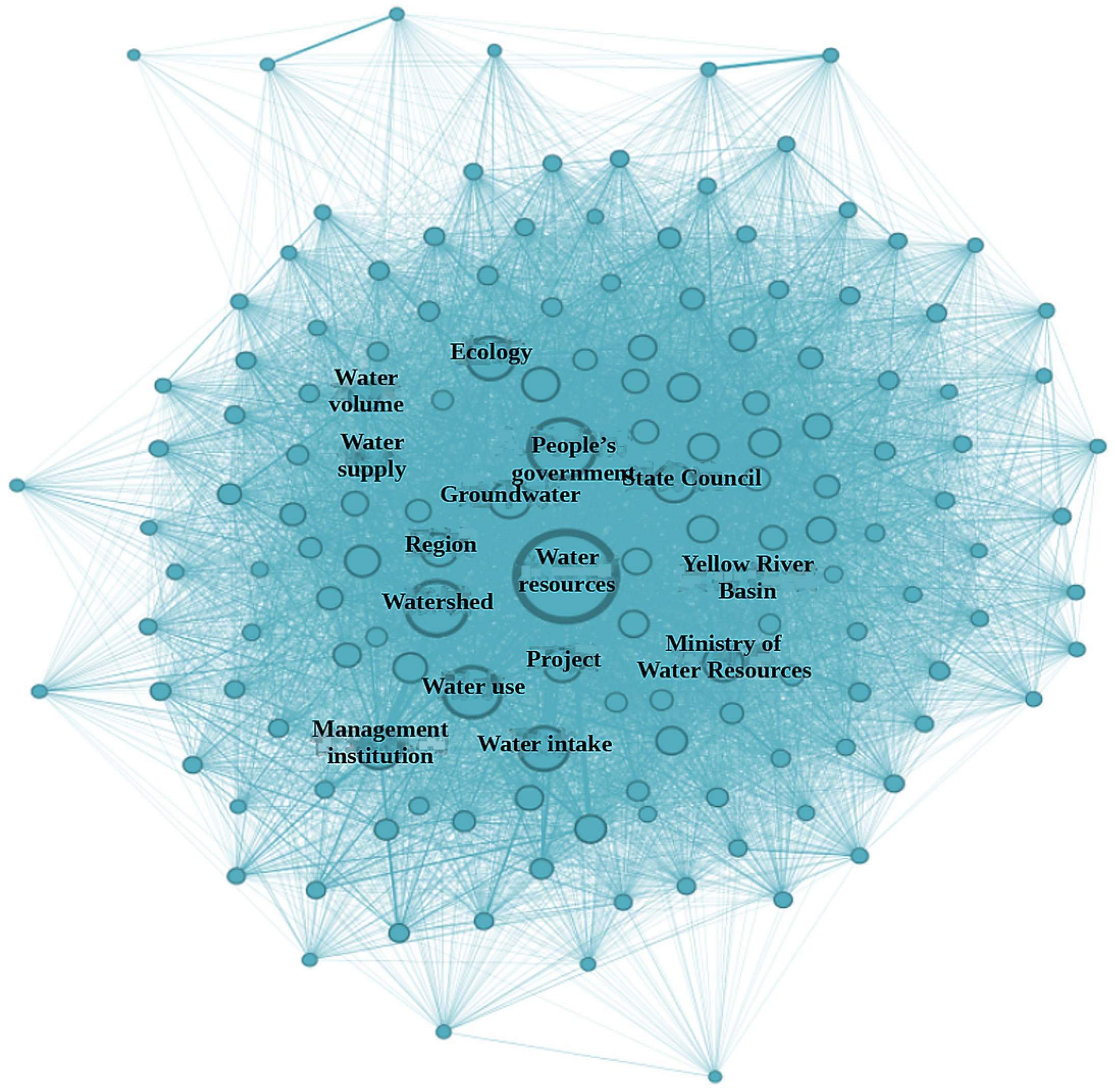
Semantic network analysis was performed to identify core concept co-occurrence structures in the policy texts. Table 4 reports the top weighted co-occurrence pairs, and Figure 4 visualizes the resulting network. The network exhibits a core-periphery structure centered on “water resources” as the most connected node, linked strongly to both governance processes (e.g., approval, justification/feasibility assessment) and implementation entities (e.g., people’s government, Ministry of Water Resources, management institution), indicating that policy discourse frequently couples “resource objects” with “administrative authority” and “procedural control”.
At the same time, basin-scale and spatial governance terms (e.g., river basin, Yellow River Basin, provincial level) appear as important connectors between administrative actors and ecological protection targets, reflecting policy attention to cross-regional coordination and basin governance. Several edges also highlight fiscal/levy dimensions (e.g., water resources-levy/fee) and protected-area governance (e.g., national-level nature reserves), suggesting that water governance texts incorporate both financing or charging logic and ecological conservation regimes within the broader policy discourse.
It can be seen that the core nodes in the Figure 5 (such as “water resources”, “government authorities”, and “river basin”) form the framework of the network, reflecting the basic elements of the policy discussion. The network presents a “core-periphery” structure, demonstrating the integration of the policy discussion of administrative power, resource objects, and ecological goals.

3.4. Policy Instruments Analysis Results

3.4.1. Overall Distribution of Policy Instruments

Coding and quantitative analysis of the 154 policy texts indicate a markedly unbalanced instrument structure. Command-and-control instruments account for approximately 69%, occupying a dominant position, consistent with the administrative steering characteristics of China’s long-term water governance. Public participation/information instruments account for about 24%, suggesting continuous policy attention to consensus building, information provision, and social mobilization. In contrast, market-based incentive instruments remain relatively limited at about 7%, indicating that economic levers and market mechanisms (e.g., pricing, trading) are still supplementary and appear more frequently as pilot or exploratory tools rather than as system-wide core instruments.

3.4.2. Topic-Instrument Associations

The LDA-based theme structure shows a clear correspondence with instrument types (as shown in Table 5). The Administrative Control theme is strongly associated with command-and-control instruments, consistent with its emphasis on licensing, approval, allocation, and institutional enforcement. They jointly serve the authoritative allocation and compliance supervision of water resources, highlighting the fundamental role of such instruments in China’s water resource management system. By contrast, the Comprehensive Management theme exhibits a more mixed instrument profile, combining regulatory constraints (e.g., quotas and standards) with participation-oriented instruments (e.g., disclosure, coordination) and limited economic tools where relevant (e.g., fees and compensation). This pattern suggests that integrated governance objectives tend to require instrument bundling, where rigid constraints provide baseline control while information/participation mechanisms support coordination and adaptive implementation.
From this, it can be seen that the theme-tool correlation matrix, which reveals the structured matching relationship between the two. The high correlation between the administrative control theme and the directive control tool (correlation coefficient 0.72, p < 0.01) confirms the institutional dependence of procedural governance on the authority mechanism tools such as licensing and approval provide order guarantees for water resource allocation, but excessive reliance on such tools may also lead to governance rigidity and insufficient adaptability [48,49]. The comprehensive management theme, on the other hand, presents the diversity and flexibility of the tool combination: the correlation coefficient between this theme and the public participation tool is 0.58, and the correlation coefficient with the market tool is 0.43, which is significantly higher than that of the administrative control theme (p < 0.05). This indicates that when the policy agenda expands from a single control to multiple goals, such as ecological protection and system coordination, the tool design also shifts from single-dimensional regulation to multi-dimensional collaboration. This coupling relationship of “theme guiding tool differentiation and tool supporting theme realization” is an important sign of the maturation of China’s water resource governance.

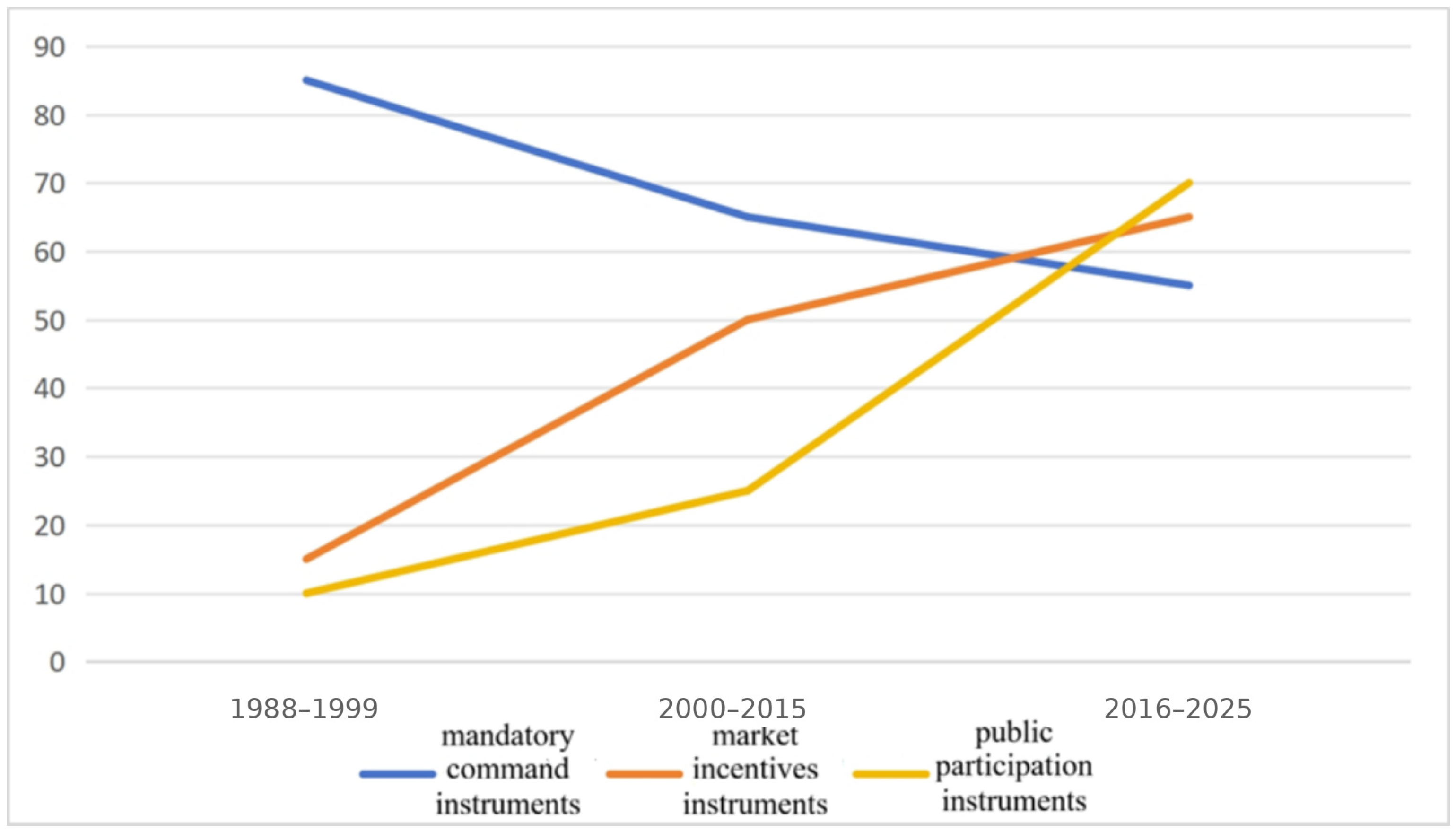
3.4.3. Phased Evolution of Policy Instruments (1988–2025)

The phased division is based on quantitative signals from the corpus and major national policy milestones used as interpretable boundary anchors. The stage boundaries are ultimately a hybrid of quantitative trend interpretation and policy-historical contextualization. Based on key policy milestones and shifts in governance framing, the evolution of China’s policy instruments can be summarized in three stages, presenting an overall trend of transition from single administrative control to diversified collaborative governance.
The quantitative evidence is derived from three analytical dimensions. (1) Time-series analysis of LDA topic intensity reveals that the relative intensity of the administrative control theme was significantly higher in the earlier stage (1988–1999) than in the subsequent stage (t-test, p < 0.01), whereas the intensity of the integrated management theme exhibited a sustained increase across the latter two stages. (2) The annual distribution of policy instrument coding demonstrates a gradual increase in the proportion of market-based and participatory instruments after 2000, with a more pronounced upward trend observed after 2016. (3) The phased construction of semantic networks indicates a clear evolutionary trajectory of core nodes: from early-stage terms such as “approval” and “project, to mid-stage terms such as “water conservation” and “system”, and finally to recent-stage terms such as “ecology” and “basin-wide coordination”.
The qualitative evidence is primarily reflected in: (1) the identification of key policy milestones, including the promulgation of the 1988 Water Law, its revision in 2002, the introduction of the Strictest Water Resources Management System in 2012, the nation-wide implementation of the River Chief System in 2016, and the Yellow River Basin Ecological Protection and High-Quality Development Strategy launched in 2019; and (2) a qualitative interpretation of emblematic discourses within policy texts, tracing the emergence and diffusion of core concepts such as the “Three Red Lines”, “Ecological Civilization”, and “High-Quality Development”.
The results demonstrated a high degree of consistency, thereby reinforcing the robustness and reliability of the proposed periodization. The evolutionary characteristics of each stage are as follows:
At administrative control stage (1988–1999), policy instruments rely heavily on regulatory mandates, licensing, approvals, and project-oriented administrative control. The promulgation of the Water Law of the People’s Republic of China in 1988 established the ownership basis and administrative management framework of water resources owned by the state. The frequent use of terms such as approval, water conservancy projects, and management institution in policy texts reflects a governance model centered on project approval and water use permits, with direct government intervention as its characteristic. Instrument design focuses on establishing order and basic control for water resource development and utilization. This stage primarily established institutional order and baseline control mechanisms.
At comprehensive management stage (2000–2015), policy instrument diversification became more visible. Facing challenges such as water scarcity and water pollution, policy instruments have begun to show a trend of diversification. While continuing the mandatory instruments of command-control, market incentive instruments such as water rights trading, water resource fee to tax reform, and ecological compensation pilot projects are gradually being valued and applied. The frequency of words such as system, water conservation, economy, and compensation in policy texts has significantly increased. The 2012 Opinions on Implementing the Strictest Water Resources Management System marked the establishment of an institutionalized and systematic management system, with the focus of governance shifting from controlling usage to improving efficiency, and policy intervention methods becoming more diverse. While regulatory tools remained central, the policy system increasingly emphasized efficiency improvement, conservation, and system building, and began to incorporate emerging economic and ecological compensation-related tools in some contexts.
At collaborative innovation stage (2016–2025), accountability and coordination instruments (e.g., River/Lake Chief mechanisms) were strengthened, and ecological civilization framing promoted deeper integration of quantity-quality-ecology governance objectives. Since the 18th National Congress of the Communist Party of China, the construction of ecological civilization has been elevated to a national strategic level, and water resource policy instruments have entered a stage of collaborative innovation. On the one hand, the River Chief System and lake chief system have been fully implemented, and a cross-departmental and cross-level collaborative execution mechanism with the party and government leadership responsibility system as the core has been established. On the other hand, regulations and strategic plans such as the Yellow River Protection Law of the People’s Republic of China and the National Water Conservation Action Plan further integrate three types of instruments: administrative regulation, market incentives, and public participation. The strong co-occurrence of terms such as ecology, collaboration, watershed, and high-quality development in semantic networks indicates that policy instruments design tends to achieve coordinated management of water resources, water environment, and water ecology. Policy discourse increasingly links basin coordination, ecological protection, and high-quality development narratives, suggesting stronger coupling between administrative accountability and comprehensive governance goals.
According to the frequency weight and topic distribution intensity of keywords related to policy instruments at each stage, the evolution trend of the intensity of water resource governance policy instruments use in China is shown in the Figure 6, which presents the above-mentioned phased change characteristics.

4. Conclusions

This study provides a systematic, reproducible quantitative reading and the evolutionary characteristics analysis of China’s national-level water resources governance policy texts (1988–2025). Based on 154 authoritative policy documents, the study employs Latent Dirichlet Allocation topic modeling, semantic network analysis, and a tripartite policy instrument coding scheme (command-and-control, market-based, and public participation instruments). Across these complementary lenses, the results suggest a clear shift in the discursive emphasis and instrumental configuration of national water governance policy, alongside a gradual strengthening of cross-sectoral and basin-oriented governance logic.

4.1. Interpreting the Thematic Shift: From Administrative Ordering to System-Oriented Governance

The observed thematic evolution reflects a fundamental transformation in China’s water governance paradigm. The early dominance of administrative control themes aligns with the priority of establishing a basic regulatory architecture for water allocation and use during the initial post-reform period [50]. The subsequent rise of integrated management themes indicates a broadening policy agenda that progressively incorporates basin coordination, ecological protection, and efficiency-oriented management.
Importantly, these findings should be interpreted as evidence of shifts in policy attention and framing rather than as direct proof of improvements in on-the-ground governance outcomes. Policy texts signal changing priorities and governance narratives, but implementation effectiveness depends on administrative capacity, enforcement mechanisms, financing, and local institutional conditions. Therefore, the textual evolution observed here is best understood as a national-level agenda trajectory that may translate into practice unevenly across regions and sectors.
The evolution of the theme is in line with the development of scientific cognition and technological progress. Policies during the 1980s and 1990s focused on administrative order and engineering management, reflecting the limited hydrological monitoring capabilities and singular governance approaches available at that time. In the 21st century, advances in environmental science and eco-hydrology enabled policy discussions to incorporate scientific concepts such as “ecological water demand” and “environmental capacity,” facilitating the transition from volumetric management to integrated “quantity-quality-ecology” governance [51]. More recently, digital transformation—including digital twin technologies and artificial intelligence—has rendered governance concepts such as “basin-wide collaboration” and “fine-grained control” operationally feasible, as reflected in policy texts after 2016 [52,53].

4.2. The Persistence of Regulatory Dominance and Constraints on Market Instruments

The persistently unbalanced instrument mix warrants careful interpretation. The dominance of command-and-control instruments is consistent with a governance regime in which the state plays a central coordinating and enforcing role, relying heavily on rules, standards, permitting, and administrative accountability mechanisms.
The limited representation of market-based instruments does not necessarily indicate policy neglect. Rather, it likely reflects the higher institutional prerequisites of market mechanisms in water governance, including definable and enforceable water rights, robust monitoring infrastructure, transparent pricing mechanisms, trading platforms, and dispute-resolution capacity. These conditions require sustained institutional development and vary significantly across regions.
Similarly, the presence of public participation instruments should be interpreted with caution. Text-based participation often manifests as information dissemination, publicity campaigns, or standardized guidance documents, which may not equate to deliberative or co-governance arrangements. As such, the quantitative increase in participation-related instruments may overstate the extent of substantive stakeholder engagement in water governance.

4.3. Stage-Wise Evolution: Theoretical and Empirical Implications

The three-stage trajectory identified in this study offers a parsimonious explanation of how China’s national water governance policy toolkit and agenda framing have co-evolved over nearly four decades. The staging is heuristic, recognizing that policy change is gradual rather than discrete, yet it provides a useful analytical framework for understanding governance transitions.
External validity assessment confirms that this stage division aligns closely with main-stream academic narratives in China’s water resources governance literature [25,26,27], reinforcing the robustness of the proposed periodization. The integration of quantitative trend identification with qualitative event analysis represents a triangulated approach that mitigates the subjectivity inherent in purely qualitative periodization while transcending the mechanistic rigidity of purely quantitative methods.

5. Discussion

5.1. Theoretical Contributions

This study advances the policy analysis literature in several respects. First, it develops a multi-method quantitative policy text framework that links latent topic structures, semantic network properties, and instrument typologies. Compared with single-method studies, this integrated approach improves interpretability and provides converging evidence for policy evolution patterns.
Second, it illuminates topic-instrument alignment dynamics: administrative control topic signals are strongly associated with command-and-control instruments, while integrated management signals tend to co-occur with more diverse instrument portfolios, including information-based participation and selected market mechanisms. This finding contributes to policy mix research by demonstrating how instrument portfolios relate to policy attention structures over time.
Third, it provides empirical evidence on the evolutionary logic of water governance in an emerging economy context, where strong administrative coordination is often necessary for large-scale institutional change, while market and participatory tools face higher transaction costs and capacity barriers. This contextualized understanding enriches comparative policy studies and informs institutional design considerations.

5.2. Policy Optimization Pathways

Based on the above findings, this study proposes three policy optimization pathways to enhance the effectiveness of China’s water resources governance.

5.2.1. Strengthening the Institutional Foundations for Market-Based Instruments

The empirical results indicate that market-based instruments account for only 7% of the coded policy tools, reflecting not merely a matter of policy preference but rather the institutional thresholds inherent in applying market mechanisms to water governance. To address this, the following measures are recommended: (a) expedite the initial allocation and registration of water rights, establishing clear standards and registration procedures for tradable water rights to ensure legal clarity and enforceability; (b) improve the water pricing mechanism by developing a dynamic adjustment framework that reflects resource scarcity, ecological value, and engineering costs, thereby sending accurate economic signals to water users; (c) pilot and scale up water rights trading platforms, standardizing trading rules and dispute-resolution procedures to reduce transaction costs and enhance market liquidity; and (d) expand ecological compensation mechanisms beyond fiscal transfers toward market-based models, exploring diversified compensation approaches such as inter-jurisdictional water rights trading and hydropower co-financing arrangements along river basins.

5.2.2. Deepening the Connotation and Practice of Public Participation Instruments

Current public participation instruments are predominantly characterized by information dissemination and educational campaigns, representing low-level engagement within participation ladder theory. To advance meaningful stakeholder involvement, the following actions are suggested: (a) introduce mandatory public consultation procedures in basin planning and major water infrastructure decision-making, ensuring that stakeholder perspectives are substantively considered rather than symbolically acknowledged; (b) establish water environment information disclosure platforms that present water quality monitoring data, pollution outlet distributions, and governance performance in accessible, visual formats to enhance public understanding and oversight; and (c) strengthen public supervision mechanisms within the River and Lake Chief System by developing user-friendly feedback channels (e.g., mobile applications for real-time reporting and online complaint systems) and integrating public evaluation into performance assessments of river chiefs.

5.2.3. Constructing Synergistic Policy Mixes: Integrating Regulation, Markets, and Participation

The effectiveness of policy instruments lies not in their simple superposition but in their functional complementarity and synergistic enhancement. To achieve coherent policy design, the following recommendations are proposed: (a) integrate the three instrument categories at the basin level: employ regulatory instruments to set binding constraints, market instruments to optimize resource allocation, and participatory instruments to facilitate collaborative governance; (b) establish an impact assessment mechanism for policy instruments, conducting ex-ante simulations and ex-post evaluations of instrument combinations in new policies to identify potential conflicts, redundancies, or gaps; and (c) draw on the experience of eco-environmental zoning by delineating water resource management units within the territorial spatial planning framework. Differentiated instrument portfolios should be based on the resource endowments and governance needs of each unit, enabling precision policymaking.

5.3. Limitations and Future Research

There are several limitations. First, national-level texts may not capture local adaptation and implementation heterogeneity, and future work may incorporate provincial and municipal documents for multi-level comparisons. This study examines national-level water resource governance policy evolution, which is a necessary but not sufficient lens for multi-level governance. However, sub-national implementation and adaptation can be heterogeneous. Therefore, we position our work as a macro-level policy evolution study, and the future work direction is to extend the corpus to provincial/municipal and basin-level documents and to conduct a multi-level comparative analysis. Second, instrument coding based on textual cues may undercount informal governance practices or overstate participation signals. In this study, we interpret technology-related signals (e.g., “technology”, “monitoring”, “standards”) as part of the policy discourse rather than as direct measures of scientific progress. Policy texts capture governance intentions and institutional design, but not the full set of techno-scientific drivers. Future research could triangulate text-based instrument coding with implementation evidence and link technology discourse to measurable techno-scientific capacity and outcomes to fully reflect governance practice. Third, topic modeling abstracts from contextual nuance, and future studies can combine text analysis with indicators of policy implementation and outcome data to examine policy design-outcome linkages.
Overall, China’s national water resources governance policy evolution, as reflected in policy texts from 1988 to 2025, can be characterized as a process of agenda broadening, instrument diversification under continued regulatory dominance, and increasing emphasis on basin-oriented and ecology-focused coordination. The three-stage trajectory identified from administrative control and framework building, through comprehensive management and diversification, to collaborative innovation and basin/ecology integration, captures the co-evolution of policy attention and governance instruments. Continued policy optimization would benefit from strengthening incentive compatibility, enabling meaningful participation, and designing coherent policy mixes to support sustainable water use and river basin ecological health.

Author Contributions

Conceptualization, M.W. and Z.H.; methodology, Z.H.; software, X.S.; validation, X.S.; writing—original draft preparation, Z.H.; writing—review and editing, X.S. and M.W.; visualization, X.S.; supervision, M.W.; funding acquisition, M.W. All authors have read and agreed to the published version of the manuscript.

Funding

This research was funded by the 2025 Key Project of the System Science and Enterprise Development Research Center of the Key Research Base of Philosophy and Social Sciences in Sichuan Province, grant number Xq25B07, and 2025 Sichuan Province Graduate High-Quality Education and Teaching Resource Construction Project, grant number YJGXM25-C020.

Data Availability Statement

The original contributions presented in this study are included in the article. Further inquiries can be directed to the corresponding author.

Acknowledgments

We are very grateful to all the reviewers for their valuable comments, and we are very thankful to Mengru Li for her constructive comments on the revision of the manuscript.

Conflicts of Interest

The authors declare no conflicts of interest.

Abbreviations

The following abbreviations are used in this manuscript:
PMCthe Policy Modeling Consistency
LDALatent Dirichlet Allocation
SNASemantic Network Analysis

References

  1. OECD. Water Resources Governance in OECD Countries: A Multi-Level Approach; OECD Publishing: Paris, France, 2015. [Google Scholar]
  2. UNESCO. United Nations World Water Development Report 2023: Partnerships and Cooperation for Water; UNESCO/UN-Water: Paris, France, 2023. [Google Scholar]
  3. Akhmouch, A.; Correia, F.N. The 12 OECD principles on water governance—When science meets policy. Util. Policy 2016, 43, 14–20. [Google Scholar]
  4. Ostrom, E. Polycentric systems for coping with collective action and global environmental change. Glob. Environ. Change 2010, 20, 550–557. [Google Scholar] [CrossRef]
  5. Pahl-Wostl, C. A conceptual framework for analysing adaptive capacity and multi-level learning processes in resource governance regimes. Glob. Environ. Change 2009, 19, 354–365. [Google Scholar] [CrossRef]
  6. Wang, X.; Zhang, J.; Gao, J.; Shahid, S.; Xia, X.; Geng, Z.; Tang, L. The new concept of water resources management in China: Ensuring water security in a changing environment. Environ. Dev. Sustain. 2018, 20, 897–909. [Google Scholar] [CrossRef]
  7. The World Bank. China Country Water Resource Partnership Strategy; The World Bank Publisher: Washington, DC, USA, 2013. [Google Scholar]
  8. Liu, H.; Lin, L.; Zhang, S. The River Chief System and river pollution control in China: A case study of Foshan. Water 2019, 11, 1606. [Google Scholar] [CrossRef]
  9. Whitehead, P.G.; Wilby, R.L.; Battarbee, R.W.; Kernan, M.; Wade, A.J. A review of the potential impacts of climate change on surface water quality. Hydrol. Sci. J. 2009, 54, 101–123. [Google Scholar] [CrossRef]
  10. Li, J.; Shi, X.; Wu, H.; Liu, L. Trade-off between economic development and environmental governance in China: An analysis based on the effect of river chief system. China Econ. Rev. 2020, 60, 101403. [Google Scholar] [CrossRef]
  11. Pan, J.; Peng, J.; Yang, X.; Xuan, S. Does water rights trading promote resources utilisation efficiency and green growth? Evidence from China’s resources trading policy. Resour. Policy 2023, 86, 104235. [Google Scholar] [CrossRef]
  12. Yan, R.; Zhao, N.; Wang, Y.; Liu, X. The impact of water rights trading on water resource use efficiency: Evidence from China’s water rights trading pilots. Water Resour. Econ. 2024, 46, 100241. [Google Scholar] [CrossRef]
  13. Bemelmans-Videc, M.-L.; Rist, R.C.; Vedung, E. (Eds.) Carrots, Sticks and Sermons: Policy Instruments and Their Evaluation; Transaction Publishers: New Brunswick, NJ, USA, 1998. [Google Scholar]
  14. Hood, C. The Tools of Government; Macmillan Press: London, UK, 1986. [Google Scholar]
  15. Howlett, M. Designing Public Policies: Principles and Instruments; Routledge: London, UK, 2011. [Google Scholar]
  16. Howlett, M.; Rayner, J. Patching vs packaging in policy formulation: Assessing policy portfolio design. Politics Gov. 2013, 1, 170–182. [Google Scholar] [CrossRef]
  17. Rogge, K.S.; Reichardt, K. Policy mixes for sustainability transitions: An extended concept and framework for analysis. Res. Policy 2016, 45, 1620–1635. [Google Scholar] [CrossRef]
  18. Lascoumes, P.; Le Galès, P. Understanding public policy through its instruments—From the nature of instruments to the sociology of public policy instrumentation. Governance 2007, 20, 1–21. [Google Scholar] [CrossRef]
  19. Fritsch, O.; Benson, D. (Eds.) Handbook on the Governance and Politics of Water Resources; Edward Elgar Publishing: Cheltenham, UK, 2024. [Google Scholar]
  20. Ma, H.; Xiang, H.; Pang, Q. The impact of new quality productive forces development on China’s water resources utilization efficiency. Resour. Sci. 2025, 47, 485–500. (In Chinese) [Google Scholar]
  21. Zhang, H.; He, Y. The contraction effect and mechanism of green technology progress on the water resources ecological footprint. Resour. Sci. 2025, 47, 526–542. (In Chinese) [Google Scholar]
  22. Ministry of Water Resources of the People’s Republic of China. Basic Technical Requirements for ‘Four Preventions’ in Water Conservancy Business (Draft for Comments). Available online: http://gjkj.mwr.gov.cn/jsjd1/tzgg_3/202503/t20250307_1831976.html (accessed on 25 March 2026).
  23. Howlett, M.; Ramesh, M.; Perl, A. Studying Public Policy: Principles and Processes, 4th ed.; Oxford University Press: Oxford, UK, 2020. [Google Scholar]
  24. Baumgartner, F.R.; Jones, B.D. Agendas and Instability in American Politics, 2nd ed.; University of Chicago Press: Chicago, IL, USA, 2010. [Google Scholar]
  25. Vedung, E. Policy instruments: Typologies and theories. In Carrots, Sticks, and Sermons: Policy Instruments and Their Evaluation; Bemelmans-Videc, M., Rist, R.C., Vedung, E., Eds.; Transaction Publishers: Piscataway, NJ, USA, 1998; pp. 21–55. [Google Scholar]
  26. Graversgaard, M. Regulatory approaches in water policy and governance. In Handbook on the Governance and Politics of Water Resources; Fritsch, O., Benson, D., Eds.; Edward Elgar Publishing: Cheltenham, UK, 2024; pp. 21–32. [Google Scholar]
  27. Expósito, A.; Berbel, J. Economic policy instruments in water governance. In Handbook on the Governance and Politics of Water Resources; Fritsch, O., Benson, D., Eds.; Edward Elgar Publishing: Cheltenham, UK, 2024; pp. 10–20. [Google Scholar]
  28. Fritsch, O. Public participation in water policy and governance. In Handbook on the Governance and Politics of Water Resources; Fritsch, O., Benson, D., Eds.; Edward Elgar Publishing: Cheltenham, UK, 2024. [Google Scholar]
  29. Grimmer, J.; Stewart, B.M. Text as data: The promise and pitfalls of automatic content analysis methods for political texts. Political Anal. 2013, 21, 267–297. [Google Scholar] [CrossRef]
  30. Roberts, M.E.; Stewart, B.M.; Tingley, D. Stm: An R package for structural topic models. J. Stat. Softw. 2019, 91, 1–40. [Google Scholar] [CrossRef]
  31. Blei, D.M.; Ng, A.Y.; Jordan, M.I. Latent Dirichlet allocation. J. Mach. Learn. Res. 2003, 3, 993–1022. [Google Scholar]
  32. Röder, M.; Both, A.; Hinneburg, A. Exploring the space of topic coherence measures. In Proceedings of the Eighth ACM International Conference on Web Search and Data Mining; Association for Computing Machinery: New York, NY, USA, 2015; pp. 399–408. [Google Scholar]
  33. Sievert, C.; Shirley, K. LDAvis: A method for visualizing and interpreting topics. In Proceedings of the Workshop on Interactive Language Learning, Visualization, and Interfaces; Association for Computational Linguistics: Stroudsburg, PA, USA, 2014; pp. 63–70. [Google Scholar]
  34. Drieger, P. Semantic network analysis as a method for visual text analytics. Procedia—Soc. Behav. Sci. 2013, 79, 4–17. [Google Scholar] [CrossRef]
  35. Freeman, L.C. Centrality in social networks: Conceptual clarification. Soc. Netw. 1979, 1, 215–239. [Google Scholar] [CrossRef]
  36. Lazaro, L.L.B.; Giatti, L.L.; Bermann, C.; Giarolla, A.; Ometto, J. Policy and governance dynamics in the water-energy-food-land nexus of biofuels: Proposing a qualitative analysis model. Renew. Sustain. Energy Rev. 2021, 149, 111384. [Google Scholar] [CrossRef]
  37. Delpla, I.; Jung, A.-V.; Baures, E.; Clement, M.; Thomas, O. Impacts of climate change on surface water quality in relation to drinking water production. Environ. Int. 2009, 35, 1225–1233. [Google Scholar] [CrossRef]
  38. IPCC. Climate Change 2022: Impacts, Adaptation and Vulnerability (AR6 WGII); Cambridge University Press: Cambridge, UK, 2022. [Google Scholar]
  39. Arnold, J.G.; Srinivasan, R.; Muttiah, R.S.; Williams, J.R. Large area hydrologic modeling and assessment part I: Model development. J. Am. Water Resour. Assoc. 1998, 34, 73–89. [Google Scholar] [CrossRef]
  40. Gassman, P.W.; Reyes, M.R.; Green, C.H.; Arnold, J.G. The Soil and Water Assessment Tool: Historical development, applications, and future research directions. Trans. ASABE 2007, 50, 1211–1250. [Google Scholar] [CrossRef]
  41. Zhu, M.; Wang, J.; Yang, X.; Zhang, Y.; Zhang, L.; Ren, H.; Wu, B.; Ye, L. A review of the application of machine learning in water quality evaluation. Eco-Environ. Health 2022, 1, 107–116. [Google Scholar]
  42. Wang, F.; Wang, Y.; Zhang, K.; Hu, M.; Weng, Q.; Zhang, H. Spatial heterogeneity modeling of water quality based on random forest regression and model interpretation. Environ Res. 2021, 202, 111660. [Google Scholar] [CrossRef]
  43. Cohen, J. A coefficient of agreement for nominal scales. Educ. Psychol. Meas. 1960, 20, 37–46. [Google Scholar] [CrossRef]
  44. Fleiss, J.L. Measuring nominal scale agreement among many raters. Psychol. Bull. 1971, 76, 378–382. [Google Scholar] [CrossRef]
  45. Landis, J.R.; Koch, G.G. The measurement of observer agreement for categorical data. Biometrics 1977, 33, 159–174. [Google Scholar] [CrossRef] [PubMed]
  46. Pedregosa, F.; Varoquaux, G.; Gramfort, A.; Michel, V.; Thirion, B.; Grisel, O.; Blondel, M.; Prettenhofer, P.; Weiss, R.; Dubourg, V.; et al. Scikit-learn: Machine learning in Python. J. Mach. Learn. Res. 2011, 12, 2825–2830. [Google Scholar]
  47. Chang, J.; Boyd-Graber, J.; Gerrish, S.; Wang, C.; Blei, D.M. Reading tea leaves: How humans interpret topic models. Adv. Neural Inf. Process. Syst. 2009, 22, 288–296. [Google Scholar]
  48. Peng, J.; Zhong, W.; Sun, W. Policy measurement, policy synergy evolution and economic performance: An empirical study based on innovation policy. Manag. World 2008, 9, 25–36. (In Chinese) [Google Scholar]
  49. Zhang, G.; Gao, X.; Wang, Y.; Guo, J.; Wang, S. Measurement, synergy and evolution of China’s energy-saving and emission-reduction policies: Based on policy text data from 1978 to 2013. China Popul. Resour. Environ. 2014, 24, 62–73. (In Chinese) [Google Scholar]
  50. Deng, J.; Jia, S. Construction and application of a regional water security evaluation indicator system. Adv. Water Sci. 2022, 33, 48–56. (In Chinese) [Google Scholar]
  51. Yang, Y.; Wang, Y.; Wang, L.; Lv, W. Research on the construction and application of the national information platform for eco-environmental zoning control. Environ. Impact Assess. 2023, 45, 31–34. (In Chinese) [Google Scholar]
  52. Liu, Q. Between the state and society: The history and logic of traditional Chinese water governance. J. Cent. China Norm. Univ. 2018, 57, 38–44. (In Chinese) [Google Scholar]
  53. Wang, Y. Understanding state governance through water governance: The institutional code of China’s governance. Frontiers 2020, 21, 82–96. (In Chinese) [Google Scholar]
Figure 1. “Theme—Tool” Analysis Framework Diagram.
Water 18 00862 g001
Figure 2. LDA Theme Model Framework Diagram.
Water 18 00862 g002
Figure 3. Word cloud of the top high-frequency policy terms (1988–2025).
Water 18 00862 g003
Figure 4. Perplexity Diagrams for Each Topic. Note. The horizontal axis represents the number of topics ( k value) in the LDA model, increasing sequentially from 2 to 15; the vertical axis represents perplexity, with lower values indicating a higher degree of model prediction fit. By combining the visual diagnosis with Python 3.11 and the consistency test of topics, the optimal number of topics, k = 5, was finally selected to balance the statistical fit and semantic interpretability.
Water 18 00862 g004
Figure 5. Semantic Network of China’s Water Resources Governance Policies (1988–2025). Note. This network diagram is constructed based on the co-occurrence relationships of frequently used terms in policy texts. Nodes represent policy terms and the size of the nodes reflects the total frequency of the terms in the corpus (degree centrality). Edges represent the co-occurrence relationships between terms, and the thickness of the edges represents the co-occurrence weight (co-occurrence frequency). The network layout adopts the Fruchterman–Reingold algorithm, making the closely related nodes spatially close to each other.
Water 18 00862 g005
Figure 6. Evolution Trend of the Intensity of Water Resource Policy Instruments Use in China.
Water 18 00862 g006
Table 1. Retrieval Conditions and Results of Water Resource Governance Policy Texts in China.
Retrieval PlatformsRetrieval WordsRetrieval ConditionsRetrieval Results/Numbers
National legal and regulatory databaseWater resourcesAdvanced search: laws and regulations; keyword in main text; 1988–202548
State Council policy document libraryWater resourcesKeyword in title; issuing agencies: State Council and departments; 1988–202594
Ministry of Water Resources portalWater resourcesRegulatory standards section; full-text; 1988–202538
Ministry of Natural Resources portalWater resourcesGovernment information disclosure; full-text; 1988–202595
Ministry of Ecology and Environment portalWater resourcesFile library; full-text; 1988–2025225
Laws and Regulations Database (Chinalawinfo)Water resourcesTitle + full-text; 1988–2025255
Table 2. High-frequency terms.
No.TermsFrequencyNo.TermsFrequencyNo.TermsFrequency
1water resources495211project104321approval747
2water use230012city100822National Forest Park745
3water intake202113region92423provincial level733
4the People’s Government187514water conservation92324water sources677
5watershed158715water supply89825system643
6ecology156316administrative institutions86726annual640
7groundwater148917argumentation85027standard597
8the State Council112718construction project79628agriculture593
9Ministry of Water Resources111919Yellow River Basin77929reform568
10hydrology106120water volume758
Notes. Term refers to the semantic units that have been extracted and filtered, which can be a single word or a combination of multiple words.
Table 3. Results of extracting the LDA theme from China’s water resources governance policies.
No.TermIntensityHigh-Frequency Keywords (Weighted Ranking)
topic 1administrative control0.44water quantity, the People’s Government, hydrology, Yellow River, reservoir, Yellow River Water Conservancy Commission, approval, management institutions, drinking water, protection region, section, watershed, administrative license, water sources, ecology, allocation, issuance
topic 2comprehensive management0.56water resources, water use, groundwater intake, Ministry of Water Resources, watershed, construction project, water saving, city, water supply, region, ecology, total water, water conservancy, technology
Notes: This table presents the two main topics and their keyword distributions output by the LDA model (with K = 5). The topic intensity refers to the average proportion of this topic in the entire corpus, and the values are rounded to two decimal places for better readability. The keywords are listed in descending order of their weight within the topic.
Table 4. High-frequency co-occurring word pairs in the semantic network (the top 30 pairs).
No.Word PairWeightNo.Word PairWeight
1River Basin—Management Institution57916Water supply—City237
2Water Resources—Water Use48217People’s Government—Yellow River Basin236
3Water Resources—Ministry of Water Resources47718People’s Government—Provincial level …231
15Water intake—Water use24730Water Resources—Argumentation185
Notes: Co-occurrence Weight refers to the frequency at which two terms appear together in the same policy document, reflecting the strength of semantic association between the concepts. This table lists the top 30 pairs of words in descending order of weight to reveal the core concept combinations in the policy discussion.
Table 5. Association Matrix between LDA Topics and Policy Instrument Types.
LDA TopicCommand-Control InstrumentsMarket Incentives InstrumentsPublic Participation InstrumentsMain Characteristics
Administrative ControlHigh-Intensity CorrelationLow-Intensity CorrelationLow-Intensity CorrelationAuthority, rule, procedure
Comprehensive ManagementMedium-Intensity CorrelationMedium-Intensity CorrelationHigh-Intensity CorrelationSystem, coordination, multi-dimension
Disclaimer/Publisher’s Note: The statements, opinions and data contained in all publications are solely those of the individual author(s) and contributor(s) and not of MDPI and/or the editor(s). MDPI and/or the editor(s) disclaim responsibility for any injury to people or property resulting from any ideas, methods, instructions or products referred to in the content.