Article

Treated Wastewater Use for Fertigation: A Distance-Based and Sodium-Constrained Deterministic Allocation Model in the Semi-Arid Region of Minas Gerais, Brazil

by
Adriana Aparecida dos Santos
1,
Augusto Cesar Laviola de Oliveira
1,
Natalia dos Santos Renato
1,
Raphael Bragança Alves Fernandes
2,
Fernando França da Cunha
1,
André Pereira Rosa
1 and
Alisson Carraro Borges
1,*
1
Department of Agricultural Engineering, Federal University of Viçosa, Viçosa 36570-900, MG, Brazil
2
Department of Soil Science, Federal University of Viçosa, Viçosa 36570-900, MG, Brazil
*
Author to whom correspondence should be addressed.
Water 2026, 18(7), 853; https://doi.org/10.3390/w18070853
Submission received: 10 February 2026 / Revised: 18 March 2026 / Accepted: 25 March 2026 / Published: 2 April 2026

Abstract

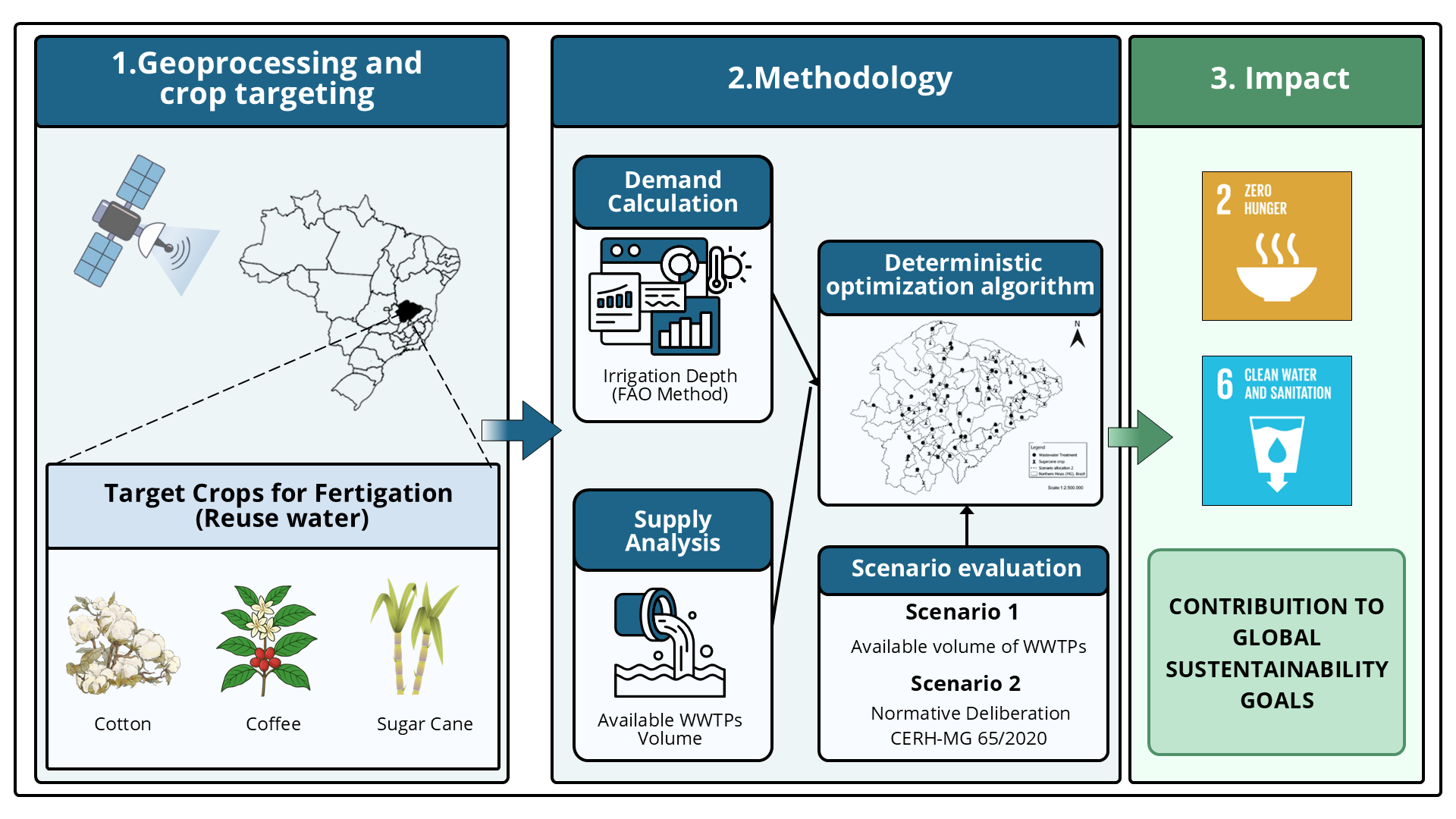
The use of treated wastewater constitutes a strategic alternative for agriculture in water-scarce regions. This study developed and applied a distance-based and sodium-constrained deterministic allocation model integrating geoprocessing tools with environmental and logistical constraints to optimize the spatial distribution of treated effluent from 48 wastewater treatment plants (WWTPs) in the semi-arid region of Minas Gerais, Brazil. The deterministic allocation algorithm prioritizes geographic proximity and favorable topographic differences as a proxy for reducing potential pumping requirements. Two scenarios were evaluated: (1) full effluent availability and (2) sodium-regulated allocation limited to 300 kg ha−1 year−1 of Na, in accordance with Normative Deliberation CERH-MG 65/2020. Under Scenario 1, cotton demand exceeded (184%), while coffee and sugarcane reached 69% and 24% of annual demand, respectively. Under the sodium-constrained Scenario 2, demand fulfillment changed to 37% for coffee and 42% for sugarcane, while cotton remained above full demand (108%). The proposed model differs from previous deterministic spatial allocation applications by integrating regulatory sodium constraints and dual-scenario regional assessment, providing a spatially explicit and regulation-compliant decision-support tool for sustainable wastewater reuse in semi-arid agricultural systems.

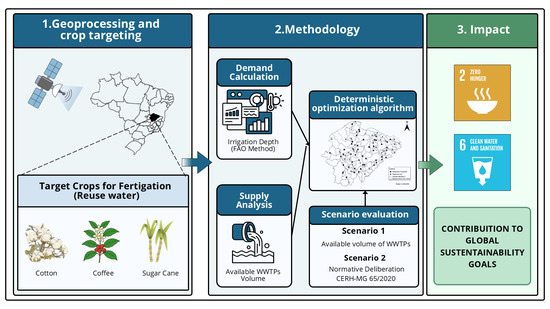
Graphical Abstract

1. Introduction

Global population growth and rising food demand are intensifying pressure on agricultural production, with projections indicating a 50% increase by 2050 [1,2]. This expansion places pressure on water resources, as agriculture is the largest consumer of freshwater worldwide [3]. In this context, the adoption of sustainable and water-efficient agricultural practices has become essential to ensure food security. Climate variability has further intensified this challenge by altering seasonal patterns, prolonging drought periods, and increasing the frequency of extreme rainfall events [4].
In Brazil, these phenomena have directly affected agricultural productivity, with estimates indicating that 25–35% of variations in agricultural prices are linked to adverse climatic events [4]. In the northern mesoregion of Minas Gerais, a semi-arid area facing persistent water scarcity, these challenges are particularly severe, directly impacting the productivity of crops such as coffee, sugarcane, and cotton [5].
In response to water scarcity, strategies such as wastewater reuse, desalination, and precision irrigation have gained prominence, especially in agriculture [6]. Among these alternatives, the reuse of treated wastewater stands out for its potential to supplement irrigation water, reduce pressure on freshwater sources, and promote nutrient recycling [7,8]. Fertigation consists of applying nutrients dissolved in irrigation water, thereby enhancing nutrient use efficiency and reducing losses due to leaching [9,10]. When combined with the reuse of treated effluents, nutrients naturally present in the effluent, as well as those derived from organic matter degradation, can partially replace inorganic mineral fertilizers [11,12]. Despite the technical and environmental advantages, the successful implementation of treated effluent reuse is often influenced by social acceptance factors reported in the literature, including perceived health risks, psychological aspects, and cultural barriers [13,14].
In Minas Gerais, the Normative Deliberation CERH-MG 65/2020 [15] establishes clear guidelines for direct reuse, including quality limits and a maximum sodium dose (300 kg ha−1 year−1), aiming to ensure sanitary and environmental safety in crops not consumed raw. In Brazil, wastewater reuse for agricultural purposes remains limited, and this deliberation regulates and promotes safe practices by defining quality standards and technical requirements for the reuse of treated effluents from public and private wastewater treatment plants [16,17]. This deliberation applies to the state of Minas Gerais, which has a population of over 20 million, making it the second most populous state in the country. It permits agroforestry activities and fertigation of crops not eaten raw, including food and non-food crops, forage, pastures, and trees, provided that sanitary and environmental safeguards are met.
Despite the potential of treated wastewater use in fertigation, the implementation of the legislation enacted five years ago faces obstacles, such as limited technical knowledge and insufficient awareness of the regulation. Additionally, the decentralized nature of rural agricultural systems poses operational and economic challenges for large-scale wastewater reuse, particularly regarding energy efficiency and infrastructure viability [18].
In this context, deterministic optimization algorithms integrated with geoprocessing tools have emerged as effective approaches for improving spatial resource allocation and infrastructure planning. Such models enable the incorporation of geographic constraints, elevation differences, and operational parameters into structured decision-support frameworks, enhancing allocation efficiency and regional planning capacity [19,20]. Building on this methodological basis, the present study applies a deterministic spatial allocation model for wastewater reuse in agricultural fertigation, incorporating regulatory and environmental constraints.
Oliveira et al. [19] demonstrated the application of a deterministic constructive algorithm integrated with GIS tools to optimize the spatial allocation of biogas plants based on resource potential and geographic proximity. Similarly, the present study also prioritizes geographic proximity between wastewater treatment plants (WWTPs) and irrigated farms. Unlike Oliveira et al. [19], this study advances the approach by (i) combining topographic criteria to favor gravity-based routing and reduce pumping requirements, (ii) integrating a sodium-based regulatory constraint (Normative Deliberation CERH-MG 65/2020), (iii) applying the model at a regional scale involving 48 WWTPs and multiple crop systems, and (iv) performing a dual-scenario comparison (full availability versus sodium-constrained allocation) specifically focused on treated wastewater reuse in agriculture. These elements distinguish the proposed allocation model from previous deterministic spatial applications.
Given this context, the present study adopts a deterministic allocation model as a strategic tool to address gaps related to the spatial distribution of treated wastewater for fertigation. The proposed allocation model integrates sodium-regulated constraints to mitigate soil sodicity risks, applies the model at a regional scale involving 48 WWTPs, incorporates a dual-scenario comparison (full availability versus sodium-constrained allocation), and uses topographic weighting as a proxy to reduce potential pumping requirements, thereby enhancing soil sustainability, operational feasibility, and regulatory compliance.
The objective of this study was therefore to develop and apply a distance-based and sodium-constrained deterministic allocation model to distribute treated effluent from WWTPs to coffee, sugarcane, and cotton farms in the northern Minas Gerais mesoregion, Brazil, characterized by recurrent water scarcity and expanding agricultural activity.

2. Methodology

2.1. Delimitation of the Study Area and Collection of Input Data

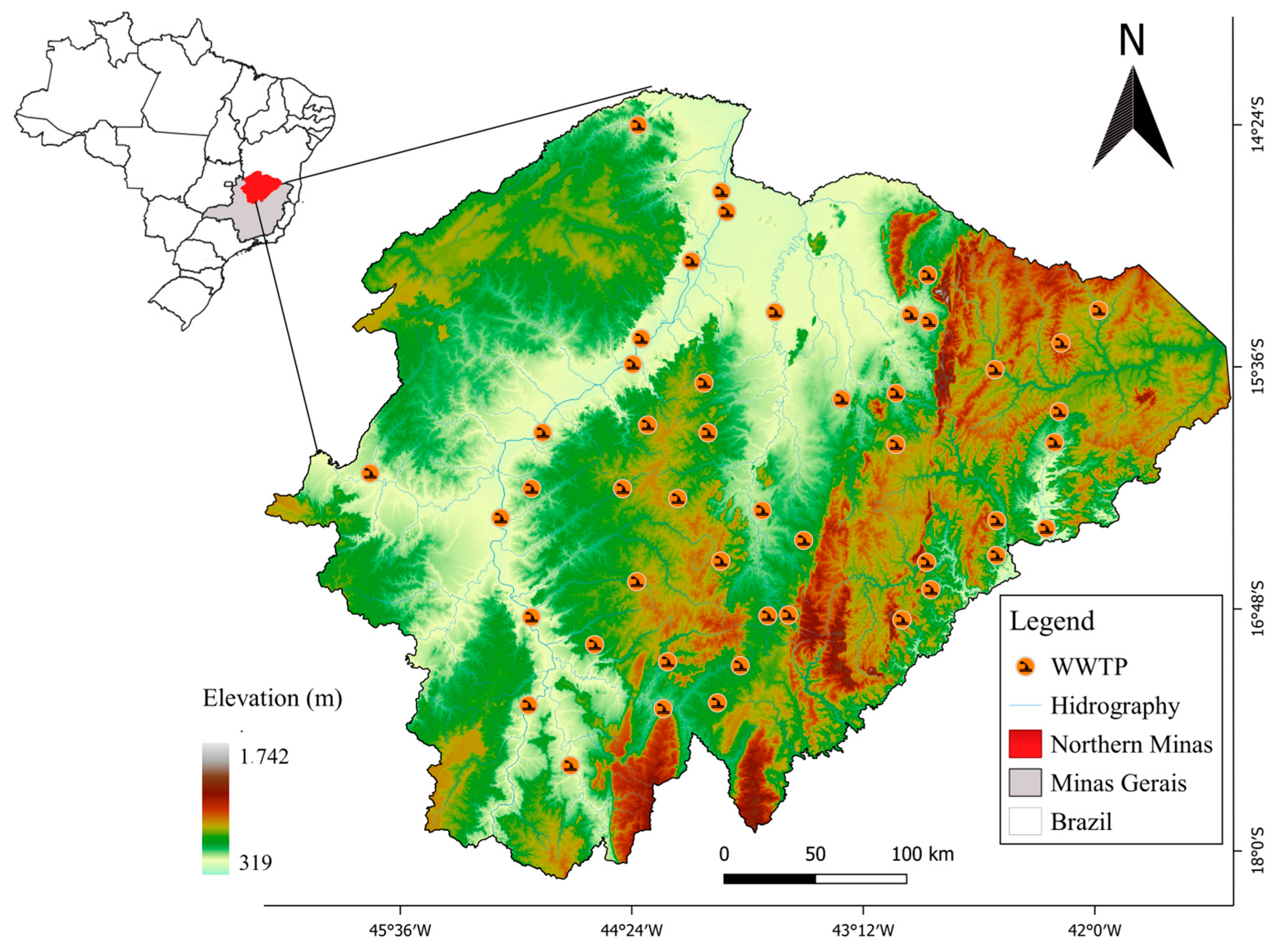
The North Minas mesoregion (Figure 1) is located between the parallels of 14°24′0″ and 17°33′0″ south latitude and the meridians of 41°56′0″ and 45°44′0″ west longitude [5]. This mesoregion comprises 86 municipalities and covers an area of 127,816.15 km2 [21], comparable in size to Greece, which is located in southeastern Europe. The region is characterized by a semi-arid climate and water scarcity, conditions that have been worsening with the advance of climate change, directly affecting agricultural activity [22].
Currently, the wastewater collection rate in the mesoregion is 95.18%, while the proportion of treated wastewater relative to the volume of water consumed is 35.75% [23]. This ratio (~3/8) indicates that only a fraction of the collected wastewater is effectively treated, highlighting the significant potential to expand treated wastewater reuse for agricultural purposes.
Spatial data were obtained from official geospatial databases provided by the Brazilian Institute of Geography and Statistics (IBGE) [24]. All datasets were projected using the Albers Equal Area Conic projection (SIRGAS 2000) to ensure area equivalence across the study region. Spatial processing and area calculations were performed using ArcGIS (v. 10.7.1) (Esri, Redlands, CA, USA) and QGIS software (v. 3.28.0). This procedure enabled the characterization of coffee, sugarcane, and cotton cultivation areas. This choice ensures accurate coordinate transformation and reduces spatial distortions, thereby improving the allocation of treated wastewater collection and agricultural irrigation points [24]. This study used data from the following databases: the Spatial Data Infrastructure of the Minas Gerais Environment and Sustainable Development System (IDE-Sisema) [25], TOPODATA [26], the Brazilian Institute of Geography and Statistics (IBGE) [24], and the National Institute for Space Research (INPE) [27].

2.2. Calculation of Evapotranspiration and Estimation of Irrigation Depth for Specific Crops

Reference evapotranspiration (ET0) was estimated to determine the irrigation depth for three important local crops: coffee, sugarcane, and cotton. These crops were chosen for their socioeconomic importance in northern Minas Gerais, where they account for a large share of the regional agricultural production. Meteorological data were collected from four stations in northern Minas Gerais, selected based on the availability of a complete ten-year historical series (2014–2023), and were obtained from the National Institute of Meteorology (INMET) [28]. Therefore, these weather stations were selected for data completeness and strategic location, and were well distributed throughout the northern mesoregion of Minas Gerais. This choice allows the results to be extrapolated to neighbouring municipalities that share similar climatic conditions and agronomic characteristics.
The weather stations in Montes Claros, Salinas, Pirapora, and Montalvânia, distributed representatively throughout the region, provided the data necessary to calculate the reference evapotranspiration, using the Penman–Monteith equation according to the FAO-56 method [29]. This method is widely recognized for its accuracy and considers variables such as solar radiation, temperature, relative humidity, and wind speed [29]. With this information, water demand was estimated using the specific crop coefficients for coffee, sugarcane, and cotton. Next, the net irrigation depth was calculated using the FAO-56 methodology, considering the region’s soil characteristics, including texture, bulk density, field capacity, permanent wilting point, effective root system depth, and depletion factor.
To support the estimation of the net irrigation depth and to parameterize the soil-related variables required by the FAO-56 methodology, the soil physical and hydraulic properties used in this study were derived as described below.
Soil organic carbon content (g kg−1) was obtained from raster layers provided by IDE-Sisema and produced by Embrapa for the 0–5, 5–15, and 15–30 cm depth intervals. For each municipality, the values were aggregated using zonal statistics (mean per municipal polygon), and the mean carbon content for the 0–30 cm layer was computed as a thickness-weighted average of the three layers (5, 10, and 15 cm). Soil organic matter (OM) was estimated from soil organic carbon using the Van Bemmelen factor (OM = C × 1.724).
Municipal mean soil texture (sand, silt, and clay) was obtained from soil texture raster layers provided by IDE-Sisema and produced by Embrapa [25,30], aggregated by zonal statistics (mean per municipal polygon). Field capacity (θFC, −33 kPa) and permanent wilting point (θPWP, −1500 kPa) were estimated using pedotransfer functions based on municipal mean soil texture and organic matter, following the equations proposed by Saxton and Rawls [31], which estimate volumetric water content as a function of sand, clay, and organic matter contents. The available water capacity was calculated as the difference between θFC and θPWP. The reference matric potentials adopted for θFC (−33 kPa) and θPWP (−1500 kPa) followed the FAO-56 convention. Gravimetric field capacity and permanent wilting point (g g−1) were obtained by converting the volumetric water contents (θFC and θPWP, m3 m−3) using soil bulk density (Bd), according to FC = θFC/Bd and PWP = θPWP/Bd. Bulk density values were assigned according to textural class using representative values for surface mineral soils (0–30 cm). This approach was adopted to maintain consistency with the regional scope of the study, which aimed at a mesoregional assessment rather than site-specific representation. Therefore, bulk density values were not obtained from local measurements. While suitable for regional simulations and municipal comparisons, this assumption may introduce uncertainty when extrapolating results to specific field conditions.
Secondary data obtained through the platform available on the IDE-SISEMA portal [25] were used to characterize the soil texture composition in the northern mesoregion of Minas Gerais. From the geospatial repository, information was extracted on the clay, silt, and total sand contents of different soil orders and classes across the municipalities of Montes Claros, Pirapora, Salinas and Montalvânia. The analysis incorporated soil texture data, enabling more accurate estimates of water demand and supporting agricultural management practices in semi-arid regions [32,33].
The study calculated annual water demand based on the irrigation depths obtained, considering the use of treated wastewater from WWTPs, according to Equations (1) and (2) adapted from [34,35]. For perennial crops, total water demand was estimated annually as the product of cultivated area and irrigation depth (Equation (1)), since these crops remain in the field throughout the year. For annual crops, annual irrigation depths were adjusted to the crop cycle using 365 effective irrigation days per year and an average cycle duration of 150 days (Equation (2)). The study region has a mean annual precipitation of approximately 900–1200 mm year−1, based on long-term climatological records from [36]. The adopted irrigation depths correspond to the net irrigation requirements reported in the literature.
Total water demand for perennial crops = Area (m2) × Irrigation depth (m)
Total   water   demand   for   annual   crops = Area   ( m 2 )   ×   Irrigation   depth   ( m )   ×     150 365
In Equation (2), the value 365 corresponds to the number of days in a leap year, which serves as the temporal basis for the annual calculation of water demand. Conversely, the value 150 represents the average cotton crop cycle in days, spanning from emergence to harvest. Consequently, Equation (1), originally employed for perennial crops such as coffee and sugarcane, does not require temporal correction, as these crops remain in the field throughout the entire year. In contrast, for cotton, which has an average cycle of approximately 150 days, a proportional correction (rule of three) was necessary to ensure the estimated water consumption reflects only the effective cultivation period rather than the full calendar year.
Regarding precipitation, the total rainfall was obtained from data recorded by National Institute of Meteorology (INMET) weather stations, which are part of the Brazilian government’s monitoring network. To determine effective precipitation, a soil water balance was performed to quantify the fraction of total rainfall effectively utilized by the crop. In this procedure, effective precipitation was defined solely as the amount of water required to raise the soil moisture content to field capacity. Any surplus precipitation exceeding the soil’s storage capacity was considered a loss through deep percolation and thus did not contribute to meeting the crop’s water demand.
Subsequently, the water demand of each crop was compared with the annual volume of treated effluent available at WWTPs, estimated at 46,531,861 m3 year−1 [37].

2.3. Allocation of Treated Wastewater from WWTPs to Irrigated Agricultural Areas

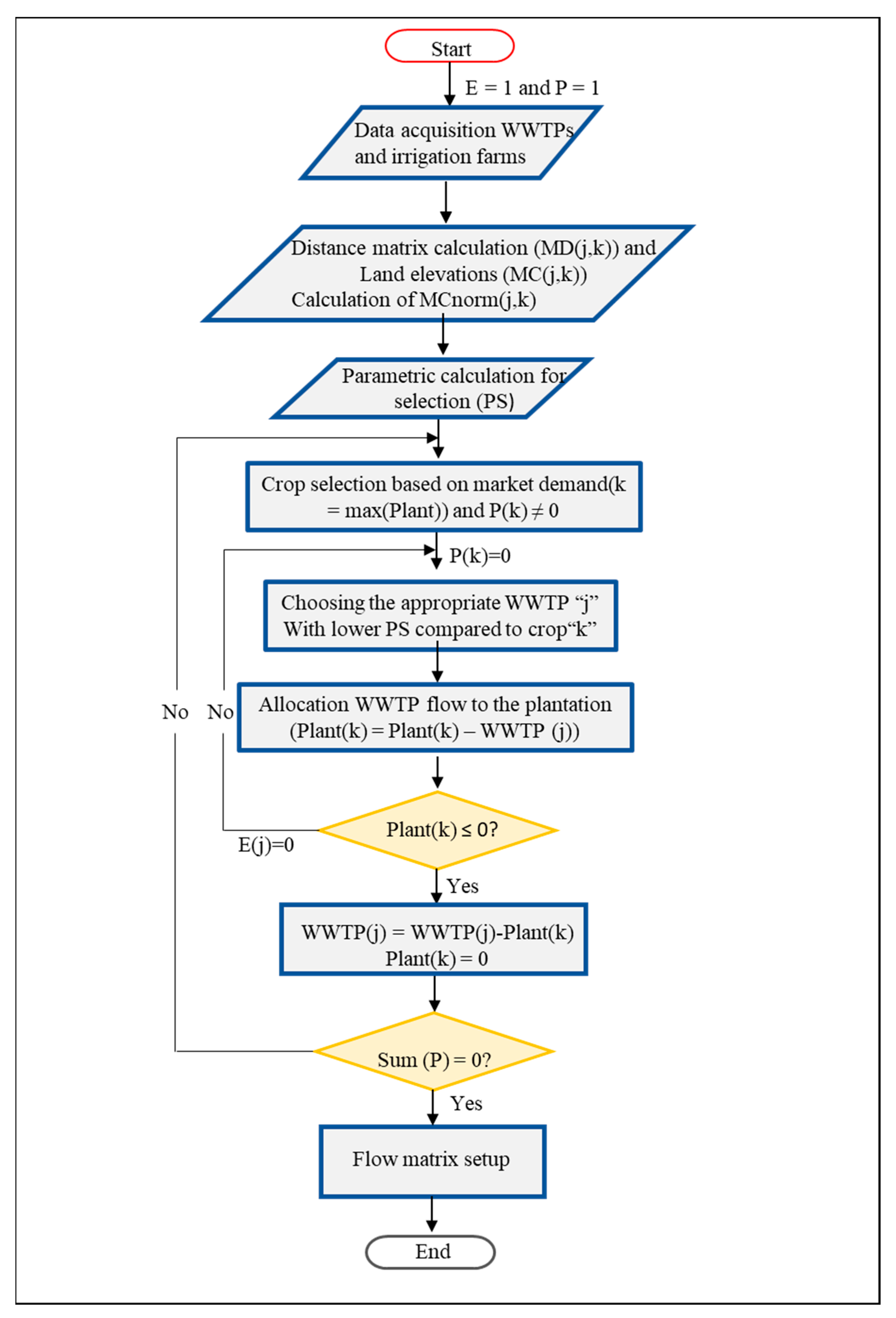
The volumes of treated wastewater from the 48 WWTPs in the northern Minas mesoregion were allocated to selected agricultural areas using a deterministic optimization algorithm (Figure 2) according to a methodology adapted from Oliveira et al. [19]. The optimization algorithm proposed in this research was structured for regional-scale spatial allocation of reclaimed water, integrating geographic location, elevation constraints, and effluent availability. The approach is designed to support strategic planning rather than detailed hydraulic system design. The optimization algorithm proposed in this research was structured based on a methodology previously developed in earlier studies and is now applied to the reality of WWTPs in the northern mesoregion of Minas Gerais [19,20]. A deterministic algorithm was implemented to account for factors such as the geographical locations of wastewater stations, the amounts of effluent generated, the altitudes of WWTPs and fertilization (irrigation) points, and potential flow demands for receiving areas. The selected crops, coffee, sugarcane, and cotton, represent different production profiles, with the first two being perennial and the latter annual.
The algorithm selects WWTP–plantation pairs based on the shortest spatial distance and favorable elevation differences (WWTP elevation higher than plantation elevation). Positive elevation gradients were considered advantageous because they may enable gravity-driven conveyance and reduce the potential need for pumping. This approach represents a topography-informed allocation rather than explicit hydraulic energy minimization.
The algorithm selects the shortest distance between the WWTPs and farms with the highest water demand, prioritizing that the WWTPs’ lowest elevation exceed those farms, thereby reducing energy consumption for pumping and reducing piping in the system. In this study, it was assumed that the treated wastewater from WWTPs is transported to agricultural areas via gravity-fed pipeline systems, ensuring the conveyance of reclaimed water to irrigated farms [20]. It is important to clarify that pumping energy and hydraulic losses were not explicitly calculated in this study using head loss equations, pump power formulations, or energy consumption models. The elevation differences were incorporated as a spatial proxy to prioritize gravity-favorable routing and reduce potential pumping requirements. Therefore, no explicit hydraulic energy modeling was performed.
The algorithm begins by defining the water scenario and the agricultural crop to be evaluated, based on the previously established irrigation parameters. Next, the user selects one of two scenarios: one with high water demand, in which case wastewater is available from WWTPs, or another with limited demand, in accordance with the guidelines established for controlled agricultural reuse. Additionally, the desired crop for fertigation was selected. This choice determines the input command to be used and the respective irrigation depth applied in the calculation of the water demand. The geographic and operational data of the WWTPs and plantation areas were then imported.
For the WWTPs, the name, geographic coordinates (latitude and longitude), elevation, and available flow were compiled. For plantations, names, total areas, elevations, and geographic coordinates were also collected. Geographic coordinates were subsequently reprojected to the Albers Conical Equal Area Brazil projection (SIRGAS 2000) for spatial distance calculations [24]. Figure 2 presents a flowchart of the optimization process, detailing each step from reading the input data to obtaining the final results. The mathematical model proposed in this study aims to identify the most suitable WWTP to meet the different demands of plantations, while accounting geographical criteria, particularly topography. Initially, the control vectors E and P were defined with unit values for the WWTPs and plantations, respectively. Each unit has geographic coordinates (latitude and longitude) and elevation data. Coordinates were reprojected to the Albers Conical Equal Area Brazil projection (SIRGAS 2000), and projected planar coordinates were used to compute Euclidean distances between WWTPs and plantations.
The distance between a WWTP (j) and a plantation (k) was calculated using projected planar coordinates (x, y) under the Albers Conical Equal Area Brazil projection (SIRGAS 2000), ensuring metric consistency. The Euclidean distance was then computed as follows (Equation (3)):
M D j , k = x W W T P ( j ) x P l a n t ( k ) 2 + y W W T P ( j ) y P l a n t ( k ) 2
The difference in elevation between a WWTP (j) and a plantation k forms the MC (j, k) matrix, obtained by calculating the difference in elevation between the WWTP (j) and the plantation k (Equation (4)):
M C j , k = E l e v a t i o n W W T P ( j ) E l e v a t i o n P l a n t ( k )
The quota matrix was normalized (Equation (5)) to values between 0 and 1, since this parameter was used to weight the distance matrix, giving greater credibility to WWTPs that were closer and at a higher altitude than the plantation k under study.
M C N o r m a l i z e d ( j , k ) = M C ( j , k ) m i n M C ( j , k ) m a x M C ( j , k ) m i n M C ( j , k )
Normalization is performed by subtracting the lowest value from the MC matrix and dividing it by the difference between the highest and lowest values in the same matrix (Equation (5)).
As explained above, the selection potential matrix (SP) is calculated from the distance matrix and the normalized elevation matrix, representing the feasibility of a WWTP (j) serving a plantation k. The SP (j, k) term in Equation (6) represents only the numerical value resulting from this calculation, such that the shorter the distance and the greater the favorable quota difference, the lower the SP value, thus indicating a greater potential for service.
P S ( j , k ) = M D ( j , k ) × 1 M C n o r m a l i z e d j , k
The weighting between distance and elevation reflects physical feasibility considerations. Distance represents the extension of infrastructure and the potential transport effort, whereas elevation difference influences the feasibility of gravity-driven conveyance. Therefore, elevation was incorporated as a spatial weighting factor in the selection potential matrix. Sodium loading was not included directly in the SP because sodium concentrations were not individually monitored for each WWTP. Instead, sodium constraints were incorporated at the scenario level (Scenario 2) in accordance with the regulatory limit established by Normative Deliberation CERH-MG 65/2020. This structure ensures that spatial optimization is guided by physical feasibility, while environmental compliance is guaranteed through regulatory constraints.
Next, the demand vector of plantations, called Plant(k), is considered. The selection of the WWTP for each plantation was based on the highest demand and the lowest SP value. Thus, the pair (j, k) with the lowest SP value and the highest demand is identified, ensuring that the selected WWTP (j) is the most efficient for serving plantation k. Importantly, sodium loading was not treated as an objective function to be simultaneously optimized with distance/topography; instead, it was incorporated as a scenario-based constraint (Scenario 2).
The allocation process follows a deterministic constructive procedure (Figure 2). In each iteration, plantations are prioritized according to their remaining water demand, and the WWTP presenting the most favourable spatial feasibility (lowest SP value) is selected, provided that effluent availability remains. Allocated volumes are limited by both plantation demand and WWTP discharge capacity. After each allocation step, remaining demands and available flows are updated. The procedure continues until all demands are satisfied or effluent resources are exhausted. The algorithm was executed using the Thonny Integrated Development Environment (IDE) with Python 3.8.10 adopted as the programming language [38]. Its integration with the Python interpreter allows variable analysis, making it suitable for algorithm development and execution [39].
The optimization process aims to prioritize spatial configurations that potentially reduce infrastructure requirements and hydraulic energy demand by favoring shorter distances and positive elevation gradients. However, hydraulic head losses, pump efficiency, pipe diameter optimization, and explicit energy consumption equations were not modeled. Distance and elevation differences were used as geometric proxies for potential energy requirements, suitable for regional-scale planning purposes. Appropriate selection of WWTPs to meet the plantations demands, considering geographical and topographical criteria, directly contributes to the operational and economic efficiency of the system. Thus, shorter distances and favorable elevation differences reduce both the logistical costs and energy consumption required to transport the treated effluent.
It is important to note that hydraulic head losses, pumping efficiency, and detailed energy consumption were not explicitly modeled. The present approach uses distance and elevation difference as spatial proxies for potential energy requirements. Future studies may incorporate detailed hydraulic simulation (e.g., Darcy–Weisbach equation or EPANET-based modeling) to refine energetic and economic assessments.

2.4. Sensitivity Analysis of Maximum Allocation Distance

To assess the structural robustness of the deterministic allocation model and quantify the influence of spatial constraints on system performance, a one-at-a-time (OAT) sensitivity analysis was conducted. In this regard, only one parameter was varied while all others remained constant, as described by Hamby [40]. The maximum allocation distance parameter was tested with four threshold values: 25, 50, 80, and 100 km. For each distance, the allocation algorithm was executed independently under Scenario 1 (full effluent availability) and Scenario 2 (sodium-restricted allocation). All other parameters were kept constant, including crop water demand, WWTP discharge volumes, topographic criteria, and the sodium application limit. For each simulation, the allocated volume corresponded to the sum of all flows assigned by the algorithm (∑ allocated flow, m3). Demand fulfillment (%) was calculated according to Equation (7):
Demand   fulfillment ( % ) =   A l l o c a t e d   v o l u m e A n n u a l   c r o p   w a t e r   r e q u i r e m e n t
Demand fulfillment (%) represents the proportion of total water requirement effectively supplied by the allocation model. This indicator enabled the identification of performance trends associated with the expansion of spatial coverage and with the interaction between distance constraints and regulatory sodium limits.

2.5. Definition and Simulation Approach

The Northern Minas Gerais mesoregion is home to several wastewater treatment systems. To define Scenario 1, we considered the wastewater volume that can be allocated, referring to the 48 WWTPs in operation in the mesoregion, totalling 46,531,861 m3 year−1 [37]. The predominant biological treatment systems in the mesoregion include anaerobic reactors, anaerobic ponds followed by facultative ponds, maturation ponds, and isolated facultative ponds. In addition to the biological stage (secondary), WWTPs generally include a pretreatment stage with screening and grit chambers. When treatment is associated with post-treatment stages, such as maturation ponds, reuse with greater sanitary safety is favored, enabling a reduction in E. coli, helminth eggs, and other pathogens, in accordance with the World Health Organization WHO standards and Brazilian guidelines [41,42,43].
In addition to microbiological safety, the reuse of treated wastewater must also consider its chemical effects on soil properties. Salinity and sodicity are major factors of soil degradation, which can affect up to 50% of irrigated areas and thereby lead to significant economic losses [35,44]. In Scenario 2, the wastewater volume was calculated based on Normative Deliberation CERH-MG 65/2020, a state-level legislation instrument that establishes guidelines and maximum allowable application loads for non-potable water reuse from wastewater treatment plants. The regulation defines a maximum sodium application limit of 300 kg ha−1 year−1 to ensure soil protection [15]. Equation (8) was adopted considering a maximum sodium application rate [35,44]. Sodium concentrations in treated effluent were not monitored individually at each WWTP; therefore, a regulation-based approach was adopted, using the maximum application limit established by Normative Deliberation CERH-MG 65/2020, to ensure soil protection and regulatory compliance.
D = Q r e q Q d i s p
In Equation (8), D represents the allowable reuse water volume (m3 ha−1 year−1), calculated as the ratio between the maximum permissible annual sodium load ( Q r e q , kg ha−1 year−1) and the sodium concentration in treated effluent ( Q d i s p , kg m−3).
The parameter Q r e q corresponds to the regulatory sodium application limit (300 kg ha−1 year−1), as established by Normative Deliberation CERH-MG 65/2020. The parameter Q d i s p represents the sodium concentration in the treated effluent, adopted as 115 mg L−1 (0.115 kg m−3 after unit conversion), based on FAO and EPA guidelines [34,45].
Due to the unavailability of individual sodium monitoring data for each of the 48 WWTPs, we adopted the maximum limit defined by state regulation Normative Deliberation CERH-MG 65/2020. This ensures a conservative safety margin for soil protection. Sodium was chosen as the reference chemical element because of its critical role in soil salinization, which can compromise the soil structure and agricultural productivity, especially in regions with intensive irrigation [46]. In the context of treated wastewater used for irrigation, sodium has emerged as one of the main agents responsible for soil salinization, particularly because it is present at high concentrations in effluents [46,47].
The accumulation of sodium in the soil profile can cause particle dispersion, which compromises the physical structure, infiltration, and aeration capacity. As a result, high sodium concentrations can lead to soil particle dispersion, reducing permeability and aeration, negatively affecting plant root development, and consequently agricultural productivity [48]. Furthermore, it was observed that sodium removal is limited in biological WWTPs, that is, even if a plant operates at the tertiary level, there will be no significant removal of this element. The integration the regulatory framework (Normative Resolution CERH-MG No. 65/2020), which establishes a sodium application limit, and the availability of treated wastewater for agricultural reuse is illustrated (Figure 3).

3. Results and Discussion

3.1. Geoprocessing of the Study Area and Characterization of WWTPs: Potential for Generating Treated Wastewater

The Northern Minas Gerais mesoregion comprises 89 municipalities and 48 operating WWTPs [37], as illustrated in Figure 4. The main biological treatment systems adopted are anaerobic reactors followed by facultative and maturation ponds, anaerobic ponds followed by facultative and maturation ponds, isolated facultative ponds, and some conventional systems that integrate physicochemical and biological processes [49]. According to the SEMAD [23], the wastewater collection rate is 95.18%, but only 35.75% of this volume received effective treatment.

3.2. Calculation of Irrigation Depth for a 10-Year Series

The selection of weather stations was based on historical data series and their locations to ensure a good spatial representation of the Northern Minas mesoregion. These stations, Montes Claros, Pirapora, Salinas, and Montalvânia, presented consistent and continuous data, which ensured the reliability of the estimated results. In addition, the geographical distribution allows the results of neighboring municipalities with similar climatic conditions and agronomic characteristics to be generalized, strengthening the regional applicability of the study.
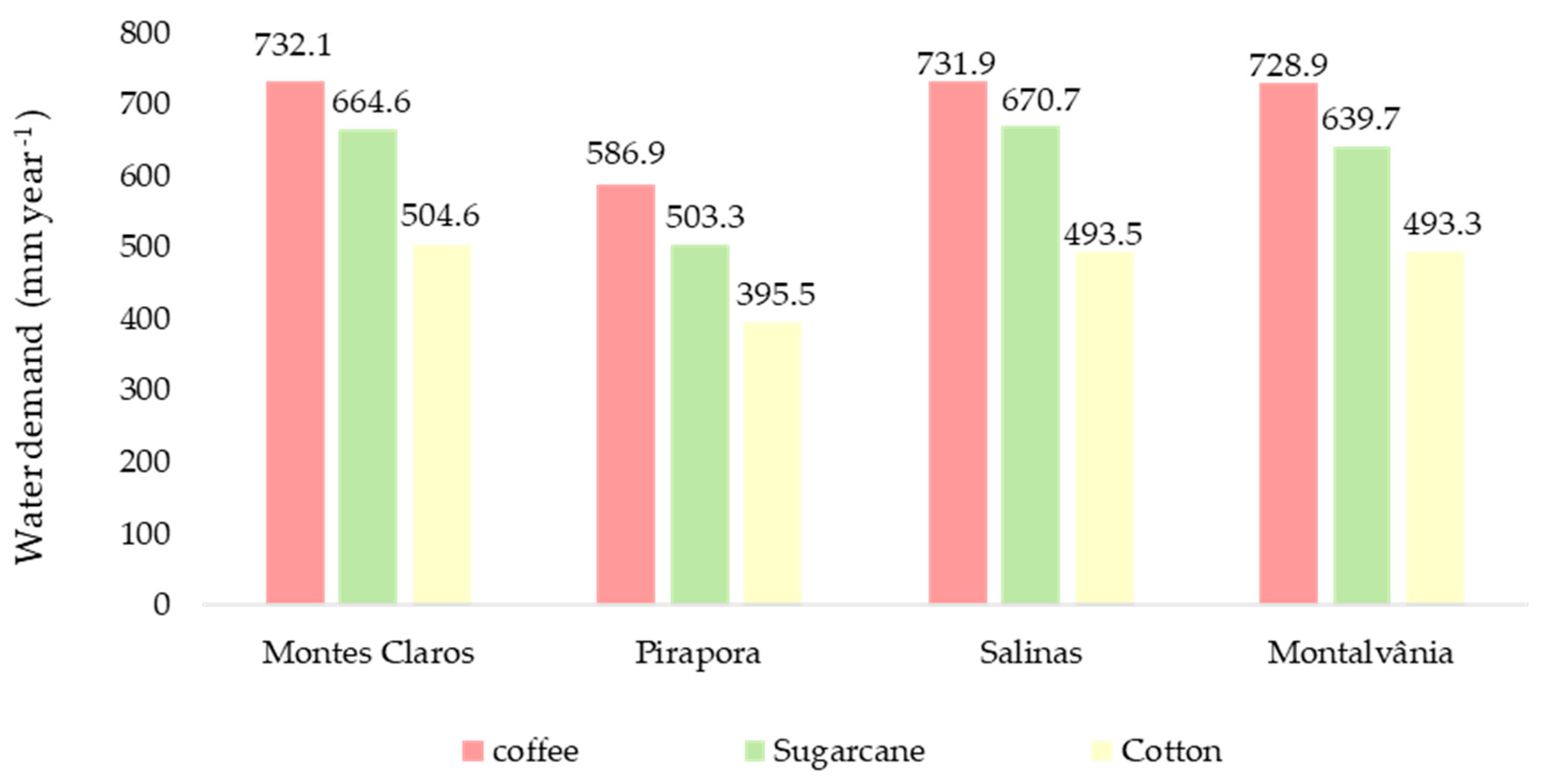
Coffee cultivation had the highest water demand in all locations analyzed, with values exceeding 700 mm year−1, indicating high water requirements throughout the production cycle (Figure 5). This higher demand can be explained by the crop’s physiological characteristics, such as a larger leaf area, as well as its perennial nature. In this sense, factors such as greater leaf area and stomatal density can lead to higher transpiration rates compared to crops such as sugarcane and cotton [50,51].
According to the literature, the water depth for the coffee cycle ranges from 1200 mm to 1800 mm; however, in irrigated systems, this demand varies between 800 mm and 1200 mm per cycle, depending on the climate, soil, and management adopted [51,52]. According to Oliveira et al. [53], coffee production in the Brazilian semi-arid region accounts for 14.86% of the national total, reinforcing the relevance of this study in regions with low water availability.
Sugarcane showed the intermediate values of required irrigation depth, ranging from 503.3 mm year−1 (Pirapora) to 670.7 mm year−1 (Salinas), which are compatible with those reported for semi-arid regions [54].
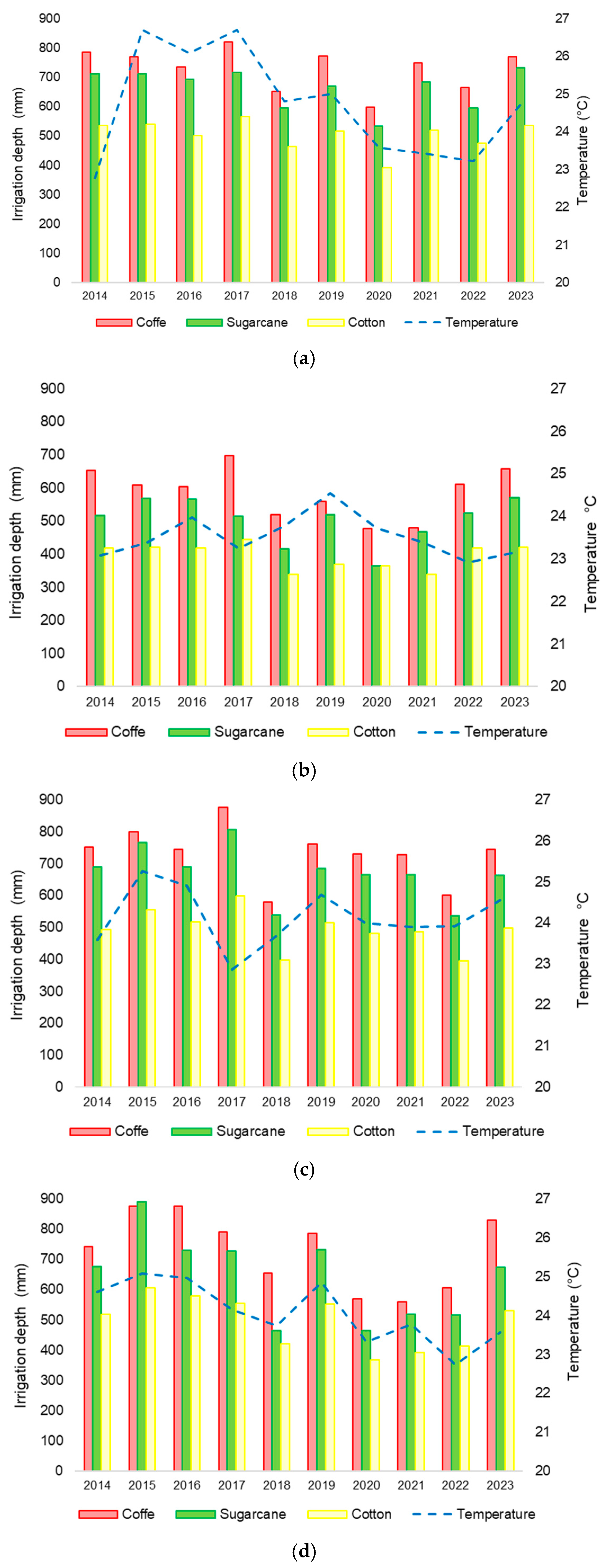
Cotton has the lowest water demand, especially in Pirapora, where annual rainfall reaches 395.5 mm year−1. This value is in line with the range reported by Boulange et al. [55], which varies between 333 mm and 493 mm year−1, depending on the management adopted. Figure 6 shows the historical series (2014–2023) of annual irrigation depths required for the three crops analyzed.
Although air temperature influences evapotranspiration, irrigation demand results from the interaction of multiple climatic, agronomic, and edaphic factors [56]. Solar radiation plays a dominant role in reference evapotranspiration and can lead to high evaporative demand even in years with lower average air temperatures [57]. Furthermore, irrigation requirements are strongly influenced by the amount and temporal distribution of precipitation, as concentrated rainfall events tend to reduce effective precipitation through deep percolation losses [57].
There is a variation in irrigation depths over time, mainly due to changes in local climatic conditions, such as effective precipitation and reference evapotranspiration (ET0). These natural fluctuations highlight the effects of climate change, which affect soil moisture and intensify water stress on crops [56]. The periods of severe drought recorded in the southeast, including the northern Minas mesoregion (2014–2015, 2017–2018, and 2023–2024), corroborate these findings [58].
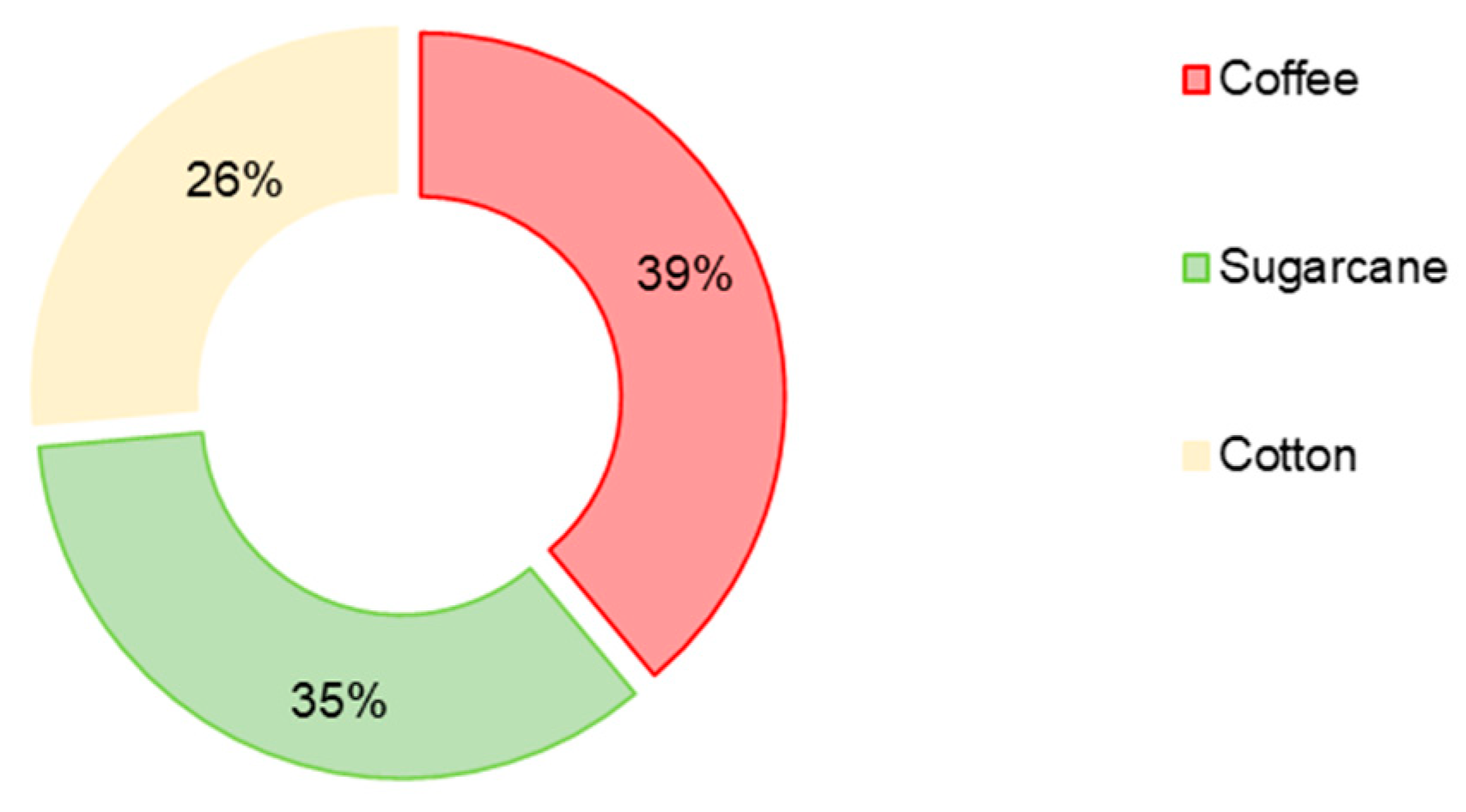
Figure 7 shows the proportion of annual irrigation water demand by crop, with coffee accounting for the highest share (39%), followed by sugarcane (35%) and cotton (26%). The corresponding annual irrigation depths were 694.95 mm for coffee, 619.58 mm for sugarcane, and 471.73 mm for cotton.
Soil texture is an important factor controlling soil water retention, infiltration, and irrigation management. Fine-textured soils generally exhibit higher water retention, whereas coarse-textured soils have lower water-holding capacity and require more frequent irrigation with smaller application depths [59,60]. In addition, fine-textured soils may be more susceptible to clogging and reductions in hydraulic conductivity, particularly under irrigation with reclaimed water [59]. Medium-textured soils tend to exhibit more balanced infiltration and water retention, and may also favor soil quality under irrigation with treated wastewater [61].
In this study, soil texture information was used to support the estimation of soil hydraulic parameters and irrigation depths at the municipal scale, together with evapotranspiration and precipitation data. Soil analysis is therefore essential for calculating irrigation depth, as, together with evapotranspiration and rainfall, it allows the determination of the appropriate amount of water to be applied, so as not to exceed the soil water-holding capacity and to avoid losses due to deep percolation, thereby ensuring greater efficiency in irrigation management [29,60].
As the study is based on a regional-scale simulation, these parameters were used in a representative manner for each municipality, allowing regional differences in soil water retention to be captured and ensuring greater consistency in the calculation of irrigation depth. The soil physical parameters adopted in the simulations are summarized in Table 1. The complete set of soil physical and hydraulic parameters is provided in Appendix A.

3.3. Scenarios for Effluent Application in Crops: Ideal Conditions and Operational Limitations of Treatment of Irrigation Depth for a 10-Year Series

The annual water demand for each agricultural crop (coffee, sugarcane, and cotton) was determined, as was the availability of effluent for fertigation, under scenarios 1 and 2. Annual irrigation water demand was calculated based on the crop’s characteristics, including its cycle (perennial or annual), the water depth required throughout cultivation, and the plant’s phenological stage.
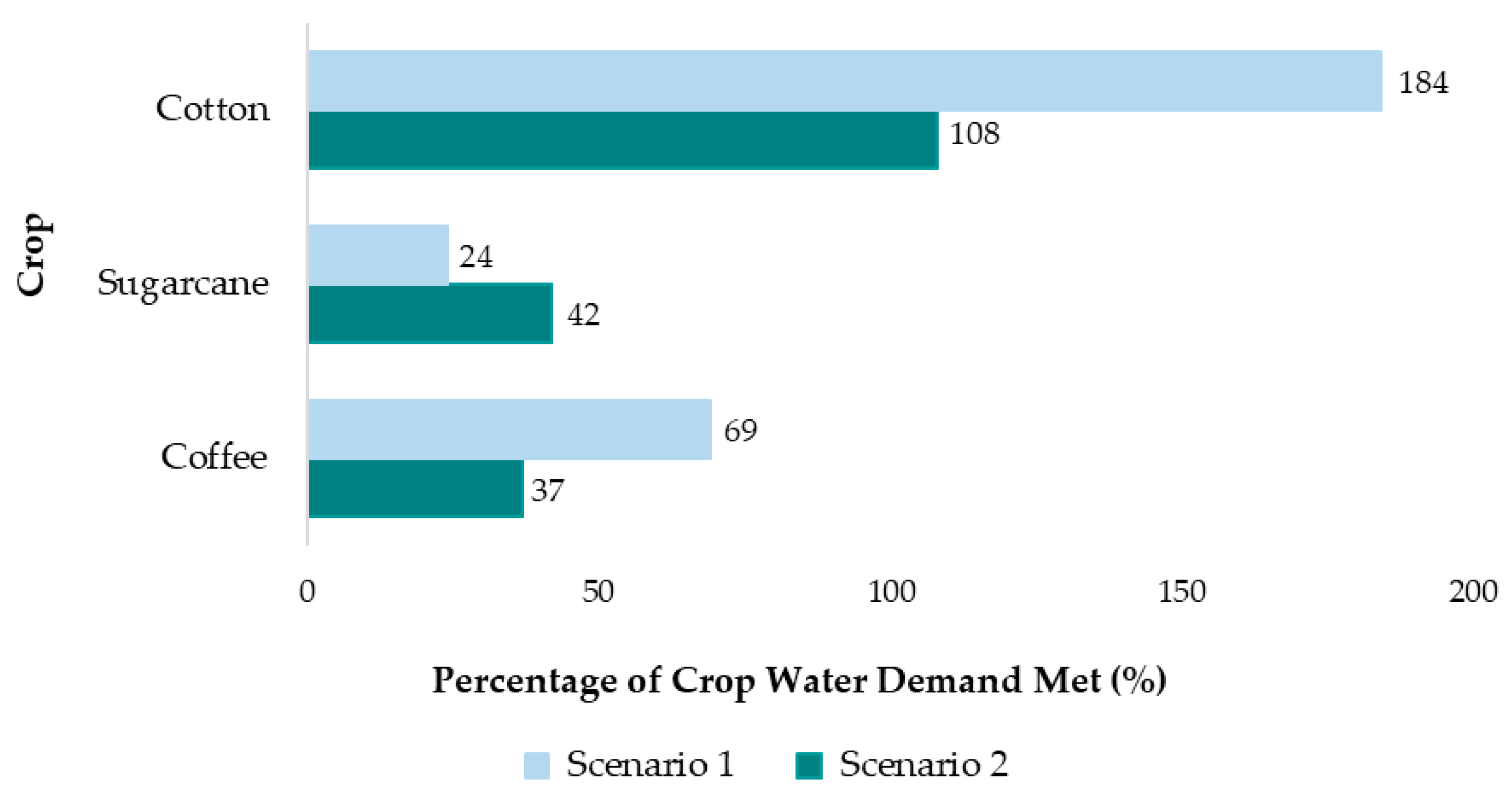
Table 2 presents Scenario 1, whose volume (46,531,861 m3 year−1) is based on the current total capacity of the WWTPs in the north of Minas mesoregion, enabling a more accurate analysis of the local supply of treated wastewater. As this scenario does not impose restrictions on the volume applied per hectare, a high proportion of supply is identified, as in the case of cotton, where 184% of demand is met.
Under Scenario 1 (full effluent availability of 46,531,861 m3 year−1), cotton demand was exceeded by 184%, indicating surplus allocation capacity relative to crop demand. Coffee reached 69% of its total annual demand (67,298,958 m3 year−1), while sugarcane reached 24% (196,521,408 m3 year−1). These quantitative results demonstrate that, under unrestricted conditions, allocation efficiency is primarily constrained by spatial distribution and crop area rather than effluent availability.
Table 2. Annual water demand of crops and volume of available effluent (Scenario 1).
CropCultivated Area
(ha)
Annual
Demand (m3 year−1)
Available
Volume from WWTPs
(m3 year−1)
Maximum
Effluent
Volume
(m3 year−1)
Proportion Served
(%)
Coffee968467,298,95846,531,861480569
Sugarcane31,719196,521,40846,531,861146724
Cotton10,51824,781,77646,531,8614424184
Notes: Values based on effluent, without restrictions due to sodium or salinity. The available volume refers to the total volume treated at the 48 WWTPs in the mesoregion.
In Scenario 2 (Table 3), the available volume complied with the technical and legal guidelines for the direct reuse of treated sanitary effluents in Minas Gerais, as established by Normative Deliberation CERH-MG 65/2020. The permitted volume of 2608 m3 ha−1 year−1 was calculated based on this standard, ensuring safety during reuse for agricultural, urban, and industrial purposes. For agricultural purposes, the reuse of treated effluents aims not only to meet part of the crop water demand but also to add nutrients through fertigation. The application must be designed to ensure that the supply of macronutrients, such as nitrogen (N), phosphorus (P), and potassium (K), and sodium contents does not cause changes in surface water, groundwater, and soil quality (salinity and sodicity), in accordance with the parameters defined by current legislation [15].
The effects of the maximum sodium application limit on effluent availability and crop water supply are shown (Table 3).
Table 3. Annual water demand of crops and available effluent volume according to the maximum sodium application limit (Scenario 2).
CropCultivated Area
(ha)
Annual
Demand
(m3 year−1)
Maximum Safe Available Effluent Volume (m3 year−1)Proportion
Served
(%)
Coffee968467,298,958260837
Sugarcane31,719196,521,408260842
Cotton10,51824,781,7762608108
Note: The maximum dose of sodium applied to the soil via reused water was 300 kg ha−1 year−1, as established by Normative Deliberation CERH-MG 65/2020.
Scenario 2 incorporated the regulatory sodium application limit of 300 kg ha−1 year−1, as established by Normative Deliberation CERH-MG 65/2020, corresponding to a maximum allowable reuse volume of 2608 m3 ha−1 year−1. Under this constraint, demand fulfillment changed to 37% for coffee and 42% for sugarcane, while cotton remained above total demand (108%). Although this regulation restricts the volume available for irrigation, the measure acts as a soil protection mechanism by limiting the applied sodium load, thereby mitigating long-term risks associated with soil sodicity, aggregate instability, and reduced hydraulic conductivity, including in semi-arid regions.
Figure 8 shows the proportion of water demand met by reused water in the two scenarios analyzed. In Scenario 1, cotton cultivation exceeded 100% of demand (184%), indicating the possibility of redistributing the surplus volume to other crops. This result stems from the lower irrigation depth required by cotton during its approximately 150-day production cycle, as well as the smaller cultivation area. This behavior is consistent with reference evapotranspiration (ET0), which guides water management in semi-arid regions [62]. For coffee (69%) and sugarcane (24%) crops, irrigation requirements are not fully met due of higher water requirements and larger cultivated areas, as indicated in Table 2 and Appendix B.
In Scenario 2, lower proportions of demand met were observed for all crops because of the limitation imposed by Normative Deliberation CERH-MG 65/2020. Cotton stands out (108%), followed by sugarcane (42%) and coffee (37%). These values reflect a more realistic and reliable perspective on the load of macronutrients, such as nitrogen, phosphorus, and potassium, applied via treated effluent, which, despite low concentrations of organic matter and nutrients, contains sodium in its composition, given that this element is not removed in conventional biological WWTPs. Even so, the use of treated effluents is a promising strategy for the agricultural sector, offering economic and environmental benefits by replacing mineral fertilizers [63] and conserving water for other uses, such as public supply.

3.4. Optimization of Treated Wastewater Use for Irrigation Farms

The algorithm begins the process by selecting the farm with the highest demand for available effluent. When the nearest station is unavailable, the system selects the second most viable station to supplement the allocation. This procedure was repeated until the cultivated area received the required amount of fertigation, within the limits of availability.
The allocation logic adopted in this study follows a deterministic approach, in which resource distribution is guided by spatial constraints and system efficiency. The proposed method employs a single-objective deterministic algorithm specifically designed for treated wastewater allocation, consistent with deterministic allocation frameworks reported in the literature [64].
During the allocation process, the algorithm assesses the distribution network’s feasibility based on local topography, aiming to reduce energy consumption in transporting treated wastewater for irrigation, primarily by considering the energy required as a function of distance. In addition, distances between the treatment plants and the irrigation points were determined, enabling approximate cost estimates for piping and hydraulic infrastructure. To visualize the process, QGIS software was used in conjunction with the constructive algorithm, which enabled the generation of thematic maps representing the spatial distribution of effluent among crops, as proposed by Oliveira et al. [19,20].
Beyond its technical contributions, the proposed optimization framework can help mitigate social and regulatory challenges associated with implementing wastewater reuse in agriculture. From a social perspective, the model addresses concerns related to the cultivation and consumption of crops irrigated with treated effluents. From a regulatory perspective, it supports the effective application of the relevant legislation. Moreover, compliance with technical criteria and legal reuse limits contributes to reducing perceived risks to human health and the environment, thereby fostering public acceptance and facilitating the practical adoption of reuse strategies.
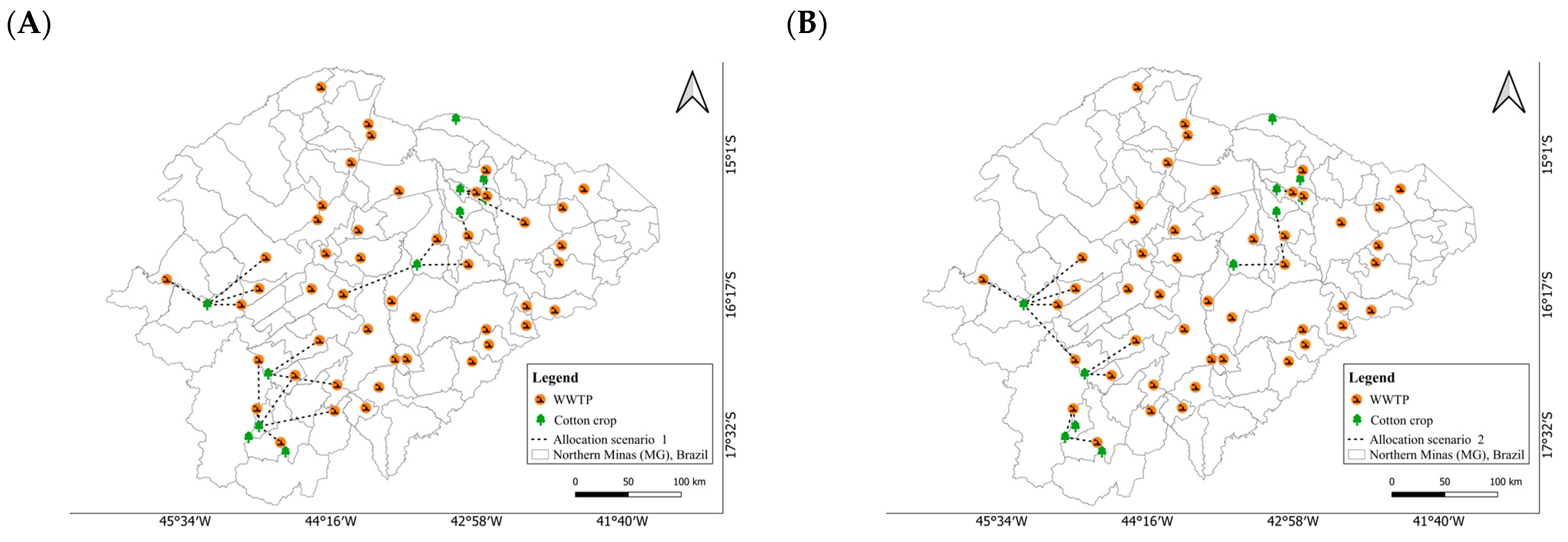
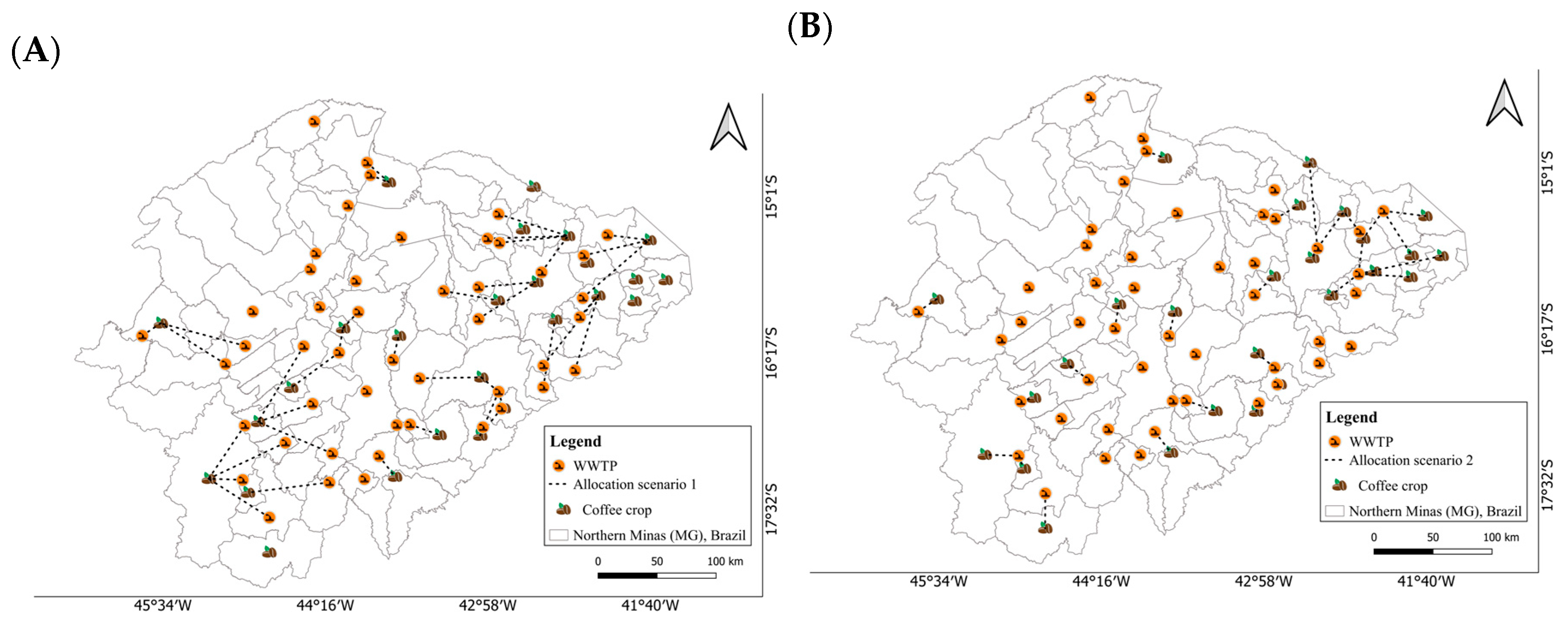
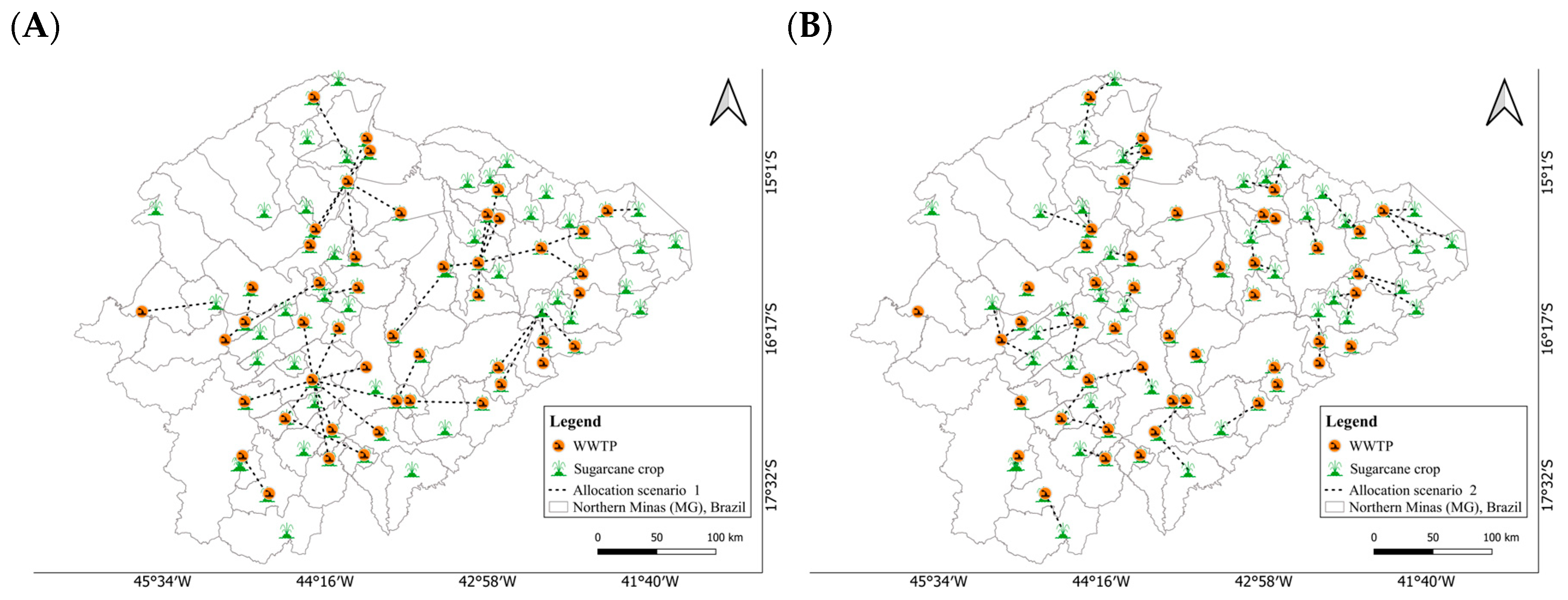
The comparison between the scenarios allowed us to observe the allocation of reused water in each situation, while respecting the available volume and the specificities of each crop. Figure 9, Figure 10 and Figure 11 present the spatial distribution of results from the proposed algorithm for cotton, coffee, and sugarcane, respectively, highlighting irrigation patterns based on crop water demands under Scenario 1 (A) and Scenario 2 (B).
The contrast between scenarios highlights the effect of the regulatory constraint applied in Scenario 2 (Normative Deliberation CERH-MG 65 sodium-based limit), which restricts the maximum reuse volume per hectare and, consequently, reduces the number and extent of feasible WWTP–crop connections compared with Scenario 1. The methodology follows an approach similar to that of Oliveira et al. [19], who demonstrated the applicability of deterministic constructive algorithms combined with GIS to optimize spatial allocation and support decision-making. In this study, such framework enables clear spatial quantification of environmental risks; specifically, the spatial analysis reveals that several areas in Scenario 1 would exceed the 300 kg ha−1 year−1 threshold.
The application of the heuristic constructive algorithm proved effective. However, in some scenarios, such as scenario 1 for cotton crops, the distribution of reused water is more extensive, highlighting the influence of topography, especially terrain elevation, on restricting the distribution of effluent. It was found that, in some cases, even when WWTPs were in close proximity, terrain topography influenced effluent allocation, favoring more distant properties to reduce energy expenditure.
For cotton cultivation (Figure 9), which had the smallest cultivated area among the three crops analyzed (10,518 ha), it was observed that in Scenario 1, the volume of available effluent (46,531,861 m3 year−1) was distributed among several farms along an optimized route, resulting in 184% of the total crop demand being met (24,781,776 m3 year−1). The geographical distribution of cotton crops is highly concentrated and limited to a few specific regions of northern Minas Gerais. It was found that this spatial concentration, although showing excess water, suggests a variation in distribution among properties as some specific farms have demands exceeding the total available volume, indicating that the excess water is not uniformly distributed.
In Scenario 2, it was found that the application of the criteria established by Normative Deliberation CERH-MG 65/2020 [15], which limits fertigation to (2608 m3 ha−1 year−1) to prevent soil salinization, resulted in a sprayed distribution among multiple properties, while still maintaining a remarkably high 108% of demand. This unique behavior of cotton, with fulfillment rates above 100% in both scenarios, results from the combination of its small cultivated area and the geographic concentration of crops, which optimizes the allocation of treated effluent.
For coffee cultivation (Figure 10), intermediate behavior was identified, with an annual demand of 67,298,958 m3 distributed over 9684 ha. It was found that Scenario 1 provides a more concentrated spatial distribution, meeting 69% of the demand through a few crops connected by allocation lines, demonstrating a better balance between water availability and cultivated area. In Scenario 2, a more dispersed distribution was observed, with shorter routes in accordance with the regulated volume (2608 m3 ha−1 year−1), and increased coverage to 37%, while maintaining the spatially distributed benefits.
For sugarcane (Figure 11), which has the highest water demand (196,521,408 m3 year−1) distributed over 31,719 ha, it was observed that in Scenario 1, there was a concentration of demand at specific points, similar to the behavior observed in cotton, with only 42% coverage owing to the limitation of available volume. On the other hand, it was found that Scenario 2 represents the only situation in which regulation results in a reduction, decreasing fulfillment to 24% and leading to a wider distribution among properties. This unique behavior stems from the limit per hectare (2608 m3 ha−1 year−1), which is disadvantageous for extensive crops, limiting the maximum volume to (82,726,352 m3 year−1) for sugarcane, which was lower than the volumes allocated in Scenario 1.
In terms of energy and transportation costs, Scenario 1 was more advantageous because of the shorter distances traveled compared with Scenario 2. However, Scenario 1 can lead to excessive nutrient concentrations in the soil, resulting in leaching and resources waste.
However, Scenario 2 requires a greater initial investment in infrastructure, such as pipes for effluent distribution. Its gains in agricultural productivity, soil conservation, and reduced environmental impacts offset additional costs and promote sustainable water management. The savings from the partial replacement of commercial fertilizers contribute to the system’s long-term economic viability.
In semi-arid regions, prolonged application of sodium-rich effluents may lead to increased soil sodicity, a condition characterized by with high levels of exchangeable sodium in the soil exchange complex. Sodicity promotes clay particle dispersion, reduces aggregate stability, and decreases hydraulic conductivity. These processes can impair root development and long-term crop productivity. Studies conducted in comparable semi-arid environments report structural degradation and reduced infiltration associated with elevated exchangeable sodium percentages. In this context, the sodium-constrained scenario adopted in this study functions as a preventive allocation strategy, limiting application rates to mitigate cumulative soil degradation risks.

3.5. Simulation of Scenarios to Evaluate the Best Use of Water Resources

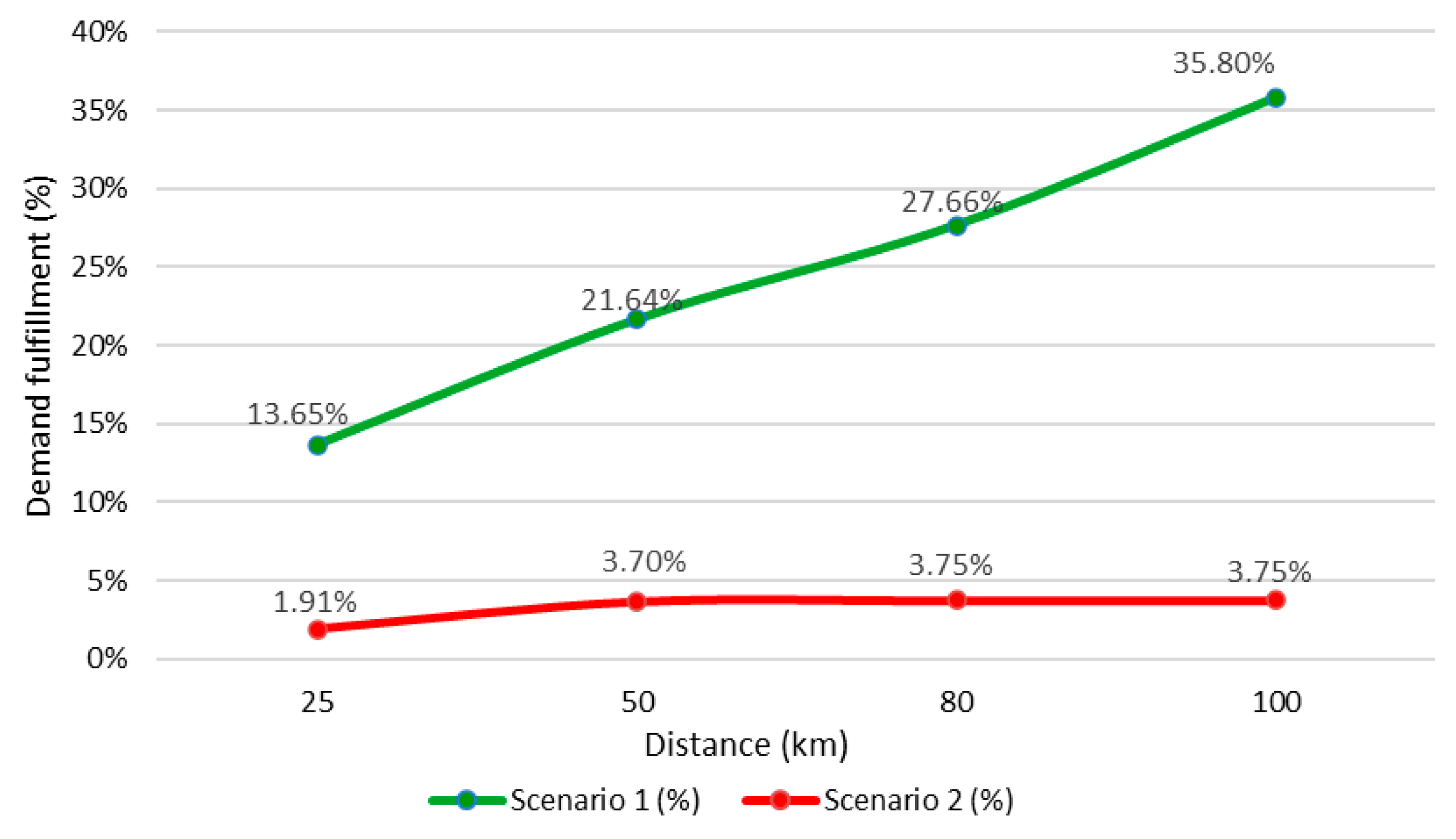
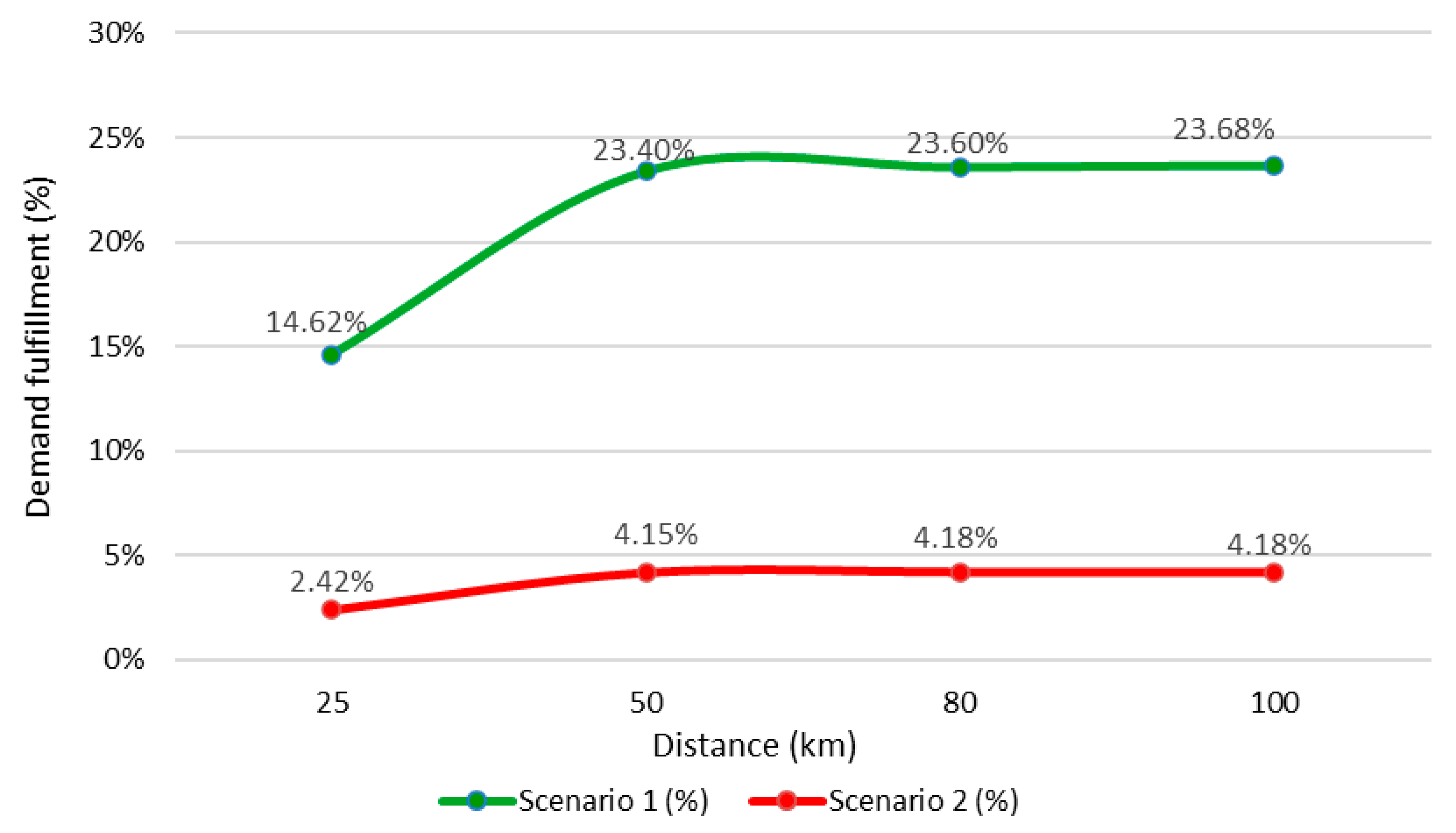
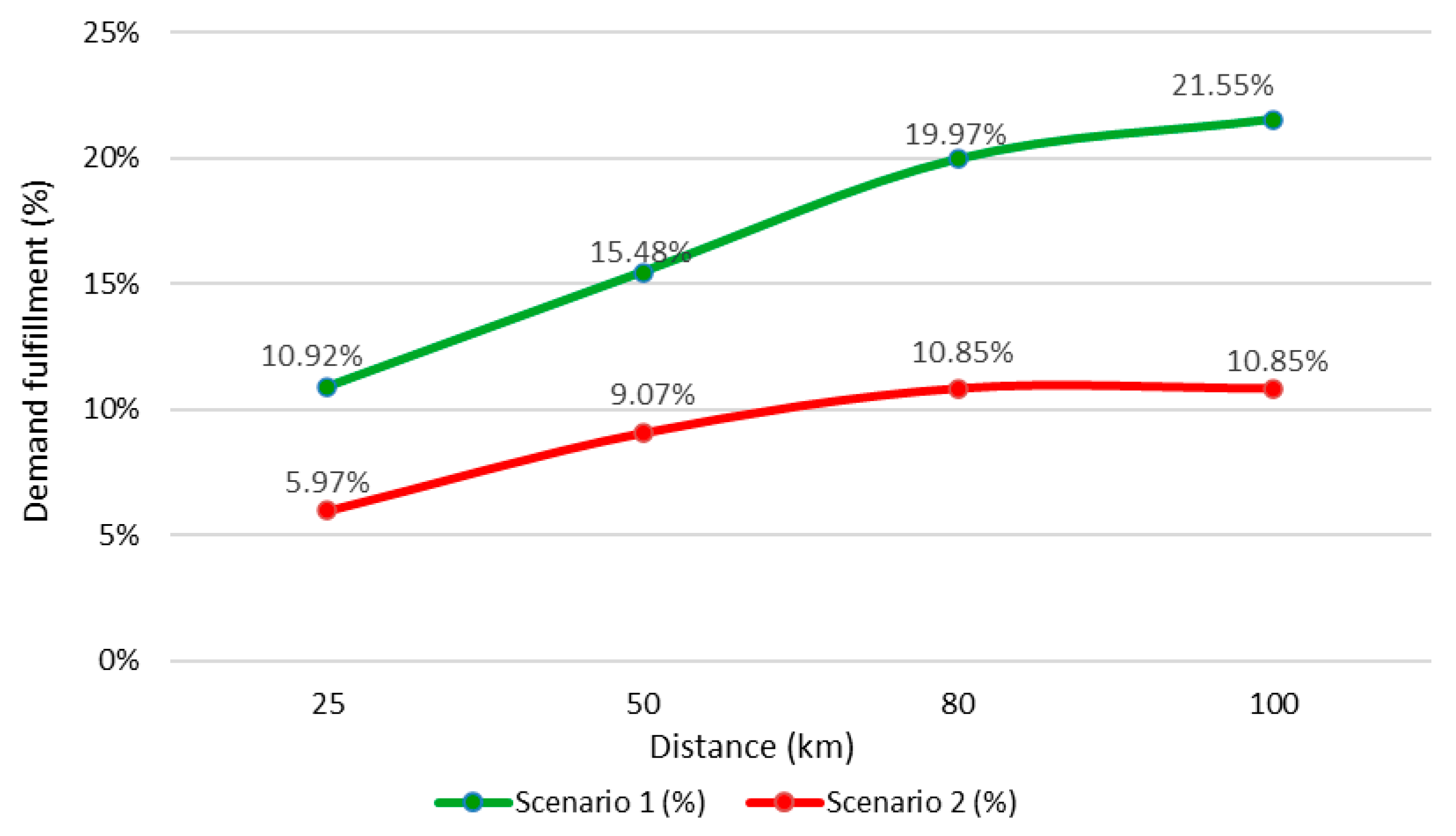
The sensitivity analysis of the maximum allocation distance (25, 50, 80, and 100 km) indicated that the most efficient operational threshold occurs at approximately 80 km. Figure 12, Figure 13 and Figure 14 illustrate the sensitivity analysis of the maximum allocation distance across the evaluated scenarios.
In Scenario 1, without chemical restrictions, a progressive increase in water demand fulfillment is observed as the allocation distance increases, reaching 27.66% for coffee, 23.60% for sugarcane, and 19.97% for cotton at this distance. Expanding the allocation distance to 100 km causes in only marginal additional gains (35.80%, 23.68%, and 21.55%, respectively), indicating that extending the distance mainly increases the transportation requirements for the treated effluent.
In Scenario 2, when the regulatory constraint on sodium application is incorporated, a substantial reduction in the potential to meet agricultural water demand is observed. Demand fulfillment stabilizes at approximately 3.75% for coffee, 4.18% for sugarcane, and 10.85% for cotton, already at 80 km. The absence of additional gains at a distance of 100 km indicates that, in this case, the limiting factor is not the spatial availability of effluent but rather the constraints on its chemical quality.
In this context, the model demonstrates that the economic allocation distance directly influences logistical requirements and pumping costs. Based on the sensitivity analysis, a maximum allocation distance of 80 km was adopted as a parameter in the allocation algorithm, as it represents a balance between spatial efficiency and technical feasibility.

3.6. Limitations of the Study

The effluent was not analyzed individually at each wastewater treatment plant (ETE). Information on the volume of effluent generated was obtained from official secondary databases made available by government agencies. In particular, in Scenario 2, sodium concentrations were represented in accordance with the regulatory limits and technical references established by Normative Deliberation CERH-MG 65/2020.
The water demand estimate was based on time series from four weather stations representative of the mesoregion, which may not fully capture climate variability at the microregional scale. Also, the physical and hydraulic soil parameters were represented by municipal average values obtained from geospatial databases and estimated using pedotransfer functions. Soil bulk density was assigned by textural class and was not obtained from local measurements.
The simulations were restricted to three crops of high regional socioeconomic relevance (coffee, sugarcane, and cotton), all classified as non-raw consumption crops. Therefore, direct extrapolation of the results to other production systems and to crops intended for fresh consumption should be done with caution.
Future studies could enhance the robustness of the methodology by incorporating local monitoring of effluent quality by WWTPs, including new crops and production systems, using climate data with higher spatial resolution, providing a detailed hydraulic representation of transport networks, and comparing the proposed algorithm with alternative optimization methods.

4. Conclusions

The northern Minas Gerais mesoregion presents great potential for treated wastewater reuse in agricultural irrigation, considering the operational capacity of the WWTPs. Based on a ten-year historical meteorological series (2014–2023), coffee exhibited the highest irrigation demand, followed by sugarcane, while cotton required comparatively lower volumes.
The incorporation of the sodium constraint significantly altered the allocation of resources among crops. Coffee exhibited a 32 percentage-point reduction (from 69% to 37%), while sugarcane demand fulfillment increased from 24% to 42%, reflecting a redistribution of allocable volumes under regulatory conditions. For cotton, allocation decreased from 184% to 108%, resulting in a 76 percentage-point reduction; however, full demand satisfaction was maintained. These findings demonstrate the regulatory influence of sodium constraints on spatial feasibility and crop-specific allocation dynamics.
The deterministic allocation framework proved effective in prioritizing WWTP–plantation pairs with greater geographic proximity and favorable topographic conditions. By integrating distance and elevation as spatial criteria, the model favors routes with greater infrastructure efficiency and potential gravity-driven conveyance.
Importantly, the sodium-regulated scenario functions as a preventive soil protection mechanism. By limiting sodium application rates, the model contributes to mitigating long-term risks associated with soil sodicity. Overall, the study demonstrates that regulation-compliant treated wastewater reuse can remain operationally viable while supporting soil conservation and environmentally responsible irrigation planning at a regional scale.
Future studies may investigate the use of meta-heuristic or multi-objective optimization techniques to incorporate additional criteria, such as hydraulic energy modeling, economic cost functions, and stochastic variability, thereby expanding the analytical scope of the proposed allocation framework.

Author Contributions

Conceptualization, A.A.d.S., A.C.L.d.O., N.d.S.R. and A.C.B.; methodology, A.A.d.S., A.C.L.d.O., N.d.S.R., F.F.d.C. and A.C.B.; formal analysis, A.A.d.S., A.C.L.d.O., N.d.S.R., R.B.A.F., F.F.d.C., A.P.R. and A.C.B.; writing—original draft preparation, A.A.d.S.; writing—review and editing, A.C.L.d.O., N.d.S.R., R.B.A.F., F.F.d.C., A.P.R. and A.C.B.; supervision, R.B.A.F., A.P.R. and A.C.B.; resources, R.B.A.F., A.P.R. and A.C.B.; funding acquisition, A.C.B. All authors have read and agreed to the published version of the manuscript.

Funding

This research was funded by Coordination for the Improvement of Higher Education Personnel (CAPES Finance Code 001) and the Research Support Foundation of the State of Minas Gerais (FAPEMIG APQ-04318-22).

Data Availability Statement

Links to the publicly available datasets used in this study are provided in the reference list. Additional data supporting the findings of this study are available from the corresponding author upon reasonable request, including intermediate processing files and derived datasets.

Conflicts of Interest

The authors declare no conflicts of interest.

Abbreviations

The following abbreviations are used in this manuscript:
CERH-MGState Council for Water Resources of Minas Gerais
E. coliEscherichia coli
ET0Reference Evapotranspiration
FAOFood and Agriculture Organization of the United Nations
FAO-56FAO Irrigation and Drainage Paper No. 56
IBGEBrazilian Institute of Geography and Statistics
IDE-SisemaSpatial Data Infrastructure of the Minas Gerais Environmental System
INMETNational Institute of Meteorology (Brazil)
SIDRAAutomatic Recovery System (IBGE)
SIRGAS 2000Geocentric Reference System for the Americas
WGS 84World Geodetic System 1984
WHOWorld Health Organization
WWTPsWastewater Treatment Plants

Appendix A

Table A1. Soil physical and hydraulic parameters adopted in the simulations (0–30 cm).
MunicipalityTextural Class
(Adopted)
θFC
(m3 m−3)
θPWP
(m3 m−3)
AWC
(m3 m−3)
FC
(g g−1)
PWP
(g g−1)
Bd
(g cm−3)
Montes Clarosclay loam0.3720.2440.1280.2860.1881.30
Piraporaloam (medium texture)0.2740.1310.1430.1830.0871.50
Salinasclay loam0.3320.1911.410.2220.1281.50
Montalvâniasandy0.1600.0880.1410.1070.0581.50
Notes: Soil organic carbon contents (C0–5, C5–15 and C15–30) were obtained from raster layers produced by Embrapa and made available by IDE-Sisema. Municipal values were derived using zonal statistics (mean) applied to each municipality’s administrative boundaries. The mean soil organic carbon content for the 0–30 cm layer was calculated as a thickness-weighted average of the three layers (5, 10, and 15 cm). Soil organic matter was estimated from soil organic carbon using the Van Bemmelen factor (OM = C × 1.724). Field capacity (θFC, −33 kPa) and permanent wilting point (θPWP, −1500 kPa) were estimated using pedotransfer functions proposed by Saxton and Rawls [31], based on municipal mean soil texture and organic matter content. Available water capacity (AWC) was calculated as the difference between θFC and θPWP. Gravimetric values were obtained by converting volumetric estimates to mass units using soil bulk density (Bd). Soil bulk density was assigned by textural class and does not correspond to local measurements.

Appendix B

Table A2. Calculation of irrigation depth for the Montes Claros weather station, Minas Gerais (mm year−1).
YearCoffeeSugarcaneCotton
2014786712536
2015771711541
2016735694500
2017821717565
2018652596464
2019773670518
2020598533391
2021749685520
2022666596475
2023770732536
Average732.1664.6504.6
Table A3. Calculation of irrigation depth for the Pirapora weather station, Minas Gerais (mm year−1).
YearCoffeeSugarcaneCotton
2014653517418
2015609569421
2016605567419
2017697514445
2018520417339
2019560520369
2020478365365
2021479468339
2022611524419
2023657572421
Average586.9503.3395.5
Table A4. Calculation of irrigation depth for the Salinas weather station, Minas Gerais (mm year−1).
YearCoffeeSugarcaneCotton
2014753689493
2015799766555
2016745689516
2017876808599
2018580539397
2019761686514
2020731666480
2021728665486
2022602536396
2023744663499
Average731.9670.7493.5
Table A5. Calculation of irrigation depth for the Montalvânia weather station, Minas Gerais (mm year−1).
YearCoffeeSugarcaneCotton
2014743676519
2015875891605
2016876731579
2017792727554
2018654465420
2019785732553
2020569466367
2021560518393
2022605516413
2023830675530
Average792691.3493.3

References

  1. Food and Agriculture Organization. OECD-FAO Agricultural Outlook 2021–2030; FAO: Paris, France, 2021. [Google Scholar] [CrossRef]
  2. Sands, R.; Meade, B.; Seale, J.L., Jr.; Robinson, S.; Seeger, R. Scenarios of Global Food Consumption; Department of Agriculture Economic Research Service: Washington, DC, USA, 2023. [Google Scholar] [CrossRef]
  3. Mehta, P.; Siebert, S.; Kummu, M.; Deng, Q.; Ali, T.; Marston, L.; Davis, K.F. Half of twenty-first century global irrigation expansion has been in water-stressed regions. Nat. Water 2024, 2, 254–261. [Google Scholar] [CrossRef]
  4. Empresa Brasileira de Pesquisa Agropecuária. Megatendência 2—Adaptação à Mudança do Clima; Embrapa: Brasília, Brazil, 2022; Available online: https://www.embrapa.br/visao-de-futuro/adaptacao-a-mudanca-do-clima (accessed on 20 November 2025).
  5. Rocha, G.G.; Freitas, A.C.V.; Cunha, A.P.M.A. Impacts of drought on bean and corn production in the Northern Mesoregion of Minas Gerais. Rev. Bras. Climatol. 2024, 34, 505–532. [Google Scholar] [CrossRef]
  6. Khan, M.A.; Noor, A.; Tahir, S.; Ullah, Q.; Qasim, M.; Haidri, I.; Shahzadi, A.; Bibi, F. Advanced agricultural water management in Pakistan: Integrative approaches and cutting-edge technologies to combat water scarcity. Sch. J. Agric. Vet. Sci. 2024, 11, 82–106. [Google Scholar] [CrossRef]
  7. Silva, J.R.M.; Celeri, M.O.; Borges, A.C.; Fernandes, R.B.A. Greywater as a water resource in agriculture: The acceptance and perception from Brazilian agricultural technicians. Agric. Water Manag. 2023, 280, 108227. [Google Scholar] [CrossRef]
  8. Yánez, D.; Espinoza, L.C.; Vargas, I.; Romero, J.; Aguirre, M.J.; Arce, R.; Abejon, R. Treated greywater as a novel water resource: The perspective of greywater treatment for reuse from a bibliometric analysis. Water Sci. Technol. 2024, 90, 3076–3110. [Google Scholar] [CrossRef] [PubMed]
  9. Thomas, S.L.; Bindhu, J.S.; Pillai, S.P.; Beena, R.; Biju, J.; Sarada, S. Nutrient dynamics and moisture distribution under drip irrigation system. J. Exp. Agric. Int. 2024, 46, 485–493. [Google Scholar] [CrossRef]
  10. Xie, G.; Su, Z.; Fu, Y.; Li, J.; Mao, D.; Wang, S. Distribution of subsurface nitrogen and phosphorus from different irrigation methods in a maize field. Hydrology 2024, 11, 171. [Google Scholar] [CrossRef]
  11. Santos, A.F.; Alvarenga, P.; Gando-Ferreira, L.M.; Quina, M.J. Urban wastewater as a source of reclaimed water for irrigation: Barriers and future possibilities. Environments 2023, 10, 17. [Google Scholar] [CrossRef]
  12. Boularbah, S.; El Khoumsi, W.; Bourziza, R.; Bourioug, M.; Abouabdillah, A. Treated wastewater reuse in agriculture: An overview. E3S Web Conf. 2024, 492, 05002. [Google Scholar] [CrossRef]
  13. Alzahrani, F.; Elsebaei, M.; Tawfik, R. Public acceptance of treated wastewater reuse in the agricultural sector in Saudi Arabia. Sustainability 2023, 15, 15434. [Google Scholar] [CrossRef]
  14. Villacorta-Ranera, C.; Blanco-Gutiérrez, I.; Novo, P. Disentangling social perspectives on the use of reclaimed water in agriculture using Q methodology. J. Environ. Manag. 2025, 381, 125264. [Google Scholar] [CrossRef]
  15. Conselho Estadual de Recursos Hídricos de Minas Gerais. Deliberação Normativa CERH-MG nº 65, de 18 de Junho de 2020; CERH-MG: Belo Horizonte, Brazil, 2020. Available online: https://www.siam.mg.gov.br/sla/download.pdf?idNorma=52040 (accessed on 20 November 2025).
  16. Kligerman, D.C.; Zanatta, A.S.; Toledo, G.d.A.; Nogueira, J.M.d.R. Path toward sustainability in wastewater management in Brazil. Int. J. Environ. Res. Public Health 2023, 20, 6597. [Google Scholar] [CrossRef]
  17. Obijianya, C.C. Agricultural irrigation using treated wastewater. Water 2025, 17, 2083. [Google Scholar] [CrossRef]
  18. Abubakar, I.R.; Mu’azu, N.D. Household attitudes toward wastewater recycling in Saudi Arabia. Util. Policy 2022, 76, 101372. [Google Scholar] [CrossRef]
  19. Oliveira, A.C.L.; Renato, N.S.; Martins, M.A.; Mendonça, I.M.; Moraes, C.A.; Resende, M.O. Modeling for estimating and optimizing the energy potential of animal manure and sewage in small and medium-sized farms. J. Clean. Prod. 2021, 319, 128562. [Google Scholar] [CrossRef]
  20. Renato, N.S.; Oliveira, A.C.L.; Ervilha, A.M.T.; Antoniazzi, S.F.; Moltó, J.; Conesa, J.A.; Borges, A.C. Replacing natural gas with biomethane from sewage treatment: Optimizing the potential in São Paulo State, Brazil. Energies 2024, 17, 1657. [Google Scholar] [CrossRef]
  21. Instituto Brasileiro de Geografia e Estatística. Informações Técnicas e Legais Para a Utilização dos Dados Publicados; IBGE: Rio de Janeiro, Brazil, 2023. Available online: https://cidades.ibge.gov.br/brasil/mg/panorama (accessed on 20 November 2025).
  22. Peres, C.S.; Ladeia, M.M.; da Silva, J.F. Evaluation of Treated Wastewater Quality for Reuse in the Northern Region of Minas Gerais. Rev. Gest. Soc. Ambient. 2025, 18, e04358. [Google Scholar] [CrossRef]
  23. Secretaria de Estado de Meio Ambiente e Desenvolvimento Sustentável (SEMAD). Panorama de Abastecimento de Água e Esgotamento Sanitário de Minas Gerais—2023; SEMAD: Belo Horizonte, Brazil, 2023. Available online: https://idesisema.meioambiente.mg.gov.br/geonetwork/srv/api/records/d6c06e2f-18ae-4922-986b-3ad2b94c38e9/attachments/panorama_abastecimento_agua_esgotamento_sanitario_semad_2023.pdf (accessed on 20 November 2025).
  24. Instituto Brasileiro de Geografia e Estatística (IBGE). Projeções Cartográficas. IBGE Atlas Escolar. Available online: https://atlasescolar.ibge.gov.br/cartografia/21733-as-projecoes-cartograficas.html (accessed on 20 November 2025).
  25. Infraestrutura de Dados Espaciais do Sistema Estadual de Meio Ambiente e Recursos Hídricos (IDE-SISEMA GeoWork). Available online: https://idesisema.meioambiente.mg.gov.br/geonetwork/srv/por/catalog.search#/home (accessed on 20 November 2025).
  26. Instituto Nacional de Pesquisas Espaciais (INPE). TOPODATA: Banco de dados Geomorfométricos do Brasil. Available online: http://www.dsr.inpe.br/topodata/ (accessed on 24 March 2026).
  27. Instituto Nacional de Meteorologia (INMET). Radar Meteorológico. Available online: https://portal.inmet.gov.br/produtos/radar (accessed on 24 March 2026).
  28. Instituto Nacional de Pesquisas Espaciais (INPE). Catálogo de dados—DGI/INPE. Available online: https://www.dgi.inpe.br/catalogo/explore (accessed on 24 March 2026).
  29. Allen, R.G.; Pereira, L.S.; Raes, D. Crop Evapotranspiration—Guidelines for Computing Crop Water Requirements; FAO Irrigation and Drainage Paper 56; FAO: Rome, Italy, 1998. [Google Scholar]
  30. Empresa Brasileira de Pesquisa Agropecuária (EMBRAPA). Solos Tropicais; Empresa Brasileira de Pesquisa Agropecuária (EMBRAPA): Brasília, Brazil, 2025. [Google Scholar]
  31. Saxton, K.E.; Rawls, W.J. Soil water characteristic estimates by texture and organic matter for hydrologic solutions. Soil Sci. Soc. Am. J. 2006, 70, 1569–1578. [Google Scholar] [CrossRef]
  32. Rasoulzadeh, A.; Kohan, M.R.; Amirzadeh, A.; Heydari, M.; Mobaser, J.A.; Raoof, M.; Fernández-Gálvez, J. Improving soil water simulation in semi-arid agriculture: A comparative evaluation of water retention curves and inverse modeling using HYDRUS-1D. Hydrology 2025, 12, 273. [Google Scholar] [CrossRef]
  33. Wang, L.; Blanchy, G.; Cornelis, W.; Garré, S. Changes in soil hydraulic and physio-chemical properties under treated wastewater irrigation: A meta-analysis. Agric. Water Manag. 2024, 295, 108752. [Google Scholar] [CrossRef]
  34. Associação Brasileira de Engenharia Sanitária e Ambiental (ABES). Nota Técnica 3—Uso Agrícola: Condições de Aplicabilidade de Efluente de Estações de Tratamento de Esgoto. In Cadernos Técnicos Sanitária e Ambiental; Associação Brasileira de Engenharia Sanitária e Ambiental (ABES): Rio de Janeiro, Brazil, 2022; Available online: https://abes-dn.org.br/pdf/ESA_NT_V2n3_DOI_compressed.pdf (accessed on 8 March 2026).
  35. Bernardo, S.; Soares, A.A.; Mantovani, E.C. Manual de Irrigação, 8th ed.; UFV: Viçosa, Brazil, 2005. [Google Scholar]
  36. INMET. Normais Climatológicas do Brasil 1991–2020; Instituto Nacional de Meteorologia: Brasília, Brazil, 2022. [Google Scholar]
  37. Agência Nacional de Águas e Saneamento Básico (ANA); Secretaria Nacional de Saneamento Ambiental do Ministério das Cidades. Atlas Esgotos: Situação do Esgotamento Sanitário nos Municípios Brasileiros (Analyses of Sewage Collection and Treatment by Municipality). Available online: https://www.ana.gov.br/atlasesgotos/ (accessed on 20 November 2025).
  38. Thonny. Thonny: Python IDE for Beginners; Institute of Computer Science, University of Tartu: Tartu, Estonia, 2024. [Google Scholar]
  39. Annamaa, A. Thonny: A Python IDE for Learning Programming. Master’s Thesis, University of Tartu, Tartu, Estonia, 2015. Available online: https://dspace.ut.ee/server/api/core/bitstreams/527fb56b-794a-414e-b328-ca79f9b75d0c/content (accessed on 20 November 2025).
  40. Hamby, D.M. A review of techniques for parameter sensitivity analysis of environmental models. Environ. Monit. Assess. 1994, 32, 135–154. [Google Scholar] [CrossRef]
  41. Van Haandel, A.; Santos, S.D.; Paiva, F.V. Aplicação do sistema UASB-lagoas de polimento para o tratamento de esgoto visando ao reúso agrícola ou industrial ou à proteção de recursos hídricos. Rev. DAE 2021, 69, 173–191. [Google Scholar] [CrossRef]
  42. Mahlalela, L.C.; Casado, C.; Marugán, J.; Septien, S.; Ndlovu, T.; Dlamini, L.N. Coupling biological and photocatalytic treatment of atrazine and tebuthiuron in aqueous solution. J. Water Process Eng. 2021, 40, 101918. [Google Scholar] [CrossRef]
  43. Vasseghian, Y.; Alimohamadi, M.; Khataee, A.; Dragoi, E.N. A global systematic review on the concentration of organophosphate esters in water resources: Meta-analysis and probabilistic risk assessment. Sci. Total Environ. 2022, 807, 150876. [Google Scholar] [CrossRef]
  44. Marouelli, W.A.; Oliveira, Á.S.; Coelho, E.F.; Nogueira, L.C.; Sousa, V.F. Manejo da Água de Irrigação. In Irrigação e Fertirrigação em Fruteiras e Hortaliças; Embrapa: Brasília, Brazil, 2011; pp. 159–232. [Google Scholar]
  45. Matos, A.T.; Matos, M.P. Disposição de Águas Residuárias no Solo e Sistemas Alagados Construídos, 1st ed.; Editora Universidade Federal de Viçosa: Viçosa, Brazil, 2017; 357p. [Google Scholar]
  46. Muscarella, S.M.; Alduina, R.; Badalucco, L.; Capri, F.C.; Di Leto, Y.; Gallo, G.; Laudicina, V.A.; Paliaga, S.; Mannina, G. Water reuse of treated domestic wastewater in agriculture: Effects on tomato plants, soil nutrient availability and microbial community structure. Sci. Total Environ. 2024, 887, 172259. [Google Scholar] [CrossRef] [PubMed]
  47. Shtull-Trauring, E.; Cohen, A.; Ben-Hur, M.; Israeli, M.; Bernstein, N. NPK in treated wastewater irrigation: Regional scale indices to minimize environmental pollution and optimize crop nutritional supply. Sci. Total Environ. 2022, 806, 150387. [Google Scholar] [CrossRef]
  48. Roy, S.; Chowdhury, N. Salt stress in plants and amelioration strategies: A critical review. In Abiotic Stress in Plants; Fahad, S., Saud, S., Chen, Y., Wu, C., Wang, D., Eds.; IntechOpen: London, UK, 2021; pp. 1–33. [Google Scholar] [CrossRef]
  49. Agência Nacional de Águas. Atlas Esgotos: Despoluição de Bacias Hidrográficas; ANA: Brasília, Brazil, 2020. Available online: https://metadados.snirh.gov.br/geonetwork/srv/api/records/1d8cea87-3d7b-49ff-86b8-966d96c9eb01 (accessed on 20 November 2025).
  50. Figueirôa, J.M.D.; Barbosa, D.C.D.A.; Simabukuro, E.A. Crescimento de plantas jovens de Myracrodruon urundeuva Allemão (Anacardiaceae) sob diferentes regimes hídricos. Acta Bot. Bras. 2004, 18, 573–580. [Google Scholar] [CrossRef]
  51. Carvalho, I.R.; Korcelski, C.; Pelissari, G.; Hanus, A.D.; Rosa, G.M. Demanda hídrica das culturas de interesse agronômico. Encicl. Biosf. 2013, 9, 969–985. [Google Scholar]
  52. Meireles, E.J.; Camargo, M.B.P.; Pezzopane, J.R.M.; Thomaziello, R.A.; Fahl, J.I.; Bardin, L.; Santos, J.C.F.; Japiassú, L.B.; Garcia, A.W.R.; Miguel, A.E.; et al. Fenologia do Cafeeiro: Condições Agrometeorológicas e Balanço Hídrico do Ano Agrícola 2004–2005; Embrapa: Campinas, Brazil, 2004. [Google Scholar]
  53. Oliveira, L.C.; Oliveira, L.S.; Silva, M.M.; Santos, R.S.L.; Nascimento, B.M.C.; Pereira, D.D. Aceita um cafezinho? O semiárido hospitaleiro. Produção e produtividade. Meio Ambiente 2023, 5, 1–13. Available online: https://meioambientebrasil.com.br/index.php/MABRA/article/view/393/218 (accessed on 24 March 2026).
  54. Dingre, S.K.; Gorantiwar, S.D. Determination of the water requirement and crop coefficient values of sugarcane by field water balance method in semiarid region. Agric. Water Manag. 2020, 232, 106042. [Google Scholar] [CrossRef]
  55. Boulange, J.; Nizamov, S.; Nurbekov, A.; Ziyatov, M.; Kamilov, B.; Abduvasikov, A.; Khamdamova, G.; Watanabe, H. Calibration and validation of the AquaCrop model for simulating cotton growth under a semi-arid climate in Uzbekistan. Agric. Water Manag. 2025, 310, 109360. [Google Scholar] [CrossRef]
  56. Wanniarachchi, S.; Sarukkalige, R. A review on evapotranspiration estimation in agricultural water management: Past, present, and future. Hydrology 2022, 9, 123. [Google Scholar] [CrossRef]
  57. Manucharyan, M. Climate change impacts on sustainable agriculture: Evidence from Armenia. Unconv. Resour. 2025, 6, 100159. [Google Scholar] [CrossRef]
  58. Centro Nacional de Monitoramento e Alertas de Desastres Naturais. Cemaden Analisa Secas Recentes no Brasil e Apresenta Diagnóstico e Projeções como Subsídio para a COP-16; Cemaden: São José dos Campos, Brazil, 2024. [Google Scholar]
  59. Gao, Y.; Shao, G.; Wu, S.; Xiaojun, W.; Lu, J.; Cui, J. Changes in soil salinity under treated wastewater irrigation: A meta-analysis. Agric. Water Manag. 2021, 255, 106986. [Google Scholar] [CrossRef]
  60. Luciano, E.A.; Benincasa, M. Alterações na infiltração de água em Latossolos devidas à incorporação controlada de resíduo industrial de silicatos. Holos Environ. 2001, 1, 101–113. [Google Scholar] [CrossRef][Green Version]
  61. Bassoi, L.H.; Teixeira, A.H.d.C.; Braga, M.B.; Simões, W.L.; Calgaro, M.; Pinto, J.M. Uso da água em agricultura irrigada no Semiárido brasileiro. In Semiárido Brasileiro: Pesquisa, Desenvolvimento e Inovação; Sá, I.B., da Silva, P.C.G., Eds.; Embrapa Semiárido: Brasília, Brazil, 2012; pp. 353–382. Available online: https://www.embrapa.br/busca-de-publicacoes/-/publicacao/862126/uso-da-agua-em-agricultura-irrigada-no-semiarido-brasileiro (accessed on 29 January 2026).
  62. Pereira, L.S.; Allen, R.G.; Smith, M.; Raes, D. Crop evapotranspiration estimation with FAO56: Past and future. Agric. Water Manag. 2015, 147, 4–20. [Google Scholar] [CrossRef]
  63. Oliveira, A.C.L.; Resende, M.O.; Silva, E.G.M.; Renato, N.S.; Martins, M.A.; Sequinel, R.; Machado, J.C. Evaluation and optimization of electricity generation through manure obtained from animal production chains in two Brazilian mesoregions. J. Clean. Prod. 2021, 316, 128270. [Google Scholar] [CrossRef]
  64. Bai, C.; Yao, L.; Wang, C.; Zhao, Y.; Peng, W. Optimization of water and energy spatial patterns in the cascade pump station irrigation district. Sustainability 2022, 14, 4943. [Google Scholar] [CrossRef]
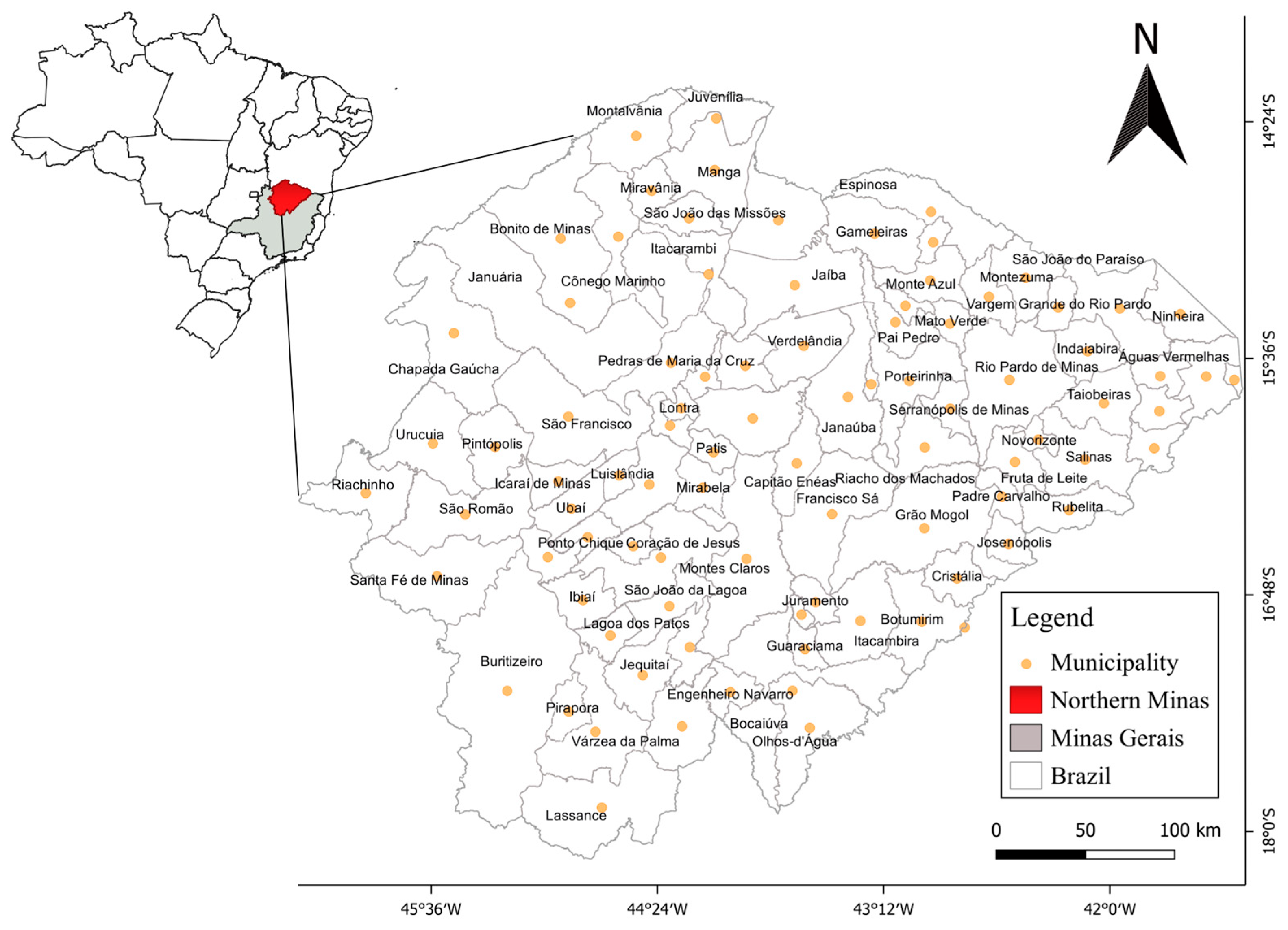
Figure 1. Mesoregion of Northern Minas in the state of Minas Gerais, Brazil. Source: elaborated by the authors using IDE-Sisema datasets.
Water 18 00853 g001
Figure 2. Integrated flowchart of the optimization process for allocation.
Water 18 00853 g002
Figure 3. Integration between Normative Deliberation CERH-MG 65/2020 and the availability of treated wastewater in WWTPs with a focus on agricultural reuse.
Water 18 00853 g003
Figure 4. Elevation map of the study area and wastewater treatment plants in Northern Minas Gerais, Brazil. Source: elaborated by author using IDE-Sisema datasets.
Water 18 00853 g004
Figure 5. Annual values of irrigation depths calculated for coffee, sugarcane, and cotton crops based on meteorological data from stations located in Montes Claros, Pirapora, Salinas, and Montalvânia.
Water 18 00853 g005
Figure 6. Trend in simulated annual irrigation depths (2014–2023) by municipality. (a) Montes Claros (2014–2023). (b) Pirapora (2014–2023). (c) Salinas (2014–2023). (d) Montalvânia (2014–2023).
Water 18 00853 g006
Figure 7. Proportion of annual water demand by crop.
Water 18 00853 g007
Figure 8. Proportion of crop water demand met under the two simulated scenarios (Scenario 1 and Scenario 2), derived from the results presented in Table 2 and Table 3.
Water 18 00853 g008
Figure 9. Allocation of wastewater from WWTPs to cotton under Scenario 1 (A) and Scenario 2 (B).
Water 18 00853 g009
Figure 10. Allocation of wastewater from WWTPs to coffee under Scenario 1 (A) and Scenario 2 (B).
Water 18 00853 g010
Figure 11. Allocation of wastewater from WWTPs to sugarcane under Scenario 1 (A) and Scenario 2 (B).
Water 18 00853 g011
Figure 12. Sensitivity analysis of maximum allocation distance for coffee under Scenario 1 and Scenario 2.
Water 18 00853 g012
Figure 13. Sensitivity analysis of maximum allocation distance for sugarcane under Scenario 1 and Scenario 2.
Water 18 00853 g013
Figure 14. Sensitivity analysis of maximum allocation distance for cotton under Scenario 1 and Scenario 2.
Water 18 00853 g014
Table 1. Soil physical parameters adopted in the simulations (0–30 cm).
MunicipalityTextural Class (Adopted)FC
(g g−1)
PWP
(g g−1)
Bd
(g cm−3)
Montes Clarosclay loam0.2860.1881.30
Piraporaloam (medium texture)0.1830.0871.50
Salinasclay loam0.2220.1281.50
Montalvâniasandy0.1070.0581.50
Notes: Soil textural class represents the municipal mean surface texture (0–30 cm). Field capacity (FC) and permanent wilting point (PWP) were estimated using municipal mean texture and organic matter derived from soil organic carbon layers provided by IDE-Sisema and Embrapa. Soil bulk density (Bd) was assigned by textural class, using typical values for surface mineral soils (0–30 cm). Gravimetric FC and PWP values were obtained from volumetric estimates (FC = θFC/Bd; PWP = θPWP/Bd).
Disclaimer/Publisher’s Note: The statements, opinions and data contained in all publications are solely those of the individual author(s) and contributor(s) and not of MDPI and/or the editor(s). MDPI and/or the editor(s) disclaim responsibility for any injury to people or property resulting from any ideas, methods, instructions or products referred to in the content.