Review

From Pollution to Resource: Algal–Bacterial Symbiotic Systems for Swine Wastewater Treatment and Resource Recovery—A Review
1
School of Environmental and Municipal Engineering, Huangdao Campus, Qingdao University of Technology, Qingdao 266525, China
2
Shanghai Advanced Research Institute, Chinese Academy of Sciences, Shanghai 201210, China
*
Authors to whom correspondence should be addressed.
Water 2026, 18(7), 833; https://doi.org/10.3390/w18070833
Submission received: 2 March 2026 / Revised: 24 March 2026 / Accepted: 27 March 2026 / Published: 31 March 2026
(This article belongs to the Special Issue Algae-Based Technology for Wastewater Treatment)

Abstract

Swine wastewater is a high-strength agricultural effluent characterized by high organic loading, elevated ammonium nitrogen and phosphorus concentrations, and frequently low C/N ratios, which make simultaneous pollutant removal and resource recovery challenging. Conventional physicochemical, anaerobic, and aerobic treatment technologies are widely used, but they are often constrained by high energy demand, ammonia inhibition, insufficient nitrogen recovery under low C/N conditions, and limited resource valorization. This review comparatively evaluates these conventional technologies alongside microalgal and algal–bacterial symbiotic (ABS) systems for swine wastewater treatment and resource recovery. Particular attention is given to algal–bacterial interactions, oxygen and carbon exchange, nitrogen and phosphorus removal pathways, reactor configurations, key operational parameters, and biomass valorization routes. The reviewed evidence shows that conventional anaerobic–aerobic systems generally achieve stable COD removal (>80%) but often provide limited nitrogen recovery, whereas microalgal systems can remove 80–90% of nitrogen and phosphorus but remain restricted by ammonia toxicity, light attenuation, and biomass harvesting costs. Under optimized conditions, ABS granular systems have achieved >90% COD removal, >80% total nitrogen removal, and 70–95% total phosphorus removal, while also improving biomass settleability and process stability. Overall, ABS systems offer a promising route to shift swine wastewater treatment from discharge-oriented pollution control toward resource-oriented management. Future research should prioritize reactor scale-up, long-term operational stability, biological monitoring, and economically viable biomass valorization.

1. Introduction

According to the United Nations, the global population reached nearly 8.2 billion by mid-2024 and is projected to increase by an additional 2 billion over the next 60 years, peaking at approximately 10.3 billion in the mid-2080s [1]. Meanwhile, rising purchasing power in developing countries—particularly China—is accelerating dietary transitions from plant-based staples toward animal-derived products. Over the next decade, developing countries are expected to account for approximately 82% of the projected increase in global meat consumption [2].
Pork is the second most consumed meat worldwide, representing 32% of total global meat consumption, second only to poultry [3]. China is both the largest producer and consumer of pork. As of 2025, the annual number of pigs slaughtered nationwide reached 719.73 million head, an increase of 17.16 million head compared with 2024 (2.4% growth). The total live pig inventory was 429.67 million head, reflecting a year-on-year increase of 2.24 million head (0.5%). Total pork production reached 59.38 million tons, representing a 3.9% increase compared with the previous year [4]. Table 1 summarizes the estimated swine wastewater generation in China from 2015 to 2025 based on the year-end live pig inventory and a reported wastewater generation coefficient.
As shown in Table 1, China has maintained a consistently high level of swine wastewater generation over the past decade. Based on the year-end live pig inventory, the estimated national swine wastewater output remained within the range of 4.66–6.87 million m3 per day during 2015–2025, highlighting the substantial and persistent environmental burden associated with intensive pig production. In 2025 alone, the estimated swine wastewater output reached approximately 6.45 million m3 per day, posing considerable challenges for wastewater treatment.
Swine wastewater originates primarily from animal urine and feces, residual feed, and flushing water from pig housing facilities. It is typically characterized by dark coloration, high organic matter concentration, and elevated suspended solids. The pollutants are predominantly present in dissolved and particulate carbohydrate forms, rendering the wastewater highly biodegradable [6]. To better illustrate the complexity of swine wastewater, Table 2 summarizes the typical physicochemical characteristics reported in previous studies.
As shown in Table 2, swine wastewater generally exhibits high organic loading and elevated nitrogen and phosphorus concentrations, while its composition varies markedly with collection point, solids content, and pretreatment stage. Raw swine wastewater and slurry-rich fractions usually show substantially higher COD and nutrient concentrations than anaerobically digested or otherwise pretreated liquid fractions, which partly explains the considerable differences in treatment performance reported across studies.
If discharged without adequate treatment, swine wastewater can intensify eutrophication in receiving water bodies, contribute to soil acidification, and generate air pollution and greenhouse gas emissions, thereby causing serious ecological and environmental risks. Therefore, strengthening both resource-oriented utilization and environmentally sound treatment of swine wastewater is of significant importance for environmental protection and sustainable livestock industry development [12].
In China, the discharge standards for livestock and poultry wastewater specify the following limits: pH 6–9; suspended solids (SS) ≤ 150 mg/L for direct discharge (≤300 mg/L for indirect discharge); COD ≤ 150 mg/L (≤300 mg/L indirect); biochemical oxygen demand (BOD5) ≤ 40 mg/L (≤80 mg/L indirect); ammonium nitrogen (NH4+–N) ≤ 40 mg/L (≤70 mg/L indirect); total nitrogen (TN) ≤ 70 mg/L (≤100 mg/L indirect); and total phosphorus (TP) ≤ 5.0 mg/L (≤8.0 mg/L indirect) [13]. In large-scale livestock operations in China, pollution control and resource utilization typically involve four major steps: (i) pretreatment, (ii) anaerobic digestion, (iii) biogas purification and comprehensive utilization, and (iv) treatment and utilization of digestate, including both liquid and solid fractions [5].
In recent years, increasing attention has been directed toward nutrient recovery from swine wastewater [14]. For example, comparative studies have evaluated the methane recovery performance of anaerobic membrane bioreactors (AnMBR) and upflow anaerobic sludge blanket (UASB) reactors in treating swine wastewater [15]. The recovery of nitrogen and phosphorus in synthetic swine wastewater using modified magnesium-oxyde-palygorskite (MgO-PAL) materials has also been examined by other researchers [16].
Beyond nutrient recovery and conventional treatment by-products, swine wastewater has also been explored as a low-cost nutrient source for microalgae cultivation. One line of research has used swine wastewater as a culture medium for Tetradesmus obliquus to produce biomass with biostimulant properties. The extracted bioactive compounds were evaluated through multiple bioassays, and the centrifuged biomass was further tested as a biofertilizer. This strategy enabled both full and partial valorization of microalgal products, reduced waste generation, improved biomass profitability, and supported the development of a circular bioeconomy [17].
Compared with previous reviews on general livestock wastewater treatment or algal–bacterial systems, this review specifically focuses on swine wastewater, a high-strength and highly variable wastewater characterized by elevated ammonium, organic matter, and nutrient loads. In particular, this review not only compares conventional physicochemical, anaerobic, and aerobic treatment technologies with microalgal and algal–bacterial symbiotic (ABS) systems but also integrates the underlying algal–bacterial interaction mechanisms, nutrient removal pathways, reactor configurations, key operational parameters, biomass valorization routes, and scale-up challenges. By linking treatment performance with resource recovery potential, this review aims to provide a more application-oriented perspective for the development of sustainable and resource-efficient swine wastewater treatment systems.
Accordingly, this review focuses on three major aspects: (i) the pollutant removal performance of different treatment methods; (ii) the key factors influencing biomass production from swine wastewater; and (iii) the potential of microalgae and algal–bacterial symbiotic systems for biomass generation and nutrient recovery.
By integrating nutrient recovery with biomass production, swine wastewater treatment can transition from a cost-intensive environmental burden to a value-generating component within circular agricultural systems, thereby alleviating pressures on enterprises, ecosystems, and society.

2. Treatment Options for Swine Wastewater

At present, biological treatment remains the dominant approach for swine wastewater management, while physicochemical methods are typically applied as pretreatment or advanced polishing units [18]. According to different treatment objectives, existing technologies can be broadly classified into two categories: (i) conventional treatment technologies primarily aimed at achieving discharge standards, and (ii) emerging treatment technologies designed for resource recovery. The traditional technologies of treatment, which enjoy the advantages of initial development and broad application in engineering, are at a comparatively high level of practical application. They are, however, mostly associated with high energy usage, high operational costs, and low resource recovery efficiency. Contrary to this, new technologies, specifically the algal–bacterial symbiotic systems, can attain pollutant removal, recovery of nitrogen and phosphorus, and microalgal biomass simultaneously [18,19]. These integrated systems provide a new technological direction for resource-oriented and sustainable swine wastewater treatment.

2.1. Physicochemical Methods

2.1.1. Coagulation and Sedimentation

In swine wastewater treatment, solid–liquid separation is majorly done using sedimentation and coagulation. There is an effect on their performance based on the duration of sedimentation, concentration of wastewater, and type and dosage of coagulants applied. As claimed by Deng et al., simultaneous losses to COD, BOD5, TN, and TP can be achieved by only the process of sedimentation. The water efficiencies of COD, BOD, TN, and TP were 52.7, 52.8, 42.4, and 52.8, respectively, at the end of 3 h of sedimentation [20].
Coagulant addition remarkably improves the efficiency of solid–liquid separation. In a single experimental work, naturally occurring sedimentation dropped the total suspended solids (TSS) of 5, 800 mg/L to 1450 mg/L, and the removal efficiency was 75 percent. Total phosphorus (TP) was reduced from 533 mg/L to 318 mg/L (40% removal). TP removal was improved to 70 percent when 1600 mg/L aluminum sulfate, in the form of a flocculant, was added. Further addition of the dosage of aluminum sulfate to 3000 mg/L showed TP removal efficiency of 93% [21]. These findings indicate that the addition of coagulants is important in enhancing and hastening solid–liquid segregation.
Sedimentation needs minimal infrastructure and does not involve the input of external energy, which also improves the low operational cost. Sedimentation is, however, not usually used independently as a treatment method, except in limited applications; however, it can be used as a pretreatment process to precede anaerobic or aerobic biological treatment, especially in relation to dissolved contaminants, for which it has a very low capacity to remove.

2.1.2. Adsorption

Adsorption has also gained a lot of applications in wastewater treatment, since it is operationally simple and comparatively high in efficiency. The technology of biochar manufacturing from pig manure has been examined in recent studies [22]. Biochar can be characterized as a high-specific surface area with a large number of porous structures that present a promising adsorbent material in the removal of phosphates [23].
The adsorption performance of biochar can be significantly enhanced through modification with metal nanoparticles such as Ca, Mg, and Fe [24,25]. For example, nano zero-valent iron (nZVI)-modified biochar achieved phosphate adsorption efficiencies of 68.0–83.7% within 60 min [26]. In addition, the incorporation of elements such as Ca, Fe, Mg, Si, Mn, and K not only improves nitrogen and phosphorus adsorption capacity but also enriches the biochar with beneficial nutrients and trace metals. These phosphorus-enriched biochars can subsequently be applied to soil as slow-release fertilizers to promote crop growth [27].
Although the effectiveness of physical adsorption for phosphorus recovery from swine wastewater has been demonstrated, its practical applicability is constrained by several factors. The effective treatment range of phosphorus concentration is limited, and the reported phosphorus recovery rate ranges from 0.48 to 54.0 mg/L·d [28]. Moreover, operational and maintenance costs, including adsorbent regeneration and replacement, must be carefully considered. Therefore, adsorption technology is generally applied as a tertiary or polishing treatment step in swine wastewater treatment systems rather than as a primary treatment process.

2.1.3. Magnesium Ammonium Phosphate Crystallization (MAP)

Struvite precipitation is a crystallization process involving magnesium ammonium phosphate or MAP that is used to recover both nitrogen and phosphorus in the swine wastewater. In this step, the ammonium (NH4+), phosphate (PO43−), and magnesium (Mg2+) ions respond to create struvate (MgNH4PO4·6H2O) precipitates, and thus, attain nutrient recovery in wastewater [29].
Mg2+ + NH4+ + PO43− + 6H2O → MgNH4PO4·6H2O ↓
The formation of struvite is strongly influenced by pH, reactant molar ratios, and temperature, with alkaline conditions generally favoring crystallization efficiency.
Some of these studies have indicated that over 98 percent of phosphorous contained in wastewater streams can be recovered using MAP crystallization. The resulting struvate may be recycled as slow-release fertilizer, which brings agronomic benefits but minimizes nutrient loss [30,31]. It has been identified that MAP crystallization exhibits a high level of operational adaptability, in that it can be kept under a variety of temperature and pH conditions without showing any change in removal performance. In addition, it is eco-friendly, and the process does not necessitate any major input of external energy [32].
Nevertheless, stoichiometric ratios of reactants should be varied to obtain the best phosphorus removal efficiency. The ratio of N:P is about 5.5:1, and the Mg:P ratio is usually about 2:1 [33]. The economic viability of the process directly depends on the dosage of chemical reagents.
Cao et al. suggest that, economically, MAP technology is more appropriate to treat wastewater in a plant with a capacity of more than 300,000 m3/d. In addition, an increase in phosphorus levels in digestate and the market price of struvite increases the hit-and-miss of phosphorus recovery projects [34]. Thus, the MAP crystallization, although effective on a large scale, is highly determined by the economic conditions and demand in the market.

2.1.4. Membrane Separation Technology

Membrane separation technology facilitates the process of separation, purification, concentration, and recovery of wastewater elements without phase separation [35]. Some of the common membrane processes are microfiltration (MF), ultrafiltration (UF), nanofiltration (NF), and reverse osmosis (RO). Microfiltration is one method commonly used in the treatment of swine wastewater as a pretreatment process for solids. Usually, the advanced or polishing units used at the end of the treatment process are ultrafiltration, nanofiltration, and reverse osmosis to achieve the targets of discharging standards by membrane concentration and separation.
Membrane bioreactors (MBRs), which integrate biological treatment with membrane separation, combine microbial degradation with efficient solid–liquid separation. MBR systems are characterized by high volumetric loading capacity, reduced footprint, enhanced nitrification efficiency, stable and high-quality effluent, and relatively convenient operation and management [36].
Currently, combined membrane processes have been developed to improve treatment performance, including MBR coupled with chemical precipitation, MBR combined with electrocatalysis, microbial fuel cell (MFC) integrated with MBR, MBR + NF, and MBR + NF + RO systems [35]. For swine wastewater with complex composition, hybrid membrane systems are often applied to meet advanced treatment requirements [35].
For example, the algal–bacterial membrane photobioreactor (MB-MPBR) integrates algal–bacterial symbiosis with membrane bioreactor technology. This configuration enables efficient simultaneous removal of carbon, nitrogen, and phosphorus, enhanced system stability, and improved resource recovery efficiency [37,38].
Overall, membrane-based hybrid processes can be flexibly configured according to specific treatment objectives. By selecting appropriate coupling technologies, treatment efficiency can be optimized, operational costs minimized, and resource recovery maximized [35].
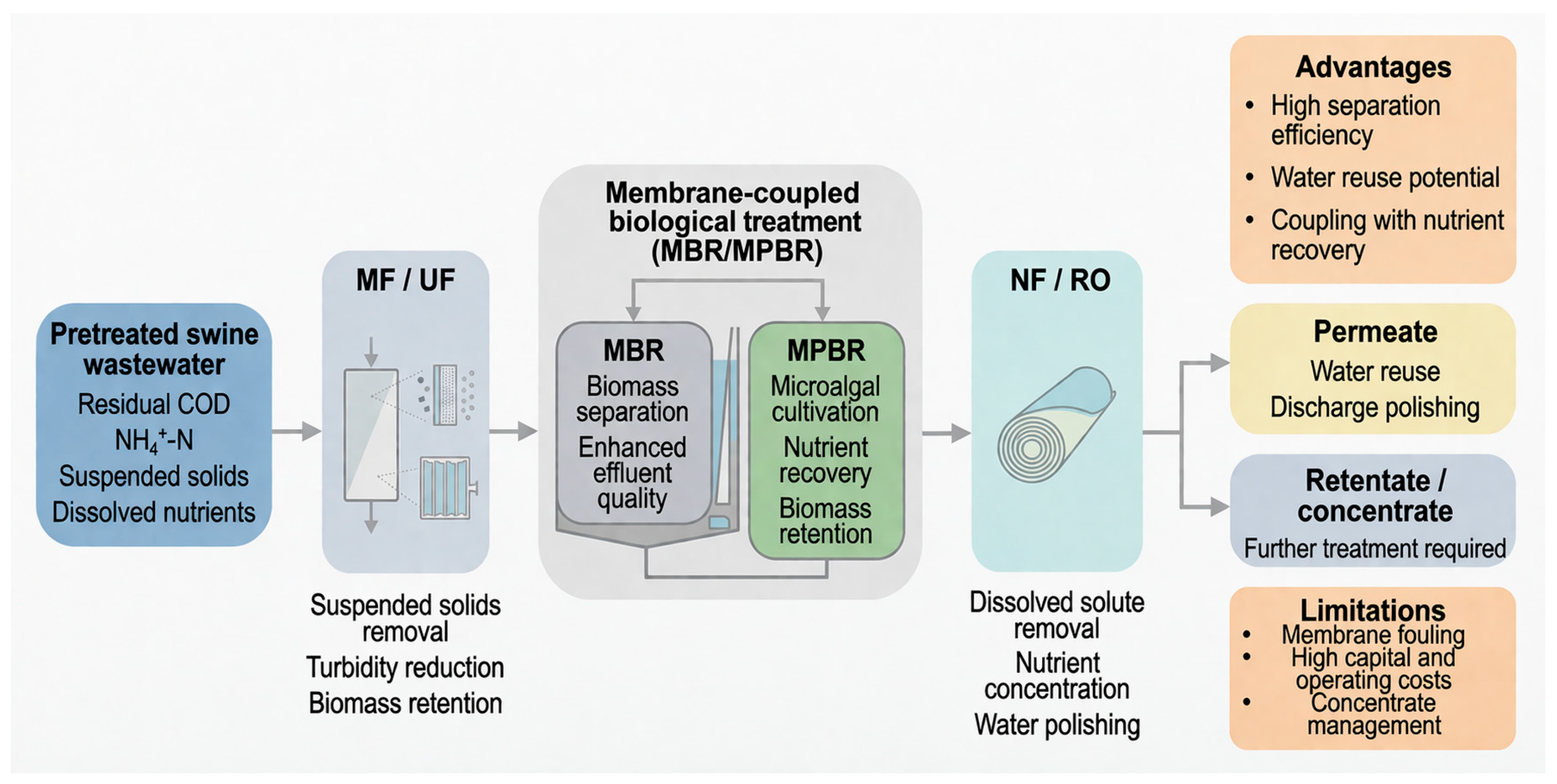
Figure 1 summarizes the major membrane-based and hybrid treatment configurations currently applied to swine wastewater, highlighting the role of MF as pretreatment, membrane-coupled biological units as the core treatment stage, and NF/RO as advanced polishing processes.

2.2. Biological Treatment

The fundamental technology for the attainment of compliant discharge of swine wastewater is that of biological treatment. The core idea is based on employing microbial metabolism to make dissolved and colloidal organic pollutants, nitrogen, and phosphorus compounds into non-toxic final products or microbial biomass by means of biochemical transformation. To balance the efficacy of treatment, energy usage, and cost, anaerobic–aerobic (AO) or anaerobic–anoxic–aerobic (A2O) configurations are typically used in practical engineering applications in order to provide a balance between efficacy and cost.

2.2.1. Anaerobic Biological Treatment

Anaerobic biological treatment, also known as anaerobic digestion (AD), refers to a biochemical process occurring under oxygen-free conditions, in which facultative and obligate anaerobic microorganisms work synergistically to decompose organic matter into methane (CH4), carbon dioxide (CO2), and stabilized organic residues [39].
Based on studies of methanogenic archaea and hydrogen-producing acetogenic bacteria, M. P. Bryant (1979) proposed the classical three-stage theory of anaerobic digestion, which divides the process into: (i) hydrolysis and fermentation, (ii) hydrogen-producing acetogenesis, and (iii) methanogenesis [40].
During the hydrolysis and fermentation stage, macromolecular organic compounds such as cellulose, proteins, and lipids are decomposed by extracellular enzymes secreted by anaerobic bacteria into smaller molecules, including polysaccharides, amino acids, fatty acids, and glycerol. These simpler organic molecules are subsequently converted by acidogenic bacteria through anaerobic fermentation and oxidation into volatile fatty acids (VFAs), such as acetic acid, propionic acid, and butyric acid, as well as alcohols.
In the hydrogen-producing acetogenesis stage, VFAs such as propionate and butyrate, along with alcohols generated in the previous stage, are further converted into acetate, hydrogen (H2), and CO2 by syntrophic bacteria.
Finally, during the methanogenesis stage, acetate, H2, and CO2 are converted into methane (CH4) and CO2 by methanogenic archaea, completing the stabilization and degradation of organic matter [41].
Throughout this process, chemical oxygen demand (COD) and biochemical oxygen demand (BOD) are effectively reduced. At the same time, methane is recovered as an energy carrier. Therefore, anaerobic biological treatment demonstrates strong cost-effectiveness and energy recovery potential when applied to high-organic-strength swine wastewater [42].
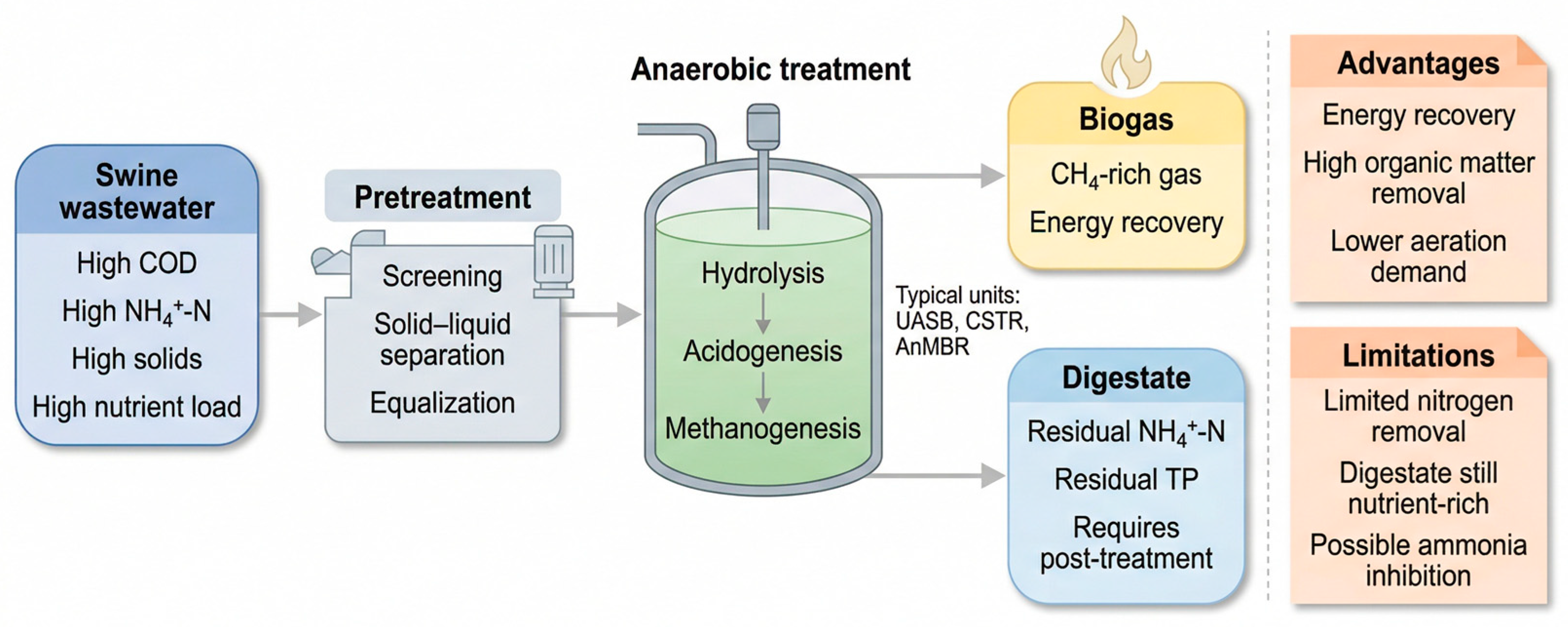
Figure 2 provides a schematic overview of the main process steps, products, and engineering characteristics of anaerobic treatment for swine wastewater.
Based on differences in treatment principles and reactor configurations, several anaerobic treatment processes have been widely applied in swine wastewater management. These include the upflow anaerobic sludge blanket (UASB) reactor, expanded granular sludge bed (EGSB) reactor, anaerobic sequencing batch reactor (AnSBR), and anaerobic membrane bioreactor (AnMBR). The working principles, advantages, and limitations of these representative processes are summarized in Table 3.

2.2.2. Aerobic Biological Treatment

Aerobic biological treatment refers to the degradation of organic matter in wastewater in the presence of dissolved molecular oxygen through the metabolic activities of aerobic and facultative microorganisms [39]. During the treatment process, dissolved and colloidal organic pollutants in wastewater are directly absorbed and metabolized by bacteria. Solid and colloidal organic matter first adheres to the surface of bacterial cells and is subsequently hydrolyzed by extracellular enzymes into soluble substances before entering the cells for further metabolism [41].
The aerobic treatment process is generally stable and environmentally benign. Through aerobic metabolism, organic matter is ultimately oxidized into carbon dioxide (CO2), water (H2O), and microbial biomass (excess sludge). Compared with anaerobic systems, aerobic treatment typically generates minimal odor and requires a shorter treatment time, resulting in smaller reactor volumes. Common aerobic treatment processes can be broadly categorized into suspended-growth systems and attached-growth systems. According to different operational modes and microbial growth patterns, aerobic treatment technologies include conventional activated sludge (AS), step aeration, extended aeration, biofilters (BF), rotating biological contactors (RBC), and biological aerated filters (BAF) [39]. Under appropriate operating conditions, BOD5 removal efficiencies generally range from 80% to 90%, and may exceed 95% in optimized systems.
However, conventional activated sludge processes operate under fully aerobic conditions and lack the anaerobic and anoxic environments required for enhanced biological phosphorus removal and complete denitrification. As a result, total phosphorus removal efficiency is often limited. To achieve comprehensive removal of nitrogen, phosphorus, and COD in swine wastewater treatment, activated sludge and its modified processes are commonly integrated with anaerobic treatment units. Typical configurations include anaerobic + sequencing batch reactor (SBR), anoxic–aerobic (A/O or A2O) processes, and membrane bioreactors (MBR) [44].
According to Cai et al., when SBR, A/O, and MBR systems were applied individually to treat swine wastewater, removal efficiencies of key pollutants such as COD, total nitrogen (TN), and total phosphorus (TP) all exceeded 90%, achieving satisfactory treatment performance [45].
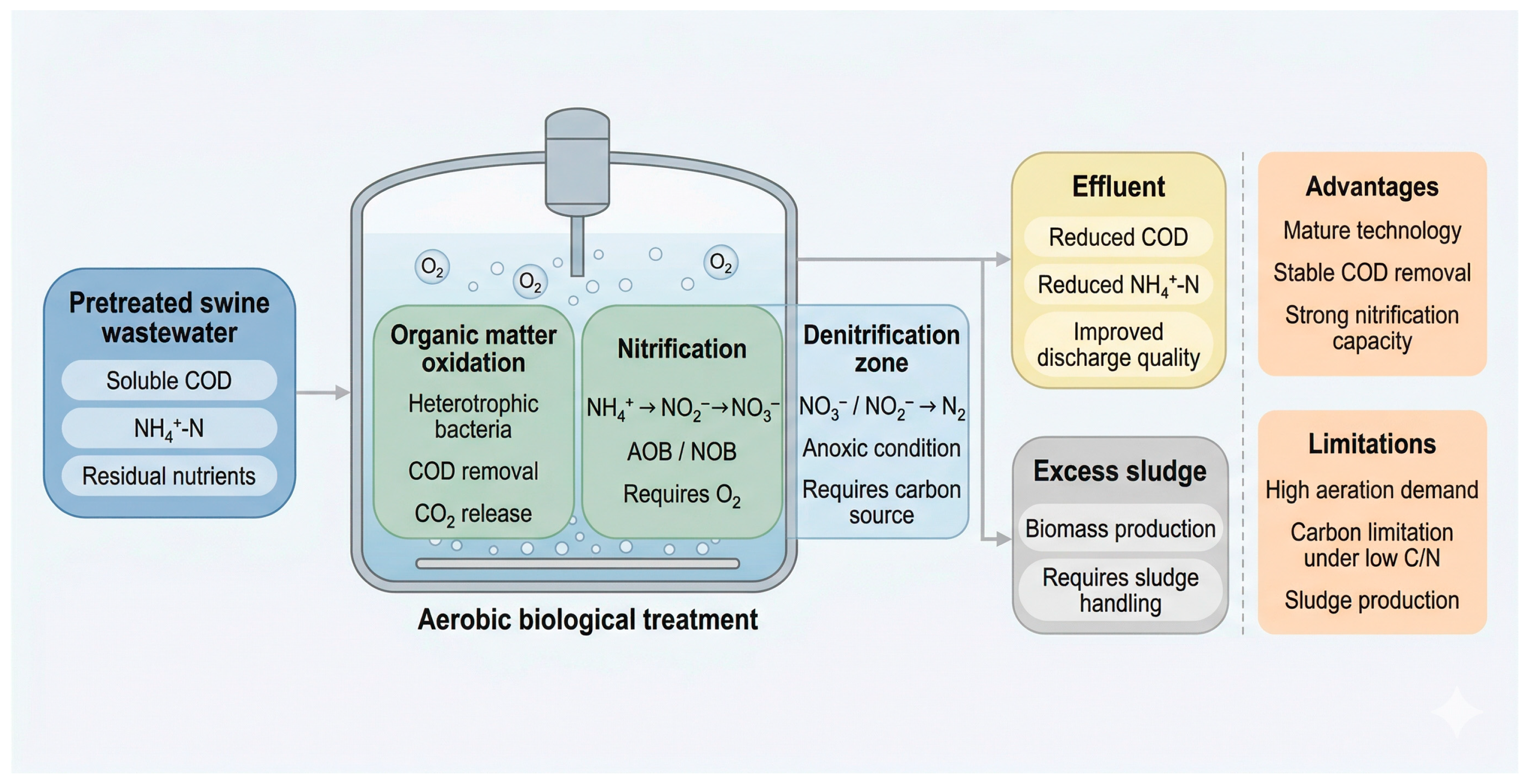
Figure 3 illustrates the major functional pathways involved in aerobic treatment of swine wastewater, including organic matter oxidation, nitrification, denitrification, and sludge generation.
Currently, aerobic/anoxic treatment processes applied in swine wastewater management mainly include conventional activated sludge and its modified forms (A/O and A2O), sequencing batch reactors (SBR), membrane bioreactors (MBR), and enhanced nitrogen removal strategies such as microaerobic operation or intermittent aeration. The working principles, advantages, and limitations of these representative processes are summarized in Table 4.

3. Microalgae, Bacteria, and Algal–Bacterial Symbiotic Systems in Swine Wastewater Treatment

3.1. Advances in Microalgal Systems for Swine Wastewater Treatment

Microalgae are among the earliest life forms on Earth and are widely distributed across diverse aquatic environments, including freshwater, marine ecosystems, and even extreme habitats [51]. According to reports from the Institute of Hydrobiology, Chinese Academy of Sciences, more than 30,000 algal species have been identified globally, of which approximately 70%—over 20,000 species—belong to microalgae [52]. Common microalgal taxa include cyanobacteria (e.g., Spirulina), green algae (e.g., Chlorella and Scenedesmus), and diatoms (e.g., Skeletonema). As photosynthetic microorganisms, microalgae assimilate inorganic carbon (e.g., CO2), nitrogen (e.g., NH4+–N and NO3–N), and phosphorus (e.g., PO43−–P) through photosynthesis and convert them into cellular biomass [53].
Their unique physiological characteristics enable microalgae to be applied in wastewater treatment systems. As early as 1957, Oswald and Gotaas proposed the theoretical and technical framework for applying photosynthesis in sewage treatment [54]. During the 1960s–1980s, the synergistic relationship between microalgae and bacteria was utilized in high-rate algal ponds (HRAPs) or algal–bacterial oxidation ponds. In such systems, oxygen generated through algal photosynthesis supports bacterial degradation of organic matter, while algae assimilate nitrogen and phosphorus, enabling decentralized wastewater treatment applications. Preliminary research was mainly aimed at the establishment of the ability to eliminate nitrogen and phosphorus by microalgae. After that, the microalgal wastewater treatment was extended to other industries. The widely used species include Chlorella and Scenedesmus in municipal wastewater, livestock wastewater, pharmaceutical wastewater, brewery wastewater treatment, and resource recovery systems [55,56,57].
Over the recent years, microalgal technology has been receiving growing interest in the treatment of swine wastewater because of its triple qualities of high efficiency in pollutant removal, recovery of nutrients, and the reduction of carbon emissions. The cleansing of pollutants by microalgae can be classified into several synergistic processes, but they can be broadly classified as: (i) biological assimilation, (ii) physicochemical transformation, and (iii) symbiotic cooperation. By these actions, it is possible to eliminate nitrogen, phosphorus, organic substances, heavy metals, and antibiotics, resulting in a closed-loop treatment/recovery/reuse system. Biological assimilation is the most common method for the removal of nitrogen. The ammonium nitrogen enters amino acids through the glutamine synthetase–glutamate synthase (GS-GOGAT) cycle involving the central route of nitrogen assimilation that is incorporated by microalgae [58]. The ammonium removal efficiency is positively correlated with the activities of GS and GOGAT [59]. Nonetheless, the level of ammonium also has a great impact on the enzyme activity. The report by Yuan et al. indicates that the activities of GS and GOGAT in three Chlorella strains (FACHB-5, FACHB-11, and GB-Z3) were high at the beginning and maximum at 100 and 150 mg/L, and then the activities were significantly inhibited [60].
Besides biological assimilation, there are physicochemical processes that aid in the removal of nitrogen. The large amount of CO2 used in photosynthesis raises the pH of wastewater and may cause ammonia to be volatile in an alkaline environment [61]. In addition, oxygen produced by microalgae sustains ammonia-oxidizing bacteria (AOB) in transforming NH4+ to NO3- in algal–bacterial symbiosis. This is then followed by the process of denitrification being done in a localized anoxic microenvironment by the facultative anaerobic bacteria. Liu et al. reported a cyclic operational mode in which, during the light period (6 h), algal oxygen production facilitated nitrification (NH4+ → NO3), whereas, during the dark period (4 h), dissolved oxygen decreased, enabling denitrifying bacteria to reduce NO3 to N2. Under this regime, total nitrogen removal reached 87.56% [62]. Phosphorus removal occurs primarily through active uptake mediated by phosphate transport proteins. Microalgae assimilate PO43− and synthesize polyphosphate granules within vacuoles using ATP as an energy source [63]. Furthermore, elevated pH conditions (pH > 9) induced by photosynthesis promote chemical precipitation of phosphate with Ca2+ and Mg2+ ions present in swine wastewater. In digestate systems, up to 30% of TP removal has been attributed to phosphate precipitation [64]. Overall, total phosphorus removal efficiencies exceeding 90% have been reported in microalgal systems treating swine wastewater [65].
Organic matter degradation in microalgal systems largely depends on the metabolic interactions within algal–bacterial consortia. Heterotrophic bacteria play a primary role in decomposing complex organic compounds into smaller molecules [66], while also participating in nitrification and denitrification processes [67]. In turn, microalgae utilize CO2 released from bacterial respiration for photosynthesis and release O2, thereby increasing dissolved oxygen (DO) concentrations and creating favorable conditions for aerobic bacterial metabolism [68]. Liu et al. further demonstrated that by adjusting the nitrogen-to-phosphorus ratio in swine wastewater and utilizing indigenous bacterial communities, a more stable algal–bacterial symbiotic consortium could be established. Under optimized conditions, the COD removal efficiency increased by 326.7% compared to the control system [66].
In addition to symbiotic interactions, microalgae can directly assimilate dissolved organic matter under certain conditions. Xu et al. cultivated Chlorella using anaerobically fermented swine wastewater rich in volatile fatty acids (VFAs), such as acetate and propionate. Under mixotrophic conditions, microalgae directly assimilated these low-molecular-weight organics through heterotrophic metabolism, achieving a soluble COD (SCOD) removal efficiency of 82.8% [69]. In another study, Li et al. supplemented synthetic digestate with sodium acetate as an additional carbon source, resulting in a COD removal efficiency of 97.18% by Chlorella sorokiniana [70]. In algal–bacterial symbiotic systems, microbial signaling interactions also contribute to system performance. Wang et al. reported that Gram-negative bacteria within the consortium secreted a quorum-sensing molecule, C12-homoserine lactone (C12-HSL). This signaling molecule induced microalgal cells to synthesize and secrete aromatic proteins, which promoted aggregation between algae and bacteria, forming bioflocs. These flocs not only enhanced the adsorption of organic particles but also facilitated biomass harvesting due to improved settling properties, thereby increasing overall organic matter removal efficiency [71].
Removal of heavy metals using microalgal systems has several mechanisms such as biosorption and surface precipitation, intracellular accumulation, and compartmentalization, as well as activation of antioxidant defense systems and synergistic electrical field coupling. The walls of microalgal cells have negative charges and functional groups, including hydroxyl, carboxyl, and amino groups, which make them adsorb and complex with heavy metal ions like Zn2+ and Mn2+ [72]. Liu et al. state that, in Chlorella sp. HL, the adsorbed Zn2+ and Mn2+ were evenly distributed on the cell surface [73].
Besides the biosorption, Zn2+ can be used to react with PO4 that is present in swine wastewater to form Zn3(PO4) 2H2O precipitates, which improves overall phosphorus removal efficiencies up to 77.6% [74]. Heavy metal ions can also actively be transferred by microalgae into the cells, which are then compartmentalized (e.g., in vacuoles) or bound to certain proteins like metallothioneins, thus resulting in detoxification and elimination [73]. Active accumulation within the cell can be a significant addition to passive accumulation on the surface.
Oxidative stress is caused by exposure to heavy metals and induces antioxidant defense responses in microalgae. The activities of superoxide dismutase (SOD) and catalase (CAT) in Chlorella were boosted under co-exposure to Zn2+ and Mn2+, lowering the concentrations of the reactive oxygen species (ROS) and eliminating oxidative damage, and the malondialdehyde (MDA) content decreased [73]. The transcriptomic data also supported the fact that Mn was positively correlated with the metabolism-related genes and thus relieved the stress induced by Zn [73].
Nevertheless, single microalgal systems may have a low adsorption capacity for low-concentration heavy metals. Tian et al. suggested the combination of the microalgal systems with the electric fields. Heavy metals can be pretreated through anodic oxidation, cathodic reduction, and electrocoagulation by changing the valence states or aiding in precipitation, thereby enhancing bioavailability and remediation efficacy and reducing secondary pollution [75].
Biodegradation, enzymatic reaction, co-metabolism, and synergistic degradation in algal–bacterial consortia are the mechanisms of removing antibiotics in microalgal systems. In other situations, microalgae may have a direct degradation of antibiotics. A Chlorella vulgaris strain (M5) was screened by researchers at the Shenzhen Institutes of Advanced Technology, Chinese Academy of Sciences, by means of directed evolution. Because of its high expression of cytochrome P450 enzymes, this strain had high degradation efficiency on antibiotics like doxycycline, chlortetracycline, and tetracycline in swine wastewater. P450 enzymes were overexpressed, and the removal of lincomycin was greater, 60–130% [76].
In similar situations, antibiotics are co-metabolized. In the case of growing the microalgae with organic carbon sources in wastewater, it is possible that the antibiotic degradation is provided as a secondary metabolic process [74]. As an example, a microalgal activity involving glutamine synthetase (GS) caused by a combined action of low concentrations of Zn(II) and oxytetracycline (OTC) changed the nitrogen metabolism and could enable OTC to target the degradation of microalgae [74].
The bioremediation is further improved through the algal–bacterial–fungal consortia. Under these systems, the bacteria first break down complex organics and partially break down the antibiotics, whereas the microalgae avail oxygen produced through photosynthesis and absorb CO2 produced by the bacteria [77]. The hyphae of fungi may form aggregates with the cells of the algae, improving the sorption of the pollutant and providing a stable microenvironment. Also, fungi can produce particular metabolites that stimulate the breakdown of antibiotics [78,79].
Qin et al. constructed a bacteria–microalgae–fungi symbiotic system consisting of Chlorella, endophytic bacterium S395-2, and Clonostachys sp. Under optimized conditions with 60 mg/L gibberellic acid, removal efficiencies for tetracycline hydrochloride and chlortetracycline reached 98.6% and 99.5%, respectively [78]. Similarly, Li et al. demonstrated that microalgae–fungi co-culture systems achieved higher removal efficiencies of sulfonamide antibiotics compared with monoculture microalgae, while also forming easily harvestable aggregates [79].
Although microalgal systems demonstrate high efficiencies in nitrogen and phosphorus removal while simultaneously producing biomass, several practical challenges remain in large-scale applications. These challenges are primarily associated with toxicity inhibition, light limitation, process efficiency, and cost control. High ammonium concentrations in swine wastewater can significantly inhibit microalgal growth. Following anaerobic digestion, ammonium concentrations in swine wastewater digestate can reach 1000–2000 mg/L [80]. In some large-scale pig farms, ammonium concentrations in anaerobic digestate have been reported to reach up to 2050 mg/L [81].
Although nitrogen is an essential nutrient for microalgal growth and ammonium (NH4+–N) is readily assimilated into amino acids, excessive ammonium concentrations, combined with pH elevation induced by photosynthetic CO2 consumption, can result in the formation of free ammonia (NH3). Free ammonia (NH3), being uncharged and highly lipophilic, can diffuse across cell membranes without transport proteins [82]. Once inside the cell, NH3 can damage thylakoid membranes within chloroplasts, disrupt photosystems I and II, and impair electron transport chains [82]. This leads to decoupling of photophosphorylation and inhibition of chlorophyll synthesis [59], ultimately reducing photosynthetic efficiency. Furthermore, intracellular accumulation of NH3 disturbs cellular pH homeostasis [83] and decreases enzymatic activity. Under high ammonium conditions, the activities of glutamine synthetase (GS) and glutamate synthase (GOGAT)—key enzymes involved in ammonium assimilation—are significantly reduced [60].
Swine wastewater is normally dark brown, and it contains a lot of solids that are suspended. The intense color and turbidity minimize the light penetration and thus the amount of photosynthetically active radiation (PAR) in the culture medium, as well as crippling photosynthesis of the microalgae [84]. Swine wastewater digestate often, after anaerobic digestion, includes refractory organic matter in the form of humic acids and fulvic acids that result in the dark color of the liquid phase [85]. These compounds lead to a rapid attenuation of PAR in the short distances, leading to the development of dark spots in the center of photobioreactors, in places where light is inadequate to support the growth of photosynthesis [86]. In the absence of a dilution or decolorization process, the core region of the reactor can be left in constant light-limiting conditions. In this case, there is the possibility of microalgae transitioning to heterotrophic or mixotrophic metabolism instead of continuing to grow as a photoautotroph [87].
Consequently, high ammonium concentration, high color intensity, as well as high turbidity when a mixture of swine wastewater conditions occurs, not only negatively affect biomass accumulation, but it can also cause dramatic decreased overall productivity. High dilution ratios, intensive artificial illumination, or a radically scaled-down reactor configuration may frequently be necessary in practice to realize biomass production on an adequate scale. Nonetheless, diluted systems treat more water and use more fresh water and high-intensity artificial lighting, and shallow designs of reactors raise energy requirements and land area [88]. Biomass harvesting and separation are one of the greatest bottlenecks in microalgal wastewater treatment. Microalgal cells have a diameter usually between 2 and 300 μm and have negatively charged surfaces, constituting a slow-settling colloidal suspension. Fasaei et al. further maintain that traditional harvesting approaches, like centrifugation, filtration, and chemical flocculation, can add 20–30 percent of the total expenditure of the microalgal biomass generation systems [89]. In addition, low-energy harvesting in the absence of secondary contamination is one of the significant technical challenges.
Microalgal treatment systems can also have longer hydraulic retention times (HRTs) of 812 days compared to conventional systems that have hydraulic retention times (HRTs) of 412 days. This enhances Capital investment and reactor volume requirements. There are also microalgal systems with comparatively low ranges of environmental tolerance. The presence of residual antibiotics and heavy metals in swine wastewater can inhibit the growth of microalgae or accumulate in the biomass, thus posing a possible danger to the downstream use of the resource. Moreover, the cultivation of microalgae requires constant light intensity, constant mixing or agitation, and regulated temperature and gas exchange. These working specifications raise the level of energy use and the total treatment expense.

3.2. Advances in Bacterial Systems for Swine Wastewater Treatment

A typical example of a high-strength organic wastewater is swine wastewater produced as a result of massive pig farming systems, which is very high in chemical oxygen demand (COD) and ammonium nitrogen (NH4+–N), and has an unbalanced ratio of carbon-to-nitrogen (C/N). Today, the main process of bacterial treatment of swine wastewater is the digestion in the anaerobic phase, followed by oxidation in an aerobic phase. The essence is to take advantage of function-based microbial consortia in controlled anaerobic and aerobic conditions. An example is that the conversion of organic carbon under anaerobic conditions and the removal of nitrogen under aerobic and anoxic conditions are dominated by methanogenic, nitrifying, and denitrifying bacteria. The recent research has centered mostly on developing a high level of pollutant removal efficiency, in addition to the low consumption of energy. Nonetheless, as the set of regulations on discharge has been increasingly tougher, and as the expansion demands in this regard have also risen concerning the energy preservation, carbon neutrality, and the building of the green economy, the constraints of the traditional bacterial systems have grown more pronounced.
Anaerobic digestion (AD) is one of the resource-related methods in treating swine wastewater. It relies upon syntrophic interactions of hydrolytic bacteria, acidogenic bacteria, acetogenic bacteria, and methanogenic archaea. It is especially efficient with high-strength organic wastewater and allows biogas re-covering at the same time. Indicatively, Deng et al. had found that in an internal circulation (IC) anaerobic reactor, in a situation in which the organic loading rate of a reactor was 6–7 kg COD/mode/d, the efficiency of the system would stabilize at an approximate of 80 percent, indicating that the system would still work under a condition of high organic loading [90].
Greenhouse gases are also reduced by a process referred to as anaerobic digestion. Kaparaju and Rintala (2011) found that anaerobic digestion, as opposed to traditional manure storage or aerobic treatment, generated methane, which has the potential of replacing fossil fuels as a renewable energy source, and thus greenhouse gas emission is minimized [91]. Moreover, AD lowers emissions linked to fertilizer manufacturing and manure control, which facilitates the development of agriculture in a sustainable way.
Ammonia inhibitions are common in the long-term high-load performance at optimal conditions of anaerobic digestion systems. Swine wastewater contains a great level of nitrogen-rich organic compounds that produce ammonium during decomposition. In summary, Chen et al. reported that total ammonia nitrogen (TAN), especially free ammonia (FA), is one of the principal pharmacological inhibitors in anaerobic digestion systems. Methanogenic activity is very inhibited when TAN is over about 1500 mg/L. The instability due to ammonia often causes the build-up of volatile fatty acids (VFAs), which results in the acidification of the reactor and reduced efficiency of methane production [92]. The reaction between free ammonia and VFAs with the pH has the potential to yield an inhibited steady state, where the system becomes operationally stable yet yields lower methane. It is especially widespread in the treatment of raw, undiluted swine wastes [92].
These findings indicate that single anaerobic bacterial systems exhibit ecological vulnerability under high-nitrogen conditions. Therefore, anaerobic digestion alone is insufficient to achieve efficient nitrogen removal, and residual high ammonium concentrations typically require further treatment.
To address residual ammonium and organic matter in anaerobic effluent, aerobic biological treatment is commonly applied as a post-treatment step. Sequencing batch reactors (SBRs) are widely used due to their operational flexibility. By controlling time-based phases within a single reactor, aerobic, anoxic, and anaerobic conditions can be alternated to achieve integrated nitrogen and phosphorus removal. Obaja et al. demonstrated the high efficiency of SBR systems treating swine wastewater. After optimizing operational cycles, the system achieved 99.7% ammonia conversion efficiency and 97.3% phosphorus removal in wastewater containing 1500 mg/L ammonium and 144 mg/L phosphate [47].
Nitrogen removal process of SBR systems has been characterized as a process of autotrophic nitrification, which is predominated by ammonia-oxidizing bacteria (AOB) and nitrite-oxidizing bacteria (NOB), and then heterotrophic denitrification. While aerobic nitrification is an effective method of converting ammonium to nitrate, the total nitrogen (TN) removal may be inhibited by a lack of carbon during denitrification. With the help of Bernet et al., the authors described that it is the readily biodegradable organic carbon, the electron donor used by heterotrophic denitrifiers, that is extensively used during the anaerobic digestion phase upstream. The denitrifying bacteria, as a result of the anoxic stage of SBR treatment, do not have enough carbon to oxidize nitrate into nitrogen gas. This state of carbon starvation inhibits the expression and activity of the denitrification enzymes, resulting in nitrogen discharged at the level of about 10–28 percent as nitrate [93].
Such results underline one of the fundamental shortcomings of the traditional bacterial systems: the effective nitrogen extraction of the low C:N swine wastewater is frequently accompanied by the necessity to add external carbon that increases operational costs and complexity. This has prompted the search for an alternative or combined solution, such as photoautotrophic microorganisms, like microalgae.
For low C/N swine wastewater, autotrophic nitrogen removal processes such as anaerobic ammonium oxidation (Anammox) have attracted significant attention. The Anammox process directly converts NH4+–N and NO2–N into N2 under anaerobic conditions without requiring external organic carbon. It produces lower sludge yields and reduces secondary pollution risks [94]. Ren et al. summarized that, compared with conventional nitrification–denitrification processes, Anammox significantly reduces energy consumption while achieving high nitrogen removal efficiency, particularly in low C/N wastewater conditions [95].
In practical applications, partial nitrification–Anammox (PN/A) strategies are commonly adopted for swine wastewater treatment. Hwang et al. combined the SHARON process with Anammox to treat swine wastewater. Without external carbon addition, the system successfully treated influent ammonium concentrations of approximately 700 mg/L and achieved total nitrogen removal of around 80% [96]. Similarly, Yuan et al. demonstrated that, under low dissolved oxygen control in an SBR system, ammonia removal reached approximately 99% and total nitrogen removal reached approximately 80% during start-up, indicating strong engineering feasibility of PN/A processes for high-ammonium swine wastewater [97].
Created based on PN/A, pro-processes of short-cut nitrification–denitrification–Anammox SNAD have been developed to integrate nitrogen removal. The denitrifying bacteria use organic matter in SNAD systems as an electron donor to reduce NO3 and leftover NO2 that are produced by Anammox bacteria to N2. This structure allows applying part of nitrification and simultaneously with Anammox and denitrification in one system, and the maximum use of endogenous wastewater substrates. A pilot-scale experiment that was done to treat swine digestate indicated that COD and TN removal efficiencies were high. Anammox pathway provided about 61.5% of total nitrogen removal, which means that the integrated bacterial systems will not be reliant on carbon sources, but the high treatment efficiency will be preserved [98].
The technical maturity of the bacterial processing of the organic matter and nutrient extraction tends to possess several limitations in complex water quality conditions, as well as in full-scale engineering applications. To start with, swine wastewater is normally typified by elevated levels of suspended solids, ammonium levels, and salinity (electrical conductivity). Moreover, the quality and the rate of flow in wastewater vary quite a lot according to the seasonal temperature variations and the approach of management of the farms [99]. These variations can reduce activated sludge systems. Obaja et al. indicated that, in using SBR to treat swine wastewater of high strength, pretreatment using a solid–liquid separation process and an extended reaction cycle were needed to achieve stable nitrification–denitrification and biological phosphorus removal processes [47]. This shows how strong the dependence of the bacterial systems on pretreatment and operational control is under high load and changeable conditions.
Second, high ammonium environments—particularly free ammonia (FA) and free nitrous acid (FNA)—as well as salinity, heavy metals, and organic toxicants, can inhibit nitrogen-transforming functional microorganisms. Jin et al. summarized that in Anammox systems, when FA or FNA concentrations exceed critical thresholds, Anammox activity declines sharply and may even experience irreversible inactivation [100]. Moreover, Anammox bacteria exhibit slow growth rates and long doubling times (typically 10–20 days). Therefore, once inhibited by environmental shocks, system recovery requires extended periods, limiting stability in swine wastewater with fluctuating characteristics [100].
Third, unwanted nitrous oxide (N2O) emissions can be attained in standard nitrification–denitrification processes used to treat low C/N swine wastewater. According to Law et al., N2O could be generated as a by-product of both the nitrification and denitrification processes, and the level of emission was highly dependent on the variation in dissolved oxygen and decreasing nitrite content [101]. Therefore, in cases when the effluents are of a quality that does not surpass the discharging standards, greenhouse gases can add to the pollution of the air by the bacteria systems.
Moreover, antibiotic resistance genes (ARGs) are more and more being considered an environmental issue in livestock wastewater. ARGs in the livestock waste might be up to 108–1010 copies/mL. The traditional biological treatment mechanisms are mainly best suited to COD, NH4+-N, and TP, rather than ARG, which presents dangers of remaining antibiotic resistance amid [102]. Yang et al. discovered that dominant denitrifying bacterial communities existing in A/O systems within pig farms were also useful sources of ARGs [103]. This observation opens the possibility of linkages between the nitrogen elimination processes and the spread of antibiotic resistance, which brings forth more environmental safety challenges.
Overall, the key constraints of bacterial treatment processes in swine wastewater treatment are:
(i)
low sensitivity to water quality changes and large loading impulses;
(ii)
great sensitivity to environmental changes that influence the processing of nitrogen;
(iii)
possible N2O emissions; and
(iv)
inadequate management of pollution by antibiotic resistance.
These limitations suggest that the application of a bacterial system only will not allow an easy simultaneous combination of high pollutant removal, system robustness, and environmental sustainability. This gives a good technical rationale to the creation of multifunctional integrated systems like algal-based symbiotic processes with bacteria.

3.3. Synergistic Algal–Bacteria Symbiosis Mechanisms in the Treatment of Swine Wastewater

Algal–bacterial symbiotic systems (ABS) are metabolically coupled microbial consortia in which microalgae and bacteria coexist in the same reaction environment and continuously exchange oxygen, carbon, nutrients, and growth-promoting substances. In these systems, microalgae provide oxygen through photosynthesis, whereas bacteria release carbon dioxide, mineral nutrients, and other metabolites that support algal growth, thereby forming a mutually beneficial network of material and energy exchange [104,105,106,107]. This type of metabolic complementarity is particularly relevant for swine wastewater treatment, because swine wastewater is typically characterized by high organic loading, elevated ammonium concentrations, and relatively low C/N ratios, making it difficult for conventional single-organism systems to simultaneously achieve efficient pollutant removal, process stability, and resource recovery [105,106,107]. Therefore, ABS provide an integrated biological basis for coupling pollutant removal with biomass production in swine wastewater treatment [104,105,106,107].
Earlier investigations have revealed that the most basic structural arrangement of the ABS system involves a system of carbon oxygen two tergal exchange: microalgal oxygen generation, bacterial oxygen utilization, bacteria CO2 emission, and microalgal carbon fixation. Photosynthesis by microalgae produces O2 that largely enhances dissolved oxygen (DO) in the surrounding microenvironment and supplies the electron acceptor that heterotrophic bacteria use to oxidize organic matter or initiate the process of nitrification. In the meantime, CO2 emitted during bacterial respiration contributes to averting inorganic carbon overconsumption by microalgae in the excessively elevated pH [105,108].
This role is particularly important in swine wastewater treatment, where oxygen supply demand is high because of elevated organic and ammonium loadings. In an early study on piggery wastewater under photosynthetic oxygenation, de Godos et al. reported oxygen production rates of 116–133 mg O2 L−1 d−1, together with total organic carbon removal efficiencies of 42–55%, demonstrating that algal oxygen can directly sustain bacterial biodegradation in this high-strength wastewater [109]. More specific evidence was provided by Wang et al. in a Chlorella–Exiguobacterium consortium treating piggery wastewater: compared with the axenic algal culture, net photosynthetic activity, dissolved oxygen, and total inorganic carbon increased by 70.8%, 172.4%, and 71.0%, respectively, while the final removal rates of TN, TP, NH4+–N, and COD reached 78.3%, 87.2%, 84.4%, and 86.3% [110]. These results indicate that oxygen production by algae is not merely a by-product of photosynthesis but a functional driver that supports bacterial organic matter degradation, facilitates nitrification, and improves overall treatment performance.
Nitrogen removal in ABS should be interpreted as the combined outcome of algal assimilation, bacterial nitrification, and bacterial denitrification rather than as a single undifferentiated biological process [106,107]. First, microalgae directly assimilate NH4+–N and, in some cases, NO3–N into intracellular amino acids, proteins, and other cell constituents, thereby converting dissolved inorganic nitrogen into recoverable biomass [106,107]. Second, oxygen produced by microalgae supports ammonia-oxidizing and nitrite-oxidizing bacteria, enabling the oxidation of ammonium to nitrite and nitrate and thus creating the oxidized nitrogen pool required for subsequent denitrification [105,106,107]. Third, because oxygen is not uniformly distributed within flocs, biofilms, or aggregates, oxygen-limited microzones can develop inside the consortium, where denitrifying bacteria reduce NO2–N and NO3–N to gaseous nitrogen [106,107]. Recent pathway analysis further clarified the relative contributions of these processes: Li et al. reported that ammonium removal by an algal–bacterial consortium was mainly attributable to ammonia oxidation (approximately 41.8%) and algal assimilation (approximately 43.5%), whereas total nitrogen removal was driven primarily by algal assimilation (28.1–40.8%), followed by bacterial denitrification (2.9–26.5%) [111]. In piggery wastewater, Wang et al. further observed that, relative to the pure algal culture, the Chlorella–Exiguobacterium consortium significantly enhanced nitrate reductase, nitrite reductase, glutamine synthetase, and glutamate synthase activities, while achieving 78.3% TN removal and 84.4% NH4+–N removal within 12 days [110]. Additional swine-wastewater studies have likewise demonstrated that coupling algal nitrogen assimilation with bacterial nitrification–denitrification can sustain high nitrogen removal efficiency under relatively short HRTs [112,113]. Therefore, nitrogen removal in ABS is best understood as a coordinated process in which algal assimilation recovers nitrogen into biomass, nitrification transforms reduced nitrogen into oxidized forms, and denitrification completes nitrogen loss as gaseous products.
Phosphorus removal in ABS is likewise a multipathway process involving bacterial mineralization, microalgal assimilation, and photosynthesis-induced precipitation [105,106]. Bacterial degradation of particulate and organic matter releases orthophosphate into the liquid phase, which can then be assimilated by microalgae into phospholipids, nucleic acids, ATP, and other intracellular compounds [105,106]. At the same time, intensive photosynthetic CO2 uptake increases bulk pH, and the resulting alkaline conditions can promote phosphate precipitation or co-precipitation with cations such as Ca2+ and Mg2+ [105,106]. Xu et al. demonstrated in a high-density Chlorella emersonii membrane bioreactor that algae-induced phosphate precipitation was a key mechanism of phosphorus removal [114]. Mechanistic work on algal–bacterial aerobic granular sludge further showed that aerobic phosphorus removal was governed by macropore and micropore diffusion, with macropore diffusion contributing 64–75% of phosphorus removal, indicating that structured aggregates and associated microbial processes are also central to phosphorus elimination [115]. In piggery wastewater, Wang et al. reported that the Chlorella–Exiguobacterium consortium achieved 87.2% TP removal and reduced the final TP concentration to 1.8 mg/L [110]. Therefore, phosphorus removal in ABS should be interpreted as the integrated result of biological assimilation, physicochemical precipitation, and structured biomass retention rather than as algal uptake alone [105,106,110,114,115].
Beyond oxygen, carbon, nitrogen, and phosphorus exchange, algal–bacterial interactions are further stabilized within the phycosphere, namely the microscale region surrounding algal cells that serves as a hotspot for chemical communication and metabolite transfer. In this microenvironment, microalgae release dissolved organic carbon and other photosynthetic exudates that selectively recruit and sustain heterotrophic bacteria, whereas bacteria provide vitamin B12, improve iron bioavailability through siderophore-mediated processes, and produce phytohormone-like compounds such as indole-3-acetic acid (IAA), thereby enhancing algal growth, stress tolerance, and metabolic activity [116,117]. Kouzuma and Watanabe classified algae–bacteria interactions into nutrient exchange, signal transduction, and horizontal gene transfer, among which nutrient exchange is generally the dominant mode in engineered wastewater systems [117]. Recent reviews have likewise emphasized that the phycosphere functions as a chemical-exchange hotspot, where mutualistic signaling and metabolite transfer shape the productivity and resilience of algal–bacterial consortia, while signaling-mediated interactions have also been shown to play an essential role in photogranule development [118,119]. At the engineering level, these biochemical interactions are closely linked to biomass aggregation. Extracellular polymeric substances (EPS) secreted by algae and bacteria promote co-adhesion, flocculation bridging, and surface-charge regulation, thereby improving settleability, enhancing biomass retention, and facilitating the formation of structured aggregates or biofilms [107,116]. Such structures create spatially differentiated microenvironments with aerobic outer layers and oxygen-limited inner zones, which provide the physical basis for simultaneous nitrification, denitrification, and nutrient assimilation within a single system [107,116]. Recent work has further highlighted that algal EPS can act as a natural flocculant and promote the formation and stable operation of algal–bacterial granular sludge, indicating that EPS-mediated co-aggregation is not only beneficial for harvesting, but also central to process stability and reactor-scale intensification [120].
In summary, the synergistic mechanisms of ABS in swine wastewater treatment can be understood as an integrated process driven by metabolic complementarity, spatial microenvironment differentiation, and structural stabilization [105,106,107,110,116,117]. Microalgae support bacterial organic matter degradation and nitrification through photosynthetic oxygen production, while bacteria sustain algal growth by supplying carbon dioxide, mineral nutrients, and growth-promoting substances [105,106,107,110]. At the same time, nitrogen removal is jointly achieved through algal assimilation, bacterial nitrification, and denitrification, whereas phosphorus removal results from the combined effects of biological uptake, bacterial mineralization, and photosynthesis-induced precipitation [105,106,107,110,111,114,115]. These interactions are further strengthened within the phycosphere and through aggregate formation, which improves biomass retention, creates functional oxygen gradients, and enhances the overall stability of the consortium [107,114,115]. Therefore, the advantage of ABS in swine wastewater treatment lies not only in pollutant removal but also in their capacity to convert pollutants into recoverable biomass and thus support the transition from conventional treatment toward resource-oriented management [105,106,107,110,116,117,121].
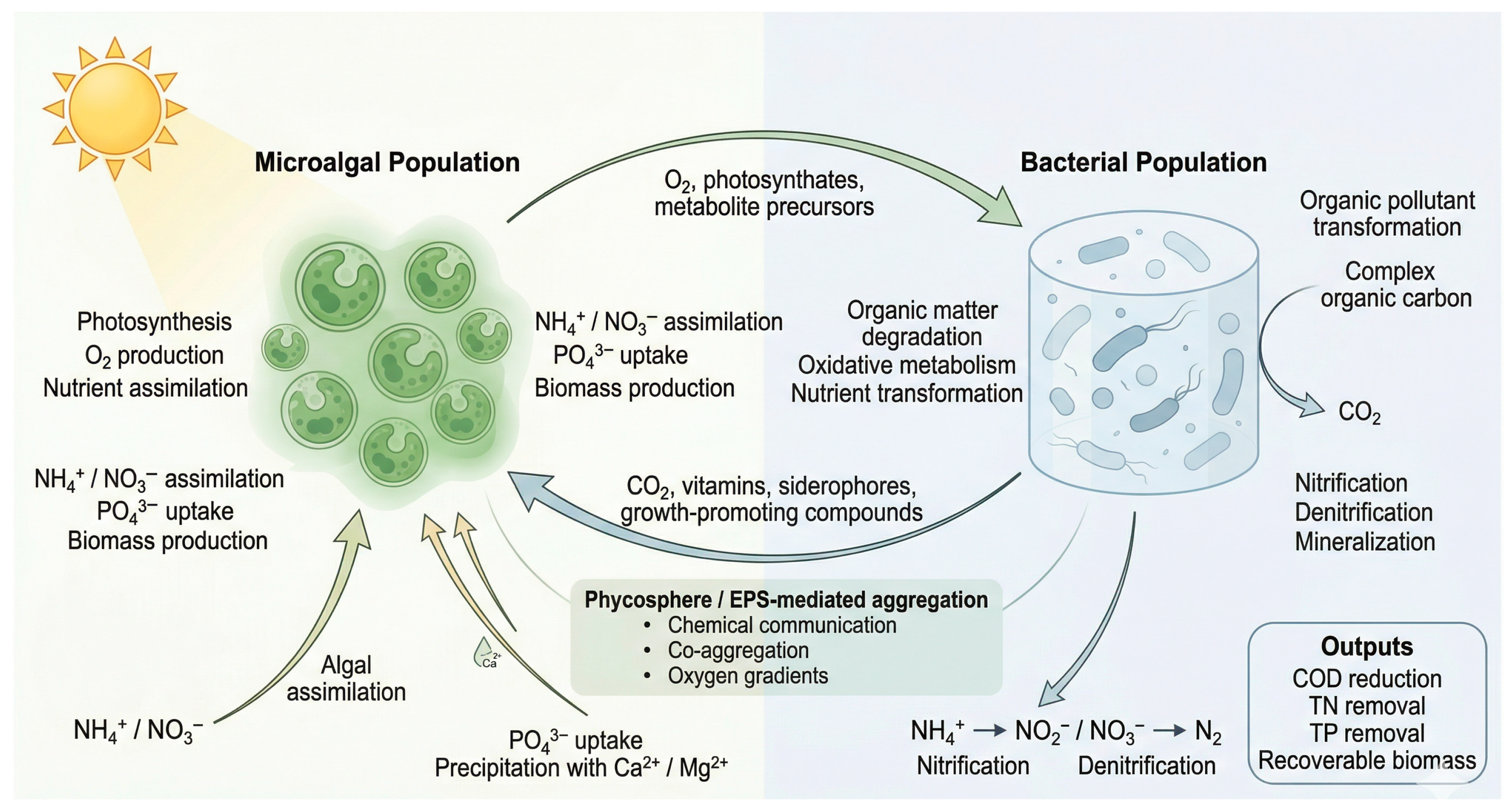
To further clarify the metabolic complementarity and nutrient transformation pathways in algal–bacterial symbiotic systems, the major interaction mechanisms are summarized in Figure 4.

3.4. Optimization Strategies and Technological Innovations in Algal–Bacterial Symbiotic Systems

On the basis that the synergistic metabolic mechanisms of algal–bacterial symbiotic systems have been relatively well elucidated, recent research has increasingly shifted toward process intensification and controllable operation aimed at engineering scale-up. Specifically, current studies focus on how to maintain stable, efficient, and sustainable performance under high loading and fluctuating wastewater conditions through regulation of operational parameters, optimization of reactor configurations, and integrated process design. Although algal–bacterial symbiotic systems have demonstrated considerable potential for resource recovery and low-energy operation in municipal, industrial, and livestock wastewater treatment, their practical engineering application remains constrained by issues related to operational stability, process controllability, biomass retention, and solid–liquid separation efficiency [104,122].
At the operational level, the treatment performance of algal–bacterial symbiotic systems is mainly governed by several key factors, including light conditions, hydraulic retention time (HRT), influent C/N ratio, initial algal–bacterial ratio, and mixing mode. These parameters jointly influence biomass productivity, oxygen transfer, nutrient transformation pathways, and overall system stability. In swine wastewater anaerobic digestate, adjustment of the algal–bacterial ratio, inoculation concentration, and photoperiod has been shown to significantly affect microalgal growth, as well as nitrogen and phosphorus removal and recovery efficiencies. Under an algal–bacterial ratio of 1:0.2, increasing the initial microalgal inoculation concentration from 0.05 g/L to 0.2 g/L raised the maximum biomass increment from 0.41 g/L to 0.68 g/L. Under different photoperiod conditions, a 12L:12D cycle achieved the highest growth rate (0.20 g/L/d) and biomass accumulation (0.81 g/L), significantly outperforming continuous illumination and shorter light cycles [19].
Hydraulic retention time (HRT) further determines the trade-off between biomass harvesting efficiency and pollutant removal efficiency. When HRT was shortened to 2 d, the biomass harvesting rate reached 0.16 g/L/d, representing a 117% increase compared with pure microalgal systems. However, extending HRT to 12 d was more favorable for deep pollutant removal and stable process performance [19]. These findings indicate that optimization of ABS systems should not pursue a single objective, such as maximum biomass productivity or maximum pollutant removal alone, but rather seek a balanced operational window that matches treatment targets and downstream resource-recovery requirements.
To facilitate comparison of the main engineering control factors reported for algal–bacterial symbiotic systems, the key operational parameters and their major implications are summarized in Table 5.
As shown in Table 5, the performance of algal–bacterial symbiotic systems is governed not by a single factor, but by the coordinated interaction of light regime, inoculation strategy, hydraulic retention time, influent characteristics, and community structure. This further indicates that process optimization should focus on defining a stable operational window rather than maximizing a single performance indicator.
In addition to biomass growth and harvesting, operational conditions also influence the relative contributions of different nutrient removal pathways. Mechanistic analysis has shown that biological assimilation is not always the dominant route for nitrogen and phosphorus removal in algal–bacterial systems. Under suboptimal algal–bacterial ratios, approximately 38% of total nitrogen removal was attributed to biological assimilation, whereas the remaining 62% was associated with nitrification–denitrification. For phosphorus removal, chemical precipitation accounted for approximately 82%, while biological assimilation contributed only 18% [67]. These results indicate that shifts in operational conditions and community structure can substantially alter the balance between assimilation-dominated and transformation-dominated pathways. As a consequence, current engineering optimization is increasingly oriented toward coordinated control of operational parameters to stabilize metabolic pathway distribution and improve long-term process reliability rather than maximizing the removal of a single pollutant [104,122].
On this basis, structural optimization of reactor configuration and cultivation mode has increasingly been recognized as an effective strategy to enhance system stability and shock resistance. Compared with conventional suspended-culture reactors, attached-growth or biofilm-based systems generally exhibit advantages in mass transfer, biomass retention, microenvironmental stability, and resistance to hydraulic and organic shock loading, particularly when treating high-strength swine wastewater containing elevated organic matter and ammonium concentrations [123]. These structural features help maintain stable algal–bacterial coexistence and functional stratification under variable operating conditions.
In addition to operational control, reactor configuration plays a decisive role in biomass retention, microenvironment formation, and overall process stability. Representative reactor configurations applied in algal–bacterial symbiotic systems for swine wastewater treatment are compared in Table 6.
As summarized in Table 6, reactor configuration strongly influences the engineering feasibility of algal–bacterial symbiotic systems. Compared with conventional suspended-culture reactors, attached-growth, granular, and integrated multi-unit systems generally provide advantages in biomass retention, shock resistance, and process intensification, although their structural complexity and scale-up requirements are also greater.
Recently developed algal–bacterial granular sludge (ABGS) systems further represent an important technological advance. ABGS establishes compact and stratified granular structures, enabling simultaneous removal of COD, nitrogen, and phosphorus within a single reactor [108,125]. Chen et al. reported that ABGS achieved >90% COD removal, >80% total nitrogen removal, and 70–95% phosphorus removal, while maintaining high biomass retention under hydraulic shock conditions [108]. In addition, ABGS inherits the strong shock resistance of aerobic granular sludge systems, supporting stable operation under fluctuating loading conditions [124,125]. These findings suggest that granularization is not only beneficial for pollutant removal but also for process intensification and operational robustness.
Another critical issue concerns biomass aggregation and solid–liquid separation. In conventional suspended microalgal cultivation systems, poor sedimentation and costly biomass harvesting remain major barriers to engineering application [124]. During the formation of algal–bacterial symbiotic systems, extracellular polymeric substances (EPS) secreted by bacteria promote adhesion of microalgae to bacterial particles and facilitate inward settling, thereby serving as nucleation centers for floc and granule formation [122]. In AB-AGS and ABGS systems, both microalgae and bacteria are embedded within an EPS matrix, where EPS functions as a binding agent and plays a central role in granule formation and structural stability. As a result, algal–bacterial granular sludge systems generally exhibit better settling performance than pure microalgal cultures, and EPS-mediated co-aggregation is considered one of the key mechanisms enhancing system shock resistance [108,124]. Improved settling performance can also reduce the burden on downstream solid–liquid separation units, such as secondary clarifiers, while the dense structure and high biomass retention capacity of granular systems further strengthen resistance to fluctuating influent conditions and provide an engineering basis for subsequent biomass valorization [108,116,124].
At a larger process scale, algal–bacterial treatment systems are gradually shifting toward integrated multi-unit configurations that combine anaerobic digestion, nutrient recovery, and biomass resource recovery. Wu et al. described an integrated system coupling a UASB reactor with a high-rate algal pond (HRAP), highlighting its advantages in both environmental impact reduction and resource recovery [122]. Studies on swine wastewater anaerobic digestate have further shown that algal–bacterial symbiotic reactors can simultaneously reduce nitrogen and phosphorus while utilizing CO2 derived from anaerobic digestion as an inorganic carbon source to support microalgal growth [19,122]. This type of integration improves carbon utilization efficiency and strengthens the connection between wastewater treatment and resource recovery.
Moreover, increasing attention has been directed toward the recovery and further utilization of algal–bacterial biomass, which enhances the economic value and engineering feasibility of the overall process. Biomass generated during algal–bacterial treatment should not be regarded as a terminal by-product, but as a carrier of recovered resources. Depending on its composition, it can be converted into methane, hydrogen, or liquid biofuels through anaerobic digestion or fermentation, or recycled as biofertilizer and soil amendment. In this way, wastewater treatment is transformed from a pollution-control process into an integrated platform for circular resource recovery [104,125].
Overall, current optimization research on algal–bacterial symbiotic systems is evolving from single-factor, single-indicator adjustment toward multi-scale process optimization governed by “operational window–structural configuration–biomass morphology–resource recovery pathway.” At present, maintaining stable performance under fluctuating influent conditions remains a major engineering challenge. Nevertheless, through refined control of operational windows, functional reactor design, engineered regulation of biomass morphology, and deeper integration with anaerobic treatment and resource recovery units, algal–bacterial symbiotic technology is progressively demonstrating practical feasibility and engineering potential for achieving the dual objective of pollution reduction and resource recovery in swine wastewater treatment [104,108,122,125].
Despite these advances in process optimization and reactor design, stable engineering operation still requires effective supervision of both physicochemical conditions and biological activity.

3.5. Biological Monitoring and Process Supervision of Swine Wastewater Treatment Systems

Effective process supervision is essential for maintaining the long-term stability and engineering feasibility of swine wastewater treatment systems, particularly for aerobic and algal–bacterial processes that are highly sensitive to fluctuations in organic loading, ammonium concentration, dissolved oxygen, and environmental conditions. In practice, routine monitoring should not be limited to conventional physicochemical indicators such as pH, dissolved oxygen, oxidation–reduction potential, temperature, COD, NH4+–N, TN, and TP, but should also include biological response indicators that can reveal early process deterioration before a marked decline in effluent quality occurs [126,127]. This is especially important for algal–bacterial symbiotic systems, in which treatment performance depends on the coordinated functioning of microalgal photosynthesis, bacterial degradation, nitrification, denitrification, and biomass aggregation. For such systems, stable operation requires not only adequate online monitoring of physicochemical variables but also improved supervision of biological states such as biomass activity, nutrient transformation capacity, and process inhibition [128,129].
Biological test systems provide an important complement to routine chemical monitoring. In an early study on wastewater treatment plant supervision, Strotmann et al. used heterotrophic respiration activity, dehydrogenase activity, and nitrification activity tests to monitor activated-sludge performance, while a luminescent bacteria test was applied to screen effluent toxicity. Under shock-loading conditions, both nitrification activity and heterotrophic respiration decreased significantly, and the inhibition of luminescent bacteria increased markedly, demonstrating the value of biological monitoring for early warning and diagnosis of process failure [126]. For swine wastewater treatment, such monitoring concepts are highly relevant because sudden changes in ammonia level, toxic compounds, or organic loading can impair microbial activity and destabilize treatment performance. In algal–bacterial systems, online supervision may further be strengthened through in situ and model-assisted tools, including optical sensing, spectroscopic methods, soft sensors, and state-estimation approaches, which can help infer biological variables that are difficult to measure directly in real time [128,129]. Therefore, future development of swine wastewater treatment technologies should integrate physicochemical monitoring, biological activity assays, and data-driven process supervision in order to improve robustness, accelerate fault detection, and support stable long-term operation under variable field conditions [127,129].
Beyond process stability and supervision, another key issue is how the biomass generated in algal–bacterial systems can be efficiently valorized, which directly determines the resource-recovery potential and overall engineering value of these systems.

4. Resource Utilization of Algal–Bacterial Biomass

4.1. Algal–Bacterial Biomass as a Carrier of Pollutant-Derived Resources

In conventional wastewater treatment, process design has traditionally focused on achieving discharge compliance through efficient pollutant removal and stable reactor operation. Within this framework, biomass generated during biological treatment has generally been regarded as a secondary by-product that requires further handling or disposal. However, with the development of resource-oriented wastewater treatment and the broader concept of the circular bioeconomy, the functional role of wastewater treatment systems is gradually shifting from simple pollution control toward integrated platforms for resource transformation and recovery [104,122,130]. Under this emerging paradigm, algal–bacterial biomass should no longer be considered residual waste, but rather a valuable carrier of resources formed through the biotransformation of wastewater-derived pollutants by microalgae and bacteria [104,122,131].
From the perspective of elemental migration, nitrogen, phosphorus, and biodegradable organic carbon in swine wastewater are not removed exclusively through nitrification–denitrification or mineralization. Instead, a substantial fraction of these elements is assimilated into cellular materials and converted into proteins, polysaccharides, lipids, and other structural or functional biomass components [105,131,132]. Algal–bacterial biomass, therefore, represents the final biological form in which dissolved pollutants are transformed into biomass-bound resources. Its composition and yield are directly influenced by wastewater characteristics and process conditions, indicating that treatment performance and resource potential are intrinsically linked [105,122].
Unlike conventional activated sludge systems, which are commonly evaluated mainly on the basis of pollutant removal efficiency, recent studies on algal–bacterial systems increasingly emphasize material fate and resource attributes [104,122,133]. In other words, the key question is not only whether pollutants are removed from the aqueous phase but also whether they are converted into reusable biological forms after treatment. From this perspective, wastewater treatment acquires an additional function of biological conversion and regeneration, and algal–bacterial biomass becomes an important material bridge linking pollution control with resource recovery.
From an engineering point of view, algal–bacterial biomass plays two essential roles within the overall treatment system. First, it serves as the product through which nitrogen, phosphorus, and biodegradable carbon are transferred from the liquid phase into a recoverable solid form. Second, it acts as the primary feedstock for subsequent utilization pathways, including energy recovery, agricultural reuse, and high-value product development. Accordingly, its physicochemical properties and biochemical composition determine the feasibility of different valorization routes [131,133,134]. For this reason, the compositional characteristics of algal–bacterial biomass should not be treated merely as passive outcomes of wastewater treatment, but rather as design-relevant variables that need to be incorporated into process regulation and system evaluation from the outset.
More broadly, the focus of wastewater engineering is gradually shifting from minimizing residual biomass production to guiding biomass formation toward purposeful resource recovery [105,134]. In algal–bacterial systems, the amount, composition, and morphology of biomass can be influenced by operational conditions, reactor configuration, and process control strategy. This controllability provides an important theoretical and engineering basis for downstream energy recovery, nutrient recycling, and high-value biomass utilization. Therefore, algal–bacterial biomass should be understood not as an unavoidable treatment residue, but as a central intermediate linking pollutant removal with circular resource utilization.

4.2. Energy Recovery from Algal–Bacterial Biomass

In resource-oriented wastewater treatment systems, the recovery of usable energy while achieving pollutant reduction is a key factor influencing overall process efficiency and engineering feasibility. Algal–bacterial systems inevitably generate biomass during operation, and the extent to which this biomass can be converted into energy carriers directly affects the overall value of the treatment process [133]. Compared with pure microalgal biomass or conventional excess sludge, algal–bacterial biomass contains both algal and bacterial organic fractions, which increases its versatility for different energy-conversion pathways [133,135].
Among the currently available options, anaerobic digestion remains one of the most mature and practically viable routes for energy recovery from algal–bacterial biomass [135]. Ward et al. noted that algal–bacterial biomass often exhibits a relatively suitable C/N ratio and contains a substantial fraction of readily biodegradable organic matter, which is favorable for stable methane production, especially during co-digestion with other organic wastes [136]. Jiang et al. further pointed out that, compared with pure microalgal biomass, the bacterial fraction can enhance substrate hydrolyzability and partly alleviate the limitations imposed by rigid microalgal cell walls on anaerobic degradation. This mixed-biomass property also improves buffering capacity, helps balance nutrient composition, and can reduce the need for intensive pretreatment before digestion [133]. Therefore, within integrated wastewater treatment–anaerobic digestion systems, algal–bacterial biomass can be more readily incorporated into existing biogas recovery processes, making anaerobic digestion a particularly attractive route for engineering implementation [133,135].
Beyond biochemical conversion, thermochemical pathways have also attracted increasing attention. Elliott et al. and Gollakota et al. identified hydrothermal liquefaction (HTL) as a promising route for converting high-moisture biomass into energy-dense bio-crude oil [137,138]. A key advantage of HTL is that wet algal or algal–bacterial biomass can be processed directly without prior drying, thereby avoiding the high energy demand associated with dehydration in conventional pyrolysis or gasification processes [137,138]. Jiang et al. likewise emphasized that the inherently high moisture content of algal–bacterial biomass is well aligned with the process requirements of HTL [133]. Nevertheless, the economic feasibility, process complexity, and downstream upgrading requirements of HTL at the engineering scale still require further evaluation [137].
Lipid-based liquid fuel production has also been discussed as a potential valorization route. Chisti highlighted the theoretical advantages of biodiesel derived from microalgal lipids, particularly in terms of energy density [139]. However, Zhu noted that economically meaningful biodiesel production generally requires nitrogen limitation to promote lipid accumulation, often at the expense of biomass growth and pollutant removal capacity [134]. For algal–bacterial systems primarily designed for wastewater treatment, excessive emphasis on lipid accumulation may therefore compromise treatment efficiency and process stability [133,134]. Under such circumstances, biodiesel production should be regarded as a targeted, value-added option within product-oriented process designs rather than as a universal route for all algal–bacterial treatment systems [133,134].
Overall, the engineering significance of energy recovery from algal–bacterial biomass lies not only in theoretical conversion efficiency but also in the compatibility between biomass characteristics and downstream conversion pathways. In practical applications, the selection of an energy-recovery route should be based on biomass composition, moisture content, pretreatment demand, system integration potential, and overall process economics. Among current options, anaerobic digestion is the most readily applicable pathway, whereas HTL and biodiesel production may offer additional opportunities under more specifically designed process conditions [133,134,135,136,137,138,139].

4.3. Nutrient Reuse from Algal–Bacterial Biomass

In swine wastewater treatment, nutrient reuse is a major component of resource-oriented management because nitrogen and phosphorus are not only pollutants of concern but also valuable agricultural resources. Compared with conventional treatment pathways dominated by denitrification and chemical precipitation, algal–bacterial systems can capture and retain a substantial fraction of wastewater-derived nitrogen and phosphorus in biomass, thereby creating a direct material basis for nutrient recovery and reuse [104,122]. This role has also been emphasized in broader resource-oriented treatment frameworks, in which algal–bacterial biomass is regarded as an intermediate carrier for the reintegration of wastewater-derived nutrients into productive use [105,133].
Wastewater-derived microalgal or algal–bacterial biomass is typically enriched in nutrients. Christenson and Sims reported that such biomass generally contains approximately 5–10% nitrogen and 0.5–2% phosphorus on a dry-weight basis [131], while Jiang et al. reported similar ranges based on multi-system analyses [133]. In livestock wastewater and anaerobic digestate systems, Oruganti et al. summarized that approximately 30–60% of influent nitrogen and phosphorus can be transferred into biomass, with even higher proportions under certain operating conditions [104]. Saravanan et al. reported comparable results, further supporting the view that algal–bacterial biomass functions as a concentrated nutrient sink rather than a simple residual by-product [105].
Direct or stabilized agricultural application is one of the most feasible nutrient-reuse pathways for algal–bacterial biomass. Chiaiese et al. identified the use of microalgal and algal–bacterial biomass as soil amendments or nutrient carriers as a promising route for nutrient recycling [140]. Unlike struvite or chemically precipitated phosphorus, nitrogen and phosphorus in biomass are mainly present in organically bound forms, which often confer slow-release characteristics in soil and may reduce leaching and runoff losses [140,141]. Renuka et al. demonstrated in wheat pot experiments that partial substitution of chemical fertilizer with wastewater-derived algal biomass did not reduce crop yield and, in some cases, improved plant growth, likely because of the additional contribution of organic matter and associated bioactive components [141].
Importantly, nutrient reuse is not restricted to direct land application. After stabilization treatments such as composting, anaerobic digestion, or related post-processing steps, algal–bacterial biomass can still retain a substantial proportion of its nutrient value while exhibiting improved handling properties and lower sanitary risk [135]. Renuka et al. further showed that 40–70% of the original phosphorus remained in algal residues after anaerobic digestion and could still be recycled into soil systems [141]. These findings indicate that nutrient recovery from algal–bacterial biomass can be integrated with other valorization routes, rather than being limited to a single end-use pathway.
From a broader material-cycle perspective, algal–bacterial systems provide an engineering route for reintroducing wastewater-derived nutrients into agroecosystems through biomass reuse [122]. This view is consistent with the concept of algal–bacterial platforms for bioproduct and resource recovery proposed by Jiang et al. [133]. Compared with conventional systems, in which nitrogen is commonly lost as N2 and phosphorus is frequently immobilized in low-value sludge, algal–bacterial systems offer greater potential for nutrient retention in recoverable biological form [122,133,134]. Therefore, nutrient reuse from algal–bacterial biomass should be understood not merely as a disposal alternative, but as a key strategy for closing nutrient loops between wastewater treatment and agricultural production.

4.4. High-Value Utilization of Algal–Bacterial Biomass

In addition to energy recovery and nutrient reuse, algal–bacterial biomass also offers considerable potential for high-value utilization. As emphasized by Jiang et al., this biomass is often enriched in proteins, bioactive polysaccharides, pigments, extracellular polymeric substances (EPS), and other functional compounds, making it suitable for product-oriented wastewater treatment systems that aim not only to remove pollutants but also to generate value-added bioproducts [133]. In this context, the significance of algal–bacterial biomass lies not merely in its bulk quantity, but in the possibility of directing biomass composition toward specific functional applications.
One important route is the use of wastewater-derived algal or algal–bacterial biomass as agricultural biostimulants. Chiaiese et al. reported that amino acids, oligopeptides, polysaccharides, and hormone-like compounds present in microalgal biomass can promote plant growth and improve stress tolerance without causing excessive nutrient loading [140]. Renuka et al. likewise demonstrated that wastewater-derived algal biomass had positive effects on crop growth when applied as a soil amendment, suggesting that its agronomic value may extend beyond simple fertilization and include broader biostimulatory functions [141]. These findings indicate that, under appropriate quality control, biomass produced during wastewater treatment may serve not only as a carrier of recovered nutrients but also as a source of bioactive compounds beneficial to crop production.
Another promising direction is the use of algal–bacterial biomass as a protein-rich feed resource or feed additive. Christenson and Sims noted that microalgal or algal–bacterial biomass can contain protein levels comparable to those of conventional feed materials [131]. Jiang et al. further highlighted its potential for partial feed protein substitution and for the development of functional feed additives, while also noting that practical application depends on contaminant control, particularly with respect to heavy metals and other wastewater-derived residues, as well as compliance with regulatory requirements [133]. Accordingly, feed-oriented utilization of algal–bacterial biomass should be considered a promising but quality-sensitive pathway, requiring careful evaluation of biomass safety, composition, and consistency.
Beyond agricultural and feed applications, EPS produced in algal–bacterial systems also represent a potentially valuable class of functional materials. Saravanan et al. reported that EPS derived from algal–bacterial systems may be applied in flocculation, adsorption, and biomaterial production [105]. Jiang et al. further proposed that operational parameters can influence EPS yield and structure, suggesting that treatment systems may be designed not only for pollutant removal but also for the targeted generation of specific material precursors [133]. This feature is particularly important because it shifts the role of biomass from a passive treatment residue to an actively controllable biomanufacturing intermediate.
Taken together, high-value utilization of algal–bacterial biomass should not be understood as the production of a single specific product, but rather as a system-level property arising from the controllable composition and functionality of biomass generated during wastewater treatment [122,133]. Through process regulation, it is possible to influence not only pollutant removal performance but also the biochemical characteristics of the resulting biomass, thereby enabling product-oriented downstream utilization. In this sense, algal–bacterial biomass serves as a controllable biological material platform linking wastewater treatment with biostimulants, feed applications, and functional biomaterials.

4.5. Product-Oriented “Process–Resource” Coupled Design Concept

By integrating the evidence presented above on energy recovery, nutrient reuse, and high-value product development, the engineering value of algal–bacterial systems can no longer be interpreted solely in terms of pollutant removal performance. Instead, these systems should be understood as resource-output-oriented treatment platforms, in which process design is constrained and guided by the characteristics of the desired end products. Jiang et al. and Wu et al. pointed out that conventional design paradigms focusing exclusively on effluent standards do not adequately reflect the resource-conversion potential of algal–bacterial systems [122,133]. Therefore, a product-oriented “process–resource” coupled design framework is needed to better align treatment objectives with downstream biomass valorization pathways.
A central implication of this framework is that different resource-utilization routes require different biomass properties. Mata-Alvarez et al. emphasized that anaerobic digestion is more strongly influenced by biomass productivity, biodegradability, and the fraction of degradable organic matter [135]. Chiaiese et al. highlighted the importance of nutrient bioavailability for agricultural reuse [140], whereas Zhu and Jiang showed that lipid, protein, or polysaccharide enrichment is often required in product-oriented systems designed for specific high-value outputs [133,134]. These differences indicate that there is no single “optimal” algal–bacterial biomass for all applications. Instead, the target composition of biomass should be defined according to the intended end use.
Under this perspective, process parameters, reactor configuration, and system integration should be designed not only to maximize pollutant removal but also to regulate biomass properties in a direction compatible with downstream utilization. In other words, treatment performance and resource output are co-optimized and mutually constrained [122,133]. This means that operational decisions such as light regime, hydraulic retention time, influent characteristics, and microbial community structure should be evaluated not only for their effect on COD, TN, and TP removal but also for their influence on biomass composition, stability, and recoverability.
This concept is further consistent with the cascading utilization strategy proposed by Nizami et al. in waste biorefinery systems, in which resource value is amplified stepwise rather than consumed through competing single-pathway uses [130]. For algal–bacterial biomass, such a strategy may be conceptualized as “high-value products first, energy recovery second, and nutrient return third,” depending on biomass quality and system objectives [130,133]. This hierarchy does not imply a rigid sequence for all systems, but rather a design principle in which resource allocation is prioritized according to value, feasibility, and compatibility with the treatment process.
Overall, positioning algal–bacterial systems within a product-oriented process–resource coupling framework redefines them as integrated pollution-control and bioresource platforms rather than as treatment units alone. This perspective not only strengthens the theoretical basis for reverse process design driven by target resource outputs but also provides a more realistic foundation for future scale-up, system integration, and industrial application.

5. Challenges and Perspectives

As discussed in the preceding sections, algal–bacterial symbiotic systems have shown considerable potential for the resource-oriented treatment of swine wastewater, not only in terms of pollutant removal but also with respect to nutrient recovery, biomass generation, energy conversion, and high-value product development. On this basis, this review has further proposed a product-oriented “process–resource” coupled design concept, in which treatment objectives are aligned with downstream biomass valorization pathways. Nevertheless, most of the advantages reported so far have been demonstrated under controlled laboratory or pilot-scale conditions. When translated into full-scale practice, algal–bacterial systems will inevitably face a series of practical challenges related to long-term stability, biological controllability, system integration, and economic feasibility. These limitations do not negate the promise of the technology, but rather define the key directions that future research and engineering development must address.
The first challenge lies in maintaining stable treatment performance under highly variable swine wastewater conditions. Swine wastewater often exhibits pronounced fluctuations in organic loading, ammonium concentration, suspended solids content, and seasonal characteristics associated with farming cycles. Such variability can directly affect pollutant removal efficiency and indirectly alter algal–bacterial community structure, metabolic allocation, and the resource properties of the resulting biomass. As Jiang et al. and Wu et al. have pointed out, most currently available studies are still based on laboratory-scale reactors or semi-continuous pilot systems, whereas long-term validation under realistic field conditions with dynamic influent changes remains limited [122,133]. Therefore, future development should place greater emphasis on long-term demonstration under complex and fluctuating operating conditions, so that the robustness of algal–bacterial systems can be evaluated beyond idealized laboratory environments.
At the biological level, community stability and functional controllability remain fundamental scientific and engineering issues. Although algal–bacterial systems possess certain self-organizing and self-stabilizing capacities, environmental disturbances and operational fluctuations may still induce community drift, species dominance shifts, or functional decay [105,133]. In swine wastewater treatment, this issue is particularly relevant because high ammonium concentrations, elevated salinity, and variable organic loading may all disrupt biological interactions and resource-conversion performance. The challenge is therefore not only to sustain pollutant removal but also to maintain a stable functional partitioning between photosynthesis, organic matter degradation, nitrification, denitrification, and biomass formation without introducing excessive operational complexity or cost. Improving biological controllability under realistic wastewater stress conditions is thus a prerequisite for the large-scale application of algal–bacterial systems.
Another major bottleneck lies in process-chain integration. At present, much of the literature still focuses on individual reactors or isolated functional units, whereas mature engineering integration across the full pathway of pollutant treatment, resource recovery, and product utilization remains underdeveloped. Although concepts such as wastewater biorefinery and cascading utilization have gained increasing attention in recent years [130], a robust engineering framework that can coordinate pollutant removal efficiency, nutrient retention, biomass valorization, and downstream product quality is still lacking. Future research should therefore move beyond optimization of single units and instead focus on multi-objective process integration, including the coupling of algal–bacterial systems with anaerobic digestion, biofilm-based systems, membrane units, and other established technologies. In this way, algal–bacterial treatment may be positioned not as a stand-alone replacement for existing infrastructure, but more realistically as a functional module within broader and more flexible treatment portfolios [133].
Economic feasibility is equally critical. Compared with conventional biological treatment processes, algal–bacterial systems involve additional considerations related to light supply, reactor design, biomass harvesting, and downstream resource utilization. At the same time, the economic return of the process is strongly influenced by biomass valorization routes, product markets, and the maturity of downstream value chains. As Jiang et al. noted, the absence of stable and mature markets for biomass-derived products means that energy recovery or fertilizer reuse alone may not be sufficient to guarantee long-term economic viability [133]. In parallel, Nizami et al. emphasized that when emerging treatment technologies move from proof-of-concept toward engineering comparison and deployment, life-cycle assessment (LCA), techno-economic analysis (TEA), and multi-criteria decision tools become indispensable [130]. For algal–bacterial systems, these tools are essential for quantitatively comparing different resource-utilization options, clarifying environmental trade-offs, and identifying application scenarios in which the technology provides real net benefit.
Overall, future development of algal–bacterial technology for swine wastewater treatment should not be guided by the expectation of a universally optimal stand-alone process. Instead, it should be regarded as a flexible and evolving technological platform that can be integrated with complementary treatment and recovery processes under different engineering and policy conditions. Where resource conditions, infrastructure, and market demand are favorable, algal–bacterial systems may evolve into comprehensive wastewater biotransformation platforms. In broader engineering applications, they may also function as modular units that enhance nitrogen and phosphorus recovery, strengthen biomass valorization, and improve the overall sustainability of existing treatment chains. In this sense, the most important question for future research is no longer whether algal–bacterial systems can work in principle, but under what configurations, operational windows, and integration pathways they can create the greatest practical value for sustainable livestock wastewater management.

Author Contributions

Conceptualization, H.Y., C.L. and W.W.; writing—original draft preparation, H.Y.; writing—review and editing, Y.X., T.T., C.L. and W.W.; supervision, C.L. and W.W.; funding acquisition, C.L. and W.W. All authors have read and agreed to the published version of the manuscript.

Funding

This work was supported by the National Key Research and Development Program of China (Grant No. 2020YFD1100303), the Shanghai Agricultural Science and Technology Innovation Projects (Grant No. A2024010), and the Shandong Energy Institute (SEI U202311).

Data Availability Statement

No data was used for the research described in the article.

Conflicts of Interest

The authors declare no conflicts of interest.

References

  1. World Population Prospects: Global Population to Peak at 10.3 Billion in the Mid-2080s. Available online: https://www.un.org/zh/desa/UN-projects-world-population-to-peak-within-this-century-zh (accessed on 24 March 2026).
  2. Food and Agriculture Organization of the United Nations. How to Feed the World in 2050. Available online: https://www.fao.org/4/k6021c/k6021c.pdf (accessed on 24 March 2026).
  3. World Food and Agriculture: Statistical Yearbook 2024; FAO: Rome, Italy, 2024.
  4. China Statistical Yearbook 2025. Available online: https://www.stats.gov.cn/sj/ndsj/2025/indexch.htm (accessed on 24 March 2026).
  5. Ministry of Ecology and Environment of the People’s Republic of China. Guideline on Best Available Technologies for Pollution Prevention and Control of Livestock and Poultry Farms (on Trial). Available online: https://www.mee.gov.cn/gkml/hbb/bgth/201105/W020110520345011061807.pdf (accessed on 24 March 2026).
  6. Zhang, H.F.; Wang, Y.Q. Analysis of Wastewater Treatment and Pollution Control Countermeasures in Large-Scale Pig Farms. China Resour. Compr. Util. 2021, 39, 183–185. (In Chinese) [Google Scholar]
  7. Dan, N.H.; Rene, E.R.; Le Luu, T. Removal of Nutrients From Anaerobically Digested Swine Wastewater Using an Intermittent Cycle Extended Aeration System. Front. Microbiol. 2020, 11, 576438. [Google Scholar] [CrossRef] [PubMed]
  8. Zhao, B.; Xie, F.; Zhang, X.; Yue, X. Enhancing the Nitrogen Removal from Swine Wastewater Digested Liquid in a Trickling Biofilter with a Soil Layer. RSC Adv. 2020, 10, 23782–23791. [Google Scholar] [CrossRef] [PubMed]
  9. Chen, Z.; Xiao, Y.; Liu, T.; Yuan, M.; Liu, G.; Fang, J.; Yang, B. Exploration of Microalgal Species for Nutrient Removal from Anaerobically Digested Swine Wastewater and Potential Lipids Production. Microorganisms 2021, 9, 2469. [Google Scholar] [CrossRef]
  10. Qian, J.; Xu, C.; Song, H.; Zhou, W.; Toda, T.; Li, H.; Takayama, Y.; Sekine, M.; Koga, S.; Li, J.; et al. Enhancing Algal Growth and Nutrient Recovery from Anaerobic Digestion Piggery Effluent by an Integrated Pretreatment Strategy of Ammonia Stripping and Flocculation. Front. Bioeng. Biotechnol. 2023, 11, 1219103. [Google Scholar] [CrossRef]
  11. Reiter, J.; Beier, M. Deammonification Potential of Pig Slurries and Vapor Condensates from Sewage Sludge Drying—Substrate Quality and Inhibition. Bioengineering 2023, 10, 826. [Google Scholar] [CrossRef]
  12. Chen, B.; Zhu, Y.; Wang, K.; Xiao, Y.; Huang, J.; Zhang, J.; Zhang, X.; Chen, X. Research Progress on the Mechanisms and Influencing Factors of Algal–Bacterial Symbiotic Systems for Livestock Biogas Slurry Treatment. Trans. Chin. Soc. Agric. Eng. 2023, 39, 14–24. (In Chinese) [Google Scholar]
  13. GB 18596-2001; Discharge Standard of Pollutants for Livestock and Poultry Breeding. Ministry of Ecology and Environment of the People’s Republic of China: Beijing, China, 2001. Available online: https://www.mee.gov.cn/ywgz/fgbz/bz/bzwb/shjbh/swrwpfbz/200301/t20030101_66550.shtml (accessed on 24 March 2026).
  14. Cheng, D.L.; Ngo, H.H.; Guo, W.S.; Chang, S.W.; Nguyen, D.D.; Kumar, S.M. Microalgae Biomass from Swine Wastewater and Its Conversion to Bioenergy. Bioresour. Technol. 2019, 275, 109–122. [Google Scholar] [CrossRef]
  15. Pu, Y.; Tang, J.; Zeng, T.; Hu, Y.; Yang, J.; Wang, X.; Huang, J.; Abomohra, A. Pollutant Removal and Energy Recovery from Swine Wastewater Using Anaerobic Membrane Bioreactor: A Comparative Study with Up-Flow Anaerobic Sludge Blanket. Water 2022, 14, 2438. [Google Scholar] [CrossRef]
  16. Wang, H.; Wang, X.; Zhao, J. Application of MgO-Modified Palygorskite for Nutrient Recovery from Swine Wastewater: Effect of pH, Ions, and Organic Acids. Environ. Sci. Pollut. Res. 2019, 26, 19729–19737. [Google Scholar] [CrossRef]
  17. Ferreira, A.; Corrêa, D.O.; Ribeiro, B.; Lopes Da Silva, T.; Marques-dos-Santos, C.; Gabriel Acién, F.; Gouveia, L. Bioprocess to Produce Biostimulants/Biofertilizers Based on Microalgae Grown Using Piggery Wastewater as Nutrient Source. Bioresour. Technol. 2024, 414, 131619. [Google Scholar] [CrossRef]
  18. Liang, Y.H.; Xiao, Y.Y. The Advance of Swine Wastewater Treatment Technology. J. Light Ind. 2020, 35, 67–80. (In Chinese) [Google Scholar]
  19. Qian, R.; Liu, H.; Xu, H.T.; Ma, C.W.; Chen, H.; Liang, J.Y.; Ye, J.F. Enhancement of Microalgae Culture in Anaerobic Fermentation Liquid of Swine Wastewater by Algal–Bacterial Symbiotic System. J. Agro-Environ. Sci. 2021, 40, 1557–1564. (In Chinese) [Google Scholar]
  20. Deng, L.; Chen, Z.; Yang, H.; Zhu, J.; Liu, Y.; Long, Y.; Zheng, D. Biogas Fermentation of Swine Slurry Based on the Separation of Concentrated Liquid and Low Content Liquid. Biomass Bioenergy 2012, 45, 187–194. [Google Scholar] [CrossRef]
  21. Zhu, K.; Gamal El-Din, M.; Moawad, A.K.; Bromley, D. Physical and Chemical Processes for Removing Suspended Solids and Phosphorus from Liquid Swine Manure. Environ. Technol. 2004, 25, 1177–1187. [Google Scholar] [CrossRef]
  22. Ro, K.S. Kinetics and Energetics of Producing Animal Manure-Based Biochar. Bioenergy Res. 2016, 9, 447–453. [Google Scholar] [CrossRef]
  23. Abukhadra, M.R.; Mostafa, M. Effective Decontamination of Phosphate and Ammonium Utilizing Novel Muscovite/Phillipsite Composite; Equilibrium Investigation and Realistic Application. Sci. Total Environ. 2019, 667, 101–111. [Google Scholar] [CrossRef]
  24. Peng, Y.; Sun, Y.; Hanif, A.; Shang, J.; Shen, Z.; Hou, D.; Zhou, Y.; Chen, Q.; Ok, Y.S.; Tsang, D.C.W. Design and Fabrication of Exfoliated Mg/Al Layered Double Hydroxides on Biochar Support. J. Clean. Prod. 2021, 289, 125142. [Google Scholar] [CrossRef]
  25. Yang, F.; Zhang, S.; Sun, Y.; Tsang, D.C.W.; Cheng, K.; Ok, Y.S. Assembling Biochar with Various Layered Double Hydroxides for Enhancement of Phosphorus Recovery. J. Hazard. Mater. 2019, 365, 665–673. [Google Scholar] [CrossRef]
  26. Ren, L.; Li, Y.; Wang, K.; Ding, K.; Sha, M.; Cao, Y.; Kong, F.; Wang, S. Recovery of Phosphorus from Eutrophic Water Using Nano Zero-Valent Iron-Modified Biochar and Its Utilization. Chemosphere 2021, 284, 131391. [Google Scholar] [CrossRef]
  27. An, X.; Wu, Z.; Yu, J.; Cravotto, G.; Liu, X.; Li, Q.; Yu, B. Co-pyrolysis of biomass, bentonite, and nutrients as a new strategy for the synthesis of improved biochar-based slow-release fertilizers. ACS Sustain. Chem. Eng. 2020, 8, 3181–3190. [Google Scholar] [CrossRef]
  28. Liu, M.; Liu, C.; Liao, W.; Xie, J.; Zhang, X.; Gao, Z. Impact of Biochar Application on Gas Emissions from Liquid Pig Manure Storage. Sci. Total Environ. 2021, 771, 145454. [Google Scholar] [CrossRef] [PubMed]
  29. Kim, B.U.; Lee, W.H.; Lee, H.J.; Rim, J.M. Ammonium Nitrogen Removal from Slurry-Type Swine Wastewater by Pretreatment Using Struvite Crystallization for Nitrogen Control of Anaerobic Digestion. Water Sci. Technol. 2004, 49, 215–222. [Google Scholar] [CrossRef] [PubMed]
  30. Sancho, I.; Licon, E.; Valderrama, C.; De Arespacochaga, N.; López-Palau, S.; Cortina, J.L. Recovery of Ammonia from Domestic Wastewater Effluents as Liquid Fertilizers by Integration of Natural Zeolites and Hollow Fibre Membrane Contactors. Sci. Total Environ. 2017, 584–585, 244–251. [Google Scholar] [CrossRef] [PubMed]
  31. Kamilya, T.; Majumder, A.; Yadav, M.K.; Ayoob, S.; Tripathy, S.; Gupta, A.K. Nutrient Pollution and Its Remediation Using Constructed Wetlands: Insights into Removal and Recovery Mechanisms, Modifications and Sustainable Aspects. J. Environ. Chem. Eng. 2022, 10, 107444. [Google Scholar] [CrossRef]
  32. González-Morales, C.; Fernández, B.; Molina, F.J.; Naranjo-Fernández, D.; Matamoros-Veloza, A.; Camargo-Valero, M.A. Influence of pH and Temperature on Struvite Purity and Recovery from Anaerobic Digestate. Sustainability 2021, 13, 10730. [Google Scholar] [CrossRef]
  33. Guo, L.; Nie, J.X.; Liu, C. Experimental Study on the Treatment of Phosphorus-Containing Wastewater by Magnesium Ammonium Phosphate Crystallization. Appl. Chem. Ind. 2019, 48, 122–125. (In Chinese) [Google Scholar]
  34. Cao, Z.; Zhou, L.; Ma, K.; Shi, Y. Economic analysis of recovering phosphate from dewatered digester sludge slurry in sewage treatment plant by magnesium ammonium phosphate crystallization. Ind. Water Treat. 2020, 40, 43–46. [Google Scholar]
  35. Li, Y.; Dai, J.X.; Ma, Y.J.; Wu, L.J.; Guo, Y.; Hou, L.A. Progress of Membrane Technology in the Treatment of High-Concentration Organic Wastewater and Its Resource Utilization. Technol. Water Treat. 2024, 50, 1–6. (In Chinese) [Google Scholar]
  36. Shui, Y.; Kawagishi, T.; Song, X.Y.; Liu, R.; Chen, L.J. A Comparative Study on Two Membrane Bioreactors for the Treatment of Digested Piggery Wastewater. Environ. Sci. 2015, 36, 3319–3328. (In Chinese) [Google Scholar]
  37. Wan, H.Y. Study on the Parameter Optimization of Microalgae-Bacteria Symbiotic Membrane Photobioreactor for Advanced Treatment of Swine Wastewater. Master’s Thesis, Nanchang University, Nanchang, China, 2024. (In Chinese) [Google Scholar] [CrossRef]
  38. Wang, X.Z. HRT Optimization of Microalgae-Bacterial Symbiotic Membrane Photobioreactor for Advanced Treatment of Swine Wastewater. Master’s Thesis, Nanchang University, Nanchang, China, 2023. (In Chinese) [Google Scholar]
  39. Wastewater Treatment and Reuse. Available online: https://kns.cnki.net/reader/flowpdf?invoice=a9cWD93H0stue%2Fe7K21kir3yFDNyRCwfRpzh2XyxTlCCj%2FTMi8tO5wZBSClvUhhvC0cEJQHEIZ0WUy71Av5kpqzyW5XSaa5PUIXqHEpTcrImxBhDcTcVOsPtujyVQN7oLWrMnn99xmPFCKkN6kE3ji6RPy64td1jwu%2BJLUCFpgU%3D&platform=NZKPT&sourcetype=nxgp&product=WBFD&filename=9787122404428000&tablename=wbfd&type=BOOK&scope=trial&cflag=pdf&dflag=&pages=&language=CHS&trial=&nonce=03E4D1CC6EB747A392308152ED8B50BD (accessed on 27 February 2026).
  40. Bryant, M.P. Microbial methane production—Theoretical aspects. J. Anim. Sci. 1979, 48, 193–201. [Google Scholar] [CrossRef]
  41. Microbiology of Water Treatment. Available online: https://kns.cnki.net/reader/flowpdf?invoice=Ye%2FGJy76m4D%2B4ajItdxEH0Ns7wRiI6lqw0Edtk02u1NUdMAUA6mkk9H4j7mGUselwLRXT%2FmW5QAfESl%2BMH%2FpTHb6gnpZDThBZ64s1b5XSFP6bMkWAJUEBpm8Ck3yd%2Fv3Mey2VR3llcvYO%2FDBdlEb%2Bc1Ez%2BOvKnUboaFBCkHgK8M%3D&platform=NZKPT&sourcetype=xkts&product=WBFD&filename=9787122436818000&tablename=wbfd&type=BOOK&scope=trial&cflag=overlay&dflag=&pages=&language=chs&trial=&nonce=BF49278BC34949ED9A8D5CF9A6E4DE4B (accessed on 27 February 2026).
  42. Chen, X.; Chen, B.; Xiao, L.; Fukushi, K.; Zhang, J.; Niu, J.; Xu, K. Optimisation of an Original CO2-Enhanced Natural Treatment System for Reclaiming and Reusing Anaerobically Digested Strong Wastewater from Animal Breeding Industry. J. Clean. Prod. 2021, 291, 125946. [Google Scholar] [CrossRef]
  43. Tomei, M.C.; De Sanctis, M.; Altieri, V.G.; Di Iaconi, C.; Stazi, V. Immobilized and Granular Biomass Systems. In Anaerobic Treatment of Domestic Wastewater; Tomei, M.C., Garrido, J.M., Eds.; IWA Publishing: London, UK, 2024; pp. 93–126. [Google Scholar]
  44. Deng, L.; Zheng, D.; Zhang, J.; Yang, H.; Wang, L.; Wang, W.; He, T.; Zhang, Y. Treatment and Utilization of Swine Wastewater: A Review on Technologies in Full-Scale Application. Sci. Total Environ. 2023, 880, 163223. [Google Scholar] [CrossRef] [PubMed]
  45. Cai, Y.; Han, Z.; Deng, L.; Wang, W. Comparative study on A/O and SBR processes for the treatment of digested effluent of swine wastewater. J. Agro-Environ. Sci. 2022, 41, 648–657. (In Chinese) [Google Scholar]
  46. Cai, Y.; Yang, H.; Liu, J.; Zuo, D.; Deng, L. Sequencing Batch Reactor (SBR) and Anoxic and Oxic Process (A/O) Display Opposite Performance for Pollutant Removal in Treating Digested Effluent of Swine Wastewater with Low and High COD/N Ratios. J. Clean. Prod. 2022, 372, 133643. [Google Scholar] [CrossRef]
  47. Obaja, D.; Macé, S.; Costa, J.; Sans, C.; Mata-Alvarez, J. Nitrification, Denitrification and Biological Phosphorus Removal in Piggery Wastewater Using a Sequencing Batch Reactor. Bioresour. Technol. 2003, 87, 103–111. [Google Scholar] [CrossRef]
  48. Cheng, J.; Liu, B. Nitrification/Denitrification in Intermittent Aeration Process for Swine Wastewater Treatment. J. Environ. Eng. 2001, 127, 705–711. [Google Scholar] [CrossRef]
  49. Sun, Z.; Li, J.; Fan, Y.; Meng, J.; Deng, K. Efficiency and Mechanism of Nitrogen Removal from Piggery Wastewater in an Improved Microaerobic Process. Sci. Total Environ. 2021, 774, 144925. [Google Scholar] [CrossRef]
  50. Prado, N.; Ochoa, J.; Amrane, A. Zero nuisance piggeries: Long-term performance of MBR for dilute swine wastewater treatment using submerged membrane bioreactor in semi-industrial scale. Water Res. 2009, 43, 1549–1558. [Google Scholar] [CrossRef]
  51. Rojas-Villalta, D.; Rojas-Rodríguez, D.; Villanueva-Ilama, M.; Guillén-Watson, R.; Murillo-Vega, F.; Gómez-Espinoza, O.; Núñez-Montero, K. Exploring Extremotolerant and Extremophilic Microalgae: New Frontiers in Sustainable Biotechnological Applications. Biology 2024, 13, 712. [Google Scholar] [CrossRef]
  52. Microalgae: The Big Science of Single-Celled Plants. Available online: https://ihb.cas.cn/kxcb_1/cmsj/201701/t20170119_5735937.html (accessed on 27 February 2026).
  53. Nguyen, L.N.; Aditya, L.; Vu, H.P.; Johir, A.H.; Bennar, L.; Ralph, P.; Hoang, N.B.; Zdarta, J.; Nghiem, L.D. Nutrient Removal by Algae-Based Wastewater Treatment. Curr. Pollut. Rep. 2022, 8, 369–383. [Google Scholar] [CrossRef]
  54. Oswald, W.J.; Gotaas, H.B. Photosynthesis in sewage treatment. Trans. Am. Soc. Civ. Eng. 1957, 122, 73–105. [Google Scholar] [CrossRef]
  55. Li, H.D.; Ding, Z.J.; Sun, H.D.; Luo, S.F.; Liu, C.Q.; Zhao, F.C. Experiment of Municipal Wastewater Treatment with Microalgae Resource Utilization. Water Purif. Technol. 2025, 44, 92–99. (In Chinese) [Google Scholar]
  56. Mu, R.M.; Jiang, L.L.; Qi, F.; Ma, G.X.; An, Y.L.; Zhao, W.X. Research Status and Prospects of Pharmaceutical Wastewater Treatment Based on Microalgae. Appl. Chem. Ind. 2025, 54, 220–224. (In Chinese) [Google Scholar]
  57. Li, Q.J.; Su, J.; Zhang, F.Y.; Gou, Z.X.; Liu, L.; Chen, S.J.; Yuan, C.F.; Qiao, Z.W.; An, M.Z. A Review on Distillery Wastewater Treatment and Resource Recycling by Microalgae. Ind. Water Treat. 2023, 43, 59–71. (In Chinese) [Google Scholar]
  58. Salbitani, G.; Carfagna, S. Ammonium Utilization in Microalgae: A Sustainable Method for Wastewater Treatment. Sustainability 2021, 13, 956. [Google Scholar] [CrossRef]
  59. Wang, J.; Zhou, W.; Chen, H.; Zhan, J.; He, C.; Wang, Q. Ammonium Nitrogen Tolerant Chlorella Strain Screening and Its Damaging Effects on Photosynthesis. Front. Microbiol. 2019, 9, 3250. [Google Scholar] [CrossRef]
  60. Yuan, F.; Liao, M.; Xie, X.-M.; Luo, Z.; Lu, X.-Y.; Qiu, H.; Fan, C.-L. Exploration of the Physiological Response Characteristics of Four Chlorella Strains to Ammonia Nitrogen Concentration in the Culture System. J. Ecol. Rural Environ. 2025. advance online publication (In Chinese) [Google Scholar] [CrossRef]
  61. Chai, W.S.; Chew, C.H.; Munawaroh, H.S.H.; Ashokkumar, V.; Cheng, C.K.; Park, Y.-K.; Show, P.L. Microalgae and Ammonia: A Review on Inter-Relationship. Fuel 2021, 303, 121303. [Google Scholar] [CrossRef]
  62. Liu, C.S.; Zhang, L.Y.; Yin, H.; Li, S.W.; Wang, M.Y.; Liu, L.J.; Wang, S.Y.; Sun, Z.C. Performance of Microalgae Aeration-Enhanced Partial Nitrification/Anammox Autotrophic Nitrogen Removal Process. J. China Univ. Pet. (Nat. Sci. Ed.) 2023, 47, 185–191. (In Chinese) [Google Scholar]
  63. Bossa, R.; Di Colandrea, M.; Salbitani, G.; Carfagna, S. Phosphorus utilization in microalgae: Physiological aspects and applied implications. Plants 2024, 13, 2127. [Google Scholar] [CrossRef] [PubMed]
  64. Wang, H.P.; Li, F.; Zhao, L.G.; Wang, X. Mechanism of Phosphorus Removal from Biogas Slurry by Oedogonium sp. Environ. Eng. 2021, 39, 37–41. [Google Scholar]
  65. Chen, C.-Y.; Kuo, E.-W.; Nagarajan, D.; Ho, S.-H.; Dong, C.-D.; Lee, D.-J.; Chang, J.-S. Cultivating Chlorella sorokiniana AK-1 with swine wastewater for simultaneous wastewater treatment and algal biomass production. Bioresour. Technol. 2020, 302, 122814. [Google Scholar] [CrossRef]
  66. Liu, X.-Y.; Hong, Y.; Zhai, Q.-Y.; Zhao, G.-P.; Zhang, H.-K.; Wang, Q. Performance and Mechanism of Chlorella in Swine Wastewater Treatment: Roles of Nitrogen-Phosphorus Ratio Adjustment and Indigenous Bacteria. Bioresour. Technol. 2022, 358, 127402. [Google Scholar] [CrossRef] [PubMed]
  67. Xu, T.C.; Liu, H.; Qian, R.; Ye, J.F. Study on the Effect and Mechanism of Algae–Bacteria Ratio on the Treatment of Anaerobic Fermentation Liquid of Swine Wastewater Using an Algae–Bacteria Symbiosis System. Energy Environ. Prot. 2022, 36, 36–43. (In Chinese) [Google Scholar]
  68. Ma, H.T.; Li, R.Z.; Zhang, H.J.; Hang, W.; Cui, H.L. Research Progress on the Treatment of Wastewater from Poultry and Livestock Breeding Based on Microalgae Cultivation. Biotechnol. Bull. 2018, 34, 83–90. (In Chinese) [Google Scholar]
  69. Xu, T.C. Research on Technology and Effect of Swine Wastewater Treatment Based on Anaerobic Fermentation and Microalgae Culture. Master’s Thesis, Donghua University, Shanghai, China, 2022. (In Chinese) [Google Scholar]
  70. Li, X. Study on Treatment of Biogas Slurry from Pig Industry by an Algae–Bacteria Symbiosis System. Master’s Thesis, Qilu University of Technology, Jinan, China, 2022. (In Chinese) [Google Scholar]
  71. Wang, S.; Su, X.; Qin, J.; He, L.; Tong, M. N-Acyl-Homoserine Lactone (AHL)-Mediated Initial Adhesion Behaviors of Bacteria onto Plastics. Environ. Sci. Technol. 2025, 59, 13012–13021. [Google Scholar] [CrossRef]
  72. Danouche, M.; El Ghachtouli, N.; El Arroussi, H. Phycoremediation Mechanisms of Heavy Metals Using Living Green Microalgae: Physicochemical and Molecular Approaches for Enhancing Selectivity and Removal Capacity. Heliyon 2021, 7, e07609. [Google Scholar] [CrossRef]
  73. Liu, X.-Y.; Hong, Y.; Liang, M.; Zhai, Q.-Y. Bioremediation of Zinc and Manganese in Swine Wastewater by Living Microalgae: Performance, Mechanism, and Algal Biomass Utilization. Bioresour. Technol. 2023, 385, 129382. [Google Scholar] [CrossRef]
  74. Li, X. Effects and Mechanisms of Characteristic Pollutants on Microalgal Growth and Swine Wastewater Treatment. Ph.D. Thesis, Hunan University, Changsha, China, 2022. (In Chinese) [Google Scholar]
  75. Tian, X.; Wang, M.; Liao, X.; Chu, S.; Cheng, H.; Lin, X.; Luo, L. Removal of Single and Multi-Heavy Metals from Piggery Digestate by the Electric Field-Microalgae System: Influences, Kinetics and Mechanisms. Algal Res. 2025, 86, 103934. [Google Scholar] [CrossRef]
  76. Xiao, R.; Tian, C.; Wang, H.; Zhang, H.; Chen, H.; Chou, H.H. Two-Stage Continuous Cultivation of Microalgae Overexpressing Cytochrome P450 Improves Nitrogen and Antibiotics Removal from Livestock and Poultry Wastewater. Bioresour. Technol. 2025, 418, 131994. [Google Scholar] [CrossRef]
  77. Qu, W.Y. Efficiency and Mechanism of Microalgae Bacteria Symbiosis System for Removaling N and P from Swine Wastewater. Ph.D. Thesis, Harbin Institute of Technology, Harbin, China, 2022. (In Chinese) [Google Scholar]
  78. Qin, Y.Y.; Lu, Z.J.; Lu, B.; Yan, H.X.; Wei, J. Study on Antibiotic Removal from Swine Wastewater by Different Algal Treatment Systems under Gibberellic Acid and Carboxylated Multi-Walled Carbon Nanotube Regulation. J. Hydroecol. 2025, 46, 24–31. (In Chinese) [Google Scholar]
  79. Li, S.X. Mechanistic Study on Copper Ion and Sulfonamide Removal from Livestock and Poultry Breeding Wastewater by Microalgae–Fungi Co-Culture. Ph.D. Thesis, Wuhan University, Wuhan, China, 2022. (In Chinese) [Google Scholar]
  80. Zhang, W.; Kong, T.; Xing, W.; Li, R.; Yang, T.; Yao, N.; Lv, D. Links between Carbon/Nitrogen Ratio, Synergy and Microbial Characteristics of Long-Term Semi-Continuous Anaerobic Co-Digestion of Food Waste, Cattle Manure and Corn Straw. Bioresour. Technol. 2022, 343, 126094. [Google Scholar] [CrossRef]
  81. Chang, T.; Xu, Z.H.; Cheng, P.F.; Xu, J.L.; Zhou, C.X. Effects of Different Concentrations of Ammonia Nitrogen on the Growth and Enzyme Activity of Four Common Algae Strains. Environ. Sci. 2019, 40, 3642–3649. (In Chinese) [Google Scholar]
  82. Collos, Y.; Harrison, P.J. Acclimation and Toxicity of High Ammonium Concentrations to Unicellular Algae. Mar. Pollut. Bull. 2014, 80, 8–23. [Google Scholar] [CrossRef] [PubMed]
  83. Ayre, J.M.; Moheimani, N.R.; Borowitzka, M.A. Growth of Microalgae on Undiluted Anaerobic Digestate of Piggery Effluent with High Ammonium Concentrations. Algal Res. 2017, 24, 218–226. [Google Scholar] [CrossRef]
  84. Ferreira, A.; Figueiredo, D.; Cardeiras, R.; Nabais, R.; Ferreira, F.; Ribeiro, B.; Cordovil, C.M.D.S.; Acién, F.G.; Gouveia, L. Exploring Different Pretreatment Methodologies for Allowing Microalgae Growth in Undiluted Piggery Wastewater. Agronomy 2022, 12, 580. [Google Scholar] [CrossRef]
  85. Luo, L.; Li, M.; Luo, S.; Kumar Awasthi, M.; Lin, X.; Liao, X.; Peng, C.; Yan, B. Enhanced Removal of Humic Acid from Piggery Digestate by Combined Microalgae and Electric Field. Bioresour. Technol. 2022, 347, 126668. [Google Scholar] [CrossRef]
  86. Marcilhac, C.; Sialve, B.; Pourcher, A.-M.; Ziebal, C.; Bernet, N.; Béline, F. Digestate Color and Light Intensity Affect Nutrient Removal and Competition Phenomena in a Microalgal-Bacterial Ecosystem. Water Res. 2014, 64, 278–287. [Google Scholar] [CrossRef]
  87. Nagarajan, D.; Kusmayadi, A.; Yen, H.-W.; Dong, C.-D.; Lee, D.-J.; Chang, J.-S. Current Advances in Biological Swine Wastewater Treatment Using Microalgae-Based Processes. Bioresour. Technol. 2019, 289, 121718. [Google Scholar] [CrossRef]
  88. Wang, H.; Xiong, H.; Hui, Z.; Zeng, X. Mixotrophic Cultivation of Chlorella Pyrenoidosa with Diluted Primary Piggery Wastewater to Produce Lipids. Bioresour. Technol. 2012, 104, 215–220. [Google Scholar] [CrossRef] [PubMed]
  89. Fasaei, F.; Bitter, J.H.; Slegers, P.M.; Van Boxtel, A.J.B. Techno-Economic Evaluation of Microalgae Harvesting and Dewatering Systems. Algal Res. 2018, 31, 347–362. [Google Scholar] [CrossRef]
  90. Deng, L.-W.; Zheng, P.; Chen, Z.-A. Anaerobic Digestion and Post-Treatment of Swine Wastewater Using IC–SBR Process with Bypass of Raw Wastewater. Process Biochem. 2006, 41, 965–969. [Google Scholar] [CrossRef]
  91. Kaparaju, P.; Rintala, J. Mitigation of Greenhouse Gas Emissions by Adopting Anaerobic Digestion Technology on Dairy, Sow and Pig Farms in Finland. Renew. Energy 2011, 36, 31–41. [Google Scholar] [CrossRef]
  92. Chen, Y.; Cheng, J.J.; Creamer, K.S. Inhibition of Anaerobic Digestion Process: A Review. Bioresour. Technol. 2008, 99, 4044–4064. [Google Scholar] [CrossRef]
  93. Bernet, N.; Delgenes, N.; Akunna, J.C.; Delgenes, J.P.; Moletta, R. Combined anaerobic–aerobic SBR for the treatment of piggery wastewater. Water Res. 2000, 34, 611–619. [Google Scholar] [CrossRef]
  94. Chen, B.; Zhu, Y.; Wu, M.; Xiao, Y.; Huang, J.; Lin, C.; Weng, B. Research Advancements in Swine Wastewater Treatment and Resource-Based Safe Utilization Management Technology Model Construction. Water 2024, 16, 661. [Google Scholar] [CrossRef]
  95. Ren, Z.-Q.; Wang, H.; Zhang, L.-G.; Du, X.-N.; Huang, B.-C.; Jin, R.-C. A Review of Anammox-Based Nitrogen Removal Technology: From Microbial Diversity to Engineering Applications. Bioresour. Technol. 2022, 363, 127896. [Google Scholar] [CrossRef]
  96. Hwang, I.S.; Min, K.S.; Choi, E.; Yun, Z. Nitrogen Removal from Piggery Waste Using the Combined SHARON and ANAMMOX Process. Water Sci. Technol. 2005, 52, 487–494. [Google Scholar] [CrossRef]
  97. Yuan, L.; Tang, R.; Yao, H.; Hu, Z.-H.; Wang, Y.; Yuan, S.; Wang, W. Start-up of Partial Nitrification-Anammox (PN/A) Process Treating Piggery Wastewater. Desalin. Water Treat. 2020, 180, 156–163. [Google Scholar] [CrossRef]
  98. Ge, Z.; Li, B.X.; Han, X.Y.; Zheng, B.Y.; Jiao, J.T. Research Advances of ANAMMOX Process for Livestock and Poultry Farming Wastewater Treatment. J. Beijing Univ. Technol. 2025, 51, 883–896. (In Chinese) [Google Scholar]
  99. Chen, N.; Zhang, X.; Du, Q.; Huo, J.; Wang, H.; Wang, Z.; Guo, W.; Ngo, H.H. Advancements in Swine Wastewater Treatment: Removal Mechanisms, Influential Factors, and Optimization Strategies. J. Water Process Eng. 2023, 54, 103986. [Google Scholar] [CrossRef]
  100. Jin, R.-C.; Yang, G.-F.; Yu, J.-J.; Zheng, P. The Inhibition of the Anammox Process: A Review. Chem. Eng. J. 2012, 197, 67–79. [Google Scholar] [CrossRef]
  101. Law, Y.; Ye, L.; Pan, Y.; Yuan, Z. Nitrous Oxide Emissions from Wastewater Treatment Processes. Philos. Trans. R. Soc. B 2012, 367, 1265–1277. [Google Scholar] [CrossRef]
  102. Huang, F.; Hong, Y.; Mo, C.; Huang, P.; Liao, X.; Yang, Y. Removal of Antibiotic Resistance Genes during Livestock Wastewater Treatment Processes: Review and Prospects. Front. Vet. Sci. 2022, 9, 1054316. [Google Scholar] [CrossRef]
  103. Yang, Y.; Wu, R.; Hu, J.; Xing, S.; Huang, C.; Mi, J.; Liao, X. Dominant Denitrifying Bacteria Are Important Hosts of Antibiotic Resistance Genes in Pig Farm Anoxic-Oxic Wastewater Treatment Processes. Environ. Int. 2020, 143, 105897. [Google Scholar] [CrossRef]
  104. Oruganti, R.K.; Katam, K.; Show, P.L.; Gadhamshetty, V.; Upadhyayula, V.K.K.; Bhattacharyya, D. A Comprehensive Review on the Use of Algal-Bacterial Systems for Wastewater Treatment with Emphasis on Nutrient and Micropollutant Removal. Bioengineered 2022, 13, 10412–10453. [Google Scholar] [CrossRef]
  105. Saravanan, A.; Kumar, P.S.; Varjani, S.; Jeevanantham, S.; Yaashikaa, P.R.; Thamarai, P.; Abirami, B.; George, C.S. A Review on Algal-Bacterial Symbiotic System for Effective Treatment of Wastewater. Chemosphere 2021, 271, 129540. [Google Scholar] [CrossRef]
  106. Phyu, K.; Zhi, S.; Liang, J.; Chang, C.-C.; Liu, J.; Cao, Y.; Wang, H.; Zhang, K. Microalgal-Bacterial Consortia for the Treatment of Livestock Wastewater: Removal of Pollutants, Interaction Mechanisms, Influencing Factors, and Prospects for Application. Environ. Pollut. 2024, 349, 123864. [Google Scholar] [CrossRef]
  107. Ramanan, R.; Kim, B.-H.; Cho, D.-H.; Oh, H.-M.; Kim, H.-S. Algae–Bacteria Interactions: Evolution, Ecology and Emerging Applications. Biotechnol. Adv. 2016, 34, 14–29. [Google Scholar] [CrossRef]
  108. Chen, S.; Wang, J.; Feng, X.; Zhao, F. Algal–Bacterial Symbiotic Granular Sludge Technology in Wastewater Treatment: A Review on Advances and Future Prospects. Water 2025, 17, 1647. [Google Scholar] [CrossRef]
  109. de Godos, I.; Vargas, V.A.; Blanco, S.; González, M.C.G.; Soto, R.; García-Encina, P.A.; Becares, E.; Muñoz, R. A Comparative Evaluation of Microalgae for the Degradation of Piggery Wastewater under Photosynthetic Oxygenation. Bioresour. Technol. 2010, 101, 5150–5158. [Google Scholar] [CrossRef] [PubMed]
  110. Wang, Y.; Wang, S.; Sun, L.; Sun, Z.; Li, D. Screening of a Chlorella-Bacteria Consortium and Research on Piggery Wastewater Purification. Algal Res. 2020, 47, 101840. [Google Scholar] [CrossRef]
  111. Li, Q.; Xu, Y.; Liang, C.; Peng, L.; Zhou, Y. Nitrogen Removal by Algal-Bacterial Consortium during Mainstream Wastewater Treatment: Transformation Mechanisms and Potential N2O Mitigation. Water Res. 2023, 235, 119890. [Google Scholar] [CrossRef]
  112. Sepúlveda-Muñoz, C.A.; Hontiyuelo, G.; Blanco, S.; Torres-Franco, A.F.; Muñoz, R. Photosynthetic Treatment of Piggery Wastewater in Sequential Purple Phototrophic Bacteria and Microalgae-Bacteria Photobioreactors. J. Water Process Eng. 2022, 47, 102825. [Google Scholar] [CrossRef]
  113. Zhang, H.; Wu, T.; Sun, L.; Han, Z.; Wang, Q.; Li, D. The Construction of a Microalgal-Bacterial Biofilm Reactor for Enhanced Swine Wastewater Treatment. Algal Res. 2024, 79, 103494. [Google Scholar] [CrossRef]
  114. Xu, M.; Bernards, M.; Hu, Z. Algae-Facilitated Chemical Phosphorus Removal during High-Density Chlorella Emersonii Cultivation in a Membrane Bioreactor. Bioresour. Technol. 2014, 153, 383–387. [Google Scholar] [CrossRef]
  115. Li, Z.; Wang, J.; Chen, X.; Lei, Z.; Yuan, T.; Shimizu, K.; Zhang, Z.; Lee, D.-J. Insight into Aerobic Phosphorus Removal from Wastewater in Algal-Bacterial Aerobic Granular Sludge System. Bioresour. Technol. 2022, 352, 127104. [Google Scholar] [CrossRef]
  116. Fuentes, J.; Garbayo, I.; Cuaresma, M.; Montero, Z.; González-del-Valle, M.; Vílchez, C. Impact of Microalgae-Bacteria Interactions on the Production of Algal Biomass and Associated Compounds. Mar. Drugs 2016, 14, 100. [Google Scholar] [CrossRef]
  117. Kouzuma, A.; Watanabe, K. Exploring the Potential of Algae/Bacteria Interactions. Curr. Opin. Biotechnol. 2015, 33, 125–129. [Google Scholar] [CrossRef]
  118. Tong, C.Y.; Honda, K.; Derek, C.J.C. A Review on Microalgal-Bacterial Co-Culture: The Multifaceted Role of Beneficial Bacteria towards Enhancement of Microalgal Metabolite Production. Environ. Res. 2023, 228, 115872. [Google Scholar] [CrossRef]
  119. Wu, X.; Kong, L.; Feng, Y.; Zheng, R.; Zhou, J.; Sun, J.; Liu, S. Communication Mediated Interaction between Bacteria and Microalgae Advances Photogranulation. Sci. Total Environ. 2024, 914, 169975. [Google Scholar] [CrossRef]
  120. Jia, X.; Hou, L.; Pan, Z.; Chen, W.; Wang, K.; Fan, B.; Lyu, J.; Wang, Y.; Li, J.; Liu, X. Research Hotspots and Application of Algal Extracellular Polymeric Substances (EPS) in Wastewater Treatment and Resources Recovery. Desalination 2025, 600, 118510. [Google Scholar] [CrossRef]
  121. Kang, D.; Kim, K. Real Wastewater Treatment Using a Moving Bed and Wastewater-Borne Algal–Bacterial Consortia with a Short Hydraulic Retention Time. Processes 2021, 9, 116. [Google Scholar] [CrossRef]
  122. Wu, F.; Kong, F.; Liu, B.-F.; Song, X.; Ren, N.-Q.; Ren, H.-Y. Applications, Challenges and Prospects on Efficient and Reliable Bacterial-Algal Symbiosis System for Wastewater Treatment: A Systematic Review. J. Clean. Prod. 2025, 509, 145605. [Google Scholar] [CrossRef]
  123. Hengyuan, C.; Yezi, F.; Huabao, Z.; Min, W. Study on the Mechanism of a Biofilm Reactor Based on Microalgal Bacterial Consortia for Piggery Wastewater Treatment. J. Biol. 2024, 41, 65–70. (In Chinese) [Google Scholar] [CrossRef]
  124. Ilmasari, D.; Nishimura, F. Algal-Bacterial Aerobic Granular Sludge: Applications and Future Prospects. J. Water Environ. Technol. 2025, 23, 57–70. [Google Scholar] [CrossRef]
  125. Hao, L.; Wen, L.; Ren, S.; Shi, C.; Shen, Q.; Wang, Q. Algal-Bacterial Granular Sludge: A Sustainable Solution for Wastewater Treatment for Pollutant Removal and Resource Recovery towards Circular Economy Implementation. Process Saf. Environ. Prot. 2025, 201, 107555. [Google Scholar] [CrossRef]
  126. Strotmann, U.J.; Keinath, A.; Hüttenhain, S.H. Biological Test Systems for Monitoring the Operation of Wastewater Treatment Plants. Chemosphere 1995, 30, 327–338. [Google Scholar] [CrossRef]
  127. Parsa, Z.; Dhib, R.; Mehrvar, M. Dynamic Modelling, Process Control, and Monitoring of Selected Biological and Advanced Oxidation Processes for Wastewater Treatment: A Review of Recent Developments. Bioengineering 2024, 11, 189. [Google Scholar] [CrossRef]
  128. Havlik, I.; Lindner, P.; Scheper, T.; Reardon, K.F. On-Line Monitoring of Large Cultivations of Microalgae and Cyanobacteria. Trends Biotechnol. 2013, 31, 406–414. [Google Scholar] [CrossRef] [PubMed]
  129. Bausa-Ortiz, I.; Oliveira-Silva, E.; Muñoz, R.; Cristea, S.P.; De Prada, C. Moving Horizon Estimation in Microalgae-Bacteria Based Wastewater Treatment Using Online and Analytical Multi-Rate Measurements. Algal Res. 2025, 91, 104338. [Google Scholar] [CrossRef]
  130. Nizami, A.S.; Rehan, M.; Waqas, M.; Naqvi, M.; Ouda, O.K.M.; Shahzad, K.; Miandad, R.; Khan, M.Z.; Syamsiro, M.; Ismail, I.M.I.; et al. Waste Biorefineries: Enabling Circular Economies in Developing Countries. Bioresour. Technol. 2017, 241, 1101–1117. [Google Scholar] [CrossRef]
  131. Christenson, L.; Sims, R. Production and Harvesting of Microalgae for Wastewater Treatment, Biofuels, and Bioproducts. Biotechnol. Adv. 2011, 29, 686–702. [Google Scholar] [CrossRef] [PubMed]
  132. Markou, G.; Georgakakis, D. Cultivation of Filamentous Cyanobacteria (Blue-Green Algae) in Agro-Industrial Wastes and Wastewaters: A Review. Appl. Energy 2011, 88, 3389–3401. [Google Scholar] [CrossRef]
  133. Jiang, L.; Li, Y.; Pei, H. Algal–Bacterial Consortia for Bioproduct Generation and Wastewater Treatment. Renew. Sustain. Energy Rev. 2021, 149, 111395. [Google Scholar] [CrossRef]
  134. Zhu, L. Microalgal Culture Strategies for Biofuel Production: A Review. Biofuels Bioprod. Bioref. 2015, 9, 801–814. [Google Scholar] [CrossRef]
  135. Mata-Alvarez, J.; Dosta, J.; Romero-Güiza, M.S.; Fonoll, X.; Peces, M.; Astals, S. A Critical Review on Anaerobic Co-Digestion Achievements between 2010 and 2013. Renew. Sustain. Energy Rev. 2014, 36, 412–427. [Google Scholar] [CrossRef]
  136. Ward, A.J.; Hobbs, P.J.; Holliman, P.J.; Jones, D.L. Optimisation of the Anaerobic Digestion of Agricultural Resources. Bioresour. Technol. 2008, 99, 7928–7940. [Google Scholar] [CrossRef]
  137. Elliott, D.C.; Biller, P.; Ross, A.B.; Schmidt, A.J.; Jones, S.B. Hydrothermal Liquefaction of Biomass: Developments from Batch to Continuous Process. Bioresour. Technol. 2015, 178, 147–156. [Google Scholar] [CrossRef]
  138. Gollakota, A.R.K.; Kishore, N.; Gu, S. A Review on Hydrothermal Liquefaction of Biomass. Renew. Sustain. Energy Rev. 2018, 81, 1378–1392. [Google Scholar] [CrossRef]
  139. Chisti, Y. Biodiesel from Microalgae. Biotechnol. Adv. 2007, 25, 294–306. [Google Scholar] [CrossRef]
  140. Chiaiese, P.; Corrado, G.; Colla, G.; Kyriacou, M.C.; Rouphael, Y. Renewable Sources of Plant Biostimulation: Microalgae as a Sustainable Means to Improve Crop Performance. Front. Plant Sci. 2018, 9, 1782. [Google Scholar] [CrossRef]
  141. Renuka, N.; Prasanna, R.; Sood, A.; Ahluwalia, A.S.; Bansal, R.; Babu, S.; Singh, R.; Shivay, Y.S.; Nain, L. Exploring the Efficacy of Wastewater-Grown Microalgal Biomass as a Biofertilizer for Wheat. Environ. Sci. Pollut. Res. 2016, 23, 6608–6620. [Google Scholar] [CrossRef]
Figure 1. Schematic illustration of membrane-based and hybrid treatment configurations for swine wastewater. MF is mainly used for pretreatment and solids removal, whereas membrane-coupled biological units such as MBR and MB-MPBR integrate biological conversion with solid–liquid separation. Advanced membrane stages, including UF, NF, and RO, are typically applied for polishing, concentration, and reuse-oriented treatment. Hybrid configurations further enhance treatment flexibility for complex swine wastewater streams.
Water 18 00833 g001
Figure 2. Schematic overview of anaerobic treatment technology for swine wastewater. Swine wastewater is first subjected to pretreatment, followed by anaerobic conversion through hydrolysis, acidogenesis, and methanogenesis. The main outputs are methane-rich biogas and nutrient-containing digestate. Anaerobic treatment is advantageous for high-strength wastewater because it enables energy recovery and efficient organic matter removal, but digestate usually requires further nutrient-focused post-treatment.
Water 18 00833 g002
Figure 3. Schematic overview of aerobic treatment technology for swine wastewater. In aerobic systems, soluble and particulate organic matter is oxidized by heterotrophic microorganisms, while ammonium is converted through nitrification and may subsequently undergo denitrification in anoxic zones or coupled configurations. Although aerobic treatment is effective and operationally mature, it is typically associated with high aeration demand, sludge production, and potential carbon limitation under low C/N conditions.
Water 18 00833 g003
Figure 4. Schematic illustration of algal–bacterial symbiosis mechanisms in swine wastewater treatment. Microalgae provide oxygen and photosynthetic exudates to support bacterial degradation of organic matter and nitrification, while bacteria supply carbon dioxide, mineral nutrients, vitamins, and growth-promoting compounds that sustain algal growth. Nitrogen removal involves algal assimilation, nitrification, and denitrification, whereas phosphorus removal occurs through biological uptake and precipitation-related pathways. Phycosphere interactions and EPS-mediated aggregation further enhance biomass retention, microenvironment differentiation, and overall system stability.
Water 18 00833 g004
Table 1. Estimated swine wastewater generation in China from 2015 to 2025.
YearLive Pig Inventory at Year-End (106 Head)Estimated Swine Wastewater Output (106 m3/d)Estimated Swine Wastewater Output (108 m3/yr)
2015458.036.8725.08
2016442.096.6324.20
2017441.596.6224.18
2018428.176.4223.44
2019310.414.6616.99
2020406.506.1022.20
2021449.226.7424.59
2022452.566.7924.78
2023434.226.5123.77
2024427.436.4123.40
2025429.676.4523.52
Notes: Estimated swine wastewater output was calculated based on the year-end live pig inventory and a reported wastewater generation coefficient of 150 m3 per 10,000 pigs per day [4,5]. Daily output was calculated as: Estimated output (m3/d) = Live pig inventory × 106 × 150/104; annual output was calculated by multiplying the daily value by 365.
Table 2. Typical physicochemical characteristics of swine wastewater.
Wastewater TypepHCOD (mg/L)TN (mg/L)NH4+–N (mg/L)TP (mg/L)Reference
Raw swine wastewater6.93459.43975.45623.86482.62[7]
Anaerobically digested swine wastewater8.42267.62862.92476.35415.34[7]
UASB-treated swine-wastewater digested liquid8.0–8.5180.9–508.9198.1–807.3192.9–802.18.7–29.2[8]
Prefiltered anaerobically digested swine wastewater (non-autoclaved)7.35 ± 0.211124.01 ± 23.46341.50 ± 9.71238.50 ± 4.9580.75 ± 0.49[9]
Untreated anaerobic digestion piggery effluent (ADPE)8.8 ± 0.15757.8 ± 122.21357.9 ± 4.61250.5 ± 22.671.2 ± 1.0[10]
Pig slurry samples from 12 farms7.16–8.073130–89,500720–8840650–326070–3320[11]
Table 3. Comparison of Representative Anaerobic Treatment Technologies for Swine Wastewater.
Reactor TypeWorking PrincipleAdvantagesLimitationsReference
UASB (Upflow Anaerobic Sludge Blanket)Wastewater flows upward through granular sludge bed; organics degraded under anaerobic conditions; biogas production promotes mixingSuitable for high-strength wastewater; low operating cost; methane recoverySlow sludge granulation during start-up; sensitive to temperature fluctuations[43]
EGSB (Expanded Granular Sludge Bed)Enhanced internal circulation expands granular sludge, increasing contact efficiency and mass transferHigher loading capacity than UASB; improved mixing and reaction rateHigher energy input; risk of sludge disintegration[43]
AnSBR (Anaerobic Sequencing Batch Reactor)Cyclic operation (fill–react–settle–decant) enhances biomass retention and contact timeFlexible operation; suitable for small- to medium-scale systemsRequires precise operational control; batch operation complexity[43]
AnMBR (Anaerobic Membrane Bioreactor)Combines anaerobic digestion with membrane separation for biomass retention and effluent polishingHigh effluent quality; complete biomass retention; suitable for reuseHigh capital cost; membrane fouling issues[43]
Table 4. Comparison of representative aerobic/anoxic treatment processes for swine wastewater.
Process TypeWorking PrincipleAdvantagesLimitationsTypical Application
A/O (Anoxic–Oxic) [46]Anoxic denitrification (NOx → N2, requiring organic carbon) combined with aerobic nitrification (NH4+ → NOx); internal recirculation enables closed-loop nitrogen removalMature and scalable; clear process configuration; easy integration with anaerobic unitsLimited denitrification under low C/N conditions; high aeration energy demand; sensitive to influent fluctuationsPost-anaerobic polishing treatment
SBR (Sequencing Batch Reactor) [47]Cyclic operation (fill–react–settle–decant); alternating anaerobic–anoxic–aerobic phases enable integrated nitrogen and phosphorus removal within one reactorFlexible operation; good resistance to hydraulic shock; adaptable phase controlStrong dependence on operational strategy (aeration, mixing, feeding); higher automation requirementMedium-scale systems and advanced treatment
Intermittent Aeration (IA) [48]Alternating aeration and non-aeration periods create temporal aerobic/anoxic conditions for sequential nitrification and denitrificationReduced average aeration intensity; no need for separate anoxic tankSensitive to DO and cycle control; limited performance under low C/N conditionsProcess retrofitting and nitrogen removal enhancement
Microaerobic/Low DO [49]Maintains low dissolved oxygen to promote simultaneous nitrification–denitrification and potential shortcut pathwaysPotential energy savings; improved nitrogen removal in some casesNarrow operational control window; sensitive to temperature and loading fluctuationsAdvanced nitrogen removal
MBR (Membrane Bioreactor) [50]Combines biological reaction (nitrification/denitrification) with membrane separation replacing secondary clarifier; high sludge retention time (SRT)High effluent quality; small footprint; stable solid–liquid separationMembrane fouling; higher capital and operational costs; dependence on pretreatmentHigh-standard discharge and reuse
Table 5. Key operational parameters affecting algal–bacterial symbiotic systems and their engineering implications.
ParameterReported Condition/RangeMain Effect on System PerformanceRepresentative Indicators AffectedRepresentative Studies
Algal–bacterial ratioExample reported optimum: 1:0.2Alters metabolic complementarity and the balance between assimilation-dominated and transformation-dominated nutrient removal pathwaysBiomass increment; TN/TP removal and recovery efficiency[19,67]
Initial microalgal inoculation concentration0.05–0.2 g/LHigher inoculation can enhance biomass accumulation and improve process start-up under digestate conditionsMaximum biomass increment increased from 0.41 g/L to 0.68 g/L[19]
Light regime/photoperiodContinuous illumination vs. shorter cycles vs. 12L:12D; 12L:12D performed bestRegulates photosynthetic activity, oxygen supply, biomass growth, and nutrient transformationGrowth rate; biomass accumulation; oxygen availability; N/P recovery[19]
Hydraulic retention time (HRT)2–12 dControls the trade-off between biomass harvesting efficiency and deep pollutant removal; short HRT favors productivity, longer HRT favors stable treatmentBiomass harvesting rate; pollutant removal efficiency; operational stability[19]
Influent C/N ratioLow-C/N digestate and swine wastewater are critical operating contextsAffects the relative contribution of algal assimilation, nitrification–denitrification, and nutrient recovery pathwaysTN removal route distribution; carbon utilization; process stability[104,122]
Community structure/algal–bacterial compositionSuboptimal vs. optimized consortium structureStrongly influences the relative contributions of biological assimilation and physicochemical/transformation pathwaysTN removal: 38% assimilation vs. 62% nitrification–denitrification; TP removal: 18% assimilation vs. 82% precipitation[67]
Mixing/hydrodynamic conditionsIdentified as a key operational factor requiring coordinated controlInfluences light distribution, gas transfer, biomass suspension, and long-term reliabilityBiomass retention; pathway stability; overall reactor performance[104,122]
Operational window integrationCoordinated control of light, HRT, ratio, and community structureShifts optimization target from single-pollutant maximization to stable long-term process controlMulti-pathway balance; long-term reliability; engineering feasibility[104,122]
Table 6. Comparison of representative reactor configurations used in algal–bacterial symbiotic systems for swine wastewater treatment.
Reactor ConfigurationMain Structural CharacteristicsAdvantagesLimitationsReference
Suspended-culture reactorMicroalgae and bacteria are cultivated as suspended biomass in the bulk liquid phaseSimple configuration; easy start-up; suitable for laboratory screening and mechanistic studiesPoor settling performance; low biomass retention; high harvesting burden; vulnerable to hydraulic disturbance[19,124]
Attached-growth/biofilm reactorMicrobial biomass grows on carriers or support media, forming attached biofilmsImproved mass transfer; enhanced biomass retention; greater microenvironmental stability; better resistance to shock loadingCarrier management and biofilm overgrowth may affect long-term operation; reactor design is relatively more complex than suspended systems[123]
High-rate algal pond (HRAP)Open or semi-open shallow pond system with continuous mixing and strong light exposureLow energy demand; suitable for large-volume treatment; can couple pollutant removal with biomass production and CO2 utilizationLarge land requirement; lower process controllability; biomass separation remains challenging; more sensitive to climate fluctuations[122]
Algal–bacterial aerobic granular sludge (ABGS/AB-AGS)Dense, self-aggregated granular structure with microalgae and bacteria embedded in an EPS-rich matrixHigh effluent quality; complete biomass retention; suitable for reuseGranule formation and stability require careful operational control; engineering scale-up is still developing[108,124,125]
Integrated UASB–HRAP systemAnaerobic digestion unit coupled with a downstream algal-based polishing and recovery unitImproved carbon utilization; integration of anaerobic treatment, nutrient recovery, and biomass production; reduced environmental impactMulti-unit operation is more complex; coordination of upstream and downstream units is required[122]
Algal–bacterial symbiotic reactor for anaerobic digestate polishingABS reactor treating anaerobic digestate while utilizing digestion-derived CO2 as an inorganic carbon sourceSimultaneous nitrogen and phosphorus reduction; enhanced carbon recovery; direct linkage between digestion and algal growthPerformance depends strongly on light regime, inoculation strategy, and HRT; digestate composition may fluctuate markedly[19,122]
Disclaimer/Publisher’s Note: The statements, opinions and data contained in all publications are solely those of the individual author(s) and contributor(s) and not of MDPI and/or the editor(s). MDPI and/or the editor(s) disclaim responsibility for any injury to people or property resulting from any ideas, methods, instructions or products referred to in the content.