Article

Enhanced Catalytic Ozonation for Water Treatment via TiO2-Modified LaMnO3 Undergoing Efficient Mn3+/Mn4+ Redox Cycle


1
Department of Civil & Environmental Engineering, National University of Singapore, 1 Engineering Drive 2, Singapore 117576, Singapore
2
Pillar of Engineering Product Development, Singapore University of Technology and Design, 8 Somapah Road, Singapore 487372, Singapore
3
Center for Environment and Water Resources, College of Chemistry and Chemical Engineering, Central South University, Changsha 410083, China
4
Key Laboratory of Hunan Province for Water Environment and Agriculture Product Safety, Changsha 410083, China
*
Authors to whom correspondence should be addressed.
These authors contributed equally to this work.
Water 2026, 18(7), 822; https://doi.org/10.3390/w18070822
Submission received: 8 February 2026 / Revised: 27 March 2026 / Accepted: 27 March 2026 / Published: 30 March 2026

Abstract

The TiO2-modified LaMnO3 catalyst demonstrated outstanding catalytic performance across a broad pH range (4.2 to 10.0) and under various complex water conditions. It achieved complete degradation of the ibuprofen parent compound, attaining an 85.9% mineralization rate. The efficacy stems from the reversible Mn3+/Mn4+ redox couple. The ratio of Mn3+/Mn4+ was 3.9 for TiO2-modified LaMnO3, significantly higher than 1.2 for nanocast LaMnO3. Experimental results and density functional theory revealed that La and Ti did not actively participate in the catalytic ozone reaction. Notably, the Mn3+/Mn4+ pair emerged as key drivers in the involvement of HO•, O2, and 1O2 in the reactive oxygen species pathway. Notably, ozone exhibited preferential adsorption and activation on the (010) crystal face of the catalyst. A moderated reduction in interaction forces facilitated the Mn3+/Mn4+ redox cycle, resulting in increased production of reactive oxygen species. These findings contributed to the development of more efficient catalysts for environmental remediation.

1. Introduction

Heterogeneous catalytic ozonation has garnered significant attention in the water and wastewater treatment field due to its enhanced ozonation efficiency for pollutant removal. A range of catalysts have found use in catalytic ozonation, including carbonaceous materials, minerals, and metal-based systems [1]. The success of catalytic ozonation hinges upon the development of novel catalysts with exceptional activity. Perovskite, in particular, has become a favored catalyst in catalytic ozonation over the years. This is attributed to its remarkable design flexibility, the ability to create controllable defects for enhancing ionic or electronic conductivities, adjustable surface properties, and inherent stability [2,3]. Perovskites adopt the general formula ABO3, with A and B denoting cations of distinct sizes [4]. La-containing (a rare-earth element) perovskite was reported to address the removal of ozone-resistant acids and pharmaceuticals and personal care products [2,5,6,7]. Manganese, chosen as the transitional metal at the B site, is favored due to its multiple oxidation states and low environmental toxicity [8,9]. The synergy among structural defects, oxygen vacancies, and abundant Mn3+ sites underpins the high efficacy of this catalytic ozonation system [7,10]. However, it is noteworthy that limited existing literature delves into the interconversion of Mn3+ and Mn4+ oxidation states within the catalytic ozone process.
Enhanced catalytic ozonation efficiency hinges on the tailored modification of perovskite. Reported methods included tailoring both the A and B perovskite sites, notably using oxalic acid to improve its performance [9]. Additionally, applying nano-casting as a surface engineering technique significantly increases the surface area of LaMnO3 compared to the conventional sol–gel method [10]. Furthermore, Al2O3 and TiO2 are suitable support materials for LaFeO3, enabling control over morphology and enhancing stability in peroxymonosulfite activation and photo-assisted chemical wet peroxide oxidation [11,12,13]. TiO2, in particular, exhibits excellent modification capabilities by regulating crystal growth, increasing surface area, and reducing charge recombination [14,15]. Considerable attention has been devoted to TiO2/LaFeO3 heterojunctions, whereas the potential of TiO2-modified LaMnO3 in catalytic ozonation remains unexplored. The robustness of such a modified catalyst under various treatment conditions has yet to be investigated. By combining TiO2 with LaMnO3, synergistic effects of the composite catalyst may result in improved pollutant degradation rates, enhanced catalyst stability, and more efficient utilization of available adsorption sites, thereby intensifying the ozonation process. However, the specific roles of individual components within the TiO2-modified LaMnO3 in the adsorption-catalysis ozone process remain unclear, necessitating further research to elucidate the regulation of crucial control steps and adsorption forces.
Density Functional Theory (DFT) simulations are a potent tool, unveiling intricate details in various chemical systems [16,17]. DFT calculations provide profound insights into electronic structures, exposing the nature of chemical bonds and electron density distribution [18,19]. Interaction analysis using DFT allows for a detailed examination of how molecules or materials interact. It can elucidate the energetics of chemical reactions, the binding affinities between molecules, and the steric hindrance that may affect reaction pathways [20]. The mechanism underlying the enhancement of catalytic ozone by metal atom pairs in TiO2-modified LaMnO3 remains unclear. The role of metal atoms needs to be revealed by elemental valence characterization and DFT simulations. Detailed bonding, orbitals, charge, and interaction analysis are lacking, especially in the adsorption-catalytic process of the O atom of O3 and active sites. Resolving these issues shows essential implications for the adsorption-catalytic ozone processes on TiO2-modified LaMnO3.
Ibuprofen (IBP), a widely used non-steroidal anti-inflammatory drug for pain, fever, and inflammation, was selected as a model emerging organic pollutant with low persistence [21]. Conventional water and wastewater treatment processes such as solar photolysis, biodegradation, and activated sludge can only remove up to 85% of IBP from the influent load due to its refectory properties [22,23]. In this study, we synthesized TiO2-modified LaMnO3 using a sol–gel method, which served as a catalytic agent for ozone in removing IBP. Our research focused on three critical aspects: (I) the synthesis and comprehensive analysis of the catalysts; (II) the evaluation of catalytic ozone performance under various operational conditions and in complex water matrices; and (III) the elucidation of the adsorption-catalysis mechanism based on experimental results and DFT calculations.

2. Materials and Methods

2.1. Chemicals and Reagents

IBP (Chemical Abstracts Service (CAS) No. 58560-75-1, its physicochemical property is listed in Table S1), TiO2 (CAS No. 13463-67-7), citric acid (CAS No. 77-92-9), humic acid (HA, CAS No. 68131-04-4), La(NO3)3·6H2O (CAS No. 10277-43-7), and Mn(NO3)2·xH2O (CAS No. 15710-66-4) were obtained from Sigma-Aldrich (Singapore). Additional chemicals and reagents (e.g., tert-butanol (TBA), HCl (36.0–38.0) wt%, NaOH, 4-chlorobenzoic acid, 1-butanol, p-benzoquinone (p-BQ), and methanol) of analytical grade were provided by Sigma-Aldrich (Singapore). Ultrapure water (>18.25 MΩ/cm) was employed for the preparation of standard stock solutions and simulated IBP-containing wastewater.

2.2. Preparation and Characterization

Following a standard citric acid-mediated sol–gel procedure [24], a mixture of ethanol and ultrapure water (1:1, 50 mL total) was prepared, followed by the addition of 10 mmol of both La(NO3)3·6H2O and Mn(NO3)2·xH2O. Subsequently, 20 mmol citric acid was slowly introduced with stirring. A pale-yellow gel was obtained after heating the mixed solution in a water bath at 85 °C. The pale-yellow gel was collected, transferred to a ceramic crucible, and subjected to calcination at 750 °C for 4 h (ramping rate of 5 °C min−1) under air atmosphere. The resulting sample was labeled as LaMnO3. TiO2-modified LaMnO3 was prepared in the same method, using TiO2 powders as an additional precursor alongside the metal salts [13].
The prepared catalysts underwent characterization using various techniques, including N2 sorption, X-ray diffraction (XRD), electron microscopy (SEM and TEM), thermos-gravimetric analysis (TGA), Fourier transform infrared (FT-IR) spectroscopy, X-ray photoelectron spectroscopy (XPS), and electron spin resonance (ESR). A modified pH drift method was employed to determine the point of zero charge (PZC) of the catalyst [25]. Detailed characterization methods can be found in the Supporting Information.

2.3. Experimental Set-Up and Conditions

A schematic representation of the catalytic ozonation setup is depicted in Figure S1. The experiments were conducted in a Duran bottle with 500 mL of simulated wastewater. The typical initial IBP concentration was 1.0 mg/L, and the catalyst loading was set at 500 mg/L. Ozone gas was uniformly distributed within the reactor using a porous diffuser at a flow rate of 300 mL/min and a concentration of 10 mg/L, ensuring efficient gas–liquid mass transfer. The solution temperature was maintained between 28–30 °C, and the initial pH was adjusted to approximately 6.4 using either 0.1 mol/L HCl or NaOH solution. At predetermined time intervals, samples were collected, filtered using a 0.45 μm syringe filter, and quenched with 0.2 mol/L Na2S2O3 [16]. The one-factor-at-a-time method was adopted to evaluate the impact of key operational variables (catalyst and ozone dosages, initial IBP, pH) and coexisting water constituents (Cl, SO42−, humic acid) [19,26,27]. To ensure statistical reliability, each experiment was performed in triplicate.

2.4. Analytical Methods

IBP concentrations were determined via LC-MS/MS (LCMS-8030, Shimadzu, Kyoto, Japan) using a Zorbax SB C18 column (2.1 × 150 mm, particle size 5 μm, Agilent, Santa Clara, CA, USA) at 40 °C. A flow rate of 0.25 mL/min was applied for the mobile phase, which consisted of 99% methanol and deionized water [28]. IBP mineralization was evaluated via dissolved organic carbon (DOC) analysis using a TOC-L total organic carbon analyzer (Shimadzu, Kyoto, Japan). Before analysis, all samples were filtered through a 0.45 μm filter paper or syringe filter. The DOC values obtained were taken as an indicator of mineralization efficiency. The investigation of ROS was conducted using electron spin resonance (ESR) with a Bruker EMX PLUS spectrometer (Bruker BioSpin, Ettlingen, Germany). For detailed ESR methods, please refer to Text S3 in the Supplementary Information.

2.5. Density Functional Theory Calculations

A cutoff energy of 550 eV and a 2 × 2 × 1 supercell were adopted for structural optimization, with convergence achieved when all residual forces fell below 0.0001 eV/Å. Total energy calculations utilized a KPT-Resolved 4 × 3 × 1 K-Mesh. Structural optimizations and electronic calculations were performed using the Vienna Ab initio Simulation Package (VASP), employing the projector augmented wave (PAW) method and the Perdew–Burke–Ernzerhof (PBE) functional. [29,30,31]. A Hubbard correction of U = 3.9 eV was added to treat d orbitals [32]. To visualize the results, electron localization function (ELF) maps, partial density of states (PDOS) curves, and crystal orbital overlap population (COOP) curves were displayed using VESTA, P4VASP, and wxDragon, respectively [33,34]. The ELF value ranges from 0 to 1, where 1 indicates complete electron localization, and 0 represents complete electron delocalization [35]. Additional features were obtained using VASPKIT [36]. For the catalytic ozonation process, Nudged Elastic Band calculations were performed with nine replicas, including the initial and final states [37]. Independent gradient model (IGM) analysis based on the Hirshfeld partition was performed with Multiwfn 3.8 [38].

3. Results and Discussion

3.1. Characterization of Catalysts

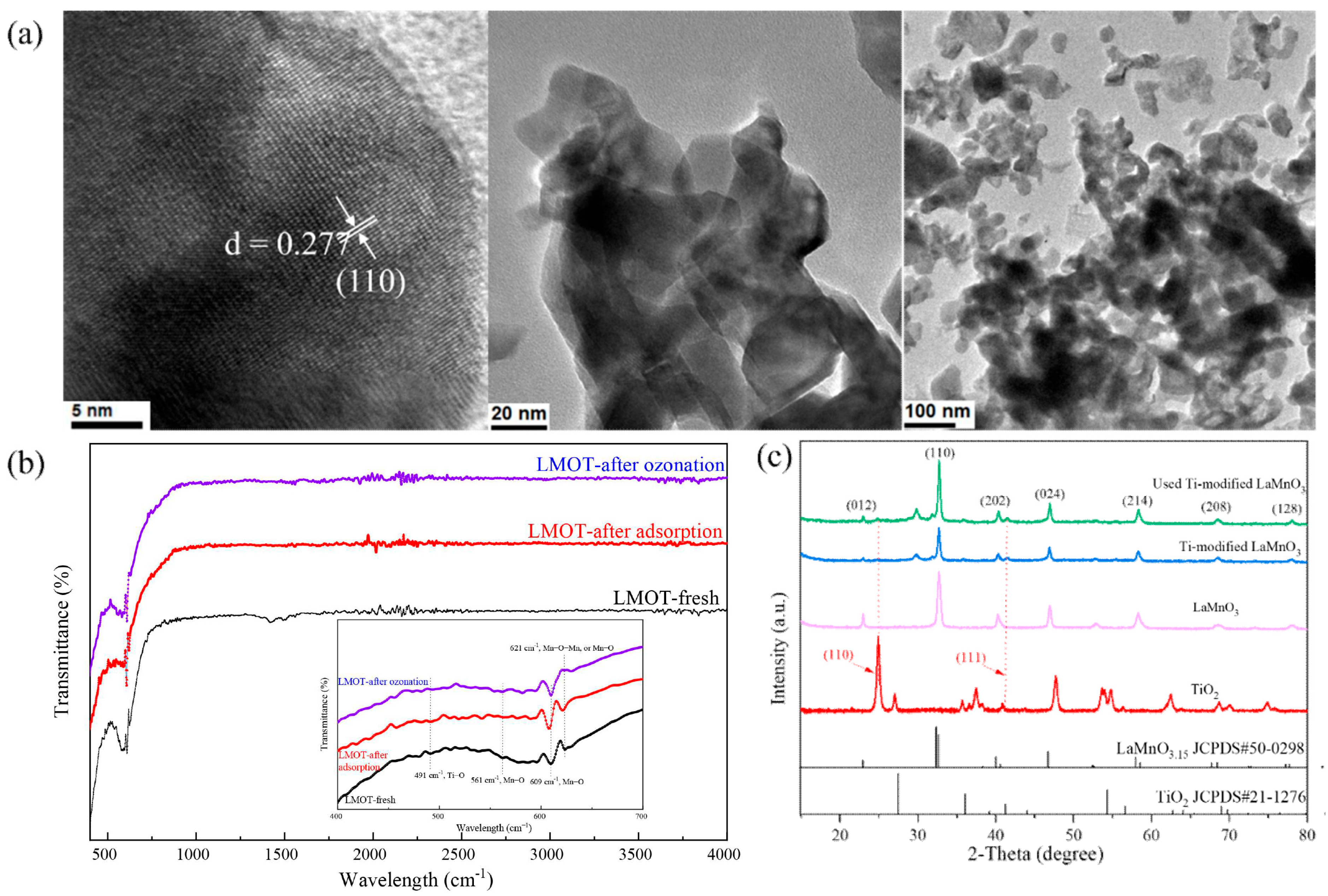
As shown in the TEM results of Figure 1a, the d-spacing of TiO2-modified LaMnO3 (110) was determined to be 0.277 nm, which closely matches the d-spacing value of the single-phase LaMnO3 (110) at 0.2755 nm, as reported in JCPDS 50-0298. SEM images (Figure S2) revealed diverse particle shapes of TiO2-modified LaMnO3, exhibiting both regular cubic morphology and irregular forms. Energy dispersive X-ray spectrometry analysis demonstrated the presence of La, Mn, Ti, and O elements on the sample’s surface, with relative contents of 8.31%, 7.75%, 7.10%, and 76.74%, respectively (Figure S3 and Table S2). The TiO2-modified LaMnO3 exhibited a specific surface area of 24.43 m2/g, a pore volume of 0.059 cm3/g, and an average pore diameter of 4.8 nm (Figure S4 and Table S3).
FT-IR analysis (Figure 1b) indicated peaks below 1000 cm−1, which were associated with metal–oxygen bonds [39]. Specifically, the absorption bands at 561, 609, and 621 cm−1 were assigned to Mn-O or Mn-O-Mn bonds [40], while the absorption band at 491 cm−1 was attributed to Ti-O bonds [41]. The firm diffraction peaks observed at (012), (110), (202), (024), (214), (208), and (128) were identified as facets of LaMnO3 based on JCPDS 50-0298 (Figure 1c) [42]. Additionally, the diffraction peaks at (110) and (111) were associated with facets of TiO2, as reported in JCPDS 21-1276 [43]. As presented in Text S2 and Table S4, the calculated crystallite sizes for TiO2-modified LaMnO3 particles fell within 19.6 to 21.2 nm, with average values of 20.6 nm, respectively. Meanwhile, its corresponding calculated crystallinity was found to be 75.5%. TGA curves (Figure S5) demonstrated that the mass loss of the sample was lower than 1.5% when the decomposition temperature reached 800 °C, highlighting the stability of TiO2-modified LaMnO3.

3.2. Degradation Performance and Reusability

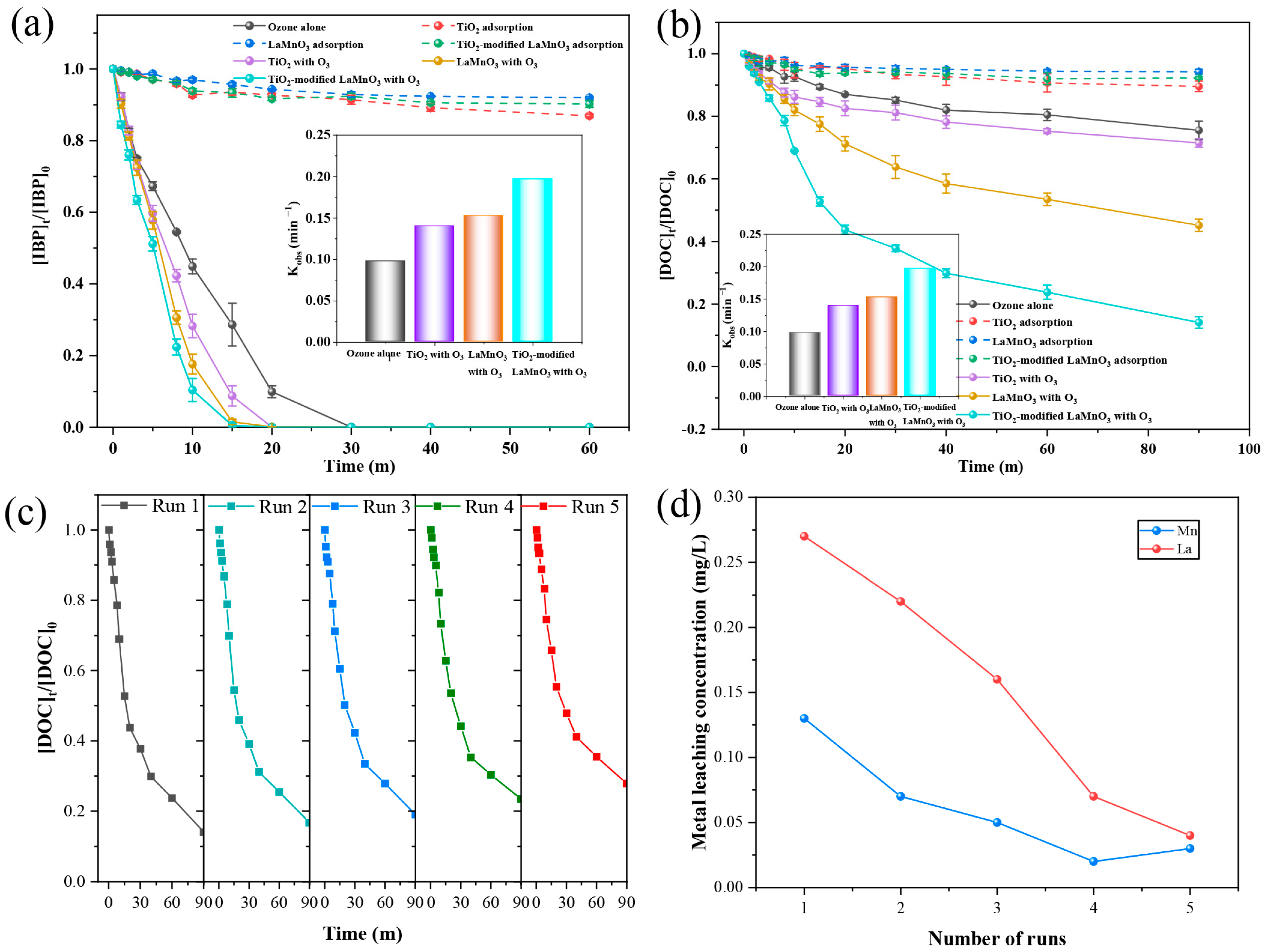
As shown in Figure 2a,b, TiO2-modified LaMnO3 attained the most efficient IBP removal (98.0%) and the highest ratio of DOC removal (85.9%). The degradation kinetics were modeled using pseudo-first-order reactions, resulting in R2 values exceeding 0.97. In the absence of ozone, TiO2, LaMnO3, and TiO2-modified LaMnO3 exhibited IBP removal efficiencies of 13.2%, 8.05%, and 9.80%, respectively. TiO2-modified LaMnO3 achieved significantly higher IBP degradation rate constants (Kobs) of 0.1974 min−1 compared to ozonation, TiO2, and LaMnO3. Correspondingly, DOC removal for these processes was 28.5%, 54.8%, and 85.9%, respectively (Figure 2b). Figure S6 illustrates the pH variation during different processes, providing additional evidence that the inadequate mineralization observed during single ozonation was attributed to the accumulation of acid-resistant intermediates impervious to ozone degradation [10]. This illustrates that the catalytic effect of ozone was mainly attributed to LaMnO3 rather than TiO2, and the modification of TiO2 contributed to enhanced adsorption-catalytic performance.
After 5 cycles, the DOC removal decreased from 85.9% to 72.2%, representing a relative reduction of 13.7% (Figure 2c). The overall stability was found to be comparable to previous studies utilizing perovskite in visible light-induced photocatalysis [44] and catalytic ozonation, where removal reductions ranged from 3% to 23% after 5 cycles [7,45]. This stability was attributed to the modification that increased the overall stability of LaMnO3 by enhancing specific surface features. Consequently, it accelerated the IBP degradation rate in the bulk solution and facilitated the rapid removal of IBP bound to the surface via active sites. The crystallinity and crystal structures remained well-preserved, as depicted in Figure 1c and Table S4, by comparing fresh and used catalysts. After five uses (Figure 2d), the leaching of Mn and La was minimal, measuring less than 0.1 mg/L. Less Mn leaching was observed compared to the reported non-modified perovskite (0.2 mg/L) [7,9,46]. These findings demonstrate that TiO2-modified LaMnO3 exhibited exceptional removal efficiency and reusability.

3.3. Effect of the Operational Parameters

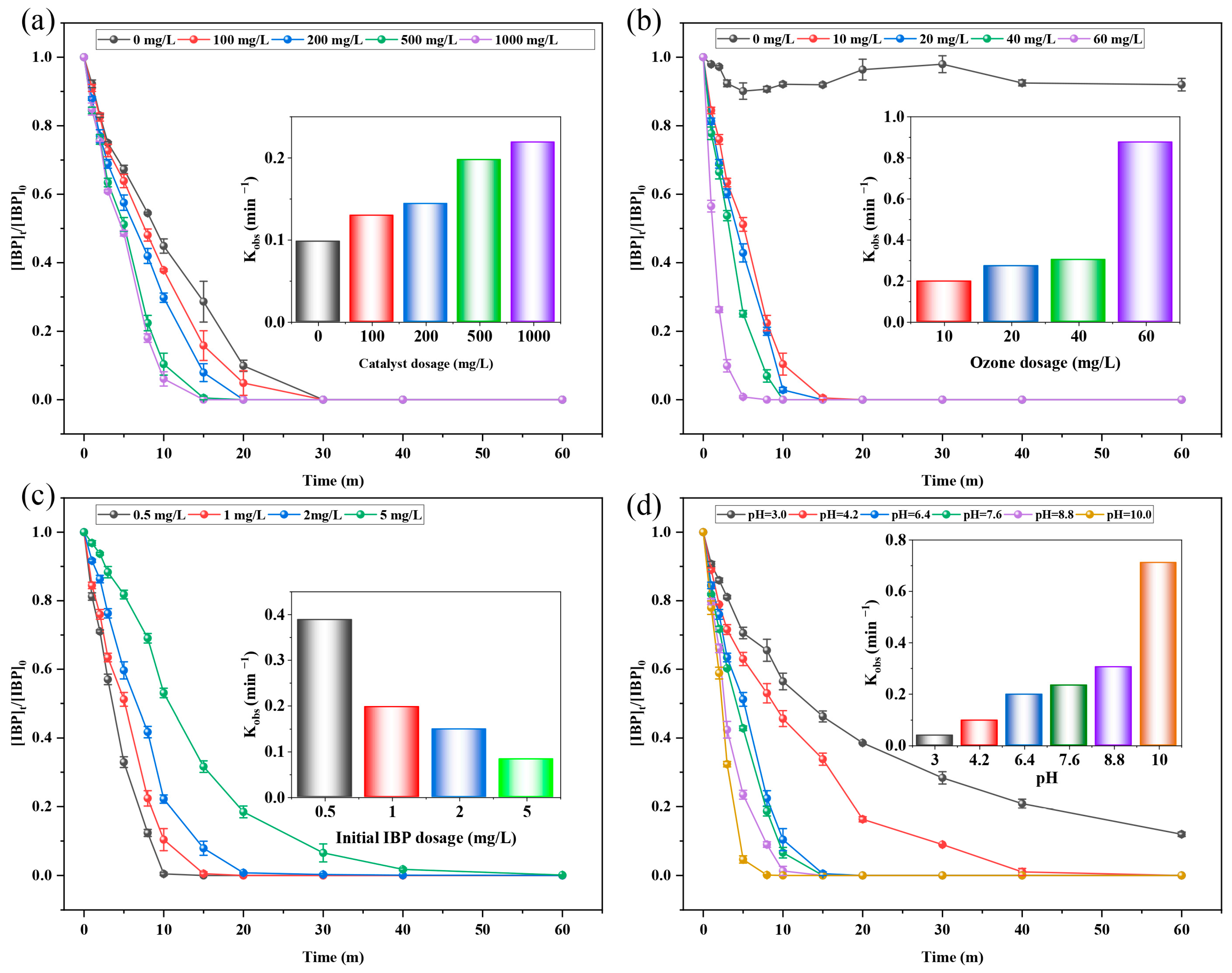
As shown in Figure 3a, at a catalyst dosage of 1000 mg/L, IBP was completely removed, with the observed rate constant (Kobs) reaching 0.2189 min−1. Notably, even when the catalyst dosage was increased from 500 to 1000 mg/L, the observed rate constant (Kobs) increased by only 0.02 min−1. This can be attributed to the fixed ozone dosage, causing an excess of the catalyst. The surplus catalyst contributes to escalated treatment costs. Figure 3b illustrates the effect of ozone dosage on IBP removal. With ozone concentration elevated across the range of 10–60 mg/L, Kobs rose from 0.1974 min−1 to 0.8763 min−1. This notable enhancement in Kobs can be linked to more efficient gas–liquid ozone transport [47]. A significant surge in Kobs was observed upon stepping up the ozone input from 40 to 60 mg/L. As the primary oxidant in the catalytic ozonation system, the increasing ozone dosage led to an increase in the generation of secondary oxidants such as reactive oxygen species (ROS). Considering the relative reactivity of ozone (kO3 = 9.6 M−1 s−1) and hydroxyl radicals (HO•, kHO• = 7.4 × 10⁹ M−1 s−1) toward IBP, this was likely due to the improvement in excessive generation of ROS [48].
As depicted in Figure 3c, Kobs decreased from 0.3880 min−1 to 0.0832 min−1 with an increase in the initial IBP concentration across 0.5–5 mg/L. Even when the IBP concentration was elevated to 5 mg/L, complete removal could still be achieved within a 40-min treatment, suggesting the enduring robustness of the catalyst even under high initial IBP concentration. As observed in Figure 3d, when the initial pH was increased within the range of 3 to 10, a drastic reduction in Kobs, from 0.7115 to 0.0039 min−1, was consistent with the inhibitory effect of acidic conditions on IBP removal. At initial pH values of 3.0 and 4.2, IBP removal was notably inhibited compared to conditions close to neutral and alkaline. On the one hand, acidic conditions restrain ozone decomposition into ROS. Hydroxide ions promote ROS generation and act as initiators for ozone decomposition. On the other hand, PZC was measured as 5.75 (Figure S7) [49]. When the solution pH was below 4.9, protonation of both the catalyst surface and IBP rendered them mutually repulsive, thereby suppressing their interaction. This limitation reduced the surface reactions between IBP and active sites, further decreasing Kobs. Nevertheless, it is also worth noting that, apart from pH = 3.0, all the other pH conditions favored complete degradation of IBP within 40 min, indicating a wide pH tolerance range of TiO2-modified LaMnO3.

3.4. Effect of the Water Matrix

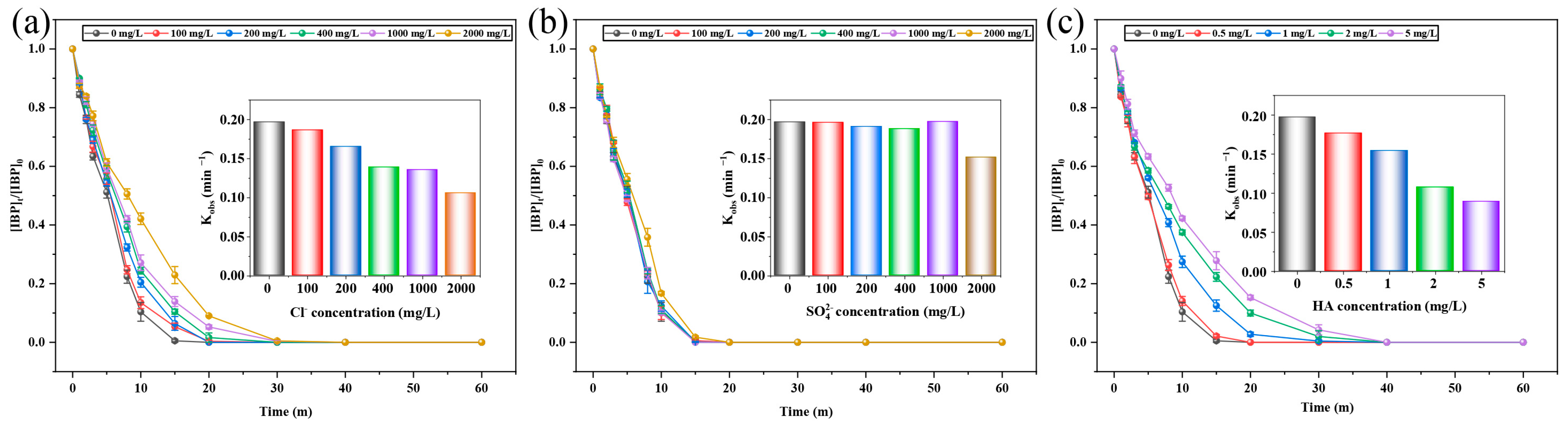
In the presence of 2000 mg/L chloride ions, Kobs decreased from 0.1974 to 0.1063 min−1 (Figure 4a). However, IBP could still be degraded entirely within 30 min. This is consistent with findings in existing studies [50,51]. When chloride ions were introduced into the system, they directly reacted with ozone and HO• [52]. Chloride ions affected ozone dissolution in water, reacted with ozone, competed for absorption onto the catalyst surface active site, and reacted with HO•. Considering the relatively small reaction rate constant between ozone and chloride ions (3.0 × 10⁻³ M−1 s−1), the significant inhibition came from the reaction with HO• and the generation of less reactive chlorine radicals.
When the SO42− concentration ranged from 100 to 1000 mg/L, both Kobs and IBP removal remained unaffected (Figure 4b). Even with the SO42− concentration increased to 2000 mg/L, IBP could still be completely removed within 30 min, although Kobs slightly decreased to 0.1542 min−1. Excessive SO42− tends to adsorb on the catalyst surface, occupying adsorption sites and slowing down the adsorption-catalytic degradation process [25]. Furthermore, HO• can react with Kobs to produce sulfate radicals with a constant reaction rate to IBP.
The addition of HA at concentrations of 0.5, 1, 2, and 5 mg/L led to a steady decline in Kobs from 0.1974 to 0.1768, 0.1546, 0.1076, and 0.0898 min−1 (Figure 4c). The polyfunctional nature of HA, bearing carboxylic and phenolic moieties, imparts a negative surface charge at pH 6.4. This negatively charged species readily competes for the Lewis acid centers on the catalyst surface, accounting for the observed suppression of catalytic activity [53]. Simultaneously, ozone could be depleted as it oxidizes the HAs, thereby diminishing the oxidation efficacy of the process.

3.5. Adsorption-Catalysis Mechanism of O3 on TiO2-Modified LaMnO3 Surface

3.5.1. ROS Identification and Reaction Pathways

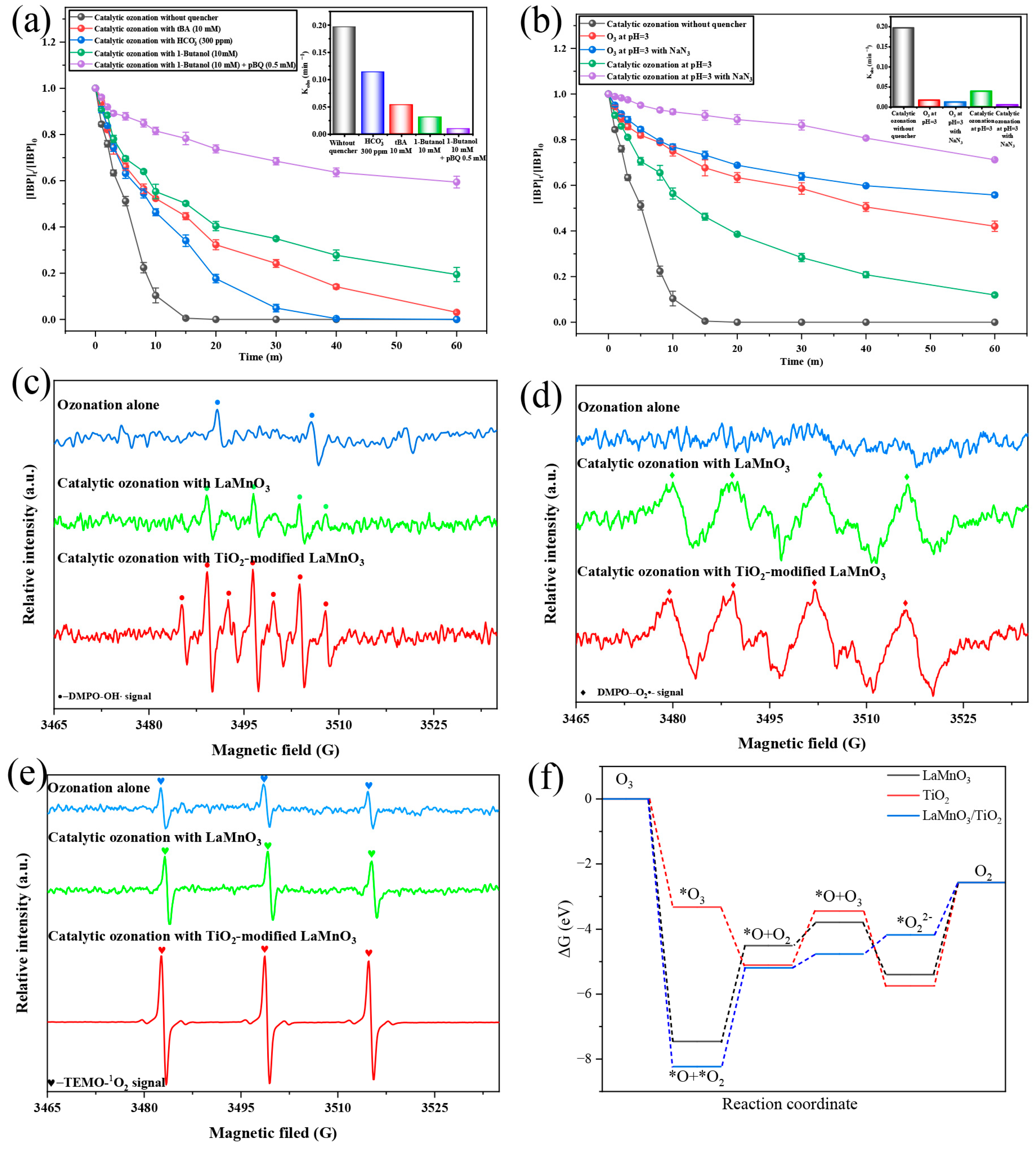
Different scavengers exhibit distinct reaction rates with radicals (Table S6), allowing for an indirect deduction of the ROS type in the catalytic system by EPR. A noticeable reduction in Kobs was observed when various radical scavengers were introduced into the catalytic ozone system. TBA and HCO3 act as scavengers for HO• [54]. Specifically, upon addition of 10 mmol/L TBA and 300 mg/L HCO3 (Figure 5a), Kobs decreased to 0.0547 and 0.0911 min−1, respectively. This reflects the pivotal contribution of HO• to IBP degradation, wherein the extent of removal mirrors the level of radical generation. Furthermore, adding 10 mmol/L 1-butanol and 0.5 mmol/L p-BQ resulted in a significant decrease in IBP removal and Kobs, providing further evidence that, besides HO•, O2 is also involved in IBP removal. Simultaneously, NaN3 addition suppressed IBP removal in both the ozonation and catalytic ozonation processes at pH 3 (Figure 5b), suggesting that the inhibition arose not only from scavenging 1O2 but also HO• [55]. In the solution, the primary action is by ozone, while on the catalyst surface, catalytic ozone reactions generate a substantial amount of ROS, influencing IBP removal and DOC reduction. The dominance of bulk solution reactions in IBP degradation was established using TBA and HCO3 as radical probes. Meanwhile, O2 and 1O2 were found to drive mineralization through a combination of HO• generation via chain reactions and direct oxidative destruction.
The intense DMPO-HO• signal (Figure 5c) underscores the superior capacity of the TiO2-modified LaMnO3 system for HO• generation during catalytic ozonation. Stable DMPO-O2 signals were observed in both LaMnO3 and TiO2-modified LaMnO3 systems (Figure 5d). During the single ozonation process, the absence of DMPO-signals suggested the limited involvement of O2 in IBP removal. Figure 5e illustrates the significantly high signal intensity of TMEP-1O2 in catalytic ozonation using modified LaMnO3 compared to single ozonation and catalytic ozonation using non-modified LaMnO3. This indicates the presence of singlet oxygen in the catalytic system, consistent with the quenching experiment results. Further analysis was conducted to elucidate the ozone decomposition pathways and intermediates on distinct catalyst surfaces. The reaction energy for these pathways is depicted in Figure 5f. The initial step involved the adsorption of O3 on the catalysts, characterized by an exothermic process with negative ΔG values. This energy release overcame the reaction barrier and reached the transition state. The third step (*O + O2) transitioning to the fourth step (*O + O3) was the rate-limiting step. In the final step, the energy barrier for TiO2-modified LaMnO3 was significantly minimal, implying that the composite catalyst facilitated the desorption of O22−. The significant enhancement of key steps significantly improved adsorption-catalysis efficiency, thereby promoting the removal of IBP and DOC.

3.5.2. Redox Pair of Mn3+/Mn4+

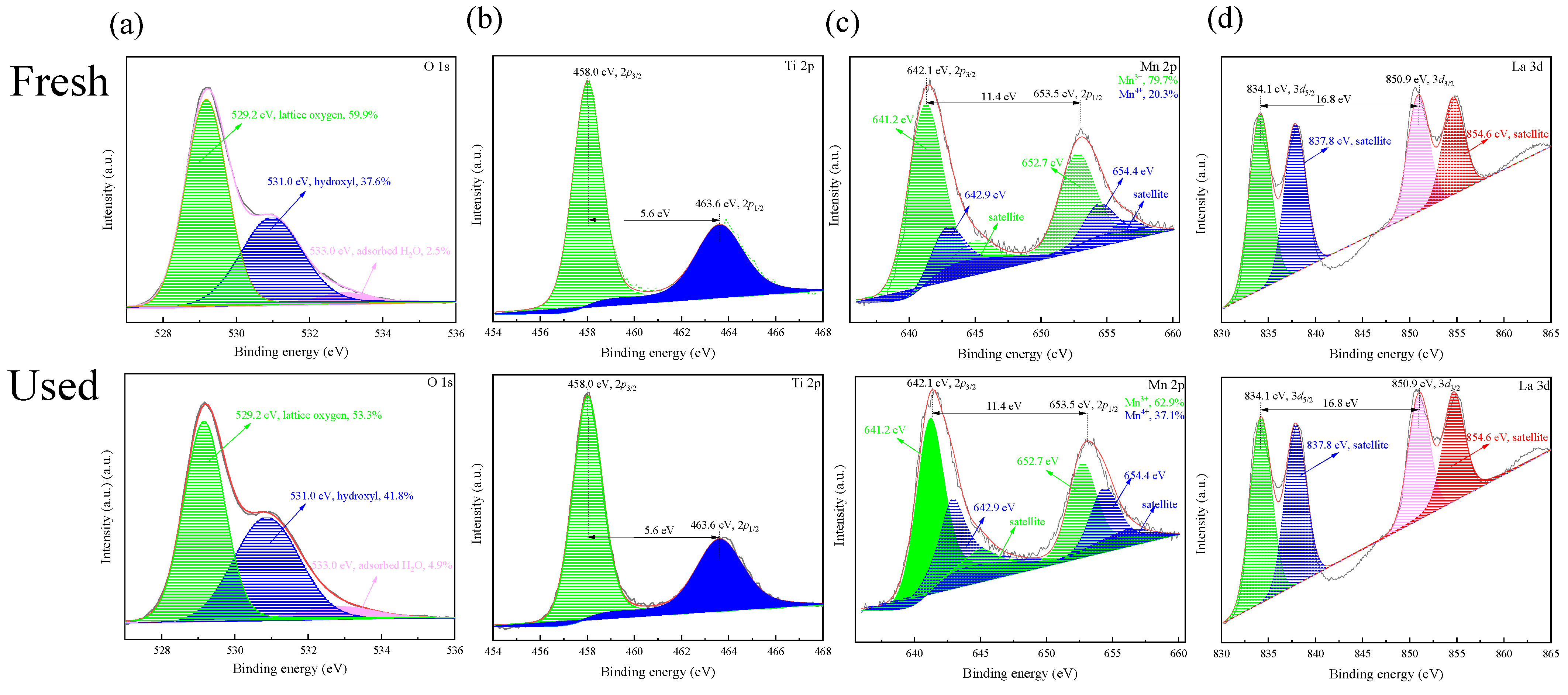
As shown in Figure 6a and Figure S8, lattice oxygen signals diminished, whereas hydroxyl and adsorbed water features intensified, suggesting that oxygen vacancies are abundant in the TiO2-modified LaMnO3 and play a key role in ozone decomposition. The increase in adsorbed H2O and hydroxyl on TiO2-modified LaMnO3 indicated the occurrence of redox reactions on the catalyst surface [42]. The difference in binding energy between Ti 2p 3/2 and 2p 1/2 difference was measured at 5.6 eV (Figure 6b), confirming the presence of TiO2 in the catalyst both before and after use [56]. However, the relative area of Ti 2p 3/2 and 2p 1/2 remained unchanged after the reaction. The spin–orbit splitting of the Mn 2p level was consistently 11.4 eV for both fresh and used TiO2-modified LaMnO3 (Figure 6c). Two spin–orbit doublets were resolved from the Mn 2p spectra, corresponding to Mn3+ (642.1 eV and 653.5 eV) and Mn4+ (642.9 eV and 654.4 eV). A reduction in Mn3+ content from 79.7% to 62.9% was observed after the reaction, coupled with an increase in Mn4+ from 20.3% to 37.1%. The Mn3+/Mn4+ ratio in TiO2-modified LaMnO3 was 3.9, in stark contrast to the ratios of 1.2 and 2.2 typically observed for nanocast LaMnO3 and LaMn4Ox, respectively [7,10]. Regarding La 3d binding energies, the difference between La 3d 5/2 and 3d 3/2 was 16.8 eV (Figure 6d), confirming the presence of La3+ in both fresh and used TiO2-modified LaMnO3 [57]. However, there was only a slight change after the reaction. In summary, Ti and La did not actively participate in the catalytic reaction, indicating no catalytic performance from these elements. On the other hand, Mn3+/Mn4+ was key to the catalytic reaction process.

3.5.3. Bonding, Orbitals, Charge, and Interaction Analysis

In TiO2-modified LaMnO3, LaMnO3 played a pivotal role in adsorption-catalysis processes. We focused on elucidating the interaction between O3 and LaMnO3 while assessing the impacts of different components on adsorption forces. We devised three distinct adsorption configurations for O3 on the 110, 102, and 010 crystal facets (Figure S9). The calculated adsorption energy (Eads) suggests that O3 exhibited the highest favorability for adsorption on the 010 crystal facet (Figure S10), with an Eads value of −2.24 eV. Significantly, excessively high or low Eads could adversely affect the catalytic process [58]. A more negative adsorption energy reflects greater instability of the adsorption complex, which hampers the overall catalytic performance [59]. In the optimized catalyst structure (Figure S11), Mn and La atoms constitute the primary adsorption-catalysis centers, with O atoms from the O3 molecule forming bonds with these sites at bond lengths ranging from 1.954 to 2.461 Å. Following adsorption, the O-O bonds within the O3 molecule elongated to 1.365 and 1.511 Å, greater than the original bond length of 1.284 Å. This observation aligned with the catalytic mechanism of O3, as adsorption on the (010) face facilitated the breaking of O-O bonds.
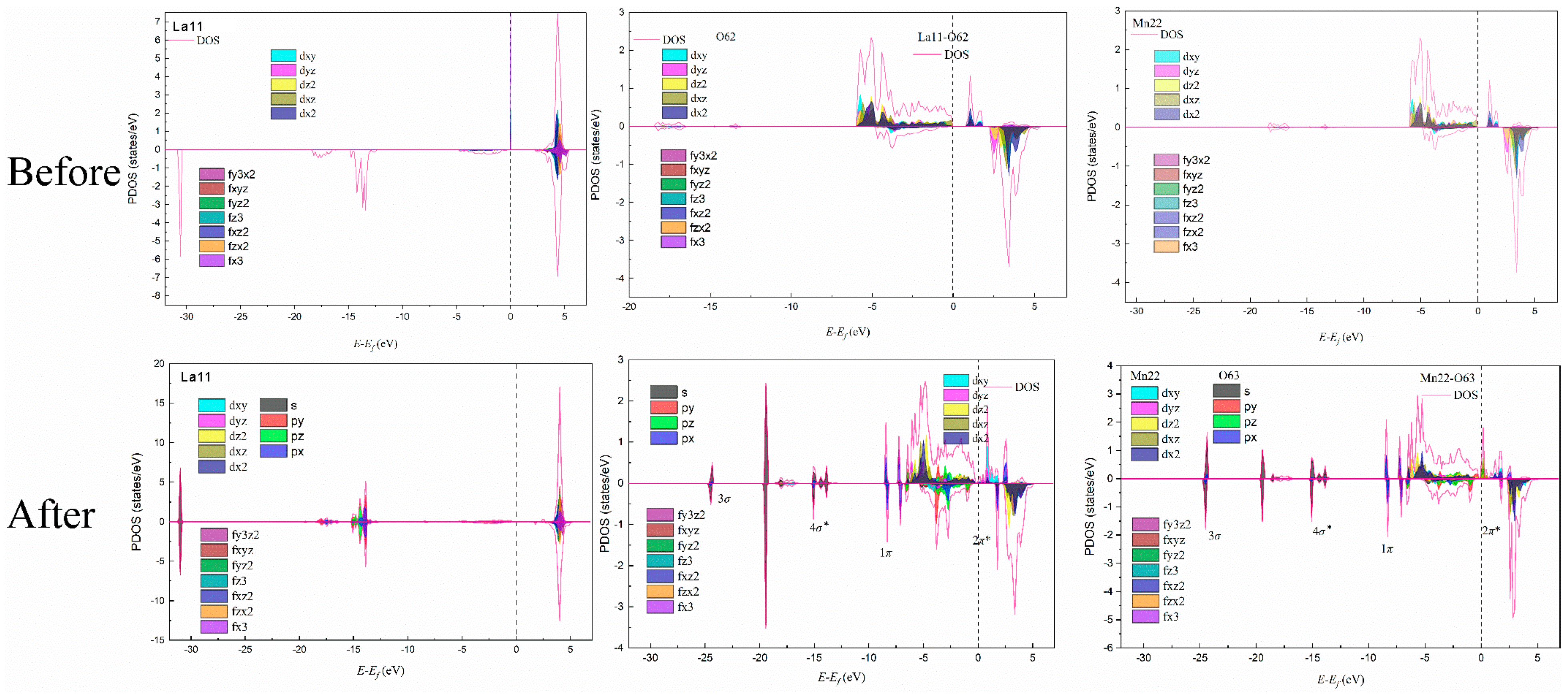
As the d-band center (ɛd) was closely linked to catalytic activity, variations between Mn and La atoms resulted in distinct reactivities towards O3. The calculated ɛd, within a range spanning from −0.289 to −1.289 eV, was in proximity to the Fermi energy (Ef, −2.830 eV), thereby reinforcing the interaction between the oxygen and metal (La, Mn) centers. Notably, the ɛd of the Mn atom was closer to Ef than that of the La atom, pointing to preferential O3 adsorption at the Mn site. Spin polarization of the M 3d orbitals shaped the spin-dependent DOS of the M-O bonds (Figure 7). The up-spin DOS was dominated by O 2p and M 3d orbitals, whereas the down-spin DOS arose primarily from O 2s 2p and M 3d contributions. The DOS near Ef reflects a hybrid character stemming from the coupling of O 2p and M 3d orbitals, rather than pure M 3d states, with this coupling arising from a 5σ bond formed between the two orbitals. The 2px and 2py orbitals contributed to forming a 1π bond, while the 2s and 2py orbitals were responsible for the 3σ bond. The 2π* antibonding state underwent a dispersion effect, whereas the 4π* antibonding energy exhibited a slight decline, a behavior stemming from the interaction between the 2π bond of O and the σ bond of M atoms. The coefficients of the orbital combination in the partial density of states (PDOS) exhibited notable differences, with electrons tending to be localized on the O side rather than being shared equally between O and M atoms. Particularly significant were the interactions between the 3dxy, 3dxz, and 3d2z orbitals of M atoms with the 2pz orbital of the O atom. Negative values in the COOP curves represent antibonding interactions, while positive values signify bonding interactions. These COOP curves showed antibonding characteristics at higher energies levels and bonding characteristics in the low-energy region. The COOP curves traversed through the Ef (Figure S12), indicating a transition of interactions from antibonding to bonding.
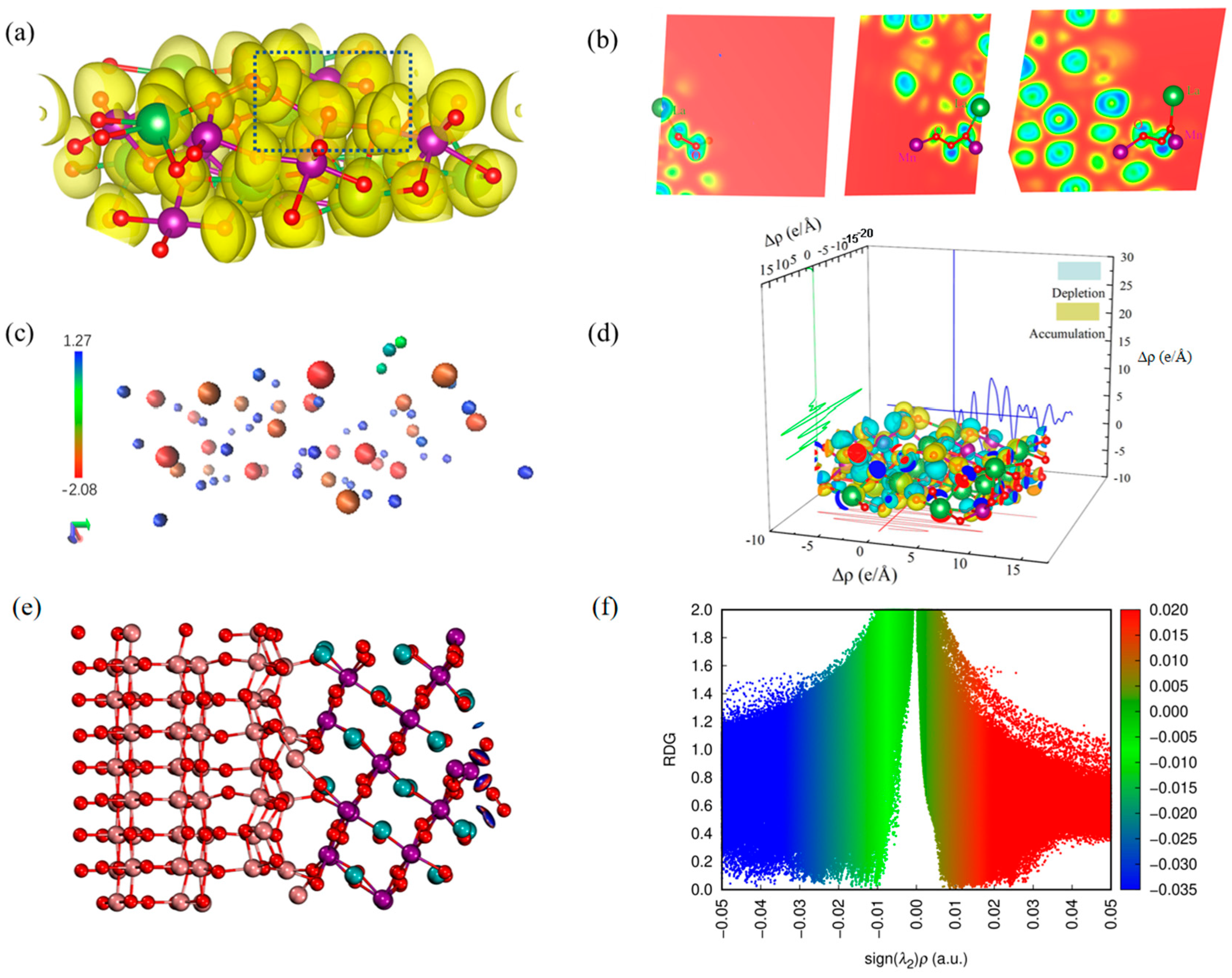
The ELF maps (Figure 8a,b) offered additional insights into the charge density overlaps. Following adsorption, electron density within LaMnO3 shifted toward the adsorbed O atoms, disrupting the initially homogeneous ELF field. Stronger ELF intensity at the Mn-O interface relative to La-O suggests more robust electronic coupling at Mn sites [60]. Bader charges (Figure 8c) exemplified that the charge transfer occurred from the surface M atoms to the adsorbed O atoms. Additionally, the adsorbed O atoms expedited the transfer of internal electrons to the vicinity around them, leading to alterations in the charge distribution. Compared to La atoms, the greater charge transfer suggested that exposed Mn atoms predominantly served as mediators for bonding the adsorbed O atoms. The charge density difference maps (Figure 8d) further underscored the increase in charge density surrounding the adsorbed O atoms, accompanied by a decrease in charge density around the corresponding M atoms. For a more in-depth examination of the interaction between O3 and the catalyst surface, we conducted a reduced density gradient (RDG) analysis, as illustrated in Figure S13 and Figure 8e,f. This analysis involved the evaluation of Sign(λ2)ρ values and electron density values at the bond critical point (BCP) for various systems, which were summarized in Table S7. RDG analysis stands as a potent method for characterizing chemical bonding interactions [20]. The values surrounding the reference point indicated pronounced attractive interactions (represented in blue), and this heightened attraction can be ascribed to O of O3 positioned between the M atom of the catalyst. Furthermore, the presence of a BCP at the electron density level served as additional confirmation for the existence of the M-O bond. Moderate reduction in interaction forces proves advantageous for improving the adsorption-catalysis process of O3 on the surface of TiO2-modified LaMnO3. Simultaneously, prompt detachment facilitates the swift cycling of Mn3+/Mn4+, resulting in the increased production of ROS, which can be effectively utilized for IBP removal.

4. Conclusions

In summary, the synthesized TiO2-modified LaMnO3 catalyst displayed exceptional efficiency in the catalytic ozonation process for removing IBP under various operational parameters and water matrices (with DOC removal increasing from 28.5% to 85.9%). Experimental evidence, including ESR and quenching experiments, unequivocally confirmed the greater production of ROS by the TiO2-modified LaMnO3, which was responsible for its superior IBP removal compared to the non-modified LaMnO3. Furthermore, the Mn3+/Mn4+ ratio increased to 3.9, contributing significantly to ozone decomposition. DFT simulations offered valuable insights into the enhanced ROS generation, primarily attributed to the activation of surface-active Mn sites. A moderate reduction in interaction forces has proven advantageous for improving the adsorption-catalysis process of O3 over TiO2-modified LaMnO3. Rapid detachment facilitated the swift cycling of Mn3+/Mn4+, resulting in an increased production of ROS, which can be effectively harnessed for IBP removal. This study deepens our understanding of electron behaviors and bond dynamics during ozone interaction with perovskite surface metal ions and underscores the significance of structural modifications in perovskite materials to enhance ROS generation in catalytic ozonation. Overall, this catalyst emerges as a promising candidate for advanced water treatment applications, effectively eliminating IBP from diverse and complex water sources.

Supplementary Materials

The following supporting information can be downloaded at: https://www.mdpi.com/article/10.3390/w18070822/s1. Text S1. Characterization methods. Text S2. Calculation equations. Text S3. Testing conditions for electron spin resonance experiments. Table S1. The physicochemical property of ibuprofen. Table S2. Atomic element analysis of catalysts. Table S3. Surface area and pore characteristics of catalysts. Table S4. The crystalline sizes and crystallinities of TiO2-modified LaMnO3 before and after the reaction. Table S5. The content of C 1s, La 3d, Mn 2p, Mn 3s, O 1s, and Ti 2p of TiO2-modified LaMnO3 before and after the reaction process. Table S6. The reaction rate between quenchers and reactive oxygen species. Table S7. Sign(λ2)ρ values and electron density values at bond critical point (BCP) of different systems. Figure S1. Schematic diagram of catalytic ozonation system setup. Figure S2. SEM image of LaMnO3 (A), (B), and TiO2-modified LaMnO3 (C), (D) at different magnitudes. Figure S3. Energy dispersive X-ray spectrometry of LaMnO3 (A–D; A: image of mapping particle; B–D: La, Mn, and O element mapping) and TiO2-modified LaMnO3 (E-J; E: image of mapping particle; G–J: La, Mn, Ti and O element mapping). Figure S4. Nitrogen sorption isotherms (a) and the corresponding pore size distributions (b) of three catalyst. Figure S5. TGA analysis in N2 atmosphere for evaluation of the concentration of surface hydroxyl groups. Figure S6. Variation of solution pH during ozonation and catalytic ozonation processes. Figure S7. Measurement of point of zero charge (PZC) for TiO2-modified LaMnO3. Figure S8. XPS full-range scan of the used and fresh TiO2-modified LaMnO3. Figure S9. Possible conformations of O3 adsorbed different crystal faces of the catalyst. Figure S10. Adsorption energy of O3 adsorbed different crystal faces of the catalyst. Figure S11. Representative conformation of O3 adsorbed on the optimized catalyst structure. Figure S12. COOP curves of the catalyst after O3 adsorption. Figure S13. Sign(λ2)ρ colored isosurfaces of δginter = 0.005 a.u. corresponding to reduced density gradient (RDG) analyses for (a) LaMnO3, (b) TiO2; (c) and (d) are the corresponding plots of the RDG vs. the electron density (ρ) multiplied by the sign of the second Hessian eigenvalue (λ2).

Author Contributions

Formal analysis, investigation, writing—original draft preparation, writing—review and editing, J.Y. and R.L.; Project administration, S.-L.O., H.L., H.Y.Y. and J.H.; Funding acquisition, H.L., H.Y.Y. and J.H. All authors have read and agreed to the published version of the manuscript.

Funding

This research was funded by National Natural Science Foundation of China joint grant (NRF2018NRF-NSFC003ES-015), National Key Research and Development Program of China (2023YFC3207000), and Singapore Ministry of Education SUTD Kickstarter initiative (SKI 2021_02_16).

Data Availability Statement

The original contributions presented in this study are included in the article and Supplementary Materials. Further inquiries can be directed to the corresponding authors.

Acknowledgments

This work was supported by Center for Water Research, Department of Civil and Environment Engineering, College of Design and Engineering, and National University of Singapore. Computational resources from the High Performance Computing Center of Central South University are gratefully acknowledged.

Conflicts of Interest

The authors declare no conflicts of interest.

Abbreviations

The following abbreviations are used in this manuscript:
CASChemical Abstracts Service
BCPbond critical point
COOPcrystal orbital overlap population
DFTdensity functional theory
DOCdissolved organic carbon
Eadsadsorption energy
EfFermi energy
ELFelectron localization function
ESRelectron spin resonance
ɛdd-band center
FT-IRFourier transform infrared
HAhumic acid
HO•hydroxyl radicals
IBPibuprofen
O2Superoxide radical
1O2Singlet oxygen
PAWprojector augmented wave
PBEPerdew-Burke-Ernzerhof
p-BQp-benzoquinone
PDOSpartial density of states
PZCpoint of zero charges
RDGreduced density gradient
ROSreactive oxygen species
SEMscanning electron microscopy
TBAtert-butanol
TEMtransmission electron microscopy
TGAthermos-gravimetric analysis
VASPVienna Ab initio Simulation Package
XPSX-ray photoelectron spectroscopy
XRDX-ray diffraction

References

  1. Nawrocki, J.; Kasprzyk-Hordern, B. The efficiency and mechanisms of catalytic ozonation. Appl. Catal. B-Environ. 2010, 99, 27–42. [Google Scholar] [CrossRef]
  2. Rivas, F.; Carbajo, M.; Beltran, F.; Acedo, B.; Gimeno, O. Perovskite catalytic ozonation of pyruvic acid in water: Operating conditions influence and kinetics. Appl. Catal. B-Environ. 2006, 62, 93–103. [Google Scholar] [CrossRef]
  3. Pan, Y.; Xu, X.; Zhong, Y.; Ge, L.; Chen, Y.; Veder, J.M.; Guan, D.; O’Hayre, R.; Li, M.; Wang, G.; et al. Direct evidence of boosted oxygen evolution over perovskite by enhanced lattice oxygen participation. Nat. Commun. 2020, 11, 2002. [Google Scholar] [CrossRef]
  4. Merino, N.; Barbero, B.; Grange, P.; Cadus, L. LaCaCoO perovskite-type oxides: Preparation, characterisation, stability, and catalytic potentiality for the total oxidation of propane. J. Catal. 2005, 231, 232–244. [Google Scholar] [CrossRef]
  5. Carbajo, M.; Beltrán, F.J.; Gimeno, O.; Acedo, B.; Rivas, F.J. Ozonation of phenolic wastewaters in the presence of a perovskite type catalyst. Appl. Catal. B-Environ. 2007, 74, 203–210. [Google Scholar] [CrossRef]
  6. Alvárez’, P.M.; Beltrán, F.J.; Masa, F.J.; Pocostales, J.P. A comparison between catalytic ozonation and activated carbon adsorption/ozone-regeneration processes for wastewater treatment. Appl. Catal. B-Environ. 2009, 92, 393–400. [Google Scholar] [CrossRef]
  7. Wang, Y.; Chen, L.; Cao, H.; Chi, Z.; Chen, C.; Duan, X.; Xie, Y.; Qi, F.; Song, W.; Liu, J.; et al. Role of oxygen vacancies and Mn sites in hierarchical Mn2O3/LaMnO3−δ perovskite composites for aqueous organic pollutants decontamination. Appl. Catal. B-Environ. 2019, 245, 546–554. [Google Scholar] [CrossRef]
  8. Saputra, E.; Muhammad, S.; Sun, H.; Ang, H.-M.; Tadé, M.O.; Wang, S. Shape-controlled activation of peroxymonosulfate by single crystal α-Mn2O3 for catalytic phenol degradation in aqueous solution. Appl. Catal. B-Environ. 2014, 154–155, 246–251. [Google Scholar] [CrossRef]
  9. Orge, C.A.; Órfão, J.J.M.; Pereira, M.F.R.; Barbero, B.P.; Cadús, L.E. Lanthanum-based perovskites as catalysts for the ozonation of selected organic compounds. Appl. Catal. B-Environ. 2013, 140–141, 426–432. [Google Scholar] [CrossRef]
  10. Afzal, S.; Quan, X.; Zhang, J. High surface area mesoporous nanocast LaMO3 (M = Mn, Fe) perovskites for efficient catalytic ozonation and an insight into probable catalytic mechanism. Appl. Catal. B-Environ. 2017, 206, 692–703. [Google Scholar] [CrossRef]
  11. Wu, S.; Lin, Y.; Yang, C.; Du, C.; Teng, Q.; Ma, Y.; Zhang, D.; Nie, L.; Zhong, Y. Enhanced activation of peroxymonosulfte by LaFeO3 perovskite supported on Al2O3 for degradation of organic pollutants. Chemosphere 2019, 237, 124478. [Google Scholar] [CrossRef]
  12. Zhang, R.; Wan, Y.; Peng, J.; Yao, G.; Zhang, Y.; Lai, B. Efficient degradation of atrazine by LaCoO3/Al2O3 catalyzed peroxymonosulfate: Performance, degradation intermediates and mechanism. Chem. Eng. J. 2019, 372, 796–808. [Google Scholar] [CrossRef]
  13. Garcia-Muñoz, P.; Lefevre, C.; Robert, D.; Keller, N. Ti-substituted LaFeO3 perovskite as photoassisted CWPO catalyst for water treatment. Appl. Catal. B-Environ. 2019, 248, 120–128. [Google Scholar] [CrossRef]
  14. Ong, W.-J.; Tan, L.-L.; Ng, Y.H.; Yong, S.-T.; Chai, S.-P. Graphitic carbon nitride (g-C3N4)-based photocatalysts for artificial photosynthesis and environmental remediation: Are we a step closer to achieving sustainability? Chem. Rev. 2016, 116, 7159–7329. [Google Scholar] [CrossRef]
  15. Chong, M.N.; Jin, B.; Chow, C.W.K.; Saint, C. Recent developments in photocatalytic water treatment technology: A review. Water Res. 2010, 44, 2997–3027. [Google Scholar] [CrossRef]
  16. Shan, C.; Zhang, Y.; Hou, N.; Jia, Q.; Hou, X.; Wang, Y.; Liu, Q. Revealing the key role of interfacial oxygen activation over CoMn2O4@MnO2 in the catalytic oxidation of acetone. J. Hazard. Mater. 2025, 485, 136904. [Google Scholar] [CrossRef] [PubMed]
  17. Lin, F.; Zhang, S.; Wang, B.; Yang, H.; Lv, J.; Zhang, S. Enhanced humic acid removal by sludge activated carbon/Fe2+ composite in peroxymonosulfate activation: Mechanism and performance. Environ. Sci. Pollut. Res. 2024, 32, 1195–1207. [Google Scholar] [CrossRef] [PubMed]
  18. Pei, J.; Liu, J.; Fu, K.; Fu, Y.; Yin, K.; Luo, S.; Luo, J. Non-metallic iodine single-atom catalysts with optimized electronic structures for efficient Fenton-like reactions. Nat. Commun. 2025, 16, 800. [Google Scholar] [CrossRef]
  19. Jiang, J.; Tong, M.; Shen, D.; Liang, Z.; Li, Z.; Duan, G.; Wang, L.; Fu, H. Utilizing molybdenum to tailor the electronic structure of iron through electron complementary effect for promoting oxygen reduction activity. Adv. Funct. Mater. 2025, 35, 2500065. [Google Scholar] [CrossRef]
  20. Lu, T.; Chen, F. Multiwfn: A multifunctional wavefunction analyzer. J. Comput. Chem. 2012, 33, 580–592. [Google Scholar] [CrossRef]
  21. Khalaf, S.; Shoqeir, J.H.; Lelario, F.; Bufo, S.A.; Karaman, R.; Scrano, L. TiO2 and active coated glass photodegradation of ibuprofen. Catalysts 2020, 10, 560. [Google Scholar] [CrossRef]
  22. Aydin, S.; Aydin, M.E.; Ulvi, A. Monitoring the release of anti-inflammatory and analgesic pharmaceuticals in the receiving environment. Environ. Sci. Pollut. Res. Int. 2019, 26, 36887–36902. [Google Scholar] [CrossRef]
  23. Illes, E.; Takacs, E.; Dombi, A.; Gajda-Schrantz, K.; Racz, G.; Gonter, K.; Wojnarovits, L. Hydroxyl radical induced degradation of ibuprofen. Sci. Total Environ. 2013, 447, 286–292. [Google Scholar] [CrossRef]
  24. Li, Q.; Wu, J.; Wu, T.; Jin, H.; Zhang, N.; Li, J.; Liang, W.; Liu, M.; Huang, L.; Zhou, J. Phase engineering of atomically thin perovskite oxide for highly active oxygen evolution. Adv. Funct. Mater. 2021, 31, 2102002. [Google Scholar] [CrossRef]
  25. Seleka, W.M.; Makhado, E. Synthesis and characterization xanthan gum/acrylic acid/acrylamide modified with graphene oxide hydrogel nanocomposite for removal of methylene blue from aqueous solution. Int. J. Biol. Macromol. 2025, 305, 141015. [Google Scholar] [CrossRef]
  26. Cho, J.; Cha, D.; Lee, Y.; Lee, J.; Lee, C. Conversion of ozone into hydroxyl radical by granular activated carbon with and without biofilms: Implications for micropollutant abatement. J. Hazard. Mater. 2025, 496, 139411. [Google Scholar] [CrossRef]
  27. Aribi, J.; Jahouach Rabai, W.; Bousselmi, L.; Trabelsi, M.H.; Azzouz, Z.; Hamrouni, B. Radiolysis performance of ibuprofen using ionizing processes: Kinetics and energy consumption. Environ. Technol. 2024, 46, 11–17. [Google Scholar] [CrossRef]
  28. Al-Odaini, N.A.; Zakaria, M.P.; Yaziz, M.I.; Surif, S. Multi-residue analytical method for human pharmaceuticals and synthetic hormones in river water and sewage effluents by solid-phase extraction and liquid chromatography–tandem mass spectrometry. J. Chromatogr. A 2010, 1217, 6791–6806. [Google Scholar] [CrossRef] [PubMed]
  29. Perdew, J.P.; Burke, K.; Ernzerhof, M. Generalized gradient approximation made simple. Phys. Rev. Lett. 1996, 77, 3865–3868. [Google Scholar] [CrossRef] [PubMed]
  30. Momma, K.; Izumi, F. VESTA 3 for three-dimensional visualization of crystal, volumetric and morphology data. J. Appl. Crystallogr. 2011, 44, 1272–1276. [Google Scholar] [CrossRef]
  31. Kresse, G.; Joubert, D. From ultrasoft pseudopotentials to the projector augmented-wave method. Phys. Rev. B 1999, 59, 1758–1775. [Google Scholar] [CrossRef]
  32. Song, M.; Hou, L.; Zhang, J.; Zhang, J.; Qian, G. A deeper orbital hybridization because of more unpaired electrons in d orbital resulted in a better catalytic performance. Sep. Purif. Technol. 2025, 353, 128639. [Google Scholar] [CrossRef]
  33. Hughbanks, T.; Hoffmann, R. Chains of trans-edge-sharing molybdenum octahedra: Metal-metal bonding in extended systems. J. Am. Chem. Soc. 1983, 105, 3528–3537. [Google Scholar] [CrossRef]
  34. Dronskowski, R.; Bloechl, P.E. Crystal orbital Hamilton populations (COHP): Energy-resolved visualization of chemical bonding in solids based on density-functional calculations. J. Phys. Chem. 1993, 97, 8617–8624. [Google Scholar] [CrossRef]
  35. Bader, R.F.; Stephens, M.E. Spatial localization of the electronic pair and number distributions in molecules. J. Am. Chem. Soc. 1975, 97, 7391–7399. [Google Scholar] [CrossRef]
  36. Wang, V.; Xu, N.; Liu, J.-C.; Tang, G.; Geng, W.-T. VASPKIT: A user-friendly interface facilitating high-throughput computing and analysis using VASP code. Comput. Phys. Commun. 2021, 267, 108033. [Google Scholar] [CrossRef]
  37. Henkelman, G.; Uberuaga, B.P.; Jónsson, H. A climbing image nudged elastic band method for finding saddle points and minimum energy paths. J. Chem. Phys. 2000, 113, 9901–9904. [Google Scholar] [CrossRef]
  38. Lu, T.; Chen, Q. Independent gradient model based on Hirshfeld partition: A new method for visual study of interactions in chemical systems. J. Comput. Chem. 2022, 43, 539–555. [Google Scholar] [CrossRef] [PubMed]
  39. Rahemi, N.; Haghighi, M.; Babaluo, A.A.; Jafari, M.F.; Khorram, S. Non-thermal plasma assisted synthesis and physicochemical characterizations of Co and Cu doped Ni/Al2O3 nanocatalysts used for dry reforming of methane. Int. J. Hydrogen Energy 2013, 38, 16048–16061. [Google Scholar] [CrossRef]
  40. Wenwei, W.; Jinchao, C.; Xuehang, W.; Sen, L.; Kaituo, W.; Lin, T. Nanocrystalline LaMnO3 preparation and kinetics of crystallization process. Adv. Powder Technol. 2013, 24, 154–159. [Google Scholar] [CrossRef]
  41. Thakur, P.; Thakur, A.; Yadav, K. Study of variation in the band gap with concentration of TiO2In (LaMnO3)1−x/(TiO2)x (where x = 0.0,0.1,0.2,0.3 and 0.4) nanocomposites. AIP Conf. Proc. 2016, 1728, 020414. [Google Scholar]
  42. Mo, H.; Nan, H.; Lang, X.; Liu, S.; Qiao, L.; Hu, X.; Tian, H. Influence of calcium doping on performance of LaMnO3 supercapacitors. Ceram. Int. 2018, 44, 9733–9741. [Google Scholar] [CrossRef]
  43. Arami, H.; Mazloumi, M.; Khalifehzadeh, R.; Sadrnezhaad, S.K. Sonochemical preparation of TiO2 nanoparticles. Mater. Lett. 2007, 61, 4559–4561. [Google Scholar] [CrossRef]
  44. Garcia-Muñoz, P.; Fresno, F.; Lefevre, C.; Robert, D.; Keller, N. Highly robust La1−xTixFeO3 dual catalyst with combined photocatalytic and photo-CWPO activity under visible light for 4-chlorophenol removal in water. Appl. Catal. B-Environ. 2020, 262, 118310. [Google Scholar] [CrossRef]
  45. Garcia-Muñoz, P.; Fresno, F.; Lefevre, C.; Robert, D.; Keller, N. Synergy effect between photocatalysis and heterogeneous photo-Fenton catalysis on Ti-doped LaFeO3 perovskite for high efficiency light-assisted water treatment. Catal. Sci. Technol. 2020, 10, 1299–1310. [Google Scholar] [CrossRef]
  46. Pecchi, G.; Reyes, P.; Zamora, R.; Cadús, L.E.; Fierro, J.L.G. Surface properties and performance for VOCs combustion of LaFe1−yNiyO3 perovskite oxides. J. Solid State Chem. 2008, 181, 905–912. [Google Scholar] [CrossRef]
  47. Lin, Z.; Yao, W.; Wang, Y.; Yu, G.; Deng, S.; Huang, J.; Wang, B. Perchlorate formation during the electro-peroxone treatment of chloride-containing water: Effects of operational parameters and control strategies. Water Res. 2016, 88, 691–702. [Google Scholar] [CrossRef]
  48. Huber, M.M.; Canonica, S.; Park, G.Y.; Von Gunten, U. Oxidation of pharmaceuticals during ozonation and advanced oxidation processes. Environ. Sci. Technol. 2003, 37, 1016–1024. [Google Scholar] [CrossRef]
  49. Tanveer, M.; Guyer, G.T.; Abbas, G. Photocatalytic degradation of ibuprofen in water using TiO2 and ZnO under artificial UV and solar irradiation. Water Environ. Res 2019, 91, 822–829. [Google Scholar] [CrossRef]
  50. Chu, W.; Lau, T.K. Ozonation of endocrine disrupting chemical BHA under the suppression effect by salt additive--with and without H2O2. J. Hazard. Mater. 2007, 144, 249–254. [Google Scholar] [CrossRef]
  51. Khuntia, S.; Majumder, S.K.; Ghosh, P. Catalytic ozonation of dye in a microbubble system: Hydroxyl radical contribution and effect of salt. J. Environ. Chem. Eng. 2016, 4, 2250–2258. [Google Scholar] [CrossRef]
  52. Yuan, Y.; Garg, S.; Wang, Y.; Li, W.; Chen, G.; Gao, M.; Zhong, J.; Wang, J.; Waite, T.D. Influence of salinity on the heterogeneous catalytic ozonation process: Implications to treatment of high salinity wastewater. J. Hazard. Mater. 2022, 423, 127255. [Google Scholar] [CrossRef] [PubMed]
  53. Ikhlaq, A.; Brown, D.R.; Kasprzyk-Hordern, B. Catalytic ozonation for the removal of organic contaminants in water on alumina. Appl. Catal. B-Environ. 2015, 165, 408–418. [Google Scholar] [CrossRef]
  54. Khan, Z.; Al Thubaiti, K.S.; Albishi, H.M. Kinetic studies on the sulfathiazole degradation by activated persulfate with ascorbic acid and cysteine. Int. J. Chem. Kinet. 2024, 57, 185–198. [Google Scholar] [CrossRef]
  55. He, Y.; Wang, L.; Chen, Z.; Shen, B.; Wei, J.; Zeng, P.; Wen, X. Catalytic ozonation for metoprolol and ibuprofen removal over different MnO2 nanocrystals: Efficiency, transformation and mechanism. Sci. Total Environ. 2021, 785, 147328. [Google Scholar] [CrossRef]
  56. Kitchamsetti, N.; Kalubarme, R.S.; Chikate, P.R.; Park, C.J.; Ma, Y.R.; Shirage, P.M.; Devan, R.S. An investigation on the effect of Li–ion cycling on the vertically aligned brookite TiO2 nanostructure. Chem. Sel. 2019, 4, 6620–6626. [Google Scholar] [CrossRef]
  57. Zhang, C.; Wang, C.; Zhan, W.; Guo, Y.; Guo, Y.; Lu, G.; Baylet, A.; Giroir-Fendler, A. Catalytic oxidation of vinyl chloride emission over LaMnO3 and LaB0.2Mn0.8O3 (B=Co, Ni, Fe) catalysts. Appl. Catal. B-Environ. 2013, 129, 509–516. [Google Scholar] [CrossRef]
  58. Yang, S.; Ye, S.; Hu, J.; Zhao, Q.; Chen, J.; Li, C.; Wang, S. From solid wastes to functional catalysts for persulfate activation: Biochar with structured Fe mediated non-radical pathway for chlorinated phenols removal. J. Clean. Prod. 2025, 523, 146443. [Google Scholar] [CrossRef]
  59. Hao, M.; Xiong, X.G.; Li, Z.; Ma, D.; Cai, L.; Lu, S.; Yue, Q. Adsorption-catalysis synergy boosting the conversion of polysulfide over mesoporous carbon confined molecular catalysts. Adv. Energy Mater. 2025, 15, 2501226. [Google Scholar] [CrossRef]
  60. Mei, J.; Wu, Y.; Zhang, R.; Xu, G.; Zhou, H.; Chen, Y.; Xia, D. Isovalent metal doping tuning electronic structure to boost molecular oxygen adsorption and lattice oxygen activation for efficient o-xylene oxidation. Appl. Catal. B Environ. Energy 2025, 365, 124953. [Google Scholar] [CrossRef]
Figure 1. (a) TEM micrographs, (b) FT-IR spectroscopic analysis, and (c) XRD patterns of catalysts.
Water 18 00822 g001
Figure 2. Treatment performance and operational stability. (a) IBP removal; (b) mineralization in different processes; (c) mineralization of IBP in 5 consecutive runs (90 min of each run); and (d) metal leaching after each run. Conditions: Initial IBP concentration of 1 mg/L, catalyst loading of 500 mg/L, ozone supply of 300 mL/min (10 mg/L), and the pH was initially set to 6.4.
Water 18 00822 g002
Figure 3. Effect of (a) catalyst dosage, (b) ozone dosage, (c) initial IBP concentration, and (d) initial pH on IBP removal. Conditions: Initial IBP concentration of 1 mg/L, catalyst loading of 500 mg/L, and ozone supply of 300 mL/min (10 mg/L).
Water 18 00822 g003
Figure 4. Effect of (a) chloride ion, (b) sulphate ion, and (c) humic acid on IBP removal. Conditions: Initial IBP concentration of 1 mg/L, catalyst loading of 500 mg/L, and ozone supply of 300 mL/min (10 mg/L).
Water 18 00822 g004
Figure 5. Radical scavenging experiments, electron spin resonance (ESR) spectra, and free energy diagrams. (a) Influence of radical scavengers on IBP removal; (b) Impact of NaN3 on catalytic IBP removal; Conditions: Initial IBP concentration of 1 mg/L, catalyst loading of 500 mg/L, and ozone supply of 300 mL/min (10 mg/L). (ce) ESR analysis of reactive oxygen species; (f) Free energy diagrams of O3 decomposition over LaMnO3, TiO2, and LaMnO3-TiO2.
Water 18 00822 g005
Figure 6. XPS spectral of TiO2-modified LaMnO3 before and after reaction: (a) O 1s level, (b) Ti 2p level, (c) Mn 2p level, and (d) La 3d level.
Water 18 00822 g006
Figure 7. Evaluating the DOS and PDOS of catalysts.
Water 18 00822 g007
Figure 8. (a,b) ELF maps, (c) Bader charge, (d) charge transfers of catalyst after O3 adsorption; (e) Sign(λ2)ρ colored isosurfaces of δginter = 0.005 a.u. corresponding to reduced density gradient (RDG) analyses for LaMnO3-TiO2; (f) Plot showing the relationship between RDG and Sign(λ2)ρ.
Water 18 00822 g008
Disclaimer/Publisher’s Note: The statements, opinions and data contained in all publications are solely those of the individual author(s) and contributor(s) and not of MDPI and/or the editor(s). MDPI and/or the editor(s) disclaim responsibility for any injury to people or property resulting from any ideas, methods, instructions or products referred to in the content.