Article

A Study on the Safe Navigation of Ships in Channel Intersections During Flood Seasons

Department of Port, Waterway and Coastal Engineering, School of Transportation, Southeast University, Nanjing 211189, China
*
Author to whom correspondence should be addressed.
Water 2026, 18(7), 819; https://doi.org/10.3390/w18070819
Submission received: 26 February 2026 / Revised: 20 March 2026 / Accepted: 24 March 2026 / Published: 30 March 2026
(This article belongs to the Section Oceans and Coastal Zones)

Abstract

The navigation conditions of inland river crossing waterways are directly related to the efficiency and safety of the entire water transport network. In this paper, a two-dimensional hydrodynamic model is established by using Delft3D to simulate the crossflow distribution characteristics before and after the excavation project under the condition of 98% guaranteed flow rate (1690 m3/s). On this basis, the optimized channel width calculation formula is introduced to quantify the drift of ships of different tonnage classes (1000 t and 2000 t) under the action of crossflow. The results show that the maximum lateral flow velocities of north branch, middle Branch and south branch after excavation are 0.57 m/s, 0.42 m/s and 0.50 m/s. Based on the calculation results of the required channel width and the actual situation of the section, the organizational scheme of adopting one-way navigation under the condition of high flow during the flood season is proposed, and the speed of downbound ships (1000 and 2000 t) should not be less than 9 km/h to ensure the safety of one-way navigation. In the upbound ship, the 1000-t class needs to be not less than 6 km/h, and the 2000-t class needs to be not less than 7 km/h. The study establishes an engineering-oriented quantitative link from hydrodynamic cross-current analysis to navigation-width assessment and further to traffic organization under flood-season conditions, providing practical support for navigation safety management in complex inland river confluence reaches.

1. Introduction

There are numerous reaches in natural rivers where main streams and tributaries converge. With the rapid development of inland waterway transport, intersecting waters, as a key component of China’s inland waterway network, have become core nodes of regional water transport hubs. Many factors affect navigation safety in inland waterways, including waterway class, channel dimensions, navigational visibility, and adverse weather conditions. Among these, flow is one of the most important environmental factors acting directly on ships, and both its velocity and direction significantly influence ship maneuvering.
Intersecting reaches are formed by the interweaving of multiple channels, where several flow branches interact strongly and often generate complex flow structures. Especially during the flood season, momentum exchange among different channels gives rise to significant cross-currents. Such cross-currents are the primary hydrodynamic factor threatening ship navigation safety, as they continuously act on the ship’s center of gravity, causing lateral drift, reduced heading stability, and greater maneuvering difficulty. More specifically, cross-currents may result in lateral displacement, heading deviation, and increased rudder demand, thereby reducing the effective maneuvering width available for safe navigation. When cross-currents become strong in intersecting reaches, they may lead to ship collisions or groundings and also affect transit time and the overall navigation efficiency of the reach [1]. Meanwhile, with the continuous improvement in the inland waterway network, the upgrading of technical standards, and the accelerating trend toward larger vessels [2], achieving safe and efficient navigation in intersecting waters will become a critical bottleneck issue that deserves increasing attention in the future.
There have been numerous discussions on the flow state in complex waters such as inland intersecting waterways. Early studies relied mainly on physical model tests to reveal the hydrodynamic characteristics of main–tributary confluence zones, including velocity distribution, flow-direction variation, and vortex structures. However, traditional physical models are limited in research scope and are often costly to implement. With the development of computational fluid dynamics, numerical simulation has gradually become an important tool for investigating complex flow structures in river channels. Existing studies have shown that river confluence zones commonly exhibit pronounced shear layers, recirculation zones, and secondary flow structures, all of which can significantly affect the hydrodynamic environment of navigation channels. Chen Yuehua [3], based on an analysis of the hydrodynamic characteristics of the confluence section of main and tributary rivers, constructed a two-dimensional flow numerical model and discretized the equations using the finite volume method, achieving ideal simulation results. Zhang Wei et al. [4] adopted a body-fitted orthogonal curvilinear coordinate system to construct a two-dimensional flow mathematical model and validated the model using the Fuling section of the Yangtze River as an example, thereby exploring the flow movement patterns at the confluence of the main and tributary rivers in the upper reaches of the Yangtze River. C Y Wei et al. [5] conducted numerical simulations for the inflow and outflow conditions of a pumped storage power station’s intake and discharge channels, using a two-dimensional depth-integrated finite element flow model to reproduce vortices observed in experiments. Gao et al. [6] performed numerical simulations of turbulent water and air flow structures at the confluence of Shenxigou Stream and Baisha River in the Dujiangyan area, where water depth is complex. Weerakoon and Tamaip [7] proposed a three-dimensional mathematical model based on the finite volume method and the k-ε turbulence model to simulate the characteristics of converging flows at confluences, which can accurately predict the state of intersecting flows. DE SERRES B et al. [8] incorporated factors such as flow velocity, flow rate, inlet and outlet geometries, and surrounding terrain and water depth into their research scope, using a three-dimensional mathematical model to study the flow structure at the confluence of intersecting waterways.
Inland waterway design addresses the impact of cross-currents under complex flow conditions in two ways: by providing additional maneuvering channel width or by limiting the maximum allowable cross-current velocity [9]. Around river confluences, which are areas of complex flow, the core objective of waterway regulation projects is to control cross-currents within safe thresholds. Tobias Linke and Claus Zimmermann [10], focusing on the Main-Danube Canal in Bamberg, Germany, used a 1:25 scale physical model test and three-dimensional computational fluid dynamics (CFD) numerical simulations to derive engineering measures that effectively control the impact of cross-currents on vessel drift. Sun et al. [11] used 3D numerical simulations with the RNG k-ε turbulence model to analyze flow characteristics at the Pinglu Canal confluence. By adjusting the confluence angle and expanding the channel section, they effectively improved navigation condition. Yuan et al. [12] conducted numerical simulations based on the RNG k-ε turbulence model to reveal the complex hydraulic characteristics of curved open-channel confluences. Using a curved confluence channel in the Yangtze River Basin as a prototype, they set three main channel widths and three flow ratio conditions. Their study concluded that tributary confluences reduce the water level in the main channel. These studies demonstrate that hydrodynamic simulation can provide a reliable basis for engineering optimization. However, engineering practice in real inland intersecting waterways is often subject to practical constraints, such as limited excavation conditions, existing river morphology, hydraulic control requirements, and construction cost. Under such conditions, large-scale reconstruction is frequently impractical. As a result, navigation safety cannot always be ensured by engineering treatment alone, especially when residual local cross-currents remain above conventional empirical thresholds after feasible channel improvement.
The maximum allowable cross-current velocity is defined as the critical flow velocity that prevents a navigating vessel from deviating from its permitted maneuvering channel. In the field of waterway engineering, empirical methods have traditionally been widely used for estimation, typically set at 0.3 m/s [13,14]. At the same time, numerous studies have conducted quantitative analyses of the specific impacts of cross-currents on vessel course stability, maneuverability, and required channel width. Zhou et al. [15] addressed the disconnect between existing flow velocity limits at lock approach channel entrances and engineering practice by collecting model test data from 23 navigation hubs. They analyzed the correlation between transverse flow velocity, longitudinal flow velocity, and vessel rudder angle and drift angle, finding that most hubs still met navigation requirements even when measured flow velocities exceeded traditional limits, and proposed optimized limits. Chen and Wang et al. [16] addressed the challenge of quantifying cross-current effects in waterways by establishing semi-empirical estimation methods for uniform and non-uniform cross-current scenarios based on momentum and energy theorems. They derived formulas for calculating lateral drift velocity and distance, enabling rapid estimation of cross-current impacts on vessel navigation. Cao et al. [17] conducted remote-controlled self-propelled ship model tests in a flume, proposing empirical formulas for the effects of cross-currents in inland waterways on vessel lateral drift velocity, drift angle, track width, and drift distance. They analyzed the limit ranges of lateral flow velocity for safe navigation of Class IV and V waterway vessels. Wang et al. [18] proposed a dynamic ship domain model that comprehensively considers restricted waterway conditions, vessel type and size, and vessel operator capabilities in an integrated manner to determine the required domain range for vessels. Xu et al. [19] studied factors affecting safe navigation at intersecting waterways, using the confluence of the Qinhuai River Waterway with the Lishui River and Jurong River as an example. They employed a two-dimensional flow model to simulate flow patterns at the intersection, evaluating key factors affecting navigation safety, such as the magnitude of cross-currents in the waterway, the extent of secondary circulation, and sediment deposition hindering navigation at river confluences.
In recent years, the widespread application of the Automatic Identification System (AIS) and the development of deep learning techniques have made large-scale analysis of ship navigation data possible, opening up new research avenues for improving navigation safety in intersecting waterways. AIS-based ship trajectory prediction has become a major research focus. Zhao et al. [20] combined a graph attention network (GAT) with a long short-term memory (LSTM) network to predict ship trajectories by extracting the spatial and temporal features of trajectory data. Yin et al. [21] introduced multi-scale convolution and attention mechanisms to enhance model representation capability. These studies provide a methodological basis for analyzing ship navigation behavior under complex flow conditions. Focusing on ship scheduling in one-way multi-branch port waterways, Xia et al. [22] proposed an integrated scheduling method that combines safe-distance calculation with precomputed collision-avoidance points, and solved the problem using an improved genetic algorithm. Experiments based on real data from a northern Chinese port verified the effectiveness of this method in ensuring navigation safety and avoiding collisions in intersecting waterways.
In the field of ship navigation safety, navigation risk assessment is also one of the major research directions. Traditional navigation safety assessment methods are usually based on empirical rules or ship maneuvering theory, such as ship domain theory, which refers to the area around a ship that other vessels are not expected to enter during navigation [23]. With the increasing complexity of waterway traffic, researchers have gradually developed more comprehensive risk assessment approaches. Yin et al. [24] used a structural equation model to quantify the effects of four major factors—ship characteristics, environmental conditions, operational risks, and crew and equipment factors—on the severity of inland waterway accidents in China. Ding et al. [25] integrated AIS and visual data, and used YOLOv5s combined with the DeepSORT algorithm to extract and track vessel visual features, thereby constructing a ship-domain-based conflict identification model and proposing a collision risk assessment method for inland waterway vessels.
Currently, extensive studies have been conducted on the flow-field characteristics of intersecting waterways and their influencing mechanisms, as well as on the effects of cross-currents on vessel navigation. However, existing studies have mainly focused on individual aspects, such as confluence hydrodynamics, empirical maneuverability assessment, or data-driven navigation analysis, and have not sufficiently established a practical link between hydrodynamic risk identification, engineering mitigation, and traffic organization for real inland intersecting waterways under constrained regulation conditions. In practice, large-scale channel reconstruction is often infeasible due to excavation limitations, existing river morphology, hydraulic control requirements, and construction costs. Under such circumstances, navigation safety cannot always be ensured by engineering measures alone, and it becomes necessary to combine feasible engineering treatment with traffic organization strategies.
To address this gap, the present study develops an engineering-oriented assessment chain for a real inland intersecting waterway during the flood season. First, a two-dimensional hydrodynamic model is employed to quantify the cross-current characteristics in three distinct zones of the intersecting waterway, both prior to and following the implementation of feasible excavation measures, thereby enabling a comparative analysis of the hydrodynamic regimes in each zone. Second, the cross-current influence factor is integrated into the channel width calculation formula. By incorporating the simulated velocity characteristics specific to each of the three zones, the requisite navigable widths are determined, and the variations in width requirements among the zones are systematically evaluated. Third, based on the residual hydrodynamic risk after engineering treatment, a one-way navigation protocol is established, which delineates the conditions under which various ship types are recommended to adopt one-way traffic to ensure navigational safety. In this way, the study establishes a quantitative link from hydrodynamic analysis to navigation-width assessment and further to traffic organization decision-making, thereby providing technical support for practical waterway regulation and management.
The structure of this paper is as follows: Section 2. introduces the general situation of the Sulian waterway in the study area; Section 3. contains four parts: firstly, the theory of Delft 3D model is expounded, then the calculation model of channel width required for ship navigation is introduced, and finally the construction process and model verification of hydrodynamic model are introduced in detail. Section 4. introduces the hydrodynamic simulation results and the calculation results of ship navigation width, and proposes a one-way navigation strategy. Section 5 concludes the study.

2. Study Area

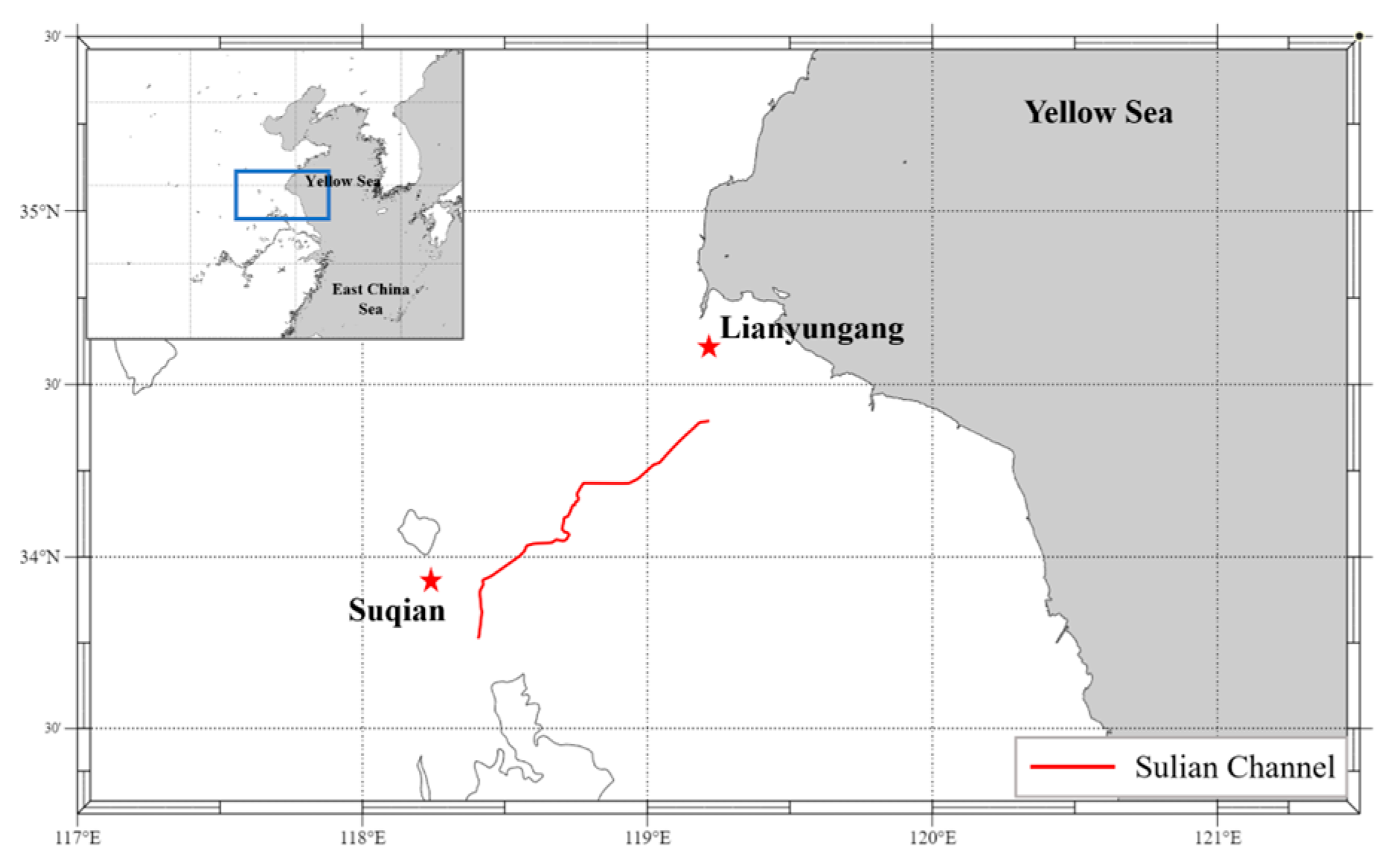
This study focuses on the multi-intersection waterway section of the Suqian–Lianyungang Channel (Sulian channel) located in Shuyang County, Suqian City, Jiangsu Province, China. The study area constitutes a confluence of three tributary inflows: from the Western Shuhe reach of the Xinyi River, the Chaliu Xinkai River, and the Huaishuxin River. The Sulian channel Project is a crucial component of the northernmost east–west arterial route in Jiangsu, and its geographical location is shown in Figure 1. Province’s trunk waterway network plan. It serves as a vital water transport link connecting northern Jiangsu to the Port of Lianyungang, enabling sea–river intermodal transportation. The channel is planned according to Class II waterway standards, integrating existing river channels and low-grade waterway resources. This integration aims to unify previously fragmented waterways, creating synergistic advantages through connectivity.
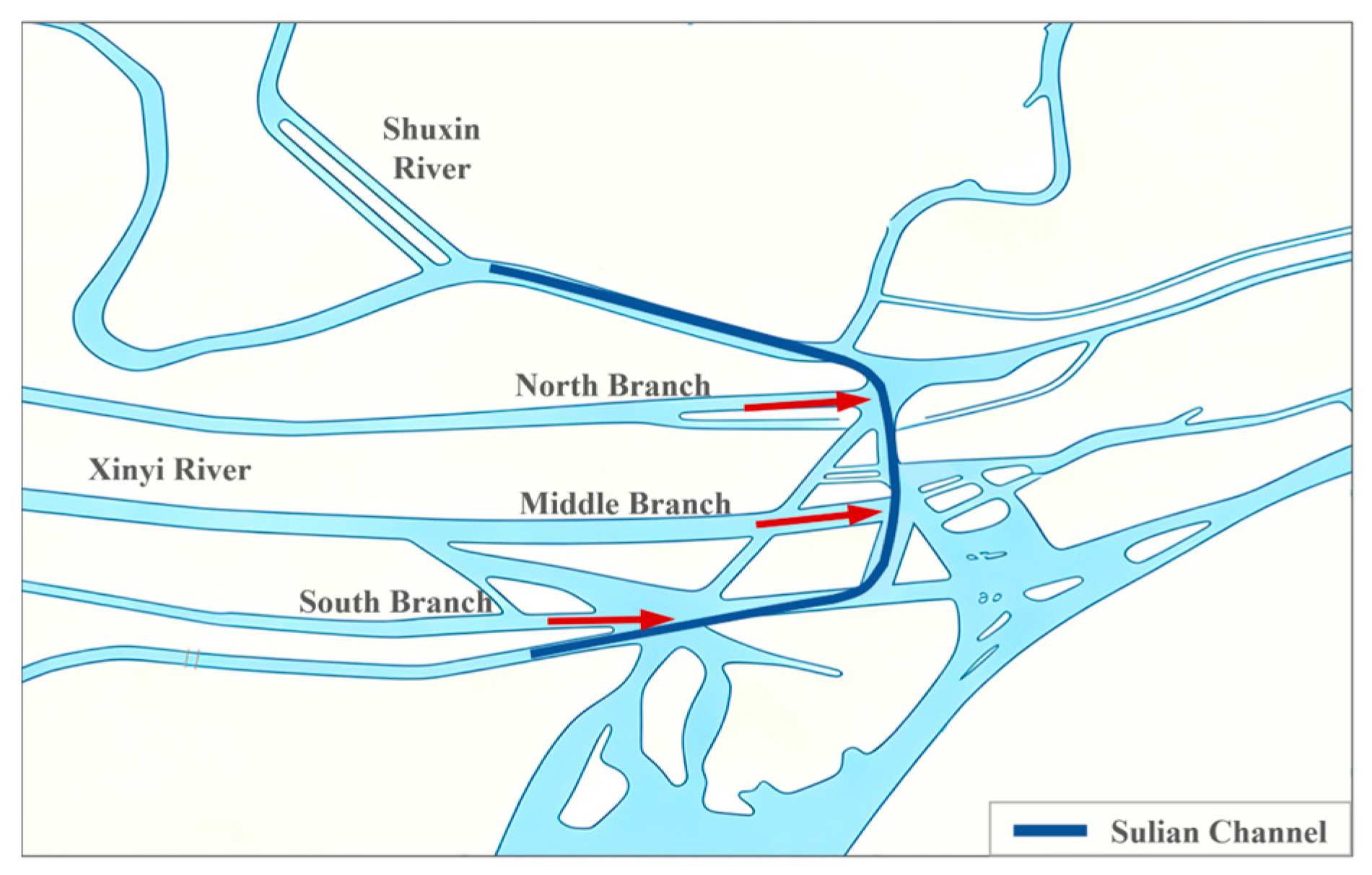
The Sulian channel crosses the Xinyi River, intersecting almost orthogonally with its two main channels: the North Branch and the Middle Branch. The crossing route is shown in Figure 2. Specifically, it is as follows: the channel merges into the South Branch of the Xinyi River at the Chaiyi River estuary at an oblique angle, proceeds eastward along the river for approximately 700 m, then turns north to traverse a floodplain area of about 600 m. It intersects orthogonally with the Middle Branch of the Xinyi River, continues eastward along the eastern side of the Xinyi River floodplain for about 500 m, intersects orthogonally with the North Branch of the Xinyi River, and finally exits the Xinyi River via the Shuxin River. During the flood season, inflows from the western Xinyi River (Shuxi) create complex flow conditions in the intersection section of the Sulian channel, with significant cross-currents. When navigating through this intersection, vessels are subjected to the combined effects of cross-currents, riverbed topography, and their own gravity, leading to lateral drift. In severe cases, this may cause vessels to deviate beyond safe navigation limits, resulting in scraping or collisions with other vessels, or even capsizing, posing significant economic losses and safety risks to life.
Based on 55 years of hydrological data (1970–2024) from the recent Shuyang Station, the maximum flood discharge of the Xinyi River reached 6330 m3/s in 1974, with a peak flow of 5420 m3/s also recorded in 2024. Furthermore, frequency analysis of the daily average flow at Shuyang Station throughout the year yielded flow rates corresponding to 99%, 98%, 97%, 96%, and 95% assurance rates as 2710, 1690, 1050, 750, and 530 m3/s, respectively. Accordingly, to address sustained high flows under high assurance rates and extreme flood conditions during the flood season, and to ensure the navigational efficiency of the Sulian channel, it is crucial to study vessel navigation conditions in the intersection section during flood periods. In light of this, this study aims to provide a theoretical basis and decision-making support for the safe and efficient passage of this waterway section during high-flow periods.

3. Methods

3.1. Hydrodynamic Model

Numerous software packages are available for river numerical simulation, with commonly used ones including SMS, MIKE, FLUENT, and Delft3D. This study employs the Delft3D 4.03.01 software, developed by the Dutch Deltares Institute, to construct a two-dimensional hydrodynamic model of the intersecting channel. This software is an open-source integrated simulation system that incorporates multiple modules for flow, waves, water quality, and sediment transport. It is renowned for its multi-physical process coupling capabilities, flexible grid design, and high computational accuracy and efficiency [26]. These features enable it to accurately capture the complex flow structures in intersecting channels, thereby providing reliable hydrodynamic field data for analyzing ship navigation conditions.
Delft3D-Flow employs the finite difference method to numerically solve the governing equations, specifically using the Alternating Direction Implicit (ADI) method for discretization. The ADI method does not directly solve the original equations; instead, it simplifies the computational process by transforming multi-dimensional equation problems into one-dimensional problems.
The two-dimensional nonlinear shallow water equations used in Delft3D-Flow are derived from the Navier–Stokes equations (N-S equations), which describe the conservation of momentum for incompressible fluid flow [27]. The depth-averaged continuity equation is derived by integration the continuity equation. Although complex three-dimensional turbulence structures can exist at some river confluences, field measurements conducted in the Sulian channel crossing the Xinyi River during the flood season in July 2024 indicate that vertical flow disturbances are not pronounced within the navigation channel. Under such conditions, the depth-averaged two-dimensional model is capable of capturing the primary flow features critical to navigation safety, particularly the lateral velocity components and recirculation zones that directly affect vessel maneuverability. Previous studies have demonstrated the effectiveness of two-dimensional models in simulating flow conditions at navigation confluences and supporting navigation safety assessments [19,28]. Therefore, this model is employed as a reliable and computationally efficient tool for evaluating the flow conditions relevant to this study.
The depth-averaged continuity equation is given by:
ζ t + 1 G ξ ξ G η η d + ζ U G η η ξ + 1 G ξ ξ G η η d + ζ V G η η η = Q
where ζ ,   η is the coordinate direction under the Delft 3D curve coordinate system, corresponding to the x and y axes of the Cartesian coordinate system, respectively; G ξ ξ , U is the coordinate conversion coefficient and average velocity of the ξ direction, G η η , V is the coordinate conversion coefficient and average velocity of the η direction; ζ is the height of the water surface above the zero scale of the z coordinate; that is, the water level above the reference surface; Q is the change value of water per unit area.

3.2. Navigation Condition Calculation Model

3.2.1. Calculation of Required Navigation Navigable Width

Cross-currents in inland waterways often push vessels off course, affecting safe navigation. It is necessary to study the impact of cross-currents on vessel navigation and quantify the required navigation width under the influence of cross-currents.
The “Design Code for Waterway Engineering” (JTS181-2016) [29] provides clear specifications for the calculation formula of canal waterway width. The calculation formula for the width of a straight-line single-lane channel is as follows:
B = B F + 2 d
where B is the required channel width for one-way navigation; B F is the bandwidth of the ship (team) track; d denotes the safe clearance width in ship navigation.
However, the channel width designed by this specification is based on the assumption of favorable flow conditions. When there is significant cross-current in the channel, attention must be paid to the issue of flow-induced drift [30,31]. By modifying the navigation width calculation model for situations with significant cross-current, the modified model for the required channel width for one-way navigation of ships in the presence of significant cross-current based on the “Channel Engineering Design Specification” (JTS181-2016) is obtained.
B = B F + D + 2 d
where D is flow-induced drift distance.

3.2.2. Calculation of Flow-Induced Drift

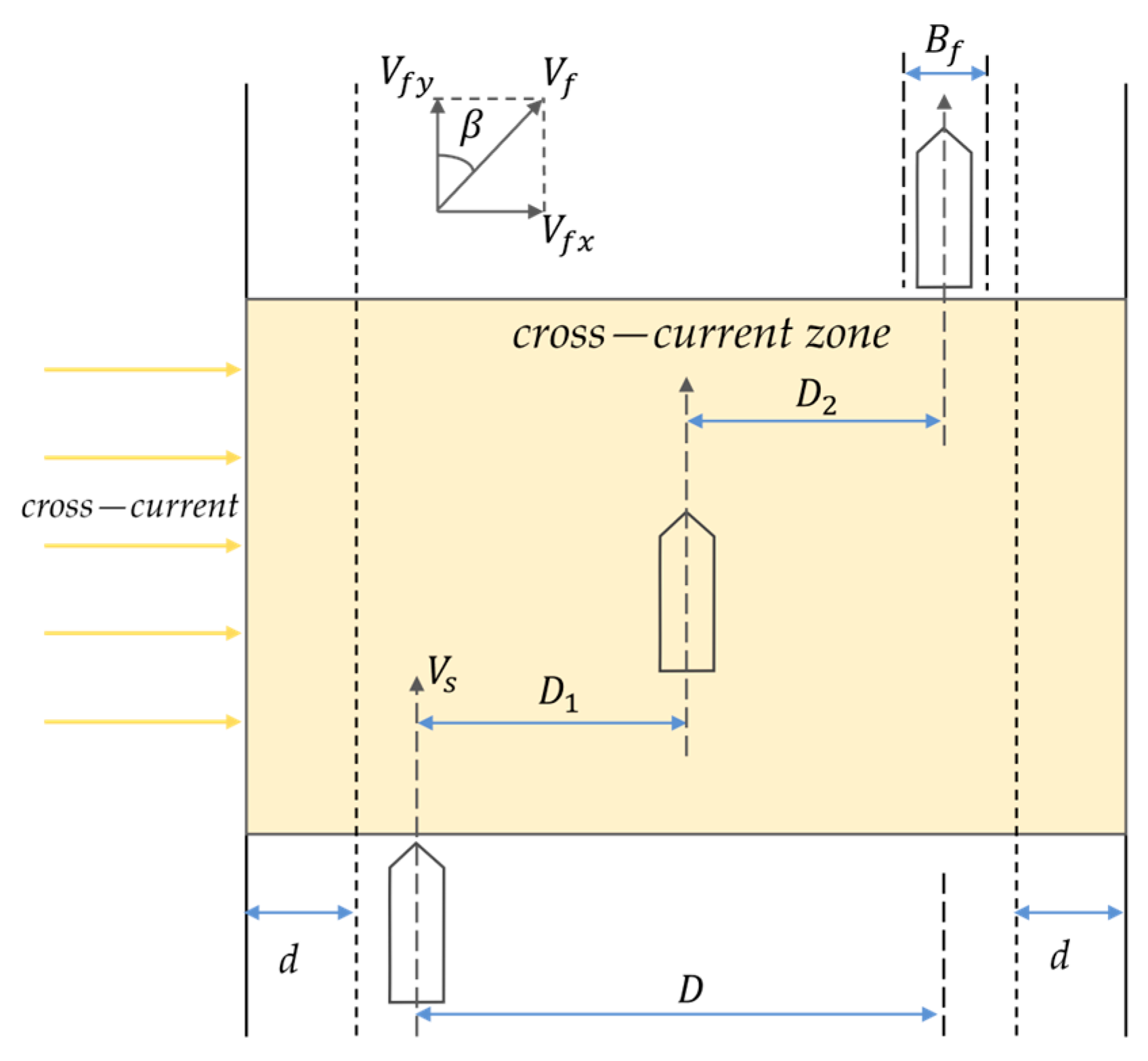
In the case of navigation without a heading angle, referring to Figure 3, the schematic diagram of a ship navigating through a cross-flow area, the drift distance of the ship’s navigation is discussed. Based on the analysis of ship model navigation test data, the relationship for a ship navigating without a heading angle is as follows:
D = k s V x V y 1.1 S L
V x = V f s i n β
V y = V S + V f c o s β   ( U p s t r e a m ) V S V f c o s β   ( D o w n s t r e a m )
V x is lateral drift velocity; V y is longitudinal drift velocity; V S is ship sailing speed; V f is water flow velocity; β is angle between flow direction and channel direction; k s is Coefficient related to ship type and navigation process. According to ship model tests, it is taken as 0.89 for the 500 t ship type and 0.91 for the 300 t ship type [17]. Analysis of test results shows a negative correlation between ship tonnage and the coefficient value, meaning that larger tonnage corresponds to a smaller coefficient. Given the lack of test data for larger-tonnage ships, this study conservatively selects the coefficient corresponding to the 500-t class for calculation. This value is on the safe side, which helps ensure a safety margin in channel design.

3.3. Construction of the Hydrodynamic Model

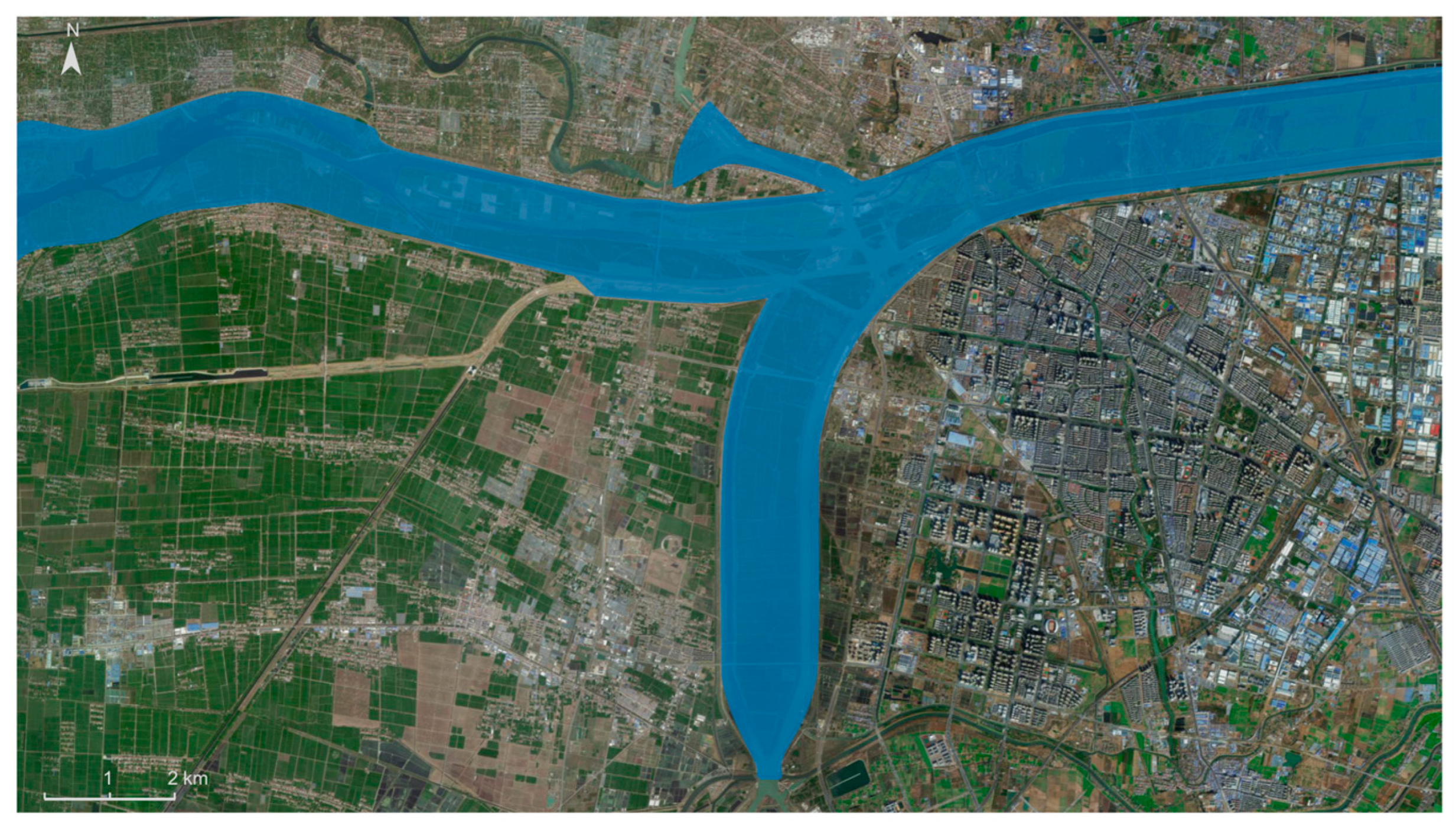
This study employs the Delft 3D-RGFGRID tool for mesh generation. The shape of the mesh is determined based on the river flow direction and boundary shape, with the mesh conforming as closely as possible to the boundaries. Using shoreline data extracted from LocaSpace Viewer, the data is imported into Delft3D software to delineate the model area. A schematic diagram of the model domain is shown in Figure 4. The mesh is then roughly generated, and the spline curves are subsequently converted into dense and ordered grids. After orthogonalizing the mesh, a computational grid covering the study area is obtained. The calculation range of the model is about 10.5 km from the western boundary to the upstream diversion of the Xinyi River, the eastern boundary is located in the lower reaches of the Xinyi River about 9.3 km from the crossing section, the northern boundary is about 2.4 km away from the crossing section, and the southern boundary is about 8.5 km away from the crossing section. The mesh resolution ranges from 8~15 m, and the number of meshes is 1011 × 451 = 455,961, of which the number of meshes in the M direction is 1011 and the number of meshes in the N direction is 451, which can ensure a certain computational efficiency while ensuring the accuracy of numerical simulation.
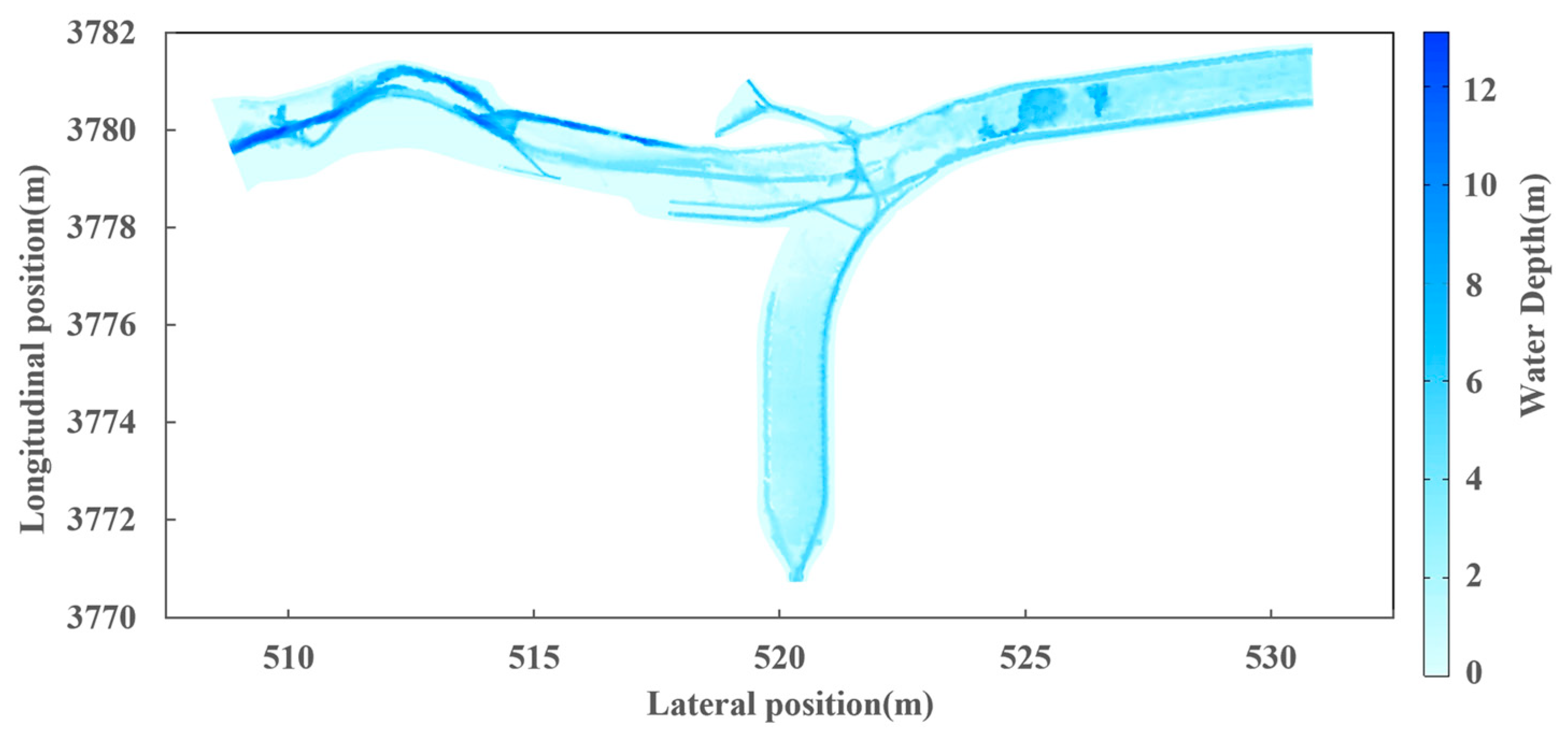
In addition to the quality of the mesh, the accuracy of the underwater topography is equally crucial for the simulation of the hydrodynamic model. Based on the measured pre-flood topographic map of the study area in 2024 (2000-118°30′), elevation data from the study area is extracted using AutoCAD 2025 software. The position of each point and the water depth near that point are represented by the three-dimensional coordinates of each scatter point, generating a total of 23,898 scatter points that cover the key areas of this study. Finally, the water depth map of the study area was obtained, as shown in Figure 5.
In order to accurately simulate the incoming flow, three boundaries are set up: the western boundary, the north boundary and the east boundary. The western boundary is set to the leftmost part of the calculation area; that is, the upper reaches of the western section of the Xinyi River, and the eastern boundary is set to the far right of the calculation area; that is, the lower reaches of the eastern section of the Xinyi River. The initial conditions of the model were set to 0 in cold start mode, and the initial water level and flow rate were set to 0. The simulation was run over a period of two days using a fixed time step of 0.2 min. In this study, the roughness rate was changed according to the change in bottom elevation, and the roughness coefficient was ranged from 0.025 to 0.028.
For the studied cross-river section area, the channel length is greater than the cross-sectional scale, so the flow velocity in the channel can be approximated by the depth-averaged velocity.

3.4. Validation of the Hydrodynamic Model

To ensure the accuracy and reliability of the numerical model, hydrological measurement data from the Sulian channel crossing the Xinyi River in July 2024, including flow rate, water level, flow velocity, and flow direction, were used for comparative validation of the hydrodynamic numerical model. The downstream section of the Xinyi River is jointly responsible for discharging upstream flow through the North Channel and South Channel. The flow conditions at the upstream open boundary were set based on the total flow rate of the two channels. The model validation scenarios are shown in the Table 1.
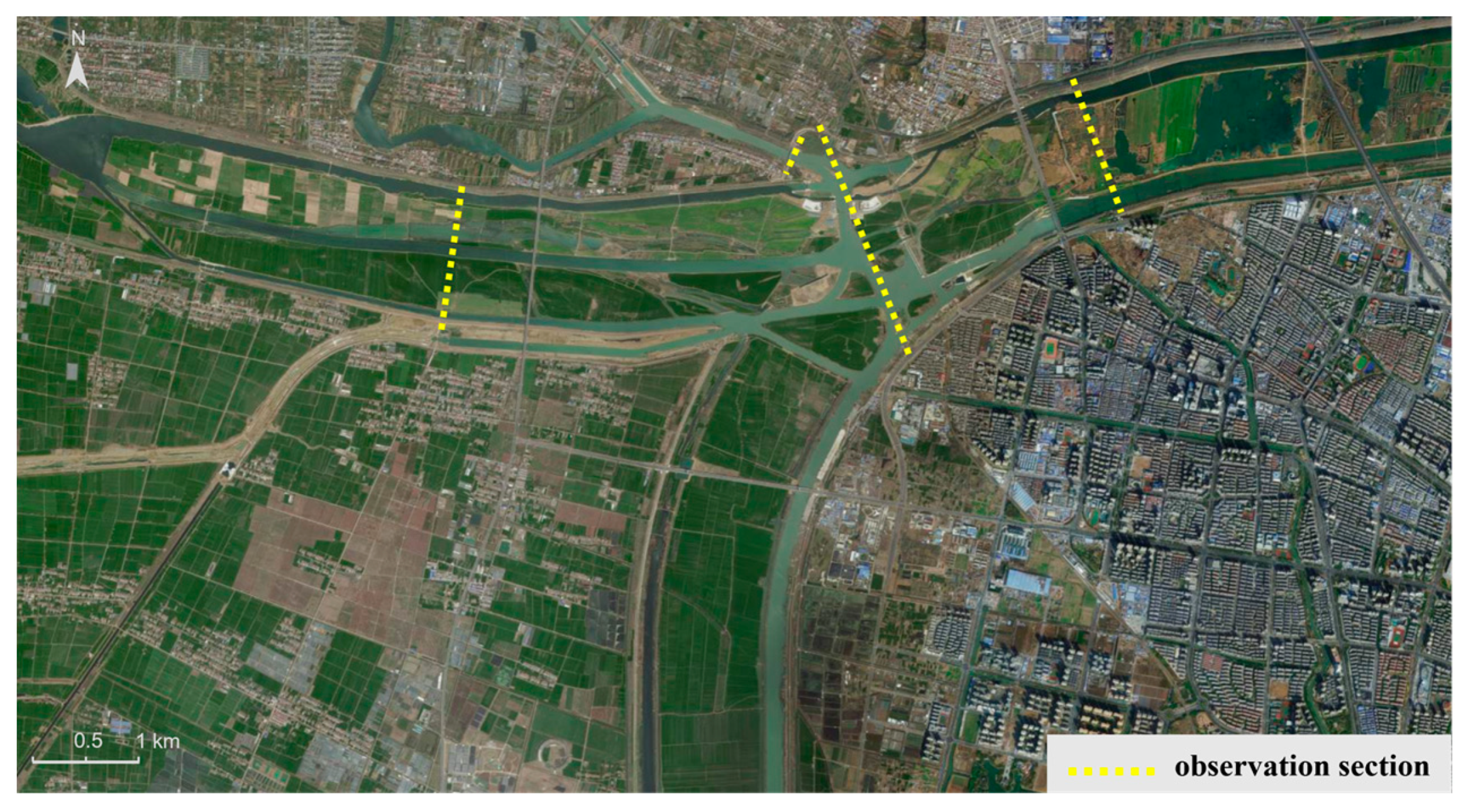
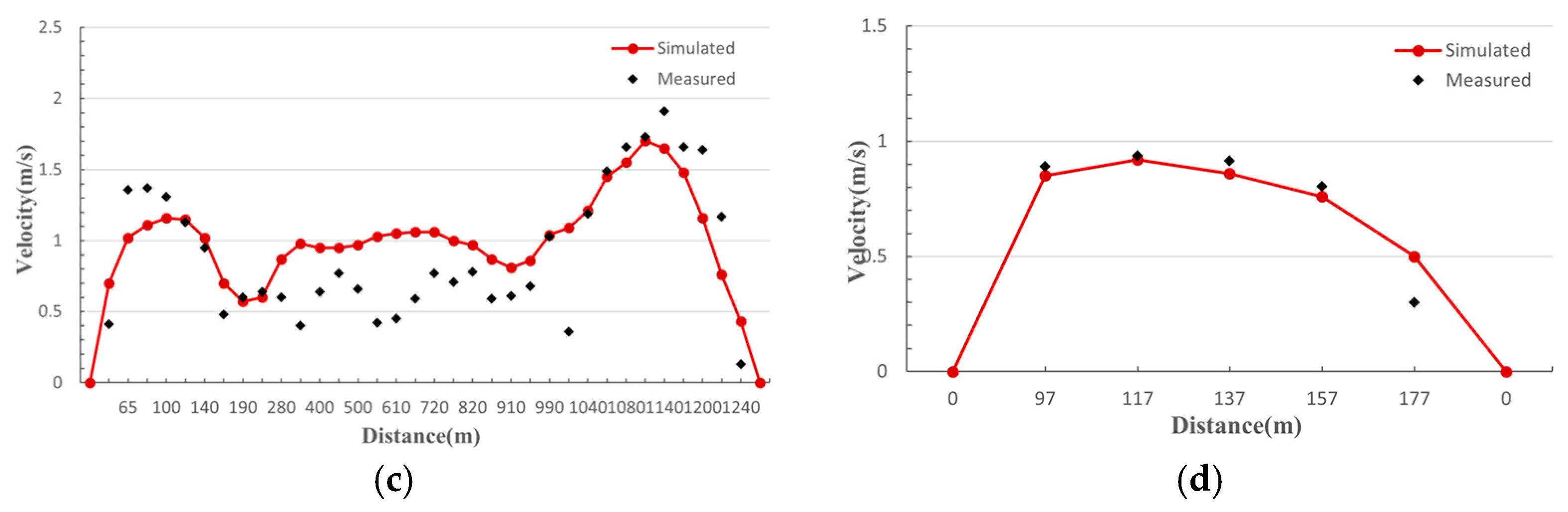
Data observation points were added to the numerical model to read the flow velocity and water depth data at each observation point. The model observation points correspond to the locations of the measured hydrological data observation points. A total of four observation cross-sections were set up, arranged from west to east as cross-sections, CS1, CS4, CS2, and CS3. The observation points at these four cross-sections are 30, 49, 39, and 5, respectively, and are numbered sequentially from north to south, totaling 118 observation points. The observation points and their locations at the cross-sections are shown in Figure 6.
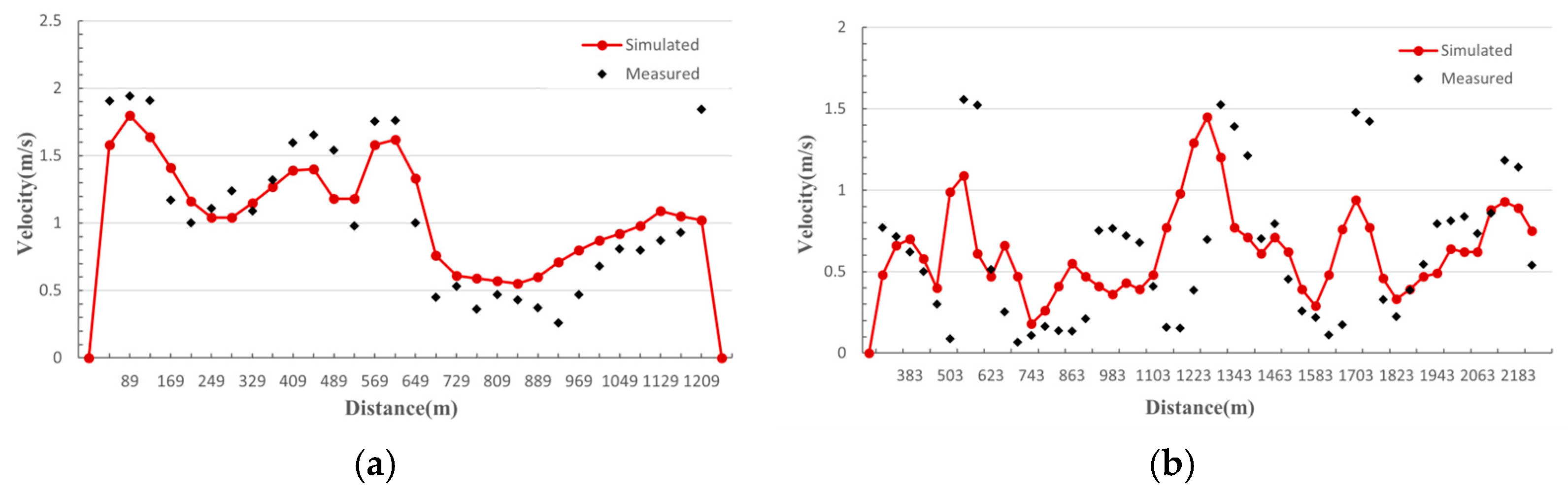
By comparing the simulated and measured flow velocity data at the four cross-section observation points (Figure 7), it can be seen that the simulated values of a total of 118 measurement points across the sections match well with the measured values, indicating high model accuracy and demonstrating that the established hydrodynamic model has reliable simulation capabilities. Therefore, this model can be used for subsequent studies on flow velocity at related intersections.

4. Calculation of Ship Navigation Conditions

4.1. Hydrodynamic Numerical Simulation

According to the flow statistics of Shuyang Station, the annual 98% guaranteed flow rate at Shuyang Station is 1690 m3/s. This discharge effectively reflects the cross-current characteristics of the confluence reach under high-water conditions. Based on this, the model’s open boundary inflow is designed to be 1690 m3/s. Condition 1 is used to simulate the channel without engineering measures, while Condition 2 is used for the numerical simulation after engineering excavation of the intersecting channel. The specific condition designs are shown in the Table 2.
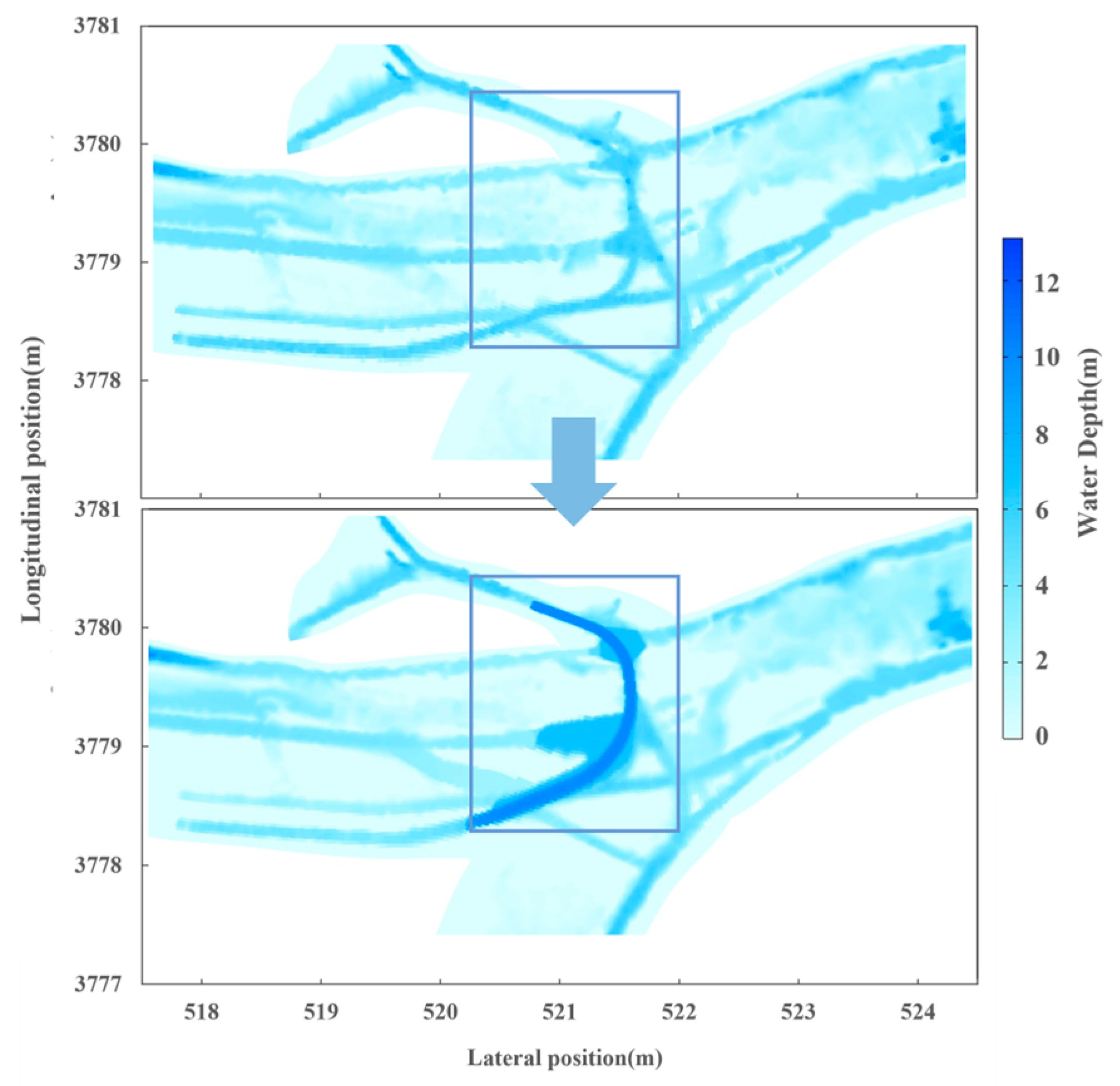
The excavation works were designed in accordance with the standard for restricted Class II navigation channels, meaning the channel was excavated to a designed water depth of 4 m. The bed elevation distributions before and after channel excavation are illustrated in Figure 8, where the dark blue regions denote the excavated zones. The cross-sectional areas of the North Branch and Middle Branch were enlarged, and the channel was further deepened to a water depth of 7 m to mitigate flow velocity. Additionally, a diversion navigation channel is designed from the Middle Branch to the South Branch, so as to mitigate the flow velocity pressure in the Middle Channel.
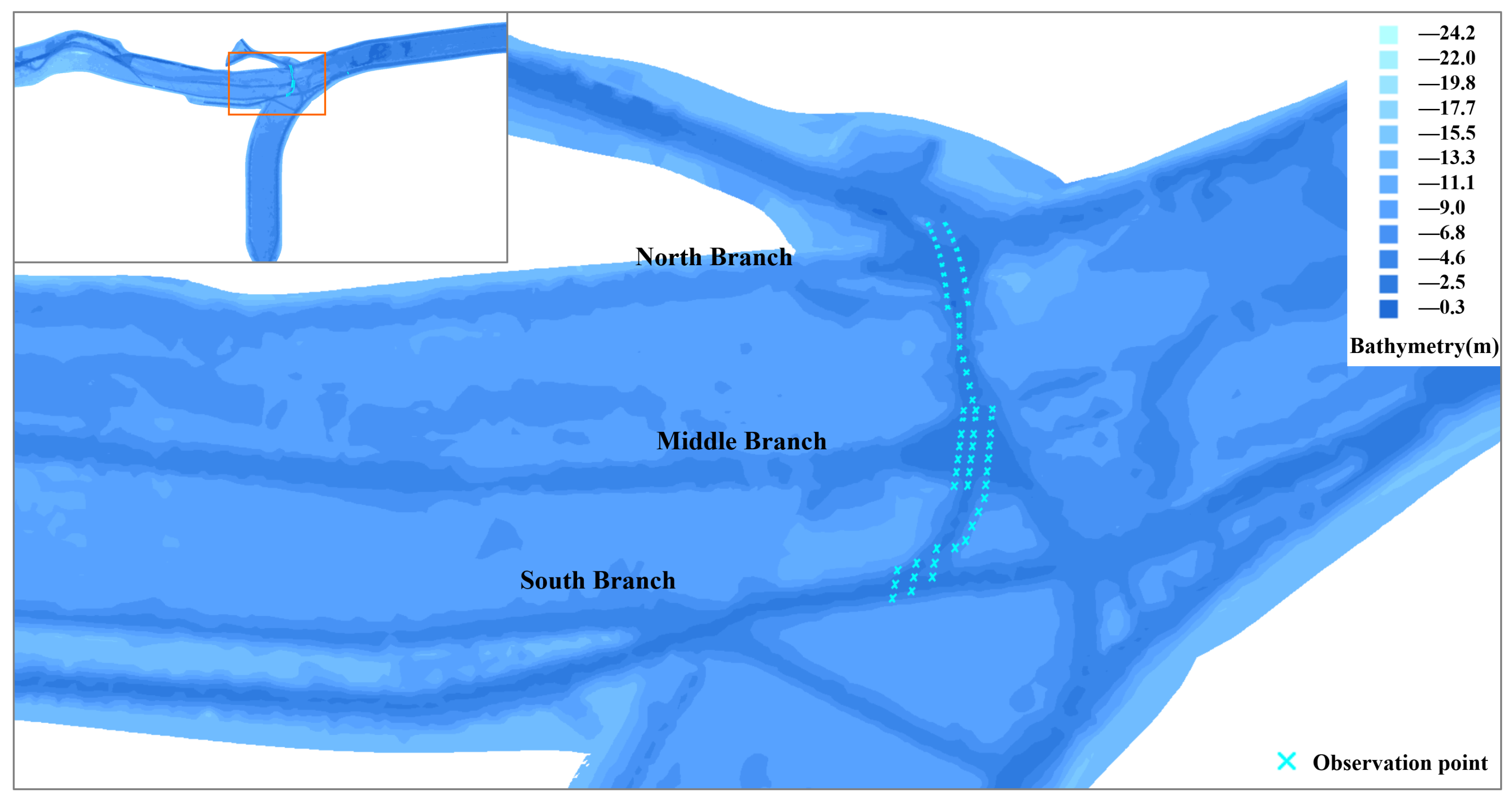
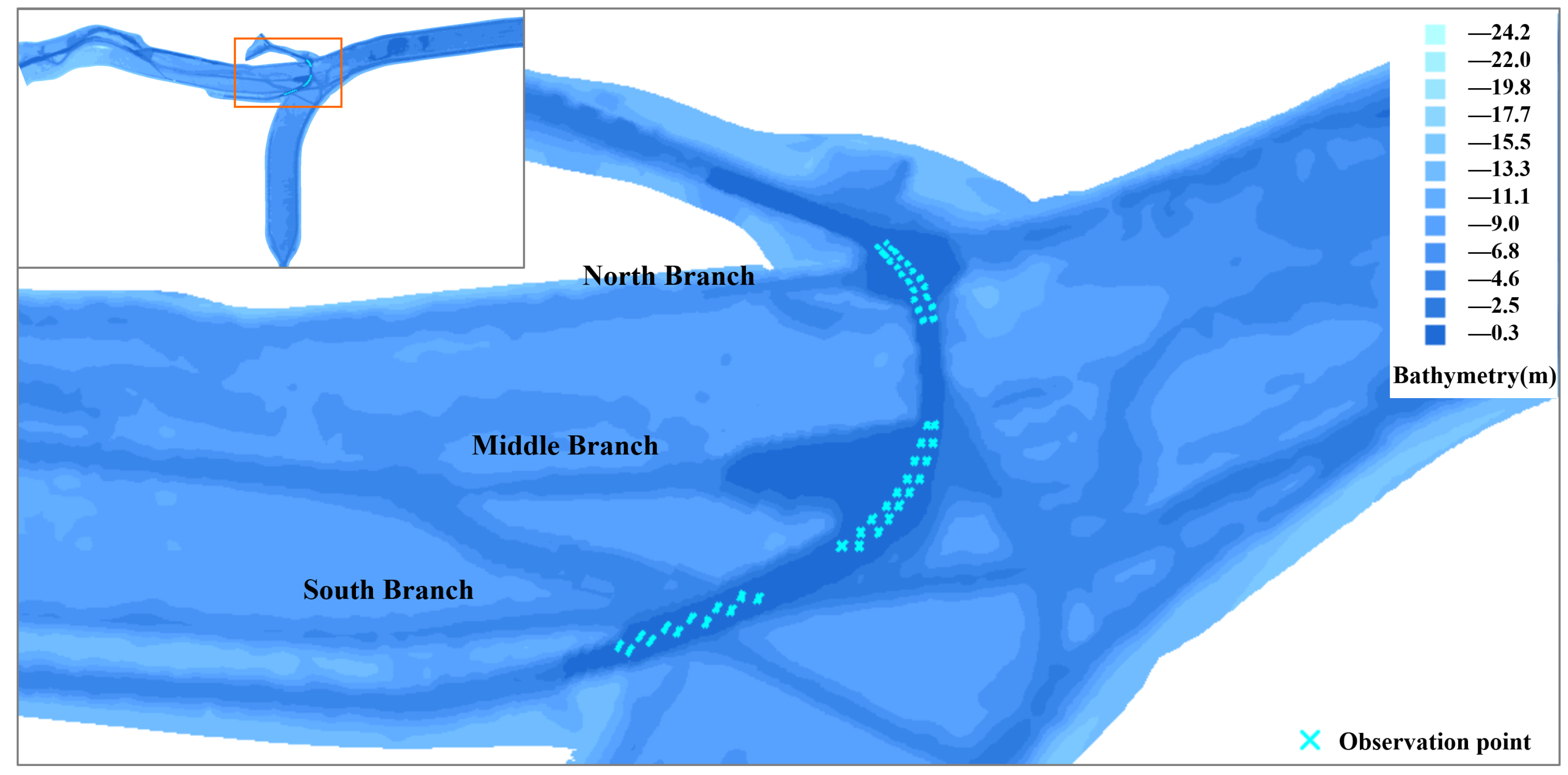
Observation points were established at key research locations within the intersecting river channel to study the cross-current velocity conditions in the entrance area of the intersecting waterway. Given that the implementation of the excavation project led to changes in the original navigation route, this study correspondingly adjusted the model observation points before and after the engineering excavation. To more clearly present the spatial distribution of each observation point, the observation points are now uniformly numbered in a certain order to facilitate subsequent systematic comparison and analysis. The locations of the observation points are shown in Figure 9 and Figure 10, and the detailed setup of all observation points is presented in Table 3 and Table 4.
When the inflow from the Shuxi section of the Xinyi River is 1690 m3/s, in the multi-branch navigation reach without excavation work, observation points with cross-flows greater than 0.3 m/s are present in the South Branch, North Branch, and Middle Branch. Among these, there are more observation points with cross-flows greater than 0.5 m/s in the North Branch and Middle Branch, with local areas even experiencing cross-flows greater than 1 m/s in the North Branch and greater than 1.5 m/s in the Middle Branch. The maximum cross-flow in the North Branch is 1.05 m/s, in the Middle Branch 1.99 m/s, and in the South Branch 0.43 m/s. The detailed flow results are shown in Table 5. The results indicate that the middle branch exhibits the most unfavorable cross-current conditions, whereas the southern branch offers the most favorable navigation conditions.
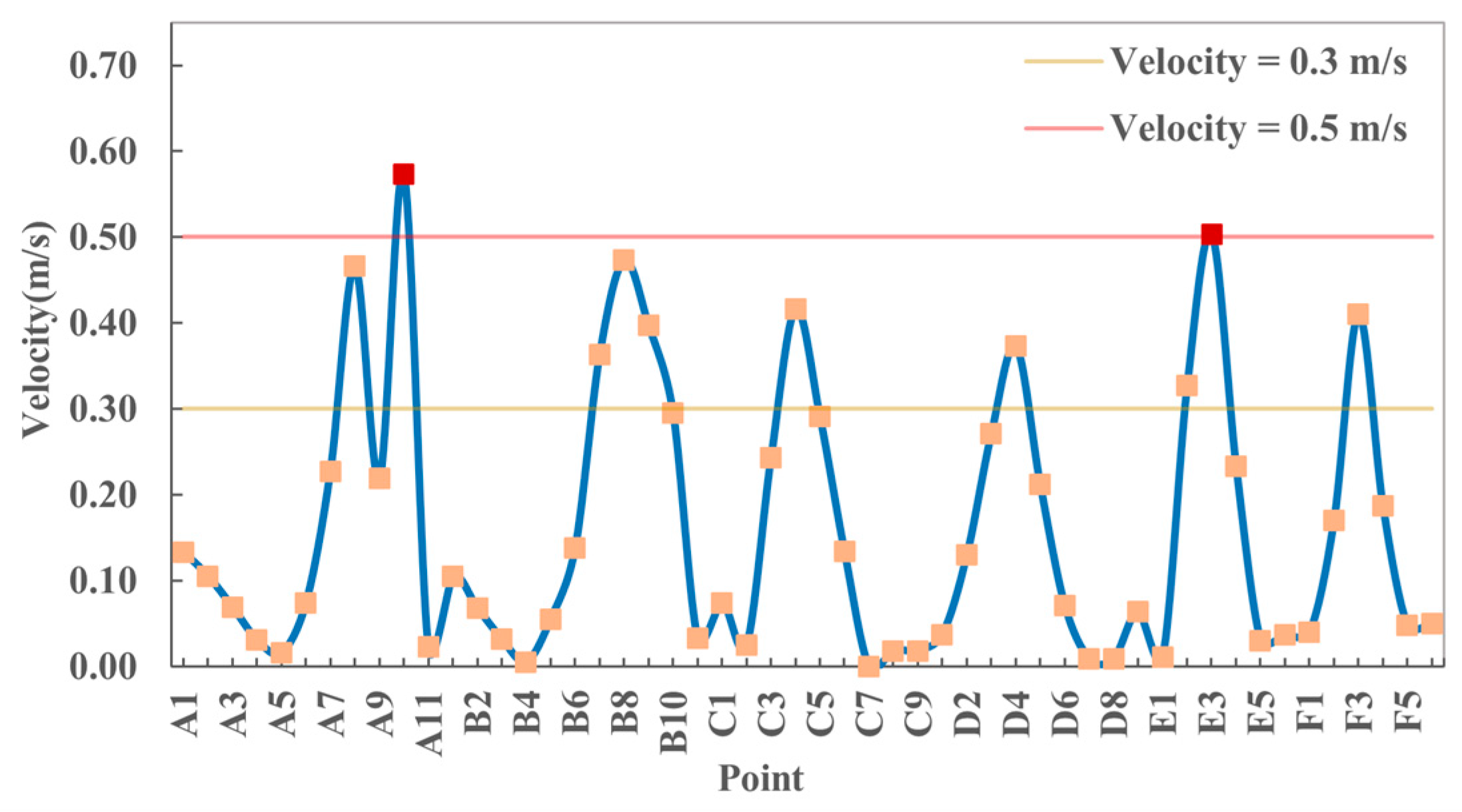
After the excavation project, when the inflow of the Xinyi River’s western section of the Shu River is 1690 m3/s, the simulation results show that the maximum transverse flow velocity in the North Branch is 0.57 m/s, the maximum flow velocity in the main channel is 0.42 m/s, and the maximum flow velocity in the South Branch is 0.50 m/s, as shown in the Table 6. The results indicate that, except for a few locations where the transverse flow exceeds 0.5 m/s, the transverse flow velocity in the navigation channel intersection area is effectively controlled overall. The results indicate that the expansion of the confluence mouth, together with the optimization of the angle between the shipping route and the confluence, has effectively mitigated the cross-current velocity in the middle branch. Furthermore, the diversion channel connecting the middle and southern branches substantially reduces the flow velocity in the middle branch, though this is accompanied by an increase in cross-currents in the southern branch.
Based on the results of hydrodynamic numerical simulation of the intersecting channel, the spatial distribution pattern of cross-flow in this area can be revealed. As shown in Figure 11, there are 10 points where the cross-current velocity exceeds 0.3 m/s. A comparison of the simulated cross-current values before and after the engineering intervention shows that the engineering measures reduced the proportion of locations with cross-current velocity greater than 0.3 m/s in the North Branch from 52.63% to 22.73%, and in the Middle Branch from 47.62% to 11.11%. In the South Branch, however, the proportion increased slightly from 22.22% to 25.00%. The main reason for the increase in the South Branch is that an additional diversion channel was introduced from the Middle Branch to the South Branch, which redirected part of the flow from the Middle Branch into the South Branch. In other words, the engineering scheme achieved a significant reduction in cross-currents in the Middle Branch at the cost of a slight increase in cross-current intensity in the South Branch. The simulation results indicate that after the implementation of the excavation works, the cross-flow velocity in the channel significantly decreases, thereby creating favorable conditions for the safe navigation of vessels. The simulation results also provide velocity input data for the study of vessel navigation conditions.

4.2. Calculation of Required Navigation Width

According to inland waterway navigation safety regulations, the cross-current limit for safe ship navigation is 0.3 m/s. The hydrodynamic numerical simulation results of this study indicate that after project implementation, there are still localized areas within the intersecting channel where cross-currents exceed this limit. To ensure the safety of vessel navigation, the required channel width for safe ship passage is further examined in this study. Based on the aforementioned hydrodynamic numerical simulation results, this study uses them as key input parameters, imports them into the navigation condition calculation model, and then simulates the ship’s crossing navigation process under the influence of cross-currents to quantitatively calculate the required safe navigation channel width.
The degree to which a ship is affected by cross-currents is related to factors such as ship type and still-water speed. Specifically, larger ship dimensions result in a larger underwater lateral projection area, leading to greater lateral water flow forces and thus increased impact, whereas higher still-water speeds enhance the ship’s course stability, suppressing the interference from cross-currents [32]. The Suqian section of the Sulian channel is constructed according to the second-class standard, with a designed 2000-t CS. This study selects 1000-t CS and 2000-t CS as representative calculation ship types. Referring to actual ship type data from the Beijing–Hangzhou Grand Canal waterway and based on engineering flow statistics, the settings of various calculation parameters for ship navigation conditions are summarized in the Table 7.
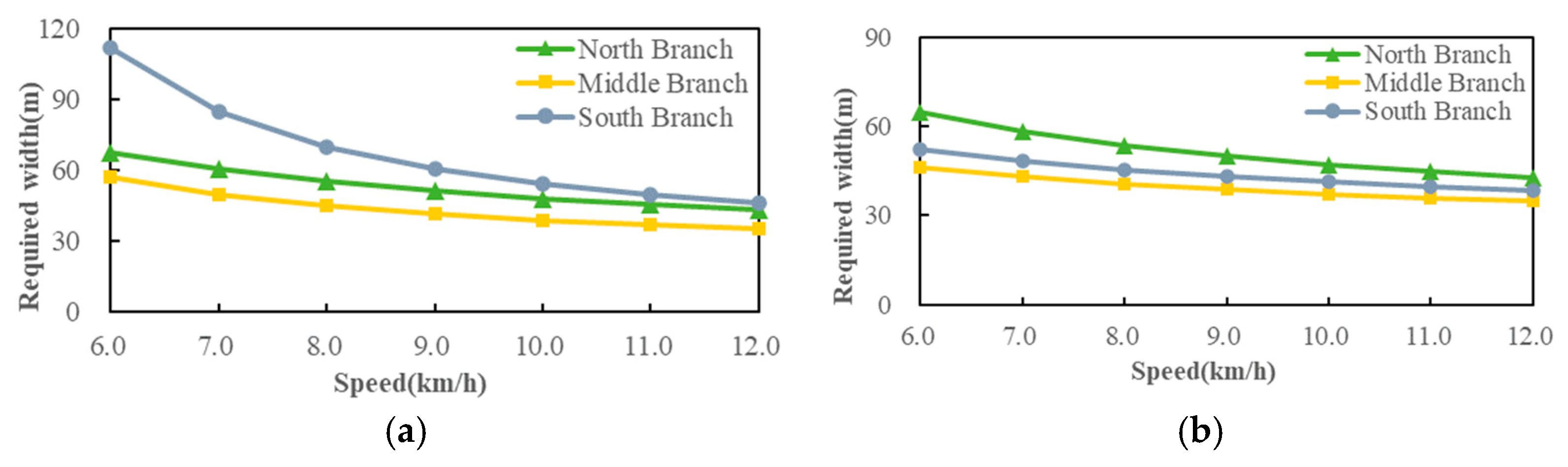
Based on the navigation experience of ships in the Sulian channel, the ship navigation speeds are taken as: 6 km/h, 7 km/h, 8 km/h, 9 km/h, 10 km/h, 11 km/h, and 12 km/h. Since ships travel faster when empty than when fully loaded, only the required channel width for navigation under fully loaded conditions is calculated. The required widths for 2000-t CS traveling upstream and downstream at 7 km/h are shown in the Table 8. A systematic calculation of various navigation conditions yields the required channel widths for 1000-t and 2000-t CS navigating in the North Channel, Middle Channel, and South Channel. The calculation results are summarized in the Table 9 and Table 10. A comparison of the required channel widths for different navigation reaches is shown in Figure 12.

4.3. Navigation Feasibility Analysis

From the results, it can be seen that upstream vessels require a greater navigable width when passing through the North Channel, while downstream vessels need a larger navigable width when traversing the South Channel. At the same time, it is observed that the required navigation width for downstream sailing is generally larger than that for upstream sailing. The difference in required width between upstream and downstream sailing expands as vessel speed decreases, with the South Branch showing the most significant difference. The distribution characteristics and differences in required navigation width are essentially the result of the interaction between water flow conditions in the channel and the vessel’s navigation state. This is directly manifested as follows: when there is a large angle between the vessel’s heading and the direction of the water flow, the lateral drift force and yaw moment generated by the cross-current on the vessel increase significantly. To compensate for this adverse effect and ensure safe navigation, a larger navigation width must be provided.
The calculated results of the channel width required for ship navigation under different vessel speeds indicate that, even after the excavation project is implemented, under the flood-season discharge condition of 1690 m3/s, the required safe navigation width would still clearly exceed the width of a Class II waterway if two-way navigation were maintained. However, this reach is an important section of the Sulian channel and carries a high volume of vessel traffic. According to the available data, the daily number of passing vessels is expected to reach approximately 400. Under such circumstances, a direct navigation ban would reduce the navigation efficiency of the Sulian channel and lead to vessel congestion. At the same time, ship locks and anchorages are available both upstream and downstream of this intersecting reach, allowing vessels to wait when necessary. Therefore, a one-way navigation traffic organization scheme is considered as a practical measure to improve navigation efficiency under special conditions.
This navigation segment has the possibility of one-way navigation under certain conditions. The navigation condition calculations determined the critical safe speeds for one-way navigation of two ship types. Specifically, for downstream navigation, both 1000-t CS and 2000-t CS need to maintain a speed of 9 km/h, whereas for upstream navigation, the critical speed required for 2000-t CS is 7 km/h, which is higher than the 6 km/h for 1000-t ships. Ships traveling below the aforementioned speeds through this intersecting channel area will still face significant safety risks during one-way navigation. In summary, given the high ship traffic volume in the study area, it is recommended to combine speed optimization with one-way traffic control strategies to synergistically enhance the efficiency and safety of channel navigation.

5. Conclusions

This study systematically analyzes the one-way navigation conditions of intersection channels during flood seasons by establishing a hydrodynamic numerical model and incorporating an optimized channel width calculation formula.
By establishing a hydrodynamic numerical model, this study simulated the cross-current velocity in the intersecting reach and, in combination with an improved channel-width calculation formula, systematically analyzed the estimated channel width required for safe ship navigation in the confluence waterway during the flood season. Under conditions where engineering measures are constrained, a one-way navigation traffic organization scheme is proposed, and the minimum recommended vessel speeds for ensuring navigation safety are given as follows: both 1000-t and 2000-t classes must maintain a speed of no less than 9 km/h; for upstream vessels, the 1000-t class requires a speed of no less than 6 km/h, while the 2000-t class requires a speed of no less than 7 km/h. Under these standards, the implementation of corresponding speed monitoring and traffic organization management can achieve safe and efficient navigation in this channel segment. The results indicate that navigation speed is a key controllable factor in improving navigation conditions, and the obtained values can provide a scientific basis for channel traffic management, speed limit settings, and emergency plan formulation during flood seasons.
Nevertheless, this study still has several limitations. The accuracy of the Delft3D model is constrained by the grid resolution and the quality of the topographic data, while the study area also contains numerous hydraulic structures. In future work, further refinement of the computational grid, acquisition of higher-resolution topographic data, and more comprehensive validation would significantly improve model accuracy.
In addition, this study adopts a simplified channel-width calculation formula and uses a single fixed cross-current velocity, without considering ship maneuvering dynamics, active steering correction by pilots, or the spatial and temporal variability in cross-currents. Future studies could establish a ship maneuvering model and use spatially distributed cross-current data as input to simulate the dynamic process of vessel transit through the confluence reach, thereby obtaining more accurate requirements for channel width and vessel speed restrictions. Moreover, ship collision risk assessment methods could also be introduced to quantify collision risk indicators under complex flow conditions and further improve the navigation safety assurance system.
On the other hand, with respect to the one-way navigation traffic organization scheme, future research may employ simulation software such as AnyLogic to model vessel traffic operations, so as to develop more reasonable traffic organization rules and obtain a more accurate evaluation of the efficiency of one-way navigation.
The hydrodynamic risk assessment framework established in this study provides a foundation for the future integration of intelligent navigation methods. Future research may combine AIS trajectory data with ship maneuvering models to explore the application of reinforcement learning algorithms to autonomous navigation in confluence reaches, thereby enabling a transition from environmental assessment to intelligent decision-making.

Author Contributions

Conceptualization, S.X.; methodology, S.X., X.L. and H.X. (Hui Xu); software, X.L., K.L., H.X. (Hui Xu) and H.X. (Haiyang Xu); validation, X.L., K.L. and H.X. (Hui Xu); formal analysis, X.L. and K.L.; investigation, X.L. and K.L.; resources, S.X.; data curation, X.L., K.L. and H.X. (Haiyang Xu); writing—original draft preparation, X.L. and Y.T.; writing—review and editing, S.X.; visualization, X.L. and Y.T.; supervision, S.X.; project administration, S.X.; funding acquisition, S.X. All authors have read and agreed to the published version of the manuscript.

Funding

This work was supported by the 2023 Key Transportation Science and Technology Project of the Department of Transportation of Jiangsu Province, Green and Low-Carbon Technology Demonstration Project of the Second Phase of the Sulian Waterway (Beijing-Hangzhou Canal–Yanhe Section) (Grant No. 2023QD15).

Data Availability Statement

The original contributions presented in this study are included in the article. Further inquiries can be directed to the corresponding author.

Conflicts of Interest

The authors declare no conflicts of interest.

References

  1. Elsaeed, G.H. Effect of cross water currents on ships: The state of art review. Aust. J. Basic Appl. Sci. 2013, 7, 238–246. [Google Scholar]
  2. Yin, B.; Liang, C.; Wang, Y.; Xu, X.; Zhang, Y. Optimization of Vessel Traffic Scheduling in a Compound Channel of an Estuarine Port with Opposing Distribution of Inner Anchorages and Terminals. J. Mar. Sci. Eng. 2025, 13, 700. [Google Scholar] [CrossRef]
  3. Chen, Y.H. Study on the Calculation of Water Flow Characteristics in the Confluence of Main and Tributary Rivers; Nanjing Institute of Water Resources Research: Nanjing, China, 2007. [Google Scholar]
  4. Zhang, W.; Liu, L.; Yuan, J. 2D flow mathematical model and its application for the typical reach at the confluence of main stream and tributary in upstream Yangtze River. Sci. Technol. Eng. 2010, 10, 8466–8470. [Google Scholar]
  5. Wei, C.Y.; John, B. A Rocky Mountain Project Intake/Discharge Channel Flow Simulation Study. Water Power 1991, 1667–1675. [Google Scholar]
  6. Gao, Y.S.; Ye, L.; Wang, Y.K.; Xu, Z.X.; Wang, X.K. 3D Numerical Simulation of Flow Characteristics at Confluence Zone Between Shenxigou Stream and Baisha River. Adv. Eng. Sci. 2020, 52, 78–85. [Google Scholar]
  7. Weerakoon, S.B.; Tamai, N. Three dimensional calculation of flow in river confluences using boundary fitted co-ordinates. J. Hydrosci. Hydraul. Eng. 1989, 6, 51–65. [Google Scholar]
  8. De Serres, B.; Roy, A.G.; Biron, P.M.; Best, J.L. Three-dimensional structure of flow at a confluence of river channels with discordant beds. Geomorphology 1999, 26, 313–335. [Google Scholar] [CrossRef]
  9. Malasani, G.C.; Kantharaj, M.; Chandra, V. Influence of Cross Currents on Inland Vessel Movement—A Review. In Riverine, Estuarine and Marine Hydraulics; Sannasiraj, S.A., Bhallamudi, S.M., Rajamanickam, P.S., Kumar, D., Eds.; IAHRAPD 2022. Lecture Notes in Mechanical Engineering; Springer: Singapore, 2024. [Google Scholar]
  10. Linke, T.; Zimmermann, C. Minimizing Transverse Flow Effects on Passing Ships at Inland Waterways. In Proceedings of the World Water & Environmental Resources Congress, Orlando, FL, USA, 20–24 May 2001; p. 1. [Google Scholar]
  11. Sun, H.Y.; Zhou, J.Y.; Diao, W. Tributary inflow schemes for Niujiang River and Xiadi River of Pinglu Canal. Water Transp. Eng. 2024, 6, 114–121. [Google Scholar]
  12. Yuan, H.; Tian, H.F.; Huang, W.; Zhang, Z.J.; Hu, R.C. Numerical investigation on the hydraulic characteristics of curved open channel confluence with different main channel widths. Phys. Fluids 2025, 37, 105–106. [Google Scholar] [CrossRef]
  13. Brolsma, J.; Roelse, K. Waterway Guidelines 2011; Rijkswaterstaat, Directorate-General for Public Works and Water Management; 2011. [Google Scholar]
  14. Söhngen, B.; Eloot, K. Update PIANC Incom WG 141: Design guidelines for inland waterways. In Proceedings of the 33rd PIANC World Congress, San Francisco, CA, USA, 1–5 June 2014. [Google Scholar]
  15. Zhou, H.X.; Zheng, B.Y. Reiterate about an approach to the limiting value of flow conditions in the entrance area of ship lock approach channel. Port Waterw. Eng. 2005, 30, 49–52. [Google Scholar]
  16. Chen, Y.K.; Wang, L.Y.; Chun, Y. Investigation on oblique flow characteristics in upstream approach entrance region of TGPʾs lock. J. Yangtze River Sci. Res. Inst. 1999, 16, 1–6. [Google Scholar]
  17. Cao, M.X.; Ma, A.X.; Wang, X.H.; Cai, G.Z. Influence of cross current on ship navigation in inland waterway. J. Transp. Eng. 2008, 8, 61–67. [Google Scholar]
  18. Liu, J.; Zhou, F.; Li, Z.; Wang, M.; Liu, R.W. Dynamic Ship Domain Models for Capacity Analysis of Restricted Water Channels. J. Navig. 2016, 69, 481–503. [Google Scholar] [CrossRef]
  19. Xu, L.Y.; Zhang, G.F.; Ying, H.H. Safety assessment methods and applications for cross-segment navigation—Taking the intersection of Qinhuai River channel with Lishui River and Jurong River as an example. China Water Transp. (First Half) 2021, 39–41. [Google Scholar] [CrossRef]
  20. Zhao, J.S.; Yan, Z.W.; Zhou, Z.Z.; Chen, X.; Wu, B.; Wang, S. A ship trajectory prediction method based on GAT and LSTM. Ocean. Eng. 2023, 289, 116159. [Google Scholar] [CrossRef]
  21. Yin, J.; Yu, Z.W.; Wu, H.F. Ship trajectory prediction based on LSTM model with multi-scale convolution and attention mechanism. Ocean. Eng. 2025, 338, 122055. [Google Scholar] [CrossRef]
  22. Xia, Z.C.; Feng, T.; Guo, Z.J. Research on safety and efficiency warranted vessel scheduling in unidirectional multi-junction waterways of port waters. Comput. Ind. Eng. 2023, 180, 109284. [Google Scholar] [CrossRef]
  23. Kundakçı, B.; Nas, S.; Gucma, L. Prediction of ship domain on coastal waters by using AIS data. Ocean. Eng. 2023, 273, 113921. [Google Scholar] [CrossRef]
  24. Yin, J.B.; Rafi, U.K.; Mujtaba, A.; Wang, X.; Yang, Z. A latent risk factor analysis guiding policy interventions for inland maritime safety. Transp. Policy 2026, 180, 104057. [Google Scholar] [CrossRef]
  25. Ding, H.F.; Weng, J.X. A robust assessment of inland waterway collision risk based on AIS and visual data fusion. Ocean. Eng. 2024, 307, 118242. [Google Scholar] [CrossRef]
  26. Alam, S.; Matin, M.A. Application of Delft3D Mathematical Model in the River Karnafuli for Two-Dimensional Simulation. In Proceedings of the 1st International Conference on Advances in Civil Engineering, Chittagong, Bangladesh, 12–14 December 2012. [Google Scholar]
  27. Briere, C.; Giardino, A.; Van der Werf, J. Morphological modeling of bar dynamics with Delft3D: The quest for optimal free parameter settings using an automatic calibration technique. Coast. Eng. Proc. 2011, 1, 1–12. [Google Scholar] [CrossRef]
  28. Qiu, Y.; Zhang, T.T.; Liu, Z.H.; Xiao, Y.; Wu, Y.; Wu, C.; Xu, L. Impact of pre-advance construction for second-stage cofferdam of main branch project in lower reaches of the Ganjiang River on navigation flow conditions. Adv. Sci. Technol. Water Resour. 2025, 45, 126–133. [Google Scholar]
  29. JTS 181—2016; Design Code for Waterway Engineering. China Communications Press: Beijing, China, 2016.
  30. Gan, X.Z.; Ai, W.Z. Analysis of navigation capacity in bridge-area waterways. Ship Ocean. Eng. 2015, 44, 132–134, 138. [Google Scholar] [CrossRef]
  31. Chen, H.D.; Tong, S.C.; Zhang, Y.; Shun, K.; Wang, X. Research and application of channel widening under excessive cross-current conditions. Yangtze River 2025, 56, 156–163. [Google Scholar] [CrossRef]
  32. Xu, J.B. Numerical simulation study on the influence of wind and current conditions on ship navigation. China Water Transp. 2021, 5, 122–124. [Google Scholar]
Figure 1. Schematic diagram of the geographical location of the Sulian channel.
Water 18 00819 g001
Figure 2. Route of the Sulian channel at the Xinyi River Crossing.
Water 18 00819 g002
Figure 3. Schematic Diagram of Ship Navigation Through Cross-Flow Areas.
Water 18 00819 g003
Figure 4. Schematic Diagram of the Model Calculation Area.
Water 18 00819 g004
Figure 5. Bottom Elevation Map of the Study Area.
Water 18 00819 g005
Figure 6. Schematic diagram of cross-section observation points and their locations.
Water 18 00819 g006
Figure 7. Comparison of Simulated and Measured Flow Velocities at Cross-Sections CS1 (a), CS2 (b), CS3 (c), and CS4 (d).
Water 18 00819 g007aWater 18 00819 g007b
Figure 8. Comparison Chart of Channel Bottom Elevation Before and After Engineering Excavation.
Water 18 00819 g008
Figure 9. Schematic Diagram of Observation Point Locations for Working Condition 1.
Water 18 00819 g009
Figure 10. Schematic Diagram of Observation Point Locations for Working Condition 2.
Water 18 00819 g010
Figure 11. Cross-flow distribution diagram of simulation results after excavation works.
Water 18 00819 g011
Figure 12. Required Navigation Width for 2000-t CS Upstream (b) and Downstream (a) at Different Speeds.
Water 18 00819 g012
Table 1. Simulation Validation Cases.
NameOpen Boundary Settings
Simulation Verification ConditionsThe inflow at the western section of the Xinyi River is 5100 m3/sThe inflow at the northern section of the Huaishuxin River is 410 m3/s
Table 2. Different conditions for numerical simulation.
NameCondition Design
Condition 1Condition 2
Condition 1Inflow at open boundary 1690 m3/sNo engineering measures taken
Condition 2Inflow at open boundary 1690 m3/sExcavation carried out according to the excavation plan
Table 3. Layout Scale Table for Observation Point Condition 1.
Number of
Observation Point
PositionDeployment AreaRows of
Deployment
A1–A10 and B1–B9North Branch Confluence320 m × 85 m2
C1–C7, D1–D7 and E1–E7Middle Branch Confluence275 m × 115 m3
F1–F3, G1–G3 and H1–H3south Branch Confluence185 m × 95 m3
Table 4. Layout Scale Table for Observation Point Condition 2.
Number of
Observation Point
PositionDeployment AreaRows of
Deployment
A1–A10 and B1–B11North Branch Confluence350 m × 40 m2
C1–C7 and D1–D7Middle Branch Confluence585 m × 80 m2
E1–E6 and F1–F3south Branch Confluence545 m × 60 m2
Table 5. Summary of Simulated Flow Velocities Before Engineering Excavation.
IDPositionSurface Flow Velocity (m/s)Surface Lateral Flow Velocity (m/s)IDPositionSurface Flow Velocity (m/s)Surface Lateral Flow Velocity (m/s)
A1North Branch0.080.00D1Middle Branch0.320.09
A2North Branch0.190.08D2Middle Branch0.290.08
A3North Branch0.490.47D3Middle Branch0.210.09
A4North Branch1.151.05D4Middle Branch0.330.29
A5North Branch1.050.97D5Middle Branch1.541.38
A6North Branch0.260.26D6Middle Branch2.021.65
A7North Branch0.22−0.08D7Middle Branch1.120.65
A8North Branch0.41−0.28E1Middle Branch0.100.04
A9North Branch0.07−0.05E2Middle Branch0.150.08
A10North Branch1.121.02E3Middle Branch0.210.14
B1North Branch0.170.16E4Middle Branch0.290.23
B2North Branch0.500.43E5Middle Branch0.830.74
B3North Branch0.960.87E6Middle Branch1.721.49
B4North Branch1.151.05E7Middle Branch1.631.27
B5North Branch0.530.46F1South Branch0.140.00
B6North Branch0.110.02F2South Branch0.600.03
B7North Branch0.33−0.32F3South Branch0.530.06
B8North Branch0.37−0.37G1South Branch0.060.00
B9North Branch0.150.09G2South Branch0.450.13
C1Middle Branch0.380.04G3South Branch0.570.19
C2Middle Branch0.300.00H1South Branch0.270.17
C3Middle Branch0.13−0.04H2South Branch0.31−0.31
C4Middle Branch0.570.53H3South Branch0.610.43
C5Middle Branch2.171.99----
C6Middle Branch1.691.45----
C7Middle Branch0.520.40----
Table 6. Summary of Simulated Flow Velocities After Project Excavation.
IDPositionSurface Flow Velocity (m/s)Surface Lateral Flow Velocity (m/s)IDPositionSurface Flow Velocity (m/s)Surface Lateral Flow Velocity (m/s)
A1North Branch0.17−0.13C5Middle Branch0.650.29
A2North Branch0.16−0.11C6Middle Branch0.300.13
A3North Branch0.15−0.07C7Middle Branch0.040.00
A4North Branch0.15−0.03C8Middle Branch0.08−0.02
A5North Branch0.140.02C9Middle Branch0.150.02
A6North Branch0.180.07D1Middle Branch0.13−0.04
A7North Branch0.290.23D2Middle Branch0.340.13
A8North Branch0.500.47D3Middle Branch0.620.27
A9North Branch0.260.22D4Middle Branch0.690.37
A10North Branch0.580.57D5Middle Branch0.470.21
A11North Branch0.10−0.02D6Middle Branch0.190.07
B1North Branch0.10−0.10D7Middle Branch0.12−0.01
B2North Branch0.07−0.07D8Middle Branch0.210.01
B3North Branch0.04−0.03D9Middle Branch0.310.06
B4North Branch0.050.01E1South Branch0.410.01
B5North Branch0.060.06E2South Branch0.880.33
B6North Branch0.140.14E3South Branch1.090.50
B7North Branch0.370.36E4South Branch0.610.23
B8North Branch0.490.47E5South Branch0.11−0.03
B9North Branch0.410.40E6South Branch0.04−0.04
B10North Branch0.320.30F1South Branch0.80−0.04
B11North Branch0.120.03F2South Branch0.980.17
C1Middle Branch0.09−0.07F3South Branch0.950.41
C2Middle Branch0.090.02F4South Branch0.410.19
C3Middle Branch0.440.24F5South Branch0.08−0.05
C4Middle Branch0.760.42F6South Branch0.06−0.05
Table 7. Calculation Condition Settings.
ConditionFlow
(m3/s)
Maximum Cross
Current (m/s)
Width
(m)
Ship TypeLength × Width × Draft
(m)
North BranchMiddle BranchSouth Branch
216900.570.370.5060.02000-t CS62.8 × 12.8 × 4.0
1000-t CS50.0 × 10.2 × 2.7
Table 8. Required widths for 2000-t CS traveling upstream and downstream at 7 km/h.
Cross Current Zone V f
(m/s)
β
(°)
V x
(m/s)
DownstreamUpstream
V y (m/s) D (m) B 1 (m) V y (m/s) D (m) B 1
North Branch0.585.410.571.8937.5060.542.0035.2758.31
Middle Branch0.6957.050.371.3726.8049.842.2620.0743.11
South Branch1.0962.450.500.9861.8384.872.3925.4148.45
Table 9. Required Navigation Width for 2000-t CS at Different Speeds.
Speed (km/h)6789101112
North BranchUpstream64.6258.3153.6049.9747.0844.7342.78
Downstream67.7060.5455.2951.2848.1345.5943.50
Middle BranchUpstream46.2343.1140.7038.7937.2435.9634.88
Downstream57.4449.8444.9141.4738.9336.9835.44
South BranchUpstream52.1548.4545.5643.2341.3339.7438.39
Downstream112.2784.8770.0360.7754.4649.9046.46
Table 10. Required Navigation Width for 1000-t CS at Different Speeds.
Speed6789101112
North BranchUpstream59.9453.6348.9245.2942.4040.0538.10
Downstream63.0255.8650.6146.6043.4540.9138.82
Middle BranchUpstream41.5538.4336.0234.1132.5631.2830.20
Downstream52.7645.1640.2336.7934.2532.3030.76
South BranchUpstream47.4743.7740.8838.5536.6535.0633.71
Downstream107.5980.1965.3556.0949.7845.2241.78
Disclaimer/Publisher’s Note: The statements, opinions and data contained in all publications are solely those of the individual author(s) and contributor(s) and not of MDPI and/or the editor(s). MDPI and/or the editor(s) disclaim responsibility for any injury to people or property resulting from any ideas, methods, instructions or products referred to in the content.