1. Introduction
In recent years, the frequency and magnitude of natural and technological disasters have increased. Floods rank among the most destructive natural hazards worldwide [
1]. They cause severe damage to the natural environment and human infrastructure [
2,
3]. These impacts highlight the requirement for proactive flood risk assessment and efficient mitigation measures. Such measures help protect vulnerable communities and ecosystems [
4]. Uncontrolled urbanization, climate change, land-use changes, rapid snowmelt, and heavy rainfall make floods more frequent and more severe [
5,
6]. Because of this, it becomes increasingly important to identify and map areas at risk of flooding. Assessing vulnerability also plays a key role in improving flood risk management [
1,
4]. According to statistical records, floods represent the most common natural hazard in Kazakhstan. They occur more frequently than earthquakes and cause greater economic losses [
7]. Many settlements face flood risk, including about 750 rural and 850 urban areas. More than 3 million people live in these zones [
8,
9]. During severe flood years, up to 50,000 hectares of agricultural land are inundated, and around 7000 residential buildings are damaged, affecting a total area of 635,000 m
2. Floods also impair critical infrastructure, including roads, power supply, and communication networks. For example, the 1993 spring floods affected 669 settlements, resulted in six fatalities, and forced the evacuation of more than 12,700 people [
10]. In 2024, major flooding occurred again in eastern Kazakhstan. These floods damaged over 300 houses and led to the evacuation of approximately 1200 residents [
11]. In spring 2024, floods affected several regions of Kazakhstan, causing partial inundation of settlements and transport infrastructure [
7,
12]. River systems in the country are determined by the hydrological characteristics of their basins, and local climate and terrain strongly control river flow modes [
13]. Extensive lowland areas allow water to spread over large surfaces, increasing flood risk during extreme hydrometeorological events [
14].
Floods cannot be fully prevented; however, efficient mitigation measures can greatly reduce flood damage. Effective flood risk reduction begins with locating areas highly susceptible to flooding. Such information supports preparedness planning and helps reduce potential losses [
1,
4]. Flood hazard and flood risk maps are key tools in this process, as they guide land-use planning, emergency response, and long-term risk management [
2,
12]. Reliable risk assessment depends on the precise mapping of the main environmental and human factors that influence flood occurrence and spatial dispersion [
4,
12,
15]. In this context, merging spatial datasets is essential for a complete assessment of elements affecting flood occurrence and extent. Multi-Criteria Decision Analysis (MCDA) provides an organized framework for combining multiple variables into a weighted flood-susceptibility model [
4,
16]. By evaluating several conditioning factors within a single analytical scheme, MCDA helps identify the most vulnerable areas.
One of the most widely applied MCDA approaches is the Weighted Linear Combination (WLC) method [
17], where each factor is assigned a relative weight and combined to produce an overall susceptibility index [
18]. The Analytical Hierarchy Process (AHP) is commonly used to obtain these weights via pairwise comparisons based on expert judgment and available evidence [
19,
20]. The combination of multiple spatial datasets within a Geographic Information Systems (GIS) environment provides a strong basis for accurate and practical flood risk mapping. GIS enables the overlay, processing, and spatial analysis of flood-related factors, supporting the creation of detailed flood-susceptibility and hazard maps. Many studies have successfully applied a combined GIS–AHP approach for flood-susceptibility assessment. For example, study [
4] applied AHP combined with remote sensing and GIS data to assess flood risk in a data-scarce region. The analysis included key factors such as elevation, slope, Topographic Wetness Index (TWI), land-use/land cover (LULC), precipitation, distance to rivers and roads, and the Normalized Difference Vegetation Index (NDVI). The resulting five-class flood risk map showed values ranging from 8.71% to 30.99%. Assessment using the Area Under the Curve (AUC) of 0.86 demonstrated good predictive performance in the Dosso region. Similarly, study [
2] developed a GIS–AHP flood-susceptibility model for Davidson County, Tennessee. Ten conditioning factors were weighted using AHP and integrated through a weighted overlay in ArcGIS Pro 3.0 (
https://www.esri.com/). The final five-level susceptibility map showed high agreement with FEMA flood risk zones, confirming model dependability. Study [
1] applied a geospatial MCDA approach to map flood-prone areas in Texas, USA. Factor weights were obtained using AHP, and a weighted overlay produced the final susceptibility map. ROC/AUC validation yielded a value of 0.90, indicating high agreement with historical flood records. The analysis showed that approximately 62% of Texas is exposed to elevated flood risk, particularly in major river basins.
Despite the extensive global application of GIS–AHP models, their adaptation to semi-arid continental environments influenced by snowmelt regimes remains insufficiently explored. Most existing studies focus on humid or monsoon-dominated climates where rainfall intensity is the primary driver of flooding.
The contribution of this study lies in three main aspects:
Regional specificity—providing the first comprehensive flood-susceptibility assessment for the newly established Abai Region and addressing an important local data gap;
Hydrological context—considering flood generation controlled by the interaction of spring snowmelt and rapid temperature variability typical of the Central Asian steppe-to-mountain transition;
Methodological refinement—integrating the Height Above Nearest Drainage (HAND) metric together with selected anthropogenic indicators to improve terrain-based representation of flood processes.
Flood-susceptibility assessment is an important tool in integrated water-resources management and climate adaptation, as it helps identify areas exposed to hydrological extremes under changing climate conditions. These assessments provide a scientific basis for proactive flood risk reduction, spatial planning, and adaptive water-management strategies, especially in data-scarce regions. However, region-specific GIS-based flood-susceptibility assessments remain limited for the Abai Region and the broader continental environments of Eastern Kazakhstan.
The primary goal of this study is to develop a region-specific flood-susceptibility assessment for the newly established Abai Region to support spatial decision-making in a data-scarce environment. The specific objectives are as follows:
Characterize regional flood drivers by evaluating the interaction of cryospheric (snowmelt), topographic (e.g., HAND and slope), and anthropogenic factors across Eastern Kazakhstan;
Apply a multi-criteria GIS–AHP framework adapted to continental hydroclimatic conditions through regionally derived factor weights;
Delineate susceptibility zones for spatial planning, including the identification of priority areas for infrastructure protection and land-use regulation.
Unlike many GIS–AHP studies that mainly focus on rainfall intensity, this study addresses conditions typical of the Central Asian steppe-to-mountain region, where spring floods and ice-related processes create significant hazards. By integrating HAND with anthropogenic factors, we improve terrain-based flood representation and increase the practical value of the susceptibility map for regional planning and flood risk reduction.
2. Study Area
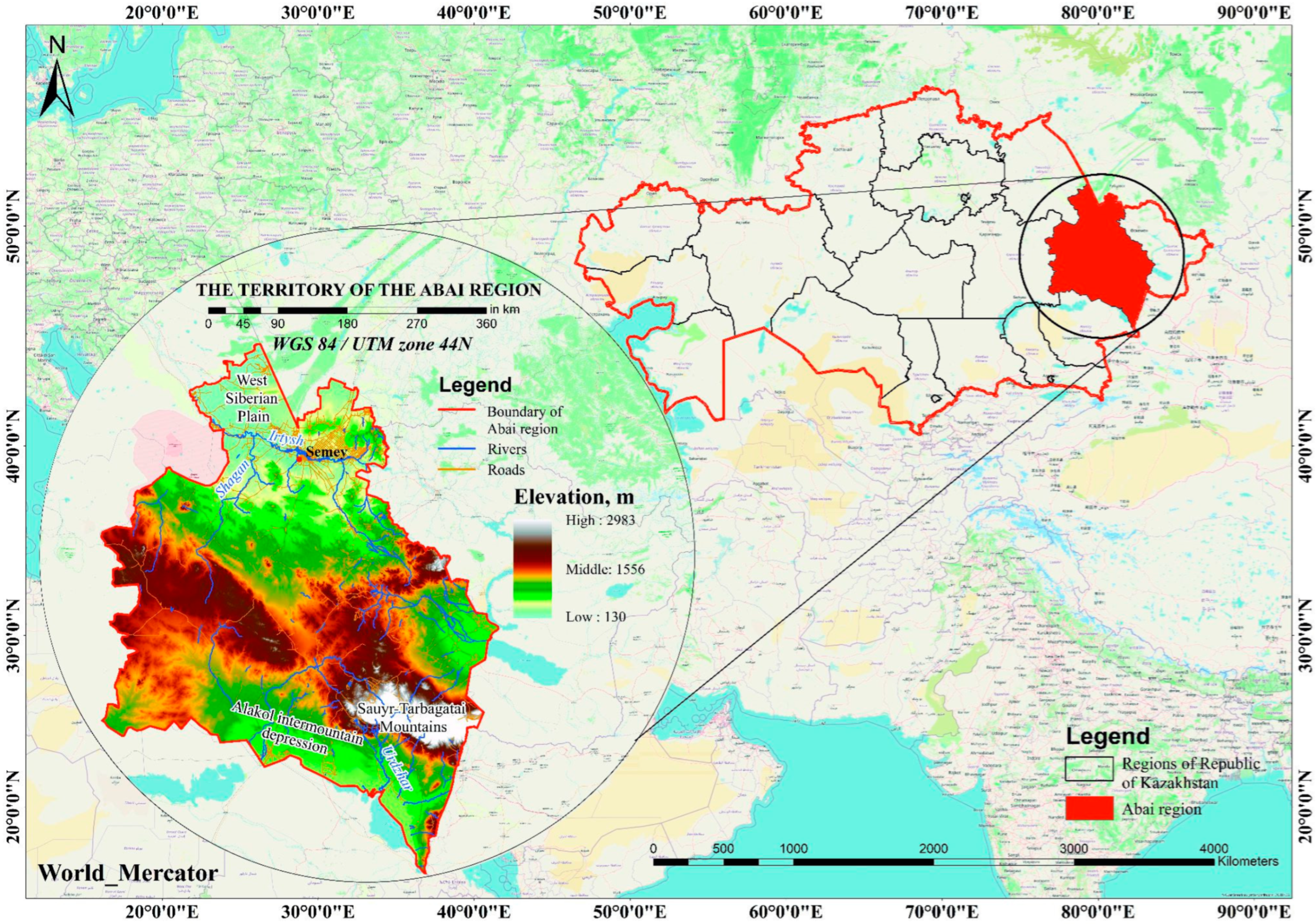
The Abai Region lies in northeastern Kazakhstan and borders the Russian Federation to the north and the People’s Republic of China to the southeast (
Figure 1). Authorities recently established it as an independent administrative unit, with Semey as the regional center, following its separation from the former East Kazakhstan Region [
11].
The Abai Region is characterized by a highly varied physical and geographical structure, notable for its pronounced structural-tectonic diversity. The area features gently rolling, park-like steppes that transition into western steppe landscapes [
23], as well as mountain ranges that run from northeast to south. Among these are the Saur and Tarbagatai ranges, with elevations reaching up to 3000 m above sea level (
Figure 1). In the extreme southern part of the region lie the desert-steppe plains of the Balkhash-Alakol intermontane basin [
24]. The western and southwestern regions are characterized by the elevated plains that are typical of Central Kazakhstan. To the north and northwest, the hilly terrain of Central Kazakhstan gradually transitions into the vast lowlands of the West Siberian Plain near the Priirtysh-Semey area.
The climate in the Abai Region varies significantly from the mountainous southeast to the lowland northwest, both in temperature and precipitation patterns. Some parts of the region fall within arid and semi-arid climatic zones. The sharply continental climate prevalent in the desert and semi-desert areas becomes more moderate in the foothill and mountainous zones. January is the coldest month, with average temperatures ranging from −12 °C to −20 °C, although extreme lows can reach −45 °C to −49 °C. In contrast, July, the warmest month, sees average temperatures of 20–23 °C, with maximums rising up to +45 °C. Despite a long-term warming trend in the annual mean temperature, minor decreases are noted during the winter seasons. The average annual air temperature ranges from −3.6 to 3.0 °C in the lowland southwestern regions and near large reservoirs like Zaisan, to −6 to −7 °C in the high-mountain areas.
The distribution of precipitation throughout the region is quite irregular. The northeastern mountain and foothill areas receive the highest amounts, ranging from 400 to 650 mm annually, while the intermontane basins experience the least, with less than 200 mm per year. During the warm season, from March to October, precipitation is considerably higher than in the cold season, which lasts from December to March. The peak monthly rainfall usually occurs in June or July, particularly in mountainous regions [
7].
The region boasts a wealth of water resources, encompassing over 800 rivers with a combined length surpassing 10,000 km. The Irtysh River serves as the main waterway in the Abai Region, accompanied by significant tributaries like the Shagan, Shulbinka, and Shar rivers. Additionally, the Urdzhar River, one of the three key rivers supplying Lake Alakol, traverses this area. The hydrology of the Irtysh is heavily affected by atmospheric precipitation, including snow, as well as groundwater from the Altai Mountains. The region is also home to significant lakes such as Alakol and Sasykkol, along with numerous smaller lakes and reservoirs, the largest being the Shulbinsk Reservoir [
13,
14,
25].
The Abai Region encompasses a range of natural zones, including steppe, semi-desert, and desert landscapes. It features dry feather-grass–fescue steppes, desert vegetation complexes, and high ecological diversity, driven by distinct latitudinal zones, notably visible in the foothills and within expansive, deep basins. For instance, around 70% of the Zaisan Basin is characterized by sparse vegetation typical of desert and semi-desert areas. The region offers one of the most diverse arrays of vegetation and soil types in Kazakhstan, from the desert communities of the Kazakh Uplands to the taiga forests of the northeastern Altai and tundra ecosystems in the high-mountain zones [
26,
27].
The regional land-use/land-cover structure is dominated by natural steppe and semi-desert landscapes, interspersed with agricultural areas, forested zones in mountainous regions, and relatively sparse urban settlements concentrated along major river corridors. These surface characteristics strongly influence hydrological response by controlling infiltration capacity, soil-moisture retention, and the generation of surface runoff, thereby shaping spatial flood susceptibility across the Abai Region. A detailed classification of LULC categories and their hydrological roles is provided in
Section 3.1.9 [
25].
4. Results and Discussion
The results integrate global flood hazard principles with region-specific hydrological characteristics of the Abai Region, where continental climate, complex terrain, and rapid runoff processes intensify flood susceptibility.
4.1. Reclassification of Flood Hazard Components
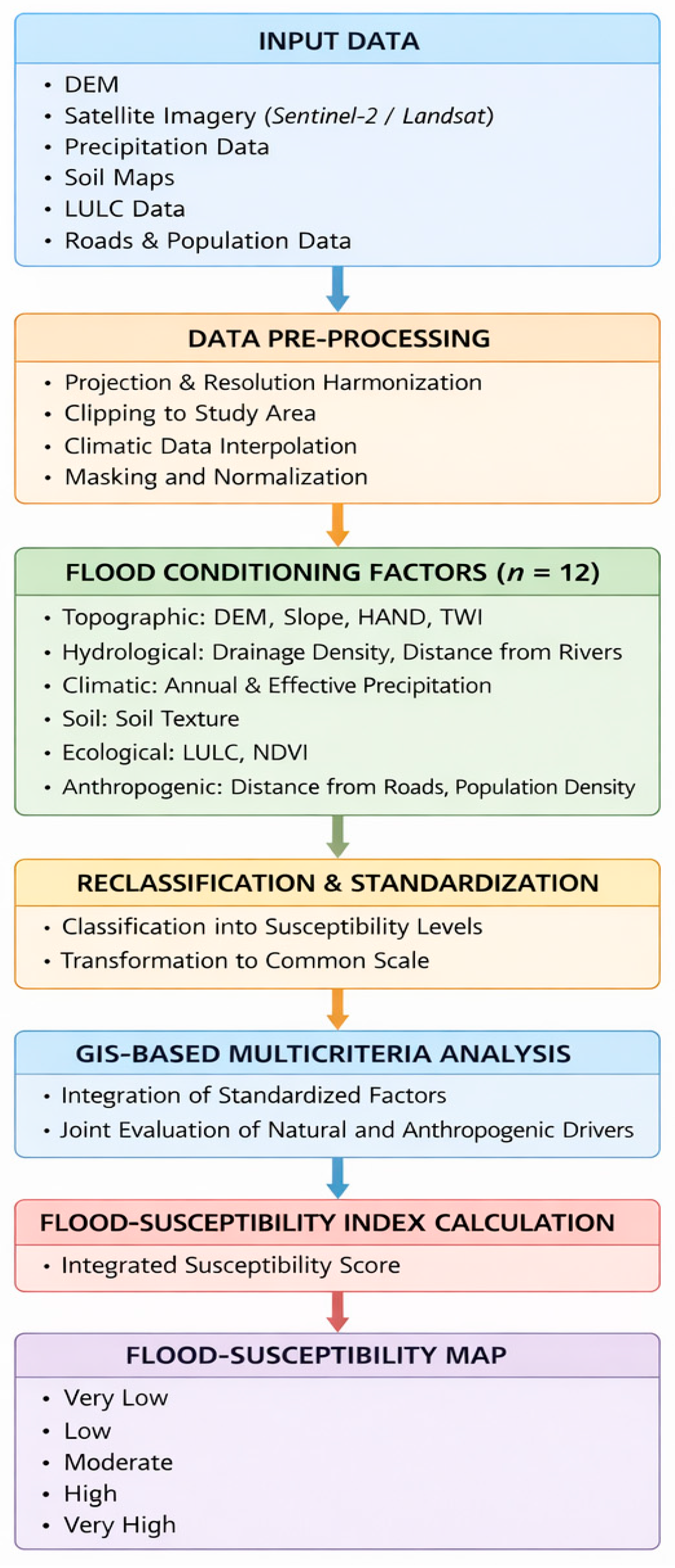
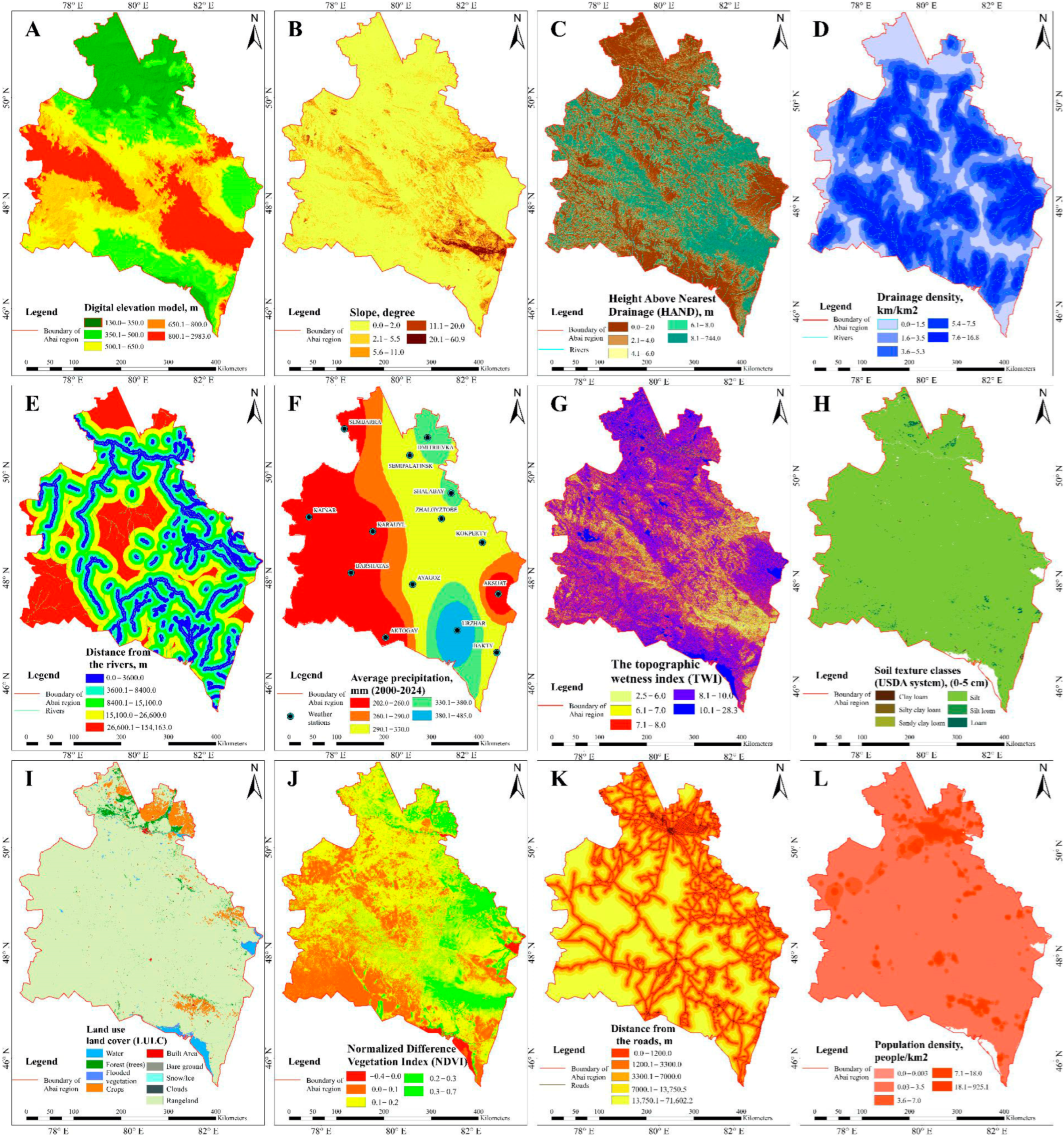
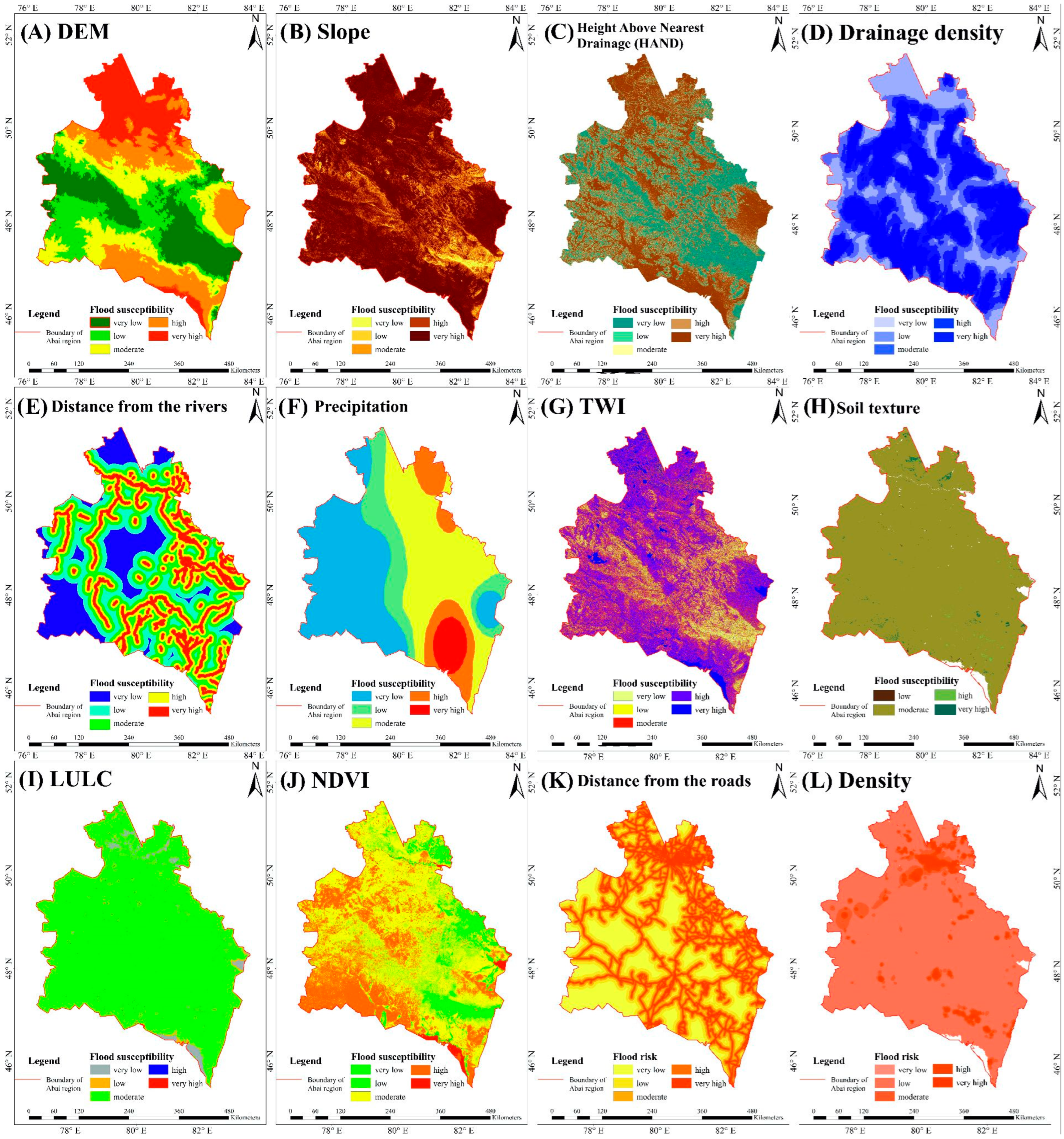
We reclassified all twelve conditioning factors into five ordinal classes (1–5), ranging from very low to very high susceptibility (
Table 3). This approach follows widely applied multi-criteria flood hazard frameworks [
54,
55]. Reclassification ensures consistent comparison among different types of datasets, including continuous, categorical, and distance-based variables. It also standardizes the inputs for multi-criteria analysis [
16].
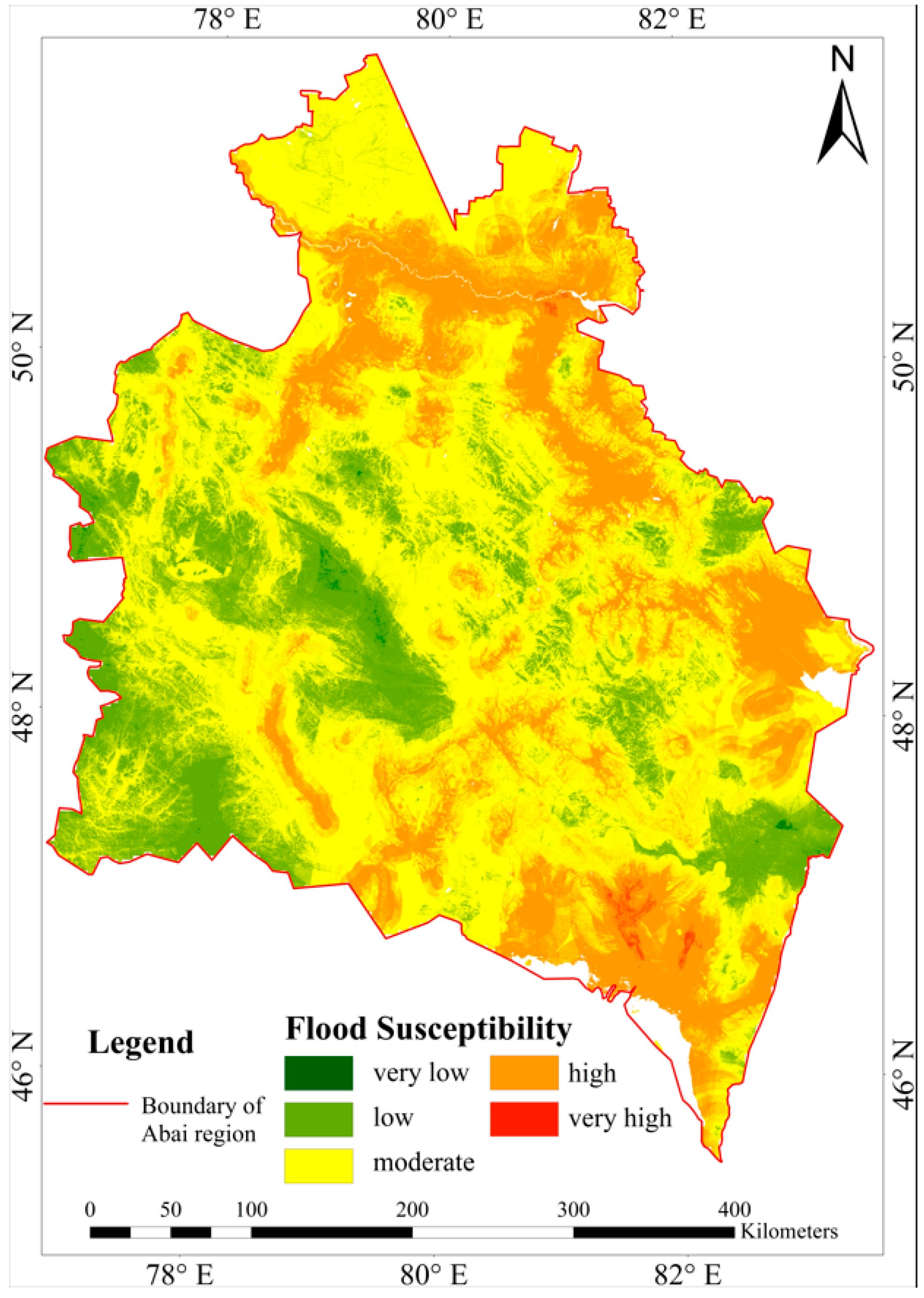
We then applied the Weighted Overlay tool to integrate all layers into a comprehensive flood-susceptibility map (
Figure 4). The resulting map shows clear spatial variability across the study area. It highlights strong physiographic contrasts between the mountainous eastern region and the lowland floodplains.
These spatial contrasts provide an important hydrological basis for interpreting regional flood-generation processes, as runoff accumulation and flood susceptibility are primarily concentrated within low-lying valley systems and river-adjacent terrains.
4.2. Matrix Comparison
The flood-susceptibility model is founded on the AHP pairwise comparison matrix (
Table 4), which quantifies the relative influence of the twelve conditioning factors according to Saaty’s scale [
19,
20], ranging from 0.11 (very weak influence) to 9.0 (extremely strong influence). The resulting matrix ensures methodological transparency and supports reproducibility in multi-criteria decision-making analyses [
16]. The weighting coefficients were derived from pairwise comparisons provided by seven domain experts, as described in
Section 3.2.2 [
1,
2]. The classical AHP approach was considered appropriate due to the structured and internally consistent nature of the input datasets.
The final AHP-derived weights (
Table 5) reveal a clear hierarchical ranking of the conditioning factors. Distance from rivers (19.66%) and precipitation (16.42%) represent the most influential variables in the study region. This pattern is consistent with previous hydrological studies identifying river proximity and rainfall intensity as key flood-generating mechanisms across diverse climatic settings, including continental and semi-arid regions [
24,
41,
56,
57]. In continental environments such as Kazakhstan and northern China, fluvial flooding may be influenced by seasonal snowmelt in combination with intense rainfall events [
49,
58]. The high weight for precipitation reflects the vulnerability of semi-arid regions to intense, sporadic rainfall events that generate rapid surface runoff due to limited infiltration capacity [
59].
Topo-hydrological factors (HAND, Drainage Density, Elevation, Slope, and TWI) received moderate but important weights (8–11% each). Their combined contribution highlights the strong influence of terrain on flood processes. HAND effectively represents local drainage potential [
39] and is particularly relevant in the undulating foothills and plains of the study area. The moderate weight assigned to TWI aligns with studies from similar landscapes in northern China, where it identifies saturation-prone areas but remains less influential than direct hydrological factors [
60].
Soil Texture, LULC, and NDVI received lower weights (2–6%). These variables act as secondary modifiers rather than primary drivers. Although soil properties affect infiltration, intense precipitation events may override their influence in this regional context.
The modest weight for LULC, often higher in urbanized watersheds, suggests that in the Abai Region, natural topography and hydrology currently outweigh anthropogenic land cover changes in flood generation, a finding noted in similar continental regions [
26,
27]. Population density and distance from roads received the lowest weights and were therefore interpreted as anthropogenic spatial modifiers of flood susceptibility rather than direct indicators of social vulnerability. Their inclusion reflects potential influences of settlement distribution and infrastructure on runoff concentration and exposure patterns, while maintaining the conceptual distinction between susceptibility (hazard potential) and risk, as adopted in modern flood-assessment frameworks [
35].
The pairwise comparison matrix (
Table 4) and resulting AHP weights (
Table 5) demonstrate high internal consistency, with a Consistency Ratio of CR = 0.0206, well below the accepted threshold of 0.10 (
Table 6). This reliable hierarchy of flood-controlling factors provides a robust hydrological basis for spatial flood risk interpretation and supports evidence-based land-use planning and integrated water-management strategies in the Abai Region.
To evaluate potential multicollinearity among terrain-derived predictors, Pearson correlation coefficients were calculated for the Digital Elevation Model (DEM), slope, and Topographic Wetness Index (TWI). The results indicate moderate relationships (DEM-slope r = 0.599; DEM-TWI r = −0.361; slope-TWI r = −0.457), suggesting partial association but no strong redundancy among variables (
Table 7).
These findings confirm that DEM, slope, and TWI represent complementary terrain-controlled hydrological processes-topographic position, runoff velocity, and moisture accumulation-supporting their joint inclusion in the GIS–AHP flood-susceptibility model without violating independence assumptions commonly required in multi-criteria decision analysis [
61,
62].
4.3. Spatial Distribution of Flood Susceptibility
The final susceptibility map classifies the region into five distinct categories (
Table 8). Approximately 25.0% of the territory corresponds to High susceptibility and 0.2% to Very High susceptibility, primarily concentrated in low-lying areas adjacent to major river channels and in zones of elevated drainage density. This spatial configuration reflects characteristic floodplain inundation dynamics and is consistent with regional flood-mapping studies across Central Asia, where riverine corridors represent the most hazardous environments [
5].
The extensive Moderate susceptibility class (56.6%) predominantly occupies transitional slopes and foothill landscapes, indicating areas where flooding may occur under extreme precipitation or localized runoff accumulation. Such spatial dominance is consistent with the combined influence of precipitation variability and topographic control observed in continental foothill systems, including the northern Tien Shan and comparable environments in Xinjiang, China [
56,
58].
Similar spatial patterns have been reported in recent regional investigations of soil-moisture variability and hydroclimatic indices in East Kazakhstan, where antecedent saturation and intense precipitation jointly generate hazardous runoff conditions [
27]. The broad extent of Moderate susceptibility, therefore, suggests that flood susceptibility in the Abai Region is not confined solely to major floodplains but represents a landscape-scale hydrological characteristic, emphasizing the importance of integrated watershed management and early-warning preparedness for surface and flash-flood processes.
In contrast, Low and Very Low susceptibility zones (18.2% combined) correspond to higher elevations and steeper slopes that promote rapid drainage and reduced water accumulation. This inverse relationship between elevation, slope, and flood susceptibility is a globally recognized geomorphological pattern and is clearly expressed within the study area [
54].
Overall, the spatial correspondence between modeled high-susceptibility zones, known floodplain extents, and documented historical flood locations supports the physical plausibility of the AHP-based model and demonstrates its suitability for flood-susceptibility assessment in semi-arid continental environments such as the Abai Region (
Figure 5). These results provide an important spatial foundation for evidence-based land-use planning, disaster-risk reduction, and integrated water-resources management under variable hydroclimatic conditions.
4.4. Model Validation and Sensitivity Analysis
Model validation was conducted using an independent flood inventory compiled from documented historical flood occurrence records at settlement locations within the Abai Region. Each settlement was assigned a binary validation label (1 = flood observed; 0 = non-flood/control), and the corresponding GIS–AHP susceptibility class was extracted from the final flood susceptibility map. The settlement-based flood inventory provides an intuitive “ground check” of the susceptibility map by comparing (1) observed flood occurrence at settlement locations with (2) the susceptibility class assigned by the GIS-AHP model at those same locations. The compiled inventory contains 44 settlements in total: 33 flood-affected locations (class = 1) and 11 non-flood/control locations (class = 0), with the modeled susceptibility classes predominantly falling into High and Very High for flood-affected settlements (
Table 9) [
53].
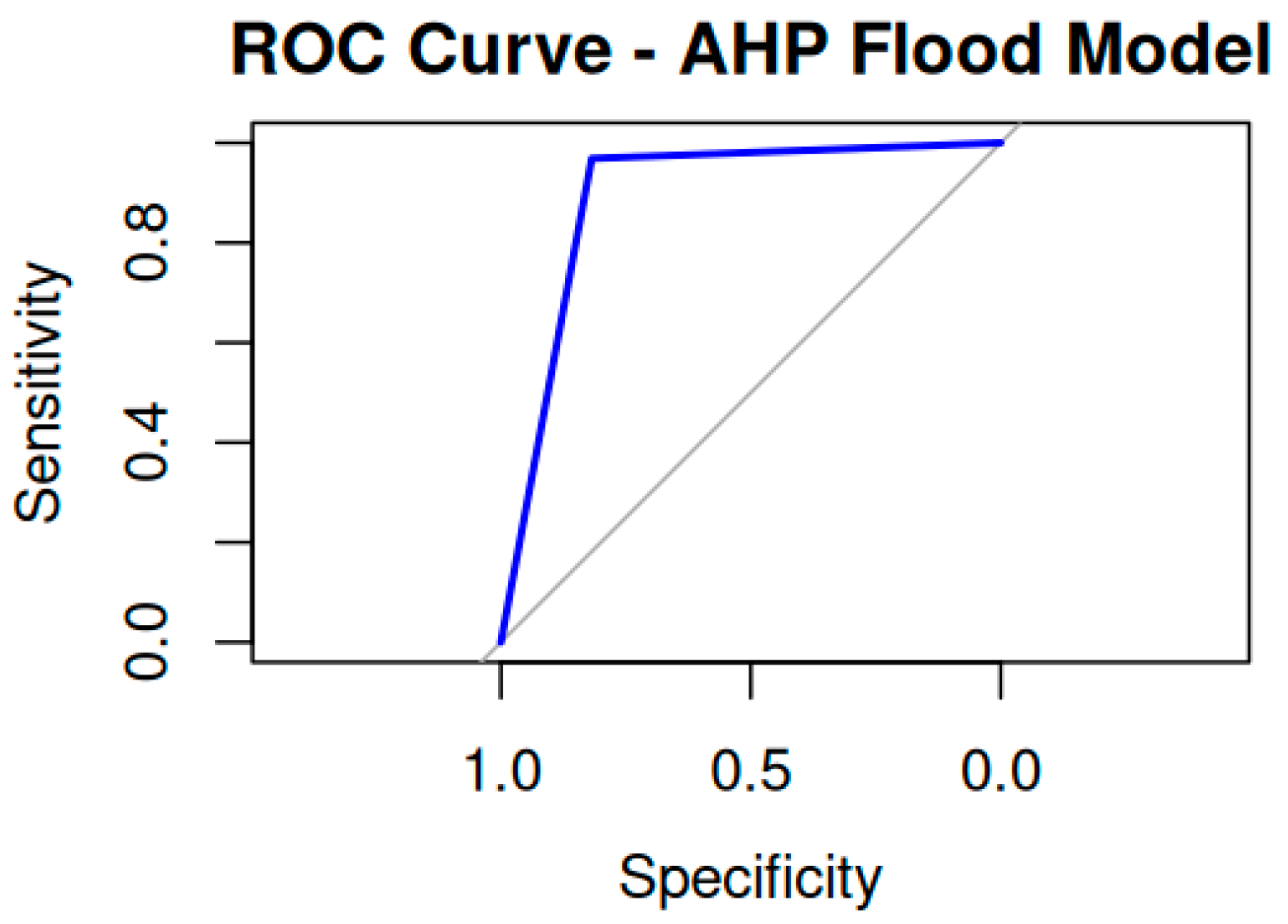
To quantitatively assess predictive performance, susceptibility index values were extracted at inventory locations from the final raster and evaluated using Receiver Operating Characteristic (ROC) analysis. ROC curves provide a threshold-independent assessment of discrimination skill by summarizing the sensitivity–specificity trade-off across all possible cut-off values. The ROC curve (
Figure 6) produced an Area Under the Curve (AUC) value of 0.893, indicating strong agreement between modeled susceptibility patterns and independent flood observations. In line with commonly used interpretation guidelines, an AUC within the 0.8–0.9 range reflects excellent discrimination capability of the model [
66].
In addition to ROC–AUC analysis, model performance was further evaluated using a confusion matrix approach. Classification metrics, including overall accuracy, precision, recall, and Cohen’s Kappa coefficient, were calculated using the caret package in R (
https://cran.r-project.org/web/packages/caret/index.html, 8 February 2026). The results indicate good predictive capability of the model, with an overall accuracy of 83.3%, precision of 0.75, recall of 1.0, and a Kappa coefficient of 0.667, indicating substantial agreement between predicted flood-susceptibility zones and observed flood locations.
To evaluate model robustness, the weights of the dominant conditioning factors were perturbed by ±10%, and the flood susceptibility map was recalculated using identical classification thresholds. The resulting changes in the spatial extent of susceptibility classes are summarized in
Table 10.
The sensitivity analysis indicates that the High susceptibility class varied within a relatively narrow range (−4.7% to +5.1%) compared to the baseline scenario. The Moderate class exhibited minimal variation (within ±2.2%), suggesting strong structural stability of the model. Although more pronounced percentage changes were observed for the Very High and Very Low classes, these categories represent small spatial proportions of the study area and are inherently more sensitive to boundary shifts. Larger relative changes observed in the Very High and Very Low classes are attributed to their limited spatial extent and do not indicate structural instability of the model.
Importantly, the spatial configuration of major flood-prone corridors along primary river systems remained consistent across all perturbation scenarios. No systematic displacement of hotspot areas was observed. These findings confirm that the GIS–AHP model is not overly sensitive to reasonable variations in expert-derived weights and demonstrates satisfactory robustness for regional-scale flood susceptibility assessment [
66,
67].
4.5. Limitations and Future Research Directions
Although the GIS–AHP approach produced a clear and interpretable flood-susceptibility map, the method has several limitations. First, AHP relies on expert judgment. Even though the Consistency Ratio (CR) confirms acceptable consistency, the method still includes subjectivity. Future studies could apply sensitivity analysis or combine AHP with data-driven techniques such as Random Forest or Maximum Entropy (MaxEnt). Recent studies show that such hybrid approaches improve objectivity in factor weighting [
1,
2,
15].
Second, data resolution limits model accuracy. The 30 m SRTM DEM does not fully capture micro-topographic features that control local surface flow. In data-scarce regions such as Central Asia, researchers could use higher-resolution global datasets (e.g., ALOS or Copernicus DEM) or conduct UAV surveys in critical areas [
22,
23]. In addition, incorporating dynamic variables such as snowmelt timing—an important flood driver in Central Asia and northern China [
5,
6]—and higher temporal resolution precipitation data would improve model realism in climate-sensitive regions [
26].
Third, this study assesses flood susceptibility, which reflects the natural tendency of an area to flood. A complete flood risk assessment should integrate the hazard map with detailed exposure data (e.g., infrastructure and agricultural land) and social vulnerability indicators (e.g., age and poverty). This integrated approach aligns with the Sendai Framework and advanced flood risk methodologies [
3,
4].
Despite these limitations, this study provides a foundational assessment of flood susceptibility in the Abai Region. It establishes a reproducible methodology, identifies flood-prone spatial corridors, and offers a scientifically grounded tool for prioritizing land-use planning, early warning systems, and targeted flood-mitigation strategies. Future research should focus on validating the susceptibility map using historical flood inventories, incorporating climate-change projections to assess potential shifts in flood susceptibility, and progressing toward an integrated socio-environmental flood risk assessment framework.
5. Conclusions
Analysis of twelve conditioning factors revealed that distance to rivers (20%) and precipitation (16%) are the principal drivers of flood susceptibility, highlighting the importance of river proximity and seasonal flow dynamics. Topo-hydrological variables, including HAND (11%) and drainage density (9%), further improve representation of terrain-controlled runoff accumulation. The final susceptibility map classifies 25.0% of the region as high susceptibility and 56.6% as moderate susceptibility, primarily concentrated in low-lying floodplains and foothill areas of the Irtysh River basin. Model reliability is confirmed by a low Consistency Ratio (CR = 0.0206) and good predictive performance based on ROC–AUC validation (AUC = 0.893). Sensitivity analysis further demonstrated that the model is stable under reasonable variations in expert-derived weights.
Despite these strengths, the static susceptibility framework is limited by medium-resolution input data, expert-driven weighting, and the exclusion of dynamic hydrological drivers. Future research should incorporate higher-resolution datasets, climate projections, and integrated vulnerability indicators to improve predictive capability.
Overall, the resulting susceptibility map provides a useful spatial basis for disaster-risk reduction, integrated water-resources management, climate-adaptation planning, and evidence-based land-use regulation in the Abai Region under evolving hydroclimatic conditions. Although the present study focuses on flood susceptibility, hydroclimatic extremes in continental Central Asia also include recurrent drought conditions. Future research should therefore extend the proposed GIS–AHP spatial framework toward integrated flood–drought risk assessment and adaptive water-resources management under increasing climate variability.





 ,
,