Article

Evolution of Turbulent-Structure Scale Distribution in Decelerating Open-Channel Flow

1
School of River & Ocean Engineering, Chongqing Jiaotong University, Chongqing 400074, China
2
National Engineering Research Center for Inland Waterway Regulation, Chongqing Jiaotong University, Chongqing 400074, China
*
Authors to whom correspondence should be addressed.
Water 2026, 18(7), 815; https://doi.org/10.3390/w18070815
Submission received: 25 February 2026 / Revised: 24 March 2026 / Accepted: 27 March 2026 / Published: 29 March 2026
(This article belongs to the Special Issue Advances in Open-Channel Flow Hydrodynamics)

Highlights

What are the main findings?
  • Inner-layer velocity follows the log law; outer-layer velocity departs as depth increases.
  • As γ increases from 1.2 to 2.8, turbulent-structure scales shift from bimodal to unimodal.
  • Downstream sections retain longer coherence; normalized peak correlations are self-similar.
  • Turbulent kinetic energy shifts from large and small scales toward intermediate scales downstream.
What are the implications of the main findings?
  • The results provide scaling-based evidence for turbulence redistribution in decel-erating nonuniform open-channel flow.
  • The identified coherence and scale-redistribution features can inform modeling of backwater, reservoir, and transport processes.

Abstract

To investigate the evolution of turbulent-structure scales in decelerating open-channel flow, this study uses a high-frequency particle image velocimetry system in combination with a 28 m high-precision variable-slope flume to conduct controlled flume experiments. The analysis includes cross-sectional specific energy, velocity profiles, turbulence intensity, Reynolds stress, cross-correlation, and power spectral density. The study examines the turbulent statistical characteristics of decelerating flow and the evolution of turbulent-structure scale distributions during streamwise development. The results show that the velocity profile within the decelerating-flow region generally follows a logarithmic distribution, whereas the outer-region velocity profile gradually deviates from the logarithmic law as water depth increases. Compared with uniform open-channel flow, decelerating flow exhibits significantly higher turbulence intensities and Reynolds-stress levels. During flow development, turbulent structures maintain stronger spatial coherence, with spatial correlation increasing as water depth increases. As the nonuniformity coefficient γ increases, the turbulent-structure scale distribution shifts from bimodal to unimodal. Across the measured sections, the dominant turbulent-structure scales range approximately from λ/H = 2.5 to 20, over the ranges Reτ = 596–849 and γ = 1.2–2.8. During downstream development, turbulent kinetic energy increases progressively and is redistributed from large and small scales toward intermediate scales. These results provide new insight into turbulence-scale redistribution in decelerating open-channel flow.

1. Introduction

Decelerating open-channel flow is a type of nonuniform flow characterized by a gradual increase in water depth and a gradual decrease in flow velocity along the channel. Hydraulic parameters vary significantly among cross-sections along the channel, making this flow distinctly different from uniform flow. China currently has nearly 100,000 reservoirs, where decelerating open-channel flow commonly occurs. This flow pattern exists widely in reservoirs worldwide and strongly affects sediment transport, pollutant dispersion, and aquatic ecosystem evolution in global river systems. In recent years, the existence of turbulent structures in open channels has been extensively verified [1,2]. Related research has primarily focused on uniform open-channel flow. However, in decelerating open-channel flow, the generation, development, and dissipation of turbulent structures become more complex because hydraulic parameters change across cross-sections along the flow path. Conventional turbulence models developed for uniform flow are inadequate for accurately describing its dynamic behavior.
With continuous advances in measurement techniques and increasing research demands [3,4], the focus of open-channel turbulence studies has gradually shifted from preliminary investigations of fundamental hydraulic characteristics to in-depth analyses of the intrinsic structure and statistical behavior of turbulence. Following Richardson’s proposal [5] that turbulent motion exhibits multiscale transport characteristics, spectral analysis methods for describing these multiple scales were developed. Research by Xia et al. [6] showed that the velocity field of turbulent open-channel flow exhibits distinct fractal characteristics. The turbulent velocity-field structure is not entirely random, but instead possesses a degree of self-similarity. This finding challenges the conventional view of turbulence as purely random and suggests the existence of more complex multiscale structures in turbulent flows. Liu et al. [7] investigated periodic subsurface turbulent structures using a two-point correlation method and demonstrated that the scale and orientation of coherent structures vary significantly with shear stress and boundary conditions under different operating conditions.
With the advancement of flow-field analysis techniques, large-scale motions (LSMs) and very-large-scale motions (VLSMs) in wall-bounded turbulence have received considerable academic attention. Duan et al. [8] conducted open-channel experiments and, for the first time, introduced the turbulent kinetic energy (TKE) content of VLSMs [9,10,11]. Observations from the premultiplied spectrum distribution at different wall-normal levels revealed that the water surface plays a crucial role in promoting the formation and development of large-scale structures. This influence is consistent with the redistribution of turbulent intensity and kinetic energy along the flow direction. Wang et al. [12] experimentally verified that the flow-velocity power spectrum exhibits a bimodal characteristic at different water depths, corresponding to LSMs and VLSMs. This phenomenon was validated across the entire water-depth range, indicating that large-scale turbulent structures are present throughout the entire flow depth in open-channel turbulence.
Although existing studies have conducted relatively systematic investigations into the scale characteristics of turbulence structures in open-channel flows [13,14], understanding of the streamwise evolution of turbulence length scales under decelerating open-channel flow conditions remains at an exploratory stage. Stewart and Fox [15] carried out the first dedicated investigation of macroscopic turbulence in gravel-bed decelerating flows. Using turbulence decomposition and spectral analysis, they confirmed the consistent presence of such large-scale flow structures. These LSMs contribute significantly to the production, distribution, and maintenance of TKE and affect the entire turbulence field through interscale interactions. However, a systematic understanding of the streamwise evolution of power spectral density distributions at different depths under decelerating open-channel flow conditions is still lacking. The energy distribution and transfer mechanisms of multiscale turbulent structures in decelerating flows also remain unclear.
Therefore, this study employs a high-frequency particle image velocimetry (PIV) system combined with a 28 m high-precision variable-slope flume to obtain full-depth longitudinal measurements in decelerating open-channel flow. To systematically reveal the influence of flow nonuniformity, the evolution of turbulent flow characteristics is analyzed through the vertical distributions of mean velocity and turbulence intensity, cross-correlation delay, the transient characteristics of multiscale turbulent structures, and the power spectra of velocity fluctuations. This study aims to clarify how the scale distribution of turbulent structures and the interscale energy-transfer process evolve with increasing flow nonuniformity in decelerating open-channel flow, thereby providing theoretical support for subsequent turbulence research.

2. Experimental Program and Measurement Setup

2.1. Experimental Flume

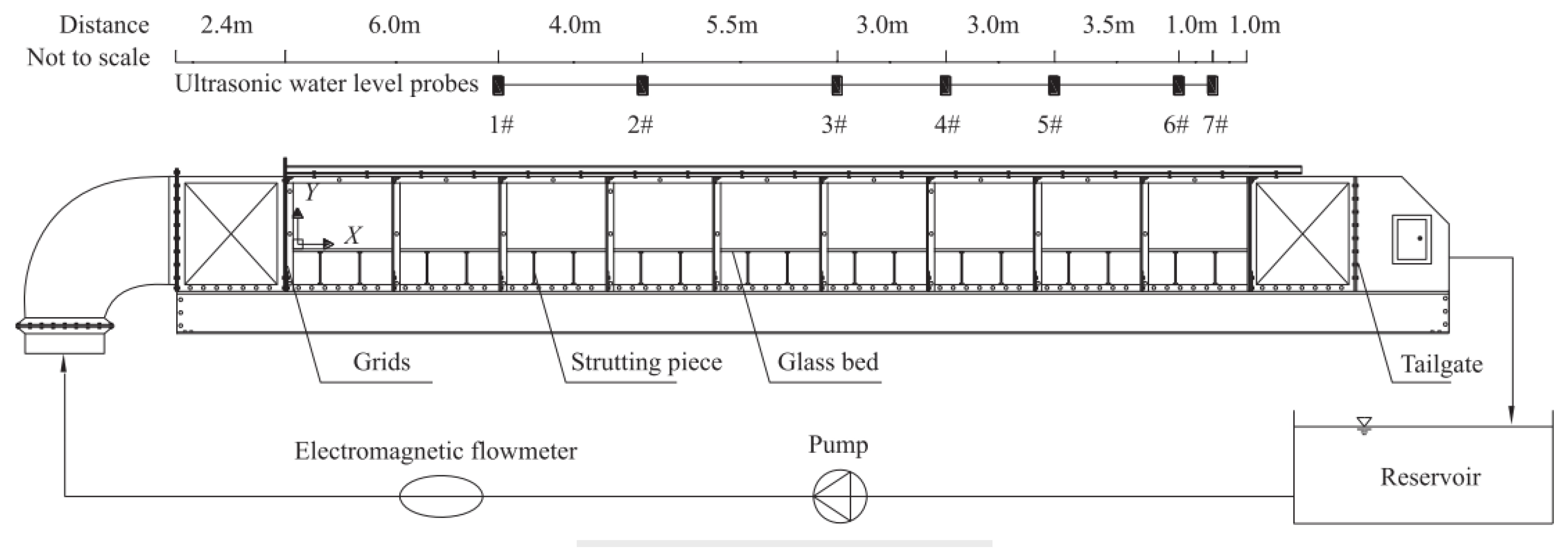
The experiments were conducted in a recirculating flume measuring 28 m in length, 0.56 m in width, and 0.70 m in depth. The sidewalls and bed were constructed from glass panels with smooth, level surfaces, which minimized joint-induced disturbances and provided good optical access for flow-field measurements. The bed slope was adjustable from −0.1% to 0.7% using a motor-driven geared mechanism installed beneath the flume to regulate the support bearings. A three-stage flow-straightening grid was installed at the inlet to stabilize the approach flow, and a hinged tailgate at the outlet was used to control downstream flow conditions. Water level and discharge were monitored using seven ultrasonic sensors and an electromagnetic flowmeter. A schematic of the experimental flume is shown in Figure 1.

2.2. Experimental Flow Conditions

The flume coordinate system was defined with the origin of the X-axis located at the upstream edge of the first glass bottom plate at the flume inlet. The Y-axis was defined vertically upward, with the glass bottom plate taken as Y = 0. The Z-axis was oriented in the transverse (widthwise) direction of the flume, with Z = 0 defined at B/2 (the channel centerline), where B denotes the flume width.
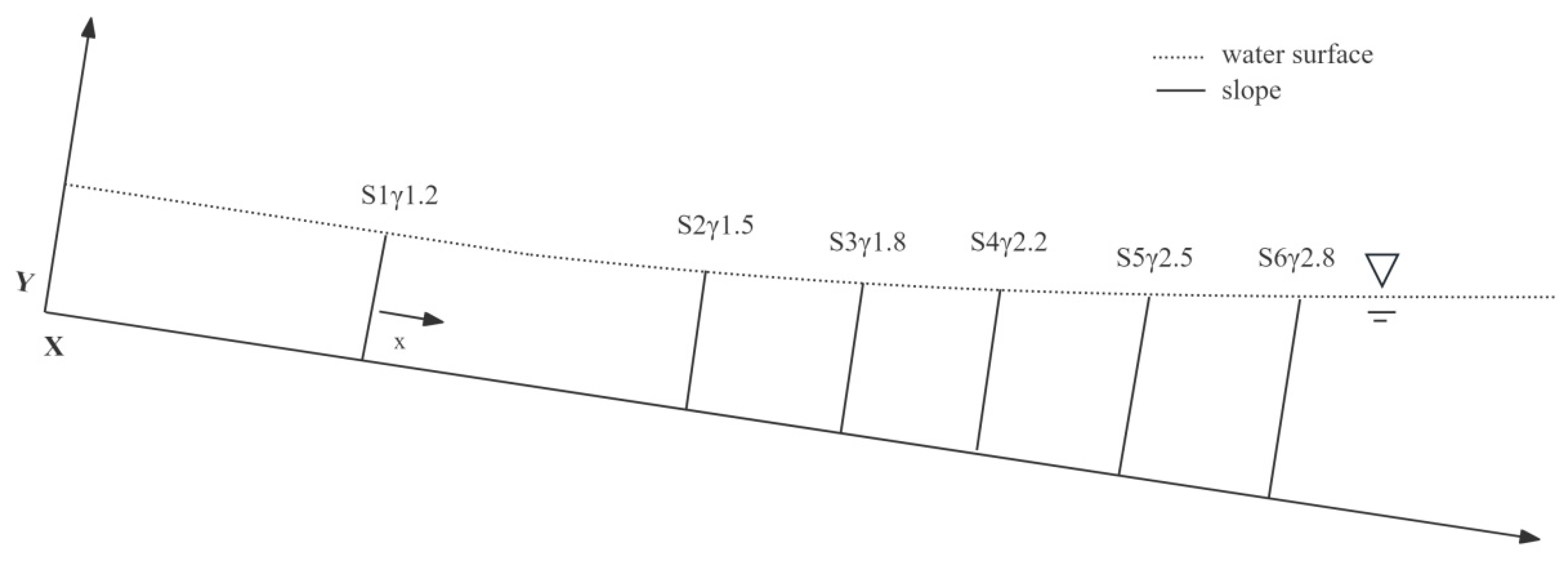
For the PIV measurements, a local coordinate system was adopted in which the streamwise and wall-normal directions were denoted by x and y, respectively. The corresponding velocity components in the streamwise and wall-normal directions were denoted by u and v, respectively, and the fluctuating components were denoted by u′ and v′. The coordinate origin was located at the center of the observation window, as shown in Figure 2.
Because the nonuniform flow varied along the streamwise direction, the critical flow depth (Hk) was used as a reference. A nonuniformity coefficient (γ) was defined as the ratio of the local water depth (H) to the critical flow depth (Hk), i.e., γ = H/Hk. This parameter reflects the degree of backwater effect at each measurement section.
According to the theoretical formula for the critical depth in a rectangular open channel, the critical flow depth for the present experimental conditions was calculated as Hk = 2.89 cm. Based on the Chezy formula, the normal flow depth was determined as Hn = 3.2 cm.
In the decelerating open-channel flow experiments, the flow condition was characterized as steady nonuniform flow. Along the streamwise direction, the flow was divided into an inlet reach, a transition reach, and a backwater reach. The inlet reach was approximately uniform, with a water depth of 3.5 cm, whereas the backwater reach had a water depth of 8.1 cm. In the intermediate transition reach, the water depth gradually increased in the flow direction. Measurement cross-sections were arranged at distances of 3.55, 7.55, 11.5, 16.4, 18.0, and 22.7 m downstream from the inlet. The present experiments covered a subcritical open-channel flow regime, with Fr = 0.21–0.75 and Reτ = 596–849. These values are comparable in order of magnitude to canonical laboratory open-channel turbulence studies such as Nezu and Rodi, although the present flow is nonuniform and decelerating. The detailed hydraulic parameters for each section are listed in Table 1.

2.3. PIV Flow-Field Measurement System

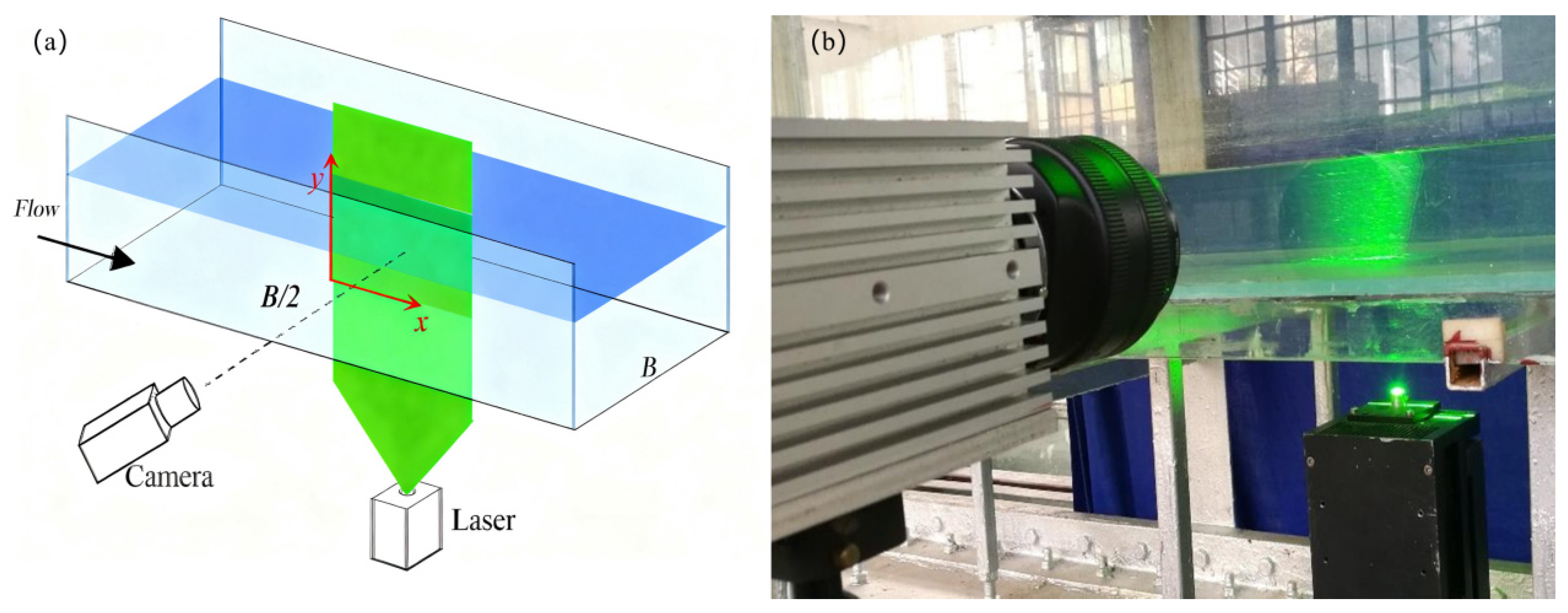
A high-speed two-dimensional PIV system was used to measure the instantaneous flow field (Figure 3). The PIV system used a 10 W continuous-wave laser in combination with a Powell prism to generate a fan-shaped laser sheet with a thickness of 1 mm. The laser sheet was aligned parallel to the main flow direction. Hollow glass spheres were used as seeding particles, with a mean diameter of 10 μm and a density of 1.03 g/cm3. Flow images were acquired using a 2560 × 1920 pixel complementary metal–oxide–semiconductor (CMOS) camera with 12-bit digital resolution, equipped with a Nikon 50 mm f/1.8D lens.
The laser beam was introduced normal to the glass bottom plate to illuminate the longitudinal mid-plane of the flume (B/2). The camera was mounted on a tripod. During the experiments, careful fine adjustment was performed to ensure coincidence between the laser-sheet plane and the camera focal plane.
Particle images were post-processed using an in-house PIV software package employing an image-deformation, multigrid iterative algorithm similar to that proposed by Scarano [16]. The velocity fields were computed using a multi-pass iterative procedure, beginning with an interrogation window of 64 × 64 pixels and ending with a final interrogation window of 16 × 16 pixels. The spatiotemporal resolution of the PIV measurements was adequate. Specifically, Δx+ = Δy+ ranged from 5.70 to 16.53, allowing the key small-scale turbulent motions in the near-wall region, approaching the Kolmogorov scale, to be captured. The sampling frequency of 400–700 Hz satisfied the Nyquist criterion and was sufficient to resolve the dominant temporal scales. In addition, the long sampling duration of 366–2021 s ensured stable statistical convergence, thereby supporting the reliability of the turbulence statistics. A 50% overlap was applied in both the streamwise and wall-normal directions, yielding a flow-field spatial resolution of 0.62 mm × 0.62 mm. The time separation between the two images used to compute each instantaneous velocity field was 1.25 ms.
The location of the correlation peak was determined using three-point Gaussian fitting for sub-pixel interpolation. Spurious vectors were identified and removed using the normalized median test [17], and the rejected vectors were replaced by Gaussian-weighted interpolation. The particle image diameter was approximately 4–6 pixels, and the final interrogation window contained approximately 2–4 particles. The accuracy of the velocity vectors was assessed using a validation threshold of three standard deviations of the velocity fluctuations. Across the 5000 instantaneous fields, the percentage of erroneous vectors was less than 1%. In each case, a total of 5000 velocity fields were sampled to ensure statistical convergence. Detailed PIV interrogation parameters are provided in Table 2.

2.4. Power Spectral Analysis Method

In studies of decelerating open-channel flow, power spectral analysis is commonly used to characterize the distribution of large-scale turbulent structures [18]. In the present work, a Hamming window was applied to mitigate spectral leakage associated with the Fourier transform. The power spectrum was computed using the direct method as follows:
E i ( f x ) = n = 0 N 1 u i ( n ) W ( n ) exp [ ( p 2 π N x n ) ] ,
S i j ( f x ) = 1 N M [ E i ( f x ) E j * ( f x ) ] ,
where  M = 1 N n = 0 N 1 W 2 ( n )  is the normalization factor of the window function; i, j = 1, 2 denote the streamwise and vertical directions, respectively; and fx is the frequency component (with x = 0, 1, …, N − 1 denoting the discrete frequency index).
Based on Taylor’s frozen-turbulence hypothesis and the convection velocity, the corresponding wavenumber spectrum can be obtained from the power spectrum as follows:
S i j ( k x ) = u ( y ) 2 π S i j ( f x ) ,
k x = 2 π f x u ( y ) ,
where kx is the streamwise wavenumber, Sij(fx) is the power spectrum, and u(y) is the time-averaged velocity profile measured by PIV.
By invoking Taylor’s frozen-turbulence hypothesis, the temporal velocity signals can be approximately transformed into a spatial flow field. It should be noted that, because the present flow exhibits pronounced streamwise deceleration and nonuniformity, Taylor’s hypothesis is not strictly valid. Nevertheless, for the coherent-structure scale variations of interest in this study, adopting the time-averaged velocity profile as the convection velocity is still considered a reasonable first-order approximation. Under this assumption, the spatial correlation variable rx and the time-lag variable τ satisfy rx = u(y)τ. Therefore, the resulting wavenumber spectra are interpreted mainly in terms of the relative trends in spectral evolution, dominant-scale variation, and energy redistribution.
In this study, a window length of 50H was adopted, and the measured velocity signals were segmented to compute the power spectra for each window. The resulting spectra were then smoothed using a 20% bandwidth running-mean (sliding-average) filter [19]. For the six measurement sections, the PIV record length, when multiplied by the depth-averaged mean velocity, corresponds to an advected flow distance exceeding 4500H, which is sufficient to capture the characteristic scales and the distribution of TKE.

3. Results

3.1. Cross-Sectional Distribution of Specific Energy

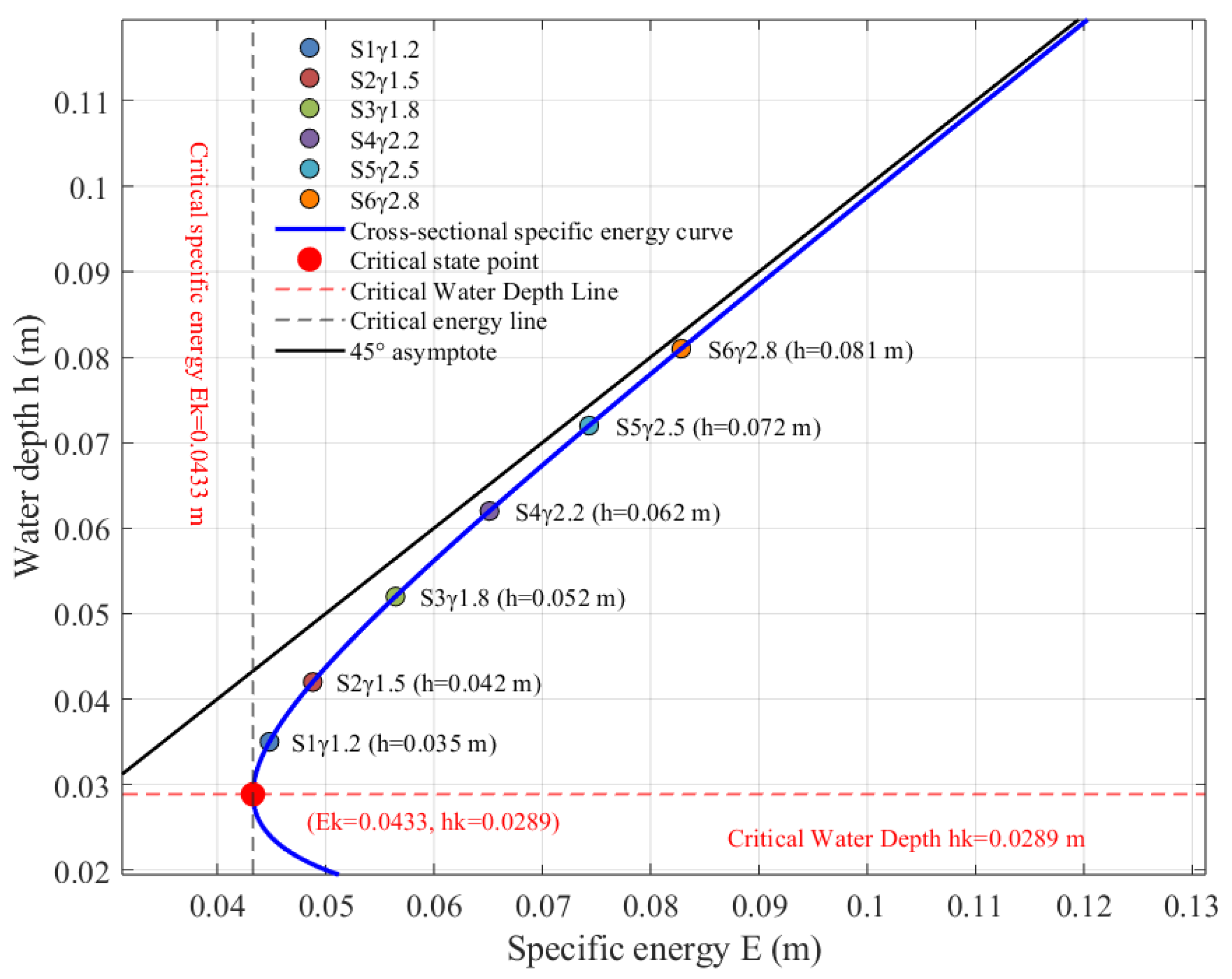
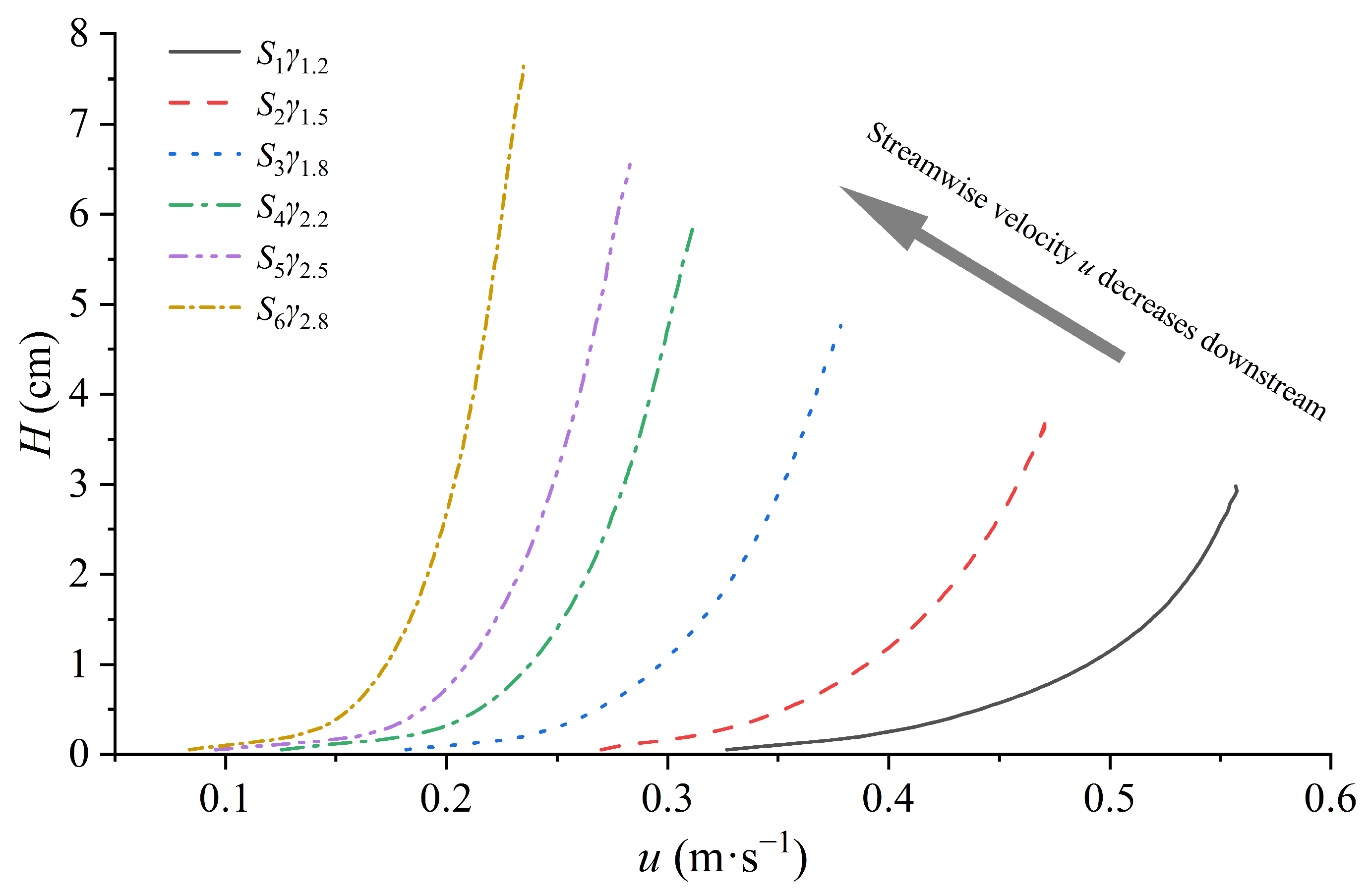
The relationship between flow depth (H) and cross-sectional specific energy (E) at the six measurement sections under the tested conditions is shown in Figure 4. On the upper branch of the specific-energy curve, E increases with increasing H. At section S1γ1.2, the flow depth is 3.5 cm, which is closest to the normal depth (Hn = 3.2 cm). At section S6γ2.8, the flow depth reaches 8.1 cm and approaches the 45° asymptote. Sections S2γ1.5 through S5γ2.5 are distributed relatively evenly between S1γ1.2 and S6γ2.8. Overall, the six sections adequately capture the streamwise evolution of the decelerating open-channel flow.

3.2. Turbulence Statistics

3.2.1. Time-Averaged Velocity Profiles Streamwise Variation of Time-Averaged Velocity Profiles

Figure 5 shows the streamwise evolution of the vertical velocity profiles in the decelerating open-channel flow. As the flow depth increases, the velocity decreases along the channel, and the differences among the vertical profiles gradually diminish, indicating a tendency toward a more uniform velocity distribution over the full flow depth. The area under each profile represents the unit-width discharge. By integrating the local velocity u over the corresponding vertical increments, the unit-width discharges at the six sections are estimated as 1.49 × 10⁻², 1.52 × 10⁻², 1.56 × 10⁻², 1.60 × 10⁻², 1.60 × 10⁻², and 1.55 × 10⁻² m2/s, respectively. Overall, the unit-width discharge estimated from the channel centerline exhibits only minor variation during streamwise development, with a marginal overall increase.
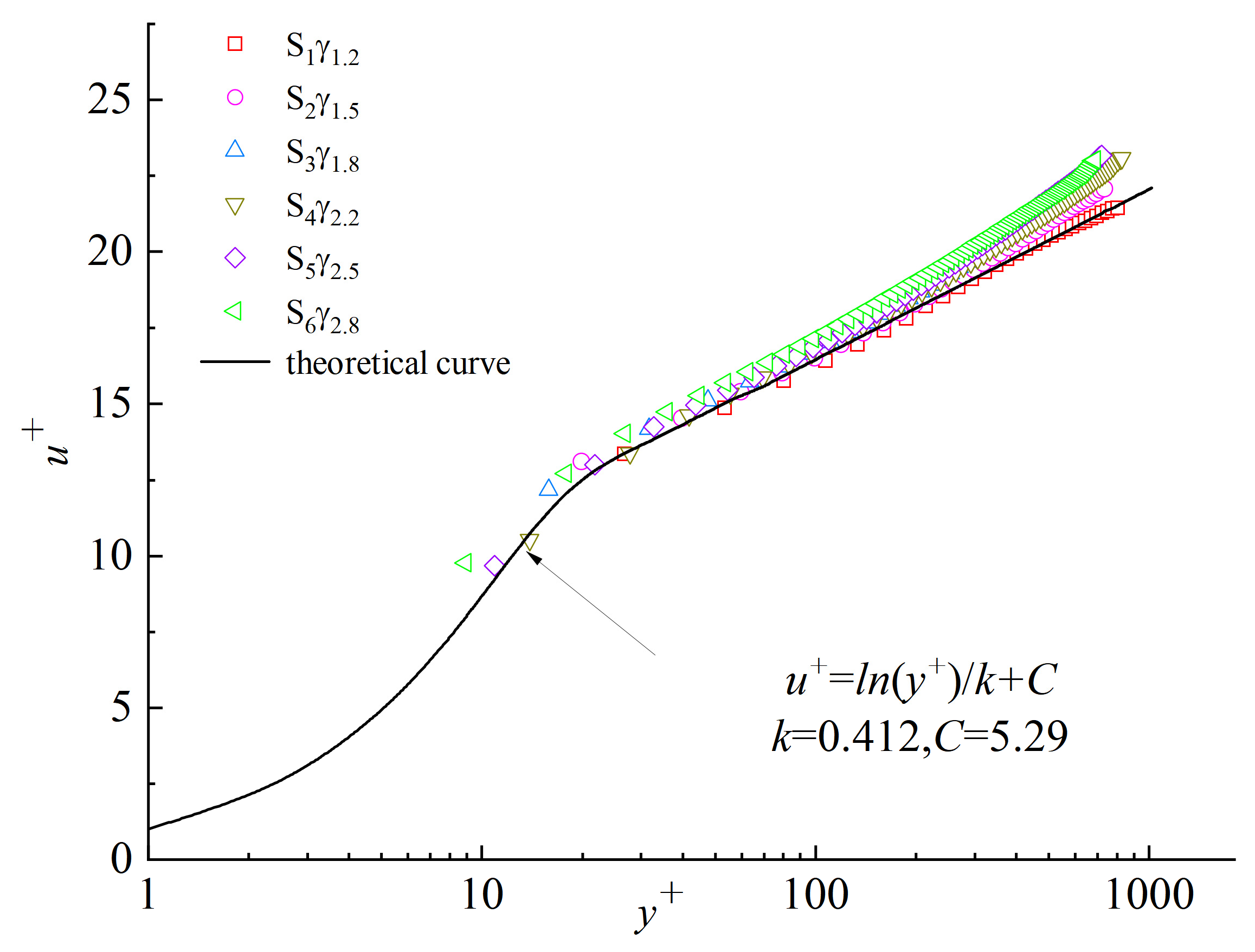
Figure 6 shows the inner-normalized mean-velocity profiles at each section. Except in the near-wall region, the normalized profiles u+(y+) agree well with the logarithmic law within the log layer (y+ ∈ [30, 0.2Ret]), showing an overall logarithmic trend. During streamwise development, as the flow depth increases, the velocity in the wake region downstream of the log layer (y+ > 200) gradually departs from the log law and tends to be marginally higher than the logarithmic prediction. Near the free surface, the profile at section S1γ1.2 still follows the log law reasonably well, whereas at larger γ, such as at section S6γ2.8, the profile is noticeably higher than the log-law prediction. Under decelerating-flow conditions, the velocity distribution tends to become more center-peaked: as depth increases, the near-wall velocity decreases while the core-region velocity increases, leading to an upward shift of the peak in the velocity profile.

3.2.2. Distribution of Turbulence Intensity

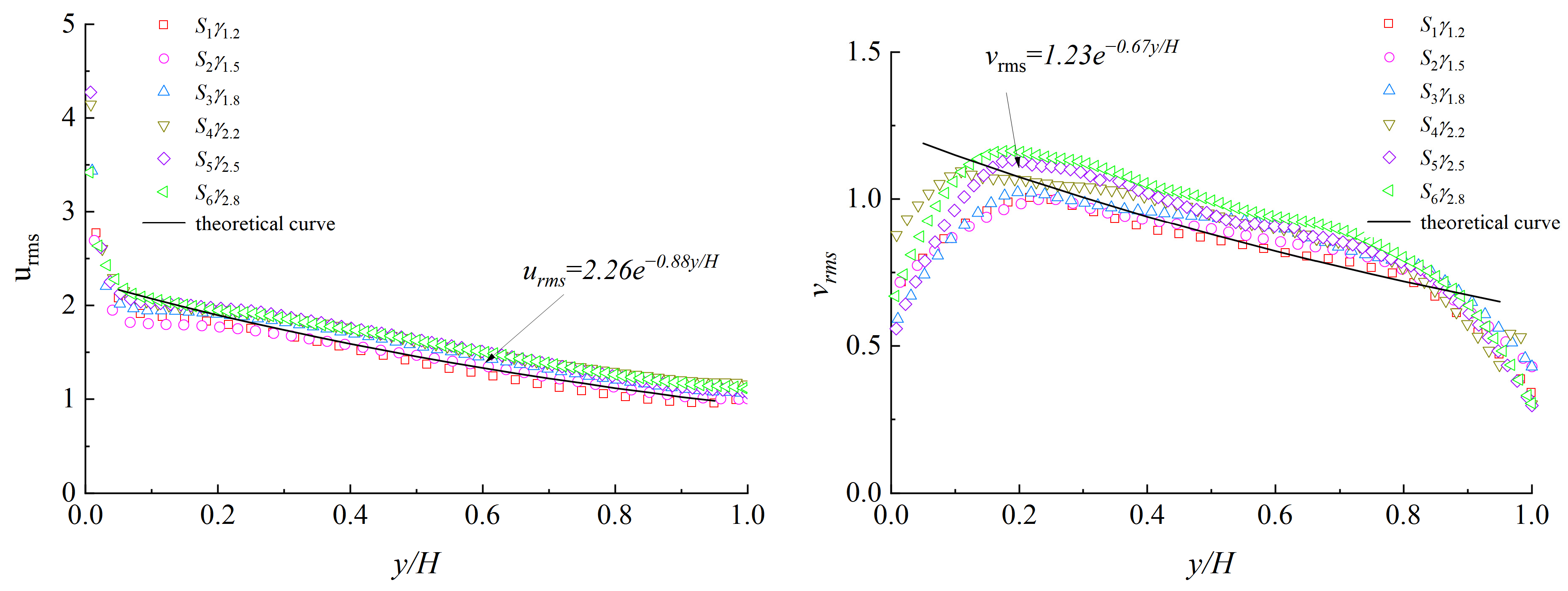
As shown in Figure 7, the vertical distributions of the time-averaged turbulence statistics are broadly consistent among the measured sections. The six sections exhibit similar trends, with the maxima of both the streamwise and vertical turbulence intensities occurring near the bed. The streamwise turbulence intensity decreases with increasing distance from the bed, and its peak is located within the viscous sublayer. In contrast, the vertical turbulence intensity reaches its maximum at approximately 0.2H and then gradually decays with depth; above 0.9H, it decreases considerably. At section S1γ1.2, the vertical profiles of urms and vrms agree well with the uniform-flow results reported by Nezu and Rodi [20]. However, with increasing γ, beginning at section S2γ1.5, both the streamwise and vertical turbulence intensities show noticeable differences in magnitude and exhibit an overall increasing trend in the downstream direction.
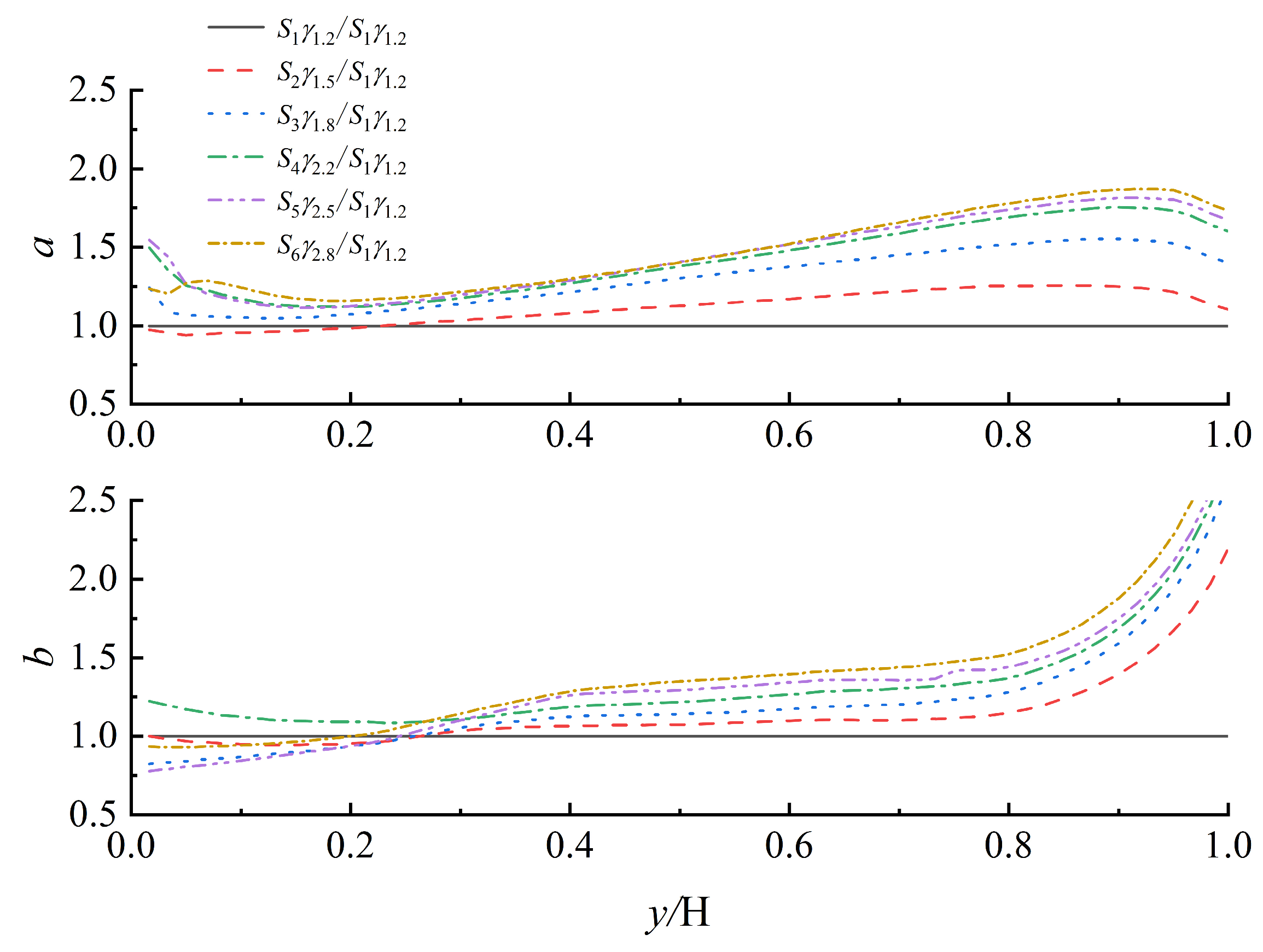
Taking the turbulence intensities at section S1γ1.2 as the reference, the increase in turbulence intensity with increasing γ at the downstream sections is quantified. The relative increments are defined as follows:
a = u i 2 ¯ / u * i u 1 2 ¯ / u * 1 ,
b = v i 2 ¯ / u * i v 1 2 ¯ / u * 1 .
Here, i = 1–6 denotes the six measurement sections. The streamwise evolution of the relative turbulence intensity is shown in Figure 8. Both the streamwise and vertical turbulence intensities exhibit an overall increasing trend in the main-flow direction.
In the near-bed region (y/H < 0.2), the turbulence intensities at the six sections are similar because of viscous effects and confinement by the bed boundary. As the distance from the bed increases, the relative turbulence intensity generally rises with increasing γ, starting from section S2γ1.5, indicating that both the streamwise and vertical turbulence intensities increase relative to the near-uniform-flow condition at S1γ1.2. Meanwhile, the increment between successive sections becomes progressively smaller. In the near-surface region (y/H > 0.8), both the streamwise and vertical turbulence intensities are considerably larger at higher γ.
These results suggest that during streamwise development, although the absolute mean velocity decreases, the inner-normalized mean velocity profile and the normalized turbulence intensities exhibit increasing trends.

3.2.3. Reynolds-Stress Distribution

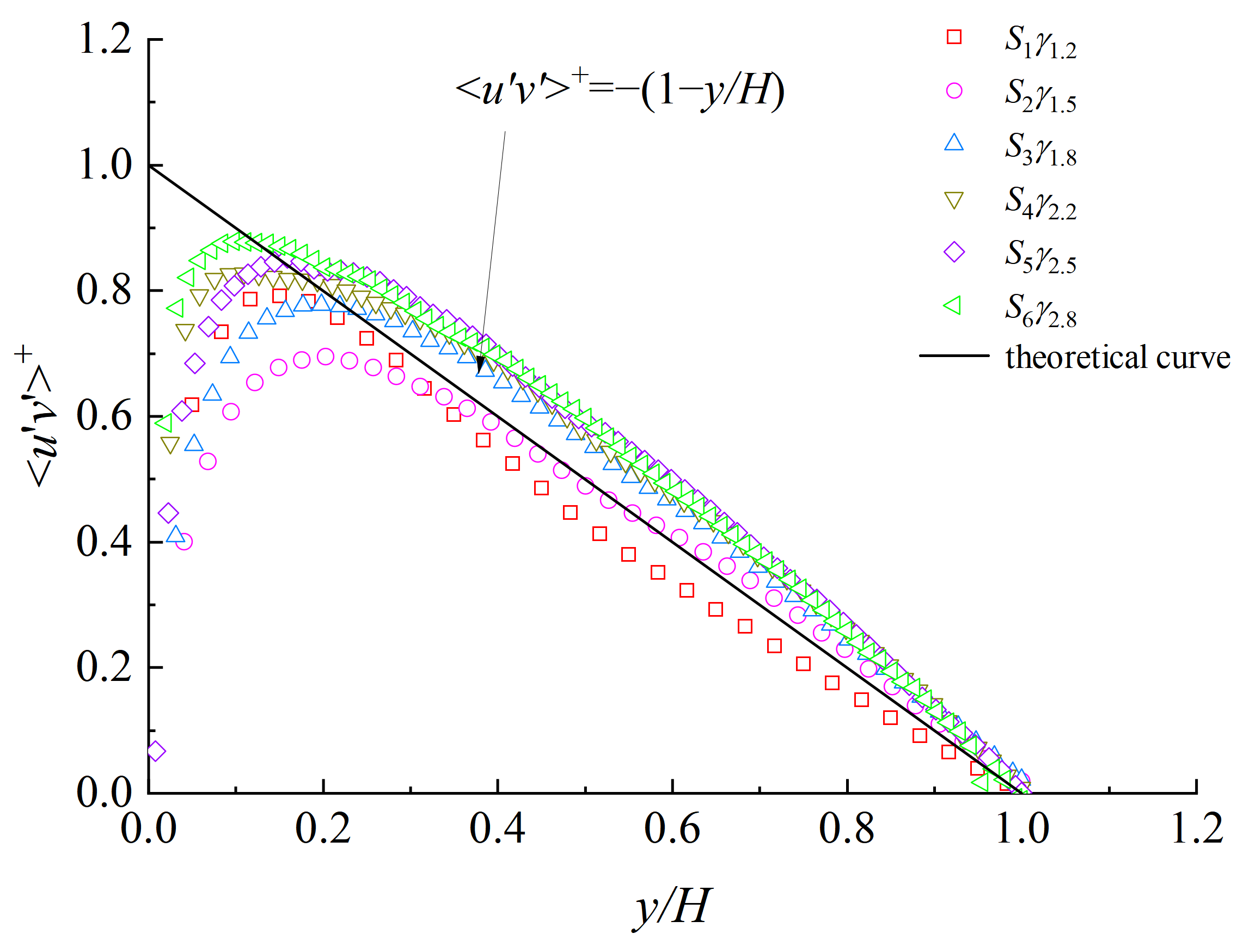
The vertical profiles of Reynolds stress at the six sections are shown in Figure 9. The Reynolds stress approaches zero near both the bed and the free surface. For y/H < 0.1, as the flow depth increases, the near-bed turbulence is enhanced owing to the reduction in bed viscous shear stress, leading to a rapid increase in Reynolds stress. The Reynolds stress reaches its maximum at approximately y/H = 0.2.
The wall-normal distribution of the normalized Reynolds shear stress <uv′>+ at S1γ1.2 is close to that of uniform open-channel flow. From S2γ1.5 downstream, however, <uv′>+ in the outer region (0.2 < y/H < 0.8) lies above the linear theoretical profile <uv′>+ = −(1 − y/H), indicating a streamwise increase in Reynolds shear stress during the development of the decelerating open-channel flow.
Analysis of the turbulence statistics indicates that section S1γ1.2 is close to uniform open-channel flow, as its mean-velocity profile, turbulence intensities, and Reynolds stress agree well with classical results for uniform flow. In the decelerating open-channel flow, however, the cross-sectionally averaged velocity decreases progressively in the downstream direction, and the absolute magnitude of the mean velocity also decreases. In contrast, when normalized using inner scaling, the nondimensional mean-velocity profiles show a gradual increasing trend. Moreover, both the turbulence intensities and the Reynolds stress exhibit streamwise enhancement during flow development.

3.3. Cross-Correlation Analysis

Two-point correlation analysis is widely used to investigate LSMs and VLSMs in wall-bounded turbulence [21,22,23,24], because it provides a quantitative measure of spatial coherence in the velocity field. By computing two-point correlations of fluctuating velocity components, the statistical dependence between different spatial locations can be identified, thereby enabling characterization of the spatial distribution and statistical properties of specific flow features. To further elucidate the characteristic scales of turbulent structures, this approach is used here to evaluate the two-point correlation of velocity fluctuations.
The two-point correlation coefficient of the streamwise velocity fluctuation, Ruu is defined as follows:
R u u ( Δ x ) = u ( x ) u ( x + Δ x ) σ u ( x ) σ u ( x + Δ x ) ,
where ∆x denotes the streamwise separation distance between the two points (m),   denotes an ensemble (statistical) average, and σu′ is the root-mean-square value of the streamwise velocity fluctuation u′.
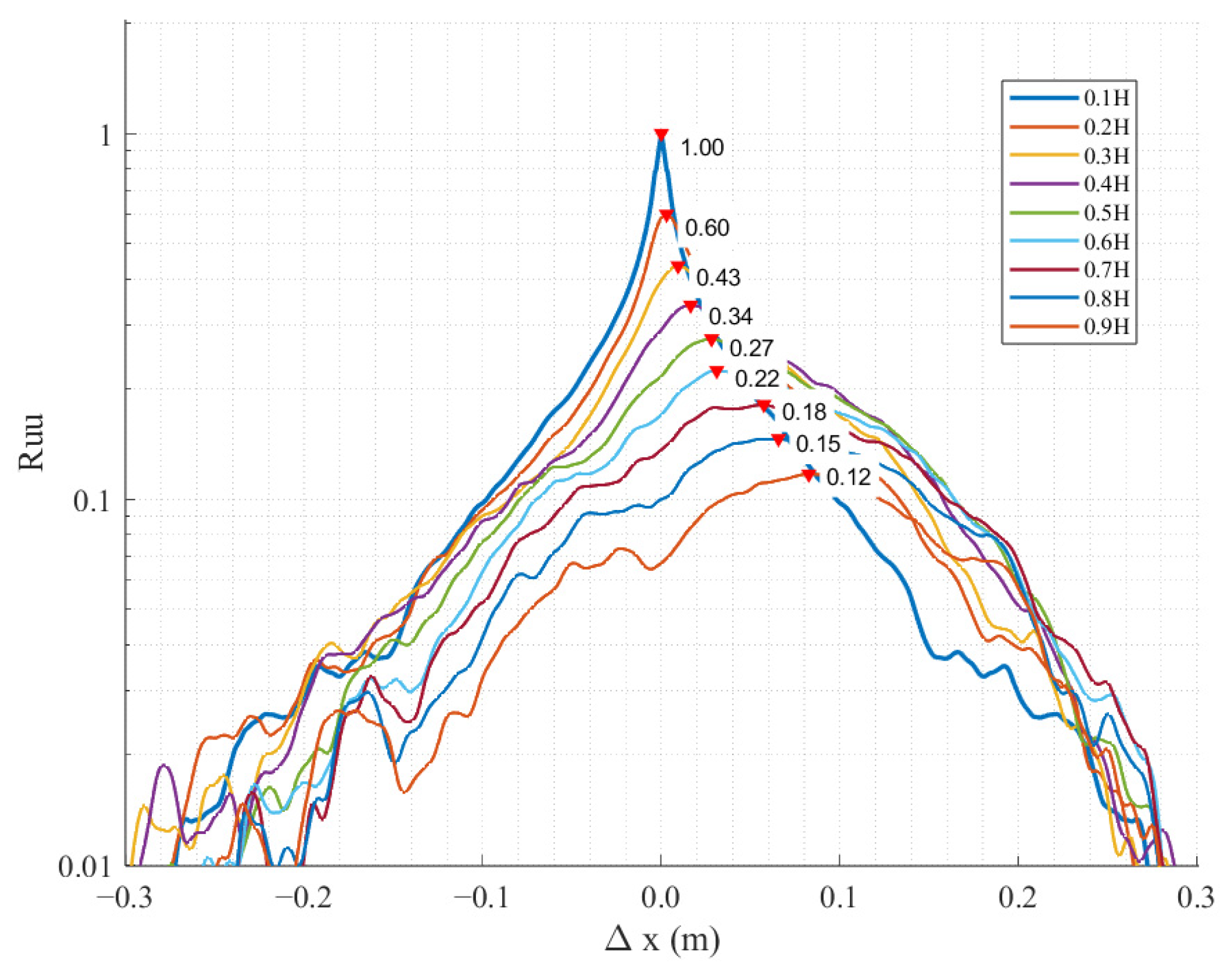
Figure 10 shows the two-point correlation coefficient Ruu of the streamwise velocity fluctuation u′, where the reference signal is taken at y/H = 0.1 and correlated with u′ signals measured at wall-normal positions y/H = 0.1 to 0.9 (in increments of 0.1) as a function of streamwise separation Δx. To distinguish the curves more clearly, the wall-normal coordinate y on the vertical axis is plotted on a logarithmic scale.
Using section S1γ1.2 as an example (with Ret = 849), the variation of the two-point spatial correlation function Ruu with wall-normal position is illustrated. The curve with a maximum correlation of unity corresponds to the autocorrelation of the fluctuating velocity at y/H = 0.1 as ∆x varies. As y increases, the peak magnitude decreases progressively, and the curve shape evolves from a sharp, narrow peak to a broader, flatter profile. For y/H = 0.2 to 0.9, the peak Ruu values range approximately from 0.12 to 0.60. Overall, the peak Ruu decreases with increasing y, and the peak location gradually shifts to the right of Δx = 0, indicating a delayed correlation associated with the downstream advection of turbulent structures across the vertical direction. This feature is consistent with previous studies of large-scale coherent structures in open-channel flows [12,25].
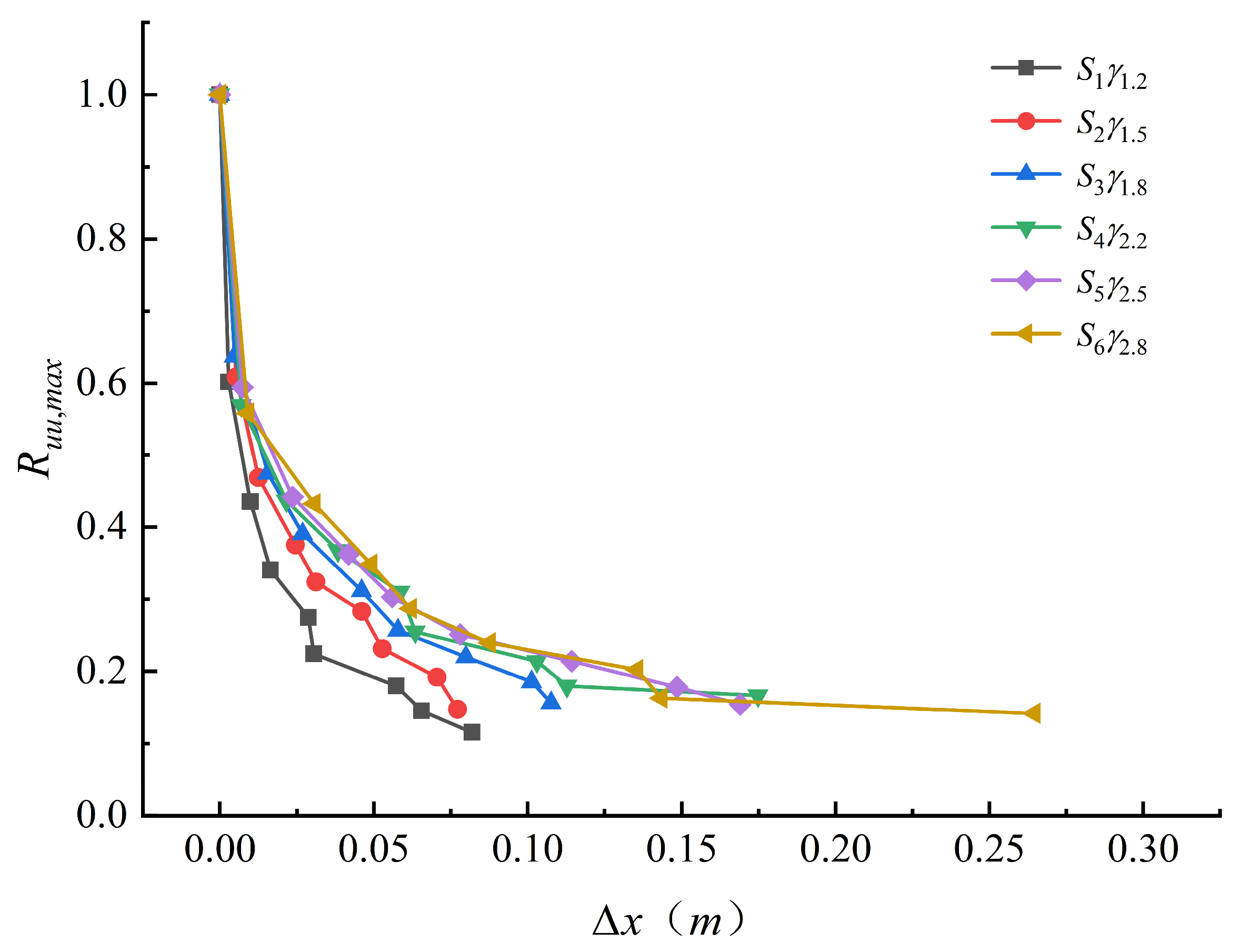
To illustrate the streamwise development of the spatial correlation of streamwise velocity fluctuations, the peak values of Ruu and their corresponding separation distances Δx for velocity signals at y/H = 0.1 to 0.9 across the six cross-sections are plotted, as shown in Figure 11.
Here, Ruu(∆x) denotes the two-point correlation coefficient of the streamwise velocity fluctuation u′ between the reference signal measured at y/H = 0.1 and the signal at a given wall-normal location y, separated by a streamwise distance ∆x. The peak correlation, Ruu,max, is defined as the maximum value of Ruu(∆x) over the examined range of ∆x:
R u u , max = max Δ x R u u ( Δ x ) .
The separation distance at which this maximum occurs is denoted by ∆x. A larger Ruu,max indicates stronger streamwise coherence of velocity fluctuations between the two points, whereas a smaller Ruu,max reflects progressive decorrelation with increasing separation.
As shown in Figure 11, the peak correlation coefficient Ruu decreases with increasing separation distance, indicating that the correlation between velocity fluctuations at two points weakens as the spatial separation increases. For section S1γ1.2, where the flow is close to uniform, Ruu,max decreases rapidly and falls below 0.2 once ∆x > 0.05, exhibiting the fastest decay and the steepest trend among the six sections. In contrast, for the section S6γ2.8 cross-section, Ruu,max remains close to 0.2 even when ∆x > 0.25, indicating the slowest decay. This suggests that turbulent structures at this section possess greater streamwise coherence and stability, resulting in a larger streamwise correlation range and finite correlation over longer distances. From section S1γ1.2 to section S6γ2.8, the streamwise correlation length increases progressively with increasing γ, implying that turbulent structures preserve their spatial organization more effectively during the development of the decelerating flow.
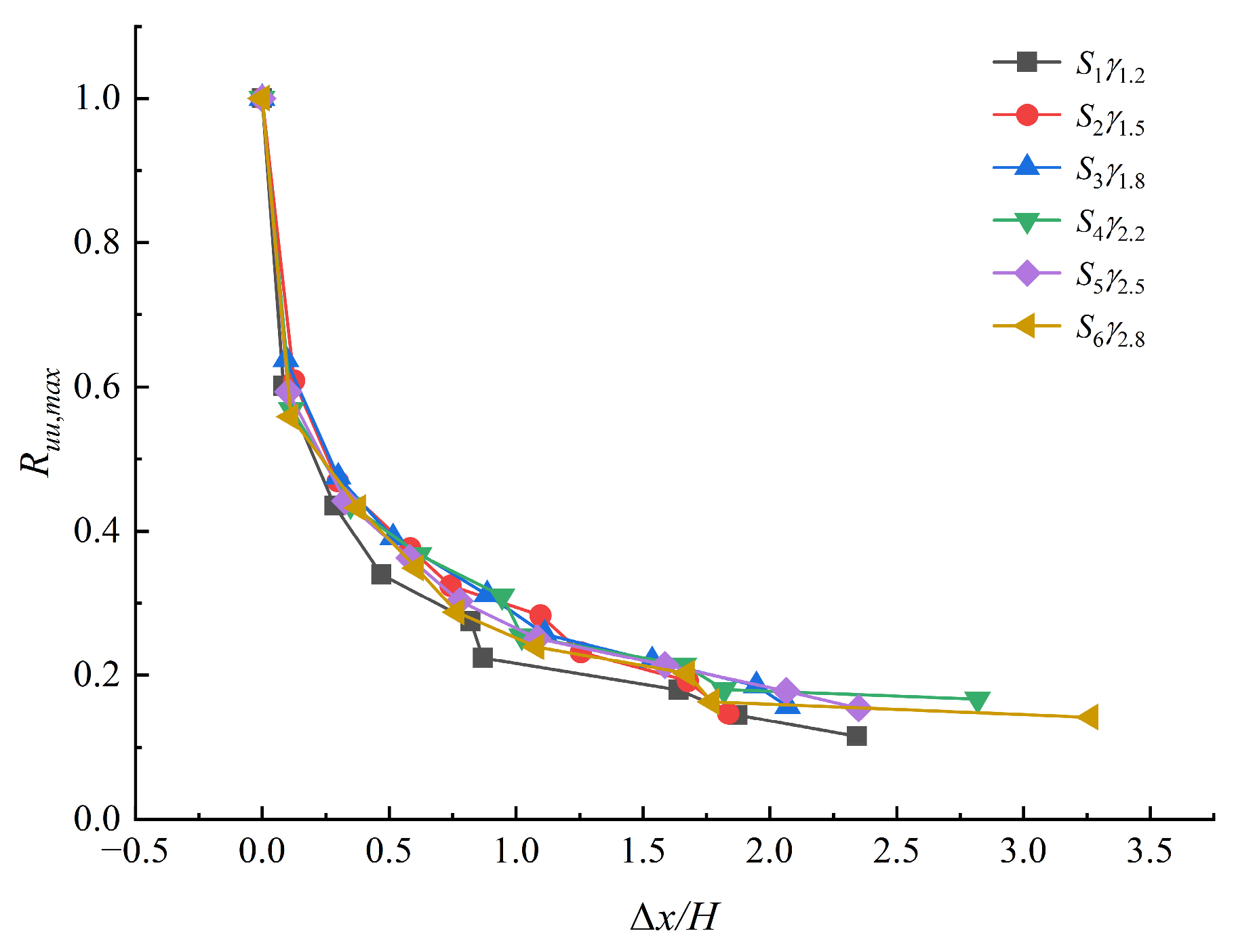
To further examine the effect of the relative water-depth-normalized separation distance ∆x/H on the peak value of Ruu under decelerating-flow conditions, the results are presented in Figure 12. In all cases, the peak Ruu decreases with increasing nondimensional distance. Although all flow parameters in a decelerating open-channel flow vary along the streamwise direction, normalizing the point separation as ∆x/H reduces the differences in peak Ruu among the six cross-sections. The peak Ruu values at different wall-normal positions and streamwise locations collapse well onto a common trend, demonstrating pronounced self-similarity. This self-similar behavior appears to be independent of the distance from the flume inlet.
Although decelerating open-channel flow exhibits gradual streamwise variations in mean velocity and flow depth and is therefore strongly nonuniform, its mean statistics and dominant coherent structures remain robustly self-similar after nondimensionalization. This observation is consistent with the findings of Zhang et al. [26], Williams et al. [27], and Pu et al. [28] for decelerating flows. Specifically, despite significant streamwise variations in mean velocity, turbulence intensity, and Reynolds stress, the wall-normal profiles at different streamwise sections show good overlap when normalized. Furthermore, the coherent structures exhibit comparable self-similar characteristics in terms of scale, intensity, and spatial distribution.

3.4. Power Spectral Density Analysis

The evolution of turbulent-structure scale distributions in decelerating flow is analyzed primarily using the premultiplied spectrum method, which characterizes turbulent-structure scales in a statistical-mean sense. The premultiplied wavenumber spectrum represents the distribution of mean fluctuation intensity per unit wavelength (or scale) contained in the signal. In a premultiplied wavenumber spectrum, a pronounced maximum in the low-wavenumber range indicates the presence of turbulent structures that contribute strongly to the overall fluctuation intensity. Therefore, premultiplied spectral analyses were performed on long-duration, high-frequency flow-field measurements at each cross-section.
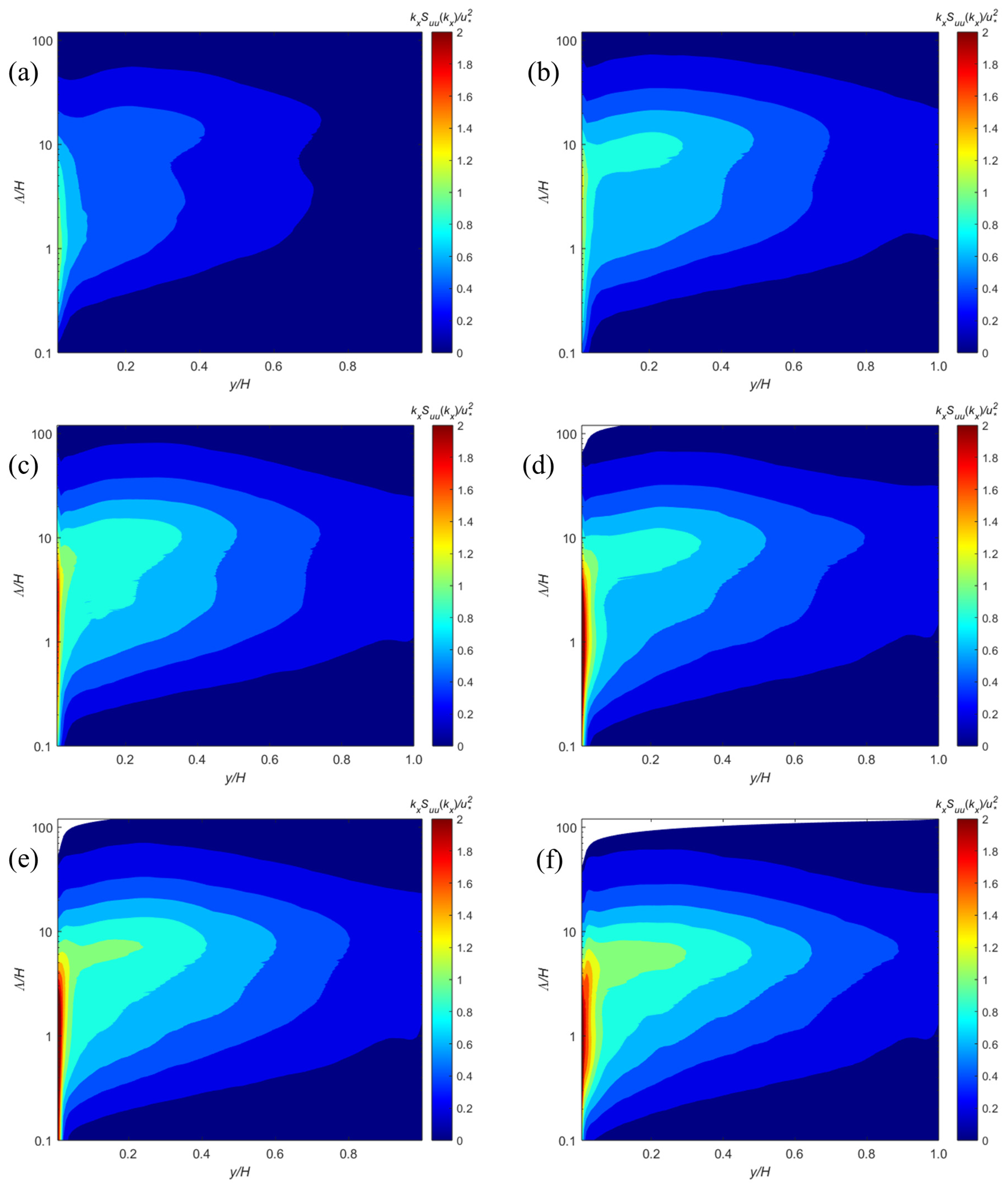
Turbulent-structure scales are commonly classified using λ/H = 3 as the threshold separating LSMs from VLSMs. The grouped panels in Figure 13 show the evolution of multiscale turbulent structures at different cross-sections and provide a direct visualization of LSMs and VLSMs.
Section S1γ1.2 exhibits behavior similar to that of uniform open-channel flow, with a bimodal distribution observed for y/H ≥ 0.2. Under decelerating-flow conditions, the premultiplied spectrum in the near-bed region also remains bimodal, with wavelengths in the range λ/H = 2.5–20, consistent with previous findings for uniform open-channel flows [4,25]. At S1γ1.2, the energetically dominant VLSM scale generally increases with water depth and then decreases, reaching a maximum at y/H = 0.6–0.7 with a wavelength of approximately 20H, whereas the LSM wavelength is approximately 2.5H.
For S3γ1.8 (Figure 13c), the bimodal VLSM signature remains evident for y/H ≥ 0.6, with VLSM scales reaching approximately 15H. In addition, a pronounced long-wavelength peak appears within λ/H = 8–15. The corresponding LSM wavelength is approximately 3H. At S6γ2.8 (Figure 13f), a single-peak distribution emerges at y/H ≥ 0.8, with a characteristic scale of approximately 7H. As γ increases from section S1γ1.2 to section S6γ2.8, the turbulent-structure scale distribution gradually transitions from bimodal to unimodal, accompanied by an increase in peak magnitude and a narrowing of the scale range. This trend indicates that, during downstream development of the decelerating flow, TKE becomes progressively concentrated from both very large and small scales toward intermediate scales.
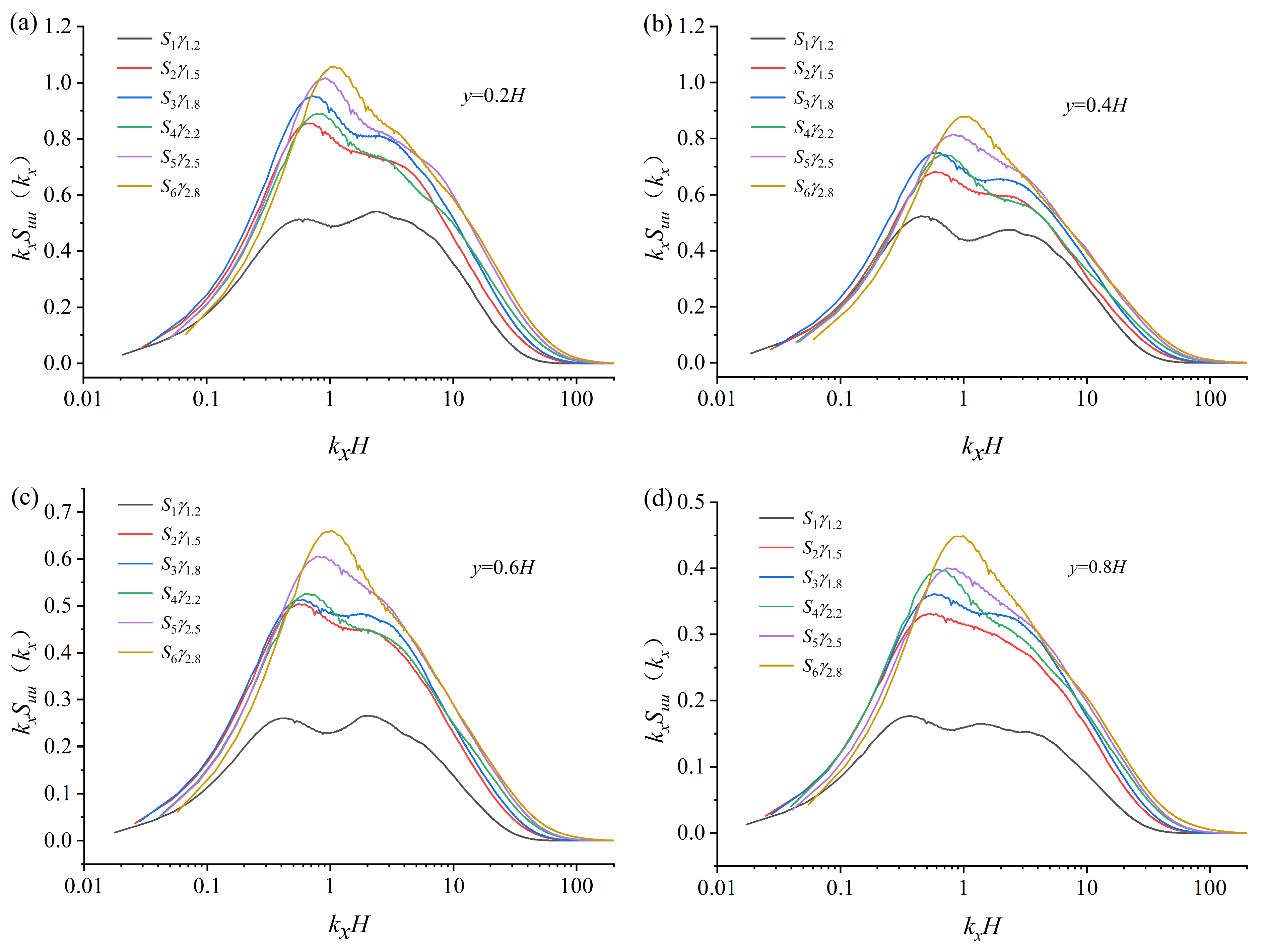
A comparison of the streamwise evolution of the premultiplied wavenumber spectra was performed at four relative depths (y/H = 0.2, 0.4, 0.6, and 0.8) as shown in Figure 14. At y/H = 0.2 (Figure 14a), the premultiplied spectrum at S1γ1.2 exhibits a bimodal distribution characteristic of near-uniform flow, and its spectral peaks are considerably lower than those at the other sections. In contrast, S6γ2.8 shows the strongest TKE, with the dominant peak concentrated around kxH = 1, corresponding to a turbulent-structure wavelength of λ/H ≈ 6.3.
At y/H = 0.2, the low-wavenumber peak locations (i.e., dominant energy-containing scales) for sections S1γ1.2S6γ2.8 are kxH = 0.58, 0.69, 0.74, 0.83, 0.92, and 1.08, respectively, corresponding to λ/H = 10.83, 9.11, 8.49, 7.57, 6.83, and 5.82. At y/H = 0.8, the corresponding low-wavenumber peak locations are kxH = 0.33, 0.52, 0.55, 0.59, 0.77, and 0.94, corresponding to λ/H = 19.04, 12.08, 11.42, 10.65, 8.16, and 6.69, respectively.
These results indicate that the characteristic turbulent-structure scale decreases overall in the downstream direction, whereas the dominant energy-containing scale increases with depth in the vertical direction. As the flow develops downstream, TKE increases progressively, suggesting that under decelerating-flow conditions, the active region of turbulent structures expands from the near-wall layer toward the outer region.
The vertical distribution of TKE further shows that near-wall TKE is considerably larger than that in the outer region: the maximum value is approximately 1.1 in the near-wall region, compared with about 0.4 near the free surface. The energy distributions in the low- and high-wavenumber ranges are relatively similar, whereas pronounced differences are observed in the intermediate-wavenumber range.
At y/H = 0.4 (Figure 14b), the premultiplied wavenumber spectrum at S1γ1.2 still exhibits a bimodal structure, although the peak magnitude is reduced. At y/H = 0.6 (Figure 14c), the dominant peak at S6γ2.8 remains concentrated around kxH = 1; its magnitude decreases substantially, but it is still higher than those at the other sections. At y/H = 0.8 (Figure 14d), the peaks decrease further. The spectrum at S1γ1.2 becomes flatter, whereas S6γ2.8 exhibits a sharper spectral peak across the entire wavenumber range. This behavior implies that the large-scale coherent structures at S6γ2.8 persist longer and are more resistant to dissipation, thereby maintaining relatively high energy levels, particularly at low wavenumbers. Overall, under decelerating nonuniform-flow conditions, large-scale structures are more readily sustained than in uniform flow.

4. Discussion

4.1. Evolution of Turbulent-Structure Scales in Decelerating Flow

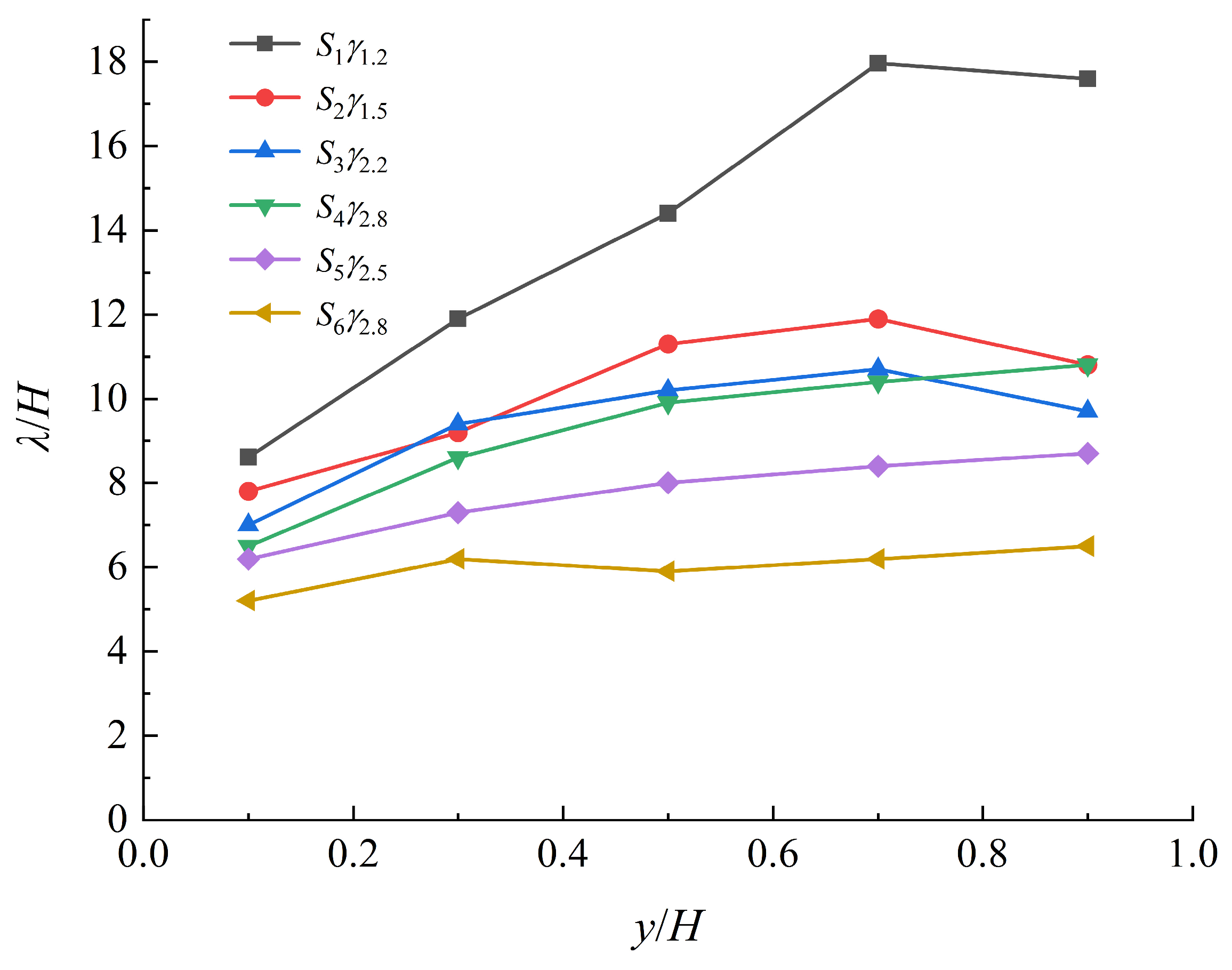
Multiscale organization is a fundamental feature of turbulent flows. Figure 15 shows the vertical distributions of the maximum-scale structures at the six measurement sections, from which consistent trends (from S1γ1.2 to S6γ2.8) can be observed. The curve for S1γ1.2 lies consistently above the others, indicating that the maximum turbulent-structure scale at this section is the largest. As the nonuniformity coefficient γ increases, the maximum-scale structure at each vertical position decreases. The curve for S6γ2.8 lies lowest, implying that the maximum turbulent-structure scale at this section is the smallest. The intermediate sections, S2γ1.5, S3γ1.8, S4γ2.2, and S5γ2.5, fall between these two extremes, reflecting pronounced differences in both the magnitude and growth rate of the maximum turbulent scale over depth.
As the flow develops in the streamwise direction, the characteristic scales of turbulent structures change considerably. The differences in the maximum structure scale at different depths along a given vertical become progressively smaller, indicating a tendency toward a more vertically uniform distribution of turbulent scales. Along the measurement vertical, the dominant energy-containing scale generally increases with depth. For sections S1γ1.2, S2γ1.5, and S3γ1.8, the dominant scale reaches a maximum at approximately 0.7H and then decreases slightly toward the free surface. In contrast, for sections S4γ2.2, S5γ2.5, and S6γ2.8, the dominant energy-containing scale increases monotonically with depth.

4.2. Energy-Transfer Processes of Turbulent Structures in Decelerating Flow

Previous studies have proposed that energy transfer among turbulent structures may follow a cascade process in which VLSMs break down into LSMs, which subsequently fragment into smaller scales until the smallest motions are dissipated by viscosity. This cascade paradigm can be traced back to Richardson’s seminal concept of the turbulent cascade [5], which posits that energy is injected at the largest eddy scales and, through instability-driven successive breakdown, is transferred down a self-similar hierarchy toward smaller scales, where it is ultimately removed by viscous dissipation.
Other studies have shown that an inverse pathway of energy transfer may also occur. Fjørtoft [29] demonstrated that, in two-dimensional incompressible inviscid flows, the simultaneous conservation of kinetic energy and enstrophy imposes stringent constraints on nonlinear interactions, implying that energy cannot be transferred exclusively toward smaller scales; therefore, a redistribution of energy toward larger scales must also occur. Based on this result, Kraichnan [30] proposed the dual-cascade theory for two-dimensional turbulence, in which, under forcing at intermediate scales, kinetic energy undergoes an inverse cascade toward larger scales, whereas enstrophy exhibits a forward cascade toward smaller scales. However, the present flow is a shallow, wall-bounded, free-surface flow rather than an ideal two-dimensional system. Therefore, the classical 2D inverse-cascade framework is invoked here only as a qualitative reference for possible quasi-two-dimensional tendencies, rather than as a strict dynamical description of the present flow.
In the present study of decelerating open-channel flow, the streamwise development reveals distinctive features in the scale distribution and energetic content of turbulent structures across the measurement sections. For instance, in the near-wall region (y/H = 0.2), the TKE at S1γ1.2 is the smallest among the sections, and the characteristic scale distribution exhibits a bimodal pattern. Downstream, the TKE increases progressively, while the energy becomes increasingly concentrated around the dominant (peak) structural scale. This trend indicates a redistribution of TKE from both very large and small scales toward intermediate scales. Such behavior may reflect partial scale reorganization associated with shallow-flow constraints and possible quasi-two-dimensional tendencies; however, because the flow remains strongly affected by the bed, sidewalls, and free surface, it should not be interpreted as direct evidence of a canonical two-dimensional inverse cascade.

5. Conclusions

In decelerating open-channel flow, both velocity and flow depth vary continuously in the streamwise direction. The inner-layer velocity profiles remain consistent with the logarithmic law. In the outer layer, however, the streamwise velocity in the wake region beyond the log layer progressively deviates from the log-law prediction as flow depth increases, with values marginally exceeding those predicted by the log law. Compared with uniform flow, decelerating flow is characterized by higher turbulence intensities and enhanced Reynolds-stress levels.
The spatial coherence of streamwise velocity fluctuations decreases progressively with increasing depth. During downstream development, however, the streamwise fluctuations remain highly correlated over relatively long separation distances, and this tendency becomes more pronounced as flow depth increases, indicating enhanced persistence of turbulent structures in decelerating flow. More importantly, when the separation distance is normalized by water depth as Δx/H, the peak correlation values at different elevations collapse well onto a single curve, revealing a self-similar vertical distribution of spatial coherence. This finding provides a unified scaling framework for characterizing the spatial organization of turbulent structures in decelerating open-channel flow.
As the nonuniformity coefficient γ increases, the scale distribution of turbulent structures evolves from bimodal to unimodal. During downstream development, TKE increases progressively, while turbulent energy is redistributed from very large and small scales toward intermediate scales, indicating a gradual concentration of energy over mid-range scales. This scale-redistribution behavior differs from the TKE and turbulent-structure scale distributions typically observed in uniform open-channel flow. These findings provide new insight into turbulence-scale redistribution in decelerating open-channel flow and may help improve turbulence modeling for nonuniform flow conditions. Moreover, the observed enhancement of streamwise coherence and the redistribution of turbulent energy toward intermediate scales provide useful physical constraints for turbulence closures and numerical validation in nonuniform decelerating shallow flows. These features may also affect mixing, sediment transport, and pollutant dispersion in backwater regions and related environmental hydraulic applications.

Author Contributions

Conceptualization, Q.M. and Y.W.; methodology, Q.M.; software, Q.M.; validation, Q.M., Y.W., J.H. and S.L.; formal analysis, Q.M.; investigation, Q.M.; resources, Q.M.; data curation, Q.M.; writing—original draft preparation, Q.M.; writing—review and editing, Q.M.; visualization, Q.M.; supervision, P.Z.; project administration, P.Z.; funding acquisition, P.Z. All authors have read and agreed to the published version of the manuscript.

Funding

This research was funded by the National Natural Science Foundation of China, grant number 52209080.

Data Availability Statement

The original contributions presented in this study are included in the article. Further inquiries can be directed to the corresponding author.

Acknowledgments

We would like to express our gratitude to the Chongqing Jiaotong University for providing laboratory facilities.

Conflicts of Interest

The authors declare no conflicts of interest.

References

  1. Bai, X.; Zhang, W.; Fang, Q.; Wang, Y.; Zheng, J.; Guo, A. The visualization of turbulent coherent structure in open channel flow. J. Hydrodyn. 2019, 31, 266–273. [Google Scholar] [CrossRef]
  2. Zhong, Q.; Li, D.; Chen, Q.; Wang, X. Coherent structures and their interactions in smooth open channel flows. Environ. Fluid Mech. 2015, 15, 653–672. [Google Scholar] [CrossRef]
  3. Nezu, I.; Nakagawa, H. Turbulence in Open-Channel Flows; Taylor & Francis: London, UK, 1993. [Google Scholar] [CrossRef]
  4. Zampiron, A.; Cerino, B.; Berni, C.; Proust, S.; Nikora, V.I. Very-large-scale motions in open-channel flow: Insights from velocity spectra, correlations, and structure functions. Phys. Fluids 2024, 36, 041707. [Google Scholar] [CrossRef]
  5. Richardson, L.F. Weather Prediction by Numerical Process; Cambridge University Press: Cambridge, UK, 1922. [Google Scholar]
  6. Xia, W.; Chen, H.; Wang, J.; Wu, H.; Shen, Q.; Chen, Y.; Yang, P.; Song, J.; Xiang, C. Fractal characteristics of turbulent flows in open channel. J. Hydroelectr. Eng. 2018, 37, 39–47. (In Chinese) [Google Scholar] [CrossRef]
  7. Liu, X.; Chong, T.H.; Law, A.W.K. Turbulence and coherent structures in fully developed open-channel flows beneath periodic surface submergence. Phys. Fluids 2025, 37, 115155. [Google Scholar] [CrossRef]
  8. Duan, Y.; Chen, Q.; Li, D.; Zhong, Q. Contributions of very large-scale motions to turbulence statistics in open channel flows. J. Fluid Mech. 2020, 892, A3. [Google Scholar] [CrossRef]
  9. Balakumar, B.J.; Adrian, R.J. Large- and very-large-scale motions in channel and boundary-layer flows. Philos. Trans. A Math. Phys. Eng. Sci. 2007, 365, 665–681. [Google Scholar] [CrossRef] [PubMed]
  10. Lee, J.; Ahn, J.; Sung, H.J. Comparison of large- and very-large-scale motions in turbulent pipe and channel flows. Phys. Fluids 2015, 27, 025101. [Google Scholar] [CrossRef]
  11. Good, G.H.; Warhaft, Z. On the probability distribution function of the velocity field and its derivative in multi-scale turbulence. Phys. Fluids 2011, 23, 095106. [Google Scholar] [CrossRef]
  12. Wang, Y.; Zhang, P.; Yang, S.; Hu, J.; Zeng, L. Study on the morphological characteristics of large-scale structures in open-channel flows based on tomographic particle image velocimetry. Phys. Fluids 2025, 37, 095128. [Google Scholar] [CrossRef]
  13. Shen, Y.; Yang, S.; Liu, J. Characteristics of very large-scale motions in rough-bed open-channel flows. Water 2023, 15, 1433. [Google Scholar] [CrossRef]
  14. Cerino, B.; Zampiron, A.; Proust, S.; Berni, C.; Nikora, V. Large and very large scale motions in open-channel flows over rough bed in the presence and absence of a mixing layer. Environ. Fluid Mech. 2024, 24, 1421–1442. [Google Scholar] [CrossRef]
  15. Stewart, R.L.; Fox, J.F. Role of macroturbulence to sustain turbulent energy in decelerating flows over a gravel bed. Geomorphology 2015, 248, 147–160. [Google Scholar] [CrossRef]
  16. Scarano, F. Iterative image deformation methods in PIV. Meas. Sci. Technol. 2002, 13, R1–R19. [Google Scholar] [CrossRef]
  17. Westerweel, J.; Scarano, F. Universal outlier detection for PIV data. Exp. Fluids 2005, 39, 1096–1100. [Google Scholar] [CrossRef]
  18. Zhang, P.; Duan, Y.; Li, D.; Hu, J.; Li, W.; Yang, S. Turbulence statistics and very-large-scale motions in decelerating open-channel flow. Phys. Fluids 2019, 31, 125106. [Google Scholar] [CrossRef]
  19. Baars, W.J.; Talluru, K.M.; Hutchins, N.; Marusic, I. Wavelet analysis of wall turbulence to study large-scale modulation of small scales. Exp. Fluids 2015, 56, 188. [Google Scholar] [CrossRef]
  20. Nezu, I.; Rodi, W. Open-channel flow measurements with a laser Doppler anemometer. J. Hydraul. Eng. 1986, 112, 335–355. [Google Scholar] [CrossRef]
  21. Dharmarathne, S.; Tutkun, M.; Araya, G.; Castillo, L. Structures of scalar transport in a turbulent channel. Eur. J. Mech. B Fluids 2016, 55, 259–271. [Google Scholar] [CrossRef]
  22. Sillero, J.A.; Jiménez, J.; Moser, R.D. Two-point statistics for turbulent boundary layers and channels at Reynolds numbers up to δ+ ≈ 2000. Phys. Fluids 2014, 26, 105109. [Google Scholar] [CrossRef]
  23. Tutkun, M.; George, W.K.; Delville, J.; Stanislas, M.; Johansson, P.B.V.; Foucaut, J.M.; Coudert, S. Two-point correlations in high Reynolds number flat plate turbulent boundary layers. J. Turbul. 2009, 10, N21. [Google Scholar] [CrossRef]
  24. Bross, M.; Scharnowski, S.; Kähler, C.J. Large-scale coherent structures in compressible turbulent boundary layers. J. Fluid Mech. 2021, 911, A2. [Google Scholar] [CrossRef]
  25. Cameron, S.M.; Nikora, V.I.; Stewart, M.T. Very-large-scale motions in rough-bed open-channel flow. J. Fluid Mech. 2017, 814, 416–429. [Google Scholar] [CrossRef]
  26. Zhang, P.; Duan, Y.; Zhong, Q.; Li, D.; Yang, S.; Hu, J.; Li, W. Self-similarity of spanwise rotational motions population trends in decelerating open-channel flow. Theor. Appl. Mech. Lett. 2022, 12, 100344. [Google Scholar] [CrossRef]
  27. Williams, P.; Roussinova, V.; Balachandar, R. Turbulence structure of non-uniform rough open channel flow. E3S Web Conf. 2018, 40, 05039. [Google Scholar] [CrossRef]
  28. Pu, J.H.; Tait, S.; Guo, Y.; Huang, Y.; Hanmaiahgari, P.R. Dominant features in three-dimensional turbulence structure: Comparison of non-uniform accelerating and decelerating flows. Environ. Fluid Mech. 2018, 18, 395–416. [Google Scholar] [CrossRef]
  29. Fjørtoft, R. On the changes in the spectral distribution of kinetic energy for two-dimensional, non-divergent flow. Tellus 1953, 5, 225–230. [Google Scholar] [CrossRef]
  30. Kraichnan, R.H. Inertial ranges in two-dimensional turbulence. Phys. Fluids 1967, 10, 1417–1423. [Google Scholar] [CrossRef]
Figure 1. Schematic of the 28 m experimental flume.
Water 18 00815 g001
Figure 2. Schematic of the streamwise water-level variation in decelerating open-channel flow.
Water 18 00815 g002
Figure 3. CMOS camera and laser emitter. (a) sketch of the PIV system and (b) scene photograph of the PIV system.
Water 18 00815 g003
Figure 4. Cross-sectional specific-energy profiles.
Water 18 00815 g004
Figure 5. Vertical profiles of streamwise velocity in decelerating open-channel flow.
Water 18 00815 g005
Figure 6. Time-averaged velocity profiles.
Water 18 00815 g006
Figure 7. Streamwise and vertical turbulence intensities.
Water 18 00815 g007
Figure 8. Streamwise evolution of relative turbulence intensity.
Water 18 00815 g008
Figure 9. Reynolds shear stress.
Water 18 00815 g009
Figure 10. Two-point streamwise velocity correlation (y/H = 0.1); inverted red triangles mark peak Ruu.
Water 18 00815 g010
Figure 11. Relationship between the peak two-point correlation of streamwise velocity fluctuations, Ruu,max, and separation distance ∆x at each section (y/H = 0.1).
Water 18 00815 g011
Figure 12. Relationship between the peak value of Ruu and relative flow depth.
Water 18 00815 g012
Figure 13. Premultiplied spectrum of the streamwise velocity (a) S1γ1.2 (H = 3.5 cm), (b) S2γ1.5 (H = 4.2 cm), (c) S3γ1.8 (H = 5.2 cm), (d) S4γ2.2 (H = 6.2 cm), (e) S5γ2.5 (H = 7.2 cm) and (f) S6γ2.8 (H = 8.1 cm), (contours plotted at intervals of 0.2).
Water 18 00815 g013
Figure 14. Streamwise evolution of the premultiplied wavenumber spectrum of streamwise velocity fluctuations (a) y/H = 0.2, (b) y/H = 0.4, (c) y/H = 0.6, (d) y/H = 0.8.
Water 18 00815 g014
Figure 15. Distribution of the maximum-scale structures over flow depth in decelerating open-channel flow.
Water 18 00815 g015
Table 1. Flow conditions a.
SectionX (m)JH (cm)γU (m/s)υ (10−6 m2/s)u* (cm/s)FrReReτ
S1γ1.23.550.00253.51.20.4390.8230.0250.7513,651849
S2γ1.57.550.00254.21.50.3660.8230.0210.5713,354746
S3γ1.811.50.00255.21.80.2950.8230.0170.4112,952708
S4γ2.216.40.00256.22.20.2480.8230.0140.3212,573732
S5γ2.5180.00257.22.50.2130.8230.0130.2512,216611
S6γ2.822.70.00258.12.80.1900.8230.0110.2111,911596
Note(s): a J denotes the channel-bed slope; H is the cross-sectional flow depth; γ = H/Hk is the nonuniformity coefficient; U is the cross-sectionally averaged velocity; υ is the kinematic viscosity; u* is the friction velocity; Fr is the Froude number; Re is the Reynolds number; and Reτ is the friction Reynolds number.
Table 2. PIV interrogation parameters b.
SectionΔx+Δy+y*Resolution (mm/pix)Image Size (Pixel)Frame Rate (Hz)Sampling Duration, t (s)Ut/H
S1γ1.216.5316.530.0300.062128 × 12007003664598
S2γ1.512.4012.400.0400.062128 × 14007005664930
S3γ1.89.739.730.0510.062128 × 140050014087989
S4γ2.28.708.700.0570.062128 × 160050011554621
S5γ2.56.446.440.0770.062128 × 160040016364842
S6γ2.85.705.700.0870.062128 × 160040020214742
Note(s): b Δx+ is the inner-scaled spacing in the streamwise direction; Δy+ is the inner-scaled spacing in the wall-normal direction; and y* = υ/u* is the viscous length scale in the inner layer.
Disclaimer/Publisher’s Note: The statements, opinions and data contained in all publications are solely those of the individual author(s) and contributor(s) and not of MDPI and/or the editor(s). MDPI and/or the editor(s) disclaim responsibility for any injury to people or property resulting from any ideas, methods, instructions or products referred to in the content.